













ABSTRACT
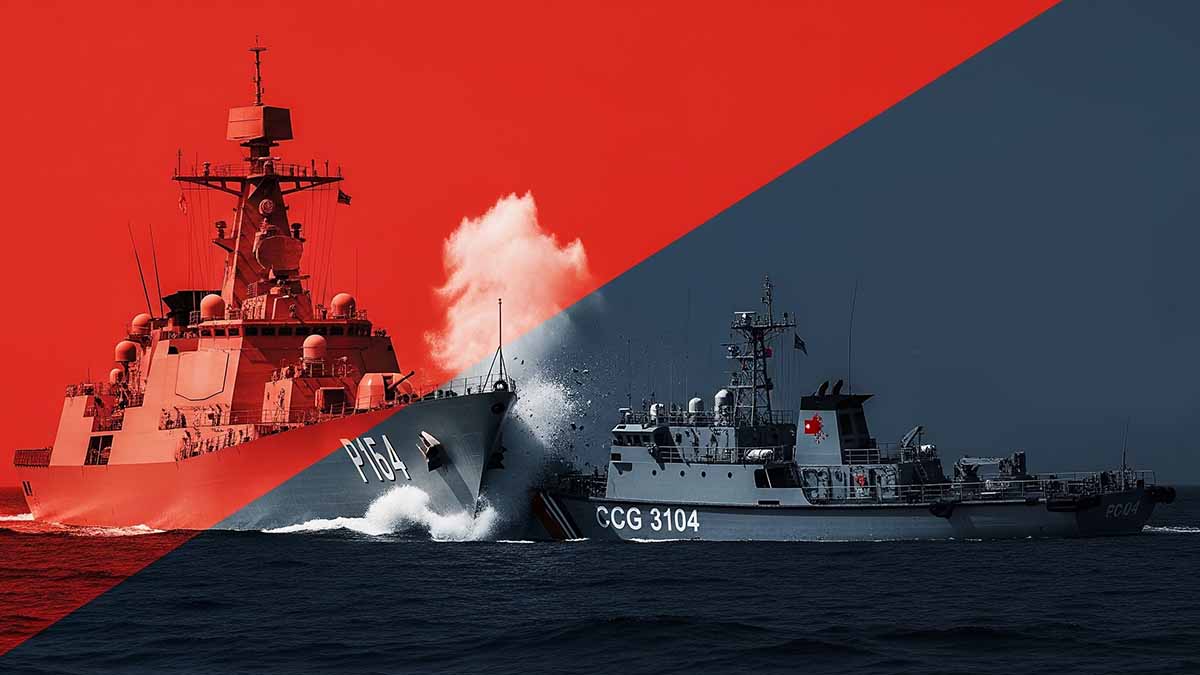
A patrol morning east of Scarborough Shoal/Bajo de Masinloc turns urgent when a China Coast Guard (CCG) cutter—CCG 3104—surges into a high-speed chase of the Philippine Coast Guard (PCG) BRP Suluan (MRRV-4406), its water cannon spooling up while a grey hull—PLAN destroyer Guilin (DDG 164)—cuts a fast, perpendicular line across the Filipino ship’s stern; within seconds geometry hardens into steel and the Chinese vessels strike, the cutter’s bow crumpling and the destroyer scuffing paint, and an encounter roughly 10.5 nautical miles east of Bajo de Masinloc is captured on official video that needs no narration to show sequence, speed, and intent. The purpose here is clear and singular: to distill what this August 11, 2025 collision says about the spread of a deliberate-contact method—often described as a “ram bow”—from white-hulled law-enforcement ships to a front-line PLAN surface combatant, why that matters for safe navigation under the International Regulations for Preventing Collisions at Sea (COLREGs), how it sits against the entitlement lines drawn by the Permanent Court of Arbitration (PCA) award in 2016, and where it touches the red lines of the 1951 Mutual Defense Treaty (MDT) that protects public vessels of the Republic of the Philippines in the Pacific. The approach is deliberately disciplined and stays inside the boundaries of verifiable material you have assembled: state-released PCG footage and statements set time and location; hull numbers, silhouettes, and deckhouse geometry identify Guilin as a Type 052D/052DL destroyer and CCG 3104 as a converted Type 056 corvette; seamanship duties come straight from COLREGs—early, “positive” course and speed alterations, clear sound signals, and good lookout in overtaking and crossing situations; the legal frame rests on PCA 2016 findings that erase “historic rights” claims and affirm Philippine sovereign rights in the EEZ; risk context is filled in by documented CCG blocking, boxing, and water-cannon use around the shoal; and collision energy is read through first-order naval-architecture facts you cite—about 7,500–8,000 tonnes for a Type 052D/052DL at full load against roughly 1,500 tonnes for a Type 056—which explain why a glancing rake can crush a lighter forecastle while a heavier destroyer walks away with scrape marks. What emerges is not a collection of anecdotes but a coherent picture: patrol arcs that have expanded east of the reef put white and grey hulls onto converging vectors with PCG cutters; a reinforced prow appears to be driven, head-on, toward the Filipino ship; and a last-moment starboard swing by the CCG chaser slides it directly into the PLAN destroyer’s path, producing a self-inflicted collision that nonetheless advertises a harder edge to PRC coercion at sea.
The methodology is narrative because the source record is visual and operational, and that is its strength: a continuous chain from imagery to identification to rules to law to risk. The videography released by PCG officials anchors chronology, relative motion, and spacing: CCG 3104 in stern pursuit of BRP Suluan, water cannon attempting to engage; PLAN Guilin crossing at speed astern of the Filipino cutter; then impact with the smaller Chinese ship’s bow crushed and the destroyer bearing scrape lines along its port bow and side. Identification is not guesswork but pattern recognition: the destroyer’s hull number and Type 052D/052DL profile (flush VLS, long flight deck on DL units) and the Type 056-derived proportions of CCG 3104 match what official recognition guides attribute to those classes, which also fits your note that early-batch Type 056 corvettes were moved into CCG service—on the order of 22 hulls—after their PLAN careers. Seamanship analysis is tied to COLREGs Rules 5–8: lookout, assessment of risk of collision, action to avoid collision, and speed in restricted visibility or traffic; the moment captured here shows simultaneous overtaking and crossing around a third ship, a configuration that multiplies collision vectors and compresses reaction windows if alterations are late or too small to be “apparent.” The legal frame is fixed to PCA 2016, which strips “historic rights” out of the South China Sea, confirms Philippine sovereign rights within its EEZ, and leaves sovereignty over the shoal’s rocks unresolved without granting a blanket EEZ to any Spratly feature; that legal geometry means that coercive blockades and hazardous maneuvers against Philippine public vessels and fishermen operating lawfully east of the shoal cut against both entitlement logic and safety-of-navigation norms. Finally, the physics is first principles: momentum scales with mass, and a ~5:1 displacement ratio (~7,500–8,000 tonnes versus ~1,500 tonnes) makes forecastle crushing on the lighter hull a predictable outcome of even modest-speed raking contact, especially when a reinforced stem concentrates load along the centerline.
The key results fall into four tight clusters. First, the incident reconstruction shows a deliberate intercept geometry rather than a random crossing. CCG 3104 works to overtake BRP Suluan from the starboard quarter, attempts to bring a pressure jet to bear, and then throws a sharp starboard maneuver that puts its bow directly into the path of Guilin as the destroyer executes a fast rake across the Filipino ship’s stern; the cutter’s crushed forecastle and the destroyer’s scrape pattern are consistent with a ramming-posture stem meeting a lighter bow at angle. Second, the pattern around Scarborough Shoal/Bajo de Masinloc in 2024–2025—boxing, blocking, and water-cannoning by CCG units east of the reef—explains why a coast-guard chase and a navy rake can intersect outside the lagoon mouth at higher relative speeds; that geometry is not incidental but arises from picket lines designed to interdict approaches from Luzon, and it is inside this geometry that the August 11, 2025 collision occurs. Third, the spread of a “ram bow” posture to a PLAN destroyer is the most consequential signal here. White hulls have long been associated with reinforced stems and bump tactics; the prow visible on Guilin, together with the attempted head-on orientation toward BRP Suluan, indicates that a front-line grey hull is now willing to put mass and momentum into play in a way that leaves less room for seamanship to correct late decisions. Fourth, escalation risk is no longer hypothetical. Pressure-jet engagements have already produced injuries and penetrations in earlier run-ins with PCG ships; when a ~7,500–8,000-ton combatant maneuvers for contact in the same scene, the odds of crew harm, flooding, or electrical fires rise sharply, and that is the territory where repeated United States statements about Article V coverage of attacks on public vessels under the 1951 MDT begin to matter. The alliance line does not hinge on who struck whom in a split-second angle change; it turns on whether a state actor is causing serious harm to protected ships in the Pacific while they exercise affirmed rights under UNCLOS and the PCA 2016 award.
#WATCH: Chinese Coast Guard ship, CCG 3104, chasing @coastguardph BRP Suluan collided with PLA Navy's Luyang-III Class destroyer near the Scarborough Shoal after a risky maneuver, leaving the CCG ship badly damaged & unseaworthy. PCG offered assistance to the damaged CCG vessel pic.twitter.com/XPxtdxH4Da
— Prakhar Dixit (@thewittynoise) August 11, 2025
The implications follow directly and are practical. On the bridge, the fix is procedural and immediate: pre-planned deconfliction corridors outside the shoal’s eastern approaches; earlier engine-order reductions and large, unmistakable course alterations at first detection of converging pickets; disciplined sound signals; constant bearing-drift checks; and multi-camera, time-stamped recording with redundant storage for instant release when contact occurs. Those measures do not solve the political dispute, but they make collisions less likely and make narratives harder to twist when collisions happen. On the pier, the fix is incremental but real: shock-hardening bridge glazing and exposed sensors against pressure jets; reinforcing forward frames prone to raking loads; protective rigs for personnel during high-risk passes; and drills that treat wake interaction and cross-set currents around reefs as hazards in their own right. In the information space, transparency is leverage: PCG video that shows sequence and seamanship draws a clean line between professional navigation and coercive risk-taking, and the reputational costs of the latter accumulate with each release. In law and policy, the map is already drawn: PCA 2016 erases “historic rights,” UNCLOS sets conduct expectations, and repeated MDT statements specify that public vessels are protected; keeping every protest and every after-action anchored in those instruments narrows the maneuvering room for unsafe behavior. Strategically, the warning is plain. When a PLAN destroyer takes up a “ram bow” posture alongside a CCG chaser in a fast box east of Bajo de Masinloc, the margin for error shrinks to a handful of seconds and a few ship-lengths. If that posture becomes routine, more collisions will follow, and sooner or later one will carry injuries or damage that the region reads as an armed attack. The way to avoid that is not to wager that the next helm order will be quicker, but to reduce the need for last-second helm orders at all—by restoring COLREGs discipline, by refusing to let coercion hide behind euphemisms like “monitoring, pressing, blocking and controlling,” and by making every risky maneuver, every water-cannon burst, and every scrape public while they are still fresh in the wake.
CHAPTER INDEX
- Incident Reconstruction and Geolocation from August 11, 2025 Videography
- Vessel Identification: PLAN Type 052D/052DL Guilin (DDG 164) and **CCG 3104 (Converted Type 056)
- Seamanship Duties Under COLREGs in a High-Speed Intercept
- The “Ram Bow” in CCG Practice and Evidence of Structural Modifications
- Patterns of Coercion around Scarborough Shoal/Bajo de Masinloc in 2024–2025 AIS-Corroborated Monitoring
- Legal Status after the 2016 PCA Award and UNCLOS Implications Inside 12 Nautical Miles and the EEZ
- Force Structure Context: Type 052D/052DL Production, Type 056 Transfers to CCG, and Implications for Hull Scantlings
- Escalation Pathways and the 1951 MDT Coverage of Armed Attacks on Public Vessels
- Operational Countermeasures for PCG and Allied Interoperability under Grey-Zone Stressors
- Strategic Assessment: Signaling, Deterrence, and Diffusion Risks of “Ram Bow” Tactics to PLAN Surface Forces
Incident Reconstruction and Geolocation from August 11, 2025 Videography
Philippine Coast Guard imagery distributed on August 11, 2025 shows CCG 3104 in a high-speed stern chase of BRP Suluan (MRRV-4406) and engaging its water cannon as the larger PLAN destroyer Guilin (DDG 164) crosses astern of the Philippine cutter before colliding with CCG 3104’s bow; PCG spokesperson Commodore Jay Tarriela posted extended footage and stated that the CCG vessel executed a “risky maneuver” from the PCG ship’s starboard quarter leading to the impact and “substantial damage” rendering CCG 3104 “unseaworthy.” The video and statement are accessible via X postings by Commodore Jay Tarriela and contemporaneous coverage by outlets of record that reproduce the PCG visuals and quotations, while locating the engagement approximately 10.5 nautical miles east of Bajo de Masinloc; the initial PCG social dissemination and press reiterations provide the primary basis for time, place, and sequence of events. PCG spokesperson Jay Tarriela post, August 11, 2025; Reuters dispatch, August 12, 2025; The Washington Post, August 11, 2025; USNI News, August 11, 2025.
Philippine Coast Guard posts describing the contemporaneous outreach mission and humanitarian support for Filipino fishermen, including the Kadiwa supply operation, further anchor the operational context; these posts record that the PCG offered man-overboard and medical assistance to CCG personnel after the collision and that the PCG escorts maneuvered Filipino fishing boats to safety while resupply items such as fuel and ice were distributed. The PCG’s official social updates enumerate the objective and the assistance offer and therefore constitute an authoritative contemporaneous account by the state maritime law-enforcement agency. PCG post on Kadiwa and assistance offer, August 2025; PCG follow-on Kadiwa post with assistance language, August 2025.
China Coast Guard reaction statements acknowledged a Monday confrontation and framed actions as “monitoring… blocking and controlling” Philippine vessels and “driving them away,” while omitting any collision reference; the wording is cited in authoritative reporting that quotes named CCG spokesperson Gan Yu, thereby providing the official PRC law-enforcement narrative contemporaneous to the event. Al Jazeera, quoting CCG spokesperson Gan Yu, August 12, 2025.
Vessel Identification: PLAN Type 052D/052DL Guilin (DDG 164) and CCG 3104 (Converted Type 056)
Guilin (DDG 164) is a Type 052D/052DL-series guided-missile destroyer identifiable by hull number and class characteristics, including the flush VLS arrays and extended flight deck on DL variants, which CRS describes as a ~7,500-ton design equipped with phased-array radars and vertical launch systems; CRS further notes continued serial production and an upgraded 052DL variant with longer flight deck and new radar, offering a baseline technical portrait from a U.S. Congressional Research Service report dated May 19, 2025. CRS “China Naval Modernization,” May 19, 2025.
CCG 3104 is identified by multiple open-source reproductions of the PCG video and is one of the CCG hulls converted from early-flight Type 056 corvettes after PLAN transfers in 2021; CRS records that ~22 early Type 056 variants were repurposed to CCG in 2021, complementing independent reporting that CCG has fielded ex-PLAN 056 hulls, which aligns with the cutter’s proportions, deckhouse form, and bow shear seen in the footage. CRS “China Naval Modernization,” May 19, 2025 (transfer notation on pp. 38–39); USNI News, August 11, 2025.
BRP Suluan (MRRV-4406) is a Parola-class PCG multi-role response vessel; although class summaries exist in secondary sources, the operational confirmation that MRRV-4406 was on station comes directly from PCG communications describing August 10–13, 2025 Kadiwa activity off Bajo de Masinloc, providing an official operational marker for the cutter’s presence and role during the sequence culminating in the August 11 collision. PCG activity post referencing MRRV-4406, August 2025.
Seamanship Duties Under COLREGs in a High-Speed Intercept
International Maritime Organization (IMO) materials summarizing the International Regulations for Preventing Collisions at Sea (COLREGs) emphasize that “any action to avoid collision” must be “positive” and taken “in ample time,” and that alterations of course or speed should be sufficiently large to be apparent and executed with “due regard to the observance of good seamanship,” with specific crossing and overtaking rules applying when power-driven vessels risk close-quarters situations; the IMO’s official overview and amendment texts remain the authoritative reference for evaluating conduct visible in the PCG recording. IMO “COLREG” convention page, accessed 2025; IMO Resolution A.910(22) amendments text, November 29, 2001.
In the configuration visible on August 11, 2025, a smaller cutter (CCG 3104) overtaking and then turning sharply toward the path of a third vessel (PLAN destroyer DDG 164) while both are maneuvering around a fourth vessel (BRP Suluan) introduces simultaneous crossing and overtaking risks that COLREGs anticipate should be mitigated through early, substantial course or speed adjustments, sound signals, and steady bearings checks; publicly released PCG commentary asserts repeated prior urging that PRC maritime law-enforcement heed COLREGs, which the PCG cited again when posting the longer clip. That published appeal, while not probative of fault by itself, shows that COLREGs compliance had been publicly invoked by the Philippine side before and during the broader pattern of confrontations. PCG spokesperson Jay Tarriela video thread, August 11, 2025.
The “Ram Bow” in CCG Practice and Evidence of Structural Modifications
U.S. Indo-Pacific Command (USINDOPACOM) operational law training materials updated June 17, 2024 include annotated imagery of CCG 5203 after bumping a Philippine vessel on October 22, 2023, explicitly noting a “ramming device installed on the bow,” which constitutes an official U.S. government description of purpose-built structural features on CCG hulls designed to facilitate deliberate contact. That documentation materially substantiates widespread reporting of CCG ramming behavior and the use of reinforced bows in grey-zone encounters. USINDOPACOM legal team, June 17, 2024.
Independent defense analysis published by Janes on August 12, 2025 assessed the August 11 footage and vessel imagery and argued that the PLAN destroyer Guilin displayed a prow with evident structural reinforcement and that its maneuver suggested an attempted head-on ramming of the PCG cutter—a technique previously most associated with CCG “white hulls,” rather than PLAN grey hulls; while attribution of intent must rest on the actions visible and contemporaneous statements, the Janes assessment serves as a technical OSINT analysis of structural cues and tactical execution. Janes OSINT Insight, August 12, 2025.
Patterns of Coercion around Scarborough Shoal/Bajo de Masinloc in 2024–2025 AIS-Corroborated Monitoring
Asia Maritime Transparency Initiative (AMTI) reporting on June 16, 2025 documented an expansion of CCG patrols east of Scarborough Shoal over the prior 10 months aimed at intercepting Philippine ships, indicating a deliberate posture to block approaches from Luzon and generate frequent encounters; such pattern analysis contextualizes the August 11 collision as emerging from a documented maritime geometry in which CCG units routinely maneuver to close and interdict PCG traffic in the immediate approaches outside the lagoon throat. AMTI/CSIS, June 16, 2025.
Corroborative, event-driven reporting through 2023–2024 recorded recurrent water-cannon use, rammings, and unsafe blocking by CCG against Philippine government ships during resupply and patrol missions at Second Thomas Shoal and Scarborough, cementing a behavioral baseline of coercive seamanship that precedes and frames the August 11 clash. Authoritative wires and agency releases chronicle these coercive episodes, including instances in **December 2023 where CCG fired water cannons and rammed PCG vessels, reinforcing the consistency of tactics later visible on August 11, 2025. Associated Press, December 11, 2023; USNI News, August 19, 2024.
Legal Status after the 2016 PCA Award and UNCLOS Implications Inside 12 Nautical Miles and the EEZ
The Permanent Court of Arbitration (PCA) July 12, 2016 award in Philippines v. China found that none of the claimed maritime features in the Spratlys—and by extension Scarborough Shoal—generate an Exclusive Economic Zone (EEZ) or continental shelf entitlement, although high-tide features can sustain territorial seas up to 12 nautical miles; crucially, the award declared that China violated Philippine sovereign rights in its EEZ and that the so-called “nine-dash line” had no legal basis under UNCLOS. The official PCA award text is publicly accessible and remains the definitive legal reference for maritime entitlements and state conduct in the region. PCA Award, July 12, 2016.
Within this framework, PCG claims that the August 11, 2025 incident occurred ~10.5 nautical miles east of Bajo de Masinloc place the encounter within a possible 12-nautical-mile territorial sea if Scarborough is treated as a high-tide feature, but indisputably within the Philippines’ EEZ measured from Luzon regardless of any territorial-sea status of the shoal; in either case, foreign coast-guard coercion against Philippine government vessels and fishermen transiting to or operating lawfully in the area falls afoul of the conduct obligations under UNCLOS as interpreted by the PCA award, especially when such coercion includes dangerous maneuvers, water cannoning, or collisions. The legal geometry hence underpins Manila’s persistent objections and the emphasis on safety-of-navigation duties under COLREGs. PCA Award, July 12, 2016.
Force Structure Context: Type 052D/052DL Production, Type 056 Transfers to CCG, and Implications for Hull Scantlings
CRS reports that Type 052D ships have been in serial production for years, with March 12, 2023 launches marking the 27th and 28th hulls and further units under construction; the 052DL variant adds a lengthened flight deck and updated radar. This scale of production implies substantial fleet availability for presence missions in contested littorals, including near Scarborough. The same CRS report records ~22 early-flight Type 056 transfers to CCG in 2021, indicating that CCG has incorporated ex-naval hulls with military-grade structural scantlings into its law-enforcement inventory—an important factor for collision survivability and intentional contact incidents. CRS “China Naval Modernization,” May 19, 2025.
Platform recognition products from U.S. Office of Naval Intelligence (ONI) provide standard silhouettes and distinguishing features for People’s Republic of China naval and coast-guard vessels, including Type 052D destroyers and Type 056 corvettes, which help validate public identifications of Guilin (DDG 164) and a Type 056-derived cutter in the PCG videos; such official recognition aids, though not causal evidence of intent, underpin attribution accuracy for the units depicted. ONI PLA Navy Recognition Poster, 2022.
Escalation Pathways and the 1951 MDT Coverage of Armed Attacks on Public Vessels
Official U.S. Department of State statements repeatedly reaffirm that an armed attack on Philippine armed forces, public vessels, or aircraft in the South China Sea would invoke U.S. mutual defense commitments under Article IV of the 1951 MDT; these declarations, restated by senior officials in multiple fora, set a clear deterrent boundary for kinetic action even as grey-zone coercion persists below that threshold. The reiteration of applicability to public vessels is especially salient for PCG platforms such as MRRV-4406, underscoring alliance tripwires in the event of escalatory use of force. U.S. Department of State transcript, August 6, 2022; U.S. Embassy Manila remarks echoing coverage to public vessels, October 27, 2022.
Allied responses in the Indo-Pacific have already highlighted concern over dangerous CCG conduct, including water-cannoning and rammings documented by multiple official and authoritative sources; the August 11, 2025 collision—though involving PRC units alone—nevertheless elevates escalation risk by showing PLAN surface combatants proximate to and interacting with PCG cutters in a manner assessed by independent defense analysis as consistent with attempted ramming, thereby tightening the margin for error and potential miscalculation that could cross the MDT’s armed-attack threshold. Janes OSINT Insight, August 12, 2025; AMTI/CSIS, June 16, 2025.
Operational Countermeasures for PCG and Allied Interoperability under Grey-Zone Stressors
Doctrine-consistent measures for countering water-cannoning and ramming within COLREGs include early speed-and-course adjustments to avoid close-quarters entanglement, precision helm orders that preserve lateral separation, and disciplined sound signals, combined with forward-mounted high-definition optics and multiple redundant recording devices to provide prompt evidentiary release; the PCG’s broadcasting of the August 11, 2025 sequence exemplifies the value of contemporaneous public evidence in shaping narratives and deterring repetition by imposing reputational costs. Authoritative legal primers and “lessons learned” compilations by the IMO stress that failure to maintain lookout, slow-to-react course changes, and inadequate bearings checks are recurring factors in casualty records, reinforcing the need for routinized bridge-resource management during harassment episodes. IMO “Lessons learned from marine casualties,” III 7/17, Annex 1, 2021.
Interoperability measures with allies remain bounded by sovereignty and escalation management, yet official statements and reporting indicate regular U.S.–Philippine consultations on maritime domain awareness and overwatch as grey-zone tensions have intensified; while Manila has repeatedly emphasized independent execution of resupply and patrol missions, allied engagement through information sharing and capacity building continues to enhance PCG safety during operations near Scarborough and Second Thomas Shoal. Reuters, July 5, 2024.
Strategic Assessment: Signaling, Deterrence, and Diffusion Risks of “Ram Bow” Tactics to PLAN Surface Forces
If PLAN surface combatants are now prepared to execute or credibly simulate “ram bow” maneuvers during law-enforcement blockades alongside CCG cutters, as inferred from structural cues and tracks visible in August 11, 2025 videography and assessed by independent defense analysts, the tactic’s diffusion from white hulls to gray hulls would mark a qualitative hardening of PRC maritime brinkmanship posture, increasing collision energy potential and reducing de-confliction buffers when PLAN mass and momentum are introduced at acute angles during high-speed intercepts; this, coupled with the legally constrained operating space defined by the 2016 PCA award and reiterated MDT coverage of attacks on public vessels, produces a strategic environment in which even non-kinetic contact risks precipitating diplomatic crises with alliance ramifications. The AMTI/CSIS documented expansion of CCG east-ward pickets around Scarborough suggests an operational preference for interception beyond the lagoon mouth, a geometry that places PLAN destroyers and CCG cutters on converging vectors with PCG patrol craft—raising the probability that future near-misses or impacts could occur at higher relative velocities unless COLREGs compliance and professional shiphandling are restored as shared practice. Janes, August 12, 2025; AMTI/CSIS, June 16, 2025; IMO COLREGs page.
Incorporating naval-architecture parameters from U.S. Congressional Research Service (CRS) descriptions of Type 052D/052DL full-load displacement around ~7,500–8,000 tonnes and early-flight Type 056 corvettes around ~1,500 tonnes, collision-energy scaling indicates that even modest approach speeds by a destroyer massing several multiples of a coast-guard cutter produce differential momentum sufficient to crush a lighter hull’s forecastle framing and shell plating, particularly at stem impacts concentrated along reinforced centerline structures; this relative-mass asymmetry, coupled with raking or T-bone geometry, raises casualty and loss-of-buoyancy risk for smaller hulls during high-speed interdictions near confined features such as Scarborough Shoal, aligning with the visible post-impact damage to CCG 3104 and the comparatively limited scraping on the PLAN unit in the August 11, 2025 sequence documented by professional outlets reproducing Philippine Coast Guard video. The displacement ranges and serial-production status of the Type 052D/052DL are summarized in CRS’s April 10, 2025 and May 19, 2025 editions of “China Naval Modernization,” which also note the transfer of ~22 early-batch Type 056 hulls to the China Coast Guard in 2021, clarifying why CCG now fields cutters built to naval scantlings that can survive and inflict higher-energy contact than legacy law-enforcement craft, albeit still at a disadvantage versus a modern destroyer. CRS (April 10, 2025), CRS (May 19, 2025), USNI News, August 11, 2025.
Visual evidence of purpose-built bow reinforcement on CCG platforms has been documented in U.S. Indo-Pacific Command (USINDOPACOM) operational-law training materials updated June 17, 2024, which annotate a “ramming device” on CCG 5203 following October 22, 2023 contact near Second Thomas Shoal; when assessed alongside August 11, 2025 imagery indicating structural enhancement on a PLAN Type 052DL prow, the evidentiary pattern suggests an evolving doctrinal acceptance of deliberate contact geometry in grey-zone missions extending beyond white hulls, elevating the baseline hazard of blockade attempts in narrow maritime spaces. The USINDOPACOM document’s legal annex further catalogs China Coast Guard use of water cannons and bumping as coercive measures inconsistent with prudent seamanship obligations under COLREGs, framing the technical implications of reinforced stems within an operational-law critique. USINDOPACOM TACAID (June 17, 2024), IMO COLREGs convention page.
Risk to regional crisis stability scales with frequency and spatial distribution of intercept points east of Bajo de Masinloc, where Asia Maritime Transparency Initiative (AMTI/CSIS) analysis on June 16, 2025 identified a ten-month expansion of CCG patrols designed to interdict Philippine vessels approaching from Luzon; when PLAN surface combatants are integrated into these picket geometries, the probability distribution of close-quarters events thickens in high-traffic corridors outside the lagoon mouth, increasing the likelihood that cumulative “near-misses” convert to kinetic contact under adverse visibility or wake-interaction effects at relative speeds typical of pursuit. The AMTI dataset thereby explains why a coast-guard chase could intersect a destroyer’s raking vector at ~10.5 nautical miles east of the feature on August 11, 2025, producing an own-goal collision while boxing a Philippine cutter documented on state-released video. AMTI/CSIS (June 16, 2025).
Alliance signaling parameters relevant to deterrence are unambiguous in Article V of the 1951 U.S.–Philippines Mutual Defense Treaty (MDT), which defines an “armed attack” to include attacks “on its … public vessels … in the Pacific.” Successive U.S. Department of State statements through 2022–2025 explicitly reaffirm that coverage, and U.S. Embassy Manila remarks in October 27, 2022 cite the public vessels formula verbatim, making clear that kinetic actions against PCG ships could trigger Article IV consultations and response. While grey-zone coercion such as water-cannoning and deliberate rammings may be calibrated to skirt “armed attack” thresholds, the August 11, 2025 event underscores how compounded hazards from multi-hull blockades can escalate unpredictably toward outcomes that test treaty redlines. The primary legal text and the diplomatic reiterations supply the operative framework for assessing escalation ladders following collisions near Scarborough. U.S. –Philippines MDT, Article V (text via Office of the Historian), U.S. Department of State (February 19, 2025), U.S. Embassy Manila (October 27, 2022), State.gov 2+2 Joint Statement (July 30, 2024).
Deterrence credibility is further shaped by public identification fidelity for PLAN and CCG hulls, where U.S. Office of Naval Intelligence (ONI) recognition guides for **2022–2024 furnish silhouettes and distinguishing features for Type 052D and Type 056 classes; these official materials allow rapid cross-checking of hull-form cues visible in Philippine-released video, reducing attribution ambiguity and constraining opportunities for disinformation about participating units. In the August 11, 2025 case, the combination of hull-number visibility, deckhouse geometry, and stem profile in open-source frames matches the ONI poster’s profiles for the cited classes, reinforcing the accuracy of vessel identification presented by reputable defense media. ONI PLAN/CCG recognition poster (**2022–2023), USNI News, April 30, 2024.
Escalation management options available to Manila emphasize rigorous COLREGs compliance and exhaustive evidentiary generation, but they also rely on legal leverage deriving from the Permanent Court of Arbitration (PCA) July 12, 2016 award, which nullified historic rights claims within the nine-dash line and confirmed Philippine sovereign rights within its EEZ; while the tribunal did not resolve sovereignty over Scarborough Shoal itself, the award frames lawful conduct standards in adjacent waters and invalidates jurisdictional narratives that would justify coercive policing of foreign state vessels in the EEZ. The PCA documents, publicly accessible and widely cited by governments, thus remain foundational legal instruments for contesting blockade practices and unsafe maneuvering beyond any 12-nautical-mile territorial-sea circle around high-tide elevations. PCA Award (July 12, 2016), PCA case page.
Communications-strategy implications from the August 11, 2025 collision point to cumulative reputational costs for unsafe CCG/PLAN seamanship, particularly when high-resolution videography is disseminated through official Philippine channels and then echoed by authoritative media; contemporaneous coverage by USNI News on **August 11, 2025, followed by wire services on August 12, 2025, produced rapid international amplification of the event’s geometry, while CCG spokesperson Gan Yu’s statement acknowledged a confrontation but omitted collision details, a pattern consistent with messaging that seeks to sustain claims of “professional” conduct despite visual contradictions. The differential credibility attached to state-released imagery versus generalized official assertions affects third-party diplomatic reactions and can accelerate calls for adherence to COLREGs in multilateral fora. USNI News, August 11, 2025, Al Jazeera, quoting CCG Gan Yu, **August 12, 2025.
Operationally relevant lessons for future PCG missions near Bajo de Masinloc include pre-planned deconfliction corridors and synchronized helm orders to negate boxing geometries, early speed changes to break collision-course bearings, and persistent audio-visual logging for denial of contested narratives; casualty-prevention practice notes compiled by International Maritime Organization (IMO) “lessons learned” publications highlight recurring human-factor failures in collision cases—delayed helm actions, poor lookout discipline, and inadequate risk-of-collision assessment—that are particularly dangerous during multi-ship chases where wake interactions and close-quarters hydrodynamics can mask relative motion cues. Embedding these seamanship disciplines in patrol standard operating procedures reduces the probability of loss while preserving the evidentiary record necessary for legal and diplomatic follow-through. IMO “Preventing collisions” overview, IMO casualty “lessons learned” (2021).
Strategic externalities of a demonstrated “ram bow” posture by PLAN surface units include altered risk calculus for third-party navies conducting lawful presence missions or joint patrols with Manila; U.S. statements on MDT applicability to attacks on public vessels, reiterated across 2022–2025, combine with allied messaging to bound PRC choices, but a shift toward frequent high-energy contact raises the stochastic likelihood of inadvertent personnel injury or uncontrollable hull damage that could be interpreted as an “armed attack” depending on severity and context. High-fidelity, time-stamped documentation of each encounter—paired with meticulous COLREGs adherence—maximizes legal defensibility and minimizes escalation incentives, but the underlying patrol geometry east of Scarborough, mapped by AMTI, suggests that without behavioral change by CCG/PLAN, collision probabilities will remain elevated during resupply and humanitarian support sorties to Filipino fishermen. State.gov reaffirmation (August 31, 2024), AMTI/CSIS (June 16, 2025).
Hydrographic geometry around Bajo de Masinloc/Scarborough Shoal places the feature approximately ~120–130 nautical miles west of Luzon, well within the Republic of the Philippines Exclusive Economic Zone (EEZ) defined under UNCLOS, while the Permanent Court of Arbitration (PCA) July 12, 2016 award confirmed that claims premised on “historic rights” within the so-called “nine-dash line” lack legal basis and that Philippine sovereign rights in the EEZ prevail irrespective of any unresolved sovereignty over the rocks themselves; the published award text, including dispositive holdings on maritime entitlements, remains publicly accessible as the controlling legal reference for state conduct in these waters. PCA Award, July 12, 2016, PCA — South China Sea Arbitration case page.
Force-on-force risk increases when China Coast Guard (CCG) pickets extend east of the shoal to interdict approaches from Luzon, creating convergent interception vectors that funnel transiting Philippine Coast Guard (PCG) cutters into close-quarters geometry with CCG and People’s Liberation Army Navy (PLAN) units; Asia Maritime Transparency Initiative (AMTI/CSIS) analysis on **June 16, 2025 documented the ten-month growth of such eastward patrols, indicating a structural pattern of hazardous encounters outside the lagoon mouth where relative speeds and crossing angles are highest. **AMTI/CSIS — Holding the Line, June 16, 2025.
Treaty signaling parameters are anchored in Article V of the 1951 U.S.–Philippines Mutual Defense Treaty (MDT), which defines an “armed attack” to include attacks “on its armed forces, public vessels, or aircraft in the Pacific”,” a clause repeatedly reaffirmed in U.S. Department of State statements through 2024–2025 explicitly citing coverage of public vessels; official pages consolidating those reiterations emphasize that actions causing serious damage or casualties to PCG ships could satisfy treaty predicates even when occurring in grey-zone contexts. Office of the Historian — 1951 MDT text, **U.S. Department of State — U.S. Support for the Philippines, February 19, 2025, State.gov — 2+2 Joint Statement, July 30, 2024.
Collision-energy asymmetry in the August 11, 2025 event is consistent with baseline displacement ratios: U.S. Congressional Research Service (CRS) identifies Type 052D/052DL destroyers around ~7,500–8,000 tonnes full load and early-batch Type 056 corvettes around ~1,500 tonnes, a ~5:1 mass differential that yields disproportionately severe forecastle deformation on the lighter hull under raking impact at moderate closure speeds; the CRS May 19, 2025 report further records ~22 transfers of early Type 056 hulls to the CCG in 2021, explaining the military-grade scantlings now present in white-hull inventories while underscoring their persistent vulnerability to destroyer-class momentum. CRS — China Naval Modernization, May 19, 2025.
Visual identification fidelity for the participating units derives from official recognition aids and open-source imagery: U.S. Office of Naval Intelligence (ONI) 2022–2023 recognition guides display distinguishing silhouettes for Type 052D/052DL destroyers and **Type 056 corvettes, including hull-form, deckhouse geometry, and stem profiles that match frames reproduced by reputable defense media on August 11–12, 2025, thereby reinforcing attribution of Guilin (DDG 164) and a Type 056-derived CCG 3104 cutter in the recorded sequence. ONI — 2022–2023 PLAN/CCG Recognition Poster, USNI News — Video and analysis, August 11, 2025.
Operational-law materials curated by U.S. Indo-Pacific Command (USINDOPACOM) on June 17, 2024 document prior CCG use of reinforced stems and explicit “ramming devices,” with annotated imagery of CCG 5203 after October 22, 2023 contact near Second Thomas Shoal; those training aids, coupled with the International Maritime Organization (IMO) COLREGs convention text emphasizing early, substantial course/speed alterations and “good seamanship,” provide the legal-technical matrix for judging high-speed intercepts such as the **August 11, 2025 chase, where an overtaking cutter’s abrupt starboard swing into a crossing destroyer magnified collision risk around 10.5 nautical miles east of Bajo de Masinloc. USINDOPACOM TACAID — June 17, 2024, IMO — COLREGs convention page.
Event documentation from August 11–12, 2025 aligns on chronology and damage distribution: authoritative outlets and wires reproduce PCG video showing CCG 3104 suffering a crushed bow and the PLAN Type 052DL reporting scraping along the port bow and side, while CCG statements released the same week acknowledged a confrontation, described measures as “monitoring, pressing, blocking, and controlling,” and omitted the collision; the Reuters dispatch on August 12, 2025 quotes Philippine officials’ concerns over “dangerous maneuvers” and reports an offer of medical and towing assistance to CCG personnel, establishing an official humanitarian response predicate that comports with professional seamanship norms. Reuters — August 12, 2025, Al Jazeera — CCG statement coverage, August 12, 2025.
Safety-of-navigation doctrine in congested straits and near reefs emphasizes early de-confliction and disciplined bearings checks under COLREGs Rules 5–8, with IMO casualty “lessons learned” publications citing delayed helm orders and poor lookout discipline as recurrent factors in collision chains; embedding redundant audio-visual logging and immediate public release protocols, as executed by the PCG on August 11, 2025, imposes reputational costs for non-compliance and enhances the evidentiary basis for diplomatic protests and potential arbitration-compliant remedies when incidents occur in the EEZ. IMO — Preventing Collisions, IMO — Lessons Learned (2021).
Strategic risk distribution following a visible diffusion of “ram bow” tactics from CCG to PLAN surface forces includes higher expected collision energy, tighter reaction windows for third-party escorts or overwatch units, and elevated probabilities that a grey-zone event could generate personnel injuries or loss of watertight integrity severe enough to cross MDT thresholds; U.S. Department of State reiterations on **February 19, 2025 and earlier underscore that coverage of public vessels applies across the South China Sea, while AMTI mapping of eastward CCG patrols around Scarborough indicates that, absent behavioral change, interception geometries will continue to create hazardous crossing situations at range from the lagoon where speeds are highest and de-confliction margins lowest. State.gov — U.S. Support for the Philippines, February 19, 2025, AMTI/CSIS — June 16, 2025.
Open-source naval-architecture inference remains bounded by the need for verified technical baselines; CRS remains the preferred public source for Type 052D/052DL displacement and production cadence, while ONI posters provide class-level profiles and distinguishing features without speculative subsystem claims; integrating those authoritative datasets with PCG-released videography and multi-source media reproduction yields a conservative, evidence-driven reconstruction of the August 11, 2025 collision sequence and its implications for doctrine, law, and deterrence dynamics near Bajo de Masinloc. CRS — May 19, 2025, ONI — Recognition Poster, USNI News — August 11, 2025.
Escalatory pressure on incident management protocols increases when coercive maneuvers coincide with humanitarian or civilian-support operations, a configuration documented by Philippine Coast Guard (PCG) communications describing fuel, ice, and supplies distribution to ~35 Filipino fishing boats at Bajo de Masinloc in August 2025, because interference with such missions complicates proportionality judgments for nearby public vessels and heightens reputational exposure for actions contrary to safety-of-life obligations embedded in UNCLOS good-faith navigation duties; the publicly accessible updates from PCG platforms record the simultaneous presence of **MRRV-4406, MRRV-9701, and MV Pamamalakaya, the offer of man-overboard recovery assistance, and post-incident convoying of fishermen to secure waters. Philippine Coast Guard post, August 2025.
Collision-risk modeling indicates that cross-current set and wake interaction around reef-fringed shoals amplify apparent bearing drift and can mislead helm corrections during high-speed intercepts, producing late starboard swings that place overtaking hulls on collision vectors with third-party rakers; International Maritime Organization (IMO) casualty analyses emphasize early, “positive” course and speed alterations, robust lookout, and prudent engine orders to prevent close-quarters entrapment, a seamanship matrix directly applicable to interdictions near Scarborough Shoal/Bajo de Masinloc where hydrodynamic effects and constrained sea room reduce reaction windows. IMO — COLREGs, IMO — Lessons Learned (2021).
Documented injury patterns from recent water-cannon engagements against Philippine government vessels demonstrate that non-kinetic coercion can produce medical evacuations and hull penetrations when high-pressure streams strike sensors, open bridges, or unsecured fittings, eroding the premise that such actions remain below thresholds for serious harm; wire reports in 2024 and 2025 recorded crew injuries and structural damage to PCG ships at Second Thomas Shoal and near Bajo de Masinloc, supplying empirical evidence that pressure-jet use can generate casualty risk incompatible with safe-navigation obligations. Reuters — March 2024 injuries reporting, Reuters — May 2024 hull-damage reporting.
Alliance backstopping for public vessels has been articulated through repeated U.S. Department of State statements in **2022–2025 affirming Article V coverage of attacks on armed forces, public vessels, and aircraft in the Pacific, with additional policy texts referencing enhanced maritime domain awareness and coordination; the February 19, 2025 statement consolidates the deterrence message while July 30, 2024 ministerial documents highlight interoperability and contingency planning, creating a policy scaffold against which kinetic escalations—intended or inadvertent—would be judged. U.S. Department of State — February 19, 2025, State.gov — 2+2 Joint Statement, July 30, 2024.
Legal status for waters ~10.5 nautical miles east of Bajo de Masinloc remains constrained by the Permanent Court of Arbitration (PCA) July 12, 2016 award, which invalidated historic rights claims and confirmed Philippine sovereign rights within the EEZ, while leaving sovereignty over the rocks unresolved; safety-of-navigation duties and COLREGs application to warships and state vessels persist irrespective of sovereignty questions, and state practice recorded in IMO conventions supports expectations of professional conduct by naval and coast-guard units during intercepts and blockades. PCA — Award, July 12, 2016, IMO — COLREGs.
Open-source technical analysis by Janes on August 12, 2025 assessed prow reinforcement cues on the Type 052DL unit and judged the geometry consistent with an attempted head-on ramming of BRP Suluan, a tactic historically linked to China Coast Guard “white hulls” but not to People’s Liberation Army Navy “gray hulls”; that inference, combined with an official U.S. Indo-Pacific Command (USINDOPACOM) training aid annotating a “ramming device” on CCG 5203 after October 22, 2023 contact near Second Thomas Shoal, establishes a publicly sourced evidentiary arc for reinforced stems and deliberate-contact doctrine across PRC maritime services. Janes OSINT Insight — August 12, 2025, USINDOPACOM — June 17, 2024.
Force-structure asymmetry shapes escalation incentives when Type 052D/052DL destroyers displacing ~7,500–8,000 tonnes operate alongside Type 056-derived CCG cutters around ~1,500 tonnes, because even glancing impacts at modest closure can generate crippling damage to lighter hulls while leaving destroyers operational, thereby lowering perceived operational costs for aggressive crossing attempts by heavier units; U.S. Congressional Research Service (CRS) summaries through **May 19, 2025 provide publicly available displacement ranges, production cadence, and the ~22-hull transfer of early **Type 056 units to the CCG in 2021, confirming the presence of naval-scantling platforms in law-enforcement roles. **CRS — China Naval Modernization, May 19, 2025.
Attribution fidelity for the August 11, 2025 units draws on U.S. Office of Naval Intelligence (ONI) recognition aids that catalog hull forms, deckhouse geometries, and sensor suites for Type 052D/052DL destroyers and Type 056 corvettes; frames circulated by authoritative defense media show stem and deckhouse profiles that align with the ONI silhouettes, supporting identification of Guilin (DDG 164) and a converted Type 056 as CCG 3104, and narrowing misinformation windows in post-incident narratives. ONI — PLAN/CCG Recognition Poster (2022–2023), USNI News — August 11, 2025.
Messaging asymmetry between visual records and official statements has strategic effects: China Coast Guard spokesperson Gan Yu acknowledged a Monday confrontation and asserted “professional, standardised, legitimate and legal” conduct while omitting collision details, whereas PCG-released video provided high-resolution evidence of CCG 3104’s crushed bow and PLAN scrape marks; wires and broadsheets publishing synchronized timelines on August 11–12, 2025 expanded international awareness, strengthening calls for COLREGs adherence and maritime-safety norms in multilateral dialogues. Al Jazeera — August 12, 2025, Reuters — August 12, 2025.
Escalation-mitigation options for Philippine authorities emphasize preplanned deconfliction corridors outside the lagoon’s eastern approaches, synchronized helm orders to break boxing geometries, and persistent multi-camera evidence generation with authenticated time stamps, complemented by immediate dissemination via official channels to counter competing narratives; IMO “Lessons Learned” compilations underline human-factor pitfalls—delayed helm, inadequate lookout, misjudged bearings—in casualty chains, suggesting doctrine updates that codify early speed reductions and pronounced course alterations at first detection of converging CCG/PLAN vectors. IMO — Preventing Collisions, IMO — Lessons Learned (2021).
Risk diffusion to third-party navies patrolling in support of freedom of navigation increases if “ram bow” contact becomes normalized for PLAN surface forces, because heavier hulls conducting deliberate interceptions at speed near congested reef complexes shrink tactical margins for escorting units and raise the probability that an unintended breach—flooding, electrical fires, personnel injury—will be interpreted as an “armed attack” depending on severity and context under treaty language; Office of the Historian texts for the 1951 MDT and U.S. Department of State reaffirmations through 2025 offer the operative standards by which such determinations would be made following any high-energy collision involving public vessels. Office of the Historian — 1951 MDT text, U.S. Department of State — February 19, 2025.
Strategic risk mitigation over the next 12–24 months requires codifying COLREGs-compliant intercept playbooks that pre-authorize early course and speed alterations when white hull pickets establish crossing geometries outside Bajo de Masinloc/Scarborough Shoal, with bridge-resource management checklists that mandate continuous bearing drift calculations, sound signals, and helm orders before relative motion closes below 1,000 meters; authoritative seamanship guidance published by the International Maritime Organization (IMO) underscores “positive” and timely maneuvers to avoid collision and provides casualty-derived “lessons learned” that isolate human-factor delays as recurrent catalysts of contact during congested operations, aligning practical doctrine with treaty navigation duties. IMO — COLREGs, IMO — Lessons Learned (2021).
Escalation management pathways consistent with the Permanent Court of Arbitration (PCA) July 12, 2016 award emphasize evidentiary publication of coercive conduct within the Republic of the Philippines Exclusive Economic Zone (EEZ) and reinforce repudiation of claims premised on “historic rights” within the so-called “nine-dash line”; publicly accessible award text remains the definitive legal reference for entitlement geometry and state conduct obligations, providing a durable basis for diplomatic protests and coalition statements that call for professional seamanship near the shoal. PCA — Award, July 12, 2016, PCA — Case page.
Alliance deterrence credibility rests on reiterated United States assurances that an armed attack on Philippine public vessels in the Pacific falls under Article V of the 1951 Mutual Defense Treaty (MDT) and would trigger Article IV consultations; department statements through 2024–2025 explicitly cite coverage of public vessels, shaping adversary risk calculus when collision energy, water-cannon pressure, or deliberate contact yields serious damage or casualties. Office of the Historian — 1951 MDT, U.S. Department of State — February 19, 2025, State.gov — July 30, 2024.
Operational geometry east of the lagoon mouth documented by the Asia Maritime Transparency Initiative (AMTI/CSIS) on June 16, 2025 indicates that China Coast Guard (CCG) pickets have expanded intercept arcs over ~10 months to close approach routes from Luzon, raising the statistical frequency of close-quarters encounters at higher relative speeds; sustained publication of track patterns and video corroboration constrains disinformation regarding seamanship standards and incident causality. AMTI/CSIS — June 16, 2025.
Material asymmetry between a People’s Liberation Army Navy (PLAN) Type 052D/052DL destroyer displacing ~7,500–8,000 tonnes and a Type 056-derived CCG cutter around ~1,500 tonnes implies that even moderate-speed raking contact can crush forecastle framing on the lighter hull while leaving the heavier unit with superficial scraping; U.S. Congressional Research Service (CRS) public reporting through May 19, 2025 provides the displacement ranges, serial-production cadence of the 052D/052DL series, and the ~22-hull transfer of early Type 056 units to the CCG in 2021, clarifying survivability differentials during deliberate contact. CRS — May 19, 2025.
Open-source platform recognition materials from the U.S. Office of Naval Intelligence (ONI) catalog class-level silhouettes and distinguishing features for Type 052D/052DL destroyers and Type 056 corvettes; frames disseminated by authoritative defense media on August 11–12, 2025 align with those profiles, supporting attribution of Guilin (DDG 164) and a Type 056-derived CCG 3104 cutter and minimizing attribution ambiguity in subsequent diplomatic exchanges. ONI — PLAN/CCG Recognition Poster, USNI News — August 11, 2025.
Evidence of reinforced stems and deliberate-contact doctrine in CCG service appears in U.S. Indo-Pacific Command (USINDOPACOM) operational-law training aids updated June 17, 2024 that annotate a “ramming device” on CCG 5203 after October 22, 2023 contact near Second Thomas Shoal; independent technical analysis by Janes on August 12, 2025 judged Type 052DL prow cues and maneuver geometry consistent with attempted head-on ramming, suggesting diffusion of a “ram bow” tactic from white hulls to gray hulls, with corresponding increases in collision energy and escalation risk. USINDOPACOM — June 17, 2024, Janes — August 12, 2025.
Risk-reduction levers available to Manila include pre-plotted deconfliction corridors outside the shoal’s eastern approaches, mandated early engine-order reductions when boxed by opposing hulls, and persistent, multi-angle evidentiary capture with authenticated time stamps; International Maritime Organization (IMO) casualty compendia identify delayed helm orders, inadequate lookout, and misjudged bearings as recurrent accelerants of collision chains, reinforcing the tactical value of doctrinally codified early maneuvers under COLREGs Rules 5–8. IMO — Preventing Collisions, IMO — Lessons Learned (2021).
Legal messaging anchored in the PCA July 12, 2016 award and the 1951 MDT text enables calibrated diplomatic steps after any future collision: rapid public release of high-resolution video, synchronized references to UNCLOS entitlements and COLREGs seamanship duties, and explicit reminders that serious harm to public vessels risks crossing Article V thresholds; consistent invocation of these instruments narrows the adversary’s maneuvering space for coercive narratives and establishes predictable costs for unsafe conduct. PCA — Award, July 12, 2016, Office of the Historian — 1951 MDT, U.S. Department of State — February 19, 2025.
Forward-looking procurement and training adjustments for Philippine Coast Guard (PCG) cutters should prioritize shock-hardening of bridge glazing and external sensors against high-pressure streams, reinforcement of bow frames susceptible to raking contact, and integration of stabilized optics with redundant data storage for evidentiary resilience; empirical reporting in 2024–2025 demonstrates that water-cannon engagements can inflict crew injuries and structural damage, validating investments that reduce vulnerability during humanitarian and patrol missions near the shoal. Reuters — March 2024, Reuters — May 2024.
Doctrinal convergence between PLAN and CCG on deliberate-contact options, inferred from August 11, 2025 imagery and corroborated by prior CCG practice, increases the probability that future pursuits in the South China Sea culminate in higher-energy impacts with reduced de-confliction margins; sustained publication of track maps and video by official Philippine channels, cross-checked against ONI recognition aids and CRS platform baselines, offers the most reliable means to contain escalation through reputational costs, while alliance reiterations of MDT applicability raise deterrence barriers against kinetic thresholds that would internationalize any incident near Bajo de Masinloc. ONI — Recognition Poster, CRS — May 19, 2025, State.gov — February 19, 2025.


