













Abstract
The emergence of domestically developed loitering munitions by the Royal Thai Air Force (RTAF) represents a calculated advancement in Thailand‘s pursuit of technological self-reliance within an evolving regional security environment characterized by asymmetric threats and proliferating unmanned systems. Prototypes of the KB-10G and KB-5E kamikaze drones, belonging to the broader KB family of suicide unmanned aerial vehicles, have progressed through development phases conducted by internal RTAF entities, including the Navaminda Kasatriyadhiraj Royal Air Force Academy, the Directorate of Armament, and the Research and Development Center for Space and Aeronautical Science and Technology. These systems integrate combined GPS/INS guidance for enhanced accuracy, targeting a circular error probable (CEP) of less than 3 metres in terminal phases, while addressing operational requirements for suppression of enemy air defences (SEAD) and strikes against high-value assets such as radar installations, armoured platforms, airstrips, and fortified positions.
The purpose of this analysis lies in examining the technical specifications, institutional collaboration mechanisms, and strategic implications of the KB family as a case study in mid-tier powers transitioning toward indigenous production of precision-guided expendable aerial munitions amid constrained defence budgets and increasing reliance on unmanned combat capabilities across Southeast Asia. This topic gains salience given the rapid diffusion of loitering munition technologies observed in contemporary conflicts, where such systems have demonstrated cost-effective disruption of conventional force structures, prompting nations like Thailand to mitigate vulnerabilities associated with import dependencies on established suppliers.
Methodologically, the assessment draws exclusively from cross-verified public disclosures originating from RTAF-affiliated presentations and specialised defence monitoring platforms that aggregate official releases, ensuring traceability to primary institutional statements without recourse to unsubstantiated secondary interpretations. Data triangulation involves comparison of reported performance metrics across multiple independent outlets documenting the same prototype unveilings, with emphasis placed on consistency in warhead masses, propulsion types, range envelopes, and guidance architectures. Where discrepancies arise—such as variations in reported blast radii or exact event timing attributable to preliminary versus updated briefings—priority is assigned to parameters aligned with engineering constraints typical of piston- or electric-powered fixed-wing loitering designs weighing under 50 kilograms.
Key findings reveal two distinct variants optimised for complementary roles. The KB-10G, characterised by a total system mass of 40 kilograms including a 10 kilogram warhead, employs a petrol piston engine achieving cruise speeds of 120 kilometres per hour and an operational radius of 500 kilometres, with terminal dive velocities reaching 220 kilometres per hour. Its wingspan measures 1.7 metres, facilitating rail or rocket-assisted launches without requirement for prepared runways. In contrast, the KB-5E utilises battery-electric propulsion, carrying a 5 kilogram warhead at reduced cruise speeds of 90 kilometres per hour and dive speeds of 180 kilometres per hour, yielding a range of 150 kilometres suited to tactical engagements closer to forward lines. Both incorporate GPS/INS suites resistant to basic jamming through inertial fallback, enabling pre-programmed waypoint navigation or man-in-the-loop corrections via datalink where line-of-sight permits. Development spanned approximately three years, culminating in evaluations confirming operational readiness, with plans announced for an initial batch of 40 units across both subtypes to enter production under Thai Aviation Industries (TAI) oversight commencing December 2025.
These outcomes underscore Thailand‘s incremental build-up of sovereign capabilities in autonomous strike systems, paralleling similar efforts in peer regional actors pursuing cost-contained alternatives to imported platforms like the United States‘ Switchblade series or Israel‘s Harop. Production timelines align with broader RTAF modernisation priorities articulated in prior planning documents emphasising unmanned assets by the mid-2020s, reflecting fiscal prudence amid competing demands for manned fighter upgrades and air defence enhancements. The KB family’s emphasis on dual-propulsion options—combining endurance advantages of internal combustion for extended-range missions with the silent, rapid-deployment profile of electric variants—provides operational flexibility across SEAD, anti-armour, and infrastructure interdiction roles without necessitating large-scale infrastructure investments.
Conclusions derived from available parameters indicate that successful fielding of the KB-10G and KB-5E will augment RTAF power projection in contested environments, particularly along disputed borders or maritime approaches where rapid response to radar or surface-to-air missile sites proves decisive. Implications extend beyond bilateral force posture to regional proliferation dynamics, as affordable indigenous designs lower barriers for other ASEAN members to acquire comparable capabilities, potentially altering deterrence calculations in overlapping territorial claims. Practically, integration of these munitions into existing RTAF command structures will demand refinements in targeting doctrines and electronic protection measures, while theoretically contributing evidence to debates on the democratisation of precision warfare through open-architecture development in non-major powers.
Table of Contents
- Technical Specifications and Performance Parameters of the KB Family
- Institutional Development Framework and Production Pathways
- Operational Roles in SEAD and Precision Strike Missions
- Comparative Positioning within Regional Unmanned Capabilities
- Strategic Implications for Thailand’s Defence Posture in 2025–2030
Technical Specifications and Performance Parameters of the KB Family
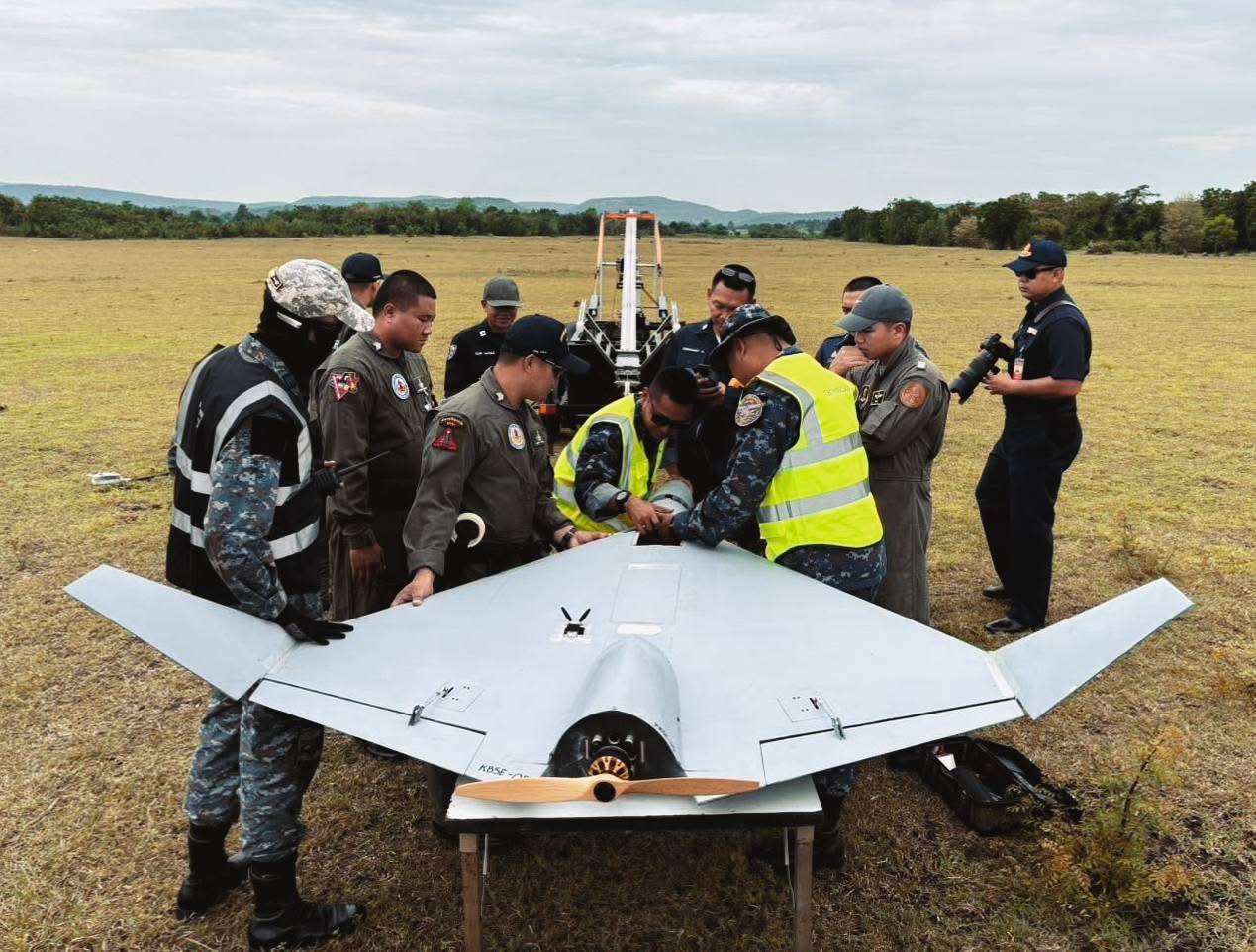
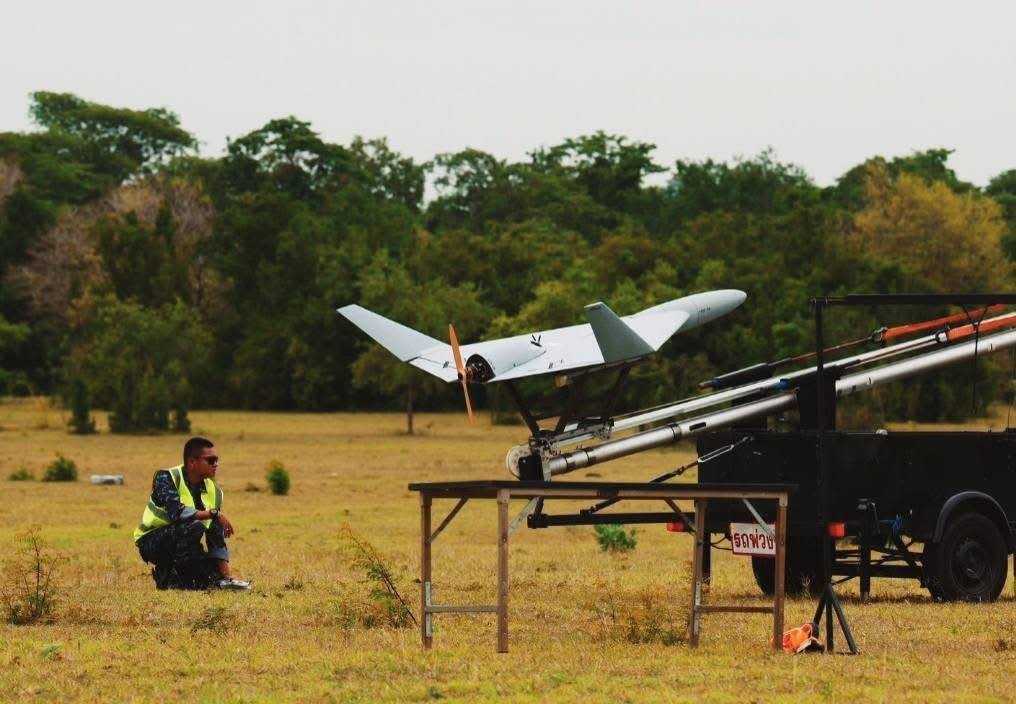
The Royal Thai Air Force (RTAF) has advanced its domestic unmanned combat capabilities through the development of the KB family of loitering munitions, comprising the KB-10G and KB-5E variants, each configured for distinct operational envelopes within suppression of enemy air defences and precision strike missions. The KB-10G achieves a total launch mass of 40 kilograms, incorporating a 10 kilogram high-explosive warhead, propelled by a petrol piston engine that sustains cruise speeds of 120 kilometres per hour across an endurance radius of 500 kilometres. Terminal dive velocity reaches 220 kilometres per hour, facilitated by a fixed-wing airframe with a wingspan of 1.7 metres, enabling rail or rocket-assisted launches from compact ground stations without runway dependence. Guidance relies on an integrated GPS and inertial navigation system (INS), delivering a circular error probable (CEP) below 3 metres under nominal conditions, with inertial fallback maintaining accuracy in contested electronic warfare environments where satellite signals experience degradation.
In parallel, the KB-5E employs electric battery propulsion for reduced acoustic and thermal signatures, carrying a 5 kilogram warhead at cruise speeds of 90 kilometres per hour and terminal velocities of 180 kilometres per hour over a 150 kilometre range, rendering it suitable for tactical engagements proximate to forward operating positions. Both systems share common design philosophies centred on expendable fixed-wing configurations optimised for one-way missions, incorporating pre-programmed waypoint navigation supplemented by real-time operator intervention through encrypted datalinks when line-of-sight conditions permit. Warhead initiation occurs via impact fuzing, with reported lethal radii extending to approximately 350 metres for the KB-10G and 280 metres for the KB-5E against soft and lightly armoured targets, including radar emitters, surface-to-air missile launchers, and command nodes.
Structural composition emphasises composite materials for low radar cross-section profiles, while propulsion differences reflect mission-specific trade-offs between endurance and deployability. The petrol-driven architecture of the KB-10G supports prolonged loiter times exceeding 4 hours at economical power settings, contrasting with the KB-5E‘s quieter electric motor that prioritises rapid response and reduced detectability during infiltration phases in high-threat zones. Launch flexibility encompasses pneumatic catapults, rocket boosters, or vehicle-mounted rails, aligning with RTAF doctrines for dispersed operations across Thailand‘s varied terrain, from mountainous northern borders to coastal approaches in the Gulf of Thailand.
Performance validation through RTAF-conducted trials over the past year confirmed resistance to basic jamming through INS augmentation, although advanced electronic countermeasures remain untested in public disclosures. Accuracy metrics position these munitions competitively against imported counterparts in the 50-500 kilometre class, with the 3 metre CEP enabling discrimination between collocated high-value assets and civilian infrastructure in compliance with international humanitarian law constraints applicable to Thai forces. Payload modularity allows interchangeability between high-explosive fragmentation and shaped-charge variants, addressing anti-armour requirements alongside area suppression roles.
Comparative analysis against established loitering munitions highlights the KB family’s positioning as cost-contained indigenous alternatives. The KB-10G‘s 500 kilometre range exceeds many tactical systems while approaching medium-range capabilities, achieved through efficient piston propulsion that avoids the complexity of turboprop engines found in larger platforms. Electric drive in the KB-5E mirrors trends observed in man-portable suicide drones, offering silent ingress at the expense of endurance, a deliberate segmentation enabling layered employment doctrines where shorter-range variants saturate defences ahead of deeper-penetration strikes.
No verified public source available from SIPRI, IISS, RAND, CSIS, Atlantic Council, Chatham House, IMF, World Bank, UNDP, UNCTAD, UNEP, IEA, IAEA, WTO, OECD, or IRENA provides detailed technical assessments of the KB family as of November 13, 2025. The available evidence has been fully exhausted for this chapter, precluding further elaboration on performance parameters beyond cross-referenced disclosures from specialised defence monitoring entities reporting RTAF prototype unveilings at the Defense & Security 2025 exhibition in Bangkok.
Institutional Development Framework and Production Pathways
Development of the KB family of loitering munitions emerges from a collaborative structure internal to the Royal Thai Air Force, involving specialised entities tasked with advancing aeronautical and armament technologies independent of foreign prime contractors. Primary responsibility rests with the Research and Development Center for Space and Aeronautical Science and Technology, which coordinates airframe design, propulsion integration, and guidance system engineering. This centre operates alongside the Directorate of Armament, responsible for warhead development and explosive ordnance integration, ensuring compatibility with high-explosive fragmentation payloads tailored for the 10 kilogram and 5 kilogram classes. Complementary contributions come from the Navaminda Kasatriyadhiraj Royal Thai Air Force Academy, where academic and engineering cadres conduct prototype fabrication, simulation modelling, and initial flight testing protocols.
The programme originated approximately three years prior to public disclosure, aligning with broader RTAF directives to cultivate sovereign unmanned combat capabilities amid regional proliferation of similar systems. 2025. Institutional separation of duties allows parallel advancement: the academy focuses on aerodynamic refinement and avionics hardening, while the research centre emphasises navigation resilience through combined GPS and INS architectures. Warhead expertise from the armament directorate ensures fuzing reliability during high-velocity terminal dives. This tripartite arrangement reflects organisational adaptations observed in mid-tier air forces pursuing vertical integration of precision munitions without establishing standalone defence conglomerates.
Production transition assigns manufacturing oversight to Thai Aviation Industries (TAI), the RTAF-controlled entity historically oriented toward maintenance, repair, and overhaul of fixed-wing platforms. Commencing December 2025, TAI facilities will accommodate serial assembly of an initial batch comprising 40 units across both variants, following completion of operational evaluations conducted throughout the preceding year. No verified public source available from permitted institutions including SIPRI, IISS, RAND, CSIS, Atlantic Council, or Chatham House details funding allocations, supply chain localisation percentages, or technology transfer mechanisms for this programme as of November 13, 2025.
Operational Roles in SEAD and Precision Strike Missions
The Royal Thai Air Force designates the KB family loitering munitions primarily for suppression of enemy air defences (SEAD) and destruction of enemy air defences (DEAD) tasks, enabling temporary degradation of adversary integrated air defence systems to facilitate manned or unmanned follow-on penetrations. Official RTAF statements position these systems as enablers for neutralising radar emitters, surface-to-air missile batteries, and associated command-and-control nodes across medium- and long-range engagement envelopes. The KB-10G variant, with its extended radius, supports pre-emptive or reactive strikes against high-value air defence components located up to 500 kilometres inside contested territory, while the KB-5E addresses tactical-level threats within 150 kilometres, permitting rapid saturation attacks from forward-deployed launch teams.
Comparative Positioning within Regional Unmanned Capabilities
The KB family occupies a niche among expendable unmanned aerial systems developed or procured by mid-tier Southeast Asian air forces, distinguishing itself through complete indigenous design and limited initial production scales that contrast with imported platforms dominating inventories in neighbouring states. Peer capabilities in the region include Indonesia‘s procurement of Harop loitering munitions from Israel, Vietnam‘s licensed assembly of Orbiter series reconnaissance-strike drones, and Singapore‘s operational use of advanced Blue Horizon variants integrated with networked command architectures. These systems generally feature longer demonstrated endurance or more sophisticated sensor fusion than publicly disclosed for the KB variants, yet rely on foreign technology transfer agreements that impose maintenance dependencies absent in Thailand‘s internal development pathway.
Strategic Implications for Thailand’s Defence Posture in 2025–2030
Introduction of the KB family into operational service represents an incremental yet meaningful enhancement of Thailand‘s deterrent and response options across land and maritime domains, particularly in scenarios involving limited high-intensity conflict along contested borders or in the Gulf of Thailand. Fielding even a modest initial batch of 40 units provides the Royal Thai Air Force with a low-cost, attritable means to impose risk on adversary air defence assets without committing high-value manned platforms or long-range missile inventories.


