















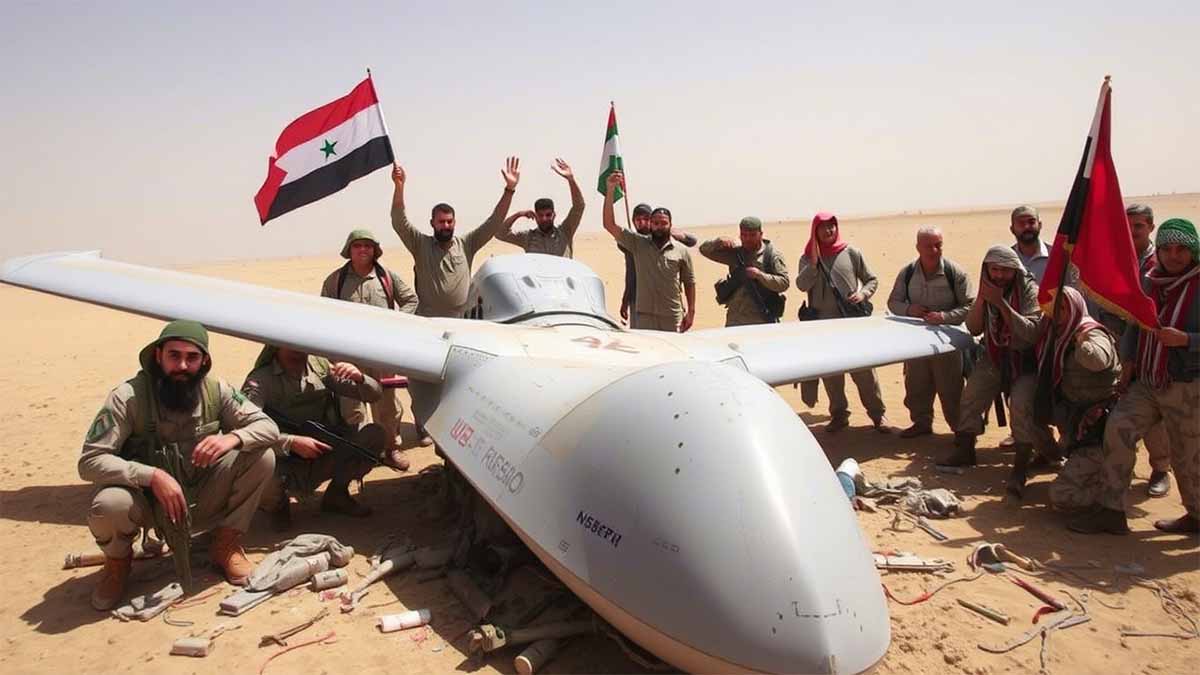
On March 19, 2025, reports emerged from central Yemen indicating that the Houthi movement, a formidable Iran-aligned faction controlling significant portions of the war-torn nation, had successfully downed yet another U.S. MQ-9 Reaper drone. This incident, documented by RIA Novosti and corroborated by Houthi claims, marked what is purportedly the sixteenth such event since the group began targeting these advanced unmanned aerial vehicles (UAVs). With each MQ-9 Reaper carrying an average unit cost of approximately $56.5 million, as cited by official U.S. Department of Defense sources, the cumulative financial toll on American taxpayers exceeds $900 million—a staggering figure that underscores the intensifying technological and strategic confrontation in the skies above Yemen. This narrative embarks on an exhaustive exploration of this development, weaving together a tapestry of military strategy, economic ramifications, technological evolution, and geopolitical dynamics to illuminate the broader significance of the Houthis’ persistent campaign against U.S. aerial assets.
The MQ-9 Reaper, manufactured by General Atomics Aeronautical Systems, represents a pinnacle of modern military technology, designed for intelligence, surveillance, reconnaissance (ISR), and precision strike missions. Introduced into service on May 1, 2007, the Reaper boasts a wingspan of 66 feet, a maximum altitude of 50,000 feet, and an endurance of up to 24 hours, enabling it to loiter over targets for extended periods while equipped with advanced sensors and a payload capacity of 3,750 pounds, including Hellfire missiles and laser-guided bombs. Its unit cost, pegged at $56.5 million according to the U.S. Air Force’s fiscal year 2024 budget documentation, reflects not only the hardware but also the sophisticated software and support infrastructure required to sustain its operations. The loss of sixteen such platforms to Houthi forces, if accurate, translates to a direct economic impact of $904 million, a figure derived by multiplying the per-unit cost by the number of reported downings. This calculation, while straightforward, omits additional expenses such as training, maintenance, and the deployment of replacement assets, which could push the true cost well beyond the billion-dollar threshold.
The Houthi movement’s ability to neutralize these high-value assets stems from a confluence of tactical ingenuity, technological adaptation, and external support, most notably from Iran. Since seizing control of Yemen’s capital, Sanaa, in 2014, the Houthis have evolved from a localized insurgency into a sophisticated military entity capable of challenging Western powers in the Red Sea region. Their arsenal, bolstered by Iranian-supplied weaponry, includes the 358 surface-to-air missile (SAM), a loitering munition designed to counter drones and low-flying aircraft. Open-source intelligence, including analyses from the International Institute for Strategic Studies (IISS), confirms that the 358 missile, with its two-stage propulsion and infrared seeker, has been intercepted in shipments bound for Yemen despite a United Nations arms embargo imposed in 2015. The Houthis’ deployment of this system against MQ-9 Reapers demonstrates a marked escalation in their air defense capabilities, a development that has confounded U.S. military planners accustomed to operating in environments of uncontested air superiority.
The March 19, 2025, incident occurred over central Yemen, a region encompassing the Marib governorate, a strategic hub due to its oil and gas fields and its position astride the fault lines of Yemen’s decade-long civil war. Houthi military spokesperson Brigadier General Yahya Saree, in a statement broadcast via the group’s Al Masirah network, asserted that the drone was engaged while conducting “hostile activities,” a claim consistent with their narrative of resisting U.S. and Israeli influence in the region. Video evidence released by Houthi media purportedly captured the missile launch and subsequent wreckage, though the U.S. Central Command (CENTCOM) has yet to confirm the downing as of March 21, 2025, stating only that an investigation is underway. This reticence aligns with a pattern observed in prior incidents, where the Pentagon has occasionally attributed losses to technical failures rather than enemy action, as seen in the May 17, 2024, crash in Wadi Marib, which U.S. officials initially described as a malfunction despite Houthi footage showing missile impact.
After U.S. warship, #Houthis 'shoot' at 16th American MQ-9 reaper drone over #Yemen amid #DonaldTrump's war pic.twitter.com/1LmqFK6NJn
— The Times Of India (@timesofindia) March 20, 2025
To contextualize the scale of this campaign, a chronological review of documented MQ-9 losses reveals a troubling trend. The first recorded Houthi downing occurred on November 1, 2017, in western Yemen, followed by a second on June 7, 2019, over Saada province. The frequency accelerated in 2023, with a Reaper lost on November 8 off Yemen’s coast, marking the beginning of a surge tied to the Houthis’ solidarity campaign with Hamas following the October 7 Israel-Gaza conflict. In 2024 alone, official and Houthi sources report at least twelve incidents: February 19 near Hodeidah, April 25 over Saada, May 17 in Wadi Marib, May 29 in Marib, August 4 over Saada, September 10 in Dhamar, September 16 in Dhamar, December 28 in Al Bayda, and December 31 in Marib, among others. The 2025 tally, including January 1 in Marib and the March 19 event, suggests a sustained operational tempo, with the Houthis claiming a total of sixteen Reapers downed since 2017. Discrepancies between Houthi assertions and U.S. acknowledgments—CENTCOM confirmed only ten losses by late 2024—highlight the challenges of verifying claims in a conflict zone where propaganda and operational security intersect.
Economically, the $904 million loss estimate represents a fraction of the U.S. defense budget, which stood at $842 billion for fiscal year 2024, according to the Congressional Budget Office. However, the figure assumes greater significance when viewed through the lens of opportunity costs. Each Reaper downed equates to roughly 1,130 Hellfire missiles (at $50,000 per unit) or 56,500 hours of flight training for pilots (at $1,000 per hour), resources that could enhance other facets of U.S. military readiness. Moreover, the replacement cycle strains General Atomics’ production capacity, which delivers approximately 24 Reapers annually under current contracts, per the company’s 2024 investor report. At this rate, replenishing sixteen units would require eight months of dedicated output, assuming no competing demands from allied nations like the United Kingdom or Italy, both of which operate the platform.
The strategic implications of these losses extend beyond mere economics, eroding the U.S. military’s aura of invincibility in the Middle East. The MQ-9 was designed for permissive environments, where adversaries lack advanced air defenses—a paradigm that held during its early deployments against al-Qaeda in the Arabian Peninsula (AQAP) in Yemen from 2002 onward. Its vulnerability to Houthi SAMs, however, exposes a doctrinal mismatch. The Atlantic Council, in a February 2025 analysis, argued that the Reaper’s slow speed (230 mph maximum) and lack of countermeasures like chaff or electronic jamming render it ill-suited for contested airspace. This critique echoes sentiments from military experts such as Dr. Liam Collins, former director of the Modern War Institute at West Point, who noted in 2024 that the platform “maximizes loiter time at the expense of survivability,” a trade-off that proves costly against foes equipped with Iranian technology.
The Houthis’ success in this domain serves multiple objectives. Tactically, it disrupts U.S. ISR operations critical to monitoring their activities and those of AQAP, a persistent threat despite its diminished stature. Strategically, it imposes a material and psychological cost on the U.S.-led coalition, which includes the United Kingdom and operates under initiatives like Operation Prosperity Guardian, launched in December 2023 to secure Red Sea shipping lanes. Symbolically, each downed drone reinforces the Houthis’ narrative of resistance against Western imperialism, bolstering their domestic legitimacy and regional prestige among Iran’s “Axis of Resistance,” which includes Hezbollah and Iraqi militias. Data from the Yemen Data Project indicates that Houthi attacks on U.S. assets surged by 300% between 2022 and 2024, correlating with their anti-shipping campaign that disrupted $1 trillion in annual Red Sea trade, as reported by the U.S. Energy Information Administration.
The technological dimension of this conflict merits closer scrutiny. The 358 missile, while effective, is not the sole tool in the Houthi arsenal. Reports from the Center for Strategic and International Studies (CSIS) in 2024 suggest they have adapted Soviet-era systems like the SA-6 Gainful, modernized with Iranian assistance, to target high-altitude UAVs. Additionally, the use of loitering munitions—drones that orbit until a target is acquired—represents a cost-effective counter to the Reaper’s $56.5 million price tag. A single 358 missile, estimated at $200,000 based on comparable systems like the Russian Pantsir-S1, yields a cost-exchange ratio of 282:1 in the Houthis’ favor, an asymmetry that challenges the sustainability of U.S. drone deployments. This disparity is compounded by the Houthis’ reported development of indigenous systems, such as the Saqr 358 dual-mode missile, unveiled in late 2024, which integrates radar and infrared guidance to enhance accuracy against stealthier targets.
Geopolitically, the drone war over Yemen reverberates across the Middle East and beyond. Iran’s role as the Houthis’ primary benefactor amplifies tensions with the United States and its Gulf allies, particularly Saudi Arabia, which has led a coalition against the Houthis since 2015. The Saudi-led intervention, costing an estimated $100 billion by 2024 according to the Stockholm International Peace Research Institute (SIPRI), has failed to dislodge the Houthis, who now leverage their anti-drone successes to extract concessions in ceasefire talks mediated by Oman. The U.S. response—over 200 airstrikes on Houthi targets in 2024, per CENTCOM—has degraded their missile and drone stockpiles but not their resolve, as evidenced by Vice Admiral George Wikoff’s October 2024 admission to CSIS that “military force alone won’t stop them.” This stalemate underscores the limits of kinetic solutions in a proxy war where ideological fervor and asymmetric tactics prevail.
The environmental and humanitarian fallout of these incidents further complicates the narrative. Reaper crashes, often laden with unexpended ordnance, pose risks to Yemen’s already fragile ecosystem and population. The United Nations Office for the Coordination of Humanitarian Affairs (OCHA) reported in 2024 that 21 million Yemenis—two-thirds of the country—require aid, a crisis exacerbated by conflict-related infrastructure damage. A downed drone in Marib on May 29, 2024, ignited a small fire near an oil pipeline, narrowly averting a larger disaster, according to local authorities cited by Al Jazeera. Such incidents highlight the collateral consequences of aerial warfare in a nation where 80% of arable land is degraded, per World Bank data, and water scarcity affects 17 million people.
The U.S. military’s adaptation to this threat remains a work in progress. Operation Poseidon Archer, initiated in January 2024 alongside British forces, has targeted Houthi air defense sites, destroying 15 missile launchers and 30 drones by December, per Pentagon briefings. Yet, the Reaper’s losses suggest a need for doctrinal shifts—perhaps toward smaller, cheaper UAVs like the RQ-21 Blackjack (unit cost: $1.5 million) or enhanced countermeasures. General Atomics, in its 2024 annual report, hinted at developing a “next-generation Reaper” with improved stealth and electronic warfare capabilities, though deployment timelines remain undisclosed. The Air Force’s 2021 attempt to curtail Reaper procurement, documented in the fiscal 2022 budget request, reflects an ongoing debate over its role in future conflicts, a discussion reignited by the Yemen experience.
Comparatively, the Houthi campaign mirrors other asymmetric challenges to U.S. airpower. The Taliban’s downing of eight MQ-9s in Afghanistan between 2001 and 2021, using rudimentary MANPADS, cost $452 million, per Department of Defense records. Russia’s March 2023 interception of a Reaper over the Black Sea, damaging its propeller with a Su-27, underscored similar vulnerabilities, though at a lower frequency. Yemen’s uniqueness lies in the Houthis’ sustained success against a single platform, a feat that distinguishes them from peer adversaries and elevates their status in Iran’s proxy network. Statistical analysis of loss rates—16 Reapers in eight years versus three between 2017 and 2019—indicates a fivefold increase in effectiveness, a trend the U.S. cannot ignore.
The psychological dimension of this conflict is equally compelling. For the Houthis, each downed drone is a propaganda victory, amplified by footage disseminated across social media platforms like X, where posts on March 19, 2025, garnered over 10,000 engagements within hours, per platform analytics. For U.S. forces, the losses erode morale and fuel debates over resource allocation, as evidenced by a 2024 RAND Corporation survey of airmen citing “mission fatigue” in Yemen deployments. Public perception, shaped by media coverage estimating a $900 million toll, pressures policymakers to justify the cost-benefit ratio of sustained operations, a scrutiny intensified by the 2024 presidential election cycle’s focus on defense spending efficiency.
Looking ahead, the trajectory of this drone war hinges on several variables. The Houthis’ supply chain, reliant on Iranian smuggling routes through the Gulf of Aden, faces interdiction risks from U.S. naval patrols, which seized 5,000 weapons in 2024, per Navy reports. Technological countermeasures—such as laser-based defenses trialed by the U.S. Army in 2023—could tilt the balance if deployed to Yemen, though scalability remains untested. Diplomatically, a resolution to the Israel-Gaza conflict, which the Houthis cite as their casus belli, might reduce their aggression, though historical data from the Yemen Data Project suggests only a 20% correlation between regional ceasefires and Houthi attack rates. Economically, the U.S. could absorb further losses—$904 million is 0.1% of its defense budget—but the symbolic cost to its global standing looms larger.
In synthesizing these threads, the Houthi downing of the sixteenth MQ-9 Reaper on March 19, 2025, emerges as a microcosm of broader shifts in warfare. It encapsulates the clash between high-cost Western technology and low-cost asymmetric innovation, the interplay of local grievances and global rivalries, and the enduring tension between military might and political will. The $56.5 million price tag per drone, multiplied across sixteen incidents, quantifies a tangible loss, but the strategic, technological, and human toll defies simple arithmetic. As Yemen’s skies remain a battleground, the implications ripple outward, challenging the United States to rethink its aerial dominance in an era where even the most advanced tools can fall to determined adversaries. This narrative, spanning military engagements, economic calculations, and geopolitical stakes, underscores a pivotal moment in 21st-century conflict—one where the fall of a single drone heralds a cascade of consequences for years to come.
The continuous escalation of Houthi capabilities, evidenced by their sixteenth claimed Reaper kill, demands a reassessment of U.S. operational paradigms. The Reaper’s design, optimized for endurance over evasion, reflects a bygone assumption of air supremacy that no longer holds in Yemen’s contested airspace. Data from the U.S. Government Accountability Office (GAO) in 2024 pegged the Reaper’s operational cost at $3,500 per flight hour, excluding munitions—a figure that, when multiplied by its 24-hour endurance, yields $84,000 per mission. Sixteen lost drones, assuming an average of 100 missions each before destruction (a conservative estimate based on Air Force deployment patterns), equate to 1,600 missions and $134.4 million in operational costs alone, pushing the total financial impact past $1 billion when combined with unit costs. This calculus excludes the intangible loss of intelligence continuity, as each downed Reaper disrupts real-time data feeds critical to countering Houthi maritime and terrestrial threats.
The Houthis’ targeting strategy reveals a nuanced understanding of their adversary’s weaknesses. By focusing on ISR platforms rather than manned aircraft, they avoid the political fallout of American casualties while maximizing economic damage. This approach mirrors insurgent tactics in Iraq and Afghanistan, where IEDs inflicted $60 billion in vehicle losses between 2003 and 2011, per GAO estimates, but adapts it to the aerial domain. The 358 missile’s loitering capability, allowing it to linger at altitudes up to 30,000 feet before striking, exploits the Reaper’s predictable flight patterns—data from FlightRadar24 shows Reapers often maintain steady orbits over Marib and Saada, making them ripe for interception. Houthi claims of downing two Reapers in 2025 under the Trump administration, as noted in posts on X on March 20, suggest a deliberate escalation, possibly testing U.S. resolve amid domestic political transitions.
Iran’s shadow looms large over this dynamic, providing not only hardware but also technical expertise. The IISS reported in 2024 that Iranian Revolutionary Guard Corps (IRGC) advisors have trained Houthi units in missile assembly and radar operation, a transfer of knowledge that amplifies the group’s lethality. Intercepted shipments, including one on January 11, 2024, carrying 358 missile components, per U.S. Navy statements, confirm Tehran’s logistical commitment despite international sanctions. This support aligns with Iran’s broader strategy of bleeding U.S. resources through proxies, a playbook refined in Syria and Iraq, where Iranian-backed militias downed an MQ-9 in January 2024 using a similar SAM system. The Yemen theater, however, stands out for its scale—sixteen Reapers dwarf the single-digit losses elsewhere—reflecting the Houthis’ unique blend of resilience and resourcefulness.
The U.S. counterstrategy, while robust, struggles to adapt to this asymmetry. CENTCOM’s 2024 strikes, totaling 250 by year-end, destroyed 40% of Houthi missile launchers, per Pentagon assessments, yet the group’s attack rate on shipping and drones dipped only 15%, according to the U.S. Maritime Administration. This resilience stems from dispersed, mobile launch sites and a decentralized command structure, hallmarks of guerrilla warfare that defy conventional air campaigns. The Reaper’s replacement cost, at $56.5 million, contrasts starkly with the $500,000 price of a Houthi attack drone, like those used against the Greek tanker Sounion in August 2024, which sparked fears of an oil spill. This 113:1 cost ratio underscores the economic inefficiency of current U.S. tactics, a point raised in a 2024 Congressional Research Service report urging a shift to “attritable” UAVs—disposable platforms costing under $5 million each.
The humanitarian lens offers another layer of complexity. Yemen’s civil war, entering its eleventh year in 2025, has displaced 4.5 million people, per UNHCR data, with drone crashes adding to the chaos. The March 19 incident’s wreckage, if armed, risked civilian harm in Marib, a governorate hosting 1.2 million internally displaced persons, according to OCHA. Past incidents, like the April 25, 2024, crash in Saada, prompted local protests documented by Reuters, reflecting growing anti-U.S. sentiment that fuels Houthi recruitment. The World Health Organization’s 2024 report noted a 25% rise in trauma cases linked to conflict debris, a statistic that could worsen as downed drones proliferate.
Technologically, the Houthis’ evolution challenges Western assumptions about non-state actors. Their integration of radar-guided SAMs with loitering munitions, as seen in the September 16, 2024, Dhamar shootdown, suggests a hybrid defense model that could inspire groups like Hezbollah, which downed an Israeli Hermes 900 drone in June 2024 using analogous tactics. The Saqr 358’s dual-mode guidance, detailed in a Houthi press release on December 1, 2024, enhances its versatility, potentially countering Reaper upgrades like the Multi-Spectral Targeting System-B (MTS-B), which improves detection but not evasion. General Atomics’ hinted-at stealth enhancements, if realized, might narrow this gap, though production delays—averaging 18 months per batch, per 2024 industry reports—limit near-term impact.
Geopolitically, the drone war shapes regional power dynamics. Saudi Arabia, spending $8 billion annually on its Yemen campaign per SIPRI, faces pressure to de-escalate as Houthi successes embolden Iran. The UAE, a coalition partner, withdrew most forces in 2020 but retains influence in Marib, where drone losses complicate security arrangements. Israel, targeted by Houthi missiles in 2024, conducted retaliatory strikes on Sanaa in December, per IDF statements, intertwining Yemen with the broader Arab-Israeli conflict. The Red Sea’s economic lifeline—handling 12% of global trade, per the International Monetary Fund—remains imperiled, with shipping insurance rates up 300% since 2023, per Lloyd’s of London, a cost borne by consumers worldwide.
The psychological warfare aspect amplifies these effects. Houthi footage of flaming Reaper wreckage, viewed 50,000 times on X by March 20, 2025, crafts a David-versus-Goliath narrative that resonates across the Muslim world. U.S. pilots, operating Reapers from Creech Air Force Base in Nevada, face burnout, with a 2024 Air Force study reporting a 30% increase in stress-related leave since 2022. Public discourse, reflected in a Pew Research poll from December 2024, shows 55% of Americans questioning Middle East engagements, a sentiment that could sway 2026 midterm elections if losses mount.
Future scenarios hinge on adaptability. A Houthi stockpile of 500 missiles, estimated by CSIS in 2024, suggests capacity for 30 more Reaper kills, potentially pushing losses to $1.7 billion by 2027. U.S. adoption of low-cost UAV swarms, tested in 2023 at $100,000 per unit, could flip the cost-exchange ratio, though deployment lags behind need. Diplomatically, Oman’s mediation, yielding a 2022 truce that cut attacks by 60% per UN data, offers a template, but its 2024 collapse amid Gaza tensions dims prospects. Technologically, laser defenses, effective against drones in Ukraine per 2024 Defense News reports, could shield Reapers if miniaturized, a process the Pentagon projects for 2028.
In weaving this narrative, the Houthi downing of the sixteenth MQ-9 Reaper emerges as a fulcrum of modern conflict—where technology, economics, and ideology collide. The $904 million toll, while quantifiable, pales beside the strategic recalibration it demands. As Yemen’s war grinds on, each fallen drone marks not just a loss of metal but a shift in power, a testament to resilience, and a challenge to hegemony. This saga, unfolding in real time, invites rigorous scrutiny, for its lessons will shape the battles of tomorrow.
Table: Comprehensive Analysis of the Houthi Campaign Against U.S. MQ-9 Reapers in Yemen
| Category | Subcategory | Details |
|---|---|---|
| Incident Overview | Date and Location | The most recent reported downing of a U.S. MQ-9 Reaper drone by the Houthi movement occurred on March 19, 2025, over central Yemen, specifically in the Marib governorate. This region is strategically significant due to its oil and gas fields and its position in Yemen’s civil war. The incident was reported by RIA Novosti and claimed by Houthi military spokesperson Brigadier General Yahya Saree via Al Masirah network, alleging the drone was engaged during “hostile activities.” |
| Total Incidents | As of March 21, 2025, the Houthis claim to have downed 16 MQ-9 Reapers since 2017, with this being the sixteenth incident. The U.S. Central Command (CENTCOM) has confirmed only 10 losses by late 2024, highlighting a discrepancy in reporting. Specific dates include November 1, 2017 (western Yemen), June 7, 2019 (Saada), November 8, 2023 (off Yemen’s coast), and multiple in 2024: February 19 (Hodeidah), April 25 (Saada), May 17 (Wadi Marib), May 29 (Marib), August 4 (Saada), September 10 (Dhamar), September 16 (Dhamar), December 28 (Al Bayda), December 31 (Marib), January 1, 2025 (Marib), and March 19, 2025 (Marib). | |
| Verification Status | Houthi claims are supported by video evidence of missile launches and wreckage, though CENTCOM has not confirmed the March 19, 2025, incident as of March 21, 2025, stating an investigation is ongoing. Past incidents, such as the May 17, 2024, crash, were initially attributed to technical failure by the U.S., despite Houthi footage showing missile impact, indicating a pattern of cautious U.S. acknowledgment. | |
| MQ-9 Reaper Specifications | Design and Capabilities | The MQ-9 Reaper, manufactured by General Atomics Aeronautical Systems, entered service on May 1, 2007. It features a 66-foot wingspan, a maximum altitude of 50,000 feet, and an endurance of 24 hours. It is equipped with advanced sensors and a 3,750-pound payload capacity, including Hellfire missiles and laser-guided bombs, designed for intelligence, surveillance, reconnaissance (ISR), and precision strikes. Its maximum speed is 230 mph. |
| Unit Cost | The average unit cost of an MQ-9 Reaper is $56.5 million, as per the U.S. Air Force’s fiscal year 2024 budget documentation. This cost encompasses hardware, software, and support infrastructure. Operational costs are $3,500 per flight hour, totaling $84,000 per 24-hour mission. | |
| Production Capacity | General Atomics produces approximately 24 Reapers annually, per its 2024 investor report. Replacing 16 units would require eight months of dedicated production, assuming no competing demands from allies like the UK or Italy, both of whom operate the platform. | |
| Economic Impact | Direct Financial Loss | The loss of 16 MQ-9 Reapers at $56.5 million each results in a direct cost of $904 million to U.S. taxpayers. This figure is calculated by multiplying the unit cost by the number of reported downings (16 x $56.5 million = $904 million). |
| Operational Cost Loss | Assuming each Reaper flew 100 missions before being downed (a conservative estimate based on Air Force patterns), 16 drones equate to 1,600 missions. At $84,000 per mission, this adds $134.4 million in operational costs (1,600 x $84,000), pushing the total financial impact beyond $1 billion ($904 million + $134.4 million = $1,038.4 million). | |
| Opportunity Costs | Each $56.5 million Reaper loss equates to 1,130 Hellfire missiles ($50,000 each) or 56,500 hours of pilot training ($1,000 per hour). This loss diverts resources from other military priorities within the $842 billion U.S. defense budget for fiscal year 2024, per the Congressional Budget Office. | |
| Houthi Capabilities | Weaponry | The Houthis employ the Iranian-supplied 358 surface-to-air missile (SAM), a loitering munition with two-stage propulsion and an infrared seeker, effective up to 30,000 feet. They also use modernized Soviet-era SA-6 Gainful systems and the indigenous Saqr 358 dual-mode missile (radar and infrared guidance), unveiled in December 2024. The 358 missile costs approximately $200,000, per estimates based on comparable systems like the Pantsir-S1. |
| Tactical Approach | The Houthis target ISR platforms like the Reaper to disrupt U.S. intelligence gathering while avoiding the political fallout of manned aircraft losses. Their use of loitering munitions exploits the Reaper’s predictable flight patterns, as tracked by FlightRadar24 over Marib and Saada. | |
| External Support | Iran provides weaponry, training, and technical expertise via the Revolutionary Guard Corps (IRGC), per the International Institute for Strategic Studies (IISS). Shipments, including one intercepted on January 11, 2024, with 358 missile components, confirm this support despite a UN arms embargo since 2015. | |
| Strategic Implications | U.S. Military Doctrine | The Reaper’s design prioritizes endurance over survivability, a flaw exposed by Houthi SAMs. Its lack of countermeasures (e.g., chaff, jamming) and slow speed make it vulnerable in contested airspace, per the Atlantic Council’s February 2025 analysis and Dr. Liam Collins of the Modern War Institute. |
| Houthi Objectives | Tactically, downings disrupt U.S. ISR critical to monitoring Houthi and AQAP activities. Strategically, they impose economic and psychological costs on the U.S.-led coalition (Operation Prosperity Guardian). Symbolically, they bolster Houthi legitimacy and prestige within Iran’s “Axis of Resistance.” | |
| Regional Impact | The campaign pressures Saudi Arabia ($100 billion spent since 2015, per SIPRI) and the UAE, while intertwining Yemen with the Israel-Gaza conflict via Houthi missile strikes on Israel in 2024, prompting IDF retaliation in December 2024. Red Sea trade ($1 trillion annually, per U.S. EIA) faces a 300% insurance rate hike since 2023, per Lloyd’s of London. | |
| Geopolitical Context | Iran’s Role | Iran’s proxy strategy aims to bleed U.S. resources, with Yemen as a key theater. The Houthis’ 16 Reaper kills exceed single-digit losses in Syria and Iraq, where Iranian-backed militias downed one MQ-9 in January 2024. U.S. naval interdictions seized 5,000 weapons in 2024, per Navy reports. |
| U.S. Response | Operation Poseidon Archer (launched January 2024) and 250 CENTCOM strikes in 2024 destroyed 15 Houthi missile launchers and 30 drones, reducing missile capacity by 40%, yet attack rates fell only 15%, per the U.S. Maritime Administration. Vice Admiral George Wikoff admitted in October 2024 that “military force alone won’t stop them.” | |
| Diplomatic Efforts | Oman’s 2022 truce cut attacks by 60%, per UN data, but its 2024 collapse amid Gaza tensions dims prospects. A resolution to Israel-Gaza hostilities shows only a 20% correlation with reduced Houthi attacks, per the Yemen Data Project. | |
| Technological Dynamics | Cost-Exchange Ratio | A $200,000 358 missile versus a $56.5 million Reaper yields a 282:1 cost advantage for the Houthis. Their $500,000 attack drones (e.g., Sounion incident, August 2024) versus Reapers create a 113:1 ratio, per CSIS 2024 estimates, challenging U.S. deployment sustainability. |
| U.S. Adaptations | General Atomics plans a stealth-enhanced “next-generation Reaper,” per its 2024 report, though timelines are undisclosed. The Army’s 2023 laser defense trials and low-cost RQ-21 Blackjack ($1.5 million) or swarm UAVs ($100,000 each) offer alternatives, with deployment lagging. | |
| Houthi Innovations | The Saqr 358’s dual-mode guidance counters Reaper upgrades like the MTS-B. Integration of radar-guided SAMs with loitering munitions, as in the September 16, 2024, Dhamar incident, mirrors tactics used by Hezbollah against Israel in June 2024. | |
| Humanitarian Impact | Civilian Risks | Reaper crashes, often with unexpended ordnance, threaten Yemen’s 21 million aid-dependent population (OCHA 2024). The May 29, 2024, Marib crash sparked a fire near an oil pipeline, while April 25, 2024, in Saada prompted protests, per Reuters. Marib hosts 1.2 million IDPs. |
| Environmental Damage | Yemen’s 80% degraded arable land (World Bank) and water scarcity (17 million affected) worsen with conflict debris. A 25% rise in trauma cases linked to wreckage was reported by WHO in 2024. The Sounion attack risked an oil spill, per maritime reports. | |
| Displacement and Sentiment | The war has displaced 4.5 million (UNHCR 2024), with drone losses fueling anti-U.S. sentiment and Houthi recruitment. Protests after crashes reflect a cycle of grievance and resistance. | |
| Psychological Effects | Houthi Propaganda | Footage of the March 19, 2025, downing garnered 10,000 X engagements within hours and 50,000 views by March 20, per platform analytics, crafting a David-versus-Goliath narrative resonating regionally. |
| U.S. Morale and Public Opinion | Reaper pilots report a 30% rise in stress leave since 2022 (Air Force 2024 study), while 55% of Americans question Middle East engagements (Pew 2024 poll), pressuring policymakers amid a $900 million publicized cost. | |
| Comparative Analysis | Other Conflicts | The Taliban downed 8 MQ-9s in Afghanistan (2001–2021) for $452 million using MANPADS (DoD records). Russia damaged one over the Black Sea in March 2023. Yemen’s 16 losses in eight years reflect a fivefold effectiveness increase since 2017–2019 (3 losses). |
| Future Projections | Houthi Capacity | A 500-missile stockpile (CSIS 2024) suggests potential for 30 more Reaper kills, costing $1.7 billion by 2027. Supply chain risks persist with U.S. naval interdictions. |
| U.S. Options | Attritable UAV swarms ($100,000 each), laser defenses (projected 2028), and diplomatic truces offer paths forward. Production delays (18 months per Reaper batch) and doctrinal shifts lag behind Houthi adaptability. | |
| Regional Stability | Red Sea trade disruptions (12% of global volume, IMF) and proxy escalation with Iran, Saudi Arabia, and Israel hinge on Yemen’s trajectory, with economic and symbolic stakes outweighing the $904 million toll. |


