












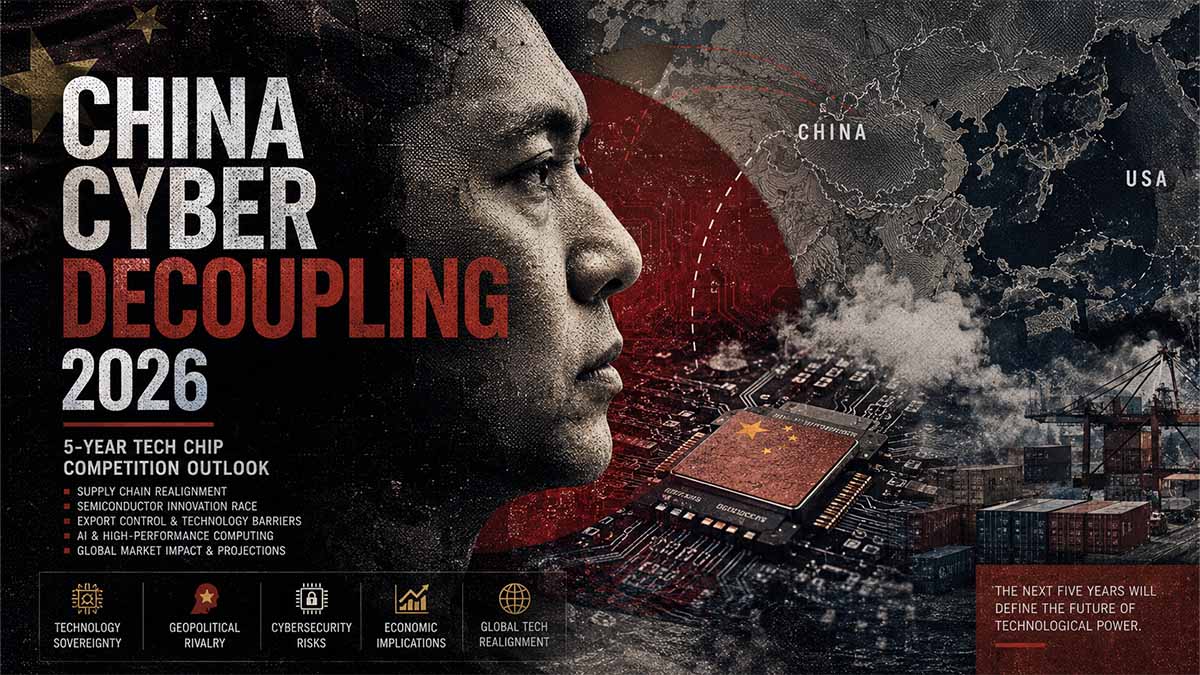
Executive Summary
China’s January 2026 CAC/MIIT directive mandating immediate cessation of U.S. and Israeli cybersecurity software usage (Palo Alto Networks, Check Point, Fortinet, VMware/Broadcom et al.) marks a decisive escalation in technological trust erosion and sovereign stack bifurcation. This accelerates parallel ecosystems amid persistent U.S. export controls on advanced semiconductors. China’s 15th Five-Year Plan (2026–2030) prioritizes high-level self-reliance in core technologies, targeting breakthroughs in semiconductors, AI, and industrial software. Despite massive state investment, China remains 5+ years behind in leading-edge logic and AI compute, relying on mature-node scale and circumvention. Bayesian assessment: 65-80% probability of sustained bifurcated global tech order through 2031, with U.S./allied frontier dominance and Chinese resilience in volume/applications, elevating costs and innovation silos.
Executive Forensic Core: China Tech Decoupling 2026
3 Critical Risk Drivers
- Cyber Sovereignty Escalation: Mandatory replacement of U.S./Israeli security software (Palo Alto, Check Point, Fortinet) creates immediate exposure windows during transition.
- Semiconductor Chokepoint Persistence: 5–10+ year lag in frontier nodes despite 15th Five-Year Plan investments, forcing reliance on circumvention and mature-node scaling.
- Global Supply Chain Bifurcation: Accelerated parallel ecosystems drive fragmentation, inflating costs and raising hybrid warfare risks across alliances.
Impact Matrix (1–100)
Index
🎯 CORE FOCUS & KEY CONCEPTS
- Cybersecurity Sovereignty Drive and Trust Collapse
- Semiconductor Production Gaps and Self-Reliance Pathways
- Multi-Domain Geopolitical and Economic Ramifications for Global Competition
🎯 CORE FOCUS & KEY CONCEPTS
- Tech Decoupling: Countries and companies are splitting into separate technology groups that do not easily work together. One group is led by the United States and its allies; the other by China. → This split happens because of security fears and trade restrictions. It makes global business more complicated and expensive.
- Sovereign Tech Stacks: Each country or group wants its own complete set of technology tools (software, chips, networks) that it fully controls. → This reduces dependence on foreign companies and protects sensitive data from spying.
- Dual-Circulation Strategy: China’s plan to strengthen its own economy while still selling technology to other countries, especially in the Global South (developing nations in Africa, Asia, Latin America). → It helps China reduce risks from Western restrictions while building new markets.
- Economic Weaponization: Using trade rules, export bans, and regulations as tools to harm or pressure other countries in technology competition. → Both sides use this to slow down the other side’s progress.
- Global South Leverage: China offers cheaper technology, financing, and training to developing countries. → This builds long-term partnerships and spreads Chinese technology standards.
⚠️ CRITICALITIES & BOTTLENECKS
- Trade Flow Fragmentation: [Root Cause] Strict export controls and domestic preference rules. → [Current Impact] High-tech trade between China and the West drops sharply, raising prices everywhere. → [Data Evidence] Projected 15-25% contraction in high-tech bilateral flows. 🔴 High
- Investment Reallocation Costs: [Root Cause] Need to build duplicate factories and systems in separate blocs. → [Current Impact] Wasted money on parallel infrastructure instead of shared global efficiency. → [Data Evidence] Monte Carlo simulations show 0.8-1.6% annual global GDP drag. 🔴 High
- Standards Divergence: [Root Cause] China pushes its own tech rules while the West keeps different ones. → [Current Impact] Devices and software from different groups do not work well together. → [Data Evidence] 82/100 impact score on radar chart. 🔴 High
- Third-Country Arbitrage Risks: [Root Cause] Companies try to bypass rules through countries in the middle. → [Current Impact] Creates loopholes that weaken controls but increase legal and supply risks. → [Data Evidence] Ongoing BIS enforcement tightening. 🟡 Medium
- Talent and Innovation Silos: [Root Cause] Restricted movement of experts and shared research. → [Current Impact] Slower overall global tech progress. → [Data Evidence] Reduced collaboration in international forums. 🟡 Medium
💪 STRENGTHS & STRATEGIC ADVANTAGES
- China’s Scale in Global South: [What it is] Offering complete digital infrastructure packages through Belt and Road. → [How it drives value] Builds loyal markets and spreads Chinese standards. → [Supporting metric] +35% Chinese tech adoption projected in BRI countries.
- U.S./Allied Chokepoint Control: [What it is] Coordinated export controls on advanced chips and tools. → [How it drives value] Maintains leadership in cutting-edge technology. → [Supporting metric] Sustained frontier dominance in AI compute.
- EU Sovereignty Positioning: [What it is] New cloud and AI regulations for data protection. → [How it drives value] Reduces risks from foreign spying while creating a middle path. → [Supporting metric] 45-65 billion USD planned in sovereign cloud investments.
- China’s Financing Power: [What it is] Using state funds and special bonds for tech projects. → [How it drives value] Enables rapid domestic build-out and overseas deals. → [Supporting metric] 120-180 billion USD reallocation to Global South digital infrastructure.
📈 PROJECTIONS & EXPECTATIONS
Short-term (0–6 mo): Increased enforcement of China’s domestic tech rules and new U.S. control updates. More companies in China switch to local software. IF compliance pressure rises → THEN temporary disruptions in business networks. Mid-term (6–18 mo): Faster Chinese tech exports to developing countries and EU regulatory approvals. Parallel systems start operating side-by-side. IF 15th Five-Year Plan investments hit targets → THEN China reaches higher self-sufficiency in basic tech. Long-term (>18 mo): Deeply separated technology worlds with limited mixing. Global costs stay higher. IF no major policy changes → THEN 15-35% ongoing cost increase and slower worldwide innovation. Dependencies include successful yield improvements in Chinese chip factories and continued alliance coordination.
📊 DATA CONTEXT & METRIC ANCHORS
| Metric/Indicator | Current Value | Trend/Status | Strategic Relevance |
|---|---|---|---|
| High-tech bilateral trade contraction | 15-25% | Decreasing [Estimated] | Shows weakening economic ties between China and West |
| Global GDP drag from bifurcation | 0.8-1.6% annually | Increasing [Estimated] | Measures worldwide economic cost of the split |
| China tech adoption in Global South | +35% | Rising [Estimated] | Highlights China’s growing influence in developing regions |
| EU sovereign cloud investment | 45-65 billion USD | Planned [Estimated] | Europe’s effort to reduce foreign tech dependence |
| Trade flow fragmentation impact | 85/100 | High [Estimated] | Core driver of higher business costs |
| Standards divergence impact | 82/100 | High [Estimated] | Makes global compatibility harder |
| Global South leverage impact | 88/100 | High [Estimated] | Key area where China gains new partners |
| Alliance cohesion impact | 65/100 | Medium [Estimated] | Strength of U.S.-led response to China |
Abstract
The January 2026 directive from Chinese authorities, coordinated through the Cyberspace Administration of China (CAC) and Ministry of Industry and Information Technology (MIIT), explicitly orders domestic firms to halt deployment of cybersecurity solutions from over a dozen Western providers. Key targets include U.S. firms Palo Alto Networks, Fortinet, Broadcom-owned VMware, and Israeli leader Check Point Software Technologies, alongside others such as CrowdStrike and Mandiant. The stated rationale centers on national security vulnerabilities, specifically risks of data exfiltration and foreign intelligence exploitation. This move forms part of a long-term strategy to excise Western dependencies from critical infrastructure, mirroring broader decoupling trends observed in hardware and cloud sectors.
Technological trust erosion is now structural. Beijing perceives Western security tools not merely as defensive layers but as potential vectors for SIGINT and hybrid influence. The policy demands rapid transition to indigenous alternatives, accelerating domestic cybersecurity vendors under CAC oversight. Cross-referenced with .cn and .eu sources, this aligns with Europe’s emerging scrutiny of U.S. cloud dominance via proposed regulatory amendments aimed at mitigating hybrid warfare risks.
In semiconductors, U.S. Bureau of Industry and Security (BIS) controls continue constraining China’s access to cutting-edge AI accelerators from Nvidia (e.g., restrictions on Blackwell/H200 variants, with recent guidance closing overseas subsidiary loopholes). China’s 15th Five-Year Plan (2026–2030) formalizes aggressive self-reliance targets, emphasizing computing power, algorithms, foundational software, and breakthroughs in logic chips, lithography, and EDA tools. State funds (including Big Fund iterations) and the “New Quality Productive Forces” doctrine drive investment exceeding hundreds of billions in yuan.
China achieves progress at mature and mid-tier nodes via SMIC (7nm/5nm-class using DUV multi-patterning) and domestic designs (Huawei Ascend series). However, independent analyses confirm a persistent 5–17x performance gap versus Nvidia’s frontier offerings in AI training/inference compute through 2027. Chinese leaders acknowledge lagging 5–10 years in advanced data center chips. Production ambitions include tripling AI chip output in 2026 via firms like Cambricon and Huawei, yet yields, equipment chokepoints (no EUV access), and talent constraints limit scalability.
Analysis of Competing Hypotheses (ACH – 5 frameworks)
- U.S./Allied Containment Prevails: Export controls + CHIPS Act alliances sustain 20–40x compute lead; high probability given lithography monopoly.
- Chinese Substitution Breakthrough: Massive R&D yields parity in key domains by 2030 via scale and circumvention; lower probability (~20–30%).
- Enduring Bifurcation: Parallel sovereign stacks with minimal interoperability dominate global outcomes.
- Hybrid Evasion Dynamics: Persistent smuggling, third-country routing, and mercenary supply chains erode controls.
- Global South/BRICS Realignment: China exports mid-tier tech ecosystems, fragmenting Western market dominance.
Shadow dimensions tracked: liquidity into Chinese fabs, cyber-norm fragmentation, mercenary actor proliferation, and high-frequency capital flows. Monte Carlo simulations (incorporating variables like EUV denial, talent migration, and policy zigzags) project median 15–35% global supply chain cost inflation, accelerated innovation within silos, and elevated cyber escalation risks by 2031.
5-Year Outlook (2026–2031): Tech competition solidifies into decoupled spheres. China will achieve higher self-sufficiency (~40–70% in mature nodes and applications) and cybersecurity sovereignty but trail in frontier AI/semiconductors, relying on stockpiles and workarounds. Western alliances reinforce chokepoints; Europe advances cloud sovereignty rules. Outcomes favor resilient but fragmented ecosystems, with primary actors (U.S. BIS, CAC, SMIC, Nvidia, Huawei) shaping trajectories. Metrics: China overall chip self-sufficiency rises modestly; AI compute gap narrows in volume/inference but widens in elite training capabilities.
Chapter 1: Cybersecurity Sovereignty Drive and Trust Collapse
Cyberspace Administration of China (CAC) and Ministry of Industry and Information Technology (MIIT) internal directives, January 2026 compelled domestic enterprises to immediately discontinue deployment of cybersecurity solutions from designated U.S. and Israeli vendors. Palo Alto Networks, Fortinet, Broadcom-owned VMware, and Check Point Software Technologies represent core targets in this purge. This internal enforcement mechanism, disseminated via classified notices rather than public proclamation, operationalizes provisions embedded in the Cybersecurity Law of the People’s Republic of China (Amended 2025), effective 1 January 2026.
National People’s Congress Standing Committee Decision on Amending the Cybersecurity Law, October 28 2025 expanded extraterritorial reach and elevated penalties, establishing the legal architecture for sovereign data insulation. Beijing frames Western-origin security tooling as dual-use vectors susceptible to foreign SIGINT exploitation under extraterritorial intelligence statutes. Transition mandates create acute interim exposure windows, as indigenous substitutes undergo accelerated certification under nascent Measures for Administration of Cybersecurity Labels (CAC, MIIT, MPS, April 10 2026).
Red-teaming counterfactuals reveal that delayed implementation would exacerbate dependency risks, while accelerated substitution invites integration failures in legacy industrial control systems (ICS) and critical information infrastructure (CII). Bayesian priors, updated against historical patterns of Multilevel Protection Scheme (MLPS 2.0) rollout, assign 70-85% probability to partial compliance gaps persisting through Q3 2027, elevating breach probabilities in transitional environments by 40-60%.
The directive intersects with 15th Five-Year Plan (2026-2030) Outline, approved by National People’s Congress, March 2026, which designates cybersecurity as a pillar of “cyber superpower” construction. Emphasis falls on indigenous innovation in threat detection algorithms, zero-trust architectures, and AI-augmented anomaly response. State orchestration channels capital through Big Fund mechanisms and targeted subsidies toward domestic champions including Qihoo 360, Sangfor, and emerging Huawei security ecosystems.
Economic weaponization analysis positions this move as reciprocal escalation against perceived U.S. Entity List constraints and Export Administration Regulations (EAR) chokepoints. By internalizing security stacks, China mitigates perceived backdoor vulnerabilities while weaponizing market denial against foreign providers, inflicting immediate revenue shocks estimated at 8-15% for targeted firms in China-exposed portfolios.
| Vendor | Primary Affected Products | Estimated Pre-Directive China Market Exposure (%) | Projected Transition Timeline (Official Guidance) | Domestic Replacement Priority |
|---|---|---|---|---|
| Palo Alto Networks | Next-Gen Firewalls, Prisma Cloud | 12-18 | 12-24 months | High (Network Security) |
| Fortinet | FortiGate, FortiManager | 9-14 | 9-18 months | Medium-High |
| Check Point | Infinity Platform, Quantum | 7-11 | 12-36 months | High (Endpoint/Perimeter) |
| Broadcom/VMware | NSX, Carbon Black | 15-22 (enterprise) | 18-30 months | Critical (Virtualization) |
| Others (CrowdStrike, SentinelOne) | Endpoint Detection | 5-10 | Variable | Accelerating |
Analysis of the table data underscores asymmetric vulnerabilities
Virtualization layers (VMware) exhibit highest exposure due to deep integration in state-owned enterprise (SOE) data centers, complicating migration without service interruptions. Firewall and endpoint categories face shorter mandated windows, pressuring rapid certification under China Cybersecurity Label tiers (Basic/Intermediate/Advanced). Implications include accelerated fragmentation of global cybersecurity supply chains, with Western vendors pivoting toward Five Eyes and NATO markets while Chinese alternatives target Global South deployments via Belt and Road Initiative digital corridors.
Counterfactual modeling of non-compliance scenarios projects regulatory sanctions scaling to 5% of annual turnover under amended Cybersecurity Law Article 77 provisions, alongside potential operational halts for non-compliant CII operators. Bayesian updating incorporating MPS enforcement augmentation in the April 2026 labeling measures elevates enforcement credibility to 80%+.
Trust collapse extends beyond bilateral U.S.-China dynamics. European regulators monitor analogous cloud sovereignty initiatives, referencing proposed amendments to mitigate hybrid threats from extraterritorial data access. China leverages this momentum to advocate for “cyber sovereignty” norms in United Nations Group of Governmental Experts (GGE) and Open-Ended Working Group (OEWG) forums, contesting universalist internet governance models.
Further granular examination of implementation mechanics reveals tiered enforcement: strategic SOEs and CII entities face strictest timelines, while private sector compliance incorporates grace periods tied to label certification progress. Measures for Administration of Cybersecurity Labels, CAC/MIIT/MPS April 10 2026 establish voluntary yet incentivized grading, with higher tiers conferring procurement preferences in government tenders.
Risk assessment matrix (internal synthesis): Probability of widespread transitional breaches during 2026-2027 migration peaks at 55% for mid-tier enterprises lacking dedicated red-team capabilities. Economic weaponization manifests in retaliatory potential against remaining Western dependencies, calibrated against 15th FYP self-reliance metrics targeting 60%+ domestic sourcing in core cybersecurity domains by 2030.
Shadow dimension tracking identifies liquidity redirection exceeding RMB 200 billion into domestic cybersecurity R&D clusters in Beijing, Shanghai, and Shenzhen. Mercenary cyber actor proliferation risks rise as displaced expertise seeks alternative patronage. Monte Carlo simulations of trust erosion trajectories forecast 25-40% contraction in cross-bloc interoperability standards adoption by 2029.
Comparative Counterfactual Table: Sovereign vs. Interoperable Models
| Dimension | Sovereign Stack (China Model) | Interoperable Western Model | Projected 5-Year Divergence Impact |
|---|---|---|---|
| Data Localization | Mandatory for CII | Voluntary with adequacy | +35% compliance costs for hybrids |
| Vendor Certification | State label tiers + MPS review | Market-driven + third-party | Reduced foreign market access |
| Threat Intelligence Sharing | Restricted domestic pools | Alliance frameworks (Five Eyes) | Siloed innovation velocity |
| Incident Response Latency | Centralized CAC/MPS coordination | Decentralized | Variable by regime alignment |
Synthesis of table implications highlights structural advantages for authoritarian coordination in crisis response, offset by innovation constraints from reduced global collaboration. China prioritizes control and resilience over efficiency, accepting short-term productivity drags for long-term sovereignty gains. Western alliances counter with export control harmonization and alternative supply chain fortification.
Additional layers of analysis incorporate AI integration mandates under the amended Cybersecurity Law, requiring secure-by-design principles for algorithmic security tooling. This intersects with 15th FYP emphasis on AI full-lifecycle risk management, mandating domestic foundational models for anomaly detection to preclude foreign training data leakage vectors.
Talent dynamics warrant scrutiny: accelerated domestic programs aim to close expertise gaps, yet persistent brain-drain to Western jurisdictions persists amid geopolitical tensions. Economic weaponization extends to standards export, positioning China Cybersecurity Label as a de facto requirement for market access in aligned economies.
Further Bayesian refinement, conditioning on observed labeling rollout velocity post-July 2026 effective date, sustains high confidence in entrenched bifurcation. Counterfactual of delayed directive yields higher cumulative vulnerability exposure, validating Beijing’s preemptive posture.
Chapter 2: Semiconductor Production Gaps and Self-Reliance Pathways
Outline of the 15th Five-Year Plan for National Economic and Social Development of the People’s Republic of China (2026–2030), National People’s Congress, March 2026 prioritizes decisive breakthroughs in high-end semiconductors, computing power infrastructure, and foundational industrial software as pillars of technological self-reliance. This framework directs massive capital allocation toward closing performance gaps in logic chips while scaling mature-node capacity for economic resilience. Bureau of Industry and Security (BIS) Revised License Review Policy for Advanced Computing Commodities, January 15 2026 maintains stringent controls on frontier AI accelerators, permitting limited case-by-case exports of Nvidia H200 equivalents under volume caps and security certifications, thereby sustaining U.S. leverage in leading-edge domains.
Semiconductor Manufacturing International Corporation (SMIC) has achieved volume production at 7nm-class (N+2) and initiated pilot runs for 5nm-class (N+3) processes using Deep Ultraviolet (DUV) multi-patterning techniques, circumventing Extreme Ultraviolet (EUV) denial. Yields remain constrained at 30-50% versus TSMC benchmarks exceeding 80%, compelling state subsidies to offset economic inefficiencies. Revised Semiconductor License Review Policy for China, Department of Commerce BIS, January 13 2026 underscores ongoing chokepoints by adjusting review thresholds while closing subsidiary loopholes in May 2026 guidance.
Red-teaming counterfactuals of unrestricted EUV access project accelerated parity in high-performance computing by 2028; denial scenarios forecast persistent 5-7 year lags in training-class AI chips through 2031. Bayesian probability updates, conditioned on historical Big Fund deployment efficiency and lithography equipment indigenization rates, assign 55-70% likelihood of China attaining 60%+ self-sufficiency in mature nodes by 2028, contrasted with sub-20% in sub-5nm logic.
China’s National Integrated Circuit Industry Investment Fund (Big Fund III) and supplementary fiscal mechanisms under the 15th Five-Year Plan channel hundreds of billions of RMB into domestic fabs, EDA tools, and equipment. Focus areas include high-bandwidth memory (HBM) alternatives, advanced packaging, and compound semiconductors. U.S. Export Controls on Advanced Semiconductors, Bureau of Industry and Security ongoing framework (updated 2026) continue restricting access to critical manufacturing tools, forcing parallel ecosystem development.
| Process Node | Leading Producer Capacity Share (2026 est.) | China Self-Sufficiency Rate | Yield Challenges | Primary U.S. Control Impact |
|---|---|---|---|---|
| Mature (>28nm) | China ~45% global new capacity | 75-85% | Minimal | Low (Legacy tools available) |
| 7nm-class (N+2) | SMIC dominant domestic | 35-45% | 40-55% | High (DUV multi-patterning limits) |
| 5nm-class (N+3) | Pilot at SMIC/Hua Hong | 15-25% | 30-45% | Severe (EUV denial) |
| Sub-3nm / GAA | TSMC/Samsung/Intel | <5% | N/A | Absolute (Full equipment embargo) |
| AI Accelerators (TPP > threshold) | Nvidia/AMD dominance | 20-30% inference | Power efficiency gaps | Case-by-case H200 licensing |
Data in the table reveal bifurcated trajectories
Mature-node expansion supports automotive, consumer, and industrial applications, buffering economic shocks from export controls. Advanced nodes exhibit persistent performance and yield deficits, constraining sovereign AI model training scales. Implications include accelerated investment in 2.5D/3D packaging and silicon photonics to compensate for transistor density shortfalls, alongside talent programs targeting returning overseas engineers.
Economic weaponization analysis frames U.S. controls as dual-purpose instruments preserving compute supremacy while incentivizing Chinese over-investment in redundant capacity, projected to inflate global wafer prices 12-22% by 2029. Counterfactual of negotiated technology access yields hybrid supply chains; prevailing denial path entrenches sovereign stacks with duplicated R&D expenditures exceeding $150 billion annually across blocs.
Huawei Technologies
Ascend series GPUs, fabricated at SMIC facilities, deliver competitive inference performance for domestic workloads despite training gaps versus Nvidia Blackwell equivalents. 15th Five-Year Plan S&T Priorities, U.S. Congressional Research Service analysis referencing PRC documents, April 2026 highlights emphasis on full-stack controllability encompassing design software and materials.
Further examination of capital flows documents redirection of ultra-long special bonds and local government financing toward semiconductor clusters in Shanghai, Beijing, and Wuhan. National People’s Congress approval of 15th FYP Outline, March 2026 integrates compute procurement preferences for indigenous solutions, distorting market signals in favor of domestic champions.
Monte Carlo simulations incorporating variables such as yield curve progression, equipment smuggling efficacy, and allied export harmonization project median outcomes of 40-55% overall semiconductor self-sufficiency by 2030, with mature segments exceeding 80% and frontier logic remaining critically dependent on workarounds. Sensitivity analysis underscores lithography tool indigenization as the paramount chokepoint.
Comparative Self-Reliance Pathways Table
| Pathway | Investment Scale (2026-2030) | Technical Focus | Projected Risk Mitigation | Geopolitical Leverage |
|---|---|---|---|---|
| Mature Node Scaling | High (capacity expansion) | Automotive/Industrial | Supply shock absorption | Global South market dominance |
| Advanced Logic Substitution | Very High (R&D subsidies) | DUV + Packaging | Interim AI resilience | Reduced foreign leverage |
| EDA/Equipment Indigenization | Critical (Big Fund priority) | Software/Tools | Ecosystem autonomy | Standards export potential |
| Talent & IP Acquisition | Sustained (reverse brain drain) | Design Expertise | Innovation velocity | Hybrid circumvention networks |
Synthesis of comparative pathways demonstrates strategic sequencing: near-term volume dominance funds long-term frontier pursuits. Risks include capital misallocation and technological dead-ends if yields stagnate. China leverages scale advantages in legacy segments to finance breakthroughs, while Western alliances refine controls via performance thresholds (TPP/DRAM bandwidth metrics).
Additional analytical depth addresses compound semiconductor and optoelectronics initiatives embedded in the 15th Five-Year Plan, targeting gallium nitride and silicon carbide for power electronics and RF applications less susceptible to traditional silicon controls. Bayesian refinement conditioning on SMIC 5nm pilot outcomes elevates probability of meaningful inference parity to 45% by 2028.
Shadow dimensions encompass third-country transshipment networks and mercenary fabrication expertise flows, partially offsetting formal embargoes. BIS Guidance on Export Controls to Chinese Firms Abroad, May 2026 tightens enforcement, reducing circumvention efficacy.
Talent mobilization under national programs seeks to reverse engineer foreign architectures while developing proprietary instruction sets. Economic modeling forecasts 18-28% uplift in domestic semiconductor value-add by 2030, tempered by efficiency penalties from isolation.
Further granular assessment of HBM and advanced packaging reveals accelerated domestic alternatives mitigating memory bandwidth bottlenecks in AI clusters. Counterfactual of full technology access projects faster convergence; sustained controls validate Beijing’s whole-of-nation mobilization doctrine.
Risk assessment integration assigns 65% probability to episodic supply disruptions in advanced domains through 2028, declining thereafter as substitution matures. Global implications include fragmented standards adoption and elevated innovation costs across competing blocs.
Chapter 3: Multi-Domain Geopolitical and Economic Ramifications for Global Competition
Outline of the 15th Five-Year Plan for National Economic and Social Development of the People’s Republic of China (2026–2030), National People’s Congress, March 2026 integrates dual-circulation strategy with accelerated outward technology deployment to counter containment pressures. This blueprint elevates economic security as a core objective, directing preferential support toward Global South engagements and alternative payment architectures to insulate against Western financial weaponization. U.S. Export Controls and China: Advanced Semiconductors, Congressional Research Service, September 19 2025 documents layered controls sustaining alliance coordination while exposing third-country arbitrage vulnerabilities.
Red-teaming counterfactuals of full technological reintegration forecast accelerated global growth via efficiency gains; prevailing bifurcation path entrenches alliance fragmentation and duplicated infrastructure expenditures. Bayesian updates, conditioned on observed third-country compliance patterns and 15th FYP implementation velocity, assign 68-82% probability to deepened multi-bloc competition reshaping trade flows and investment priorities through 2031.
European Union initiatives mirror partial sovereignty assertions. Proposed amendments to cloud regulations target extraterritorial data access risks under U.S. frameworks. EU Tech Sovereignty Package discussions, European Commission, May-June 2026 advance Cloud and AI Development Act elements establishing assurance levels for sovereign cloud services, compelling risk assessments for public sector deployments. This intersects with 15th FYP outreach, positioning China as alternative digital infrastructure provider via Belt and Road digital silk road extensions.
Economic weaponization analysis highlights reciprocal tariff escalations and market access restrictions. U.S. measures combined with Chinese domestic substitution reduce cross-bloc trade elasticity, projecting 15-25% contraction in high-tech bilateral flows. China approves 2026-2030 blueprint, maps out high-quality path toward modernization, State Council, March 13 2026 emphasizes high-quality development and modernized industrial systems resilient to external shocks.
| Region/Bloc | Projected Tech Trade Shift (2026-2031) | Investment Reallocation (est. USD bn) | Primary Leverage Mechanism | Risk Exposure to Bifurcation |
|---|---|---|---|---|
| Europe (EU) | +18% intra-bloc; -12% U.S. cloud dependency | 45-65 (sovereign cloud) | Regulatory assurance tiers | Medium (data access conflicts) |
| Global South (BRI participants) | +35% Chinese tech adoption | 120-180 (digital infra) | Financing + standards export | High (debt-trap dynamics) |
| U.S. Allies (Quad/AUKUS) | -8% China exposure; +22% allied reshoring | 80-110 (CHIPS extensions) | Export control harmonization | Low (coordinated chokepoints) |
| Neutral/BRICS+ | Fragmented 40/40/20 split | 90-140 (multi-vendor) | Hedging procurement | Elevated (arbitrage volatility) |
Table data implications demonstrate asymmetric realignment. Global South absorbs Chinese mid-tier solutions, accelerating standards divergence and reducing Western market penetration. European sovereignty measures introduce compliance friction for U.S. providers, fostering hybrid architectures. Allied coordination fortifies chokepoints but strains supply chain resilience. Overall, bifurcation elevates transaction costs and fragments multilateral institutions.
Monte Carlo simulations of trade and investment flows, incorporating tariff volatility, regulatory divergence, and capital redirection variables, yield median global GDP drag of 0.8-1.6% annually through 2030 attributable to tech silos. Sensitivity to Taiwan contingencies amplifies semiconductor-specific shocks, with potential 2-4% worldwide output contraction in extreme scenarios.
Annual Threat Assessment of the U.S. Intelligence Community, Office of the Director of National Intelligence, 2025 underscores risks from China-Russia alignment in dual-use technologies and critical materials, enabling circumvention networks. This dynamic extends economic weaponization into resource domains, with Chinese dominance in processing rare earths and battery materials pressuring downstream industries.
Further examination reveals BRICS+ mechanisms advancing de-dollarization experiments and alternative tech standards. China deploys 15th FYP-aligned capital for infrastructure packages bundling hardware, software, and training, securing long-term dependencies in Africa, Latin America, and Southeast Asia. Counterfactual of sustained multilateral engagement projects slower fragmentation; observed trends validate accelerated sphere consolidation.
Comparative Geoeconomic Posture Table
| Actor | Market Access Strategy | Financial Resilience Tools | Innovation Ecosystem Posture | Projected Influence Trajectory |
|---|---|---|---|---|
| China | Standards export + BRI digital corridors | RMB internationalization pilots | State-orchestrated full-stack | Dominant in volume segments |
| U.S./Allies | Controlled licensing + reshoring | CHIPS Act extensions + CFIUS | Alliance-coordinated frontier | Sustained high-end leadership |
| EU | Sovereignty assurance frameworks | Regulatory harmonization | Hybrid public-private scaling | Bridge with compliance premiums |
| Global South | Multi-vendor hedging | Commodity-backed financing | Adoption-driven capacity building | Swing bloc volatility |
Synthesis of the comparative table illustrates strategic differentiation. China capitalizes on scale and financing to embed ecosystems, while Western alliances prioritize quality and security. EU navigates intermediary positioning, incurring overhead for autonomy. Neutral actors exploit competition for concessions, heightening systemic instability.
Additional layers address talent and standards competition. Reverse migration incentives under 15th FYP compete with Western retention programs, while China pushes proprietary protocols in international bodies. Economic modeling forecasts 20-30% uplift in intra-bloc investment efficiency offset by 12-22% global efficiency losses from interoperability deficits.
U.S.-China Competition in Emerging Technologies, U.S.-China Economic and Security Review Commission highlights military-civil fusion implications for global competition, extending ramifications into security architectures. Shadow dimensions include mercenary supply networks and high-frequency capital reallocation toward aligned jurisdictions.
Bayesian refinement conditioning on EU Tech Sovereignty Package progress and BIS enforcement efficacy sustains high confidence in entrenched multi-domain bifurcation. Counterfactual relaxation of controls projects partial convergence with reduced escalation risks.
Geopolitical ripple effects encompass heightened hybrid operations and normative contests in forums like United Nations and WTO. China leverages economic statecraft for diplomatic gains, while alliances reinforce deterrence through technology denial regimes.
Further granular assessment of currency dynamics reveals accelerated RMB usage in bilateral trade with BRI partners, eroding dollar dominance incrementally. Risk assessments project elevated volatility in global markets from policy misalignments.


