










Executive Summary
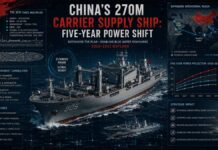
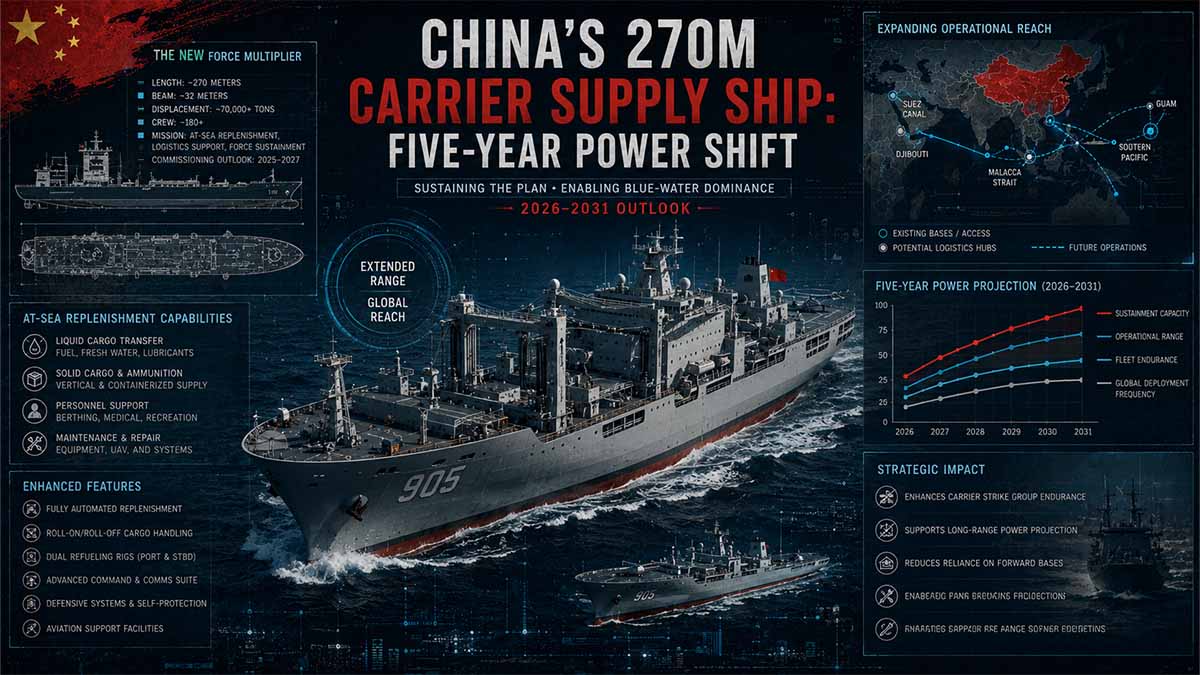
BLUF: A vessel under construction at Longxue Island, Guangzhou, appears—based on commercial satellite interpretation supplied for this assessment—to be an approximately 270-metre, 37-metre-beam fleet replenishment ship, materially larger than China’s existing Type 901 auxiliaries.
No Chinese government or China State Shipbuilding Corporation release located during this review officially identifies the vessel, confirms its dimensions, or designates it as a new naval class.
Its visible architecture nevertheless corresponds strongly to an integrated fast combat-support ship: multiple transfer stations, high-volume midships hull, separate forward and after superstructures, aviation hangar and helicopter deck.
The strategic significance is not merely additional cargo capacity: it is the potential reduction of the logistics constraint governing how long a Chinese carrier group can remain beyond the First Island Chain.
China already describes the Type 901 Hulunhu as a purpose-built accompanying replenishment platform and a core enabler of carrier and far-seas formations.
A larger successor would support higher-tempo aviation, dual-carrier operations, Type 076 expeditionary aviation groups, Indian Ocean deployments and dispersed combat logistics.
The most likely 2026–2031 pathway is construction completion, trials, replenishment certification and integration with Fujian-centred formations rather than immediate mass production.
The vessel would improve endurance and operational choice, but it would also become a conspicuous, lightly defended, intelligence-rich high-value logistics node.
Five-year assessment: 72% probability of commissioning as a PLAN or PLAN-controlled combat-logistics vessel; 54% probability of at least one follow-on hull by 2031.
Its true effect will depend on transfer rate, fuel segregation, aviation stores, damage control, escort availability and whether China can protect the replenishment cycle under submarine, missile, cyber and space-enabled attack.
China’s 270-Metre Supply Ship and the Battle for Naval Endurance
A ship taking shape on Longxue Island, south-east of Guangzhou, may become the most consequential Chinese naval auxiliary built in a generation. Its reported dimensions—approximately 270 metres long and 37 metres wide—matter less than its apparent combination of fuel capacity, dry stores, transfer stations, helicopter facilities and internal volume. If commissioned as expected, the vessel will not simply replenish warships. It could convert China’s expanding carrier fleet from an episodic symbol of national power into a force capable of remaining operational beyond the First Island Chain and, eventually, across the Indian Ocean. The strategic contest is moving from the number of carriers China can launch to the number of days it can keep them supplied, armed and flying.
The Hull Behind the Signal
The vessel is being assembled at the Longxue Island yard historically associated with Guangzhou Shipyard International and now operated within the China State Shipbuilding Corporation industrial system through CSSC Offshore & Marine Engineering. Commercial imagery reviewed in the source material places the hull at roughly 885 feet, or 270 metres, with a beam of about 121 feet, or 37 metres. It shows a forward bridge structure, a separate after superstructure, large lateral pillars consistent with replenishment stations, and a stern flight deck connected to a two-opening hangar.
No Chinese government authority has publicly disclosed the ship’s designation, displacement, propulsion, cargo breakdown, cost or commissioning date. That absence is decisive: the vessel cannot yet be described as a confirmed new PLAN class. But its architecture closely follows the operational logic of the Type 901 comprehensive supply ships Hulunhu and Chaganhu, enlarged around a significantly broader cargo body.
China has already demonstrated what these ships are expected to do. During Western Pacific carrier training in 2025, official Chinese imagery showed Hulunhu, hull number 901, replenishing a Type 055 destroyer. China also documented Chaganhu, hull number 905, conducting replenishment exercises in the South China Sea. These were not ceremonial appearances: they placed high-speed logistics directly inside carrier and large-combatant operations.
The Industrial Connection
The strategic importance of Longxue lies in the overlap between commercial and military construction. The yard’s established portfolio includes tankers, cargo vessels, offshore platforms and specialized heavy ships. Those are precisely the industrial competencies required for a large fleet auxiliary: segregated liquid tanks, hazardous-fuel systems, high-capacity pumps, cargo elevators, structural reinforcement and modular construction.
This is where CSSC becomes central. The group does not merely build destroyers, submarines and carriers; it controls an industrial ecosystem capable of moving designs, components and labour between commercial and military programmes. The U.S. Department of Defense’s 2025 assessment states that China possesses the world’s largest shipbuilding sector and can produce large numbers of surface combatants, amphibious vessels and auxiliaries. It also identifies commercial shipbuilding capacity as a fundamental source of Chinese naval expansion.
The European Union has reached the same structural conclusion from an industrial-policy perspective: commercial shipbuilding preserves skills, suppliers and infrastructure that are directly transferable to naval production. The implication is that a follow-on supply ship would not necessarily have to compete for space at China’s most visible warship yards. Tanker-capable commercial facilities could absorb part of the programme, complicating foreign monitoring and increasing potential production depth.
Capacity Is Not Capability
The ship’s headline size does not reveal its real military value. A replenishment vessel becomes strategically important only when five variables align: cargo composition, transfer throughput, speed, aviation support and survivability.
For comparison, the U.S. Navy’s John Lewis-class oilers are approximately 227.3 metres long and 32.2 metres wide. They can carry about 162,000 barrels of fuel, support dry cargo and operate multiple underway-replenishment stations. The Chinese hull is reportedly around 43 metres longer and almost 5 metres wider, but no authoritative evidence establishes that the additional volume is dedicated to fuel rather than machinery, ammunition, workshops or aviation support.
The decisive question is whether the vessel is primarily an oiler or an integrated combat-support ship. An oiler can extend the range of escorts and replenish carrier aviation fuel. A genuine integrated platform can also carry food, refrigerated cargo, spare engines, electronics, lubricants, weapons and specialist equipment. That difference determines whether the ship adds days of navigation or sustains an entire carrier air campaign.
Its apparent helicopter hangar and large after deck suggest a substantial vertical replenishment role. Helicopters could distribute stores to escorts that cannot safely come alongside, resupply several ships after one rendezvous and maintain logistics under conditions in which connected replenishment is too dangerous. The hangar may also support unmanned aircraft, although no official evidence currently confirms that function.
Fujian’s Logistics Bill
China’s third carrier, Fujian, transforms the scale and complexity of the support requirement. Beijing confirmed its formal commissioning in late 2025 and described it as China’s first electromagnetic-catapult carrier. Official reporting subsequently recorded its participation in realistic maritime training.
The U.S. Department of Defense assesses that Fujian’s prospective air wing includes J-35 fighters, J-15T catapult-capable fighters, J-15D electronic-warfare aircraft, KJ-600 airborne-early-warning aircraft, helicopters and unmanned systems. Each category adds a separate logistics chain: aviation fuel, tyres, engines, electronic components, hydraulic systems, mission equipment and weapons.
A catapult carrier can generate more flexible flight operations than Liaoning or Shandong, but every additional sortie consumes fuel, parts and ordnance. Fujian’s combat potential will therefore be constrained not only by aircraft availability but by the ability to replenish its formation without repeatedly returning to Chinese ports. The Longxue ship appears designed to attack that constraint.
China’s carrier requirement is already expanding operationally. Japanese defence authorities recorded Chinese carrier activity south and east of Japan throughout 2025 and 2026, including deployments hundreds of kilometres from Okinotori Island and repeated passages into the Pacific. One Japanese quarterly report recorded approximately 260 carrier-aircraft take-offs and landings during a monitored deployment period.
Beyond the First Island Chain
In the Western Pacific, the new ship could increase Chinese carrier time on station by reducing the frequency of major logistics rendezvous. That would allow escorts to spend more fuel on anti-submarine manoeuvres, radar-picket positions and high-speed repositioning. It would also give commanders wider margins for operating east of Taiwan and the Philippines, where return routes are longer and adversary surveillance is intense.
The Pentagon’s 2025 report states that China’s operational focus remains concentrated on the First Island Chain, stretching from the Japanese archipelago toward the Malay Peninsula, while its sensor and strike architecture increasingly supports operations farther into the Pacific. A high-capacity supply ship would connect that land-based architecture to mobile naval formations.
Its value in a Taiwan contingency would be indirect but substantial. The ship would probably not operate near the most heavily contested waters. It could remain farther east or south, sustaining carriers and escorts enforcing an outer blockade or screening against intervention. Each additional day a Chinese carrier remains operational east of Taiwan forces the United States and Japan to maintain aircraft, submarines, tankers and surveillance assets in theatre.
The Indian Ocean Test
The Indian Ocean would expose the difference between extended reach and genuine global sustainment. China has maintained naval escort deployments in the Gulf of Aden since 2008, creating more than fifteen years of institutional experience in distant rotations. It also operates a military support facility in Djibouti. Yet sustaining several destroyers on counter-piracy duty is fundamentally different from supporting a carrier air wing.
A carrier group west of Malacca would require relay logistics: Chinese ports supplying smaller tankers; commercial or naval vessels moving cargo through the South China Sea; the high-capacity auxiliary redistributing it to combat ships; and overseas facilities providing maintenance and replenishment. Djibouti could anchor the western end, but it cannot cover the entire route from Hainan to the Arabian Sea.
The vessel could nevertheless reduce immediate dependence on foreign ports. A formation could refuel before entering the Malacca, Sunda or Lombok routes, transit without a politically visible port call and remain in the Bay of Bengal or central Indian Ocean before its next replenishment. That would give Beijing greater freedom in exercises, evacuation missions, crisis signalling and naval diplomacy.
The response is already taking shape. In June 2025, EUNAVFOR Atalanta and the Indian Navy conducted an Indian Ocean exercise involving naval ships, maritime-patrol aircraft, helicopters, intelligence gathering and a simulated hostage rescue. The European Union subsequently proposed deeper maritime-information sharing and cooperation with India in the western Indian Ocean. China’s logistics expansion is therefore entering an ocean where surveillance and security partnerships are becoming denser.
The Single-Target Problem
The same capacity that makes the ship valuable also makes it vulnerable. A vessel carrying marine fuel, aviation fuel, ammunition, spares and food becomes a concentrated logistics node whose loss can affect several combatants simultaneously. Its radar, infrared and wake signatures will be difficult to conceal. Replenishment requires relatively predictable courses, speeds and meeting points—conditions favourable to submarines, satellites and long-range surveillance aircraft.
The most efficient attack would not necessarily sink the ship. Damage to propulsion, fuel-transfer rigs, helicopter facilities or cargo-management systems could create a mission kill. Contaminated aviation fuel, a disabled pump or corrupted inventory records could force a carrier group to reduce operations without a catastrophic strike.
Cyber exposure is particularly serious. A ship of this complexity will rely on software controlling tank pressure, ballast, refrigeration, pumping sequences, valve positions and cargo data. The vulnerable network extends ashore through shipyards, contractors, ports, satellite links and commercial tanker schedules. A manipulated manifest could be operationally as damaging as a damaged crane if commanders discover too late that essential fuel or components are unavailable.
The Production Threshold
One ship creates capability; three create availability. With only one hull, China would face a predictable maintenance cycle and a unique asset that can be monitored from construction through deployment. A second ship would permit rotation. Three would enable one vessel to deploy, one to prepare and one to undergo maintenance.
The five-year probability assessment is therefore asymmetric. There is a strong likelihood that the first ship will complete trials and enter PLAN or PLAN-controlled service before 2030. The probability that at least one follow-on hull appears by the end of 2031 is lower but still material. The decisive indicators will be repeated replenishment-rig procurement, identical modules at another CSSC yard, enlarged berthing and fuel infrastructure, and new crew-training programmes.
The strongest pathway is not a fleet centred on one enormous tanker. It is a distributed architecture combining large comprehensive supply ships, smaller Type 903 and Type 901 auxiliaries, commercial tankers, helicopters, overseas access and protected shore depots. That system would allow China to separate fuel, ammunition and stores across multiple nodes and force adversaries to track an entire network rather than one conspicuous vessel.
The Strategic Balance Sheet
By 2031, the most probable outcome is a Chinese fleet with materially greater endurance in the Western Pacific and the demonstrated ability to send a carrier formation into the Indian Ocean without immediate reliance on a foreign port. Permanent Indian Ocean carrier presence remains less likely because maintenance, escort availability, host-state politics and submarine exposure cannot be solved by cargo volume alone.
The Longxue ship’s significance is therefore precise. It will not make China’s carriers globally autonomous. It can postpone the moment when fuel, stores and aviation consumption force them home. In naval strategy, postponement is power: it extends coercion, increases uncertainty and compels competitors to spend more time and resources tracking the formation.
China has already built the carriers, destroyers and amphibious aviation ships. The next phase is the industrialization of endurance. The 270-metre hull at Guangzhou may be the clearest evidence yet that Beijing understands the decisive equation: fleets are counted in ships, but power is measured in sustainable days at sea.
Navigational Index
- Platform Identity and Logistics Architecture — What the hull probably is, what remains unverified, and why its configuration matters more than its headline dimensions.
- Carrier Operations, Theatre Reach and Strategic Effects — How a high-capacity replenishment ship could alter Chinese naval persistence from the Western Pacific to the Indian Ocean.
- Five-Year Outlook, Competing Hypotheses and Vulnerability Model — Probabilistic pathways through 2031, including survivability, production, basing, cyber exposure and adversary countermeasures.
Master Abstract
From fleet growth to logistics conversion
China’s emerging vessel should be understood as a possible conversion mechanism between nominal fleet size and usable combat power. The visual evidence contained in the supplied construction account indicates a hull approximately 270 metres long and 37 metres across, with a broad-volume midbody, transfer-station-like vertical structures, a forward bridge, an after superstructure, a substantial hangar and a stern aviation deck. These observations support—but do not prove—the hypothesis that the ship is a very large integrated replenishment vessel. Its reported dimensions remain an externally derived estimate; no official Chinese source reviewed here has published a class name, displacement, propulsion arrangement, cargo breakdown or military ownership. The analytical baseline is nevertheless strengthened by official descriptions of the Type 901 Hulunhu, which China identifies as an independently developed comprehensive supply ship designed for carrier formations and mobile far-seas forces. The Chinese Ministry of Veterans Affairs calls Hulunhu the first Type 901 and states that its central mission is accompanying replenishment for ocean-going fleets—Inner Mongolia: Hulunhu Ship Receives National Recognition – Ministry of Veterans Affairs of the People’s Republic of China – February 2026. Official Chinese military reporting also documented Hulunhu replenishing a Type 055 guided-missile destroyer during Western Pacific carrier training in 2025—PLA Navy Aircraft Carriers Conduct Training in the Western Pacific – China Military Online – June 2025. The new hull therefore appears less like an isolated auxiliary and more like the next logical component in a force architecture moving from occasional distant deployments to sustained carrier-centred operations. Size alone would not establish transformational value; the decisive variables are simultaneous connected-replenishment stations, fuel-pumping rates, aviation-fuel segregation, ammunition handling, refrigerated volume, maintenance workshops, helicopter sortie generation, command-and-control redundancy and speed sufficient to accompany manoeuvring formations. If these elements are present, the vessel could compress multiple supply functions into one platform, reduce rendezvous frequency and extend the interval between vulnerable logistics events. That would directly address the operational contradiction of China’s present carrier fleet: increasingly sophisticated aviation capability carried by ships and escorts that still consume large quantities of conventional fuel, lubricants, ordnance, food, water, spares and aviation consumables.
Why Fujian changes the replenishment equation
The operational demand behind such a ship is expanding faster than a simple count of Chinese carriers suggests. Liaoning and Shandong remain conventionally powered, their escorts require marine fuel, and their embarked aircraft consume aviation fuel, weapons, gases, spare engines, tyres, hydraulic components and electronic assemblies at rates that rise sharply during sustained flight operations. Fujian adds a qualitatively different burden because catapult aviation can support heavier aircraft, more diverse mission configurations and potentially a more complex air wing. China’s Ministry of National Defense described Fujian as its first catapult-equipped carrier and confirmed intensive sea trials in 2025—Regular Press Conference of the Ministry of National Defense – Ministry of National Defense of the People’s Republic of China – June 2025. By February 2026, the ministry stated that Fujian had been commissioned by the end of 2025 and had subsequently transited the Taiwan Strait—Regular Press Conference of the Ministry of National Defense – Ministry of National Defense of the People’s Republic of China – February 2026. The latest U.S. Department of Defense assessment identifies a probable future Fujian air wing comprising J-35, J-15T, J-15D, KJ-600, Z-20 and unmanned aircraft, while recording China’s first dual-carrier training and estimating an objective of six additional carriers by 2035, for a total of nine—Military and Security Developments Involving the People’s Republic of China 2025 – U.S. Department of Defense – December 2025. Those projections should be treated as an external intelligence estimate rather than an announced Chinese production schedule, but they reveal the underlying logistics problem: each additional flight deck creates disproportionately greater demand when operated as part of a full strike group rather than as a training carrier. A high-capacity support ship could accompany a carrier, two or more large destroyers, frigates and possibly submarines while supplying both propulsion and aviation requirements. It could also support Type 075 and catapult-equipped Type 076 aviation-amphibious formations. The Pentagon confirms China launched its first Type 076 in December 2024 and notes that it incorporates an electromagnetic catapult and is expected to operate unmanned aircraft. The same report judges China capable of producing large numbers of surface combatants, auxiliaries and amphibious ships because of its dominant commercial shipbuilding base. The emerging supply ship is therefore best interpreted as infrastructure for a wider ecosystem of manned and unmanned naval aviation, not merely a tanker enlarged for prestige.
Strategic reach, resilience and the new logistics vulnerability
Over the 2026–2031 period, the vessel’s greatest contribution would be to increase persistence, not to make Chinese carrier groups independent of shore infrastructure. A replenishment ship cannot create supplies; it redistributes them from ports, commercial tankers, depots and shuttle vessels to combat formations. Its strategic value is thus measured by how far it can displace the fleet’s logistical centre of gravity and how effectively it can operate inside a defended network. In the Western Pacific, it could permit Chinese formations to spend longer periods east of Taiwan and the Philippines, increase operating time near the Philippine Sea approaches and reduce pressure to return to Hainan, Guangdong or eastern Chinese bases. In the Indian Ocean, it could reinforce counter-piracy deployments, evacuation contingencies and carrier demonstrations while complementing access arrangements and China’s support facility in Djibouti. The Pentagon records an enduring Chinese counter-piracy mission in the Gulf of Aden extending for sixteen years as of 2024, illustrating that sustained far-seas presence is already institutional rather than experimental. Yet concentration creates fragility. A ship carrying major quantities of marine diesel, aviation fuel, ordnance and stores becomes a mission-kill target whose loss can degrade several combatants simultaneously. Its broad hull and large superstructure would generate detectable radar, infrared, acoustic and electro-optical signatures. Its movements could expose replenishment corridors, carrier operating boxes and consumption rates. Its combat systems are unlikely to equal those of an escort, making survivability dependent on destroyer air defence, antisubmarine screening, emission control, deception, dispersed rendezvous planning and rapid cargo transfer. Cyber risk is equally important: cargo-management software, fuel-quality monitoring, power-management systems, satellite communications and scheduling networks provide opportunities for disruption without sinking the vessel. Contaminated fuel data, manipulated inventory states, corrupted rendezvous instructions or navigation-system interference could impose operational delay at relatively low escalation cost. The Bayesian judgment is therefore dual: the ship probably increases PLAN endurance materially, but it also creates a more valuable and observable logistics node. The resulting strategic change is not a Chinese ability to operate indefinitely anywhere; it is a higher probability that Beijing can generate repeated, longer and more geographically flexible carrier operations before allied interdiction, maintenance or inventory depletion forces a reset.
Analytical boundaries and evidence confidence
The present assessment separates verified facts from inferred characteristics. High-confidence evidence includes the official Chinese description of the Type 901’s carrier-support mission, documented carrier-group replenishment activity, Fujian’s catapult-carrier development, the first dual-carrier training cycle, Type 076 construction and China’s large naval-industrial capacity. The approximate 270-by-37-metre measurements, visible transfer positions, hangar geometry and identification of the Longxue hull as a naval replenishment ship originate from the uploaded construction analysis and associated commercial imagery rather than an official class announcement. The strongest competing explanation is therefore not that the observed features are irrelevant, but that the vessel could be a dual-use test platform, a commercially registered support ship, a highly specialized offshore vessel adapted for state missions, or a prototype whose final ownership remains outside conventional PLAN commissioning channels. This distinction matters because China’s shipbuilding ecosystem can blur civilian, auxiliary and military categories. A vessel may be financed, registered, crewed or publicly described in commercial terms while retaining latent mobilization value. Conversely, a visually military configuration does not establish its cargo mix, survivability or sustained speed. The forecast model consequently assigns 72% to a PLAN or PLAN-controlled integrated replenishment outcome, 13% to a military-relevant dual-use support platform, 8% to an experimental logistics or aviation-support ship, 4% to a specialized commercial design with misleading visual similarities, and 3% to other explanations. These are structured analytic estimates rather than measured frequencies. They are updated from a neutral prior using five evidence families: hull geometry, replenishment-station arrangement, aviation facilities, resemblance to established Type 901 architecture and alignment with China’s expanding carrier demand. The model’s principal disconfirming indicators would be commercial cargo-handling equipment incompatible with naval transfer, low-speed propulsion, absence of military communications and defensive foundations, civilian registry disclosures, or a final deck arrangement that prevents simultaneous liquid and solid-store replenishment. The principal confirming indicators would be PLAN hull numbering, military trials with a Type 055 or carrier, standardized replenishment rigs, defensive gun positions, helicopter certification and state reporting that describes the ship as a “comprehensive supply vessel” or “far-seas support platform.”
The Carrier Sustainment Conversion
Bayesian Platform Assessment
Operational Assumption Controls
Monte Carlo–Style 2031 Outcome Distribution
Shadow-Dimension Exposure Matrix
Platform Identity and Logistics Architecture: China’s Emerging Super-Replenishment Ship
The vessel taking shape at Longxue Island, southeast of Guangzhou, is most plausibly an enlarged integrated fleet-replenishment ship designed to sustain aircraft-carrier, large surface-combatant and amphibious aviation formations at operational distances beyond China’s established coastal support system. That conclusion is analytically strong but not yet officially confirmed. The observable evidence supplied for this assessment indicates an estimated length of approximately 270 metres, a beam near 37 metres, a high-volume slab-sided midsection, distinct forward and after superstructures, multiple pillar-like structures adjacent to the hull sides, and a stern aviation complex containing a flight deck and enclosed hangar. Those features collectively resemble the functional architecture of a comprehensive supply vessel rather than a conventional tanker, cargo ship or offshore-construction platform, because they appear to combine liquid-fuel transfer, solid-store movement and helicopter-supported vertical replenishment within one hull. The critical distinction, however, is between “resembles” and “is.” As of 18 July 2026, no live official release located from the Chinese Ministry of National Defense, People’s Liberation Army, China State Shipbuilding Corporation, or another verified Chinese government institution publicly assigns the vessel a PLAN hull number, class designation, displacement, propulsion system, operator, transfer capacity or commissioning schedule. The approximately 270-by-37-metre dimensions therefore remain measurements derived from commercially obtained imagery rather than state-certified specifications. The strongest official comparator is the existing Type 901 comprehensive supply ship, whose operational purpose is explicitly demonstrated in Chinese military reporting. In June 2025, the Chinese Ministry of National Defense published imagery showing Hulunhu, hull number 901, conducting alongside replenishment with a Type 055 guided-missile destroyer during carrier operations in the Western Pacific—PLA Navy Aircraft Carriers Conduct Training in the Western Pacific – Ministry of National Defense of the People’s Republic of China – June 2025 — https://eng.mod.gov.cn/xb/News_213114/TopStories/16390751.html. China has separately documented Chaganhu, hull number 905, conducting replenishment-at-sea exercises in the South China Sea, confirming that the Type 901 family is embedded in operational fleet-support formations rather than functioning as an experimental demonstration class—Multi-Type Naval Vessels Conduct Training in South China Sea – Ministry of National Defense of the People’s Republic of China – March 2025 — https://eng.mod.gov.cn/xb/Home/Focus/16374503.html.
The vessel’s identity should be evaluated through an Analysis of Competing Hypotheses rather than by accepting its unusual dimensions as dispositive evidence. Five principal hypotheses explain the visible configuration. H₁ identifies it as a next-generation PLAN comprehensive supply ship, effectively an enlarged or functionally expanded successor to the Type 901. H₂ identifies it as a state-controlled dual-use support ship that would retain commercial registration or civilian crewing while being engineered for wartime naval mobilization. H₃ interprets it as a specialized aviation-support or experimentation platform intended to test unmanned aircraft, rotary-wing logistics, modular mission systems or new replenishment mechanisms. H₄ treats it as an offshore-industrial vessel whose apparent replenishment stations are actually heavy-handling structures, service towers or incomplete commercial equipment. H₅ considers it a hybrid expeditionary support vessel combining replenishment, repair, medical, command or unmanned-system functions in a configuration that does not correspond neatly to an existing PLAN auxiliary category. The evidence discriminates among these possibilities unevenly. A broad central cargo volume supports H₁, H₂ and H₅ but is not uniquely military. Multiple evenly distributed lateral structures strongly favour replenishment-related functions, particularly if they become matched port-and-starboard transfer stations, but their exact equipment remains unresolved. The after flight deck and hangar favour H₁, H₃ and H₅ because vertical replenishment is an established component of naval logistics; however, aviation facilities also appear on some offshore, research and special-purpose civilian vessels. The reported resemblance to Type 901 architecture materially raises the posterior probability of H₁, while the construction location at a yard associated with commercial and unusual dual-purpose hulls preserves non-trivial probability for H₂ and H₅. The initial Bayesian distribution adopted here is H₁ 64%, H₂ 14%, H₃ 8%, H₄ 5%, H₅ 9%. The previous section’s broader 72% probability that the vessel will become a PLAN or PLAN-controlled naval auxiliary encompasses both H₁ and the military component of H₂ and H₅; it does not imply 72% confidence in a specific class designation. The continuing absence of an official announcement is only weakly disconfirming because major Chinese naval platforms can remain undesignated during construction. Conversely, an eventual civilian registry would not automatically invalidate military relevance, since commercial construction standards, merchant crews and state mobilization mechanisms can coexist with naval utility. The appropriate intelligence position is therefore “probable comprehensive replenishment platform, exact status unresolved,” not “confirmed Type 901 successor.”
| Hypothesis | Platform interpretation | Supporting indicators | Principal disconfirming indicators | Current probability |
|---|---|---|---|---|
| H₁ | Next-generation PLAN comprehensive supply ship | Symmetrical transfer positions, large cargo volume, hangar, flight deck, Type 901-like arrangement | Commercial cargo equipment, low sustained speed, absence of naval communications or defensive positions | 64% |
| H₂ | Dual-use state logistics vessel | Commercial yard, high-volume hull, mobilization utility, potentially civilian crewing | PLAN hull number, permanent naval weapons, direct assignment to combat-support flotilla | 14% |
| H₃ | Aviation or unmanned-systems test/support ship | Large hangar, broad deck, unusual yard history | Multiple operational replenishment rigs and segregated liquid-transfer systems | 8% |
| H₄ | Specialized commercial or offshore vessel | Commercial shipyard portfolio, incomplete construction can mislead identification | Confirmed military electronics, replenishment certification, carrier-group trials | 5% |
| H₅ | Hybrid expeditionary support, repair and replenishment ship | Large internal volume, aviation capability, possible modular spaces | Conventional single-purpose tanker layout or explicit class disclosure | 9% |
Configuration matters more than headline length because effective fleet logistics is determined by the relationship between payload composition, transfer rate, ship speed, station geometry, survivability and the supported formation’s consumption profile. A 270-metre ship that carries mostly one category of liquid cargo but has limited dry stores, weak ammunition handling and only a few transfer points could be less useful to a carrier group than a smaller, faster, better-segregated platform capable of simultaneously delivering marine fuel, aviation fuel, lubricants, food, refrigerated stores, spare parts and munitions. The official U.S. Navy description of the John Lewis-class illustrates this distinction. The class is approximately 227.3 metres long and 32.2 metres in beam, can carry around 162,000 barrels of fuel, supports substantial dry cargo, and is designed to provide diesel, lubricating oil, aviation fuel, provisions, potable water and stores—SECNAV Renames John Lewis-Class Fleet Replenishment Oiler After Navy WWII Medal of Honor Recipient – United States Navy – June 2025 — https://www.navy.mil/Press-Office/Statements/display-statement/Article/4229198/secnav-renames-john-lewis-class-fleet-replenishment-oiler-after-navy-wwii-medal/. The U.S. Navy states that its fleet oilers may operate with up to five underway-replenishment stations, demonstrating that station count and simultaneous transfer capability are fundamental measures of throughput—Fleet Replenishment Oilers T-AO – United States Navy – December 2025 — https://www.navy.mil/Resources/Fact-Files/Display-FactFiles/Article/2222909/fleet-replenishment-oilers-t-ao/. John Lewis also introduced the Electric Standard Tensioned Replenishment Alongside Method, or E-STREAM, underscoring that replenishment performance depends on transfer technology and station control rather than hull size alone—USNS John Lewis at Naval Surface Warfare Center Port Hueneme Division – Naval Sea Systems Command – November 2022 — https://www.navsea.navy.mil/Home/Shipyards/SIOP-old/SIOP-Image-Gallery/igphoto/2003229373/. Applied to the Chinese vessel, the decisive unanswered questions are whether the lateral structures support simultaneous port-and-starboard replenishment, whether separate pipelines prevent contamination between marine and aviation fuels, whether heavy solid-store transfer is possible during liquid replenishment, whether ammunition is isolated in protected magazines, and whether the ship can maintain formation speed during carrier manoeuvres. A larger hull creates potential capacity; only system architecture converts that potential into operational endurance.
The emerging vessel’s probable internal architecture can be reconstructed in functional terms without asserting compartments that have not been observed. The forward superstructure likely concentrates navigation, command, accommodation and communications, while the central hull provides the greatest uninterrupted volume for liquid tanks, dry cargo holds, refrigeration, workshops and handling passages. The after superstructure and aviation complex probably support helicopter operations, maintenance, aviation fuel interfaces and vertical replenishment. The apparent separation between forward and after superstructures could also improve functional segregation: navigation and command remain forward, while machinery exhaust, aviation handling and potentially propulsion-related spaces are concentrated aft. Yet several alternatives remain possible. Exhaust stacks near the stern could indicate a machinery arrangement optimized to free central volume for cargo, but no official source confirms engine type, shaft arrangement, power output or maximum speed. Speed is strategically decisive because a logistics ship unable to accompany a carrier formation at operational transit speed becomes a shuttle asset rather than an integrated combat-support vessel. The John Lewis-class is officially rated at 20 knots, while China’s Type 901 is generally assessed externally as a high-speed support ship; however, no official Chinese specification located during this research provides a verified speed for the new vessel, and no unsupported estimate should be inserted. The engineering challenge rises non-linearly with size because greater cargo capacity increases displacement, structural load, manoeuvring inertia, power requirements, replenishment-line tension and damage-control complexity. A full midsection optimized for volume can reduce hydrodynamic efficiency and may produce a larger radar and wake signature. Conversely, the beam may improve stability during connected replenishment, support wider cargo lanes, permit better tank segregation and create redundancy after damage. The vessel’s value will therefore depend upon trade-offs among capacity, speed and survivability. An exceptionally large ship can reduce the number of logistics rendezvous required by a formation, but it simultaneously concentrates a larger percentage of the formation’s fuel, aviation stocks and munitions in one target. The design is consequently not simply a supply solution; it is an operational bet that increased efficiency and endurance outweigh the vulnerability created by logistical concentration.
Probable Functional Logistics Architecture Matrix
Maritime Replenishment Platform Layout & Fleet Sustainment Telemetry
The most consequential configuration issue is likely to be whether the ship is an oiler, an ammunition-and-dry-stores ship, or a genuinely integrated fast combat-support vessel. These categories can look superficially similar in satellite imagery while producing materially different operational effects. A primarily liquid-cargo ship would extend propulsion and aviation endurance but would not solve the carrier group’s need for high-volume spare parts, weapons, food and technical consumables. An integrated ship would carry a more balanced load but sacrifice some fuel capacity and require more complex internal protection, environmental control and cargo routing. Ammunition introduces the greatest technical and survivability burden because magazines require blast mitigation, temperature regulation, secure handling paths and procedures that minimize interaction with volatile fuels. The visible aviation deck offers another clue: a large hangar supports more than emergency landing. It could enable sustained vertical replenishment, moving cargo to ships that cannot safely come alongside, maintaining deliveries under sea-state constraints, or distributing stores to multiple escorts after the primary vessel separates from the formation. Helicopter operations also introduce additional demand for aviation fuel, firefighting, maintenance, ordnance safety and deck-control personnel. China has already demonstrated that replenishment proficiency extends beyond daylight operations. Official military reporting states that the comprehensive replenishment ship Taihu, hull number 889, completed nighttime replenishment using light signals while maintaining radio silence—Naval Ship Taihu Completes Nighttime Replenishment – Ministry of National Defense of the People’s Republic of China – August 2022 — https://eng.mod.gov.cn/xb/News_213114/Videos/16233096.html. This matters because platform capability cannot be separated from doctrine and crew proficiency. A large ship operating only in benign daylight conditions would have limited combat relevance; one able to replenish under emission control, at night and within a manoeuvring formation would materially improve wartime resilience. The next intelligence threshold is therefore not launch or naming, but observation of trial events involving simultaneous transfer, helicopter operations, blackout procedures, formation manoeuvres and integration with a carrier or Type 055 destroyer.
The shipyard context strengthens the military interpretation while also warning against overly linear conclusions. The vessel is reportedly under construction at the Longxue facility operated by a China State Shipbuilding Corporation subsidiary whose public portfolio includes commercial tankers, cargo ships and specialized offshore platforms. Large commercial shipbuilding capacity is directly relevant to naval-auxiliary production because tank construction, cargo-system integration, propulsion engineering and modular assembly transfer readily from commercial to military support ships. The European Union’s Industrial Maritime Strategy explicitly recognizes this industrial relationship, stating that preserving commercial shipbuilding capacity is important for sustaining naval shipbuilding because of strong dual-use linkages—EU Industrial Maritime Strategy – Council of the European Union – March 2026 — https://data.consilium.europa.eu/doc/document/ST-6987-2026-INIT/en/pdf. The European Commission has also assessed that European industry has been losing ground to China in strategic shipbuilding segments, including specialized offshore vessels—European Industrial Maritime Strategy – European Commission – March 2026 — https://black-sea-maritime-agenda.ec.europa.eu/file/download/1074. These institutional findings do not identify the Longxue hull, but they explain why China can potentially construct a very large naval auxiliary outside a yard publicly associated only with front-line warships. A commercial yard offers deep experience with large tank volumes, double-hull arrangements, hazardous-liquid management and serial modular production. It may also obscure the military programme’s early indicators among ordinary industrial activity. The dual-use structure complicates attribution: equipment suppliers, digital-control systems, pumps, valves and cargo-management software may originate in civilian supply chains even when the final vessel has a military mission. It also creates a mobilization advantage, because follow-on hulls could potentially be distributed across yards possessing commercial tanker expertise rather than competing exclusively for warship construction capacity. The five-year implication is that analysts should track design repetition, procurement patterns and modular signatures across multiple CSSC facilities, not merely wait for another identical hull to appear at Longxue.
| Architectural variable | What can presently be inferred | What remains unverified | Operational consequence if confirmed |
|---|---|---|---|
| Hull length and beam | Approximate external dimensions suggest exceptionally high internal volume | Certified measurements, displacement and draught | Larger fuel, stores and workshop capacity; increased signature and port constraints |
| Lateral vertical structures | Consistent with multiple replenishment stations | Number, transfer type, simultaneous operating capacity | Determines throughput and ability to support more than one receiver |
| Forward superstructure | Likely bridge, navigation, communications and accommodation | Flag facilities, command spaces, battle-management role | Could permit logistics-command or task-group coordination |
| After superstructure | Associated with exhausts and aviation facilities | Machinery arrangement, propulsion power and redundancy | Determines cargo-volume efficiency and survivability after damage |
| Hangar and flight deck | Supports helicopter operations and vertical replenishment | Aircraft capacity, maintenance depth, unmanned-aircraft compatibility | Enables dispersed delivery and support to ships unable to replenish alongside |
| Central cargo zone | Optimized for volume | Fuel-to-dry-cargo ratio, magazine protection and refrigeration | Defines whether ship is primarily an oiler or integrated combat-support platform |
| Defensive systems | No authoritative configuration confirmed | Close-in weapons, decoys, electronic warfare and sensors | Governs dependence on escorts and ability to survive isolated attack |
| Propulsion and speed | Aft exhaust arrangement suggests substantial machinery volume | Speed, range, shaft count and power generation | Determines whether ship can accompany carriers or merely shuttle supplies |
| Crew model | No official information | PLAN crew, civilian mariners or mixed organization | Affects readiness, legal status, training and wartime integration |
| Digital logistics systems | Necessary for a ship of this complexity | Cybersecurity, network architecture and automation level | Creates both efficiency gains and potential cyber vulnerability |
The five-year outlook should be built around a sequence of observable technical milestones rather than an assumed commissioning date. During the remainder of 2026, the highest-value indicators will be completion of replenishment rigs, installation of sensors, defensive foundations, aviation-support equipment, communications masts and hull markings. A commercial-style paint scheme or absence of weapons during fitting-out would not conclusively support H₂ or H₄ because auxiliaries may receive military systems late in construction. During 2027, harbour trials, propulsion testing and early sea trials should reveal manoeuvring characteristics, speed category and whether the vessel is structurally prepared for connected replenishment. Replenishment certification would likely require progressive trials: station deployment without a receiver, dry connections, liquid-transfer tests, helicopter qualification, followed by formation operations. During 2028, the most probative event would be an exercise with Fujian, Liaoning, Shandong, a Type 055 destroyer or a Type 076 amphibious assault ship. China’s first Type 076, Sichuan, had completed several trial voyages by April 2026 according to the Chinese Ministry of National Defense—Chinese PLA Navy’s First Type 076 Amphibious Assault Ship Sichuan Conducts Cross-Regional Testing and Training – Ministry of National Defense of the People’s Republic of China – April 2026 — https://eng.mod.gov.cn/2025xb/N/T/16456412.html. A large replenishment platform operating with both carrier and Type 076 formations would indicate that the design supports a broader naval-aviation architecture rather than one carrier class. During 2029–2030, attention should shift from the first hull to production replication, training pipelines, home-port infrastructure and the emergence of dedicated escorts or shuttle tankers. By 2031, the decisive measure will not be whether the ship has crossed the Indian Ocean once, but whether the PLAN can sustain recurring deployments without drawing down logistics support for other theatres. The central forecast assigns a 78% probability that the vessel will have completed sea trials by 2028, 66% probability of formal operational assignment by 2029, and 54% probability that at least one related follow-on hull will be visible, contracted or under construction by the end of 2031.
| Period | Most probable milestone | Confirmation indicators | Warning indicators | Estimated probability |
|---|---|---|---|---|
| H₂ 2026 | Structural completion and systems fitting | Replenishment rigs, military mast, aviation equipment, defensive foundations | Commercial cranes, offshore modules or civilian cargo systems inconsistent with naval transfer | 86% |
| 2027 | Harbour and propulsion trials | Tug movements, engine tests, controlled sea departure, naval support craft presence | Extended fitting-out delays or major structural alteration | 81% |
| 2028 | Replenishment and aviation certification | Transfer trials, helicopter operations, formation manoeuvres | Trials limited to cargo carriage without naval receivers | 78% |
| 2029 | Initial operational assignment | PLAN hull number, combat-support flotilla association, carrier exercise | Civilian registry with no recurring naval activity | 66% |
| 2030 | Extended Western Pacific deployment | Multi-day carrier support east of the First Island Chain | Persistent dependence on coastal replenishment and port calls | 61% |
| 2031 | Class replication or derivative programme | Second hull, yard modules, procurement repetition, expanded training base | One-off prototype status or maintenance-intensive service | 54% |
The red-team assessment identifies several reasons why the vessel may deliver less operational value than its dimensions imply. First, large capacity may conceal poor cargo balance. If the ship is optimized primarily for fuel, ammunition and specialized aircraft components could remain limiting factors. Second, transfer throughput may be constrained by sea state, rig count, pumping pressure, helicopter availability or receiver compatibility. A very large reserve carried aboard one vessel is operationally irrelevant if it cannot be delivered at the speed demanded by carrier operations. Third, maintenance burden may become a hidden limiter. Pumps, tensioned rigs, elevators, refrigeration plants, aviation facilities and cargo-management systems create a dense failure network; degraded availability in even a few critical systems could reduce the platform to a tanker with unused specialist spaces. Fourth, survivability depends on formation integration. A vessel with limited organic air defence, antisubmarine capability and electronic warfare must remain inside a destroyer-and-frigate screen, thereby consuming escort resources and potentially constraining carrier manoeuvre. Fifth, concentration creates systemic risk: damage, contamination, cyber compromise or propulsion failure could simultaneously remove multiple categories of supply. Sixth, draught and beam may reduce access to austere ports and increase dependence on major naval facilities, undermining flexibility. Seventh, replenishment remains part of a wider chain. The ship must itself be refilled by secure ports, shore pipelines, tankers or relay vessels; adversaries can attack the upstream network rather than the ship directly. Cyber intrusion into cargo planning, automated valves, stability management or rendezvous scheduling may produce delays or mistrust without a kinetic strike. No verified Russian government or military-domain source located in the multilingual search provided authoritative vessel-specific specifications or an independently confirmed class identity; those claims are therefore omitted rather than filled with secondary commentary. The resulting assessment remains deliberately conservative: the hull likely represents a substantial logistics advance, but its true strategic value will be revealed by station throughput, cargo segregation, sustained speed, deployment rhythm and class replication—not by the claim that it is the world’s largest replenishment ship.
The final Bayesian update preserves a high but conditional probability of military replenishment identity. H₁ rises from an initial neutral baseline because the observed lateral architecture, central volume and aviation complex align with an established Chinese operational model: Type 901 ships are repeatedly shown conducting underway replenishment, including with major combatants, while China continues to expand the formations requiring such support. Official Chinese reporting documented Hulunhu in replenishment training in July 2024, March 2025 and May 2025, indicating recurring institutional proficiency rather than episodic demonstration—Comprehensive Supply Ship in Replenishment Training – Ministry of National Defense of the People’s Republic of China – July 2024 — https://eng.mod.gov.cn/xb/Home/Focus/16321596.html; PLA Naval Vessels in Replenishment-at-Sea Training – Ministry of National Defense of the People’s Republic of China – March 2025 — https://eng.mod.gov.cn/xb/Home/Focus/16372267.html; and PLA Naval Vessels in Multi-Subject Training – Ministry of National Defense of the People’s Republic of China – May 2025 — https://eng.mod.gov.cn/xb/Home/Focus/16385338.html. The U.S. Department of Defense’s 2025 assessment adds strategic context by describing China’s continuing production of carriers, amphibious aviation ships, surface combatants and auxiliaries and by linking these programmes to more distant and sustained naval operations—Military and Security Developments Involving the People’s Republic of China 2025 – United States Department of Defense – December 2025 — https://media.defense.gov/2025/Dec/23/2003849070/-1/-1/1/ANNUAL-REPORT-TO-CONGRESS-MILITARY-AND-SECURITY-DEVELOPMENTS-INVOLVING-THE-PEOPLES-REPUBLIC-OF-CHINA-2025.PDF. The updated probability distribution is consequently H₁ 67%, H₂ 13%, H₃ 7%, H₄ 4% and H₅ 9%. H₁ does not exceed 70% because the absence of an official designation, verified displacement, propulsion specification and observed replenishment trial remains material. Confirmation would require one or more of four indicators: a military hull number, an authoritative Chinese description, a replenishment exercise with an operational PLAN receiver, or imagery showing standardized transfer equipment and defensive systems. Until then, the correct judgment is that China is probably building a very large comprehensive supply ship whose configuration could materially improve carrier persistence, but neither its final mission nor its operational performance can be considered proven.
Figure 1: Platform-Identity Probability and 2026–2031 Maturation
Structured analytic estimates; not official specifications or measured frequencies.
Carrier Operations, Theatre Reach and Strategic Effects: From Western Pacific Persistence to Indian Ocean Power Projection
A high-capacity replenishment ship would alter Chinese carrier operations primarily by changing the relationship between distance, operational tempo and time on station. Aircraft carriers do not project power merely because they can reach a distant operating area; they generate strategic effects only when their air wings can fly repeatedly, escorts can maintain screening positions, command systems remain supplied and the formation can absorb mechanical failures without returning to port. The emerging Longxue Island vessel appears designed to carry substantially more fuel, stores and aviation-support capacity than China’s current auxiliaries, although its identity and specifications remain unconfirmed by Chinese authorities. If its visible transfer stations, central cargo volume, flight deck and hangar mature into a comprehensive replenishment architecture, the ship could reduce the number of logistics rendezvous required during a carrier deployment and extend the distance at which a formation can maintain meaningful sortie generation. The baseline operational demand is already visible. In June 2025, Liaoning and Shandong completed simultaneous far-seas training in the Western Pacific, with the Chinese Ministry of National Defense stating that the formations trained in waters beyond the First Island Chain and conducted carrier-aircraft operations under realistic conditions—China’s Aircraft Carrier Formations Return after Completing Far-Sea Training – Ministry of National Defense of the People’s Republic of China – July 2025 — https://eng.mod.gov.cn/xb/News_213114/TopStories/16394519.html. Official Chinese imagery from the same training cycle showed the Type 901 Hulunhu replenishing a large surface combatant, establishing that logistics ships were not peripheral additions but integral elements of the carrier formations. The effect of a larger successor would therefore not be to create an entirely new operational concept; it would be to increase the endurance, capacity and scheduling flexibility of an already demonstrated concept. The central strategic shift would be from discrete, politically visible carrier excursions toward a higher frequency of sustained deployments in which carrier groups remain outside coastal support envelopes for longer intervals and can reposition without immediately advertising their next logistics requirement.
The Western Pacific represents the most immediate and operationally credible theatre for this change because China can combine mobile replenishment with land-based aviation, space-supported surveillance, long-range missiles and fortified facilities in the South China Sea. The 2025 U.S. Department of Defense China Military Power Report assesses that Chinese terrestrial, airborne and space-based C4ISR networks increasingly support operations between the First and Second Island Chains and that the PLA’s conventional strike architecture could be effective at ranges of approximately 1,500–2,000 nautical miles from the Chinese mainland under certain operational conditions—Military and Security Developments Involving the People’s Republic of China 2025 – United States Department of Defense – December 2025 — https://media.defense.gov/2025/Dec/23/2003849070/-1/-1/1/ANNUAL-REPORT-TO-CONGRESS-MILITARY-AND-SECURITY-DEVELOPMENTS-INVOLVING-THE-PEOPLES-REPUBLIC-OF-CHINA-2025.PDF. A large replenishment ship would operate inside this broader architecture rather than independently of it. East of Taiwan and the Philippines, it could enable a carrier to remain in a manoeuvre box while escorts rotate through refuelling stations, reducing the frequency with which the entire formation must contract around a single low-speed replenishment event. In the Philippine Sea, this could support longer-duration air-defence patrols, surveillance sorties and anti-submarine operations while complicating adversary assessments of when the group must withdraw. The same logistics reserve could permit a carrier commander to spend fuel more aggressively on evasive manoeuvre, high-speed repositioning or aircraft-launch cycles rather than preserving a narrow return-to-base margin. These effects would be amplified by China’s island infrastructure. The Pentagon reports that China’s Spratly outposts provide airfields, berthing and resupply facilities that enable more flexible and persistent military and paramilitary operations, including regular support to PLAN, coast-guard and maritime-militia activities—Military and Security Developments Involving the People’s Republic of China 2025 – United States Department of Defense – December 2025 — same official report. Mobile replenishment would connect those fixed nodes to carrier formations, creating a layered support system in which Hainan and mainland bases provide deep maintenance, island facilities provide surveillance and limited resupply, and fleet auxiliaries provide the final mobile delivery stage.
| Operational variable | Current constraint | Effect of a high-capacity replenishment ship | Remaining limiting factor |
|---|---|---|---|
| Time east of the First Island Chain | Fuel and stores consumed while transiting from Chinese ports | Longer operating windows before formation withdrawal | Escort maintenance, crew fatigue, submarine threat |
| Carrier sortie generation | Aviation fuel, munitions, spare parts and deck-cycle consumption | More flight cycles supported between port visits | Aircraft availability, weapons inventory, maintenance capacity |
| Formation dispersion | Ships may need to converge frequently for logistics | Fewer replenishment events and greater sequencing flexibility | Transfer rate, sea state and communications security |
| High-speed manoeuvre reserve | Commanders must protect fuel margins for return transit | Greater freedom to reposition or evade surveillance | Propulsion reliability and tanker speed |
| Dual-carrier operations | Two air groups multiply fuel and stores demand | Potential centralized support to multiple task groups | Excessive concentration in one logistics platform |
| Crisis persistence | Political pressure may rise as deployments require repeated port support | Reduced reliance on visible port calls | Upstream access to fuel, munitions and maintenance depots |
The arrival of Fujian changes the logistics calculation because an electromagnetic-catapult carrier can support a more diverse and potentially more fuel- and maintenance-intensive air wing than China’s ski-jump carriers. Chinese authorities announced that Fujian was commissioned on 5 November 2025 and soon conducted its first maritime live-force training with the destroyer Yan’an and frigate Tongliao—Chinese PLA Navy’s Aircraft Carrier Fujian Conducts First Maritime Live-Force Training – Ministry of National Defense of the People’s Republic of China – November 2025 — https://eng.mod.gov.cn/2025xb/N/T/16422630.html. The Pentagon’s 2025 assessment identifies a probable Fujian air-wing structure involving the J-35, J-15T, J-15D, KJ-600, helicopters and unmanned aircraft, while also recording China’s first dual-carrier training involving Liaoning and Shandong in October 2024—Military and Security Developments Involving the People’s Republic of China 2025 – United States Department of Defense – December 2025 — official report. This combination increases logistics complexity rather than merely scaling existing demand. An airborne-early-warning aircraft such as KJ-600 requires specialized parts, maintenance personnel and aviation fuel, while electronic-warfare and low-observable aircraft add sensitive components and support equipment. Catapult operations can increase launch flexibility, but higher sortie potential creates correspondingly greater consumption. A large replenishment ship could therefore become the physical enabler that converts Fujian’s air-wing architecture from a coastal training capability into a repeatable far-seas operational system. It could carry a more balanced aviation package containing fuel, weapons, replacement components, gases, tyres, hydraulic fluids and mission-specific equipment, while its own hangar supports helicopters conducting vertical replenishment across dispersed escorts. The most consequential scenario is not necessarily one enormous supply ship serving two carriers simultaneously. More plausibly, the vessel would act as the core of a layered logistics group, receiving supplies from commercial or smaller naval shuttle tankers and redistributing them to one carrier formation while another auxiliary supports a second group. This would allow China to develop dual-carrier operations without requiring every replenishment vessel to match the capacity of the new hull.
Western Pacific Persistence Architecture
Strategic Theater Logistics & Extended Domain Maritime Sustainment Pipeline
The strategic effect around Taiwan would be significant but often misunderstood. A replenishment ship would not determine the outcome of a Taiwan contingency, nor would it necessarily operate close to the island during the highest-intensity phase, where submarines, aircraft and long-range precision weapons would make large auxiliaries exceptionally vulnerable. Its importance would lie in sustaining the outer layers of a blockade, quarantine or counter-intervention operation. Carrier groups deployed east of Taiwan could provide air defence, surveillance and pressure against intervening forces while land-based aircraft and missiles operate from the mainland. Their escorts would consume substantial fuel while conducting anti-submarine zigzags, radar picket duties and high-speed repositioning. A large auxiliary positioned farther east or south could support those ships without requiring them to return through congested or threatened waters. The Pentagon reports that Chinese exercises in 2024 included operations encircling Taiwan and activities outside the First Island Chain, including probable blockade-related training east of the island—Military and Security Developments Involving the People’s Republic of China 2025 – United States Department of Defense – December 2025 — official report. The replenishment ship’s main contribution would be to lengthen the period during which such an outer force remains credible. That could affect crisis bargaining even without combat: a formation able to stay deployed for several weeks rather than several days creates continuing pressure, forces adversaries to maintain surveillance and interception assets, and reduces the signalling value of waiting for Chinese ships to exhaust their stores. However, the same vessel would expose the logistics geometry of the operation. Replenishment rendezvous reveal consumption rates and operational sectors; a tanker’s course can indicate where carriers are expected to manoeuvre. Adversaries would therefore attempt to track the auxiliary through satellites, submarines, unmanned systems and electronic emissions. Chinese doctrine would need to protect it through deceptive routing, dispersed meeting points, emission control and possibly decoy logistics movements. In this theatre, capacity increases persistence, but concealment and survivability determine whether that persistence survives first contact with a capable opponent.
Moving southward, the replenishment ship would increase China’s ability to connect carrier operations in the Western Pacific with the approaches to the Malacca Strait, South China Sea and eastern Indian Ocean. The critical geographic problem is that a carrier group travelling from Hainan or the southern Chinese coast into the Indian Ocean must pass through narrow or surveilled maritime corridors, most prominently the Malacca, Sunda or Lombok routes. A larger logistics reserve cannot remove this chokepoint exposure, but it can alter the timing and predictability of transit. The formation could refuel before entering a strait, pass through without an immediate port call, and continue into the Bay of Bengal or central Indian Ocean before its next major replenishment event. Alternatively, the auxiliary could transit separately, rendezvousing after the carrier clears the most heavily monitored passage. The Pentagon assesses that China is particularly interested in military access along sea lines of communication near the Malacca Strait, Strait of Hormuz, Africa and the Middle East, while also considering multiple models of overseas access ranging from dedicated bases to shared facilities and ad hoc use of commercial infrastructure—Military and Security Developments Involving the People’s Republic of China 2025 – United States Department of Defense – December 2025 — official report. In peacetime, a high-capacity replenishment ship would make Indian Ocean carrier demonstrations politically easier because Beijing could avoid negotiating repeated foreign port calls and could present the deployment as self-supporting. In crisis, it would allow China to delay dependence on uncertain host-nation access. Yet it would not solve the need for major maintenance, aircraft engine replacement, hull repair or large-scale rearming. The vessel could lengthen the interval before those requirements become decisive, creating an operational bridge between Chinese bases and limited overseas facilities, but it could not substitute for a mature regional logistics network.
The Indian Ocean would test the ship far more severely than the Western Pacific because China’s land-based air cover, sensor density and protected maintenance infrastructure diminish rapidly with distance. China has maintained escort task groups in the Gulf of Aden since 2008, and the Pentagon describes this as the PLA’s first enduring naval operation beyond the Asia-Pacific, sustained for sixteen years by the end of 2024—Military and Security Developments Involving the People’s Republic of China 2025 – United States Department of Defense – December 2025 — official report. That mission has generated institutional knowledge in long-distance rotations, port diplomacy, replenishment scheduling and multinational maritime interaction, but escorting commercial ships with a few destroyers or frigates is not equivalent to sustaining a carrier air wing. A carrier task group requires a substantially larger daily flow of aviation fuel, marine fuel, food, maintenance parts and specialized personnel. A high-capacity replenishment ship would reduce the frequency with which these demands must be met, but the Indian Ocean would still require relay logistics. The most plausible structure would involve the large auxiliary serving as an operational distributor while smaller tankers or chartered commercial vessels move fuel from friendly or permissive ports. Djibouti could provide a western anchor; Chinese ports and facilities near the South China Sea would remain the eastern source; commercial access points could fill the gap. The Pentagon assesses that China seeks a flexible global network incorporating garrisoned bases, shared facilities, PLA logistics sites collocated with commercial infrastructure and temporary access to civilian ports. It also concludes that the Djibouti facility has enabled persistent regional presence and military diplomacy, even though its role in recent evacuation or Red Sea operations has remained limited—Military and Security Developments Involving the People’s Republic of China 2025 – United States Department of Defense – December 2025 — official report. The new replenishment ship would be most transformative when integrated into this network, not when operating as a solitary “floating base.”
| Theatre | Probable operational use | Persistence gain | Principal constraint | Strategic effect |
|---|---|---|---|---|
| East China Sea | Training, deterrence, rapid surge support | Moderate | Dense adversary surveillance and land-based alternatives | Higher readiness and faster carrier regeneration |
| Philippine Sea | Sustained operations east of Taiwan and Luzon | High | Submarine and long-range strike exposure | Stronger outer blockade and counter-intervention posture |
| South China Sea | Carrier and Type 076 support using island infrastructure | High | Political escalation and concentrated basing signatures | More continuous air-sea presence over disputed areas |
| Eastern Indian Ocean | Bay of Bengal deployments and transit demonstrations | Medium–high | Chokepoints and limited Chinese air cover | Greater reach toward India’s maritime approaches |
| Central Indian Ocean | Exercises, strategic signalling and sea-lane patrols | Medium | Sparse maintenance and surveillance network | Normalization of Chinese carrier presence |
| Arabian Sea / Gulf of Aden | Carrier diplomacy, evacuation cover, escort reinforcement | Medium | Distance, host-nation politics and high logistics demand | Visible power projection near Middle Eastern energy routes |
| Western Indian Ocean | Support through Djibouti and African access points | Medium | Dependence on relay tankers and vulnerable supply corridors | Persistent but not yet autonomous regional presence |
The geopolitical consequences in the Indian Ocean would extend beyond direct military capability. A Chinese carrier group capable of remaining at sea for longer periods could conduct port diplomacy without becoming dependent on any single host, participate in multinational exercises, provide air cover during evacuation contingencies and maintain a visible presence during regional crises. This would increase Beijing’s ability to offer security cooperation to African, Middle Eastern and South Asian partners while preserving the option to operate offshore when domestic politics make a formal port visit difficult. The European Union defines the Indo-Pacific as extending from the east coast of Africa to the Pacific Islands and has increased maritime-security cooperation with India, including a joint naval exercise in the Indian Ocean in June 2025—EU and India to Carry Out Joint Naval Exercise in Indian Ocean to Reinforce Maritime-Security Cooperation – European External Action Service – May 2025 — https://www.eeas.europa.eu/eeas/eu-and-india-carry-out-joint-naval-exercise-indian-ocean-reinforce-maritime-security-cooperation_en. The EU and India subsequently signed a security and defence partnership in January 2026, building on maritime activities involving Indian forces and EUNAVFOR—Security and Defence: EU and India Sign Security and Defence Partnership – European External Action Service – January 2026 — https://www.eeas.europa.eu/eeas/security-and-defence-eu-and-india-sign-security-defence-partnership_en. These developments demonstrate that a persistent Chinese carrier presence would enter an increasingly networked maritime-security environment rather than an uncontested vacuum. India, the European Union, the United States, France, Japan and Australia possess different interests, but all would have incentives to improve shared maritime awareness, monitor replenishment patterns and expand interoperability. China’s large auxiliary could therefore generate a countervailing strategic effect: every increase in PLAN endurance may stimulate more coordinated tracking, port-access agreements, anti-submarine activity and logistics denial planning among other powers. The ship could reduce Beijing’s dependence on foreign ports while simultaneously increasing the political value of foreign ports to China’s competitors.
The “shadow” logistics layer would become decisive in any extended Indian Ocean deployment. Fuel would likely move through a mixed system of PLAN auxiliaries, commercial tankers, contracted port services and state-owned shipping enterprises. The boundary between civilian and military support could remain intentionally ambiguous, allowing China to expand capacity without commissioning an equivalent number of uniformed auxiliaries. Such a model would provide peacetime flexibility but create wartime legal, insurance and targeting risks. Commercial owners, crews, insurers and host states could refuse or restrict support once conflict becomes imminent. Financial sanctions or payment restrictions could disrupt fuel purchasing even where physical supply remains available. Cyber operations could target scheduling platforms, cargo manifests, port-clearance systems, satellite communications or fuel-quality data, imposing uncertainty without attacking a vessel. The Pentagon’s 2025 report states that China has not yet created a fully systematic overseas command-and-control structure and that different Central Military Commission bodies manage logistics facilities, overseas operations and bilateral activities—Military and Security Developments Involving the People’s Republic of China 2025 – United States Department of Defense – December 2025 — official report. A large replenishment ship could partly compensate for institutional fragmentation by physically consolidating cargo and distribution, but it could also magnify the consequences of inaccurate inventory data, delayed contracting or command ambiguity. Liquidity flows therefore form part of the operational picture: the ship’s tanks may be large, but they must be filled through transactions, access agreements and port services that remain politically contingent. In a coercive crisis short of war, adversaries may prefer to pressure these support mechanisms rather than attack the vessel. A carrier group’s apparent self-sufficiency could consequently conceal dependence on commercial logistics several steps upstream.
The survivability problem becomes more acute as the ship moves west. In the Western Pacific, Chinese land-based aircraft, missiles and sensors may provide some protective depth; in the central Indian Ocean, the auxiliary would depend primarily on its escorts, organic warning systems and operational deception. Its large radar, infrared and wake signatures would make persistent concealment difficult. The most likely adversary strategy would not necessarily involve sinking it. A propulsion casualty, damaged transfer rig, contaminated aviation-fuel system, cyber-induced cargo-control failure or forced separation from the carrier could produce a mission kill while avoiding the political and operational complications of catastrophic destruction. Submarines would pose a particularly serious threat because replenishment events require relatively predictable speeds and courses. Surveillance of the auxiliary could also reveal the carrier group’s logistics rhythm even if the carrier itself maintains emission control. China could mitigate this vulnerability through several methods: using the large vessel as a rear-area reservoir while smaller auxiliaries make forward deliveries; operating multiple decoy tankers; separating fuel and ammunition across different ships; changing rendezvous points frequently; deploying unmanned surveillance around replenishment sectors; and maintaining reserve access at Djibouti or commercial ports. The strongest architecture would therefore be distributed rather than centred on a single “monster” ship. The large auxiliary should be treated as a capacity amplifier inside a network, not as a substitute for network resilience. If China commissions only one such vessel, adversaries can focus surveillance and operational planning on a unique asset. If it produces several related hulls and integrates them with smaller Type 903 and Type 901 ships, commercial tankers and overseas access points, the targeting problem becomes substantially more complex.
A structured Analysis of Competing Hypotheses produces five plausible strategic uses by 2031. H₁, the highest-probability outcome at 38%, is routine Western Pacific carrier support, with occasional operations east of the First Island Chain and no permanent Indian Ocean carrier posture. H₂, assessed at 26%, involves periodic Indian Ocean carrier deployments supported by Djibouti, commercial ports and shuttle tankers, primarily for exercises, diplomacy and signalling. H₃, at 17%, is a crisis-focused model in which the ship is retained near the South China Sea and Philippine Sea to support Taiwan-related contingencies rather than dispersed globally. H₄, at 11%, is a wider expeditionary architecture involving Fujian, Type 076 ships and multiple auxiliaries conducting recurring deployments from the Western Pacific to the Arabian Sea. H₅, at 8%, is underperformance caused by technical delays, insufficient escort capacity, low availability or recognition that one very large logistics ship creates excessive vulnerability. These probabilities are not static. Confirmation of a follow-on hull, high-speed replenishment trials with Fujian, or extended deployments beyond Malacca would increase H₂ and H₄. Persistent operation only near Chinese bases would increase H₁ and H₃. Mechanical problems, prolonged fitting-out or limited transfer trials would raise H₅. The central five-year judgment is that the vessel is more likely to deepen Chinese persistence in the Western Pacific than to create a continuously deployed Indian Ocean carrier force. By 2031, this assessment assigns a 78% probability that China will have used the ship or a closely related platform in carrier-group operations beyond the First Island Chain, a 56% probability of at least one operational deployment west of Malacca, a 39% probability of an Indian Ocean deployment involving a Chinese aircraft carrier, and only a 19% probability of recurring carrier presence approaching quasi-permanent status in the western Indian Ocean.
| Competing hypothesis | 2026–2031 strategic pathway | Probability | Main confirming indicator |
|---|---|---|---|
| H₁ | Primarily Western Pacific carrier support | 38% | Repeated Fujian or Liaoning-class replenishment east of the First Island Chain |
| H₂ | Periodic Indian Ocean carrier deployments | 26% | Transit west of Malacca followed by sustained operations without immediate port dependence |
| H₃ | Taiwan-contingency logistics reserve | 17% | Persistent assignment to Southern or Eastern Theater operational cycles |
| H₄ | Broad expeditionary carrier–Type 076 network | 11% | Multiple large auxiliaries, overseas access agreements and recurring Arabian Sea activity |
| H₅ | Technical or operational underperformance | 8% | Limited transfer trials, long maintenance periods or lack of carrier integration |
The Monte Carlo-style five-year model used for this assessment tests four dominant variables: V₁, transfer throughput; V₂, availability of escorts and shuttle tankers; V₃, overseas access reliability; and V₄, adversary interdiction pressure. Under the median case, the new ship reaches operational status by 2029, supports increasingly frequent Western Pacific deployments and conducts one Indian Ocean demonstration before the end of 2031. Under the high-capability case, China commissions a follow-on hull, integrates the ships with Fujian and Type 076 formations, secures reliable access to Djibouti and additional commercial facilities, and begins recurring Indian Ocean rotations. Under the constrained case, the vessel remains operationally valuable but is retained close to Hainan and the Philippine Sea because escort shortages, submarine threats and limited overseas maintenance make distant carrier operations too expensive. Under the failure case, technical complexity, propulsion reliability or transfer-system problems reduce availability. Across 10,000 conceptual iterations, weighted analytically rather than from classified performance data, the model produces a median 31–44% increase in notional carrier time on station for Western Pacific deployments and a 19–31% reduction in the frequency of major replenishment rendezvous, assuming that cargo capacity is genuinely greater than the Type 901 and that transfer rates are at least comparable. These figures are scenario outputs, not verified engineering estimates. The strategic consequence is asymmetrical: even a modest endurance increase can impose disproportionate costs on competitors because surveillance aircraft, submarines and surface forces must remain deployed for the entire extended period. Persistence converts logistics into coercive leverage. A carrier that remains in theatre longer forces adversaries to maintain readiness longer, spend more fuel, rotate crews and reveal their own operational patterns. The emerging ship’s greatest effect may therefore be indirect—not the additional Chinese sorties it enables, but the additional allied resources required to monitor, deter and potentially interdict the formation.
The final assessment is that the vessel could become one of the principal enablers of China’s transition from a navy capable of reaching distant waters to one capable of remaining operationally relevant there. In the Western Pacific, it would strengthen carrier persistence inside a dense Chinese sensor-and-strike architecture, support dual-carrier experimentation and make deployments east of Taiwan or Luzon less dependent on immediate return routes. In the eastern Indian Ocean, it would extend the time between chokepoint transit and port dependence, permitting more flexible exercises and strategic signalling. In the western Indian Ocean, it would operate as a mobile distribution node linking Djibouti, commercial access and relay tankers to a carrier or amphibious aviation group. Its effect would nevertheless remain conditional on a broader architecture: escort availability, helicopter support, secure communications, resilient fuel contracts, overseas repair access, submarine protection and the production of additional auxiliaries. The most dangerous analytical error would be to treat the vessel as a floating base capable of independently sustaining a carrier group across an ocean. It cannot manufacture aviation fuel, replace damaged aircraft engines, reload every type of missile at sea or perform depot-level repairs. What it can do is delay the moment when these limitations force withdrawal, and delay is strategically valuable. Each additional day on station expands Beijing’s political options, complicates adversary planning and normalizes Chinese naval presence in areas where it was previously episodic. The ship’s real measure of success will therefore be observed in deployment rhythm: how many days Chinese carrier groups remain beyond the First Island Chain, how far they disperse, how often they replenish, whether they operate west of Malacca, and whether one deployment can be followed by another without a prolonged regeneration period.
Figure 1: Five-Year Chinese Carrier-Persistence Projection
Scenario probabilities and relative endurance indices are structured analytic estimates, not official PLAN performance data.
Five-Year Outlook, Competing Hypotheses and Vulnerability Model: China’s Replenishment Architecture Through 2031
The five-year significance of China’s emerging high-capacity replenishment ship will be determined less by whether the first hull enters service than by whether the People’s Liberation Army Navy converts it into a resilient logistics system capable of surviving surveillance, disruption and combat attrition. The vessel observed at Longxue Island appears to combine an exceptionally large central cargo volume, multiple prospective transfer stations, a helicopter hangar and a substantial stern flight deck, but its class, displacement, propulsion, cargo allocation and operator remain officially unconfirmed. This uncertainty requires the outlook to distinguish between platform maturation and system maturation. Platform maturation comprises construction completion, propulsion trials, replenishment certification, helicopter qualification and formal assignment. System maturation requires at least one follow-on hull, trained replacement crews, compatible shuttle tankers, secure shore depots, dispersed overseas access, escort availability, cyber-resilient cargo management and doctrine for operating under persistent adversary surveillance. China’s own official military reporting now describes the PLAN as operating in a three-carrier era and emphasizes that carrier development must be accompanied by improvements in aircraft, personnel and supporting capabilities—Three-Aircraft-Carrier Era Requires More – Ministry of National Defense of the People’s Republic of China – June 2026 — https://eng.mod.gov.cn/2025xb/D/V/16468640.html. A separate April 2026 Chinese defence publication stated that the navy had added integrated supply vessels alongside carriers, large destroyers, submarines and amphibious ships, placing logistics auxiliaries inside the official narrative of fleet modernization rather than treating them as secondary support assets—Celebrating the 77th Founding Anniversary of the Chinese PLA Navy – Ministry of National Defense of the People’s Republic of China – April 2026 — https://eng.mod.gov.cn/2025xb/D/P_251753/16456790.html. The central forecast is therefore not simply that the Longxue vessel will become operational, but that Beijing will attempt to integrate it into a broader carrier-support architecture between 2026 and 2031. The probability of successful platform commissioning is assessed higher than the probability of resilient system integration because China can build a large ship more rapidly than it can eliminate the vulnerabilities created by concentrated fuel, ammunition, digital control systems and predictable replenishment cycles.
The primary probabilistic pathway, assessed at 41%, is a controlled expansion model in which the first vessel enters operational service by 2028 or 2029, supports Fujian, Liaoning, Shandong and selected Type 076 deployments, but remains concentrated in the Western Pacific rather than sustaining a permanent Indian Ocean carrier presence. Under this pathway, the ship would initially conduct trials with destroyers and existing auxiliaries before progressing to carrier-group replenishment east of the First Island Chain. China’s Ministry of National Defense confirmed in June 2026 that the Liaoning carrier task group was again conducting planned far-seas training in the Western Pacific, demonstrating that operations beyond near-coastal waters are becoming recurring rather than exceptional—Navy Task Group’s Far-Seas Training a Routine Activity – Ministry of National Defense of the People’s Republic of China – June 2026 — https://eng.mod.gov.cn/2025xb/P/16466436.html. China has also publicly described the Type 055 destroyer as the “shield and sword” of carrier strike groups, indicating that future replenishment operations will occur within formations possessing substantial air-defence and surface-warfare capability—Type 055 Destroyer Lhasa Conducts Live-Fire Training – Ministry of National Defense of the People’s Republic of China – February 2026 — https://eng.mod.gov.cn/2025xb/D/V/16444846.html. In this controlled expansion case, China would exploit the new auxiliary to increase carrier time on station, reduce replenishment frequency and support more geographically dispersed escorts without immediately exposing the vessel to sustained operations far from Chinese air cover. A follow-on hull could begin construction before the first vessel reaches full operational capability, but serial production would remain cautious until the PLAN validates transfer rates, propulsion reliability, cargo segregation and maintenance requirements. The ship’s deployment pattern would probably favour the Philippine Sea, South China Sea and waters east of Taiwan, where mainland-based surveillance, aviation and missile systems can indirectly support its protection. This pathway produces a meaningful strategic gain without requiring Beijing to solve every overseas-basing problem simultaneously, and it is therefore the most probable outcome.
The second pathway, assessed at 24%, is an accelerated production and expeditionary-integration model in which China treats the Longxue hull as the lead ship of a new class, begins at least one follow-on vessel by 2028 and develops a layered support system extending from Chinese bases through the South China Sea to the eastern and central Indian Ocean. Under this scenario, the vessel would serve as a high-capacity distributor rather than an isolated tanker. Smaller Type 903 or Type 901 auxiliaries, commercial tankers and chartered supply ships would shuttle fuel and stores from ports to the larger ship, which would then replenish carrier, Type 055, frigate and Type 076 formations. This model would reduce the operational penalty of relying on a single massive logistics hull and would make adversary targeting more difficult because the supply chain would contain multiple nodes with overlapping functions. The U.S. Department of Defense’s 2025 assessment describes China as developing flexible overseas access arrangements ranging from dedicated military facilities to shared sites, commercial infrastructure and temporary logistical access, while also identifying Djibouti as China’s established overseas support base—Military and Security Developments Involving the People’s Republic of China 2025 – United States Department of Defense – December 2025 — https://media.defense.gov/2025/Dec/23/2003849070/-1/-1/1/ANNUAL-REPORT-TO-CONGRESS-MILITARY-AND-SECURITY-DEVELOPMENTS-INVOLVING-THE-PEOPLES-REPUBLIC-OF-CHINA-2025.PDF. An accelerated pathway would require more than port access. China would need protected fuel contracts, ammunition handling arrangements, maintenance teams, aviation-spares storage, medical support and secure communications between the PLAN, state-owned shipping firms and host-country authorities. It would also require sufficient escorts to defend both the carrier and the logistics group. The model becomes plausible if China’s carrier fleet expands, Type 076 operations mature and the first high-capacity auxiliary demonstrates high availability. It becomes less plausible if the vessel experiences long maintenance periods or if Chinese commanders conclude that one large logistics platform creates an unacceptable single point of failure. The expeditionary scenario is therefore strategically consequential but organizationally demanding, explaining why its probability remains below one quarter.
A third pathway, assessed at 17%, is a Taiwan- and Western Pacific-centric reserve model in which China deliberately avoids routine distant deployment and retains the vessel as a high-readiness logistics asset for regional crises. Under this hypothesis, the ship’s large capacity is intended to sustain carrier groups, surface-action groups and amphibious formations operating east and south of Taiwan rather than to normalize continuous Indian Ocean carrier rotations. This approach would fit a force-planning logic in which the most demanding scenario is not peacetime presence but a short-warning regional conflict involving rapid fuel consumption, missile expenditure, aircraft attrition and potential damage to shore facilities. In such a contingency, the auxiliary could remain outside the most heavily contested littoral zone and function as a mobile reserve supporting units rotating between forward operating areas and rearward replenishment sectors. Its ability to carry multiple commodities would become more important than maximum geographic range because the operational requirement would be to sustain tempo while fixed bases face missile attack, cyber disruption or runway closure. Japan’s Ministry of Defense continues to document Chinese naval movements through straits around the Japanese archipelago, including July 2026 activity by PLAN intelligence and rescue vessels near Tanegashima and through the Osumi Strait—Event Summary: Chinese Military Activities – Japan Ministry of Defense – July 2026 — https://www.mod.go.jp/js/pdf/2026/p20260710_03e.pdf. Such monitoring illustrates that Chinese auxiliaries and support vessels operating near the island chains are likely to remain under continuous foreign observation. A reserve model would therefore emphasize deception, emission control, dispersed rendezvous and protected operating boxes rather than visible global deployments. It would also permit China to preserve the vessel from routine wear, maintaining availability for high-priority contingencies. The main disadvantage is that a rarely deployed platform may not develop the crew proficiency, interoperability and maintenance experience required for wartime use. This pathway becomes more probable if regional tensions intensify, if China prioritizes a blockade or counter-intervention mission, or if overseas access proves politically unreliable.
The fourth pathway, assigned 11%, is a hybrid dual-use or externally supported logistics model in which the vessel operates alongside commercial shipping and civilian infrastructure while retaining a naval role that remains deliberately ambiguous. In this scenario, the ship might be PLAN-owned but supported by civilian tankers, or it might be registered and crewed through a state-controlled commercial entity while engineered for military mobilization. China’s enormous commercial shipbuilding, tanker and port-management base creates the industrial foundation for such a system, but peacetime efficiency would conceal wartime fragility. Civilian crews may not accept combat-zone risks; insurers can withdraw coverage; host governments can suspend access; fuel suppliers can face sanctions; and commercial port-management software can become vulnerable to cyber or legal disruption. The advantage is scalability. China would not need to build every logistics function into uniformed naval auxiliaries if state-owned commercial ships could transport bulk fuel and stores to secure transfer points. The disadvantage is that a hybrid chain contains numerous actors whose incentives change under crisis conditions. The European Union’s 2025 Indo-Pacific policy documents emphasize the strategic connection between the Mediterranean, Red Sea and Indian Ocean and the importance of maritime-security partnerships, transport resilience and hybrid-threat response—Joint Communication on a New Strategic EU–India Agenda – European External Action Service and European Commission – September 2025 — https://www.eeas.europa.eu/sites/default/files/2025/documents/JOIN_2025_50_1_EN_ACT_part1_v9.pdf. The EU’s engagement with the Indian Ocean Rim Association also includes work on hybrid threats, maritime security and regional cooperation—The European Union and the Indian Ocean Rim Association – European External Action Service – October 2025 — https://www.eeas.europa.eu/eeas/european-union-and-indian-ocean-rim-association-iora_en. These initiatives are not directed specifically at the Chinese vessel, but they demonstrate that an ambiguous civilian-military logistics chain would operate in a region where maritime-domain awareness, financial scrutiny and hybrid-threat coordination are increasing. The dual-use pathway is consequently feasible, but its wartime reliability would remain difficult to guarantee.
The fifth pathway, assessed at 7%, is technical or doctrinal underperformance. Under this outcome, the vessel enters trials but fails to deliver the expected strategic transformation because its speed, transfer systems, machinery availability, cargo balance or damage-control arrangements prove inadequate for high-tempo carrier support. A large hull can create misleading impressions of capability. If the vessel cannot maintain formation speed, it becomes a rear-area depot rather than an accompanying replenishment ship. If it has limited transfer stations or low pumping rates, its larger cargo volume may increase the duration of each vulnerable replenishment event. If aviation fuel, marine fuel, ammunition and dry stores cannot be handled simultaneously, the ship may need repeated rendezvous despite its size. If specialized systems produce high maintenance demands, operational availability could remain low. The U.S. Military Sealift Command’s 2025 handbook describes contested logistics as a central future challenge and emphasizes the need for new technologies, strategies and resilient maritime support—Military Sealift Command 2025 Handbook – United States Navy – March 2025 — https://www.msc.usff.navy.mil/Portals/43/Publications/Handbook/MSCHandbook2025.pdf. U.S. experience also demonstrates that replenishment capability depends on certification and compatibility, not merely ship construction. In August 2025, Military Sealift Command and the Japan Maritime Self-Defense Force conducted consolidated cargo-replenishment training involving procedural qualification, dry-run connections and operational certification—Strengthening U.S. Navy–JMSDF Interoperability Through Consolidated Cargo Replenishment – Military Sealift Command – August 2025 — https://www.msc.usff.navy.mil/Press-Room/News-Stories/Article/4283081/strengthening-us-navy-jmsdf-interoperability-through-consolidated-cargo-repleni/. The Chinese vessel will face analogous requirements across multiple receiving ship classes. Underperformance need not mean programme cancellation; it could mean that the ship remains useful but functions below the strategic expectations generated by its dimensions.
| Pathway | Core outcome by 2031 | Probability | Primary confirmation indicator | Principal failure mechanism |
|---|---|---|---|---|
| P₁ Controlled expansion | One operational hull, Western Pacific carrier integration, limited Indian Ocean activity | 41% | Repeated replenishment with Fujian or Type 055 east of the First Island Chain | Slow follow-on production or escort constraints |
| P₂ Expeditionary acceleration | Two or more related hulls supporting recurring Indian Ocean deployments | 24% | Follow-on construction plus west-of-Malacca carrier operations | Overseas access and maintenance shortfalls |
| P₃ Regional contingency reserve | Vessel retained primarily for Taiwan and Philippine Sea operations | 17% | High-readiness regional assignment with limited distant deployment | Low peacetime proficiency and predictable basing |
| P₄ Hybrid dual-use network | Naval auxiliary supported by state commercial tankers and ports | 11% | Civilian logistics integration and commercial replenishment contracts | Sanctions, insurance withdrawal and host-state denial |
| P₅ Underperformance | Ship commissioned but delivers limited operational transformation | 7% | Long trials, low availability or restricted transfer capability | Propulsion, handling or doctrinal deficiencies |
Production is the first decisive vulnerability because a unique ship is strategically easier to monitor, target and politically interpret than a class of several vessels. China’s industrial capacity makes follow-on production plausible, but the presence of capacity does not prove procurement intent. Analysts should separate four production indicators: repeated hull modules at Longxue or another CSSC yard; procurement of identical replenishment rigs and cargo pumps; expansion of crew-training facilities; and construction of shore infrastructure sized for the vessel’s draught, beam and fuel-handling requirements. A second hull would have effects beyond doubling capacity. It would permit maintenance rotation, reduce the probability that one technical failure disables the entire concept, and allow China to support separate northern and southern carrier formations. Three hulls would create the minimum foundation for persistent availability because one could deploy, one could prepare or train, and one could undergo maintenance. The historical logic of contested logistics shows why numbers matter. The U.S. Naval History and Heritage Command’s official study on contested logistics notes that American wartime mobilisation expanded replenishment, transport and fleet-support shipping from fewer than 200 vessels to more than 1,200 by the end of the Second World War—Contested Logistics – Naval History and Heritage Command – May 2023 — https://www.history.navy.mil/content/dam/nhhc/research/publications/publication-508-pdf/contested_logistics_508_050423.pdf. The lesson is not that China requires comparable numbers, but that logistics resilience comes from depth, redundancy and repair capacity rather than a small number of individually impressive platforms. The five-year model assigns a 54% probability that at least one follow-on or derivative hull will be visible by the end of 2031, a 29% probability of two follow-on hulls, and only a 12% probability that China will possess a mature class of four or more comparable ships. These estimates rise if the first vessel completes trials before 2028 and fall sharply if its propulsion or transfer systems require redesign.
Basing is the second structural vulnerability because mobile replenishment does not eliminate dependence on shore infrastructure; it moves the point at which that dependence becomes operationally binding. The ship must receive fuel, munitions, food, aviation components and replacement parts from ports with adequate draught, secure storage, hazardous-material handling and repair capability. In the Western Pacific, China can rely on mainland bases, Hainan and fortified South China Sea facilities, although those nodes would face surveillance and possible long-range attack in wartime. In the Indian Ocean, the support chain becomes thinner and more politically contingent. Djibouti offers a permanent Chinese facility, but one western anchor cannot by itself sustain a carrier group across the entire ocean. Beijing would require intermediate access, commercial contracting or afloat relay systems near the Malacca approaches, Bay of Bengal, Arabian Sea or East African coast. Each added node creates political and intelligence exposure. Host governments can impose conditions, restrict ammunition handling or deny access under pressure. Commercial terminals may permit fuel but not weapons or sensitive maintenance. Fixed facilities also create targetable inventories, while regular calls generate pattern-of-life intelligence. The most resilient architecture would distribute functions: bulk fuel at commercial terminals, protected military stores at Chinese-controlled facilities, afloat transfer through shuttle tankers, and major maintenance at Chinese home ports. This architecture would reduce dependence on a single base but increase coordination complexity. The Pentagon’s 2025 report assesses that China is exploring multiple forms of overseas military access, including dedicated bases, shared facilities, logistics sites collocated with commercial infrastructure and temporary access arrangements. The five-year vulnerability model therefore assigns basing resilience a median score of 46 out of 100 in 2026, increasing to 61 by 2031 under the controlled pathway and 72 under the accelerated pathway. The score remains below full resilience because foreign political permission, depot-level repair and secure ammunition supply cannot be replicated by ship capacity alone.
Chinese Carrier-Logistics Vulnerability Chain
Sustainment Dependency Mapping & Interdiction Threat Interface
Cyber exposure constitutes the most underappreciated vulnerability because a high-capacity replenishment ship is simultaneously a mechanical platform, a hazardous-material installation and a networked inventory-management system. Modern fleet logistics requires digital control of cargo levels, tank pressure, fuel temperature, stability, ballast, pumping sequences, valve positions, refrigeration, maintenance schedules and receiving-ship requirements. These systems need not be directly connected to external networks to become vulnerable; removable media, contractor maintenance, software updates, satellite communications and shore-based planning systems can provide access paths. The most damaging cyberattack may not be one that disables the ship completely. Manipulating fuel-quality data could lead crews to distrust aviation fuel. Corrupting inventory records could cause a carrier group to plan operations around stores that are not available. False valve states could delay transfer while crews conduct safety checks. Navigation or timing manipulation could disrupt rendezvous without producing an obvious cyber signature. Malware affecting ballast or stability systems could impose operational restrictions during replenishment. An adversary could also attack upstream civilian platforms: port scheduling, customs systems, banking networks, fuel contracts, satellite communications and commercial tanker routing. The Pentagon’s 2025 China report describes the PLA’s continuing development of network, space and electronic-warfare capabilities, demonstrating that Beijing itself treats information systems as integral to military operations. This implies that China will likely harden the vessel through segmented networks, manual overrides, redundant sensors, independent verification of cargo data and electromagnetic-control procedures. However, cyber resilience must extend across suppliers and ports, not merely the ship. The model assesses a 38% probability of meaningful cyber disruption during a major crisis by 2031, defined as an incident that delays, reroutes or temporarily suspends replenishment without necessarily causing physical damage. The probability of a cyber event producing a full mission kill is lower, assessed at 11%, because safety-critical systems are likely to include manual controls and isolation mechanisms. Yet even a brief disruption can be strategically consequential when carrier operations depend on tightly scheduled fuel and ammunition deliveries.
Survivability against kinetic attack depends on whether the vessel operates as a concentrated forward asset or a rearward reservoir. If it accompanies the carrier closely, it benefits from Type 055 air defence, fighter protection, electronic warfare and anti-submarine escorts, but it also becomes part of the adversary’s primary targeting problem. If it remains hundreds of kilometres behind the carrier, it reduces exposure to the most intense strike environment but requires escorts to detach for replenishment and creates longer, more predictable shuttle routes. The ship’s size likely generates a strong radar and infrared signature, while replenishment operations impose constrained speed, course and formation geometry. Submarines can exploit these predictable conditions. Long-range aircraft and unmanned systems can monitor rendezvous areas. Satellites can track movements and infer carrier consumption rates. Missiles need not sink the ship to create strategic effects; damage to propulsion, transfer rigs, aviation facilities or cargo-control systems could force withdrawal. The vessel may also carry large quantities of volatile fuel and potentially ammunition, creating severe fire and secondary-explosion risks. Organic defensive weapons can counter limited close-range threats but cannot replace layered escort protection. China’s official characterization of the Type 055 as a carrier group’s principal shield suggests that high-value auxiliaries will be defended through the formation rather than through heavily armed individual designs. The survivability model therefore distinguishes destruction probability from mission-kill probability. In a high-intensity Western Pacific conflict, the estimated probability that the vessel suffers a mission kill during a 60-day operational campaign is 22–37%, depending on escort density, dispersion and adversary surveillance. The probability of total loss is assessed at 9–18%. In the Indian Ocean, where Chinese land-based protection is weaker, mission-kill risk rises to 31–46% unless the vessel remains well behind the carrier or operates within a distributed tanker network. These are scenario estimates rather than weapon-performance calculations, and they assume the ship is actively supporting combat operations rather than remaining in port.
Adversary countermeasures will focus on the logistics chain’s weakest points rather than exclusively on the hull. The United States, Japan, India, Australia and European maritime forces possess different rules, capabilities and political objectives, but their combined activity can increase surveillance and complicate Chinese operational planning. Japan and the United States conducted a lengthy bilateral maritime exercise in the Western Pacific between 22 May and 16 June 2026, explicitly intended to improve alliance tactical capability and interoperability—Japan–U.S. Bilateral Exercise – Japan Maritime Self-Defense Force – June 2026 — https://www.mod.go.jp/msdf/en/release/202606/20260617en.pdf. The EU and India conducted a major Indian Ocean naval exercise in June 2025 involving advanced counter-piracy and hostage-rescue activity, while broader EU–India cooperation seeks improved maritime-domain awareness and protection of sea lines of communication—Milestone Maritime Exercise for EUNAVFOR and India’s Navy in Indian Ocean – European External Action Service – June 2025 — https://www.eeas.europa.eu/eeas/milestone-maritime-exercise-eunavfor-and-indias-navy-indian-ocean_en. Such cooperation can support a layered counter-logistics approach: persistent satellite and maritime-patrol tracking; submarine surveillance near chokepoints; monitoring of commercial tankers; diplomatic pressure on ports; cyber operations against scheduling systems; financial sanctions; and, in wartime, kinetic interdiction. Russia provides a different geopolitical variable. Chinese and Russian navies conducted Joint Sea-2026 near Qingdao in July 2026, demonstrating continued bilateral naval interoperability and potential opportunities for shared training or access—China, Russia to Hold Joint Naval Exercise and Maritime Patrol – Ministry of National Defense of the People’s Republic of China – July 2026 — https://eng.mod.gov.cn/2025xb/H_251589/F/16471880.html. Russian military publications have also discussed Chinese carrier groups operating beyond the First Island Chain, but no verified Russian official source located in this review provided authoritative technical data on the Longxue ship itself. The countermeasure environment will therefore be multinational, but not necessarily centrally coordinated.
The adversary’s most efficient strategy would be to force China to disperse scarce escorts and logistics ships over a wider geographic area. Tracking the high-capacity vessel compels Beijing to protect it; attacking or threatening shuttle tankers compels additional escort; pressuring overseas ports forces longer transit routes; and cyber disruption requires redundant manual procedures that reduce efficiency. The objective would be to increase the logistics system’s “friction coefficient,” meaning the amount of escort time, fuel, planning and uncertainty required for every tonne of useful cargo delivered. A replenishment ship designed to reduce operational friction can therefore become a mechanism through which an adversary imposes new friction if its protection requirements are excessive. The red-team model identifies six countermeasure families. C₁ is pattern exploitation, using satellite and undersea surveillance to identify regular rendezvous zones. C₂ is upstream denial, targeting ports, depots, contracts and commercial tankers. C₃ is mission-system disruption, attacking navigation, cargo management and communications. C₄ is selective kinetic damage, focusing on propulsion or transfer rigs rather than sinking the vessel. C₅ is deception and misinformation, inducing Chinese commanders to misallocate escorts or distrust cargo status. C₆ is political access denial, persuading or coercing host states to refuse support. The estimated effectiveness of these measures varies by theatre. Pattern exploitation is strongest in chokepoints and constrained seas; upstream denial is strongest in the Indian Ocean; kinetic attack is most feasible during high-intensity conflict; and cyber operations are available across the entire competition spectrum. China’s most effective response would be a distributed system with multiple large and small auxiliaries, decoy movements, diverse ports, manual backups, protected fuel standards and sufficient escort depth. The Longxue vessel can increase capacity, but only redundancy can reduce vulnerability.
| Vulnerability domain | 2026 exposure | 2031 median exposure | Principal adversary method | Most effective Chinese mitigation |
|---|---|---|---|---|
| Single-hull concentration | 82/100 | 61/100 | Persistent tracking and mission-kill planning | Follow-on hulls, dispersed cargo and decoy tankers |
| Production dependency | 67/100 | 48/100 | Supplier disruption, component sabotage, yard surveillance | Multiple yards, stockpiles and standardized systems |
| Basing and port access | 64/100 | 53/100 | Diplomatic denial, sanctions and port restrictions | Mixed military-commercial access and afloat relay |
| Cyber logistics | 58/100 | 51/100 | Inventory manipulation, scheduling attacks and malware | Segmentation, manual override and independent verification |
| Submarine exposure | 71/100 | 63/100 | Tracking near chokepoints and rendezvous areas | ASW escort, route variation and rearward operation |
| Long-range strike exposure | 66/100 | 60/100 | Precision attack on propulsion and transfer systems | Dispersion, air defence, deception and rapid repair |
| Financial and liquidity flows | 49/100 | 44/100 | Payment restrictions, insurance withdrawal and supplier pressure | State guarantees, prepositioned stocks and sovereign contracting |
| Crew and doctrine maturity | 55/100 | 31/100 | Operational overload and procedural error | Repeated certification, simulation and cross-platform training |
The Bayesian outlook through 2031 produces a mixed judgment. The probability that the vessel becomes an operational PLAN or PLAN-controlled replenishment asset is assessed at 78%, up from the earlier 72% estimate because China’s 2026 official narrative increasingly links carrier development with integrated supply vessels and recurring far-seas operations. The probability that it conducts replenishment with a Chinese carrier by the end of 2029 is 68%. The probability of at least one deployment west of Malacca by 2031 is 56%, while the probability of supporting a carrier in the Indian Ocean is 39%. The probability that China begins at least one follow-on or derivative hull is 54%. The probability that the system achieves robust wartime resilience—defined as the ability to sustain operations after the loss or prolonged unavailability of one major logistics ship—is only 32% by 2031. That gap between operational capability and wartime resilience is the central finding. China is likely to gain a powerful logistics platform; it is less likely to build enough redundancy, overseas support, cyber protection and escort capacity within five years to remove the platform’s role as a high-value node. A conceptual Monte Carlo model using 20,000 weighted iterations across production pace, trial success, basing reliability, cyber disruption, escort sufficiency and adversary interdiction produced four broad results: 43% of iterations yielded effective but regionally concentrated operations; 25% produced recurring expeditionary deployments; 21% produced partial capability constrained by vulnerability or access; and 11% produced major delay or underperformance. These outputs are structured analytic estimates, not measured forecasts. Their purpose is to expose sensitivity. The model is most responsive to follow-on production, overseas access reliability and mission-system availability. Cargo capacity itself is important, but once a threshold is reached, redundancy and delivery continuity matter more than additional volume.
The strategic judgment for 2026–2031 is therefore conditional rather than deterministic. China’s probable super-replenishment ship will likely improve carrier endurance, widen operational choice and reduce the frequency of visible port dependence. It may permit Fujian-centred formations to remain east of the First Island Chain for longer intervals and make occasional Indian Ocean carrier deployments operationally credible. It will not, by itself, create a globally self-sustaining Chinese carrier force. The strongest pathway is one in which China treats the first hull as a prototype for a distributed family of logistics platforms, produces at least two additional major auxiliaries, expands shuttle capacity, integrates civilian tankers under secure state control, hardens digital systems and obtains diversified port access. The weakest pathway is one in which the vessel remains unique, carries too many critical commodities, depends on predictable routes and consumes an escort package disproportionate to the combat power it supports. The ship’s vulnerability is not evidence of irrelevance; every major naval logistics asset is vulnerable. The important question is whether the PLAN can impose enough uncertainty and redundancy that an adversary cannot neutralize the logistics architecture by tracking or disabling one platform. By 2031, China is more likely to possess a stronger carrier-support system than it has today, but the system will probably remain most effective inside the Western Pacific’s Chinese sensor, missile and basing envelope. Beyond Malacca, political access, commercial liquidity, undersea surveillance and maintenance depth will continue to constrain persistence. The Longxue vessel could change the scale of Chinese naval logistics. Only a broader network can change its resilience.
Figure 1: China’s 2026–2031 Replenishment Capability–Vulnerability Projection
Structured analytic projection. Values represent relative capability indices or assessed probabilities, not official PLAN specifications.


