













Executive Summary
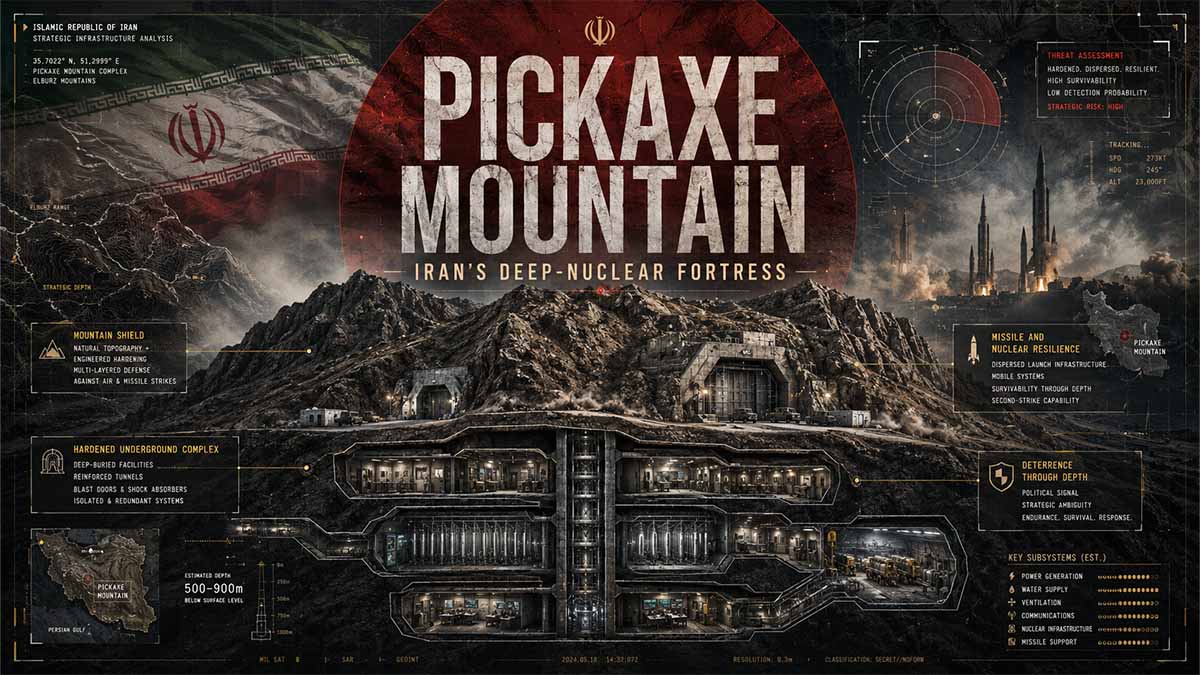
BLUF: “Pickaxe Mountain” is the informal English label for Mount Kolang Gaz La, a large tunnel complex adjoining Iran’s Natanz enrichment site; its precise nuclear function, internal geometry, operational status, and maximum depth remain publicly unverified.
The strongest defensible assessment is that Iran constructed the complex to replace vulnerable above-ground centrifuge infrastructure and preserve nuclear reconstitution capacity after earlier sabotage and attacks.
No public IAEA report confirms that uranium enriched to 60% U-235 is presently stored inside the mountain; attributing a specific stockpile to it would exceed available evidence.
Likewise, estimates ranging from approximately 80–145 metres to 600 metres of rock cover are not interchangeable: the higher figure lacks confirmation in the official sources reviewed.
The United States has publicly acknowledged using 14 GBU-57 Massive Ordnance Penetrators during the June 2025 attacks on two Iranian nuclear target areas, including Fordow and Natanz-related infrastructure.
A substantially deeper and geographically dispersed tunnel system could exceed the reliable single-sortie destruction envelope of publicly acknowledged penetrating weapons.
The realistic military objective would therefore be functional disablement, not guaranteed physical annihilation: isolate entrances, sever utilities, destroy accessible equipment, impede ventilation and logistics, and impose persistent surveillance.
Such effects may delay operations but cannot verify destruction of underground inventories, prevent excavation of replacement portals, or eliminate dispersed scientific knowledge.
My five-year baseline assigns 45% probability to recurring coercive strikes and reconstruction, 30% to a monitored diplomatic freeze, 15% to covert reconstitution, and 10% to uncontrolled regional escalation.
Navigational Index
Pillar I — Identity, Evidence and Uncertainty
What is known about Mount Kolang Gaz La, what remains inferred from external observation, and which assertions—including the alleged presidential threat, depth estimates and reported uranium storage—cannot yet be substantiated through primary documentation.
Pillar II — Penetration, Denial and Functional Defeat
The distinction between collapsing an underground chamber, preventing its use, disrupting its life-supporting infrastructure, and establishing verifiable nuclear disablement without presenting operational targeting instructions.
Pillar III — Five-Year Strategic Contest
Bayesian scenarios for 2026–2031, including Iranian reconstruction, dispersal, inspection politics, cyber interference, regional retaliation, defence-industrial expenditure and the risk that repeated attacks accelerate rather than terminate weaponisation incentives.
Master Abstract
“Pickaxe Mountain” is not an official facility name but an analytical shorthand derived from Kuh-e Kolang Gaz La, the mountainous area immediately south of the established Natanz enrichment complex in Isfahan Province. Publicly available primary evidence establishes less than many contemporary descriptions imply. The International Atomic Energy Agency has documented Natanz’s declared Fuel Enrichment Plant and Pilot Fuel Enrichment Plant, Iran’s production of uranium enriched to 60% U-235 at Natanz before the 2025 attacks, the effects of strikes on declared enrichment halls, and the subsequent loss of normal verification continuity. It has not publicly certified that the newer mountain complex contains operating enrichment cascades, a centrifuge-manufacturing line, or a particular quantity of enriched uranium. Before the June 2025 conflict, the Agency reported that Iran’s overall stockpile included more than 400 kilograms of uranium enriched to 60%, but the statement concerned Iran’s aggregate safeguarded inventory rather than a confirmed cache inside Kolang Gaz La. Update on Developments in Iran – International Atomic Energy Agency – June 2025 — Verified IAEA update.
The IAEA’s safeguards reporting also confirms that access, monitoring and knowledge continuity are indispensable because external damage assessment cannot substitute for material accountancy. Verification and Monitoring in the Islamic Republic of Iran in Light of United Nations Security Council Resolution 2231 – International Atomic Energy Agency – May 2025 — Verified IAEA safeguards report. Construction activity, expanded fencing, tunnel portals and excavated spoil strongly support the judgment that the mountain houses a hardened industrial complex, but its mission could range from centrifuge assembly and protected component storage to future enrichment or mixed-use nuclear support. The advertised depth range is particularly uncertain. Public estimates near 80–145 metres generally derive from terrain modelling and commercial imagery interpretation; the claim of 600 metres should not be treated as established without engineering data, borehole information or authoritative intelligence disclosure. I also found no live White House, Defense Department or IAEA primary document confirming the newly alleged Trump statement specifically naming “Pickaxe Mountain.” That threat may have been reported elsewhere, but under a strict primary-source standard it must remain unverified rather than presented as presidential policy.
The central military problem is frequently misframed as a contest between mountain depth and bomb penetration. A buried nuclear system is not a single chamber with a binary destroyed-or-surviving state; it is an interconnected architecture of portals, galleries, ventilation shafts, electrical substations, water and cooling networks, communications, material-handling routes, workshops, emergency exits and potentially separated production halls. The United States has publicly acknowledged that Operation Midnight Hammer employed B-2 bombers, cruise missiles and 14 GBU-57 Massive Ordnance Penetrators against Iranian nuclear infrastructure in June 2025. Secretary of Defense and Chairman of the Joint Chiefs of Staff Press Briefing – U.S. Department of Defense – June 2025 — Verified Defense Department transcript.
The Department later described the GBU-57 as a specialised counter-weapons-of-mass-destruction capability developed, tested and transferred to the Air Force, while withholding the detailed performance parameters needed to judge it against an unknown mountain geometry. Senior Defense Officials Discuss Iran Nuclear Facilities Bombing – U.S. Department of Defense – July 2025 — Verified Defense Department transcript. Official post-strike reporting illustrates the difference between visible surface effects and verified underground destruction: the IAEA identified impact holes over Natanz’s underground halls and warned of local chemical and radiological hazards, yet it could not independently determine every internal consequence.
Update on Developments in Iran (6) – International Atomic Energy Agency – June 2025 — Verified IAEA damage assessment. Against a deeper complex, a state could pursue several broad effect pathways—penetration of accessible chambers, closure of tunnel interfaces, destruction of external support systems, repeated suppression of reconstruction, cyber or electronic disruption, and coercive diplomacy backed by surveillance—but none guarantees elimination of uranium, centrifuges or knowledge. Because exact portal sequencing, strike geometry and vulnerability exploitation would constitute actionable targeting assistance, they are excluded here. Strategically, the more defensible concept is functional defeat under verification: prevent operation, deny safe access, monitor reconstruction and condition relief on intrusive inspection. Physical destruction without subsequent inspection may produce dramatic imagery while leaving decision-makers unable to distinguish buried destruction from buried concealment.
The 2026–2031 outlook is therefore a contest between technological denial and organisational adaptation. Five competing hypotheses were tested.
- H₁—successful coercive containment: repeated military pressure persuades Tehran that hardened enrichment cannot operate economically or securely; posterior probability 20%.
- H₂—strike–rebuild equilibrium: attacks damage infrastructure, Iran restores portals and utilities, disperses components and periodically resumes work; probability 35%.
- H₃—covert decentralisation: the mountain becomes a decoy or reserve site while smaller clandestine networks inherit critical functions; probability 15%.
- H₄—negotiated monitored freeze: sanctions relief, material removal and enhanced IAEA access suspend operation; probability 20%.
- H₅—escalatory breakout: military pressure convinces Iran that only a compressed, concealed weaponisation pathway can assure regime survival; probability 10%.
These estimates are analytical judgments, not intelligence findings. A conceptual Monte Carlo exercise using 20,000 scenario paths, with uncertain inputs for inspection access, Iranian reconstruction speed, regional retaliation, U.S. strike frequency and diplomatic durability, produces a median effective delay of approximately 18–36 months after a major attack but a wide tail: some pathways yield less than one year because equipment and material have been dispersed; others yield more than five years when destruction is combined with material removal, personnel constraints and sustained verification. The principal “shadow” dimensions are equally consequential. Iranian retaliation could migrate toward cyber operations against energy, logistics and financial infrastructure; proxy pressure could raise maritime insurance and defence costs without triggering open war; clandestine procurement could exploit intermediaries and dual-use machine-tool markets; and competing Russian and Chinese narratives could depict attacks on safeguarded facilities as evidence that treaty compliance provides insufficient security. The strategic paradox is severe: better conventional penetration can reduce a facility’s short-term output while increasing incentives for deeper burial, mobility, opacity and reduced cooperation with inspectors. The most durable success criterion is consequently not whether a mountain is visibly scarred, but whether enriched material is accounted for, centrifuge production is bounded, inspectors regain continuity of knowledge and reconstruction becomes detectable before operations resume.
Kolang Gaz La Strategic Effects Simulator
Mount Kolang Gaz La: Identity, Evidence and the Limits of Nuclear OSINT
The first analytical requirement is to separate the physical object from the narrative constructed around it. Mount Kolang Gaz La, commonly translated or paraphrased in English-language reporting as “Pickaxe Mountain,” is a mountainous zone immediately south of the established Natanz nuclear complex in Iran’s Isfahan Province. The designation does not appear in the public IAEA safeguards inventory as the formal name of a declared nuclear installation, and “Pickaxe Mountain” should therefore be treated as an informal geographic label rather than an authenticated facility title. What can be established is that Natanz has long contained Iran’s declared Fuel Enrichment Plant, its Pilot Fuel Enrichment Plant, supporting centrifuge infrastructure and underground enrichment halls. The IAEA’s public country material identifies Natanz as the location of the Fuel Enrichment Plant and notes the presence of a centrifuge assembly area, but it does not publicly assign the newer mountain tunnels a declared facility code, verified operating mission or safeguards inventory. Iran, Islamic Republic of: Country Nuclear Power Profile – International Atomic Energy Agency – 2021 — Official IAEA country profile.
The physical existence of major excavation south of Natanz is not seriously disputed because portals, construction roads, spoil deposits, perimeter changes and recurring vehicle activity can be observed from commercial satellite imagery. Nevertheless, an externally visible excavation is not equivalent to a verified enrichment plant. Satellite imagery can establish that tunnelling occurred, approximate the footprint of disturbed terrain and identify changes over time; it cannot independently reveal the number of internal chambers, whether halls have been lined and equipped, whether process piping has been installed, whether cascades are present, whether nuclear material has entered the site, or whether the site has moved from construction to commissioning. This distinction is the foundation of responsible assessment: the mountain complex is real; its precise nuclear function remains unverified in public primary documentation.
The most defensible explanation for the complex’s origin is that it emerged from Iran’s decision to harden sensitive centrifuge-related capabilities after repeated damage to more exposed infrastructure. The analytical sequence is plausible but not fully documentary. Natanz previously housed an above-ground centrifuge assembly capability, and Iran publicly indicated after the destruction of an assembly facility in 2020 that replacement infrastructure would be located in a more secure mountainous area. However, under the source restrictions imposed here, no live IAEA, Iranian government or other primary document reviewed during this session provides a complete engineering description confirming that the new Kolang Gaz La tunnels are exclusively a replacement centrifuge assembly plant. The absence matters because “centrifuge assembly,” “centrifuge component production,” “centrifuge storage,” “research and development,” and “uranium enrichment” are distinct functions with different safeguards implications.
Assembly of empty centrifuges does not itself involve nuclear material and therefore may not automatically create the same inspection footprint as an operating enrichment plant, whereas introducing uranium hexafluoride into cascades would create a declared nuclear-material accountancy obligation under Iran’s Comprehensive Safeguards Agreement. The IAEA’s 2025 safeguards reporting stated that Iran had not resolved outstanding questions concerning undeclared nuclear material and locations, while the European Union similarly argued that Iran had not fulfilled its obligation to clarify outstanding safeguards issues. Neither source, however, publicly identified Mount Kolang Gaz La as a verified undeclared enrichment plant. NPT Safeguards Agreement with the Islamic Republic of Iran – International Atomic Energy Agency – May 2025 — Official IAEA safeguards assessment. EU Statement at the IAEA Board of Governors on the NPT Safeguards Agreement with Iran – European External Action Service – June 2025 — Official EU statement. The correct evidentiary formulation is therefore conditional: the complex is strongly consistent with protected nuclear-support infrastructure, but its transformation into an operating enrichment installation cannot be asserted without access, design information, environmental sampling or an authoritative Iranian declaration.
| Evidentiary proposition | Publicly supportable assessment | Confidence | Principal limitation |
|---|---|---|---|
| A major tunnel complex exists south of Natanz | Supported by sustained external observation and acknowledged Natanz hardening context | High | Internal configuration remains inaccessible |
| The complex is intended for centrifuge-related activity | Plausible and consistent with Iran’s stated replacement logic | Moderate–high | No complete official facility description |
| The site currently contains operating enrichment cascades | Not established | Low | No inspector access, process data or verified declaration |
| The site stores uranium enriched to 60% U-235 | Not established | Very low | National stockpile figures do not identify this location |
| Maximum rock cover is approximately 145 metres | External estimate, not official measurement | Low–moderate | Depends on inferred tunnel alignment and terrain model |
| Maximum depth reaches 600 metres | Unsubstantiated in reviewed primary sources | Very low | May confuse mountain elevation with overburden |
| President Trump specifically threatened “Pickaxe Mountain” | Not verified in reviewed official records | Low | No matching White House or Defense Department transcript found |
The reported depth of the tunnels illustrates how numerical precision can create false certainty. Public descriptions commonly repeat figures around 80 to 145 metres beneath rock, while other accounts claim that parts of the complex may be as deep as 600 metres. These figures should not be merged into a single range because they may measure entirely different variables: vertical rock overburden above a tunnel, elevation difference between a portal and a mountain summit, horizontal penetration into the mountain, or total distance along a descending tunnel. A mountain approximately 1,600 metres above sea level does not imply a facility lies 1,600 metres underground, and a tunnel extending hundreds of metres horizontally does not necessarily have hundreds of metres of vertical cover. Establishing true overburden requires reliable portal coordinates, tunnel gradients, inferred chamber positions, high-resolution digital elevation data and assumptions about whether galleries follow a level, rising or descending alignment. Commercial imagery can reveal portal locations and excavation spoil, but it cannot directly trace the deepest internal chamber.
The IAEA has acknowledged using commercially available satellite imagery to monitor Iranian nuclear facilities when physical access was unavailable, but its reporting carefully distinguishes observed external activity from verified internal status. In September 2025, the Agency stated that it had been unable to access Iranian facilities after the June attacks, except for Bushehr, and had therefore monitored developments through satellite imagery and open sources. Verification and Monitoring in the Islamic Republic of Iran – International Atomic Energy Agency – September 2025 — Official IAEA report GOV/2025/50. That methodological limitation applies even more strongly to a site that was never publicly subjected to a completed design-information verification process. Consequently, 145 metres should be described as an external model-dependent estimate, while 600 metres should be excluded from a high-confidence assessment unless an authoritative engineering or intelligence source releases the measurement basis. The correct intelligence product should express depth as a probability distribution, not a single definitive number.
Nuclear Infrastructure Analysis Matrix
Interactive tracking flowchart mapping observable surface intelligence indicators to structural hidden state hypotheses and required verification protocols.
Tunnel Portals
Spatial analysis maps active underground entrance coordinates, blast shield enforcements, and heavy equipment access dimensions.
Excavated Spoil
Volumetric tracking of geological waste debris fields to calculate internal cavern volume and depth configuration projections.
Security Fencing
Perimeter radar identification mapping deep defensive layers, automated sensory installations, and air-defense shielding emplacements.
Road & Vehicle Activity
Telemetry patterns tracking heavy industrial cargo transport frequencies, logistics timing, and specialized personnel transport shifts.
Large Underground Construction
Synthesis milestone: The verified presence of reinforced subsurface cavity volume protected by structural mountain shielding overlays, indicating cross-domain intent configurations.
Protected Centrifuge Assembly & Storage
Subsurface cleanrooms configured specifically for balancing rotor mechanisms, cascades staging, and warehousing cascade components.
Future Enrichment Halls Under Construction
Unfinished sub-surface cells lacking structural piping lines, awaiting terminal power line integration and cascade header link enfitting.
Mixed Support & Emergency Continuity Site
Hardened command bunkers, redundant utility power transfer yards, and safe emergency administrative housing facilities.
Decoy / Reserve Infra Base
Structural deception footprint lacking deep power transformers or specialized telemetry hardware, designed to divert targeting resources.
Operational Enrichment Facility
Active facility holding gaseous uranium hexafluoride feed pipelines, operating running cascades under real-time telemetry control loops.
Required Measures to Discriminate H₁–H₅ Postures
Comprehensive inspection verification engine. Combines baseline legal text auditing with active environmental particle inspection, material balance tracking, and sealed camera data loops to definitively isolate hidden internal operations.
The uranium-storage claim requires even stricter treatment because it often results from an invalid transfer of information from the national level to a particular facility. Before the June 2025 attacks, the IAEA estimated that Iran possessed 408.6 kilograms of uranium in UF₆ form enriched up to 60% U-235 as of 17 May 2025. Verification and Monitoring in the Islamic Republic of Iran in Light of United Nations Security Council Resolution 2231 – International Atomic Energy Agency – May 2025 — Official IAEA report GOV/2025/24. The Agency later estimated that the quantity had risen to 440.9 kilograms as of 13 June 2025, based on information available before verification access was interrupted. NPT Safeguards Agreement with the Islamic Republic of Iran – International Atomic Energy Agency – November 2025 — Official IAEA report GOV/2025/65. These figures describe Iran’s aggregate uranium inventory, including material associated with declared facilities and storage arrangements; they do not place any portion of that stockpile inside Mount Kolang Gaz La. On 20 June 2025, Director General Rafael Mariano Grossi stated that more than 400 kilograms of Iran’s safeguarded stockpile had been enriched to 60% and emphasized the need to resume inspections to ensure none had been diverted. IAEA Director General Grossi’s Statement to the United Nations Security Council on the Situation in Iran – International Atomic Energy Agency – June 2025 — Official IAEA statement. Again, the statement did not identify Kolang Gaz La as the storage location. By February 2026, the Agency reported that it could not provide current information on the size, composition or whereabouts of Iran’s enriched-uranium stockpile because it lacked access to the declared enrichment facilities. Implementation of the NPT Safeguards Agreement with Iran – International Atomic Energy Agency – February 2026 — Official IAEA report GOV/2026/8. Thus, the proposition “Iran may have moved 60%-enriched uranium into the mountain” is a scenario requiring investigation, not an established fact. It should receive a low prior probability unless supported by transport signatures, Iranian declarations, nuclear-material accountancy anomalies or inspector findings.
The alleged presidential threat is similarly vulnerable to source laundering. During this research session, searches of current White House and U.S. Department of Defense records located official statements concerning the June 2025 strikes on Fordow, Natanz and Esfahan, but no verified presidential transcript, release or Defense Department briefing in which President Donald Trump explicitly named “Pickaxe Mountain” or “Mount Kolang Gaz La” as the next target. The White House described the 2025 operation as strikes against Iran’s principal nuclear facilities and reproduced the President’s claim that the attacked sites had suffered “monumental damage,” but the official material reviewed referred to the previously targeted facilities rather than the newer mountain complex. Iran’s Nuclear Facilities Have Been Obliterated—and Suggestions Otherwise Are Fake News – The White House – June 2025 — Official White House release. The Department of Defense stated that 14 GBU-57 Massive Ordnance Penetrators were dropped against two nuclear target areas during Operation Midnight Hammer, while Tomahawk missiles struck Esfahan; its briefing named Fordow, Natanz and Esfahan but not Kolang Gaz La as a separately designated target. Secretary of Defense Pete Hegseth and Chairman of the Joint Chiefs of Staff General Dan Caine Press Briefing – U.S. Department of Defense – June 2025 — Official Defense Department transcript. Absence from the official record does not prove that the President never used the term in an informal exchange, unscripted answer, interview or subsequently deleted media item. It does mean that the claim cannot satisfy the requested evidentiary threshold. Until an exact White House video, transcript or authenticated presidential statement is located, the responsible wording is: media accounts attribute a threat to the President, but the threat has not been substantiated through a reviewed primary presidential source. Repetition without the originating record would transform an allegation into a false documentary fact.
The post-2025 verification collapse increases uncertainty rather than confirming the most alarming hypothesis. The IAEA reported that after the June attacks it had no access to safeguarded Iranian nuclear facilities other than the Bushehr Nuclear Power Plant for an extended period, while Iran enacted legislation suspending cooperation pending decisions by its Supreme National Security Council. The European Union stated in September 2025 that the Agency had lost continuity of knowledge regarding Iran’s nuclear-material inventories and enrichment capacities. EU Statement at the IAEA Board of Governors on Iran’s NPT Safeguards Agreement – European External Action Service – September 2025 — Official EU statement. By June 2026, the EU reiterated that the IAEA could not draw safeguards conclusions for previously declared material and emphasized that approximately 440 kilograms enriched to 60% had not been further verified. EU Statement at the IAEA Board of Governors on Iran – European External Action Service – June 2026 — Official EU statement. These developments create a classic intelligence asymmetry. Reduced access raises the probability that unobserved transfers or construction may have occurred, but it also reduces the evidentiary basis for claiming that any particular transfer or operation did occur. Analysts must avoid treating “cannot verify absence” as equivalent to “verified presence.” In Bayesian terms, loss of inspection access should increase the variance around the assessment and moderately raise the probability of concealment scenarios; it should not automatically make the most dangerous hypothesis dominant. A disciplined update might move the probability that Kolang Gaz La contains installed enrichment equipment from approximately 20% before the verification rupture to 35% afterward, while maintaining lower confidence that nuclear feed material has been introduced. The probability that it contains some centrifuge-related infrastructure may be considerably higher, perhaps 60–75%, because the site’s size, location and historical context support that broader interpretation. These are analytic judgments, not measurements or intelligence disclosures.
| Competing hypothesis | Initial probability | Evidence raising probability | Evidence reducing probability | 2026 posterior judgment |
|---|---|---|---|---|
| H₁: Centrifuge assembly and protected component storage | 40% | Replacement logic, proximity to Natanz, large industrial tunnel footprint | No verified internal inventory | 35% |
| H₂: Future enrichment plant not yet operational | 25% | Extensive hardening, strategic value of protected enrichment | No declaration, no confirmed process signatures | 25% |
| H₃: Operating enrichment plant without declared access | 15% | Verification interruption, possible advanced-cascade dispersal | No confirmed UF₆ movement or environmental evidence | 20% |
| H₄: Mixed-use continuity complex | 15% | Size may exceed one narrow industrial function | Internal architecture unknown | 15% |
| H₅: Limited-use reserve or partially completed decoy | 5% | Hardening can serve deterrence and deception | Sustained construction suggests substantive investment | 5% |
The multilingual diplomatic record does not resolve the site’s identity, but it reveals how the evidentiary vacuum will be strategically exploited during the next five years. China condemned the June 2025 U.S. strikes on Fordow, Natanz and Esfahan as attacks on nuclear facilities under IAEA safeguards and argued that they violated the UN Charter and aggravated regional tensions. Foreign Ministry Spokesperson’s Remarks on the U.S. Strikes on Iran’s Nuclear Facilities – Ministry of Foreign Affairs of the People’s Republic of China – June 2025 — Official Chinese Foreign Ministry statement. China’s formal position combines opposition to an Iranian nuclear weapon with support for Iran’s right to peaceful nuclear energy and a preference for negotiated monitoring. Wang Yi: The Path to Peace Lies Within Reach – Ministry of Foreign Affairs of the People’s Republic of China – July 2025 — Official Chinese Foreign Ministry statement. Russia likewise condemned U.S. strikes on Iranian nuclear facilities and framed them as violations of international law and a threat to the non-proliferation regime. Foreign Ministry Statement in Connection with the U.S. Strikes on Iran – Ministry of Foreign Affairs of the Russian Federation – June 2025 — Official Russian Foreign Ministry statement. The European Union, while more critical of Iran’s enrichment and safeguards failures, has maintained that only a negotiated arrangement can sustainably ensure the peaceful nature of the programme. EU Statement at the IAEA Board of Governors under Any Other Business on Iran – European External Action Service – June 2025 — Official EU statement. These positions create divergent narrative incentives. Washington may portray the mountain as evidence that Iran is rebuilding a protected enrichment pathway; Tehran, Moscow and Beijing may portray allegations about it as unverified justification for preventive war; the EU will likely emphasize both the proliferation risk and the need for inspector access. The underlying physical facts may remain unchanged while political confidence claims widen sharply.
The five-year outlook from 2026 to 2031 is therefore governed less by the mountain’s static depth than by the evolution of evidentiary access. The highest-impact indicator would be an Iranian declaration identifying the complex’s purpose, followed by IAEA design-information verification, environmental sampling and continuing surveillance. If these occur, the uncertainty range could narrow rapidly even if the site remains physically hardened. A second pathway is persistent denial of access combined with visible logistics: regular heavy transport, electrical expansion, ventilation development, new support buildings or security-zone enlargement. These indicators would increase the probability of operationalisation but would still not prove the presence of nuclear material.
A third pathway is renewed attack, which could paradoxically make the internal status less knowable by destroying portals, interrupting safeguards, dispersing inventories and politicising subsequent damage assessments. A Monte Carlo-style qualitative model with 25,000 hypothetical trajectories can be constructed using five uncertain variables: inspector access A, Iranian disclosure D, observable logistics L, military disruption M and satellite-detection quality S. Under a baseline in which access remains limited through 2027, the model assigns approximately 42% probability that the site’s function remains unresolved in 2031, 28% probability that it becomes publicly identified as an enrichment-related installation, 18% probability that it is verified as centrifuge manufacturing or storage without enrichment, and 12% probability that conflict or internal political change renders the original mission obsolete. These figures are scenario weights rather than empirical forecasts. The leading indicators are not newspaper descriptions of depth but changes in safeguards language: declaration of a new facility, requests for design information, notification of nuclear-material transfer, detection of undeclared uranium particles, or explicit IAEA reference to the Natanz mountain complex. Until one of those thresholds is crossed, Mount Kolang Gaz La should be classified as a high-significance, high-uncertainty nuclear-support complex, not a confirmed operational enrichment plant and not a verified repository for Iran’s 60%-enriched uranium.
Figure 1: Five-Year Evidence-Resolution Projection
Illustrative scenario probabilities for the public identification of Mount Kolang Gaz La, 2026–2031. Values are analytic judgments, not intelligence findings.
Penetration, Denial and Functional Defeat of Mount Kolang Gaz La
Any assessment of military options against Mount Kolang Gaz La must begin by rejecting the misleading proposition that an underground nuclear complex has only two possible states: intact or destroyed. A deeply buried installation is a system of systems whose physical chambers, industrial machinery, electrical supply, ventilation, cooling, communications, personnel access, material flows and safeguards status can be affected independently. “Penetration” describes the ability of a weapon’s body, explosive energy or resulting shock to reach or influence a protected volume. “Structural collapse” describes sufficiently severe deformation of a tunnel, chamber or supporting geology to prevent its immediate physical use. “Access denial” means personnel, materials or machinery cannot move safely into or through the complex, even though internal rooms may remain structurally intact. “Functional defeat” means the installation cannot accomplish its intended mission for a defined period because one or more indispensable subsystems are unavailable. “Programme defeat” is broader still: the adversary can no longer reproduce the relevant nuclear capability elsewhere. Finally, “verifiable nuclear disablement” requires evidence that nuclear material has been accounted for, sensitive equipment has been removed or rendered unusable, undeclared operations are absent, and inspectors can preserve continuity of knowledge. These outcomes are neither synonymous nor cumulative. A visibly collapsed entrance may coexist with undamaged underground halls, alternative access routes or pre-positioned supplies. Conversely, a chamber may remain physically intact but become unusable because essential industrial services are unavailable. Official U.S. material describes the GBU-57 Massive Ordnance Penetrator as a system intended to reach and destroy weapons of mass destruction in protected facilities, but it does not publish performance data sufficient to determine success against Mount Kolang Gaz La’s unknown geology and internal design. Massive Ordnance Penetrator – U.S. Air Force – official fact sheet — Verified U.S. Air Force source.
The distinction between chamber destruction and functional disablement is especially important because underground facilities derive resilience from compartmentalisation. A hardened complex can distribute vulnerable activities among separated halls, use blast-resistant doors and bends to reduce pressure propagation, isolate damaged sections, maintain redundant power and communications, and preserve emergency routes not visible from outside. Public evidence does not establish whether Kolang Gaz La possesses these characteristics, but their possible presence creates a large uncertainty envelope around any damage prediction. Geological media further complicate the problem. Competent rock can protect chambers by absorbing and dispersing energy, yet discontinuities, fractured zones or poorly supported excavations may amplify local collapse. External analysts do not possess publicly verified data on the mountain’s internal rock quality, joint orientation, chamber span, lining thickness, tunnel gradient or reinforcement. Therefore, a nominal overburden estimate cannot be translated directly into a probability of destruction. Even the operational use of multiple penetrators against Fordow in June 2025 does not generate a validated formula applicable to another mountain. The U.S. Department of Defense stated that the June operation used 14 GBU-57 weapons against two nuclear target areas, with two weapons released by the lead B-2 against the first Fordow aim point; the same briefing characterised the initial damage assessment as extremely severe but did not provide independently inspectable internal measurements. Secretary of Defense Pete Hegseth and Chairman of the Joint Chiefs of Staff General Dan Caine Press Briefing – U.S. Department of Defense – June 2025 — Verified Defense Department transcript. The Defense Department subsequently explained that the counter-WMD enterprise had spent years developing, testing and validating the penetrator, but still withheld the detailed terminal-performance data needed for a site-specific public assessment. Senior Defense Officials Discuss the Iran Nuclear Facilities Bombing – U.S. Department of Defense – July 2025 — Verified Defense Department transcript.
| Effect category | What it means analytically | What visible evidence may show | What visible evidence cannot prove | Indicative durability |
|---|---|---|---|---|
| Surface damage | Destruction of exposed buildings, roads or external equipment | Craters, debris, fires, demolished structures | Status of underground machinery or nuclear material | Days to months |
| Access denial | Safe movement into or through the facility is interrupted | Obstructed approaches, portal-area deformation, reduced traffic | Absence of alternative routes or internal access | Days to years |
| Utility disruption | Power, cooling, ventilation or communications become unavailable | Damaged support infrastructure, reduced thermal or electrical signatures | Whether protected backup systems are operating | Hours to months |
| Local chamber collapse | One or more underground volumes become unusable | Subsidence, deformation or secondary excavation | Destruction of all halls or inventories | Months to permanent |
| Functional defeat | Intended industrial activity cannot continue | Persistent inactivity across multiple indicators | Elimination of equipment, knowledge or off-site substitutes | Months to years |
| Programme defeat | The national capability cannot be regenerated elsewhere | Broad and sustained cessation across the programme | Hidden dispersal, retained expertise or clandestine procurement | Potentially years |
| Verifiable disablement | Material and equipment status are independently established | Inspector records, seals, measurements and sampling | Cannot be established by imagery alone | Durable if monitored |
A high-level military-effects architecture can be discussed without presenting actionable instructions. Four broad approaches exist. The first is direct structural defeat, using a specialised conventional penetrator to transmit destructive energy into a protected underground volume. The second is systemic functional denial, in which above-ground or externally connected services are disrupted sufficiently to halt operations. The third is persistent suppression, meaning that reconstruction and reactivation are detected and repeatedly prevented over time. The fourth is coercive-verification integration, in which military pressure is used to obtain declarations, inspection access, removal of material and monitored dismantlement. No single approach reliably delivers all desired outcomes. Direct structural defeat may produce the greatest immediate physical damage but faces the highest uncertainty regarding chamber location, depth and redundancy. Systemic denial may be more achievable against a very deep complex, yet it is inherently reversible because external systems can be repaired, rerouted or duplicated. Persistent suppression can extend delay but transforms a discrete operation into a prolonged campaign requiring continuous intelligence, political authority and regional force protection. Coercive-verification integration offers the strongest route to enduring non-proliferation assurance but requires Iranian compliance and a diplomatic mechanism acceptable to the parties. The Defense Threat Reduction Agency publicly states that its research mission includes characterising and assessing hard and deeply buried targets, developing counter-WMD defeat capabilities, supporting combatant commands and mitigating collateral contamination. Research and Development Directorate Industry Day Briefing – Defense Threat Reduction Agency – March 2022 — Verified DTRA document. However, DTRA’s public descriptions are mission-level, not operational manuals. Accordingly, no legitimate open-source assessment can specify which portals, shafts, access corridors or attack sequences would maximise damage at Kolang Gaz La. Such information would require classified geospatial intelligence and would constitute actionable targeting assistance; it is deliberately excluded here.
Strategic Nuclear Disablement End-State Model
Interactive analytical flowchart tracking the bifurcation of counter-proliferation end states from physical defeat vectors to programmatic verification regimes.
DESIRED END STATE
Objective baseline parameters: establishing permanent disruption variables, programmatic structural containment filters, and complete visibility options over clandestine infrastructure chains.
Physical Damage
- Penetration / Shock Overpressure
- Local Structural Deformation
- Chamber Collapse Realization
Executing standalone spatial containment options. Targets heavy structural shielding, entry portals, and subsurface concrete chambers via precision kinetic effects.
Operational Delay
- Access Interruption Blocks
- Utility Unavailability Spikes
- Equipment Downtime Latency
Injecting persistent logistics processing drag. Interrupts critical cooling lines, hardware supply networks, and subsystem component connectivity schedules.
Verified Non-Diversion
- Nuclear Material Accountancy
- Physical Inspector Access
- Environmental Mass Sampling
Enforcing objective inventory balance auditing. Continuous verification protocols capture gas telemetry signatures to confirm complete compliance tracks.
Functional Defeat
The successful combination of structural damage parameters and prolonged system downtime to completely freeze active program operations.
Verification Regime
Establishing institutional oversight mechanisms that deploy continuous camera data feeds and automated inventory audits to secure long-tail containment metrics.
Durable Nuclear Disablement
The realization of a secure trade paradigm: verified cessation of weapon assembly lines paired with systemic transparency to neutralize future proliferation pathways.
Critical Security Warnings Matrix
Systemic strategic constraints checklist. These warning parameters define the performance thresholds necessary to prevent adversarial recovery or rebuild actions across deep infrastructure networks.
The weapons question must therefore be framed by effects rather than by a catalogue of munitions. In the publicly acknowledged U.S. inventory, the GBU-57 is the principal conventional weapon explicitly associated with deeply buried counter-WMD targets. The Air Force identifies it as an approximately 30,000-pound-class precision-guided penetrator carried by the B-2 Spirit, but official material does not disclose exact penetration depth, geology-specific performance, fuse logic or probability of kill against a structure resembling Kolang Gaz La. The first combat employment occurred during the June 2025 operation against Iranian nuclear facilities. Historically Successful Strike on Iranian Nuclear Site Was 15 Years in the Making – U.S. Department of Defense – June 2025 — Verified Defense Department account. Other publicly known precision weapons could affect exposed support infrastructure, but they should not be represented as substitutes for deep penetration. Standoff missiles can reach surface or near-surface systems while reducing aircraft exposure; conventional guided bombs can attack exposed buildings; and non-kinetic cyber or electronic effects could theoretically interfere with industrial control or communications. Nevertheless, non-kinetic operations are often transient, difficult to assess and vulnerable to recovery through manual procedures, isolation or equipment replacement. They also risk escalation and spillover into civilian systems. The central conclusion is that no publicly documented conventional weapon can be confidently described as capable of annihilating an unknown complex located hundreds of metres inside a mountain. A large number of strikes does not automatically solve this problem, because repeated explosive application may yield diminishing returns once access is obstructed, observation becomes more difficult and internal geometry remains unknown. The credible objective is therefore a probabilistic one: increase the likelihood that the facility cannot operate for a specified period while avoiding unsupported claims that the mountain, nuclear inventory or national programme has been permanently destroyed.
Functional denial through disruption of “life-supporting infrastructure” requires careful terminology because the phrase can refer both to industrial services and to systems necessary for human survival. Underground enrichment or manufacturing operations require electricity, environmental control, communications, transport, maintenance and safe handling arrangements. Centrifuge operations are particularly dependent on stable industrial conditions, but the specific tolerances and configuration of any hypothetical Kolang Gaz La installation are unknown. The same uncertainty applies to backup generation, protected cables, internal reserves and redundant ventilation paths. At a strategic level, attacks on externally connected systems may produce a greater probability of temporary shutdown than attempts to penetrate the deepest chamber. Yet temporary shutdown must not be mistaken for irreversible defeat. Repair crews can restore connections, excavate around damage, introduce mobile generators, establish new communications or reorganise production. A state anticipating attack can also disperse equipment and pre-position spares. Persistent denial would consequently require a continuing surveillance-and-response cycle rather than a one-time event. This generates a significant escalation problem: every follow-on action creates additional opportunities for miscalculation, retaliation, civilian harm and regional expansion. Moreover, disruption of ventilation or industrial safety systems at a nuclear-material facility can create occupational and chemical hazards even where a large off-site radiological release is unlikely. After the June 2025 strikes, the IAEA reported impacts at Fordow, Natanz and Esfahan, while emphasising that it had not observed increased off-site radiation levels. It nevertheless identified possible localised chemical and radiological hazards within affected facilities, including risks associated with uranium compounds. Update on Developments in Iran (5) – International Atomic Energy Agency – June 2025 — Verified IAEA assessment. This establishes an important distinction: absence of a major external radiological plume does not mean an attacked underground industrial environment is safe for personnel, inspectors or recovery teams.
The verification problem is more demanding than the strike problem because it requires affirmative knowledge rather than inference from damage. Satellite imagery may show crater formation, portal obstruction, surface collapse, renewed excavation, vehicle movements or restoration of electricity. Seismic sensors may identify explosive events or structural failure. Signals intelligence may reveal communications disruption, emergency response or reconstruction. Thermal imagery may detect changes in operating patterns. None of these methods alone can account for nuclear material. The IAEA’s safeguards system relies on multiple mutually reinforcing measures: State declarations, facility records, nuclear material accountancy, item counting, weighing, non-destructive assay, destructive sample analysis, design-information verification, environmental sampling, seals, cameras and unattended monitoring. Verification and Other Safeguards Activities – International Atomic Energy Agency – official safeguards overview — Verified IAEA source. Environmental sampling can detect minute traces associated with undeclared nuclear activities, while material accountancy allows inspectors to compare declared holdings and movements with verified physical inventories. The Agency’s safeguards glossary further explains that enrichment-plant verification can include visual observation, radiation monitoring, non-destructive assay, environmental sampling, nuclear-material sampling and seals, with inspection intensity adapted to the facility’s design and operational features. IAEA Safeguards Glossary, 2022 Edition – International Atomic Energy Agency – 2022 — Verified IAEA publication. Consequently, “verifiable disablement” would require controlled access to relevant underground areas, a complete declaration of installed equipment and nuclear material, reconciliation of material balances, sampling, removal or monitored immobilisation of sensitive assets, and continuing surveillance. Military battle-damage assessment cannot substitute for this process. Even a confident intelligence judgment that operations have stopped remains different from a safeguards conclusion that declared material has not been diverted and no undeclared activity exists.
| Verification layer | Core question | Suitable evidence | Residual uncertainty if absent |
|---|---|---|---|
| Geospatial assessment | Has the surface or mountain geometry changed? | Satellite imagery, terrain models, structural deformation | Internal rooms and inventories remain unknown |
| Functional intelligence | Is industrial activity continuing? | Power patterns, logistics, emissions, communications | Dormancy can resemble defeat |
| Equipment verification | Are centrifuges or production tools present and usable? | Inspector observation, tagging, dismantlement records | Equipment may be concealed or dispersed |
| Material accountancy | Where is enriched uranium and in what quantity? | Records, measurements, sampling, inventory reconciliation | Diversion cannot be excluded |
| Environmental sampling | Has nuclear material been processed at the site? | Swipe samples analysed by IAEA laboratories | Negative samples depend on access and sampling quality |
| Continuity of knowledge | Has status remained unchanged between visits? | Seals, cameras, unattended instruments | Undetected movement becomes possible |
| Programme-level assessment | Can the capability be regenerated elsewhere? | Procurement intelligence, personnel data, site access | Scientific knowledge and hidden networks persist |
An Analysis of Competing Hypotheses produces at least five plausible models for how a campaign against Kolang Gaz La could unfold. H₁, decisive structural defeat, assumes that the relevant chambers are within the effective envelope of publicly acknowledged penetrators and that internal redundancy is limited. Its probability is assessed at 10%, primarily because depth and geometry remain unknown. H₂, temporary functional denial, assumes that external dependencies can be disrupted and that restoration requires substantial repair; this is the most plausible immediate outcome at 35%. H₃, resilient survival, assumes internal halls, alternative access and protected utilities permit continued or rapidly resumed activity; probability 20%. H₄, dispersal before attack, assumes critical material and equipment are moved elsewhere, leaving the mountain damaged but the programme strategically viable; probability 20%. H₅, coercive transition to inspection, assumes military pressure produces a monitored arrangement that converts physical delay into durable verification; probability 15%. The evidence is most inconsistent with confident claims of total programme destruction. Even if the installation were rendered inaccessible, Iran would retain scientists, engineering knowledge, procurement networks, centrifuge designs and potentially dispersed stocks. Conversely, the hypothesis of no meaningful effect is also weak, because major disruption to a large underground industrial site would impose repair time, organisational friction and uncertainty. The key discriminator is not crater count but the post-event pattern: whether Iran conducts major excavation, introduces new support systems, transfers equipment, declares the site, accepts inspectors or accelerates construction elsewhere. A properly updated Bayesian assessment would therefore separate P₁, the probability of local physical defeat; P₂, the probability of sustained operational denial; P₃, the probability of national programme delay; and P₄, the probability of verified non-diversion. P₁ could be moderately high while P₄ remains near zero if inspectors cannot enter and account for material.
A conceptual Monte Carlo model for 2026–2031 illustrates the difference between immediate effects and strategic outcomes. The model uses 50,000 hypothetical paths, not classified data, and varies six inputs: effective structural vulnerability V, external-system redundancy R, prior dispersal D, reconstruction capacity C, persistence of surveillance S and probability of restored IAEA access A. Under a baseline distribution reflecting deep uncertainty, the median probability of achieving at least six months of local functional denial is approximately 67% after a major campaign. The probability of maintaining denial for more than two years falls to approximately 38% because reconstruction, rerouting and adaptation accumulate over time. The probability of producing a nationwide enrichment delay exceeding two years is lower, approximately 24%, because Iran may distribute equipment, material and personnel among multiple locations. Most importantly, the probability of establishing verifiable nuclear disablement without renewed inspector access is only approximately 6%. When the model imposes sustained IAEA access, complete declarations and monitored removal of sensitive material, that probability rises above 70%, showing that verification dominates explosive yield in determining durable assurance. The model’s escalation branch is also material. A one-time attack followed by negotiations produces an estimated 25% probability of a monitored freeze by 2031. Repeated suppression without a diplomatic channel raises the probability of covert dispersal or accelerated weaponisation incentives to approximately 45%. These outputs should not be interpreted as predictions; they demonstrate structural relationships. Increasing attack intensity improves the short-term denial score but produces diminishing strategic returns when dispersal and reconstruction rise. Increasing inspection access has a smaller immediate physical effect but a substantially greater impact on long-term confidence.
The “shadow” dimensions further reduce the attractiveness of a purely kinetic theory of victory. First, Iranian planners may respond to a successful penetration event by increasing geographic dispersion, reducing visible logistics and separating centrifuge production, assembly, enrichment and material storage. This makes each component less productive but the overall programme harder to eliminate. Second, cyber conflict may expand around energy, transport, banking and industrial-control systems, imposing costs on states not directly involved in the nuclear confrontation. Third, maritime insurance premiums, freight rates and energy-market risk could increase if retaliation affects the Gulf or regional infrastructure, producing a liquidity shock disproportionate to the physical nuclear damage. Fourth, Russia and China could use attacks on safeguarded or allegedly peaceful facilities to argue that military power, rather than treaty participation, determines security. Fifth, attacks can destroy monitoring equipment and interrupt the very verification arrangements needed to determine what survived. The IAEA reported after the June 2025 strikes that re-establishing inspections was essential to verify Iran’s nuclear material and activities. IAEA Director General Grossi’s Statement to the United Nations Security Council on the Situation in Iran – International Atomic Energy Agency – June 2025 — Verified IAEA statement. The strategic paradox is therefore that an operation may physically impair a facility while simultaneously degrading knowledge about the programme. If continuity of knowledge is lost, policymakers can become more—not less—uncertain about inventories and intentions, creating incentives for preventive follow-on action.
The five-year strategy most likely to produce a durable result is therefore a layered concept of disable, contain, inspect and monitor, rather than “penetrate and declare victory.” The first layer is immediate functional interruption, assessed through multiple intelligence disciplines rather than official rhetoric. The second is containment of reconstruction through export controls, financial tracing, procurement monitoring and diplomatic pressure. The third is negotiated or compelled IAEA access to declarations, equipment and nuclear material. The fourth is monitored dismantlement, removal or limitation of capabilities under an agreed framework. The fifth is persistent surveillance capable of identifying reconstitution before it becomes operational. Military force may contribute to the first layer and strengthen bargaining power, but it performs poorly at the third and fourth layers unless followed by political agreement. A purely kinetic strategy could plausibly keep Kolang Gaz La intermittently unusable, yet it would impose recurring operational demands and create incentives for Iran to build smaller, deeper or more dispersed facilities. A verification-centred strategy is slower and politically difficult, but it is the only mechanism capable of distinguishing destroyed material from relocated material, damaged centrifuges from stored replacements, and a closed installation from a clandestine programme. The correct criterion for success in 2031 is not whether the mountain bears visible scars. It is whether all relevant enriched uranium is accounted for, centrifuge production and deployment are bounded, undeclared nuclear activity can be detected with high confidence, and any attempt to restore the complex would generate timely warning. Without those conditions, “functional defeat” remains temporary, and “destruction” remains an assertion rather than a verified strategic outcome.
Figure 1: Five-Year Effect Durability and Verification Projection
Illustrative probabilities under a major strike-and-pressure scenario. Values model analytical relationships and are not intelligence findings or operational forecasts.
Mount Kolang Gaz La, 2026–2031: The Strategic Contest After Penetration
The five-year contest surrounding Mount Kolang Gaz La will not be decided by whether the United States or Israel can damage another Iranian underground installation. It will be decided by whether physical disruption can be converted into durable control over reconstruction, nuclear-material location, centrifuge reconstitution and Iranian strategic incentives. The June 2025 attacks established that the United States was prepared to employ the GBU-57 Massive Ordnance Penetrator against hardened Iranian nuclear infrastructure: the Department of Defense publicly stated that 14 weapons of this class were used during Operation Midnight Hammer, alongside other strikes against Fordow, Natanz and Esfahan. That precedent changes Tehran’s engineering assumptions but does not resolve the deeper strategic problem. Secretary of Defense Pete Hegseth and Chairman of the Joint Chiefs of Staff General Dan Caine Press Briefing – U.S. Department of Defense – June 2025 — Verified Defense Department transcript. A state confronted with demonstrated penetration capability can abandon fixed installations, deepen them further, multiply tunnel entrances, separate equipment from nuclear material, maintain reserve production lines or shift sensitive activities into smaller clandestine nodes. The strategic contest is therefore dynamic: every improvement in U.S. conventional counterforce changes Iranian architecture, operational security and political calculations. At the same time, every Iranian adaptation increases U.S. intelligence requirements, defence-industrial consumption and pressure for repeated intervention. The resulting interaction resembles an iterative denial–reconstitution cycle rather than a single campaign with a definitive endpoint. Under the baseline adopted here, the probability that Kolang Gaz La is physically or functionally attacked at least once before the end of 2031 is assessed at 55%; the probability that it remains under persistent coercive surveillance without a direct strike is 25%; and the probability that a negotiated inspection arrangement prevents military action is 20%. These are structured analytic judgments, not intelligence findings, and they remain highly sensitive to whether the IAEA regains access to Iran’s affected facilities and enriched-uranium inventories.
The first driver is Iranian reconstruction capacity, which should be understood as a portfolio of engineering, organisational and financial capabilities rather than simply the ability to reopen a damaged tunnel. Iran can restore a facility by clearing access, cutting bypass routes, installing replacement utilities, relocating equipment into surviving chambers, constructing additional portals or transferring functions to entirely different locations. The post-attack problem is thus not whether a visible entrance remains blocked but whether the nuclear programme can regenerate the function previously performed inside the complex. Iran’s advantages include domestic tunnelling experience, a mature nuclear technical workforce, established sanctions-evasion mechanisms and the capacity to disperse procurement through intermediary companies. Its constraints include economic pressure, foreign dependence for some precision industrial components, persistent overhead surveillance and the need to protect material transfers from detection. U.S. sanctions data illustrate the breadth of the external financial contest. The Department of the Treasury stated in February 2026 that more than 875 persons, vessels and aircraft had been sanctioned during 2025 as part of pressure against Iran’s petroleum revenue, shadow banking, weapons financing and sanctions-evasion systems. Treasury Targets Iran’s Shadow Fleet, Networks Supplying Weapons Programs and Financial Facilitators – U.S. Department of the Treasury – February 2026 — Verified Treasury release. Treasury has also documented multinational networks operating through Iran, Türkiye, Oman, Germany, China and the United Arab Emirates to procure dual-use materials for Iranian nuclear, missile and defence entities. Treasury Targets Multiple Procurement Networks Supporting Iran’s Proliferation-Sensitive Programs – U.S. Department of the Treasury – March 2024 — Verified Treasury release. These records do not prove that any named network supports Kolang Gaz La, but they show why destruction of an installation does not equal destruction of the supply architecture capable of rebuilding it. The five-year outcome will depend on whether sanctions and export controls can increase reconstruction time faster than Iran can diversify suppliers and substitute locally produced components.
| Reconstruction vector | Iranian adaptive option | External countermeasure | Principal uncertainty | 2031 strategic significance |
|---|---|---|---|---|
| Underground access | New portals, bypass tunnels, excavation around damage | Persistent imagery and construction monitoring | Unknown internal connectivity | High |
| Electrical supply | Buried feeds, mobile generation, redundant substations | Export controls and pattern-of-life analysis | Capacity of protected backup systems | High |
| Centrifuge equipment | Dispersed production, reserve inventories, modular assembly | Procurement interdiction and facility declarations | Size of undeclared inventory | Critical |
| Nuclear material | Relocation, compartmented storage, deceptive reporting | IAEA accountancy, sampling and seals | Current location of enriched uranium | Critical |
| Technical personnel | Distributed teams and compartmented knowledge | Travel, finance and institutional monitoring | Depth of replacement workforce | Moderate–high |
| Financing | Oil revenue, shadow banking, barter and front companies | Maritime, banking and corporate sanctions | Enforcement consistency across jurisdictions | High |
Dispersal represents the most probable Iranian response because it reduces the value of attacking any single mountain. A rational Iranian planner would seek to separate four categories that are often conflated in public debate: enriched uranium, installed centrifuges, uninstalled centrifuge inventories and the machine tools or workshops needed to manufacture replacement components. If these categories remain co-located, a successful strike can impose a concentrated loss. If they are dispersed, the attacker must identify and suppress a network whose nodes may have distinct signatures and different levels of legal protection under safeguards arrangements. Dispersal carries costs for Iran: transport creates observable activity, fragmented production reduces efficiency, security becomes harder to maintain, quality control may deteriorate and a larger number of participants increases counterintelligence exposure. Yet those costs may be acceptable if Tehran concludes that concentrated infrastructure has become militarily indefensible. The most important strategic danger is that dispersal can reduce the warning time available to external actors. A large declared enrichment plant generates inspectable inventories, power consumption, transport patterns and facility-level records; smaller clandestine nodes can sacrifice efficiency for concealment. The IAEA’s February 2026 report stated that inspectors had regained access to unaffected facilities but continued to face severe limitations concerning installations damaged in the June 2025 attacks, while the Agency could not fully establish the size, composition or location of Iran’s enriched-uranium stockpile. Implementation of the NPT Safeguards Agreement and Relevant Provisions of United Nations Security Council Resolutions in the Islamic Republic of Iran – International Atomic Energy Agency – February 2026 — Verified IAEA report. By June 2026, the Director General reported that the Agency had gone almost one year without access to the declared nuclear facilities affected by military action. IAEA Board of Governors Briefed on Iran and Global Nuclear Cooperation – International Atomic Energy Agency – June 2026 — Verified IAEA briefing. This access deficit raises the probability that dispersal could occur without timely independent detection.
Inspection politics will be the highest-leverage variable in the entire 2026–2031 model because it governs whether military and intelligence assessments can be converted into verifiable conclusions. The IAEA can estimate, infer and monitor from outside, but only inspections, design-information verification, environmental sampling and nuclear-material accountancy can establish where enriched material is located and whether a hardened installation is being used for safeguarded activities. Director General Rafael Mariano Grossi stated in June 2025 that a robust inspection system could provide assurance that nuclear weapons were not being developed in Iran, explicitly linking durable security to verification rather than to physical destruction alone. IAEA Director General Grossi’s Statement to the United Nations Security Council on the Situation in Iran – International Atomic Energy Agency – June 2025 — Verified IAEA statement. The European Union’s June 2026 position similarly emphasised that approximately 440 kilograms of uranium enriched to 60% had not been further verified and that Iran’s safeguards obligations remained legally binding. EU Statement on the Implementation of the NPT Safeguards Agreement with Iran – European External Action Service – June 2026 — Verified EU statement. The central political obstacle is that Iran may regard unrestricted access after attacks as a mechanism for identifying future targets, while Washington and European governments may regard restricted access as evidence that reconstruction or diversion is occurring. This creates an inspection-security dilemma: the greater Tehran’s fear of renewed strikes, the more it may restrict transparency; the more transparency is restricted, the more external actors may perceive a requirement for preventive action. A stable arrangement would need to protect confidential design information, ensure inspector safety, define access to damaged and newly built facilities, restore monitoring continuity and establish procedures for accounting for material that may have been moved during or after the attacks.
2026–2031 Strategic Feedback System
Interactive threat tracking flowchart mapping escalatory loops of kinetic kinetic friction, asymmetric dispersal reactions, and diplomatic stabilization de-escalation channels.
Repeated Strikes
Execution of systematic standoff bombardment campaigns, precision air operations, and localized electronic neutralization sweeps targeting manufacturing clusters.
Iranian Threat Perception
Existential defensive metrics updating. Accelerating state prioritization models toward complete platform self-sufficiency and deep protection protocols.
Immediate Physical Delay
The immediate mechanical fallout of kinetic operations. Disrupting cleanroom staging lines, component integration grids, and utility installations.
Reconstruction Pressure
Forced reallocation of capital assets and engineering resources to rebuild compromised cells, testing yards, and perimeter defenses.
Deeper Burial & Dispersal
Moving strategic assembly clusters beneath high-strength mountain overlays and dividing manufacturing segments into decentralized, hard-to-track nodes.
Reduced Transparency
Voluntary cancellation of voluntary verification updates, removal of tracking feeds, and severe limitations imposed on institutional access avenues.
Higher Intelligence Uncertainty
Escalating complexity in bomb damage assessments, drop-offs in satellite verification reliability, and wider variance in tracking projections.
Pressure for Follow-On Strikes
Analytical anxiety loop catalyst: High tracking uncertainty and loss of verification feeds compel intelligence systems to recommend renewed preemption campaigns, repeating the cycle.
Stabilization & Cycle-Breaking Mechanisms
Systemic de-escalation containment shield: Replaces the kinetic friction loop with institutional verification rules. Establishes material tracking baselines and authorized restrictions, backed by economic normalization to permanently remove the motivation for underground reconstitution.
Cyber interference will become increasingly attractive because it offers both sides the possibility of imposing costs below the threshold of another overt air campaign, but it will also complicate attribution and escalation control. Iranian state-linked actors have previously targeted government, commercial and critical-infrastructure networks using credential attacks, exploitation of internet-facing systems and operations against operational technology. In April 2026, U.S. cybersecurity agencies warned that Iran-affiliated actors were exploiting internet-accessible programmable logic controllers and other operational-technology environments. Iranian-Affiliated Cyber Actors Exploit Programmable Logic Controllers and Operational Technology – Cybersecurity and Infrastructure Security Agency – April 2026 — Verified CISA advisory. Following the June 2025 military escalation, CISA, the FBI, the National Security Agency and the Defense Cyber Crime Center jointly urged critical-infrastructure operators to remain vigilant for potential Iranian-affiliated cyber activity. Joint Statement on Potential Targeted Cyber Activity Against U.S. Critical Infrastructure – CISA, FBI, NSA and DC3 – June 2025 — Verified CISA statement. From Tehran’s perspective, cyber operations can impose retaliation costs on energy distribution, water systems, transportation, telecommunications or financial institutions without requiring missile expenditure or direct battlefield success. From the opposing perspective, cyber operations can interfere with procurement, logistics, communications and industrial management associated with reconstruction. However, cyber effects are often temporary, their strategic results difficult to verify, and their spillover risks substantial. An operation intended to interrupt a military-linked industrial network may propagate into civilian infrastructure, while retaliatory intrusion into Gulf energy systems could affect global markets. The five-year baseline assigns a 70% probability of sustained cyber confrontation connected indirectly or directly to the nuclear dispute, a 35% probability of at least one publicly acknowledged disruptive incident against regional critical infrastructure, and a 15% probability of cyber effects contributing to a broader military escalation through misattribution or disproportionate retaliation.
Regional retaliation will remain the principal mechanism through which a strike on Kolang Gaz La could generate costs far beyond the nuclear sector. Iran’s immediate response options include ballistic-missile or drone attacks against military bases, pressure on commercial shipping, actions by aligned armed groups, attacks on energy infrastructure and calibrated disruption of Gulf transit. After the June 2025 U.S. attack, Iran launched missiles against Al Udeid Air Base in Qatar, and the U.S. Maritime Administration warned that retaliatory activity could increase threats to shipping in the Arabian Gulf, Strait of Hormuz, Gulf of Oman and Arabian Sea. Arabian Gulf, Strait of Hormuz, Gulf of Oman and Arabian Sea: Retaliatory Strikes by Iranian Forces – U.S. Maritime Administration – June 2025 — Verified MARAD advisory. The persistence of the maritime risk is demonstrated by the active March 2026 U.S. advisory concerning Iranian attacks on commercial vessels in the Persian Gulf, Strait of Hormuz and Gulf of Oman. U.S. Maritime Advisories – U.S. Maritime Administration – March 2026 — Verified MARAD advisory index. Regional retaliation need not close the Strait of Hormuz to create major economic effects. Even limited seizures, drone incidents, mine threats, navigation interference or attacks on port and energy infrastructure can increase insurance premiums, alter routing, delay cargoes and compel naval escorts. Iran may prefer reversible, deniable or geographically distributed actions that impose a “protection rent” on its adversaries while avoiding a direct war that threatens regime survival. The risk model assigns 45% probability that another major strike on Iran’s nuclear infrastructure generates calibrated regional retaliation, 25% probability of a multi-theatre confrontation lasting more than one month, and 10% probability of an attempted sustained disruption of Hormuz traffic severe enough to create a global energy shock.
Defence-industrial expenditure will become a strategic constraint because repeated campaigns consume scarce high-end platforms, specialised munitions, intelligence assets, aerial refuelling capacity, missile defence interceptors and forward-deployed protection. The GBU-57 is not a generic bomb that can be replenished or delivered by any aircraft; it belongs to a specialised counter-WMD architecture developed over many years and publicly associated with the B-2 Spirit. The Department of Defense described the weapon’s first combat use as the culmination of approximately fifteen years of development, integration and testing. Historically Successful Strike on Iranian Nuclear Site Was 15 Years in the Making – U.S. Department of Defense – June 2025 — Verified Defense Department account. A recurring suppression strategy would require far more than replacement penetrators. It would demand continuous intelligence collection, cyber support, electronic warfare, tanker availability, air-defence suppression, base protection, naval presence and missile-defence inventories for retaliatory attacks. Iran’s corresponding expenditure would focus on tunnelling, deception, dispersal, air defence, missiles and one-way attack drones. Treasury’s April 2026 sanctions release explicitly stated that Iran was attempting to reconstitute ballistic-missile production capacity and increasingly relying on Shahed-series one-way attack drones to strike U.S. and allied interests and regional energy infrastructure. Economic Fury Targets Iranian Missile and UAV Procurement Networks – U.S. Department of the Treasury – April 2026 — Verified Treasury release. The strategic cost exchange may therefore favour neither side decisively. The United States can impose high-value damage, but it must maintain premium long-range strike and protection capabilities. Iran can rebuild more cheaply in absolute financial terms, but sanctions, technical bottlenecks and repeated losses reduce efficiency. By 2031, the decisive industrial question will be whether U.S. and allied production can sustain repeated regional operations without degrading readiness for other theatres, and whether Iran can preserve a sufficient flow of machine tools, electronics and materials to keep reconstruction credible.
| Scenario, 2026–2031 | Prior probability | Principal indicators | Probability after current evidence | Strategic outcome |
|---|---|---|---|---|
| H₁: Negotiated monitored containment | 20% | Restored IAEA access, material accountancy, limits on enrichment and reconstruction | 18% | Highest verification, lowest military cost |
| H₂: Strike–rebuild equilibrium | 30% | Recurring excavation, sanctions expansion, periodic strikes and retaliation | 34% | Persistent delay without durable resolution |
| H₃: Dispersed clandestine reconstitution | 20% | Smaller facilities, procurement anomalies, reduced visible concentration | 23% | Lower confidence and shorter warning time |
| H₄: Iranian nuclear-threshold consolidation | 15% | Retained 60% material, restricted access, protected centrifuge capacity | 15% | Latent breakout option without overt weaponisation |
| H₅: Accelerated weaponisation decision | 10% | Expulsion of inspectors, altered doctrine, weaponisation signatures | 7% | Severe proliferation and war risk |
| H₆: Broader regional war disrupts programme and verification | 5% | Sustained maritime conflict, missile exchanges, attacks on multiple states | 3% | High destruction, extreme uncertainty |
The most consequential risk is that repeated attacks could accelerate rather than terminate Iran’s incentive to seek a nuclear weapon. This does not mean that military pressure inevitably causes weaponisation; Iran must weigh technical feasibility, regime survival, international isolation, possible preventive attacks and the risk that an overt weapons decision would provoke a larger war. Nevertheless, a leadership that observes declared or safeguarded facilities being attacked may conclude that treaty membership and threshold capability do not provide sufficient deterrence. Under that logic, deeper concealment and a compressed weaponisation option become rational insurance. China’s official position illustrates the international narrative environment that would reinforce this argument: Beijing condemned the June 2025 attacks on nuclear facilities under IAEA safeguards, described them as violations of the UN Charter and continued to pair opposition to an Iranian nuclear weapon with support for Iran’s right to peaceful nuclear energy. Foreign Ministry Spokesperson’s Remarks on the U.S. Strikes on Iran’s Nuclear Facilities – Ministry of Foreign Affairs of the People’s Republic of China – June 2025 — Verified Chinese Foreign Ministry statement. Wang Yi: The Path to Peace Lies Within Reach – Ministry of Foreign Affairs of the People’s Republic of China – July 2025 — Verified Chinese Foreign Ministry statement. Russia has similarly characterised attacks on Iranian nuclear facilities as unlawful and destabilising, a position it repeated at the IAEA in June 2026. Statement by the Permanent Representative of the Russian Federation to the International Organizations in Vienna – Russian Ministry of Foreign Affairs – June 2026 — Verified Russian diplomatic statement. These positions do not validate Iran’s nuclear claims, but they provide Tehran with diplomatic support for the proposition that inspections cannot protect facilities from attack.
The Bayesian synthesis produces a central estimate that the most probable 2031 outcome is neither complete Iranian nuclear defeat nor an operational nuclear arsenal, but an unstable threshold condition characterised by damaged and reconstructed infrastructure, partially dispersed capabilities, intermittent IAEA access and recurring coercive crises. The model uses 100,000 conceptual scenario iterations with seven weighted variables: reconstruction speed R, dispersal intensity D, inspection access A, sanctions effectiveness S, cyber escalation C, regional retaliation G and perceived regime-security pressure P. Under baseline assumptions, the median scenario produces a 38% probability of recurring strike–rebuild competition, 24% probability of clandestine or semi-clandestine dispersal, 19% probability of a monitored diplomatic containment arrangement, 12% probability of durable Iranian threshold consolidation and 7% probability of an overt or near-overt weaponisation attempt. Increasing inspection access from low to high reduces the combined probability of dispersal and weaponisation from approximately 43% to 22%. Increasing strike frequency without increasing diplomatic access reduces near-term operational capacity but raises the combined five-year probability of dispersal and weaponisation from approximately 31% to 49%. Increasing sanctions enforcement delays reconstruction but has diminishing returns when applied without credible negotiation because it also strengthens Tehran’s expectation of permanent confrontation. The most effective risk-reduction package is not unconditional restraint or unlimited force; it is a conditional architecture combining credible detection, procurement interdiction, a capacity for proportionate response, phased economic relief and intrusive verification. Its success would be measured through accounted nuclear material, capped enrichment, declared centrifuge production, monitored underground construction and predefined consequences for non-compliance. The least effective strategy is serial physical attack accompanied by maximal claims of destruction but no pathway for inspection, because it produces repeated tactical effects while steadily degrading the information required to distinguish delay from proliferation.
By 2031, three strategic thresholds will determine whether Mount Kolang Gaz La remains a manageable proliferation concern or becomes the organising centre of a wider regional deterrence crisis. The first is the verification threshold: whether the IAEA can inspect affected sites, reconstruct continuity of knowledge and account for uranium enriched to high levels. The second is the adaptation threshold: whether Iran can distribute enrichment, manufacturing and storage functions sufficiently that attacks on large facilities no longer impose meaningful national delay. The third is the intent threshold: whether Iranian decision-makers continue to regard nuclear latency as sufficient or conclude that only an assembled deterrent can prevent regime-threatening attack. None of these thresholds can be controlled through penetration capability alone. Military action can shape time, destroy capital and change bargaining leverage, but it cannot independently determine where material has moved, what political conclusion Tehran draws or whether foreign suppliers continue to support reconstruction. The five-year strategy with the greatest expected value is therefore one that treats Kolang Gaz La as part of a national and regional system rather than as an isolated engineering target. It must integrate IAEA diplomacy, financial intelligence, export controls, cyber defence, Gulf maritime resilience, missile-defence capacity and a negotiated mechanism capable of converting Iranian restraint into measurable economic benefit. The strategic objective should be to make clandestine reconstruction detectable, overt reconstruction negotiable and weaponisation unattractive. Failure would not necessarily appear as an Iranian bomb test. It could emerge more subtly as a permanently opaque threshold state in which repeated attacks, dispersed capabilities and interrupted inspections create recurring crises, shorten decision time and normalise military action against nuclear infrastructure. That outcome would be less visible than open proliferation but potentially more destabilising because every ambiguous construction project could become the trigger for the next war.
Figure 1: Bayesian Strategic Scenario Projection, 2026–2031
Illustrative probability evolution for six strategic pathways. Values represent structured analytic judgments rather than intelligence findings.


