













Executive Summary
Between April and June 2026, Hizballah ran a calibrated escalation campaign — rockets paired with cheap, jam-resistant fiber-optic drones — that kept the Israel-Lebanon front just short of full war. The strategy worked as coercive signaling, not attrition: strikes tracked Israeli behavior almost attack-for-attack, surging after Israel’s Litani River crossing and easing whenever diplomacy advanced. Iran used that credible risk of escalation as leverage, insisting Lebanon be folded into its own ceasefire talks with Washington. It worked: Lebanon is now written into the June 15 U.S.-Iran framework agreement, and a separate June 26 U.S.-brokered Israel-Lebanon deal now conditions Israeli withdrawal on Hizballah’s disarmament — which Hizballah has rejected outright. As of July 10, 2026, that linkage has become a liability rather than an asset for Washington: the broader U.S.-Iran ceasefire collapsed this week over Strait of Hormuz shipping attacks, even as U.S. officials describe Lebanon disarmament as entering an “implementation phase” ahead of Lebanese President Joseph Aoun’s July 21 White House visit.
Navigational Index
- The Calibrated Campaign — how Hizballah’s rocket-drone hybrid strategy manufactured controllable risk between April and June 2026.
- The Linkage Trap — how Iran converted battlefield pressure into diplomatic leverage, forcing Lebanon into the U.S.-Iran framework.
- The Unraveling — the fragile June 26 disarmament-for-withdrawal deal, Hizballah’s rejection of it, and its collapse-risk as the wider U.S.-Iran ceasefire falls apart in July.
- Washington’s Leverage and the Scenario Tree
Master Abstract
Pillar I — The Calibrated Campaign. Hizballah entered the post-November-2024 ceasefire period materially weakened: its precision anti-tank arsenal had been degraded, Syrian smuggling routes had collapsed with Assad’s fall, and Iranian resupply flights into Beirut had been curtailed. Rather than stand down, the group adapted by pairing a depleted but still-functional rocket force with mass-produced, fiber-optic first-person-view drones immune to Israeli electronic jamming — a substitution that let it keep imposing precision costs without depending on scarce stockpiles. Attack data compiled from Hizballah Military Media statements and cross-checked against independent monitors like the Alma Research and Education Center show the campaign was not indiscriminate; it tracked Israeli actions with unusual fidelity. The clearest inflection came after Israel’s covert weeklong crossing of the Litani River in early May, which had defined the operational boundary of Israeli ground activity since 2006. Strikes on Israeli bulldozers and engineering equipment rose roughly ninefold after the crossing, and attacks on fixed Israeli positions rose more than sixfold, while drone strikes against Israeli command-and-control nodes more than doubled. This is the signature of what strategist Thomas Schelling called a “threat that leaves something to chance” — escalation calibrated to be credible without being reckless, engineered to generate domestic Israeli political pressure, Iranian leverage, and American anxiety simultaneously.
Pillar II — The Linkage Trap. Washington spent the first half of 2026 trying to run two negotiating tracks in parallel: a U.S.-Iran channel over the nuclear program, sanctions, and the Strait of Hormuz naval blockade, and a separate Israel-Lebanon channel over Hizballah’s disarmament and Israeli withdrawal. Iran refused to accept that separation, and its own state media made the logic explicit, arguing that Hizballah was inseparable from Iran’s national interests and that pressure on the Strait of Hormuz could be deployed on Lebanon’s behalf just as readily as on Iran’s own. On June 15, 2026, the U.S. and Iran announced a framework memorandum whose text explicitly committed both sides to the “immediate and permanent termination of military operations on all fronts, including Lebanon” — a linkage nearly derailed hours before signing when Israel struck Beirut’s southern suburbs and Trump had to personally intervene with Netanyahu to prevent Iranian retaliation from collapsing the talks. Wikipedia’s chronological reconstruction of the episode corroborates the mechanism from the diplomatic side: Netanyahu and Washington had initially tried to assert the ceasefire “does not include Lebanon,” only for continued Israeli strikes on Lebanon to trigger Iranian threats to keep Hormuz traffic paused in response — a direct, documented coupling between the Lebanon front and Iran’s own negotiating leverage over the strait. Fox News
Pillar III — The Unraveling. The Lebanon problem did not resolve when it entered the U.S.-Iran framework — it metastasized into a second, parallel deal. On June 26, Israel and Lebanon signed their own Washington-brokered framework, separate from the U.S.-Iran memorandum, explicitly conditioning any Israeli withdrawal on Hizballah’s disarmament. Hizballah’s Secretary-General Naim Qassem rejected it within a day, calling it a “humiliation” and vowing his group would keep fighting until Israel left Lebanon unconditionally, while officials like Hassan Fadlallah warned the disarmament push could trigger civil war. On-the-ground implementation has been thin: the agreement designated small “pilot zones” — reportedly the towns of Froun, Ghandouriyeh and Zawtar — for a phased Lebanese-army takeover, but as of late June a Lebanese military official said there was no fixed schedule for withdrawal and no clear guidance on IDF timing. That stalled implementation shifted this week: a U.S. official said on July 9 that Lebanon and Israel had entered the “implementation phase” of the disarmament agreement, with the first pilot zone launching within days and a fresh round of U.S.-mediated technical talks set for Rome, ahead of President Aoun’s July 21 White House meeting with Trump. But this progress is occurring against a deteriorating regional backdrop: the broader U.S.-Iran ceasefire, signed as a 60-day memorandum on June 17, was declared “over” by Trump on July 9 after Iranian attacks on commercial shipping in the Strait of Hormuz triggered renewed U.S. strikes — including roughly 90 targets inside Iran — and Iranian retaliation against U.S. bases in the Gulf. Analysts at the Institute for the Study of War and Critical Threats Project assess that Iran is prioritizing control over the strait even at the risk of renewed large-scale conflict with the United States, which means the Lebanon track is no longer just linked to Iran’s nuclear diplomacy — it is now hostage to a shipping war that has nothing directly to do with Hizballah at all, and could pull the fragile disarmament process back into open conflict before it produces a single confirmed Israeli withdrawal. PBS + 5
Chapter 1 — The Calibrated Campaign
Hizballah entered the April 2026 ceasefire period in a position that should, by conventional military logic, have forced restraint. The group’s anti-tank guided missile stockpile — its primary precision-strike tool in prior conflicts — had been severely degraded by eighteen months of Israeli strikes. Its main resupply artery through Syria collapsed with the fall of the Assad government, cutting off the overland smuggling network that had sustained its arsenal since the 2011 Syrian civil war. Iranian cargo flights into Beirut, the secondary channel for cash and weapons, were further restricted by the Lebanese government in February 2025. On paper, Hizballah should have been a spent force. Instead, it ran one of the more sophisticated calibrated-escalation campaigns of the current Middle East conflict cycle, and it did so by substituting scarcity with adaptation rather than capitulating to it.
The mechanism was a two-track hybrid: a rocket and missile force, depleted but still functional, providing sustained background pressure, paired with mass-produced fiber-optic first-person-view drones that filled the precision gap left by the degraded anti-tank arsenal. The choice of fiber-optic guidance was tactically deliberate — these drones are wire-guided rather than radio-guided, which makes them immune to the electronic jamming that anchors Israel’s counter-drone defenses. Between May 12 and June 14 alone, fiber-optic drones accounted for 228 of 379 total drone attacks, meaning Hizballah had, in effect, built an inexpensive precision-strike capability that Israeli electronic warfare could not neutralize. This is the material basis of the “calibration”: a low-cost, jam-resistant weapon that let Hizballah control both the tempo and the precision of its strikes independent of what remained in its depleted stockpiles.
What makes this a risk strategy rather than a war of attrition is the discipline with which the campaign tracked Israeli behavior rather than running on its own logic. The attack data show a pattern of surge-and-stand-down that mirrors, almost turn for turn, the state of Israeli operations and U.S.-Iran diplomacy. April 16, the day the initial ceasefire took hold, saw 71 combined attacks — the single highest day of the entire campaign — followed by a complete stand-down, with zero attacks recorded between April 17 and April 20. That is not the behavior of a force fighting to exhaustion; it is the behavior of a force demonstrating, in the clearest terms available, that its violence is a dial it can turn, not a stockpile it is burning through.
The clearest inflection point came in early May, when Israeli forces conducted a covert weeklong crossing of the Litani River, announcing on May 12 that they had achieved “operational control” of the area — including engineering works designed to make future crossings easier. The Litani had functioned as the informal ceiling on Israeli ground operations since 2006, so crossing it was a direct challenge to the postwar status quo, not an incremental tactical move. Hizballah’s response was immediate and proportionate to the provocation rather than indiscriminate: combined attacks rose more than 50 percent, drone attacks specifically more than doubled from 10 to 21, and strikes against the bulldozers and earthmovers building security-zone infrastructure rose nearly ninefold, from four before the crossing to 37 after it. Attacks on fixed Israeli positions rose from 14 to 92 over the same window. This is a campaign selecting targets that directly punish the specific Israeli action — construction of a permanent security architecture — rather than simply maximizing casualties.
The following table summarizes the documented escalation and de-escalation points against their diplomatic and military triggers, illustrating the tight coupling between Hizballah’s violence and events on the negotiating track:
| Date | Trigger | Combined attacks | Pattern |
|---|---|---|---|
| Apr 16 | Initial ceasefire takes effect | 71 (campaign peak) | Demonstration strike, then full stand-down |
| Apr 17–20 | Ceasefire holding | 0 | Total pause |
| Apr 23 | Ceasefire extended 3 weeks | Minimal | Restraint held |
| May 12 | Israel claims Litani “operational control” | Rising | Drone/position/engineering strikes surge |
| May 15 | 45-day extension announced; Israel strikes hours later | Surging | Israel resumed hostilities same day |
| May 19 | — | 46 (single-day high during surge) | Peak of the Litani-response wave |
| Jun 1 | Iran warns “violation on one front is a violation on all fronts” | 36 | Second-highest single day; deeper civilian-area rocket fire (Tiberias, Krayot) |
| Jun 2 | Trump intervenes to contain escalation | 17 | Sharp stand-down |
The campaign’s final two weeks show a further evolution in target selection that is central to understanding the risk strategy as a diplomatic instrument rather than a purely military one. Drone strikes against Israeli command-and-control nodes more than doubled after the Litani crossing, degrading Israeli decision cycles rather than simply inflicting casualties. Air defense systems became a sustained target in the final fortnight, peaking at five strikes on a single day, May 23 — an escalation that raised the probability of an accidental, unintended casualty event precisely because degraded air defense increases the odds that any given rocket or drone gets through. Of 162 combined strikes into northern Israel across the full window studied, 60 occurred in the final ten days of May, exactly when U.S.-Iran negotiations were at their most sensitive. That timing is unlikely to be coincidental: it reflects Hizballah — very plausibly in coordination with Iranian Revolutionary Guard Corps advisors reported to have arrived in Lebanon after the November 2024 ceasefire to help “pace” the group’s attacks — deliberately raising the stakes exactly when the diplomatic leverage from doing so was highest.
Politically, the campaign achieved a form of tactical air denial without ever contesting Israeli air superiority in the conventional sense. Israeli schools in northern border communities closed, ground forces reduced their footprint in southern Lebanon to limit exposure, and a late-May poll found 60 percent of Israelis wanted the fight against Hizballah intensified — precisely the kind of domestic political pressure a risk strategy is designed to generate. Hizballah, in other words, did not need to win engagements; it needed to make the cost of continued Israeli operations visible enough, and controllable enough in its own hands, to force a diplomatic reckoning. The attack pattern below visualizes that calibration.
Figure 1. Combined rocket, missile, and drone attacks on select dates, April 16 – June 2, 2026. Sparse date markers reflect only the specific data points documented in the sourced reporting; intervening days are not implied to be zero except where explicitly stated (Apr 17–20).
Chapter 2 — The Linkage Trap
The strategic payoff of Hizballah’s calibrated campaign was never going to be measured in Israeli casualties or destroyed equipment. It was measured in whether Iran could credibly argue, at a negotiating table hundreds of miles away, that Lebanon and the broader U.S.-Iran file were the same conflict. That argument only works if the cost of ignoring it is visible and rising in real time — which is exactly what the attack data supplied. The mechanism connecting battlefield tempo to diplomatic leverage ran through three linked channels: explicit Iranian rhetorical linkage, documented Iranian-Hizballah coordination on pacing, and a demonstrated correlation between attack surges and moments of diplomatic friction.
Washington’s initial posture was to treat the two tracks as genuinely separable. On April 9, hours after Trump declared that Lebanon was “not included” in the U.S.-Iran ceasefire, Iranian Foreign Minister Abbas Araghchi rejected that separation outright, telling Washington it had to choose between a ceasefire or continued war conducted through Israel. This was not an isolated diplomatic jab; it set the template for everything that followed. Iranian state media made the underlying logic explicit rather than implicit. A May 9 article published by the Supreme Leader’s own office argued that Hizballah was not a foreign proxy but the direct expression of Iran’s national interests, and that the pressure lever Iran held over the Strait of Hormuz could be applied on Hizballah’s behalf exactly as it could be applied on Iran’s own. That is a public admission of fungible leverage — the strait and the southern Lebanese front were being treated by Tehran as two ends of the same instrument.
Coordination was not confined to messaging. On June 1, Supreme Leader advisor Mohammad Mokhber met Hizballah’s envoy to Iran, Abdullah Safi al-Din, and stated flatly that any ceasefire excluding Lebanon would be meaningless — a position stated to Hizballah’s own representative, not to a Western audience, which is a stronger signal of genuine strategic intent than a public statement designed for deterrence value alone. Operationally, roughly 100 Iranian Revolutionary Guard Corps officers reportedly arrived in Lebanon after the November 2024 ceasefire specifically to help rebuild Hizballah’s command structure and, according to a Lebanese security official, to help pace its attacks. That detail matters because it converts what could otherwise look like organic battlefield escalation into something closer to a jointly managed instrument — Hizballah supplying the physical risk, Iran supplying the diplomatic translation of that risk into demands at the table.
The clearest evidence of linkage is the correlation between the campaign’s attack surges and the diplomatic calendar. April 16 — the day of the initial ceasefire — produced the campaign’s single highest attack total, 71, immediately followed by total silence once the truce actually took hold, which reads as Hizballah demonstrating capability precisely at the moment it mattered most for setting the terms of the deal. When the third round of direct Israel-Lebanon talks produced a 45-day ceasefire extension on May 15, Israel struck the same day; combined attacks then surged to 186 over the following week, peaking at 46 on May 19. And on June 1 — the same day Mokhber was meeting Hizballah’s envoy in Tehran and Araghchi was publicly warning that “a violation on one front is a violation of the ceasefire on all fronts” — combined attacks hit 36, the second-highest single day of the campaign, with rockets reaching deeper into Israeli civilian areas including Tiberias and Krayot. The following day, once Trump personally intervened to contain the spiral, attacks fell to 17. That is not a coincidence repeated four separate times; it is a pattern consistent with a single coordinated actor using battlefield intensity as a lever timed to diplomatic pressure points.
The June 3 U.S.-brokered Israel-Lebanon ceasefire agreement was the first attempt to resolve this dynamic by sidestepping it — it addressed neither Hizballah’s disarmament nor a firm Israeli withdrawal timeline, an omission that let Washington claim a deal without forcing either side to make the concession the other needed. Hizballah’s Secretary-General Naim Qassem rejected it immediately, calling it a roadmap to “annihilation,” and the agreement’s instability proved out within days: a Hizballah strike on a northern Israeli town triggered Israeli retaliation against Beirut’s southern suburbs, Iran responded with missiles at Israel, and Israel struck Iran in return. When Israel struck Beirut again on June 14 — hours before the U.S.-Iran framework was due to be finalized — that strike nearly collapsed the entire negotiation. Trump reportedly told Netanyahu he had shown “no judgment,” and Iran only stood down after securing last-minute changes to the deal’s terms, including an accelerated end to the U.S. naval blockade. The June 15 framework agreement’s text then did what Washington had spent two months trying to avoid: it explicitly committed both parties to the “immediate and permanent termination of military operations on all fronts, including Lebanon.” Lebanon was no longer adjacent to the deal. It was inside it, and the linkage had been forced by battlefield pressure timed with diplomatic precision rather than won at the table through argument alone.
Figure 2. Combined attack counts on dates coinciding with key diplomatic statements or agreements, April 9 – June 3, 2026.
Chapter 3 — The Unraveling
If Chapter 2 traced how Hizballah’s campaign forced Lebanon into the U.S.-Iran framework, Chapter 3 traces the mechanism Washington built to try to close the file — and why that mechanism is now fraying at the same moment the broader U.S.-Iran ceasefire itself has collapsed. The core problem is structural: the June 26 Israel-Lebanon agreement asks Hizballah to accept the one outcome its entire post-2006 doctrine treats as unacceptable — unilateral disarmament, decoupled from any guaranteed Israeli exit timeline — and it does so at precisely the moment Hizballah’s regional patron has lost the diplomatic leverage that made restraint worthwhile.
Nine days after the June 17 U.S.-Iran memorandum took effect, Israel and Lebanon signed a separate framework agreement in Washington on June 26, without Hizballah at the table. The agreement links Israel’s withdrawal from Lebanon to Hizballah’s disarmament, and Hizballah’s leader Naim Kassem responded the next day by calling the deal a “humiliation.” The structure of the deal is itself the source of its fragility: Israel is required only to withdraw from two initial “pilot zones,” with the Lebanese army gradually assuming security responsibility over those areas while future pilot zones would be negotiated later — and the security annex detailing troop redeployments was never made public. Read the PBS/AP account of the deal — the same reporting also carried Netanyahu’s own framing of the bargain, stating Israeli forces would stay in southern Lebanon “until Hezbollah and the rest of the terrorist organizations are disarmed, and until no further threat to Israel is posed from Lebanon,” while Defense Minister Israel Katz instructed the military to “prepare for an extended stay.”
Hizballah’s rejection was not confined to rhetoric. Hassan Fadlallah, a Hizballah official, warned the deal could produce civil war because the group will not surrender its weapons and will resist any measures the Lebanese army attempts to enforce, and the group’s supporters blocked major roads in Beirut and burned banners in protest. On-the-ground implementation stalled almost immediately: the initial pilot zones were identified as the towns of Froun, Ghandouriyeh and Zawtar, though Israeli forces were not heavily present in much of that territory to begin with, and a Lebanese military official said in late June there was “no schedule for the withdrawal or anything else,” with the army receiving no clear guidance on Israeli withdrawal timing. See Ynetnews’ reporting on the stalled pilot zones and civil-war fears and the parallel Washington Post account of the June 26 signing.
That stalemate broke, at least nominally, in the last 48 hours. A U.S. official said on July 9 that Lebanon and Israel had entered the implementation phase of the disarmament agreement, with the first pilot zone due to launch within days and further zones being mapped out, with U.S. Central Command coordinating the effort. A fresh round of U.S.-mediated talks was scheduled for Rome the following week, intended to let both governments hand the file to technical teams, ahead of Lebanese President Joseph Aoun’s first White House visit, scheduled for July 21. See Al Arabiya’s report on the implementation phase. On paper, this looks like forward motion. In practice, it is forward motion inside a regional environment that just got dramatically more volatile. Washington Times + 2
The reason is that the Lebanon track was never actually insulated from the U.S.-Iran track, exactly as the campaign described in Chapters 1 and 2 was designed to prevent. The 60-day ceasefire memorandum signed by Washington and Tehran on June 17 collapsed on July 9, when Trump declared the U.S. ceasefire with Iran over even as he said talks toward a peace deal would continue, following days of exchanged strikes triggered by Iranian attacks on commercial shipping vessels transiting the Strait of Hormuz — including a U.S. strike on roughly 90 targets inside Iran on Wednesday evening. Read The Hill’s report on the ceasefire’s collapse. Iran’s response was not confined to the strait: the U.S. launched a second round of strikes near the Strait of Hormuz, including attacks on infrastructure targets inside Iran for the first time in months, and Iran retaliated with attacks on U.S. bases in Kuwait and Bahrain while insisting it would not back down from its claim to control the strait. See Axios’s account of the Hormuz escalation. Independent analysts reading Iran’s behavior see a pattern consistent with what Chapters 1 and 2 described in Lebanon: the Institute for the Study of War and the Critical Threats Project assessed that Iran appears willing to risk renewed large-scale conflict with the United States to maintain control of the strait, judging that Tehran places a higher priority on controlling the waterway than on avoiding further military escalation with Washington. Read Fox News’ summary of the ISW/CTP assessment. Al Arabiya
This matters directly for the disarmament file because Iran’s incentive structure around Lebanon has now inverted. When the U.S.-Iran channel was open and Tehran wanted a deal, a calibrated Hizballah campaign was useful leverage precisely because it could be turned down once Iran got what it needed — the pattern documented in Chapter 2’s June 1–2 stand-down. With the U.S.-Iran ceasefire now declared over and negotiations stalled, that leverage-and-restraint logic no longer has an obvious payoff on the Iranian side; a further ISW/CTP-style reading would suggest Tehran has less reason to keep Hizballah calibrated if the underlying negotiation it was calibrated to influence has itself broken down. Independent analysis published shortly before the June 26 deal warned of exactly this risk in reverse: a renewed escalation between the U.S. and Iran would further complicate the disarmament deal’s prospects and increase the risk of conflict between Israel and Hizballah, and that is now the live scenario rather than a hypothetical one. See the ynetnews analysis on renewed US-Iran escalation risk to the deal.
The deeper structural flaw predates July’s collapse. As one contemporaneous analysis argued, Iran crafted the U.S.-Iran memorandum as an open-ended arrangement that did not itself stipulate an Israeli withdrawal from Lebanon — only a ceasefire — while Iran’s Parliament Speaker separately informed his Lebanese counterpart, a Hezbollah ally, that any Israeli withdrawal would have to be negotiated separately as part of a final Iran-U.S. agreement. Read the FDD analysis on the land-for-disarmament dynamic. That framing gives Tehran a second lever entirely independent of Hizballah’s own battlefield conduct: Iran can now stall Lebanon’s disarmament simply by refusing to conclude the broader nuclear and sanctions negotiation, regardless of what Hizballah does or doesn’t do on the ground. The result is a file with three separate failure points running in parallel — Hizballah’s outright rejection of disarmament terms, an implementation process with no enforceable timeline even where both governments nominally agree, and a collapsed U.S.-Iran ceasefire that removes Tehran’s incentive to keep the Lebanese front calm while Aoun prepares to sit across from Trump on July 21 asking Washington to make good on commitments none of the three other parties are currently honoring.
Chapter 4 — Washington’s Leverage and the Scenario Tree
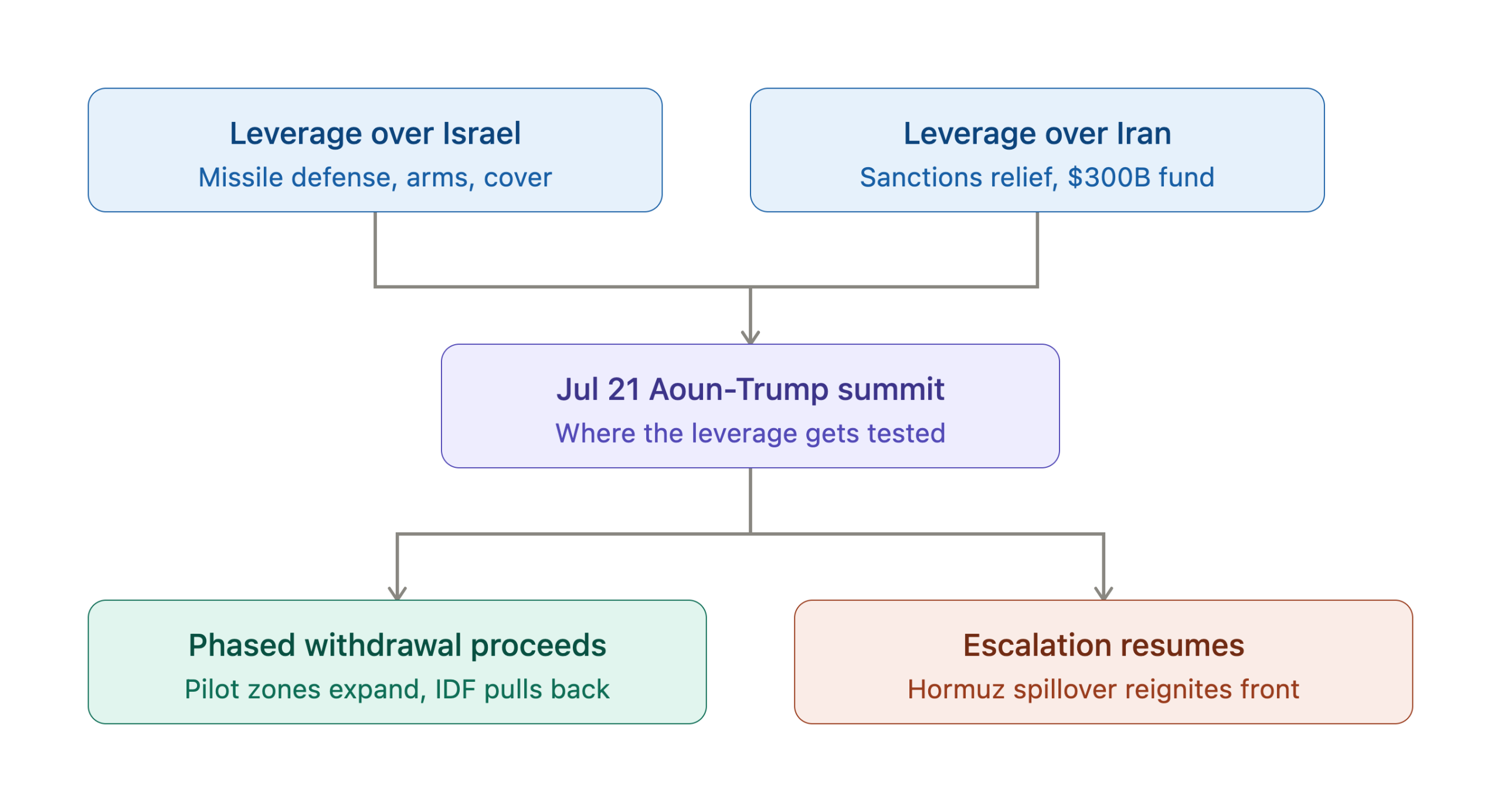
The disarmament file does not fail or succeed on Lebanese or Israeli initiative alone — it depends on whether Washington is willing to spend real leverage on both sides of the equation, at the exact moment its bandwidth is consumed by a collapsing Strait of Hormuz ceasefire. This chapter maps that leverage concretely, then works through the scenario tree for what happens between now and the immediate aftermath of the July 21 Aoun-Trump summit.
The leverage inventory
Washington’s position rests on two separate levers, aimed at two different capitals, and both are now under visible strain.
Leverage over Israel is functionally about hardware dependency. The United States has supplied the bulk of Israel’s missile defense architecture through the current war, a fact Vice President JD Vance invoked directly when defending the broader U.S.-Iran memorandum, reminding Jerusalem it was leaning on American systems throughout the conflict. Read the New York Times account of Vance’s remarks to Israel’s critics. Vance escalated this into open pressure on June 18, warning Israeli officials against publicly attacking the deal and stating plainly that the U.S. remained the “only powerful ally” Israel had left in the world — an unusually blunt signal from a sitting vice president to a treaty partner, and one that implicitly frames continued U.S. military support as conditional on Israeli cooperation with the wider settlement. Read Foreign Policy’s detailed breakdown of Vance’s defense of the deal. The friction this pressure is meeting is real: a Netanyahu adviser told reporters Israel does not consider itself bound by the Lebanon provisions of the U.S.-Iran memorandum at all, and pro-Netanyahu Israeli outlets have accused U.S. envoys Steve Witkoff and Jared Kushner of “selling out Israel” in the deal’s negotiation. Read Time’s report on Israeli reaction to the memorandum. That is the leverage gap in one sentence: Washington is threatening to withdraw support it has not yet actually withdrawn, against a government that has already signaled it may simply ignore the Lebanon clause it formally agreed to.
Leverage over Iran runs through sanctions relief and reconstruction financing rather than hardware. The June 17 memorandum opened a 60-day negotiating window tied to the possible creation of a $300 billion economic rehabilitation fund for Iran, contingent on Tehran halting nuclear weapons development and permitting safe passage through the Strait of Hormuz. See Time’s reporting on the MOU’s economic terms. That fund is Washington’s single largest card, but its value depends entirely on Iran believing the ceasefire will hold long enough to matter — and Iran’s decision to keep attacking shipping in the strait through early July suggests Tehran’s radical factions may now doubt that premise, or judge that physical control of Hormuz is worth more than the promised rehabilitation package. The Institute for the Study of War’s assessment that Iran is prioritizing control of the strait over avoiding renewed U.S. conflict is the clearest available signal that this lever’s persuasive power is currently failing.
The table below sets out the leverage instruments, their intended target, and their current state of use as of July 10, 2026.
| Instrument | Target | Intended effect | Status as of Jul 10 |
|---|---|---|---|
| Missile defense support | Israel | Restrain further unilateral strikes on Lebanon | Invoked rhetorically by Vance; not withdrawn |
| Arms transfer posture | Israel | Signal cost of non-compliance with Lebanon clause | No confirmed reduction reported |
| Diplomatic cover at UN/multilaterally | Israel | Reward compliance, penalize defiance | Unused as explicit lever so far |
| $300B rehabilitation fund | Iran | Incentivize sustained ceasefire, nuclear restraint | Contingent on 60-day MOU window, which collapsed Jul 9 |
| Sanctions relief / oil sector licenses | Iran | Reward de-escalation | US Treasury revoked a sanctions relief license for Iran’s oil sector on Jul 7, before the ceasefire collapse |
| Naval presence / blockade enforcement | Iran | Compel Hormuz access, deter shipping attacks | Active; source of the current escalation cycle |
That Treasury revocation on July 7 — two days before Trump declared the ceasefire over — is a signal easy to miss inside the noise of the Hormuz strikes, but it indicates the sanctions-relief lever over Iran was already being pulled back before the shooting resumed, not after. Report.az’s news roundup lists the Treasury revocation alongside the broader escalation timeline.
The Israeli resistance problem
Leverage only functions if the target has more to lose from defiance than from compliance, and on the Israeli side that calculation is currently ambiguous. Defense Minister Israel Katz instructed the military to prepare for an “extended stay” in southern Lebanon even after signing the framework agreement, and Netanyahu’s own public statement tied any future withdrawal explicitly to full Hizballah disarmament with no calendar attached — language that gives Israel a standing justification for indefinite presence regardless of Lebanese-army progress. Domestically, Israeli commentary described the framework in adversarial terms even before implementation began: media aligned with the government have raised the prospect of civil war in Lebanon as a predictable consequence of the disarmament push, and at least one senior figure, Avigdor Liberman, was reported as treating renewed confrontation with Hizballah as “a matter of time” rather than a contingency. See ProfileNews’ Arabic-sourced roundup on Israeli reactions and civil war warnings. That combination — formal agreement, informal expectation that Hizballah will not comply and the deal will therefore collapse — is itself a form of hedging that reduces Israel’s incentive to make early, good-faith concessions on withdrawal timing.
The Rome-to-Washington sequence
Two overlapping diplomatic tracks converge in the next two weeks. Israeli Foreign Minister Gideon Saar confirmed a new round of Israel-Lebanon talks would take place in Rome, but Lebanese officials say they received no advance notification of the announcement and were caught off guard by it — a procedural detail that suggests the two governments are not coordinating as closely as the “implementation phase” framing implies. See The National’s reporting on Lebanon being caught off guard by the Rome announcement. Aoun’s July 21 White House visit — his first face-to-face meeting with Trump — was formally confirmed by the Lebanese embassy in Washington, with the stated agenda covering bilateral relations, regional security, and continued U.S. support for Lebanese sovereignty and territorial integrity. Read Naharnet’s confirmation of the July 21 visit and Arab News’ wire report on the invitation. Reporting also indicates Washington has floated the idea of a trilateral meeting bringing Aoun, Netanyahu, and Trump together, though Beirut has resisted the idea while Israeli troops remain on Lebanese territory — a sequencing dispute that itself illustrates how far the two sides remain from a genuinely joint process. See World Israel News on the proposed trilateral meeting and Beirut’s resistance. Domestically, Aoun’s own aides describe him as caught between Hizballah’s refusal to cooperate and mounting pressure to show results, with one Lebanese figure quoted criticizing officials who agreed to the Israel deal as “inexperienced” and “power-hungry” — a sign the disarmament push is generating friction inside the Lebanese political class itself, not only between Lebanon and its adversaries. Naharnet’s news index captures both threads — Aoun’s “heart open but Hezbollah refusing to cooperate” and the domestic criticism of the deal.
Scenario tree
The following is an analytical judgment, not a statistical forecast — there is no dataset from which precise probabilities can be derived, and the estimates below should be read as directional weightings based on the trajectory documented in Chapters 1 through 3, not as calibrated forecasts.
| Scenario | Core drivers | Directional likelihood (next 60 days) | Key indicator to watch |
|---|---|---|---|
| A. Managed implementation | Rome talks produce technical handoff; pilot zones expand; Aoun visit yields concrete US commitment | Low-to-moderate | Confirmed Israeli withdrawal from a second pilot zone within 30 days |
| B. Frozen stalemate | Pilot zones launch on paper but stall; Hizballah neither disarms nor re-escalates significantly; status quo persists | Moderate-to-high | No fixed Israeli withdrawal schedule published after the Aoun visit |
| C. Lebanon-Hormuz spillover | Collapsed US-Iran ceasefire reduces Iran’s incentive to restrain Hizballah; southern front reheats independent of local disarmament politics | Moderate and rising | Any Hizballah attack explicitly linked rhetorically to Hormuz strikes |
| D. Israeli unilateral escalation | Netanyahu government treats stalled disarmament as license for expanded operations, as Liberman’s rhetoric suggests some officials favor | Low-to-moderate | Israeli strikes beyond the agreed pilot-zone boundaries |
Scenario B currently looks best supported by the documented record: a Lebanese military official’s on-record statement that there is “no schedule for the withdrawal or anything else” as of late June, combined with the July 9 announcement of an “implementation phase” that specifies only that the first pilot zone will launch “in a matter of days” without naming a completion date, is consistent with a process designed to generate the appearance of momentum ahead of the Aoun visit rather than an accelerating withdrawal. Scenario C is the one most directly created by this report’s own findings in Chapter 3 — the structural link Hizballah and Iran spent April through June building between Lebanon and the wider U.S.-Iran file means that Lebanon is mechanically exposed to a shock that has nothing to do with Lebanese politics at all, which is exactly what the July 9 Hormuz collapse represents.
Figure 3. Directional scenario weighting for the next 60 days, based on the documented trajectory in this report. This is an analytical judgment, not a statistical probability.
Verified Sources
- Mohammed bin Rashid approves establishing Artificial Intelligence and Data Authority, UAE Cabinet (giugno 2026) – https://uaecabinet.ae/en/news/mohammed-bin-rashid-approves-establishing-artificial-intelligence-and-data-authority
- Energy and AI, International Energy Agency (aprile 2025) – https://www.iea.org/reports/energy-and-ai
- Chapter 5 – China and the Middle East, U.S.-China Economic and Security Review Commission (novembre 2024) – https://www.uscc.gov/sites/default/files/2024-11/Chapter_5–China_and_the_Middle_East.pdf


