













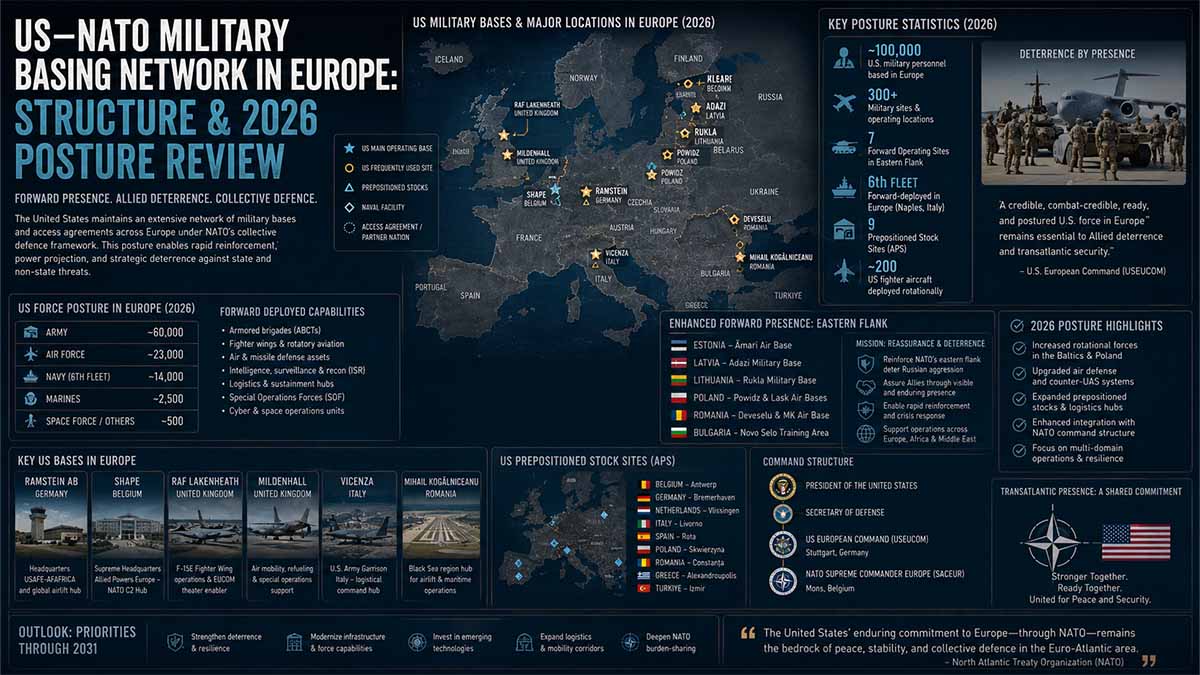
Reference report — data current as of July 8, 2026
Executive Summary
The US maintains 80,000–100,000 personnel across Europe through two overlapping legal architectures: bilateral Status of Forces Agreements with individual host nations, and NATO-integrated command structures under SHAPE. Installations cluster into four functional roles — airspace control/strike, naval presence, strategic logistics, and forward/advanced defense — concentrated in Germany, Italy, the UK, Spain, and increasingly Romania and the Baltic states. As of mid-2026, the network is under genuine, partial, and contested reduction: a confirmed 5,000-troop withdrawal from Germany, a Brigade Combat Team cut from four to three, and a formal Pentagon posture review are underway, but this sits alongside reversals (an added 5,000 troops to Poland), unresolved internal US policy disagreement, and a statutory floor of 76,000 troops that Congress imposed in the FY2026 NDAA. No NATO withdrawal, Article 5 change, or closure of major hubs (Ramstein, Naples, Rota) has occurred. Separately, a longer-running Washington debate over reweighting defense resources toward the Indo-Pacific — driven by rare-earths, semiconductor, and AI-infrastructure competition with China — remains genuinely contested rather than settled in either direction.
Index
- Two Legal Architectures, One Network
- The Network by Function (with installation table)
- Chapter 1 — The 2026 Posture Debate: Timeline of Confirmed Events
- Chapter 2 — Legal Constraints and Internal US Divisions
- Chapter 3 — Country-by-Country Troop Data
- Chapter 4 — The Broader Strategic Frame: Rare Earths, Chips, and the Indo-Pacific Pivot
- Chapter 5 — Italy: The Specific Friction Points
- Chapter 6 — Five-Year Outlook (2026–2031): Competing Scenarios
- Bottom Line
- Sources
1. Two Legal Architectures, One Network
The US military footprint in Europe rests on two distinct legal foundations that function together in practice:
- Bilateral installations operate under Status of Forces Agreements (SOFAs) negotiated directly between Washington and the host government (Germany, Italy, Spain, the UK, Poland, etc.). The US retains full operational command; the host nation controls basing rights, legal jurisdiction over personnel, and terms of access.
- NATO-titled infrastructure (integrated air-defense sites, AWACS operations at Geilenkirchen, elements of Allied Command Operations) sits under NATO’s own command chain, headquartered at Supreme Headquarters Allied Powers Europe (SHAPE) in Belgium, with multinational staffing rather than a single national chain of command.
In practice these overlap constantly: a base like Ramstein is a US Air Force installation under a bilateral SOFA with Germany, but it also anchors NATO’s Allied Air Command and hosts genuinely multinational missions. EUCOM (US European Command) is headquartered in Stuttgart and functions as the connective tissue between the bilateral and NATO layers.
Roughly 80,000–100,000 US personnel are in Europe at any given time depending on rotations, according to the Congressional Research Service and repeated White House disclosures to Congress.
2. The Network by Function
| Role | Installation | Country | Key Facts |
|---|---|---|---|
| Airspace control / strike | Ramstein AB | Germany | Largest US installation in Europe; ~16,200 direct personnel, ~56,000 in wider Kaiserslautern community; HQ of USAFE-AFAFRICA; command node for air activity across 100+ countries; future NATO Space Center site |
| Airspace control / strike | RAF Lakenheath | UK | 48th Fighter Wing; only F-35A/F-15E combination in Europe; B61-12 nuclear-capable strike role |
| Airspace control / strike | Aviano AB | Italy | 31st Fighter Wing F-16s; covers NATO’s southern approaches; only US combat search-and-rescue (HH-60W) unit in Europe/Africa |
| Airspace control / strike | Incirlik AB / İzmir AS | Türkiye | Middle East–facing strike and logistics access |
| Naval presence | NSA Naples | Italy | HQ, US Naval Forces Europe-Africa and Sixth Fleet |
| Naval presence | Naval Station Rota | Spain | Four Aegis-equipped destroyers, NATO ballistic-missile-defense mission; in continuous US use since 1953 |
| Naval presence | NSA Souda Bay | Crete, Greece | Only Mediterranean deep-water pier for US nuclear-powered carriers; sits at EUCOM/AFRICOM/CENTCOM crossroads |
| Strategic logistics | Camp Darby | Italy | Army pre-positioning site, war-reserve materiel |
| Strategic logistics | NAS Sigonella | Sicily, Italy | P-8 Poseidon maritime patrol; logistics hub for 36 tenant commands |
| Strategic logistics | RAF Croughton / RAF Mildenhall; USAG Stuttgart | UK / Germany | Command, control, communications backbone |
| Forward / advanced defense | Mihail Kogălniceanu AB | Romania | ~5,000 US personnel; expanding Black Sea hub for NATO Enhanced Air Policing |
| Forward / advanced defense | Rotational sites | Poland, Lithuania, Latvia, Estonia, Bulgaria | Expanded under Operation Atlantic Resolve after 2022 (~20,000 additional troops at peak) |
| Nuclear sharing | Multiple sites | Belgium, Germany, Italy, Netherlands, Türkiye | ~100 US B61 nuclear bombs under NATO nuclear-sharing arrangement |
Chapter 1 — The 2026 Posture Debate: Timeline of Confirmed Events
This is the part worth being precise about, because the public record already shows concrete, if inconsistent, movement — not merely media chatter:
| Date (2026) | Development |
|---|---|
| ~April–May | Pentagon halts a planned rotation of ~4,000 troops (2nd Armored BCT, 1st Cavalry Division) to Poland |
| May 2 | Trump signals openness to broader cuts; floats pulling troops from Spain and Italy after clashes with Sánchez and Meloni |
| May 19–20 | Pentagon formally announces reducing Brigade Combat Teams in Europe from four to three, returning levels to roughly those of 2021 |
| May, following weeks | Withdrawal of 5,000 troops from Germany confirmed — about 14% of the ~36,000–38,000 stationed there — following a public dispute between Trump and Chancellor Friedrich Merz over the Iran conflict |
| May 22 | Trump abruptly reverses course, announcing an additional 5,000 troops to Poland, citing ties to Polish President Karol Nawrocki — NATO allies and even US defense officials describe themselves as “bewildered” |
| June 18 | Defense Secretary Pete Hegseth announces a formal review of US force posture and basing in Europe, framed as accelerating “Europe leading” its own defense |
| July 7–8 (Ankara summit) | Trump raises Greenland again and suggests the US could pull troops out of Europe over the dispute; declines to commit to further cuts, telling reporters “we’re going to see” |
What hasn’t happened: a NATO withdrawal, an end to Article 5 commitments, or a wholesale pullout from major hubs like Ramstein, Naples or Rota, all of which remain fully operational as of this writing.
Chapter 2 — Legal Constraints and Internal US Divisions
Internal US divisions. A “retrenchment” faction centered in Pentagon policy and the Vice President’s office wants a genuine, structural reduction in US force posture and has pushed to convert Trump’s anger over the Iran war into a broader drawdown agenda; so far these efforts have produced only partial results (the Poland rotation pause, the BCT cut), while the Poland reversal shows the opposing camp — those who favor keeping troop levels as leverage rather than as fixed reductions — still has real influence.
Legal constraint. Section 1249 of the FY2026 National Defense Authorization Act bars the Pentagon from using its budget to cut European troop levels below 76,000 for more than 45 days unless the administration certifies the move serves US national security, consults NATO allies beforehand, and reports in detail to Congress. This doesn’t prevent a drawdown, but it requires process and creates a paper trail — a genuine check, not a rumor. The Senate and House Armed Services Committees have already issued joint bipartisan criticism of the Germany withdrawal, warning it could embolden Russia and weaken NATO’s eastern flank.
Chapter 3 — Country-by-Country Troop Data
The Congressional Research Service (CRS) is the most authoritative unclassified baseline, though its most recent published full breakdown dates to March 2024; more recent country-level figures below come from Reuters’ 2026 factbox reporting and DoD-sourced Statista data, and are noted as such.
| Country | Permanently assigned (CRS, March 2024) | Rotational / EDI-funded (2026 reporting) | 2026 status notes |
|---|---|---|---|
| Germany | 35,068 | — | ~36,000–38,000 total pre-drawdown (DoD, May 2026); down ~5,000 following May 2026 announcement, bringing the total toward ~31,000–33,000 |
| Italy | 12,375 | — | ~12,300 total reported in 2026 guides; no confirmed permanent cuts as of this writing, though Trump has threatened reductions |
| United Kingdom | 10,058 | — | No confirmed 2026 reduction announced |
| Poland | 369 | ~9,000–10,000 (EDI-funded rotational, across four bases with temporary US access) | Pentagon paused a ~4,000-troop rotation in spring 2026, then Trump announced an additional 5,000 troops in May 2026 — net position unsettled |
| Romania | 153 | Rotational presence across Mihail Kogălniceanu AB, Camp Turzii, and Deveselu | Expanding infrastructure (new runway, fuel depots) reported through 2026 |
| Hungary | 77 | Rotational/exercise-based, two bases (Kecskemét, Pápa AB) | No major changes reported |
| Spain | Not separately broken out by CRS in public reporting | — | Naval Station Rota hosts ~6,450 US-affiliated personnel including families and civilians; Trump has threatened cuts here without confirmed action |
| Baltic states (Estonia, Latvia, Lithuania) | Smaller rotational presence | Includes a 500-person Army multi-domain task force deployed February 2026, plus a sixth Navy destroyer | Reflects continued reinforcement rather than drawdown |
EUCOM-wide baseline: CRS identified 31 persistent bases and 19 additional military sites across the region as of 2024, with approximately 67,200 permanently assigned active-duty personnel; adding rotational and exercise forces brings the total to the oft-cited 80,000–100,000 range. For comparison, CENTCOM’s Middle East posture (2024 CRS baseline) totaled roughly 5,400 permanently assigned personnel across 8 persistent bases, with Bahrain hosting the largest single contingent (3,479) — illustrating how much more heavily garrisoned Europe is relative to the Middle East on a permanent-basing footing, even before rotational forces are counted.
Caveat on precision: troop figures fluctuate constantly with rotations, and government disclosures (DMDC, CRS, White House letters to Congress) are the only fully authoritative source; media aggregations, including the figures above, should be read as good-faith estimates rather than real-time counts.
Chapter 4 — The Broader Strategic Frame: Rare Earths, Chips, and the Indo-Pacific Pivot
Separate from the day-to-day troop-posture fight, there’s a real and longer-running policy argument in Washington about whether US defense resources — fabrication capacity, munitions stockpiles, force structure — should be reweighted toward the Indo-Pacific given China’s centrality to critical minerals, semiconductor supply chains, and AI-relevant compute infrastructure. This argument has genuine advocates on more than one side:
- Some analysts (e.g., in War on the Rocks commentary) argue Europe has the economic capacity to fund its own conventional defense and that a deliberate, negotiated US drawdown — not a punitive or chaotic one — would free up resources and reduce entanglement risk for Washington.
- Others, including the bipartisan congressional voices noted above, warn that reducing the European “tripwire” removes a deterrent signal to Russia at a moment when the alliance’s eastern flank is most exposed, regardless of the merits of an Asia pivot.
- European governments have used US pressure (defense-spending targets rising toward 5% of GDP by 2035, up from roughly 2% today) as leverage to accelerate their own rearmament — Germany’s increased spending following the initial drawdown announcement is one concrete example — while facing real fiscal and industrial-capacity constraints (Europe’s defense R&D spend is a much smaller share of budgets than the US’s, and the region faces a shortage of roughly 200,000 skilled defense-industry workers per Milken Institute estimates).
This is a genuinely contested policy question rather than a settled one, and reasonable people disagree about the right balance — I’d avoid treating either the “abandon Europe” or “Europe must matter more than ever” framing as simply correct.
Chapter 5 — Italy: The Specific Friction Points
Italy hosts roughly 12,000 US military personnel (Aviano, NAS Sigonella, NSA Naples, Camp Darby), making it one of the three largest European hosts alongside Germany and the UK. Tension with Washington in 2026 runs on several concrete, documented tracks rather than a single grievance:
- Base-access dispute: In March 2026, Rome declined to let US bombers bound for the Middle East stage through Sicilian airbases without parliamentary approval, citing constitutional constraints and domestic opposition to the Iran war; Sigonella specifically was denied as a refueling/transit point during Iran operations, while Aviano remained available for logistics but not direct combat missions.
- Defense-spending friction: Italy’s defense spending sits at roughly 2% of GDP, below the 5%-by-2035 target NATO adopted under US pressure; Rome also scaled back an initial €15 billion request from the EU’s Security Action for Europe fund.
- Procurement disputes: Italy canceled a planned order of 20 French-Italian frigates after Trump moved to redirect the relevant program, and in April 2026 chose European-made Airbus A330 tankers over a previously planned Boeing KC-46 order — read in Washington’s defense establishment as a signal of drift toward European suppliers.
- Personal-political rupture: Relations between Trump and Meloni — previously friendly, with Meloni cast as a potential “Trump whisperer” among European leaders — deteriorated sharply after Trump criticized Pope Leo XIV as “weak on crime,” which Meloni called “unacceptable.” Trump then claimed Meloni “begged” him for a photo at the June 2026 G7 summit, which she called fabricated; Italy’s foreign minister canceled a planned Washington visit, and Trump posted a mocking “RESTRAINING ORDER NEEDED” image of Meloni on Truth Social in early July.
- Troop-presence threat: Trump has said he would “probably” pull troops from Italy and Spain, telling reporters “Italy has not been of any help to us,” directly linking the threat to the base-access refusal.
- Countervailing structural ties: Italian analysts note that what the US values most in Italy is not raw troop numbers but technological interdependence — Sigonella hosts NATO’s Alliance Ground Surveillance drone program, described as having no European alternative; Italian firms Fincantieri and Leonardo have significant US defense-industrial ties; and Italy’s Defense Minister was, as of early July 2026, preparing a Washington visit to discuss further contracts (including a possible US Navy purchase of Italy’s M-346 trainer aircraft). These ties are why analysts on both sides expect the Rome-Washington relationship to survive the political friction even if it stays personally acrimonious.
Net assessment: Italy is a genuine flashpoint, but on the evidence available, it’s better described as a political and procurement dispute layered on top of durable technical interdependence, rather than a relationship at risk of structural rupture. No Italian base closure or confirmed troop cut has occurred as of this writing.
Chapter 6 — Five-Year Outlook (2026–2031): Competing Scenarios
Given how much reversal has already occurred within a single year (Germany cuts, then Poland reinforcement; BCT reduction, then a stated review with contested internal outcome), a single-point forecast would overstate confidence. Three scenarios are worth tracking, none treated here as the default:
Scenario A — Managed rebalancing (continuity of current trajectory). The Pentagon’s six-month review concludes with modest, negotiated reductions (further BCT consolidation, continued Germany drawdown toward the ~31,000–33,000 level already signaled) while eastern-flank rotational forces in Poland, Romania and the Baltics are maintained or grow, consistent with the Baltic Security Initiative language in the FY2026 NDAA. Nuclear-sharing and space/cyber/AGS-type technical assets — which several analysts argue are now the more decisive form of US leverage over troop counts — remain intact regardless of headcount changes. This scenario assumes the “retrenchers” inside the administration continue winning only incremental battles, as they have so far.
Scenario B — Accelerated drawdown. Internal advocates for retrenchment (Pentagon policy office, VP’s staff, and the “NATO 3.0” framework associated with Undersecretary Elbridge Colby) succeed in converting the posture review into a structural reduction closer to the one-third figure Trump has mused about, pushing toward the statutory 76,000 floor and potentially prompting a legislative fight if the administration seeks to move below it. This would likely be paired with continued friction over defense-spending compliance and could accelerate European efforts toward “strategic autonomy” — French and German officials have both signaled interest in this framing, though funding it remains a serious industrial and fiscal challenge (Europe’s defense R&D share and skilled-labor shortages, noted above, are real constraints).
Scenario C — Volatility without net change. Given the pattern already observed in 2026 — announce cuts, reverse with increases, announce a review, decline to commit at the summit — force levels could simply oscillate within a relatively narrow band around the statutory floor without a clear directional trend by 2031, driven more by personal disputes with individual leaders (Merz, Meloni, Sánchez) than by a coherent strategic doctrine. Several NATO officials already describe this as the operative pattern rather than an aberration.
Cross-cutting factor — the Indo-Pacific/critical-minerals dimension: under any scenario, the pressure to reallocate resources toward countering China’s position in rare earths, semiconductor supply chains, and AI infrastructure is likely to persist independent of whoever occupies the White House after Trump’s term ends in January 2029, since it reflects a bipartisan-shared assessment (both the 2022 National Security Strategy and National Defense Strategy already named the Indo-Pacific the “priority theater”). This makes the Asia-reallocation argument more durable than the personality-driven disputes documented above, even though its pace and framing under Trump specifically have been unusually erratic.
What would most clearly resolve the uncertainty: the outcome of Hegseth’s six-month posture review (due roughly December 2026), and whether Congress moves to tighten or loosen the NDAA Section 1249 floor in the FY2027 defense bill.
Bottom Line
The US–NATO basing network in Europe is real infrastructure with well-documented functions across air, sea, logistics and forward-defense roles. The claim that Trump is not actually reducing the US presence doesn’t hold up against the public record: partial troop withdrawals, a BCT reduction, and a formal posture review are already underway, alongside genuine reversals and internal disagreement about how far this goes. Congress has built in guardrails that make an abrupt, total pullout legally difficult, and no NATO-wide withdrawal has occurred. The most defensible summary is: real, partial, contested drawdown — not yet a wholesale retreat, and not merely rumor.
Sources
- CNN, “Trump mused about cutting troops in Europe by a third to send a message to NATO,” July 7–8, 2026
- War on the Rocks, “Misguided and Misunderstood: Trump’s Approach to U.S. Troops in Europe,” July 2026
- PBS News / AP, “NATO allies bewildered by Trump’s about-face on U.S. troop moves in Europe,” May 22, 2026
- CNN Business, “2,300 years in the making, a record-setting bridge is finally in the works. Because of Trump. Sort of,” July 8, 2026
- Fox News, “Pentagon reduces US troops in Europe as Trump pushes NATO defense spending,” May 20, 2026
- Euronews, “Can US law stop Trump from withdrawing troops from Europe?,” May 5, 2026
- TIME, “The U.S. Military Drawdown in Europe Has Only Just Begun,” May 3, 2026
- CNBC, “Trump renews Greenland threats at NATO summit, says U.S. could remove troops from Europe,” July 7, 2026
- CEPA, “Going, Going . . .? The US Base Network in Europe”
- Congressional Research Service base-location data, via Brilliant Maps and Newsweek reporting
- usmilitary.org, “US Military Bases in Europe 2026: A Guide for Service Members and Families”
- Congressional Research Service, “U.S. Overseas Basing: Background and Issues for Congress,” R48123, via congress.gov
- Reuters, “Factbox — Details of U.S. Troops Based in Europe as Trump Mulls Removing Some,” April 10, 2026
- Statista / US Department of Defense, “Number of active-duty United States military personnel in Europe in 2026, by country,” May 1, 2026
- Defense Priorities, “Aligning global military posture with U.S. interests,” March 2026
- The National (UAE), “Trump and Meloni set for Nato showdown over defence spending,” July 7, 2026
- Euronews, “Meloni-Trump tensions tested, can the US-Italy alliance hold?,” June 5, 2026
- AP/PBS News, “Trump deepens the dustup with Italy’s Meloni, who says his ‘unprovoked attacks are senseless,'” June 2026
- Axios, “‘I just want loyalty’: Trump’s Iran grudge hangs over NATO summit,” July 7, 2026
- Newsweek, “Donald Trump’s Hidden Allies at the NATO Summit: Ranked,” July 7, 2026
- NPR / PBS News, “Trump won spending promises from NATO allies last year. This week, he’ll try to enforce them,” July 6, 2026


[…] US–NATO Military Basing Network in Europe: Structure & 2026 Posture Review […]