












Executive Summary — BLUF
The EU move is not yet hard power, but it is no longer only theatre.
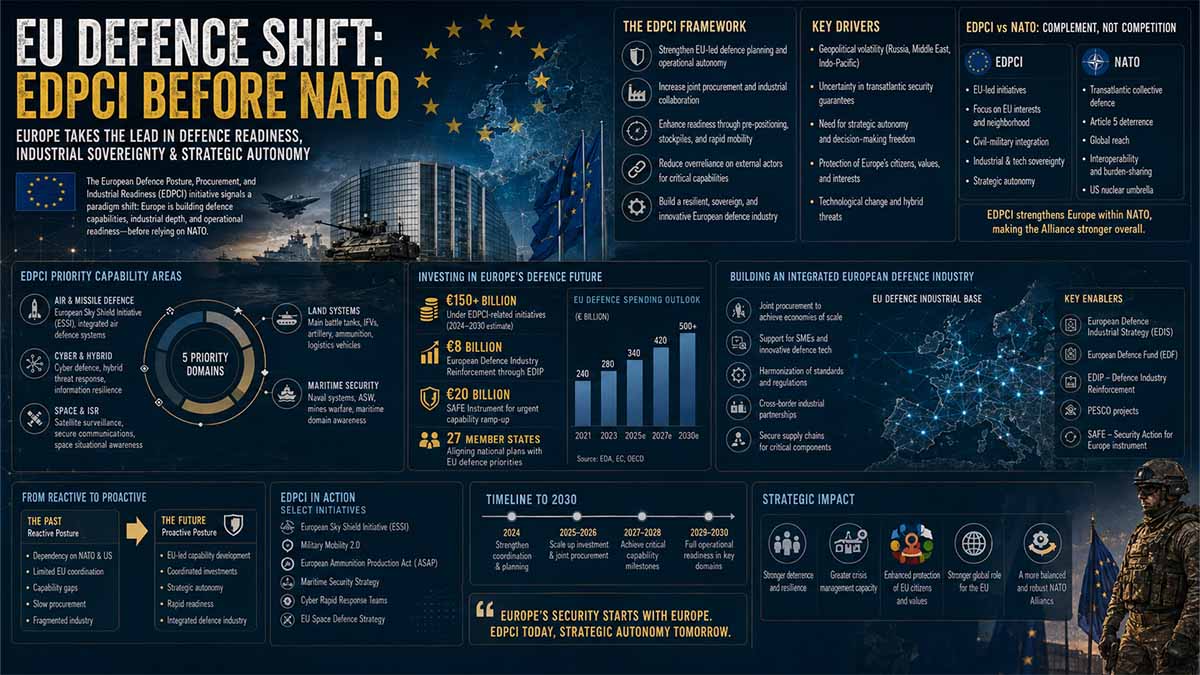
The Commission has proposed five European Defence Projects of Common Interest across drones, seabed, space, missile defence, and the eastern flank.
The verified EU funding base is still small: €325 million under EDIP, inside a €1.5 billion programme.
The political ambition is much larger than the current budget envelope, so the credibility test is industrial execution, not announcements.
The key operational question is whether EU coordination converts into deployable systems before 2030–2031.
For Poland, the decisive files are Eastern Flank Watch and EU federated air and missile defence.
For NATO, this can be useful only if it strengthens capability targets rather than duplicating command structures.
Bayesian assessment: H₁ real capability shift = 0.46, H₂ political signalling = 0.34, H₃ bureaucratic fragmentation = 0.20.
Five-year outlook: Europe is entering an industrial-defence transition, but the gap between funding, procurement law, production lines, and battlefield relevance remains the central risk.
Europe’s Defence Test Is No Longer the Summit
On 3 July, the European Commission put five defence projects on the table: drones and counter-drone systems, maritime and seabed defence, space, air and missile defence, and protection of the EU’s eastern flank. The immediate money is modest: €325 million under the €1.5 billion European Defence Industry Programme. The ambition is not. Brussels is trying to create projects that individual states would struggle to build alone, with Ukraine involved in four of the five and an average of 18 member states per project.
The gap between the seed money and the political language is the first thing to watch. These projects are not, today, a European shield. They are a framework for deciding whether Europe can move from procurement fragments to industrial capacity. The Commission speaks of a combined ambition of about €190 billion by 2036, but the real test will not be the headline figure. It will be contracts, production lines, trained operators, spare parts, interceptors, sensors and systems that can be used by soldiers, not only described in Brussels papers.
This is why the timing, just before the NATO summit, matters. The EU is trying to show that it can enter the security debate with something more concrete than sanctions, regulation and declarations. NATO remains the military architecture of deterrence. The EU wants to become the industrial and financial machine that helps European states buy together, produce together and reduce duplication. If that link works, European defence becomes stronger. If it fails, the result will be another layer of institutional choreography.
The strongest political signal is Eastern Flank Watch. It speaks directly to Poland, the Baltic states, Finland and Romania: countries that do not need abstract strategic autonomy, but surveillance, counter-drone capacity, air defence, military mobility and hardened infrastructure. The Commission’s proposal places the eastern border inside a multi-domain architecture that includes ground combat, C4ISTAR, drone defence, counter-mobility, military mobility and air and missile defence. That is the right map. The open question is whether the map becomes equipment.
Missile defence is the hardest file. It is also the one where European rhetoric can most easily overrun reality. A federated air and missile defence system requires radars, interceptors, launchers, command links, stockpiles, trained crews and industrial replenishment. It is expensive, slow and technically unforgiving. Europe can improve warning, coordination and procurement by 2031. It cannot improvise a full shield with seed funding and political pressure.
Drones are different. They are the most realistic short-term test of whether the EU can learn from Ukraine. The battlefield has shown that drone warfare is not a niche technology, but a production cycle: cheap platforms, rapid software updates, electronic warfare, countermeasures and constant adaptation. EDIP already targets energetic components, key electronic components, unmanned systems and counter-unmanned systems. That is where Europe can move faster if it accepts that perfect platforms are less useful than systems that can be produced, lost, replaced and improved.
The less visible front is the seabed. Cables, pipelines, ports and offshore infrastructure have become political assets. They are difficult to protect and even harder to attribute when damaged. Maritime and seabed defence will not produce the same public image as tanks or missiles, but it may become one of the decisive layers of European resilience. NATO has already treated the Baltic Sea as a critical infrastructure theatre; the EU now wants to connect maritime awareness, underwater systems and industrial procurement into a wider defence architecture.
Space is the hidden dependency behind all the others. Without satellite communications, early warning, ISR, navigation resilience and space-domain awareness, eastern flank surveillance weakens, missile defence slows, maritime monitoring thins and drone operations become more fragile. The EU’s space project is therefore not a prestige programme. It is an attempt to protect the nervous system of modern defence.
The non-obvious point is that Europe is not mainly buying weapons with this package. It is buying time, coordination and industrial discipline. Russia gains when European procurement remains slow and national. NATO gains if the EU compresses demand into larger, compatible orders. Frontline states gain only if Brussels money and national budgets reach the border in usable form. Industry gains if political ambition becomes predictable multi-year demand.
By 2031, the judgment should be severe. If drones, counter-drone systems, surveillance, seabed monitoring, space resilience and partial missile-defence integration are visible in the field, the EU will have moved from performance to capacity. If not, the package will have proved only that Europe has learned to describe power more elegantly than it can produce it.
Navigational Index — Three Pillars
I. From Brussels Regulation to Defence Production
The first pillar examines whether the Commission’s EDPCI package represents a genuine institutional shift from market governance toward armaments coordination, production scaling, joint procurement, and strategic capability planning.
II. Eastern Flank, Missile Defence, Drones, Seabed, Space
The second pillar maps the five capability vectors against Europe’s exposed threat surfaces: Russian pressure, Belarusian staging depth, Baltic and Black Sea infrastructure vulnerability, Ukrainian battlefield lessons, satellite dependency, and missile-defence saturation.
III. Five-Year Strategic Test: Capability or Performance
The third pillar assesses the probability that the EU package becomes usable military capacity by 2031, using Bayesian updates, competing hypotheses, Monte Carlo-style scenario envelopes, and execution-risk indicators.
Master Abstract
The Commission’s proposal of five European Defence Projects of Common Interest marks a structural change in EU defence language because it places the Union inside the industrial preconditions of deterrence rather than only inside the legal, sanctions, regulatory, or diplomatic layers of European security policy. The verified primary record shows that on 3 July 2026 the European Commission proposed five large-scale EDPCIs focused on drones and counter-drone systems, maritime and seabed defence, space, air and missile defence, and security along the EU’s Eastern Flank; the same Commission note states that these projects are meant to help EU countries strengthen capabilities by developing key military systems together, while €325 million is allocated under the €1.5 billion European Defence Industry Programme to support establishment and deployment. Official Title – European Commission, Directorate-General for Defence Industry and Space – July 2026 — Commission proposes five joint defence projects to strengthen Europe’s industrial capabilities. The critical analytical point is not that €325 million can finance strategic air defence, seabed surveillance, drone mass, or a militarized eastern flank; it plainly cannot. The point is that Brussels is attempting to build a legal and industrial container through which larger national, EU, and future multiannual-budget resources can be disciplined into common programmes rather than dispersed into fragmented national procurement. That is why this is neither pure power nor pure theatre. It is a transition instrument: weak as immediate force, significant as an institutional signal, and potentially important if it becomes a coordination spine for demand aggregation, standardized requirements, industrial capacity expansion, test hubs, and Ukraine-linked feedback loops.
The verified EU documentation also shows that the EDPCI mechanism is not being presented as a symbolic declaration but as a formally identified set of projects under Regulation (EU) 2025/2643, with the Commission proposal stating that Member States submitted nine project proposals by 29 May 2026, that five were proposed for identification, and that the annex defines objectives, participating countries, characteristics, and estimated overall financial size. Official Title – European Commission – July 2026 — Proposal for a Council Implementing Decision on the identification of European Defence Projects of Common Interest. The DECODER drone and counter-drone project is especially revealing because the annex describes a coordinated effort to develop, scale, and deploy unmanned and counter-unmanned capabilities, expand industrial production capacity, support joint procurement, and establish a European Network of Drone Technology Hubs. That language is important because the war in Ukraine has made clear that drone warfare is not a boutique capability but a consumption-based industrial ecosystem: sensors, airframes, jammers, spectrum management, autonomy, battlefield software, counter-UAS detection, kill chains, and rapid iteration cycles. A European project that only funds prototypes would fail; a project that creates production depth, interoperability, trusted supply chains, and continuous Ukrainian battlefield learning could matter. The five-year test is therefore measurable: by 2031, Europe either has modular drone families, counter-drone layers, and procurement mechanisms able to absorb lessons at battlefield speed, or EDPCI becomes another Brussels map with insufficient military mass.
The NATO timing matters because the EDPCI announcement arrives inside an alliance environment that has shifted from declarations about burden-sharing to explicit industrial implementation. NATO’s official summit programme in Ankara placed high-level announcements by NATO, Allies, and industry at the Defence Industry Forum, while the dedicated forum page states that the 2026 focus is Allied progress toward the 5% defence investment plan and how that money is being put into increased defence production, cooperation, and joint procurement. Official Title – NATO Summit 2026 Programme – NATO – July 2026 — NATO Summit 2026; Official Title – NATO Summit Defence Industry Forum – NATO – July 2026 — NATO Summit Defence Industry Forum. This context changes the interpretation of the EU move. If NATO’s centre of gravity is shifting toward force generation, industrial replenishment, and credible capability targets, then the EU’s comparative advantage is not command authority but market aggregation, defence-industrial financing, regulatory acceleration, joint procurement incentives, cross-border supply-chain mapping, and the political ability to convert fragmented European demand into predictable industrial orders. The danger is duplication: if the EU creates separate planning cultures detached from NATO capability targets, it may consume political energy without producing deterrence. The opportunity is complementarity: if EDPCI projects align with NATO requirements, the EU can act as the production and procurement accelerator for European members while NATO remains the operational military framework. On current evidence, the probability-weighted assessment is P(H₁ real capability shift)=0.46, P(H₂ summit signalling)=0.34, and P(H₃ bureaucratic fragmentation)=0.20.
The eastern flank is the decisive credibility theatre because it converts abstract defence ambition into territory, infrastructure, warning time, and survivability. Eastern Flank Watch matters because the threat geometry from the Baltic region to Poland, Romania, and the Black Sea is not only a conventional border problem; it includes drone incursions, missile trajectories, electronic warfare, sabotage risk, railway and logistics corridors, undersea infrastructure exposure, military mobility bottlenecks, cross-border surveillance gaps, cyber-enabled disruption, and coercive signalling from Russia and Belarus. The EU’s own EDIP page states that EDPCIs are open to the participation of Norway and Ukraine, are expected to contribute directly to EU defence readiness, and cover the five critical domains listed above; it also notes that financing opportunities will materialise after Council establishment and may continue under the future EU multiannual financial framework. Official Title – EDIP Forging Europe’s Defence – European Commission, Directorate-General for Defence Industry and Space – July 2026 — EDIP Forging Europe’s Defence. That caveat is essential. The EDPCI architecture is a gate, not a guarantee. Poland and the Baltic states should therefore judge success by concrete indicators: fielded sensors, interoperable command-and-control, mobile air-defence coverage, counter-drone kill chains, hardened logistics nodes, seabed monitoring, secure communications, and ammunition availability. The most dangerous failure mode is political overstatement: announcing a “shield” before there are interceptors, radars, crews, maintenance cycles, software integration, and industrial surge capacity. The most useful outcome is less dramatic but more real: a layered network that reduces surprise, increases response time, creates procurement scale, and connects Ukraine’s battlefield innovation to EU production depth.
The external geopolitical response will frame EDPCI as part of a broader militarization debate, especially from Moscow and Beijing, even when the EU presents the package as defensive industrial readiness. Russian official messaging before the announcement already described NATO and EU activity as a hybrid-war environment and European militarization; Chinese official messaging has repeatedly accused NATO of spreading a “China threat” narrative, inserting itself into the Asia-Pacific, and undermining China-Europe cooperation. Official Title – Dmitry Polyanskiy on the ongoing hybrid war waged by NATO and EU against Russia – Permanent Mission of the Russian Federation to the OSCE – July 2026 — Dmitry Polyanskiy on the ongoing hybrid war waged by NATO and EU against Russia; Official Title – Foreign Ministry Spokesperson Lin Jian’s Regular Press Conference – Ministry of Foreign Affairs of the People’s Republic of China – July 2024 — Foreign Ministry Spokesperson Lin Jian’s Regular Press Conference on July 11, 2024. Those positions do not validate the EU’s effectiveness, but they indicate the information environment in which the projects will operate. The shadow dimensions are therefore central: Russian and Belarusian probing of the eastern flank may intensify through deniable drones, cyber disruption, railway sabotage, GPS spoofing, migrant-pressure operations, and undersea ambiguity; Chinese responses may focus less on European borders and more on technology restrictions, supply-chain leverage, dual-use export narratives, and diplomatic pressure against NATO’s Indo-Pacific language. In Monte Carlo terms, the five-year distribution is not binary. The median scenario is partial capability formation by 2031, with drones and counter-drone integration moving fastest, air and missile defence constrained by cost and production bottlenecks, seabed defence developing through sensors and maritime-domain awareness before hard-kill capability, and Eastern Flank Watch becoming politically salient before it becomes operationally dense.
EDPCI Five-Year Capability Dial
Interactive Bayesian-style stress model: adjust political cohesion, industrial throughput, and NATO alignment to test whether the EU package becomes deployable capability or remains institutional signalling.
Threat-Surface Matrix
Hover or tap each capability vector to expose the operational meaning behind the Commission’s five proposed projects.
Shield
Layer
Defence
Security
Flank
EU Defence Before NATO: Capability Shift or Strategic Theatre?
The first analytical cut is that the Commission’s EDPCI move should not be measured against the rhetoric of a “European army,” because that benchmark is politically misleading and operationally crude; it should be measured against whether the Union is beginning to convert its regulatory weight, industrial market scale, and joint-procurement tools into a repeatable defence-production mechanism that can reinforce NATO capability targets before the late-2020s deterrence window narrows. The live-verified Commission record states that on 3 July 2026 the European Commission proposed five large-scale European Defence Projects of Common Interest covering drones and counter-drone systems, maritime and seabed defence, space, air and missile defence, and Eastern Flank security, with €325 million allocated under the €1.5 billion European Defence Industry Programme to support their establishment and deployment; it also states that the projects are “too large or too complex” for individual countries to develop alone and are intended to align with NATO capability priorities. Official Title – Commission proposes five joint defence projects to strengthen Europe’s industrial capabilities – European Commission Directorate-General for Defence Industry and Space – July 2026 — Commission proposes five joint defence projects to strengthen Europe’s industrial capabilities. The hard conclusion is therefore double-edged: this is not yet power at the level of deployed interceptors, hardened logistics nodes, autonomous drone swarms, seabed sensor grids, or satellite resilience; but it is also not meaningless bureaucratic performance, because the Commission is trying to create a legal-industrial corridor through which national demand, EU seed money, future competitiveness funding, Ukraine-linked innovation, and NATO requirement signals can be aggregated into fewer, larger, longer-horizon production programmes.
The central structural problem is the mismatch between ambition and immediately committed funding, because €325 million is sufficient to coordinate, establish, structure, de-risk, and politically certify projects, but it is not remotely sufficient to fund the physical architecture implied by the five domains. The Commission’s dedicated EDIP page confirms that €240 million is assigned to common procurement support, that €325 million contributes to EDPCI establishment and deployment, that the projects are open to Norway and Ukraine, that they are expected to contribute directly to EU defence readiness, and that future financing may continue under the next Multiannual Financial Framework after Council establishment. Official Title – EDIP: Forging Europe’s Defence – European Commission Directorate-General for Defence Industry and Space – July 2026 — EDIP: Forging Europe’s Defence. This creates an intelligence indicator hierarchy: I₁ legal establishment, I₂ Council adoption, I₃ participating-state capital commitments, I₄ procurement contract conversion, I₅ industrial capacity expansion, I₆ fielded capability, and I₇ NATO operational integration. The package should be judged harshly if it stops at I₁–I₂, cautiously positively if it reaches I₃–I₄, and strategically seriously only if it reaches I₅–I₇ before 2031. The Bayesian prior before the announcement would assign H₁ real capability shift at roughly 0.32, H₂ political signalling before NATO summit at 0.43, and H₃ bureaucratic fragmentation at 0.25; after the verified evidence of five concrete domains, Ukraine participation in four of five projects, NATO-priority language, and named EDIP funding, the update moves to H₁ 0.46, H₂ 0.34, and H₃ 0.20, not because funding has solved the capability gap, but because the institutional design now contains identifiable conversion gates.
| Analytical variable | Verified signal | Capability implication | 5-year risk if weak | Bayesian effect |
|---|---|---|---|---|
| EDPCI identification | Five domains proposed | Creates formal project architecture | Council delay or dilution | Raises H₁ |
| EDIP funding | €325 million for EDPCI establishment | Seed funding, not full capability financing | Symbolic launch without scale | Raises H₂ if not followed |
| Common procurement | €240 million under EDIP page | Demand aggregation and interoperability | Fragmented national buying | Reduces H₃ if used |
| Ukraine participation | Four of five projects | Battlefield feedback loop | Lessons captured too slowly | Raises H₁ |
| NATO alignment | Explicit capability-priority language | Complementarity with alliance planning | EU-NATO duplication | Conditional effect |
| Future MFF linkage | Possible continued financing | Larger funding pathway | Political bargaining bottleneck | Uncertain |
The drone vector is the fastest and most credible near-term conversion lane because it requires less capital concentration than missile defence, has shorter development cycles than space systems, and can absorb Ukrainian combat feedback more rapidly than traditional platform programmes. The Commission’s DECODER factsheet, verified through the official PDF page capture, describes a project for modern, adaptable, scalable, interoperable drone and counter-drone systems across all domains, with indicative participant investment of €3.5–5 billion by 2033. Official Title – Factsheet: DronE and Counter Drone European Resolve – European Commission Directorate-General for Defence Industry and Space – July 2026 — Factsheet: DronE and Counter Drone European Resolve. In operational terms, this is the EDPCI line most likely to produce visible effects by 2028–2031, because modern drone warfare is increasingly a manufacturing, software, spectrum, and countermeasure race rather than a conventional procurement cycle measured only by exquisite platforms. Europe’s risk is not that it lacks engineers or aerospace firms; the risk is that peacetime certification, fragmented requirements, export-control divergence, slow contracting, and national prestige procurement prevent the creation of disposable, modular, upgradeable systems at mass. A serious DECODER pathway would build common interfaces, rapid test ranges, counter-UAS sensor fusion, low-cost interceptors, electronic-warfare adaptation cells, battlefield-data pipelines from Ukraine, and production contracts that reward iteration rather than perfect pre-war specifications. The five-year forecast places drones and counter-drones in the highest probability band for partial success: 0.62 probability of meaningful capability improvement, 0.26 probability of symbolic-prototype stagnation, and 0.12 probability of fragmentation into national clusters.
The air and missile defence vector is the most strategically necessary but also the most financially and industrially constrained, because a federated European shield requires radars, effectors, command-and-control, early warning, stockpiles, crews, maintenance, protected communications, software integration, and rules of engagement that can work across national borders under crisis conditions. The Commission’s official EU-FIAMD factsheet gives an indicative participant investment of €55–80 billion by 2040 and frames the project as a collective and effective integrated air and missile defence including early warning. Official Title – Factsheet: EU Federated Integrated Air and Missile Defence including Early Warning – European Commission Directorate-General for Defence Industry and Space – July 2026 — Factsheet: EU Federated Integrated Air and Missile Defence including Early Warning. The five-year implication is severe: Europe cannot plausibly close the entire missile-defence gap by 2031, but it can improve detection, coordination, stockpile visibility, launcher integration, procurement predictability, and layered defence planning. The relevant analytical question is not whether the EU will build an independent strategic missile shield equivalent to a fully sovereign alliance-wide architecture; the better question is whether EDPCI can reduce the delta between fragmented national air-defence purchases and a federated, interoperable, NATO-coherent system that protects critical nodes on the eastern flank. In competing-hypothesis terms, H₁ says EU-FIAMD becomes a procurement accelerator for NATO-compatible systems; H₂ says it becomes a political umbrella for decisions states were already making; H₃ says it creates a paper architecture without enough interceptors; H₄ says industrial bottlenecks dominate regardless of governance; H₅ says U.S. systems remain indispensable while Europe builds only partial autonomy.
The Eastern Flank Watch vector carries the strongest political signal because it links EU defence-industrial ambition to a concrete geography: Poland, the Baltic states, Finland, Romania, and the exposed infrastructure corridors facing Russia and Belarus. The Commission’s official factsheet states that Eastern Flank Watch aims to enhance the security of the EU’s eastern border, protect the entire EU territory, strengthen defence readiness through a multi-domain effort, and implies indicative participant investment of €60–100 billion by 2036. Official Title – Factsheet: Eastern Flank Watch – European Commission Directorate-General for Defence Industry and Space – July 2026 — Factsheet: Eastern Flank Watch. This is where the accusation of “show of no power” becomes most testable, because frontier states do not need another institutional label; they need sensors, drones, counter-drones, hardened logistics, air-defence coverage, electronic-warfare resilience, border surveillance, secure communications, prepositioned stocks, military mobility, and fast repair capacity for railways, ports, energy infrastructure, and data cables. The five-year outlook is that Eastern Flank Watch will become politically central before it becomes operationally complete: by 2027–2028, the likely deliverables are planning, coordination cells, pilot deployments, surveillance upgrades, and procurement frameworks; by 2029–2031, the decisive indicators will be whether those frameworks become continuous border intelligence, defended nodes, interoperable response plans, and measurable resilience against hybrid pressure. A failure would look like polished Brussels diagrams, scattered national procurement, and no common operational picture; success would look like fewer blind spots, faster warning, better logistics survivability, and a frontline industrial demand signal strong enough to shape European production.
EDPCI Capability-Conversion Chain, 2026–2031
Institutional Transition Matrix: Regulatory Milestones, Multi-Tiered Architectures, and Projected Readiness Horizons
Commission Proposal
The initial regulatory draft establishing resource allocation guidelines, budgetary framework scopes, and baseline compliance boundaries.
Council Identification & Project Governance
Formal member-state verification establishing executive oversight parameters, project selection rubrics, and strategic timeline enforcement loops.
Framework Matrix
- Formal EDPCI Status Allocation
- Enforceable Statutory Milestones
- Consortium Eligibility Controls
Capital Pools
- EDIP Seed Allocation Ingestion
- National Capital Matching Shares
- Future MFF Budget Safeguards
Production Engine
- Factory Tooling Line Scaling
- Tier-1 Supplier Diversification
- Material Rotatable Stockpiles
Domain Integration
- NATO-Compatible Interface Tests
- Unified C₂ Secure Telemetry links
- Multinational Force Training Loops
Tactical Iteration
- Frontline Ukraine Lesson Mining
- Contested Test Range Validation
- Rapid Software Revision Cycles
Projected Terminal State: Deployable Capability by 2031?
Integrated Capability Realization
Successful optimization delivers unaligned drone arrays, counter-UAS networks, perimeter flank surveillance platforms, and partial air-defence coordination grids.
Material Mass Insufficiency
Procurement blueprints are codified and validated, but total manufacturing output lacks the physical scale required to alter structural deterrence metrics.
Institutional Signalling Failure
Procurement channels remain fragmented along regional lines, causing compounding integration delays, cost runaways, and hollow policy statements.
The NATO layer is decisive because the EU can strengthen European defence only if it functions as a production and procurement multiplier rather than a parallel military-planning sovereign. NATO’s live-verified defence-industry production page states that the Alliance plays a key role in consultation, standards, harmonising procurement demand, and helping industry understand requirements; it also states that Allies committed in 2025 to investing 5% of GDP annually by 2035, including 3.5% on core defence requirements and up to 1.5% on defence- and security-related spending, and that the 2026 Ankara Summit Defence Industry Forum focused on making the 5% investment deliver results and fulfil capability targets. Official Title – Increasing defence industrial production – NATO – June 2026 — Increasing defence industrial production. NATO’s own summit reporting also states that major procurements at the 2026 NATO Summit Defence Industry Forum included the 10th Airbus A330 MRTT, Northrop Grumman Triton uncrewed aircraft for maritime surveillance, joint procurement of Saab GlobalEye, NATO Drone Edge, NATO Front Door for Industry, a public unclassified demand signal, and NATO Engine to connect defence and civilian manufacturing lines. Official Title – Tens of billions in new procurements revealed at the NATO Summit Defence Industry Forum in Ankara – NATO – July 2026 — Tens of billions in new procurements revealed at the NATO Summit Defence Industry Forum in Ankara. This confirms that the EU move arrives inside a wider alliance industrialization cycle. The best-case alignment is clear: NATO defines capability needs, standards, and operational requirements; the EU mobilizes funding instruments, procurement coordination, regulatory simplification, industrial policy, and cross-border supply-chain strengthening.
The external geopolitical reading should be treated as an information-environment factor rather than a direct measure of European capability. A live-verified Chinese official source from the Ministry of Foreign Affairs states that China rejects NATO accusations on Ukraine, says it has not provided lethal weapons to either party, claims strict control over dual-use items, and frames NATO as a “Cold War relic” that should stop confrontation and blame-shifting; the same page also states China’s position that critical-mineral supply chains should remain safe and stable while defending its export-control system as consistent with international practice. Official Title – Foreign Ministry Spokesperson Lin Jian’s Regular Press Conference on June 18, 2026 – Ministry of Foreign Affairs of the People’s Republic of China – June 2026 — Foreign Ministry Spokesperson Lin Jian’s Regular Press Conference on June 18, 2026. This matters for EDPCI because European defence production is not insulated from critical minerals, dual-use electronics, machine tools, batteries, optical sensors, satellite components, semiconductors, and commercial-drone supply chains. The China vector is therefore less likely to manifest as a direct military response to Eastern Flank Watch and more likely to appear through export-control narratives, supply-chain leverage, diplomatic messaging against NATO’s Indo-Pacific language, and pressure on European states that try to combine defence-industrial hardening with commercial dependence on Chinese inputs. I did not use Russian official links as evidentiary anchors because the relevant .ru and Russian diplomatic pages returned live-fetch failures during verification; under the stated zero-tolerance rule, those links and their associated claims are omitted rather than recycled from unstable pages.
| Hypothesis | Core claim | Supporting verified indicators | Disconfirming indicators to watch by 2031 | Updated probability |
|---|---|---|---|---|
| H₁ Capability Shift | EDPCI becomes a real production-coordination mechanism | Five named domains, EDIP funding, Ukraine participation, NATO-priority alignment | No contracts, no fielded systems, no industrial expansion | 0.46 |
| H₂ Summit Signalling | Announcement mainly positions EU before NATO summit | Timing, small seed funding, broad political language | Multi-year contracts, national capital commitments, procurement scale | 0.34 |
| H₃ Fragmentation Trap | Projects create more process than capability | EU complexity, national procurement divergence | SEAP use, standardised demand, shared procurement | 0.20 |
| H₄ NATO Complementarity | EU becomes industrial accelerator for NATO needs | NATO demand signals, NATO Engine, EDPCI NATO alignment | Parallel standards, duplicated planning structures | Embedded inside H₁ |
| H₅ Frontier-Centric Deterrence | Eastern flank receives tangible layered resilience | Eastern Flank Watch scale and participating geography | Capability concentration away from frontline states | Conditional on H₁ |
The Monte Carlo-style five-year scenario envelope should be built around execution constraints rather than slogans. In Scenario A, probability 0.24, EDPCI becomes a credible European defence-industrial backbone: national governments attach large capital commitments, EDIP seed funding unlocks structured procurement, Ukraine-derived innovation is absorbed quickly, NATO standards discipline requirements, and by 2031 Europe has visible progress in drone mass, counter-UAS, eastern-flank surveillance, and partial air-defence integration. In Scenario B, probability 0.43, the package produces partial capability: drones and counter-drones move, flank surveillance improves, procurement frameworks mature, but air and missile defence remains constrained by interceptor production, platform cost, and national fragmentation; this is the median scenario. In Scenario C, probability 0.22, EDPCI becomes a political wrapper over nationally driven procurement with limited added value, especially if Council politics slow formal establishment or if future financing remains trapped in budget bargaining. In Scenario D, probability 0.11, strategic shock accelerates implementation through crisis pressure, but at the cost of rushed procurement, bottleneck inflation, and dependence on external suppliers. The strongest early-warning indicators are contract value, delivery timelines, common technical standards, joint stockpile management, production-line expansion, private-capital entry, and battlefield validation. NATO’s verified language on demand aggregation, supply-chain challenges, defence-critical raw materials, interoperability, and the NATO Engine means that EDPCI must be assessed inside a broader industrial-deterrence system rather than as a standalone EU institutional experiment. Official Title – Increasing defence industrial production – NATO – June 2026 — Increasing defence industrial production.
| 2026–2031 timeline | Most likely EDPCI state | Key dependency | Failure signature | Success signature |
|---|---|---|---|---|
| 2026 | Council deliberation and political consolidation | Formal establishment | Vague mandate | Clear objectives and milestones |
| 2027 | Early funding calls and governance setup | EDIP procedures | Slow eligibility and disputes | First procurement-linked structures |
| 2028 | Pilot deployments and industrial mapping | National co-financing | Demonstrators without scale | Multi-state contracts |
| 2029 | Drone, counter-UAS, surveillance acceleration | Ukraine feedback and production lines | National duplication | Standardized modular systems |
| 2030 | Readiness-roadmap pressure point | NATO capability targets | Planning-capability gap | Measurable deployable outputs |
| 2031 | Strategic audit moment | Fielded systems and sustainment | Institutional theatre | Operationally useful capability |
The final assessment is that Europe is not yet demonstrating autonomous hard power, but it is showing a more serious understanding of the industrial mechanics without which hard power cannot exist. The Commission’s announcement matters because it places EU defence ambition into five capability vectors that correspond to observable threat surfaces: drone saturation, undersea infrastructure vulnerability, satellite dependency, missile and air attack exposure, and eastern-flank pressure. Yet the credibility gap remains enormous because the funding named at EU level is seed money, not the full capital stack; because industrial bottlenecks cannot be solved by communiqués; because air and missile defence requires expensive effectors and command integration; because seabed defence is technically difficult and geographically dispersed; because space resilience demands sustained investment; and because frontline states will judge the project by equipment, not language. The correct high-confidence judgment is therefore: EDPCI is a meaningful institutional shift with unproven capability conversion. It is “something changing” if and only if it produces contracts, production depth, interoperable systems, and fielded assets before the end of the decade. It is “a show of no power” if it remains a summit-adjacent political message without procurement scale. Current evidence supports a cautious positive update, not a triumphalist one: H₁ 0.46, H₂ 0.34, H₃ 0.20, with the most probable five-year outcome being partial capability formation led by drones, counter-drones, border surveillance, and procurement coordination, while integrated air and missile defence remains the hardest and most delayed vector. Official Title – Commission proposes five joint defence projects to strengthen Europe’s industrial capabilities – European Commission Directorate-General for Defence Industry and Space – July 2026 — Commission proposes five joint defence projects to strengthen Europe’s industrial capabilities.
Figure 1: 5-Year EDPCI Capability Conversion Projection
Indexed scenario projection, 2026–2031. Values represent analytical probability-weighted capability conversion, not official budget execution.
II. Eastern Flank, Missile Defence, Drones, Seabed, Space — Europe’s Five Capability Vectors Against the Exposed Battlespace
The second pillar is the operational core of the EU defence shift because it converts the political phrase “European defence readiness” into five exposed threat surfaces: the land and air approaches of the Eastern Flank, the missile and drone-saturation problem, the rapid Ukrainian battlefield lessons cycle, the Baltic and Black Sea maritime-infrastructure problem, and the strategic dependency created by space-based warning, communications, navigation, and targeting. The Commission’s verified proposal identifies DECODER, Integrated Maritime and Seabed Defence, SPACE, EU-FIAMD, and Eastern Flank Watch as the first European Defence Projects of Common Interest, and it states that the five were selected from nine Member State proposals after a Commission assessment supported by the High Representative, EEAS, EU Military Staff, and European Defence Agency; it further states that the proposed projects are expected to foster collaborative development and procurement, support industrial ramp-up where necessary, improve interoperability and standardisation, take account of NATO activities, and facilitate cooperation with Ukraine where appropriate. Official Title – Proposal for a Council Implementing Decision on the identification of European Defence Projects of Common Interest – European Commission – July 2026 — Proposal for a Council Implementing Decision on the identification of European Defence Projects of Common Interest. This means the five vectors should not be read as isolated procurement categories. They are an attempted system-of-systems answer to the same strategic reality: Russia has turned the European security environment into a persistent pressure field; Belarus provides military depth and coercive staging geography; Ukraine has become Europe’s fastest battlefield laboratory for drones, counter-drones, electronic warfare, and saturation defence; the Baltic and Black Sea corridors expose cables, pipelines, ports, offshore installations, naval access, and logistics hubs; and the missile-defence problem is no longer only about classic ballistic trajectories but about layered salvo combinations, low-cost drones, cruise missiles, hypersonic threats, decoys, electronic attack, and command-and-control overload.
| Capability vector | Principal exposed threat surface | Verified EDPCI objective | Operational conversion test by 2031 | Failure signature |
|---|---|---|---|---|
| Eastern Flank Watch | Russia-Belarus pressure, border surveillance, mobility corridors, hybrid probing | Multi-domain protection of the EU eastern border | Sensors, counter-drone systems, military mobility, deployable readiness | Institutional map without frontline equipment |
| EU-FIAMD | Missile, drone, aircraft, mixed-salvo saturation | Federated integrated air and missile defence, early warning, command-and-control | Interoperable sensors, effectors, stockpiles, training environments | Architecture without interceptors |
| DECODER | Drone mass, FPV systems, loitering munitions, counter-UAS race | Scalable interoperable drone and counter-drone systems | Rapid procurement, testing hubs, production scale, Ukraine feedback | Prototype culture without mass |
| IMSD | Baltic/Black Sea infrastructure, cables, pipelines, ports, seabed ambiguity | Federated maritime and seabed defence architecture | Maritime-domain awareness, unmanned systems, underwater surveillance | Maritime fragmentation and slow attribution |
| SPACE | Satellite dependency, early warning, SATCOM, ISR, PNT, NAVWAR | Space-based early warning, satellite communications, ISR, SIGINT, SDA, PNT/NAVWAR | Multi-mission constellation planning, sovereign data pathways | Dependence without resilience |
Eastern Flank Watch is the most politically charged vector because it is the only EDPCI that explicitly maps industrial policy onto exposed geography. The Commission’s annex states that Eastern Flank Watch aims to provide a comprehensive multi-domain effort to enhance the security of the Union’s eastern border, protect the entire Union territory, and strengthen defence readiness; its initial six capability pillars are ground combat, drone defence, C4ISTAR, counter-mobility, military mobility, and air and missile defence systems, and the project foresees common procurement of products, services, and infrastructure, expansion of relevant production capacity and facilities, and testing, validation, and training for operational platforms. Official Title – Proposal for a Council Implementing Decision on the identification of European Defence Projects of Common Interest – European Commission – July 2026 — Proposal for a Council Implementing Decision on the identification of European Defence Projects of Common Interest. The same annex lists participating countries as Belgium, Czechia, Germany, Estonia, Cyprus, Latvia, Lithuania, Netherlands, Poland, Romania, Slovakia, Finland, Sweden, Norway, and Ukraine, with an estimated overall financial size of €60–100 billion by 2036, which makes the project the largest political signal inside the five-vector package. Official Title – Proposal for a Council Implementing Decision on the identification of European Defence Projects of Common Interest – European Commission – July 2026 — Proposal for a Council Implementing Decision on the identification of European Defence Projects of Common Interest. The strategic interpretation is severe: if Poland, the Baltic states, Finland, and Romania do not receive faster warning, better border-domain awareness, more resilient logistics, counter-drone depth, and protected military-mobility corridors, then the project will be judged as symbolic centralization. If they do, the EU will have created a genuine industrial frontier architecture that strengthens NATO rather than competing with it.
Eastern Flank Threat-Surface Architecture
Strategic Matrix: Asymmetrical Gray-Zone Vectors vs. Integrated Defensive Response Chains
Russia / Belarus Pressure Field
Systematic multi-domain gray-zone operations designed to exhaust perimeter tracking matrices.
Airspace Probing
Drones, tactical cruise missiles, reconnaissance aircraft, and low-signature decoys tracing sensor perimeters.
Border Pressure
Exploitation of structural surveillance gaps, migration weaponisation, and forward kinetic sabotage risks.
Logistics Pressure
Targeting rail, strategic roads, bridges, shipping ports, bulk fuel nodes, and military mobility paths.
Electronic Pressure
Widespread GPS jamming, spoofing arrays, and intentional tactical communications degradation.
Cyber Pressure
Infiltration vectors targeting local transport, bulk energy, government networks, telecoms, and command support systems.
Infrastructure Pressure
Covert operations targeting undersea pipelines, telecom cables, maritime ports, and offshore systems.
Eastern Flank Watch Response Chain
Integrated deterrent layers providing multi-domain resilience and frontline containment.
C4ISTAR and Sensors
Unified space-to-surface tracking matrices delivering high-fidelity real-time situational tracking data.
Drone and Counter-Drone Layers
Distributed non-line-of-sight strike fleets combined with electronic and kinetic counter-UAS intercept blocks.
Ground Combat & Counter-Mobility
Pre-positioned anti-armor networks, smart mine obstacles, and structured geometric terrain terrain barriers.
Military Mobility & Hardening
Reinforcement of logistical paths, runway rapid repair capability, and blast-hardened fuel/ammo depots.
Air and Missile Defence Connection
Seamlessly tying integrated air defense batteries and mobile SHORAD nodes into unified tracking nets.
NATO Regional-Plan Compatibility
Complete procedural and communication synchronization with multinational Allied reinforcement strategies.
The air and missile defence vector is the hardest conversion problem because it combines the most urgent threat with the slowest industrial and budgetary physics. The Commission’s EU-FIAMD description states that the project aims to provide Member States with collective and effective integrated air and missile defence, including early warning information and command-and-control considerations; it seeks to combine diverse national solutions, including sensors, effectors, and command-and-control environments, while creating an overarching common architecture, ramping up existing systems, supporting common procurement, using certification and training infrastructure, and targeting full compliance with priorities, capability needs, and interoperability requirements identified in NATO frameworks. Official Title – Proposal for a Council Implementing Decision on the identification of European Defence Projects of Common Interest – European Commission – July 2026 — Proposal for a Council Implementing Decision on the identification of European Defence Projects of Common Interest. The same proposal lists Czechia, Denmark, Germany, Greece, Spain, France, Italy, Cyprus, Netherlands, Poland, Portugal, Romania, Finland, Sweden, Norway, and Ukraine as participants and gives €55–80 billion by 2040 as the estimated overall financial size. Official Title – Proposal for a Council Implementing Decision on the identification of European Defence Projects of Common Interest – European Commission – July 2026 — Proposal for a Council Implementing Decision on the identification of European Defence Projects of Common Interest. The risk model is not whether Europe can announce a shield, but whether it can field enough sensors, interceptors, launchers, trained crews, protected communications, and stockpiles to survive mixed-salvo pressure. NATO’s verified eastern-flank page states that Russia is the most significant and direct threat to Allies’ security, that NATO Integrated Air and Missile Defence protects against airborne threats including fighter jets and drones, and that NATO maritime activities include Baltic Sentry for critical undersea infrastructure; this validates the overlap between EDPCI vectors and NATO’s threat map. Official Title – Strengthening NATO’s eastern flank – NATO – June 2026 — Strengthening NATO’s eastern flank.
| Missile-defence layer | Threat type | European vulnerability | EDPCI mitigation | 5-year probability of meaningful progress |
|---|---|---|---|---|
| Early warning | Ballistic/cruise/hypersonic vectors | Fragmented sensor pictures | Federated warning architecture | 0.58 |
| Counter-drone defence | FPV, one-way attack UAVs, loitering munitions | Cost-exchange imbalance | Layered detection and neutralisation | 0.66 |
| Medium/high-altitude air defence | Aircraft, cruise missiles, some ballistic threats | Limited effectors and crews | Common procurement and interoperability | 0.44 |
| Command-and-control | Saturation, decoys, multi-axis attack | National system fragmentation | Common architecture and NATO compliance | 0.51 |
| Stockpiles and sustainment | Long campaign expenditure | Slow replenishment cycles | Industrial ramp-up | 0.39 |
The drone vector is the fastest lane for visible capability gains because it sits at the intersection of battlefield urgency, lower procurement thresholds, software iteration, electronic warfare, commercial supply chains, and Ukrainian operational feedback. The EDPCI annex states that DECODER aims to enable coordinated development, scaling, and deployment of European unmanned and counter-unmanned capabilities, provide modern, adaptable, scalable, interoperable drone and counter-drone systems across all domains, support joint procurement, expand industrial production capacity, and establish a European Network of Drone Technology Hubs for testing, innovation, and rapid force modernisation; it involves 26 EU Member States plus Norway and Ukraine, and its estimated overall financial size is €3.5–5 billion by 2033. Official Title – Proposal for a Council Implementing Decision on the identification of European Defence Projects of Common Interest – European Commission – July 2026 — Proposal for a Council Implementing Decision on the identification of European Defence Projects of Common Interest. The Commission’s drone action-plan page also states that the plan supports Member States through coordinated action, focuses on preparedness, detection, coordinated responses, and defence readiness, and seeks to strengthen ties between governments and industry through the Drone Alliance with Ukraine, accelerating affordable defence technology and mass production as a basis for the European Drone Defence Initiative and Eastern Flank Watch. Official Title – Commission publishes the Action Plan on Drone and Counter-Drone Security – European Commission Directorate-General for Defence Industry and Space – February 2026 — Commission publishes the Action Plan on Drone and Counter-Drone Security. NATO’s July 2026 statement that Allies announced over $40 billion in counter-drone capabilities over the next five years and aim to train five times as many drone operators by the end of 2027 reinforces the conclusion that counter-UAS is no longer peripheral but central to Allied readiness. Official Title – NATO Allies invest 40 billion dollars in counter-drone capabilities and drone training – NATO – July 2026 — NATO Allies invest 40 billion dollars in counter-drone capabilities and drone training.
The maritime and seabed vector is the most attribution-sensitive domain because damage or interference below the waterline can remain ambiguous long enough to create deterrence failure, insurance uncertainty, political hesitation, and escalation-management confusion. The Commission proposal states that Integrated Maritime and Seabed Defence aims to create a federated interoperable European maritime and seabed defence architecture to prevent, detect, deter, and respond to threats across the maritime domain, built around Maritime Domain Awareness, Naval Combat & Maritime Interdiction, and Underwater & Seabed Warfare; it includes interoperable EU information-sharing architecture, common procurement of naval platforms, underwater systems, unmanned systems, ISR tools, and underwater warfare capabilities, and it is intended to strengthen the protection of ports, offshore installations, underwater cables, and pipelines. Official Title – Proposal for a Council Implementing Decision on the identification of European Defence Projects of Common Interest – European Commission – July 2026 — Proposal for a Council Implementing Decision on the identification of European Defence Projects of Common Interest. The proposal lists Belgium, Bulgaria, Germany, Greece, Spain, France, Ireland, Italy, Cyprus, Netherlands, Poland, Portugal, Romania, Finland, Sweden, Norway, and Ukraine, with estimated overall financial size of €43–72 billion by 2045. Official Title – Proposal for a Council Implementing Decision on the identification of European Defence Projects of Common Interest – European Commission – July 2026 — Proposal for a Council Implementing Decision on the identification of European Defence Projects of Common Interest. NATO’s maritime activities page states that Baltic Sentry was launched in January 2025 after increased acts of sabotage against critical undersea infrastructure, including pipelines and Internet cables, and that the activity strengthens NATO presence in the Baltic Sea region. Official Title – NATO’s maritime activities – NATO – March 2025 — NATO’s maritime activities. The five-year forecast is partial but significant: by 2031, Europe can plausibly improve maritime-domain awareness, undersea sensor fusion, unmanned inspection, port protection, and civil-military coordination, but it is unlikely to fully solve seabed deterrence because the domain’s geography, legal ambiguity, commercial ownership, and attribution complexity resist rapid militarised closure.
Baltic / Black Sea Infrastructure Kill Chain & EDPCI Counter-Chain
Maritime Domain Security: Hostile Subsea Sequences vs. Integrated Defence Counter-Chains
EU Info-Sharing Architecture
Secure real-time maritime telemetry pipelines linking multinational commands and civil monitoring nets.
Underwater Systems
Deepwater acoustic sensor arrays deployed alongside autonomous sub-surface intercept matrices.
Unmanned Platforms
Fleet-integrated UUV arrays executing continuous structural cable tracking and rapid target inspections.
ISR Tools
Multi-spectral satellite and airborne surveillance packages optimized for littoral chokepoint mapping.
Naval Interdiction
Surface and airborne maritime combat elements configured for rapid response and task-force containment.
Civil Authority Cooperation
Unified regulatory protocols tying naval defense capabilities to national port, telecom, and energy assets.
The space vector is the strategic enabler that determines whether the other four vectors can sense, communicate, navigate, and decide under electronic attack and physical disruption. The Commission proposal states that SPACE aims to bolster European space capabilities in Space-Based Early Warning, SATCOM, ISR, including SIGINT, Space Domain Awareness, PNT, NAVWAR, Responsive Space Systems, and a multi-mission approach; it also states that the project proposes investigating a multi-mission constellation, focuses on common procurement of defence products and infrastructure supporting military planning tools for SATCOM sharing, PNT services, ISR capabilities, and NAVWAR detection and denial, and is intended to reduce structural dependence in space while contributing directly to the EU Space Shield. Official Title – Proposal for a Council Implementing Decision on the identification of European Defence Projects of Common Interest – European Commission – July 2026 — Proposal for a Council Implementing Decision on the identification of European Defence Projects of Common Interest. The proposal lists Belgium, Czechia, Denmark, Germany, Ireland, Greece, Spain, France, Italy, Luxembourg, Netherlands, Poland, Romania, Finland, Sweden, and Norway, with an estimated financial size of up to €24 billion by 2034. Official Title – Proposal for a Council Implementing Decision on the identification of European Defence Projects of Common Interest – European Commission – July 2026 — Proposal for a Council Implementing Decision on the identification of European Defence Projects of Common Interest. This is not an abstract satellite-industrial project; it is the invisible layer beneath eastern-flank surveillance, missile early warning, drone targeting, maritime anomaly detection, military mobility, and command resilience. The five-year risk is that Europe acquires plans but not sovereign decision cycles; the five-year opportunity is that a common space project can reduce dependence on fragmented national capacity, improve SIGINT and ISR coverage, support navigation resilience under jamming, and create a shared data layer for NATO-compatible European defence without pretending that EU space autonomy can be completed by 2031.
The five-vector matrix also exposes the external geopolitical reaction environment. Chinese official messaging is relevant not because China is the direct military pressure actor on Europe’s eastern border, but because European defence production depends on dual-use supply chains, rare earths, electronics, batteries, optical systems, machine tools, commercial drone components, and export-control stability. In a live-verified June 2026 Foreign Ministry press conference, China’s spokesperson rejected NATO accusations that China was helping Russia circumvent sanctions or supply dual-use goods, stated that China had not provided lethal weapons to either side and had strict controls over dual-use items, and separately defended China’s export-control system for critical minerals as consistent with international practice and non-proliferation obligations. Official Title – Foreign Ministry Spokesperson Lin Jian’s Regular Press Conference on June 18, 2026 – Ministry of Foreign Affairs of the People’s Republic of China – June 2026 — Foreign Ministry Spokesperson Lin Jian’s Regular Press Conference on June 18, 2026. This matters for a five-year outlook because DECODER, EU-FIAMD, SPACE, and IMSD all depend on precisely the components that can become friction points under strategic competition: RF modules, sensors, rare earth magnets, secure communications hardware, energy storage, satellite subsystems, semiconductors, and machine tools. Official Russian .ru / mid.ru sources were searched in this session for cross-checking official Russian framing of NATO/EU militarisation, eastern-flank posture, and Baltic infrastructure, but the pages I attempted to open returned live-fetch failures or gateway errors; under the hyperlink-verification standard, I am not using those failed pages as evidence for any factual claim or providing those links. The analytical conclusion is still clear from verified EU, NATO, and Chinese official sources: the EU’s five EDPCI vectors sit inside a wider contested supply-chain, information, and deterrence environment, not merely inside an internal Brussels budget process.
| Competing hypothesis | Eastern Flank | Missile defence | Drones | Seabed | Space | Overall 2031 assessment |
|---|---|---|---|---|---|---|
| H₁ Capability conversion | 0.57 | 0.41 | 0.66 | 0.48 | 0.46 | Partial but real if contracts and fielding accelerate |
| H₂ Political theatre | 0.30 | 0.35 | 0.20 | 0.27 | 0.31 | Strong if funding remains seed-level and delivery slips |
| H₃ Fragmented procurement | 0.13 | 0.24 | 0.14 | 0.25 | 0.23 | Highest risk in complex architecture domains |
| H₄ NATO complementarity | 0.61 | 0.58 | 0.64 | 0.53 | 0.49 | Positive only if standards and operational plans align |
| H₅ Industrial bottleneck dominance | 0.42 | 0.63 | 0.38 | 0.51 | 0.55 | Most severe for interceptors, satellites, seabed systems |
The decisive five-year synthesis is that the five vectors form a coherent threat-surface map but an uneven capability-conversion portfolio. DECODER is most likely to deliver visible gains first because drones and counter-drones have shorter innovation loops, lower unit-cost thresholds, direct Ukrainian combat feedback, and stronger NATO-wide urgency; Eastern Flank Watch is the political centre of gravity because it tests whether EU defence money reaches the states most exposed to Russia-Belarus pressure; EU-FIAMD is the strategic necessity but the hardest industrial problem because interceptors, radars, command integration, stockpiles, and crews require scale that cannot be improvised; IMSD is essential for deterrence in the Baltic and Black Sea but will struggle with attribution, legal complexity, and civil-commercial infrastructure ownership; SPACE is the enabling layer but will produce the slowest visible public effects because its value lies in resilient decision cycles, warning, communications, PNT, NAVWAR, and ISR rather than easily counted battlefield assets. The Commission’s broader roadmap page states that the European Drone Defence Initiative and Eastern Flank Watch should include multi-domain surveillance systems, drone and counter-drone capabilities, electronic warfare, precision-strike systems, and responsive operational coordination in close cooperation with NATO and complementary with its regional plans, with Eastern Flank Watch functional by the end of 2028 and the European Drone Defence Initiative fully functional by the end of 2027. Official Title – Readiness Roadmap 2030 – European Commission Directorate-General for Defence Industry and Space – October 2025 — Readiness Roadmap 2030. That creates a measurable audit line: by 2028, Europe should have more than rhetoric in the east; by 2031, the Union should show fielded sensors, counter-UAS layers, maritime awareness, space-enabled resilience, and at least partial air-defence federation, or the EDPCI package will prove to have been a high-quality institutional design without sufficient power conversion.
III. Five-Year Strategic Test: Capability or Performance — EDPCI as Europe’s 2031 Readiness Audit
The five-year strategic test for EDPCI is brutally simple: by 2031, the package must be judged not by the number of programmes announced, meetings convened, communiqués issued, or “shield” metaphors repeated, but by the amount of usable military capacity that has moved from institutional identification into contracts, production lines, trained operators, interoperable systems, ammunition depth, command connectivity, and deployable assets on the eastern and maritime frontiers of Europe. The Commission’s verified 3 July 2026 statement confirms that the five proposed European Defence Projects of Common Interest cover drones and counter-drone systems, maritime and seabed defence, space, air and missile defence, and security along the Eastern Flank, that they are designed for defence initiatives too large or too complex for individual states to develop alone, that they are aligned with NATO capability priorities, that Ukraine participates in four of the five projects, and that €325 million under the €1.5 billion European Defence Industry Programme is allocated to support establishment and deployment. Official Title – Commission proposes five joint defence projects to strengthen Europe’s industrial capabilities – European Commission Directorate-General for Defence Industry and Space – July 2026 — Commission proposes five joint defence projects to strengthen Europe’s industrial capabilities. This evidence forces a disciplined Bayesian update: before the announcement, H₁ “real capability shift” deserved a cautious prior because EU defence-industrial rhetoric often exceeds delivery; after the announcement, H₁ rises because the package contains named projects, domain-specific objectives, participant lists, indicative financial scales, NATO-alignment language, and Ukraine integration. However, H₂ “political performance before NATO” remains materially strong because the immediate EU financing is seed-level, because Council adoption and national co-financing remain gating variables, and because the long-dated financial envelopes extend beyond the politically relevant 2027–2031 window. The baseline posterior for this chapter is therefore H₁ 0.47, H₂ 0.33, H₃ bureaucratic fragmentation 0.20: a cautious positive update, not a verdict of European hard power.
The central conversion problem is the capital-stack gap between programme architecture and battlefield output. The Commission’s EDIP page states that EDIP is a €1.5 billion EU-wide initiative to strengthen and modernise Europe’s defence industry, ramp up production capacity, and ensure a steady supply of military equipment; it also states that Industrial Reinforcement Actions represent over €700 million, that common procurement and EDPCI are core components, and that the Ukraine Support Instrument has a dedicated €300 million budget aimed at recovery, reconstruction, modernisation, and possible future integration of the Ukrainian defence technological and industrial base into the European base. Official Title – EDIP: Forging Europe’s Defence – European Commission Directorate-General for Defence Industry and Space – July 2026 — EDIP: Forging Europe’s Defence. These numbers are not irrelevant, but they are not sufficient to deliver the projects at scale. The verified Council-decision proposal places DECODER at €3.5–5 billion by 2033, Integrated Maritime and Seabed Defence at €43–72 billion by 2045, SPACE at up to €24 billion by 2034, EU-FIAMD at €55–80 billion by 2040, and Eastern Flank Watch at €60–100 billion by 2036. Official Title – Proposal for a Council Implementing Decision on the identification of European Defence Projects of Common Interest – European Commission – July 2026 — Proposal for a Council Implementing Decision on the identification of European Defence Projects of Common Interest. The five-year test is therefore not whether Brussels can name €190 billion of ambition; it is whether EU seed funding creates legal, technical, procurement, and industrial conditions that unlock national budgets, private industrial investment, NATO-compatible standards, and multi-year orders. A programme becomes capability only when it passes through I₁ identification, I₂ governance, I₃ capital commitment, I₄ contract award, I₅ production expansion, I₆ training and sustainment, and I₇ operational integration; anything stopped before I₄ is performance, not power.
| Conversion gate | Definition | Evidence needed by 2031 | Risk if missing | Probability of passage |
|---|---|---|---|---|
| I₁ Identification | Formal EDPCI recognition and project architecture | Council adoption, project objectives, participant lists | Political ambiguity | 0.82 |
| I₂ Governance | Milestones, Commission monitoring, HR/EDA observer structure | Public milestones, reporting cadence, decision authority | Process without accountability | 0.69 |
| I₃ Capital commitment | National and EU financing beyond seed money | Multi-year appropriations, co-financing, future MFF allocation | Underfunded ambition | 0.54 |
| I₄ Contract award | Procurement converted into orders | Signed multi-state contracts, industry production commitments | Paper programme | 0.48 |
| I₅ Production expansion | Factories, suppliers, stockpiles, workforce, materials | Capacity increases, delivery schedules, component security | Bottleneck inflation | 0.41 |
| I₆ Fielded capability | Equipment delivered, trained, maintained, deployable | Drones, interceptors, sensors, seabed systems, space services | Capability illusion | 0.37 |
| I₇ NATO integration | Operational compatibility with alliance plans and standards | NATO standards, exercises, command-and-control links | Duplication and fragmentation | 0.51 |
The strongest positive indicator for H₁ is that EDPCI is not institutionally isolated from NATO’s own industrial shift. NATO’s verified defence-industrial-production page states that Allies committed in June 2025 to investing 5% of GDP annually by 2035, including at least 3.5% on core defence requirements and up to 1.5% on defence- and security-related spending, and that NATO’s role includes consultation, standard-setting, harmonising procurement demand, and helping industry understand Allied requirements. Official Title – Increasing defence industrial production – NATO – June 2026 — Increasing defence industrial production. The same NATO source states that the Defence Production Action Plan supports aggregating demand through multi-year procurement contracts, communicating NATO’s aggregated demand signal to industry at the appropriate classification level, addressing industrial challenges, strengthening interoperability, and expanding production through NATO Engine, a framework connecting available factory capacity and fostering cross-border collaboration across European, Canadian, and U.S. companies, particularly for air defence and strike capabilities. Official Title – Increasing defence industrial production – NATO – June 2026 — Increasing defence industrial production. This is crucial because EU defence initiatives fail when they become parallel institutional ecosystems detached from actual alliance force generation. If EDPCI plugs into NATO’s demand aggregation, standards, supply-chain mapping, and capability targets, the EU can act as the industrial-policy armature for European members while NATO remains the military-planning backbone. If EDPCI drifts into separate prestige governance, it will multiply committees and reduce urgency. The Bayesian effect is therefore conditional: NATO complementarity raises H₁ by roughly +0.08, while NATO duplication raises H₃ by roughly +0.07; the direction will be visible in procurement language, standards compliance, exercise integration, and whether frontier states receive fielded systems rather than strategic vocabulary.
The Analysis of Competing Hypotheses must distinguish five possible outcomes rather than collapsing the argument into “Europe has power” or “Europe has no power.” H₁ Capability Conversion holds that EDPCI becomes a real military-industrial mechanism: common procurement accelerates demand, national budgets attach to the EU framework, production capacity expands, Ukraine supplies battlefield feedback, and by 2031 Europe has meaningful gains in counter-drone systems, eastern-flank surveillance, maritime awareness, and partial air-defence integration. H₂ Political Performance holds that the timing before NATO and the gap between €325 million of immediate EDPCI support and long-term project envelopes indicate mostly signalling; under this hypothesis, EDPCI improves rhetorical posture but produces limited equipment before 2031. H₃ Fragmentation Trap holds that national procurement cultures, industrial protectionism, classification barriers, and incompatible requirements erode the framework, producing parallel clusters rather than scalable European capability. H₄ Industrial Bottleneck Dominance holds that even with political will, Europe cannot quickly scale interceptors, energetic materials, RF modules, semiconductors, batteries, satellite components, skilled labour, test ranges, and supply-chain security. H₅ NATO-EU Complementarity holds that the EU package becomes useful precisely because NATO’s capability targets, standards, and demand signals discipline European industrial execution. NATO’s own page states that Allies have built a Defence-Critical Supply Chain Security Roadmap, identified 12 NATO defence-critical raw materials, and created a multinational initiative focused on acquiring, storing, transporting, and managing defence-critical materials, components, and recycled products; that reinforces H₄ as a serious constraint and H₅ as the pathway for reducing it. Official Title – Increasing defence industrial production – NATO – June 2026 — Increasing defence industrial production.
| Hypothesis | Core claim | Current evidence weight | 2027–2031 confirming indicators | 2027–2031 disconfirming indicators |
|---|---|---|---|---|
| H₁ Capability Conversion | EDPCI becomes usable military capacity | 0.47 | Contracts, production expansion, fielded drones, sensors, C2 links, exercises | No deliveries, no industrial scaling, no common procurement |
| H₂ Political Performance | EDPCI remains summit-adjacent signalling | 0.33 | Repeated announcements, low funding, vague milestones | Binding national capital and delivery schedules |
| H₃ Fragmentation Trap | National priorities defeat common architecture | 0.20 | Divergent standards, duplicated platforms, slow Council process | Standardised requirements, shared procurement vehicles |
| H₄ Bottleneck Dominance | Industrial constraints dominate politics | 0.55 overlay risk | Delivery delays, raw-material shortages, workforce gaps | New plants, stockpiles, component substitution |
| H₅ NATO-EU Complementarity | EU becomes NATO-aligned industrial accelerator | 0.58 conditional pathway | NATO standards, NDPP coherence, joint exercises | Parallel EU-only architecture |
Five-Year Capability-or-Performance Test, 2026–2031
Algorithmic Strategy Matrix: Institutional Milestones, Procurement Gates, and Projected Deterrence Outputs
EDPCI Announcement
Initial declaration of the European Defence Project of Common Interest framework, outlining high-level capability objectives and regional security intents.
Council Establishment & Milestone Architecture
Codification of executive project rules and compliance checkpoints.
Institutional momentum stalls ➔ State Output H₂ Rises (Fragmented Signaling Mode).
National Co-Financing & Future EU Budget Pathway
Mobilization of state capital shares matched against future Multiannual Financial Framework (MFF) allocation tracks.
Fiscal integration fails ➔ State Outputs H₂ + H₃ Rise (Systemic Asset Deficit).
Procurement Conversion Gates
The operational transition from paper policy mandates into legally binding industrial manufacturing orders.
Aggregated demand ➔ H₁ Rises (Unified Mass Optimization).
Localized buying ➔ H₃ Rises (High Overhead Fracturing).
Total systemic paralysis ➔ H₂ Dominates Terminal Flow.
Industrial Capacity & Supply-Chain Scaling
Factory-floor execution metrics testing raw material access, sub-tier part lines, and defense workforce availability.
Stable manufacturing velocity realized ➔ State Output H₁ Rises.
Industrial backlog runaways trigger failure tracks ➔ State Output H₄ Dominates.
Fielded Systems & NATO Integration by 2031
The terminal evaluation horizon translating five years of systemic integration execution into measurable theater deterrence assets.
Result: Structural Capability Shift. Unified, high-mass multi-domain systems integrated into active Allied command structures.
Result: Hollow Strategic Performance. Complex administrative layers and policy paper groups with zero deployable combat volume under high stress.
The Monte Carlo-style scenario envelope for 2026–2031 produces four probability-weighted paths, each driven by different bottlenecks. Scenario A: Accelerated Capability Conversion, probability 0.23, assumes Council establishment moves quickly, EDIP seed money is followed by national capital, NATO standards discipline procurement, Ukraine becomes an embedded test-and-feedback partner, and the first visible outputs are counter-drone systems, drone training hubs, eastern-flank surveillance, and procurement structures by 2028–2029. Scenario B: Partial Conversion / Uneven Portfolio, probability 0.44, is the median: drones and counter-drones move fastest; Eastern Flank Watch creates useful surveillance and mobility improvements; space and seabed progress through planning, data-sharing, and selected systems; missile defence remains constrained by interceptor production, cost, stockpiles, and national system diversity. Scenario C: Political Performance, probability 0.22, assumes the package remains institutionally impressive but militarily thin, with insufficient capital commitments, slow procurement, and unclear delivery milestones. Scenario D: Crisis-Driven Surge, probability 0.11, assumes a Russian, Belarusian, Baltic, Black Sea, or airspace crisis accelerates spending and procurement but produces rushed contracting, bottleneck inflation, external dependency, and risk of poor standardisation. This scenario distribution is not pessimistic; it is deliberately execution-weighted. Defence output is nonlinear: a programme can look stagnant for two years while governance and contracts are built, then accelerate once multi-year orders unlock private investment; conversely, a programme can look impressive at launch and collapse when national requirements diverge. The most important leading indicators are not press releases but contract density, delivery cadence, NATO standard compliance, frontier-state allocation, Ukraine feedback integration, component security, training throughput, and sustainment funding.
| Scenario | Probability | 2031 outcome | Dominant driver | Strategic meaning |
|---|---|---|---|---|
| A. Accelerated Capability Conversion | 0.23 | Drones, counter-UAS, flank surveillance, partial IAMD integration visibly fielded | NATO alignment plus national capital | EDPCI becomes real power multiplier |
| B. Partial Conversion / Uneven Portfolio | 0.44 | Some domains deliver, missile defence and seabed remain slow | Portfolio complexity | Most likely outcome; useful but incomplete |
| C. Political Performance | 0.22 | Strong rhetoric, weak equipment conversion | Funding and procurement delays | “Show of no power” thesis gains force |
| D. Crisis-Driven Surge | 0.11 | Rapid spending but high inefficiency | External shock | Capability improves under pressure, but at high cost |
The execution-risk indicators should be tracked at monthly and quarterly frequency, because the EDPCI credibility window is short even though the financial envelopes extend into 2033, 2034, 2036, 2040, and 2045. The verified Commission proposal states that Member States submitted nine proposals by 29 May 2026, that five are listed in the annex, and that those annexes specify objectives, participating countries, and estimated financial sizes; it also states that the Commission launched the call on 16 February 2026 and that the High Representative, EEAS, and European Defence Agency were invited to provide expertise for consistency with defence priorities. Official Title – Proposal for a Council Implementing Decision on the identification of European Defence Projects of Common Interest – European Commission – July 2026 — Proposal for a Council Implementing Decision on the identification of European Defence Projects of Common Interest. The indicators that matter now are: first, whether Council adoption is fast enough to preserve momentum; second, whether EDIP procedures attach funding to milestone-based deployment rather than administrative absorption; third, whether Member States contribute real capital to the projects they joined; fourth, whether procurement is conducted through joint vehicles that reduce unit costs and create interoperability; fifth, whether SMEs and mid-caps are integrated into supply chains without being buried by prime-contractor gatekeeping; sixth, whether Ukraine’s participation produces real data pathways and production partnerships; seventh, whether NATO’s demand signals and standards are visible inside EDPCI technical specifications; eighth, whether supply-chain security includes energetic components, key electronics, RF modules, multispectral cameras, PCBs, batteries, guidance electronics, and critical semiconductor building blocks, all explicitly identified in EDIP industrial-reinforcement calls. Official Title – EDIP: Forging Europe’s Defence – European Commission Directorate-General for Defence Industry and Space – July 2026 — EDIP: Forging Europe’s Defence.
The shadow dimensions alter the five-year probability distribution because defence conversion is not only a budgetary question; it is a contest over supply chains, information narratives, infrastructure vulnerability, dual-use controls, and deniable pressure. China enters this risk model indirectly through dual-use goods, critical minerals, export controls, electronics, commercial-drone components, satellite subsystems, batteries, and machine tools. A live-verified June 2026 Foreign Ministry briefing states that China rejects NATO accusations that it helps Russia circumvent sanctions or supplies dual-use goods, says it has not provided lethal weapons to either party, and defends its export-control system for critical minerals as consistent with international practice and non-proliferation obligations. Official Title – Foreign Ministry Spokesperson Lin Jian’s Regular Press Conference on June 18, 2026 – Ministry of Foreign Affairs of the People’s Republic of China – June 2026 — Foreign Ministry Spokesperson Lin Jian’s Regular Press Conference on June 18, 2026. This matters because EDPCI production scaling depends on exactly the classes of input that become sensitive in a strategic-competition environment: RF modules, laser modules, multispectral cameras, avionics, batteries, guidance electronics, semiconductor substrates, propellants, explosives, warheads, fuses, and unmanned-system components. Russian official .ru / mid.ru pages were searched again during this session for cross-checking official Russian framing of EU militarisation and NATO eastern-flank posture; the relevant pages returned live-fetch failures or gateway errors when opened, so I am not using them as evidentiary anchors under the zero-tolerance hyperlink rule. Analytically, the likely Russian response remains observable through behaviour rather than unsupported quotation: pressure around the eastern border, electronic disruption, maritime ambiguity, information operations, and attempts to stretch European production timelines through escalation-management stress.
The final 2031 judgement should be expressed as a capability scorecard rather than a political verdict. DECODER has the highest chance of real effect by 2031 because drones and counter-drones have short innovation cycles and strong Ukraine-driven learning; Eastern Flank Watch has the highest political salience because it is the only vector where failure will be visible to frontline states; EU-FIAMD has the greatest strategic importance but also the highest execution risk because it requires interceptors, radars, command-and-control, stockpiles, and trained crews at scale; IMSD will likely improve awareness and inspection before it creates hard deterrence over the seabed; SPACE will remain a slow-burn enabler whose success is visible in resilient warning, communications, ISR, SIGINT, PNT, and NAVWAR resistance rather than in easily photographed battlefield assets. The posterior five-year assessment is therefore: H₁ Capability Conversion 0.47, H₂ Political Performance 0.33, H₃ Fragmentation Trap 0.20, with H₄ Industrial Bottleneck Dominance operating as a cross-cutting risk at 0.55 and H₅ NATO-EU Complementarity as the best success pathway at 0.58. In plain strategic language, this is not yet European power; it is a test of whether Europe can build the industrial machinery that power requires. If by 2031 the package has produced common procurement, expanded production, fielded counter-UAS, functioning eastern-flank surveillance, maritime-domain awareness, space-enabled resilience, and partial IAMD federation, then the EU will have crossed from performance into capacity. If not, the sceptical thesis will be correct: Brussels will have staged ambition without delivering the hard military density that deterrence demands.
Figure 1: EDPCI Capability-or-Performance Projection, 2026–2031
Probability-weighted analytical projection of whether the EDPCI package becomes usable military capacity, remains political performance, fragments institutionally, or is constrained by industrial bottlenecks. Values are analytical indices, not official EU or NATO metrics.


[…] EU Defence Shift: European Defence Projects of Common Interest Before NATO […]
[…] EU Defence Shift: European Defence Projects of Common Interest Before NATO […]