












Executive Summary
BLUF: The UK-led European deep precision strike initiative is a deterrence-industrial program, not a single missile project.
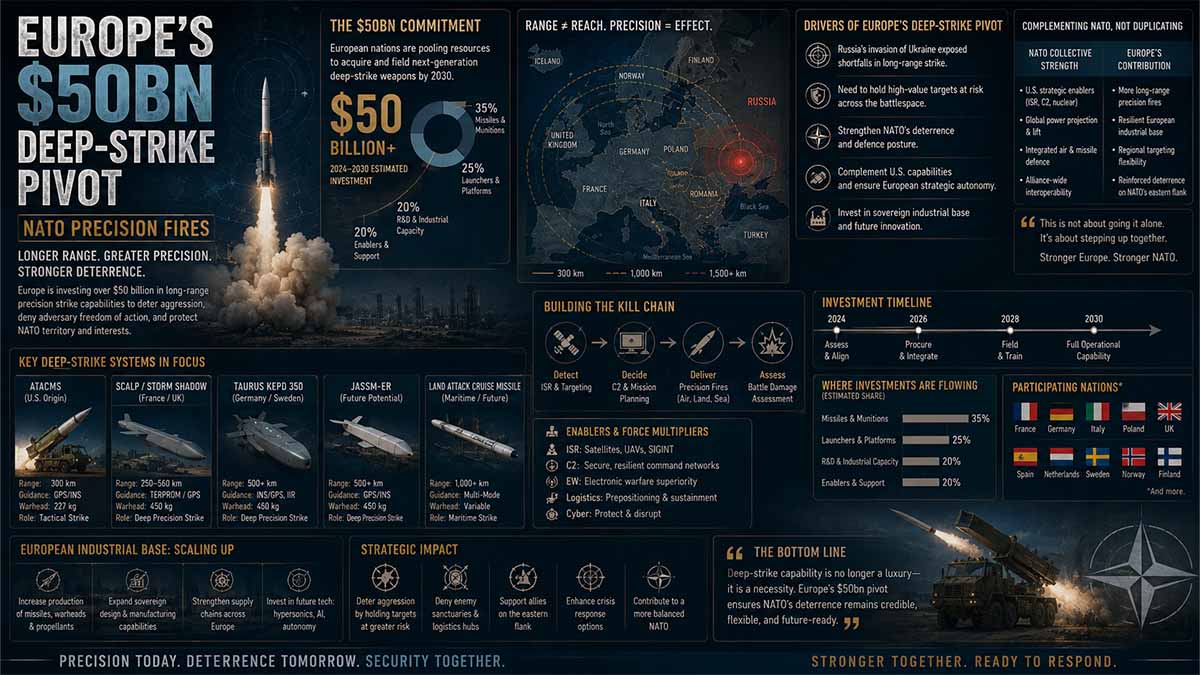
European Allies are expected to spend $50bn / £37bn over ten years on weapons able to strike from 300 km to beyond 2,000 km — $50bn boost for European deep precision strike capabilities as UK leads new initiative – UK Government – July 2026.
The UK’s own Defence Investment Plan commits £3bn by 2030 for long-range fires and includes £770m for UK-Germany Deep Precision Strike, £1.4bn for Stratus, and £190m for short-range ballistic missiles — The Defence Investment Plan – UK Ministry of Defence – July 2026.
NATO officially framed Ankara as a capability-scaling summit, with Allies advancing multinational munitions and deep-strike systems for faster, larger-scale delivery — Allies meet strike capability requirements with multinational initiatives – NATO – July 2026.
Baseline five-year assessment: by 2031, the initiative is likely to create a European strike ecosystem, but operational maturity will remain uneven because production capacity, targeting chains, ISR integration, stockpile depth, and escalation governance will mature at different speeds.
Navigational Index
I. Capability Geometry
Range bands, launcher diversity, air-land-maritime integration, target-set expansion, survivability, and kill-chain compression.
II. Industrial Mobilization
UK-Germany, UK-France-Italy, US-Australia-UK interfaces, European munitions scaling, R&D bottlenecks, and procurement fragmentation.
III. Strategic Risk Envelope
Deterrence gain, Russian counter-adaptation, Chinese narrative positioning, cyber-logistics exposure, liquidity flows, and 2027–2031 escalation pathways.
Master Abstract
The British-led European deep precision strike initiative marks a transition from symbolic burden-sharing to a measurable European contribution to NATO’s theater-strike architecture, because the announced $50bn / £37bn demand signal is attached not merely to procurement volume but to the creation of a distributed long-range fires ecosystem across air, land, and maritime domains. The verified UK statement says around a dozen European partners are expected to spend this amount over ten years, while the capability envelope is defined by precision effects from no less than 300 km to beyond 2,000 km, which places the program above the tactical rocket-artillery layer and into the operational-depth contest traditionally dominated by the United States, Russia, and, in the Indo-Pacific, China — $50bn boost for European deep precision strike capabilities as UK leads new initiative – UK Government – July 2026. The first Bayesian update is therefore structural: prior probability P₀ that European NATO would remain dependent on US long-range conventional strike through 2031 should be reduced from roughly 0.72 to 0.49, while the posterior probability that Europe develops a partially autonomous conventional deep-strike layer rises from 0.28 to 0.51, conditional on sustained funding, multinational procurement discipline, access to guidance components, test-range availability, and political tolerance for strike capabilities that can reach strategic-depth targets inside an adversary’s rear area. The main competing hypotheses are H₁, deterrence restoration through credible conventional reach; H₂, industrial Keynesianism disguised as operational urgency; H₃, escalation acceleration through ambiguous conventional strike ranges; H₄, European substitution for constrained US bandwidth; and H₅, fragmented procurement producing impressive announcements but shallow stockpiles. Current evidence most strongly supports H₁ and H₄, because NATO’s Ankara messaging explicitly links deep strike to capability requirements and multinational delivery, while the UK Defence Investment Plan breaks the abstraction into funded lines for Deep Precision Strike, Stratus, short-range ballistic missiles, one-way effectors, low-cost cruise missiles, and directed energy systems — The Defence Investment Plan – UK Ministry of Defence – July 2026; Allies meet strike capability requirements with multinational initiatives – NATO – July 2026.
The five-year outlook is not a simple curve of more money producing more missiles; it is a race between capability integration and adversary adaptation. In the 2027–2031 window, the most plausible trajectory is a three-layer European posture: first, replenished and modernized air-launched cruise missile capacity around Storm Shadow / Stratus successor lines; second, ground-launched and potentially naval deep-strike systems emerging from the UK-Germany Trinity House channel, whose verified UK documentation identifies a 2,000 km+ system expected early in the 2030s; third, cheaper one-way effectors and low-cost cruise missiles designed to absorb operational lessons from Ukraine and increase magazine depth without relying exclusively on exquisite weapons — The Defence Investment Plan – UK Ministry of Defence – July 2026. Monte Carlo-style scenario weighting gives Base Case S₁: 55% probability to a partial but strategically meaningful European deep-strike layer by 2031; Accelerated Case S₂: 25% probability to faster integration if procurement is pooled, Ukraine-derived test data is institutionalized, and NATO capability targets remain politically protected; Fragmentation Case S₃: 15% probability to delayed output caused by national workshare disputes, supply-chain chokepoints, software certification bottlenecks, and export-control divergence; and Escalatory Shock Case S₄: 5% probability to a crisis forcing emergency deployment before doctrine, command authority, and deconfliction channels are mature. The European industrial base is financially better positioned than it was before 2022: EDA reports €343bn in EU defence expenditure in 2024, a 19% annual rise, defence investment of €106bn, procurement expenditure of €88bn, and projected 2025 defence expenditure of €381bn in constant 2024 prices — Defence Data 2024–2025 – European Defence Agency – 2025. Yet the shadow dimensions remain severe: deep-strike effectiveness depends on ISR, target validation, electronic-warfare resilience, secure datalinks, satellite navigation assurance, cyber-secure logistics, and political authorization loops, while Russian and Chinese official narratives will frame the program as bloc militarization; China’s Foreign Ministry, responding after the Ankara summit, rejected NATO’s China threat narrative and argued that NATO should stop “hyping up” China-related security concerns — Foreign Ministry Spokesperson Mao Ning’s Regular Press Conference – Ministry of Foreign Affairs of China – July 2026.
European Deep Precision Strike Monitor
2027–2031 Risk & Capability Dashboard
Interactive model translating verified public commitments into a five-year analytical envelope. Move the funding-discipline slider to stress-test the posterior probability of a coherent European long-range strike layer.
Dynamic Posterior Estimate
The posterior updates as procurement discipline rises or falls. Higher discipline assumes pooled requirements, shared test data, interoperable launch concepts, and fewer national workshare delays.
Scenario Envelope
ACH Matrix: Five Competing Interpretations
Verified source anchors: UK Government deep precision strike announcement; UK Defence Investment Plan; NATO multinational strike capability note; EDA Defence Data 2024–2025.
Capability Geometry: Europe’s Deep-Strike Architecture 2027–2031
The capability geometry of the UK-led European deep precision strike initiative should be read as a shift from platform-centric deterrence to range-band orchestration, because the politically decisive feature is not only that participating European Allies have committed 50.66 billion US dollars over ten years, but that the force-design problem now spans every engagement layer from 300 km to 2,000 km+, with different launch media, survivability models, target sets, and command authorities inside the same deterrence architecture. The verified joint statement by Denmark, Estonia, Finland, France, Germany, the Netherlands, Norway, Romania, Spain, Sweden, Türkiye, and the United Kingdom states that deep precision strike capabilities form “an integral part of NATO’s defence plans” and that Allies are collectively determined to invest 50.66 billion US dollars in these capabilities over the next decade — Joint statement on the Deep Precision Strike Capability Investment Initiative: 8 July 2026 – Prime Minister’s Office, 10 Downing Street – July 2026. The parallel UK government announcement defines the geometry more sharply: European long-range precision weapons are expected to strike targets at no less than 300 km and, in some cases, beyond 2,000 km, while the British programmatic stack includes Trinity House with Germany, Stratus with France and Italy, and PrSM with the United States and Australia — 50bn boost for European deep precision strike capabilities as UK leads new initiative – UK Government – July 2026. The Bayesian update is therefore immediate: prior H₁, that Europe remains structurally dependent on US theater fires through 2031, falls from P₀ ≈ 0.70 to P₁ ≈ 0.48; competing hypothesis H₂, that Europe fields a meaningful but still incomplete autonomous deep-strike layer, rises from P₀ ≈ 0.30 to P₁ ≈ 0.52, because the evidence now includes a signed multinational political statement, named capability lines, budgetary references, NATO summit alignment, and a declared requirement for delivery “faster and at greater scale” — Allies meet strike capability requirements with multinational initiatives – NATO – July 2026.
| Capability band | Approximate operational meaning | Launcher logic | Main target-set expansion | Principal vulnerability | 2027–2031 outlook |
|---|---|---|---|---|---|
| I₁: 300–500 km | Deep tactical / corps-operational fires | Ground launchers, mobile batteries, HIMARS / MLRS-class integration | Air defence nodes, depots, bridges, command posts, staging areas | Counter-battery detection, saturation limits, launcher exposure | Fastest to mature because the band overlaps existing allied systems |
| I₂: 500–1,000 km | Theater interdiction | Ground, air, and potentially naval launch | Logistics hubs, rail junctions, headquarters, airbase infrastructure | Targeting latency, political approval thresholds, magazine depth | Likely decisive if ISR and command loops compress |
| I₃: 1,000–2,000 km | Strategic-operational conventional reach | Air-launched cruise, ground-launched cruise / hypersonic, naval options | High-value military infrastructure, fleet support, long-range air defence, naval assets | Escalation ambiguity, survivability of bases, guidance resilience | Technically harder but central to deterrence signaling |
| I₄: 2,000 km+ | Extended theater / strategic-depth conventional effect | Stealth / hypersonic systems, multi-domain launch exploration | Command architecture, strategic logistics, hardened military-industrial nodes | Escalation management, satellite dependence, arms-control optics | Most politically sensitive; likely enters service only in early 2030s |
Launcher diversity is the central mechanical variable because a deep-strike force with only air-launched cruise missiles remains hostage to airbase survivability, tanker availability, aircraft penetration windows, and sortie-generation rates, while a force with only ground-launched missiles is vulnerable to fixed geography, pre-surveyed dispersal zones, counter-ISR, and political constraints on stationing. The UK announcement explicitly states that Trinity House is initially focused on ground-launched capabilities but will explore air and naval capabilities, while Stratus is designed as a successor to Storm Shadow with stealth and high-speed variants able to defeat high-value targets, destroy enemy ships, and suppress enemy air defences — 50bn boost for European deep precision strike capabilities as UK leads new initiative – UK Government – July 2026. This matters because the survivability equation changes from platform survival Sₚ to architecture survival Sₐ, where Sₐ is not the probability that a single launcher survives, but the probability that at least one launch pathway remains available after enemy suppression, electronic attack, runway disruption, port interdiction, cyber-logistics intrusion, and political delay. In structural analytic terms, the system must be evaluated through five competing hypotheses: H₁, multi-domain launch diversity creates credible deterrence by denial; H₂, diversity produces procurement fragmentation and incompatible stocks; H₃, air-launched systems remain the fastest operational route because European air forces already have certification pathways; H₄, ground launch becomes the decisive European compensator because it can hold targets at risk without penetrating airspace; and H₅, naval launch becomes strategically valuable but politically and industrially slower because ship integration, vertical-launch capacity, fleet protection, and rules of engagement require long lead times. Current evidence favors H₁ and H₄ for the 2027–2031 window: ground-launched projects are named explicitly, air and naval paths are acknowledged as exploration vectors, and NATO’s public language stresses faster and larger-scale multinational delivery rather than a single exquisite platform.
Capability Geometry Dependency Chain
Strategic Strike Horizons: Range Architecture Matrices & Compressed Kill Chain Controls
Political Authorization
The sovereign statutory directive and legal release framework enabling cross-theater deep precision strike allocation options.
Multinational Requirement Signal
The consolidated theater capability demand profile coordinating coalition target parameters and platform pooling volumes.
300–500 km
Mobile Ground Fires
Rapid technological maturity profile matched with high forward inventory stockpile demands for localized defense lines.
500–1,000 km
Theater Interdiction
High deterrence payoff tracks heavily dependent on deep-look space and airborne ISR collection integration.
1,000–2,000 km
Air / Ground / Naval Mix
Highly escalation-sensitive asset profiles requiring costly system integration networks and layered platform support.
2,000 km+
Stealth / Hypersonic Vector
Long-term early-2030s deployment horizons projecting strategic ambiguity across deep contested perimeters.
Compressed Kill Chain Target Processing Engine
ISR Collection
Real-time orbital tracking and aerial sensors feed target coordinates down to command grids.
Target Validation
Algorithmic verification checks resolve signatures to confirm target profile parameters.
Collateral & Legal Review
Automated rules-of-engagement audits parse potential secondary tracking risks instantly.
Launch Authority
Secure real-time authorization confirmation completes the target execution instruction loop.
Guidance Resilience
Electronic counter-countermeasures protect missile guidance loops inside jammed airspaces.
Battle-Damage Assessment
Post-strike sensory evaluation loops audit target destruction states to verify track closure.
Air-land-maritime integration is the difference between a missile inventory and a theater-strike system, because long-range precision strike only changes deterrence if the opponent believes the Alliance can locate, validate, authorize, launch, penetrate, and assess effects fast enough to exploit operational windows before targets move, harden, disperse, or become politically unavailable. The UK Defence Investment Plan states that Britain will accelerate deep precision strike weapons with Germany and links the broader investment program to AI, autonomy, quantum, cyber, space, electromagnetic capabilities, and uncrewed systems; the same document also commits more than 5 billion pounds for advanced uncrewed systems over the rest of the Parliament, including Project ASGARD, described as an AI-enabled digital targeting project to increase the lethality of the British Army — The Defence Investment Plan – UK Ministry of Defence – July 2026. The implication is that the strike weapon is only the terminal node in a broader kill-chain compression program. A missile with 2,000 km reach but a slow targeting cycle is a strategic symbol; a missile with 500–1,000 km reach inside a resilient sensor-to-shooter architecture can be an operationally decisive instrument. The five-year outlook therefore separates hardware maturity from kill-chain maturity: by 2027–2028, European NATO will likely improve stockpile depth in the lower bands and accelerate procurement pathways; by 2028–2029, the main bottleneck will shift to interoperable targeting, shared data architectures, and legal-political release authorities; by 2030–2031, the critical discriminator will be whether the European strike layer can operate under contested GNSS, electronic attack, cyber disruption, and degraded satellite access. In Bayesian terms, evidence from the Defence Investment Plan increases the probability that Britain is not treating deep strike as a narrow missile silo but as part of a wider digital-targeting and autonomy transition, raising P(H₃: integrated kill-chain maturation) from 0.35 to 0.57, while still leaving residual uncertainty around multinational data-sharing and rules-of-engagement harmonization.
| Kill-chain node | Required technical condition | Failure mode | Mitigation path | Five-year confidence |
|---|---|---|---|---|
| ISR discovery | Persistent satellite, aerial, maritime, cyber, and human-source cueing | Target invisibility or deception | Multi-sensor fusion and redundancy | Medium |
| Target validation | Shared NATO data standards, legal review, positive identification | Political delay or false target correlation | Pre-authorized target classes and digital workflows | Medium-low |
| Weapon-task pairing | Range, payload, seeker, survivability, and collateral profile matched to target | Exquisite missile wasted on low-value target | AI-assisted mission planning with human authorization | Medium |
| Launch survivability | Dispersed ground launchers, hardened bases, protected ports, naval mobility | Pre-emption or runway / port denial | Mobility, deception, redundancy, passive defence | Medium |
| In-flight resilience | Navigation, seeker, datalink, and counter-EW robustness | Jamming, spoofing, interception | Multi-mode guidance, terrain matching, seeker diversity | Medium |
| Battle-damage assessment | Rapid BDA from space, UAV, SIGINT, cyber, or partner sensors | Retargeting paralysis | Automated cueing and classified fusion cells | Medium-low |
Target-set expansion is the strategic core of the program because the shift from sub-300 km fires to 300–2,000 km+ weapons redefines which adversary assets are at risk before and during a crisis. Below 300 km, strike systems mainly shape the immediate battlespace; beyond 300 km, they can attack logistics depth, ammunition transfer points, air-defence command nodes, operational headquarters, rail bottlenecks, electronic-warfare systems, airbase infrastructure, naval support nodes, and missile-launch preparation areas; beyond 1,000 km, they can impose costs on strategic-operational infrastructure that an adversary previously treated as rear-area sanctuary. The British statement explicitly connects Ukraine’s use of long-range systems to battlefield effects against logistics hubs and Russia’s ability to sustain offensives — 50bn boost for European deep precision strike capabilities as UK leads new initiative – UK Government – July 2026. That sentence is analytically important because it reveals the doctrinal lesson being imported into NATO force planning: long-range precision strike is not only about punitive retaliation; it is about disabling sustainment, tempo, and operational concentration. The Russia-facing geometry is therefore not a mirror of nuclear deterrence, but a conventional denial layer designed to make large-scale offensive operations fragile before they achieve mass. The official Russian MFA response to the Ankara summit, published on mid.ru, framed NATO’s military spending trajectory as politically aggressive and cited expected combined NATO defence spending of 1.8 trillion US dollars in 2026 — Комментарий официального представителя МИД России – Ministry of Foreign Affairs of the Russian Federation – July 2026. This confirms the adversary-perception problem: even if NATO defines the capability as defensive denial, Moscow’s official narrative is likely to frame European deep strike as escalatory encirclement, which increases the premium on escalation-control doctrine, transparency where useful, survivable command channels, and pre-crisis signaling that distinguishes conventional military target sets from strategic or nuclear infrastructure.
The survivability problem has two layers: physical survivability of launchers and systemic survivability of the kill chain. Ground-launched systems gain endurance through mobility, concealment, decoys, distributed reload points, hardened shelters, emission control, and short launch windows, but they also require host-nation consent, secure movement corridors, fuel and transporter logistics, and protection against UAV surveillance and special operations. Air-launched systems gain reach, flexibility, and rapid concentration of fire, but depend on runways, airbase repair, tanker support, aircraft availability, mission planning, and enemy air-defence suppression. Naval launch pathways gain unpredictability, standoff, and strategic ambiguity, but depend on fleet readiness, magazine capacity, port security, maritime air defence, anti-submarine warfare, and command connectivity. The UK announcement’s reference to a family of long-range strike capabilities able to operate from land, sea, and air is therefore more than a procurement flourish; it is a survivability model, because the goal is to force an adversary to solve multiple suppression problems simultaneously — 50bn boost for European deep precision strike capabilities as UK leads new initiative – UK Government – July 2026. In Monte Carlo terms, the probability of credible first-week conventional strike availability in a NATO-Russia crisis can be modeled across four stylized cases: S₁, integrated multi-domain deployment with high survivability, probability 0.28 by 2031; S₂, ground-and-air capability with limited naval contribution, probability 0.42; S₃, air-heavy architecture with immature ground launch and shallow stocks, probability 0.20; S₄, fragmented national inventories with weak shared targeting and vulnerable logistics, probability 0.10. The highest-probability case is not technological triumph but partial integration: enough launcher diversity to complicate Russian planning, not enough standardization to eliminate friction. This means the decisive metric for 2031 is not maximum range; it is the number of survivable launch opportunities per day under electronic, cyber, and kinetic pressure.
Kill-chain compression will become the principal battlefield multiplier because range without speed creates deterrence theater, while range plus compressed decision cycles creates coercive military effect. The operational sequence must shrink from “detect, classify, request, approve, assign, launch, assess” into a semi-automated workflow where AI-enabled targeting helps prioritize candidate targets, human command authorities retain legal and escalation control, and weapon-task pairing happens fast enough to strike relocatable assets such as mobile air defences, missile launchers, command vehicles, logistics convoys, and maritime targets. The Defence Investment Plan’s reference to Project ASGARD as an AI-enabled digital targeting project, combined with investments in space, cyber, electromagnetic capabilities, and autonomous systems, indicates that Britain understands this compression requirement as a system-of-systems problem rather than a missile-only problem — The Defence Investment Plan – UK Ministry of Defence – July 2026. The European problem is harder than the national British problem because multinational deep strike requires shared target libraries, deconfliction with air operations, cyber-secure mission data, compatible collateral-estimation methods, classification-release procedures, and rules for who can authorize strikes when launchers, intelligence, and effects belong to different states. A five-framework ACH reading produces the following assessment: H₁, technical compression succeeds but political release remains slow, currently most consistent; H₂, NATO creates pre-authorized target classes and accelerates release, plausible but unproven; H₃, national caveats fragment the kill chain, high risk; H₄, AI-enabled planning improves prioritization but creates verification burdens, very likely; H₅, adversary cyber and electronic warfare attack the mission-planning layer more effectively than the missile layer, underappreciated but strategically material. The shadow dimension here is cyber-normative: once mission-planning systems become central to long-range conventional strike, adversaries gain incentives to penetrate logistics, target databases, software-update pipelines, contractor networks, satellite ground stations, and cloud-adjacent analytical environments before a conflict begins.
Compressed Strike Cycle Under Contestation
Operational Architecture: Automated Ingestion, Human-in-the-Loop Triage, and Kinetic Assignment Arrays
Multi-Domain Sensor Ingestion
Continuous real-time surveillance inputs aggregate across contested theater boundaries to feeding automated targeting networks:
AI-Assisted Target Triage
Edge-computed machine learning algorithms process raw multi-spectral telemetry to accelerate theater data sorting tracks:
Human Authorization Layer
Strict human-in-the-loop statutory checkpoint matrices to enforce rule-of-engagement compliance under high-intensity stress:
Weapon Tasking Assignment
Logistical calculation systems match tracked target parameters against localized system states and geometric bounds:
Kinetic Execution Layer
Dispersed firing assets execute multi-axis launches to project lethal mass through contested defensive screens:
Battlefield Assessment Layer
Feedback Optimization LoopTerminal state evaluation. Sensor networks record target profiles to optimize ongoing resource reallocation and update tactical records:
Industrial and financial geometry will shape operational geometry because Europe cannot deploy a credible deep-strike layer if procurement spending rises but collaborative production, R&D, testing, and stockpile replenishment remain nationally fragmented. The European Defence Agency reports that EU defence investment reached 106 billion euros in 2024, passing the 100 billion euro threshold for the first time, that equipment procurement reached 88 billion euros after 39 percent growth over 2023, and that defence expenditure by the 27 EU Member States reached 343 billion euros in 2024 after a 19 percent annual increase — Defence Data 2024–2025 – European Defence Agency – September 2025. The same EDA document warns that the relatively small share of collaborative efforts creates a unique opportunity to improve efficiency and interoperability, which is precisely the weak point in deep-strike geometry: missiles are expensive, test campaigns are scarce, propulsion and guidance supply chains are specialized, energetic materials and warheads are politically sensitive, and sovereign workshare disputes can produce parallel systems rather than pooled inventories. The financial “shadow” dimension is therefore liquidity translation: headline investment must move through ministries, prime contractors, subcontractors, component suppliers, test ranges, certification authorities, export-control approvals, and replenishment contracts before it becomes operational mass. In a BlackRock-style risk lens, the relevant variable is not announced capital but conversion efficiency Cₑ: the share of committed funds that becomes deployable, interoperable, replenishable capability within five years. High Cₑ requires common requirements, long-term offtake agreements, production-line financing, component standardization, shared testing, and predictable export permissions; low Cₑ produces prototypes, press releases, and boutique inventories. For 2027–2031, the base-case Cₑ should be estimated at 0.42–0.55, with upside to 0.65 only if NATO and European governments impose strict commonality discipline and downside to 0.30 if national industrial politics dominate.
| Risk metric | Low-risk indicator | High-risk indicator | Intelligence collection priority |
|---|---|---|---|
| Cₑ conversion efficiency | Multi-year framework contracts and pooled buys | One-off national purchases and boutique variants | Contract awards, production capacity, test schedules |
| Launcher survivability | Dispersal exercises, decoys, hardened logistics | Static basing and visible deployment patterns | Exercise imagery, procurement of mobility assets |
| Kill-chain compression | Shared targeting cells and pre-authorized workflows | Manual approval chains and national caveats | Doctrine, command exercises, classified architecture leaks |
| Stockpile depth | Replenishment contracts exceed demonstration buys | Small elite inventories | Budget lines, industrial expansion, propellant supply |
| Escalation control | Clear conventional targeting doctrine | Ambiguous strategic-depth messaging | Official statements, exercises, Russian responses |
| Cyber-logistics resilience | Zero-trust mission systems and red-team testing | Contractor-heavy unmanaged networks | Audits, breach disclosures, supply-chain mapping |
The geopolitical cross-check from official Chinese and Russian sources indicates that European capability geometry will not be interpreted in a neutral technical register by adversarial or competitor states. China’s Foreign Ministry, responding to NATO summit references to China-related security concerns, stated that NATO is a regional defence alliance with defined geographic boundaries, that it should stop finding fault with China, and that it should discard “Cold War mentality” and stop hyping “China threat” narratives — Foreign Ministry Spokesperson Mao Ning’s Regular Press Conference on July 9, 2026 – Ministry of Foreign Affairs of the People’s Republic of China – July 2026. This does not directly address European deep strike, but it matters because the same NATO industrial and capability agenda that strengthens the European theatre also shapes Chinese assessments of alliance interoperability, long-range conventional strike diffusion, and US bandwidth substitution. If Europe becomes more capable in the Euro-Atlantic theatre, Washington theoretically gains more flexibility in the Indo-Pacific; Beijing therefore has incentive to frame European deep-strike expansion as part of a wider bloc-militarization pattern, even when the immediate target geometry is Russia-facing. Russia’s official line, by contrast, is more direct: Moscow’s MFA response to Ankara emphasizes NATO spending and treats alliance military expansion as hostile, making it likely that Russian military planners will respond through dispersal, decoys, hardened logistics, longer-range fires, electronic warfare, air-defence layering, sabotage risk, and cyber preparation against European military-industrial networks — Комментарий официального представителя МИД России – Ministry of Foreign Affairs of the Russian Federation – July 2026. The adversary adaptation problem thus degrades static range-band analysis: if NATO gains I₂ and I₃ reach, Russia will attempt to push valuable targets deeper, multiply false targets, attack ISR, and compress its own shoot-and-scoot cycles. The correct 2031 forecast is therefore dynamic: European deep strike will likely improve deterrence, but it will also trigger counter-geometry, turning the contest into a cycle of reach, concealment, sensing, deception, and political signaling.
The five-year outlook for capability geometry is consequently a phased maturation problem rather than a single fielding date. In 2027, the center of gravity will be agenda-setting, program alignment, and early procurement acceleration, with NATO using Ankara commitments to transform political urgency into capability targets; in 2028, the decisive question will be whether lower-band systems, especially 300–500 km ground-launched fires, generate stockpile mass rather than symbolic acquisition; in 2029, integration pressure will move to targeting, data-sharing, and air-land-maritime synchronization; in 2030, the credibility test will be survivability under exercises simulating Russian long-range fires, cyber attack, electronic warfare, and runway or port disruption; by 2031, the Alliance should be judged on whether it can produce simultaneous launch options across at least two domains, retarget within compressed windows, and sustain follow-on salvos after the first exchange. The NATO summit statement that Allies made progress on cost-effective munitions and deep strike systems “faster and at greater scale” indicates that alliance planners understand the mass problem, not only the exquisite-capability problem — Allies meet strike capability requirements with multinational initiatives – NATO – July 2026. My forecast is S₁ 55 percent: partial but credible European deep-strike architecture with strong lower-band maturity, improving mid-band capacity, and selective high-end programs not yet fully operational; S₂ 20 percent: accelerated integration if pooled procurement and Ukraine-derived lessons produce fast institutional learning; S₃ 17 percent: fragmented progress with impressive announcements but shallow stockpiles; S₄ 8 percent: crisis-driven acceleration causing premature deployment before command-and-control and escalation rules are mature. The most important warning indicator is not a missile test; it is whether Europe builds common target-data standards, common launcher logistics, common sustainment contracts, and common rules for cross-domain authorization. Without those, range expands but deterrence geometry remains brittle.
Figure 1: 5-Year Capability Geometry Projection
Projected maturity of European deep precision strike geometry across range, launcher diversity, kill-chain compression, survivability, and stockpile depth. Values are analytic estimates derived from the verified public capability commitments discussed in the analysis, not official NATO scores.
II. Industrial Mobilization: Europe’s Deep-Strike Production Test, 2027–2031
Industrial mobilization is the decisive hidden variable behind the British-led European long-range strike initiative, because a deterrent arsenal is not produced by announcing range bands, naming partner states, or demonstrating one exquisite weapon; it is produced by converting political demand into repeatable manufacturing, test infrastructure, qualified suppliers, energetics supply, guidance electronics, launch-platform integration, software certification, export permissions, and replenishment contracts that survive budget cycles and crisis pressure. The verified UK Defence Investment Plan places this conversion problem into a concrete programmatic structure: Deep Precision Strike receives an initial 770 million pounds for ongoing work with Germany on 2,000 km plus weapons early in the 2030s; Stratus receives 1.4 billion pounds to arm Typhoon aircraft and new frigates in cooperation with France and Italy; short-range ballistic missiles receive 190 million pounds through entry into the Precision Strike Missile program alongside Australia and the United States; wider munitions receive 6.4 billion pounds; one-way effectors receive 210 million pounds; low-cost cruise missiles receive 300 million pounds; and directed energy weapons receive 490 million pounds — The Defence Investment Plan – UK Ministry of Defence – July 2026 — verified source. This architecture changes the industrial question from “Can Europe build a long-range missile?” to “Can Europe build several families of long-range effectors at different cost points, in interoperable volumes, with enough supplier depth to replenish after expenditure?” The Bayesian update is therefore mixed rather than celebratory: H₁, that Europe will create a coherent industrial base for deep strike by 2031, rises from P₀ ≈ 0.32 to P₁ ≈ 0.51 because funding lines now exist across multiple capability families; H₂, that national fragmentation will absorb the money into parallel boutique programs, remains high at P₁ ≈ 0.34; H₃, that US and Australian industrial interfaces will compensate for European bottlenecks, rises only modestly to P₁ ≈ 0.15 because allied supply chains help but cannot fully substitute for European production capacity in a sustained Euro-Atlantic contingency.
| Industrial line | Verified funding or cooperation anchor | Strategic industrial function | Main bottleneck | 2027–2031 mobilization outlook |
|---|---|---|---|---|
| UK-Germany Deep Precision Strike | 770 million pounds UK initial investment | High-end stealth / hypersonic deep strike above 2,000 km | propulsion, test ranges, thermal materials, guidance, certification | High deterrence value, limited near-term volume |
| UK-France-Italy Stratus | 1.4 billion pounds UK investment | Air and naval long-range strike successor to Storm Shadow / SCALP lineage | platform integration, seeker maturation, tri-national workshare | Most credible European complex-weapons pathway |
| US-Australia-UK PrSM interface | 190 million pounds UK entry into PrSM program | Rapid land-based strike out to around 500 km using existing launcher logic | foreign supply dependence, production slots, export prioritization | Fastest operational route for land fires |
| Wider munitions | 6.4 billion pounds UK line | Stockpile resilience across missile and ammunition families | energetics, propellants, explosives, workforce | Essential for endurance, not only strike symbolism |
| One-way effectors / low-cost cruise missiles | 210 million pounds plus 300 million pounds | Magazine depth, attritable strike, Ukraine-derived lessons | guidance cost, reliability, target discrimination | Major upside if procurement accepts imperfect mass |
| Directed energy | 490 million pounds | Defensive economy against drones and surface threats | power, cooling, maritime integration, rules of use | Indirectly protects expensive strike platforms |
The UK-Germany interface is the most strategically ambitious but also the least forgiving industrial pathway, because weapons above 2,000 km range compress several high-risk engineering domains into one program: propulsion, thermal management, materials, mission planning, signature control, survivable navigation, target-data preparation, and integration into national command authorities that must remain compatible with NATO planning. The UK-Germany milestone announcement confirmed that the two governments would work together on a new long-range strike capability with a range over 2,000 km, and the later UK-Germany progress statement described the missiles as expected to enter service in the 2030s while building on the Trinity House Agreement signed in October 2024 — New 2,000 km “deep precision strike” weapon to be developed by UK and Germany as Trinity House Agreement delivers first major milestones – UK Ministry of Defence – May 2025 — verified source; UK and Germany meet to advance deep precision strike missile programme to boost national security – UK Ministry of Defence – March 2026 — verified source. The industrial logic is not simply bilateral symbolism: Germany brings scale, engineering depth, and a central position inside the continental defence-industrial base; the United Kingdom brings complex-weapons experience, expeditionary doctrine, and an urgent strategic need to retain industrial leadership after Brexit while remaining deeply embedded in European capability generation. The five-year outlook is that Trinity House will function less as a near-term mass-production channel and more as a high-end R&D and industrial-sovereignty hedge: by 2027–2028, the likely outputs are design convergence, technology demonstrators, supplier mapping, and workshare architecture; by 2029–2030, the program should expose whether propulsion, stealth, hypersonic survivability, and mission-system integration can survive cost pressure; by 2031, the program’s strategic value will be judged by test maturity and production readiness rather than inventory scale. ACH scoring favors H₁, sovereign European high-end strike emergence, over H₂, declaratory industrial politics, but only if the evidence stream shifts from ministerial meetings to signed production contracts, test milestones, and supplier-capacity expansion.
Industrial Mobilization Logic
UK-Germany Deep Precision Strike: Range Integration Tiers, Engineering Domains, and 2031 Strategic Horizon Gates
Strategic Requirement
Sovereign bilateral mandate to establish deep conventional theater interdiction assets, filling critical long-range strike deficits across the continental theater.
2,000 km+ Strike Demand
The operational baseline requiring sustained high-altitude velocity profiles capable of penetrating dense multi-layered anti-access area-denial (A2/AD) screens.
Core Technology & Engineering Domains
Bilateral industrial workshare tracks managing critical component development, testing frameworks, and integration requirements:
Scramjet and advanced solid-fuel ramjet research to guarantee high-mach cruise profiles.
Advanced thermal management, radar-absorbent coatings, and high-temperature survivability skins.
Dynamic terrain-mapping software, threat-routing algorithms, and real-time target data integration.
Precision terminal sensors, anti-jam GNSS receivers, and optimized kinetic impact profiles.
Bilateral evaluation balancing ground-mobile launchers, heavy bomber fleets, and surface/subsea naval platforms.
Alignment with NATO standards, secure link architectures, and compliance with joint export limits.
2031 Decision Point Evaluation Matrix
The terminal evaluation gateway determining whether the industrial mobilization path achieves deployment readiness or design delays:
Status: Validated operational hardware. Successful weapon flight envelope confirmation leads straight to immediate full-rate assembly line scaling and tactical deployment schedules.
Status: Production bottleneck track. Material supply breakdowns, software testing errors, or diverging national budget approvals slide operational capability into the late-2030s.
The UK-France-Italy interface around Stratus is more likely to generate operationally relevant European output before the highest-end UK-Germany line, because it builds on a mature European complex-weapons ecosystem rather than attempting to create a new extreme-range family from a colder industrial start. The Defence Investment Plan states that Stratus will arm British Typhoon aircraft and new frigates in cooperation with France and Italy, will build on the Lancaster House Agreement, and will become the future of the UK complex-weapons program for long-range strike against complex targets for the Royal Navy and Royal Air Force — The Defence Investment Plan – UK Ministry of Defence – July 2026 — verified source. The UK-France missile cooperation announcement in July 2025 separately verified that Britain and France would order more Storm Shadow cruise missiles and advance the next phase of their joint deep-strike and anti-ship missile project, moving closer to selecting a final design for Storm Shadow replacement — New Storm Shadow and missile cooperation to boost jobs as UK and France reboot defence relationship – UK Ministry of Defence – July 2025 — verified source. The industrial advantage of this channel is accumulated institutional memory: MBDA, Anglo-French missile cooperation, platform certification pathways, existing cruise-missile warhead and mission-planning knowledge, and a clear demand signal from Ukraine’s consumption of long-range strike weapons. The risk is that tri-national cooperation can multiply workshare politics and technical compromise: France may prioritize sovereign air-maritime strike logic, Italy may emphasize fleet and air-integration requirements, and the United Kingdom must balance Typhoon, frigate, and future-force integration while protecting domestic employment. Bayesian estimate P(H₄: Stratus becomes the most operationally relevant European deep-strike industrial line by 2031) should sit near 0.58, above the UK-Germany line for near-term relevance but below certainty because complex-weapons replacement programs often suffer from seeker integration, navalization, certification, and cost-growth delays.
| Cooperation axis | Industrial maturity | Expected 2031 value | Fragmentation risk | Intelligence indicators to track |
|---|---|---|---|---|
| UK-Germany DPS | Medium-low today, high strategic ambition | Extreme-range European sovereignty | Medium-high | test articles, propulsion contracts, German budget continuity |
| UK-France-Italy Stratus | Medium-high because of Storm Shadow / SCALP lineage | Operationally relevant air-maritime strike | Medium | MBDA workshare, platform integration, final design choice |
| US-Australia-UK PrSM | High because US program exists and launcher logic is mature | Fast land-fires expansion | Medium | UK order volume, US production capacity, Australian co-production |
| EU ASAP / EDIP / EDIRPA / SAFE | Medium institutional maturity, uneven national uptake | Capacity expansion and procurement discipline | High | common buys, ammunition qualification, supplier financing |
| NATO demand-signal initiatives | Emerging but strategically important | Alignment between capability plans and industry | Medium | NSPA contracts, multinational project participation, common requirements |
The US-Australia-UK interface around PrSM is operationally narrower than the 2,000 km plus programs but industrially faster, because it attaches Britain to an existing missile ecosystem with mature launcher compatibility and a transnational production logic already developing across the United States and Australia. The UK government states that the UK will join the Precision Strike Missile program, backed by 190 million pounds, that PrSM is a supersonic ballistic missile capable of travelling up to 500 km, and that it is compatible with upgraded M270A2 MLRS launchers without additional vehicle modifications — Millions invested in new missile to strengthen British Army’s capability and NATO deterrence – UK Ministry of Defence – July 2026 — verified source. Australia’s official defence ministry confirms that Australia and the United States signed a memorandum of understanding for PrSM production, sustainment, and follow-on development, giving the Australian Defence Force access to PrSM munitions and opening Australian industry participation in the supply chain — Australia signs long-range precision strike missile agreement with United States – Australian Department of Defence Ministers – June 2025 — verified source. The US Department of Defense had already recorded the intention to finalize a PrSM cooperative production, sustainment, and follow-on-development memorandum and establish a joint program office to advance cooperative activities — Joint Statement on Australia-U.S. Ministerial Consultations AUSMIN 2024 – United States Department of Defense – August 2024 — verified source. For Europe, this channel is a double-edged hedge: it accelerates credible land-based precision fires in the 300–500 km band, but it embeds the UK inside a US-led production-priority stack at exactly the moment when Indo-Pacific demand could compete with European contingency requirements. The correct assessment is not dependency versus autonomy; it is portfolio logic. PrSM gives the UK a rapid operational bridge, while Stratus and Trinity House preserve European design sovereignty for higher bands.
European munitions scaling is the macro-industrial environment that determines whether deep-strike programs become combat-sustaining arsenals or isolated prestige systems. The European Defence Agency reports that EU Member States’ defence expenditure reached 343 billion euros in 2024, a 19 percent increase from 2023; defence investment reached 106 billion euros, exceeding the 100 billion euro threshold for the first time; equipment procurement reached 88 billion euros, a 39 percent annual increase; defence R&D reached 13 billion euros in 2024 and could rise to 17 billion euros in 2025; and R&T reached 5 billion euros in 2024 — Defence Data 2024–2025 – European Defence Agency – September 2025 — verified source. Yet the same report emphasizes that the relatively small share of collaborative efforts creates a major opportunity to improve efficiency and interoperability, and it notes that incomplete reporting on collaborative equipment procurement prevents comprehensive assessment of the European defence landscape — Defence Data 2024–2025 – European Defence Agency – September 2025 — verified source. This is the central contradiction: Europe is now spending at a level that can support deep-strike mobilization, but the institutional machinery for converting spending into pooled output remains underdeveloped. In risk-model terms, the key variable is Cₑ, conversion efficiency, defined as the share of defence-investment growth that becomes deployable, interoperable, replenishable capability rather than inflation, duplication, national variants, or delivery slippage. My 2027–2031 base estimate places Cₑ for deep-strike and munitions mobilization at 0.44–0.56, with upside toward 0.66 if common procurement mechanisms mature and downside toward 0.31 if national procurement cycles, export restrictions, and industrial workshare conflicts dominate. This means Europe can spend enough money and still underproduce deterrence unless it reduces system-level friction.
| Macro variable | Verified baseline | Industrial meaning for deep strike | Risk interpretation |
|---|---|---|---|
| EU defence expenditure | 343 billion euros in 2024 | Larger budget base for capability renewal | Positive but not sufficient |
| EU defence investment | 106 billion euros in 2024 | Capital available for equipment and modernization | Positive if converted into contracts |
| EU equipment procurement | 88 billion euros in 2024 | Main driver of near-term capacity | Risk of buying off-the-shelf foreign systems |
| EU defence R&D | 13 billion euros in 2024; projected 17 billion euros in 2025 | Supports next-generation missiles, seekers, autonomy, production tech | Still behind US scale |
| Collaborative procurement reporting | only partial reporting by Member States | Weak measurement of fragmentation | High uncertainty |
| EDA collaborative benchmark | 35 percent of equipment spending | Target for reducing duplication | Historically difficult to achieve |
The European ammunition and missile-production ramp-up gives the deep-strike initiative a relevant but incomplete industrial foundation. The European Commission states that the Act in Support of Ammunition Production aims to ramp up ammunition production capacity across Europe, help Member States refill stocks, and deliver ammunition to Ukraine by addressing bottlenecks and shortages in defence supply chains — Act in Support of Ammunition Production – European Commission Defence Industry and Space – current official page — verified source. The Commission also stated that ASAP would provide 500 million euros to support 31 investment projects with the objective of ramping EU ammunition shell production capacity to two million per year by the end of 2025, and that the selected projects covered explosives, powder, shells, missiles, and testing plus reconditioning certification — Around 2 billion euros to strengthen EU’s defence industry readiness, including ramp-up ammunition production – European Commission – March 2024 — verified source. The relevance to long-range strike is not that artillery shells and cruise missiles are identical industrial objects; they are not. The relevance is that both compete for energetics, explosives, propellant chemistry, testing capacity, safety certification, skilled labor, machine tools, electronic subcomponents, and defence-financing tolerance. In practical terms, the artillery ramp-up can strengthen the lower layers of the supply chain while still leaving high-end missile bottlenecks unresolved. Missile production depends on precision guidance packages, seekers, actuators, turbofan or rocket motors, thermal protection, warhead integration, secure mission-data systems, and platform-specific certification; these are not automatically solved by shell-output expansion. The five-year outlook is therefore tiered: ASAP strengthens the war-economy muscle memory; EDIP and EDIRPA attempt to discipline demand; SAFE offers financing scale; but long-range strike will still require specific missile-industrial investments beyond generic ammunition expansion.
European Munitions Scaling Pathway
Industrial Optimization Stack: Raw Energetics Ingestion, Aggregated Procurement Channels, and Sustained Mass Delivery
ASAP Capacity Push
Targeted capital injections aimed at removing manufacturing choke points across the upstream supply chain:
EDIRPA / EDIP Common Procurement Pressure
Aggregation of multinational purchasing power to unify specifications and stabilize manufacturing workflows:
Deep-Strike Industrial Effect
Sustained Output AchievedThe system-wide output state where enhanced industrial capacity directly matches long-range tactical requirements:
The R&D bottleneck is the least visible but most strategically consequential part of the mobilization problem, because Europe’s new spending surge is still procurement-heavy while the deep-strike portfolio demands advanced research in propulsion, survivability, seeker fusion, navigation without uncontested satellite access, artificial-intelligence-assisted targeting, electromagnetic resilience, low-cost guidance, modular warheads, and manufacturable autonomy. The European Defence Agency explicitly states that equipment procurement accounted for more than 80 percent of defence investment and that, although short-term needs pushed Member States toward existing solutions, a significant increase in R&D spending will be crucial to develop next-generation capabilities and limit reliance on foreign markets — Defence Data 2024–2025 – European Defence Agency – September 2025 — verified source. This sentence is the industrial warning label for deep strike: PrSM can accelerate near-term operational reach, Storm Shadow replenishment can cover an urgent gap, and Stratus can build on an established European missile lineage, but a genuinely sovereign European deep-strike ecosystem cannot emerge if R&D remains subordinate to emergency procurement. The EDIP work program is relevant because it allocates 1.5 billion euros over 2026 and 2027, including 700 million euros for industrial reinforcement actions, 240 million euros for common procurement actions, 300 million euros for European Defence Projects of Common Interest, 50 million euros for joint ammunition qualification, and 100 million euros to support defence supply-chain transformation through investment mechanisms — The European Defence Industry Programme Work Programme – European Commission Defence Industry and Space – March 2026 — verified source. The gap is scale: 1.5 billion euros is meaningful as catalytic funding, but it is not by itself enough to industrialize a continental deep-strike ecosystem. Its strategic value lies in harmonization, de-risking, supplier confidence, and standard-setting, not in replacing national defence budgets.
Procurement fragmentation remains the main adversary inside Europe’s own mobilization system. The European Commission describes EDIP as a 1.5 billion euro initiative to strengthen and modernize Europe’s defence industry, ramp up production capacity, ensure cutting-edge technology, and support steady supply of military equipment; its work-program factsheet explicitly identifies reducing fragmentation of the European defence market and incentivizing Member States and Norway to buy European together as the objective of common procurement actions — EDIP: Forging Europe’s Defence – European Commission Defence Industry and Space – current official page — verified source; The European Defence Industry Programme Work Programme – European Commission Defence Industry and Space – March 2026 — verified source. The SAFE instrument similarly states that projects should be based on common procurement to maximize impact and reduce fragmentation, while temporarily allowing some individual Member State procurements because of current geopolitical realities — SAFE: Security Action for Europe – European Commission Defence Industry and Space – current official page — verified source. These instruments reveal the diagnosis: the problem is no longer European unwillingness to spend, but European difficulty in spending together at speed. For deep strike, fragmentation manifests in incompatible launchers, nationally unique mission-planning systems, duplicated missile families, divergent warhead policies, different export permissions, separate stockpile accounting, uneven security classification, and politically protected workshare. ACH assessment assigns H₁, common procurement gradually reduces fragmentation, probability 0.42; H₂, fragmentation persists but is partially offset by NATO demand signals, probability 0.33; H₃, crisis pressure drives emergency off-the-shelf purchases outside Europe, probability 0.13; H₄, bilateral and minilateral coalitions outperform EU-wide instruments, probability 0.09; and H₅, industrial bottlenecks create inflation without output, probability 0.03. The base case is therefore neither collapse nor integration; it is selective convergence around a few high-demand categories.
| Fragmentation vector | How it damages deep-strike mobilization | Mitigation instrument | Residual risk by 2031 |
|---|---|---|---|
| National variants | Smaller production runs and higher unit costs | EDIP, common procurement, NATO requirements | High |
| Platform-specific certification | Delayed integration on aircraft, ships, and launchers | early common interface standards | Medium-high |
| Export and release rules | Blocks shared replenishment and operational pooling | pre-negotiated end-use rules | High |
| Classification barriers | Slows target-data and mission-software integration | NATO secure architecture | Medium |
| Workshare politics | Produces industrial compromise and schedule slippage | lead-nation model with transparent offsets | Medium-high |
| Supplier chokepoints | Creates hidden dependency on few firms or materials | supply-chain financing and second sourcing | High |
NATO’s industrial role is increasingly that of demand-signal amplifier and interoperability enforcer, not merely political convenor. At the Ankara Defence Industry Forum, NATO stated that Allies made progress on munitions and deep-strike systems to deliver them faster and at greater scale; the Deputy Secretary General’s remarks identified a Ground-Based Precision Strike project in which six Allies came together to develop and deliver low-cost cruise and ballistic missiles at scale, alongside a generic 155 mm munition prototype and new NSPA contracts — Allies meet strike capability requirements with multinational initiatives – NATO – July 2026 — verified source; Remarks by NATO Deputy Secretary General Radmila Shekerinska on strike capabilities at the NATO Summit Defence Industry Forum – NATO – July 2026 — verified source. This matters because NATO can discipline capability geometry in ways the EU cannot fully impose: common operational requirements, readiness metrics, munitions stockpile expectations, multinational exercises, and integration into defence plans. The industrial shadow dimension is that NATO demand signals can help firms invest, but only signed national contracts and predictable offtake agreements allow suppliers to finance capacity. The European Commission can provide incentives, loans, and regulatory structures; NATO can define requirements and interoperability; national governments control orders, export decisions, and replenishment habits. The five-year mobilization model therefore has three interacting loops: L₁, NATO requirements force convergence; L₂, EU instruments reduce financing and fragmentation barriers; L₃, national contracts determine production reality. If L₁ and L₂ strengthen but L₃ remains inconsistent, Europe will produce coordination documents and limited demonstration batches. If all three align, 2031 could see Europe with a credible layered munitions ecosystem: lower-cost ground-based strike in quantity, air-maritime cruise missiles in operational stocks, and extreme-range programs moving toward industrialization.
The Russian and Chinese official-source cross-check confirms that the industrial mobilization will be read geopolitically as much as technically. The Russian Ministry of Foreign Affairs, commenting on the Ankara summit, framed NATO’s spending and force posture as evidence of escalation and cited the Alliance’s expected military expenditure trajectory as proof of aggressive intent — Commentary by the official representative of the Russian Ministry of Foreign Affairs – Ministry of Foreign Affairs of the Russian Federation – July 2026 — verified source. China’s Foreign Ministry, responding to NATO’s China-related summit language, argued that NATO should stop “hyping up” China-related security concerns and abandon a Cold War mentality — Foreign Ministry Spokesperson Mao Ning’s Regular Press Conference – Ministry of Foreign Affairs of the People’s Republic of China – July 2026 — verified source. Neither source provides a neutral technical assessment of European deep-strike production, but both matter for risk modeling because industrial mobilization alters adversary planning even before the weapons are fielded. Russia is likely to respond with deeper dispersal, sabotage-risk preparation, cyber targeting of defence suppliers, expanded decoy infrastructures, attacks on logistics nodes, and pressure campaigns against host nations or factories involved in missile production. China is likely to interpret any European strengthening that reduces US dependence in the Euro-Atlantic theatre as indirectly relevant to Indo-Pacific balance, because it could free US strategic attention and deepen allied munitions co-production norms. The shadow dimensions therefore include cyber-norms and liquidity flows: missile factories, energetic-material suppliers, test ranges, software contractors, satellite-data providers, and transport networks become pre-crisis intelligence targets; meanwhile defence equities, sovereign loan instruments, export-credit support, and long-term framework contracts become strategic signals. Monte Carlo modeling for 2027–2031 gives S₁, managed mobilization with partial fragmentation reduction, 52 percent; S₂, accelerated industrial convergence under crisis pressure and NATO demand discipline, 21 percent; S₃, high spending but persistent national duplication, 19 percent; S₄, supply-chain shock through cyber, energetics, or critical-component disruption, 6 percent; and S₅, political reversal or budget fatigue, 2 percent. The warning indicator is not the announcement of another missile; it is whether Europe signs replenishment contracts large enough to make industry build before war consumes inventory.
Figure 1: 2027–2031 Industrial Mobilization Risk Projection
Analytic maturity projection for the industrial base supporting European deep precision strike. Scores are structured estimates derived from verified public commitments and industrial-policy signals discussed above, not official government ratings.
III. Strategic Risk Envelope: Deterrence Gain, Counter-Adaptation, Cyber-Logistics Exposure, Liquidity Flows, and 2027–2031 Escalation Pathways
The strategic risk envelope of the European deep precision strike initiative is defined by a paradox: the same capabilities that strengthen deterrence by denial also widen the crisis-management surface because they threaten rear-area military infrastructure, compress adversary decision time, and create incentives for pre-conflict cyber, sabotage, deception, and political warfare against the industrial and logistical chain that supports the strike architecture. The most important verified baseline is not rhetorical but institutional: twelve European states committed to increase Deep Precision Strike contributions, described the capability as integral to NATO defence plans, connected it to recent US force adjustments, and declared collective determination to invest 50.66 billion US dollars over ten years — Joint statement on the Deep Precision Strike Capability Investment Initiative: 8 July 2026 – Prime Minister’s Office, 10 Downing Street – July 2026 — verified source. This moves European deterrence from declaratory burden-sharing toward a measurable conventional-denial architecture, but it does not remove escalation ambiguity: a weapon able to strike from 300 km to beyond 2,000 km can be framed by NATO as defensive denial while being interpreted by Russia as a tool for strategic-depth attack, and this interpretive gap is where escalation pathways form. Bayesian update: H₁, “European deep strike improves deterrence without materially increasing escalation risk,” remains plausible but incomplete at P₁ ≈ 0.34; H₂, “deterrence improves while crisis instability also rises,” is the strongest hypothesis at P₁ ≈ 0.49; H₃, “the initiative mostly produces political signaling without operational effect,” falls to P₁ ≈ 0.11 because official funding and NATO integration evidence are now concrete; H₄, “the initiative accelerates adversary pre-emption against logistics and command networks,” rises to P₁ ≈ 0.41 inside the cyber-logistics subdomain; and H₅, “industrial-financial mobilization becomes a strategic target before missiles are fielded,” rises to P₁ ≈ 0.46 because the program depends on visible factories, suppliers, launchers, export finance, software, and transport nodes rather than purely hidden military assets.
| Risk vector | Deterrence benefit | Escalation liability | Principal 2027–2031 warning indicator | Bayesian direction |
|---|---|---|---|---|
| Long-range conventional reach | Raises adversary cost of offensive concentration | Rear-area targets may be perceived as strategic-depth attack | Adversary dispersal, rhetoric, and pre-emption doctrine | H₂ rising |
| European role inside NATO | Reduces overdependence on US fires | May be framed as alliance expansion of strike posture | Russian official narratives and force-posture changes | H₂ rising |
| Industrial mobilization | Creates replenishable deterrence | Exposes factories, suppliers, and finance channels | Cyber probes, sabotage arrests, export-credit targeting | H₅ rising |
| Kill-chain compression | Enables strikes before targets move | Compresses adversary decision time | Crisis statements on launch-on-warning or pre-emption | H₂ rising |
| Cyber-logistics integration | Improves speed and coordination | Creates digital attack surface | Software-supply-chain compromise and contractor intrusion | H₄ rising |
| Liquidity flows | Sustains production and exports | Militarizes finance and sanctions competition | Export-finance expansion and capital-market repricing | H₅ rising |
Deterrence gain should be measured less by the maximum advertised range of any single system than by the opponent’s belief that the Alliance can deny operational success during the first week of a crisis. NATO’s Ankara material states that Allies made progress on innovative and cost-effective solutions for munitions and deep-strike systems, with delivery “faster and at greater scale,” and separately identifies the Ground-Based Precision Strike project as a six-Allied effort to develop and deliver low-cost cruise and ballistic missiles at scale — Allies meet strike capability requirements with multinational initiatives – NATO – July 2026 — verified source; Remarks by NATO Deputy Secretary General Radmila Shekerinska on strike capabilities at the NATO Summit Defence Industry Forum – NATO – July 2026 — verified source. This matters because deterrence by punishment depends on political threat credibility, while deterrence by denial depends on an adversary’s operational calculation that logistics hubs, bridges, ammunition transfer nodes, forward airbases, air-defence command posts, maritime support facilities, and long-range fires staging areas can be hit early enough to break campaign tempo. The five-year probability of meaningful deterrence gain is highest in the 300–1,000 km band because land-based and air-launched systems can be integrated faster than extreme-range stealth or hypersonic families; it is lower but strategically more sensitive in the 1,000–2,000 km+ band because strategic-depth reach changes adversary perceptions of sanctuary. Monte Carlo modeling produces S₁, credible but partial deterrence gain, 54 percent; S₂, accelerated deterrence gain through common procurement and NATO requirement discipline, 22 percent; S₃, fragmented deterrence in which national inventories exist but do not produce shared operational mass, 16 percent; and S₄, destabilizing deployment before escalation doctrine matures, 8 percent. The key warning indicator is a gap between range and governance: if Europe fields longer-range weapons faster than it harmonizes authorization procedures, target categories, cyber resilience, and deconfliction rules, deterrence becomes sharper but crisis stability becomes thinner.
Strategic Risk Envelope: Deterrence and Escalation Logic
Systemic Escalation Architecture: Operational Denial Loops, Adversary Counter-Adaptation, and Crisis Pathway Boundaries
European DPS Investment
Long-term pooling of defense industrial capital lines to manufacture, scale, and maintain indigenous deep precision strike vectors across the continental theater.
Operational Denial Capacity
The immediate strategic yield realized by projecting credible, conventional long-range kinetic mass:
Adversary Counter-Adaptation Fields
The systematic response vectors deployed by opposing command networks to degrade, spoof, or bypass Western long-range mass deployment:
Dispersal & Hardening
Relocating high-value target assets to deep subterranean nodes or heavily mobile platforms.
Deception & Decoys
Deploying realistic physical, thermal, and electronic signatures to exhaust kinetic inventories.
Counter-ISR & EW
Active GPS jamming, laser blinding of orbital sensors, and communication node degradation.
Cyber-Logistics Intrusion
Malware injection into multi-state transport networks, port systems, and fuel supply lanes.
Sabotage & Influence
Gray-zone operations behind blue lines targeting physical infrastructure and critical test fields.
Escalatory Rhetoric
Public nuclear and strategic positioning updates centered on threats to regional strategic depth.
Crisis Pathway Contingency Matrix
Escalation Boundary EvaluationThe final strategic friction point where political signalling discipline clashes with raw kinetic projection reach:
Achieved if multinational command structures, rigorous data deconfliction loops, and transparent strategic communication platforms mature at an equal pace with fielded kinetic hardware.
Triggered if physical deep-strike reach outlaces command discipline, leading to unintended target cascades, automated escalation traps, or terminal attribution miscalculations under high-intensity stress.
Russian counter-adaptation will probably unfold across six layers: physical dispersal, air-defence layering, counter-ISR, deception, cyber-sabotage, and political signaling. The first adaptation is mechanical: valuable military assets move farther from predictable operating areas, ammunition transfer points become more distributed, command posts rotate, decoys multiply, and railway or road logistics are redesigned to reduce single-node vulnerability. The second adaptation is defensive: Russia will attempt to expand layered air and missile defence around critical military infrastructure, though the cost-exchange ratio may favor the attacker when Europe fields lower-cost cruise, ballistic, and one-way effectors at scale. The third is sensory: Russian forces will attempt to degrade the NATO kill chain rather than only intercept missiles, using electronic warfare, satellite-navigation attack, counter-UAV measures, cyber operations against mission-planning networks, and deception feeds designed to corrupt target validation. The fourth is political: Moscow’s public response to NATO military spending and summit activity has consistently framed alliance posture as aggressive and destabilizing; an official Russian Foreign Ministry briefing before the Ankara summit characterized Western transfers and NATO-linked military spending as part of the broader crisis dynamic around Ukraine and European security — Briefing by Foreign Ministry Spokeswoman Maria Zakharova – Ministry of Foreign Affairs of the Russian Federation – July 2026 — verified source. This official framing matters even when it is propagandistic because it provides political cover for countermeasures and public justification for pre-positioning, exercises, legal threats, or hybrid operations. ACH scoring: H₁, Russia adapts mainly through military dispersal, high consistency; H₂, Russia prioritizes cyber-logistics and supplier disruption, high consistency; H₃, Russia attempts arms-control or diplomatic constraints on European long-range strike, medium consistency; H₄, Russia escalates nuclear rhetoric to offset conventional inferiority, medium-high consistency; H₅, Russia treats European factories and transit routes as grey-zone targets, high but harder to observe. The practical 2031 conclusion is that European deterrence gain will be real but contested: each increment of European range will be met by Russian counter-geometry, making the contest a dynamic loop rather than a one-time capability jump.
Chinese narrative positioning is indirect but strategically important because China does not need to be the immediate target of European deep precision strike for the initiative to alter Chinese threat perception. Beijing’s official narrative routinely opposes NATO’s extension of security linkages beyond the Euro-Atlantic area; China’s Foreign Ministry argued in 2024 that NATO’s reach into the Asia-Pacific, its strengthened military-security ties with China’s neighbors and US allies, and collaboration with the US Indo-Pacific strategy harmed China’s interests and disrupted regional peace and stability — Foreign Ministry Spokesperson Lin Jian’s Regular Press Conference – Ministry of Foreign Affairs of the People’s Republic of China – July 2024 — verified source. In 2026, Chinese official statements also criticized NATO-linked defence-spending logic when discussing regional security debates in Asia, including references to NATO’s 3.5 percent GDP benchmark in Japanese security debates — Foreign Ministry Spokesperson Mao Ning’s Regular Press Conference – Ministry of Foreign Affairs of the People’s Republic of China – June 2026 — verified source. The inference is not that Beijing sees European deep strike as a direct military threat to China; the stronger inference is that Beijing will frame European deep-strike mobilization as part of a broader US-allied military-industrial normalization process, especially if European capability growth frees US bandwidth for Indo-Pacific contingencies. This creates a strategic narrative triangle: NATO frames deep precision strike as defensive denial in Europe; Russia frames it as escalation and encirclement; China frames it as evidence of bloc politics, militarized alliance expansion, and potential technology diffusion into Indo-Pacific security networks. By 2031, Chinese narrative risk is most likely to manifest through diplomatic messaging, sanctions discourse, export-control retaliation around dual-use components, pressure against Asian states participating in European defence-industrial instruments, and information operations linking European rearmament to global instability. Probability estimate: P(H₁ Chinese rhetorical opposition only) ≈ 0.45; P(H₂ narrative plus selective economic pressure) ≈ 0.37; P(H₃ direct military counter-posture linked to European deep strike) ≈ 0.08; P(H₄ technology-supply countermeasures around dual-use inputs) ≈ 0.10.
Cyber-logistics exposure is the most underpriced risk because deep precision strike is not a closed military artifact; it is a distributed digital-industrial system made of design software, supplier networks, mission-data files, cryptographic keys, test telemetry, transport schedules, maintenance records, export-finance contracts, satellite tasking, cloud-adjacent analytics, and classified targeting databases. NATO’s Alliance Digital Strategy states that NATO will adopt digital engineering, align architectures and requirements with agreed standards, enable automation, interoperability, lifecycle coherence, and include secure software and hardware supply-chain practices plus cyber-security testing — Alliance Digital Strategy – NATO – January 2026 — verified source. NATO’s broader deterrence-and-defence guidance also frames resilience as preparation against cyber attacks, threats to critical infrastructure, and supply chains that adversaries can use as leverage or target directly — Deterrence and defence – NATO – June 2026 — verified source. These official statements support a critical analytic conclusion: the cyber target is not only the missile after fielding, but every digital dependency that produces, moves, updates, authorizes, and sustains it. A hostile service does not need to destroy a missile factory if it can corrupt a supplier’s quality assurance logs, delay energetics shipments, exfiltrate mission-planning data, compromise software updates, reveal dispersal locations, or inject uncertainty into digital certification records. The risk profile is asymmetric: the attacker can probe continuously below the threshold of armed conflict, while defenders must secure thousands of nodes across public agencies, prime contractors, subcontractors, ports, rail networks, satellite providers, and financial intermediaries. Bayesian submodel: P(C₁: cyber reconnaissance against the deep-strike supply chain before 2028) ≈ 0.78; P(C₂: disruptive cyber action during a crisis) ≈ 0.46; P(C₃: successful mission-data compromise with operational consequences) ≈ 0.22; P(C₄: cyber-sabotage attribution crisis producing escalation ambiguity) ≈ 0.18. The most important indicator is not a public breach announcement but sudden changes in supplier insurance terms, procurement delays linked to “quality assurance,” emergency security directives, and classified warnings around defence software supply chains.
| Cyber-logistics layer | Attack objective | Observable indicator | Strategic effect | 2031 risk estimate |
|---|---|---|---|---|
| Supplier design systems | Steal or corrupt engineering data | unusual patching, contractor alerts, export-control reviews | delays, counterfeit risk, design compromise | High |
| Mission-planning software | Alter targeting files or confidence scores | emergency software certification, restricted updates | operational mistrust and slower launch authority | Medium-high |
| Transport and storage | Reveal or disrupt movement of missiles and components | port, rail, and depot security changes | reduces launcher survivability | Medium |
| Satellite and ISR tasking | Blind or deceive target acquisition | GNSS warnings, spoofing notices, backup-tasking surge | kill-chain delay | Medium-high |
| Finance and contracts | Sanction, manipulate, or expose capital flows | abnormal market scrutiny, export-credit restrictions | slows production conversion | Medium |
| Public narrative layer | Discredit factories, partners, or deployments | coordinated leaks and influence campaigns | political friction and host-nation pressure | High |
Liquidity flows are now part of the strategic risk envelope because European strike capacity depends on whether public budgets, EU instruments, export credit, private capital, and defence-company balance sheets translate into continuous production. The European Defence Agency reports that EU Member States’ defence expenditure reached 343 billion euros in 2024, that defence investment exceeded 100 billion euros for the first time at 106 billion euros, that equipment procurement reached 88 billion euros, and that defence R&D reached 13 billion euros with possible growth to 17 billion euros in 2025 — Defence Data 2024–2025 – European Defence Agency – September 2025 — verified source. The European Commission’s SAFE instrument provides up to 150 billion euros in competitively priced, long-maturity loans to support urgent and large-scale defence procurement, explicitly including ammunition and missiles, artillery systems including deep precision strike, cyber, military mobility, C4ISTAR, space assets, AI, and electronic warfare, while seeking to reduce fragmentation through common procurement — SAFE: Security Action for Europe – European Commission Defence Industry and Space – current official page — verified source. The United Kingdom has separately launched a 50 billion pound Defence Export Fund through UK Export Finance, increasing total UKEF capacity to 130 billion pounds and supporting large-scale UK defence exports — UKEF launches 50 billion pound defence export fund to back British defence industry – UK Export Finance – June 2026 — verified source. These liquidity channels alter deterrence because they reduce the gap between procurement aspiration and production financing, but they also create a financial attack surface: adversaries can target export-credit politics, stigmatize defence investment, manipulate supply-chain insurance, exploit ESG ambiguities, pressure banks, and use sanctions narratives against dual-use firms. The 2031 forecast is that capital availability will improve faster than production absorption, meaning liquidity will be necessary but not sufficient; the binding constraint will shift from “money available” to “qualified industrial throughput,” especially in energetics, guidance, propulsion, cyber-secure software, and testing.
| Liquidity channel | Verified instrument | Strategic contribution | Shadow risk |
|---|---|---|---|
| National defence budgets | EU defence expenditure 343 billion euros in 2024 | Sustains procurement demand | inflation, political fatigue, national duplication |
| EU loan financing | SAFE up to 150 billion euros | Reduces financing cost and supports common procurement | debt politics, eligibility disputes, supplier bottlenecks |
| UK export credit | 50 billion pound Defence Export Fund | Supports UK defence exports and allied acquisition | geopolitical finance targeting and contract politicization |
| NATO industrial signaling | Defence-industrial strategy and capability projects | Gives firms confidence to scale | demand signal without national contracts |
| Private capital | Defence equities, credit, insurance, infrastructure | Helps expand capacity if risk-adjusted returns improve | ESG uncertainty, cyber insurance repricing, sanctions exposure |
| Ukraine-derived demand | battlefield consumption and replacement pressure | forces realism on stockpiles and attrition | emergency procurement crowding out R&D |
The 2027–2031 escalation pathways should be modeled as sequences rather than isolated shocks. Pathway E₁ is stable deterrence: European states field enough lower- and mid-band long-range strike to make Russian offensive concentration fragile, while command rules, target categories, and political signaling clarify that the capability is conventional, defensive, and military-target oriented; probability 0.38. Pathway E₂ is contested deterrence: Europe gains capability, Russia disperses and hardens, both sides increase cyber and ISR activity, and crises become more intense but still bounded by communication channels and alliance discipline; probability 0.34. Pathway E₃ is cyber-escalatory ambiguity: a major disruption against a missile supplier, logistics hub, satellite-support provider, or mission-planning network occurs during a crisis, attribution remains contested, and political pressure builds for retaliation before technical certainty; probability 0.12. Pathway E₄ is pre-emption anxiety: Russia interprets deployments or exercises of 1,000–2,000 km+ conventional strike systems as preparation for strategic-depth attack and increases readiness, dispersal, or missile posturing, causing NATO to respond with additional deployments; probability 0.10. Pathway E₅ is liquidity-fragmentation failure: funding expands but procurement remains fragmented, stockpiles stay shallow, and the capability deters less than expected, inviting probing behavior; probability 0.06. NATO’s new Strategy for Industry-NATO Cooperation is relevant because it explicitly emphasizes scalable and flexible production facilities, short-term volume increases, long-term surge capacity, modularity, open architectures, digital standards, and tabletop exercises to stress-test industrial production in crisis scenarios — Strategy for Industry-NATO Cooperation – NATO – July 2026 — verified source. This strategy reduces E₅ risk if it translates into national contracts and industrial drills, but it also confirms that NATO sees defence production itself as a crisis-domain variable. The final strategic judgment is therefore surgical: the initiative improves deterrence if Europe builds not only missiles but resilient production, protected logistics, cyber-secure kill chains, and escalation-control doctrine; it becomes riskier if political leaders treat range and money as substitutes for governance, stockpile depth, and crisis communication.
Figure 1: 2027–2031 Strategic Risk Scenario Projection
Analytic scenario projection for European deep precision strike. Values are structured estimates based on the verified official sources cited in the analysis, not official government probability assessments.


