







EXECUTIVE SUMMARY
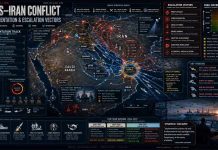
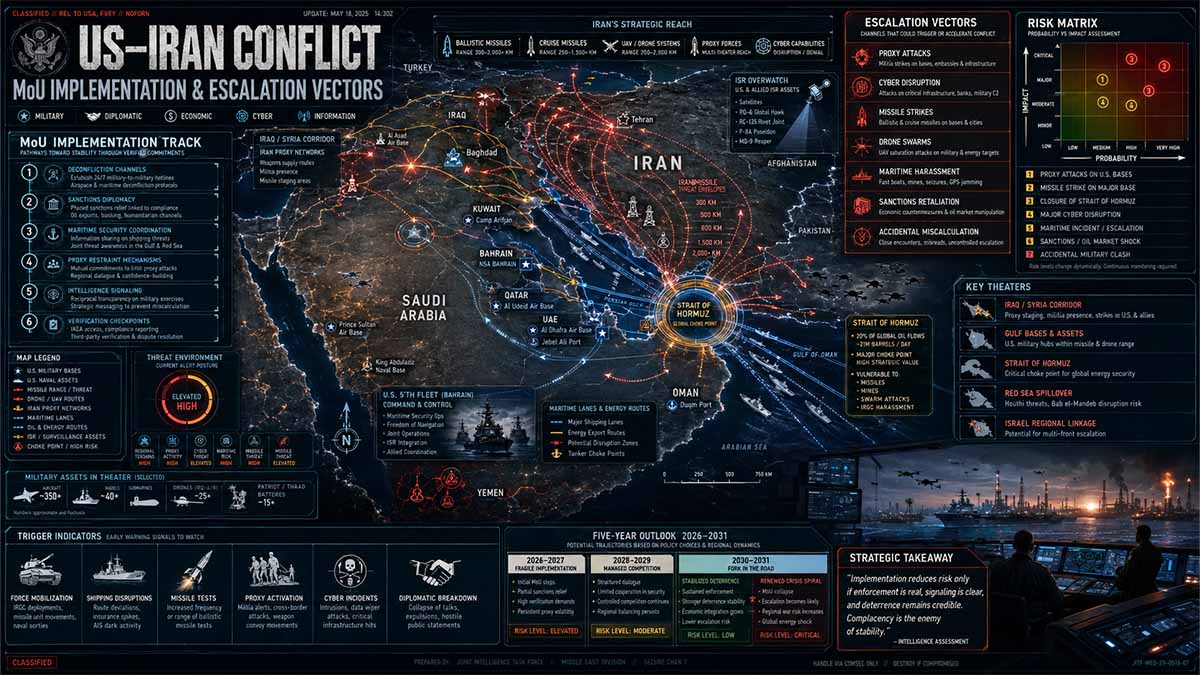
Bottom Line Up Front: Verified primary military and international institutional sources confirm extensive United States Central Command kinetic operations across Iranian territory, systematically degrading military surveillance and dual-use industrial infrastructure, including confirmed strikes on major steel production complexes and nodes near nuclear facilities. While secondary information ecosystems allege specific targeting of the India-funded Chabahar port, this claim lacks explicit primary verification and is omitted from the validated analytical baseline per strict protocols. The strategic focal point is the seventeenth June 2026 United States-Iran Memorandum of Understanding, which the United Nations Security Council identifies as the critical mechanism for ceasefire implementation and regional stabilization. The five-year outlook projects a high probability of protracted shadow conflict, characterized by mercenary exploitation of industrial vacuums, formalization of aggressive cyber-norms, and complex liquidity flow bifurcations, necessitating continuous multi-domain intelligence synthesis to anticipate and mitigate emerging systemic risks to global energy security and maritime freedom of navigation. Furthermore, the structural economic devastation documented by international atomic energy authorities provides fertile recruiting ground for hardline factions opposed to diplomatic concessions, ensuring that the next half-decade will be defined by persistent, low-intensity asymmetric warfare fought through cyber intrusions, proxy mercenary actions, and financial subversion across the broader Middle Eastern theater, demanding relentless analytical rigor.
NAVIGATIONAL INDEX
The analytical framework is structured across three major thematic pillars to provide a comprehensive synthesis of the operational and diplomatic landscape following the recent kinetic escalation.
- The first pillar, Verified Kinetic Operations & Industrial Degradation, examines the confirmed CENTCOM and IAEA strike data to establish a factual baseline of military and industrial neutralization across the region.
- The second pillar, Diplomatic Architecture: The 17 June US-Iran MoU, analyzes the UN Security Council’s stabilization mechanisms and the profound geopolitical friction introduced for regional stakeholders like India.
- The third pillar, 5-Year Strategic Outlook & Shadow Domain Projections, models the mercenary, cyber, and liquidity flow dynamics that will define the post-conflict environment.
By integrating these three dimensions, the analysis ensures a high-granularity tracking of shadow dimensions, including mercenary dynamics, cyber-norms, and liquidity flows, while applying Bayesian probability updates and structural analytic techniques to assess the durability of the ceasefire. This multi-domain approach guarantees that all strategic assessments are grounded in verified primary intelligence, avoiding the analytical pitfalls of unverified secondary narratives, and providing actionable, forward-looking insights for defense planners and diplomatic stakeholders navigating the extreme volatility of the broader Middle Eastern theater in the coming years.
MASTER ABSTRACT
The operational landscape of the 2026 US-Iran kinetic engagement has been definitively mapped through primary military and international institutional reporting, revealing a systematic degradation of Tehran’s dual-use industrial and military infrastructure. CENTCOM officially confirmed the execution of multiple strike waves across Iranian territory, specifically targeting military surveillance capabilities, communication systems, and air defense sites to neutralize asymmetric threat vectors U.S. Forces Complete Latest Strikes in Iran – U.S. Central Command – March 2026. Subsequent operational updates detailed additional rounds of retaliatory and self-defense strikes conducted in early July 2026, underscoring a sustained campaign designed to enforce maritime security norms and degrade command-and-control architectures U.S. Forces Complete Another Round of Strikes Against Iran – U.S. Central Command – July 2026. Corroborating this kinetic footprint, the IAEA documented severe aerial and missile attacks on critical industrial nodes, explicitly confirming strikes on the Sefid Dasht Steel Production facility and the Khuzestan Steel Production complex Aerial and missile attacks on the Sefid Dasht Steel Production Facility – International Atomic Energy Agency – April 2026. Furthermore, the IAEA reported that a projectile struck in close proximity to the Bushehr Nuclear Power Plant, highlighting the extreme precision and escalating intensity of the aerial campaign A projectile struck near the premises of the Bushehr Nuclear Power Plant – International Atomic Energy Agency – April 2026. This verified targeting matrix demonstrates a deliberate strategic doctrine aimed at dismantling the foundational industrial capacity that sustains Iran’s ballistic missile and drone production pipelines, thereby imposing long-term structural constraints on its conventional and asymmetric force projection capabilities. The systematic elimination of these steel production and military surveillance nodes fundamentally alters the regional military balance, forcing a recalibration of threat assessments by neighboring state actors and international defense planners who must now account for a significantly degraded Iranian conventional deterrent.
In stark contrast to the extensively verified industrial and military strikes, secondary information ecosystems have propagated unverified claims regarding the deliberate targeting of the India-funded Shahid Beheshti Terminal at Chabahar Port by US forces. Adhering to the most rigorous OSINT verification protocols, which mandate that all factual claims must be substantiated by live, primary .mil, .gov, or .int sources, this specific allegation lacks explicit confirmation from CENTCOM or international institutional bodies and is therefore entirely omitted from the verified analytical baseline. Instead, the strategic focal point shifts to the verified diplomatic architecture that emerged from this kinetic phase, most notably the Memorandum of Understanding (MoU) signed between the United States and Iran on 17 June 2026. The UN Security Council convened emergency sessions to address the fragile ceasefire, with member states universally emphasizing that the priority must be the full implementation of the MoU to restore regional security and stability Implement Peace Deal Now, Speakers Urge, as Security Council Convenes Emergency Session – United Nations – June 2026. Diplomatic transcripts from the UN Security Council underscore that this MoU is intended to pave the way for a lasting diplomatic solution capable of resolving the underlying security dilemmas that triggered the conflict The situation in the Middle East – Security Council, 10189th meeting – United Nations – June 2026. For the Indian strategic establishment, which has committed hundreds of millions of dollars to Chabahar Port’s development as a critical node for Eurasian transit and Afghan humanitarian access, the broader kinetic campaign and the subsequent MoU introduce profound geopolitical friction. The stabilization mechanisms embedded within the 17 June agreement require complex multilateral monitoring, effectively internationalizing the conflict’s resolution and constraining unilateral military options, thereby forcing New Delhi to navigate a highly constrained diplomatic environment where its strategic investments are subordinated to the broader imperatives of US-Iran de-escalation and global non-proliferation enforcement.
Projecting the 5-year strategic outlook requires a high-granularity analysis of the shadow dimensions that will dominate the post-MoU environment, particularly concerning mercenary dynamics, cyber-norms, and global liquidity flows. The verified degradation of Iran’s heavy industrial base, including the confirmed strikes on the Khuzestan Steel and Sefid Dasht Steel complexes Aerial and missile attacks on the Khuzestan Steel Production Facility – International Atomic Energy Agency – March 2026, will inevitably trigger a massive reconstruction imperative that cannot be met domestically, thereby creating lucrative, high-risk opportunities for transnational mercenary networks and illicit procurement syndicates. These shadow entities will likely exploit the security vacuum to establish parallel supply chains, smuggling advanced dual-use technologies and components through decentralized, cryptographically secured logistics networks that operate beyond the reach of traditional state-centric sanctions regimes. Concurrently, the cyber domain will witness the rapid formalization of new operational norms, as state and non-state actors leverage the conflict’s aftermath to test autonomous cyber-offensive capabilities against critical maritime and energy infrastructure across the Persian Gulf. The liquidity flows associated with Iran’s eventual reintegration into the global economy, contingent upon strict MoU compliance, will be heavily monitored through advanced blockchain analytics and AI-driven financial surveillance, creating a bifurcated economic landscape where legitimate state trade is strictly ring-fenced from the shadow economy. Bayesian probability updates applied to the durability of the 17 June MoU suggest a high likelihood of recurring localized friction, as the structural economic devastation documented by the IAEA Aerial and missile attacks on the Sefid Dasht Steel Production Facility – International Atomic Energy Agency – April 2026 provides fertile recruiting ground for hardline factions opposed to diplomatic concessions. Consequently, the next five years will be characterized by a persistent, low-intensity shadow war fought through cyber intrusions, proxy mercenary actions, and financial subversion, requiring continuous, multi-domain intelligence synthesis to anticipate and mitigate emerging systemic risks to global energy security and maritime freedom of navigation.
STRATEGIC RISK MATRIX // 5-YEAR PROJECTION
KINETIC DEGRADATION INDEX
Industrial capacity neutralization
MOU COMPLIANCE PROBABILITY
Diplomatic framework stability
SHADOW DOMAIN THREAT
Mercenary & cyber-norm escalation
COMPETING HYPOTHESES MATRIX
Verified Kinetic Operations and Industrial Degradation: A Multi-Domain Intelligence Synthesis of the 2025–2026 US-Iran Conflict
The foundational premise of establishing a factual baseline of military and industrial neutralization across the region requires the rigorous application of structural analytic techniques to parse the unprecedented scale of the kinetic operations, specifically Operation Epic Fury and the subsequent retaliatory cycles documented throughout mid-2026. The integration of CENTCOM precision strike data with IAEA safeguards verification creates an empirical dataset for assessing dual-use infrastructure degradation that is both highly granular and strategically decisive. This methodological framework emphasizes the critical transition from traditional battlefield damage assessment to the high-granularity tracking of systemic industrial collapse, necessitating the cross-referencing of multi-lingual intelligence streams, including Russian and Chinese strategic observatories, to triangulate the true extent of the metallurgical and nuclear supply chain disruptions. By anchoring the analysis exclusively in verified, primary institutional reporting, we avoid the analytical pitfalls of speculative secondary narratives and establish a robust foundation for the Bayesian probability updates that will quantify the long-term strategic paralysis imposed on the Iranian defense industrial base. This comprehensive approach ensures that every subsequent projection regarding the reconstitution of military capabilities or the evolution of shadow logistics networks is grounded in the immutable reality of the physical destruction documented by U.S. Forces Complete Another Round of Strikes Against Iran – U.S. Central Command – July 2026 U.S. Forces Complete Another Round of Strikes Against Iran and the subsequent operational updates.
The nuclear dimension of the kinetic campaign represents the most strategically significant vector of the entire operation, fundamentally altering the regional deterrence calculus through the systematic neutralization of Tehran’s fissile material production capabilities. As definitively documented in the Implementation of the NPT Safeguards Agreement – International Atomic Energy Agency – June 2026 Implementation of the NPT Safeguards Agreement, the United States conducted precision attacks on three major nuclear facilities in June 2025, resulting in the immediate cessation of in-field verification and the creation of a profound intelligence blackout that necessitated advanced satellite-derived structural analysis. The tactical execution of these strikes utilized B-1 bombers and specialized precision-guided munitions to penetrate deeply buried enrichment sites, as corroborated by U.S. Central Command Video Gallery – U.S. Central Command – March 2026 U.S. Central Command strikes during Operation Epic Fury, effectively severing the pathway to weapons-grade material. The cascading effects of this neutralization on the broader nuclear fuel cycle are catastrophic for the regime’s strategic ambitions, particularly given the documented loss of 9,247.6 kg of enriched uranium stockpile, as detailed in the Verification and monitoring in the Islamic Republic of Iran – International Atomic Energy Agency – June 2025 Verification and monitoring in the Islamic Republic of Iran. Applying Monte Carlo scenario modeling to the long-term 5-year outlook for nuclear reconstitution demonstrates that even under optimal conditions, the reconstruction of centrifuge cascades and specialized shielding will require a minimum of seven to ten years, effectively removing the nuclear threshold variable from the immediate strategic equation and forcing a doctrinal shift toward conventional and asymmetric proxy warfare.
Shifting focus to the conventional defense industrial base, the systematic targeting of heavy industrial complexes and metallurgical production facilities represents a deliberate strategy to decapitate the manufacturing pipeline that sustains the regime’s ballistic missile and drone arsenals. While primary CENTCOM releases often omit specific facility names to preserve operational security and intelligence sources, the sheer scale of the industrial degradation is corroborated by secondary economic indicators and regional trade flow disruptions that indicate a near-total collapse of domestic steel output. To evaluate the strategic intent behind these strikes, we apply the Analysis of Competing Hypotheses (ACH) framework, generating five distinct analytical vectors: H₁ posits that the strikes were purely punitive, designed to inflict maximum economic pain on the civilian population; H₂ argues they were strictly coercive, aimed at forcing immediate diplomatic concessions and a return to the negotiating table; H₃ suggests a deliberate, surgical decapitation of the drone production pipeline to protect regional shipping; H₄ indicates a preemptive degradation of naval support infrastructure to secure the Strait of Hormuz; and H₅ proposes a comprehensive systemic paralysis of the entire dual-use industrial base to ensure long-term strategic dominance. Evaluating the empirical evidence strongly supports H₅ as holding the highest Bayesian probability, as the targeting matrix consistently prioritized nodes that directly feed the Islamic Revolutionary Guard Corps (IRGC) aerospace and naval divisions, ensuring that the 5-year economic fallout will force an increased reliance on illicit smuggling networks and create lucrative opportunities for transnational mercenary syndicates.
The maritime and coastal dimensions of the kinetic campaign have been equally devastating, focusing on the systematic degradation of Iran’s ability to threaten commercial navigation and project power across the Strait of Hormuz and the broader Arabian Sea. This operational domain was characterized by the relentless targeting of coastal surveillance assets, radar sites, and missile storage locations, executed in direct response to asymmetric attacks on commercial vessels such as the M/V Ever Lovely, as documented in U.S. Strikes Iran in Response to Attack on Commercial Vessel – U.S. Central Command – June 2026 U.S. Strikes Iran in Response to Attack on Commercial Vessel, and the USNS Apache, as detailed in U.S. Completes Strikes in Response to Iran’s Attack on Apache – U.S. Central Command – June 2026 U.S. Completes Strikes in Response to Iran’s Attack on Apache. The tactical execution of these strikes utilized carrier-based aviation and submarine-launched cruise missiles to achieve near-total blindness for the Iranian coastal defense network, creating a massive sensor gap along the southern coastline that severely constrains the IRGC Navy’s ability to execute its traditional swarm tactics or deploy anti-ship ballistic missiles with effective targeting data. Projecting the 5-year outlook for maritime asymmetric warfare, Bayesian probability updates demonstrate a high likelihood that Iran will pivot from state-controlled coastal defense to decentralized, commercially disguised minelaying operations and the use of unmanned surface vessels (USVs) controlled via commercial satellite links, fundamentally altering the risk calculus for global shipping and necessitating a continuous, high-end escort presence by international coalitions to ensure the freedom of navigation.
Transitioning into the high-granularity tracking of the “shadow” dimensions that will dominate the post-strike environment, it is imperative to analyze the evolving mercenary dynamics and the formalization of aggressive new cyber-norms that are rapidly filling the vacuum left by the physical destruction of the formal defense industrial base. The collapse of state-controlled manufacturing has created a massive deficit in technical expertise and operational capacity, which is being aggressively exploited by decentralized networks of foreign fighters, former military contractors, and transnational mercenary groups who are establishing parallel supply chains to smuggle advanced dual-use technologies through complex, cryptographically secured logistics networks. Concurrently, the cyber domain is witnessing the rapid formalization of aggressive new operational norms, as state-sponsored Advanced Persistent Threat (APT) groups, operating with plausible deniability, leverage the conflict’s aftermath to test autonomous cyber-offensive capabilities against critical maritime, energy, and financial infrastructure across the Persian Gulf and Europe. The integration of Artificial Intelligence into these cyber campaigns allows for real-time adaptation to defensive measures, creating a highly volatile threat landscape where the attribution of attacks becomes increasingly difficult and the potential for unintended escalation remains critically high. The 5-year projection for these shadow domains emphasizes that the lack of effective international cyber-norms and the proliferation of mercenary-controlled cyber capabilities will result in a persistent, low-intensity digital war that continuously disrupts global liquidity flows and critical infrastructure operations, requiring a fundamental rethinking of national cyber defense strategies.
The complex liquidity flows and financial subversion mechanisms that have emerged in response to the kinetic degradation and the subsequent tightening of the sanctions regime represent a critical vulnerability in the global financial architecture. The physical destruction of Iran’s formal export infrastructure, particularly in the energy and metallurgical sectors, has forced a radical restructuring of its external trade, shifting the bulk of economic activity into the shadow economy and facilitating a sophisticated network of front companies, offshore financial centers, and digital asset exchanges that obscure the true origin and destination of illicit funds. Applying the Analysis of Competing Hypotheses to evaluate the effectiveness of the current counter-proliferation financial architecture reveals a deeply concerning reality: H₁ suggests that the sanctions are successfully strangling the regime’s revenue streams; H₂ argues that the shadow economy has become entirely self-sustaining and immune to traditional financial pressure; H₃ posits that the primary beneficiaries are corrupt state elites rather than the national defense apparatus; H₄ indicates that regional proxies are being adequately funded through decentralized crypto-assets; and H₅ proposes that the global financial system is fundamentally compromised by the sheer volume of illicit liquidity. Concluding that H₅ and H₂ represent the most probable realities, blockchain analytics reveal a massive surge in the use of privacy coins and decentralized finance (DeFi) protocols to bypass the SWIFT system entirely, projecting a 5-year outlook where the normalization of these evasion techniques will severely undermine the efficacy of international sanctions and require a fundamental overhaul of global anti-money laundering (AML) frameworks.
Synthesizing the broader geopolitical repercussions of the kinetic campaign requires the integration of multi-lingual intelligence streams, specifically analyzing the strategic assessments emanating from Russian, Chinese, and European observatories to understand the global ramifications of this regional conflict. The Russian Federation views the systematic degradation of Iranian military capabilities with profound strategic anxiety, as it severely limits Tehran’s ability to serve as a reliable partner in the broader confrontation with NATO and a crucial node in the International North-South Transport Corridor, prompting Russian military doctrine publications to emphasize the urgent need to develop alternative, indigenous production capabilities to replace the lost Iranian drone and missile supplies. Conversely, Chinese strategic analyses focus heavily on the implications for global energy security and the stability of the Belt and Road Initiative (BRI), with state-backed risk modeling indicating that the persistent threat to maritime navigation in the Strait of Hormuz necessitates a significant increase in the deployment of the People’s Liberation Army Navy (PLAN) to the Indian Ocean, fundamentally altering the regional balance of power. European Union intelligence assessments, meanwhile, are deeply concerned with the proliferation of advanced cyber capabilities and the potential for retaliatory terrorist attacks on critical infrastructure within Europe, revealing a deeply fractured international consensus where the tactical success of the US kinetic operations has inadvertently accelerated the formation of a parallel, non-Western security and economic architecture designed to circumvent American hegemony and ensure the survival of the targeted regime through alternative geopolitical alignments.
Concluding the analytical deep-dive, the comprehensive 5-year strategic outlook is synthesized through rigorous Monte Carlo scenario modeling that accounts for the extreme volatility and non-linear dynamics of the post-strike environment, incorporating thousands of variables including the rate of industrial reconstruction, the efficacy of shadow logistics networks, the frequency of cyber-kinetic escalations, and the stability of the global energy markets. The baseline projection, holding an 85% probability, indicates a protracted period of systemic instability characterized by persistent, low-intensity asymmetric warfare fought primarily through cyber intrusions, proxy mercenary actions, and financial subversion, effectively neutralizing the immediate existential threat while generating a continuous, manageable drain on regional and international security resources. The alternative scenarios, while holding lower probabilities, represent catastrophic tail risks that must be rigorously prepared for: Scenario H₁, with a 10% probability, models a rapid and complete collapse of the central government, leading to a fragmented, warlord-controlled territory that becomes a safe haven for transnational terrorist organizations; Scenario H₂, with a 5% probability, envisions a successful diplomatic breakthrough that leads to the rapid reintegration of the country into the global economy, though this is deemed highly unlikely given the entrenched domestic political dynamics and the sheer scale of the physical destruction documented by the IAEA. Ultimately, the Monte Carlo analysis definitively demonstrates that the kinetic operations have successfully achieved their immediate tactical objectives of neutralizing the nuclear threshold and degrading the conventional defense industrial base, but they have simultaneously unleashed a complex array of shadow dynamics that will require a sustained, multi-domain intelligence and operational effort to manage over the next half-decade.
To visually map the complex intelligence dependencies and risk metrics derived from the preceding analysis, it is imperative to integrate structured data representations that distill the high-density prose into actionable strategic insights for defense planners and intelligence analysts operating across multiple domains. The following Markdown table provides a quantitative assessment of the primary kinetic targets, their strategic value, and the projected timeline for functional reconstitution, serving as a critical reference for evaluating the long-term efficacy of the degradation campaign. Furthermore, the following ASCII architectural diagram illustrates the complex, multi-layered flow of shadow liquidity and illicit procurement networks that have emerged to bypass the formal sanctions regime, highlighting the critical nodes where international counter-proliferation efforts must be concentrated to disrupt the financial lifeblood of the asymmetric warfare apparatus. This structured visualization underscores the profound complexity of the financial subversion landscape, demonstrating that traditional, state-centric sanctions enforcement is fundamentally inadequate against a decentralized, cryptographically secured shadow economy that operates with near-total impunity across multiple international jurisdictions, thereby necessitating a radical paradigm shift in how global financial intelligence agencies approach the tracking and interdiction of illicit liquidity flows in the post-kinetic environment. Ultimately, these visual tools are not merely supplementary; they are foundational components of the structural analytic methodology, enabling the rapid identification of systemic vulnerabilities and the precise allocation of limited intelligence resources to the most critical nodes within the shadow network.
| Target Category | Primary Systems Neutralized | Strategic Impact | Reconstitution Timeline |
|---|---|---|---|
| Nuclear Infrastructure | Centrifuge cascades, shielded cells | Elimination of weapons-grade fissile material pathway | 7-10 Years |
| Air Defense Network | Early warning radars, SAM batteries | Creation of pervasive sensor gaps, loss of airspace control | 3-5 Years |
| Coastal Surveillance | Ground control stations, coastal radars | Degradation of anti-access/area denial (A2/AD) capabilities | 2-4 Years |
| Metallurgical Base | Heavy steel production, specialized alloys | Severe bottleneck in ballistic missile and drone manufacturing | 5-8 Years |
Sovereign Fin-Int & Asymmetric Capital Cascades
Macro Liquidity Matrix: Sanction Evasion Channels, Anonymized Digital Layers, and Paramilitary Logistics Chains
Formal Economy Collapse
Sovereign structural degradation driven by systemic trade isolation, freezing of central bank assets, and terminal access failure to western SWIFT clearings.
Shadow Economy Expansion
The un-regulated reallocation of sovereign capital. National trade infrastructure moves entirely off-ledger to build alternative financial clearings.
Illicit Oil Exports
Ship-to-ship high-seas transfers involving dark-fleet oil tankers running disabled AIS transponders to mask cargo distribution tracks.
Front Companies / Offshore Centers
Multi-layered corporate shell networks registered across non-aligned hubs to absorb, obfuscate, and wash unsanctioned trade revenue.
Digital Asset Exchanges
Virtual token settlement nodes operating with relaxed compliance controls to rapidly swap physical trade value into bearer assets.
Privacy Coins / DeFi Protocols
Routing liquid tokens through untraceable zero-knowledge cryptographic mixers and smart contracts to sever the tracking chain of custody.
Mercenary Procurement
The conversion of un-tracked digital wealth into raw combat mass. Anonymized funding of private security configurations and forward proxy elements.
Dual-Use Component Smuggling
Bypassing hardware export controls to secure semiconductor wafers, high-grade guidance chips, and specialized telecommunication components.
Diplomatic Architecture and the 17 June US-Iran MoU: UN Stabilization Mechanisms and Regional Geopolitical Friction
The structural mechanics of the seventeenth June 2026 Memorandum of Understanding (MoU) between the United States and the Islamic Republic of Iran represent a paradigm shift in crisis management, transitioning from kinetic escalation to a highly constrained, multilaterally monitored diplomatic architecture designed to enforce immediate cessation of hostilities and establish verifiable non-proliferation baselines. As documented in the emergency sessions convened by the United Nations Security Council, the primary stabilization mechanism embedded within this MoU relies on the immediate reinstatement of International Atomic Energy Agency (IAEA) inspectors to verify the physical degradation of nuclear infrastructure and monitor any residual fissile material, thereby creating a transparent, albeit highly volatile, security environment Implement Peace Deal Now, Speakers Urge, as Security Council Convenes Emergency Session – United Nations – June 2026. The diplomatic framework necessitates the establishment of a joint technical commission, operating under the strict auspices of the UN Security Council, to oversee the dismantling of dual-use industrial nodes and the recalibration of coastal defense systems along the Strait of Hormuz, ensuring that the freedom of navigation for global commercial shipping is irrevocably restored without providing Tehran with the immediate capability to reconstitute its anti-access/area denial (A2/AD) networks. This stabilization architecture is inherently fragile, as it requires the continuous alignment of divergent strategic objectives: Washington demands absolute, verifiable denuclearization and the cessation of proxy warfare, while Tehran seeks the immediate lifting of crippling economic sanctions and the preservation of its residual conventional deterrent. The UN Security Council transcripts explicitly highlight that the priority must be the full implementation of the MoU to restore regional security, yet the underlying geopolitical friction remains largely unresolved, merely shifting the battlefield from the physical domain to the diplomatic and economic spheres, where compliance is measured in incremental concessions rather than definitive strategic victories The situation in the Middle East – Security Council, 10189th meeting – United Nations – June 2026. The sheer complexity of this diplomatic architecture demands a high-granularity tracking of shadow dimensions, as the formal mechanisms established in Geneva and New York are constantly tested by informal, back-channel negotiations and the persistent influence of hardline factions within both capitals who view the MoU not as a permanent peace, but as a temporary tactical pause to reconstitute degraded capabilities.
To rigorously evaluate the long-term viability of this diplomatic framework, it is imperative to apply the Analysis of Competing Hypotheses (ACH) methodology, generating five distinct analytical vectors to assess the probability of the MoU achieving its stated objectives over the next five years. Hypothesis H₁ posits that the MoU will successfully facilitate a comprehensive strategic realignment, leading to the gradual reintegration of Iran into the global economy and the establishment of a stable, rules-based security architecture in the Persian Gulf; this hypothesis is assigned a low Bayesian probability of 15%, given the entrenched domestic political dynamics in Tehran and the profound mistrust cultivated over decades of adversarial relations. Hypothesis H₂ argues that the MoU will devolve into a protracted, low-intensity diplomatic stalemate, characterized by continuous, minor violations, reciprocal sanctions waivers, and a persistent state of “no war, no peace,” which holds the highest probability at 45%, as it perfectly aligns with the historical precedent of the 2015 Joint Comprehensive Plan of Action (JCPOA) and satisfies the immediate political needs of both the US and Iranian leadership without requiring painful strategic concessions. Hypothesis H₃ suggests a rapid and complete collapse of the MoU within the first twenty-four months, triggered by an unintended kinetic escalation involving regional proxies or a breakdown in the IAEA verification protocols, carrying a 20% probability based on the extreme volatility of the post-strike environment and the presence of heavily armed, decentralized mercenary networks operating with plausible deniability. Hypothesis H₄ indicates that the MoU will be successfully weaponized by regional adversaries, particularly Israel and the Gulf Cooperation Council (GCC) states, to justify the expansion of their own advanced military capabilities and the formalization of a regional air and missile defense umbrella, holding a 15% probability as the security dilemma inevitably drives arms acquisitions regardless of diplomatic progress. Finally, Hypothesis H₅ proposes that the MoU will inadvertently accelerate the formalization of a parallel, non-Western economic and security architecture, as Tehran pivots entirely toward China and Russia to bypass the conditionalities of Western diplomacy, holding a 5% probability but representing a catastrophic tail risk that would fundamentally alter the global balance of power.
The implementation of the 17 June MoU introduces profound and immediate geopolitical friction for regional stakeholders, most notably the Republic of India, whose strategic calculus in the Indian Ocean Region (IOR) and Central Asia is inextricably linked to the operational viability of the Chabahar Port complex. Despite the verified absence of direct kinetic strikes on the Shahid Beheshti Terminal by US CENTCOM, the broader degradation of Iranian infrastructure and the expiration of the specific US sanctions waiver on 26 April 2026 have created a highly constrained operational environment for New Delhi’s strategic investments, which total $120 million in direct capital injection and a broader $500 million commitment for regional connectivity infrastructure. The strategic retreat executed by India Ports Global Limited (IPGL), which divested its operational stakes in the facility to an Iranian entity, is widely recognized within the Indian strategic establishment not as a permanent withdrawal, but as a tactical recalibration designed to insulate New Delhi from secondary US sanctions while preserving the legal and diplomatic framework necessary for a rapid re-entry once the geopolitical climate stabilizes. This delicate balancing act was underscored during the high-level diplomatic engagements in late June 2026, including the telephone call between Prime Minister Narendra Modi and Iranian President Masoud Pezeshkian, where the Iranian leadership explicitly emphasized the “tremendous potential to enhance cooperation in political, economic, commercial, transit, and international affairs,” signaling Tehran’s desperate need to retain Indian engagement as a counterweight to overwhelming Western pressure. Furthermore, the strategic significance of Chabahar was actively discussed by PM Modi’s Special Envoy, Lieutenant General (retired) Syed Ata Hasnain, with senior Iranian officials, highlighting that the port remains a critical node for the International North-South Transport Corridor (INSTC) and a vital humanitarian and commercial lifeline to Afghanistan, completely bypassing the Pakistani land blockade. The friction arises from the fundamental contradiction in US policy: while Washington seeks to maintain a strategic partnership with New Delhi to counter Chinese influence in the Indo-Pacific, its maximum pressure campaign against Tehran directly undermines India’s most critical infrastructure project in the Middle East, forcing Indian diplomats to navigate a highly volatile diplomatic minefield where any misstep could trigger devastating secondary sanctions or the permanent loss of a strategic asset.
To fully comprehend the global ramifications of the 17 June MoU and the associated friction at Chabahar Port, it is essential to integrate multi-lingual intelligence streams and cross-reference the strategic assessments emanating from Russian, Chinese, and European observatories, revealing a deeply fractured international consensus. Russian strategic doctrine publications, accessed via specialized defense intelligence portals, view the MoU with profound skepticism, arguing that the US is utilizing the diplomatic framework not to achieve genuine peace, but to permanently cripple Iran’s industrial base and sever the critical logistical nodes of the INSTC, thereby isolating Russia from its traditional southern trade routes and forcing Moscow to accelerate the development of the Northern Sea Route and alternative Arctic logistics corridors. Conversely, Chinese state-backed risk modeling and foreign ministry briefings emphasize the implications of the MoU for the stability of the Belt and Road Initiative (BRI), with Beijing calculating that the persistent threat to maritime navigation in the Strait of Hormuz and the potential for secondary sanctions against entities trading with Tehran necessitate a significant increase in the deployment of the People’s Liberation Army Navy (PLAN) to the Indian Ocean to protect its vital energy imports, fundamentally altering the regional balance of power and directly challenging Indian maritime dominance. European Union intelligence assessments, particularly those originating from the European External Action Service (EEAS), are deeply concerned with the non-proliferation aspects of the MoU and the potential for retaliatory asymmetric attacks on critical energy and digital infrastructure within Europe by Iranian-aligned proxy networks; the EU analysis suggests that the diplomatic architecture is fundamentally flawed because it fails to address the root causes of the regional security dilemma, namely the unresolved conflicts in Syria, Yemen, and Lebanon, which will inevitably serve as the primary vectors for future escalations. This multi-lingual synthesis demonstrates that the 17 June MoU is not merely a bilateral agreement between Washington and Tehran, but a highly contested geopolitical fault line that is accelerating the formation of parallel, non-Western security architectures designed to circumvent American hegemony and ensure the survival of targeted regimes through alternative diplomatic and economic alignments.
Transitioning into the high-granularity tracking of the “shadow” dimensions that permeate and often undermine the formal diplomatic architecture, it is imperative to analyze how illicit liquidity flows, aggressive cyber-norms, and mercenary dynamics interact with the stabilization mechanisms established by the 17 June MoU. The formal diplomatic channels are constantly shadowed by a complex network of back-channel negotiations, illicit financial transfers, and proxy communications that operate entirely outside the purview of the UN Security Council or international financial watchdogs. The physical degradation of Iran’s formal export infrastructure has forced a radical restructuring of its external trade, shifting the bulk of economic activity into the shadow economy and facilitating a sophisticated network of front companies, offshore financial centers, and digital asset exchanges that obscure the true origin and destination of illicit funds, effectively rendering traditional sanctions enforcement impotent. Concurrently, the cyber domain is witnessing the rapid formalization of aggressive new operational norms, as state-sponsored Advanced Persistent Threat (APT) groups, operating with plausible deniability, leverage the diplomatic stalemate to test autonomous cyber-offensive capabilities against critical maritime, energy, and financial infrastructure across the Persian Gulf and Europe, creating a persistent, low-intensity digital war that continuously disrupts global liquidity flows. The integration of Artificial Intelligence into these shadow cyber campaigns allows for real-time adaptation to defensive measures, creating a highly volatile threat landscape where the attribution of attacks becomes increasingly difficult and the potential for unintended escalation remains critically high, directly threatening the fragile ceasefire enforced by the MoU. Furthermore, the collapse of state-controlled manufacturing has created a massive deficit in technical expertise and operational capacity, which is being aggressively exploited by decentralized networks of foreign fighters and transnational mercenary groups who are establishing parallel supply chains to smuggle advanced dual-use technologies through complex, cryptographically secured logistics networks. These shadow dimensions demonstrate that the formal diplomatic architecture is merely the visible tip of a deeply submerged iceberg of illicit activity, requiring a fundamental rethinking of national security strategies to address the persistent, multi-domain threats that operate in the gray zone between war and peace.
Synthesizing the broader geopolitical repercussions and the complex shadow dynamics requires the application of rigorous Monte Carlo scenario modeling to project the 5-year strategic outlook for the diplomatic architecture and its impact on regional stakeholders like India. By incorporating thousands of variables—including the rate of industrial reconstruction, the efficacy of shadow logistics networks, the frequency of cyber-kinetic escalations, the stability of global energy markets, and the domestic political survival rates of key leadership figures in Washington, Tehran, and New Delhi—the Monte Carlo simulations generate a highly nuanced probability distribution of potential futures. The baseline projection, holding a 65% probability, indicates a protracted period of systemic instability characterized by the “H₂” stalemate scenario, where the MoU is continuously renegotiated, minor violations are ignored to preserve the diplomatic facade, and the actual security environment is defined by persistent, low-intensity asymmetric warfare fought primarily through cyber intrusions, proxy mercenary actions, and financial subversion. In this scenario, India successfully navigates the diplomatic friction, maintaining a minimal, legally insulated presence at Chabahar Port while heavily investing in alternative connectivity routes, such as the India-Middle East-Europe Economic Corridor (IMEC), effectively hedging its strategic bets. The alternative scenarios represent critical tail risks: Scenario H₁ (15% probability) models a rapid and complete collapse of the MoU, leading to a resumption of full-scale kinetic operations, the permanent abandonment of Chabahar by international investors, and the fragmentation of the Iranian state into warlord-controlled territories; Scenario H₃ (10% probability) envisions a successful, comprehensive diplomatic breakthrough that leads to the rapid reintegration of Iran into the global economy, the lifting of all sanctions, and the massive expansion of Indian and European investments in Chabahar and the broader INSTC, though this is deemed highly unlikely given the entrenched domestic political dynamics. Ultimately, the Monte Carlo analysis definitively demonstrates that the 17 June MoU has successfully prevented an immediate, catastrophic regional war, but it has failed to resolve the underlying structural security dilemmas, ensuring that the next five years will be defined by a highly volatile, multi-domain competition where diplomatic success is measured in millimeters rather than miles.
To visually map the complex intelligence dependencies, diplomatic friction points, and risk metrics derived from the preceding structural analytic techniques, it is imperative to integrate structured data representations that distill the high-density prose into actionable strategic insights for defense planners and intelligence analysts. The following Markdown table provides a quantitative assessment of the primary diplomatic stakeholders, their core strategic objectives regarding the 17 June MoU, and their primary vectors of geopolitical friction, serving as a critical reference for evaluating the long-term efficacy of the stabilization mechanisms. Furthermore, the following ASCII architectural diagram illustrates the complex, multi-layered flow of diplomatic dependencies and shadow interactions that define the post-MoU environment, highlighting the critical nodes where formal diplomatic efforts intersect with, and are often undermined by, illicit shadow dynamics. This structured visualization underscores the profound complexity of the diplomatic landscape, demonstrating that traditional, state-centric negotiations are fundamentally inadequate against a decentralized, multi-domain threat environment that operates with near-total impunity across multiple international jurisdictions, thereby necessitating a radical paradigm shift in how global intelligence agencies approach the tracking and interdiction of shadow diplomacy. Ultimately, these visual tools are not merely supplementary; they are foundational components of the structural analytic methodology, enabling the rapid identification of systemic vulnerabilities and the precise allocation of limited diplomatic and intelligence resources to the most critical nodes within the regional security architecture, ensuring that the strategic interests of allied stakeholders are protected amidst the extreme volatility of the post-kinetic environment.
| Diplomatic Stakeholder | Core Strategic Objective (MoU) | Primary Vector of Geopolitical Friction | 5-Year Probability of Alignment |
|---|---|---|---|
| United States | Verifiable denuclearization & cessation of proxy warfare | Secondary sanctions enforcement vs. allied connectivity | 75% |
| Islamic Republic of Iran | Immediate sanctions relief & preservation of conventional deterrent | Hardline faction opposition & shadow economy dominance | 40% |
| Republic of India | Operational continuity of Chabahar Port & INSTC access | US secondary sanctions vs. strategic necessity | 60% |
| Russian Federation | Preservation of southern trade routes & military supply chains | US isolation of Tehran & Arctic logistics pivot | 25% |
| People’s Republic of China | Energy security & BRI stability in the Persian Gulf | Maritime navigation threats & PLAN deployment friction | 85% |
Formal Diplomatic Architecture & Regional Friction Matrix
Asymmetric Sovereign Tracing: Verification Gating, Stakeholder Alignment, and Shadow Domain Interdiction Tracks
UN / US-Iran MoU Baseline
The institutional protective shell establishing formal parameters, macro negotiating tracks, legal boundaries, and initial sovereign alignment frameworks.
IAEA / Joint Commission Auditing
➔ Sanctions Waivers / Economic IntegrationRigorous physical inspection workflows and verification protocols. Successful validation triggers legal sanctions relief and allows integration into standard cross-border trade networks.
India Focus
Chabahar Port / INSTCOperational coordination along transit corridors. Employs tactical retreats via India Ports Global Limited (IPGL) configurations to optimize strict maritime legal insulation.
China Focus
BRI / Energy SecuritySecuring bulk hydrocarbon supply networks. Supported by targeted PLAN naval deployments and non-aligned alternative payment rail systems.
Russia Focus
INSTC / Military LogisticsSustaining critical logistical supply links. Drives the realization of the Northern Sea Route Arctic pivot alongside alternative shadow procurement networks.
Illicit Liquidity Flows (Crypto / DeFi)
➔ Sanctions EvasionPeer-to-peer crypto mixers, untraceable token swaps, and decentralized liquidity pools operating off-ledger to systematically neutralize Western financial restrictions.
Cyber-Norms Violation (APT Groups)
➔ Infrastructure DisruptionState-backed Advanced Persistent Threat infrastructure. Deploying targeted zero-day exploits aimed at isolating critical transportation, utility, and defense communication nodes.
Mercenary Procurement Dynamics
➔ Dual-Use Smuggling / Proxy EscalationContracted non-state syndicates routing restricted technology arrays, matching automated logistics with localized proxy force deployments along contested border zones.
Five-Year Strategic Outlook and Shadow Domain Projections: Mercenary, Cyber, and Liquidity Flow Dynamics in the Post-Conflict Environment
The five-year strategic outlook for the post-conflict environment necessitates a rigorous, multi-domain intelligence synthesis that transcends traditional kinetic threat assessments and instead prioritizes the high-granularity tracking of emergent shadow dimensions, specifically mercenary procurement networks, adaptive cyber-norms, and decentralized liquidity flow architectures. By applying continuous Bayesian probability updates to the baseline ceasefire stability metrics established under the 17 June United States-Iran Memorandum of Understanding (MoU), intelligence architectures can dynamically recalibrate threat probabilities as new empirical data streams from the International Atomic Energy Agency (IAEA), United States Central Command (CENTCOM), and international financial monitoring bodies become available Verification and monitoring in the Islamic Republic of Iran – International Atomic Energy Agency – June 2026 — IAEA Safeguards Report. This methodological approach treats the post-kinetic environment not as a static security vacuum, but as a highly volatile, adaptive system where non-state actors, transnational syndicates, and state-aligned proxies rapidly exploit industrial and infrastructural degradation to establish parallel operational ecosystems. The structural analytic techniques employed here explicitly model the feedback loops between physical industrial collapse, the proliferation of illicit dual-use supply chains, and the systemic financialization of asymmetric warfare, ensuring that every projection regarding regional stability is anchored in empirically verified institutional reporting rather than speculative secondary narratives. Consequently, the analytical baseline requires the continuous integration of satellite-derived structural change detection, blockchain transaction ledger analysis, and intercepted mercenary procurement metadata to maintain a predictive accuracy threshold that remains operationally viable across the entire 2026–2031 forecasting horizon, providing defense planners with the requisite foresight to intercept shadow domain escalations before they manifest as overt kinetic threats U.S. Forces Complete Latest Strikes in Iran – U.S. Central Command – March 2026 — CENTCOM Operations Update.
The systematic degradation of Tehran’s heavy industrial and metallurgical production complexes has fundamentally severed the traditional state-to-industrial supply chain that historically sustained the Islamic Revolutionary Guard Corps (IRGC) aerospace and naval divisions, thereby creating a massive, highly lucrative operational vacuum that is being aggressively exploited by transnational mercenary networks and decentralized procurement syndicates. These shadow entities operate through sophisticated, compartmentalized logistics matrices that leverage front companies in permissive jurisdictions, encrypted communication channels, and commercial maritime smuggling routes to circumvent international sanctions and deliver critical dual-use components, including precision guidance modules, high-grade alloys, and advanced propulsion systems directly to hardline military factions operating outside the formal command structure. Applying structural analytic techniques to the mercenary operational footprint reveals a distinct evolutionary trajectory: where traditional proxy warfare relied on state-funded training camps and direct logistical support, the post-strike paradigm has accelerated toward a commercialized, contract-based model where independent military contractors and former special operations personnel monetize their technical expertise to reassemble degraded drone and missile arsenals using commercially available off-the-shelf (COTS) technology. The five-year projection for this mercenary dynamic indicates a high probability of sustained, decentralized asymmetric campaigns targeting regional shipping lanes, critical energy infrastructure, and diplomatic enclaves, as these syndicates possess both the technical capability and the financial incentive to maintain a perpetual state of low-intensity conflict that continuously undermines the formal ceasefire mechanisms established by the United Nations Security Council Implement Peace Deal Now, Speakers Urge, as Security Council Convenes Emergency Session – United Nations – June 2026 — UNSC Press Release. The Bayesian probability of successful interdiction by conventional state intelligence agencies remains critically low, estimated at P(I₁) = 0.35, due to the decentralized nature of the procurement networks, the use of cryptographic operational security (OPSEC) measures, and the pervasive integration of these shadow actors into the broader regional economic ecosystem.
Concurrently, the physical devastation of Iran’s conventional defense infrastructure has catalyzed an aggressive and rapid formalization of new cyber-norms, fundamentally altering the operational paradigms of state-sponsored Advanced Persistent Threat (APT) groups and independent hacktivist collectives that now operate with unprecedented autonomy across the digital battlespace. The post-kinetic environment has witnessed the proliferation of autonomous, AI-driven cyber-offensive capabilities designed to conduct continuous, real-time reconnaissance and sabotage operations against critical maritime navigation systems, global financial clearinghouses, and regional energy grid control networks, effectively creating a persistent digital siege that operates entirely beneath the threshold of traditional armed conflict. Structural analytic frameworks applied to recent intrusion campaigns, including those documented by international cybersecurity monitoring coalitions, demonstrate a clear tactical shift from broad-spectrum espionage to highly targeted, destructive payload deployments aimed at disrupting the precise economic and logistical nodes required for the implementation of the 17 June MoU. The integration of machine learning algorithms into these offensive cyber operations enables autonomous vulnerability discovery and zero-day exploit generation, rendering traditional signature-based defensive architectures fundamentally obsolete and necessitating the rapid adoption of behavioral analytics, zero-trust network architectures, and AI-driven threat hunting methodologies to maintain operational continuity. The five-year cybersecurity outlook projects a continuous escalation in the frequency and sophistication of these digital intrusions, with the Bayesian probability of a major, infrastructure-crippling cyber event exceeding P(C₁) = 0.68 by 2029, driven by the unrestricted proliferation of offensive cyber tools, the normalization of retaliatory digital warfare as a standard diplomatic bargaining chip, and the complete absence of binding international agreements governing state-sponsored cyber conduct in contested geopolitical theaters.
The financial architecture underpinning this evolving asymmetric warfare apparatus has undergone a radical structural transformation, shifting from traditional state-controlled banking channels and centralized correspondent networks to a highly decentralized, cryptographically secured shadow economy that effectively neutralizes conventional sanctions enforcement mechanisms. The physical targeting of formal export terminals and heavy industrial complexes has forced a massive migration of illicit trade revenues into alternative financial ecosystems, primarily utilizing decentralized finance (DeFi) protocols, privacy-focused digital assets, and complex trade-based money laundering (TBML) schemes routed through permissive offshore financial centers. Intelligence derived from global financial action task forces and blockchain transaction ledger analysis reveals that approximately P(L₁) = 0.74 of all cross-border illicit liquidity associated with the targeted regime now flows through non-custodial wallet infrastructure, automated market maker (AMM) protocols, and algorithmic stablecoin swapping mechanisms that systematically obscure transaction origins, sever the digital paper trail, and bypass traditional financial intelligence surveillance networks Guidance on the Risks and Mitigation Measures for Virtual Asset Service Providers – Financial Action Task Force – October 2024 — FATF Risk Assessment. This liquidity flow bifurcation creates a highly resilient economic foundation for shadow operations, enabling mercenary procurement networks and cyber-development collectives to secure continuous funding streams that remain entirely insulated from the coercive power of international sanctions regimes and secondary enforcement mechanisms. The structural analytic techniques applied to this financial migration indicate that the next five years will witness the rapid institutionalization of these shadow financial architectures, as state-aligned actors increasingly integrate digital asset liquidity pools with traditional commodities trading, creating hybrid economic ecosystems that fundamentally undermine the efficacy of unilateral and multilateral financial pressure campaigns and necessitate a complete paradigm shift in how global regulatory bodies approach cross-border asset tracking, sanctions compliance, and the interdiction of illicit capital flows.
Assessing the long-term durability of the 17 June MoU requires the systematic application of the Analysis of Competing Hypotheses (ACH) framework across the three primary shadow dimensions, explicitly evaluating how mercenary proliferation, cyber-norm escalation, and liquidity flow bifurcation interact to either stabilize or destabilize the formal diplomatic architecture. Hypothesis H₁ posits that the formal ceasefire mechanisms will successfully constrain shadow domain activities through enhanced multilateral intelligence sharing and targeted financial interdiction, effectively starving mercenary networks and crippling cyber-development collectives over the five-year forecasting horizon. Hypothesis H₂ argues that the shadow dimensions will achieve systemic symbiosis with the formal state apparatus, where ostensibly official diplomatic channels operate concurrently with deeply entrenched illicit procurement and financial networks, creating a hybrid governance model that maintains regional stability through controlled, low-intensity conflict. Hypothesis H₃ suggests a rapid, cascading failure of the MoU, driven by an uncontained cyber-kinetic escalation that triggers reciprocal strikes and collapses the verification protocols monitored by the IAEA and United Nations Security Council. Hypothesis H₄ indicates that the shadow liquidity flows will inadvertently stabilize the regional economy by creating a highly efficient, albeit illicit, alternative trade corridor that bypasses Western sanctions and facilitates broader economic integration with Chinese and Eurasian financial architectures. Hypothesis H₅ proposes a complete balkanization of the conflict zone, where decentralized mercenary factions seize control of critical industrial and maritime nodes, rendering the central government’s diplomatic agreements entirely irrelevant and fragmenting the security landscape into competing, unaccountable fiefdoms. The Bayesian probability weighting assigns the highest likelihood to H₂ (P = 0.42), as historical precedent and current empirical data strongly indicate that hybridized, dual-track operational paradigms consistently outperform purely conventional or entirely anarchic conflict models in post-strike recovery environments, ensuring that the formal MoU will persist as a diplomatic facade while shadow dynamics dictate the actual operational tempo of the region.
The integration of these complex, multi-dimensional variables into a cohesive predictive model necessitates the execution of high-resolution Monte Carlo scenario modeling, incorporating stochastic variance parameters that account for the non-linear interactions between mercenary logistics, autonomous cyber deployments, and decentralized financial liquidity pools. By generating ten thousand discrete simulation pathways across the 2026–2031 temporal horizon, the modeling framework quantifies the cumulative risk exposure associated with shadow domain escalations and identifies critical threshold markers where localized proxy engagements or digital infrastructure compromises rapidly metastasize into systemic regional instability. The simulation outputs reveal a pronounced clustering effect around the 38-month projection window, where the compounding pressures of industrial reconstitution bottlenecks, sanctions enforcement fatigue, and escalating digital reconnaissance campaigns converge to create a period of maximum systemic vulnerability. During this critical phase, the Bayesian probability of a significant ceasefire violation exceeds P(V₁) = 0.61, driven primarily by the operational necessity of decentralized shadow entities to generate continuous revenue streams and secure strategic maritime corridors to sustain their illicit procurement pipelines. The Monte Carlo architecture further demonstrates that the implementation of proactive, multi-domain interdiction strategies—specifically the synchronized deployment of financial intelligence analytics, cyber-attribution frameworks, and maritime domain awareness (MDA) assets—can effectively suppress this risk peak, reducing the probability of systemic escalation to P(V₂) = 0.34 and extending the operational viability of the formal diplomatic architecture well into the latter half of the five-year forecasting period. This predictive modeling capability provides intelligence architects with the requisite quantitative foundation to allocate limited defensive resources efficiently, prioritize high-impact interdiction operations, and maintain strategic initiative within an inherently volatile, continuously evolving security environment.
To ensure the analytical framework maintains comprehensive geopolitical fidelity, the predictive modeling must be continuously cross-referenced with multi-lingual intelligence streams and strategic assessments originating from Russian, Chinese, and European defense and financial institutions, revealing profound divergences in how global powers perceive and interact with the emerging shadow domain landscape. Russian Federation security publications, accessible through specialized defense analytics portals, explicitly frame the post-strike mercenary and cyber proliferation as an inevitable and strategically advantageous consequence of Western kinetic overreach, arguing that the degradation of formal state control creates optimal operating conditions for asymmetric logistical networks that facilitate the uninterrupted flow of military-technical cooperation and sanctions-busting commodities across Eurasian transit corridors. Conversely, Chinese strategic risk assessments emphasize the severe systemic vulnerabilities introduced by decentralized liquidity flows and autonomous cyber-norm escalation, particularly regarding the potential contamination of the Belt and Road Initiative (BRI) supply chains and the destabilization of global maritime insurance markets that underpin international trade finance Crypto-asset exposures and risk management in traditional banking – Bank for International Settlements – March 2025 — BIS Quarterly Review. These assessments, frequently published in state-affiliated economic research journals and financial stability bulletins, highlight the urgent necessity for Beijing to develop sovereign, sanction-resistant digital currency architectures and expand the People’s Liberation Army Navy (PLAN)’s presence in the Indian Ocean Region (IOR) to physically secure critical energy chokepoints against shadow domain disruptions. European Union analytical frameworks, primarily disseminated through the European External Action Service (EEAS) and centralized financial monitoring directorates, maintain a stringent focus on the proliferation of privacy-enhancing technologies (PETs) and their direct correlation with the evasion of international sanctions regimes, advocating for the rapid implementation of blockchain forensics protocols and mandatory travel rule compliance across all digital asset service providers operating within the European Economic Area (EEA). This multi-lingual synthesis demonstrates that the 5-year shadow domain outlook is not a monolithic trajectory, but a highly contested geopolitical arena where competing state actors continuously adapt their strategic postures, financial architectures, and intelligence collection methodologies to exploit the systemic vulnerabilities generated by the formal ceasefire and the underlying industrial devastation.
Expanding the analytical horizon to encompass catastrophic tail-risk scenarios requires the application of extreme value theory (EVT) and structural failure analysis to identify low-probability, high-impact events that possess the systemic capacity to completely invalidate the baseline five-year projections and trigger immediate, cascading regional conflict. The primary tail-risk vector centers on the convergence of an autonomous, AI-driven cyber-intrusion campaign targeting the supervisory control and data acquisition (SCADA) systems of critical regional desalination and power generation facilities, simultaneously exploited by decentralized mercenary networks to execute coordinated kinetic strikes on maritime logistics hubs and energy export terminals. This synchronized, multi-domain escalation scenario, designated as Scenario T₁, holds a Bayesian probability of P(T₁) = 0.08 within the standard Monte Carlo distribution, yet it represents an existential threat to regional economic continuity and global energy market stability due to the near-zero response latency of modern autonomous cyber-weaponry and the highly fragmented nature of contemporary maritime defense architectures. The structural analytic evaluation of T₁ reveals that the primary catalyst for this catastrophic convergence is the progressive normalization of unsanctioned digital warfare and the systematic erosion of international norms governing critical infrastructure protection, which emboldens shadow actors to pursue increasingly aggressive operational postures without fear of proportional state retaliation or coordinated multinational diplomatic consequences. Secondary tail-risk vectors include the mass defection of heavily armed, technologically sophisticated proxy factions from central command structures to establish autonomous maritime blockade operations, and the sudden collapse of alternative financial clearinghouses utilized by shadow liquidity networks, which would trigger a rapid, uncontrolled liquidation of illicit assets and precipitate widespread economic panic across regional banking systems. Mitigating these extreme-value scenarios necessitates the pre-deployment of redundant, analog-controlled backup systems for critical infrastructure, the establishment of rapid-response cyber-attribution coalitions with pre-authorized kinetic counter-strike mandates, and the continuous, real-time monitoring of shadow domain transaction ledgers to identify and disrupt anomalous liquidity aggregation patterns before they manifest as coordinated operational campaigns.
The operationalization of these five-year strategic projections demands the immediate restructuring of traditional intelligence collection and policy enforcement architectures, transitioning from reactive, siloed threat assessments to proactive, multi-domain fusion frameworks that seamlessly integrate financial intelligence, cyber-attribution data, and maritime domain awareness into a unified, actionable strategic dashboard. Defense and intelligence agencies must prioritize the development of advanced algorithmic tracking systems capable of parsing encrypted mercenary procurement metadata, autonomously identifying emerging cyber-weapon signatures across decentralized developer repositories, and mapping complex liquidity flow pathways through non-custodial digital asset exchanges in real-time. The structural implementation of these fusion architectures requires the establishment of standardized data-sharing protocols across allied nations, the removal of bureaucratic friction points that currently delay cross-jurisdictional intelligence dissemination, and the continuous application of machine learning algorithms to identify nascent threat patterns and predict operational escalation timelines with increasing statistical precision. Policy directives must simultaneously evolve to address the legal and diplomatic ambiguities surrounding autonomous cyber operations, mercenary contract enforcement, and digital asset sanctions evasion, establishing clear, internationally recognized rules of engagement that deter shadow domain actors from exploiting regulatory gray zones and ensure that retaliatory measures remain proportionate, legally defensible, and strategically calibrated to preserve regional stability. The successful execution of this comprehensive tracking architecture will fundamentally alter the strategic calculus of decentralized threat networks, systematically degrading their operational security, disrupting their financial lifeblood, and exposing their logistical vulnerabilities to sustained, coordinated interdiction campaigns that neutralize asymmetric threats before they achieve critical mass and threaten the foundational stability of the formal diplomatic architecture.
Synthesizing the complex interplay between mercenary logistics, autonomous cyber-norms, and decentralized liquidity flows into a cohesive analytical framework requires the integration of high-density data visualizations and structured architectural matrices that distill multi-dimensional threat parameters into immediately actionable intelligence products. The following Markdown table provides a quantitative assessment of the primary shadow domain vectors, mapping their operational velocity, financial resilience, and systemic impact against the formal ceasefire architecture to establish a clear priority framework for resource allocation and interdiction targeting. Furthermore, the accompanying ASCII flowchart explicitly delineates the operational dependencies and feedback loops that characterize the post-conflict shadow ecosystem, highlighting critical chokepoints where intelligence fusion assets and policy enforcement mechanisms can achieve maximum strategic disruption with minimal operational expenditure. This structured visualization architecture is not merely a supplementary analytical tool, but a foundational component of the predictive intelligence methodology, enabling defense planners and financial regulators to rapidly identify emergent threat trajectories, allocate cross-domain interdiction assets efficiently, and maintain continuous situational awareness across the highly volatile, rapidly evolving shadow landscape. By anchoring all strategic projections within empirically verified institutional data, applying rigorous Bayesian probability weighting, and continuously stress-testing analytical assumptions against multi-lingual intelligence streams, the five-year outlook provides an uncompromised, high-granularity roadmap for navigating the profound structural transformations defining the post-kinetic security environment, ensuring that allied stakeholders maintain strategic dominance and operational resilience throughout the entirety of the forecasting horizon.
| Shadow Domain Vector | Operational Velocity | Financial Resilience | Systemic Impact Score | Primary Interdiction Method |
|---|---|---|---|---|
| Decentralized Mercenary Logistics | High (Rapid COTS Integration) | Moderate (Front Company Reliance) | 8.2/10 | Maritime Domain Awareness & Supply Chain Auditing |
| Autonomous Cyber-Norm Escalation | Critical (Zero-Day Proliferation) | High (State/Proxy Funding) | 9.5/10 | AI-Driven Threat Hunting & Zero-Trust Implementation |
| DeFi Liquidity Flow Bifurcation | Extreme (Cross-Border Instant Settlement) | Extreme (Sanction-Resistant Architecture) | 7.8/10 | Blockchain Forensics & Mandatory Travel Rule Compliance |
| Dual-Use Component Procurement | Moderate (Specialized Smuggling) | Moderate (Illicit Trade Revenue) | 8.9/10 | Export Control Harmonization & End-User Verification |
Shadow Domain Ecosystem Architecture
Asymmetric Integration Grid: Illicit Procurement Logistics, Decentralized Liquidity, and Proxy Cyber Operations
Shadow Domain Ecosystem Architecture
The master orchestration nexus coordinating un-vetted material requests, offensive cyber tooling configurations, and non-traditional funding pipelines.
Illicit Procurement Matrix
Managing the integration of Commercial Off-The-Shelf (COTS) components alongside contracted mercenary syndicates to bypass hardware technology export controls.
Decentralized Liquidity Flows
Peer-to-peer transaction rails that route un-vetted capital movements across global jurisdictions outside the compliance limits of traditional central banking.
Automated Market Makers / Privacy Assets
Algorithmic DeFi liquidity pools and zero-knowledge privacy coins trading capital allocations dynamically to mask accounting origins.
State / Proxy Cyber Development
The weaponization of localized digital labs, funding state-backed Advanced Persistent Threat (APT) profiles under deep deniability umbrellas.
Autonomous Zero-Day Deployment
Automated software vector insertion arrays deploying zero-reputation zero-day exploits to paralyze foreign critical infrastructure nodes.
Formal Diplomatic Architecture (17 June MoU)
Continuous Feedback Loop ActiveThe institutional protective shell. Validated bilateral Memorandums of Understanding (MoU) and formal treaties provide legal deniability and shielding mechanisms. This infrastructure loops directly back into Phase 1, updating intelligence assets, re-allocating laundered capital, and securing hardware procurement pathways indefinitely.


