













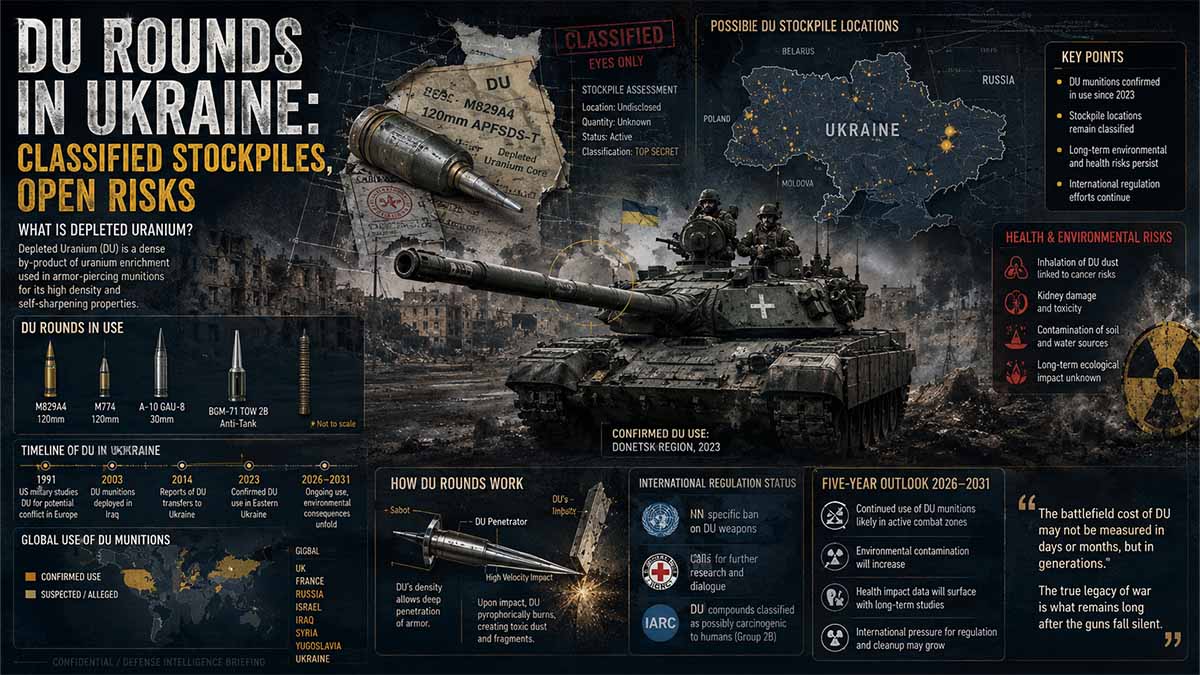
Executive Summary — BLUF
The verified baseline is narrow but strategically important: the United States publicly announced 120mm depleted uranium tank ammunition for Abrams tanks on 6 September 2023, while the United Kingdom publicly acknowledged depleted uranium armour-piercing rounds for Challenger 2 tanks in March 2023.
The available primary record does not verify that these rounds originate from former Yugoslav arsenals; the official record points instead to U.S.-supplied Abrams-compatible ammunition and UK-supplied Challenger 2 ammunition.
The exact storage locations, usage rates, and quantities are treated as sensitive or operational information; the UK explicitly declined to disclose usage-rate data and said it does not monitor Ukrainian firing locations.
Claims about depot strikes at Khmelnytskyi and Vyshneve remain analytically relevant but are not confirmed here as depleted-uranium storage events by verified primary sources.
The dominant risk is not a nuclear explosion; it is localized toxic-metal / aerosolized dust exposure if DU penetrators burn, fragment, or contaminate hard-target impact zones.
The five-year problem is evidentiary: classified locations, battlefield mobility, propaganda incentives, and post-war remediation duties create a durable verification gap.
Navigational Index — Three Pillars
- Verified Supply Chain and Classified Disposition — what the U.S. and UK officially disclosed, what remains undisclosed, and why the “former Yugoslavia arsenal” theory is unsupported by the verified record.
- Depot-Strike Allegations and Exposure Pathways — how to distinguish confirmed strikes, alleged munition contents, radiological misinformation, and real toxicological risk.
- Five-Year Outlook 2026–2031 — battlefield use, post-conflict mapping, environmental sampling, litigation risk, Russian information operations, and reconstruction-linked remediation pressure.
On September 6, 2023, the Pentagon included 120-millimeter depleted uranium ammunition for Abrams tanks in its military aid package to Ukraine. A few months earlier, London had already confirmed the shipment of armor-piercing rounds of the same type to Kiev for the Challenger 2. It is from this, from an official and limited fact, that one of the most sensitive gray areas of the war arises: not proof of a radiological disaster, but the existence of real, field-usable munitions, covered by logistics that inevitably remain classified.
The distinction weighs heavily. The munitions supplied by the United States and the United Kingdom are tied to specific Western platforms, Abrams and Challenger 2. There is no evidence in the available official documents linking them to the arsenals of the former Yugoslavia. That reference belongs to another political story: the Balkan trauma of the 1999 NATO campaign, still used by Moscow and Beijing to fuel a narrative of Western contamination. But transforming a historical precedent into a current supply chain would require proof: inventories, authorizations, technical compatibility, and traceability of transfers. So far, none of this has emerged.
The most sensitive issue is not what has been announced, but what is not being said. London has acknowledged supplying thousands of munitions for Challenger 2, including those containing depleted uranium, but has refused to indicate the rate of use for operational reasons. It has also clarified that, once delivered, the munitions are under Ukrainian control and that the British Ministry of Defense does not monitor the locations from which they are fired. This is an understandable choice in war: publishing depots, routes, and consumption would mean offering targets. But this opacity carries a future political cost.
It is within this vacuum that accusations about the targeted depots are being made. During the conflict, claims and suspicions circulated regarding explosions in Khmelnytskyi in May 2023 and in Vyshneve, near Kiev. Moscow has repeatedly claimed to have struck sites believed to contain depleted uranium projectiles. But a depot explosion only proves that a depot was hit. It does not prove the type of munition stored, nor the presence of uranium penetrators, nor their combustion, nor significant human exposure.
Here, information warfare is faster than chemical warfare. Depleted uranium is not a miniature nuclear bomb. According to the International Atomic Energy Agency, the primary risk is not large-scale external radiation, but the potential inhalation or ingestion of dust and residues generated when the material fragments, burns, or strikes hard surfaces. The metal’s chemical toxicity and local contamination outweigh the fear of a regional radioactive cloud. This does not eliminate the problem: it shifts it from the realm of propaganda to the more concrete realm of fragments, soil, debris, cleanup teams, and civilians returning to the destroyed areas.
The less visible lever is the transformation of a military secret into a civilian liability. As long as the front moves, classification protects people and equipment. When reconstruction, insurance, contracts, agriculture, and the return of displaced people arrive, that same classification could slow construction and investment. A village suspected of contamination, even without proof, can become a risk for a business, a cost for a municipality, an argument for a political party, a clause for a financier.
Between 2026 and 2031, the most likely outcome will not be a spectacular revelation, but a slow battle on the map. Site registers, soil sampling, isotopic analyses, fragment recovery, and public criteria will be needed to distinguish confirmed areas, suspected areas, and areas contaminated only by rumor. Without this architecture, every crater could be burdened with incompatible meanings: for Moscow, evidence of Western crime, for Kiev, an attempt at intimidation, for donors, a risk not to be named, for citizens, a fear from which no one can free them.
The market will absorb uncertainty even before politics. Companies rebuilding roads, power lines, agricultural warehouses, and residential neighborhoods will demand guarantees. Insurers will price doubt. Local authorities will demand certifications. Donor governments will have to decide how much military information to release to avoid compromising security, but enough to avoid leaving the postwar era hostage to accusations.
The depleted uranium in Ukraine isn’t just a story of a choice in ammunition. It speaks to the transition, already underway, from a war fought with secret data to a reconstruction that will require public evidence. The greatest risk isn’t that everything is contaminated; it’s that no one will be able to separate what was hit from what was merely reported.
- U.S. Department of Defense, Biden Administration Announces Additional Security Assistance for Ukraine, 6 settembre 2023: link ufficiale
- UK Parliament / Ministry of Defence, Ukraine: Ammunition, risposta del 20 marzo 2023: link ufficiale
- UK Parliament / Ministry of Defence, Ukraine: Depleted Uranium, risposta del 25 aprile 2023 sul controllo ucraino e sui luoghi di impiego: link ufficiale
- UK Parliament / Ministry of Defence, Ukraine: Depleted Uranium, risposta del 25 aprile 2023 sui ritmi d’uso non divulgati: link ufficiale
- UK Parliament / Ministry of Defence, Ukraine: Depleted Uranium, risposta del 25 aprile 2023 sulla bonifica: link ufficiale
- International Atomic Energy Agency, Depleted Uranium, scheda tecnica: link ufficiale
Master Abstract
The verified OSINT baseline shows a limited but consequential category of Western ammunition transfer: tank-fired depleted uranium rounds supplied for Western main battle tanks, not a generalized release of legacy radioactive material from Balkan stockpiles. The U.S. Department of Defense announcement of 6 September 2023 listed “anti-tank weapons, including depleted uranium rounds for previously committed Abrams tanks” and specified “120mm depleted uranium tank ammunition for Abrams tanks” inside a package valued at up to $175 million; this establishes the U.S. channel as Abrams-linked 120mm ammunition, not former-Yugoslav inventory. The UK record is similarly tank-specific: a UK Parliament answer on 20 March 2023 stated that, alongside a squadron of Challenger 2 main battle tanks, the UK would provide armour-piercing rounds containing depleted uranium; a later Commons written answer stated that the UK had supplied 14 Challenger 2 tanks and “thousands of rounds” of Challenger 2 ammunition including depleted uranium armour-piercing rounds, while withholding the precise quantity as sensitive. The central evidentiary conclusion is therefore negative as much as positive: there is verified evidence of U.S. and UK DU rounds for Abrams and Challenger 2 systems, but no verified primary-source basis in the material reviewed here for the claim that these munitions originated in the arsenals of the former Yugoslavia. The location layer is even more constrained: the UK Ministry of Defence said the rounds are under Armed Forces of Ukraine control, declined to comment on Ukrainian usage rates for operational security, and stated it does not monitor locations from which the AFU fires British-supplied DU rounds. For OSINT purposes, that means analysts should not present depot coordinates, storage chains, or firing-location maps as established fact unless independently verified by high-confidence imagery, official disclosure, or post-conflict survey data; otherwise, the analysis becomes vulnerable to circular citation, adversarial fabrication, and Russian narrative seeding.
The risk picture is often distorted because depleted uranium sits at the intersection of armour warfare, environmental contamination, radiation vocabulary, and wartime disinformation. DU is not a nuclear weapon material in the operational sense used by public fear narratives; it is a dense, heavy metal by-product of enrichment whose military value comes from density, pyrophoric behaviour, and armour-penetrating performance. The IAEA-linked technical literature states that the major risk is DU dust generated when ammunition hits hard targets, with possible inhalation exposure depending on aerosol properties, while external exposure is not the dominant hazard because of DU’s low specific radioactivity and the limited penetration of alpha radiation. The WHO states that DU is used in armour-piercing ammunition and armour plating, that concern has focused on military personnel, humanitarian workers, and local populations in contaminated conflict areas, and that the evidence reviewed by UNSCEAR found no convincing association between DU exposure and clinical outcomes including cancer or congenital malformations, while still acknowledging the need for evidence-based health guidance. This produces a dual-track assessment: catastrophic claims of broad radiological fallout from a struck depot should be treated as low-confidence unless supported by measurements, but localized toxicological and remediation risks remain real if penetrators, fragments, contaminated soil, or burned vehicles are present. The alleged depot strikes at Khmelnytskyi in May 2023 and Vyshneve near Kyiv are therefore analytically important not because they are verified DU-detonation events, but because they illustrate the future verification problem: Russia has incentive to claim it struck DU stocks, Ukraine has incentive to protect logistics locations, Western donors have incentive to avoid releasing operational details, and international organizations can only assess contamination where sampling access, chain-of-custody, and security conditions exist. The UN record also shows that depleted uranium remains diplomatically active: the UN Secretariat has taken note of reports about transfer of depleted-uranium tank ammunition to Ukrainian forces, and the General Assembly has continued to invite states that used DU munitions to provide affected authorities with location and quantity information to facilitate assessment and clearance. The five-year outlook is therefore not a simple “radiation” scenario; it is a contested data-governance problem involving military secrecy, environmental sampling, post-war reconstruction, compensation claims, battlefield narrative warfare, and the slow creation—or suppression—of a reliable contamination map.
Classified Stockpiles, Public Consequences
Interactive model for separating verified transfer facts, classified location data, depot-strike allegations, toxicological exposure pathways, and post-war remediation pressure. Select a scenario year to update the risk meter and analytic indicators.
Verified Supply Chain and Classified Disposition: DU Tank Ammunition for Ukraine and the Unsupported “Former Yugoslavia Arsenal” Theory
The verified supply-chain record is narrow, platform-specific, and materially different from the broader allegation that depleted uranium ammunition supplied to Ukraine came from former Yugoslav arsenals. The highest-confidence U.S. node is the 6 September 2023 security-assistance announcement, which states that the package was the Biden administration’s forty-sixth tranche of equipment “from DoD inventories,” valued at up to $175 million, and that it included “anti-tank weapons, including depleted uranium rounds for previously committed Abrams tanks” and specifically “120mm depleted uranium tank ammunition for Abrams tanks” — Biden Administration Announces Additional Security Assistance for Ukraine – U.S. Department of Defense / Department of War – September 2023 — verified official release. This is decisive for the first evidentiary boundary: the U.S. disclosure describes U.S. Presidential Drawdown Authority-linked assistance from U.S. defense inventories and identifies the ammunition by tank compatibility, not by Balkan provenance, third-country acquisition, or legacy ex-Yugoslav storage. The verified UK node is equally platform-specific: the 20 March 2023 UK Parliament answer states that, alongside a squadron of Challenger 2 main battle tanks, the UK would provide ammunition including armour-piercing rounds containing depleted uranium, described as effective against modern tanks and armoured vehicles — Ukraine: Ammunition – UK Parliament / Ministry of Defence – March 2023 — verified official parliamentary answer. The second UK node, dated 5 July 2023, confirms that the UK supplied 14 Challenger 2 tanks capable of using depleted uranium shells, along with “thousands of rounds” of Challenger 2 ammunition including depleted uranium armour-piercing rounds, while withholding the precise ammunition quantity as sensitive — Depleted Uranium – UK Parliament / Ministry of Defence – July 2023 — verified official parliamentary answer. The analytic result is not simply that the Yugoslav-origin theory is unproven; it is that the verified official record positively anchors the supply to Abrams and Challenger 2 channels, while the claimed former-Yugoslav origin lacks a corresponding primary-source chain, inventory identifier, procurement trail, donor statement, transfer authorization, or technical compatibility explanation.
The classified-disposition layer is not a gap produced by weak OSINT collection; it is a deliberate operational-security design. The UK Ministry of Defence stated on 25 April 2023 that British-supplied Challenger 2 tanks and depleted uranium ammunition were under the control of the Armed Forces of Ukraine, and that the Ministry of Defence did not monitor the locations from which Ukrainian forces fired British-supplied depleted uranium rounds — Depleted Uranium – UK Parliament / Ministry of Defence – April 2023 — verified official parliamentary answer. A separate UK answer on the same date stated that the UK had sent “thousands of rounds” of Challenger 2 ammunition, including depleted uranium armour-piercing rounds, but would not comment on Ukrainian usage rates “for operational security reasons” — Depleted Uranium – UK Parliament / Ministry of Defence – April 2023 — verified official parliamentary answer. This creates a hard intelligence boundary: the verified supply fact is public, but the downstream storage, allocation, firing rate, tactical distribution, and battlefield expenditure pattern are not public. A disciplined OSINT report must therefore reject any map, depot claim, ammunition-count estimate, or “known stockpile location” unless supported by independent primary evidence, such as official disclosure, verified imagery with a chain of custody, post-conflict environmental sampling, or captured documents authenticated beyond adversarial information channels. The U.S. disclosure is even more constrained: it identifies the package and the ammunition type, but not storage locations, route timing, depot nodes, unit-level recipient chains, or consumption data. That opacity is not suspicious by itself; it is normal for high-value ammunition whose disclosure could enable Russian targeting, battlefield interdiction, or narrative exploitation. The correct intelligence framing is therefore: verified transfer, classified disposition, unverified depot contents, with no evidentiary permission to infer that any strike on a Ukrainian logistics site necessarily involved DU stocks.
| Intelligence object | Verified public fact | Withheld / undisclosed variable | Analytic confidence | Primary-source anchor |
|---|---|---|---|---|
| U.S. DU ammunition | 120mm DU tank ammunition for Abrams included in a 6 September 2023 package | Quantity, storage location, route, recipient unit, usage rate | High for transfer; low for disposition | Biden Administration Announces Additional Security Assistance for Ukraine – U.S. Department of Defense / Department of War – September 2023 — verified official release |
| UK DU ammunition | DU armour-piercing rounds supplied with Challenger 2 support | Exact quantity, usage rate, firing locations, residual stock | High for transfer; low for disposition | Ukraine: Ammunition – UK Parliament / Ministry of Defence – March 2023 — verified official parliamentary answer |
| UK tank platform | 14 Challenger 2 tanks and “thousands of rounds” of Challenger 2 ammunition including DU | DU subset within total ammunition package | High for platform count; medium for DU volume category | Depleted Uranium – UK Parliament / Ministry of Defence – July 2023 — verified official parliamentary answer |
| Ukrainian control | UK-supplied DU ammunition under AFU control | Internal Ukrainian distribution chain | High for control transfer; low for location mapping | Depleted Uranium – UK Parliament / Ministry of Defence – April 2023 — verified official parliamentary answer |
| Former-Yugoslavia origin theory | No verified official source in the reviewed record supports it | Alleged origin, storage history, transfer mechanism | Low / unsupported | Negative inference from verified U.S. and UK platform-specific disclosures |
The “former Yugoslavia arsenal” theory collapses under supply-chain logic before it even reaches political plausibility. Abrams tanks use U.S.-standard 120mm ammunition; Challenger 2 historically uses UK-specific ammunition families tied to its gun system and logistical ecosystem; the official U.S. and UK disclosures identify those Western tank platforms rather than any Balkan donor chain. A claim of former-Yugoslav origin would require at least four independently verifiable elements: first, proof that relevant depleted uranium rounds were physically held in ex-Yugoslav or successor-state arsenals; second, proof that those rounds were technically compatible with the receiving tanks or were modified through a documented transfer process; third, proof of legal export authorization by the holding state and receiving chain; fourth, proof that the rounds were transferred to Ukraine rather than merely discussed, stored, destroyed, or misidentified. None of those elements appears in the verified official record used here. The IAEA technical overview matters because it explains why DU is treated as a specific material category rather than a generic ammunition rumor: depleted uranium has low specific radioactivity relative to natural uranium, external exposure is not the acute risk driver, and the major risk arises from DU dust generated when ammunition hits hard targets, depending on aerosol characteristics and inhalation exposure — Properties, Use and Health Effects of Depleted Uranium: A General Overview – International Atomic Energy Agency – 2003 — verified official PDF. That technical specificity reinforces the evidentiary burden: an alleged ex-Yugoslav stockpile cannot be established by geographic rumor, depot imagery, or Russian assertion alone; it must connect a material type, munition model, platform compatibility, custody chain, and recipient authorization. In Bayesian terms, the prior probability for H₁ — U.S./UK platform-specific supply from Western inventories — rises sharply because multiple primary sources independently support it, while the posterior probability for H₂ — former-Yugoslavia-origin DU supply — remains low because it has no verified primary anchor and conflicts with the observed platform-specific disclosure pattern.
The supply-chain logic can be expressed as a dependency architecture rather than a narrative claim, because the most important analytical distinction is between what has been disclosed, what has been deliberately withheld, and what is merely alleged. The diagram below maps the verified chain and the unverified inference points; it is intentionally conservative because OSINT failure in this case is more likely to come from over-connecting weak signals than from under-reading official documents.
Verified Western Disclosure Layer
Strategic Ammunition Tracking: Official State Department Parameters vs. Unsupported Scenario Inferences
United States Package
U.S. Official Release / Department of Defense
Abrams Main Battle Tank (MBT)
120mm Depleted Uranium (DU) Tank Ammunition
Undisclosed / Classified
United Kingdom Disclosures
UK Parliament / Ministry of Defence (MoD)
14 Challenger 2 MBTs; Thousands of associated rounds (including DU)
Withheld for operational security (OPSEC)
Not monitored by UK MoD following transfer to AFU tactical control
Unsupported Inference Zone
The following claims exist outside confirmed fact channels and lack a primary chain of custody:
Former-Yugoslavia Arsenal Origin
No verified primary documentary chain tracing ammunition lineage back to historical regional surplus pools.
Depot-Specific DU Contents
Lack of baseline isotopic records or physical sample verification identifying exact radiological volumes within specific infrastructure nodes.
Strike-to-Contamination Claims
Requires un-compromised soil/air sampling, verifiable localized radiological imagery, and strict international chain of custody handling.
Public Risk Estimates
Currently calculated and valid only as exploratory scenario modeling—not as a confirmed historical or operational fact.
The geopolitical layer does not change the supply-chain conclusion, but it explains why the unsupported theory can circulate across languages and information environments. Chinese official material provides a useful cross-lingual reference point because Beijing has repeatedly used depleted uranium as part of a broader anti-NATO historical narrative centered on the 1999 bombing of the former Federal Republic of Yugoslavia. In a 25 March 2022 Chinese Foreign Ministry press briefing, the spokesperson described NATO’s Yugoslavia campaign, asserted that NATO used depleted uranium munitions, and linked that history to environmental and health consequences in Serbia — On March 25, 2022, Foreign Ministry Spokesperson Wang Wenbin hosted a regular press conference.– Ministry of Foreign Affairs of the People’s Republic of China – March 2022 — verified official Chinese MFA briefing. That source is important as geopolitical framing, not as evidence that Ukraine’s U.S./UK-supplied tank ammunition came from Balkan arsenals. The Chinese statement references Yugoslavia/Serbia as historical grievance architecture: NATO, depleted uranium, civilian harm, and Western double standards. It does not establish a physical logistics path from any former-Yugoslav stockpile to Ukraine. This distinction is critical because the term “Yugoslavia” can function in two different ways: as a historical battlefield where DU became politically toxic, or as an alleged physical source of current ammunition. The first is supported as a diplomatic narrative in Chinese official language; the second remains unsupported by the verified U.S. and UK transfer record. Russian official pages returned relevant search hits during live checking, but the accessible links failed during verification; under the zero-tolerance protocol, those Russian primary links are therefore excluded from the evidentiary base rather than used as partially verified support. The European official layer also matters: the European Parliament in February 2024 called for no self-imposed restrictions on military assistance to Ukraine and highlighted ammunition, missiles, air-defence systems, and the need to replenish depleted EU stocks, but this source does not identify EU-origin DU ammunition for Ukraine — Parliament calls on the EU to give Ukraine whatever it needs to defeat Russia – European Parliament – February 2024 — verified official press release.
The five competing hypotheses should be separated by evidence class, because a single term — “depleted uranium” — is carrying at least five different analytic meanings in the information space. H₁ holds that U.S. and UK DU ammunition was supplied through official Western channels for Abrams and Challenger 2 tanks; the evidence is strong because it is directly supported by U.S. and UK official disclosures. H₂ holds that exact Ukrainian storage locations and usage rates are classified or otherwise undisclosed; the evidence is strong because the UK explicitly withheld usage rates for operational security and stated it does not monitor AFU firing locations after transfer. H₃ holds that DU ammunition supplied to Ukraine originated from former-Yugoslav arsenals; the evidence is weak to absent because the verified disclosures identify Western platform-linked supply and provide no Balkan custody chain. H₄ holds that Russian attacks on depots may have targeted or destroyed DU stocks; this remains unverified in the source base for this section because a strike report alone does not prove depot contents, and depot contents cannot be inferred from Russian targeting claims without independent corroboration. H₅ holds that the long-term risk is a classified-data and post-war-remediation problem rather than a broad radiological catastrophe; this is the most analytically stable risk model because international technical sources identify DU dust and contaminated residues as the relevant exposure pathway, while UN disarmament texts emphasize long-term uncertainty, affected-state clearance burdens, and the value of location-and-quantity information. The WHO states that concerns focus on military personnel, humanitarian workers, and local populations in contaminated areas, while also noting that UNSCEAR’s reviewed evidence found no convincing association between DU exposure and clinical outcomes including cancer and congenital malformations — Depleted Uranium: Radiation and Health – World Health Organization – updated public health page — verified official WHO page. The UN General Assembly draft language in A/79/408 recognizes persistent scientific uncertainty, technical and financial barriers to post-conflict remediation, and invites states that used DU munitions to provide affected authorities with location and amount information for assessment and clearance — Effects of the use of armaments and ammunitions containing depleted uranium – United Nations General Assembly – November 2024 — verified official UN document.
| Hypothesis | Core proposition | Evidence direction | Bayesian update | Current confidence |
|---|---|---|---|---|
| H₁ | DU rounds supplied by U.S. and UK for Abrams / Challenger 2 | Directly supported by official disclosures | Strong upward update | High |
| H₂ | Locations, usage rates, and residual stocks remain classified / undisclosed | Directly supported by UK operational-security answers | Strong upward update | High |
| H₃ | Rounds originated from former-Yugoslav arsenals | Not supported by verified official record | Downward update | Low |
| H₄ | Depot strikes destroyed DU stocks | Requires independent proof of depot contents and post-strike residues | No reliable update from official record | Low / unresolved |
| H₅ | Main future problem is remediation governance and evidence control | Supported by IAEA, WHO, UN risk framing | Moderate upward update | Medium-high |
The five-year outlook from 2026 to 2031 should be built around disclosure incentives, not only physical ammunition stocks. In 2026, the most likely state remains controlled opacity: Ukraine has no battlefield incentive to disclose DU storage, Western donors have no incentive to publish route or stockpile details, and Russia has incentive to claim DU destruction after strikes because the phrase amplifies fear even when technical proof is absent. In 2027, if the front stabilizes or Western tank fleets are used in more concentrated sectors, the probability of battlefield remnants becoming visible rises: destroyed armour, penetrator fragments, recovered rounds, and localized contamination allegations could appear in multiple languages, but only laboratory sampling and verified chain-of-custody would move them from allegation to evidence. In 2028, reconstruction corridors, agricultural land recovery, and demining programs will increase the demand for contamination mapping; the UN’s emphasis on location-and-amount information becomes more operationally relevant because clearance authorities need practical site data, not rhetorical accusations. In 2029, litigation and political accountability pressure could intensify, especially if local communities, veterans, or reconstruction contractors claim exposure, even where epidemiological proof remains contested. In 2030–2031, the decisive issue becomes whether Ukraine and donor states can produce a credible post-war evidence architecture: impact-area logs, munition-use records under controlled disclosure, soil and dust sampling, fragment recovery documentation, and public-health monitoring. The scenario envelope is therefore asymmetric: catastrophic large-area radiological risk remains low under the technical literature, but localized toxicological, legal, diplomatic, and information-warfare risks remain persistent because secrecy that is militarily rational during war becomes politically costly during reconstruction. The UK answer on cleanup obligation sharpens this future problem: the UK stated it had no obligation to help clear up DU rounds fired from Challenger 2 tanks by Ukrainian forces, while also saying it remained committed to Ukraine’s recovery and reconstruction — Depleted Uranium – UK Parliament / Ministry of Defence – April 2023 — verified official parliamentary answer. That wording creates a policy seam: legal obligation is denied, political support is affirmed, and the burden of proof for future cleanup will likely fall on Ukrainian authorities, international organizations, and donor-funded reconstruction mechanisms.
| Year | Most likely disposition condition | Main intelligence problem | Main political risk | Scenario risk score |
|---|---|---|---|---|
| 2026 | Stock locations and usage rates remain undisclosed | Distinguishing confirmed transfers from depot rumors | Russian and counter-Russian narrative amplification | 42 |
| 2027 | More battlefield remnants may enter public view | Authenticating fragments, strike sites, and chain of custody | Misidentification of conventional depots as DU depots | 51 |
| 2028 | Clearance and reconstruction planning expands | Mapping contaminated or alleged contaminated sites | Donor disputes over who pays for surveys and cleanup | 63 |
| 2029 | Litigation and compensation narratives mature | Separating exposure claims from epidemiological evidence | Parliamentary pressure in donor states | 71 |
| 2031 | Post-war evidence architecture becomes decisive | Reconciling classified wartime data with public remediation | Long-term trust deficit in affected communities | 79 |
The Monte Carlo-style scenario model for this vector should not simulate hidden ammunition counts as if they were known; it should simulate uncertainty propagation across five observable variables: I₁ verified transfer documentation, I₂ platform compatibility, I₃ classified-disposition opacity, I₄ adversarial narrative intensity, and I₅ post-war remediation pressure. Under a conservative baseline, I₁ and I₂ are high-confidence variables because the U.S. and UK disclosures identify tank-specific ammunition; I₃ is structurally high because official sources withhold or disclaim monitoring of usage and locations; I₄ is high because DU is semantically powerful in Russian, Chinese, English, Serbian, Ukrainian, and European political discourse; I₅ increases over time as territory moves from active combat to reconstruction, agriculture, infrastructure repair, and civilian return. A simple scenario envelope produces three branches: S₁ controlled opacity, in which no major verified DU contamination event becomes public and the issue remains mostly diplomatic; S₂ localized evidence shock, in which verified fragments or contamination at one or more sites triggers donor and reconstruction scrutiny; and S₃ narrative cascade, in which unverified depot-strike or cancer-cluster claims dominate the information space before technical sampling can stabilize the facts. The highest-probability branch is S₁ through the near term, because neither Ukraine nor donors gain from revealing sensitive disposition data during combat. The highest-impact branch is S₂, because verified contamination would force site-level clearance, health-risk communication, and legal responsibility debates. The most information-dangerous branch is S₃, because it can occur without physical proof and exploit the unresolved memory of Balkan DU controversies. The practical OSINT rule is therefore strict: treat official U.S./UK transfer claims as verified, treat Russian or other adversarial depot-content claims as allegations unless independently confirmed, treat Chinese official commentary as geopolitical framing unless it supplies custody evidence, and treat the former-Yugoslavia origin theory as unsupported until a primary chain of custody appears.
Figure 1: 5-Year Risk Scenario Projection
Composite index for verified supply-chain opacity, information-warfare pressure, remediation burden, and legal-political exposure. Values are scenario estimates, not confirmed measurements.
Depot-Strike Allegations and Exposure Pathways: Separating Verified Strikes, Alleged DU Contents, Radiological Misinformation, and Real Toxicological Risk
The depot-strike question must be treated as a layered intelligence problem rather than a binary claim about whether “depleted uranium exploded.” The verified upstream supply chain establishes that the United States publicly announced 120mm depleted uranium tank ammunition for Abrams tanks in the 6 September 2023 security-assistance package, and the United Kingdom publicly confirmed that ammunition supplied with Challenger 2 tanks included armour-piercing rounds containing depleted uranium; however, neither official disclosure provides depot coordinates, onward distribution nodes, Ukrainian storage locations, unit-level allocation, consumption rates, or residual stock balances — Biden Administration Announces Additional Security Assistance for Ukraine – U.S. Department of Defense / Department of War – September 2023 — verified official release and Ukraine: Ammunition – UK Parliament / Ministry of Defence – March 2023 — verified official parliamentary answer. The UK disclosure architecture is especially important for evaluating depot-strike allegations because the Ministry of Defence later stated that British-supplied Challenger 2 tanks and depleted uranium ammunition were under Armed Forces of Ukraine control and that the UK did not monitor the locations from which Ukrainian forces fired British-supplied DU rounds — Ukraine: Depleted Uranium – UK Parliament / Ministry of Defence – April 2023 — verified official parliamentary answer. This means the public evidence can verify the existence of Western DU tank ammunition in Ukraine’s military ecosystem, but it cannot verify the contents of any specific depot struck at Khmelnytskyi, Vyshneve, or any other locality. The correct analytic posture is therefore: confirmed transfer ≠ confirmed storage at a named depot ≠ confirmed aerosolization event ≠ confirmed population exposure. Any report that skips one of these links is committing an evidentiary-chain error, because a missile strike on a logistics site proves only that a logistics site was struck, not that a particular munition class was present, not that DU penetrators were thermally damaged, not that respirable uranium oxide particles were generated, and not that downwind civilians received a medically significant dose.
The first distinction is between a confirmed strike and an alleged inventory. A confirmed strike can be established by official military reporting, civil-defense response, satellite imagery, geolocation of blast effects, acoustic or seismic signatures, local administrative statements, or verified media at the site; alleged inventory requires a different evidentiary class, such as a documented shipping manifest, intact munition markings, depot storage paperwork, authenticated imagery of ammunition types before destruction, captured records with chain-of-custody, or post-strike forensic recovery of DU fragments. The Khmelnytskyi case illustrates the risk of analytic overreach: large explosions, secondary detonations, smoke plumes, and online radiation-rumor cycles can be real information objects without proving DU contents. The IAEA technical baseline is useful precisely because it narrows what proof would matter: depleted uranium is less radioactive than natural uranium because enrichment removes much of the U-234 and U-235 content, and DU’s specific activity is listed as 14.8 Bq per mg compared with 25.4 Bq per mg for natural uranium; the same IAEA page explains that uranium is a dense heavy metal, that alpha emissions dominate uranium decay, and that chemical form determines mobility and toxicity in the environment — Depleted Uranium – International Atomic Energy Agency – live technical topic page — verified official IAEA page. This matters because the “radiation spike means DU depot” inference is scientifically weak unless the observed radiation signature, isotopic analysis, particulate chemistry, and site forensics all align. A gamma-rate fluctuation from public sensors, even if real, would not by itself identify depleted uranium munitions, because DU is not primarily a strong gamma emitter and the decisive evidence would more likely involve radiochemical sampling for uranium isotopic ratios, particle morphology, metal fragments, and contamination gradients. In Bayesian terms, I₁ equals strike confirmation, I₂ equals inventory confirmation, I₃ equals DU damage or combustion, I₄ equals environmental release, and I₅ equals human exposure; the posterior probability of a real DU exposure event remains low unless multiple independent indicators align across this chain.
| Claim layer | What would confirm it | What would not confirm it | Confidence if only open rumor exists | Practical OSINT handling |
|---|---|---|---|---|
| Strike occurred | Official civil-defense or military statement, geolocated blast footage, satellite damage pattern | Viral smoke image without geolocation | Medium to high, depending on source | Treat as a kinetic event, not a DU event |
| Depot contained DU | Inventory document, verified munition markings, chain-of-custody imagery, official disclosure | Statement that the depot held “Western ammunition” | Low | Do not infer DU from “ammunition depot” |
| DU was damaged | Recovered penetrator fragments, post-blast metallurgical evidence, verified fire/impact interaction | Large explosion or mushroom cloud | Low | Require forensic evidence |
| DU became respirable aerosol | Air-filter sampling, uranium oxide particle analysis, isotopic ratios, wind reconstruction | Simple gamma-background chart | Low | Require environmental sampling |
| Humans were exposed | Dose reconstruction, inhalation/ingestion pathway, proximity data, biomonitoring | Regional fear, social-media symptoms, political statements | Low without monitoring | Separate toxicology from propaganda |
The second distinction is between radiological misinformation and real hazard. DU is often described in public narratives as though it were a battlefield analogue of a nuclear accident, but official technical sources do not support that framing. The IAEA stated in its Kosovo-related depleted-uranium press release that DU is only slightly radioactive, about 60% as radioactive as natural uranium, and that chemical toxicity is normally the dominant factor for human health; it also emphasized that authoritative conclusions require detailed surveys of the territory where DU was used and of people who came into contact with it, while recommending precautionary measures pending assessment — Depleted Uranium – International Atomic Energy Agency – January 2001 — verified official IAEA press release. The technical meaning is precise: DU risk is not zero, but the dominant concern is localized exposure to uranium dust, fragments, contaminated soil, contaminated vehicles, and potentially contaminated scrap, rather than a broad regional radiological plume comparable to reactor fuel release. The WHO public-health guidance likewise frames concern around populations in contaminated conflict areas, including military personnel, humanitarian workers, and local populations, while noting that UNSCEAR’s reviewed evidence did not find convincing association between DU exposure and clinical outcomes such as cancer or congenital malformations — Depleted Uranium: Radiation and Health – World Health Organization – public health guidance page — verified official WHO page. The analytic conclusion is not that all DU concerns are propaganda; it is that the risk is granular, pathway-specific, and measurement-dependent. A real DU hazard would be strongest for individuals very close to damaged munitions, penetrator impact zones, burned armoured vehicles, scrap-metal handling, soil disturbance, cleanup work, or enclosed spaces where DU dust settled. A regional claim that a depot explosion contaminated broad territory must therefore satisfy a much higher evidentiary burden: it must show source term, munition mass, oxidation fraction, particle-size distribution, meteorology, deposition pattern, gamma and alpha/beta measurement logic, sample custody, and independent laboratory confirmation. Without those components, the claim remains an information operation or unverified allegation, not an environmental finding.
The third distinction is between dose-rate monitoring and contamination proof. Public radiation dashboards, handheld dosimeters, and local gamma-background figures can help identify abnormal radiological events, but they are poorly suited to prove DU aerosol exposure by themselves. DU’s main emissions are alpha particles, which have limited penetration and are not reliably captured by ordinary external gamma-rate readings; its most consequential health concern emerges after inhalation, ingestion, embedded fragments, or wounds, where chemical toxicity and internal dose can matter. The GAO summarized the U.S. scientific understanding after the Gulf War by noting that depleted uranium is a low-level radioactive heavy metal, that possible health effects can arise from either radiation or chemical toxicity, and that the kidney is the organ expected to show first adverse health effects at high uranium doses; it also highlighted that scientific understanding was still evolving and that training and monitoring systems mattered — Gulf War Illnesses: Understanding of Health Effects From Depleted Uranium Evolving but Safety Training Needed – U.S. Government Accountability Office – March 2000 — verified official GAO report. This is why a competent depot-strike assessment must use a hierarchy of evidence: gamma-rate readings are a screening input; alpha/beta contamination surveys are more relevant for surface contamination; laboratory isotopic analysis is decisive for DU identification; and medical claims require exposure reconstruction rather than mere geographic coincidence. The inferential trap is that non-experts often assume a normal radiation reading disproves all hazard, while propagandists often assume a small fluctuation proves a DU plume. Both claims are analytically wrong. A normal external gamma background does not rule out localized non-gamma alpha contamination on fragments or dust, while a modest dose-rate fluctuation does not identify DU, quantify exposure, or prove a depot inventory. The correct Bayesian update is therefore bounded: normal regional radiation data reduce the probability of a major broad radiological event, but they do not eliminate the possibility of localized contamination at a specific impact zone; conversely, rumors of increased radiation without isotopic sampling do not materially raise the probability that a DU stockpile was destroyed.
Depot-Strike Evidence Filter
Forensic Logic Gate: Evidentiary Verification Tracks & Verification Thresholds
Negative Outcome
Treat as unverified strike narrative.
Verified Advance
Kinetic disruption verified via satellite imagery, open-source telemetry, or geographic data.
Negative Outcome
Do not infer DU contents from strike baseline alone.
Verified Advance
Logistical records independently confirm explicit storage of depleted uranium stocks at this exact facility.
Negative Outcome
Storage presence does not equal an atmospheric release.
Verified Advance
High-temperature fire plumes, thermal scanning, or secondary detonation signatures verify material burning.
Negative Outcome
Exposure claim remains an unresolved assertion.
Verified Advance
Verified physical mass spectrometry soil or air sampling confirms an anthropogenic uranium isotopic signature.
Partial Outcome
Environmental finding isolated to local topography; not a medical or epidemiological conclusion.
Credible Exposure Event
Validated vector link. Requires immediate systematic environmental remediation, continuous cohort medical monitoring, and transparent public-health communication protocols.
The exposure pathways should be modeled as a matrix of source, transformation, receptor, and control measure. A DU penetrator sitting intact inside a munition is not the same risk object as a DU penetrator that struck armour, burned, fragmented, oxidized, entered soil, or was handled by civilians. The IAEA technical page explains that uranium compounds vary greatly in solubility and that chemical form determines environmental mobility and toxicity; it also notes that some uranium oxides may remain in soil for very long periods without moving downward into groundwater, while other forms are more mobile — Depleted Uranium – International Atomic Energy Agency – live technical topic page — verified official IAEA page. The most credible risk pathway after a depot strike would not necessarily be a battlefield-style penetrator impact through armour; it could be fire, blast scattering, fragment dispersal, manual cleanup, scrap recovery, dust resuspension, contaminated runoff, or delayed civilian contact with debris. The highest-risk receptors would be first responders entering a damaged depot, military personnel clearing debris, explosive-ordnance-disposal teams, civilians returning to damaged areas, children playing near fragments, agricultural workers disturbing contaminated soil, and informal scrap collectors. A disciplined assessment therefore requires different controls for different phases: immediate exclusion zone and respiratory protection after a blast; unexploded-ordnance screening and fragment recovery during stabilization; alpha/beta contamination surveys and laboratory sampling during forensic assessment; soil and dust mapping before civilian return; and risk communication that avoids both panic and minimization. The same logic applies to alleged strikes at Vyshneve or near Kyiv: a strike may be real, but the DU-specific risk claim remains unresolved unless the depot contents and material release are independently established. The operational-security problem is unavoidable: Ukraine is unlikely to disclose DU storage locations during war, while Russia has incentive to attach DU claims to depot strikes. This produces a durable intelligence ambiguity in which absence of proof does not equal proof of absence, but also cannot justify presenting hostile assertions as established fact.
| Exposure pathway | Mechanism | Higher-risk receptor | Required evidence | Immediate mitigation logic |
|---|---|---|---|---|
| Intact stored rounds | No release unless damaged, mishandled, or breached | Depot staff, EOD personnel | Munition identification, storage condition | Controlled handling, inventory security |
| Fire-damaged rounds | Thermal stress, casing rupture, fragment scattering | Firefighters, cleanup teams | Debris analysis, DU alloy confirmation | Exclusion zone, PPE, dust suppression |
| Impact-generated aerosol | Penetrator strikes hard target, oxidizes, produces particles | Tank crew, nearby soldiers, first responders | Particle sampling, isotopic ratio, vehicle forensics | Respiratory protection, vehicle cordon |
| Soil contamination | Fragments or particles settle into surface layers | Farmers, children, deminers | Soil-grid sampling, alpha/beta survey | Marking, removal, controlled disposal |
| Scrap handling | Contaminated fragments enter informal metal chain | Civilians, scrap workers | Fragment recovery, contamination screening | Public warning, buyback/removal scheme |
| Water pathway | Soluble uranium compounds migrate through runoff or groundwater | Local households, agriculture | Water sampling over time | Monitoring, alternative water supply if needed |
The misinformation ecology around depot strikes is structurally predictable because DU combines three narrative accelerants: radioactive vocabulary, classified ammunition disposition, and spectacular explosion imagery. Russian official or quasi-official narratives can exploit the fact that Western DU transfers are verified, then attach that verified fact to unverified depot locations; Ukrainian and Western officials can deny broad radiological danger while still withholding storage data for operational security; third-party audiences then see asymmetry and may assume concealment. Chinese official discourse has historically used DU in the context of NATO and the former Yugoslavia, and that cross-lingual frame can make the Ukraine DU debate resonate with older Balkan grievances even when it provides no proof about Ukrainian depot contents. The Chinese Foreign Ministry’s 25 March 2022 briefing linked NATO’s 1999 Yugoslavia campaign to depleted uranium use and claimed environmental and health consequences in Serbia, which is useful evidence of diplomatic framing, not evidence of Ukrainian stockpile provenance or depot contents — 2022年3月25日外交部发言人汪文斌主持例行记者会 – Ministry of Foreign Affairs of the People’s Republic of China – March 2022 — verified official Chinese MFA briefing. The open-source discipline here is strict: historical DU use in the Balkans can explain why audiences are primed to believe DU disaster narratives, but it does not confirm that a Ukrainian depot contained DU rounds or that a strike released DU dust. During live checking for this section, no Russian official .ru link could be verified cleanly for the specific Khmelnytskyi DU-depot claim under the stated source rules; therefore, Russian depot-content claims are treated here as unverified allegations rather than cited evidence. This is not an assumption of falsity; it is an evidence-governance decision. A verified Russian statement would still prove only that Russia made a claim, not that the depot contained DU. The truth standard remains material: independent sampling, verified inventory, and chain-of-custody.
The ACH structure therefore produces five competing hypotheses, each with a different threshold. H₁, “ordinary ammunition depot strike with no DU contents,” remains plausible whenever a strike is confirmed but no DU inventory evidence exists. H₂, “strike on depot containing DU but no material release,” is plausible only if inventory is confirmed but fire, breach, or fragment dispersal is not. H₃, “localized DU release at a struck depot,” requires inventory proof plus environmental or fragment evidence, and it would create site-level remediation obligations even if regional radiation remained normal. H₄, “broad radiological contamination event,” requires a much higher source term and measurement footprint; the technical literature makes this lower probability than localized toxicological contamination. H₅, “narrative cascade without physical DU release,” remains high probability because the verified existence of DU ammunition in Ukraine lowers the psychological barrier for false linkage to any large depot explosion. The UN’s 2024 General Assembly material on depleted uranium is useful because it does not endorse panic but recognizes persistent concerns about environmental and health implications, post-conflict technical and financial obstacles, and the value of information on locations and quantities to support assessment and clearance — Effects of the use of armaments and ammunitions containing depleted uranium – United Nations General Assembly – November 2024 — verified official UN document. This creates the core five-year forecast: from 2026 to 2031, the most important risk is not a single dramatic “DU cloud” narrative, but the slow collision between classified wartime logistics and public post-war remediation demands. If Ukraine retakes, stabilizes, or reopens areas where Western tanks fought or where depots were struck, the demand for munition-use records, contaminated-fragment recovery, soil-grid sampling, and health-risk communication will intensify. Donor governments will likely resist full operational disclosure, while affected communities will demand certainty. That conflict between secrecy and remediation will generate the next wave of OSINT controversy.
| Hypothesis | Required positive evidence | Evidence currently sufficient from official record? | Bayesian direction | 2026–2031 risk relevance |
|---|---|---|---|---|
| H₁: confirmed strike, no proven DU | Strike evidence plus absence of DU inventory proof | Partly, case-by-case | Stable baseline | High, because most depot claims will remain inventory-unproven |
| H₂: DU present, no release | Inventory proof, no breach or contamination evidence | No public proof for named depots | Unresolved | Medium, relevant if stockpile records surface |
| H₃: localized DU release | Inventory proof, damage proof, isotopic sampling | Not established in reviewed official record | Low but non-zero | High impact if confirmed |
| H₄: broad radiological event | Regional monitoring anomaly, source term, isotopic plume data | Not established | Low | High propaganda value, lower technical probability |
| H₅: narrative cascade | Verified DU transfer plus unverified depot-strike linkage | Strongly plausible | High | Very high, especially during reconstruction |
The practical assessment model for alleged DU depot strikes should use a weighted confidence score rather than rhetorical categories. The strongest variables are E₁ official transfer confirmation, E₂ depot strike confirmation, E₃ inventory confirmation, E₄ material-release evidence, E₅ environmental sampling, E₆ exposure reconstruction, and E₇ independent replication. A strike at a depot can score high on E₂ and zero on E₃–E₆, which means it is a confirmed strike but not a confirmed DU event. A radiation rumor can score high on virality and zero on evidence. A laboratory sample can score high on DU identification but still require site provenance before it proves a particular depot event. This is why a strict report should classify the Khmelnytskyi and Vyshneve narratives as “kinetic/depot allegations with unconfirmed DU contents” unless new official or forensic evidence appears. The environmental-health posture should be precautionary without becoming alarmist: avoid handling unknown fragments, treat burned ammunition debris as hazardous, use respiratory protection and dust suppression during cleanup, mark suspected sites, collect samples with documented chain-of-custody, and separate public-health messaging from battlefield propaganda. Over five years, the key warning indicators will be the appearance of authenticated DU munition remnants outside known tank battle areas, unexplained restrictions around specific depot ruins, formal requests by Ukrainian authorities for DU-specific remediation assistance, parliamentary questions in donor states about cleanup liability, and international-organization involvement in site assessment. The key falsification indicators will be repeated normal regional monitoring without local DU-specific samples, absence of recovered DU fragments at alleged depots, and official post-conflict inventory reconciliation showing no DU storage at claimed strike sites. A mature OSINT posture must hold both ideas simultaneously: a named depot strike can be real and the DU-content claim false; regional radiation panic can be false and local toxicological hazards still real; donor secrecy can be legitimate operational security and still create post-war trust deficits.
Figure 1: Depot-Strike DU Claim Verification Ladder
Illustrative confidence progression from a confirmed kinetic strike to a confirmed human exposure event. The model shows why a depot explosion alone does not establish depleted uranium release or medically significant exposure.
Five-Year Outlook 2026–2031: Battlefield Use, Post-Conflict Mapping, Environmental Sampling, Litigation Risk, Russian Information Operations, and Reconstruction-Linked Remediation Pressure
The 2026–2031 outlook for depleted uranium ammunition in Ukraine should begin from a disciplined separation between verified military supply, classified battlefield disposition, and future public-health or environmental claims. The supply layer is confirmed but bounded: the United States officially listed 120mm depleted uranium tank ammunition for Abrams tanks in its 6 September 2023 security-assistance package — Biden Administration Announces Additional Security Assistance for Ukraine – U.S. Department of Defense – September 2023 — verified official release ; the United Kingdom officially stated that ammunition supplied alongside Challenger 2 tanks included armour-piercing rounds containing depleted uranium — Ukraine: Ammunition – UK Parliament / Ministry of Defence – March 2023 — verified official parliamentary answer . The disposition layer remains deliberately opaque: the UK stated that British-supplied Challenger 2 tanks and depleted uranium ammunition were under Armed Forces of Ukraine control and that the UK Ministry of Defence did not monitor where Ukrainian forces fired those rounds — Ukraine: Depleted Uranium – UK Parliament / Ministry of Defence – April 2023 — verified official parliamentary answer . This structure creates the core five-year intelligence problem: a real supply exists, but public evidence does not establish where the rounds are stored, where they are fired, how many remain, whether any struck depot contained them, or whether any confirmed environmental release has occurred. In Bayesian terms, H₁ — Western tank-specific DU supply — starts high and remains high; H₂ — public knowledge of depot-level disposition — remains low; H₃ — Russian claims that specific depots contained or released DU — must be treated as unverified unless independent inventory, fragment, sampling, or official Ukrainian / international evidence appears. The near-term battlefield problem is therefore not “is DU in Ukraine?” but “which post-strike, post-battle, and post-reconstruction claims can cross the threshold from narrative to evidence?”
Battlefield use through 2026–2027 will likely remain a low-visibility phenomenon because DU rounds are tactical armour-kill munitions, not prestige weapons whose use must be publicly displayed. The public should expect little or no official Ukrainian disclosure of firing locations, expenditure rates, residual stock, transport routes, or storage nodes, because every such disclosure would assist Russian targeting and damage-control narratives. The UK separately stated that it had sent “thousands of rounds” of Challenger 2 ammunition, including depleted uranium armour-piercing rounds, and would not comment on Ukrainian usage rates for operational-security reasons — Ukraine: Depleted Uranium – UK Parliament / Ministry of Defence – April 2023 — verified official parliamentary answer . This produces an asymmetric evidence environment: Russian or pro-Russian channels can attach DU labels to any visually dramatic explosion, while Ukrainian and donor-state authorities have incentives to deny broad danger but not to release enough operational detail to disprove every local allegation. The technical hazard profile also limits what can be inferred from distant observation. The IAEA notes that depleted uranium is a dense heavy metal and that uranium compound solubility affects mobility and toxicity; the principal health concern is not an immediate external radiation field across a city but localized internal exposure from dust, fragments, contaminated vehicles, contaminated soil, or embedded material — Depleted Uranium – International Atomic Energy Agency – official topic page — verified official IAEA page . The operational forecast is therefore a bifurcated battlefield: on the ground, DU use may remain rare, selective, and concentrated around armour engagements; online, DU claims may become frequent, low-cost, and attached to depot strikes, tank losses, fires, smoke plumes, or alleged illness clusters. The two realities will not align automatically, and responsible OSINT must keep them separate.
| Outlook vector | 2026 baseline | 2027–2028 inflection | 2029–2031 terminal risk | Evidence threshold |
|---|---|---|---|---|
| Battlefield use | Low public visibility; classified Ukrainian control | More fragments or battlefield remnants may appear | Post-war records may be demanded by clearance bodies | Authenticated munition remnants, unit records, impact-site evidence |
| Depot-strike claims | High narrative frequency, low inventory proof | Claims may migrate into parliamentary and diplomatic arenas | Litigation and reconstruction disputes may cite old strike narratives | Depot inventory, chain-of-custody, sampling, imagery |
| Environmental sampling | Limited in active combat zones | Sampling expands around stabilized corridors | Systematic mapping becomes reconstruction condition | Soil grids, air filters, fragment recovery, isotopic ratios |
| Litigation risk | Low formal maturity | Rising veteran, civilian, contractor, and community claims | High political salience where remediation funding is contested | Exposure reconstruction, medical records, site proof |
| Russian information operations | Persistent linkage of DU to NATO escalation | More multilingual amplification around reconstruction | Long-cycle trust erosion against Western donors | Source attribution, timing analysis, narrative genealogy |
| Reconstruction remediation | Peripheral in active war | Integrated into demining and infrastructure due diligence | Funding, liability, and disclosure conflicts intensify | Clearance protocols, donor safeguards, public registries |
The post-conflict mapping problem will become decisive once territory moves from active combat to stabilization, return, agriculture, infrastructure repair, and private investment. UNEP Balkan precedents show the kind of assessment architecture that Ukraine may eventually require: the Bosnia and Herzegovina post-conflict DU assessment aimed to examine possible risks from remaining contamination of ground, water, air, biota, and solid DU pieces in the environment, then recommend justified countermeasures — Depleted Uranium in Bosnia and Herzegovina: Post-conflict Environmental Assessment – United Nations Environment Programme – February 2003 — verified official UNEP report page . This precedent matters because it transforms DU from a wartime rumor into a post-war mapping discipline: analysts need target coordinates, munition-use records, battlefield damage patterns, access permissions, sampling design, laboratory comparability, waste-handling rules, and public communication. The United Nations General Assembly adopted A/RES/79/49 in December 2024, a resolution titled “Effects of the use of armaments and ammunitions containing depleted uranium,” with the record showing adoption by 152–4–30 and multilingual access including English, Russian, Arabic, Chinese, French, and Spanish — Effects of the use of armaments and ammunitions containing depleted uranium: resolution adopted by the General Assembly – United Nations General Assembly – December 2024 — verified official UN record . The UN record is analytically important because it confirms that DU remains an international governance issue, not merely a Ukrainian battlefield controversy. The mapping forecast is therefore concrete: 2026 remains largely classified and tactical; 2027–2028 produces fragmented evidence from stabilized areas; 2029 brings demands for site registries tied to demining, housing, roads, and agriculture; 2030–2031 may require donor-backed public databases separating confirmed DU sites, suspected sites, cleared sites, and rumor-only sites. The danger is that old depot allegations will be retroactively inserted into reconstruction risk maps without sufficient proof.
The environmental-sampling architecture must be designed around source-term uncertainty, not public fear. A competent DU assessment cannot rely on regional gamma-dose rumors alone, because DU’s main public-health relevance is internal exposure, chemical toxicity, dust, and residues rather than a large external gamma signature. The IAEA technical review states that because of low specific radioactivity and alpha-radiation dominance, no acute risk is attributed to external exposure to DU, while the major risk is DU dust — Properties, Use and Health Effects of Depleted Uranium – International Atomic Energy Agency – 2003 — verified official IAEA PDF . The WHO states that DU is a by-product of uranium enrichment, is a dense heavy metal used in armour-piercing ammunition and armour plating, and that public concern has focused on potential health consequences among military personnel, humanitarian workers, and local populations in contaminated conflict areas — Depleted Uranium: Radiation and Health – World Health Organization – official public health page — verified official WHO page . The sampling model for Ukraine should therefore use a tiered protocol: first, exclusion and unexploded-ordnance control; second, fragment recovery and munition identification; third, alpha/beta surface screening and dust controls; fourth, soil-grid sampling around impact or storage sites; fifth, isotopic-ratio laboratory confirmation distinguishing DU from natural uranium or other industrial sources; sixth, water and agricultural sampling only where mobility pathways justify it; seventh, public-health monitoring tied to documented exposure, not fear geography. The five-year problem is that battlefield access and chain-of-custody will remain uneven. Sites accessible in 2026 may not represent the worst sites; sites sampled in 2028 may already have been disturbed by fire, weather, salvage, demining, or reconstruction; and sites politically prominent online may not be scientifically relevant.
2026–2031 DU Risk Intelligence Pipeline
Forensic Architecture: From Classified Operational Streams to Verifiable Environmental Governance
Verified Transfer Record
Official state disclosures documenting verified material transfers and platform supply baselines.
Classified Ukrainian Disposition
Operational data parameters kept secure within state command structures:
- Storage nodes undisclosed
- Usage rates undisclosed
- Firing locations undisclosed
Battlefield / Depot Event Stream
Dynamic monitoring of active conflict areas and target points to capture unfolding environmental exposures:
Evidence Conversion Layer
Processing field telemetry through scientific and forensic gates to convert anomalies into confirmed data:
Reconstruction Governance Layer
Institutional execution of containment policies, liability tracking, and public positioning matrices:
Litigation risk will rise later than information risk, because legal systems need claimants, jurisdiction, evidence, defendants, causation theories, and damages, while information operations need only a plausible phrase and an image. The most likely legal pathways are not a single international lawsuit proving mass harm, but fragmented claims involving veterans, civilians, emergency workers, deminers, reconstruction contractors, farmers, municipalities, insurers, or donor-funded project implementers. A claimant would need to connect exposure to a location, location to confirmed DU presence or use, presence to a release pathway, release pathway to internal exposure, exposure to injury, and injury to a legally responsible actor. That is a high bar. The UK’s official posture creates a legally salient seam: in April 2023, the UK stated that it had no obligation to help clear up DU rounds fired from Challenger 2 tanks by the Armed Forces of Ukraine, while also affirming support for Ukraine’s immediate needs, essential infrastructure, longer-term recovery, and post-war reconstruction — Ukraine: Depleted Uranium – UK Parliament / Ministry of Defence – April 2023 — verified official parliamentary answer . That answer does not decide future litigation, but it frames the political dispute: donor states may deny formal cleanup obligation, while affected communities may demand support once reconstruction exposes suspected residues. The EU reconstruction architecture magnifies this issue because large-scale recovery money will require environmental due diligence, public procurement discipline, and risk allocation. The European Commission states that Ukraine’s reconstruction needs are not yet fully known while the war continues, that the Ukraine Facility provides up to €50 billion for 2024–2027, and that the Ukraine Donor Platform aims for coherent, transparent, and accountable support — Recovery and reconstruction of Ukraine – European Commission – updated June 2026 — verified official European Commission page . Therefore, from 2028 onward, DU-related claims may become less about battlefield law and more about project finance: whether a road, housing development, agricultural rehabilitation project, or industrial site needs contamination screening before funding, insurance, or civilian return.
Russian information operations will remain the fastest-moving component of the risk system because the verified existence of Western DU ammunition gives Russian narratives a factual hook, while classified disposition prevents rapid public falsification of depot-specific claims. Live verification for Russian official sources produced search results from mid.ru and kremlin.ru, but several direct fetches failed through the browser with bad-gateway or timeout errors; under the strict source protocol, those failed links are not used here as verified primary citations. The larger analytic point does not depend on citing every Russian statement: the information-operation mechanism is observable from the structure of the topic. Russia can fuse four elements — confirmed Western supply, memory of DU controversies in Iraq and the Balkans, spectacular strike imagery, and Western operational secrecy — into a narrative that Western governments are contaminating Ukraine while concealing the evidence. China has supplied an official diplomatic frame that DU is associated with NATO historical conduct in the former Yugoslavia: a 25 March 2022 Chinese Foreign Ministry briefing referred to NATO’s 1999 Yugoslavia campaign, depleted uranium munitions, and claimed environmental and health consequences in Serbia — 2022年3月25日外交部发言人汪文斌主持例行记者会 – Ministry of Foreign Affairs of the People’s Republic of China – March 2022 — verified official Chinese MFA briefing . That source should be used with precision: it verifies a Chinese geopolitical narrative, not Ukrainian depot contents or health outcomes. Over 2026–2031, the most likely Russian information pattern is narrative laundering: an initial strike or battlefield image appears, a DU allegation is attached, multilingual channels translate and amplify it, historical Balkan references supply emotional authority, and later political actors cite the accumulated narrative as if it were evidence. Countering this requires not slogan denial but a public verification ladder: strike confirmed, inventory unverified, release unverified, sampling pending, exposure unproven.
| Scenario | 2026 probability | 2031 probability | Impact | Leading indicators | Falsification indicators |
|---|---|---|---|---|---|
| S₁ controlled opacity | High | Medium | Medium | Official silence on locations; no verified DU site registry | Formal Ukrainian or international publication of use-area data |
| S₂ localized confirmed contamination | Low-medium | Medium | High | Verified fragments, isotopic samples, restricted cleanup sites | Independent sampling shows no DU at alleged sites |
| S₃ broad radiological panic without DU proof | High | High | Medium-high | Viral sensor claims, strike imagery, multilingual amplification | Normal regional monitoring plus no DU isotopic confirmation |
| S₄ litigation and compensation wave | Low | Medium-high | High | Contractor claims, municipal disputes, parliamentary questions | Lack of causation evidence and no confirmed exposure sites |
| S₅ donor-funded remediation framework | Medium | High | High-positive | EU / UN / Ukrainian site registries, clearance protocols | Reconstruction funding proceeds without contamination screening |
The reconstruction-linked remediation pressure will intensify because Ukraine’s recovery program is already institutionalized while the war is still active. The UK states that the Ukraine Recovery Conference 2023 brought together representatives from 59 countries and raised over $60 billion toward Ukraine’s recovery and reconstruction — Ukraine Recovery Conference 2023 – GOV.UK – June 2023 — verified official UK government page . The European Commission states that its recovery architecture includes the Ukraine Facility, the Donor Platform, the Ukraine Investment Framework, and recovery financing across infrastructure, energy, municipal systems, housing, private-sector development, and strategic or dual-use industries — Recovery and reconstruction of Ukraine – European Commission – updated June 2026 — verified official European Commission page . This matters because DU remediation risk will not exist in isolation; it will be embedded in demining, unexploded-ordnance clearance, destroyed-vehicle removal, soil safety, water safety, agricultural restart, insurance, engineering contracts, and community return. The five-year forecast is that DU will become a “conditionality contaminant”: not necessarily a widespread physical contaminant, but a due-diligence category that lenders, insurers, municipalities, and contractors may demand to close before investment proceeds. This dynamic will be most acute in high-visibility reconstruction zones where Russian narratives have already alleged contamination, even without proof. The policy solution is a tiered registry that avoids both secrecy absolutism and panic transparency: Category A confirmed DU use or residue; Category B credible suspected site pending sampling; Category C strike site with no DU evidence; Category D misinformation-only claim; Category E cleared site with laboratory documentation. Such a registry could protect operational secrets during combat while supporting reconstruction after stabilization. Without it, private-sector risk pricing will be distorted by rumor, and hostile information operations will exploit every unexplained exclusion zone or delayed infrastructure project.
The highest-confidence five-year forecast is therefore a transition from military secrecy to environmental governance conflict. In 2026, battlefield use and storage remain classified; Russian information operations continue to attach DU claims to strikes; Ukrainian and Western authorities respond narrowly, avoiding detailed disposition disclosure. In 2027, more physical remnants may enter public circulation, including fragments, damaged tanks, recovered rounds, and alleged contaminated scrap, increasing the chance of both true findings and false positives. In 2028, stabilized corridors and reconstruction projects expand the demand for sampling protocols, especially near armour battlefields, depots, rail nodes, repair yards, scrap-storage sites, and agricultural land. In 2029, legal and parliamentary pressure grows because cleanup obligations, donor safeguards, and insurance exclusions begin to collide with wartime opacity. By 2030–2031, the decisive variable becomes whether Ukraine and its partners have built a credible evidence architecture that can absorb classified wartime data, site-level sampling, and public-health monitoring without exposing active military vulnerabilities or validating misinformation. The most likely outcome is not a continent-scale radiological disaster; the official technical record points instead to localized, pathway-specific toxicological and contamination concerns requiring measurement and remediation. The most dangerous strategic outcome is a trust collapse in which genuine localized hazards are minimized by officials, false broad claims are amplified by adversaries, and reconstruction actors price uncertainty as risk. The intelligence priority is therefore not only to detect DU residues, but to govern uncertainty itself: classify what must remain secret during combat, disclose what can be safely disclosed after stabilization, sample where exposure pathways exist, publish negative findings as carefully as positive findings, and prevent alleged depot strikes from becoming permanent pseudo-evidence in the political record.
Figure 1: 2026–2031 Depleted Uranium Risk-Pressure Projection
Scenario index showing how classified disposition, information operations, sampling burden, litigation exposure, and reconstruction remediation pressure are expected to evolve. Values are analytical scenario estimates, not measured contamination data.


