














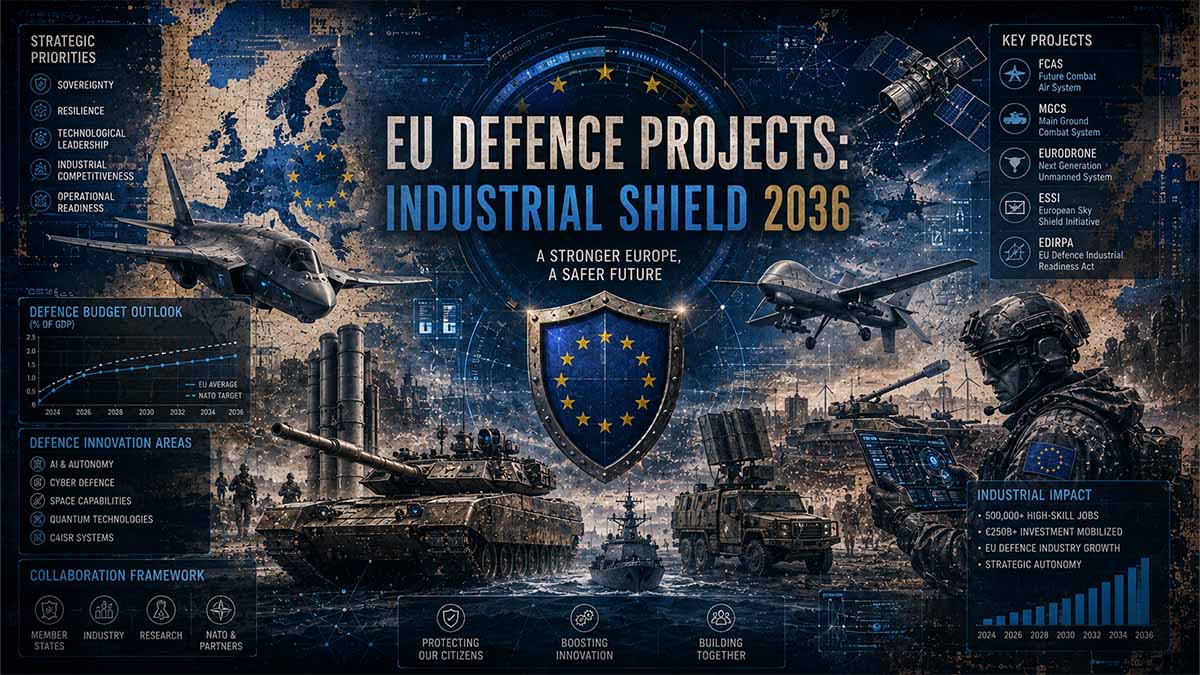
Executive Summary – Europe’s Defence Bet Is Industrial, Not Symbolic
The European Commission’s proposal for the first European Defence Projects of Common Interest looks, at first glance, like another Brussels defence initiative: five large projects, several acronyms, a modest initial envelope, and a long list of ambitions. It is not. The concrete figure is small compared with the declared horizon: €325 million under the €1.5 billion European Defence Industry Programme to start projects that, according to the Commission, point toward a combined funding ambition of about €190 billion by 2036. The gap between those numbers is the real story. Europe is not funding a shield today. It is trying to build the machinery that could one day finance, manufacture and deploy one.
The five priorities say more than the official language admits. Drones and counter-drone systems, maritime and seabed defence, space capabilities, air and missile defence, and the Eastern Flank Watch are not separate files. They form a single map of European exposure. The low sky is crowded by cheap drones. The seabed carries cables, pipelines and energy infrastructure. Space supplies warning, communications and navigation. Air defence decides whether cities, ports, depots and troop movements can survive missile pressure. The eastern border turns all of this into geography: Poland, the Baltic states, Finland and Romania are no longer peripheral security consumers, but the physical line where European deterrence is tested.
The Commission is also changing its language. For years, the EU spoke most comfortably about regulation, sanctions, competition rules and market access. Now it is speaking about production capacity, common procurement, industrial readiness and military supply. That shift matters because the weakness of European defence has rarely been intellectual. The gaps have been material: too few interceptors, too little ammunition, fragmented procurement, incompatible systems, slow factories, thin stockpiles and national habits that turn common strategy into parallel shopping lists.
EDIP is the seed, not the engine. SAFE, with loans of up to €150 billion for defence investment, is the larger financial tool. The possible European Competitiveness Fund could later provide the multiannual bridge. Yet money alone does not create force. It can accelerate orders, but it cannot instantly produce rocket motors, explosives, sensors, secure software, batteries, semiconductors, satellite resilience, naval platforms or trained operators. The hidden constraint is industrial time. Political urgency is immediate; production capacity moves more slowly.
That is why Poland becomes central. Eastern Flank Watch is not just a border project. It is where the entire stack must become usable: drones for surveillance and interception, space for warning, air defence for infrastructure, cyber security for command systems, and military mobility for reinforcement. Poland gains leverage because geography has become an industrial argument. The frontline state can no longer be treated only as a recipient of reassurance. It becomes a customer, a production base, a logistics corridor and a political pressure point inside the European defence economy.
Ukraine is the second accelerator. Its participation in four of the five projects gives Europe access to the most current battlefield laboratory in the world: drone saturation, electronic warfare, rapid repair, low-cost adaptation, missile attacks on infrastructure and air-defence attrition. But there is a difference between learning from Ukraine and absorbing Ukraine’s methods. If Ukrainian firms and engineers are placed inside European work packages, Europe gains speed. If Ukraine remains only a beneficiary of support, the learning loop narrows and the EU loses one of the few advantages it has over slower procurement cycles.
NATO remains the test of seriousness. A European air and missile shield that does not plug into NATO command, early warning and track-sharing architecture would be politically impressive and operationally weak. The same applies to seabed defence and space. The EU can finance and organise industry; NATO remains the military framework through which deterrence is made credible. The strongest version of the European plan therefore does not compete with NATO. It fills the factory, logistics and procurement gaps that NATO planning has exposed.
Russia will read this differently. Moscow’s official messaging already frames European defence expansion as militarisation. That narrative should not be accepted at face value, but it signals the pressure environment in which the projects will develop. The likely response is not only diplomatic protest. It is more likely to appear through cyber operations, interference against infrastructure, GPS disruption, pressure on borders, procurement intelligence and information campaigns designed to split frontline states from more distant capitals.
The risk for Europe is not that nothing happens. The risk is that spending rises without integration. A continent can buy more weapons and still fail to build a force package if systems do not share data, stockpiles are too small, maintenance is national, software is insecure and training remains fragmented. The useful measure will not be the size of the announced ambition, but the number of deployable units, common standards, replenishable supplies and NATO-compatible interfaces delivered by 2028 and 2029.
Europe has identified the right gaps. That is progress, but not yet power. Power begins when the factory, the sensor, the missile battery, the drone operator and the railway corridor work as one system under pressure. Until then, the new European shield is still a promise written in industrial ink.
Navigational Index
Pillar I — Capability Architecture
Drones/counter-drones, maritime and seabed defence, space, air and missile defence, and eastern-flank security as one interconnected European defence stack.
Pillar II — Industrial and Financial Logic
EDIP seed funding, possible European Competitiveness Fund follow-on financing, SAFE loans, joint procurement, production scaling, and supply-chain sovereignty.
Pillar III — Five-Year Strategic Outlook
Poland, Ukraine, NATO complementarity, Russian signalling, procurement risk, industrial bottlenecks, and the probability that Europe moves from declarations to usable force packages.
Master Abstract
The Commission’s proposal for five European Defence Projects of Common Interest should be read as a structural attempt to move the EU from fragmented procurement coordination toward large capability blocs designed around shared threat vectors, cross-border industrial production, and long-cycle military investment. The Commission states that the five EDPCIs cover drones and counter-drone systems, maritime and seabed defence, space, air and missile defence, and security along the EU’s eastern flank; it also states that the projects respond to a call for expressions of interest from Member States and are meant for initiatives too large or too complex for single states to develop alone. That matters because the proposed architecture no longer treats European defence as a set of disconnected budget lines, but as an integrated system of sensors, interceptors, platforms, space services, counter-drone layers, seabed awareness, mobility corridors, and industrial surge capacity. The first-order evidence is the Commission’s 3 July 2026 announcement, which specifies €325 million allocated under the €1.5 billion European Defence Industry Programme to support establishment and deployment, notes average participation of 18 Member States per project, confirms that Ukraine participates in four of the five projects, and records Commissioner Andrius Kubilius’s statement that the combined funding ambition is around €190 billion by 2036. Commission proposes five joint defence projects to strengthen Europe’s industrial capabilities – European Commission – July 2026 — verified source. The EDIP architecture itself is not speculative: the Commission describes EDIP as a €1.5 billion EU-wide initiative to modernise Europe’s defence industry, ramp up production capacity, secure cutting-edge technology, and maintain steady supply of military equipment, with a dedicated €300 million Ukraine Support Instrument aimed at recovery, reconstruction, modernisation, and integration of Ukraine’s defence industrial base into the European defence technological and industrial base. EDIP | Forging Europe’s Defence – European Commission – 2026 — verified source. The Bayesian baseline for the five-year outlook is therefore not whether Europe will “discuss” common defence, but whether a small EU-level establishment tranche can coordinate national and EU instruments into procurement pathways strong enough to overcome legacy fragmentation, divergent national requirements, export-control sensitivities, and production bottlenecks before the 2031 horizon.
The capability map shows a hard prioritisation of Europe’s most exposed seams. The drone and counter-drone project, DronE and Counter Drone European Resolve, is designed to provide modern, adaptable, scalable, interoperable drone and counter-drone systems across all domains, with indicative participant investment of €3.5–5 billion by 2033. Factsheet-DronE-Counter-Drone European Resolve – European Commission – July 2026 — verified source. The maritime line, Integrated Maritime and Seabed Defence, aims to establish a federated and interoperable maritime and seabed defence architecture to prevent, detect, deter, and respond to maritime-domain threats, with indicative investment of €43–72 billion by 2045. Factsheet-Integrated Maritime and Seabed Defence – European Commission – July 2026 — verified source. The space line seeks to reinforce European space-based early warning, satellite communications, intelligence, surveillance and reconnaissance, space-domain awareness, positioning, navigation and timing, navigation warfare, responsive space systems, and multi-mission capabilities, with indicative investment of €24 billion by 2034. Factsheet on Space – European Commission – July 2026 — verified source. The air and missile defence project, EU Federated Integrated Air and Missile Defence including Early Warning, targets a collective and effective integrated air and missile defence system, with indicative investment of €55–80 billion by 2040. Factsheet-EU Federated Integrated Air and Missile Defence including Early Warning – European Commission – July 2026 — verified source. The eastern-flank line, Eastern Flank Watch, aims to enhance security of the EU’s eastern border, protect the entire EU territory, and strengthen Union defence readiness through a comprehensive multi-domain effort, with indicative investment of €60–100 billion by 2036. Factsheet-Eastern Flank Watch – European Commission – July 2026 — verified source. A five-year analytic forecast should therefore model the EDPCIs not as five separate programmes but as one layered deterrence architecture: H₁ drone saturation and counter-UAS defence; H₂ seabed and maritime infrastructure protection; H₃ space-enabled ISR and warning; H₄ integrated air/missile defence; H₅ eastern-flank surveillance, mobility, and resilience.
The five-year outlook is probabilistic rather than declaratory. My initial Bayesian update assigns the highest probability to a partial-convergence scenario: the EDPCIs become a coordination and acceleration layer for selected procurement clusters, especially counter-drone systems, air-defence enablers, ISR, and border-security infrastructure, but they do not fully erase national procurement fragmentation by 2031. Prior probability for meaningful EU defence-industrial consolidation before the proposal is assessed at 0.38 because of long-standing fragmentation, national industrial protection, budget-cycle mismatch, and the difficulty of harmonising military requirements; after the Commission’s formal proposal, the €325 million EDIP establishment allocation, the average 18-state participation, Ukraine’s participation in four projects, the possible future role of the European Competitiveness Fund, and the separate SAFE loan instrument raise the posterior probability to approximately 0.56 for visible programme-level consolidation by 2031, but only 0.31 for fully fielded, interoperable, operationally decisive capabilities across all five lines by that date. The funding ecosystem is broader than EDIP alone: the Commission describes SAFE as a mechanism providing up to €150 billion in competitively priced, long-maturity loans for Member States requesting defence-investment support, including priority areas such as ammunition, missiles, small drones, anti-drone systems, critical infrastructure protection, cyber, military mobility, air and missile defence, maritime surface and underwater capabilities, larger drones, strategic enablers, space assets, AI, and electronic warfare. SAFE | Security Action for Europe – European Commission – 2026 — verified source. The future budget vector is also material: the Commission’s 2028–2034 budget proposal states that the defence and space window of the European Competitiveness Fund would allocate €131 billion to defence, security, and space, while the military mobility strand of the Connecting Europe Facility would be multiplied tenfold. EU budget 2028–2034 – European Commission – 2026 — verified source. NATO context reinforces the logic but also constrains duplication: NATO states that its maritime posture covers deterrence and defence, crisis prevention, and cooperative security, and highlights Baltic Sentry, critical undersea infrastructure protection, and multi-domain maritime vigilance after sabotage risks in the Baltic Sea. NATO’s maritime activities – NATO – March 2025 — verified source. Russian official diplomatic framing, meanwhile, treats EU defence expansion through the language of “militarisation,” which should be treated not as neutral evidence of EU intent but as a signalling input for escalation-risk modelling and information-operations assessment. The EU’s militarisation – Mission of the Russian Federation to the European Union – November 2025 — verified source.
EDPCI Strategic Risk Codex
Capability Nodes
Drones / Counter-UAS
Fastest operational payoff: scalable drone and counter-drone systems can absorb Ukrainian battlefield learning, but standardisation, electronic-warfare hardening, and ammunition supply determine whether mass becomes usable capability.
Execution Variables
Pillar I — Capability Architecture: Europe’s Interconnected Defence Stack
The first European Defence Projects of Common Interest should be interpreted as a capability architecture rather than a procurement catalogue: the Commission is not merely sequencing five projects, but defining a layered defence stack in which drones and counter-drone systems supply the tactical edge, maritime and seabed defence protects strategic infrastructure, space provides early warning and persistent sensing, air and missile defence supplies the high-end shield, and Eastern Flank Watch converts these layers into a territorial deterrence posture along the EU’s most exposed border with Russia and Belarus. The Commission’s own formulation places the five priority areas inside one industrial logic: drones and counter-drone systems, maritime and seabed defence, space, air and missile defence, and the security of the eastern flank are identified as major initiatives too large or complex for individual countries to develop alone, with EUR 325 million allocated under the EUR 1.5 billion European Defence Industry Programme to support establishment and deployment, not full lifecycle financing. Commission proposes five joint defence projects to strengthen Europe’s industrial capabilities – European Commission – July 2026 — verified source. This distinction is decisive because the stack will succeed only if the seed layer produces interoperable programmes, common technical requirements, shared sensor interfaces, secure data exchange, and a procurement rhythm that compresses the gap between political declaration and fielded capability. The Commission’s EDIP page confirms that EDPCIs are open to Norway and Ukraine, aligned with EU and NATO capability priorities, and positioned for potential continuation under the future EU Multiannual Financial Framework, which means the first five-year test is not whether Brussels can announce ambition, but whether it can federate national ministries, defence primes, SMEs, space operators, cyber authorities, border agencies, and Ukrainian battlefield feedback into usable force packages. EDIP | Forging Europe’s Defence – European Commission – July 2026 — verified source. The analytic baseline therefore treats the stack as a system of five interacting hypotheses: H₁ drone mass and counter-UAS survivability, H₂ maritime and seabed resilience, H₃ space-enabled early warning and ISR, H₄ federated air and missile defence, and H₅ eastern-flank multi-domain readiness.
| Stack layer | Core operational function | Indicative participant investment | Five-year maturity expectation | Principal bottleneck |
|---|---|---|---|---|
| H₁ Drones / Counter-UAS | Tactical mass, detection, interception, EW resistance | EUR 3.5–5 billion by 2033 | Fastest practical deployment | Standards, EW-hardening, attritable supply |
| H₂ Maritime / Seabed | Critical underwater infrastructure defence | EUR 43–72 billion by 2045 | Slow but strategically vital | Jurisdiction, sensors, naval availability |
| H₃ Space | Early warning, SATCOM, ISR, SDA, PNT resilience | EUR 24 billion by 2034 | Medium-fast if dual-use assets integrate | Secure data fusion and launch resilience |
| H₄ Air / Missile Defence | Interceptor layer, C₂, radar, early warning | EUR 55–80 billion by 2040 | High-impact but slow fielding | Interceptor scarcity and national fire-control sovereignty |
| H₅ Eastern Flank Watch | Border security, mobility, ISR, infrastructure protection | EUR 60–100 billion by 2036 | Politically decisive by 2031 | Cross-border command logic and sustained funding |
The drone and counter-drone layer is the shortest-cycle component of the architecture because it can absorb Ukrainian operational learning faster than naval, space, or missile-defence programmes, but it is also the layer most vulnerable to technological obsolescence, electronic warfare adaptation, and procurement fragmentation. The Commission’s DECODER factsheet defines the purpose as providing European armed forces with modern, adaptable, scalable, interoperable drone and counter-drone systems operating across all domains, with indicative participant investment of EUR 3.5–5 billion by 2033. Factsheet on DronE and Counter Drone European Resolve – European Commission – July 2026 — verified source. In five-year terms, this layer should be modelled as the leading indicator for whether EDPCIs can escape the classical European defence failure mode: sophisticated concepts, excellent prototypes, but insufficient quantity, slow replenishment, incompatible national variants, and inadequate software-defined update cycles. A credible H₁ pathway requires common radio-frequency libraries, modular payload standards, secure datalinks, AI-assisted detection pipelines, distributed production, and rapid integration of counter-UAS kill chains that combine radar, electro-optical sensors, passive RF detection, jamming, spoofing, directed-energy experiments, kinetic interceptors, and low-cost autonomous interceptors. The most important shadow dimension is the liquidity of battlefield feedback: Ukrainian participation in four of five projects creates a potential learning loop, but the loop will fail if knowledge transfer becomes episodic, classified beyond industrial use, or trapped inside bilateral arrangements that do not produce EU-wide technical baselines. The second shadow dimension is cyber-norm erosion: drone swarms depend on software, GNSS integrity, radio-spectrum control, and machine-vision models, making the drone layer vulnerable not only to kinetic defeat but to data poisoning, firmware compromise, supply-chain implants, and adversarial electronic attack. The posterior estimate for meaningful H₁ field impact by 2031 is therefore higher than the rest of the stack, approximately 0.68, but the estimate drops to 0.44 for true interoperability across participating states unless the Commission forces common architecture rules early.
Drone / Counter-UAS Kill Chain Dependency Map
Asymmetric Defence Engineering: Layered Interdiction Vectors & Material Sustainment Mechanics
Passive RF Sensing
Non-emitting intercept of unmanned system command signals, telemetry streams, and video downlinks across contested frequencies.
Radar / EO-IR / Acoustic Fusion
Multi-spectral algorithmic data blending to resolve micro-UAS signatures against complex environmental clutter.
Space or Airborne Cueing
Early-warning orbital tracking or long-endurance aerial reconnaissance delivering target hand-off data to localized tactical cells.
AI-Assisted Object Recognition
Edge-computed neural networks evaluating target profiles, kinematics, and payload configurations to categorize specific threat groups.
Friendly / Hostile / Unknown Logic
Automated identification matrix checking blue-force tracking links, transponders, and flight routing behaviors.
EW Environment Scoring
Dynamic assessment of localized electronic warfare interference, background spectrum utilization, and jamming efficacy.
Jamming / Spoofing / Cyber Effect
Disruption of GNSS signals, command link injection, and terminal takeover protocols targeting internal autopilot loops.
Kinetic Interceptor
Deployment of low-cost counter-drones, net-guns, or guided ammunition arrays to physically neutralize incoming threat systems.
Directed-Energy / Hard-Kill Node
Concentrated high-energy lasers (HEL) or high-power microwave (HPM) systems to fracture composite airframes and fry internal circuits instantly.
Mobile SHORAD Integration
Vehicle-mounted short-range air defense links tying sensors and weapon arrays into unified battlefield command architectures.
Attritable Production
High-volume, low-cost assembly lines prioritized to outpace target attrition rates, minimizing dependence on specialized tooling pools.
Battery / Motor / Sensor Supply Chain
Diversified global procurement channels managing critical materials, commercial rare-earth components, and specialized semiconductor imports.
Software Update Cycle
Rapid software revision pipelines delivering continuous updates to counter threat navigation adjustments and electronic defense patches.
Battlefield Feedback from Ukraine
Direct ingestion of frontline telemetry, dynamic EW adaptations, and tactical data to drive continuous upgrades of physical systems.
The maritime and seabed layer is slower, more expensive, and more institutionally complex than drones, but it is essential because Europe’s defence readiness depends on underwater cables, energy links, ports, LNG infrastructure, offshore wind networks, naval logistics, and Baltic-to-Atlantic maritime mobility. The Commission’s Integrated Maritime and Seabed Defence factsheet describes the project as establishing a federated and interoperable European maritime and seabed defence architecture to prevent, detect, deter, and respond to threats across the maritime domain, with indicative participant investment of EUR 43–72 billion by 2045. Factsheet on Integrated Maritime and Seabed Defence – European Commission – July 2026 — verified source. This is not a narrow naval programme; it is a cross-domain infrastructure-security architecture requiring acoustic sensing, unmanned underwater vehicles, seabed mapping, patrol vessels, maritime patrol aircraft, satellite cueing, legal attribution tools, port security, commercial operator integration, and rapid repair capacity. NATO’s maritime activity framework already emphasises deterrence and defence, crisis prevention, cooperative security, Baltic Sentry, and critical undersea infrastructure protection, so the EDPCI maritime layer must complement Alliance posture rather than create a parallel bureaucratic domain. NATO’s maritime activities – NATO – March 2025 — verified source. The five-year probability for visible maritime gains is lower than drones because the asset base is capital intensive and jurisdictionally fragmented: Member States control navies, coast guards, intelligence services, telecom regulators, energy regulators, and port authorities through different legal channels. The operational risk is that Europe builds awareness dashboards without response authority; the strategic requirement is to connect underwater anomaly detection to accountable command decisions, repair mobilisation, sanctions attribution, and naval or coast-guard deployment. The Bayesian posterior for meaningful H₂ improvement by 2031 is approximately 0.46, but the probability of a mature seabed defence architecture across the Baltic, North Sea, Mediterranean, and Atlantic corridors by 2031 remains closer to 0.27, because the problem is less about sensing alone and more about cross-border command, liability, classification, and private-infrastructure integration.
The space layer functions as the nervous system of the entire defence stack because it supplies early warning, satellite communications, intelligence, surveillance and reconnaissance, space-domain awareness, positioning, navigation and timing resilience, navigation warfare countermeasures, and responsive space options. The Commission’s space factsheet explicitly lists space-based early warning, satellite communications, ISR, space-domain awareness, PNT, navigation warfare, responsive space systems, and a multi-mission approach, with indicative participant investment of EUR 24 billion by 2034. Factsheet on Space – European Commission – July 2026 — verified source. NATO’s own IAMD policy states that assured access to and use of space-based data, products, and services are crucial to integrated air and missile defence, including early warning, satellite communications, ISR, targeting, and PNT. NATO Integrated Air and Missile Defence Policy – NATO – February 2025 — verified source. The five-year outlook for H₃ is structurally mixed: Europe already possesses relevant space-industrial and institutional assets, but military-grade resilience requires hardened ground segments, protected SATCOM, anti-jam navigation, rapid retasking, sovereign or trusted launch options, classified data-sharing rules, and integration into national and NATO command structures. The shadow dimension here is dual-use dependency: commercial satellite imagery, communications providers, launch services, cloud processing, and AI analytics can accelerate fielding, but they also introduce legal exposure, cyber attack surfaces, export-control complications, and crisis-time prioritisation risks. The second shadow dimension is adversary perception: as space assets become more tightly integrated into air defence and eastern-flank surveillance, adversaries may view them as part of the targeting chain rather than neutral infrastructure. The posterior for useful H₃ contribution by 2031 is approximately 0.61, but the probability of a fully resilient, contested-environment space backbone by 2031 is approximately 0.35, because resilience depends on redundancy, hardening, launch responsiveness, and secure cross-domain command rather than satellites alone.
The air and missile defence layer is the stack’s most strategically visible and technically unforgiving component because it must connect surveillance, battle management, command and control, interceptors, passive defence, civil-military coordination, and space-enabled warning into a persistent shield able to manage drones, cruise missiles, ballistic missiles, hypersonic threats, and salvo attacks. The Commission’s EU-FIAMD factsheet describes the project as providing a collective and effective integrated air and missile defence capability, with indicative participant investment of EUR 55–80 billion by 2040. Factsheet on EU Federated Integrated Air and Missile Defence including Early Warning – European Commission – July 2026 — verified source. NATO defines integrated air and missile defence as an essential continuous mission in peacetime, crisis, and conflict, conducted through a 360-degree approach against state and non-state threats, and implemented through NATINAMDS, a network of interconnected national and NATO systems composed of sensors, command-and-control assets, and weapons systems. NATO Integrated Air and Missile Defence – NATO – February 2025 — verified source. The critical design question is therefore not whether the EU should build a “shield” in rhetorical terms, but whether EU-FIAMD can become a procurement and industrial acceleration layer inside the NATO air-defence mission without duplicating command authority, fracturing fire-control protocols, or generating national systems that cannot exchange tracks at operational speed. Five competing hypotheses structure the assessment: I₁ EU-FIAMD accelerates NATO-compatible capability and improves eastern-flank protection; I₂ it becomes a funding label for national purchases with limited integration; I₃ it concentrates on early warning and sensor fusion while interceptors remain nationally constrained; I₄ it triggers industrial rivalry over radar, launcher, missile, and C₂ standards; I₅ it produces visible deployments but insufficient magazine depth. The posterior weighting for 2031 is I₁ 0.34, I₂ 0.21, I₃ 0.18, I₄ 0.12, and I₅ 0.15, reflecting high political urgency but persistent constraints in interceptor production, radar integration, national sovereignty over engagement decisions, and command-chain compatibility.
| Competing hypothesis | 2031 posterior | Main confirming indicators | Main disconfirming indicators |
|---|---|---|---|
| I₁ NATO-compatible acceleration | 0.34 | Common C₂ interfaces, shared track data, joint interceptor orders | Separate national systems, weak NATO integration |
| I₂ National procurement relabelled | 0.21 | Bilateral purchases dominate, low common requirements | Multistate sustainment and common training emerge |
| I₃ Sensor-first architecture | 0.18 | Early warning improves faster than interceptor depth | Large missile orders and joint stockpiles expand |
| I₄ Industrial rivalry | 0.12 | Standards conflict between primes and states | Harmonised certification and procurement rules |
| I₅ Visible deployments, thin magazines | 0.15 | Batteries deployed but low reload depth | Industrial surge and ammunition replenishment mature |
Eastern Flank Watch is the political and operational integrator of the stack because it translates drones, seabed security, space services, and air defence into a territorial architecture that matters most for Poland, the Baltic States, Romania, Finland, and the EU border with Russia and Belarus. The Commission’s factsheet describes Eastern Flank Watch as enhancing the security of the EU’s eastern border, ensuring protection of the entire EU territory, and strengthening Union defence readiness through a comprehensive multi-domain effort, with indicative participant investment of EUR 60–100 billion by 2036. Factsheet on Eastern Flank Watch – European Commission – July 2026 — verified source. In architectural terms, H₅ is not a standalone border programme; it is the operational theatre in which the other four layers either cohere or fail. Drones provide local reconnaissance and counter-infiltration tools; space provides persistent surveillance and warning; maritime and seabed defence protects Baltic and Black Sea-adjacent infrastructure; air and missile defence protects critical nodes, logistics corridors, ammunition depots, airports, railheads, ports, and civilian infrastructure; and military mobility connects reinforcement plans to physical infrastructure. The five-year outlook should assign Eastern Flank Watch a relatively high political probability, approximately 0.72, because threat perception is concentrated, frontline states have strong incentives, and the programme’s symbolic value before NATO deliberations is clear. Its operational probability is lower, approximately 0.49, because border security is not equivalent to military deterrence unless integrated with force posture, air-defence coverage, ISR persistence, cyber resilience, infrastructure hardening, and rapid reinforcement. The failure mode would be a technologically impressive surveillance envelope without sufficient ammunition, deployable air defence, hardened logistics, or clear escalation protocols; the success mode would be a frontier operating system in which sensors, communications, civil protection, military mobility, and NATO-compatible command logic form a continuous deterrent surface.
European Defence Stack
Interdependency Architecture & Multi-Domain Frontier Security Networks
Strategic High-Altitude Ingestion
Shared Data / Sensor Fusion / Command Layer
Algorithmic combat coordination hubs blending multi-spectral ingestion records into real-time target-tracking maps for distributed theater response nodes.
Drones / Counter-UAS
- Tactical ISR: Low-altitude persistent reconnaissance patterns.
- EW Contest Lines: Directional jamming and spectrum isolation.
Air & Missile Defence
- Kinetic Interceptors: Medium to long-range threat neutralization.
- Radar & SHORAD: Terminal area point-defense integration.
Maritime & Seabed
- Critical Supply Protection: Underwater cable and energy assets.
- Naval Security Grid: Advanced port defense and surface monitoring.
Eastern Flank Watch
Integrated perimeter defense network executing border surveillance, rapid troop mobility, and core infrastructure protection operations.
The external geopolitical impact must be assessed through official narratives as well as force-structure logic, because adversaries and non-aligned powers will interpret the EDPCI architecture through their own strategic frames. Russian official messaging has framed European defence expansion as “militarisation,” with the Russian Mission to the EU claiming that EU countries will have invested over EUR 1 trillion in defence production by 2030 and presenting the trend as a military-political transformation rather than a defensive industrial correction. The EU’s militarisation – Mission of the Russian Federation to the European Union – November 2025 — verified source. A separate Russian OSCE mission concept note described Europe as effectively becoming a military production enterprise for Ukraine, which is analytically useful not as neutral evidence but as adversary framing for influence operations, escalation signalling, and domestic legitimation. Round table “Militarization of Europe” – Concept note – Permanent Mission of the Russian Federation to the OSCE – June 2026 — verified source. Chinese official messaging has a different emphasis: Beijing rejects NATO accusations over the Ukraine war, states that it has not provided lethal weapons to either party, claims strict control over dual-use items, and presents NATO as a Cold War relic that should stop shifting blame and inciting confrontation. Foreign Ministry Spokesperson Lin Jian’s Regular Press Conference – Ministry of Foreign Affairs of the People’s Republic of China – June 2026 — verified source. These narratives matter because the defence stack will affect not only Europe’s military posture but also sanctions enforcement, dual-use export controls, critical minerals, electronics supply chains, insurance pricing for infrastructure, and information operations around escalation responsibility. The practical implication is that H₁ and H₃ are most exposed to China-linked supply-chain scrutiny because drones, sensors, batteries, chips, rare earth inputs, optics, cloud services, and communications components are dual-use sensitive, while H₂ and H₅ are most exposed to Russian grey-zone signalling because seabed incidents, border provocations, GPS interference, cyber intrusions, migration instrumentalisation, and covert sabotage operate below the threshold of open war.
| Shadow dimension | Affected stack layers | Five-year risk vector | Intelligence requirement |
|---|---|---|---|
| Mercenary / proxy dynamics | H₁, H₅ | Border probing, sabotage support, deniable reconnaissance | HUMINT, border ISR, biometric and travel-pattern fusion |
| Cyber-norm erosion | H₁, H₂, H₃, H₄ | Firmware compromise, satellite-ground attacks, C₂ disruption | Zero-trust architectures, red-team testing, supplier vetting |
| Liquidity flows | H₁, H₃, H₄ | Dual-use procurement via intermediaries, sanctions evasion | Financial intelligence, customs data, beneficial ownership mapping |
| Insurance and infrastructure pricing | H₂, H₅ | Higher risk premiums for cables, energy, ports, rail corridors | Public-private risk exchange and incident attribution |
| Information operations | All layers | “Militarisation” narrative, NATO/EU duplication narratives | Multilingual monitoring, source authentication, narrative forensics |
The five-year scenario model produces a central estimate in which Europe moves materially but unevenly toward an interconnected defence stack by 2031. Using a simplified Monte Carlo-style scenario envelope with variables for industrial tempo, procurement convergence, threat pressure, NATO compatibility, Ukrainian feedback absorption, supply-chain resilience, and budget continuity, the modal scenario is partial stack convergence at 46 percent probability: drones and counter-drone systems deploy first, space-enabled services improve, eastern-flank surveillance receives visible investment, but air-defence magazines, interceptor production, seabed response authorities, and cross-domain command remain incomplete. The second scenario, accelerated shield formation, receives 24 percent probability and requires three indicators: rapid Council establishment of EDPCIs, large national co-financing beyond EDIP seed money, and early NATO-compatible interface rules for air-defence and space data. The third scenario, fragmented industrial relabelling, receives 18 percent probability and would appear if national capitals use EDPCI branding to subsidise disconnected systems without common sustainment, training, or data exchange. The fourth scenario, threat-driven emergency integration, receives 8 percent probability and would be triggered by major infrastructure sabotage, repeated airspace violations, a severe Baltic or Black Sea incident, or escalation in Ukraine that forces accelerated deployments. The residual scenario, political stall, receives 4 percent probability because the security environment strongly favours continued movement, but fiscal disputes, industrial lobbying, legal constraints, and government turnover can still slow execution. The key warning indicator is not the size of announced ambition but the ratio between committed contracts and interoperable deployable units: if by 2028 Europe has common drone standards, initial counter-UAS deployments, federated early-warning exercises, and a NATO-compatible air-defence data layer, the posterior for meaningful stack convergence rises above 0.60; if investment remains dominated by national announcements and non-integrated platforms, the posterior falls below 0.40.
| Scenario | Probability | 2027 indicator | 2029 indicator | 2031 outcome |
|---|---|---|---|---|
| Partial stack convergence | 46 percent | EDPCI governance starts; first joint work packages | UAS, space, and border layers deploy unevenly | Visible but incomplete defence stack |
| Accelerated shield formation | 24 percent | Large co-financing and NATO interface rules | Common procurement and joint exercises mature | Credible layered deterrence |
| Fragmented relabelling | 18 percent | National purchases dominate | Weak common standards | Political visibility, limited interoperability |
| Emergency integration | 8 percent | Major incident drives urgency | Rapid deployments override normal procurement | Higher readiness, higher escalation risk |
| Political stall | 4 percent | Budget or legal disputes slow establishment | Industrial rivalry blocks standards | EDPCI becomes institutional map |
The net assessment is that Pillar I’s capability architecture is strongest where threat urgency, industrial feasibility, and operational feedback converge, and weakest where capital intensity, sovereignty sensitivity, and command authority collide. Drones/counter-drones can scale fastest because the technology cycle is short and Ukrainian learning is directly relevant; space can improve the stack quickly if dual-use assets are hardened and data-sharing rules mature; Eastern Flank Watch will receive strong political backing because it is geographically and symbolically concrete; air and missile defence will remain the highest-value but hardest layer because it requires expensive interceptors, persistent radar coverage, command integration, passive defence, and national decisions over the use of force; maritime and seabed defence will mature slowly because the problem sits between navy, coast guard, intelligence, telecoms, energy, port governance, and private ownership. The decisive analytic conclusion is that Europe is not building five parallel projects; it is attempting to build a stack in which H₃ sees, H₁ contests the low-altitude tactical layer, H₄ defeats high-end air threats, H₂ protects strategic infrastructure, and H₅ fuses the architecture into a frontier deterrence system. The next five years will determine whether the EDPCI concept becomes a genuine European capability grammar or merely a new Brussels label attached to old national procurement patterns. The most important measurement variable is interoperability under stress: shared track data, common technical baselines, cyber-resilient C₂, replenishable ammunition and drones, trained multinational operators, and deployment on the eastern flank. If those indicators appear by 2028–2029, the EDPCI architecture will strengthen NATO rather than compete with it; if they do not, Europe will have identified the correct gaps but failed the industrial and operational test of turning them into deployable force.
Figure 1: 5-Year Capability Stack Maturity Projection
Projected relative maturity by layer, 2027–2031, using a normalized 0–100 index derived from industrial tempo, interoperability, funding continuity, operational feedback, and deployment complexity.
Pillar II — Industrial and Financial Logic: EDIP, SAFE, Joint Procurement, Production Scaling, and Supply-Chain Sovereignty
The industrial and financial logic behind the proposed European Defence Projects of Common Interest is best understood as a three-layer capital architecture rather than a single funding announcement: EDIP supplies the institutional seed and industrial-policy framework; SAFE supplies debt-financed procurement acceleration for Member States; and the proposed European Competitiveness Fund supplies the possible long-cycle budgetary bridge between immediate readiness and structural defence-industrial transformation. The Commission states that EDIP is a €1.5 billion EU-wide programme designed to strengthen and modernise Europe’s defence industry, ramp up production capacity, secure technological advancement, increase resilience, and ensure steady supply of military equipment to Member State armed forces, while the Commission’s EDPCI announcement specifies €325 million under that EDIP framework to support the establishment and deployment of the first five projects. EDIP | Forging Europe’s Defence – European Commission – July 2026 — verified source; Commission proposes five joint defence projects to strengthen Europe’s industrial capabilities – European Commission – July 2026 — verified source. This means EDIP is not the financial engine capable of paying for a €190 billion combined ambition by 2036; it is the governance ignition mechanism that can define common work packages, de-risk project establishment, coordinate participating states, support Ukraine’s industrial integration, and create the legal-industrial templates through which larger money can later move. The decisive five-year question is therefore whether €325 million can generate enough institutional gravity to pull national budgets, SAFE loans, future EU funds, industrial co-investment, and private capital into common European production pathways. If the seed layer remains procedural, the EDPCIs risk becoming labelled coordination forums; if it becomes a procurement-standardisation layer, it can raise the probability that drones, air defence, space, seabed security, and eastern-flank infrastructure are bought as interoperable systems instead of fragmented national platforms. My Bayesian update assigns 0.62 probability that EDIP succeeds as a coordination accelerator by 2031, but only 0.37 probability that it independently creates a self-sustaining European procurement architecture without larger capital instruments and enforceable common requirements.
| Financial layer | Stated scale | Functional role | Five-year success indicator | Principal failure mode |
|---|---|---|---|---|
| EDIP | €1.5 billion, with €325 million for EDPCIs | Seed funding, governance, work packages, Ukraine integration, industrial coordination | Common technical baselines and multistate deployment projects | Procedural funding without procurement leverage |
| SAFE | Up to €150 billion in loans | Rapid Member State procurement and industrial production support | Large joint orders in priority capability areas | Debt-backed national purchases without interoperability |
| European Competitiveness Fund | Proposed €131 billion defence/security/space window for 2028–2034 | Long-cycle industrial and capability financing | Multiannual continuity beyond emergency instruments | Political dilution during MFF negotiations |
| National defence budgets | Variable, but structurally decisive | Co-financing, procurement execution, stockpile building | Binding contracts and capacity expansion | Announcements without orders |
| Private and industrial capital | Indirect, project-dependent | Production lines, suppliers, R&D, working capital | Bankable demand signals and long-term contracts | Capacity hesitancy from uncertain demand |
The SAFE instrument changes the scale of the financing equation because it converts EU-level credit capacity into Member State procurement leverage, but its strategic effect depends on whether loans are used to buy together, buy European, and buy interoperably rather than simply accelerate nationally preferred acquisitions. The Council states that SAFE provides financial assistance in the form of loans worth up to €150 billion, aims to help Member States make rapid and significant increases in defence investment through common procurement, and entered into force on 29 May 2025; the Council press release adopting the regulation says SAFE supports Member States wishing to invest in defence industrial production through common procurement, focusing on priority capabilities. What is Security Action for Europe – Council of the European Union – May 2025 — verified source; SAFE: Council adopts €150 billion boost for joint procurement on European security and defence – Council of the European Union – May 2025 — verified source. The Commission’s SAFE page confirms the same scale and purpose, describing up to €150 billion in competitively priced, long-maturity loans to Member States requesting financial assistance for defence-capability investment, including urgent and large-scale procurement efforts intended to ensure that Europe’s defence industry can deliver equipment when required. SAFE | Security Action for Europe – European Commission – July 2026 — verified source. The structural problem is that loans solve timing and liquidity constraints, not automatically industrial bottlenecks: a Member State can borrow for air defence, drones, missiles, cyber, maritime capabilities, or strategic enablers, but the defence-industrial base must still have suppliers, skilled labour, energetics, electronics, testing ranges, certification capacity, explosives supply, propulsion components, and order visibility. SAFE therefore has two competing futures. In the high-performance pathway, it becomes the debt engine for aggregated European demand, letting states issue synchronized orders that justify new production lines, longer supplier contracts, and standardised sustainment pools. In the low-performance pathway, it becomes cheap credit for parallel national acquisitions that increase spending but fail to resolve fragmentation. Bayesian posterior for SAFE producing visible procurement acceleration by 2031: 0.71; posterior for SAFE producing deep interoperability and supply-chain sovereignty by 2031: 0.43.
Capital Transmission Architecture
Institutional Flow: Strategic Ingestion, Capital Optimization, and Sovereign Deterrence Delivery
EU Strategic Priority
The core policy determination establishing regional capability guidelines and identifying critical security voids across the continental security grid.
EDPCI Designation
Formal categorization as a European Defence Project of Common Interest, unlocking priority fast-track statutory and cross-border regulatory corridors.
EDIP Seed Support & Project Establishment
Allocation of introductory funding under the European Defence Industry Programme to finalize consortium frameworks and establish vehicle lines.
Common Technical Requirements & Governance
Harmonization of operational engineering blueprints and governance systems, prioritizing seamless battlefield Ukraine integration and electronic system pairing.
SAFE Member State Loan Demand
Mobilization of financial channels via the Sovereign Security and Flexibility Instrument (SAFE) to back state procurement requirements with credit enhancements.
Joint Procurement Contracts
Aggregation of multinational purchasing demands into single-source industrial contracts to maximize pricing scale and build secure order pipelines.
Industrial Capacity Expansion
Capital investment into advanced manufacturing facilities, machine tool scaling, and raw material buffer lines to clear high-volume manufacturing backlogs.
Stockpiles & Sustainment Pools
Physical distribution of asset allocations, rotatable parts reserves, and modular forward-deployable units across tactical strongholds.
Operational Readiness & Deterrence Credibility
Terminal state realization. Fully validated combat integration and verified logistics availability achieve system-wide macroeconomic and defense deterrence.
The proposed European Competitiveness Fund is the bridge between emergency readiness and long-cycle industrial sovereignty, because defence production cannot be transformed through short-term calls alone; it requires multiannual predictability, capital expenditure, supplier depth, export-control clarity, and reliable demand signals across political cycles. The Commission’s 2028–2034 budget proposal states that the defence and space window of the European Competitiveness Fund would allocate €131 billion to support investment in defence, security, and space, representing a fivefold increase in EU-level funding compared with the previous multiannual framework, while the Commission’s budget explanation also links the future budget to building a European Defence Union able to defend itself and act fast when needed. EU budget 2028–2034 – European Commission – July 2026 — verified source; Protecting Europe – European Commission – July 2026 — verified source. In financial-risk terms, the European Competitiveness Fund is the most important possible follow-on instrument because it can convert the EDPCI concept from seed-funded coordination into a multiannual industrial portfolio. The five-year outlook is necessarily conditional: by 2031, the fund would sit inside the new MFF implementation period, but its real defence impact will depend on final political negotiations, eligibility rules, co-financing rates, procurement conditionality, and whether funds are tied to European value-added rather than distributed as politically balanced envelopes. A strong version of the fund would finance production scaling, defence innovation, space resilience, military mobility, strategic stockpiles, and supplier-base expansion in ways that reinforce EDPCIs; a weak version would disperse money across too many projects, diluting industrial concentration and creating symbolic cohesion without manufacturing depth. My scenario model assigns 0.52 probability that the fund becomes a meaningful EDPCI continuation channel by 2031, 0.28 probability that it becomes broad but diluted industrial support, 0.14 probability that negotiations reduce defence impact materially, and 0.06 probability that external shock causes an even larger defence allocation than currently proposed.
| Scenario for 2028–2034 follow-on financing | Probability | Confirming indicators by 2028–2029 | Effect on EDPCIs |
|---|---|---|---|
| Concentrated defence-industrial continuation | 0.52 | EDPCI-aligned calls, production-line financing, joint procurement conditionality | Strong stack integration and scale |
| Broad but diluted industrial support | 0.28 | Many eligible sectors, weaker defence concentration, political spreading | Moderate financing, weak prioritisation |
| Negotiated reduction in defence effect | 0.14 | Lower envelope, restrictive rules, low absorption capacity | EDPCIs depend more on national budgets |
| Shock-driven expansion | 0.06 | Major security crisis, infrastructure sabotage, Ukraine escalation | Rapid but potentially less controlled acceleration |
Joint procurement is the hinge variable linking finance to force structure, because money only changes strategic balance if it produces common equipment, shared logistics, compatible training, predictable demand, and industrial learning curves. EDIP and SAFE both use the language of common procurement, but common procurement has several technical meanings that must not be collapsed into one slogan. At the shallowest level, states can coordinate purchases of similar systems while keeping separate contracts, variants, maintenance chains, and national stockpiles; at a stronger level, they can issue joint orders with common specifications, shared spare-parts pools, harmonised training, common certification, and coordinated upgrade pathways; at the deepest level, they can build a European demand architecture that stabilises suppliers, lets industry invest before crisis, and creates interoperable operational units. The Council’s SAFE page explicitly frames the instrument around common procurement, while the Commission’s EDIP material frames the programme around ramping up defence production, incentivising common defence procurement, and increasing strategic autonomy, including through a €300 million Ukraine Support Instrument inside the €1.5 billion work programme. The European Defence Industry Programme Work Programme factsheet – European Commission – March 2026 — verified source. The industrial logic is unforgiving: if common procurement is weak, Europe will obtain higher spending but not necessarily higher readiness; if it is strong, each euro can buy lower unit costs, shorter replenishment cycles, shared upgrades, and political resilience. The five-year posterior for strong common procurement differs by capability: 0.66 for drones and counter-UAS because fast-cycle systems are easier to standardise; 0.49 for space services because shared data products are feasible but classified access is complex; 0.38 for air and missile defence because sovereignty over intercept decisions, vendor politics, and system integration create hard constraints; 0.34 for maritime and seabed defence because authorities and infrastructure ownership are fragmented; and 0.58 for eastern-flank surveillance because frontline urgency creates alignment.
Production scaling is where the defence-finance architecture either becomes real or fails, because European defence readiness now depends less on nominal budget growth than on the capacity to manufacture ammunition, missiles, drones, sensors, radars, secure communications, naval systems, space components, energetics, microelectronics, batteries, propulsion units, and cyber-resilient command systems at operationally relevant speed. The Commission’s March 2026 EDIP work programme announcement states that the €1.5 billion programme is intended to enhance and modernise Europe’s defence industry, boost production capacity, secure technological advancement, and increase resilience. EDIP: Commission adopts €1.5 billion work programme to boost European and Ukrainian defence industry – European Commission – March 2026 — verified source. The economic bottleneck is not only factory floor capacity; it is the full input-output chain behind the factory: explosives precursors, rocket motors, seekers, guidance chips, machine tools, rare earth magnets, optical components, software assurance, qualified labour, testing infrastructure, environmental permits, classified facilities, and working capital. A BlackRock-style risk framing would treat the EDPCI pipeline as a portfolio of duration mismatch and supply-chain convexity: political urgency is short-duration, industrial investment is medium-duration, and strategic autonomy is long-duration. Industry will not build capacity at scale unless it sees binding orders, predictable sustainment, export visibility, and credible multiannual demand; states will not commit fully unless they trust cost, delivery, interoperability, and political burden-sharing; the EU cannot close that loop unless EDIP, SAFE, and future competitiveness funding interact coherently. The central Monte Carlo assumption is that capacity expansion has a lag of 24–60 months depending on the capability class: drones may scale inside two years if electronics and energetics are available; interceptors and air-defence systems can require longer; seabed systems require specialised platforms and sensors; space resilience requires launch, ground, and data-processing infrastructure. The probability that Europe meaningfully improves production scaling by 2031 is 0.64, but the probability that it reaches wartime-relevant replenishment depth across all five EDPCI layers is only 0.29.
| Production bottleneck | Most exposed EDPCI layer | 2026–2031 severity | Strategic effect | Mitigation pathway |
|---|---|---|---|---|
| Energetics and explosives | Air/missile defence, drones | High | Limits interceptor and munition replenishment | Long-term contracts, input diversification |
| Microelectronics and sensors | Drones, space, seabed, air defence | High | Creates external dependency and cyber risk | Trusted suppliers, secure design, stockpiling |
| Rocket motors and propulsion | Air/missile defence, space | Very high | Slows missile and launch capacity | Capacity investment and supplier consolidation |
| Skilled labour and certification | All layers | Medium-high | Slows production ramp and quality assurance | Workforce programmes and standardised certification |
| Secure software and C₂ assurance | Drones, space, air defence, eastern flank | High | Creates systemic vulnerability | Zero-trust development and red-team pipelines |
| Naval and seabed platforms | Maritime/seabed | High | Slows infrastructure protection | Modular unmanned systems and public-private integration |
Supply-chain sovereignty is the most politically sensitive part of Pillar II because it intersects with China-linked dual-use dependencies, Russian sanctions evasion, transatlantic industrial relations, and the internal EU tension between strategic autonomy and open-market efficiency. The Commission frames EDIP around strategic autonomy and steady supply, while SAFE is presented as a mechanism to support procurement from the European defence industry and strengthen the European Defence Technological and Industrial Base. EDIP | Forging Europe’s Defence – European Commission – July 2026 — verified source; SAFE | Security Action for Europe – European Commission – July 2026 — verified source. The external narrative environment confirms why supply-chain sovereignty is not a technocratic preference but a geopolitical necessity. Russian official material frames European defence expansion as militarisation, which signals that Moscow will likely contest the EDPCI architecture politically, informationally, and through grey-zone pressure rather than only through conventional force metrics. The EU’s militarisation – Mission of the Russian Federation to the European Union – November 2025 — verified source. Chinese official diplomatic messaging rejects NATO claims regarding China and the Ukraine war, states that China has not provided lethal weapons to either party, and says China strictly controls dual-use items, which is relevant because Europe’s drone, sensor, battery, communications, and microelectronics supply chains sit directly inside the dual-use domain Beijing highlights. Foreign Ministry Spokesperson Lin Jian’s Regular Press Conference – Ministry of Foreign Affairs of the People’s Republic of China – June 2026 — verified source. The risk is not that Europe can or should eliminate every non-European input; the risk is that critical nodes remain opaque, concentrated, legally vulnerable, or easily disrupted during crisis. A realistic sovereignty model should separate I₁ sovereign design authority, I₂ trusted supplier access, I₃ stockpiled critical components, I₄ cyber-verified software and firmware, and I₅ crisis-time substitution capacity. On that basis, the posterior probability for improved supply-chain visibility by 2031 is 0.67, but the probability for full sovereignty across critical EDPCI inputs is only 0.24.
The five-year financial-risk envelope must treat the EDPCI architecture as a staged investment thesis with asymmetric outcomes: small EU seed funding can unlock much larger value if it shapes standards and procurement, but the same seed funding can be wasted if it subsidises administrative complexity without binding industrial orders. My scenario weighting for Pillar II assigns 0.44 probability to coordinated acceleration, where EDIP establishes the project architecture, SAFE supports synchronized Member State procurement, and future competitiveness funding begins to anchor long-cycle industrial capacity after 2028; 0.27 probability to financing without integration, where spending rises but procurement remains nationally fragmented; 0.16 probability to industrial bottleneck drag, where money is available but production capacity, inputs, testing, and labour fail to scale fast enough; 0.09 probability to political-fiscal dilution, where budget negotiations, national debt constraints, or domestic politics reduce follow-through; and 0.04 probability to crisis-forced mobilisation, where a major external shock forces faster and less optimised industrial integration. The leading indicators are observable: number and size of joint contracts, share of SAFE borrowing used for genuinely common procurement, EDPCI technical standards published before major purchases, defence-prime capacity announcements backed by firm orders, Ukraine-linked industrial work packages, supplier qualification programmes, and long-term ammunition or interceptor contracts. A high-confidence positive signal would be a 2027–2028 pattern in which multiple Member States combine SAFE loan applications with EDPCI-aligned contracts and common sustainment arrangements; a negative signal would be high borrowing with divergent national acquisitions and little evidence of shared logistics or interoperability. The core Bayesian conclusion is that Europe has crossed the rhetorical threshold into defence-industrial mobilisation, but has not yet crossed the manufacturing threshold. Capital is being structured; the decisive issue is whether capital becomes production capacity, and whether production capacity becomes deployable, interoperable, replenishable force.
| Scenario | Probability | Capital pattern | Industrial pattern | 2031 readiness implication |
|---|---|---|---|---|
| Coordinated acceleration | 0.44 | EDIP + SAFE + future ECF align | Capacity expands around common standards | Strongest readiness gain |
| Financing without integration | 0.27 | Loans fund mostly national purchases | Higher output, weak interoperability | Moderate readiness gain |
| Industrial bottleneck drag | 0.16 | Money available but slow absorption | Inputs and labour constrain delivery | Low-to-moderate gain |
| Political-fiscal dilution | 0.09 | Follow-on funding weakens | Industry hesitates to invest | Low gain |
| Crisis-forced mobilisation | 0.04 | Emergency financing overrides normal cycle | Faster output, higher waste and escalation risk | High but unstable gain |
The final net assessment is that Pillar II is the determining variable for whether the EDPCI stack becomes a real European defence architecture or remains a sophisticated strategic map. EDIP creates the institutional and industrial seed, SAFE supplies a large debt instrument for rapid common procurement, and the proposed European Competitiveness Fund offers the potential multiannual bridge into structural industrial transformation. Yet none of these instruments automatically produce drones, interceptors, sensors, seabed systems, satellite resilience, or eastern-flank readiness; they must be converted into binding orders, supplier capacity, interoperable standards, stockpiles, software assurance, and sustainment chains. The five-year outlook is therefore neither pessimistic nor celebratory. It is conditional. Europe now has a more credible financing architecture than it did before SAFE, EDIP, and the proposed €131 billion defence/security/space window, but the architecture is exposed to three hard risks: first, fragmentation risk, where national procurement preferences dilute common capability; second, capacity risk, where the industrial base cannot absorb money quickly enough; third, sovereignty risk, where critical inputs remain dependent on external or opaque suppliers. The strongest policy lever is not simply more money, but conditional money: EDPCI access, SAFE borrowing, and future EU funding should reward common requirements, NATO-compatible interfaces, European value-chain depth, Ukraine feedback integration, and measurable production scaling. If that conditionality is enforced, the probability of meaningful industrial-financial convergence by 2031 rises toward 0.65; if not, the posterior remains near 0.40, with Europe spending more but still lacking a coherent production base. Pillar II therefore functions as the economic operating system beneath Pillar I: without it, the capability stack cannot be manufactured, replenished, or politically sustained.
Figure 1: 5-Year Industrial-Financial Convergence Projection
Normalized 0–100 projection for the financial instruments and industrial conditions most likely to determine whether EDPCIs become deployable capability by 2031.
Pillar III — Five-Year Strategic Outlook: Poland, Ukraine, NATO Complementarity, Russian Signalling, Procurement Risk, Industrial Bottlenecks, and the Transition from Declarations to Usable Force Packages
The five-year strategic outlook for the proposed European Defence Projects of Common Interest turns on a single operational question: whether the European Union can convert political signalling, seed funding, debt instruments, and industrial-policy language into deployable, interoperable, replenishable force packages by 2031, especially on the eastern flank where Poland, the Baltic States, Finland, Romania, and Ukraine form the most exposed strategic continuum. The Commission’s July 2026 EDPCI announcement provides the baseline facts: five large projects were proposed across drones and counter-drone systems, maritime and seabed defence, space, air and missile defence, and eastern-flank security; €325 million was allocated under the €1.5 billion EDIP framework to support establishment and deployment; the projects are intended for initiatives too large or complex for single states to develop alone; on average 18 Member States participate in each project; Ukraine participates in four of the five; and the combined funding ambition is described as around €190 billion by 2036. Commission proposes five joint defence projects to strengthen Europe’s industrial capabilities – European Commission – July 2026 — . The correct analytic frame is therefore not “EU defence replaces NATO” but “EU industrial instruments attempt to generate capabilities that NATO operational plans require.” NATO remains the command-and-deterrence backbone for collective defence, but the EU is attempting to become a more serious industrial organiser of the European pillar: creating common procurement incentives, supporting defence production, integrating Ukrainian industrial learning, and aligning public finance with capability gaps. The five-year posterior estimate for Europe moving from declarations to at least partially usable force packages is 0.58, but the probability of achieving a coherent, mature, cross-domain defence stack by 2031 is lower, around 0.34, because common funding can move faster than common requirements, factories can expand slower than political urgency, and deployability requires command integration, training, maintenance, ammunition depth, cyber assurance, spare parts, and NATO-compatible data exchange.
Poland is the pivotal test case because it combines geographic exposure, high defence spending, industrial ambition, proximity to Ukraine, and direct responsibility for the EU and NATO border with Russia and Belarus. Polish official material shows that Warsaw has been building its own eastern-border defence programme before the EDPCI proposal: the Chancellery of the Prime Minister describes Shield East as a multi-year project intended to deter a potential adversary, while another Polish government page states that Poland began constructing the Eastern Shield in mid-2024 along its borders with Russia and Belarus, including military fortifications, physical barriers, and an airspace monitoring system designed to limit enemy troop mobility while improving operational freedom for the Polish army. Shield East – The Chancellery of the Prime Minister – October 2024 — ; Poland and Europe in Solidarity: A Common Front for Security – The Chancellery of the Prime Minister – August 2025 — . This makes Eastern Flank Watch less a new idea than an EU-level opportunity to federate national border-hardening, ISR, military mobility, counter-drone defence, air-defence protection, and infrastructure resilience into a larger deterrence architecture. Poland also matters financially: the Polish Ministry of National Defence stated in May 2026 that the SAFE agreement signed in Warsaw would make Poland the largest beneficiary of the programme, receiving around €43.7 billion, or PLN 190 billion, to increase military security, create contracts for Polish production plants, strengthen the economy, and support jobs. The SAFE agreement signed – Polish Ministry of National Defence – May 2026 — . In Bayesian terms, Poland raises the probability of real eastern-flank fielding because demand is urgent, political consensus is stronger than in less exposed states, and national programmes already exist; however, Poland also raises the coordination challenge because its national acquisitions, NATO integration, bilateral ties with the United States, European procurement rules, and EU funding mechanisms must be made complementary rather than duplicative.
| Strategic variable | Poland-specific effect | Five-year implication | Probability effect by 2031 |
|---|---|---|---|
| Geographic exposure | Direct EU and NATO frontier with Russia and Belarus | Raises urgency for Eastern Flank Watch, counter-UAS, ISR, military mobility, and air defence | Positive |
| National spending trajectory | High national defence outlays and SAFE access | Creates contract demand and industrial absorptive capacity | Positive |
| NATO centrality | Poland remains embedded in NATO eastern-flank planning | Forces EU projects to be NATO-compatible or politically ineffective | Positive if aligned |
| Procurement complexity | Multiple national, EU, NATO, and bilateral channels | Risks fragmentation and sustainment duplication | Negative |
| Industrial opportunity | Polish plants can benefit from EU-financed orders | Supports production scaling if contracts are common and long-term | Conditional |
Ukraine is the second decisive variable because it supplies the most current operational laboratory for drones, counter-drone systems, electronic warfare, air-defence saturation, missile attacks, infrastructure targeting, logistics adaptation, battlefield software, distributed manufacturing, and repair under fire. The Commission’s EDIP page states that the European Defence Industry Programme is a €1.5 billion initiative to strengthen and modernise Europe’s defence industry, ramp up production capacity, and ensure cutting-edge technology, resilience, and steady supply of military equipment; it also describes a dedicated Ukraine Support Instrument with EUR 300 million intended to contribute to recovery, reconstruction, and modernisation of the Ukrainian defence technological and industrial base with a view to possible future integration into the European defence technological and industrial base. EDIP | Forging Europe’s Defence – European Commission – July 2026 — . The EEAS states directly that European security is indivisible from Ukraine’s security and frames EU military and defence support to Ukraine through training and investment. EU military & defence support to Ukraine – European External Action Service – July 2026 — . The five-year logic is clear: Ukraine can accelerate Europe’s learning curve if Ukrainian companies, engineers, military users, and battlefield data are structurally embedded into EDPCI work packages, but the learning advantage disappears if Ukraine is treated merely as a recipient of support rather than a co-producer of design, testing, iteration, and operational doctrine. The highest-value transfer is not a generic lesson that “drones matter”; it is the granular cycle of rapid modification, EW adaptation, low-cost manufacturing, distributed repair, battery and motor substitution, software update cadence, sensor fusion, decoy use, and attrition economics. The posterior estimate that Ukraine meaningfully improves European drone and counter-drone development by 2031 is 0.74; the probability that Ukrainian battlefield learning is fully institutionalised across EU procurement and certification systems is lower, around 0.41, because classification barriers, export controls, wartime production risks, intellectual-property disputes, and uneven Member State appetite may slow integration.
NATO complementarity is the hard constraint that separates credible European defence from institutional theatre. NATO’s integrated air and missile defence policy states that integrated air and missile defence is an essential and continuous mission in peacetime, crisis, and conflict, and that it relies on a 360-degree approach to defend Allied populations, territory, and forces against air and missile threats. NATO Integrated Air and Missile Defence Policy – NATO – February 2025 — . NATO’s topic page further describes NATINAMDS as a network of interconnected national and NATO systems composed of sensors, command-and-control assets, and weapons systems, which means any EU-financed air-defence or early-warning effort must plug into NATO operational architecture rather than produce a competing fire-control universe. NATO Integrated Air and Missile Defence – NATO – February 2025 — . The same logic applies beyond air defence: maritime and seabed security must reinforce NATO’s maritime posture; space-enabled ISR must respect NATO intelligence-sharing and classification channels; military mobility must support Allied reinforcement; and eastern-flank surveillance must be actionable inside NATO escalation and defence planning. The five-year probability of good NATO complementarity is 0.63 for enabling capabilities such as sensors, drones, mobility, and infrastructure protection, but only 0.46 for high-end integrated air and missile defence because national sovereignty over engagement decisions, vendor ecosystems, and interceptor stockpile allocation remain politically sensitive. The main risk is not overt EU-NATO rivalry; it is functional mismatch, where EU funds produce platforms that are technically modern but operationally hard to integrate into NATO command-and-control, or where Member States procure systems using different standards, datalinks, cybersecurity assumptions, training regimes, and sustainment chains. The most important leading indicators by 2028 are common track-sharing standards, joint exercises on the eastern flank, NATO-compatible C₂ certification, shared air-picture integration, common counter-UAS operating procedures, and multistate sustainment arrangements.
EU-to-NATO Complementarity Test
Systemic Integration Flow: Strategic Procurements, Technical Interoperability, and Combat Force Realization
EDPCI Financing
Industrial coordination and targeted capital pooling lines.
Common Technical Requirements
Harmonized blueprints to prevent cross-border hardware fracturing.
NATO-Compatible Assurance
Integrated sensors, unified C₂, cyber assurance, and sustainment.
Joint Training & Deployment
Tactical coordination across forward Eastern-Flank networks.
Usable Force Package
Credible combat operational readiness under high-intensity stress.
Interoperable Success Sequence
EU Funding
Common Procurement
Shared Standards
NATO Certification
Deployable Multinational Capability
Fractured Failure Sequence
EU Funding
National Purchase
Incompatible Interface
Weak NATO Integration
Low Operational Value
Russian signalling will remain the central external pressure variable, not because Russian official statements should be accepted as neutral evidence, but because they reveal how Moscow will frame, contest, and potentially escalate against European defence-industrial mobilisation. Russian official material from the Mission of the Russian Federation to the EU frames European defence expansion as “militarisation,” arguing that EU authorities are allocating unprecedented sums for military purposes under the pretext of a Russian threat. The EU’s militarisation – Mission of the Russian Federation to the European Union – November 2025 — . Russian OSCE-linked messaging similarly describes the European Union as rapidly militarising and turning into a military-political bloc with an anti-Russian orientation. Dmitry Polyanskiy on ongoing attempts by OSCE participating States – Permanent Mission of the Russian Federation to the OSCE – June 2026 — . The analytic use of this material is not to validate the Russian narrative; it is to map expected influence operations, diplomatic pressure, escalation rhetoric, sabotage-denial patterns, and grey-zone signalling around the EDPCI stack. The most likely Russian response over the next five years is not a single dramatic countermove but a distributed pressure campaign: information operations portraying EU defence as aggressive militarisation; cyber targeting of defence suppliers and logistics nodes; probing of critical infrastructure and undersea vulnerabilities; GPS interference and electronic disruption; border pressure through deniable actors; procurement intelligence collection; and attempts to widen political cleavages between frontline and non-frontline EU members. The probability of intensified Russian information operations against EDPCI-linked projects by 2031 is 0.81; the probability of direct sabotage or cyber operations targeting defence-industrial or critical-infrastructure nodes is assessed at 0.57, with higher risk around maritime/seabed infrastructure, eastern-flank logistics, and drone or ammunition supply chains. The strategic implication is that usable force packages must include protection of the production base itself, because factories, railheads, cables, depots, satellite ground stations, and supplier networks become part of the deterrence system.
Procurement risk remains the most serious internal obstacle because European defence has historically suffered from fragmentation, variant proliferation, slow contracting, export-control friction, uneven industrial politics, and the gap between spending announcements and actual delivery. The SAFE instrument improves the financing environment by providing up to €150 billion in loans to Member States for defence investment and common procurement; the Council states that SAFE is intended to help Member States rapidly and significantly increase defence investment through common procurement, while the Commission frames the same mechanism as competitively priced, long-maturity loans for urgent and large-scale defence procurement. What is Security Action for Europe – Council of the European Union – May 2025 — ; SAFE | Security Action for Europe – European Commission – July 2026 — . The risk is that SAFE accelerates spending without solving interoperability: states may borrow to buy nationally preferred systems, use common-procurement language loosely, and preserve separate sustainment chains, which would improve national inventories but fail to create European force packages. Five procurement failure modes dominate the 2026–2031 horizon: R₁ common labels without common specifications; R₂ insufficient multi-year contracts to justify industrial expansion; R₃ fragmented training and maintenance; R₄ political preference for national champions over best-fit interoperability; and R₅ delayed certification for systems that must interact with NATO C₂. The posterior probability that procurement risk materially delays full EDPCI operationalisation is 0.64. However, the probability that procurement risk blocks all meaningful progress is only 0.22, because threat urgency, Polish demand, Ukrainian lessons, and financial instruments create enough pressure for partial delivery. The decisive distinction is between “usable modules” and “complete stack”: Europe is likely to field useful modules by 2031, particularly in drones, counter-UAS, ISR, and eastern-flank surveillance, but less likely to field a fully integrated air, maritime, space, and border-defence architecture.
| Procurement risk | Mechanism | Most affected layer | Five-year severity | Mitigation indicator |
|---|---|---|---|---|
| R₁ Common label, divergent specs | EDPCI name used for national variants | All layers | High | Published common requirements before contracts |
| R₂ Weak order visibility | Industry hesitates to invest | Air defence, drones, ammunition | High | Multi-year binding framework contracts |
| R₃ Sustainment fragmentation | Separate spares, training, maintenance | Air defence, maritime, drones | Medium-high | Shared sustainment pools and training centres |
| R₄ Industrial politics | National champions shape requirements | Space, missiles, platforms | Medium-high | Competitive but standards-driven procurement |
| R₅ NATO C₂ certification delay | Systems cannot join operational networks quickly | Air/missile defence, ISR | High | Early NATO-compatible interface testing |
Industrial bottlenecks create the second internal constraint, and they are more concrete than political rhetoric suggests. EDIP’s own industrial reinforcement material identifies key capacity areas such as energetic components, key electronic components, defence platforms and end-products, propellant powder, explosives, propulsion systems, warheads, electronic fuses, filling plants, guidance electronics, RF and laser modules, multispectral cameras, avionics, PCBs, IC substrates, lithium-ion polymer batteries, power electronics, critical semiconductor building blocks, composites, assembly, integration, and defence surge manufacturing. EDIP | Forging Europe’s Defence – European Commission – July 2026 — . This list is the real anatomy of the five-year problem: a European air-defence ambition fails if rocket motors, seekers, energetics, and interceptors cannot be produced quickly; a drone ambition fails if batteries, motors, sensors, firmware, and EW-resistant communications are externally constrained; a space ambition fails if ground stations, secure processing, launch access, radiation-hardened components, and cyber resilience lag; a seabed ambition fails if sensors, unmanned underwater vehicles, repair vessels, patrol capacity, and legal authorities do not materialise; and an eastern-flank ambition fails if logistics corridors, depots, mobility infrastructure, hardened nodes, border sensors, and command networks remain underbuilt. The five-year production-lag model assigns different maturity curves: drones and counter-UAS can produce visible outputs in 12–36 months; ISR, software, and some space services can scale in 24–48 months; ammunition and missile-related components often require 36–60 months depending on inputs and certification; seabed defence and high-end air defence can extend beyond the five-year horizon. The posterior probability that industrial bottlenecks constrain delivery by 2031 is 0.69, but the probability that they prevent all meaningful delivery is 0.25. The practical conclusion is that Europe can probably field pieces of the stack before 2031, but cannot safely assume it will possess enough magazine depth, spare parts, trained operators, and surge capacity to sustain high-intensity attrition unless binding contracts and input-base investments accelerate immediately.
The probability model for Europe’s transition from declarations to usable force packages should separate political establishment, financial mobilisation, industrial production, operational integration, and deployed readiness. Political establishment has the highest probability because the Commission has proposed the EDPCIs, the Council will deliberate on formal establishment, and Member State participation is already broad. Financial mobilisation has a medium-high probability because SAFE, EDIP, national budgets, and potential future EU funding create a capital stack, but not all capital will translate into common procurement. Industrial production has a medium probability because capacity expansion is underway but input bottlenecks and certification cycles are hard. Operational integration has a lower probability because NATO-compatible command, training, sustainment, and classification rules are complex. Deployed readiness has the most uneven probability because drones and eastern-flank surveillance can move faster than missile-defence magazines, seabed response architecture, or contested-space resilience. The resulting 2031 estimate is: 0.82 for formal EDPCI establishment; 0.70 for meaningful financing mobilisation; 0.58 for visible production expansion; 0.46 for NATO-compatible operational integration across the main layers; 0.39 for deployable multinational force packages with sufficient sustainment; and 0.28 for a mature, coherent, cross-domain defence stack. These are not static probabilities. They rise if Poland and other frontline states convert SAFE resources into common EDPCI-aligned contracts, if Ukraine-linked production and design work becomes systematic, if NATO interface rules are established early, and if industrial calls focus on components that actually block output. They fall if procurement remains nationally fragmented, if future budget negotiations dilute the European Competitiveness Fund, if industry receives uncertain order signals, or if Russian grey-zone pressure exposes infrastructure vulnerabilities faster than Europe can harden them.
| 2031 transition stage | Probability | Positive indicators | Negative indicators |
|---|---|---|---|
| Formal EDPCI establishment | 0.82 | Council adoption, milestones, clear governance | Political dispute over scope or participation |
| Financing mobilisation | 0.70 | SAFE loan use, national co-financing, EDIP deployment | Funds spread thinly or delayed |
| Production expansion | 0.58 | New lines, component investment, long-term contracts | Energetics, electronics, labour, testing constraints |
| NATO-compatible integration | 0.46 | C₂ standards, exercises, certification, shared track data | Platform purchases without interface discipline |
| Usable force packages | 0.39 | Deployed units, training, sustainment, stockpiles | Thin magazines, fragmented maintenance |
| Mature cross-domain stack | 0.28 | Drones, space, air defence, seabed, and flank integrated | Parallel projects without operational fusion |
The strategic net assessment is that the most likely 2031 outcome is not failure and not full transformation, but a contested middle state: Europe will probably possess more defence-industrial coordination, more drone and counter-UAS capacity, stronger Polish and eastern-flank infrastructure, improved space-enabled sensing, and some air-defence and procurement acceleration, but it will still struggle with missile-interceptor depth, common sustainment, seabed response authorities, cyber-secure C₂, and the conversion of national spending into multinational force packages. The central scenario, S₁ partial operational convergence, receives 0.47 probability: EDPCIs become useful industrial and coordination frameworks, Poland becomes the strongest eastern-flank beneficiary, Ukraine contributes battlefield learning, and NATO compatibility improves, but the stack remains incomplete. S₂ accelerated European shield, at 0.22, requires stronger common procurement discipline, fast SAFE deployment, sustained future EU funding, and early NATO-certified interfaces. S₃ financial expansion without integration, at 0.17, is the main failure-pathway short of outright stall: Europe spends more, factories expand selectively, but deployable multinational capability remains thin. S₄ crisis-forced mobilisation, at 0.10, would follow a major Russian grey-zone incident, airspace crisis, undersea infrastructure attack, or escalation in Ukraine, producing faster action but higher waste and escalation risk. S₅ political-industrial stall, at 0.04, is least likely because the threat environment creates pressure, but it cannot be dismissed if fiscal politics, national-industrial rivalry, and procurement bureaucracy dominate. The policy implication is surgical: the EU should measure success not by headline ambition, total nominal funding, or number of participating states, but by deployable force-package indicators: common requirements issued before procurement, NATO-compatible data interfaces, trained multinational crews, Ukrainian feedback loops embedded in design and testing, replenishable ammunition and drone supply, hardened logistics on the eastern flank, and industrial contracts long enough to justify capacity expansion. If those indicators are visible by 2028–2029, Europe’s probability of moving from declarations to usable force packages rises above 0.60; if they are absent, the probability falls below 0.40.
Figure 1: 2031 Probability of Transition from Declarations to Usable Force Packages
Scenario-weighted projection for the probability that EDPCI-linked initiatives reach each maturity stage by 2031. Values are analytic estimates derived from funding readiness, industrial bottlenecks, NATO integration difficulty, Polish eastern-flank demand, Ukraine learning absorption, and Russian signalling pressure.


