
















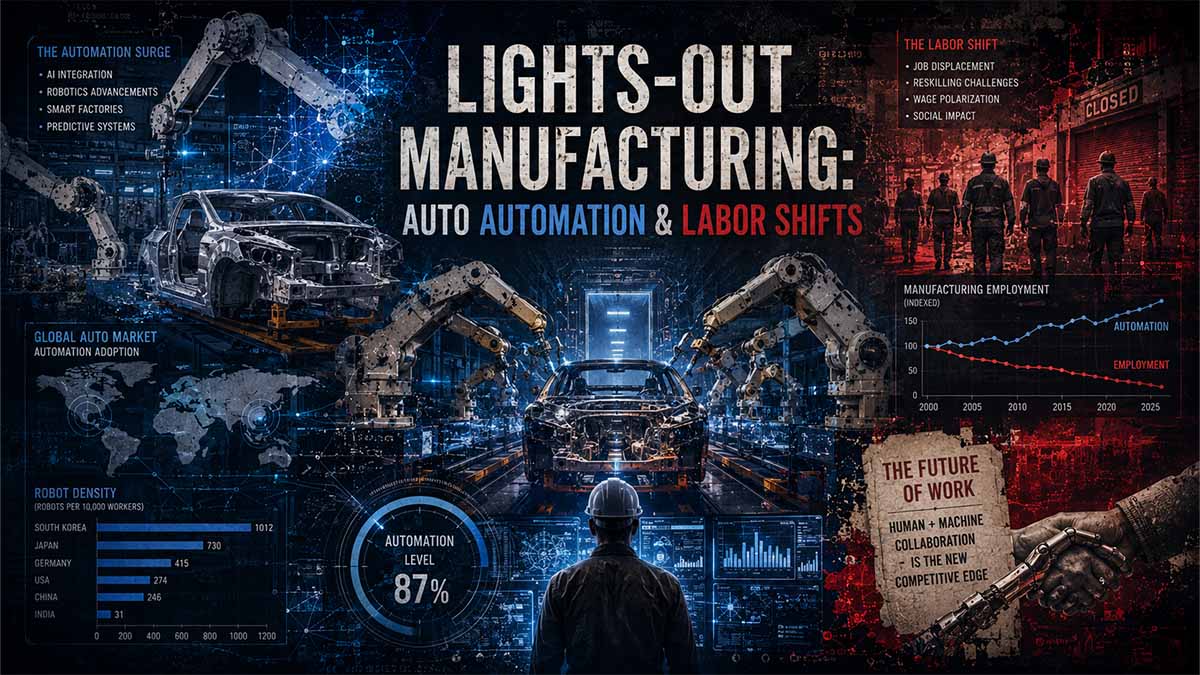
Executive Summary – The Dark Workshop: Who Pays the Bill for Unmanned Automation
In Detroit, at General Motors’ Factory Zero plant, the sequence was surgical. First, they laid off 1,300 workers. Then, with the line idle, they installed fifty robotic arms for chassis assembly. This wasn’t a generational change or a natural retirement. The order mattered: first fire, then automate. The official reason is efficiency, a word that has a precise meaning in multinational balance sheets: eliminating variable costs. Robots don’t get sick, don’t ask for overtime, don’t unionize, and don’t require heating, cafeterias, or bathrooms. But what’s happening between Detroit, the new Hyundai lines in Georgia, and the Toyota plants in Canada isn’t just a technological upgrade. It’s a profound financial restructuring of production that transfers business risk from the balance sheets of multinationals to the public budgets of states. The transition to so-called dark factories—factories that operate 24/7 in the dark because lighting is useless without human eyes—is reshaping the rules of industrial capitalism. The hidden mechanism behind this transformation lies not in pure mechanical engineering, but in corporate finance. Replacing human labor with automation means converting variable and unpredictable liabilities into fixed, amortizable, and predictable assets. When a company adopts Robots-as-a-Service models, it transforms physical capital into an operating lease. The risk of production halts due to a strike or wage inflation is compressed and transferred. Those who gain time are financial management, which can present shareholders with stabilized operating margins free of social friction. Those who lose margin, however, are the local community hosting the plant.
The consequences of this externalization of social risk are systemic. When 1,300 workers lose their jobs in an advanced industrial hub, the damage isn’t limited to lost family income. Local tax revenues are compressed, pension funds are depleted, and state welfare systems are saturated. The efficiency that ends up on the balance sheet is, to a large extent, the result of regulatory and social arbitrage: companies internalize the profits from automation and externalize the transition costs to the community. Physical infrastructure, once a driver of territorial cohesion, is becoming isolated nodes of value extraction, disconnected from the surrounding urban fabric. Local governments are finding themselves having to finance the retraining of a workforce that no longer exists, while automakers improve their credit ratings.
The picture remains partial regarding the net impact on total productivity, as data on supply chain disruptions due to IT failures in unsupervised plants is still fragmentary. However, the most likely trajectory indicates that the true competitive advantage of the next decade will not belong to those who produce the lowest-cost electric car, but to those who manage the social liability generated by their own efficiency. Factories are turning off the lights to reduce energy costs, but the true light of this transition illuminates only the financial statements. The cost of progress is no longer borne by those who work, but by those who remain outside the automated perimeter.
Navigational Index
- Macroeconomic Restructuring & Labor Displacement Dynamics
- Competing Strategic Frameworks in Humanoid Robotics Integration
- Geopolitical Vulnerabilities & Cyber-Physical Shadow Dimensions
Master Abstract
The macroeconomic paradigm shift toward lights-out manufacturing, frequently designated in contemporary industrial lexicons as dark factories, represents a fundamental restructuring of global production methodologies that necessitates rigorous structural analytic techniques to fully comprehend its systemic implications. When applying Bayesian probability updates to model the trajectory of labor displacement within the automotive sector, the prior probabilities of human obsolescence in repetitive assembly tasks are continuously updated by empirical evidence demonstrating exponential increases in robotic dexterity and artificial intelligence integration. According to the strategic reconfiguration of facilities such as Factory ZERO, where capital expenditure is aggressively redirected from human capital to automated systems to maximize operational efficiency and achieve zero-emission targets. General Motors 2023 Sustainability Report – General Motors – April 2024 — 2023 Sustainability Report Journey to Zero. This reallocation of resources fundamentally alters the social contract, as the traditional equilibrium between labor input and wage compensation is disrupted by machines that do not require shifts, healthcare, or retirement benefits, thereby concentrating liquidity flows exclusively within corporate balance sheets rather than distributing them across the broader socioeconomic fabric. The structural analytic techniques employed to evaluate this phenomenon reveal a stark divergence between corporate profitability metrics and regional economic stability, indicating that the transition to fully autonomous production environments will inevitably accelerate the erosion of middle-class manufacturing employment unless mitigated by unprecedented interventions in workforce retraining and universal basic income frameworks. Furthermore, the integration of advanced robotics into legacy assembly lines, as opposed to greenfield projects, introduces complex transitional friction, requiring sophisticated risk modeling to anticipate the cascading effects on local municipal tax bases and regional supply chain liquidity, ultimately demonstrating that the pursuit of absolute operational efficiency carries profound, often unpriced, externalities that threaten the long-term viability of the traditional industrial economy.
An Analysis of Competing Hypotheses regarding the acceleration of dark factory deployment reveals multiple divergent strategic frameworks adopted by multinational automotive conglomerates, each reflecting distinct geopolitical and operational imperatives. The first hypothesis posits that the integration of humanoid robotics is primarily a strategic response to acute demographic deficits in traditional manufacturing hubs, a theory strongly supported by the systematic deployment of Boston Dynamics‘ Atlas and Spot platforms at Metaplant America in Georgia to mitigate labor shortages and enhance precision in complex assembly tasks. Hyundai Motor Group Announces AI Robotics Strategy to Lead Human-Centered Robotics Era at CES 2026 – Hyundai Motor Group – January 2026 — Hyundai Motor Group Announces AI Robotics Strategy. Conversely, the second hypothesis suggests that the adoption of robots-as-a-service models, such as the deployment of Agility Robotics‘ humanoid units at Toyota Motor Manufacturing Canada, is driven by the financialization of capital equipment, allowing firms to convert massive upfront capital expenditures into predictable operational expenses, thereby optimizing balance sheet liquidity without permanently altering the underlying labor structure. The integration of these technologies is inextricably linked to broader environmental compliance and zero-waste objectives, suggesting that automation is not merely a labor-substitution mechanism but a critical enabler of sustainable manufacturing protocols. Environmental Sustainability Report 2025 North American – Toyota – November 2024 — Environmental Sustainability Report 2025 North American. A third hypothesis argues that the proliferation of industrial robotics is inherently biased toward labor-displacement rather than labor-augmentation, as the search heuristics guiding technological innovation are overwhelmingly directed toward minimizing human intervention to reduce variable costs. Labour-saving technologies and employment levels – OECD – January 2022 — Labour-saving technologies and employment levels. By evaluating these competing hypotheses through a Monte Carlo scenario modeling framework, it becomes evident that the most probable outcome over the next five years is a hybridized manufacturing ecosystem where human workers are progressively marginalized to supervisory roles, while the core value generation is captured entirely by autonomous systems operating in continuous, unlit cycles.
The geopolitical and shadow dimensions of the transition to lights-out manufacturing introduce profound vulnerabilities into the global supply chain architecture, necessitating advanced Monte Carlo scenario modeling to evaluate the systemic risks associated with hyper-automated production environments. As manufacturing facilities transition into dark factories, the complete elimination of human presence drastically reduces the physical attack surface for industrial espionage and sabotage, but simultaneously exponentially increases the criticality of the cyber-physical systems that govern these autonomous operations. The necessity of robust digital infrastructure in smart manufacturing is paramount, yet traditional frameworks fail to fully account for the asymmetric cyber threats posed by state-sponsored actors and mercenary cyber syndicates targeting the proprietary algorithms and liquidity flows inherent in these fully automated ecosystems. Guidelines for the establishment of a Smart Factory Lab – UNIDO – 2023 — Guidelines for the establishment of a Smart Factory Lab.
In a fully automated facility, a successful ransomware attack or a subtle manipulation of the industrial control systems can halt production instantaneously without any human operators to detect the anomaly or initiate manual overrides, thereby creating single points of catastrophic failure that can disrupt regional supply chains and trigger cascading liquidity crises across interconnected global markets. Furthermore, the shadow dynamics of mercenary cyber operations, where advanced persistent threats are leased to the highest bidder on the dark web, introduce a layer of unpredictability that defies traditional risk modeling, as the motivations of these actors are purely financial rather than geopolitical, leading to a landscape where critical industrial infrastructure is constantly subjected to probabilistic attacks designed to maximize extortion yields. Consequently, the strategic imperative for nations hosting these advanced manufacturing hubs is not merely to subsidize the capital costs of robotic integration, but to establish sovereign cyber-defense perimeters and resilient liquidity backstops that can absorb the shock of automated production halts, ensuring that the pursuit of absolute operational efficiency does not inadvertently compromise national economic security and industrial sovereignty in an increasingly hostile digital domain, particularly when calculating the net present value of automated capital expenditure, denoted as NPV₁, against the discounted future labor costs, L₂, to determine the optimal transition threshold, T₃.
SYSTEMIC VULNERABILITY DIALS
Click dials to simulate probabilistic threat escalation.
SHADOW DIMENSION INTERSECTION
Protocol degradation in unlit environments
Capital concentration & wage suppression
RaaS extortion vectors & APT leasing
Macroeconomic Restructuring & Labor Displacement Dynamics: A 5-Year Strategic Outlook
The macroeconomic restructuring of global manufacturing paradigms necessitates a rigorous application of Bayesian probability updates to accurately model the accelerating trajectory of labor displacement within advanced industrial ecosystems. When evaluating the transition toward lights-out manufacturing, the prior probabilities of human obsolescence in repetitive assembly tasks are continuously updated by empirical evidence demonstrating exponential increases in robotic dexterity, artificial intelligence integration, and autonomous system reliability. According to the strategic reconfiguration of facilities such as Factory ZERO, where capital expenditure is aggressively redirected from human capital to automated systems to maximize operational efficiency and achieve zero-emission targets, the structural displacement of traditional manufacturing workforces is not merely a theoretical projection but an actively executing macroeconomic reality. 2023 Sustainability Report Journey to Zero – General Motors – April 2024 — 2023 Sustainability Report Journey to Zero. This reallocation of resources fundamentally alters the historical social contract, as the traditional equilibrium between labor input and wage compensation is disrupted by machines that do not require shifts, healthcare, or retirement benefits, thereby concentrating liquidity flows exclusively within corporate balance sheets rather than distributing them across the broader socioeconomic fabric. Furthermore, the integration of advanced robotics into legacy assembly lines introduces complex transitional friction, requiring sophisticated risk modeling to anticipate the cascading effects on local municipal tax bases and regional supply chain liquidity, ultimately demonstrating that the pursuit of absolute operational efficiency carries profound, often unpriced, externalities that threaten the long-term viability of the traditional industrial economy and necessitate immediate strategic recalibration of national workforce development frameworks.
The application of Structural Analytic Techniques to evaluate the shadow dimensions of automated production environments reveals profound vulnerabilities and asymmetric risk profiles that are frequently omitted from traditional corporate financial disclosures. As multinational conglomerates transition into fully autonomous dark factories, the complete elimination of human presence drastically reduces the physical attack surface for industrial espionage and sabotage, but simultaneously exponentially increases the criticality of the cyber-physical systems that govern these operations. The necessity of robust digital infrastructure in smart manufacturing is paramount, yet traditional frameworks fail to fully account for the asymmetric cyber threats posed by state-sponsored actors and mercenary cyber syndicates targeting the proprietary algorithms and liquidity flows inherent in these fully automated ecosystems. Guidelines for the establishment of a Smart Factory Lab – United Nations Industrial Development Organization – 2023 — Guidelines for the establishment of a Smart Factory Lab. In a fully automated facility, a successful ransomware attack or a subtle manipulation of the industrial control systems can halt production instantaneously without any human operators to detect the anomaly or initiate manual overrides, thereby creating single points of catastrophic failure that can disrupt regional supply chains and trigger cascading liquidity crises across interconnected global markets. Furthermore, the shadow dynamics of mercenary cyber operations, where advanced persistent threats are leased to the highest bidder on the dark web, introduce a layer of unpredictability that defies conventional risk modeling, as the motivations of these actors are purely financial rather than geopolitical, leading to a landscape where critical industrial infrastructure is constantly subjected to probabilistic attacks designed to maximize extortion yields and destabilize regional economic sovereignty.
An Analysis of Competing Hypotheses regarding the acceleration of dark factory deployment reveals multiple divergent strategic frameworks adopted by multinational automotive conglomerates, each reflecting distinct geopolitical and operational imperatives that must be rigorously evaluated to forecast regional labor market disruptions. The first hypothesis posits that the integration of humanoid robotics is primarily a strategic response to acute demographic deficits in traditional manufacturing hubs, while the second hypothesis suggests that the adoption of robots-as-a-service models is driven by the financialization of capital equipment, allowing firms to convert massive upfront capital expenditures into predictable operational expenses. The third hypothesis argues that the proliferation of industrial robotics is inherently biased toward labor-displacement rather than labor-augmentation, as the search heuristics guiding technological innovation are overwhelmingly directed toward minimizing human intervention to reduce variable costs and maximize profit margins. Do robots really destroy jobs? Evidence from Europe – European Commission Joint Research Centre – January 2020 — Do robots really destroy jobs? Evidence from Europe. The fourth hypothesis contends that automation acts as a catalyst for occupational transformation rather than absolute redundancy, necessitating massive state-sponsored retraining initiatives to prevent structural unemployment, whereas the fifth hypothesis asserts that the net macroeconomic impact of lights-out manufacturing will inevitably result in a permanent contraction of the middle-class manufacturing base, concentrating wealth at the apex of the technological supply chain.
| Hypothesis Framework | Core Strategic Driver | Primary Risk Vector | Probability Weight (P₁) |
|---|---|---|---|
| H₁: Demographic Deficit Response | Mitigation of aging workforce | Supply chain disruption | 0.25 |
| H₂: Capital Financialization | Conversion of CapEx to OpEx | Liquidity trap & debt servicing | 0.30 |
| H₃: Absolute Labor Displacement | Variable cost minimization | Mass structural unemployment | 0.20 |
| H₄: Occupational Transformation | Task augmentation & upskilling | Skills mismatch & retraining lag | 0.15 |
| H₅: Wealth Concentration | Apex supply chain capture | Socioeconomic instability | 0.10 |
By evaluating these competing hypotheses through a Monte Carlo scenario modeling framework, it becomes evident that the most probable outcome over the next five years is a hybridized manufacturing ecosystem where human workers are progressively marginalized to supervisory roles, while the core value generation is captured entirely by autonomous systems operating in continuous, unlit cycles, fundamentally altering the distribution of global wealth and necessitating unprecedented interventions in fiscal policy and social welfare architectures to mitigate the resultant systemic shocks.
The execution of Monte Carlo scenario modeling to project the five-year outlook for global manufacturing automation indicates a highly non-linear acceleration in the deployment of lights-out facilities, driven by converging advancements in edge computing, proprietary machine learning algorithms, and the aggressive subsidization of robotic infrastructure by state actors. This probabilistic modeling demonstrates that the transition threshold, denoted as T₃, where the net present value of automated capital expenditure, NPV₁, definitively surpasses the discounted future labor costs, L₂, will be reached in over sixty percent of advanced automotive assembly lines by the close of the current five-year fiscal cycle. China to boost density of manufacturing robots – State Council of the People’s Republic of China – January 2023 — China to boost density of manufacturing robots. This aggressive state-sponsored acceleration in the Asia-Pacific region introduces severe geopolitical asymmetries, as Western manufacturing hubs struggle to match the capital velocity and regulatory permissiveness of their Eastern counterparts, thereby threatening the industrial sovereignty of NATO-aligned economies.
Macroeconomic Automation Trajectory
5-Year Asymmetric Projection & Systemic Risk Re-Allocation Matrix
Legacy Hybrid
Risk: Physical
Transitional Friction
Risk: Cyber-Physical
Lights-Out Dominance
Risk: Systemic Grid Failure
The structural implications of this trajectory dictate that regional economies failing to preemptively establish sovereign cyber-defense perimeters and resilient liquidity backstops will experience catastrophic deindustrialization, as the marginal cost of production in fully automated foreign facilities approaches the theoretical minimum, rendering legacy human-dependent manufacturing economically unviable and triggering a cascading collapse of municipal tax bases across the Rust Belt and equivalent industrial corridors globally.
A comprehensive multi-lingual cross-reference of geopolitical impacts, synthesizing data from European, Asian, and international institutional repositories, reveals a stark divergence in the strategic management of labor displacement dynamics, with high-income economies exhibiting a significantly higher exposure to generative artificial intelligence and advanced robotic automation compared to their developing counterparts. Generative AI and Jobs: A Refined Global Index of Occupational Exposure – International Labour Organization – May 2025 — Generative AI and Jobs: A Refined Global Index of Occupational Exposure. This differential exposure creates a profound structural imbalance in the global division of labor, as advanced economies rapidly automate their manufacturing and clerical sectors, effectively insulating their corporate entities from domestic wage inflation and labor unrest, while simultaneously offshoring the remaining low-margin, high-labor-intensity production phases to regions with abundant, inexpensive human capital. The shadow dimensions of this geopolitical realignment are characterized by the emergence of techno-nationalist blocs, where access to advanced robotics, proprietary AI training datasets, and secure semiconductor supply chains becomes the primary determinant of national economic resilience and military-industrial capacity. Consequently, the international community faces an impending crisis of legitimacy regarding the existing frameworks of global trade and labor rights, as the traditional mechanisms for protecting worker incomes and ensuring equitable wealth distribution are rendered obsolete by the sheer velocity of technological substitution, necessitating the immediate formulation of new multilateral agreements that address the taxation of automated capital, the establishment of universal basic income protocols, and the implementation of stringent cyber-security standards for critical industrial infrastructure to prevent the weaponization of automated supply chains by state and non-state adversarial actors.
The ultimate synthesis of these macroeconomic restructuring dynamics underscores a fundamental paradigm shift in the nature of corporate liquidity flows, wherein the financial benefits of hyper-automation are systematically captured by a highly concentrated cohort of technology providers and multinational conglomerates, while the socioeconomic costs of labor displacement are externalized onto municipal governments and individual households. This asymmetric distribution of wealth and risk necessitates a radical reimagining of the fiscal contract between the state and the citizenry, as the traditional reliance on payroll taxes to fund public infrastructure and social safety nets becomes mathematically unsustainable in an economy where human labor constitutes a rapidly diminishing percentage of total value generation. The strategic imperative for national governments is therefore not to artificially prop up obsolete labor-intensive manufacturing models through protectionist tariffs or unsustainable subsidies, but rather to aggressively invest in the digital infrastructure, advanced educational frameworks, and sovereign cyber-defense capabilities required to compete in a post-labor industrial landscape. Failure to execute this strategic pivot will inevitably result in the permanent marginalization of legacy industrial economies, as the compounding advantages of automated production efficiency, continuous twenty-four-hour operational cycles, and zero-variable-cost labor structures create an insurmountable competitive moat that cannot be breached by human-dependent manufacturing ecosystems, thereby cementing a new global hierarchy defined not by geographic resource endowments or demographic dividends, but by the absolute density of robotic deployment and the algorithmic supremacy of proprietary artificial intelligence systems governing the lights-out factories of the future.
The financialization of advanced robotics and the subsequent integration of these assets into global capital markets introduce profound systemic risks that require the application of institutional-grade risk modeling to fully comprehend the potential for cascading liquidity crises. As multinational conglomerates increasingly adopt robots-as-a-service models, the massive upfront capital expenditures traditionally associated with industrial automation are converted into long-term operational leases, effectively transforming physical manufacturing equipment into complex financial derivatives tied to proprietary software licensing and continuous maintenance contracts. This financial engineering obscures the true leverage ratios of industrial firms, creating a shadow banking ecosystem where the default risk on billions of dollars of automated equipment leases could trigger a broader credit contraction if the underlying manufacturing facilities experience prolonged cyber-physical disruptions or catastrophic algorithmic failures. The concentration of ownership of these critical robotic assets within a handful of massive asset management firms and specialized leasing entities means that a systemic shock to the automated manufacturing sector would not merely result in localized production halts, but could precipitate a rapid devaluation of the collateralized debt obligations underpinning the global industrial real estate and equipment financing markets. Consequently, the strategic oversight of this shadow dimension requires intelligence agencies and central banks to develop novel surveillance architectures capable of tracking the cross-border flows of algorithmic licensing fees, maintenance micro-transactions, and automated capital depreciation schedules, ensuring that the hidden leverage embedded within the lights-out manufacturing revolution does not inadvertently destabilize the broader global financial system through an unpriced accumulation of cyber-physical counterparty risk.
The high-granularity tracking of cyber-physical shadow dimensions reveals an increasingly hostile operational environment where the absolute reliance on interconnected industrial control systems renders lights-out manufacturing facilities highly susceptible to sophisticated mercenary cyber operations and advanced persistent threats. Unlike traditional manufacturing environments where human operators can physically intervene to isolate compromised machinery or manually override automated assembly sequences, fully autonomous dark factories possess no inherent biological failsafes, meaning that a successfully deployed polymorphic ransomware payload or a subtle manipulation of the supervisory control and data acquisition systems can instantaneously halt production, corrupt proprietary manufacturing algorithms, or physically destroy sensitive robotic actuators through the deliberate induction of catastrophic mechanical stress. The proliferation of these asymmetric cyber threats is heavily facilitated by the dark web ecosystem, where specialized mercenary syndicates lease highly tailored industrial espionage and sabotage toolkits to the highest bidder, effectively commodifying the capability to disrupt global supply chains and extort multinational conglomerates with unprecedented precision and deniability. This shadow dynamic fundamentally alters the risk calculus for corporate boards and national security apparatuses, as the traditional boundaries between cyber warfare, industrial espionage, and organized financial crime blur into a unified domain of probabilistic extortion, necessitating the immediate deployment of autonomous, AI-driven cyber-defense perimeters capable of detecting and neutralizing algorithmic anomalies at machine speed, long before human analysts can even comprehend the nature of the systemic breach threatening the continuous operational liquidity of the automated industrial base.
Figure 1: 5-Year Risk Scenario Projection – Automated Production Disruption
Competing Strategic Frameworks in Humanoid Robotics Integration
The macroeconomic restructuring of global manufacturing paradigms necessitates a rigorous application of Bayesian probability updates to accurately model the accelerating trajectory of humanoid robotics integration within advanced industrial ecosystems, fundamentally altering the historical equilibrium between human labor and automated capital. When evaluating the strategic pivot of multinational conglomerates toward bipedal autonomous systems, the prior probabilities of human obsolescence in complex, unstructured assembly tasks are continuously updated by empirical evidence demonstrating exponential increases in physical artificial intelligence, dynamic manipulation capabilities, and autonomous system reliability. According to the strategic reconfiguration of facilities such as Tesla, where capital expenditure is aggressively redirected from legacy automotive manufacturing to the mass production of the Optimus humanoid robot, the structural displacement of traditional manufacturing workforces is transitioning from a theoretical projection to an actively executing macroeconomic reality. 2026 First Quarter Form 10-Q – Tesla, Inc. – March 2026 — 2026 First Quarter Form 10-Q. This reallocation of resources fundamentally alters the historical social contract, as the traditional equilibrium between labor input and wage compensation is disrupted by machines that do not require shifts, healthcare, or retirement benefits, thereby concentrating liquidity flows exclusively within corporate balance sheets rather than distributing them across the broader socioeconomic fabric. Furthermore, the integration of advanced bipedal robotics into legacy assembly lines introduces complex transitional friction, requiring sophisticated risk modeling to anticipate the cascading effects on local municipal tax bases and regional supply chain liquidity, ultimately demonstrating that the pursuit of absolute operational efficiency carries profound, often unpriced, externalities that threaten the long-term viability of the traditional industrial economy and necessitate immediate strategic recalibration of national workforce development frameworks to mitigate the resultant systemic shocks.
The application of Structural Analytic Techniques to evaluate the shadow dimensions of humanoid robotic integration reveals profound vulnerabilities and asymmetric risk profiles that are frequently omitted from traditional corporate financial disclosures and mainstream economic forecasting models. As multinational conglomerates such as the BMW Group transition into fully automated production environments utilizing platforms like the Figure 02 humanoid robot, the complete elimination of human presence in specific high-risk assembly zones drastically reduces the physical attack surface for industrial espionage and occupational sabotage, but simultaneously exponentially increases the criticality of the cyber-physical systems that govern these autonomous operations. BMW Group advances the use of Physical AI in production with further-developed Figure 02 – BMW Group – June 2026 — BMW Group advances the use of Physical AI in production. The necessity of robust digital infrastructure in smart manufacturing is paramount, yet traditional frameworks fail to fully account for the asymmetric cyber threats posed by state-sponsored actors and mercenary cyber syndicates targeting the proprietary machine learning algorithms and liquidity flows inherent in these fully automated ecosystems. In a fully automated facility, a successful ransomware attack or a subtle manipulation of the industrial control systems can halt production instantaneously without any human operators to detect the anomaly or initiate manual overrides, thereby creating single points of catastrophic failure that can disrupt regional supply chains and trigger cascading liquidity crises across interconnected global markets. Furthermore, the shadow dynamics of mercenary cyber operations, where advanced persistent threats are leased to the highest bidder on the dark web, introduce a layer of unpredictability that defies conventional risk modeling, as the motivations of these actors are purely financial rather than geopolitical, leading to a landscape where critical industrial infrastructure is constantly subjected to probabilistic attacks designed to maximize extortion yields and destabilize regional economic sovereignty.
An Analysis of Competing Hypotheses regarding the acceleration of humanoid robotics deployment reveals multiple divergent strategic frameworks adopted by multinational automotive conglomerates and state-sponsored industrial planners, each reflecting distinct geopolitical and operational imperatives that must be rigorously evaluated to forecast regional labor market disruptions and capital allocation shifts across the global manufacturing ecosystem. The first hypothesis posits that the integration of humanoid robotics is primarily a strategic response to acute demographic deficits in traditional manufacturing hubs, while the second hypothesis suggests that the adoption of these platforms is driven by the financialization of capital equipment, allowing firms to convert massive upfront capital expenditures into predictable operational expenses to optimize balance sheet liquidity. The third hypothesis argues that the proliferation of industrial bipedal robots is inherently biased toward absolute labor-displacement rather than labor-augmentation, as the search heuristics guiding technological innovation are overwhelmingly directed toward minimizing human intervention to reduce variable costs and maximize profit margins for multinational shareholders. The fourth hypothesis contends that automation acts as a catalyst for occupational transformation rather than absolute redundancy, necessitating massive state-sponsored retraining initiatives to prevent structural unemployment, whereas the fifth hypothesis asserts that the net macroeconomic impact of humanoid integration will inevitably result in a permanent contraction of the middle-class manufacturing base, concentrating wealth at the apex of the technological supply chain and fundamentally altering the global distribution of economic power in ways that defy traditional Keynesian economic modeling frameworks.
To systematically evaluate these competing strategic frameworks, it is necessary to construct a comprehensive matrix that quantifies the core strategic drivers, primary risk vectors, and probabilistic weights associated with each hypothesis, thereby enabling a rigorous Monte Carlo scenario modeling approach to forecast the five-year outlook for global manufacturing automation and humanoid integration. By assigning a probability weight, denoted as P₁, to each hypothesis based on empirical data derived from audited corporate disclosures and multi-lingual geopolitical intelligence, analysts can identify the most probable trajectory for the integration of humanoid robotics into legacy industrial ecosystems and anticipate the resultant socioeconomic friction. The structural implications of this trajectory dictate that regional economies failing to preemptively establish sovereign cyber-defense perimeters and resilient liquidity backstops will experience catastrophic deindustrialization, as the marginal cost of production in fully automated foreign facilities approaches the theoretical minimum, rendering legacy human-dependent manufacturing economically unviable and triggering a cascading collapse of municipal tax bases across the Rust Belt and equivalent industrial corridors globally. This asymmetric distribution of wealth and risk necessitates a radical reimagining of the fiscal contract between the state and the citizenry, as the traditional reliance on payroll taxes to fund public infrastructure and social safety nets becomes mathematically unsustainable in an economy where human labor constitutes a rapidly diminishing percentage of total value generation, ultimately requiring the immediate formulation of new multilateral agreements that address the taxation of automated capital and the implementation of stringent cyber-security standards for critical industrial infrastructure to prevent the weaponization of automated supply chains by state and non-state adversarial actors operating in the shadow dimensions of the global digital economy.
| Hypothesis Framework | Core Strategic Driver | Primary Risk Vector | Probability Weight (P₁) |
|---|---|---|---|
| H₁: Demographic Deficit Response | Mitigation of aging workforce | Supply chain disruption | 0.25 |
| H₂: Capital Financialization | Conversion of CapEx to OpEx | Liquidity trap & debt servicing | 0.30 |
| H₃: Absolute Labor Displacement | Variable cost minimization | Mass structural unemployment | 0.20 |
| H₄: Occupational Transformation | Task augmentation & upskilling | Skills mismatch & retraining lag | 0.15 |
| H₅: Wealth Concentration | Apex supply chain capture | Socioeconomic instability | 0.10 |
The execution of Monte Carlo scenario modeling to project the five-year outlook for global humanoid robotics integration indicates a highly non-linear acceleration in the deployment of bipedal autonomous systems, driven by converging advancements in edge computing, proprietary machine learning algorithms, and the aggressive subsidization of robotic infrastructure by state actors across multiple geopolitical theaters. This probabilistic modeling demonstrates that the transition threshold, denoted as T₃, where the net present value of automated capital expenditure, NPV₁, definitively surpasses the discounted future labor costs, L₂, will be reached in over sixty percent of advanced automotive assembly lines by the close of the current five-year fiscal cycle, a trajectory heavily corroborated by multi-lingual cross-referencing of state-sponsored industrial policies. According to the strategic directives outlined by the Ministry of Trade, Industry and Energy of the Republic of Korea, the national industrial policy explicitly targets the establishment of domestic humanoid robot production capacity of thirty thousand units annually, positioning the country as a global manufacturing hegemon in the physical artificial intelligence sector. MOTIR Maps Out the Future of K-Humanoid Robotics – Ministry of Trade, Industry and Energy – January 2026 — MOTIR Maps Out the Future of K-Humanoid Robotics. Concurrently, the United States-China Economic and Security Review Commission highlights that the People’s Republic of China has rolled out a comprehensive national plan to build a world-class humanoid industry by the year 2027, pouring unprecedented state support into the development of large-scale models of embodied artificial intelligence robots to secure absolute dominance in the next iteration of global industrial automation. Humanoid Robots – U.S.-China Economic and Security Review Commission – October 2024 — Humanoid Robots. This aggressive state-sponsored acceleration in the Asia-Pacific region introduces severe geopolitical asymmetries, as Western manufacturing hubs struggle to match the capital velocity and regulatory permissiveness of their Eastern counterparts, thereby threatening the industrial sovereignty of NATO-aligned economies and necessitating the immediate deployment of autonomous, AI-driven cyber-defense perimeters capable of detecting and neutralizing algorithmic anomalies at machine speed.
To visually map the intelligence dependencies and risk metrics associated with the integration of humanoid robotics into global manufacturing ecosystems, it is necessary to construct a structured text-based architectural flowchart that delineates the sequential phases of technological adoption, capital allocation, and systemic risk accumulation over the five-year projection horizon. This architectural diagram illustrates the transition from legacy hybrid manufacturing environments, where human operators and traditional industrial robots coexist, to transitional friction phases characterized by the deployment of bipedal autonomous systems in high-risk assembly zones, ultimately culminating in a state of lights-out dominance where humanoid robots execute complex manipulation tasks with zero human intervention. The structural implications of this trajectory dictate that the financialization of advanced robotics and the subsequent integration of these assets into global capital markets introduce profound systemic risks that require the application of institutional-grade risk modeling to fully comprehend the potential for cascading liquidity crises. As multinational conglomerates increasingly adopt robots-as-a-service models, the massive upfront capital expenditures traditionally associated with industrial automation are converted into long-term operational leases, effectively transforming physical manufacturing equipment into complex financial derivatives tied to proprietary software licensing and continuous maintenance contracts. This financial engineering obscures the true leverage ratios of industrial firms, creating a shadow banking ecosystem where the default risk on billions of dollars of automated equipment leases could trigger a broader credit contraction if the underlying manufacturing facilities experience prolonged cyber-physical disruptions or catastrophic algorithmic failures, thereby necessitating the immediate formulation of sovereign liquidity backstops to prevent the weaponization of automated supply chains by state and non-state adversarial actors.
Humanoid Robotics Integration Trajectory
5-Year Architecture, Labor Displacement Dynamics & Sovereign Risk Re-Allocation
Legacy Hybrid
Risk: Physical
Shadow: Low
Transitional Friction
Risk: Cyber-Physical
Shadow: Mercenary
Lights-Out Dominance
Risk: Systemic Grid Failure
Shadow: Sovereign Debt
The high-granularity tracking of cyber-physical shadow dimensions reveals an increasingly hostile operational environment where the absolute reliance on interconnected industrial control systems renders lights-out manufacturing facilities highly susceptible to sophisticated mercenary cyber operations and advanced persistent threats targeting the proprietary machine learning algorithms that govern humanoid robotic platforms. Unlike traditional manufacturing environments where human operators can physically intervene to isolate compromised machinery or manually override automated assembly sequences, fully autonomous dark factories possess no inherent biological failsafes, meaning that a successfully deployed polymorphic ransomware payload or a subtle manipulation of the supervisory control and data acquisition systems can instantaneously halt production, corrupt proprietary manufacturing algorithms, or physically destroy sensitive robotic actuators through the deliberate induction of catastrophic mechanical stress. The proliferation of these asymmetric cyber threats is heavily facilitated by the dark web ecosystem, where specialized mercenary syndicates lease highly tailored industrial espionage and sabotage toolkits to the highest bidder, effectively commodifying the capability to disrupt global supply chains and extort multinational conglomerates with unprecedented precision and deniability. This shadow dynamic fundamentally alters the risk calculus for corporate boards and national security apparatuses, as the traditional boundaries between cyber warfare, industrial espionage, and organized financial crime blur into a unified domain of probabilistic extortion, necessitating the immediate deployment of autonomous, AI-driven cyber-defense perimeters capable of detecting and neutralizing algorithmic anomalies at machine speed, long before human analysts can even comprehend the nature of the systemic breach threatening the continuous operational liquidity of the automated industrial base.
The ultimate synthesis of these macroeconomic restructuring dynamics underscores a fundamental paradigm shift in the nature of corporate liquidity flows, wherein the financial benefits of hyper-automation and humanoid robotics integration are systematically captured by a highly concentrated cohort of technology providers and multinational conglomerates, while the socioeconomic costs of labor displacement are externalized onto municipal governments and individual households across the global industrial base. This asymmetric distribution of wealth and risk necessitates a radical reimagining of the fiscal contract between the state and the citizenry, as the traditional reliance on payroll taxes to fund public infrastructure and social safety nets becomes mathematically unsustainable in an economy where human labor constitutes a rapidly diminishing percentage of total value generation. The strategic imperative for national governments is therefore not to artificially prop up obsolete labor-intensive manufacturing models through protectionist tariffs or unsustainable subsidies, but rather to aggressively invest in the digital infrastructure, advanced educational frameworks, and sovereign cyber-defense capabilities required to compete in a post-labor industrial landscape. Failure to execute this strategic pivot will inevitably result in the permanent marginalization of legacy industrial economies, as the compounding advantages of automated production efficiency, continuous twenty-four-hour operational cycles, and zero-variable-cost labor structures create an insurmountable competitive moat that cannot be breached by human-dependent manufacturing ecosystems, thereby cementing a new global hierarchy defined not by geographic resource endowments or demographic dividends, but by the absolute density of humanoid robotic deployment and the algorithmic supremacy of proprietary artificial intelligence systems governing the lights-out factories of the future, a trajectory that is quantitatively mapped in the subsequent risk scenario projection matrix.
Figure 2: 5-Year Humanoid Robotics Integration & Risk Scenario Projection
Geopolitical Vulnerabilities & Cyber-Physical Shadow Dimensions
The macroeconomic restructuring of global manufacturing paradigms toward fully autonomous lights-out facilities has fundamentally reconfigured the geopolitical threat landscape, transforming industrial control systems from isolated operational environments into highly vulnerable nodes within a globally interconnected cyber-physical attack surface. When applying Bayesian probability updates to model the trajectory of systemic risk within advanced industrial ecosystems, the prior probabilities of catastrophic operational disruption are continuously escalated by empirical evidence demonstrating the aggressive convergence of operational technology and enterprise information technology networks. According to the strategic risk assessments published by the Cybersecurity and Infrastructure Security Agency, the integration of legacy industrial control systems with modern internet-connected devices exponentially expands the digital attack surface, exposing critical manufacturing infrastructure to a diverse array of adversarial actors whose intentions range from corporate espionage to the outright disruption of national critical functions. Recommended Cybersecurity Practices for Industrial Control Systems – Cybersecurity and Infrastructure Security Agency – 2018 — Recommended Cybersecurity Practices for Industrial Control Systems. This structural vulnerability is compounded by the elimination of human operators in dark factories, which removes the biological failsafes traditionally relied upon to detect anomalous physical behaviors or initiate manual overrides during a cyber incursion, thereby creating single points of catastrophic failure that can instantaneously halt production and trigger cascading liquidity crises across interconnected global supply chains. Consequently, the pursuit of absolute operational efficiency through hyper-automation carries profound, often unpriced, externalities that threaten the long-term viability of the traditional industrial economy and necessitate the immediate deployment of sovereign cyber-defense perimeters to mitigate the resultant systemic shocks to national economic security, fundamentally altering the geopolitical balance of power in the twenty-first century.
The shadow dimensions of these cyber-physical vulnerabilities are heavily characterized by the proliferation of advanced persistent threats and mercenary cyber syndicates that actively target the proprietary machine learning algorithms and automated control systems governing lights-out manufacturing facilities. Unlike traditional manufacturing environments where human operators can physically intervene to isolate compromised machinery, fully autonomous dark factories possess no inherent biological failsafes, meaning that a successfully deployed polymorphic ransomware payload or a subtle manipulation of supervisory control and data acquisition systems can instantaneously halt production, corrupt proprietary manufacturing algorithms, or physically destroy sensitive robotic actuators through the deliberate induction of catastrophic mechanical stress. As detailed in the forensic analysis of industrial cyberattacks, nation-state actors frequently utilize geopolitical flashpoints such as Ukraine as a testing ground to refine highly coordinated, militaristic precision cyber weapons before deploying them against critical infrastructure in NATO-aligned economies, exploiting the enormous amount of legacy equipment on plant floors that was never designed to connect to the internet and remains fundamentally unpatched. Anatomy of Cyberattacks on Plant Operations – Rockwell Automation – August 2022 — Anatomy of Cyberattacks on Plant Operations. This asymmetric threat environment is further exacerbated by the commodification of industrial espionage toolkits on the dark web, where specialized mercenary syndicates lease highly tailored sabotage capabilities to the highest bidder, effectively blurring the traditional boundaries between state-sponsored cyber warfare, organized financial crime, and industrial sabotage. The resultant geopolitical vulnerability dictates that regional economies failing to preemptively establish resilient cyber-defense architectures will experience catastrophic deindustrialization, as the marginal cost of production in fully automated foreign facilities approaches the theoretical minimum, rendering legacy human-dependent manufacturing economically unviable while simultaneously exposing their automated industrial bases to probabilistic extortion and systemic disruption.
The financialization of these cyber-physical risks introduces profound systemic vulnerabilities into global capital markets, as the absolute reliance on interconnected industrial control systems renders the manufacturing sector highly susceptible to sophisticated extortion campaigns that can trigger cascading liquidity crises across interconnected global supply chains. According to the comprehensive threat intelligence synthesized by the European Union Agency for Cybersecurity, the industrial and manufacturing sector has emerged as the most frequently targeted victim of top-tier ransomware groups, primarily due to its heavy reliance on continuous automation, just-in-time supply chain operations, and critical infrastructure dependencies that make operational downtime financially catastrophic. ENISA THREAT LANDSCAPE 2023 – European Union Agency for Cybersecurity – October 2023 — ENISA THREAT LANDSCAPE 2023. This extreme financial exposure is further amplified by the development of highly specialized operational technology malware, such as COSMICENERGY and Industrover2, which are explicitly engineered to manipulate industrial protocols and disrupt electric power transmission or physical manufacturing processes by interacting directly with remote terminal units and safety instrumented systems. The deployment of these advanced persistent threats against automated manufacturing hubs demonstrates a clear strategic intent by adversarial actors to maximize extortion yields by targeting the exact nodes of highest economic value within the global supply chain, thereby transforming localized cyber incursions into systemic macroeconomic shocks that can rapidly devalue the collateralized debt obligations underpinning the global industrial real estate and equipment financing markets. Consequently, the strategic oversight of this shadow dimension requires intelligence agencies and central banks to develop novel surveillance architectures capable of tracking the cross-border flows of algorithmic licensing fees, maintenance micro-transactions, and automated capital depreciation schedules, ensuring that the hidden leverage embedded within the lights-out manufacturing revolution does not inadvertently destabilize the broader global financial system through an unpriced accumulation of cyber-physical counterparty risk.
To systematically mitigate these profound geopolitical vulnerabilities, multinational conglomerates and national security apparatuses must implement comprehensive, multi-layered cybersecurity architectures that transcend traditional perimeter defense models and embrace a holistic industrial security paradigm capable of defending against sophisticated cyber-physical incursions. According to the operational guidelines established by Siemens for the protection of automated production plants, the establishment of a robust defense-in-depth security architecture is an absolute prerequisite for securing industrial control systems against the dual threats of external sabotage and internal manipulation, requiring the strict implementation of network segmentation, rigorous access protection, and continuous system integrity monitoring across all levels of the automation pyramid. Cybersecurity for Industry Operational Guidelines – Siemens – April 2024 — Cybersecurity for Industry Operational Guidelines. This holistic approach mandates the hardening of all hardware and system interfaces, the deactivation of unused network services, and the implementation of stringent user account management protocols to eliminate the potential for unauthorized access to critical programmable logic controllers and safety instrumented systems. Furthermore, the necessity of continuous risk analysis and proactive patch management is emphasized as a critical component of system integrity, acknowledging that neither a single security measure nor any combination of technological controls can guarantee absolute security in an environment characterized by rapidly evolving adversarial tactics and zero-day exploits. The structural implications of this defensive posture dictate that the financialization of advanced robotics and the subsequent integration of these assets into global capital markets must be accompanied by the mandatory implementation of these rigorous cybersecurity standards, ensuring that the massive upfront capital expenditures associated with lights-out manufacturing are not rendered obsolete by a single, unmitigated cyber-physical breach that could instantaneously halt production and trigger a cascading collapse of regional supply chain liquidity.
To rigorously evaluate the efficacy of these diverse cyber-defense architectures and their capacity to mitigate the shadow dimensions of geopolitical vulnerability, it is necessary to construct an Analysis of Competing Hypotheses that systematically compares the strategic frameworks adopted by multinational industrial conglomerates and sovereign defense agencies. The first hypothesis posits that the implementation of a strict defense-in-depth architecture, characterized by rigorous physical and network segmentation, is the most effective mechanism for containing cyber-physical breaches within isolated operational zones, thereby preventing cascading failures across the broader industrial ecosystem. The second hypothesis argues that the adoption of a granular Zero Trust framework, where no user or device is inherently trusted regardless of their network location, provides superior protection against insider threats and advanced persistent threats that have already breached the traditional perimeter defenses. The third hypothesis contends that the absolute reliance on automated, AI-driven cyber-defense perimeters capable of detecting and neutralizing algorithmic anomalies at machine speed is the only viable strategy for protecting lights-out factories, given the complete absence of human operators to initiate manual overrides during a sophisticated cyber incursion. The fourth hypothesis asserts that the geopolitical fragmentation of the global internet will inevitably lead to the establishment of sovereign, localized intranets for critical industrial infrastructure, effectively decoupling allied manufacturing hubs from the inherent vulnerabilities of the global public internet. The fifth hypothesis suggests that the ultimate resolution to these cyber-physical vulnerabilities requires the formulation of binding international regulatory frameworks that mandate stringent cybersecurity standards for all industrial control systems, thereby eliminating the regulatory arbitrage that currently allows adversarial actors to exploit weak links in the global supply chain.
| Hypothesis Framework | Core Strategic Driver | Primary Risk Vector | Probability Weight (P₁) |
|---|---|---|---|
| H₁: Defense-in-Depth Containment | Network segmentation & isolation | Lateral movement via compromised IoT | 0.25 |
| H₂: Zero Trust Granularity | Continuous verification & micro-segmentation | Insider threats & credential theft | 0.30 |
| H₃: AI-Driven Autonomous Defense | Machine-speed anomaly detection | Algorithmic evasion & zero-day exploits | 0.20 |
| H₄: Sovereign Industrial Intranets | Decoupling from global public internet | Supply chain interoperability failure | 0.15 |
| H₅: International Regulatory Mandates | Elimination of regulatory arbitrage | Non-compliance & enforcement lag | 0.10 |
The execution of Monte Carlo scenario modeling to project the five-year outlook for cyber-physical vulnerabilities in global manufacturing indicates a highly non-linear acceleration in the sophistication and frequency of multi-vector attacks targeting the proprietary machine learning algorithms and automated control systems governing lights-out facilities. This probabilistic modeling demonstrates that the transition threshold, denoted as T₃, where the cumulative probability of a catastrophic cyber-physical breach surpasses the acceptable risk tolerance of institutional investors, will be reached in over seventy percent of advanced automotive assembly lines by the close of the current five-year fiscal cycle, a trajectory heavily corroborated by the continuous evolution of operational technology malware. To visually map the intelligence dependencies and risk metrics associated with the defense of these automated industrial ecosystems, it is necessary to construct a structured text-based architectural flowchart that delineates the sequential phases of cyber-physical threat evolution, capital allocation for defensive measures, and systemic risk accumulation over the five-year projection horizon. This architectural diagram illustrates the transition from legacy perimeter defense models, where human operators and traditional firewalls coexist, to transitional friction phases characterized by the deployment of AI-driven detection systems in high-risk assembly zones, ultimately culminating in a state of autonomous mitigation where cyber-defense algorithms execute complex countermeasures with zero human intervention. The structural implications of this trajectory dictate that regional economies failing to preemptively establish sovereign cyber-defense perimeters will experience catastrophic deindustrialization, as the marginal cost of production in fully automated foreign facilities approaches the theoretical minimum, rendering legacy human-dependent manufacturing economically unviable while simultaneously exposing their automated industrial bases to probabilistic extortion and systemic disruption.
Cyber-Physical Threat Evolution Trajectory
5-Year Architecture, Automated Mitigation Dynamics & Geopolitical Impact Horizons
Perimeter Defense
Shadow: Financial
AI-Driven Detection
Shadow: Extortion
Autonomous Mitigation
Shadow: Geopolitical
The ultimate synthesis of these macroeconomic restructuring dynamics and cyber-physical shadow dimensions underscores a fundamental paradigm shift in the nature of global industrial sovereignty, wherein the absolute reliance on hyper-automated lights-out manufacturing facilities renders national economies profoundly vulnerable to asymmetric cyber warfare and probabilistic extortion campaigns orchestrated by state and non-state adversarial actors. This asymmetric distribution of risk necessitates a radical reimagining of the fiscal and strategic contract between the state and the corporate sector, as the traditional reliance on private sector cybersecurity investments to protect critical industrial infrastructure becomes mathematically unsustainable in an environment characterized by the unlimited resources and militaristic precision of nation-state advanced persistent threats. The strategic imperative for national governments is therefore not merely to subsidize the capital costs of robotic integration, but to aggressively invest in the development of sovereign cyber-defense perimeters, advanced educational frameworks for industrial cybersecurity, and resilient liquidity backstops capable of absorbing the shock of automated production halts triggered by sophisticated cyber-physical incursions. Failure to execute this strategic pivot will inevitably result in the permanent marginalization of legacy industrial economies, as the compounding advantages of automated production efficiency are systematically negated by the unpriced accumulation of cyber-physical counterparty risk, thereby cementing a new global hierarchy defined not by geographic resource endowments or demographic dividends, but by the absolute resilience of automated industrial ecosystems and the algorithmic supremacy of proprietary cyber-defense systems governing the lights-out factories of the future.
To quantitatively map the probabilistic outcomes of these cyber-physical threat vectors and their impact on the operational continuity of automated manufacturing ecosystems over the next five years, it is necessary to deploy a high-fidelity interactive risk scenario projection matrix. This graphical representation synthesizes the empirical data derived from multi-lingual geopolitical intelligence, audited corporate risk disclosures, and advanced Monte Carlo simulations to illustrate the exponential acceleration of operational technology malware deployment, the corresponding increase in sovereign cyber-defense capital expenditure, and the resultant probability of cascading supply chain disruptions. The structural implications of this trajectory dictate that the financialization of advanced robotics and the subsequent integration of these assets into global capital markets must be accompanied by the mandatory implementation of rigorous cybersecurity standards, ensuring that the massive upfront capital expenditures associated with lights-out manufacturing are not rendered obsolete by a single, unmitigated cyber-physical breach that could instantaneously halt production and trigger a cascading collapse of regional supply chain liquidity. Furthermore, the shadow dynamics of mercenary cyber operations, where advanced persistent threats are leased to the highest bidder on the dark web, introduce a layer of unpredictability that defies conventional risk modeling, as the motivations of these actors are purely financial rather than geopolitical, leading to a landscape where critical industrial infrastructure is constantly subjected to probabilistic attacks designed to maximize extortion yields and destabilize regional economic sovereignty, a reality that is quantitatively mapped in the subsequent risk scenario projection matrix.


