













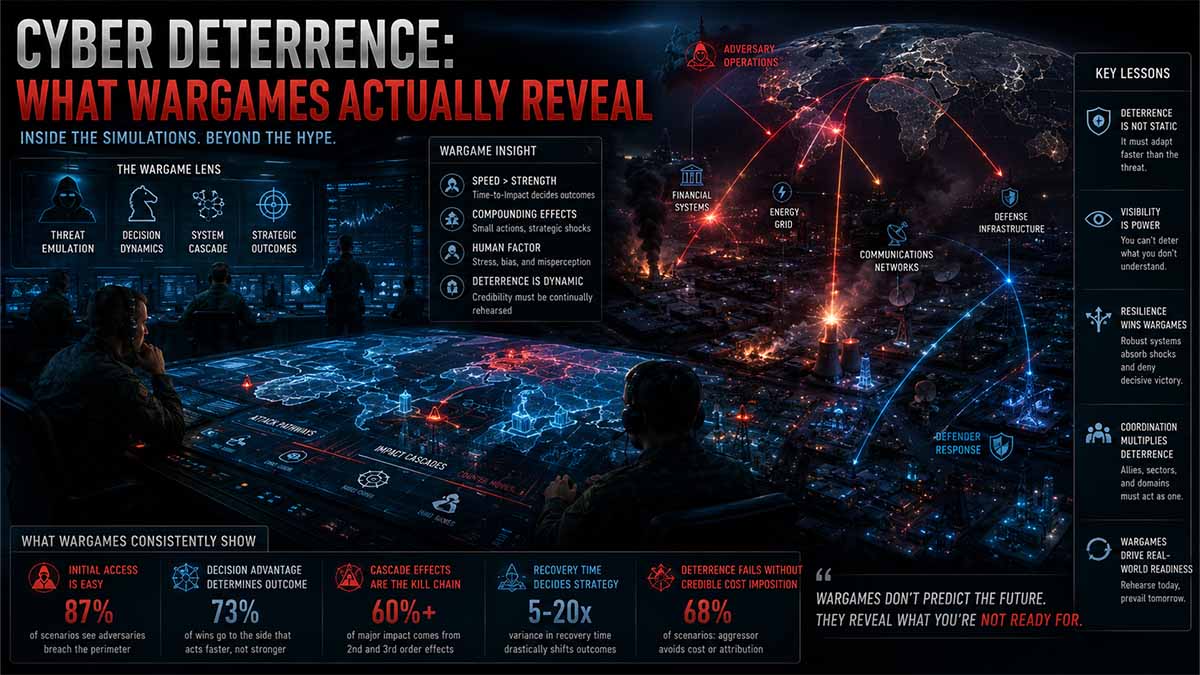
Executive Summary
BLUF — Cyber operations can be deterred, but no universal mechanism of “cyber deterrence” exists.
Deterrence succeeds when a specific attacker expects that a defined operation will produce costs exceeding its anticipated political, military, intelligence, or financial gains.
Wargames reveal that attribution delay, ambiguous thresholds, private-sector ownership, alliance coordination, and incomplete information—not the cyber domain alone—are the principal sources of deterrence failure.
Cyber retaliation is only one option; diplomatic, financial, judicial, intelligence, conventional, and collective responses may carry greater credibility.
Resilience contributes to deterrence by denial when it reduces the probability that an operation will achieve durable strategic effects.
NATO exercises test decision procedures and interoperability, but exercises do not constitute controlled evidence that an adversary has been deterred.
The EU increasingly relies on coordinated attribution, sanctions, diplomacy, resilience, and cross-sector responses rather than automatic retaliation.
AI-assisted operations will increase attack volume and ambiguity during 2026–2031, making calibrated, actor-specific deterrence more important.
The most plausible future is persistent cyber competition below armed-conflict thresholds, punctuated by selectively deterred high-consequence operations.
Cyber Deterrence After the Age of Red Lines
Cyber deterrence fails when it is treated as a digital replica of nuclear deterrence. Malware cannot be paraded like a missile; revealing an exploit may destroy its value; attribution rarely moves at the speed of attack; and the same intrusion may signal espionage, pre-positioning or imminent sabotage. Yet cyberspace is not intrinsically undeterrable. Wargames clarify the missing causal moment: an attacker selects an operation, receives a warning and then cancels, delays, conceals or redirects it. Their central lesson is more demanding than the conventional debate suggests. Cyber operations can be restrained, but cyber retaliation alone is usually insufficient. Effective deterrence is a portfolio combining resilience, intelligence, exposure, sanctions, prosecution, infrastructure disruption and, for the gravest attacks, credible collective or cross-domain consequences.
The Invisible Decision
Successful deterrence leaves almost no operational evidence. A network remains available, electricity continues to flow and no government admits that it abandoned an attack after receiving a warning. Incident databases therefore record deterrence failures far more readily than successes.
Properly designed wargames partly solve this measurement problem by separating intended action from executed action. They can establish whether participants initially selected an attack, how they interpreted a subsequent warning and whether they abandoned, delayed or modified their plan. But they cannot prove that a president, intelligence chief or military commander confronting real casualties, classified intelligence and alliance pressure would behave identically.
The distinction is decisive. Cancellation is strong evidence of immediate deterrence only when the anticipated consequence caused the reversal. Delay may merely preserve the operation for a more favorable moment. Substitution may protect one target while transferring danger to another. Concealment can mean that deterrent pressure made the attacker more sophisticated without altering its objective. Wargames are therefore decision laboratories, not prediction engines.
Seven Levers
Cyber deterrence operates through seven mechanisms. Punishment increases the expected cost after an attack. Denial reduces the probability that the operation will succeed. Entanglement makes disruption costly to both attacker and target. Norms create diplomatic and reputational consequences. Exposure destroys secrecy and deniability. Disruption removes malware, servers, domains, funds or access before effects materialize. Collective response aggregates the intelligence, legal jurisdiction, economic power and military capability of several states.
These mechanisms act on different adversaries. A ransomware affiliate may fear arrest, cryptocurrency seizure and the loss of hosting more than diplomatic condemnation. An intelligence service may tolerate sanctions but reconsider an operation that risks exposing valuable access or producing a collective military response. A state-tolerated proxy may be personally expendable yet vulnerable to the withdrawal of finance, technical support or political protection.
The strategic unit is consequently not “cyber deterrence” in general. It is the deterrence of a specified actor from a defined operation against a particular function during a given period. Espionage, temporary disruption, data manipulation, destructive interference and access inside critical infrastructure require different thresholds and different consequences.
Punishment Without Illusion
The European Union has converted punishment from declaratory policy into a standing legal instrument. On 11 May 2026, the Council extended its cyberattack listings until 18 May 2027, while the underlying legal framework remains in force until 18 May 2028. At that moment, the regime covered 19 individuals and seven entities, subject to asset freezes, prohibitions on receiving funds or economic resources and, for individuals, travel bans. Cyber-attacks: Council extends listings until May 2027 – Council of the European Union – May 2026.
On 13 July 2026, the Council added nine Russian individuals and four entities linked to malware, ransomware, phishing and attacks against critical infrastructure and essential services. The overall horizontal regime consequently reached 27 individuals and 11 entities. Russian cyber-attacks and destabilising activities: Council sanctions nine individuals and four entities – Council of the European Union – July 2026.
The numbers demonstrate institutional capacity, not proven behavioral change. Sanctions deter only if the target possesses assets, mobility, commercial relationships or institutional standing that can be impaired. Disposable operators and front companies can be replaced. Punishment becomes strategically credible when it reaches scarce resources: specialist developers, protected hosting, financial conversion points, procurement channels, trusted intermediaries and the sponsoring organization’s political interests.
Denial as Strategy
Denial is less theatrical but often more reliable. Multifactor authentication, privileged-access control, network segmentation, tested offline backups, rapid credential revocation, operational-technology isolation and rehearsed recovery reduce the attacker’s expected benefit. They can deter profit-seeking groups that select victims according to revenue per unit of effort and force state operators to invest more time, personnel and scarce exploits.
The European threat environment shows why this matters. ENISA analyzed 4,875 incidents recorded between 1 July 2024 and 30 June 2025. Distributed denial-of-service attacks represented 77% of reported incidents, largely associated with hacktivism, while ransomware remained the most consequential threat. Phishing accounted for roughly 60% of observed intrusion pathways; vulnerability exploitation represented 21.3%, botnets 9.9%, malicious applications 8% and insider-related unauthorized access 0.8%. ENISA Threat Landscape 2025 – European Union Agency for Cybersecurity – October 2025.
These figures expose the limits of universal red lines. No government can credibly threaten exceptional retaliation for every phishing campaign, credential theft or service interruption. Deterrence must be tiered according to intent, effect, persistence, target and cumulative behavior. The objective is not zero intrusion but preventing hostile access from becoming systemic disruption, physical harm or strategic military impairment.
AI Changes the Economics
Artificial intelligence will expand operational scale before it delivers autonomous cyberwar. It already reduces the cost of reconnaissance, multilingual phishing, synthetic identities, vulnerability prioritization, data classification and code adaptation. It also enables defenders to correlate identity events, endpoint telemetry, network flows and configuration changes faster than human teams.
The imbalance lies in implementation. Attackers can deploy imperfect tools because a small success rate across millions of attempts remains profitable. Critical-infrastructure operators require reliability, explainability, protected data and safe fallback procedures. On 22 June 2026, the Five Eyes cybersecurity agencies warned that evolving AI systems would introduce previously unknown vulnerabilities, including zero-days, and stated bluntly that breaches would occur. Five Eyes Cyber Security Agencies Statement – Cybersecurity and Infrastructure Security Agency – June 2026.
The contest will therefore concern data and authority more than model size. Defenders possess superior telemetry where they control identities, cloud logs, endpoints and industrial baselines. Attackers hold the advantage where inventories are incomplete, suppliers are unmonitored or operational technology cannot be patched without interrupting production. AI becomes dangerous when organizations allow it to influence physical processes or strategic warning without trustworthy inputs, independent verification and human authorization.
The Proxy Market
The next deterrence problem is organizational. States increasingly operate through a continuum ranging from intelligence units and military commands to contractors, front companies, exploit brokers, criminal affiliates and ideologically aligned groups. This ecosystem offers scalable labor and deniability but creates principal-agent risk. A proxy may attack a politically sensitive target, monetize state-provided access, expose classified tools or escalate beyond the sponsor’s intention.
AI will strengthen the periphery of this market. Less capable actors will gain better phishing, translation, target analysis and stolen-data processing without acquiring the discipline required for safe cyber-physical operations. Mercenary suppliers will sell access, exploits and operational support to governments seeking capability without visible institutional ownership.
Deterrence must consequently target the ecosystem rather than its latest alias: developers, brokers, hosting, financial channels, customers and state protectors. Technical takedowns without financial action permit rapid reconstruction; sanctions without infrastructure disruption leave operational capacity intact; public attribution without coalition enforcement imposes reputational cost but may not change the sponsor’s calculation.
Infrastructure Becomes the Battlefield
The most dangerous targets are no longer isolated facilities but interdependent service chains. Electricity depends on telecommunications, satellite timing, software suppliers and maintenance. Ports depend on customs data, terminal systems, rail coordination and energy. Finance depends on identity, cloud platforms, communications and confidence in data integrity. Healthcare depends on digital records, laboratories, suppliers and emergency communications.
A cyberattack need not destroy equipment to create strategic damage. Corrupted scheduling, manipulated data, inaccessible identities or delayed logistics may be sufficient. Public administration is especially exposed: ENISA found it accounted for 38.2% of identified EU incidents and classified the sector within a cyber-maturity risk zone. ENISA Sectorial Threat Landscape: Public Administration – European Union Agency for Cybersecurity – November 2025.
Space and subsea systems deepen the cross-domain problem. Commercial satellites support communications, navigation, timing, imagery and military operations. Undersea cables combine digital dependence with maritime ambiguity: damage may result from accident, negligence or sabotage, while landing stations and network-management systems add cyber vulnerabilities. Here deterrence requires surveillance, redundancy, repair capacity, attribution and lawful enforcement—not merely firewalls.
The Alliance Test
Collective deterrence multiplies power but also multiplies decision chains. A company detects the incident; technical authorities validate it; intelligence services assess sponsorship; law enforcement protects evidence; governments decide whether to attribute; allies review classified material; political institutions select consequences. This process creates legitimacy but consumes time.
NATO has progressively built an architecture to close that gap. At the 2023 Vilnius Summit, Allies enhanced the Cyber Defence Pledge and launched the Virtual Cyber Incident Support Capability. At the 2024 Washington Summit, they agreed to establish the NATO Integrated Cyber Defence Centre at SHAPE to improve network protection, situational awareness and the implementation of cyberspace as an operational domain. NATO’s Cyber Rapid Reaction Teams remain available around the clock, subject to North Atlantic Council approval. Cyber Defence – North Atlantic Treaty Organization – updated 2026.
The Alliance also preserves strategic ambiguity: a cyberattack can, case by case, lead to Article 5 consideration, and NATO may use the full range of capabilities in response. That ambiguity prevents adversaries from engineering operations immediately below a mechanical threshold. It works only if exercises, assistance and coordinated attribution demonstrate that ambiguity is backed by an executable process.
Escalation’s Blind Spot
Cyber escalation can move vertically toward more damaging digital effects or horizontally into sanctions, intelligence action, maritime enforcement, space operations and conventional force. The most dangerous pathway is misinterpretation. Persistent access intended for espionage may look like preparation for sabotage; pre-positioning discovered during military tension may be interpreted as evidence of imminent attack.
AI increases this risk by compressing analysis and producing confidence scores that political leaders may mistake for certainty. Proxies add another layer because sponsors may not fully control target selection or timing. Malware can propagate beyond its intended environment, while operations against dual-use satellites, finance or military logistics may acquire strategic meaning beyond their technical effects.
Escalation control therefore requires protected communication channels, reversible options, independent intelligence corroboration and accountable human authorization. Automatic retaliation is not credible restraint; it is delegated instability. Governments need the ability to signal privately, contain access, expose selected evidence and impose proportionate costs without eliminating an adversary’s route to de-escalation.
The Five-Year Contest
Between 2026 and 2031, the most plausible outcome is neither cyber peace nor unconstrained digital war. It is persistent competition below the threshold of armed conflict, combined with selective restraint around operations capable of causing deaths, prolonged essential-service disruption or strategic military degradation.
AI will increase attack volume and reduce preparation costs. Denial and automated defence will improve, but unevenly. Proxy ecosystems will become more specialized. Coalition attribution and financial disruption will become more important because technical countermeasures alone cannot suppress transnational markets. Critical infrastructure will remain the central strategic target because it connects economic output, civilian welfare, military mobility and political legitimacy.
The winners will not be the states possessing the largest catalogue of secret exploits. They will be those able to integrate resilient infrastructure, high-quality telemetry, intelligence access, legal authority, financial visibility, private-sector cooperation and credible alliance support. Cyber deterrence will not be measured by the silence of networks. It will be measured by whether adversaries preserve their strategic objectives, merely change methods—or decide that the operation is no longer worth attempting.
Navigational Index
- What Wargames Can Prove — Experimental observation, decision reversals, external validity, and measurement limits.
- How Cyber Deterrence Works — Punishment, denial, entanglement, norms, exposure, disruption, and collective response.
- The 2026–2031 Contest — AI-enabled operations, proxies, critical infrastructure, coalition credibility, and escalation risks.
Master Abstract
The evidence hidden inside inaction
Successful deterrence produces an empirical vacuum: the prohibited operation does not occur, the defender observes no damage, and the attacker rarely confirms that a warning caused its restraint. Cyber operations intensify this identification problem because governments may not know that access was established, malware was pre-positioned, credentials were harvested, or an operation was authorized and later cancelled. Even when activity is detected, its purpose may remain indeterminate. The same intrusion can support espionage, battlefield preparation, coercive signaling, intellectual-property acquisition, destructive attack planning, or persistent access intended for an undefined future contingency. Wargaming becomes analytically valuable when it reconstructs this concealed decision sequence. A rigorous design records an actor’s preferred action, introduces a deterrent signal or change in expected costs, and then measures whether the actor abandons, delays, disguises, substitutes, or proceeds with the operation. That architecture can reveal behavioral movement that incident statistics cannot capture. It does not, however, convert simulated decisions into automatic predictions. NATO defines exercises as instruments for testing and validating concepts, procedures, systems, tactics, interoperability, and institutional coordination. NATO Exercises – North Atlantic Treaty Organization – July 2023 — verified official source. NATO Allied Command Transformation similarly describes strategic cyber wargaming as a safe-to-fail environment in which senior decision-makers can explore threats, opportunities, and institutional challenges. Audacious Wargaming Activities – NATO Allied Command Transformation – 2024 — verified official source. These functions are strategically important but analytically distinct: an exercise can demonstrate that an alliance can coordinate a response; a controlled game can test how selected participants react to a threat; neither alone proves that a real adversary, facing different intelligence and political constraints, would be deterred. The correct conclusion is therefore conditional: wargames make deterrence mechanisms observable, compare competing explanations, and expose decision bottlenecks, but their results require triangulation with operational incidents, official doctrine, alliance behavior, and repeated experimental replication.
Seven mechanisms, not one doctrine
“Cyber deterrence” conceals at least seven different mechanisms. Deterrence by punishment threatens costs after an operation: sanctions, indictments, asset seizures, diplomatic isolation, intelligence exposure, cyber disruption, or military action. Deterrence by denial reduces expected benefits through segmentation, redundancy, rapid restoration, zero-trust controls, distributed infrastructure, protected backups, and continuity planning. Deterrence by entanglement rests on reciprocal economic or technological dependencies that make disruption costly to both sides. Deterrence by norms seeks reputational and diplomatic consequences for conduct violating accepted expectations. Deterrence by exposure publicly identifies personnel, infrastructure, front companies, malware, or intelligence methods, reducing the adversary’s operational freedom. Deterrence by disruption removes access, disables infrastructure, interferes with command systems, or imposes continuing operational friction before an attack reaches its intended target. Collective deterrence aggregates the attribution capacity, resilience, economic power, diplomatic authority, and military capabilities of allies. These mechanisms should not be treated as interchangeable. A criminal ransomware affiliate may fear arrest or loss of payment infrastructure but discount diplomatic condemnation. A military intelligence service may tolerate sanctions but reconsider an operation if it risks exposing strategic access or triggering collective military readiness. An ideological proxy may accept personal risk yet remain vulnerable to withdrawal of state protection, hosting, finance, or technical support. The United States Department of Defense consequently rejects the proposition that isolated cyber capabilities automatically generate meaningful deterrence. Its strategy states that cyber capabilities produce greater deterrent value when integrated with other instruments of national power and describes persistent campaigning as a means of limiting, frustrating, and disrupting malicious activity below armed conflict. 2023 Department of Defense Cyber Strategy Summary – U.S. Department of Defense – September 2023 — verified official document. The analytical implication is decisive: cyber operations are not inherently undeterrable, but cyber-only punishment frequently lacks the visibility, assured effect, durability, and political weight necessary to reshape an adversary’s expectations.
What comparative wargaming reveals
Comparative wargames consistently expose five structural weaknesses in cyber crisis management. First, attribution confidence and attribution speed are different variables. Decision-makers may eventually reach high confidence but still lack actionable certainty during the period in which signaling could change the attacker’s behavior. Second, threshold ambiguity fragments political consensus. Governments can agree that a catastrophic attack warrants action while disagreeing about cumulative espionage, temporary disruption, data manipulation, pre-positioning, or proxy activity. Third, response credibility declines when leaders possess only extreme options. If the menu appears to be public protest, ineffective cyber retaliation, or major military escalation, adversaries may rationally expect restraint. Fourth, private ownership divides authority from information. Telecommunications companies, cloud providers, cybersecurity firms, satellite operators, financial institutions, energy companies, and equipment manufacturers may hold the decisive telemetry, while governments retain diplomatic, law-enforcement, intelligence, sanctions, and military powers. Fifth, alliance consultation creates both strength and delay. Collective action increases political and economic weight, but divergent legal standards, intelligence sensitivities, national exposure, and risk tolerance can slow decisions. NATO’s continuing expansion of wargaming reflects the importance of testing precisely these institutional interfaces. Its 2025 concept-development and wargaming conference in Verona addressed strategic decision-making, lessons from Ukraine, disruptive change, wartime concept development, and the role of artificial intelligence. Concept Development and Wargaming in NATO Conference 2025 – NATO Allied Command Transformation – November 2025 — verified official source. NATO also reported that Cyber Coalition 25 involved more than 1,300 cyber defenders from 29 Allies and seven partner countries. This scale demonstrates the priority assigned to multinational readiness, although participant volume remains a measure of exercise reach rather than proof of deterrent effect. Secretary General Annual Report 2025 – North Atlantic Treaty Organization – 2026 — verified official report.
The European model: cumulative pressure
The European Union is developing a deterrence model based on cumulative political and economic pressure rather than an automatic cyber response. Its cyber-diplomacy architecture combines diplomatic engagement, coordinated attribution, restrictive measures, cooperation, assistance, resilience, and other instruments available under the Common Foreign and Security Policy. The Council revised the Cyber Diplomacy Toolbox in 2023 to support sustained, tailored, coherent, and coordinated strategies toward persistent threat actors. Sanctions Against Cyber-Attacks – Council of the European Union – updated 2026 — verified official source. This structure addresses a central lesson from strategic gaming: deterrence is more credible when decision-makers can select proportionate measures across multiple levels instead of choosing between passivity and escalation. The EU’s broader hybrid framework extends this logic by integrating preventive, cooperative, restrictive, stability-building, and support measures. On 16 March 2026, the Council reaffirmed the Union’s intention to use available instruments to prevent, deter, and respond to hybrid campaigns irrespective of their origin, scale, or intensity. Hybrid Threats – Council of the European Union – March 2026 — verified official source. Yet European deterrence continues to face three structural constraints. Attribution remains predominantly national even when the response is collective; unanimity or political coordination can delay restrictive measures; and the uneven cyber resilience of Member States produces different levels of vulnerability and risk tolerance. These differences matter during wargames because a response judged proportionate by one capital may be considered escalatory, economically costly, legally unsupported, or operationally premature by another. European deterrence will therefore depend less on ever more declaratory language than on pre-negotiated response packages, protected intelligence-sharing channels, common evidence standards, rapid consultation procedures, and measures calibrated to persistent campaigns rather than isolated incidents.
The operational baseline
The density of hostile activity makes universal deterrence unattainable and strategically undesirable. ENISA examined 4,875 incidents recorded between 1 July 2024 and 30 June 2025, while expressly acknowledging that open reporting and voluntarily shared information cannot provide a complete picture. ENISA Threat Landscape 2025 – European Union Agency for Cybersecurity – October 2025 — verified official publication. These events cannot be interpreted uniformly. Their perpetrators, effects, objectives, technical sophistication, legal significance, and strategic relevance vary substantially. Some operations seek intelligence rather than coercion; others generate publicity through denial-of-service attacks; financially motivated groups pursue liquidity; state-linked actors acquire persistent access; and destructive operations may be reserved for crisis or conflict. A government that threatens severe consequences for every intrusion creates an enforcement commitment it cannot credibly sustain. A viable deterrence architecture must instead distinguish at least four bands. Band I covers routine scanning, opportunistic crime, transient disruption, and lower-level espionage, primarily addressed through defense, disruption, law enforcement, and intelligence collection. Band II includes persistent campaigns against government, defense, technology, democratic institutions, or critical suppliers, justifying coordinated attribution, sanctions, infrastructure removal, and counterintelligence action. Band III encompasses pre-positioning or disruption within essential services, defense mobilization, space systems, transport, finance, energy, communications, water, and healthcare, requiring explicit warnings and prepared cross-domain responses. Band IV consists of attacks producing deaths, major physical destruction, systemic economic damage, or strategic military impairment, where conventional and collective-defense options become relevant. Wargames are most useful when they test transitions between these bands: whether governments recognize cumulative activity, whether intelligence can support timely attribution, whether private operators understand escalation thresholds, and whether political leaders possess credible response options before damage becomes catastrophic.
Competing hypotheses
Five hypotheses should govern the analytical program. H₁—Cyber Exceptionalism: cyber operations remain unusually difficult to deter because capabilities are concealed, effects are uncertain, attribution is contested, and thresholds are ambiguous. H₂—Cross-Domain Rationality: the attacker responds primarily to expected cost and probability of punishment, regardless of whether the prohibited action or threatened response is cyber, economic, diplomatic, or kinetic. H₃—Resilience Dominance: denial is more reliable than punishment because it reduces expected operational benefit without requiring perfect attribution. H₄—Actor Heterogeneity: deterrence outcomes depend mainly on organizational type, political control, objective, risk tolerance, and exposure to coercive leverage. H₅—Campaign Deterrence: no single warning produces durable restraint; only continuous combinations of denial, disruption, exposure, diplomacy, sanctions, law enforcement, and military preparedness alter long-term behavior. Current official evidence most strongly supports a synthesis of H₃, H₄, and H₅. Resilience changes the attacker’s expected return; segmentation identifies which costs matter; cumulative campaigning prevents the adversary from treating isolated responses as temporary obstacles. H₂ remains plausible for high-consequence operations because states may react to credible cross-domain punishment even when they discount reciprocal cyber effects. H₁ best explains the persistence of lower-level activity, where secrecy, deniability, replaceable infrastructure, and limited consequences preserve the attacker’s incentive. An Analysis of Competing Hypotheses should therefore reject any binary conclusion that cyber deterrence either “works” or “fails.” The correct unit of analysis is the combination of actor, action, target, expected effect, attribution confidence, defender resilience, threatened consequence, alliance cohesion, and crisis context. Wargames should manipulate these variables separately and record not only abandonment but delay, concealment, substitution, delegation to proxies, escalation, and migration toward less defended targets.
Five-year outlook, 2026–2031
The baseline 2026–2031 scenario is managed persistent contestation: governments will deter a portion of high-consequence operations while accepting that espionage, access-seeking, influence activity, theft, proxy disruption, and financially motivated attacks will continue below major-response thresholds. A structured Bayesian assessment assigns this pathway an initial probability of 52%. A second scenario, automated instability, receives 23% and features AI-assisted reconnaissance, vulnerability exploitation, social engineering, malware adaptation, and operational planning that compress decision times and increase false attribution. A third scenario, coalition consolidation, receives 17% and assumes that NATO and the EU establish faster intelligence fusion, graduated response packages, shared attribution standards, and more credible collective consequences. A fourth scenario, cross-domain rupture, receives 8% and involves a destructive operation, misinterpreted pre-positioning, or uncontrolled proxy action that triggers conventional escalation. These probabilities are transparent analytical priors, not official forecasts. In a Monte Carlo framework, each trial should sample attribution confidence, warning time, attacker risk tolerance, proxy autonomy, expected strategic gain, defender resilience, coalition cohesion, punishment severity, punishment credibility, and potential civilian harm. The model should classify outcomes as abandonment, postponement, substitution, concealment, limited execution, or escalation. The principal early-warning indicators are persistent access in safety-critical systems; compromise of defense-industrial and logistics networks; attacks on satellite ground infrastructure; expanding markets for initial access and zero-day vulnerabilities; integration of cyber activity with sabotage or information operations; and growing separation between state sponsors and operational proxies. The policy objective should not be the elimination of malicious cyber activity. It should be the measurable reduction of operations capable of causing systemic, strategic, or physical harm while preserving escalation control.
Cyber Deterrence Stress Test
Conditional leverage
The defender can influence the decision, but delay, substitution, and concealment remain plausible.
What Wargames Can Prove: Observation, Reversal and Validity
The evidentiary boundary
A wargame can prove that specified participants made observable decisions under a defined experimental architecture; it cannot independently prove that states will reproduce those decisions during an authentic geopolitical crisis. This distinction establishes the evidentiary boundary for every subsequent inference. A properly instrumented game can record the information available to each participant, the initial action selected, the deterrent message received, the participant’s interpretation of that message, any subsequent decision reversal, and the final action submitted for execution. Researchers can therefore demonstrate that a treatment preceded a behavioral change inside the synthetic environment and, under randomized conditions, estimate whether the treatment caused a statistically distinguishable difference between experimental groups. NATO characterizes experimentation as a controlled investigation intended to generate evidence for concept development, hypothesis testing, and validation, while describing wargaming as an arena in which thinking opponents interact through decisions rather than a mechanical simulation that merely executes programmed rules. Experimentation and Wargaming Online Press Room – NATO Allied Command Transformation – 2026 — official verified source. Audacious Wargaming Activities – NATO Allied Command Transformation – 2026 — official verified source. The strongest permissible claim is consequently local and conditional: under scenario S, rules R, information structure I, participant population P, and treatment T, a measurable share of participants changed behavior. Moving from that result to “cyber operations can be deterred” requires replication across populations, adversary types, stakes, scenarios, signaling channels, and institutional conditions. Moving further to “state A will be deterred by threat B in crisis C” requires intelligence unavailable to the game, including leadership incentives, classified capabilities, alliance constraints, domestic politics, operational necessity, and perceptions of the defender’s resolve. Wargames are therefore neither prediction machines nor theatrical exercises. Properly designed, they are bounded laboratories for exposing causal mechanisms that real-world observation normally conceals.
The observable decision reversal
The methodological breakthrough is not the presence of cyber capabilities on a game board but the temporal separation of intention, signaling, reconsideration, and execution. Conventional games often record only the final move, making successful deterrence observationally identical to an absence of hostile intent. A high-resolution design first freezes the participant’s preferred action at time T₀; introduces a deterrent communication, capability disclosure, attribution signal, defensive change, or expected-cost adjustment at T₁; requests a revised decision at T₂; and records the executed or withheld action at T₃. This sequence exposes four outcomes that conventional incident analysis conflates. Abandonment occurs when the planned operation is cancelled. Delay preserves the objective while changing timing. Substitution redirects the operation toward another target, method, domain, or proxy. Concealment preserves the original action but modifies attribution risk or observable signatures. Only abandonment constitutes strong immediate deterrence of the selected act; delay may represent temporary coercive success, while substitution can mean that the defender protected one target by transferring risk to another. Concealment may even indicate that the threat increased operational sophistication without reducing hostile intent. NATO’s description of wargames as interactions between thinking friendly and adversarial forces is central because strategic behavior develops recursively: the attacker anticipates the defender’s interpretation, the defender anticipates denial or deception, and both adjust their actions. Audacious Wargaming Activities – NATO Allied Command Transformation – 2026 — official verified source. The experimental unit must therefore be the complete decision transition rather than the final move alone. Researchers should separately code changed objective, target, timing, instrument, scale, attribution posture, proxy use, and escalation level. This prevents an analytically dangerous false positive in which an apparent deterrence success is actually displacement, tactical adaptation, or preparation for a more consequential operation.
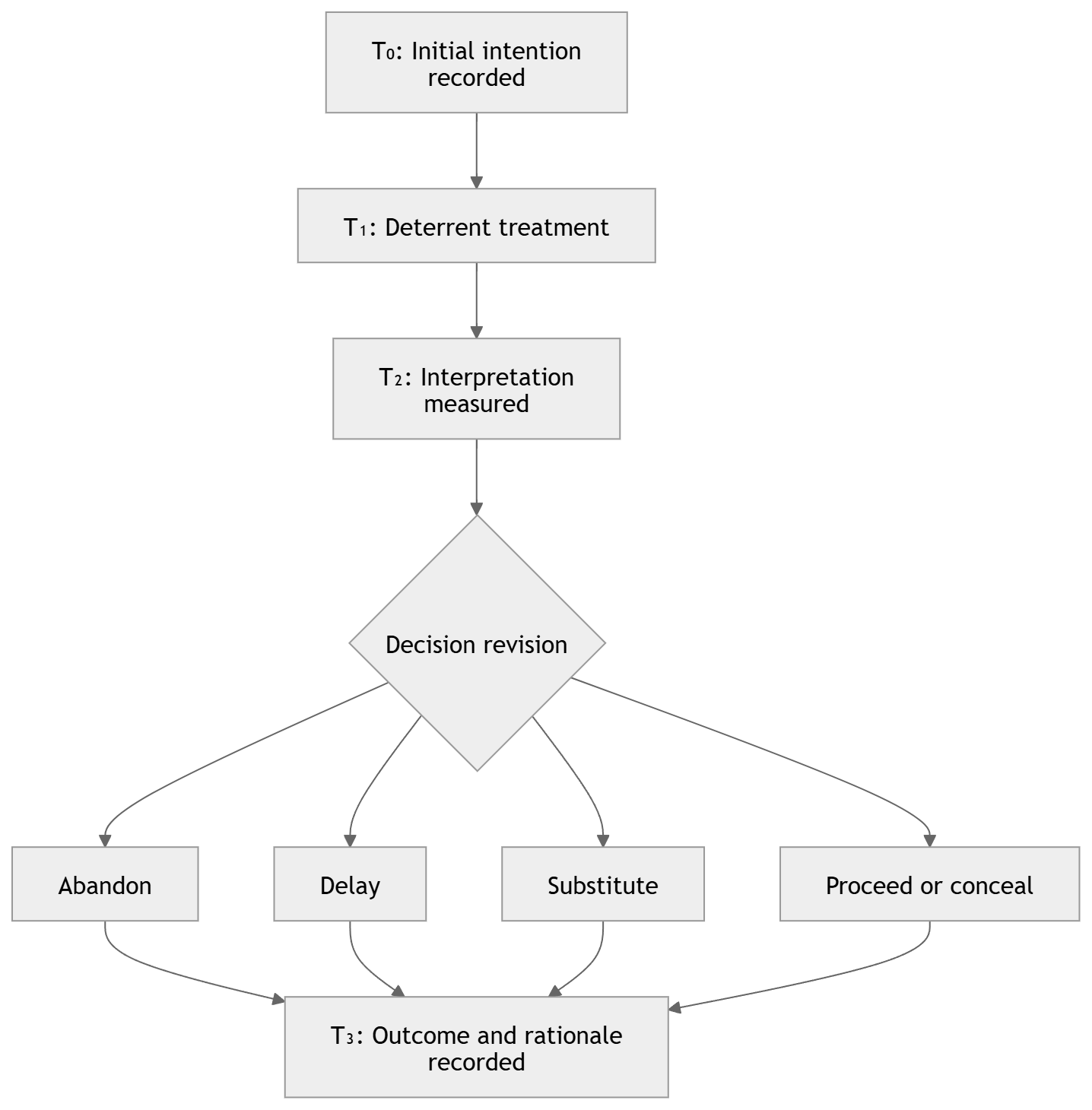
Experimental observation versus exercise performance
Analysts must distinguish an experimental wargame from an exercise, seminar game, course-of-action analysis, training event, simulation, and operational rehearsal because each instrument supports different claims. A controlled experiment manipulates one or more variables and attempts to isolate causal effects. A seminar game elicits expert judgments and exposes disagreements but may lack randomization, control groups, or standardized decisions. A military exercise tests whether personnel and organizations can execute established procedures under representative conditions. Course-of-action wargaming compares operational options and identifies likely branches, sequels, vulnerabilities, and resource conflicts. A computer simulation executes formal relationships encoded by designers; unless humans make consequential choices, it demonstrates model behavior rather than human behavior. The United Kingdom’s analysis-led framework places analytical design, data capture, delivery, exploitation, and methodological refinement inside a continuous process, explicitly linking game activity to the wider defence decision context. The Analysis-Led Wargaming Framework – United Kingdom Cyber and Specialist Operations Command – 2026 — official verified document. NATO similarly reports that wargaming is used to develop ideas, examine decision-making, validate concepts, and complement research, modelling, and simulation. Wargaming Initiative for NATO 2024: Towards a Common Wargaming Capability – NATO Allied Command Transformation – September 2024 — official verified source. None of these functions is inferior; the error lies in claiming evidence the selected method cannot generate. An exercise may prove that a multinational cyber incident-response process was executed within the allocated time, but not that an adversary would interpret the demonstrated capability as credible. A seminar game may reveal that ministers disagree over attribution thresholds, but not estimate the population frequency of that disagreement. An experiment may identify a causal effect among participants, but not prove operational readiness. A simulation may test thousands of parameter combinations, but it cannot recover political psychology excluded from its equations.
| Instrument | Primary observable | Strongest defensible inference | Claim it cannot establish alone |
|---|---|---|---|
| Controlled experimental game | Behavioral difference after a treatment | Treatment affected decisions in the tested environment | Real leaders will react identically |
| Seminar or matrix game | Arguments, preferences, disagreements | Plausible decision mechanisms and institutional friction | Population-level causal magnitude |
| Operational exercise | Timeliness, coordination, procedural performance | Organizations can execute tested procedures under exercise conditions | Adversary deterrence or strategic effectiveness |
| Course-of-action wargame | Branches, sequels, risks, resource conflicts | One plan appears more robust under stated assumptions | Forecast of actual conflict outcome |
| Computer simulation | Model outputs over repeated runs | Consequences implied by encoded relationships | Human adaptation absent from the model |
| Historical adjudication game | Decisions constrained by reconstructed evidence | Whether alternative decisions remain plausible | Direct counterfactual truth |
| Red-team game | Exploitable assumptions and adversarial adaptations | Existing plans contain specified vulnerabilities | Frequency with which exploitation will occur |
Causal identification and treatment design
A deterrence experiment requires a pre-registered causal structure that specifies the treatment, outcome, comparison condition, expected mechanism, exclusion criteria, and permissible generalizations before results become visible. The treatment cannot be defined vaguely as “a threat.” Researchers must distinguish threatened cyber disruption, economic sanctions, public attribution, criminal prosecution, diplomatic isolation, conventional military action, alliance response, and resilience disclosure. Each differs in severity, credibility, latency, reversibility, and relevance to the attacker’s objectives. Treatments should also vary attribution confidence, public versus private delivery, specificity of the prohibited conduct, proportionality, response timing, and whether the threat communicates capability, resolve, or both. The primary outcome should not be a binary attack/no-attack variable. A richer vector records objective retention, target selection, timing, scale, method, proxy involvement, concealment investment, expected utility, confidence, and escalation preference. Random assignment supports causal inference only if treatment groups are comparable, contamination is limited, attrition is measured, and participants cannot infer the study’s desired conclusion. Repeated play creates additional problems: learning, reputation, strategic adaptation, and recognition of experimental patterns violate independence assumptions. Cluster randomization at game-table level may therefore be more defensible than treating every decision as statistically independent. Manipulation checks must determine whether participants noticed, understood, believed, and considered the signal relevant; otherwise a null effect cannot distinguish an ineffective deterrent threat from a communication failure. The United Kingdom’s defence guidance on analytical models states that users must manage the risks associated with supporting analysis and ensure that it is fit for its intended purpose. JSP 939 Part 2: Modelling and Simulation – United Kingdom Ministry of Defence – January 2026 — official verified document. Applied to deterrence gaming, fitness for purpose means aligning every claim with the treatment actually manipulated and the population actually observed.
Internal validity: what can corrupt the result
Internal validity fails when something other than the assigned deterrent treatment plausibly caused the observed decision change. Demand characteristics arise when participants identify the research hypothesis and perform the behavior they believe investigators expect. Facilitator effects emerge when tone, clarification, pacing, or selective attention communicates approval. Adjudication effects occur when uncertain consequences are resolved inconsistently or when controllers unconsciously favor a narrative. Unequal information produces spurious treatment effects if one group receives more contextual intelligence than another. Social hierarchy can suppress dissent when junior participants defer to senior officials, while group polarization can generate stronger positions than participants would adopt individually. Selection bias appears when volunteers with military, technical, academic, or gaming experience differ systematically from the target decision-making population. Attrition bias arises when frustrated, unsuccessful, or unconvinced participants disproportionately leave before completion. Instrumentation bias occurs when researchers revise rules, prompts, or scoring during data collection. Cyber scenarios add a distinctive confounder: participants may possess incompatible mental models of technical feasibility. One player may treat a proposed operation as certain to succeed, another may regard it as technically implausible, and a third may assume hidden intelligence determines the outcome. Their reactions then measure divergent capability beliefs rather than deterrence. Controls should include standardized briefings, blinded facilitators where feasible, explicit probability ranges, adjudication protocols, decision logs, independent coding, inter-rater reliability tests, and post-decision interviews conducted before participants learn the experimental objective. NATO’s approach defines experimentation as a controlled investigation designed to reduce uncertainty and evaluate innovation objectively, making control discipline central rather than optional. Experimentation and Wargaming Online Press Room – NATO Allied Command Transformation – 2026 — official verified source. A statistically significant result cannot rescue a contaminated design; it may measure the consistency of the contamination rather than the deterrent mechanism.
| Validity threat | How it distorts deterrence measurement | Minimum control | Residual risk |
|---|---|---|---|
| Demand characteristics | Participants behave as they think researchers expect | Cover story, blinded hypothesis, neutral prompts | Experienced participants may still infer purpose |
| Facilitator influence | Delivery changes perceived credibility | Scripted messages and facilitator training | Non-verbal variation remains |
| Adjudication inconsistency | Similar actions produce different consequences | Predefined rules and independent review | Novel actions require judgment |
| Hierarchy and conformity | Senior preferences suppress genuine reversals | Private initial decisions and anonymous revision | Institutional culture persists |
| Technical-model divergence | Players assign incompatible feasibility estimates | Common capability and probability briefing | Real-world uncertainty cannot be eliminated |
| Repeated-game learning | Later decisions reflect adaptation to game mechanics | Counterbalancing and first-round analysis | Learning is also strategically meaningful |
| Selection bias | Sample differs from actual leaders or adversaries | Stratified recruitment and subgroup reporting | Elite adversary populations remain inaccessible |
| Missing data | Unrecorded reasoning obscures causal mechanism | Mandatory decision logs and coded explanations | Rationales may be post-hoc |
External validity and the elite decision-maker problem
External validity concerns whether an effect travels from the game to other people, institutions, crises, technologies, and periods. Cyber-deterrence games face an unusually severe transportability problem because the target population often consists of inaccessible political leaders, intelligence chiefs, military commanders, private infrastructure executives, and adversarial officials. University participants may supply statistical power but lack institutional responsibility and classified knowledge. Experienced officials improve realism but create small samples, heterogeneous backgrounds, and possible reliance on country-specific procedures. Retired leaders can reproduce established habits yet no longer face career, electoral, alliance, or personal consequences. Subject-matter experts understand capabilities but may overvalue technical variables relative to political legitimacy. External validity therefore cannot be reduced to a single realism score. It should be decomposed into population validity, institutional validity, ecological validity, temporal validity, and strategic-interaction validity. Population validity asks whether the participants resemble the actual decision-makers. Institutional validity asks whether authorization, consultation, legal review, and intelligence-sharing relationships are represented. Ecological validity asks whether uncertainty, time pressure, incomplete information, and competing crises approximate the operational environment. Temporal validity asks whether results remain applicable after capabilities, norms, alliances, and vulnerabilities change. Strategic-interaction validity asks whether the adversary can learn, deceive, delegate, and adapt rather than merely select from fixed options. China’s official defence white paper describes scenario-based, force-on-force, online confrontational, and computer-simulation exercises intended to improve operations under informationized conditions. The Diversified Employment of China’s Armed Forces – State Council Information Office of the People’s Republic of China – April 2013 — official verified source. This confirms that major powers use differing training and simulation cultures; it does not establish that participants from one strategic culture can serve as direct proxies for another. Replication across national and institutional populations is therefore indispensable.
Measurement validity: deterrence is not one outcome
Measurement limits become acute when researchers compress deterrence into a single binary dependent variable. A participant who cancels an operation may have been deterred, denied, confused, procedurally blocked, persuaded that the target lacks value, or redirected by an unrelated development. A participant who proceeds may have discounted the threat, disbelieved attribution, accepted the cost, misunderstood the signal, lacked authority to change the plan, or believed delay would sacrifice a fleeting opportunity. Researchers must consequently measure the latent variables connecting treatment and action: perceived capability, perceived resolve, expected punishment, expected operational benefit, attribution risk, domestic cost, alliance response, proportionality, controllability, and escalation expectation. Decision reversal is necessary evidence for immediate deterrence success only when the participant confirms that anticipated consequences caused the change and the game record supports that explanation. Even then, self-report may rationalize an intuitive or socially influenced choice. Triangulation should combine action data, response time, confidence ratings, written rationales, communication records, process tracing, and structured post-game interviews. The coding framework should distinguish general deterrence, in which background capability prevents serious consideration of an operation, from immediate deterrence, in which a communicated warning changes an already active decision. General deterrence remains harder to observe because no initial hostile choice enters the dataset. Experimental designs can approximate it by measuring which options participants generate before receiving explicit prompts, but the measurement may itself prime aggression. NATO doctrine treats wargaming results as inputs to course-of-action comparison and commander judgment rather than self-executing conclusions. Allied Joint Doctrine for the Planning of Operations, AJP-5 Edition B Version 1 – North Atlantic Treaty Organization – June 2026 — official verified document. That institutional framing is analytically sound: game outputs inform judgment; they do not replace it.
Structural analysis and competing hypotheses
An Analysis of Competing Hypotheses prevents researchers from treating every reversal as confirmation of deterrence. H₁—punishment credibility predicts that reversal varies with the perceived probability and severity of retaliation. H₂—denial dominance predicts that participants change course because the target becomes less penetrable or effects less durable, not because they fear retaliation. H₃—information correction predicts that the intervention changes beliefs about the situation, capability, or target value without coercing the actor. H₄—institutional constraint predicts that alliance procedures, legal review, command authorization, or domestic politics block the operation. H₅—strategic displacement predicts that the actor preserves its objective while changing the target, method, timing, or proxy. H₆—experiment compliance predicts that players reverse because the game signals that reversal is expected. H₇—escalation management predicts that the actor delays action to avoid an uncontrolled crisis while retaining long-term intent. Each hypothesis generates different observable implications. Punishment credibility should correlate with perceived response probability and severity; denial dominance should correlate with declining expected operational benefit; information correction should change factual beliefs; institutional constraint should appear in authorization records; displacement should produce a substitute action; experiment compliance should correlate with hypothesis awareness; escalation management should preserve hostile intent while changing timing or scale. Bayesian updating begins with explicit priors and multiplies them by the relative likelihood of the observed evidence under each hypothesis. Because exact numerical likelihoods are seldom defensible, analysts should publish qualitative or bounded likelihood ratios and test sensitivity to alternative priors. The purpose is not cosmetic quantification but protection against premature closure. A reversal accompanied by an unchanged strategic objective, immediate proxy substitution, and no increase in perceived punishment should update strongly toward H₅ and weakly toward H₁. A reversal following a credible coalition warning, accompanied by a marked increase in expected cost and no substitute operation, provides substantially stronger evidence of deterrence by punishment.
| Hypothesis | Predicted observable | Evidence increasing confidence | Evidence decreasing confidence |
|---|---|---|---|
| H₁ Punishment credibility | Higher expected cost precedes cancellation | Believed capability, resolve, attribution and proportionality all rise | Threat considered incredible or irrelevant |
| H₂ Denial dominance | Expected benefit collapses | Participants cite resilience, redundancy or failed access | Target remains vulnerable and valuable |
| H₃ Information correction | Beliefs change without fear response | Revised intelligence changes target assessment | Facts remain unchanged |
| H₄ Institutional constraint | Authorization pathway blocks action | Legal, alliance or command veto recorded | Actor retains autonomous authority |
| H₅ Strategic displacement | Objective survives through another route | New target, proxy, timing or instrument selected | Objective itself is abandoned |
| H₆ Experiment compliance | Reversal tracks perceived researcher expectation | Participants identify study purpose | Blinding succeeds and rationales are treatment-specific |
| H₇ Escalation management | Action is reduced or postponed | Fear of uncontrolled escalation dominates rationale | Actor expects escalation but proceeds unchanged |
Bayesian and Monte Carlo integration
Bayesian analysis and Monte Carlo simulation answer different questions and should not be conflated. Bayesian updating estimates how new observations change confidence in competing explanations; Monte Carlo modeling propagates uncertainty through a structured scenario model. For a deterrence experiment, the Bayesian layer begins with priors for H₁ through H₇, incorporates the observed decision transition and process evidence, and produces posterior rankings. The Monte Carlo layer then samples uncertain parameters such as attribution confidence, signal credibility, defender resilience, attacker risk tolerance, target value, proxy autonomy, alliance cohesion, domestic political cost, and escalation sensitivity. Each synthetic trial returns an outcome category: abandonment, delay, substitution, concealment, execution, or escalation. The resulting frequencies are conditional model outputs, not empirical forecasts. Their credibility depends on the parameter ranges, dependency structure, behavioral rules, and calibration evidence. Correlations are essential: attribution confidence may increase response credibility; alliance cohesion may decline as response severity rises; resilient systems may reduce damage but also make punishment politically less likely; proxy autonomy may increase deniability while decreasing sponsor control. A model assuming independent parameters will systematically understate clustered tail risks. Sensitivity analysis should report which variables most strongly alter outcomes and identify threshold effects where small changes produce large behavioral shifts. Model validation requires retrospective cases, expert elicitation, experimental results, and out-of-sample tests, while recognizing that strategic adaptation can invalidate past relationships. The United States Department of Defense identifies modelling, simulation, experimentation, exercises, testing, and wargaming as complementary analytical tools for evaluating system performance, dependencies, and capability decisions. Department of Defense Electromagnetic Spectrum Superiority Strategy – U.S. Department of Defense – October 2020 — official verified document. The methodological lesson applies directly: no single tool carries the entire evidentiary burden.
Shadow dimensions excluded by clean game designs
The most elegant experimental designs may omit precisely the shadow dimensions that determine real cyber behavior. Mercenary cyber suppliers blur the boundary between state direction, commercial service, patriotic activity, and criminal entrepreneurship. Liquidity networks allow operators to replace sanctioned infrastructure, purchase access, recruit affiliates, and relocate across jurisdictions. Vulnerability markets connect intelligence agencies, brokers, contractors, criminal groups, and offensive-security vendors through transactions that are rarely visible to public researchers. Private cloud, satellite, telecommunications, cybersecurity, and financial firms hold telemetry and control points that governments may not possess. Cyber norms shape reputational costs, but the same actor may invoke legal restraint publicly while exploiting ambiguous thresholds covertly. Games that assign every action to a unitary state actor will systematically overestimate central control and underestimate substitution through proxies. Games that treat sanctions as an immediate scalar cost will ignore enforcement delay, asset concealment, alternative payment rails, and the uneven exposure of individuals and organizations. Games that model attribution as a percentage will overlook the political process through which technical findings become an intelligence assessment, allied statement, legal case, or public accusation. These dimensions should enter through explicit actor networks, resource constraints, payment mechanisms, jurisdictional choices, and principal-agent relationships. They should also affect time: a sponsor may tolerate a proxy’s low-level activity until escalation threatens strategic interests, while the proxy may exploit ambiguity before control is reasserted. The European Union’s cyber-sanctions architecture seeks sustained, tailored, coherent, and coordinated strategies toward persistent threat actors rather than treating every incident as an isolated event. Sanctions Against Cyber-Attacks – Council of the European Union – updated July 2026 — official verified source. This campaign perspective should be reproduced in longitudinal games where actors accumulate access, resources, exposure, and political costs over multiple rounds.
The 2026–2031 measurement outlook
Over the next five years, wargaming will gain analytical power while simultaneously facing more serious validity risks. AI-generated scenario material will reduce design costs, accelerate adjudication, create adaptive adversaries, translate play across languages, and permit thousands of branching narratives. Synthetic agents may support preliminary stress testing before expensive human participation, while natural-language processing can code decision rationales and identify recurring causal mechanisms. Yet AI can introduce hidden priors, culturally specific assumptions, unstable outputs, automation bias, and false precision. If synthetic adversaries are trained primarily on Western doctrinal and historical material, their apparent reactions may reproduce the defender’s model of the opponent rather than the opponent’s actual decision culture. NATO’s 2025 concept-development and wargaming program explicitly included AI’s role in wargaming and decision-making under disruptive change. Shaping NATO’s Future Through Concept Development and Wargaming – NATO Allied Command Transformation – November 2025 — official verified source. China’s official descriptions of confrontational, verification-oriented, online, and computer-simulation exercises demonstrate a longstanding emphasis on informationized training, quantitative evaluation, and opposing-force interaction. The Diversified Employment of China’s Armed Forces – State Council Information Office of the People’s Republic of China – April 2013 — official verified source. Russian official military educational standards likewise identify command-staff exercises and military-specialized games as integrated methods, confirming a distinct institutional gaming tradition without disclosing sufficient evidence to compare cyber-deterrence outcomes directly. Federal State Educational Requirements: Command-Staff Exercises and Military Games – Ministry of Defence of the Russian Federation – verified 2026 — official verified document. By 2031, the strongest research programs will combine preregistered human experiments, culturally diverse samples, synthetic-agent stress tests, operational exercises, historical cases, and repeated Bayesian updating rather than privileging any single dataset.
Final evidentiary judgment
Wargames can prove that decisions changed within a controlled or documented environment; they can identify mechanisms, expose institutional friction, compare policy options, discover vulnerabilities, and generate evidence about how particular participants process uncertainty. They can show that a communicated threat altered perceived costs, that resilience reduced expected benefits, that attribution confidence affected coalition willingness, or that an apparently deterred operation migrated to a proxy or alternate target. They can also falsify simplistic claims—for example, that increasing threatened severity always increases deterrence—if escalation fear, credibility loss, or defiance produces the opposite behavioral response. Wargames cannot independently prove that a real adversary was deterred in an unobserved historical case, that national leaders will repeat participant behavior, that statistically significant laboratory effects possess strategic magnitude, or that a modeled probability corresponds to an objective frequency in future crises. Their results remain conditional on participant selection, scenario construction, information architecture, adjudication, incentives, institutional representation, technical assumptions, and temporal context. The appropriate evidentiary chain therefore runs from experimental observation to mechanism identification, from mechanism identification to replicated comparison, from replication to triangulation with exercises and operational cases, and only then to bounded policy inference. The most important measurement reform for 2026–2031 is to stop equating attack cancellation with complete deterrence. Researchers must track whether hostile objectives disappear, migrate, fragment, or become more covert. A defender that prevents an operation against one critical network but redirects the same actor toward a less resilient ally has achieved local denial, not necessarily strategic deterrence. The scientific value of gaming lies precisely in making those distinctions visible before policymakers mistake a quiet network for a changed adversary.
Five-Year Wargame Evidentiary-Capability Projection
Structured analytical projection, 2026–2031. Index values represent comparative methodological maturity, not operational probabilities.
How Cyber Deterrence Works: Seven Mechanisms of Restraint
Deterrence as a portfolio, not a weapon
Cyber deterrence works when a potential attacker concludes that a contemplated operation will not produce an acceptable net strategic return. That conclusion may result from fear of punishment, expectation of operational failure, dependence on systems exposed to reciprocal damage, anticipated reputational loss, exposure of covert infrastructure, pre-emptive disruption, or the prospect of a coordinated multinational response. These are distinct causal mechanisms, not interchangeable labels for a single policy. A state can deter one category of behavior while remaining unable to deter another: destructive interference with an electricity grid may be restrained by the possibility of cross-domain retaliation, while espionage against the same grid continues because the attacker regards intelligence collection as legitimate, deniable, and worth the residual risk. Deterrence must therefore be specified as a relationship among an identifiable actor, prohibited behavior, protected interest, communicated or inferred consequence, and temporal horizon. A useful conceptual representation is Dₐ,ᵦ,ₜ: deterrence of actor a from behavior b during period t. The defender’s objective is not to “deter cyber” in the abstract but to reduce the probability that actor a selects behavior b after comparing its expected benefits, costs, risks, alternatives, and opportunity costs. NATO’s official cyber policy reflects this portfolio logic: Allies strengthen detection, prevention, resilience, response, collective situational awareness, civil-military cooperation, and the potential use of collective responses rather than relying on automatic cyber retaliation. Cyber Defence – North Atlantic Treaty Organization – updated July 2024 — official verified source. The resulting architecture is closer to risk management than to a fixed red line. It must alter both sides of the attacker’s calculation: reduce the expected gain through denial and disruption, increase expected cost through punishment and exposure, constrain substitution through collective action, and preserve off-ramps so that coercion does not force escalation.
| Mechanism | Variable principally altered | Immediate objective | Strongest against | Principal failure mode |
|---|---|---|---|---|
| Punishment | Expected post-operation cost | Make execution prohibitively expensive | States, identifiable officials, exposed firms | Threat lacks credibility or targetable value |
| Denial | Probability and durability of success | Make the operation strategically unproductive | Opportunists, ransomware, disruption campaigns | Attack migrates toward weaker targets |
| Entanglement | Reciprocal economic and operational loss | Make escalation self-damaging | Economically integrated states and firms | Dependencies are asymmetric or already being reduced |
| Norms | Legitimacy and reputational cost | Increase diplomatic and coalition consequences | Reputation-sensitive governments | Norms are contested or weakly enforced |
| Exposure | Secrecy, deniability and operational longevity | Destroy cover and impose adaptation costs | Intelligence services, proxies, infrastructure providers | Disclosure burns defender intelligence access |
| Disruption | Available capability and operational tempo | Remove infrastructure before effects occur | Botnets, malware services, criminal ecosystems | Infrastructure is rapidly reconstituted |
| Collective response | Aggregate probability and scale of consequence | Multiply attribution, resilience and coercive power | State campaigns and transnational ecosystems | Political delay, divergent thresholds, vetoes |
Punishment: increasing the price of action
Deterrence by punishment attempts to change behavior by increasing the attacker’s expected post-operation cost. In simplified form, an operation becomes unattractive when Pᵣ × Cᵣ exceeds Pₛ × Bₛ, where Pᵣ represents the perceived probability of an effective response, Cᵣ the expected cost imposed, Pₛ the probability of operational success, and Bₛ the expected strategic benefit. The expression is not a forecast formula; it identifies the beliefs that deterrent policy must influence. Increasing nominal severity without increasing response probability may have little effect. A threat of overwhelming retaliation that the defender is politically unlikely to execute can be less credible than a limited measure already authorized, legally prepared, and supported by allies. Punishment can take the form of asset freezes, travel prohibitions, commercial restrictions, criminal charges, extradition requests, cryptocurrency seizures, diplomatic expulsions, covert action, public attribution, cyber countermeasures, or conventional military readiness. Its target may be the operator, commanding officer, intelligence organization, enabling company, financial intermediary, political sponsor, or economic sector from which the sponsor derives disproportionate value. The European Union’s dedicated cyber-sanctions framework illustrates a targeted model. On 12 May 2025, the Council extended the legal framework until 18 May 2028 and the operative restrictive measures until 18 May 2026; at that date, measures applied to 17 individuals and four entities, including asset freezes, restrictions on making funds available, and travel bans. Cyber-Attacks: Council Extends Sanctions and Legal Framework – Council of the European Union – May 2025 — official verified source. These figures demonstrate institutionalized punitive capacity, but not deterrent success. To establish behavioral effect, analysts would need evidence that listed or prospective actors changed operations because they anticipated those measures rather than because infrastructure failed, priorities shifted, or another constraint intervened.
Punishment’s credibility problem
Punishment is strongest when it is attributable, relevant, timely, proportionate, legally sustainable, and repeatable. It weakens when attribution takes months, the threatened measure targets assets the attacker does not possess, the defender has previously tolerated comparable behavior, or political leaders cannot explain why a particular incident crosses the response threshold. Cyber attribution also separates technical confidence from political attribution. Investigators may connect malware, infrastructure, operational security failures, victimology, working hours, language artifacts, procurement records, cryptocurrency movements, and prior campaigns to a cluster without proving which official authorized the specific operation. A defender can still impose costs, but uncertainty affects coalition formation, public legitimacy, legal process, and escalation risk. Punishment also encounters a replacement problem: operators, servers, accounts, corporate vehicles, and front companies may be expendable. Sanctioning a low-level operator imposes personal cost yet may leave the sponsor’s strategic calculus unchanged. Punitive policy should consequently target scarce and difficult-to-replace resources: trusted intermediaries, specialist developers, privileged access, protected hosting, financial conversion points, travel opportunities, procurement channels, intelligence cover, and relationships with state institutions. The January 2025 EU measures against three individuals connected to cyberattacks against Estonia targeted officers of GRU Unit 29155, connecting personal listings to an identified institutional structure. Cyber-Attacks: Three Individuals Added to EU Sanctions List for Malicious Cyber Activities Against Estonia – Council of the European Union – January 2025 — official verified source. The deterrent value depends on more than publication: whether implicated officers or their command anticipate operational restrictions, whether allied jurisdictions enforce the measures, whether financial or travel exposure exists, and whether future listings reach organizational sponsors. Punishment is therefore a cumulative credibility asset built through consistent attribution, enforceable consequences, coalition participation, and visible follow-through.
Denial: reducing the expected return
Deterrence by denial works before punishment becomes necessary. It seeks to convince the attacker that penetration will fail, lateral movement will be contained, operational technology will remain segmented, compromised identities will be detected, destructive changes will be reversed, and essential services will continue. Denial does not require the attacker to fear the defender; it requires the attacker to expect insufficient benefit. Its constituent measures include multifactor authentication resistant to phishing, privileged-access control, network segmentation, zero-trust verification, application allow-listing, rapid patching of exploited vulnerabilities, behavioral detection, protected logging, isolated and tested backups, recovery-time engineering, manual operating modes, redundant communications, alternate suppliers, and rehearsed continuity procedures. CISA defines its Cross-Sector Cybersecurity Performance Goals as a baseline of practices applicable across critical infrastructure and oriented toward known risk reduction. Cross-Sector Cybersecurity Performance Goals – Cybersecurity and Infrastructure Security Agency – verified July 2026 — official verified source. Denial produces different deterrent effects across actor classes. It can strongly discourage opportunistic criminals who select targets by expected profit per unit of effort. It can redirect hacktivists toward more visible but less protected targets. It may delay a state intelligence service without eliminating its strategic interest, causing investment in supply-chain compromise, insiders, zero-day vulnerabilities, or living-off-the-land techniques. Denial can also reduce the defender’s willingness to punish if limited damage lowers political urgency, creating a paradox: improved resilience makes an operation less valuable but may simultaneously make it less costly for the attacker to attempt. The correct metric is consequently not breach count alone. Analysts must measure dwell time, privilege obtained, operational effect, recovery time, mission degradation, replacement cost imposed on the attacker, and whether hostile activity migrates elsewhere.
Denial’s displacement and weakest-link effects
A defender can achieve local denial while suffering system-level deterrence failure. If a hardened national ministry causes an adversary to target a regional authority, managed-service provider, small supplier, allied network, or personal device used by an official, the original target remains functional but the campaign objective may survive. This displacement effect is especially important in alliance and supply-chain environments, where security is heterogeneous and operational dependencies extend beyond nationally controlled infrastructure. NATO’s Cyber Defence Pledge explicitly states that interconnectedness makes the Alliance only as strong as its weakest link and places primary responsibility on Allies to improve national networks and infrastructure. Cyber Defence Pledge – North Atlantic Treaty Organization – July 2016 — official verified source. Denial therefore requires minimum collective baselines, not merely exceptional protection of high-profile nodes. It must map functional dependencies: which identity provider, cloud tenant, satellite service, logistics platform, software update channel, telecommunications carrier, data exchange, domain registrar, certificate authority, and energy source sustains the protected mission. The target of deterrence is often a service chain rather than an organization. Denial metrics should include the percentage of critical functions capable of operating under degraded connectivity, time to revoke compromised credentials, backup restoration success, median patch latency for known exploited vulnerabilities, concentration among service providers, number of unmonitored trust relationships, and recovery time for operational technology. Where these metrics remain undisclosed, the defender must solve a signaling problem. Revealing every defensive control helps the attacker identify residual weaknesses, while revealing nothing prevents resilience from influencing the attacker’s expectations. Selective disclosure—audited standards, aggregate recovery performance, exercises, certification, and visible redundancy—can communicate that catastrophic effects are unlikely without exposing exact architecture. Denial becomes deterrence only when the adversary perceives the reduced payoff; unobserved resilience remains protection, but it may not shape pre-operation choice.
Entanglement: dependence as restraint and vulnerability
Deterrence by entanglement rests on the proposition that interconnected economies, platforms, financial networks, supply chains, and communications systems make severe cyber disruption costly to both initiator and target. A state considering attacks on financial clearing, cloud infrastructure, undersea communications, semiconductor production, satellite services, or global logistics may anticipate collateral damage to its own firms, citizens, intelligence access, export revenue, and political partners. Entanglement can therefore raise the attacker’s endogenous cost without an explicit retaliatory threat. Its restraining power, however, depends on symmetry, visibility, indispensability, and time. Highly asymmetric dependence can become coercive leverage rather than mutual restraint. Replaceable commercial connections create weaker deterrence than unique financial, technological, or infrastructural dependencies. States may also pursue strategic decoupling, domestic substitution, reserve systems, data localization, alternative payment networks, and sovereign cloud capacity specifically to reduce vulnerability before confrontation. Entanglement is consequently dynamic: measures that increase resilience may simultaneously remove a source of mutual restraint. Analysts should map both direct and second-order dependencies. An operation against a foreign cloud provider may impair domestic companies hosted on the same platform; disruption of a maritime logistics system may delay the attacker’s imports; interference with financial messaging may reduce access to hard currency; manipulation of widely used software may expose intelligence operations by affecting neutral countries. Entanglement works most reliably against high-consequence attacks with broad systemic effects and less reliably against narrowly tailored espionage or operations designed to avoid shared dependencies. It also generates ambiguity about intent: restraint may result from concern about blowback, preservation of intelligence access, fear of escalation, or lack of operational readiness. Wargames should therefore manipulate dependency concentration, substitution time, anticipated collateral effects, and the political visibility of reciprocal damage rather than assuming that economic integration automatically produces peace.
Norms: converting consensus into anticipated cost
Norm-based deterrence does not depend on moral persuasion alone. It operates when accepted standards of responsible behavior increase the diplomatic, reputational, coalition, legal, or economic cost of violation. The United Nations framework addresses existing and potential ICT threats, the application of international law, voluntary norms of responsible state behavior, confidence-building measures, capacity-building, and regular institutional dialogue. At the tenth substantive session of the 2021–2025 Open-Ended Working Group, the United Nations reported that its intergovernmental Points of Contact directory had participation exceeding 160, illustrating the scale of the emerging crisis-communication architecture. Tenth Substantive Session of the Open-Ended Working Group on Security of and in the Use of ICTs 2021–2025 – United Nations General Assembly – February 2025 — official verified source. Norms influence behavior through at least five pathways: they clarify expectations; enable coalitions to characterize conduct as unacceptable; reduce political transaction costs for coordinated responses; provide standards against which third states can assess evidence; and create reputational stakes for governments seeking legitimacy. Their limitations are equally substantial. Voluntary norms may lack automatic enforcement, states disagree over terminology and legal interpretation, public attribution can become politically contested, and actors may accept reputational damage when core security interests dominate. Norms also interact with capability. A norm without monitoring, attribution, diplomatic coordination, or enforcement may condemn behavior without changing incentives. Conversely, coercive action unsupported by a recognized normative framework can fragment coalitions and appear opportunistic. Norm deterrence is therefore strongest when violation activates predictable institutional consequences: formal consultation, evidence sharing, public attribution, assistance to victims, sanctions review, law-enforcement coordination, and defensive reinforcement. Its appropriate success metric is not simply whether malicious activity stops. Analysts should measure breadth and speed of condemnation, number of states joining attribution, consistency of legal characterization, implementation of protective measures, and whether the target actor changes behavior, tools, infrastructure, or sponsorship arrangements.
Exposure: attacking secrecy and deniability
Deterrence by exposure changes the economics of covert action. Cyber capabilities derive value from secrecy: undisclosed vulnerabilities remain exploitable, covert infrastructure retains access, malware persists while defenders do not recognize it, front companies acquire services, and operators benefit from anonymity. Publicly or privately exposing these assets can force the attacker to rebuild tools, replace servers, abandon accounts, alter procedures, rotate personnel, close intelligence accesses, and accept greater attribution risk. Exposure differs from punishment because its principal effect is operational degradation rather than retrospective suffering. It may include malware signatures, infrastructure indicators, command-and-control patterns, cryptocurrency addresses, organizational affiliations, procurement networks, photographs, indictments, technical advisories, or coordinated attribution. Its deterrent message is that operational preparation will not remain invisible and that invested resources may be neutralized before producing strategic effects. Exposure must nevertheless be governed by an intelligence-gain/loss calculation. Publishing a detailed indicator can enable defenders worldwide to detect a campaign, but it can also reveal the defender’s visibility and cause the adversary to close a collection channel. Naming an intelligence service can strengthen coalition solidarity while encouraging more disciplined proxy use. Exposing a zero-day operation can protect targets yet sacrifice an opportunity to observe objectives, victims, and command relationships. The optimal disclosure is therefore neither maximum transparency nor permanent secrecy. It is selective release designed to impose greater replacement cost on the attacker than intelligence loss on the defender. NATO’s July 2025 statement illustrates collective exposure at the political level: the North Atlantic Council recognized national attributions concerning Russian malicious cyber activity and declared an intention to counter, constrain, and contest those activities while strengthening Allied defences. Statement of Condemnation by the North Atlantic Council Concerning Russian Malicious Cyber Activities – North Atlantic Treaty Organization – July 2025 — official verified source.
Disruption: removing capability before damage
Deterrence by disruption occupies the boundary between prevention and coercion. It targets the infrastructure, malware, credentials, domains, devices, financial accounts, hosting arrangements, or administrative systems that enable malicious operations. Unlike punishment, disruption need not wait for completed harm; unlike denial, it acts against the adversary’s ecosystem rather than only protecting the defender’s network. United States court-authorized operations demonstrate several variants. In September 2024, the Department of Justice announced disruption of a botnet comprising more than 200,000 consumer devices in the United States and internationally, attributing its use to People’s Republic of China state-sponsored actors associated with Integrity Technology Group. Court-Authorized Operation Disrupts Worldwide Botnet Used by People’s Republic of China State-Sponsored Hackers – U.S. Department of Justice – September 2024 — official verified source. In April 2022, Operation Copied and Removed disabled the Cyclops Blink malware on command-and-control devices used by the Russian GRU, although the Department emphasized that victims still needed to remediate underlying vulnerabilities. Justice Department Announces Court-Authorized Disruption of Botnet Controlled by the Russian Federation’s Main Intelligence Directorate – U.S. Department of Justice – April 2022 — official verified source. These operations produce immediate denial of capability and reveal access to legal, technical, and intelligence instruments. Their longer-term deterrent effect depends on replacement time, accumulated cost, operator identification, financial consequences, and the adversary’s belief that future infrastructure will also be discovered. A takedown that is restored within days may interrupt operations without altering strategic intent; repeated disruption across technical and financial layers can transform temporary friction into campaign-level deterrence.
Disruption of the criminal supply chain
Criminal cyber ecosystems illustrate why disruption must address supply chains rather than only named groups. Modern ransomware and credential-theft operations depend on initial-access brokers, loaders, botnets, stolen credentials, bulletproof hosting, domain services, malware developers, affiliates, negotiators, cryptocurrency infrastructure, mixers, exchanges, and cash-out networks. Removing one brand may produce rebranding if personnel, liquidity, access, and hosting survive. Operation Endgame targets upstream malware and botnet infrastructure used to enable later-stage attacks. Europol reported that its November 2025 phase resulted in 1,025 servers taken down, while the European Cybercrime Centre reports that the May 2025 phase included €21.2 million in cryptocurrency seized and 300 malware servers taken down. Operation Endgame – European Union Agency for Law Enforcement Cooperation – November 2025 — official verified source. European Cybercrime Centre EC3 – European Union Agency for Law Enforcement Cooperation – updated 2026 — official verified source. The Qakbot operation demonstrates the integration of technical and financial action. In 2023, law enforcement redirected botnet traffic and caused infected systems to download an uninstall file; in May 2025, the Department of Justice announced an indictment and a civil forfeiture complaint connected to more than $24 million in seized cryptocurrency. Leader of Qakbot Malware Conspiracy Indicted for Involvement in Global Ransomware Scheme – U.S. Department of Justice – May 2025 — official verified source. Deterrence emerges when operators expect that technical access, revenue, stored value, freedom of movement, and personal anonymity can be lost together. The correct metric is ecosystem regeneration time, not the takedown-day count.
| Officially reported action | Date | Quantified result | Mechanism principally affected | Deterrence significance |
|---|---|---|---|---|
| EU cyber-sanctions extension | May 2025 | 17 individuals; 4 entities | Punishment and exposure | Institutionalizes repeatable targeted costs |
| Integrity Technology botnet disruption | September 2024 | More than 200,000 devices | Disruption and exposure | Removes infrastructure and demonstrates reach |
| Qakbot international takedown | August 2023–May 2025 | More than 700,000 infections reported; over $24 million seized later | Disruption, punishment, liquidity denial | Couples technical action with financial loss |
| Operation Endgame, May phase | May 2025 | 300 servers; €21.2 million cryptocurrency | Supply-chain disruption | Targets enabling malware and stored value |
| Operation Endgame, November phase | November 2025 | 1,025 servers | Infrastructure disruption | Increases replacement and coordination costs |
| Emotet international operation | January 2021 | More than 1.6 million victim computers reported | Infrastructure disruption | Demonstrates multinational access to a major botnet |
| Aisuru/KimWolf/JackSkid/Mossad case | March 2026 | More than 316,000 alleged DDoS commands across four botnets | Disruption and prosecution | Targets industrial-scale attack capacity |
Liquidity denial as cyber deterrence
Liquidity is a shadow variable connecting punishment, exposure, and disruption. Cyber operators require funds to acquire access, vulnerabilities, hosting, domains, credentials, developer labor, money-laundering services, and personal protection. State operators receive budgets and institutional support; criminal ecosystems depend more directly on payment rails and conversion services; mercenary suppliers occupy the middle, monetizing expertise while serving state, corporate, or criminal customers. Financial action can deter when it raises conversion costs, freezes stored value, exposes counterparties, or creates personal legal risk for facilitators. In August 2025, the U.S. Treasury reported that actions against the cryptocurrency exchange Garantex included seizure of its web domain and freezing of more than $26 million in cryptocurrency in March 2025, followed by indictments of executives. Treasury Sanctions Cryptocurrency Exchange and Network Enabling Sanctions Evasion and Cyber Criminals – U.S. Department of the Treasury – August 2025 — official verified source. In November 2025, Treasury sanctioned eight individuals and two entities for roles in laundering funds associated with North Korean cybercrime and information-technology worker schemes. Treasury Sanctions DPRK Bankers and Institutions Involved in Laundering Cybercrime Proceeds and IT Worker Funds – U.S. Department of the Treasury – November 2025 — official verified source. Liquidity denial is less effective when actors can shift to alternative exchanges, over-the-counter brokers, privacy-enhancing tools, mule networks, commodities, or state-backed channels. It must therefore be evaluated through network analysis: concentration of payment services, substitutability of sanctioned nodes, transaction-routing changes, conversion spreads, and time required to restore usable liquidity. The deterrent target is not cryptocurrency itself but the operator’s confidence that operational revenue can be converted, stored, transferred, and consumed without unacceptable exposure.
Collective response: multiplying capability and credibility
Collective deterrence aggregates capabilities that few states possess individually. One Ally may contribute technical telemetry, another financial intelligence, another criminal jurisdiction, another diplomatic access, another malware reverse engineering, and another military capability. Coalition attribution increases evidentiary breadth and political legitimacy; synchronized sanctions restrict jurisdictional arbitrage; coordinated takedowns prevent infrastructure from escaping into uncooperative jurisdictions; shared resilience reduces target displacement. NATO’s collective cyber posture integrates political, military, and technical levels and permits the Alliance to consider collective responses to significant malicious activity. Cyber Defence – North Atlantic Treaty Organization – updated July 2024 — official verified source. The Alliance decided at the 2024 Washington Summit to establish the NATO Integrated Cyber Defence Centre to improve network protection, situational awareness, and implementation of cyberspace as an operational domain. Deterrence and Defence – North Atlantic Treaty Organization – updated June 2026 — official verified source. Collective capacity is also exercised operationally: Cyber Coalition 2025, conducted from 28 November to 4 December, involved approximately 1,300 cyber defenders from 29 NATO Allies and seven partner nations. NATO Cyber Coalition 2025: Advancing Cyber Defence Through Collaboration and Innovation – NATO Allied Command Transformation – December 2025 — official verified source. These numbers measure participation and interoperability investment, not deterrence itself. Collective deterrence depends on whether adversaries expect rapid consultation, coherent attribution, material assistance, and consequences. If political coordination is slow or thresholds diverge, aggregation can become procedural friction. Credibility therefore requires pre-agreed evidence standards, protected channels, graduated response packages, national authorities mapped in advance, and rehearsed transitions from technical incident response to strategic decision-making.
The collective-action paradox
Coalitions create scale but also distribute risk unevenly. A state hosting critical infrastructure may favor immediate attribution, while another fears economic retaliation, intelligence exposure, or escalation. A highly resilient Ally may tolerate continued confrontation; a digitally dependent but weakly protected Ally may prefer restraint. States also differ in attribution law, evidentiary standards, sanctions exposure, offensive authorities, private-sector relationships, and public tolerance for secrecy. An adversary can exploit these differences through operations calibrated below the threshold likely to generate consensus, by targeting non-members or partners, or by imposing asymmetric economic costs on the most reluctant coalition member. The EU framework illustrates both power and constraint. Sanctions decisions are adopted by the Council unanimously, making them politically weighty but potentially slower and vulnerable to divergent national interests. Why the EU Adopts Sanctions – Council of the European Union – verified July 2026 — official verified source. The solution is not to eliminate deliberation, which provides legitimacy and escalation control, but to reduce preventable delay through advance planning. Coalitions should develop response ladders linked to effect categories rather than named technologies: espionage, service disruption, destructive effect, data manipulation, pre-positioning in critical infrastructure, electoral interference, or physical harm. Each band should specify consultation triggers, intelligence requirements, available assistance, public-communication options, financial measures, law-enforcement tools, and escalation authorities. Collective response should also be cumulative. A campaign comprising individually limited intrusions may cross a strategic threshold through persistence, target pattern, or aggregate effect even when no single event does. Without cumulative accounting, adversaries can remain permanently below incident-specific thresholds while imposing substantial long-term cost.
Integration: how the seven mechanisms reinforce one another
The seven mechanisms produce maximum effect when sequenced as an integrated campaign. Denial reduces success probability and generates telemetry. Telemetry supports attribution and exposure. Exposure enables sanctions, prosecution, diplomatic action, and infrastructure removal. Disruption forces the attacker to acquire replacement resources, creating financial movements and operational mistakes. Liquidity controls increase replacement cost. Norms provide the political framework for coalition formation. Collective response expands jurisdictional reach, while entanglement supplies additional leverage over enabling firms and sponsor economies. The causal chain is recursive rather than linear because every defensive action changes adversary behavior. Strong denial may increase supply-chain attacks; exposure may encourage proxy delegation; financial sanctions may push operators toward new payment rails; disruption may fragment large groups into smaller cells; collective attribution may reduce overt activity while increasing covert preparation. An effective strategy therefore observes adaptation and updates the intervention portfolio. It must also preserve proportionality. Excessive punishment for lower-level activity can undermine coalition support, validate adversary narratives, or provoke escalation. Excessively cautious responses can normalize persistent aggression and reduce future credibility. The governing concept should be campaign-level expected-cost dominance: across repeated interactions, the attacker should expect that strategically harmful activity will become progressively less successful, more expensive, more visible, and more personally or institutionally risky. No single mechanism must be decisive in every incident. The portfolio succeeds when the combination changes target selection, scale, persistence, sponsorship, and strategic return over time.
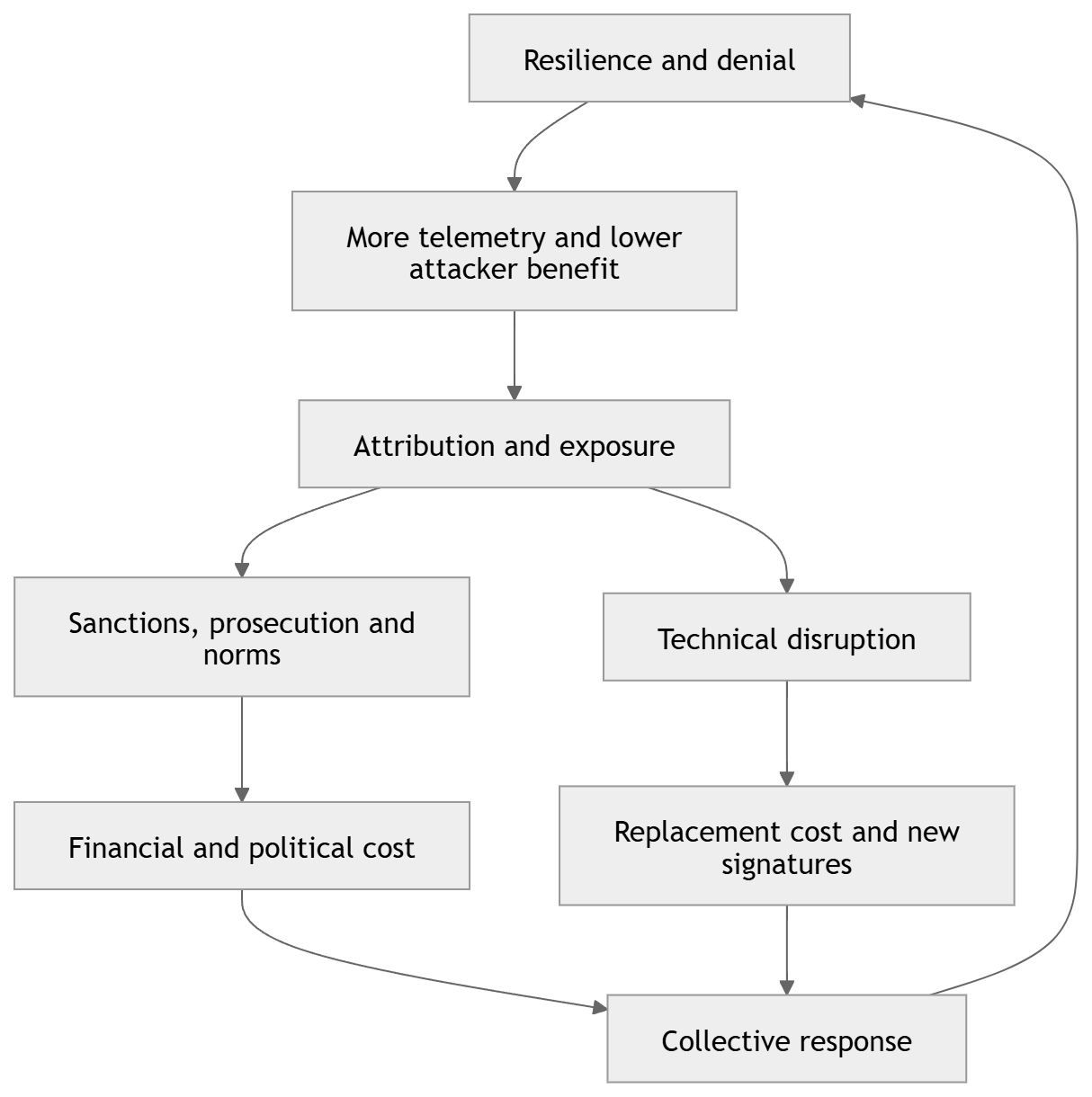
Measurement architecture
Cyber deterrence cannot be assessed through incident counts alone because reporting improves, attacker substitution occurs, and failed attempts are often invisible. A rigorous measurement system must distinguish activity, capability, intent, effect, cost, and adaptation. For punishment, analysts should track the time between attribution and consequence, number of participating jurisdictions, asset exposure, travel restriction, procurement denial, and subsequent operational behavior. For denial, appropriate metrics include mission degradation, recovery time, containment rate, credential-revocation latency, backup restoration, and displacement toward other targets. For entanglement, analysts require dependency concentration, switching time, reciprocal exposure, and evidence of strategic decoupling. Norm measurement should include breadth of diplomatic alignment, speed of consultation, consistency of state practice, and whether norm violation triggers material response. Exposure should be evaluated through infrastructure abandonment, malware redesign, operational silence, altered tradecraft, and intelligence gain or loss. Disruption metrics include servers, domains, devices, accounts, and funds affected, but also regeneration time, post-operation attack volume, and whether key personnel remain active. Collective-response metrics include attribution participation, intelligence-sharing speed, synchronized legal action, victim assistance, and political cohesion. These indicators feed Bayesian updating. A fall in attacks following sanctions supports punishment only if alternative explanations—improved denial, infrastructure loss, operational reprioritization, or reporting change—are less consistent with the evidence. Monte Carlo models should then sample attribution confidence, coalition response time, replacement cost, attacker tolerance, proxy autonomy, target resilience, and escalation sensitivity, preserving correlations rather than treating variables as independent. The result is not a universal “deterrence score” but a conditional distribution for abandonment, delay, substitution, concealment, persistence, and escalation.
| Mechanism | Leading indicator | Intermediate indicator | Outcome indicator | Essential counterfactual |
|---|---|---|---|---|
| Punishment | Threat and authority prepared | Attribution-to-action time | Behavior changes after cost imposition | What comparable actors did without punishment |
| Denial | Control adoption and exercised recovery | Increased attacker effort and containment | Lower mission impact | Outcome against less resilient targets |
| Entanglement | Reciprocal dependency remains material | Leaders reference blowback risk | High-impact action withheld | Behavior after dependency declines |
| Norms | Shared standard and consultation channel | Coalition condemnation and attribution | Reduced or altered prohibited conduct | Similar conduct without normative alignment |
| Exposure | Collection supports public or private disclosure | Infrastructure and tradecraft change | Campaign loses access or tempo | Expected change absent disclosure |
| Disruption | Legal and technical access obtained | Assets disabled or seized | Reconstitution delayed or abandoned | Normal infrastructure turnover |
| Collective response | Pre-agreed coordination mechanisms | Multinational synchronized action | Broader, more durable constraint | Unilateral action against same ecosystem |
Five-year outlook, 2026–2031
Between 2026 and 2031, denial and disruption are likely to generate the most measurable operational effects, while punishment, norms, entanglement, and collective response will remain more politically consequential but harder to attribute causally. The baseline scenario, assessed at 50%, is persistent competition with selective deterrence of the most destructive operations. States continue espionage, access preparation, influence operations, and proxy activity but exercise greater restraint around effects likely to cause deaths, prolonged essential-service disruption, or collective military consequences. A second scenario, ecosystem suppression, assessed at 20%, emerges if coordinated technical, legal, financial, and private-sector operations raise replacement costs faster than criminal and proxy ecosystems can regenerate. A third scenario, fragmented impunity, assessed at 20%, develops if geopolitical blocs weaken attribution coalitions, safe-haven jurisdictions expand, and infrastructure becomes easier to replace through automation. A fourth scenario, cross-domain escalation, assessed at 10%, follows a destructive incident, misinterpreted pre-positioning, or proxy operation that exceeds sponsor control. These are structured priors, not official probabilities. AI will intensify every mechanism: attackers gain scalable reconnaissance, translation, social engineering, vulnerability prioritization, and adaptive malware; defenders gain faster detection, correlation, adjudication, and recovery. The crucial question will be which side converts automation into sustainable cost advantage. Coalition data access, identity security, cloud telemetry, semiconductor supply, financial intelligence, and control over major service providers will become deterrence assets. The most effective architecture will not promise retaliation for every intrusion. It will make serious operations progressively harder to execute, harder to conceal, harder to finance, easier to attribute, and more likely to trigger coordinated consequences.
Projected Relative Leverage of Cyber-Deterrence Mechanisms, 2026–2031
Analytical index based on expected measurability, operational reach, coalition development and adversary adaptation. Values are scenario-model outputs, not observed probabilities.
The 2026–2031 Cyber Contest: AI, Proxies and Escalation
The strategic operating environment
The cyber contest between 2026 and 2031 will not be defined by a transition from human operations to autonomous cyberwar. It will be defined by unequal combinations of human judgment, machine-generated scale, pre-positioned access, commercial infrastructure, proxy labor, private telemetry, and state coercive authority. Artificial intelligence will compress the time required to identify exposed systems, create convincing social-engineering content, translate operational material, prioritize vulnerabilities, classify stolen data, generate malware variations, and coordinate activity across large target sets. It will not eliminate the persistent constraints governing sophisticated operations: acquiring privileged access, understanding proprietary environments, maintaining operational security, predicting physical consequences, controlling escalation, and converting temporary penetration into strategic effect. The principal 2026–2031 shift will therefore be economic and organizational. AI reduces the marginal cost of reconnaissance, targeting, impersonation, and adaptation, allowing more actors to conduct more operations against more targets. This increases background noise and makes warning more difficult because defenders must distinguish automated opportunism from state preparation. ENISA’s 2025 assessment already described a move toward continuous, diversified, and convergent campaigns rather than isolated high-impact incidents. Its dataset covered 4,875 incidents recorded from 1 July 2024 through 30 June 2025; distributed denial-of-service attacks accounted for 77% of reported incidents, while vulnerability exploitation represented 21.3% of observed initial-access methods. ENISA Threat Landscape 2025 – European Union Agency for Cybersecurity – October 2025 — official verified report. These figures cannot be projected mechanically through 2031 because reporting, collection, and attacker behavior will change. They nevertheless establish the strategic baseline: high-volume disruption and rapidly weaponized vulnerabilities already coexist with more selective, persistent campaigns. AI will amplify this mixed environment, making attribution, prioritization, and escalation assessment more difficult even if it does not proportionately increase every attacker’s ability to produce destructive effects.
AI-enabled operations: where acceleration will occur
AI will produce its earliest and most reliable operational advantage in tasks characterized by large data volumes, repeatable classification, language generation, and rapid iteration. During reconnaissance, models can correlate exposed services, corporate records, employee identities, software versions, procurement information, leaked credentials, and organizational relationships. During initial access, generative systems can personalize phishing messages, imitate institutional language, construct multilingual pretexts, and adapt content to the victim’s profession or current activities. During persistence and lateral movement, AI-assisted systems can summarize directory structures, classify account privileges, identify administrative patterns, and recommend next actions. During exploitation, models can help translate vulnerability descriptions into test cases, compare patches, prioritize reachable assets, and modify existing code. During intelligence processing, they can search large stolen datasets, identify strategic documents, extract entities, map relationships, and rank information by intelligence value. These capabilities do not imply autonomous end-to-end compromise. Models may hallucinate commands, misunderstand custom environments, trigger detection, corrupt valuable access, or generate technically invalid code. The most capable actors will therefore use AI as a force multiplier inside controlled workflows, retaining human authorization for actions carrying significant operational or escalation risk. Less capable actors may grant agents wider autonomy because they lack trained personnel, creating a paradox in which less sophisticated groups produce more erratic and potentially dangerous behavior. CISA and partner agencies issued specific guidance in December 2025 for integrating AI into operational technology, emphasizing governance, understanding system limitations, securing infrastructure, and maintaining human oversight. Principles for the Secure Integration of Artificial Intelligence in Operational Technology – Cybersecurity and Infrastructure Security Agency and International Partners – December 2025 — official verified source. The guidance matters strategically because AI will be deployed on both sides of the attack surface: attackers will use it to search and adapt, while critical-infrastructure operators will embed it into systems whose failure can affect physical processes.
| Operational phase | AI-enabled acceleration | Remaining human or organizational constraint | Primary 2026–2031 risk |
|---|---|---|---|
| Target discovery | Correlation of exposed assets, identities and suppliers | Determining strategic relevance | Larger reconnaissance coverage obscures intent |
| Social engineering | Multilingual, personalized and persistent interaction | Establishing a credible real-world pretext | Higher compromise rates and identity fraud |
| Vulnerability analysis | Patch comparison, test generation and prioritization | Reliable exploit engineering in complex environments | Shorter defender remediation window |
| Privilege discovery | Rapid classification of accounts and access paths | Avoiding detection and understanding local controls | Faster lateral movement after initial access |
| Data exploitation | Search, translation, entity extraction and ranking | Validating intelligence significance | Theft becomes more strategically usable |
| Malware adaptation | Code variation, obfuscation and configuration | Reliability, operational security and quality control | More variants strain signature-based defence |
| Command support | Option generation and automated recommendation | Political authorization and escalation judgment | Automation bias during time pressure |
| Influence integration | Synthetic media and narrative adaptation | Achieving durable audience effects | Cyber incidents paired with deceptive narratives |
| Defensive detection | Correlation, anomaly recognition and triage | Data quality, model governance and analyst trust | False positives or adversarial manipulation |
| Recovery | Automated asset mapping and restoration prioritization | Physical access, tested backups and operational authority | Overreliance on corrupted automation |
Defensive AI and the contest over data
The decisive AI competition will concern data quality, visibility, integration, and authority rather than model size alone. Defenders possess structural advantages when they control identity systems, endpoint telemetry, network flows, cloud logs, software inventories, vulnerability records, industrial-process baselines, and incident history. Attackers possess advantages where defenders lack inventories, logging is fragmented, operational technology is poorly monitored, or service providers hold relevant data across jurisdictional boundaries. Defensive models can correlate weak signals that human teams would examine separately: unusual authentication, privilege changes, new scheduled tasks, anomalous command execution, rare outbound traffic, configuration drift, and behavior inconsistent with an account’s established pattern. They can also prioritize alerts according to mission criticality rather than technical severity alone. Yet these advantages depend on trustworthy data pipelines. An attacker who manipulates training data, telemetry, model context, retrieval sources, or identity attributes may cause the defensive system to misclassify malicious activity or divert analyst attention. AI introduces new dependencies—model providers, application programming interfaces, vector databases, orchestration layers, data-labeling processes, graphics processors, and cloud platforms—that expand the system requiring protection. CISA’s May 2025 guidance addressed security and integrity risks affecting AI data throughout development, testing, deployment, operation, and maintenance. New Best Practices Guide for Securing AI Data Released – Cybersecurity and Infrastructure Security Agency – May 2025 — official verified source. The Five Eyes cyber agencies further warned in June 2026 that evolving AI systems will contain new and previously unknown vulnerabilities and that breaches should be expected. Five Eyes Cyber Security Agencies Statement – Cybersecurity and Infrastructure Security Agency – June 2026 — official verified source. The strategic implication is that “AI defence” cannot be treated as an additional security product. It is a contested decision layer whose inputs, model behavior, permissions, and outputs must be governed as critical assets.
Proxies and the fragmentation of responsibility
Proxy ecosystems will become more important because they provide states with scalable labor, deniability, jurisdictional distance, specialized tools, and flexible escalation. The relevant spectrum extends from directly controlled military and intelligence units through contractors, front companies, patriotic hackers, ideologically aligned groups, criminal affiliates, access brokers, vulnerability suppliers, and opportunistic actors who independently support a state’s strategic narrative. Control is not binary. A sponsor may finance an organization without directing individual targets; provide intelligence without controlling execution; tolerate criminal activity in exchange for selective cooperation; or signal preferred targets through public rhetoric. This layered relationship creates an attribution problem and a command problem. The defender may establish that infrastructure, malware, working patterns, personnel, or financial flows connect an operation to a proxy but remain uncertain whether the sponsor ordered, approved, encouraged, tolerated, or merely benefited from it. The sponsor gains deniability but accepts principal-agent risk: proxies may attack prohibited targets, exaggerate effects, steal for personal profit, expose state tools, or escalate during politically sensitive periods. AI lowers entry barriers for these peripheral actors, particularly in phishing, distributed denial-of-service coordination, influence activity, credential exploitation, and data processing. ENISA’s 2025 reporting found hacktivist activity responsible for the majority of reported DDoS events within its dataset, demonstrating how high-volume political disruption can be generated outside conventional military structures. EU Consistently Targeted by Diverse Yet Convergent Threat Groups – European Union Agency for Cybersecurity – October 2025 — official verified source. The deterrence challenge is to impose consequences on sponsors and enablers without treating every ideologically aligned actor as a state instrument. Over-attribution risks escalation and loss of credibility; under-attribution allows states to externalize strategic aggression through disposable intermediaries.
Mercenary capacity and exploit markets
The shadow market for cyber capability will connect state competition, criminal finance, commercial offensive tools, insider theft, and vulnerability trading. Mercenary suppliers can provide intrusion expertise, surveillance systems, exploit chains, operational infrastructure, training, and target development to governments that lack mature indigenous capability or seek distance from sensitive operations. Their deterrence profile differs from that of uniformed state units. Commercial actors value revenue, legal access to markets, protection of staff, intellectual property, travel, banking, cloud services, and corporate continuity. These create leverage through export controls, sanctions, litigation, indictments, procurement restrictions, financial monitoring, and exposure of ownership networks. At the same time, suppliers can reorganize under new corporate identities, route payments through intermediaries, relocate personnel, or sell capabilities through brokers. The exploit market further complicates strategic stability because the same vulnerability may be sold to intelligence services, defensive vendors, brokers, or criminal actors. In February 2026, the U.S. Treasury sanctioned an exploit-broker network following a case in which an individual admitted stealing proprietary cyber tools and selling them to Operation Zero for millions in cryptocurrency. Treasury Sanctions Exploit Broker Network for Theft and Sale of Cyber Tools – U.S. Department of the Treasury – February 2026 — official verified source. This case illustrates the liquidity and control problem: capabilities developed inside one institutional environment can migrate through insiders and cryptocurrency payments into a transnational market. Between 2026 and 2031, AI will increase the value of raw access and vulnerability data by making it easier to search, prioritize, adapt, and operationalize. Deterrence will therefore require targeting the market architecture—developers, brokers, payment channels, hosting, recruitment, and customers—not only malware families or operational aliases.
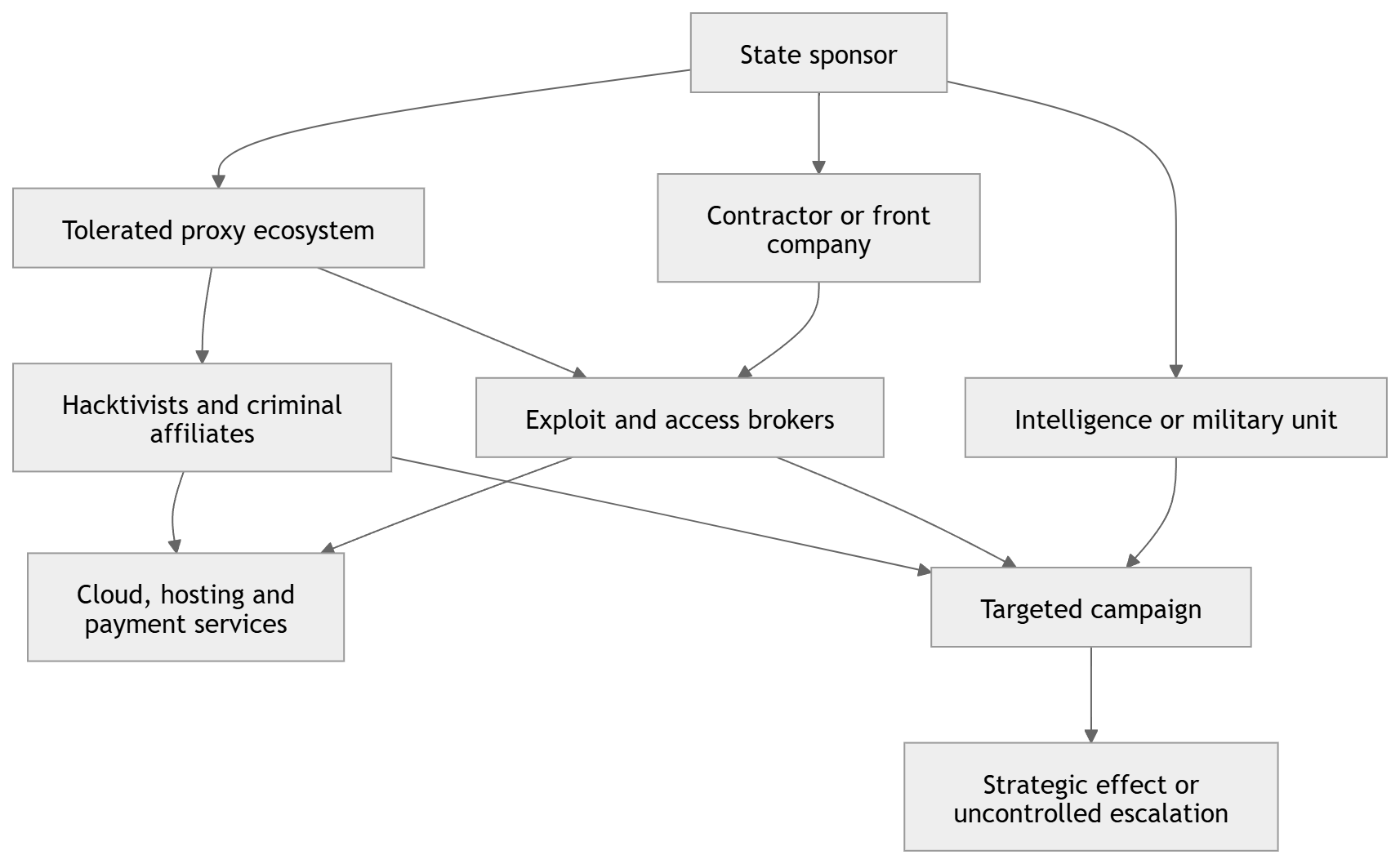
Critical infrastructure as a system of dependencies
Critical infrastructure risk will shift from the protection of individual facilities toward the resilience of interconnected functions. Electricity depends on telecommunications, fuel, satellite timing, identity systems, cloud services, software suppliers, and physical maintenance. Financial systems depend on communications, data centers, authentication, market-data providers, payment networks, and electricity. Ports depend on cargo-management platforms, customs data, navigation, rail and road coordination, energy, and terminal equipment. Healthcare depends on suppliers, laboratories, digital records, imaging, pharmaceuticals, cloud platforms, and emergency communications. A cyber operation need not destroy a plant to create strategic effect; it can manipulate scheduling, corrupt data integrity, interrupt authentication, delay logistics, or undermine public confidence. The most dangerous scenarios involve cyber-physical convergence, where attackers affect industrial control systems, safety mechanisms, autonomous machinery, building controls, medical devices, vehicles, or space-dependent services. CISA’s decision to issue specific principles for AI integration into operational technology reflects the expanding convergence of AI, cyber systems, and physical processes. New Joint Guide Advances Secure Integration of Artificial Intelligence into Operational Technology – Cybersecurity and Infrastructure Security Agency – December 2025 — official verified source. Europe’s exposure is similarly systemic. ENISA assessed public administration as the most targeted EU sector, accounting for 38.2% of identified incidents in the referenced landscape, and classified the sector within a cyber-maturity risk zone. ENISA Sectorial Threat Landscape: Public Administration – European Union Agency for Cybersecurity – November 2025 — official verified report. The strategic issue is not only service interruption: repeated lower-level incidents can erode administrative capacity, consume scarce personnel, weaken public trust, and prepare access for a future crisis.
Finance, space and undersea infrastructure
Three infrastructure clusters will carry disproportionate escalation risk through 2031: finance, commercial space, and subsea communications and energy systems. Financial-sector operations can spread through interconnected institutions, market infrastructures, service providers, and confidence effects. ENISA analyzed 488 publicly reported incidents affecting the European financial sector from January 2023 through June 2024, underscoring both the sector’s exposure and the limitations of public reporting. ENISA Threat Landscape: Finance Sector – European Union Agency for Cybersecurity – February 2025 — official verified report. Space systems present a different dependency structure: ground stations, command links, user terminals, software supply chains, cloud components, navigation, timing, communications, and imagery services connect commercial and military users. ENISA’s space assessment addresses cyber risk across the commercial satellite lifecycle and warns that malicious activity can affect space assets and supporting infrastructure. Space Threat Landscape – European Union Agency for Cybersecurity – March 2025 — official verified report. Subsea infrastructure merges cyber, maritime, legal, and physical attribution challenges. Cable damage may result from accident, negligence, criminal conduct, covert sabotage, or military preparation. Network-management systems and landing stations create cyber entry points, while repair capacity, vessel availability, insurance, and jurisdiction affect recovery. NATO launched Baltic Sentry in January 2025 to strengthen protection of critical undersea infrastructure using frigates, maritime patrol aircraft, national surveillance, and naval drones, while emphasizing lawful boarding, impounding, and arrest as possible consequences. NATO Launches Baltic Sentry to Increase Critical Infrastructure Security – North Atlantic Treaty Organization – January 2025 — official verified source. This is a model of cross-domain deterrence: cyber and infrastructure security reinforced by surveillance, maritime presence, law enforcement, and collective attribution.
China, Russia and differing strategic ecosystems
The 2026–2031 contest will be shaped by different national models of digital power rather than a uniform race in cyber capability. China combines large-scale digital infrastructure, industrial policy, extensive telecommunications deployment, state regulation of data, growing AI capacity, and military interest in informationized and intelligentized operations. Official Chinese reporting stated that the country had more than 2.64 million 5G base stations by the end of March 2023 and that 5G applications extended into 52 of 97 major economic categories, including mining, ports, and electricity. Research into 6G Technology Promoted – State Council of the People’s Republic of China – April 2023 — official verified source. These figures do not establish offensive cyber intent; they demonstrate the scale at which digital, industrial, and physical infrastructure are converging, creating both strategic capability and an expanding domestic protection requirement. Official Chinese reporting also described a target for the data-security market to exceed 150 billion yuan by 2025, with projected compound annual growth above 30%, indicating recognition of the economic and strategic importance of cybersecurity. Efforts in Cybersecurity Highlighted at Conference – State Council of the People’s Republic of China – July 2023 — official verified source. Russia’s ecosystem combines military and intelligence capabilities, wartime operational experience, cybercriminal safe-haven dynamics alleged by Western governments, information operations, and proxy activity. Official Russian military publications discuss AI, military-system modelling, autonomous targeting, and cyber-related education, but accessible material does not support precise public estimates of future operational capacity. The analytical conclusion should therefore avoid mirror imaging: similar technologies may serve different command cultures, risk tolerances, economic constraints, and theories of escalation.
Coalition credibility as an operational variable
Coalition credibility will depend on whether collective institutions can convert technical evidence into timely political and operational action. Capability aggregation alone is insufficient. An adversary must believe that significant attacks will trigger consultation, assistance, attribution, defensive reinforcement, legal action, sanctions, infrastructure disruption, or—in extreme circumstances—broader military consequences. NATO states that a cyberattack could, case by case, lead to invocation of Article 5 and that the Alliance can consider collective responses using the full range of capabilities. Cyber Defence – North Atlantic Treaty Organization – updated July 2024 — official verified source. Ambiguity preserves political flexibility and prevents adversaries from optimizing operations immediately below a published technical threshold, but excessive ambiguity can reduce deterrence if no attacker knows which conduct will produce collective action. Credibility should therefore emerge through demonstrated processes rather than an exhaustive public red-line catalogue: rapid information sharing, exercises, coordinated attributions, common resilience commitments, assistance to affected members, and synchronized consequences. NATO’s Cyber Coalition 2025 involved approximately 1,300 participants from 29 Allies and seven partner nations, testing collaboration and cyber defence across a large multinational environment. NATO Cyber Coalition 2025: Advancing Cyber Defence Through Collaboration and Innovation – NATO Allied Command Transformation – December 2025 — official verified source. Participation does not prove that political leaders would agree during a real crisis, but exercises can reveal procedural delays, incompatible evidence standards, legal constraints, communication failures, and private-sector dependencies. By 2031, coalition credibility should be measured through time-to-consultation, time-to-assistance, attribution participation, synchronization of sanctions and prosecutions, availability of deployable teams, and continuity of political support after repeated lower-level incidents.
The credibility gap inside alliances
Coalitions face a structural asymmetry between shared security and nationally retained authority. Intelligence collection, offensive cyber operations, criminal prosecution, infrastructure regulation, sanctions implementation, and public attribution remain distributed across national institutions. A major incident may consequently pass through multiple decision chains: the victim company recognizes disruption; a national technical authority validates indicators; intelligence services assess sponsorship; law enforcement preserves evidence; regulators evaluate sector impact; ministers decide whether to attribute; allies review classified material; and political bodies consider collective consequences. Each stage increases legitimacy but consumes time. Attackers can exploit this temporal gap by completing effects, destroying evidence, shifting infrastructure, or presenting alternate narratives before a coalition reaches consensus. They can also target countries with weaker investigative capacity or greater economic exposure to retaliation. NATO’s 2024 decision to establish the NATO Integrated Cyber Defence Centre seeks to improve network protection, situational awareness, and operational-domain implementation, addressing part of this coordination problem. Deterrence and Defence – North Atlantic Treaty Organization – updated June 2026 — official verified source. The EU confronts an additional unanimity constraint for sanctions, which strengthens political authority once agreement is reached but can delay or dilute action. Coalition deterrence will become credible when national procedures are pre-mapped, minimum evidence packages are standardized, classified findings can be shared rapidly, assistance is deployable before attribution is finalized, and response options are graduated. The objective is not automaticity. Automatic responses create escalation risk and invite manipulation. The objective is reliable conditionality: adversaries should expect that high-consequence conduct will generate an organized process with a high probability of material cost.
Escalation pathways
Cyber escalation is neither inherently automatic nor inherently controllable. It can occur vertically through increasingly severe cyber effects; horizontally when a response moves into financial, diplomatic, space, maritime, or conventional military domains; geographically when operations spread to allied or neutral infrastructure; and politically when public attribution narrows leaders’ room for compromise. Five pathways deserve priority. First, misinterpreted pre-positioning occurs when access intended for intelligence or contingency planning appears to be preparation for imminent destruction. Second, unintended physical effect occurs when malware propagates beyond the intended target, corrupts safety functions, or interacts unpredictably with industrial processes. Third, proxy overreach occurs when a semi-autonomous group attacks a target the sponsor would have avoided. Fourth, automation compression reduces the time available for verification and political authorization, increasing reliance on machine-generated assessments. Fifth, cross-domain entanglement arises when cyber operations affect nuclear command support, military mobilization, satellite services, air traffic, financial stability, or other systems associated with national survival. NATO describes the contemporary environment as one in which cyberattacks, critical-infrastructure sabotage, assassination attempts, and civil-aviation disruption increasingly coexist, demonstrating the difficulty of separating cyber risk from wider hybrid confrontation. Deterrence and Defence – North Atlantic Treaty Organization – June 2026 — official verified source. Escalation control requires protected communication channels, reversible response options, human authorization for high-impact operations, capability to distinguish espionage from imminent attack, and preplanned public communication. The most dangerous event may not be the most destructive attack; it may be the ambiguous operation interpreted under extreme time pressure as the opening phase of a broader offensive.
| Escalation pathway | Trigger | Amplifying condition | Early-warning indicator | Stabilizing measure |
|---|---|---|---|---|
| Misread pre-positioning | Discovery of persistent access in critical systems | Military crisis or mobilization | Access reaches safety, command or continuity functions | Confidential warning and technical containment |
| Unintended propagation | Malware escapes intended environment | Shared software or flat networks | Effects appear in third countries or unrelated sectors | Kill mechanisms, segmentation and coordinated disclosure |
| Proxy overreach | Affiliate selects politically sensitive target | Weak sponsor control and ideological incentives | Targeting diverges from prior campaign pattern | Sponsor signaling, law enforcement and infrastructure disruption |
| Automated misclassification | AI labels activity as imminent attack | Poor data, adversarial manipulation or time pressure | Confidence rises without corroborating intelligence | Mandatory multi-source verification and human authorization |
| Cross-domain retaliation | Cyber effect causes strategic or physical damage | Public pressure and limited response options | Military forces reposition or alliances consult urgently | Graduated response ladder and protected communications |
| Coalition fragmentation | Members dispute attribution or proportionality | Unequal economic exposure | Delayed statements and inconsistent national language | Pre-agreed evidentiary and consultation protocols |
| Financial contagion | Data or service disruption undermines confidence | Concentrated providers and simultaneous misinformation | Liquidity stress or inconsistent transaction records | Offline reconciliation, market communication and redundancy |
| Space-service degradation | Ground or command systems compromised | Dual military-commercial use | Navigation or timing anomalies across sectors | Alternate services and rapid technical attribution |
Structural Analysis of Competing Hypotheses
Five principal hypotheses define the 2026–2031 competition. H₁—AI Offence Dominance predicts that automation lowers attack costs faster than defence can scale, producing more compromises, shorter vulnerability windows, and persistent overload. H₂—Defensive Data Advantage predicts that defenders will gain because they control richer telemetry, identity infrastructure, and opportunities to detect anomalous behavior. H₃—Proxy Proliferation predicts that the decisive shift will be organizational rather than technical: states and criminals will outsource more operations, fragment attribution, and exploit mercenary markets. H₄—Coalition Consolidation predicts that multinational attribution, shared resilience, financial controls, and joint disruption will raise adversary costs faster than proxy ecosystems adapt. H₅—Escalatory Automation predicts that machine-speed operations, ambiguous pre-positioning, and AI-supported decision systems will increase the probability of unintended cross-domain escalation. H₆—Persistent Managed Competition predicts that none of the preceding effects becomes dominant; actors continue extensive activity below strategic thresholds while selectively restraining the most dangerous operations. Evidence available in 2025–2026 updates most strongly toward H₆, with material support for H₁ and H₃. High incident volume, rapid weaponization, DDoS prevalence, convergent campaigns, and proxy ecosystems support offence scaling. Joint takedowns, resilience initiatives, and multinational exercises support H₂ and H₄ but do not yet demonstrate durable suppression of state or criminal campaigns. No public dataset establishes that AI has already produced autonomous strategic cyber operations, weakening strong versions of H₅, although the combination of AI, operational technology, and compressed decision time makes it a serious tail-risk hypothesis. Bayesian updating should remain event-driven: major autonomous failures, sustained reductions after coalition disruption, or evidence of systematic sponsor loss of proxy control would materially change posterior probabilities.
| Hypothesis | Initial 2026 prior | Evidence that would raise probability | Evidence that would reduce probability |
|---|---|---|---|
| H₁ AI offence dominance | 18% | Falling time-to-exploit, rising compromise-to-analyst ratio, autonomous exploitation | Defensive automation contains attack volume without rising impact |
| H₂ Defensive data advantage | 12% | Persistent reductions in dwell time and mission impact | Telemetry poisoning or alert overload defeats automated defence |
| H₃ Proxy proliferation | 16% | More front companies, contractor operations and affiliate ecosystems | Strong sponsor attribution and market controls reduce outsourcing |
| H₄ Coalition consolidation | 12% | Faster collective attribution and durable infrastructure suppression | Political fragmentation and inconsistent enforcement |
| H₅ Escalatory automation | 8% | AI-driven false warning or uncontrolled cyber-physical effect | Effective human control and crisis communication |
| H₆ Managed persistent competition | 34% | High activity continues while catastrophic effects remain rare | Clear transition toward strategic restraint or uncontrolled escalation |
Monte Carlo scenario architecture
A five-year Monte Carlo model should not treat annual incident counts as the central variable. It should simulate campaigns and decision transitions. Each iteration samples actor class, strategic objective, technical capacity, AI integration, proxy autonomy, target criticality, access depth, defender maturity, attribution confidence, coalition cohesion, response speed, expected punishment, and escalation sensitivity. Dependencies must be explicit. AI integration increases reconnaissance scale but does not automatically increase physical-effect reliability. Proxy autonomy increases deniability but also increases sponsor-control risk. High target criticality raises strategic benefit and response severity simultaneously. Strong defender telemetry raises detection and attribution probabilities, while heavy dependence on centralized platforms can increase systemic consequences. Coalition cohesion may rise after a severe attack but fall during ambiguous lower-level campaigns. The model should return multiple outcomes: no launch, failed access, contained compromise, intelligence collection, temporary disruption, persistent strategic access, destructive effect, target substitution, sponsor disavowal, collective response, or cross-domain escalation. Under an illustrative baseline calibrated to current official evidence, the 2031 distribution assigns 48% to managed persistent competition, 22% to offence-accelerated fragmentation, 18% to strengthened coalition containment, and 12% to a high-impact escalation pathway during the five-year period. These are transparent analytical priors rather than measured government forecasts. Sensitivity analysis identifies four dominant variables: depth of adversary access to critical infrastructure, coalition response credibility, proxy-control failure, and defender recovery capability. Attack volume is less decisive than access quality and system consequence. Ten thousand low-level incidents may consume resources without changing strategic stability; one misinterpreted intrusion into a safety-critical or military-support system can transform the crisis environment.
Timeline and indicators, 2026–2031
The most plausible development path begins with accelerated AI-supported reconnaissance and social engineering during 2026–2027, followed by deeper integration of AI into both defensive operations and critical-infrastructure management during 2027–2029. This creates a transitional risk window: organizations gain automation benefits before governance, red-teaming, fallback procedures, and security architectures mature. By 2028, proxy markets are likely to become more specialized, dividing access acquisition, exploit development, infrastructure provision, data processing, influence activity, and financial conversion among separate actors. This specialization will make disruption more complex but also create observable transactions and dependencies. During 2028–2030, coalition competition will focus on whether shared attribution, sanctions, financial intelligence, and infrastructure takedowns can impose persistent rather than temporary costs. By 2030–2031, the central issue will be strategic integration: whether states can combine cyber warning with military, space, maritime, financial, and diplomatic decision-making without allowing automated assessments to generate premature escalation. Indicators should be tracked monthly or quarterly rather than retrospectively after major incidents. These include median time from vulnerability disclosure to exploitation; AI-generated identity and impersonation campaigns; number of critical-infrastructure operators deploying AI into operational technology; concentration among cloud, identity, and model providers; growth of access-broker and exploit markets; cryptocurrency and alternative-payment flows linked to cyber services; frequency of coordinated public attribution; infrastructure regeneration after takedowns; and evidence of persistent access to safety, continuity, military logistics, satellite, or subsea systems. Strategic warning will come from convergence across these indicators, not from any single malware family or public statement.
| Period | Principal transformation | Primary risk | Required policy test |
|---|---|---|---|
| 2026–2027 | AI scales reconnaissance, impersonation and triage | Defender overload and attribution noise | Can critical alerts be separated from automated background activity? |
| 2027–2028 | AI enters operational technology and infrastructure management | New control-layer vulnerabilities | Can essential functions operate safely without the model? |
| 2028–2029 | Proxy and mercenary ecosystems specialize | Attribution fragmentation and sponsor-control failure | Can coalitions target enablers rather than disposable aliases? |
| 2029–2030 | Multinational disruption and financial pressure mature | Political fragmentation or jurisdictional displacement | Do operations cause durable regeneration costs? |
| 2030–2031 | Cyber, space, maritime and military warning converge | Cross-domain misinterpretation | Are high-impact decisions protected by human review and crisis communication? |
Policy architecture for credible restraint
A credible 2026–2031 posture requires six integrated layers. The first is mission assurance: governments and operators must identify services whose failure could produce deaths, strategic military impairment, financial instability, or loss of governmental continuity. The second is identity and dependency control: privileged access, software supply chains, cloud concentration, telecommunications, satellite services, and managed providers must be mapped and continuously tested. The third is persistent adversary exposure: intelligence, private telemetry, law enforcement, and allied reporting must identify infrastructure, personnel, finances, and sponsor relationships. The fourth is graduated consequence planning: sanctions, prosecutions, diplomatic action, technical disruption, assistance, and military options should be prepared before crisis. The fifth is coalition interoperability: evidence standards, consultation channels, deployable support, and public communications must be rehearsed. The sixth is escalation governance: autonomous systems must not create irreversible strategic effects without accountable authorization, and governments need confidential channels for warning, clarification, and de-escalation. NATO’s creation of a Special Coordinator for Hybrid Threats in 2025 reflects recognition that cyberattacks, disinformation, economic pressure, irregular actors, sabotage, and military coercion form integrated campaigns. Countering Hybrid Threats – North Atlantic Treaty Organization – updated January 2026 — official verified source. The success criterion is not the elimination of malicious cyber activity. It is the preservation of essential functions, restriction of adversary strategic gains, control of escalation, and creation of a credible expectation that serious campaigns will encounter cumulative, multinational, and increasingly costly resistance.
Net assessment
The 2026–2031 cyber contest will favor actors capable of integrating technology with institutions. AI alone will not deliver strategic dominance. Advantage will accrue to states and coalitions that combine high-quality data, resilient infrastructure, rapid legal authorities, private-sector cooperation, intelligence access, financial visibility, trained personnel, and controlled cross-domain options. Offensive actors will gain scale and adaptability, particularly through proxies, but scale will generate signatures, dependencies, financial movements, and control problems that defenders can exploit. Critical infrastructure will remain the principal strategic center of gravity because it connects civilian welfare, economic stability, military mobility, political legitimacy, and alliance commitments. Coalition credibility will determine whether operations against one member produce an isolated national response or a wider strategic cost. Escalation risk will be highest where cyber access intersects with safety-critical systems, military command support, space assets, financial integrity, or physical infrastructure during an existing geopolitical crisis. The baseline remains managed competition rather than unconstrained cyberwar: persistent espionage, disruption, theft, influence activity, access preparation, and proxy operations below thresholds associated with major retaliation. That equilibrium is not automatically stable. It depends on resilience, discrimination, credible response, protected communication, and the ability to recognize when cumulative activity has become a strategic campaign. The decisive test by 2031 will be whether governments can exploit AI’s speed without surrendering human control, use proxies as an attribution problem without granting them impunity, protect infrastructure without fragmenting the digital economy, and make collective response sufficiently predictable to deter high-consequence action without making escalation automatic.
2026–2031 Cyber-Strategic Pressure Projection
Relative analytical indices derived from the report’s scenario assumptions. Values compare directional pressure and institutional capacity; they are not incident forecasts or official intelligence estimates.


