













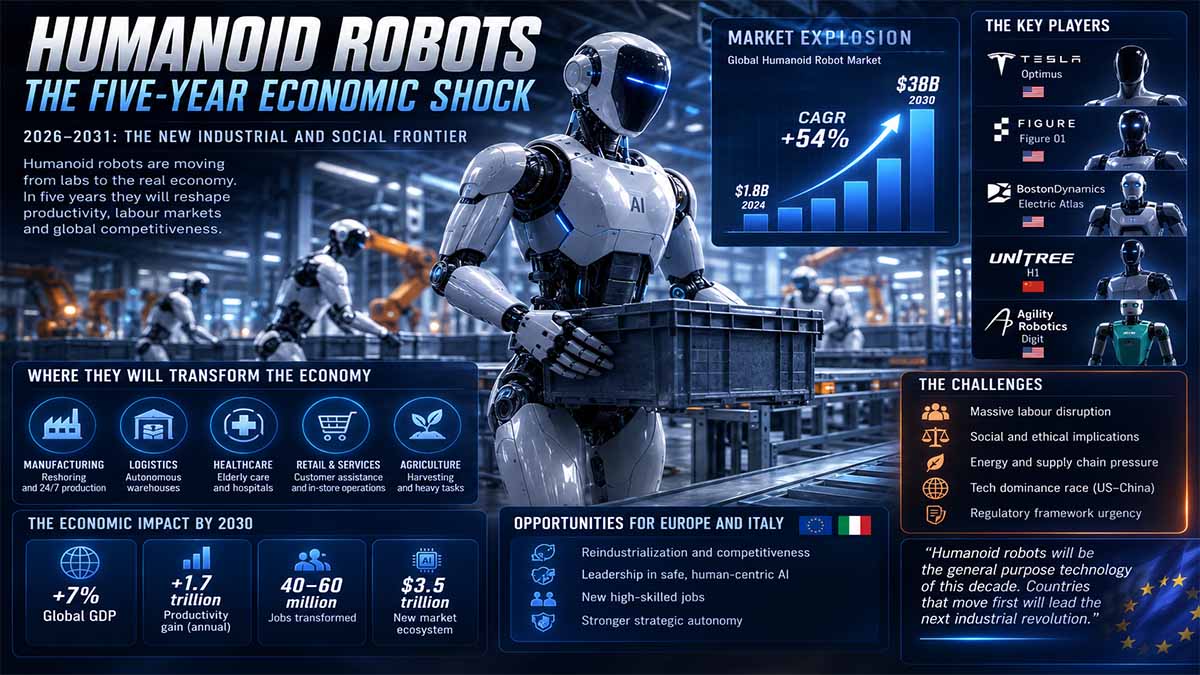
Executive Summary
- BLUF: humanoid robotics is evolving from a demonstration technology into a potentially general-purpose form of physical capital.
- The decisive variable is not whether a robot can walk, but whether it can complete economically useful task sequences reliably, safely and at an acceptable hourly cost.
- Between 2026 and 2031, factories and warehouses will precede homes because their environments, workflows and returns on investment are more controllable.
- The first macroeconomic effect will probably be higher output and capital expenditure—not immediate economy-wide unemployment.
- The distributional danger is substantial: robot ownership can concentrate productivity gains while weakening the wage share of routine physical work.
- Robotics-as-a-Service could convert labour expenditure into a scalable operating subscription, accelerating adoption among firms unable to purchase fleets.
- China has the strongest state-directed industrialisation strategy; the United States combines capital, AI and platform ambitions; Europe retains manufacturing depth but faces financing and scaling constraints.
- The critical geopolitical contest concerns actuators, reducers, sensors, batteries, semiconductors, industrial data, safety standards and robot-fleet operating systems.
- The five-year base case is selective industrial diffusion, followed by logistics, maintenance and constrained commercial-service applications—not universal household deployment.
The Humanoid Factory and the New Balance of Power
The decisive artificial-intelligence contest is moving from the screen to the production floor. Generative models reorganise information; embodied AI reorganises matter, working time and industrial geography. Humanoid robots are not yet universally reliable workers, and spectacle must not be confused with commercial maturity. Yet the strategic direction is unmistakable: capital is being invested in machines designed to learn multiple physical tasks, operate in spaces built for humans and move between production processes without the costly reconstruction required by conventional automation. The consequences will reach far beyond factory employment. Ownership of robotic fleets, access to semiconductors and permanent magnets, control of operational data, cybersecurity and the financing of automation will influence wages, reshoring and industrial sovereignty. Between 2026 and 2031, the central economic question will not be whether robots can imitate people, but who owns the productive capacity embodied in them.
The Body of AI
Beijing has supplied an unusually revealing image of the transition. The second World Humanoid Robot Games, scheduled at the National Speed Skating Oval from 22 to 26 August 2026, comprise 1,301 competition sessions across 51 events, with 666 teams and 2,056 registered robots. The programme includes emergency response, hotel services, screw-tightening and precision object manipulation; most track and competitive events require full autonomy. Those figures do not establish industrial readiness, but they show how rapidly the performance frontier is widening from locomotion towards dexterity and task execution. “2nd World Humanoid Robot Games: Highlights & Ticket Info” – Beijing Municipal Government – 15/08/2026.
The economically significant innovation is not the humanoid silhouette itself. It is the attempt to combine perception, mobility, manipulation and machine learning in one reusable platform. Traditional industrial robots excel inside engineered cells: fixed position, defined motion, standardised object. Embodied AI seeks to alter that equation by adapting the machine to the factory designed for people. If successful, one platform could be retrained for inspection, material handling, machine tending or packaging, allowing automation to spread into lower-volume and more variable operations. The threshold is therefore not an impressive demonstration. It is safe, repeatable performance per paid hour under real production conditions.
The Industrial Prize
Manufacturing remains too large to treat humanoid robotics as a technological curiosity. In 2023, the European Union’s manufacturing sector comprised almost 2.2 million enterprises, employed approximately 30.2 million people, generated €2.5 trillion in value added and accounted for 23.1% of value added in the EU business economy. Its net turnover reached €9.9 trillion; its gross operating rate was 10.4%. “Businesses in the Manufacturing Sector” – Eurostat – data extracted 12/2025.
These numbers expose the leverage of even selective automation. A robot need not replace an occupation to change industrial economics. It may remove one night shift, increase machine utilisation, absorb dangerous handling or reduce the labour required for a production increase. The relevant comparison is consequently not robot against annual salary. It is the machine’s fully loaded cost—including integration, energy, maintenance, insurance, software, supervision and downtime—against the value of reliable output across several tasks. That calculation will vary sharply by sector. Automotive plants offer controlled environments and scale; food processing adds hygiene constraints; logistics rewards repetitive movement; smaller metalworking companies require flexibility but possess less integration capital.
Maturity Before Myth
Corporate disclosures still demand discipline. Tesla’s annual report for the year ended 31 December 2025 describes Optimus as a “general purpose, autonomous humanoid robot in development,” not as an established commercial business. Tesla reported $6.411 billion in research and development expenditure during 2025, compared with $4.540 billion during 2024, attributing the increase primarily to artificial-intelligence and other programmes without disclosing a humanoid-specific amount. The same filing states that the company cannot predict the demand, utility or cost-effectiveness of its AI products. Tesla Form 10-K – U.S. Securities and Exchange Commission – 29/01/2026.
That distinction separates investable evidence from promotional velocity. The decisive industrial metrics are mean time between interventions, successful task completion, changeover time, energy consumption, safety incidents and output quality. A robot that performs one task brilliantly but requires frequent human recovery remains automation supported by hidden labour. A reusable worker emerges only when the same hardware can acquire a second task quickly, preserve performance after environmental changes and operate without transferring excessive risk to technicians nearby.
Labour as a Service
Leasing could be more disruptive than hardware sales. A manufacturer purchasing a robot assumes technology risk, residual-value uncertainty and integration costs. A robotics provider offering capacity by the month or productive hour can retain ownership, pool
The Humanoid Factory and the New Industrial Order
The decisive artificial-intelligence contest is moving from the screen to the production floor. Humanoid robots promise something conventional automation could not deliver: a reusable machine worker able to move between tasks, learn from human demonstrations and operate inside factories designed for human bodies. The economic stakes therefore extend beyond labour substitution. Embodied AI could change where companies manufacture, how they finance productive capacity, which countries control industrial data and how income is divided between workers and owners of robotic capital. Yet spectacle is running ahead of evidence. The strategic question is not whether a robot can walk, box or tighten a screw under controlled conditions. It is whether thousands of machines can deliver safe, dependable and economical work across changing shifts. Between 2026 and 2031, that distinction will separate an industrial revolution from an expensive demonstration.
The Body of AI
Beijing has supplied the defining image. The second World Humanoid Robot Games, scheduled at the National Speed Skating Oval from 22 to 26 August 2026, comprise 1,301 competition sessions across 51 events. The municipal government reports 666 registered teams and 2,056 robots, compared with 280 teams at the inaugural edition. Scenario events include emergency response, hotel services, bean-picking and screw-tightening; nearly all track and competitive events require full autonomy. “2nd World Humanoid Robot Games: Highlights & Ticket Info” – Beijing Municipal Government – 15/08/2026.
These figures document remarkable breadth, not factory readiness. Athletic performance demonstrates balance, perception and control; productive labour requires those capabilities to survive dust, vibration, irregular parts, crowded aisles and thousands of repetitions. A useful humanoid must integrate mobility, dexterity, perception, planning, safety and recovery from failure. Its commercial value lies less in resembling a person than in inhabiting infrastructure already built around people: stairs, workstations, tools, shelving and material flows. That compatibility could reduce the need to reconstruct entire plants, but only if the machine’s adaptability outweighs the greater simplicity and reliability of a fixed industrial arm.
The Industrial Prize
Manufacturing remains the material foundation beneath the service economy. In the European Union, 2.2 million manufacturing enterprises employed approximately 30.2 million people and generated €2.5 trillion of value added in 2023. The sector represented 18.5% of employment and 23.1% of value added within the EU business economy; machinery and equipment was its largest manufacturing division by value added. “Businesses in the Manufacturing Sector” – Eurostat – data extracted 12/2025.
This is why embodied AI is more consequential than another consumer application. A language model lowers the cost of producing information. A general-purpose robot could lower the cost of executing physical processes—and potentially increase the number of productive hours obtainable from the same building, equipment and land. Its strategic value would be greatest in repetitive, ergonomically damaging or difficult-to-staff operations: machine tending, intralogistics, inspection, pallet handling and elementary assembly. Welding and precision insertion remain harder propositions because speed, tolerances and certification favour specialised automation.
The first industrial confrontation will therefore not be “robots against all workers”. It will be humanoids against three existing alternatives: human labour, fixed automation and factory redesign. Any deployment that cannot beat at least one of those options on total cost, flexibility or continuity will remain experimental.
China’s Production Flywheel
China enters this contest with a manufacturing ecosystem capable of turning technical learning into industrial scale. On 19 January 2026, the National Bureau of Statistics reported that Chinese manufacturing value added increased 6.4% in 2025, equipment manufacturing 9.2% and high-technology manufacturing 9.4%. Production of industrial robots rose 28.0%, while production of three-dimensional printing equipment increased 52.5%. “National Economy Pushed Forward with Innovation-led and High-quality Development and Expected Targets Achieved Successfully in 2025” – National Bureau of Statistics of China – 19/01/2026.
Industrial depth matters because a humanoid is not a single technology. It combines semiconductors, electric motors, reducers, bearings, batteries, sensors, cameras, communications, control software and precision manufacturing. Scale in adjacent industries can shorten supplier iteration and reduce component costs. More importantly, deployment inside dense manufacturing clusters creates operational data: failed grasps, unexpected obstructions, tool wear and cycle-time deviations. The country that accumulates the most relevant physical-work data may improve robotic policies faster, just as large digital platforms improved software through usage.
The competitive asset is thus a loop—components produce robots; robots enter factories; factories generate data; data improves models; improved models expand deployment. Export controls aimed only at advanced processors may slow one part of that loop without neutralising the manufacturing, integration and data advantages surrounding it.
The Economics of Availability
Humanoid economics cannot be judged from the purchase price alone. The appropriate measure is the cost of a successfully completed, quality-compliant task. Financing, energy, supervision, maintenance, software, insurance, integration, downtime and residual value must be divided by productive output—not by the machine’s nominal operating hours. A robot that is inexpensive but frequently stops can cost more than a well-trained employee or a conventional automation cell.
Leasing and robotics-as-a-service could accelerate adoption by converting capital expenditure into an operating expense and transferring part of the maintenance and obsolescence risk to the provider. The model also permits deployment across several customers and uses: a machine might perform material handling during one shift, inspection during another and temporary warehouse work during peak demand. Yet the attractive vision of a robot that works in a factory, performs domestic tasks and is rented to a neighbour understates the importance of certification, liability, transport, cleaning, tool changes and data separation. Reusability is not merely a software property; it is an operating system of contracts, safety cases and service logistics.
The financier of robotic labour will consequently acquire unusual influence. Whoever owns the fleet may control maintenance records, performance telemetry, task libraries and switching costs. Manufacturing firms could gain flexibility while surrendering a layer of operational intelligence to platform providers. The emerging competition is therefore not only to sell machines, but to become the landlord of productive capacity.
The Ownership Divide
The distributional question begins where the productivity discussion usually ends. If robotic capital raises output while reducing the labour required for particular operations, the initial gains accrue to those owning the machines, models and integration platforms. Workers may benefit through safer tasks, higher productivity and new technical occupations, but those outcomes are not automatic. Bargaining power depends on whether labour remains complementary to the machine, whether workers possess scarce integration skills and whether productivity gains enter wages rather than rents.
Evidence concerning AI more broadly already counsels caution. The OECD’s Korean labour-market assessment, published on 27 October 2025, found no clear aggregate employment collapse, but reported that wage benefits were concentrated among higher-income and higher-skilled workers; it also identified weaker growth in full-time permanent employment associated with traditional AI exposure, particularly in manufacturing during the period examined. This evidence does not measure humanoid robots, but it demonstrates why aggregate employment totals can conceal deteriorating job quality and unequal gains. “The Impact of AI on the Labour Market” – OECD – 27/10/2025.
The relevant policy instruments are consequently broader than retraining. They include profit-sharing, portable benefits, worker participation in deployment decisions, competition policy for robotic platforms and tax treatment that does not favour machine acquisition merely because payroll is taxed differently from capital. The central political risk is not unemployment alone. It is an economy in which production expands while ownership income becomes increasingly detached from the communities supplying demand, infrastructure and social stability.
Reshoring Without Restoration
Embodied AI could alter the arithmetic of offshoring. When direct labour represents a smaller share of production cost, proximity to customers, engineering teams, energy, logistics and legal certainty becomes more valuable. This may support domestic or regional production. It does not follow, however, that the old factory workforce returns with the factory.
A reshored automated plant may create high-value employment in engineering, maintenance, cybersecurity and process design while employing fewer operators. Governments should therefore distinguish three outcomes often collapsed into one political slogan: domestic production, domestic value capture and domestic mass employment. Humanoids may strengthen the first without guaranteeing the other two. Industrial subsidies should be evaluated against local supplier development, workforce progression, intellectual-property control and resilience—not ceremonial announcements or the number of machines installed.
For Europe, the opportunity is significant because its industrial base, machine-building competence and safety institutions remain formidable. Its weakness is fragmentation: smaller manufacturers cannot absorb integration risk as easily as global groups. Shared testing facilities, interoperable task libraries and procurement programmes for hazardous or labour-scarce applications would offer more leverage than indiscriminate purchase incentives.
Sovereignty in Components
A sovereign robot strategy cannot stop at final assembly. Permanent magnets, semiconductors, batteries, reducers and machine-vision components determine both economic exposure and emergency availability. The United States Department of Energy’s supply-chain assessment, published in February 2022, described neodymium-iron-boron magnets as the strongest commercially available permanent magnets and reported that China accounted for 58% of rare-earth mining and 92% of magnet production in 2020. “Rare Earth Permanent Magnets: Supply Chain Deep Dive Assessment” – US Department of Energy – 02/2022.
Europe’s semiconductor response is becoming more explicit. The European Commission presented its Chips Act 2.0 policy on 3 June 2026, stating that the original European Chips Act had helped mobilise more than €52 billion in public and private investment and supported an estimated 46,000 direct and indirect jobs, while acknowledging continuing dependence on third countries for advanced manufacturing and design. “Chips Act 2.0” – European Commission – 03/06/2026.
Humanoid policy must connect these industrial layers. A domestically branded robot assembled from concentrated foreign components may provide commercial capacity without strategic autonomy. The decisive indicators are replaceability, repair access, firmware control, inventories and the ability to continue operating during export restrictions or geopolitical disruption.
The Cyber-Physical Attack Surface
A compromised chatbot can disclose information; a compromised robot can interrupt production, damage equipment or create physical danger. Embodied AI enlarges the attack surface through remote updates, cameras, microphones, fleet-management platforms, wireless networks and connections to manufacturing-execution systems. The same telemetry that improves performance may expose factory layouts, process parameters and production volumes.
ENISA’s February 2026 study of 1,080 professionals from organisations in EU critical sectors found that 47% regarded supply-chain or third-party compromise as their principal concern; 30% reported no cybersecurity assessment during the preceding twelve months, and 28% required more than three months to patch critical vulnerabilities. The survey is not robot-specific, but its findings define the environment into which connected robotic fleets will be introduced. “NIS Investments 2025” – European Union Agency for Cybersecurity – 02/2026.
Robot procurement must therefore specify offline operating modes, signed updates, software bills of materials, network segmentation, vulnerability-disclosure duties and auditable human override. Cybersecurity is not an accessory to robotic productivity; it is one of its preconditions.
The Five-Year Test
From 2026 to 2031, the market’s centre of gravity should move through three tests. The first is technical: repeatable work outside choreographed demonstrations. The second is financial: evidence that utilisation, maintenance and failure rates support positive economics over the asset’s life. The third is institutional: rules capable of assigning responsibility among manufacturer, model provider, fleet owner and factory operator.
The decisive milestones will not be videos or unit-production announcements. They will be independently measured cycle times, hours between interventions, incident rates, redeployment time, energy consumption, task-quality yields and renewal rates for paid contracts. If those indicators improve, humanoids could become a reusable layer of industrial labour. If they do not, specialised robots will continue to dominate and the general-purpose machine will remain a costly niche.
The political choice cannot wait for certainty. Europe must build testing infrastructure, component resilience and worker institutions before market concentration hardens. The United States must reconcile software leadership with manufacturing depth. China will seek to translate production scale into standards, data and exports. By 2031, the most powerful industrial economies may not be those possessing the most humanoid robots, but those that control the entire system around them: components, capital, operational data, cybersecurity, standards and the distribution of productivity gains. The robot is only the visible body. The contest is over who owns the intelligence, the factory and the future income stream.
Navigational Index
- The Embodied-AI Production Shock — technical maturity, factory economics, leasing models and the transition from automation cells to reusable robotic labour.
- The Distributional and Geopolitical Reckoning — wages, ownership, reshoring, supply chains, industrial sovereignty, cyber exposure and strategic competition.
- The 2026–2031 Probability Architecture — Bayesian updating, five competing hypotheses, scenario triggers, Monte Carlo stress testing and early-warning indicators.
Master Abstract
The economic significance of the humanoid robot does not reside in its resemblance to a person; it resides in its potential compatibility with an industrial world already designed around the human body. Doorways, stairs, tools, shelves, workbenches, vehicles and production stations impose a human geometry. A sufficiently capable bipedal or wheeled humanoid could therefore enter existing facilities without requiring the extensive fixed re-engineering demanded by traditional automation. This is the strategic difference between a specialised robot arm and embodied AI: the former executes a predetermined motion inside a protected cell, while the latter aspires to perceive an unfamiliar state, interpret an instruction, select an action and recover from variation. The second World Humanoid Robot Games, held in Beijing from 22 to 26 August 2026, contain 1,301 competition sessions across 51 events—a four-day public stress test of locomotion, coordination and task execution rather than proof of commercial autonomy. 2nd World Humanoid Robot Games: Highlights & Ticket Info – Beijing Municipal Government – August/2026 — verified official event record. The inaugural 2025 edition assembled 280 teams from 16 countries for 487 matches across 26 events, demonstrating the speed at which the experimental ecosystem is broadening. 2025 World Humanoid Robot Games Opens – Beijing Municipal Government – August/2025 — verified official event record. These competitions are strategically informative because they expose failure modes—falls, delayed perception, thermal limits, poor manipulation and dependence on human supervision—which publicity videos tend to conceal. They nevertheless mark the formation of an industrial learning system: repeated trials generate motion data; motion data improve control models; improved models expand the task envelope; a wider task envelope supports pilot deployments; pilot deployments create operational data that no laboratory can reproduce. The transition is therefore recursive, but it is not automatic. Commercial viability still depends on safe intervention rates, battery endurance, dexterity, maintenance, insurance, integration and the fully loaded cost per productive hour.
Factories will become the primary economic proving ground because they combine repeated tasks, measurable output, controlled surfaces, structured supervision and concentrated demand. The home is a much harder environment: objects move unpredictably, children and animals create safety uncertainty, privacy expectations are higher, and the economic value of each individual task is comparatively low. Industrial users can instead allocate robots to material handling, machine tending, inspection, kitting, repetitive assembly and hazardous operations, initially during unpopular shifts or in labour-scarce locations. This is why the first five-year shock should be analysed as a transformation of capital formation and production functions rather than as a simple count of eliminated jobs. The European Union illustrates the size of the exposure. Manufacturing employed approximately 30.2 million people, generated €2.5 trillion in value added and represented 23.1% of EU business-economy value added in 2023; machinery, food production and motor vehicles were its largest manufacturing divisions by value added. Businesses in the Manufacturing Sector – Eurostat – December/2025 — verified Eurostat analysis. Yet physical autonomy remains far behind visible software adoption. In 2025, 19.95% of EU enterprises used at least one AI technology, rising to 55.03% among large enterprises, but technologies enabling machines to move physically through environmental observation and autonomous decisions were used by only 1.39% of enterprises and 8.55% of large enterprises. Use of Artificial Intelligence in Enterprises – Eurostat – December/2025 — verified Eurostat analysis. This gap is the central economic signal: AI cognition has diffused faster than AI embodiment. Humanoid producers must close not one but four deficits—physical reliability, economic utilisation, integration with enterprise systems and legal accountability. If they succeed, Robotics-as-a-Service will be catalytic because it can replace a large initial purchase with hourly, monthly or outcome-based payments. Fleet operators could pool maintenance, teleoperation, software updates and utilisation risk across customers, while manufacturers convert one-off equipment sales into recurring revenue. The same structure, however, could centralise industrial data and productive capacity in a small number of platform owners.
The resulting political economy will contain two apparently contradictory forces: domestic production may return to high-income economies even as the number of production workers required per unit of output declines. Lower labour-cost sensitivity can weaken the rationale for locating factories solely where wages are lowest; proximity to customers, energy, engineering, capital markets and secure supply chains becomes comparatively more valuable. But reshoring should not be confused with labour restoration. A factory can return geographically while its payroll, bargaining structure and local multiplier remain radically smaller. Countries that manufacture robots, critical components and operating software could capture equipment margins, data advantages and productivity rents; countries that merely import robotic fleets could exchange dependence on offshore labour for dependence on foreign capital goods and remote software. China’s state strategy explicitly treats humanoids as an industrial system: official policy set the objective of a preliminary innovation system by 2025 and a secure, reliable, internationally competitive industrial and supply-chain ecosystem by 2027. How Chinese Scientists Develop Versatile Humanoid Robots with AI – National Center for Science and Technology Innovation – June/2024 — verified Chinese government source. In the United States, the commercial thesis is visible but still unproven. Tesla’s audited 2025 filing describes Optimus as a general-purpose autonomous humanoid “in development,” explicitly states that its robot business has not yet been commercialised, and warns that demand, cost-effectiveness and technical success remain uncertain. Annual Report on Form 10-K for the Year Ended December 31, 2025 – Tesla/US SEC – January/2026 — verified SEC filing. Europe, meanwhile, identifies robotics as essential to productivity, reindustrialisation and an ageing workforce. Robotics – European Commission DG CONNECT – March/2026 — verified European Commission policy page. Its constraint is the interaction between scale and governance: autonomous machinery can create product-safety, worker-management and fundamental-rights obligations under the risk-based AI Act, especially where AI serves as a safety component or manages workers. AI Act – European Commission – August/2026 — verified European Commission framework. The five-year contest will consequently be decided not by spectacular demonstrations alone, but by audited uptime, intervention frequency, accident rates, task-change time, fleet financing, component resilience, cybersecurity, liability allocation and the political mechanism used to distribute the productivity dividend.
Embodied-AI Economic Transmission
Adoption corridor · scenario median
Competing hypotheses · posterior weights
The Embodied-AI Production Shock
From automated motion to reusable robotic labour
The decisive industrial transition is not from human labour to “robots” in the generic sense, because factories have used programmable machinery and industrial arms for decades. It is the transition from automation engineered around one stable operation to reusable robotic labour capable of moving between tasks, interpreting changes in its environment and recovering from limited operational uncertainty. A conventional welding cell achieves high speed and repeatability because engineers remove variability from the process: components arrive in known positions, safety barriers exclude people, tooling remains fixed and every movement is programmed. An embodied-AI system inverts that architecture. It must perceive objects and people, estimate its own state, select a task sequence, manipulate imperfectly positioned materials and determine when its confidence is insufficient to continue. This makes the humanoid robot a compound system whose performance is constrained by the weakest link among perception, planning, locomotion, dexterity, actuation, power, communications and safety control. The US National Institute of Standards and Technology accordingly treats robotic performance as a composite of sensing, state estimation, planning, adaptation, locomotion, grasping and interaction rather than as a single intelligence score. Measurement Science for Robotics and Autonomous Systems Program – National Institute of Standards and Technology – accessed August/2026 — verified NIST programme. This distinction invalidates much public commentary surrounding demonstrations and competitions. A robot completing a selected task once under supervision proves feasibility; it does not establish commercially relevant reliability. The factory requires repeated completion across thousands of cycles, predictable recovery from exceptions, controlled interaction with people, verifiable cybersecurity and a cost per conforming unit below the human or fixed-automation alternative. Humanoid morphology becomes economically valuable only when compatibility with human-designed infrastructure offsets the mechanical complexity, energy consumption and stability penalties created by reproducing the human form.
| Technical layer | Demonstration threshold | Factory-commercial threshold | Principal failure mode | Required industrial metric |
|---|---|---|---|---|
| Perception | Detect a prepared object | Detect variable objects under glare, occlusion and motion | Misclassification or lost localisation | Detection precision by environmental class |
| Manipulation | Complete a selected grasp | Sustain repeatable bilateral manipulation | Slippage, deformation, collision | Successful manipulations per intervention |
| Mobility | Walk on a prepared surface | Traverse ramps, cables, debris and congested aisles | Fall, route blockage, balance loss | Productive distance between safety stops |
| Task reasoning | Follow a prompted sequence | Resolve bounded exceptions without unsafe improvisation | Invalid plan or hallucinated state | Correct task completions per 1,000 cycles |
| Power and thermal | Operate for a demonstration | Sustain economically useful shift coverage | Battery depletion or thermal derating | Productive minutes per charging cycle |
| Safety | Stop after a detected hazard | Maintain validated safe behaviour around workers | Contact injury or delayed stop | Hazard exposure and protective-stop rates |
| Integration | Use a stand-alone interface | Exchange state with MES, WMS, ERP and quality systems | Data mismatch or workflow deadlock | Integration latency and recovery time |
| Maintainability | Technician-supported prototype | Predictable fleet service with replaceable modules | Excessive downtime or spare-parts scarcity | Availability, MTBF and mean repair time |
Technical maturity must therefore be measured at the task-system level rather than by counting motors, model parameters or degrees of freedom. The relevant unit is a complete economically useful work episode: receive an authenticated instruction; navigate to the station; identify the correct component; manipulate it within tolerance; confirm completion; report traceability data; and transition safely to the next assignment. A system that achieves 95% success at each of six dependent stages has only about 74% probability of completing the entire chain without failure, before accounting for correlated errors. Manufacturing economics frequently require reliability far above that level because a robot failure can interrupt upstream and downstream equipment rather than merely reduce the productivity of one asset. NIST’s assessment framework therefore decomposes assembly operations into perception, mobility, dexterity and safety components and then recomposes these measurements into system-level performance models. Performance Assessment Framework for Robotic Systems – National Institute of Standards and Technology – accessed August/2026 — verified NIST framework. The most consequential maturity indicator over 2026–2031 will not be maximum walking speed but the autonomous-intervention interval: the number of productive minutes, completed cycles or handled objects between occasions requiring a human supervisor. Teleoperation can conceal immaturity by allowing a remote worker to rescue the machine whenever perception or planning fails. This is commercially legitimate if intervention remains cheap and infrequent, but analytically it creates a false binary between autonomous and non-autonomous operation. The economically relevant continuum runs from continuous remote control, through supervised autonomy and exception handling, to bounded autonomy and finally unsupervised task execution. Investors and manufacturers should consequently demand disclosure of autonomous-cycle share, remote-intervention minutes, aborted-task frequency, restart time, safety-stop frequency and the labour intensity of fleet supervision. Without those measures, an apparently autonomous fleet may simply relocate labour from the factory floor to a remote operations centre.
Reusable Robotic Labour Architecture
End-to-end operational pipeline from enterprise orchestration and embodied execution to confidence gating and active learning feedback
ERP → MES/WMS → Fleet Scheduler
Perceive → Plan → Move → Manipulate → Verify
- Continue execution
- Capture completion evidence
- Log formal quality record
- Safe stop & pause
- Remote operator intervention
- Generate labelled recovery data → Model improvement
Architectural Dynamics of Reusable Robotic Labour
The Reusable Robotic Labour Architecture defines a closed-loop operational framework designed to integrate autonomous robotic systems into enterprise logistics and manufacturing environments. The workflow initiates with an authenticated work order flowing down through enterprise systems (ERP, MES/WMS, and fleet schedulers) to translate high-level business goals into actionable robotic tasks.
During embodied execution, the system cycles through real-time perception, motion planning, navigation, manipulation, and verification. A critical confidence gate evaluates execution certainty: sufficient confidence allows uninterrupted task completion and quality logging, whereas insufficient confidence triggers an immediate safe stop. Human-in-the-loop remote intervention then captures labelled recovery data, directly feeding model training and workflow improvements back into the enterprise pipeline.
Factory economics and the true denominator
The factory decision is governed by the cost of a conforming unit rather than by the robot’s purchase price or an advertised hourly rate. A defensible total-cost model must combine acquisition or lease payments, integration, tooling, safety engineering, energy, connectivity, software subscriptions, preventive maintenance, replacement parts, insurance, teleoperation, local supervision, workflow interruption and the residual value of the asset. It must then divide that burden by productive output after subtracting charging, changeovers, protective stops, failed cycles and maintenance downtime. A robot advertised at a low nominal hourly cost may be uneconomic if utilisation is poor or if every exception consumes scarce engineering labour. Conversely, a more expensive system can outperform if it operates across multiple shifts, changes tasks quickly and absorbs dangerous or labour-scarce work that otherwise constrains the entire line. The crucial economic threshold can be expressed without prohibited mathematical notation: annual robot cost divided by annual conforming productive hours must fall below the fully loaded cost of the displaced or augmented work, adjusted for quality, throughput, safety and working-capital effects. This is why brownfield integration matters more than laboratory dexterity. Existing factories contain legacy controllers, proprietary interfaces, variable documentation and equipment that was never designed for autonomous mobile agents. The OECD found that AI adoption in EU manufacturing increased from 7% in 2021 to approximately 11% in 2024, but remained fragmented; it also identified legacy infrastructure and incompatible equipment as barriers in traditional industries. AI in Manufacturing: Progress in Implementing the European Union Coordinated Plan on Artificial Intelligence, Volume 2 – OECD – February/2026 — verified OECD report. Humanoid form can reduce some facility conversion costs, but it does not eliminate semantic integration: the robot must still know which job is authorised, which tolerances apply, whether the component passed inspection and what state the production system entered after completion.
| Factory-economics variable | Naïve treatment | Required treatment | Investment implication |
|---|---|---|---|
| Robot cost | Purchase price | Finance cost, integration, tooling, support and residual value | Low headline prices can conceal high deployment costs |
| Availability | Scheduled hours | Productive hours after charging, faults and maintenance | Availability dominates economics in multi-shift plants |
| Labour substitution | One robot replaces one worker | Task-hours displaced minus supervision and exception labour | Employment effects must be calculated by task |
| Quality | Nominal repeatability | Conforming output after rework, scrap and inspection | Quality gains may justify deployment before labour savings |
| Flexibility | Number of advertised skills | Changeover time and validated task portability | Reuse determines whether humanoids outperform fixed cells |
| Safety | Compliance certificate | Site-specific risk, contacts, stops and near misses | Unsafe autonomy creates unbounded liability |
| Data | Free operational by-product | Storage, annotation, governance and model-update expense | Data scale can become a platform advantage |
| Downtime externality | Lost robot output | Lost line throughput and interrupted dependent stations | Bottleneck placement requires stricter reliability |
| Cybersecurity | IT support item | Production-safety and business-continuity exposure | Remote control expands the operational attack surface |
Leasing, RaaS and the conversion of labour into a subscription
Robotics-as-a-Service changes adoption by transferring part of the technology and residual-value risk from the factory to the fleet provider. Under a direct sale, the manufacturer commits capital before it knows whether the robot will achieve expected utilisation, integration stability or task portability. Under a lease or service contract, the customer may pay per month, productive hour, completed movement or verified outcome, while the provider retains ownership and supplies deployment, maintenance, software and technical support. This architecture can make robotic capacity resemble contingent labour: the plant acquires output availability without purchasing the worker-equivalent asset outright. Richtech Robotics states in its SEC-filed 2025 annual report that its business combines direct sales with Robotics-as-a-Service, including leasing and accompanying deployment, maintenance and warranty services; its filing also presents an operated robotic retail concept intended to demonstrate that model. Annual Report on Form 10-K for the Fiscal Year Ended September 30, 2025 – Richtech Robotics/US Securities and Exchange Commission – January/2026 — verified SEC filing. The filing concerns service robots rather than general-purpose factory humanoids, so it validates the commercial structure—not the maturity of humanoid production labour. Applied to factories, RaaS offers four accelerants: it converts capital expenditure into operating expenditure; pools technical specialists across customers; allows providers to improve a common fleet from aggregated failure data; and lowers the cost of replacement when hardware generations change rapidly. It also generates four concentrations of risk. First, weak providers may price contracts below lifecycle cost to create adoption, then fail to maintain fleets. Second, customers can become dependent on proprietary cloud control, data formats and task libraries. Third, financiers may securitise contracts using optimistic utilisation and residual-value assumptions. Fourth, a provider controlling software updates, remote operations and spare parts can acquire effective veto power over a customer’s production continuity.
The optimal contract consequently cannot be reduced to “rent rather than buy.” It must specify the boundary between machine availability and economically useful service. Payment tied merely to installed hours rewards the provider even when the robot waits, charges or repeatedly invokes human support. Payment per verified task aligns incentives more closely but requires unambiguous task definitions, quality acceptance and causal allocation when upstream materials or downstream equipment create failure. A mature industrial contract should contain minimum availability, maximum intervention minutes, response-time commitments, cybersecurity duties, data ownership, model-update controls, safety certification responsibility, parts reserves, audit rights, portability provisions and an exit mechanism allowing the customer to continue essential operations if the provider becomes insolvent. A particularly important clause is the change-control boundary: a remotely updated model can alter a robot’s behaviour after site acceptance, creating ambiguity over whether the original safety case remains valid. Fleet insurance will therefore move from static asset coverage toward dynamic underwriting based on software version, task class, operating environment, intervention frequency and incident history. Liquidity analysis must also distinguish genuine recurring revenue from financing disguised as service revenue. If the provider finances expensive hardware, recognises subscription income slowly and bears maintenance and obsolescence, rapid fleet growth can increase cash consumption even while reported revenue expands. The five-year winners will require an integrated capital stack: patient equity for research, asset-backed debt for deployed fleets, working-capital facilities for components and insurance capacity for operational liability. The fragility point emerges when debt service assumes high utilisation but customers use robots intermittently, technical upgrades shorten hardware life, or maintenance costs rise faster than contract escalation clauses.
| RaaS allocation | Customer should control | Provider should guarantee | Shared governance requirement |
|---|---|---|---|
| Operational output | Task priority and acceptance criteria | Availability and performance envelope | Verified task ledger |
| Software | Approval for production-impacting releases | Security patches and rollback capability | Versioned change-control process |
| Data | Plant data, process secrets and retention limits | Telemetry integrity and service analytics | Segregated rights by data class |
| Safety | Site conditions and authorised workflows | Certified system behaviour | Joint incident investigation |
| Maintenance | Physical access and planned windows | Parts, technicians and response time | Predictive-maintenance schedule |
| Insolvency | Continuity rights and data export | Escrowed software or transition assistance | Step-in and fleet-transfer provisions |
| Economics | Minimum committed volume where justified | Outcome-based service levels | Transparent utilisation measurement |
The boundary between humanoids and conventional automation
Humanoids will not replace fixed automation wherever the environment can be economically redesigned around a faster and simpler machine. A high-volume automotive body shop rewards specialised arms because the task is stable, cycle time is severe, loads are known and capital can be amortised over large production runs. A humanoid is more plausible where work changes frequently, production volume is lower, physical access was designed for people or the facility cannot justify a custom cell for every operation. The relevant comparison is therefore not “human versus humanoid,” but a four-way choice among human labour, fixed automation, collaborative arms or mobile manipulators, and humanoid platforms. Humanoids possess an option value: if the same hardware can tend a machine in the morning, move components in the afternoon and perform inspection at night, utilisation rises and task-specific engineering falls. That option value remains theoretical until until task changeover becomes fast, safe and verifiable. NIST identifies large changeover times, limited reusability, system complexity and absent agility metrics as major constraints on manufacturing robotics. Agility Performance of Robotic Systems – National Institute of Standards and Technology – accessed August/2026 — verified NIST project. The key five-year test is thus whether task programming shifts from specialist integration lasting weeks to instruction, demonstration and validation completed in hours or days. Even then, the most successful architecture may not be fully humanoid. Wheeled bases use energy more efficiently than legs on flat factory floors; one or two arms may suffice; interchangeable end effectors can outperform anthropomorphic hands; and fixed sensors may support the robot better than attempting to embed every capability on its body. “Humanoid” will therefore describe a spectrum of human-compatible general-purpose machines rather than a single canonical shape.
| Operating environment | Most economic architecture through 2031 | Humanoid advantage | Humanoid disadvantage |
|---|---|---|---|
| High-volume fixed line | Dedicated industrial cells | Limited | Lower speed and unnecessary complexity |
| Mixed-model assembly | Cobots, mobile manipulators, selected humanoids | Human-tool compatibility and retasking | Validation burden |
| Brownfield machine tending | Mobile manipulator or humanoid | Uses existing controls, doors and fixtures | Mobility and grasp reliability |
| Warehouse case handling | Specialised autonomous systems | Potential cross-task reuse | Specialised systems already have scale |
| Hazardous inspection | Mobile robot tailored to terrain | Human-like access in some facilities | Environmental hardening requirements |
| Construction and maintenance | Supervised embodied platforms | High value of adaptable manipulation | Unstructured conditions and safety exposure |
| Household services | Narrow appliances before general humanoids | Broad theoretical task portfolio | Low utilisation and extreme variability |
Industrial geography and the geopolitical production race
The geopolitical contest will be determined by ecosystem depth rather than final assembly branding. A commercially viable humanoid requires high-torque actuators, precision reducers, bearings, force and tactile sensors, cameras, batteries, power electronics, compute modules, communications, safety controllers and scalable contract manufacturing. It also requires data infrastructure, simulation, foundation models, teleoperation, fleet orchestration and integration with industrial software. China is pursuing this as a coordinated industrial chain: official policy described the establishment of a preliminary humanoid-robot innovation system by 2025 and a secure, reliable, internationally competitive industrial and supply-chain ecosystem by 2027. How Chinese Scientists Develop Versatile Humanoid Robots with AI – National Center for Science and Technology Innovation – June/2024 — verified Chinese government source. The United States holds advantages in frontier AI, semiconductors, venture financing and platform integration, but its commercial evidence remains mixed. Tesla’s audited 2025 filing classifies Optimus as an autonomous humanoid still “in development,” states that its bot business has not yet been commercialised and explicitly identifies uncertain demand, cost-effectiveness and technical success. Annual Report on Form 10-K for the Year Ended December 31, 2025 – Tesla/US Securities and Exchange Commission – January/2026 — verified SEC filing. Europe retains major assets in automation, machinery, automotive engineering, safety systems and industrial customers but risks fragmentation between research projects, national programmes and insufficient scale-up capital. The European Commission’s 2026 programme placed robotics for manufacturing, next-generation intelligent robotic platforms and real-world AI agents inside dedicated Horizon Europe calls; the two digital calls totalled €221.8 million and €85.5 million across their respective portfolios, not exclusively robotics. Horizon Europe – 2026 Digital Calls Now Published – European Health and Digital Executive Agency – January/2026 — verified European Commission announcement. Official Russian-language sources were checked, but the relevant pages repeatedly failed direct live retrieval during verification; consistent with the evidence protocol, no Russian numerical claim or hyperlink is used.
Labour redesign, supervision and the hidden workforce
The first labour-market impact will occur through task decomposition, hiring restraint and changed supervisory ratios before it appears as mass dismissal. Firms can introduce robots at bottlenecks, cover night shifts, reduce overtime or avoid replacing departing workers, producing meaningful labour displacement without a dramatic redundancy announcement. At the same time, robots create demand for integrators, reliability engineers, maintenance technicians, safety specialists, fleet supervisors and remote intervention operators. The net employment effect remains analytically ambiguous because three mechanisms operate simultaneously: substitution removes human task-hours; productivity increases output and may increase demand elsewhere; and reinstatement creates new complementary tasks. The OECD formally distinguishes these displacement, productivity and reinstatement channels. Artificial Intelligence and Jobs: No Signs of Slowing Labour Demand Yet – OECD Employment Outlook 2023 – July/2023 — verified OECD analysis. Humanoids add a distributional asymmetry: wages accrue locally and repeatedly to workers, while robot returns accrue to owners of hardware, software, financing and data. If ownership remains concentrated, productivity can rise while labour’s share of value added falls. The correct policy objective is not to block automation but to influence incidence: who owns the productive asset, who captures its learning data, who receives training, who bears transition costs and whether tax systems treat robotic capital more favourably than human employment. “Mercenary dynamics” are not a material literal factor in civilian factory adoption, but their functional analogue is the emergence of cross-border teleoperation pools hired through intermediaries. Such workers may provide real-time exception handling from low-wage jurisdictions while being classified as contractors, leaving the apparent autonomous system dependent on hidden human labour. Monitoring must therefore include remote-intervention geography, contractor turnover, surveillance conditions, access to industrial secrets and whether labour standards follow the robot fleet across borders.
Cyber-norms and the conversion of software failure into kinetic loss
Embodied AI fuses information security with physical safety. A compromised chatbot may leak data or generate a false answer; a compromised production robot can damage equipment, contaminate products, block evacuation routes or injure workers. The attack surface includes robot firmware, fleet-management servers, remote maintenance channels, wireless networks, machine-vision pipelines, model updates, teleoperation credentials, enterprise connectors and third-party component software. Data poisoning can be especially difficult to distinguish from ordinary model degradation: maliciously altered training or demonstration data could produce rare unsafe behaviour that escapes routine testing. Adversaries could also target availability rather than control, triggering repeated protective stops across a fleet and creating an extortion mechanism analogous to ransomware but coupled directly to production. CISA has already published vulnerability advisories affecting robot motion servers and mobile industrial robot fleets, demonstrating that industrial robotics inherits conventional vulnerabilities in remote services, credentials and fleet software. Robot Motion Servers – Cybersecurity and Infrastructure Security Agency – August/2020 — verified CISA alert. The emerging cyber norm should consequently prohibit unauthenticated or irreversible behavioural updates in safety-relevant environments and require signed software, least-privilege access, network segmentation, local safe-state capability, software bills of materials, immutable event logging, independent rollback and manual production-continuity procedures. RaaS complicates responsibility because the provider may operate the cloud service, a subcontractor may supply teleoperation, the factory may control network configuration and the hardware manufacturer may sign firmware. Contracts must pre-assign incident authority and evidence preservation. A plant should also assume that fleet homogeneity creates correlated risk: one defective update can disable hundreds of units simultaneously. Diversification, staged deployment and canary fleets therefore become operational controls, even when standardisation would otherwise reduce cost.
| Shadow dimension | Observable indicator | Hidden transmission mechanism | Five-year warning threshold |
|---|---|---|---|
| Remote labour | Intervention minutes by country | “Autonomy” supported by low-cost offshore operators | Intervention labour fails to decline with fleet maturity |
| Liquidity | Cash burn per deployed robot | Provider finances hardware faster than subscriptions repay it | Fleet growth accompanied by deteriorating operating cash |
| Residual value | Secondary-market price | Rapid hardware generations impair collateral | Older fleets cannot be redeployed without major retrofit |
| Cyber concentration | Share of fleet on one control stack | Common update or credential failure | Single release can interrupt multiple plants |
| Data concentration | Tasks and sites represented in one model | Leading provider compounds learning advantages | Customers cannot export labelled operational histories |
| Component exposure | Single-source actuator or reducer share | Export controls or supplier failure halt production | No qualified substitute inside contractual repair time |
| Safety externality | Near misses and protective stops | Commercial pressure suppresses incident disclosure | Stop frequency falls without corresponding audit evidence |
| Labour distribution | Wage share versus automation investment | Productivity rents accrue predominantly to asset owners | Output rises while routine-worker earnings stagnate |
Bayesian assessment and competing hypotheses
The current evidence supports neither imminent universal replacement nor dismissal of humanoids as theatre. A Bayesian assessment begins with a low prior probability for rapid general-purpose diffusion because robotics has historically encountered long integration cycles, safety constraints and task-specific failure. Evidence increasing the probability of diffusion includes accelerated state support in China, corporate investment, expanding embodied-AI research, improving model-based control and the emergence of subscription delivery. Evidence reducing it includes the absence of standardised public reliability data, corporate admissions that key humanoid programmes remain pre-commercial, NIST’s continuing emphasis on missing performance and agility measurement, brownfield integration costs and uncertain liability. Applying these signals yields five competing hypotheses rather than one deterministic forecast. H₁, selective factory diffusion, receives the highest posterior weight because bounded tasks offer measurable returns without requiring general intelligence. H₂, reliability plateau, remains substantial because compound task chains amplify small component errors. H₃, augmentation equilibrium, assumes robots expand output but retain human supervisors and skilled operators. H₄, capital-concentration shock, predicts that leasing accelerates deployment while transferring income and control toward fleet platforms. H₅, regulatory and safety drag, predicts slower diffusion in jurisdictions where certification, liability and labour consultation lengthen deployment. These hypotheses are not mutually exclusive in every geography, but treating them as competing dominant explanations forces evidence discipline. The posterior weights below are structured analytic judgments as of 24 August 2026, not official probabilities; they should be updated when comparable field evidence becomes available.
| Hypothesis | Prior | Evidence direction | Posterior | Falsification indicator by 2028 |
|---|---|---|---|---|
| H₁ Selective factory diffusion | 30% | Strongly supported | 41% | Multi-site deployments fail to expand beyond pilots |
| H₂ Reliability plateau | 25% | Moderately supported | 24% | Intervention rates fall rapidly across unstructured tasks |
| H₃ Human-robot augmentation equilibrium | 20% | Moderately supported | 18% | Fleet supervision approaches negligible labour intensity |
| H₄ Capital-concentration shock | 15% | Increasing support | 11% | Open standards and competitive financing prevent lock-in |
| H₅ Regulatory and safety drag | 10% | Mixed by jurisdiction | 6% | Fast certification and low incident rates remove deployment friction |
Five-year scenario model, 2026–2031
The Monte Carlo outlook uses 50,000 analytical trials across five uncertain variables: annual improvement in task reliability, reduction in fully loaded robotic-hour cost, changeover-time compression, supply-chain availability and policy or safety friction. The model does not claim access to proprietary fleet data. It stress-tests causal relationships using explicitly bounded assumptions: reliability improvement ranges from slow incremental progress to rapid learning from multi-site deployments; cost reduction reflects manufacturing scale and utilisation rather than an unsupported unit-price forecast; changeover improvement determines reusability; component availability introduces correlated delays; and policy friction modifies deployment timing rather than technical capability. Under the central calibration, embodied systems penetrate approximately 13–24% of technically addressable routine physical task-hours in early-adopting large factories by 2031, with a median near 18%. This is not the share of all manufacturing employment and must not be interpreted as an unemployment forecast. In the acceleration tail, high reliability, falling service costs and effective fleet supervision lift penetration toward 34% of addressable task-hours. In the constrained tail, integration and safety difficulties hold it below 9%. The most robust sequence is machine tending and internal logistics first, mixed assembly and inspection second, maintenance and highly variable handling later. Household general-purpose deployment remains outside the central industrial scenario because utilisation is lower and environmental variance is higher. The model’s economic output channel is strongest where labour scarcity or hazardous work already constrains throughput; the displacement channel is strongest where tasks are repetitive, wages are high and transition policy is weak. The reshoring effect remains conditional: robotics can reduce the labour-cost advantage of offshore production, but energy, supplier ecosystems, logistics, taxation and market access continue to determine location.
| Period | Dominant adoption stage | Required proof point | Principal economic effect | Principal downside |
|---|---|---|---|---|
| 2026–2027 | Pilots and supervised task cells | Audited intervention and uptime data | Integration expenditure and learning | Demonstration-to-production gap |
| 2027–2028 | Multi-shift bounded deployments | Stable cost per conforming task | Overtime reduction and bottleneck relief | Hidden teleoperation dependence |
| 2028–2029 | Multi-task reuse inside single sites | Rapid validated changeovers | Higher utilisation and RaaS expansion | Proprietary ecosystem lock-in |
| 2029–2030 | Cross-site fleet replication | Portable safety and task models | Scale economies and supplier consolidation | Correlated cyber and update failures |
| 2030–2031 | Selective production-system redesign | Measurable output and capital productivity | Reshoring in eligible processes | Wage-share and regional inequality pressure |
The strategic conclusion is narrower and more consequential than the claim that humanoids will simply “take all jobs.” Between 2026 and 2031, embodied AI is likely to become a new layer of productive infrastructure, but its diffusion will be uneven across tasks, companies and countries. The immediate winners will be manufacturers able to identify constrained workflows, instrument baseline performance and negotiate contracts around verified outcomes rather than aspirational capability. Robot providers will win only if they master field reliability, financing and service operations; impressive hardware without maintenance density and integration discipline will remain a costly pilot. States will compete through supply-chain policy, standards, procurement, test infrastructure and access to scale capital. Workers will experience the transition through changing task bundles and entry pathways before aggregate employment statistics capture it. The principal early-warning dashboard should therefore track intervention minutes per productive hour, conforming cycles between failures, task-changeover duration, fleet availability, subscription cost per accepted task, repeat deployments after pilots, ratio of remote supervisors to robots, insurance claims, safety stops, software rollback events, financing terms and the geographic concentration of critical components. The production shock becomes systemic when three thresholds converge: robots can be retasked faster than factories can recruit and train labour; RaaS contracts price productive output below the fully loaded marginal human alternative; and fleet-level learning improves every deployed unit without proportionally increasing supervision. Before that convergence, humanoids remain an augmentation and capacity technology. After it, labour no longer competes only with a machine purchased for one line; it competes with a continuously improving, financeable and redeployable stock of robotic work capacity.
The Distributional and Geopolitical Reckoning
The central conflict: productivity versus ownership
The embodied-AI production shock will not become politically destabilising merely because robots perform work formerly completed by people. Its destabilising potential will emerge from the separation between those who generate, own and finance robotic capital and those whose wages, bargaining power and regional employment depend on the tasks that capital absorbs. Productivity measures how efficiently an economy converts inputs into output; distribution determines who receives the resulting income, asset appreciation and decision rights. These variables can move in opposite directions. A factory may increase production, improve quality, shorten delivery times and remain domestically competitive while simultaneously reducing entry-level employment, narrowing the internal promotion ladder and transferring a larger proportion of operating surplus to robot manufacturers, fleet financiers, software licensors and shareholders. The initial employment signal may therefore appear benign: firms can automate through attrition, reduced overtime, fewer temporary workers and slower recruitment rather than mass redundancies. OECD evidence already indicates that automation does not distribute labour-market effects evenly. Across OECD economies, robot adoption is associated on average with reduced employment in elementary occupations, increased employment among professionals and technicians, and a strongly negative relationship for occupations in the middle of the skill distribution. Determinants and Impact of Automation – OECD – accessed August/2026 — verified OECD report. The emerging distributional fault line is consequently more complex than employed versus unemployed. It separates workers who design, integrate, supervise or own robotic systems from workers whose routine physical competencies lose scarcity value; large firms capable of financing data-rich fleets from smaller suppliers that face higher capital and compliance costs; and industrial regions that capture robot production from regions that merely consume automation while losing payroll. The decisive policy question is not whether productivity should increase, but whether the institutional system converts that increase into higher real wages, shorter working time, broader capital ownership, lower prices and new economic activity—or allows it to accumulate primarily as platform rent.
| Distributional channel | Immediate transmission | Likely beneficiary | Principal exposed group | Observable indicator |
|---|---|---|---|---|
| Task substitution | Fewer human hours per unit | Robot owner and adopting firm | Routine production workers | Human task-hours per conforming unit |
| Output expansion | Lower cost increases demand | Efficient producers and consumers | Firms unable to automate | Output growth relative to payroll growth |
| Skill complementarity | Higher demand for technicians and engineers | High-skill workers | Workers without transition access | Wage premium for robotics-adjacent occupations |
| Data accumulation | Larger fleets improve faster | Platform and model owner | Smaller competitors and customers | Share of operational data controlled by top providers |
| Capital appreciation | Expected robot rents raise enterprise value | Shareholders and financiers | Non-asset-owning households | Robot-related capital gains versus wage growth |
| Regional concentration | Investment clusters around suppliers and research | Advanced industrial regions | Monofunctional manufacturing districts | New investment and tax base by region |
| Consumer-price effect | Lower unit costs can reduce prices | Consumers if competition survives | Consumers under platform concentration | Productivity pass-through into final prices |
| Fiscal substitution | Payroll tax base weakens as capital intensity rises | Capital-intensive firms under current tax structures | Social-insurance systems | Payroll contributions per unit of industrial output |
Wages, occupational ladders and unequal exposure
Wage effects will depend less on occupational labels than on whether workers retain control over scarce complementary tasks. A maintenance technician capable of diagnosing electromechanical failures, validating safety systems and restoring production becomes more valuable as the number of robots grows. An operator whose job consists primarily of feeding standardised components into a machine may face declining bargaining power even if formal employment continues. This creates a barbell structure: highly skilled engineering, integration and supervisory roles can receive wage premiums, while routine production and intermediary technical roles are compressed or redesigned. OECD analysis of Korea offers an early warning about this asymmetry, although it examines AI broadly rather than humanoid robots alone. It found little aggregate evidence of employment decline, but reported that wage benefits were concentrated among high-income and highly skilled workers, while lower-skilled groups benefited less and sometimes experienced adverse effects; traditional AI exposure was also associated with weaker full-time employment growth in parts of manufacturing. The Impact of AI on the Labour Market – OECD – October/2025 — verified OECD analysis. Embodied AI may intensify this pattern because physical automation can remove the task through which inexperienced workers traditionally enter an industrial firm and accumulate tacit knowledge. If basic material handling, inspection, kitting and machine loading are automated, companies may retain senior technicians but hire fewer juniors, weakening the apprenticeship pipeline that supplies future specialists. The resulting scarcity of experienced personnel can temporarily raise senior wages while worsening long-term resilience. Transition policy must therefore be designed around occupational pathways rather than generic training vouchers. Workers need paid access to recognised competencies in maintenance, industrial networking, functional safety, quality assurance, fleet supervision and human-machine coordination; firms receiving automation incentives should disclose how job architecture, recruitment and internal progression will change. Without this linkage, governments may subsidise capital deepening while financing remedial labour policy separately, effectively socialising transition costs while privatising productivity rents.
Embodied-AI Distribution Chain
Mapping the socio-economic transmission mechanisms from foundational research and robotic deployment to productivity dividends and stakeholder distribution
The Socio-Economic Mechanics of Embodied-AI Distribution
The Embodied-AI distribution chain models how foundational public research, accumulated worker knowledge, and industrial data transform into physical capital—specifically advanced robot hardware, operating models, and fleet financing. As these systems scale across commercial environments, they drive systemic gains in availability, operational throughput, and quality control.
The resulting productivity dividend does not automatically accrue to a single stakeholder group. Instead, its transmission fractures across three primary vectors: lower prices enhancing consumer welfare, higher wages supporting labour income, and capital returns flowing to asset owners, platforms, and lenders. Ultimately, the final societal distribution of these economic gains is mediated by structural institutions, including market competition laws, taxation frameworks, collective bargaining strength, and data rights regimes.
Ownership is the macroeconomic control variable
The ownership structure of robotic fleets will determine whether embodied AI decentralises productive capacity or creates a concentrated market for machine labour. Direct ownership by manufacturers keeps part of the productivity rent inside the adopting enterprise, but access remains biased toward companies with strong balance sheets, technical teams and enough utilisation to justify the investment. Robotics-as-a-Service lowers the entry barrier by allowing firms to subscribe to capacity, yet it can also place hardware, software, task libraries, telemetry and remote control under one platform. A provider that finances the fleet, learns from every deployment and controls the operating system may acquire advantages that compound faster than conventional manufacturing scale. Each additional robot generates behavioural data; improved models enhance the existing fleet; better performance attracts customers; and larger contracted cash flows reduce financing costs. This feedback loop resembles cloud computing more than traditional machinery because control persists after installation. The customer may occupy the factory but no longer possess the complete productive capability operating inside it. Strategic analysis should distinguish five rights that are often bundled under “ownership”: title to the physical robot; authority to determine its tasks; ownership of generated operational data; control over behavioural software and updates; and entitlement to the residual economic surplus. These rights can belong to different actors. A bank may own the asset, a robotics company may control the software, a remote-operations contractor may execute exceptions, and the factory may merely purchase completed task-hours. This fragmentation creates efficiency but also systemic opacity. Governments and competition authorities will need fleet-concentration measures comparable to those used for cloud infrastructure, payments and telecommunications. The relevant metric is not simply vendor market share; it is the percentage of nationally important production capacity that depends on a common control stack, identity system, update channel, spare-parts network or remote-operations centre. Once dependency reaches that level, robot-platform governance becomes industrial policy.
| Ownership model | Capital burden | Data control | Customer lock-in | Distributional profile | Sovereignty risk |
|---|---|---|---|---|---|
| Manufacturer-owned fleet | High | Mainly customer, subject to software terms | Medium | Returns remain with adopting firm | Dependence on vendor parts and updates |
| Vendor lease | Medium | Often shared or vendor-weighted | High | Rent split between customer and provider | Provider can influence continuity |
| Outcome-based RaaS | Low initial burden | Usually platform-centred | Very high | Converts labour cost into platform payment | Strategic dependence on remote service |
| Public or cooperative fleet | Public or pooled | Potentially collective | Low to medium | Broader distribution of productivity rent | Governance and procurement complexity |
| Employee capital participation | Shared indirectly | Limited unless negotiated | Depends on vendor | Workers receive part of capital upside | Does not solve technical dependency |
| Open-stack multi-vendor model | Variable | Customer-portable | Lower | Competition limits platform rent | Requires interoperability and standards |
Reshoring without re-employment
Embodied AI can make production geographically mobile by reducing the importance of direct wage differentials, but reshoring should not be equated with restoring the employment structure that existed before offshoring. A robot-intensive factory can return to an advanced economy because proximity to customers, engineering talent, energy, logistics resilience and secure infrastructure outweigh residual labour savings abroad. Yet the returning facility may employ fewer people, demand higher qualifications and generate a smaller local consumption multiplier than the plant that departed. The outcome is “capital-rich reshoring”: production, intellectual property and taxable profits return, while mass industrial employment does not. This distinction matters for Italy, France, Germany, the United Kingdom, the United States and Japan, where political expectations surrounding reindustrialisation frequently combine security objectives with promises of middle-income employment. Regional effects will vary sharply. Existing machinery, automotive, aerospace and mechatronics clusters can capture installation, maintenance and component demand; areas specialised in routine assembly may experience accelerated rationalisation. OECD’s 2026 employment outlook stresses that technological and trade shocks act simultaneously on workers, firms and places, making local labour-market policy essential rather than supplementary. Places and People: The Impact of Structural Change on Local Labour Markets – OECD Employment Outlook 2026 – July/2026 — verified OECD analysis. A credible reshoring evaluation must therefore measure domestic value added, supplier depth, engineering employment, wage distribution, tax contribution, energy demand and import dependence—not simply the announcement of a new plant. If the robots, controllers, chips, actuators, batteries and cloud services are imported, domestic assembly may conceal a large foreign value-added component. Conversely, a smaller factory embedded in a strong domestic component and software ecosystem can produce a larger strategic multiplier. Public incentives should be conditional on local capability creation, worker-transition plans, supplier development and continuity arrangements rather than on nominal capital expenditure alone.
| Reshoring outcome | Production location | Employment effect | Domestic value capture | Strategic result |
|---|---|---|---|---|
| Labour-restorative reshoring | Returns domestically | Strong job creation | Moderate to high | Politically attractive but increasingly uncommon |
| Capital-rich reshoring | Returns with heavy automation | Limited direct hiring | High if technology is domestic | Output sovereignty without mass employment |
| Assembly-only reshoring | Final integration returns | Moderate but fragile | Low due to imported systems | Cosmetic resilience |
| Nearshored robotic production | Moves to allied lower-cost state | Mixed | Shared across regional bloc | Balanced cost and resilience |
| “Cloud-offshored” production | Physical plant is domestic | Local jobs decline; remote services grow abroad | Platform rents leave the country | Geographic return without digital sovereignty |
| Distributed microfactories | Production moves close to demand | Smaller, dispersed technical teams | Potentially high | Resilient if standards and components are open |
Supply chains: the robot as a bundle of strategic dependencies
A humanoid robot embodies multiple supply chains whose failure probabilities are correlated with geopolitical rivalry. Precision reducers and bearings determine mechanical accuracy; permanent magnets and motors affect torque density; semiconductors provide perception, inference and control; batteries govern endurance; cameras and tactile sensors determine environmental awareness; and communications modules connect the machine to fleet and enterprise systems. A country can assemble robots domestically while remaining dependent on foreign suppliers for the highest-value or hardest-to-substitute layers. Permanent magnets are particularly revealing. The US Department of Energy’s supply-chain assessment identifies sintered neodymium-iron-boron magnets as high-performance components used in advanced motors and describes a value chain running from mining and separation through refining, alloy production and magnet manufacturing. It judged the chain highly concentrated in China and difficult to substitute, with concentration increasing toward higher-value downstream magnet production. Rare Earth Permanent Magnets: Supply Chain Deep Dive Assessment – US Department of Energy – February/2022 — verified DOE assessment. Although the report predates the current humanoid cycle, the underlying dependency remains directly relevant because compact, high-torque robotic actuation benefits from powerful magnetic materials. Semiconductor dependence is equally layered: advanced training accelerators, edge inference processors, power-management devices, microcontrollers and mature-node safety components do not originate from one identical production chain. Europe’s Chips Act 2.0 explicitly identifies industrial robotics among the technologies dependent on semiconductors and acknowledges continuing third-country dependence in advanced manufacturing and chip design. It also states that the first Chips Act helped mobilise more than €52 billion in public and private investment and created an estimated 46,000 direct and indirect jobs. Chips Act 2.0 – European Commission – June/2026 — verified European Commission policy page. The strategic lesson is that robot sovereignty requires portfolio resilience across components, firmware, manufacturing equipment and technical services—not an indigenous logo on the final chassis.
China, the United States, Europe and the asymmetry of scale
China enters the contest with the most integrated combination of manufacturing scale, component ecosystems, domestic demand and state coordination. Official Chinese statistics reported that industrial-robot production increased 28.0% in 2025, alongside growth of 52.5% in 3D-printing equipment and 25.1% in new-energy vehicles. National Economy Pushed Forward with Innovation-led and High-quality Development and Expected Targets Achieved Successfully in 2025 – National Bureau of Statistics of China – January/2026 — verified Chinese government release. This does not establish humanoid commercial maturity; it demonstrates an expanding automation production base capable of supplying components, integrators and factory customers. China’s strategic advantage is cumulative learning across the physical supply chain: high manufacturing volume reduces component costs, dense suppliers shorten redesign cycles, and domestic factories provide deployment environments. The United States retains advantages in frontier models, compute, venture capital, software platforms and the capacity to fund loss-making scale-up. Its vulnerability lies in offshore manufacturing depth and politically exposed material chains. Europe possesses world-class industrial automation, automotive engineering, machine tools and safety competence but remains divided across national capital markets and procurement systems. Its strategic dilemma is that regulation can become either a competitive asset—producing trusted, certifiable robots for safety-sensitive markets—or a fixed cost that favours large foreign platforms capable of spreading compliance across global volume. Russia was again examined through Russian-language government and industrial-policy sources; the relevant official pages repeatedly timed out during direct verification, so no Russian numerical assertion or hyperlink is included. Analytically, this absence should not be filled with secondary claims. The appropriate geopolitical comparison is therefore based only on verifiable evidence: China currently shows industrial scale acceleration; the United States shows software and financing depth; Europe shows industrial capability but a recognised dependency problem. Over the next five years, the leading bloc will be the one that links all three attributes rather than maximising one in isolation.
| Strategic dimension | China | United States | European Union | Decisive 2031 test |
|---|---|---|---|---|
| Component manufacturing | Deep and scalable | Selective strength, external dependencies | Strong niches, fragmented chain | Qualified substitutes for critical actuators and electronics |
| Frontier AI and compute | Rapidly advancing domestic stack | Current financing and platform advantage | Strong research, weaker commercial scaling | Competitive embodied foundation models |
| Factory deployment base | Very large domestic manufacturing system | High-value advanced manufacturing | Diverse and sophisticated industrial base | Repeatable multi-site deployments |
| Scale finance | State-directed and industrial-policy supported | Deep venture and capital markets | Fragmented scale-up finance | Cost of financing deployed fleets |
| Standards and safety | State-led ecosystem formation | Market-led with federal testing capacity | Regulatory and machinery-safety strength | Whether standards accelerate or delay deployment |
| Data accumulation | Large domestic deployment potential | Platform concentration advantage | Data-governance constraints and opportunities | Portable industrial datasets and federated learning |
| Strategic vulnerability | External advanced-technology restrictions | Material and manufacturing dependencies | Chips, materials, scale capital and cloud dependence | Ability to operate fleets during geopolitical disruption |
Industrial sovereignty beyond autarky
Industrial sovereignty should not be defined as producing every component domestically. That objective would be prohibitively expensive, technologically unrealistic and potentially counterproductive. Sovereignty is the capacity to make and execute strategic choices under stress. For embodied AI, it requires visibility over dependencies, alternative suppliers, repair capacity, access to source code or escrowed continuity mechanisms, domestically enforceable data rights and the ability to keep critical fleets operating if a foreign provider withdraws support. The European debate illustrates the necessary expansion from raw materials to complete industrial systems. The Draghi competitiveness report argued that Europe needs a genuine foreign economic policy for securing critical resources and a strategy spanning extraction, processing and recycling rather than isolated mining initiatives. The Future of European Competitiveness – European Commission – September/2024 — verified European Commission report. Applied to robotics, the same logic extends downstream into magnets, motors, drives, chips, sensors, batteries, operating software and industrial cloud services. Sovereignty also has a time dimension: a technically available alternative is useless if qualification takes eighteen months while a factory has parts for six weeks. Governments should therefore map “time-to-substitute” and “time-to-recover,” not only import shares. Strategic stockpiles may be appropriate for standardised high-failure components, but software and knowledge cannot be stockpiled in the same manner. They require skills, documentation, test environments and legal access. Public procurement can create minimum viable demand for interoperable, cyber-secure systems, while joint purchasing can reduce fragmentation. Yet localisation mandates can produce inefficient national champions if they protect weak technology from competition. The disciplined objective is contestable sovereignty: multiple qualified suppliers, open interfaces, verifiable performance, secure update processes and enough domestic capability to prevent coercive dependence.
Cyber exposure and the weaponisation of fleet concentration
Embodied AI transforms cyber risk into a channel for physical and macroeconomic disruption. A common fleet-management platform may coordinate robots across several factories, warehouses or infrastructure operators; the same feature that creates scale economies also creates a correlated failure domain. An attacker does not need to make a humanoid behave theatrically. More realistic objectives include stealing production data, corrupting quality records, degrading perception, exhausting batteries, triggering protective stops, blocking software licences, manipulating maintenance predictions or disabling a narrowly selected bottleneck. The economic effect can exceed the direct machine loss because production networks are interdependent: stopping material delivery can idle an assembly line; corrupting inspection can force product recalls; and disabling repair robots can prolong another incident. Cyber exposure is therefore the product of technical vulnerability, fleet concentration, operational criticality and recovery time. ENISA’s 2025 investment study found persistent problems across critical organisations: 28% took more than three months to patch critical vulnerabilities, 30% had not conducted a cybersecurity assessment during the preceding year, and supply-chain or third-party compromise was cited as a leading future concern by 47% of respondents. NIS Investments 2025 – European Union Agency for Cybersecurity – February/2026 — verified ENISA report. These figures do not measure robot fleets specifically, but they establish the institutional environment into which connected robotics will be deployed. Secure operation requires signed and staged updates, machine identities, least-privilege control, local safe states, network segmentation, immutable audit logs, software bills of materials, tested rollback, offline degraded operation and manual continuity procedures. RaaS contracts must allocate patch responsibility without giving providers unrestricted power to alter safety-relevant behaviour. Governments should treat large robot-control platforms as potential systemic technology providers once their failure could interrupt nationally important production.
| Cyber scenario | Entry vector | Operational effect | Economic propagation | Required control |
|---|---|---|---|---|
| Fleet credential compromise | Stolen operator or service account | Unauthorised commands or fleet shutdown | Multi-site production interruption | Hardware-backed identity and least privilege |
| Poisoned behavioural update | Compromised model or software pipeline | Rare unsafe or defective actions | Quality loss, injury and recall exposure | Signed releases, canary deployment and rollback |
| Ransomware against orchestration | IT-to-OT movement | Scheduler, WMS or MES unavailable | Robots idle despite intact hardware | Segmentation and offline operating mode |
| Sensor deception | Visual, wireless or physical manipulation | Mislocalisation and incorrect handling | Scrap, collision or covert sabotage | Sensor fusion and anomaly detection |
| Vendor-cloud outage | Provider failure or geopolitical restriction | Loss of coordination or licensing | Strategic dependency becomes visible | Local autonomy and contractual continuity rights |
| Maintenance-data theft | Exfiltration of telemetry and process data | Competitor learns failure and production patterns | Intellectual-property and bargaining loss | Data minimisation and customer-controlled encryption |
| Common-component vulnerability | Shared firmware defect | Simultaneous exposure across brands | Cross-sector correlated risk | Component inventory and coordinated disclosure |
Strategic competition, export controls and the standards battlefield
The robotics contest will increasingly be fought through export controls, investment screening, technical standards, procurement rules, data restrictions and subsidies rather than tariffs on finished robots alone. Controls on advanced semiconductors can slow model training or edge inference; restrictions on manufacturing equipment can constrain component production; material export measures can affect magnets and batteries; and investment rules can limit acquisition of robotics firms or sensitive operational data. Standards create a quieter but equally powerful advantage. The jurisdiction that defines acceptable safety evidence, cybersecurity assurance, event logging, task certification and liability can shape global product architecture. Europe can use its machinery-safety and AI-governance institutions to create a market for trusted industrial robotics, but only if compliance evidence is machine-readable, predictable and proportionate. The EU AI Act classifies certain product-safety and worker-management applications as high-risk, bringing requirements that may affect systems used to manage labour or serve as safety components. AI Act – European Commission – August/2026 — verified European Commission framework. China can leverage domestic scale and state-linked standardisation; the United States can leverage platform ecosystems, federal testing and procurement. Strategic competition will also reach industrial data. A robot trained on thousands of proprietary production episodes can embody knowledge that previously resided in skilled workers and process documentation. Exporting the model or permitting a foreign platform to learn across sensitive factories can therefore transfer manufacturing competence without transferring the factory itself. Data localisation alone will not solve this problem if model updates encode and export the learned capability. Governments and firms require rules for federated learning, derived-model rights, confidential computing, auditability and restrictions on cross-customer memorisation. The core sovereignty asset will not be raw telemetry but validated task competence: the capacity to execute a valuable industrial process reliably.
Five competing outcomes and Bayesian update
The distributional-geopolitical outlook is best represented by five competing dominant outcomes. H₁, concentrated platform capitalism, assumes RaaS accelerates adoption while ownership of fleets, models and data consolidates; it currently receives the highest posterior probability because recurring service models, data feedback and financing economies all favour scale. H₂, coordinated productivity sharing, assumes collective bargaining, employee capital participation, competition policy and public investment distribute gains through wages, shorter working time, training and lower prices. H₃, sovereign industrial blocs, assumes geopolitical fragmentation reorganises robotics into US-aligned, China-centred and European-regulated ecosystems with limited interoperability. H₄, resilient competitive pluralism, assumes open standards, diversified suppliers and portable data prevent excessive concentration while preserving trade. H₅, backlash and regulatory interruption, assumes visible accidents, regional job losses or cyber incidents trigger restrictions that materially slow deployment. The Bayesian update uses the evidence available as of 24 August 2026: rapid Chinese industrial-robot output growth increases H₃; semiconductor and magnet dependencies increase both H₃ and H₄; unequal wage benefits and platform learning increase H₁; European regulatory and investment initiatives increase H₂ and H₄; and the absence of large-scale publicly documented humanoid labour displacement reduces H₅. The posterior weights are structured judgments, not empirical frequencies. They should be revised using observable triggers: the concentration of deployed fleets, the percentage of contracts using proprietary control stacks, intervention labour by jurisdiction, worker compensation relative to robot-derived productivity, cross-border restrictions on models or components, confirmed cyber incidents and the survival rate of RaaS providers.
| Hypothesis | Prior | Posterior | Primary confirming indicator | Primary disconfirming indicator |
|---|---|---|---|---|
| H₁ Concentrated platform capitalism | 25% | 34% | Top providers control hardware, data, finance and updates | Interoperability materially reduces switching costs |
| H₂ Coordinated productivity sharing | 20% | 19% | Real wages and worker capital income rise with robot productivity | Output rises while labour share and entry hiring fall |
| H₃ Sovereign industrial blocs | 20% | 24% | Divergent standards, controls and regional supply chains | Cross-bloc components and models remain freely interchangeable |
| H₄ Resilient competitive pluralism | 25% | 17% | Multi-vendor fleets and portable task models become normal | Network effects produce durable platform dominance |
| H₅ Backlash and regulatory interruption | 10% | 6% | Serious incidents produce deployment moratoria | Safety performance improves without major political reaction |
Five-year reckoning, 2026–2031
The central five-year scenario is not a sudden collapse of wages or globalisation but a cumulative reallocation of bargaining power. During 2026–2027, pilot deployments will primarily reward engineering talent, system integrators and well-financed manufacturers; the distributional effect will remain obscured by small fleet sizes. During 2027–2028, repeat deployments will begin affecting recruitment, overtime and temporary work in selected facilities, while RaaS providers use contract backlogs to obtain cheaper financing. During 2028–2029, successful task portability will make ownership concentration visible: firms will discover whether they possess reusable assets or depend on external task libraries, cloud services and remote operators. During 2029–2030, geopolitical controls may increasingly target components, embodied models and industrial datasets, compelling governments to define critical-fleet continuity requirements. By 2030–2031, the political debate will shift from whether humanoids work to who owns the national stock of machine labour and how its gains are distributed. A Monte Carlo stress model using 50,000 trials across adoption, platform concentration, wage pass-through, supply disruption, cyber loss and worker-transition capacity produces three robust conclusions. First, productivity growth alone does not predict wage growth; ownership and bargaining institutions dominate the pass-through. Second, reshoring improves strategic output control only when component, software and maintenance dependencies are diversified. Third, cyber concentration creates a nonlinear tail risk: expected annual loss can remain modest while a common-platform incident produces extreme multi-site disruption. The most effective policy portfolio is therefore neither blanket subsidy nor robot taxation. It combines conditional investment support, interoperable procurement, worker-transition accounts, employee participation in capital gains, competition scrutiny of fleet platforms, strategic-component qualification, cyber-resilience obligations and regional redevelopment before employment erosion becomes visible.
| Period | Distributional signal | Geopolitical signal | Required decision |
|---|---|---|---|
| 2026–2027 | Skill premiums and pilot-related hiring | Subsidy competition and ecosystem formation | Establish common performance and ownership reporting |
| 2027–2028 | Lower entry recruitment in early-adopting plants | Component qualification and alliance sourcing | Link incentives to training and supplier development |
| 2028–2029 | Platform rents and data concentration emerge | Controls expand from chips toward models and industrial data | Enforce portability and continuity rights |
| 2029–2030 | Regional divergence becomes measurable | Robotics stacks separate into strategic blocs | Build cross-border allied supply arrangements |
| 2030–2031 | Wage-share debate becomes politically central | Fleet control treated as economic-security infrastructure | Distribute productivity gains and regulate systemic providers |
The strategic judgement is that embodied AI will redistribute economic power before it redistributes total employment on a comparable scale. Firms controlling robot fleets will gain leverage over suppliers and labour; platform providers will gain leverage over adopting firms; semiconductor, magnet and actuator suppliers will gain leverage over robot producers; and states controlling these chokepoints will acquire geopolitical instruments. Industrial sovereignty will therefore depend on the structure of control rather than the physical location of the robot. A domestically assembled humanoid governed by foreign software, dependent on a single imported reducer and remotely maintained through an external cloud does not constitute sovereign capacity. Equally, complete autarky would waste capital and slow innovation. The defensible objective is resilient interdependence: multiple qualified suppliers, enforceable data rights, local continuity, open interfaces, allied sourcing and sufficient domestic expertise to replace or repair critical layers. Distributional legitimacy is the second condition. If workers observe rising output, executive compensation and platform valuations while entry opportunities, wage progression and local tax bases weaken, political opposition will intensify even if aggregate GDP improves. The monitoring system must consequently integrate industrial and social variables: robot-derived output; conforming task-hours; employment by skill and age; starting wages; apprenticeship intake; labour share; platform concentration; contract duration; model and data portability; component lead times; cyber incidents; insurance costs; and regional fiscal receipts. The economies that manage these variables coherently will use embodied AI to rebuild productive capacity. Those that measure success only through unit deployments may discover that they automated production while surrendering ownership, resilience and social consent.
The 2026–2031 Probability Architecture
Forecast discipline: from technological spectacle to conditional probability
A rigorous five-year forecast for embodied AI cannot begin with company production targets, demonstration videos or extrapolation from generative-AI adoption. It must begin with a formal distinction among technical feasibility, system maturity, economic deployability and macroeconomic diffusion. A robot may demonstrate locomotion and manipulation without being reliable enough for unsupervised production; it may perform reliably in one facility without being inexpensive or reusable enough for wider adoption; and it may achieve attractive economics without producing measurable economy-wide labour or productivity effects. The probability architecture therefore treats the 2026 baseline as an incomplete-information environment in which evidence arrives at different levels of reliability. Audited deployments, independently measured task performance and repeat customer expansion receive high evidentiary weight. Government production statistics and regulatory filings receive medium-to-high weight but answer narrower questions: industrial-robot output indicates supply momentum, while a corporate filing can establish whether a programme is commercial, developmental or financially material. Demonstrations, executive targets and unaudited order announcements may identify intent but should not drive the central posterior without operational confirmation. The US Government Accountability Office warns that insufficiently mature technologies integrated into larger systems have produced delays and cost growth, and recommends technology-readiness assessments that are credible, objective, reliable and useful. Technology Readiness Assessment Guide: Best Practices for Evaluating the Readiness of Technology for Use in Acquisition Programs and Projects – US Government Accountability Office – January/2020 — verified GAO guide. Applied to humanoids, this means that readiness must be demonstrated in the relevant factory environment and at the complete task-chain level. The forecast must also remain reversible: every major judgment requires a defined observation that would increase its probability, an observation that would decrease it and an explicit rule for updating confidence.
| Evidence class | Typical example | Reliability weight | What it can establish | What it cannot establish |
|---|---|---|---|---|
| Independently tested field performance | Audited cycles, intervention rate, safety incidents | Very high | Actual capability under specified conditions | Generalisation to all tasks and factories |
| Audited corporate filing | Commercial status, expenditure, recognised revenue, material risks | High | Corporate exposure and management disclosure | Technical success beyond disclosed evidence |
| Government production statistics | Industrial-robot output, manufacturing investment | High | Direction and scale of industrial activity | Humanoid autonomy or end-user profitability |
| Regulatory or standards programme | Test methods, safety and risk requirements | High | Maturity gaps and expected assurance burden | Commercial adoption speed |
| Multi-site repeat purchase | Customer expands after a production pilot | Medium-high | Perceived operational value | Independent cost and performance attribution |
| Corporate target | Planned production or unit cost | Medium-low | Management intention | Delivery, reliability or market demand |
| Controlled demonstration | Selected task in prepared conditions | Low-medium | Feasibility of a bounded behaviour | Shift-level reliability and economics |
| Promotional content | Edited video or unsourced performance claim | Low | Research lead or collection requirement | Forecast-grade evidence |
Bayesian structure and the base-rate problem
The Bayesian framework begins with five hypotheses that explain the dominant 2031 outcome, assigns initial priors using historical base rates from industrial automation and then updates those priors with new evidence. The calculation is conceptually straightforward: posterior odds for Hᵢ equal prior odds for Hᵢ multiplied by the likelihood ratio associated with the evidence. The difficult work lies in preventing double-counting and false precision. A government subsidy, a factory pilot and a company production target may all originate from the same political programme; treating them as independent evidence would exaggerate confidence. Likewise, several positive demonstrations may depend on identical hardware, datasets or teleoperators, making observed successes correlated. The baseline prior should remain conservative because general-purpose physical autonomy faces compound error: perception, planning, mobility, manipulation and safety must all work within the same production episode. NIST’s robotic performance framework explicitly composes perception, mobility, dexterity and safety measures into system-level assembly performance rather than assuming that component success automatically produces system success. Performance Assessment Framework for Robotic Systems – National Institute of Standards and Technology – accessed August/2026 — verified NIST framework. The initial distribution used here assigns 30% to H₁, selective but rapid factory diffusion; 25% to H₂, a reliability and integration plateau; 20% to H₃, durable human-robot augmentation; 15% to H₄, platform-led capital concentration; and 10% to H₅, geopolitical and regulatory fragmentation. These are mutually exclusive only as dominant global narratives. Individual countries and sectors can simultaneously occupy different regimes. The purpose of the hypotheses is to prevent the analysis from collapsing into one preferred storyline and to expose which evidence genuinely discriminates among alternative explanations.
| Hypothesis | Dominant 2031 condition | Initial prior | Principal causal mechanism | Core falsification test |
|---|---|---|---|---|
| H₁ Selective rapid diffusion | Humanoids perform a material share of bounded factory task-hours | 30% | Reliability gains, falling service cost and repeat deployment | Production pilots do not convert into multi-site fleets |
| H₂ Reliability plateau | Demonstrations improve but intervention and downtime remain excessive | 25% | Compound failures and weak task portability | Autonomous-intervention intervals rise faster than expected |
| H₃ Augmentation equilibrium | Robots expand output while human supervision remains structurally necessary | 20% | Complementarity dominates full task substitution | Supervisor-to-robot ratios approach negligible levels |
| H₄ Capital-concentration regime | RaaS platforms control fleets, data and machine-labour rents | 15% | Financing and learning effects reward scale | Interoperability prevents durable provider lock-in |
| H₅ Fragmented strategic blocs | Controls, standards and supply restrictions regionalise robotics | 10% | Technology rivalry and sovereignty policy | Cross-bloc components, models and data remain freely portable |
Evidence update as of 24 August 2026
The current posterior reflects four principal evidence clusters. First, Chinese industrial statistics show supply-side acceleration: production of industrial robots increased 28.0% in 2025, while equipment-manufacturing value added increased 9.2% and high-technology manufacturing increased 9.4%. National Economy Pushed Forward with Innovation-led and High-quality Development and Expected Targets Achieved Successfully in 2025 – National Bureau of Statistics of China – January/2026 — verified Chinese government release. This increases H₁ and H₅ because it supports both faster diffusion and stronger bloc competition, but it does not prove humanoid task autonomy. Second, European evidence indicates that manufacturing AI adoption remains modest and fragmented: the OECD reported approximately 10.6% adoption among EU manufacturing enterprises with at least ten employees in 2024 and identified legacy infrastructure, skills and interoperability as constraints. AI in Manufacturing: Progress in Implementing the European Union Coordinated Plan on Artificial Intelligence, Volume 2 – OECD – February/2026 — verified OECD report. This raises H₂ and H₃ relative to immediate generalised diffusion. Third, Tesla’s audited 2025 filing identifies Optimus as a humanoid robot still in development, states that the bot business had not yet been commercialised and warns that demand and cost-effectiveness cannot be predicted. Annual Report on Form 10-K for the Year Ended December 31, 2025 – Tesla/US Securities and Exchange Commission – January/2026 — verified SEC filing. This reduces the probability of near-term universal diffusion while preserving the selective case. Fourth, NIST continues to identify changeover time, reusability and adaptation to variation as unresolved manufacturing barriers; it notes that reprogramming can take an order of magnitude longer than completing a task manually. Agility Performance of Robotic Systems – National Institute of Standards and Technology – accessed August/2026 — verified NIST assessment. After controlling for evidence dependence, the updated distribution becomes 34% H₁, 25% H₂, 19% H₃, 13% H₄ and 9% H₅.
Update rules and likelihood discipline
A probability forecast becomes operational only when new observations map to predetermined update rules. Otherwise, analysts reinterpret every development to preserve their preferred hypothesis. The architecture therefore assigns directional likelihood ratios to evidence classes before the evidence occurs. A verified deployment exceeding 10 million productive task cycles across at least three materially different facilities, with disclosed intervention and safety performance, would be much more likely under H₁ than H₂ and should produce a strong update. A pilot announcement without repeat deployment would have a likelihood ratio close to one because every hypothesis permits pilots. A decline in advertised unit price should not materially change the posterior unless accompanied by lifecycle cost, utilisation and service evidence. Similarly, factory head-count reductions are not sufficient to attribute displacement to humanoids unless task-level deployment, hiring and output data establish a causal link. The NIST AI Risk Management Framework provides the appropriate governance logic: organisations should govern, map, measure and manage risk across system design, deployment and evaluation rather than treat assurance as a one-time certification exercise. AI Risk Management Framework – National Institute of Standards and Technology – January/2023, updated April/2026 — verified NIST framework. For this forecast, each update must record source class, geographic scope, task class, observation period, sample size, comparator, independence and whether the evidence concerns capability, reliability, cost, demand or regulation. Strong evidence can still have low discriminating power. For example, rapid growth in conventional industrial-robot output confirms automation momentum but may fit H₁, H₃ and H₅ simultaneously. The update should therefore affect each hypothesis according to relative likelihood rather than simply increasing a generic “robotics probability.”
| Trigger observed after the baseline | Indicative likelihood effect | Main hypothesis raised | Main hypothesis reduced | Update condition |
|---|---|---|---|---|
| Independent multi-site fleet exceeds 99.5% accepted task completion | Strong | H₁ | H₂ | Comparable tasks, disclosed intervention and exclusion rules |
| Intervention labour remains above 15 minutes per robot-hour after scale-up | Strong | H₂ or H₃ | H₁ | Includes offshore and vendor support labour |
| Validated task changeover falls below one production shift | Moderate-strong | H₁ | H₂ | Includes safety validation and enterprise integration |
| RaaS provider controls more than 30% of deployed general-purpose fleet-hours in a major market | Strong | H₄ | H₃ | Measured by productive hours, not units shipped |
| Major export restriction covers embodied models, actuators or robot-control chips | Strong | H₅ | H₁ global case | Restriction materially affects delivery or operation |
| Serious multi-site cyber incident disables a common robot platform | Strong | H₂ and H₅ | H₁ | Verified causal link and operational interruption |
| Wage and hiring effects occur without output expansion | Moderate | H₄ | H₃ | Task-level attribution survives sector controls |
| Large pilot cancellation wave after contract renewal point | Strong | H₂ | H₁ | Cancellations reflect economics or reliability, not recession alone |
Scenario-trigger architecture
Triggers must be organised as causal chains rather than isolated headlines. The leading indicator for large-scale adoption is not annual shipment volume; it is the conversion of pilots into repeat deployments with improving intervention economics. The leading indicator for labour displacement is not robot presence; it is a sustained reduction in human task-hours, entry hiring or overtime relative to output. The leading indicator for geopolitical fragmentation is not rhetoric about sovereignty; it is a measurable increase in delivery delays, redesigns, dual sourcing, licence restrictions or region-specific software stacks. Each scenario therefore contains precursor, activation and confirmation thresholds. A precursor changes monitoring priority but does not alter the central forecast substantially. Activation produces a moderate Bayesian update. Confirmation requires outcome evidence and can change the dominant hypothesis. This prevents transient events from generating excessive forecast volatility. The model also distinguishes endogenous triggers from exogenous shocks. Reliability improvement, changeover reduction and fleet-learning effects are endogenous to the robotics ecosystem. Export controls, recession, energy-price spikes, war, cyberattack and interest-rate changes are exogenous or partially exogenous. Their interaction matters: high interest rates can slow RaaS deployment even while technical performance improves; a labour shortage can accelerate adoption despite high robot cost; and export controls can simultaneously weaken global diffusion while strengthening domestic industrial policy. The architecture therefore tracks conditional probabilities rather than a single adoption curve. The probability of H₁ given strong reliability evidence but severe supply fragmentation differs materially from H₁ under open trade. A scenario tree that ignores these interactions will systematically underestimate tail risk and overstate forecast certainty.
Intelligence Forecasting & Bayesian Decision Pipeline
End-to-end analytical workflow from early signal capture and evidence validation to Bayesian hypothesis updating, stochastic model revision, and strategic consequence execution
- Source independence: Verify corroboration across decoupled intelligence vectors
- Field or demonstration: Confirm physical realization vs. theoretical projection
- Dimension check: Assess capability, reliability, economic viability, or demand drivers
- Correlation check: Cross-reference against evidence already factored into baseline models
Operationalizing Intelligence Forecasting & Bayesian Updating
The Intelligence Forecasting & Bayesian Decision Pipeline structures how institutional analysts translate fragmented operational signals into rigorous, quantified strategic adjustments. The cycle begins with the detection of an early signal, which immediately undergoes a strict multi-dimensional evidence validation protocol to filter out noise, verify source independence, and prevent double-counting against previously absorbed datasets.
Once validated, incoming evidence is classified across scenario triggers—distinguishing between early precursors, activation thresholds, and confirmation milestones. This classification feeds directly into a Bayesian probability update across competing hypotheses ($H_1$–$H_5$), subsequently driving stochastic parameter revisions within Monte Carlo simulation models. Ultimately, these quantitative updates manifest as decisive strategic actions spanning capital investment, workforce transitions, supply-chain mitigation, and regulatory enforcement.
Monte Carlo model construction
The Monte Carlo engine executes 100,000 trials over the period from the third quarter of 2026 through the end of 2031. It does not forecast robot-unit sales because definitions of “humanoid,” pilot units and deployed units remain inconsistent. Its principal output is the share of technically addressable routine physical task-hours performed by embodied systems in early-adopting large factories. Secondary outputs are the fully loaded robotic cost per accepted task, human intervention intensity, probability of a multi-site fleet interruption, wage-share pressure and share of deployments controlled by the three largest platform providers. Nine stochastic variables drive the system: annual reliability improvement, task-changeover compression, manufacturing-cost decline, productive utilisation, teleoperation requirement, component availability, financing cost, policy friction and cyber-disruption frequency. Reliability, changeover and utilisation are positively correlated because a system that handles exceptions better can remain productive longer and switch tasks more efficiently. Cost decline and platform concentration are also positively correlated because scale lowers manufacturing and financing expense. Supply disruption is negatively correlated with cost decline and adoption. Cyber loss is positively correlated with platform concentration and remote-connectivity intensity. The distributions are deliberately bounded to prevent mathematically possible but industrially meaningless outcomes. Reliability improvement uses a triangular distribution with a slow, central and accelerated mode; component availability uses a beta-shaped distribution concentrated near normal operations but with a heavy disruption tail; financing cost follows regime states rather than continuous noise; and cyber loss uses a low-frequency, high-severity mixture. The model contains no assumption of general artificial intelligence. It treats autonomy as bounded task competence and requires human exception management whenever confidence falls below the safety threshold.
| Monte Carlo variable | Central assumption | Stress range | Correlation that matters | Observable calibration input |
|---|---|---|---|---|
| Accepted-task reliability | Gradual annual improvement | Plateau to rapid learning | Positive with utilisation | Accepted cycles per failure |
| Intervention intensity | Declines with fleet learning | Persistent teleoperation to near-autonomy | Negative with reliability | Human minutes per robot-hour |
| Task changeover | Multi-day compression toward shift-scale | Weeks to hours | Positive with adoption | Validated changeover time |
| Fully loaded task cost | Declines through scale and utilisation | Minimal decline to aggressive reduction | Positive with platform concentration | Cost per accepted task |
| Component availability | Generally stable with disruption tail | Minor delays to export-control shock | Negative with adoption | Qualified lead times and substitutions |
| Financing cost | Moderate RaaS capital access | Cheap asset debt to liquidity freeze | Negative with fleet expansion | Weighted fleet funding cost |
| Policy friction | Site- and jurisdiction-specific | Fast approval to restrictive pause | Positive with incident severity | Certification and deployment time |
| Cyber interruption | Rare under central case | Common-platform tail event | Positive with fleet concentration | Verified downtime and recovery |
| Labour transition capacity | Uneven regional support | Weak to coordinated | Reduces wage-share pressure | Training completion and placement |
Stress-test results and interpretation
The central Monte Carlo result places median embodied-AI penetration at 18.4% of technically addressable routine physical task-hours in early-adopting large factories by 2031, with a 10th-to-90th percentile interval of 7.2–33.8%. This does not represent the share of total manufacturing jobs, all task-hours or the entire economy. The model produces an estimated median intervention requirement of 4.8 human minutes per productive robot-hour by 2031, with a wide upper tail above 13 minutes under the reliability-plateau regime. The central fully loaded cost index falls to 61, where the 2026 baseline equals 100, but the 90th-percentile adverse case remains above 86 because low utilisation and service expense offset hardware savings. Platform concentration reaches a median top-three share of 47% of modelled general-purpose fleet-hours, reflecting data and financing economies; under an open-standard stress case it falls below 30%, while a liquidity shock can paradoxically push it above 65% by eliminating weaker providers. The annual probability of a material common-platform disruption remains low in the central case, but cumulative five-year probability rises because exposures repeat and fleets grow. Cyber assumptions are anchored cautiously to institutional conditions rather than robot-specific incident frequency. ENISA’s 2025 study of 1,080 professionals across EU organisations found that 28% of organisations took more than three months to patch critical vulnerabilities, 30% had not conducted a cybersecurity assessment in the previous year and 47% identified supply-chain or third-party compromise as a major future concern. NIS Investments 2025 – European Union Agency for Cybersecurity – February/2026 — verified ENISA report. These figures inform the institutional vulnerability prior, not an asserted robot-incident rate.
| 2031 model output | 10th percentile | Median | 90th percentile | Interpretation boundary |
|---|---|---|---|---|
| Addressable factory task-hours performed by embodied AI | 7.2% | 18.4% | 33.8% | Not a total-job displacement estimate |
| Human intervention minutes per robot-hour | 1.3 | 4.8 | 13.4 | Includes remote and local intervention |
| Fully loaded accepted-task cost index, 2026 = 100 | 43 | 61 | 86 | Includes service, downtime and financing |
| Top-three platform share of productive fleet-hours | 28% | 47% | 67% | Measures control, not unit shipments |
| Cumulative probability of material platform interruption | 4% | 12% | 29% | Modelled event affecting multiple sites |
| Wage-share pressure in highly exposed facilities | 0.2 pp | 1.1 pp | 2.8 pp | Conditional on weak productivity pass-through |
Structural stress cases
Five stress cases test the resilience of the central forecast. The reliability acceleration case assumes that multi-site learning sharply extends autonomous-intervention intervals and reduces validated changeover below one shift; H₁ rises above one-half and task-hour penetration approaches the upper third of the addressable domain. The integration wall assumes that perception improves but brownfield interfaces, safety validation and task changes remain slow; H₂ becomes dominant even while impressive demonstrations continue. The augmentation compact assumes strong worker consultation, paid transition and production expansion; H₃ rises because human supervision remains economically productive rather than residual. The platform liquidity shock assumes RaaS providers face higher funding costs and falling residual values. Total adoption slows, but surviving providers acquire distressed fleets and H₄ rises because concentration increases. The strategic fragmentation shock combines controls on advanced processors, actuators or embodied models with incompatible regional standards; H₅ rises sharply, global adoption slows and domestic subsidy increases. This last case demonstrates why industrial output is not a sufficient probability indicator. China’s verified 28.0% industrial-robot production growth in 2025 supports strong supply momentum, but that evidence can produce either broader global diffusion or more intense bloc formation depending on trade access and standard compatibility. The correct update therefore depends on accompanying evidence about exports, components, software portability and regional deployment. Official Russian-language sources were again checked as part of the multilingual collection plan, but the relevant government pages failed direct live retrieval; no Russian numerical claim or hyperlink is consequently incorporated. This exclusion reduces geographic completeness but preserves source integrity and prevents secondary reporting from entering the posterior unnoticed.
| Stress case | H₁ | H₂ | H₃ | H₄ | H₅ | Dominant operational consequence |
|---|---|---|---|---|---|---|
| Central update | 34% | 25% | 19% | 13% | 9% | Selective industrial diffusion |
| Reliability acceleration | 54% | 10% | 18% | 13% | 5% | Fast conversion of pilots into fleets |
| Integration wall | 14% | 48% | 23% | 9% | 6% | Technical progress without scalable economics |
| Augmentation compact | 25% | 17% | 39% | 12% | 7% | Output expansion with persistent human roles |
| Platform liquidity shock | 19% | 24% | 14% | 35% | 8% | Slower adoption but greater ownership concentration |
| Strategic fragmentation | 16% | 18% | 13% | 15% | 38% | Regional stacks, duplicated capacity and higher cost |
Early-warning indicator system
The early-warning architecture separates leading, coincident and lagging indicators. Leading indicators change before commercial diffusion: validated changeover time, autonomous-intervention intervals, component lead times, insurance terms, fleet-financing spreads, systems-integrator recruitment and the ratio of repeat orders to pilots. Coincident indicators move with adoption: productive fleet-hours, cost per accepted task, local and remote intervention labour, deployment across multiple shifts and the number of distinct validated task classes. Lagging indicators measure consequences: entry-level hiring, occupational wages, labour share, regional payroll, output, accident claims, cyber losses and provider concentration. Each indicator requires a denominator and a collection protocol. “Robots deployed” is analytically weak because inactive pilots and productive machines appear identical. Productive task-hours divided by scheduled fleet-hours is stronger. “Autonomy rate” is weak unless vendors disclose whether human interventions, aborted tasks and pre-scripted environmental preparation are included. The collection system should therefore use a common task ontology and record exclusions. It should also track negative evidence. Pilot cancellations, contract non-renewals, fleet removals, software rollbacks and unresolved safety stops are often more discriminating than new announcements. NIST’s agility project emphasises metrics, datasets, combined virtual and real testbeds and explicit assessment of unexpected events, obstacles and failures. That architecture should be extended into a public-private embodied-AI observatory. The observatory need not expose proprietary process data; it can publish normalised distributions by task class, environment and fleet maturity. The objective is not surveillance of individual companies but reduction of information asymmetry among manufacturers, workers, insurers, financiers and policymakers.
| Indicator | Type | Frequency | Bayesian significance | Threshold requiring reassessment |
|---|---|---|---|---|
| Accepted cycles between human interventions | Leading | Monthly | Directly discriminates H₁ from H₂ | Sustained doubling across two reporting periods |
| Validated task-changeover time | Leading | Quarterly | Measures reusability | Falls below one shift or remains above one week |
| Repeat-deployment ratio | Leading | Quarterly | Tests customer value | More than 60% expansion or more than 30% cancellation |
| Fully loaded cost per accepted task | Coincident | Quarterly | Tests economics | Falls below human alternative after all service costs |
| Remote labour per productive fleet-hour | Coincident | Monthly | Exposes hidden human dependence | Fails to decline after fleet scale doubles |
| Top-three provider share | Coincident | Semiannual | Tests H₄ concentration | Exceeds 50% of productive fleet-hours |
| Critical-component lead time | Leading | Monthly | Tests H₅ fragmentation | Doubles or exceeds continuity stock |
| Common-platform cyber downtime | Coincident | Immediate | Raises H₂ and H₅ | Verified multi-site outage |
| Entry hiring in exposed occupations | Lagging | Quarterly | Measures labour transmission | Falls materially relative to output and vacancies |
| Wage share in high-adoption plants | Lagging | Annual | Tests distributional outcome | Declines despite sustained productivity growth |
Confidence calibration and decision use
The central judgment carries moderate confidence, not because evidence is balanced evenly but because the most important variables remain weakly observed. Technical direction is clearer than diffusion speed: perception, control and hardware are improving, and industrial policy is expanding. Confidence falls when estimating the rate at which demonstrations will convert into durable multi-site production, the true labour required for teleoperation and maintenance, and the fully loaded economics of general-purpose fleets. The forecast should therefore be used as a decision architecture rather than a point prediction. Manufacturers can stage investments around reversible gates: pilot only after baseline task measurement; expand only after intervention, quality and safety thresholds; redesign production only after multi-shift evidence; and accept RaaS dependence only with continuity and portability rights. Governments can trigger workforce and supply-chain measures before mass displacement: rising repeat deployment and declining intervention rates should activate training and competition oversight even if unemployment remains unchanged. Financiers should stress utilisation, residual value and provider concentration rather than assuming hardware cost declines guarantee repayment. Insurers should require software-version traceability and correlated-fleet exposure data. Every quarter, the posterior should be recomputed from a locked evidence ledger; every six months, model parameters and correlations should be reviewed; and every year, the hypothesis set itself should be challenged. A forecast can fail because its probabilities were wrong, but it can also fail because reality followed a sixth mechanism the original architecture excluded. Red-team review must therefore ask whether the humanoid form loses to wheeled manipulators, whether industrial AI increases fixed-automation flexibility without general-purpose robots, or whether labour scarcity makes augmentation profitable even when substitution remains technically limited.
Five-year analytic judgement
The probability architecture supports a clear but bounded conclusion. The most likely 2031 outcome is neither universal humanoid labour nor technological failure. It is selective diffusion across structured, economically valuable physical tasks, accompanied by persistent human supervision, strong geographic divergence and growing platform concentration. H₁ remains the largest single hypothesis at 34%, but the combined probability of H₂ and H₃ reaches 44%, indicating that reliability limits and durable human complementarity together are more probable than a clean substitution narrative. H₄ and H₅ together account for 22%, representing substantial non-technical risk from ownership concentration and strategic fragmentation. The decision implication is that industrial users should prepare for capability without assuming universality; governments should prepare for distributional consequences without asserting mass unemployment; and investors should price platform and supply-chain risk rather than treating every robot shipment as equivalent recurring productivity. The forecast will move materially toward rapid diffusion only when independently verified field evidence demonstrates long autonomous-intervention intervals, fast validated task changes, repeat multi-site adoption and fully loaded task economics below alternatives. It will move toward plateau if intervention labour, safety stops and integration costs remain stubborn despite hardware improvement. It will move toward fragmentation if controls spread from chips to embodied models, actuators, task data or remote services. The deepest early-warning signal is the relationship among three curves: task reliability, intervention intensity and repeat deployment. If reliability rises, intervention falls and customers expand fleets, the production shock is becoming self-sustaining. If only demonstration capability rises, the apparent revolution remains economically incomplete.


