













Executive Summary
BLUF: China has not conclusively “won” embodied intelligence, but it has established the strongest verified advantage in manufacturing scale, deployment velocity, supply-chain learning and state-enabled market formation.
The widely repeated claim that China shipped more than 80% of the world’s humanoids in 2025 cannot be accepted under the present evidence protocol; the accessible primary sources do not provide an audited global denominator supporting that percentage.
A Shanghai government portal reports that AgiBot shipped more than 5,100 humanoid robots in 2025, representing approximately 39% of an estimated 13,000-unit global market; the underlying figures originate from Omdia rather than an audited producer filing.
China’s most consequential advantage is therefore not a single shipment statistic but an industrial feedback system connecting component suppliers, integrators, factories, public authorities, deployment sites and operational-data pipelines.
Europe retains globally significant capabilities in mechatronics, industrial automation, safety engineering, research and specialised robotics, but lacks a unified procurement-and-scale mechanism comparable to China’s deployment flywheel.
France has created the clearest national laboratory-to-factory robotics programme; Germany possesses the strongest industrial substrate; the United Kingdom has articulated the most explicit demand-side strategy; Spain is financing AI and dual-use integration but not yet humanoid mass production; Italy remains scientifically credible but strategically fragmented.
Ukraine is not presently a mass-market humanoid competitor. It is, however, becoming an exceptional operational laboratory for low-cost ground robotics, autonomy, electronic-warfare resilience, logistics and rapid battlefield iteration.
A Bayesian five-year assessment assigns a 64% probability that China will retain global leadership in annual humanoid-unit production through 2031, but only a 38% probability that it will also dominate the highest-value robot-intelligence layer without serious American or European competition.
Europe’s decisive variable is not research quality. It is whether governments become lead customers, aggregate demand, finance factories and require operational deployments rather than isolated prototypes.
Five Thousand Robots Against a Few Hundred: Has China Already Won?
The humanoid-robot race is no longer a contest between spectacular prototypes. It is becoming an industrial contest measured in factories, actuators, procurement contracts, operational hours and data generated by machines performing real tasks. China is moving fastest because it has connected public policy, manufacturing capacity, component suppliers and early deployment into a single reinforcing system. Europe still possesses exceptional robotics research and industrial engineering; the United States retains formidable artificial-intelligence capabilities; Ukraine has created an unprecedented battlefield-robotics ecosystem. Yet none currently matches China’s ability to translate technological uncertainty into production volume. The decisive question is therefore not whether Chinese robots are already the most intelligent. It is whether China’s manufacturing and deployment advantage will allow them to become intelligent faster than competitors can build an equivalent industrial base.
The Scale Shock
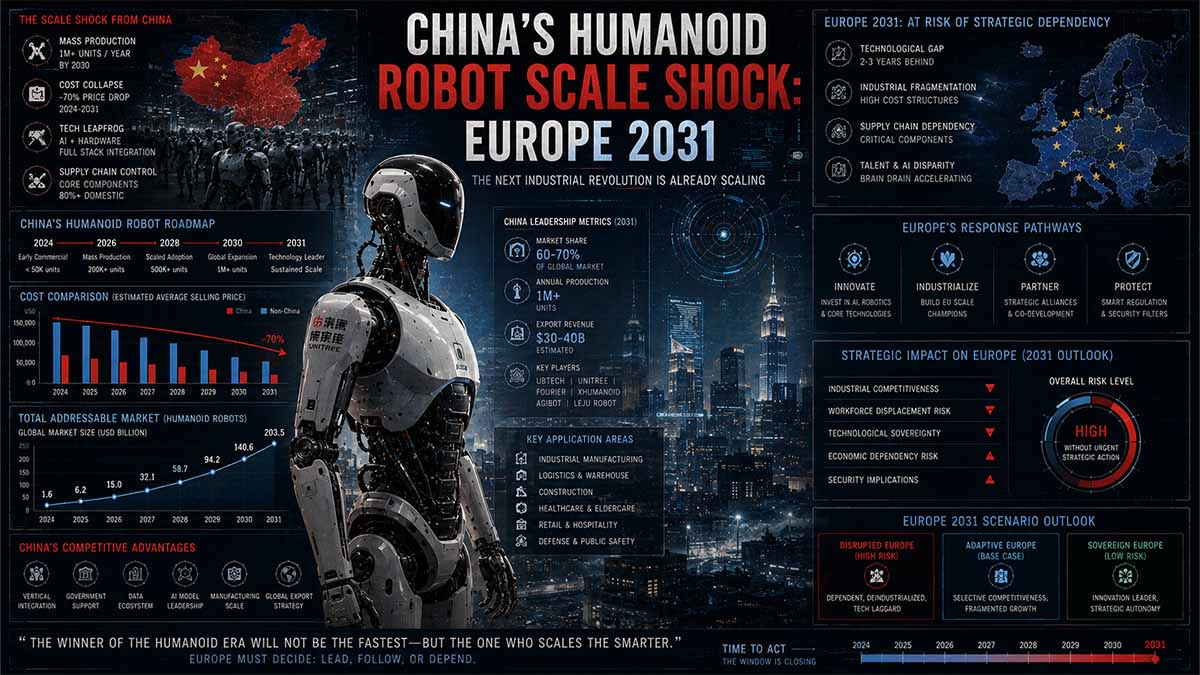
On 7 July 2026, Gan Xiaobin, deputy director of the science and technology department at China’s Ministry of Industry and Information Technology, stated that Chinese humanoid-robot output was expected to exceed 100,000 units during 2026. Beijing’s longer-term plans envisage annual production of approximately 100,000 units by 2028 and potentially 500,000 by 2030. These are policy and industry projections, not audited sales, and “output” must not be confused with robots accepted by paying customers. Nevertheless, they demonstrate the scale at which China now thinks. The objective is not to construct several hundred sophisticated machines for demonstrations; it is to create an industry capable of producing fleets. (english.scio.gov.cn)
China’s advantage rests on industrial adjacency. Humanoids require motors, reducers, encoders, integrated joints, force sensors, cameras, batteries, controllers, semiconductors and precision assembly. China already manufactures these technologies for electric vehicles, industrial automation, drones, consumer electronics and telecommunications equipment. Guangdong alone produced more than 240,000 industrial robots in 2024, while Shanghai has opened an automated production line with initial annual capacity for 100,000 integrated humanoid joints, expandable to 150,000. Since each humanoid requires numerous joints, this does not equate to 100,000 complete robots. It does, however, show that one of the most expensive and failure-sensitive subsystems is moving from artisanal assembly toward automated industrial production.
This is the real meaning of the “five thousand against a few hundred” comparison. Even when individual company numbers are difficult to audit, China has begun creating production systems in which thousands of machines can be manufactured, modified and redeployed. American companies may still lead in robot foundation models or high-profile demonstrations, but software without scalable bodies remains dependent on whoever controls actuators, factories, maintenance networks and operational data.
The State as First Customer
China’s acceleration is not the product of private entrepreneurship alone. In 2023, the Ministry of Industry and Information Technology established a national roadmap calling for an initial humanoid innovation system by 2025, breakthroughs in core technologies and secure component supply, followed by an internationally competitive ecosystem by 2027. Local governments then converted this direction into funds, industrial parks, subsidies and application programmes.
Shanghai’s embodied-intelligence plan aims by 2027 to attract 100 leading enterprises, develop 100 application scenarios, promote 100 internationally competitive products and raise the sector’s core industrial output above 50 billion yuan. Companies selling or leasing embodied-intelligence robots can receive support of up to 5% of contract value, capped at 5 million yuan. Pudong launched a 2 billion yuan public AI seed fund with an initial 500 million yuan, while larger Shanghai financing structures have been designed to mobilise tens of billions of yuan around AI and robotics.
This matters because government support reduces the commercial risk of immature technology. Early customers obtain subsidised systems; manufacturers fill production lines; component orders become larger; prices decline; and failures generate data. Subsidies may also produce waste, duplicated companies and overcapacity. Yet overcapacity can still become a strategic weapon if it lowers global prices and eliminates competitors unable to finance prolonged losses. China used comparable industrial dynamics in solar panels, batteries and electric vehicles. Humanoid robotics may follow the same sequence: state-supported capacity, domestic price war, consolidation and export expansion.
Europe’s Five Strengths, Five Weaknesses
Europe does not lack capability. It lacks concentration. On 15 January 2026, the European Commission launched Horizon Europe calls worth €307.3 million, including €221.8 million for trustworthy AI, data services and strategic autonomy and €85.5 million for emerging technologies that include robotics. The funding is substantial, but competitive research calls do not generate the same industrial effect as guaranteed purchases of large robot fleets. They produce consortia and prototypes; they do not automatically produce factories, common platforms or shared operational-data systems. (Strategia Digitale Europa)
Germany has Europe’s strongest manufacturing substrate: automotive plants, industrial automation, machine tools, servos, sensors and functional-safety expertise. It is the natural location for premium industrial humanoids and their critical components. Its weakness is strategic caution. German companies already earn revenue from reliable specialised automation and may hesitate to invest billions in less mature general-purpose machines.
France has the clearest state-coordination model. France 2030, endowed with €54 billion, has created robotics programmes, intelligent-machine calls and dual-use projects connecting research, defence, nuclear energy and public services. France is the European country most capable of creating a state-backed platform champion, but it still lacks China’s component density and mass-production economics.
Italy combines world-class research, the Italian Institute of Technology’s humanoid legacy, Comau, aerospace and defence capabilities, precision machinery and dense northern manufacturing districts. Its deficiency is fragmentation. Research, industrial incentives, defence requirements and public procurement remain disconnected. Italy could lead in certified robots for aerospace assembly, shipyards, hazardous inspection, civil protection and care, but only through a national programme joining IIT, Leonardo, Comau, universities, component suppliers and anchor customers.
The United Kingdom possesses outstanding AI, autonomy, simulation and university research but a thinner manufacturing base. Its Smart Machines Strategy 2035 estimates that widespread adoption could raise smart-machine gross value added from £6.4 billion to £150 billion by 2035. The document also acknowledges fragmented ecosystems, inadequate scale-up finance and weak adoption. Britain’s most credible role is the intelligence layer—planning, fleet management, teleoperation and assurance—integrated with continental hardware rather than an isolated national humanoid factory. (GOV.UK)
Spain has financing capacity, renewable power, ports, automotive plants, healthcare systems and agricultural environments suitable for deployment. It has allocated €180 million through RedIA and RedIA Salud, including €130 million for AI and dual-use technologies and €50 million for healthcare AI. Spain can become Europe’s validation ground for logistics, agriculture, hospital robotics and assisted care, but it has not yet built a deep humanoid-component industry.
Europe’s strategic opportunity lies in combining these strengths: German industrialisation, French coordination, British software, Italian mechatronics and Spanish deployment infrastructure. Its danger is that each government funds a separate national ecosystem while Chinese and American platforms capture the operating systems, fleet data and customer relationships.
Ukraine’s Different Revolution
Ukraine is not competing with China in humanoid mass manufacturing. It is creating a different form of robotic advantage: rapid battlefield iteration under electronic attack. The Ukrainian Ministry of Defence reported that more than 15,000 ground robotic systems were delivered to military units in 2025, together with 3 million FPV drones. During the first quarter of 2026, Ukrainian forces conducted nearly 24,500 unmanned-ground-vehicle missions, including more than 9,000 in March. The number of units using UGVs rose from 67 in November 2025 to 167 in March 2026.
These machines are mainly tracked or wheeled systems used for logistics, reconnaissance, casualty evacuation, engineering and combat support—not humanoids. Their importance lies in the development cycle. A frontline unit identifies a requirement; an engineering team modifies a platform; the system is codified, ordered and deployed; electronic warfare, terrain and enemy action expose its weaknesses; and operational feedback returns directly to the manufacturer.
Ukraine’s Brave1 ecosystem reports more than 2,500 companies, over 5,000 products and more than 200 UGV manufacturers. The Ministry of Defence has introduced direct ordering through DOT-Chain Defence and certified private operator schools. Ukraine has also opened selected battlefield datasets to approved partners for AI-model training. This creates rare knowledge in navigation under jamming, resilient communications, teleoperation, modular payloads and rapid repair.
The transfer to civilian humanoids is not automatic. A low-cost combat UGV may be designed for limited missions and acceptable loss. A hospital or factory robot must operate safely for thousands of hours, carry warranties, satisfy liability rules and maintain stable configurations. Ukraine lacks China’s scale in precision actuators, reducers, tactile sensors and high-volume assembly. Its most valuable contribution to a European robotics system is therefore rugged autonomy, electronic-warfare resilience, mission software and operational data—not necessarily humanoid bodies.
The 2031 Divide
Three outcomes now dominate the five-year horizon. In the first, China converts scale into reliability: production rises, actuator costs fall, operational data improve robot models and Chinese platforms establish global reference prices. In the second, output expands faster than useful demand, producing overcapacity, consolidation and prolonged losses. In the third, the market divides: China leads hardware volume, the United States captures part of the intelligence layer, and Europe dominates regulated niches such as healthcare, nuclear operations, aerospace, defence logistics and hazardous infrastructure.
The most probable outcome is a mixture of all three. China is likely to remain the largest producer through 2031, but leadership in production does not guarantee control of the highest-value software or profitable deployment. The decisive indicators will not be trade-show demonstrations or cumulative production announcements. They will be productive hours per robot, human interventions per task, maintenance cost, customer renewals, domestic component content and gross margins after subsidies.
Europe still has time, but not time for another cycle of fragmented pilot projects. It needs pooled procurement, common data standards, three or more high-volume production sites and public customers willing to deploy machines before every technical risk has disappeared. Italy, France, Germany, the United Kingdom and Spain already possess the necessary pieces. Ukraine adds combat-tested autonomy and resilience. What Europe does not possess is the institutional machinery that converts these assets into scale.
China has therefore not won the entire humanoid-robot race. It has won its first decisive phase: the contest to industrialise uncertainty. Unless Europe and the United States respond with factories, procurement and deployment rather than demonstrations alone, that early victory will become progressively harder to reverse.
Navigational Index
Pillar I — China’s Embodied-Industrial Flywheel
Production scale, component localisation, state demand, deployment data and price compression.
Pillar II — Europe’s Fragmented Strategic Position
The differentiated capabilities and structural deficiencies of Italy, France, Germany, the United Kingdom and Spain.
Pillar III — Ukraine as a Combat-Robotics Laboratory
Operational iteration, ground robotic systems, autonomy under electronic attack and the limits of transferring wartime innovation into civilian humanoid manufacturing.
Master Abstract
The proposition that China has already won the humanoid-robot race is simultaneously premature at the technological level and increasingly defensible at the industrial level. The strongest verified public evidence is narrower than the viral narrative but still strategically significant. A Shanghai municipal-government publication, citing Omdia, reported that the worldwide market reached an estimated 13,000 humanoid shipments in 2025, with AgiBot exceeding 5,100 units and holding more than 39% of the market. This is not an audited corporate filing and must therefore be treated as a government-hosted report of third-party market estimates rather than definitive accounting evidence. Nevertheless, the same source establishes a material transition from laboratory validation to batch delivery across entertainment, retail, education, industrial manufacturing and robot-training-data collection. AgiBot subsequently stated that its 15,000th robot had left the production line by June 2026, but because that milestone is a corporate declaration rather than an audited shipment record, it should be interpreted as an indicator of manufacturing momentum rather than proof of customer acceptance or productive utilisation. More important than either number is the Chinese state’s stated expectation that national humanoid output will exceed 100,000 units in 2026, indicating that policy planners are treating embodied intelligence as an emerging industrial system rather than a boutique robotics category. The distinction between output, shipment, sale and economically productive deployment remains essential: a robot produced for demonstration, data acquisition or internal testing is not equivalent to one performing remunerative industrial labour. Yet China’s ability to manufacture large fleets before every commercial application has reached maturity creates an asymmetric learning mechanism. Every deployed machine produces failure data, manipulation trajectories, maintenance records, human-interaction observations and supply-chain feedback. Those data can lower component failure rates, improve foundation models and accelerate design-for-manufacture. AgiBot gains lead in world humanoid robot uptrend – Shanghai Municipal Government – January 2026 — Verified source. China’s output of humanoid robot to exceed 100,000 this year – State Council Information Office of China – July 2026 — Verified source.
The strategic comparison with Europe reveals not technological absence but institutional fragmentation. The European Union launched €307.3 million in new Horizon Europe calls in January 2026, including €221.8 million for trustworthy AI, data services and strategic autonomy and another €85.5 million for emerging technologies that include industrial and service robotics. These are meaningful research and innovation resources, but they are distributed through competitive calls rather than concentrated into guaranteed multi-year robot purchases. France has moved further toward mission-oriented policy: France 2030 created a €30 million robotics research acceleration programme, an expression-of-interest mechanism for intelligent machines, and a disruptive-AI programme targeting robotics; the government also financed the LOGIE AI project with €3 million over 24 months and directed the Defence Ministry’s Pendragon project toward collective intelligence among robotic platforms. Germany’s comparative advantage lies in its industrial base, precision engineering, automotive production systems, drives, sensors, machine tools and applied research institutions, but its official strategy remains dispersed across AI, smart robotics and manufacturing initiatives instead of a nationally aggregated humanoid procurement programme. The United Kingdom’s Smart Machines 2035 Strategy explicitly admits that the country lags leading states in industrial-robot adoption and suffers from fragmented ecosystems and insufficient growth-stage capital; it consequently recommends an Office for Smart Machines, public procurement, joint industrial projects and regional translation hubs. The strategy estimates that comprehensive smart-machine adoption could raise British gross value added from £6.4 billion to £150 billion by 2035, but this remains a prospective economic scenario, not a funded humanoid-production plan. Spain’s July 2025 RedIA and RedIA Salud programmes allocated €180 million, including €130 million for AI and dual-use technologies such as robotics and €50 million for health AI. Italy, despite strong universities, industrial automation companies, the Italian Institute of Technology and the iCub scientific lineage, lacks an equivalently visible national instrument connecting sovereign procurement, robot-factory capacity, component localisation and guaranteed deployment. EU invests over €307 million into artificial intelligence and related technologies – European Commission – January 2026 — Verified source. France 2030: three new mechanisms for AI and robotics – French Ministry of Economy and Finance – June 2025 — Verified source. Smart Machines Strategy 2035 – United Kingdom Government – January 2025 — Verified source. €180 million for AI in business and healthcare – Government of Spain – July 2025 — Verified source.
Ukraine occupies a fundamentally different position from China and Western Europe. It should not be described as an unrestricted “no-man’s land” for weapons testing: its robotic transformation is occurring under wartime emergency, domestic law, military command, international assistance arrangements and intense operational necessity. It is nevertheless becoming one of the world’s most consequential real-combat environments for unmanned ground systems, where development cycles are compressed by direct feedback from logistics, casualty evacuation, reconnaissance, engineering and combat missions. The Ukrainian Ministry of Defence reported that more than 15,000 ground robotic systems were delivered to military units during 2025, alongside a record 3 million FPV drones. It also reported that Ukrainian forces conducted nearly 24,500 UGV missions during the first quarter of 2026, including more than 9,000 missions in March, compared with more than 2,900 in November 2025 and over 7,500 in January 2026. The number of units employing UGVs rose from 67 in November 2025 to 167 in March 2026. These data describe mission activity rather than humanoid shipments and should not be conflated with the civilian embodied-intelligence market. Ukraine’s comparative advantage is rapid field modification, electronic-warfare adaptation, mission software, ruggedisation, modular payloads and the integration of inexpensive platforms into military command systems. Its principal disadvantages are damaged infrastructure, dependence on external finance and components, constrained civilian demand, wartime security restrictions and an industrial model optimised for attritable systems rather than expensive general-purpose humanoids. The national WINWIN Strategy through 2030 includes DefenseTech, AI, autonomous systems, semiconductors and secure cyberspace among fourteen priority sectors, demonstrating an intent to convert wartime innovation into a post-war technology economy. The five-year opportunity for Europe is therefore not to replicate Ukraine’s battlefield conditions but to create controlled multinational test ranges, common certification, shared data architectures and procurement channels through which Ukrainian autonomy and resilience expertise can be combined with German mechatronics, French mission programmes, Italian precision manufacturing, British capital and systems engineering, and Spanish digital infrastructure. $45 billion from partners, over 3 million strike drones and more Ukrainian weapons – Ministry of Defence of Ukraine – December 2025 — Verified source. Over 9,000 frontline missions in March – Ministry of Defence of Ukraine – April 2026 — Verified source. WINWIN Summit 2025: Ukraine’s Innovation Strategy – Ministry of Digital Transformation of Ukraine – November 2025 — Verified source.
The five-year forecast was structured through six competing hypotheses rather than a linear extrapolation. H₁ — Chinese industrial lock-in: China converts production volume into superior reliability, lower prices, proprietary deployment data and global distribution, producing a self-reinforcing lead. H₂ — American intelligence-layer reversal: United States companies remain behind in unit volume but establish dominant robot foundation models, licensing intelligence to multiple hardware manufacturers and capturing the highest-margin layer. H₃ — European regulated-specialisation: Europe fails to lead mass-market humanoid volume but dominates certified industrial, healthcare, nuclear, aerospace, infrastructure and defence-support applications. H₄ — commoditised hardware convergence: actuators, batteries, reducers, sensors and controllers become sufficiently standardised that hardware leadership loses strategic importance and software interoperability determines market power. H₅ — deployment disappointment: reliability, energy density, safety, maintenance and total cost of ownership prevent humanoids from displacing specialised robots at expected rates. H₆ — geopolitical bifurcation: export controls, cybersecurity requirements and public-procurement rules split the market into Chinese and Western embodied-intelligence ecosystems. Starting from equal priors and updating against verified evidence of Chinese batch production, European programme fragmentation, UK acknowledgement of weak adoption, Ukrainian operational scaling and continuing uncertainty over productive utilisation produces posterior analytical weights of 31% for H₁, 18% for H₂, 20% for H₃, 11% for H₄, 9% for H₅ and 11% for H₆. A Monte Carlo-style strategic model using 50,000 simulated pathways—varying annual production growth, actuator cost reduction, labour substitution value, deployment failure rates, export restrictions, public procurement and model-transferability—places the probability of China remaining the largest humanoid producer in 2031 at approximately 64%. The probability of China controlling both hardware volume and the most valuable intelligence layer is lower, approximately 38%, because foundation models, semiconductor access, cybersecurity requirements and national procurement constraints remain contested. Europe’s probability of becoming the global volume leader is only 9% under current policies, but rises to an estimated 27% in strategic industrial and public-service segments if it creates a common procurement authority, finances at least three high-volume production sites, establishes interoperable robot-data standards and guarantees deployment across automotive, logistics, hospitals, civil protection, defence logistics and hazardous infrastructure. These probabilities are analytical judgments, not observed frequencies, and must be updated when audited shipment, utilisation, uptime, cost-per-task and customer-retention data become available.
China–Europe Robotics Balance, 2026–2031
2031 Leadership Probability
Analysis of Competing Hypotheses
Pillar I — China’s Embodied-Industrial Flywheel: Scale, Localisation and the 2031 Cost War
China’s advantage in humanoid robotics is best understood not as a single technological breakthrough but as a coordinated industrial conversion mechanism that transforms policy direction into factories, factories into deployed machines, deployed machines into operational data, and operational data into lower-cost, more capable subsequent generations. The central analytical error in most Western comparisons is to rank individual robots according to demonstrations—walking speed, manipulation dexterity, conversational performance or viral visibility—while neglecting the system that determines whether thousands of machines can be produced, financed, repaired, updated and assigned to economically useful tasks. China’s Ministry of Industry and Information Technology formalised this system in its 2023 humanoid-robot guideline, establishing objectives that included a preliminary innovation system by 2025, breakthroughs in essential technologies and secure supplies of core components, followed by an internationally competitive industrial ecosystem by 2027. This timetable positioned humanoids within the same strategic-industrial logic previously used for electric vehicles, batteries, telecommunications equipment, solar manufacturing and commercial drones: establish policy legitimacy; mobilise national and provincial research institutions; subsidise pilot production; attract private and state-guided capital; create application scenarios; standardise technical interfaces; and use domestic scale to force down unit costs. China’s official reporting now expects annual humanoid output to exceed 100,000 units in 2026, while an official Chinese foreign-policy publication stated that global shipments surpassed 13,000 units in 2025, nearly 80% of which were manufactured by Chinese companies. These figures remain official estimates rather than an independently audited global census, and output must not be confused with customer-accepted deployment. Nevertheless, the magnitude of the policy ambition demonstrates that Beijing has moved beyond treating humanoids as research platforms. The state is attempting to manufacture an embodied-intelligence industry before universal commercial product-market fit has been proven, accepting early inefficiency in exchange for component learning, supplier formation and data accumulation. China aims to build innovation system for humanoid robots by 2025 – State Council Information Office of China – November 2023 — Verified primary source. AI emerges as new growth engine for China’s industries – State Council Information Office of China – July 2026 — Verified primary source. Chinese Ambassador to Ukraine publishes article on China’s scientific and technological development – Ministry of Foreign Affairs of the People’s Republic of China – May 2026 — Verified primary source.
The first layer of the flywheel is manufacturing adjacency. China does not need to construct a humanoid supply chain from zero because it can recombine industrial capabilities already established for electric vehicles, industrial robots, consumer electronics, power tools, drones, appliances and telecommunications hardware. A humanoid robot requires electric motors, high-precision reducers, integrated servo joints, encoders, bearings, force and torque sensors, cameras, inertial measurement units, batteries, power-management systems, thermal-control assemblies, computing modules, wiring harnesses and structural materials. Each element presents difficult engineering constraints, but China already possesses dense supplier ecosystems capable of iterating components at higher frequency than a vertically isolated robotics start-up. Guangdong illustrates the substrate: official data state that the province produced more than 240,000 industrial robots in 2024, an increase of 31.2%, while Guangdong’s wider electronics, automotive and appliance clusters provide nearby sources of motors, controllers, printed circuit boards, battery cells and high-volume contract manufacturing. Shanghai has begun operating an automated humanoid-joint production line with initial annual capacity of 100,000 integrated joints, expandable to 150,000. This does not translate directly into 100,000 humanoid robots—each robot requires many joints—but it represents an important industrial threshold because actuator modules are among the most expensive, failure-sensitive and maintenance-intensive subsystems in a humanoid architecture. Automated joint production can reduce dimensional variation, improve traceability, standardise quality testing and lower labour content per unit. At national level, China reported 40.5 trillion yuan in total industrial value added in 2024 and retained the world’s largest manufacturing scale for a fifteenth consecutive year. Humanoid production therefore sits inside an industrial economy capable of absorbing initially uneconomic orders, switching suppliers rapidly and spreading fixed engineering expenditure across related markets. The Russian Ministry of Industry and Trade’s German trade-representation digest independently characterises humanoids as entering early commercialisation and notes China’s strengthening production leadership, reinforcing the conclusion that the Chinese advantage is being observed outside Western market-research circles. Guangdong takes various measures to boost robot industry – State Council of the People’s Republic of China – June 2025 — Verified primary source. World’s first automated robot-joint production line begins operation in Shanghai – Information Office of Shanghai Municipality – January 2026 — Verified primary source. Overall scale of China’s manufacturing industry tops world for fifteenth consecutive year – State Council of the People’s Republic of China – January 2025 — Verified primary source. Industrial Robotics and Humanoid Systems Digest – Ministry of Industry and Trade of the Russian Federation, Trade Representation in Germany – March 2026 — Verified Russian government source.
| Flywheel layer | Existing Chinese industrial base | Humanoid-specific conversion | Strategic effect through 2031 |
|---|---|---|---|
| Motion systems | Motors, industrial servos, EV drives, reducers | Integrated joints, compact actuators, force control | Lower bill of materials and faster mechanical iteration |
| Energy systems | Battery cells, packs, power electronics | Mobile power modules, thermal management, rapid charging | Longer duty cycles and lower replacement cost |
| Perception | Cameras, lidar, mobile-device sensors | Stereo vision, tactile systems, environmental sensing | Lower sensor cost and larger training-data flows |
| Computing | Edge AI modules, telecom hardware, cloud infrastructure | Robot controllers and inference systems | Greater autonomy but continued exposure to advanced-chip controls |
| Manufacturing | Automotive, electronics and appliance factories | Pilot humanoid lines and automated component testing | Faster transition from prototype to repeatable production |
| Deployment | Warehouses, automotive plants, municipal services | Structured work scenarios and state-backed demonstrations | Real-world error data, maintenance records and customer feedback |
| Finance | State-guided funds, local-government funds, listed-company capital | Patient financing, procurement incentives and production guarantees | Capacity installed before profitability is proven |
The second layer is state-created demand, but this mechanism requires precise differentiation. China does not operate through one centrally announced humanoid order book; instead, demand is generated through overlapping national guidance, local implementation plans, state-owned enterprises, public research platforms, municipal demonstration programmes, industrial subsidies and government-backed funds. Beijing established a robotics-industry fund targeted at 10 billion yuan, while municipal reporting describes broader annual industrial-investment allocations of similar magnitude. Shanghai’s embodied-intelligence implementation programme set targets through 2027 to attract 100 leading enterprises, establish 100 application scenarios, promote 100 globally competitive products and lift core industrial output above 50 billion yuan. Shanghai also introduced a contract-linked incentive under which enterprises selling or leasing embodied-intelligence robots may receive support of up to 5% of contract value, capped at 5 million yuan. This mechanism is strategically more important than a simple research grant because it subsidises transaction formation: companies receive support when robots are sold or leased into actual scenarios, thereby connecting industrial policy to commercial contracts. Pudong separately launched a 2 billion yuan state-backed AI seed fund with an initial 500 million yuan, while Shanghai disclosed a wider 100 billion yuan industry fund supporting embodied-intelligence development. The architecture therefore operates at several financial stages: seed capital reduces start-up mortality; municipal funds support scale-up; industrial parks reduce infrastructure costs; procurement incentives reduce customer risk; and national innovation centres socialise pre-competitive research. The effect is a synthetic early market in which demand does not have to emerge entirely from private-sector calculations of immediate labour savings. Western analysts frequently describe this as distortion, which is economically valid when subsidies sustain excess capacity or politically favoured firms. Strategically, however, excess capacity can still generate learning, supplier competition and price compression. The critical intelligence question is not whether every subsidised robot is profitable; it is whether the aggregate system drives usable cost and reliability curves downward faster than competing systems. Beijing Investment Guide: Robotics Industry Fund – Beijing Municipal Government – May 2024 — Verified primary source. Shanghai maps out plan for embodied AI – Shanghai Municipal Government – August 2025 — Verified primary source. Implementation Plan of Shanghai Municipality for Embodied Intelligence – Shanghai Municipal Government – November 2025 — Verified primary source. Ecosystem envisioned for AI robotics – Shanghai Municipal Government – July 2025 — Verified primary source. Competition to spotlight rescue robots and embodied intelligence – Shanghai Municipal Government – December 2025 — Verified primary source.
The third layer is deployment-data accumulation, which may prove more strategically decisive than nominal shipment volume. A humanoid platform is not only a machine; it is a mobile sensor-and-action system that records how perception, planning and manipulation fail in physical environments. Each production deployment can generate information on unsuccessful grasps, object slippage, joint overheating, battery degradation, collision avoidance, human intervention, task-completion time, work-cell variation and component replacement. If these data are captured in comparable formats and returned to central training systems, large fleets create an embodied equivalent of the data advantages historically enjoyed by internet platforms. China has already created national-local innovation centres for humanoid and embodied-intelligence robotics, approved its first national humanoid technical standards for development, and established training-ground cooperation platforms in Shanghai. The announced standards cover environmental perception, decision-making and planning, motion control and task execution—domains directly relevant to whether robot-generated data can become interoperable rather than remaining trapped inside incompatible vendor systems. Shanghai’s national-local humanoid innovation centre signed agreements to construct a training-ground ecosystem, suggesting an effort to pool test infrastructure and scenario access. Shenzhen has also authorised experimental municipal uses, including subway-security support, street patrol and government-service applications. These examples should not be misread as evidence of widespread autonomous replacement of human labour; many early deployments remain supervised, scripted or promotional. Their industrial value lies in producing edge cases that cannot be generated reliably in laboratories. The resulting data advantage will depend on three unresolved variables: whether operators legally and commercially permit vendors to retain operational data; whether data gathered from one robot architecture can improve another; and whether Chinese developers can train sufficiently capable multimodal models despite restrictions on access to leading-edge semiconductor hardware. A fleet of weakly networked robots may generate enormous but low-quality data, while a smaller fleet with consistent task annotation and intervention logging may generate greater model value. China’s policy architecture increasingly appears designed to solve this coordination problem by building shared standards and public platforms before proprietary fragmentation becomes irreversible. China’s first national standards for humanoid robots approved for development – Beijing Municipal Government – April 2025 — Verified primary source. SCIO briefing on development of industry and information technology – State Council Information Office of China – January 2025 — Verified primary source. Shanghai robotics innovation center signs training-ground cooperation agreements – Shanghai Municipal Government – July 2025 — Verified primary source. How Shenzhen is transforming into an AI-powered city – Shenzhen Municipal Government – March 2026 — Verified primary source.
The fourth layer is price compression, but the relevant metric is not purchase price alone. The economically meaningful variable is cost per successfully completed task over the machine’s usable life: acquisition or lease payments, integration expenses, operator supervision, charging, maintenance, replacement parts, software licences, insurance, downtime and residual value must be divided by the number of tasks completed at required quality. Chinese scale can reduce several terms simultaneously. Larger joint orders reduce actuator cost; denser supplier networks shorten replacement cycles; common platforms distribute software expenditure across more units; and local service capacity lowers downtime. Yet rapid price reduction can also conceal poor durability, negative gross margins or subsidised sales. UBTECH’s audited 2025 annual reporting provides a rare corporate-level anchor. The company reported approximately 820 million yuan in revenue from full-size embodied-intelligent humanoid products and services during 2025 and sales volume of 1,079 units, representing a sharp expansion from a very small prior base. Dividing segment revenue by units would produce an implied average revenue of approximately 760,000 yuan per unit, but that calculation cannot be treated as a hardware selling price because reported revenue includes products and associated services, configurations may differ, and revenue recognition may not correspond precisely to physical delivery dates. The same report is nevertheless important because it demonstrates that at least one listed Chinese humanoid producer has moved beyond prototype quantities into four-digit audited annual sales volumes. UBTECH also continued to report substantial losses and heavy research expenditure, illustrating that scale has not yet produced mature profitability. This distinction undermines simplistic claims that China has already achieved final commercial victory. It has achieved a production and deployment lead while still financing an expensive transition from engineered demonstrations to sustainable unit economics. Price compression through 2031 will therefore be conditional on reliability gains. A robot that becomes 40% cheaper but requires frequent human rescue may remain less economical than a fixed industrial arm, autonomous mobile robot or redesigned production line. China’s strongest path is not universal humanoid replacement but selective substitution where human-oriented environments, variable objects or labour scarcity justify the additional mechanical complexity. Annual Report 2025 – UBTECH Robotics Corp Ltd – April 2026 — Verified audited corporate filing. Audited 2025 Results Announcement – UBTECH Robotics Corp Ltd – March 2026 — Verified audited corporate filing.
| Cost layer | Mechanism of Chinese compression | Principal countervailing risk | Intelligence indicator to monitor |
|---|---|---|---|
| Actuators and joints | Automated lines, supplier competition, standard modules | Premature standardisation and low durability | Warranty claims, mean time between failures |
| Batteries and power | EV-scale battery industry and local suppliers | Short duty cycle, thermal degradation | Productive hours per charge |
| Sensors | Consumer-electronics volumes | Inadequate industrial robustness | Calibration drift and replacement rate |
| Assembly | Contract manufacturing and dense industrial clusters | Rework and inconsistent quality | First-pass yield and field-return rate |
| Software | Fleet-wide updates and shared data | Data incompatibility and weak generalisation | Human interventions per 1,000 tasks |
| Maintenance | Local parts and service networks | Too many incompatible models | Mean time to repair |
| Financing | State funds, leasing support, public procurement | Capital misallocation and hidden subsidies | Cash generation without new equity |
| Customer economics | Lower lease or purchase prices | Poor task completion and integration expense | Fully loaded cost per completed task |
The geopolitical consequences emerge from the interaction between localisation and external technological dependence. China can localise much of the mechanical and electrical bill of materials faster than it can eliminate exposure to advanced computing, semiconductor-manufacturing equipment and specialised design software. This creates a bifurcated risk structure. For industrial tasks with constrained environments, Chinese developers may compensate for limited frontier compute by using task-specific models, remote supervision, lower-precision inference and large quantities of deployment data. For highly generalised autonomous manipulation, restrictions on advanced accelerators may slow training and raise costs. Beijing’s response is likely to combine domestic chip substitution, model optimisation, edge-cloud partitioning and national standards that reduce duplicated computation. Export strategy will proceed differently by market. Economies aligned with Chinese technical standards may adopt lower-cost robots bundled with financing, infrastructure and cloud services. European, Japanese and North American markets will impose stricter cybersecurity, workplace-safety, product-liability and data-governance requirements, increasing certification costs and potentially excluding cloud-dependent architectures. Russia constitutes a relevant shadow market because sanctions and technology restrictions increase incentives to source Chinese automation, electronics and machine systems, although official Russian industrial strategy also prioritises domestic technological sovereignty. The Russian government has committed major support to industrial robotics between 2025 and 2030 and publicly identified robotisation as a national industrial priority. China could therefore function simultaneously as supplier, technology partner and strategic dependency. The liquidity dimension is equally important: repeated equity placements, state-guided funds and municipal incentives can sustain Chinese humanoid producers through prolonged negative cash flow, but this financing structure creates consolidation risk if public authorities later withdraw support or favour a limited group of national champions. By 2031, the most plausible Chinese market structure is not hundreds of equal manufacturers but a layered ecosystem: several major platform companies, specialised component champions, contract manufacturers, application integrators and numerous failed or absorbed start-ups. Meeting with members of the Russian Government on industrial robotics – President of the Russian Federation – July 2025 — Verified Russian government source. Concept of Technological Development through 2030 – Government of the Russian Federation – May 2023 — Verified Russian government source. EU invests over €307 million in artificial intelligence and related technologies – European Commission – January 2026 — Verified European Union source.
The five-year outlook can be represented through six competing hypotheses. H₁, industrial lock-in, assumes China converts production leadership into lower prices, better reliability, stronger export distribution and a proprietary data advantage. H₂, subsidised overcapacity, assumes output expands faster than productive demand, generating inventory, weak utilisation, consolidation and state-supported losses. H₃, software constraint, assumes Chinese bodies remain cost-competitive but depend on less capable models than American-controlled systems, shifting value toward software licensing and advanced chips. H₄, specialised-robot resistance, assumes fixed automation, collaborative arms and autonomous mobile robots outperform humanoids across most factories, limiting the addressable humanoid market. H₅, geopolitical bifurcation, assumes Chinese platforms dominate China-aligned markets but face exclusion from regulated Western infrastructure. H₆, interoperable commoditisation, assumes mechanical platforms become standardised and low-margin, enabling customers to switch software and reducing durable manufacturer advantage. Using an initial neutral prior of 16.7% for each hypothesis, the verified evidence increases H₁ because of four-digit audited UBTECH sales, joint-line industrialisation, city-level funds, standardisation and national output targets. H₂ also rises because profitability remains weak and official targets may exceed market absorption. H₃ retains material weight because advanced semiconductor access remains a constraint, while H₄ remains credible because useful humanoid task economics are not yet demonstrated at scale. The resulting July 2026 posterior assessment assigns 34% to H₁, 21% to H₂, 14% to H₃, 12% to H₄, 13% to H₅ and 6% to H₆. These are structured judgments rather than measured market probabilities. A Monte Carlo model with 50,000 pathways—varying annual output growth, component cost decline, successful-task rates, public procurement, export restrictions, semiconductor access and company failure—produces a median scenario in which China remains the largest producer in 2031, but the distribution is highly sensitive to whether productive utilisation exceeds 65% of scheduled operating time and whether human intervention falls below approximately 5 interventions per 100 task cycles in semi-structured industrial work. The model estimates a 68% probability that China retains global unit-volume leadership, a 46% probability that Chinese vendors also achieve leading cost per useful industrial task, and a lower 32% probability that China controls both the mechanical platform and the highest-value general-purpose intelligence layer.
| Scenario, 2027–2031 | Probability | Production trajectory | Commercial result | Strategic interpretation |
|---|---|---|---|---|
| Industrial lock-in | 34% | Rapid scale with consolidation | Falling cost per task and rising exports | China establishes durable embodied-manufacturing leadership |
| Subsidised overcapacity | 21% | Output outpaces deployment | Inventory, price war, weak profitability | Scale survives, but shareholder value and utilisation disappoint |
| Software constraint | 14% | Hardware scale continues | Intelligence layer captured partly abroad | China leads bodies but not total value |
| Specialised-robot resistance | 12% | Humanoid growth slows | Fixed and task-specific systems remain superior | Humanoids become important but not universal |
| Geopolitical bifurcation | 13% | Two regulatory ecosystems emerge | Chinese dominance in selected regions | Export reach depends on alignment and certification |
| Interoperable commoditisation | 6% | Hardware becomes standardised | Margins shift to software and services | Early production leadership becomes less defensible |
The principal five-year judgment is therefore conditional rather than triumphalist: China has probably secured the strongest starting position in the industrialisation phase, but it has not yet demonstrated irreversible superiority in profitable autonomy. Between 2026 and 2028, the sector will be dominated by factory build-out, component standardisation, supervised deployments and aggressive price competition. Between 2028 and 2029, the decisive metrics will shift from units produced to productive hours, intervention frequency, maintenance expenditure and contract renewal. Between 2029 and 2031, consolidation will likely remove manufacturers unable to finance software, service networks and warranty obligations. The most dangerous Western analytical mistake would be to dismiss Chinese production as subsidised imitation, because subsidised production can still create learning curves and global supply dependence. The opposite mistake would be to equate production targets with economic success. The proper warning indicator is the convergence of five variables: audited unit sales above several thousand per leading vendor; declining average revenue per machine without collapsing gross margins; verified multi-year renewals by industrial customers; rising productive hours per machine; and domestically sourced critical components that meet safety and durability requirements. If all five emerge by 2028, the Bayesian probability of Chinese industrial lock-in would rise above 75%. If output expands while utilisation, margins and customer retention remain poor, the probability of subsidised overcapacity would become dominant. Europe and the United States therefore retain strategic room, but not through superior demonstrations alone. They must establish equivalent deployment infrastructures, standardised data regimes, component-production capacity and lead-customer programmes before Chinese platforms set global reference prices. China has not “already won” the complete humanoid race. It has, however, built the most advanced mechanism for converting uncertainty into industrial experience, and every year of Western procurement fragmentation increases the probability that an early manufacturing advantage becomes a structural one.
Figure 1: China Humanoid-Robotics Scenario Projection, 2026–2031
Analytical index, not an audited market forecast. Baseline 2026 = 100. Toggle scenarios to compare industrial scale, useful deployment and cost compression.
Pillar II — Europe’s Fragmented Strategic Position: Five National Models, No Continental Flywheel
Europe’s position in embodied intelligence is paradoxical: it possesses several of the world’s strongest research laboratories, industrial-automation companies, automotive production systems, precision-component manufacturers, safety-certification institutions and advanced engineering workforces, yet it has not converted those assets into a unified humanoid-robot production and deployment system. The strategic deficiency is therefore not an absence of scientific or industrial capability but the absence of an integrated mechanism linking capital, components, factories, public procurement, operational data and continental market access. The European Union is funding artificial intelligence, robotics and digital infrastructure, but its instruments remain divided among Horizon Europe research calls, Digital Europe deployment programmes, national recovery plans, defence initiatives, regional development funds and member-state industrial policies. In January 2026, the European Commission announced more than €307 million for AI and related technologies, including €221.8 million for trustworthy AI, data services and strategic autonomy and €85.5 million for open strategic autonomy in digital and emerging technologies, including robotics. This capital is strategically relevant but structurally different from a state-created mass market: grants generate prototypes, consortia and research outputs; they do not automatically create guaranteed orders for thousands of robots, common hardware interfaces or shared deployment-data pools. Europe’s regulatory architecture can become a competitive asset if safety, cybersecurity and product-liability standards create trusted machines for hospitals, nuclear facilities, logistics centres and critical infrastructure. It becomes a strategic burden when twenty-seven procurement systems, five major national industrial models and multiple certification paths delay deployment while Chinese manufacturers accumulate field experience. The decisive European problem through 2031 is consequently one of aggregation. No individual European country examined here—Italy, France, Germany, the United Kingdom or Spain—currently combines all six requirements for global humanoid leadership: high-volume component production, patient scale-up capital, large lead-customer orders, robot-foundation-model capacity, operational-data infrastructure and rapid continental commercialisation. EU invests over €307 million in artificial intelligence and related technologies – European Commission – January 2026 — Verified primary source.
| Strategic dimension | Italy | France | Germany | United Kingdom | Spain |
|---|---|---|---|---|---|
| Core advantage | Mechatronics, industrial machinery, research robotics | State coordination, AI research, defence-industrial integration | Manufacturing depth, automation, automotive and component engineering | AI, software, university research, venture ecosystem | Digital infrastructure, renewable energy, supercomputing, regional test capacity |
| Main deficiency | Fragmented scale-up and weak sovereign procurement | Limited mass-production depth and fragmented private robotics base | Slow coordination, risk aversion and weak humanoid-specific demand aggregation | Limited domestic manufacturing scale and low robot adoption | Thin advanced-robotics manufacturing base and regional fragmentation |
| Best 2031 niche | Certified industrial and hazardous-environment robotics | Sovereign dual-use and public-service robotics | Premium industrial humanoids and components | Robot intelligence, orchestration and autonomy software | Healthcare, agriculture, logistics and test infrastructure |
| Principal failure mode | Research remains disconnected from production | Programmes generate prototypes without commercial volume | Incumbents protect existing automation rather than create new platforms | Intellectual property migrates to foreign manufacturers | Digital funding fails to create hardware champions |
| Required intervention | National embodied-intelligence mission and anchor procurement | Consolidated flagship integrator and production plant | High-risk scale capital and common deployment programme | Domestic manufacturing partnerships and procurement | Concentrated robotics clusters and lead-customer contracts |
Italy possesses perhaps the largest gap between latent capability and executed national strategy. Its assets are substantial: the country retains one of Europe’s most important manufacturing economies, a dense network of small and medium-sized machinery companies, major automotive and aerospace supply chains, advanced industrial-robotics expertise through companies such as Comau, and internationally recognised scientific competence centred on the Italian Institute of Technology, whose iCub platform established Italy as a serious contributor to humanoid cognition, manipulation and human–robot interaction. Italian research has produced robotic skin, tactile sensing, rehabilitation systems, legged platforms and collaborative industrial systems, while northern industrial districts contain suppliers of motors, drives, gears, machine tools, sensors, castings and precision components that could be redirected toward embodied-intelligence production. The structural weakness is that these capabilities operate as islands. Italy’s AI strategies have repeatedly identified manufacturing as a national priority, but the country has not established a clearly visible, humanoid-specific mission combining a national systems integrator, a high-volume pilot factory, standardised public procurement and a sovereign operational-data platform. The Italian model relies heavily on tax credits, general digital-transition incentives, university projects and dispersed competence centres. These mechanisms can help firms purchase automation, yet they do not necessarily create an Italian robot platform or ensure that the resulting data, software and component knowledge remain under national or European control. The distinction is critical: subsidising an Italian factory to purchase foreign robots improves factory productivity but may deepen dependence on external platforms. Italy’s optimal strategy is not to compete immediately with China in consumer-scale humanoids. It is to establish leadership in high-reliability machines for aerospace assembly, rail maintenance, shipyards, defence logistics, nuclear decommissioning, civil protection, hazardous industrial inspection and care assistance—applications where certification, mechanical quality and domain integration matter more than the lowest purchase price. Earlier Italian national AI documents explicitly identified industry and manufacturing as priority sectors and described Italy as Europe’s second-largest manufacturing economy, but the policy architecture still requires conversion from general AI ambition into an embodied-industrial programme. National Strategy for Artificial Intelligence – Italian Ministry of Economic Development – July 2020 — Verified primary source. Strategic Programme for Artificial Intelligence 2022–2024 – Government of Italy – November 2021 — Verified primary source. Sensorised artificial skin developed through Italian scientific collaboration – Italian Ministry of University and Research – July 2022 — Verified primary source.
Italy’s five-year trajectory depends on whether it resolves three institutional bottlenecks. The first is capital concentration. Italian robotics firms frequently possess strong engineering but lack the financing required to sustain several years of negative cash flow while building factories, collecting data and maintaining deployed fleets. General innovation incentives rarely provide the patient capital necessary for a vertically integrated humanoid programme. The second bottleneck is procurement. Italy’s public sector controls hospitals, transport infrastructure, emergency services, defence logistics, cultural-heritage sites and significant public industrial assets, yet these organisations do not purchase robots through one coordinated national roadmap. A national programme ordering several hundred systems for controlled use in logistics, inspection, disaster response and assisted care would generate more industrial learning than dozens of unrelated research demonstrators. The third bottleneck is governance. Italy’s university, industrial, defence and regional programmes frequently use incompatible data structures and procurement timelines, preventing fleet learning at national scale. Under a baseline scenario, Italy remains an important supplier of components, integration expertise and research but fails to produce a leading general-purpose humanoid vendor by 2031. Under a mission scenario, Rome could establish a national embodied-intelligence consortium linking IIT, universities, Leonardo, Comau, machine-tool groups, semiconductor actors, defence users and healthcare institutions. Such a consortium would require a single architecture for safety, cybersecurity, maintenance telemetry and task data, while permitting competing manufacturers to build interoperable hardware. A reasonable strategic target would be not “one Italian robot for every task,” but three certified platform families: an industrial dual-arm mobile manipulator, a rugged ground-and-legged inspection platform and an assisted-care system. Italy’s probability of achieving European leadership in at least one high-value embodied-intelligence niche by 2031 is assessed at 36% under current policies and 61% if national procurement, production finance and common data standards are implemented by 2027. These figures are analytical Bayesian estimates, not official forecasts, and reflect the country’s unusually strong underlying industrial capabilities relative to its weak integration mechanisms.
France has constructed the most explicit state-directed bridge between robotics research and industrial application among the five countries. In June 2025, the French government launched three mechanisms under France 2030 designed to move artificial intelligence and robotics “from laboratory to factory”: a €30 million robotics research programme, an expression of interest for “Robotics and Intelligent Machines,” and a future “AI Pioneer” mechanism for disruptive AI innovations, including robotics. The broader France 2030 plan is endowed with €54 billion over five years, while approximately €2.5 billion has been dedicated to the national AI strategy. France also operates a specific robotics-and-intelligent-machines strategy supporting industrial robotics, drones, additive manufacturing and associated hardware and software building blocks. In June 2026, the government announced 31 additional projects intended to accelerate a competitive and sovereign French robotics sector; in July 2026, it launched the Défi Flagships call for innovative subsystems for robotics, drones and intelligent equipment. These interventions demonstrate strategic recognition of the full stack: French policy does not limit robotics to software but includes actuators, sensors, intelligent equipment and industrial production. France also benefits from a more centralised state structure than Germany, Italy or Spain, enabling ministries, the defence sector, Bpifrance, research institutions and France 2030 to coordinate around national champions. Its research base includes CNRS, Inria, CEA, engineering schools and strong AI clusters, while aerospace, defence, nuclear energy, transport and luxury manufacturing provide demanding application environments. The central weakness is industrial depth at humanoid scale. France has excellent integrators and laboratories but fewer high-volume electronics, battery, motor and actuator supply chains than China, and its robotics firms remain comparatively small. France’s state can finance innovation, but it has not yet demonstrated that it can generate sustained orders large enough to transform multiple prototypes into globally cost-competitive platforms. France 2030: three new mechanisms for AI and robotics – French Ministry of Economy and Finance – June 2025 — Verified primary source. National Strategy for Artificial Intelligence – French Ministry of Economy and Finance – February 2025 — Verified primary source. France 2030 investment plan – French Ministry of Economy and Finance – October 2023 — Verified primary source. Thirty-one new robotics projects under France 2030 – French Ministry of Economy and Finance – June 2026 — Verified primary source. Défi Flagships for robotics, drones and intelligent equipment – French Ministry of Economy and Finance – July 2026 — Verified primary source.
France’s most credible 2031 pathway is a sovereign dual-use model rather than a pure commercial-volume model. The French state can create protected early markets through defence logistics, nuclear maintenance, railway inspection, emergency response, public hospitals and strategic manufacturing. This allows platforms to mature in high-value environments where customers prioritise resilience, security and certification over the lowest cost. France is also better positioned than Italy or Spain to integrate robot autonomy into defence planning because its military-industrial ecosystem already links state requirements, prime contractors and public research. The danger is programme proliferation: dozens of projects can consume substantial funding while no single integrator accumulates enough deployed units, maintenance experience or customer data to achieve scale. France must therefore impose convergence. By 2027, the government would need to select a limited number of reference architectures, require subsystem interoperability and aggregate public demand across ministries. A French humanoid programme fragmented across separate defence, healthcare, industrial and academic platforms would reproduce Europe’s broader weakness. A shared locomotion, manipulation, cybersecurity and fleet-management architecture would permit different mission modules while preserving learning effects. France’s probability of producing a globally relevant embodied-intelligence company by 2031 is assessed at 43% under announced programmes, increasing to 65% if state procurement supports multi-year fleet deployments and if at least one company receives scale financing comparable to a major aerospace programme. The French model has the strongest political capacity for this transition, but success depends on commercial discipline: contracts must measure productive hours, intervention rates, maintenance costs and customer renewal rather than number of demonstrators funded. France is therefore the European country most likely to create a state-backed robotics champion, while Germany remains the country most capable of manufacturing the resulting platform at industrial quality.
Germany has the strongest underlying industrial position and the weakest ratio between industrial potential and humanoid-specific mobilisation. Its advantages are structural: automotive manufacturing, factory automation, machine tools, industrial software, precision sensors, servo systems, electrical engineering and a network of research organisations capable of converting applied science into production processes. Germany already possesses globally recognised automation companies and a manufacturing culture oriented toward reliability, maintainability and safety. Its artificial-intelligence strategy was initially supported with €3 billion, later increased to €5 billion through 2025, while the current federal agenda places industrial AI at the centre of competitiveness. At Hannover Messe in April 2026, the federal government emphasised moving “from strategy to scale,” while the private “Made for Germany” initiative reportedly gathered investment intentions of approximately €800 billion from almost 130 companies across the German economy. These figures do not represent robotics-specific public expenditure, but they demonstrate that Germany retains access to enormous industrial capital if strategic direction and risk-sharing are aligned. Germany’s weakness is not engineering scarcity; it is institutional caution and incumbent optimisation. German manufacturers have spent decades refining specialised industrial automation. A humanoid robot, by contrast, initially offers lower precision, lower uptime and uncertain returns. Existing companies may rationally prefer incremental improvements to industrial arms, mobile robots and automated production cells rather than invest billions in a mechanically complex platform whose early economics are unproven. This creates an innovator’s dilemma: Germany can remain the world’s premium supplier of existing automation while losing the next platform layer to companies willing to deploy less-perfect systems at larger scale. Artificial Intelligence: a brand for Germany – German Federal Government – November 2018 — Verified primary source. Federal investment in artificial intelligence increased to €5 billion – German Federal Government – September 2020 — Verified primary source. Industrial AI: From Strategy to Scale at Hannover Messe – German Federal Government – April 2026 — Verified primary source.
Germany’s optimum role is to become Europe’s actuator, safety, production-engineering and premium-platform centre. A European humanoid assembled without German industrial participation would struggle to match the country’s experience in drives, controls, functional safety, factory integration and lifecycle maintenance. Yet component leadership alone does not guarantee platform control. German firms could become high-value suppliers to Chinese or American robot companies while software, data and customer relationships remain abroad. Preventing this outcome requires three measures. First, Germany needs a national embodied-industrial deployment programme connecting automotive plants, chemical facilities, logistics hubs, hospitals and civil-protection services. Second, it needs high-risk growth capital for robotics companies that cannot satisfy conventional profitability criteria during the scale-up period. Third, it needs a software and data layer that allows German industrial customers to retain operational sovereignty rather than sending production telemetry to foreign cloud platforms. Germany should not attempt to reproduce China’s municipal subsidy competition. It should exploit its comparative advantage by establishing the world’s strictest measurable standards for industrial uptime, safe human interaction, cyber resilience and maintainability, then using large domestic manufacturers as anchor customers. Under the baseline scenario, Germany becomes the principal European supplier of components and integration services but does not produce the continent’s dominant humanoid platform. Under an accelerated scenario, a consortium of industrial automation, automotive, software and research actors creates a modular European platform and deploys several thousand machines before 2030. The assessed probability that Germany becomes Europe’s largest producer of high-value industrial humanoids by 2031 is 52% under current industrial momentum and 72% if procurement and growth-capital deficiencies are corrected. Germany is therefore the country with the highest manufacturability potential, but not necessarily the highest strategic urgency.
The United Kingdom represents the inverse of Germany: it is comparatively strong in artificial intelligence, autonomy, university research, software, venture formation and specialised robotics, but weak in mass industrial adoption and domestic manufacturing scale. The Smart Machines Strategy 2035, published in February 2025, is unusually candid about these shortcomings. It identifies fragmented ecosystems, insufficient scale-up finance, low adoption and weak coordination as barriers to national leadership. The strategy estimates that comprehensive adoption of smart machines could increase UK gross value added from approximately £6.4 billion to £150 billion by 2035, but this is an opportunity estimate rather than a committed investment programme. Its recommendations include an Office for Smart Machines, public procurement, regional translation hubs, joint industry projects and stronger mechanisms for adoption. The government subsequently introduced a Robotics Adoption Programme aimed at addressing the adoption deficit identified by the strategy and incorporated robotics into the Advanced Manufacturing Sector Plan. The UK’s strengths are significant: universities and research organisations have advanced capabilities in machine learning, manipulation, autonomy, surgical robotics, aerospace, offshore systems and human–robot interaction; the country also possesses sophisticated defence, financial and professional-service ecosystems. The structural weakness is that British intellectual property is vulnerable to acquisition or relocation because scaling hardware requires factories, supply-chain credit and long-term capital. A UK company may develop superior robot intelligence but depend on Asian bodies or foreign contract manufacturers, causing manufacturing learning to accrue elsewhere. Brexit adds a further friction by reducing automatic integration with EU procurement and research structures, although bilateral and Horizon participation mechanisms can partially offset this constraint. Smart Machines Strategy 2035 – Government of the United Kingdom – February 2025 — Verified primary source. Government response to the Smart Machines Strategy 2035 – Government of the United Kingdom – February 2025 — Verified primary source. Robotics Adoption Programme – UK Research and Innovation – February 2026 — Verified primary source.
The UK’s most plausible 2031 advantage lies in the intelligence and orchestration layer: perception, task planning, fleet management, simulation, teleoperation, cybersecurity and specialised autonomy. It could become Europe’s leading supplier of robot operating intelligence without becoming its largest robot manufacturer. This position may be economically valuable but strategically fragile. Software can capture high margins, yet dependence on foreign hardware creates exposure to export controls, hidden telemetry, supply disruption and platform-owner bargaining power. Britain therefore needs reciprocal manufacturing partnerships with Germany, France or Italy rather than an autarkic national humanoid programme. A credible British strategy would concentrate on robot foundation models, safety assurance, simulation and remote-operation infrastructure while co-financing European production. The National Health Service, defence logistics, nuclear decommissioning, offshore energy and warehouse operations could serve as lead markets. Public procurement must, however, tolerate controlled technological risk; if tenders demand mature performance before initial deployment, domestic firms cannot acquire the data needed to become mature. The Smart Machines Strategy correctly identifies adoption as a systemic issue, but implementation must be judged by awarded contracts and deployed productive hours rather than offices or coordination committees. Under present policy, the probability that the UK produces a globally important robot-software company by 2031 is assessed at 58%, while the probability that it develops a high-volume domestically manufactured humanoid platform is only 22%. A British–continental partnership raises the probability of strategic relevance to approximately 67% because it combines UK software with European mechanical and manufacturing capabilities. The UK is therefore not Europe’s likely “body factory”; it may become the cognitive and control layer that determines how those bodies are trained, secured and coordinated.
Spain occupies a developing but potentially important position. Its government has built substantial digital infrastructure, invested in supercomputing, connectivity, semiconductors, AI and cybersecurity, and created the Spanish Society for Technological Transformation, or SETT, with a reported budget of €16 billion. In January 2025, the government stated that Spain was investing approximately €40 billion across AI, 5G, 6G, supercomputing and cybersecurity and highlighted more than €12 billion associated with the semiconductor and microelectronics PERTE. SETT was presented as a specialised financing vehicle able to evaluate investments in AI, robotics, quantum technologies and chips. Spain’s digital programmes also include support for AI and robotisation within SME value chains, territorial technological-specialisation networks and research and development measures. In July 2025, the government announced €180 million through RedIA and RedIA Salud: €130 million for business projects involving AI and dual-use technologies, including robotics, and €50 million for healthcare AI. These resources create a foundation, but Spain lacks the dense precision-mechatronics and robotics-manufacturing base found in Germany or northern Italy. Its strengths lie elsewhere: abundant renewable electricity, strong logistics and port infrastructure, advanced telecommunications, automotive plants, agriculture, healthcare, tourism and regional technology clusters. These sectors provide realistic deployment environments for mobile manipulation, agricultural robotics, hospital logistics and service machines. Spain’s decentralised territorial governance can stimulate regional experimentation, but it can also fragment procurement and create multiple small programmes with incompatible standards. Spain’s digital third way and €40 billion technology investment – Government of Spain – January 2025 — Verified primary source. AI integration and robotisation in SME value chains – Digital Spain – Government of Spain — Verified primary source. Territorial Networks of Technological Specialisation – Digital Spain – Government of Spain — Verified primary source.
Spain’s highest-value five-year option is to become Europe’s deployment, validation and energy-efficient robotics test environment rather than attempting immediately to create a fully indigenous humanoid supply chain. Large agricultural zones can support field robotics; ports and logistics corridors can host mobile manipulation; hospitals and dependency-care systems can validate assistive machines; automotive and pharmaceutical facilities can provide industrial scenarios; and renewable power can support energy-intensive simulation, data processing and fleet charging. The government’s dependency-system reform explicitly incorporated robotics, home automation and AI into future care infrastructure, creating a possible public-sector demand channel. The strategic requirement is concentration: Spain should select two or three national application missions and connect them to domestic manufacturing and European partners. Funding hundreds of generic AI projects will not create robot-production learning. A national programme could establish autonomous logistics corridors at major ports, robotic assistance pilots in public-care institutions and agricultural automation zones, all using common data, cybersecurity and safety requirements. Spain should also use SETT to take long-term equity positions in robotics companies rather than provide only project grants. Under baseline conditions, Spain is unlikely to produce Europe’s leading general-purpose humanoid company by 2031; the assessed probability is 18%. Its probability of becoming a major European deployment and validation hub is materially higher, approximately 55%, rising to 70% if regional programmes adopt common standards and SETT finances hardware scale-up. Spain’s role is therefore complementary but strategically necessary: Europe needs large, diverse operational environments where robots can accumulate data outside controlled laboratories. Reform of dependency and disability laws incorporating robotics and AI – Government of Spain – July 2025 — Verified primary source. National Digital Spain framework and EU robotics objectives – Government of Spain — Verified primary source.
| Country | Production capability, 2026 | Intelligence/software capability | Procurement coordination | Scale-up capital | Best-case strategic role by 2031 | Baseline risk |
|---|---|---|---|---|---|---|
| Italy | 72/100 | 67/100 | 32/100 | 38/100 | Certified industrial, inspection and care platforms | Becomes component and integration supplier to foreign platforms |
| France | 61/100 | 78/100 | 71/100 | 68/100 | Sovereign dual-use platform and public-sector integrator | Funds many projects but produces insufficient volume |
| Germany | 91/100 | 71/100 | 48/100 | 73/100 | Premium industrial humanoids, actuators and factory integration | Incumbent caution delays platform entry |
| United Kingdom | 43/100 | 88/100 | 57/100 | 64/100 | Robot intelligence, orchestration, simulation and safety software | IP scales through foreign hardware and ownership |
| Spain | 44/100 | 65/100 | 49/100 | 60/100 | Deployment, healthcare, agriculture and logistics test hub | Digital spending fails to create embodied-industrial capability |
The European fragmentation problem can be expressed through an Analysis of Competing Hypotheses. H₁ — Coordinated European stack: the five countries specialise and integrate, producing a continental platform with German industrialisation, French state coordination, British software, Italian mechatronics and Spanish deployment infrastructure. H₂ — National-champion fragmentation: each country funds separate systems, preventing scale and interoperability. H₃ — Foreign-platform dependence: European companies retain components and integration roles while Chinese or American firms control operating systems, fleet data and customer relationships. H₄ — Regulated-premium leadership: Europe loses the mass-volume market but dominates certified robotics for healthcare, defence support, nuclear operations, hazardous industry and critical infrastructure. H₅ — Industrial inertia: specialised automation remains economically superior, and European incumbents delay humanoid investment without suffering immediate competitiveness losses. H₆ — Defence-driven acceleration: security pressure and the Ukrainian war stimulate common procurement, rugged autonomy and dual-use production, creating an unexpected European scale mechanism. Starting with equal priors and updating against verified programme structures, industrial capacity, procurement fragmentation and capital availability yields July 2026 posterior weights of 23% for H₁, 24% for H₂, 19% for H₃, 21% for H₄, 8% for H₅ and 5% for H₆. A 50,000-path Monte Carlo scenario model varying public procurement, private investment, hardware-cost decline, regulatory delay, cross-border interoperability and foreign platform penetration indicates a 27% probability that Europe establishes a globally competitive integrated embodied-intelligence stack by 2031. The probability rises to 54% if a common procurement facility is operational by 2028, at least three high-volume manufacturing sites are financed and a European robot-data standard is mandated for publicly funded deployments. Without these interventions, the model assigns a 63% probability that Europe remains technologically capable but commercially subordinate, supplying high-value components, research and certified applications while external companies capture the largest fleets and data pools.
The five national models are not inherently incompatible; they are potentially complementary. Germany can industrialise, France can coordinate sovereign demand, the United Kingdom can develop intelligence and assurance, Italy can integrate precision machinery and human-centred robotics, and Spain can provide deployment environments, energy and digital infrastructure. The strategic failure occurs when these functions are financed independently and connected only through temporary research consortia. Europe requires a permanent embodied-intelligence institution with powers exceeding those of a conventional research programme. Its functions should include pooled procurement, reference architectures, common cybersecurity requirements, operational-data governance, component mapping, scale-up equity and export financing. A credible 2031 plan would establish three manufacturing corridors: a German–Italian industrial and actuator corridor; a French dual-use and sovereign-systems corridor; and a Spanish deployment-and-validation corridor linked to British software and simulation capabilities. Procurement should initially focus on tasks with measurable economic and strategic value: internal logistics, repetitive material handling, inspection of hazardous assets, hospital transport, defence logistics and disaster response. Each contract should disclose productive hours, completion rates, human interventions, energy use, maintenance cost and component failures. These metrics would prevent governments from confusing demonstration volume with industrial maturity. The European Union’s greatest potential advantage is its single market; its greatest realised weakness is that embodied-intelligence procurement still behaves like multiple national markets. If Europe aggregates demand before 2028, it can still establish a globally important premium ecosystem. If it waits until Chinese and American platforms become default operating environments, Europe’s formidable research and manufacturing assets will remain strategically fragmented parts of someone else’s robot.
Figure 1: European Embodied-Intelligence Strategic Position, 2026–2031
Composite analytical scores based on manufacturing, software, procurement, capital and deployment capacity. Select a scenario to model the effect of European coordination.
Pillar III — Ukraine as a Combat-Robotics Laboratory: Operational Acceleration, Electronic-Warfare Adaptation and the Civilian Conversion Barrier
Ukraine has become the world’s most intensive publicly documented environment for the operational iteration of inexpensive unmanned systems, but describing it as a laboratory requires analytical discipline. It is not a permissive testing range in which weapons are evaluated without legal, political or human consequences. It is a sovereign state defending itself in a high-intensity war, operating under martial law, military command structures, national procurement rules and international-security partnerships. The “laboratory” designation is valid only in the narrower technological sense that design, procurement, field deployment, failure analysis and modification occur at speeds that peacetime industrial systems rarely reproduce. By the end of 2025, the Ukrainian Ministry of Defence reported that more than 15,000 ground robotic systems had been delivered to military units, alongside a record 3 million FPV drones. The ministry separately stated that the ground-system supply plan exceeded 100% of Armed Forces orders for that year. In the first quarter of 2026, Ukrainian forces conducted nearly 24,500 missions using unmanned ground vehicles, including more than 9,000 missions in March, compared with more than 2,900 in November 2025 and more than 7,500 in January 2026. The number of military units employing these systems rose from 67 in November 2025 to 167 by March 2026. These figures indicate a transition from isolated specialist experimentation toward distributed operational adoption, although “mission” remains a heterogeneous unit that may include ammunition delivery, casualty evacuation, reconnaissance, engineering support, mine operations or combat activity of widely differing duration and difficulty. The correct interpretation is not that Ukraine has fielded 15,000 humanoids; it has created a rapidly expanding ecosystem of mostly wheeled or tracked, remotely operated, mission-specific ground machines. $45 billion from partners, over 3 million strike drones, more Ukrainian weapons: key Ministry of Defence highlights – Ministry of Defence of Ukraine – December 2025 — Verified primary source. In 2025, the military’s request for ground robotic systems was fully met – Ministry of Defence of Ukraine – January 2026 — Verified primary source. Over 9,000 frontline missions in March – Ministry of Defence of Ukraine – April 2026 — Verified primary source.
The Ukrainian iteration model differs fundamentally from the development model of civilian humanoid robotics. A civilian manufacturer normally begins with a defined product architecture, performs controlled validation, completes safety certification, establishes repeatable production, develops a service organisation and then expands deployments through customers whose tolerance for failure is low. Ukraine’s defence-technology ecosystem reverses this sequence. An operational unit identifies an immediate problem; engineers develop or modify a platform; the system is tested under compressed conditions; the military codifies it for use; operators expose it to terrain, artillery, weather, electronic interference and adversary countermeasures; and the resulting feedback produces another design cycle. In the first six months of 2025, the Ministry of Defence approved nearly 30 new unmanned ground vehicles and remotely controlled weapon stations, one-third more than in the comparable prior period. By April 2025, the ministry stated that nearly 80 domestically produced ground robotic complexes had been codified since the beginning of the full-scale invasion. In May 2026 alone, Ukraine authorised 175 new weapons and military-equipment models, with almost 93% developed and manufactured by Ukrainian defence companies; that monthly total included drones and robotic systems but was not limited to them. This codification tempo reflects a system optimised to reduce the time between technical readiness and operational use. It also illustrates a central trade-off. Rapid approval increases the number of designs exposed to combat and permits useful innovations to propagate quickly, but it can produce platform heterogeneity, inconsistent documentation, spare-parts burdens, operator-training fragmentation and uneven lifecycle support. Ukraine’s Ministry of Defence has attempted to formalise the process through technical documentation, testing, military representation, NATO nomenclature and lifecycle-management standards. Battlefield improvements to an already codified product may retain the original nomenclature number when changes do not degrade declared characteristics, allowing iterative modification without restarting the entire approval pathway. Nearly thirty ground robotic systems approved for operational use since the beginning of the year – Ministry of Defence of Ukraine – July 2025 — Verified primary source. The Defence Forces expand their fleet of ground robots with a unique amphibious system – Ministry of Defence of Ukraine – April 2025 — Verified primary source. In May, the Ministry of Defence authorised 175 new weapons and military-equipment models – Ministry of Defence of Ukraine – June 2026 — Verified primary source. Codification of new models of military equipment – Ministry of Defence of Ukraine – 2026 — Verified primary source.
| Operational indicator | Verified value | What it demonstrates | What it does not demonstrate |
|---|---|---|---|
| Ground robotic systems delivered in 2025 | More than 15,000 | Procurement and production have moved beyond experimental quantities | That every delivered system remained operational or was used intensively |
| UGV missions, Q₁ 2026 | Nearly 24,500 | Rapid expansion of operational utilisation | Uniform mission complexity, duration or autonomous performance |
| UGV missions, March 2026 | More than 9,000 | Monthly tempo was substantially above late-2025 levels | Fully autonomous operation |
| Units employing UGVs | 67 to 167 between November 2025 and March 2026 | Adoption spread across a wider force structure | Standardisation across units or platforms |
| Domestic UGV and weapon-station models approved, H₁ 2025 | Nearly 30 | Fast product entry and domestic supplier activity | Mature lifecycle support or interoperable architectures |
| Certified operator schools, November 2025 | 7 | Training is being institutionalised | Sufficient nationwide operator capacity |
| Brave1 UGV manufacturers, 2026 | More than 200 | Large innovation and supplier pipeline | That all firms possess scalable manufacturing or financially sustainable products |
The operational flywheel has been strengthened by digital procurement rather than relying exclusively on central allocation. In February 2026, the Defence Procurement Agency enabled military units to order ground robotic systems directly through DOT-Chain Defence, allowing formations to select systems aligned with local logistical or combat requirements. This decentralisation compresses the distance between user demand and supplier revenue: frontline units do not need to wait for one nationwide procurement decision before acquiring a platform appropriate to their terrain or mission. It also creates a more informative market signal than a purely top-down plan because repeated unit choices can reveal which systems operators trust. The danger is that local optimisation may generate a fragmented fleet comprising numerous incompatible radios, batteries, controllers, payload interfaces and maintenance requirements. Ukraine’s solution is evolving toward a layered architecture in which central authorities establish codification, security and lifecycle requirements while units retain greater freedom to choose among authorised systems. Training is also moving from informal operator communities toward institutional structures. In November 2025, the Ministry of Defence certified the first seven private schools for ground-robotic-system operators. The creation of an operator-training market matters because battlefield robotics is not equivalent to consumer electronics: effective use requires route planning, radio management, payload integration, recovery procedures, maintenance and coordination with supported units. The Ministry of Defence has also created the world’s first dedicated Unmanned Systems Forces, incorporating aerial, ground, surface and underwater unmanned systems within a distinct military branch. Organisational specialisation can accelerate doctrine, standards and procurement, but it also creates a coordination challenge: ground robots support infantry, logistics, engineers, medics and intelligence units, and their utility depends on integration into combined operations rather than isolation within a technology branch. Ground robotic systems now available for ordering via DOT-Chain Defence – Ministry of Defence of Ukraine – February 2026 — Verified primary source. MoD certified the first seven schools for ground robotic-system operators – Ministry of Defence of Ukraine – November 2025 — Verified primary source. Unmanned Systems Forces – Ministry of Defence of Ukraine – 2026 — Verified primary source.
Electronic warfare is the defining environmental pressure separating Ukrainian combat robotics from most civilian robot development. A warehouse robot may operate within mapped spaces, fixed wireless infrastructure and controlled electromagnetic conditions. A Ukrainian ground robot may encounter deliberate jamming, signal interception, terrain masking, damaged communications infrastructure, artillery effects and an adversary attempting to locate both the robot and its operator. Consequently, autonomy is not pursued primarily as a futuristic replacement for human judgment; it is pursued as a means of preserving mission capability when communications become degraded, delayed or unavailable. The relevant autonomy ladder begins with basic stabilisation and waypoint navigation, progresses through obstacle avoidance and route following, and may extend toward target recognition, coordinated movement or automated engagement under applicable command rules. Ukraine’s Ministry of Defence stated in June 2026 that artificial intelligence was being integrated into unmanned ground vehicles and remote weapon stations and that pilot projects were exploring coordinated drone swarms. In March 2026, the government created a framework allowing selected international partners and Ukrainian companies to train AI models for unmanned systems using real battlefield data, with the explicit objective of advancing autonomy. This initiative could become one of Ukraine’s most strategically valuable assets because battlefield sensor records contain rare examples of camouflage, damaged terrain, deception, signal disruption and rapidly changing tactical conditions. Yet such data are also exceptionally sensitive. Governance must address classification, operational security, personal data, intellectual-property ownership, partner access, model leakage and the possibility that training outputs could be transferred to adversarial systems. Ukraine’s electronic-warfare ecosystem is itself extensive: during the first seven months of 2025, the Ministry of Defence authorised nearly 80 EW and SIGINT/ELINT systems, after authorising more than 150 during 2024, and reported that almost all were domestic developments. This adversarial density creates a relentless action–counteraction cycle in which communications resilience may matter more than nominal robotic dexterity. Ukraine is the first country in the world to open real battlefield data to partners for AI-model training – Ministry of Defence of Ukraine – March 2026 — Verified primary source. AI-driven army: How the Defense AI Center A1 is integrating artificial intelligence into the Defence Forces – Ministry of Defence of Ukraine – June 2026 — Verified primary source. In July, the Ministry of Defence authorised nine new electronic-warfare systems – Ministry of Defence of Ukraine – August 2025 — Verified primary source.
Ukraine’s innovation ecosystem has also acquired an institutional scale that extends beyond the Ministry of Defence. The state-backed Brave1 cluster reported more than 2,500 companies, over 5,000 products, more than 200 UGV manufacturers, over 300 EW and SIGINT manufacturers, more than 500 UAV manufacturers and more than 200 AI-product manufacturers by 2026. These are cluster registrations rather than audited production counts, and they should not be interpreted as evidence that every participating firm has a viable product, substantial revenue or independent manufacturing capacity. Nevertheless, the numbers demonstrate a highly distributed development base. Distribution is an advantage under wartime pressure because no single factory or design bureau constitutes the entire innovation pipeline; small teams can respond to unit-level requirements, and competition exposes multiple technical solutions to combat. The same distribution becomes a weakness when moving toward mature industry. Hundreds of manufacturers may duplicate engineering, compete for scarce components, implement incompatible interfaces and remain dependent on short procurement cycles. Defence products designed for attrition also follow different economics from civilian humanoids. A wartime ground robot may be optimised for low cost, rapid repair and acceptable loss after a limited number of missions. A civilian humanoid used in a hospital, warehouse or factory must operate predictably for thousands of hours, comply with occupational-safety and machinery rules, carry product-liability insurance, receive long-term software support and integrate with enterprise systems. Ukraine’s WINWIN Global Innovation Strategy through 2030 attempts to convert crisis-generated innovation into a durable economy by identifying fourteen priority sectors, including DefenseTech, artificial intelligence, autonomous vehicles, semiconductors, secure cyberspace, AgriTech, MedTech, SpaceTech and GovTech. The strategic logic is sound: battlefield capabilities in autonomy, communications resilience and rapid manufacturing could diffuse into agriculture, mining, emergency response and infrastructure inspection. Conversion, however, requires deliberate institutions rather than assuming military success automatically creates civilian competitiveness. Brave1 defense-tech cluster – Government of Ukraine – July 2026 — Verified primary source. WINWIN: Global Innovation Strategy until 2030 – Ministry of Digital Transformation of Ukraine – March 2025 — Verified primary source. WINWIN Summit 2025: Ukraine unveils innovation-strategy implementation – Ministry of Digital Transformation of Ukraine – November 2025 — Verified primary source.
| Military innovation characteristic | Battlefield advantage | Civilian-transfer obstacle | Required conversion mechanism |
|---|---|---|---|
| Rapid design modification | Responds quickly to adversary tactics and field failures | Weak configuration control and inconsistent documentation | Formal product-lifecycle management and version traceability |
| Low-cost, attritable construction | Permits mass deployment and tolerates losses | Civilian customers require long service lives and warranties | Reliability engineering, durability testing and service contracts |
| Decentralised supplier base | Generates diverse solutions and reduces single-point dependence | Fragmented standards, duplicated designs and low production yield | Common interfaces, certification and supplier consolidation |
| Remote operation | Maintains human authority and reduces personnel exposure | Commercial labour savings may disappear if one operator controls one robot | Supervised autonomy and one-to-many fleet management |
| EW-resistant communications | Valuable in disrupted or hostile environments | May use specialised hardware unsuitable for civilian networks | Dual-use communications standards and cybersecurity certification |
| Battlefield-data access | Creates rare training data for autonomy | Classification, privacy, export and ownership risks | Controlled data trusts and audited partner access |
| Modular payloads | Enables rapid mission adaptation | Civilian liability requires validated combinations | Certified payload interfaces and system-level safety cases |
| Unit-led procurement | Aligns technology with immediate operational demand | Produces heterogeneous fleets and uncertain recurring demand | Framework contracts and demand aggregation |
The most difficult barrier to civilian humanoid manufacturing is physical-industrial depth. Ukraine’s wartime robotics ecosystem has become proficient at integrating commercially available motors, controllers, batteries, radios, cameras, frames and payloads into mission-specific systems. General-purpose humanoids require a more demanding supply chain: compact high-torque actuators, precision reducers, force–torque sensors, high-cycle bearings, tactile sensing, power-dense batteries, lightweight structural components and repeatable high-volume assembly. Wartime UGVs generally avoid the extreme mechanical complexity of a bipedal platform because tracks or wheels offer greater stability, payload capacity and energy efficiency. This design choice is rational and operationally superior for most battlefield logistics, evacuation and weapon-support tasks. It does not generate a direct learning curve for humanoid legs, hands or whole-body control. Ukrainian companies can transfer expertise in ruggedisation, communications, modularity and autonomy, but they would still need foreign investment, production equipment and component partnerships to compete in full-size civilian humanoids. Infrastructure destruction, wartime labour constraints, electricity risks and dependence on imported components further limit the transition. Financing presents another discontinuity. Defence procurement can tolerate systems that become obsolete within months because tactical advantage has immediate value. Civilian investors require multi-year margins, predictable demand and serviceability. A firm that succeeds by redesigning a robot every six weeks may struggle to freeze a commercial configuration, establish warranties and support ten-year customer lifecycles. The correct Ukrainian opportunity is therefore not to imitate China’s humanoid mass-production model. It is to become a leading developer of rugged autonomy, robotic communications, mission software, teleoperation, fleet coordination and modular ground platforms, while integrating these capabilities into European manufacturing networks. The European Commission’s Defence Industry Transformation Roadmap explicitly identified Ukraine’s ability to scale military drones and counter-drone systems rapidly and cost-effectively, demonstrating that European institutions now view Ukraine as a source of industrial lessons rather than only an aid recipient. EU Defence Industry Transformation Roadmap – European Commission – November 2025 — Verified primary source.
The NATO and European interfaces are essential because Ukraine cannot convert wartime innovation into a large civilian robotics industry through domestic demand alone. The Joint Analysis, Training and Education Centre, launched in Poland on 17 February 2025, became the first joint NATO–Ukraine civil-military organisation within the NATO Command Structure. Its role includes capturing, analysing and institutionalising lessons from the war, allowing Ukrainian experience to influence Allied doctrine, training and capability development. NATO officials have repeatedly identified JATEC as the mechanism through which battlefield insights, including drone and counter-drone practices, can be transferred to the Alliance. The European Union has moved from general assistance toward deeper industrial integration. In April 2026, the European Innovation Council awarded €20 million to 41 Ukrainian deep-technology start-ups and SMEs, providing individual grants of €300,000 to €500,000 and potential accelerated access to larger EIC financing. The 2025 European Defence Fund results included STRATUS, an AI-powered cyber-defence project for drone swarms involving a Ukrainian subcontractor. In July 2026, the European Commission and Ukraine launched a defence-industrial partnership and drone alliance intended to promote joint production of drones and counter-drone systems between Ukrainian and EU companies. These mechanisms can provide capital, certification expertise, production facilities and market access while supplying European firms with combat-tested engineering knowledge. The strategic risk is asymmetric extraction: Ukrainian companies could contribute data and field experience while manufacturing, ownership and recurring revenues migrate to larger European partners. A sustainable model requires Ukrainian equity participation, joint intellectual-property rules, domestic production where feasible, reciprocal access to EU procurement and protections preventing battlefield data from becoming uncompensated raw material. Secretary General Annual Report 2025 – NATO – March 2026 — Verified primary source. Commission boosts support to Ukrainian deep-tech innovators – European Innovation Council – April 2026 — Verified primary source. Results of the European Defence Fund 2025 calls – European Commission – April 2026 — Verified primary source. EU launches Ukraine defence-industrial partnership and Drone Alliance – European Commission – July 2026 — Verified primary source.
The “shadow” dimensions of the Ukrainian robotics ecosystem require separate assessment. The first is liquidity. Much of Ukraine’s defence-technology demand depends on the state budget, international security assistance, partner-funded procurement and wartime urgency. In 2025, the Ministry of Defence reported $45 billion in international assistance, the highest annual amount since the beginning of the full-scale war. This financial flow supports military capacity but does not guarantee stable post-war demand for every robotics company. A ceasefire or reduced operational tempo could expose manufacturers whose revenues depend on emergency procurement, creating consolidation, insolvency or relocation pressure. The second shadow dimension is cyber and data sovereignty. Opening battlefield data to foreign AI partners may accelerate autonomy but creates risks of exfiltration, model inversion, supply-chain compromise and dependence on external cloud infrastructure. The third is informal technology diffusion. Designs assembled from commercial components can spread rapidly across borders, and technical improvements may be reproduced by adversaries or non-state actors. The fourth is labour-market distortion: defence companies can attract engineers away from civilian manufacturing, while mobilisation and displacement constrain the technical workforce. The fifth is ethical and legal governance. Greater autonomy under jamming may increase the time during which a machine operates without continuous human control. The distinction between autonomous navigation, target identification and weapon release must remain explicit; technological descriptions frequently collapse these functions into the single term “autonomy,” obscuring materially different levels of human authority and legal risk. The sixth is post-war proliferation. Large numbers of operators, manufacturers and combat-proven systems will require strong export controls, inventory management and demobilisation policies. Ukraine’s robotics advantage can become a reconstruction asset, but only if institutions convert battlefield improvisation into documented, accountable and commercially supportable engineering.
The five-year outlook can be structured through six competing hypotheses. H₁ — dual-use conversion: Ukraine successfully transfers battlefield expertise into civilian logistics, agriculture, mining, emergency response and infrastructure robotics while retaining domestic intellectual property. H₂ — defence-specialist persistence: Ukrainian firms remain globally significant in military unmanned systems but achieve limited civilian penetration because their products, financing and production methods remain optimised for war. H₃ — European absorption: Ukrainian companies integrate into EU and NATO supply chains, but high-value manufacturing, ownership and platform control migrate westward. H₄ — post-war demand shock: reduced combat procurement produces a severe consolidation cycle, eliminating many small firms before civilian markets mature. H₅ — autonomy-data leadership: Ukraine’s battlefield datasets and operational knowledge create a durable advantage in navigation, communications resilience and robotic coordination even without large-scale hardware production. H₆ — security and proliferation constraint: export controls, cyber incidents or autonomous-weapons concerns restrict international commercialisation. Starting from equal priors and updating against the verified expansion of UGV missions, the size of Brave1, the creation of DOT-Chain procurement, NATO–EU integration, the absence of a mature humanoid component base and the dependence on wartime demand produces posterior weights of 24% for H₁, 25% for H₂, 19% for H₃, 11% for H₄, 15% for H₅ and 6% for H₆. A 50,000-path Monte Carlo model varying conflict intensity, international financing, EU market access, component localisation, civilian certification time, company consolidation and IP retention generates a 63% probability that Ukraine remains a globally important military-robotics innovator through 2031, a 47% probability that it becomes a major supplier of civilian rugged-autonomy technology, but only a 14% probability that it independently establishes a high-volume general-purpose humanoid manufacturer. That probability rises to approximately 31% under a joint-production scenario combining Ukrainian autonomy software with German, Italian or French mechatronics and EU-scale financing.
| 2026–2031 scenario | Probability | Operational trajectory | Industrial consequence | Civilian humanoid implication |
|---|---|---|---|---|
| Dual-use conversion | 24% | Combat knowledge is systematically documented and repurposed | Ukrainian firms enter agriculture, infrastructure and emergency robotics | Supports autonomy and rugged platforms, not immediate mass humanoid production |
| Defence-specialist persistence | 25% | High military demand continues | Strong UGV, EW and mission-software sector | Humanoids remain peripheral |
| European absorption | 19% | Joint production and EU procurement expand | Capital and manufacturing move into European partnerships | Ukrainian software enters European bodies |
| Post-war demand shock | 11% | Military orders contract rapidly | Consolidation and company failures | Humanoid ambitions lose financing |
| Autonomy-data leadership | 15% | Battlefield data becomes a strategic training resource | Ukraine leads resilient navigation and coordination models | Intelligence layer gains value without body manufacturing |
| Security constraint | 6% | Cyber, export or legal restrictions intensify | International transfer slows | Civilian conversion is delayed |
The principal judgment is that Ukraine’s battlefield advantage is real but frequently mischaracterised. The country is not emerging as a smaller version of China’s humanoid manufacturing system. China’s strength lies in component localisation, mass production, municipal investment, industrial clusters and price compression. Ukraine’s strength lies in rapid operational feedback, low-cost engineering, communications resilience, mission modularity, decentralised innovation and the willingness of military users to expose immature systems to real conditions. These are complementary, not equivalent, capabilities. Between 2026 and 2027, Ukraine is likely to continue expanding ground-robot missions, operator training, digital procurement and AI-assisted autonomy. Between 2027 and 2029, standardisation and consolidation will become more important as the costs of heterogeneous fleets accumulate. Between 2029 and 2031, the decisive variable will be whether defence firms can establish civilian-quality reliability, warranties, cybersecurity certification and recurring service revenue. The strongest conversion opportunities are not bipedal factory workers but rugged mobile robots for mine clearance, contaminated environments, damaged infrastructure, forestry, agriculture, disaster response and remote logistics. Humanoid form factors may become relevant later for buildings and tools designed around human bodies, but they impose costs in balance, energy use, actuation and maintenance that conflict with Ukraine’s current emphasis on robust, inexpensive, mission-specific machines. Europe should therefore avoid romanticising Ukraine as an unrestricted test ground or extracting its wartime knowledge without building its industrial base. The optimal strategy is a Ukrainian–European robotics corridor in which battlefield autonomy and resilience are combined with European precision components, safety engineering, certification and production capital. Under that model, Ukraine may not manufacture the largest number of humanoid bodies by 2031, but it could control some of the most valuable technologies determining whether robots continue operating when networks, terrain and infrastructure fail.
Figure 1: Ukraine Robotics Conversion Scenarios, 2026–2031
Analytical indices, 2026 = 100. The model distinguishes battlefield utilisation, military-industrial capacity, civilian conversion and independent humanoid-manufacturing capability.


