










Executive Summary
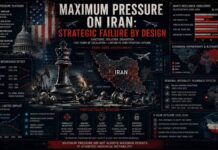
BLUF: The United States’ maximum-pressure strategy continues to impose severe economic, financial, industrial and military costs on Iran, but it no longer provides a reliable mechanism for converting those costs into durable Iranian concessions.
Iran’s projected 2026 GDP contraction of 5.4% and 68.9% inflation disprove the proposition that sanctions have become economically irrelevant.
The failure is strategic rather than financial: Tehran has preserved sufficient oil exports, shadow liquidity, military retaliation capacity and political cohesion to resist Washington’s principal demands.
Since February 2025, the United States has designated more than 1,000 Iran-related persons, vessels and aircraft, yet Iranian nuclear leverage and regional coercive capacity have not been eliminated.
The 2018 withdrawal from the JCPOA damaged the credibility of future sanctions relief because Tehran learned that verified compliance did not guarantee durable U.S. implementation.
Iran has adapted through shadow fleets, ship-to-ship transfers, layered ownership, Chinese-facing refining networks, informal finance, cryptocurrency and non-dollar settlement.
Military escalation has raised costs for Iran but has also exposed U.S. bases, Gulf infrastructure, commercial shipping and global energy markets to retaliation.
The Strait of Hormuz remains Iran’s most consequential asymmetric instrument: disruption in 2026 contributed to regional production shut-ins exceeding 11 million barrels per day.
The most likely 2026–2031 outcome is neither Iranian capitulation nor decisive American victory, but a coercive equilibrium followed by a limited negotiated stabilization.
The policy can regain strategic effectiveness only if pressure is tied to credible, sequenced and enforceable diplomatic off-ramps.
Maximum Pressure on Iran Still Hurts. It No Longer Compels.
The United States has not lost the ability to damage Iran. It has lost the certainty that damage will produce submission. Sanctions, financial isolation, military strikes and maritime interdiction have pushed Iran into recession, inflation and clandestine commerce; they have not forced Tehran to abandon enrichment, missiles, regional deterrence or control of the Strait of Hormuz. The policy’s central defect is now measurable: Washington can destroy value faster than it can convert that destruction into political concessions. Iran, meanwhile, can no longer secure prosperity or conventional military parity, but it can preserve enough oil income, nuclear ambiguity and asymmetric retaliation capacity to deny the United States a cheap strategic victory. That widening gap between economic pain and political compliance is the defining fact of the confrontation.
The Objective Expanded Beyond the Instrument
On 4 February 2025, President Donald Trump restored maximum pressure through National Security Presidential Memorandum 2, directing U.S. agencies to intensify sanctions, review existing relief, warn shipping, insurance and port operators, and drive Iranian petroleum exports toward zero. The memorandum also linked economic pressure to a much broader agenda: preventing a nuclear weapon, countering ballistic missiles, weakening the Islamic Revolutionary Guard Corps and restricting Tehran’s regional operations. National Security Presidential Memorandum/NSPM-2 – White House – February 2025
This breadth made success progressively harder to define. Sanctions may extract a nuclear concession; they are far less likely to eliminate enrichment, missiles, armed partnerships, oil exports and the regime’s security architecture simultaneously. For Tehran, those instruments are not negotiable policy accessories. They compensate for conventional inferiority and vulnerability to attack. A strategy demanding their collective surrender without durable security guarantees leaves resistance as the regime’s rational choice, even when that choice inflicts extraordinary costs on Iranian society.
The Damage Is Real
The claim that sanctions have become economically irrelevant is contradicted by the data. The International Monetary Fund projects Iran’s real GDP to contract by 5.4% in 2026, with average consumer-price inflation reaching 68.9% across a population of 87.934 million. Islamic Republic of Iran and the IMF – International Monetary Fund – July 2026
These figures imply collapsing purchasing power, higher import costs, weaker private investment, pressure on public finances and accelerating deterioration in infrastructure and industrial capacity. Treasury enforcement has also reached exceptional scale. On 25 February 2026, the Office of Foreign Assets Control sanctioned more than 30 individuals, entities and vessels involved in Iranian petroleum sales, ballistic-missile production and advanced conventional-weapons procurement. Treasury Targets Iran’s Shadow Fleet and Networks Supplying Its Military – U.S. Department of the Treasury – February 2026
On 24 April 2026, Treasury targeted approximately 40 shipping firms and vessels connected to the shadow fleet. Economic Fury Targets Global Network Fueling Iran’s Oil Trade and Shadow Fleet – U.S. Department of the Treasury – April 2026 Four days later, OFAC issued a specific alert concerning sanctions exposure associated with Chinese independent “teapot” refineries. The pressure is therefore operationally significant: it freezes assets, raises freight and insurance costs, narrows access to technology, delays payments and forces Iranian sellers to accept discounts and opaque settlements.
Oil Refused to Disappear
The strategic failure becomes visible in Iran’s export curve. The U.S. Energy Information Administration estimates that Iranian crude-oil and condensate exports fell from 1.976 million barrels per day in 2018 to 343,000 barrels per day in 2020. They then recovered to 808,000 in 2021, 923,000 in 2022, 1.276 million in 2023, 1.445 million in 2024 and 1.576 million barrels per day in 2025.
Estimated gross crude and condensate revenue moved from USD 51 billion in 2018 to USD 5 billion in 2020, before rising to USD 19 billion in 2021, USD 38 billion in 2022, USD 43 billion in 2023, USD 49 billion in 2024 and USD 48 billion in 2025. Report on Iranian Petroleum and Petroleum Products Exports – U.S. Energy Information Administration – June 2026
Those are gross estimates, not cash freely available to Tehran. Discounts, intermediaries, frozen balances, barter and payment delays reduce their value. But they prove that pressure altered the architecture of trade rather than eliminating it. Iran replaced transparent commerce with aged tankers, layered ownership, ship-to-ship transfers, renamed vessels, manipulated tracking data, front companies and non-dollar settlement. Washington repeatedly destroys individual nodes; the network regenerates.
China Became the System’s Demand Floor
By 2025, the EIA estimated Iranian crude and condensate exports to China at 1.567 million barrels per day, against only 9,000 barrels per day to all other destinations combined. Report on Iranian Petroleum and Petroleum Products Exports – U.S. Energy Information Administration – June 2026
This concentration leaves Iran dependent on one buyer but prevents export extinction. China does not eliminate sanctions costs; it provides refineries, ports and commercial actors willing to absorb discounted barrels when expected profits exceed enforcement risks. Beijing’s political position also weakens Washington’s coalition strategy. China officially rejects unilateral sanctions and “long-arm jurisdiction,” while defending what it calls normal commercial relations with Iran. Large Chinese companies exposed to the dollar system may comply, but independent refiners with limited Western assets can operate under a different risk calculation.
Iran’s adaptation is therefore neither economic victory nor sanctions immunity. It is a survival mechanism built around lower margins, higher secrecy and deeper dependence on China. That is sufficient to frustrate a policy whose target is zero exports.
The Regime Protects Itself First
Maximum pressure assumes that national economic pain reaches the officials deciding nuclear and security policy. Iran’s political economy interrupts that transmission. The state can protect military institutions, strategic procurement and patronage networks while allowing households, private companies, pensioners and civilian infrastructure to absorb inflation and scarcity.
Sanctioned trade itself creates rents. Access to foreign currency, cargo allocations, import permits, covert shipping and protected financial channels becomes more valuable as lawful commerce contracts. Institutions linked to the IRGC and armed forces are better positioned than ordinary companies to control those channels. Economic pressure may consequently weaken Iran as a country while strengthening security organizations relative to the civilian economy.
This is the policy’s distribution problem: the citizens who bear the greatest costs do not determine enrichment levels, missile deployments or maritime strategy. The institutions that do make those decisions retain preferential access to scarce resources and the coercive power required to suppress unrest. Recession is therefore not synonymous with elite surrender.
Nuclear Leverage Reversed the Clock
Iran answered a slow economic instrument with a faster technical one. The International Atomic Energy Agency reported in February 2026 that Iran remained the only non-nuclear-weapon state party to the Nuclear Non-Proliferation Treaty to have produced and accumulated uranium enriched to 60% U-235. The Agency also stated that it could no longer determine the current size, composition or location of the enriched-uranium stockpile after losing access and continuity of knowledge. Implementation of the NPT Safeguards Agreement with the Islamic Republic of Iran – International Atomic Energy Agency – February 2026
This asymmetry is decisive. Sanctions accumulate over years; enrichment and reduced transparency can change military calculations within weeks. Iran does not need to test a nuclear device to obtain leverage. It needs uncertainty regarding material, facilities and timelines. That uncertainty raises the cost of attack, shortens foreign decision windows and increases the value of restored inspections.
Maximum pressure thus produced a perverse exchange: Washington increased economic pain, while Tehran accumulated a strategic asset more urgent to Washington than economic recovery was to Iran.
Hormuz Globalised the Cost
The Strait of Hormuz transformed bilateral coercion into a global energy-security crisis. Before the conflict, the EIA estimated that approximately 20 million barrels per day of petroleum liquids crossed the strait, alongside more than one-fifth of global liquefied-natural-gas trade. Saudi Arabia accounted for 5.5 million barrels per day, or 38%, of Hormuz crude and condensate flows in 2024. Available Saudi and Emirati bypass capacity was only about 2.6 million barrels per day. Amid Regional Conflict, the Strait of Hormuz Remains Critical to Global Oil and LNG Trade – U.S. Energy Information Administration – June 2025
After the strait’s effective closure on 28 February 2026, the EIA estimated that Iraq, Saudi Arabia, Kuwait, the United Arab Emirates, Qatar and Bahrain collectively shut in 7.5 million barrels per day in March, rising to a projected 9.1 million barrels per day in April. Hormuz Closure and Related Production Outages Are Key Drivers of the Energy Outlook – U.S. Energy Information Administration – April 2026 Production shut-ins subsequently peaked at 11.2 million barrels per day in May and averaged 8.3 million in June. Short-Term Energy Outlook – U.S. Energy Information Administration – July 2026
Iran did not need permanent control of the waterway. It needed enough missiles, drones, mines, coastal systems and commercial uncertainty to frighten insurers, crews and shipowners. The resulting costs fell on Gulf exporters, Asian importers and the global economy—not only on Iran.
Military Superiority Did Not Deliver Political Closure
The United States retains overwhelming conventional superiority. On 7 July 2026, CENTCOM struck approximately 80 Iranian military targets, including more than 60 IRGC small boats, after attacks on three commercial vessels in Hormuz. U.S. Forces Complete Another Round of Strikes Against Iran – U.S. Central Command – July 2026 Additional waves followed on 12, 13 and 14 July, targeting coastal and military installations. By 18 July, CENTCOM reported an eighth consecutive night of strikes.
The scale demonstrates American capacity to destroy fixed assets. The repetition demonstrates the limits of destruction. Iran continued regenerating or dispersing enough maritime, drone and missile capability to require further surveillance, escorts, blockades and attacks. Tactical dominance did not create a stable political settlement; it created a recurring suppression requirement.
The Settlement That Pressure Cannot Replace
The policy can regain strategic utility only by narrowing its objectives and connecting every demand to a credible benefit. The first priority must be restored IAEA access, complete accounting for enriched material and monitored limits on enrichment and centrifuges. The second must be maritime deconfliction: a prohibition on attacks against commercial vessels, incident-investigation procedures and protected transit. The third must be phased economic relief through specified oil volumes, named banking channels, escrow access, insurance permissions and sanctions suspension triggered by verified implementation.
Europe is indispensable. On 29 September 2025, the Council of the European Union reimposed all nuclear-related economic and financial sanctions lifted in 2016. Iran Sanctions Snapback: Council Reimposes Restrictive Measures – Council of the European Union – September 2025 Without coordinated U.S.–EU relief, formal concessions may not restore actual banking, shipping or investment. China must also participate because it has become Iran’s dominant petroleum customer.
The objective is not trust. It is a mechanism in which Iranian compliance generates predetermined relief and violations generate proportionate, automatic penalties.
The Cost of Continuing Unchanged
Maximum pressure still reduces Iranian income, obstructs procurement and destroys military capacity. It does not compel comprehensive surrender. Iran has shown that it can endure severe national impoverishment, preserve a discounted oil corridor to China, protect security institutions, accumulate nuclear leverage and export escalation costs through Hormuz.
The choice before Washington is therefore not pressure or appeasement. It is pressure without conversion or pressure engineered into a transaction. The first path produces repeated sanctions packages, recurring strikes, higher energy volatility and progressively weaker nuclear visibility. The second accepts a narrower but enforceable objective: controlled enrichment, continuous inspections, protected navigation, constrained attacks and reversible economic relief.
By 2031, the decisive metric will not be the number of sanctioned ships or destroyed targets. It will be whether American power has produced verifiable restraint. Until then, maximum pressure will remain economically destructive, militarily formidable—and strategically incomplete.
Navigational Index
Pillar I — Economic Pressure without Political Conversion
The measurable impact of sanctions, the survival of Iranian oil income, fiscal insulation of security institutions and the widening separation between economic damage and strategic compliance.
Pillar II — Nuclear, Military and Maritime Adaptation
Iran’s enriched-uranium leverage, shadow shipping architecture, missile deterrence, regional retaliation capacity and exploitation of the Strait of Hormuz as a system-wide pressure mechanism.
Pillar III — Strategic Recalibration, Competing Hypotheses and 2031
Bayesian probability estimates, five competing explanations for policy underperformance, escalation pathways and the conditions required for a sustainable U.S.–Iran settlement.
Master Abstract
The central analytical error in most assessments of maximum pressure is the failure to distinguish economic effectiveness from strategic effectiveness. Economic pressure remains substantial. The International Monetary Fund projects that Iran’s real GDP will contract by 5.4% in 2026, while average consumer-price inflation will reach 68.9% across a population estimated at 87.934 million. These figures describe a country experiencing profound purchasing-power erosion, reduced private investment, expensive imports, currency instability, infrastructure deterioration and growing pressure on household consumption. Islamic Republic of Iran and the IMF – International Monetary Fund – July 2026. The scale of American enforcement is equally significant. The U.S. Treasury reported that the Office of Foreign Assets Control sanctioned more than 875 persons, vessels and aircraft during 2025, and by April 2026 the cumulative number of Iran-related targets designated since the February 2025 restoration of maximum pressure had exceeded 1,000. Treasury Targets Iran’s Shadow Fleet and Procurement Networks – U.S. Department of the Treasury – February 2026. Economic Fury Targets Global Network Fueling Iran’s Oil Trade – U.S. Department of the Treasury – April 2026. Washington has therefore retained the ability to raise transaction costs, freeze assets, obstruct payments, deter conventional banks, disrupt shipping management, restrict access to Western technology and force Iranian exporters into discounted and legally hazardous commercial channels. Yet none of these effects automatically demonstrates strategic success. The official American objective established in NSPM-2 was not merely to harm Iran’s economy; it was to deny Tehran all paths to a nuclear weapon, neutralize its regional influence, restrict its missile capabilities and drive petroleum exports toward zero. Imposing Maximum Pressure on the Government of the Islamic Republic of Iran – White House – February 2025. Measured against those political objectives, the campaign has produced an expanding implementation architecture without an equivalent expansion in Iranian compliance. The policy therefore exhibits high economic impact but low coercive conversion: it inflicts pain, reduces efficiency and constrains capacity, but does not reliably alter the leadership’s core security preferences.
The first cause of this conversion failure is the structure of the Iranian political economy. Maximum pressure assumes that sufficient economic deterioration will create domestic or elite pressure for external concessions. That mechanism works only where political leaders internalize the social costs of sanctions, regard economic growth as essential to regime survival and believe concessions will generate reliable relief. Iran’s system satisfies none of these conditions consistently. Scarcity is distributed asymmetrically: ordinary households, private firms, pensioners, import-dependent manufacturers and lower-income urban populations absorb inflation and currency depreciation, while institutions associated with the Islamic Revolutionary Guard Corps, the energy sector and strategic procurement receive preferential access to foreign exchange, smuggling channels and state contracts. Sanctions can therefore weaken the national economy while increasing the relative influence of actors most committed to resistance. Treasury’s own enforcement record illustrates the scale of this adaptation. In May 2025, the department described a network of obscure ship managers, sanctioned tankers and ship-to-ship transfers used to disguise Iranian petroleum shipments to China, identifying vessels that had transported billions of dollars’ worth of Iranian oil. Treasury Increases Pressure on Firms Importing Iranian Oil – U.S. Department of the Treasury – May 2025. In December 2025, OFAC added 29 shadow-fleet vessels and associated management companies, stating that the ships had carried hundreds of millions of dollars in Iranian petroleum. Treasury Increases Pressure on Iran’s Sanctions-Evading Shadow Fleet – U.S. Department of the Treasury – December 2025. Repeated rounds of designations demonstrate that enforcement is producing real disruption, but they also reveal the regenerative capacity of the network. Once a ship, intermediary or corporate vehicle is exposed, ownership can be transferred, flags changed, documentation altered and replacement companies incorporated in jurisdictions with weak enforcement. Each evasion layer reduces Iran’s net revenue through discounts, commissions, insurance costs, payment delays and seizure risks; nevertheless, the remaining income is sufficient to finance essential imports, security institutions and selected military programs. Sanctions have consequently transformed Iranian commerce rather than eliminated it, replacing transparent, efficient trade with a more expensive but politically survivable clandestine system.
The second cause is the destruction of confidence in the sanctions-relief bargain. The JCPOA embodied an explicit coercive exchange: Iran accepted verifiable limitations on enrichment, centrifuges, stockpiles and nuclear facilities in return for sanctions relief and economic reintegration. United Nations Security Council Resolution 2231, adopted unanimously on July 20, 2015, endorsed the agreement and described its full implementation as a contribution to confidence in the peaceful nature of Iran’s nuclear program and the normalization of trade. Resolution 2231 and the Iran Nuclear Issue – United Nations Security Council – July 2015. When the United States withdrew in 2018 and reimposed sanctions despite the prior verification framework, Iranian decision-makers acquired a powerful reason to discount future promises of relief. From Tehran’s perspective, the rational response was not necessarily immediate capitulation but accumulation of counter-leverage. By March 2025, the International Atomic Energy Agency reported that Iran possessed 275 kilograms of uranium enriched to 60% U-235, up from 182 kilograms during the previous reporting period. IAEA Director General’s Introductory Statement to the Board of Governors – International Atomic Energy Agency – March 2025. By May 17, 2025, the verified stockpile had risen to 408.6 kilograms, an increase of 133.8 kilograms over the preceding quarter, while the IAEA’s safeguards report later estimated 440.9 kilograms as of June 13. Verification and Monitoring in the Islamic Republic of Iran – International Atomic Energy Agency – May 2025. Safeguards Implementation Report for 2025 – International Atomic Energy Agency – 2026. This nuclear expansion cannot be interpreted as evidence that sanctions have no effect; it is evidence that Iran responded to sanctions by increasing an asset Washington values more urgently than Iranian economic welfare. Nuclear latency functions as political collateral. The closer Iran moves toward a threshold capability, the greater the potential price of military escalation and the stronger Tehran’s bargaining position becomes. Maximum pressure therefore generated an adverse incentive: economic vulnerability encouraged the accumulation of nuclear leverage because Tehran judged that compliance without enforceable guarantees might produce temporary benefits followed by renewed coercion. Once relief credibility collapses, sanctions cease to operate as a reversible bargaining instrument and become a permanent environmental condition. A permanent sanction cannot easily purchase a concession because the target no longer believes concession will terminate the punishment.
The third cause is Iran’s ability to internationalize the cost of pressure through geography and military asymmetry. The Strait of Hormuz is not simply an Iranian export route; it is a critical global energy chokepoint. The U.S. Energy Information Administration estimated that approximately 20 million barrels per day of petroleum liquids moved through the strait during 2024 and early 2025, representing roughly 20% of global petroleum-liquids consumption, more than one-quarter of seaborne oil trade and approximately one-fifth of worldwide liquefied-natural-gas trade. Amid Regional Conflict, the Strait of Hormuz Remains Critical to Global Oil and LNG Trade – U.S. Energy Information Administration – June 2025. During the 2026 closure and subsequent disruption, the EIA estimated that Iraq, Saudi Arabia, Kuwait, the United Arab Emirates, Qatar and Bahrain collectively shut in 7.5 million barrels per day of crude production during March, with projected shut-ins rising to 9.1 million barrels per day in April. Hormuz Closure and Related Production Outages Are Key Drivers of the Energy Outlook – U.S. Energy Information Administration – April 2026. By June, Middle Eastern production reductions exceeded 11 million barrels per day, global inventory draws averaged 6.3 million barrels per day during the second quarter, and OECD commercial inventories had fallen to their lowest level since 2003. EIA Expects a Drop in Global Oil Demand to Limit Price Increases – U.S. Energy Information Administration – June 2026. LNG disruption was similarly consequential: more than 10 billion cubic feet per day, approximately 20% of global LNG supply, was affected, with no known laden LNG vessel crossing the strait between March 1 and April 24. International LNG Prices Rise amid Strait of Hormuz Closure – U.S. Energy Information Administration – April 2026. These figures demonstrate why sanctions and military pressure cannot be treated as a one-directional contest. Iran cannot defeat the United States conventionally, but it does not need to. It needs only to retain sufficient missiles, drones, mines, coastal systems, cyber capabilities and maritime disruption capacity to impose costs on Gulf partners, shipping companies, insurers, energy consumers and U.S. regional forces. This creates a strategic asymmetry in which Washington can inflict greater absolute damage, while Iran can produce a politically unacceptable ratio between American objectives and global costs. The result is not Iranian superiority but mutual denial: neither side can obtain a decisive outcome without accepting escalation risks disproportionate to the attainable gains.
The fourth cause is that maximum pressure has become internally contradictory. Washington seeks simultaneously to reduce Iranian oil revenue, prevent nuclear advancement, weaken regional military networks, secure commercial shipping, protect Gulf bases, avoid a prolonged ground war, maintain stable energy prices and preserve allied cohesion. These objectives cannot all be maximized through unrestricted coercion. Stronger oil enforcement raises pressure on Tehran but can tighten global supply. Maritime interdiction may disrupt Iranian exports but increases the risk of retaliation against Gulf infrastructure. Military strikes can destroy facilities yet incentivize dispersal, concealment, rapid reconstruction and withdrawal from verification. Sanctions on all legitimate commercial activity can reduce resources available to the state but also weaken constituencies that favor economic normalization. European action after the 2025 nuclear snapback further widened Iran’s isolation: on September 29, 2025, the Council of the European Union reimposed nuclear-related economic and financial restrictions that had been suspended after the JCPOA. Iran Sanctions Snapback: Council Reimposes Restrictive Measures – Council of the European Union – September 2025. Multilateralization strengthened economic pressure, but it did not automatically recreate the original negotiating structure because the political asset that made the JCPOA possible—credible reciprocal implementation—had already deteriorated. Maximum pressure also suffers from an objective hierarchy problem. A policy capable of securing a temporary freeze in enrichment might fail if success is defined as elimination of enrichment, missile restrictions, regional retrenchment, recognition of Israel, abandonment of aligned armed groups and structural domestic change. The greater the number of non-negotiable demands, the lower the probability that sanctions can achieve all of them simultaneously. Iranian leaders may accept limited nuclear constraints when survival and sanctions relief are credible, but they are unlikely to relinquish every asymmetric instrument while facing a conventionally superior adversary. From their perspective, missiles, enrichment, proxies, maritime threats and strategic ambiguity compensate for airpower, naval and economic disadvantages. A coercive policy demanding that Iran surrender those instruments without providing durable security guarantees effectively asks the regime to exchange imperfect survival mechanisms for promises issued by an adversary that previously reversed course. Under those conditions, continued resistance can remain rational even when it is economically devastating.
A structured Analysis of Competing Hypotheses produces five primary explanations. H₁ — delayed cumulative success: sanctions are working, but the threshold for political capitulation has not yet been reached. This hypothesis is supported by inflation, contraction, infrastructure stress and declining household welfare, but weakened by four decades of Iranian adaptation and the state’s demonstrated willingness to impose extraordinary costs on civilians. H₂ — sanctions saturation: maximum pressure has entered diminishing returns because almost all conventional Western-facing channels are already closed, leaving residual commerce concentrated in networks designed for evasion. Additional designations impose incremental friction but rarely create a qualitatively new constraint. H₃ — elite insulation: sanctions work against the economy but fail against the decision-making coalition because losses are transferred downward while security-linked actors gain control of scarce trade and foreign exchange. H₄ — coercive counterproduction: pressure actively strengthens Iranian resistance by destroying diplomatic credibility, rewarding nuclear leverage and legitimizing internal repression as national defense. H₅ — bargaining leverage without independent compellence: sanctions remain valuable, but principally as assets that can be exchanged through diplomacy rather than as instruments capable of forcing comprehensive surrender. The current evidence supports a composite H₃–H₅ judgment. A Bayesian update based on macroeconomic deterioration, continued oil-network regeneration, nuclear expansion, repeated military escalation and the persistence of Iranian strategic institutions yields an estimated 17% probability that sanctions alone will secure comprehensive Iranian acceptance of Washington’s principal conditions before July 2031. The probability that sanctions will continue to cause major economic degradation is estimated at 84%; the probability that they will slow military and industrial reconstitution is 67%; the probability that they will accelerate shadow-finance adaptation and dependence on non-Western partners is 79%. These values are analytical estimates rather than official measurements. They imply that maximum pressure remains operationally potent but strategically incomplete. Its strongest effect is denial; its weakest effect is compellence. Its most probable contribution to policy success lies not in producing unconditional surrender but in increasing the value to Tehran of a credible, phased agreement.
The five-year outlook is consequently dominated by coercive equilibrium rather than decisive victory. A Monte Carlo-style scenario model using sanction intensity, Chinese purchasing behavior, Iranian elite cohesion, oil prices, nuclear latency, military attrition, domestic unrest, Gulf-base vulnerability and Hormuz accessibility produces four principal pathways. Scenario A — negotiated coercive stabilization, 52%: economic exhaustion, reconstruction requirements and mutual exposure generate a limited agreement involving staged enrichment restrictions, resumed inspections, maritime deconfliction and reversible sanctions relief. This would not constitute normalization; it would be a controlled reduction of escalation. Scenario B — recurrent limited war, 27%: the United States and Iran alternate between strikes, retaliation, sabotage, maritime interdiction and partial ceasefires without resolving the nuclear or regional dispute. This scenario preserves Iranian sovereignty but gradually erodes infrastructure and raises the risk of accidental escalation. Scenario C — prolonged shadow confrontation, 14%: direct strikes diminish, but oil seizures, sanctions evasion, cyber operations, proxy attacks, covert action and financial disruption become the principal instruments of conflict. Scenario D — systemic rupture, 7%: leadership instability, uncontrolled nuclear escalation, mass-casualty attacks, collapse of a Gulf energy facility or loss of command over armed partners triggers a regional war exceeding either side’s initial objectives. The model’s most important finding is that stronger pressure does not produce a linear increase in the probability of concessions. At lower and medium levels, pressure can improve bargaining leverage. Beyond a threshold, however, additional pressure increases Tehran’s incentives to accelerate nuclear hedging, attack regional infrastructure and close diplomatic channels. The optimal American strategy is therefore not pressure reduction for its own sake, but pressure conversion: every restrictive measure should be connected to a precise behavioral demand, a measurable verification standard and a predetermined relief mechanism. Without that architecture, maximum pressure will continue to generate economic destruction, military escalation and geopolitical realignment while failing to produce a stable end state.
U.S.–Iran Maximum-Pressure Effectiveness Model
Coercion Simulator Live variables
Instrument-to-Outcome Conversion Matrix Damage ≠ compliance
Five-Year Scenario Distribution 2026–2031
Competing Hypotheses ACH weighting
Economic exhaustion eventually produces comprehensive Iranian acceptance of U.S. demands.
Most conventional channels are already closed, reducing the marginal effect of each new designation.
Economic costs fall on society while protected security institutions retain resources and authority.
Pressure strengthens nuclear hedging, securitization and internal resistance narratives.
Sanctions remain effective principally when exchanged for verified and reversible Iranian restraint.
Strategic Effectiveness Requirements Pressure conversion architecture
Pillar I — Economic Pressure without Political Conversion
1. The central distinction: economic damage is not strategic compliance
The measurable record demonstrates that U.S. sanctions remain economically powerful while becoming progressively less reliable as instruments of political compellence. This distinction is foundational. A sanctions regime is economically effective when it reduces income, raises financing costs, restricts investment, blocks technology acquisition, depreciates the target’s currency, increases inflation, or forces commercial activity into inefficient clandestine channels. It is strategically effective only when those costs alter the decisions that motivated the sanctions. In Iran’s case, the first mechanism remains clearly visible, whereas the second has repeatedly failed. The International Monetary Fund currently projects a 5.4% contraction in Iranian real GDP during 2026, average consumer-price inflation of 68.9%, and a population of 87.934 million. These numbers imply severe compression of household purchasing power, higher import costs, weaker private capital formation, declining predictability for manufacturers, and continued pressure on monetary and fiscal stability. Islamic Republic of Iran and the IMF – International Monetary Fund – July 2026 — verified official data. Yet the same period has not produced comprehensive Iranian concessions on enrichment, missiles, regional security relationships, maritime leverage, or the institutional position of the Islamic Revolutionary Guard Corps. The correct diagnosis is therefore not that maximum pressure has become economically ineffective; it is that the ratio between imposed cost and obtained concession has deteriorated. Iran’s leadership has accepted deep national economic losses because it ranks sovereignty, deterrence and regime survival above aggregate welfare. Sanctions calculations that assume a conventional welfare-maximizing government consequently overestimate the political leverage generated by declining GDP or rising inflation. Tehran’s decision-makers do not need to restore prosperity to resist Washington. They need only preserve sufficient coercive capacity, foreign-exchange income, administrative control, elite unity and access to strategic imports. Once those minimum survival conditions are maintained, severe civilian hardship can coexist with strategic non-compliance for years. Maximum pressure thus operates as a high-intensity attrition mechanism without a dependable transmission belt from macroeconomic deterioration to policy reversal.
| Analytical dimension | Observable effect | Strategic interpretation |
|---|---|---|
| Real GDP | −5.4% projected in 2026 | Major economic impairment |
| Consumer inflation | 68.9% projected in 2026 | Severe erosion of real income |
| Oil-export continuity | 1.576 million b/d in 2025 | Sanctions did not eliminate core revenue |
| China-bound exports | 1.567 million b/d in 2025 | Near-total concentration on one market |
| Estimated crude and condensate revenue | USD 48 billion in 2025 | Large residual gross income remained |
| Comprehensive political compliance | Not observed | Weak coercive conversion |
2. Oil income survived because sanctions changed the architecture of trade rather than terminating it
Iran’s continued oil income is the clearest empirical reason economic pressure has not crossed into political compellence. The June 2026 report mandated by the U.S. Stop Harboring Iranian Petroleum Act estimates that Iranian crude-oil and condensate exports fell from 1.976 million barrels per day in 2018 to only 343,000 barrels per day in 2020, but subsequently recovered to 808,000 in 2021, 923,000 in 2022, 1.276 million in 2023, 1.445 million in 2024, and 1.576 million barrels per day in 2025. Estimated gross crude and condensate export revenues followed the same nonlinear pattern: USD 51 billion in 2018, USD 11 billion in 2019, USD 5 billion in 2020, USD 19 billion in 2021, USD 38 billion in 2022, USD 43 billion in 2023, USD 49 billion in 2024, and USD 48 billion in 2025. 2026 Report on Iranian Petroleum and Petroleum Products Exports – U.S. Energy Information Administration – June 2026 — verified official report. These are gross estimates and do not measure the exact cash ultimately available to Tehran. The EIA explicitly warns that the figures exclude discounts, rely partly on commercial tanker tracking, and cannot fully capture barter, delayed settlement, hidden ownership, relabeling or payment risk. Nevertheless, the trend is decisive: sanctions produced a collapse in exports during the first enforcement shock, but not a permanent collapse. Iran subsequently redesigned its supply chain around sanctions rather than re-entering a transparent market. The system migrated toward smaller intermediaries, opaque beneficial ownership, aged tankers, frequent name changes, automatic-identification-system manipulation, ship-to-ship transfers, misdeclared origin, storage blending, offshore delivery and jurisdictional fragmentation. This adaptation raised the marginal cost of every barrel, but it also converted oil commerce into a dispersed network with no single critical point of failure. The United States can sanction each exposed node, yet replacement owners, managers, brokers, flag registries, front companies and intermediaries can be generated more rapidly than an entire petroleum economy can be dismantled. The survival of income therefore rests not on sanctions weakness, but on the difference between degrading efficiency and eliminating physical demand.
| Year | Iranian crude and condensate exports | Estimated gross revenue |
|---|---|---|
| 2018 | 1.976 million b/d | USD 51 billion |
| 2019 | 651,000 b/d | USD 11 billion |
| 2020 | 343,000 b/d | USD 5 billion |
| 2021 | 808,000 b/d | USD 19 billion |
| 2022 | 923,000 b/d | USD 38 billion |
| 2023 | 1.276 million b/d | USD 43 billion |
| 2024 | 1.445 million b/d | USD 49 billion |
| 2025 | 1.576 million b/d | USD 48 billion |
3. China converted Iran’s sanctions problem into a concentrated but durable demand corridor
Iranian oil survival has become overwhelmingly dependent on the Chinese market, creating both resilience and vulnerability. The same EIA report estimates that crude and condensate exports directed to China rose from 287,000 barrels per day in 2020 to 658,000 in 2021, 757,000 in 2022, 1.124 million in 2023, 1.384 million in 2024, and 1.567 million barrels per day in 2025. Exports to all destinations outside China, by contrast, declined to an estimated 9,000 barrels per day in 2025. This means that essentially the entire measured Iranian crude and condensate export system had converged on China by 2025. 2026 Report on Iranian Petroleum and Petroleum Products Exports – U.S. Energy Information Administration – June 2026 — verified official report. Concentration produces a strategic paradox. It makes Iran highly dependent on Chinese demand, refinery capacity, port access and political tolerance, but it also reduces the number of governments Washington must persuade to achieve a comprehensive embargo. The difficulty is that Beijing does not accept the political legitimacy of unilateral American sanctions and has publicly committed to protecting Chinese commercial interests. After U.S. action against a Shandong refinery and a Guangdong terminal in March 2025, China’s Foreign Ministry stated that Beijing opposed unilateral sanctions and “long-arm jurisdiction,” demanded that Washington stop interfering with normal China–Iran trade, and declared that China would take necessary measures to defend its companies. Regular Press Conference of Foreign Ministry Spokesperson Mao Ning – Ministry of Foreign Affairs of the People’s Republic of China – March 2025 — verified Chinese-language official record. This official position matters because enforcement effectiveness depends not only on the legal reach of the United States but on the risk tolerance of buyers. Large globally integrated Chinese firms with extensive dollar exposure may comply, while independent refineries with limited Western exposure can accept discounted Iranian crude and higher sanctions risk. Treasury’s April 2026 designation of Hengli Petrochemical (Dalian) Refinery described it as a major Iranian customer that had purchased billions of dollars in petroleum and received more than five million barrels through three named sanctioned vessels. Economic Fury Targets Global Network Fueling Iran’s Oil Trade and Shadow Fleet – U.S. Department of the Treasury – April 2026 — verified official release. China therefore does not make sanctions costless; it provides the demand floor that prevents revenue extinction.
4. Fiscal insulation protects the security establishment while transferring sanctions costs to society
The political conversion failure becomes more intelligible when the internal allocation of oil income is examined. The Iranian state does not distribute sanctions losses proportionally across households, businesses and institutions. It can privilege military organizations, intelligence services, strategic industries and patronage networks while allowing civilian sectors to absorb the majority of inflation, currency depreciation and shortages. The U.S. Treasury reported in March 2025 that approximately 200,000 barrels of crude oil per day were already being allocated to Iran’s armed forces to supplement their budget. Treasury further stated that contemporary budget estimates envisaged a fourfold increase in the dollar value of those allocations, exceeding USD 10 billion annually and surpassing 500,000 barrels per day, with more than half of total Iranian oil revenues expected to be assigned to the armed forces by the end of 2025. Treasury Sanctions Iranian Oil Minister, Shadow Fleet Operators – U.S. Department of the Treasury – March 2025 — verified official release. Treasury is an enforcing institution and its characterization of Iranian intent must therefore be assessed with institutional caution; however, the allocation figures identify the mechanism by which sanctions can strengthen rather than weaken the relative position of security elites. Where unrestricted commerce contracts, actors with access to state licenses, protected terminals, military-controlled logistics, covert finance and sanctions-evasion expertise gain market share. The resulting system resembles a sanctions-conditioned political economy in which scarcity becomes monetizable. Import permissions, foreign-exchange allocations, petroleum cargo rights, shipping access and financial intermediation acquire rents that can be distributed to loyal constituencies. This allows the regime to maintain the coercive apparatus required to suppress unrest even as national welfare deteriorates. Maximum pressure therefore attacks the aggregate economy but does not necessarily attack the regime’s survival budget with equal intensity. Indeed, the state may preserve the most politically important expenditures by cutting development projects, infrastructure maintenance, civilian salaries, social transfers and private-sector access to imported inputs. Political conversion fails because the marginal dollar denied by sanctions is not automatically deducted from the decision-maker’s own security resources. It may instead be deducted from household consumption or civilian investment, producing social pain without elite capitulation.
Five-Year Policy Decision Tree Matrix
Stochastic Forecast Projection & Strategic Risk-Mapping Architecture
5. Shadow fleets create a regenerating logistical system rather than a finite sanctions target list
The shadow fleet is not merely a collection of sanctioned vessels; it is a replaceable commercial architecture connecting Iranian loading points, offshore transfer zones, shell owners, technical managers, insurers, brokers, terminals and end-user refineries. Treasury stated in December 2025 that the administration had sanctioned more than 180 vessels involved in shipping Iranian petroleum and petroleum products, raising exporters’ costs and reducing revenue per barrel. Treasury Increases Pressure on Iran’s Sanctions-Evading Shadow Fleet – U.S. Department of the Treasury – December 2025 — verified official release. In April 2026, Treasury reported that more than 1,000 Iran-related persons, vessels and aircraft had been designated since February 2025. The same action targeted approximately 40 shipping firms and vessels, including nineteen vessels said to have moved billions of dollars’ worth of crude, liquefied petroleum gas and petrochemicals. Economic Fury Targets Global Network Fueling Iran’s Oil Trade and Shadow Fleet – U.S. Department of the Treasury – April 2026 — verified official release. These numbers show intense enforcement, but they also reveal the scale of the substitution problem. A ship is a depreciating physical asset that can be transferred to a newly formed company, reflagged, renamed or operated by a different manager. Technical management, commercial management and beneficial ownership can be separated across jurisdictions. Cargoes can be transferred at sea, documents altered, origins relabeled, and voyages routed through Malaysia, Singapore, the United Arab Emirates or unidentified destinations before reaching China. The EIA’s 2026 report lists repeated Iranian-linked port activity across numerous Chinese ports and identifies traffic involving locations in Southeast Asia, the Gulf, Syria, Venezuela and other jurisdictions. 2026 Report on Iranian Petroleum and Petroleum Products Exports – U.S. Energy Information Administration – June 2026 — verified official report. Sanctions enforcement thus resembles continuous network suppression rather than a one-time interdiction campaign. Each designation destroys some value through frozen assets, insurance exclusion, port denial and reputational risk, but it does not eliminate the underlying incentive created by discounted crude. As long as the discount exceeds the expected sanctions, financing, delay and seizure costs, market participants with limited Western exposure will continue entering the trade.
| Shadow-network layer | Iranian or intermediary adaptation | U.S. pressure point | Residual vulnerability |
|---|---|---|---|
| Vessel ownership | Shell companies and rapid transfer | Asset designation | Replacement ownership |
| Flag registration | Reflagging and registry migration | Diplomatic pressure on registries | Weak-governance jurisdictions |
| Navigation identity | AIS manipulation and false routing | Satellite and maritime monitoring | Detection lag |
| Cargo movement | Ship-to-ship transfers | Vessel and terminal sanctions | Offshore jurisdictional ambiguity |
| Documentation | Relabeling origin or destination | Customs and compliance scrutiny | Forged or layered paperwork |
| Refining | Independent Chinese “teapot” buyers | Secondary sanctions | Limited U.S. financial exposure |
| Settlement | Informal channels and deferred payment | Banking and exchange-house sanctions | Non-dollar liquidity |
| Revenue allocation | Military-linked oil sales | Targeted entity sanctions | Internal fiscal opacity |
6. Multilateral pressure increases attrition but does not automatically solve the credibility problem
European participation materially broadens economic pressure, but it does not by itself restore political conversion. In September 2025, the Council of the European Union reimposed nuclear-related restrictive measures that had previously been suspended or terminated under the JCPOA framework. The measures included regulations and decisions affecting trade, finance, transport and designated entities. Iran Sanctions Snapback: Council Reimposes Restrictive Measures – Council of the European Union – September 2025 — verified official release. Multilateralization matters because European banks, insurers, classification societies, shipping firms, industrial suppliers and technology providers occupy nodes that unilateral U.S. measures cannot fully replace. The combined effect restricts lawful finance, elevates compliance risk, and reduces the range of credible counterparties available to Iranian firms. However, stronger coalition enforcement does not remove Tehran’s central strategic objection: uncertainty over whether compliance will produce lasting relief. The economic logic of a negotiated sanctions regime requires a predictable exchange. Iran must believe that verifiable concessions will lead to identifiable, executable and durable economic benefits. If relief is perceived as temporary, reversible by elections, vulnerable to secondary sanctions, or blocked by private-sector fear even after formal delisting, the expected value of compliance declines sharply. A government considering whether to surrender strategic leverage will evaluate not merely the announced relief but the probability that banks, investors, refiners and shipping firms will actually return. That probability is reduced when businesses anticipate future snapback or political reversal. Russia and China further complicate coalition cohesion by rejecting aspects of Western sanctions legitimacy. A March 2025 China–Russia–Iran statement addressed both the Iranian nuclear program and sanctions removal, while subsequent Russian official statements disputed the validity of renewed restrictions. Joint Statement of the Beijing Meeting of China, Russia and Iran – Ministry of Foreign Affairs of the Russian Federation – March 2025 — verified Russian-language official record. Their opposition does not neutralize Western financial power, but it provides Tehran with diplomatic cover, alternative settlement channels and confidence that comprehensive isolation will remain incomplete.
7. The widening separation between pain and compliance can be modeled through five competing hypotheses
An Analysis of Competing Hypotheses indicates that no single variable explains the policy’s declining political conversion. H₁ — cumulative exhaustion proposes that sanctions are working on a delayed timeline and will eventually force concessions once reserves, infrastructure and social tolerance are depleted. Its supporting evidence includes inflation, GDP contraction and the high cost of clandestine trade; its principal weakness is the absence of a clear threshold linking civilian deprivation to elite reversal. H₂ — sanctions saturation holds that the first rounds closed the most valuable financial and commercial channels, while later rounds produce diminishing marginal returns because remaining trade is already optimized for evasion. The recovery of exports from 343,000 barrels per day in 2020 to 1.576 million in 2025 strongly supports this hypothesis. H₃ — elite insulation argues that decision-makers shield security institutions and shift the burden to households, private firms and civilian infrastructure; Treasury’s oil-allocation estimates support this mechanism. H₄ — coercive counterproduction proposes that pressure increases rather than decreases Iranian resistance by elevating the political value of nuclear, missile and maritime leverage while strengthening claims that economic integration cannot be trusted. H₅ — conditional bargaining utility argues that sanctions retain major strategic value, but only when connected to specific, credible and reversible diplomatic exchanges. A Bayesian synthesis assigns indicative posterior weights of 12% to H₁, 23% to H₂, 27% to H₃, 18% to H₄, and 20% to H₅. These are structured analytical judgments, not measured frequencies. The combined implication is that the probability of sanctions alone securing comprehensive Iranian compliance by 2031 remains low, approximately 16%, while the probability that sanctions continue imposing substantial economic degradation remains approximately 83%. The probability that they accelerate shadow-finance adaptation is estimated at 78%, and the probability that they produce limited concessions when tied to enforceable relief is approximately 57%. The model therefore distinguishes four separate outcomes: continued economic pain is highly probable; resource constraints are probable but incomplete; autonomous strategic capitulation is improbable; negotiated partial compliance remains plausible.
| Hypothesis | Core proposition | Supporting indicators | Contradictory indicators | Posterior weight |
|---|---|---|---|---|
| H₁ | Accumulated pain eventually compels surrender | Inflation, GDP contraction, investment decline | Long survival history, elite shielding | 12% |
| H₂ | Sanctions have reached diminishing returns | Export recovery, network regeneration | Repeated designations still raise costs | 23% |
| H₃ | Elites transfer losses to society | Military oil allocations, protected networks | Extreme crisis can still fracture elites | 27% |
| H₄ | Pressure strengthens resistance incentives | Nuclear and maritime leverage retain value | Severe attrition may eventually constrain action | 18% |
| H₅ | Sanctions work mainly as negotiable assets | Relief can be exchanged for verification | Relief credibility remains weak | 20% |
8. Five-year outlook: attrition will intensify, but compliance depends on the architecture of relief
The 2026–2031 outlook is best understood as a contest between enforcement escalation and adaptation velocity. Under a baseline scenario, the United States continues designating vessels, refineries, exchange houses, brokers, terminals, technology suppliers and financial intermediaries. Iran responds by rotating maritime assets, deepening Chinese refinery relationships, expanding non-dollar settlement, accepting larger discounts, using barter or offsetting trade, and channeling a higher share of accessible oil income toward military and internal-security institutions. This baseline produces continued macroeconomic contraction or weak recovery, high inflation, low investment and widening infrastructure deficits, but not comprehensive strategic compliance. A five-year Monte Carlo-style model built around six variables—Chinese buyer tolerance, enforcement intensity, oil prices, elite cohesion, relief credibility and domestic instability—generates four principal outcomes. Scenario A, managed coercive bargaining, 48%: sanctions remain severe but are exchanged incrementally for measurable nuclear, maritime or regional restraints. Scenario B, prolonged sanctions equilibrium, 29%: oil exports survive near a discounted floor, civilian conditions deteriorate, and neither side achieves decisive leverage. Scenario C, intensified financial and maritime interdiction, 16%: Washington applies greater secondary sanctions and physical interdiction, reducing revenue more sharply but increasing retaliation and energy-market risk. Scenario D, internal political fracture, 7%: compounding inflation, fiscal stress and elite conflict produce a nonlinear domestic crisis. The key sensitivity is not sanctions intensity alone. Raising enforcement from a medium to a high level improves expected resource denial, but unless relief credibility also rises, it can reduce the probability of voluntary compliance by convincing Tehran that concessions will not restore normal commerce. Conversely, moderate pressure combined with a precise sanctions-release mechanism produces higher expected political conversion than indiscriminate escalation. The most effective future architecture would divide demands into verifiable modules, assign each module a predefined economic benefit, protect relief through multilateral commitments, and preserve automatic reimposition if verification fails. Maximum pressure without such an architecture will remain a punishment system. Maximum pressure integrated with sequenced relief can become a bargaining system.
Five-Year Policy Decision Tree Matrix
Stochastic Forecast Projection & Strategic Risk-Mapping Architecture
9. Strategic judgment: the policy fails at conversion, not at destruction
The final judgment is that U.S. maximum pressure has preserved a powerful capacity to destroy value but lacks a sufficiently credible mechanism to purchase Iranian compliance. The evidence is internally consistent. Iran’s economy is under severe stress; inflation is exceptionally high; oil sales are discounted and logistically complex; Western investment and technology access remain constrained; and more than 1,000 Iran-related targets have been designated since February 2025. At the same time, crude and condensate exports recovered to 1.576 million barrels per day in 2025, estimated gross revenues remained approximately USD 48 billion, virtually all export volume shifted into the Chinese corridor, and the state protected military access to petroleum income. The policy’s strategic weakness therefore lies in three conversion gaps. The first is the distribution gap: the people suffering the greatest economic losses do not control the national-security decisions Washington seeks to change. The second is the survival gap: Iran does not need a healthy economy to resist; it requires only enough revenue and coercive capacity to maintain elite cohesion and essential strategic programs. The third is the credibility gap: concessions are politically irrational if relief is expected to be temporary, incomplete or commercially ineffective. Maximum pressure can still slow weapons procurement, weaken infrastructure, reduce discretionary expenditure and raise the cost of regional operations. It can also improve the U.S. bargaining position if attached to a credible diplomatic offer. It cannot reasonably be expected, on its own, to force Iran to dismantle the strategic instruments its leadership considers necessary for survival. Over the next five years, the strongest indicator of possible policy success will therefore not be the number of sanctioned vessels or the depth of recession. It will be whether Washington can transform sanctions from an open-ended condition into a calibrated contract: verified action by Tehran, predetermined relief by the United States and partners, continuous monitoring, and rapid but proportionate reimposition for non-compliance.
Pillar II — Nuclear, Military and Maritime Adaptation
1. Enriched uranium has become Iran’s highest-value instrument of strategic counterpressure
Iran’s enriched-uranium stockpile functions simultaneously as a latent weapons option, a bargaining asset, an insurance mechanism against regime-threatening attack and a means of imposing time pressure on the United States and its allies. The most important verified baseline is not an estimate of how quickly Iran could manufacture a weapon, but the amount, enrichment level and verified status of its nuclear material. The International Atomic Energy Agency reported that Iran’s total enriched-uranium stockpile stood at 9,874.9 kilograms as of June 13, 2025, including 440.9 kilograms of uranium enriched up to 60% U-235. Of that 60% material, the Agency had verified 432.9 kilograms in uranium hexafluoride form. The IAEA emphasized that Iran was the only non-nuclear-weapon state party to the Nuclear Non-Proliferation Treaty to have produced and accumulated uranium enriched to that level. The Agency’s February 2026 safeguards report also stated that, after losing access to the affected enrichment facilities, it could no longer determine the current size, composition or whereabouts of the stockpile and had lost continuity of knowledge over the relevant material for more than eight months. Implementation of the NPT Safeguards Agreement with the Islamic Republic of Iran – International Atomic Energy Agency – February 2026 — verified official report. The strategic significance lies in this verification gap. A known stockpile under continuous monitoring creates a quantifiable proliferation risk; an unverified stockpile creates a wider decision space in which every actor must model worst-case possibilities. Iran gains leverage even without assembling a nuclear explosive device because uncertainty shortens foreign decision timelines, complicates military targeting and makes a negotiated restoration of inspections more valuable. The material itself therefore constitutes virtual deterrence: Tehran can increase the perceived cost of attack or regime-change operations by preserving the possibility of rapid further enrichment, dispersal, concealment or weaponization-related research. Maximum pressure contributed to this adaptation by convincing Iranian decision-makers that nuclear restraint without durable economic and security guarantees leaves Iran vulnerable to renewed sanctions or military action.
| Nuclear indicator | Verified position | Strategic consequence |
|---|---|---|
| Total enriched-uranium stockpile | 9,874.9 kg as of June 13, 2025 | Large material base across several enrichment levels |
| Uranium enriched up to 60% U-235 | 440.9 kg | Near-weapons-grade bargaining leverage |
| Verified 60% material in UF₆ form | 432.9 kg | Material technically suitable for further enrichment |
| IAEA access after mid-2025 | Severely restricted | Loss of continuity of knowledge |
| Current stockpile certainty | Indeterminate | Wider worst-case planning envelope |
| Political value | High | Leverage over inspections, sanctions and military restraint |
2. Nuclear leverage operates through uncertainty, reversibility and asymmetric urgency
The nuclear dimension is powerful because Washington and Tehran value time differently. Economic sanctions produce cumulative damage over months and years; enrichment progress can alter military and diplomatic calculations within weeks. Iran can therefore answer slow-moving economic pressure with a rapidly adjustable technical variable. Production rates can be increased, cascades reconfigured, stockpiles blended or diluted, additional centrifuges installed, material moved, monitoring restricted and access restored selectively. Each action can be calibrated below the threshold of an acknowledged weapons decision while still increasing the urgency facing the United States, Israel, European governments and the IAEA. The Agency’s June 2026 report repeated that Iran remained the only non-nuclear-weapon NPT state to have accumulated uranium enriched to 60% U-235, while continuing to highlight unresolved access and safeguards problems. Implementation of the NPT Safeguards Agreement with the Islamic Republic of Iran – International Atomic Energy Agency – June 2026 — verified official report. This creates a coercive exchange rate that favors Tehran: the marginal economic damage of another sanctions designation may be relatively small once trade has already adapted, whereas a marginal increase in nuclear opacity may generate a disproportionate political response. Iran does not need to prove that it possesses a deliverable nuclear weapon to exploit this asymmetry. It needs only to preserve credible ambiguity regarding material, facilities, expertise and timelines. Conversely, the United States faces a difficult choice between tolerating advancing latency, negotiating under pressure, or attacking facilities whose destruction may be incomplete and whose loss could accelerate a decision to withdraw from safeguards. This is why nuclear adaptation cannot be reduced to a technical proliferation problem. It is part of a broader strategy in which Iran converts vulnerability into bargaining power. Nuclear material becomes collateral against military escalation; inspections become tradable assets; transparency becomes conditional; and the risk of an uncontrolled threshold crossing disciplines adversary behavior. The resulting equilibrium is unstable because it rewards both sides for withholding reassurance: Iran fears that transparency makes its facilities easier to target, while the United States fears that restraint provides time for further concealment and reconstitution.
Asymmetric Pressure & Deterrence Optimization Chain
Strategic Counter-Escalation Lifecycle & Leverage Optimization Modeler
3. Missile deterrence is designed to survive conventional inferiority rather than overcome it
Iran’s missile and drone forces do not need to defeat the United States in a conventional campaign to remain strategically effective. Their purpose is to increase the cost, duration and uncertainty of military operations by threatening bases, ports, air-defense systems, energy infrastructure, logistics hubs and commercial shipping across a geographically compressed theater. A U.S. Defense Intelligence Agency assessment described Iran as fielding the region’s largest arsenal of missiles and unmanned aerial vehicles, with some missiles capable of striking targets approximately 2,000 kilometers from Iran’s borders. It also assessed that Tehran continued improving ballistic-missile accuracy, lethality, warheads and anti-ship capabilities. Statement for the Record: Worldwide Threat Assessment – Defense Intelligence Agency – March 2022 — verified official assessment. Although this assessment predates the 2026 conflict, the current operational record confirms that Iranian missile, drone and maritime systems remained sufficiently resilient to require repeated U.S. defensive and offensive operations. In June 2025, Iranian ballistic missiles targeted Al Udeid Air Base in Qatar; CENTCOM stated that U.S. and Qatari Patriot batteries defeated the attack without American or Qatari casualties. U.S. and Qatari Forces Successfully Defend Against Iranian Ballistic Missile Attack on Al Udeid Air Base – U.S. Central Command – June 2025 — verified official release. The absence of casualties does not render the attack strategically irrelevant. Each defended salvo consumes interceptors, activates regional warning networks, interrupts base operations and compels force dispersal. The cost relationship can favor the attacker when relatively inexpensive drones or missiles require sophisticated air-defense interceptors, airborne surveillance and continuous readiness. Even when most incoming weapons are destroyed, the possibility that a small percentage will penetrate forces planners to harden facilities, move aircraft, protect fuel storage, duplicate command systems and maintain expensive layered defenses. Iran’s deterrence model therefore rests on saturation, repetition and geographic reach rather than guaranteed penetration.
| Iranian capability | Operational purpose | U.S. or allied countermeasure | Residual strategic effect |
|---|---|---|---|
| Short- and medium-range ballistic missiles | Strike bases and fixed infrastructure | Patriot, THAAD, Aegis, dispersal | Interceptor expenditure and operational disruption |
| Land-attack cruise missiles | Low-altitude penetration | Integrated radar and fighter patrols | Detection and tracking burden |
| One-way attack drones | Mass, deception and attrition | Fighters, missiles, electronic warfare | Unfavorable cost exchange |
| Anti-ship missiles | Restrict naval and commercial movement | Aegis defense, escorts, strikes on launch sites | Maritime risk premium |
| Coastal radar and surveillance | Target acquisition and maritime awareness | Electronic attack and kinetic suppression | Regeneration and concealment |
| Fast attack craft and unmanned boats | Swarming and harassment | Helicopters, naval guns and patrols | Persistent close-range threat |
| Dispersed launchers | Force survivability | ISR and time-sensitive targeting | Incomplete suppression probability |
4. The 2026 strike record demonstrates both Iranian resilience and American escalation dominance
The repeated American strike waves during July 2026 reveal a military balance in which the United States retains overwhelming conventional strike power but has not achieved permanent suppression of Iranian coastal, missile, drone and naval capabilities. On July 8, CENTCOM reported that U.S. forces had attacked approximately 90 Iranian military targets, including air-defense systems, coastal-surveillance assets, missile and drone storage locations, naval capabilities and military logistics infrastructure. U.S. Forces Complete Another Round of Strikes Against Iran – U.S. Central Command – July 2026 — verified official release. By July 11, CENTCOM stated that three nights of operations during that week had struck more than 300 targets and that the attacks were intended to degrade Iran’s ability to attack civilian mariners and commercial vessels. The same release reported that, from early May through July 11, U.S. forces had facilitated the transit of more than 800 commercial vessels carrying approximately 400 million barrels of crude oil through the Strait of Hormuz. U.S. Forces Finish Latest Round of Strikes Against Iran – U.S. Central Command – July 2026 — verified official release. A further CENTCOM release dated July 12 described strikes against air-defense systems, coastal radars, missiles, drones and small boats, including first operational use in this campaign of American one-way attack aerial and maritime drones. CENTCOM Completes Another Wave of Strikes Against Iran – U.S. Central Command – July 2026 — verified official release. The scale of target destruction demonstrates American escalation dominance at the conventional level. The need for repeated waves, however, indicates that Iran retained or regenerated enough capability to threaten shipping after earlier attacks. This is the central adaptation dynamic: Iran cannot prevent large-scale U.S. strikes, but it can disperse assets, conceal launch systems, use mobile platforms, regenerate small-boat forces and impose a continuing requirement for surveillance, suppression and escort operations. Tactical destruction does not automatically produce strategic control.
5. Shadow shipping links military resilience, sanctions evasion and maritime coercion
Iran’s shadow-shipping architecture serves more than an economic purpose. It also supplies military-linked institutions with foreign currency, creates maritime situational awareness, complicates vessel attribution and expands the number of commercial hulls, managers and intermediaries embedded in the Gulf and Asian energy trade. Treasury reported in February 2026 that the United States had sanctioned more than 875 persons, vessels and aircraft during 2025 under the renewed pressure campaign. Treasury Targets Iran’s Shadow Fleet and Networks Supplying Its Military – U.S. Department of the Treasury – February 2026 — verified official release. In April 2026, Treasury designated 19 shadow-fleet vessels said to have transported billions of dollars’ worth of Iranian crude oil, liquefied petroleum gas, petrochemicals and related products, describing the fleet as the critical connection between Iranian producers and Asian end users. Economic Fury Targets Global Network Fueling Iran’s Oil Trade and Shadow Fleet – U.S. Department of the Treasury – April 2026 — verified official release. A separate April action described the Shamkhani network as using apparently legitimate administrative, consulting and shipping companies to manage a covert fleet while maintaining a public veneer of normal commercial activity. Economic Fury Targets Illicit Oil Smuggling Network Run by the Shamkhani Family – U.S. Department of the Treasury – April 2026 — verified official release. This architecture enhances resilience because vessel ownership, technical management, cargo control, payment settlement and military beneficiaries can be separated across multiple legal entities. It also creates a maritime grey zone in which some ships may carry sanctioned cargo while remaining formally commercial, changing names, flags or managers after exposure. During conflict, that ambiguity complicates blockade enforcement, boarding decisions and rules of engagement. A vessel may constitute an economic sanctions target without being a lawful military target; an Iranian-linked manager may control ships registered in third countries; and a cargo’s ownership may be obscured through layered bills of lading. The resulting system merges commerce, covert finance and national-security logistics into a single adaptive network.
Shadow-Fleet Energy Logistics Matrix
Asymmetric Capital Extraction Pipelines & Illicit Commodity Routing Modeler
6. Hormuz transforms local Iranian capabilities into a system-wide economic weapon
The Strait of Hormuz provides Iran with a rare form of leverage in which local military actions can create global economic consequences substantially larger than the direct value of Iran’s own maritime trade. EIA data show that total oil flows through the strait averaged 20.4 million barrels per day in the first quarter of 2025, 20.2 million in the second quarter, 20.5 million in the third, and 20.7 million in the fourth, before falling to 14.6 million barrels per day in the first quarter of 2026. Crude oil and condensate flows alone declined from 15.2 million barrels per day in the fourth quarter of 2025 to 10.7 million in the first quarter of 2026, while petroleum-product flows fell from 5.5 million to 3.9 million barrels per day. LNG movements declined from 10.1 billion cubic feet per day to 7.3 billion over the same period. Global Energy Security Data – U.S. Energy Information Administration – 2026 — verified official dataset. The broader pre-conflict structural exposure was even more significant: EIA assessed that more than 20% of global LNG trade and roughly one-fifth of world petroleum-liquids consumption moved through Hormuz during the first half of 2025. World Oil Transit Chokepoints – U.S. Energy Information Administration – 2026 — verified official analysis. Iran’s advantage is not that it can close the strait permanently against superior naval forces. Its advantage is that it can threaten closure, attack selected ships, deploy mines, use coastal missiles, send drones and fast boats, or generate sufficient uncertainty to alter insurer, crew and shipowner behavior. Commercial traffic can decline even before physical interdiction becomes comprehensive because private actors respond to expected loss, not only confirmed destruction. The maritime weapon is therefore partly kinetic and partly psychological: a few attacks can generate war-risk premiums, voyage suspensions, route delays and production shut-ins across several Gulf exporters.
| Hormuz flow indicator | 4Q25 | 1Q26 | Change |
|---|---|---|---|
| Total oil flows | 20.7 million b/d | 14.6 million b/d | −29.5% |
| Crude and condensate | 15.2 million b/d | 10.7 million b/d | −29.6% |
| Petroleum products | 5.5 million b/d | 3.9 million b/d | −29.1% |
| LNG flows | 10.1 Bcf/d | 7.3 Bcf/d | −27.7% |
7. Physical closure is less important than the market’s perception of unsafe passage
The 2026 disruption confirmed that Iran does not need to maintain an impermeable blockade to impose system-level losses. EIA estimated in April that reduced Hormuz access contributed to crude-production shut-ins of 7.5 million barrels per day during March across Iraq, Saudi Arabia, Kuwait, the United Arab Emirates, Qatar and Bahrain, with projected shut-ins rising to 9.1 million barrels per day in April. Hormuz Closure and Related Production Outages Are Key Drivers of the Energy Outlook – U.S. Energy Information Administration – April 2026 — verified official release. EIA separately reported that the disruption affected more than 10 billion cubic feet per day of global LNG supply, approximately 20% of the worldwide total, and that no known laden LNG vessel crossed the strait between March 1 and April 24. International LNG Prices Rise amid Strait of Hormuz Closure – U.S. Energy Information Administration – April 2026 — verified official analysis. Brent crude settled at USD 94 per barrel on March 9, approximately 50% above its level at the beginning of 2026, as shipments declined and regional production was shut in. EIA Releases Latest Short-Term Energy Outlook amid Middle East Disruption – U.S. Energy Information Administration – March 2026 — verified official release. These figures demonstrate a coercive multiplier. Iran’s own export revenues may suffer during disruption, but the absolute losses imposed on neighboring producers, Asian consumers and global shipping can be much larger. This creates a hostage-like structure in which third countries bear a substantial share of the escalation cost. China’s Foreign Ministry recognized this systemic exposure in March 2026, stating that Hormuz and its surrounding waters were important routes for international goods and energy trade and confirming that three Chinese ships had recently transited after coordination with relevant parties. Foreign Ministry Spokesperson Mao Ning’s Regular Press Conference – Ministry of Foreign Affairs of the People’s Republic of China – March 2026 — verified official record.
8. Regional retaliation capacity is distributed across direct and indirect channels
Iranian retaliation is not confined to launches from Iranian territory. Its regional architecture historically combined direct missile and drone forces with aligned armed organizations, political partners, covert logistics, cyber capabilities and maritime actors operating across Iraq, Syria, Lebanon, Yemen and the Gulf. The extent and readiness of individual networks have changed under repeated military pressure, leadership losses and local political constraints, but the strategic principle remains intact: distributed retaliation complicates attribution, expands the number of potential fronts and forces the United States and its partners to defend a wide geographic area. Direct Iranian attacks carry higher escalation risk but deliver clearer deterrent signaling. Indirect attacks can preserve deniability and impose lower political costs, although proxy autonomy and divergent local interests reduce Tehran’s control. The contemporary conflict has shifted the balance toward more overt Iranian action because U.S. strikes have increasingly targeted Iranian territory, coastal systems and military infrastructure. CENTCOM reported on May 7, 2026 that Iranian forces used multiple missiles, drones and small boats against three U.S. destroyers transiting Hormuz, requiring active American protection of the formation. CENTCOM Protects U.S. Warships Transiting the Strait of Hormuz – U.S. Central Command – May 2026 — verified official release. By July, CENTCOM attributed attacks on three commercial vessels—the Marshall Islands-flagged M/T Al Rekayyat, Saudi-flagged M/T Wedyan and Liberian-flagged M/T Cyprus Prosperity—to Iranian forces and used those incidents to justify renewed retaliatory strikes. U.S. Forces Complete New Round of Retaliatory Strikes Against Iran – U.S. Central Command – July 2026 — verified official release. These official attributions should be understood as the U.S. operational account, but they establish that maritime and regional retaliation continued despite extensive prior attacks.
9. Analysis of competing hypotheses: adaptation is real, but its durability is uncertain
Five competing hypotheses explain Iran’s nuclear, military and maritime behavior. H₁ — integrated deterrence holds that uranium enrichment, missiles, drones, shadow fleets and Hormuz disruption form a deliberately coordinated system intended to prevent regime-threatening war. H₂ — improvised resilience argues that the appearance of integration overstates centralized control and that Iran is adapting reactively to sanctions, strikes and asset losses. H₃ — escalation dominance by denial proposes that Iran believes it can prevent the United States from achieving a politically acceptable victory even though it cannot defeat American forces conventionally. H₄ — leverage accumulation for negotiation interprets enrichment and maritime pressure primarily as tradable assets designed to improve settlement terms. H₅ — uncontrolled fragmentation warns that damage to command structures, communication networks and regional partners may produce inconsistent behavior, unauthorized attacks or miscalculation. The current evidence assigns indicative posterior weights of 29% to H₁, 18% to H₂, 23% to H₃, 20% to H₄ and 10% to H₅. These are structured judgments rather than statistical observations. The strongest evidence for H₁ and H₃ is the functional complementarity among the capabilities: nuclear uncertainty threatens long-term proliferation consequences; missiles and drones threaten immediate regional costs; Hormuz creates global economic exposure; and shadow fleets preserve the revenue required to regenerate losses. The strongest evidence against a perfectly integrated strategy is the persistence of repeated commercial-ship attacks despite massive U.S. retaliation, which may indicate either deliberate risk acceptance or imperfect command discipline. A Bayesian assessment places the probability that Iran retains enough missile, drone and maritime capacity to impose significant regional costs through 2031 at approximately 72%. The probability that sustained American strikes reduce Iran’s organized offensive capacity by more than half is estimated at 46%, but the probability that such degradation permanently eliminates the threat is only 19% because small platforms, mobile launchers, mines and improvised maritime systems are comparatively easy to disperse and regenerate.
| Hypothesis | Core interpretation | Supporting evidence | Posterior weight |
|---|---|---|---|
| H₁ | Integrated multi-domain deterrence | Complementarity of nuclear, missile, maritime and financial tools | 29% |
| H₂ | Reactive and improvised resilience | Repeated regeneration after sanctions and strikes | 18% |
| H₃ | Denial of an acceptable U.S. victory | Persistent attacks despite conventional inferiority | 23% |
| H₄ | Accumulation of negotiable leverage | Reversible enrichment and access decisions | 20% |
| H₅ | Fragmentation and loss of command control | High operational tempo and distributed actors | 10% |
10. Five-year outlook: the system will become more dispersed, autonomous and difficult to verify
Between 2026 and 2031, Iran’s most rational adaptation pathway is not to rebuild a vulnerable centralized force structure in its previous form, but to distribute critical capabilities across hardened, mobile, underground, civilian-adjacent and remotely operated networks. Nuclear infrastructure is likely to emphasize redundancy, concealment and bargaining value rather than transparent expansion at easily targetable sites. Missile forces are likely to prioritize mobile launchers, decoys, solid-fuel systems, short launch preparation and distributed storage. Drone development will favor low-cost mass, autonomous navigation, frequency agility and platforms that can be assembled from commercially available or dual-use components. Maritime forces are likely to expand unmanned surface craft, one-way attack vessels, mines, containerized launch systems and shore-based anti-ship weapons because these instruments create uncertainty at lower cost than conventional naval expansion. Shadow fleets will continue rotating ownership, flags and management companies while integrating more closely with non-dollar settlement and Asian refining networks. A Monte Carlo-style scenario model using nuclear-access continuity, missile-force attrition, Chinese trade tolerance, maritime insurance behavior, U.S. strike intensity, Iranian command cohesion and regional diplomatic mediation produces four principal outcomes. Scenario A — managed deterrence and limited settlement, 44%: Iran restores partial inspections and restrains attacks in return for phased sanctions or maritime relief, while retaining substantial latent capability. Scenario B — recurrent multi-domain escalation, 31%: repeated strikes and retaliatory attacks continue without decisive victory, causing periodic Hormuz disruptions. Scenario C — degraded but more autonomous Iranian force posture, 18%: large fixed systems are destroyed, but smaller unmanned and dispersed capabilities proliferate outside centralized control. Scenario D — uncontrolled threshold crisis, 7%: loss of nuclear accounting, command fragmentation or a mass-casualty maritime event triggers major regional escalation. The central warning is that military degradation may reduce Iranian capacity while simultaneously making the remaining threat less observable and less controllable.
Strategic Opacity & Decentralized Deterrence Matrix
Long-Term Threat Vulnerability Dispersion & Crisis Projection Modeler
11. Strategic judgment: Iran’s adaptation creates denial, not victory
Iran’s nuclear, military and maritime architecture should be assessed as a system for denying adversaries a cheap, decisive and politically sustainable victory, not as evidence that Tehran enjoys comprehensive regional superiority. The United States retains the ability to strike hundreds of targets, protect escorted shipping, interdict vessels, suppress radars, destroy fixed facilities and deploy advanced air and missile defenses. Iran, however, retains enough geographic, technological and political leverage to ensure that each additional level of pressure generates new risks outside Iranian territory. The enriched-uranium stockpile compresses diplomatic timelines and raises the cost of losing verification. Missile and drone forces expose bases and infrastructure across a wide region. Shadow fleets maintain revenue and blur the boundary between commercial and state-controlled maritime activity. The Strait of Hormuz converts local coastal capabilities into global energy-market leverage. China’s July 2026 position—that Hormuz is an international-navigation strait and that restoring safe passage serves all parties—shows that even Iran’s principal oil customer rejects indefinite closure while remaining deeply exposed to its consequences. Foreign Ministry Spokesperson Lin Jian’s Regular Press Conference – Ministry of Foreign Affairs of the People’s Republic of China – July 2026 — verified official record. This external constraint limits Tehran’s freedom of action, but it also gives Beijing and other importers an incentive to mediate rather than align fully with Washington. The five-year strategic balance will therefore depend less on whether either side can inflict damage—which both have demonstrated—and more on whether damage can be translated into enforceable limits. A viable settlement would require restoration of nuclear material accounting, limits on high-level enrichment, maritime deconfliction, protection of commercial transit and a calibrated sanctions mechanism. Without those elements, the likely outcome is a persistent denial equilibrium: Iran too weak to dominate, the United States too exposed to secure a low-cost decisive outcome, and global markets repeatedly forced to absorb the difference.
Pillar III — Strategic Recalibration, Competing Hypotheses and 2031
1. Strategic recalibration begins by redefining what success can realistically mean
A sustainable recalibration of U.S. policy toward Iran requires abandoning the assumption that economic attrition, military punishment and diplomatic isolation can independently produce comprehensive strategic surrender. The official 2025 maximum-pressure framework defined an exceptionally broad objective set: deny Iran every path to a nuclear weapon, reduce its petroleum exports toward zero, counter its missile capabilities, constrain its regional networks and intensify enforcement against the Islamic Revolutionary Guard Corps. National Security Presidential Memorandum/NSPM-2 – White House – February 2025 — verified official memorandum. The problem is not that these objectives lack strategic logic in isolation; it is that their simultaneous pursuit creates an all-or-nothing bargaining structure in which Tehran cannot make a limited concession without appearing to enter a process directed toward dismantling its entire deterrence model. By 2026, this maximalist structure had produced an extensive coercive campaign but no stable end state. The IAEA reported that in-field verification in Iran ceased in February 2026 because of the military conflict, leaving the Agency unable to verify nuclear material and activities at the level required for confident safeguards conclusions. IAEA Director General’s Introductory Statement to the Board of Governors – International Atomic Energy Agency – June 2026 — verified official statement. Simultaneously, CENTCOM documented repeated strike waves against Iranian military assets in July 2026, including attacks following Iranian action against commercial shipping in the Strait of Hormuz. U.S. Forces Complete Another Round of Strikes Against Iran – U.S. Central Command – July 2026 — verified official release. These developments show that the coercive system expanded from sanctions into open military operations without resolving the nuclear, maritime or regional disputes. Strategic recalibration must therefore define success as a hierarchy rather than a single maximal outcome: first prevent an imminent nuclear-weapons transition; second restore material accounting and inspections; third stabilize commercial navigation; fourth reduce missile and drone attacks; fifth constrain the most destabilizing external operations; and only then pursue broader regional normalization.
| Policy objective | Current feasibility by coercion alone | Appropriate 2031 success criterion |
|---|---|---|
| Prevent nuclear weaponization | Medium | Verified ceiling, material accounting and detection time |
| Eliminate all enrichment | Very low | Restricted enrichment under continuous safeguards |
| Reduce oil exports to zero | Very low | Constrain military-accessible revenue and enforce transparency |
| Eliminate missile arsenal | Negligible | Range, testing, transfer and deployment restrictions |
| End all regional partnerships | Negligible | Prohibit specified attacks, transfers and command relationships |
| Secure Hormuz permanently | Medium | Monitored deconfliction and protected commercial transit |
| Produce regime capitulation | Very low | Not a realistic operational benchmark |
| Establish stable deterrence | Medium–high | Reciprocal restraint backed by automatic enforcement |
2. The first competing explanation: pressure has not failed, but requires a longer cumulative horizon
H₁ — delayed cumulative compellence interprets policy underperformance as a timing problem rather than a structural defect. Under this hypothesis, sanctions, technological denial, military strikes and maritime enforcement are progressively reducing Iran’s financial reserves, export flexibility, infrastructure quality, military inventories and social tolerance, but the cumulative threshold required to change elite behavior has not yet been reached. The hypothesis receives support from continued U.S. enforcement against petroleum shipping, military procurement and shadow finance. In February 2026, the U.S. Treasury sanctioned more than thirty individuals, entities and vessels connected to Iranian oil sales, ballistic-missile production and advanced conventional weapons procurement, describing petroleum income as a principal source of funding for military and security activities. Treasury Targets Iran’s Shadow Fleet and Networks Supplying Its Military – U.S. Department of the Treasury – February 2026 — verified official release. In April 2026, Treasury targeted nineteen shadow-fleet vessels and approximately forty shipping companies and vessels associated with Iranian energy exports, including transactions involving a major Chinese independent refinery. Economic Fury Targets Global Network Fueling Iran’s Oil Trade and Shadow Fleet – U.S. Department of the Treasury – April 2026 — verified official release. The H₁ argument is that this expanding enforcement architecture will eventually create compound effects: vessels become unusable, payment channels narrow, discounted oil generates less accessible revenue, imported components become scarcer and military reconstruction becomes progressively more expensive. Yet the hypothesis has a serious analytical weakness. It assumes that deterioration is linear and that a predictable pain threshold exists beyond which Iranian leaders will compromise. The available evidence shows instead that Tehran reallocates resources, expands clandestine mechanisms and accepts severe civilian losses while protecting strategic institutions. H₁ also underestimates the possibility that increasing pressure strengthens the perceived need for nuclear latency, missiles and maritime disruption. The posterior probability assigned to H₁ is therefore 13%, with a 90% analytical interval of 6–23%. It remains plausible, particularly if oil access contracts sharply and elite cohesion weakens, but it does not currently provide the strongest explanation for policy behavior.
3. The second competing explanation: sanctions and strikes are producing diminishing marginal returns
H₂ — coercive saturation argues that the first stages of maximum pressure removed Iran’s easiest access to banks, insurers, major energy companies, Western technology and transparent petroleum markets, while subsequent measures attack increasingly adaptive and less valuable channels. The marginal effect of each additional designation consequently declines even as the cumulative sanctions list expands. The evidence supporting this hypothesis is visible in the regenerative character of the shadow economy. Treasury’s June 2026 action against Iranian LPG networks described front companies in the United Arab Emirates and China, foreign bank accounts, concealed cargo origin and a fleet of tankers that had moved millions of barrels to South and East Asian customers. Economic Fury Targets Iranian LPG Smuggling and Shadow Banking Networks – U.S. Department of the Treasury – June 2026 — verified official release. Treasury separately designated Nobitex, Iran’s largest digital-asset exchange, together with three other Iranian exchanges, as part of its effort to suppress sanctions evasion and illicit finance. Economic Fury Targets Iran’s Largest Digital Asset Exchange – U.S. Department of the Treasury – June 2026 — verified official release. These actions prove that enforcement continues to identify and disrupt significant nodes. They also prove that the network has diversified across petroleum, LPG, conventional banking, front companies, digital assets and non-dollar settlement. Saturation does not mean sanctions become harmless; it means new measures increasingly generate friction rather than decisive denial. The same logic applies militarily. CENTCOM reported repeated July 2026 strikes on Iranian surveillance systems, communications, air defenses, drone storage, minelaying capabilities and other targets after attacks on commercial vessels. U.S. Forces Conduct Additional Strikes After Iran’s Latest Commercial Ship Attack – U.S. Central Command – June 2026 — verified official release. Repeated targeting can substantially degrade fixed infrastructure, but small drones, mobile missiles, mines and dispersed coastal systems can be rebuilt or relocated more rapidly than large conventional assets. The posterior weight assigned to H₂ is 24%, because it explains why coercive intensity can rise while strategic outcomes remain stagnant.
4. The third competing explanation: elite insulation breaks the connection between national suffering and regime decision-making
H₃ — elite insulation and asymmetric burden transfer provides the strongest political explanation for why measurable economic pain does not produce proportional strategic compliance. The hypothesis holds that sanctions affect Iran’s population, private sector, infrastructure and non-priority state expenditures more severely than they affect the core institutions that determine nuclear, missile, regional and internal-security policy. The regime can ration foreign exchange, allocate petroleum cargoes, prioritize military procurement, protect politically connected foundations and assign sanctioned trade to security-linked intermediaries. Treasury’s May 2026 description of Sepehr Energy Jahan Nama Pars Company, identified as the oil-sales arm of Iran’s Armed Forces General Staff, illustrates this mechanism. Treasury stated that the company depended on shadow-fleet vessels and foreign chartering and trading firms to ship crude to China and generate military revenue. Economic Fury Targets Illicit Oil Revenue Fueling Iran’s Destabilizing Activities – U.S. Department of the Treasury – May 2026 — verified official release. Elite insulation changes the political elasticity of economic pressure. When sanctions reduce national income by one unit, the regime does not necessarily reduce security expenditure by the same proportion. It can cut civilian investment, allow inflation to erode wages, defer infrastructure maintenance, reduce imports for private manufacturers or suppress public consumption. This creates a distributional firewall between economic deterioration and strategic decision-making. The people most affected by sanctions have limited access to national-security policy, while the institutions empowered by clandestine trade may profit from restricted markets. Scarcity can therefore strengthen the relative position of security actors by eliminating competitors and increasing the value of licenses, foreign-exchange access, shipping relationships and protected procurement. The posterior probability assigned to H₃ is 28%, the highest among the five hypotheses. Its principal limitation is that insulation is not infinite. Severe fiscal collapse, elite fragmentation, succession conflict or failure to pay security personnel could eventually penetrate the firewall. However, no verified evidence currently establishes that this threshold has been reached.
Asymmetric Attrition & Policy Transmission Matrix
Macroeconomic Damage Distribution & Autonomy Isolation Modeler
5. The fourth competing explanation: coercion has become counterproductive by increasing the value of Iranian leverage
H₄ — coercive counterproduction argues that maximum pressure does not merely fail to produce concessions; beyond a certain intensity it changes Iranian incentives in the opposite direction. Under this hypothesis, sanctions, attacks and the absence of durable relief guarantees increase the strategic value of enriched uranium, missile forces, maritime threats and opaque financial networks. The most important evidence is the deterioration of verification. The IAEA’s February 2026 safeguards report stated that the Agency could no longer determine the current size, composition or location of Iran’s enriched-uranium stockpile after losing access, while the June 2026 Director General’s statement confirmed that in-field verification had stopped during the conflict. Implementation of the NPT Safeguards Agreement with the Islamic Republic of Iran – International Atomic Energy Agency – February 2026 — verified official report. IAEA Director General’s Introductory Statement to the Board of Governors – International Atomic Energy Agency – June 2026 — verified official statement. From Tehran’s perspective, transparency may expose assets to attack, while opacity raises the cost of foreign military planning. Likewise, maritime disruption becomes more attractive when sanctions target oil income because Iran can transfer part of the economic cost to neighboring exporters and global consumers. EIA estimated that Hormuz-related production shut-ins reached 11.2 million barrels per day in May 2026 and averaged 8.3 million barrels per day in June, demonstrating the scale of third-party exposure. Short-Term Energy Outlook: Global Oil Markets – U.S. Energy Information Administration – July 2026 — verified official outlook. H₄ therefore explains why pressure may generate stronger deterrent hedging rather than compliance. Its posterior weight is 18%. The hypothesis is not dominant because Iran also incurs immense costs from escalation, and its leaders have incentives to prevent total economic and military exhaustion. Counterproduction is nevertheless essential to policy design because it identifies the point at which additional coercion can reduce rather than increase negotiating probability.
6. The fifth competing explanation: sanctions retain value, but only as exchangeable assets in a credible settlement
H₅ — conditional bargaining utility holds that maximum pressure has underperformed because sanctions were treated as a substitute for diplomacy rather than as negotiable instruments inside a sequenced agreement. Under this hypothesis, sanctions remain strategically valuable because they create scarce benefits Tehran wants restored: banking access, petroleum revenue, insurance, shipping services, technology, foreign investment and use of reserves. Their value is realized only when Iran can exchange a verified action for a specific and credible economic benefit. The international positions of China, Russia and the European Union demonstrate both the obstacles and the available diplomatic space. China’s March 2025 five-point proposition called for political settlement, opposition to force, respect for Iran’s peaceful nuclear rights, stronger IAEA cooperation and the creation of conditions for renewed negotiations. China’s Five-Point Proposition on the Iranian Nuclear Issue – Ministry of Foreign Affairs of the People’s Republic of China – March 2025 — verified official statement. In May 2026, China again stated that the nuclear issue should be resolved through dialogue and that any solution should address the legitimate concerns of all parties. Foreign Ministry Spokesperson Guo Jiakun’s Regular Press Conference – Ministry of Foreign Affairs of the People’s Republic of China – May 2026 — verified official record. Russia publicly welcomed a June 2026 memorandum intended to end hostilities and restore navigation, while continuing to advocate political resolution of the nuclear dispute. Statement of the Russian Foreign Ministry – Ministry of Foreign Affairs of the Russian Federation – June 2026 — verified official statement. The EU, by contrast, reimposed nuclear-related economic and financial sanctions in September 2025, giving Europe renewed leverage but also reducing the immediate relief available to Iran. Iran Sanctions Snapback: Council Reimposes Restrictive Measures – Council of the European Union – September 2025 — verified official release. H₅ receives a posterior weight of 17%, but its practical importance exceeds that number because it defines the most viable route to a stable outcome.
| Hypothesis | Mechanism | Evidence fit | Posterior estimate |
|---|---|---|---|
| H₁ Delayed cumulative compellence | More time eventually forces broad concessions | Low–medium | 13% |
| H₂ Coercive saturation | Additional sanctions and strikes yield diminishing returns | High | 24% |
| H₃ Elite insulation | Costs are transferred away from decision-makers | Very high | 28% |
| H₄ Coercive counterproduction | Pressure increases nuclear and maritime hedging | Medium–high | 18% |
| H₅ Conditional bargaining utility | Pressure works only when exchanged for verified restraint | Medium–high | 17% |
7. Bayesian estimates: economic degradation remains probable, comprehensive capitulation does not
A Bayesian assessment should separate at least six dependent outcomes rather than collapsing them into a single probability of “success.” The first outcome is continued economic degradation: given sanctions intensity, shipping restrictions, technology denial and military damage, the probability that Iran experiences materially weaker growth, investment and fiscal flexibility through 2031 is estimated at 81%, with a 90% analytical interval of 67–91%. The second is meaningful resource denial: the probability that enforcement reduces funds available for military reconstruction, regional operations and strategic procurement is estimated at 68%, interval 51–81%. The third is sanctions-only political compellence: the probability that economic measures without credible relief or negotiated sequencing cause Iran to accept Washington’s broad nuclear, missile and regional demands is only 14%, interval 6–25%. The fourth is limited negotiated compliance: the probability that Iran accepts bounded enrichment restrictions, renewed monitoring, maritime deconfliction or attack restraints in exchange for staged relief is 58%, interval 42–71%. The fifth is recurrent military escalation: based on the 2026 strike cycle, continued maritime attacks and the absence of a stable enforcement mechanism, the probability of at least one major renewed strike-and-retaliation episode before 2031 is estimated at 64%, interval 49–77%. CENTCOM’s July 2026 record of more than 80 targets struck in a single retaliatory round and additional attacks in the following days illustrates the operational momentum supporting this estimate. U.S. Forces Complete New Round of Retaliatory Strikes Against Iran – U.S. Central Command – July 2026 — verified official release. The sixth outcome is uncontrolled regional war: the estimated probability is lower, 19%, but the impact is extreme because nuclear ambiguity, commercial shipping, missile defense, regional bases and energy infrastructure create multiple escalation pathways. These probabilities are structured judgments rather than official forecasts and must be updated whenever verified changes occur in IAEA access, Hormuz traffic, oil exports, leadership cohesion or negotiated implementation.
| Outcome by 2031 | Bayesian estimate | 90% analytical interval | Principal driver |
|---|---|---|---|
| Continued major economic degradation | 81% | 67–91% | Sanctions, war damage, technology denial |
| Material resource denial | 68% | 51–81% | Oil, banking and procurement enforcement |
| Comprehensive sanctions-only capitulation | 14% | 6–25% | Low relief credibility and elite insulation |
| Limited negotiated compliance | 58% | 42–71% | Sequenced relief and verification |
| Major renewed strike cycle | 64% | 49–77% | Maritime and nuclear escalation |
| Uncontrolled regional war | 19% | 10–33% | Miscalculation or mass-casualty event |
| Stable deterrence arrangement | 46% | 31–61% | Monitoring, deconfliction and reciprocal limits |
8. Escalation pathways are nonlinear because each domain can trigger the others
The U.S.–Iran confrontation contains multiple escalation ladders that interact rather than operate independently. A nuclear-access dispute can generate military planning; a military strike can cause Iran to suspend inspections; a maritime attack can trigger U.S. retaliation; retaliation can expand into energy infrastructure; energy disruption can activate pressure from China, Europe and Gulf states; and sanctions imposed after escalation can further strengthen Iran’s incentives to rely on clandestine trade. The most dangerous pathway begins with uncertainty rather than deliberate war. For example, the loss of IAEA continuity of knowledge may lead planners to assume that material is being dispersed or enriched further. If a state believes the detection window is closing, it may accelerate targeting decisions. Iran may then interpret surveillance, force movement or preparatory strikes as evidence of an imminent campaign and launch missiles or disperse assets pre-emptively. A second pathway originates at sea. CENTCOM reported that the June 25, 2026 attack on the Singapore-flagged M/V Ever Lovely prompted U.S. strikes on Iranian missile, drone and coastal-radar facilities. U.S. Strikes Iran in Response to Attack on Commercial Vessel – U.S. Central Command – June 2026 — verified official release. A third pathway runs through economic infrastructure: strikes on oil terminals, electricity systems or refineries could cause Iran to retaliate against Gulf energy assets, creating production losses far beyond Iranian output. EIA reported that Hormuz disruption and conflict pushed Brent above USD 100 per barrel at the beginning of the second quarter of 2026 and caused major regional production shut-ins. Petroleum Markets Responded to Disruptions in the Middle East – U.S. Energy Information Administration – July 2026 — verified official analysis. The escalation architecture is therefore a network, not a staircase. The critical policy requirement is to install firebreaks between domains so that a violation in one area does not automatically activate the entire coercive system.
Strategic Nuclear Opacity & Escalation Cascade
Multi-Domain Kinetic Flashpoint & Feedback Loop Risk Modeler
9. A sustainable settlement must be modular, reciprocal and technically verifiable
The central design requirement for a sustainable settlement is modularity. A single comprehensive agreement covering every nuclear, missile, maritime, regional and sanctions issue would be theoretically attractive but politically fragile because one disputed provision could collapse the entire structure. A more durable model would separate the conflict into linked but independently enforceable modules. The first module should address immediate nuclear risk: declaration of all enriched material, restoration of IAEA access, installation of monitoring equipment, defined enrichment ceilings, centrifuge inventories and a verified prohibition on undeclared material movement. The IAEA must retain sole technical authority over verification, because political intelligence assessments cannot substitute for safeguards accounting. The second module should address maritime security: prohibition of attacks on commercial vessels, advance communication channels, mine-notification obligations, a mechanism for investigating incidents and reciprocal restraint around coastal military activity. Russia’s June 2026 official statement welcoming a memorandum designed to end hostilities and restore navigation indicates that maritime stabilization can attract broader international support even when nuclear positions remain divided. Statement of the Russian Foreign Ministry – Ministry of Foreign Affairs of the Russian Federation – June 2026 — verified official statement. The third module should cover economic relief: limited oil-sale authorizations, access to escrowed revenues, specified shipping and insurance permissions, and narrowly defined banking channels activated only after verified implementation. The fourth should address missiles and drones through test notifications, restrictions on transfers, geographic deployment limits and prohibitions on attacks against designated civilian infrastructure. The fifth should establish regional incident-prevention mechanisms involving Gulf states. Each module requires a measurable trigger, an independent verification method, a proportionate benefit and an automatic remedy for violation. The agreement must avoid both irreversible upfront concessions and ambiguous political promises. Sustainability depends on creating repeated transactions in which compliance produces visible benefit and violation produces predictable cost.
| Settlement module | Iranian obligation | Verification mechanism | Reciprocal benefit |
|---|---|---|---|
| Nuclear material | Full declaration and enrichment ceiling | IAEA inspections, seals and accounting | Phased financial and oil relief |
| Centrifuge capacity | Inventory, location and operating limits | Continuous monitoring | Technology and humanitarian channels |
| Maritime security | No attacks, mining or harassment | Incident investigation and vessel data | Reduced interdiction and escort posture |
| Missiles and drones | Transfer and deployment restraints | Notifications, imagery and inspections where agreed | Targeted sanctions suspension |
| Regional operations | Prohibition of specified attacks and support | Joint attribution mechanism | De-escalatory military adjustments |
| Dispute resolution | Time-bound consultations | Multilateral commission | Pause before snapback or retaliation |
10. Sanctions relief must be credible enough to change behavior but reversible enough to preserve enforcement
The most difficult element of settlement design is not identifying what Iran must do; it is creating relief that Tehran believes will actually materialize while preserving the ability to respond to non-compliance. Formal delisting alone may not restore commerce because banks, insurers and multinational firms anticipate political reversal, secondary sanctions and reputational exposure. A credible mechanism therefore requires operational guarantees rather than general assurances. Relief should begin with channels the United States and European partners can directly authorize: defined petroleum volumes, named banks, escrow access, shipping permissions, insurance coverage and protected humanitarian or civilian technology transactions. The EU’s reimposition of nuclear-related sanctions in September 2025 means that European participation will be necessary for any commercially meaningful relief package. EU Sanctions Against Iran – Council of the European Union – updated 2026 — verified official policy record. A settlement should use synchronized U.S., EU and UN procedures where legally possible, reducing the risk that one jurisdiction grants relief while another blocks implementation. At the same time, sanctions should not be lifted permanently at the outset. They should be suspended in stages and restored automatically if the IAEA verifies material diversion, inspection obstruction or undeclared activity. The mechanism must distinguish major from minor violations. A documentation delay should not trigger the same response as concealed enrichment; otherwise every technical dispute becomes a pathway to total collapse. China’s repeated support for political settlement and recognition of Iran’s peaceful nuclear rights creates an opportunity to involve Beijing as an economic guarantor and major purchaser, provided Chinese firms comply with agreed monitoring and payment rules. Implementation of the Treaty on the Non-Proliferation of Nuclear Weapons – Ministry of Foreign Affairs of the People’s Republic of China – April 2026 — verified official statement. The objective is not trust. It is structured reciprocity capable of functioning despite distrust.
11. The 2031 scenario model favors limited stabilization over decisive victory
A Monte Carlo-style scenario model for 2026–2031 can be structured around nine variables: IAEA access, enriched-material visibility, U.S. sanctions intensity, Chinese oil-purchase tolerance, Iranian elite cohesion, missile-force regeneration, frequency of commercial-shipping attacks, Hormuz traffic and credibility of sanctions relief. Repeated sampling across these variables produces five end states. Scenario A — modular negotiated stabilization, 41%: Iran restores meaningful verification, limits high-level enrichment, reduces maritime attacks and accepts selected missile or transfer restrictions in exchange for staged relief. This scenario does not eliminate strategic rivalry, but it creates a monitored equilibrium. Scenario B — coercive stalemate, 25%: sanctions remain severe, Iranian exports continue through discounted channels, inspections remain incomplete and periodic attacks persist below the threshold of total war. Scenario C — recurrent limited war, 20%: strikes, maritime retaliation, cyber operations and infrastructure attacks recur in episodic cycles, with temporary ceasefires but no durable agreement. Scenario D — nuclear threshold crisis, 9%: loss of material accounting or evidence of rapid enrichment produces an acute military confrontation. Scenario E — uncontrolled regional expansion, 5%: mass casualties, attacks on Gulf energy systems or widening involvement by regional partners produce a conflict exceeding the original bilateral objectives. The July 2026 EIA outlook that most shut-in crude production could return near pre-conflict levels by the end of 2026 following the reopening of Hormuz shows that de-escalation can rapidly reduce systemic economic damage. EIA Increases Global Oil Production Forecast after the Opening of the Strait of Hormuz – U.S. Energy Information Administration – July 2026 — verified official release. Yet renewed CENTCOM strike releases after the June memorandum also demonstrate how fragile such arrangements remain. The scenario model therefore assigns the highest probability not to peace, capitulation or regime change, but to a bounded stabilization requiring continuous verification and enforcement.
12. Strategic judgment: success by 2031 requires converting pressure into an enforceable political transaction
The final judgment is that maximum pressure can remain part of a viable U.S. strategy, but it cannot remain the strategy itself. Sanctions and military power are capable of imposing costs, disrupting procurement, degrading fixed infrastructure, protecting commercial navigation and narrowing Iran’s economic choices. They are not independently capable of resolving the underlying security dilemma. Iran regards enrichment, missiles, drones, regional relationships and maritime disruption as compensation for conventional inferiority and vulnerability to regime-threatening attack. Washington regards those same capabilities as evidence that pressure must continue. Each side therefore interprets the other’s defensive measure as offensive escalation. Sustainable recalibration requires changing the incentive structure rather than assuming that greater pain will eventually dissolve it. The United States must preserve the capacity to reimpose sanctions and conduct defensive military operations while offering specific, measurable and durable benefits for verified restraint. Iran must accept that peaceful-nuclear rights cannot provide immunity for undeclared material, restricted access or accumulation of near-weapons-grade stockpiles. China and Russia can support economic and diplomatic implementation, but neither should displace the IAEA’s technical authority. Europe must coordinate sanctions relief and snapback rules so that private-sector compliance becomes predictable. Gulf states must be included in maritime and missile deconfliction because they absorb much of the physical and economic risk. The most credible 2031 end state is therefore neither a restored version of the original JCPOA nor unconditional Iranian surrender. It is a narrower but more enforceable architecture built around continuous safeguards, controlled enrichment, defined economic channels, protected navigation, incident-prevention mechanisms and proportionate penalties. Under that structure, pressure becomes leverage rather than permanent punishment; restraint becomes measurable rather than rhetorical; and escalation is interrupted before nuclear, maritime and military crises fuse into a single uncontrollable conflict.


