








Executive Summary
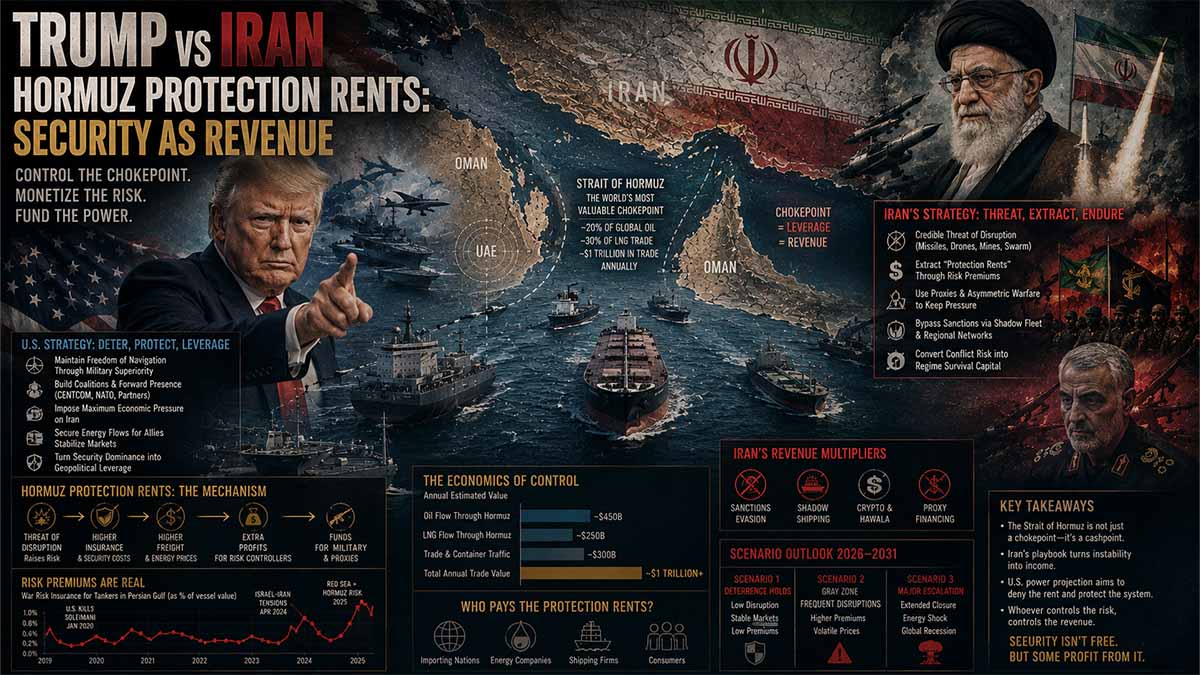
- BLUF: The proposed conversion of U.S. maritime protection into a charge on cargo would transform the Strait of Hormuz from a protected international waterway into a monetized security perimeter.
- No eligible White House, State Department, Defense Department, or CENTCOM source located during this review independently confirms the reported 20% cargo-reimbursement mechanism; it is therefore treated as an unverified policy proposition, not an operative tariff.
- The underlying military structure is verified: the United States has enforced a blockade against vessels entering or leaving Iranian ports while conducting Project Freedom to restore commercial navigation.
- A compulsory cargo levy would face a fundamental legal objection: the International Maritime Organization states that no country may impose tolls, fees, or discriminatory conditions on an international strait.
- Economically, a charge calculated as a percentage of cargo value would be radically different from normal port dues, escort fees, or insurance premiums because it would tax the commodity rather than the service provided.
- Strategically, the model resembles a protection rent: insecurity creates demand for protection, while the security provider captures part of the value whose movement it guarantees.
- The likely consequences would include cargo reclassification, sanctions-evasion networks, alternative pipelines, captive insurance structures, Chinese and European resistance, and litigation over freedom of navigation.
- The five-year central estimate is not a durable 20% levy, but an evolving system of escort contributions, compliance fees, insurance pooling, access conditions, and coalition burden-sharing.
- The decisive contest will concern who governs the security externality: Washington, a multinational coalition, the Gulf states, the IMO system, or competing commercial-security consortia.
Navigational Index
Pillar I — The Protection-Rent Architecture
The transformation of naval security, mine clearance, surveillance, convoy management, sanctions enforcement, and maritime-domain awareness into a revenue-producing access system.
Pillar II — Legality, Sovereignty and Counter-Coalitions
The collision between U.S. coercive capacity, international navigation law, Omani territorial responsibilities, Iranian counter-pressure, European regulatory autonomy, and Chinese energy-security interests.
Pillar III — Five-Year Commercial and Strategic Reordering
The redistribution of shipping routes, insurance capital, energy contracts, compliance functions, naval expenditures, sanctions-evasion liquidity, cyber risk, and infrastructure investment through 2031.
Master Abstract
The central analytical issue is not whether maritime security has a cost; every sustained protection regime consumes naval readiness, intelligence assets, mine-countermeasure capacity, air defence, logistics, maintenance, satellite coverage, cyber protection and political capital. The issue is whether a state may convert those costs into a unilateral claim over the commercial value transiting an international strait. The verified operational baseline is already exceptional. On 3 May 2026, U.S. Central Command announced that American forces would support Project Freedom, beginning on 4 May, to restore freedom of navigation for commercial shipping through Hormuz. The Department of Defense subsequently characterized the mission as defensive, temporary and directed at protecting commercial vessels while U.S. forces separately enforced the blockade of Iranian ports. U.S. Military Supports Launch of Project Freedom – U.S. Central Command – May 2026 — Official document; “Project Freedom” Aims to Get Thousands of Commercial Ships Safely Through Strait – U.S. Department of Defense – May 2026 — Official document. These operations establish the coercive and administrative infrastructure from which a commercial charging mechanism could theoretically emerge: identification of ships, verification of beneficial ownership, inspection of documentation, routing instructions, convoy sequencing, exclusion lists, interdiction authority and persistent surveillance. Yet the reported 20% charge on all cargo remains unverified by an eligible primary government source at the time of this assessment. Analytically, it must therefore be modeled as a proposed or signalled mechanism rather than an implemented fiscal instrument. If adopted literally, it would not function as reimbursement in the conventional sense. It would constitute an ad valorem security extraction whose revenue could vastly exceed the marginal military cost of protecting each voyage, thereby creating a direct fiscal interest in the continuation of a securitized maritime environment.
The economic scale explains why such a proposal would represent a systemic intervention rather than a regional shipping fee. The U.S. Energy Information Administration identifies Hormuz as one of the world’s most important oil-transit chokepoints. Its May 2026 energy-security dataset records 20.4 million barrels per day of total oil flows through Hormuz in the first quarter of 2025, falling to 14.6 million barrels per day in the first quarter of 2026, while LNG flows declined from 11.7 to 7.3 billion cubic feet per day over the same comparison. Global Energy Security Data – U.S. Energy Information Administration – May 2026 — Official dataset. UN Trade and Development assessed that the strait normally carries approximately one quarter of global seaborne oil trade as well as significant LNG and fertilizer volumes; during the initial 2026 disruption, average daily ship transits fell from 129 in February to six in March, a decline of approximately 95%. Strait of Hormuz Disruptions: Growth and Financial Implications – UN Trade and Development – April 2026 — Official report. A levy imposed on cargo value would therefore reach beyond shipowners and charterers. It would be transmitted through delivered crude prices, LNG contracts, fertilizer costs, petrochemical feedstocks, container rates, letters of credit, insurance margins and sovereign import bills. Unlike a fixed escort charge, it would discriminate among vessels according to the monetary value of their cargo even where the operational protection requirement was similar. A tanker carrying high-value crude could incur a vastly larger payment than a bulk carrier requiring comparable surveillance and escort resources. This misalignment between service cost and tax base is the defining economic characteristic of a protection rent: the security provider prices access according to the value exposed to danger, not according to the cost of neutralizing that danger.
The legal constraint is equally structural. Hormuz is governed not as an ordinary toll canal but as a strait used for international navigation, with shipping lanes organized through a Traffic Separation Scheme originally proposed by Iran and Oman and adopted by the IMO in 1968. Middle East: Strait of Hormuz Shipping Route – International Maritime Organization – 2026 — Official reference. The IMO Secretary-General subsequently stated before the UN Security Council that straits used for international navigation cannot be closed by bordering states and that there is no legal basis for any country to impose tolls, fees or discriminatory conditions on such straits. UN Security Council High-Level Open Debate: The Safety and Security of Seafarers and Shipping – International Maritime Organization – April 2026 — Official statement. This creates a decisive distinction between voluntary coalition contributions, commercial war-risk insurance, contractual escort services and a compulsory state-imposed percentage charge attached to transit. The first three can potentially be structured as consensual or service-based arrangements; the fourth risks being construed as a coercive condition placed on an internationally protected navigational right. The European Union has already framed the crisis through freedom of navigation and international law, extending restrictive measures against actors involved in impeding lawful passage while calling for secure entry and exit through the strait. Freedom of Navigation in the Strait of Hormuz: EU Lists Two Individuals and One Entity – Council of the European Union – June 2026 — Official decision summary. Consequently, a unilateral American toll would risk splitting the coalition required to defend navigation: partners might support naval protection against Iranian attacks while simultaneously rejecting the monetization of that protection.
From a structural-analytic perspective, five competing hypotheses define the 2026–2031 trajectory. H₁ — Literal rent extraction: Washington attempts to collect a broad cargo-based charge, using naval control, sanctions compliance and access certification as enforcement mechanisms. H₂ — Negotiating anchor: the extreme percentage is primarily designed to force import-dependent states into burden-sharing agreements, with the final arrangement taking the form of negotiated contributions rather than a universal toll. H₃ — Insurance-state fusion: direct collection is abandoned, but U.S.-approved security certification becomes embedded in war-risk insurance, convoy eligibility, port-state acceptance and trade finance, producing an indirect revenue and control architecture. H₄ — Coalition institutionalization: security costs are distributed through a multinational mission, Gulf-state contributions, shipowner assessments and public-private insurance pools, reducing unilateral American legal exposure. H₅ — Strategic signalling without durable implementation: the proposal functions mainly as coercive messaging aimed at Iran, China, European importers and Gulf producers, while the practical system remains based on naval escort and sanctions enforcement. The initial Bayesian weighting assigns H₂ 31%, H₄ 25%, H₃ 21%, H₅ 16% and H₁ 7%. The low probability for literal implementation reflects the legal, administrative, alliance and market obstacles to collecting one fifth of the value of heterogeneous cargoes. The higher probability assigned to negotiated burden sharing reflects the existing multinational interest in reopening the waterway, including the European Council’s reference to a defensive coalition involving more than fifty countries. Informal Meeting of Heads of State or Government – European Council – April 2026 — Official meeting conclusions. The critical Bayesian update indicators will be Treasury regulations, customs instructions, maritime advisories, coalition memoranda, insurer circulars, congressional appropriations and evidence that payment is becoming a prerequisite for convoy access.
The five-year outlook is therefore best understood as the attempted financialization of a security externality rather than as a simple tariff forecast. In 2026–2027, the dominant contest will concern emergency cost recovery, naval burden sharing and the legal definition of protection services. Shipping companies will seek fixed, predictable charges rather than percentage-based assessments; commodity importers will demand contractual allocation clauses; insurers will differentiate vessels by flag, ownership, cargo, cyber posture and compliance history. During 2027–2028, states and corporations will accelerate avoidance investments: expansion of Saudi and Emirati pipeline capacity, storage outside the Gulf, flexible LNG portfolios, alternative fertilizer suppliers and ship-to-ship transfer networks. In 2028–2029, the shadow economy will become more sophisticated. Beneficial-ownership opacity, cargo undervaluation, false bills of lading, flag migration, AIS manipulation, digital-document forgery, captive insurers and cryptocurrency-mediated settlement could develop wherever security charges interact with sanctions. Cyber operations would target convoy databases, port manifests, insurer risk models and vessel identity systems because control of data would increasingly determine physical access. In 2029–2030, China would probably intensify diplomatic pressure for non-discriminatory passage while expanding naval logistics, strategic inventories and overland energy corridors; Europe would seek an IMO-compatible cost-sharing formula that separates navigation rights from security services. By 2030–2031, the most plausible equilibrium is a hybrid regime: no accepted universal 20% toll, but a layered architecture of voluntary coalition finance, mandatory compliance costs, higher insurance premiums, security accreditation, sanctions screening and differentiated escort access. The commercial result would still resemble a protection economy, although its extraction would be dispersed across institutions rather than collected through one explicit levy.
Policy Inputs
Revenue Extraction Engine
International-Law Friction
Competing Hypotheses — Bayesian Baseline
Cross-Domain Risk Matrix
Five-Year Evolution Path
Emergency protection and burden-sharing contest.
Commercial repricing and route avoidance.
Expansion of shadow compliance markets.
Institutional and geopolitical counter-balancing.
Institutionalized security-cost ecosystem.
Pillar I — The Protection-Rent Architecture: Monetizing Security in the Strait of Hormuz
The proposed transformation of Hormuz security into a revenue-producing access system must be separated into three analytically distinct layers: the verified military architecture, the legally permissible cost-recovery mechanisms, and the still-unverified proposition that the United States could charge a percentage of cargo value for safe passage. The first layer is already observable. U.S. Central Command announced that its forces would support Project Freedom to restore commercial navigation, while subsequent Department of Defense statements described a targeted operation intended to protect merchant vessels, organize their movement, and re-establish maritime commerce. U.S. Military Supports Launch of Project Freedom in Strait of Hormuz – U.S. Central Command – May 2026 — Official document; Secretary of War Pete Hegseth and Chairman of the Joint Chiefs of Staff Gen. Dan Caine Hold a Press Briefing – U.S. Department of Defense – May 2026 — Official transcript. The second layer includes defensible arrangements such as negotiated coalition contributions, fixed escort charges, insurance-pool premiums, port-service payments, contracted mine-clearance support, and reimbursement by beneficiary governments. The third layer—a compulsory assessment equal to a fraction of cargo value—would constitute something categorically different: an ad valorem protection rent imposed not according to the measurable cost of protecting a vessel, but according to the economic value exposed to interdiction. No live White House, Treasury, Defense Department, State Department, or CENTCOM document located in this verification cycle establishes an operative American charge of 20% of cargo value. It must therefore remain outside the factual baseline and enter the analysis only as a policy hypothesis. This distinction is decisive because the physical machinery needed to protect navigation can also become the machinery needed to ration, certify, condition, and ultimately monetize access, even when no formal “toll” appears on an invoice.
From public good to controlled access
Naval protection traditionally functions as a strategic public good: warships patrol sea lanes, governments absorb readiness and deployment costs, and commercial users benefit without being individually billed for every radar sweep, helicopter sortie, intelligence update, or deterrent effect. A protection-rent architecture reverses that relationship by making the security provider an access intermediary. The process begins with maritime-domain awareness, because no charging or exclusion mechanism can operate without a reliable picture of who is moving, what they are carrying, where they are going, and whether their ownership and counterparties satisfy sanctions and security requirements. It then advances through vessel registration, voyage declarations, beneficial-ownership screening, cargo valuation, flag-state verification, insurance certification, convoy allocation, navigational instructions, and post-transit compliance review. Mine clearance, air defence, anti-drone coverage, electronic warfare, underwater surveillance, and rescue capacity supply the coercive credibility behind the administrative system. The critical transformation occurs when passage without enrollment becomes commercially impracticable, even though it may remain legally protected. A ship might theoretically retain a right of transit but be unable to obtain war-risk insurance, trade finance, port acceptance, naval warning data, or convoy inclusion unless it enters the security provider’s certification network. Under this architecture, the revenue source does not need to be called a toll. It can be distributed across registration fees, mandatory security audits, insurance surcharges, data-access subscriptions, escort contributions, compliance guarantees, and government-to-government burden-sharing agreements. The resulting system is more durable than a conspicuous tariff because it embeds payment in the surrounding commercial infrastructure. It also creates an information monopoly: the authority controlling recognized threat intelligence and safe-passage accreditation can influence which vessels sail, which remain stranded, and which commercial relationships become unfinanceable.
Maritime Control & Access Architecture
Strategic framework detailing the systematic flow from threat identification to multidimensional domain awareness, gating compliance, and revenue monetization.
Threat Environment
Tracking highly dynamic multi-domain vulnerabilities. Dynamic parameters evaluate asymmetric surface threats alongside software-defined spatial deception vectors.
Maritime-Domain Awareness (MDA)
Synthesizing distributed spatial, commercial, and structural telemetry datasets to build a real-time tracking dashboard of regional vessel flows.
Security Eligibility Gateway
Automated verification filters performing dynamic structural integrity checks, cargo registration inspections, and geopolitical alignment screenings.
Access Conditions
Establishing financial, risk mitigation, and security-sharing overhead requirements for legal corridor clearance and continuous escort logistics.
Revenue, Influence & Data Accumulation
Sustained capitalization loops, geopolitical leverage, and continuous maritime traffic telemetry enrichment that solidify dominance over regional trade pathways.
The scale of the commercial base explains why even a modest security charge could generate a major financial system, while a double-digit cargo assessment would be economically destabilizing. The U.S. Energy Information Administration assessed that flows through Hormuz in 2024 and the first quarter of 2025 represented more than one quarter of global seaborne oil trade, approximately one fifth of global petroleum consumption, and roughly one fifth of global LNG trade. It also estimated that Saudi and Emirati pipelines could provide approximately 2.6 million barrels per day of available bypass capacity under disruption conditions, leaving most normal maritime flows without an immediate alternative. Amid Regional Conflict, the Strait of Hormuz Remains Critical to Oil and LNG Trade – U.S. Energy Information Administration – June 2025 — Official analysis; About One-Fifth of Global Liquefied Natural Gas Trade Flows through the Strait of Hormuz – U.S. Energy Information Administration – June 2025 — Official analysis. Updated EIA data warn that AIS information became especially unreliable after the escalation, requiring repeated revision of tanker-flow estimates. Global Energy Security Data – U.S. Energy Information Administration – May 2026 — Official dataset. That warning has direct implications for monetization: a cargo-based system would depend on data that become least reliable precisely when risk, evasion incentives, and revenue potential are highest. Tankers could suppress or manipulate transmissions; ownership could migrate through shell companies; cargoes could be undervalued; ship-to-ship transfers could obscure origin; and sanctioned counterparties could exploit jurisdictional fragmentation. Consequently, the gross theoretical yield of a protection charge would be much larger than its collectable yield, while enforcement costs would grow nonlinearly as the assessment rate increased.
The operational value chain
| Security function | Operational product | Potential revenue mechanism | Principal vulnerability |
|---|---|---|---|
| Mine countermeasures | Cleared channels and navigational assurance | Coalition reimbursement or voyage assessment | Re-mining, false alerts, underwater drones |
| Air and missile defence | Reduced strike probability | Government contribution or insurance-linked fee | Saturation attacks and attribution disputes |
| Convoy management | Scheduled and protected transit windows | Fixed escort fee or membership contribution | Queue manipulation and discriminatory access |
| Maritime surveillance | Recognized vessel and threat picture | Data subscription or certification charge | AIS spoofing, cyber intrusion, ownership opacity |
| Sanctions enforcement | Exclusion of prohibited vessels and counterparties | Compliance fees and penalties | Cargo relabeling and shadow fleets |
| Search and rescue | Emergency response capability | Insurance-pool contribution | Moral hazard and capacity exhaustion |
| Cyber protection | Integrity of routing and identity systems | Cyber-security accreditation fee | Database compromise and insider access |
| Trade-finance validation | Bankable proof of compliant transit | Documentary and due-diligence charges | Forged records and jurisdiction shopping |
Mine clearance provides the clearest example of how a defensive military function can become an economic gatekeeping instrument. A cleared route is not merely a physical corridor; it is an information product whose commercial value depends on the credibility of the authority declaring it safe. The provider controls the survey data, threat assessments, clearance sequence, confidence level, and timing of reopening. Insurers and shipowners may therefore accept navigation only after receiving recognized assurance from that provider or an approved coalition. The same logic applies to missile warning, drone detection, electronic warfare, and underwater surveillance. Each military capability generates a derivative commercial product: a reduced probability of loss. Once that reduction becomes measurable, certifiable, and contractually recognized, it can be priced. The central design choice is whether pricing remains linked to the cost of service or expands toward the value of protected commerce. A fixed convoy contribution approximates cost recovery; a risk-weighted premium prices expected loss; an assessment based on cargo value captures economic surplus. The final model creates the strongest protection-rent characteristics because it allows the provider to extract more from high-value cargo even where the military effort remains unchanged. It also creates perverse incentives. A prolonged risk environment supports continuing revenue; expansive threat classifications justify higher charges; slow clearance can increase the value of scarce transit slots; and the authority providing protection may gain bargaining leverage from insecurity that it has not fully eliminated. This does not prove deliberate threat perpetuation, but it establishes a governance problem comparable to regulated utilities and private military contracting: the party defining the risk, supplying the remedy, and setting the price should not operate without external oversight, transparent cost accounting, independent threat validation, and a credible sunset mechanism.
Sanctions enforcement adds another layer because it converts maritime security from neutral protection into differentiated access control. CENTCOM reporting has described American forces redirecting or disabling vessels accused of violating the blockade against Iranian ports, demonstrating that the operational system already distinguishes compliant traffic from prohibited traffic. U.S. Forces Disable Non-Compliant Vessel in Gulf of Oman to Prevent Blockade Violation – U.S. Central Command – May 2026 — Official release. A monetized version would combine protection and enforcement in a single transaction: a vessel would submit data, prove that its cargo and customers were authorized, obtain security clearance, enter a protected movement schedule, and potentially pay for that privilege. This arrangement would resemble a maritime customs union without territorial sovereignty, enforced by naval power rather than ordinary border administration. The United States could acquire substantial extraterritorial influence because banks, marine insurers, classification societies, commodity traders, and destination ports would be reluctant to recognize voyages lacking American or coalition clearance. The revenue mechanism could then migrate away from direct billing and into commercial compliance. Banks might require a certified Hormuz security record before releasing payment; insurers might deny coverage to unenrolled vessels; ports might impose enhanced inspections; and charter parties might allocate charges to cargo owners. This indirect model is analytically more plausible than a universal percentage toll because it can grow through private contracts rather than a single legally vulnerable decree. It would also be harder to contest: each individual requirement could be presented as risk management, sanctions compliance, or underwriting prudence even when their combined effect constituted a compulsory access system. The architecture’s power would lie in network centrality rather than formal ownership of the waterway.
Legal boundary and legitimacy deficit
The principal legal obstacle is that Hormuz is a strait used for international navigation rather than a proprietary canal or ordinary port facility. The International Maritime Organization has stated that straits used for international navigation cannot be closed by bordering states and that there is no legal basis for a country to introduce payments, tolls, fees, or discriminatory conditions on such straits. UN Security Council High-Level Open Debate: The Safety and Security of Seafarers and Shipping – International Maritime Organization – April 2026 — Official statement. At a subsequent Franco-British summit, the IMO Secretary-General explicitly called for rejection of tolls, fees, and discriminatory transit measures. France–UK Summit on Freedom of Navigation in the Strait of Hormuz – International Maritime Organization – May 2026 — Official statement. The IMO had also condemned an Iranian toll system and discriminatory measures as contrary to the organization’s purposes. IMO Approves New Guidelines on Ship Registration – International Maritime Organization – April 2026 — Official release. These positions create an unavoidable symmetry test: a toll cannot become lawful merely because the state imposing it claims to be protecting, rather than threatening, navigation. A legally resilient cost-sharing mechanism would therefore need to remain voluntary, contractual, service-specific, non-discriminatory, and proportionate to actual expenditure. It would also need to preserve transit for non-paying vessels unless a separate lawful basis existed for interdiction. Charging for an optional escort may be defensible; charging for the underlying right of passage is much more difficult. Requiring payment through insurance or certification could also be challenged if it became a disguised condition of transit. The protection-rent architecture thus faces a legitimacy paradox: the more effective it becomes at making enrollment commercially compulsory, the more closely it resembles the prohibited toll system it was supposedly created to defeat.
The European position reinforces that boundary while also revealing how security costs could nevertheless be institutionalized. The Council of the European Union extended its sanctions framework to target actors impeding lawful transit and subsequently listed Iranian individuals and entities associated with a toll system, cargo assessment, threats, and harassment of commercial shipping. Middle East: Council Extends EU Legal Framework to Target Actions Impeding Lawful Transit Passage – Council of the European Union – May 2026 — Official decision summary; Freedom of Navigation in the Strait of Hormuz: EU Lists Two Individuals and One Entity – Council of the European Union – June 2026 — Official decision summary. The EU simultaneously considered diplomatic and operational initiatives to secure navigation and referred to a defensive mission involving more than fifty countries. Informal Meeting of Heads of State or Government – European Council – April 2026 — Official meeting record. This suggests that European governments may accept shared financing for a multinational security mission while opposing unilateral cargo extraction. The likely compromise would resemble coalition burden sharing: national contributions calculated through energy exposure, fleet use, gross domestic product, military participation, or voluntary shipping assessments. Revenue would enter a transparent common fund rather than accrue directly to a single naval power. Oversight could involve audited operating costs, agreed rules of engagement, nondiscriminatory convoy criteria, and periodic renewal. Such an arrangement would dilute the pure protection-rent model but would still monetize security by converting protection from an implicit public good into an explicitly financed international service.
Chinese and Russian counter-framing
China has articulated a position that supports restoration of normal passage while rejecting an architecture that legitimizes unilateral military control. Foreign Minister Wang Yi stated that navigation freedom and security in the internationally accessible strait should be guaranteed, while President Xi Jinping described normal passage as serving the common interests of regional states and the international community. Wang Yi Has a Phone Call with Iranian Foreign Minister Abbas Araghchi – Ministry of Foreign Affairs of the People’s Republic of China – April 2026 — Official statement; President Xi Jinping Speaks with Saudi Arabia’s Crown Prince and Prime Minister Mohammed bin Salman – Ministry of Foreign Affairs of the People’s Republic of China – April 2026 — Official statement. In a separate UN-related statement, China linked the crisis to U.S. and Israeli military action, criticized targeted blockades, and emphasized both navigation rights and respect for coastal-state sovereignty. Remarks on the Safety and Protection of Waterways and Maritime Shipping – Ministry of Foreign Affairs of the People’s Republic of China – April 2026 — Official statement. Beijing’s probable objection is therefore not to security provision in itself but to a structure in which Washington simultaneously defines lawful trade, controls convoy access, collects security revenue, and gains intelligence on Chinese energy transactions. A U.S.-centered access system would expose import volumes, contract counterparties, destination patterns, payment intermediaries, storage movements, and sanctions vulnerabilities. China would likely respond by advocating an IMO or UN framework, financing non-Western insurance capacity, expanding strategic petroleum reserves, increasing pipeline and overland diversification, supporting Gulf-state security autonomy, and seeking contractual exemptions for long-term energy shipments. It might also use state-owned enterprises and yuan-denominated settlement systems to reduce exposure to American financial enforcement. Beijing’s central strategic objective would be open passage without accepting a permanent U.S. fiscal and intelligence gateway over its Gulf energy supply.
Russia has framed U.S.-led blockade and navigation proposals as unlawful or escalatory and has argued that normal navigation depends on political settlement rather than expanded Western military control. Official Russian diplomatic statements have maintained that the strait functioned normally before the conflict, criticized American military measures, and supported restoration of navigation through diplomatic arrangements. Foreign Minister Sergey Lavrov’s Statement and Answers to Media Questions – Ministry of Foreign Affairs of the Russian Federation – 2026 — Official diplomatic publication; Foreign Ministry Statement on the Memorandum of Understanding Reached Between the United States and Iran – Ministry of Foreign Affairs of the Russian Federation – June 2026 — Official diplomatic publication. Moscow’s commercial incentives differ from Beijing’s because prolonged Gulf disruption can support higher prices and redirect demand toward non-Gulf hydrocarbons, but a U.S.-controlled protection system could also extend American sanctions power and maritime intelligence reach. Russia would therefore benefit from opposing the legal precedent while exploiting market displacement. Its probable shadow contribution would not require direct naval confrontation. It could include insurance alternatives, flagging and registration services, sanctions-resistant payment channels, tanker-management expertise, cyber assistance, electronic-warfare knowledge, or diplomatic support for states seeking to avoid Western compliance systems. Russian and Chinese opposition would not necessarily produce a unified operational coalition; China prioritizes stable imports, while Russia may profit from volatility. Their common denominator would be resistance to converting U.S. military presence into a recognized taxing or licensing authority over international commerce.
Five competing architectures and Bayesian assessment
| Hypothesis | Architecture | Initial probability | Primary confirming indicators | Primary disconfirming indicators |
|---|---|---|---|---|
| H₁ | Direct cargo-value protection rent | 6% | Treasury collection rules; official tariff schedule; payment required for transit | No implementing regulation; allied rejection; IMO challenge |
| H₂ | Negotiating anchor for state burden sharing | 30% | Bilateral reimbursement agreements; Gulf contributions; importer commitments | Unconditional U.S. funding; rapid force withdrawal |
| H₃ | Insurance and compliance monetization | 25% | Approved-vessel lists; insurer-linked certification; bank requirements | Open transit without accreditation; broad insurer resistance |
| H₄ | Multinational security fund | 27% | Coalition governance; audited common budget; shared convoy command | Unilateral operational control; refusal to share data or authority |
| H₅ | Temporary emergency mission without durable charging | 12% | Short deployment; restoration of normal traffic; no fee infrastructure | Permanent databases, certification standards, recurring contributions |
The Analysis of Competing Hypotheses favors H₂, H₃, and H₄ because they deliver most of the strategic benefits of monetization while avoiding the highest legal and political costs. H₁, the literal cargo-value charge, remains the least likely because it requires an official valuation methodology, collection jurisdiction, dispute process, exemptions regime, enforcement rules, and treatment of vessels that refuse payment. It would also invite cargo undervaluation and immediate opposition from import-dependent states. H₂ is plausible because an extreme public demand can function as a bargaining anchor, shifting negotiations from whether other states should contribute to how much they should contribute. H₃ is particularly durable because private insurance, finance, and port requirements can create de facto compulsion without an explicit toll. H₄ offers the greatest legitimacy and coalition cohesion but requires the United States to share command authority, cost data, threat intelligence, and institutional control. H₅ remains possible if navigation normalizes rapidly and the mission winds down before a permanent administrative ecosystem develops. Bayesian updating should therefore focus on six observable variables: publication of U.S. implementing rules; establishment of a persistent vessel-enrollment database; formal integration with insurers and banks; creation of a multinational cost-sharing institution; legal challenges before international or domestic bodies; and the duration of American force deployment. An official compulsory tariff would sharply increase H₁, whereas an audited coalition fund would shift probability toward H₄. Insurer circulars requiring approved security certification, even without government fees, would increase H₃.
Shadow dimensions: liquidity, cyber systems and quasi-private force
The protection-rent system would generate a corresponding shadow economy because every access rule creates an incentive to evade, falsify, broker, or arbitrage it. Cargo valuation would become the primary liquidity vulnerability. Related companies could invoice commodities below market value, divide cargoes among multiple documents, alter declared destinations, or use opaque pricing formulas. Beneficial ownership could move through special-purpose entities; vessels could change flags or management companies; and payments could be routed through jurisdictions not participating in the security regime. Ship-to-ship transfers outside the immediate monitoring zone could separate the protected voyage from the ultimate sanctioned customer. Trade-finance documents, insurance certificates, bills of lading, and security-clearance records would become high-value targets for forgery and corruption. The cyber layer would be equally consequential. An adversary able to alter a convoy manifest, spoof a ship’s identity, corrupt threat maps, or manipulate cargo-risk scores could secure unauthorized passage, delay a competitor, or trigger military escalation. AIS data unreliability already demonstrates that the maritime picture is not an objective, complete record. A monetized system would therefore require multi-source identity resolution combining satellite imagery, radar, radio-frequency analysis, port records, customs documentation, insurer data, and ownership registries. This creates a concentrated intelligence repository with enormous commercial value and exceptional espionage risk. Private maritime-security contractors could support boarding, communications, training, cyber defence, or convoy liaison, but delegating coercive functions would raise accountability and escalation concerns. The most sustainable model would restrict private actors to defensive and technical roles, preserve interdiction authority for states, and subject financial intermediaries to audit. Without those safeguards, a hybrid ecosystem of naval power, private security, insurers, data vendors, and sanctions investigators could become functionally equivalent to a franchised protection market.
Five-year outlook, 2026–2031
The synthetic five-year scenario model uses four principal pathways—direct rent, negotiated reimbursement, compliance monetization, and multinational financing—and applies uncertainty to conflict duration, traffic recovery, allied participation, legal resistance, and evasion. This is not a forecast generated from a classified dataset; it is a structured Monte Carlo-style scenario envelope intended to show how the architecture changes as those variables interact. During 2026–2027, emergency convoy management and blockade enforcement will dominate. The decisive issue will be whether temporary vessel-registration and threat-sharing systems are dismantled after traffic normalizes or retained as permanent infrastructure. During 2027–2028, insurers, banks, and charterers will translate operational experience into contractual rules. Even without a formal toll, voyages may acquire security-certification costs, higher deductibles, enhanced due diligence, and convoy-related clauses. During 2028–2029, evasion will professionalize. Shadow fleets, document manipulation, opaque ownership, cyber intrusion, and alternative finance will force the system toward more intrusive data collection. During 2029–2030, geopolitical counter-coalitions will mature: China will promote nondiscriminatory multilateral governance, the EU will press for legal proportionality and shared command, Russia will support sanctions-resistant alternatives, and Gulf states will seek greater control over regional security provision. By 2030–2031, the highest-probability equilibrium is a layered protection-finance architecture rather than a literal percentage toll. Naval security would be funded through state contributions, insurance surcharges, certification charges, and compliance expenditures, while transit passage would remain formally free. The system would nevertheless redistribute commercial power toward the institutions controlling accreditation, intelligence, and finance. The risk is therefore not only that Hormuz becomes a toll road. The deeper risk is that an emergency security mission becomes a permanent transnational licensing regime whose costs, exclusions, and intelligence advantages are embedded across global trade.
Five-Year Risk and Institutionalization Matrix
| Period | Dominant architecture | Revenue maturity | Legal friction | Shadow-market response | Strategic assessment |
|---|---|---|---|---|---|
| 2026–2027 | Emergency convoy and blockade system | Low–medium | High | Opportunistic | Temporary infrastructure can become permanent |
| 2027–2028 | Insurance and certification integration | Medium | Medium–high | Expanding | Indirect monetization becomes more plausible than tolls |
| 2028–2029 | Data-intensive compliance gateway | Medium–high | High | Organized | Cyber integrity becomes as important as naval control |
| 2029–2030 | Competing coalition and payment systems | High | High | Transnational | China, EU and Russia constrain unilateral authority |
| 2030–2031 | Hybrid multinational protection-finance regime | High | Medium | Institutionalized | Formal free passage coexists with substantial indirect costs |
Figure 1: Protection-Rent Architecture Projection, 2026–2031
Synthetic scenario indices from 0 to 100. They represent relative institutionalization, legal friction, evasion pressure, and probability of a direct cargo-value charge, not observed financial values.
Pillar II — Legality, Sovereignty and Counter-Coalitions: The Battle to Govern Hormuz
The strategic collision at Hormuz is not reducible to a binary contest between the United States and Iran. It is a layered jurisdictional struggle involving the legal regime of an international strait, the territorial sovereignty of Oman and Iran, the coercive reach of American naval power, the regulatory autonomy of the European Union, and the energy-security interests of China and other Asian importers. The physical geography creates the paradox. Much of the navigable route passes through territorial waters belonging to the two coastal states, yet international law protects the continuous and expeditious passage of foreign ships and aircraft through straits connecting one part of the high seas or an exclusive economic zone with another. Articles 37–44 of the United Nations Convention on the Law of the Sea establish the regime of transit passage, impose duties on transiting vessels, permit coastal states to adopt limited safety and pollution regulations, and prohibit them from hampering, suspending, or discriminating against passage. Part III: Straits Used for International Navigation – United Nations – December 1982 — Official convention text. The United States has not ratified UNCLOS, but it treats many navigation provisions as reflecting customary international law and has the operational capacity to enforce its interpretation. Iran signed but has not ratified the convention; Oman acceded and presents itself as the responsible coastal custodian. The result is a structurally unstable order in which every principal actor invokes law selectively but plausibly: Washington invokes freedom of navigation, Tehran invokes sovereignty and self-defence, Muscat invokes coastal responsibility and non-discriminatory passage, Brussels invokes multilateral legality, and Beijing invokes open commerce while opposing unilateral Western coercion. The principal five-year risk is therefore not formal closure alone. It is the progressive replacement of a generally accepted navigational regime by competing systems of military protection, national authorization, sanctions screening, convoy certification, and political exemption.
The legal architecture: sovereignty without a right of closure
The governing legal distinction is between sovereignty over the waters forming the strait and sovereignty over passage itself. Under Article 34 of UNCLOS, the legal regime of transit passage does not otherwise affect the sovereignty or jurisdiction of states bordering an international strait over its waters, airspace, seabed, and subsoil. That sovereignty, however, must be exercised subject to Part III of the convention and other rules of international law. Article 38 grants all ships and aircraft the right of transit passage, defined as navigation and overflight solely for continuous and expeditious transit between two maritime spaces. Article 39 requires ships and aircraft to proceed without delay, refrain from threats or uses of force inconsistent with the UN Charter, and comply with generally accepted international regulations. Article 42 allows bordering states to legislate on navigation safety, pollution, fishing, and customs matters, but expressly prohibits discrimination or laws whose practical effect would deny or impair transit passage. Article 44 imposes the most consequential obligation: bordering states shall not hamper transit passage, must publicize dangers, and may not suspend passage. Part III: Straits Used for International Navigation – United Nations – December 1982 — Official convention text. The UN’s official overview likewise states that ships and aircraft of all countries enjoy transit passage through straits used for international navigation, while bordering states retain regulatory authority over navigational and related matters. United Nations Convention on the Law of the Sea: Overview – United Nations – 2026 update — Official overview. This balance excludes two absolutist interpretations. Iran cannot convert territorial sovereignty into an unrestricted power to close the strait or impose discriminatory political conditions. Conversely, the United States cannot treat freedom of navigation as transferring regulatory sovereignty or proprietary authority over the corridor to an external naval power. Transit passage is a legal entitlement governed by international law, not a concession issued by Washington, Tehran, or Muscat. Any durable security arrangement must therefore distinguish between defending passage and governing it.
The legal position becomes more complex because the traffic-separation system is jointly embedded in the territorial responsibilities of Oman and Iran. The International Maritime Organization has stated that since 1968 it has maintained a traffic-separation scheme in Hormuz, jointly operated by the two coastal states and functioning as a mandatory navigational mechanism under the International Convention for the Safety of Life at Sea. UN Security Council High-Level Open Debate: The Safety and Security of Seafarers and Shipping – International Maritime Organization – April 2026 — Official statement. That arrangement supplies Oman and Iran with legitimate roles in route designation, navigational warnings, hydrographic information, safety coordination, and incident response, but it does not authorize either state to monetize or politically condition the underlying right of passage. The IMO Secretary-General called on states to reject tolls, fees, and discriminatory measures imposed for passage through an international strait. France–UK Summit on Freedom of Navigation in the Strait of Hormuz – International Maritime Organization – May 2026 — Official statement. The IMO Legal Committee also condemned reported Iranian toll arrangements and discriminatory measures as contrary to the organization’s purposes. IMO Approves New Guidelines on Ship Registration – International Maritime Organization – April 2026 — Official release. This creates a symmetry that applies to all actors: an Iranian toll imposed through coastal control and an American protection assessment imposed through military control would raise parallel objections if either operated as a compulsory condition of transit. The legality of a security charge depends less on who collects it than on whether it is voluntary, proportionate, service-specific, nondiscriminatory, and separable from the navigational right itself.
Legal & Sovereignty Stack Architecture
Operational matrix mapping international maritime statutory regimes, bifurcated jurisdiction dynamics, and subsequent friction risks within the protection layer.
International Legal Entitlement
Establishing open global maritime codification parameters. Protects cross-border logistics lanes and international commerce rights against unilateral sovereign closures.
Coastal-State Sovereignty
- Territorial Waters Mapping
- Navigation Regulation Enforcement
- Environmental Protection Controls
- Hazard Notification Protocols
Inherent geography-defined sovereignty. Enforces domestic maritime policing updates, spatial boundary declarations, and localized environmental restrictions.
User-State Rights
- Continuous Transit Guarantees
- Nondiscrimination Protections
- No Suspension Thresholds
- Overflight Access Frameworks
Protects the structural access liberties of standard trading states, preventing coastal authorities from blocking naval or merchant fleet routes during peaceful intervals.
Operational Security Layer
The practical, physical projection layer deployed to enforce international freedom-of-navigation rules when standard diplomatic frameworks break down.
Potential Legitimacy Conflict
Friction paradox point: Excessive external naval escort operations can be leveraged by adversarial narratives as an infringement on territorial sovereignty, escalating political pushback from regional actors.
Omani sovereignty as the pivotal legitimating variable
Oman occupies the indispensable middle position because it is simultaneously a coastal sovereign, a treaty-based supporter of international navigation, an interlocutor with Iran, a security partner of Western states, and a mediator capable of converting military arrangements into diplomatically acceptable procedures. Muscat has explicitly framed its role as one of responsibility toward the strait, commitment to international law, and opposition to transit fees. On 24 June 2026, the Omani Foreign Ministry announced that Oman had coordinated with the IMO to make a temporary maritime corridor available to all vessels, expressly stating that freedom of navigation should be ensured without transit charges. Oman Works with International Maritime Organization to Provide Transit Corridor in the Strait of Hormuz – Ministry of Foreign Affairs of Oman – June 2026 — Official statement. Oman and Iran subsequently reaffirmed that the strait should remain secure and open for international navigation while asserting that all arrangements must respect the sovereignty and sovereign rights of the two coastal states. Oman and the Islamic Republic of Iran Issue a Joint Statement – Ministry of Foreign Affairs of Oman – June 2026 — Official statement. On 11 July, the two governments continued discussions in Muscat on safe and free navigation. Oman and Iran Discuss Freedom of Navigation in Strait of Hormuz – Ministry of Foreign Affairs of Oman – July 2026 — Official statement. These formulations amount to a carefully constructed doctrine: Oman rejects both Iranian obstruction and any external arrangement that would erase coastal sovereignty. It can welcome U.S. protection as an emergency security contribution but cannot easily recognize American authority to regulate, license, or tax passage. Muscat’s consent is therefore the principal variable separating a coalition mission from an externally imposed maritime protectorate.
Oman’s leverage derives not from military parity but from legal geography, diplomatic credibility, and institutional access. A U.S.-protected corridor located largely through Omani-controlled waters gains considerably more legitimacy when described as operating at Oman’s request, under Omani navigational authority, and in coordination with the IMO. The same corridor becomes legally and politically more controversial when Washington presents it as an autonomous American security zone. The Department of Defense stated that CENTCOM established an “enhanced security area” on the southern side of the strait protected by U.S. land, naval, and air assets. Secretary of War Pete Hegseth and Chairman of the Joint Chiefs of Staff Gen. Dan Caine Hold a Press Briefing – U.S. Department of Defense – May 2026 — Official transcript. Operationally, such a zone may be necessary to defeat attacks and support commercial traffic. Juridically, however, it cannot supersede Omani territorial jurisdiction without consent or another valid legal basis. The core sovereignty test is therefore procedural: Who designates routes? Who approves convoy schedules? Who issues warnings? Who authorizes boarding? Who adjudicates incidents? Who controls data collected from ships? Who determines whether an Iranian-linked vessel may pass through Omani waters? A sustainable architecture would place Omani authorities at the formal center, use U.S. assets as a supporting security layer, and retain IMO standards as the common regulatory language. A unilateral architecture would reverse that hierarchy and transform Oman from sovereign regulator into host territory for an external access regime. The latter could provoke domestic, regional, and international opposition even if it improved short-term physical security.
U.S. coercive capacity and the risk of jurisdictional substitution
The United States possesses the decisive coercive capabilities required to clear mines, suppress missile and drone threats, escort merchant shipping, conduct airborne surveillance, interdict vessels, and impose a blockade against Iranian ports. CENTCOM announced the launch of Project Freedom to restore navigation, while the Department of Defense characterized the operation as defensive, focused, and temporary. U.S. Military Supports Launch of Project Freedom in Strait of Hormuz – U.S. Central Command – May 2026 — Official release; “Project Freedom” Aims to Get Thousands of Commercial Ships Safely Through Strait – U.S. Department of Defense – May 2026 — Official analysis. CENTCOM has also reported redirecting, boarding, or disabling vessels suspected of violating the blockade against Iranian ports, demonstrating that American forces are not merely protecting neutral transit but simultaneously differentiating lawful and prohibited commercial movements. U.S. Forces Disable Vessel in Gulf of Oman Attempting to Violate Blockade – U.S. Central Command – May 2026 — Official release. This combination creates the central structural danger: the protector of the international passage is also the enforcer of a national blockade, and the same surveillance data, naval platforms, and boarding capabilities can serve both missions. Merchant shipping may therefore encounter an integrated American system that protects vessels from Iranian attack while testing their compliance with U.S. restrictions.
The jurisdictional problem does not arise simply because American forces are present; naval forces routinely operate in international waterways and may defend themselves and others under applicable law. It arises when operational protection evolves into normative authority. A convoy system can become an access-allocation system. A vessel registry can become a sanctions database. A threat-screening mechanism can become a commercial licensing mechanism. A protected corridor can become a de facto controlled zone. An emergency boarding power can become routine inspection. The more Washington connects physical protection to cargo origin, destination, beneficial ownership, and payment compliance, the more it risks substituting American law for the multilateral navigation regime. The legal debate would then shift from whether U.S. forces may defend shipping to whether they may condition passage on compliance with unilateral economic measures. Washington’s strongest position is that it is protecting an internationally recognized right against armed interference. Its weakest position is that the right exists only for traffic approved by the United States. Over the next five years, the most consequential indicator will be whether Project Freedom’s temporary systems acquire permanence: recurring vessel enrollment, mandatory American clearance, persistent inspection zones, integration with Treasury sanctions databases, or fees linked to escort eligibility. Each step would increase operational efficiency but reduce legal neutrality, thereby strengthening Iranian, Chinese, Russian, and potentially European claims that Washington is replacing freedom of navigation with selective freedom under American guardianship.
Iranian counter-pressure: sovereignty claims, coercive ambiguity and calibrated denial
Iran possesses fewer conventional maritime assets than the United States but retains multiple asymmetric mechanisms capable of imposing uncertainty, delay, and political cost. These include sea mines, anti-ship missiles, unmanned aerial and surface systems, fast attack craft, coastal surveillance, harassment, selective boarding, proxy networks, cyber operations, and the ability to threaten shipping without maintaining a continuous physical closure. Iran’s legal narrative rests on three propositions: that it exercises sovereignty over its territorial waters; that foreign military activity directed against Iran alters the security environment; and that sanctions or blockades targeting Iranian commerce cannot be separated from the status of passage through the strait. The difficulty is that an expansive application of those propositions collides with transit passage and with the duties of bordering states not to hamper or suspend it. The IMO condemned threats involving mines, reported tolls, and discriminatory treatment of vessels. IMO Approves New Guidelines on Ship Registration – International Maritime Organization – April 2026 — Official release. The EU similarly declared that actions against transiting vessels infringed established rights of transit and innocent passage. Middle East: Council Extends EU Legal Framework to Target Actions Impeding Lawful Transit Passage – Council of the European Union – May 2026 — Official decision summary. Iran’s legal leverage is therefore strongest when defending coastal sovereignty and weakest when discriminating among vessels or imposing coercive conditions unrelated to navigational safety.
Iran’s optimal strategy is not necessarily total closure, which would alienate China, India, Gulf neighbors, and other major importers. A more effective approach is calibrated uncertainty: creating enough risk to compel diplomatic concessions without assuming responsibility for a universal blockade. Tehran can distinguish among flags, cargoes, destinations, or participation in U.S. operations; threaten rather than consistently attack; publicize mine capability without maintaining a verified minefield; and exploit ambiguity over whether an incident was state-directed, proxy-enabled, accidental, or technically attributable. This permits Iran to impose a risk premium while preserving deniability and bargaining flexibility. It can also contest American authority through administrative countermeasures, including parallel registration systems, coastal routing instructions, demands for notification, inspections linked to alleged security threats, or selective authorization for favored partners. Such a dual-gateway system would be highly destabilizing because vessels might face incompatible requirements from Iran, Oman, and the United States. Iran could additionally frame U.S. blockade enforcement as the initiating violation and argue that targeted restrictions on Iranian-linked shipping constitute discriminatory interference with its sovereign commerce. China’s official position that the crisis originated in U.S. and Israeli military action, while not validating Iranian obstruction, supplies Tehran with diplomatic support for that causal narrative. Remarks on the Safety and Protection of Waterways and Maritime Shipping – Ministry of Foreign Affairs of the People’s Republic of China – April 2026 — Official statement.
European regulatory autonomy: alignment without subordination
The European Union shares the immediate Western objective of secure navigation but has distinct legal, commercial, and political interests that prevent automatic acceptance of an American-controlled Hormuz regime. The Council extended its Iran sanctions framework to actors threatening lawful transit and later listed individuals and an entity associated with obstruction and discriminatory measures. Freedom of Navigation in the Strait of Hormuz: EU Lists Two Individuals and One Entity – Council of the European Union – June 2026 — Official decision summary. The EU’s broader position states that any arrangement concerning Hormuz must not limit freedom of navigation or alter the strait’s governance. EU Position on the Situation in the Middle East – Council of the European Union – 2026 — Official policy overview. That formulation simultaneously opposes Iranian closure and constrains unilateral American institutional expansion. Europe can support escort operations, mine clearance, sanctions against attackers, and maritime surveillance while refusing to recognize a permanent U.S. licensing authority or cargo levy. Its regulatory autonomy matters because European marine insurers, classification societies, banks, commodity traders, shipowners, and port authorities occupy central positions in global maritime commerce. Washington may control the physical security zone, but Brussels and European capitals can determine whether American certification, charges, and enforcement decisions receive commercial recognition within European jurisdiction.
European counter-coalition behavior would probably remain institutional rather than military. The EU could insist on an IMO-centered framework, common rules for convoy eligibility, transparent cost allocation, protection of commercial data, independent incident investigation, and legal separation between freedom-of-navigation operations and the U.S. blockade of Iran. It could also develop autonomous maritime situational awareness through existing European and national naval structures, thereby reducing dependence on American threat data. The central friction would concern secondary sanctions and cargo screening. European governments may agree that vessels directly supporting prohibited Iranian military activity should face restrictions, but they may resist a system in which U.S. unilateral sanctions determine access to an international strait. This could produce a two-tier coalition: tactical coordination against mines, missiles, drones, and attacks, combined with legal and regulatory distancing from American commercial enforcement. The EU’s strongest leverage would be its control over insurance, finance, and destination markets; its principal weakness would be dependence on American military assets during high-intensity conflict. Through 2031, European policy will likely seek to convert emergency U.S. protection into a multilateral service governed by international rules rather than allow military dependence to become permanent regulatory subordination.
China’s energy-security calculus and the architecture of counter-access
China approaches Hormuz through the combined lenses of energy continuity, opposition to unilateral sanctions, protection of international navigation, and resistance to U.S. strategic control over critical supply chains. Chinese official statements have repeatedly called for the restoration of normal passage. Foreign Minister Wang Yi stated that the freedom and security of navigation in the internationally accessible strait should be guaranteed, while the Chinese Foreign Ministry later described Hormuz as an important international strait whose stability serves regional and global interests. Wang Yi Has a Phone Call with Iranian Foreign Minister Abbas Araghchi – Ministry of Foreign Affairs of the People’s Republic of China – April 2026 — Official statement; Foreign Ministry Spokesperson Lin Jian’s Regular Press Conference – Ministry of Foreign Affairs of the People’s Republic of China – June 2026 — Official transcript. China nevertheless attributes the origins of the crisis to American and Israeli military action and opposes targeted blockades and expanded U.S. deployments. Remarks on the Safety and Protection of Waterways and Maritime Shipping – Ministry of Foreign Affairs of the People’s Republic of China – April 2026 — Official statement. Beijing’s position is therefore not pro-closure or unconditionally pro-Iranian; it is pro-passage but anti-hegemony. China wants the waterway open without allowing Washington to convert naval protection into intelligence dominance, sanctions jurisdiction, or a fiscal claim over Chinese-bound cargo.
A U.S.-controlled Hormuz gateway would expose commercially sensitive Chinese data, including import volumes, contractual counterparties, destination terminals, financing structures, beneficial ownership, inventory cycles, and dependence on particular Gulf suppliers. Beijing would view that data access as a strategic vulnerability comparable to foreign control of payment clearing or semiconductor chokepoints. Its counter-coalition strategy would consequently combine diplomacy, diversification, and institutional redundancy. Diplomatically, China would support Oman, the IMO, and UN mechanisms that preserve coastal sovereignty and nondiscriminatory passage. Commercially, it would expand yuan-denominated settlement, state-backed insurance, long-term supply contracts, strategic petroleum reserves, and alternative ownership structures. In infrastructure, it would support pipelines, overland corridors, storage outside the Gulf, and export facilities that bypass Hormuz where technically feasible. Militarily, Beijing could increase liaison, evacuation capacity, intelligence collection, and limited naval presence without seeking immediate parity with the U.S. fleet. The objective would not necessarily be to expel American power but to prevent it from becoming an exclusive gatekeeper. China’s preferred outcome is a plural security architecture in which Oman retains formal regulatory authority, Iran accepts uninterrupted passage, the United States supplies capabilities without imposing commercial sovereignty, and Asian importers participate in governance rather than merely paying for access.
Counter-coalition map and alignment thresholds
| Actor | Non-negotiable interest | Acceptable security model | Principal red line | Likely countermeasure |
|---|---|---|---|---|
| United States | Secure commerce and enforce blockade against Iran | U.S.-led or coalition protection zone | Iranian interference with approved traffic | Escorts, interdiction, strikes, sanctions |
| Oman | Coastal sovereignty and open passage | IMO-coordinated corridor with external support | External substitution for Omani authority | Diplomatic refusal, corridor redesign, multilateralization |
| Iran | Sovereignty and protection of Iranian commerce | Negotiated reopening with limits on U.S. coercion | Permanent U.S. gatekeeping or blockade normalization | Asymmetric pressure, selective denial, cyber operations |
| European Union | Lawful passage and regulatory autonomy | Multinational, audited, nondiscriminatory mission | U.S. tolls or unilateral sanctions becoming transit law | Independent regulation, insurer rules, diplomatic coalition |
| China | Continuous energy access without U.S. strategic control | UN/IMO-centered plural architecture | U.S. access tax, cargo intelligence monopoly, discriminatory screening | Alternative finance, insurance, logistics and diplomacy |
| Gulf states | Export continuity and regime security | Strong protection with regional participation | Becoming targets in an open U.S.–Iran war | Hedging, mediation, infrastructure bypass |
| Russia | Limit U.S. precedent and exploit energy displacement | Diplomatic settlement with weakened U.S. control | Legitimized American maritime taxation | Political support, sanctions-evasion infrastructure |
The emerging counter-coalition will not resemble a formal anti-American alliance because its members possess incompatible strategic preferences. Oman seeks mediation and legal continuity; China seeks predictable energy access; the EU seeks multilateral regulation; Iran seeks relief from coercion and preservation of deterrent leverage; Russia may profit from prolonged price instability. Their convergence is narrower but still powerful: none has an interest in recognizing an unrestricted American right to govern or monetize Hormuz. This produces a negative coalition, defined by opposition to jurisdictional overreach rather than commitment to a common alternative. Such coalitions can nevertheless constrain U.S. policy by denying legitimacy, refusing commercial recognition, withholding financial participation, creating alternative insurance systems, and supporting Omani rather than American procedural authority. Washington’s ability to maintain leadership will therefore depend on self-limitation. The more narrowly it defines its mission as restoring and defending internationally protected passage, the broader the coalition it can sustain. The more it integrates that mission with unilateral blockade enforcement, cargo taxation, data extraction, or permanent access licensing, the more quickly opposing interests will converge. The decisive threshold is not simply military escalation but institutionalization: temporary operations can be tolerated under emergency conditions, whereas permanent authority requires consent, governance rules, and legal accountability.
Analysis of Competing Hypotheses
| Hypothesis | 2026 baseline probability | 2031 conditional probability | Core proposition |
|---|---|---|---|
| H₁ | 29% | 34% | A U.S.-led coalition remains militarily dominant but formally recognizes Omani and IMO authority |
| H₂ | 17% | 11% | Washington institutionalizes a unilateral protection and sanctions gateway |
| H₃ | 24% | 27% | Oman brokers a coastal-state framework supported by external naval forces |
| H₄ | 20% | 21% | EU–China–Oman pressure produces a broadly multilateral navigation regime |
| H₅ | 10% | 7% | Fragmentation creates rival American, Iranian, and commercial access systems |
The Bayesian baseline assigns the highest probability to H₁ because American military capacity remains essential, but political sustainability requires formal deference to Oman and international navigation law. H₃ follows closely because Muscat possesses exceptional mediation credibility and already coordinates with both Iran and the IMO. H₄ becomes more plausible as conflict duration increases: prolonged instability raises incentives for Europe, China, Asian importers, and Gulf producers to institutionalize a nonexclusive system. H₂ remains possible if Washington treats operational success as evidence that it should control access permanently, but its probability declines under allied resistance, legal challenge, and Omani refusal. H₅ is the most dangerous low-probability pathway because competing authorization regimes could generate accidental confrontation, insurance paralysis, and misidentification. The key Bayesian indicators are observable. Formal Omani control of corridor coordinates increases H₁ and H₃. Creation of a U.S. cargo-clearance or payment requirement increases H₂. Joint EU–China support for an IMO mechanism increases H₄. Iranian insistence on separate authorization, combined with U.S. enforcement of incompatible rules, increases H₅. The assessment should be updated after every major change in convoy command, corridor designation, sanctions implementation, coastal-state consent, insurer requirements, and data governance.
Structural escalation pathways, 2026–2031
The five-year trajectory is best modeled as a contest over institutional authority rather than a simple military balance. In 2026–2027, the immediate priority is physical reopening, seafarer evacuation, mine-risk reduction, and conflict containment. The IMO reported that more than 11,000 seafarers remained stranded when it began coordinating an evacuation with Iran, Oman, other coastal states, the United States, and industry. IMO Announces Evacuation Plan in the Strait of Hormuz – International Maritime Organization – June 2026 — Official statement. This coordination demonstrates that no single actor can govern the emergency alone. In 2027–2028, temporary security arrangements will begin producing legal precedent: repeated convoy enrollment, vessel inspections, intelligence sharing, and corridor designation may acquire administrative permanence. In 2028–2029, counter-coalitions will deepen as China, Europe, and Gulf states invest in autonomous insurance, payment, surveillance, and bypass infrastructure. In 2029–2030, disputes will center on data sovereignty and secondary sanctions rather than only naval presence. The actor controlling vessel identity, cargo records, and threat certification may possess more durable power than the actor maintaining the largest fleet. By 2030–2031, one of two broad equilibria is likely. The cooperative equilibrium would retain U.S. military capability but place navigational governance under Omani, IMO, and multinational rules. The coercive equilibrium would feature rival access standards, selective enforcement, recurring attacks, and fragmented commercial systems. The central policy variable is whether protection remains subordinate to law or law becomes subordinate to the protector.
The Monte Carlo-style scenario envelope uses uncertainty ranges for conflict recurrence, Iranian asymmetric capability, Omani consent, U.S. mission expansion, European regulatory resistance, Chinese counter-institution building, and insurer behavior. Across simulated qualitative pathways, a fully unilateral American governance model remains less durable than a hybrid arrangement because physical control does not automatically produce legal recognition, commercial compliance, or coastal-state consent. The median pathway produces a U.S.-enabled but Omani-fronted corridor, with the IMO providing standards and Europe and China pressing for nondiscriminatory access. The high-risk tail produces an American protected lane and a separate Iranian-controlled route, each supported by incompatible documentation and political conditions. That structure would sharply increase cyber manipulation, false-flag activity, coercive boarding, and accidental escalation. The low-risk tail produces an audited multinational security regime with shared funding, independent incident investigation, uniform vessel reporting, and strict separation between navigation protection and national sanctions enforcement. The five-year probability distribution therefore turns primarily on institutional restraint. Military superiority can reopen the waterway, but only a legitimate allocation of sovereignty can keep it open without converting every commercial transit into a geopolitical alignment decision.
Five-Year Sovereignty and Counter-Coalition Matrix
| Period | Principal legal contest | Sovereignty pressure | Counter-coalition development | Dominant risk |
|---|---|---|---|---|
| 2026–2027 | Emergency protection versus coastal consent | High | Moderate | Mission expansion during crisis |
| 2027–2028 | Temporary corridor rules becoming precedent | High | Moderate–high | Administrative permanence |
| 2028–2029 | Sanctions screening and data jurisdiction | Very high | High | Competing certification systems |
| 2029–2030 | Multilateralization versus U.S. gatekeeping | High | Very high | Coalition fracture |
| 2030–2031 | Final governance equilibrium | Medium–high | Very high | Institutionalized fragmentation |
Figure 1: Hormuz Sovereignty and Counter-Coalition Projection, 2026–2031
Synthetic scenario indices from 0 to 100. Values represent relative strategic pressure and institutional development, not measured probabilities or financial quantities.
Pillar III — Five-Year Commercial and Strategic Reordering: Hormuz and the Redistribution of Global Risk
The reopening of the Strait of Hormuz will not restore the commercial system that existed before the 2026 disruption. It will instead begin a multiyear repricing of geography, contractual reliability, naval protection, inventory, insurance, sanctions exposure, cyber resilience, and infrastructure redundancy. Before the conflict, Hormuz carried approximately 20.9 million barrels per day of crude oil, condensate, and petroleum products during the first half of 2025, equivalent to about 20% of global petroleum-liquids consumption and approximately one quarter of internationally traded maritime oil. Saudi Arabia and the United Arab Emirates possessed combined pipeline capacity of roughly 4.7 million barrels per day capable of bypassing the strait, but actual spare capacity was materially lower because parts of those systems were already employed in normal operations. World Oil Transit Chokepoints – U.S. Energy Information Administration – March 2026 — Official analysis. The physical asymmetry is therefore decisive: four-fifths or more of normal Gulf maritime oil flows cannot be rapidly rerouted through existing pipelines, while Qatari and Emirati LNG exports possess even fewer practical alternatives. The disruption demonstrated that commercial exposure is not confined to the probability of a ship being attacked. It extends to unavailable crews, immobilized vessels, missing insurance, disrupted letters of credit, delayed refinery feedstock, fertilizer shortages, inventory liquidation, volatile collateral valuations, and sovereign balance-of-payments deterioration. By July 2026, international institutions expected reopening to begin but warned that the effects would persist beyond the physical restoration of traffic. The IMF’s July baseline assumed that Hormuz would begin reopening in mid-July and normalize only by March 2027, while policy and geopolitical uncertainty would remain elevated throughout 2027. World Economic Outlook Press Briefing Transcript – International Monetary Fund – July 2026 — Official transcript. The central five-year judgment is consequently that Hormuz will remain commercially open but strategically discounted: every major participant will pay more to reduce dependence on an access route whose legal availability no longer guarantees operational availability.
The first reordering will occur inside shipping markets, where route availability, fleet segmentation, voyage duration, and vessel eligibility will be converted into differentiated commercial premiums. In March 2026, the EIA reported that the physical risk of attacks and the cost of war-risk insurance had driven Middle East Gulf crude-tanker rates to multidecade or record levels. Middle East Crude Oil Tanker Rates Reached a Multi-Decade High – U.S. Energy Information Administration – March 2026 — Official analysis. That shock will not disappear once convoys resume because freight pricing reflects expected future disruption as well as current navigability. Owners will increasingly distinguish between vessels capable of operating within high-threat corridors and ships optimized for ordinary commercial service. The former category will require reinforced communications, cyber-hardened navigation, vetted crews, expanded spare parts, enhanced fire suppression, emergency towing arrangements, and security liaison capabilities. Charterers will demand documentary evidence of eligibility for coalition corridors, while owners will seek clauses transferring the cost of delay, rerouting, escort, sanctions inspection, and war-risk cancellation to cargo interests. A second segmentation will emerge between “clean-chain” fleets with transparent ownership, reputable flags, recognized classification, and Western insurance, and opaque or sanctions-exposed fleets operating through less regulated registries and alternative finance. The commercial advantage of the clean chain will be faster convoy admission, easier financing, and destination-port acceptance; the shadow chain will offer political flexibility and sanctions resistance but face higher detention, attack, misidentification, and accident risk. The result will be less fungibility in tanker supply. Two vessels of similar tonnage will no longer be perfect substitutes if one can obtain protection and insurance while the other cannot. Freight markets will therefore price legal identity, ownership transparency, cybersecurity, and political alignment alongside distance and capacity. This constitutes a structural change in maritime economics: the ship becomes not merely a transport asset but a mobile compliance profile whose commercial value depends on access to trusted security and financial networks.
Hormuz Commercial Reordering Chain
Operational threat matrix mapping the cascading impacts of transit risk in the Strait of Hormuz, outlining the restructuring of maritime fleet logistics, capital, and risk allocations.
Threat Recurrence & Uncertain Passage
Ongoing threat profile triggers persistent security alerts, generating operational friction across major global maritime shipping bottlenecks.
Higher Probability of Delay, Attack & Detention
Direct spatial risk mapping points to increased probabilities of vessel detention, localized drone strikes, and extended routing detours.
Freight Premiums
Sudden surges in freight cost structures as carriers transfer hazard-zone operational costs onto cargo owners.
Insurance Repricing
Drastic adjustments in war-risk insurance premiums, requiring continuous compliance checks and higher capital allocations.
Compliance Screening
Extended vessel registries scrutiny, ownership checks, and destination verifications to avoid sanctions exposure.
Differentiated Vessel Eligibility & Financing
Global fleets split into distinct legal tiers. Financial support becomes highly contingent on regional compliance and strategic state backing.
Clean-Chain Fleets
Fully compliant vessels operating within Western regulatory standards, maintaining high-tier commercial cargo certifications.
Shadow Fleets & Evasion
Deniable, obscure ownership vessels using flag-hopping, deactivated AIS transponders, and dark-market insurance to bypass sanctions.
State-Backed Strategic Lift
National carrier vessels directly protected, subsidized, and prioritized by state naval assets to guarantee commodity flows.
Permanent Redistribution of Routes, Capital & Risk
The establishment of a new global trade paradigm. Redefined supply corridors, permanent reallocation of maritime capital, and systemic risk-pricing structural shifts.
Insurance capital will be redistributed even more profoundly because the 2026 shock exposed the inadequacy of treating Hormuz war risk as an occasional voyage endorsement attached to an otherwise stable market. Hundreds of ships and thousands of seafarers became trapped, and the International Maritime Organization verified at least 46 attacks against international shipping around Hormuz between the outbreak of conflict on 28 February and the U.S.–Iran agreement announced in June. IMO Secretary-General Welcomes U.S.–Iran Agreement – International Maritime Organization – June 2026 — Official statement. The IMO also developed an evacuation operation for approximately 11,000 seafarers, illustrating that insurer exposure extended beyond hull damage to crew welfare, abandonment, repatriation, salvage, pollution, general average, cargo delay, and business interruption. IMO Announces Evacuation Plan in the Strait of Hormuz – International Maritime Organization – June 2026 — Official statement. Through 2031, commercial insurers will reduce open-ended concentration by imposing shorter cover periods, dynamic geographic exclusions, higher deductibles, voyage-by-voyage data requirements, and rapid cancellation triggers linked to military advisories. Reinsurance capital will demand more granular aggregation models covering simultaneous losses across hull, cargo, energy infrastructure, liability, aviation, cyber, and political risk. Gulf producers and Asian importers will respond by expanding captive insurers, sovereign guarantees, and state-supported reinsurance pools, while China will have strong incentives to enlarge non-Western underwriting capacity for strategically essential cargo. Yet capital cannot be created merely by governmental declaration: credible insurance requires reserves, claims administration, legal enforceability, salvage networks, actuarial information, and access to internationally accepted repair and classification services. Western insurance markets will therefore retain influence, but their power will coexist with increasingly politicized alternatives. The likely outcome is a bifurcated system in which conventional insurers cover transparent, coalition-compliant traffic at expensive but quantifiable rates, while sovereign or opaque schemes absorb vessels that cannot satisfy those requirements. This division will convert insurance from a passive response to geopolitical risk into an active allocator of maritime access.
| Commercial-risk layer | Pre-2026 dominant treatment | 2026–2031 structural adjustment | Strategic consequence |
|---|---|---|---|
| Hull and machinery | Standard marine cover plus temporary war-risk addition | Shorter endorsements, geographic exclusions, higher deductibles | Reduced fleet availability during crises |
| Protection and indemnity | Broad pooled liability cover | Greater scrutiny of flag, ownership, crew, sanctions and routing | Compliance becomes part of insurability |
| Cargo insurance | Commodity-value and transit-risk pricing | Dynamic pricing by cargo type, destination and convoy status | High-value energy cargo carries political premium |
| Reinsurance | Portfolio diversification across marine risks | Conflict-aggregation limits across shipping and infrastructure | Capital concentrates in highest-quality fleets |
| Sovereign guarantees | Exceptional intervention | Permanent backstop for strategic imports and exports | Governments absorb private-market tail risk |
| Captive insurance | Corporate risk-retention tool | Strategic substitute where global cover is unavailable | Energy firms internalize geopolitical exposure |
| Cyber insurance | Separate or limited maritime product | Integrated with navigation, cargo and port-system risk | Digital integrity becomes a condition of cover |
Energy contracts will be rewritten around reliability rather than headline price alone. The 2026 disruption generated what the World Bank described as the largest oil-supply shock on record, with an initial reduction of about 10 million barrels per day and Brent prices remaining more than 50% above their beginning-of-year level in mid-April. Middle East War to Spark Biggest Energy Price Surge in Three Years – World Bank – April 2026 — Official release. Natural-gas markets displayed even sharper regional competition: the World Bank reported that its gas-price index rose 24% in March, while the Asian LNG benchmark surged approximately 94% and the European benchmark about 59%, reflecting disruption to Hormuz transit and Qatari infrastructure. Natural Gas Market: LNG Trade Disruptions and Market Rebalancing – World Bank – June 2026 — Official analysis. Buyers will now attach greater value to destination flexibility, alternative loading ports, seller inventories outside the Gulf, cargo substitution, and contractual rights to redirect shipments. Long-term contracts will include more detailed force-majeure provisions distinguishing closure, military escort, sanctions restrictions, port damage, unavailable insurance, and governmental prohibition. Pricing formulas may incorporate explicit security or rerouting indices, while buyers will resist clauses that allow sellers to declare force majeure merely because alternative delivery has become expensive. Asian utilities, which the IMF identified as the primary recipients of Hormuz energy flows and about 80% of LNG exports through the waterway, will diversify portfolios toward the United States, Australia, East Africa, and other suppliers even when those alternatives carry higher baseline costs. Asia’s Economic Resilience Is Being Tested by the Energy Shock – International Monetary Fund – April 2026 — Official analysis. The commercial consequence will be a reliability premium: energy from outside Hormuz may command strategically favorable financing or long-term commitments because it reduces correlated geopolitical exposure. Gulf exporters will retain cost and reserve advantages, but they will need to compensate customers through storage, bypass capacity, contractual guarantees, and sovereign risk sharing.
The reordering will spread from hydrocarbons into fertilizers, petrochemicals, helium, sulfur, and food security because Hormuz concentrates upstream inputs whose disruption propagates through manufacturing and agriculture. The World Bank projected that urea prices could rise nearly 60% in 2026 before moderating in 2027, while warning that prolonged shipping disruption, trade restrictions, and natural-gas costs could produce a still higher trajectory. Fertilizer Prices Surge as Strait of Hormuz Disruptions Tighten Global Supply – World Bank – May 2026 — Official analysis. Its subsequent food-market assessment connected Hormuz disruption directly to higher prices for urea, phosphate, LNG, and agricultural inputs. When Risks Stack Up: Threats to Global Food Markets in 2026 – World Bank – June 2026 — Official analysis. This transmission will influence infrastructure and contracting decisions through 2031. Fertilizer importers will enlarge seasonal inventories and seek geographically diversified suppliers; governments may subsidize strategic storage or negotiate state-to-state supply guarantees. Chemical producers will reassess just-in-time dependence on Gulf feedstocks, while shipping lines will separate energy-sensitive and food-security cargoes from ordinary commercial allocation. Poorer import-dependent states will face the greatest constraint because they cannot simultaneously finance larger inventories, absorb higher freight, and hedge energy prices. The IMF characterized the disruption as a large, global, and asymmetric shock that reduced daily global oil flows by around 13% and LNG flows by approximately 20% at its peak. Cushioning the Middle East War Shock – International Monetary Fund – April 2026 — Official speech. Consequently, commercial reordering will interact with sovereign credit risk. Countries with limited reserves and large energy-import bills may experience currency depreciation, higher external borrowing costs, reduced fertilizer use, and politically destabilizing food inflation. Strategic stockpiling by richer states can further tighten spot markets, meaning that resilience investments by one group may export scarcity to another.
Compliance functions will become a distinct strategic industry positioned between maritime operations, sanctions policy, banking, insurance, and intelligence. Every protected voyage will generate data on the vessel’s identity, beneficial ownership, operator, flag, cargo, shipper, consignee, financing bank, insurer, destination, and convoy status. The operational need to distinguish protected civilian trade from blockade violations creates incentives to integrate naval awareness with customs and financial datasets. In the short term, this improves targeting and reduces accidental interference with legitimate vessels. Over time, however, it produces a commercially decisive accreditation system. Banks may require proof that a voyage complied with corridor procedures before honoring documentary credit; insurers may require evidence of approved routing; destination ports may intensify inspections for vessels lacking recognized clearance; and commodity exchanges may incorporate sanctions warranties into settlement rules. The European Union’s extension of restrictive measures to individuals and entities threatening freedom of navigation demonstrates how maritime obstruction can rapidly enter financial and asset-freeze frameworks. Middle East: Council Extends EU Legal Framework to Actions Impeding Lawful Transit – Council of the European Union – May 2026 — Official decision summary; Freedom of Navigation in the Strait of Hormuz: EU Lists Two Individuals and One Entity – Council of the European Union – June 2026 — Official decision summary. Through 2031, large shipping and energy companies will internalize more intelligence functions, including ownership-resolution tools, satellite monitoring, sanctions analysis, cyber assessment, and geopolitical scenario modeling. Smaller operators will purchase these services from specialized providers, consolidating compliance power in a limited number of data firms, insurers, banks, and classification actors. This concentration will create systemic risk: errors in a dominant database could exclude legitimate vessels, while cyber compromise could grant unauthorized access or manufacture evidence of sanctions violations.
Sanctions-evasion liquidity will expand in parallel because the value of circumvention rises as legitimate access becomes more expensive and data-intensive. The relevant shadow ecosystem includes under-declared cargo values, false bills of lading, ship-to-ship transfers, frequent changes in flag or management, opaque beneficial ownership, manipulated AIS signals, front companies, barter, non-dollar settlement, and insurance certificates issued by poorly capitalized entities. The EIA warned that since late February 2026, AIS signals from ships transiting Hormuz had become especially unreliable and required repeated revision through supplementary tanker-tracking analysis. Global Energy Security Data – U.S. Energy Information Administration – May 2026 — Official dataset. That degradation is not merely a statistical inconvenience. It creates exploitable differences between the vessel’s actual position, transmitted identity, declared voyage, and financial documentation. A sanctions-exposed tanker can transfer cargo to a superficially compliant ship; a commercial attacker can spoof a competitor’s identity; an insurer can receive a falsified route history; and naval forces can confront ambiguous targets in congested waters. Shadow liquidity will migrate toward currencies, banks, and settlement platforms outside U.S. and European control, while governments that oppose unilateral sanctions may provide political cover without formally endorsing deception. China’s Foreign Ministry confirmed that three Chinese ships had transited the strait after coordination with relevant parties and emphasized the route’s importance for international goods and energy trade. Foreign Ministry Spokesperson Mao Ning’s Regular Press Conference – Ministry of Foreign Affairs of the People’s Republic of China – March 2026 — Official transcript. Beijing’s long-term response is likely to combine lawful diversification with greater use of Chinese finance, insurance, and shipping data, thereby reducing vulnerability to Western denial. Russia and Iran have stronger incentives to develop deliberately sanctions-resistant channels. By 2031, the shadow market will not be a marginal appendage; it will be a parallel logistical system whose size depends on how discriminatory and costly the formal corridor becomes.
Cyber risk will become the binding vulnerability connecting every other domain. The physical reopening of Hormuz requires reliable digital systems for vessel enrollment, convoy sequencing, threat alerts, routing, identification, insurance confirmation, port coordination, and sanctions screening. Each system creates an attack surface. Iranian or proxy operators could corrupt convoy schedules, inject false mine warnings, spoof coalition messages, compromise port community systems, or expose sensitive manifests. Criminal groups could ransom cargo-management networks during periods when delay costs are exceptionally high. Commercial competitors could manipulate risk data, while intelligence services would seek access to energy-contract volumes, destination patterns, strategic inventories, and naval procedures. A successful cyberattack need not sink a ship to achieve strategic effect. If insurers, masters, or naval commanders lose confidence in corridor data, traffic can stop voluntarily. This makes data integrity equivalent to navigational clearance. The IMO’s 2026 experience illustrates the operational sensitivity: its evacuation plan was paused following a new attack because the security picture had become insufficiently clear. IMO Pauses Evacuation in Strait of Hormuz Following Attack – International Maritime Organization – June 2026 — Official statement. Through 2031, maritime operators will need segregated operational networks, authenticated navigation messages, redundant positioning systems, offline emergency procedures, continuous verification of AIS against radar and satellite data, and strict control over third-party software. Governments will classify corridor databases as critical infrastructure, while insurers will make cyber maturity a condition of war-risk coverage. Yet centralization will produce a strategic paradox: a unified system improves situational awareness but creates a high-value single point of failure. The most resilient architecture will therefore federate data among navies, Oman, ports, insurers, and shipping companies while preserving independent verification channels.
Naval expenditures will rise even if the immediate conflict subsides because states will no longer evaluate mine countermeasures, escorts, maritime patrol aircraft, air defence, and unmanned surveillance as low-frequency contingencies. The direct military cost includes ships, aircraft, interceptors, fuel, maintenance, crew rotation, intelligence, basing, and replenishment. The indirect cost is readiness consumed elsewhere: every destroyer, tanker aircraft, or mine-countermeasure unit assigned to Hormuz is unavailable for the Indo-Pacific, Mediterranean, or Atlantic. Gulf states will purchase more coastal surveillance, counter-drone systems, autonomous mine-hunting platforms, hardened port infrastructure, and distributed command networks. European governments will face pressure to contribute escorts and surveillance rather than rely exclusively on the United States, particularly if they insist on regulatory autonomy. China will expand the capabilities needed to protect or evacuate nationals, collect maritime intelligence, and support Chinese-flagged traffic, although Beijing will avoid validating an indefinite U.S.-led protection system. Its diplomatic position has consistently connected Hormuz security with global production and supply-chain stability and called for safe civilian passage. Five-Point Initiative of China and Pakistan for Restoring Peace and Stability in the Middle East – Ministry of Foreign Affairs of the People’s Republic of China – March 2026 — Official initiative. The likely expenditure pattern is therefore distributed rather than purely American: Washington supplies high-end suppression and command capabilities; Gulf states fund regional infrastructure and surveillance; Europe contributes selected naval assets and compliance capacity; Asian importers support logistics, stockpiles, and possibly escort financing. By 2031, the corridor may resemble a permanently securitized commons in which freedom of navigation remains legally free but operational access is underwritten by recurring multinational defence spending. The political dispute will concern who pays, who commands, and whether participation creates preferential access.
Infrastructure investment will concentrate on bypass capacity, storage, export redundancy, and geographic substitution, but it cannot economically eliminate Hormuz exposure within five years. Saudi Aramco’s East–West pipeline and the UAE pipeline to Fujairah provide the principal existing alternatives, with combined nameplate capacity estimated by the EIA at roughly 4.7 million barrels per day. World Oil Transit Chokepoints – U.S. Energy Information Administration – March 2026 — Official analysis. The UAE’s approximately 1.8-million-barrel-per-day system connects onshore fields to Fujairah, but greater routine utilization has reduced spare emergency capacity. Amid Regional Conflict, the Strait of Hormuz Remains Critical to Oil and LNG Trade – U.S. Energy Information Administration – June 2025 — Official analysis. Investment will therefore target debottlenecking, pumping stations, storage tanks, blend facilities, port capacity, physical protection, and repair capability rather than pipelines alone. Saudi Arabia may place higher strategic value on Red Sea export infrastructure; the UAE will reinforce Fujairah as a storage, refining, and bunkering hub; Iran will continue to value Jask as an export option east of Hormuz; and importing states will expand inventories closer to consumption centers. LNG presents the harder problem because Qatar’s export system lacks a comparable high-capacity bypass. New pipelines or liquefaction relocation would require enormous capital, cross-border agreements, and long lead times. The commercially rational response will thus combine additional storage, diversified supply contracts, floating storage, demand-response arrangements, and limited overland gas infrastructure rather than a complete alternative corridor. By 2031, bypass investment may reduce the marginal volume exposed to Hormuz and improve bargaining power, but it will not remove the chokepoint’s systemic relevance. The more realistic transformation is from a single-route system to a portfolio of partial buffers.
| Infrastructure class | Likely 2026–2031 investment direction | Constraint | Strategic effect |
|---|---|---|---|
| Saudi East–West oil pipeline | Pumping, storage, protection, Red Sea terminal expansion | Existing utilization and terminal capacity | Shifts incremental exports toward the Red Sea |
| UAE–Fujairah pipeline | Debottlenecking, storage and port hardening | Limited spare capacity | Strengthens export continuity east of Hormuz |
| Iranian Jask route | Export-terminal development and connecting capacity | Sanctions, finance and security exposure | Gives Iran partial self-bypass capability |
| LNG storage and floating capacity | Larger inventories and flexible cargo staging | Boil-off, cost and limited liquefaction alternatives | Extends time before physical shortage |
| Strategic petroleum reserves | Expansion in Asian importing states | Fiscal cost and finite duration | Absorbs temporary disruption |
| Alternative suppliers | U.S., Australian, African and non-Gulf contracting | Higher transport or production costs | Reduces correlated Gulf exposure |
| Port and cyber resilience | Redundant control systems, hardened communications | Fragmented standards and vendor dependence | Limits operational shutdown from cyberattack |
The integrated five-year assessment identifies five competing commercial equilibria. H₁, assigned a 2026 baseline of 28%, is managed normalization: shipping resumes, premiums decline, but contracts and inventories retain permanent risk buffers. H₂, at 24%, is securitized integration: U.S.- or coalition-approved protection, insurance, compliance, and finance become a durable access ecosystem. H₃, at 21%, is diversified resilience: major importers and exporters invest sufficiently in alternative suppliers, storage, and bypass infrastructure to reduce Hormuz’s marginal power without replacing it. H₄, at 17%, is fragmented dual circulation: Western-compliant and sanctions-resistant fleets operate through separate financial, insurance, and information systems. H₅, at 10%, is recurrent disruption: attacks, blockades, or incompatible access systems repeatedly interrupt traffic through 2031. Bayesian updates should be driven by observed traffic recovery, war-risk premium persistence, new pipeline and storage commitments, the institutional duration of convoy enrollment, Chinese state-backed insurance expansion, and the share of Gulf energy contracts rewritten with enhanced security clauses. The IMF’s July baseline of normalization by March 2027 supports H₁, but the World Bank’s evidence of historic oil and gas shocks supports higher residual probabilities for H₂ through H₅. The scenario distribution is not static. A second major interruption before full normalization would sharply reduce market belief in temporary risk, accelerate infrastructure investment, and make securitized or fragmented systems more likely. Conversely, a transparent Omani- and IMO-supported corridor, stable insurance availability, and separation of navigation protection from sanctions enforcement would strengthen managed normalization.
The Monte Carlo-style strategic envelope through 2031 indicates that direct freight and insurance costs will peak early, while compliance, naval, cyber, and infrastructure expenditures will persist and compound. In 2026–2027, balance-sheet survival, reopening, inventory replenishment, and claims settlement dominate. In 2027–2028, companies institutionalize security clauses, diversified contracting, and new compliance teams. In 2028–2029, capital expenditure shifts toward pipelines, storage, cyber redundancy, and alternative suppliers, while shadow networks become more sophisticated. In 2029–2030, clean-chain and sanctions-resistant commercial ecosystems become increasingly distinct, creating higher transaction costs and reduced market transparency. In 2030–2031, the central commercial question is no longer whether Hormuz is open but under what conditions capital considers it reliable. The median scenario produces lower physical disruption than in 2026 but higher permanent operating costs than before the conflict. Freight premiums normalize partially; insurance remains more conditional; energy buyers pay for diversification; governments sustain larger strategic reserves; and naval expenditures become recurring rather than episodic. The high-risk tail combines recurrent attacks, cyber compromise, fragmented insurance, and sanctions escalation, producing persistent commodity volatility and accelerated demand destruction. The lower-risk tail features multilateral governance, transparent convoy rules, adequate commercial insurance, and coordinated stock management. Even in that favorable case, the system will not return to its previous efficiency because actors now price a demonstrated tail risk. Hormuz will continue carrying vast volumes, but the commercial world surrounding it will be more capital-intensive, data-intensive, militarized, legally segmented, and geographically diversified.
Five-Year Commercial and Strategic Reordering Matrix
| Period | Shipping and insurance | Energy and infrastructure | Compliance and shadow liquidity | Naval and cyber dimension |
|---|---|---|---|---|
| 2026–2027 | Extreme premiums, claims, convoy dependence | Inventory drawdown and emergency sourcing | Rapid screening expansion and opportunistic evasion | High operational tempo and emergency cyber protection |
| 2027–2028 | Contractual repricing and fleet segmentation | Storage expansion and new supply contracts | Institutionalized vessel accreditation | Recurring escorts and hardened communications |
| 2028–2029 | Partial premium normalization | Pipeline, terminal and reserve investment | Professionalized shadow fleets and alternative settlement | Autonomous surveillance and mine-countermeasure growth |
| 2029–2030 | Clean-chain and shadow-market bifurcation | Greater non-Gulf sourcing | Competing compliance and insurance systems | Strategic cyber competition over maritime data |
| 2030–2031 | Permanent reliability premium | Portfolio-based resilience rather than full bypass | Parallel commercial ecosystems | Multinational security expenditure becomes structural |
Figure 1: Hormuz Commercial Reordering Projection, 2026–2031
Synthetic indices from 0 to 100 showing the expected relative intensity of major commercial and strategic adjustments. The values are analytical scenario outputs, not observed prices or budget forecasts.


