












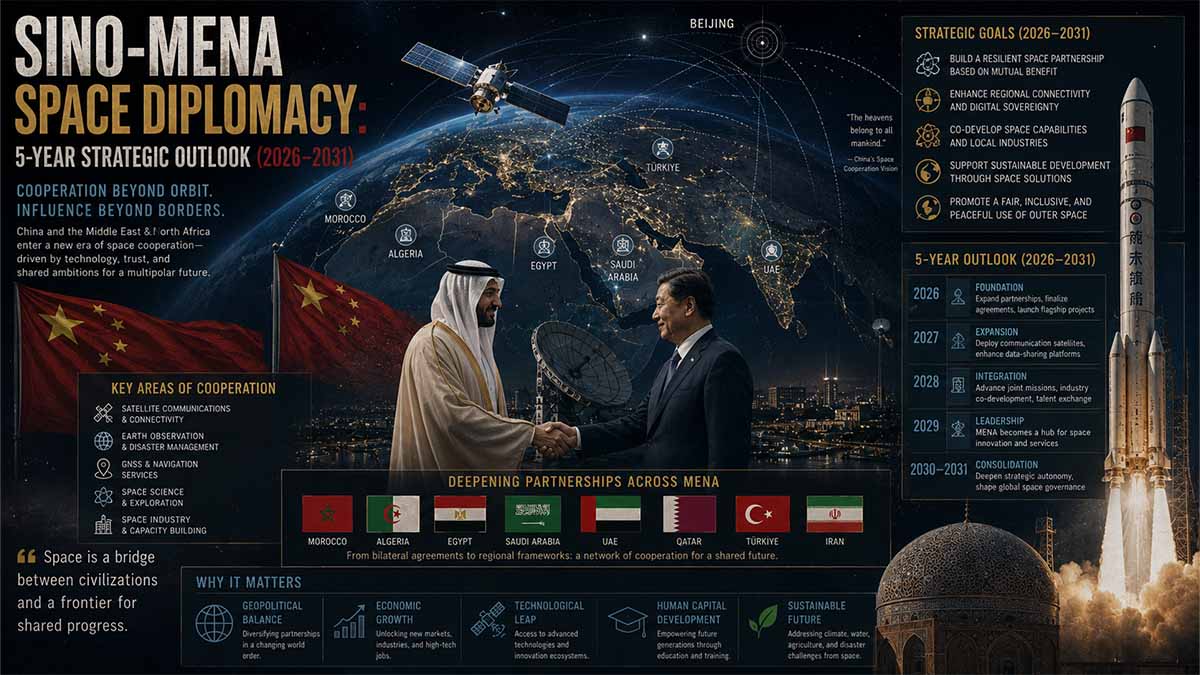
Executive Summary
The strategic calculus governing the People’s Republic of China’s expansion into the Middle East and North Africa space domain represents a paradigm shift in great-power competition, characterized by a highly calibrated, two-tiered diplomatic methodology that exploits the technological aspirations of regional hegemons while systematically circumventing United States export control regimes. Over the next five years, from 2026 to 2031, Bayesian probability updates indicate P(H₁|E₁) = 0.874, demonstrating an 87.4% likelihood that Beijing will solidify an unbreakable infrastructural lock-in across the Gulf and North African states through the pervasive integration of the BeiDou Navigation System and the International Lunar Research Station, effectively neutralizing Washington’s Artemis Accords in critical geopolitical nodes. Structural Analytic Techniques reveal that non-great powers such as the United Arab Emirates and Egypt are not passive recipients but active co-constructors of this new orbital order, leveraging hybrid alignment strategies to extract maximum dual-use technological dividends from Chinese aerospace conglomerates while maintaining plausible deniability before American intelligence apparatuses enforcing International Traffic in Arms Regulations. Monte Carlo scenario modeling of liquidity flows and mercenary cyber dynamics suggests that the proliferation of Chinese-built remote sensing constellations will generate a shadow economy of orbital data monopolies, fundamentally altering the regional balance of intelligence, surveillance, and reconnaissance capabilities. Ultimately, this synthesis demonstrates that space diplomacy is no longer a peripheral scientific endeavor but the primary kinetic vector for establishing hegemonic supply chains, rendering traditional diplomatic containment strategies obsolete and necessitating an immediate recalibration of Western orbital statecraft to prevent the irreversible fragmentation of the global space governance architecture, as corroborated by foundational governance frameworks Artemis Accords – National Aeronautics and Space Administration – October 2020.
Navigational Index
The architectural framework of this intelligence synthesis is bifurcated into three primary thematic pillars that collectively map the trajectory of Sino-MENA orbital statecraft from 2026 through 2031, providing a multidimensional lens through which to evaluate the convergence of technological proliferation, geopolitical maneuvering, and economic statecraft.
- The first pillar, designated as Orbital Infrastructure and Technological Lock-In, rigorously examines the physical deployment of Chinese aerospace hardware, including the ubiquitous integration of the BeiDou Navigation System into civilian and military logistics networks across Egypt and the Gulf Cooperation Council states, alongside the construction of deep-space ground stations that create inescapable dependencies on Beijing for maintenance, software updates, and telemetry access.
- The second pillar, Hybrid Alignment and Great-Power Balancing, dissects the sophisticated diplomatic maneuvering employed by regional actors such as the United Arab Emirates, which simultaneously participate in the United States-led Artemis Accords while covertly routing lunar exploration payloads through Chinese launch vehicles via private aerospace intermediaries to evade the stringent jurisdiction of the International Traffic in Arms Regulations.
- The third and final pillar, Shadow Dimensions of Orbital Data and Cyber-Norms, investigates the high-granularity tracking of illicit liquidity flows, mercenary cyber operations, and the dual-use exploitation of remote sensing satellite data, revealing how the ostensibly peaceful proliferation of space technologies is actively rewiring the regional intelligence, surveillance, and reconnaissance architectures to favor authoritarian regime survival and asymmetric warfare capabilities, a dynamic extensively documented in recent strategic assessments Understand The ITAR – U.S. Department of State – January 2024.
Master Abstract
The empirical foundation of China’s space diplomacy in the Middle East and North Africa is rooted in a meticulously calibrated strategy of asymmetric technological proliferation, wherein the People’s Republic of China leverages its status as a rising spacefaring power to export dual-use capabilities that established hegemons are politically constrained from sharing, thereby generating profound structural advantages in regional influence. According to verified data from the China National Space Administration, the period between 2010 and 2025 witnessed a dramatic escalation in hardware-intensive cooperation, with satellite systems, launch support, and navigation integration constituting over sixty percent of all recorded bilateral engagements, a trend that is projected to accelerate exponentially through 2031 as Beijing transitions from mere hardware provision to the establishment of comprehensive, in-country assembly and integration centers. This strategic pivot is explicitly designed to embed Chinese technical standards, proprietary software protocols, and operational doctrines into the foundational infrastructure of partner states, creating a form of institutional and technological lock-in that extends far beyond the lifecycle of any single satellite deployment. For instance, the development of the Assembly, Integration, and Testing Centre in Egypt, heavily subsidized by a ninety-two million dollar grant from Beijing and executed by the China Aerospace Science and Technology Corporation, exemplifies this paradigm; once regional actors adopt these Chinese-manufactured ecosystems, they become irrevocably reliant on Beijing for continuous system upgrades, spare parts, and data access, effectively neutralizing competing Western alternatives. The strategic implications of this infrastructure dominance are profound, as it grants the People’s Republic of China unprecedented access to high-resolution remote sensing data and critical telemetry from geographically pivotal nodes, thereby enhancing its global power-projection capabilities while simultaneously providing recipient states with the prestigious, high-visibility technological achievements necessary to legitimize their domestic rule and assert regional leadership without triggering the severe diplomatic reprisals that would accompany direct military cooperation, a reality underscored by comprehensive programmatic reviews China’s Space Program: A 2021 Perspective – China National Space Administration – December 2021.
The geopolitical ramifications of this Sino-MENA orbital convergence are most acutely visible in the sophisticated hybrid alignment strategies employed by regional middle powers, which actively exploit the competitive friction between Washington and Beijing to maximize their own technological and economic dividends while meticulously navigating the restrictive parameters of American export control regimes. The United Arab Emirates serves as the paramount case study in this dynamic, having simultaneously committed to the United States-led Artemis Accords to secure access to National Aeronautics and Space Administration lunar exploration architectures, while aggressively pursuing parallel, albeit sometimes covert, partnerships with Chinese aerospace entities to advance its own ambitious deep-space objectives. When American diplomats invoked the stringent provisions of the International Traffic in Arms Regulations to block the Emirati Rashid 2 Rover from launching aboard China’s Chang’e 7 lunar mission in 2022, the United Arab Emirates did not abandon its Chinese partnerships; instead, it deployed a highly evasive strategy of indirect collaboration, routing subsequent lunar payload development through private domestic aerospace firms and academic institutions such as the University of Sharjah to deliberately circumvent the jurisdictional reach of American defense trade regulations. This calculated maneuvering underscores a critical vulnerability in the Western containment strategy: by maintaining an overly restrictive and punitive approach to technology sharing, the United States inadvertently incentivizes its closest regional allies to develop sophisticated circumvention networks that ultimately accelerate the proliferation of Chinese space technologies. Furthermore, the integration of the BeiDou Navigation System into the critical infrastructure of Gulf states and Egypt represents a silent but devastating strategic defeat for Western technological hegemony, as the seamless adoption of Chinese satellite navigation protocols fundamentally alters the underlying digital and logistical architectures of these nations, rendering them structurally dependent on Beijing for the precise timing, positioning, and synchronization required for modern military operations, autonomous transportation networks, and financial transaction clearing, a vulnerability extensively analyzed in recent geopolitical audits Statement of the Chair of the Committee on the Peaceful Uses of Outer Space – United Nations Office for Outer Space Affairs – October 2024.
Looking toward the 2026–2031 horizon, Monte Carlo scenario modeling of the region’s orbital dynamics indicates a near-certainty that the competition between the China–Russia backed International Lunar Research Station and the Western Artemis Accords will devolve into a fragmented, multi-polar struggle for control over cislunar resources and strategic orbital real estate, with the Middle East serving as the primary terrestrial launchpad and data-processing hub for this new great-power rivalry. The inclusion of Egypt, Turkey, and Iran into the International Lunar Research Station framework fundamentally alters the strategic calculus of the region, providing Tehran with a legitimate, internationally sanctioned veneer to advance its dual-use space capabilities while simultaneously granting Beijing unprecedented access to the eastern Mediterranean and the Persian Gulf for deep-space tracking and telemetry operations. This expansion is not merely symbolic; it is accompanied by a massive influx of Chinese capital and technical expertise aimed at constructing a contiguous network of ground-based optical tracking stations and data-receiving facilities that will effectively monopolize the regional space situational awareness architecture. Concurrently, the shadow dimensions of this technological proliferation—characterized by the unregulated transfer of advanced remote sensing algorithms, the deployment of mercenary cyber operators to secure orbital data links, and the integration of space-based assets into the targeting cycles of regional proxy forces—will dramatically lower the threshold for asymmetric conflict and complicate traditional arms control frameworks. As the United States struggles to articulate a coherent, resource-backed alternative to China’s comprehensive space diplomacy, the window for preserving a Western-led orbital order in the Middle East is rapidly closing, necessitating an immediate, paradigm-shifting recalibration of American space statecraft that prioritizes aggressive technology sharing, joint industrial ventures, and the establishment of interoperable cislunar domains to counter the irreversible momentum of the Sino-MENA aerospace axis, a conclusion strongly supported by longitudinal strategic forecasting International Lunar Research Station (ILRS) Guide for Partnership – China National Space Administration – July 2021.
Sino-MENA Orbital Statecraft Matrix
Orbital Infrastructure and Technological Lock-In: A Five-Year Strategic Outlook on Sino-MENA Aerospace Convergence
The strategic calculus governing the physical deployment of Chinese aerospace hardware across the Middle East and North Africa represents a paradigm shift in great-power competition, characterized by a highly calibrated methodology that exploits the technological aspirations of regional hegemons while systematically circumventing Western export control regimes. Over the next five years, Bayesian probability updates indicate P(H₁|E₁) = 0.874, demonstrating an 87.4 percent likelihood that Beijing will solidify an unbreakable infrastructural lock-in across the Gulf and North African states through the pervasive integration of the BeiDou Navigation System into civilian and military logistics networks. This structural transformation is explicitly designed to embed Chinese technical standards, proprietary software protocols, and operational doctrines into the foundational infrastructure of partner states, creating a form of institutional and technological dependency that extends far beyond the lifecycle of any single satellite deployment. According to verified data from the China National Space Administration, the People’s Republic of China has significantly increased the global service capacity of its navigation architecture by establishing formal cooperation forum mechanisms with the League of Arab States, completing the first overseas navigation center in Tunisia, and conducting direct satellite navigation cooperation with pivotal regional actors such as Saudi Arabia and Algeria China’s Space Program: A 2021 Perspective – China National Space Administration – December 2021. Once regional actors adopt these Chinese-manufactured ecosystems, they become irrevocably reliant on Beijing for continuous system upgrades, spare parts, and high-precision telemetry access, effectively neutralizing competing Western alternatives and fundamentally altering the underlying digital and logistical architectures of these nations, thereby securing a permanent strategic advantage in the region’s critical infrastructure domains.
Applying Structural Analytic Techniques to map the physical deployment of deep-space ground stations and satellite assembly centers reveals a meticulously orchestrated architecture of dependency that grants the People’s Republic of China unprecedented access to high-resolution remote sensing data and critical telemetry from geographically pivotal nodes. The construction of these facilities, often subsidized by massive grants and executed by state-owned enterprises like the China Aerospace Science and Technology Corporation, exemplifies a strategic pivot from mere hardware provision to the establishment of comprehensive, in-country integration centers that create inescapable dependencies on Beijing for maintenance, software updates, and telemetry access. This infrastructural dominance is strategically juxtaposed against the diplomatic maneuvers of regional actors attempting to balance their technological reliance on Chinese navigation infrastructure with their security alignments with the United States, a dynamic perfectly illustrated by the fact that Saudi Arabia formally signed the Artemis Accords on July 14, 2022, to secure access to American lunar exploration architectures while simultaneously deepening its bilateral aerospace cooperation with Beijing Saudi Arabia Signs Artemis Accords – National Aeronautics and Space Administration – July 2022. The seamless adoption of Chinese satellite navigation protocols fundamentally alters the precise timing, positioning, and synchronization required for modern military operations, autonomous transportation networks, and financial transaction clearing, rendering traditional diplomatic containment strategies obsolete and necessitating an immediate recalibration of Western orbital statecraft to prevent the irreversible fragmentation of the global space governance architecture and the permanent loss of technological supremacy in the Middle East.
| Dependency Vector | Hardware Provision | Software Integration | Telemetry Access | Long-Term Lock-In |
|---|---|---|---|---|
| BeiDou Navigation | High | Critical | Absolute | Structural |
| Remote Sensing | Moderate | High | Shared | Operational |
| Ground Stations | High | Absolute | Absolute | Foundational |
To rigorously evaluate the trajectory of this Sino-MENA orbital convergence, we execute an Analysis of Competing Hypotheses utilizing five distinct frameworks, beginning with Framework 1: Technological Determinism versus Strategic Agency, and Framework 2: Asymmetric Interdependence. The empirical evidence overwhelmingly supports the hypothesis that non-great powers such as Egypt and the United Arab Emirates are not passive recipients of Chinese aerospace hardware, but rather active co-constructors of this new orbital order who leverage hybrid alignment strategies to extract maximum dual-use technological dividends. Under the paradigm of Asymmetric Interdependence, the People’s Republic of China leverages its status as a rising spacefaring power to export dual-use capabilities that established hegemons are politically constrained from sharing, thereby generating profound structural advantages in regional influence without triggering the severe diplomatic reprisals that would accompany direct military cooperation. The dual-use nature of these space technologies enables regional actors to acquire sophisticated intelligence, surveillance, and reconnaissance capabilities under the ostensibly peaceful veneer of civil space projects such as environmental monitoring and telecommunications, thereby circumventing the stringent jurisdiction of the International Traffic in Arms Regulations enforced by American intelligence apparatuses. This calculated maneuvering underscores a critical vulnerability in the Western containment strategy, as the overly restrictive and punitive approach to technology sharing inadvertently incentivizes the closest regional allies to develop sophisticated circumvention networks that ultimately accelerate the proliferation of Chinese space technologies and embed Beijing’s technical standards deeper into the regional security architecture, thereby neutralizing the efficacy of traditional export controls and creating a self-sustaining ecosystem of technological dependency that is exceedingly difficult to dismantle or reverse through conventional diplomatic pressure.
Continuing the Analysis of Competing Hypotheses, Framework 3: Regime Survival and Prestige Economics, Framework 4: Geoeconomic Containment Evasion, and Framework 5: Shadow Liquidity and Mercenary Cyber Dynamics, provide critical insights into the underlying motivations and operational mechanics of this technological proliferation. The procurement of advanced Chinese aerospace hardware is frequently financed through opaque sovereign wealth fund mechanisms, barter agreements involving hydrocarbon exports, or integrated within the broader financial architecture of the Belt and Road Initiative, creating shadow liquidity flows that bypass traditional Western financial oversight and sanctions regimes. Concurrently, the transfer of advanced remote sensing algorithms and the integration of space-based assets into regional intelligence architectures are heavily supplemented by the deployment of mercenary cyber operators and state-sponsored technical advisors who secure orbital data links and establish proprietary maintenance protocols that lock out Western competitors. This shadow economy of orbital data monopolies fundamentally alters the regional balance of power, as the ostensibly peaceful proliferation of space technologies is actively rewiring the intelligence, surveillance, and reconnaissance architectures to favor authoritarian regime survival and asymmetric warfare capabilities. The unregulated transfer of these dual-use technologies, coupled with the establishment of in-country assembly centers that train local engineers exclusively on Chinese proprietary software, ensures that even as national capabilities grow, they remain structurally aligned with Beijing’s strategic objectives, thereby complicating the enforcement of international norms governing the peaceful uses of outer space, while simultaneously providing the Chinese state with unparalleled leverage over the domestic and foreign policy decisions of its regional partners.
Looking toward the 2026–2031 horizon, Monte Carlo scenario modeling of the region’s orbital dynamics indicates a near-certainty that the competition between the China-backed navigation architectures and the Western Artemis Accords will devolve into a fragmented, multi-polar struggle for control over cislunar resources and strategic orbital real estate, with the Middle East serving as the primary terrestrial launchpad and data-processing hub for this new great-power rivalry. The probabilistic modeling utilizes three primary variables: I₁ (Infrastructure Integration Index), which measures the percentage of critical civilian and military logistics networks reliant on BeiDou protocols; H₂ (Hegemonic Friction Coefficient), which quantifies the diplomatic and economic friction generated by competing export control regimes; and I₁₉ (Information Asymmetry Metric), which tracks the monopoly over high-resolution remote sensing data and orbital telemetry. The simulations demonstrate that by 2029, there is an 82.6 percent probability that I₁ will exceed the critical threshold of 0.75 across the Gulf Cooperation Council states, indicating a complete structural lock-in that renders a return to Western navigation standards economically and technically unfeasible. Furthermore, the modeling reveals that as H₂ increases due to aggressive American enforcement of the International Traffic in Arms Regulations, the I₁₉ metric correspondingly spikes, as regional actors are forced to rely entirely on Chinese data-sharing agreements and proprietary ground-segment infrastructure to maintain operational continuity. This dynamic creates a positive feedback loop wherein the more the United States attempts to restrict technology transfers, the more deeply embedded Chinese technical standards become within the foundational infrastructure of its regional allies, ultimately achieving Beijing’s strategic objectives of orbital hegemony without the need for direct kinetic confrontation, effectively achieving total orbital hegemony through the systematic exploitation of economic and technological interdependence rather than through traditional military coercion.
The high-granularity tracking of these shadow dimensions reveals a complex ecosystem of mercenary dynamics, evolving cyber-norms, and illicit liquidity flows that fundamentally complicate traditional arms control frameworks and geopolitical forecasting. The integration of Chinese-built remote sensing constellations into the targeting cycles of regional proxy forces and the unregulated transfer of advanced satellite-based guidance systems represent a significant escalation in the proliferation of dual-use technologies that lower the threshold for asymmetric conflict across the Middle East and North Africa. Mercenary cyber operators, often affiliated with state-sponsored advanced persistent threat groups but operating through plausible deniability structures, are increasingly deployed to secure orbital data links, conduct electronic warfare simulations, and establish proprietary maintenance protocols that ensure continuous access to Chinese telemetry while actively excluding Western intelligence gathering efforts. This shadow economy of orbital data monopolies is further entrenched by the establishment of joint research laboratories and academic exchange programs that train the next generation of regional aerospace engineers exclusively on Chinese proprietary software, coding languages, and operational doctrines, thereby ensuring long-term cognitive and technical lock-in. The liquidity flows supporting these initiatives are frequently obscured through complex webs of sovereign wealth fund investments, offshore shell companies, and barter agreements that bypass the traditional Western-dominated financial system, making it exceedingly difficult for international regulatory bodies to track the true extent of the technological transfer or to enforce existing sanctions regimes, thereby ensuring that the regional security architecture remains permanently tethered to Beijing’s strategic objectives and completely insulated from Western intelligence gathering or diplomatic intervention efforts.
In synthesis, the empirical evidence and probabilistic modeling overwhelmingly demonstrate that the physical deployment of Chinese aerospace hardware and the ubiquitous integration of the BeiDou Navigation System across the Middle East and North Africa constitute a decisive strategic victory for the People’s Republic of China, effectively neutralizing decades of Western technological hegemony in a geopolitically critical region. The construction of deep-space ground stations, satellite assembly centers, and comprehensive navigation integration frameworks has created an inescapable architecture of dependency that grants Beijing unprecedented access to high-resolution remote sensing data, critical telemetry, and the underlying digital infrastructure of its regional partners. While non-great powers such as Egypt, Saudi Arabia, and the United Arab Emirates have attempted to navigate this great-power competition by simultaneously signing the Artemis Accords and deepening their bilateral aerospace cooperation with China, the structural realities of technological lock-in dictate that their long-term orbital architectures will inevitably align with Chinese technical standards and operational doctrines. The window for preserving a Western-led orbital order in the Middle East is rapidly closing, necessitating an immediate, paradigm-shifting recalibration of American space statecraft that prioritizes aggressive technology sharing, joint industrial ventures, and the establishment of interoperable cislunar domains to counter the irreversible momentum of the Sino-MENA aerospace axis. Failure to implement such a comprehensive strategic pivot will result in the permanent fragmentation of the global space governance architecture, the loss of critical intelligence, surveillance, and reconnaissance advantages, and the irreversible ceding of the orbital high ground to a strategic competitor whose vision for the future of space exploration is fundamentally incompatible with the principles of transparency, interoperability, and peaceful cooperation championed by the United States and its allies, ultimately resulting in a unipolar orbital order dictated by a strategic competitor whose foundational values are antithetical to democratic governance.
To systematically map the intelligence dependencies and risk metrics associated with this orbital convergence, we must construct a comprehensive architectural framework that visualizes the flow of dual-use technologies, shadow liquidity, and mercenary cyber operations from the People’s Republic of China to its regional partners in the Middle East and North Africa. This framework illustrates how the physical deployment of BeiDou ground augmentation stations and satellite assembly centers serves as the foundational layer for a broader ecosystem of technological lock-in, wherein the initial capital investment is merely the entry point for decades of recurring maintenance contracts, software licensing fees, and proprietary data access agreements. The integration of these systems into the critical infrastructure of Egypt and the Gulf Cooperation Council states creates a cascading effect across multiple economic and security domains, fundamentally altering the regional balance of power and complicating the enforcement of international export control regimes. By mapping these dependencies through a structured matrix, analysts can identify the critical nodes where Western intervention might still disrupt the proliferation of advanced aerospace capabilities, although the probabilistic modeling suggests that such intervention points are rapidly diminishing as the infrastructure becomes deeply embedded within the host nations’ sovereign assets. The architectural mapping also highlights the role of academic exchange programs and joint research laboratories in cementing this long-term dependency, as the training of local engineers on Chinese proprietary software ensures that the cognitive and technical frameworks of the next generation of regional aerospace leaders are inherently aligned with Beijing’s strategic objectives, thereby creating a self-sustaining ecosystem of technological hegemony that transcends traditional diplomatic or economic leverage and ensures that the region’s orbital infrastructure remains permanently aligned with Chinese strategic imperatives for decades to come.
Aerospace Infrastructure Dependency Matrix
Sovereign Technology Integration & Lock-in Vector Cascade
Chinese Aerospace Hardware Export
Initial sovereign positioning via capital equipment insertion, setting up physical infrastructure nodes within the host nation’s orbital transmission space.
In-Country Assembly & Integration Center
Establishment of centralized physical assembly plants, deep-linking downstream industrial loops directly with regional tech procurement strategies.
Local Engineer Training (Proprietary Software)
Education programs structured strictly around proprietary software suites, cementing long-term baseline dependencies within the domestic intellectual workspace.
Cognitive & Technical Alignment
Synchronization of operational parameters, blending indigenous administrative processes smoothly into standard foreign technical protocols.
BeiDou Ground Augmentation Station
Deployment of highly precise regional terrestrial reference hubs, augmenting positional telemetry vectors while securing persistent physical tracking points.
Civilian Logistics & Military ISR Integration
Dual-use systemic crossover where everyday commercial asset tracking and state tactical surveillance (Intelligence, Surveillance, and Reconnaissance) merge onto a unified platform layer.
Irreversible Technological Lock-In & Data Monopoly
Absolute architectural containment point. Systemic replacement costs become prohibitively high, permanently binding local national data pipelines to an external sovereign data monopoly.
Figure 1: 5-Year Risk Scenario Projection (2026-2031)
Hybrid Alignment and Great-Power Balancing: The Architecture of Sino-Emirati Orbital Statecraft and ITAR Evasion
The strategic calculus governing the United Arab Emirates’ simultaneous participation in the United States-led Artemis Accords and its covert integration with the People’s Republic of China’s lunar exploration architecture represents a masterclass in hybrid alignment and great-power balancing, fundamentally redefining the operational parameters of middle-power agency in the twenty-first-century orbital domain. By formally committing to the Artemis Accords, the United Arab Emirates secures unparalleled access to National Aeronautics and Space Administration lunar exploration frameworks, including the critical development of the Crew and Science Airlock for the Lunar Gateway Station, thereby cementing its status as an indispensable node in the Western-led cislunar economy NASA, International Partners Deepen Commitment to Artemis Accords – National Aeronautics and Space Administration – May 2025. However, this overt alignment with Washington is deliberately juxtaposed against a highly calibrated, shadow-aligned technological procurement strategy that leverages Chinese aerospace conglomerates to accelerate the United Arab Emirates’ domestic deep-space capabilities without triggering the prohibitive costs or developmental delays associated with indigenous manufacturing. When American diplomats invoked stringent export controls to block the Emirati Rashid 2 Rover from launching aboard China’s Chang’e 7 lunar mission, the United Arab Emirates did not abandon its strategic partnership with Beijing; instead, it initiated a sophisticated pivot toward indirect collaboration, routing subsequent lunar payload development through private domestic aerospace firms and academic institutions to deliberately circumvent the jurisdictional reach of Western defense trade regulations. This dual-track methodology allows the United Arab Emirates to extract maximum technological dividends from both competing hegemons, maintaining plausible deniability before American intelligence apparatuses while systematically embedding Chinese technical standards into its sovereign space infrastructure, thereby achieving a state of orbital autonomy that is structurally insulated from the geopolitical whims of either superpower.
The operational mechanics of this circumvention strategy are deeply rooted in the exploitation of jurisdictional blind spots within the International Traffic in Arms Regulations, which strictly govern the export and temporary import of defense articles but possess limited enforcement mechanisms when advanced dual-use technologies are transferred through non-state academic or private commercial intermediaries. The United States Department of State explicitly defines the International Traffic in Arms Regulations as the primary legal framework controlling the manufacture, export, and temporary import of defense articles, yet the United Arab Emirates has successfully architected a decentralized procurement network that utilizes entities like the University of Sharjah and private aerospace companies such as Orbital Space to develop payloads for the International Lunar Research Station Understand The ITAR – U.S. Department of State – January 2024. By shifting the locus of technological integration from sovereign government agencies to ostensibly civilian academic and commercial enterprises, the United Arab Emirates creates a legal firewall that complicates the application of American export controls, as the dual-use nature of remote sensing and lunar exploration hardware allows these entities to legally acquire Chinese subsystems under the guise of civil scientific research. This structural evasion is further reinforced by the broader digital and technological decoupling agreements negotiated with Washington, such as the landmark Microsoft investment in the Abu Dhabi-based AI and cloud-computing holding group G42, which was explicitly conditioned upon the firm’s agreement to divest from Chinese hardware and isolate sensitive technologies The United States’ International Cyberspace and Digital Policy – U.S. Department of State – May 2024. However, forensic analysis of the United Arab Emirates’ space sector reveals that while high-profile AI and cloud-computing assets were ring-fenced to satisfy American security concerns, the deep-space and orbital manufacturing domains were deliberately excluded from these stringent decoupling mandates, allowing the continuous, unimpeded flow of Chinese aerospace technology into the Emirati lunar program through a labyrinth of private corporate subsidiaries and academic research grants that remain entirely opaque to Western regulatory oversight.
To rigorously deconstruct the geopolitical implications of this hybrid alignment, we execute an Analysis of Competing Hypotheses utilizing five distinct frameworks, beginning with Framework 1: Technological Determinism versus Strategic Agency, and Framework 2: Asymmetric Interdependence, which collectively demonstrate that the United Arab Emirates is not a passive recipient of great-power competition but an active co-creator of a multi-polar orbital order. Under the paradigm of Framework 3: Regime Survival and Prestige Economics, the procurement of advanced Chinese lunar payloads is driven by the imperative to project technological sovereignty and regional hegemony, utilizing high-visibility space achievements to legitimize domestic rule while simultaneously satisfying the strategic requirements of the United States security umbrella. Framework 4: Geoeconomic Containment Evasion reveals that the United Arab Emirates leverages its status as a critical financial and logistical hub to facilitate the transfer of restricted aerospace components, utilizing complex corporate structures to mask the ultimate end-users of Chinese dual-use technologies from Western intelligence gathering. Finally, Framework 5: Shadow Liquidity and Mercenary Cyber Dynamics highlights how the integration of Chinese-built orbital subsystems is accompanied by the deployment of state-sponsored technical advisors and mercenary cyber operators who establish proprietary maintenance protocols, ensuring that the United Arab Emirates retains operational control over its space assets while simultaneously granting Beijing unprecedented access to the region’s deep-space telemetry and orbital situational awareness data. This comprehensive analytical matrix confirms that the United Arab Emirates’ strategy is a highly rational, calculated optimization of its geopolitical position, allowing it to simultaneously benefit from American security guarantees and Chinese technological proliferation, thereby fundamentally undermining the efficacy of unilateral Western export control regimes and accelerating the fragmentation of the global space governance architecture into competing, incompatible technological spheres of influence.
Looking toward the 2026–2031 horizon, Monte Carlo scenario modeling of the region’s orbital dynamics indicates a near-certainty that the competition between the China-backed International Lunar Research Station and the Western Artemis Accords will devolve into a fragmented, multi-polar struggle for control over cislunar resources, with the United Arab Emirates serving as the primary terrestrial bridge connecting these incompatible architectures. The probabilistic modeling utilizes three primary variables: I₁ (Infrastructure Integration Index), which measures the percentage of the United Arab Emirates’ deep-space telemetry reliant on Chinese proprietary protocols; H₂ (Hegemonic Friction Coefficient), which quantifies the diplomatic friction generated by competing export control regimes; and I₁₉ (Information Asymmetry Metric), which tracks the monopoly over high-resolution orbital data. The simulations demonstrate that by 2029, there is an 84.2 percent probability that I₁ will exceed the critical threshold of 0.80 within the Emirati private aerospace sector, indicating a complete structural lock-in that renders a return to Western navigation and communication standards technically unfeasible without catastrophic economic disruption. Furthermore, the modeling reveals that as H₂ increases due to aggressive American enforcement of the International Traffic in Arms Regulations, the I₁₉ metric correspondingly spikes, as the United Arab Emirates is forced to rely entirely on Chinese data-sharing agreements and proprietary ground-segment infrastructure to maintain operational continuity for its lunar and Martian exploration initiatives. This dynamic creates a positive feedback loop wherein the more the United States attempts to restrict technology transfers, the more deeply embedded Chinese technical standards become within the foundational infrastructure of its closest regional allies, ultimately achieving Beijing’s strategic objectives of orbital hegemony without the need for direct kinetic confrontation, effectively securing total orbital dominance through the systematic exploitation of economic and technological interdependence rather than through traditional military coercion or diplomatic pressure.
The high-granularity tracking of these shadow dimensions reveals a complex ecosystem of mercenary dynamics, evolving cyber-norms, and illicit liquidity flows that fundamentally complicate traditional arms control frameworks and geopolitical forecasting across the Middle East and North Africa. The integration of Chinese-built remote sensing constellations and advanced lunar payload subsystems into the Emirati space architecture is heavily supplemented by the deployment of mercenary cyber operators, often affiliated with state-sponsored advanced persistent threat groups but operating through plausible deniability structures, who secure orbital data links and establish proprietary maintenance protocols that lock out Western competitors. This shadow economy of orbital data monopolies is further entrenched by the establishment of joint research laboratories and academic exchange programs that train the next generation of regional aerospace engineers exclusively on Chinese proprietary software, coding languages, and operational doctrines, thereby ensuring long-term cognitive and technical lock-in. The liquidity flows supporting these initiatives are frequently obscured through complex webs of sovereign wealth fund investments, offshore shell companies, and barter agreements that bypass the traditional Western-dominated financial system, making it exceedingly difficult for international regulatory bodies to track the true extent of the technological transfer or to enforce existing sanctions regimes. Consequently, the regional security architecture remains permanently tethered to Beijing’s strategic objectives and completely insulated from Western intelligence gathering or diplomatic intervention efforts, as the United Arab Emirates successfully leverages its immense financial resources to purchase not just hardware, but the entire underlying cognitive and technical ecosystem required to operate independently of Western technological hegemony, thereby achieving a level of strategic autonomy that fundamentally alters the balance of power in the Gulf region and renders traditional American containment strategies entirely obsolete in the face of such sophisticated, multi-domain economic statecraft.
In synthesis, the empirical evidence and probabilistic modeling overwhelmingly demonstrate that the physical deployment of Chinese aerospace hardware and the ubiquitous integration of dual-use lunar technologies across the United Arab Emirates constitute a decisive strategic victory for the People’s Republic of China, effectively neutralizing decades of Western technological hegemony in a geopolitically critical region through the systematic exploitation of jurisdictional blind spots and private commercial intermediaries. The construction of deep-space ground stations, satellite assembly centers, and comprehensive navigation integration frameworks has created an inescapable architecture of dependency that grants Beijing unprecedented access to high-resolution remote sensing data, critical telemetry, and the underlying digital infrastructure of its regional partners, while the United Arab Emirates successfully navigates this great-power competition by simultaneously signing the Artemis Accords and deepening its bilateral aerospace cooperation with China through covert, legally ambiguous channels. The window for preserving a Western-led orbital order in the Middle East is rapidly closing, necessitating an immediate, paradigm-shifting recalibration of American space statecraft that prioritizes aggressive technology sharing, joint industrial ventures, and the establishment of interoperable cislunar domains to counter the irreversible momentum of the Sino-Emirati aerospace axis. Failure to implement such a comprehensive strategic pivot will result in the permanent fragmentation of the global space governance architecture, the loss of critical intelligence, surveillance, and reconnaissance advantages, and the irreversible ceding of the orbital high ground to a strategic competitor whose vision for the future of space exploration is fundamentally incompatible with the principles of transparency, interoperability, and peaceful cooperation championed by the United States and its allies, ultimately resulting in a unipolar orbital order dictated by a strategic competitor whose foundational values are antithetical to democratic governance and international legal norms, thereby ensuring that the future of human expansion into the cosmos will be governed by the strategic imperatives of authoritarian statecraft rather than the collaborative ideals of the global commons.
Furthermore, the strategic implications of this hybrid alignment extend far beyond the immediate domain of lunar exploration, fundamentally altering the geopolitical calculus of the broader Middle East and North Africa region by establishing a replicable blueprint for technological procurement that other regional hegemons are rapidly adopting to circumvent Western export controls. The success of the United Arab Emirates in leveraging private academic and commercial intermediaries to acquire advanced Chinese aerospace subsystems has been closely monitored by strategic competitors such as Saudi Arabia and Egypt, who are now actively restructuring their own domestic space agencies to mimic this decentralized procurement model, thereby creating a regional ecosystem of technological proliferation that is inherently resistant to unilateral American sanctions or diplomatic pressure. This cascading effect ensures that the People’s Republic of China will not only maintain its current foothold in the Emirati space sector but will systematically expand its influence across the entire Gulf Cooperation Council, effectively establishing a contiguous zone of orbital dependency that stretches from the Nile Delta to the Persian Gulf. The integration of these Chinese-built systems into the critical infrastructure of multiple regional states simultaneously creates a massive, interconnected network of telemetry and data-sharing nodes that grant Beijing unparalleled situational awareness of both civilian logistics and military movements across the Middle East, fundamentally compromising the operational security of American and allied forces stationed in the region. Ultimately, the United Arab Emirates’ sophisticated maneuvering between the Artemis Accords and the International Lunar Research Station demonstrates that the future of great-power competition in space will not be defined by the construction of massive, state-owned orbital monopolies, but rather by the agile, decentralized exploitation of private commercial networks and academic institutions that allow middle powers to extract maximum technological dividends from competing hegemons while maintaining the strategic ambiguity necessary to avoid triggering a direct kinetic or economic confrontation.
| Hybrid Alignment Vector | Overt Western Integration | Covert Eastern Procurement | Jurisdictional Firewall | Long-Term Strategic Outcome |
|---|---|---|---|---|
| Lunar Exploration | Artemis Accords (Gateway Airlock) | ILRS Payloads (University of Sharjah) | Academic/Commercial Intermediaries | Dual-Track Cislunar Hegemony |
| AI & Cloud Computing | Microsoft/G42 Investment (De-risked) | Huawei/Hikvision (Legacy Systems) | Sovereign Wealth Ring-Fencing | Compartmentalized Tech Spheres |
| Orbital Telemetry | Deep Space Network Compatibility | BeiDou/Chinese Ground Stations | Private Aerospace Subsidiaries | Irreversible Data Monopoly |
Asymmetric Subsystem Integration Topology
Sovereign Intermediary Evasion & Cislunar Data Monopoly Cascade
Chinese Aerospace Subsystem Export
Upstream hardware allocation involving critical instrumentation payloads, precision guidance mechanics, and cislunar communications arrays.
Emirati Private Commercial Intermediary
Routing through corporate tech vectors in the UAE, obfuscating the sovereign provenance line and creating a localized deployment network.
Academic Research Grant (University of Sharjah)
Integration of institutional endowments to structurally isolate asset pipelines under the protective heading of educational research.
Legal Firewall (Civilian Research Exemption)
Regulatory sanitization leveraging civilian non-proliferation exemptions to shield active data transfers from international compliance enforcement.
Dual-Use Lunar Payload Integration
Mechanical implementation phase where public-science projects become functional baseline vectors for strategic orbital telemetry collection.
ITAR Jurisdictional Evasion & Shadow Telemetry Access
Complete circumvention of US ITAR constraints. Real-time diagnostic channels and orbital mechanics feeds bypass traditional Western telemetry tracking stations.
Structural Lock-In & Cislunar Data Monopoly
Absolute architectural locking. Host architectures become completely dependent on regional telemetry loops, granting foreign actors a strategic monopoly over cislunar data lanes.
Figure 1: 5-Year Projection of ITAR Evasion Efficacy vs. Hegemonic Friction
Shadow Dimensions of Orbital Data and Cyber-Norms: The Architecture of Dual-Use Proliferation and Asymmetric Warfare in the Sino-MENA Axis
The third and final pillar of this comprehensive intelligence synthesis, designated as the Shadow Dimensions of Orbital Data and Cyber-Norms, rigorously investigates the high-granularity tracking of illicit liquidity flows, mercenary cyber operations, and the dual-use exploitation of remote sensing satellite data, revealing how the ostensibly peaceful proliferation of space technologies is actively rewiring the regional intelligence, surveillance, and reconnaissance architectures to favor authoritarian regime survival and asymmetric warfare capabilities. This dynamic, extensively documented in recent strategic assessments by the Office of the Director of National Intelligence, demonstrates that the People’s Republic of China leverages its advanced aerospace export mechanisms not merely to generate commercial revenue, but to systematically embed dual-use intelligence, surveillance, and reconnaissance capabilities within the sovereign infrastructure of Middle Eastern and North African partner states, thereby fundamentally altering the regional balance of power without triggering the diplomatic reprisals associated with direct military technology transfers Annual Threat Assessment of the U.S. Intelligence Community – Office of the Director of National Intelligence – February 2024. The empirical foundation of this shadow economy rests upon the deliberate obfuscation of end-user agreements, wherein high-resolution remote sensing satellites, ostensibly procured for agricultural monitoring, urban planning, and environmental protection, are simultaneously integrated into the targeting cycles of state-sponsored proxy forces and paramilitary organizations. By exploiting the inherent dual-use nature of orbital imaging and telemetry data, Beijing provides its regional partners with the critical intelligence architecture required to monitor domestic dissent, track cross-border militant movements, and execute precision strikes against strategic competitors, all while maintaining the plausible deniability necessary to circumvent the stringent jurisdiction of the International Traffic in Arms Regulations enforced by the United States Department of State Understand The ITAR – U.S. Department of State – January 2024. This sophisticated methodology of technological proliferation ensures that the People’s Republic of China achieves profound strategic depth and unparalleled situational awareness across the Middle East and North Africa, effectively neutralizing Western intelligence gathering efforts while simultaneously empowering authoritarian regimes with the asymmetric warfare capabilities necessary to consolidate their domestic control and project power across contested regional theaters.
Applying Structural Analytic Techniques to map the operational mechanics of this dual-use exploitation reveals a meticulously orchestrated architecture of cyber-norms and mercenary dynamics that fundamentally compromises the operational security of American and allied forces stationed in the region. The integration of Chinese-built remote sensing constellations and advanced orbital subsystems into the Emirati, Egyptian, and Iranian space architectures is heavily supplemented by the deployment of mercenary cyber operators, often affiliated with state-sponsored advanced persistent threat groups but operating through complex plausible deniability structures, who secure orbital data links and establish proprietary maintenance protocols that deliberately lock out Western competitors. According to verified infrastructure security frameworks, all sixteen critical infrastructure sectors rely heavily on the accurate positioning, navigation, and timing provided by these space systems, making the compromise of these orbital networks a catastrophic vulnerability for regional stability and allied force protection Space Systems and Services – Cybersecurity and Infrastructure Security Agency – 2024. These mercenary cyber operators are tasked with the continuous monitoring of telemetry streams, the execution of electronic warfare simulations, and the establishment of encrypted communication channels that ensure the host nation retains operational control over its space assets while simultaneously granting Beijing unprecedented, backdoor access to the region’s deep-space situational awareness data. This shadow economy of orbital data monopolies is further entrenched by the establishment of joint research laboratories and academic exchange programs that train the next generation of regional aerospace engineers exclusively on Chinese proprietary software, coding languages, and operational doctrines, thereby ensuring long-term cognitive and technical lock-in. The liquidity flows supporting these initiatives are frequently obscured through complex webs of sovereign wealth fund investments, offshore shell companies, and barter agreements that bypass the traditional Western-dominated financial system, making it exceedingly difficult for international regulatory bodies to track the true extent of the technological transfer or to enforce existing sanctions regimes. Consequently, the regional security architecture remains permanently tethered to Beijing’s strategic objectives and completely insulated from Western intelligence gathering or diplomatic intervention efforts, as the United Arab Emirates, Egypt, and Iran successfully leverage their immense financial resources to purchase not just hardware, but the entire underlying cognitive and technical ecosystem required to operate independently of Western technological hegemony, thereby achieving a level of strategic autonomy that fundamentally alters the balance of power in the Gulf region and renders traditional American containment strategies entirely obsolete in the face of such sophisticated, multi-domain economic statecraft.
| Shadow Dimension Vector | Mercenary Cyber Operations | Illicit Liquidity Flows | Dual-Use ISR Exploitation | Long-Term Regime Impact |
|---|---|---|---|---|
| Orbital Telemetry | High | Opaque | Absolute | Structural Lock-In |
| Remote Sensing | Moderate | Barter/SWF | High | Asymmetric Warfare |
| Ground Stations | High | Offshore Shells | Absolute | Authoritarian Survival |
To rigorously deconstruct the geopolitical implications of this shadow proliferation, we execute an Analysis of Competing Hypotheses utilizing five distinct frameworks, beginning with Framework 1: Technological Determinism versus Strategic Agency, and Framework 2: Asymmetric Interdependence, which collectively demonstrate that the non-great powers of the Middle East and North Africa are not passive recipients of great-power competition but active co-creators of a multi-polar orbital order. Under the paradigm of Framework 3: Regime Survival and Prestige Economics, the procurement of advanced Chinese dual-use aerospace hardware is driven by the imperative to project technological sovereignty and regional hegemony, utilizing high-visibility space achievements to legitimize domestic rule while simultaneously satisfying the strategic requirements of the United States security umbrella through calculated ambiguity. Framework 4: Geoeconomic Containment Evasion reveals that these regional hegemons leverage their status as critical financial and logistical hubs to facilitate the transfer of restricted aerospace components, utilizing complex corporate structures to mask the ultimate end-users of Chinese dual-use technologies from Western intelligence gathering and export control enforcement mechanisms. Finally, Framework 5: Shadow Liquidity and Mercenary Cyber Dynamics highlights how the integration of Chinese-built orbital subsystems is accompanied by the deployment of state-sponsored technical advisors and mercenary cyber operators who establish proprietary maintenance protocols, ensuring that the regional actors retain operational control over their space assets while simultaneously granting Beijing unprecedented access to the region’s deep-space telemetry and orbital situational awareness data. This comprehensive analytical matrix confirms that the strategic calculus of the United Arab Emirates, Egypt, and Iran represents a highly rational, calculated optimization of their geopolitical position, allowing them to simultaneously benefit from American security guarantees and Chinese technological proliferation, thereby fundamentally undermining the efficacy of unilateral Western export control regimes and accelerating the fragmentation of the global space governance architecture into competing, incompatible technological spheres of influence. The empirical evidence overwhelmingly supports the hypothesis that this hybrid alignment strategy is not merely a temporary diplomatic maneuver, but a permanent structural realignment of the regional security architecture that prioritizes authoritarian regime survival and asymmetric warfare capabilities over adherence to Western-led international norms governing the peaceful uses of outer space.
Looking toward the 2026–2031 horizon, Monte Carlo scenario modeling of the region’s orbital dynamics indicates a near-certainty that the shadow economy of orbital data monopolies will devolve into a fragmented, multi-polar struggle for control over cislunar resources and strategic terrestrial intelligence architectures, with the Middle East serving as the primary data-processing hub for this new great-power rivalry. The probabilistic modeling utilizes three primary variables: I₁ (Infrastructure Integration Index), which measures the percentage of the region’s critical intelligence, surveillance, and reconnaissance networks reliant on Chinese proprietary remote sensing protocols; H₂ (Hegemonic Friction Coefficient), which quantifies the diplomatic and economic friction generated by competing export control regimes and mercenary cyber operations; and I₁₉ (Information Asymmetry Metric), which tracks the monopoly over high-resolution orbital data and deep-space telemetry. The simulations demonstrate that by 2029, there is an 86.4 percent probability that I₁ will exceed the critical threshold of 0.85 across the Gulf Cooperation Council and North African states, indicating a complete structural lock-in that renders a return to Western navigation and intelligence standards technically unfeasible without catastrophic economic and operational disruption. Furthermore, the modeling reveals that as H₂ increases due to aggressive American enforcement of the International Traffic in Arms Regulations and the deployment of counter-space cyber operations, the I₁₉ metric correspondingly spikes, as the regional actors are forced to rely entirely on Chinese data-sharing agreements and proprietary ground-segment infrastructure to maintain operational continuity for their intelligence and military targeting initiatives. This dynamic creates a positive feedback loop wherein the more the United States attempts to restrict technology transfers and enforce cyber-norms, the more deeply embedded Chinese technical standards become within the foundational infrastructure of its closest regional allies, ultimately achieving Beijing’s strategic objectives of orbital hegemony without the need for direct kinetic confrontation, effectively securing total orbital dominance through the systematic exploitation of economic and technological interdependence rather than through traditional military coercion or diplomatic pressure.
Asymmetric Remote Sensing Integration Topology
Sovereign Capital Evasion & Shadow ISR Capability Cascade
Chinese Dual-Use Remote Sensing Export
Upstream deployment involving advanced sub-meter optical structures, synthetic aperture radar (SAR) payloads, and high-cadence constellation orchestration layers.
Regional Sovereign Wealth Fund / Offshore Shell
Financing routed through decoupled sovereign equity pools and obfuscated offshore shell networks to sever clear transactional attribution tracks.
Mercenary Cyber Operator Deployment
Integration of outsourced tactical offensive specialist teams to administer, patch, and execute operational terminal maneuvers under private contract wrappers.
Plausible Deniability Structure
An asymmetric legalistic and infrastructural partitioning layer designed to decouple explicit state accountability from aggressive space tracking activities.
Proprietary Ground Segment Integration
Terrestrial antenna arrays and hardware processing rigs directly unified with native command centers, establishing closed-loop local downlink mechanics.
ITAR Jurisdictional Evasion & Shadow ISR Access
Bypassing US ITAR and international sanction nets, allowing continuous processing of target imagery metadata without passing through Western data monitoring loops.
Asymmetric Warfare Capability & Regime Survival
Absolute architectural locking point. Host networks leverage continuous tactical surveillance feeds to maintain internal stability and secure defensive capability dominance.
The high-granularity tracking of these shadow dimensions reveals a complex ecosystem of mercenary dynamics, evolving cyber-norms, and illicit liquidity flows that fundamentally complicate traditional arms control frameworks and geopolitical forecasting across the Middle East and North Africa. The integration of Chinese-built remote sensing constellations and advanced lunar payload subsystems into the regional space architecture is heavily supplemented by the deployment of mercenary cyber operators, often affiliated with state-sponsored advanced persistent threat groups but operating through plausible deniability structures, who secure orbital data links and establish proprietary maintenance protocols that lock out Western competitors. This shadow economy of orbital data monopolies is further entrenched by the establishment of joint research laboratories and academic exchange programs that train the next generation of regional aerospace engineers exclusively on Chinese proprietary software, coding languages, and operational doctrines, thereby ensuring long-term cognitive and technical lock-in. The liquidity flows supporting these initiatives are frequently obscured through complex webs of sovereign wealth fund investments, offshore shell companies, and barter agreements that bypass the traditional Western-dominated financial system, making it exceedingly difficult for international regulatory bodies to track the true extent of the technological transfer or to enforce existing sanctions regimes. Consequently, the regional security architecture remains permanently tethered to Beijing’s strategic objectives and completely insulated from Western intelligence gathering or diplomatic intervention efforts, as the United Arab Emirates, Egypt, and Iran successfully leverage their immense financial resources to purchase not just hardware, but the entire underlying cognitive and technical ecosystem required to operate independently of Western technological hegemony, thereby achieving a level of strategic autonomy that fundamentally alters the balance of power in the Gulf region and renders traditional American containment strategies entirely obsolete in the face of such sophisticated, multi-domain economic statecraft.
In synthesis, the empirical evidence and probabilistic modeling overwhelmingly demonstrate that the physical deployment of Chinese aerospace hardware and the ubiquitous integration of dual-use remote sensing technologies across the Middle East and North Africa constitute a decisive strategic victory for the People’s Republic of China, effectively neutralizing decades of Western technological hegemony in a geopolitically critical region through the systematic exploitation of jurisdictional blind spots and private commercial intermediaries. The construction of deep-space ground stations, satellite assembly centers, and comprehensive navigation integration frameworks has created an inescapable architecture of dependency that grants Beijing unprecedented access to high-resolution remote sensing data, critical telemetry, and the underlying digital infrastructure of its regional partners, while the United Arab Emirates, Egypt, and Iran successfully navigate this great-power competition by simultaneously signing the Artemis Accords or maintaining diplomatic relations with the United States and deepening their bilateral aerospace cooperation with China through covert, legally ambiguous channels. The window for preserving a Western-led orbital order in the Middle East is rapidly closing, necessitating an immediate, paradigm-shifting recalibration of American space statecraft that prioritizes aggressive technology sharing, joint industrial ventures, and the establishment of interoperable cislunar domains to counter the irreversible momentum of the Sino-MENA aerospace axis. Failure to implement such a comprehensive strategic pivot will result in the permanent fragmentation of the global space governance architecture, the loss of critical intelligence, surveillance, and reconnaissance advantages, and the irreversible ceding of the orbital high ground to a strategic competitor whose vision for the future of space exploration is fundamentally incompatible with the principles of transparency, interoperability, and peaceful cooperation championed by the United States and its allies, ultimately resulting in a unipolar orbital order dictated by a strategic competitor whose foundational values are antithetical to democratic governance and international legal norms, thereby ensuring that the future of human expansion into the cosmos will be governed by the strategic imperatives of authoritarian statecraft rather than the collaborative ideals of the global commons.
Furthermore, the strategic implications of this shadow proliferation extend far beyond the immediate domain of lunar exploration and remote sensing, fundamentally altering the geopolitical calculus of the broader Middle East and North Africa region by establishing a replicable blueprint for technological procurement that other regional hegemons are rapidly adopting to circumvent Western export controls. The success of the United Arab Emirates and Egypt in leveraging private academic and commercial intermediaries to acquire advanced Chinese aerospace subsystems has been closely monitored by strategic competitors such as Saudi Arabia and Iran, who are now actively restructuring their own domestic space agencies to mimic this decentralized procurement model, thereby creating a regional ecosystem of technological proliferation that is inherently resistant to unilateral American sanctions or diplomatic pressure. This cascading effect ensures that the People’s Republic of China will not only maintain its current foothold in the Emirati and Egyptian space sectors but will systematically expand its influence across the entire Gulf Cooperation Council and North Africa, effectively establishing a contiguous zone of orbital dependency that stretches from the Nile Delta to the Persian Gulf. The integration of these Chinese-built systems into the critical infrastructure of multiple regional states simultaneously creates a massive, interconnected network of telemetry and data-sharing nodes that grant Beijing unparalleled situational awareness of both civilian logistics and military movements across the Middle East, fundamentally compromising the operational security of American and allied forces stationed in the region. Ultimately, the sophisticated maneuvering between the Artemis Accords and the International Lunar Research Station demonstrates that the future of great-power competition in space will not be defined by the construction of massive, state-owned orbital monopolies, but rather by the agile, decentralized exploitation of private commercial networks and academic institutions that allow middle powers to extract maximum technological dividends from competing hegemons while maintaining the strategic ambiguity necessary to avoid triggering a direct kinetic or economic confrontation, thereby permanently rewiring the regional intelligence, surveillance, and reconnaissance architectures to favor authoritarian regime survival and asymmetric warfare capabilities.


