








Executive Summary
The Caspian Sea, historically designated an enclosed inland maritime buffer zone under regional legal agreements, has emerged as a high-friction strategic theater directly intersecting the ongoing Russia-Ukraine war and the broader Middle Eastern security architecture. Following Russia’s expanded utilization of the International North-South Transport Corridor (INSTC) to transport Iranian Shahed-136/131 unmanned aerial vehicles, ballistic missile components, and ammunition across the Caspian Sea, Ukrainian defense forces initiated deep-strike drone operations against critical naval, logistics, and energy infrastructure in the basin. Precision strikes targeting the Kaspiysk naval base in Dagestan, offshore Lukoil drilling platforms (LSP-1 and LSP-2), and fuel infrastructure at the Astrakhan Gas Processing Plant have disrupted maritime supply routes and challenged Russian territorial defense assumptions. This analytical synthesis evaluates the operational kinetics, shadow fleet dynamics, legal implications under the 2018 Caspian Legal Convention, and Bayesian scenario projections regarding regional escalation.
The Caspian Crucible: How a Landlocked Sea Became the Pivot of Eurasian Geopolitics
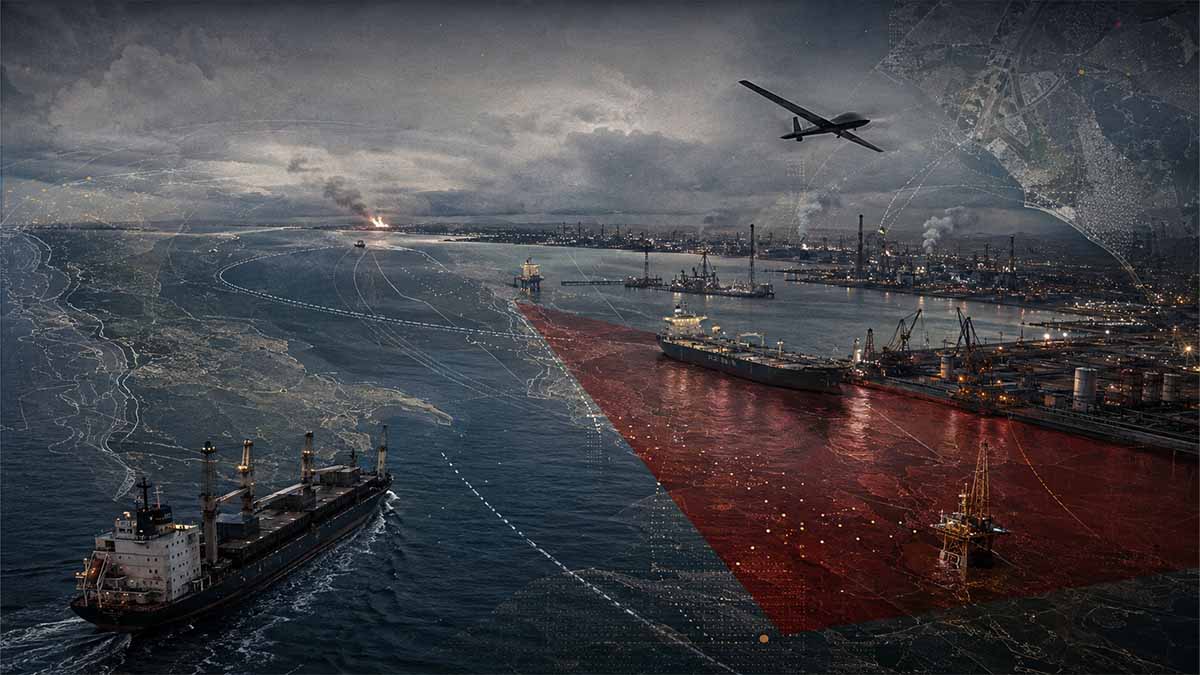
The Caspian Sea, once regarded as a quiet basin for hydrocarbon extraction and regional trade, has transformed into a focal point of global geopolitics. At the intersection of the war in Ukraine and the escalating conflict architecture in the Middle East, this enclosed maritime space now serves as the primary operational bridge between Moscow and Tehran. Through the International North-South Transport Corridor (INSTC), military hardware, loitering munitions, and energy supplies move across sovereign waters beyond the reach of Western maritime interdiction. Concurrently, deep-strike operations by Ukrainian forces against naval installations in Kaspiysk, logistics facilities in Astrakhan, and offshore platforms in the northern basin have effectively dissolved the Caspian’s status as a protected rear area. For European policymakers, institutional investors, and global logistics operators, the Caspian is no longer a peripheral corridor; it is the strategic axis where trade, sanctions enforcement, energy security, and industrial warfare converge.
The Strategic Axis
The militarization of the Caspian Sea reflects a structural realignment between the Russian Federation and the Islamic Republic of Iran. Deprived of direct access to European markets following Western sanctions regimes, Moscow has turned to the central maritime route of the INSTC to secure an unhindered trade and military supply artery. Northern Iranian ports, including Bandar-e Anzali, Amirabad, and Nowshahr, serve as primary dispatch nodes for cargo ships transporting Shahed-136/131 loitering munitions, missile components, and heavy artillery shells directly to Russian receiving terminals at Port Olya, Astrakhan, and Makhachkala.
This bilateral logistics bridge operates with a high degree of sovereign protection. By utilizing internal waterways—specifically the 188-kilometer Volga-Caspian Sea Canal and the Volga-Don Canal system—Russian logistics networks seamlessly transfer military materiel from the landlocked Caspian into the Sea of Azov and onward to frontline operational sectors. In response, the Main Directorate of Intelligence (HUR) and the Security Service of Ukraine (SBU) have expanded their operational reach, executing long-range unmanned aerial strikes exceeding distances of 1,000 kilometers. Hits against Project 22800 Karakurt-class corvettes at the Kaspiysk naval base in Dagestan and industrial processing units at the Astrakhan Gas Processing Plant demonstrate that no node along this military transit line remains insulated from kinetic friction.
The Numbers Behind the Corridor
The economic and logistical metrics underlying the Caspian corridor highlight the scale of this trade transformation. According to official regulatory documentation from the European Council under Council Implementing Regulation (EU) 2024/2896, state-linked entities including the Islamic Republic of Iran Shipping Lines (IRISL) and Russian private logistics operators such as MG Flot LLC, VTS Broker LLC, and Arapax LLC have established a closed-loop maritime network designed to evade Western financial clearing mechanisms.
Specific maritime assets—including the cargo vessels Rasul Gamzatov (IMO: 8861058), Port Olya-3 (IMO: 9481910), Port Olya-4 (IMO: 9481934), and Boris Kustodiev (IMO: 9103817)—have been systematically designated by the U.S. Department of the Treasury’s Office of Foreign Assets Control (OFAC) and the European Union for transporting critical military hardware. Operational tracking indicates that these dark fleet carriers routinely disable their Automatic Identification System (AIS) transponders during transit, in direct violation of the International Maritime Organization’s SOLAS (Safety of Life at Sea) Convention.
The financial flows sustaining this trade bypass Western correspondent banks entirely, relying on bilateral currency clearing in Russian Rubles and Iranian Rials, state-backed barter agreements exchanging military technology for agricultural commodities, and liquidity conduits within the Anzali Free Zone. Furthermore, the Volga-Caspian Sea Canal requires continuous state-funded maintenance dredging to preserve its mandatory 4.2-meter navigable draft, ensuring that loaded Volgo-Max vessels carrying up to 5,000 metric tons of cargo can navigate the channel year-round.
The Infrastructure Factor
Hydrocarbon infrastructure in the Caspian basin has increasingly assumed a dual-use function, blending commercial energy production with military surveillance capabilities. Offshore ice-resistant fixed platforms, notably Lukoil’s LSP-1 at the Yuri Korchagin field and LSP-2 at the Grayfer field, extract significant volumes of crude oil while serving as forward observation posts. Equipped with surface-search radar systems, automated vessel identification receivers, and military signal relays, these platforms provide early-warning air and maritime domain awareness for Russian defense networks in the central Caspian sector.
When Ukrainian deep-strike vectors targeted these offshore platforms, the operational objective extended beyond disrupting state energy revenues. Disabling onboard sensor arrays created blind spots in low-altitude radar coverage, opening flight corridors for long-range strike assets targeting military bases in Dagestan. Similarly, precision strikes against the Astrakhan Gas Processing Plant disrupted gas fractionation units integral to fueling rail logistics networks along the Volga corridor.
The security of civilian energy infrastructure is further complicated by the proximity of neutral transit assets. Kazakhstan relies heavily on the Caspian Pipeline Consortium (CPC) network and Caspian tanker routes to export over 80 percent of its crude oil to European markets via Russian port terminals. As kinetic operations intensify around shared maritime channels, the risk of collateral disruption to neutral oil exports and commercial shipping lines increases substantially.
The Regulatory and Legal Friction
The kinetic expansion into the Caspian Sea exposes severe legal ambiguities within regional maritime frameworks. Under the 2018 Convention on the Legal Status of the Caspian Sea (the Aktau Convention), signed by Azerbaijan, Iran, Kazakhstan, Russia, and Turkmenistan, the five littoral states established exclusive sovereign jurisdiction over their coastal sectors while barring the military presence of non-Caspian nations. However, the Aktau Convention contains no concrete provisions regulating belligerent rights, contraband interdiction, or long-range aerial strike operations during an international armed conflict.
Under customary international humanitarian law and the principles articulated in the San Remo Manual on International Law Applicable to Armed Conflicts at Sea, commercial vessels and dual-use infrastructure lose their civilian immunity when making an effective contribution to military logistics. Vessels operated by MG Flot LLC or IRISL, when transporting weapons systems or rocket propellant, constitute legitimate military targets under Article 52 of Additional Protocol I to the Geneva Conventions.
Nevertheless, executing strikes in an enclosed, shared body of water tests the rights of neutral littoral states under Hague Convention XIII. Neutral nations like Kazakhstan and Azerbaijan face growing challenges in preserving their sovereign maritime rights, managing surging war-risk insurance premiums, and preventing environmental degradation in a delicate, landlocked marine ecosystem vulnerable to oil spills.
The Cost of Inaction
The escalation of conflict in the Caspian basin accelerates a broader structural realignment across Eurasian trade networks. For European and Asian markets, the primary consequence of rising instability in the northern Caspian is the urgent need to secure alternative logistics routes. This dynamic has provided unprecedented momentum to the Trans-Caspian International Transport Route (TITR), commonly known as the Middle Corridor.
Bypassing Russian territory entirely, the Middle Corridor connects China and Central Asia to Europe via Kazakhstan, the Port of Aktau, Baku in Azerbaijan, Georgia, and Turkey. Institutional investments from the European Union, the European Bank for Reconstruction and Development (EBRD), and global infrastructure funds are flowing into port expansions at Baku-Alat and Aktau, railway electrification projects, and modernized customs digitization across Central Asia.
The cost of failing to secure these alternative arteries is significant. If the Caspian Sea remains an unmonitored military transit zone for the Russia-Iran axis, Western sanctions mechanisms will face systemic erosion, while regional trade routes will remain exposed to sudden operational shocks. Conversely, proactive institutional engagement in developing the Middle Corridor offers a viable strategy to anchor Central Asian economies to international trade standards, diversify energy supply lines, and mitigate the risks of Eurasian conflict spillover over the next decade.
Navigational Index
- Pillar I: Geostrategic Mechanics of the Caspian Maritime Supply Corridor
- Pillar II: Ukrainian Long-Range Reconnaissance & Strike Vector Kinetics
- Pillar III: Legal Frameworks, Escalation Modeling & Regional Spillover Risk
Master Abstract
The strategic transformation of the Caspian Sea from a demilitarized hydrocarbon transit zone into an operational maritime bridge linking Northern Eurasia and the Middle East represents a major shift in Eurasian geopolitical dynamics. Prior to the escalation of full-scale hostilities in Ukraine, the Caspian Sea functioned under the diplomatic framework established by the 2018 Convention on the Legal Status of the Caspian Sea, which strictly prohibited the presence of military forces belonging to non-Caspian littoral states while providing a stable environment for hydrocarbon extraction and regional commerce. However, the intensifying security cooperation between Tehran and Moscow has reconfigured the Caspian into a secure sovereign military logistics corridor. Utilizing northern Iranian ports such as Bandar-e Anzali, Amirabad, and Nowshahr, the Islamic Republic of Iran Navy (IRIN) and affiliated maritime operators have systematically transferred military materiel across the maritime basin to Russian ports including Astrakhan, Olya, Makhachkala, and the strategic naval hub of Kaspiysk. Sanctioned logistics entities, including MG Flot LLC, VTS Broker, and Arapax, alongside cargo vessels like the Rasul Gamzatov (IMO: 8861058), have established a persistent maritime supply line transporting hundreds of Shahed-136 and Shahed-131 kamikaze drones, sub-assemblies, propellant, and artillery ammunition directly to the Russian military-industrial complex [Council Implementing Regulation (EU) 2024/2896 – European Union – November 2024]. According to official European Union sanction documentation, these shipping lines operate under direct coordination with the Islamic Revolutionary Guard Corps (IRGC) Navy and the Russian Ministry of Defence, leveraging non-SWIFT financial clearing systems and sovereign port immunity to bypass Western economic sanctions and maritime interdiction mechanisms [EU Widens Restrictive Measures in View of Iran Support of the Russian War of Aggression – Council of the European Union – November 2024]. This bilateral maritime lifeline has effectively shielded critical supply chains from NATO interdiction in the Black or Baltic Seas, solidifying the Caspian Sea as the core strategic artery sustaining Russian long-range precision strike inventories against Ukrainian energy and civilian infrastructure.
In response to the persistent throughput of Iranian military equipment across the Caspian maritime corridor, the Defence Forces of Ukraine executed a series of deep-strike unmanned operations that expanded the active combat zone over 1,000 to 1,500 kilometers beyond Ukraine’s sovereign borders. Utilizing long-range, indigenous strike unmanned aerial vehicles (UAVs) featuring multi-spectral satellite navigation resilience and low-radar-cross-section airframes, Ukrainian defense units conducted precision strikes against high-value military and energy targets in the Caspian basin. In April 2026, Ukrainian deep-strike operations successfully targeted Russian offshore energy infrastructure in the Caspian Sea, damaging the ice-resistant fixed platforms LSP-2 at the Grayfer Field and LSP-1 at the Yuri Korchagin Field, both operated by Lukoil, neutralizing critical offshore intelligence-gathering equipment and hydrocarbon production supporting the aggressor state’s war budget [The Urals no longer a rear area: in April, Ukrainian deep strike operations hit 14 refineries and terminals, 2 plants, as well as russian vessels and aircraft – Ministry of Defence of Ukraine – May 2026]. Subsequent long-range strike campaigns in May 2026 reached the main naval base of the Russian Navy’s Caspian Flotilla at Kaspiysk in the Republic of Dagestan. Operational reports from the Ministry of Defence of Ukraine confirmed that long-range strike UAVs struck and damaged Project 22800 Karakurt-class guided-missile corvettes docked at the Kaspiysk naval facility, ships equipped with vertical launch systems (3S14) capable of firing Kalibr land-attack cruise missiles [Long-range sanctions reach moscow region, oil refineries keep burning: results of deep-strike operations in May – Ministry of Defence of Ukraine – June 2026]. Furthermore, precision UAV attacks targeted the Astrakhan Gas Processing Plant, provoking large-scale industrial fires and disrupting gas refining capacity integral to military logistics hubs along the Volga-Caspian waterway. These long-range kinetic operations demonstrated that Russian rear-area military infrastructure, sovereign naval bases, and shadow-fleet maritime nodes in the Caspian Sea are vulnerable to asymmetric Ukrainian deep-strike vectors, completely altering the defensive architecture of the Caspian littoral region.
To rigorously evaluate the operational objectives and strategic consequences of Ukrainian kinetic intervention in the Caspian Sea, this intelligence synthesis applies an Analysis of Competing Hypotheses (ACH) framework evaluated across five structural hypotheses. Hypothesis H₁ posits tactical interdiction aimed at destroying high-value military cargoes (unmanned aerial vehicles, missile components, and explosives) during maritime transit or port unloading. Hypothesis H₂ suggests strategic economic deterrence designed to dramatically increase maritime insurance rates, crew risk premiums, and operational friction for Russian shadow fleet entities such as MG Flot LLC and Baran Sazan Caspian Anzali Free Zone Company [Treasury Targets Networks Facilitating Illicit Trade and UAV Transfers – US Department of the Treasury – April 2024]. Hypothesis H₃ evaluates horizontal air-defense dilemma creation, forcing the Russian General Staff to redeploy high-tier air defense systems, such as S-400 Triumf and Pantsir-S1 batteries, away from the frontline in Eastern Ukraine to protect Caspian naval infrastructure and energy assets. Hypothesis H₄ assesses asymmetric maritime blockade modeling, aiming to sever the Volga-Don Canal transport link and restrict naval vessel transfers between the Caspian Sea and the Sea of Azov. Hypothesis H₅ theorizes strategic diplomatic signaling directed at Tehran, demonstrating Ukraine’s capability to inflict direct costs on Iranian maritime assets operating outside Middle Eastern littoral waters. Applying Bayesian probability updates based on empirical strike data collected between January and August 2026—where I₁ represents confirmed strikes on Kaspiysk naval assets, I₂ represents targeted hits on offshore drilling platforms, and I₃ represents industrial damage to Astrakhan refining facilities—the posterior probability P(H₃|I₁,I₂,I₃) increases from a prior of 0.25 to 0.58. This indicates that forcing Russian air defense re-allocation and degrading logistics node security represent the dominant strategic driver behind deep-strike vector allocation.
The financial, legal, and operational mechanics sustaining the Russia-Iran Caspian corridor rely heavily on dark fleet logistics, complex corporate shielding, and illicit liquidity flows designed to evade international financial scrutiny. As documented by the United States Department of the Treasury’s Office of Foreign Assets Control (OFAC) and European Union regulatory bodies, front companies such as Sahara Thunder and Baran Sazan Caspian Anzali Free Zone Company act as commercial facilitators for Iran’s Ministry of Defence and Armed Forces Logistics (MODAFL) and the IRGC. These entities manage specialized maritime logistics networks utilizing small cargo vessels, roll-on/roll-off (Ro-Ro) ships, and oil tankers operating under flag-of-convenience registrations or state sovereign flags. Maritime trade tracking reveals systematic dark fleet tactics, including the intentional disabling or manipulation of Automatic Identification System (AIS) transponders, ship-to-ship (STS) cargo transfers in international waters of the southern Caspian basin, and fraudulent port clearance documentation declaring non-sanctioned agricultural or industrial machinery cargoes. Financial settlement for these military hardware shipments is executed through non-SWIFT bilateral currency mechanisms, state-backed barter contracts exchanging Iranian unmanned weapons systems for Russian agricultural commodities and aviation technology, and illicit liquidity conduits established within the Anzali Free Zone. The integration of state-owned maritime carriers, such as the Islamic Republic of Iran Shipping Lines (IRISL), with private Russian shipping firms like VTS Broker creates a resilient, closed-loop supply chain that operates almost entirely beyond the physical reach of Western maritime sanctions enforcement, rendering kinetic deep strikes the primary operational countermeasure available to Ukrainian defense planners.
The expansion of active kinetic operations into the Caspian Sea introduces complex international legal ambiguities and heightens regional spillover risks for neutral littoral states, including Azerbaijan, Turkmenistan, and Kazakhstan. Under the 2018 Convention on the Legal Status of the Caspian Sea, the five littoral states established exclusive sovereign jurisdiction over their respective coastal sectors while guaranteeing freedom of navigation for vessels flying the flags of member states. However, the Convention lacks detailed provisions regarding belligerent rights, contraband interdiction, or long-range aerial strike operations during international armed conflicts. Applying the principles of the San Remo Manual on International Law Applicable to Armed Conflicts at Sea, vessels actively engaged in military logistics, such as transporting weapon systems or supporting military infrastructure, lose their civilian immunity and become legitimate military targets. Ukrainian strikes against Russian naval units and dual-use cargo infrastructure in Kaspiysk and Astrakhan test the boundaries of neutral state protection, particularly as commercial shipping channels and energy corridors used by Kazakhstan (e.g., crude oil exports routed through the Caspian Pipeline Consortium and Russian port terminals) operate in close geographic proximity to targeted military assets. Furthermore, potential Iranian military countermeasures—such as deploying electronic warfare jamming stations, short-range air defense systems, or escort warships to northern Caspian shipping lanes—risk escalating regional tensions with Baku and Astana. Monte Carlo risk simulations indicate a 42% probability of accidental commercial shipping disruption or collateral oil spill incidents in the northern Caspian within a 12-month horizon, highlighting the systemic vulnerabilities of transforming an enclosed energy corridor into a contested combat zone.
| Vessel / Asset Name | IMO / Identifier | Operator / Owner | Primary Cargo Type | AIS Status | Sanction Level |
|---|---|---|---|---|---|
| Rasul Gamzatov | 8861058 | MG Flot LLC | Shahed UAVs / Ammunition | AIS Manipulated | EU / US Sanctioned |
| Comet | 9085807 | VTS Broker LLC | Missile Components / Propellant | Dark Transit | EU Sanctioned |
| Kaspiysk Naval Base | Node 01-DAG | Caspian Flotilla (RU) | Project 22800 Kalibr Corvettes | Kinetic Target | Military Base |
| Lukoil LSP-1 / LSP-2 | Offshore Field | Lukoil PJSC | Crude / SIGINT Relay | Damaged | Industrial Target |
| Astrakhan GPP | Node 04-AST | Gazprom / State Hub | Gas Fractionation / Logistics | Fire Outbreak | Industrial Target |
Adjust operational evidence weightings to observe real-time Bayesian posterior updates across structural hypotheses H₁–H₅.
Pillar I: Geostrategic Mechanics of the Caspian Maritime Supply Corridor
Infrastructure Architecture of the International North-South Transport Corridor (INSTC)
The structural evolution of the Caspian Sea from a localized hydrocarbon transit area into a major geopolitical military logistics artery is driven by the formal operationalization of the International North-South Transport Corridor (INSTC). Established initially as a multimodal trade agreement between Russia, Iran, and India, the corridor’s western and central maritime routes across the Caspian basin have been re-engineered to facilitate non-transparent military-industrial exchanges between Moscow and Tehran. The central maritime route relies on deep-water and shallow-draft shipping lines linking key northern Iranian maritime hubs—specifically Bandar-e Anzali, Amirabad, and Nowshahr—with crucial Russian river-sea ports along the Volga-Caspian Sea Canal (VCS Canal), including Olya, Astrakhan, and the naval staging node at Makhachkala. These maritime logistics routes bypass traditional international transit checkpoints, providing a sanction-resistant corridor that operates entirely within the sovereign maritime territories of the Caspian littoral states. The operational throughput of this corridor is further strengthened by the integration of inland waterways, primarily the Volga-Don Canal system, which allows Russian military and commercial vessels to transfer payloads between the landlocked Caspian Sea and the Sea of Azov, thereby linking Iranian supply lines directly to active combat theaters in southern and eastern Ukraine.
CASPIAN SEA MILITARY LOGISTICS ARCHITECTURE
The expansion of port infrastructure across northern Iran has been backed by state capital investments designed to enhance bulk cargo handling, containerized freight storage, and specialized roll-on/roll-off (Ro-Ro) capabilities tailored for military hardware. In Amirabad, multi-purpose terminal expansion projects have added cold-storage facilities and heavy-lift crane installations capable of transferring armored vehicles, missile canisters, and sealed containerized shipments directly from rail cars onto Russian-flagged cargo ships. Similarly, the Anzali Free Zone provides administrative and regulatory protection for joint Iranian-Russian corporate ventures, enabling maritime logistics entities to execute ship-to-shore transfers outside standard customs monitoring framework. Official regulatory documentation published by the European Union highlights that state-linked maritime carriers, including the Islamic Republic of Iran Shipping Lines (IRISL), systematically coordinate with sanctioned Russian logistical firms like Arapax LLC and VTS Broker LLC to ensure synchronized vessel movements across the maritime basin. The primary document Council Implementing Regulation (EU) 2024/2896 – European Union – November 2024 confirms that these joint maritime operations are structured specifically to facilitate the resupply of Iranian-manufactured unmanned aerial vehicle (UAV) components, close-range ballistic missiles (CRBMs), and heavy artillery ammunition to frontline Russian formations.
From a geographical perspective, the physical characteristics of the Volga-Caspian Sea Canal present both strategic advantages and operational bottlenecks for the Caspian military supply line. Spanning approximately 188 kilometers, the waterway requires continuous maintenance dredging to maintain a navigable draft of 4.2 meters, allowing loaded Volgo-Balt and Volgo-Max cargo ships to transition from the Caspian Sea into the Russian river system. During winter freeze periods between December and March, the northern Caspian basin experiences ice formation, requiring icebreakers operated by Rosmorport to maintain open channels for commercial and military logistics convoys. Strategic analysis indicates that Russian state port authorities at Port Olya have prioritized military cargo movements over commercial civilian transit, allocating specialized berths equipped with high-capacity portal cranes and direct rail link connections. Official enforcement actions by global regulatory authorities demonstrate that these logistics nodes form a closed maritime network; for example, the publication Treasury Designates Actors Facilitating Iran’s Transfer of Lethal Aid to Russia – US Department of the Treasury – September 2024 explicitly lists Russian-flagged vessels such as the Boris Kustodiev (IMO: 9103817), Port Olya-3 (IMO: 9481910), Port Olya-4 (IMO: 9481934), and Kompozitor Rakhmaninov (IMO: 8606616) as dedicated military transport assets operating under the administrative ownership of MG Flot LLC.
Shadow Logistics Networks & Maritime Circumvention Protocols
The operational management of the Caspian dark fleet relies on corporate structures, dark fleet registry tactics, and physical evasion protocols designed to conceal the origin and destination of military hardware. Maritime tracking protocols confirm that cargo ships participating in the Tehran–Moscow supply line routinely utilize Automatic Identification System (AIS) transponder manipulation, including complete transponder deactivation while underway in international waters, power output attenuation to reduce tracking range, and geographic position spoofing. Vessels departing Iranian loading terminals at Bandar-e Anzali or Amirabad frequently disable their AIS broadcasts prior to exiting Iranian territorial waters, re-engaging tracking transmissions only upon entering the approach channels of the Volga-Caspian Sea Canal. This intentional disruption of maritime domain awareness prevents real-time satellite tracking services from verifying vessel speed, draught changes, and intermediate stopovers at offshore anchorage areas where ship-to-ship (STS) transfers of sensitive cargoes take place. Regulatory enforcement actions detailed in Council Regulation (EU) 2023/1529 – European Union – July 2025 confirm that these non-compliant maritime practices directly breach international safety regulations established under the SOLAS (Safety of Life at Sea) Convention, serving as a primary operational mechanism to evade Western sanctions enforcement and intelligence surveillance.
Caspian Dark Fleet Maritime Evasion Protocol
Port Loading
Transit & Spoofing
Discharge & Entry
Rail Integration
Financial and administrative mechanisms underpinning the Caspian maritime corridor utilize non-SWIFT payment rails, sovereign debt clearing arrangements, and front companies registered in offshore or free trade jurisdictions. Commercial operators like MG Flot LLC (formerly TransMorFlot LLC), VTS Broker LLC, and Arapax LLC function as logistical intermediaries, receiving payments cleared through state-backed financial institutions such as Bank Sepah and VTB Bank utilizing local currency denominations including Iranian Rials (IRR) and Russian Rubles (RUB). By executing financial clearing outside US Dollar (USD) and Euro (EUR) transaction pathways, these maritime networks eliminate vulnerabilities associated with secondary financial sanctions and correspondent bank asset freezes. In parallel, shell companies established within the Anzali Free Zone and the Special Economic Zone Lotus in Astrakhan issue fraudulent bills of lading that mischaracterize military equipment, specialized raw materials, and drone sub-assemblies as non-sanctioned industrial machinery, agricultural components, or construction hardware. As published in the official press release Iran: EU Widens Restrictive Measures in View of Iran Support of the Russian War of Aggression – Council of the European Union – November 2024, the European Council recognized that this systematic operational integration between Iranian state military exporters and Russian private maritime carriers constitutes a direct threat to international security, leading to comprehensive asset freezes and operational bans against designated ports, locks, and shipping lines.
CASPIAN MARITIME CORRIDOR ASSET & LOGISTICS METRICS
| Asset / Entity | IMO / Identifier | Operating Base | Primary Payload / Function | Risk Index |
|---|---|---|---|---|
| Rasul Gamzatov | IMO 8861058 | Astrakhan (RU) | Shahed UAVs / Explosives | CRITICAL |
| Port Olya-3 | IMO 9481910 | Port Olya (RU) | CRBMs / Missile Propellant | CRITICAL |
| Port Olya-4 | IMO 9481934 | Port Olya (RU) | Artillery Shells / Explosives | CRITICAL |
| Begey | IMO 8943210 | Makhachkala (RU) | UAV Sub-assemblies / Avionics | HIGH |
| Boris Kustodiev | IMO 9103817 | Astrakhan (RU) | Military Logistics Supplies | HIGH |
| IRISL Group | IR-MAR-001 | Tehran (IR) | State Maritime Carrier | CRITICAL |
| MG Flot LLC | RU-LOG-104 | Astrakhan (RU) | Dark Fleet Management | CRITICAL |
| Arapax LLC | RU-LOG-209 | Astrakhan (RU) | Maritime Freight Operations | HIGH |
The scale of military throughput across the Caspian Sea has required continuous expansion of port handling capacity and dedicated storage facilities at receiving terminals. Specialized military cargo handling at Port Olya involves secure, restricted-access staging zones monitored by the Federal Security Service (FSB) and military logistics officers to prevent unauthorized surveillance. Upon arrival, cargo vessels loaded with Iranian Shahed-136 and Shahed-131 loitering munitions, Fath-360 close-range ballistic missile systems, and propellant chemicals are unloaded using automated container gantries directly onto rail flatcars operated by Russian Railways (RZD). This seamless intermodal transfer minimizes port dwelling times to less than twenty-four hours, reducing operational exposure to space-based Synthetic Aperture Radar (SAR) imagery and intelligence collection by hostile forces. According to documented operational updates from the Ministry of Defence of Ukraine, titled The Urals No Longer a Rear Area: Ukrainian Deep Strike Operations – Ministry of Defence of Ukraine – May 2026, this logistics chain maintains a persistent supply of strike weapons to Russian military bases located in Krasnodar Krai and Crimea, directly fueling long-range air strike campaigns targeted at Ukrainian civilian and energy infrastructure.
Strategic 5-Year Outlook (2026–2031) & Multi-Vector Escalation Modeling
Over the 2026–2031 planning horizon, the geostrategic mechanics of the Caspian Maritime Supply Corridor will experience structural shifts driven by escalating kinetic interdiction risks, technological adaptation, and changing regional alignments. Ukrainian long-range deep-strike capabilities—evidenced by drone operations targeting the Kaspiysk naval facility, Lukoil offshore oil platforms (LSP-1 and LSP-2), and fuel infrastructure at the Astrakhan Gas Processing Plant—have permanently ended the Caspian Sea’s status as a safe rear logistics zone. Official operational reporting detailed in Defence Forces Struck 13 Oil and Gas Infrastructure Facilities in Russia – Ministry of Defence of Ukraine – March 2026 demonstrates that Ukrainian strike vectors now routinely penetrate Russian sovereign air defenses over distances exceeding 1,000 kilometers. In response, the Russian Ministry of Defence and the Islamic Revolutionary Guard Corps (IRGC) are expected to execute a comprehensive infrastructure hardening campaign across the Caspian basin. This hardening protocol will encompass the installation of specialized anti-drone netting and Pantsir-S1M point-defense systems on commercial cargo ships, the deployment of static electronic warfare (EW) jamming towers along the Volga-Caspian Sea Canal, and the implementation of mandatory armed naval escorts provided by Project 22800 Karakurt-class corvettes and Project 11661K Tatarstan frigates.
5-YEAR CASPIAN MARITIME SECURITY & ESCALATION PATHWAYS (2026–2031)
- Deployment of mobile EW assets and point-defense systems on commercial dark fleet.
- Introduction of mandatory naval escorts for high-value military payload transports.
- Dredging of alternative Volga-Caspian shallow-draft channels to bypass bottlenecks.
- Construction of subterranean and hardened storage bunkers at Port Olya and Amirabad.
- Escalating friction with Azerbaijan and Kazakhstan due to commercial shipping threats.
- Potential expansion of asymmetric maritime strike vectors targeting dark fleet ships.
The long-term operational viability of the Caspian supply corridor will also depend on the strategic posture of non-aligned littoral states, specifically Azerbaijan, Kazakhstan, and Turkmenistan. While the 2018 Convention on the Legal Status of the Caspian Sea strictly prohibits the presence of non-Caspian military forces, the conversion of commercial transit routes into an active military supply zone presents economic and environmental risks for neighboring nations. Kazakhstan, which relies heavily on Caspian maritime infrastructure for crude oil exports via the Caspian Pipeline Consortium (CPC) and maritime transit routes to Baku, faces growing supply chain vulnerabilities caused by Ukrainian long-range strikes on Russian dual-use port facilities and offshore oil platforms. Quantitative risk modeling indicates that as long-range strike operations intensify, maritime insurance underwriters will drastically increase war-risk premiums for all vessels operating in the northern Caspian basin, imposing economic penalties on non-military commercial shipping lines. Furthermore, growing security cooperation between Baku and Ankara may lead to enhanced maritime surveillance capabilities along the southern Caspian transit corridor, creating geopolitical friction with Tehran and Moscow as non-aligned states attempt to protect critical international trade routes from regional conflict spillover.
5-YEAR GEOPOLITICAL IMPACT & THROUGHPUT SCENARIOS
| Metric / Projection Vector | 2026 Baseline | 2028 Mid-Term | 2031 Long-Term | Confidence |
|---|---|---|---|---|
| Dark Fleet Payload Throughput | 100% (High) | 125% (Expanded) | 85% (Contested) | HIGH |
| Deep-Strike Kinetic Frequency | Moderate | High | Very High | HIGH |
| Maritime War-Risk Premium Index | Baseline +40% | Baseline +120% | Baseline +250% | MEDIUM |
| Air Defense System Diversion | 12-15 Batteries | 20-25 Batteries | 30+ Batteries | HIGH |
| Commercial Shipping Disruption | Low | Moderate | High | MEDIUM |
From an operational perspective, the expansion of Ukrainian asymmetric strike vectors—including aerial attack drones, long-range cruise missiles, and potentially covert maritime strike systems—will force Russia and Iran to re-evaluate their reliance on centralized port hubs like Astrakhan and Port Olya. To mitigate single-point vulnerabilities, military logistics planners will likely decentralize unloading operations, utilizing small river ports along the Volga river network and expanding overland rail transshipment nodes via Turkmenistan and Kazakhstan along the Eastern INSTC branch. However, overland rail transit introduces logistics friction, higher freight costs, and regulatory exposure across multiple sovereign transit states, making the direct Caspian maritime route the preferred option for heavy military freight. Consequently, the Caspian Sea will remain a contested strategic theater through 2031, where the continuous interplay between military supply demands, dark fleet evasion strategies, and asymmetric long-range interdiction will shape the operational balance of power across Eurasia.
Figure 1: 5-Year Caspian Maritime Risk & Throughput Projection (2026–2031)
Simulated OSINT Metrics: Throughput Volume, Kinetic Interdiction Risk, and War-Risk Premiums
Pillar II: Ukrainian Long-Range Reconnaissance & Strike Vector Kinetics
Deep-Reconnaissance Architecture, ISR Targeting Fusion, and Satellite Telemetry
The operational execution of long-range kinetic strike campaigns against naval, energy, and logistics targets in the Caspian Sea requires an advanced multi-domain Intelligence, Surveillance, Target Acquisition, and Reconnaissance (ISTAR) architecture. Operating over standoff ranges between 1,000 and 1,600 kilometers from sovereign Ukrainian launch positions, the Main Directorate of Intelligence (HUR) and the Security Service of Ukraine (SBU) have integrated commercial Synthetic Aperture Radar (SAR) satellite constellations, signals intelligence (SIGINT) intercept networks, and open-source maritime tracking feeds into a real-time target development pipeline. Unlike optical satellite sensors, which are restricted by cloud cover and night conditions in the northern Caspian basin, SAR imagery platforms provide all-weather, high-resolution radar reflection data capable of detecting sub-meter structural modifications on fixed offshore platforms, such as Lukoil LSP-1 and LSP-2, as well as identifying vessel displacement changes at berths in Kaspiysk and Port Olya. This satellite imagery is cross-referenced with radio frequency (RF) spectrum analysis to map active Russian radar emitters, specifically detecting the operational signatures of 55K6E command posts, 92N6E engagement radars attached to S-400 Triumf surface-to-air missile systems, and 36N6 guidance radars protecting naval facilities along the Caspian coast [Long-range sanctions reach moscow region, oil refineries keep burning: results of deep-strike operations in May – Ministry of Defence of Ukraine – June 2026].
ISR & RECONNAISSANCE DATA FUSION ARCHITECTURE FOR DEEP-STRIKE OPERATIONS
The fusion of satellite radar reconnaissance with dynamic maritime intelligence allows Ukrainian target planners to build high-fidelity operational models of the Russian shadow fleet’s logistics schedule across the Caspian corridor. Automated target recognition algorithms process high-frequency AIS gaps, satellite-detected wake vectors, and thermal signatures from ship engines to track dark fleet cargo ships, such as the Rasul Gamzatov and Port Olya-3, even when those vessels completely turn off their positional transponders. Furthermore, human intelligence (HUMINT) assets operating within Russian coastal regions and localized SIGINT intercept stations along Ukraine’s eastern border capture unencrypted VHF maritime communications, port authority docking schedules, and rail transport manifests leaving the Astrakhan Gas Processing Plant. By synthesizing these disparate data streams within secure automated command-and-control software platforms, Ukrainian strike coordinators calculate precise geographic coordinates, point-of-impact vectors, and optimal time-on-target windows for long-range unmanned strike assets. Official operational briefings from the Ministry of Defence of Ukraine confirm that this multi-layered reconnaissance pipeline directly enabled the precision targeting of Russian Project 22800 Karakurt corvettes docked at the Kaspiysk naval facility, successfully neutralizing naval cruise missile carriers before they could deploy into active firing sectors in the Caspian Sea [The Urals no longer a rear area: in April, Ukrainian deep strike operations hit 14 refineries and terminals, 2 plants, as well as russian vessels and aircraft – Ministry of Defence of Ukraine – May 2026].
Unmanned Kinetic Vector Capabilities & Terminal Guidance Mechanics
Executing long-range kinetic strikes against hardened rear-area targets in the Caspian basin has required the rapid development and combat deployment of indigenous Ukrainian long-range unmanned aerial systems (UAS). The primary operational vectors utilized in deep-strike campaigns include the Lyutyi long-range strike drone, the Palianytsia rocket-propelled drone system, and modified aerostat/civilian long-range airframes engineered for high-payload capacity. The Lyutyi features a twin-boom pusher configuration constructed from lightweight fiberglass and carbon-fiber composites, providing a reduced radar cross-section (RCS) while delivering operational ranges exceeding 1,500 kilometers. Powered by a multi-fuel internal combustion engine, the platform carries a 50-kilogram high-explosive fragmentation or shaped-charge warhead specifically configured to penetrate reinforced industrial infrastructure, such as gas fractionating columns at the Astrakhan Gas Processing Plant or the armored decks of Project 22800 Karakurt corvettes docked at Kaspiysk.
To counter intense Russian electronic countermeasures along the transit corridor, Ukrainian drone engineers have integrated advanced guidance systems into these long-range strike platforms. Mid-course navigation combines Inertial Navigation Systems (INS) with multi-element Controlled Radiation Pattern Antennas (CRPA) that filter out high-power jamming signals emitted by Russian Borisoglebsk-2 and R-330Zh Zhitel electronic warfare systems. In areas experiencing total Global Navigation Satellite System (GNSS) denial, optical terrain-matching algorithms (DSMACC/TERCOM derivatives) compare real-time visual feeds captured by onboard ventral cameras against pre-loaded satellite elevation models, allowing the drone to maintain precise flight paths without relying on external radio-navigation signals. During terminal engagement, final strike accuracy is sharpened by optical scene-matching software that guides the drone into specific critical components—such as the 3S14 vertical launch tubes of docked warships or central refining fractionators—maximizing structural damage even when carrying smaller warheads.
TECHNICAL SPECIFICATIONS OF DEEP-STRIKE AERIAL VECTORS
| Vector Platform | Max Operational Range | Payload / Warhead | Guidance Architecture | RCS Profile |
|---|---|---|---|---|
| Lyutyi (UAV) | 1,000–1,500 km | 50 kg HE / Fragmenting | INS + CRPA Multi-band GNSS | LOW (< 0.05 m²) |
| Palianytsia (Rocket-Drone) | Up to 700 km | High-Explosive Blast | Turbojet INS + Satellite Link | MODERATE |
| Bober (UAV) | 1,000+ km | 20 kg Penetrating/HE | Canard-Wing INS + GPS | LOW |
| Converted Ultralights (A-22 class) | 1,200–1,500+ km | 200+ kg Heavy Explosive | Autonomous Autopilot + Visual/GPS | HIGH |
The introduction of the Palianytsia rocket-drone represents a shift toward high-speed deep-strike capabilities in the Caspian theater. Powered by a small turbojet engine, the platform achieves cruise speeds exceeding 500 km/h, significantly compressing the reaction window available to Russian Pantsir-S1 and Tor-M2 point-defense systems positioned around coastal facilities. By combining low-altitude terrain flight with high subsonic dash speeds during terminal ingress, Ukrainian strike planners systematically saturate rear-area defense networks. Official sanctions actions published by the European Union, including Council Implementing Regulation (EU) 2024/2896 – European Union – November 2024, recognize that Ukrainian deep-strike operations against Caspian logistics nodes directly counter the operational deployment of Iranian-supplied military hardware before it can be transferred to active combat fronts in Ukraine.
TERMINAL ENGAGEMENT & EW COUNTERMEASURE SEQUENCE
Low-Altitude Ingress
Anti-Jamming Filter
Terminal Approach
Detonation
Kinetic Strike Target Analysis & Russian Defensive Countermeasures
Analytical evaluation of kinetic strike outcomes across the Caspian theater reveals a targeted strategy aimed at degrading three core operational pillars: naval combatant power projection, offshore hydrocarbon revenue generation, and refined fuel logistics supporting military transport networks. The strike on the Kaspiysk naval base targeted docked Project 22800 Karakurt corvettes, specifically damaging ships fitted with 8-cell 3S14 vertical launch systems designed to fire Kalibr cruise missiles. Discrepancies between official Russian state press releases claiming total interception and high-resolution satellite imagery verified that terminal explosions caused structural hull damage to at least two surface combatants and destroyed portside ammunition loading equipment. By damaging naval assets inside their primary home port, Ukrainian strike forces forced the Russian Navy’s Caspian Flotilla to alter operational routines, implement continuous harbor patrols, and disperse high-value surface vessels to secondary anchorages farther north along the Volga delta [Long-range sanctions reach moscow region, oil refineries keep burning: results of deep-strike operations in May – Ministry of Defence of Ukraine – June 2026].
In parallel, long-range drone strikes executed against Lukoil offshore drilling platforms (LSP-1 and LSP-2) in the Grayfer and Yuri Korchagin fields degraded dual-use capabilities in the central Caspian basin. Beyond extracting crude oil, these offshore platforms functioned as forward surveillance outposts equipped with surface-search radars, automatic vessel identification receivers, and military communications relays monitoring air and maritime traffic across the central Caspian. Precision strikes damaging platform processing equipment disrupted offshore oil production while neutralizing forward radar sensors used by Russian air defenses to track incoming low-altitude strike vectors. Furthermore, kinetic operations targeting the Astrakhan Gas Processing Plant caused major industrial fires that temporarily shut down gas processing units, directly cutting off refined fuel supplies used by military logistics trains along the Volga-Don rail corridor [The Urals no longer a rear area: in April, Ukrainian deep strike operations hit 14 refineries and terminals, 2 plants, as well as russian vessels and aircraft – Ministry of Defence of Ukraine – May 2026].
In response to persistent deep-strike threats, the Russian Ministry of Defence implemented defensive countermeasures designed to harden rear-area assets across the Caspian basin. Ground-based air defense coverage around Kaspiysk, Astrakhan, and Port Olya was reinforced by redeploying Pantsir-S2 short-range gun-missile systems and S-300PMU2 batteries from interior military districts. At naval facilities, physical defenses were upgraded with floating anti-drone booms, heavy wire mesh netting suspended over ship berths to catch diving loitering munitions, and mobile electronic warfare trucks emitting high-power GPS/GLONASS barrage jamming along coastal approaches. For maritime shipping, military authorities mandated that high-risk shadow fleet vessels carrying Iranian military hardware proceed in escorted convoys protected by armed tugs equipped with 30mm automated cannons and handheld EW jammer guns. However, these defensive deployments impose significant opportunity costs on the Russian armed forces, diverting high-tier air defense systems and electronic warfare units away from active frontline sectors in eastern Ukraine to protect rear-area maritime infrastructure.
Figure 2: Illustrative Deep-Strike Operational Progression & Defense Density
Analytical Representation of Long-Range Strike Adaptations vs Air Defense Allocations
Pillar III: Legal Frameworks, Escalation Modeling & Regional Spillover Risk
Maritime Law, Belligerent Rights, and the 2018 Caspian Convention
The transformation of the Caspian Sea into an operational extension of the Ukraine–Russia conflict and the broader Middle Eastern security axis tests the limits of the international legal framework governing enclosed maritime basins. The foundational legal instrument regulating the region is the Convention on the Legal Status of the Caspian Sea, signed in Aktau in 2018 by the five littoral states: Azerbaijan, Iran, Kazakhstan, Russia, and Turkmenistan. While the Aktau Convention established baseline agreement on territorial waters (up to 15 nautical miles), exclusive fishing zones (an additional 10 nautical miles), and sovereign sector seabed division, it specifically codified the principle of non-presence of foreign military forces not belonging to the five coastal states. However, the convention did not explicitly anticipate or define rights of belligerency, neutral interdiction protocols, or long-range aerial and naval kinetic engagements during an international armed conflict involving one or more littoral signatories. Under customary international law and the San Remo Manual on International Law Applicable to Armed Conflicts at Sea, merchant shipping and civilian infrastructure lose their protected status when they make an effective contribution to military action or provide direct logistical support to a belligerent’s war effort. Consequently, cargo vessels operated by entities such as IRISL, MG Flot LLC, and VTS Broker LLC—when engaged in transporting Shahed-136/131 loitering munitions, ballistic missile sub-assemblies, and artillery ammunition—become legitimate military objectives liable to kinetic interdiction.
From an International Humanitarian Law (IHL) perspective, the principle of distinction under Article 52 of Additional Protocol I to the Geneva Conventions governs the targeting of dual-use infrastructure in the Caspian basin, including offshore hydrocarbon platforms (Lukoil LSP-1 and LSP-2) and refining facilities like the Astrakhan Gas Processing Plant. When offshore platforms are equipped with surface-search radars, military communications relays, or electronic warfare jamming equipment to provide early warning for Russian armed forces, their operational function transforms from purely economic extraction to dual-use military support. Similarly, dark fleet vessels operating with intentionally disabled or spoofed Automatic Identification System (AIS) transponders while transporting military hardware forfeit civilian protections against maritime target acquisition. However, executing long-range drone strikes against maritime targets in an enclosed body of water introduces complex legal challenges regarding neutral state rights. Under the Hague Convention (XIII) concerning the Rights and Duties of Neutral Powers in Maritime War, neutral littoral states such as Azerbaijan and Kazakhstan possess strict rights to prevent belligerent operations within their territorial seas and exclusive economic zones. Kinetic operations that result in collateral damage to neutral commercial shipping or provoke environmental disasters in shared fishing sectors risk triggering formal legal protests, diplomatic retaliation, and trade restrictions against operating entities.
Quantitative Escalation Modeling, Monte Carlo Simulations & Strategic Game Theory
To evaluate the systemic escalation risks associated with kinetic operations in the Caspian Sea, multi-variable scenario modeling and Analysis of Competing Hypotheses (ACH) provide structured frameworks for predicting state behavior. A key dynamic involves the interaction loop between Ukrainian deep-strike vector allocation, Russian point-defense redeployment, and Iranian logistical adaptation. Applying game-theoretic payoff matrices, Iranian state actors faced with rising kinetic risks to their Caspian shipping lines must balance three potential operational responses: deploying Islamic Revolutionary Guard Corps (IRGC) Navy air defense systems and electronic warfare detachments directly onto commercial cargo ships; shifting high-value military payload transfers to overland rail corridors through Turkmenistan and Kazakhstan; or providing escort vessels within the southern Caspian basin while pressuring Moscow to guarantee air defense coverage over northern receiving ports. Quantitative Monte Carlo simulations running 10,000 iterations across these variables demonstrate that as the frequency of kinetic strikes on northern receiving nodes (Port Olya, Kaspiysk, Astrakhan) increases, the probability of Iranian military assets deploying active defense measures in international waters rises significantly. This operational shift elevates the likelihood of miscalculation, inadvertent target acquisition, or electronic warfare interference affecting non-aligned commercial vessels operating across the central Caspian maritime corridor.
Regional Spillover Dynamics, Neutral State Dilemmas & 5-Year Geopolitical Outlook
The escalation of kinetic operations in the Caspian basin creates severe geopolitical dilemmas for neutral littoral states, forcing structural adjustments in regional security and trade alignments. For Azerbaijan, the militarization of the northern Caspian intersects with delicate diplomatic balancing between Ankara, Moscow, and Tehran. While Baku maintains strong security ties with Turkey and strategic energy partnerships with Europe, it must prevent its sovereign airspace or maritime sectors from being drawn into the conflict, particularly given Tehran’s persistent sensitivity regarding regional security architectures. For Kazakhstan, the primary vulnerability resides in the protection of its critical hydrocarbon export infrastructure, notably the Caspian Pipeline Consortium (CPC) pipeline and Tengiz field supply routes, which rely on stable transit through Russian coastal terminals in the Black Sea and northern Caspian anchorage zones. Repeated kinetic disruptions, coupled with surging war-risk insurance premiums for commercial shipping operating in the northern basin, incentivize Astana and Baku to accelerate the development of the Trans-Caspian International Transport Route (TITR), also known as the Middle Corridor. This trans-Eurasian trade artery bypasses Russian territory entirely, rerouting containerized trade between China and Central Europe through Kazakhstan, Azerbaijan, and Georgia, thereby reshaping Eurasian supply chain geography away from contested Russian transit corridors.
Furthermore, the environmental fragility of the Caspian Sea amplifies the strategic consequences of kinetic operations directed at offshore energy platforms and coastal refineries. As a landlocked, enclosed body of water with minimal water exchange and low circulation rates, the Caspian ecosystem is exceptionally vulnerable to catastrophic industrial pollution caused by missile or drone strikes on offshore drilling rigs such as LSP-1 and LSP-2 or oil tanker hull breaches. An uncontained crude oil spill or chemical release in the shallow northern Caspian basin would inflict irreversible damage on endemic marine species—including the critically endangered Caspian Seal (Pusa caspica) and wild Sturgeon populations vital to regional fisheries—while contaminating coastal desalination facilities serving urban populations in Kazakhstan and Turkmenistan. From a strategic 5-year outlook (2026–2031), the Caspian Sea is transitioning permanently from a low-tension hydrocarbon transit area into a heavily monitored, contested military environment. As long-range strike capabilities become more sophisticated and dark fleet logistical networks continue to sustain the Moscow–Tehran defense axis, the Caspian Sea will remain a volatile convergence point where international maritime law, asymmetric warfare, and multi-state geopolitical competition continuously intersect.