














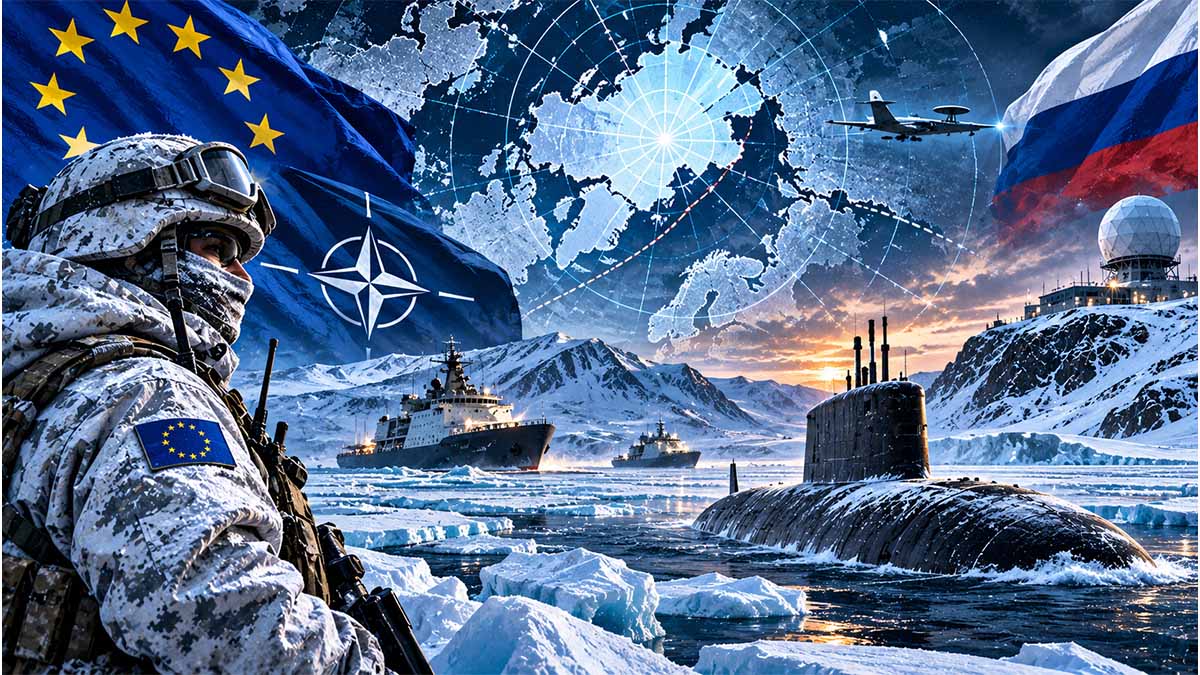
Scope: This assessment examines the relationship between British military deterrence in the European Arctic and North Atlantic, Russia’s demands for a wider European security settlement, and negotiations over Ukraine, with separate implications for Italy, France, Germany, the United Kingdom and the European Union through November 2031.
Executive Summary / BLUF
The principal strategic issue is whether stronger northern deterrence can support a durable Ukraine settlement without creating an additional escalation mechanism. British announcements establish closer naval integration and investment in underwater surveillance; they do not establish a government decision to attack Russian territory. Defence Secretary Wes Streeting reported a 41% increase in Russian activity within the UK’s maritime area of responsibility during 2026, while the Atlantic Net programme carries an announced initial investment of £90 million. These measures must be distinguished from delivered, operationally available capability. Moscow explicitly links Ukraine’s settlement to a wider European security architecture, whereas European partners insist on sovereignty, independent decision-making and credible guarantees for Ukraine. The immediate policy requirement is to connect military preparedness, political authority and negotiated safeguards. The decisive uncertainty concerns the substantive obligations that the parties would accept, implement and verify. GOV.UK
Europe’s Security Guarantees Face a Delivery Test
Europe’s security commitments will deter renewed coercion only if governments can convert them into support that remains available when a settlement is contested. The contradiction exposed by the November 2026 negotiations is that diplomatic ambition, financing and military preparation are advancing through institutions that cannot automatically bind one another. The European Union can organise lending; the Coalition of the Willing can prepare multinational contributions; NATO can coordinate collective defence; national governments must still authorise and sustain what they promise. Treating those functions as a single guarantee would conceal the point at which credibility can fail. The immediate stakes are fiscal and industrial as much as military: money can be committed before equipment is delivered, and political assurances can create expectations before the necessary permissions and supporting services exist.
The financing envelope conceals a change in priorities
The €90 billion Ukraine Support Loan for 2026–2027 illustrates the distinction between financial scale and usable support. The Council’s decision of 23 April 2026 made up to €45 billion accessible for 2026: €16.7 billion for budget support and €28.3 billion for defence-industrial capacity. The Commission’s proposal of 30 October allocated the same €45 billion annual envelope for 2027 differently: €13.3 billion for budget support and €31.7 billion for defence-industrial capacity. The proposed €3.4 billion shift increases the industrial share from 62.9% to 70.4%. It changes the composition of support without enlarging the annual total.
That shift within the Ukraine Support Loan places a greater burden on procurement execution. An industrial allocation can strengthen defence only through orders, production, acceptance and delivery, while the state still needs functioning public services and the resources to maintain its forces. The April implementing decision also conditions disbursement on the availability of the loan guarantee. The October proposal establishes a proposed allocation, not a payment or equipment-delivery record.
The European Peace Facility demonstrates a different transmission mechanism. The Council’s 26 October decisions provided €4.7 billion for partial reimbursement of military assistance already delivered by member states and €230 million for additional EUMAM Ukraine financing. Reimbursement can sustain contributors’ willingness and capacity to continue assistance, but it does not deliver the same equipment a second time. Likewise, SAFE’s €150 billion consists of loans to beneficiary member states. Its almost €13.5 billion in prefinancing across eleven states, reported on 29 October, measures financial implementation rather than completed military capability.
Procurement rules determine how quickly money becomes protection
SAFE’s eligibility conditions shape which industrial arrangements can convert financing into equipment. The Council’s explanation limits component costs originating outside the EU, Ukraine and EEA/EFTA countries to 35% and applies stricter conditions to certain advanced capabilities. Those rules serve a defence-industrial purpose, but they also mean that a government’s willingness to buy does not establish that its preferred contract qualifies for the instrument. A security undertaking tied to equipment supply therefore inherits procurement constraints that diplomatic language cannot remove.
The Commission’s 29 October SAFE update records nineteen participating states with approved loan agreements, sixteen signed agreements and eleven recipients of prefinancing. Each stage answers a different implementation question. Approval does not establish a signed agreement; a signed agreement does not establish production; prefinancing does not establish delivery. Its strategic value depends on delivery within the period covered by the commitment; later capacity cannot retrospectively meet an immediate requirement.
NATO’s July 2026 public-private resilience guidance extends this problem beyond weapons factories. Transport, communications, energy and other essential services depend on commercial operators whose ordinary business arrangements cannot simply be assumed to remain sufficient in a crisis. The guidance recommends governance, exercises and ready-to-activate legal and contractual tools, while creating no new legal obligations itself. Governments must supply the agreements, resources and priorities that make those services dependable. A security guarantee supported by equipment but dependent on unavailable transport or restoration services would fail through its supporting arrangements.
A ceasefire would activate responsibilities, not erase uncertainty
The Paris Declaration of 6 January 2026 envisages monitoring, continued support for Ukrainian forces, multinational reassurance, commitments addressing a future Russian attack and deeper defence cooperation. These components are connected, but they perform different functions. Monitoring can establish a record of conduct without determining the response to a violation. Reassurance can support confidence without replacing Ukraine’s own defensive capacity. The declaration’s provision for national legal and constitutional arrangements means that its architecture still requires decisions capable of making the respective contributions usable.
British guidance published on 3 November makes the distinction explicit for the Multinational Force-Ukraine. Deployment requires a Ukrainian invitation, the end of hostilities and the necessary political and military conditions. The guidance describes the force as separate from NATO and distinguishes it from peacekeeping and ceasefire monitoring. Coordination with the Alliance cannot therefore be presented as evidence that the proposed force automatically carries NATO’s institutional authority or collective-defence obligations.
The Coalition of the Willing’s implementation problem would become sharper after activation. If a contributor withdrew a necessary function, another participant would have to replace it or the undertaking would need revision. Keeping the original assurance unchanged while its practical basis diminished would make political credibility depend on a capability no longer available. A durable guarantee must therefore demonstrate that it can handle disagreement and shortfalls after a ceasefire.
Europe’s negotiating seat cannot substitute for national consent
Germany’s account of the Abu Dhabi process on 11 November identifies sequencing, context, consensus and avoidance of surprises as principles understood among European, American and Ukrainian participants. The federal government expressly confirmed that these principles had not been agreed with Russia. That qualification limits what can be claimed about convergence. Moscow’s insistence that a Ukraine settlement and wider European security arrangements are inseparable does not establish acceptance of the sequence described by Berlin, nor does European agreement on that sequence establish a common negotiating framework with Moscow.
The European Council’s 13 November account identifies a proposed negotiating team comprising EU institutions and France, Germany, Italy, Poland and the United Kingdom. Representation can improve coordination, but it cannot merge their powers. Italy’s equipment-transfer authorisation runs through 31 December 2026; the current decision does not itself supply authority for every undertaking envisaged beyond that date. France and the United Kingdom’s coalition leadership creates responsibilities for implementation, while Germany’s long-term industrial contracts connect annual support to production. A common European position becomes credible through these separate decisions.
NATO’s consensus system imposes an equally concrete boundary. A collective decision expresses the common consent of sovereign members; technical integration or participation in another coalition cannot be assumed to supply it. The cost of leaving permissions unresolved is that disagreement emerges when a contribution is needed rather than when it can still be adjusted. The negotiating task is to secure commitments from the authorities that can perform them, with Ukrainian sovereign decisions remaining Ukraine’s own.
Crisis control depends on procedures that survive hostility
The Arctic–Atlantic contest increases the consequences of ambiguous events because the Northern Fleet combines conventional missions with protection of strategic submarines. A measure intended to constrain conventional activity could be interpreted through its effects on strategic-force security. That establishes no automatic escalation threshold; it makes the distinction between intention and effect central to political control. A bargaining strategy that assumes these interpretations will remain aligned would rest on an assurance the public record does not provide.
The Vienna Document supplies a narrower, practical instrument for handling some forms of uncertainty. Within its scope, it provides a 48-hour reply period for an applicable request concerning unusual military activity and a separate 48-hour window for a requested meeting. Those procedures are not a universal deadline for every Arctic incident, and their existence does not guarantee cooperation. Their value lies in preserving an opportunity for substantive clarification before uncertain information hardens into a political demand for broader action.
Direct force against Russian territory would require a separate national, legal and strategic decision. The UN Charter and the International Court of Justice’s reasoning on threats and uses of force do not allow a deterrence objective to supply its own legal justification. The policy consequence is that stronger defensive preparedness and coercive military action cannot be treated as successive administrative stages of the same programme. One preserves capabilities for a range of contingencies; the other changes the circumstances to which governments and allies must respond.
The next two years will expose who underwrites the promise
Between November 2027 and November 2028, the decisive test will be whether the Ukraine Support Loan, SAFE procurement and the Coalition of the Willing’s preparations have produced support that remains usable across successive budgets and decisions. A ceasefire would increase the importance of that test because political assurances would face practical questions about monitoring, sustained assistance and responses to violations. Continuing confrontation would test the same arrangements through prolonged demand and disruption.
The costs of inaction would fall unevenly. Ukraine would bear the immediate security and fiscal consequences of support gaps; contributing governments would bear the cost of replacing delayed or withdrawn functions; suppliers and infrastructure operators would face uncertainty where public commitments lacked dependable contracts and priorities. For France and the United Kingdom, the exposure would include the credibility of coalition leadership; for Germany, the connection between financing and delivery; for Italy, continuity beyond the present authorisation. The EU and NATO would confront the consequences of commitments attributed to them without the decisions required to implement them. Over these twelve to twenty-four months, the choice is whether to finance, authorise and sustain the promise already made—or allow its practical value to erode while its wording remains intact.
Navigational Index
Pillar I — Northern Military Power and Strategic Stability
- Chapter 1 — The Arctic–Atlantic Security System: Geography, the Northern Fleet, strategic deterrence and European reinforcement.
- Chapter 2 — British and Allied Operational Credibility: Naval integration, surveillance, logistics, readiness and the distinction between programmes and available forces.
- Chapter 3 — Authority, International Law and Escalation: Political control, the use of force and the interaction between conventional operations and nuclear security.
Pillar II — Ukraine and the Negotiation of European Security
- Chapter 4 — Competing Definitions of a European Settlement: Russian demands, Ukrainian sovereignty, European participation and the role of the United States.
- Chapter 5 — The Material Foundations of Security Guarantees: Procurement, industrial capacity, financing, undersea infrastructure and implementation constraints.
- Chapter 6 — European Responsibilities and National Choices: Separate assessments of Italy, France, Germany and the United Kingdom, followed by EU and NATO coordination.
Pillar III — Risk Pathways, Decisions and the Five-Year Outlook
- Chapter 7 — Deterrence, Bargaining and Crisis Pathways: Alternative developments through November 2031, with observable indicators.
- Chapter 8 — Courses of Action and Final Net Assessment: Authorities, expected effects, implementation burdens, reversibility and principal risks.
Master Abstract
Deterrence proposals require precise political interpretation
The distinction between preparing to threaten military facilities during a conflict and authorising an attack is fundamental to assessing British policy. Rishi Sunak’s column, published on 14 November, carries the explicit subtitle: “We must show Russia that in a conflict we could put its bases at risk.” The accessible publication record establishes a conditional deterrence argument. It does not establish an instruction from the serving British government, an approved operation or an imminent attack. The full column was inaccessible during verification, so its detailed operational prescriptions cannot be treated as established here. The defensible starting point is the argument that credible wartime vulnerability could influence Russian calculations, followed by an examination of whether the necessary forces, authorities and escalation controls exist. Rishi Sunak: It is Britain’s duty to prove Putin can’t rule the Arctic — Rishi Sunak, The Sunday Times — Nov 2026. thetimes.com
The serving government’s published position provides a more concrete baseline. In Oslo on 12 November, Streeting reported more than 50 Royal Navy ship visits to the High North during 2025, British troop numbers in Norway doubled to 2,000, and participation by 1,500 commandos in Exercise Cold Response earlier in 2026. He also described the procurement of eight British Type 26 anti-submarine warfare frigates to operate alongside five Norwegian counterparts. These are different categories of evidence: visits measure activity, troop figures describe a reported presence, exercises demonstrate participation, and procurement identifies future force development. None alone establishes the availability of a sustained offensive campaign. The reported 41% rise likewise concerns Russian activity across the UK’s maritime area of responsibility; the speech provides neither the underlying event count nor a sufficiently detailed methodology to translate that percentage into a comparable increase in combat power. Defence Secretary Wes Streeting speech at Atlantic Future Forum — Ministry of Defence — Nov 2026. GOV.UK
The Northern Fleet creates a conventional–nuclear escalation problem
The Norwegian Intelligence Service’s Focus 2026 identifies protection of strategic submarines as the Northern Fleet’s primary task, alongside capabilities that can threaten NATO military and civilian targets and maritime supply routes. Its assessment also describes regular Atlantic deployments as a priority. This combination gives the northern theatre significance beyond its immediate geography: forces associated with strategic nuclear survivability operate within a wider military system that also supports conventional pressure against allied territory and communications. The service nevertheless records constraints, including a maintenance backlog and slow fleet modernisation, while assessing that the most advanced submarines have remained comparatively protected from those limitations. These distinctions rule out a simple interpretation of either unlimited Russian strength or general naval exhaustion. Focus 2026, pp. 27–31 — Norwegian Intelligence Service — 2026. etterretningstjenesten.no
The analytical consequence is that conventional military pressure in this theatre can affect perceptions of nuclear security. An operation intended to constrain conventional naval activity could be interpreted as threatening the protection of strategic submarines, depending on its location, scale and observable effects. That mechanism does not make nuclear escalation inevitable; it makes discrimination, communication and political control central to deterrence design. Credibility therefore depends on more than the ability to reach a military installation. It also requires a defensible political purpose and an assessment of how the adversary might interpret the action.
Allied integration is advancing ahead of demonstrated delivery
The Northern Navies Initiative, announced as signed on 10 November, seeks common operating practices, training standards, pre-crisis planning and compatible equipment among Joint Expeditionary Force navies. Its stated purpose includes acting early and transitioning into NATO command if the Alliance mobilises at scale. This establishes an integration framework, rather than proof that all participating forces already possess interchangeable capabilities or identical national permissions. Its military value will depend on implementation: shared procedures must survive practical tests involving communications, sustainment and command transfer. Its political value will depend on whether national decisions can be taken quickly enough to support the intended operational tempo. New Royal Navy-Led Northern Navies Initiative — Ministry of Defence — Nov 2026. GOV.UK
Atlantic Net addresses a related information requirement. The Ministry of Defence describes a network of autonomous systems, sensors and artificial intelligence intended to improve underwater surveillance and protect shipping routes, critical infrastructure and the nuclear deterrent. Its 10 November announcement identifies a framework with Ocean Infinity Solutions associated with £90 million of investment. In a separate speech that day, Defence Readiness and Industry Minister Luke Pollard said the investment would allow the service to become operational in 2027. The relevant assessment is therefore a funded and announced development pathway with a stated operational target. Public announcements do not establish its eventual coverage, detection performance, endurance or availability under contested conditions. £90 million investment for new drones and sensors to protect undersea cables and hunt Russian submarines — Ministry of Defence — Nov 2026; Minister for Defence Readiness and Industry Luke Pollard MP’s speech at ISPC 2026 — Ministry of Defence — Nov 2026. GOV.UK
Moscow links settlement to architecture, without establishing an agreed architecture
On 15 November, Kremlin spokesman Dmitry Peskov told the broadcaster conducting his interview that a Ukraine settlement and a new European security architecture were inseparable. In another published extract, he coupled eventual discussions with Europeans to a warning that Russia would pursue its objectives through force if negotiating potential were absent. These statements establish the Kremlin’s declared position and its coercive framing. They provide no agreed definition of the future architecture, no accepted limits on military deployments and no jointly endorsed enforcement mechanism. Песков: урегулирование на Украине связано с безопасностью в Европе — Vesti/VGTRK, interview with Dmitry Peskov — Nov 2026; Песков: РФ добьется своего силой при отсутствии договорного потенциала с Европой — Vesti/VGTRK, interview with Dmitry Peskov — Nov 2026. Новости на Вести.ru
Vladimir Medinsky’s account of the 10–11 November Abu Dhabi negotiations similarly presented future European security arrangements as a central subject, while acknowledging that mutual understanding had been reached on some matters and remained absent on others. His account also identified an agreement in principle on a further prisoner exchange, with parameters to be announced. Those statements require separate treatment: a humanitarian understanding is a potentially implementable outcome; discussion of a security architecture remains a negotiating process. Neither establishes a comprehensive settlement. The first-party broadcast record is competent evidence of Medinsky’s public account, rather than independent confirmation that other delegations accepted his description of the talks. Три делегации, два дня, одна цель: главное о переговорах в Абу-Даби — Vesti/VGTRK, reporting Medinsky’s concluding press conference — Nov 2026. Новости на Вести.ru
European participation turns on consent and implementation
European partners have articulated principles that constrain any wider bargain. The 10 November statement covering the EU, France, Germany, Italy, the United Kingdom, Ukraine, the United States and NATO records coordination before the trilateral discussions with Russia. It specifies sovereignty, territorial integrity, independent decision-making and credible security guarantees for Ukraine. This establishes a common declared framework among the named participants. It does not establish agreement with Russia or authorise individual governments to undertake particular military commitments. Statement on today’s meeting in Abu Dhabi between the EU, France, Germany, Italy, United Kingdom, Ukraine, United States and NATO — Council of the European Union — Nov 2026. consilium.europa.eu
The country assessments must therefore distinguish shared principles from national decisions. Italy’s immediate decision question is the authority and sustainable resources behind any guarantee it might assume. France’s concerns the relationship between its proposed political commitments and the responsibilities it would accept for implementation. Germany’s concerns the conversion of commitments into authorised, financed and deliverable support. The United Kingdom’s additionally concerns the compatibility of northern maritime responsibilities with commitments associated with Ukraine. These are analytical requirements for evaluating policy options; the joint statement does not disclose separate national operational pledges.
At EU level, António Costa’s 13 November remarks assigned distinct roles: Ukraine decides matters concerning its territory and sovereignty; the EU addresses its European future, reconstruction and prosperity; security guarantees are discussed through the Coalition of the Willing in coordination with NATO. This division makes institutional coordination a substantive requirement. A settlement could fail in implementation if financial, military and diplomatic obligations were negotiated without the competent institutions and governments assuming them. Remarks by President António Costa at the press conference following the informal meeting of Heads of State or Government of 13 November 2026 — European Council — Nov 2026. Consilium
Security arrangements remain constrained by law and sovereign choice
Military preparedness and political bargaining do not themselves supply legal authority to use force. Article 2(4) of the UN Charter prohibits threats or uses of force inconsistent with the Charter; Article 51 preserves individual and collective self-defence if an armed attack occurs, subject to its stated conditions. Any proposed operation requires assessment against its actual circumstances and legal basis. A general objective of demonstrating vulnerability cannot substitute for that assessment. United Nations Charter, Articles 2(4) and 51 — United Nations, reproduced by the US National Archives — 1945. National Archives
The OSCE’s 1999 Charter for European Security also places sovereign choice and reciprocal security within the same political framework. Paragraph 8 affirms states’ freedom to choose or change security arrangements, including alliances, while rejecting spheres of influence and commitments to strengthen security at other states’ expense. The negotiating challenge is to translate these principles into reciprocal, verifiable arrangements without converting one state’s asserted security concerns into authority over another state’s sovereign decisions. Charter for European Security, paragraph 8 — OSCE — Nov 1999. unece.org
Key Evidence Table
| Indicator | Value/status | Reference date | Definition/scope | Issuer | Exact source |
|---|---|---|---|---|---|
| Russian maritime activity | Reported increase of 41% | 2026, as reported on 12 November | UK maritime area of responsibility; underlying count and methodology not supplied in the speech | UK Ministry of Defence | Streeting’s Atlantic Future Forum speech |
| British High North activity | More than 50 ship visits | 2025 | Visits, rather than distinct ships or continuously deployed vessels | UK Ministry of Defence | Streeting’s Atlantic Future Forum speech |
| Atlantic Net investment | £90 million, announced initial investment | 10 November 2026 | Framework-associated programme investment; not evidence of completed expenditure or operational acceptance | UK Ministry of Defence | Atlantic Net announcement |
| Atlantic Net operational target | 2027 | Announced 10 November 2026 | Ministerial delivery objective | UK Ministry of Defence | Pollard’s ISPC speech |
| Northern Navies Initiative | Agreement announced as signed | 10 November 2026 | JEF maritime integration, including an intended transition into NATO command | UK Ministry of Defence | Northern Navies Initiative announcement |
| Ukraine–European security linkage | Explicit Kremlin position | 15 November 2026 | Attributed negotiating position; no agreed settlement text established | Dmitry Peskov, interviewed by Vesti | Published interview extract |
| European negotiating principles | Sovereignty, territorial integrity, independent decision-making and credible guarantees | 10 November 2026 | Joint statement of the named European and transatlantic participants | Council of the European Union | Abu Dhabi coordination statement |
The British activity figures, programme status and diplomatic positions above come from the corresponding official announcements and first-party interview records. GOV.UK
Competing Explanations or Pathways
The following pathways can overlap. They identify developments that would strengthen or weaken the assessment; they are not assigned numerical probabilities.
| Hypothesis | Diagnostic support | Disconfirming evidence | Indicators | Current standing |
|---|---|---|---|---|
| Military reinforcement supports negotiated restraint | Surveillance investment, allied integration and continuing diplomatic coordination provide mechanisms for combining preparedness with bargaining | No reciprocal restraint or verification agreement has been established in the reviewed record | Implemented communications arrangements, reciprocal notifications and verifiable commitments | Plausible, dependent on negotiated implementation |
| Security architecture becomes a vehicle for coercive bargaining | Moscow explicitly links settlement to wider arrangements and retains force as a declared alternative | European participants maintain sovereignty and independent decision-making as stated principles | Concrete demands affecting third countries’ choices; pressure to accept obligations without their consent | A material negotiating risk |
| A northern incident disrupts settlement efforts | Closer military interaction occurs in a theatre connected to strategic submarine protection and critical infrastructure | The reviewed announcements establish preparedness and investment, without establishing an imminent attack | A serious encounter, infrastructure incident or breakdown in military communication followed by retaliatory demands | A contingency requiring preparation; no established timetable |
These judgments derive from the documented integration programme, Russian negotiating statements, European principles and the Norwegian assessment of the Northern Fleet’s strategic role. GOV.UK
Principal Gaps and Watch Indicators
The substantive negotiating record. A jointly authenticated framework, agreed communiqué or published draft is needed to establish whether “European security architecture” means reciprocal risk reduction, restrictions on military posture, security guarantees or broader political concessions. Unilateral descriptions cannot resolve that question.
Programme delivery and acceptance. Procurement notices, parliamentary disclosures and formal operational acceptance statements would establish whether Atlantic Net meets its announced timetable. The consequential distinction is between acquiring surveillance services and demonstrating sustained operational performance.
Comparable maritime activity data. A published Ministry of Defence definition, geographic boundary, reference period and underlying count would permit assessment of the reported 41% increase. Until then, the figure supports the ministry’s account of increased activity without measuring its composition or severity.
National commitments. Separate Italian, French, German and British decisions are needed to identify the legal authorities, funding, personnel, duration and conditions attached to any security guarantee. Joint political coordination does not establish these obligations.
Escalation safeguards. Published arrangements for military communications, incident management, exercise notification and verification would indicate whether stronger deterrence is being accompanied by practical controls against misinterpretation.
Decision threshold. The assessment would change materially following an authenticated settlement framework, demonstrated operational delivery of the announced surveillance capability, a formal decision authorising hostilities, or a serious incident that alters national rules and commitments. None should be inferred from political rhetoric alone.
Arctic Deterrence and the Contest over European Security
Open-source analytical assessment · 2026-11-15. British military integration and surveillance investment must be distinguished from operational capability and decisions to use force. Russia links a Ukraine settlement to wider European security arrangements; European partners emphasise sovereignty and credible guarantees.
| Indicator | Value / status | Qualification |
|---|---|---|
| Russian maritime activity | +41% | UK ministerial statement, 12 November 2026. Underlying count and methodology not supplied. |
| Royal Navy High North visits | More than 50 | 2025 visits, not distinct ships or continuous deployments. |
| Atlantic Net | £90 million | Announced initial investment; not completed expenditure. |
| Atlantic Net operational target | 2027 | Announced objective; operational acceptance not established. |
| Northern Navies Initiative | Agreement announced as signed | 10 November 2026; implementation remains consequential. |
Sources: UK Ministry of Defence, 12 November 2026; Atlantic Net announcement, 10 November 2026; Northern Navies Initiative, 10 November 2026.
Pillar I — Northern Military Power and Strategic Stability
Assessment cut-off: 15 November 2026.
Chapter 1 — The Arctic–Atlantic Security System: Geography, the Northern Fleet, Strategic Deterrence and European Reinforcement
The northern theatre connects territorial defence to the movement of allied power
The Arctic–Atlantic system matters because it connects the defence of northern Europe to the movement, protection and sustainment of allied forces across the Atlantic; its strategic importance cannot be reduced to the vulnerability of individual Russian installations. The institutional geography has already changed: Finland, Sweden and Denmark transferred into Joint Force Command Norfolk’s area of responsibility on 5 December 2025, joining an area that already included Iceland, Norway and the United Kingdom. The Finnish Defence Forces’ announcement identifies coherent defence planning, command and control, sustainment and transatlantic communications as reasons for the realignment, while explicitly preserving Finland’s responsibility for its own defence. This combination is consequential: consolidating operational responsibility can reduce fragmentation between maritime reinforcement and the defence of the Nordic region, but it does not transfer every national decision to a single headquarters or remove the need to coordinate with other NATO commands. The analytical distinction is between a more coherent planning area and an automatically executable campaign. The former is documented; the latter would depend on assigned forces, national permissions, support arrangements and the circumstances of a crisis. Finland, Sweden and Denmark to be transferred to Joint Force Command Norfolk — Finnish Defence Forces — Dec 2025. Finnish Government
The practical significance of this geography lies in the relationship between access and usable military capacity. Reinforcements reaching a European port are not yet equivalent to reinforcements available to a commander: reception, movement, maintenance, communications and subsequent supply must remain functional. Consequently, the protection of Atlantic communications and the defence of northern territory are mutually supporting responsibilities, rather than interchangeable missions. NATO’s July 2026 description of Arctic security identifies keeping maritime communications and reinforcement routes open as an alliance objective and describes Arctic Sentry, launched in February 2026, as an activity intended to consolidate national military activities into a coherent operational approach under JFC Norfolk. This is evidence of organisational integration, not evidence that every possible interruption to movement has been eliminated. The decision consequence is that force contributions should be assessed against the function they perform within the wider system: an additional combat platform, a surveillance service and an improvement to reception infrastructure may each strengthen deterrence, but through different mechanisms and on different timescales. Arctic security — NATO — Jul 2026. NATO Topic
The Northern Fleet combines strategic protection with conventional reach
The Northern Fleet’s significance arises from the coexistence of missions whose political consequences differ substantially. The Norwegian Intelligence Service’s Focus 2026 identifies protection of the fleet’s strategic submarines as its primary task, while also describing missile-carrying vessels and submarines capable of threatening NATO targets and maritime supply routes. It assesses that maintenance backlogs constrain Russian naval combat power, but distinguishes the most advanced submarines, which have remained comparatively protected and able to sustain a high operational tempo. The appropriate conclusion is therefore selective: constraints affecting the wider navy cannot be assumed to remove the operational relevance of its more capable submarine forces. Equally, the fleet’s strategic role does not establish that every associated vessel, installation or movement has an exclusively nuclear function. This mixed mission structure creates a problem of interpretation: pressure intended to constrain conventional activity could also be perceived as affecting the protection of strategic forces. The mechanism is functional overlap, not a presumption that any northern military confrontation would necessarily become nuclear. Focus 2026, pp. 27–31 — Norwegian Intelligence Service — 2026. www.etterretningstjenesten.no
For allied decision-makers, this distinction changes the meaning of operational success. A measure could improve local military conditions while worsening the political environment if its observable effects suggested an intention to threaten strategic retaliation rather than to restore a limited defensive position. Conversely, avoiding all measures that Russia might describe as threatening would allow an interested party to determine the boundaries of allied defence through assertion alone. The relevant analytical task is to compare purpose, actual effects and plausible interpretation without allowing any one of them to substitute for the others. Protective surveillance, reinforcement activity and coercive action against military infrastructure occupy different positions in that assessment. They should be evaluated separately, with particular attention to whether an action preserves time for political decisions, creates an opportunity for clarification, or instead compresses the period in which the other side believes it must respond. This is a framework for assessing escalation exposure; it does not establish an undisclosed Russian response threshold or justify predicting a specific reaction from geographical proximity alone.
Exercised multinational scale is measurable, but its interpretation requires discipline
Cold Response 2026 provides a more substantial basis for examining allied northern integration than isolated statements of intent. The Norwegian Armed Forces’ retrospective account, updated on 25 March, records 32,500 participants, comprising 25,000 in Norway and 7,500 in Finland, during the exercise held from 9 to 19 March 2026. Of the participants in Norway, 11,800 exercised on land; the remainder participated at sea or in the air. The account describes coordination across land, maritime, air, cyber and space domains and identifies participation by Italy, France, Germany and the United Kingdom among fourteen allied countries. These figures establish the scale and composition reported by the exercise authority, but they do not disclose how many formations could have been sustained under combat conditions or how performance would change under disruption. Cold Response 2026 — Norwegian Armed Forces — Mar 2026. NATO’s statement of 18 March used rounded figures of more than 32,000 overall, approximately 25,000 in Norway and 7,000 in Finland; the later Norwegian account provides the more precise retrospective breakdown, rather than a reason to average the two publications. NATO Secretary General visits Norway and observes exercise Cold Response 26 in the High North — NATO — Mar 2026. Norwegian Armed Forces
| Exercise measure | Reported value | Reference and definition | Assessment boundary |
|---|---|---|---|
| Exercise period | 9–19 March 2026 | Cold Response 2026 | A defined exercise period, not continuous deployment |
| Total participants | 32,500 | Norwegian retrospective account | Participation does not establish combat availability |
| Participants in Norway | 25,000 | All domains | Not a ground-force total |
| Participants in Finland | 7,500 | Norwegian retrospective account | Not interchangeable with a permanent force presence |
| Participants on Norwegian ground | 11,800 | Land component within Norway | Subset of the Norwegian total |
| Participants at sea or in the air within the Norwegian total | 13,200 | Calculated: 25,000 minus 11,800 | The source does not separate maritime and air participants |
| Participating allied countries | 14 | Exercise authority’s count | Country participation does not establish equal contributions |
The table follows the Norwegian Armed Forces’ retrospective definitions; the 13,200 figure is an arithmetic residual, rather than an independently published maritime or aviation strength. Cold Response 2026 — Norwegian Armed Forces — Mar 2026. Norwegian Armed Forces
Civilian support and transparency are operational variables
Norway’s statement to the OSCE on 25 March adds a dimension that participant totals alone cannot capture: the exercise involved civilian partners and a major health-preparedness activity rehearsing evacuation capabilities. The same statement records voluntary observation by officers from Bosnia and Herzegovina, Georgia, Moldova and Serbia during 12–14 March, in accordance with the Vienna Document framework. The significance is twofold. Civilian participation makes the exercise relevant to the supporting functions without which military activity cannot be sustained, while observation creates a documented mechanism for reducing uncertainty about an announced exercise. Neither function guarantees wartime resilience or prevents political disagreement, but both broaden the basis on which readiness and restraint can be assessed. A force can demonstrate proficiency in its immediate military task while remaining dependent on civilian capacity that has not been exercised to the same standard; similarly, an announced defensive purpose becomes more assessable when accompanied by observable conduct and notification. These are complementary requirements: the ability to operate and the ability to communicate the limits of that operation. Statement on Norwegian Exercise Cold Response 2026 — Permanent Delegation of Norway to the OSCE — Mar 2026. Norway and the OSCE
One theatre, three interacting functions
Conceptual relationships. Card size and depth encode no quantities, probabilities or operational priorities.
STRATEGIC STABILITY
Protection of strategic forces
The Northern Fleet protects strategic submarines. Conventional pressure can therefore acquire strategic significance.
CONVENTIONAL DEFENCE
Access and maritime communications
NATO seeks to preserve communications and reinforcement routes. Local military effects must be assessed against this wider function.
ALLIED SUSTAINMENT
Reception and continued support
Command coordination, civilian support and exercised evacuation capabilities contribute to the usability of deployed forces.
Why the functions cannot be assessed separately
A measure can improve conventional defence while increasing strategic uncertainty. Reinforcement depends on sustained access and support; military presence alone does not establish either. This is an analytical interpretation, not a disclosed campaign plan.
Sources: NATO, Arctic security, July 2026; Norway’s OSCE statement, March 2026. Northern Fleet assessment: Norwegian Intelligence Service, Focus 2026, pp. 27–31. Assessment cut-off: 2026-11-15.
Arctic–Atlantic security combines strategic-force protection, conventional maritime defence and allied sustainment. These functions interact; no numerical risk assessment is implied.
Key judgments
The northern theatre should be assessed as a system connecting strategic stability, conventional defence and reinforcement, because improvement in one function does not establish equivalent improvement in the others. The exercise record demonstrates multinational activity at substantial scale and provides evidence of civilian involvement, but its participant totals remain distinct from the availability and endurance of forces in a contested operation. The principal assessment is therefore functional: contributions matter according to the dependency they address, the conditions under which they remain usable and the political effects they generate.
What would change the assessment
The assessment would strengthen with published evidence of sustained reinforcement exercises that demonstrate reception, onward movement and support under realistic disruption, or with official evaluations identifying specific improvements in command integration and civilian support. It would weaken if subsequent official records disclosed unresolved dependencies that materially prevented assigned forces from operating or being sustained. Changes in Russian strategic-force protection or northern naval employment would also matter, but should be assessed from competent records rather than inferred from individual movements.
Open official record
The consequential outstanding records are releasable exercise evaluations, documented implementation of the command realignment and official assessments of reinforcement-support performance. The absence of public detail limits the assessment of demonstrated endurance; it does not establish that the relevant arrangements are absent.
Chapter 2 — British and Allied Operational Credibility: Naval Integration, Surveillance, Logistics, Readiness and the Distinction between Programmes and Available Forces
Fleet statistics establish an inventory boundary, not a deployable force package
British operational credibility depends on the ability to generate and sustain the required combination of platforms, personnel and support at the required time; a fleet total cannot establish that combination. The Ministry of Defence’s equipment statistics, published on 20 August 2026 with a reference date of 1 April, record nine submarines, divided into four ballistic nuclear submarines and five nuclear submarines, together with 52 Royal Navy surface vessels and 12 Royal Fleet Auxiliary vessels. The statistical release counts all 52 Royal Navy surface vessels as in service, but only nine of the twelve auxiliary vessels; the three outside that category comprise two delivered mine-hunting capability vessels awaiting transfer into service and a primary casualty receiving ship. This is a particularly useful distinction because it demonstrates, within one official publication, why delivery, recorded inventory and service status must remain separate. The figures establish neither the number of vessels available for a specific mission nor the strength that could be sustained over successive rotations. UK armed forces equipment and formations 2026 — Ministry of Defence — Aug 2026. GOV.UK
A parliamentary answer dated 31 March provides a second, differently defined view. The Ministry of Defence reported 52 Royal Navy surface ships in service and nine Royal Fleet Auxiliary vessels, described readiness as a cycle involving maintenance, training, deployment and recovery, and stated that around 50% of the fleet was at high readiness or above at any one time. It also withheld detailed long-term schedules and readiness profiles on operational-security grounds. The answer cannot responsibly be converted into an exact number of combat-ready ships for November, because its approximation does not disclose a mission-specific denominator, the composition of the higher-readiness group or the conditions attached to availability. Nor should its nine auxiliary vessels be presented as contradicting the later statistical total of twelve: the statistical release explicitly distinguishes the wider recorded total from the nine in-service vessels. The analytical consequence is to preserve each measure’s definition and date, rather than manufacture a single readiness figure from administrative categories. Written question HL15483: Royal Navy — Ministry of Defence answer to the House of Lords — Mar 2026. UK Parliament
WordPress evidence table — Inventory, service status and readiness
Fleet strength: preserve the definitions
Inventory, service status and readiness describe different conditions. No mission-specific available force is calculated.
| Measure | Value | Meaning | Boundary |
|---|---|---|---|
| Submarines | 9 | Recorded at 1 April 2026 | Not a deployable total |
| Ballistic nuclear submarines | 4 | Subset of the submarine total | Not additional to the nine |
| Other nuclear submarines | 5 | Second submarine category in the release | Availability not established |
| Royal Navy surface vessels | 52 | Recorded as in service | Different vessel types and readiness states |
| Royal Fleet Auxiliary: total | 12 | Recorded statistical total | Includes three outside in-service status |
| Royal Fleet Auxiliary: in service | 9 / 12 | 75%, as reported in the statistics | Service status is not mission readiness |
| Fleet at high readiness or above | Around 50% | Ministerial description, 31 March | Approximate; not a November force package |
Sources: MOD equipment statistics, August 2026; Parliamentary answer HL15483, March 2026. Assessment cut-off: 2026-11-15.
At 1 April 2026: nine submarines, 52 Royal Navy surface vessels, and twelve Royal Fleet Auxiliary vessels, of which nine were in service. A 31 March parliamentary answer described around half the fleet as being at high readiness or above. These are different measures.
Integration creates potential efficiencies, but schedules determine when they become usable
The Type 26 partnership illustrates how multinational integration can strengthen a future force while leaving important near-term questions unresolved. In its parliamentary answer of 14 July, the Ministry of Defence described a combined programme of at least thirteen frigates, comprising eight for the Royal Navy and at least five for Norway, but stated that detailed production scheduling and the allocation of individual build slots were still being developed with industry and international partners. The decisive distinction is between the agreed direction of the programme and the timing of its operational contribution. Shared procurement can create an opportunity for compatible training and sustainment, but the existence of that opportunity does not establish when a particular ship, crew and support arrangement will be available. A deterrence argument that depends on future platforms must therefore specify the period during which those platforms are expected to contribute and identify the separate means by which existing responsibilities will be met before then. Written question 16172: Type 26 build slots — Ministry of Defence answer to the House of Commons — Jul 2026. UK Parliament
The Royal Navy’s April announcement of Norway’s entry into the Global Combat Ship User Group provides a more detailed account of the intended mechanism. It describes cooperation extending from construction through crew training to operations, with opportunities to share testing, development and sustainment. It also distinguishes a common fundamental design from the different sensors, combat systems and weapons fitted to Australian and Canadian variants. This qualification matters because design commonality and complete interchangeability are different propositions: common engineering can facilitate cooperation without eliminating national configuration differences or the need to validate particular arrangements. The same announcement places the beginning of service entry at the end of the decade, led by HMS Glasgow, while the October parliamentary answer refers more broadly to entry into service from the late 2020s without supplying the requested ship-by-ship schedule. The public record therefore supports a future interoperability and industrial-cooperation pathway, while leaving the precise sequence of available capability unresolved. Future frigate programme bolstered as Norway joins UK, Canada and Australia — Royal Navy — Apr 2026; Written question 23189: frigate programme schedules — Ministry of Defence answer to the House of Commons — Oct 2026. royalnavy.mod.uk
Persistent surveillance introduces a delivery and sustainment test
Atlantic Net’s commercial structure deserves scrutiny beyond the announcement of an investment figure. Ocean Infinity’s first-party statement of 10 November identifies the company as the Royal Navy’s Commercial Mission Partner and describes an intended combination of autonomous, uncrewed and lean-crewed systems, advanced sensors, artificial intelligence and data. Its stated responsibility concerns making that model work in sustained operations with specialist partners. This establishes the supplier’s account of its role, rather than independent validation of achieved performance. The programme should consequently be assessed as an intended persistent service whose value depends on the continuity and usefulness of the information delivered, not simply the existence of individual platforms or sensors. In analytical terms, collecting information, maintaining a usable picture and supporting a timely decision are separate functions; improvement at the first does not establish equivalent improvement at the last. The company’s statement does not publish service-availability figures, independently assessed performance or evidence of sustained operation under contested conditions. Ocean Infinity selected as Commercial Mission Partner for Royal Navy Atlantic Net programme — Ocean Infinity — Nov 2026. Ocean Infinity
The required assurance should therefore follow the programme’s transition from an announced delivery model to accepted service and then to sustained military utility. Those stages answer different questions: whether the supplier has delivered the contracted function, whether the Royal Navy has accepted it for its intended use, and whether it remains useful over time alongside the forces and decision processes it is meant to support. This does not imply that the programme is deficient; it identifies the evidence needed to assess the claim made for it. The principal countervailing consideration is that some operationally relevant performance information may properly remain non-public, so public uncertainty should not be converted into a finding of failure. Equally, commercial selection should not be converted into a finding of operational success. The defensible assessment remains conditional on appropriate acceptance and sustainment evidence, with the limits of public disclosure preserved.
| Capability stage | What it establishes | What it does not establish | Consequential next record |
|---|---|---|---|
| Political announcement | Intended policy and programme direction | Contract execution or delivery | Procurement and contractual record |
| Supplier selection | Identified commercial responsibility | Accepted operational performance | Delivery and acceptance statement |
| Equipment delivery | Material has been supplied | Service entry or mission readiness | Formal service-entry record |
| Service entry | Administrative or operational admission under the applicable definition | Continuous availability for every mission | Readiness and sustainment evidence |
| Exercise participation | Conduct under the exercise’s conditions | Performance across all combat conditions | Releasable exercise evaluation |
| Sustained operational employment | Repeated use for the documented task | Unlimited endurance or universal effectiveness | Performance, maintenance and renewal record |
This table is an analytical framework for interpreting the official inventory distinctions, parliamentary readiness evidence and supplier statement; it is not an additional grading system or a claim about undisclosed acceptance criteria.
Replacement programmes can coincide with a temporary reduction in usable capacity
Norway’s implementation report in Prop. 68 S (2025–2026) makes the transition problem explicit: it anticipates an early-period decline in operational capability as existing equipment ages before new acquisitions become fully operational, and describes the challenges and costs of operating old and new structures in parallel. In the submarine programme, the report identifies the first delivery in 2029, five deliveries planned by 2036 and a sixth during 2038, alongside maintenance-infrastructure requirements. These dates demonstrate why a strengthening long-term programme should not be treated as a completed near-term reinforcement. They also extend beyond the dossier’s five-year horizon: the full planned submarine contribution would not be delivered by November 2031. The mechanism is an overlap of replacement, training, maintenance and infrastructure requirements, rather than a contradiction between investment growth and operational pressure. Prop. 68 S (2025–2026), Chapter 4: Status i gjennomføringen av Forsvarsløftet — Norwegian Ministry of Defence — 2026. regjeringen.no
Key judgments
Operational credibility should be judged by the forces and supporting functions that can be generated for a defined responsibility, within a defined period, rather than by adding inventory categories or future orders. The British records support a clear distinction between recorded vessels, in-service vessels and readiness; the multinational frigate programme supports a future integration pathway whose detailed scheduling remains consequential. Persistent surveillance and replacement programmes require their own assurance: service acceptance, sustained performance and the management of transition periods determine when announced investment becomes usable capacity.
What would change the assessment
Formal operational-acceptance statements, published delivery milestones and releasable evidence of sustained employment would strengthen confidence in the conversion of programmes into available capability. Revised schedules, changes in service-entry status or official findings of support constraints would alter the timing and scale of that contribution. A future statement about fleet readiness would be useful only if its date, coverage and definitions allowed a defensible comparison with the existing records.
Open official record
The principal gaps concern mission-specific availability, detailed delivery sequencing, persistent-service acceptance and the supporting arrangements required during equipment transition. The public record reviewed here does not permit a responsible calculation of a November 2026 British force package for an offensive operation against Russian territory.
Chapter 3 — Authority, International Law and Escalation: Political Control, the Use of Force and the Interaction between Conventional Operations and Nuclear Security
Domestic authority, alliance obligations and international legality are separate requirements
An operationally feasible action is not necessarily authorised, an authorised action is not necessarily lawful internationally, and a lawful action is not necessarily strategically prudent. These distinctions are particularly important where conventional operations could affect perceptions of strategic nuclear security. The House of Commons Library’s March 2026 account describes deployment of British armed forces in armed conflict as a prerogative power exercised by ministers, with the Prime Minister authorising military action on behalf of the Crown and decisions taken within Cabinet. It also distinguishes the political convention concerning parliamentary debate from a legally binding requirement for parliamentary approval. The relevant implication is institutional: commentary by a former officeholder cannot substitute for a decision by the serving authorities, and the absence of a prior parliamentary vote does not, by itself, settle the domestic constitutional question. Whether a particular decision complied with the applicable convention would require examination of its circumstances, including the government’s stated justification for proceeding as it did. Military action: Parliament’s role — House of Commons Library — Mar 2026. House of Commons Library
The international question is independently constrained by the UN Charter. Article 2(4) prohibits the threat or use of force inconsistent with the Charter; Article 51 preserves individual or collective self-defence if an armed attack occurs and requires measures taken in that exercise to be reported immediately to the Security Council. The distinction matters because political objectives such as imposing costs, demonstrating vulnerability or changing an adversary’s calculations do not themselves establish a legal basis for military force. A decision would require assessment of the concrete facts and the legal basis invoked, rather than a conclusion drawn from the desirability of its intended outcome. Nor does the classification of an installation as military resolve the initial question of entitlement to use force: the character of the object and the justification for resorting to force belong to different legal inquiries. United Nations Charter, Articles 2(4) and 51 — United Nations, reproduced by the US National Archives — 1945. www.archives.gov
NATO provides collective obligations without erasing national responsibility
The North Atlantic Treaty establishes several distinct mechanisms that should not be collapsed into a general presumption of automatic war. Article 3 concerns the maintenance and development of individual and collective defensive capacity; Article 4 provides for consultation when a party considers its security, territorial integrity or political independence threatened; Article 5 establishes assistance following an armed attack within its terms, with each ally taking the action it considers necessary, including armed force. Article 1 also commits the parties to peaceful settlement and conduct consistent with the UN Charter. The analytical consequence is that consultation, capacity-building and collective defence are related but legally different functions. They do not establish an unrestricted authority for one member to choose an offensive action and assume that every other member has thereby accepted its purpose, means and consequences. The North Atlantic Treaty, Articles 1, 3, 4 and 5 — NATO — Apr 1949. NATO’s explanatory account further states that assistance under Article 5 may or may not involve armed force and recognises national constitutional constraints. Collective defence and Article 5 — NATO — current institutional explanation. NATO Official text
This distinction is particularly relevant to integrated forces. Common procedures can shorten the interval between a political decision and its execution, but they do not remove the need for the decision itself. If governments have not resolved the circumstances in which particular contributions may be used, improved technical compatibility may expose unresolved political differences at the moment of crisis. Conversely, clear national permissions and a shared understanding of the mission can make integration more credible by reducing uncertainty about what assigned forces are actually available to do. The assessment should therefore treat national authority as part of usable capability, rather than an external administrative condition that can be addressed after forces are assembled. The Northern Navies Initiative’s published intention to facilitate a transition into NATO command is relevant to this problem, but its announcement does not disclose every national permission or an unrestricted delegation of authority. New Royal Navy-Led Northern Navies Initiative — Ministry of Defence — Nov 2026. www.gov.uk
The legality of a threat depends on the force being contemplated
The International Court of Justice’s 1996 advisory opinion provides a controlling analytical distinction for evaluating coercive military language. In paragraphs 41–42, the Court identifies necessity and proportionality as conditions governing self-defence and explains that compliance with self-defence requirements does not remove the separate obligations imposed by the law of armed conflict. In paragraph 47, it connects the legality of a threat to the legality of the contemplated use of force: an unlawful use cannot be made lawful merely by presenting it as a conditional warning. That reasoning requires examination of the substance and circumstances of a statement, rather than treating the word “deterrence” as either a legal exemption or proof of illegality. A conditional statement about defending against an armed attack and a threat to use force for an unlawful purpose would require different assessments, even if both were presented politically as intended to prevent escalation. Legality of the Threat or Use of Nuclear Weapons, Advisory Opinion, paragraphs 41–47 — International Court of Justice — Jul 1996. icj-web.leman.un-icc.cloud
The practical consequence is that public ambiguity carries costs as well as potential deterrent value. Ambiguity may leave an adversary uncertain about the full range of defensive responses, but it can also leave allies uncertain about the purpose of a proposed action and make it harder to distinguish a limited contingency from an expansive political objective. This does not mean that operational details should be published. It means that the political purpose, governing authority and broad legal conditions should be sufficiently intelligible to prevent claims of capability from being mistaken for approved policy. The same discipline should govern analysis of Russian statements: an assertion that force will be used if negotiations fail is evidence of the speaker’s position, not evidence that the legal conditions for that force have been satisfied.
Military objectives remain subject to civilian protection and precautions
The law governing the conduct of hostilities imposes an additional set of requirements that cannot be satisfied by a broad geographical label such as “military infrastructure.” Article 52(2) of Additional Protocol I defines military objectives through their effective contribution to military action and the definite military advantage offered by their neutralisation in the circumstances prevailing at the time. Article 57 requires feasible verification and precautions, prohibits attacks expected to cause excessive incidental civilian harm relative to the anticipated concrete and direct military advantage, and requires cancellation or suspension when the relevant conditions are no longer met. These provisions make the assessment specific and continuing: a general claim about an area’s military importance cannot replace examination of the object, the expected effects and the circumstances of the contemplated action. Protocol Additional I, Articles 52 and 57, reproduced in the United Nations Juridical Yearbook 1977, pp. 114–116 — United Nations — 1977. The ICJ separately emphasised that compliance with self-defence proportionality does not dispense with humanitarian-law requirements, so the two inquiries should remain distinct in both policy advice and public explanation. Legality of the Threat or Use of Nuclear Weapons — International Court of Justice — Jul 1996. legal.un.org
| Assessment layer | Central question | Evidence required | What cannot substitute for it |
|---|---|---|---|
| Domestic authority | Has the competent national authority approved the action? | Applicable decision and constitutional process | A former officeholder’s argument |
| Alliance coordination | What have allies actually accepted or undertaken? | Consultation, agreed mission and national permissions | Technical interoperability alone |
| Resort to force | What legal basis applies to the concrete circumstances? | Facts and an applicable international legal justification | A general deterrence objective |
| Conduct of hostilities | Does the contemplated action satisfy the applicable rules? | Object-specific assessment, expected effects and feasible precautions | The label “military infrastructure” |
| Strategic stability | Could the effects be interpreted as threatening strategic retaliation? | Assessment of functions, observable effects and plausible interpretation | Assurance about intention alone |
| Termination and control | Can political authorities constrain, suspend or end the action? | Defined decision responsibilities and reassessment arrangements | Initial authorisation alone |
The table separates legal requirements from alliance coordination and analytical judgments about escalation. Its final two rows are strategic decision questions, rather than additional treaty provisions.
Strategic stability requires attention to effects that legal compliance does not resolve
A legally justified conventional operation can still create a severe strategic problem if its effects are interpreted as threatening the survival or responsiveness of strategic forces. This is an analytical implication of the mixed functions examined in Chapter 1, rather than a claim that a particular action would cross a publicly established threshold. The problem is especially acute when the actor conducting an operation believes its purpose is limited, while the other side assesses the same event through its possible effect on future options. Intentions may be communicated, but observable consequences can carry greater weight in a crisis. For that reason, political control should include reassessment of the evolving situation: whether the initial purpose remains attainable, whether the effects remain within the intended bounds and whether a response is changing the political character of the confrontation. The corresponding countervailing consideration is that excessive fear of misinterpretation can undermine lawful defence. The appropriate objective is therefore to preserve effective defensive action while reducing avoidable ambiguity about its purpose and limits, rather than assuming that either maximum pressure or maximum restraint necessarily produces stability.
Transparency arrangements offer one practical means of addressing part of this problem without abandoning preparedness. Norway’s documented exercise notifications and voluntary observation under the Vienna Document show that substantial military training and measures intended to reduce uncertainty can coexist. Their value should not be overstated: observers do not verify every capability, notifications do not settle legal disputes and transparency cannot compel an actor to accept another’s stated intentions. Nevertheless, such arrangements create a record against which conduct can be compared and can preserve opportunities for clarification before an ambiguous event acquires a more dangerous interpretation. The decision principle is to pair readiness measures with communication and reassessment arrangements appropriate to their potential consequences, rather than treating those arrangements as evidence of diminished resolve. Statement on Norwegian Exercise Cold Response 2026 — Permanent Delegation of Norway to the OSCE — Mar 2026. Norway and the OSCE
WordPress scheme — Independent requirements for a military decision
Four questions that require separate answers
This is an analytical decision framework, not a universal approval sequence. Satisfying one requirement does not satisfy the others.
NATIONAL RESPONSIBILITY
Who has authorised the action?
Identify the competent government decision and applicable constitutional process. Political commentary is not authorisation.
RESORT TO FORCE
What international legal basis applies?
Assess the actual circumstances under the UN Charter. A deterrence objective does not itself establish that basis.
CONDUCT OF HOSTILITIES
Are the applicable attack rules satisfied?
Examine military-objective status, civilian harm and feasible precautions. A geographical label is insufficient.
ANALYTICAL JUDGMENT
Can the consequences remain controlled?
Compare intended purpose, observable effects and plausible interpretation. Legal compliance does not establish strategic prudence.
Alliance integration does not erase national decisions
Consultation, collective defence and technical integration perform different functions. They do not demonstrate identical permissions or an unrestricted delegation of authority by every participating state.
Sources: House of Commons Library, March 2026; UN Charter, 1945; Additional Protocol I, Articles 52 and 57. Strategic-control questions are analytical judgments. Assessment cut-off: 2026-11-15.
National authorisation, international justification, compliance with the rules of hostilities and strategic prudence require separate assessment. Alliance integration does not remove national responsibility.
Key judgments
The governing distinction is between the authority to decide, the legal entitlement to act, compliance with the rules governing the action and the judgment that its consequences are acceptable. None can be inferred solely from the others. Northern integration makes this distinction more consequential because improved operational coordination can accelerate execution while leaving national permissions and strategic interpretation unresolved. The strongest basis for credible deterrence is therefore a demonstrable relationship between available capability, competent political decisions, lawful purposes and arrangements that preserve the ability to reassess and constrain action.
What would change the assessment
An authenticated national decision, a published legal justification, a defined allied undertaking or an implemented incident-management arrangement would materially change the evidence available for assessing a specific action. So would a serious event whose documented effects altered the factual basis for self-defence or the interpretation of military intentions. Such changes require examination on their own terms; they should not be inferred from a procurement announcement, an exercise total or a political statement about resolve.
Open official record
The reviewed public record does not establish a British government authorisation for attacks against Russian Arctic infrastructure, the legal justification for such an operation or the national permissions that would govern allied participation. The absence of those public records prevents a concrete assessment of an approved operation. It does not prevent assessment of the capabilities, institutional responsibilities and legal constraints that any such decision would have to address.
Pillar II — Ukraine and the Negotiation of European Security
Assessment cut-off: 15 November 2026.
Chapter 4 — Competing Definitions of a European Settlement: Russian Demands, Ukrainian Sovereignty, European Participation and the Role of the United States
The central disagreement concerns the authority to define security
The principal obstacle to a durable settlement is the absence of an agreed relationship between ending the war in Ukraine and deciding the wider military and political arrangements of Europe. These subjects are connected, but connection does not establish a negotiating hierarchy, identify which governments can bind other participants, or determine whether particular obligations should precede a ceasefire. The joint statement issued before the Abu Dhabi trilateral discussions on 10 November establishes a European–Ukrainian–American position that combines sovereignty, territorial integrity, independent decision-making and credible guarantees with discussion of post-war European security. It also identifies NATO as central to collective defence and envisages broader multilateral discussions involving European partners. The significance is that these participants do not reject discussion of a wider architecture; they attach conditions concerning consent, existing institutions and Ukraine’s long-term security. Consequently, a description of the diplomatic contest as a choice between negotiating European security and refusing to negotiate it would misrepresent the documented positions. The more consequential questions concern the order of decisions, the participants entitled to make them, the obligations being proposed and the means of enforcing them. Statement on today’s meeting in Abu Dhabi between the EU, France, Germany, Italy, United Kingdom, Ukraine, United States and NATO — European Council — Nov 2026. Consilium
The Russian position creates a different potential negotiating mechanism. Peskov’s declaration that a Ukraine settlement and a new European security architecture cannot exist separately makes the wider arrangement a stated component of Moscow’s settlement concept, while his accompanying warning about pursuing objectives by force preserves coercion as a declared alternative to negotiation. The analytical issue is how that linkage would operate in practice: it could support reciprocal arrangements addressing future military risks, or it could become a means of withholding agreement on the immediate conflict until other states accept broader demands. The published interview extracts establish the linkage and the threat, but do not provide a complete draft agreement, a mutually accepted list of obligations or evidence that other parties have conceded a Russian right to determine their security choices. Any assessment of specific Russian demands must therefore distinguish what has been publicly stated from provisions that remain undisclosed or unagreed. Песков: урегулирование на Украине связано с безопасностью в Европе — Vesti/VGTRK, interview with Dmitry Peskov — Nov 2026; Песков: РФ добьется своего силой при отсутствии договорного потенциала с Европой — Vesti/VGTRK, interview with Dmitry Peskov — Nov 2026. www.vesti.ru
Sequencing is a substantive negotiating position
Germany’s account of the Abu Dhabi process supplies an important distinction that a general reference to “European security talks” would obscure. At the federal government’s press conference on 11 November, spokesman Stefan Kornelius described four principles: discussion of peace in Ukraine before a subsequent European and transatlantic order; recognition that Ukraine forms an inherent part of that security context; consensus; and a policy of avoiding surprises through transparency and close coordination. Crucially, when asked whether these principles had been agreed with Russia, he confirmed that they concerned understanding among the Europeans, Americans and Ukrainians. That qualification prevents a significant analytical error: Berlin’s account cannot be presented as a Russian commitment to the same sequence or as an already agreed procedural settlement among all negotiating parties. Its importance lies in defining the position Germany says its partners took into the next diplomatic stage. Regierungspressekonferenz vom 11. November 2026 — German Federal Government — Nov 2026. bundesregierung.de
The difference between these approaches has direct consequences for bargaining. If settlement in Ukraine is made contingent on resolving every wider European dispute, the number of issues capable of blocking an immediate agreement increases; if broader arrangements are deferred without a credible process, unresolved security concerns can undermine confidence in the initial settlement. Neither problem is solved merely by declaring the subjects inseparable. A workable architecture would need to distinguish measures necessary for an immediate cessation of hostilities, obligations required to sustain that cessation, and questions that can be negotiated over a longer period without suspending the first two. This is an analytical requirement rather than a disclosed formula accepted by the parties. Its value is that it prevents a procedural disagreement from being concealed inside apparently shared language: governments can all endorse “lasting peace” while disagreeing over whether military guarantees must be operational before a ceasefire, activated by it, or negotiated after it.
Ukrainian participation concerns ownership of the settlement
Ukraine’s diplomatic position cannot be reduced to acceptance or rejection of proposals transmitted by larger powers. The presidential account of the 6 November meeting with Nordic and Baltic leaders records support for European participation in decisions concerning Europe’s security and identifies energy and air defence as Ukraine’s immediate winter priorities. The connection between these subjects matters: negotiating authority is exercised while the state must continue protecting its population and maintaining essential functions, so the practical credibility of a settlement depends partly on whether support remains available during the negotiating period. The President Discussed Preparations for a Trilateral Meeting in Abu Dhabi With NB8 Leaders — Presidency of Ukraine — Nov 2026. In its 13 November account of Zelenskyy’s meeting with American envoys Steve Witkoff and Jared Kushner, the presidency identifies a prospective prisoner exchange, greater European participation and preparations for further multilateral meetings as outcomes of the week’s diplomacy. These are attributed Ukrainian assessments of progress, not proof that a final settlement or its enforcement arrangements had been concluded. Volodymyr Zelenskyy Discussed Outcomes of This Week’s Negotiations with Steve Witkoff and Jared Kushner — Presidency of Ukraine — Nov 2026. president.gov.ua
American mediation and American guarantees are different commitments
The American role extends across diplomacy, proposed monitoring arrangements and discussion of support, but those functions should not be treated as interchangeable obligations. Ukraine’s account of the 4 November call with Witkoff and Kushner describes preparations for the trilateral format, separate meetings concerning recovery and guarantees, and requests for air-defence support. This establishes a broad diplomatic interface without establishing the legal form or duration of a future American security undertaking. Volodymyr Zelenskyy Discussed Preparations for a Trilateral Format in Abu Dhabi and Strengthening Ukraine’s Air Defenses with Steve Witkoff and Jared Kushner — Presidency of Ukraine — Nov 2026. The Paris Declaration of 6 January envisages a proposed US-led ceasefire-monitoring mechanism, continued support for Ukrainian forces, a multinational force, commitments concerning a future Russian attack and deeper defence cooperation. Its wording also preserves national legal and constitutional arrangements and identifies proposed American support for European-led reassurance measures. The document is therefore evidence of an intended architecture containing distinct components; it should not be rewritten as an unconditional American military guarantee already activated across all of them. Paris Declaration — Robust Security Guarantees for a Solid and Lasting Peace in Ukraine — French Presidency — Jan 2026. president.gov.ua
| Negotiating question | Documented position or arrangement | Consequential distinction |
|---|---|---|
| Relationship between Ukraine and wider security | Moscow describes them as inseparable | Linkage does not establish agreed provisions |
| Order of negotiations | Berlin describes peace in Ukraine before a subsequent wider order | The reported principles were not agreed with Russia |
| European participation | European and Ukrainian records support broader participation | Attendance and authority to bind institutions remain different |
| Ceasefire monitoring | Paris Declaration envisages a proposed US-led mechanism | Monitoring does not itself establish enforcement |
| Future military support | Long-term assistance and responses to renewed attack are contemplated | The content and activation of commitments require specification |
| Sovereign decisions | European participants affirm independent decision-making | A wider agreement cannot be assumed to supply another state’s consent |
A settlement contains different obligations
Analytical decomposition, not an agreed implementation timetable.
CESSATION OF HOSTILITIES
What conduct must stop?
Define the obligations, parties and conditions governing the cessation.
MONITORING AND ATTRIBUTION
How are violations established?
Observation, attribution and dispute handling require defined responsibilities.
SUSTAINED DEFENCE
What remains available over time?
Support for Ukrainian forces and any reassurance contribution require resources and consent.
WIDER EUROPEAN ARRANGEMENTS
Who can accept which commitments?
Broader negotiations require the participation and authority of the affected actors.
Monitoring is not the same as enforcement
Detecting a violation does not determine the response. A credible arrangement must separately identify who decides, what support is available and which national permissions apply.
Sources: Paris Declaration, 6 January 2026; German government briefing, 11 November 2026. Assessment cut-off: 2026-11-15. No probabilities or operational plans are encoded.
A prospective settlement must distinguish cessation obligations, monitoring, sustained defence and wider European arrangements. These functions do not establish one another.
Key judgments
The most consequential disagreement concerns the relationship between immediate peace arrangements and wider security obligations, including who participates and whether one set of decisions is made conditional on another. The documentary record supports continued negotiation and an intended architecture of guarantees, but does not establish Russian acceptance of the sequencing described by Berlin or an unconditional American undertaking covering every proposed function. A durable arrangement would need to turn shared political vocabulary into separately identifiable obligations whose implementation does not depend on assumptions about another participant’s consent.
What would change the assessment
A jointly authenticated negotiating framework specifying sequence, participation, activation conditions and responses to violations would materially strengthen the assessment of diplomatic convergence. Conversely, evidence that an immediate cessation was being withheld pending acceptance of unspecified obligations by absent parties would strengthen concern that architectural negotiations were functioning principally as coercive leverage.
Open official record
The decisive missing records are the agreed negotiating mandate, any common text governing ceasefire monitoring, the final form of national guarantees and provisions defining the participation of affected European institutions and states.
Chapter 5 — The Material Foundations of Security Guarantees: Procurement, Industrial Capacity, Financing, Undersea Infrastructure and Implementation Constraints
Guarantees require a financing structure that survives beyond the announcement
A security guarantee becomes materially credible when its political commitments are supported by financing, procurement and sustainment arrangements that remain usable over the period in which the commitment is expected to deter renewed aggression. The European financing structure already illustrates why headline amounts require careful interpretation. On 23 April, the Council finalised the legal framework for a €90 billion Ukraine Support Loan for 2026–2027 and adopted an implementing decision making up to €45 billion accessible for 2026, divided between macro-financial assistance, the Ukraine Facility and defence-industrial support. The distinction between the two-year framework, the annual allocation and actual payments is essential: these are successive stages within an instrument, not separate contributions that can be added together. The April decision’s annual allocation comprises €8.35 billion through macro-financial assistance, €8.35 billion through the Ukraine Facility and €28.3 billion for defence-industrial capacities. Council finalises €90 billion support loan to Ukraine — Council of the European Union — Apr 2026. The operative decision also makes disbursement conditional on the availability of the loan guarantee, demonstrating that an amount made accessible in law is not itself a record of cash received. Council Implementing Decision (EU) 2026/919, Article 2 — Council of the European Union — Apr 2026. Consilium
The Commission’s proposal published on 30 October identifies a different allocation within the proposed €45 billion for 2027: €13.3 billion of budget support, split equally between the Ukraine Facility and macro-financial assistance, and €31.7 billion for defence-industrial capacity. Compared with the April 2026 allocation, the proposed industrial component rises by €3.4 billion, while budget support falls by the same amount. Calculated from the published inputs, the industrial share changes from 62.9% to 70.4% of the annual envelope, rounded to one decimal place. This is a proposed change in composition, not an increase in the annual total and not a record of completed procurement. Its strategic significance is conditional: a larger industrial allocation can support greater defence output only if orders, production, acceptance and delivery can convert the financing into useful capability, while a smaller budget-support component must still be assessed against the state’s continuing non-procurement requirements. Commission takes a key step forward on 2027 financial support for Ukraine — European Commission — Oct 2026. Enlargement and Eastern Neighbourhood
Same annual envelope, different proposed allocation
Nominal euro amounts in billions. The 2027 column describes the Commission proposal published on 30 October, not a payment record.
| Component | 2026 decision | 2027 proposal | Interpretation |
|---|---|---|---|
| Ukraine Facility budget support | €8.35bn | €6.65bn | One budget-support channel |
| Macro-financial assistance | €8.35bn | €6.65bn | Second budget-support channel |
| Combined budget support | €16.7bn | €13.3bn | Subtotal; do not add it again |
| Defence-industrial capacity | €28.3bn | €31.7bn | Financing allocation, not delivered equipment |
| Annual total | €45bn | €45bn | Components of the €90bn two-year framework |
| Industrial share of annual total | 62.9% | 70.4% | Calculated; rounded to one decimal place |
Calculations: 28.3 ÷ 45 and 31.7 ÷ 45. Proposed industrial increase: €3.4bn, offset by lower budget support.
Sources: Council Implementing Decision 2026/919, April 2026; Commission proposal announcement, October 2026. Assessment cut-off: 2026-11-15.
The 2026 decision allocates €16.7bn to budget support and €28.3bn to defence-industrial capacity. The October proposal for 2027 allocates €13.3bn and €31.7bn respectively. Each annual envelope totals €45bn; neither figure establishes completed disbursement.
Joint procurement can strengthen supply while creating eligibility constraints
SAFE supplies a separate financing mechanism whose purpose and beneficiaries differ from the Ukraine Support Loan. The Council describes €150 billion in long-maturity loans repayable by beneficiary member states, with common procurement as the governing model and conditions concerning product eligibility and component origin. Ukraine can participate alongside EU member states, but the loans themselves go to member states. These distinctions matter to industrial planning: political willingness to buy a system does not automatically establish that a particular contract qualifies for a particular financing instrument, and participation by a partner country does not necessarily give its suppliers identical access across all categories. The Council’s explanation includes a maximum 35% component-cost share originating outside the EU, Ukraine and EEA/EFTA countries, together with stricter conditions for certain advanced capabilities. What is Security Action for Europe (SAFE)? — Council of the European Union — Jun 2026. The Commission’s 29 October update provides a later implementation snapshot: €21.3 billion in a second call within the existing envelope, agreements approved for 19 participating states, 16 signed, and almost €13.5 billion disbursed as prefinancing across 11 states. These are different stages of implementation, not nineteen completed national procurement programmes. Commission invites Member States to use €21.3 billion under SAFE to boost Defence Readiness and support to Ukraine — European Commission — Oct 2026. Consilium
The industrial implication is that a guarantee must be supported by a procurement portfolio whose legal eligibility, delivery schedule and sustainment burden are understood together. Common orders can improve demand visibility and facilitate standardisation, but the benefit depends on whether participating governments can maintain their commitments through the production period and whether the resulting equipment meets the recipient’s actual requirements. A financing instrument can reduce one constraint while leaving others unresolved: access to a loan does not establish the availability of production slots, and a signed contract does not establish that training, maintenance or replacement supplies will be funded over the equipment’s life. The relevant assessment should therefore identify which dependency each instrument addresses and avoid presenting all financial mechanisms as interchangeable purchasing power. This also creates a practical negotiating requirement: commitments to provide rapid support after a renewed attack should be connected to identifiable replenishment arrangements, rather than relying on the assumption that sufficient equipment will be obtainable at the moment the commitment is activated.
Reimbursement and additional assistance must remain separate
The Council’s European Peace Facility decisions of 26 October illustrate another important accounting boundary. The release identifies €4.7 billion for partial reimbursement of military assistance already delivered by member states and €230 million in additional financing for EUMAM Ukraine. Their sum is €4.93 billion, consistent with the rounded €4.9 billion headline. It also places those decisions within the separate September political agreement to mobilise €6.6 billion. Treating the October headline, its components and the September envelope as independent new assistance would therefore double-count overlapping amounts and misrepresent the timing of military effect. Reimbursement can matter strategically by easing the financial burden on contributing governments and supporting the sustainability of assistance, but its immediate meaning differs from a new equipment delivery to Ukraine. EU support for Ukraine: Council mobilises €4.9 billion under the European Peace Facility — Council of the European Union — Oct 2026. consilium.europa.eu
| Instrument or measure | Published amount/status | Financial meaning | Inference to avoid |
|---|---|---|---|
| Ukraine Support Loan | €90bn, 2026–2027 | Two-year financing framework | Adding annual components again |
| 2026 implementing decision | Up to €45bn | Annual assistance made accessible under specified conditions | Treating the ceiling as cash received |
| October 2027 proposal | €45bn | Proposed annual allocation | Treating a proposal as a delivery record |
| SAFE | €150bn | Loans to participating member states | Calling it a grant to Ukraine |
| SAFE October prefinancing | Almost €13.5bn across 11 states | Reported disbursement stage | Equating prefinancing with completed capability |
| EPF reimbursement | €4.7bn | Partial reimbursement for aid already delivered | Counting the same aid as a fresh delivery |
| Additional EUMAM financing | €230m | Financing for the military-assistance mission | Treating it as a separate weapons inventory |
Infrastructure resilience must include recovery, not only protection
The material foundations of a guarantee also include the continuity of civilian and military-supporting systems, because an undertaking can lose practical value if communications, power or repair arrangements fail even while nominal military commitments remain unchanged. The Commission’s submarine-cable toolbox addresses prevention, detection, response, recovery and deterrence, drawing on a risk assessment and identifying Cable Projects of European Interest for prioritisation in public funding. The importance of this framework is its treatment of resilience as a cycle: preventing an incident and restoring a service after one are different tasks, and protection cannot be assessed solely through surveillance or patrol activity. Submarine Cable Security Toolbox and Cable Projects of European Interest — European Commission — Feb 2026, report corrected Mar 2026. The accompanying announcement identifies €347 million for strategic cable projects, including a €20 million call concerning adaptable repair modules. Those figures concern infrastructure funding, not a Ukraine-specific military guarantee or proof that all required repair capacity has been delivered. Commission increases submarine cable security with €347 million investment and new toolbox — European Commission — Feb 2026. Shaping Europe’s digital future
The scale of Ukraine’s recovery requirements reinforces the need to separate security assistance from the wider financial problem. The joint RDNA5 assessment released on 23 February estimates almost $588 billion in recovery and reconstruction needs over the following decade, using a damage reference date of 31 December 2025; it also identifies more than $15 billion in priority recovery programmes and public investment for 2026. These figures measure estimated needs and priorities, not secured financing, annual military assistance or a forecast of damage through November 2026. Updated Ukraine Recovery and Reconstruction Needs Assessment Released — Government of Ukraine, World Bank Group, European Commission and United Nations — Feb 2026. The analytical consequence is that a credible guarantee must coexist with a viable recovery framework without assuming that one financing stream can meet every requirement. Military capacity can protect recovery activity, while recovery can help sustain the state that maintains that capacity; nevertheless, their budgets, delivery channels and conditions require separate scrutiny.
Key judgments
The financial architecture is increasingly substantial, but its credibility depends on the relationship between instruments rather than the sum of their headlines. Loans, annual allocations, prefinancing, reimbursements and guarantees perform different functions and create different obligations. The proposed shift towards defence-industrial support strengthens the importance of production and delivery assurance, while the scale of reconstruction needs and infrastructure dependencies prevents military procurement from serving as a complete proxy for national resilience.
What would change the assessment
Published disbursement records, procurement awards, delivery milestones and accepted support arrangements would strengthen confidence that financing is becoming usable security capacity. Revised allocations, unmet financing conditions, delivery slippage or evidence of infrastructure-recovery constraints would change the timing and practical strength of the guarantee.
Open official record
The consequential gaps concern the reconciliation of annual allocations with actual payments, the delivery schedules attached to industrial financing, the continuing cost of sustainment and the availability of infrastructure-restoration capacity. No aggregate total is calculated here across instruments with different beneficiaries, legal forms and reference periods.
Chapter 6 — European Responsibilities and National Choices: Italy, France, Germany and the United Kingdom, Followed by EU and NATO Coordination
Italy — Material support requires continuity beyond the current authorisation
Italy’s most consequential choice is how to turn its participation in the settlement process into a defined, sustainable contribution without treating diplomatic participation as evidence of an undisclosed operational commitment. The domestic record supplies a concrete boundary: Article 1 of Decree-Law 201 of 31 December 2025, converted with amendments by Law 27 of 27 February 2026, extends the authorisation for transfers to Ukrainian governmental authorities through 31 December 2026, subject to parliamentary direction. The amended provision gives priority to logistics, medical, civilian-use and protective equipment addressing air, missile, drone and cyber attacks. This establishes an enabling framework for material support, not a quantified national guarantee or an authorisation for every possible future mission. Decreto-legge 31 dicembre 2025, n. 201, Article 1, as amended — Italian Republic / Normattiva — 2026. The Chamber’s account confirms the conversion and its scope. D.L. 201/2025 — Cessione di mezzi, materiali ed equipaggiamenti alle autorità governative dell’Ucraina — Chamber of Deputies — Mar 2026. normattiva.it
The approaching end of that authorisation creates a specific implementation question for commitments intended to last into 2027 and beyond: continuity requires the appropriate subsequent decisions, rather than an assumption that a diplomatic declaration supplies them. Italy could contribute materially through equipment, training, industrial cooperation and support functions, but each option would need a defined authority, resource basis and duration. Parliamentary scrutiny also has an accounting function. The Chamber’s 2026 international-missions dossier notes that financial requirements were presented in some cases on a combined basis rather than disaggregated by individual mission, while identifying EUMAM Ukraine among the relevant mission records. This does not establish inadequate funding; it identifies a comparability limit that matters when assessing the cost of an additional undertaking. For Italy, the most reviewable contribution would therefore specify the capability or support function, the period covered, the financing decision and the relationship to existing commitments, rather than rely on an imprecise national headline. Proroga delle missioni internazionali in corso e autorizzazione per ulteriori missioni e interventi di cooperazione per l’anno 2026, dossier DI0204b — Chamber of Deputies — 2026. documenti.camera.it
France — Leadership creates responsibility for the transition from framework to employment
France’s distinctive position is its role in organising the proposed guarantee architecture, which makes the quality of implementation especially consequential to its credibility. The French foreign ministry’s 12 November account describes a coalition of 36 countries, co-chaired by France and the United Kingdom, and identifies five components of the guarantee framework: monitoring, long-term support for Ukrainian forces, a multinational force, responses to renewed attack and deeper defence cooperation. It also describes Exercise Koalicija 26.2, scheduled for 2–24 November, involving 2,800 personnel from 13 countries, with activities addressing logistics, force protection and the support of training and force regeneration. At the assessment cut-off, the exercise was ongoing; its announced scope should not be presented as a completed evaluation or proof of deployment readiness. Ukraine: What is the Coalition of the Willing? — French Ministry for Europe and Foreign Affairs — Nov 2026. France Diplomatie
The resulting French decision problem is how to ensure that leadership of planning is matched by an executable division of responsibilities. A multinational framework can broaden participation while also increasing the number of dependencies that must be resolved before employment: contributors may offer different functions, apply different permissions or require support from other participants. France’s policy options should consequently be assessed according to their effect on that implementation problem. A larger national contribution may increase capacity, while a clearer allocation of responsibilities may improve the usability of contributions already pledged; neither benefit should be assumed without evidence. The principal risk is a gap between the political visibility of the framework and the maturity of its supporting arrangements. The relevant test is whether the coalition can identify what will be available at activation, who will sustain it and how changes in individual national contributions would be managed without making the entire undertaking uncertain.
Germany — Funding scale and procedural discipline must reinforce one another
Germany supplies a different combination of material weight and negotiating emphasis. The federal government’s account of the 2026 budget identifies approximately €11.5 billion in military assistance for Ukraine. That amount is a budgetary provision for the year, not a statement that all assistance had been delivered by the assessment date or a complete valuation of Germany’s contribution across every instrument. Bundeshaushalt 2026: Investitionen für die Zukunft — German Federal Government — 2026 budget account. At the 11 March press conference, a defence ministry representative described annual support as embedded in long-term industrial processes and purchase agreements, including air-defence systems, missiles and ammunition, and stated that industry was fulfilling the relevant contracts. That is an attributed governmental assessment at that date; it does not establish that every subsequent contract remained on schedule. Its importance is the documented use of longer-term contracting to connect annual funding with production commitments. Regierungspressekonferenz vom 11. März 2026 — German Federal Government — Mar 2026. Bundesregierung
Berlin’s strategic task is to preserve this material continuity while maintaining the procedural conditions under which a settlement can command allied consent. The government announced on 13 November that Germany, France and the United Kingdom would convene a Coalition of the Willing meeting in Berlin on 19 November, addressing current diplomacy, post-war guarantees and continued support. That was a scheduled event beyond the cut-off, not an accomplished agreement. Regierungspressekonferenz vom 13. November 2026 — German Federal Government — Nov 2026. The practical opportunity is to connect negotiating principles with identifiable commitments: a requirement for consensus is more useful when governments can state what they are prepared to finance and sustain, while substantial funding has greater deterrent value when its role within the future arrangement is understood. The principal downside would be to allow agreement on procedure to substitute for agreement on the resources and decisions required after a violation. Germany’s contribution should therefore be evaluated through both contracting continuity and the clarity of its undertakings within the wider framework.
The United Kingdom — Military planning and financial support require different accounting
The British record provides unusually explicit information about the proposed multinational force. Ministry of Defence guidance published on 3 November describes 35 coalition nations, military commitments from 24 nations, and a joint operational-level headquarters commanded by the United Kingdom and France, then located in Paris and due to rotate to Britain before the end of 2026. It states that the force is not a peacekeeping or ceasefire-monitoring force and is not connected to NATO, and makes deployment conditional on a Ukrainian invitation, the end of hostilities and the necessary political and military conditions. These distinctions prevent coalition participation from being mistaken for force contribution, and force planning from being mistaken for completed deployment. The Multinational Force-Ukraine — UK Ministry of Defence — Nov 2026. The British count of 35 and the later French count of 36 should remain dated institutional snapshots: the reviewed records do not explain whether the difference reflects membership change or counting practice. GOV.UK
The financial record requires equivalent discipline. The Treasury’s 28 October announcement combines economic support, World Bank-related guarantees and grant contributions, additional air-defence assistance and a £3 billion increase in UK Export Finance capacity, taking the stated cover limit to £6.5 billion. It also reiterates support through at least 2030–31. An export-finance cover limit and a guarantee are not equivalent to a grant already paid, so these categories should not be combined into a single measure of immediate fiscal transfer or military delivery. Further support for Ukraine — HM Treasury — Oct 2026. Britain’s concrete decision problem is to align the personnel and support responsibilities associated with its coalition role with a financial structure whose different components can be activated when needed. The strategic benefit of longer commitments is predictability; the burden is maintaining their practical meaning through successive budgets and changing requirements. The principal risk is that headline financial capacity or headquarters activity is treated as proof that every element of the future undertaking has already been funded and made available. GOV.UK
Different national contributions, shared implementation test
Analytical comparison. No readiness ranking, financial equivalence or risk score.
| Actor | Documented anchor | Concrete decision | Implementation risk |
|---|---|---|---|
| Italy | Equipment-transfer authorisation through 31 December 2026 | Define subsequent authority, support function and duration | Long-term promises exceeding current decisions |
| France | Coalition leadership and ongoing multinational preparation | Connect planned contributions to activation and sustainment | Planning visibility exceeding executable arrangements |
| Germany | Approximately €11.5bn military-assistance provision for 2026 | Preserve delivery continuity and specify future undertakings | Funding and negotiating commitments remaining disconnected |
| United Kingdom | Joint command role and 24 national military commitments reported | Match force responsibilities to usable support arrangements | Confusing financial capacity with delivered capability |
| EU institutions | Financing, reconstruction and diplomatic coordination | Align competent instruments with national commitments | Different institutions assumed to supply the same authority |
Sources: Italian Chamber of Deputies; French Foreign Ministry; German Federal Government; UK Ministry of Defence. Decision and risk columns are analytical judgments.
Italy faces continuity of authorisation; France faces implementation of coalition planning; Germany faces continuity between funding and delivery; the United Kingdom faces alignment of command responsibilities and support. These are different decision problems, not a numerical ranking.
EU and NATO coordination — Representation does not merge institutional powers
The European negotiating structure now has a more explicit political form. The European Council’s account of the 13 November meeting identifies a proposed team comprising the EU institutions and France, Germany, Italy, Poland and the United Kingdom, coordinating Europe’s contribution while working with all member states. This gives Italy and Poland an identified role alongside the three governments prominently involved in coalition leadership, while preserving the need to coordinate with the wider Union. It also means that the four-country assessment in this chapter should not be mistaken for a complete membership list of the European diplomatic mechanism. The same account places Ukraine’s 2027 financing needs on the agenda of the 26–27 November European Council, a future decision point at the assessment cut-off. Informal meeting of heads of state or government, 13 November 2026 — European Council — Nov 2026. Consilium
The resulting coordination problem is substantive rather than presentational. EU financing institutions, the coalition’s military framework, NATO’s collective-defence responsibilities and national authorities perform different functions; a common diplomatic position does not automatically combine their powers or activate their resources. The British guidance’s explicit separation of the multinational force from NATO must therefore be read alongside European statements calling for coordination with NATO, without converting coordination into institutional identity. A coherent arrangement would identify which body finances a function, which government authorises it, which headquarters directs it and which participants undertake to sustain it. This is particularly important after a violation, when delays can arise from uncertainty about responsibility even where governments agree politically that a response is necessary. The strongest European contribution would be a set of commitments whose ownership and implementation are clear enough to remain credible under pressure, rather than a single broad assurance whose constituent responsibilities remain unspecified.
Key judgments
Italy, France, Germany and the United Kingdom have materially different positions within the emerging framework, and those differences should be used to structure complementary contributions rather than concealed within an aggregate European label. Italy’s current equipment-transfer authority has a defined expiry; France’s leadership places emphasis on executable coalition arrangements; Germany’s funding and contracting role makes delivery continuity consequential; and Britain’s command role and mixed financial instruments require alignment between responsibility and usable support. EU-level representation can strengthen negotiating coherence, but cannot replace the distinct decisions through which institutions and governments assume obligations.
What would change the assessment
Published national undertakings specifying contributions, activation conditions, duration and sustainment would strengthen the assessment of European preparedness to support a settlement. The announced Berlin meeting and subsequent European Council would become consequential evidence only through their actual decisions and implementation records. A change in coalition membership, force commitments or command arrangements would require updated attribution rather than retroactive harmonisation of the existing figures.
Open official record
The remaining decisive records are the final national contribution schedules, the financing and support arrangements attached to them, the operative relationship between coalition planning and allied coordination, and the authority through which each participant would respond to renewed aggression. These documents would determine whether the emerging political architecture can function as a durable security undertaking.
Pillar III — Risk Pathways, Decisions and the Five-Year Outlook
Assessment cut-off: 15 November 2026. Outlook period: 15 November 2026–15 November 2031.
Chapter 7 — Deterrence, Bargaining and Crisis Pathways: Alternative Developments through November 2031, with Observable Indicators
The decisive variable is whether commitments remain usable under pressure
The five-year balance will depend on whether military preparedness, financial commitments and political decision-making remain connected when governments face disruption, contested information and competing demands. The preceding chapters established the relevant organisations, programmes and negotiating positions; the forward assessment must now examine how that structure could behave under stress. An agreement can be signed without resolving the conditions under which support is activated, while a military programme can enter service without removing dependencies on civilian infrastructure or national permissions. Conversely, disagreement over a comprehensive European settlement does not necessarily prevent narrower arrangements that reduce immediate dangers or preserve practical cooperation. The central forecasting question is therefore whether the emerging system can maintain Ukrainian defensive capacity, allied freedom of decision and functioning channels for managing incidents through successive political and budgetary cycles. The 10 November coordination statement supports the existence of a shared European–Ukrainian–American objective combining guarantees, sovereign decision-making and escalation management, but it does not establish how those objectives would perform during a disputed violation. The pathways below are conditional developments that can overlap or succeed one another; they are not assigned numerical probabilities. Statement on today’s meeting in Abu Dhabi between the EU, France, Germany, Italy, United Kingdom, Ukraine, United States and NATO — European Council — Nov 2026. Consilium
Civilian dependencies create channels for strategic pressure
The extent of military dependence on civilian systems makes disruption a potentially important source of bargaining leverage. NATO’s September 2026 account provides indicative figures: around 90% of military transport for large military operations comes from civilian assets chartered or requisitioned commercially; more than 70% of satellite communications used for defence purposes comes from the commercial sector; approximately 95% of transatlantic internet traffic, including military communications, travels through undersea fibre-optic networks; and, on average, around 75% of host-nation support is sourced from local commercial infrastructure and services. These figures describe different activities and denominators, and the page does not supply a common statistical reference period. They should therefore be treated as NATO’s published illustrations of structural dependence, rather than a comparable dataset measuring vulnerability in the present crisis. Their decision relevance is nevertheless substantial: interruptions to transport, communications or contracted services can affect military usability without destroying a combat platform, while the same interruption can impose civilian costs that complicate the political response. Resilience, civil preparedness and Article 3 — NATO — Sep 2026. NATO Topic
| NATO’s published dependency illustration | Indicative value | Actual denominator | Interpretation limit |
|---|---|---|---|
| Civilian transport provision | Around 90% | Military transport for large operations | Not a measure of available Arctic transport |
| Commercial satellite communications | More than 70% | Satellite communications used for defence purposes | Not all military communications |
| Undersea carriage of transatlantic internet traffic | Approximately 95% | Transatlantic internet traffic, including military communications | Not the share of every defence network |
| Commercial contribution to host-nation support | Around 75%, on average | Local infrastructure and services supporting NATO operations | Not a country-specific readiness assessment |
The figures retain NATO’s qualifications and should not be added, averaged or converted into a combined risk score. Their differing denominators also preclude interpreting them as four measurements of the same vulnerability. Resilience, civil preparedness and Article 3 — NATO — Sep 2026.
Pathway A — An implemented cessation supported by continuing defensive capacity
Under this pathway, negotiations produce a cessation of hostilities that is accompanied by functioning monitoring arrangements, continuing support for Ukrainian forces and sufficiently clear national undertakings to prevent routine uncertainty from becoming a test of the entire settlement. The stabilising mechanism is the reduction of opportunities to obtain advantage through a limited violation: observation establishes a credible record, support preserves Ukraine’s ability to resist renewed coercion, and governments retain agreed procedures for deciding how to respond. The Paris Declaration provides the documentary basis for examining this combination, but its proposed components would have to be implemented through the competent decisions and arrangements identified in Pillar II. The strongest evidence for this pathway would consequently be operational rather than ceremonial: a monitoring mechanism that actually produces accepted reports, national commitments whose activation conditions are intelligible, and continuing delivery arrangements that remain effective after the immediate diplomatic milestone. The principal vulnerability would be an imbalance between the maturity of observation and the maturity of response. A system that can document violations but cannot produce a timely decision may reveal disagreement more clearly without resolving it. The assessment would therefore strengthen through demonstrated handling of disputes, rather than through the existence of a declaration alone. Paris Declaration — Robust Security Guarantees for a Solid and Lasting Peace in Ukraine — French Presidency — Jan 2026. www.elysee.fr
Pathway B — Managed confrontation with selective agreements
A second pathway involves continued strategic competition, incomplete settlement negotiations and sustained military preparedness, alongside narrower arrangements designed to prevent individual incidents from producing uncontrolled consequences. This would not require the parties to agree on the legitimacy of each other’s broader security positions. Its mechanism would instead be limited cooperation where an identifiable mutual interest exists, such as clarifying unusual activity or exchanging information after a hazardous military incident. The OSCE’s Vienna Document contains procedures relevant to that function: paragraph 16.1.2 specifies a reply within 48 hours to an applicable request for explanation concerning unusual military activity; paragraph 16.2.1 provides for a requested meeting within a further 48-hour procedural window; and paragraph 17 addresses reporting and clarification of hazardous military incidents within the document’s scope. These are separate procedures with defined applicability, not a universal deadline governing every Arctic maritime event. Their presence establishes a formal basis for consultation, while effective use would depend on participation and implementation. The diagnostic indicator for managed confrontation would be the continued use of such channels despite political hostility, particularly where governments exchange substantive information and modify conduct sufficiently to reduce an immediate misunderstanding. Vienna Document 2011, Chapter III, paragraphs 16–17 — OSCE — Nov 2011. osce.org
Pathway C — Political guarantees persist while their practical value erodes
The third pathway is a gradual separation between public commitments and the resources, permissions and supporting services needed to fulfil them. It could occur even without an explicit governmental decision to abandon support: successive postponements, incomplete replenishment, unresolved responsibilities or the expiry of enabling arrangements could reduce the undertaking’s practical strength while its diplomatic language remains unchanged. The causal mechanism is cumulative dependency failure. An individual delay may be manageable, but several delays affecting different parts of a support arrangement can interact, leaving the political commitment dependent on resources that are unavailable at the same time. NATO’s September 2026 resilience requirements recognise the importance of sustained resource planning, defined governance and coordination between civilian and military needs, including support in a contested environment. That record supports treating continuity of enabling functions as a substantive part of deterrence. The observable warning would be repeated official evidence that an agreed function cannot be delivered, coupled with no credible replacement or revised commitment. A single administrative delay or an undisclosed readiness figure would not establish this pathway; the assessment would require a pattern linking documented shortfalls to the usability of the undertaking. 2026 Resilience Baseline Requirements — NATO — Sep 2026. NATO Official text
Pathway D — An incident changes the political character of the confrontation
An acute crisis could develop if a serious military encounter or infrastructure disruption were interpreted as a deliberate attempt to change the strategic balance, particularly where information remained incomplete and governments faced pressure to respond before their assessments converged. The transition mechanism would involve more than the incident itself: uncertain attribution, visible military responses, concern about further action and the narrowing of political options could reinforce one another. This pathway does not require the original event to have been designed to produce a broader conflict, and it should not be inferred merely from increased military activity. The relevant indicators would be observable changes in decision-making, such as the interruption of communication channels, incompatible official accounts accompanied by immediate coercive demands, or emergency measures whose stated purposes affect the conditions for further negotiation. The Northern Fleet’s overlapping strategic and conventional functions, assessed by the Norwegian Intelligence Service, make the interpretation of effects especially consequential in the northern theatre. They do not establish an automatic escalation threshold. The assessment must therefore preserve the distinction between an event’s verified effects, the responsibility attributed by governments and the intentions subsequently inferred from it. Focus 2026, pp. 27–31 — Norwegian Intelligence Service — 2026. www.etterretningstjenesten.no
Indicators must identify a decision consequence
The purpose of an indicator framework is to distinguish developments that change the assessment from developments that merely attract attention. Another political meeting, procurement announcement or force contribution can be relevant, but its significance depends on whether it resolves a named dependency. A signed monitoring arrangement matters if it establishes access, reporting and responsibility; an additional contribution matters if it can perform the required function within the undertaking’s conditions; and a communication mechanism matters if the relevant actors can actually use it. Indicators should therefore be paired with a decision that becomes necessary when the evidence changes. This prevents the accumulation of loosely related observations from creating an impression of precision. It also preserves proportion: a financing delay should trigger examination of the affected obligation, while a hazardous incident should trigger immediate protective and clarification measures appropriate to its facts, rather than treating every warning as evidence of the same pathway.
| Observable development | Assessment strengthened | Consequential threshold | Decision implication |
|---|---|---|---|
| Monitoring arrangements begin producing documented reports | Implemented cessation | Agreed reporting and dispute procedures function in practice | Assess whether response arrangements are equally mature |
| Diplomatic hostility coexists with substantive incident clarification | Managed confrontation | Channels remain usable during disagreement | Preserve and exercise those channels |
| A contributor withdraws a necessary function without replacement | Erosion of guarantees | The undertaking can no longer perform that function | Reallocate support or revise the commitment explicitly |
| Repeated delivery failures affect the same required capability | Erosion of guarantees | Available capacity no longer meets the accepted undertaking | Review contracts, alternatives and political assurances |
| A serious incident interrupts communications and produces coercive demands | Acute crisis | Clarification becomes less available as response pressure rises | Separate immediate protection from attribution and broader policy |
| Tested continuity arrangements maintain critical services during disruption | Greater resilience | The required function remains available under the tested conditions | Extend assurance to connected dependencies |
| National permissions are clarified before activation | Greater implementability | Contributions can be used within the agreed mission | Validate the complete multinational arrangement |
These are proposed analytical thresholds, not treaty triggers, numerical warning scores or claims that the developments have occurred.
Four pathways through November 2031
Conditional analysis as of 15 November 2026. Pathways may overlap or follow one another. Card size and visual depth encode no probability.
IMPLEMENTED CESSATION
Commitments function after agreement
Monitoring, defensive support and political decisions remain connected.
Diagnostic evidence
Documented monitoring reports, usable dispute procedures and national undertakings that can be activated and sustained.
MANAGED CONFRONTATION
Competition continues with safeguards
Limited clarification arrangements remain usable despite wider disagreement.
Diagnostic evidence
Substantive exchanges after incidents and observable conduct that reduces immediate misunderstanding.
GUARANTEE EROSION
Political assurances outlast practical support
Necessary resources or permissions fall away without credible replacement.
Diagnostic evidence
Repeated documented shortfalls prevent performance of an accepted function, while the public commitment remains unchanged.
ACUTE CRISIS
An incident compresses political choice
Uncertain information and coercive demands weaken opportunities for clarification.
Diagnostic evidence
A serious incident is followed by communication failure and measures that change the conditions for further negotiation.
Documentary anchors: Paris Declaration, January 2026; Vienna Document, Chapter III; NATO resilience requirements, September 2026. Pathway mechanisms and indicators are analytical judgments.
Four conditional pathways: implemented cessation, managed confrontation, erosion of guarantees and acute crisis. They may overlap and carry no assigned numerical probabilities.
The five-year assessment should follow different tests over time
The period through November 2031 is best examined through successive analytical windows, rather than a single end-state prediction. During November 2026–2027, the principal test is conversion: whether negotiating positions and announced commitments become operative arrangements with identifiable responsibilities. During 2028–2029, the emphasis shifts to continuity: whether support survives successive budgets, equipment transitions and the normal rotation of personnel and governments. During 2030–November 2031, the stronger test is durability: whether the system can absorb changes in requirements and contributors without reopening its fundamental obligations whenever pressure increases. These windows are assessment periods, not official programme schedules or predictions about when a settlement will occur. A crisis could arise in any of them, and an implemented cessation could coexist with continuing northern competition. The advantage of separating the windows is that the evidence required becomes more demanding over time: an initial decision can demonstrate intention, while later assessments require evidence that the commitment has been exercised, sustained and adapted.
Key judgments
The record supports several plausible pathways because diplomacy, military integration and material support are progressing through different institutions and at different speeds. The most decision-relevant deterioration would be a widening gap between accepted obligations and the functions available to fulfil them, especially if it coincided with weaker channels for clarification. The strongest evidence of stabilisation would be demonstrated performance during disagreement: continued support, functioning reporting, maintained essential services and decisions taken through understood authorities.
What would change the assessment
A functioning settlement mechanism, documented handling of violations or independently assessable continuity of support would strengthen the implemented-cessation pathway. Persistent failure to replace necessary contributions would strengthen the erosion pathway. A serious incident accompanied by communication failure and coercive demands would require immediate reassessment of crisis exposure, without predetermining attribution or a particular military response.
Open official record
The decisive collection gaps concern the practical operation of monitoring and consultation channels, the continuity of national undertakings, the implementation of civilian-support arrangements and the actual consequences of disruptions. Public declarations of unity or resolve cannot resolve these questions by themselves.
Chapter 8 — Courses of Action and Final Net Assessment: Authorities, Expected Effects, Implementation Burdens, Reversibility and Principal Risks
The preferred policy portfolio should preserve defence, implementation and political choice
The most defensible course is a combined portfolio that strengthens the delivery of existing commitments, assures essential supporting services and maintains mechanisms for clarification, while making additional undertakings conditional on demonstrable authority and sustainment. This judgment follows from the dependencies established across the dossier: military credibility can be weakened by support failure, negotiating credibility can be weakened by undertakings that governments cannot implement, and crisis control can be weakened when protective measures and wider coercive objectives become indistinguishable. NATO’s consensus system is relevant because a collective decision expresses the common consent of sovereign members; it does not establish that each member has accepted every action proposed outside that process. Preserving political choice therefore requires early work on permissions and responsibilities, rather than relying on emergency convergence after a crisis begins. The portfolio should be assessed by the specific dependency each measure resolves and by the consequences it could generate if the underlying assumptions prove wrong. Measures that preserve useful capacity across several pathways have particular value, provided their cost and institutional ownership are explicit. Consensus decision-making at NATO — NATO — Jun 2023. NATO Topic
Assure delivery before expanding the scope of the promise
The first course of action is to establish a continuing governmental assurance process connecting accepted security functions to financing decisions, contracts, deliveries and sustainment. This would be conducted by the competent national ministries and, for EU instruments, the institutions administering those instruments within their legal mandates. Its expected effect would be to expose gaps early enough for replacement arrangements or an explicit revision of the commitment. The implementation burden is administrative and political as well as financial: governments would have to reconcile information held by procurement authorities, operational commands, finance ministries and suppliers, while deciding what can be published without compromising sensitive information. Time-to-effect would differ by function. Clarification of ownership and identification of an unfunded obligation could begin before new equipment arrives; an increase in physical capacity would depend on actual delivery. Reversibility would also differ: an assurance process is readily adjustable, while contracts and public undertakings may create continuing obligations. The principal risk is that reporting becomes a substitute for correction, producing increasingly detailed descriptions of a shortfall without changing the conditions that cause it. The existing distinctions between annual assistance made accessible and actual disbursement provide a concrete reason to maintain that separation throughout implementation. Council Implementing Decision (EU) 2026/919, Articles 2–3 — Council of the European Union — Apr 2026. eur-lex.europa.eu
Secure commercial support through arrangements that work in a crisis
The second course is to convert critical civilian dependencies into defined continuity arrangements with the operators and suppliers concerned. NATO’s July 2026 public-private guidance identifies governance, information-sharing, planning, exercises and ready-to-activate legal and contractual tools as complementary lines of effort, while explicitly stating that the guidance creates no new legal obligations. National authorities would therefore need to act through their own powers and agreements. The expected effect would be greater assurance that essential services remain available during disruption, rather than an assumption that ordinary commercial availability will persist under exceptional conditions. The burden includes identifying critical suppliers, resolving competing civilian and military priorities, defining responsibilities and providing workable incentives. Effects would emerge through exercised agreements and demonstrated service continuity; physical redundancy and repair capacity would require their own implementation periods. Such arrangements are adjustable, but cancellation or underfunding could weaken the confidence needed for suppliers to maintain preparedness. A principal second-order consequence is the redistribution of scarce services during a crisis, which makes the treatment of civilian needs part of the policy design rather than an issue to be addressed after military demand has been prioritised. Guidance for enhancing public-private cooperation for resilience — NATO — Jul 2026. NATO Official text
Maintain clarification channels without confusing them with deterrence guarantees
The third course is to maintain and exercise the appropriate diplomatic and military mechanisms for explaining activity, handling hazardous incidents and communicating protective intentions. Its authority would rest with the participating governments and the relevant institutional arrangements, including the OSCE mechanisms within their scope. Its expected effect would be to preserve an opportunity for clarification before uncertain information becomes the basis for broader action. The burden would include designated contacts, procedures for sharing releasable information, staff preparation and periodic testing; the time-to-effect could be shorter than that of new procurement where the necessary channels and permissions already exist. Reversibility is comparatively high, but repeated suspension of communication can reduce confidence in its future availability. The principal limitation is that consultation cannot compel cooperation or determine responsibility merely because an explanation has been requested. For that reason, the policy should preserve both the capacity to protect affected services or forces and the ability to distinguish a provisional assessment from an established finding. The Vienna Document’s procedures supply a defined consultation framework, rather than a guarantee that every participant will respond constructively in a crisis. Vienna Document 2011, Chapter III — OSCE — Nov 2011. osce.org
Activate additional reassurance only when its dependencies are accepted
The fourth course is a conditional expansion of multinational reassurance and support once the relevant political conditions are met. Its expected effect would be to strengthen the practical protection of an implemented settlement and support the regeneration of Ukrainian capacity. Its burden would be greater than that of planning alone because contributors would have to identify usable personnel and equipment, permissions, support responsibilities, rotation arrangements and continuing financing. The British description of the Multinational Force-Ukraine makes deployment conditional on a Ukrainian invitation, the end of hostilities and the necessary political and military conditions; these conditions should remain substantive tests rather than formalities presumed to have been met by a diplomatic announcement. The Multinational Force-Ukraine — UK Ministry of Defence — Nov 2026. Time-to-effect would depend on the maturity of those arrangements and cannot be responsibly reduced to a single public estimate from the reviewed record. Reversibility would diminish after deployment because withdrawal could affect both the undertaking’s practical strength and the confidence of other participants. The principal risk is an undertaking whose political meaning exceeds its available support, making a later adjustment appear to be a strategic retreat even where the original contribution was never sufficient for the implied responsibility. www.gov.uk
Direct coercive force requires an independent decision, not inference from bargaining objectives
A fifth course sometimes implied by political rhetoric is direct military force against Russian territory intended to increase bargaining pressure. The reviewed record does not support adopting that as a standing recommendation. Its authority, international legal basis, expected effect and termination conditions would require assessment against an actual situation; an objective of demonstrating vulnerability does not establish those requirements. Its implementation burden and consequences could extend beyond the initiating state, while the effects of action and retaliation would be substantially less reversible than the adjustment of a financing, consultation or support arrangement. No operational cost, success rate or escalation probability can be assigned from the evidence reviewed. The material policy distinction is that improving lawful defensive preparedness preserves options, whereas using force changes the facts to which governments and allies must respond. This does not prejudge the assessment of an actual self-defence situation. It means that a deterrence argument cannot substitute for a separate legal and strategic decision about the contemplated use of force. United Nations Charter, Articles 2(4) and 51 — United Nations, reproduced by the US National Archives — 1945; Legality of the Threat or Use of Nuclear Weapons, paragraphs 41–47 — International Court of Justice — Jul 1996. www.archives.gov
Comparative feasibility and downside exposure
| Course of action | Competent authority | Expected effect | Implementation burden | Time-to-effect |
|---|---|---|---|---|
| Delivery assurance | National ministries; competent EU institutions | Identify and correct gaps in accepted support functions | Reconciliation of obligations, financing and delivery evidence | Governance effects before new capacity; material effects after delivery |
| Civilian-support continuity | National authorities and relevant operators | Maintain essential services supporting defence and society | Agreements, incentives, exercises and restoration arrangements | After arrangements are implemented and tested |
| Incident clarification | Governments and applicable consultation mechanisms | Preserve opportunities to resolve uncertainty | Contacts, permissions and procedures | Potentially usable through existing channels |
| Conditional multinational reassurance | Contributing governments and agreed command arrangements | Support an implemented settlement | Forces, permissions, financing, protection and sustainment | Dependent on satisfied conditions and validated arrangements |
| Direct coercive force | Competent national authority, subject to international law | Intended coercive effect; outcome not established | Situation-specific and potentially extensive | Cannot be responsibly estimated from the reviewed record |
| Course of action | Reversibility | Second-order consequence | Principal risk |
|---|---|---|---|
| Delivery assurance | Process adjustable; contracts may remain binding | Greater visibility of national shortfalls | Reporting without corrective decisions |
| Civilian-support continuity | Agreements adjustable; preparedness requires continuity | Reallocation of scarce services during crisis | Conflicting civilian and military requirements |
| Incident clarification | Channels can be adjusted or suspended | Better communication may expose substantive disagreement | Mistaking a channel’s existence for effective cooperation |
| Conditional reassurance | Lower after deployment | Withdrawal affects confidence and other contributors | Political undertaking exceeds sustainable contribution |
| Direct coercive force | Low once effects and responses occur | Wider alliance and strategic consequences | Uncontrolled expansion of objectives or confrontation |
The comparisons are analytical judgments. Time-to-effect descriptions are conditional planning assessments, not measured programme-performance estimates.
Policy options: implementation before implied commitment
Analytical comparison as of 15 November 2026. No numerical ranking, probability or operational timetable is implied.
| Option | Authority | Expected effect and burden | Time and reversibility | Principal risk |
|---|---|---|---|---|
| Delivery assurance | Competent national and EU authorities | Correct gaps through financing, contract and delivery reconciliation | Process can begin before deliveries; contracts may remain binding | Reporting substitutes for correction |
| Civilian-support continuity | National authorities and operators | Assure essential services through agreements, exercises and restoration plans | Benefits depend on implementation; agreements remain adjustable | Civilian and military priorities conflict |
| Incident clarification | Governments and applicable consultation frameworks | Reduce uncertainty through usable contacts and information procedures | Existing channels may be used promptly; cooperation is not guaranteed | Communication is mistaken for resolution |
| Conditional reassurance | Contributing governments and agreed command arrangements | Support a settlement with funded, permitted and sustained contributions | Activation depends on conditions; withdrawal becomes consequential | Promise exceeds sustainable contribution |
| Direct coercive force | Competent authority and an applicable international legal basis | Intended coercion; effect and burden require a separate situation-specific assessment | No supported timetable; effects and responses are difficult to reverse | Wider confrontation and loss of control |
Preferred portfolio
Combine delivery assurance, civilian-support continuity and usable clarification channels. Make additional reassurance conditional on accepted authority, resources and sustainment. Direct force requires an independent legal and strategic decision.
Documentary anchors: NATO public-private guidance, July 2026; Vienna Document, Chapter III; UK multinational-force guidance, November 2026; UN Charter. Options and comparative judgments are the assessment’s analysis.
Compare delivery assurance, civilian-support continuity, incident clarification, conditional reassurance and direct coercive force. Their authorities, burdens and reversibility differ; no numerical ranking or probability is assigned.
Decision thresholds should produce corrective action before credibility is lost
The recommended portfolio requires explicit review points tied to the undertaking being assessed. Before accepting a new commitment, the responsible authorities should identify its purpose, activation conditions, necessary contribution and sustainment basis. Before describing that commitment as available, they should establish that the relevant arrangements have been accepted and that any consequential dependencies are understood. If a necessary contribution becomes unavailable, the decision should concern replacement, adjustment or an explicit revision of the undertaking; preserving the original language while allowing its practical basis to disappear would increase the gap between assurance and performance. After a serious incident, immediate protective measures should be considered separately from conclusions about responsibility and from decisions about a wider response, while recognising that an actual emergency may compress the time available. These are governance thresholds rather than automatic triggers for military action. Their purpose is to preserve a relationship between evidence and decision, so that political leaders can explain what has changed and why a particular measure follows.
| Review point | Required determination | Action if the requirement is not met |
|---|---|---|
| Before a new undertaking | Competent authority, purpose and activation conditions | Resolve the authority or narrow the undertaking |
| Before declaring availability | Accepted contribution and supporting arrangements | Preserve the distinction between planned and available support |
| Before activation | Required conditions and permissions are satisfied | Remedy the missing condition or revise the proposed action |
| After a necessary contribution is lost | A credible replacement exists | Replace, reduce or explicitly amend the commitment |
| After a serious incident | Protective needs, established facts and unresolved attribution are distinguished | Preserve protection while continuing clarification |
| During continued employment | Purpose, sustainment and consequences remain within the accepted undertaking | Adjust, suspend or terminate through the competent authority |
Key judgments
The preferred approach combines measures that remain useful across several pathways: dependable support, continuity of essential services and functioning arrangements for consultation. Additional reassurance should be matched to authority and sustainment before its political meaning expands. Direct military coercion against Russian territory cannot be inferred as the necessary next step from the existence of a deterrence argument, and the reviewed record does not establish a standing legal or strategic basis for recommending it.
What would change the assessment
The assessment would change materially if an implemented settlement established clear obligations and responses, if an actual armed attack created a new factual and legal situation, or if documented support failures made existing undertakings unusable. A verified improvement in delivery and continuity would support stronger confidence in the portfolio; repeated commitments without corrective implementation would weaken it.
Open official record
The principal unresolved records remain the final national guarantees, their activation provisions, accepted contribution schedules, sustainment arrangements and the practical operation of monitoring and incident-management mechanisms. These gaps affect judgments about implementability and escalation control; they cannot be filled by aggregating announcements or treating interested-party statements as agreed facts.
Final net assessment
The northern military contest and negotiations over Ukraine form a connected strategic problem because each can change the incentives and perceived options of the actors involved. Stronger allied preparedness can support a settlement when it preserves defensive capacity and makes commitments credible; the same competition can complicate settlement when its effects are interpreted as threatening wider strategic interests or when governments attach obligations to states and institutions that have not accepted them. The decisive distinction is therefore between an architecture that can operate and an architecture that is only described. By November 2031, the more consequential evidence will concern whether governments sustained agreed functions, maintained essential services, handled violations and preserved the authority to adapt their actions. Procurement totals, declarations and institutional meetings remain relevant inputs, but their strategic value depends on those demonstrated results.
The defensible conclusion is that Europe’s position will be strengthened by commitments whose authority, resources and implementation can withstand disagreement and disruption, together with a negotiating process that preserves Ukrainian sovereign choice and the participation of affected European actors. The principal danger is a divergence between the scope of the promise and the capacity to fulfil it, especially during an incident in which uncertainty and coercive pressure reduce time for decision. A durable settlement would have to survive precisely that test: support must remain usable, responsibility must remain identifiable, and political control must remain effective when compliance is disputed. The public record establishes movement towards the necessary components; it does not yet establish that the complete system has been agreed, activated and demonstrated under those conditions.