
















Scope: This assessment examines whether autonomous underwater cargo systems can become a scalable military logistics capability, focusing on the United States and Western Pacific, relevant European industrial and security developments, and the five-year horizon to November 2031.
Executive Summary / BLUF
- Autonomous undersea logistics is a credible capability under development; a permanent, scalable underwater supply chain remains unproven. The decisive distinction is between transporting a payload and sustaining repeated deliveries at militarily useful volume, cost and reliability.
- Corridian’s US$38 million seed financing is documented by transaction counsel, which represented participating investor Balerion Space Ventures. It finances development, facilities and engineering recruitment; it is not evidence of a government procurement commitment. Latham & Watkins Advises on Corridian’s US$38 Million Seed Round — Latham & Watkins — Nov 2026. lw.com
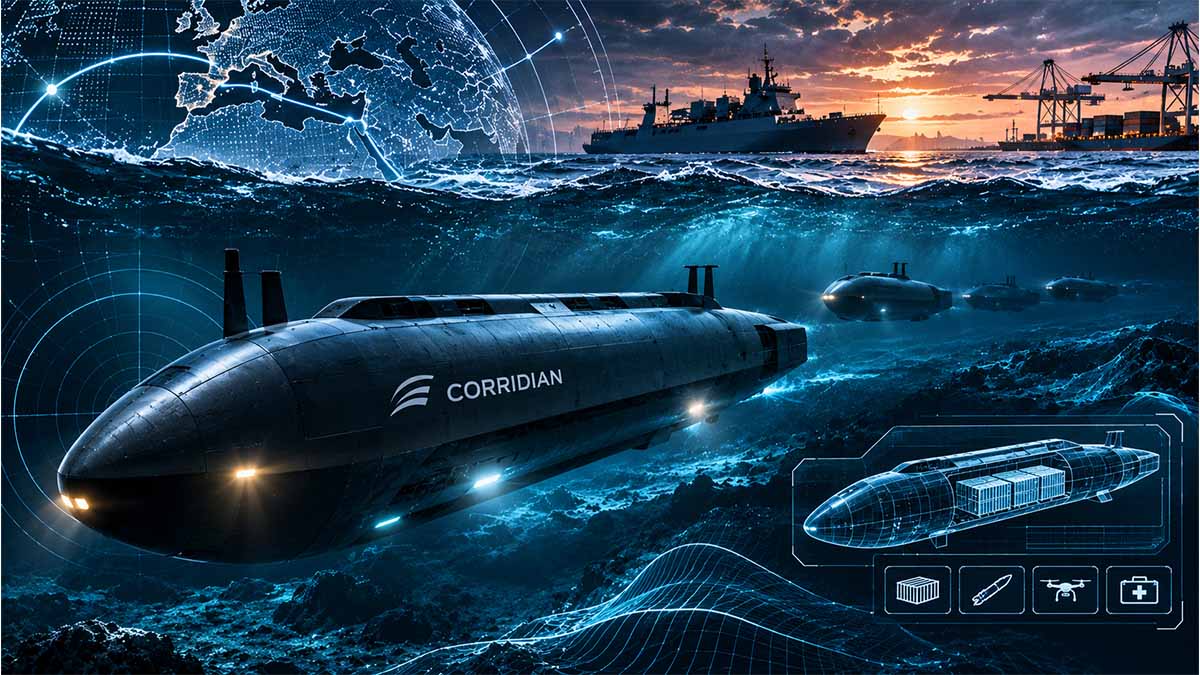
- Corridian describes ISO-standard containerized payloads, autonomous travel over thousands of nautical miles and a supply chain independent of the Submarine Industrial Base. These remain company assertions; its flagship unveiling is planned for 2027. Corridian Emerges With $38 Million to Build America’s Undersea Stealth Logistics Fleet — Corridian — Nov 2026. Ultra-Large AUVs
- The strongest near-term policy case is for staged testing of selected missions. Fleet-scale acquisition requires evidence on loaded endurance, cargo transfer, turnaround, maintainability and production repeatability.
- The decisive uncertainty is delivered logistical output: how much useful cargo reaches its recipient, within the required time, after accounting for losses, maintenance and supporting infrastructure.
Governments should fund autonomous undersea logistics against a defined delivery requirement, with fleet expansion conditional on evidence that the service can be sustained. Corridian’s emergence exposes a procurement contradiction: the naval requirement is credible, but the logistics system needed to meet it has yet to be established. The company proposes autonomous vehicles carrying containerized payloads beneath contested waters; its customers would need a service that connects those vehicles to usable cargo, receiving arrangements, maintenance and lawful access. Confusing the two would shift technical uncertainty into public procurement and supporting infrastructure. For European governments, NATO and the United States, the immediate choice is whether to purchase evidence of a useful capability or commit resources around an anticipated one.
The financing is real; the procurement case is unfinished
Corridian announced a US$38 million seed round on 3 November 2026, led by Point72 Ventures. Fenwick, counsel to the company, and Latham & Watkins, counsel to participating investor Balerion Space Ventures, separately documented the transaction. The money supports platform development, facilities and recruitment; it does not establish a government order. Corridian plans to unveil its flagship vehicle in 2027. An unveiling can demonstrate progress, but the decision to buy a recurring delivery service requires different evidence: accepted cargo missions, repeatability and a support burden the customer can sustain. Corridian’s announcement establishes the development proposition, not those subsequent outcomes.
The fiscal comparison makes that distinction consequential. The FY2026 Defense Budget Overview requested nearly US$5.7 billion for the Submarine Industrial Base and Nuclear Shipyard Productivity Enhancements, including more than US$2.6 billion for implementing industrial-base study recommendations and US$2.5 billion for productivity measures. Those components must not be added to the combined figure. Nor should requests be presented as expenditure or completed capacity. GAO’s April 2026 review examined 15 selected high-dollar-value submarine industrial-base investments: only three files contained documentation of monthly updates and only two of quarterly reporting. The selection was not a representative sample of all investment. It nevertheless shows why funding announcements need a documented connection to outcomes. GAO’s assessment supplies a warning about oversight, not an argument against investment.
A separate factory can still inherit the same bottleneck
Corridian describes a supply chain independent of the Submarine Industrial Base. That proposition serves a clear industrial interest: additional underwater capacity would be more valuable if producing it did not consume resources already constraining submarine programs. But independence has to be established where the constraint occurs. Separate assembly facilities can still rely on shared specialist labor, components or qualification resources. Conversely, overlapping suppliers do not necessarily invalidate the claim if their relevant capacity can expand. The procurement test is whether successive accepted vehicles add usable output without extending another critical program’s delivery schedule. Corridian’s industrial model therefore needs supplier-level evidence, not merely a different corporate address.
DARPA’s Manta Ray program identifies energy management, efficient propulsion, long-duration mission management, corrosion and biofouling mitigation among its technology objectives. These requirements explain how a manufacturing advantage can be lost after delivery: additional vehicles contribute little if maintenance, replenishment or receiving arrangements constrain their use. An acquisition authority should assess production and support together before financing a permanent footprint. A platform that moves cargo successfully once has answered an engineering question; a customer buying recurring logistics needs to know what resources restore it to service. DARPA’s program description identifies the supporting technologies under development, rather than certifying that persistent operation has been achieved.
Software control determines whether modularity survives procurement
The Orca experience exposes a less visible constraint on the proposed market. GAO’s July 2026 Weapon Systems Annual Assessment described limited government visibility and rights in proprietary Orca software, with additional rights being pursued. The implication for Corridian’s modular open systems proposition is direct: a customer must establish what it can integrate, inspect, modify and sustain under the contract. A technical interface and a legal right to use it perform different functions. Without adequate contractual access, a fleet can remain dependent on its original supplier even where payload packaging is standardized. That dependence can affect modification schedules and the ability to preserve competition during the system’s life.
ISO 668:2020 concerns freight-container classification, dimensions and ratings; Corridian’s announcement does not identify the specific ISO standard it invokes. Container compatibility cannot, by itself, establish underwater environmental qualification or safe cargo transfer. The acquisition authority should require the applicable standards and qualified interfaces to be identified before treating payload interchangeability as an accepted capability. This also protects the supplier from an undefined requirement: a stable approval boundary makes clear which changes require further testing. The industrial gain comes when modularity reduces the work needed to introduce an accepted payload, rather than shifting that work into an undisclosed integration and support package.
Maritime law can interrupt the promise of concealed delivery
UNCLOS Article 20 requires submarines and other underwater vehicles to navigate on the surface and show their flag in the territorial sea within the innocent-passage framework. Qualifying international straits and archipelagic sea lanes have separate passage regimes. A submerged logistics concept must therefore identify the applicable regime and distinguish navigation from payload deployment, reconnaissance or other mission activity. An autonomous vehicle does not turn those different acts into one legal category. The engineering promise of concealment is consequently bounded by where the service operates and what it does there. The convention provides no universal authorization for an underwater supply route.
The Philippine example shows why access agreements belong inside the business case. The EDCA Annex A amendment that entered into force on 16 July 2024 lists nine Agreed Locations; it does not establish Corridian deployment rights. Each proposed service still needs its activity and support arrangements assessed against the permissions granted. The Philippine Supreme Court’s January 2016 Saguisag decision also emphasized retained Philippine sovereignty and jurisdiction. A technically suitable receiving location can therefore remain unavailable for a particular mission. The cost of resolving that uncertainty should be identified before procurement creates a fleet dependent on access that has not been established.
Allies can share evidence before they share a fleet
Italy, France, Germany and the United Kingdom provide different foundations for cooperation. CMRE’s 2025 Annual Report records the CHOBIN v1.1 evaluation prototype for the Italian Navy’s Centro di Supporto e Sperimentazione Navale. France’s November 2026 UCUV announcement schedules sea experiments for 2028. Germany’s February 2026 Blue Whale announcement concerns reconnaissance acquisition. The Royal Navy’s September 2026 Excalibur account concerns a particular payload-integration experiment. These records support cooperation on evaluation and integration; they cannot be combined into a common cargo-readiness measure. The useful European division of work begins with the evidence each program can actually produce.
NATO’s interoperability work sharpens that choice. CMRE reported more than 200 platform and sensor nodes connected across domains during the 2025 REPMUS and Dynamic Messenger activities. This demonstrates the reported exercise infrastructure, not underwater freight throughput. STANAG 4817 command-and-control work and STANAG 4748 underwater signalling address different interoperability layers; neither accepts an entire cargo mission. Governments should use common reporting and selected interfaces to make national trials more transferable, while retaining clear customer responsibility for acceptance. The EU Cable Security Toolbox addresses infrastructure resilience and a different policy purpose; its existence does not convert cable-security measures into an autonomous military transport mandate. CMRE’s exercise account establishes a basis for shared learning, not a joint fleet.
The next two years will charge the cost to readiness
Over the 12–24 months from November 2026, Corridian’s planned 2027 unveiling and France’s scheduled 2028 sea experiments will provide opportunities to test different parts of the development case. Governments should use that period to establish customer requirements, obtain representative results and connect funding to explicit continuation decisions. They should retain the ability to accept a useful narrow mission, revise an unsupported operating concept or decline expansion. Premature infrastructure commitments would make those choices harder by placing capital and institutional expectations behind a service before its operating conditions are established.
Inaction also has a defined cost. If the authorities conducting national trials and NATO experimentation fail to make their evidence comparable, customers will have less basis for distinguishing useful capability from supplier ambition. Operational users would continue to carry unresolved delivery constraints, procurement authorities would repeat integration assessments, and taxpayers would bear avoidable evaluation or infrastructure expenditure. Corridian does not need every government to endorse a permanent underwater network. It needs customers capable of specifying and accepting a service. By November 2028, the consequential result will be whether public decisions have reduced the uncertainty surrounding that service or merely financed its expansion.
Navigational Index
Pillar I — Strategic Demand, Platform Evidence and Operational Boundaries
- Chapter 1 — Contested Maritime Logistics and the Case for Undersea Transport
Strategic requirement, physical baseline and the distinction between underwater access and logistical throughput. - Chapter 2 — Corridian’s Platform Proposition and the Evidence of Maturity
Declared specifications, financing, modular payloads, autonomy, demonstrated performance and unresolved technical claims. - Chapter 3 — Employment Geography, Maritime Law and Host-Nation Access
Deployment and recovery arrangements, applicable maritime regimes, permissions, accountability and infrastructure access.
Pillar II — Industrial Capacity and the Economics of Sustained Delivery
- Chapter 4 — Building Additional Capacity Outside the Submarine Industrial Base
Manufacturing, suppliers, workforce, qualification, capital requirements and production constraints. - Chapter 5 — From Autonomous Vehicle to Sustainable Logistics System
Cargo handling, energy replenishment, maintenance, communications, availability and cost per completed delivery.
Pillar III — Allied Choices, Strategic Risk and the 2031 Outlook
- Chapter 6 — Italy, France, Germany, the United Kingdom and European Coordination
Separate national capabilities and interests, EU infrastructure security, and NATO and bilateral interoperability. - Chapter 7 — Alternative Development Pathways and Observable Indicators
Selective adoption, network expansion, development delay and evidence that would distinguish these outcomes. - Chapter 8 — Courses of Action and Final Net Assessment
Responsible authorities, implementation burdens, decision thresholds, reversibility and consequences.
Master Abstract
The strategic requirement is more defensible than the strongest capability claims
The central assessment is that autonomous undersea transport deserves serious military experimentation, while claims of an emerging permanent underwater supply chain require substantially stronger evidence. Corridian’s announced mission portfolio includes payload delivery, intelligence, surveillance and reconnaissance, and contested logistics; its investor Industrious Ventures presents these systems as a means of extending undersea capacity while preserving crewed submarines for missions requiring their specialized capabilities. This is an interested-party investment thesis, rather than independent validation of operational effectiveness. Nevertheless, it identifies a coherent mechanism: additional autonomous carriers could undertake selected tasks that would otherwise consume scarce crewed-platform capacity or require more exposed transport. The limiting question is whether the whole delivery operation remains viable once preparation, transit, cargo handover, recovery and maintenance are included. A vehicle that completes a long underwater voyage establishes an important technical result. A logistics capability must also demonstrate that the intended recipient can receive and use its cargo, and that the process can be repeated at the tempo demanded by operations. Announcing Our Investment in Corridian — Industrious Ventures — Nov 2026. Announcing Our Investment in Corridian
Containerization creates an integration opportunity, not automatic interchangeability
Corridian’s proposed use of standardized containerized payloads is significant because it could separate the transport platform from individual mission packages. Beaten Zone Venture Partners, a participating investor, describes the intended combination of containerized carriage, long-distance autonomous operation and multiple mission types. Its account supports the existence of that design proposition, but does not establish completed qualification of specific cargo configurations. The analytical implication is conditional: common packaging can simplify integration only where the relevant mechanical, electrical, software, environmental and handling interfaces are also compatible. Container dimensions alone cannot establish underwater pressure tolerance, safe carriage of particular contents, acceptable trim, reliable release or compatibility with a recipient’s equipment. Likewise, a modular cargo carrier does not automatically become a persistent intelligence node; that additional function requires its own power, sensors, data handling and operational validation. Procurement authorities should therefore distinguish the vehicle’s transport envelope from the qualification of each payload and from the readiness of each mission. BZV Backs Corridian in its US$38M Seed Round to Build Ultra-Large Autonomous Underwater Vehicles that Move Payload Where Ships and Aircraft Cannot Safely Go — Beaten Zone Venture Partners — Nov 2026. Beaten Zone Venture Partners
Industrial additionality must be demonstrated across the production system
The pressure to extract more operational utility from undersea forces has an independently documented basis. In August 2026, the U.S. Government Accountability Office reported that maintenance delays and active idle time had cost the attack submarine fleet more than 15,000 operational days during fiscal years 2016–2025, with an estimated US$3.4 billion spent sustaining crews and submarines that provided no operational capability during those periods. These are maintenance and readiness findings, rather than a measurement of demand for autonomous cargo vehicles. They nevertheless strengthen the case for evaluating systems that could perform appropriate supporting missions without drawing on crewed submarine availability. The corresponding industrial test is whether autonomous platforms genuinely add capacity. Even a distinct assembly process could encounter shared constraints in specialist labor, components, testing or sustainment. The claim of independence should therefore be assessed through supplier mapping, qualification requirements and demonstrated production performance. A separate corporate organization is insufficient evidence of a separate industrial bottleneck. Navy Readiness: Actions Needed to Address Costly Attack Submarine Maintenance Challenges — GAO — Aug 2026. files.gao.gov
Existing trials establish technological progress without proving a cargo network
Official testing records show that large autonomous underwater systems have advanced beyond conceptual discussion. DARPA reported that Northrop Grumman’s Manta Ray prototype completed full-scale in-water testing in February and March 2024, demonstrating submerged hydrodynamic performance and its propulsion and steering modes. The same announcement described modular shipment and assembly, while identifying further testing and transition work. Separately, the Royal Navy reported in September 2026 that XV Excalibur had launched and controlled a heavyweight torpedo during a trial. These are material demonstrations within their stated boundaries. Neither establishes Corridian’s performance, nor verifies a repeatable underwater freight service. Their principal relevance is to show that vehicle operation, modular deployment and payload integration can produce observable test results against which subsequent claims can be judged. The next evidentiary threshold for logistics is an end-to-end demonstration involving a representative cargo and recipient, followed by repeated missions sufficient to expose turnaround, reliability and maintenance constraints. Manta Ray UUV Prototype Completes In-Water Testing — DARPA — May 2024; Historic first as Royal Navy launches torpedo from uncrewed submarine — Royal Navy — Sep 2026. darpa.mil
European developments require separate national assessments
Europe presents several relevant but different development paths. Italy: Fincantieri reported a demonstration of its DEEP system in October 2025, integrating underwater sensors, command and control, autonomous vehicles and data analysis for infrastructure and port-related applications. This provides an industrial reference for system integration, rather than evidence of long-range autonomous cargo delivery. France: the defence ministry’s November 2026 announcement concerns an operational UCUV demonstrator, with sea experiments scheduled to begin in 2028; the schedule identifies a future validation stage. Germany: the Bundeswehr’s February 2026 Blue Whale announcement emphasizes underwater and surface reconnaissance and German-Israeli industrial cooperation. United Kingdom: Excalibur’s documented payload trial provides a distinct experimentation reference. These programs should not be ranked through a single measure of “underwater autonomy,” because their purposes and maturity evidence differ. For logistics procurement, the relevant comparison is each country’s ability to integrate a carrier, payload, support arrangements and authorized operating concept. Fincantieri launches the first integrated underwater drone system — Fincantieri — Oct 2025; La France lance le développement d’un démonstrateur de drone sous-marin océanique polyvalent — Ministère des Armées et des Anciens combattants — Nov 2026; Blue Whale: Marine erhält neues Unterwassersystem — Bundeswehr — Feb 2026. fincantieri.com
At EU level, the policy connection is currently clearest in underwater infrastructure resilience. In February 2026, the Commission announced a Cable Security Toolbox and an amended work program allocating €347 million to strategic submarine cable projects, including a €20 million repair-capacity call. These amounts concern cable infrastructure and repair; they are not funding commitments for autonomous military freight. The analytical connection is that expanding underwater activity increases the importance of compatible surveillance, infrastructure protection, incident response and access arrangements. Allied coordination should therefore distinguish shared technical standards and infrastructure resilience from decisions on sovereign military procurement and operational control. Commission increases submarine cable security with €347 million investment and new toolbox — European Commission — Feb 2026. Shaping Europe’s digital future
Key Evidence Table
The entries below distinguish financing, declared design, trials and future milestones. Their quantities measure different things and should not be combined into a capability ranking.
| Indicator | Value/status | Reference date | Definition/scope | Issuer | Exact source |
|---|---|---|---|---|---|
| Corridian seed financing | US$38 million announced; Point72 Ventures led | November 2026 | Corporate financing; not a procurement award or disclosed vehicle price | Latham & Watkins, counsel to participating investor Balerion | Latham & Watkins Advises on Corridian’s US$38 Million Seed Round |
| Corridian payload and range proposition | ISO-standard containerized payloads; thousands of nautical miles | 3 November 2026 | Company-declared design; no precise loaded-range figure in the announcement | Corridian | Corridian Emerges With $38 Million to Build America’s Undersea Stealth Logistics Fleet |
| Corridian presentation milestone | Flagship unveiling planned for 2027 | 3 November 2026 | Presentation target; not an operational acceptance date | Corridian | Corridian Emerges With $38 Million to Build America’s Undersea Stealth Logistics Fleet |
| U.S. attack submarine maintenance burden | More than 15,000 lost operational days; estimated US$3.4 billion associated sustainment costs | FY2016–FY2025; published August 2026 | Maintenance delays and active idle time; not autonomous-system costs | GAO | Navy Readiness: Actions Needed to Address Costly Attack Submarine Maintenance Challenges |
| Manta Ray prototype | Full-scale in-water testing completed | February–March 2024; announced May 2024 | Hydrodynamic, propulsion and steering demonstrations | DARPA | Manta Ray UUV Prototype Completes In-Water Testing |
| Excalibur payload integration | Heavyweight torpedo launch and control reported | September 2026 | Specific trial; not evidence of sustained cargo operations | Royal Navy | Historic first as Royal Navy launches torpedo from uncrewed submarine |
| French UCUV demonstrator | Development agreement announced; sea experiments scheduled for 2028 | November 2026 | Future demonstrator validation milestone | French defence ministry | La France lance le développement d’un démonstrateur de drone sous-marin océanique polyvalent |
| EU cable resilience allocation | €347 million, including a €20 million repair-capacity call | February 2026 | Announced work-program allocation; not expenditure or autonomous cargo funding | European Commission | Commission increases submarine cable security with €347 million investment and new toolbox |
Alternative Development Pathways
The available evidence supports conditional pathways rather than defensible numerical probabilities. Different missions and national programs could follow different paths simultaneously.
Selective adoption for specialized deliveries. Autonomous carriers could establish military value in missions where concealment, payload characteristics and acceptable delivery time justify their support burden. The confirming evidence would be repeated customer-observed deliveries with representative loads and documented handling arrangements. Successful transit alone would leave this pathway only partially validated.
Expansion into a distributed logistics service. A broader network becomes plausible if qualified payloads can move between multiple authorized support locations using repeatable handling, maintenance and replenishment procedures. The distinguishing evidence would be sustained multi-vehicle operations, recurring delivery requirements and funded support infrastructure. A larger fleet announcement would not, by itself, establish this outcome.
Prolonged experimentation or narrower mission adoption. Development could produce useful vehicles while failing to establish competitive cargo throughput or acceptable sustainment costs. Indicators would include successful individual demonstrations followed by limited repeat operations, unresolved transfer arrangements, or acquisition concentrated on reconnaissance and other specialist missions. This outcome would constrain the logistics thesis without invalidating autonomous underwater technology more broadly.
The provisional judgment is to treat selective adoption as the first capability to validate. Network-scale planning becomes more defensible after the carrier and the delivery cycle have both demonstrated repeatability.
Principal Gaps and Watch Indicators
The following are proposed decision tests, not disclosed customer requirements or descriptions of Corridian’s internal program.
| Consequential gap | Record or observation needed | Confirming indicator | Decision consequence |
|---|---|---|---|
| Useful payload capacity | Released payload envelope and representative loaded-trial results | Cargo mass, volume and configuration tied to completed missions | Determines which logistics requirements the platform can address |
| Loaded endurance | Customer-observed trial report specifying payload, duration and completion conditions | Repeatable loaded performance against an agreed mission requirement | Supports comparison with alternative delivery methods |
| Cargo handover | End-to-end demonstration involving the intended receiving arrangement | Usable cargo received without disproportionate supporting effort | Establishes delivery capability beyond transit |
| Survivability | Authorized signature and operational evaluation under defined conditions | Evidence that concealment persists across relevant mission phases | Determines whether the claimed protection justifies its costs |
| Industrial additionality | Supplier-dependency assessment and repeat production evidence | Output increases without materially worsening shared constraints | Tests the claimed contribution outside the crewed submarine production system |
| Availability and turnaround | Multi-mission operating and maintenance records | Predictable return to service after delivery | Establishes sustainable output per vehicle |
| Government demand | Public award, funded requirement or formally documented evaluation | A customer accepts a defined mission and performance threshold | Distinguishes investor-backed development from procurement adoption |
| Permissions and accountability | Applicable operating authorization, responsibility framework and incident procedures | Deployment arrangements agreed before operational use | Determines whether the intended service can operate lawfully and sustainably |
| Delivery economics | Customer-reviewed life-cycle comparison using equivalent mission assumptions | Cost per completed delivery includes support, maintenance and losses | Supports a defensible scale-up decision |
Decision implication: acquisition authorities should use progressively more representative trials to resolve these gaps before committing to fleet-scale procurement. The relevant success measure is completed delivery under defined conditions, supported by an auditable operating and sustainment record.
Visualisation Assessment
The verified record does not provide compatible measurements of payload, loaded endurance, availability, production output or delivery cost across the relevant systems. A quantitative comparison would imply precision that the sources do not support, while a platform diagram would require undisclosed architecture or merely repeat the evidence table.
As of 14 November 2026: US$38 million seed financing announced; flagship unveiling planned for 2027. Range, containerization and industrial independence are declared propositions. Sustained logistics performance remains unestablished in the reviewed record.
Corridian announcementPillar I — Strategic Demand, Platform Evidence and Operational Boundaries
Chapter 1 — Contested Maritime Logistics and the Case for Undersea Transport
Autonomous underwater transport has a defensible strategic purpose where it can preserve delivery access under conditions that make other transport options prohibitively vulnerable or operationally expensive. Its contribution must nevertheless be measured against the receiving force’s actual consumption, delivery deadlines and handling capacity. The appropriate starting point is therefore the sustainment requirement rather than the vehicle category: what must arrive, in what condition, by what time, and with what consequences if delivery fails. This approach changes the assessment substantially. A relatively small delivery can have considerable operational value when it restores an otherwise unavailable capability; a much larger consignment can contribute little if it arrives after the relevant decision window or cannot be transferred to the intended recipient. Conversely, a vehicle capable of moving a valuable sensor package over a long distance may remain unsuitable for meeting a formation’s recurring demand for bulk supplies. These are different logistics problems, requiring different combinations of payload, speed, endurance, availability and receiving infrastructure. The institutional basis for treating logistics as a contested operational function already exists: the Marine Corps’ October 2025 Force Design Update, particularly section 3.4, identifies distributed sustainment, expanded prepositioning, autonomous surface distribution, unmanned aerial resupply and improved logistics information as complementary development priorities. Undersea cargo systems must demonstrate where they improve this wider portfolio, rather than deriving their value merely from operating beneath the surface. Force Design Update — U.S. Marine Corps — Oct 2025, section 3.4. marines.mil
The strategic problem concerns the continuity of the whole distribution system
A contested supply chain can fail at several different points, and improving the survivability of the transport leg addresses only some of them. Supplies must first exist in an issuable condition, be allocated to the correct requirement, reach a departure point, enter a compatible carrier, survive transit, pass through a receiving interface and become usable by the supported force. Each stage can impose a separate limit. This is visible even in conventional exercise logistics: the official account of the maritime prepositioning operation supporting Balikatan 2026 describes the movement of equipment aboard USNS Sgt. William W. Seay, offload at Cagayan de Oro, transfer to contracted Philippine barges, northbound distribution to Subic Bay and subsequent issuance. The operation demonstrates the organizational and physical interdependence of ships, ports, host-country contractors and receiving units; it does not establish performance under wartime interdiction. Its relevance to undersea logistics is analytical: replacing a carrier does not automatically replace the surrounding distribution arrangements. An underwater system that removes one exposed movement could still depend on preparation facilities, specialist handling teams or recovery equipment whose availability determines whether delivery can proceed. The strategic assessment must identify which dependencies are removed, which are relocated and which remain common to the alternative transport options. Balikatan 2026: U.S. Marines, Sailors Conduct Distributed Maritime Logistics in the Philippines — U.S. Marine Corps/DVIDS — Apr 2026. dvidshub.net
| Distribution function | Operational question | Potential contribution of an underwater carrier | Dependency that still requires validation |
|---|---|---|---|
| Requirement identification | Is the cargo required at the destination within a defined period? | Adds a transport option for an identified demand | Accurate demand information and allocation authority |
| Cargo preparation | Is the consignment serviceable and qualified for the journey? | Could accept a standardized mission package | Preservation, packaging, inspection and configuration control |
| Departure | Can the loaded vehicle enter service reliably? | Could reduce dependence on some conventional transport assets | Launch arrangements, local access and handling capacity |
| Transit | Can the cargo reach the receiving area within the required time? | Could provide a less exposed movement option in suitable circumstances | Loaded endurance, navigation, reliability and mission conditions |
| Receipt | Can the intended recipient take possession of usable cargo? | Could support delivery through a qualified receiving interface | Transfer equipment, personnel, authorization and cargo condition |
| Redistribution | Can the consignment reach its final user? | Could shorten a particular distribution segment | Onward transport, local storage and inventory visibility |
| Repeat operation | Can the service sustain recurring demand? | Could add delivery capacity across successive missions | Turnaround, maintenance, replenishment and available vehicles |
Analytical decomposition of a delivery service, informed by the documented Balikatan distribution sequence; the table does not describe a disclosed Corridian operating architecture.
The resilience argument also needs to distinguish between more routes and genuinely independent routes. Additional vehicles can increase nominal transport capacity without increasing resilience if all of them require the same departure facility, proprietary diagnostic equipment or receiving mechanism. The same distinction applies to dispersal: a geographically distributed fleet can remain functionally centralized if one support activity controls its availability. This is why a procurement assessment should examine common dependencies before treating autonomous mass as a resilience measure. GAO’s March 2026 military readiness testimony identifies persistent sustainment and personnel challenges across domains and specifically recognizes difficulties in providing logistics support in contested environments. That finding establishes a broader institutional problem; it does not establish that autonomous underwater vehicles solve it. The decision consequence is to test the proposed system against the actual constraint. If the limiting factor is receiving capacity, adding carriers may increase congestion rather than completed deliveries. If the constraint is cargo preservation, concealed transit will not restore an unserviceable item. If the constraint is access to a particular destination, a qualified underwater carrier could be consequential even with modest capacity. The preferred measure is the change in supported operational endurance attributable to the completed service, with the enabling resources included in the assessment. Military Readiness: DOD Should Take Further Actions to Address Challenges Across the Air, Sea, Ground, and Space Domains — GAO — Mar 2026. files.gao.gov
The underwater environment exchanges some exposures for different engineering constraints
Submergence changes the physical problem; it does not remove the need for navigation, structural protection or an assessment of detectability. NOAA explains that hydrostatic pressure increases by approximately one atmosphere for every 10.06 metres of depth. The engineering implication is that a cargo system requires a defined pressure-management approach for the vehicle, its equipment and the payload environment. Separately, NOAA’s account of underwater robot navigation explains that GPS positioning is unavailable while submerged and describes the trade-off between navigation capability and power consumption in long-endurance gliders. These observations do not establish Corridian’s design choices, but they identify requirements that any comparable proposition must resolve. A useful range figure must therefore specify the cargo configuration and navigation assumptions under which it is achieved. An endurance claim that excludes a relevant payload’s power demand, or depends on support unavailable in the intended setting, cannot establish mission completion on its own. The pressure and navigation constraints also explain why surface freight compatibility is insufficient evidence of underwater cargo qualification: the package must remain usable throughout the specified environment and arrive with the positional accuracy needed for the receiving arrangement. How does pressure change with ocean depth? — NOAA — updated Sep 2026; Low-Power Navigation for Fleets of Underwater Robots — NOAA Ocean Exploration — Jul 2019. oceanservice.noaa.gov
| Physical or technical baseline | Verified reference | What follows for logistics assessment | What does not follow |
|---|---|---|---|
| Pressure increases with depth | Approximately one additional atmosphere per 10.06 metres | Specify the payload’s qualified environmental envelope | A particular Corridian operating depth or pressure architecture |
| GPS does not provide submerged positioning | NOAA’s underwater navigation account | Assess navigation performance during submerged operation | A claim that autonomous submerged navigation is impossible |
| Navigation capability can impose an energy burden | NOAA’s glider navigation example | Include navigation and mission-system consumption in endurance assessment | A universal power requirement for all vehicle types |
| Sound propagates differently according to ocean conditions | NOAA’s acoustic explanation | Evaluate acoustic performance under defined environmental conditions | A universal detection range or guaranteed concealment |
| Transported equipment must remain serviceable | Marine Corps shelf-life management record | Measure cargo condition at receipt | Operational usefulness merely because the package arrived |
Sources: NOAA pressure reference, NOAA underwater navigation account, NOAA sound-propagation explanation, and Blount Island shelf-life management account.
The term stealth consequently needs a bounded operational meaning. NOAA describes sound travelling in seawater at approximately 1,500 metres per second, with propagation affected by temperature and pressure and with sound channels capable of carrying acoustic energy over considerable distances. These are general physical observations, not a basis for estimating a particular vehicle’s detection probability. They support a narrower conclusion: removing a cargo movement from direct surface observation does not establish acoustic invisibility, and an environmental advantage in one operating area cannot simply be assumed elsewhere. A credible assessment needs to distinguish the vehicle’s own characteristics from the conditions of the environment and from the capability of the observing system. It also needs to distinguish performance during transit from performance during preparation, transfer and recovery. For policymakers, the practical question is whether the complete delivery operation reduces relevant exposure sufficiently to justify its engineering, support and financial burden. There is no defensible public basis in the reviewed material for assigning Corridian a numerical survivability advantage, a universal acoustic detection distance or an operational loss rate. How far does sound travel in the ocean? — NOAA — updated Sep 2026. oceanservice.noaa.gov
Throughput must count usable deliveries within the operational window
The appropriate output measure is the quantity of usable cargo received within the required period, rather than the aggregate capacity of vehicles nominally assigned to the mission. For an observed trial period, this can be expressed without speculative assumptions: add the accepted, on-time cargo delivered during that period and divide by its duration. Such a measure should retain the distinctions between cargo types, since tonnes of fuel, replacement components and sensor packages do not provide interchangeable military effects. It should also report unsuccessful attempts and late deliveries separately, rather than allowing a large successful consignment to conceal repeated failures. Vehicle productivity then depends on the complete cycle: preparation, outbound movement, transfer, return or repositioning, inspection, maintenance and replenishment. Where missions are one-way, recovery and replacement requirements must be described accordingly. These are proposed accounting rules, not reported Corridian results. Their purpose is to prevent a range demonstration or a nominal payload specification from being interpreted as sustained output. The importance of the cargo-condition requirement is supported by the Marine Corps’ August 2026 shelf-life management account, which identifies preservation, packaging, remaining service life and accurate records as conditions of equipment readiness. Concealment preserves value only if the consignment remains usable when the receiving force needs it. Blount Island tackles shelf-life risks in forward-positioned supplies — Blount Island Command/DVIDS — Aug 2026. dvidshub.net
| Proposed performance measure | Definition | Why it matters | Required evidence |
|---|---|---|---|
| Accepted payload per delivery | Cargo received in the required quantity and condition | Excludes damaged, incompatible or unusable cargo | Recipient acceptance record |
| On-time delivery performance | Completed deliveries meeting their specified deadline | Connects transport to operational demand | Dispatch, arrival and acceptance timestamps |
| Completed delivery output | Accepted, on-time cargo over a defined observation period | Measures demonstrated service output | Complete mission and receipt records |
| Full cycle duration | Time from preparation through readiness for the next assigned mission | Reveals the effect of support activities | Maintenance, replenishment and handling records |
| Mission completion record | Successful, failed, aborted and late attempts, with causes | Prevents selection of only favourable results | Unfiltered trial or operating log |
| Support burden | Personnel, equipment and facilities required for the service | Tests whether exposure or workload has merely shifted | Resource accounting across departure and receipt |
| Cargo-specific operational effect | Supported function restored or sustained by the delivery | Distinguishes valuable delivery from undifferentiated tonnage | Receiving-unit assessment |
Proposed assessment measures; no numerical Corridian performance is inferred.
Key judgments
The strategic case is strongest when an underwater service resolves an identifiable delivery constraint and its supporting arrangements remain feasible. Capacity, access and resilience must be measured separately: a carrier may improve one without improving the others. Undersea logistics should therefore enter force planning as a mission-specific transport option whose contribution is demonstrated through receiving-unit outcomes, rather than as an assumed replacement for the wider maritime distribution system.
What would change the assessment
Evidence of repeated, accepted deliveries under representative conditions would strengthen the case, particularly if it showed a reduction in the resources required to sustain a defined mission. Conversely, trials showing that handling, cargo condition or turnaround remains the dominant constraint would narrow the useful mission set even if submerged transit were successful.
Open official record
The consequential missing records are a customer-defined logistics requirement, representative cargo qualifications and a complete end-to-end trial report linking departure, transit, receipt and return to service. These records would permit an assessment of actual contribution to sustainment rather than nominal vehicle performance.
Chapter 2 — Corridian’s Platform Proposition and the Evidence of Maturity
Corridian’s proposition combines a potentially valuable mission requirement with a publicly documented financing event, but the reviewed record does not yet establish an operationally accepted cargo platform. The distinction is consequential because financial, engineering and military evidence answer different questions. Financing supports the existence of resources committed to development; a specification describes an intended envelope; a test demonstrates performance within its stated conditions; acceptance establishes that a customer has judged the system against defined requirements. None can substitute for all the others. Corridian states that it was founded in September 2025 by Mike Guay, Greg Barrow, Kyle Arace and Mark Bodnar, whose prior work involved undersea autonomy programs at General Dynamics. That experience is relevant to the team’s familiarity with the engineering and acquisition environment, but the performance of previous programs cannot establish the maturity of a new vehicle. Likewise, advisers’ professional experience can help explain the company’s mission orientation without constituting an independent technical endorsement. The analytical task is to identify which parts of the proposed capability have a verifiable record and which still require evidence from the new development effort. Corridian Emerges With $38 Million to Build America’s Undersea Stealth Logistics Fleet — Corridian — Nov 2026.
The financing record establishes development backing, not acquisition demand
The financing announcement has corroboration from advisers on different sides of the transaction. Fenwick states that it represented Corridian in the US$38 million seed round, while Latham & Watkins identifies its client as participating investor Balerion Space Ventures. These records strengthen confidence in the announced financing event, although both firms participated in the transaction and neither provides an independent engineering assessment. The disclosed use of proceeds concerns continued platform development, research and development facilities and engineering recruitment. The record therefore supports an investment-backed development program. It does not disclose a complete vehicle development budget, the amount allocated to individual work packages, a production unit cost, an assured financing runway or a government customer’s acquisition commitment. Nor should seed capital be divided by a hypothetical fleet size to infer affordability: development expenditure, facilities, tooling, recurring manufacturing and support costs are different accounting categories. The appropriate financial question at this stage is whether successive technical and customer-validation milestones can be funded and completed; the eventual procurement question is whether a delivered service provides sufficient military value at its full cost. Fenwick Represents Corridian in $38M Seed Funding — Fenwick — Nov 2026; Latham & Watkins Advises on Corridian’s US$38 Million Seed Round — Latham & Watkins — Nov 2026. Fenwick
| Financial or institutional item | Publicly supported position | Analytical significance | Inference excluded |
|---|---|---|---|
| Seed round | US$38 million announced in November 2026 | Development financing has a documented transaction record | Fully funded fleet procurement |
| Lead investor | Point72 Ventures | Identifies the lead backer | Government sponsorship or acceptance |
| Company counsel | Fenwick represented Corridian | Corroborates participation in the financing transaction | Technical certification |
| Investor counsel | Latham & Watkins represented Balerion Space Ventures | Provides a separate transaction-side record | Independent performance validation |
| Intended expenditure | Platform development, facilities and engineering recruitment | Indicates development-stage priorities | A disclosed cost breakdown or runway |
| Government orders | Not established by the reviewed financing records | Customer adoption remains a separate evidentiary question | A conclusion that no non-public engagement exists |
| Vehicle affordability | No supported unit-cost comparison in the reviewed records | Requires production and support information | A price derived from the seed-round total |
Sources: Fenwick’s financing record and Latham & Watkins’ transaction record.
Standardized cargo packaging does not establish a qualified underwater interface
Corridian describes a modular open systems approach and a software interface intended to connect its platform autonomy with mission-autonomy systems. These are relevant design claims because integration boundaries can determine how quickly a carrier accepts a new payload and how independently a customer can modify its mission package. The public website does not, however, disclose the interface-control documentation, qualification results or data-rights arrangements needed to assess that proposition in detail. Its ISO-container statement also requires precision. ISO 668:2020 concerns Series 1 freight-container classification, dimensions and ratings; ISO lists Amendment 1:2022 against that standard. These official catalogue records explain the standard’s subject, but they do not establish that Corridian applies that particular standard or amendment: the company announcement does not identify a standard number. Nor does a dimensional standard establish pressure resistance, safe release, electrical compatibility or the suitability of a specific cargo for submerged carriage. Procurement authorities should therefore request the exact standards invoked, the selected container configurations and the qualification boundary between the carrier, any protective enclosure and the payload itself. That documentation would turn a broad modularity proposition into an assessable integration system. Corridian — platform and capability statements — undated, accessed Nov 2026; ISO 668:2020 — Series 1 freight containers — Classification, dimensions and ratings — ISO — Jan 2020; ISO 668:2020/Amd 1:2022 — Amendment 1 — ISO — Feb 2022. Ultra-Large AUVs
| Integration boundary | Documentation needed | Acceptance question | Consequence of an unresolved interface |
|---|---|---|---|
| Physical dimensions and attachment | Applicable standards and mechanical interface specification | Does the designated package fit and remain secured? | Integration becomes configuration-specific |
| Mass distribution | Approved loading envelope and configuration record | Does the load remain within the vehicle’s qualified operating limits? | Nominal cargo volume cannot establish usable capacity |
| Environmental protection | Payload environmental requirements and qualification results | Is the cargo protected throughout the specified mission? | Arrival does not guarantee serviceability |
| Electrical supply | Power-quality and consumption specifications | Can the payload function without invalidating the mission’s energy assumptions? | Vehicle endurance and payload endurance diverge |
| Data exchange | Published message definitions and interface-control document | Can the customer integrate and verify the mission package? | Software dependence can constrain modification |
| Transfer and release | Qualified handling and transfer procedure | Can the recipient obtain usable cargo safely and repeatably? | Transport capability remains disconnected from delivery |
| Configuration control | Versioned hardware, software and payload approval records | Is each tested configuration traceable to the deployed configuration? | Earlier results may not apply to later combinations |
| Customer modification rights | Contractual rights, licences and technical-data access | Can the customer sustain and adapt the system as intended? | Modularity can remain dependent on the original supplier |
Proposed qualification boundaries. They are analytical requirements, not disclosed Corridian specifications. The distinction between a declared interface and an assessable interface follows from the company’s modularity statements and the limited subject matter identified in the ISO 668 catalogue.
Autonomy must be assessed through mission authority and failure handling
The operational value of autonomy depends on what the system can decide, what it must refer to an operator and how it behaves when information or communications are insufficient. A declaration of autonomous operation therefore needs to be translated into specific acceptance questions. Can the vehicle remain within its authorized mission limits after a navigation anomaly? Can it distinguish an inability to complete delivery from a temporary delay? What evidence is retained to explain its decisions? How are software changes tested against the approved cargo configuration and operating envelope? These questions do not imply a particular weakness in Corridian; they identify the information required to evaluate any autonomous logistics system. They also distinguish the platform’s safe operation from the mission package’s functions. A vehicle could navigate effectively while remaining unable to complete a transfer, or support a useful reconnaissance package while failing the requirements of recurring freight delivery. The customer consequently needs a clear allocation of decision authority among the platform, mission software and responsible human command, together with evidence that the integrated configuration behaves predictably in both ordinary and degraded conditions. Corridian’s website describes long-duration platform autonomy and connection to external mission-autonomy systems; those claims establish the intended integration direction, while the detailed allocation and validation of decision authority remain outside the reviewed disclosure. Corridian — platform autonomy and modularity statements — undated, accessed Nov 2026.
| Maturity category | Evidence that would establish it | Position supported for Corridian in the reviewed record |
|---|---|---|
| Declared capability | Attributable specification or company statement | Containerized payloads, long-distance autonomy and intended mission areas are declared |
| Tested subsystem | Defined test procedure and recorded result | No sufficiently specific subsystem result identified in the reviewed disclosure |
| Integrated vehicle performance | Loaded vehicle test with stated configuration and conditions | Not established |
| End-to-end delivery | Cargo accepted by a representative recipient | Not established |
| Customer acceptance | Formal assessment against defined requirements | Not established |
| Operational availability | Sustained operating and maintenance record | Not established |
| Contested-environment effectiveness | Authorized evaluation under representative conditions | Not established |
| Combat performance | Attributable evidence of operational employment and outcome | Not established |
The first row reflects Corridian’s announcement. The remaining entries identify limits of the reviewed public disclosure; they do not establish that undisclosed tests or engagements have not occurred.
Orca provides a concrete warning about integration, materials and software dependence
The most informative comparison is not a superficial ranking by vehicle size, but a documented account of where another large underwater development effort encountered difficulty. In its July 2026 Weapon Systems Annual Assessment, GAO reported that Orca experienced approximately five years of delays, including difficulties sourcing materials and building pressure vessels. The Navy received its test asset in December 2023 and its first prototype in September 2025, with some contract deliverables still outstanding; the assessment recorded an expectation that the remaining four prototypes would arrive by January 2027. That was an expectation reported in the assessment, not confirmation of subsequent delivery. GAO also described limited government visibility and rights in proprietary software, with additional rights being pursued. The comparison does not justify transferring Orca’s schedule, costs or problems to Corridian. It does show why an alternative manufacturing model must be evaluated through evidence on materials, qualification, integration and customer control. A different production organization could improve performance, but that outcome requires demonstration rather than inference from the organizational model itself. Weapon Systems Annual Assessment: Requiring Mature Technologies Could Enable Shift to Rapid Delivery — GAO — Jul 2026, pp. 159–160. U.S. GAO
| Development question for Corridian | Evidence that would strengthen confidence | Evidence that would narrow the claim |
|---|---|---|
| Does modularity accelerate integration? | Different qualified payloads integrated through a stable documented interface | Repeated redesign or extensive supplier-only modification |
| Does industrial separation add capacity? | Traceable supplier independence and repeatable production results | Dependence on the same scarce qualified resources |
| Is autonomous operation mission-relevant? | Integrated trials demonstrating approved decisions and safe failure responses | Success limited to conditions that exclude the intended mission’s constraints |
| Can customers adapt the system? | Adequate technical-data access and contractual modification rights | An interface claim without practical customer control |
| Does a presentation milestone reflect technical progress? | A disclosed test configuration and measurable results | A display without evidence of relevant performance |
| Can prototype success support recurring service? | Multiple builds and repeated delivery cycles with recorded maintenance | A successful individual demonstration with unresolved repeatability |
Analytical tests informed by the specific development issues documented in the GAO Orca assessment, rather than predictions that Corridian will experience the same problems.
Key judgments
The financial record is stronger than the public performance record, and the two should remain separate in institutional reporting. Modularity, autonomy and industrial independence are potentially valuable attributes, but their practical significance depends on qualified interfaces, integrated testing and customer control. The appropriate next assessment should examine configuration-specific evidence rather than convert broad design statements into readiness judgments.
What would change the assessment
A representative loaded-vehicle test, documented cargo transfer, formal customer evaluation or release of qualified interface information would materially advance the assessment. Evidence that multiple payloads can be integrated without major platform redesign would particularly strengthen the modularity proposition. Repeated production and delivery results would be required before extending those conclusions to scale.
Open official record
The principal gaps are a released technical envelope, identified applicable standards, configuration-specific test results, an autonomy assurance framework, payload acceptance documentation and a disclosed customer acquisition or evaluation record. Commercial confidentiality may explain some omissions, but it does not permit public analysis to treat the missing evidence as established performance.
Chapter 3 — Employment Geography, Maritime Law and Host-Nation Access
The legal feasibility of an underwater logistics mission depends on the vehicle’s status, the maritime regime governing each part of its activity, the nature of the payload operation and the authority for using departure and receiving facilities. A long-range platform does not create a continuous legal corridor between two points merely because it can physically travel between them. Navigation, port access, cargo transfer, deployment of equipment and installation of persistent support infrastructure require separate analysis. The distinction is especially important for a modular vehicle because changing its mission package can change the legal character of its activities without changing its hull. A carrier transporting sealed supplies, a platform conducting reconnaissance and a system deploying equipment are not automatically undertaking the same legally relevant activity. Mission approval must therefore identify what the vehicle will do, where it will do it and under whose responsibility it operates. This chapter assesses the applicable framework and decision requirements; it does not identify a publicly authorized Corridian deployment. The legal baseline is the United Nations Convention on the Law of the Sea, read alongside applicable domestic permissions and relevant state positions, rather than a general presumption that autonomous operation creates an exception to existing maritime rules. United Nations Convention on the Law of the Sea — United Nations — Dec 1982.
Innocent passage, transit passage and archipelagic passage are distinct regimes
The clearest constraint on an assumption of uninterrupted submerged movement appears in UNCLOS Article 20, which requires submarines and other underwater vehicles to navigate on the surface and show their flag in the territorial sea within the innocent-passage framework. Article 19 separately identifies activities prejudicial to innocent passage, including specified intelligence collection, military-device deployment and research or survey activities. The analytical consequence is that carriage, observation and payload employment cannot be bundled together under a generic transit label. By contrast, transit passage through qualifying international straits and archipelagic sea lanes passage have their own rules. Articles 38–39 address continuous and expeditious transit and normal modes; Article 53 expressly addresses normal-mode archipelagic passage. Applying those provisions to a particular uncrewed system requires attention to its status and activities, rather than assuming that every submerged movement qualifies. The practical policy requirement is a mission-specific legal assessment that distinguishes passage from operational activity and identifies where separate consent is needed. Seas and Submerged Lands Act 1973, Schedule 1 reproducing UNCLOS Articles 19–20 — Australian Federal Register of Legislation — Aug 2019 compilation; UNCLOS — United Nations — Dec 1982, Articles 38–39 and 53. legislation.gov.au
| Maritime setting | Relevant legal baseline | Implication for an autonomous logistics proposal |
|---|---|---|
| Foreign internal waters and ports | Coastal-state authority and applicable entry conditions | Establish the permission for entry, handling and support |
| Territorial sea under innocent passage | Articles 19–20 | Do not assume authorization for submerged transit or separate mission activities |
| Qualifying international strait | Articles 38–39 | Establish the passage regime and whether activities remain within it |
| Archipelagic sea lanes passage | Article 53 | Assess normal-mode passage within the applicable framework |
| Exclusive economic zone | Articles 56 and 58 | Distinguish navigation freedoms from coastal-state jurisdiction and due-regard duties |
| Seabed-related support activity | Depends on location and the activity undertaken | Assess installations, equipment placement and support functions separately |
Sources: UNCLOS — United Nations, official Australian reproduction of Parts II, V and VI, and The Commander’s Handbook on the Law of Naval Operations — Mar 2022, section 2.5.1.
The exclusive economic zone requires particular care because coastal-state jurisdiction and navigational freedoms coexist there. The relevant treaty provisions allocate different rights to different activities; the zone is neither equivalent to territorial waters nor a space in which every proposed underwater operation is automatically unrestricted. For a logistics service, the central distinction is between moving through the water and undertaking an activity with an additional legal character. Installing a fixed support structure, conducting research, interacting with seabed infrastructure or maintaining a persistent operational presence can raise questions beyond simple transit. The correct assessment therefore examines the activity itself, its purpose and its interaction with other rights. This matters commercially as well as operationally: a service model that assumes extensive support infrastructure could depend on permissions that a vehicle-only demonstration never tests. It also matters for alliance planning, since a partner may support navigation while requiring separate agreement for a particular facility, cargo or mission. The underlying treaty allocation is found in Articles 56 and 58, including reciprocal due-regard requirements; the further implication is analytical that a procurement specification should identify its legal and infrastructure assumptions explicitly. Seas and Submerged Lands Act 1973, Schedule 1 reproducing UNCLOS Articles 56 and 58 — Australian Federal Register of Legislation — Aug 2019 compilation.
U.S. doctrine supports an uncrewed-vessel position without settling every international question
The March 2022 Commander’s Handbook on the Law of Naval Operations provides a relevant statement of the U.S. doctrinal position. Sections 2.3.4–2.3.5 address unmanned maritime systems, including payload delivery, and state a sovereign-immunity position for U.S. Navy systems. The handbook also contemplates designation as a United States Ship under specified command and crew arrangements, including remote means. This is important evidence that autonomy does not, in the U.S. position, remove a platform from the maritime legal framework. It is not evidence that every privately developed vehicle already possesses that status, or that every other state accepts every application of the position. The distinction between ownership, operation, flagging, command and mission purpose must therefore remain visible. For a future customer, these issues belong in the operating concept and contractual structure before deployment. They determine who can issue instructions, who represents the platform’s legal status, who preserves its records and who addresses a foreign-state challenge. The handbook’s treatment of submerged transit through qualifying straits is likewise a statement of U.S. doctrine that should be distinguished from a specific assessment of an autonomous vehicle and mission. The Commander’s Handbook on the Law of Naval Operations — U.S. Navy, Marine Corps and Coast Guard — Mar 2022, sections 2.3.4–2.3.5 and 2.5.3. usnwc.libguides.com
Immunity, where applicable, must also be kept separate from permission and substantive responsibility. A state’s position that its craft is immune from foreign enforcement does not itself answer whether a proposed activity is authorized in a particular place. Nor does assigning decisions to autonomous software remove the need for a responsible command and an auditable record. The operational documents should distinguish the authority that approves the mission, the entity that operates the system, the party that maintains its software and the authority that handles an incident. These distinctions become more consequential when contractors, allied facilities and customer-provided mission packages are involved. A failure can originate in a platform subsystem, an incorrectly prepared payload, an instruction or an unsupported assumption about the receiving interface; a usable record must permit those possibilities to be examined. UNCLOS Article 29 contains the treaty definition of a warship, while Article 31 addresses specified flag-state responsibility and Article 32 preserves relevant immunities. These provisions support separate treatment of status, responsibility and immunity; they do not supply a universal authorization for autonomous logistics. UNCLOS — United Nations — Dec 1982, Articles 29–32.
Host-country access is a negotiated operating condition
The Philippines provides a concrete documentary example of why access should be treated as an operational input rather than an assumption derived from alliance membership. The 2024 amendment to Annex A of the Enhanced Defense Cooperation Agreement, published in the U.S. Treaties and Other International Acts Series as TIAS 24-716, entered into force on 16 July 2024 and lists nine Agreed Locations. The instrument concerns designated facilities and associated arrangements; it does not identify Corridian deployment rights. Its analytical relevance is the documentary sequence: agreement on an updated annex, completion of domestic procedures and entry into force. A future underwater logistics proposal would still require examination of whether its activities, facilities, equipment and support arrangements fall within the permissions actually granted. The existence of an agreed location is consequently a starting point for legal and operational planning, not proof that every new system or mission is covered. Facility capacity must be examined separately as well: a legally available location may lack the handling, maintenance or receiving arrangements required by the proposed service. Defense Cooperation: Agreement Amending the Agreement of April 28, 2014, as amended — U.S. Department of State, TIAS 24-716 — Jul 2024. govinfo.gov
The sovereignty dimension is also explicit in the Philippine Supreme Court’s January 2016 decision in Saguisag v. Executive Secretary. In its discussion of Agreed Locations, the majority emphasized Philippine sovereignty and jurisdiction and the agreement’s relationship to Philippine law. This is a national judicial determination within its own jurisdiction, not a ruling on autonomous underwater logistics. It nevertheless demonstrates why a host-country agreement cannot be read solely as a catalogue of facilities available to the visiting force. The relevant interpretation also concerns retained authority, permitted activities and the mechanisms through which implementation occurs. For a proposed logistics network, the implication is to obtain clarity on access before treating a location as a dependable support node. Technical interoperability cannot substitute for political authorization, and a successful demonstration at one facility does not establish a standing right to conduct the same operation elsewhere. Resilience planning should therefore record both physical availability and the scope, duration and conditions of permission, while recognizing that these are distinct sources of operational uncertainty. Saguisag v. Executive Secretary, G.R. Nos. 212426 and 212444 — Supreme Court of the Philippines — Jan 2016, discussion of Philippine sovereignty and applicable law. Supreme Court E-Library
| Access or accountability issue | Record needed before operational reliance | Principal authority to identify | Consequence if unresolved |
|---|---|---|---|
| Facility access | Applicable agreement and implementing authorization | Host-country and visiting-force designated authorities | A technically usable location may be unavailable |
| Mission coverage | Written determination of permitted activities | Competent national and military authorities | Exercise permission may be mistaken for standing operational access |
| Vehicle status | Ownership, operation, flagging and command documentation | Responsible state and naval authorities | Status and representation may be disputed |
| Cargo handling | Applicable approval and qualified handling procedure | Relevant military, port and national authorities | Transfer may be delayed or prohibited |
| Local infrastructure | Approved works and support arrangements | Facility owner and competent host-country authorities | The service may lack sustainable support |
| System control | Documented allocation of mission and intervention authority | Operational command and authorized operator | Responsibility during degraded operation remains unclear |
| Incident response | Notification, assistance and recovery arrangements | Named operational and host-country points of responsibility | Delays can compound an otherwise manageable failure |
| Evidence preservation | Mission, software and cargo configuration records | Operator, maintainer and contracting authority | Causes and responsibility may be difficult to establish |
Proposed implementation requirements, informed by the 2024 EDCA annex amendment, the Philippine Supreme Court’s majority analysis, and the U.S. naval handbook. No Corridian-specific authorization is inferred.
Autonomous surface-ship regulation does not provide a blanket underwater approval
The current regulatory record also requires a distinction between autonomous surface shipping and military underwater systems. IMO reports that its non-mandatory International Code of Safety for Maritime Autonomous Surface Ships was adopted in May 2026 and took effect on 1 July 2026. Its stated purpose concerns the safe integration of remotely controlled or autonomous commercial ships. That development is relevant to the wider maturation of autonomous maritime governance, but its subject and non-mandatory character do not establish a general authorization for military underwater cargo operations. The practical lesson is to identify the instruments and approvals applicable to the actual system rather than invoking autonomy regulation as a single category. Surface navigation, submerged activity, port operation and cargo transfer can involve different requirements. IMO’s account of the collision regulations separately identifies lookout, safe speed, collision-risk assessment and avoidance action as core safety functions. For an uncrewed platform, an assurance case must explain how relevant safety obligations are addressed in its intended operation; a reference to autonomous software does not answer that question. FAQ — Autonomous shipping — IMO — accessed Nov 2026; Convention on the International Regulations for Preventing Collisions at Sea, 1972 — IMO — undated. Autonomous shipping
For institutional decision-making, these legal and geographic requirements should be incorporated into the same acceptance process as the technical ones. A service is operationally available only when the vehicle, payload, recipient, support arrangements and required permissions are available together. This does not mean that every activity requires a new treaty or that existing access agreements are unusable; it means that their scope must be established rather than presumed. The most efficient approach is to select a defined trial mission, identify its applicable approvals and test whether the complete arrangement can be repeated without exceptional measures. A bounded demonstration can then establish a usable operating model whose technical and legal assumptions are visible. Expansion to other destinations or payloads should identify which elements remain valid and which require additional qualification or agreement. This approach supports scale through repeatable arrangements while preserving the distinction between a demonstrated service and a broader network ambition. It follows from the different functions of maritime passage rules, host-country access instruments and autonomous-system safety frameworks described in the UNCLOS text, the EDCA annex amendment, and IMO’s autonomous-shipping guidance.
Key judgments
Undersea logistics must be planned as a legally differentiated service. Passage rights, vehicle status, payload activity and facility access answer separate questions, and none should be treated as a substitute for the others. The most consequential geographic constraint may therefore be the availability of an authorized and technically qualified receiving arrangement rather than the maximum distance the vehicle can travel.
What would change the assessment
A disclosed operating framework identifying vehicle status, mission authority, approved facilities, cargo handling and incident arrangements would materially strengthen the case for practical deployment. Repeated operations under such a framework would provide stronger evidence of scalability than a presentation milestone or a general statement of allied interest.
Open official record
The missing Corridian-specific records are an authorized operating concept, a defined status and command arrangement, applicable host-country permissions, qualified launch and receiving procedures, and a formal customer acceptance framework. Until those records become available, the defensible conclusion remains that strategic demand, technical potential and development financing are identifiable, while a repeatable and authorized underwater logistics service still requires demonstration.
Pillar II — Industrial Capacity and the Economics of Sustained Delivery
Chapter 4 — Building Additional Capacity Outside the Submarine Industrial Base
The strategic value of a separate autonomous-underwater manufacturing system depends on whether it adds qualified production capacity without reproducing the constraints that already limit submarine construction and support. Industrial independence must therefore be demonstrated through suppliers, workforce, facilities, inspection processes and production results. A company can assemble a vehicle outside a traditional submarine shipyard while still depending on scarce components, specialist engineering or qualification resources used elsewhere in the maritime sector. Conversely, an autonomous platform designed around different materials, manufacturing methods and support requirements could create additional capacity even where some suppliers overlap. The meaningful distinction is between shared suppliers that can expand output and shared bottlenecks that cannot. Corridian’s investor Industrious Ventures presents an independent supply chain as part of the company’s industrial proposition, but its account does not disclose the supplier-level evidence needed to measure that independence. The appropriate government assessment would identify the resources that determine delivery schedules, establish their available capacity and examine whether the proposed production system expands those resources or merely reallocates them. That assessment should also distinguish additional manufacturing output from additional operational capability: a completed vehicle still requires accepted equipment, support arrangements and an assigned mission before it contributes to force availability. Announcing Our Investment in Corridian — Industrious Ventures — Nov 2026.
Historical delivery records establish the problem, but cannot supply a startup production forecast
The industrial case should be grounded in documented delivery performance rather than a general claim that conventional shipbuilding is slow. GAO’s February 2025 assessment compared Navy-planned and actual deliveries across fiscal years 2019–2023, recording totals of 11 planned and four delivered Virginia-class submarines, alongside 15 planned and seven delivered Arleigh Burke-class destroyers. These are annual delivery comparisons assembled from different planning vintages; they are not a fixed cohort of orders followed through completion. Consequently, dividing the delivered totals by the planned totals would not establish the proportion of a particular order book fulfilled. The evidence instead illustrates the difference between delivery expectations and recorded annual outcomes, which is relevant when assessing whether additional industrial approaches deserve experimentation. It does not establish how quickly Corridian can manufacture vehicles, whether its designs are production-ready or whether autonomous platforms can substitute for the missions of the ships in the comparison. The correct inference is that new production claims require demonstrated manufacturing evidence, particularly where government planning already depends on expected improvements in industrial performance. The interactive component below reproduces the annual counts while preserving these limitations. Shipbuilding and Repair: Navy Needs a Strategic Approach for Private Sector Industrial Base Investments — GAO — Feb 2025, Table 1. files.gao.gov
The additionality test should extend beyond the final assembly location because the production constraint can move as a program matures. An early prototype may depend primarily on engineering attention and one-off fabrication; subsequent units can be limited by repeatable inspection, supplier consistency, software configuration or the availability of qualified acceptance personnel. Investment that removes the first constraint does not necessarily remove the next. For a prospective customer, the useful industrial record would therefore link each production stage to its output, lead time and acceptance condition. It would identify the difference between installed equipment and usable production capacity, between recruited employees and qualified productive labor, and between a supplier’s stated capability and accepted recurring deliveries. These distinctions are proposed evaluation requirements, not reported defects in Corridian. Their purpose is to establish what an industrial-independence claim must demonstrate before it supports acquisition planning. They also protect against an overly narrow definition of efficiency: a shorter assembly period may be offset by longer inspection, rework or customer-acceptance periods, leaving total delivery time unchanged. The need to connect investment to outcomes is reinforced by GAO’s subsequent examination of submarine industrial-base oversight. Navy and Coast Guard Shipbuilding: A Disciplined, Strategy-Driven Approach Is Needed to Achieve Ambitious Goals — GAO — Apr 2026.
| Industrial additionality test | Evidence required | What would support the claim | What remains insufficient |
|---|---|---|---|
| Supplier capacity | Supplier-level lead times, capacity and accepted output | Additional output without extending other critical delivery schedules | A separate assembly facility |
| Workforce | Qualification records and productive staffing by function | Sufficient qualified personnel for the intended production cadence | Recruitment announcements |
| Manufacturing | Build records across successive units | Repeatable completion against stable specifications | A single completed prototype |
| Inspection | Acceptance procedures, capacity and rejection records | Inspection keeps pace with production | Increased fabrication without acceptance capacity |
| Rework | Defect, correction and retest records | Corrections become predictable and manageable | Counting units before required corrections |
| Customer acceptance | Completed acceptance against agreed criteria | Vehicles transfer with required functionality and documentation | Physical handover alone |
| Sustainment supply | Spares availability and repair turnaround | Support remains available as the fleet grows | Production capacity assessed without support demand |
Proposed industrial evaluation framework, informed by the investment-effectiveness questions examined in the April 2026 GAO assessment. It does not assign Corridian a manufacturing-readiness score.
Public investment figures require careful separation of requests, contracts and demonstrated effects
The financial context is substantial, but different figures represent different stages of government action. The FY2026 Defense Budget Overview requested nearly US$5.7 billion for the Submarine Industrial Base and Nuclear Shipyard Productivity Enhancements, including more than US$2.6 billion for implementing submarine industrial-base study recommendations and US$2.5 billion for nuclear-shipyard productivity measures. It separately identified US$2.7 billion for the Shipyard Infrastructure Optimization Program. These are figures from the budget request, not a statement of final appropriations, obligations, expenditure or completed capacity as of November 2026; they should not be presented as equivalent to money already converted into additional ships. Their relevance is that the official investment rationale encompasses suppliers, infrastructure, workforce, oversight and manufacturing technology rather than a single shipyard expansion. For an autonomous-underwater program, the corresponding financial assessment should explain which of these functions must be funded within the new production system and which can use existing capacity. Commercially sourced equipment can reduce some development burdens, but the cost of qualifying and supporting its military use still requires explicit treatment. Defense Budget Overview: Fiscal Year 2026 Budget Request — U.S. Department of Defense — Jul 2025, p. 3-25. comptroller.defense.gov
| Financial reference | Amount | Accounting status | Appropriate interpretation |
|---|---|---|---|
| Submarine Industrial Base and Nuclear Shipyard Productivity Enhancements | Nearly US$5.7 billion | FY2026 request | Proposed combined support in the cited budget document |
| Implementation of submarine industrial-base study recommendations | More than US$2.6 billion | Component of the FY2026 request | Proposed support across specified industrial priorities |
| Nuclear Shipyard Productivity Enhancements | US$2.5 billion | Component of the FY2026 request | Proposed workforce and capacity-related support |
| Shipyard Infrastructure Optimization Program | US$2.7 billion | Separately identified FY2026 request | Proposed public-shipyard infrastructure support |
Source: FY2026 Defense Budget Overview — p. 3-25. Amounts retain the document’s rounding and scope; the rows must not be added together because some are components of a broader figure.
GAO’s April 2026 testimony identifies an equally important governance problem: investment does not establish its own effectiveness. Among 15 selected high-dollar-value submarine industrial-base investments, GAO found documentation of monthly updates for only three and quarterly reporting for only two. Those findings concern the selected files, not a statistically representative estimate for every investment. GAO also described fragmented information systems and separate oversight-support contracts with a combined value of US$3.5 billion, alongside insufficient coordination. The practical implication for a new autonomous-underwater production effort is to establish its baseline and outcome measures before expanding funding. A facility investment should be connected to accepted output, a supplier intervention to a measurable delivery constraint, and a workforce initiative to qualified productive capacity. Without that connection, additional spending can coexist with continued uncertainty about the constraint it was intended to remove. The same discipline should apply to privately financed and publicly supported development: the source of capital changes the financial exposure, but it does not change the need to establish what the investment accomplished. Navy and Coast Guard Shipbuilding — GAO — Apr 2026, investment oversight and coordination findings. files.gao.gov
Modular industrial partnerships provide an alternative integration model
A useful contemporary comparison is the division of responsibilities disclosed for Lancet, a separate XL-class underwater effort associated with the Defense Innovation Unit’s Combat Autonomous Maritime Platform program. In its 14 September 2026 announcement, Metron reported fabrication activity and identified a team combining its autonomy, command-and-control and integration work with Cellula Robotics’ vehicle and energy-system integration, Integer Technologies’ modelling and vehicle-health monitoring, and General Dynamics Applied Physical Sciences’ payload-control and deployment work. Metron described program requirements of at least 1,000 nautical miles of transit and autonomous operation beyond 200 metres, with a demonstration scheduled for March 2027. These are contractor-reported requirements and plans, not established performance, and they must not be transferred to Corridian. The industrial relevance is the explicit allocation of functions across firms. Such an arrangement can draw on existing capabilities while creating additional interface-management responsibilities. A customer must consequently evaluate both the maturity of the participating components and the ability of the integrated system to perform its assigned mission. Component pedigree reduces some uncertainties; it does not eliminate the need for vehicle-level and service-level validation. Fabrication Begins on Lancet™ XL-UUV for DIU’s CAMP Program — Metron — Sep 2026. Metron
Key judgments
Industrial additionality should be assessed through qualified output and the resources that determine its timing. A separate organization, facility or supply-chain label cannot establish that result on its own. Government support becomes more defensible when each investment has an identified constraint, a documented baseline and an acceptance measure linking the intervention to additional usable capacity.
What would change the assessment
Successive accepted vehicles, predictable supplier performance and a demonstrated ability to expand output without proportionately increasing rework or support requirements would strengthen the industrial proposition. Evidence that production growth depends on the same constrained resources as existing programs would narrow the claimed additionality.
Open official record
The decisive missing records are a production-capacity baseline, supplier dependencies, recurring build and acceptance results, investment-to-output measures and a sustainment supply plan. These would permit an assessment of industrial contribution beyond the existence of development financing and manufacturing intent.
Chapter 5 — From Autonomous Vehicle to Sustainable Logistics System
A sustainable underwater logistics service must preserve operational availability across repeated missions while controlling the cost and duration of support activities. The economic challenge therefore extends beyond the number of vehicles that can be manufactured. A fleet can grow while delivery capacity remains constrained by maintenance, energy replenishment, payload preparation or the availability of receiving equipment. Conversely, improvements in support processes can increase usable output without a corresponding increase in vehicle inventory. These relationships make the service architecture central to the acquisition decision: which functions travel with the vehicle, which are performed at fixed facilities, which require specialist personnel and which can be provided by the supported force. A design that minimizes one category of support may increase another, and the trade-off must be assessed over the operating pattern rather than a single demonstration. DARPA’s Manta Ray program explicitly identifies energy management, efficient propulsion, long-duration mission management and mitigation of biofouling, corrosion and material degradation as relevant technology areas. These are program objectives rather than confirmation that the challenges have been solved, but they establish why persistent underwater operation requires a sustained engineering and support effort beyond autonomous navigation. Manta Ray — DARPA — undated program description, accessed Nov 2026. DARPA
Maintenance demand must be measured across the operating pattern
The maintenance burden of an autonomous logistics system is best examined through what happens between accepted missions. The relevant record should distinguish routine inspections, scheduled replacement, unplanned correction, software-related intervention and damage associated with handling or operation. These categories have different implications for scale. Predictable work can be planned into the operating cycle; recurring faults can consume scarce specialists and make availability unstable. A long maintenance interval may be valuable, but only if the intervention that follows it remains feasible within the intended support network. Equally, a component that can be replaced quickly in a workshop may become a serious operational constraint if its replacement requires facilities unavailable to the deployed service. These are proposed assessment conditions rather than reported Corridian characteristics. They follow from treating long-duration material degradation and energy management as design requirements, while recognizing that a working prototype does not establish its recurring service burden. The customer needs evidence from the actual vehicle configuration and maintenance concept, including the resources required to return it to its approved operating condition. DARPA’s stated focus on reducing human-present logistical support provides a useful reference for this distinction between an endurance objective and the supporting technologies needed to achieve it. Manta Ray — DARPA — program objectives.
| Service function | Cost or availability mechanism | Required operating record | Relevant decision |
|---|---|---|---|
| Inspection | Consumes time, equipment and qualified labor | Inspection duration and findings by mission | Can support capacity match the intended operating tempo? |
| Planned maintenance | Creates predictable periods of unavailability | Tasks, intervals, labor and parts | Can maintenance be scheduled without undermining service demand? |
| Corrective maintenance | Introduces uncertain downtime | Fault, diagnosis, repair and retest history | Is additional fleet inventory masking recurring technical problems? |
| Energy replenishment | Constrains readiness for subsequent missions | Procedure, duration and supporting resources | Where can the service regenerate its operating capacity? |
| Payload change | Adds configuration and handling work | Changeover, inspection and release records | Does modularity reduce total turnaround? |
| Software support | Can require testing and configuration verification | Approved versions, changes and validation results | Can adaptation occur without invalidating prior qualification? |
| Material degradation | Can increase intervention or replacement needs | Condition trends and corrective actions | Are endurance and maintenance assumptions sustainable? |
Proposed service-assurance framework. Its material-degradation and energy-management foundations are identified in the DARPA Manta Ray program description; no maintenance interval or availability value is assigned to Corridian.
The acquisition comparison must include the resources needed to produce completed service
The cost comparison should distinguish at least three decisions: whether to fund development, whether to buy vehicles and whether to establish a recurring delivery service. Each has a different cost boundary. Development expenditure concerns learning and qualification; vehicle procurement concerns accepted equipment; service provision concerns the personnel, facilities, consumables, maintenance and replacement resources necessary to keep deliveries available. Combining those categories without explanation can make a design appear either artificially expensive or artificially inexpensive. For example, a mature service may benefit from previously funded infrastructure, while a new system’s estimate includes its initial facilities; a fair comparison must identify that difference rather than conceal it. Similarly, a vehicle price excluding its mission equipment and support package cannot be compared directly with an alternative’s fully supported price. The appropriate analytical approach is to state the mission requirement, define the cost boundary and identify which resources are shared with other missions. This is consistent with the broader investment-evaluation problem documented by GAO: decision-makers need a link between expenditure and the outcome it is intended to achieve, rather than relying on expenditure as a proxy for capacity. Navy and Coast Guard Shipbuilding — GAO — Apr 2026.
| Cost category | Include in the assessment | Avoid interpreting it as |
|---|---|---|
| Development and qualification | Engineering, testing and initial approval of the relevant configuration | Recurring manufacturing cost |
| Procurement | Accepted vehicles and the specified delivered equipment | A complete operating-service price unless support is included |
| Initial support establishment | Training, tooling, facilities and initial spares | A cost incurred identically for every subsequent vehicle |
| Recurring operation | Personnel, replenishment, handling and operating support | The vehicle’s purchase price |
| Maintenance and repair | Planned and corrective work, parts, diagnosis and retesting | An optional addition to operational availability |
| Replacement and attrition | Replacement equipment and restoration of service capacity where applicable | A demonstrated loss rate without an operating record |
| Customer-provided resources | Support supplied outside the contractor’s invoice | A resource with no economic or operational burden |
| Shared infrastructure | An explicitly allocated share or a clearly stated incremental-cost treatment | A cost that disappears because another program funded it |
Analytical accounting framework; the reviewed record does not support a numerical Corridian life-cycle cost or a comparative cost-per-delivery estimate.
A lower-cost platform can still produce a costly service if it requires substantial support for each mission, and an expensive platform can remain economically justified for a requirement that alternatives cannot reliably satisfy. This is why the comparison must retain operational consequence alongside expenditure. The relevant decision is not simply which option moves cargo most cheaply under favourable conditions, but which provides the required delivery capability within the accepted resource and risk envelope. Cost measures should therefore be accompanied by records of service availability, late or failed missions, the condition of delivered cargo and the support resources consumed. No numerical risk premium should be assigned without an evidentiary basis. Nor should an assumed survivability advantage be inserted into a cost model to make an otherwise unsupported comparison appear decisive. At this stage, the defensible approach is to identify the missing inputs and specify the trial or accounting records that would supply them. The industrial evidence discussed in Chapter 4 reinforces the importance of that discipline: government investment and manufacturing capacity are consequential only insofar as they can be connected to usable outcomes. Shipbuilding and Repair — GAO — Feb 2025.
A staged commitment can separate technical learning from irreversible support expenditure
The practical acquisition approach is to fund increasingly representative evidence before making the service dependent on a large dedicated support footprint. An initial evaluation can examine the integration of the vehicle, payload and support process; subsequent operating periods can establish whether maintenance and replenishment remain manageable across repeated missions. Production expansion should then be assessed alongside support expansion so that the fleet does not outgrow the resources required to use it. This is a proposed decision sequence, not a disclosed Corridian acquisition plan. Its advantage is reversibility: early findings can alter payload choices, support arrangements or operating assumptions before they become embedded in facilities and long-term contracts. Its burden is that the customer must provide coherent requirements and sufficient evaluation capacity rather than treating the supplier’s demonstration as a substitute for acceptance. The approach also preserves alternatives. A system that fails a recurring cargo requirement may still support another validated mission, while a successful narrow service can justify expansion without requiring every proposed capability to mature simultaneously. The relevant industrial lesson is that integration and oversight must remain connected to the capability actually being purchased, as illustrated by the allocation of responsibilities in the Lancet fabrication announcement and the outcome-measurement concerns in the April 2026 GAO assessment.
GAO annual delivery comparison, FY2019–FY2023. VCS planned: 3, 3, 2, 2, 1; delivered: 1, 1, 0, 2, 0. DDG 51 planned: 3, 4, 2, 3, 3; delivered: 1, 1, 1, 1, 3.
Service assessment: industrial capacity, support capacity, accepted service and expansion decision. This is an analytical framework, not a readiness score.
GAO-25-106286, Table 1Key judgments
The service model determines how much of the manufactured fleet can be used and what resources are needed to keep it useful. Maintenance, energy replenishment, payload handling and customer support must therefore mature alongside production. Affordability remains unresolved until the comparison includes the relevant operating pattern and the resources required to sustain it.
What would change the assessment
A sustained operating record showing predictable maintenance, manageable support demand and accepted service outcomes would materially strengthen the economic case. Evidence that support requirements expand faster than useful output would narrow it, even where individual vehicles perform their assigned transit successfully.
Open official record
The consequential missing records are configuration-specific maintenance data, replenishment and repair procedures, support staffing, customer-provided resources, recurring operating costs and a service-level acceptance assessment. Without those inputs, a numerical cost advantage or sustainable operating cadence cannot be established.
Pillar III — Allied Choices, Strategic Risk and the 2031 Outlook
Chapter 6 — Italy, France, Germany, the United Kingdom and European Coordination
The most defensible allied approach is to coordinate requirements, interfaces and evaluation evidence while preserving national responsibility for procurement, mission approval and operational employment. The available record reveals several different forms of underwater development: simulation and assurance infrastructure, national demonstrator programs, acquisition of reconnaissance systems, and payload-integration experiments. These activities provide relevant foundations, but they do not constitute interchangeable evidence of autonomous cargo capability. The policy question is consequently where cooperation can reduce uncertainty without requiring every participant to adopt the same vehicle, industrial arrangement or mission. A common evaluation framework could make national results more useful to partners by identifying the configuration tested, the conditions of the demonstration and the limitations of the result. A common operating fleet would demand substantially more: agreement on support, access, responsibility, information release and funding. The distinction matters because the latter should follow evidence of a useful mission and an agreed operating model. Existing cooperation already offers mechanisms for the earlier stage. NATO’s account of REPMUS 2026, conducted in Portugal from 31 August to 25 September, records participation by more than 3,700 people, 300 unmanned systems, 60 research and development companies, and representatives of 36 navies. These figures establish the scale of experimentation, rather than a count of operationally accepted underwater logistics systems. REPMUS 2026 in Portugal brings together NATO Allies to test uncrewed maritime systems — NATO — Oct 2026. NATO News
Italy: evaluation infrastructure can provide value before a cargo fleet exists
Italy has a relevant opportunity in the assurance and integration functions that determine whether heterogeneous underwater systems can be evaluated together. CMRE’s 2025 Annual Report describes the CHOBIN demonstrator for the Italian Navy’s Centro di Supporto e Sperimentazione Navale at La Spezia, funded by the Italian Ministry of Defence. The report identifies its purpose as supporting testing, evaluation, verification and validation of heterogeneous autonomous underwater systems and related operational analysis; it also records release of the v1.1 prototype in 2025. This provides a more specific foundation for an Italian contribution than a general assertion of underwater industrial potential. The analytical opportunity is to use such capabilities to examine mission integration and customer requirements before committing to a particular transport platform. Simulation can help identify assumptions and organize testing, but its results require validation against the relevant physical system and environment. An Italian initiative should therefore connect modelling, operational users and observed trials rather than treat simulation as proof of field performance. The potential benefit is broader than one acquisition: a reusable evaluation environment could help compare alternative systems, expose incompatible assumptions and preserve the customer’s ability to assess supplier claims. Its principal limitation is that the public record establishes a demonstrator capability, not an approved national autonomous-cargo acquisition or a validated freight service. Maritime Unmanned Systems Enablers — NATO CMRE Annual Report 2025 — CHOBIN section.
France: a national demonstrator creates a defined opportunity to validate requirements
France’s 3 November 2026 defence-ministry announcement identifies an agreement between the Agence de l’innovation de défense and Naval Group for an operational UCUV demonstrator, with sea experiments scheduled to begin in 2028. The intended characteristics include endurance, controlled decision autonomy, air transportability and deployment from a quay or surface vessel. Those requirements matter because they connect the vehicle to an envisaged deployment and support concept; they remain objectives requiring demonstration. For logistics policy, the relevant French decision is whether a transport requirement can be accommodated within that development effort without obscuring its other mission priorities. A multipurpose demonstrator can generate transferable evidence about autonomy, handling and integration, but the value of that evidence depends on whether the tested configuration represents the proposed cargo mission. The analytical recommendation is consequently to establish distinct acceptance criteria for each intended function and identify which results genuinely transfer between them. This would permit France to preserve national design authority while participating in allied comparisons of interfaces and test methods. It would also reduce the risk that success in one mission is used to justify readiness in another. The official schedule offers a useful watch point for the 2031 horizon, but it is a planned experimentation milestone rather than a commitment to an operational logistics service. La France lance le développement d’un démonstrateur de drone sous-marin océanique polyvalent — Ministère des Armées et des Anciens combattants — Nov 2026. defense.gouv.fr
Germany: reconnaissance acquisition offers operating lessons with a defined mission boundary
Germany’s 25 February 2026 Blue Whale announcement describes a system intended for wide-area reconnaissance, including underwater-target detection and covert surface observation, developed through cooperation between TKMS ATLAS Elektronik and IAI ELTA. The Bundeswehr gives its dimensions as 10.9 metres in length, 1.12 metres in diameter and 5.5 tonnes in weight. These values describe the disclosed vehicle; they do not establish a cargo envelope or enable a valid payload comparison with Corridian. The policy value for Germany lies in the evidence that acquisition and operation can generate about integration into naval activity, operator preparation, maintenance and customer oversight. Some of that experience may inform future logistics requirements, but the transfer must be examined function by function. A reconnaissance system can generate valuable endurance or support observations while offering little evidence about loading, transfer or cargo-condition requirements. Germany should therefore preserve the distinction between learning from an acquired underwater system and extending its mission without qualification. The bilateral industrial arrangement also provides a practical setting in which to examine customer access to technical information and the responsibilities of different suppliers. Those are proposed areas of evaluation; the public announcement does not establish the contractual rights or support arrangements that would be necessary to assess them conclusively. Blue Whale: Marine erhält neues Unterwassersystem — Bundeswehr — Feb 2026. bundeswehr.de
United Kingdom: bilateral experiments can validate integration without proving recurring logistics
The United Kingdom’s most relevant contribution is a documented ability to organize a bounded underwater payload experiment with an allied partner. The Royal Navy’s 30 September 2026 account describes Excalibur’s integration with an inert, recoverable heavyweight torpedo during a three-week experiment, involving the U.S. Navy, the UK autonomy organization, MSubs and QinetiQ. The report states that the integration was achieved over six months. These details establish the participants, duration and character of that particular experiment; they do not establish a generally applicable integration timetable. The analytical value is the demonstration of a partnership structure in which a vehicle, payload, management system, test range and responsible military organizations were brought together for a defined result. A logistics evaluation could apply a similarly explicit allocation of responsibilities, but would need different acceptance evidence concerning receipt, handling and service repetition. For British policy, the opportunity is to retain the speed and bounded objectives of experimentation while strengthening the connection to subsequent procurement decisions. The principal risk is institutional overextension: a successful demonstration can encourage a broader mission claim before the additional requirements have been tested. The evidence should therefore remain attached to the particular payload, configuration and conditions of the experiment. Historic first as Royal Navy launches torpedo from uncrewed submarine — Royal Navy — Sep 2026. royalnavy.mod.uk
European Union and NATO: infrastructure resilience and military interoperability have different functions
At EU level, the strongest direct connection concerns the resilience of underwater infrastructure and the organization of supporting civil capabilities. The Commission’s Cable Security Toolbox, published in February 2026 with a corrected report version identified in March, addresses risk mitigation and proposed Cable Projects of European Interest. The record distinguishes prevention, detection, response and recovery, and deterrence. For autonomous logistics, this creates relevant coordination questions concerning infrastructure awareness, support locations and the interaction between military activity and critical networks. It does not create a military freight mandate or prove that cable-security resources can be redirected to autonomous cargo procurement. The appropriate recommendation is to examine shared requirements where they exist—such as incident coordination and infrastructure protection—while retaining separate funding purposes, operational responsibilities and access decisions. This would allow cooperation to reduce duplicated supporting activity without concealing the distinct requirements of military transport. Submarine Cable Security Toolbox and Cable Projects of European Interest — European Commission — Feb 2026, corrected report version Mar 2026. Shaping Europe’s digital future
NATO’s contribution is more directly connected to the ability of different systems and commands to exchange information and conduct coordinated activity. CMRE reports work on STANAG 4817, concerning interoperable command and control of multidomain unmanned systems, and on STANAG 4748, the JANUS underwater signalling standard. These address different layers of interoperability and should not be treated as a single certification of mission readiness. Separately, CMRE’s account of the 2025 REPMUS and Dynamic Messenger activities records connections involving more than 200 platform and sensor nodes across domains, with several thousand messages processed per minute. That result concerns the reported exercise infrastructure; it is not a count of submerged cargo vehicles or a measure of underwater freight throughput. The policy implication is that connectivity can be demonstrated at considerable scale while the physical delivery function remains a separate acceptance problem. Allied evaluation should consequently identify which interoperability layer has been tested, which national systems participated and whether the mission remained effective when the information exchange was connected to actual operating responsibilities. Maritime Unmanned Systems Enablers — NATO CMRE Annual Report 2025; Technical Demonstration and Interoperability — NATO CMRE Annual Report 2025. CMRE Annual Report 2025
| Cooperation layer | What partners could agree | National responsibility retained | Evidence needed before a stronger claim |
|---|---|---|---|
| Evaluation | Common reporting fields and representative test conditions | Acceptance of the national requirement | Comparable results with stated limitations |
| Command and control | Applicable interface and message requirements | Mission authority and command arrangements | Demonstrated exchange linked to operating tasks |
| Payload integration | Defined interfaces for selected packages | Payload approval and mission qualification | Accepted configurations and transfer results |
| Support | Compatible procedures where operationally justified | Funding, staffing and local facility authority | Observed support performance |
| Infrastructure resilience | Incident contacts and information-sharing arrangements | Protection and access decisions | Exercised coordination procedures |
| Procurement | Shared learning or a jointly defined requirement | Budget approval and contractual obligations | A useful mission, agreed costs and an authorized operating model |
Proposed allocation of cooperation functions, informed by the CMRE interoperability record and the EU Cable Security Toolbox. The table does not describe an existing joint underwater-cargo procurement.
Key judgments
National programs offer complementary sources of learning, but their results should remain attached to their demonstrated missions. The most immediately useful cooperation concerns evaluation, interfaces and the exchange of operational lessons. A common cargo fleet would require a further decision supported by an agreed mission, support model and allocation of authority.
What would change the assessment
A multinational evaluation connecting customer-approved requirements to representative cargo operations would strengthen the case for deeper cooperation. A jointly funded support arrangement and accepted cross-national mission results would provide stronger evidence of a network than exercise participation or data connectivity alone.
Open official record
The missing records are national autonomous-cargo requirements, proposed multinational acceptance criteria, support-sharing agreements and a disclosed procurement decision defining who funds, commands and sustains the service. No reviewed record establishes such a complete arrangement for Corridian.
Chapter 7 — Alternative Development Pathways and Observable Indicators
The 2031 outlook should be assessed through conditional development pathways rather than a single prediction of inevitable fleet expansion. The available evidence supports continued experimentation and identifies institutions capable of conducting it, but does not establish the pace, scale or mission distribution of subsequent procurement. Different countries may also reach different outcomes: one could adopt a specialized service while another remains in evaluation and a third pursues a broader network. These outcomes are not mutually exclusive across the alliance, so assigning them percentages that sum to 100 would misrepresent the problem. The useful forecasting question is what observable change would justify moving from one assessment to another. A vehicle unveiling provides different information from a customer-observed trial; a trial provides different information from an accepted recurring service; and a national service provides different information from a multinational network. The scheduled French experiments in 2028 and the existing NATO experimentation structures offer identifiable opportunities to collect new evidence, but neither establishes that a particular logistics outcome will occur by November 2031. French UCUV demonstrator announcement — Ministère des Armées — Nov 2026; REPMUS 2026 — NATO — Oct 2026.
Selective adoption would establish value without requiring a permanent network
The first pathway is adoption for a defined set of missions in which underwater delivery provides sufficient operational value to justify its support burden. Its defining feature would be accepted use against a customer requirement, rather than a particular number of vehicles. A small fleet could represent meaningful adoption if it repeatedly performs a valuable task; a larger prototype inventory could remain experimental if its users have not accepted a recurring service. The confirming evidence would therefore include a funded operating requirement, a qualified cargo configuration, repeated deliveries and a support arrangement that remains feasible over the observation period. A procurement announcement alone would leave important questions unresolved because equipment acquisition can precede operational availability. This pathway is analytically credible because it requires fewer simultaneous agreements than a multinational network: the customer can begin with one mission, a limited number of support locations and a bounded acceptance process. Its limitation is equally clear. Evidence of a successful specialized service would not establish suitability for bulk supply, other payloads or different receiving environments. The existing national demonstrator and experimentation records support the availability of places to investigate this pathway; they do not establish its completion. Relevant reference points include the British payload-integration experiment and CMRE’s operational experimentation account.
Network expansion requires evidence that capability transfers between locations and operators
The second pathway is development of a recurring service across multiple authorized locations, potentially involving allied customers or shared support. Its distinguishing feature would be the ability to transfer the operating model without rebuilding the entire arrangement for each destination. That would require compatibility in the functions that matter for the mission: approved cargo interfaces, receiving procedures, support information, operator responsibilities and access arrangements. Compatibility does not require every participant to own identical vehicles, but differences must be manageable within the agreed service. The confirming evidence would include accepted operations from more than one support location, documented responsibility for cross-national activity and support performance under the intended pattern of use. Multinational connectivity would strengthen one part of this case while leaving the physical service to be demonstrated. CMRE’s exercise record illustrates why the distinction is necessary: a shared command-and-control infrastructure can connect heterogeneous nodes, but the presence of that connectivity cannot establish the readiness of every connected mission. The strategic benefit of a genuine network would be greater flexibility in how a validated service is organized. Its principal exposure would be shared dependencies: a network can remain vulnerable if many operating locations still rely on one indispensable support activity or supplier. This is an analytical pathway, informed by the CMRE interoperability evidence and the EU infrastructure-resilience framework.
Development delay or mission narrowing would not invalidate underwater autonomy as a whole
The third pathway is continued technical progress without acceptance of the initially envisaged cargo service, or adoption for a narrower mission than originally proposed. Such an outcome could arise if a platform performs useful underwater tasks while the cargo-handling, support or economic conditions of recurring transport remain unresolved. It could also reflect a customer’s changed requirement rather than an engineering failure. The distinguishing evidence would be repeated movement of logistics milestones without corresponding end-to-end results, acquisition focused on another mission, or continuing demonstrations unsupported by an accepted operating requirement. Analysis should examine the reason for the change before interpreting it. A delayed test can reflect an unresolved technical dependency, a change in configuration or an institutional decision; those explanations have different implications for the outlook. The existing range of national missions makes this pathway particularly important: the German reconnaissance record, French multipurpose demonstrator and British payload experiment should not be forced into a common cargo trajectory. Their progress can remain strategically relevant even where freight adoption does not follow. The correct response to narrower results is to revise the capability claim and the investment case around the mission actually demonstrated. Blue Whale — Bundeswehr — Feb 2026; French UCUV demonstrator announcement — Nov 2026.
| Observation through November 2031 | Assessment strengthened | Important qualification |
|---|---|---|
| A customer accepts a defined cargo mission | Selective adoption | Acceptance applies to the specified configuration and requirement |
| Repeated operations remain available over an agreed evaluation period | Sustainable service | Results must include support demand and unsuccessful missions |
| More than one support location completes accepted operations | Network expansion | Locations must share a workable operating model |
| Allied operators conduct an accepted mission under agreed responsibilities | Multinational service | Data connectivity alone is insufficient |
| Logistics milestones move repeatedly without representative results | Development delay | Establish the cause before inferring technical failure |
| Acquisition concentrates on reconnaissance or another qualified task | Mission narrowing | Success remains bounded by the adopted mission |
| A later vehicle build repeats the earlier result | Production repeatability | Support and operating assumptions must remain comparable |
| A customer revises or abandons the cargo requirement | Reduced demand for that service | This does not establish failure of the underlying technology |
Conditional watch framework, not a probability model. Its purpose is to distinguish changes in experimentation from changes in accepted service.
WordPress component — allied evidence table and interactive pathway scheme
The following component is limited to the national comparison and the three conditional pathways. It uses a different visual layout, with a 3D branching scheme, selectable evidence details and a translated HTML table. It contains English, Italian, Spanish, French and German text. Shadow DOM confines its styles and interface behavior; it makes no external data requests and uses no external libraries. The moving connectors are visual only and represent no measured probability or readiness level.
Italy: evaluation infrastructure. France: UCUV demonstrator, sea experiments planned for 2028. Germany: reconnaissance system acquisition. United Kingdom: payload-integration experiment.
Conditional pathways: selective adoption, network expansion, or delay and mission narrowing. No probabilities or readiness scores are assigned.
Key judgments
Selective adoption, network expansion and continued experimentation require different evidence and can occur simultaneously across countries. The first useful milestone is customer acceptance of a defined service; the stronger network claim requires demonstrated transferability between operators or locations. Neither vehicle numbers nor exercise participation can establish that progression independently.
What would change the assessment
The outlook would strengthen with accepted recurring cargo operations and evidence that support and access arrangements can be reproduced elsewhere. Repeated schedule changes without representative results would weaken the case for the affected mission, while a documented change in customer demand would require a different explanation.
Open official record
The priority collection gaps are customer acceptance decisions, repeat-operation results, support-location qualification, cross-national responsibility arrangements and reasons for material schedule or mission changes. These records would distinguish technical progress from procurement adoption and service expansion.
Chapter 8 — Courses of Action and Final Net Assessment
The preferred course is a staged, customer-led evaluation that preserves competition and connects each funding decision to the next consequential uncertainty. This approach is more defensible than committing immediately to a permanent underwater logistics network because the reviewed evidence does not establish the required service across vehicles, customers and operating locations. It is also more useful than waiting for a fully mature commercial product without articulating military requirements: suppliers need to know what the customer will accept, while the customer needs enough evidence to distinguish an attractive demonstration from a sustainable capability. The immediate policy task is therefore to define a bounded mission and an acceptance process, identify the authorities responsible for its operation and evaluation, and ensure that the necessary information can be obtained. Cooperation should be introduced where it improves that process—for example, through comparable test reporting or an agreed interface—rather than making multinational scale a prerequisite for initial learning. The national and NATO records examined in Chapter 6 demonstrate relevant evaluation and experimentation activity; they do not establish a common acquisition decision. Maritime Unmanned Systems Enablers — NATO CMRE Annual Report 2025; Technical Demonstration and Interoperability — NATO CMRE Annual Report 2025.
Assign the decision to the customer and the evidence to an accountable evaluation process
A government should identify a responsible military customer before treating autonomous cargo as a procurement category. That customer must specify the supported operational function and determine which performance and support conditions are essential. The acquisition authority then needs to translate those requirements into contractual deliverables and access to evidence, while the competent evaluation organization assesses the relevant configuration. Industry provides the system and its supporting information; participation in development does not make the supplier the final judge of acceptance. Where allies participate, their contributions should be recorded with equal clarity: one organization may provide a range, another a payload or receiving interface, and another the operational assessment. A successful joint event should produce a result that each participant can interpret within its own authority. This allocation reduces the risk that responsibility becomes diffuse as a program expands across firms and institutions. It also supports a disciplined stopping decision. If a mission’s essential requirement remains unmet, the customer can revise the operating concept, request further evidence or decline expansion without having to defend the original promotional claim. The proposed arrangement builds on the distinction between research demonstrations, operational experimentation and national adoption visible in the CMRE exercise record.
The fiscal commitment should grow with the evidence, with explicit attention to reversibility. Funding a test and establishing a permanent support network expose the customer to different consequences; they should not be approved through the same assumption of eventual success. A limited evaluation can produce useful knowledge even when the system is not accepted, provided that the requirements and results are documented. A major infrastructure commitment is harder to reverse and can create pressure to continue procurement despite unresolved performance. The recommended sequence is therefore to fund the minimum support necessary for representative evaluation, assess recurring service before expanding dedicated facilities, and retain alternative suppliers or mission approaches where practical. This does not require uniform timelines across countries. It requires that each commitment identify what evidence justifies it and what subsequent decision it enables. The institutional opportunity is to use existing experimentation structures where suitable, while ensuring that an exercise result remains distinct from national acceptance and budget authority. NATO’s REPMUS 2026 account supports the availability of a broad experimentation environment, not a presumption that it can substitute for every customer’s evaluation.
| Proposed course of action | Responsible authority to designate | Expected effect | Implementation burden | Proposed planning window* | Reversibility | Second-order consequence and principal risk |
|---|---|---|---|---|---|---|
| Define a bounded cargo requirement | National military customer and acquisition authority | Establishes what must be demonstrated | Operational analysis and user participation | First 6 months | High | A clear requirement can narrow supplier options; avoid prescribing unnecessary design features |
| Conduct representative comparative evaluation | Customer, competent test organization and participating suppliers | Tests the integrated mission against acceptance conditions | Vehicles, payloads, support personnel and evidence access | Approximately 6–18 months | High to moderate | Learning can improve requirements; poorly matched test conditions can produce misleading comparisons |
| Agree selected allied interfaces and reporting | Participating national authorities, supported by relevant NATO bodies | Makes results and integration evidence more transferable | Technical coordination and information-release arrangements | Approximately 6–24 months | Moderate | Common interfaces can reduce integration burden; premature standardization can lock in weak assumptions |
| Establish a limited recurring service | National customer, operator and support authority | Produces availability and support evidence over time | Operating funding, trained personnel and qualified facilities | Approximately 18–36 months | Moderate | A useful niche may emerge; exceptional support can conceal an unsustainable service |
| Expand across locations or allies | Participating governments and their procurement and operational authorities | Tests and potentially extends the service network | Access, support, contractual and responsibility agreements | Approximately 24–60 months | Lower | Shared support may improve flexibility; common dependencies can concentrate exposure |
*Planning windows are analytical proposals measured from a decision to proceed. They are not announced government schedules, supplier commitments or forecasts of Corridian readiness.
Make continuation thresholds explicit before the evaluation begins
The most important thresholds should concern the customer’s essential requirement, the repeatability of the result and the resources needed to sustain it. They should be written before the evaluation so that a favourable individual result does not redefine success retrospectively. A threshold need not be public in all its detail to be institutionally useful, but it must be available to the authorities responsible for acceptance and funding. The decision framework should also distinguish a correctable shortfall from a failure of the operating concept. A specific component problem may justify a further test; a receiving arrangement that requires resources the customer cannot provide may require a different mission. Likewise, a system that demonstrates a valuable narrow function may deserve limited adoption even if it does not support the original broad ambition. The purpose of the threshold is to connect evidence to a consequential decision, rather than to create an appearance of precision through unsupported numerical scores. National demonstrator and exercise results provide inputs to that process; acceptance remains tied to the defined customer requirement. This distinction is particularly relevant when interpreting the French demonstrator schedule and the British integration experiment, which document different stages and purposes.
| Decision threshold | Continue when | Revise or pause when | Consequential record |
|---|---|---|---|
| Mission usefulness | The receiving customer confirms the defined operational benefit | A successful vehicle demonstration does not satisfy the requirement | Customer evaluation and acceptance decision |
| Repeatability | Results recur across the approved operating pattern | Success depends on exceptional intervention | Complete operating record |
| Support feasibility | Required support can be provided within the accepted resource envelope | Personnel or facilities exceed what the customer can sustain | Support assessment |
| Transferability | A new location or operator reproduces the accepted service | Each extension requires a substantially different arrangement | Cross-location or cross-operator evaluation |
| Industrial contribution | Successive accepted systems support the planned service | Production expansion does not produce usable availability | Build, acceptance and operating records |
| Strategic coherence | The service addresses a continuing requirement | Demand or mission priorities materially change | Updated requirement and investment decision |
Proposed continuation criteria. They are not claims that Corridian or any national program has met these thresholds.
Final net assessment
Autonomous undersea logistics warrants sustained institutional attention because it could add a useful transport option to forces whose operational endurance depends on access to supplies. The evidence assessed across this dossier supports a narrower and more defensible conclusion than the emergence of a permanent underwater supply chain: investment, vehicle development, national experimentation and interoperability work are advancing, while the acceptance of a repeatable cargo service remains the decisive unresolved step. The European programs examined here strengthen the case for coordinated learning because they address different parts of the problem. Their diversity also limits direct comparison. A reconnaissance acquisition, a multipurpose demonstrator, a simulation environment and a payload experiment cannot be combined into a single measure of logistics readiness. The most productive allied policy is to make their results more interpretable and transferable while requiring mission-specific evidence for procurement. That judgment follows from the distinct records published by the Bundeswehr, the French defence ministry, the Royal Navy and NATO CMRE.
By November 2031, the consequential distinction will be whether customers can rely on an accepted service and reproduce it where needed. A limited, well-supported capability could deliver strategic value without becoming a universal logistics network; a large collection of vehicles could fall short if its support and receiving arrangements remain exceptional. The recommended decision is therefore to advance through customer-led evaluation, limited recurring service and evidence-based expansion, preserving the ability to narrow the mission or stop an unsupported investment. Corridian should be assessed within that framework alongside other relevant systems, with its disclosed claims evaluated against observed results and customer acceptance. The final judgment is conditional but actionable: fund the evidence required to establish a useful service, and make broader commitments only when that evidence supports the intended operating model.
Key judgments
Coordinated evaluation offers a practical allied contribution before fleet-scale procurement is justified. National authorities should retain clear responsibility for acceptance and operation, while common interfaces and reporting can reduce avoidable integration work. The strongest acquisition case will connect an enduring customer requirement to repeated service results, feasible support and demonstrable industrial contribution.
What would change the assessment
Accepted recurring cargo operations, demonstrated transfer between support locations and a funded operating arrangement would justify a stronger judgment about scale. Persistent dependence on exceptional support, an unfulfilled essential requirement or a material change in customer demand would require the investment case to be narrowed or reconsidered.
Open official record
The records most capable of resolving the remaining uncertainty are a customer-approved cargo requirement, representative acceptance results, recurring operating and support data, industrial delivery evidence and authorized cross-location arrangements. Their absence limits a public readiness judgment; their publication or competent official confirmation would permit the assessment to advance beyond design ambition and experimentation.


