



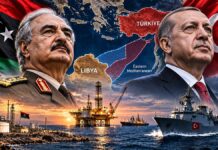












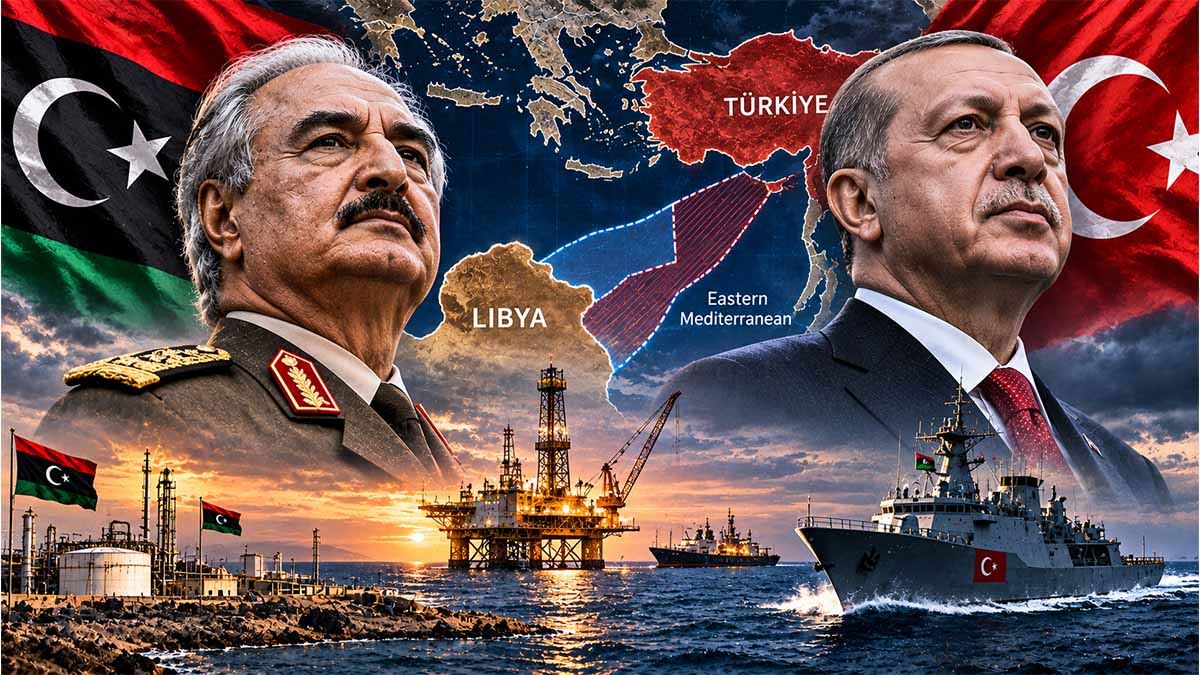
Geopolitical Realignment, Maritime Sovereignty, International Law, Offshore Energy Competition and the Emerging Security Architecture of the Eastern Mediterranean
Scope: An institutional assessment of the strategic rapprochement between Türkiye and eastern Libya, the October 2026 parliamentary reversal, competing maritime claims, energy and military interests, and their implications for Mediterranean security, European policy and regional alignments through November 2031.
Executive Summary / Bottom Line Up Front
The decision by Libya’s House of Representatives on 20 October 2026 to approve the 2019 maritime delimitation memorandum with Türkiye represents a substantial shift in eastern Libya’s diplomatic alignment, but does not settle the international legal controversy over the agreement. The unanimous vote reversed two parliamentary decisions adopted in 2020, including the rejection of agreements with Ankara and the severance of political relations. It gives Türkiye greater political acceptance across Libya’s divided institutions while expanding the diplomatic options available to Khalifa Haftar’s eastern power structure. House of Representatives Approves Maritime Memorandum of Understanding with Turkey — Libyan News Agency — Oct 2026.
The operative memorandum was signed on 27 November 2019, entered into force between its parties on 8 December 2019, and was registered with the United Nations on 11 December 2019 under registration number 56119. The new parliamentary decision therefore concerns the Libyan domestic political and institutional treatment of an existing agreement, rather than the creation of a new maritime treaty. Memorandum of Understanding on Delimitation of Maritime Jurisdiction Areas — United Nations Treaty Collection — Dec 2019.
Türkiye maintains that the agreement protects the equitable maritime rights of both signatories. Greece and Cyprus reject its legal foundations, while the European Union formally reiterated on 21 October 2026 that it cannot produce legal consequences for third states. The principal strategic risk is the widening gap between greater Turkish–Libyan political cooperation and the absence of an internationally accepted maritime delimitation. Statement No. 202 — Turkish Ministry of Foreign Affairs — Oct 2026; Libya/Türkiye: Statement on the Ratification of the Maritime MoU — Council of the European Union — Oct 2026.
Principal assessment: The rapprochement changes the diplomatic and negotiating environment more clearly than it changes the legal geography of the Mediterranean. Its longer-term consequences will depend on Libya’s institutional consolidation, the conduct of maritime exploration, negotiations involving affected coastal states, and whether regional economic cooperation can advance without prejudging contested boundaries.
Haftar’s Turn to Ankara Changes the Mediterranean Bargain—Not the Maritime Law
The unanimous vote by Libya’s eastern-based House of Representatives on 20 October 2026 gave Türkiye something its 2019 maritime agreement had lacked: acceptance from a legislature that had rejected Ankara while its forces were helping defend Tripoli against Khalifa Haftar’s offensive. But parliamentary consent is not a settlement of competing maritime rights, and it does not turn offshore acreage into exportable gas. The vote widens Türkiye’s political access across divided Libya, while the real shift in Mediterranean leverage will depend on which companies can secure legally durable licences, finance production and deliver energy to European markets. That distinction has immediate consequences for fiscal authority in Libya, energy investment by Italian and French companies, crude-oil supply to Italy and Germany, and the security calculations of Greece, Egypt, Cyprus and Israel. A treaty can change diplomacy overnight; a functioning energy corridor cannot.
Ankara has gained a second Libyan channel, not a unified state
The 2019 Türkiye–Libya maritime memorandum, signed on 27 November and in force between its parties from 8 December, was concluded with the Government of National Accord during Haftar’s campaign against Tripoli. The eastern House of Representatives rejected the agreement in 2020 and severed political relations with Ankara. Its 20 October 2026 decision approved the memorandum and repealed both earlier resolutions. The Foreign Ministry of the Government of National Unity in Tripoli welcomed the reversal, producing agreement on this instrument without agreement on a single Libyan executive or military command.
Saddam Haftar, deputy commander of the Libyan National Army, met Turkish Defence Minister Yaşar Güler in April 2025; three eastern Libyan military-technical delegations visited Türkiye that June. Hakan Fidan, Türkiye’s foreign minister, met him in November 2025 and visited both Tripoli and Benghazi on 11–12 August 2026. Belqasim Haftar, director general of the Libyan Development and Reconstruction Fund, discussed Turkish participation in reconstruction. The meetings establish diplomatic and commercial access, not delivered weapons, a unified command or financed construction.
Nor has Ankara displaced Cairo. Egypt’s President Abdel Fattah el-Sisi met Khalifa Haftar, commander of the Libyan National Army, on 19 August 2026, one week after Fidan’s Benghazi visit. Eastern Libya can engage Türkiye while keeping Egypt close, but the two governments still differ over the maritime agreement.
Europe’s exposure is measured in barrels and cargoes, not declarations
The Italian Ministry of Economy and Finance’s 2026 public-finance document puts Libya at 24.3% of Italy’s crude-oil import value in 2025, up from 18.3% in 2021. Libya represented only 1.7% of Italian imports in customs category HS 2711, which covers natural gas and other gases; that figure is not a physical-gas-volume share. ARERA recorded physical gas imports from Libya declining from approximately 2.5 billion cubic metres in 2023 to 1.4 billion in 2024. The contrast explains Rome’s actual exposure: the Libyan relationship matters heavily to crude supply, while the direct gas corridor matters for diversity and infrastructure resilience rather than for its present dominance of the Italian gas balance.
Germany imported 10.4 million tonnes of Libyan crude in 2025, 13.8% of its total, according to Destatis. France’s exposure runs through TotalEnergies: 113,000 barrels of oil equivalent per day of Libyan equity production in 2025. Its January 2026 extension of the Waha concessions to 2050 covers fields producing 370,000 barrels of oil equivalent per day across all partners; TotalEnergies holds 20.42%, not all that output. In the United Kingdom, bp’s July 2025 NOC memorandum covers studies of Sarir and Messla, not approved new production.
The new concessions cross the diplomatic divide
On 11 November 2026, Libya’s National Oil Corporation met the Repsol–Turkish Petroleum Corporation (TPAO)–MOL consortium for offshore Block 22, where water depths reach 2,000 metres. The planned second-quarter 2027 programme covers 2,676 square kilometres of 3D seismic and 1,500 kilometres of 2D seismic. Spanish, Turkish and Hungarian companies are thus preparing to explore under the same Libyan licence. The programme establishes neither reserves nor a development commitment. NOC’s technical announcement specifies proposed work, not discovered gas. The US Geological Survey’s assessment identifies 286.2 trillion cubic feet of mean undiscovered, technically recoverable regional gas—not Block 22 reserves.
In February 2026, Eni and QatarEnergy won the offshore O1 licence, approximately 29,000 square kilometres, with Eni as operator of a five-year exploration programme. Eni’s March discoveries at Bahr Essalam South 2 and 3 were estimated at more than 1 trillion cubic feet of gas in place, not commercially recoverable reserves. Its Sabratha Compression Project started production in June, with approximately 800 million cubic metres a year of additional gas reported. The Bouri Gas Utilization Project entered commissioning in October, with approximately 700 million standard cubic metres a year anticipated. Neither figure is an independently verified export total; part of the supply is for Libyan electricity generation. Eni’s Sabratha disclosure identifies domestic and export uses.
The more mature alternative is Cronos, in Cyprus’ Block 6. Eni and TotalEnergies, each at 50%, took a final investment decision in July 2026 to send gas through Egyptian processing facilities to Damietta LNG. They target 2028 first production and approximately 2.8 million tonnes of LNG a year at plateau. Four planned subsea wells and a defined export route give Cronos a development status that the new Libyan exploration blocks do not yet possess. TotalEnergies’ investment decision describes planned capacity, not delivered volumes.
The legal ceiling remains where third-state rights begin
The 2019 memorandum is registered as UN Treaty No. 56119; registration does not adjudicate Greek or Egyptian rights. Greece argues that the line disregards Crete and other island entitlements; Türkiye objects to giving islands an effect that unduly restricts its mainland coastline. Articles 74, 83 and 121 of UNCLOS distinguish maritime entitlement from delimitation. Türkiye is not a party to UNCLOS, so customary rules and treaty obligations cannot simply be conflated. The disputed line remains a legal claim, not a settled boundary against non-signatories.
Greece and Egypt signed their partial EEZ delimitation on 6 August 2020, effective from 2 September and registered as Treaty No. 56237. On 21 October 2026 the EU reaffirmed that the Türkiye–Libya agreement cannot affect third-state rights. That is an official legal position, not a judgment invalidating the treaty. Egypt’s Foreign Minister Badr Abdelatty repeated Cairo’s rejection to Fidan on 23 October while maintaining bilateral dialogue. A diplomatic opening is not yet a revised delimitation.
Libya’s fiscal position also limits implementation. The IMF’s April 2026 assessment placed its 2025 deficit at approximately 30% of GDP and public debt at 146% of GDP. UN Security Council Resolution 2835, adopted on 30 October 2026, extended UNSMIL to 31 October 2027 and reaffirmed the need for unified executive and security institutions. Exploration rights and reconstruction contracts still require competent authorities, enforceable payments and oversight; the parliamentary vote does not supply those conditions.
Security coordination raises the stakes but does not create a single command
The defence ministries of Greece, Cyprus and Israel met on 5 November 2026 on maritime security, infrastructure and defence industry, reiterating their objection to the memorandum. Greece’s April 2026 contract for Israeli PULS rocket-artillery systems, valued at approximately US$750 million, was a procurement agreement, not proof of delivered systems. The planned Great Sea Interconnector from Greece to Cyprus, nearly 900 kilometres long and supported by approximately €658 million in EU construction funding, faces different risks: permitting, financing and maritime access. None of these instruments creates an automatic collective military response.
The EU’s Russian share of gas imports fell from 45% in 2021 to 12% in 2025 under the REPowerEU policy shift, increasing the value of credible alternatives without validating a disputed boundary. The United States participates with Greece, Cyprus and Israel in the 3+1 mechanism, including a June 2026 declaration for an Eastern Mediterranean Energy Center. Egypt rejects the Türkiye–Libya line but does not belong to the Israel–Greece–Cyprus defence trilateral; Türkiye and Greece are both NATO members. A legal protest, procurement contract and operating pipeline therefore create different obligations and exposures.
By late 2028, delay will be charged to identifiable balance sheets
Between November 2027 and November 2028, Block 22’s proposed 2027 seismic programme can generate data, not production, while Cronos targets first gas in 2028. Sabratha and Bouri must demonstrate sustained output; Libya’s NOC and public institutions must provide workable licences and payment channels. The 516-kilometre GreenStream pipeline links Libyan production to Sicily, but its installed route says nothing about current spare capacity. These milestones—not a parliamentary declaration—will show which claimed advantages become physical supply.
The costs of inaction are specific. Libyan institutions risk losing investment, production reliability and accountable resource revenue if contracting authority remains divided. Operators and lenders bear delay, financing and legal costs; Italian and German refiners pay for replacement crude when shipments fail. European consumers face limited alternatives in a market where the International Energy Agency projected a roughly 3% fall in global LNG supply for 2026, conditional on sustained Middle Eastern disruptions. Greece, Egypt and Cyprus must manage competing maritime claims without a settled incident-prevention mechanism. Ankara has secured political consent in Benghazi. Its value by November 2028 will be measured in permits that withstand scrutiny, wells that produce and energy that reaches a buyer.
Navigational Index — Three Strategic Pillars
PILLAR I — LIBYA’S STRATEGIC REALIGNMENT
Political Authority, Military Networks and the Ankara–Haftar Rapprochement
- Chapter 1. From the Tripoli Offensive to Parliamentary Reversal: Türkiye and Libya, 2019–2026
- Chapter 2. Khalifa Haftar, Saddam Haftar and the Transformation of Eastern Libya’s External Relationships
- Chapter 3. Libyan Sovereignty, Competing Institutions and the Political Authority to Conclude Maritime Agreements
PILLAR II — MARITIME LAW AND REGIONAL POWER COMPETITION
Sovereign Rights, Territorial Claims and the Mediterranean Security System
- Chapter 4. The Turkish–Libyan Maritime Boundary: International Law, Greek Islands and Competing Delimitation Agreements
- Chapter 5. Egypt, Greece, Cyprus and Israel: Regional Diplomacy, Security Partnerships and Strategic Counterweights
PILLAR III — ENERGY, EUROPEAN EXPOSURE AND STRATEGIC OUTLOOK
Industrial Interests, Infrastructure, Risk Pathways and Decision Options
- Chapter 6. Offshore Hydrocarbons, Exploration Licensing, Energy Corridors and Infrastructure Economics
- Chapter 7. Italy, France, Germany, the United Kingdom and the European Union: Differentiated Strategic and Economic Interests
- Chapter 8. Mediterranean Scenarios, Escalation Indicators and Strategic Policy Options, 2027–2031
Master Abstract
The political reversal: a realignment without a unified state
The significance of the October 2026 decision lies in the relationship between Libya’s divided centres of authority rather than in the legal novelty of the maritime instrument. In 2019, Türkiye entered into maritime and security cooperation agreements with the internationally recognised Government of National Accord while Khalifa Haftar’s forces were conducting their offensive against Tripoli. Eastern Libyan institutions subsequently rejected the agreements and severed political relations with Ankara. The October 2026 decision reverses that institutional opposition, while stopping short of demonstrating the political reunification of Libya. Indeed, the Government of National Unity’s Foreign Ministry in Tripoli welcomed the parliamentary decision on the same day, creating a publicly documented convergence between institutions that otherwise continue to compete over executive authority. Statement by the Government of National Unity Ministry of Foreign Affairs — Libyan News Agency — Oct 2026.
Saddam Haftar’s publicly expressed support gives the development additional significance. On 20 October 2026, the deputy commander of the eastern military establishment described the maritime agreement as a means of protecting Libya’s economic interests and developing long-term cooperation and investment with Türkiye. He also framed cooperation with Ankara within a broader policy of maintaining relations with multiple regional states. This public position supports an interpretation of strategic diversification rather than demonstrated abandonment of Libya’s existing partnerships. The distinction matters particularly for Egypt, which retains significant security and political interests in its western neighbour. Greater engagement with Ankara can increase eastern Libya’s diplomatic options without requiring Haftar’s network to accept every Turkish regional position. Saddam Haftar’s Statement on the Libyan–Turkish Maritime Agreement — Libyan News Agency — Oct 2026.
Libya’s institutional fragmentation remains the central constraint. On 30 October 2026, the UN Security Council adopted Resolution 2835, extending the United Nations Support Mission in Libya until 31 October 2027 and reaffirming the objective of a unified executive authority, consolidated military and judicial institutions, and national elections. The resolution welcomed the agreement reached through the UN-facilitated political process to pursue elections within 24 months while maintaining demands for compliance with the arms embargo and the withdrawal of foreign fighters, mercenaries and foreign forces. The parliamentary maritime decision must therefore be assessed in the context of an unresolved state-building process. A degree of cross-factional acceptance of one international agreement cannot be equated with a comprehensive political settlement. Security Council Resolution 2835 (2026) — United Nations Security Council — Oct 2026.
The maritime confrontation: political acceptance does not establish legal opposability
The 2019 memorandum identifies a continental-shelf and exclusive-economic-zone boundary through two geographic endpoints specified in Article I, with technical annexes forming an integral part of the instrument. Its provisions include diplomatic dispute settlement, possible cooperation over resources crossing the maritime boundary, and consultation between the signatories before either concludes a maritime delimitation agreement with a third country. These provisions matter because the agreement is not merely a symbolic proclamation: it provides an agreed bilateral reference for Turkish and Libyan maritime policy and establishes procedural expectations for future negotiations. However, the bilateral existence of an agreement and its legal effect against other coastal states are separate questions. Memorandum of Understanding, Articles I–VI — Governments of Türkiye and Libya, United Nations Treaty Series No. 56119 — Nov 2019.
The principal legal confrontation concerns the maritime entitlements of Greek islands, including Crete, and the relationship between mainland coastlines, island-generated maritime zones and the principle of equitable delimitation. Greece maintains that Türkiye and Libya lack opposite or adjacent coastlines capable of supporting the purported boundary and that the memorandum disregards the rights of Greek islands. Türkiye argues that islands cannot be assigned a delimitation effect that unjustifiably blocks the maritime projection of its mainland. The divergence is not resolved simply by invoking UNCLOS: questions concerning the generation of maritime entitlements and the allocation of their effect during delimitation require separate legal examination. The European Union’s October 2026 statement adopts the position that the memorandum is incompatible with the law of the sea and cannot generate legal consequences for third states. That is an authoritative statement of EU policy, but it must not be misrepresented as a final judgment of an international court. Announcement on the Libyan House of Representatives’ Decision — Hellenic Ministry of Foreign Affairs — Oct 2026; Statement of the High Representative on Behalf of the EU — Council of the European Union — Oct 2026.
Egypt introduces a further and independent legal obstacle. Cairo and Athens signed a partial exclusive-economic-zone delimitation agreement on 6 August 2020, which entered into force on 2 September 2020 and is registered with the United Nations as treaty number 56237. Egypt subsequently reaffirmed its rejection of the Turkish–Libyan memorandum during diplomatic contacts with Ankara in October 2026, making clear that improved bilateral dialogue did not constitute acceptance of the disputed maritime boundary. On 26 October, Greece delivered a joint statement on behalf of Bahrain, Cyprus, Egypt, the United Arab Emirates and the European Union, as well as Greece itself, opposing the Turkish–Libyan arrangement. The resulting diplomatic structure is more complex than a straightforward confrontation between Athens and Ankara: several states now articulate overlapping objections, although their geographical interests, negotiating priorities and exposure to an eventual compromise are not identical. Agreement on the Delimitation of the Exclusive Economic Zone between Greece and Egypt — United Nations Treaty Collection — Sep 2020; Stake-out Statement on the Turkish–Libyan Memorandum — Hellenic Ministry of Foreign Affairs — Oct 2026.
Energy economics: the difference between geological potential and commercial control
The hydrocarbon dimension increases the significance of maritime jurisdiction, but it requires careful separation of resource potential from commercially recoverable reserves. The US Geological Survey’s 2020 geological assessment, published in July 2021, estimated mean undiscovered, technically recoverable conventional resources of 286.2 trillion cubic feet of gas and 879 million barrels of oil across the assessed eastern Mediterranean area. Neither figure establishes proven reserves in the disputed Turkish–Libyan maritime sector, nor does either quantify the economic value that the 2019 memorandum could secure for its signatories. Geological potential only becomes a commercially actionable asset after sufficient exploration, reservoir appraisal, legal access, development planning, financing, infrastructure arrangements and market assessment. Assessment of Undiscovered Conventional Oil and Gas Resources in the Eastern Mediterranean Area, 2020 — US Geological Survey — Jul 2021.
Italy provides an especially important counterpoint to narratives that divide the Mediterranean into rigid geopolitical blocs. Eni’s operations demonstrate that commercially significant Italian–Libyan energy integration already exists independently of the eastern Mediterranean delimitation dispute. In March 2026, Eni announced the Bahr Essalam South 2 and 3 discoveries, estimating more than 1 trillion cubic feet of gas in place across the two geological structures. In June, Eni and Libya’s National Oil Corporation announced the start-up of the Sabratha Compression Project, with a stated incremental gas-production contribution of approximately 800 million cubic metres annually. On 19 October, Eni announced completion of the Bouri Gas Utilization Project, with start-up procedures underway and an anticipated incremental gas contribution of approximately 700 million standard cubic metres annually. The company identified both Libyan domestic supply and exports to Italy as relevant destinations for these developments. These figures refer to different project measures and stages and cannot simply be added together as realised exports. New Gas Discoveries in Libya — Eni — Mar 2026; Sabratha Compression Project — Eni — Jun 2026; Bouri Gas Utilization Project — Eni — Oct 2026.
These investments also demonstrate why maritime delimitation and commercial energy development must not be treated as interchangeable. Projects operating under established Libyan infrastructure arrangements are exposed to different legal and operational circumstances from hypothetical exploration in waters whose jurisdiction is contested by other states. The strategic concern for European governments and investors is not that the parliamentary vote automatically changes ownership of existing offshore assets, but that future licensing decisions, survey operations or infrastructure proposals could create conflicts between competing interpretations of maritime authority. Those conflicts could increase financing uncertainty, insurance complexity and diplomatic friction even before any commercially viable new field is established.
The emerging regional architecture: overlapping coalitions, not a single alliance system
The Mediterranean’s energy and security arrangements already extend beyond bilateral maritime disputes. The East Mediterranean Gas Forum includes Egypt, Cyprus, Greece, Israel, Italy, France, Jordan and Palestine, while Türkiye remains outside the organisation. In June 2026, the United States Department of Energy announced a declaration of intent with Cyprus, Greece, Israel and Rice University to establish an Eastern Mediterranean Energy Center in Houston, with cooperation envisaged in natural gas, energy transportation, infrastructure resilience and emerging technologies. These institutional developments demonstrate the existence of organised cooperation involving states whose maritime and security interests do not always coincide with Ankara’s. They do not, by themselves, establish a collective military alliance directed against Türkiye or prove that specific infrastructure investments are intended to exclude Turkish participation. East Mediterranean Gas Forum — Official Membership Register; United States, Cyprus, Greece, Israel and Rice University to Establish Eastern Mediterranean Energy Center — US Department of Energy — Jun 2026.
For European governments, the strategic question is consequently broader than whether the Turkish–Libyan agreement should be accepted or rejected. Italy must account for existing energy production and transmission interests; France combines European maritime solidarity with participation in regional energy institutions and Libya-related diplomacy; Germany remains associated with the Berlin Process and institutional reunification efforts; and the United Kingdom supports the UN-sponsored political transition while maintaining its own sanctions framework. The European Union collectively has adopted an unequivocal legal position on the maritime memorandum, but the economic and security consequences of a prolonged dispute are distributed unequally among its members. A sustainable Mediterranean settlement would therefore have to address the legal rights of affected coastal states, the autonomy of Libya’s national institutions and the practical requirements of commercially viable energy development without assuming that political convergence automatically resolves the underlying maritime dispute. Joint Statement on Recent Progress in Libya’s Political Process — French Ministry for Europe and Foreign Affairs — Aug 2026; UK Statement on Security Council Resolution 2835 — Foreign, Commonwealth & Development Office — Oct 2026.
Key Evidence Table — Verified Institutional, Legal and Energy Baseline
| Indicator | Value / Status | Reference date | Definition / Scope | Issuer | Exact source |
|---|---|---|---|---|---|
| Turkish–Libyan maritime memorandum | Signed 27 Nov 2019; entered into force 8 Dec 2019 | 2019 | Bilateral maritime jurisdiction delimitation | Türkiye, Libya; UN Treaty Collection | UNTS No. 56119 |
| UN treaty registration | No. 56119; registered 11 Dec 2019 | 2019 | Registration under UN Charter Article 102; not UN adjudication | United Nations | Treaty record |
| Parliamentary reversal | Unanimous approval; repeal of Resolutions 1/2020 and 6/2020 | 20 Oct 2026 | Eastern-based House of Representatives | Libyan parliamentary spokesperson | LANA official report |
| Turkish diplomatic position | Formal welcome; assertion of equitable maritime rights | 20 Oct 2026 | Official bilateral position | Turkish Ministry of Foreign Affairs | Statement No. 202 |
| EU legal position | Rejection; no legal consequences for third states, according to EU | 21 Oct 2026 | Common EU position | Council of the EU | High Representative’s statement |
| Greece–Egypt EEZ agreement | Signed 6 Aug 2020; in force 2 Sep 2020 | 2020 | Bilateral exclusive-economic-zone delimitation | Greece, Egypt; United Nations | UNTS No. 56237 |
| Multilateral diplomatic objection | Joint statement on behalf of six participants | 26 Oct 2026 | Bahrain, Cyprus, Egypt, UAE, EU and Greece | Hellenic Ministry of Foreign Affairs | New York statement |
| UN political mission | Mandate extended to 31 Oct 2027 | Oct 2026 | Political mediation and institutional reunification | UN Security Council | Resolution 2835 (2026) |
| Regional undiscovered gas | Mean 286.2 Tcf | 2020 assessment, 2021 publication | Technically recoverable conventional gas resources; not proven reserves | US Geological Survey | Fact Sheet 2021-3032 |
| Eni’s Libyan gas discoveries | More than 1 Tcf | Mar 2026 | Preliminary gas-in-place estimate; BESS 2 and BESS 3 | Eni | Corporate announcement |
| Sabratha Compression Project | Approximately 800 million m³/year incremental gas | Jun 2026 | Reported production contribution following project start-up | Eni / NOC | Project announcement |
| Bouri Gas Utilization Project | Approximately 700 million standard m³/year anticipated incremental gas | Oct 2026 | Completed project; commissioning underway when announced | Eni / NOC | Project announcement |
The evidence establishes four distinct categories that must not be conflated: international treaty status, domestic parliamentary acceptance, third-state legal objections and realised industrial activity. The October 2026 vote directly changes the third-party perception of political support within Libya; it does not itself alter the internationally recorded coordinates of the 2019 memorandum, establish new proven reserves or demonstrate operational control over disputed maritime areas.
Competing Strategic Explanations
Three explanations satisfy the minimum evidentiary conditions for a structured comparison. They are not fully mutually exclusive: strategic diversification, bargaining leverage and deeper bilateral cooperation can reinforce one another.
| Hypothesis | Diagnostic support | Disconfirming evidence / limitations | Observable indicators | Current standing |
|---|---|---|---|---|
| H1 — Strategic diversification by eastern Libya | Repeal of the political boycott; Saddam Haftar’s support for wider cooperation; preservation of diplomatic channels with regional partners | Public evidence does not establish the terms of a comprehensive new political or defence alignment | Sustained high-level contacts; additional bilateral economic agreements; continuity of engagement with Egypt | Supported as an explanation of the political reversal |
| H2 — Comprehensive strategic reorientation toward Türkiye | Parliamentary acceptance of an agreement previously rejected; declared willingness to develop long-term Turkish–Libyan cooperation | No verified evidence of an exclusive alliance, termination of Egyptian relationships or operational military integration resulting from the vote | New defence instruments, documented deployments, institutional agreements and material changes in security cooperation | Not established by the available official record |
| H3 — Maritime bargaining leverage | The vote reinforces the Turkish–Libyan negotiating position while Greece, Egypt and Cyprus continue to object | No verified settlement, new operative maritime boundary or demonstrated agreement among the affected third states | Negotiations involving coastal states; revised maps; formal maritime consultations; new licensing or survey authorisations | Plausible strategic effect; operational outcome unresolved |
The strongest observable development is the formal reversal of previous eastern Libyan institutional opposition. Whether that reversal produces a durable redistribution of regional influence remains dependent on subsequent government action.
Egypt’s diplomatic conduct illustrates the difference between continued engagement and legal acceptance. The Egyptian Foreign Ministry recorded discussions between Badr Abdelatty and Hakan Fidan on 23 October 2026, during which Cairo reiterated its objection to the maritime memorandum while both sides discussed continued coordination over Libya. This demonstrates that bilateral dialogue and unresolved maritime disagreement can coexist. Foreign Minister’s Activities — Egyptian Ministry of Foreign Affairs — Oct 2026.
Principal Gaps and Strategic Watch Indicators
The implementation gap
The first consequential uncertainty is whether the parliamentary reversal will produce new administrative or operational decisions relating directly to the disputed maritime sector. The strongest confirmation would be a formally published exploration licence, survey authorisation, maritime notification, or other competent state instrument identifying the relevant coordinates and legal authority.
Such an instrument would establish action, not necessarily undisputed jurisdiction. The analysis would still have to distinguish documentary authorisation from physical operations and actual commercial discoveries.
The decisive collection priorities are the Libyan House of Representatives’ published resolutions and session record, any subsequent ratification or implementing instruments, National Oil Corporation licensing documents, and notices issued by competent maritime authorities.
The alliance gap
Public statements demonstrate greater acceptance of Turkish cooperation within eastern Libya, but do not establish the existence of a comprehensive new bilateral security architecture between Ankara and Haftar’s command.
The principal indicators are formally concluded defence agreements, approved training arrangements, equipment transfers, command-level visits and verified changes in the distribution of foreign military personnel. Diplomatic meetings alone do not establish operational integration, and announcements of military cooperation do not demonstrate that equipment has been delivered or made available for use.
UN Security Council Resolution 2835 remains an important legal and diplomatic reference because it reiterates the obligations concerning the Libyan arms embargo, foreign military involvement and the country’s political transition. Security Council Resolution 2835 (2026) — United Nations Security Council — Oct 2026.
The negotiation gap
A third uncertainty concerns whether political contacts between Ankara and Cairo can create an acceptable framework for addressing overlapping maritime claims. The existence of dialogue does not demonstrate agreement on geographic coordinates, recognition of existing bilateral delimitation instruments, or the legal treatment of Greek island entitlements.
The critical records would be joint diplomatic communiqués explicitly addressing maritime boundaries, agreed technical maps, formally authorised negotiations, and treaty amendments or new delimitation agreements.
Any proposal must also be assessed against the existing Greek–Egyptian agreement and the rights asserted by other affected coastal states.
The commercial gap
The principal unresolved energy question is not the existence of regional gas resources but whether new offshore resources can be developed within commercially and legally sustainable arrangements.
Relevant indicators include seismic-survey results, confirmed discoveries, appraisal drilling, recoverable-resource estimates, development approvals, project financing, export agreements and insurance conditions.
Investment announcements are insufficient on their own. A project reaches a different level of commercial maturity when its resources, infrastructure, regulatory permissions and contracted markets are demonstrably connected.
The Libyan sovereignty gap
The final uncertainty concerns the relationship between eastern Libya’s individual diplomatic decisions and the formation of unified national institutions.
The August 2026 international statement by ten governments supporting the UN-facilitated political process, followed by Security Council Resolution 2835, provides a documented framework for monitoring national institutional consolidation. The relevant benchmarks are not diplomatic declarations alone but progress toward elections, a single executive authority and unified security, judicial and economic institutions. Joint Statement on Recent Progress in Libya’s Political Process — French Ministry for Europe and Foreign Affairs — Aug 2026; Security Council Resolution 2835 (2026) — United Nations Security Council — Oct 2026.
Strategic Visualisation — How the Parliamentary Reversal Transmits into Regional Risk
The following WordPress component distinguishes three sequential analytical stages: the documented political decision, the unresolved legal environment, and the conditional transition to operational and commercial consequences. It intentionally uses no speculative geographic boundaries, unsupported probabilities or invented quantitative indicators.
LIBYA–TÜRKİYE | THREE-STAGE STRATEGIC TRANSMISSION
The 2026 parliamentary decision changes the political environment. Legal acceptance and commercial implementation remain separate and conditional.
20 October 2026 — Parliamentary reversal
Libya’s House of Representatives approves the 2019 maritime memorandum and repeals two decisions adopted in 2020.
Competing maritime claims remain unresolved
Possible downstream consequences
Interpretation: Political endorsement is established. International recognition of the claimed boundary and the commercial exploitation of disputed resources do not follow automatically.
Status date: 12 November 2026. Qualitative relationships only; no probability or territorial-area estimates.
Opening Net Assessment
The central development is a convergence of interests between Türkiye and eastern Libya after years of political and military confrontation. The parliamentary reversal provides a measurable institutional basis for that convergence, while the contemporaneous positions of Ankara, Tripoli and Saddam Haftar indicate a widening opportunity for cooperation.
Its implications for the regional balance should nevertheless be assessed through three separate tests. The first is whether the relationship develops beyond diplomatic acceptance into sustained political, economic or military cooperation. The second is whether the parties can translate their maritime position into lawful and internationally manageable arrangements despite the objections of Greece, Egypt, Cyprus and the European Union. The third is whether Libya’s divided institutions can safeguard national economic interests while pursuing the political reunification demanded by its own state-building process and supported by the United Nations.
For European governments, the challenge is not confined to the legality of a maritime memorandum. It encompasses the security of existing offshore infrastructure, future exploration rights, the stability of Libya, relations between NATO members, and competing mechanisms of Mediterranean energy cooperation.
The verified record supports a significant diplomatic realignment. It does not yet establish a comprehensive new alliance, an internationally settled maritime boundary or a corresponding transfer of effective control over offshore resources. The next decisive evidence will be found in implementing decisions, maritime negotiations and identifiable economic or military commitments—not in the parliamentary vote alone.
JavaScript is required for the interactive graph.
PILLAR I — LIBYA’S STRATEGIC REALIGNMENT
Political Authority, Military Networks and the Ankara–Haftar Rapprochement
OPEN-SOURCE ANALYTICAL ASSESSMENT
Assessment date: 12 November 2026
Geographic scope: Libya, Türkiye and the regional security relationships influencing Libya’s political and military institutions.
Chapter 1. From the Tripoli Offensive to Parliamentary Reversal: Türkiye and Libya, 2019–2026
Principal judgment: The transformation of Turkish–Libyan relations between 2019 and 2026 constitutes a change in the structure of political engagement rather than a simple reconciliation between former military adversaries. Ankara has progressively developed relations with eastern Libya’s political, military and economic institutions while preserving its established relationships with Tripoli. This development introduces a new diplomatic configuration in which actors formerly divided by direct military confrontation can cooperate on selected strategic interests without resolving the institutional fragmentation underlying the Libyan conflict.
The 2019 military confrontation and the transformation of Libya’s external security relationships
The offensive launched against Tripoli on 4 April 2019 by forces affiliated with Khalifa Haftar fundamentally altered the relationship between Libya’s internal political divisions and external military involvement. The confrontation increasingly depended on foreign military assistance, access to air bases, unmanned aerial systems, air-defence capabilities and the protection of logistics corridors. It exposed the limitations of treating the conflict as a confrontation between two self-contained Libyan military organisations. The United Nations Panel of Experts established that both Haftar-affiliated forces and the Government of National Accord received growing assistance from state and non-state actors, with this support contributing materially to the evolution of the conflict. The importance of that finding extends beyond the identification of foreign participants: it demonstrates that Libya’s military balance had become dependent on international relationships capable of supplying equipment, technical expertise and operational support that domestic forces could not necessarily reproduce independently. The February 2021 reporting cycle also documented how control of petroleum infrastructure, transportation routes and armed formations shaped the conflict’s economic and political dimensions. Final Report of the Panel of Experts on Libya, S/2021/229 — United Nations Security Council — Mar 2021.
Türkiye’s support for the Government of National Accord must be understood within this increasingly internationalised environment. Ankara entered into maritime and security cooperation arrangements with Tripoli in November 2019, creating a bilateral framework through which maritime jurisdiction, defence cooperation and broader strategic relations became politically interconnected. The maritime memorandum was signed on 27 November 2019 and entered into force between the signatories on 8 December. Its relevance to the subsequent military confrontation was not that it independently authorised every form of Turkish operational involvement, but that it formed part of the diplomatic relationship underpinning Ankara’s support for the Tripoli authorities. The instruments also generated sharply different reactions among Libya’s institutions. The eastern House of Representatives rejected the arrangements in 2020 and adopted decisions opposing their ratification and severing political relations with Türkiye. These decisions were not incidental expressions of disagreement. They formalised the institutional consequences of a conflict in which Ankara supported the government Haftar was attempting to displace. Memorandum of Understanding on the Delimitation of Maritime Jurisdiction Areas, Treaty No. 56119 — United Nations Treaty Collection — Dec 2019; House of Representatives Approves Maritime Memorandum and Repeals Previous Decisions — Libyan News Agency — Oct 2026.
The operational sequence documented by the United Nations is particularly important because it provides a more precise description than retrospective claims that a single weapons system or external intervention independently decided the conflict. The UN Panel of Experts recorded a tactical stalemate at the end of 2019, when Haftar-affiliated forces controlled approaches to Tripoli and possessed substantial aerial capabilities, including combat aircraft, attack helicopters and Wing Loong II unmanned combat aerial vehicles. Government-aligned forces employed Turkish-supplied Bayraktar TB2 systems, whose operational effectiveness initially faced significant constraints from opposing air-defence capabilities and the vulnerability of their operating bases. During the following months, the Government of National Accord recovered control of the western coastal region in April 2020 and forced Haftar-affiliated forces away from the Tripoli area by early June. By July, the principal military confrontation had shifted toward Sirte and Jufrah. These developments demonstrate that changes in the military balance were cumulative and involved adaptation in air operations, ground coordination, logistics and external support rather than the isolated effect of a single technological platform. Final Report of the Panel of Experts on Libya, S/2021/229, Summary and Military Analysis — United Nations Security Council — Mar 2021.
The geographical redistribution of forces also transformed the political objectives of the parties. The failure to capture Tripoli prevented Haftar from establishing control over Libya’s principal western governing institutions, while the preservation of eastern and central military positions prevented the Government of National Accord from establishing an uncontested national monopoly of force. A divided military environment consequently survived the immediate campaign. The resulting distinction between territorial influence and national authority remains central to the interpretation of the 2026 maritime decision: the House of Representatives could change its diplomatic position toward Türkiye without the armed formations and executive authorities across Libya automatically becoming part of a unified command structure. This is a supported analytical consequence of the documented military stalemate and the continuing UN requirement for consolidated institutions, rather than evidence of any undisclosed political bargain. Final Report of the Panel of Experts on Libya, S/2021/229 — United Nations Security Council — Mar 2021; Security Council Resolution 2835 (2026), Operative Paragraph 3 — United Nations Security Council — Oct 2026.
The October 2020 ceasefire: stabilising the military confrontation without eliminating external dependencies
The ceasefire signed in Geneva on 23 October 2020 marked a separate institutional turning point. Delegations representing the Government of National Accord’s military establishment and the General Command of the Libyan National Army concluded an agreement through the United Nations-facilitated 5+5 Joint Military Commission. The agreement required the withdrawal of military units from front lines, addressed the departure of foreign fighters and mercenaries, and contemplated arrangements for monitoring and security coordination. It also dealt with military training activities and the role of a future unified government. The existence of these provisions is analytically significant because the ceasefire addressed not only battlefield violence but also the external military relationships that could undermine a political settlement. The agreement therefore established a framework against which later defence cooperation, military visits and foreign training arrangements must be assessed, rather than allowing all such activities to be treated automatically as ordinary bilateral military diplomacy. Permanent Ceasefire Agreement Between the Libyan Parties — United Nations Support Mission in Libya — Oct 2020.
The agreement’s implementation has proved a different question from its adoption. The Security Council’s October 2026 resolution continued to demand compliance with the arms embargo and the withdrawal of foreign military personnel, while reaffirming the 5+5 Commission’s role and recalling the withdrawal action plan agreed in Geneva on 8 October 2021. This continuity demonstrates that the central security questions identified in 2020 were not considered resolved six years later. For the Ankara–Haftar relationship, the consequence is especially important: additional official contacts and military cooperation initiatives must be distinguished from the formation of an integrated national security institution. Diplomatic access to both sides of the Libyan divide can facilitate communication and potentially support institutional convergence, but it can also coexist with separate chains of command and unequal foreign military relationships. Determining which effect predominates requires evidence concerning command authority, training agreements, force deployment, equipment transfers and compliance with applicable international restrictions. Security Council Resolution 2835 (2026), Operative Paragraphs 14–16 — United Nations Security Council — Oct 2026.
The ceasefire also created an enduring institutional channel between military representatives who had previously confronted one another. The 5+5 mechanism provided for the negotiation of security arrangements across divided territory, including movements along routes linking Tripoli, Misrata, Sirte, Ajdabiya and southern Libya. These corridors are significant because Libya’s political geography cannot be separated from the practical movement of forces, commercial traffic and access to strategic infrastructure. The reopening and protection of transportation connections therefore represent operational requirements of national reunification, rather than merely symbolic confidence-building measures. For Türkiye, which retained an established military relationship with western Libya, the development of direct contacts with eastern command structures subsequently created opportunities to engage a wider set of actors involved in these security arrangements. It did not, however, transfer control over the UN ceasefire process to Ankara or establish that Turkish diplomacy alone could reconcile the competing Libyan military institutions. Statement on the 5+5 Joint Military Commission Talks — United Nations Support Mission in Libya — Oct 2020; Statement on the Fifth Anniversary of the Ceasefire Agreement — United Nations Support Mission in Libya — Oct 2025.
The development of a dual-track Turkish policy
A central feature of Türkiye’s evolving Libyan policy is the transition from a relationship concentrated on the Tripoli authorities to a network of contacts spanning both western and eastern institutions. This change did not require Ankara to abandon its existing partners, renounce its maritime claims or recognise an alternative executive authority as the exclusive representative of Libya. Instead, the public record shows an expanding diplomatic and military engagement structure operating across institutional divisions. Such an approach offers practical advantages in an environment where a single political counterpart does not exercise uncontested authority over the entire country. Engagement with Tripoli preserves access to established government relationships and existing cooperation frameworks; engagement with Benghazi creates access to military leadership, parliamentary actors and reconstruction institutions whose cooperation may be necessary for national political and economic initiatives. The resulting flexibility is a structural feature of Ankara’s diplomacy, not proof of an agreed division of influence.
The first decisive evidence of this development appeared in the military contacts initiated during 2025. On 4 April 2025, Turkish Defence Minister Yaşar Güler received Saddam Haftar, then identified as commander of the Libyan National Army’s Ground Forces. According to the Turkish Defence Ministry information reproduced by the Libyan News Agency, three further military-technical delegations from eastern Libya visited Türkiye between 15 and 28 June 2025. These delegations inspected military command facilities, units and training institutions. The Turkish ministry also described its continuing training and advisory activities in Libya. The visits demonstrate a progression from leadership-level engagement to technical familiarisation with Turkish defence institutions. They do not, without further documentation, prove the conclusion of weapons contracts, the delivery of particular systems or the creation of a joint operational command. Turkish Defence Minister Receives Saddam Khalifa Haftar — Libyan News Agency, Reporting the Turkish Ministry of National Defence — Apr 2025; Eastern Libyan Military-Technical Delegations Visit Türkiye — Libyan News Agency, Reporting the Turkish Ministry of National Defence — Jul 2025.
The progression continued into direct foreign-ministry engagement. On 20 November 2025, Foreign Minister Hakan Fidan met Saddam Haftar in Ankara, an encounter recorded by the Turkish Ministry of Foreign Affairs. This official confirmation matters because it places Saddam Haftar’s relationship with Türkiye beyond a narrowly technical defence channel. A foreign-minister-level meeting establishes diplomatic access to a figure occupying a senior position in eastern Libya’s military leadership, while leaving the substance of any non-public negotiations unresolved. The distinction is essential: the official record confirms the meeting, its participants, its location and its date, but does not disclose a binding military, maritime or commercial agreement resulting from it. Foreign Minister Hakan Fidan Meets General Saddam Haftar in Ankara — Republic of Türkiye Ministry of Foreign Affairs — Nov 2025.
By 2026, the relationship had expanded into a broader institutional pattern. On 8 May 2026, Turkish Defence Minister Yaşar Güler met Saddam Haftar and Libya’s Defence Minister Abdusselam Zubi during the SAHA 2026 defence exhibition in Istanbul. The official Turkish Ministry of National Defence record establishes that the defence minister engaged representatives associated with different parts of Libya’s military environment in the same diplomatic setting. The significance is institutional rather than ceremonial: Ankara was positioning itself to maintain defence contacts across Libya’s divided structures, while the simultaneous presence of those representatives did not itself establish agreement on command integration, force deployment or the national allocation of defence authority. Defence Minister Yaşar Güler Meets Saddam Haftar and Abdusselam Zubi — Republic of Türkiye Ministry of National Defence — May 2026.
The diplomatic architecture became particularly visible during Foreign Minister Fidan’s 11–12 August 2026 visit to Libya. The Turkish Foreign Ministry records meetings in Tripoli with Prime Minister Abdul Hamid Dabaiba, Presidential Council President Mohamed al-Menfi, High Council of State Chairman Mohamed Takala and security officials, together with a visit to the Turkish Armed Forces Libya Task Group Command. In Benghazi, Fidan met Saddam Haftar, Khalifa Haftar, House of Representatives Speaker Aguila Saleh Issa and Belqasim Haftar, head of the Libyan Development and Reconstruction Fund. This itinerary documents engagement with executive, parliamentary, military and economic institutions on both sides of Libya’s political division. Its scope demonstrates a deliberate broadening of diplomatic access, while the absence of a publicly disclosed comprehensive political settlement prevents interpreting the meetings as evidence of institutional reunification. Visit of Foreign Minister Hakan Fidan to Libya, 11–12 August 2026 — Republic of Türkiye Ministry of Foreign Affairs — Aug 2026.
The October 2026 parliamentary decision as an institutional outcome
The vote of 20 October 2026 has to be analysed as the culmination of a documented sequence of political contacts and institutional decisions, without claiming an unpublished exchange of concessions. The House of Representatives unanimously approved the maritime memorandum and repealed Resolution No. 1 of 2020, which rejected ratification of the memoranda concluded with Türkiye, and Resolution No. 6 of 2020, which severed political relations with Ankara. The decision therefore involved three identifiable institutional consequences: approval of the maritime instrument, reversal of the earlier parliamentary rejection and termination of the legislature’s previous formal political boycott. These are distinct effects, even though they were adopted in the same session. Their combined significance lies in the replacement of a formal policy of rejection with a policy permitting closer bilateral engagement. House of Representatives Approves Maritime Memorandum and Repeals Earlier Decisions — Libyan News Agency — Oct 2026.
The reaction from Tripoli provides an additional indication of the complexity of Libya’s political divisions. The Government of National Unity’s Foreign Ministry welcomed the parliamentary decision and its repeal of the 2020 resolutions, describing the development as supportive of bilateral cooperation. This establishes a convergence of publicly declared positions on the maritime memorandum between institutions that otherwise remain divided over executive authority and national governance. It does not establish agreement on the organisation of the armed forces, the distribution of state revenue, the timing of elections or the future composition of a unified executive. The distinction reveals the principal analytical value of the maritime episode: cooperation on a discrete foreign-policy instrument may advance before, and independently of, a comprehensive domestic political settlement. Whether that cooperation can subsequently support wider institutional reconciliation remains an open question. Government of National Unity Foreign Ministry Welcomes Adoption of the Maritime Memorandum — Libyan News Agency — Oct 2026.
The sequence from 2019 to 2026 therefore shows neither a complete disappearance of military rivalry nor an unqualified transfer of eastern Libya into Türkiye’s regional alignment. It shows the gradual construction of additional diplomatic and military communication channels, followed by a parliamentary act reversing previous institutional hostility. The distinction matters for all subsequent assessments of the Mediterranean balance of power: diplomatic recognition of common interests may increase the number of available negotiating partners without immediately producing internationally accepted maritime rights, enforceable commercial arrangements or unified military capabilities. The parliamentary decision is a documented political achievement for the bilateral relationship, but its broader consequences remain dependent on the content of future implementing measures and Libya’s unfinished political transition.
Chapter 2. Khalifa Haftar, Saddam Haftar and the Transformation of Eastern Libya’s External Relationships
Principal judgment: The changing relationship between eastern Libya and Türkiye is inseparable from the differentiation of political, military and economic responsibilities within the Haftar leadership network. Khalifa Haftar retains a central command role, Saddam Haftar has become a principal interlocutor in military and diplomatic engagement, Khaled Haftar occupies a senior military leadership position, and Belqasim Haftar manages an important reconstruction institution. Their activities demonstrate a widening distribution of external relationships across several policy domains, although familial relationships and political influence must not be confused with formal national constitutional authority.
The Haftar leadership structure and the distribution of institutional responsibilities
The political significance of the Haftar family extends beyond Khalifa Haftar’s individual relationship with foreign governments. Official records establish that several members of the family occupy distinct positions within eastern Libya’s military and reconstruction structures. The Turkish Foreign Ministry identifies Khalifa Haftar as General Commander of the Libyan National Army and Saddam Haftar as Deputy Commander. The Egyptian Presidency’s record of the 19 August 2026 meeting with President Abdel Fattah el-Sisi identifies Khaled Haftar as Chief of the General Staff and Belqasim Haftar as Director General of the Libyan Development and Reconstruction Fund. These descriptions establish a distribution of publicly identified leadership positions across military command, diplomatic engagement and economic administration. They do not establish that these positions constitute a legally unified national command or that every institution operating in eastern Libya is subordinate to a single formally documented decision-making hierarchy. Visit of Hakan Fidan to Libya — Republic of Türkiye Ministry of Foreign Affairs — Aug 2026; President El-Sisi Meets the Commander-in-Chief of the Libyan National Army — Presidency of the Arab Republic of Egypt — Aug 2026.
This differentiation matters because international partnerships in a politically fragmented state cannot be measured exclusively through meetings between heads of government. A foreign military delegation may seek access to military training and technical cooperation through Saddam Haftar; a diplomatic mission may engage Khalifa Haftar regarding strategic security issues; a construction or engineering company may seek information about investment opportunities through reconstruction institutions managed by Belqasim Haftar. These interactions concern different forms of authority and generate different kinds of commitments. A defence meeting may establish political consent to further discussions without creating a procurement obligation. A reconstruction memorandum may open access to feasibility studies without constituting a financed public works contract. A parliamentary vote may change the legislature’s legal or political position without providing immediate operational control over maritime territory. The institutional network therefore offers several channels through which external actors can develop relations, but the legal and financial validity of specific commitments must be established separately.
Khalifa Haftar’s position within this structure is particularly relevant to the management of external relationships. His meetings with Turkish and Egyptian representatives illustrate the importance of sustaining multiple diplomatic channels rather than relying on a single external patron. The meetings also demonstrate that military leadership in eastern Libya remains involved in discussions with foreign states concerning national security and institutional reunification. However, external recognition of a military interlocutor should not be interpreted as recognition of that actor as Libya’s exclusive sovereign authority. International engagement may reflect practical influence over security conditions while formal treaty powers, governmental recognition and national institutional legitimacy remain governed by different legal and political considerations.
Saddam Haftar as a military and diplomatic intermediary
Saddam Haftar’s emergence as a prominent interlocutor is supported by a series of dated official activities, not merely by assumptions concerning family succession. His April 2025 reception by the Turkish Defence Minister was followed by military-technical visits, foreign-ministry engagement in November 2025, further defence discussions in May 2026 and the August 2026 visit of Hakan Fidan to Benghazi. Taken together, these records indicate that Saddam occupies a position through which defence establishments and diplomatic representatives can interact with eastern Libya’s military leadership. They do not establish a formal succession agreement or determine the future distribution of authority within the Haftar command. Such conclusions would require authoritative appointments, succession instruments or a demonstrable transfer of command responsibilities that the identified public records do not provide. Military-Technical Delegations from Eastern Libya Visit Türkiye — Libyan News Agency — Jul 2025; Foreign Minister Hakan Fidan Meets Saddam Haftar — Republic of Türkiye Ministry of Foreign Affairs — Nov 2025.
The nature of this intermediary role is important for interpreting how relationships established during periods of military confrontation can evolve into cooperation. Technical military engagement offers a comparatively concrete basis for dialogue because it can concern identifiable institutions, training requirements and professional military activities. Political confidence between the parties may remain limited while selected programmes of institutional cooperation become acceptable. Conversely, an expansion in military contacts may create expectations concerning future equipment acquisition or command-level support that subsequently become difficult to reconcile with national reunification and international embargo obligations. The decisive distinction is between access to a foreign defence establishment, an agreed cooperation framework and a delivered operational capability. The available documentation supports the first category and establishes discussions relevant to the second; it does not justify asserting that specific combat systems have been delivered to Saddam Haftar’s forces as a consequence of the rapprochement.
Saddam’s public reaction to the October 2026 parliamentary decision provides unusually direct evidence of his expressed diplomatic priorities. On 20 October, the Libyan News Agency reproduced his statement presenting the maritime agreement as an instrument that could protect Libyan economic interests and create opportunities for cooperation, investment and long-term partnership with Türkiye. Crucially, his statement also maintained that relations with Türkiye formed part of a broader approach to cooperation with regional and Mediterranean states. This wording matters because it explicitly resists the assumption that engagement with Ankara necessarily requires abandoning other partners. It is a first-party political assertion reported by the national news agency, not independent proof that the proposed investment or economic benefits have materialised. Saddam Haftar on the Libyan–Turkish Maritime Agreement — Libyan News Agency — Oct 2026.
The strategic interpretation of Saddam’s role must therefore remain narrower than a claim that he has unilaterally redirected Libya’s foreign policy. His documented responsibilities concern a significant military command position, while the maritime agreement was approved through a parliamentary decision and the wider Turkish relationship also involves executive authorities in Tripoli. The importance of the public record is precisely that these interactions occur through multiple institutions. Saddam’s participation may facilitate access between Ankara and eastern Libya, but that is not equivalent to possession of the constitutional authority to bind the entire Libyan state or determine its territorial claims independently.
Cairo and Benghazi: continuing relationships within a broader diplomatic portfolio
The most consequential test of a supposed realignment away from Egypt is the actual behaviour of Egyptian and eastern Libyan institutions. The official record establishes continued high-level engagement well into the period of Turkish rapprochement. On 8 December 2025, President el-Sisi received Khalifa Haftar in a meeting attended by Khaled Haftar, Saddam Haftar and senior Egyptian intelligence leadership. The Egyptian Presidency emphasised Libya’s unity, the importance of withdrawing foreign forces and the maintenance of bilateral security cooperation. This meeting occurred after Saddam’s April and November 2025 contacts with Turkish authorities, demonstrating that engagement with Ankara had not prevented direct interaction with Cairo at the highest presidential level. President El-Sisi Meets Khalifa Haftar — Presidency of the Arab Republic of Egypt — Dec 2025.
A second meeting provides an even more revealing chronological comparison. On 19 August 2026, only seven days after Hakan Fidan’s meetings in Benghazi, President el-Sisi again received Khalifa Haftar, accompanied by Khaled Haftar and Belqasim Haftar. Egypt’s intelligence director also participated. The Egyptian Presidency stated that the discussions concerned Libyan unity, institutional consolidation, elections and bilateral cooperation. Khalifa Haftar, according to the same official account, reaffirmed his interest in continued coordination with Egypt. These observations establish the coexistence of Turkish and Egyptian engagement with the Haftar leadership during the same month. They do not demonstrate that Cairo approved the Turkish–Libyan maritime agreement or that the two regional governments had resolved their differences over Mediterranean jurisdiction. President El-Sisi Meets the Commander-in-Chief of the Libyan National Army — Presidency of the Arab Republic of Egypt — Aug 2026.
This chronology supports a particular mechanism of strategic diversification. Eastern Libya’s leadership can cultivate relations with Türkiye in domains where Turkish military expertise, commercial capabilities or diplomatic engagement offer potential benefits, while continuing to regard Egypt as an important neighbouring state with substantial interests in Libya’s security. The geographic and institutional foundations of the Egyptian relationship differ from those of the Turkish relationship. Egypt’s direct land frontier and proximity to eastern Libya create enduring concerns relating to border security and developments in the Libyan interior. Türkiye’s engagement combines military assistance relationships, maritime diplomacy, commercial access and interaction with institutions across both Libyan political centres. These relationships can overlap without being identical substitutes. However, diversification also generates a potential constraint: when Türkiye and Egypt maintain opposing positions on a particular maritime or regional question, eastern Libyan leaders cannot assume that every bilateral relationship can be expanded without producing diplomatic costs.
The evidence is consequently inconsistent with treating Haftar’s Turkish rapprochement as proof of an Egyptian–Libyan rupture. It is more defensible to identify a widening portfolio of external contacts whose durability will depend on the capacity of the parties to manage conflicting legal and security interests. The difference is substantial. A complete geopolitical realignment would imply demonstrable changes in security commitments, institutional dependencies or the exclusion of former partners. The current documentation establishes additional Turkish engagement and continued Egyptian access, not an exclusive new alliance.
Reconstruction and commercial engagement as instruments of political access
The economic component of the relationship has a different institutional logic from its military dimension. Reconstruction generates potential demand for engineering, construction, materials, transport, logistics, electricity supply and project management. It also requires procurement authority, budget allocation, payment arrangements, contractor qualification and administrative oversight. The Libyan Development and Reconstruction Fund represents an important interlocutor in this environment because Belqasim Haftar has been publicly identified as its Director General. On 12 August 2026, the Fund reported discussions with Hakan Fidan concerning increased participation by Turkish companies in reconstruction projects across several Libyan cities. The record establishes an institutional discussion about possible commercial cooperation and the utilisation of Turkish expertise. It does not establish the award of particular contracts, certified expenditure, contractor mobilisation or completed infrastructure. Belqasim Haftar Discusses Turkish Participation in Libyan Reconstruction — Libyan News Agency — Aug 2026.
The commercial engagement was not limited to ministerial contacts. In February 2026, a Turkish economic and trade delegation visited Benghazi and held meetings with Emar Libya Holding. The delegation included representatives connected with Bursa’s municipal and business community, and the discussions concerned investment opportunities and possible cooperation. The reported programme included a site visit to the Lotus project and discussions about agreements and memoranda. The value of this evidence lies in its demonstration of access between commercial representatives and eastern Libyan economic institutions. It cannot be converted into a figure for foreign direct investment, a measure of Turkish market share or a claim that the discussed projects achieved financial close. Turkish Economic and Trade Delegation Holds Meetings in Benghazi — Libyan News Agency — Feb 2026.
A separate example illustrates the distinction between project preparation and implementation. On 8 January 2026, the Libyan National Development Authority announced a memorandum with a Turkish company concerning technical studies and proposals for development and housing projects in Sabha. The announced scope included the Hindiya housing project and the Jarma Sabha Hotel, with a requirement for a comprehensive technical proposal within 60 days. This is a concrete contractual-preparation milestone, but it is not evidence that construction was subsequently financed or completed. The agreement’s economic significance depends on the later stages of design approval, procurement, funding, performance monitoring and completion. The same distinction applies to larger reconstruction initiatives: the announcement of cooperation establishes a potential project pipeline, not realised investment. National Development Authority Signs Memorandum with Turkish Company for Sabha Projects — Libyan News Agency — Jan 2026.
The interaction between reconstruction and diplomacy creates both opportunities and governance risks. A diversified supplier base may increase competition and access to specialised engineering services, while poorly defined procurement authority or fragmented public finances can increase contractual uncertainty. A contractor operating through an eastern reconstruction institution must determine whether commitments have the necessary legal authority, whether funding arrangements are enforceable, and which public bodies are responsible for technical certification, payments and dispute resolution. These are not merely administrative considerations. They determine whether a politically attractive cooperation initiative can produce durable infrastructure without reinforcing competing fiscal systems. The appropriate evidence for assessing actual commercial integration is therefore found in procurement notices, signed contracts, budgets, audited disbursements and project completion records, not in diplomatic statements alone.
Institutional relationship matrix: military, diplomatic and economic engagement
| Institution or actor | Documented position or function | Verified external interaction | Date | Substantive significance | Evidentiary limitation |
|---|---|---|---|---|---|
| Khalifa Haftar | General Commander of the eastern Libyan National Army | Met Turkish Foreign Minister Hakan Fidan in Benghazi | 12 Aug 2026 | High-level Turkish access to eastern military leadership | No disclosed comprehensive defence settlement |
| Saddam Haftar | Deputy Commander of the Libyan National Army | Met Turkish Foreign Minister Hakan Fidan in Ankara | 20 Nov 2025 | Military interlocutor with direct diplomatic access | Meeting does not prove procurement or a succession arrangement |
| Saddam Haftar | Senior eastern military leader | Participated in Turkish defence-ministry engagement alongside Abdusselam Zubi | 8 May 2026 | Engagement involving representatives of Libya’s divided military environment | No proof of unified operational command |
| Khaled Haftar | Chief of General Staff, as identified by Egypt’s Presidency | Participated in meeting with President el-Sisi | 19 Aug 2026 | Continued Egyptian engagement with eastern military leadership | No evidence of a new exclusive security treaty |
| Belqasim Haftar | Director General, Libyan Development and Reconstruction Fund | Discussed Turkish participation in reconstruction with Fidan | 12 Aug 2026 | Potential commercial engagement with Turkish contractors | No verified contract value or completed investment |
| Khalifa Haftar and senior family representatives | Military and economic leadership positions | Met President el-Sisi in Cairo | 19 Aug 2026 | Evidence of continuity in Egyptian relations | Does not establish Egyptian acceptance of maritime claims |
| Emar Libya Holding | Commercial and investment interlocutor in Benghazi | Hosted visiting Turkish economic and trade representatives | 8 Feb 2026 | Evidence of exploratory commercial engagement | Investment values and implementation not established |
| National Development Authority | Development-project institution | Announced memorandum with a Turkish company for Sabha projects | 8 Jan 2026 | Technical project preparation with a 60-day proposal requirement | Memorandum is not evidence of project completion |
Official documentary references: Turkish Ministry of Foreign Affairs, November 2025; Turkish Ministry of National Defence, May 2026; Egyptian Presidency, August 2026; Libyan News Agency, January 2026; Libyan News Agency, February 2026; Libyan News Agency, August 2026.
The strategic implications of multiple external relationships
The differentiation of external relationships across the military, diplomatic and economic spheres gives eastern Libya several potential sources of negotiating leverage, but it also makes coordination more complex. Political authorities may favour closer maritime cooperation with Türkiye, military institutions may seek access to several external partners, and reconstruction bodies may pursue commercial opportunities from contractors operating in different jurisdictions. These activities are not necessarily contradictory, but they can produce inconsistent commitments when the boundaries between national and regional authority remain unresolved. A foreign government may obtain political support from one Libyan institution without securing the approval of all other bodies needed to implement a project. A construction company may negotiate with a reconstruction fund while still requiring assurances about financing and regulatory jurisdiction. A military partnership may receive high-level political endorsement while remaining subject to national command-integration requirements and international restrictions.
The implications for governance are therefore twofold. The expansion of external contacts can reduce dependence on a single foreign relationship and introduce additional commercial or diplomatic opportunities. At the same time, the multiplication of bilateral channels may reproduce institutional fragmentation if agreements are negotiated, financed or implemented without a coherent national framework. This is particularly important in Libya because the United Nations continues to treat unified executive, security and judicial institutions as necessary elements of political stabilisation. The central test of the Haftar leadership network’s changing relationships is not how many foreign representatives it receives, but whether those relationships can be made compatible with durable national institutional arrangements. Security Council Resolution 2835 (2026), Operative Paragraphs 2–5 — United Nations Security Council — Oct 2026.
The evidence consequently supports a transformation in the diplomatic environment surrounding eastern Libya, with Saddam Haftar operating as an important defence interlocutor, Khalifa Haftar retaining high-level international engagement, and Belqasim Haftar facilitating contacts concerning reconstruction. It does not establish an exclusive Turkish alignment, a complete withdrawal from Egyptian cooperation or the conversion of family influence into uncontested national legal authority. The distinction defines the institutional problem examined in the following chapter: political influence and diplomatic access can be substantial, but the legal competence to bind the Libyan state and the capacity to enforce national decisions require separate examination.
Chapter 3. Libyan Sovereignty, Competing Institutions and the Political Authority to Conclude Maritime Agreements
Principal judgment: The central institutional question raised by the Turkish–Libyan maritime relationship is not whether eastern Libya’s parliament possesses political influence, but how the domestic authority to approve international agreements interacts with Libya’s successive constitutional arrangements, competing executive institutions, international obligations and unfinished political transition. The October 2026 parliamentary vote is an identifiable exercise of institutional authority; its consequences must nevertheless be distinguished from treaty entry into force, international legal opposability, military implementation and the sovereign management of public resources.
Constitutional continuity and the limits of institutional authority
The constitutional framework governing Libya’s political transition has undergone successive amendments since 2011, creating a legal environment in which the formal powers of institutions cannot always be established by consulting a single historical constitutional text. The original Constitutional Declaration of August 2011 entrusted the National Transitional Council with supreme transitional authority, including the ratification of international agreements. Later amendments provided for the transfer of authority to the General National Congress and established procedures for legislation and treaty ratification. The English-language consolidated text maintained by the Geneva Centre for Security Sector Governance documents this historical evolution, including the role of parliamentary institutions in approving international treaties. However, that consolidation covers amendments only through 2014. The UNHCR-hosted legal record expressly identifies subsequent amendments, including constitutional changes adopted in February 2023 affecting Articles 17–30. Consequently, it would be legally unsound to treat provisions from an earlier transitional arrangement as a complete statement of treaty-ratification competence in November 2026 without examining the intervening amendments and their legal effects. Constitutional Declaration of 2011, Consolidated Through 2014 — Geneva Centre for Security Sector Governance; Constitutional Declaration of Libya, Subsequent Amendments and Documentary Status — UNHCR Refworld.
This problem is compounded by the continued relevance of the Libyan Political Agreement concluded at Skhirat on 17 December 2015 and subsequent transitional political arrangements. The Libyan Political Agreement attempted to structure relations among the executive authority, the House of Representatives and other institutions during the transition. Its legal and political evolution is inseparable from the continuing contest over the authority to appoint governments, exercise parliamentary oversight and manage the state’s external relationships. The agreement’s significance is not that it automatically resolves every present question of treaty competence, but that it forms part of the institutional background explicitly recognised by the United Nations Security Council when calling for the establishment of a single executive authority and unified institutions. A determination concerning the current domestic validity of a particular international agreement therefore requires consideration of the applicable constitutional amendments, the Libyan Political Agreement, the competent legislative and executive acts, and any relevant judicial decisions. Libyan Political Agreement, Skhirat — United Nations Peacemaker — Dec 2015; Security Council Resolution 2835 (2026), Operative Paragraphs 2–3 — United Nations Security Council — Oct 2026.
The parliamentary decision concerning the 2019 maritime memorandum must be placed within this evolving framework. The House of Representatives publicly reported unanimous approval and the repeal of two previous decisions, thereby identifying a concrete legislative outcome. The available report does not by itself resolve every potential question concerning the required voting threshold, the effect of subsequent constitutional amendments, the relationship with executive authority or the status of any further implementing legislation. Nor does the description of the vote as unanimous establish that every elected member participated. For a complete domestic legal assessment, the decisive records would include the authenticated parliamentary resolution, the official session minutes and attendance record, the applicable constitutional provisions in force on the date of the decision, and any required publication or promulgation instruments. In the absence of those complete records, the defensible conclusion is that an officially reported parliamentary approval occurred, while the full domestic legal effect of the decision should not be extended beyond what the available documentary record establishes. House of Representatives Approves Maritime Memorandum and Repeals Earlier Resolutions — Libyan News Agency — Oct 2026.
Treaty registration, parliamentary approval and third-state rights
The distinction between domestic approval and international legal effect is essential. The Turkish–Libyan memorandum was entered into the United Nations Treaty Collection in December 2019 as treaty registration number 56119, years before the parliamentary reversal. Its international registration therefore cannot be presented as a new consequence of the October 2026 vote. Under Article 102 of the United Nations Charter, treaty registration performs a publication and transparency function and affects the capacity to invoke an instrument before UN organs. The UN Treaty Section explicitly states that registration does not amount to an institutional judgment on the nature of an instrument, the legal status of a party or other questions concerning its validity. Accordingly, a UN registration number is evidence of the existence of a registered instrument and its recorded particulars; it is not a United Nations judicial determination that all maritime claims contained in the agreement are legally opposable to other states. Mandate to Register and Publish Treaties and International Agreements — United Nations Treaty Collection; Memorandum on the Delimitation of Maritime Jurisdiction Areas, Registration No. 56119 — United Nations Treaty Collection — Dec 2019.
A related distinction concerns the position of third states. Article 34 of the Vienna Convention on the Law of Treaties expresses the general rule that treaties do not create rights or obligations for third states without their consent. Applied to maritime delimitation, this principle prevents the simple assumption that a bilateral agreement can conclusively determine the sovereign rights of another coastal state. However, the legal analysis cannot stop at this rule. The existence and geographical extent of maritime entitlements, the treatment of islands, the appropriate methodology for delimiting overlapping claims and the legal consequences of particular geographic circumstances require further examination under the applicable law of the sea. The Turkish–Libyan memorandum, its parliamentary approval and its UN registration are therefore legally distinct from an internationally settled maritime boundary accepted by all affected states. This issue forms part of the dedicated international-law analysis in Pillar II; its immediate relevance here is the limitation it imposes on the consequences that can be attributed to Libya’s domestic parliamentary decision. Vienna Convention on the Law of Treaties, Article 34 — United Nations Office of Legal Affairs — 1969; UN Treaty Registration and Publication Principles — United Nations Treaty Collection.
The European Union’s position illustrates the practical significance of this distinction. On 20 October 2026, the Presidents of the European Council and European Commission issued a joint statement rejecting the Libyan parliamentary decision’s implications for the disputed maritime arrangement and reaffirming solidarity with Greece and Cyprus. The following day, the High Representative issued a formal statement on behalf of the European Union reiterating that the memorandum could not generate legal consequences for third states. These statements demonstrate that the parliamentary reversal did not produce acceptance by the EU of the bilateral delimitation. They are diplomatic and legal positions adopted by EU institutions, not international judicial decisions, and must be identified as such. The relevant consequence for Libya is that closer Turkish cooperation may coexist with continued opposition from governments and institutions whose support could be important for maritime investment, European market access and broader diplomatic relations. Joint Statement by the Presidents of the European Council and European Commission — Council of the European Union — Oct 2026; Statement by the High Representative on Behalf of the EU — Council of the European Union — Oct 2026.
The simultaneous operation of parliamentary consensus and institutional disagreement
A particularly revealing feature of Libya’s political environment in late 2026 is the coexistence of agreement on one foreign-policy instrument with disagreement over the broader national transition. On 30 August 2026, a UN-facilitated group of Libyan representatives reached an agreement addressing electoral administration and unresolved constitutional and legal questions affecting national elections. The arrangement provided for the reconstitution of the Board of Commissioners of the High National Elections Commission and adjustments to the electoral framework, with the stated objective of conducting presidential and parliamentary elections under a single executive authority within a period not exceeding 24 months. This was a political agreement creating a pathway for institutional reform, not evidence that the relevant elections or executive unification had already occurred. UNSMIL Welcomes Agreement on Next Steps Towards National Elections — United Nations Support Mission in Libya — Aug 2026.
The subsequent institutional response demonstrates why formal agreement among selected representatives does not guarantee adoption by all relevant political bodies. In the Special Representative’s briefing to the Security Council on 14 October 2026, Hanna Tetteh reported that the House of Representatives had endorsed the arrangement on 14 September, following an earlier expression of support by 103 members on 31 August. She also reported that the High Council of State rejected the agreement on 5 October, objecting to procedures it considered inconsistent with established constitutional and consensus-based arrangements. The competing positions concerned the exercise of institutional powers and the manner in which the electoral framework would be amended. These disagreements were directly relevant to the viability of national unification, because elections require not only technical electoral arrangements but also a sufficiently accepted legal foundation and agreement concerning the executive authority responsible for implementing them. Remarks of Special Representative Hanna Tetteh to the Security Council — United Nations Support Mission in Libya — Oct 2026.
The disagreement remained unresolved in the following month. On 4 November 2026, the Political Committee of the High Council of State publicly reiterated its rejection of the outcomes of the 4+4 Committee process, while affirming support for the UN political roadmap and calling for adherence to the appropriate legal and constitutional framework. This is an important distinction. The Council’s opposition to a particular agreement or procedure does not necessarily constitute rejection of elections or of institutional unification as policy objectives. The dispute concerns the mechanisms and distribution of authority through which those objectives should be pursued. The resulting institutional landscape allows for simultaneous approval of the Turkish–Libyan maritime memorandum, disagreement over electoral procedures and continuing debate over the creation of a single executive authority. Such coexistence is not logically contradictory; it reflects the different political incentives and legal consequences attached to separate categories of institutional decisions. High Council of State Reiterates Its Position on the 4+4 Agreement — Libyan News Agency — Nov 2026.
The strategic implication is that issue-specific agreement cannot serve as a substitute for institutional consolidation. A parliamentary majority may endorse an external agreement because of its perceived economic or diplomatic value while maintaining separate positions on government formation, elections, security appointments or public expenditure. An international partner that interprets agreement on one policy as evidence of comprehensive institutional authority therefore risks overstating the stability of the resulting relationship. The stronger test is whether decisions adopted in different institutional settings can be implemented consistently, through legally competent bodies, without generating new disputes over authority or public resources.
Public finance, central-bank authority and the material limits of sovereignty
The exercise of sovereignty requires administrative capacity as well as legal authority. Libya’s ability to implement international agreements, finance infrastructure, maintain public services and regulate foreign investment depends on the functioning of fiscal, monetary and oversight institutions. The International Monetary Fund’s April 2026 staff assessment provides a quantitative indication of these constraints. It reported a fiscal deficit of approximately 30% of GDP in 2025 and public debt equivalent to 146% of GDP, while identifying energy subsidies of approximately 20% of GDP and the public wage bill at around 30% of GDP. The assessment warned that prevailing expenditure policies were placing pressure on the exchange rate, foreign reserves and inflation. These are IMF staff assessments based on the stated reference periods, not measurements of the fiscal cost of the Turkish–Libyan memorandum or of any particular reconstruction agreement. Their relevance is that commitments involving public expenditure must be evaluated against the state’s overall fiscal capacity and the need for credible budgetary oversight. Libya: Staff Concluding Statement of the 2026 Article IV Consultation Mission — International Monetary Fund — Apr 2026.
2025 FISCAL DEFICIT
~30%
Of GDP · IMF staff estimate, April 2026
PUBLIC DEBT
146%
Of GDP · IMF staff assessment, April 2026
The ratios have different economic definitions and cannot be summed. Source: IMF Article IV Mission Statement — Apr 2026.
The governance of the Central Bank provides a further example of the relationship between institutional authority and the management of national economic functions. On 22 October 2026, the Presidency of the House of Representatives announced a provisional decision concerning the resignation of Central Bank Governor Naji Issa and the temporary assignment of his duties to Fawzi Abu Khuzam. The announcement expressly characterised the arrangement as temporary pending consideration by the full House. On 2 November 2026, the House reported a parliamentary vote in Sabha in which 78 of the 90 members present supported acceptance of the resignation and the appointment of Abu Khuzam. The figure measures votes in that session; it is not a count of the entire elected membership or evidence of universal political agreement. The importance of this episode is not the personalities involved, but its illustration of how major sovereign economic appointments remain part of Libya’s continuing institutional transition. House Presidency Announces Provisional Central Bank Arrangement — Libyan News Agency — Oct 2026; House of Representatives Votes on the Appointment of the Central Bank Governor — Libyan News Agency — Nov 2026.
The international financial significance of Libya’s institutional divisions is reinforced by the Security Council’s treatment of hydrocarbon revenues. Resolution 2819 (2026) condemns illicit petroleum exports by unauthorised or parallel institutions and addresses payments for Libyan crude oil that bypass the National Oil Corporation’s accounts at the Libyan Foreign Bank. Operative paragraph 20 encourages relevant financial institutions to direct crude-oil payments exclusively through the specified NOC banking channels and notify appropriate national authorities of attempted circumvention. These provisions establish an international governance framework directly relevant to the commercial consequences of divided authority. They demonstrate that physical access to petroleum resources, the ability to negotiate a commercial transaction and the lawful receipt of export proceeds are different institutional functions. A maritime or resource agreement cannot by itself displace sanctions obligations, financial controls or the legal requirements governing the marketing of Libyan hydrocarbons. Security Council Resolution 2819 (2026), Operative Paragraphs 19–23 — United Nations Security Council — 2026.
The practical implications are particularly significant for commercial counterparties. An energy operator, construction contractor or financing institution assessing a transaction involving Libya must distinguish between the political authority expressing support for the project, the public institution competent to award or authorise it, the entity legally entitled to receive or disburse funds, and any applicable international restrictions. These functions may be performed by different bodies. Political endorsement does not establish a creditworthy purchaser; a memorandum of understanding does not automatically create a funded procurement obligation; control of a facility does not establish lawful authority to export its production; and a parliamentary approval does not eliminate the need for regulatory permissions or appropriate payment arrangements. The economic sustainability of closer Turkish–Libyan cooperation therefore depends less on diplomatic declarations than on the ability to translate them into legally valid and financially transparent transactions.
The UN political roadmap and the requirements for sovereign institutional consolidation
The Security Council’s 30 October 2026 extension of UNSMIL’s mandate until 31 October 2027 provides the most recent overarching institutional framework for evaluating Libya’s transition. Resolution 2835 reaffirmed the importance of a single executive authority, unified military and security institutions, consolidated judicial structures and presidential and parliamentary elections. It also recognised the UN-facilitated political roadmap and called for increased engagement with eastern and southern Libya, including through a more consistent mission presence in Benghazi, Sabha and Sirte. The importance of these provisions lies in their explicit recognition that national consolidation requires action across several mutually dependent institutional domains. Maritime diplomacy cannot independently resolve military integration; elections cannot be insulated entirely from disputes over executive power; and reconstruction expenditure cannot produce lasting institutional stability without credible economic governance. Security Council Resolution 2835 (2026), Operative Paragraphs 1–5 — United Nations Security Council — Oct 2026.
The mandate’s provisions on foreign military involvement impose an additional test on any development in relations between Ankara and eastern Libya. The Council continued to demand observance of the arms embargo, withdrawal of foreign forces and full implementation of the October 2020 ceasefire and the 2021 withdrawal plan. These provisions make it necessary to distinguish potential assistance supporting professional national military institutions from activities that might reinforce separate armed structures or conflict with the applicable restrictions. The legal assessment of a particular form of military cooperation would depend on the nature of the equipment or service, the identity of the recipient, the relevant sanctions requirements and any authorisation or exemption applicable to the transaction. General diplomatic statements concerning national security cooperation do not provide sufficient evidence to resolve those questions. Security Council Resolution 2835 (2026), Operative Paragraphs 14–16 — United Nations Security Council — Oct 2026.
This relationship between internal governance and international obligations is essential to understanding Libya’s strategic autonomy. A state may possess internationally recognised sovereignty while lacking complete administrative or coercive control over parts of its territory. It may maintain diplomatic relations with multiple governments while possessing competing domestic claims to authority. It may own substantial natural resources while experiencing severe fiscal constraints or disagreements over the institutions authorised to manage their revenues. The existence of these conditions does not extinguish Libyan sovereignty, but it can reduce the state’s practical ability to formulate, implement and enforce a single national policy. The resulting danger is not simply external political influence; it is the possibility that external relationships become attached to separate domestic centres of power and thereby complicate national policy coordination.
The 10 November 2026 meeting of the Berlin Process Economic Working Group in Tripoli reinforces the immediate relevance of these questions. UNSMIL reported discussions involving Libyan institutions, states and international organisations on fiscal governance, public spending, financial stability and economic reform. Special Representative Hanna Tetteh warned that weak economic governance, interference in sovereign institutions and illicit activity were undermining the management of public resources. The timing of this meeting demonstrates that the institutional and financial constraints affecting Libya remained active immediately before the assessment cut-off. The maritime rapprochement therefore cannot be assessed as though Libya’s fiscal or administrative environment had already stabilised. UNSMIL Hosts Economic Working Group Plenary on Financial Governance — United Nations Support Mission in Libya — Nov 2026.
The consequences for the implementation of international agreements
The institutional architecture described above produces a sequence of necessary distinctions. An agreement can be politically acceptable to a parliamentary institution but still require implementing legislation or executive action. It can be internationally registered without determining the rights of third states. It can identify potential resources without establishing that commercial exploitation is technically viable. It can create opportunities for cooperation while leaving procurement, financing and national security controls unresolved. Each stage requires different evidence, different competent authorities and, potentially, different mechanisms for legal challenge or diplomatic negotiation.
For Libya, the principal strategic requirement is that foreign-policy agreements and economic programmes should be capable of implementation through institutions whose authority can be identified and audited. This does not imply that every disagreement among Libyan political bodies must be resolved before any external engagement can occur. It means that specific commitments need sufficiently clear legal, financial and administrative foundations to remain operable despite changes in political leadership. A maritime understanding that depends entirely on current factional goodwill may have limited institutional durability. A project financed through transparent and legally authorised channels is less vulnerable to disputes over the identity of the public authority responsible for its execution. Military cooperation organised within an agreed national framework is more compatible with institutional consolidation than activities whose scope or recipients remain ambiguous.
The October 2026 parliamentary reversal therefore represents an important instance of political convergence within a still-fragmented national system. Its importance should not be minimised, but its consequences should be measured by the institutional functions it actually performs. It changes the formal position of the House of Representatives toward Türkiye and the maritime memorandum. It does not eliminate constitutional disputes, settle third-state maritime claims, establish a unified military hierarchy or independently guarantee the financing of infrastructure and energy projects. The central question for the next phase of Libya’s political development is whether cooperation initiated through separate institutions can be incorporated into a sufficiently coherent national framework to protect the state’s economic interests and preserve its decision-making autonomy.
Institutional accountability and implementation matrix
| Decision domain | Competent institution or relevant framework | Documented position at 12 Nov 2026 | Required implementation evidence | Principal institutional exposure |
|---|---|---|---|---|
| International maritime memorandum | Libyan parliamentary and executive authorities; applicable constitutional framework | House approval reported 20 Oct 2026 | Authenticated parliamentary act, applicable constitutional provisions, implementing measures | Disputed domestic competence or incomplete implementation |
| Treaty registration | UN Secretariat under Article 102 | Maritime memorandum registered as No. 56119 | Treaty Collection record and instrument text | Registration mistaken for adjudication of validity |
| Third-state maritime rights | Affected coastal states; international law of the sea | Competing legal positions remain | Negotiated delimitation or competent judicial decision | Conflicting jurisdictional claims |
| National elections | House, High Council of State, HNEC and UN-facilitated process | Smaller Convening agreement subject to continuing institutional disagreement | Accepted electoral laws, commission arrangements, election administration | Contested legal framework |
| Unified executive | Libyan political institutions under UN-facilitated roadmap | Single executive not yet established through the roadmap | Accepted formation process and assumption of functions | Continued division of governmental authority |
| Military integration | Relevant Libyan commands; 5+5 Commission; UN framework | Integration remains an objective | Unified command instruments, verified operational implementation | Parallel chains of command |
| Petroleum revenue management | NOC, Libyan Foreign Bank and competent financial authorities | UN Security Council restrictions and payment safeguards remain applicable | Authorised export records and payment routing | Illicit diversion or contested revenue control |
| Fiscal and monetary governance | Central Bank and national public-finance institutions | Governor appointment process recorded in Oct–Nov 2026 | Formal appointments, recognised implementation and audited financial reporting | Institutional contestation and financial instability |
| Reconstruction financing | Competent development institutions and funding authorities | Turkish participation discussed; selected project MoUs reported | Approved budgets, contracts, disbursements, certifications | Unfunded or weakly supervised commitments |
The relevant official instruments are the 2011 Constitutional Declaration and amendments — DCAF, UN Treaty Collection registration record No. 56119, Security Council Resolution 2819 (2026), Security Council Resolution 2835 (2026), and the House of Representatives’ November 2026 Central Bank decision.
WordPress HTML — Interactive Institutional Authority Scheme and Evidence Matrix
This component is designed specifically for Pillar I. It adds an animated, five-stage institutional relationship scheme, 3D-style selectable panels, an interactive evidence table, category filters, and a complete English / Italian / Spanish / French / German language selector. It uses no external libraries, no network requests and no global JavaScript variables. All CSS selectors are confined to the uniquely identified WordPress container.
The visual connections represent analytical dependencies, not territorial boundaries, a hierarchy of sovereign authority or a forecast. Source links are embedded directly in the relevant table records.
LIBYA: THE SOVEREIGN AUTHORITY CHAIN
Political approval, constitutional authority, international legal effect, implementation and financial control.
INTERACTIVE INSTITUTIONAL SCHEME
Select a stage for institutional analysisThe House approved the maritime memorandum and repealed its 2020 decisions. This is documented political action, not a determination of third-state rights.
Conceptual dependencies only. This diagram is not a legal hierarchy, a geographic delimitation or a claim of completed implementation.
OFFICIAL INSTITUTIONAL EVIDENCE MATRIX
2019–2026 · Verified records and differentiated status12 official records
| Reference date | Institution / record | Documented action | Evidence limitation | Primary record |
|---|---|---|---|---|
| 27.11.2019 | Türkiye–Libya maritime memorandum | Signed; in force between parties 8 Dec 2019 | Does not adjudicate rights of third states | UNTS 56119 |
| 04.04.2025 | Saddam Haftar / Turkish defence ministry | Senior military meeting in Ankara | No publicly established weapons delivery | LANA 329774 |
| 15–28.06.2025 | Eastern Libyan military delegations | Three technical delegations visited Türkiye | Training visits do not establish integration | LANA 335738 |
| 20.11.2025 | Fidan / Saddam Haftar | Foreign-minister-level meeting in Ankara | Terms of any further agreement undisclosed | Turkish MFA |
| 08.01.2026 | National Development Authority | Turkish company memorandum for Sabha studies | 60-day proposal target, not completed project | LANA 348437 |
| 11–12.08.2026 | Turkish Foreign Ministry | Meetings in both Tripoli and Benghazi | Engagement is not institutional reunification | Turkish MFA |
| 19.08.2026 | Egyptian Presidency / Khalifa Haftar | High-level meeting in Cairo | Evidence of continued Egyptian engagement | Egyptian Presidency |
| 20.10.2026 | House of Representatives | Approved memorandum; repealed two 2020 decisions | Unanimity refers to the reported vote | LANA 368105 |
| 21.10.2026 | European Union | Reaffirmed objection to third-state legal effects | Institutional position, not a judicial ruling | Council of the EU |
| 30.10.2026 | UN Security Council | Extended UNSMIL mandate through October 2027 | Unification remains an objective | UNSC 2835 |
| 02.11.2026 | House of Representatives / Central Bank | Governor appointment supported by 78 of 90 present | Reported parliamentary appointment vote | LANA 369156 |
| 04.11.2026 | High Council of State | Reiterated rejection of 4+4 process outcomes | Institutional disagreement remains | LANA 369343 |
Pillar I — Consolidated Key Judgments
Political realignment: The documentary record establishes the transition from direct military opposition in 2019–2020 to sustained Turkish engagement with eastern Libyan military and political institutions during 2025–2026, culminating in the parliamentary reversal of October 2026. This transformation expands the range of bilateral cooperation but does not establish the disappearance of Libya’s political divisions.
Military relationships: Saddam Haftar’s direct interactions with Turkish officials, the visits of military-technical delegations and the development of defence-ministry contacts demonstrate a significant expansion of military diplomacy. However, the available official record does not establish the delivery of particular weapons systems resulting from those contacts, a comprehensive bilateral military alliance or the creation of a unified Libyan command structure.
External diversification: Continued Egyptian presidential meetings with Khalifa Haftar during the period of Turkish rapprochement demonstrate that the expansion of relations with Ankara has not eliminated engagement with Cairo. The development is consistent with a broader diversification of external relationships, although the durability and practical limits of that approach remain dependent on the management of conflicting regional interests.
Economic implementation: Reconstruction discussions, technical memoranda and commercial delegation visits establish additional channels of economic cooperation. The available evidence does not justify treating these announcements as completed investment, financed infrastructure or realised contractual expenditure. Their significance depends on procurement authority, project execution, budgetary capacity and financial oversight.
Constitutional and international authority: The parliamentary decision changes the House of Representatives’ officially declared position toward the maritime memorandum. It does not independently resolve disputes concerning the applicable Libyan constitutional framework, settle the sovereign rights of third states, or determine the legal validity of future maritime implementation measures.
National sovereignty: Libya’s capacity to benefit from international cooperation will depend on the development of institutions able to exercise coherent national authority over defence, public expenditure, resource management and external economic commitments. The United Nations political roadmap, the continued operation of the 5+5 military framework, and the Security Council’s sanctions and financial-governance provisions remain material constraints and reference points.
What would change the assessment
The strongest evidence of deeper strategic integration would be formally published and legally competent bilateral instruments specifying the obligations of the parties, verified implementation of agreed programmes, and arrangements demonstrating how such commitments operate within a unified Libyan institutional framework. In contrast, renewed confrontation among Libyan political institutions, conflicting military commands, disputed procurement authority or failures of financial oversight would indicate that expanded international cooperation is operating alongside, rather than resolving, domestic fragmentation.
Open official record
The principal outstanding documentary requirements concern the authenticated text and session record of the 20 October 2026 parliamentary decision; the applicable constitutional amendments and their effect on treaty competence; any unpublished but subsequently disclosed bilateral implementing agreements; the legal authority and audited financing of reconstruction commitments; and independent confirmation of military cooperation measures beyond official announcements of meetings and intended programmes.
PILLAR II — MARITIME LAW AND REGIONAL POWER COMPETITION
Chapter 4. The Turkish–Libyan Maritime Boundary: International Law, Greek Islands and Competing Delimitation Agreements
Principal judgment: The central legal confrontation in the Eastern Mediterranean concerns the relationship between maritime entitlements generated by coastal geography and the delimitation of overlapping claims. The Turkish–Libyan memorandum establishes a bilateral maritime line recognised by its signatories, but the geographical position of Greek islands, the existence of competing maritime agreements and objections from affected coastal states prevent that bilateral line from being treated as an uncontested regional boundary. The October 2026 parliamentary decision strengthens the Libyan political support for the memorandum without independently resolving these questions. Any durable settlement must distinguish the existence of maritime entitlements, the legal methods used to delimit overlapping claims, the validity of obligations between treaty parties and their effects on third states.
The legal geometry of the Eastern Mediterranean: maritime entitlements are not identical to agreed boundaries
The Eastern Mediterranean dispute is frequently described as a struggle over control of maritime territory, but that terminology conceals a fundamental legal distinction. Territorial sovereignty, sovereign rights over maritime resources and jurisdiction over particular activities are different categories under international law. A coastal state exercises sovereignty over its territorial sea, subject to applicable international rules, whereas an exclusive economic zone confers specified sovereign rights and jurisdiction without transforming the entire area into sovereign national territory. Continental-shelf rights concern the seabed and subsoil and exist independently of a coastal state’s ability to exploit them. These distinctions are essential because the maritime controversy between Türkiye, Libya and Greece primarily concerns the location and legal consequences of overlapping continental-shelf and exclusive-economic-zone claims rather than ownership of the high seas as sovereign territory. Under Article 56 of the United Nations Convention on the Law of the Sea, a coastal state’s exclusive-economic-zone rights include the exploration, exploitation, conservation and management of natural resources, while Article 58 preserves specified freedoms for other states, including navigation, overflight and the laying of submarine cables and pipelines. The existence of resource rights therefore does not establish unrestricted control over every commercial or military activity in the waters concerned. United Nations Convention on the Law of the Sea, Part V, Articles 55–58 — United Nations — Dec 1982.
The Convention establishes 200 nautical miles as the maximum normal breadth of an exclusive economic zone, measured from the baselines from which the territorial sea is calculated. This corresponds to 370.4 kilometres, using the internationally defined conversion of 1 nautical mile to 1,852 metres. The figure describes a legal maximum and not an automatic allocation of 200 nautical miles to every coast regardless of surrounding geography. In enclosed and semi-enclosed seas, projected zones frequently overlap, making delimitation necessary. Article 74 governs exclusive-economic-zone delimitation, while Article 83 addresses continental-shelf delimitation. Both provisions require agreement on the basis of international law to achieve an equitable solution. They also provide for provisional arrangements of a practical nature while a final boundary remains unresolved and require states to avoid conduct that would jeopardise or hamper the conclusion of an agreement. The practical significance is that the legal framework anticipates negotiations and interim cooperation in disputed waters; it does not require all commercial and administrative activity to cease automatically pending an agreed boundary. United Nations Convention on the Law of the Sea, Articles 57 and 74 — United Nations — Dec 1982; United Nations Convention on the Law of the Sea, Article 83 — United Nations — Dec 1982.
The Eastern Mediterranean’s coastal configuration makes these principles particularly consequential. Türkiye’s southern coastline faces a maritime environment containing Crete, Rhodes, Karpathos, Kasos and other Greek islands, while the northern African coastline includes Libya and Egypt. The central legal question is not simply whether islands are entitled to maritime zones. Article 121 of UNCLOS provides that qualifying islands generally generate the same categories of maritime zones as other land territory, subject to the exception concerning rocks that cannot sustain human habitation or economic life of their own. The more difficult question concerns the effect given to particular islands when their entitlements overlap those generated by neighbouring mainland coasts. An island’s capacity to generate an exclusive economic zone or continental shelf does not necessarily determine the precise course of an eventual maritime boundary. Courts and tribunals have distinguished between entitlement and delimitation, and have considered geographic circumstances when assessing whether a provisional boundary requires adjustment to achieve an equitable result. United Nations Convention on the Law of the Sea, Article 121 — United Nations — Dec 1982; United Nations Convention on the Law of the Sea, Articles 74 and 83 — United Nations — Dec 1982.
This distinction is central to understanding the competing Turkish and Greek positions. Greece maintains that its islands possess maritime entitlements under international law and that these entitlements cannot simply be disregarded when other states draw maritime boundaries. Türkiye argues that a delimitation assigning excessive effect to islands situated close to its mainland could produce a disproportionate restriction of the maritime projection of its long coastline. Both positions invoke concepts recognised in the broader law of maritime delimitation, but they draw different conclusions concerning the specific geography of the Eastern Mediterranean. The legal problem cannot therefore be resolved by assuming either that every island must automatically receive the maximum possible effect in every delimitation or that a mainland coastline always overrides island-generated entitlements. The correct analysis requires identifying the relevant coastal geography, establishing overlapping entitlements, evaluating the circumstances relevant to the delimitation and preserving the rights of states that have not agreed to the proposed boundary. Announcement on the Turkish–Libyan Memorandum — Hellenic Ministry of Foreign Affairs — Oct 2026; Statement No. 202 on the Maritime Delimitation Memorandum — Republic of Türkiye Ministry of Foreign Affairs — Oct 2026.
The legal structure of the 2019 Turkish–Libyan memorandum
The original Turkish–Libyan memorandum provides a precise documentary basis for analysing the agreement’s legal and strategic effects. Signed in Istanbul on 27 November 2019, the instrument identifies the Government of the Republic of Türkiye and the Government of National Accord–State of Libya as its parties. Article I establishes a boundary concerning the continental shelf and exclusive economic zone between the signatories and incorporates a maritime chart and a list of geographical base points through its annexes. The agreement identifies a segment beginning at Point A, at approximately 34°16′13.720″N, 26°19′11.640″E, and ending at Point B, at approximately 34°09′07.9″N, 26°39′06.3″E, using the World Geodetic System 1984 reference. These are coordinates contained in the treaty, not an independent determination that the claimed line is legally opposable to Greece or other coastal states. The precise identification of the segment matters because the memorandum is not a general statement of Mediterranean ambitions: it contains a specific geographical claim whose relationship to neighbouring maritime entitlements can be examined against official charts and other deposited agreements. Memorandum of Understanding on Delimitation of Maritime Jurisdiction Areas, Article I and Annexes — Governments of Türkiye and Libya, United Nations Treaty Series No. 56119 — Nov 2019.
The memorandum also contains procedural commitments relevant to its future operation. Article IV provides for the settlement of disputes between the parties through diplomatic channels and refers to potential cooperation in the exploitation of natural resources extending across the agreed maritime boundary. Article IV(3) further requires a party negotiating maritime delimitation with another state to notify and consult the other signatory before concluding a final agreement. This clause does not grant Türkiye or Libya unlimited control over the external relations of the other state, but it introduces a bilateral consultation obligation potentially relevant to future maritime negotiations with third countries. Article V allows amendments or review through diplomatic channels with the parties’ consent, while excluding Articles I and II from the stated amendment mechanism. Article VI governs entry into force following notification of completion of internal legal procedures. The documentary effect is that the signatories created not only a geographical line but a bilateral framework for consultation, dispute management and possible resource cooperation. Memorandum of Understanding on Delimitation of Maritime Jurisdiction Areas, Articles IV–VI — Governments of Türkiye and Libya, UNTS No. 56119 — Nov 2019.
The legal significance of these provisions must be separated from their political interpretation. The original memorandum is recorded in the United Nations Treaty Collection as having entered into force on 8 December 2019 and having been registered on 11 December 2019, under registration number 56119. The entry-into-force date establishes the recorded operation of the instrument between its parties, while registration provides international publicity under the UN treaty system. Neither operation is equivalent to judicial confirmation of the lawfulness of the boundary against third states. The October 2026 parliamentary reversal therefore did not create the treaty, establish its original entry-into-force date or cause its first registration. It changed the declared position of an important Libyan political institution toward an existing agreement. This distinction is particularly important when assessing claims that parliamentary approval automatically transferred new offshore territory or created previously nonexistent exclusive rights over disputed resources. Treaty Registration No. 56119 — United Nations Treaty Collection — Dec 2019.
The Greek islands and the problem of equitable delimitation
Greece’s objections to the Turkish–Libyan boundary arise from the geographical relationship between its islands and the projected maritime zones of Türkiye and Libya. In its official statement of 20 October 2026, the Hellenic Ministry of Foreign Affairs reiterated that the memorandum disregards the maritime rights of Greek islands, that Türkiye and Libya lack the relevant opposite or adjacent coastlines for the purported delimitation, and that the instrument infringes upon the sovereign rights of other states. These are Athens’ formally stated legal positions, not conclusions issued by a court with jurisdiction over the dispute. Their substance nevertheless identifies the central geographical challenge to the memorandum: the claimed boundary treats the maritime relationship between the Turkish and Libyan coastlines in a manner that Greece argues is incompatible with the presence and entitlements of Greek territory between them. Announcement on the Decision of the Libyan House of Representatives Concerning the Turkish–Libyan Memorandum — Hellenic Ministry of Foreign Affairs — Oct 2026.
Crete is particularly important because it is a substantial inhabited island lying between the southern Greek maritime system and the North African coast. Its relevance is different from that of a small, isolated feature whose capacity to generate a continental shelf or exclusive economic zone might be examined under the rock exception in Article 121(3). The legal issue concerning Crete is the effect of its entitlement in an overlapping maritime delimitation. Greece’s position is that Crete and other qualifying islands cannot simply be ignored; Türkiye’s competing geographical approach gives greater emphasis to mainland coastal projection and the avoidance of disproportionate effects. The analysis must therefore avoid treating the legal status of Crete and the eventual precise delimitation line as the same question. Recognition that an island generates maritime entitlements does not by itself calculate the appropriate boundary, but a proposed bilateral boundary also cannot conclusively extinguish the entitlements of a third state that has not consented to it. United Nations Convention on the Law of the Sea, Article 121 — United Nations — Dec 1982; Hellenic Ministry of Foreign Affairs Statement — Oct 2026.
The smaller eastern Greek islands add a second layer of complexity. Rhodes, Karpathos, Kasos and Kastellorizo occupy different geographical positions relative to the Turkish mainland and neighbouring maritime spaces. Their legal treatment cannot be determined collectively through a single assumption about island size or distance from the mainland. Depending on the specific delimitation area and the relevant coastal geography, the weight assigned to an island can affect the construction of a provisional equidistance line, the assessment of relevant circumstances and the evaluation of whether the eventual result is disproportionate. The importance of this distinction is evident in international maritime jurisprudence, which does not apply a universal rule requiring identical treatment of every island in every geographical setting. The principle of equitable delimitation is a legal objective applied through defined methods and relevant circumstances; it is not an unrestricted permission for states to draw politically convenient lines. United Nations Convention on the Law of the Sea, Articles 74, 83 and 121 — United Nations — Dec 1982.
International jurisprudence: why island entitlements and boundary effects must be examined separately
International judicial practice provides a methodology for analysing competing maritime claims without assuming that the political position of either side determines the legal result. In Maritime Delimitation in the Black Sea (Romania v. Ukraine), the International Court of Justice examined the construction of a provisional equidistance line, the identification of relevant circumstances and the assessment of disproportionate effects. One significant issue concerned Serpents’ Island. The Court declined to use the island as a base point for the provisional delimitation line and concluded that its presence did not justify adjusting that line, while preserving the effect of its territorial-sea arc. Crucially, the Court did not need to determine whether the feature qualified under paragraph 2 or paragraph 3 of Article 121. The judgment therefore illustrates how the effect of a particular island in delimitation can be limited by the geographical circumstances of a case without requiring a general determination that islands lack maritime entitlements. This reasoning cannot simply be transferred to Crete, whose geographical size, coastline and position differ substantially, but it demonstrates the legal importance of evaluating the relevant circumstances rather than applying an automatic rule. Maritime Delimitation in the Black Sea (Romania v. Ukraine), Judgment, Paragraphs 185–188 — International Court of Justice — Feb 2009.
A related distinction appears in the International Tribunal for the Law of the Sea’s 2012 judgment in Bangladesh/Myanmar. The tribunal considered St. Martin’s Island and differentiated its treatment in the territorial-sea delimitation from its treatment in the exclusive economic zone and continental shelf. In the latter context, the tribunal concluded that giving the island effect would distort the boundary by obstructing the seaward projection of Myanmar’s coast. The judgment illustrates that the legal significance of an island depends on the maritime zone under examination and the geographical relationship between the relevant coasts. At the same time, the tribunal’s reasoning does not establish that every island situated near another state’s mainland must receive reduced effect. The geographical circumstances of Bangladesh and Myanmar cannot be assumed to reproduce those of the Aegean and Eastern Mediterranean. The legally sound conclusion is narrower: relevant international jurisprudence requires separate analysis of the specific maritime area, the coastal configuration, the applicable entitlements and the consequences of the proposed delimitation. Dispute Concerning Delimitation of the Maritime Boundary Between Bangladesh and Myanmar in the Bay of Bengal, Judgment, Paragraphs 147–152 and 318–319 — International Tribunal for the Law of the Sea — Mar 2012.
These cases are relevant to the Eastern Mediterranean precisely because they prevent a simplistic interpretation of equitable principles. Equidistance is an important starting method in many modern maritime delimitations, but it is not an independently sufficient answer to every geographical problem. Relevant circumstances can justify adjustments, while the outcome must be evaluated against the possibility of manifestly disproportionate effects. The identification of relevant coasts and the delimitation area is itself a consequential legal exercise. A state cannot demonstrate that a boundary is equitable merely by describing it as a median line; the underlying base points, coastal configuration, competing entitlements and effects on other states must be examined. Equally, a state cannot establish that an island must have a particular delimitation effect solely by invoking its entitlement to an exclusive economic zone. The distinction provides a disciplined legal framework for assessing the conflicting Turkish and Greek arguments, without inventing a judicial determination concerning the 2019 memorandum.
The Greece–Egypt agreement: a separate legal geometry with five defined boundary points
The agreement concluded between Greece and Egypt in Cairo on 6 August 2020 constitutes a separate, registered bilateral instrument whose geographical provisions must be considered alongside the Turkish–Libyan memorandum. It entered into force on 2 September 2020 and was registered with the United Nations on 3 September under number 56237. Unlike the Turkish–Libyan memorandum, the Greek–Egyptian agreement expressly establishes a partial delimitation of the exclusive economic zones of the parties. Article 1 specifies that the agreed line connects five geographical points, identified as A through E, while leaving the completion of the delimitation beyond the endpoints to future consultations where appropriate. The provision expressly contemplates possible revisions to the endpoints through agreement between the parties in the context of further maritime delimitations involving neighbouring states. This distinguishes a formally agreed partial boundary from a claim that the entire relevant maritime space has already been exhaustively delimited. Agreement Between the Government of the Hellenic Republic and the Government of the Arab Republic of Egypt on the Delimitation of the Exclusive Economic Zone, Article 1 and Annex I — United Nations Treaty Series No. 56237 — Aug 2020.
The five treaty points provide a verifiable geographical reference. Annex I uses WGS84 and identifies Point A at 33°53′05.00″N, 27°59′02.00″E; Point B at 33°41′56.41″N, 27°30′42.47″E; Point C at 33°35′24.09″N, 26°49′34.27″E; Point D at 33°30′26.24″N, 26°27′35.54″E; and Point E at 33°24′56.14″N, 26°00′00.00″E. These coordinates are not estimates reconstructed from a published map; they are contained in the treaty’s authenticated annex. Their significance lies in allowing a precise comparison of treaty-defined lines and asserted maritime positions. However, establishing whether particular lines intersect, the extent of any overlap or the size of an affected area requires a reproducible geospatial assessment using the complete official datasets and an appropriate geodetic method. The mere presence of nearby coordinates does not justify inventing an overlap figure. Greece–Egypt Exclusive Economic Zone Agreement, Annex I, WGS84 Coordinate Table — United Nations Treaty Series No. 56237 — Aug 2020.
A particularly revealing feature of the Greek–Egyptian agreement is Article 1(e), which requires a party negotiating maritime delimitation with another state sharing relevant maritime zones to notify and consult the other party before reaching a final agreement. The clause resembles the consultation mechanism in Article IV(3) of the Turkish–Libyan memorandum, although the wording and institutional context are not identical. This comparison demonstrates that bilateral maritime agreements commonly seek to preserve consultation rights for the signatories when subsequent negotiations could affect their agreed positions. It also illustrates why negotiations involving Egypt, Greece, Libya and Türkiye may be more institutionally complex than a single new bilateral discussion. Existing agreements can establish obligations among their respective parties even when they do not determine the rights of non-participating states. A new maritime settlement would therefore need to address the interaction between existing obligations, potential modifications and the sovereign rights asserted by other coastal states. Greece–Egypt Agreement, Articles 1(d)–1(e) — United Nations Treaty Series No. 56237 — Aug 2020; Türkiye–Libya Memorandum, Article IV(3) — United Nations Treaty Series No. 56119 — Nov 2019.
The broader network of Mediterranean delimitation instruments
The Eastern Mediterranean is governed not by a single comprehensive maritime convention among all coastal states, but by multiple bilateral agreements, national maritime claims, applicable treaty law and customary international law. This structure matters because certain boundaries have been agreed by their parties while other claimed boundaries remain contested. The legal effect of an existing agreement must be assessed according to the states that concluded it, its geographical scope, its entry-into-force provisions and its relationship with third-state rights. A legally valid boundary between two states is not automatically a definitive delimitation of every adjacent or overlapping maritime area. Conversely, the existence of a dispute affecting one sector does not invalidate unrelated bilateral agreements throughout the Mediterranean.
The Republic of Cyprus and Israel signed an exclusive-economic-zone delimitation agreement on 17 December 2010, which entered into force on 25 February 2011 and was registered under UN treaty number 48387. Greece and Italy signed an agreement concerning their respective maritime zones on 9 June 2020, which entered into force on 8 November 2021, under registration number 57024. These agreements demonstrate that delimitation arrangements are not limited to the immediate Turkish–Libyan controversy and that neighbouring states have developed distinct treaty frameworks according to their respective maritime circumstances. Their existence does not mean that every maritime boundary in the Eastern Mediterranean has been settled, nor that the signatories to one agreement can legally impose its geographical consequences on non-parties. Agreement Between Israel and Cyprus on the Delimitation of the Exclusive Economic Zone — United Nations Treaty Collection No. 48387 — Dec 2010; Agreement Between Greece and Italy on the Delimitation of Their Respective Maritime Zones — United Nations Treaty Collection No. 57024 — Jun 2020.
A further development occurred on 26 November 2025, when Cyprus and Lebanon signed an agreement delimiting their exclusive economic zones. According to the United Nations Treaty Collection, the agreement entered into force on 26 February 2026 and was registered on 7 April 2026 under number 59144. This development is particularly important to an assessment current through November 2026 because it expands the documented network of operative bilateral maritime agreements on the Levantine side of the Eastern Mediterranean. The Cyprus–Lebanon agreement does not resolve the Turkish–Libyan dispute, but it demonstrates that other coastal states have continued to formalise maritime arrangements while the broader regional legal confrontation remains unresolved. It also creates an additional treaty relationship to consider when examining future investment, jurisdictional claims and the rights of coastal states in the easternmost sectors of the Mediterranean. Agreement Between the Republic of Cyprus and the Republic of Lebanon on the Delimitation of the Exclusive Economic Zone — United Nations Treaty Collection No. 59144 — Nov 2025.
Comparative table of registered maritime instruments
| Bilateral agreement | Signature date | Entry into force | UN registration number | Legal and geographical scope |
|---|---|---|---|---|
| Cyprus–Israel | 17 Dec 2010 | 25 Feb 2011 | 48387 | Exclusive-economic-zone delimitation |
| Türkiye–Libya | 27 Nov 2019 | 8 Dec 2019 | 56119 | Continental-shelf and EEZ boundary segment under the memorandum |
| Greece–Italy | 9 Jun 2020 | 8 Nov 2021 | 57024 | Delimitation of the parties’ respective maritime zones |
| Greece–Egypt | 6 Aug 2020 | 2 Sep 2020 | 56237 | Partial EEZ delimitation involving five treaty-defined points |
| Cyprus–Lebanon | 26 Nov 2025 | 26 Feb 2026 | 59144 | Exclusive-economic-zone delimitation |
All five dates and treaty registration numbers are taken from the corresponding United Nations Treaty Collection records: Cyprus–Israel No. 48387, Türkiye–Libya No. 56119, Greece–Italy No. 57024, Greece–Egypt No. 56237 and Cyprus–Lebanon No. 59144.
The importance of this comparison lies in the interaction between several operative treaty relationships and unresolved questions about third-state rights. A regional settlement cannot be designed as though the parties are negotiating on an entirely empty legal map. Existing agreements create obligations among their signatories, while unsettled areas may require further delimitation, consultation or provisional arrangements. The strategic complication is particularly apparent when the maritime policies of Türkiye, Greece, Libya and Egypt are considered together. The 2019 Turkish–Libyan instrument and the 2020 Greek–Egyptian instrument embody incompatible positions regarding the relevant maritime geography, but their precise legal consequences must be assessed without assuming that one bilateral treaty automatically extinguishes the rights established by another. The existence of multiple registered agreements is therefore evidence of an increasingly developed treaty environment, not evidence of a universally accepted regional boundary system.
Third-state rights, the Vienna Convention and the limits of bilateral agreements
The relationship between bilateral treaties and non-participating states is governed by a general principle of international treaty law: agreements do not ordinarily create obligations or rights for third states without the legally required consent. Article 34 of the Vienna Convention on the Law of Treaties expresses this principle, while subsequent provisions address circumstances under which third-state obligations or rights may arise. This rule is important because even an agreement that satisfies the domestic and international requirements for entry into force between its signatories does not automatically determine the legal position of another state. The relevant distinction is between the validity of an agreement in relations between its parties and its ability to affect the pre-existing rights of non-parties. For maritime delimitation, this requires careful analysis of the underlying entitlements of the coastal states concerned rather than treating bilateral consent as a universal allocation of maritime space. Vienna Convention on the Law of Treaties, Articles 34–38 — United Nations — May 1969.
This distinction also explains why the European Union’s characterisation of the Turkish–Libyan memorandum must be presented accurately. In its statement of 21 October 2026, the EU declared that the memorandum infringes upon third-state sovereign rights, does not comply with the law of the sea and cannot produce legal consequences for third states. The statement represents the official collective position of the European Union, explicitly referring back to the European Council conclusions of December 2019 and the reiteration of that position in June 2025. It is consequential because the EU includes Greece and Cyprus, both of which have direct legal and political interests in the Eastern Mediterranean. However, the EU’s declaration is not equivalent to a judgment by the International Court of Justice or an arbitral tribunal exercising jurisdiction over all affected parties. The legal analysis must preserve that distinction even when the EU’s position is expressed in categorical language. Statement by the High Representative on Behalf of the EU on the Ratification of the Libya–Türkiye Memorandum — Council of the European Union — Oct 2026.
Türkiye’s official position is equally relevant to the evidentiary analysis. On 20 October 2026, the Turkish Ministry of Foreign Affairs welcomed the Libyan parliamentary decision and stated that the memorandum protects the mutual rights and interests of Türkiye and Libya on the basis of international law and equity. It also presented the agreement as contributing to the development of bilateral cooperation and reiterated Ankara’s declared commitment to Mediterranean stability. This statement establishes the Turkish government’s legal and diplomatic position concerning the instrument. It does not independently resolve the competing Greek, Cypriot or Egyptian objections. The conflict between these official positions remains a question of legal interpretation, geographic entitlement and consent by affected states rather than a disagreement that can be settled by comparing the political authority of the respective foreign ministries. Statement No. 202 on the Turkish–Libyan Maritime Memorandum — Republic of Türkiye Ministry of Foreign Affairs — Oct 2026.
Provisional arrangements and the distinction between maritime diplomacy and operational control
The most important practical implication of the legal framework concerns what states may do while maritime boundaries remain contested. Articles 74(3) and 83(3) of UNCLOS contemplate provisional arrangements of a practical nature and require the relevant parties to make efforts not to jeopardise or hamper the final agreement. These provisions recognise that an unresolved maritime boundary does not eliminate the need to manage fisheries, navigation, environmental protection, scientific activities and potential offshore resources. They also provide a legal framework for considering interim cooperation that does not prejudice the ultimate delimitation. Türkiye’s position as a non-party to UNCLOS requires care: the treaty obligations of parties cannot simply be imposed on a non-party by asserting the Convention’s applicability as a treaty. Individual rules may nevertheless bind states independently where they form part of customary international law. Determining the customary status and precise application of a particular rule requires separate analysis. United Nations Convention on the Law of the Sea, Articles 74(3) and 83(3) — United Nations — Dec 1982.
In operational terms, the important distinction is between activities that establish information and activities capable of creating irreversible physical or economic consequences. Diplomatic negotiations, certain forms of data collection and non-prejudicial technical discussions may be managed differently from drilling, installation construction or resource exploitation, depending on the jurisdictional circumstances and applicable law. The decision to authorise a commercial survey cannot be assessed solely by identifying the government that issued the licence; it must also be examined against the location of the authorised activity, the rights asserted by other coastal states, the nature of the operations and any relevant obligations concerning disputed maritime areas. A formal licence provides evidence of governmental authorisation, but it does not itself determine the underlying validity of the claimed jurisdiction. Conversely, a political objection to a licence does not automatically prove that every contemplated operation would violate international law. The nature and location of the specific activity are essential.
This is particularly important for operators considering potential offshore investment. A project may face difficulties even before drilling begins if the relevant maritime rights are disputed. Companies and financing institutions must assess the validity of licensing instruments, applicable national legislation, the possibility of conflicting authorisations, vessel security, maritime insurance, environmental responsibilities and the enforceability of eventual development agreements. These risks should not be converted into invented monetary estimates or assumed project cancellations. Their importance lies in the mechanisms through which legal uncertainty can affect commercial decisions. The actual financial effects would require evidence from company disclosures, insurance documentation, procurement records or financing agreements. The most defensible conclusion is therefore that legal disputes can create identifiable channels of commercial risk, while the magnitude of any realised loss or investment displacement remains project-specific and cannot be inferred from the diplomatic dispute alone.
Chapter 4 — Key judgments
The original treaty documents establish a clear distinction between a bilateral delimitation instrument and a universally accepted maritime boundary. The Turkish–Libyan memorandum is an operative instrument between its recorded parties, while Greece, Egypt, Cyprus and the European Union have maintained legally and diplomatically consequential objections to the geographic claims and their implications for third-state rights. International jurisprudence supports a careful separation between island entitlement and island effect in delimitation, but does not provide an automatic formula resolving the particular geography of the Eastern Mediterranean. Existing bilateral agreements, including the Greece–Egypt, Greece–Italy, Cyprus–Israel and Cyprus–Lebanon treaties, demonstrate that any wider settlement would have to operate within a developed network of international legal commitments.
The decisive unresolved question is not whether bilateral treaties exist, but how competing maritime entitlements can be reconciled through legally competent agreements, appropriate adjudication where jurisdiction exists, or non-prejudicial provisional arrangements. A settlement would require the affected states to address their conflicting legal positions without treating parliamentary votes, treaty registration or the physical presence of maritime activities as substitutes for international delimitation.
Chapter 5. Egypt, Greece, Cyprus and Israel: Regional Diplomacy, Security Partnerships and Strategic Counterweights
Principal judgment: Regional responses to the Turkish–Libyan maritime memorandum arise from different combinations of legal entitlement, geographic exposure, diplomatic relationships, military cooperation and infrastructure interests. Greece’s position centres on the maritime entitlements of its islands and the validity of competing delimitations; Egypt seeks to preserve its legal position while maintaining diplomatic engagement with Türkiye and Libya; Cyprus links maritime jurisdiction with its broader security and energy partnerships; and Israel approaches the Eastern Mediterranean through a combination of offshore-resource governance, defence cooperation, infrastructure protection and connections with European markets. The resulting arrangements demonstrate increasing regional coordination, but they should not be treated as a single military alliance possessing uniform objectives or an agreed operational strategy against Ankara.
Egypt: maritime rights, strategic autonomy and the limits of diplomatic normalisation
Egypt occupies a particularly important position because its maritime interests intersect with both the Turkish–Libyan memorandum and the Greek–Egyptian delimitation agreement. The geographical relationship between the Egyptian coast, Crete and the southern Turkish and Libyan maritime projections makes Cairo’s position legally and diplomatically consequential. However, Egypt’s opposition to the Turkish–Libyan memorandum cannot be reduced to political solidarity with Greece or a general rejection of Turkish regional influence. The 2020 agreement with Athens gives Cairo an identifiable treaty relationship concerning a defined maritime sector, while its continuing interests in Libya create incentives to maintain communication with eastern and western Libyan institutions. The result is a policy environment in which Cairo can maintain objections to a particular maritime instrument while seeking cooperation with Ankara on other bilateral and regional questions. Greece–Egypt Exclusive Economic Zone Agreement — United Nations Treaty Collection No. 56237 — Aug 2020; Egyptian Foreign Ministry Statement on the Meeting with Hakan Fidan — Arab Republic of Egypt Ministry of Foreign Affairs — Oct 2026.
The Egyptian Foreign Ministry’s account of the meeting between Badr Abdelatty and Hakan Fidan in Istanbul on 23 October 2026 provides a particularly clear statement of this dual policy. Cairo reaffirmed its support for Libyan unity, sovereignty, territorial integrity and stability, while explicitly renewing its rejection of the parliamentary approval of the 2019 Turkish–Libyan memorandum. The Egyptian statement referred to international maritime law and the 1982 United Nations Convention on the Law of the Sea, including principles governing the delimitation of the exclusive economic zone and continental shelf. According to the same official record, the Turkish minister acknowledged Egypt’s concerns and supported continued consultation and coordination concerning Libya. This documentation demonstrates that diplomatic communication remained open despite an unresolved legal dispute. It does not establish an agreement concerning maritime boundaries, a revised treaty or Egyptian acceptance of the Turkish–Libyan position. Meeting Between Foreign Ministers Badr Abdelatty and Hakan Fidan in Istanbul — Egyptian Ministry of Foreign Affairs — Oct 2026.
The distinction has implications for the structure of negotiations. Egypt’s participation in the Greece–Egypt agreement creates legal obligations toward Athens, while its bilateral relationship with Türkiye creates a separate channel for discussing regional security and diplomatic disagreements. The existence of both relationships can facilitate communication but also constrain the terms of an eventual compromise. A maritime proposal that appears advantageous in one bilateral negotiation may require additional analysis concerning its compatibility with existing delimitation commitments and the interests of other affected states. Furthermore, Egypt’s own relationship with Libya introduces a third dimension: Cairo must consider how disputes over maritime jurisdiction interact with the objective of a stable Libyan state capable of maintaining predictable border security and national institutions. The resulting negotiation is therefore multidimensional. It concerns not only the course of a maritime line, but also the compatibility of that line with existing treaties and the wider political arrangements necessary for regional stability.
Egypt’s diplomatic conduct following the October 2026 parliamentary decision provides additional evidence of its preference for a coordinated legal position. On 26 October, Greece delivered a statement in New York on behalf of Bahrain, Cyprus, Egypt, the United Arab Emirates, the European Union and Greece itself, objecting to the Turkish–Libyan maritime memorandum. The statement argued that the memorandum disregards relevant coastal geography and the maritime entitlements of other states, and called for respect for international law and peaceful settlement. Its significance extends beyond Egypt’s individual objection: it demonstrates that Cairo was willing to participate in a common diplomatic position involving several states and the EU while maintaining separate talks with Ankara. This combination of collective legal opposition and bilateral diplomatic engagement is more accurately characterised as issue-specific alignment than as evidence of an exclusive regional military bloc. Stake-out Statement on the Decision of the Libyan House of Representatives — Hellenic Ministry of Foreign Affairs, on Behalf of Bahrain, Cyprus, Egypt, UAE, EU and Greece — Oct 2026.
The Egyptian position also reveals an important limitation on attempts to translate improved Turkish–Egyptian relations into an immediate maritime settlement. Diplomatic normalisation can reduce the costs of communication, provide opportunities for technical discussions and make negotiations politically more feasible. It does not automatically change the geographical coordinates of existing treaties or remove legal objections. The fact that Cairo continued to reject the memorandum after the Libyan parliamentary reversal means that the principal legal disagreement survived a broader improvement in bilateral contacts. Any proposed adjustment would require evidence of a formally negotiated arrangement, consideration of existing treaty commitments and the necessary legal and domestic procedures. Without those records, the suggestion that Egypt has effectively accepted an alternative maritime boundary would exceed the available evidence.
Greece: the convergence of legal diplomacy, maritime geography and European institutions
Greece’s position is structurally different from Egypt’s because it involves the maritime entitlements of territory under Greek sovereignty, particularly its islands, and its membership of the European Union. Athens therefore approaches the Turkish–Libyan memorandum simultaneously as a matter of international maritime law, national sovereign rights and EU diplomatic coordination. The Greek Foreign Ministry’s statement of 20 October 2026 rejected the Libyan parliamentary decision, maintained that the memorandum was inconsistent with the international law of the sea, and challenged the geographical premise that Türkiye and Libya possess opposite or adjacent coasts capable of supporting the proposed delimitation. The statement also referred to Greece’s maritime agreements with Egypt and Italy as examples of its treaty-based approach to delimitation. These assertions articulate the official Greek position; their judicial validity in the specific Turkish–Libyan dispute remains a separate legal question. Announcement by the Ministry of Foreign Affairs on the Decision of the Libyan House of Representatives — Hellenic Ministry of Foreign Affairs — Oct 2026.
The institutional importance of Greece’s EU membership became immediately visible through the reactions of European leaders. On 20 October 2026, European Council President António Costa and European Commission President Ursula von der Leyen issued a joint statement expressing opposition to the parliamentary decision and reaffirming solidarity with Greece and Cyprus. The following day’s statement by the High Representative on behalf of the EU reiterated the Union’s position that the memorandum does not comply with the law of the sea and cannot produce legal consequences for third states. These statements demonstrate that Athens’ concerns had been incorporated into an explicit EU diplomatic position. The political importance of that incorporation is that Greece can raise the matter within a wider institutional framework involving EU external relations, energy policy and the protection of member-state sovereign rights. However, European political solidarity is not identical to the existence of an automatically applicable military obligation in every possible offshore incident. The nature of an EU response would depend on the relevant legal instrument, the incident concerned and the decisions of competent institutions. Joint Statement by the Presidents of the European Council and European Commission — Council of the European Union — Oct 2026; High Representative’s Statement on the Libya–Türkiye Memorandum — Council of the European Union — Oct 2026.
A further characteristic of Greece’s strategy is its use of bilateral maritime treaties as instruments of legal certainty. The 2020 delimitation with Egypt establishes a partial boundary in the south-eastern Mediterranean, while the agreement with Italy concerns the delimitation of maritime zones on Greece’s western side. These agreements relate to different geographic sectors, but together they demonstrate a policy of creating treaty-defined boundaries through negotiations with neighbouring coastal states. This approach does not eliminate all unresolved Greek maritime claims, especially those involving Türkiye, but it provides a documentary framework for particular sectors and allows Greece to present its legal position through agreements rather than through unilateral declarations alone. The value of these instruments is strongest where their boundaries are accepted by the signatories and where they provide clear legal conditions for activities such as fisheries management, resource exploration and maritime administration. Greece–Egypt Agreement — UN Treaty No. 56237; Greece–Italy Agreement — UN Treaty No. 57024.
Greece’s security partnerships introduce a distinct layer that should not be conflated with the legal dispute. Its relationships with Cyprus and Israel include defence consultations, maritime-security cooperation, infrastructure protection and industrial activity. These arrangements can improve practical coordination among participating states, but their existence does not independently determine maritime boundaries or confer legal rights over disputed areas. A military exercise may demonstrate communications procedures or operational familiarity; it does not establish that the participants have agreed to conduct particular actions in response to a future Turkish maritime operation. Similarly, a defence procurement agreement may represent a substantial increase in capability once systems are delivered and made operational, but the signature of a procurement contract does not demonstrate immediate readiness or establish its intended use in a particular regional dispute.
This distinction is illustrated by a documented Israeli–Greek defence transaction. On 6 April 2026, Israel’s Ministry of Defence announced a contract for PULS rocket-artillery systems for Greece, valued at approximately US$750 million, or approximately €650 million in the announcement’s currency comparison. The reported figures describe the announced agreement’s value, not expenditure already disbursed, systems already delivered or equipment available for operational deployment. The announcement demonstrates an industrial relationship between the two defence establishments and a potential future capability-development programme. It does not establish that the systems were procured specifically to respond to the Turkish–Libyan maritime memorandum. A defensible strategic assessment must therefore recognise the significance of the procurement relationship without inventing a connection between the contract and a particular contingency that the official record does not document. Israel Ministry of Defence Signs PULS Defence Export Agreement with Greece — Israel Ministry of Defence — Apr 2026.
Cyprus: maritime jurisdiction, international recognition and the development of a treaty network
The Republic of Cyprus occupies a strategic position because its maritime jurisdiction, energy interests and security arrangements are interconnected with the wider Eastern Mediterranean dispute. Its foreign-policy position concerning the Turkish–Libyan memorandum is closely aligned with that of Greece, but Cyprus also possesses its own maritime agreements and distinct national interests. On 20 October 2026, the Cypriot Ministry of Foreign Affairs rejected the decision of Libya’s House of Representatives and maintained that the 2019 memorandum infringed upon the sovereign rights of third states and was contrary to international law governing islands’ maritime entitlements. The statement expressly referred to the exclusive economic zone and continental shelf and reaffirmed Cyprus’ view that the memorandum could not have legal effect against third states. The document establishes the Cypriot government’s position, not a new adjudication of the disputed maritime boundary. Press Release Regarding the Decision by the Libyan Parliament to Approve the Turkish–Libyan Memorandum — Republic of Cyprus Ministry of Foreign Affairs — Oct 2026.
Cyprus has pursued a substantial programme of bilateral maritime delimitation that predates the Turkish–Libyan controversy. Its agreement with Egypt was signed on 17 February 2003 and entered into force on 7 March 2004, while its agreement with Israel was signed on 17 December 2010 and entered into force on 25 February 2011. The more recent agreement with Lebanon, signed in November 2025 and entering into force in February 2026, further expands that treaty network. These instruments establish defined bilateral relationships in different maritime sectors. They also create a legal foundation for national resource-management policies and discussions concerning offshore energy infrastructure. However, their existence does not imply that all maritime claims involving Cyprus have been resolved or that the parties to these agreements possess the ability to conclusively determine the rights of Türkiye or other non-participating states. The legal position of each instrument must be assessed by its own parties, coordinates, geographical scope and applicable international law. Republic of Cyprus Maritime Legislation and Delimitation Agreements — United Nations Division for Ocean Affairs and the Law of the Sea; Cyprus–Lebanon Agreement, Treaty No. 59144 — United Nations Treaty Collection — Nov 2025.
The February 2026 entry into force of the Cyprus–Lebanon agreement is particularly relevant because it represents a further institutionalisation of maritime relations on the Levantine side of the basin during a period of continuing Turkish–Greek disagreement. The agreement demonstrates that Cyprus’ maritime diplomacy has not been limited to its relationship with Greece or Israel. Its national strategy also involves developing legal frameworks with other coastal states possessing distinct foreign-policy and security interests. This complicates interpretations that treat all maritime arrangements in the region as components of a single military confrontation. Maritime delimitations can serve resource administration, bilateral legal certainty and commercial planning even when the signatories differ on broader political questions. The fact that Cyprus has concluded agreements with Egypt, Israel and Lebanon therefore supports a more differentiated understanding of its maritime policy than the description of an exclusively anti-Turkish coalition. Cyprus–Lebanon Exclusive Economic Zone Agreement — United Nations Treaty Collection No. 59144 — Apr 2026 Registration.
Cyprus’ role within European energy infrastructure adds a further institutional dimension. The European Commission’s December 2025 infrastructure assessment identified the planned Great Sea Interconnector between Greece and Cyprus as a project intended to end Cyprus’ electricity isolation from the continental European grid. The Commission described the planned submarine connection as nearly 900 kilometres long and identified a Connecting Europe Facility grant of approximately €658 million for construction works, together with earlier feasibility-study support. The length is a planned infrastructure characteristic, while the grant amount is a financing commitment and not evidence that the cable has been completed or commissioned. The project’s significance extends beyond electricity trading because submarine power infrastructure requires legal permissions, secure maritime access, construction logistics, monitoring and long-term maintenance. These requirements create practical points of interaction between maritime policy and infrastructure protection, even where the specific route is distinct from the Turkish–Libyan boundary segment. European Grids Package, Infrastructure Priorities and Great Sea Interconnector — European Commission — Dec 2025.
The legal and operational distinction is important. An electricity interconnector cannot be treated as a hydrocarbon exploration licence, and the legal rules concerning submarine cables and infrastructure differ from those governing the exploitation of seabed resources. Article 58 of UNCLOS recognises specified freedoms relating to submarine cables and pipelines in exclusive economic zones, while other provisions govern continental-shelf activities and the applicable rights of coastal states. Maritime-security concerns must consequently be assessed with reference to the type of infrastructure, its precise route, the permissions required and the nature of any reported obstruction. The presence of a maritime dispute in the wider region does not establish that every segment of a cable is legally contested or that every construction delay results from geopolitical interference. Such conclusions require project-specific evidence. United Nations Convention on the Law of the Sea, Article 58 — United Nations — Dec 1982.
Israel: energy infrastructure, maritime security and the expansion of trilateral defence cooperation
Israel’s role in the Eastern Mediterranean is shaped by a different combination of interests. Its offshore-resource development and export infrastructure create practical incentives for stable maritime conditions, while its relationships with Greece and Cyprus provide opportunities for defence coordination, infrastructure protection and broader connectivity. Israel’s agreement with Cyprus, registered under UN treaty number 48387, supplies an established legal framework for their bilateral exclusive-economic-zone delimitation. Its participation in trilateral diplomatic mechanisms with Greece and Cyprus extends that relationship beyond maritime boundaries and includes security cooperation, energy development, electricity interconnections and the protection of critical infrastructure. These arrangements provide an institutional basis for regional coordination, but their legal character must be distinguished from the creation of a collective defence treaty or a formal alliance possessing automatic mutual-defence obligations. Israel–Cyprus Exclusive Economic Zone Delimitation Agreement — United Nations Treaty Collection No. 48387 — Dec 2010; Joint Declaration of the Tenth Israel–Greece–Cyprus Trilateral Summit — Office of the Prime Minister of Greece — Dec 2025.
The trilateral summit held in Jerusalem on 22 December 2025 provides an authoritative account of the partnership’s stated priorities. The leaders of Israel, Greece and Cyprus agreed to strengthen cooperation in security, defence and military matters, intensify ministerial and working-level dialogue, and improve coordination concerning maritime security and critical infrastructure. They also supported the continuation of the 3+1 mechanism with the United States, energy cooperation, electricity interconnections and the India–Middle East–Europe Economic Corridor. The declaration welcomed the planned inauguration in 2026 of a Maritime Cybersecurity Center of Excellence in Cyprus and committed the governments to closer cooperation concerning marine pollution and emergency response. These commitments demonstrate that the trilateral mechanism is designed to address more than maritime delimitation. It combines traditional security cooperation with economic connectivity, civil protection and resilience of maritime infrastructure. The declaration does not, however, establish that every announced initiative was operational as of the summit date, nor does it specify an agreed offensive military response to Turkish maritime claims. Joint Declaration, Tenth Trilateral Summit of Israel, Greece and Cyprus — Office of the Prime Minister of Greece — Dec 2025.
A subsequent development demonstrates the institutional progression of defence cooperation after the October 2026 parliamentary reversal. On 5 November 2026, the defence ministries of Greece, Cyprus and Israel met in Athens to discuss regional security assessments, defence-industrial cooperation, technological innovation, maritime security, infrastructure protection and emergency preparedness. According to the Israeli Ministry of Defence’s official statement, the participants considered professional exchanges, joint initiatives and the establishment of a trilateral defence-industrial working group. They also reaffirmed their objection to the Turkish–Libyan memorandum, explicitly linking their shared maritime-law position to the wider regional security discussion. This is significant because the official statement establishes both an institutional security meeting and a common political position concerning a specific maritime dispute. It does not establish that the proposed industrial working group had already produced joint systems, that military procurement had been completed, or that the three countries had created a unified maritime command. Israel, Greece and Cyprus Deepen Defence Cooperation at Trilateral Meeting — Israel Ministry of Defence — Nov 2026.
The November 2026 meeting also illustrates how maritime-security cooperation can develop across several operational functions. Infrastructure protection may involve the monitoring of sea lanes, port approaches, energy installations and undersea infrastructure, while emergency preparedness includes coordination among civilian authorities and security organisations. Defence-industrial discussions concern yet another category of activity: the potential development, production or acquisition of technologies that participating states consider useful for their security requirements. These functions may reinforce one another, but they should not be treated as evidence of a single integrated operational plan. The official record supports coordination, discussion and common political positions. Claims concerning permanent joint patrols, specific intelligence-sharing arrangements or a shared command-and-control architecture would require separate documentary or operational evidence that is not established by the meeting statement.
A further example of operationally relevant but non-combat cooperation emerged on 10 November 2026, when Israel’s Ministry of Environmental Protection reported the participation of an Israeli delegation in a three-country marine oil-pollution response exercise in Cyprus. The announced exercise involved maritime and aerial activities and coordination through a shared operational situation room, bringing together environmental protection authorities and other relevant governmental organisations. The event was connected to earlier trilateral arrangements concerning marine pollution response. Its importance is that it demonstrates a form of practical regional cooperation that may contribute to the protection of shipping and offshore infrastructure without being equivalent to military deterrence or maritime enforcement. The exercise also provides an observable benchmark for distinguishing declarations of cooperation from activities conducted by operational agencies. Joint Marine Oil Pollution Response Exercise by Israel, Greece and Cyprus — Israeli Ministry of Environmental Protection — Nov 2026.
The 3+1 mechanism and the role of the United States
United States participation introduces an additional dimension to the regional framework, but it does not convert every Greek, Cypriot or Israeli initiative into a formal American security guarantee. The 3+1 format provides a mechanism for diplomatic and energy-related cooperation involving the United States and the three Eastern Mediterranean partners. On 11 June 2026, the US Department of Energy announced a Declaration of Intent involving the United States, Cyprus, Greece, Israel and Rice University to establish an Eastern Mediterranean Energy Center in Houston. The participants identified cooperation concerning energy development, infrastructure, investment and technology as principal objectives. The declaration established a framework for further institutional cooperation; it should not be treated as evidence that a fully operational facility, a defined investment portfolio or commercially completed projects already existed on the announcement date. United States, Cyprus, Greece, Israel and Rice University to Establish Eastern Mediterranean Energy Center — US Department of Energy — Jun 2026.
The US initiative is strategically relevant because it extends cooperation beyond the immediate geography of offshore fields and maritime claims. An energy centre concerned with research, technical collaboration, infrastructure and investment can support the development of standards, specialised capabilities and institutional relationships among participating states. However, the announcement does not establish that the centre possesses authority over maritime delimitation, that it controls energy-export routes or that its creation constitutes an economic measure against Türkiye. Such conclusions would require evidence of specific policy decisions and project-level implementation. The more defensible interpretation is that the United States is participating in a regional cooperation structure whose declared objectives include energy security and infrastructure development, while preserving the distinction between commercial cooperation and the legal resolution of disputed maritime boundaries.
The trilateral declaration of December 2025 explicitly invited additional like-minded partners to participate in the 3+1 framework. That invitation demonstrates an intention to broaden cooperation, but not the conclusion of a collective defence arrangement. It is equally important that Türkiye remains a NATO member alongside Greece. The existence of political disagreement between two alliance members does not make NATO itself a party to their maritime dispute, nor does the partnership of one member with non-NATO regional states determine the Alliance’s institutional position. Any NATO response to an incident would depend on its nature, the applicable treaty provisions and decisions taken by the relevant political authorities. The distinction between bilateral, trilateral, EU and NATO responsibilities is therefore necessary to avoid overstating the military implications of regional diplomatic alignment.
The emerging regional system: cooperation, competing claims and differentiated strategic purposes
The regional arrangements surrounding the Eastern Mediterranean cannot be reduced to two perfectly symmetrical blocs. Türkiye and Libya maintain their bilateral maritime memorandum and have developed closer political contacts, while Greece, Egypt, Cyprus and Israel participate in different combinations of maritime agreements, diplomatic statements, energy cooperation and security coordination. The membership of these arrangements varies according to the subject. Egypt is central to the Greek–Egyptian delimitation agreement and participates in opposition to the Turkish–Libyan memorandum, but it is not a member of the Israel–Greece–Cyprus defence trilateral. Israel participates in the trilateral partnership and the 3+1 energy framework, while its bilateral maritime delimitation agreement is with Cyprus rather than Greece or Libya. The European Union supports Greece and Cyprus and has adopted an explicit collective position concerning the Turkish–Libyan memorandum, while also maintaining broader interests in Mediterranean stability and energy cooperation. These distinctions matter because the political and legal consequences of an agreement depend on who participates, what was actually agreed and which institutions are competent to implement it.
The difference between opposition to a maritime claim and participation in military cooperation is particularly important. A state may support another government’s legal position without committing forces to defend its maritime assertions. It may engage in joint exercises without recognising every maritime claim made by its partner. It may participate in energy research or infrastructure development without accepting an exclusive regional alignment. The official evidence nevertheless establishes areas of convergence, especially concerning the position of Greece, Cyprus and Israel toward the Turkish–Libyan memorandum. The November 2026 defence-ministry statement is unusually explicit because it combines a common legal position with discussion of defence-industrial cooperation, maritime security and infrastructure resilience. The strategic implication is a growing capacity for institutional coordination, not automatically a unified regional military strategy. Trilateral Defence Cooperation Statement — Israel Ministry of Defence — Nov 2026.
The extent to which this coordination changes the regional balance depends on future implementation. Institutional meetings provide evidence of communication, while jointly conducted exercises provide evidence of actual participation in a defined activity. Procurement contracts establish legal and commercial commitments, but operational capability depends on delivery, training, maintenance and integration. Energy-centre declarations provide institutional frameworks, but their commercial significance depends on funded projects and measurable outputs. Maritime treaties establish obligations among their parties, but their ability to resolve wider disputes depends on the rights of affected coastal states. An assessment that collapses these categories would overstate the immediate consequences of regional alignment and conceal the practical barriers to implementation.
Italy, France, Germany, the United Kingdom and the European Union: differentiated policy responsibilities
The European implications of the Eastern Mediterranean dispute require a distinction between the legal interests of states directly involved in maritime delimitation, the common diplomatic positions adopted by the European Union, and the wider security and economic interests of European governments. Italy has a particularly concrete legal relationship with Greece through the maritime agreement signed in June 2020 and entering into force in November 2021. It also possesses significant economic interests in Mediterranean energy production, transportation and infrastructure. The relevance of the Italian–Greek agreement is that it demonstrates Italy’s participation in treaty-based maritime delimitation, rather than an assumption that Rome’s entire Mediterranean policy is defined by opposition to Türkiye. In the present legal context, Italy’s participation in EU positions coexists with its bilateral treaty relationships and with commercial interests whose practical management depends on maritime stability. A fuller treatment of Italian industrial assets and energy exposure belongs to Pillar III; the essential point here is that Rome’s economic and legal interests are not identical to those of a state whose own islands form part of the disputed maritime geography. Agreement Between Italy and Greece on the Delimitation of Their Respective Maritime Zones — United Nations Treaty Collection No. 57024 — Jun 2020.
France participates in the collective EU legal position while maintaining its own diplomatic role concerning Libya’s political transition and wider Mediterranean security. Its interests include the functioning of European institutions, relations with regional partners and the implications of instability for Mediterranean security arrangements. However, French participation in the EU position should not be converted into an assertion that France has undertaken a particular military operation or made an exclusive security commitment concerning the Turkish–Libyan delimitation. The distinction between diplomatic solidarity, national defence policy and operational military decisions is necessary. Where the public record establishes a common EU statement, that statement may be attributed to the Union and its participating member states; conclusions concerning independent French military action require separate French governmental evidence. Statement by the High Representative on Behalf of the EU — Council of the European Union — Oct 2026.
Germany approaches Libya through a combination of EU foreign policy, multilateral diplomacy and concern over instability in Europe’s southern neighbourhood. The Berlin Process provides an institutional setting associated with efforts to advance a Libyan political settlement, while Germany’s July 2026 foreign-office statement explicitly identified Libya’s political and humanitarian conditions as matters directly affecting Europe. These concerns do not amount to a separate German maritime claim in the disputed Turkish–Libyan sector. Germany’s policy interests are therefore more closely associated with the preservation of European diplomatic coherence, the prevention of escalation and the functioning of multilateral conflict-resolution mechanisms than with the direct delimitation of German maritime territory. The difference matters because German participation in a common EU position should not be interpreted as evidence that Berlin exercises the same geographical or legal role as Athens or Nicosia. Visit to Libya by Federal Government Commissioner Lars Castellucci — German Federal Foreign Office — Jul 2026; Statement on the Libya–Türkiye Memorandum — Council of the European Union — Oct 2026.
The United Kingdom occupies a different institutional position because it is outside the European Union while remaining a NATO member and a permanent member of the United Nations Security Council. Its principal direct connection to the Libyan institutional crisis operates through diplomacy, international security obligations and participation in the Security Council framework rather than through an EU member-state obligation to support the collective October 2026 declaration. This distinction does not imply British opposition to the EU’s legal interpretation or acceptance of Ankara’s claims. It means that the official EU statement cannot, by itself, establish an independently articulated British governmental position. The United Kingdom’s relevance to the regional balance also requires separating NATO commitments from the interpretation of maritime entitlements and the management of disputes among individual Alliance members. The UN Security Council’s October 2026 renewal of UNSMIL’s mandate provides an authoritative multilateral reference for the United Kingdom’s institutional engagement with Libya, but does not establish a British guarantee concerning any particular Eastern Mediterranean boundary. Security Council Resolution 2835 (2026) — United Nations Security Council — Oct 2026.
The European Union collectively has a more explicit and directly documented position. Its 21 October 2026 statement rejected the legal effects of the Turkish–Libyan memorandum on third states and reaffirmed respect for the sovereign rights of EU member states under international law. The statement was also formally aligned with by Albania, Iceland, Liechtenstein, Moldova, Montenegro, North Macedonia and Serbia, demonstrating diplomatic support beyond the Union’s membership. This alignment is important for measuring the geographical extent of the EU’s diplomatic position, but it does not transform the declaration into a judicial ruling or an enforceable collective military commitment. Its relevance is principally legal, political and institutional. The European Union also has separate infrastructure and energy policies, including measures concerning cross-border electricity interconnections, which create practical interests in maritime stability regardless of the outcome of any particular maritime boundary dispute. Statement by the High Representative on Behalf of the EU, Including Aligning States — Council of the European Union — Oct 2026; European Grids Package — European Commission — Dec 2025.
Regional comparative matrix: legal interests, strategic instruments and implementation constraints
| Actor | Principal maritime or legal position | Documented cooperation framework | Operational or institutional significance | What the record does not establish |
|---|---|---|---|---|
| Türkiye | Supports the 2019 Türkiye–Libya memorandum and invokes equity | Bilateral maritime agreement; Libyan diplomatic relationships | Greater political acceptance of Ankara’s maritime position in eastern Libya | International acceptance of the claimed line |
| Libya | House approved the 2019 memorandum in October 2026 | Existing treaty framework with Türkiye | Domestic political convergence on a selected maritime instrument | Unified national military and executive authority |
| Greece | Rejects the Turkish–Libyan delimitation; invokes Greek island entitlements | Greece–Egypt and Greece–Italy treaties; EU diplomacy; Israel–Cyprus trilateral | Treaty-defined boundaries in separate sectors and wider diplomatic cooperation | Final judicial settlement of the dispute with Türkiye |
| Egypt | Rejects approval of the Turkish–Libyan memorandum | Greece–Egypt treaty; direct talks with Ankara; multilateral statements | Preserves legal position while continuing diplomatic consultations | Egyptian acceptance of a revised boundary |
| Cyprus | Rejects legal effects of the Turkish–Libyan memorandum against third states | Maritime treaties with Egypt, Israel and Lebanon; trilateral cooperation | Legal certainty in agreed sectors; participation in infrastructure and security initiatives | Settlement of all maritime disputes involving Cyprus |
| Israel | Supports the trilateral position on maritime law and infrastructure security | Cyprus EEZ treaty; Greece–Cyprus–Israel trilateral; 3+1 cooperation | Defence dialogue, infrastructure protection and energy cooperation | A formal collective defence treaty directed against Türkiye |
| United States | Participates in regional energy cooperation | 3+1 framework; Eastern Mediterranean Energy Center declaration | Institutional platform for energy cooperation and technology | Adjudication of maritime boundaries or automatic security guarantees |
| European Union | Maintains that the memorandum has no legal effects against third states | Common foreign-policy statements; energy infrastructure framework | Diplomatic solidarity and cross-border infrastructure policy | Judicial invalidation of the treaty or a uniform military response |
The comparative assessment is grounded in the Turkish Foreign Ministry statement of 20 October 2026, Egyptian Foreign Ministry statement of 23 October 2026, Greek Ministry of Foreign Affairs statement of 26 October 2026, Cypriot Ministry of Foreign Affairs statement of 20 October 2026, Israeli Ministry of Defence statement of 5 November 2026, and US Department of Energy declaration of 11 June 2026.
Escalation geometry: the transmission from legal disagreement to maritime-security incidents
The pathway through which the dispute could affect regional security is not a simple progression from political disagreement to armed confrontation. It involves several intermediate decisions, each requiring an identifiable authority and operational action. The first stage is the assertion of maritime jurisdiction through agreements, official coordinates, licensing decisions or governmental declarations. The second involves activities conducted pursuant to those claims, which may include surveys, drilling preparations or other uses of maritime infrastructure. The third arises when another state contests the legal basis or practical consequences of those activities through diplomatic protest, administrative measures or the deployment of maritime assets. The final and most consequential stage concerns the conduct of the parties during a specific encounter and whether established communications and deconfliction procedures are sufficient to prevent a dispute from escalating. This sequence is an analytical framework rather than a forecast that such events will necessarily occur.
The nature of the maritime activity is a decisive variable. Hydrocarbon exploration, submarine cable installation, marine scientific research, fishing activity and navigation are governed by different combinations of rights and obligations. A state asserting continental-shelf jurisdiction over a drilling location may frame an activity differently from another state asserting freedom of navigation through the same general maritime area. A commercial vessel performing a survey may face a different legal and security situation from a warship exercising navigational freedoms or an installation vessel conducting authorised infrastructure work. The strategic assessment must therefore identify the precise activity, the coordinates, the flag state, the relevant authorisation and the conduct of any government vessels involved. Without this information, descriptions of an incident as either lawful enforcement or unlawful interference are liable to exceed the evidence. United Nations Convention on the Law of the Sea, Articles 56, 58 and 74 — United Nations — Dec 1982.
The coexistence of overlapping maritime claims and multiple security relationships introduces the possibility of diplomatic and operational escalation, but it also creates channels for communication. Egypt maintains direct discussions with Türkiye despite its legal objections, while Greece and Türkiye possess established diplomatic relationships as neighbouring states and NATO members. The trilateral framework involving Greece, Cyprus and Israel provides another channel for coordination, although it does not replace bilateral diplomacy or multilateral dispute-settlement mechanisms. The importance of these relationships is that their ability to prevent incidents from escalating depends on the availability of reliable communications, clarity concerning the location and nature of operations, and the capacity of political authorities to intervene before an encounter produces irreversible consequences. The existence of a security partnership does not itself prove that such mechanisms are sufficient, just as the existence of a legal dispute does not prove that confrontation is inevitable.
The commercial dimension adds a further layer. Maritime uncertainty can affect the cost and feasibility of infrastructure projects through licensing risk, construction delays, insurance conditions, financing requirements and the possibility of operational disruption. However, the effect of each mechanism must be established separately. The European Commission’s assessment of the Great Sea Interconnector recognised that geopolitical complexity had affected project progress and could influence timelines and costs, while also identifying permitting, financing and other infrastructure-development challenges across the European grid system. This provides documentary support for treating maritime and geopolitical conditions as potentially relevant to infrastructure implementation, without assuming that all delays or cost increases can be attributed exclusively to the Turkish–Libyan dispute. European Grids Package, Annex on the Great Sea Interconnector — European Commission — Dec 2025.
Strategic indicators and evidence thresholds
| Indicator | Observation that would be relevant | What it would establish | What it would not establish |
|---|---|---|---|
| New maritime treaty | Authenticated agreement with coordinates and entry-into-force provisions | Formal commitment between identified states | Automatic effects against third states |
| Maritime licensing | Competent authority issues a licence for a defined offshore block | Governmental authorisation of a proposed activity | International acceptance of claimed jurisdiction |
| Seismic survey | Verified vessel movements and authorised survey operations | Operational activity in a defined area | Discovery of a commercially recoverable field |
| Drilling programme | Confirmed mobilisation, permits and drilling activity | Progress beyond preparatory exploration | Proven reserves or commercially viable production |
| Defence agreement | Signed instrument specifying cooperation obligations | Formal bilateral or multilateral commitments | Delivered equipment or fielded capability |
| Defence-industrial cooperation | Funded contract with identifiable deliverables | Procurement or development obligation | Operational availability before delivery and acceptance |
| Infrastructure financing | Binding grant or financing agreement | Financial support under specified conditions | Completion, commissioning or economic profitability |
| Diplomatic consultation | Joint statement addressing specific maritime claims | Formal dialogue or declared negotiating position | Final delimitation without a competent agreement |
| Incident at sea | Verified coordinates, vessel identities and conduct | Specific operational encounter | Legal responsibility without analysis of the applicable rules |
| International judgment | Final decision by a court or tribunal possessing jurisdiction | Judicial determination within the judgment’s scope | Automatic settlement of every regional maritime dispute |
Chapter 5 — Key judgments
The Eastern Mediterranean’s present security environment is characterised by the coexistence of competing maritime claims, treaty-based cooperation and increasingly institutionalised diplomatic and defence relationships. Egypt’s conduct demonstrates that opposition to a maritime agreement can coexist with continued engagement with Türkiye. Greece’s position is supported through an established network of bilateral maritime agreements and explicit EU diplomatic solidarity. Cyprus combines legal opposition to the Turkish–Libyan memorandum with a growing network of bilateral delimitation instruments and infrastructure interests. Israel participates in legally distinct maritime, energy and security frameworks, with the November 2026 trilateral defence-ministry meeting providing a recent example of official coordination.
The principal strategic consequence is an increase in the complexity of regional diplomacy and the number of institutions involved in maritime-security questions, not the verified creation of two exclusive military blocs. Further change must be assessed through the legal validity of implementing instruments, the operational maturity of defence and infrastructure programmes, and the effectiveness of diplomatic mechanisms capable of managing overlapping maritime claims.
WordPress HTML — Interactive Maritime Law, Treaty and Security Architecture
The following component is designed specifically for Pillar II. It combines an animated, rotatable 3D-style relationship graph, an interactive legal-analysis scheme, and a searchable official evidence table. The language selector updates the content in English, Italian, Spanish, French and German. All styling is confined to the unique dashboard container, JavaScript runs inside a private function, and no external libraries, requests, plugins or WordPress configuration changes are required.
The graph is conceptual rather than geographical: its connections identify documented relationships and competing institutional positions, not sovereign boundaries or measured military capabilities.
| 2019-11-27 | Türkiye–Libya maritime memorandum | Signed; entered into force 8 December 2019 | UNTS 56119 |
| 2020-08-06 | Greece–Egypt EEZ treaty | Partial delimitation; entered into force 2 September 2020 | UNTS 56237 |
| 2026-10-21 | European Union | Reaffirmed objections concerning third-state rights | Council of the EU |
Pillar II — Consolidated Net Assessment
The evidence establishes a regional maritime system characterised by multiple treaty-defined boundaries, competing interpretations of island entitlements, formal third-state objections and expanding security and energy cooperation. The Turkish–Libyan memorandum remains an internationally registered bilateral instrument, while the Greek–Egyptian agreement and other maritime delimitations demonstrate the existence of distinct legal relationships whose provisions cannot simply be disregarded. The political reversal in eastern Libya changes the diplomatic environment but does not independently settle the conflicting maritime claims.
The military and diplomatic evidence likewise requires differentiation. Greece, Cyprus and Israel have developed documented trilateral defence cooperation, while Egypt maintains its maritime objections alongside direct talks with Türkiye. The United States participates in an energy-oriented cooperation framework, and the EU has adopted an explicit position concerning third-state sovereign rights. These arrangements create meaningful coordination opportunities, but no verified document establishes an integrated regional military alliance with automatic collective obligations against Türkiye.
The principal strategic risk lies in the possibility that a contested legal claim becomes the basis for operational activity in an area where another state asserts competing sovereign rights. The decisive evidence would be a formally authorised activity at identifiable coordinates, its relationship to the relevant maritime instruments, and the response of the states concerned. Without those observations, assigning a quantitative probability of military confrontation or asserting the certainty of a particular escalation pathway would be unsupported.
The strongest stabilising mechanism supported by the applicable legal framework is the ability of states to negotiate maritime boundaries or establish practical arrangements without prejudicing a final delimitation. The difficulty is not the absence of legal mechanisms, but the challenge of reconciling competing geographical interpretations, treaty obligations, commercial interests and domestic political constraints.
PILLAR III — ENERGY, EUROPEAN EXPOSURE AND STRATEGIC OUTLOOK
Chapter 6. Offshore Hydrocarbons, Exploration Licensing, Energy Corridors and Infrastructure Economics
Principal judgment: The most consequential energy development in the Turkish–Libyan relationship is not the prospective value of an internationally disputed maritime boundary, but the expansion of actual exploration and production arrangements involving Libya’s National Oil Corporation, Turkish companies and European energy groups. By November 2026, publicly documented activities included the award of offshore exploration blocks, technical programmes scheduled for 2027, the commissioning of new gas-processing infrastructure, the reopening of established oil-production facilities and decisions to extend long-term concessions. These developments demonstrate that commercial cooperation can advance through existing Libyan petroleum institutions while unresolved maritime claims remain politically contentious. The central economic question is whether exploration rights can be converted into commercially recoverable resources, reliable production, adequately financed infrastructure and sustained export capacity without exposing operators to unacceptable legal, operational or sovereign-counterparty risks.
Libya’s offshore licensing enters a new phase: the industrial significance of Block 22
The most recent official development available at the assessment cut-off is particularly important because it provides a concrete industrial connection between Türkiye, European energy companies and Libya’s offshore exploration programme. On 11 November 2026, the National Oil Corporation announced its first technical meeting with a consortium comprising Spain’s Repsol, Türkiye’s Turkish Petroleum Corporation (TPAO) and Hungary’s MOL. The consortium had been awarded Block 22, an offshore exploration area containing deepwater sectors reaching approximately 2,000 metres. The meeting addressed the proposed exploration programme, including a 2,676-square-kilometre three-dimensional seismic survey and 1,500 kilometres of two-dimensional seismic acquisition, both scheduled to begin during the second quarter of 2027. These are planned geophysical-survey programmes, not estimates of discovered hydrocarbons, committed production capacity or completed exploration expenditure. Their significance is that the licensing process had advanced beyond diplomatic expressions of interest to the preparation of identifiable technical operations under NOC supervision. NOC’s Exploration Department Begins Technical Meetings with 2026 Public Bid Round Winners — Libyan National Oil Corporation — Nov 2026.
The composition of the Block 22 consortium is analytically more significant than a narrative presenting Turkish and European energy interests as necessarily incompatible. A Turkish state-owned petroleum company is participating alongside Spanish and Hungarian companies in an exploration venture administered by Libya’s national petroleum institution. This does not resolve the maritime objections maintained by Greece, Cyprus and the European Union, but it demonstrates that European commercial participation and Turkish industrial engagement can coexist within a particular petroleum licensing structure. The distinction between the European Union’s institutional legal position and the commercial activities of companies headquartered in EU member states is essential. Corporate participation in a Libyan concession does not constitute recognition by the participating companies’ home governments of every Turkish maritime claim. Equally, an EU legal objection to the 2019 delimitation memorandum does not by itself establish that every exploration project undertaken by a Turkish company anywhere offshore Libya is unlawful. The actual legal assessment depends on the licensed block’s coordinates, the applicable concession instruments, the relevant coastal-state entitlements and the specific activities authorised.
The proposed seismic programme also provides a useful illustration of the technical sequence required to develop an offshore discovery. Two-dimensional seismic surveys ordinarily provide regional subsurface information along survey lines, while three-dimensional acquisition generates a more detailed spatial representation of subsurface geological structures across a defined area. Both can inform prospect identification, geological-risk assessment and the selection of potential drilling locations. Neither directly establishes a commercially recoverable hydrocarbon accumulation. Exploration drilling must subsequently establish the presence of hydrocarbons and provide information about reservoir properties, fluids and potential productivity; appraisal and development studies must then address recoverable volumes, commerciality and infrastructure requirements. The Block 22 programme therefore provides evidence of the next intended stage of exploration rather than evidence of reserves that can already be incorporated into Libya’s future export capacity. The planned depth of the concession also matters economically because deepwater operations can create demanding requirements for drilling technology, subsea systems, logistics, installation vessels and environmental-risk management. No verified cost estimate for these specific requirements is contained in the NOC announcement, and a project-level capital expenditure figure cannot responsibly be inferred from water depth alone.
The public bidding round underlying these developments represents an effort by Libya’s petroleum authorities to attract international capital and technical expertise after an extended period of limited exploration activity. The NOC’s February 2026 announcement identified winning participants including Repsol–TPAO–MOL, Eni–QatarEnergy, Chevron and ATEO. The original programme offered 20 exploration blocks, comprising nine offshore areas and eleven onshore areas, according to the NOC’s Arabic-language announcement. These figures describe the number of blocks offered, not the number of commercially successful discoveries or the extent of eventual investment. The participation of companies from Türkiye, Italy, Spain, Hungary, Qatar, the United States and Nigeria illustrates the diversification of commercial counterparties that Libya’s petroleum authorities are pursuing. However, the value of the programme will ultimately depend on finalised licences, compliance with contractual work obligations, exploratory success and the conversion of discoveries into profitable development projects. NOC Announces the Results of the Exploration Licensing Round — Libyan National Oil Corporation — Feb 2026.
The economics of exploration licensing: what the Eni–QatarEnergy award demonstrates
A second significant development concerns the award of the offshore O1 exploration licence to a consortium led by Italy’s Eni in partnership with QatarEnergy. On 11 February 2026, Eni announced that it had received the award following the NOC’s competitive licensing process. The concession covers approximately 29,000 square kilometres in the offshore extension of the Sirte petroleum province. Eni is designated as operator, and the consortium was reported to hold the full working interest during the exploration and development phases under the announced terms. The initial exploration programme covers five years and envisages two-dimensional and three-dimensional seismic acquisition together with drilling activities. At the time of the announcement, Eni stated that formal signature of the agreement was expected before the end of February 2026. That temporal qualification is material: an announced award and a subsequently executed concession agreement are different documentary milestones, and a complete contractual analysis requires the final signed instrument rather than reliance on the initial award announcement alone. Eni Awarded a New Offshore Exploration License in Libya — Eni — Feb 2026.
The scale of O1 is relevant primarily to the exploration opportunity and its associated technical obligations. An area of 29,000 square kilometres does not imply that the entire block contains hydrocarbons, nor can it be multiplied by an assumed resource density to create an estimate of reserves. The concession’s economic value depends on geological prospectivity, the quality of available seismic information, discoveries confirmed through drilling and the fiscal provisions governing production. Exploration costs are typically incurred before a reliable estimate of commercial output can be established, making capital discipline and the sequencing of technical work fundamental considerations. The consortium structure may distribute financial exposure and combine technical expertise, but the percentage ownership and operatorship terms alone do not establish the distribution of investment obligations, cost recovery, taxes or ultimate government take. Those matters depend on the governing petroleum contract and applicable Libyan legislation.
The O1 licence also illustrates the importance of differentiating the location of existing commercial activity from the legal controversy surrounding the Turkish–Libyan maritime memorandum. Libya possesses offshore petroleum areas that are subject to established national licensing and operational arrangements. The presence of Turkish companies in one exploration consortium and Italian or Qatari companies in another is evidence of participation in Libya’s commercial petroleum sector; it is not, without official geospatial documentation, evidence that those concessions occupy the same maritime area or overlap the contested delimitation segment. A reliable assessment requires authenticated block coordinates and comparison with relevant maritime instruments before drawing conclusions about legal exposure. This distinction prevents a commercial investment announcement from being misinterpreted as a substantive alteration of the Eastern Mediterranean’s legal geography.
Existing production infrastructure: why additional recoverable gas matters more than speculative basin-wide resource estimates
The industrial foundation of Libya’s near-term gas strategy lies in developed producing fields, processing facilities and transmission systems rather than in unappraised offshore acreage. Eni and NOC’s Mellitah Oil & Gas joint venture provides an important example because its activities connect reservoir management, offshore platforms, gas treatment, domestic supply and exports to Italy. The economic value of such infrastructure arises partly from its ability to support incremental production without requiring each new project to construct a completely independent processing and transmission network. Where reservoir conditions, technical compatibility and available infrastructure capacity permit, a new discovery situated near an operating field may be developed through a subsea connection to existing facilities. This approach can reduce the amount of new infrastructure required and shorten the development process, but it does not eliminate geological risk, contracting requirements or the need for investment decisions. The distinction between a prospective tie-back opportunity and an approved, producing development remains fundamental.
On 16 March 2026, Eni announced the discovery of gas and condensates in two neighbouring structures, Bahr Essalam South 2 and Bahr Essalam South 3, investigated through wells B2-16/4 and C1-16/4. The structures are situated approximately 85 kilometres offshore, in water depths of around 200 metres, and approximately 16 kilometres south of the existing Bahr Essalam field. Eni identified gas-bearing intervals in the Metlaoui Formation and reported that a production test on the first well confirmed reservoir productivity. Its preliminary volumetric estimate indicated more than 1 trillion cubic feet of gas in place, equivalent to more than approximately 28 billion cubic metres as reported in the company’s Italian-language announcement. This figure refers to gas initially present in the geological structures; it is not a certified quantity of commercially recoverable reserves or an estimate of annual deliverability. Eni indicated that the discoveries could be connected to existing Bahr Essalam infrastructure, with potential supply directed to the Libyan domestic market and exports to Italy. Eni Announces New Gas Discoveries in Libya Totalling More Than 1 Tcf — Eni — Mar 2026.
The distinction between gas in place and gas available for commercial sale has considerable financial importance. Recoverable volumes depend on reservoir pressure, fluid characteristics, drainage efficiency, well configuration, production technology and economic operating limits. The schedule for converting a discovery into sales depends on reservoir appraisal, the approval of a development concept, financing, equipment procurement, installation and the availability of processing capacity. The existence of a successful exploration well reduces some geological uncertainty, but does not establish the commercial recovery factor or guarantee that the project can meet its proposed schedule. In this case, the proximity to producing infrastructure provides a documented technical advantage, while the precise development cost and recoverable volume require subsequent project-specific evidence. Such distinctions prevent geological announcements from being interpreted as immediate additions to Europe’s natural gas supply.
A separate development reached an operational milestone in June 2026. Eni announced the successful start-up of production supported by the Sabratha Compression Project, designed to maintain and increase gas recovery from the Bahr Essalam field. The installation involved a 1,600-tonne compression module, incorporating new compression trains with an overall stated compression capacity of approximately 440 million standard cubic feet per day. According to the company, the project enables production under lower reservoir-pressure conditions and supports additional gas recovery of approximately 800 million cubic metres annually, together with associated condensates. The distinction between compression capacity and incremental annual gas production is important: the first describes an engineering characteristic of the installed equipment, while the second is the company’s estimate of the production contribution. Neither should be equated automatically with measured exports to Italy. The company identified both Libyan electricity generation and exports through GreenStream as relevant uses of the additional supply. Eni and NOC Increase Libya’s Gas Production with Start-up of Sabratha Compression Project — Eni — Jun 2026.
The economic mechanism differs from that of an entirely new field development. Compression investment can extend the productive life of an existing reservoir by allowing gas to be recovered under conditions where declining reservoir pressure would otherwise reduce deliverability. The project therefore concerns the maintenance and optimisation of an established productive system, with an incremental contribution dependent on reservoir behaviour and the reliability of the offshore installation. Its commercial importance is connected to the avoided decline in production as well as the reported additional volumes. These effects cannot be captured by comparing annual production announcements alone. A complete financial assessment would require the underlying production baseline, operating costs, capital expenditure, field-decline assumptions, planned maintenance and the allocation of volumes between domestic consumption and export commitments.
A further milestone occurred on 19 October 2026, when Eni announced the completion of the Bouri Gas Utilization Project, with start-up procedures underway. The project installed a new Gas Recovery Module and related infrastructure designed to recover associated gas from the Bouri oilfield that had previously been flared. Eni reported an anticipated incremental gas contribution of approximately 700 million standard cubic metres annually and an expected reduction in greenhouse gas emissions of approximately 1.5 million tonnes of CO₂ annually. The recovered gas was principally intended for the Libyan domestic market, including electricity generation, while the company stated that the project could also support additional volumes available for export through GreenStream. At the date of the announcement, however, commissioning was still in progress. The stated annual gas contribution and emissions reduction should therefore be treated as company-reported project expectations rather than independently verified full-year operating results. Eni Completes the Bouri Gas Utilization Project in Libya — Eni — Oct 2026.
The Bouri project introduces an additional financial and environmental mechanism. Associated-gas recovery can convert previously flared gas into a productive fuel, potentially increasing the amount available for power generation while reducing routine flaring. This creates a different investment case from exploration because the hydrocarbon resource is already associated with an existing producing field. The relevant commercial risks concern gas-collection efficiency, processing and transportation systems, commissioning performance, operating reliability and the market value or avoided fuel costs associated with recovered gas. The environmental benefit must also be assessed according to the baseline flaring activity, the actual volume recovered and the emissions-accounting methodology. A company’s forecast reduction should not be automatically presented as an independently audited annual achievement.
The combined significance of these developments is that Libya’s near-term gas supply depends on several different operational mechanisms: the discovery of additional geological resources, the extension of productive life at existing fields, recovery of previously wasted associated gas, and the development of new offshore structures. These mechanisms can reinforce one another through shared processing and transmission infrastructure, but their figures cannot be added indiscriminately. The 800 million cubic metres per year associated with Sabratha and the approximately 700 million standard cubic metres per year anticipated at Bouri represent different project contributions at different operating stages. Moreover, incremental gas production, gross processing throughput, export volumes, reserves and emissions reductions measure different quantities. Any aggregate economic calculation must reconcile these definitions, establish the relevant baseline and avoid treating prospective output as realised commercial sales.
GreenStream: the physical connection between Libyan production and Italian energy security
The principal existing connection between western Libyan gas production and the Italian market is the GreenStream transmission system. According to the pipeline operator, its infrastructure includes the Mellitah gas compression station, an offshore pipeline extending approximately 516 kilometres from Libya to Sicily, a 7.4-kilometre offshore shore-approach section, and a receiving terminal connected to the Italian natural gas transmission network. The principal offshore pipeline has a nominal diameter of 32 inches, while the maximum water depth along its route is approximately 1,150 metres. These are physical engineering characteristics published by the system operator. They do not establish current annual throughput, contracted export availability or the amount of unused capacity in November 2026. GreenStream Pipeline and Libyan Gas Transmission System — GreenStream BV — Official Technical Description.
The system’s economic significance lies in the connection between upstream hydrocarbon production and an existing European gas network. A producing field generates commercial value from gas exports only when deliverable gas can be treated to the required quality, compressed to appropriate transmission conditions, transported reliably and delivered under enforceable commercial arrangements. This means that geological resources, production capacity and pipeline transmission capacity form related but distinct constraints. An offshore field may possess significant gas in place while lacking sufficient deliverability. A producing field may generate additional gas but face restrictions arising from domestic allocation requirements or processing availability. A transmission system may possess nominal design capacity while actual exports remain lower because of upstream production, maintenance, contractual or operational conditions. Consequently, the mere existence of GreenStream cannot be used to assume that additional Libyan discoveries will automatically increase Italy’s imports.
GreenStream’s configuration also illustrates a strategic asymmetry between pipeline gas and liquefied natural gas. Pipeline exports depend on a relatively fixed route connecting specific production and consumption systems. LNG can be transported across several potential destinations, subject to shipping availability, contractual restrictions, receiving-terminal access and market prices. The fixed physical route of GreenStream gives Italy a direct connection to Libya but also makes continuity dependent on the integrity of infrastructure along that route and the availability of upstream production. This dependence must be evaluated through physical integrity management, maintenance programmes, emergency response capabilities and contractual flexibility. The strategic concern is not merely the possibility of intentional interference. Technical failures, power interruptions, equipment malfunction, severe weather and limitations in upstream gas availability can also affect actual deliveries.
The domestic energy requirements of Libya are an important part of this equation. Eni’s June and October 2026 announcements both identified the Libyan domestic market as a relevant destination for additional gas, particularly electricity generation. These statements show that projects intended to improve gas availability cannot be assessed entirely through a European export perspective. The allocation of gas between domestic consumption and export markets depends on infrastructure, operating conditions, contractual arrangements and governmental policy. A project that increases domestic fuel availability may produce substantial economic benefits for Libya even if its immediate contribution to Italian pipeline imports is limited. Conversely, an export programme that generates foreign-exchange earnings may be commercially valuable but must operate within Libya’s national energy and fiscal arrangements. This dual function is fundamental to understanding why the economic interests of the producing and importing countries may converge without being identical.
Egypt’s emerging LNG route: commercial investment in the Cyprus–Egypt–Europe corridor
The industrial comparison with Cyprus reveals a different model for connecting Eastern Mediterranean gas resources to European markets. On 28 July 2026, Eni and TotalEnergies announced the final investment decision for the Cronos gas project, located in Cyprus’ offshore Block 6. Eni is the operator with a 50% participating interest, while TotalEnergies holds the other 50%. The field was discovered in 2022 and appraised in 2024. The companies plan to develop it through four subsea wells, with gas transported through a subsea pipeline to Egypt, processed using existing infrastructure associated with the Zohr field, and liquefied at the Damietta LNG terminal before shipment to international markets, principally Europe. The partners expect production to begin in 2028 and to reach a plateau of approximately 500 million cubic feet per day, equivalent in the companies’ project reporting to approximately 2.8 million tonnes of LNG annually. TotalEnergies reported that it would market half of the LNG output, corresponding to approximately 1.4 million tonnes annually at the stated plateau level. Cyprus: TotalEnergies Approves the Development of the Cronos Gas Field to Supply Europe with LNG — TotalEnergies — Jul 2026; Eni Announces Final Investment Decision for Cyprus’ Cronos Project — Eni — Jul 2026.
Cronos represents a substantially more advanced commercial stage than a newly awarded exploration concession. The field has undergone discovery and appraisal, the partners have approved a development investment decision, and the commercial structure includes arrangements concerning the use of existing Egyptian processing infrastructure and LNG export facilities. The 2025 Host Government Agreement between Eni, TotalEnergies, Cyprus and Egypt provided a framework for this cross-border development, while the July 2026 announcement recorded further commercial and contractual progress. These arrangements create an industrial pathway from a Cyprus offshore resource to an Egyptian liquefaction plant and international LNG markets. They also establish a commercially relevant form of interdependence between Cyprus and Egypt that is based on physical infrastructure, governmental agreements and corporate investment decisions rather than solely on declarations of geopolitical cooperation. TotalEnergies and Eni Sign Agreement with Cyprus and Egypt for Export of Cyprus Block 6 Gas — TotalEnergies — Feb 2025.
The comparison between Cronos and the Libyan offshore exploration projects is particularly revealing. Cronos has an approved development concept and a reported target for initial production, whereas Block 22 and O1 are exploration-stage concessions whose commercial potential remains dependent on future data acquisition, drilling and appraisal. The value of this comparison is not to determine which country possesses greater geological resources. It is to demonstrate that project maturity, infrastructure integration and market access are more immediate determinants of commercial energy availability than the size of a maritime claim. A comparatively mature field connected to existing liquefaction infrastructure may supply international markets before a geologically promising but unappraised exploration block. At the same time, a final investment decision does not eliminate construction, commissioning or geopolitical risk, and the anticipated 2028 Cronos start-up remains a forward-looking project schedule rather than a verified delivery date.
Industrial evidence table: production, exploration and development commitments
| Project or asset | Operators / participating companies | Verified physical or commercial indicator | Reference period | Development status at cut-off | Principal uncertainty |
|---|---|---|---|---|---|
| Libya Block 22 | Repsol–TPAO–MOL | Water depths up to 2,000 m; proposed 2,676 km² 3D and 1,500 km 2D seismic | Nov 2026; activities proposed for Q2 2027 | Exploration award and technical planning | Survey completion, discovery and commercial development |
| Libya O1 offshore | Eni–QatarEnergy | Approximately 29,000 km²; five-year exploration programme | Feb 2026 | Award announced; Eni designated operator | Final contractual implementation and exploration success |
| Bahr Essalam South 2–3 | Eni–NOC | More than 1 Tcf gas in place | Mar 2026 | Discoveries announced following drilling | Recoverable resources, development cost and production schedule |
| Sabratha Compression | Eni–NOC / Mellitah Oil & Gas | 1,600-tonne module; approximately 440 MMscfd compression capacity | Jun 2026 | Production start-up announced | Sustained incremental output and export allocation |
| Sabratha production contribution | Eni–NOC | Approximately 800 million m³/year additional gas | Jun 2026 | Company-reported production contribution | Realised full-year incremental output |
| Bouri Gas Utilization | Eni–NOC / Mellitah Oil & Gas | Approximately 700 million standard m³/year incremental gas anticipated | Oct 2026 | Construction completed; commissioning underway | Stable operations and actual gas recovery |
| Bouri emissions reduction | Eni–NOC | Approximately 1.5 million tonnes CO₂/year anticipated reduction | Oct 2026 | Project expectation | Measured and verified emissions performance |
| GreenStream | GreenStream BV | 516 km principal offshore pipeline; 32-inch nominal diameter | Operator’s technical description | Existing transmission infrastructure | Current throughput, maintenance and available capacity |
| Cronos, Cyprus Block 6 | Eni 50%; TotalEnergies 50% | Four subsea wells; 500 MMcf/day target plateau | Jul 2026 | Final investment decision | Construction and 2028 start-up |
| Cronos LNG output | Eni–TotalEnergies | Approximately 2.8 Mtpa planned; 1.4 Mtpa marketed by TotalEnergies | Jul 2026 | Approved development plan | Realised output, liquefaction and LNG sales |
Official sources: NOC — Block 22 Technical Programme, November 2026; Eni — O1 Licence, February 2026; Eni — Bahr Essalam Discoveries, March 2026; Eni — Sabratha Compression, June 2026; Eni — Bouri Gas Utilization, October 2026; GreenStream BV — Pipeline Technical Description; TotalEnergies — Cronos Investment Decision, July 2026.
The commercial consequences of global gas-market disruption
The strategic value of Mediterranean gas projects must also be assessed against the global supply environment prevailing in late 2026. The International Energy Agency’s Global Gas Security Review 2026, published on 3 November, describes a substantial disruption to LNG trade associated with the 2026 Middle Eastern conflict. According to the IEA, LNG loadings from Qatar and the United Arab Emirates fell by more than 60 billion cubic metres year on year between March and October, partly offset by increased output from producers outside the Gulf. For the full year, the agency projected a decline in global LNG supply of approximately 3%, equivalent to almost 20 billion cubic metres, under the assumption that trade through the Strait of Hormuz remained substantially disrupted. The IEA also reported that European TTF spot prices averaged close to US$20 per million British thermal units during March–October 2026, almost 70% above the corresponding period in 2025. These are IEA estimates and forecasts tied to defined time periods and assumptions, not independent assessments of the economic returns of individual Mediterranean projects. Global Gas Security Review 2026, Executive Summary — International Energy Agency — Nov 2026.
The immediate consequence is that diversification cannot be measured solely by the number of suppliers. Importing countries must consider the flexibility of supply contracts, the physical availability of gas, storage levels, exposure to competing international buyers and the reliability of transportation infrastructure. The IEA reported that Europe entered the 2026–2027 heating season with gas storage inventories at their lowest levels since 2013. Its conditional modelling indicated that inventories could fall below 10% of working storage capacity by the end of March 2027 under a combination of colder-than-average weather and continuing disruption to LNG flows through the Strait of Hormuz. The figure is a conditional model result, not an unconditional forecast or a statement of current storage levels. It demonstrates how a relatively limited reserve buffer can amplify the consequences of an additional supply interruption. Global Gas Security Review 2026 — International Energy Agency — Nov 2026.
These conditions increase the potential commercial importance of reliable Mediterranean energy supply, but they do not establish that Libya can rapidly compensate for a major disruption elsewhere. Even when infrastructure already exists, incremental production must be physically available, compatible with gas-quality requirements and accessible under the relevant commercial agreements. New offshore developments require additional time, while LNG export projects depend on the operation of liquefaction facilities and the availability of shipping and receiving capacity. The relevant strategic distinction is between assets capable of contributing to the immediate energy balance and projects that may improve supply diversity later in the decade. Sabratha’s announced operational start-up places it in a different category from Block 22’s proposed 2027 seismic programme or Cronos’ planned 2028 initial production. Treating all three as equivalent sources of near-term gas security would fundamentally distort their economic significance.
Chapter 6 — Key judgments
The strongest evidence of industrial change is found in identifiable exploration awards, technical programmes, completed infrastructure works and formal investment decisions. The inclusion of TPAO alongside Repsol and MOL in Block 22, the Eni–QatarEnergy exploration award, the new Bahr Essalam discoveries, the Sabratha and Bouri developments, and the Cronos final investment decision demonstrate a commercially diverse Mediterranean energy system whose participants do not correspond neatly to competing diplomatic alignments.
The principal industrial constraint is the gap between discovered or prospective resources and reliable deliverable production. Offshore licensing, seismic acquisition, appraisal, investment approval, production, processing, transmission and export represent separate stages, each dependent on different permissions, capital commitments and operational capabilities.
The economic importance of the Eastern Mediterranean through 2031 will be determined primarily by the successful conversion of resources into marketable energy, the integrity and efficiency of existing infrastructure, the stability of sovereign contractual relationships and the capacity of importing markets to manage supply disruptions. The validity of maritime claims remains consequential, particularly where it affects licensing or offshore activities, but it cannot substitute for the physical and financial requirements of energy development.
Chapter 7. Italy, France, Germany, the United Kingdom and the European Union: Differentiated Strategic and Economic Interests
Principal judgment: European exposure to Libya and the Eastern Mediterranean is differentiated by the structure of national energy imports, the ownership and location of commercial assets, the maturity of investment projects, the availability of alternative supply routes and each government’s legal and institutional responsibilities. Italy has a direct pipeline relationship with Libya and substantial upstream investments; France possesses important interests in Libyan oil production and in the Cyprus–Egypt LNG corridor; Germany is significantly exposed to Libyan crude oil through its import and refining system; the United Kingdom has commercial opportunities through petroleum-sector redevelopment and a separate national gas-security framework; and the European Union collectively must reconcile energy diversification, support for member-state maritime rights and infrastructure resilience. These distinctions make a uniform assessment of European vulnerability analytically inadequate.
Italy: a major crude-oil relationship and a strategically important but smaller gas corridor
Italy’s relationship with Libya is materially more extensive than the presence of a single offshore pipeline. Libya is an important supplier of crude oil to the Italian refining system, while Italian corporate participation in Libyan gas production and infrastructure creates additional commercial and security interests. The most consequential distinction is between the scale of Libya’s contribution to Italian crude-oil imports and its smaller contribution to Italian natural-gas supplies. Conflating the two would produce an inaccurate assessment of Italy’s exposure and could lead to disproportionate policy conclusions concerning the consequences of a disruption in either market.
Italy’s Ministry of Economy and Finance provides an important quantitative baseline in the 2026 Public Finance Document, examining progress during 2025. Figure R1, on page 58, identifies Libya as the source of 24.3% of Italy’s crude petroleum imports in 2025, measured under customs category HS 2709. The corresponding share in 2021 was 18.3%. Libya consequently occupied the largest individual country share in the 2025 crude-oil import distribution presented in the document, ahead of Azerbaijan at 15.4% and Kazakhstan at 12.3%. The figures are based on Eurostat information available as of 14 April 2026 and are expressed as shares of import values in the relevant customs category, rather than as pipeline capacity, daily production or final refinery throughput. Their significance is that Libya remained a major source of crude petroleum for Italy even as the country diversified its energy supply after the reduction of Russian imports. Documento di Finanza Pubblica 2026, Section I, Figure R1, Page 58 — Italian Ministry of Economy and Finance — Apr 2026.
The same official figure illustrates a markedly different gas relationship. For 2025, Libya accounted for 1.7% of Italian imports in customs category HS 2711, covering natural gas and other gases. This compares with Algeria’s 38.2%, Azerbaijan’s 15.8%, the United States’ 14.8% and Norway’s 11.1%. These shares must be interpreted according to the document’s customs methodology: HS 2711 is a broader trade classification and cannot be treated as a direct measurement of Libya’s share of the physical volumes entering the Italian gas grid. Nevertheless, the comparison establishes an important structural difference. Libya’s significance for Italian crude supply is much greater than its apparent share of the overall gas import category, even though GreenStream remains a strategically relevant direct transmission connection. Documento di Finanza Pubblica 2026, Figure R1, Page 58 — Italian Ministry of Economy and Finance — Apr 2026.
Physical gas-import statistics provide a complementary measure. ARERA’s 2025 annual-report communications recorded that Italian imports of gas from Libya declined from approximately 2.5 billion cubic metres in 2023 to 1.4 billion cubic metres in 2024. These are calendar-year physical import quantities, not customs-value percentages. The decline demonstrates that existing pipeline connectivity does not guarantee stable utilisation. Production conditions, operational availability, contractual arrangements and the distribution of Libyan gas between domestic and export markets all affect realised deliveries. The comparison also shows why the economic value of additional upstream compression and gas-recovery projects should be assessed against actual measured gas flows rather than the pipeline’s nominal engineering characteristics. ARERA: I Numeri dei Servizi Pubblici, Natural Gas Sector and Import Origins — Italian Regulatory Authority for Energy, Networks and Environment — Jun 2025.
In its July 2026 account of the 2025 annual results, ARERA reported that Italian natural-gas consumption increased by approximately 2% during 2025. LNG imports increased by 44%, with LNG accounting for approximately one third of total imports. The increase was supported by greater supplies from the United States and northern European sources, demonstrating that the Italian gas balance had become more diversified across pipeline and LNG channels. This development creates additional flexibility but also increases exposure to international LNG-market conditions. It does not eliminate the strategic value of supplies delivered through GreenStream: a direct pipeline connection can provide a distinct route that may be less dependent on LNG shipping availability, while remaining vulnerable to its own upstream and infrastructure constraints. The policy challenge is therefore to preserve multiple viable sources of supply rather than to assume that expansion in one category makes the others redundant. ARERA Annual Report 2026: Data for 2025 Electricity, Gas and Other Public Services — ARERA — Jul 2026.
Italian corporate exposure is substantial. Eni reported equity hydrocarbon production in Libya of approximately 162,000 barrels of oil equivalent per day in 2025. Equity production is the company’s attributable share of output under its participation interests and should not be confused with Libya’s total national production or the production of every joint venture in which Eni participates. The company’s investment programme includes producing fields, offshore compression infrastructure, gas recovery, exploration and future developments. This creates exposure across several stages of the value chain, from upstream reservoir performance to offshore installation and gas export arrangements. The financial consequences of a disruption therefore depend on which specific project or segment is affected. An interruption to gas deliveries through GreenStream does not necessarily imply a simultaneous halt to Libyan crude production, while an offshore technical failure affecting one Eni installation may not have the same consequences for other independently operated assets. Eni Completes the Bouri Gas Utilization Project in Libya — Eni — Oct 2026.
Italy’s strategic position is also differentiated by its participation in commercially distinct Mediterranean energy arrangements. Eni’s partnership with QatarEnergy in Libya’s O1 concession expands exploration exposure, while its participation with TotalEnergies in Cyprus’ Cronos project connects it to a separate LNG export corridor through Egypt. These investments are not mutually exclusive. They demonstrate that an Italian energy company can participate simultaneously in Libyan production, new Libyan exploration and offshore gas development involving Cyprus and Egypt. This makes the commercial geography more complex than a confrontation between an exclusively Turkish–Libyan energy system and an exclusively Greek–Cypriot alternative. Eni’s investment portfolio is structured around specific concessions, partners, infrastructure and markets, not solely around the diplomatic positions of the governments associated with each project. Eni Awarded a New Offshore Exploration License in Libya — Eni — Feb 2026; Eni Announces Final Investment Decision for Cyprus’ Cronos Project — Eni — Jul 2026.
For Italian public authorities, the strategic response must therefore distinguish the protection of existing infrastructure from the governance of future investments. The integrity of GreenStream, the reliable operation of gas-processing facilities, the stability of Libyan production and the security of maritime transportation are immediate concerns. New exploration projects require a different set of assessments, including licensing validity, partner obligations, environmental authorisations and commercial development prospects. Italy’s diplomatic position also operates within the common EU legal framework regarding the Turkish–Libyan memorandum. However, EU solidarity with Greece and Cyprus does not eliminate Italy’s independent commercial relationships with Libya or its interest in the uninterrupted operation of infrastructure connecting the two countries. Managing these dimensions requires coordination between diplomatic authorities, energy regulators, infrastructure operators and companies, without treating every Turkish–Libyan commercial initiative as a direct threat to Italian investments.
France: upstream production, long-term concessions and the Cyprus–Egypt LNG corridor
France’s industrial exposure is illustrated by the scale and maturity of TotalEnergies’ Libyan portfolio. On 24 January 2026, the company signed an agreement extending the Waha concessions until 31 December 2050, introducing revised fiscal terms intended to support further development. TotalEnergies reported that the concessions were producing approximately 370,000 barrels of oil equivalent per day at the time of the announcement, and identified the proposed development of the North Gialo field as a future investment capable of contributing an additional 100,000 barrels of oil equivalent per day. The distinction between existing production and anticipated incremental output is essential. The 370,000 figure refers to the production of the Waha concessions as a whole; it does not represent TotalEnergies’ attributable equity output. The additional North Gialo volume is a project expectation, not production already achieved. Libya: TotalEnergies Signs the Extension of the Waha Concessions until 2050 — TotalEnergies — Jan 2026.
The concession structure provides a particularly useful example of the difference between asset operation, ownership and national control. According to TotalEnergies, the Waha concessions are held by NOC with 59.16%, TotalEnergies with 20.42% and ConocoPhillips with 20.42%. They are operated by Waha Oil Company, which is wholly owned by NOC. The ownership percentages describe the reported participating interests, while the operator is a separate legal and operational function. The extension of the concession to 2050 creates a long-duration contractual framework, but does not establish that every prospective development project within it is already financed, approved or producing. The commercial significance lies in the potential continuity of resource access and the incentives created by revised fiscal terms, subject to the future performance of the fields and the enforceability of the relevant agreements. Waha Concessions Extension and Participating Interests — TotalEnergies — Jan 2026.
The company’s wider Libyan position is not limited to Waha. TotalEnergies reported average equity production of approximately 113,000 barrels of oil equivalent per day in 2025, drawing on interests in the offshore Al Jurf field, the onshore El Sharara area and Waha. It also holds a 37.5% interest in the Mabruk field, where production was restarted through a new facility brought into operation on 28 February 2026. The installation has a stated production capacity of 25,000 barrels per day, while the construction programme was initiated in May 2024. This is an important distinction from the company’s much larger Waha production figure: Mabruk’s 25,000 barrels per day refers to the nominal capacity of a specific newly installed production unit and should not automatically be treated as measured sustained daily output or additional equity production for TotalEnergies. TotalEnergies Announces Restart of Production at the Mabruk Field — TotalEnergies — Mar 2026.
French corporate participation in the Cyprus–Egypt gas corridor introduces a different form of exposure. TotalEnergies’ 50% partnership with Eni in Cronos gives the company a direct interest in an offshore gas development whose export route uses Egyptian processing and liquefaction infrastructure rather than a new direct pipeline to the European mainland. This structure involves the governments of Cyprus and Egypt, the companies developing the resource, subsea transportation arrangements and access to liquefaction capacity at Damietta. The July 2026 final investment decision therefore establishes more than an exploration opportunity: it records the transition to a defined development project with expected production beginning in 2028. However, France’s national strategic interests should not be equated automatically with every commercial decision taken by TotalEnergies. The company is a commercial operator with its own corporate governance, partners and financial obligations, while the French government operates within a separate framework of national and EU policy responsibilities. Cyprus: TotalEnergies Approves Development of the Cronos Gas Field — TotalEnergies — Jul 2026.
This dual exposure creates a specific strategic condition for France: a major French energy company has interests in Libyan oil production and in a separate Eastern Mediterranean LNG corridor supported by Cyprus and Egypt. Both depend on the continuity of sovereign contractual relationships, infrastructure operations and commercial market access. Their exposure to political risk is not identical, because the legal regimes, partners and physical transmission systems differ. A disruption to Libyan oil production could affect one part of the company’s portfolio without necessarily affecting the Cronos development, while difficulties concerning the Cyprus–Egypt gas corridor could create project-specific risks without automatically disrupting Waha. This diversified asset structure provides potential commercial flexibility, but it also requires differentiated risk management across several jurisdictions.
France’s governmental policy choices arise from that differentiated exposure. Diplomatic support for the EU’s legal position regarding the Turkish–Libyan memorandum can coexist with an interest in maintaining Libyan oil production, supporting the country’s political stabilisation and preserving lawful commercial access. Similarly, the development of Cyprus–Egypt gas infrastructure can be consistent with wider regional energy diversification without proving that the French government has adopted an exclusive energy-routing strategy directed against Türkiye. The appropriate distinction is between documented state policy, the binding contractual obligations of a company and the operational status of individual energy assets.
Germany: Libyan crude oil, refining exposure and the consequences of supply interruption
Germany’s most direct material exposure to Libya is concentrated in crude-oil imports rather than in a dedicated natural-gas pipeline linking the two countries. The German Federal Statistical Office reported that Libya supplied approximately 10.4 million tonnes of crude oil to Germany in 2025, representing 13.8% of total German crude-oil imports. Total German crude imports amounted to approximately 75.7 million tonnes during the same year. Libya therefore ranked behind Norway and the United States among Germany’s principal crude suppliers. The figures describe imported crude volumes and country shares for calendar year 2025; they do not quantify the value of German investment in Libya, the specific refinery destinations of each shipment or the vulnerability of individual industrial plants. Their relevance is nonetheless substantial because a disruption affecting Libyan crude availability could have consequences for German refinery feedstock procurement and international oil-market exposure. 6.1% of German Crude-Oil Imports in 2025 Came from the Middle East — Federal Statistical Office of Germany (Destatis) — Mar 2026.
The import relationship must be understood within the wider characteristics of Germany’s petroleum supply system. Crude oil reaches German refineries through maritime terminals and cross-border pipeline connections, while the geographic sources of supply have been diversified following the cessation of Russian crude imports through established arrangements. A particular supplier’s market share does not imply that the same share of domestic refinery throughput is technically dependent on an irreplaceable crude grade. Refineries differ in configuration, crude-processing capabilities and logistical access. Switching suppliers may be possible, but the economic effects depend on crude quality, transportation costs, available alternative grades, shipping capacity, contractual obligations and refinery operating constraints. Consequently, a disruption of Libyan crude exports would not automatically translate into an equivalent percentage reduction in German refined-product output. Its impact would depend on substitution possibilities and the duration and geographical scope of the interruption. The German Federal Ministry for Economic Affairs has identified diversification of crude suppliers and cross-border transportation infrastructure as fundamental elements of national oil-supply security. Security of Crude-Oil Supply — German Federal Ministry for Economic Affairs and Energy — Official Guidance.
Germany’s position differs from Italy’s in another important respect. The Italian system possesses a direct gas import connection through GreenStream, while Germany’s economic exposure to Libyan energy is principally mediated through internationally traded crude oil and the logistics of the European refining system. In the event of a disruption, Germany’s exposure would therefore be transmitted through different mechanisms: replacement crude procurement, transport costs, refinery compatibility and internationally determined oil prices. The relevance of the Turkish–Libyan maritime dispute is consequently more indirect than in a scenario involving physical interference with an Italian–Libyan pipeline. Maritime legal uncertainty may affect prospective offshore development or shipping conditions, but the available evidence does not establish that the 2019 memorandum itself altered Germany’s contractual crude supplies in 2026.
German corporate and industrial interests may extend beyond direct petroleum imports through engineering, equipment supply, energy technology and services, but the scale of those activities cannot be determined from the crude-import figures alone. A reliable assessment would require company-level disclosures and contract information, distinguishing existing operations from prospective opportunities. The strategic consequence for German public authorities is that diplomatic participation in the EU’s common position should be accompanied by monitoring of crude-supply diversification, refinery feedstock flexibility and the commercial conditions facing importing companies. Those functions involve different authorities and operational actors from the institutions responsible for assessing maritime treaty claims.
United Kingdom: petroleum redevelopment, commercial optionality and a separate energy-security framework
The United Kingdom’s commercial engagement with Libya is illustrated by the memorandum of understanding concluded between bp and the National Oil Corporation on 7 July 2025. The agreement concerned the evaluation of opportunities to redevelop the mature Sarir and Messla oilfields in the Sirte Basin, together with possible exploration activities in surrounding areas. The NOC described the memorandum as an arrangement for technical studies and assessment of potential future exploration and production programmes. It also reported discussions with Shell concerning the evaluation of the al-Atshan field and other NOC-owned petroleum assets. These agreements represent opportunities for technical evaluation and possible future investment, not completed development contracts or verified additions to oil production. Their significance lies in the involvement of international companies with experience in large petroleum projects and the potential application of that expertise to mature Libyan fields. BP Reopens Office in Libya and Shell Explores Cooperation in Oil Field Development — Libyan National Oil Corporation — Jul 2025.
The economics of mature-field redevelopment differ from those of frontier exploration. A mature oilfield may contain considerable remaining resources while experiencing declining reservoir pressure, changing fluid ratios, ageing production facilities or operational limitations. Redevelopment may involve additional wells, improved reservoir management, water handling, artificial lift, enhanced recovery technologies or replacement of obsolete infrastructure. These interventions can improve recovery or production reliability, but their commercial value depends on the condition of the asset, remaining recoverable volumes, development costs and the fiscal terms governing the project. A memorandum authorising technical evaluation is therefore a preliminary stage. It allows information gathering and feasibility assessment but does not establish that a particular recovery technique will prove technically or economically viable. The NOC’s description of the bp and Shell arrangements supports this limited interpretation and does not justify attributing a specific production increase or investment value to the announced studies.
The United Kingdom’s wider energy-security position is governed by a different supply structure from those of Italy, France and Germany. The Department for Energy Security and Net Zero, in its National Risk Assessment on Security of Gas Supply 2026, published on 23 October, concluded that the British gas market remained resilient and was expected to continue meeting security-of-supply requirements. It identified a supply structure comprising domestic production, pipeline imports from Norway and continental Europe, LNG imports and commercially operated storage. The assessment also identified geopolitical instability, international LNG competition, changing storage and interconnector economics, cyber threats, severe weather and sudden peak demand as relevant risks. These findings demonstrate that the United Kingdom’s exposure to Mediterranean disruption is principally transmitted through internationally interconnected energy markets and commercial relationships rather than through a direct Libya–United Kingdom gas pipeline. UK National Risk Assessment on Security of Gas Supply 2026 — Department for Energy Security and Net Zero — Oct 2026.
The UK assessment’s distinction between resilience and the absence of risk is particularly important. A diversified supply structure can reduce dependence on a single route while leaving the market exposed to higher international prices, shipping interruptions or competition for LNG cargoes. The IEA’s November 2026 analysis indicates that international LNG markets were experiencing unusually tight conditions, making price exposure relevant even to countries with relatively diversified physical supply. The United Kingdom’s policy response must therefore consider both the reliability of domestic infrastructure and the international market conditions through which geopolitical shocks are transmitted. A disruption affecting Libyan crude or Mediterranean gas infrastructure would have different consequences from a sustained reduction in Gulf LNG shipments, and the effects should not be combined into a single unqualified risk estimate. Global Gas Security Review 2026 — International Energy Agency — Nov 2026.
The commercial and governmental dimensions of British engagement are also distinct. bp’s or Shell’s participation in technical evaluation does not represent a binding commitment by the United Kingdom to support a particular Libyan political institution or maritime claim. Similarly, the British government’s diplomatic interest in Libyan stability and maritime security does not guarantee the execution of a company’s proposed investment. The relevant requirements for commercial development include competent Libyan licences, environmental and technical approvals, corporate investment decisions, enforceable fiscal terms and compliance with applicable international restrictions. For the British government, additional considerations include financial transparency, sanctions compliance and the stability of the wider regional security environment. The distinction preserves the separation between national foreign policy and the commercial decisions of privately governed enterprises.
The European Union: diversification, import regulation, infrastructure resilience and legal coherence
The European Union collectively faces a more complex challenge because it must reconcile several policy objectives that operate over different time horizons. The Union has committed to reducing dependence on Russian fossil fuels, improving energy-supply resilience, accelerating electrification and defending the sovereign rights of its member states under international law. These objectives can reinforce one another, but they do not always favour the same infrastructure investments or commercial arrangements. Increasing access to alternative gas supplies can contribute to near-term resilience, while long-term policy seeks greater efficiency, renewable energy deployment and lower fossil-fuel dependence. The EU’s position on the Turkish–Libyan memorandum adds a legal and diplomatic dimension: energy diversification cannot be treated as justification for disregarding the asserted maritime rights of member states, but legal objections also do not eliminate the economic need for reliable and commercially viable energy supplies.
The regulatory context changed materially in 2026. On 26 January, EU member states formally adopted Regulation (EU) 2026/261, concerning the phased prohibition of Russian natural-gas imports and the monitoring of potential energy dependencies. The Regulation was published on 2 February and entered into force on 3 February 2026. The European Commission’s implementation guidance describes a gradual but permanent phase-out of Russian gas imports, with restrictions applying according to contract type and specified transition dates. The Commission’s April 2026 assessment reported that the Russian share of EU gas imports declined from approximately 45% in 2021 to 12% in 2025, corresponding to a fall in annual volumes from approximately 152 billion cubic metres to 36 billion cubic metres. These are EU-level gas-import figures and cannot be used as a direct estimate of Italian, German or British dependence. Their significance is that European gas procurement has undergone structural change, increasing the importance of alternative supply relationships and the regulatory verification of import origin. REPowerEU: Phase-Out of Russian Energy Imports — European Commission — Updated 2026.
The Regulation also introduced monitoring and prior-authorisation arrangements intended to support the phase-out and prevent circumvention. The Commission’s updated guidance of 18 March 2026 emphasised the need to avoid unnecessary administrative barriers to legitimate non-Russian gas imports, particularly during a period of international market disruption. It identified mechanisms including faster authorisations, simplified documentation and recognition of prior authorisations to facilitate trade in eligible gas. This is relevant to Mediterranean energy corridors because diversification requires not only the physical availability of alternative gas but also commercially workable import procedures. Nevertheless, the Regulation concerns Russian gas restrictions and supply-origin verification; it does not itself determine the legality of the Turkish–Libyan maritime memorandum or grant authorisation for disputed offshore resource exploitation. Different legal frameworks govern those questions. Commission Publishes Updated Guidance on REPowerEU Gas Regulation — European Commission — Mar 2026.
The European Commission has also identified electricity networks and interconnections as central components of long-term energy resilience. Its European Grids Package, presented on 10 December 2025, proposed changes intended to improve cross-border infrastructure planning, accelerate permitting, strengthen security and improve the allocation of costs among participating countries. These measures reflect the fact that a reliable European energy system cannot be achieved through additional fuel imports alone. Electricity interconnections, storage, flexibility and grid reinforcement affect the system’s ability to accommodate renewable generation and respond to changes in supply and demand. The Great Sea Interconnector between Greece and Cyprus illustrates how Mediterranean infrastructure development intersects with regional legal and security questions, although the project has its own technical, financial and regulatory framework and should not be reduced to an extension of the Turkish–Libyan maritime dispute. European Grids Package and Cross-Border Infrastructure Priorities — European Commission — Dec 2025.
The Commission’s infrastructure programme also reveals why the concept of strategic autonomy must be defined carefully. A project can receive EU financial support without being completed; an interconnection can be designated a priority without possessing all final permits; and infrastructure capacity can be planned without being immediately available to the market. Similarly, the existence of a new LNG source does not demonstrate that it can supply every European country under all market conditions. The decisive requirement is effective integration: infrastructure must connect production or supply assets with the appropriate markets, operate under clear regulatory conditions, remain financially sustainable and possess sufficient resilience against technical and geopolitical disruptions. The EU’s energy-security policy therefore requires coordinated assessment of supply sources, transmission networks, storage, market rules and physical infrastructure security, rather than a single measure of geopolitical alignment.
The Union’s legal position concerning the Turkish–Libyan memorandum remains separate but relevant. The statement issued on 21 October 2026 maintained that the agreement could not create legal consequences for third states and reaffirmed the rights of EU member states under the international law of the sea. The legal consequences of that position are not equivalent to a direct EU prohibition on every commercial relationship with Turkish or Libyan energy companies. Commercial activities must be assessed according to their locations, applicable permissions, relevant sanctions and the legal regime governing the transaction. The strategically important distinction is that a European company may participate in a lawful Libyan petroleum project while EU institutions continue to oppose a maritime delimitation they consider incompatible with third-state rights. This is not necessarily a contradiction; it reflects the difference between commercial operations within an established jurisdictional framework and disputed claims concerning other maritime areas. Libya/Türkiye: Statement by the High Representative on Behalf of the EU — Council of the European Union — Oct 2026.
Comparative European exposure matrix
| Country or institution | Verified economic exposure or instrument | Reference period | Transmission mechanism | Principal policy responsibility |
|---|---|---|---|---|
| Italy | Libya supplied 24.3% of Italian HS 2709 crude imports | 2025 | Crude procurement and refining supply | Supplier diversification and maritime logistics |
| Italy | Libya represented 1.7% of imports in HS 2711, covering natural gas and other gases | 2025 | Gas trade and market exposure | Distinguish customs statistics from physical gas flows |
| Italy | Physical gas imports from Libya: approximately 1.4 bcm | 2024 | GreenStream pipeline supply | Pipeline reliability and upstream production |
| Italy / Eni | Approximately 162,000 boe/day equity production in Libya | 2025 | Corporate upstream operations | Asset security and contractual continuity |
| France / TotalEnergies | Approximately 113,000 boe/day equity production in Libya | 2025 | Oil production and investment exposure | Commercial protection and Libyan governance |
| France / TotalEnergies | 20.42% participation in Waha; concessions extended to 2050 | Jan 2026 | Long-duration petroleum investment | Fiscal stability and operational implementation |
| France / Italy | Cronos FID; planned 2.8 Mtpa LNG plateau through Egypt | Jul 2026 | Cyprus–Egypt–Europe LNG corridor | Construction and commercial-delivery risks |
| Germany | 10.4 million tonnes of crude imported from Libya; 13.8% of German total | 2025 | Refining feedstock and import substitution | Crude quality, logistics and supplier diversification |
| United Kingdom | bp–NOC studies for Sarir and Messla; Shell feasibility discussions | Jul 2025 | Potential petroleum redevelopment | Contract validity, investment and sanctions compliance |
| United Kingdom | 2026 national gas-security assessment identifies diversified supply and market risks | Oct 2026 | LNG, pipeline imports, storage and domestic production | Security-of-supply planning |
| European Union | Russian gas share decreased from 45% to 12% | 2021–2025 | Structural energy diversification | Regulation, import-origin monitoring and market resilience |
| European Union | REPowerEU Regulation (EU) 2026/261 | Entered into force Feb 2026 | Phased Russian gas-import prohibition | Coordinated implementation and emergency flexibility |
The figures are not directly additive or interchangeable. The Italian customs figures describe import shares by commodity classification, the German data describe physical crude-oil imports, the Eni and TotalEnergies figures describe attributable corporate production, and the EU figures refer to the Union-wide natural-gas import structure. Sources include the Italian Ministry of Economy and Finance’s Public Finance Document 2026, ARERA Annual Report Statistics, Destatis German Crude-Oil Import Statistics, TotalEnergies’ Waha Concession Disclosure, Libyan NOC’s bp and Shell Announcement, UK Gas Security Assessment 2026, and the European Commission’s REPowerEU Framework.
Chapter 7 — Key judgments
European energy exposure is differentiated by actual physical infrastructure and commercial participation rather than by a uniform regional geopolitical position. Italy has a substantial crude-oil import relationship with Libya, significant upstream investments and an existing natural-gas pipeline connection. France’s exposure includes established Libyan production and an investment position in the Cyprus–Egypt LNG corridor. Germany’s direct material interest is concentrated in crude-oil procurement and refinery supply. The United Kingdom maintains opportunities for petroleum redevelopment while operating within a separate national gas-security framework. The European Union collectively manages energy-import regulation, common diplomatic positions and the development of cross-border infrastructure.
The principal strategic constraint is the need to protect legitimate commercial activity and energy diversification while maintaining coherent legal positions concerning maritime rights. Commercial participation by European companies in Libya does not independently validate disputed maritime claims, and opposition to those claims does not by itself establish that every Turkish–Libyan petroleum activity presents the same legal or operational risk.
Chapter 8. Mediterranean Scenarios, Escalation Indicators and Strategic Policy Options, 2027–2031
Principal judgment: The most consequential strategic uncertainty through 2031 is whether the expansion of Mediterranean energy investment and diplomatic cooperation can proceed independently of unresolved maritime delimitation disputes, or whether future licensing, offshore operations and infrastructure development will increasingly become instruments of interstate confrontation. The verified record supports several potential pathways rather than a single deterministic outcome. Existing production and contracted projects provide an industrial foundation for cooperation, while competing maritime claims create legal uncertainty concerning future activities in particular areas. The relative importance of these forces will depend on observable government decisions, commercial implementation and the ability of affected states to maintain communication when their legal positions conflict.
The strategic baseline for the 2027–2031 horizon
The medium-term outlook begins from an important distinction between established assets and prospective developments. Libya already possesses producing offshore and onshore petroleum fields, international export infrastructure and active foreign operators. Additional resources have been discovered, new exploration licences have been awarded, and certain development projects have entered operation or commissioning. Cyprus’ Cronos project has reached a final investment decision, with an expected start-up in 2028, while Block 22’s proposed seismic campaign is scheduled for the second quarter of 2027. These different stages create an identifiable sequence of potential industrial developments through the forecast period. However, the existence of a project schedule does not establish that every milestone will be met, and an exploration award does not provide a reproducible basis for predicting a commercial discovery. The forecast must therefore distinguish the continuation of existing operations, the implementation of approved projects and the uncertain results of frontier exploration. NOC’s Technical Programme for Block 22 — Libyan National Oil Corporation — Nov 2026; TotalEnergies’ Cronos Final Investment Decision — TotalEnergies — Jul 2026.
The European demand environment introduces a second set of uncertainties. The IEA’s November 2026 assessment projects continued market effects from the Middle Eastern conflict and expects global LNG supply to remain constrained relative to earlier forecasts. The agency’s medium-term assessment indicates that cumulative LNG supply losses over 2026–2030 could reach approximately 150 billion cubic metres compared with the supply trajectory previously anticipated, reflecting both immediate disruptions and the implications of damaged infrastructure. The IEA describes this as equivalent to approximately 15% of the new LNG supply expected to be added globally over that period. These are conditional global market estimates based on the agency’s assumptions; they do not establish the amount of LNG that Mediterranean projects will produce or the volume that European governments can obtain through individual contracts. Nevertheless, the figures demonstrate why the timing and reliability of new supply sources have strategic value. A project commencing production during a period of limited alternative supply may encounter different commercial conditions from one that enters the market after a substantial expansion of competing LNG capacity. Global Gas Security Review 2026, Medium-Term LNG Supply Outlook — International Energy Agency — Nov 2026.
The relationship between future Mediterranean production and European demand is also influenced by the Union’s regulatory and energy-transition framework. The phased prohibition of Russian gas imports creates a defined regulatory reason for developing alternative supply arrangements, while efficiency, electrification, renewable generation and storage development can reduce or modify the long-term demand for imported gas. These processes are not mutually exclusive. European countries may require reliable gas supply during a period in which their policy also seeks to reduce the structural role of fossil fuels. This creates an investment problem involving the relationship between capital recovery periods, demand uncertainty and the useful life of infrastructure. A new gas project with a long development period may need to secure contractual access to several markets or demonstrate sufficient cost competitiveness to remain commercially viable under different demand conditions. The consequences cannot be determined from gas-price forecasts alone; they require project-specific cost and contract information. REPowerEU Gas Regulation and Implementation Roadmap — European Commission — 2026.
Pathway A: commercially pragmatic cooperation without comprehensive maritime settlement
One plausible pathway involves the continuation of offshore exploration, production optimisation and energy infrastructure investment in areas where the relevant operations can proceed under sufficiently clear contractual and jurisdictional arrangements. Under this pathway, Türkiye and Libya continue to cooperate on selected commercial initiatives, while Greece, Egypt, Cyprus and the EU maintain their legal objections to the Turkish–Libyan memorandum. Commercial operators proceed where they consider licensing authority, contractual enforcement and operational conditions adequate, without requiring an immediate settlement of every regional maritime dispute. The Block 22 consortium provides a concrete basis for this possibility: its members include Turkish and European companies operating within a NOC-administered exploration programme. The existence of that consortium demonstrates a form of commercial cooperation that does not correspond to a rigid division between Turkish and European interests. NOC’s Exploration Department Begins Technical Meetings with 2026 Public Bid Round Winners — Libyan National Oil Corporation — Nov 2026.
The industrial advantages of this pathway would arise from the ability to preserve investment continuity and utilise existing infrastructure while political negotiations remain incomplete. Projects involving established producing fields could progress through maintenance, efficiency improvements and incremental development, while exploration consortia gather data and evaluate prospects. New production would remain dependent on technical success and investment decisions rather than on the outcome of political declarations. The potential weakness is that pragmatic cooperation may remain geographically and institutionally selective. It may function in established concession areas but become difficult to sustain if a new licence is issued within a sector where another coastal state asserts competing rights. The pathway therefore depends on a continuing distinction between commercially manageable projects and operations that directly activate the unresolved maritime dispute.
Observable confirmation would include the completion of Block 22’s proposed seismic programme, continued operational delivery from Sabratha and Bouri, progress toward Cronos’ planned 2028 start-up, and the publication of additional petroleum contracts that identify competent authorities and avoid unresolved third-state conflicts. Contrary evidence would include the suspension of projects following maritime protests, contradictory licences over the same geographical area, or documented operational interference with commercial vessels. This pathway cannot be assigned a numerical probability from the available record, but it is consistent with the coexistence of commercial investment and diplomatic disagreement documented in 2026.
Pathway B: negotiated adjustment and provisional maritime arrangements
A second pathway involves a gradual reduction in the operational consequences of maritime disagreement through negotiations, technical consultations or provisional arrangements that do not require immediate agreement on every final boundary. The relevant legal framework includes the provisions of UNCLOS concerning the delimitation of overlapping exclusive-economic-zone and continental-shelf claims, as well as the broader principles governing agreements between states and the protection of third-state rights. A provisional arrangement could address specified activities, communication procedures, environmental protection or resource management without prejudging the final delimitation. Such mechanisms would have to be negotiated by states possessing the relevant legal competence, and their scope would need to be explicit. They cannot be presumed to exist merely because bilateral diplomatic meetings have taken place. United Nations Convention on the Law of the Sea, Articles 74 and 83 — United Nations — Dec 1982.
Egypt’s conduct provides a possible diplomatic opening for this pathway, although not proof of an impending settlement. Cairo has maintained its rejection of the Turkish–Libyan memorandum while continuing discussions with Ankara concerning Libya and wider bilateral relations. This demonstrates that states can preserve opposing legal positions without terminating dialogue. The essential obstacle is the interaction between existing bilateral maritime agreements and the rights asserted by other coastal states. A technically credible process would require agreed agendas, authenticated maps, a clear statement of the areas under discussion and safeguards against construing participation as recognition of a contested claim. The diplomatic process would also need to address the legal position of Greece where its island-generated entitlements are implicated, rather than assuming that a Turkish–Egyptian or Turkish–Libyan negotiation can independently determine Greek rights. Meeting Between Foreign Ministers Badr Abdelatty and Hakan Fidan — Egyptian Ministry of Foreign Affairs — Oct 2026.
The strongest confirmation of this pathway would be the publication of a joint technical or diplomatic framework that identifies the participating states, the subject of negotiations and the legal effect of any provisional measures. An agreed mechanism for maritime communication or the prevention of incidents would represent a narrower but still relevant step. A final delimitation treaty would require a substantially higher evidentiary threshold, including authenticated coordinates, entry-into-force provisions and procedures compatible with existing obligations. The main strategic advantage is that a negotiated or provisional framework could reduce operational uncertainty without requiring the parties to abandon their principal legal arguments at the outset. The main limitation is political feasibility: states may regard a provisional arrangement as implying recognition of claims they reject, even when the instrument expressly preserves their legal positions.
Pathway C: operationalised jurisdictional disputes and rising investment uncertainty
A third pathway concerns the escalation of legal disagreement into operational confrontation. The relevant mechanism would begin with an identifiable governmental act, such as a petroleum licence, survey authorisation or maritime notification concerning an area where another state asserts overlapping rights. The subsequent movement of survey, drilling or support vessels could produce diplomatic protests or the deployment of governmental maritime assets. If the parties lacked clear communication procedures or interpreted the other’s conduct as an attempt to create irreversible facts, the risk of a maritime incident could increase. This is a conditional escalation pathway, not a claim that a particular state intends to initiate military confrontation. The available evidence establishes disputed legal positions and expanding maritime-security relationships; it does not establish a verified future operational plan to confront another state’s vessels.
The economic consequences would depend on the type and duration of the incident. A diplomatic objection without operational interference may leave commercial activities largely unchanged, although it can affect legal-risk assessments. A temporary survey interruption could delay data acquisition and require adjustments to vessel schedules or contracts. A prolonged dispute affecting drilling operations might influence project financing, security costs, insurance availability or contractual performance. Physical damage to critical infrastructure would create a more severe category of consequences involving repair, environmental risk and loss of production or transmission. These outcomes should be evaluated separately. The absence of project-specific cost information prevents assigning credible monetary losses to each scenario, and the record provides no defensible base rate for numerical probabilities of maritime escalation in the particular areas concerned.
The implications for European governments would vary according to the assets affected. An incident involving a prospective exploration block might have a limited immediate effect on Europe’s delivered energy supplies while creating substantial legal or commercial consequences for the participating companies. A disruption affecting existing gas-processing or export infrastructure could have more immediate supply consequences. An incident involving an electricity interconnection under construction might affect project schedules without reducing current generating capacity, while interference with an operating petroleum export terminal could affect crude shipments and refinery procurement. This variation underscores why the European response should be based on the location, legal circumstances, physical impact and commercial significance of a specific event rather than on a general geopolitical label.
Pathway D: industrial underperformance without geopolitical escalation
A fourth pathway deserves separate consideration because it is frequently neglected in geopolitical assessments: offshore projects may underperform or experience prolonged delays even if the relevant states avoid diplomatic confrontation. Exploration can fail to discover commercially recoverable resources, reservoir productivity can prove lower than expected, construction can encounter technical complications, and financial returns can deteriorate when costs rise or market conditions change. These are ordinary but strategically consequential industrial risks. The existence of a disputed maritime boundary may complicate investment decisions, but it is not necessary for a project to experience commercial failure. Distinguishing industrial underperformance from geopolitical disruption is essential to prevent every setback from being interpreted as evidence of regional confrontation.
This pathway is particularly relevant to new exploration licences. Block 22’s planned seismic programme may improve understanding of subsurface geology without leading to a commercial discovery. O1’s five-year exploration horizon indicates a structured programme of technical work, but does not imply that hydrocarbons will be found or developed within that period. Even the more mature Cronos project remains subject to construction, commissioning and operational risks despite having reached a final investment decision. In existing producing fields, reservoir decline, equipment reliability and maintenance programmes can affect production independently of maritime politics. The appropriate confirmation would therefore involve project-specific performance data, development revisions, drilling results, capital expenditure disclosures and explanations issued by operators.
Scenario comparison: distinct mechanisms and evidentiary thresholds
| Pathway | Defining condition | Supporting evidence at cut-off | Principal constraint | Decisive confirmation | Consequence through 2031 |
|---|---|---|---|---|---|
| A — Pragmatic commercial cooperation | Projects advance under workable concession and infrastructure arrangements | NOC awards; mixed Turkish–European consortia; producing assets | Legal and administrative limits in contested areas | Survey completion, approved development plans, sustained output | Additional investment without comprehensive settlement |
| B — Negotiated or provisional arrangements | States establish mechanisms to manage overlapping claims | Continuing diplomatic dialogue; applicable international-law mechanisms | Competing treaty obligations and domestic political constraints | Formal technical process or signed provisional instrument | Reduced operational uncertainty in defined areas |
| C — Operationalised maritime confrontation | Competing claims lead to conflicting activities or enforcement | Official legal objections and maritime-security coordination | Need for identifiable operational triggers | Verified incident with coordinates, vessels and competent authorities | Delays, heightened security requirements or asset disruption |
| D — Industrial underperformance | Projects fail to meet geological, technical or commercial requirements | Exploration-stage uncertainty; future project schedules | Reservoir, engineering, financing and market risks | Negative drilling results, FID revisions or sustained underperformance | Lower-than-anticipated new supply without interstate confrontation |
These pathways are not entirely mutually exclusive. Commercial cooperation may continue in one area while negotiations occur elsewhere; an individual project may underperform during a period of regional diplomatic stability. Numerical probabilities would therefore be misleading without a clearly defined set of mutually exclusive outcomes and a defensible forecasting methodology.
The five-year implementation calendar: observable milestones rather than invented forecasts
The period 2027–2031 includes a limited number of identifiable future milestones grounded in existing official documentation. The first is the NOC’s scheduled commencement of Block 22 seismic activity in the second quarter of 2027. The second is the expected 2028 start-up of the Cronos project, subject to construction and commissioning. A third concerns the continued implementation of Eni’s offshore gas developments and the progression of exploration under awarded licences. A fourth arises from the European Union’s Russian gas phase-out schedule and the continued development of cross-border energy infrastructure. These milestones establish opportunities for monitoring actual outcomes; they do not guarantee that every announced project will be completed according to its initial schedule.
The IEA’s latest assessment also identifies 2027 as an important period for international gas-market resilience. Europe entered the 2026–2027 winter with unusually low storage inventories, and the agency warned that continued disruption to LNG supply could increase the need for additional storage injections during summer 2027. This creates a potential interaction between short-term market conditions and investment decisions for projects expected to supply gas later in the decade. However, the commercial effect of high prices on a particular project depends on contract structure, expected delivery dates, costs and future market conditions. A single period of high gas prices should not be used to calculate the profitability of an offshore field with a long development life. Global Gas Security Review 2026 — International Energy Agency — Nov 2026.
For monitoring purposes, the forecast horizon can be divided into an initial implementation period during 2027, a subsequent period of potential project start-ups and appraisal results in 2028–2029, and a longer period during 2030–2031 in which the commercial performance of projects that successfully entered operation may become more apparent. This division is an analytical planning framework rather than an official government schedule. Its purpose is to distinguish near-term evidence of implementation from later evidence of sustained economic output. The most consequential indicators are therefore not the number of memoranda announced or political meetings held, but the completion of defined work programmes, publication of investment decisions, physical production, export deliveries and the resolution or management of identifiable legal disputes.
Early-warning indicators: distinguishing diplomatic friction from operational escalation
A credible monitoring framework should distinguish changes in diplomatic positions from developments that materially alter legal or operational exposure. Public statements are useful for identifying governmental policy, but they are insufficient to establish whether a maritime activity has commenced or whether an incident has occurred. The progression from a political declaration to an issued licence, the movement of survey vessels into a defined area, or an official notification concerning restrictions on maritime activity provides increasingly specific evidence. The relevant analytical task is to compare these observations with the legal and geographical scope of existing agreements and the established rights asserted by affected coastal states. The strongest indicators are those that can be independently documented through official notices, authenticated contracts, maritime records, corporate disclosures and competent institutional statements.
The need for precision increases when security forces become involved. A naval presence in the Eastern Mediterranean may be associated with routine exercises, patrols, maritime-security tasks or activities unrelated to the Turkish–Libyan dispute. It should not automatically be interpreted as preparation for confrontation. Conversely, the interception or obstruction of a specific vessel carrying out an authorised operation in an area of overlapping claims would be more directly relevant to the escalation mechanism. The assessment would then require the vessel’s identity, the coordinates, the applicable permissions, the conduct of participating units and any contemporaneous official communications. These requirements prevent assumptions about military intention from being substituted for observable activity.
The same evidentiary discipline applies to infrastructure security. Cyber incidents, equipment failures, physical damage and deliberate interference can produce superficially similar operational consequences. A temporary production shutdown or pipeline interruption establishes an operational effect but not automatically its cause. Attributing a disruption to sabotage, hostile state action or a particular political dispute requires competent technical and investigative evidence. Premature attribution can itself increase diplomatic tensions, especially where infrastructure serves several commercial partners or crosses multiple jurisdictions. This creates a case for agreed procedures concerning incident reporting, technical examination and the preservation of evidence, without requiring states to abandon their legal positions regarding maritime delimitation.
| Monitoring domain | Initial observable signal | Material escalation threshold | Primary verification requirement | Possible decision consequence |
|---|---|---|---|---|
| Maritime licensing | New offshore block or exploration award | Licence coordinates intersect an area of competing claims | Authenticated licence, block coordinates and maritime instruments | Detailed legal review and diplomatic consultation |
| Seismic acquisition | Contractor and survey programme announced | Survey begins in an area subject to formal objection | Competent maritime notices and verified operations | Maritime communication and deconfliction |
| Offshore drilling | Drilling authorisation and vessel mobilisation | Physical operations begin in a contested sector | Permit, coordinates and confirmed operational activity | Regulatory and diplomatic response |
| Defence posture | Military meetings or exercises announced | Identifiable deployments directly connected to a disputed activity | Official operational records and observed movements | Enhanced incident-prevention measures |
| Energy infrastructure | Project delay or technical interruption | Sustained loss of production or transmission | Operator notices, maintenance records and technical findings | Supply contingency planning |
| Energy markets | Increased gas or crude-price volatility | Physical shortage or identified security-of-supply deterioration | Market data, storage and flow measurements | Commercial flexibility and emergency mechanisms |
| Fiscal governance | Unclear contractual or payment authority | Documented diversion of revenues or conflicting payment instructions | NOC, central-bank, audit and competent legal records | Contractual safeguards and financial controls |
| Political institutions | Competing claims concerning an agreement | Incompatible implementing acts by rival authorities | Official gazettes, parliamentary records and executive instruments | Legal clarification before execution |
The indicators should be interpreted sequentially rather than converted into an arbitrary numerical risk score. A proposed survey, an active survey and a survey interrupted by governmental vessels represent materially different evidentiary states. Similarly, a disputed maritime licence is not equivalent to a confirmed commercial discovery, and a confirmed discovery is not equivalent to sustained export production. The value of the framework lies in preserving those distinctions as new information becomes available.
Strategic policy options: authority, effect, implementation burden and reversibility
A first course of action concerns the protection of commercially established energy infrastructure without prejudging contested maritime boundaries. The relevant authorities would include national energy ministries, infrastructure regulators, competent maritime-security bodies and the companies responsible for operating production and transmission assets. Implementation would involve maintaining accurate infrastructure inventories, reviewing security and maintenance plans, ensuring continuity of emergency communications and improving the exchange of operational information among relevant authorities. The principal expected effect would be greater resilience against technical failure, accidental damage and other interruptions affecting existing assets. Such measures could be introduced through current regulatory and contractual mechanisms and would generally be more reversible than major investments in new infrastructure. Their principal limitation is that they do not resolve the legal dispute concerning maritime jurisdiction and may require coordination across several national and corporate authorities.
A second option concerns the establishment of practical maritime communication arrangements in areas where overlapping claims create operational uncertainty. The competent authority would remain with the affected coastal states, acting through diplomatic, maritime and other legally appropriate institutions. Potential arrangements could concern notification procedures, communication channels for vessels, incident reporting or specific non-prejudicial technical cooperation. Their expected effect would be to reduce the possibility that misunderstandings or competing interpretations of an operation produce an avoidable incident. The implementation burden would depend on the number of participating states and the degree of political trust required. A narrow communication mechanism could be established more rapidly than a comprehensive delimitation treaty and could generally be amended or discontinued without the same consequences as a permanent boundary settlement. The principal risk is that a participant might interpret cooperation as an implicit recognition of another state’s claims, making explicit legal reservations and careful drafting important. United Nations Convention on the Law of the Sea, Articles 74 and 83 — United Nations — Dec 1982.
A third option addresses commercial investment governance in Libya. The appropriate authorities would include the National Oil Corporation, competent petroleum and finance institutions, recognised contractual counterparties and relevant oversight bodies. The principal objective would be to ensure that licences, exploration obligations, development expenditures and petroleum revenues operate through transparent and legally competent channels. Such an approach could improve the investment environment by reducing uncertainty concerning contracting authority and the allocation of obligations. Its implementation would require effective administrative cooperation, reliable publication of contractual information where legally permissible, financial controls and the ability to reconcile disputed institutional claims. Unlike a simple communications protocol, these measures may require sustained institutional reform. Their reversibility is limited where contracts have already generated binding financial obligations, while the principal downside risk concerns the possibility that reforms are adopted formally but not implemented consistently across Libya’s divided institutions.
The immediate official context for this option is provided by the 10 November 2026 meeting between NOC representatives and the Berlin Process Economic Working Group. The NOC reported a detailed presentation concerning petroleum-sector governance, oil revenues, fuel-import arrangements and regulatory coordination. It identified Cabinet Decree No. 525 of 2026 as part of the framework governing relevant procedures, alongside cooperation with the Ministry of Finance, Central Bank and oversight authorities. The meeting established a documented institutional discussion about financial governance and transparency; it does not independently certify the effectiveness of every mechanism described by the NOC. The distinction matters because policy statements concerning transparency must ultimately be assessed through audited implementation and enforceable procedures. NOC Meets Berlin Process Economic Working Group to Discuss Oil Sector Governance — Libyan National Oil Corporation — Nov 2026.
A fourth option concerns commercial supply diversification and market flexibility for European importing countries. The relevant authorities would include national energy ministries, regulators, transmission-system operators and the European Commission within their respective legal powers, while companies would remain responsible for their commercial procurement and investment decisions. The objective would be to reduce the consequences of disruptions affecting individual supply routes by maintaining alternative sources, adequate storage and operational flexibility. The IEA’s November 2026 assessment provides a strong factual basis for examining these measures because it identifies reduced European storage buffers, constrained international LNG supply and increased competition for flexible cargoes. The implementation burden varies substantially. Revising procurement and emergency-response procedures can be less capital-intensive and more reversible than building additional terminals, pipelines or interconnections. Infrastructure construction requires longer planning, financing and permitting processes and may create long-duration commitments. The principal strategic risk is overinvestment in assets whose commercial utilisation could decline under different energy-demand conditions. Global Gas Security Review 2026 — International Energy Agency — Nov 2026; European Grids Package — European Commission — Dec 2025.
A fifth option concerns improved contractual and technical disclosure for new offshore projects. This would involve petroleum regulators, concession authorities, project operators, investors and financial institutions. The objective would be to distinguish binding exploration commitments, completed technical milestones, confirmed discoveries and approved development expenditure. Clearer disclosure can reduce the risk that investment decisions are based on overstated resource estimates or incomplete information concerning project maturity. Its implementation burden is comparatively manageable where competent reporting systems and corporate disclosure procedures already exist, but it may be constrained by legitimate commercial confidentiality. The principal limitation is that disclosure cannot eliminate geological uncertainty or guarantee project success. Nevertheless, a better understanding of project maturity would improve the ability of policymakers and investors to assess whether a particular Mediterranean energy development is likely to contribute to market supply within the relevant horizon.
Decision-options matrix
| Policy option | Competent authority | Expected effect | Implementation burden | Time-to-effect | Reversibility | Principal downside |
|---|---|---|---|---|---|---|
| Protect existing petroleum and gas infrastructure | National regulators, operators, competent security bodies | Greater operational resilience | Medium; asset-specific | Short to medium | Generally high for procedures; lower for capital works | Cost and coordination complexity |
| Establish non-prejudicial maritime communications | Affected coastal states | Lower incident and misunderstanding risk | Diplomatic and administrative | Potentially short after agreement | High for procedures | Risk of perceived implicit recognition |
| Strengthen Libyan petroleum-contract governance | NOC, finance and oversight institutions | Clearer contracting and payment authority | High; institutional | Medium to long | Limited for binding contracts | Fragmented enforcement |
| Expand European supply flexibility | Governments, regulators, operators and commercial buyers | Reduced dependence on individual routes | Variable; potentially capital-intensive | Short for procurement, longer for infrastructure | Variable | Overinvestment or market exposure |
| Improve offshore project disclosure | Petroleum authorities, operators, investors | More reliable project assessment | Low to medium | Short to medium | High for reporting rules | Confidentiality and administrative cost |
| Negotiate final maritime delimitation | Legally competent coastal-state authorities | Potential long-term legal certainty | Very high; political and legal | Indeterminate | Low once binding and implemented | Failure of negotiation or adverse distributional effects |
These options address different problems and should not be treated as substitutes. A final delimitation agreement could provide substantial legal certainty but would not replace maintenance of energy infrastructure. Improved petroleum governance could support investment without eliminating geological risk. Supply diversification could reduce commercial vulnerability while leaving maritime disputes unresolved. Effective policy therefore depends on matching the chosen instrument to the specific mechanism of risk.
WordPress HTML — Interactive Energy Dependency and Strategic Decision Scheme
This single bounded component is intended for insertion after the scenario and decision analysis. It contains a selectable 3D-style dependency scheme, an interactive evidence table, category filtering and a five-language selector. It uses only locally embedded information; no external library, font, iframe or data request is required. All CSS is scoped to the component ID, and all JavaScript variables and controls remain inside its private function.
MEDITERRANEAN ENERGY: THE DECISION CHAIN
From exploration rights to market supply. Four distinct implementation stages.
A licence documents authorisation by its issuer. It does not settle competing sovereign rights.
OFFICIAL PROJECT AND RISK EVIDENCE
| Project | Verified indicator | Status | Primary record |
|---|---|---|---|
| Block 22 | 2,676 km² 3D + 1,500 km 2D seismic | Planned Q2 2027 | NOC, Nov 2026 |
| Offshore O1 | ~29,000 km² | Five-year exploration programme | Eni, Feb 2026 |
| Sabratha | ~800 million m³/year incremental gas | Start-up announced | Eni, Jun 2026 |
| Bouri | ~700 million standard m³/year anticipated | Commissioning underway | Eni, Oct 2026 |
| Cronos | ~2.8 Mtpa LNG target | FID; 2028 start-up expected | TotalEnergies, Jul 2026 |
| EU gas market | Russian import share 12% in 2025 | REPowerEU phase-out in force | European Commission |
| Global LNG | 2026 supply decline forecast ~3% | IEA conditional forecast | IEA, Nov 2026 |
Project figures represent different measures and stages. They must not be added as equivalent realised supply. Data cut-off: 12 November 2026.
The component’s source links remain embedded in the HTML table. If the WordPress installation removes inline scripts, the English evidence table and dependency cards remain visible, but language switching and filtering will require JavaScript permission. No global stylesheet or WordPress configuration change is made by the code.
Final net assessment — the Mediterranean’s emerging industrial-security architecture
The evidence available through 12 November 2026 demonstrates that the Eastern Mediterranean is undergoing a combination of political realignment, renewed petroleum investment and increasingly complex security cooperation. These developments are related but should not be collapsed into a single causal explanation. The rapprochement between Türkiye and eastern Libya alters diplomatic access and the political support available to the 2019 maritime memorandum. New Libyan exploration awards demonstrate that Turkish, European and other international companies are participating in the same petroleum investment environment. Existing production and transmission systems continue to connect Libya directly to European energy markets, while the Cyprus–Egypt LNG corridor is progressing through a different commercial and governmental framework.
The principal economic conclusion is that geographical location alone does not determine strategic energy value. Resources require appraisal, recoverability, development funding, processing capacity, transportation and markets. The substantial resource potential of an exploration block cannot be equated with the production capacity of an operating field or the commercial maturity of a project that has reached a final investment decision. The documented projects illustrate these distinctions: Block 22 remains at the technical exploration-planning stage, O1 has been awarded for a multiyear exploration programme, Sabratha has entered production, Bouri was undergoing commissioning, and Cronos had reached a final investment decision with production expected in 2028. Their contributions to regional energy security are therefore conditional on different technical and financial events. NOC Block 22 Announcement — Nov 2026; Eni Sabratha Start-up — Jun 2026; TotalEnergies Cronos Investment Decision — Jul 2026.
The European consequences are similarly differentiated. Italy’s crude-import relationship and direct gas infrastructure create exposure to Libyan operational conditions. France’s corporate interests span Libyan production and the Cyprus–Egypt gas corridor. Germany’s refining system relies materially on imported Libyan crude, while the United Kingdom’s commercial interests include opportunities for mature-field redevelopment and its energy-security exposure is mediated through a broader international supply system. The European Union must preserve coherence between its maritime-law position, regulatory commitments and energy-diversification objectives. These relationships demonstrate that European commercial and strategic interests cross the diplomatic divisions apparent in the maritime dispute. The available records do not support the existence of a single, uniform European energy vulnerability or a common commercial response to every Turkish–Libyan initiative.
The legal question remains distinct from the commercial one. A bilateral maritime agreement can establish obligations between its signatories without settling the rights of other coastal states. An exploration licence can authorise activity under the issuing government’s legal framework without independently determining the validity of the claimed maritime jurisdiction. A company can participate in a commercial project without its home government accepting every maritime claim advanced by the host state. These distinctions are necessary to avoid misinterpreting industrial cooperation as legal recognition or treating diplomatic opposition as proof that every relevant commercial activity is unlawful.
The strategic environment through 2031 will consequently be shaped by the relationship between three independent processes: the evolution of maritime negotiations and legal positions, the implementation of energy projects and infrastructure investments, and the development of regional security and incident-prevention arrangements. Progress in one process does not automatically guarantee progress in the others. Investment may proceed without a comprehensive boundary settlement; diplomatic negotiations may advance without immediate commercial effects; and industrial projects may encounter technical difficulties despite stable political conditions.
The most important early evidence will be found in Block 22’s planned 2027 seismic operations, the commissioning and performance of existing Libyan gas projects, the construction and start-up of Cronos, and any new maritime licences or negotiations involving overlapping claims. Over the longer period, sustained production, enforceable contracts, reliable infrastructure and the effective management of maritime incidents will provide a stronger measure of strategic change than the number of announcements made by governments or companies.
Final assessment: The Eastern Mediterranean’s emerging balance will be determined less by the formal assertion of maritime jurisdiction than by the ability of states and commercial operators to transform legally sustainable access, recoverable resources and existing infrastructure into reliable economic activity. The Turkish–Libyan rapprochement changes the diplomatic conditions under which this process takes place, while European and regional partnerships influence the alternatives available. The outcome remains contingent on industrial execution, international legal constraints, energy-market conditions and the effectiveness of political and operational coordination.


