

















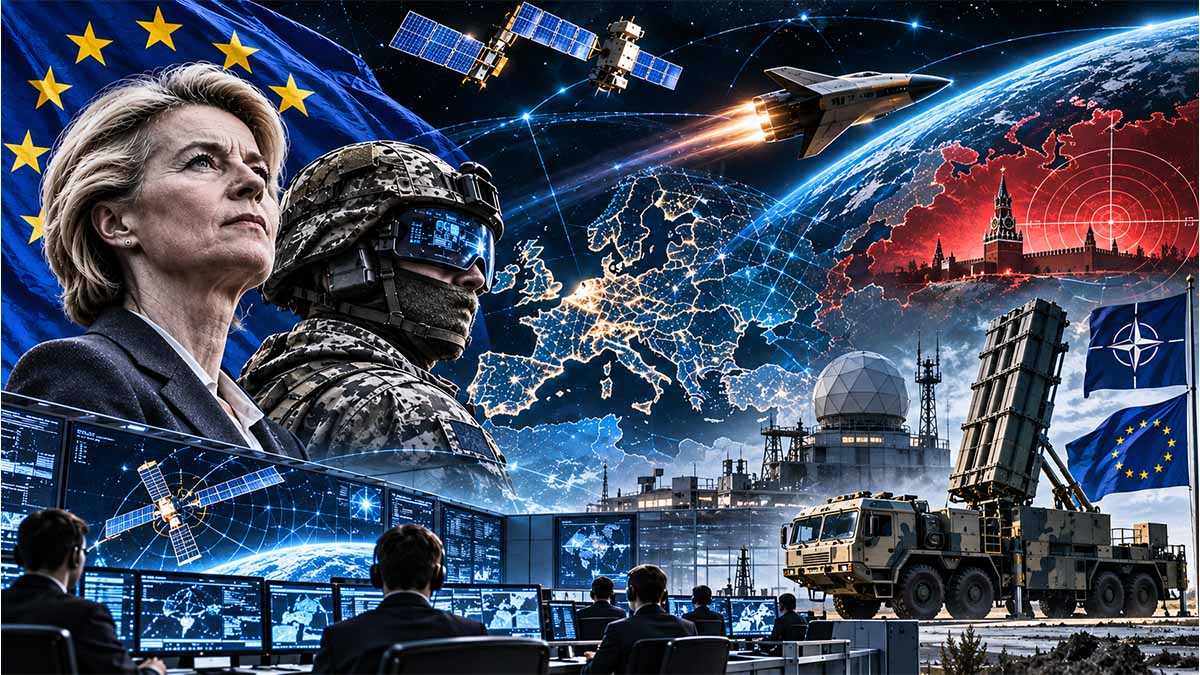
ATMOS Space Cargo, Precision Orbital Deep Strike, European Defence Sovereignty, NATO Escalation Stability and the Future of Space-Based Conventional Weapons
Scope: Assessment of the technological, military, legal, industrial, financial and geopolitical feasibility of European conventional orbit-to-surface strike capabilities, with particular attention to Germany, France, Italy, the United Kingdom, Poland, the European Union and NATO, covering developments through 11 November 2026 and strategic implications for 2027–2031.
Executive Summary — Bottom Line Up Front
Europe’s emerging interest in conventional orbital strike systems represents a potentially significant transformation in deterrence doctrine, but no publicly verified European operational capability currently establishes that transformation as a military reality. The strategic question is whether reusable orbital-return technology can evolve into a credible, politically controlled precision-strike capability that supplements existing European conventional and nuclear deterrence without producing disproportionate financial, operational and escalation risks.
The German company ATMOS Space Cargo provides a relevant industrial case. Its PHOENIX programme demonstrates a documented effort to develop controlled orbital re-entry and reusable space logistics, including a first orbital test mission in April 2025. The company publicly describes PHOENIX 2 as a vehicle designed for autonomous operations and precision recovery, with a declared payload capacity of 100 kilograms. These are spacecraft-development specifications, not evidence of a qualified orbital weapons system. ATMOS Space Cargo — Mission Completion Update — Apr 2025 and ATMOS Space Cargo — Technology — Undated.
The surrounding strategic environment is materially more developed than the proposed weapon itself. The United Kingdom’s 2025 Strategic Defence Review explicitly prioritises conventional deep precision strike and integrated air and missile defence. France’s defence institutions are advancing European long-range strike cooperation through ELSA, while Germany’s November 2025 Space Security Strategy formalises a stronger national military-space architecture.
The 1967 Outer Space Treaty prohibits placing nuclear weapons and other weapons of mass destruction in Earth orbit, but it does not establish an equivalent categorical prohibition on all conventional orbital weapons. That distinction does not constitute unrestricted authorisation: state responsibility, international humanitarian law, the UN Charter and applicable national licensing requirements remain decisive. Outer Space Treaty — United Nations Treaty Series, No. 8843 — 1967.
The principal obstacles to an operational European capability are not merely re-entry engineering. They concern persistent orbital access, credible response timelines, target identification, penetration and survivability, cost per delivered military effect, civilian oversight, command authority and strategic misinterpretation by a nuclear-armed adversary.
Principal judgment: Over the 2027–2031 horizon, orbital strike is more defensibly assessed as an exploratory strategic-industrial option than an emerging deployable pillar of European deterrence. The decisive indicator will be the transition from civilian technology demonstrations to documented government requirements, funded development programmes, independently assessed performance and formally established operational and legal authorities.
Orbital Deterrence Against Russia: Europe’s Space Weapons Ambition Collides with NATO Doctrine, Industrial Economics and Nuclear Risk
Europe is approaching a consequential defence decision: whether technologies developed to return commercial cargo from orbit should become the foundation of a new conventional strike capability against Russia. Germany’s ATMOS Space Cargo illustrates the industrial possibility, but the political contradiction is sharper. NATO explicitly opposes placing weapons in space, while European governments are already financing satellite resilience, conventional deep strike and military-space integration. The distinction carries immediate fiscal and security consequences. The European Union has established a €1.5 billion defence-industry programme for 2025–2027 and a separate €150 billion loan facility, neither dedicated to orbital weapons. Developing an additional strategic system would therefore require new sovereign commitments, industrial qualification and legally accountable command arrangements. The question is no longer whether Europe possesses relevant technology, but whether weaponising it would strengthen deterrence more than it would increase costs, dependencies and nuclear uncertainty.
A German spacecraft is not yet a European strategic weapon
The industrial foundation is identifiable. On 23 April 2025, ATMOS Space Cargo reported completion of its first PHOENIX 1 orbital demonstration, launched aboard SpaceX’s Bandwagon-3 mission. The company reported successful activation of critical systems and deployment of its inflatable thermal-protection technology. Its subsequent PHOENIX 2 architecture is designed around autonomous orbital operations, controlled atmospheric re-entry and reusable cargo recovery. Published specifications identify a 100-kilogram payload capacity, selectable mission durations from three hours to twelve months, electrical interfaces providing 50 watts of average power and 100 watts at peak demand, and a thermally controlled payload environment of 4–40°C. ATMOS Space Cargo — Mission Completion Update — April 2025 and ATMOS Space Cargo — Technology.
These figures establish an industrial development proposition, not a qualified weapons system. The manufacturer’s claimed improvement in landing accuracy over parachute-based recovery cannot establish military targeting performance. A three-hour commercial mission specification cannot be converted into a three-hour strike response. Nor does the ability to protect cargo during atmospheric re-entry prove that a vehicle could achieve a militarily effective result against defended targets. The distinction matters because governments acquire capabilities against military requirements, not against the theoretical range of an aerospace technology.
Europe’s broader industrial interest is nevertheless substantial. The European Innovation Council identifies ATMOS among its EIC Fund-invested companies, while ATMOS WORKS provides a registered corporate presence in Kraków. These developments establish investment and industrial relationships across national boundaries. They do not establish an approved multinational weapons programme, a defence procurement contract or military acceptance of an orbital system. The commercial company’s engineering progress and the sovereign government’s decision to purchase a weapon remain separate events. European Innovation Council — ATMOS Space Cargo and ATMOS WORKS — Corporate Information.
The economic distinction is equally consequential. Reusable spacecraft may eventually distribute manufacturing expenditure across repeated missions, but affordability depends on actual launch costs, refurbishment, insurance, operating expenses and mission frequency. None of the documented ATMOS specifications establishes the lifecycle economics of a conventional orbital weapon. Without such evidence, the proposition that orbit offers a more efficient method of conventional deterrence than existing air-, land- or sea-based systems remains unproven.
Europe’s defence billions are committed to a different industrial problem
The financial record reveals the gap between strategic ambition and institutional commitment. On 8 December 2025, the Council of the European Union adopted the European Defence Industry Programme, establishing €1.5 billion in grants for 2025–2027, including €300 million earmarked for Ukraine’s defence industry. The Security Action for Europe instrument, in force since 29 May 2025, separately provides up to €150 billion in loans to eligible member states for defence investment. In October 2026, the Council adopted the €115 million AGILE initiative, intended to support smaller innovative companies moving towards defence applications from 2027. These instruments are financially distinct: EDIP provides grants, SAFE provides sovereign borrowing capacity, and AGILE addresses defence innovation. Their combined headline amounts cannot be interpreted as money available to an orbital strike consortium. European Defence Industry Programme — Council of the European Union — December 2025, Security Action for Europe — Council of the European Union and EU Defence Funding — Council of the European Union — October 2026.
The distinction between authorised financing and realised military capability is visible in Poland. On 14 May 2025, the Polish Armament Agency contracted with a consortium comprising ICEYE Polska and Wojskowe Zakłady Łączności Nr 1 for the MikroSAR satellite reconnaissance system. The approximately PLN 860 million gross agreement covered three guaranteed radar satellites and an option for three additional units. Polish defence authorities subsequently reported launches in November 2025, March 2026 and May 2026, bringing the reported total to four satellites by May 2026. Unlike speculative orbital weapons concepts, this programme has an identifiable military customer, contractors, contract value and implementation milestones. MikroSAR Contract — Polish Ministry of National Defence — May 2025 and Satellite Earth Observation System — Polish Ministry of National Defence — 2026.
The Polish example exposes the procurement problem facing orbital deterrence. A technology becomes a credible government programme when a defence authority defines a requirement, commits financing and accepts responsibility for delivery. ATMOS WORKS has registered share capital of PLN 50,000 in Kraków, but that legal figure is neither the company’s total financing nor evidence of a Polish military acquisition. Industrial presence can facilitate cooperation; it cannot substitute for funded military demand. The difference separates participation in Europe’s expanding space economy from ownership of an operational strategic capability.
Germany supplies innovation, but sovereignty runs through French, Italian and British systems
Germany’s adoption of its Space Security Strategy on 19 November 2025 formalised the relationship between space infrastructure, national security and civil-military coordination. The policy creates an institutional environment in which commercial aerospace companies may become increasingly relevant to defence, but it does not authorise a specific orbital bombardment programme. German technological competence must still be translated into procurement requirements, security arrangements and accountable national military decisions. German Space Security Strategy — German Federal Government — November 2025.
France approaches the problem through a more established sovereign military-space structure. On 12 November 2025, the French Ministry of the Armed Forces inaugurated the facilities of the Commandement de l’Espace at Air Base 101 in Toulouse and declared its initial operational capability. The command’s personnel objective is approximately 500 positions by 2030. France’s ARES programme addresses military-space observation, protective capabilities and command infrastructure, including the YODA demonstrator, PALADIN and EGIDE. These investments concern France’s capacity to operate and protect assets in space; they do not establish an orbit-to-surface conventional weapons programme. Commandement de l’Espace — French Ministry of the Armed Forces — November 2025.
Italy brings a different form of industrial leverage. COSMO-SkyMed, developed through the Italian Space Agency and Ministry of Defence, integrates radar Earth observation, spacecraft manufacturing, ground systems and data services. Its industrial architecture includes Thales Alenia Space, owned 67% by Thales and 33% by Leonardo, and Telespazio, owned 67% by Leonardo and 33% by Thales. The successful launch of the CSG-FM3 satellite on 3 January 2026 aboard a SpaceX Falcon 9 demonstrates both Italian technological competence and continued dependence on international launch infrastructure. Sovereign industrial production is not equivalent to autonomous control over every mission dependency. COSMO-SkyMed — Italian Space Agency and CSG-FM3 Launch — Italian Space Agency — January 2026.
The United Kingdom’s Strategic Defence Review of 2 June 2025 makes conventional deep precision strike an explicit priority while linking military effectiveness to resilient communications, surveillance, navigation and intelligence. London thus recognises the military requirement for long-range conventional effects without identifying orbital bombardment as the necessary solution. The European industrial dilemma follows directly: Germany’s commercial innovation, France’s military-space command, Italy’s integrated aerospace manufacturing and Britain’s precision-strike priorities are potentially complementary, but they operate under different sovereign authorities and procurement systems. Industrial cooperation can distribute production; it cannot automatically distribute political responsibility for employing a strategic weapon. Strategic Defence Review 2025 — UK Ministry of Defence — June 2025.
International law permits no shortcut from conventional payload to lawful attack
The legal argument often associated with conventional orbital weapons begins with Article IV of the 1967 Outer Space Treaty, which prohibits placing nuclear weapons and other weapons of mass destruction in Earth orbit. The provision does not establish an equivalent categorical prohibition on every conventional weapon. But that distinction is insufficient to validate an operational programme. Article III requires space activities to comply with international law, including the United Nations Charter; Article VI establishes state responsibility for national space activities, including those of private companies; and Articles VII–IX address liability, jurisdictional consequences and the interests of other space users. Outer Space Treaty — United Nations — 1967.
A conventional payload would therefore remain subject to the law governing the threat or use of force. Under the United Nations Charter, the existence of a weapons capability does not itself create authority to employ it. International humanitarian law introduces another distinction: Article 36 of Additional Protocol I requires states bound by the provision to assess the legality of new weapons, while the rules on distinction, proportionality and precautions govern the conduct of attacks. The ability to reach a location precisely cannot demonstrate that striking it would be lawful. A multinational European programme would also have to reconcile national licensing, registration, export controls and sovereign command responsibilities. Charter of the United Nations — United Nations — 1945 and Additional Protocol I — International Committee of the Red Cross — 1977.
Europe’s regulatory architecture adds another institutional boundary. The European Commission’s proposed EU Space Act of 25 June 2025 addresses the safety, resilience and sustainability of defined space activities while recognising exclusions involving military and national-security systems. It is not a general authorisation for orbital weapons. Nor can commercial contracts eliminate the international responsibilities of governments involved in launching, registering, supervising or operating space objects. The legal cost of weaponisation consequently begins before deployment: states must establish the activity they are authorising, the responsibilities they retain and the rules governing any eventual military use. Proposal for an EU Space Act, COM(2025) 335 final — European Commission — June 2025.
NATO is building orbital resilience while rejecting weapons in space
The sharpest contradiction is institutional. NATO’s updated space policy of 5 November 2026 identifies Russia and China as developers of counterspace technologies and recognises the importance of space to Allied communications, intelligence, navigation and defence. Yet the Alliance explicitly states that it has no intention of placing weapons in space. That position does not prevent national governments from researching advanced technologies, but it prevents a private orbital strike proposal from being described as an established NATO capability or approved Alliance doctrine. NATO’s Approach to Space — NATO — November 2026.
NATO’s actual investment direction is visible in the Hybrid Alliance Layered Operations in Space initiative, launched on 7 July 2026 by eight Allies: Canada, Denmark, Finland, Germany, the Netherlands, Norway, Sweden and Türkiye. HALO seeks to connect sovereign military satellites for communications, intelligence and missile tracking. Alliance Persistent Surveillance from Space involves 19 participating Allies, while STARLIFT involves 15 in cooperation concerning responsive launch access. These are institutional mechanisms for strengthening the services underlying military effectiveness, not programmes to deliver conventional weapons from orbit. NATO Multinational Capability Cooperation — NATO — 2026.
The European Union is moving in a comparable direction. On 28 September 2026, the Council identified SPACE among its first five European Defence Projects of Common Interest, covering early warning, satellite communications, intelligence, positioning and rapid replacement launches. On the same date, it strengthened the EU Space Threat Response Architecture, expanding mechanisms for monitoring threats and coordinating responses. Under urgent circumstances, the High Representative may adopt provisional measures subject to Council confirmation, modification or revocation within four weeks. The shift is significant because it creates institutional instruments for handling hostile space activity without establishing an EU weapons-employment authority. European Defence Projects of Common Interest — Council of the European Union — September 2026 and EU Space Threat Response Architecture — Council of the European Union — September 2026.
Russia’s demonstrated counterspace activity explains the emphasis on resilience. Its destructive anti-satellite test against COSMOS 1408 on 15 November 2021 generated more than 1,500 initially trackable debris fragments, creating hazards beyond the targeted spacecraft. Moscow’s revised nuclear doctrine, approved through Presidential Decree No. 991 on 19 November 2024, also identifies circumstances involving conventional aggression that Russia associates with potential nuclear escalation. Neither record establishes how Moscow would respond to a future European orbital weapon. Together, they demonstrate why additional conventional reach cannot automatically be equated with greater crisis stability. Russian Anti-Satellite Test — United States Space Command — November 2021 and Presidential Decree No. 991 — Russian Official Legal Information Portal — November 2024.
By 2028, the cost of indecision will fall on procurement budgets and existing space infrastructure
Over the next 12–24 months, the consequential decisions will concern whether European governments convert orbital-return research into formally specified defence programmes or continue concentrating expenditure on capabilities with established institutional requirements. Neither a European orbital weapons acquisition budget nor an operational deployment timetable is established in the dossier. A credible transition would require funded procurement, independent military qualification, a legally accountable command structure and evidence that the resulting capability could achieve effects unavailable more efficiently through existing systems. Without those conditions, public expenditure risks financing industrial expectations rather than an accepted military requirement.
The cost of inaction is therefore not simply the possibility of losing a future orbital weapons race. It is the opportunity cost of leaving existing military-space dependencies unresolved while redirecting attention towards an unqualified strategic system. National treasuries would absorb development and acquisition exposure; defence ministries would bear the consequences of delayed capability decisions; aerospace suppliers would face uncertain demand and fragmented requirements; and operators dependent on satellite communications, reconnaissance and warning would remain exposed to disruption. These costs are not hypothetical categories of expenditure: they arise from the procurement, resilience and governance requirements already identified by NATO, the EU and national defence authorities.
The distinction between action and inaction must consequently be defined against the actual European programme record. HALO, APSS, STARLIFT, the EU SPACE project and national satellite acquisitions already establish a direction for strengthening military-space infrastructure. Commercial orbital-return systems may contribute additional technological capabilities, but their conversion into weapons would require a separate political and financial decision. Until that decision is supported by operational evidence, European orbital deterrence remains an industrial proposition rather than an established conventional military capability.
The decisive European choice is not between placing weapons in orbit and accepting strategic vulnerability. It is between financing capabilities against verified military requirements and allowing technological ambition to determine procurement before its operational value, legal authority and escalation costs have been established.
Navigational Index
PILLAR – 01 – Orbital Strike Technology and Military Deterrence
Physical feasibility, industrial maturity and operational credibility
- Chapter 1 — From Orbital Logistics to Conventional Weapons: The ATMOS Industrial and Technological Baseline
- Chapter 2 — Orbital Mechanics, Targeting, Re-entry and the Limits of Global Precision Strike
- Chapter 3 — Deterrence by Punishment, Russian Strategic Calculations and NATO Escalation Dynamics
PILLAR – 02 – European Strategic Sovereignty, Law and Defence Industry
Institutional authority, national interests and procurement economics
- Chapter 4 — The Outer Space Treaty, International Humanitarian Law and the Regulation of Orbital Weapons
- Chapter 5 — Germany, France, Italy and the United Kingdom: National Capabilities, Industrial Interests and Sovereignty Constraints
- Chapter 6 — Poland, the Eastern Flank and European Industrial Integration
- Chapter 7 — Financing, Procurement, Supply Chains and European Collaborative Programmes
PILLAR – 03 – Strategic Stability, Future Scenarios and Government Decisions
Escalation pathways, strategic competition and investment choices
- Chapter 8 — Russian Countermeasures, Counterspace Competition and Crisis Instability
- Chapter 9 — European Orbital Deterrence Scenarios, 2027–2031
- Chapter 10 — Strategic Options, Decision Thresholds and Final Net Assessment
Master Abstract
The boundary between space infrastructure and strategic weapons is becoming a European defence question
The prospect of European conventional weapons deployed in orbit should be understood within a larger transformation of military-space activity. Space is no longer exclusively an enabling environment for terrestrial operations, nor can its military importance be assessed solely through satellite communications, navigation, reconnaissance and early warning. The growing integration of commercial spacecraft, military command systems, autonomous technologies and precision-strike networks creates possibilities for military functions that previously belonged to separate industrial and operational categories. The strategic significance lies in this convergence: technologies developed to transport, protect and recover payloads from orbit might eventually acquire roles in the delivery of military effects against terrestrial targets.
The transition is neither automatic nor established by the successful development of a reusable capsule. A re-entry vehicle capable of transporting scientific or industrial cargo does not necessarily satisfy requirements for weapons reliability, target accuracy, operational availability, survivability or military certification. These requirements belong to different performance and governance regimes. A commercial system may validate materials, control systems and mission operations without demonstrating the capacity to deliver a conventionally armed payload against a defended military target. The distinction is critical because a deterrent derives its credibility not from theoretical geographic reach but from the adversary’s assessment that the capability can be employed, survive relevant countermeasures and achieve politically meaningful effects under actual conflict conditions.
The European industrial baseline: credible spacecraft development, unproven weapons performance
ATMOS Space Cargo illustrates both the opportunity and the evidentiary limitations of this technological convergence. The company reported that its PHOENIX 1 prototype was launched during SpaceX’s Bandwagon-3 mission and that its April 2025 test achieved primary objectives, including the activation of critical systems and deployment of an inflatable thermal-protection system. The company’s own reporting supports a technology-demonstration milestone; it does not establish an operational military delivery system.
The PHOENIX 2 architecture is more ambitious. ATMOS describes an autonomous orbital transfer and return vehicle with controlled re-entry, integrated propulsion and guidance, a non-ablative inflatable atmospheric decelerator and precision landing capabilities. Its public specification identifies a 100-kilogram payload capacity and selectable orbital mission durations from three hours to twelve months. Those specifications are commercially relevant to orbital logistics and potentially relevant to broader defence applications, but they cannot be translated into strike range, military payload capacity, accuracy against hostile targets or weapons readiness without additional evidence. ATMOS Space Cargo — Technology — Undated.
The institutional-financial significance is also evident. The European Innovation Council identifies ATMOS as an EIC Fund-invested German space company serving microgravity research, manufacturing and defence customers. Separately, ATMOS WORKS publicly describes its mission in terms of European-controlled dual-use orbital logistics, in-orbit demonstration and the secure return of sensitive hardware and data. These records establish an industrial orientation towards security-sensitive markets. They do not establish a sovereign defence acquisition contract, qualified weapons programme or approved orbital deployment architecture. ATMOS Space Cargo — European Innovation Council — Undated and ATMOS WORKS — Company Capability Statement — Undated.
Deterrence credibility depends on response capacity rather than maximum theoretical range
The military proposition is straightforward at the strategic level: an ability to threaten military targets over very large geographic distances could expand the conventional options available to European governments during a major crisis. Yet orbital accessibility is not equivalent to continuous target accessibility, and the possibility of striking a location is not equivalent to a guaranteed short-notice response. A credible orbital deterrent would require an architecture capable of maintaining the necessary orbital presence, receiving lawful engagement decisions, sustaining communications, identifying and validating targets, and demonstrating adequate reliability under contested conditions.
This distinction is especially important when assessing time-sensitive deterrence. A weapon’s nominal ability to reach distant targets could be strategically irrelevant if the system cannot produce the required effect within the operational window. Conversely, an expensive orbital architecture might duplicate effects that other long-range systems can deliver at lower cost or with greater political and military flexibility. Any European assessment must therefore compare orbital strike not with an abstract absence of deterrence, but with existing and developing air-, land- and sea-based precision-strike options, as well as the space-based surveillance and warning capabilities supporting them.
The United Kingdom’s Strategic Defence Review makes this broader distinction explicit by prioritising conventional deep precision strike, integrated air and missile defence, and resilient space systems capable of supporting the military functions of understanding and striking. The French defence ministry similarly records progress within the European Long-Range Strike Approach, including a collaborative workstream on lower-cost deep-strike capabilities. Neither record establishes an official European decision to procure orbital bombardment weapons. Strategic Defence Review 2025 — UK Ministry of Defence — Jun 2025 and Compétition militaire et ruptures technologiques — French Ministry of the Armed Forces — 2026.
The central contradiction: greater conventional reach may produce greater nuclear uncertainty
Conventional orbital strike raises a problem that cannot be resolved solely through technology or treaty interpretation. A capability intended to deter aggression by threatening a rapid, precise, non-nuclear response may simultaneously create uncertainty about its payload, trajectory, target and ultimate strategic purpose. A nuclear-armed adversary observing unusual orbital manoeuvres or an incoming re-entry vehicle may have limited time and incomplete information with which to determine whether the event represents a conventional attack, a threat to strategic command infrastructure or an escalation involving another category of weapon.
Deterrence credibility and crisis stability therefore need not improve together. The capacity to impose costs on an adversary could strengthen deterrence under certain conditions, while ambiguity concerning payload identity, strategic targets and command authority could create incentives for rapid escalation under others. This tension is particularly relevant to Russia because its military strategy and force structure integrate conventional strike, nuclear deterrence, air and missile defence, counterspace capabilities and threats to critical infrastructure.
The legal distinction between conventional and nuclear payloads remains important, but it does not eliminate the military risks of ambiguity. Article IV of the Outer Space Treaty prohibits the orbital stationing of weapons of mass destruction, whereas Articles III, VI and VII introduce broader considerations involving international law, national responsibility, authorisation and liability. A European programme would therefore need a legally coherent architecture governing not only space activity and launch operations but also targeting, weapons employment, state supervision and responsibility for potential harm. Outer Space Treaty — US Department of Defense Treaty Text — 1967.
Europe is developing military-space institutions, but not a unified orbital weapons policy
Germany, France, Italy and the United Kingdom have established or expanded national military-space structures, although their respective priorities and institutional arrangements differ. Germany’s November 2025 Space Security Strategy strengthens national and European freedom of action in space. France’s military-space strategy and Space Command emphasise national sovereignty, space operations and the protection of strategic capabilities. Italy’s defence planning identifies satellite systems, space situational awareness, military communications and coordinated space-capability development as significant requirements. The United Kingdom explicitly links space services and operational resilience to deep precision strike and integrated defence.
These are related developments, but they should not be treated as evidence of agreement on placing conventional weapons in orbit. The European Union’s official space-security strategy principally addresses threat awareness, resilience, protection, dual-use services, industrial autonomy and responsible international behaviour. Its institutional responsibilities and the national prerogatives of member states create a governance structure in which military-space integration can advance without transferring sovereign decisions on the use of force to a common European authority. Bundesregierung+3
Poland occupies a distinct position in this landscape. Its geographic exposure, defence-industrial requirements and national emphasis on improving military capabilities give it a clear interest in future European long-range strike architectures. The country’s 2025 National Security Strategy explicitly identifies Russian aggression as a threat to European and Euro-Atlantic security and places importance on national defence-industrial capacity, advanced technologies and protection against threats in space. This provides an institutional rationale for participation in relevant European research and industrial programmes, but not evidence that Warsaw has committed to an orbital strike procurement programme. National Security Strategy of the Republic of Poland — Chancellery of the Prime Minister — Jul 2025.
Strategic outlook to 2031
The central issue for European governments is whether the potential military advantage of an orbital strike architecture justifies the costs and systemic risks of moving beyond space-based support functions into direct orbital weapons deployment. The answer depends on technical evidence that is not currently available in the verified public record: demonstrated weapons-relevant performance, independently evaluated target engagement, realistic lifecycle economics, operational command arrangements, government sponsorship and clear legal authority.
Three developments could materially change the assessment: the publication of a funded national or multinational acquisition requirement; a credible, instrumented demonstration establishing relevant military performance; and an explicit European or allied decision defining how such systems would contribute to conventional deterrence while managing nuclear escalation risks.
Until those conditions are met, the strongest defensible conclusion is that European orbital strike belongs to the intersection of strategic technology exploration, defence-industrial competition and emerging military-space doctrine rather than the inventory of operational European deterrent capabilities.
Key Evidence Table — Verified Industrial, Strategic and Legal Baseline
The following table separates demonstrated events, declared engineering specifications, national policy decisions and binding legal provisions. No entry should be interpreted as evidence that a European orbital weapons system has reached operational service.
| Indicator | Value / status | Reference date | Definition / scope | Issuer | Exact source |
|---|---|---|---|---|---|
| PHOENIX 1 orbital demonstration | First test flight completed; primary objectives reported as achieved | 23 Apr 2025 | Company-reported spacecraft technology demonstration, not military qualification | ATMOS Space Cargo | Mission Completion Update |
| PHOENIX 2 declared payload capacity | 100 kg | Public specification consulted Nov 2026 | Payload specification for planned orbital-return cargo service | ATMOS Space Cargo | Technology |
| PHOENIX 2 declared mission duration | 3 hours–12 months | Public specification consulted Nov 2026 | Selectable cargo mission duration; not a guaranteed strike response time | ATMOS Space Cargo | Technology |
| PHOENIX 2 landing accuracy | Up to 10× higher than parachute-based systems, according to manufacturer | Public specification consulted Nov 2026 | Manufacturer comparison without a disclosed independent military-test baseline | ATMOS Space Cargo | Technology |
| European institutional investment relationship | Listed among EIC Fund-invested companies | Record consulted Nov 2026 | Investment relationship; not evidence of orbital weapons funding | European Innovation Council | Atmos Space Cargo |
| United Kingdom conventional deep strike | Explicit defence priority | Jun 2025 | National policy recommendation covering long-range precision strike and integrated air and missile defence | UK Ministry of Defence | Strategic Defence Review 2025 |
| German Space Security Strategy | Adopted by federal cabinet | 19 Nov 2025 | National civil-military space security framework | German Federal Government | Weltraumsicherheitsstrategie |
| EU space-security framework | Joint Communication JOIN(2023) 9 final | 10 Mar 2023 | EU space protection, resilience, security, dual-use services and cooperation | European Commission / High Representative | EU Space Strategy for Security and Defence |
| Poland’s national security framework | Government-adopted strategy addressing space threats and defence-industrial capacity | 25 Jul 2025 | National strategic policy, not a specific orbital weapons commitment | Polish Council of Ministers | National Security Strategy |
| Treaty prohibition on orbital WMD | Binding Article IV prohibition | 10 Oct 1967, entry into force | Nuclear weapons and other weapons of mass destruction; not a categorical prohibition on every conventional weapon | States Parties / United Nations | Outer Space Treaty, No. 8843 |
| European operational orbital strike capability | Not established in the verified public record | 11 Nov 2026 | No verified fielded architecture, weapons qualification, operational deployment or publicly documented military acquisition baseline | Analytical assessment | ATMOS technical disclosures and identified national/EU defence records |
The distinction between reported technical performance and independently established military capability is particularly consequential. PHOENIX 2’s commercial payload capacity, anticipated flight duration and landing-accuracy claims cannot be combined into a numerical estimate of potential weapons effectiveness. Such a calculation would require data on military payload configuration, guidance performance, atmospheric re-entry characteristics, operational constraints and the target environment that are not established by the cited specifications.
Similarly, national military-space investments cannot be aggregated into a hypothetical European orbital weapons budget. Expenditure on satellite communications, reconnaissance, space control and space situational awareness supports defence activity, but it is not automatically interchangeable with funding for a weaponised orbital platform.
Competing Strategic Pathways
Three overlapping development pathways are sufficiently distinct to support a structured comparison. They describe possible industrial and policy trajectories rather than mutually exclusive outcomes, and none can be assigned a defensible numerical probability from the currently verified evidence.
| Strategic pathway | Diagnostic support | Evidence limiting the proposition | Indicators | Current standing |
|---|---|---|---|---|
| A. Operational orbital strike programme | Relevant re-entry technologies, military-space policy expansion and European interest in deep precision strike | No verified weapons qualification, government procurement contract, operational concept or demonstrated military effectiveness | Funded acquisition requirement; military testing; operational command framework | Conceptually possible, operationally unestablished |
| B. Dual-use orbital logistics and defence-support capability | Existing ATMOS orbital-return development, security-oriented commercial positioning and European government interest in resilient space infrastructure | Industrial applications do not themselves establish commercial scale, programme profitability or military adoption | Follow-on missions; government service contracts; repeated successful recovery and defence-related logistics demonstrations | Directly supported as an industrial development pathway |
| C. Conventional deterrence strengthened primarily through non-orbital deep strike | Explicit British policy, French-led European long-range strike cooperation and wider European defence-readiness priorities | Future cost, industrial output, procurement schedules and integration remain subject to programme-specific verification | Contract awards; production expansion; delivered systems; alliance interoperability | More clearly reflected in current official defence planning |
Pathway A — Orbital strike becomes an authorised military programme
This pathway would involve a European government or multinational coalition adopting orbital strike as a formal military requirement. The political authorities concerned would need to define its strategic purpose, acceptable targets, command-and-control arrangements, treaty compliance and relationship with existing nuclear and conventional forces.
Its distinguishing feature would not be the appearance of a more advanced commercial spacecraft. It would be an identifiable procurement and operational decision supported by funded milestones, relevant test evidence and an agreed military doctrine. The programme’s eventual deterrent value would remain contingent on demonstrable effectiveness and adversary perceptions, rather than on its declared geographic reach alone.
The principal countervailing consideration is that orbit could introduce substantial fixed costs, strategic ambiguity and exposure to counterspace threats into a mission already served by terrestrial and airborne long-range strike systems.
Pathway B — Military-space logistics advances without orbital weapons deployment
This pathway would preserve a direct connection between reusable spacecraft development and national security without requiring an immediate decision to weaponise orbit.
Government and defence customers could use controlled orbital-return systems for technology validation, secure payload recovery and specialised logistics missions, subject to demonstrated performance and regulatory approvals. Such applications would build an industrial knowledge base in mission control, re-entry technology, spacecraft servicing and the operational management of sensitive payloads.
This trajectory is compatible with Europe’s existing policies on dual-use technological sovereignty and more resilient space infrastructure. It also offers a potential route to institutional cooperation without requiring agreement among European governments on the legitimacy or necessity of space-based conventional bombardment.
Pathway C — Europe prioritises established deep-strike architectures
Under this pathway, European defence ministries would continue to emphasise conventional precision-strike systems launched from established military domains while using space principally for surveillance, navigation, communications, warning and targeting support.
This distinction matters economically. A ground-, sea- or air-launched system might provide a lower-cost or more flexible means of achieving a particular deterrence objective, although that conclusion requires system-specific lifecycle and operational comparisons. Orbital alternatives would have to demonstrate additional military value sufficient to justify their distinct launch, deployment, space-control and operational costs.
The United Kingdom’s strategic review and France’s European long-range strike cooperation provide a documentary basis for this pathway. They do not exclude later orbital developments, but they establish that European conventional deterrence is already advancing through programmes independent of orbital weapons deployment.
Principal Intelligence Gaps and Watch Indicators
The public evidence identifies consequential missing records that would materially affect the strategic assessment. They should be treated as decision thresholds rather than as incidental information gaps.
| Intelligence gap | Required official or first-party evidence | Decision significance |
|---|---|---|
| Orbital weapons programme status | Formal government requirement, programme designation, acquisition decision or attributable industrial disclosure | Determines whether the concept has advanced beyond exploratory activity |
| Military relevance of re-entry technology | Instrumented demonstration reports and competent technical assessment | Separates spacecraft technology maturity from weapons applicability |
| Development and lifecycle economics | Funded programme baseline, acquisition cost estimates and sustainment assumptions | Enables comparison with existing long-range strike systems |
| European industrial partnership | Signed development agreement identifying scope, financing and work allocation | Establishes whether an actual multinational programme exists |
| Legal and regulatory authority | Competent national licensing decisions and documented state legal positions | Determines the regulatory basis for development, testing and potential deployment |
| NATO command and escalation integration | Authoritative doctrine, command assignment or formally endorsed operational concept | Determines whether the capability could contribute coherently to collective deterrence |
| Polish industrial role | Corporate registration, public investment disclosures and defence-sector contracts | Distinguishes commercial presence from funded military-industrial participation |
| Russian strategic response | Official doctrine, military posture changes or attributable government positions | Helps assess adversary interpretation and possible countermeasures |
Strategic signposts for 2027–2031
Four developments would be especially important to monitor.
Industrial transition: Repeated, independently assessed orbital-return demonstrations would strengthen confidence in the underlying space technology. They would not, without dedicated military evidence, establish strike capability.
Government sponsorship: A published acquisition requirement, budget line or programme contract would mark a materially different stage of institutional commitment. A memorandum of understanding or exploratory industrial discussion would not carry the same evidentiary weight.
European doctrinal alignment: A formal position distinguishing orbital conventional strike from space-based support capabilities would clarify command authority, legal interpretation and escalation-management responsibilities. Divergence between national positions would remain a material obstacle to multinational implementation.
Strategic response: Russian changes in space-control posture, missile warning policy or official military doctrine explicitly connected to foreign orbital strike developments would provide more meaningful evidence of deterrence effects and escalation risks than commentary about the theoretical performance of a future weapon.
Government Decision Implications
The immediate policy question is not whether to deploy an orbital strike capability whose operational performance remains unestablished. It is whether governments should invest in clarifying the military value, legal permissibility, technological maturity and opportunity cost of such a capability before allocating major defence resources.
A limited technology-assessment programme could be authorised through national defence research structures, subject to applicable space and export-control law. Its expected benefit would be improved knowledge of reusable orbital systems and their defence relevance. Its financial exposure could be bounded through explicit research milestones, and its reversibility would be substantially greater than that of a full acquisition commitment. The principal risk would be allowing a dual-use research programme to evolve into an implied weapons requirement without a separate strategic and legal decision.
A multinational industrial feasibility programme would impose greater coordination burdens, particularly concerning export controls, intellectual property, security classifications, procurement eligibility and operational sovereignty. It could improve European supply-chain integration while introducing the possibility of competing national priorities and delayed implementation.
A fully funded military development programme would carry the greatest resource commitment and the most consequential diplomatic and strategic implications. Its justification would require evidence of an operational advantage that cannot be obtained more effectively through conventional long-range strike systems and supporting military-space infrastructure. Its reversibility would diminish as financial, industrial and international commitments accumulated.
Across these options, the central requirement is to keep technological feasibility, procurement approval, military necessity and strategic legitimacy as separate decision tests. None should be inferred from the others.
No decision-useful visualisation is supportable from the verified record.
Preliminary Strategic Assessment
The emergence of commercial orbital-return technology creates a new category of European defence-industrial questions. It does not yet create a new operational deterrent.
Europe’s defence institutions are strengthening military-space capabilities, pursuing more autonomous industrial supply chains and expanding conventional deep-strike cooperation. Those developments provide an institutional environment in which orbital strike concepts may receive increasing attention. They do not establish that orbit is the most militarily effective, economically sustainable or strategically stable location from which Europe should deliver conventional weapons.
The distinction has direct consequences for governments and defence industries. Reusable spacecraft can become valuable strategic infrastructure without becoming weapons. A conventional weapon may be legally distinguishable from a weapon of mass destruction without being strategically unproblematic. A system capable of global physical reach may still lack the availability, precision, survivability and political credibility required for deterrence.
For Europe, the decisive challenge through 2031 is therefore not to equate technological ambition with military readiness, but to determine which combination of space infrastructure, conventional precision strike, industrial cooperation and sovereign command authority offers defensible military effects under credible crisis conditions.
The principal uncertainty is whether future orbital systems can demonstrate a military advantage sufficiently substantial to outweigh their acquisition costs, operational constraints and potential contribution to nuclear escalation instability.
ORBITAL DETERRENCE
Can reusable orbital-return technology evolve into a credible European conventional deterrent? An interactive assessment of industrial maturity, strategic pathways, military constraints and escalation stability.
Orbital Technology and Deterrence
Orbital-return technology
Documented developmentRe-entry, thermal protection, guidance and orbital operations are relevant technology areas. Civilian demonstrations are not evidence of operational weapons performance.
Three Development Pathways
Operational orbital strike
Requires an authorised military requirement, dedicated qualification, funded procurement and credible escalation controls.
From Technology to Military Capability
Evidence category, not a numerical maturity score.
Specifications do not establish completed flight qualification.
No verified European fielded system in the assessed public record.
Strategic Intelligence Matrix
Public record through 11 November 2026
| Indicator | Verified value / status | Evidence classification | Source |
|---|---|---|---|
| PHOENIX 1 | April 2025 orbital test | Company-reported demonstration | ATMOS Space Cargo |
| PHOENIX 2 | 100 kg declared payload | Manufacturer specification | ATMOS Space Cargo |
| UK Strategic Defence Review | 2025 | National policy | UK Ministry of Defence |
| Outer Space Treaty | Article IV | Binding international treaty | United Nations |
Development and Decision Horizon
Technology demonstration
PHOENIX 1 orbital test; UK Strategic Defence Review and European deep-strike policy developments.
Industrial and policy assessment
Separate commercial development, military requirements, procurement commitments and legal authorities.
Conditional strategic horizon
Watch for funded programmes, validated military performance and sovereign command decisions. Not a deployment forecast.
National and Institutional Lenses
European Union: space security, resilience, dual-use capability and industrial autonomy. These national priorities do not establish a common European orbital weapons programme.
Critical Watch Indicators
| Indicator | Required observation | Strategic consequence |
|---|
PILLAR 01 — ORBITAL STRIKE TECHNOLOGY AND MILITARY DETERRENCE
Chapter 1 — From Orbital Logistics to Conventional Weapons: The ATMOS Industrial and Technological Baseline
The strategic-industrial threshold: converting spacecraft recovery into military capability
The decisive technological question is not whether Europe can return a spacecraft from orbit, but whether the technologies supporting orbital return can be transformed into an independently qualified military system whose operational effectiveness justifies its economic, political and strategic consequences. This distinction determines the interpretation of the German commercial space industry’s emerging relevance to European defence. The development of reusable orbital transfer and return vehicles demonstrates increasing competence in spacecraft autonomy, atmospheric re-entry, payload protection and mission management. None of those achievements, individually or collectively, establishes the capacity to conduct operationally credible conventional strikes against defended terrestrial targets. The transition between these two categories involves a change in system requirements, certification standards, government authority and acceptable operational risk that is significantly more substantial than a change in the nature of the payload.
The industrial relevance of ATMOS Space Cargo derives from its effort to establish a European capability for transporting payloads into low Earth orbit and returning them through controlled atmospheric re-entry. The enterprise is operating within a sector in which European strategic autonomy has a specific technological meaning: the ability to exercise control over the movement, handling and recovery of sensitive orbital payloads without depending entirely on external service providers. The military relevance of that capacity extends beyond weapons-related speculation. A government possessing assured access to orbital-return services could obtain additional options for the recovery of experimental hardware, specialised materials and sensitive technological components. Yet such an industrial service does not itself provide independent launch access, assured military availability or sovereign operational control. Those functions depend on contracts, infrastructure, regulatory arrangements and the distribution of responsibilities across the complete space mission. Technology — ATMOS Space Cargo — 2026.
This distinction is directly connected to a broader institutional shift in NATO’s relationship with commercial space companies. The Alliance’s Commercial Space Strategy, endorsed by Allied defence ministers on 13 February 2025, recognises that commercial space services can contribute to defence requirements and that closer industrial cooperation offers opportunities to improve access, resilience and operational effectiveness. The significance of the policy is not that NATO has authorised commercial companies to develop orbital weapons. It is that the Alliance increasingly treats privately developed space infrastructure as a potential component of collective military capability, subject to security, resilience, interoperability and contractual requirements. Commercial participation therefore becomes relevant to defence planning before any particular spacecraft acquires a direct weapons function. NATO Commercial Space Strategy — NATO — February 2025.
PHOENIX 1: demonstrated mission activity and the limits of technical validation
ATMOS reported the completion of its first PHOENIX 1 orbital test mission on 23 April 2025. The prototype was launched aboard the SpaceX Bandwagon-3 rideshare mission, providing an opportunity to evaluate elements of an orbital-return vehicle under actual flight conditions. According to the company’s mission statement, the test achieved primary objectives that included activation of key spacecraft systems and deployment of its inflatable thermal-protection technology. These results are meaningful because they move a technical development programme beyond laboratory activity and ground-based experimentation into the physical environment for which the spacecraft was conceived. They also establish a dated, attributable industrial milestone that can be separated from future development intentions. Mission Completion Update — ATMOS Space Cargo — April 2025.
The mission’s significance must nevertheless be evaluated according to the precise scope of the published claims. Testing the deployment of thermal-protection equipment under relevant flight conditions does not establish complete vehicle reusability, commercially routine recovery, certified landing precision or sustained operational reliability. Nor does the activation of spacecraft subsystems demonstrate that the complete engineering architecture has been validated across repeated missions. Military relevance requires an additional level of scrutiny, since the reliability requirements for a sensitive government payload may differ from those applicable to experimental scientific cargo, while the requirements for a weapon would introduce distinct operational and legal considerations. The available manufacturer reporting establishes a successful reported technology demonstration within the company’s development programme. It does not establish military qualification or a demonstrated orbit-to-surface conventional strike.
The evidentiary distinction between deployment of a spacecraft component, achievement of a mission objective and validation of a complete operational system is fundamental to evaluating emerging aerospace technologies. Technology demonstrations can establish that selected components behave as intended under particular conditions while leaving other critical performance requirements unresolved. An experimental result may justify further investment, more demanding tests or the development of a subsequent prototype without establishing that the manufacturer can immediately deliver a mature commercial service. In defence procurement, this distinction becomes especially important because the perceived strategic value of a system can advance faster than the demonstrable maturity of its underlying technology. The correct analytical treatment is therefore to recognise PHOENIX 1 as evidence of industrial progress while excluding unsupported conclusions about weapons accuracy, payload effectiveness, operational availability or military readiness.
PHOENIX 2: the commercial architecture and its industrial significance
PHOENIX 2 represents a more integrated commercial proposition. ATMOS describes the system as a reusable orbital transfer and return vehicle intended for autonomous cargo operations in low Earth orbit. Its stated architecture combines an orbiting platform with a controlled return capability, allowing the same system to support in-orbit activities and subsequent payload recovery. The manufacturer identifies integrated propulsion and guidance, an inflatable atmospheric decelerator, controlled re-entry and precision landing as principal design characteristics. This architecture is important because it links different aerospace functions within a single commercial service model rather than relying exclusively on the recovery of experimental objects through uncontrolled atmospheric descent. Technology — ATMOS Space Cargo — 2026.
The published technical specifications indicate a total payload capacity of 100 kilograms, selectable mission durations ranging from three hours to twelve months, and payload power interfaces providing 50 watts of mean electrical power and 100 watts at peak demand. ATMOS also describes a pressurised main compartment operating at approximately one atmosphere, a controlled thermal range of 4–40°C, and a microgravity environment below 10⁻⁵ g. These figures characterise a specialised cargo platform intended to support scientific, technological or commercial payloads with defined environmental and electrical requirements. They do not describe a weapons payload, strike mission profile or guaranteed military response time. Most importantly, the twelve-month mission-duration specification should not be confused with sustained combat readiness, and the three-hour minimum mission-duration specification does not establish that a designated terrestrial target could be engaged within that period. PHOENIX 2 Technical Specifications — ATMOS Space Cargo — 2026.
The manufacturer’s comparison claiming up to ten times greater landing accuracy than parachute-based re-entry systems must likewise be interpreted within its stated commercial context. Without a published and independently assessed comparative test baseline, this figure cannot be translated into an absolute ground-impact error, let alone military targeting precision. Recovery accuracy describes how effectively a spacecraft reaches its intended landing location under the operating conditions for which it was designed. Military terminal accuracy would have to be established through a different qualification regime. The performance of a commercial return vehicle therefore cannot be treated as an indirect proof of weapons accuracy simply because both applications involve controlled movement towards a location on Earth.
Industrial capability assessment
| Technological component | Documented industrial relevance | Additional validation needed | Defence significance |
|---|---|---|---|
| Autonomous orbital operations | PHOENIX 2 is designed for autonomous low-Earth-orbit cargo missions | Repeated mission performance and operational reliability | Potential contribution to sovereign space logistics |
| Orbital propulsion and guidance | Manufacturer describes integrated propulsion and re-entry guidance | Flight validation and independently assessed performance | Relevant to spacecraft control, not proof of strike capability |
| Inflatable thermal protection | PHOENIX 1 tested deployment under actual flight conditions | Complete protection performance across applicable mission conditions | Relevant to protected payload recovery |
| Payload containment | Declared pressurised and thermally controlled compartment | Environmental certification and payload compatibility | Support for specialised civil or government cargo |
| Payload power and interfaces | Published power and communications specifications | Interoperability, cybersecurity and long-duration reliability | Integration of specialised instruments |
| Reusability | Central objective of the PHOENIX commercial architecture | Demonstrated refurbishment and repeated flight cycles | Potential lifecycle cost and service availability benefits |
| Precision recovery | Manufacturer claims improved landing accuracy | Independent test evidence and defined comparison conditions | Controlled recovery, not demonstrated military targeting |
| Conventional orbital weapon | No operational system established by the cited manufacturer specifications | Dedicated government requirement, qualification and procurement | Hypothetical military application |
Evidence: ATMOS Space Cargo — Technology — 2026 and ATMOS Space Cargo — Mission Completion Update — April 2025. The qualifications in the final two columns are analytical requirements, not manufacturer performance claims.
The economic meaning of reusability
The industrial economics of orbital-return services require separate consideration from the engineering feasibility of individual missions. Reusability has the potential to distribute spacecraft manufacturing costs over multiple flights, but this economic advantage depends on actual refurbishment requirements, inspection procedures, component replacement, mission frequency and the costs associated with each launch and recovery operation. A spacecraft designed to be reusable is not automatically a spacecraft that can be operated economically on a recurring basis. The relevant unit of comparison is the complete cost of delivering and recovering a payload, including launch services, mission integration, ground operations, insurance, refurbishment and any regulatory or security-specific expenditure.
A military application would introduce another financial distinction. Governments do not assess a defence capability solely through the average cost of a successful civilian mission. They must consider assured availability during crisis conditions, security and infrastructure resilience, sustainment, operational control and the opportunity cost of alternative capabilities. A commercially efficient orbital-return system may provide defence logistics services without making orbital weapons economically attractive. Conversely, certain defence services may justify a premium because sovereign control and availability carry value beyond ordinary commercial profitability. The available ATMOS disclosures do not provide an independently verified lifecycle cost structure sufficient to determine whether its architecture would produce a favourable cost-per-effect comparison against existing conventional long-range strike capabilities.
The broader European significance is therefore industrial before it is operational. Development of reusable orbital-return technology could improve the European competence base in systems engineering, thermal protection, mission integration and payload recovery. It could also support specialised supply chains and provide public authorities with additional choices for contracting space services. These benefits can be assessed without assuming that the technology will become an orbital weapon, and without treating speculative military applications as a prerequisite for commercial viability.
Commercial space integration and sovereign military responsibility
The February 2025 NATO Commercial Space Strategy provides the institutional context for evaluating this industrial transformation. A commercial provider may supply a service that becomes important to a military organisation, but the resulting arrangement raises questions about continuity, protection, data governance, supply-chain dependence and the division of responsibilities between state authorities and private companies. The strategic challenge is not simply obtaining access to commercial innovation. It is ensuring that services required for defence remain dependable when commercial infrastructure is exposed to military pressure, cyber interference, contractual disruption or restrictions arising from national laws. NATO Commercial Space Strategy — NATO — February 2025.
Germany’s federal government adopted its Space Security Strategy on 19 November 2025, explicitly addressing the increasingly inseparable civilian and military dimensions of national space activity. The government’s published explanation calls for coordinated action across state institutions and the ability to act in space during peacetime, crises and national defence emergencies. This is strategically relevant to German commercial space companies because it places their activities within a national policy environment that recognises space infrastructure as a security concern. However, it would be analytically incorrect to interpret the strategy as authorisation of any particular orbit-to-surface weapons programme. National space-security policy and individual weapons procurement are different institutional acts with different legal and budgetary consequences. Weltraumsicherheitsstrategie: Strategie gegen Bedrohungen im Weltraum — German Federal Government — November 2025.
The industrial transition also introduces responsibility questions that will be examined more fully under Pillar 02. Commercial ownership does not eliminate state obligations under international space law. The United Nations’ interpretation of the Outer Space Treaty emphasises that states bear responsibility for national space activities undertaken by governmental and non-governmental entities. Consequently, future military applications of commercial spacecraft would require attention to national authorisation and supervision independently of whether the underlying platform had previously been developed for legitimate civilian purposes. Treaty on Principles Governing the Activities of States in the Exploration and Use of Outer Space — United Nations Audiovisual Library of International Law — 1967.
Chapter 1 — Key judgments
The technological baseline supports a clear separation between industrial progress and military capability. ATMOS has publicly documented an initial orbital demonstration and has described a more ambitious reusable cargo architecture with specific payload and environmental characteristics. These developments are relevant to European sovereign space logistics, but the cited technical record does not establish the deployment, qualification or procurement of a conventional orbital strike weapon. The decisive next evidence would be independently assessed follow-on spacecraft performance, repeated recovery operations and, if military weaponisation is pursued, a formally attributable government requirement supported by dedicated qualification and acquisition records.
What would change the assessment: Successful repeated missions, independently verified spacecraft performance, published cost data, funded defence-specific development and documented governmental authorisation would materially alter the evaluation of industrial maturity and potential military relevance.
Open official record: No public acquisition baseline or independently validated performance dataset identified in the reviewed material permits reliable estimation of the operational effectiveness or economic viability of a European conventional orbital strike system.
Chapter 2 — Orbital Mechanics, Targeting, Re-entry and the Limits of Global Precision Strike
Geographic reach is not equivalent to instantaneous military access
The principal physical constraint on orbital conventional strike is that global geographic accessibility does not create continuous availability of a chosen target. A spacecraft in Earth orbit moves according to orbital dynamics, and its relationship to a particular location on the surface changes over time. The apparent absence of a conventional terrestrial range limit therefore conceals a more complicated operational requirement: a system intended to support time-sensitive military action must be available within the relevant decision window, possess the authority and information necessary for the operation, and maintain sufficient control over the mission to deliver the intended effect. The phrase unlimited range may describe the theoretical global nature of orbital activity, but it does not establish unrestricted access to targets at arbitrary times or under arbitrary operational conditions.
This distinction arises from the difference between the physical motion of a spacecraft and the requirements of a military decision cycle. A conventional precision-strike capability is valuable only to the extent that it can be employed when a legitimate military requirement exists. Even assuming suitable spacecraft performance, an orbital platform cannot be assessed independently of the availability of communications, the quality of target information, the continuity of command authority and the restrictions imposed by the surrounding space environment. A claim that a future system might reach any location within a specified period requires demonstrable evidence across the entire system, not merely an assertion about the speed associated with orbital flight.
The European Space Agency explains that spacecraft approaching atmospheric re-entry at approximately 120 kilometres altitude typically travel at around 28,000 kilometres per hour. That figure describes the physical conditions associated with orbital motion before substantial atmospheric deceleration, not the speed of a military weapon at its final destination. The energy and thermal consequences of atmospheric entry are central to spacecraft design, and the behaviour of a vehicle during re-entry differs substantially from its behaviour in orbit. The mere presence of high initial orbital velocity therefore does not establish either interception resistance or successful delivery of a particular military effect. Reentry and Collision Avoidance — European Space Agency — 2017.
The distinction between orbital mobility and strategic responsiveness
A government’s requirement for prompt conventional deterrence would need to distinguish several functions that are frequently combined in public descriptions of advanced strike systems. First, the capability must be positioned or available in a way consistent with the government’s strategic objectives. Second, decision-makers must have sufficient situational awareness to determine whether military action is necessary and lawful. Third, the authorised system must remain technically available and controllable. Fourth, the resulting action must produce effects relevant to the strategic situation. These functions are not interchangeable, and success in one cannot compensate automatically for failure in another.
An orbital platform may provide geographic flexibility while remaining constrained by the timing of its available orbital opportunities. The importance of this problem increases when the proposed strategic purpose is deterring a rapidly developing conventional attack. If a government cannot credibly demonstrate that a response can be executed within the necessary period, the adversary may discount the deterrent value of the capability, even if the system possesses an impressive theoretical reach. Conversely, increasing the number of available platforms to improve responsiveness would create additional costs, launch requirements, control responsibilities and exposure to disruption. Such choices can be assessed conceptually, but their quantitative consequences cannot be established without a defined architecture and verified performance assumptions.
This produces a distinction between the capacity to reach a destination eventually and the military ability to hold an adversary’s assets at risk continuously. The former is principally a matter of orbital access and spacecraft operation. The latter requires an integrated operational architecture and reliable decision-making arrangements. For European governments, the distinction has direct procurement implications because the value of a prospective orbital system would need to be compared with available alternatives that can provide comparable effects through conventional military domains.
Atmospheric re-entry and the competing demands of protection, control and recovery
Atmospheric re-entry introduces a different family of engineering constraints. The European Space Agency identifies aerodynamic forces, atmospheric density, thermal exposure and structural behaviour as central determinants of re-entry outcomes. As an object moves into denser atmospheric layers, interaction with the atmosphere produces heating and deceleration. Spacecraft intended to return safely must therefore protect their contents while maintaining sufficient structural integrity and predictable behaviour. The resulting engineering requirements depend on the nature of the mission and cannot be generalised from one class of vehicle to every possible application. ESA Re-entry Predictions — European Space Operations Centre — Undated.
Commercial orbital-return systems are generally designed around a recovery objective. The vehicle must preserve the cargo, control the return process and reach an acceptable landing environment. This mission architecture prioritises predictable descent and survival of the payload. A hypothetical military strike would introduce a distinct operational purpose, and the relevant performance characteristics cannot be inferred from a recovery vehicle’s commercial design. In particular, the engineering characteristics that contribute to protected cargo recovery should not be treated as evidence that the system would possess a militarily effective terminal configuration or be capable of overcoming a defended target environment.
The ATMOS inflatable atmospheric decelerator illustrates this distinction. The company describes a non-ablative approach intended to support atmospheric deceleration, thermal protection and controlled recovery. The relevance of this technology to commercial cargo logistics is direct: efficient protection and repeatable recovery could reduce the burden of returning valuable payloads from orbit. Its relevance to a weapons concept remains a different question, requiring evidence that is absent from the publicly established commercial specification. It would be scientifically and analytically unjustified to treat improved recovery performance as proof of military terminal effectiveness. Inflatable Atmospheric Decelerator — ATMOS Space Cargo — 2026.
Target information is a strategic dependency, not an accessory
Precision strike is commonly discussed in terms of the vehicle delivering the effect, but the military significance of precision depends heavily on the information available to the decision-maker. Geographic coordinates alone do not establish that an object remains a lawful or relevant military target, that its operational status is current or that the proposed action would achieve the desired military purpose. Intelligence, surveillance and reconnaissance therefore belong to the fundamental architecture of precision strike, rather than merely to the supporting infrastructure surrounding the weapon.
The United Kingdom’s 2025 Strategic Defence Review recognises precisely this relationship. Its assessment of military-space capabilities identifies intelligence, surveillance and reconnaissance, positioning, navigation and timing, communications and decision advantage as important to the functions of understanding and striking. The review also stresses the importance of resilient space infrastructure and the ability to operate when critical systems are threatened or degraded. These priorities provide official evidence that modern precision-strike effectiveness depends on integrated information and command systems, irrespective of the physical location from which a weapon might be launched. The Strategic Defence Review 2025: Making Britain Safer — UK Ministry of Defence — June 2025.
A future European orbital strike architecture would consequently face a systems-integration problem before its claimed precision could be treated as meaningful. The quality of target identification, the timeliness of intelligence, the reliability of communications and the applicable decision authority would all affect military credibility. These requirements would also shape the system’s compatibility with NATO planning and national command arrangements. A claimed ability to deliver a physical payload from orbit would not eliminate the risk of outdated information, interrupted communications or an authorised decision that arrives after the relevant operational circumstances have changed.
Military performance must be assessed across distinct categories
| Assessment dimension | Physical or operational significance | What would be needed for a credible assessment | Current public-record position |
|---|---|---|---|
| Geographic reach | Potential access to locations across the Earth’s surface | Defined mission architecture and operational constraints | Orbital reach is physically broad; unrestricted access is not established |
| Response time | Delay between an authorised decision and an operational effect | Validated complete-system performance | No verified European orbital strike response time |
| Payload protection | Preservation of cargo during orbital operation and atmospheric return | Environmental and qualification testing | Civilian development and manufacturer specifications available |
| Guidance and control | Predictability and controllability of spacecraft movement | Relevant flight-test evidence | Commercial design claims do not establish weapons performance |
| Target intelligence | Accuracy and timeliness of operational information | Integrated and validated intelligence arrangements | NATO and national space-support requirements documented |
| Communications resilience | Ability to maintain authorised command and situational awareness | Assessed operation under relevant disruption conditions | General military-space resilience requirements established |
| Survivability | Capacity to remain available under adversarial interference | Threat-specific assessment and qualification | Not established for the hypothetical orbital weapon |
| Operational sustainability | Capacity to maintain the system over its service life | Procurement, maintenance, availability and cost records | No verified programme baseline |
| Military effectiveness | Ability to achieve authorised military objectives | Dedicated effectiveness assessment | No fielded European capability established |
| Escalation control | Ability to avoid unintended strategic interpretation | Doctrine, command rules and crisis-management arrangements | No orbital-strike-specific NATO framework identified |
Underlying official records: ESA Reentry and Collision Avoidance, ESA Re-entry Predictions, UK Strategic Defence Review 2025 and NATO Overarching Space Policy. The matrix is an analytical comparison of requirements, not a disclosed weapons specification.
The problem of survivability in a contested orbital environment
A spacecraft deployed for military purposes would operate in an environment where adversaries may attempt to interfere with the services on which it depends. The concern is not hypothetical in the broader military-space domain. NATO’s updated space-policy account, published on 5 November 2026, explicitly identifies Russian and Chinese development and testing of counterspace technologies, while describing space as increasingly congested, contested and indispensable to collective defence. Its assessment connects space security to communications, navigation, intelligence and the continuity of allied military operations. NATO’s Approach to Space — NATO — November 2026.
The implications for a future orbital weapon are substantial. A strategic asset that depends on sustained orbital presence could become exposed to threats affecting its communications, situational awareness or continued operation. Even where a system’s physical platform remained intact, interruption of the supporting services could reduce its practical military value. This is why survivability must be assessed at the level of the complete architecture rather than limited to the durability of the spacecraft itself. A capability that remains technically present in orbit but cannot be controlled, authorised or employed reliably would not necessarily contribute to credible deterrence.
The economic consequences are equally important. Governments would need to account for the cost of maintaining dependable operations in a contested environment and for the possibility that critical assets could lose military value before producing the expected effect. Without programme-specific cost and survivability evidence, no defensible claim can be made that orbital deployment would provide a more economical or resilient alternative to conventional systems operating through other military domains.
The limits of comparisons with conventional deep-strike systems
The strategic attraction of orbital strike must be tested against capabilities that already occupy a defined place in European military planning. Conventional deep precision strike can be provided through different operational architectures, each with distinct constraints and advantages. The comparative evaluation should therefore focus on the military objective rather than on the novelty of the delivery technology. Where a prospective system offers greater geographic reach but lower availability, higher cost or more severe escalation risks, its additional value may be limited. Where its capabilities would genuinely expand available response options, that advantage would need to be demonstrated through relevant evidence.
The British Strategic Defence Review explicitly recommends further investment in conventional deep precision strike and integrated air and missile defence as part of a more coherent conventional and nuclear deterrence posture. It also identifies space-based surveillance and targeting support as important components of the integrated force. This provides a basis for treating orbital strike as an alternative technological proposition requiring comparison with funded or officially prioritised capabilities, rather than as the natural next step in the evolution of European military-space activities. Strategic Defence Review 2025, Recommendations 30 and 49–50 — UK Ministry of Defence — June 2025.
Chapter 2 — Key judgments
The physical possibility of returning spacecraft from orbit cannot be equated with an ability to conduct globally available, immediately responsive or highly precise conventional military operations. Orbital movement, atmospheric re-entry, target information, communications resilience and operational command impose distinct requirements, none of which can be eliminated through a single engineering innovation. The available public evidence supports the maturity of certain general spacecraft technologies and the strategic importance of space-based military support, but does not establish the performance of a European orbital strike weapon.
What would change the assessment: A documented complete-system evaluation, independently verified response and availability requirements, relevant environmental qualification, and government-approved operational and legal arrangements would permit a more substantive comparison with existing conventional deep-strike capabilities.
Open official record: The reviewed sources do not establish a specific orbital weapons architecture, its operational readiness, its comparative lifecycle cost or its effectiveness against defended military objectives.
Chapter 3 — Deterrence by Punishment, Russian Strategic Calculations and NATO Escalation Dynamics
The deterrence paradox: additional conventional options can coexist with greater strategic instability
The strategic value of a future European conventional orbital strike capability would depend less on its theoretical ability to threaten geographically distant targets than on whether it could change Russian decision-making without creating unacceptable uncertainty concerning nuclear escalation. This is the central distinction between the existence of a potentially powerful military technology and its contribution to deterrence. An adversary may be deterred by a capability that it believes can impose significant costs, provided that it also considers the threatened response politically credible, operationally feasible and sufficiently connected to the behaviour that Europe seeks to prevent. The ability to impose punishment is therefore only one component of deterrence. If the threat cannot be implemented within the relevant military circumstances, or if its use would expose European governments to disproportionate escalation risks, the apparent technological advantage may not translate into an effective strategic instrument.
The prevailing NATO framework makes this question particularly important. The Alliance’s 2022 Strategic Concept identifies the Russian Federation as the most significant and direct threat to Allied security and Euro-Atlantic stability. NATO’s deterrence policy, updated through 2026, rests on a combination of nuclear forces, conventional capabilities and missile defence, complemented by space and cyber capabilities. This institutional structure already recognises the interdependence of military domains without defining orbital bombardment as an established component of collective defence. Consequently, any proposal for European orbital strike must be evaluated in relation to an existing military and political architecture rather than as an independent substitute for conventional deterrence or nuclear assurance. Strategic Concepts — NATO — 2022 and NATO’s Nuclear Deterrence Policy and Forces — NATO — September 2026.
The principal strategic attraction of conventional orbital strike is that it could, if successfully developed and integrated, give European decision-makers another means of threatening military consequences in response to aggression. Its theoretical role would be particularly relevant when governments seek an option that is more forceful than political or economic retaliation but does not rely upon nuclear weapons. Such a capability might affect an adversary’s calculations by increasing uncertainty about the security of military assets beyond the immediate theatre of operations. However, the same characteristics that make a system strategically significant—wide geographic reach, potentially rapid engagement and uncertainty about its intended target—could also complicate crisis interpretation. The military benefit would therefore have to be considered alongside the possibility of misidentification, miscalculation and reciprocal escalation.
Deterrence by denial and deterrence by punishment
European defence strategy requires a clear separation between deterrence by denial and deterrence by punishment. Deterrence by denial seeks to persuade an adversary that military aggression will fail to achieve its objectives or will encounter unacceptable obstacles. It depends on capabilities such as force readiness, territorial defence, air and missile defence, logistics, reserves and the ability to sustain operations. Deterrence by punishment seeks to persuade an adversary that aggression will produce consequences whose costs exceed the anticipated benefits. The latter can involve conventional military capabilities, but its effectiveness depends on political credibility and the adversary’s assessment of how a threatened response would affect its interests.
Conventional orbital strike would principally enter this discussion as a possible instrument of punishment, although the precise military role of any future system would have to be defined by the responsible government. It would not automatically provide the defensive capacity required to defeat an attack, protect civilian populations or sustain Allied operations. Nor would it eliminate the continuing requirement for integrated air and missile defence. A credible European deterrence architecture must therefore evaluate the relationship between preventing military success and threatening consequences for aggression, rather than assuming that a powerful long-range weapon can replace other military functions.
NATO’s June 2025 Hague Summit Declaration confirms the institutional importance of collective defence and the continued investment required to sustain readiness and resilience. Allied leaders committed to a framework reaching 5% of GDP annually by 2035, including core defence requirements and defence- and security-related expenditure under the agreed definitions. This commitment is a political and budgetary framework, not evidence of an allocation to orbital weapons. Its significance for the present assessment is that any entirely new strike architecture would compete with numerous established military requirements for financial and industrial resources. The Hague Summit Declaration — NATO — June 2025.
This opportunity-cost dimension is strategically important. Governments confronting immediate requirements for military readiness, air defence, ammunition supply and force sustainment would need to establish why a future orbital weapons programme merits funding over capabilities with more clearly demonstrated operational functions. The possibility of creating an additional deterrent option may justify research and experimentation. It does not, without further evidence, establish that deploying such a system would deliver a greater increase in deterrence than alternative investments.
Russian strategic interpretation and the problem of conventional–nuclear ambiguity
Russian assessments of a future European orbital weapon would be shaped by factors extending beyond its declared conventional payload. Moscow would have to interpret the strategic purpose of the system, the credibility of its employment, its potential targets and its relationship to existing European and American military capabilities. A platform described by its operator as conventionally armed might nevertheless be interpreted by an adversary through a wider framework of strategic vulnerability and escalation risk. This possibility becomes especially consequential when a military technology could be perceived as threatening assets associated with national command, warning or strategic deterrence.
The analytical problem is one of information asymmetry. The deploying state may understand the intended purpose, payload configuration and limitations of its system, but the adversary may not have equivalent confidence in those facts during a rapidly developing crisis. Public statements, technical transparency measures and agreed procedures can potentially reduce some uncertainty, but they cannot guarantee that an adversary will interpret a novel military system as its operator intends. The result is a possible divergence between European and Russian perceptions: a capability intended by European authorities as a proportionate conventional response option could be regarded by Moscow as a threat to strategically sensitive assets.
The NATO Strategic Defence Review published by the United Kingdom explicitly recognises that the growing relationship between advanced conventional technologies and nuclear deterrence creates more complicated escalation pathways. It recommends greater coherence between NATO’s conventional and nuclear components, including attention to military exercises, potential escalation scenarios and the availability of precision-strike options. The importance of this institutional position is that escalation management is not an optional consideration to be added after a weapon enters service. It is part of the assessment determining whether a new strategic capability should be developed and how it would fit within the wider deterrence posture. Strategic Defence Review 2025, Chapter 6 and Recommendation 30 — UK Ministry of Defence — June 2025.
It is not possible to infer from these official documents how Russia would respond to a specific future European orbital system. Moscow’s interpretation would depend on the system’s actual characteristics, announced purpose, deployment context, diplomatic signalling and the wider military situation. The relevant assessment must therefore distinguish plausible escalation mechanisms from demonstrated Russian reactions. In the absence of an operational European capability or a documented Russian response to it, the proposition that orbital weapons would decisively transform Moscow’s strategic calculations remains unestablished.
The space domain as both strategic enabler and potential theatre of confrontation
Space already contributes to military effectiveness in ways that do not require the deployment of orbit-to-surface weapons. The Alliance depends upon satellite communications, intelligence collection, positioning services, navigation and timing, environmental monitoring and space-domain awareness. These functions support operations across the terrestrial military domains and contribute to the continuity of command and control. Their importance creates a corresponding vulnerability: interference with space systems can affect military activities that depend upon them, even when the interference does not involve the physical destruction of a spacecraft.
NATO’s Overarching Space Policy identifies space as an environment in which national military capabilities, commercial services and Allied operational requirements intersect. The policy also recognises that attacks against space assets may have consequences beyond the immediate military system affected. In 2021, Allied leaders acknowledged that attacks to, from or within space could, depending on their consequences, lead to consideration of Article 5 of the North Atlantic Treaty. The decision remains with the North Atlantic Council and must be assessed on a case-by-case basis. This point matters directly to the orbital strike debate because the introduction of new military capabilities into space could broaden the range of interactions in which ordinary military incidents acquire alliance-wide political significance. NATO’s Overarching Space Policy — NATO — June 2019, subsequently updated and NATO’s Approach to Space — NATO — November 2026.
A future orbital strike system would consequently operate within a domain whose security is already closely connected to civilian infrastructure and Allied military effectiveness. The destruction, interference or malfunction of space assets can produce consequences that extend beyond the original parties to a confrontation. An escalation originating from a conventional military exchange might therefore generate pressure on communications, navigation, observation and other services essential to civilian and military activity. The possibility of broader effects creates a strategic externality that should be included in government decision-making before any new military architecture is deployed.
NATO’s policy also makes a significant institutional distinction: the Alliance does not seek to become an autonomous space actor owning and operating all the space assets required for its missions. Instead, it relies principally on the capabilities and services provided by individual Allied states, including national and commercial resources. This arrangement creates an additional consideration for any hypothetical European orbital weapons system. National ownership, national launch and licensing responsibilities, collective defence planning and any multinational operational arrangement would have to remain legally and institutionally coherent. The presence of a shared NATO requirement would not automatically transfer sovereign control over a national military system to the Alliance.
Crisis stability and the limits of precision as an escalation-control mechanism
The claim that precision necessarily produces more proportionate or controllable military outcomes requires qualification. Precision can reduce uncertainty about the intended location of a conventional effect, but it does not determine the strategic significance of the target, the adversary’s interpretation of the action or the political consequences that follow. A technically accurate strike can still be escalatory if the affected asset is regarded as strategically indispensable, if the action takes place during a period of extreme uncertainty or if the adversary believes a more extensive campaign is imminent.
The distinction between technical accuracy and strategic proportionality is therefore decisive. In military doctrine and international law, the permissibility and consequences of an attack depend on considerations beyond the ability of a weapon to reach a chosen point. Governments must consider the nature of the military objective, expected civilian harm, the applicable legal rules and the broader operational context. At the strategic level, policymakers must additionally consider how the action may be interpreted and what alternative responses it could provoke. None of these questions is resolved simply by increasing technical precision.
The potential deterrent contribution of orbital strike would also depend on whether a government could communicate a credible threshold for its employment. An adversary must understand sufficiently clearly what behaviour the deterrent seeks to prevent and why the threatened response is credible. Excessive ambiguity about employment conditions may weaken the connection between the threatened consequence and the prohibited behaviour, while excessive specificity may restrict political flexibility. These are established problems in deterrence analysis, but the available official record does not provide an orbital-strike-specific European doctrine capable of resolving them.
Strategic escalation assessment
| Strategic interaction | Potential effect on European deterrence | Countervailing risk | Institutional requirement |
|---|---|---|---|
| Conventional response options | Additional means of imposing costs could expand political choice | Operational credibility and availability remain unproven | National military requirements and government authority |
| Geographic reach | Wider potential exposure of military assets | Adversary uncertainty about intended targets | Strategic communication and policy clarity |
| Rapid response proposition | A short-notice option might affect aggression calculations | Technical responsiveness does not guarantee political authorisation | Integrated decision-making and command arrangements |
| Precision technology | Potentially greater control over physical effects | Precision does not eliminate escalation or legal risks | Validated military performance and legal review |
| Persistent orbital presence | Potential continuity of an available military option | Counterspace exposure and infrastructure dependencies | Space-domain awareness and resilience |
| Commercial-space integration | Access to innovation and specialised industrial expertise | Private-sector dependencies and security complications | Contracts, licensing and national supervision |
| NATO interoperability | Potential contribution to collective planning | Different national authorities and escalation perceptions | Agreed doctrine and coordination procedures |
| Strategic signalling | Possible additional pressure on an aggressor’s calculations | Misidentification or interpretation as a strategic threat | Diplomatic and military crisis-management mechanisms |
| Defence resource allocation | Potential future capability diversification | Diversion from immediate readiness requirements | Comparative capability and lifecycle-cost assessment |
Analytical synthesis based on NATO Deterrence and Defence — June 2026, NATO Nuclear Deterrence Policy — September 2026, NATO Overarching Space Policy and the UK Strategic Defence Review 2025. The pathways are conditional assessments, not forecasts of military action.
NATO’s institutional architecture and the question of European strategic autonomy
The institutional challenge of orbital deterrence extends beyond technical interoperability. Europe comprises states with distinct national constitutional arrangements, defence planning authorities, space-industrial capacities and relationships to NATO’s nuclear and conventional posture. A European company developing relevant spacecraft technology does not thereby create a European sovereign weapons capability. Even a multinational industrial programme would require decisions concerning procurement responsibility, ownership, operational control, national licensing, access to sensitive information and the conditions under which a weapon could be employed.
Within NATO, collective defence relies upon political consultations and the integration of national military capabilities. The Alliance’s existing space policy emphasises cooperation, interoperability and the coordination of services provided by Allied governments. It does not establish a general NATO authority to procure and employ national space-based strike weapons without the relevant political decisions. A multinational orbital strike architecture would therefore encounter an institutional threshold distinct from the engineering problem of building the spacecraft: governments would have to agree who controls the capability, how it interacts with alliance planning and which authority makes decisions concerning its use.
The credibility of European strategic autonomy would also depend on whether the relevant industrial system could operate under crisis conditions without unacceptable dependence on external providers. Sovereign ownership of a vehicle is not equivalent to autonomy across the complete mission. Launch services, satellite communications, data infrastructure, industrial components, ground control and technical support may involve different jurisdictions and suppliers. For a government evaluating strategic capability, the presence of a domestically developed spacecraft must therefore be distinguished from the ability to sustain the complete operational service independently or through dependable Allied arrangements.
The result is an important distinction between European industrial sovereignty, national military sovereignty and NATO operational interoperability. These objectives can reinforce one another, but they are not identical. A system may be European-designed yet depend upon non-European infrastructure; nationally owned yet integrated into NATO planning; commercially operated yet subject to national security supervision. A future orbital deterrence programme would need to reconcile these different layers explicitly rather than treating its European industrial origin as sufficient evidence of strategic autonomy.
Deterrence credibility and the 2027–2031 horizon
Across the 2027–2031 horizon, the principal strategic question is whether emerging commercial re-entry capabilities will lead to measurable military advantages or remain primarily within the field of dual-use space logistics. The answer cannot be expressed through an unsupported numerical probability. The key developments are observable and institutionally specific: repeated and independently evaluated spacecraft demonstrations, identifiable government programme decisions, dedicated military qualification, funded acquisition planning and formal approaches to command authority and escalation management.
The significance of these indicators is cumulative but not automatic. Successful commercial spacecraft demonstrations could strengthen confidence in relevant engineering technologies without producing a military programme. A government-funded research contract could establish institutional interest without demonstrating operational effectiveness. A future military prototype might show technical progress while leaving strategic credibility unresolved. Only the convergence of technological maturity, military demand, institutional authority and a demonstrable operational advantage would justify describing orbital strike as an emerging component of European deterrence.
This assessment is consistent with the direction of NATO’s existing defence policy, which continues to emphasise the combination of conventional capabilities, missile defence, nuclear deterrence and supporting space and cyber functions. Space contributes decisively to collective defence even without the stationing of weapons intended to strike the Earth’s surface. The burden of proof for a new orbital strike architecture is therefore not whether space matters to European security; that proposition is already established. It is whether direct orbital strike adds military and strategic value that cannot be achieved more effectively and with lower escalation exposure through existing or developing capabilities.
Chapter 3 — Key judgments
A future European orbital strike capability could theoretically expand the range of conventional responses available to decision-makers, but its deterrent value would remain contingent on demonstrated operational effectiveness, political credibility and the adversary’s interpretation. The availability of a conventional payload would not remove the possibility of nuclear ambiguity or escalation risk. NATO’s existing policy provides a framework for integrating military-space capabilities into collective defence, but it does not establish an operational European orbital bombardment doctrine.
The most consequential strategic risk is that a system intended to strengthen deterrence by punishment could simultaneously produce greater uncertainty concerning the security of strategic assets and the thresholds governing military escalation. This risk does not establish that orbital strike must be strategically destabilising under every possible configuration. It establishes that the benefit cannot be presumed from technical reach or accuracy alone.
What would change the assessment: Formal NATO or national doctrine, independently demonstrated military performance, transparent governmental acquisition decisions and authoritative crisis-management arrangements would provide a stronger basis for assessing deterrence credibility and strategic stability.
Open official record: The current verified material does not establish an operational European orbital strike system, a NATO-approved employment doctrine or an attributable Russian assessment of a specific fielded European orbit-to-surface conventional weapon.
Technology Maturity, Operational Dependencies and Escalation Architecture
The following component is intended for insertion immediately after Chapter 3. It combines a 3D-styled strategic dependency scheme, interactive analytical perspectives, an evidence-status table, and a five-language selector. Its purpose is to show the relationships between industrial capability, military qualification, strategic credibility and escalation exposure without inventing numerical performance measurements.
All styles are restricted to the unique component ID. It uses no external libraries, fonts, requests or global variables. The displayed evidence classifications are qualitative, not readiness scores.
From Orbital Technology to Deterrence
Four different evidentiary thresholds separate commercial spacecraft innovation from credible military deterrence. Advancing through one threshold does not establish success at the next.
Spacecraft technology
Orbital return, thermal protection, spacecraft guidance and payload recovery.
Development documentedMilitary qualification
Dedicated testing, operational requirements, reliability and authorised programme development.
Not demonstratedDeterrence credibility
Demonstrable availability, military effect, political authority and adversary perception.
Conditional propositionStrategic stability
Crisis interpretation, nuclear ambiguity, command responsibilities and escalation exposure.
Consequential uncertainty| Assessment domain | What is established | Decisive missing evidence |
|---|---|---|
| Civilian technology | PHOENIX 1 orbital demonstration reported in April 2025 | Repeated independently assessed operational performance |
| Spacecraft architecture | PHOENIX 2 commercial specifications published | Complete flight qualification and service economics |
| Orbital weapons | No verified European fielded system | Funded military programme and dedicated qualification |
| Alliance deterrence | NATO integrates conventional, nuclear, space and cyber capabilities | Orbital-strike-specific doctrine and command authority |
Technology does not equal deterrence
A spacecraft may return cargo from orbit without meeting the operational, legal and strategic requirements applicable to a conventional military weapon.
Pillar 01 — Integrated Net Assessment
The three chapters establish that European orbital deterrence is best understood as a strategic proposition involving several distinct and only partially connected developments. The first is the documented growth of European commercial competence in reusable orbital-return systems. The second is the expanding military significance of space-based services for European and NATO defence. The third is the theoretical possibility of adapting certain spacecraft technologies to support new categories of conventional military capability. These developments are related through industrial knowledge, infrastructure and national security requirements, but their relationship does not establish an inevitable transition from civilian orbital logistics to operational space-based weapons.
The most consequential distinction concerns strategic credibility. A conventional military capability acquires deterrent value only when its performance, availability, political authorisation and likely consequences are sufficiently credible to influence an adversary’s decisions. Orbital reach may provide a distinctive geographic characteristic, but cannot independently establish the timeliness, survivability or strategic effectiveness of a response. At the same time, the integration of weapons into the orbital environment could create additional uncertainty over the relationship between conventional military action and the strategic systems of nuclear-armed states. For European governments, the resulting challenge is to ensure that technological development, defence investment and strategic doctrine evolve according to demonstrable military requirements rather than technological novelty alone.
The existing official record supports a substantial European effort to improve military-space resilience, commercial-space integration and conventional deep precision strike. It does not establish an operational European orbit-to-surface conventional weapons capability. Over the 2027–2031 period, the most meaningful changes to this assessment would therefore arise from independently validated technical performance, clearly funded military acquisition programmes, legally accountable sovereign command arrangements and demonstrable advantages over other conventional military capabilities.
The governing judgment of Pillar 01 is that orbital technology can expand Europe’s future defence-industrial options, but the existence of such options does not establish a new deterrent until military effectiveness and escalation stability have been assessed independently.
PILLAR 02 — European Strategic Sovereignty, Law and Defence Industry
Chapter 4 — The Outer Space Treaty, International Humanitarian Law and the Regulation of Orbital Weapons
The central legal distinction: a weapon is not automatically prohibited because it operates in orbit
The legal viability of a European conventional orbital strike capability cannot be established simply by observing that the 1967 Outer Space Treaty does not categorically prohibit conventional weapons in Earth orbit. The treaty creates a differentiated legal regime in which explicit prohibitions, obligations governing state conduct, responsibilities for private space activities, international liability and wider rules governing the use of force operate simultaneously. A technically feasible system could therefore fall outside the specific prohibition on orbital weapons of mass destruction while remaining subject to substantial legal restrictions arising from its intended use, the circumstances of deployment, the responsibilities of participating states and the potential consequences of military operations.
This distinction is fundamental to European defence-industrial policy because the legal question changes as an aerospace programme moves from commercial logistics into government-directed military development. A spacecraft designed to return scientific equipment is principally assessed through applicable space-activity authorisation, safety, supervision, registration and other regulatory requirements. A spacecraft adapted for a military weapons function would introduce additional questions concerning procurement, military authority, export controls and the legality of potential employment. The fact that certain components may be identical does not mean that the legal status of the resulting activities is identical. International law attaches obligations to state conduct and the character of operations, not merely to the commercial classification of the technology involved.
The foundational instrument is the Treaty on Principles Governing the Activities of States in the Exploration and Use of Outer Space, including the Moon and Other Celestial Bodies, adopted by the United Nations General Assembly on 19 December 1966, opened for signature on 27 January 1967 and entered into force on 10 October 1967. Its legal architecture was designed during the Cold War, but the continuing relevance of its provisions lies in the fact that they apply to national space activities regardless of whether those activities are conducted by government agencies or commercial enterprises. Outer Space Treaty — United Nations Audiovisual Library of International Law — 1967.
Article IV and the boundaries of orbital arms control
Article IV establishes an explicit prohibition on placing objects carrying nuclear weapons or other weapons of mass destruction in orbit around Earth, installing such weapons on celestial bodies or stationing them in outer space in other ways. It also contains provisions governing the exclusively peaceful use of the Moon and other celestial bodies, including restrictions on military installations, weapons testing and military manoeuvres in those environments. The treaty therefore distinguishes between specific weapons restrictions applicable to Earth orbit and the additional demilitarisation requirements imposed upon celestial bodies.
For conventional orbital strike, the decisive point is that the treaty’s Earth-orbit prohibition is expressly framed around nuclear weapons and other weapons of mass destruction. It does not reproduce an equivalent general prohibition covering every conventional weapon placed in Earth orbit. However, the absence of such a categorical prohibition does not create an independent legal entitlement to conduct conventional attacks from space. An orbital object may comply with the specific prohibition in Article IV and still be involved in activities contrary to other rules of international law.
This distinction becomes especially important in discussions that seek to describe conventional orbital weapons as treaty-compliant solely because they would carry non-nuclear payloads. Article IV addresses only part of the legal analysis. The international legality of an actual military operation depends on additional rules, particularly those governing the threat or use of force and the conduct of hostilities. A conventional payload does not resolve whether a strike would be directed against a lawful military objective, whether the circumstances justify the use of force or whether the operation would violate other applicable international obligations. Outer Space Treaty — United Nations Treaty Framework — 1967.
There is also a conceptual difference between a weapon stationed in orbit and a missile or spacecraft passing through space during a military mission. The interpretation of provisions governing the placement or stationing of prohibited weapons cannot be collapsed into a general rule covering all objects temporarily travelling through outer space. The legal consequences depend on the instrument’s wording and the characteristics of the activity. For European procurement authorities, a formal legal assessment would therefore need to identify the proposed system’s actual status and mission before determining which treaty provisions apply, rather than accepting an industrial description as sufficient legal classification.
Article III: the Outer Space Treaty does not displace the United Nations Charter
Article III requires states to conduct activities in outer space in accordance with international law, including the Charter of the United Nations, with the objective of maintaining international peace and security and promoting international cooperation. This provision prevents the space domain from being treated as an autonomous legal environment in which the ordinary restrictions on interstate force cease to apply. A military operation does not escape the legal constraints of the UN Charter merely because its technological infrastructure is located beyond the atmosphere.
Under Article 2(4) of the United Nations Charter, states are prohibited from threatening or using force against the territorial integrity or political independence of another state, or otherwise acting inconsistently with the purposes of the United Nations. The Charter also recognises the inherent right of individual or collective self-defence under Article 51 when the applicable conditions are satisfied. Consequently, the legality of a prospective European military action involving orbital technology would depend on the circumstances establishing a lawful basis for force, not on the geographic origin of the weapon.
This has important implications for the concept of deterrence by punishment. A political doctrine describing the capacity to inflict costs on an aggressor does not, by itself, create a legal exemption permitting punitive force. The legality of an actual response requires an independent analysis of the factual circumstances and applicable legal rules. In particular, concepts such as military retaliation, conventional deterrence and strategic punishment cannot be treated as interchangeable with the legal requirements governing self-defence. The distinction between strategic terminology and legal authority must remain explicit in any European programme intended for military employment. Charter of the United Nations — United Nations — 1945.
Article VI: commercial ownership does not remove governmental responsibility
Article VI provides a particularly consequential legal foundation for the relationship between European states and private space companies. It establishes international responsibility for national activities in outer space, including activities carried out by non-governmental entities, and requires appropriate state authorisation and continuing supervision of those activities. This means that commercial development, private financing and multinational ownership do not automatically remove the responsibilities of states under the treaty.
For a hypothetical multinational orbital weapons programme, the distribution of these responsibilities would be legally significant. A spacecraft might be designed in one European state, manufactured through a multinational industrial consortium, launched from a facility in another jurisdiction and operated through infrastructure belonging to several public or private entities. The governing contractual arrangements would determine many commercial and operational relationships, but the international responsibilities of the relevant states could not simply be transferred away through private agreements.
The critical institutional requirement would therefore be to distinguish contractual control from international legal responsibility. A government purchasing services from a commercial provider may obtain rights concerning availability, data, confidentiality and operational performance, while the launching, registration or supervising states retain obligations under international instruments. A contractual indemnity or allocation of financial risk between companies cannot, by itself, eliminate duties that international law imposes upon states.
Article VI also creates a substantial requirement for national regulatory competence. Authorities must be capable of assessing the space activities they authorise, supervising their continuation and responding when the intended nature of an activity changes. A commercial orbital-return licence should not be assumed to provide authorisation for a fundamentally different military operation. The precise legal consequences would depend on national legislation and licensing conditions, but the general principle is that the authorised activity must be assessed according to its actual purpose and characteristics. Outer Space Treaty, Article VI — United Nations — 1967.
Articles VII and VIII: liability, registration and jurisdiction
Article VII establishes international liability in connection with damage caused by space objects and their component parts, while Article VIII addresses jurisdiction and control over registered space objects. These provisions are particularly important for multinational projects because ownership, registration, launch responsibility and operation may involve different actors.
A consortium seeking to develop a sovereign European orbital system would therefore need an institutional architecture capable of identifying relevant launching states, establishing registration arrangements and allocating operational responsibilities. The applicable legal analysis would also need to consider the 1972 Liability Convention and the 1975 Registration Convention, together with national implementing frameworks. These instruments address responsibilities that cannot be evaluated solely through the engineering characteristics of the vehicle. United Nations Space Law Treaties and Principles — United Nations Office for Outer Space Affairs.
For European governments, this legal framework has direct financial significance. The potential consequences of damage, insurance requirements, contractual indemnities and cross-border claims can affect the structure of government guarantees, commercial coverage and programme risk allocation. A government might decide that certain activities should remain under direct sovereign control, while others can be contracted to commercial providers under defined supervision. This would be a policy choice shaped by legal obligations and the nature of the military activity, not simply a question of whether private companies possess sufficient technical competence.
The important distinction is between international liability under space law, which arises according to applicable treaty provisions, and responsibility under the law of armed conflict, which governs different aspects of military operations. These regimes may interact, but they are not identical, and liability for damage cannot be used as a substitute for assessing whether an attack was lawful in the first place.
Article IX: due regard, consultation and the wider space environment
Article IX requires states to conduct space activities with due regard to the corresponding interests of other parties and provides for consultations in circumstances involving potentially harmful interference. This provision becomes relevant where military activities create risks for other users of the orbital environment.
A future orbital weapons programme would need to be evaluated against an increasingly congested space environment involving government, commercial and scientific infrastructure. Military activity that threatens other space operations could generate diplomatic and regulatory consequences extending beyond the states directly involved in a confrontation. The legal significance of Article IX depends on the facts and the applicable interpretation of its obligations; it does not operate as a blanket prohibition on all military activity in orbit. Nevertheless, it is an important reason why a bilateral or national weapons programme cannot be assessed exclusively through the interests of the state financing it.
The European Union’s wider approach to space safety, resilience and sustainability reflects the importance of these concerns. On 25 June 2025, the European Commission presented its proposal for an EU Space Act, identified as COM(2025) 335 final, addressing the safety, resilience and sustainability of space activities. The proposal distinguishes the regulation of civilian commercial space services from specified defence and national-security activities, and its scope contains explicit exclusions for certain military space objects. As a Commission proposal, it should not be represented as an already operative general regulatory regime or as an instrument authorising orbital weapons. Its relevance lies in demonstrating the legal and administrative complexity of the European space market and the limits of attempting to regulate military and civilian activities through a single harmonised framework. Proposal for an EU Space Act, COM(2025) 335 final — European Commission — June 2025.
International humanitarian law: the legality of the means and the legality of an attack
The legal assessment of an orbital weapon must address international humanitarian law separately from the law governing space activities. A weapon does not become lawful for every use merely because a particular treaty does not prohibit its deployment. The relevant principles include distinction, proportionality, precautions in attack and restrictions on means and methods of warfare.
Article 35 of Additional Protocol I to the Geneva Conventions establishes that belligerents do not enjoy an unlimited right to choose means or methods of warfare. Article 36 requires contracting states to determine, when studying, developing, acquiring or adopting a new weapon, whether its employment would be prohibited under applicable international law in some or all circumstances. For a novel European military-space programme, this requirement would make legal evaluation an integral part of development and acquisition rather than a review undertaken only after technical completion. Additional Protocol I, Article 35 — ICRC Treaty Database — 1977 and Additional Protocol I, Article 36 — ICRC Treaty Database — 1977.
Article 48 requires parties to distinguish between combatants and civilians and between military objectives and civilian objects. Articles 51, 52 and 57 provide additional rules concerning the protection of civilians, military objectives and precautions in attack. These provisions are especially consequential for any proposition that a precision orbital weapon would offer a uniquely proportionate means of conventional response. The ability to reach a specified location does not establish the lawful character of the objective, the acceptability of anticipated incidental civilian harm or compliance with the required precautions. Those questions remain dependent upon the circumstances of an actual operation. Additional Protocol I, Article 48 — ICRC Treaty Database — 1977, Article 51 — Protection of the Civilian Population, Article 52 — Protection of Civilian Objects and Article 57 — Precautions in Attack.
Legal authority matrix
| Legal instrument | Principal provision | Relevance to an orbital strike programme | Institutional consequence |
|---|---|---|---|
| Outer Space Treaty | Article III | Space activities remain subject to international law, including the UN Charter | Space-based force requires a lawful international basis |
| Outer Space Treaty | Article IV | Prohibits placing nuclear weapons and other WMD in Earth orbit | Conventional status does not establish unrestricted permissibility |
| Outer Space Treaty | Article VI | State responsibility, authorisation and continuing supervision | Commercial providers remain subject to applicable national supervision |
| Outer Space Treaty | Article VII | International liability associated with damage caused by space objects | Launching-state responsibilities must be assessed |
| Outer Space Treaty | Article VIII | Jurisdiction and control over registered objects | Registration and operational authority must be distinguished |
| Outer Space Treaty | Article IX | Due regard and consultation concerning harmful interference | Other space users’ interests remain legally relevant |
| UN Charter | Articles 2(4) and 51 | Prohibition on force and conditions of self-defence | Strategic deterrence doctrine does not itself confer authority to attack |
| Additional Protocol I | Article 35 | Restrictions on means and methods of warfare | Technical design must be evaluated under applicable legal rules |
| Additional Protocol I | Article 36 | Legal review of new weapons | Weapons review required for states bound by the provision |
| Additional Protocol I | Articles 48, 51, 52 and 57 | Distinction, civilian protection and precautions | Precision alone does not establish lawfulness |
| 1972 Liability Convention | Liability regime for damage caused by space objects | Financial and international responsibility | Relevant to governmental exposure and risk allocation |
| 1975 Registration Convention | Identification and registration of space objects | Transparency and state identification | Relevant to the registration and governance architecture |
| Proposed EU Space Act | COM(2025) 335 | Safety, resilience and sustainability of defined space activities | Proposal-stage regulation with defence-related scope exclusions |
Primary legal records: United Nations Outer Space Treaty, United Nations Space Law Instruments, ICRC Additional Protocol I and European Commission EU Space Act Proposal. National applicability and implementation must be evaluated jurisdiction by jurisdiction.
Chapter 4 — Key judgments
The legal baseline does not support either of two simplified conclusions: that every conventional orbital weapon is prohibited because it would be stationed in space, or that such a weapon would be unrestricted because Article IV prohibits only specified categories of weapons. The applicable legal framework is cumulative, extending from the Outer Space Treaty to the UN Charter, international humanitarian law and national regulatory authority. The most consequential institutional requirement is to establish the lawful character of the proposed activity and the responsibilities of participating governments before commercial aerospace technologies are converted into military systems.
What would change the assessment: A formally defined weapons architecture, attributable national legal position, completed weapons review, identified launching and registering states, and documented licensing arrangements would permit a more specific assessment of legal feasibility.
Open official record: No project-specific international legal determination or competent government authorisation establishing the deployment of a European conventional orbital strike weapon was identified in the reviewed official material.
Chapter 5 — Germany, France, Italy and the United Kingdom: National Capabilities, Industrial Interests and Sovereignty Constraints
European military-space integration is advancing through different national models
European strategic sovereignty in space is not a single capability owned by a single political authority. It is an evolving combination of national military commands, civilian space agencies, industrial production networks, commercial-service contracts, multinational programmes and alliance arrangements. Germany, France, Italy and the United Kingdom contribute different institutional and technological assets to this architecture, but their approaches do not establish a common European policy for placing conventional weapons in orbit. Their respective positions are best understood through the difference between the military requirements already recognised in official planning and the additional governmental decisions that would be necessary to develop a direct orbital strike capability.
The most important institutional distinction concerns the authority to employ force. European industrial cooperation can distribute manufacturing work, research costs, satellite services and technological responsibilities across several countries. It does not automatically produce an equivalent distribution of sovereign operational authority. A multinational satellite constellation may supply information to several defence ministries while each state retains control of national military decisions. Similarly, a jointly developed aerospace vehicle could have multinational ownership or manufacturing arrangements without having a jointly authorised weapons-employment doctrine.
The consequence is that industrial integration and strategic integration must be assessed separately. Europe possesses substantial technological competence across satellite manufacturing, launch services, space operations, communications and Earth observation, but these competencies exist within different national, contractual and institutional structures. The integration of such capabilities into a military system requires decisions concerning operational control, security classifications, export licences, procurement, supply continuity and the responsibilities of participating governments. These matters can be more restrictive than the physical compatibility of the underlying technologies.
Germany: commercial innovation and the institutionalisation of military-space security
Germany occupies a particularly important position because its commercial aerospace sector and federal defence institutions are developing within a policy environment that increasingly identifies space as essential to national security. The adoption of Germany’s Space Security Strategy on 19 November 2025 represented an important institutional development. The strategy addresses threats to national space systems, the relationship between civilian and military capabilities, and the need for improved coordination between the responsible governmental institutions. Its central significance is the recognition that freedom of action and resilience in space are connected to the protection of critical infrastructure and the continuity of national and Allied defence functions. Weltraumsicherheitsstrategie — German Federal Government — November 2025.
The German institutional model combines federal civilian authorities, the Bundeswehr, commercial operators and European cooperation. This arrangement offers a large potential industrial base but also requires a clear distribution of responsibility between commercial development and national military requirements. The significance for defence procurement is that commercial innovation must be translated into an explicit capability requirement before it can justify military acquisition expenditure. A company may possess relevant technical expertise, but the national government must determine whether the resulting service or system is necessary, lawful and economically preferable to alternatives.
Germany’s contribution to European strategic autonomy also depends upon broader space-industrial supply chains. The design or manufacture of a national spacecraft does not necessarily establish independence in launch services, propulsion components, electronic systems, communications infrastructure or ground operations. For systems intended to support national defence, the resilience and jurisdictional exposure of those supporting services become material. The industrial challenge is therefore to move beyond individual technological competencies towards a reliable and accountable capability architecture.
In a hypothetical multinational orbital strike initiative, Germany’s legal and institutional responsibilities would be especially important where German companies, facilities, governmental authorities or controlled technologies are involved. A commercial programme developed under civilian supervision could encounter substantially different requirements if its intended purpose changed to military weapons delivery. The transition would not simply be an industrial expansion; it would involve government authorisation, defence procurement decisions and applicable controls on the transfer and use of sensitive technology.
Germany’s strategic position should not nevertheless be reduced to the existence of one emerging spacecraft manufacturer. Its wider military-space policy addresses capabilities essential to modern defence regardless of whether direct orbital weapons are ever pursued. Surveillance, secure communications, threat awareness and the protection of space systems are already relevant to Germany’s obligations as a NATO member and to European critical-infrastructure security.
France: sovereign military-space command and a defined operational development programme
France possesses a more explicitly centralised institutional military-space architecture. The Commandement de l’Espace (CDE), created in 2019, is responsible for supporting French military operations and developing operational capabilities for activity in the space domain. On 12 November 2025, France inaugurated the CDE’s new facilities at Air Base 101 in Toulouse and declared the command’s initial operational capability. The French Ministry of the Armed Forces described the facilities as a central component of the national defence-space strategy and identified a personnel objective of approximately 500 positions by 2030. This establishes a concrete institutional trajectory: permanent infrastructure, an identifiable military command, specialist personnel and operational command-and-control development. Inauguration des installations du Commandement de l’Espace — French Ministry of the Armed Forces — November 2025.
France’s ARES programme provides an additional example of the distinction between military-space operations and orbit-to-surface weapons. The French Directorate General of Armaments identifies three development areas: observation systems, satellites capable of supporting observation and action in space, and the command-and-control infrastructure required to manage military-space operations. The published development sequence includes the AURORE surveillance radar, the YODA technological demonstrator, the PALADIN service and the future EGIDE capability. The French ministry’s November 2025 reporting places PALADIN’s planned service availability in 2027 and EGIDE’s anticipated initial operational role from 2029. These are programme milestones and expectations, not proof of completed future delivery. Emmanuel Macron inaugure le Commandement de l’Espace à Toulouse — Direction générale de l’armement — November 2025.
This programme is important because it demonstrates that France is investing in military-space activities that involve more than passive dependence upon satellites. Nevertheless, its declared mission concerns space-domain awareness and the protection of French interests in orbit. It should not be reclassified as an orbit-to-surface weapons programme. The distinction between capabilities designed to observe, approach or protect space systems and those intended to deliver military effects against terrestrial targets is fundamental to both strategic interpretation and procurement classification.
France’s approach to European industrial cooperation is also shaped by its tradition of sovereign military decision-making and its established aerospace-industrial institutions. French participation in multinational projects can support European interoperability while retaining national authority over particularly sensitive military capabilities. This creates an institutional challenge for any novel European strike programme: industrial cooperation may be politically acceptable without agreement on the distribution of operational control. The more strategically consequential the capability, the greater the importance of resolving who authorises its employment and under what legal and political conditions.
From an industrial perspective, France’s defence-space development is relevant to European suppliers and joint ventures because it creates requirements for surveillance systems, specialised spacecraft, autonomous operations, secured communications and data integration. These requirements are materially connected to the evolution of the European space industry, but they should not be treated as evidence that France has adopted conventional orbital bombardment as a military objective.
Italy: a mature civil-military space ecosystem with industrial leverage across European programmes
Italy’s position differs from both Germany and France because its principal contribution is particularly visible through an established civil-military Earth-observation architecture and a network of internationally integrated aerospace manufacturers and service providers. The COSMO-SkyMed programme, developed by the Italian Space Agency (ASI) and the Ministry of Defence, is a dual-use satellite system employing synthetic-aperture radar technology for Earth observation. Its ability to acquire radar imagery independently of daylight and many weather conditions supports both civilian applications and government security requirements.
The programme provides a concrete example of how technological capabilities can serve civilian and defence customers within an institutionally defined architecture. It is not an orbital weapons programme. Its industrial significance lies in the integration of spacecraft manufacturing, ground infrastructure, mission operations and data distribution. The Italian Space Agency identifies Thales Alenia Space as the principal satellite manufacturer, Telespazio as responsible for ground-segment activities and operations, and e-GEOS as a significant actor in data distribution and commercialisation. These relationships illustrate how European technological sovereignty depends upon a complete supply and service chain rather than spacecraft production alone. COSMO-SkyMed — Agenzia Spaziale Italiana.
On 3 January 2026, ASI reported the successful launch of the third COSMO-SkyMed Second Generation satellite, CSG-FM3, aboard a SpaceX Falcon 9 from Vandenberg, California. The event is a relevant example of the difference between European industrial ownership and independent access to orbit. The spacecraft was developed through the Italian industrial system, but the launch relied upon an American service provider. This is not inherently a deficiency: international launch cooperation can provide economic and operational advantages. It does demonstrate, however, that sovereign technological development and sovereign control over every mission dependency are separate concepts requiring distinct assessments. Lanciato con successo COSMO-SkyMed CSG-FM3 — Agenzia Spaziale Italiana — January 2026.
Italy’s industrial position is reinforced by the ownership structure of major European aerospace joint ventures. ASI identifies Thales Alenia Space as 67% Thales and 33% Leonardo, while Telespazio is 67% Leonardo and 33% Thales. These percentages are especially important because they demonstrate that the European space-industrial base is simultaneously national and multinational. The location of production, the nationality of corporate shareholders, the applicable security controls and the jurisdiction governing a particular contract may differ. A multinational industrial programme can therefore distribute technological benefits while leaving certain decisions subject to distinct national authorities.
Italy’s relevance to a hypothetical European orbital military programme would extend through spacecraft engineering, payload integration, ground infrastructure, secure data systems and potential participation in multinational industrial procurement. However, the existence of these competencies does not establish that the Italian government has authorised or funded any specific orbit-to-surface weapons development. The appropriate analytical distinction is between the demonstrated industrial capacity to contribute to sophisticated space programmes and the unverified political decision to apply such capacity to a novel class of military weapon.
Italy’s strategic interests additionally include continuity of military communications, access to European space services and the protection of critical technological supply chains. Its Ministry of Defence publishes multiyear planning documents identifying equipment and capability-development priorities, although these documents must be evaluated programme by programme rather than treated as evidence of an unrestricted space-weapons budget. The 2025–2027 defence planning documentation is available through the ministry’s official programming register. Documento Programmatico Pluriennale della Difesa 2025–2027 — Italian Ministry of Defence.
For European decision-makers, Italy therefore represents an important industrial participant capable of supplying specialised components and integrating systems across national boundaries. Its strongest currently documented contribution concerns space infrastructure and services that are already relevant to security and defence. A direct weapons role would require a new and separately accountable institutional decision.
United Kingdom: military-space resilience and the priority of conventional deep precision strike
The United Kingdom’s strategic position is defined by the integration of national military-space capabilities with broader Allied defence planning and its explicit policy emphasis on conventional deep precision strike. The Strategic Defence Review 2025, published on 2 June 2025, identifies resilient military-space systems as essential to the operation of an integrated force. Its recommendations specifically address space control, decision advantage and the support provided by space-based systems to military understanding and strike operations. These priorities reflect a comprehensive conception of military-space capability in which satellites and related infrastructure are essential to terrestrial operations without necessarily performing direct offensive strikes from orbit. Strategic Defence Review 2025 — UK Ministry of Defence — June 2025.
Recommendation 30 is particularly significant. It calls for greater coherence between NATO’s conventional and nuclear components, including investment in conventional deep precision strike and integrated air and missile defence. This establishes an official British strategic requirement for long-range conventional military effects, but it does not identify orbital strike as the necessary technological solution. That distinction is important for industrial evaluation because a commercial aerospace concept should not be presented as a direct response to an official military requirement unless the government has defined the requirement in sufficiently specific terms.
The review also identifies continued investment in secure satellite communications, including the SKYNET programme, and recommends improved space-domain awareness, resilient positioning and navigation services, and deeper cooperation with government and commercial providers. These are areas where the United Kingdom has recognisable institutional requirements and identifiable industrial programmes. A hypothetical orbital strike proposal would need to demonstrate added strategic value relative to those established priorities.
The British institutional structure additionally raises questions concerning cooperation with European Union member states. The United Kingdom participates in NATO but is not an EU member, and EU defence-industrial instruments apply specific eligibility and participation rules. Consequently, a multinational European aerospace programme involving British companies or governmental authorities would need to distinguish NATO interoperability from eligibility for EU funding and procurement support. These are separate institutional frameworks with different legal consequences.
Comparative national sovereignty assessment
| Dimension | Germany | France | Italy | United Kingdom |
|---|---|---|---|---|
| Principal institutional orientation | Military-space security and civil-military coordination | Sovereign military-space operations and dedicated command infrastructure | Civil-military satellite capabilities and multinational industrial integration | Integrated military-space services and conventional deep strike |
| Identifiable official framework | Space Security Strategy, November 2025 | Space Defence Strategy and CDE development | ASI–Ministry of Defence programmes and multiyear defence planning | Strategic Defence Review 2025 |
| Relevant operational or industrial evidence | National commercial-space base and federal defence-space development | CDE initial operational capability; ARES development | COSMO-SkyMed and CSG-FM3; Thales Alenia Space, Telespazio and Leonardo | UK Space Command, SKYNET and military-space resilience requirements |
| Principal sovereignty issue | Translating commercial capability into sovereign defence requirements | Preserving national command authority within cooperation | Managing cross-border industrial ownership and mission dependencies | Reconciling NATO cooperation with distinct EU programme eligibility |
| Direct orbital strike programme | Not established in the cited official record | Not established in the cited official record | Not established in the cited official record | Not established in the cited official record |
| Industrial implication | Commercial innovation and specialist spacecraft systems | Defence-space command systems, surveillance and autonomous space operations | Spacecraft, radar payloads, ground operations and system integration | Secure communications, defence-space services and precision-strike integration |
Sources: German Federal Government Space Security Strategy, French Space Command, Italian Space Agency COSMO-SkyMed and UK Strategic Defence Review 2025.
The European Union: strategic autonomy without a unified authority to employ military force
The European Union’s institutional role differs from the sovereign military responsibilities of its member states. EU policy can support defence-industrial research, collaborative procurement, market development, technological resilience and certain shared capabilities. It does not automatically establish a single European military command with general authority to employ weapons on behalf of all member states. This distinction is particularly important when evaluating technologies whose potential employment would involve major national security and international legal consequences.
The EU Space Strategy for Security and Defence, adopted in March 2023, identifies space as strategically important to the Union’s security and seeks to improve threat awareness, protection, resilience and the capacity to make use of space-related services. These objectives can support European industrial development and reduce strategic dependencies. They do not constitute a governmental decision to develop conventional orbital bombardment capabilities. EU Space Strategy for Security and Defence — European Commission and High Representative — March 2023.
The relevant European policy question is therefore not whether the Union can support space-related defence industry. It can, within the applicable legal and programme frameworks. The more difficult question concerns the nature of the capability being supported, the authority responsible for it and the distinction between an industrial programme eligible for EU cooperation and a weapons system requiring sovereign military employment decisions. These issues become more significant as industrial cooperation moves from relatively established areas such as communications and Earth observation towards more strategically sensitive applications.
Chapter 5 — Key judgments
Germany, France, Italy and the United Kingdom possess different but potentially complementary military-space and industrial capabilities. Germany offers a growing commercial-space ecosystem supported by a formalised security framework; France has established a dedicated military-space command and an identifiable operational development programme; Italy contributes a sophisticated civil-military satellite and industrial integration base; and the United Kingdom has articulated specific requirements for military-space resilience and conventional deep precision strike.
Their convergence lies in the strategic importance attributed to space infrastructure, military resilience and advanced aerospace technologies. Their divergence concerns institutional structures, industrial ownership, procurement authority and the relationship between national military capabilities and multinational arrangements. None of the cited national records establishes a common European operational orbital strike programme.
What would change the assessment: A formally established joint requirement, a signed industrial development agreement, identified participating defence ministries, a funded acquisition programme and agreed command responsibilities would provide evidence of movement from complementary national capabilities towards a specific multinational military system.
Open official record: The reviewed official material does not establish an EU-wide or four-country decision to develop and deploy a conventional orbital strike capability.
Chapter 6 — Poland, the Eastern Flank and European Industrial Integration
Poland’s strategic significance derives from operational requirements and a rapidly developing sovereign space capability
Poland’s relevance to European military-space integration is supported by two distinct developments: the increasing importance of autonomous reconnaissance and information systems for national defence, and the emergence of a domestic industrial environment capable of participating in advanced multinational space programmes. These developments provide a substantially stronger evidentiary basis for assessing Poland’s role than speculation concerning its possible acquisition of future orbital weapons. The country’s geographic exposure and responsibilities within NATO’s eastern flank create clear incentives to improve military information, resilience and the reliability of defence-industrial supply chains. However, a strategic interest in advanced long-range military capabilities does not automatically establish a procurement requirement for orbit-to-surface weapons.
The development of national satellite reconnaissance is particularly important because it involves identifiable acquisition contracts, public expenditure, deployed spacecraft and governmental responsibility. Unlike speculative future weapons concepts, Poland’s investment in military Earth observation has already generated measurable programme activity. The central example is MikroSAR, a programme intended to develop sovereign synthetic-aperture radar observation capabilities for the Polish armed forces. Its importance extends beyond the satellites themselves because military reconnaissance depends on the complete system required to acquire, process, distribute and use information.
On 14 May 2025, the Polish Armament Agency signed an agreement with a consortium comprising ICEYE Polska Sp. z o.o. and Wojskowe Zakłady Łączności Nr 1 for the delivery of a satellite Earth-observation system. The Polish Ministry of National Defence identified the contract’s approximate value as PLN 860 million gross, covering a guaranteed purchase of three satellites and an option for three additional units. This distinction between guaranteed and optional quantities is essential: an option provides an acquisition mechanism, not proof that all optional deliveries have been completed. Nowe zdolności Wojska Polskiego: MikroSAR Contract — Polish Ministry of National Defence — May 2025.
The acquisition record demonstrates an important industrial mechanism. Poland is not simply purchasing imagery from an external satellite operator; it is investing in a national military reconnaissance architecture involving domestic industrial entities, government procurement and an intended sovereign operational capability. The ability to obtain radar imagery across different lighting and weather conditions supports military situational awareness and reduces dependence on the availability of external information providers. This is strategically significant even without a direct weapons function because reconnaissance is one of the infrastructure requirements supporting modern military planning.
POLSARIS and the transition from procurement to orbital deployment
The Polish defence ministry’s subsequent reporting provides a chronology that permits a more precise assessment of implementation. It states that the first radar satellite associated with the POLSARIS military constellation was launched on 28 November 2025, followed by two further satellites on 30 March 2026 and a fourth in May 2026. The ministry identifies the additional deployments as part of the continued implementation of the MikroSAR acquisition framework. These dated events demonstrate a progression from procurement commitment to launch activity, although they should not be interpreted as establishing every aspect of operational availability or the final completion of the system. Satelitarny System Obserwacji Ziemi — Polish Ministry of National Defence — 2026.
On 15 May 2026, the ministry also reported a formal transfer event concerning the MikroSAR reconnaissance system, describing the development as a significant improvement in Poland’s independent geospatial intelligence capabilities. The institutional significance of the event lies in the relationship between a contracted system and its adoption by the military customer. It provides stronger evidence of national capability development than an announcement concerning future technical ambitions alone. Nevertheless, operational acceptance, ongoing availability and full constellation performance remain matters that should be evaluated according to the detailed programme record. Historyczne tempo budowy polskiego rozpoznania satelitarnego — Polish Ministry of National Defence — May 2026.
The contrast with prospective orbital weapons is substantial. Poland’s reconnaissance programme has a named government customer, named contractors, a publicly reported contract value and dated deployment milestones. Those elements permit a documentary assessment of acquisition and implementation. An orbital strike concept lacking equivalent records cannot be treated as comparably mature merely because relevant companies operate within the same broader space sector.
Poland’s industrial participation: the significance of ATMOS WORKS
The presence of ATMOS WORKS sp. z o.o. in Kraków provides a further basis for analysing Poland’s participation in the evolving European space industry. The company’s published legal information identifies its registered office at ul. Kołowa 8, 30-134 Kraków, a National Court Register number of 0001235395, and registered share capital of PLN 50,000. Its company disclosures also identify counterparty verification, applicable export-control reviews and security-clearance requirements as relevant conditions for prospective commercial engagements. These details establish a legally identifiable Polish corporate entity and a commercial framework oriented towards activities involving sensitive technologies or customers. ATMOS WORKS — Legal Disclaimer and Company Information — 2026.
The registered share capital should not be confused with the company’s total investment, enterprise value, available financing, annual revenue or capacity to finance military development. In particular, PLN 50,000 of registered capital does not establish the scale of the resources available to an industrial consortium, nor does it establish the presence of government support. This distinction matters because the establishment of a subsidiary can be interpreted too readily as evidence of a major industrial programme. A legal entity provides an institutional vehicle for operations and contracting, but it does not demonstrate that substantial defence expenditure has already been committed.
The Polish corporate presence is nevertheless relevant to future European industrial integration. A locally registered company may participate in commercial relationships, recruit specialised personnel and establish contractual links within the domestic industrial environment, subject to applicable law. In sectors involving space technology and national security, the presence of an accountable legal entity can also facilitate the assessment of contractual responsibilities, regulatory obligations and potential industrial participation. The existence of those possibilities should be recognised without converting them into assertions that the company has already secured a Polish military weapons contract.
The decisive question is therefore not whether a German-origin space company has a Polish corporate presence. The relevant issue is whether that presence develops into documented engineering activity, contracted services, an identifiable industrial supply chain or government-funded work. Each represents a different level of industrial commitment and should be assessed separately.
The Eastern Flank as a driver of defence-industrial requirements
Poland’s strategic priorities are strongly influenced by the need to maintain credible defence capabilities within NATO’s eastern region. This creates demand for reliable military information, communications, readiness and defence-industrial production. The 2025 National Security Strategy adopted by the Polish government reflects the importance of strengthening national security in the context of Russian aggression and an increasingly demanding regional security environment. Strategia Bezpieczeństwa Narodowego Rzeczypospolitej Polskiej — Polish Government — July 2025.
This national context has implications for the distribution of European defence investment. Programmes offering demonstrable military benefits within a shorter procurement horizon may compete for financing with more experimental technologies. Poland’s acquisition of satellite reconnaissance capabilities demonstrates that national authorities are willing to invest in space infrastructure where the military requirement and procurement mechanism are sufficiently established. It does not follow that every advanced space technology will receive equivalent priority.
For multinational industrial cooperation, the Polish case illustrates the importance of connecting research and development to a defined operational customer. An industrial consortium can provide technological opportunities, but the economic viability of a defence programme generally depends on a procurement framework capable of translating development expenditure into funded contracts and eventually into accepted capabilities. Governments therefore need to distinguish the political attractiveness of industrial participation from the military value and financial sustainability of the programme itself.
Polish capability and industrial participation matrix
| Programme or entity | Documented status | Financial or quantitative evidence | Strategic-industrial significance |
|---|---|---|---|
| MikroSAR | Procurement agreement signed 14 May 2025 | Approximately PLN 860 million gross; three guaranteed satellites plus three optional | National military radar reconnaissance acquisition |
| POLSARIS | Launches reported November 2025, March 2026 and May 2026 | Four deployed radar satellites reported by the ministry through May 2026 | Development of sovereign orbital reconnaissance infrastructure |
| ICEYE Polska | Named contractor in MikroSAR consortium | Included within the reported contract, without a separately established allocation here | Domestic industrial role in radar satellite systems |
| Wojskowe Zakłady Łączności Nr 1 | Named consortium participant | Included within the reported contract | National industrial participation |
| ATMOS WORKS | Registered Polish company in Kraków | PLN 50,000 registered share capital | Commercial space-industry presence; military weapons contract not established |
| Polish conventional orbital strike acquisition | No specific operational acquisition established in the cited records | No verified procurement amount | Potential future policy question, not documented capability |
Sources: Polish Ministry of National Defence — MikroSAR Acquisition, Polish Ministry of National Defence — Satellite Earth Observation System and ATMOS WORKS — Official Corporate Disclosure.
European integration: industrial location does not determine strategic control
Poland’s growing participation in the European space industry raises broader questions about the relationship between geographic location, corporate control and operational sovereignty. A company registered in Poland may be affiliated with an enterprise headquartered elsewhere, use technologies produced in several jurisdictions and operate under contracts involving multinational customers. Such arrangements can strengthen European industrial integration while leaving important questions concerning intellectual property, licensing, security, supply continuity and government access unresolved.
These questions have direct implications for the distribution of economic benefits. Local corporate registration does not guarantee that the most valuable research, manufacturing or intellectual property activities take place in the country concerned. Conversely, a subsidiary may make a substantial contribution through engineering expertise, specialist services or systems integration without owning the complete technology. The relevant evidence would therefore include actual contracts, facilities, employment, research expenditure, industrial workshare and ownership of programme-specific intellectual property.
For Poland, the strategic objective of participating in advanced European space programmes would need to be distinguished from the separate ambition of controlling a complete sovereign military capability. Both may be legitimate industrial-policy objectives, but they require different levels of public expenditure and governmental responsibility. A country may derive considerable security and economic value from supplying critical components or operating a national reconnaissance service without becoming the lead state for an entirely new category of strategic weapon.
Chapter 6 — Key judgments
Poland provides a documented example of the transformation of military-space ambition into funded procurement and actual orbital deployments. Its MikroSAR and POLSARIS programmes establish a more concrete national capability baseline than speculative orbital strike proposals. The existence of ATMOS WORKS adds a potentially relevant industrial connection, but the corporate record does not establish a funded Polish orbital weapons programme.
The most consequential Polish contribution to future European space cooperation lies in the combination of sovereign military requirements, domestic industrial participation and an expanding operational satellite infrastructure. Whether these assets lead to participation in additional military-space programmes will depend on government decisions, industrial contracting and demonstrable requirements.
What would change the assessment: Verified contracts, defence research awards, substantial local engineering investment, confirmed industrial workshare and attributable Polish government commitments would establish a stronger basis for assessing participation in advanced multinational programmes.
Open official record: No Polish government acquisition decision specifically establishing an orbit-to-surface conventional strike programme is demonstrated by the official records examined.
Chapter 7 — Financing, Procurement, Supply Chains and European Collaborative Programmes
The financing problem: technological ambition does not create an acquisition budget
The central financial question for European orbital strike development is whether a new military capability can progress through research, qualification, industrial production and eventual procurement without confusing the existence of European defence funding instruments with actual programme financing. The European Union has created several mechanisms intended to strengthen defence readiness, industrial production and collaborative procurement. These instruments provide potentially important financial and institutional opportunities, but their aggregate nominal value cannot be treated as a funding allocation for a particular aerospace project. Eligibility, procurement conditions, programme objectives and the nature of the supported activity must be evaluated before any claim of available financing can be sustained.
This distinction is particularly important for technology-intensive projects that combine civilian and military characteristics. Early-stage research may be supported through a different instrument from industrial manufacturing, while the purchase of a military capability may remain the responsibility of national governments. A programme that qualifies for innovation support does not automatically qualify for procurement financing. Likewise, an EU instrument offering loans to governments does not create a corresponding grant available to a commercial developer.
For a future orbital strike initiative, the financing architecture would require at least three separate economic decisions: whether to fund further technology development, whether to establish a military acquisition requirement, and whether the expected operational advantage justifies the cost of development and eventual sustainment. These decisions may involve different institutions and funding sources, and each should be evaluated according to its own legal and financial framework.
The European Defence Industry Programme: grants, cooperation and industrial readiness
The European Defence Industry Programme (EDIP) provides one of the clearest examples of the European Union’s effort to strengthen its defence-industrial base. The Council formally adopted the programme on 8 December 2025, establishing €1.5 billion in grants for 2025–2027. Within that amount, €300 million is earmarked for a dedicated instrument supporting Ukraine’s defence industry. The programme is intended to strengthen industrial production, support collaborative procurement and improve the responsiveness of European defence suppliers. European Defence Industry Programme: Council Gives Final Approval — Council of the European Union — December 2025.
The programme’s institutional significance lies partly in its effort to create more durable structures for joint acquisition and European industrial cooperation. It provides a framework for supporting common procurement, reinforcing manufacturing capacity and developing projects of common European defence interest. However, the existence of these mechanisms does not mean that any particular proposed weapon, spacecraft or industrial consortium is eligible. Funding depends on the operative regulation, specific work programmes, applicable conditions and the relevant award or procurement decision.
The full €1.5 billion should not be interpreted as an unrestricted defence research fund. The funding is distributed across defined programme objectives, and the amount earmarked for Ukraine forms part of the overall total rather than an additional allocation. Similarly, the programme’s budget cannot be counted simultaneously as a national defence acquisition commitment and an EU industrial expenditure without examining the underlying financial flows.
For potential multinational aerospace projects, EDIP’s importance is therefore institutional before it is programme-specific. It establishes mechanisms through which European defence-industrial cooperation may be organised, but the financing of an orbital weapons programme would require a clear and separately verified eligibility and award basis.
SAFE: €150 billion in loans, not a European weapons grant
The Security Action for Europe (SAFE) instrument constitutes a different category of financing. Its governing regulation entered into force on 29 May 2025, making available up to €150 billion in loans to eligible EU member states to support increased defence investment through the instrument’s procurement framework. The European Union finances this mechanism through borrowing, with financial assistance provided to participating governments. Security Action for Europe — Council of the European Union — 2025.
The economic distinction between loans and grants is fundamental. SAFE’s headline amount represents a maximum loan-financing envelope; it does not represent money awarded directly to private companies, nor does it establish that the entire amount has already been borrowed, contracted or disbursed. Participating states remain responsible for the resulting financial obligations according to the instrument’s conditions. The existence of borrowing capacity also does not establish the eligibility of a particular orbital aerospace programme.
For a hypothetical multinational military-space initiative, SAFE could be relevant only if the supported activity falls within the applicable procurement and eligibility requirements and is included in a competent government’s approved financing and acquisition arrangements. An exploratory technology demonstration should not be presumed to qualify merely because it involves advanced defence-related engineering.
The relevance of SAFE to European industrial strategy is nevertheless substantial. By providing a financing mechanism intended to accelerate national defence investment and facilitate common procurement, the EU is attempting to reduce obstacles associated with fragmented demand and the limitations of national acquisition budgets. The resulting opportunity for industry depends on actual government demand, rather than on the nominal size of the EU instrument.
AGILE and the prototype-to-capability gap
A further development concerns the EU’s AGILE programme for rapid defence innovation. On 12 October 2026, the Council adopted a regulation establishing an instrument with a value of €115 million, intended to support small and medium-sized enterprises, start-ups and scale-ups in moving from promising innovations towards more operationally relevant defence applications. The Council identifies the adaptation of civilian technologies for defence use as one of the programme’s relevant purposes, with operations expected to begin in early 2027. EU Funding for Defence — Council of the European Union — October 2026.
This programme addresses a significant structural problem in European defence innovation. Commercial companies may demonstrate technologies that appear useful for military purposes but lack the resources or institutional relationships necessary to complete defence-specific development. Government funding intended to support the progression from prototype to capability can reduce part of that gap, provided the project satisfies the programme’s conditions and demonstrates relevance to a defined defence need.
The scale of AGILE also illustrates the importance of financial proportionality. A programme worth €115 million across eligible activities cannot reasonably be treated as a funding base sufficient, by itself, to establish a comprehensive strategic orbital weapons architecture. Its potential relevance lies in supporting selected innovation and testing activities, not in replacing the substantial national or multinational commitments that an entirely new operational military system would require.
Defence financing and procurement comparison
| Instrument | Financial envelope | Period or status | Financial nature | Relationship to possible military-space projects |
|---|---|---|---|---|
| EDIP | €1.5 billion | 2025–2027 | EU grants | Potential collaborative industrial and procurement activities, subject to programme eligibility |
| EDIP Ukraine Support Instrument | €300 million | Within EDIP 2025–2027 | Earmarked part of EDIP grants | Support for Ukraine’s defence industry; not additional to €1.5 billion |
| SAFE | Up to €150 billion | Regulation in force from May 2025 | Loans to member states | Government defence procurement under the applicable financing rules |
| AGILE | €115 million | Adopted October 2026; expected implementation from 2027 | Targeted defence innovation support | Potential prototype-to-capability support for eligible innovators |
| Polish MikroSAR | Approximately PLN 860 million gross | Contract signed May 2025 | National procurement contract | Documented military satellite acquisition, not an orbital strike allocation |
| European operational orbital strike programme | No verified programme budget | As of November 2026 | Not established | Cannot be assigned a credible cost, funding share or procurement timetable |
Sources: EDIP — Council of the European Union, SAFE — Council of the European Union, EU Defence Funding and AGILE — Council of the European Union and Polish MikroSAR Procurement — Ministry of National Defence. Financial envelopes represent different categories and must not be aggregated as if they were an available orbital weapons budget.
Industrial financing and the problem of uncertain programme economics
A novel military-space programme would confront the economic problem of financing development before the relevant operational capability has been demonstrated. In a conventional acquisition programme, government authorities may establish performance requirements and procurement milestones against which industrial development can be evaluated. In the absence of such requirements, private investors and industrial participants must assess potential future demand without a sufficiently defined customer commitment.
This uncertainty affects the allocation of technological and financial risk. A commercial company developing a reusable cargo vehicle may seek revenue from scientific research, manufacturing services and specialised payload recovery. A future military application could potentially create an additional market, but treating that possibility as assured future revenue would be inappropriate without attributable contracts or government procurement commitments. The financial viability of the underlying commercial programme should therefore be assessed separately from the speculative value of a strategic weapons application.
For public authorities, the same distinction applies to the treatment of industrial subsidies and defence procurement expenditure. Funding a technology demonstration may be justified by the broader value of the technological knowledge acquired. Financing a full military acquisition requires a separate assessment of operational necessity, expected effect and lifetime expenditure. A technically successful research project may be valuable even if it never develops into a military weapon, while a militarily attractive concept may remain economically impractical despite successful demonstrations.
The absence of verified orbital weapons cost estimates is therefore not a minor data limitation. It prevents a meaningful comparison with alternative conventional capabilities. A reliable estimate would need to cover development, testing, launch services, infrastructure, operational control, training, maintenance, risk management and eventual replacement or disposal. Without these elements, neither the total cost nor the cost per credible military effect can be established.
Multinational procurement and industrial governance
European collaborative programmes face the challenge of reconciling national procurement priorities with cross-border production and shared technological development. A consortium may distribute engineering responsibilities among several companies, but the resulting project still requires a lead authority, agreed performance requirements, financing commitments and a method for resolving disputes over costs, technical decisions and intellectual property.
These governance questions are especially significant in military-space programmes because the technology may involve national security restrictions and strategically sensitive information. Governments may support cooperation while retaining control over particular components or operational capabilities. Export restrictions, security-clearance requirements and access to classified data can therefore affect the practical distribution of industrial work and the ability of companies to participate.
The financial consequences should not be underestimated. A multinational project can reduce duplication and distribute research expenditure, but it can also generate additional coordination costs and contractual complexity. The expected economic benefit depends on whether cooperation produces sufficient scale, shared requirements and predictable acquisition demand to compensate for those burdens. The mere presence of several participating countries does not prove that a programme will be more economical.
This is particularly relevant to European long-range strike cooperation. The European Long-Range Strike Approach (ELSA) demonstrates governmental interest in collaborative development of long-range military capabilities. However, ELSA should not be equated with an orbital strike acquisition programme. Its relevance lies in illustrating how European states may organise common capability objectives and explore industrial cooperation, subject to specific agreements and subsequent acquisition decisions.
Supply-chain sovereignty: the complete mission matters more than the nationality of the spacecraft
The industrial sovereignty of a military-space capability depends on the reliability and control of the complete mission chain. A European manufacturer may design an advanced spacecraft while relying on external suppliers for launch, electronic components, specialist materials, software, communications or other services. Some dependencies may be commercially efficient and politically acceptable, while others may become strategic vulnerabilities under crisis conditions.
The existence of a domestic manufacturer does not eliminate these dependencies. Equally, reliance on an allied supplier does not necessarily mean that a programme lacks strategic value. The appropriate assessment distinguishes between dependencies that are readily replaceable, those governed by dependable agreements and those that could prevent the mission from being performed when required.
For a multinational European project, these dependencies should be evaluated through contractual evidence, supplier qualification and the applicable export-control framework. The resulting analysis would be relevant both to industrial policy and to operational military planning. A system that cannot be maintained or operated reliably because of unresolved supply or licensing restrictions may offer less strategic autonomy than its national branding suggests.
Procurement and industrial risk matrix
| Risk category | Underlying mechanism | Documentary evidence required | Potential consequence |
|---|---|---|---|
| Technology-development risk | Programme objectives exceed demonstrated performance | Qualified testing and development milestones | Additional expenditure or programme restructuring |
| Acquisition risk | No funded government customer or requirement | Formal procurement documents | Commercial development without assured military demand |
| Industrial integration risk | Multiple suppliers and jurisdictions | Signed workshare agreements and interface requirements | Delays, disputes or additional costs |
| Export-control risk | Restricted technologies or transfers | Competent authorisations and contractual provisions | Limitations on participation and delivery |
| Launch dependency | Mission relies on external launch services | Launch contracts and continuity arrangements | Exposure to service availability or regulatory changes |
| Operational sovereignty | Ownership differs from effective command authority | Government agreements and command framework | Unresolved control and accountability |
| Financial sustainability | Unknown lifecycle and sustainment costs | Audited programme estimates and long-term budgets | Inability to compare investment alternatives |
| Legal responsibility | Multiple states and companies participate | Registration, licensing and liability arrangements | Unclear allocation of governmental and contractual obligations |
| Strategic acceptance | Military value and escalation risks remain uncertain | National defence assessments and doctrine | Weak institutional justification for acquisition |
Chapter 7 — Key judgments
European defence financing has developed materially through EDIP, SAFE and AGILE, but these instruments differ in purpose, financial character and eligibility. Their headline values cannot be aggregated or represented as an available budget for orbital weapons development. A future project would require an identifiable government customer, an appropriate funding mechanism and a defensible assessment of cost and military value.
The industrial challenge is equally substantial. European manufacturing competence does not automatically establish sovereign control over launch, operations, intellectual property or the complete supply chain. Multinational cooperation may improve industrial integration, but its economic benefits depend on shared requirements, coherent governance and actual procurement commitments.
What would change the assessment: An eligible funding award, a signed multinational development agreement, a government-approved acquisition programme, independently assessed lifecycle costs and clearly assigned industrial responsibilities would materially improve confidence in the financial and institutional feasibility of a future project.
Open official record: No verified European orbital strike procurement budget, funded development baseline or accepted lifecycle-cost assessment is established by the current evidence.
WordPress Interactive Scheme — European Sovereignty, Legal Authority and Defence-Industrial Financing
This component is intended for insertion after Chapter 7. It combines a structured legal-authority scheme, a national industrial comparison, a financial instruments table and an interactive five-language selector. The financial figures are actual published programme envelopes or procurement values, not invented orbital weapons funding.
It is isolated within #eoss-p2-2026, including its CSS, and uses a private JavaScript function without global styling or external libraries.
European Space Sovereignty
Institutional authority, national industrial structures and defence financing are separate dimensions of strategic autonomy.
International space law
Outer Space Treaty: orbital WMD prohibition, state responsibility, registration and liability.
1967Use-of-force authority
UN Charter: separate legal basis required for military force.
UN CHARTERHumanitarian law
New weapons review, distinction, proportionality and precautions.
AP I · 1977Sovereign supervision
National licensing, procurement, command responsibility and applicable controls.
NATIONAL AUTHORITY| Jurisdiction | Documented focus | Institutional record |
|---|---|---|
| Germany | Military-space security and commercial industrial development | Space Security Strategy · 2025 |
| France | Space Command, surveillance and in-space defence | CDE · ARES · 2025 |
| Italy | Dual-use radar satellites and multinational manufacturing | COSMO-SkyMed · CSG-FM3 · 2026 |
| United Kingdom | Military space resilience and deep precision strike | Strategic Defence Review · 2025 |
| Poland | Sovereign satellite reconnaissance and industrial participation | MikroSAR · POLSARIS · 2025–26 |
EDIP
EU defence-industry grants, 2025–2027. Includes €300m earmarked for Ukraine.
SAFE
Maximum EU loan envelope for eligible member-state defence investment.
AGILE
Defence innovation programme adopted in October 2026; expected to operate from 2027.
| Instrument | Financial nature | Key distinction |
|---|---|---|
| EDIP | Grants | Not a dedicated orbital weapons budget |
| SAFE | Member-state loans | Financing envelope, not company revenue |
| AGILE | Innovation support | Not an operational system acquisition commitment |
Pillar 02 — Integrated Strategic and Institutional Assessment
The combined legal, industrial and financial evidence establishes that Europe’s capacity to develop military-space technology is advancing faster than the emergence of a common institutional framework for the development and employment of direct orbital weapons. This is not simply an administrative discrepancy. It reflects the different legal and political foundations of commercial space activity, industrial cooperation, military procurement and sovereign decisions concerning the use of force. European companies can participate in multinational aerospace programmes, EU institutions can provide financial support within their legal competences, and national governments can develop military-space capabilities. None of these developments automatically establishes a European authority capable of directing an orbital military strike, assuming the corresponding international responsibilities or distributing strategic risk among participating states.
The central consequence of the Outer Space Treaty is that the permissibility of a conventional orbital system must be assessed through more than its payload classification. Articles III, IV, VI, VII, VIII and IX establish distinct obligations that must be considered alongside the United Nations Charter, international humanitarian law and national authorisation regimes. The resulting legal architecture is particularly demanding where private companies, multinational supply chains and sovereign military customers participate in the same programme. A contract may allocate commercial obligations, but it does not eliminate international state responsibility. A spacecraft may be owned by a commercial operator, but its national authorisation and supervision remain legally consequential. A military capability may be technically feasible, but its employment must still satisfy the law applicable to the use of force and the conduct of hostilities. Outer Space Treaty — United Nations — 1967 and Additional Protocol I — ICRC Treaty Database — 1977.
European national capabilities illustrate the same distinction from an industrial perspective. France has developed a defined military-space command structure, operational infrastructure and programmes addressing surveillance and space-domain defence. Italy possesses a mature civil-military satellite ecosystem whose production and service activities extend across major European aerospace groups. Germany is strengthening its national space-security framework while supporting a commercial sector that includes companies developing new orbital-return technologies. The United Kingdom has established a strategic framework connecting space resilience with conventional deep precision strike and integrated military operations. Poland, meanwhile, offers particularly concrete evidence of national military-space procurement through the MikroSAR contract and subsequent POLSARIS deployments. These developments confirm the expansion of European defence-space capabilities, but their respective objectives, acquisition arrangements and chains of command remain distinct.
The financial record reinforces the need for institutional precision. EDIP, SAFE and AGILE demonstrate that the European Union has introduced significant mechanisms for industrial reinforcement, collaborative procurement and innovation. Their legal structures and financial characteristics differ substantially. The €1.5 billion EDIP grant envelope, the up to €150 billion SAFE loan facility and the €115 million AGILE innovation programme cannot be combined into a fictitious common investment capacity available to a prospective orbital weapons consortium. Each programme operates under defined conditions, and actual financing depends on a corresponding governmental or institutional decision. The presence of a European funding instrument therefore establishes a potential financing route for eligible activities, not an entitlement to public resources or evidence that a new weapons development programme has been authorised. European Defence Industry Programme — Council of the European Union, Security Action for Europe — Council of the European Union and EU Funding for Defence — Council of the European Union.
The principal strategic implication is that European industrial sovereignty and European military sovereignty cannot be treated as interchangeable achievements. A multinational consortium can strengthen technological independence without creating common military command authority. National ownership of a spacecraft may coexist with dependence on foreign launch services, multinational supply chains or commercial infrastructure. Joint procurement may distribute costs without resolving the political conditions governing the employment of a strategic military capability. These distinctions become increasingly consequential as defence-related technologies move from established support services into applications involving direct military effects, potential interstate escalation and international responsibility.
For the 2027–2031 period, the most significant institutional indicators would be the emergence of formally defined government requirements, legally accountable programme structures, signed multinational agreements, validated industrial workshare arrangements and specific procurement commitments. Such evidence would demonstrate whether the expanding European military-space ecosystem is developing towards new sovereign capabilities rather than remaining a collection of technologically related national programmes. Even then, the existence of an acquisition programme would not establish its eventual operational effectiveness or strategic desirability; those questions would require separate evidence concerning military performance, sustainability and escalation management.
The governing assessment of Pillar 02 is that Europe’s principal constraint is not the absence of relevant industrial competence, but the need to connect technological development to lawful sovereign authority, credible procurement demand, reliable financing and an internationally accountable governance architecture. Until those conditions are demonstrated for a particular orbital weapons programme, European commercial innovation and military-space investment should be recognised as evidence of expanding strategic options rather than proof of an approved orbital deterrence capability.
PILLAR 03 — Strategic Stability, Future Scenarios and Government Decisions
Chapter 8 — Russian Countermeasures, Counterspace Competition and Crisis Instability
The strategic asymmetry: Europe may acquire additional strike options while exposing a larger orbital infrastructure to retaliation
The most consequential strategic risk associated with a prospective European conventional orbital strike capability is not that Russia could necessarily neutralise the weapon itself, but that a contest over orbital military capabilities could expand into the infrastructure on which European defence, civilian communications, intelligence and economic activity already depend. The costs of escalation would therefore extend beyond the balance between an attacking system and the countermeasure directed against it. A confrontation involving space systems could affect third-party satellites, commercial operators, governmental services and national security assets that perform functions unrelated to the original military dispute. This broader exposure changes the logic of deterrence by punishment: introducing an additional means of threatening an adversary may also enlarge the range of assets that the adversary regards as legitimate instruments of counterpressure.
The institutional baseline for this assessment is unusually clear. In its updated statement of 5 November 2026, NATO identifies space as an operational domain essential to collective deterrence and defence and specifically warns that Russia and China have developed and tested a range of counterspace technologies. The Alliance recognises the vulnerability of satellites to interference and distinguishes cyber intrusion, jamming, physical attacks and more extensive threats to orbital infrastructure. Crucially, the same statement affirms that NATO has no intention of putting weapons in space and that its approach will remain consistent with international law. This is a decisive policy qualification: the emergence of a private European orbital weapons proposition cannot be interpreted as an extension of an officially approved NATO deployment policy. NATO’s Approach to Space — North Atlantic Treaty Organization — November 2026.
The distinction between private technological ambition and formal Alliance policy has direct implications for Russia’s strategic calculations. A proposal advanced by a commercial manufacturer does not carry the same political significance as a nationally authorised military acquisition programme, and neither is equivalent to a collective NATO deployment decision. Russia could nevertheless interpret public debate about prospective orbital strike systems through its broader perceptions of Western technological competition and strategic vulnerability. The degree to which such perceptions would influence military planning cannot be established without attributable Russian policy evidence. What can be assessed is the interaction between documented Russian counterspace activity, declared nuclear doctrine, existing NATO policy and the technological characteristics of the contested orbital environment.
Russia’s demonstrated counterspace capability: the November 2021 anti-satellite test
A particularly important historical baseline is Russia’s destructive anti-satellite test of 15 November 2021. According to the United States Space Command, Russia employed a direct-ascent anti-satellite missile against its own COSMOS 1408 satellite in low Earth orbit. The event generated more than 1,500 pieces of trackable debris, together with a considerably larger population of smaller fragments that could not all be tracked individually. The resulting debris environment created hazards for other spacecraft and required attention to the safety of crewed orbital operations. The test provides direct evidence of Russia’s willingness and ability to conduct destructive counterspace activity, although it does not establish that Russia could defeat every category of future orbital system. Russian Direct-Ascent Anti-Satellite Missile Test Creates Significant, Long-Lasting Space Debris — United States Space Command — November 2021.
The military significance of the test extends beyond its immediate physical outcome. Destructive counterspace operations can create persistent hazards whose effects are not confined to the intended target. Orbital debris does not recognise the political alignment of the spacecraft it subsequently threatens. A state conducting a destructive engagement may therefore impose risks upon its own space activities, allied systems, neutral operators and commercial services. This creates a distinctive form of strategic externality in which military action against a specific space asset can affect the broader operating environment.
For European defence authorities, the implication is that a future orbital strike platform would need to be evaluated within an environment that has already experienced deliberate destructive counterspace activity. It would be inappropriate to assume that the principal military contest would concern only the platform’s ability to reach targets on Earth. Adversaries could instead attempt to undermine the political and operational value of the entire system by threatening the broader space infrastructure supporting European military activities. The potential consequences are particularly important for governments whose military command, navigation, intelligence and communications functions rely on satellite services shared with civilian or commercial users.
The 2021 test also establishes an important evidentiary limitation. A demonstrated anti-satellite engagement against a known orbital object is not proof of universal interception capability. Counterspace technologies differ in their intended functions and operating conditions. The existence of one destructive test cannot be extrapolated into a quantitative assessment of the survivability of an unpublished European orbital strike architecture. Any such assessment would require specific, independently supported data that are not contained in the official material examined here.
Counterspace competition is broader than destructive weapons
The strategic competition over space increasingly involves capabilities intended to interrupt, degrade, manipulate or deny services without necessarily destroying the spacecraft supplying them. This distinction matters because a conflict involving space infrastructure need not begin with an unmistakable physical attack. Service degradation can create operational consequences while leaving uncertainty concerning responsibility, intent and the severity of the event.
NATO’s November 2026 space assessment identifies communications, positioning, navigation and timing, early warning, environmental monitoring, and intelligence, surveillance and reconnaissance as principal military functions supported by space systems. Interference with any of these functions can affect military effectiveness without requiring physical damage to a satellite. Consequently, resilience must be understood as the ability of an institutional and technological system to continue delivering essential functions under disruption, rather than the ability of a single spacecraft to avoid destruction. NATO’s Approach to Space — NATO — November 2026.
A useful distinction concerns the evidentiary status of different counterspace threats. Russia’s 2021 destructive anti-satellite test is a documented physical event. NATO’s broader assessment of Russian counterspace development is an attributable institutional threat evaluation. More specific claims about particular undisclosed Russian systems, their technical readiness or intended targets would require separate evidence. These categories should not be merged into a single statement asserting that Moscow possesses a comprehensive operational capacity to deny Europe access to space.
The practical implication for European governments is that orbital deterrence would compete for investment in an environment where maintaining existing military-space services is already a recognised defence requirement. The potential acquisition of a new offensive capability would need to be evaluated alongside the requirement to protect communications, reconnaissance, early warning and other functions on which conventional military effectiveness depends.
The 2026 transformation of NATO’s space architecture
The most relevant new development for European defence planning is the expansion of multinational space integration during 2026. At the NATO Summit Defence Industry Forum in Ankara on 7 July 2026, eight Allies launched the Hybrid Alliance Layered Operations in Space (HALO) initiative. Its participating countries are Canada, Denmark, Finland, Germany, the Netherlands, Norway, Sweden and Türkiye. HALO is intended to connect sovereign, nationally owned and controlled military satellites into a networked architecture supporting high-speed communications, intelligence and missile tracking. It is not identified by NATO as an orbital strike weapons programme. NATO Allies Join Forces to Develop High-End Space Capabilities — NATO — July 2026.
The institutional significance of HALO is that it addresses a different strategic problem from the delivery of conventional weapons from orbit. NATO is seeking to reduce the limitations associated with fragmented national satellite fleets by increasing cooperation, connectivity and the ability to combine nationally controlled assets. The project aims to improve military capability without eliminating the sovereign ownership of participating systems. This model is relevant to European strategic autonomy because it demonstrates that multilateral integration does not necessarily require a centralised multinational owner or a common military weapons authority.
The Alliance’s broader multinational space architecture also includes Alliance Persistent Surveillance from Space (APSS), which integrates space-based intelligence contributions, and STARLIFT, which explores improvements in assured and responsive launch access. NATO reports that APSS has grown to 19 participating Allies, while STARLIFT includes 15 Allies. These figures measure participation in identified programmes, not operational satellite numbers or the quantity of systems capable of performing particular missions. Multinational Capability Cooperation — NATO — 2026.
The distinction matters for a European orbital strike assessment because the existence of a multinational architecture supporting intelligence and communications could improve the environment in which many conventional military capabilities operate. It does not establish that the same architecture can be used to command or employ orbital weapons. The political and legal responsibilities associated with direct military action would require separate decisions.
The European Union’s 2026 response: space resilience becomes a recognised defence-industrial priority
The European Union’s policy direction also changed materially during 2026. On 28 September 2026, the Council approved the first five European Defence Projects of Common Interest under the European Defence Industry Programme. One of these projects, designated SPACE, addresses early-warning satellites for missile launches, satellite communications, intelligence, surveillance and reconnaissance, precision positioning and timing, navigation warfare and rapid replacement launches. The decision is strategically significant because it identifies space infrastructure as an explicit component of collaborative European defence-industrial development. European Defence Industry: Council Identifies the First Five Projects of Common Interest — Council of the European Union — September 2026.
This development also establishes an important policy contrast. The Council’s identified priorities concern protection, information, warning, communications and continuity of service. They do not establish an EU decision to finance orbital bombardment weapons. The approved project is eligible for support under the relevant European framework, but eligibility must not be confused with completed delivery, a specific disbursement or a newly operational military constellation.
The relationship between this European programme and NATO’s 2026 initiatives illustrates the direction of current institutional convergence. Both organisations recognise the strategic importance of resilient space services and the need to overcome limitations associated with separate national capabilities. Their instruments, responsibilities and membership structures differ, but their documented priorities reinforce the conclusion that the immediate governmental focus is on protecting and integrating military-space infrastructure rather than deploying direct orbit-to-surface weapons.
Counterspace threat and institutional response matrix
| Threat or development | Established documentary evidence | Potential strategic mechanism | Limitation of the evidence | Institutional relevance |
|---|---|---|---|---|
| Russian destructive anti-satellite activity | COSMOS 1408 test, 15 November 2021; more than 1,500 trackable debris fragments initially reported | Physical destruction creates risks beyond the intended spacecraft | One test does not demonstrate universal counterspace effectiveness | Space sustainability, resilience and crisis management |
| Russian counterspace development | NATO identifies a range of developed and tested counterspace technologies | Disruption of services supporting military operations | No complete public inventory of operational performance | Allied space-domain awareness |
| Cyber and electronic interference | NATO identifies satellites as vulnerable to hacking and jamming | Loss or degradation of essential services | Specific incident attribution requires separate verification | Communications and navigation resilience |
| HALO | Launched by eight Allies on 7 July 2026 | Integration of sovereign national satellite assets | Programme launch does not equal an operational mega-constellation | NATO interoperability |
| APSS | Nineteen participating Allies in NATO’s 2026 record | Shared intelligence and surveillance support | Participation does not indicate uniform national contributions | Intelligence cooperation |
| STARLIFT | Fifteen participating Allies in NATO’s 2026 record | Exploration of responsive launch cooperation | Participation does not establish guaranteed launch capacity | Space access and continuity |
| EU SPACE project | Council approval, 28 September 2026 | Collaborative early warning, communications, intelligence and replacement launch capabilities | Approval and eligibility do not demonstrate delivered systems | EU defence-industrial integration |
| European orbital strike deployment | No fielded multinational capability established in the examined official record | Hypothetical addition to conventional deterrence | No verified system-specific performance, doctrine or procurement baseline | Future national and multinational policy question |
Documentary basis: US Space Command — Russian ASAT Test — November 2021, NATO — Approach to Space — November 2026, NATO — Multinational Capability Cooperation — 2026 and Council of the European Union — European Defence Projects of Common Interest — September 2026.
Russia’s 2024 nuclear doctrine and the danger of interpreting conventional military technology through strategic thresholds
Russian nuclear doctrine introduces an additional source of uncertainty because it connects the possibility of nuclear employment to circumstances extending beyond a nuclear attack against Russian territory. On 19 November 2024, Presidential Decree No. 991 approved revised Fundamentals of State Policy of the Russian Federation in the Area of Nuclear Deterrence, replacing the framework adopted in June 2020. The revised document addresses the circumstances in which Russia states that it could consider nuclear weapons employment, including specified forms of conventional aggression threatening the sovereignty or territorial integrity of Russia or Belarus. The official publication identifier is 0001202411190001. Presidential Decree No. 991 — Official Legal Information Portal of the Russian Federation — November 2024.
These declared conditions should not be interpreted as a mechanical prediction of Russian military behaviour. A public nuclear doctrine is an authoritative statement of governmental policy, but it does not disclose every operational consideration underlying decisions during a crisis. Neither does the inclusion of a particular threat category establish that nuclear weapons would necessarily be employed whenever an incident falls within that category. For European policymakers, the significance lies in the possibility that Moscow could characterise a novel conventional capability as strategically threatening even where its European operator intends a limited non-nuclear role.
This produces an escalation problem that differs from the direct physical contest between offensive and defensive systems. A European government might judge that a conventional orbital capability provides an additional response option below the nuclear threshold. Moscow might instead consider the uncertainty surrounding the weapon’s mission, intended effects or potential strategic consequences sufficiently serious to alter its own escalation calculations. Such divergence would be particularly dangerous if the parties’ assessments developed during a period of heightened military tension, when incomplete information and pressures for rapid decision-making could reduce opportunities for clarification.
The institutional reference point for NATO remains its policy statement of 25 September 2026, which describes nuclear forces as a core element of Allied deterrence alongside conventional and missile-defence capabilities, complemented by space and cyber capabilities. NATO’s Nuclear Planning Group is its senior body for consultation and decision-making concerning the Alliance’s nuclear deterrence, while France maintains its independent nuclear decision-making structure outside that group. These arrangements illustrate the necessity of distinguishing conventional military innovation from the established authorities responsible for nuclear deterrence. NATO’s Nuclear Deterrence Policy and Forces — NATO — September 2026.
The emergence of a European institutional response mechanism
A further development deserves attention because it introduces a practical European framework for responding to hostile space activity without requiring the introduction of orbital weapons. On 28 September 2026, the Council of the European Union adopted a decision strengthening the EU Space Threat Response Architecture (STRA). The revised mechanism extends the scope of the EU response beyond threats to EU space programmes to include circumstances affecting the security of member states, their territory, space systems and services. It also provides for monitoring, alerting and the mobilisation of relevant Common Foreign and Security Policy instruments.
Of particular institutional significance, the revised arrangement allows the High Representative to adopt a provisional EU response where urgent action is necessary, subject to confirmation, modification or revocation by the Council as soon as possible and no later than four weeks after adoption. The decision also establishes a space-security toolbox, including the possibility of proposing targeted restrictive measures, and provides for an annual implementation exercise. These are specific institutional mechanisms rather than broad declarations of policy. Council Strengthens EU Space Threat Response Architecture — Council of the European Union — September 2026.
STRA should not be confused with a common EU military command or an authority to launch orbital weapons. Its significance lies in its capacity to coordinate political and policy responses to hostile or irresponsible behaviour involving space systems. The mechanism offers a means to organise information, diplomatic action and other relevant instruments within the EU’s institutional competences, while the use of military force remains subject to separate legal and national authorities.
For European strategic stability, this distinction is consequential. The ability to monitor an incident, establish a coordinated institutional response and communicate decisions through recognised procedures can contribute to crisis management without creating another category of strategic weapon. The effectiveness of the mechanism would nevertheless depend on implementation, the availability of reliable information, the cooperation of participating states and the practical use of the instruments available under its mandate.
Crisis instability is a problem of decision-making under uncertainty
The danger associated with conventional orbital weapons is not restricted to their potential physical effects. It also concerns the speed and quality of political decisions made in response to unfamiliar military activity. Strategic instability can increase when governments lack confidence in the intentions, capabilities or command arrangements of an adversary. This is particularly important for technologies whose movement or operational characteristics could produce uncertainty about the nature of an emerging threat.
In a crisis involving a nuclear-armed state, the distinction between an incoming conventional capability and a threat perceived as strategically decisive may not be sufficiently clear to all decision-makers. A government that believes its critical military functions are endangered may face pressure to act before complete information becomes available. At the same time, a government deploying a new capability may incorrectly assume that its declared conventional purpose is understood and accepted by the adversary. The resulting danger is not necessarily deliberate escalation. It may arise through incompatible interpretations of the same military event.
A strategic assessment must consequently examine deterrence credibility and escalation stability as separate variables. A system could be technically capable of producing conventional effects while generating substantial uncertainty about its military purpose. Conversely, a capability with limited direct offensive significance might contribute meaningfully to security by improving warning, communications and the continuity of government decision-making. The relationship between technological sophistication and strategic stability is therefore not automatically positive.
Chapter 8 — Key judgments
The official evidence establishes that Russia has demonstrated destructive counterspace capability and that NATO regards the orbital environment as increasingly contested. The same evidence shows that NATO’s present policy concentrates on military-space resilience, information, surveillance and allied cooperation rather than the deployment of weapons in orbit. The launch of HALO and the identification of an EU SPACE project in 2026 reinforce this institutional direction.
The revised Russian nuclear doctrine increases the importance of assessing how a novel conventional system could be interpreted during a crisis, but it does not support a precise prediction of Russian reactions to an undeployed European weapon. The main strategic challenge is to prevent technological innovation from generating new categories of military uncertainty faster than governments develop the doctrine, communication arrangements and institutional controls needed to manage them.
What would change the assessment: An attributable Russian policy statement concerning a specific European orbital capability, independently verified changes in Russian counterspace posture, a formal NATO doctrinal revision or the deployment of a new European orbital military system would materially alter the strategic baseline.
Open official record: No publicly demonstrated Russian response to a fielded European conventional orbit-to-surface weapon can be established because the relevant European operational capability is itself not established in the examined public evidence.
Chapter 9 — European Orbital Deterrence Scenarios, 2027–2031
Five-year strategic forecasting: separate technological possibilities from governmental commitments
The most defensible assessment for 2027–2031 is not a prediction that Europe will deploy orbital conventional weapons, but a comparison of distinct institutional and industrial trajectories that could emerge from the present combination of military-space investment, commercial spacecraft innovation and European long-range strike requirements. These trajectories differ according to the decisions required to implement them, the evidence that would distinguish them and the strategic consequences they could produce. The available official record is sufficient to identify meaningful alternatives and their conditions, but not to assign numerical probabilities to their future occurrence.
The scenarios are not mutually exclusive. Commercial orbital-return technology may continue to develop while NATO expands space-based intelligence cooperation and national governments invest in conventional long-range strike. Similarly, increased counterspace competition could occur under more than one industrial pathway. Treating these developments as competing predictions whose probabilities must sum to 100% would therefore impose an artificial structure upon the evidence.
The appropriate unit of analysis is the programme and institutional decision, rather than the technological claim alone. A spacecraft demonstration can demonstrate relevant engineering progress; a government research award can demonstrate institutional interest; a procurement contract can establish an acquisition commitment; and operational acceptance can provide evidence that a particular capability has entered military service. These events occupy different positions in the development process and must not be presented as equivalent milestones.
Scenario A — European military-space resilience becomes the dominant collaborative investment pathway
Under the first scenario, European institutions and national governments continue expanding investment in communications, surveillance, early warning, launch resilience and the interoperability of sovereign satellite systems. The principal mechanism is the reinforcement of functions already recognised as essential to military effectiveness. Instead of pursuing a direct orbital strike capability, governments seek to improve the survivability, availability and integration of the services supporting existing conventional and nuclear deterrence.
The documentary baseline for this trajectory is comparatively strong. NATO launched HALO in July 2026, continues work through APSS and STARLIFT, and identifies space resilience as an important collective defence requirement. The European Union approved the SPACE project within its first five European Defence Projects of Common Interest in September 2026 and strengthened STRA during the same month. These are separate institutional decisions serving related objectives. They indicate a practical European and Allied direction towards greater space security and coordination, though they do not guarantee the successful delivery of every announced capability. NATO Allies Join Forces to Develop High-End Space Capabilities — NATO — July 2026 and European Defence Projects of Common Interest — Council of the European Union — September 2026.
The industrial implications would extend across satellite manufacturing, ground systems, communications, data processing, launch services and the integration of national capabilities. The programme environment could support innovative commercial companies without requiring them to develop weapons. The strategic benefit would consist principally of improved continuity and effectiveness of existing military functions. Its limitations would concern procurement delays, incomplete national contributions, dependence on external suppliers and the difficulty of achieving operational integration across several sovereign systems.
This pathway would be supported by evidence of funded contracts, delivered satellites, operationally accepted network services, additional participating governments and demonstrated interoperability. It would be weakened by persistent funding gaps, cancelled programmes or an inability to convert multinational agreements into delivered capabilities.
Scenario B — Commercial orbital-return technologies develop a specialised defence market without becoming weapons
Under the second scenario, reusable orbital-transfer and return technology continues to develop primarily as a commercial and dual-use service. Government customers may become interested in protected payload recovery, experimental hardware, sensitive space logistics and specialised technology demonstrations. Industrial suppliers could develop defence-related products and services without becoming manufacturers of orbit-to-surface weapons.
The mechanism is the separation of military relevance from direct weapons employment. A technology may contribute to national security because it increases sovereign access, protects sensitive hardware or creates additional options for conducting space missions. Such functions can have strategic value independently of whether the vehicle is capable of delivering conventional military effects against terrestrial targets.
The financial attraction of this pathway is that a company can potentially address several customer categories, although the strength of commercial demand and the economic viability of recurring services would need to be demonstrated. From the government’s perspective, specialised service contracts may provide access to new technology without requiring immediate investment in an entirely new weapons architecture. This would be especially relevant if public authorities could define narrow, verifiable service requirements with clear contractual responsibility and limited financial exposure.
The limitations are commercial as much as technological. Reusability must be demonstrated through repeat operations, recovery reliability and realistic service economics. A government customer would need evidence of secure handling, dependable mission availability, regulatory compliance and operational performance. The commercial model would become strategically more significant if it demonstrated recurring revenue, repeat missions and sustained delivery of services, rather than isolated technical milestones.
This scenario would be supported by independent mission reports, completed spacecraft recoveries, recurring customer contracts, audited financial data and formally authorised government service agreements. It would be weakened by technical setbacks, insufficient demand or continuing dependence on non-recurring public development funding.
Scenario C — Conventional long-range strike remains terrestrial while space provides targeting and warning
A third pathway would involve continued investment in conventional deep precision strike through established military domains, supported by an increasingly capable space-based information infrastructure. Under this scenario, governments would seek to improve conventional deterrence through systems with defined procurement requirements while using satellite services to strengthen warning, intelligence, communications and operational coordination.
Its institutional basis is clear in the United Kingdom’s Strategic Defence Review and the broader European interest in collaborative long-range strike. The main strategic advantage would be the ability to pursue military effects without assuming the costs and uncertainties associated with a new category of orbital weapons. The economic argument would nevertheless require programme-specific comparisons, since an established delivery architecture is not automatically inexpensive or operationally superior in every circumstance. Strategic Defence Review 2025 — UK Ministry of Defence — June 2025.
The relationship between this scenario and European space investment is complementary rather than competitive. Improved reconnaissance, communications and warning systems could increase the value of conventional capabilities operating through other military domains. At the same time, a robust conventional force could reduce political pressure to pursue more speculative technologies whose marginal military benefit has not been established.
The decisive evidence would include funded long-range strike procurement, production capacity, deliveries, military acceptance and the successful integration of supporting information systems. Such developments would demonstrate that governments are converting policy priorities into operational capabilities. The scenario would remain consistent with NATO’s current policy that it does not intend to place weapons in space.
Scenario D — A national or multinational experimental orbital weapons programme emerges
Under a fourth scenario, one or more European governments could authorise exploratory development specifically directed towards a conventional orbital strike application. Such a decision would represent a significant departure from the currently documented institutional baseline. It would require an identifiable defence customer, a defined military purpose, funding, lawful authorisation, technical qualification and an assessment of the relationship between the proposed weapon and strategic stability.
The emergence of a programme would not establish that the weapon could be deployed successfully by 2031. Research and demonstration phases may resolve some uncertainties while revealing others, and government acquisition decisions can be revised when technical performance, cost or strategic circumstances change. The existence of a funded programme should therefore be interpreted as evidence of political and industrial commitment rather than proof of operational viability.
This pathway would also create an immediate policy question for NATO. The Alliance’s November 2026 statement that it has no intention of putting weapons in space is a current institutional position. A future national programme could generate discussion within NATO without automatically becoming a collectively approved Alliance project. Any change in policy would need to be established through authoritative governmental or NATO decisions rather than inferred from private industrial activity.
The principal signposts would be a formal defence research requirement, a contract describing military objectives, competent government legal authorisation and dedicated testing. An officially approved acquisition programme would constitute stronger evidence than a feasibility study. Actual operational acceptance would represent a further and substantially different threshold.
Scenario E — Counterspace confrontation restricts European access and reshapes investment priorities
The fifth scenario concerns an external strategic shock rather than a particular technology programme. A major counterspace incident, sustained interference with military satellite services or an escalating dispute involving space infrastructure could change the political and financial priorities of European governments. Increased disruption could produce greater demand for satellite resilience, replacement capacity, diversified communications, national control and crisis-response mechanisms.
Such a development would not necessarily strengthen the case for orbital strike. It might instead demonstrate the vulnerability of large, concentrated or highly sensitive space assets and encourage governments to prioritise continuity of service. Alternatively, political pressure for additional military options could increase. The direction of policy would depend on the circumstances of the crisis, the effectiveness of existing defences and the conclusions reached by national and Alliance decision-makers.
The key distinction is that a counterspace crisis could accelerate investment without establishing which type of investment would be justified. A government reacting to a loss of communications capacity would have a different immediate requirement from a government seeking to develop a new conventional strike option. The available evidence does not support assuming that all forms of strategic competition in space lead towards orbital weapons.
Five-year scenario comparison
| Scenario | Principal mechanism | Documented 2026 baseline | Key 2027–2031 indicators | Consequential uncertainty |
|---|---|---|---|---|
| A. Multinational space resilience | Integration and protection of essential military services | HALO, APSS, STARLIFT, EU SPACE and STRA | Contracts, deliveries, operational interoperability | Implementation capacity and funding continuity |
| B. Dual-use orbital logistics | Conversion of commercial spacecraft innovation into recurring services | Commercial orbital-return development | Repeated missions, government contracts, commercial sustainability | Reliability, demand and lifecycle economics |
| C. Non-orbital conventional deep strike | More capable terrestrial, air and maritime systems supported by space | Official national and multinational long-range strike priorities | Procurement, production, deliveries and integration | Cost, industrial capacity and operational effectiveness |
| D. Experimental orbital weapons | Formal government sponsorship of a new weapons-development category | No operational European acquisition programme established | Government requirements, funded research, legal reviews and qualification | Technical viability, NATO policy and escalation risk |
| E. Counterspace confrontation | Strategic disruption shifts military-space priorities | Documented threats and established response mechanisms | Attributable incidents, policy responses and resilience investment | Scale, responsibility and consequences of escalation |
Scenario evidence: NATO’s Approach to Space — November 2026, EU Space Threat Response Architecture — September 2026, EU Defence Projects of Common Interest — September 2026 and NATO Multinational Capability Cooperation — 2026. Scenarios are conditional analytical pathways, not official forecasts or probability estimates.
Indicators that distinguish real policy change from the continuation of existing programmes
The most important forecasting problem is distinguishing genuine strategic change from incremental developments within existing programmes. A company conducting an additional orbital-return demonstration would provide evidence relevant to the commercial technology scenario but would not necessarily strengthen the proposition that Europe intends to deploy orbital weapons. An expansion of HALO or APSS would provide evidence of improved multinational space integration but would not necessarily establish a new offensive weapons policy. Similarly, increased defence expenditure would not establish a specific programme allocation unless the relevant contract, budget or acquisition decision could be identified.
A material shift towards orbital weapons would require a different class of evidence. A formally issued military requirement would demonstrate a government-defined capability objective. A dedicated research contract would establish a bounded expenditure commitment. A programme of weapons-specific testing would signal movement beyond commercial technical development. A completed legal review and approved command architecture would indicate that the responsible government had begun addressing the consequences of eventual military employment. Even these developments would need to be interpreted according to their actual status rather than extrapolated into an assumed deployment date.
The time horizon also matters. An experimental programme established late in the assessment period could be strategically significant without producing a fielded capability by 2031. Conversely, improvements in established reconnaissance and communications services might become operational within the same period because they build on existing acquisition frameworks. Forecasting should therefore preserve the distinction between the emergence of institutional commitment, the maturity of a technological system and the availability of a military capability.
Chapter 9 — Key judgments
The five-year outlook contains several plausible and overlapping pathways, but the public evidence supports them to different degrees. Multinational space resilience, military information integration and conventional long-range strike possess identifiable official programmes and institutional commitments. Commercial orbital logistics provides a documented industrial development pathway whose future scale remains uncertain. Direct conventional orbital strike remains an unestablished operational proposition requiring new governmental decisions.
The introduction of numerical scenario probabilities would create false precision because the relevant pathways are not mutually exclusive and no defensible programme-specific forecasting model or base rate has been established. The useful forecasting output is instead a set of documentary milestones that would reveal genuine changes in policy, industrial capability and procurement.
What would change the assessment: A new formal European or national orbital weapons requirement, a funded acquisition programme, a major counterspace incident with attributable consequences, or independently demonstrated military performance would alter the relative strategic relevance of the scenarios.
Open official record: The examined sources contain no verified basis for assigning an operational European conventional orbital strike deployment date before the end of 2031.
Chapter 10 — Strategic Options, Decision Thresholds and Final Net Assessment
The fundamental government decision: determine the military requirement before selecting the technology
The appropriate starting point for a European government considering orbital conventional strike is not the selection of a spacecraft manufacturer or the announcement of a new strategic capability. It is the definition of the military requirement that the proposed system would be expected to satisfy and the identification of the responsible political authority. Without an agreed requirement, the government cannot reliably determine the military value of the proposed technology, compare alternative solutions or establish a defensible acquisition budget. A technology-driven procurement process may generate industrial activity without resolving whether the resulting system serves a strategically necessary function.
This distinction has direct consequences for the allocation of public resources. Commercial orbital-return development may warrant research support because of its potential contribution to sovereign space services, technological autonomy and industrial competence. The case for financing a weapon is different. It requires a demonstrable military requirement, evidence that the proposed capability could satisfy it, an assessment of available alternatives and a legal and institutional framework for its employment. The presence of useful civilian technology may reduce some development uncertainty, but cannot substitute for the governmental decision establishing why a new weapon is necessary.
European governments also operate under competing defence priorities that are already reflected in official planning. NATO’s 2025 Hague Defence Investment Plan commits Allies to a 5% of GDP framework by 2035, comprising at least 3.5% for core defence requirements and up to 1.5% for broader defence- and security-related expenditure under the agreed definitions. This political commitment does not create a dedicated orbital weapons budget, and its significance should not be distorted by treating future expenditure targets as presently available programme funds. The strategic implication is that new aerospace proposals would need to compete within an expanding but still constrained universe of defence requirements. Defence Investment and NATO’s 5% Commitment — NATO — June 2026.
The most important economic principle is therefore comparative effectiveness. A project should not be favoured because its technology appears more advanced, its proposed geographic reach is greater or its industrial partners operate within politically desirable jurisdictions. The relevant comparison concerns the military effects governments can achieve, the reliability of the capability, its lifecycle cost, its legal and political implications, and the additional strategic risks associated with deployment. These considerations are especially consequential for an orbital weapons system because the expected military benefits remain unproven while the supporting infrastructure, sovereign responsibilities and possible escalation effects could be substantial.
Option A — Concentrate on the resilience of existing military-space services
One governmental option is to strengthen the space-based functions already recognised as essential to national and collective defence. This would involve continued investment in surveillance, communications, early warning, assured access, interoperability and service continuity through national programmes and existing multinational initiatives.
The competent authorities would be national defence ministries and their procurement agencies, working within the relevant NATO and EU frameworks. The intended effect would be to improve the availability of military information and communications under conditions of disruption, thereby supporting the effectiveness of existing conventional capabilities. Implementation would depend on funded requirements, systems integration, national industrial participation and the arrangements governing shared services.
This approach is strongly connected to existing policy. HALO, APSS and STARLIFT provide multinational NATO mechanisms addressing different aspects of space integration and access, while the EU SPACE project establishes a European defence-industrial framework for related capabilities. These initiatives do not guarantee operational success, but they reduce the institutional uncertainty surrounding the underlying requirement because their purposes have already been stated officially. Multinational Capability Cooperation — NATO — 2026.
The main limitation is that better space infrastructure does not itself create an additional direct conventional strike capability. It improves the conditions under which other military systems operate. Whether that limitation is strategically significant depends on the government’s actual requirement. If the central problem is the reliability of reconnaissance and communications, a space-resilience programme addresses the requirement directly. If the central problem is the absence of a particular conventional military effect, space resilience may be necessary but not sufficient.
The financial burden would depend on the scale and type of acquisition. Its reversibility would generally be greater during planning and research and lower once governments had committed to substantial infrastructure and long-term service contracts. The principal second-order consequence would be a potentially larger dependence on integrated multinational services, requiring stronger governance over security, access and continuity.
Option B — Establish a bounded dual-use orbital technology assessment
A second option is to evaluate commercial orbital-return technology through a government-supervised research programme with clearly defined objectives that do not presume eventual weapons procurement. The competent authority could be an appropriate national defence research or innovation institution, operating under applicable space, export-control and security rules.
The programme’s value would lie in identifying which technical capabilities have been demonstrated, which require further testing and which may support legitimate military-space services. It could improve governmental knowledge of reusable spacecraft, protected payload recovery and specialised orbital logistics while preserving the distinction between civilian technology and military weapons qualification. The assessment would need to be designed around measurable technical and contractual outcomes rather than around unsupported claims of future strategic impact.
The financial advantage of such a structure is that research expenditure can be controlled through defined milestones and explicit termination conditions. Governments could obtain information relevant to future capability decisions without immediately assuming the obligations associated with full-scale acquisition. The reversibility of the option would be comparatively high, provided the programme does not create hidden production commitments or an expectation of subsequent procurement.
The main risk would be institutional momentum. A technology programme can accumulate industrial and political support even when the underlying military requirement remains insufficiently defined. A government might then face pressure to continue expenditure because earlier research has already been financed. Preventing this outcome requires separating the evaluation of technological progress from the approval of any future military programme.
The second-order consequence could be the emergence of a stronger European commercial orbital-return industry, potentially benefiting civilian scientific and industrial customers. Such benefits would need to be assessed independently of prospective weapons applications, and should not be used to conceal the absence of a defined military acquisition requirement.
Option C — Develop a multinational feasibility framework without authorising weapons acquisition
A third option would involve an explicitly multinational assessment of potential military-space capabilities, focusing on institutional feasibility, industrial participation, applicable law, procurement governance and comparative economics. Such an arrangement could be organised by participating governments within an appropriate legal and institutional structure.
The principal purpose would be to determine whether different national requirements are sufficiently aligned to justify further cooperation. The assessment would identify the authorities responsible for decisions, the distribution of industrial work, applicable national and international legal obligations, security requirements and potential financing arrangements. It would also establish whether the expected military functions could be obtained through existing programmes.
The advantage of this option is that it addresses the coordination problem before governments become committed to an expensive development programme. Multinational cooperation can appear economically attractive because costs and industrial participation may be distributed across several countries. However, the anticipated efficiency gains depend on the extent to which governments agree on requirements and accept common governance arrangements. A collaborative project without shared requirements may increase complexity rather than reduce costs.
The principal risk concerns the difference between an industrial agreement and an operational military agreement. Governments may agree to cooperate in research while retaining incompatible positions on the eventual employment of a strategic weapon. If those differences emerge only after substantial development expenditure has been committed, the result may be programme fragmentation, cost escalation or the abandonment of a common acquisition objective.
A feasibility framework should therefore be designed to establish the boundaries of agreement rather than assume that industrial participation implies political consensus. Its outputs would be useful even if governments ultimately decided not to pursue an orbital weapons programme.
Option D — Authorise a dedicated military development programme
The most consequential option would be a formal government decision to establish a conventional orbital weapons development programme. Such a decision would require a military requirement, an accountable acquisition authority, funding, a legally supportable development framework and a clear relationship to national and NATO policy.
A development programme would represent a different level of commitment from technological feasibility research. It could create long-term obligations involving industrial facilities, specialised personnel, testing, procurement and support infrastructure. It could also generate diplomatic consequences because other states might interpret the programme according to their own strategic perceptions rather than the intentions declared by its sponsors.
Its expected military effect would need to be evaluated through evidence relevant to the actual requirement. Neither the theoretical geographic reach of orbital systems nor the performance specifications of commercial cargo vehicles would justify an acquisition decision without further qualification. The government would need to demonstrate that the proposed capability offers sufficient additional military value relative to existing alternatives and that its use could be governed through credible political and military authority.
The main downside would be the combination of high development uncertainty, potentially substantial financial exposure and the possibility of strategic instability. Reversibility would diminish once acquisition contracts, industrial infrastructure and international commitments became substantial. A government could legally terminate a programme under applicable contractual arrangements, but termination might still produce financial losses, industrial disruption and political consequences.
NATO’s current position is also material. As of November 2026, the Alliance states that it has no intention of placing weapons in space. A national development decision should therefore not be presented as an approved NATO programme without a corresponding authoritative change in Alliance policy. NATO’s Approach to Space — NATO — November 2026.
Government options comparison
| Course of action | Responsible authority | Expected effect | Implementation burden | Time to effect | Reversibility | Principal downside |
|---|---|---|---|---|---|---|
| A. Military-space resilience | National defence ministries; applicable NATO/EU cooperation | More dependable communications, intelligence and warning | Integration, acquisition and service-continuity requirements | Programme-dependent; some initiatives already active | Moderate before major contracts; lower after infrastructure commitments | Continued dependence on complex shared services |
| B. Dual-use orbital assessment | National research and licensing authorities | Better evidence on technical and commercial feasibility | Limited research funding, testing and supervision | Research milestones; not equivalent to operational capability | Relatively high if strictly bounded | Technological momentum without a military requirement |
| C. Multinational feasibility | Participating governments and agreed programme authority | Clarifies common requirements, costs and governance | Negotiation, legal review and industrial coordination | Dependent on participating governments | Relatively high before acquisition approval | Divergent national priorities and institutional complexity |
| D. Dedicated orbital weapons development | Sovereign defence and political authorities | Potential future new conventional military capability | Major technical, legal, industrial and financial obligations | No verified deployment timetable | Declines with acquisition and development commitments | Cost uncertainty, strategic ambiguity and escalation exposure |
| E. Existing conventional deep-strike procurement | National governments and applicable collaborative arrangements | Additional conventional military effects through established domains | Programme-specific development and production | Dependent on contracts and delivered capability | Lower after substantial production commitments | Industrial bottlenecks and competition for defence expenditure |
The comparison does not constitute an endorsement of any political choice. The options have different purposes and cannot be ranked reliably without a defined national military requirement and comparable evidence of lifecycle costs and expected effectiveness.
The role of government assurance and programme termination thresholds
A major defence technology programme should be organised around decisions that are based on evidence rather than on the continuation of previous expenditure. This requires a distinction between technical milestones, financial commitments, legal authorisations and military acceptance.
At the research stage, the principal questions concern the relevance and reliability of the technology, the scope of the experiment and the quality of the supporting evidence. At the feasibility stage, governments must additionally determine whether there is a legitimate military requirement and whether alternative systems could satisfy it more effectively. At the acquisition stage, the required evidence extends to industrial capacity, programme costs, regulatory approval and the prospects for achieving the specified operational capability. At the deployment stage, the responsible authorities must address command responsibility, operational readiness and the consequences of military employment.
These thresholds should be treated as conditions for advancing between programme stages, not as arbitrary scores. A technology that fails to satisfy a critical legal or operational requirement cannot be rescued through favourable performance in an unrelated category. Similarly, a commercially successful spacecraft programme should not be judged a failure merely because governments elect not to acquire an associated weapons system. The objectives and decision criteria must correspond to the actual programme being assessed.
A further governance requirement concerns the treatment of undisclosed information. Certain defence-development activities may involve classified material or commercially sensitive contracts. The absence of public disclosure does not establish that no relevant activity exists, but it also does not justify inventing programme details. An institutional analysis intended for publication must therefore preserve the distinction between documented facts and matters that remain outside the available evidence.
Decision thresholds and responsible evidence
| Decision stage | Required record | Threshold for progression | Principal authority | Consequence of insufficient evidence |
|---|---|---|---|---|
| Strategic requirement | Official capability requirement and alternatives assessment | A specific military function is defined | National defence authority | Do not infer procurement necessity |
| Technology assessment | Qualified technical evidence and limitations | Relevant performance is demonstrated | Competent research and technical authorities | Continue limited research or terminate the relevant line |
| Legal assessment | Applicable national and international legal reviews | Activity is authorised within a coherent legal framework | Competent government authorities | Do not proceed with unauthorised activity |
| Industrial feasibility | Supplier capacity, contracts and integration plans | Delivery responsibilities and dependencies are credible | Procurement and industrial authorities | Revise scope or industrial structure |
| Financial authorisation | Funded baseline and lifecycle estimates | Government accepts defined expenditure and financial exposure | Competent budget and procurement authorities | Avoid unsupported acquisition commitments |
| Multinational governance | Signed agreements and designated responsibilities | Participating states accept their legal and operational obligations | Participating sovereign governments | Limit cooperation to agreed activities |
| Operational acceptance | Formal military qualification and acceptance records | Capability meets approved service requirements | Responsible military authority | Do not classify as fielded capability |
| Strategic integration | Approved doctrine and command arrangements | Political control and crisis-management responsibilities are established | National governments; applicable Alliance institutions | Do not claim an operational deterrent role |
The consequences for national and European industrial policy
The final economic question concerns whether public investment should primarily seek sovereign ownership of complete systems or aim to increase the resilience and technological depth of European supply chains. These are related objectives, but they involve different industrial and financial structures. A national programme designed to produce an entirely domestic capability may offer greater direct control over certain decisions while carrying higher development costs and reduced economies of scale. A multinational programme may distribute research expenditure and production opportunities but require more complex contractual governance and a greater degree of political coordination.
For Germany, the relevant policy challenge concerns the integration of commercial innovation with recognised defence requirements and national space-security priorities. France must reconcile the operation of its sovereign military-space command with multinational industrial and operational arrangements. Italy’s principal exposure concerns the value and security of its integrated manufacturing and service networks, including the distribution of responsibilities across cross-border aerospace groups. The United Kingdom must evaluate defence-space cooperation across NATO arrangements and distinct European funding and procurement systems. Poland combines an expanding sovereign military satellite infrastructure with opportunities for participation in multinational industrial supply chains.
These national positions affect the potential structure of future programmes, but do not establish the necessity of an orbital weapons acquisition. A collaborative European project might provide economic value through improvements to infrastructure, surveillance, secure communications or launch access without producing a direct orbital strike capability. The strategic value of such investments would depend upon their contribution to recognised requirements, not upon whether they were associated with a particularly ambitious weapons concept.
The interaction between NATO’s HALO initiative and the EU’s SPACE project offers an important institutional example. Both aim to improve security-relevant orbital capabilities, but through different organisational arrangements. Their significance lies in the possibility of stronger interoperability and resilience across national systems. The same evidence also shows that Europe possesses alternatives to direct orbital weapons deployment for addressing vulnerabilities in the military-space domain.
Chapter 10 — Key judgments
The principal government decision is whether an identifiable military requirement justifies investment beyond commercial research and established military-space services. The existence of reusable orbital-return technology does not resolve this question. Neither does the presence of European defence financing or multinational industrial cooperation.
The public record supports several institutional routes for improving European military-space capability: national investment, multinational service integration, dual-use technology assessment and established conventional strike procurement. A dedicated orbital weapons programme would require additional legal, operational, financial and strategic justification that has not been demonstrated by the examined evidence.
What would change the assessment: A documented national or multinational requirement, a credible alternatives analysis, a funded programme, independently verified military performance and an explicit policy framework addressing strategic stability would materially alter the basis for government decisions.
Open official record: No publicly established acquisition decision or independently assessed operational cost-benefit analysis demonstrates that direct orbital strike would provide superior military value to existing or planned European conventional capabilities.
WordPress Analytical Scheme — Space Escalation, Strategic Scenarios and Government Decision Gates
The following self-contained WordPress component is designed for insertion after Chapter 10. It combines a 3D-styled escalation-dependency scheme, five selectable strategic pathways, a sourced institutional evidence table and a governmental decision-gate matrix. Its five-language selector updates the explanatory text, interactive panels and tables in English, Italian, Spanish, French and German.
All CSS selectors are restricted to #orbital-p3-codex. JavaScript executes in a private scope, requires no external library or network request, and does not modify WordPress themes, site settings or other page elements. The 3D presentation represents analytical relationships rather than physical trajectories or numerical threat estimates.
Orbital Deterrence: Risk and Decision Architecture
Interactive institutional assessment of counterspace risks, five strategic scenarios and the evidence required for governmental decisions.
Military-space dependence
Communications, intelligence, early warning and navigation support conventional operations.
Established institutional requirementCounterspace exposure
Physical attacks, cyber interference and service disruption create systemic risks.
Documented threat environmentCrisis interpretation
Uncertainty about intent, military effect and command responsibility can complicate decisions.
Conditional escalation mechanismStrategic consequence
Deterrence credibility and escalation stability may evolve in different directions.
Unresolved strategic outcomeMultinational space resilience
NATO and EU programmes support satellite integration, surveillance, warning and continuity of services. Delivery requires procurement and operational implementation.
Scenarios may overlap. No numerical probabilities or deployment dates are inferred.
| Decision gate | Required evidence | Institutional consequence |
|---|---|---|
| Military requirement | Official capability specification | Separates need from technology proposal |
| Legal authority | Government authorisation | Determines lawful programme scope |
| Financial commitment | Funded acquisition baseline | Establishes accountable expenditure |
| Operational qualification | Validated performance | Separates prototypes from fielded capability |
Evidence cut-off: 11 November 2026. Qualitative analysis only. No simulated military performance, invented probability or fabricated readiness score.
Pillar 03 — Final Strategic and Governmental Net Assessment
The institutional reality of European orbital deterrence
The assessment of European conventional orbital strike reaches a conclusion that differs materially from the proposition that an advanced orbital-return vehicle could, by itself, transform the military balance with Russia. Europe’s technological capacity to develop sophisticated spacecraft is increasingly important to national defence and industrial sovereignty, but the relevant strategic environment is defined by a complex interaction among military-space dependence, counterspace threats, established deterrence arrangements, international law, industrial financing and the authority of sovereign governments. The ability to develop an orbital-return platform does not remove these dependencies. A future weapons system would have to operate within them, and its contribution to security would depend on whether its additional military effects outweighed the economic exposure and strategic uncertainty it introduced.
The strongest evidence of institutional change during 2026 concerns the integration and protection of military-space services rather than direct orbital weapons deployment. NATO’s HALO initiative establishes a multinational framework for connecting sovereign satellite capabilities, while APSS and STARLIFT address intelligence cooperation and launch-related requirements. At the European Union level, the September 2026 identification of SPACE as a European Defence Project of Common Interest and the strengthening of STRA demonstrate the emergence of more structured mechanisms for industrial cooperation and responses to hostile orbital activity. These developments are significant because they connect established defence requirements to identifiable institutional arrangements. They also illustrate an approach to strategic autonomy in which European and Allied governments seek to improve resilience without making the development of a new category of offensive space weapon a prerequisite. NATO Multinational Capability Cooperation — NATO — 2026 and EU Space Threat Response Architecture — Council of the European Union — September 2026.
The Russian dimension reinforces the need to evaluate strategic stability independently of technical ambition. Russia’s destructive anti-satellite activity demonstrates the potential for physical counterspace operations to produce effects extending beyond a single military target. Its publicly declared nuclear deterrence policy establishes a political and doctrinal environment in which certain forms of conventional military threat may be interpreted as strategically consequential. Neither proposition demonstrates how Russia would respond to a specific future European orbital weapon. Together, however, they establish why the prospect of a direct orbital strike capability cannot be evaluated solely in terms of geographic reach or precision. The strategic consequences would depend on perceptions, command arrangements, the wider military situation and the possibility that an adversary could misinterpret the purpose or significance of a novel system.
The most consequential danger is that the perceived advantages of conventional deterrence by punishment may be accompanied by increased ambiguity regarding escalation thresholds. A European government might consider a novel conventional capability to be a means of strengthening deterrence without relying upon nuclear weapons, while a nuclear-armed adversary might assess the same capability according to its potential consequences for strategically sensitive military assets. The resulting differences in interpretation could be especially serious during a rapidly developing confrontation. This does not prove that orbital strike would necessarily undermine strategic stability, but it establishes that improved technical performance would not be sufficient evidence of an improved strategic outcome.
The economic test: an additional military effect must justify an additional strategic burden
The financial basis for future decisions is equally demanding. The existence of EU defence financing instruments and increasing NATO expenditure commitments does not provide evidence that governments have authorised a dedicated orbital weapons programme. Public investment in military-space capabilities must be evaluated according to the specific objectives, financial mechanisms and responsibilities attached to each programme. The economic case for a new strategic capability cannot be built by adding together unrelated grant envelopes, loan facilities or national defence expenditure targets.
A credible acquisition assessment would therefore require a defined capability requirement and a comparison between the proposed system and available alternatives. The comparison would need to address development expenditure, service availability, maintenance, supporting infrastructure, operational performance, security of supply and the consequences of failure. It would also need to recognise that financial efficiency is not identical to technological sophistication: a system with exceptional theoretical geographic reach may offer limited marginal value if it is expensive to sustain, difficult to operate or politically impractical to employ.
The commercial sector can contribute to this evaluation by demonstrating technologies, establishing repeatable services and providing reliable cost information. Such industrial development may strengthen European autonomy even if it never leads to a weaponised system. Governments should therefore distinguish the value of supporting a strategically relevant industrial competence from the separate decision to procure a military capability.
The strategic-policy test: autonomy must include accountability
European strategic autonomy is meaningful only when technological competence is supported by effective political and institutional authority. Sovereign control involves more than national ownership of a spacecraft or the registration of a company within European territory. It requires reliable access to essential services, legal authority, accountable expenditure, security of supply and clearly assigned responsibility for decisions that may carry international consequences.
The multinational character of Europe’s aerospace industry creates considerable opportunities for cooperation, but it also increases the need for precise governance. Different states may supply technology, finance development, provide launch services, exercise regulatory supervision or retain operational control. These functions cannot automatically be combined into a single concept of European sovereignty. Their distribution must be established through agreements, national legislation and competent governmental decisions.
The same principle applies to NATO. The Alliance’s declared policy and operational responsibilities must be distinguished from national industrial initiatives and from the strategic ambitions of individual companies. NATO’s current position that it does not intend to place weapons in space is a material institutional constraint on any description of orbital strike as an emerging Alliance programme. A change in that position would require identifiable official action, not extrapolation from commercial development. NATO’s Approach to Space — NATO — November 2026.
Final judgment — European deterrence through 2031
The decisive question for European governments is not whether conventional orbital strike is technologically imaginable, but whether a defined military requirement, validated capability, lawful command structure and credible strategic benefit could justify developing it. On the evidence available as of 11 November 2026, those conditions have not been established for an operational European orbit-to-surface conventional weapons programme.
The development of reusable spacecraft, military-space infrastructure and multinational defence-industrial cooperation may continue to expand Europe’s technological options over the 2027–2031 period. The extent of that expansion will depend on identifiable government commitments, successful demonstrations, industrial sustainability and the delivery of capabilities already under development. These developments cannot be translated into a reliable orbital weapons deployment forecast without additional evidence.
The final net assessment is that European orbital deterrence remains an unproven strategic proposition within an increasingly mature military-space environment. Its potential contribution to conventional deterrence must be weighed against the continuing importance of existing military-space services, the vulnerabilities associated with counterspace competition, the financial cost of a new weapons architecture and the need to preserve political control over escalation.
The distinction between industrial possibility and strategic necessity should remain the governing principle for any subsequent European governmental decision.


