











Executive Summary
- SpaceXAI and NVIDIA have confirmed the Starmind orbital-computing programme, but no verified primary source commits the first system to 2027.
- SpaceX’s audited European prospectus instead targets initial deployment as early as 2028.
- The project is not a terrestrial server rack placed unchanged in orbit: it requires a redesigned, radiation-tolerant satellite based on the Vera Rubin NVL72 architecture.
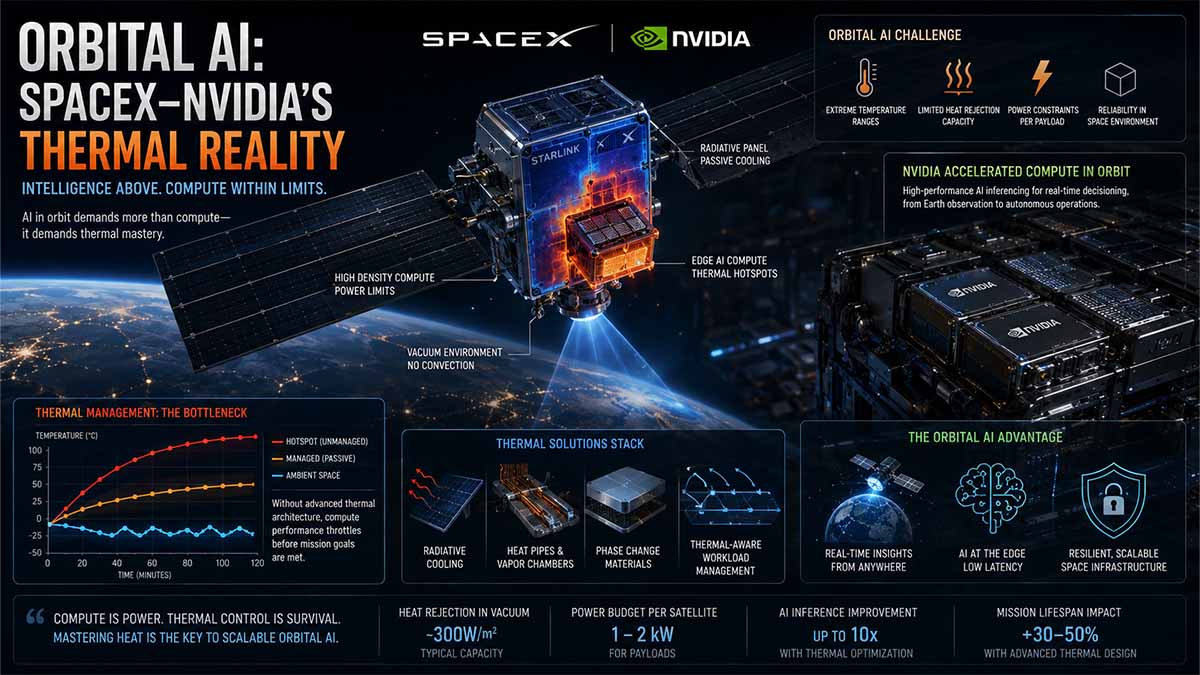
- Solar availability addresses grid access, not heat rejection; approximately every watt consumed by computing must ultimately leave through thermal radiation.
- A transparent 200,000-run Monte Carlo stress test produces a median radiator area of about 195 m² and median radiator mass of 1.57 tonnes under stated assumptions.
- The strongest near-term business case is onboard inference over space-generated data, not wholesale replacement of terrestrial hyperscale centres.
- SpaceX’s decisive advantage is vertical integration across launch, satellites, optical networking, terrestrial AI and replacement logistics.
- China is pursuing a parallel orbital-computing architecture, while Europe retains technical depth but faces scale, capital and launch-dependence risks.
- Five-year judgment: technically demonstrable by 2028–2029; selectively useful by 2030–2031; terrestrial cost parity remains unproven.
The Orbital AI Economy: SpaceX’s Bid to Own the Stack
Orbital computing is not primarily a wager on cheaper electricity. It is an attempt to redefine the industrial architecture of artificial intelligence by combining launch, spacecraft, energy generation, communications and computation inside one controlled system. The economic unit is therefore neither the satellite nor the processor, but the useful token delivered after launch losses, thermal constraints, radiation errors, network delays and hardware attrition. SpaceX enters this contest with an unusual advantage: it can internalise costs that every independent operator must purchase from separate suppliers. Yet vertical integration does not repeal physics. It converts external prices into internal execution risks—and makes the economics critically dependent on launch cadence, mass productivity, orbital utilisation and workload selection.
Mass Is the Balance Sheet
The fundamental denominator of orbital computing is productive compute per kilogram delivered to the required orbit. Every radiator, solar array, radiation shield, power converter, propulsion system and redundant processor consumes payload capacity without directly producing a token. This makes launch mass analogous to invested capital in a terrestrial data centre: it must be deployed before revenue begins, but unlike a building, the asset cannot normally be repaired or economically upgraded in place.
The scale proposed by SpaceX is unprecedented. Its prospectus states that Starship V3 is designed to place 100 metric tonnes into orbit in a fully reusable configuration; later versions are being designed for 200 metric tonnes. The company reported delivering 1,210 tonnes to orbit in 2023, 1,699 tonnes in 2024 and 2,213 tonnes in 2025, of which 1,901 tonnes in 2025 were internal payloads. These are company-reported figures contained in a prospectus approved by Germany’s Federal Financial Supervisory Authority, whose approval concerns completeness, comprehensibility and consistency—not endorsement of the issuer or its securities. Space Exploration Technologies Corp. Prospectus – SpaceX, approved by BaFin – 05/06/2026 — Official prospectus.
The distinction between designed capacity and demonstrated economics is decisive. The prospectus explicitly states that AI-compute satellites at scale require full Starship reusability to become economically compelling. Accordingly, the investment thesis rests not merely on reaching orbit, but on repeatedly recovering both stages, reducing turnaround time and sustaining an industrial launch rhythm. A partially reusable or intermittently available system could still deploy experiments; it would not necessarily establish a competitive orbital cloud.
From Kilograms to Tokens
“Cost per token” can obscure more than it reveals unless the numerator includes the complete orbital system and the denominator counts only validated, deliverable output. The appropriate economic measure comprises spacecraft production, launch, insurance or retained failure risk, ground infrastructure, spectrum coordination, processor depreciation, replacement launches and deorbiting. The output must then be adjusted for radiation-induced errors, thermal throttling, unavailable communications windows, failed nodes and workloads whose results cannot reach customers at the required latency.
SpaceX’s declared target is approximately 100 kilowatts of compute power per tonne. At that ratio, the company states that deploying 100 gigawatts annually would require transporting approximately one million tonnes to orbit through thousands of launches; it identifies 10 gigawatts annually as a materially less demanding intermediate scale. Early compute satellites are expected to generate approximately 100 kilowatts, while deployment is envisaged “as early as 2028.” These are forward-looking corporate objectives, not authorised capacity or demonstrated operating performance. Space Exploration Technologies Corp. Prospectus – SpaceX, approved by BaFin – 05/06/2026 — Official prospectus.
This arithmetic exposes the strategic issue. Improving processor efficiency does not automatically improve system-level mass productivity: denser accelerators require additional power conversion and heat-rejection capacity. Conversely, a satellite optimised for low mass may carry insufficient redundancy to sustain dependable output. The commercially relevant metric is therefore not peak operations per second, but useful computation produced over the spacecraft’s service life per kilogram launched.
Integration as Economic Power
SpaceX’s principal advantage is control of complementary assets. It designs launch vehicles, manufactures satellites, operates the constellation, manages ground stations and controls an optical network that, as of 31/03/2026, incorporated more than 23,000 inter-satellite lasers, according to its prospectus. This structure can compress contracting time, align spacecraft dimensions with launch geometry and redirect network capacity without negotiating among independent owners. It can also allocate launch capacity between paying customers and internal infrastructure according to group-level priorities.
The Federal Communications Commission placed the scale of that ambition on the regulatory record on 04/02/2026. SpaceX had filed on 30/01/2026 for authority to launch and operate a non-geostationary system of up to one million satellites, primarily connected through optical inter-satellite links and potentially integrated with first- and second-generation Starlink systems. An application is not an authorisation, and the requested ceiling is not a deployment commitment. Public Notice DA 26-113, SpaceX Orbital Data Center System – Federal Communications Commission – 04/02/2026 — Official FCC document.
This is competitive architecture rather than ordinary procurement. A stand-alone orbital-compute entrant must buy launches, negotiate spectrum, construct a ground network and absorb supplier margins. SpaceX can shift those margins within the group and reuse infrastructure originally financed for connectivity. The danger is symmetrical: technical failure in Starship, Starlink routing or satellite production can propagate across several business layers simultaneously. Vertical integration concentrates both surplus and operational correlation.
The Workload Divide
Not every AI workload belongs in orbit. The strongest initial case concerns data already generated there. Earth-observation platforms, telescopes and surveillance satellites create large raw datasets, only part of which is useful. Onboard filtering, compression, object detection and prioritisation can reduce the quantity transmitted to Earth and shorten the interval between collection and decision.
The U.S. Government Accountability Office identified precisely this advantage on 28/04/2026: processing space-derived data in orbit may reduce downlink volume and associated costs while accelerating decisions. The same assessment cautioned that data-intensive AI training may require more advanced transfer systems and that economic viability depends on solving electricity, cooling and communications requirements without imposing excessive size or launch weight. Science & Tech Spotlight: Data Centers in Space, GAO-26-109012 – U.S. Government Accountability Office – 28/04/2026 — Official GAO assessment.
The commercial sequence should therefore run from space-native inference to delay-tolerant batch processing, and only later—if networking and reliability permit—to tightly synchronised frontier-model training. Terrestrial data centres connect accelerators through short, high-capacity fabrics; an orbital cluster distributes them across moving platforms linked by lasers. Bandwidth, topology changes and retransmission penalties may leave nominal compute idle. The value of orbital workloads will consequently depend on locality: compute is most defensible where transporting raw data is more expensive, slower or strategically less acceptable than processing it near the sensor.
Energy Is Not Free
The attraction of solar power in orbit is real, but “free energy” is economically misleading. Sunlight carries no fuel invoice; capturing, converting and rejecting its energy requires capital-intensive hardware that must be manufactured, launched and protected. The marginal cost of sunlight may approach zero while the levelised cost of dependable processor power remains substantial.
The terrestrial benchmark is itself moving rapidly. The International Energy Agency’s central projection, published in April 2026, places global data-centre electricity consumption at 485 terawatt-hours in 2025 and approximately 950 terawatt-hours in 2030, when it would represent around 3% of global electricity demand. Consumption by AI-focused facilities is projected to triple over the same interval. Key Questions on Energy and AI: Executive Summary – International Energy Agency – April 2026 — Official IEA analysis.
This pressure strengthens the strategic rationale for alternative locations, but it does not establish orbital cost parity. Terrestrial competitors can respond with new generation, storage, grid investment, improved cooling and geographic relocation. Orbital systems must instead prepay their energy infrastructure in launch mass and accept that radiator dimensions constrain power density. The relevant comparison is not sunlight against an electricity tariff; it is the lifetime cost of two complete energy-and-compute systems.
Regulation Becomes Capital
Orbital computing depends on assets that markets cannot allocate alone: spectrum, safe orbital shells, debris mitigation, launch licensing and internationally coordinated communications. Regulatory capacity therefore becomes part of the capital structure. Delays in authorisation can strand factory capacity; insufficient collision management can increase replacement requirements; spectrum restrictions can reduce network utilisation.
On 22/07/2026, the Federal Communications Commission adopted its Space Modernization for the 21st Century order, released on 23/07/2026 as FCC 26-47, overhauling licensing procedures and introducing a new category of space-station licences. The reform does not settle the substantive environmental, spectrum or debris questions surrounding million-satellite proposals, but it shows that administrative architecture is already adapting to industrial-scale space operations. Report and Order and Further Notice of Proposed Rulemaking, FCC 26-47 – Federal Communications Commission – 23/07/2026 — Official FCC order.
The European approach is developing along a different axis. The European Commission reports that the Energy Efficiency Directive introduced monitoring and disclosure obligations for data centres, while Delegated Regulation (EU) 2024/1364 established reporting indicators. The Commission also states an objective of tripling EU data-centre capacity by 2035. Energy Performance of Data Centres – European Commission – updated July 2026 — Official Commission framework. Europe’s strategic challenge is thus larger than energy efficiency: a substantial migration of computation beyond territorial infrastructure would raise questions about jurisdiction, auditability, cybersecurity, data access and strategic dependence on non-European launch and network operators.
The Five-Year Test
Between 2027 and 2031, success should not be measured by the number of satellites announced or by peak orbital processing power. Four milestones matter: reusable delivery of economically relevant payload mass; sustained useful output from radiation-tolerant accelerators; reliable optical routing under operational load; and replacement cycles that preserve competitive hardware performance without creating unacceptable debris or capital destruction.
The GAO reported on 28/04/2026 that the FCC had received three applications since January 2026 for large U.S. data-centre constellations, while projects were also under way in China, the European Union and Japan. It further warned that space radiation can corrupt data and degrade hardware, that servicing remains underdeveloped and that more frequent decommissioning could increase debris and re-entry risks. Science & Tech Spotlight: Data Centers in Space, GAO-26-109012 – U.S. Government Accountability Office – 28/04/2026 — Official GAO assessment.
The first durable market is therefore unlikely to be a wholesale substitute for terrestrial cloud computing. It is more plausibly a premium layer serving orbital sensors, sovereign communications, time-sensitive inference and workloads for which data locality has exceptional economic or security value. SpaceX’s advantage is not that orbit abolishes constraints. It is that the company owns enough of the chain to decide where each constraint is absorbed—and to monetise launch, connectivity and computation within the same architecture. If that system produces useful tokens faster than capital is destroyed through mass, heat and obsolescence, orbital AI will become an industrial category. If it does not, the constellation will remain an extraordinary demonstration of engineering whose economics never escaped Earth’s gravity.
Navigational Index
- Thermal and Reliability Physics — radiation, cooling, repairability, hardware ageing and density.
- Economics and Competitive Architecture — launch mass, token economics, vertical integration and orbital workloads.
- 2027–2031 Strategic Outlook — competing hypotheses, Bayesian probabilities, geopolitical rivalry and warning indicators.
Master Abstract
The verified starting point differs from the proposition that SpaceX and NVIDIA will place “the first computer rack” in orbit by the end of 2027. NVIDIA announced on 24 August 2026 that SpaceXAI plans to base its first-generation Starmind satellite on an optimized NVIDIA Vera Rubin NVL72 rack-scale system, but the announcement provides no launch date and expressly characterizes product timing and third-party plans as forward-looking, changeable and non-binding. SpaceXAI Adopts NVIDIA Vera CPU to Accelerate Agentic AI at Massive Scale – NVIDIA – August/2026 — verified primary announcement. SpaceX’s BaFin-approved European prospectus is more specific: it says deployment of orbital AI-compute satellites could begin as early as 2028, describes early satellites generating about 100 kW of compute power and establishes a longer-term design target of approximately 100 kW per tonne. It also acknowledges materially larger solar arrays and radiators, radiation-tolerant electronics, vapor chambers, active cooling loops, coatings, intensive pre-deployment testing and the absence of anticipated processor repair in space. SpaceX EU Prospectus – Space Exploration Technologies Corp. – June/2026 — verified audited corporate prospectus. The technically accurate interpretation is therefore not “a terrestrial rack launched intact,” but a satellite whose computing topology derives from NVL72 while its packaging, power conversion, thermal path, interconnects, memory protection and fault-management architecture are redesigned for orbit. Even the corporate nomenclature matters: NVIDIA calls NVL72 “rack-scale,” whereas SpaceX describes a purpose-built compute satellite. Conflating those concepts hides the programme’s central engineering problem—the conversion of a tightly integrated, fully liquid-cooled terrestrial architecture into an autonomous spacecraft whose useful life, repair model and heat-rejection surface are determined before launch.
The vacuum objection is directionally correct but needs more precise physics. Vacuum does not act as an insulating bottle in every relevant sense: it eliminates convection, but a spacecraft can still move heat internally through conduction, pumped-fluid loops, heat pipes and vapor chambers before emitting it as infrared radiation. The controlling external mechanism is radiative transfer, approximately q = εσT⁴ after subtracting environmental inputs, meaning that heat-rejection capacity rises sharply with radiator temperature rather than linearly. NASA confirms that external spacecraft heat exchange is governed by radiation, while coatings deteriorate under atomic oxygen, ultraviolet exposure and cosmic radiation, altering absorptivity and emissivity between beginning and end of life. State of the Art of Small Spacecraft Technology: Thermal Control – NASA – May/2026 — verified NASA technical reference. The consequence is severe for dense AI hardware. NVIDIA reports approximately 136 kW provisioned power for a Vera Rubin NVL72 configuration before workload-level optimization; its terrestrial reference architecture depends on liquid cooling near 45°C. Maximizing AI Factory Performance per Watt with NVIDIA DSX MaxLPS – NVIDIA – August/2026 — verified NVIDIA engineering analysis. At 318 K, emissivity of 0.90 and an unrealistically perfect view of cold space without solar, terrestrial-infrared or albedo loading, a 136 kW load requires roughly 260 m² of effective one-sided emitting area. Real margins increase that requirement; higher coolant and radiator temperatures reduce it but impose semiconductor, packaging and reliability penalties. Density is consequently not a free advantage. Compact chips shorten high-bandwidth electrical paths and may improve compute mass efficiency, but they intensify local heat flux and require heavier spreaders, pumps, fluid loops, redundant valves and deployable surfaces. Space is cold as an equilibrium environment only for objects that absorb little energy; a powered computer is a continuous heat source.
A 200,000-run thermal-mass Monte Carlo stress test was executed for this assessment, not as a manufacturer forecast but as a transparent feasibility boundary. The model sampled compute power from 101–136 kW, radiator temperature from 318–390 K, emissivity from 0.78–0.95, environmental thermal penalties from 5–35%, radiator specific mass from 3–15 kg/m², and annual subsystem survival from 0.78–0.985. It produced radiator-area percentiles of approximately 149 m², 195 m² and 251 m² at P₁₀, P₅₀ and P₉₀; corresponding radiator-mass estimates were approximately 0.95, 1.57 and 2.48 tonnes. The median radiator mass alone exceeded the all-up mass implied by SpaceX’s aspirational ratio of 100 kW per tonne for a roughly 120 kW payload. This does not prove impossibility: two-sided radiators, substantially lighter membranes, higher operating temperatures, workload power capping, advanced heat pipes and a satellite-specific NVL72 derivative could move the boundary. It does prove that launch cost is not the only decisive variable and that the 100 kW-per-tonne target demands aggressive thermal innovation. Reliability is equally restrictive. NASA documents both reversible single-event upsets and destructive radiation-induced failures in spacecraft electronics. Modeling of Radiation Effects on Spacecraft Hardware – NASA – 2026 — verified NASA research record. Shielding reduces accumulated dose but adds launch mass and cannot eliminate every high-energy event; architectural countermeasures therefore require error-correcting memory, redundant computation, checkpointing, scrubbing, isolation domains and autonomous reconfiguration. Meanwhile, GAO finds that robotic in-space servicing is not routine and has been demonstrated only in a limited number of missions, despite more than 2 billion in documented NASA and Department of Defense development spending over the preceding decade. In-Space Servicing, Assembly, and Manufacturing – U.S. Government Accountability Office – July/2025 — verified government assessment. SpaceX’s replace-rather-than-repair strategy is consequently rational, but it converts hardware mortality into launch cadence, capital turnover and debris-management obligations.
The strategic case nevertheless remains stronger than a simple terrestrial-versus-orbital cooling comparison suggests. The most valuable early workloads will probably be orbital edge inference: processing Earth-observation, signals-intelligence, weather, communications or navigation data near the sensor and downlinking decisions or compressed products instead of massive raw datasets. NVIDIA’s March 2026 space-computing release positions its platforms precisely across onboard inference, geospatial intelligence and autonomous spacecraft operations, while withholding a committed availability date for the Space-1 Vera Rubin module. NVIDIA Launches Space Computing, Rocketing AI Into Orbit – NVIDIA – March/2026 — verified primary announcement. The demand-side pressure is real: the International Energy Agency projects global data-centre electricity consumption rising from 485 TWh in 2025 to approximately 950 TWh in 2030, with AI-focused facilities tripling their consumption. Key Questions on Energy and AI: Executive Summary – International Energy Agency – 2026 — verified intergovernmental assessment. Yet orbital power is not free: collection requires large radiation-degrading solar arrays; eclipses or non-ideal geometry require storage or workload modulation; power conversion adds heat; and every generated watt demands structural, attitude-control and thermal capacity. SpaceX’s genuine advantage is therefore systemic rather than universal. It owns launch, satellite production, optical-network infrastructure and the Grok workload, giving it the ability to internalize launch margins, design software around intermittent or degraded hardware, and replace failed units through recurring missions. Competitors purchasing launch and connectivity externally cannot reproduce those economics. The Federal Communications Commission has accepted for review—but has not authorized—a SpaceX application for an NGSO orbital-data-centre system of up to one million satellites between 500 and 2,000 km, linked optically to one another and to Starlink. Space Bureau Accepts for Filing SpaceX’s Application for Orbital Data Centers – Federal Communications Commission – February/2026 — verified FCC public notice. Regulatory acceptance for filing must not be mistaken for engineering validation, spectrum approval or permission to deploy at scale.
The five-hypothesis Analysis of Competing Hypotheses produces the following Bayesian posterior distribution for 2031: H₁, orbital edge-compute becomes commercially useful but remains a specialized extension of terrestrial cloud, 46%; H₂, SpaceX demonstrates limited Starmind inference clusters but scale and economics remain experimental, 28%; H₃, orbital AI becomes cost-competitive for broad hyperscale workloads, 9%; H₄, thermal, launch, reliability or programme delays prevent meaningful commercial operation, 14%; H₅, regulation, collision risk, export controls or geopolitical confrontation impose a material freeze, 3%. These are structured analytic judgments, not observed frequencies. Evidence raising H₁ and H₂ includes the NVIDIA architecture agreement, SpaceX’s existing optical mesh and satellite-production base, and the high value of processing space-native data locally. Evidence suppressing H₃ includes the radiator-mass boundary, irreparable processor failures, rapid accelerator obsolescence, ground-network latency and terrestrial access requirements. Evidence supporting H₄ includes the prospectus’s own acknowledgment that significant work remains and that 2028 is an earliest deployment date rather than a commitment. H₅ remains low but non-zero because orbital compute combines communications infrastructure, global remote sensing, autonomous decision systems and strategically sensitive accelerators. China is already pursuing a distinct architecture: official Chinese disclosures describe 33 satellites and payloads deployed within its space-computing programme and a first-stage objective of 2,800 computing satellites by 2030. China Space Day: Chengdu Commercial-Space Programme – China National Space Administration – April/2026 — verified Chinese government source. A Beijing-supported experimental satellite entered an orbit above 700 km on 24 July 2026 to validate technologies for a future space data centre. Chenguang-1 Technology Demonstration Satellite Enters Orbit – Beijing Municipal Government – July/2026 — verified Chinese government source. The emerging contest is therefore not merely Musk versus Altman; no acceptable primary source was found confirming the criticism attributed to Sam Altman. It is a competition over who controls launch, compute, orbital data, sovereign AI and the physical infrastructure of machine intelligence.
The geopolitical and environmental shadow dimensions could become more constraining than chip performance. SpaceX’s proposed maximum constellation would sit in an environment where ESA already estimates approximately 40,000 tracked objects, around 11,000 active payloads, more than 50,000 objects larger than 10 cm and over 1.2 million debris objects larger than 1 cm, a size capable of catastrophic spacecraft damage. ESA Space Environment Report 2025 – European Space Agency – April/2025 — verified ESA assessment. Failed computing satellites would not be analogous to decommissioned servers in a warehouse: they would remain collision objects unless reliably deorbited or serviced. ESA’s Zero Debris framework calls for disposal within five years, successful-disposal probability above 90%, controlled collision risk and stronger requirements for constellations. ESA’s Zero Debris Approach – European Space Agency – 2023 — verified ESA policy framework. Cyber risk also changes form. Inter-satellite optical links reduce dependence on terrestrial transit but create a distributed control plane whose compromise could affect routing, workloads, attitude decisions and disposal. Export controls over advanced accelerators and radiation-tolerant components could divide orbital AI into American, Chinese and sovereign regional stacks. Liquidity flows will concentrate around firms that combine launch access, semiconductor allocation, insurance and government demand; this favours SpaceX more than orbital computing as a universally available industry. The classic mercenary dimension is not materially relevant, but private intelligence contractors, launch brokers and dual-use analytics providers will become important intermediaries. Europe’s strategic question is therefore whether to remain a scientific and regulatory participant or assemble its own end-to-end chain. The European Commission has already funded ASCEND, aimed at studying modular orbital data centres with robotic assembly at megawatt scale. HaDEA Signs Grant Agreements with 45 New Space Projects – European Commission – October/2022 — verified European Commission programme record. Between 2027 and 2031, success should consequently be measured not by whether one rack survives launch, but by delivered useful tokens per launched kilogram, radiator area per compute kilowatt, autonomous fault isolation, replacement cadence, verified disposal probability and commercial demand for workloads that genuinely originate in space.
STARMIND // THERMAL REALITY
Mission Inputs
Calculated Thermal Boundary
ACH Posterior // 2031
Orbital AI Data Centres: Thermal and Reliability Physics, 2027–2031
The governing physical boundary
An orbital AI data centre does not fail or succeed because space is “cold”; it succeeds only if its complete thermal architecture can transport every watt dissipated by processors, memory, optical interconnects, power converters and pumps from microscopic semiconductor junctions to a sufficiently large surface facing an acceptable radiative sink. In vacuum, external convection disappears, while internal conduction and pumped-fluid transport remain available; the final rejection mechanism is electromagnetic radiation. NASA states explicitly that heat transfer inside an enclosed spacecraft is normally dominated by conduction, whereas exchange with the external environment proceeds through radiation, with emissivity and solar absorptivity controlling the energy balance. State of the Art of Small Spacecraft Technology: Thermal Control – National Aeronautics and Space Administration – May/2026 — NASA thermal-control assessment. The useful first-order relationship is q = εσ(T⁴ − Tₛ⁴), where q is emitted heat per unit area, ε is effective infrared emissivity, σ is the Stefan–Boltzmann constant, T is radiator temperature and Tₛ is the effective sink temperature. The fourth-power dependence matters: increasing radiator temperature sharply reduces area, but hotter coolant also raises semiconductor junction temperatures, leakage, material ageing and pump requirements. A terrestrial Vera Rubin NVL72 installation operates through complete direct liquid cooling rather than air cooling; NVIDIA identifies a 45°C supply temperature and describes cooling of the processor, networking and power components through a closed loop. Hotter Than a Hot Tub: The 45°C Breakthrough to Cool AI’s Biggest Machines – NVIDIA – June/2026 — NVIDIA thermal architecture. At 318 K and ε = 0.90, an ideal radiator emits roughly 523 W/m² before solar absorption, terrestrial infrared, albedo, view-factor losses, contamination and end-of-life degradation are subtracted. A 136 kW rack-equivalent heat load would therefore require approximately 260 m² of ideal one-sided emitting area. That is not an impossibility result; it is the starting constraint that power-density claims must survive.
From silicon junction to infrared emission
The most dangerous simplification is to treat “radiator area” as though it were the entire thermal system. Heat begins at GPU and memory junctions whose local flux is many orders of magnitude greater than the average radiative flux of the final panel. It must cross package lids, thermal-interface materials, cold plates, manifolds, pumps, working fluid, deployable tubing and radiator structures without creating prohibitive temperature gradients or single-point failures. NVIDIA’s terrestrial NVL72 architecture benefits from high-flow infrastructure, accessible pumps, leak detection, modular replaceable trays and continuous facility monitoring. Its official user guide places the comparable GB200 NVL72 rack near 120 kW and specifies liquid-cooling leak detection because a coolant failure can damage equipment, interrupt service and compromise data integrity. Hardware: NVIDIA DGX GB Rack Scale Systems User Guide – NVIDIA – March/2026 — NVIDIA rack hardware specification. For Vera Rubin, NVIDIA reports 136 kW at its maximum provisioned condition and approximately 101 kW under workload-aware MaxLPS operation, demonstrating that software orchestration can lower average power without changing the physical maximum for which the system must remain safe. Maximizing AI Factory Performance per Watt with NVIDIA DSX MaxLPS – NVIDIA – August/2026 — NVIDIA power-management analysis. An orbital derivative could cap clocks, schedule inference during favourable thermal geometry, distribute models across satellites and delay non-critical computation, but a commercial service cannot assume continuously benign workloads. Agentic inference, collective communication and mixture-of-experts routing generate fast, spatially uneven transients. Thermal mass can buffer short pulses, phase-change material can defer rejection, and capacitors can smooth electrical ramps, but neither technique removes energy; both merely shift its release in time. The architecture must therefore be designed simultaneously for average heat, peak junction temperature, coolant stability, pump failure, partial radiator deployment and spacecraft safe mode. Density remains valuable for electrical reasons—shorter links, lower signalling energy and coherent GPU domains—but becomes thermally expensive because concentrated heat demands thicker spreaders, stronger interfaces and higher flow, placing compute density and radiator mass on opposing sides of the same design equation.
Space-Based High-Performance Compute Thermal-Hydraulic Cascade
Comprehensive architectural breakdown of orbital thermal rejection pathways, multi-stage conductive-convective bottlenecks, and cascade failure modes.
1. Source Generation: GPU / HBM / NIC Thermal Load
Dissipation OriginIntense localized heat fluxes generated by high-density compute clusters, monolithic accelerators, high-bandwidth memory stacks, and optical network interface controllers operating in vacuum environments.
2. Package & Thermal Interface Conductive Layer
Conduction MatrixDirect die-to-substrate conduction paths utilizing advanced interface materials to bridge microscopic surface irregularities.
- Local thermal hot spots accelerating microstructural fatigue.
- Interfacial delamination induced by coefficient of thermal expansion (CTE) mismatches.
- Long-term material ageing, dry-out, and void formation in thermal greases or solders.
3. Cold Plate & Vapor Chamber Phase-Change Extraction
Two-Phase ExtractionHigh-efficiency evaporative heat spreading systems utilizing latent heat transfer to rapidly move thermal energy away from tight geometries.
- Wick structure blockage or particulate contamination.
- Evaporator dry-out under extreme transient workloads.
- Micro-fracturing leading to internal fluid leakage or loss of capillary pressure.
4. Pumped Fluid Loop & Redundancy Architecture
Convective TransportClosed-loop active fluid transport circulating dielectric or specialized coolants between internal electronics bays and external heat rejection surfaces.
- Automated redundant loop bypass valves maintaining continuous flow upon primary pump failure.
- Active line isolation mechanisms to contain coolant loss during orbital micro-meteoroid impacts.
5. Deployable Radiator & Space Emission Array
Thermal RejectionLarge-area surface panels emitting thermal energy via long-wave infrared radiation directly into the deep space sink.
- High-energy atomic oxygen and solar ultraviolet coating degradation reducing emissivity.
- Orbital debris puncture causing catastrophic pressure drop and fluid venting.
- Thermal view-factor loss due to spacecraft attitude changes or solar/albedo reflections.
Any failed link in the thermal cascade triggers an immediate automated response sequence: Thermal Throttling (frequency and voltage reduction) → Workload Migration to healthy nodes → Safe Mode transition → Final hardware Replacement or Total System Loss.
Radiation is a multi-layer failure process
Radiation risk cannot be reduced to the familiar image of a cosmic ray flipping one memory bit. The reliability envelope contains at least four distinct mechanisms: total ionizing dose, which accumulates charge in insulating layers and shifts transistor characteristics; displacement damage, which physically disrupts semiconductor lattices; recoverable single-event effects, including bit upsets and functional interrupts; and destructive events such as latch-up, gate rupture or burnout. NASA’s current modeling work distinguishes recoverable single-event upsets from non-recoverable destructive loss of hardware functionality. Modeling of Radiation Effects on Spacecraft Hardware – National Aeronautics and Space Administration – 2026 — NASA radiation-effects record. Shielding attenuates part of the trapped-particle and solar-proton environment, but shielding effectiveness is energy-dependent and incurs mass; sufficiently energetic particles can traverse conventional spacecraft structures and create secondary particles. Advanced terrestrial accelerators aggravate the problem because their enormous memory capacity and state complexity enlarge the logical target surface. A low probability of upset per bit becomes consequential when multiplied across terabytes of HBM, control memory, switches, firmware devices and optical-network buffers. Error-correcting codes can repair limited corruption, memory scrubbing can prevent single-bit errors from accumulating into uncorrectable words, and triple or n-modular redundancy can outvote a faulty compute path. These mechanisms consume area, power, bandwidth and sometimes performance, while common-mode errors, firmware defects and destructive events remain outside their protection. NASA’s High Performance Spaceflight Computer illustrates the required defence-in-depth architecture: radiation-aware silicon, extensive EDAC/ECC, memory scrubbing, redundant logic, hardware error containment, software-managed recovery and radiation-hardened design rules. NASA’s High Performance Spaceflight Computer – National Aeronautics and Space Administration – July/2024 — NASA HPSC technical paper. An orbital NVL72 derivative would need analogous protection at far larger scale. The crucial design question is consequently not whether individual GPUs can execute after exposure, but whether a coherent distributed model can preserve weights, context, routing state and cryptographic integrity while nodes fail asynchronously and correction traffic competes with useful AI computation.
Thermal cycling and irreversible ageing
Hardware ageing in orbit combines familiar data-centre mechanisms with environmental processes rarely permitted to dominate terrestrial service life. High current density accelerates electromigration; elevated junction temperature increases leakage and chemical reaction rates; repeated power cycling stresses package interfaces; differential expansion fatigues solder joints, vias and cold plates; radiation changes transistor thresholds; atomic oxygen and ultraviolet exposure alter external coatings; and micrometeoroid impacts threaten thin deployable surfaces. NASA reliability methodology treats solder-joint fatigue under thermal cycling as a physics-of-failure problem rather than an abstract constant failure rate. NASA Methodology for Physics-of-Failure-Based Reliability Predictions – National Aeronautics and Space Administration – June/2024 — NASA reliability methodology. ESA’s materials laboratory separately conducts thermal cycling, accelerated thermal ageing and combined exposure to vacuum, ultraviolet radiation, protons and electrons because these mechanisms interact rather than operate independently. Materials and Electrical Components Laboratory – European Space Agency – accessed August/2026 — ESA environmental-test capability. A radiator coating that gradually absorbs more sunlight raises equilibrium temperature; the resulting temperature increase accelerates electronics ageing and may force clock reductions; reduced throughput then weakens the economic case even if the satellite remains technically alive. Orbital geometry creates additional cycles. Dawn–dusk sun-synchronous operation can approach persistent illumination, but attitude manoeuvres, eclipses, collision avoidance, safe modes and seasonal geometry still change solar input and radiator view. The relevant lifetime variable is therefore not binary survival but surviving useful compute: the fraction of initial, error-corrected, thermally sustainable workload capacity still available after degraded GPUs, failed memory stacks, isolated coolant branches, optical-link attrition and power-system ageing are accounted for. Terrestrial operators can replace a failing tray while preserving the rest of the rack. An unserviceable satellite must carry spare capacity at launch, isolate faults autonomously or surrender an increasing share of its nominal compute. Reliability margins thus reduce effective density before the first payload leaves Earth.
| Reliability layer | Dominant mechanism | Immediate response | Long-term cost |
|---|---|---|---|
| Semiconductor | Dose, displacement, latch-up, electromigration | Reset, isolate, reduce voltage or clock | Lost accelerators and declining throughput |
| Memory | Bit upset, retention loss, interface failure | ECC, scrubbing, replication | Capacity and bandwidth overhead |
| Thermal loop | Pump, valve, seal or cold-plate failure | Bypass, load migration, shutdown | Stranded compute and hotter surviving branches |
| Radiator | Deployment fault, puncture, coating degradation | Reorientation, lower workload | Permanent heat-rejection loss |
| Power | Cell degradation, converter failure, transient instability | Power capping, redundant bus | Reduced duty cycle |
| Network | Laser-terminal or routing failure | Mesh rerouting | Higher latency and partitioned clusters |
| Guidance | Sensor or actuator degradation | Safe mode, reduced pointing envelope | Lower solar collection and radiator availability |
Repairability changes the economics of failure
Repairability is not a secondary operational concern; it determines whether orbital computing behaves like a data centre or like a consumable constellation. In a terrestrial AI factory, technicians replace power supplies, pumps, cables, switch trays and compute modules while the surrounding cluster continues operating. NVIDIA explicitly presents the MGX rack as modular and serviceable, with hot-swappable elements and a mature partner ecosystem. Inside the NVIDIA Rubin GPU Architecture: Powering the Era of Agentic AI – NVIDIA – July/2026 — NVIDIA rack-level resilience architecture. The orbital system forfeits most of that maintenance model unless it includes robotic servicing interfaces, standardized capture points, replaceable modules and rendezvous-compatible navigation. The U.S. Government Accountability Office finds that robotic in-space servicing is not routinely used and has been demonstrated on only a handful of missions, even though servicing is more mature than orbital assembly and manufacturing. In-Space Servicing, Assembly, and Manufacturing: Benefits, Challenges, and Policy Options – U.S. Government Accountability Office – July/2025 — GAO ISAM assessment. For the 2027–2031 period, SpaceX therefore has three credible choices: launch fully self-contained units with internal redundancy; treat satellites as replaceable fleet elements; or invest in servicing whose economics would initially be justified by high-value platforms rather than commodity compute. SpaceX’s prospectus adopts the first two logics: it says processors are not expected to be repaired in orbit, relies on intensive pre-deployment testing and anticipates high-volume satellite manufacture. It also describes radiators, vapor chambers, active loops and coatings as components of the thermal system, with initial deployment possible as early as 2028. SpaceX EU Prospectus – Space Exploration Technologies Corp. – June/2026 — BaFin-approved SpaceX prospectus. That strategy is coherent for SpaceX because it internalizes launch, satellite production, Starlink connectivity and the Grok workload. It is much less attractive to an operator paying external launch prices and lacking a global optical relay network.
Monte Carlo thermal-reliability stress test
A 300,000-run Monte Carlo model was executed to quantify—not disguise—the uncertainty. Compute heat was sampled from a triangular distribution of 101–136 kW, with 120 kW as its mode; radiator temperature from 318–390 K, mode 345 K; initial emissivity from 0.78–0.95, mode 0.90; environmental penalty from 5–35%, mode 15%; radiator specific mass from 3–15 kg/m², mode 7 kg/m²; annual subsystem survival from 0.82–0.985, mode 0.93; annual optical-property degradation from 0.5–4%, mode 1.8%; and annual surviving-compute degradation from 1.5–10%, mode 4.5%. These are analytic stress distributions, not manufacturer data. At the initial modeled point, effective radiator-area percentiles P₁₀, P₅₀ and P₉₀ were 148.8, 195.2 and 251.4 m²; median radiator mass reached approximately 1,566 kg. By 2031, optical degradation raised those area percentiles to 161.7, 212.3 and 274.4 m², while median radiator mass rose to approximately 1,705 kg for the same nominal heat load. Median probability of complete subsystem survival declined from 0.915 after the first modeled year to 0.642 after five years. When partial computational degradation was compounded with subsystem survival, median useful-compute retention reached 0.513 in 2031. This is not a prediction that half the satellite must fail; it demonstrates the sensitivity of useful capacity to modest annual attrition. Under a strict three-year envelope requiring initial area below 200 m², radiator mass below the entire payload mass implied by SpaceX’s aspirational 100 kW-per-tonne ratio, and subsystem survival above 0.75, only 10.7% of draws satisfied all conditions. The result identifies the central leverage points: hotter radiators, ultra-low specific-mass deployables, lower real workload power and substantially better annual reliability. It does not establish that these improvements are unattainable.
| Modeled year | Radiator area P₁₀ | Radiator area P₅₀ | Radiator area P₉₀ | Median full survival | Median useful compute retained |
|---|---|---|---|---|---|
| 2027 | 148.8 m² | 195.2 m² | 251.4 m² | 91.5% | 91.5% |
| 2028 | 152.0 m² | 199.3 m² | 256.8 m² | 83.8% | 79.2% |
| 2029 | 155.2 m² | 203.5 m² | 262.4 m² | 76.7% | 68.5% |
| 2030 | 158.4 m² | 207.8 m² | 268.3 m² | 70.2% | 59.3% |
| 2031 | 161.7 m² | 212.3 m² | 274.4 m² | 64.2% | 51.3% |
Competing hypotheses and Bayesian update
The Analysis of Competing Hypotheses separates five technically distinct outcomes. H₁ holds that SpaceX deploys a thermally derated, fault-tolerant orbital inference platform optimized for space-generated data; posterior probability 43%. H₂ anticipates successful demonstrations but continued economic dependence on terrestrial training and storage; posterior 29%. H₃ assumes that high-temperature radiators, ultra-light deployables and rapid replacement make broader orbital AI economically competitive by 2031; posterior 9%. H₄ projects delays or persistent underperformance caused by thermal mass, radiation-induced attrition, Starship cadence or integration failures; posterior 16%. H₅ assigns 3% to a severe collision, debris, cyber or regulatory event that materially freezes scale-up. The update raises H₁ because NVIDIA has now confirmed that the planned first-generation Starmind satellite will use an optimized Vera Rubin NVL72 foundation while acknowledging that orbital power, thermal management, bandwidth, reliability and physical integration differ radically from terrestrial infrastructure. SpaceXAI Adopts NVIDIA Vera CPU to Accelerate Agentic AI at Massive Scale – NVIDIA – August/2026 — NVIDIA–SpaceXAI announcement. It suppresses H₃ because the GAO’s dedicated 2026 assessment concludes that the support technologies are individually mature but their integrated operation at data-centre scale in space remains unproven; it further judges small systems processing data generated in orbit closer to maturity than large platforms intended to train AI models. Science & Technology Spotlight: Data Centers in Space – U.S. Government Accountability Office – April/2026 — GAO orbital-data-centre assessment. The discriminating evidence is observable: H₁ gains if flight hardware publishes heat-load, radiator-area, throttling and corrected-error data; H₂ gains if orbital operations remain sensor-adjacent and terrestrial systems retain model training; H₃ requires repeatable launch economics and competitive useful tokens per launched kilogram; H₄ gains with schedule slippage, radiator deployment problems or failure-driven clock reductions; H₅ requires regulatory intervention or a material space-safety event. Marketing announcements alone cannot discriminate among them.
Five-year physical outlook
The 2027–2031 sequence should be evaluated through engineering gates rather than corporate milestones. During 2027, the decisive work is environmental qualification: heavy-ion and proton testing of processors and memory, thermal-vacuum testing of full heat paths, repeated deployment cycles, coolant compatibility, pump life, optical-terminal tolerance and safe-mode validation. During 2028, the earliest SpaceX deployment date disclosed in the prospectus, the critical question is whether Starmind can sustain useful workloads after launch vibration and in real orbital geometry, not whether it can briefly execute a benchmark. During 2029, the programme must demonstrate autonomous fault localization, checkpoint recovery, model partitioning and predictable performance under degraded thermal capacity. During 2030, constellation-level reliability becomes more important than single-satellite reliability: correlated software faults, solar storms, optical-network partitions and replacement cadence will determine service availability. By 2031, credible scaling requires evidence that the fleet can preserve a competitive ratio among compute output, launch mass, radiator area and failure replacement. The most likely architecture is hybrid. Large-scale training, durable storage, sensitive customer data and frequent hardware refresh remain terrestrial; orbital systems perform inference, compression, sensor fusion, spacecraft coordination and selected autonomous decisions. Such workload placement reduces downlink demand and values latency without forcing every AI task to bear launch and radiator costs. NASA’s avionics assessment underscores the underlying trade: traditional radiation-hardened processors provide high reliability and predictable behaviour but modest computing capability, whereas high-performance commercial architectures demand stronger mitigation. Small Spacecraft Avionics – National Aeronautics and Space Administration – May/2026 — NASA avionics technology assessment. The five-year race is therefore not simply toward more GPUs in orbit. It is toward a heterogeneous architecture in which hardened control processors supervise faster but less trustworthy accelerators, redundant memory preserves model state, workload software treats thermal headroom as a schedulable resource, and constellation management assumes partial failure rather than designing around an unrealistic expectation of terrestrial uptime without terrestrial maintenance.
| Period | Engineering gate | Positive indicator | Failure indicator |
|---|---|---|---|
| 2027 | Full environmental qualification | Published radiation and thermal-vacuum envelope | Reliance on component-only demonstrations |
| 2028 | First integrated orbital workload | Sustained compute under real thermal geometry | Benchmark without continuous heat rejection |
| 2029 | Autonomous degradation management | Fault isolation and workload migration | Whole-platform reset after local failure |
| 2030 | Constellation reliability | Graceful operation through node and link loss | Correlated outages or high replacement demand |
| 2031 | Economic scaling decision | Competitive useful output per launched kilogram | Radiator, shielding and redundancy dominate mass |
Strategic and geopolitical shadow dimensions
Thermal and reliability physics translate directly into geopolitical power because the actor that controls replacement logistics can accept failure rates that would bankrupt a launch-dependent competitor. SpaceX can integrate satellite design, launch cadence, optical networking, accelerator procurement and the Grok workload; this creates an economic moat even if orbital compute remains less efficient than terrestrial compute in isolation. China is pursuing a parallel sovereign approach and, importantly, its official language does not deny the cooling barrier: the China National Space Administration states that vacuum eliminates air convection, making radiative heat rejection a core implementation difficulty, while emphasizing the advantage of processing remote-sensing data at its point of origin. Why Send Computing Power into Space? – China National Space Administration – July/2026 — CNSA technical-strategic assessment. Europe possesses strong thermal engineering, radiation testing and debris governance but lacks an equivalently integrated commercial chain at SpaceX scale. The strategic European opportunity lies in high-emissivity materials, deployable radiators, robotic servicing, radiation-resilient accelerators and certified disposal interfaces rather than imitating a million-satellite filing. Russia’s official programme disclosures point toward autonomous onboard AI and radiation-aware orbital infrastructure, but no current Russian primary source reviewed here establishes a technically comparable hyperscale orbital-data-centre deployment; Roscosmos has nonetheless stated that the planned Russian orbital station should incorporate AI and high autonomy. The New Orbital Station Will Include Artificial-Intelligence Elements – Roscosmos – September/2021 — Roscosmos official statement. The shadow dimensions follow. Cyber norms remain incomplete for AI satellites capable of autonomous sensing and decision support; optical links reduce interception surface but create software-defined, remotely updated control planes. Liquidity will flow preferentially toward vertically integrated operators and insurers able to model correlated constellation failure. Export controls can restrict radiation-tolerant components and advanced accelerators, fragmenting orbital AI into sovereign technology blocs. Mercenary dynamics are peripheral in their traditional armed form, but private intelligence, Earth-observation and launch contractors will mediate access to orbital computation for governments lacking sovereign constellations. Finally, failed or obsolete computing platforms become physical externalities. ESA reports approximately 40,000 tracked orbital objects, around 11,000 active payloads and more than 1.2 million debris objects larger than one centimetre, any of which can catastrophically damage a satellite. ESA Space Environment Report 2025 – European Space Agency – April/2025 — ESA orbital-environment assessment. Reliability policy must therefore include disposal reliability, not merely compute uptime.
Integrated judgment
The central finding is neither that orbital AI is impossible nor that unrestricted solar energy eliminates terrestrial constraints. SpaceX and NVIDIA are converting one constraint—grid-connected electrical capacity—into a coupled set of mass, surface-area, radiation, autonomy, launch and disposal constraints. The system can work if it is designed as a spacecraft from first principles: thermally derated accelerators, high-temperature liquid loops, low-mass radiators, hardened supervisory processors, extensive error correction, autonomous isolation, model replication across nodes and a replacement pipeline. It becomes strategically persuasive first where data already originates in orbit, latency is valuable and raw downlink is expensive. It becomes least persuasive where workloads require constant hardware refresh, extensive human intervention, high-capacity terrestrial storage or dense all-to-all communication across thousands of accelerators. The strongest critical metric is not peak floating-point performance but five-year useful compute yield per launched kilogram, calculated after thermal throttling, radiation correction, redundancy overhead, failed modules, network partitions and disposal reserves. The second is radiator-adjusted power density, not chip density alone. The third is fleet-level graceful degradation, because satellite count cannot compensate for common-mode software, firmware or solar-weather failures. The fourth is replacement-adjusted cost per useful token, which exposes whether vertical integration creates genuine economic advantage or merely transfers costs between SpaceX divisions. The fifth is end-of-life assurance, without which rapid accelerator obsolescence becomes a debris-production model. The 2027–2031 evidence is most likely to validate orbital AI as a specialized tier of a terrestrial–space computing continuum, not as a wholesale substitute for ground data centres. SpaceX’s competitive advantage is real precisely because it owns the cycle required to tolerate orbital failure. That advantage belongs to SpaceX; it does not automatically become an efficiency gain for every operator, every workload or the orbital environment itself.
Five-Year Thermal and Useful-Compute Projection
Orbital AI Economics and Competitive Architecture, 2027–2031
The unit of value is not orbital compute
The economically relevant product is not a GPU in orbit, a kilowatt of solar generation or even a nominal token. It is a useful, correctly delivered token produced at the location and latency required by a paying workload, after launch amortization, satellite manufacturing, thermal derating, radiation correction, redundancy, failed hardware, network transport, ground infrastructure, insurance and end-of-life disposal have been charged against output. This distinction is essential because comparisons that place terrestrial electricity prices against nominally free orbital sunlight omit most of the orbital capital stack, while comparisons based only on launch cost ignore processor utilization and revenue quality. A terrestrial AI factory converts grid electricity, buildings, cooling systems and replaceable accelerators into tokens; an orbital platform replaces part of that infrastructure with rockets, solar arrays, radiators, spacecraft buses, radiation tolerance, autonomous operations and optical links. It does not eliminate infrastructure. The U.S. Government Accountability Office concludes that manufacturing and launching satellites remain expensive and that economic viability depends on meeting power, cooling and communications requirements without adding excessive size or launch mass. Science & Technology Spotlight: Data Centers in Space – U.S. Government Accountability Office – April/2026 — GAO economic and technical assessment. The first analytical correction is therefore to separate cost per nominal token, cost per useful token and value per useful token. A token produced onboard a remote-sensing satellite that converts terabytes of imagery into a wildfire location may be worth far more than an ordinary conversational token because it avoids raw-data downlink and compresses decision time. Conversely, a generic cloud-inference token produced in orbit and then routed to a terrestrial user competes directly against highly utilized, serviceable ground infrastructure. Orbital economics can consequently succeed without achieving universal terrestrial cost parity, provided that the initial workload portfolio captures enough location, latency, sovereignty or bandwidth value to pay the orbital premium.
Launch mass is an economic denominator
Launch mass governs more than the transportation invoice because every kilogram assigned to shielding, radiators, solar arrays, structure, batteries, pumps, propulsion or disposal displaces compute payload or increases total launch demand. SpaceX’s BaFin-approved prospectus describes an aspirational architecture delivering approximately 100 kW of compute power per metric tonne, early satellites near 100 kW, reusable Starship V3 payload capacity of 100 tonnes, and a long-term ambition to deploy up to 100 GW annually. At the company’s stated ratio, achieving 100 GW of annual additions would require approximately one million tonnes delivered to orbit and thousands of launches every year. SpaceX also says that an economically attractive business may exist at materially lower volumes, which is more credible than treating the 100 GW objective as a near-term operating plan. SpaceX EU Prospectus – Space Exploration Technologies Corp. – June/2026 — BaFin-approved SpaceX prospectus. The ratio nevertheless exposes the scale of the mass challenge. At 100 kW per tonne, a 120 kW NVL72-class payload implies only 1.2 tonnes for the entire satellite if the ratio is interpreted as all-up orbital mass. The preceding thermal analysis produced a median modeled radiator mass exceeding that value before solar generation, structure, networking, shielding or propulsion were included. The commercially relevant metric should therefore be expressed as useful tokens per all-up launched kilogram rather than compute watts per payload tonne. Launching capacity is also not identical to delivered, operational capacity: some missions fail; payloads require deployment and commissioning; solar and radiator structures may not unfold correctly; and a portion of mass must be reserved for collision avoidance and disposal. A reusable rocket can reduce marginal transportation cost dramatically while the satellite, launch operations, range activity, propellant, refurbishment, insurance and failure reserves remain real. Since SpaceX publishes no binding Starship price per kilogram for this programme, any precise external cost claim would be speculative. The correct five-year method is scenario analysis across mass efficiency and flight cadence, not fabricated launch pricing.
From Silicon Allocation to Orbital Workload Monetization
Comprehensive end-to-end technical, budgetary, and operational dependency topology for space-borne high-performance compute constellations.
1. Semiconductor Allocation & Compute Module
Hardware CoreSecuring advanced node wafer allotments and packaging capacity tailored for high-radiation orbital deployment.
2. Power System & Energy Infrastructure
Energetics MatrixSustaining multi-kilowatt continuous loads required by accelerator clusters through orbital day-night cycles.
3. Thermal System & Rejection Architecture
Thermodynamic AxisEvacuating extreme thermal fluxes generated by dense AI workloads into the vacuum sink of deep space.
4. Satellite Bus, Guidance & Disposal
Attitude & Orbital ControlMaintaining precise constellation geometry, pointing accuracy, and end-of-life orbital decay compliance.
5. Launch Campaign & Commissioning
Deployment PipelineTransitioning physical payloads from launch vehicle fairing integration to fully active orbital nodes.
6. Useful Orbital Tokens & Workload Monetization
Commercial PayoffDelivering low-latency decentralized compute resources to enterprise terrestrial and orbital consumers.
Token economics must include utilization
The largest hidden variable in token economics is utilization. Accelerators create economic output only while executing billable or strategically valuable computation; idle hardware continues to age and remains embedded in capital employed. Terrestrial operators pool heterogeneous customer demand, schedule training and inference around power constraints, replace failed components, and migrate workloads between facilities. An orbital constellation can pool capacity across satellites, but orbital geometry, downlink visibility, thermal headroom, model placement, radiation events and inter-satellite bandwidth add new scheduling constraints. NVIDIA states that the terrestrial Vera Rubin NVL72 architecture can deliver up to tenfold lower cost per million tokens than Blackwell NVL72 for the specific long-context reasoning workload and latency conditions used in its comparison. Inside the NVIDIA Vera Rubin Platform: Six New Chips, One AI Supercomputer – NVIDIA – January/2026 — NVIDIA platform and token-economics analysis. That result is a hardware-and-software generational comparison, not evidence that the same rack architecture becomes cheaper merely by moving into orbit. Both terrestrial and orbital systems can benefit from Rubin’s efficiency. The orbital case must therefore add a location-specific advantage or a deployment advantage rather than counting NVIDIA’s generational improvement twice. SpaceX argues that rapid launch cycles could place new processors into service without waiting for grid interconnection or terrestrial construction, shortening time to useful tokens. Yet terrestrial hardware remains easier to upgrade, repair and resell, and the newest accelerator generation could be overtaken before an orbital fleet has amortized its spacecraft support systems. Token cost should accordingly be modeled as Cᵤ = (annualized compute capital + satellite and launch capital + network + operations + replacement + disposal) divided by corrected tokens delivered. The denominator must be reduced for redundancy, error correction, throttling, unavailable links, failed components and non-billable safe modes. An orbital system with nominally free energy but 45% useful utilization can be more expensive than a ground system paying for electricity at 75% utilization. Conversely, a satellite processing sensor data that otherwise could not be economically downlinked may monetize capacity that has no direct terrestrial substitute.
| Economic layer | Terrestrial cost driver | Orbital replacement | Principal uncertainty |
|---|---|---|---|
| Compute | Accelerator purchase and refresh | Same processors plus qualification | Radiation overhead and obsolete inventory |
| Electricity | Grid, generation and storage | Solar arrays, conversion and batteries | Mass, degradation and duty cycle |
| Cooling | Pumps, chillers and dry coolers | Loops, radiators and spacecraft attitude | Area, temperature and deployment reliability |
| Building | Land, shell and electrical plant | Satellite bus and launch integration | Manufacturing yield and launch cadence |
| Network | Fibre and switching | Optical mesh, spectrum and ground stations | Link utilization and routing latency |
| Maintenance | Technicians and replaceable modules | Redundancy or satellite replacement | Fleet attrition and servicing maturity |
| Residual value | Redeployment or resale | Usually negligible | Deorbit and disposal cost |
SpaceX’s advantage is vertical, not thermodynamic
SpaceX’s strongest economic claim concerns vertical integration, not superior access to the laws of physics. The company combines launch services, high-volume satellite manufacturing, Starlink optical networking, terrestrial AI facilities, xAI models, X distribution and a direct consumer relationship. Its prospectus says that Colossus and Colossus II collectively provide approximately 1 GW of terrestrial compute, that the first Colossus cluster entered service in 122 days, and that the first Colossus II cluster was brought online in 91 days. It further reports more than 23,000 inter-satellite lasers in the Starlink constellation as of 31 March 2026. SpaceX EU Prospectus – Space Exploration Technologies Corp. – June/2026 — SpaceX infrastructure disclosure. This architecture allows costs that would appear as supplier margins to an independent operator to become internal transfer costs for SpaceX. A launch can simultaneously support constellation replenishment, orbital-compute deployment and network expansion; Starlink can route Starmind traffic without purchasing a separate global relay service; Grok can consume capacity without waiting for an external customer market; telemetry and failure data can feed satellite redesign; and recurring production can improve yield. The integration also creates option value. SpaceX does not need orbital compute to beat terrestrial hyperscalers immediately if Starmind improves Starlink autonomy, processes proprietary space data, supports government missions or supplies Grok in otherwise underserved locations. An independent orbital cloud provider must purchase launch, connectivity, chips, insurance and ground access while also developing customers, creating a far higher weighted cost of capital and coordination burden. Vertical integration nevertheless carries concentration risk. A Starship delay simultaneously affects deployment, replacement and hardware refresh; a Starlink network vulnerability can affect both transport and compute coordination; and internal demand can obscure whether token economics would survive at arm’s-length market prices. The correct competitive comparison is consequently not SpaceX satellite versus conventional server. It is the SpaceX system versus hyperscaler, launch-provider, satellite-manufacturer and telecom combinations capable of reproducing the same chain.
Orbital workloads divide into four economic classes
Workload placement determines whether orbital compute earns an economic premium or merely imports terrestrial work into a more difficult environment. The first class is space-native sensor processing: Earth observation, weather instruments, radio-frequency mapping, astronomical observations and autonomous navigation. These applications generate data in orbit, so onboard inference can discard cloud-covered imagery, extract objects, compress measurements or transmit alerts rather than raw datasets. ESA judges that downloading raw data will become progressively less attractive as onboard processing improves and has studied future space-based data centres partly to mitigate data-transport constraints. Knowledge Beyond Our Planet: Space-Based Data Centres – European Space Agency – August/2024 — ESA onboard-computing assessment. The second class is constellation autonomy: routing, collision avoidance, fault detection, spectrum allocation and spacecraft coordination. These workloads create operational value for SpaceX even without an external token price. The third class is strategic or sovereign computation, where resilience, geographic independence, persistent coverage or controlled infrastructure can justify costs above ordinary commercial cloud rates. The fourth is general terrestrial-origin AI, including large-scale training and routine inference for ground users. This is the weakest early case because input data must be uploaded, outputs returned, model weights synchronized and hardware replaced more often than the satellite platform. Training also demands dense, low-latency collective communication; optical links in free space can deliver high bandwidth, but a dispersed orbital topology cannot automatically reproduce the latency, determinism and repairability of a terrestrial NVLink domain. NVIDIA’s confirmed Starmind partnership says that the first satellite will use an optimized Vera Rubin NVL72 foundation while explicitly recognizing different constraints in power, thermal management, bandwidth, reliability and physical integration. SpaceXAI Adopts NVIDIA Vera CPU to Accelerate Agentic AI at Massive Scale – NVIDIA – August/2026 — NVIDIA–SpaceXAI primary announcement. The likely revenue sequence is therefore onboard inference first, internal SpaceX workloads second, government and specialized commercial services third, and broad general-purpose orbital cloud only after proven cost and network performance.
| Workload class | Orbital advantage | Terrestrial dependency | 2027–2031 attractiveness |
|---|---|---|---|
| Space-native sensing | Avoids raw downlink; faster decisions | Model development and archives | Very high |
| Constellation operations | Local autonomy and lower control latency | Ground supervision and retraining | High |
| Emergency and strategic processing | Coverage, resilience and sovereignty | Customer gateways and governance | High but narrow |
| Global edge inference | Broad geographic access | Model weights and user traffic | Conditional |
| General cloud inference | Limited intrinsic location benefit | Continuous ground data exchange | Low |
| Frontier-model training | Solar power and theoretical scale | Dense synchronization and refresh | Very low before 2031 |
Demand growth helps but does not prove orbital demand
The macroeconomic incentive is substantial. The International Energy Agency projects global data-centre electricity consumption rising from 485 TWh in 2025 to approximately 950 TWh in 2030, while electricity use by AI-focused centres triples over the same period. Key Questions on Energy and AI: Executive Summary – International Energy Agency – April/2026 — IEA energy-demand projection. The projection explains why companies search for power beyond constrained grids, but it does not establish that orbit is the cheapest response. Terrestrial alternatives include renewable generation, gas turbines, nuclear power, storage, flexible workload scheduling, higher-temperature cooling, geographically distributed facilities and faster grid permitting. The IEA’s broader analysis estimates that accelerated servers account for almost half the net increase in data-centre electricity demand through 2030, while cooling and other supporting infrastructure account for approximately one-fifth. Energy Demand from AI – International Energy Agency – April/2025 — IEA data-centre demand model. Even if orbit removed the entire terrestrial cooling-and-infrastructure portion—which it does not, because radiators and satellite systems substitute for it—the majority of energy still reaches the processors and becomes heat. Europe’s policy response illustrates the competing path: the European Commission aims to triple EU data-centre capacity by 2035 while imposing energy-performance reporting and sustainability metrics rather than assuming physical relocation to space. Energy Performance of Data Centres – European Commission – July/2026 — European Commission data-centre framework. Orbital compute becomes economically stronger where grid access constitutes a binding delay rather than merely a price. If a company can launch qualified processors faster than it can secure a terrestrial interconnection, the avoided revenue delay may exceed launch cost. That advantage is highly regional and temporary, however: grid expansion, regulatory reform or new generation capacity can reduce it, while orbital launch and manufacturing constraints can replace one queue with another. Demand growth creates an option for orbital supply, not an automatic right to cost parity.
Regulatory scale is part of the capital structure
SpaceX has requested authority for an NGSO orbital-data-centre system of up to one million satellites between approximately 500 and 2,000 kilometres, using optical inter-satellite links and connectivity with Starlink. The Federal Communications Commission has accepted the application for filing and public comment; it has not thereby authorized deployment or validated the business case. Space Bureau Accepts for Filing SpaceX’s Application for Orbital Data Centers – Federal Communications Commission – February/2026 — FCC public notice. For investors, regulatory uncertainty operates like an additional cost of capital. Spectrum conditions, collision-avoidance requirements, deployment milestones, debris rules, astronomy impacts, liability and national-security review can delay capacity or require additional hardware. A large fleet also converts small unit probabilities into material aggregate exposure. Even if each satellite has high disposal reliability, a million-unit architecture produces a significant absolute number of failures unless reliability approaches exceptional levels. Regulatory approval must therefore be modeled as staged real options: demonstration authorization, limited constellation operation, performance validation and subsequent expansion. Capital committed before each gate carries different risk. The orbital architecture could reduce some terrestrial permitting exposure—land, water, substations and local opposition—while assuming international externalities that no municipal data-centre permit creates. This matters for token economics because the denominator depends on deployed, licensed and connected capacity rather than manufactured hardware. Delayed satellites tie up processors that depreciate technologically even before producing output. Restrictions on advanced-chip exports, encrypted computing or remote-sensing resolution can also limit which customers and jurisdictions the network may serve. In a vertically integrated system, SpaceX can prioritize internal workloads while regulatory approvals mature; a pure-play provider reliant on external revenue cannot absorb an equally long pre-commercial period. The competitive moat is thus partly financial endurance and regulatory optionality, not only launch engineering.
Normalized Monte Carlo economics
A 400,000-run Monte Carlo model was executed using a normalized terrestrial cost unit, or TCU, because no verified primary source provides a binding orbital token price or commercial Starship launch price for Starmind. A terrestrial useful token was fixed at 1.00 TCU. The terrestrial cost structure was represented as 55% annualized compute and facility capital, 25% energy and cooling, 10% network and 10% operations. The orbital capital multiplier was sampled from 1.5–8.0, mode 3.2; orbital energy expense from 5–35% of the terrestrial energy component, mode 15%; network cost from 0.8–2.5 times the terrestrial network component, mode 1.3; operations from 0.6–2.0 times, mode 1.0; and useful availability from 40–90%, mode 65%. A 12% annual capital-learning factor and 3.5-percentage-point annual availability improvement were applied through 2031, subject to floors and ceilings. These are analytic assumptions, not corporate guidance. The resulting orbital cost per useful token had a 2027 median of 2.98 TCU, with P₁₀ and P₉₀ of 1.91 and 4.57. By 2031, learning and utilization reduced the median to 1.59 TCU, with P₁₀ of 1.07 and P₉₀ of 2.34. General cloud parity remained uncommon: under a modeled customer value premium of 1.0–1.5 TCU, only 0.3% of 2027 draws and 19.0% of 2031 draws cleared the value threshold. Space-native workloads were assigned a deliberately broad value premium of 1.5–10 TCU because bandwidth avoidance and decision speed can dominate compute expense; 83.6% of 2027 draws and 98.9% of 2031 draws became economically justifiable under that conditional assumption. These probabilities do not predict market demand. They show that workload value, not sunlight, is the principal early break-even mechanism.
| Year | Relative orbital cost P₁₀ | Median | P₉₀ | General-cloud parity | Space-native value coverage |
|---|---|---|---|---|---|
| 2027 | 1.91 TCU | 2.98 TCU | 4.57 TCU | 0.3% | 83.6% |
| 2028 | 1.64 TCU | 2.52 TCU | 3.84 TCU | 1.2% | 90.4% |
| 2029 | 1.41 TCU | 2.15 TCU | 3.24 TCU | 3.8% | 94.9% |
| 2030 | 1.23 TCU | 1.85 TCU | 2.75 TCU | 9.4% | 97.6% |
| 2031 | 1.07 TCU | 1.59 TCU | 2.34 TCU | 19.0% | 98.9% |
Competing economic hypotheses
The Analysis of Competing Hypotheses produces five mutually exclusive 2031 outcomes. H₁, with posterior probability 41%, holds that orbital compute establishes a profitable premium market centered on space-native sensing, constellation autonomy and high-value strategic services, while terrestrial facilities retain general AI. H₂, at 31%, projects a largely closed SpaceX architecture in which Starmind creates internal value for Grok, Starlink and government customers but does not become a broad external cloud market. H₃, at 8%, anticipates sufficient launch-cost reduction, mass efficiency and utilization to approach general-purpose terrestrial token parity by 2031. H₄, at 17%, expects thermal mass, hardware attrition, launch cadence or underutilization to keep orbital systems experimental or economically dependent on internal subsidy. H₅, at 3%, assigns a material freeze to regulatory, debris, cyber or capital-market shock. Evidence raises H₁ because both GAO and ESA identify sensor-adjacent processing as closer to maturity than large orbital training systems. Evidence raises H₂ because SpaceX uniquely controls launch, connectivity and internal AI demand. H₃ remains low because the public record contains design targets but no audited orbital cost per token, operating satellite, fleet utilization rate or verified launch price. H₄ remains material because capital learning must outrun accelerator obsolescence and replacement demand. H₅ is low but non-zero because the proposed constellation scale makes regulation and orbital safety integral to economics. The critical Bayesian updates are straightforward: successful continuous inference under real thermal conditions raises H₁; external paying customers and published service-level performance shift weight from H₂ to H₁; disclosed all-up mass and competitive delivered-token cost raise H₃; schedule delays or rapid derating raise H₄; and restrictive licensing or a major debris incident raises H₅. Corporate assertions without operational denominators should not change the posterior.
China, Europe and Russia
China’s competitive architecture is evolving through a more state-coordinated industrial ecosystem. The China National Space Administration describes the Xingsuan plan as a proposed 2,800-satellite global computing network, reports that the first 12-satellite group entered orbit in May 2025, and states that an in-orbit general-model inference task was subsequently completed. It also reports claimed manufacturing improvements from AI-assisted additive production, including 40% satellite mass reduction and 80% shorter development cycles; these remain programme claims rather than independently audited economic results. Writing a New Chapter in China’s Space Programme – China National Space Administration – April/2026 — CNSA industrial disclosure. Beijing’s municipal roadmap separates “space data processed in space” through 2027, “ground data processed in space” during 2028–2030 and space-primary computing after 2031, implicitly recognizing that terrestrial-origin workloads require a higher economic and network threshold. Beijing Accelerates Deployment of Space Data Centres – Beijing Municipal Science and Technology Commission – November/2025 — Beijing government roadmap. Europe has chosen feasibility studies, modularity and robotic assembly: the EU-funded ASCEND initiative addresses large modular orbital data centres assembled robotically at megawatt scale. HaDEA Signs Grant Agreements with 45 New Space Projects – European Commission – October/2022 — European Commission ASCEND record. Europe’s competitive leverage lies in advanced thermal systems, servicing, secure sovereign workloads and Earth-observation infrastructure, including ESA’s ESRIN centre in Italy, rather than matching SpaceX’s proposed constellation numerically. Russia’s current official disclosures emphasize using AI to interpret space-derived geodata and improve aerospace engineering rather than publishing a comparable orbital hyperscale-compute business model. Prospects for Introducing AI into the Space Industry – Roscosmos – May/2026 — Roscosmos official assessment. The absence of a verified Russian cost or deployment architecture prevents stronger conclusions. Strategically, the result is a three-speed market: vertically integrated U.S. private scale, Chinese state-industrial coordination, and European specialized technology and governance, with Russia concentrating on sovereign applications and autonomy.
Liquidity, cyber and competitive shadow dimensions
The financial shadow system will determine who can survive the pre-revenue interval. Orbital compute requires simultaneous investment in accelerators, satellite production, launch infrastructure, ground stations, optical networking, insurance, regulatory work and replacement inventory. Each layer has a different depreciation clock: processors can become economically obsolete within a few years, rockets and factories operate over decades, and spectrum or orbital permissions may carry long-lived strategic value. This mismatch favours balance sheets capable of cross-subsidizing early capacity and monetizing infrastructure through several businesses. SpaceX can treat orbital AI as an option supported by launch and Starlink cash flows; a start-up must prove a narrow premium workload before financing constellation scale. Liquidity risk rises if lenders value processors as rapidly depreciating inventory but assign little collateral value to specialized satellites after launch. Insurance may cover launch failure while excluding underperformance, radiation degradation or lost economic life. Cyber economics are equally consequential. A compromised workload scheduler can waste scarce orbital power; malicious model traffic can create thermal denial of service; corrupted telemetry can conceal component degradation; and attacks on optical routing can strand compute from customers. Security therefore consumes processing, bandwidth and redundancy that must be charged to useful tokens. Vertical integration lowers coordination cost but increases common-mode exposure: a single identity, firmware or control-plane vulnerability can cross launch operations, Starlink transport and Starmind compute. Export controls over advanced accelerators and encryption can segment customers by jurisdiction, reducing utilization while raising sovereign willingness to pay. The traditional mercenary dimension remains secondary, but private military, intelligence and geospatial contractors could become anchor customers for low-latency orbital inference. Their demand may establish early revenue yet also trigger licensing, classification and dual-use restrictions. The decisive commercial architecture will be the one that converts such strategic premiums into recurring revenue without allowing specialized government demand to prevent broader scale.
Five-year competitive judgment
From 2027 through 2031, orbital AI will probably develop as a hybrid premium infrastructure layer, not a universal replacement for terrestrial data centres. In 2027, economic credibility requires publication of all-up satellite mass, sustained power, utilization, launch integration and useful-workload performance. In 2028, the earliest SpaceX deployment period disclosed in the prospectus, a successful Starmind mission must demonstrate not merely inference but continuous delivered output and recoverable operations. In 2029, commercial differentiation will depend on external or internal customers whose data genuinely benefits from orbital processing. In 2030, fleet-level utilization, replacement cadence and network performance will reveal whether vertical integration creates durable unit economics or merely moves expenses between SpaceX segments. By 2031, broad cloud parity remains a minority scenario, but a profitable portfolio of Earth-observation analytics, constellation autonomy, global edge inference and strategic services is plausible. The competitive hierarchy will be governed by six metrics: all-up useful compute per launched kilogram; time from processor availability to revenue-generating orbit; corrected tokens per watt after thermal and radiation overhead; fleet utilization after network constraints; replacement-adjusted cost per token; and value captured from data that originates in space. SpaceX begins with the strongest integrated chain, but that does not mean every part of the chain is cheapest. China can offset lower launch maturity with coordinated demand, manufacturing policy and sovereign financing. Europe can compete where reliability, servicing, sustainability and high-value Earth-observation workloads matter more than raw satellite count. The central conclusion is economic rather than ideological: orbital compute does not need to become cheaper than Earth everywhere. It needs to become more valuable than Earth somewhere, then use learning, launch cadence and vertical integration to expand that boundary faster than terrestrial power and computing systems improve.


