












Executive Summary
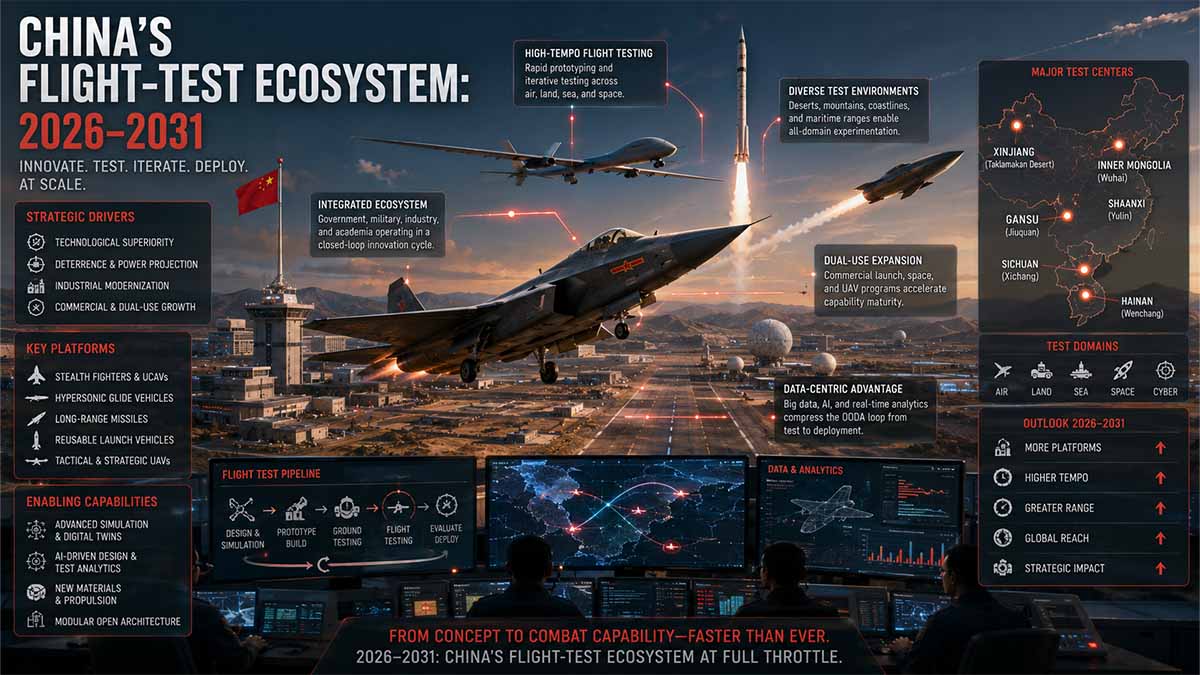
- BLUF: China is constructing an integrated aerospace experimentation system, not merely developing individual aircraft.
- Two separate sixth-generation prototypes entered initial flight testing in December 2024; U.S. assessment places operational maturity around 2035.
- The decisive 2026–2031 contest concerns test capacity, propulsion, autonomous teaming, resilient C4ISR and air–space integration.
- China’s four reusable-spaceplane missions demonstrate a parallel atmospheric–orbital experimentation track.
- A rapidly proliferating ISR and communications architecture is shortening long-range sensor-to-shooter cycles.
- Baseline judgment: 36% probability that distributed, iterative capability maturation becomes the dominant pathway through 2031.
- A Taiwan-driven acceleration pathway carries 27%, while deeper air–space convergence carries 18%.
- Propulsion, semiconductors, software assurance, corruption and test-validation complexity remain material brakes.
- Site-specific claims about the present configuration of the Lop Nur flight facility remain excluded where no primary institution confirms them.
- Strategic effect by 2031: stronger Chinese deterrence and coercive leverage, but probably not a fully mature sixth-generation combat force.
China’s Airpower Test: From Prototype to Warfighting System
China’s next airpower revolution will not be decided by the silhouette of a new aircraft. It will be decided by whether Beijing can connect experimental platforms to satellites, command networks, autonomous systems, electronic warfare, secure software, mass production and wartime logistics. Between 2026 and 2031, this conversion process will shape the military balance around Taiwan more decisively than any isolated first flight. The strategic contest is already moving from engineering achievement to operational endurance: can China maintain an integrated kill chain while communications are disrupted, bases are attacked and supply networks are compromised? And can Taiwan and its partners make that conversion sufficiently uncertain, expensive and reversible to preserve deterrence? The answer will determine whether Beijing remains within coercion below the threshold of war—or acquires confidence in blockade and limited-force options.
The Aircraft Is Not the System
The Pentagon’s report of 23 December 2025 recorded the initial flights of two Chinese sixth-generation aircraft prototypes in December 2024 and assessed that they were not expected to become operational before 2035.¹ That timetable matters because the critical work of the next five years will occur largely outside the public spectacle of flight testing.
A prototype demonstrates that propulsion, aerodynamics and flight controls can function within a defined envelope. A combat system must do far more. It must fuse sensors, exchange trusted tracks, receive targeting updates, coordinate manned and unmanned aircraft, operate under electronic attack, employ representative weapons and return quickly enough to generate another sortie. It must also be maintainable by ordinary operational units rather than by engineers attached to an experimental programme.
China’s real strategic project is therefore an architecture. The People’s Liberation Army’s Multi-Domain Precision Warfare concept is intended to connect reconnaissance, command, cyber, space, electronic warfare and precision strike. Its effectiveness will depend not on maximum laboratory performance but on graceful degradation: whether isolated formations can continue operating when satellites, airborne command posts or long-haul datalinks become unreliable.
The Orbital Backbone
The scale of China’s space expansion gives that architecture reach. The United States Space Force reported in August 2026 that China had placed 1,506 payloads in orbit and operated more than 510 intelligence, surveillance and reconnaissance-capable satellites by June 2026.² It also recorded four Chinese spaceplane missions and rapid expansion of the G60 and SatNet communications constellations.
These assets can improve target detection, revisit rates, navigation and communications redundancy. They also create dependence on terrestrial gateways, data-processing centres, cryptographic infrastructure and software that reconciles information from different constellations. More satellites do not automatically produce a more reliable operational picture. If several sensors generate conflicting tracks, the decisive variable becomes the system’s ability to establish provenance and confidence before weapons are released.
The institutional reorganisation launched by Xi Jinping on 19 April 2024 is consequently central. The new Information Support Force was established to strengthen force-wide network and communications support, while aerospace and cyberspace organisations retained responsibility for space and cyber operations. The unresolved question is whether greater central coordination will coexist with sufficient tactical delegation. A highly centralized system may process information efficiently in controlled conditions yet slow sharply when headquarters communications are interrupted or data integrity becomes uncertain.
Taiwan’s Moving Baseline
The military baseline around Taiwan has already changed. According to the Pentagon’s 23 December 2025 report, Taiwan detected approximately 2,771 PLA aircraft in its air-defence identification zone during the period counted through late November 2024, compared with approximately 1,703 during calendar year 2023. The report recorded 38 joint patrols during calendar year 2024 and stated that Joint Sword-2024B produced 111 aircraft crossings of the Taiwan Strait centreline while 34 PLA and China Coast Guard vessels operated around the island.¹
These figures do not establish that Beijing has decided to attack. They show that the distance between routine pressure and operational concentration is narrowing. China can increase the size of an exercise, introduce coast-guard enforcement, activate cyber operations or extend exclusion zones without the unmistakable mobilization traditionally associated with invasion.
This is why 2027 must be interpreted correctly. The Pentagon describes it as a PLA modernization objective linked to mechanization, informatization and intelligentization—not as a publicly established invasion deadline. Beijing’s strategic value lies in possessing credible options. The more rapidly it can convert routine deployments into quarantine, blockade or strike operations, the more difficult it becomes for Taiwan and allied governments to determine when warning has become crisis.
Blockade Before Invasion
A joint island-landing campaign would require the PLA to establish and maintain air and maritime superiority, secure crossing routes, break coastal defenses, build beachheads and sustain large forces under attack. The same Pentagon report states that the PLA Navy has not visibly expanded its conventional landing ships and medium landing craft sufficiently to eliminate its lift shortfall, although exercises with civilian roll-on/roll-off vessels indicate an effort to mitigate that constraint.¹
A blockade or selective quarantine presents a different strategic problem. China could combine naval and air power with coast-guard inspections, missile threats, electronic interference, cyber operations and information control. Joint Sword-2024A and Joint Sword-2024B rehearsed operations against major ports and naval bases, while the participation of the China Coast Guard introduced an instrument capable of operating within deliberately contested legal territory.
This is the most consequential connection between experimental airpower and Taiwan strategy. Advanced aircraft, unmanned sensors and space-based reconnaissance need not be mature enough to support occupation before they become useful in enforcing isolation. They can widen surveillance, classify shipping, protect exclusion zones, relay targeting information and complicate allied access. The conversion threshold for blockade support is therefore lower than the threshold for successful invasion.
Autonomy’s Hidden Burden
Chinese unmanned programmes are expanding across reconnaissance, electronic warfare, communications relay, early warning and strike. Yet autonomy produces operational advantage only when it reduces the demand for pilots, controllers, bandwidth and mission planners. A remotely controlled aircraft may expose a cheaper platform to danger, but it can also require continuous communications, dedicated crews, additional spectrum and separate maintenance.
The Pentagon’s 23 December 2025 assessment states that developmental Chinese AI-enabled unmanned systems generally remain dependent on preprogramming, remote piloting or extensive human input; many public claims concerning swarms and loyal-wingman operations remain aspirational or limited to narrow demonstrations.¹
The likely transition before 2031 is therefore bounded mission autonomy rather than unrestricted independent combat decision-making. Unmanned aircraft can be assigned defined reconnaissance sectors, relay stations, decoy routes or electronic-support tasks while crewed platforms retain tactical authority. The decisive indicators will be common control systems, stable payload interfaces, repeated multi-aircraft missions, predictable loss-of-link behaviour and evidence that one crew can supervise several heterogeneous aircraft without proportional growth in workload.
The Cyber Opening Move
Cyber operations may precede any visible military crisis. The Pentagon reported that Chinese state-sponsored activity during calendar year 2024 compromised a network of approximately 200,000 internet-connected devices worldwide and assessed that targeting associated with Volt Typhoon probably sought options capable of obstructing American support for Taiwan.¹ The Office of the Director of National Intelligence stated in March 2025 that Chinese cyber operations during an imminent conflict could interfere with deployment, impede decision-making and generate public disruption.³
The most dangerous attack may not be a dramatic blackout. It may be the silent corruption of port manifests, fuel data, electronic threat libraries, maintenance records or military tracks. Such manipulation can slow mobilization while allowing institutions to believe that their systems remain functional.
Cyber resilience must therefore be assessed through recovery and continuity rather than presumed exclusion of attackers. Taiwan and allied forces require authenticated data provenance, segmented networks, clean backups, alternative communications, manual operating procedures and the ability to mobilize while parts of the digital environment remain untrusted. In this domain, the distinction between espionage and preparation for conflict may remain invisible until access is activated.
Taiwan’s Industrial Answer
Taipei is responding with a strategy that connects asymmetric defense, digital resilience and domestic industry. On 30 April 2026, Premier Cho Jung-tai’s Executive Yuan announced a planned special budget of NT$1.25 trillion, officially presented as approximately US$39.6 billion, for the period 2026–2033.⁴ Its three declared priorities are the T-Dome air-and-missile-defense system, an AI-enabled kill chain and greater defense-industrial self-reliance.
President Lai Ching-te stated on 9 October 2025 that Taiwan’s defense expenditure, measured under the NATO definition, would exceed 3 per cent of GDP in 2026 and was expected to reach 5 per cent by 2030.⁵ The strategic test is implementation. Fiscal authorization must become contracts, delivered systems, ammunition, trained crews, protected communications, dispersed depots and repair capacity.
Taiwan cannot match China’s industrial scale. It can, however, exploit its semiconductor, information-technology and precision-manufacturing base to produce expendable unmanned systems, secure communications, sensors and components that are dispersed, replaceable and difficult to neutralize simultaneously. Deterrence will depend on whether these investments allow the state to remain governable and militarily coherent during isolation.
The Allied Conversion
China’s progress is being met by a regional architecture designed around denial, dispersion and industrial resilience. On 16 April 2026, Australia released its National Defence Strategy and Integrated Investment Program, allocating A$425 billion over a decade, including A$53 billion in new funding, for capabilities including undersea warfare, long-range strike, integrated air and missile defense, autonomous systems, counter-drone systems and secure multi-orbit satellite communications.⁶
Japan and Australia established a Framework for Strategic Defence Coordination on 7 December 2025 covering intelligence, space, cyber, integrated air and missile defense, industry and consultation from peacetime through contingencies.⁷ The United States Government Accountability Office reported on 6 August 2026 that the Partnership for Indo-Pacific Industrial Resilience comprised 15 allies and partners, with munitions production among its areas of cooperation.⁸
The weakness is logistical. Distributed operations require fuel, protected bases, repair teams, stockpiles, sealift, airlift and common command standards. Agreements must become rehearsed operations; industrial partnerships must produce deliverable inventories; political consultations must generate decisions at the speed of a crisis.
Europe’s Exposure
The European Commission’s White Paper for European Defence – Readiness 2030, presented on 19 March 2025, states that China’s military modernization is altering the Indo-Pacific balance and that escalation around Taiwan would carry profound economic and strategic consequences for Europe.⁹ The document connects this exposure to cyberattack, interference with navigation and satellite systems, industrial espionage, critical technologies and vulnerable supply chains.
Europe’s role is not confined to naval deployments. It includes semiconductor resilience, protection of ports and communications, export-control coordination, cyber defense, financial contingency planning and the capacity to replenish air-defense interceptors, precision weapons and electronic components. A quarantine could force European governments to decide whether Chinese inspections constitute legitimate enforcement, coercion or blockade—while shipping companies and insurers make their own decisions within hours.
That ambiguity is itself an instrument of power. Prepared positions, diversified supply chains and coordinated economic measures can raise the expected cost of coercion before a crisis begins. Improvisation after commercial traffic has already changed course would surrender the initiative.
The Decisive Clock
The period from 2026 to 2031 is not simply an invasion window. It is a competitive conversion cycle. China is attempting to transform prototypes, satellites, cyber access and joint exercises into a resilient operational system. Taiwan is trying to convert technology and fiscal commitments into denial and national endurance. The United States, Japan and Australia are turning access, interoperability and industrial cooperation into a distributed regional posture. Europe is beginning to treat Taiwan as an economic-security contingency rather than a distant naval question.
The strategic balance will turn on failure tolerance. Can Chinese forces continue after network fragmentation, satellite degradation and logistical loss? Can Taiwan preserve government, communications and military cohesion during quarantine or blockade? Can allied forces operate when fuel, bases and digital systems are under attack?
The first side to answer those questions convincingly will shape Beijing’s calculation. The aircraft may be sixth-generation. The decisive capability will be the system that can still fight after its original plan has failed.
Navigational Index
- The Experimental Architecture — Flight-test capacity, sixth-generation aircraft, unmanned systems, propulsion, spaceplanes and distributed validation infrastructure.
- The Operational Conversion Problem — Transition from prototypes to resilient C4ISR, autonomous teaming, electronic warfare, production readiness and combat-effective force packages.
- The 2026–2031 Strategic Horizon — Bayesian hypotheses, Monte Carlo distributions, Taiwan contingencies, industrial constraints, cyber exposure and allied counter-adaptation.
Master Abstract
The most consequential development in Chinese aerospace power is not the appearance of any single tailless prototype, bomber concept or reusable spacecraft. It is the emergence of a vertically connected experimentation architecture able to move technologies between laboratories, state-owned manufacturers, military test organizations, space programs and operational commands. The strongest primary-source baseline comes from the United States’ 2025 military assessment, which records the initial flights of two separate Chinese sixth-generation prototypes in December 2024, associates the prospective class with air-to-air, air-to-surface and uncrewed-aircraft-control missions, and assesses that operational service is more likely around 2035 than within the present five-year window. The same assessment reports that China’s aviation industry displayed a broad portfolio of new aircraft and UAVs during 2024, including tailless designs, a two-seat J-20 concept intended to control loyal-wingman platforms, air-launched swarm modules and the KJ-3000 airborne early-warning program. It also identifies persistent propulsion barriers and describes advertised military artificial intelligence as uneven: some capabilities remain aspirational, while present systems generally retain extensive human programming or control. These findings establish a crucial distinction between visible flight and deployable combat capability. A prototype sortie verifies only part of the aerodynamic, propulsion and flight-control problem; it does not demonstrate low-observable maintainability, mission-system stability, secure collaborative autonomy, weapons separation, electronic-warfare resilience, operational availability or affordable serial production. Baseline evidence: two sixth-generation prototypes, an expected operational horizon around 2035, more than 359 ISR satellites as of January 2024 and probable Chinese conventional strike effectiveness extending approximately 1,500–2,000 nautical miles if fielded at sufficient density — 2025 Annual Report to Congress: Military and Security Developments Involving the People’s Republic of China – U.S. Department of Defense – December 2025. The report therefore treats the Lop Nur node as one potential component of a larger national system, not as a self-sufficient explanation. Primary international documentation verifies Lop Nor’s historical nuclear-test function, including digitized records from 26 atmospheric and underground explosions between 1966 and 1996, but it does not authenticate contemporary airfield geometry, hangar functions or aircraft deployments. Those site-level assertions are consequently withheld — Features of Nuclear Explosion and Earthquake Waveforms from the Lop Nor Test Site Area – CTBTO Science and Technology Conference – June 2023.
The second analytical layer is air–space convergence. Beijing’s own policy documentation states that China intended to strengthen reusable space-transport technologies and conduct corresponding flight tests, placing reusable systems inside a national program of technological self-reliance, industrial coordination and security-enhancing space power — China’s Space Program: A 2021 Perspective – State Council Information Office of the People’s Republic of China – January 2022. Subsequent official Chinese reporting states that the Shijian-19 mission validated a new reusable returnable space-experiment platform and that multiple reusable-launch projects had entered progressively more demanding engineering tests — 实践十九号卫星成功回收!还有这些“可重复使用”航天器你知道吗 – State Administration of Science, Technology and Industry for National Defense – October 2024. On 19 August 2026, a Chinese national science-and-technology authority reported the country’s first recovery of a launch-vehicle first stage using landing legs, describing the event as a transition from recovery-technology demonstration toward engineering validation for reuse — 定格!朱雀三号遥二运载火箭创造中国首次:以陆支腿方式“归巢” – National Center for Science and Technology Innovation – August 2026. The external military baseline is still more revealing: the U.S. Space Force records four Chinese reusable-spaceplane missions, with the fourth launched in February 2026, and reports 200 G60 plus 168 SatNet communications satellites in low Earth orbit as of 1 June 2026. It explicitly connects China’s improving space architecture and standoff weapons with long-range precision-strike enablement — Space Threat Fact Sheet – United States Space Force – August 2026. The inference is not that every reusable vehicle is a weapon or that civilian launch infrastructure automatically becomes military infrastructure. It is that common competencies—thermal protection, autonomous guidance, high-speed telemetry, fault-tolerant software, rapid turnaround, range instrumentation and precision recovery—reduce technical uncertainty across both civil and military portfolios. By 2031, China’s advantage could therefore arise less from a revolutionary airframe than from a denser experimental cycle linking aircraft, orbital sensors, communications constellations, electronic-warfare systems and machine-assisted mission planning.
The structured forecast evaluates five mutually exclusive dominant pathways. H₁, distributed convergence, begins with a 34% prior and rises to a 36% posterior: China continues parallel maturation of crewed prototypes, collaborative UAVs, airborne sensing, propulsion and space support without forcing premature operational declaration. H₂, Taiwan-centered acceleration, moves from 25% to 27% because Beijing’s 2027 modernization objectives, growing joint-force pressure architecture and the strategic priority of the First Island Chain create incentives to transition selected subsystems early, even if the complete sixth-generation system remains immature. H₃, air–space fusion breakthrough, moves from 16% to 18%, reflecting reusable-spaceplane persistence, expanding low-orbit communications and ISR, and the possibility that operational value emerges first through reconnaissance, targeting, data relay and rapid experimentation rather than through a single combat platform. H₄, industrial and institutional friction, declines from 20% to 14% but remains material because advanced propulsion, high-performance semiconductors, software verification, low-observable manufacturing, procurement corruption and realistic joint testing can create nonlinear delays. H₅, strategic surprise, remains at 5% and captures an unexpectedly rapid transition of a large low-observable platform or reusable aerospace vehicle into limited operational service. These posteriors are structured judgments, not observed frequencies; they are updated through ACH consistency scoring against confirmed indicators and tested through a Monte Carlo model that varies test tempo, industrial resilience, autonomy maturity, external technological pressure and crisis demand. Financing must also be treated as a shadow variable: the Pentagon estimates China’s total 2024 defence expenditure at USD 304–377 billion, between 32% and 63% above the announced USD 231 billion, and notes that military-civil fusion can shift research expenditure outside conventional defence accounts — 2025 Annual Report to Congress: Military and Security Developments Involving the People’s Republic of China – U.S. Department of Defense – December 2025. Cyber-enabled acquisition and pre-positioning form another shadow dimension: an August 2026 joint FBI–NSA–Cyber National Mission Force advisory documents a commercial enabling network linked to Chinese state organs, former PLA personnel, exploit brokering and targeting of defence-industrial, communications and critical-infrastructure systems — China-Linked Hacking Group QTFY Targets Military and Critical Infrastructure with Malicious Distributed Systems – FBI, NSA and Cyber National Mission Force – August 2026. European exposure is therefore technological, economic and strategic: the European Commission assesses that China’s quantitative and qualitative modernization across nuclear, space and cyber capabilities is altering the Indo-Pacific balance and that a Taiwan disruption would carry profound European consequences — White Paper for European Defence – European Commission – March 2025.
China Flight-Test Horizon
The Experimental Architecture: China’s Flight-Test System to 2031
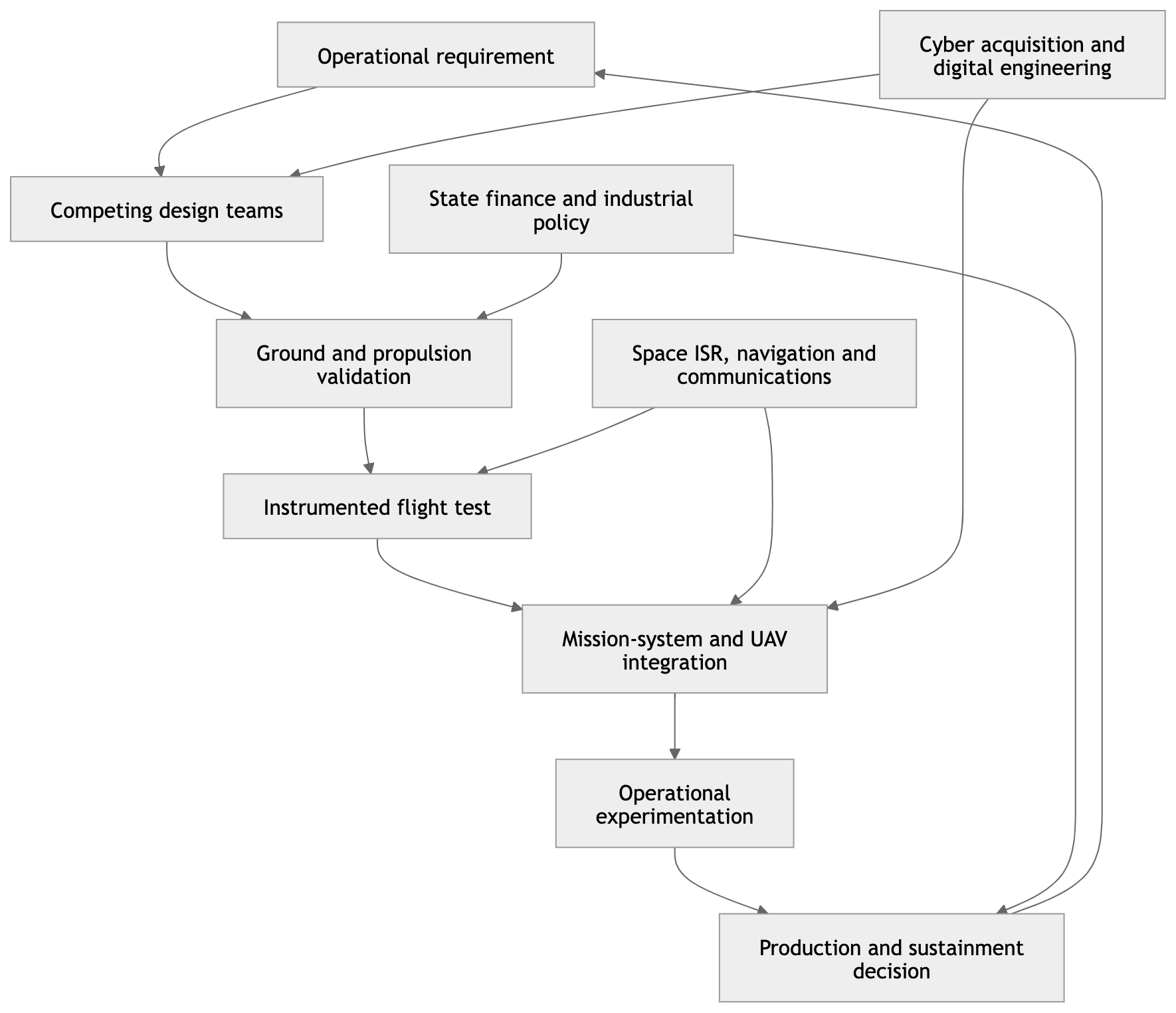
China’s experimental aerospace architecture must be assessed as a national conversion system rather than a collection of secret airfields or visually striking prototypes. Its strategic function is to reduce uncertainty between scientific discovery, prototype manufacture, instrumented flight, operational experimentation and serial production. This distinction matters because the December 2024 initial flights of two separate sixth-generation aircraft demonstrated the existence of competing development pathways, but did not establish propulsion maturity, low-observable durability, mission-system integration, weapons compatibility, autonomous teaming or production readiness. The official United States assessment expects Chinese sixth-generation aircraft to support air-to-air, air-to-surface and uncrewed-aircraft-control missions, yet places operational maturity around 2035, outside the present forecast window. It also records the initial flight of the KJ-3000 airborne early-warning aircraft, intended to combine digital radar, passive detection, anti-jamming and target identification. Official Title: 2025 Annual Report to Congress: Military and Security Developments Involving the People’s Republic of China – U.S. Department of Defense – December 2025 — verified primary document. The analytical baseline must therefore separate three evidentiary categories. Confirmed capabilities include documented prototype flights, audited industrial expenditure, declared reusable-spacecraft missions and officially assessed space infrastructure. Probable capabilities include distributed telemetry, propulsion benches, digital engineering environments and operational test detachments logically required by the confirmed programs. Speculative claims include the precise mission of individual hangars, the permanent assignment of particular prototypes and assumptions that runway dimensions alone reveal platform type. No primary government source inspected in this session confirms the current internal configuration or aircraft allocation of the airfield commonly associated with the Lop Nur region; those claims are excluded. The architecture can nevertheless be reconstructed from its observable functional outputs: parallel prototype development, expanding state-controlled aerospace companies, reusable orbital experimentation, growing unmanned-system production and a C4ISR structure designed to convert test results into operational effects.
Flight-Test Capacity as a System Property
Flight-test capacity is not measured primarily by runway length or hangar count. It is the combined ability to schedule sorties, configure prototypes, collect synchronized telemetry, reproduce anomalies, modify hardware and software, protect sensitive signatures, certify subsystems and return an aircraft to flight without allowing one bottleneck to idle the entire program. China’s emerging structure appears increasingly distributed: Chengdu and Shenyang provide competing combat-aircraft design and manufacturing pathways; Xi’an supplies large-airframe, transport and airborne-surveillance expertise; the national aero-engine complex provides propulsion manufacture, bench testing and overhaul; specialist UAV enterprises contribute autonomous-control, long-endurance and mission-payload competencies; and the space sector supplies launch, re-entry, telemetry, navigation and increasingly persistent orbital communications. The organizational significance is visible in audited disclosures. AVIC Shenyang Aircraft described itself in 2025 as an integrated research, production, testing, flight-testing, maintenance and support enterprise. It reported revenue of RMB 44.656 billion, research expenditure of RMB 1.097 billion, a 50.8% annual increase in expensed research expenditure, and 3,807 research personnel, representing 23.15% of its workforce. The company simultaneously warned that complex supply chains, quality control extending from development through flight testing, and immature technologies could produce cost overruns or schedule delays. Official Title: 中航沈飞股份有限公司2025年年度报告 – AVIC Shenyang Aircraft Company, audited annual report – March 2026 — verified audited filing. These figures do not disclose individual military programs, but they reveal the scale of the institutional substrate: a large state-controlled manufacturer possesses an internal chain extending beyond fabrication into flight validation and lifetime support. That integration reduces hand-off delay, preserves classified data inside a controlled enterprise and allows manufacturing feedback to reach design teams rapidly. Its weakness is corresponding concentration risk: deficiencies in common suppliers, quality processes or propulsion interfaces can propagate across multiple variants and suppress apparent test capacity even when physical infrastructure continues expanding.
| Experimental layer | Principal function | Capacity indicator | Main bottleneck | 2026–2031 intelligence signal |
|---|---|---|---|---|
| Digital engineering | Aerodynamic, thermal, signature and mission-system modelling | Parallel design baselines; hardware-in-the-loop throughput | Model-validation error; software configuration drift | Shorter interval between visible prototype modifications |
| Ground validation | Structural, propulsion, electromagnetic and environmental testing | Number of rigs; duty cycles; instrumented test hours | Engine availability; sensor calibration; classified-component supply | New test cells, increased engine inventories, repeated high-temperature trials |
| Flight sciences | Envelope expansion, handling qualities and safety | Instrumented aircraft; test pilots; telemetry channels | Weather, range scheduling, prototype losses | Simultaneous programs operating from separated locations |
| Mission systems | Radar, EW, data links, weapons and autonomy | Secure software releases; representative threat environments | Semiconductor access; software assurance; electromagnetic interference | New radomes, datalink trials, companion UAV appearances |
| Operational test | Formation tactics, joint C4ISR and maintainability | Representative units; sortie generation; dispersed support | Training realism; command integration; maintenance burden | Prototypes operating away from manufacturer airfields |
| Industrial conversion | Tooling, quality control and serial production | Supplier readiness; production learning; engine delivery | Yield, tolerances, working capital and classified procurement | Capital expenditure, inventories, supplier consolidation |
| Space support | ISR, communications, navigation and re-entry validation | Orbital persistence; latency; reusable mission duration | Launch cadence, survivability, ground-segment exposure | Longer spaceplane missions and proliferated LEO networks |
The architecture’s central advantage is parallelism. Two prototype families can explore different aerodynamic and operational solutions while sharing enabling technologies such as advanced composites, flight-control algorithms, distributed apertures, secure communications, power management and weapons-integration methods. Parallelism lowers the risk that one failed concept terminates the entire effort, but it increases demand for scarce propulsion units, experienced test pilots, electromagnetic ranges, telemetry analysts and configuration-control specialists. A sixth-generation program is particularly sensitive to configuration divergence because its effectiveness depends on the interaction of airframe shaping, propulsion, thermal management, sensors, software, weapons and uncrewed collaborators. A design change improving one variable can degrade several others: larger apertures increase electrical and cooling demand; greater internal fuel changes structural loading; new engine operating modes alter infrared signatures; additional antennas can compromise low-observable shaping; and autonomy software may require processing hardware constrained by semiconductor controls. China’s distributed architecture can manage these problems only if every test creates reusable evidence rather than isolated program knowledge. The likely flow is therefore not linear but recursive: modelling produces a prototype configuration; ground tests constrain the safe flight envelope; flight data update aerodynamic and structural models; mission-system trials expose electromagnetic conflicts; operational units test tactics and maintenance; and industrial organizations redesign tooling or components before the next configuration. This loop also explains why new physical capacity matters even when no revolutionary aircraft becomes operational: additional aprons, shelters, telemetry nodes, engine-run areas and secure workshops—where independently confirmed—raise the number of configurations that can be evaluated concurrently and reduce interference between unrelated programs. The strongest observable indicator is not total infrastructure area but cycle time: the interval between initial flight, major configuration revision, multi-aircraft operation, weapons testing and deployment to an operationally representative location. If this interval contracts consistently through 2028, it would support the hypothesis that China has improved its institutional test-and-evaluation machinery, rather than merely increasing the number of experimental airframes.
Sixth-Generation Aircraft: The Integration Burden
The sixth-generation vector should be understood as a system-of-systems maturation problem in which aerodynamic novelty is visible but operational integration remains largely hidden. The official evidence supports the existence of two prototypes and assigns them potential roles in crewed-uncrewed coordination, but it does not authenticate popular designations, published dimensions, engine types or claimed mission radii. The most probable development logic is that the two designs are testing different compromises among range, payload, agility, broadband signature control, sensor aperture, electrical power and command responsibility for collaborative aircraft. A large tailless platform can offer internal volume, fuel fraction and low observable performance against selected radar aspects, yet it creates demanding pitch-yaw control, structural elasticity, inlet-distortion and thermal-management problems. Those problems multiply when the aircraft must transmit, receive and fuse large data volumes without revealing itself electromagnetically. The test sequence must consequently progress through increasingly difficult gates: basic flight safety; envelope expansion; propulsion transients; sensor calibration; passive and active detection; secure data links; electronic attack; weapons separation; cooperative targeting; degraded-navigation operation; and finally mission execution within a contested electromagnetic environment. The Department of Defense’s expectation of operational maturity near 2035 is consistent with this burden and should prevent the analytical error of treating a prototype’s appearance as evidence of imminent combat deployment. Official Title: 2025 Annual Report to Congress: Military and Security Developments Involving the People’s Republic of China – U.S. Department of Defense – December 2025 — verified primary document. Between 2026 and 2031, the highest-probability outcome is therefore not full sixth-generation initial operational capability, but a portfolio of transferable subsystems: refined tailless flight-control laws, improved large-aperture sensing, greater internal carriage, better thermal control, secure control of uncrewed aircraft and new long-range operational concepts. Some of these technologies could enter upgraded fifth-generation aircraft or specialized command platforms before the complete sixth-generation design is ready, giving the PLA incremental operational value while preserving strategic ambiguity about the final platform.
Unmanned Systems and Collaborative Combat Architecture
Unmanned systems are the experimental architecture’s principal force multiplier because they permit China to test autonomy, attritable mass, distributed sensing and human-machine command relationships without waiting for every sixth-generation component to mature. The underlying industrial trajectory is visible in an audited filing by AVIC Chengdu UAV. The company reported RMB 3.016 billion in 2025 principal-business revenue, an increase of 340.11%, while total research investment reached RMB 336.97 million, or 11.17% of revenue; research investment increased 25.69%, and capitalized research expenditure rose 220.22%. The company recorded 62 new invention-patent applications and identified high-performance autonomous control and decision technology for aerospace vehicles among its recognized technical work. Official Title: 中航(成都)无人机系统股份有限公司2025年年度报告 – AVIC Chengdu UAV, audited annual report – March 2026 — verified audited filing. These data demonstrate scaling and research intensity, not autonomous combat competence: revenue growth may reflect delivery timing, existing contracts or production recovery, while capitalized research can shift expenditure recognition without proving technical success. Nevertheless, the combination of production acceleration, research capitalization and patent activity is consistent with an industry moving from isolated air vehicles toward reusable families of platforms, payloads and control software. The critical test variable through 2031 will be the level of autonomy under disruption. Remote piloting through reliable communications is fundamentally different from collaborative autonomy under jamming, cyberattack, deceptive targets and intermittent control. A credible crewed-uncrewed package must allocate tasks dynamically, preserve safe separation, prevent fratricide, authenticate commands, manage emissions and recover from lost connectivity. Testing must also determine how much authority remains with the crewed aircraft, how many uncrewed vehicles one crew can supervise, and whether autonomy reduces or merely relocates cognitive load. The strongest future indicators will be multi-aircraft tests in representative formations, autonomous recovery after datalink interruption, airborne re-tasking, passive cooperative geolocation, distributed electronic attack and evidence that identical mission software operates across several UAV classes.
Propulsion: The Governing Constraint
Propulsion remains the architecture’s most consequential physical constraint because it determines range, sustained electrical generation, thermal margins, payload, acceleration, maintainability and the feasible shape of an aircraft. China possesses a large aero-engine industrial base, but audited data reveal that scale does not eliminate maturity risk. AECC Aviation Power reported RMB 46.331 billion in 2025 revenue, of which RMB 43.476 billion came from aero-engines and derivative products. It employed 9,888 research personnel—32.5% of its workforce—and invested RMB 885.33 million in research. The company stated that aero-engine and derivative revenue declined 3.37%, that customer demand changes and deliveries below expectations affected performance, that the maturity of newer products still required improvement, and that the value of relevant ending inventories increased 58.9%. It also described continuing work on additive manufacturing, coatings, advanced materials, precision machining, assembly, engine runs, testing and production-maturity improvement for new-generation engines. Official Title: 中国航发动力股份有限公司2025年年度报告 – AECC Aviation Power, audited annual report – April 2026 — verified audited filing. None of these figures can be assigned directly to a particular military engine, but together they provide unusually valuable shadow indicators. Rising inventory alongside lower-than-expected delivery can signal timing mismatches, acceptance delays, incomplete downstream integration or deliberate stock accumulation; it cannot be reduced automatically to technical failure. Similarly, a lower annual research figure may reflect program phasing rather than reduced strategic effort. The five-year assessment should therefore track propulsion through converging indicators: expansion of test-cell utilization, changes in inventory and receivables, research staffing, supplier investment in turbine materials and coatings, engine-related prototype modifications, and the interval between new airframe flights. The decisive breakthrough would not be a single high-thrust demonstration but repeatable engine availability across multiple test articles. If prototype activity expands while engine deliveries, reliability and maintenance evidence remain constrained, flight-test capacity will become nominal rather than usable: aircraft will exist, but sortie generation and envelope expansion will lag.
Spaceplanes and the Atmospheric–Orbital Continuum
China’s reusable-spacecraft program adds a distinct experimental axis because it develops technologies that cross the boundary between aviation and space: autonomous guidance, high-energy re-entry, thermal protection, long-duration power management, precision landing, reusable structures and secure orbital command. China’s National Space Administration confirmed that a reusable experimental spacecraft was launched from Jiuquan on 7 February 2026 using a Long March-2F and would conduct reusable-spacecraft technology verification. Official Title: 我国成功发射可重复使用试验航天器 – China National Space Administration – February 2026 — verified Chinese government source. The United States Space Force separately assesses that China has undertaken four reusable-spaceplane missions: the first lasted two days, the second and third approximately nine months, and the fourth began in February 2026. It explicitly links China’s improving space-based capabilities and standoff weapons to long-range precision-strike enablement. Official Title: Space Threat Fact Sheet – United States Space Force – August 2026 — verified primary source. China’s official space white paper had already identified reusable space-transport systems and related flight demonstrations as priorities, placing them within a state strategy that combines scientific, industrial, economic and national-security objectives. Official Title: 《2021中国的航天》白皮书 – State Council Information Office of the People’s Republic of China – January 2022 — verified Chinese government source. The correct inference is not that the spaceplane is necessarily an orbital strike platform; the available primary evidence does not establish its payload, military mission or wartime concept. Its architectural significance lies instead in repeated, long-duration experimentation and recovery. Every successful mission can validate components, materials, software and operational procedures under conditions unattainable in conventional aircraft testing, while orbital persistence permits observations of manoeuvrability, tracking responses and ground-control reliability. Through 2031, mission duration, orbital manoeuvres, recovery intervals and turnaround time will matter more than unverified payload speculation.
Distributed Validation, Cyber Exposure and Shadow Liquidity
Distributed validation increases resilience but also enlarges the attack surface. A national network linking design bureaus, manufacturers, propulsion enterprises, UAV developers, launch sites, telemetry stations, universities and operational commands can run more experiments in parallel and preserve program continuity if one facility becomes unavailable. It also produces more interfaces through which configuration errors, compromised software, counterfeit components, corrupted telemetry or unauthorized access can enter the development chain. The most sensitive target is not necessarily a finished design file. Adversaries can obtain strategic value from engine-life data, defect logs, electromagnetic-test results, software dependencies, supplier tolerances and the schedule of failed trials. Cybersecurity must consequently be treated as an experimental-capacity variable rather than a separate support function: a compromised data environment can invalidate months of testing even without destroying physical infrastructure. Liquidity is similarly obscured. Direct corporate research expenditure captures only the portion recognized by listed companies; it excludes classified state research, university programs, customer-funded development, military procurement, local-government infrastructure, state-bank lending and expenditure located inside unlisted parent groups. The Department of Defense estimated China’s total 2024 defence spending at USD 304–377 billion, between 32% and 63% above the announced budget of USD 231 billion, while noting that military-civil fusion can move research activity outside conventional defence accounts. Official Title: 2025 Annual Report to Congress: Military and Security Developments Involving the People’s Republic of China – U.S. Department of Defense – December 2025 — verified primary document. “Mercenary dynamics” are not a central driver in this aerospace vector; the more relevant shadow labor market consists of state-directed talent recruitment, university laboratories, commercial software companies, specialist subcontractors and former military technicians. The analytical challenge is to identify when these dispersed assets begin acting as one validation enterprise rather than independent technology pools.
| Shadow dimension | Observable proxy | Analytical value | Deception or misreading risk | Warning threshold |
|---|---|---|---|---|
| Classified liquidity | State-company advances, capital expenditure, inventory, related-party transactions | Reveals resources entering development outside headline budgets | Working-capital changes may reflect ordinary delivery cycles | Simultaneous increases across airframe, engine, UAV and test-infrastructure entities |
| Human capital | Research headcount, laboratory recruitment, test-pilot and software vacancies | Indicates capacity to absorb parallel programs | Headcount does not measure experience or security clearance | Persistent growth in propulsion, autonomy and electromagnetic-test specialists |
| Cyber acquisition | Supplier compromises, exploit procurement, targeting of aerospace institutions | May shorten foreign-technology assimilation | Attribution uncertainty and duplicated reporting | Repeated compromise of design, semiconductor and industrial-control networks |
| Software assurance | Update cadence, simulation infrastructure, hardware-in-the-loop testing | Governs autonomy and mission-system reliability | Demonstrations may use controlled environments | Successful degraded-link and adversarial-data trials |
| Test attrition | Long pauses, replacement prototypes, altered configurations | Distinguishes normal learning from program failure | Secrecy can mimic inactivity | Multi-year interruption after early envelope expansion |
| Strategic cooperation | Joint patrols, shared exercises, maintenance interaction | Offers operational feedback and comparative experience | Exercises do not imply design-data transfer | Increasingly complex bomber, fighter and command-system integration |
Competing Hypotheses and Bayesian Update
The Analysis of Competing Hypotheses evaluates five mutually exclusive propositions concerning the dominant condition of the experimental architecture by the end of 2031. H₁, distributed convergence, assumes that China will maintain several airframe, UAV, propulsion and space projects in parallel, harvesting transferable technologies without forcing a premature declaration of full sixth-generation operational capability. H₂, contingency-driven acceleration, assumes that Taiwan-related military requirements or a deterioration in the regional balance will compress testing, shift resources toward deployable subsystems and accept elevated technical risk. H₃, air–space integration breakthrough, assumes that reusable-spacecraft, proliferated orbital networks and long-range airborne systems will generate operational value faster than the crewed sixth-generation airframes themselves. H₄, propulsion and institutional drag, assumes that engine maturity, quality control, procurement disruption, software verification and program governance will prevent infrastructure expansion from becoming proportional operational output. H₅, strategic surprise, assumes that the visible evidence substantially understates maturity and that China will demonstrate a limited but credible integrated capability before 2031. Priors were set at 34%, 22%, 16%, 23% and 5%. Evidence E₁—two separate prototype flights—raises H₁ and H₂. E₂—an external operational estimate near 2035—reduces H₅ and moderates H₂. E₃—four reusable-spaceplane missions—raises H₃. E₄—rapid UAV revenue growth and research capitalization—raises H₁ and H₂ but only modestly because corporate growth does not demonstrate contested autonomy. E₅—documented propulsion maturity and delivery concerns—raises H₄. E₆—large research workforces and integrated test organizations—raises H₁. The resulting posteriors are 38% for H₁, 24% for H₂, 17% for H₃, 16% for H₄ and 5% for H₅. These are disciplined analytic judgments rather than measured frequencies. Their value lies in making assumptions falsifiable: simultaneous weapons trials, multi-aircraft collaborative operations and shortened redesign cycles would raise H₂; repeated long-duration orbital missions with faster relaunch would raise H₃; engine-related pauses, rising unaccepted inventory or reduced prototype utilization would raise H₄.
| Hypothesis | Prior | Posterior | Evidence most consistent | Principal disconfirming evidence |
|---|---|---|---|---|
| H₁ Distributed convergence | 34% | 38% | Parallel prototypes; integrated manufacturers; growing UAV and space experimentation | Cancellation or prolonged inactivity across multiple families |
| H₂ Contingency-driven acceleration | 22% | 24% | Taiwan-centered modernization pressure; transferable subsystem maturity | Strict adherence to long certification cycles and absence of operational trials |
| H₃ Air–space integration breakthrough | 16% | 17% | Four spaceplane missions; reusable-system policy; long-range C4ISR expansion | Long mission gaps, failed recovery or limited orbital manoeuvrability |
| H₄ Propulsion and institutional drag | 23% | 16% | New-product maturity concerns; delivery shortfalls; inventory accumulation | Reliable engine availability and sustained high-tempo envelope expansion |
| H₅ Strategic surprise before 2031 | 5% | 5% | Secrecy, multiple test channels and potential hidden maturity | Continued prototype-level activity and official estimates centred on 2035 |
Monte Carlo Outlook, 2027–2031
The Monte Carlo model uses 50,000 iterations to estimate a composite experimental-maturity index rather than platform-specific combat performance. The starting 2026 index is fixed at 31 on a 100-point scale, representing confirmed prototype flight, significant industrial depth and reusable-spacecraft experience, but incomplete evidence of integrated weapons, autonomous teaming and representative operational testing. Each iteration samples six uncertain drivers: annual flight-test-cycle improvement, propulsion-maturity conversion, autonomy reliability, validation-infrastructure availability, external technological pressure and crisis-driven schedule compression. Correlation is imposed between propulsion and sortie generation, between autonomy and mission-system integration, and between external controls and indigenous substitution investment. The model’s baseline 2031 median is 61, with a P₁₀ of 45 and P₉₀ of 77. It estimates a 68% probability that China fields operationally useful sixth-generation-derived subsystems before 2032, a 43% probability of demonstrating a credible crewed-uncrewed mission package in an operationally representative environment, an 18% probability of declaring a limited sixth-generation initial operational capability, and a 22% probability that propulsion, software assurance or institutional friction keeps the architecture below an index of 50. These outputs are conditional on present evidence and should not be interpreted as precise forecasts. A Taiwan crisis before 2030 increases the probability of early deployment but does not necessarily improve technical maturity: compression can raise demonstrated readiness while reducing reliability, maintainability and safety. Conversely, the absence of public prototypes would not prove stagnation because signature testing, mission-software development, propulsion endurance and orbital experimentation can proceed without visible airframe activity. The model’s most sensitive variable is not gross expenditure but validation throughput—the fraction of tests that produce trusted, configuration-controlled evidence quickly enough to influence the next design cycle. This is the variable intelligence collection should prioritize.
| Year | Baseline maturity index | Expected dominant activity | High-value indicator | Main downside risk |
|---|---|---|---|---|
| 2027 | 39 | Envelope expansion and configuration divergence | More than one revised prototype configuration; propulsion changes | Flight pauses concealed by infrastructure growth |
| 2028 | 46 | Sensor, datalink and UAV-control integration | Multi-platform cooperative trials and passive targeting | Semiconductor and software-verification constraints |
| 2029 | 53 | Weapons, EW and degraded-network testing | Separation trials, representative jamming, autonomous recovery | Test losses or immature mission software |
| 2030 | 58 | Operational experimentation and maintainability assessment | Deployment away from design centres; repeatable sortie generation | Crisis-driven premature fielding |
| 2031 | 61 | Limited force-package evaluation | Crewed-uncrewed mission package linked to space-enabled C4ISR | Propulsion life, sustainment cost and production yield |
The geopolitical consequence is an asymmetry between operational maturity and deterrent perception. China does not need a fully certified sixth-generation force to affect American, Japanese, Australian or European planning. Parallel prototypes, expanding unmanned production, reusable-spacecraft missions and a visibly deep industrial base force competitors to hedge against several possible capability combinations simultaneously. This imposes costs on adversary air defence, dispersal, hardened basing, space resilience, electronic warfare and long-range sensing. Russian relevance is more operational than technological in the verified evidence: repeated Sino-Russian strategic air patrols provide experience in long-range coordination, command procedures and political signalling, but official public material does not prove the transfer of sixth-generation designs, propulsion data or flight-test methods. The European Commission, meanwhile, assesses that China’s quantitative and qualitative modernization across nuclear, space and cyber capabilities is altering the Indo-Pacific balance and that coercion or disruption surrounding Taiwan would have profound European economic and strategic consequences. Official Title: White Paper for European Defence – Readiness 2030 – European Commission – March 2025 — verified European Union document. For European governments, the relevant exposure is not limited to a future Chinese aircraft confronting European forces. It includes pressure on semiconductor supply, competition in military and civil aerospace markets, demand for space-based warning, stress on export-control enforcement and the possibility that Chinese advances accelerate American prioritization of the Indo-Pacific. The five-year warning framework should therefore monitor cycle compression, distributed operations and subsystem migration. The strongest evidence of success would be the same engine and mission architecture appearing across multiple test articles, UAVs operating as adaptive collaborators rather than remote vehicles, space services supporting time-sensitive targeting, and prototypes sustaining repeatable sorties away from manufacturer-controlled environments. The strongest evidence of weakness would be repeated airframe redesign without mission trials, growing propulsion inventories without accepted deliveries, extended inactivity following early flights and persistent dependence on scripted autonomy.
Figure 1: Five-Year Experimental-Maturity Projection
The Operational Conversion Problem: From Prototype to Combat Force
The decisive measure of advanced-airpower development is not whether a state can fly an experimental aircraft, demonstrate an unmanned wingman, or advertise an artificial-intelligence laboratory; it is whether the state can repeatedly assemble those technologies into a survivable force package that detects, classifies, prioritizes, engages, assesses, reloads, repairs, and regenerates under active cyber, electronic, kinetic, and organizational pressure. China has crossed several enabling thresholds but has not publicly demonstrated the complete transition. Its strongest evidence lies in the architecture surrounding the aircraft: the People’s Liberation Army is developing Multi-Domain Precision Warfare around integrated C4ISR, centralized coordination, multi-source data aggregation, and AI-assisted processing, while its space, airborne early-warning, signals-intelligence, unmanned-relay, radar, and terrestrial-fiber layers extend the theoretical reach of the sensor-to-shooter system. The most authoritative public assessment nonetheless distinguishes this expanding architecture from a fully resilient combat system: developmental Chinese autonomous aircraft generally continue to depend on preprogramming, remote pilots, or extensive human input, while many descriptions of loyal-wingman and swarm performance remain aspirational or narrowly demonstrated. 2025 Annual Report to Congress: Military and Security Developments Involving the People’s Republic of China – U.S. Department of Defense – December 2025. The analytical judgment is therefore asymmetric: the probability that China fields a limited, operationally useful next-generation force package by 2031 is materially higher than the probability that the same package remains coherent after satellite degradation, datalink disruption, cyber compromise, loss of airborne command nodes, spectrum congestion, and sustained sortie generation. Prototype conversion is not one readiness event but a sequence of conditional gates; failure at any late-stage gate can render impressive platform performance operationally peripheral.
| Conversion gate | Minimum evidence required | Principal failure mode | Public-evidence judgment, August 2026 |
|---|---|---|---|
| G₁ Platform maturity | Repeatable flight envelope, reliable propulsion, representative mission systems | Demonstrator remains instrumented and maintenance-intensive | Advancing, uneven across programs |
| G₂ Mission-system integration | Stable sensor fusion, weapons interfaces, navigation and electronic support | Subsystems work separately but not concurrently | Moderate progress |
| G₃ Network integration | Secure, low-latency exchange among aircraft, space, ground and maritime nodes | Bandwidth, classification, protocol or trust mismatch | Strong investment, incomplete validation |
| G₄ Contested-spectrum resilience | Mission continuation under jamming, spoofing, interception and emissions control | Centralized network becomes an attack surface | Critical uncertainty |
| G₅ Autonomy assurance | Bounded independent action, explainable handoffs, graceful degradation | Remote-piloting dependence or unsafe emergent behavior | Early-to-intermediate |
| G₆ Production repeatability | Qualified suppliers, stable configuration, rate tooling and quality control | Prototype craftsmanship cannot scale | Mixed industrial indicators |
| G₇ Sustainment depth | Spares, software support, trained maintainers, dispersed rearming and repair | High availability collapses after initial operations | Low public visibility |
| G₈ Force-package validation | Joint exercises against representative red teams with node losses imposed | Scripted demonstrations overstate combat utility | Partial but not conclusive |
Resilient C4ISR as the Conversion Backbone
The central conversion problem is architectural because every advanced platform becomes less valuable when removed from the information system that supplies target quality, timing, identification confidence, mission updates, electronic-order-of-battle data, and post-strike assessment. The Chinese model seeks to make the network itself the principal combat system: terrestrial fiber provides high-capacity backbone connectivity; over-the-horizon radar and airborne early-warning aircraft extend detection; SIGINT and ELINT systems characterize emissions; unmanned aircraft add surveillance, relay, and electronic-warfare functions; and satellites provide persistence, navigation, communications, remote sensing, and targeting. The Department of Defense assesses that this architecture could support strikes approximately 1,500–2,000 nautical miles from the Chinese mainland when sufficient force volume and supporting infrastructure are available, but this is an outer performance proposition rather than proof of sustained, bidirectional resilience. The distinction matters because a network optimized for efficient centralized fusion in peacetime can become brittle when attacked: long-haul links can fail; clocks can desynchronize; tracks can diverge; authentication can slow dissemination; emissions-control measures can reduce bandwidth; and operators can revert to incompatible local pictures. China’s creation of the Information Support Force and redistribution of responsibilities among information, aerospace, and cyberspace organizations indicate recognition that force-wide communications and technical intelligence require central governance. Joint Sword 2024A and 2024B reportedly exercised joint command, multi-domain coordination, cross-theater support, and integration with the China Coast Guard, providing evidence that organizational conversion is being rehearsed rather than merely described. Yet exercise complexity must be separated from adversarial stress: a valid readiness demonstration would need deliberate satellite denial, false-track injection, airborne-node loss, fragmented authorities, contested spectrum, corrupted logistics data, and delayed headquarters direction. 2025 Annual Report to Congress: Military and Security Developments Involving the People’s Republic of China – U.S. Department of Defense – December 2025.
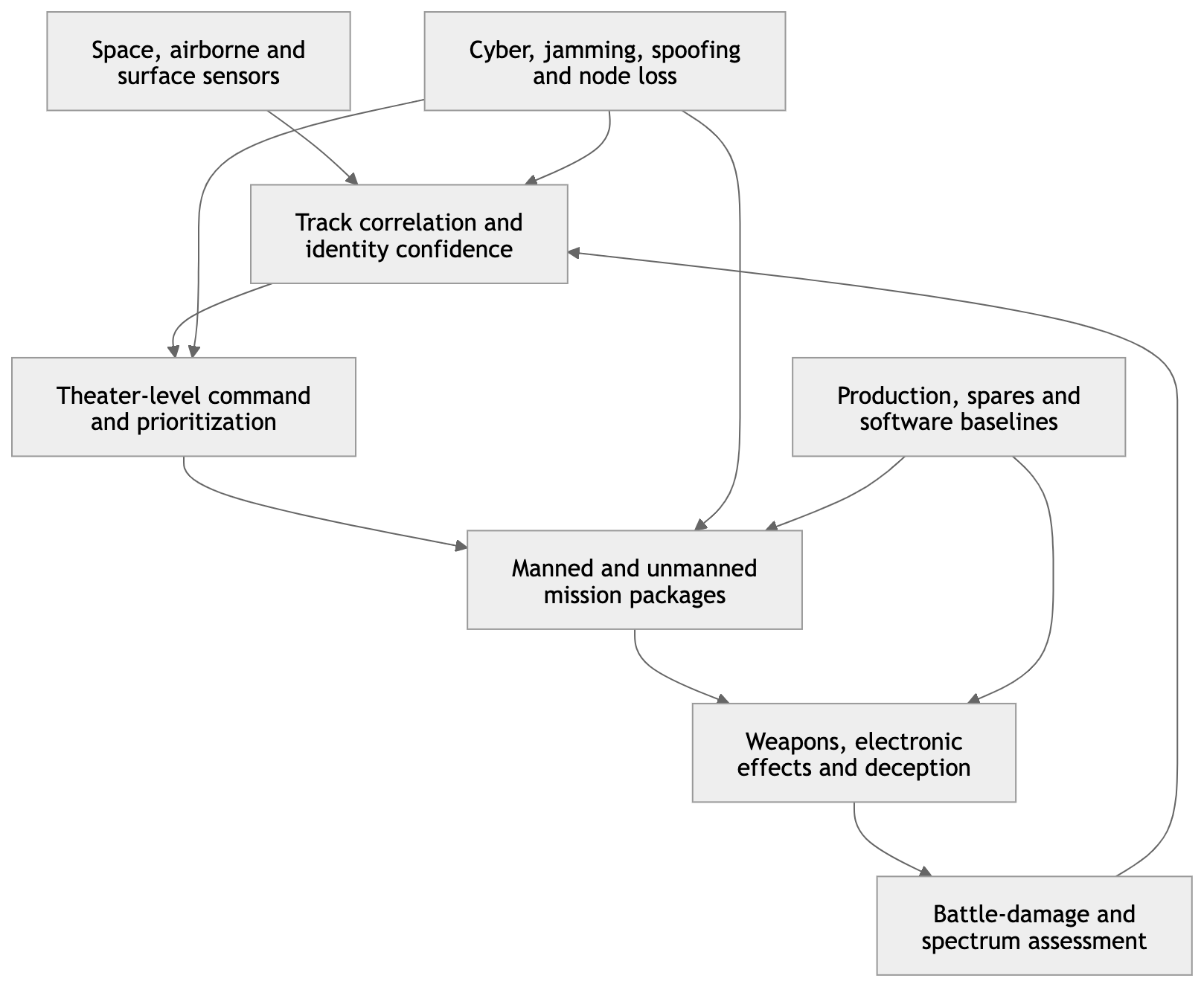
Space-layer expansion increases both operational reach and systemic dependence. As of June 2026, the United States Space Force counted 1,506 Chinese payloads, more than 510 intelligence, surveillance, and reconnaissance-capable satellites, hundreds of new communications spacecraft associated with the G60 and SatNet constellations, at least ten space-domain-awareness satellites, and four spaceplane missions. Space Threat Fact Sheet – United States Space Force – August 2026. This accumulation creates better revisit rates, more communications paths, denser target characterization, and opportunities to route around individual failures, but constellation size alone does not establish military resilience. Conversion requires interoperable ground segments, cross-constellation tasking, trusted time synchronization, protected telemetry, rapid orbital-data exploitation, deconfliction between national and commercial-equivalent services, and validated procedures for operating when the highest-capacity links disappear. The principal vulnerability is not necessarily the destruction of satellites; it may be degradation of the terrestrial gateways, processing centers, cryptographic trust infrastructure, network-management software, or commanders’ confidence in the data. A force receiving multiple inconsistent tracks may possess more information but lower decision quality. The five-year discriminator will therefore be whether the PLA distributes fusion and authorization downward without losing strategic control. Local nodes need sufficient mission data and rules to continue after isolation, while theater headquarters need mechanisms to prevent duplicate engagement, fratricide, electromagnetic interference, and uncontrolled autonomous escalation. Evidence of proliferated communications satellites raises the prior probability of graceful degradation, but evidence of centralized operational concepts lowers confidence that isolated formations will exploit that redundancy without procedural delay. The result is a C4ISR system likely to become increasingly capable under partial disruption, yet not demonstrably antifragile under coordinated space, cyber, electronic, and kinetic attack.
Autonomous Teaming and the Human-Control Bottleneck
Autonomous teaming becomes operationally significant only when unmanned aircraft reduce, rather than redistribute, the human and communications burden. A remotely piloted adjunct can extend magazine depth or expose a cheaper airframe to danger, but it may also require dedicated controllers, continuous datalinks, additional spectrum, specialized maintainers, separate mission planning, and more complex identification safeguards. A genuinely converted teaming system must perform bounded navigation, formation management, threat response, sensor tasking, electronic support, route replanning, and loss-of-link behavior with predictable outcomes, while leaving engagement authorities and escalation controls consistent with command policy. Public Chinese industrial reporting shows that the relevant technical building blocks are moving beyond concept artwork. AVIC Chengdu UAV reports modular interfaces for payloads in the 50–500 kilogram class, rapid payload switching and integration, research involving multi-domain unmanned-system collaborative cognitive control and virtual-real formation flight, edge-computing intelligent systems, and aerospace autonomous control and decision-making. Its 2025 disclosed program milestones included Wing Loong-X flight research, first flights of a Wing Loong-2 unmanned sub-aircraft, an anti-submarine patrol UAV, a cost-oriented UAV, and an early-warning UAV intended for a manned-unmanned warning architecture; research and development spending reached approximately RMB 337 million, representing 11.17 percent of revenue and a 25.69 percent annual increase. 中航(成都)无人机系统股份有限公司2025年年度报告 – AVIC Chengdu UAV, audited annual report – March 2026. These disclosures establish a broad integration pipeline, not combat autonomy. They do not disclose performance under deceptive emissions, adversarial machine-learning inputs, navigation denial, operator saturation, compromised updates, conflicting commands, or partial sensor failure. The crucial 2026–2031 indicators are consequently not additional first-flight announcements but common-control stations, cross-platform mission software, stable modular-interface standards, repeated multi-aircraft sorties, mission continuation after datalink loss, and evidence that one crew can supervise several heterogeneous aircraft without a proportional increase in workload.
Autonomous teaming also creates an assurance and configuration-management problem that conventional flight testing does not fully capture. Software behavior changes through retraining, mission-data updates, sensor substitutions, threat-library revisions, and adjustments to inference thresholds; consequently, the tested configuration can diverge from the deployed configuration without an obvious physical modification. Operational conversion requires an authoritative software baseline, signed updates, traceable training data, simulation environments representing adversarial deception, independent verification, and rollback procedures that function at dispersed bases. The system must distinguish genuine tactical novelty from corrupted or out-of-distribution inputs, and it must transition safely between onboard autonomy, cooperative decision-making, remote supervision, and preplanned behavior as connectivity varies. The Department of Defense’s conclusion that developmental Chinese AI-enabled unmanned systems generally continue to require human preprogramming, remote piloting, or extensive inputs materially reduces the posterior probability that publicized swarms already represent scalable combat autonomy. 2025 Annual Report to Congress: Military and Security Developments Involving the People’s Republic of China – U.S. Department of Defense – December 2025. Nevertheless, the architecture could deliver useful capability before high autonomy arrives. Manned aircraft can assign bounded reconnaissance sectors, electronic-support tasks, decoy routes, or communications-relay stations to unmanned partners using constrained behavior libraries. This “mission automation first” pathway is more probable than unconstrained collaborative tactics because it lowers certification complexity and preserves human authority. Its weakness is operational tempo: if every deviation returns to a human controller, bandwidth and cognition become limiting resources precisely when electronic warfare makes communications least reliable. The most likely five-year outcome is therefore heterogeneous autonomy—strong in navigation, formation, sensor cueing, and predetermined contingency handling; weaker in ambiguous identification, dynamic weapons coordination, and independent escalation-sensitive decisions.
Electronic Warfare: Enabler, Shield and Systemic Stress Test
Electronic warfare is the conversion layer most likely to expose hidden integration defects because it simultaneously affects detection, communication, navigation, identification, weapons guidance, timing, and command confidence. Chinese forces possess ground-based jammers, satellite-communications jamming capabilities, navigation-warfare systems, wideband spectrum-monitoring ambitions, and potentially space-based interference mechanisms; they also continue improving radar, direction finding, and technical reconnaissance. 2025 Annual Report to Congress: Military and Security Developments Involving the People’s Republic of China – U.S. Department of Defense – December 2025. These capabilities can suppress adversary sensors and protect friendly aircraft, yet large-scale employment generates an electromagnetic coordination burden: friendly radars, datalinks, seekers, satellites, unmanned controllers, and jammers must share spectrum without revealing the force or degrading one another. A sixth-generation or unmanned force package therefore needs dynamic spectrum allocation, passive detection, emission scheduling, geolocation of interference, low-probability-of-intercept communications, adaptive waveforms, inertial and alternative navigation, and local rules for continuing when network timing becomes unreliable. It also needs databases whose threat identities remain valid as adversaries alter emissions. The conversion threshold is not whether a jammer radiates effectively during a scripted test; it is whether the joint force can preserve its own kill chain while imposing uncertainty on the opponent’s. This favors architectures with distributed electronic support, local fusion, multi-static sensing, directional links, and preauthorized degradation modes. It disfavors excessive dependence on a small number of high-power command, radar, or relay nodes. The 2025–2031 operational race will therefore concern electromagnetic orchestration more than raw transmitter power: the side that can rapidly distinguish interference, deception, malfunction, and cyber manipulation will retain decision advantage even with fewer pristine sensors.
Cyber operations magnify this problem because the boundary between electronic and network attack is increasingly porous. The Office of the Director of National Intelligence assesses that China is preparing cyber capabilities that could impede decision-making, disrupt deployment, and create societal or operational confusion in an imminent conflict, while the PLA continues strengthening information warfare and electronic-warfare capacity. Annual Threat Assessment of the U.S. Intelligence Community – Office of the Director of National Intelligence – March 2025. The operational implication is reciprocal: a force designed to attack opposing C4ISR must assume equivalent pressure against its own software pipelines, contractors, telecommunications dependencies, logistics systems, and mission-data repositories. Resilience therefore requires more than encryption. It demands authenticated sensor provenance, segmentation between aircraft safety systems and mission networks, diversity in timing and navigation sources, zero-trust treatment of maintenance devices, offline mission-planning fallbacks, and preplanned authority for operating through inconsistent data. The most dangerous failure mode is silent corruption rather than total outage: a false but plausible track, altered electronic-order-of-battle entry, compromised spare part, or manipulated readiness dashboard can redirect resources while appearing legitimate. Public evidence is insufficient to measure Chinese performance in this area, making any claim of mature cyber-resilient autonomous teaming premature. A defensible five-year estimate must consequently discount nominal connectivity and autonomy scores unless they are accompanied by observable red-team activity, forced network isolation, rapid rekeying, software rollback, and repeated recovery during major joint exercises.
Production Readiness and the Economics of Repeatability
Industrial conversion begins when a program stops optimizing a handful of experimental aircraft and freezes enough of the design to qualify suppliers, tooling, inspections, software baselines, maintenance procedures, and training equipment. This introduces a tension: premature configuration freeze preserves production tempo but locks in immature subsystems; continued redesign improves capability but disrupts procurement, certification, spares, and maintenance. Chinese audited corporate disclosures reveal both substantial capacity and material friction. AVIC Airborne Systems reported 2024 revenue of approximately RMB 23.88 billion, research and development expenditure of approximately RMB 2.74 billion, an R&D intensity of 11.49 percent, and 7,796 R&D personnel, or 23.66 percent of its workforce. The same report disclosed negative operating cash flow of approximately RMB 1.99 billion and a revenue decline of 17.68 percent, while describing key experimental platforms, validation capability in selected technical fields, and information-system-supported management of multi-variety, low-volume production. 中航机载系统股份有限公司2024年年度报告 – AVIC Airborne Systems, audited annual report – March 2025. These figures show a large avionics and airborne-systems engineering base, but they also illustrate why prototype visibility can mislead: high R&D intensity and many experimental platforms may coexist with cash-flow pressure, shifting customer schedules, supplier bottlenecks, and costly low-rate configurations. The data cannot be attributed to a classified sixth-generation program, yet they are a valid industrial proxy for the organizational environment that must convert advanced sensors, displays, processors, controls, and electronic systems into repeatable aircraft sets.
Chinese industrial policy is explicitly attempting to compress design-to-production cycles through AI-enabled simulation, automated body and wing iteration, extreme-condition virtual validation, industrial agents for design and manufacturing, intelligent composite-material processing, additive manufacturing, automated inspection, and spacecraft assembly, integration, and testing. “人工智能+制造”专项行动实施意见 – National Data Administration and seven ministries – January 2026. These methods can reduce iteration time and improve traceability, but they do not eliminate the physical bottlenecks governing military aerospace: high-temperature materials, engines, actuators, radiation-tolerant electronics, apertures, test instrumentation, skilled assembly labor, calibration equipment, and long-duration fatigue evidence. Digital twins can discover design conflicts earlier; they cannot automatically validate model assumptions or make a fragile supplier redundant. Production readiness should therefore be measured through four ratios rather than aggregate corporate revenue: conforming units divided by units started; mission-capable aircraft divided by delivered aircraft; qualified second sources divided by critical components; and sustained monthly output divided by announced peak output. Public reporting currently provides insufficient program-specific data for those ratios. The Bayesian implication is important: abundant capital expenditure, large workforces, and new facilities raise the probability of eventual scale, but absence of disclosed yield, rework, engine life, software stability, and field-maintenance data prevents a high-confidence judgment about serial readiness. Over the next five years, the most probable path is low-rate production of selected unmanned and supporting systems ahead of any fully integrated sixth-generation package, allowing doctrine, interfaces, and sustainment to mature while higher-risk propulsion and mission-system configurations continue evolving.
| Readiness dimension | Observable leading indicator | Misleading proxy | 2031 baseline assessment |
|---|---|---|---|
| Configuration stability | Declining redesign and retrofit burden | Number of prototypes flown | Moderate uncertainty |
| Supplier maturity | Qualified alternatives for processors, engines and apertures | Total supplier count | High uncertainty |
| Manufacturing yield | Repeatable conforming output without rework growth | Factory floor area | Not publicly measurable |
| Software readiness | Common signed baseline and rapid rollback | AI publication volume | Intermediate |
| Maintenance readiness | Stable mission-capable rate across dispersed units | Delivery ceremony totals | Low visibility |
| Munitions integration | Representative weapons across real mission envelopes | Captive-carry display | Intermediate uncertainty |
| Training throughput | Operational crews and maintainers produced at unit scale | Simulator availability alone | Advancing |
| Regeneration capacity | Repair, rearm and reconstitution after node or base loss | Peacetime sortie record | Critical uncertainty |
Combat-Effective Force Packages
A combat-effective force package is an interdependent portfolio rather than a collection of advanced aircraft. A plausible Chinese package operating at extended range would require penetrating or reduced-signature crewed aircraft; unmanned sensing, decoy, communications, and electronic-attack elements; airborne early-warning or distributed passive-surveillance support; space-derived navigation and targeting; fighter cover; tanking or alternative range-management solutions; long-range weapons; search-and-rescue or recovery contingencies; mission-data preparation; and a ground system capable of generating follow-on sorties. Every additional component expands capability but also creates scheduling, basing, spectrum, maintenance, authentication, and command dependencies. Conversion succeeds when the package can lose nodes without losing the mission. A resilient package would distribute sensing and electronic-support functions across many platforms, allow weapons-quality tracks to emerge from multiple combinations of sensors, maintain local decision capacity during network isolation, and use common payload and software interfaces so unavailable assets can be substituted. A brittle package would depend on continuous wideband connectivity, a singular airborne command node, perfect satellite navigation, tightly scripted timing, or centralized permission for every tactical adjustment. The emergence of an early-warning UAV designed for manned-unmanned warning operations is therefore more operationally consequential than its airframe appearance suggests: it indicates experimentation with redistributing a traditionally scarce and detectable command-and-surveillance function. 中航(成都)无人机系统股份有限公司2025年年度报告 – AVIC Chengdu UAV, audited annual report – March 2026. Yet the configuration will only become combat-effective if it resolves track authority, latency, electromagnetic signature, survivability, crew workload, and recovery under interference. The likely 2031 force package will remain deliberately layered: mature crewed aircraft and ground command structures will carry decision responsibility, while newer unmanned systems provide bounded sensing, relay, deception, and magazine functions.
Operational conversion also requires force generation after the opening sequence. The first mission can be supported by handpicked crews, pristine aircraft, preloaded threat data, concentrated technicians, and carefully prepared communications; a resilient force must repeat the mission after attrition, component failures, runway damage, cyber incidents, changing adversary emissions, and personnel fatigue. This shifts assessment from platform characteristics to queues and recovery rates: time to diagnose faults, time to replace mission computers or apertures, availability of engines and low-observable materials, capacity to reload cryptographic and electronic-warfare data, number of dispersed maintenance teams, and time required to reconstruct the common operating picture after a network split. The PLA’s exercises provide credible evidence of increasing joint coordination, but publicly accessible evidence does not yet demonstrate sustained next-generation package operations under imposed, cascading losses. 2025 Annual Report to Congress: Military and Security Developments Involving the People’s Republic of China – U.S. Department of Defense – December 2025. The strongest conversion strategy would field modular subsets early—unmanned relays with existing fighters, passive sensors with current early-warning aircraft, electronic-support nodes with established command systems—and accumulate operational data before integrating the highest-risk elements. This incremental pathway reduces spectacular breakthrough potential but increases the probability that each capability survives contact with logistics, doctrine, spectrum management, and human workload. It is the modal forecast because it aligns with observable modular-interface development, expanding C4ISR infrastructure, and continued human dependence in autonomous systems.
Shadow Dimensions: Contract Cyber Ecosystems, Liquidity and Data Trust
Three shadow dimensions can accelerate or undermine conversion without appearing in aircraft inventories. First, cyber capability increasingly draws on contract networks that blur the boundary between state units, commercial security firms, former military personnel, exploit brokers, and criminal infrastructure. An August 2026 joint advisory by the FBI, NSA, and Cyber National Mission Force associated the China-linked QTFY group with targeting of the defense industrial base, telecommunications, government, and higher education; it described custom malicious tooling, exploit trading, botnet operations, and relationships involving Ministry of State Security units, former PLA personnel, contractors, and subcontractors. China-Linked Hacking Group QTFY Targets Military and Critical Infrastructure with Malicious Distributed Systems – FBI, NSA and Cyber National Mission Force – August 2026. This ecosystem can enlarge collection and disruption capacity, but contractorized access also creates attribution, control, compartmentation, and supply-chain risks. Second, liquidity determines whether experimental success can be converted into inventories and support systems. Corporate R&D growth can coexist with negative operating cash flow, concentrated customers, milestone-dependent payments, and capital tied up in inventory; production resilience therefore depends on state-backed demand signals, working capital, supplier financing, and willingness to fund test failures rather than merely successful demonstrations. Third, data trust becomes a strategic resource. Autonomous models, electronic-order-of-battle libraries, maintenance predictions, and command dashboards all depend on data whose provenance may span research institutes, suppliers, operational units, and classified repositories. Poisoned training sets, counterfeit components, distorted readiness reporting, or incompatible metadata can degrade the force without producing a visible outage. These dimensions imply that cyber offense, industrial finance, and assurance cannot be analyzed separately: the same commercial integration that accelerates innovation expands the number of identities, repositories, endpoints, and subcontractors that must be protected.
Analysis of Competing Hypotheses and Bayesian Update
Five hypotheses explain the likely 2026–2031 conversion trajectory. H₁, staged modular conversion, predicts that China will insert bounded autonomous, relay, sensing, and electronic-warfare functions into existing formations before a complete sixth-generation package reaches maturity. H₂, C4ISR-first leap, predicts that network, space, and information-force improvements will allow moderately mature platforms to achieve disproportionate operational value. H₃, contingency-driven premature fielding, predicts that Taiwan-related timelines or strategic pressure will push immature systems into service with high human support and low sustained availability. H₄, integration bottleneck, predicts that propulsion, software assurance, spectrum coordination, supplier qualification, or command reform will delay meaningful force-package readiness despite numerous prototypes. H₅, strategic surprise, predictss a concealed, highly integrated package reaching credible initial operational capability materially earlier than public indicators imply. The update uses seven evidence families: E₁ expanding space and C4ISR infrastructure; E₂ organizational consolidation of information support; E₃ joint-command experimentation; E₄ continuing human dependence in developmental autonomous systems; E₅ audited growth in unmanned-system R&D and flight milestones; E₆ mixed avionics-sector financial and production indicators; and E₇ intensifying cyber and electronic-warfare activity. Priors reflect the base rate that complex military-aircraft programs encounter integration and production delay, adjusted for China’s large industrial base and centralized resourcing. Likelihood directions were assigned before calculating normalized posteriors to reduce confirmation bias. The resulting distribution favors useful but incomplete operational conversion: H₁ rises because modular payloads, multiple unmanned milestones, and layered C4ISR are mutually consistent; H₂ rises modestly because information infrastructure is expanding faster than public evidence of high-end autonomy; H₃ remains significant because strategic milestones can compress testing; H₄ declines but remains substantial because negative evidence is mostly uncertainty rather than demonstrated resolution; H₅ falls because current official assessments explicitly characterize major autonomous claims as aspirational or narrow. The probabilities express disciplined analytic confidence, not measured program statistics.
| Hypothesis | Prior | Effect of E₁–E₇ | Posterior | Principal falsifier |
|---|---|---|---|---|
| H₁ Staged modular conversion | 32% | Strongly favorable | 39% | Direct evidence of immediate monolithic package fielding |
| H₂ C4ISR-first operational leap | 19% | Moderately favorable | 24% | Persistent network failures in representative joint exercises |
| H₃ Contingency-driven premature fielding | 18% | Slightly favorable | 20% | Long testing schedule with no operational-unit assignment |
| H₄ Integration bottleneck dominates | 25% | Moderately unfavorable | 14% | Already reduced; would rebound after propulsion or software setbacks |
| H₅ Concealed early full-spectrum surprise | 6% | Unfavorable | 3% | Repeated, independently observable contested-environment package operations |
The Bayesian result should not be read as a claim that H₁ and H₂ are mutually exclusive in reality; they are competing dominant explanations used to discipline inference. A staged program could exploit a C4ISR-first advantage, while a contingency could accelerate both. The value of the framework is diagnostic: future evidence changes different hypotheses in different directions. Assignment of unmanned systems to operational brigades or air regiments would support H₁ only weakly unless accompanied by representative weapons, maintainers, software support, and multi-sortie exercises. Repeated operation after imposed satellite and datalink loss would strongly support H₂ and reduce H₄. Large deliveries followed by low mission-capable rates would increase H₃. A new prototype, regardless of visual novelty, would have little effect because it does not discriminate among the hypotheses. Conversely, standardized cross-manufacturer mission interfaces, software-baseline convergence, serial engine contracts, distributed mission-data centers, and exercises in which units operate through corrupted common-operating pictures would have high diagnostic weight. The five-year collection strategy should therefore focus on integration residue: procurement notices for test equipment and spares; expansion of maintainer and controller training; modifications at dispersal airfields; recurrent satellite tasking patterns; spectrum-management doctrine; replacement rates for mission computers and engines; and changes in corporate inventory, receivables, capitalization, and supplier concentration. These indicators expose conversion activity that ceremonial rollouts conceal.
Monte Carlo Five-Year Outlook
A 100,000-trial Monte Carlo model was constructed to estimate operational-conversion readiness from 2026 through 2031. The composite score weights resilient C4ISR at 25 percent, electronic-warfare integration at 18 percent, autonomous teaming at 17 percent, repeatable production at 17 percent, sustainment and regeneration at 13 percent, and joint training and doctrine at 10 percent. The baseline begins at a synthetic readiness index of 28 in 2026; this is an analytic normalization, not an official measurement. Annual progress is sampled around 7.1 points, with variation representing subsystem delay, integration rework, learning, and changing evidence. Each year carries a 13 percent probability of a material disruption—such as propulsion delay, software instability, cyber compromise, supplier failure, or exercise-revealed redesign—whose impact is sampled up to ten points. Thresholds distinguish limited fielding at 58, repeatable production at 60, contested-network resilience at 68 combined with no unresolved major disruption, and a fully combat-effective package at 78 combined with continuity across all principal gates. Baseline median readiness rises from 28 in 2026 to 60 in 2031; the 2031 tenth-to-ninetieth-percentile interval is 50–71. The model estimates a 62 percent probability of a limited operational package by 2031, 52 percent probability of repeatable production readiness, approximately 23 percent probability that autonomous teaming crosses the defined mission-supervision threshold, and only 13 percent probability of resilient package performance under the model’s contested-network criterion. The probability of a complete, high-end force package crossing every threshold is approximately 1 percent under the strict baseline definition, rising to approximately 16 percent in the accelerated scenario. This low value does not imply that the systems lack combat utility; it reflects the much harder requirement of resilient, repeatable, multi-domain performance after disruption.
| Scenario | Structural assumption | 2031 median | 2031 P₁₀–P₉₀ | Limited package | Contested-network resilience | Full-package threshold |
|---|---|---|---|---|---|---|
| Accelerated | Stable propulsion, interface convergence, effective distributed C2 | 72 | 62–81 | 96% | 51% | 16% |
| Baseline | Modular progress with intermittent integration setbacks | 60 | 50–71 | 62% | 13% | 1% |
| Disrupted | Recurrent software, supplier, command or propulsion failures | 45 | 31–58 | 9% | Below 1% | Below 1% |
The scenario structure identifies the variables with the greatest leverage. Accelerated conversion does not require a revolutionary autonomous algorithm; it requires interface stability, reliable propulsion, distributed command authorities, trusted mission data, and a production system able to absorb redesign without collapsing output. The disruption scenario likewise does not assume program cancellation. It models accumulated friction in which each subsystem progresses but integration continually resets testing, software certification, spares, and training. This is historically common in complex systems because subsystem maturity is not additive: a new sensor can change cooling, power, electromagnetic compatibility, software, cockpit workload, maintenance, and signatures simultaneously. The baseline therefore predicts selective operational usefulness before comprehensive resilience. By 2028, bounded unmanned reconnaissance, relay, decoy, or electronic-support functions are more probable than independent dynamic engagement. By 2029–2030, improved space connectivity and early-warning distribution could support larger package experiments, while production tooling and unit-level training become the primary constraints. By 2031, a limited package may be deployable for high-priority missions under carefully prepared conditions, yet its mission-capable rate, resistance to simultaneous cyber and electromagnetic disruption, and ability to regenerate after losses will remain lower-confidence judgments. The model is most sensitive to C4ISR-resilience and sustainment correlations: treating these dimensions as independent materially overstates success because damaged networks complicate logistics, and logistics failures reduce the number and diversity of nodes available to restore the network.
Strategic and Geopolitical Consequences
The geopolitical effect will emerge before full technical maturity because adversaries must plan against plausible capability, not wait for verified combat performance. A partially converted Chinese system can impose operational costs by increasing uncertainty over detection ranges, unmanned decoy density, electronic-order-of-battle quality, satellite-supported targeting, and the number of simultaneous tracks an opposing commander must assess. This can compel greater dispersal, emissions control, hardened communications, counter-autonomy investment, munitions expenditure, and protection of airborne early-warning and tanker fleets. The principal strategic danger is therefore not an instantaneous sixth-generation monopoly but cumulative compression of warning and decision time. The European Commission assesses that Chinese military modernization is both quantitative and qualitative, encompasses nuclear, space, and cyber capabilities, and could generate profound European economic and strategic consequences through a Taiwan Strait disruption; it separately identifies electronic interference with navigation and satellite systems, cyberattack, industrial espionage, and critical-component dependencies as readiness challenges. White Paper for European Defence – Readiness 2030 – European Commission – March 2025. For Europe, the response is not simply to match aircraft generations. It is to increase interoperable command networks, alternative positioning and timing, distributed sensing, electronic-warfare training, software-assurance capacity, supplier diversity, common procurement, and production surge mechanisms. The same Commission document emphasizes predictable multi-year demand, collaborative procurement, secure supply chains, critical-component monitoring, space-based communications, and industrial scale—precisely the institutional factors that determine whether innovation becomes operational mass. Russian-language official materials were also checked for evidence of current Sino-Russian aviation integration and technology transfer; they verify an established political and exercise relationship but do not provide sufficiently granular, current, and auditable evidence to attribute specific next-generation conversion gains. No positive technology-transfer claim is therefore incorporated.
The final five-year judgment is that China is more likely than not to convert portions of its experimental ecosystem into operationally useful packages by 2031, but considerably less likely to demonstrate a uniformly resilient system across C4ISR, autonomy, electronic warfare, production, and regeneration. The strongest pathway is evolutionary: use proliferated space and terrestrial networks to strengthen existing formations; add modular unmanned sensing, relay, deception, and electronic-support assets; distribute early-warning functions; stabilize interfaces; and only then place higher autonomy and next-generation crewed aircraft at the center of the package. The principal inhibitors are not lack of prototypes or investment but correlated complexity: centralized command must coexist with local initiative; electronic attack must not disable friendly networks; autonomous behavior must remain reliable under deception; changing software must remain certifiable; industrial output must preserve quality; and dispersed units must maintain advanced materials, sensors, engines, and cryptography after attack. The intelligence warning threshold should be crossed when multiple indicators converge—operational-unit assignment, standardized mission interfaces, serial support contracts, representative weapons integration, recurrent degraded-network exercises, rapid software rollback, dispersed maintenance, and stable multi-sortie availability. Until that convergence appears, platform sightings and factory imagery should change the forecast only marginally. Once it appears, Bayesian updating should be rapid because the remaining uncertainty would no longer concern individual technologies but their demonstrated ability to function as a combat system.
The 2026–2031 Strategic Horizon: Taiwan and the Conversion Race
The strategic horizon to 2031 is not governed by a single countdown to war but by an interaction among political choice, military confidence, operational conversion, economic exposure, and the expected effectiveness of allied intervention. The 2027 PLA modernization objective is frequently misrepresented as a predetermined invasion date. It is more accurately understood as a capability benchmark intended to accelerate the integration of mechanization, informatization, and intelligentization while strengthening the PLA’s ability to counter intervention and compel Taiwan’s leadership on Beijing’s terms; the public evidence does not establish that Xi Jinping has ordered an invasion for 2027. 2025 Annual Report to Congress: Military and Security Developments Involving the People’s Republic of China – U.S. Department of Defense – December 2025. This distinction changes the forecast. Beijing does not need to choose between permanent peace and immediate amphibious assault: it can expand military patrols, cyber prepositioning, legal claims, customs enforcement, economic pressure, cognitive operations, selective exclusion zones, inspections, exercises, and limited seizures while continuously testing how Taiwan, the United States, Japan, Australia, Europe, and commercial markets respond. The most probable pathway is therefore cumulative coercion punctuated by increasingly realistic rehearsals, not a linear march toward a declared invasion day. Nevertheless, gradualism does not eliminate escalation risk. It increases opportunities for miscalculation because repeated exercises normalize force concentrations, compress warning time, blur the distinction between demonstration and operation, and permit Beijing to shift from signaling to enforcement without the visible mobilization associated with a traditional campaign. The principal analytic question is consequently not “Will China invade in 2027?” but “Under what combination of political triggers, force readiness, economic insulation, cyber access, and allied hesitation would Beijing conclude that a more coercive option has become less dangerous than continued delay?”
The Contingency Ladder
Taiwan contingencies form an escalation ladder whose lower rungs can generate strategic effects without requiring Beijing to incur the risks of occupation. At the first level, China can intensify routine air and maritime pressure, cyber reconnaissance, information manipulation, economic coercion, and coast-guard enforcement while remaining below a universally recognized threshold of armed conflict. At the second, it can declare temporary inspection, customs, quarantine, navigation-safety, or exercise zones and compel selected commercial vessels to alter course. At the third, it can attempt a prolonged joint blockade supported by naval and air forces, missile threats, electronic warfare, cyber operations, information control, and possible seizure of offshore islands. At the fourth, it can conduct limited precision strikes against command, radar, air-defense, runway, communications, or political targets, potentially framing them as punitive or counter-separatist measures rather than the opening of an invasion. Only at the fifth level does Beijing attempt a joint island-landing campaign requiring maritime and air superiority, beachhead establishment, rapid reinforcement, logistical sustainment, urban operations, and defense against external intervention. The Pentagon judges a large-scale amphibious assault to be among the PLA’s most complex and dangerous options and notes that the PLA Navy has not visibly expanded conventional landing ships and medium landing craft sufficiently to remove its lift limitations, although it trains with civilian roll-on/roll-off vessels to mitigate them. By contrast, blockade proficiency is receiving observable attention: Joint Sword-2024A and 2024B simulated seizure of maritime and air superiority, closure of ports, precision strikes, and participation by the China Coast Guard; the 2024B exercise placed an aircraft-carrier group east of Taiwan and tested third-party access. 2025 Annual Report to Congress: Military and Security Developments Involving the People’s Republic of China – U.S. Department of Defense – December 2025. The evidentiary asymmetry is decisive: China can rehearse and initiate a quarantine or blockade with forces already operating around Taiwan, whereas invasion requires successful conversion across every domain simultaneously.
| Contingency state | Operational mechanism | Beijing’s principal advantage | Principal constraint | Escalation pathway |
|---|---|---|---|---|
| C₁ Persistent coercion | Patrols, exercises, cyber access, trade pressure and cognitive warfare | Low immediate kinetic cost and high reversibility | Diminishing marginal coercive effect | Normalization enables larger deployments |
| C₂ Selective quarantine | Coast-guard inspections, temporary zones and selective interdiction | Exploits legal ambiguity and commercial risk aversion | Requires compliance by shipping and foreign governments | Resistance can force military enforcement |
| C₃ Joint blockade | Sustained air and maritime exclusion with missile and electronic support | Avoids immediate occupation while stressing Taiwan’s economy | Long duration exposes forces and invites counter-coalition | Blockade failure can trigger strikes |
| C₄ Limited kinetic campaign | Precision strikes, offshore-island seizure or leadership coercion | Concentrates force against selected targets | Retaliation and uncontrolled escalation | Can become blockade or invasion |
| C₅ Joint island landing | Multi-axis assault, beachhead and territorial seizure | Potentially decisive political outcome | Extreme lift, sustainment, attrition and intervention risks | Highest escalation and regime-level stakes |
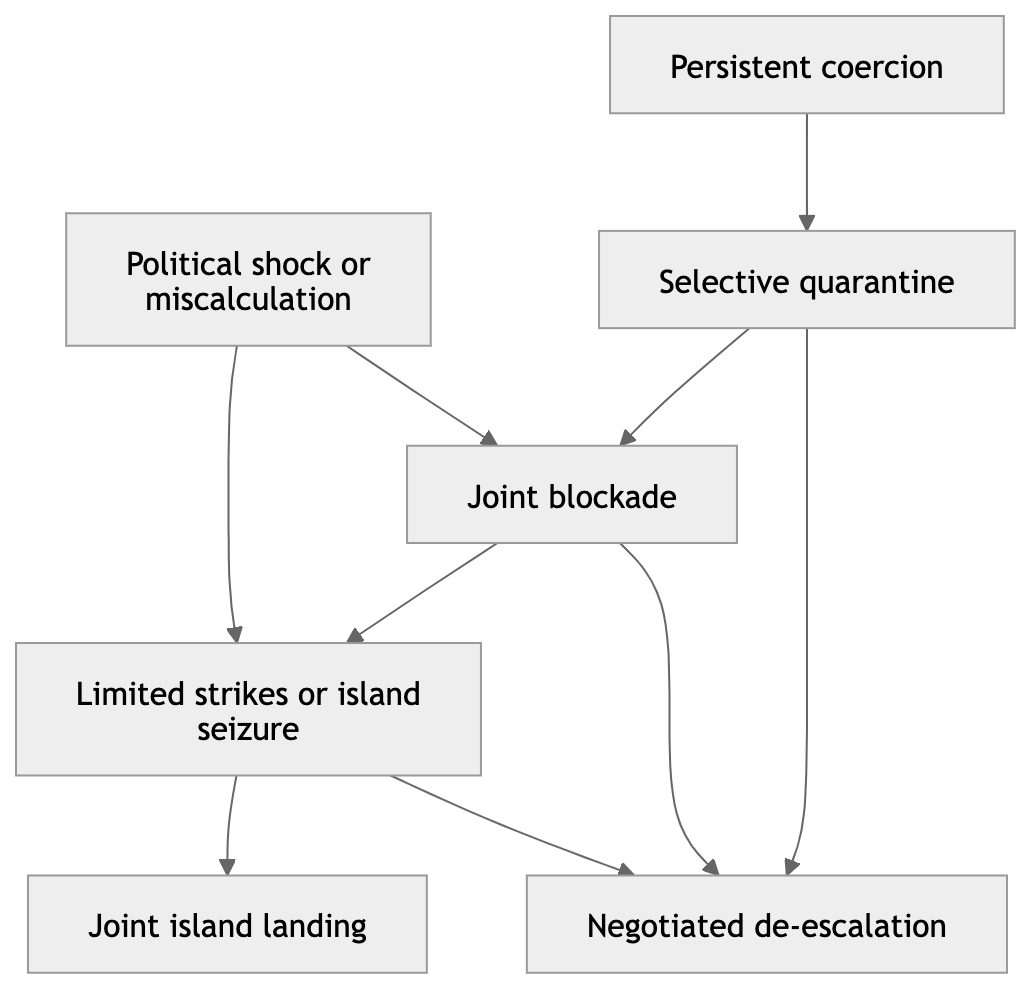
The warning architecture must account for Beijing’s ability to move laterally between these options. A quarantine may not be an early stage of invasion; it may be designed as an independent campaign that divides foreign governments over whether commercial inspection constitutes a use of force. A blockade may likewise oscillate between enforcement and temporary relaxation to manipulate insurance markets, inventories, political opinion, and diplomatic negotiations. The Department of Defense recorded approximately 2,771 PLA aircraft detections in Taiwan’s air-defense identification zone during 2024, compared with roughly 1,703 in 2023, while five to nine PLA Navy vessels operated around Taiwan during approximately three quarters of 2024. China conducted 38 joint patrols, and Joint Sword-2024B generated 111 centerline crossings and placed 34 PLA and coast-guard vessels around Taiwan in a single day. 2025 Annual Report to Congress: Military and Security Developments Involving the People’s Republic of China – U.S. Department of Defense – December 2025. These figures do not prove imminent attack; they show that the baseline from which China can escalate has moved closer to Taiwan and become more joint, persistent, and institutionally integrated. Strategic warning will increasingly depend on qualitative anomalies rather than platform counts alone: unusual replenishment patterns, civilian shipping requisition, medical mobilization, missile-warhead handling, command-post relocation, cyber activation, reserve call-ups, financial controls, changes in port administration, suspension of routine training safety practices, and simultaneous activity across eastern and southern theaters. A model that relies only on visible amphibious assembly will identify the most dramatic option while missing the more probable pathways.
Bayesian Hypotheses
The Analysis of Competing Hypotheses uses five mutually exclusive dominant pathways for the period ending in 2031. H₁ predicts sustained coercion without an extended interdiction campaign; H₂ predicts one or more selective quarantines or inspection regimes that disrupt shipping but remain deliberately ambiguous; H₃ predicts an overt and prolonged joint blockade; H₄ predicts limited kinetic action, including precision strikes or seizure of an offshore position, without an immediate full-scale landing; and H₅ predicts an attempted joint island-landing campaign. The priors were assigned using the historical prevalence of coercive behavior, the operational requirements of each option, and the political costs of escalation. The posterior update incorporates E₁, the sharp increase in routine PLA activity; E₂, blockade-centered joint exercises and coast-guard integration; E₃, continued shortfalls in conventional amphibious lift; E₄, expanded Chinese C4ISR, missile, cyber, space, and electronic-warfare capacity; E₅, Taiwan’s increasing asymmetric and whole-of-society investment; E₆, more distributed allied posture and defense-industrial cooperation; E₇, the severe economic exposure created by a Taiwan Strait disruption; and E₈, the absence of verified public evidence that Beijing has fixed an invasion date. The update moves probability from invasion toward coercive and blockade-adjacent pathways because the capabilities necessary for isolation are becoming more available than those required for occupation. It does not equate probability with harmlessness. A selective quarantine has a lower immediate kinetic intensity than invasion but can still create a global commercial crisis, provoke military escort operations, generate cyber retaliation, and escalate through collision, misidentification, or contested boarding. The U.S. intelligence community assesses that Beijing will continue pressing Taiwan while positioning for advantage in a possible conflict and conducting cyber operations for espionage and strategic leverage. Annual Threat Assessment of the U.S. Intelligence Community – Office of the Director of National Intelligence – March 2025.
| Hypothesis | Prior | Posterior | 90% Monte Carlo interval | Evidence most likely to raise probability |
|---|---|---|---|---|
| H₁ Sustained coercion without extended interdiction | 36% | 40% | 30.2–50.1% | Stable patrol growth without mobilization or shipping enforcement |
| H₂ Selective quarantine or inspection campaign | 21% | 27% | 18.4–36.4% | Coast-guard rules, inspection notices, port-control rehearsals and insurer warnings |
| H₃ Overt joint blockade | 18% | 17% | 10.0–25.1% | Sustained replenishment, exclusion-zone enforcement and multi-week joint logistics |
| H₄ Limited strikes or offshore seizure | 14% | 10% | 4.7–16.7% | Missile dispersal, wartime C2 activation and civil-defense political preparation |
| H₅ Joint island-landing attempt | 11% | 6% | 2.1–11.5% | Lift requisition, mass blood and fuel preparation, reserve activation and beachhead sustainment assets |
The posterior for H₅ remains non-zero because low probability cannot be equated with impossibility when political stakes are existential and capabilities are deliberately concealed. Its reduction reflects operational evidence, not an assumption of Chinese restraint. A successful landing requires China to suppress Taiwan’s air defenses and command system, secure crossing routes, protect transports, neutralize mines and anti-ship weapons, establish lodgments, move heavy forces ashore, maintain fuel and ammunition flow, capture or bypass urban centers, prevent leadership continuity, and deter or defeat foreign intervention. Failure in any one function can magnify failure elsewhere. Conversely, H₂ rises because quarantine architecture can exploit civilian and paramilitary instruments, selective enforcement, commercial insurance reactions, and narrative ambiguity. Its operational threshold is lower, its political reversibility greater, and its coalition-management burden imposed disproportionately on Taiwan’s partners. The posterior probabilities must therefore be updated by discriminating evidence rather than headlines. An additional carrier patrol is only modestly diagnostic because it supports several hypotheses; requisition of numerous civilian roll-on/roll-off vessels combined with reserve medical mobilization would strongly favor H₅. Coast-guard inspection procedures, customs declarations, maritime legal notices, and commercial pilotage restrictions would favor H₂. Persistent fuel, ammunition, hospital, and repair preparations without invasion lift could favor H₃ or H₄. The model also guards against mirror imaging: Beijing may interpret a coercive campaign as risk reduction because it postpones direct combat, while foreign governments perceive the same action as the opening of war. That divergence in categorization is itself an escalation mechanism.
Monte Carlo Distribution and Critical Correlations
The Monte Carlo layer uses 100,000 Dirichlet trials around the Bayesian posterior rather than pretending that point estimates are precise forecasts. The effective evidence weight is deliberately limited because classified readiness, leadership deliberations, cyber access, munitions inventories, and allied rules of engagement remain unknown. The simulation produces the uncertainty intervals in the preceding table and is then stress-tested across four strategic environments. In the baseline, the median distribution remains 40 percent sustained coercion, 27 percent quarantine, 17 percent blockade, 10 percent limited kinetic action, and 6 percent invasion attempt. Under accelerated PLA conversion combined with delayed allied adaptation, the kinetic tail expands: blockade rises to 22 percent, limited strikes to 17 percent, and invasion attempt to 12 percent. Under strong Taiwanese and allied adaptation, sustained coercion rises to 49 percent because denial reduces the attractiveness of higher rungs, while blockade falls to 13 percent and invasion to 4 percent. A dual-shock environment—political crisis combined with severe misperception or an accidental military incident—produces the most dangerous distribution: only 21 percent remains in sustained coercion, while blockade reaches 23 percent, limited action 19 percent, and invasion attempt 13 percent. These are conditional analytic outputs, not frequencies derived from historical cases. Their purpose is to identify leverage. The strongest variables are Beijing’s confidence in controlling escalation, Taiwan’s expected endurance under isolation, the credibility and speed of allied intervention, PLA joint-logistics readiness, and the perceived ability of cyber operations to delay mobilization without triggering immediate retaliation. Industrial capacity matters primarily through duration: it affects whether China and its opponents believe they can replace precision weapons, unmanned systems, air-defense interceptors, satellites, network components, ships, and aircraft after the initial inventory is depleted.
| Stress environment | H₁ Coercion | H₂ Quarantine | H₃ Blockade | H₄ Limited action | H₅ Invasion |
|---|---|---|---|---|---|
| Baseline conversion | 40% | 27% | 17% | 10% | 6% |
| Accelerated PLA, delayed allies | 25% | 24% | 22% | 17% | 12% |
| Strong Taiwan-allied adaptation | 49% | 27% | 13% | 7% | 4% |
| Dual political and military shock | 21% | 24% | 23% | 19% | 13% |
The model’s most important result is the non-linearity between deterrence and escalation. Allied adaptation does not simply reduce every form of Chinese pressure. By making invasion and sustained blockade less attractive, it can redirect Beijing toward cyber operations, law-enforcement coercion, economic punishment, infrastructure interference, and temporary quarantines. Conversely, visible allied weakness may not immediately trigger invasion; it may encourage a blockade strategy whose perceived cost has fallen. The risk distribution also changes over time. Between 2026 and 2027, political signaling and modernization milestones will create repeated opportunities for exaggerated threat interpretation, but the principal military indicators remain integration and logistics. Between 2028 and 2029, larger inventories of autonomous systems, distributed sensors, longer-range weapons, and commercial-military support assets could make blockade enforcement more persistent while Taiwan’s new procurement pipeline begins producing operational effects. Between 2030 and 2031, Beijing will compare accumulated PLA progress with Taiwan’s intended defense-spending expansion, allied basing and munitions adaptation, demographic and economic pressures, and the political environment in Taipei and Washington. The resulting decision calculus will not necessarily become more aggressive with time. If denial strengthens faster than PLA confidence, coercion may remain dominant. If both sides improve but each believes the other’s window is closing, crisis instability can rise even while deterrence improves. The critical risk is a reciprocal “use-it-or-lose-it” perception involving cyber access, surprise, missile inventories, satellite networks, or political opportunity.
Industrial Constraints and Mobilization Depth
Industrial power affects the Taiwan balance through conversion speed, stockpile depth, repair capacity, and confidence in replacing losses. China possesses substantial shipbuilding, electronics, missile, unmanned-system, telecommunications, and manufacturing capacity, but aggregate industrial scale cannot be directly converted into combat endurance. Military output requires qualified materials, controlled software, secure microelectronics, specialized propulsion, military-grade sensors, trained labor, acceptance testing, and protected transport. Audited Chinese aerospace disclosures show both acceleration and friction. AVIC Chengdu UAV reported approximately RMB 337 million in 2025 research and development expenditure, a 25.69 percent increase, alongside multiple flight-test milestones, modular payload interfaces, autonomous-control research, and early-warning UAV development. 中航(成都)无人机系统股份有限公司2025年年度报告 – AVIC Chengdu UAV, audited annual report – March 2026. AVIC Airborne Systems, however, reported 2024 revenue down 17.68 percent, negative operating cash flow of approximately RMB 1.99 billion, and R&D expenditure of approximately RMB 2.74 billion, illustrating how engineering intensity, customer timing, working capital, and production economics can diverge. 中航机载系统股份有限公司2024年年度报告 – AVIC Airborne Systems, audited annual report – March 2025. These data cannot be assigned to classified Taiwan programs, but they demonstrate that even state-prioritized aerospace enterprises face the ordinary conversion problems of low-volume production, changing requirements, supplier coordination, and cash absorption. Chinese policy seeks to reduce those constraints through AI-enabled design, simulation, automated inspection, additive manufacturing, intelligent composite processing, and closed-loop production management. “人工智能+制造”专项行动实施意见 – National Data Administration and seven ministries – January 2026. The 2031 question is not whether China can build large numbers of platforms, but whether it can regenerate the specific integrated configurations demanded by a contested campaign.
Taiwan’s industrial counterstrategy is moving from procurement toward a hybrid model linking imported systems, indigenous production, semiconductors, communications technology, precision manufacturing, unmanned systems, cybersecurity, and whole-of-society resilience. In April 2026, Taiwan’s Executive Yuan announced a planned NT 1.25 trillion, approximately US 39.6 billion, special budget covering 2026–2033, organized around the T-Dome air-and-missile-defense concept, an AI-enabled kill chain, and greater defense-industrial self-reliance. Special Budget to Bolster Taiwan’s High-Tech, Asymmetric Defense Capabilities – Executive Yuan, Taiwan – April 2026. President Lai has separately stated that defense spending under the NATO definition is intended to exceed 3 percent of GDP in 2026 and reach 5 percent by 2030. President Lai Meets 2025 Taipei Security Dialogue Delegation – Office of the President, Taiwan – October 2025. Funding, however, becomes deterrence only after contracts, delivery, unit integration, magazines, software, maintainers, shelters, repair sites, dispersed communications, and trained reserve or civilian operators exist. Taiwan’s strongest industrial advantage lies in electronics and adaptable commercial manufacturing; its vulnerability lies in geographic concentration, energy and raw-material dependence, limited strategic depth, and exposure of fixed infrastructure. A blockade-centered strategy would seek to exploit these dependencies before Taiwan’s industrial mobilization could generate replacement capacity. Taiwan’s best counter is consequently not to imitate Chinese scale but to maximize survival, dispersion, interchangeability, repairability, local manufacture of expendable systems, and continuity of decision-making.
Cyber Exposure and the Pre-Kinetic Battlespace
Cyber operations are not a supporting detail of a Taiwan contingency; they are a potential opening theater and a mechanism for changing the apparent balance before visible hostilities begin. Chinese intrusions associated with campaigns such as Volt Typhoon have targeted critical infrastructure and demonstrated an ability to preposition access that could be used during a crisis to disrupt mobilization, communications, transportation, or public confidence. The Department of Defense assesses that Chinese targeting patterns probably include preparation to obstruct U.S. support for Taiwan, while the Office of the Director of National Intelligence judges that aggressive cyber operations during an imminent conflict could impede decision-making, interfere with deployment, and induce societal disruption. 2025 Annual Report to Congress: Military and Security Developments Involving the People’s Republic of China – U.S. Department of Defense – December 2025; Annual Threat Assessment of the U.S. Intelligence Community – Office of the Director of National Intelligence – March 2025. Cyber exposure operates across five connected layers: military C4ISR; civilian telecommunications and cloud services; ports, rail, aviation and fuel distribution; banking and payment systems; and the public-information environment. A campaign need not disable all five. Temporary uncertainty over port manifests, fuel availability, air-defense tracks, mobilization orders, or financial settlement can slow response and create pressure for political caution. Silent data corruption may be more consequential than spectacular outage because commanders and officials can continue operating on manipulated information. Taiwan’s own whole-of-society resilience deliberations identify cybersecurity and communications as essential to accurate public information, financial continuity, access to resources, and resistance to cognitive warfare. Minutes of the Fifth Meeting of the Whole-of-Society Defense Resilience Committee – Office of the President, Taiwan – December 2025.
The shadow cyber ecosystem further complicates warning because offensive preparation can be distributed among state services, military organizations, security contractors, exploit developers, former personnel, botnet operators, and nominally criminal intermediaries. The August 2026 joint advisory concerning QTFY describes targeting of defense, telecommunications, government, and academic organizations; development and exchange of malicious tools; operation of distributed infrastructure; and relationships involving Chinese security institutions, former PLA personnel, contractors, and subcontractors. China-Linked Hacking Group QTFY Targets Military and Critical Infrastructure with Malicious Distributed Systems – FBI, NSA and Cyber National Mission Force – August 2026. This structure enlarges operational reach and preserves deniability, but it can also weaken central control and increase the chance that intrusive activity is misread as preparation for imminent attack. Early warning should therefore distinguish persistent espionage from activation indicators: destructive modules moving into operational networks, new command-and-control patterns, sudden credential use after long dormancy, manipulation of industrial-control logic, synchronized targeting across transport and telecommunications, attempted suppression of incident response, and concurrent information narratives explaining outages as domestic incompetence. Taiwan and its partners must assume that some access will survive pre-crisis remediation. Resilience should be measured by recovery time, trusted fallback communications, manual operating capacity, clean-data restoration, cross-border incident coordination, and the ability to mobilize while networks are only partially trusted. The strategic objective is not perfect exclusion of attackers but denial of decisive operational delay.
Allied Counter-Adaptation
Allied adaptation is evolving from symbolic presence toward a distributed system of access, interoperable command, long-range strike, integrated air and missile defense, logistics, cyber cooperation, and industrial coordination. Japan is central because geography places its southwestern islands, bases, sea lanes, airspace, and population close to any Taiwan contingency. Japan’s defense architecture increasingly emphasizes integrated air and missile defense, stand-off capabilities, joint command, alliance response, and exercises with the United States, Australia, the Philippines, the United Kingdom, France, and other partners. The 2025 Japan–United States defense ministerial meeting committed both governments to strengthening alliance deterrence and response, while Japan and Australia subsequently established a strategic defense-coordination framework covering intelligence, space, cyber, integrated air and missile defense, industry, technology, and consultation from peacetime through contingencies. Japan–U.S. Defense Ministerial Meeting Summary – Ministry of Defense, Japan – March 2025; Japan–Australia Defense Ministers’ Joint Statement: Establishment of the Framework for Strategic Defence Coordination – Ministry of Defense, Japan – December 2025. Australia’s 2026 National Defence Strategy prioritizes a larger and more lethal navy, nuclear-powered submarines, long-range strike, littoral operations, surveillance, air defense, transport, and integrated force employment. 2026 National Defence Strategy and 2026 Integrated Investment Program – Australian Department of Defence – May 2026. These measures complicate Chinese planning by increasing the number of locations, authorities, sensors, and weapons that must be accounted for; their weakness is the logistical and political coordination required to make them function under time pressure.
The allied constraint is not conceptual awareness but readiness depth. Dispersed posture consumes fuel, munitions, sealift, airlift, maintenance, communications capacity, engineering support, and protection for numerous bases. The U.S. Government Accountability Office reported classified Indo-Pacific findings concerning risks in storing and delivering fuel in contested conditions and the adequacy of pre-positioned assets; its public summary confirms that fuel requirements and contested delivery are being exercised but remain readiness concerns. Military Readiness: Status of GAO Recommendations and Selected Defense Challenges – U.S. Government Accountability Office – March 2026. GAO also reported that the Partnership for Indo-Pacific Industrial Resilience comprises 15 allies and partners and is intended to improve cooperation on defense-industrial challenges, including munitions production. Defense Industrial Base: DOD Has Opportunities to Improve Internal Communication and Assess Regional Partnerships – U.S. Government Accountability Office – August 2026. These initiatives reduce single-country dependence, but cooperation announcements do not guarantee compatible requirements, export approvals, surge contracts, shared technical data, or timely allocation during crisis. The counter-adaptation variable in the model therefore depends on four transitions: access agreements must become rehearsed operations; exercises must impose realistic loss and disruption; industrial partnerships must produce deliverable stock; and political consultations must generate sufficiently rapid authorities. If these transitions mature by 2030, Beijing faces a geographically distributed denial problem. If they remain procedural, China may conclude that coalition complexity provides a temporary window despite superior aggregate allied resources.
Indicators Through 2031
The 2026–2031 indicator framework must be organized by decision relevance rather than platform novelty. During 2026–2027, the highest-value indicators concern whether China converts the modernization milestone into operational command reform, joint logistics, cyber preparation, and blockade enforcement mechanisms; whether Taiwan turns new appropriations into contracts and dispersed capabilities; and whether allied access and command arrangements become executable. During 2028–2029, collection should shift toward production yields, unit assignments, replenishment exercises, software stability, unmanned-system control ratios, missile reload capacity, alternative navigation, civilian shipping integration, and recovery from network disruption. During 2030–2031, the decisive evidence will concern strategic confidence: whether Beijing believes it can control escalation, whether Taiwan can maintain governance and essential services during isolation, whether allies can enter the theater without relying on a few vulnerable nodes, and whether industrial systems can support a conflict extending beyond initial inventories. Warning must also monitor political and economic precursors. Capital controls, strategic commodity stockpiling, sanctions insulation, shipping directives, emergency legal changes, censorship intensification, foreign-asset protection, evacuation guidance, unusual blood collection, medical mobilization, and industrial priority orders may be more diagnostic than another exercise. None is conclusive alone. The intelligence threshold should rise only when indicators from independent systems—military logistics, political direction, cyber activation, financial preparation, civilian mobilization, and information control—converge within a compressed period. This guards against false alarms produced by routine exercises while retaining sensitivity to a campaign concealed inside normalized activity.
| Period | Chinese conversion indicators | Taiwan-resilience indicators | Allied-adaptation indicators | Principal analytic question |
|---|---|---|---|---|
| 2026–2027 | Information-force integration, blockade procedures, civilian-lift testing | Special-budget contracting, communications continuity, drone scaling | Joint command, access, fuel and pre-positioning exercises | Are institutions becoming executable? |
| 2028–2029 | Persistent joint logistics, autonomous-system unit integration, missile regeneration | Distributed stockpiles, repair sites, air-defense networking, reserve readiness | Munitions output, dispersed basing, common data and targeting standards | Can each side sustain disruption? |
| 2030–2031 | Mobilization speed, theater coordination, economic insulation, political confidence | Governance continuity, energy endurance, industrial substitution | Coalition authorities, rapid reinforcement, loss-tolerant C4ISR | Does denial remain credible after the opening phase? |
The European dimension is strategically material even though Europe is unlikely to constitute the central combat force. The European Commission judges that Chinese military modernization is changing the Indo-Pacific balance and that intensified military, cyber, political, economic, and cognitive pressure against Taiwan could produce profound consequences for Europe. It identifies cyberattack, satellite-navigation interference, industrial espionage, critical-technology competition, and supply dependence as direct European vulnerabilities. White Paper for European Defence – Readiness 2030 – European Commission – March 2025. Europe’s most consequential contributions before a crisis are therefore industrial, technological, financial, diplomatic, and resilience-based: diversifying critical inputs, hardening ports and communications, preparing sanctions and export-control coordination, protecting semiconductor-dependent industries, expanding cyber-defense cooperation, sustaining naval access, and reducing the time required to replace air-defense interceptors, precision munitions, satellites, and electronic components. During a quarantine, European governments would confront immediate decisions over shipping guidance, insurance, sanctions, maritime presence, export licensing, and recognition of Chinese inspection authority. Ambiguity would be operationally exploitable because commercial actors react faster than political coalitions. Europe must consequently develop contingency positions before the event rather than improvise after markets have already rerouted cargo, insurers have withdrawn coverage, and individual companies have accepted enforcement. The strategic value of European preparation lies partly in deterrence: Beijing’s expected economic and diplomatic cost rises when countermeasures are credible, coordinated, and pre-authorized.
The integrated judgment is that the 2026–2031 period will be defined by competitive conversion rather than a mechanically closing invasion window. China is converting military pressure into a more persistent, joint, information-enabled system; Taiwan is attempting to convert fiscal commitments and technological strengths into asymmetric denial and societal endurance; allies are converting bilateral relationships into a distributed regional architecture; and Europe is beginning to convert economic exposure into security preparedness. The baseline posterior assigns 67 percent combined probability to sustained coercion or selective quarantine, 27 percent to blockade or limited kinetic action, and 6 percent to an invasion attempt as the dominant pathway before the end of 2031. These values should not encourage complacency. The most probable pathway can still impose severe economic damage, and the least probable pathway can carry catastrophic consequences. The central policy implication is to deny Beijing confidence at every rung rather than concentrate exclusively on defeating an amphibious landing. Taiwan must remain governable, connected, supplied, and politically coherent during coercion and isolation. Allied forces must remain operational after attacks on bases, satellites, fuel systems, and networks. Industrial systems must replenish losses faster than adversaries expect. Cyber defenses must preserve mobilization even when complete trust is impossible. Diplomatic coalitions must decide in advance how they classify and answer inspections, quarantines, exclusion zones, limited strikes, and offshore seizures. If those adaptations mature, coercion remains Beijing’s most probable choice because escalation becomes less attractive. If they remain fragmented, the probability mass shifts toward blockade and limited kinetic action before it shifts toward invasion. The strategic competition will be won or lost in that conversion space.


