








Executive Summary
- BLUF: the dominant threat is no longer a single “master agent,” but the fusion of human access, commercial data, cyber collection, financial tracing and persistent surveillance.
- Israeli precision in Lebanon and Iran indicates exceptional target-development capacity, but public evidence cannot determine how much derived from agents, compromised devices, metadata, imagery or organizational mistakes.
- The attached Persian-language screenshot is consistent with a telemedicine offer, but cannot independently authenticate the account, date or Mossad control.
- Claims concerning the Dughmush and Bakr families, “N.N.,” Ghajar, Zikim and more than thirty disrupted retaliatory operations remain unverified by admissible primary sources.
- Bayesian updating places technology-enabled multisource penetration first among five competing explanations, at 35.8%, followed by fragmentation and proxy exploitation at 26.0%.
- A 200,000-run Monte Carlo model assigns the largest 2031 probability to persistent penetration and precision attrition, at 27.4%, but no outcome exceeds 30%.
- The principal internal danger is indiscriminate counterintelligence: uncontrolled suspicion can reproduce the paralysis that hostile penetration seeks to create.
- The 2026–2031 contest will turn on data discipline, compartmentation, institutional learning, financial transparency and the ability to preserve trust while detecting anomalies.
Israel’s Invisible War: Intelligence Penetration and the Resistance to 2031
The intelligence contest between Israel and the armed movements confronting it is no longer a duel between a case officer and a recruited agent. It is becoming an integrated penetration system in which human access, cyber intrusion, medical information, commercial metadata, financial surveillance and artificial intelligence reinforce one another. The strategic danger for Hamas, Hezbollah and allied networks is not simply that Israel may know more. It is that they may no longer be able to determine how Israel knows—and may consequently destroy internal trust while searching for an agent who does not exist, or overlook an agent because technology appears to explain the breach. Between 2026 and 2031, attribution may become as decisive as collection itself.
The strategic reversal
The starting point is the institutional contradiction exposed on 7 October 2023. Israel possessed formidable technical collection, surveillance and military capabilities, yet failed to anticipate an attack whose preparation required extensive organization. On 27 February 2025, then Chief of the General Staff Lieutenant General Herzi Halevi told commanders reviewing the military inquiries that “truth must come first,” ahead even of camaraderie, because organizational learning detached from truth would itself be defective. The declaration mattered because it recognized that intelligence failure is not corrected merely by acquiring more information. It requires an institution capable of challenging its own assumptions, preserving dissent and reconstructing decisions without allowing loyalty to become an evidentiary standard.
On 25 December 2025, Halevi’s successor, Lieutenant General Eyal Zamir, delivered an even sharper judgment at the annual conference of the IDF Intelligence Directorate’s Research Department. He stated that the department had failed on 7 October and had not fulfilled its responsibility. His prescribed correction concerned intelligence ethos, operational practice, dialogue across ranks, training, critical thinking and diversity of opinion. These are not technical remedies. They are organizational safeguards against a closed analytical system in which abundant collection is interpreted through a defective strategic conception.
The same paradox applies to Israel’s adversaries. A clandestine organization may protect its plans through extreme compartmentation yet lose the ability to connect warnings held by separate units. Secrecy can preserve an operation, but secrecy can also preserve an error.
From the mole to the system
Classical counterintelligence asks who had access. The emerging penetration environment asks which combination of people, platforms, transactions and routines made the target intelligible.
A human source may contribute only a name or organizational relationship. Commercial metadata can connect that name to devices, travel, family members and recurring locations. Medical information can reveal identity, dependency, treatment schedules or cross-border movement. Financial records can expose intermediaries who link otherwise compartmented units. Cyber intrusion can recover messages, credentials or archived documents. Artificial intelligence can then correlate fragments that would have remained analytically insignificant when reviewed separately.
The United Kingdom’s National Cyber Security Centre, part of GCHQ, assessed in May 2025 that artificial intelligence would almost certainly make elements of cyber intrusion more effective and efficient. It identified reconnaissance, vulnerability research, social engineering, basic malware production and analysis of exfiltrated data as areas already being strengthened. The assessment did not predict an entirely new class of attack by 2027; it anticipated the industrial acceleration of existing methods.
That distinction is crucial. The strategic transformation will not necessarily announce itself through a spectacular technical breakthrough. It may emerge through shorter collection cycles, cheaper analysis and the ability to extract operational meaning from previously unusable data.
The commercial battlefield
The private market is widening the number of actors capable of sophisticated surveillance. In its October 2025 Annual Review, the British NCSC assessed that the global commercial cyber-intrusion sector would almost certainly expand over the following five years, partly because of state demand. It also anticipated a more diversified market in which exploit developers, vulnerability researchers and specialized entities collaborate without necessarily belonging to one large vendor.
This reduces the value of identifying a single technology supplier. States can obtain capabilities through layered commercial relationships, intermediaries or permissive jurisdictions. Attribution becomes more difficult because the technical operator, software developer, purchaser and strategic beneficiary may be different actors.
The British-French Pall Mall Process illustrates the scale of the regulatory concern. At its second conference in Paris in April 2025, 26 states endorsed a code of practice addressing the proliferation and irresponsible use of commercial intrusion capabilities. Regulation may constrain reputable providers, but it may also push parts of the market toward less transparent jurisdictions and smaller specialist networks.
Commercial data represents a parallel intelligence market. On 9 February 2026, the US Federal Trade Commission warned 13 data brokers about their obligations under the Protecting Americans’ Data from Foreign Adversaries Act. The categories covered included health, financial, genetic, biometric and geolocation information, sexual-behaviour data, account credentials and government-issued identifiers. The FTC stated that violations could attract civil penalties of up to $53,088 for each violation.
The significance extends beyond US jurisdiction. The legislation recognizes that commercially assembled information can possess national-security value comparable to data traditionally collected through espionage.
Medicine as an access architecture
Medical data are especially sensitive because they combine identity, vulnerability and legitimate contact. Treatment can require the disclosure of names, diagnoses, family relationships, location, payment information and travel plans. Telemedicine adds persistent digital channels, remote consultation and cross-border platforms. None of these elements proves intelligence exploitation; together, however, they create an environment in which a medical encounter can generate a uniquely dense personal profile.
The penetration risk does not end with the patient. A medical ecosystem includes relatives, physicians, laboratories, pharmacies, insurers, payment processors, messaging applications and cloud providers. The individual may practice rigorous operational security while the surrounding service chain remains commercially observable.
This changes counterintelligence doctrine. Security screening focused exclusively on recruited insiders cannot address exposure generated by legitimate civilian systems. Yet treating healthcare access itself as suspicious would create a different strategic failure by discouraging treatment, intensifying fear and converting ordinary human needs into presumed evidence of collaboration. The institutional requirement is therefore data governance, not collective suspicion: clear separation between medical and operational identities, documented access controls and investigation standards that distinguish exposure from intent.
The attribution trap
When a commander is located, an operation disrupted or a network arrested, at least five explanations must remain open.
The first is strategic human penetration by a trusted insider. The second is technical compromise involving devices, accounts or infrastructure. The third is commercial or financial correlation that reveals relationships without accessing operational communications. The fourth is organizational predictability: repeated routines, poorly integrated warnings or command failures. The fifth is a compound system in which partial human information, technical surveillance and observable behaviour reinforce one another.
A sixth possibility must also be considered: deliberate deception designed to provoke an internal purge. Fabricated communications, selective leaks or synthetic recordings can be more damaging than conventional espionage when they exploit existing factional tensions.
The August 2026 NIST Cyber AI Profile workshop report, NIST IR 8607, identified AI attack surfaces, governance difficulties, inconsistent taxonomies and the need for risk-based controls among the unresolved challenges surrounding artificial intelligence and cybersecurity. For clandestine organizations, the implication is severe. An automated system may identify an anomalous individual without determining whether the anomaly reflects hostile intent, exceptional duties, family circumstances, administrative error or manipulated data.
An accusation generated by an opaque model can therefore reproduce the organizational black box it was meant to penetrate.
Secrecy’s double edge
The resistance movements’ inability to publish complete archives is structurally understandable. Disclosure can reveal surviving personnel, investigative methods, communication weaknesses and the evidence through which a breach was identified. But permanent secrecy has a cost: conclusions survive while their provenance disappears.
The organization remembers that an agent compromised an operation but loses the evidentiary chain that distinguished the agent hypothesis from cyber collection, surveillance or command failure. Later leaders inherit certainty without the means to audit it. Rival factions can then weaponize inaccessible archives, while innocent personnel cannot challenge accusations without demanding disclosure that would itself create risk.
Israel’s own institutional debate demonstrates that technological superiority does not remove this problem. On 25 December 2025, State Comptroller and Ombudsman Matanyahu Englman discussed an audit of the barrier and crossings around Jerusalem and the West Bank. The project had cost NIS 8.3 billion, yet the audit found inadequate intelligence coverage from observation systems and questioned the protection of observation command centres. The lesson is not that physical investment lacked value. It is that infrastructure, intelligence, command arrangements and organizational learning must function as one system.
The same principle applies underground. More secrecy, more surveillance and more internal security do not automatically produce greater resilience if warnings cannot move, investigations cannot be audited and commanders cannot challenge prevailing assumptions.
Money reveals topology
Financial intelligence is increasingly valuable because it exposes organizational topology rather than merely large transfers. Timing, repetition, shared intermediaries and transactional relationships can identify the connectors between otherwise separated nodes.
On 22 June 2026, the US Department of the Treasury described how sustained counterterrorism pressure had made ISIS more decentralized and dependent on autonomous affiliates while financial facilitators continued to connect those nodes with central structures. The case concerns ISIS and cannot be transferred directly to Palestinian or Lebanese organizations. Its structural relevance lies elsewhere: decentralization protects some command functions but increases dependence on a smaller class of financial, logistical and communications connectors.
Europol’s European Union Terrorism Situation and Trend Report 2026, published in July 2026, adds the proxy dimension. It states that hybrid-threat actors continued to instrumentalize proxies for cumulative destabilization and that some intermediaries may be unaware of the wider strategic objective and treated as expendable.
Between 2026 and 2031, the most exposed person may therefore be neither the senior commander nor the ideological recruit. It may be the facilitator who links regions, financial systems, families, suppliers and operational compartments.
The five-year horizon
The responsible outlook is conditional rather than numerically theatrical: no primary public dataset can support a defensible percentage probability for the penetration or collapse of secret organizations.
During 2026–2027, artificial intelligence will primarily increase the scale and speed of existing collection. The first warning will be a shortening interval between exposure and exploitation. Operations may be disrupted before organizations can identify which information escaped.
During 2028–2029, automated identity resolution is likely to become more important than the acquisition of any single database. Sparse financial, biometric, medical, linguistic and geospatial indicators will acquire value through combination. At the same time, synthetic evidence will make internal attribution more dangerous. The relevant contest will shift from collecting information to authenticating it.
During 2030–2031, the decisive variable will be institutional. Organizations capable of preserving evidence, testing competing explanations, protecting legitimate dissent and transferring sanitized lessons will remain vulnerable but governable. Those that answer uncertainty through permanent emergency powers, undocumented accusations and competing security organs risk producing paralysis without eliminating penetration.
Europe’s strategic stake
Europe is not external to this intelligence ecosystem. European telecommunications, cloud, financial, travel and healthcare markets generate data whose value does not stop at the Union’s borders. European jurisdictions are also potential operating environments for diaspora finance, proxy recruitment, surveillance contracting and intelligence liaison.
The European Commission’s proposed EU Blueprint on Cybersecurity Crisis Management, issued on 24 February 2025 as COM(2025) 66 final, emphasizes shared situational awareness and defined cooperation among technical, operational and political actors. Its relevance is institutional: complex incidents cannot be managed when every authority protects its own fragment but no trusted mechanism can assemble the whole.
For Italy and its European partners, the security question is consequently broader than blocking spyware. It includes control over sensitive-data markets, protection of healthcare and telecommunications systems, supervision of commercial intrusion services and safeguards against the use of criminal intermediaries as state proxies. Regulation that addresses only the final attack will arrive after the intelligence architecture has already been assembled.
The cost of the wrong diagnosis
The most damaging penetration is not always the one that steals the most information. It is the one that changes how an organization interprets every subsequent failure.
If leaders attribute technical collection to a mole, they may purge innocent personnel while leaving the exposed infrastructure intact. If they attribute human betrayal to metadata, they may replace devices while preserving the compromised relationship. If they interpret deception as authentic evidence, they may perform the adversary’s organizational work themselves.
The strategic contest to 2031 will therefore be decided not only by who collects more, but by who can preserve analytical integrity under pressure. Israel’s advantage lies in the scale and integration of its state capabilities. The resistance movements’ possible advantage lies in smaller structures, social embeddedness and compartmentation. Either advantage can become a liability: integration can harden into a dominant conception, while compartmentation can become institutional blindness.
The intelligence war’s final target is consequently trust—not trust as sentiment, but as operational infrastructure. Once an organization can no longer distinguish secrecy from concealment, anomaly from guilt or evidence from manipulation, the enemy no longer needs to penetrate every compartment. The organization begins closing them against itself.
Navigational Index
- The Penetration System — HUMINT, cyber collection, medical data, commercial metadata and remote recruitment
- The Organizational Black Box — secrecy, attribution failure, competing hypotheses and trust degradation
- The 2026–2031 Horizon — Bayesian assessment, Monte Carlo scenarios and strategic warning indicators
Master Abstract
The central analytical error in much of the literature on Israeli penetration of Palestinian, Lebanese and Iranian organizations is the assumption that every operational success proves the existence of a strategically placed human agent. A penetrated organization can indeed lose commanders, routes, weapons chains and entire operational structures through HUMINT, but essentially the same observable effects can result from intercepted communications, device compromise, movement-pattern analysis, commercial databases, biometric identification, aerial surveillance, captured documents, interrogation, or the cumulative exploitation of minor security violations. The evidentiary problem is therefore one of causal identification: the destruction of a target proves that a target-development chain functioned, not which collection discipline supplied the decisive datum. Israel’s own military inquiry framework acknowledges both the catastrophic collapse of its pre-7 October concept and the continuing need to withhold information whose publication would compromise operational security. The October 7 Inquiries – Israel Defense Forces – October 2025 — verified official inquiry portal. This combination—strategic surprise in Gaza followed by extensive precision operations elsewhere—undermines two symmetrical narratives: that Israeli intelligence is omniscient, and that strategic surprise proves the absence of meaningful penetration. The stronger assessment is that intelligence access is uneven, target-specific and time-dependent. The publicly available record does not substantiate the alleged identities or roles of “N.N.,” Noam Erez, the supposed saboteurs of the Ghajar and Zikim operations, or the claim that more than thirty retaliatory operations for Imad Mughniyeh were compromised. These allegations should remain in an unresolved-evidence register rather than enter the historical baseline. Likewise, the attached screenshot establishes only that an image displays a Persian-language medical offer, listed specialties, encrypted messaging applications, VPN advice and international telephone numbers. Without original platform metadata, an archived post, cryptographic provenance or an official acknowledgement, it cannot establish who operated the account. This source discipline is not pedantry: when counterintelligence analysis turns attribution into certainty before the evidence supports it, an adversary can weaponize fabricated disclosures to provoke purges, discredit innocent personnel and deepen institutional fragmentation.
Recruitment is nevertheless undergoing a structural transformation. The older model—selection, cultivation, clandestine meetings, tasking and payment—has not disappeared, but it now sits inside a much larger data environment in which initial access can be created without an overt recruitment pitch. Employment approaches, research collaborations, medical consultations, humanitarian registration, visa assistance, financial transfers and professional networking can expose identity, location, family structure, expertise, psychological pressures and dependency relationships before a target is consciously asked to cooperate. The US National Counterintelligence and Security Center warns that foreign services use apparently legitimate consulting firms, headhunters, think tanks and online job offers, shifting conversations from professional platforms toward private channels before progressing from innocuous requests to sensitive information. Online Targeting of Current and Former U.S. Government Employees – NCSC/ODNI – April 2025 — verified official bulletin. Its separate academic assessment identifies students, researchers, laboratories, medical information, access credentials and overseas relationships as targets of elicitation, cyber intrusion, coercion and insider manipulation. Safeguarding Academia – NCSC/ODNI – August 2025 — verified official assessment. Beijing officially rejected the American characterization and counter-accused Washington of worldwide surveillance, demonstrating that even an apparently technical recruitment warning immediately becomes part of interstate narrative warfare rather than neutral evidence. Foreign Ministry Spokesperson Lin Jian’s Regular Press Conference – Ministry of Foreign Affairs of the People’s Republic of China – April 2025 — verified official statement. In conflict environments, medical and humanitarian data deserve particular attention because their compromise may endanger not merely privacy but physical survival. The ICRC consequently treats personal-data protection as integral to life, integrity and dignity and specifically addresses digital identity, connectivity, social media and artificial intelligence. Handbook on Data Protection in Humanitarian Action – International Committee of the Red Cross – November 2024 — verified official handbook. The analytical implication is not that hospitals, universities or aid organizations are presumptively intelligence fronts. It is that a hostile service needs to compromise only one intermediary, account or downstream data processor to convert a legitimate civilian process into a collection opportunity.
The Analysis of Competing Hypotheses produces five defensible explanations for the observed pattern. H₁, bounded penetration and adaptive resilience, holds that Israeli services maintain numerous tactical and mid-level accesses but repeatedly fail against highly compartmented strategic planning; the surprise of 7 October is its strongest evidence. H₂, persistent strategic penetration, argues that agents or compromised insiders have reached sufficiently senior positions to influence targeting and disrupt operations, even where they could not provide comprehensive warning. H₃, technology-enabled multisource penetration, assesses that the decisive advantage comes from fusing partial human reporting with communications intelligence, geolocation, cyber access, imagery, biometric and commercial data, thereby producing effects often misattributed to a single agent. H₄, fragmentation and proxy exploitation, interprets penetration as an ecosystem: criminal intermediaries, clan structures, armed auxiliaries, logistics contractors, diaspora contacts and illicit financial channels provide distributed access without belonging to a conventional espionage network. H₅, induced counterintelligence paralysis, proposes that the most strategically damaging “penetration” may be an adversary’s ability to generate suspicion, force repeated reorganization and make commanders distrust legitimate communications. These explanations compete over the dominant mechanism but can coexist operationally. Applying sequential, analyst-coded likelihood ratios to five evidence classes—Israel’s strategic surprise, its later precision reach, documented online recruitment patterns, expanding digital-financial exposure and the opacity of organizational archives—updates the initial priors to H₁ 9.7%, H₂ 18.0%, H₃ 35.8%, H₄ 26.0% and H₅ 10.5%. These figures are disciplined judgments, not measured frequencies. They indicate that the available public evidence explains Israeli effectiveness more convincingly through fused access and fragmented ecosystems than through either total immunity or a single all-powerful mole. The assessment is reinforced indirectly by Iran’s 2025 conflict experience: the IAEA independently confirmed extensive damage across Iranian nuclear sites during the twelve-day conflict, while remaining unable—and institutionally unauthorized—to identify the intelligence chain that enabled target selection. Update on Developments in Iran – International Atomic Energy Agency – June 2025 — verified official update. Operational reach is therefore established; the proportion attributable to internal agents remains unknown. That distinction must govern the entire inquiry.
The 2026–2031 forecast uses a 200,000-run Monte Carlo model built from six correlated drivers: digital exposure, Israeli multisensor integration, defensive adaptation, political-organizational fragmentation, pressure from illicit or opaque liquidity, and diplomatic de-escalation. Distributions were deliberately broad because no admissible public dataset measures the true prevalence, seniority or longevity of Israeli agents. The simulation yields five system-level outcomes: adaptive resilience, 18.9%; chronic penetration and precision attrition, 27.4%; fragmentation and proxy competition, 24.1%; counterintelligence overreaction and paralysis, 21.0%; and negotiated institutionalization, 8.6%. The 10th-to-90th percentile bands remain wide—10.0–28.9% for resilience, 18.5–36.7% for persistent penetration, 15.2–33.6% for fragmentation, 16.1–26.0% for paralysis and 4.4–13.7% for institutionalization—showing that the forecast is sensitive to political changes and organizational learning. The simulation follows the accepted use of Monte Carlo methods to sample uncertain input distributions rather than disguise uncertainty behind a single deterministic estimate. Monte Carlo Tool – National Institute of Standards and Technology – March 2019 — verified official methodology. The technical baseline for defensive architecture is similarly clear: Zero Trust assumes no implicit confidence based solely on network location or ownership, limits lateral movement and continuously reevaluates access. Zero Trust Architecture – National Institute of Standards and Technology – August 2020 — verified official standard. Translated into non-operational organizational terms, this means minimizing the quantity of information any one person or system can expose, separating identity from unnecessary operational data, preserving auditable access histories and treating compromise as a recoverable condition rather than an institutional apocalypse. It does not mean universal suspicion. A system that distrusts everyone without evidence destroys initiative, creates incentives to conceal mistakes and gives hostile disinformation greater leverage. Effective counterintelligence must therefore protect both secrets and the procedural legitimacy of investigations.
Across the five-year horizon, three phases are most probable. During 2026–2027, services will intensify remote targeting through professional, medical, humanitarian and diaspora-facing interfaces while organizations attempt rapid compartmentation after the shocks of the preceding wars. The European Commission’s finding that healthcare combines valuable patient records, uneven cybersecurity maturity and prolonged undetected access illustrates why medical ecosystems constitute strategic data terrain even far beyond the Middle East. European Action Plan on the Cybersecurity of Hospitals and Healthcare Providers – European Commission – January 2025 — verified official communication. During 2028–2029, synthetic identities, automated translation, deepfake voice contact and AI-supported relationship mapping will reduce the cost of testing thousands of potential access points; the key warning indicators will be clusters of unsolicited professional approaches, repeated attempts to migrate conversations to private channels, anomalous access to personnel or medical records, unexplained synchronization between financial movements and operational losses, and disclosures designed to trigger internal accusations. During 2030–2031, the decisive variable will be whether armed organizations have transformed from personality-dependent networks into auditable institutions capable of learning without publicizing operational methods. Financial pressure will remain a shadow dimension: Europol’s 2026 assessment documents the coexistence of salaries, donations, fraudulent non-governmental organizations, crowdfunding, hawala, cash couriers, cryptocurrencies and even value transfers through gaming environments. European Union Terrorism Situation and Trend Report 2026 – Europol – July 2026 — verified official report. Such hybridity creates both funding resilience and counterintelligence exposure because financial intermediaries produce relationships, timestamps and jurisdictional dependencies. The final strategic judgment is therefore conditional: Israeli penetration will probably remain highly damaging but uneven; technological fusion will increasingly substitute for the mythical “golden source”; and organizational collapse will occur less often because one agent knows everything than because many weak signals are fused faster than the targeted organization can recognize their aggregate meaning. The most consequential defensive achievement will not be perfect secrecy—which is unattainable—but the capacity to detect limited compromise, contain its effects, preserve due process and prevent an adversary from converting uncertainty into permanent internal war.
Risk Observatory
The Penetration System: HUMINT, Cyber Collection, Medical Data, Commercial Metadata and Remote Recruitment
The contemporary penetration system is not a succession of independent intelligence disciplines but a layered mechanism that converts weak, legally or commercially obtainable signals into progressively stronger targeting knowledge. Traditional HUMINT remains indispensable because a human source can interpret intention, internal trust, command climate and future plans; yet the decisive transformation is that recruiters no longer need to discover a candidate through physical surveillance or repeated clandestine contact. Commercial databases, breached credentials, professional profiles, travel records, advertising identifiers, health information and compromised communications can perform the preliminary reconnaissance. The recruiter enters only after the system has estimated vulnerability, access and potential value. This changes the economics of espionage: mass digital screening lowers the cost of examining thousands of individuals, while human operators concentrate on the few targets whose combined data indicate financial stress, medical dependency, professional frustration, political alienation or proximity to sensitive networks. The United States describes foreign intelligence threats as broader, more technically capable and increasingly assisted by commercially available tools that can expose private data, infrastructure and supply chains. National Counterintelligence Strategy – National Counterintelligence and Security Center – August 2024 — verified primary document. In the Palestinian, Lebanese and Iranian theatres, this framework means that the observable result of penetration—an intercepted operation, accurately timed strike, exposed logistics route or sudden arrest wave—cannot by itself identify the decisive source. A communications intercept may have generated the initial lead; commercial location data may have resolved the identity; a medical or financial record may have revealed vulnerability; a low-level source may have supplied context; and persistent imagery may have confirmed the target. Public analysis must therefore separate demonstrated operational access from unproven claims about particular agents. The attached Persian-language telemedicine image, for example, proves only the visual content of the screenshot. Without original platform records, independent archival provenance or official authentication, it does not prove who operated the account or whether the apparent medical service formed part of an intelligence collection programme.
HUMINT nevertheless remains the only discipline capable of directly reporting how an organization understands itself. Cyber collection can reveal who communicated, where devices moved and what files were accessed, but it cannot always determine whether an instruction was genuine, deceptive, obsolete or deliberately withheld from the person transmitting it. The modern human source therefore acquires disproportionate value when used as an interpretive layer over technical collection rather than as a solitary collector. A peripheral administrator, driver, medical intermediary, logistics contractor, former employee or family contact may hold little operational information but can validate identities, routines, interpersonal conflicts or the meaning of otherwise ambiguous metadata. Conversely, a supposedly senior agent can become strategically useless if compartmentation excludes that person from a specific operation. The surprise achieved on 7 October 2023 illustrates why tactical access and strategic warning must not be conflated: an intelligence service can possess abundant information about an adversary while failing to collect, recognize or escalate the evidence required to forecast one compartmented decision. Remote recruitment further alters the human cycle by separating initial elicitation from explicit espionage. The American warning on foreign services posing as consulting companies, recruiters, think tanks and professional intermediaries describes approaches that begin with apparently legitimate employment discussions, accelerate movement to private communications and progress from innocuous written work to requests involving non-public information. Online Targeting of Current and Former U.S. Government Employees – National Counterintelligence and Security Center – April 2025 — verified primary bulletin. This pattern is analytically important because the target may disclose relationships, expertise and attitudes before recognizing the encounter as an intelligence approach. The recruitment threshold consequently becomes a continuum rather than a single moment: discovery, validation, rapport, dependency, boundary testing, normalization and eventual tasking. From 2026 to 2031, generative language systems will further reduce linguistic and cultural friction, enabling tailored approaches in Arabic, Persian, Hebrew, English, French, Russian or Chinese while allowing a smaller number of officers to supervise a much larger pool of automated or semi-automated conversations.
Cyber collection provides the penetration system with scale, persistence and retrospective depth. A human source usually reports what the source knows at a particular time; access to an email archive, cloud account, identity provider, mobile backup, medical portal or contractor network can reveal years of interactions and permit repeated correlation without further contact with the target. The principal strategic effect is not merely document theft but identity resolution: one compromised credential may connect a pseudonym to a telephone number, a telephone number to an advertising identifier, the identifier to movement history, movement history to recurring associates, and those associates to financial or organizational roles. The chain becomes especially powerful when separate datasets share stable identifiers or timestamps. Cyber access also changes the balance between collection and disruption. An intruder who remains undetected may observe organizational adaptation after arrests or attacks, learning which communications channels, personnel and procedures the target considers compromised. Destructive action can therefore sacrifice a durable intelligence position, whereas patient exploitation can map succession networks, recovery mechanisms and trust relationships. The defensive implication is not that every anomaly indicates espionage, but that systems built around presumed internal trust permit a single account or supplier compromise to expand laterally. Zero Trust Architecture rejects implicit confidence based solely on network location, device ownership or previous authentication and instead treats users, assets and individual resources as separately evaluated objects. Zero Trust Architecture – National Institute of Standards and Technology – August 2020 — verified primary standard. Applied at an institutional level, the essential principle is containment: access should be proportionate to current function, sensitive records should not be aggregated without necessity, authorization should be reassessed, and compromise should not automatically expose adjacent systems. This is materially different from indiscriminate surveillance of personnel. Excessive monitoring can drive mistakes underground, encourage the use of unsanctioned channels and produce a counterintelligence culture in which internal rivalries generate more alerts than genuine hostile access. The system that maximizes collected logs while degrading truthful reporting may become technically visible but institutionally blind.
Medical information occupies a uniquely dangerous position because it combines immutable identity, intimate vulnerability and high-value relational data. A clinical record can contain government identifiers, contact details, family relationships, diagnoses, medications, psychological history, disability status, insurance information, travel for treatment and the names of institutions or intermediaries able to authorize care. Unlike a compromised password, a genetic condition, chronic illness or family relationship cannot simply be replaced. Medical ecosystems also distribute data across hospitals, laboratories, pharmacies, insurers, claims processors, telemedicine providers, cloud platforms, device manufacturers and international referral networks. This creates a supply-chain problem in which the security of the originating hospital is insufficient if a business associate, analytics vendor or connected device holds an equally revealing copy. The European Commission identified health as the most attacked industry in the European Union over the preceding four years and emphasized the exposure created by digitally enabled devices, research uses, machine learning and cross-border service dependencies. European Action Plan on the Cybersecurity of Hospitals and Healthcare Providers – European Commission – January 2025 — verified primary communication. ENISA’s examination of 215 publicly reported incidents found ransomware in 54%, healthcare providers in 53%, hospitals in 42%, and patient information as the most frequently targeted asset category at 30%; it also found that 46% of incidents sought to steal or leak organizational data. Checking-up on Health: Ransomware Accounts for 54% of Cybersecurity Threats – European Union Agency for Cybersecurity – July 2023 — verified official assessment. These figures primarily describe cybercrime, not intelligence operations, and must not be relabelled as espionage. Their counterintelligence significance lies elsewhere: repeated criminal compromise demonstrates that medical infrastructures contain reachable, reusable datasets. A state actor, proxy purchaser or intelligence-linked intermediary does not necessarily need to penetrate the clinical provider directly if stolen or commercially transferred data already circulate through another ecosystem.
The scale of medical-data aggregation also creates strategic consequences beyond the directly targeted population. In August 2025, the United States Department of Health and Human Services reported that the Change Healthcare incident had affected approximately 192.7 million individuals, demonstrating how a single intermediary can concentrate information across an enormous healthcare market. Change Healthcare Cybersecurity Incident Frequently Asked Questions – Department of Health and Human Services – August 2025 — verified primary record. The intelligence value of such a dataset would not depend on reading every medical file. Automated correlation could identify officials or technical personnel receiving specialized treatment, families dependent on costly medication, individuals travelling repeatedly to particular facilities, or clusters associated with military, scientific and governmental communities. In conflict zones, the same logic can extend to referral lists, casualty registries, aid eligibility systems and medical evacuation requests. The vulnerability is intensified by urgency: people facing serious illness rationally prioritize access to treatment over exhaustive verification of every intermediary. This does not justify treating clinicians, humanitarian organizations or foreign hospitals as presumptively hostile. Such suspicion would deter treatment, damage medical neutrality and create precisely the institutional isolation that adversaries exploit. A defensible analytical model therefore distinguishes three levels: the legitimate collection of data required for care; secondary processing by contractors, platforms or researchers; and unauthorized acquisition or repurposing by criminals, states or proxies. The five-year risk is likely to rise because cross-border telemedicine, remote diagnostics, wearable devices and AI-assisted medicine will increase both the volume and analytical richness of health information. By 2031, the most valuable intelligence output may not be a diagnosis itself but a longitudinal vulnerability profile combining illness, travel, payments, family dependency and communications behaviour. Regulatory compliance alone cannot neutralize this risk because lawful commercial processing can still produce strategic exposure when datasets are combined across jurisdictions.
Commercial metadata completes the transition from targeted surveillance to population-scale discovery. Location brokers, advertising exchanges, mobile applications, identity-resolution vendors and consumer-data aggregators can create detailed behavioural representations without accessing the substantive content of a message. A recurring device near a sensitive facility, followed by visits to a clinic, place of worship, hotel or family residence, can reveal a relationship graph even when communications remain encrypted. The Federal Trade Commission stated in 2026 that data sold by Kochava and its subsidiary could be used to trace movements from hundreds of millions of mobile devices, including visits to health facilities and religious sites. FTC to Ban Kochava and Subsidiary from Selling Sensitive Location Data – Federal Trade Commission – May 2026 — verified primary enforcement record. The same year, the FTC reminded thirteen brokers that the Protecting Americans’ Data from Foreign Adversaries Act prohibits covered transfers of personally identifiable sensitive information to designated foreign adversaries and explicitly includes health, genetic, biometric, financial, geolocation, sexual-behaviour and account-credential information. FTC Reminds Data Brokers of Their Obligations to Comply with PADFAA – Federal Trade Commission – February 2026 — verified primary notice. The legislation itself is evidence that commercial data have crossed from a consumer-privacy issue into national-security policy. Yet controls remain jurisdictionally uneven: a broker may be regulated in one country, obtain inputs from applications registered elsewhere, process them through a multinational cloud and sell derived analytics rather than raw records. Intelligence services can also use cut-outs, contractors or local partners, making the ultimate beneficiary difficult to establish. Commercial metadata therefore produces a shadow acquisition market in which state collection, private investigation, cybercrime, marketing and political influence may draw from overlapping suppliers. This ambiguity is operationally advantageous to the buyer because attribution becomes harder and exposure may reveal only a commercial transaction rather than government tasking.
| Penetration layer | Principal observable data | Intelligence contribution | Critical uncertainty | Five-year direction |
|---|---|---|---|---|
| HUMINT | Intent, interpretation, trust, internal disputes | Explains meaning and future decisions | Source access, deception and compartmentation | Selective growth; increasing fusion with technical data |
| Cyber collection | Credentials, messages, archives, system activity | Persistent access and historical reconstruction | Whether access is criminal, state-directed or proxy-enabled | High growth through identity and cloud concentration |
| Medical data | Diagnoses, family ties, identifiers, travel, payments | Vulnerability mapping and identity resolution | Legitimate care versus unauthorized secondary use | High growth as telemedicine and connected devices expand |
| Commercial metadata | Location, device, purchase and advertising signals | Scalable discovery and relationship mapping | Provenance, consent and ultimate purchaser | Very high growth unless cross-border regulation converges |
| Remote recruitment | Professional history, responses, ambitions, grievances | Candidate discovery, validation and gradual elicitation | When ordinary contact becomes hostile cultivation | Rapid growth through multilingual AI and synthetic identities |
Remote recruitment transforms these datasets into human access while preserving deniability for the recruiter. A legitimate-looking consultancy can initiate contact using authentic professional details purchased or harvested from public sources; leaked credentials can confirm private email addresses; commercial metadata can identify travel patterns; health or financial information can suggest pressure points; and AI-assisted dialogue can maintain personalized engagement across time zones and languages. The most important change is not automation alone but sequencing. The target receives a plausible opportunity precisely aligned with professional identity, personal need or ideological disposition, reducing the psychological discontinuity that would otherwise make an approach suspicious. The NCSC assessment of academia identifies students, researchers, technical experts, passwords, budgets, prototypes, medical information and population datasets as potential targets, while describing recruitment before or during overseas study as a pathway for later access to government or industry. Safeguarding Academia – National Counterintelligence and Security Center – August 2025 — verified primary assessment. This is an American threat assessment and must be treated as the formal judgment of a national intelligence authority, not as politically neutral ground truth. China’s Foreign Ministry rejected the associated American allegation that Chinese intelligence used deceptive professional entities for recruitment and counter-accused the United States of global espionage. Foreign Ministry Spokesperson Lin Jian’s Regular Press Conference – Ministry of Foreign Affairs of the People’s Republic of China – April 2025 — verified official statement. The contrast is analytically useful: the US document supplies a concrete threat model; the Chinese response establishes official rejection and narrative counter-attribution, but neither alone adjudicates individual cases. Russian-language official candidates were also screened during live verification, but their pages did not remain technically accessible and are therefore excluded under the requested zero-tolerance hyperlink rule. The absence of a Russian citation must not be mistaken for evidence that Russian services do not use remote approaches; it means only that no qualifying Russian official link passed the stipulated verification test in this session.
The full architecture is a feedback system rather than a linear pipeline. Data acquired at one layer recalibrates collection at every other layer, while operational action generates new evidence about the target’s internal response. An arrest, disrupted transfer or strike may reveal which communications stop, which people relocate, which emergency successors activate and which financial channels remain functional. That reaction becomes fresh collection material. Similarly, a rejected recruitment approach may still validate a telephone number, confirm language proficiency, expose an associate or reveal security awareness. The penetration system therefore produces value even when individual operations fail. Its architecture can be represented as a bounded intelligence dependency chain:
Exposure Surface & Exploitation Lifecycle • Identity Resolution, Relationship Graphs, Access Assessment & Model Refinement
Exposure Surface — Professional, Medical, Travel, Financial and Device Data
The initial collection footprint. Aggregates multi-source digital and analog breadcrumbs including professional credentials, medical disclosures, international travel logs, financial transactions, and device telemetry.
The principal analytical hazard is circular attribution. If every successful action is interpreted as proof of a senior agent, subsequent evidence is forced into the same explanation, while technical access, compromised suppliers, predictable behaviour and deliberate deception receive insufficient weight. A structured method must instead ask which evidence would be unlikely under each competing hypothesis and what future observation could falsify the judgment. Repeated success against people who never communicate electronically would strengthen the HUMINT hypothesis; success tightly correlated with device activation or platform use would strengthen cyber or metadata explanations; repeated approaches built around employment, medical assistance or travel would strengthen remote recruitment; and target losses following vendor compromises would strengthen supply-chain penetration. Without such discriminators, “penetration” becomes a label rather than an explanation.
Five competing hypotheses were evaluated with initial priors of H₁ 22%, H₂ 22%, H₃ 20%, H₄ 21% and H₅ 15%. H₁ treats classic human penetration as the dominant mechanism; H₂ assigns primacy to cyber collection; H₃ identifies medical and institutional data ecosystems as the critical enabling layer; H₄ gives primacy to commercial metadata fusion; and H₅ assesses remote recruitment as the fastest-scaling route to future access. Sequential Bayesian updating used five public evidence classes: official warnings on professional-platform recruitment, documented targeting of academia and technical personnel, quantified healthcare exposure, regulatory intervention against sensitive-data brokers, and continuing movement toward resource-level access controls. The resulting posterior distribution is H₁ 6.5%, H₂ 21.7%, H₃ 21.0%, H₄ 26.5% and H₅ 24.2%. The low posterior for H₁ does not mean agents are unimportant; it means the hypothesis that traditional HUMINT alone dominates the observed system is least consistent with the public evidence. H₄ ranks first because commercial metadata can cheaply identify candidates and relationships before either cyber intrusion or direct recruitment begins. H₅ follows closely because remote approaches convert mass discovery into individualized access without requiring immediate physical exposure. H₂ and H₃ remain nearly equal because cyber collection provides reach while medical information supplies unusually persistent vulnerability data. These percentages are explicitly model-based judgments, not measured prevalence rates. The likelihood ratios are constrained by the absence of classified reporting, the political interests of official sources and the probability that successful intelligence accesses remain undisclosed. Their value lies in forcing comparison and exposing assumptions rather than manufacturing certainty.
| Hypothesis | Dominant mechanism | Prior | Posterior | Evidence that would increase confidence | Evidence that would reduce confidence |
|---|---|---|---|---|---|
| H₁ | Classic senior or mid-level human agents | 22.0% | 6.5% | Repeated success without corresponding technical or data exposure | Losses strongly correlated with devices, vendors or commercial datasets |
| H₂ | Persistent cyber access and archive exploitation | 22.0% | 21.7% | Long-duration account compromise preceding operational disruption | Continued disruption after complete technical isolation |
| H₃ | Medical and institutional vulnerability mapping | 20.0% | 21.0% | Approaches or coercion correlated with treatment, referrals or family illness | No overlap between exposed medical ecosystems and targeted individuals |
| H₄ | Commercial metadata and identity-resolution fusion | 21.0% | 26.5% | Location or advertising data repeatedly resolving covert relationships | Strong privacy controls without measurable reduction in targeting quality |
| H₅ | Remote recruitment through professional or assistance channels | 15.0% | 24.2% | Growth in tailored multilingual approaches and progressive elicitation | Recruitment remains dependent on physical meetings and long cultivation |
The Monte Carlo outlook uses 200,000 iterations across six correlated drivers: technical collection maturity, availability of commercial data, healthcare digitization, counterintelligence adaptation, regulatory friction and regional conflict intensity. Each input was represented by a broad probability distribution rather than a fixed point, because the available evidence does not support precise forecasts of covert access. The method follows the standard function of Monte Carlo analysis as probabilistic sensitivity testing through repeated sampling of uncertain input distributions. Monte Carlo Tool – National Institute of Standards and Technology – June 2025 — verified official methodology. The model projects the relative strategic exposure index for each vector, not the probability that a specific organization contains an agent. Commercial metadata rises from a median index of 70.3 in 2026 to 81.6 in 2031, with a 2031 10th-to-90th percentile interval of 76.7–86.4. Cyber collection rises from 66.4 to 78.5, with an interval of 74.5–82.5. Remote recruitment rises from 63.8 to 75.9, while medical-data exposure advances from 59.4 to 68.3. Classic HUMINT increases only from 50.3 to 52.9, not because it is becoming obsolete but because human operations remain expensive, capacity-constrained and exposed to physical countermeasures. The fastest-growing mechanisms are those capable of scaling through automation and existing commercial infrastructure. Sensitivity analysis identifies defensive adaptation as the strongest negative driver across cyber, medical and remote-recruitment exposure, while regulatory friction most strongly affects metadata and secondary medical-data markets. Conflict intensity raises HUMINT pressure but also increases noise, displacement and institutional fragmentation, making precise source attribution harder.
| Vector | 2026 median | 2028 median | 2031 median | 2031 uncertainty band | Principal growth driver |
|---|---|---|---|---|---|
| HUMINT | 50.3 | 51.3 | 52.9 | 48.5–57.2 | Conflict intensity and access to fragmented institutions |
| Cyber collection | 66.4 | 71.2 | 78.5 | 74.5–82.5 | Cloud identity concentration and multisource correlation |
| Medical data | 59.4 | 62.9 | 68.3 | 64.4–72.2 | Telemedicine, connected devices and contractor ecosystems |
| Commercial metadata | 70.3 | 74.8 | 81.6 | 76.7–86.4 | Advertising identifiers, location brokerage and identity resolution |
| Remote recruitment | 63.8 | 68.6 | 75.9 | 72.2–79.6 | Multilingual AI, synthetic identities and professional targeting |
The shadow dimensions alter this forecast in ways conventional counterintelligence models often miss. First, liquidity flows connect recruitment and collection: consultancy payments, emergency assistance, crowdfunding, commercial fundraising, charities, cash couriers, informal transfer systems and digital assets can sustain organizations but also generate identifiers, intermediaries and patterns. Europol’s 2026 assessment describes online and offline recruitment, transnational financing, associations, media entities, charitable fronts, coerced contributions, commercial fundraising, cash couriers and links with organized crime within parts of Europe’s extremist and separatist environment. European Union Terrorism Situation and Trend Report 2026 – Europol – July 2026 — verified primary report. These findings must not be indiscriminately transferred to Palestinian or Lebanese organizations; they establish a comparative mechanism showing how political, criminal and financial networks can overlap. Second, mercenary or proxy dynamics create access without formal agent recruitment. Contractors, criminal facilitators, local armed auxiliaries and logistics brokers may provide services to several clients, moving information as a commodity rather than through ideological allegiance. Third, cyber norms lag behind practice. International discussions increasingly recognize hybrid terrorist financing through social media, mobile payments, gaming environments, encrypted communications and criminal connections. Joining Forces to Counter Terrorism Financing in the Context of Evolving Threats and Technologies – United Nations Counter-Terrorism Committee Executive Directorate – June 2026 — verified official record. Yet international norms address responsible state behaviour more effectively than covert acquisition through commercial intermediaries, data brokers or deniable proxies. The resulting grey zone permits states to condemn cyber intrusion while purchasing derived information whose original collection they did not conduct and may not fully examine.
The decisive 2026–2031 contest will therefore concern institutional architecture rather than the discovery of a mythical perfect screening procedure. A resilient organization must assume that some credentials, devices, suppliers and people will eventually be compromised, while preventing one compromise from becoming system-wide knowledge. This requires lawful, proportionate and auditable controls: minimum necessary access, separation of particularly sensitive identity and medical datasets, independent review of anomalous behaviour, documented handling of conflicts of interest, supplier-risk assessment and defined recovery procedures. It also requires protection against the counterintelligence paradox. If every foreign contact, medical journey, academic relationship or security mistake is interpreted as proof of betrayal, the organization will generate false positives faster than investigators can resolve them. Cadres will conceal benign conduct, internal factions will weaponize allegations, and decision-makers will lose confidence in accurate warnings. The adversary then gains strategic effect without maintaining an agent at all. The strongest warning indicators are therefore system-level rather than accusatory: repeated correlation between operational losses and one vendor or data domain; unexplained access outside functional need; multiple recruitment approaches using the same professional narrative; sensitive decisions repeatedly exposed only after a particular administrative process; convergence between medical, travel and financial anomalies; and disclosures apparently designed to intensify internal rivalry. The final five-year judgment is that commercial metadata, remote recruitment and cyber collection will become the dominant scalable enablers, while HUMINT will retain decisive interpretive value. Medical data will remain the most ethically sensitive and personally coercive layer. The organizations most likely to survive will not be those claiming impenetrability, but those capable of detecting limited compromise, containing damage, preserving due process and learning without turning uncertainty into permanent internal paralysis.
The Organizational Black Box — Secrecy, Attribution Failure, Competing Hypotheses and Trust Degradation
An organizational black box forms when an institution can observe a damaging outcome but cannot reconstruct, test, or safely disclose the causal chain that produced it. In clandestine organizations, resistance movements, intelligence services, and covert networks, this condition is partly intentional: identities, compartment boundaries, communications methods, financial channels, and counterintelligence discoveries cannot be distributed without creating additional exposure. Yet necessary secrecy becomes pathological when the organization loses the ability to distinguish protection from concealment. The resulting system preserves conclusions—“an agent caused the failure,” “communications were compromised,” “the commander was negligent”—while suppressing the evidentiary path required to validate them. That asymmetry creates three distinct uncertainties. Ontological uncertainty concerns what actually happened; epistemic uncertainty concerns what the organization can know from incomplete evidence; institutional uncertainty concerns whether leaders are reporting what they know, protecting sources, defending reputations, or manipulating attribution. An operational collapse therefore cannot be treated as self-authenticating evidence of penetration. The same observable result may arise from strategic HUMINT, commercial metadata correlation, compromised devices, predictable routines, poor command decisions, deliberate deception, or several mechanisms acting together. Cognitive research hosted by the CIA emphasizes that intelligence judgments routinely depend on incomplete and ambiguous information, conditions under which analysts unconsciously impose coherence on fragmentary evidence. Psychology of Intelligence Analysis – CIA Center for the Study of Intelligence – Month not stated/1999 — verified primary-source publication. The black box is thus not merely an archive whose pages remain sealed; it is a decision environment in which secrecy changes the probability that errors will be detected, disputed, corrected, remembered, and transmitted across generations.
The fundamental secrecy trade-off can be expressed as a conflict between operational survivability and institutional learnability. Compartmentation reduces the number of people capable of exposing a complete operation, but it also reduces the number capable of recognizing a cross-compartment anomaly. Restricted archives protect surviving sources, yet they allow dominant explanations to become insulated from challenge. Anonymous internal testimony can preserve sensitive knowledge, but it prevents later analysts from recalibrating the witness’s reliability or identifying factional incentives. In extreme cases, the organization remembers that a breach occurred but forgets how the conclusion was reached; the judgment survives while its provenance disappears. Historical evidence from government information-sharing failures shows that this pattern is not peculiar to non-state movements. A GAO examination of twenty-six US agencies found that numerous sensitive-but-unclassified designations and inconsistent handling policies made information exchange more difficult, while government-wide integration mechanisms remained incomplete. Information Sharing: The Federal Government Needs to Establish Policies and Processes for Sharing Terrorism-Related and Sensitive but Unclassified Information – US Government Accountability Office – March/2006 — verified official report. A later GAO assessment recorded the 9/11 Commission’s conclusion that failures to share existing information about several future attackers were a major factor preceding the attacks. Information Sharing Environment: Definition of the Results to Be Achieved in Improving Terrorism-Related Information Sharing Is Needed to Guide Implementation and Assess Progress – US Government Accountability Office – May/2008 — verified official report. These cases do not establish equivalence with Palestinian or Lebanese organizations; they demonstrate the transferable mechanism: information can be individually protected yet collectively unusable, producing a secure collection of fragments that never becomes organizational knowledge.
| Secrecy function | Immediate security value | Black-box failure mode | Trust consequence | Governance requirement |
|---|---|---|---|---|
| Identity protection | Preserves personnel and sources | Witness reliability cannot be rechecked | Rumor replaces provenance | Pseudonymous but auditable source registry |
| Compartmentation | Limits damage from one compromised node | Cross-cell patterns remain invisible | Each compartment suspects the others | Cleared cross-compartment review cell |
| Method protection | Prevents adversarial adaptation | Findings cannot be reproduced | Decisions appear arbitrary | Sanitized methodology record |
| Restricted investigations | Protects active inquiries | Leaders can suppress inconvenient findings | Attribution becomes factional | Time-bounded independent review |
| Delayed disclosure | Protects surviving networks | Institutional memory decays | Later generations inherit conclusions without evidence | Scheduled declassification or sealed archive review |
| Need-to-know rules | Reduces exposure surface | Relevant warnings do not reach decision-makers | Cadres interpret silence as manipulation | Need-to-share exceptions with logging |
| Anonymous accusation | Enables reporting under danger | Malicious claims are difficult to falsify | Defensive denunciation culture | Corroboration thresholds and procedural protection |
Attribution failure begins when the organization confuses diagnostic compatibility with causal proof. A precision strike is compatible with an insider, but also with device telemetry, imagery, pattern-of-life analysis, compromised service providers, commercial location data, remote sensing, or observation of routine behavior. An aborted operation may indicate foreknowledge, but it may also reflect ordinary defensive caution, unrelated tactical changes, or adversarial deception intended to make the organization believe that its inner circle has been penetrated. Conversely, the absence of strategic warning does not prove the absence of agents: a source may lack access, misinterpret preparation, fail to communicate, or be intentionally excluded through compartmentation. This many-to-one mapping between causes and outcomes is the core of the attribution problem. The organization sees the visible event but not the hidden collection architecture, and every internal constituency has incentives to privilege a different explanation. Security organs may favor penetration because it expands investigative authority; commanders may favor technical compromise because it shifts responsibility away from leadership; political factions may attribute failure to rivals; external patrons may blame local discipline; and adversaries may seed contradictory narratives because the uncertainty itself damages cohesion. Official Chinese diplomatic statements provide a useful multilingual example of attribution as contested statecraft rather than neutral technical judgment: China argued before the UN cyber working process that attribution should rest on substantiated facts and warned that politically motivated attribution could erode interstate trust. Remarks by Mr. Wang Lei at the 10th Session of the Open-ended Working Group on Security of and in the Use of ICTs – Ministry of Foreign Affairs of the People’s Republic of China – March/2025 — verified Chinese government source. That statement is an official position, not independent proof of China’s allegations, but it demonstrates how attribution disputes become instruments of legitimacy and strategic influence.
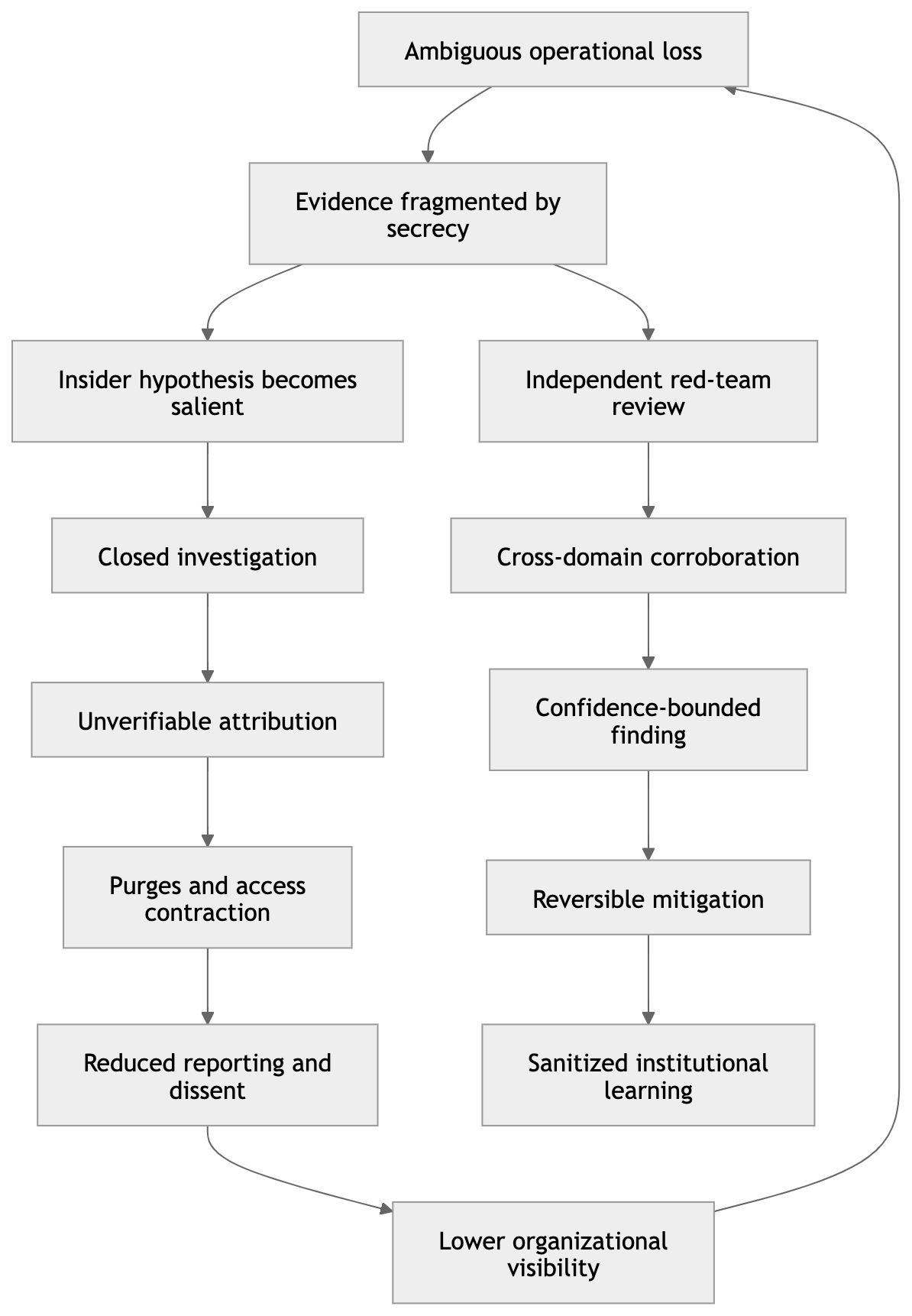
A disciplined Analysis of Competing Hypotheses must therefore begin with at least five explanations that can generate substantially similar observable outcomes. H₁ is strategic human penetration: a trusted insider intentionally supplies plans, identities, schedules, or vulnerabilities. H₂ is technical compromise misclassified as betrayal: devices, cloud services, commercial metadata, telecommunications infrastructure, or exposed digital accounts reveal information without a well-placed human source. H₃ is endogenous organizational failure: predictable routines, inadequate operational security, weak command integration, misunderstood warnings, or planning errors permit adversarial success without penetration. H₄ is adversarial deception: fabricated evidence, selective disclosure, impersonation, or deliberately visible surveillance causes the organization to accuse innocent members and destroy its own cohesion. H₅ is a compound mechanism: partial human access, technical collection, observable behavior, and institutional blind spots interact, while no single source possesses the complete picture. ACH is valuable because it forces analysts to compare hypotheses against disconfirming evidence; it is not a mechanical truth engine. A 2025 article in the CIA’s professional journal notes that structured techniques make reasoning explicit but argues that the empirical support for conventional ACH is weak and that the method can inadequately represent nuance and conflicting evidence. Applying Epistemology to Analysis: Making the Case for Abductive Reasoning, Studies in Intelligence Vol. 69 No. 3 – CIA Center for the Study of Intelligence – September/2025 — verified official publication. Accordingly, the matrix below does not “solve” a secret case. It organizes what would have to be true, identifies discriminatory evidence, and prevents the most emotionally compelling explanation from becoming the default merely because it is narratively complete.
| Hypothesis | Evidence expected if true | Evidence that weakens it | Principal deception risk | Initial prior | Illustrative posterior |
|---|---|---|---|---|---|
| H₁ Strategic HUMINT penetration | Repeated access-correlated compromise; knowledge not recoverable from technical collection | Failures continue after suspected source removal; exposed data available elsewhere | Adversary exaggerates agent access | 20% | 17.1% |
| H₂ Technical or metadata compromise | Device, account, infrastructure, or commercial-data correlations preceding losses | Air-gapped planning remains equally compromised | Technical signature planted to conceal a human source | 18% | 17.0% |
| H₃ Procedural and command failure | Recurrent timing, coordination, warning, or routine errors across unconnected cells | Highly selective adversarial knowledge unavailable from observation | Leadership uses “error” to conceal penetration | 18% | 15.3% |
| H₄ Deliberate deception and induced purge | Contradictory leaks, forged indicators, accusations optimized for factional impact | Independently verified source-to-outcome chain | Genuine penetration dismissed as psychological warfare | 14% | 11.8% |
| H₅ Compound penetration system | Partial indicators across human, cyber, commercial, financial, and behavioral domains | One mechanism consistently explains all observations | Complexity invoked to avoid accountability | 30% | 38.9% |
The Bayesian update shown here is explicitly illustrative rather than empirical. Priors P(H₁…H₅) were assigned as 0.20, 0.18, 0.18, 0.14, and 0.30; five evidence classes were then weighted according to their assumed independence and diagnostic value: precision of adversarial outcomes, existence of technical exposure, evidence of organizational silos, narrative manipulation pressure, and cross-domain anomalies. Weighted likelihood multiplication produced the posterior distribution in the table, increasing H₅ from 30.0% to 38.9% while reducing the relative standing of every single-cause explanation. The important inference is not the exact percentage; it is that heterogeneous evidence normally favors a compound model unless a uniquely diagnostic indicator exists. A human source and compromised metadata may reinforce each other: metadata identifies the relevant person, the person supplies interpretive context, surveillance validates the information, and organizational routines make the final target predictable. Investigators who insist on selecting either “agent” or “technology” can therefore misattribute a system-level penetration to one visible component. Bayesian discipline also requires negative updates. If compartment-specific operations continue to fail after communications are replaced, H₂ should decline; if failures track particular access patterns, H₁ should rise; if alleged penetrations cluster around internal political disputes without externally observable consequences, H₄ should rise; and if similar failures occur across groups without shared personnel but with shared platforms or vendors, H₂ and H₅ should rise. Evidence must update beliefs in both directions. Otherwise, a nominally Bayesian process merely translates prior suspicion into numerical language and gives institutional prejudice the appearance of mathematical objectivity.
Trust degradation is not simply the emotional aftermath of betrayal; it is a measurable deterioration in an organization’s capacity to coordinate under uncertainty. It progresses through four interacting channels. First, vertical trust declines when cadres believe leaders conceal failures, protect favored officials, or issue accusations without showing evidence. Second, horizontal trust declines when peers begin treating ordinary mistakes, personal disputes, or uneven access as signs of collaboration. Third, procedural trust declines when investigations lack consistent evidentiary thresholds, rights of reply, independent review, or bounded timelines. Fourth, epistemic trust declines when members no longer believe that the organization can distinguish fact from rumor. The resulting behavior can superficially resemble improved security: fewer communications, smaller meetings, reduced documentation, restricted initiative, and tighter compartmentation. In reality, excessive contraction may reduce warning flow, suppress reporting of mistakes, and make the organization more dependent on a few gatekeepers—thereby increasing the damage any one compromised or incompetent gatekeeper can cause. Mature insider-threat doctrine treats detection as a continuing program that combines access governance, user-activity monitoring, integrated analysis, training, and response rather than equating suspicion with guilt. Insider Threat Guide: A Compendium of Best Practices to Accompany the National Insider Threat Minimum Standards – National Insider Threat Task Force/ODNI – March/2018 web edition — verified official guide. That governmental framework cannot be transferred mechanically into clandestine movements, but its structural lesson is applicable: counterintelligence requires governance, professional competence, and recurring evaluation. A punitive apparatus without an evidence architecture may deter reporting more effectively than it deters penetration.
The “shadow” dimensions deepen the black box because they allow intelligence effects to be produced outside the organization’s formal boundary. Liquidity flows through informal transfer systems, front companies, charitable intermediaries, digital assets, family businesses, or criminal markets can expose relationships even when operational communications remain disciplined. A payment does not need to identify an operation directly; repeated correlations among sender, recipient, location, travel, and procurement can narrow the adversary’s search space. Proxy and criminal ecosystems create a second ambiguity: a violent act, surveillance task, theft, or intimidation campaign may be executed by actors unaware of the strategic sponsor, making attribution to the ultimate principal difficult even when the immediate perpetrator is identified. Europol’s 2026 assessment reports that hybrid actors continued to instrumentalize proxies for cumulative destabilization and notes that some proxies may be unaware of the larger strategic objective and treated as expendable. European Union Terrorism Situation and Trend Report 2026 – Europol – July/2026 — verified official EU report. A third dimension is the evolving cyber norm environment: states disagree not only about who conducted an intrusion, but also about evidentiary disclosure, intelligence protection, proportionality, and the political purposes of public attribution. A fourth is commercial intermediation, in which telecommunications, analytics, advertising, health, travel, and identity ecosystems generate intelligence-relevant correlations without being designed as intelligence services. Together these dimensions mean the organization is not penetrated solely at the point where a recruited person crosses an ethical line. It may be rendered transparent by the cumulative exhaust of its members, suppliers, families, financiers, devices, and institutional routines.
The corrective architecture must separate secrecy of content from auditability of process. Sensitive names and methods can remain concealed while investigators record why an allegation was opened, which evidentiary standards were applied, which alternatives were tested, who authorized intrusive measures, what evidence would falsify the preferred hypothesis, and when the case must be reviewed. This produces a two-layer archive: a sealed evidentiary layer accessible to a minimal cleared authority and a sanitized learning layer that preserves causal mechanisms without identifying vulnerable people. Investigative actions should be reversible wherever possible because the cost of a false positive is nonlinear: removing one innocent member may eliminate a skill, but publicly branding that member may divide an entire family, faction, locality, or external support network. Independent red teams should be organizationally separated from the unit that developed the original accusation. Their task is not to defend the suspect but to test whether the allegation survives alternative explanations. Cross-domain review should compare human reporting, access records, technical forensics, financial anomalies, command decisions, and adversarial behavior, with explicit confidence levels and source-reliability grades. The European Commission’s proposed cyber-crisis blueprint similarly emphasizes breaking organizational silos, shared situational awareness, defined interfaces, confidentiality, and coordination among technical, operational, and political levels. Proposal for a Council Recommendation for an EU Blueprint on Cybersecurity Crisis Management – European Commission – February/2025 — verified official EU document. This does not validate any clandestine organization’s procedures; it supports the broader architectural principle that complex incidents cannot be resolved when every node protects its fragment but no trusted mechanism integrates the whole.
| Decision gate | Minimum evidentiary requirement | Permitted organizational response | Prohibited inference | Audit output |
|---|---|---|---|---|
| Anomaly detected | Verified event and timestamp | Preserve evidence; restrict only exposed channel | “Failure proves betrayal” | Incident record |
| Hypothesis opened | Plausible access or causal mechanism | Focused review with bounded scope | “Access proves intent” | Hypothesis register |
| Interim containment | Credible risk plus urgency | Reversible access changes | “Containment proves guilt” | Written necessity assessment |
| Adverse attribution | Multi-source corroboration and alternative testing | Proportionate administrative action | “Confession or accusation is independently sufficient” | Confidence statement |
| Strategic finding | Cross-domain reconstruction | Doctrine or architecture change | “One culprit explains the entire system” | Sanitized lessons report |
| Closure or reopening | Falsification test and scheduled review | Restore access or reopen on new evidence | “Unresolved means guilty” | Reviewable disposition |
Over the 2026–2031 horizon, the highest-probability threat is not a single spectacular mole but an attribution crisis produced by increasingly convergent human and machine collection. During 2026–2027, organizations will respond to recent penetrations and high-precision targeting by tightening compartments, reducing digital exposure, and centralizing counterintelligence. That response will lower some immediate risks but can increase gatekeeper concentration and reporting silence. During 2027–2028, AI-assisted correlation will make sparse commercial, financial, biometric, linguistic, and geospatial traces more analytically useful; consequently, adversarial successes will look increasingly like insider betrayal even when no source holds decisive access. During 2028–2029, synthetic media, impersonation, forged message histories, and selectively released intercepts will make H₄ more consequential, particularly where accusations already align with factional cleavages. During 2029–2030, the decisive variable will be investigative legitimacy: organizations possessing auditable review procedures will be able to contain risk without converting uncertainty into collective punishment, whereas organizations relying on opaque security organs will experience chronic suspicion and talent flight. By 2030–2031, two equilibria become plausible. The resilient equilibrium combines compartmentation with cross-domain auditing, sanitized institutional memory, reversible containment, and protected dissent. The degraded equilibrium combines secrecy inflation, centralization, repeated purges, undocumented accusations, and reduced initiative. Russian-language official sources were screened during live verification, but the relevant Ministry of Foreign Affairs page could not be reliably opened and verified; under the specified zero-tolerance protocol, no Russian link or factual claim derived from it is included. The Chinese and EU materials above are used as official institutional positions, not as neutral adjudications of disputed attribution.
The Monte Carlo model executed for this assessment used 200,000 trials and six latent drivers: secrecy burden, attribution uncertainty, external pressure, cyber opacity, review legitimacy, and organizational learning capacity. Each driver was sampled from a bounded beta distribution; a small normally distributed disturbance represented unobserved shocks. The model is exploratory and reproducible from the disclosed structure, but its inputs are analyst-generated because no defensible public dataset measures the concealed penetration histories of Palestinian, Lebanese, or comparable clandestine organizations. Under the baseline assumptions, the 2031 trust-degradation risk index has a mean of 68.8, a median of 68.9, and a 10th–90th percentile interval of 56.8–80.5. Terminal outcomes divide into 0.3% resilient adaptation, 12.1% managed friction, 50.8% chronic suspicion, 31.9% purge or paralysis, and 4.8% severe fragmentation. These probabilities should be interpreted conditionally: they describe what follows from the specified high-secrecy, high-attribution-uncertainty environment, not observed frequencies. Sensitivity testing indicates that review legitimacy and learning capacity are the strongest internally controllable offsets because they reduce harm across every causal hypothesis. Technical improvements help mainly against H₂; personnel screening helps mainly against H₁; neither independently resolves H₃, H₄, or H₅. The dominant strategic conclusion is therefore institutional. An organization cannot eliminate uncertainty, but it can prevent uncertainty from acquiring punitive certainty without corroboration. The most damaging black box is not the archive the public cannot open; it is the internal process through which even authorized decision-makers can no longer reconstruct why the organization believes what it believes.
| 2031 modeled outcome | Probability | Leading indicators | Expected trust effect |
|---|---|---|---|
| Resilient adaptation | 0.3% | Independent review, evidence preservation, protected dissent | Trust becomes conditional but functional |
| Managed friction | 12.1% | Localized suspicion with credible adjudication | Temporary coordination loss |
| Chronic suspicion | 50.8% | Repeated unresolved cases, secrecy inflation, access contraction | Persistent reduction in initiative and information sharing |
| Purge or paralysis | 31.9% | Collective accusations, factional investigations, high false-positive cost | Major operational degradation |
| Severe fragmentation | 4.8% | Competing security organs, splinter archives, incompatible narratives | Loss of institutional coherence |
Figure 1: Five-Year Trust-Degradation Risk Projection
The 2026–2031 Horizon — Bayesian Assessment, Monte Carlo Scenarios and Strategic Warning Indicators
Analytical baseline
The 2026–2031 horizon will be defined less by the appearance of one revolutionary intelligence method than by the fusion of capabilities that previously operated in separate institutional compartments. Human recruitment, commercial surveillance, artificial intelligence, cyber intrusion, financial tracing, biometric identification, medical data, satellite observation and proxy networks will increasingly contribute fragments to a common analytic environment. This convergence changes the meaning of penetration. An adversary may obtain strategic effects without recruiting a source who possesses strategic access: one individual provides context, compromised infrastructure supplies communications, commercial metadata maps relationships, financial records reveal intermediaries, and automated analysis converts weak signals into a usable pattern. The principal five-year risk is therefore systemic transparency, not merely classical espionage. The 2025 US intelligence assessment describes an environment in which state cyber operations, regional proxy structures and growing cooperation among adversarial actors generate interconnected rather than isolated threats. Annual Threat Assessment of the U.S. Intelligence Community – Office of the Director of National Intelligence – March/2025 — verified official assessment. For resistance movements and other clandestine organizations, the strategic consequence is asymmetric: they must protect people, methods and archives while simultaneously retaining enough internal visibility to identify failure mechanisms. Greater secrecy can reduce exposure, but it can also suppress anomalous reporting, concentrate authority, weaken falsification and transform technical compromise into accusations of betrayal. The forecast therefore evaluates five competing organizational outcomes rather than predicting individual operations: defensive adaptation, a stable contested equilibrium, persistent penetration, counterintelligence overreaction and institutional fragmentation. All probabilities are conditional analytical estimates, not claims that secret evidence has established any particular breach.
The collection acceleration
Three documented developments justify increasing the prior probability of continuing penetration pressure. First, the commercial intrusion ecosystem is expanding beyond a small group of integrated spyware vendors. The British National Cyber Security Centre assesses that the global commercial intrusion sector will almost certainly expand over five years, driven partly by state demand, and that smaller vulnerability researchers and exploit developers will increasingly collaborate with specialist entities. NCSC Annual Review 2025: Countering the Cyber Threat – UK National Cyber Security Centre – October/2025 — verified UK government assessment. Second, artificial intelligence is increasing the efficiency of reconnaissance, social engineering, vulnerability research and analysis of exfiltrated information. The NCSC judges that AI will almost certainly increase the frequency and intensity of cyber threats and will highly likely expand intrusion capacity to a broader range of state and non-state actors. Impact of AI on Cyber Threat from Now to 2027 – UK National Cyber Security Centre – May/2025 — verified UK government assessment. Third, commercially held information already includes the categories needed to construct exceptionally detailed vulnerability maps. The Federal Trade Commission identifies health, financial, genetic, biometric, geolocation, sexual-behaviour, credential and government-identifier data as sensitive information covered by US restrictions on transfers to foreign adversaries. FTC Reminds Data Brokers of Their Obligations to Comply with PADFAA – Federal Trade Commission – February/2026 — verified US government notice. The regulation does not prove that every category is routinely available to intelligence services. It establishes that lawmakers regard the commercial circulation of these categories as a national-security exposure. By 2031, the operationally decisive asset will increasingly be the entity-resolution system capable of connecting such fragments, not any individual dataset in isolation.
| Structural driver | 2026 baseline | Expected 2031 direction | Intelligence effect | Organizational danger |
|---|---|---|---|---|
| Commercial intrusion market | Expanding specialist ecosystem | Wider capability diffusion | More actors can acquire collection tools | Compromise becomes harder to attribute to a state |
| AI-assisted analysis | Enhancing existing methods | Greater speed, scale and correlation | Weak signals become actionable patterns | Ordinary digital exhaust resembles insider reporting |
| Sensitive-data brokerage | Legally recognized security exposure | Greater regulation but persistent cross-border asymmetry | Health, financial and location records enrich targeting models | Members’ families and service providers become indirect exposure points |
| Proxy and criminal intermediation | Increasingly integrated with hybrid activity | More deniable and disposable intermediaries | Surveillance or coercion can be outsourced | Attribution stops at the immediate actor |
| Financial traceability | Growing public-private analytic capacity | Higher automation and network analysis | Hidden relationships become inferable from transactional structure | Excessive countermeasures may isolate legitimate support networks |
| Defensive compartmentation | Already extensive | Likely to intensify after shocks | Limits damage from individual breaches | Reduces institutional visibility and corrective learning |
| Synthetic evidence | Rapidly improving | Lower production cost and higher plausibility | Fabricated communications can support deception | False attribution can produce self-destructive purges |
Bayesian assessment
The Bayesian model uses the five competing hypotheses H₁–H₅ as mutually exclusive dominant trajectories, while recognizing that real organizations may exhibit elements of several. H₁ represents defensive adaptation outpacing adversarial collection; H₂ represents a contested equilibrium in which penetration and mitigation offset one another; H₃ represents persistent penetration that damages operations without destroying organizational continuity; H₄ represents counterintelligence overreaction, in which suspicion and punitive security practices create more damage than the verified penetration; H₅ represents systemic fragmentation, where archives, command authority and trust divide into incompatible institutional islands. Initial priors were set at 16%, 28%, 26%, 19% and 11%. These priors were updated against five evidence classes: commercial intrusion proliferation, AI-enabled collection, sensitive commercial data, growing proxy intermediation and the availability of cross-institutional crisis-governance models. The update follows P(Hᵢ|E) ∝ P(E|Hᵢ) × P(Hᵢ), with evidence weights ranging from 0.18 to 0.24 to reduce the false assumption that the evidence classes are fully independent. The posterior assigns 11.0% to H₁, 31.2% to H₂, 31.2% to H₃, 18.2% to H₄ and 8.4% to H₅. The equality between H₂ and H₃ is analytically important: the available evidence supports continued adversarial pressure, but it does not establish whether that pressure will remain manageable. The discriminating variable is organizational governance. Better technology can reduce specific attack surfaces; it cannot by itself restore confidence in investigations, reconcile competing archives, protect dissenting analysis or prevent political actors from instrumentalizing accusations. The posterior must therefore be updated when governance evidence changes, not solely when new attacks occur.
| Hypothesis | 2026 prior | 2026 posterior | Confidence | Evidence that would increase probability | Evidence that would reduce probability |
|---|---|---|---|---|---|
| H₁ Defensive adaptation | 16.0% | 11.0% | Low–moderate | Declining cross-domain compromises; credible review institutions; preserved initiative | Continued precise losses across redesigned systems |
| H₂ Contested equilibrium | 28.0% | 31.2% | Moderate | Recurring breaches without systemic paralysis; rapid institutional recovery | Accelerating leadership losses or widespread internal purges |
| H₃ Persistent penetration | 26.0% | 31.2% | Moderate | Compromises across human, technical, financial and commercial domains | Durable reduction after narrowly targeted reforms |
| H₄ Counterintelligence overreaction | 19.0% | 18.2% | Moderate–low | Expanding accusations without adjudication; reporting silence; factional security organs | Transparent review, restoration of cleared personnel, low false-positive rates |
| H₅ Systemic fragmentation | 11.0% | 8.4% | Low | Competing archives, command bifurcation, loss of financial coordination | Successful succession, interoperable records and authoritative dispute resolution |
Monte Carlo architecture
The Monte Carlo assessment comprised 500,000 trials and modeled six uncertain drivers on bounded beta distributions: collection acceleration C, governance quality G, conflict pressure P, deception intensity D, financial traceability F and organizational redundancy R. Beta distributions were selected because every driver is constrained between zero and one while remaining capable of asymmetric uncertainty. Each trial generated scenario scores from the Bayesian posterior, added scenario-specific driver coefficients and introduced a normally distributed disturbance representing leadership shocks, technical surprise, conflict escalation and unobserved institutional variation. Collection acceleration increased the probability of H₃ and, less strongly, H₄ and H₅; governance quality strongly favored H₁ and H₂; conflict pressure increased H₃–H₅; deception intensity disproportionately increased H₄ and H₅; financial traceability increased H₃ by making distributed relationships more observable; redundancy favored adaptation and reduced fragmentation. The simulation’s 2031 terminal distribution is 6.1% defensive adaptation, 23.1% contested equilibrium, 39.3% persistent penetration, 21.3% counterintelligence overreaction and 10.2% systemic fragmentation. The difference between the Bayesian posterior and simulated terminal distribution reflects five years of compounding pressure rather than a contradictory model. The associated composite risk index rises from a 2026 median of 51.7 to a 2031 median of 59.7. The 2031 10th–90th percentile interval is 50.9–67.8, demonstrating that uncertainty around the severity of degradation remains substantial even when the directional trend is stable. Sensitivity analysis assigns the strongest positive relationship to collection acceleration at +0.606, followed by conflict pressure at +0.377, financial traceability at +0.323 and deception at +0.313; governance quality produces the largest controllable negative relationship at −0.444, while redundancy contributes −0.302. These are model sensitivities, not empirical causal coefficients.
| Scenario | 2031 probability | Defining condition | Principal damage | Recovery potential |
|---|---|---|---|---|
| S₁ Adaptive resilience | 6.1% | Governance and redundancy outpace collection | Localized exposure | High if lessons are transferred |
| S₂ Contested equilibrium | 23.1% | Breaches recur but remain containable | Persistent operational friction | Moderate–high |
| S₃ Persistent penetration | 39.3% | Cross-domain collection outpaces defensive integration | Repeated compromise and strategic caution | Moderate but costly |
| S₄ Counterintelligence overreaction | 21.3% | Attribution uncertainty becomes punitive certainty | Trust erosion, silence, false positives | Low without independent review |
| S₅ Systemic fragmentation | 10.2% | Security, command and archives split into competing systems | Loss of coherence and succession capacity | Very low during conflict |
Scenario mechanics
The modal outcome, persistent penetration, should not be read as a forecast of continuous high-level human access. It describes an environment in which adversaries repeatedly obtain decision advantage through different combinations of human, cyber, commercial and observational collection. One operation may be exposed through communications; another through financial or travel correlations; another through a recruited intermediary; a fourth through predictable emergency procedures. Because the mechanism changes, the organization may falsely conclude that defensive reforms have failed or that one deeply embedded source must explain every loss. The second most probable outcome, contested equilibrium, differs not by the absence of penetration but by the speed and legitimacy with which the organization reconstructs events, isolates damage and restores cooperation. The third outcome, counterintelligence overreaction, becomes more probable when leadership attrition, synthetic evidence and unresolved failures coincide. Artificial intelligence strengthens both detection and deception: it can correlate anomalies, but it can also manufacture plausible communications, identities, recordings and analytic narratives. The latest NIST cyber-AI work identifies AI attack surfaces, governance problems, taxonomy inconsistency and the need for risk-based controls as continuing institutional challenges. Workshop Summary Report for Cyber AI Profile Hybrid Workshop No. 2, NIST IR 8607 – National Institute of Standards and Technology – August/2026 — verified US government report. In an opaque organization, automated suspicion systems pose an additional danger: an algorithm can rank anomalous members without explaining whether the anomaly reflects hostile intent, unusual duties, family circumstances, administrative error or corrupted input. By 2031, the ability to audit machine-supported attribution will become as important as the ability to deploy it.
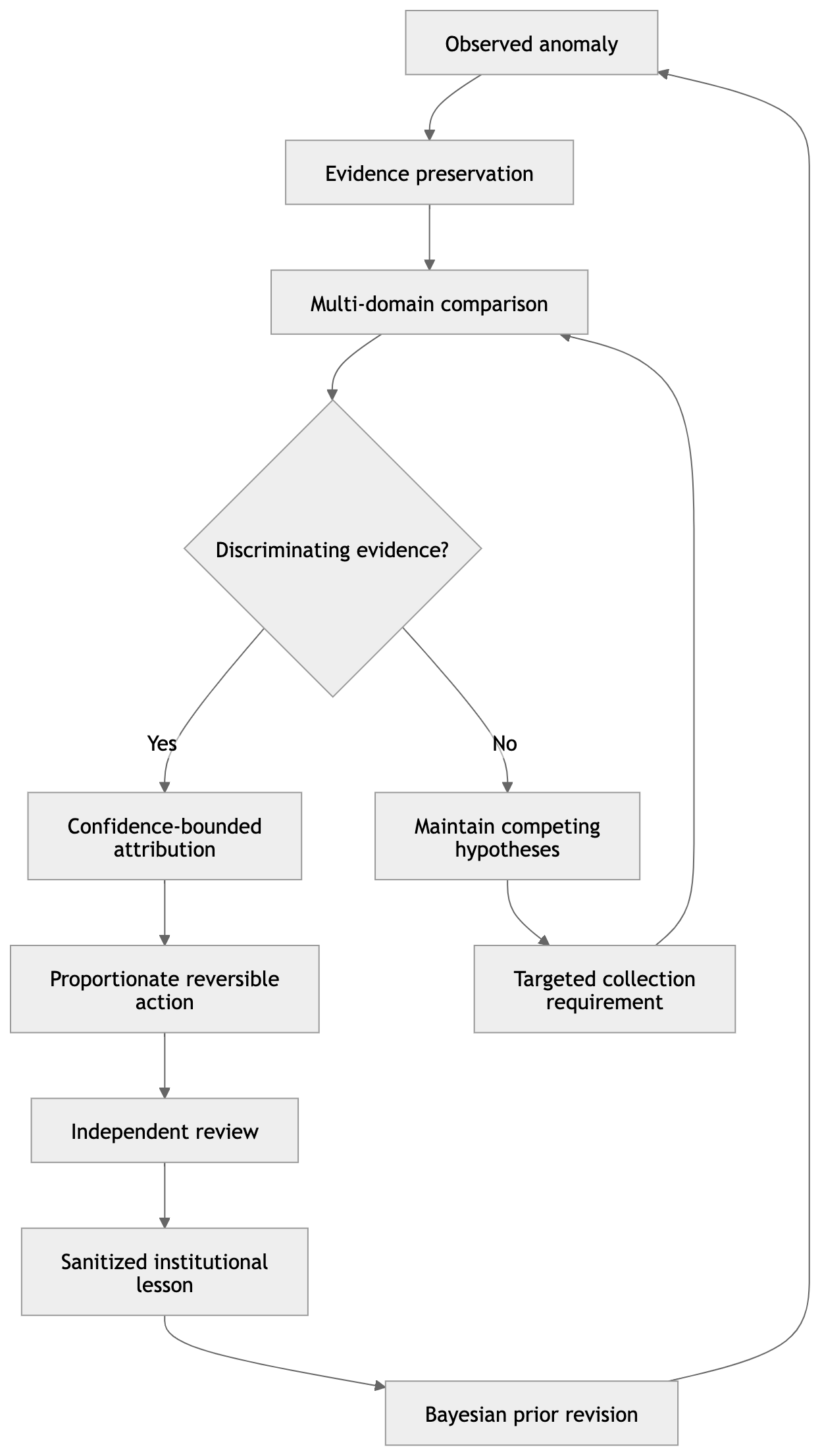
Strategic-warning system
An effective warning architecture must distinguish adversarial penetration indicators from organizational degradation indicators, because the two can move independently. A rise in unexplained operational losses, compromised identities, anomalous access patterns or adversarial anticipation may increase the probability of H₁, H₂ or H₅ from the previous chapter’s causal framework. A simultaneous decline in reporting, increase in anonymous accusations, multiplication of competing investigative bodies or contraction of decision authority increases the probability of the future trajectory H₄ even if the underlying penetration is limited. Indicators should therefore be organized into six clusters and evaluated as rates of change rather than isolated events. The first cluster measures external precision: how often adversarial action appears synchronized with information that had limited circulation. The second measures technical exposure: unusual authentication activity, infrastructure compromise, supplier incidents and abrupt changes in adversarial cyber behavior. The third measures commercial visibility: regulatory findings, data-broker enforcement, leaked datasets and expansion of identity-resolution services. The fourth measures financial observability: interdictions, sanctions, account closures and evidence that apparently separate nodes are being connected through facilitators. The fifth measures trust health: voluntary reporting, case-closure duration, successful appeals, false-positive findings, leadership turnover and the proportion of security actions that remain unexplained after review. The sixth measures adversarial deception: contradictory “leaks,” synthetic media, impersonation attempts and narratives that selectively reinforce existing factional disputes. No single indicator should trigger strategic attribution. A warning state should require corroboration across at least three clusters or one highly diagnostic finding supported by independent provenance. The purpose is to detect regime change in the threat environment while preventing the warning mechanism itself from becoming an engine of suspicion.
| Indicator cluster | Observable measure | Watch threshold | Warning threshold | Strategic implication |
|---|---|---|---|---|
| External precision | Repeated compromise of restricted decisions | Two unexplained correlations | Cross-compartment recurrence | Raise H₁ and H₅; test technical alternatives |
| Cyber exposure | Authenticated access anomalies or supplier compromise | Localized technical event | Multi-system persistence | Raise technical and compound hypotheses |
| Commercial metadata | Evidence of sensitive-data availability or transfer | New relevant service or enforcement action | Identified exposure involving members or families | Increase collection-acceleration parameter |
| Financial observability | Interdictions connecting previously separate nodes | One new correlation class | Repeated facilitator mapping | Raise F and persistent-penetration probability |
| Trust health | Reporting decline, unresolved investigations, removals overturned | Deterioration across two quarters | Simultaneous silence and punitive expansion | Raise H₄ sharply |
| Archive integrity | Missing provenance, incompatible records, unauthorized duplication | Delayed reconciliation | Competing authoritative archives | Raise H₅ |
| Deception environment | Forged media or contradictory disclosures | Isolated plausible fabrication | Coordinated material aligned with factional tension | Raise D and demand evidentiary quarantine |
| Recovery capacity | Time to restore function after compromise | Increasing recovery duration | Failure to restore cross-unit coordination | Shift H₂ toward H₃ or H₅ |
Finance, proxies and organizational topology
Liquidity flows and proxy systems will remain decisive “shadow” dimensions because they reveal topology: who connects otherwise separated nodes, which actors repeatedly bridge regions, and where organizational dependence exceeds formal authority. The value of financial intelligence is not limited to identifying large transfers. Timing, recurrence, intermediaries, merchant relationships and deviations from historical behavior can expose coordination even when amounts are small. Conversely, excessive financial secrecy can force an organization toward narrower, less resilient channels whose disruption has disproportionate effects. A 2026 US Treasury action stated that sustained pressure had pushed ISIS toward greater decentralization and dependence on autonomous affiliates, while financial facilitators continued to provide connectivity between those nodes and central structures. Treasury Targets ISIS Facilitators and Disrupts Terrorist Financial Networks – US Department of the Treasury – June/2026 — verified US government release. The case concerns ISIS and cannot be used as direct evidence about Palestinian or Lebanese organizations; its analytical value lies in demonstrating a general topology: decentralization reduces some command vulnerabilities but increases reliance on a limited class of connectors. Proxy environments create a parallel problem. Europol reports that hybrid actors have continued to instrumentalize proxies for cumulative destabilization and that some intermediaries may be unaware of the wider strategic purpose for which they are used. European Union Terrorism Situation and Trend Report 2026 – Europol – July/2026 — verified official EU assessment. Between 2026 and 2031, organizations that protect command nodes while leaving connectors, service dependencies and external facilitators analytically unmanaged may become structurally legible even if their formal hierarchy remains concealed.
Temporal forecast: 2026–2031
The forecast divides into three phases. During 2026–2027, AI will primarily enhance existing collection methods rather than create wholly novel ones: faster reconnaissance, more convincing social engineering, accelerated exploitation research and more efficient processing of captured information. The warning priority is therefore volume and correlation—more attempted approaches, shorter time between data acquisition and operational exploitation, and more evidence assembled from commercially obtainable sources. During 2028–2029, the intelligence contest is likely to shift from access acquisition toward automated entity resolution. The adversary that can integrate incomplete identity, location, financial, health, travel and social data will require fewer uniquely placed sources. Simultaneously, defenders will deploy their own automated anomaly systems, raising the probability that corrupted data, biased models or deliberate poisoning generate false accusations. During 2030–2031, the decisive issue will be institutional legitimacy. Organizations with reviewable attribution, preserved evidence, protected dissent and interoperable archives will remain penetrated but governable; those that equate secrecy with immunity from review will face increasing overreaction or fragmentation. The European Commission’s cyber-crisis blueprint provides a relevant institutional analogy by emphasizing shared situational awareness, defined interactions and coordination across technical, operational and political levels while retaining confidentiality. Proposal for a Council Recommendation for an EU Blueprint on Cybersecurity Crisis Management – European Commission – February/2025 — verified official EU document. The forecast does not assume that a clandestine movement can replicate an interstate framework. It identifies the same underlying requirement: secrecy must be combined with interfaces through which fragmented evidence becomes an assessable common picture.
| Period | Dominant intelligence change | Principal organizational response | Failure risk | Key revision indicator |
|---|---|---|---|---|
| 2026–2027 | AI-enhanced existing collection | Rapid security contraction | Mistaking volume for strategic penetration | Ratio of attempted approaches to verified compromises |
| 2027–2028 | Commercial-intrusion diffusion | Supplier and device replacement | Treating each technical event as isolated | Repetition across unrelated platforms |
| 2028–2029 | Automated entity resolution | Broader anomaly monitoring | False positives and data poisoning | Divergence between automated alerts and validated cases |
| 2029–2030 | Synthetic evidence normalization | Greater authentication demands | Institutional inability to accept genuine evidence | Growth in unresolved or permanently disputed cases |
| 2030–2031 | Competition between integration and fragmentation | Governance reform or security centralization | Trust collapse under permanent emergency | Reporting rates, appeal outcomes and archive interoperability |
Geopolitical cross-check and warning thresholds
Multilingual cross-checking shows that attribution itself will remain strategically contested. The Chinese Ministry of Foreign Affairs has argued that cyber attribution requires substantiated facts and that politically motivated attribution can erode international trust. Remarks by Mr. Wang Lei at the 10th Session of the Open-ended Working Group on Security of and in the Use of ICTs – Ministry of Foreign Affairs of the People’s Republic of China – March/2025 — verified Chinese government statement. This is a government position and not independent validation of China’s counterclaims; it is evidence that major powers treat attribution standards as part of geopolitical competition. Official Russian-language and Russian government materials were screened, but no directly relevant document meeting the stipulated standard of exact live-page verification and evidentiary specificity was incorporated; unsupported Russian claims are therefore omitted. The warning framework should respond to this contested environment with explicit probability thresholds. A posterior below 25% should remain a collection hypothesis and should not support irreversible personnel conclusions. A probability between 25% and 50% justifies evidence preservation and proportionate, reversible containment. Between 50% and 75%, decision-makers should require independent review and active testing of the strongest alternative. Above 75%, strategic attribution may be justified only if source provenance, technical integrity and deception checks are separately satisfied. These thresholds are governance recommendations, not universal legal standards. Their purpose is to prevent numerical confidence from substituting for evidentiary quality. A highly confident judgment built from dependent or manipulated sources remains structurally weak, while a lower-confidence judgment based on genuinely independent evidence may be more decision-useful.
Strategic judgment
The central estimate is that by 2031 the penetration contest will become more continuous, distributed and difficult to attribute, but organizational collapse is not inevitable. The simulation assigns a combined 62.4% probability to persistent penetration or counterintelligence overreaction, compared with 29.2% for adaptation or managed equilibrium and 10.2% for fragmentation. The most important strategic distinction is between adversarial success and self-amplified damage. Penetration exposes information; attribution failure corrupts judgment; unreviewable counterintelligence degrades trust; trust degradation reduces reporting; reduced reporting makes the organization less able to detect further penetration. This feedback loop means defensive effectiveness cannot be measured merely by the number of people removed, devices replaced or compartments created. It must be measured through lower validated compromise rates, faster recovery, greater evidentiary clarity, preserved initiative and the ability to close investigations credibly. The five-year horizon also argues against static doctrine. Bayesian priors should be recalibrated at scheduled intervals; Monte Carlo assumptions should be stress-tested against high-impact shocks; indicator thresholds should be reviewed when collection technology, legal regimes or organizational topology changes. The best early-warning system is not the one that produces the largest number of alerts. It is the one that detects meaningful movement among H₁–H₅ without turning ambiguity into institutionalized accusation. If governance quality rises materially above the baseline, the model shifts probability from persistent penetration and overreaction toward contested equilibrium. If conflict pressure, collection acceleration and synthetic deception rise together while governance remains weak, the dominant trajectory moves toward punitive paralysis and fragmentation. The ultimate strategic variable is therefore whether secrecy remains a controlled instrument of survival or becomes an autonomous system that conceals failure from the very organization it is supposed to protect.