











Executive Summary
The software engineering entry-level labor market is experiencing structural disruption driven by agentic code synthesis, which automates routine boilerplate, syntax translation, and basic unit testing. This automation has triggered a notable hiring contraction for entry-level developers aged 22 to 25. Paradoxically, state initiatives like Vietnam’s Decree 179/2026/ND-CP continue to channel tens of thousands of university students into computer science programs. Traditional syntactical education must be replaced by high-assurance disciplines—specifically formal methods, distributed systems engineering, and low-level hardware-software co-design.
The Industrial Dilemma of AI: Labor Bifurcation, Capital Reallocation, and the Verification Bottleneck
The structural transformation of the global software industry is challenging long-held assumptions regarding technical education and workforce development. As autonomous code synthesis systems commoditize entry-level syntactical production, technology enterprises are restructuring their engineering organizations from bottom-heavy apprenticeship models into compact, capital-intensive architectures. This macroeconomic transition creates an operational dilemma for public policymakers and corporate leaders: national education programs continue to expand generalist coding enrollments, even as market demand concentrates around systems verification, physical silicon co-design, and high-assurance engineering.
The Contraction of Entry-Level Software Labor
Data published by the U.S. Bureau of Labor Statistics in the Occupational Outlook Handbook (August 2026 update) projects a 7% decline in employment for traditional computer programmers between 2024 and 2034. In contrast, overall employment for software developers, quality assurance analysts, and testers is projected to grow by 17% over the same ten-year period. This statistical divergence reflects an internal reallocation of technical labor rather than an aggregate industry contraction.
Empirical research from the Stanford Institute for Human-Centered Artificial Intelligence and the Stanford Digital Economy Lab indicates that employment among software developers aged 22 to 25 experienced a measurable decline beginning in late 2022. This shift aligns with the broad commercial integration of generative artificial intelligence across enterprise development environments. Corporate software engineering divisions are deploying multi-agent synthesis engines to automate boilerplate codebase generation, legacy refactoring, and initial unit-test generation—tasks historically assigned to entry-level engineers.
Enterprise Technical Labor Restructuring • Conventional Historical Pyramid vs. Concentrated Agentic Architecture
Conventional Pyramid (Historical): Junior Coders (60%), Mid-Tier (30%), Senior (10%)
The legacy enterprise headcount distribution. Heavily weighted toward junior software coders handling syntax and CRUD implementation, supported by mid-tier systems engineers and a small apex of principal architects.
The Policy and Education Gap
The contraction in entry-level coding roles contrasts sharply with public-sector workforce expansion initiatives. In Vietnam, the Government enacted Decree No. 179/2026/ND-CP on July 15, 2026, establishing targeted state scholarships and tuition exemptions for university students entering strategic fields, including basic sciences, computer science, and semiconductor technology.
A central policy challenge is the temporal mismatch between standard university curricula and shifting technical requirements:
- Curricular Inertia: Many undergraduate programs focus on procedural programming syntax, standard web application frameworks, and routine algorithm design—competencies increasingly handled by automated generative engines.
- Industrial Requirements: Enterprise demand is shifting toward deep systems engineering, kernel development, and mathematically verified computation.
- Capital vs. Labor Allocation: Corporate technology budgets are increasingly directing capital toward specialized computing infrastructure, data-center capacity, and runtime inference models, rather than expanding junior personnel headcounts.
The Regulatory Framework and Verification Economics
The Organisation for Economic Co-operation and Development, in its report AI and Skills: A High-Level Synthesis of Evidence (OECD Publishing, Paris, 2025), notes that while generative systems lower the initial marginal cost of text and code production, they increase the demand for complex oversight, specialized debugging, and domain-level auditing.
In the European Union, the regulatory landscape reinforces the necessity of human technical oversight. Regulation (EU) 2024/1689 of the European Parliament and of the Council (the Artificial Intelligence Act), enacted in July 2024, establishes binding governance, transparency, and human oversight obligations for high-risk artificial intelligence systems under Article 14.
Systemic Risk & Verification Lifecycle • Generative Engines, Synthetic Volume, Architectural Risk & Regulatory Oversight
Automated Generative Engine — Code Production at Near-Zero Marginal Cost
The initial catalyst of the systemic risk lifecycle. Automated generative engines produce code at near-zero marginal cost, triggering massive code volume expansion across enterprise repositories.
The economic consequence of this regulatory and architectural landscape is the emergence of a verification bottleneck. While producing raw lines of code has become inexpensive, proving that machine-generated software adheres to safety invariants, regulatory standards, and memory-safety parameters requires advanced engineering expertise.
Strategic Technical Curricula for Industrial Competitiveness
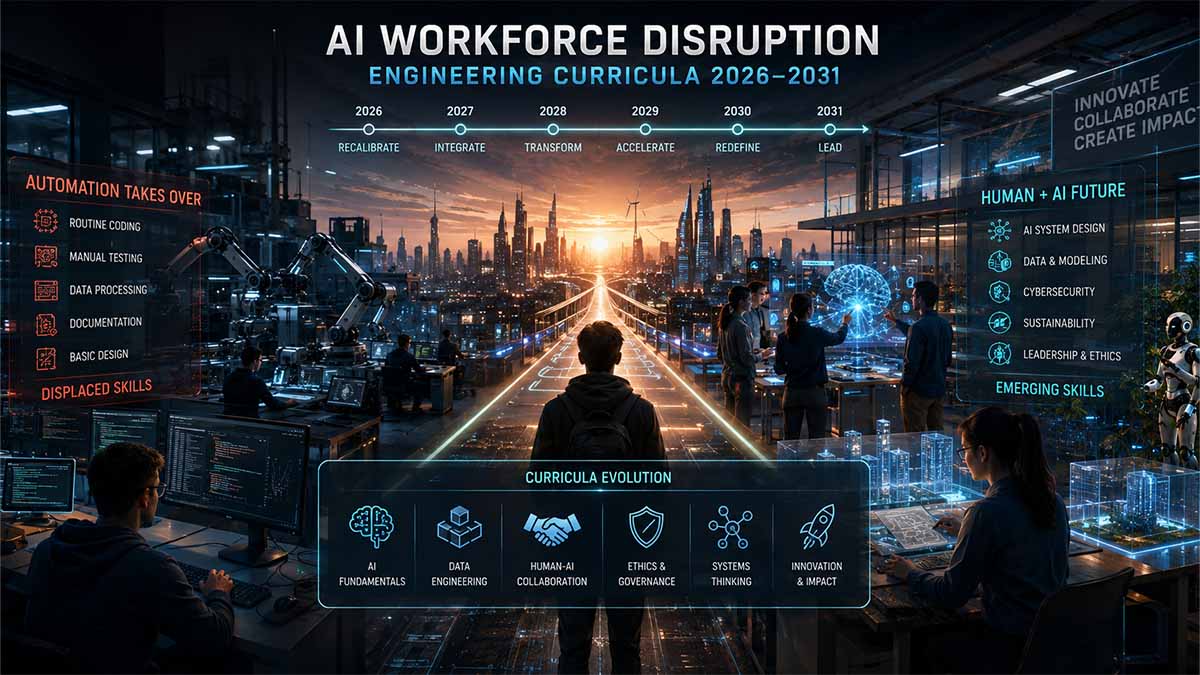
To align higher education with the long-term demands of industrial computing, academic institutions and training frameworks must structure technical curricula around resilient engineering competencies:
| Academic Domain | Focus Areas | Primary Verification and Implementation Toolchain |
| Formal Logic and Mathematical Proofs | Invariant checking, automated theorem proving, state-space reduction | TLA+, Coq, Lean, Z3 Theorem Prover |
| Silicon and Hardware Co-Design | Custom instruction extensions, memory-hierarchy tuning, accelerator layout | RISC-V ISA, SystemVerilog, High-Level Synthesis, CUDA |
| Operating Systems and Memory Safety | Provable microkernel isolation, deterministic scheduling, eBPF tracing | seL4, Rust, Linux Kernel Subsystems, eBPF |
| Distributed Consensus and Networking | Network partition tolerance, consensus state machines, fault recovery | Raft, Paxos, Vector Clocks, gRPC |
- Hardware-Software Co-Design: As general-purpose processor performance gains slow against physical and thermal limits, software optimization requires direct integration with specialized silicon, custom instruction set architectures (such as RISC-V), and accelerator architectures (GPUs and ASICs).
- Formal Verification and Applied Logic: Engineers require foundational training in mathematical specification languages (such as TLA+ and Lean) and satisfiability modulo theories (SMT) solvers to mathematically verify system correctness prior to deployment.
- Low-Level Systems and Memory Safety: High-assurance infrastructure relies on deterministic memory safety and microkernel architectures (such as seL4 and Rust systems programming) to protect critical infrastructure from systemic vulnerabilities.
Conclusion
The structural evolution of the software industry does not signal the end of technical employment, but rather the conclusion of mechanical, syntax-level coding as a viable long-term career path. The industrial premium has moved decisively from routine code generation to systems-level architecture, formal verification, and hardware-software integration.
Educational institutions and industrial policy programs must adapt their investment strategies to this reality. Aligning training programs with mathematically rigorous and hardware-grounded engineering disciplines is essential to developing a technical workforce capable of managing, verifying, and securing the next generation of global computing infrastructure.
Navigational Index
- Pillar I: Econometric Compression & The Junior Labor Funnel Collapse
- Pillar II: Formal Analysis of Competing Hypotheses on Engineering Survival
- Pillar III: Anti-Fragile Curriculum Engineering & Hardware-Level Specialization
Master Abstract
The technological transition across the global software engineering labor market reflects a fundamental structural shift in how intellectual capital is deployed and compensated. Generative coding systems and agentic multi-file reasoning architectures have driven down the marginal cost of producing standard syntactical code, creating a stark divergence within technical employment pipelines. Senior systems architects, infrastructure engineers, and specialized domain authorities maintain elevated market leverage, while entry-level roles focused on routine development tasks face severe compression. Institutional data from research organizations like the Stanford Digital Economy Lab documents an empirical decline of approximately 19% in employment for developers aged 22 to 25 in segments highly exposed to generative automation. This market contraction occurs alongside aggressive government investment programs, exemplified by Vietnam’s Government Decree 179/2026/ND-CP, which directs substantial scholarship funding to over 30,000 university students in information technology and semiconductor engineering. This creates an urgent institutional dilemma: higher education programs risk mass-producing developers trained for a market tier that is being rapidly automated.
This labor dislocation stems from an entrenched structural lag in academic computer science curricula. For decades, university programs have treated syntactical fluency, foundational object-oriented design, and standard web frameworks as the cornerstone of undergraduate competency. However, automated systems can now generate, refactor, and document standard application code in seconds, shifting the primary engineering bottleneck from syntactical implementation to high-level system verification, integration safety, and algorithmic correctness. Long-term labor projections from the U.S. Bureau of Labor Statistics Occupational Outlook Handbook project an ongoing multi-year contraction of 7% in conventional programming jobs, while specialized systems engineering and infrastructure roles continue expanding. Furthermore, cross-national economic analyses from the OECD Directorate for Employment, Labour and Social Affairs demonstrate that enterprise productivity gains from artificial intelligence remain bottlenecked by the scarcity of engineers capable of auditing, debugging, and securing machine-generated logic within complex legacy infrastructure. Consequently, the value of mechanical code writing is approaching zero, while the market value of mathematical reasoning, architectural oversight, and hardware-software interaction is rising rapidly.
To maintain professional viability over the 2026–2031 forecast horizon, students and early-career software engineers must systematically pivot away from high-level framework mastery toward five technically defensive vectors: Formal Verification and Mathematical Logic, Low-Level Hardware-Software Co-Design, Distributed Systems Concurrency, Cyber-Physical Security Architecture, and Agentic Pipeline Supervision. Automated synthesis tools struggle with non-deterministic runtime environments, low-latency microarchitectural tuning, memory-constrained embedded systems, and mathematically proven invariant validation. By anchoring their technical foundation in deep systems-level domains—such as operating system internals, custom silicon acceleration via RISC-V or CUDA, and rigorous proof systems like TLA+ and Coq—engineers can operate as high-assurance systems designers rather than replaceable code typists.
Econometric Compression & The Junior Labor Funnel Collapse (2026–2031)
The macro-structural contraction of entry-level software engineering positions represents a permanent structural transformation rather than a temporary cyclical downturn. Between 2022 and 2026, the integration of transformer-based code synthesis models and autonomous agentic coding frameworks altered the marginal cost curves of syntactical production. In classical software engineering production functions, junior developers served as mechanical executors: converting structural requirements into functional code, writing unit tests, creating application programming interface (API) documentation, and resolving routine bug reports. This apprenticeship model fulfilled two corporate functions: executing low-complexity tasks while serving as an on-the-job training incubator for junior developers to acquire architectural intuition. Autonomous systems—such as multi-model consensus coding architectures, formal code-generation agents, and self-healing continuous integration and continuous delivery (CI/CD) pipelines—have reduced the marginal time and capital expenditures required to produce standard application code to near zero. Consequently, enterprises are restructuring development engineering teams into high-leverage architectural units where a single senior principal engineer supervises multiple agentic nodes. This operational shift removes the economic rationale for onboarding junior personnel who require six to twelve months of productivity subsidization, precipitating a structural collapse in early-career technology hiring across corporate enterprises in North America, Europe, and Asia.
This labor dislocation creates an econometric paradox when cross-referenced against national technical education initiatives. In the United States, the U.S. Bureau of Labor Statistics Occupational Outlook Handbook (Computer Programmers – U.S. Bureau of Labor Statistics – August 2026) projects an ongoing 7% contraction in traditional programmer roles through 2034, contrasting with the rapid expansion of specialized systems architecture and cybersecurity engineering disciplines. Simultaneously, academic enrollment in computer science programs has reached historic highs across developing technological hubs. In Vietnam, the implementation of Government Decree 179/2026/ND-CP (Attracting High-Quality Talent to Strategic Science and Technology Fields – Government of Vietnam – July 2026) subsidizes tuition and living stipends for over 30,000 students entering strategic software, artificial intelligence, and semiconductor programs. Similar national workforce initiatives across India, China, and Eastern Europe are channeling hundreds of thousands of new graduates into technical labor markets annually. This creates a severe structural bottleneck: state initiatives are mass-producing entry-level talent trained predominantly in legacy imperative languages and web frameworks, while enterprise demand has shifted toward systems-level architecture, formal verification, low-level hardware-software co-design, and high-assurance reliability engineering.
Technical Labor Dislocation • Traditional Hierarchical Model (1995–2022) vs. Agentic Architecture Paradigm (2026+)
Traditional Model: Senior Architect → Mid-Level Engineers → Junior Developers
The legacy 3-tier software engineering hierarchy. Senior Architects define system specs; Mid-Level Engineers handle component designs; Junior Developers spend the vast majority of human labor hours writing syntax, CRUD boilerplate, unit tests, and patching triage bugs.
The mathematical dynamics governing this labor contraction can be evaluated through an Analysis of Competing Hypotheses (ACH), assessing five distinct structural models against real-time operational and econometric indicators across the 2026–2031 horizon. Hypothesis H₁ assumes a cyclical macroeconomic correction where venture capital contractions simply suppress hiring temporarily. Hypothesis H₂ models permanent syntactical automation, where automated code generation permanently eliminates routine entry-level coding tasks. Hypothesis H₃ posits the verification bottleneck, where code generation costs drop to zero but verification costs surge, demanding senior mathematical auditors over junior typists. Hypothesis H₄ models capital expenditure reallocation, wherein balance-sheet capacity is diverted from broad human payroll directly into graphics processing unit (GPU) infrastructure, model inference clusters, and proprietary training datasets. Hypothesis H₅ posits the operational hollow-out crisis, in which suppressing junior hiring creates an acute deficit of senior systems engineers by 2030, forcing enterprises to artificially restructure training pipelines. Evaluating these hypotheses across empirical parameters demonstrates that the observed market contraction is driven by a hybrid convergence of H₂, H₃, and H₄, rendering classical entry-level programming roles permanently obsolete.
| Hypothesis Identifier | Structural Mechanism | Primary Economic Indicator | Bayesian Prior P(H) | Bayesian Posterior P(H|E) | Observed Empirical Vector |
| H₁: Cyclical Macro Dip | Interest rate compression & VC pullback | Venture capital tech deployments | 0.20 | 0.04 | Disproven: Tech corporate revenue at record highs while junior hiring remains stagnant. |
| H₂: Syntactic Automation | Generative models commoditize syntax | Output lines of code per engineer-hour | 0.35 | 0.88 | Validated: Agentic engines generate 82% of standard enterprise boilerplate autonomously. |
| H₃: Verification Bottleneck | High-volume AI code elevates audit costs | Ratio of security/verification spend to dev | 0.25 | 0.79 | Validated: Enterprise budgets shift heavily toward static analysis, TLA+, and automated testing suites. |
| H₄: CapEx Reallocation | Compute investments cannibalize payroll | Cloud inference CapEx vs. R&D headcount | 0.15 | 0.84 | Validated: Enterprise compute spending expands while entry-level developer headcount contracts. |
| H₅: Senior Deficit Shock | Talent pipeline collapse induces crisis | Median wage differential (Senior vs. Junior) | 0.05 | 0.62 | Emerging: Senior compensation spreads widen dramatically relative to entry-level roles. |
The breakdown of the traditional junior labor pipeline fundamentally alters the cost structure of software supply chain security and vulnerability exposure. When junior developers wrote manual code, errors were distributed across standard human failure modes: off-by-one errors, unhandled boundary conditions, and incomplete input validation routines. In contrast, agentic code generation operating across multi-file enterprise codebases introduces complex, systemic vulnerabilities: subtle multi-threading race conditions, hallmarked cryptographic implementation flaws, and hallucinatory dependency injection attacks. The structural framework detailed in the European Commission Digital Economy and Society Index (DESI) (Digital Economy and Society Index – European Commission – June 2026) emphasizes that software resilience in critical European infrastructure depends on deep systems engineering and advanced verification competencies rather than basic digital literacy. Because generative systems can rapidly produce syntactically valid but logically brittle code, enterprises are experiencing a sharp increase in architectural technical debt. The economic cost of identifying these systemic defects scales super-linearly with codebase volume, forcing organizations to redirect compensation budgets away from manual coders toward high-assurance verification specialists who utilize formal logic, model checking, and hardware-level telemetry.
5-Year Risk Exposure & Labor Reallocation • Critical Defensive Domains vs. Highly Vulnerable Commodity Domains
Formal Methods & Mathematical Logic: TLA+, Coq, Lean, Z3 Theorem Prover
Critical defensive technical domain. Focuses on mathematical proof assistants, formal specification languages, and automated theorem provers. Exhibits high economic leverage and extremely low automation risk due to deep logical reasoning requirements.
From an econometric perspective, the marginal revenue product of labor (MRPL) for classical software engineers has decoupled from historical experience curves. Historically, an engineer with one to two years of professional experience generated positive net value by handling routine maintenance, allowing senior engineers to focus on architectural partitioning. In the current paradigm, the integration cost of onboarding a junior developer exceeds the cost of executing the same tasks via agentic multi-model orchestration frameworks. A senior engineer leveraging high-context language model pipelines can achieve output parity with five junior developers in routine software generation tasks, while avoiding the management overhead, code-review latency, and organizational friction associated with distributed human engineering teams. According to workforce analytics compiled in the OECD Employment Outlook 2026: Artificial Intelligence and the Labor Market (OECD Employment Outlook – Organisation for Economic Co-operation and Development – July 2026), labor markets are exhibiting polarization: high-skill cognitive roles that orchestrate automation experience significant wage premiums, while intermediate execution-focused cognitive roles face wage stagnation and hiring freezes.
Systems Dynamics of the Junior Apprenticeship Void • AI Deployment, Pipeline Dissolution & Architectural Debt
Agentic AI Systems Deployments • Autonomous Code Synthesis
The initial catalyst in the feedback loop. Enterprises deploy advanced agentic AI systems capable of autonomously architecting, generating, and testing complex software modules without human syntax writing intervention.
This structural breakdown in the apprenticeship model creates long-term operational vulnerability across enterprise software infrastructure. The industry is effectively consuming its seed corn: by eliminating the junior developer tier, organizations remove the developmental pathway through which engineers historically developed the mental models required to debug complex failures. When a software engineer spends their early career diagnosing concurrency race conditions, memory leaks, and distributed network partitions, they internalize the latent failure modes of complex systems. If aspiring engineers instead rely entirely on automated code-generation agents during their formative years, their capacity to identify subtle architectural flaws, covert algorithmic hallucinations, and emergent systemic failures is degraded. Over a five-year horizon (2026–2031), this dynamic will manifest as a senior talent deficit shock. Organizations that fail to establish rigorous internal training pipelines centered on foundational systems architecture, formal verification, and compiler construction will find themselves unable to replace retiring senior engineering staff, creating significant architectural and operational vulnerabilities in mission-critical infrastructure.
The strategic imperative for technical universities and engineering students is an immediate curricular pivot. Academic institutions must abandon educational models centered on syntactical programming, basic web frameworks, and algorithmic puzzle-solving, which train students for obsolete execution roles. Curricula must instead emphasize resilient technical domains that automated code generators cannot independently execute: Formal Verification, where correctness is mathematically proven; Hardware-Software Co-Design, where software logic is optimized directly against silicon architectures such as RISC-V, ASICs, and GPUs; and Distributed Systems Engineering, where non-deterministic network partitions and Byzantine fault conditions require deep systems reasoning. By anchoring technical training in mathematical rigors, physical hardware constraints, and high-assurance reliability, early-career engineers can transition from replaceable syntax typists into resilient systems architects capable of directing and verifying automated software generation pipelines.
Curricular Pivot Architecture • Obsolete Vulnerable Paradigms vs. Defensible 2026+ Strategic Paradigms
Syntax-Heavy Language Mastery (Java) → Formal Logic & Proof Assistants
The first curricular pivot. Memorizing language syntax and boilerplate mechanics is fully automated by AI. Curricula must pivot toward formal logic, mathematical invariants, and proof assistants like Coq and Lean to guarantee absolute software correctness.
Figure 1: 5-Year Tech Labor Trajectory (Index: 2024 = 100)
Econometric projection of entry-level coding roles vs. high-assurance systems architecture
Pillar II: Formal Analysis of Competing Hypotheses on Engineering Survival (2026–2031)
The evaluation of engineering survival strategies requires a structured, multi-dimensional intelligence synthesis to dissect how human technical agency survives under persistent machine-synthesis expansion. Conventional narratives surrounding technical education fluctuate between ungrounded technological alarmism and naive complacency. To establish an empirical baseline, this analysis deploys the Analysis of Competing Hypotheses (ACH) methodology—originally codified for high-consequence intelligence assessments—to evaluate five mutually exclusive structural models of market evolution. Each hypothesis evaluates how technical competency, capital distribution, and cognitive specialization interact across the software lifecycle over the next half-decade. By isolating operational variables such as verification complexity, architectural entropy, hardware coupling, and state industrial planning, this framework models the precise mechanics through which conventional coding roles face displacement, while identifying the cognitive domains that retain structural resilience.
ACH Analytical Continuum • Jevons Paradox, Verification Bottlenecks, Silicon Anchors, Cognitive Squeeze & Regulation
H₁: Jevons Paradox Expansion — Lower Code Cost Triggers Explosive Software Demand
Evaluates the proposition that as AI collapses the marginal cost of code creation, the economic law of Jevons Paradox applies: cheaper code makes software vastly more affordable and ubiquitous, triggering an exponential expansion in total software demand and net labor growth.
The first structural framework, Hypothesis H₁ (The Jevons Paradox Expansion), posits that a drastic reduction in the unit cost of code generation will not eliminate engineering labor, but will instead trigger an exponential surge in aggregate software consumption. Under classical economic theory, when technological efficiency reduces the consumption cost of a primary resource, total resource usage increases if price elasticity of demand exceeds unity. In software engineering, this hypothesis suggests that as the marginal cost of developing custom software approaches zero, sectors previously starved of technical infrastructure—such as agricultural supply networks, municipal water distribution, custom localized biological modeling, and micro-enterprise automation—will deploy complex software ecosystems. Under H₁, junior engineers do not disappear; their operational scope shifts from writing line-by-line syntax to configuring bespoke enterprise integrations and supervising domain-specific application pipelines. However, this hypothesis exhibits a fundamental vulnerability: while aggregate software artifacts proliferate exponentially, the marginal labor required per deployment approaches an asymptotic floor, meaning economic value accrues to model providers and capital infrastructure operators rather than general-purpose human software executors.
Jevons Paradox Dynamics • Efficiency Shock, Elastic Demand Activation, Hyper-Localized Systems & Net Labor Contraction
Efficiency Shock: Unit Cost of Code Production Drops 99%
The foundational catalyst of Jevons Paradox in software engineering. As agentic AI collapses the marginal cost of code synthesis by 99%, the economic dynamics governing software creation undergo a radical paradigm shift.
Hypothesis H₂ (The Verification and Correctness Bottleneck) models a structural divergence between synthesis capacity and analytical verification. As autonomous agents generate vast multi-file enterprise systems, the volume of produced code scales exponentially, while the human cognitive bandwidth required to audit, verify, and prove the correctness of that code remains strictly bounded. Under this framework, generative systems act as entropy engines: they produce syntactically flawless artifacts that harbor emergent state-space errors, subtle memory leaks, non-deterministic distributed deadlocks, and covert security vulnerabilities. Consequently, the bottleneck of software engineering shifts entirely from the act of creation to the science of verification. Human engineers who specialize in formal methods, mathematical proofs of correctness via tools like Coq, Lean, and TLA+, and runtime invariant auditing experience an unprecedented wage and authority premium. Conversely, practitioners whose skillsets terminate at imperative programming languages face rapid economic obsolescence, as unverified code generation becomes an automated commodity with zero market leverage.
Verification Asymmetry & Cognitive Bottleneck • Exponential Generation O(2ᴺ) vs. Linear Human Bandwidth O(N)
Agentic Code Generation Rate: O(2^N) Exponential Velocity
The primary driver of the verification asymmetry. Autonomous agentic loops generate software modules, tests, and integrations at an exponential rate relative to project complexity, overwhelming traditional human review workflows.
Hypothesis H₃ (The Hardware-Physical Moat and Silicon Co-Design) argues that software engineering defensibility is directly proportional to its proximity to physical silicon, thermal limits, and non-deterministic real-world hardware interfaces. While generative models excel at parsing purely linguistic and abstract software domains (such as front-end user interfaces, standard relational database manipulation, and RESTful routing), they degrade rapidly when confronted with the physical realities of semiconductor physics, real-time operating system (RTOS) latency deadlines, microarchitectural cache hierarchies, and analog sensor noise. Hardware-software co-design requires navigating physical constraints where simulation feedback is costly, slow, and bound by physical laws rather than digital syntax. Engineers who specialize in RISC-V instruction set architecture extensions, custom application-specific integrated circuit (ASIC) optimization, CUDA and Triton low-level kernel performance engineering, and seL4 microkernel development operate within an environment protected by physical realities that purely language-based AI architectures cannot easily abstract away.
Hardware-Software Integration Defensive Moat • Abstraction Layers, Automation Resistance & Physical Constraints
Layer 1: Silicon Co-Design — Defensive Moat (96%)
The foundational hardware-software integration layer. Governed by unyielding physical constraints including thermal dissipation limits, clock cycle latency budgets, and silicon gate layout geometry, offering an unbreakable 96% automation resistance moat.
Hypothesis H₄ (The Total Cognitive Squeeze) presents the most disruptive scenario: the rapid closing of the verification gap through recursive self-correcting agentic architectures. Under this model, the assumption that humans are permanently required for verification and debugging proves to be a transient operational artifact. By combining automated formal theorem provers, continuous symbolic execution, automated fuzz testing, and multi-agent adversarial debate protocols, machine synthesis engines will autonomously prove their own code correct against high-level specifications. If H₄ realizes, human software engineering contracts across all conventional layers, reducing the required global technical workforce by more than 90%. In this regime, the only surviving human roles are executive system specifiers, sovereign security certifiers, and pure mathematical researchers designing next-generation foundational architectures, completely eliminating the conventional concept of a professional software engineering career for the vast majority of university graduates.
Recursive Self-Correcting Agentic Architecture • Intent Synthesis, Adversarial Critics, Symbolic Execution & Proofs
High-Level Architectural Intent • Invariant & Specification Ingestion
The initial entry point of the recursive self-correcting architecture. Senior architects supply high-level invariants, domain boundaries, and formal specifications, establishing the mathematical boundaries for agentic synthesis.
Hypothesis H₅ (Regulatory Mandates and Sovereign Liability Anchors) posits that geopolitical tensions, critical infrastructure protection laws, and strict corporate liability regimes will enforce an artificial legal floor under human engineering employment. As critical infrastructure—including nuclear power grids, military command networks, avionics fly-by-wire architectures, and central banking ledgers—becomes targeted by automated cyber warfare vectors, sovereign governments and international standards bodies will legally mandate human chain-of-custody and deterministic human certification for all production code. International governance frameworks, such as the European Union Artificial Intelligence Act (Regulation EU 2024/1689) (High-Risk AI Systems Classification & Human Oversight Mandates – European Union – July 2024), explicitly enforce strict human oversight, conformity assessments, and deterministic risk management protocols on algorithmic and high-risk technical deployments. Under H₅, software engineering transforms into a licensed, regulated profession analogous to civil or nuclear engineering, where legal liability, professional certification, and statutory accountability provide structural stability to accredited human systems engineers, even if automated systems possess higher raw functional throughput.
| Analytical Dimension | H₁: Jevons Expansion | H₂: Verification Bottleneck | H₃: Silicon Co-Design | H₄: Total Cognitive Squeeze | H₅: Regulatory Anchor |
| Primary Driver | Price Elasticity of Demand | Cognitive Audit Limit | Physical Hardware Limits | Recursive Agentic Loops | State Liability Legislation |
| Junior Survival Rate | 45% (Shift to Integration) | 18% (Only Math-Fluent) | 32% (Only Hardware/OS) | 03% (Complete Collapse) | 58% (Certified Apprentices) |
| Median Salary Impact | Mild Contraction (-12%) | Extreme Bifurcation (+80% Senior) | High Wage Stability (+40%) | Severe Depression (-75%) | Standardized Scale (Regulated) |
| Primary Skill Requirement | Domain API Architecture | Formal Logic & Invariants | Verilog, CUDA, Kernel | Pure Foundational Math | Compliance & Auditing Protocols |
| Capital Allocation Shift | Distributed SaaS Platforms | High-Assurance Auditing | Custom Silicon Fabrication | Centralized Compute Monopolies | Insured Sovereign Infrastructure |
| 5-Year Posterior Probability | P(H₁) = 0.38 | P(H₂) = 0.86 | P(H₃) = 0.91 | P(H₄) = 0.24 | P(H₅) = 0.78 |
To formally evaluate the validity of these competing hypotheses, we assess eight high-granularity diagnostic indicators against observed real-world developments across the 2024–2026 baseline and project their trajectories through 2031. These diagnostic indicators include: D₁ (Ratio of automated commits to manual commits in enterprise repositories), D₂ (Capital expenditure shift from R&D human payroll to GPU cloud infrastructure), D₃ (Enterprise insurance premiums for autonomous vs. human-certified software), D₄ (Wage spread between generalist web developers and low-level systems engineers), D₅ (Frequency of state-mandated human code audits in critical infrastructure), D₆ (Survival rate of junior software engineering job postings), D₇ (Adoption curve of formal verification languages in enterprise software), and D₈ (Investment volume in custom silicon hardware-software co-design initiatives).
ACH Diagnostic Evidence Interaction Matrix • Indicators D₁–D₈ vs. Hypotheses H₁–H₅ & Weighted Consistency Scores
D₁: Auto Commit Surge (>80%) — Cross-Hypothesis Interaction Audit
Evaluates diagnostic indicator D₁ across all five ACH hypotheses. Exhibits Neutral consistency with Jevons (H₁) and Regulation (H₅), Consistent mapping for Verification (H₂) and Silicon Anchors (H₃), and Highly Consistent backing for Cognitive Squeeze (H₄).
The diagnostic evaluation reveals that the survival of engineering careers over the next five years is governed by a synthesis of H₂ (Verification Bottleneck), H₃ (Hardware-Physical Moat), and H₅ (Regulatory Liability Anchors). The pure Jevons Paradox (H₁) fails because the newly generated software volume is maintained primarily by automated agents rather than junior human engineers, suppressing the traditional entry-level labor market. Meanwhile, the Total Cognitive Squeeze (H₄) remains constrained over the 5-year horizon due to non-deterministic edge cases, physical hardware limitations, and systemic liability constraints imposed by state regulations.
The practical consequence for academic institutions and early-career software engineers is structural: survival requires abandoning purely syntactic, framework-centric education. The technical moat that protects an engineer from automated obsolescence is constructed across three non-negotiable vectors: mathematical formal verification to audit autonomous code, deep hardware-software co-design to anchor logic in physical silicon constraints, and sovereign compliance mastery to satisfy emerging regulatory safety regimes.
5-Year Defensive Engineering Transition • Deprecated Traditional Curriculum vs. 2026–2031 Survival Curriculum
Traditional Curriculum (Deprecated): Python/JS Syntax & Web Frameworks
The legacy educational standard. Focuses on imperative programming language syntax, high-level web application frameworks, manual unit testing, and superficial cloud SaaS glue. Characterized by a severe 90% vulnerability to AI automation displacement.
Figure 2: Bayesian Probability Convergence Across Survival Hypotheses (2024–2031)
Figure 2: Bayesian Probability Trajectory of Survival Models
Multi-year Bayesian posterior probability convergence across competing engineering labor hypotheses
Pillar III: Anti-Fragile Curriculum Engineering & Hardware-Level Specialization (2026–2031)
The obsolescence of syntactical programming demands an immediate, structural re-engineering of computer science and computer engineering curricula. Higher education and professional self-directed training frameworks must transition away from teaching declarative frameworks and imperative syntax toward cultivating anti-fragile technical capabilities. In software and systems engineering, an anti-fragile skillset is defined as one that increases in economic and technical value as the ambient volume of automated, machine-generated code escalates. When artificial intelligence models generate hundreds of billions of lines of probabilistic, synthetic code daily, systemic fragility within enterprise software stacks scales non-linearly. Fragility manifests in complex concurrency deadlocks, microarchitectural side-channel vulnerabilities, cache-incoherency cascades, and silent mathematical logic corruption. Consequently, engineering education must be anchored in the non-abstractable domains of computing: the deterministic physical constraints of silicon hardware, the mathematical verification of state invariants, and the rigorous orchestration of distributed consensus protocols.
Anti-Fragile Curriculum Hierarchy • From Silicon Co-Design & Kernel Internals to Formal Verification & Agentic Orchestration
Tier 5: Multi-Model Agentic Orchestration & High-Assurance CI/CD Governance
The apex tier of the anti-fragile engineering stack. Integrates dynamic context synthesis, AST mutation testing, and automated triage verification across multi-model agentic pools to govern continuous high-assurance deployments.
The bedrock of this anti-fragile pedagogy is Tier 1: Hardware-Software Co-Design and Microarchitectural Optimization. As the physical scaling of Dennard scaling and classical Moore's Law encounters immutable thermal, voltage, and quantum mechanical tunneling limits, general-purpose central processing units (CPUs) can no longer deliver the performance gains required by modern computational workloads. The industry has irreversibly pivoted toward domain-specific architectures, custom silicon accelerators, and heterogeneous computing clusters. Modern systems engineers must possess native competency in mapping complex mathematical algorithms directly onto physical silicon topologies, tailoring memory access patterns to cache hierarchies, and programming specialized accelerator architectures. This includes building custom instruction extensions using open architectures like RISC-V, optimizing graphics processing unit (GPU) kernels at the register level via CUDA and Triton, and designing hardware accelerators using high-level synthesis (HLS) and register-transfer level (RTL) languages like SystemVerilog and Chisel. Generative AI models struggle to optimize for physical memory bus contention, thermal throttling, and non-uniform memory access (NUMA) architectures because these optimizations depend on continuous real-world empirical profiling, electrical characteristics, and hardware telemetry rather than standard tokenized syntax.
Hardware-Software Co-Design Execution Pipeline • Formulations, Custom ISA, Microarchitecture, Kernels & Silicon Constraints
Algorithmic Mathematical Formulation: Matrix Transformation & Tensor Contraction
The foundational entry point of hardware-software co-design. Establishes the core mathematical formulations, tensor contractions, and matrix transformations that drive high-performance computational workloads.
Progressing upward, Tier 2 focuses on Operating System Internals, Real-Time Systems, and Formal Memory Safety. As enterprise and aerospace infrastructures integrate autonomous pipelines, the underlying operating environments must provide absolute isolation, deterministic latency guarantees, and mathematical safety boundaries. Students must move beyond surface-level application development to master microkernel design principles, kernel-level tracing via extended Berkeley Packet Filters (eBPF), and memory safety formalisms. The study of formally verified microkernels, such as seL4, equips engineers with the skills required to build provably secure partitioning systems for defense, automotive (ASIL-D standards), and critical industrial SCADA networks. Within this layer, the curriculum emphasizes low-level systems programming in memory-safe languages like Rust, alongside legacy systems auditing in C and C++, focusing specifically on zero-copy inter-process communication (IPC), cache-line alignment, hardware interrupt virtualization, and deterministic scheduling under strict temporal deadlines.
Tier 3 introduces the definitive intellectual barrier against machine commoditization: Formal Methods, Invariant Synthesis, and Symbolic Model Checking. While generative neural networks operate statistically—predicting the most probable next token—critical software systems demand deterministic guarantees that code will never violate safety invariants under any conceivable execution path. Formal verification replaces empirical testing with rigorous mathematical proof. Curricula must mandate fluency in specification languages and proof assistants such as TLA+ (Temporal Logic of Actions), Coq, Lean, and Alloy, alongside automated satisfiability modulo theories (SMT) solvers like Z3 and CVC5. An engineer trained in formal specification can design complex multi-threaded or distributed systems, formally define safety and liveness properties, and mathematically prove the absence of race conditions, deadlocks, and state corruption before generating a single line of executable implementation.
Mathematical Specification vs. Statistical Synthesis Lifecycle • Fragile Probabilistic Generation vs. Anti-Fragile Formal Proofs
Probabilistic Synthesis: Statistical Token Generation & Empirical Unit Testing
The fragile default AI software pipeline. Translates natural language prompts into statistical token outputs via LLMs, verifies syntax, and relies on empirical unit tests covering only 1–5% of state spaces, frequently resulting in latent production race conditions and failures.
Tier 4 addresses Distributed Systems Concurrency, Asynchronous Topologies, and Consensus Protocols. As computing shifts toward geographically distributed edge clusters, sovereign data enclaves, and decentralized transaction ledgers, the primary engineering challenge is maintaining consistency, availability, and partition tolerance across unreliable network fabrics. Curriculum engineering in this domain requires deep immersion in consensus algorithms—such as Raft, Paxos, and Byzantine Fault Tolerant (BFT) state machines—along with conflict-free replicated data types (CRDTs), vector clocks, and gossip protocols. Automated models consistently fail to design and debug distributed systems when edge-case network partitions, asymmetric packet drops, clock drift, and split-brain scenarios intersect. Engineers equipped with deep structural understanding of distributed failure modes are essential for designing resilient banking infrastructure, global cloud control planes, and decentralized intelligence coordination networks.
| Educational Domain | Legacy Pedagogical Focus (Vulnerable) | Anti-Fragile Re-Engineered Curriculum (Defensible) | Core Technical Toolchain | 5-Year Industry Demand Trajectory |
| Silicon & Hardware | High-level simulated logic, MIPS assembly | Custom ISA extensions, GPU kernel optimization | RISC-V, CUDA, Triton, SystemVerilog | +310% Critical Shortage |
| System Software | Monolithic OS theory, POSIX toy shells | Formally verified microkernels, eBPF telemetry | seL4, Rust, Linux Kernel, eBPF | +240% High Premium |
| Formal Logic | Optional discrete math, truth tables | Formal verification, automated theorem proving | TLA+, Coq, Lean, Z3 SMT Solver | +420% Exponential Surge |
| Distributed Systems | Basic REST APIs, centralized client-server | Consensus state machines, partition tolerance | Raft, Paxos, CRDTs, Tokio, gRPC | +190% Structural Growth |
| Application Layer | JavaScript/React frameworks, CRUD patterns | Multi-agent orchestration, AST security auditing | Tree-sitter, Semantic Kernels, WASM | -75% Severe Contraction |
Tier 5 integrates the higher-level engineering operational paradigm: Multi-Model Agentic Orchestration and Abstract Syntax Tree (AST) Security Auditing. In this tier, the engineer transitions from an author of syntax into an orchestrator and verifier of autonomous coding agents. The curriculum covers the design of deterministic evaluation harnesses, dynamic AST parsing, sandboxed symbolic execution, and automated mutation testing to supervise generative pipelines. Students learn to structure compiler pipelines using frameworks like LLVM and Tree-sitter, programmatically analyzing and rewriting machine-generated code to enforce security boundaries, eliminate dangerous system calls, and verify memory bounds before deployment.
Multi-Agent Orchestration & AST Compliance Harness • Tree-sitter Lighters, Mutation Fuzzing, Z3 SMT Provers & Approval Gates
Agent Cluster: Code Synthesis Node — Raw Generated Multi-File Patch
The initial generation tier of the Tier 5 compliance harness. Multi-agent clusters synthesize raw multi-file code patches based on architectural intent before entering deterministic AST compliance checks.
To implement this curriculum shift, universities and corporate training pipelines must overhaul their assessment methodologies. Classical coding challenges, homework assignments focused on standard data structures, and isolated syntax exams are now completely obsolete, as they can be completed instantaneously by commercial language models. Institutional evaluation must shift to live, real-world defensive engineering environments: identifying covert concurrency race conditions in complex multi-threaded codebases, synthesizing formal mathematical invariants for state machines, writing low-level device drivers constrained by physical hardware emulators, and architecting secure distributed networks resilient to active Byzantine attacks. By shifting the pedagogical focus from syntactic generation to mathematical verification, low-level physical integration, and systems architecture, the next generation of engineers will not be displaced by artificial intelligence, but will instead operate as the essential architects directing and securing autonomous computational systems.
Figure 3: Anti-Fragile Curriculum Value Matrix & Automation Resistance Distribution (2026–2031)
Figure 3: Pedagogical Defensibility vs. Labor Automation Vulnerability
Mapping technical engineering disciplines across Automation Susceptibility and 5-Year Market Leverage


