













Executive Summary
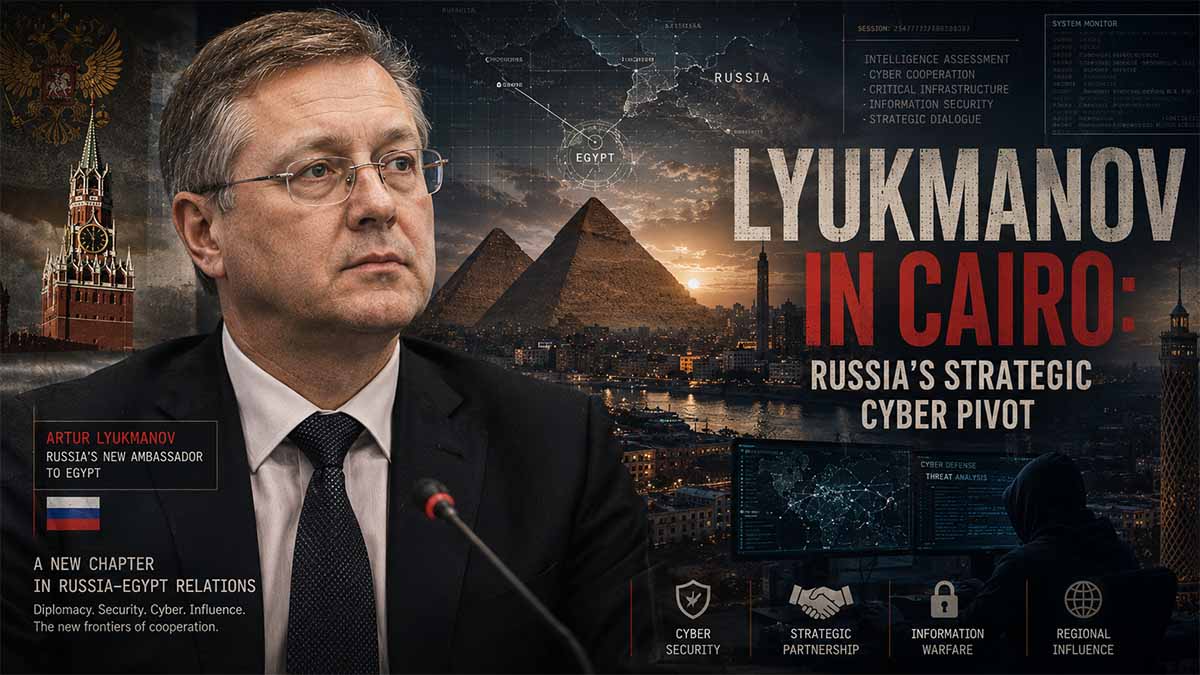
- BLUF: Artur Lyukmanov’s appointment is unlikely to be routine diplomatic rotation; it places a specialist in international cybersecurity governance at the intersection of Egypt, the Arab League, BRICS, the Red Sea and North Africa.
- The two separate presidential decrees confirm a dual mission: bilateral influence in Egypt and multilateral access to the Arab diplomatic system.
- The most probable Russian objective is to convert Cairo into a regional platform for Moscow’s doctrine of digital sovereignty, state control of information infrastructure and opposition to Western-led cyber governance.
- A second target is the protection and political insulation of strategic Russian assets, especially the El Dabaa nuclear project and the planned Russian Industrial Zone.
- Further targets include Arab voting coalitions at the United Nations, BRICS financial and digital mechanisms, Gaza diplomacy, Libya, Sudan, the Red Sea and Russia’s African relationships.
- Lyukmanov’s Arabic, Turkish and cybersecurity background gives Moscow an unusual combination of regional access, technical credibility and negotiating capability.
- Preliminary Bayesian assessment assigns a 34% probability to cyber-governance coalition building as the principal mission, followed by strategic-asset protection at 24%.
- The appointment does not prove an offensive cyber or intelligence mandate. Such a conclusion is presently unsupported by admissible primary evidence.
- Five-year outlook: by 2031, success would give Russia a durable Arab institutional channel extending beyond arms, energy and commodity diplomacy into data governance, cybercrime rules and digital infrastructure.
Lyukmanov in Cairo: Russia’s Strategic Cyber Pivot
Russia has not sent a conventional career ambassador to Cairo. On 15 August 2026, Vladimir Putin appointed Artur Lyukmanov both ambassador to Egypt and permanent representative to the League of Arab States. The two separate presidential decrees disclose no strategic rationale. Yet the choice is institutionally revealing: Lyukmanov previously directed the Russian Foreign Ministry department responsible for international information security and served as the president’s special representative in that field. Cairo now connects three Russian priorities—protecting long-term infrastructure, influencing Arab diplomacy and advancing a sovereignty-centred vision of digital governance. The assignment does not prove an operational cyber mandate. It does, however, place one of Moscow’s senior cyber diplomats at the intersection of the Arab world, BRICS, the Suez corridor and Russia’s most important civilian infrastructure project in Africa.
The Double Mandate
Putin formalised the appointment through two distinct acts. Decree No. 584 named Lyukmanov ambassador extraordinary and plenipotentiary to the Arab Republic of Egypt; Decree No. 585 accredited him concurrently to the League of Arab States in Cairo. Both entered into force on 15 August 2026. The institutional separation matters: Moscow has created one diplomatic command point for a bilateral relationship with Egypt and a multilateral relationship with the Arab League’s member states. Decree No. 584 – Official Internet Portal of Legal Information – 15/08/2026; Decree No. 585 – Official Internet Portal of Legal Information – 15/08/2026.
The Arab League accreditation gives Lyukmanov access to a wider political market than the Egyptian state alone. It allows Russia to maintain contact with Arab permanent representatives, test common formulations and build issue-specific coalitions without securing comprehensive alignment from every member. The strategic objective is likely to be selective convergence: sufficient Arab support, abstention or diplomatic neutrality to preserve Russian influence in multilateral negotiations.
The Cyber Diplomat
Lyukmanov graduated from the Moscow State Institute of International Relations in 2000, holds the Russian academic degree of Candidate of Economic Sciences and speaks Arabic, English and Turkish. His career included service in the Foreign Ministry departments responsible for the Middle East and North Africa and for new challenges and threats. On 10 February 2023, he became director of the Department of International Information Security. Artur Lyukmanov Appointed Director of the Department of International Information Security – Ministry of Foreign Affairs of the Russian Federation – 20/03/2023.
His specialisation extends beyond network defence. Russian international information-security diplomacy addresses state sovereignty over digital infrastructure, cybercrime, electronic evidence, critical-infrastructure protection and the international rules governing state conduct in the information environment. Lyukmanov publicly represented Moscow in multilateral discussions on interstate cyber cooperation before taking the Cairo assignment. Statement at the UNIDIR Conference “Towards a More Stable Cyberspace” – Ministry of Foreign Affairs of the Russian Federation – 02/12/2022.
There is no primary-source evidence that the appointment assigns him an offensive cyber or intelligence mission. The defensible conclusion is narrower: Moscow has selected a diplomat capable of linking regional politics, technical regulation, critical infrastructure and international rule-making.
Egypt’s State Architecture
Lyukmanov’s first operational target will be Egypt’s interlocking state apparatus: the presidency, Ministry of Foreign Affairs, Ministry of Communications and Information Technology, Supreme Cybersecurity Council, National Telecommunications Regulatory Authority, EG-CERT, Ministry of Electricity and Renewable Energy, Nuclear Power Plants Authority, Suez Canal Economic Zone, Ministry of Finance and Central Bank of Egypt.
These institutions control different components of the bilateral relationship. Political authorisation comes from the presidency and Cabinet; cyber policy from the Supreme Cybersecurity Council; telecommunications and incident response from the NTRA and EG-CERT; nuclear implementation from the electricity and nuclear authorities; industrial-zone execution from the Suez Canal Economic Zone; and payment policy from financial institutions.
Egypt’s National Cybersecurity Strategy 2023–2027 was prepared by the Supreme Cybersecurity Council and published in January 2024. Its declared objectives include responding to cyber threats, strengthening national capabilities and developing an Egyptian cybersecurity industry. National Cybersecurity Strategy 2023–2027 – Ministry of Communications and Information Technology – January 2024.
This creates legitimate space for Russian training, technical consultations and diplomatic coordination. It does not imply Egyptian adoption of Moscow’s model. Cairo also maintains extensive American, European, Chinese, Turkish and Gulf relationships and has strong incentives to avoid dependence on a single foreign technology ecosystem.
The Nuclear Anchor
The material foundation of Russian influence is the El Dabaa Nuclear Power Plant. The project comprises four Generation III+ VVER-1200 units, each designed for 1,200 megawatts of generating capacity, giving the planned complex 4,800 megawatts in aggregate. Main Construction Phase for Unit 3 of El Dabaa Nuclear Power Plant Commences – Rosatom – 03/05/2023.
A nuclear programme creates a relationship extending far beyond construction. It encompasses training, engineering data, industrial-control systems, nuclear-safety procedures, supply-chain integrity, maintenance and fuel services. The ambassador will not operate the plant’s cybersecurity. His strategic role is diplomatic: preserving intergovernmental coordination when technical disputes, sanctions exposure, supply interruptions or security incidents affect implementation.
The Russian Industrial Zone in the Suez Canal Economic Zone adds manufacturing, customs, logistics, telecommunications and payment systems to this infrastructure portfolio. During their meeting in Kazan on 22 October 2024, Presidents Abdel Fattah el-Sisi and Vladimir Putin identified both El Dabaa and the industrial zone as leading projects of the bilateral strategic partnership. President El-Sisi Meets President Putin at the BRICS Summit – Presidency of the Arab Republic of Egypt – 22/10/2024.
The Battle over Digital Rules
Lyukmanov arrives while governments are moving from negotiation to implementation of the United Nations Convention against Cybercrime. The General Assembly adopted the Convention through Resolution 79/243 on 24 December 2024. As of 22 August 2026, the United Nations Treaty Collection recorded 81 signatories and three parties; entry into force requires the fortieth ratification, acceptance, approval or accession. Egypt, Russia, China, the European Union, France, Germany and the United Kingdom are among the signatories. United Nations Convention against Cybercrime – United Nations Treaty Collection – status at 22/08/2026.
The decisive questions now concern domestic implementation, electronic-evidence procedures, technical assistance and the interpretation of state consent. Cairo offers Moscow a platform from which to engage Arab governments on these rules. Success would not require an explicitly pro-Russian Arab bloc. Coordinated language on sovereignty, critical infrastructure and cross-border data access could itself strengthen Russia’s negotiating position.
China already occupies this arena. On 29 March 2021, Chinese Vice Foreign Minister Ma Zhaoxu and Arab League Assistant Secretary-General Hossam Zaki signed the China–League of Arab States Cooperation Initiative on Data Security. The official Chinese account associates it with data protection, supply-chain security and international digital rules. China–LAS Cooperation Initiative on Data Security – Ministry of Foreign Affairs of the People’s Republic of China – 12/04/2021.
Russia and China can converge on sovereignty-centred principles, but they are not interchangeable. Beijing offers infrastructure, equipment, financing and industrial scale. Moscow’s comparative assets are nuclear technology, security diplomacy and experience in United Nations cyber negotiations.
The Western Counterweight
The United States retains the deepest external relationship with Egypt’s armed forces. Washington’s official bilateral assessment records more than 50 billion US dollars in military assistance and 30 billion US dollars in economic assistance since 1978. U.S. Relations with Egypt – United States Department of State – 05/01/2022. On 28 August 2025, US Central Command and the Egyptian armed forces opened Bright Star 25 at Mohamed Naguib Military Base. Bright Star 25 – United States Department of Defense – 03/09/2025.
The European Union possesses a different form of leverage. Its Strategic and Comprehensive Partnership with Egypt is supported by a €7.4 billion package for 2024–2027: €5 billion in macro-financial assistance, €1.8 billion in additional investments and €600 million for specific priorities. In 2025, the EU accounted for more than 22% of Egyptian goods trade, valued at €32.4 billion. EU–Egypt Relations: Facts and Figures – European Council – August 2026.
The EU is also pursuing cooperation on trusted digital connectivity, cybersecurity, artificial intelligence, the MEDUSA submarine fibre connection and the resilience of subsea cables around the Suez Canal. EU Position for the Eleventh EU–Egypt Association Council – Council of the European Union, document ST 10659/26 – 15/06/2026. Moscow cannot match this combined market, financial and regulatory scale. Its strategy is therefore asymmetric: secure influence in high-value niches and prevent European standards from excluding Russian participation.
Türkiye and the Gulf
Türkiye’s rapprochement with Egypt further crowds the strategic field. The countries held the first meeting of their High-Level Strategic Cooperation Council in Ankara on 4 September 2024 and the second in Cairo on 4 February 2026; their next meeting is scheduled for 2028. Joint Declaration of the Second High-Level Strategic Cooperation Council – Presidency of the Arab Republic of Egypt – 04/02/2026. El-Sisi stated on 4 February 2026 that bilateral trade had reached approximately 9 billion US dollars.
Türkiye brings commercial agility, defence-industrial capacity and access to Libya and Gaza diplomacy. Gulf states contribute something Russia lacks: rapidly deployable capital. The United Arab Emirates and Egypt launched the Ras Al-Hikma development project on 4 October 2024, accompanied by contracts among Egyptian and Emirati companies and a partnership concerning smart electric vehicles. Launch of the Ras Al-Hikma Development Project – Presidency of the Arab Republic of Egypt – 04/10/2024.
Lyukmanov must consequently frame Russian cooperation as compatible with Egyptian and Arab diversification. An explicitly anti-Western coalition would be less attractive than practical cooperation on sovereignty, critical infrastructure and cybercrime.
Cairo’s Regional Reach
Egypt’s value also derives from its role in Gaza, Libya, Sudan and the Red Sea. On 4 March 2025, Cairo hosted the Extraordinary Arab Summit that approved Egypt’s Gaza reconstruction plan while rejecting Palestinian displacement. Cairo Statement of the Extraordinary Arab Summit – Presidency of the Arab Republic of Egypt – 04/03/2025. On 13 October 2025, Egypt and the United States co-chaired the Sharm el-Sheikh Summit for Peace; the Egyptian presidency identified Egypt, the United States, Qatar and Türkiye as mediators of the agreement concluded on 9 October 2025. Sharm El-Sheikh Summit for Peace – Presidency of the Arab Republic of Egypt – 13/10/2025.
For Moscow, Cairo offers access to these diplomatic networks without requiring Russia to become the principal mediator or financier. Lyukmanov’s Arabic and Turkish improve his suitability for this environment, but language competence alone does not establish a special operational assignment.
The Five-Year Test
By 2031, the appointment should be judged against observable outcomes: whether Russia establishes a recurring cybersecurity dialogue with Egypt or the Arab League; whether cooperation protects El Dabaa and the industrial zone from political and financial disruption; whether Arab governments coordinate with Moscow in international cyber negotiations; and whether BRICS mechanisms generate operational projects rather than declarations.
The most realistic Russian objective is not control of Egypt. It is strategic indispensability within an Egyptian system deliberately built around multiple external partners. Washington will remain central to defence; Brussels to trade, finance and regulation; Beijing to infrastructure and manufacturing; Ankara to regional commerce and selected security theatres; and Gulf states to liquidity and investment.
Lyukmanov’s assignment is strategically sophisticated precisely because it recognises this constraint. Russia is positioning a cyber negotiator where energy infrastructure, Arab diplomacy, data governance and regional crises meet. The result will depend less on the symbolism of his appointment than on whether Moscow can transform diplomatic access into durable institutions without demanding an alignment Cairo has no interest in granting.
Navigational Index
- The Appointment as Strategic Signalling — Why Moscow selected a cyber diplomat for Cairo and combined the Egyptian embassy with representation to the Arab League.
- Political and Operational Targets — Egypt’s state institutions, Arab diplomatic coalitions, BRICS mechanisms, strategic infrastructure, regional crises and digital-governance rules.
- Five-Year Competitive Outlook — Alternative hypotheses, Bayesian indicators, escalation pathways and the implications for the United States, European Union, China, Türkiye and Gulf states.
Master Abstract
The analytical starting point is the institutional architecture of the appointment, not speculation about the individual. On 15 August 2026, President Vladimir Putin issued Decree No. 584 appointing Artur Rushanovich Lyukmanov ambassador extraordinary and plenipotentiary to the Arab Republic of Egypt and Decree No. 585 appointing him concurrently as Russia’s plenipotentiary representative to the League of Arab States in Cairo. The existence of two distinct legal instruments matters: Moscow has assigned Lyukmanov both a bilateral state-to-state channel and a multilateral Arab channel, allowing the same diplomatic node to engage the Egyptian presidency, foreign and security institutions, economic ministries and strategic-project authorities while simultaneously addressing the twenty-two-member Arab League system. The appointments are established by Decree No. 584 on the Ambassador to the Arab Republic of Egypt – Official Internet Portal of Legal Information – August 2026 and Decree No. 585 on the Representative to the League of Arab States – Official Internet Portal of Legal Information – August 2026. Lyukmanov is not arriving from a conventional geographic ambassadorship. The Russian Foreign Ministry records that he was born in 1977, graduated from MGIMO in 2000, holds a doctorate-level Russian academic qualification in economics, speaks Arabic, English and Turkish, served in departments covering the Middle East, North Africa, new challenges and threats, and became director of the Department of International Information Security in February 2023 — Artur Lyukmanov Appointed Director of the Department of International Information Security – Ministry of Foreign Affairs of the Russian Federation – March 2023. This profile changes the evidentiary baseline. It does not demonstrate a covert cyber mission, but it raises the prior probability that Moscow regards cyber diplomacy, information sovereignty and international rule-setting as central components of the Cairo portfolio rather than peripheral technical matters.
The first strategic target is therefore best understood as an institutional coalition, not simply the Egyptian government. Lyukmanov’s previous public work places him inside Russia’s campaign to shape the international rules governing information and communications technologies, state responsibility, cybercrime, sovereignty over digital infrastructure and cross-border access to data. In a formal intervention at a United Nations Institute for Disarmament Research conference, he represented the Russian Foreign Ministry’s international information-security department in discussions concerning interstate cooperation and the regulation of state conduct — Statement at the UNIDIR Conference “Towards a More Stable Cyberspace: Unpacking Inter-State Cooperation” – Ministry of Foreign Affairs of the Russian Federation – December 2022. Cairo offers three mutually reinforcing theatres for extending that agenda. Egypt is a major Arab state with extensive diplomatic, security and telecommunications institutions; it hosts the Arab League; and it became a full member of BRICS at the beginning of 2024. The Egyptian presidency has explicitly identified financial settlements in national currencies, digital transformation, energy, industrial projects and reform of the international financial architecture as priorities for BRICS cooperation — BRICS Summit in Russia – Presidency of the Arab Republic of Egypt – October 2024. These declared priorities create a legitimate diplomatic entry point for Russian proposals involving sovereign payment infrastructure, local-currency settlement, data localisation, cyber-capacity building and non-Western technology standards. The operational target would not necessarily be formal Arab alignment with every Russian position. A more achievable result would be selective convergence: Arab support for sovereignty-centred language in United Nations negotiations; resistance to cross-border digital investigations undertaken without state consent; expanded Russian participation in technical training; and the gradual embedding of Russian-compatible concepts in Arab cybersecurity strategies. Success should consequently be measured through voting behaviour, co-sponsored texts, memoranda, working groups, procurement decisions and regulatory vocabulary—not through public declarations of geopolitical alignment.
The second target is the political and cyber-resilience envelope surrounding Russia’s physical investments. Egypt and Russia describe their relationship as grounded in the 2018 Comprehensive Strategic Partnership Agreement, while the Egyptian presidency identifies the El Dabaa Nuclear Power Plant and the Russian Industrial Zone in the Suez Canal Economic Zone as flagship projects — President El-Sisi Meets Russian President Putin on the Sidelines of the BRICS Summit – Presidency of the Arab Republic of Egypt – October 2024. El Dabaa is not merely a commercial construction contract: it is a multidecade technological relationship involving nuclear safety, specialised personnel, supply chains, operational data, industrial control systems and continuing dependence on technical services. Rosatom reported that the reactor-pressure vessel for Unit 1 reached the Egyptian construction site in 2026 — Reactor Pressure Vessel for Unit 1 Delivered to the El Dabaa NPP Construction Site – Rosatom – July 2026. A diplomat trained in international cybersecurity can therefore add value without exercising any operational authority: he can negotiate political protection, incident-communication channels, data-handling principles, training arrangements and institutional coordination around critical infrastructure. The same logic extends to ports, logistics, tourism, banking, aviation and industrial-zone connectivity. Moscow’s desired outcome would be an ecosystem in which Russian projects are protected against sanctions spillovers, cyber disruption, Western compliance pressure and changes in Egyptian foreign policy. Cairo, however, is unlikely to accept exclusivity. Egypt’s established strategy is diversification: it obtains security, finance, technology and diplomatic support from competing partners while avoiding excessive dependence on any one of them. Lyukmanov’s strategic task is therefore more plausibly to increase Russia’s indispensability within Egypt’s diversified portfolio than to “turn Egypt” into a Russian-aligned state.
The third target is regional agenda access. In May 2025, Presidents Abdel Fattah el-Sisi and Vladimir Putin officially discussed Gaza, Syria, Libya, Sudan, Ukraine, energy, food security, mining, agriculture, industry, tourism, BRICS and the two flagship Russian projects — President El-Sisi and Russian President Putin Meet in Moscow – Presidency of the Arab Republic of Egypt – May 2025. This official agenda identifies the geographic breadth of Lyukmanov’s potential mandate. Cairo provides access to Palestinian diplomacy and Gaza mediation; proximity to Libyan political and security networks; influence concerning Sudan and Red Sea security; and institutional access to Arab governments that maintain different relationships with Moscow, Washington, Beijing, Ankara, Tehran and European capitals. His command of both Arabic and Turkish is particularly relevant to competitive theatres in which Türkiye is an important actor, although language proficiency alone cannot establish a specific negotiating assignment. Russia’s likely objective is to use Egypt as a stabilising hub through which it can preserve regional access even when bilateral relations elsewhere become volatile. Under an Analysis of Competing Hypotheses framework, five explanations remain viable: H₁, construction of an Arab cyber-governance coalition; H₂, protection and expansion of strategic economic infrastructure; H₃, creation of a Cairo-based regional mediation and political-access hub; H₄, support for BRICS financial, data and technological mechanisms; and H₅, conventional diplomatic succession with no exceptional strategic mandate. The initial Bayesian distribution—34%, 24%, 18%, 15% and 9% respectively—is an analytic judgement, not an observed fact. It should be updated against future appointments to the embassy, signed cybersecurity agreements, Arab League initiatives, El Dabaa governance arrangements, BRICS payment projects, Russian-Egyptian military-technical contacts and Lyukmanov’s actual travel and meeting pattern.
Why Moscow Sent Lyukmanov to Cairo
2031
The Appointment as Strategic Signalling: Why Moscow Sent a Cyber Diplomat to Cairo
A dual mandate, not a routine rotation
Moscow’s decision to appoint Artur Rushanovich Lyukmanov simultaneously as ambassador to Egypt and permanent representative to the League of Arab States should be read as an act of strategic signalling embedded in an administrative decision. On 15 August 2026, President Vladimir Putin formalised the two functions through separate legal instruments: Decree No. 584 covers the bilateral ambassadorship, while Decree No. 585 establishes Lyukmanov’s concurrent representation to the Arab League. The distinction is consequential. Had the Kremlin considered the Arab League assignment merely ceremonial, it could have relied on ordinary embassy accreditation; instead, it created an explicit dual mandate connecting access to the Egyptian state with access to the Arab world’s principal intergovernmental organisation. The appointments are confirmed by Decree No. 584 on the Ambassador of the Russian Federation to the Arab Republic of Egypt – Official Internet Portal of Legal Information – August 2026 and Decree No. 585 on the Plenipotentiary Representative of the Russian Federation to the League of Arab States – Official Internet Portal of Legal Information – August 2026. This legal architecture does not prove the existence of a covert cyber operation, an intelligence tasking order or an offensive technical mission. No admissible primary evidence establishes any such proposition. It does, however, justify a higher analytical prior for a coordinated diplomatic campaign involving international cyber norms, critical-infrastructure protection, data sovereignty and multilateral coalition-building. The signal is generated by the interaction of three facts: Lyukmanov’s specialised professional trajectory, Cairo’s institutional position and the timing of the appointment during the implementation phase of a new United Nations cybercrime framework. Russia is not merely stationing a Middle East specialist in an important Arab capital; it is placing a presidential-level representative for international information security inside the only city that combines the Egyptian government, the Arab League secretariat, major Russian strategic projects, BRICS membership and direct diplomatic access to the conflicts surrounding Gaza, Libya, Sudan and the Red Sea.
Why Lyukmanov’s professional profile matters
Lyukmanov’s selection is strategically meaningful because his career integrates regional expertise with the specialised vocabulary and negotiating practice of international cybersecurity governance. The Russian Foreign Ministry identifies him as a 1977-born MGIMO graduate, an economist by academic training, an Arabic-, English- and Turkish-speaking diplomat, and a former official in departments covering the Middle East and North Africa as well as new challenges and threats. In February 2023, he became director of the Foreign Ministry’s Department of International Information Security; he also served as the president’s special representative for international cooperation in information security. These credentials are recorded in Artur Lyukmanov Appointed Director of the Department of International Information Security – Ministry of Foreign Affairs of the Russian Federation – March 2023. His prior portfolio was not limited to conventional “cybersecurity” understood as network defence. Russian international information-security diplomacy encompasses the political regulation of state behaviour in cyberspace, sovereign authority over information infrastructure, cross-border access to electronic evidence, cybercrime, critical-infrastructure protection, capacity-building and the institutional venues in which international rules are negotiated. Lyukmanov publicly represented this position in multilateral discussions, including Statement at the UNIDIR Conference “Towards a More Stable Cyberspace: Unpacking Inter-State Cooperation” – Ministry of Foreign Affairs of the Russian Federation – December 2022. His appointment therefore transfers a diplomat with rule-making experience from a central ministry department to a regional platform where Russia can seek support from states that share some concerns about sovereignty and non-interference but are unwilling to become subordinate members of a Russian bloc. His Arabic provides direct access to elite and institutional discourse; his Turkish is relevant to theatres in which Türkiye is active, particularly Libya, Syria, Gaza diplomacy and the Red Sea–Horn of Africa system; his economics background is applicable to payment infrastructure, sanctions exposure, nuclear financing and industrial-zone development. The resulting profile is unusually well adapted to the convergence of diplomacy, digital governance and strategic infrastructure now visible in Egyptian foreign policy.
| Appointment variable | Verified institutional meaning | Strategic inference | Confidence |
|---|---|---|---|
| Two presidential decrees | Separate bilateral and Arab League mandates | Cairo is intended to function as a dual-node diplomatic platform | High |
| Former cyber-security negotiator | Direct experience in international information-security diplomacy | Cyber norms will probably become a substantive embassy portfolio | High |
| Arabic and Turkish | Capacity for regional diplomatic engagement | Wider remit across Arab institutions and Türkiye-contested theatres | Medium-high |
| Economics doctorate-level qualification | Formal economic-policy expertise | Relevance to sanctions resilience, payments and strategic projects | Medium |
| Cairo posting | Access to Egypt, Arab League and regional mediation channels | Russia seeks institutional reach exceeding normal bilateral diplomacy | High |
| No disclosed operational cyber mandate | Public evidence establishes diplomacy, not cyber operations | Offensive or intelligence tasking must remain an unproven hypothesis | High |
Cairo as a strategic switching point
Cairo offers Moscow a rare concentration of diplomatic, infrastructural and geopolitical access. Egypt is neither a Russian ally nor a passive client; its strategic utility derives precisely from its ability to maintain concurrent relationships with Russia, the United States, the European Union, China, Gulf monarchies and Türkiye. The Egyptian presidency describes bilateral relations with Moscow as grounded in the 2018 Comprehensive Strategic Partnership Agreement and identifies the El Dabaa Nuclear Power Plant and the Russian Industrial Zone in the Suez Canal Economic Zone as leading projects. It also records cooperation discussions covering energy, food security, mining, agriculture, industry, tourism and BRICS coordination — President El-Sisi and Russian President Putin Meet in Moscow – Presidency of the Arab Republic of Egypt – May 2025. For Moscow, this creates four interdependent layers of value. The first is bilateral: access to President Abdel Fattah el-Sisi’s administration and the Egyptian institutions governing foreign policy, telecommunications, energy, industry and national security. The second is multilateral: physical proximity to the Arab League secretariat and to the permanent delegations of Arab states. The third is infrastructural: involvement in projects whose operating life can extend over decades and therefore generate persistent technical, educational and regulatory relationships. The fourth is regional: Egypt is a central diplomatic actor on Gaza, borders Libya and Sudan, controls the Suez Canal and sits at the intersection of the Mediterranean, Red Sea, Levant, North Africa and Horn of Africa systems. Lyukmanov can therefore connect issues normally handled in separate bureaucratic compartments. A discussion about nuclear-project protection can lead into critical-infrastructure cybersecurity; a BRICS consultation can lead into alternative settlement mechanisms; an Arab League meeting can create support for sovereignty-centred cyber norms; and a regional-security dialogue can open channels on Libya, Sudan or Gaza. The intended strategic output is not necessarily Egyptian alignment with Moscow. A more realistic objective is Russian institutional persistence: ensuring that Egypt cannot design major regional, industrial or digital initiatives without considering Russian interests.
The cyber-norms target
The strongest hypothesis is that Moscow intends to use the Cairo platform to deepen Arab engagement with Russia’s preferred model of digital sovereignty. Egypt already possesses an official domestic framework into which this diplomacy can be inserted. The Egyptian Supreme Cybersecurity Council developed the National Cybersecurity Strategy 2023–2027, whose stated objectives include confronting diverse cyber threats, building human capabilities, developing a national cybersecurity industry and supporting economic growth — National Cybersecurity Strategy 2023–2027 – Egyptian Ministry of Communications and Information Technology – January 2024. This does not make the Egyptian strategy “Russian”; capacity-building, resilience and national industrial development are common objectives across numerous international models. The strategic opening lies in how operational terms are defined: which states provide training; which vendors enter public networks; how cross-border electronic evidence is handled; whether data localisation is preferred; which standards govern critical infrastructure; how cyber incidents are attributed; and whether international cooperation prioritises state consent over transnational investigative reach. The timing also intersects with the United Nations Convention against Cybercrime, adopted by General Assembly Resolution 79/243 on 24 December 2024. As of 22 August 2026, the United Nations Treaty Collection recorded 81 signatories and only three parties, meaning that signature had expanded widely but entry into force still required the fortieth ratification, acceptance, approval or accession. Egypt, Russia, China, the European Union, France, the United Kingdom and numerous Arab states had signed, creating an implementation arena in which diplomatic interpretation, reservations, domestic legislation and capacity-building will matter — United Nations Convention against Cybercrime – United Nations Treaty Collection – August 2026. Lyukmanov is therefore positioned not to renegotiate the adopted convention, but to shape the coalitions and practical arrangements that determine how its sovereignty, cooperation, evidence-sharing and technical-assistance provisions are implemented across Arab jurisdictions. Success would be visible through formal working groups, compatible national legislation, training programmes, coordinated interventions and Arab support for Russian formulations in future United Nations ICT-security negotiations.
Russian Strategic Doctrine and Information-Security Diplomacy
Multi-tiered institutional diffusion across Egyptian agencies, Arab multilateral forums, and BRICS frameworks
- National cyber strategy
- Critical infrastructure
- Data and incident governance
- Diplomatic coalition formation
- Cyber-capacity initiatives
- Common language in multilateral forums
- Payments and settlement resilience
- Digital sovereignty
- Non-Western technology cooperation
Egyptian access + Arab institutional diffusion + multilateral voting leverage
The Geopolitical Diffusion of Information-Security Norms
Russian strategic doctrine increasingly leverages information-security diplomacy as a mechanism to project state influence across regional partners. Originating from centralized doctrine, diplomatic outreach branches simultaneously into bilateral engagement with Egyptian state institutions (focusing on national cyber strategies and incident governance), institutional coordination within the Arab League (aligning multilateral terminology and coalition frameworks), and broader BRICS coordination (advancing digital sovereignty and independent financial settlement platforms).
The convergence of these parallel tracks produces an enduring observable strategic result: enhanced bilateral access, deep institutional diffusion across Arab governance structures, and significantly amplified voting leverage within international multilateral forums.
The Arab League is a competitive arena, not an empty space
The Arab League dimension cannot be analysed as though Russia were entering an institutionally unoccupied environment. China has already demonstrated how a non-Western power can convert representation in Cairo into region-wide digital diplomacy. On 29 March 2021, Chinese Vice Foreign Minister Ma Zhaoxu and Arab League Assistant Secretary-General Hossam Zaki signed the China–League of Arab States Cooperation Initiative on Data Security. The official Chinese account states that permanent representatives from Egypt, Saudi Arabia, the United Arab Emirates and other Arab states participated, and describes the initiative as a mechanism for strategic coordination, data and supply-chain security, unified international rules and global digital governance — China–LAS Cooperation Initiative on Data Security – Ministry of Foreign Affairs of the People’s Republic of China – April 2021. This precedent is central to interpreting Lyukmanov’s appointment. It shows that the Arab League can serve not merely as a forum for political declarations on regional conflicts but as a platform for external powers to institutionalise cyber and data-security concepts. Russia must therefore compete inside an existing market of norms and capabilities. Moscow and Beijing may converge on sovereignty, non-interference and resistance to unilateral technological restrictions, yet they are not functionally interchangeable. China can offer telecommunications infrastructure, cloud ecosystems, equipment financing, digital-commerce integration and large-scale commercial capacity; Russia’s comparative advantages lie more narrowly in political-security cooperation, United Nations rule-making experience, cyber diplomacy, nuclear technology and relationships with security establishments. The European Union offers another competing model based on trusted connectivity, regulatory approximation, investment conditionality and data governance. Lyukmanov’s likely approach will consequently be selective rather than hegemonic: align with China where sovereignty-centred language benefits both states, differentiate Russia through security and nuclear-sector expertise, and present Moscow as a partner without the governance and human-rights conditionality associated with European cooperation. The critical warning indicator would be movement from general political dialogue to institutional instruments: a Russia–Arab League cyber memorandum, recurring expert consultations, Arab participation in Russian cyber exercises or educational programmes, or coordinated positions in United Nations forums.
Strategic infrastructure as the material anchor
The cyber portfolio gains strategic weight because it is attached to physical infrastructure rather than floating as an abstract norm-setting exercise. The El Dabaa Nuclear Power Plant is planned around four Generation III+ VVER-1200 units, each with 1,200 megawatts of generating capacity — Main Construction Phase for Unit 3 of El Dabaa Nuclear Power Plant Commences in Egypt – Rosatom – May 2023. A nuclear programme of this scale creates long-duration requirements involving engineering data, industrial control systems, physical protection, nuclear-safety governance, specialised personnel, supply chains, maintenance, fuel-cycle relationships and emergency communication. The precise operational division of responsibilities cannot be inferred from Lyukmanov’s appointment, and an ambassador would not manage plant cybersecurity. His value is political and institutional: maintaining high-level channels, reducing policy friction, coordinating responses to sanctions or supplier disruption, encouraging compatible compatible approaches to critical-infrastructure protection and preventing isolated technical incidents from escalating into bilateral crises. The Russian Industrial Zone provides a second material anchor because industrial activity near the Suez Canal would connect production, logistics, customs, payments, ports and digital systems. The Egyptian presidency reaffirmed both projects during the October 2024 Putin–Sisi meeting — President El-Sisi Meets Russian President Putin on the Sidelines of the BRICS Summit – Presidency of the Arab Republic of Egypt – October 2024. From Moscow’s perspective, the political objective is to transform project delivery into institutional dependence: training networks, regulatory routines, technical standards and bureaucratic constituencies that survive leadership changes. From Cairo’s perspective, the objective is different: extract technology, electricity, investment and diplomatic flexibility without surrendering strategic autonomy. Lyukmanov’s effectiveness will therefore depend less on securing exclusivity than on making Russian participation resilient within Egypt’s deliberately diversified partner portfolio.
| Strategic asset or institution | Russian interest | Egyptian interest | Principal vulnerability | Five-year indicator |
|---|---|---|---|---|
| El Dabaa nuclear programme | Long-term technological and political presence | Electricity, skills and industrial development | Sanctions, supply disruption, cyber incident, financing pressure | Operational milestones and bilateral security protocols |
| Russian Industrial Zone | Manufacturing and export access near Suez | Investment, employment and localisation | Delays, payment constraints, investor caution | Resident firms, capital deployment and customs arrangements |
| Egyptian cyber institutions | Policy access and capacity-building influence | Resilience and domestic industry | Vendor dependence and competing standards | Training agreements and technical working groups |
| Arab League | Regional diffusion of diplomatic positions | Collective bargaining and policy coordination | Fragmentation among members | Joint texts, meetings and voting coordination |
| BRICS mechanisms | Reduced Western financial and technological exposure | Diversification and development finance | Limited implementation capacity | Local-currency instruments and operational platforms |
| Suez digital corridor | Visibility into a critical connectivity ecosystem | Cable resilience and global hub status | Cable disruption and geopolitical competition | Security exercises and trusted-connectivity investments |
The European counterweight and the contest over “trusted” infrastructure
The European Union’s role sharply constrains any forecast that assumes unopposed Russian expansion. The EU–Egypt Strategic and Comprehensive Partnership, launched in March 2024, is accompanied by a €7.4 billion financial and investment package for 2024–2027. In 2024, the EU accounted for 22% of Egypt’s trade in goods, with bilateral trade valued at €32.5 billion — EU–Egypt Summit: EU–Egypt Cooperation – European Council – October 2025. More directly relevant, an official 2026 Council of the European Union document commits the EU and Egypt to cooperation on trusted and secure digital connectivity, data infrastructure, the MEDUSA submarine fibre connection, subsea-cable resilience, cybersecurity, artificial intelligence, digital skills and the Suez Canal’s role as a global submarine-cable hub — EU Position for the Eleventh EU–Egypt Association Council – Council of the European Union – June 2026. This creates a structural competition between models rather than a simple bilateral Russia–Egypt story. The European offer links financing, market access, regulatory standards, research cooperation and secure connectivity. The Russian offer can emphasise sovereignty, security cooperation, nuclear technology, political flexibility and freedom from Western conditionality. China adds a third model based on infrastructure scale, industrial integration and state-backed digital technology. Egypt is likely to combine all three where compatibility permits and compartmentalise them where security concerns require separation. Lyukmanov’s appointment can be interpreted as Moscow’s response to this crowded strategic environment: a conventional ambassador might protect political relations, but a cyber diplomat can identify where technical standards create long-term geopolitical lock-in. The decisive terrain will include data governance, incident reporting, subsea-cable security, artificial-intelligence standards, sovereign cloud architecture and the cybersecurity requirements surrounding energy and transport assets. Russia does not need to displace the EU across these fields to secure a strategic result. It needs sufficient institutional access to prevent European standards from becoming Egypt’s exclusive default and sufficient Arab support to keep sovereignty-centred alternatives politically legitimate.
Analysis of Competing Hypotheses
The structured assessment uses five competing hypotheses and evaluates them against eight diagnostic evidence classes. H₁ proposes that the principal purpose is to build an Arab coalition around Russian cyber-sovereignty positions. H₂ holds that Moscow primarily wants to protect El Dabaa, the industrial zone and other strategic assets through improved political and cybersecurity coordination. H₃ interprets the appointment as an attempt to create a regional diplomatic hub covering Gaza, Libya, Sudan, Syria, the Red Sea and Türkiye-linked theatres. H₄ treats the posting principally as an instrument for BRICS financial, technological and digital cooperation. H₅ is the null hypothesis: Lyukmanov was selected through ordinary personnel rotation, and his cyber background will not dominate the assignment. The initial priors are not frequencies and do not represent secret information; they are disciplined estimates derived from the specificity of the appointee and the institutional design of the posting. H₁ begins at 34%, H₂ at 24%, H₃ at 18%, H₄ at 15% and H₅ at 9%. The low—but non-zero—weight assigned to H₅ reflects the improbability that a former presidential cyber representative’s expertise would be irrelevant, while acknowledging that senior diplomatic appointments can result from availability, promotion and bureaucratic succession. No separate “offensive cyber mission” hypothesis is included because available primary evidence does not support it sufficiently to merit parity with the five institutional explanations. If future evidence reveals embassy staffing oriented toward technical security, bilateral cyber agreements or Russian-sponsored Arab League initiatives, H₁ and H₂ should rise. If Lyukmanov’s observable activity remains concentrated on Gaza, Libya and Sudan without cyber-policy outputs, H₃ should gain weight. If local-currency settlement, BRICS payment infrastructure or digital-finance coordination dominates his agenda, H₄ should rise. If none of these indicators materialises by the end of 2027, H₅ should be revised upward substantially.
| Diagnostic evidence | H₁ Cyber norms | H₂ Asset protection | H₃ Regional hub | H₄ BRICS systems | H₅ Routine rotation |
|---|---|---|---|---|---|
| Former international cyber-security director | Strong support | Moderate support | Neutral | Moderate support | Strong contradiction |
| Separate Arab League accreditation | Strong support | Weak support | Strong support | Moderate support | Moderate contradiction |
| El Dabaa and industrial-zone exposure | Moderate support | Strong support | Neutral | Moderate support | Weak contradiction |
| Egypt’s national cyber strategy | Strong support | Moderate support | Neutral | Weak support | Neutral |
| UN cybercrime implementation phase | Strong support | Weak support | Neutral | Moderate support | Weak contradiction |
| Existing China–LAS data initiative | Strong competitive incentive | Neutral | Neutral | Moderate support | Neutral |
| Egypt’s role in Gaza, Libya and Sudan | Weak support | Neutral | Strong support | Neutral | Neutral |
| EU secure-connectivity expansion | Strong competitive incentive | Strong competitive incentive | Neutral | Moderate support | Weak contradiction |
Bayesian update rules and collection thresholds
The Bayesian model should be updated through diagnostic events rather than through the volume of diplomatic publicity. A formal Russia–Arab League cybersecurity agreement would carry a likelihood ratio of approximately 4.0 in favour of H₁ relative to the combined alternatives; a bilateral El Dabaa cyber-resilience or critical-infrastructure protocol would carry a ratio near 3.5 for H₂; repeated Lyukmanov travel or mediation activity concerning Libya, Sudan, Gaza or Syria, without parallel cyber outputs, would carry a ratio near 2.8 for H₃; and his formal involvement in operational BRICS payment or digital-identity mechanisms would carry a ratio near 3.2 for H₄. Routine ceremonial meetings, cultural events and general statements of friendship should receive ratios close to 1.0 because they do little to discriminate among hypotheses. Negative evidence also matters. If no cyber memorandum, Arab League working group, critical-infrastructure initiative or multilateral cyber intervention involving Lyukmanov appears by August 2028, H₁ should fall even if Russian–Egyptian relations remain cordial. This approach prevents confirmation bias, particularly the temptation to interpret every embassy activity through Lyukmanov’s previous cybersecurity portfolio. Collection should monitor Russian and Egyptian official calendars; Arab League resolutions and technical meetings; United Nations interventions on cybercrime and responsible state behaviour; procurement and training announcements; Rosatom project-security disclosures; BRICS financial initiatives; the professional background of new embassy personnel; and the geographic distribution of Lyukmanov’s meetings. Shadow dimensions require equally careful treatment. Liquidity flows should be tracked through disclosed project financing, local-currency settlement instruments and industrial-zone investment rather than speculative claims about sanctions evasion. Mercenary dynamics are relevant only indirectly, principally through Libya and Sudan, and no relationship between Lyukmanov’s appointment and Russian irregular forces should be asserted without primary evidence. Cyber-norm diffusion, by contrast, is directly observable through treaty positions, national strategies, memoranda, training programmes and common diplomatic language.
Monte Carlo five-year outlook, 2026–2031
A 100,000-trial Monte Carlo analytical model was constructed to estimate the probability that the dual appointment produces durable Russian institutional influence by August 2031. The model is not a forecast of cyberattacks; it simulates diplomatic-strategic outcomes. Five uncertain drivers were represented through bounded triangular distributions: Egyptian receptivity to Russian cyber diplomacy, Arab League policy cohesion, implementation progress at El Dabaa and the Russian Industrial Zone, intensity of EU and Chinese competition, and Russia’s available diplomatic and financial capacity. A sixth variable represented regional shocks affecting Gaza, Libya, Sudan or the Red Sea. The output defined “high strategic conversion” as the achievement of at least three of five observable results: a recurring Russia–Arab cyber dialogue; a bilateral critical-infrastructure mechanism; identifiable Arab support for Russian-compatible cyber language; Lyukmanov’s involvement in BRICS digital or payment initiatives; and institutional arrangements that protect Russian strategic assets. The simulation produced a median strategic-conversion score of 61 on a 100-point scale, with a 10th–90th percentile interval of 36–79. High strategic conversion occurred in 31% of trials; partial conversion, in which Russia secured project protection or diplomatic access without broad norm diffusion, occurred in 46%; and limited conversion occurred in 23%. These numbers are analytical outputs conditioned on the stated assumptions, not verified future facts. Sensitivity analysis shows that Egyptian strategic autonomy is the dominant variable: Cairo’s willingness to cooperate selectively while rejecting exclusivity increases partial conversion but suppresses Russian hegemony. Arab League fragmentation is the second strongest limiting factor. El Dabaa progress is the most powerful positive material driver because it gives the relationship bureaucratic continuity. EU digital investment reduces Russian standard-setting potential, while China’s role has mixed effects: it normalises sovereignty-centred digital language but competes with Russia for institutional and technological influence.
| Scenario, 2026–2031 | Simulated probability | Defining outcome | Principal trigger | Principal constraint |
|---|---|---|---|---|
| Arab cyber-norm coalition | 17% | Recurring Russia–LAS mechanism and coordinated multilateral positions | Formal cyber dialogue and Egyptian sponsorship | Arab political fragmentation |
| Strategic-asset entrenchment | 29% | El Dabaa and industrial cooperation create durable institutional dependence | Project milestones and security coordination | Sanctions and financing exposure |
| Regional diplomatic hub | 18% | Cairo becomes a Russian access point across multiple conflicts | Crisis diplomacy and sustained presidential access | Egypt’s resistance to external agenda capture |
| BRICS digital-financial bridge | 13% | Egypt facilitates selective non-Western settlement and digital mechanisms | Operational BRICS instruments | Technical and financial implementation limits |
| Contained or symbolic appointment | 23% | Relations continue but cyber expertise produces few strategic outputs | Strong counter-pressure or weak Russian capacity | EU–China competition and Russian resource limits |
The five-year strategic judgement
The most defensible judgement is that Moscow selected Lyukmanov because Cairo now requires a diplomat capable of operating simultaneously across political relations, critical infrastructure, international cyber law, Arab multilateralism and non-Western economic coordination. The appointment is not best understood as evidence that Russia plans a discrete cyber operation against Egypt or from Egyptian territory. It is better understood as an effort to convert cybersecurity from a specialist diplomatic file into connective tissue linking Russian interests across the region. By 2031, the most likely result is neither Russian dominance nor failure, but selective entrenchment. Russia can plausibly obtain stronger protection for El Dabaa, regular access to Egyptian and Arab cybersecurity institutions, support from subsets of Arab states for sovereignty-centred positions and a role in BRICS discussions involving payments or digital infrastructure. It is less likely to obtain a unified Arab cyber bloc, exclusive technological access or Egyptian geopolitical alignment. Cairo’s strategy is designed to maximise partner competition while preserving sovereign room for manoeuvre. The EU’s scale in trade, finance, connectivity and regulation and China’s prior institutionalisation of a data-security dialogue with the Arab League impose hard ceilings on Russian influence. Lyukmanov’s effectiveness will therefore be measured by resilience rather than visibility: whether Russian positions remain embedded when regional crises change, whether project cooperation survives sanctions pressure, whether Arab states consult Moscow during cyber-rule implementation, and whether Russia gains institutional access beyond bilateral presidential diplomacy. The appointment’s strategic signal is thus precise. Moscow recognises that influence in the Arab world will increasingly be exercised not only through weapons, energy, grain and Security Council diplomacy, but through the rules governing data, electronic evidence, critical infrastructure, artificial intelligence, subsea connectivity and sovereign control of digital systems. It has placed one of its most specialised diplomats at the junction where those domains meet.
Political and Operational Targets: Moscow’s Cairo–Arab Strategy
The Egyptian state as the primary access system
Russia’s first operational target is not Egypt as an abstract geopolitical unit but the interconnected state system through which the Egyptian presidency converts political decisions into diplomatic, financial, industrial and security outcomes. Artur Lyukmanov’s position gives him formal access to the Ministry of Foreign Affairs, International Cooperation and Egyptian Expatriates, but the strategic value of the posting will depend on his ability to construct working relationships across the presidency, Cabinet, Ministry of Communications and Information Technology, Supreme Cybersecurity Council, National Telecommunications Regulatory Authority, EG-CERT, Ministry of Electricity and Renewable Energy, Nuclear Power Plants Authority, Suez Canal Economic Zone, Ministry of Finance and Central Bank of Egypt. These institutions control distinct components of the Russia–Egypt relationship: political authorisation, cybersecurity policy, telecommunications regulation, nuclear-project delivery, industrial-zone implementation, financing and international payments. Moscow’s probable objective is not to penetrate or direct this apparatus, a proposition for which no admissible evidence exists, but to reduce the fragmentation that can delay Russian projects or expose them to sanctions, regulatory divergence and changes in Egyptian priorities. Lyukmanov’s comparative value lies in his capacity to translate a technical issue into a diplomatic one and a diplomatic commitment into interagency action. A cyber incident affecting a contractor, for example, could involve Egyptian telecommunications authorities, critical-infrastructure operators, Rosatom entities and political decision-makers. A conventional ambassador might coordinate the resulting diplomacy; a former international cyber-security negotiator can also understand how incident attribution, evidence exchange, state responsibility and data-access rules influence the dispute. The Egyptian state is therefore the first target because every larger Russian ambition—Arab coalition-building, BRICS coordination, El Dabaa protection or regional mediation—requires an Egyptian institutional sponsor, facilitator or at minimum a non-obstructive authority.
| Egyptian node | Formal function relevant to Russia | Probable Russian objective | Observable indicator | Principal Egyptian safeguard |
|---|---|---|---|---|
| Presidency and Cabinet | Strategic authorisation and interministerial coordination | Preserve high-level political protection | Presidential statements, joint committees, implementation orders | Partner diversification |
| Foreign Ministry | Bilateral, Arab League and multilateral diplomacy | Coordinate regional and UN positions | Joint texts, consultations, voting patterns | Issue-by-issue autonomy |
| Communications Ministry | Digital policy and technology development | Gain access to cyber-policy and capacity programmes | Memoranda, training, technical dialogue | Vendor and standards pluralism |
| Supreme Cybersecurity Council | National cyber policy | Promote sovereignty-centred cooperation | Strategy language and intergovernmental mechanisms | National control over implementation |
| EG-CERT and NTRA | Incident response and telecommunications regulation | Build operational confidence and liaison channels | Exercises, CERT cooperation, protocols | Compartmentalisation of sensitive systems |
| Nuclear authorities | El Dabaa oversight and nuclear governance | Protect long-duration Russian participation | Project milestones and security coordination | Egyptian regulatory authority |
| Suez Canal Economic Zone | Industrial and logistical development | Operationalise the Russian Industrial Zone | Capital deployment, resident companies, customs frameworks | Commercial-performance requirements |
| Finance Ministry and Central Bank | Sovereign finance and payment policy | Facilitate project payments and BRICS mechanisms | Currency arrangements and NDB operations | Macroeconomic and compliance constraints |
Cyber institutions as policy multipliers
The most direct operational bridge between Lyukmanov’s previous portfolio and his new assignment lies in Egypt’s cybersecurity architecture. The Egyptian Supreme Cybersecurity Council prepared the National Cybersecurity Strategy 2023–2027, which identifies the protection of Egyptian cyberspace, resilience against diverse threats, human-capital development, international cooperation and the growth of a national cybersecurity industry as state objectives — National Cybersecurity Strategy 2023–2027 – Egyptian Ministry of Communications and Information Technology – January 2024. Russia can engage this system through several legitimate instruments: government-to-government consultations, training, academic exchanges, critical-infrastructure workshops, computer emergency-response cooperation and diplomatic coordination at the United Nations. The strategically significant issue is not whether Egypt accepts cybersecurity assistance; it is which principles become embedded in the resulting relationships. Moscow’s international information-security position traditionally privileges sovereign control, state consent, United Nations-centred rule-making and limits on unilateral cross-border access to information systems. Egypt’s own emphasis on national capability and sovereign resilience creates areas of potential convergence, but convergence is not equivalence. Cairo simultaneously cooperates with European, American, Chinese and Gulf partners and has strong incentives to avoid technical dependency on a single supplier. Lyukmanov’s probable operational target is consequently the policy layer above individual procurements: terminology, institutional routines, preferred international forums and the conditions governing information exchange. If Russia can establish itself as a recurring interlocutor on cybercrime implementation, critical-infrastructure resilience and interstate conduct, it can influence Egyptian positions even without dominating hardware, software or cloud markets. The highest-value indicators would be a bilateral cyber dialogue chaired at senior level; formal links between Egyptian institutions and the Russian Foreign Ministry’s international information-security structures; joint training involving Arab states; and Egyptian sponsorship of Russia-linked initiatives within the Arab League. By contrast, ceremonial conferences, generic statements about cybercrime and one-off academic events would provide limited evidence of durable strategic conversion.
The Arab League coalition target
The second target is the construction of flexible Arab diplomatic coalitions rather than a unified pro-Russian bloc. The League of Arab States contains governments with sharply different threat perceptions, technological dependencies and alignments. Saudi Arabia, the United Arab Emirates, Qatar, Egypt, Algeria, Iraq, Jordan, Morocco and other members will not adopt identical positions merely because the League’s secretariat is located in Cairo. Lyukmanov’s mandate nevertheless gives Moscow a lower-cost mechanism for maintaining simultaneous contact with Arab delegations, identifying areas of consensus and converting bilateral agreements into regional language. Cyber governance is particularly suitable for this method because many Arab states share concerns about critical-infrastructure attacks, foreign control of data, online extremism, technological dependency and unequal participation in global rule-making, even where their relationships with Russia differ. Moscow does not need twenty-two governments to endorse an entire Russian doctrine. It can obtain useful outcomes from smaller coalitions: several states co-sponsoring a resolution, a wider group supporting sovereignty-centred language, or strategically important delegations declining to support a Western initiative. China has already demonstrated the institutional potential of this venue. In March 2021, Chinese Vice Foreign Minister Ma Zhaoxu and Arab League Assistant Secretary-General Hossam Zaki signed the China–LAS Cooperation Initiative on Data Security, with permanent representatives from Egypt, Saudi Arabia, the UAE and other members participating. The official Chinese account links the initiative to data security, supply-chain protection, international rules and global digital governance — China–LAS Cooperation Initiative on Data Security – Ministry of Foreign Affairs of the People’s Republic of China – April 2021. For Russia, this precedent is both an opportunity and a competitive warning. It validates the Arab League as a platform for digital diplomacy, but it also means that Moscow must differentiate its offer from China’s stronger commercial and technological capacity. Russia’s likely niche is the intersection of national security, international law, cybercrime, nuclear infrastructure and United Nations negotiations.
The Cairo Gateway and Regional Multilateral Coalition
From bilateral access points to regional institutional dispersion and UN-level policy coordination
The Mechanics of Regional Diplomatic Alignment
The operationalization of external strategic doctrine in the Middle East and North Africa hinges critically on foundational bilateral access in Cairo. Backed by Egyptian political sponsorship or tacit tolerance, diplomatic initiatives expand outward to encompass key regional nodes—including the Arab League secretariat, selected Gulf monarchies, and North African and Levantine state actors.
This institutional network coalesces into an issue-specific diplomatic coalition capable of exerting coordinated leverage across major multilateral arenas, driving aligned voting blocks in UN cybercrime convention implementations, ICT-security negotiations, and international data-sovereignty governance rules.
From diplomatic access to norm conversion
The operational chain from embassy activity to international influence contains several points at which Russian ambitions can fail. The first requirement is access: Lyukmanov must obtain regular engagement with Egyptian and Arab officials responsible for cyber policy rather than remaining confined to general foreign-policy contacts. The second is translation: Russian concepts must be reformulated in language acceptable to Arab governments, avoiding the appearance that they are being asked to endorse Moscow’s wider confrontation with Western states. The third is coalition formation: Egypt or another influential Arab government must be willing to circulate, sponsor or defend the proposed language. The fourth is institutionalisation: cooperation must survive beyond a single meeting through a working group, memorandum, training programme, annual consultation or common negotiating practice. The fifth is conversion into observable behaviour: votes, treaty implementation positions, domestic legislation, procurement standards or formal statements. The implementation phase of the United Nations Convention against Cybercrime provides a concrete arena for this process. The Convention was adopted on 24 December 2024 and, as of 22 August 2026, had 81 signatories but only three parties; it required forty ratifications, acceptances, approvals or accessions to enter into force. Egypt, Russia, China, the European Union, France, Germany, the United Kingdom and numerous Arab states had signed — United Nations Convention against Cybercrime – United Nations Treaty Collection – August 2026. The strategic contest now moves from drafting to ratification, reservations, domestic implementation, electronic-evidence procedures, capacity-building and interpretation. Lyukmanov cannot dictate these processes, but he can coordinate Russian diplomatic engagement with Arab capitals and identify where legal assistance or training may generate lasting alignment. The critical distinction is between shared operational interests and ideological alignment: Arab governments may support stronger state control over cross-border evidence while rejecting Russian positions on other international-security issues.
| Norm-conversion stage | Required Russian action | Necessary Arab response | Failure mode | High-value indicator |
|---|---|---|---|---|
| Access | Establish technical and diplomatic consultations | Designate empowered interlocutors | Meetings remain ceremonial | Recurring senior-level dialogue |
| Translation | Adapt Russian concepts to Arab priorities | Accept non-bloc framing | Language appears externally imposed | Arab-authored policy language |
| Coalition | Build issue-specific groups | Coordinate across selected members | Member-state fragmentation | Co-sponsored interventions |
| Institutionalisation | Create durable mechanisms | Allocate personnel and budgets | Cooperation ends after announcement | Annual programme or secretariat unit |
| Behavioural conversion | Connect dialogue to decisions | Vote, legislate or implement | Rhetoric without policy change | Treaty positions and national rules |
| Diffusion | Extend beyond Egypt | Regional replication | Cairo remains an isolated bilateral case | Multi-state participation |
BRICS as a mechanism rather than a slogan
The third operational target is to convert Egypt’s membership in BRICS and the New Development Bank into practical financial, technological and political mechanisms. Egypt became an effective NDB member on 20 February 2023, before joining the expanded BRICS political grouping in 2024 — Members – New Development Bank – August 2026. The distinction matters because BRICS is a political coordination format, whereas the NDB possesses a formal governance structure, project-financing capacity and operational procedures. The Bank identifies digital infrastructure, clean energy, transport, water, social infrastructure and environmental protection among its areas of activity. By August 2026, it reported 139 approved projects and total approved financing equivalent to 42.9 billion US dollars, translated using exchange rates as of 31 December 2025 — New Development Bank: Financing for a Sustainable Future – New Development Bank – August 2026. Egypt’s official objective in joining was to diversify funding sources, strengthen economic resilience and obtain support for infrastructure and sustainable development. The NDB’s 2024 mission to Egypt engaged the ministries responsible for finance, international cooperation, electricity and transport, as well as the Central Bank governor, and examined airports, water, energy, social infrastructure and possible non-sovereign transactions — NDB Explores Financing Airports, Energy, Water and Social Infrastructure in Egypt – New Development Bank – February 2024. Lyukmanov will not control NDB lending; Russia is only one member of a multilateral institution. His diplomatic role can nevertheless facilitate political coordination, identify Russian-compatible projects, support Egyptian participation and connect BRICS discussions to bilateral infrastructure. Moscow’s highest-value outcome would be an ecosystem in which Egyptian projects use diversified currencies, non-Western financing and technology partnerships that reduce exposure to sanctions-sensitive channels. Cairo’s objective is narrower and more pragmatic: acquire additional financing without replacing established relationships with the IMF, World Bank, EU, Gulf investors or global capital markets.
Liquidity, payments and the limits of de-dollarisation
The liquidity dimension requires particular analytical discipline because political declarations about national currencies are frequently mistaken for operational payment systems. Russia has strong incentives to encourage settlement channels that reduce dependence on Western correspondent banking, sanctions-sensitive institutions and dominant reserve-currency infrastructure. Egypt has incentives to conserve foreign exchange, diversify funding and expand trade, but it also requires access to globally liquid currencies, European markets, Gulf capital and conventional multilateral finance. The resulting overlap supports experimentation but not necessarily systemic displacement. Lyukmanov’s potential targets include the settlement arrangements used for Russian grain, tourism receipts, industrial-zone transactions, nuclear-project payments and bilateral trade; central-bank consultations concerning local currencies; and Egyptian participation in BRICS discussions about payment connectivity. However, any claim that a new BRICS currency or unified payment system already exists operationally at scale would exceed the verified evidence presented here. The NDB offers a more concrete mechanism because its history records lending in euros, renminbi, South African rand and Swiss francs in addition to US-dollar funding — History of the New Development Bank – New Development Bank – August 2026. Egypt’s governance role also creates institutional access: the NDB lists Egyptian Foreign Minister Badr Abdelatty as governor and Finance Minister Ahmed Kouchouk as alternate governor — Boards of the New Development Bank – New Development Bank – August 2026. Moscow can therefore engage Egyptian officials simultaneously through bilateral diplomacy and a multilateral development institution. The measurable indicators are not speeches about de-dollarisation but currency denomination of loans, clearing arrangements, volumes settled outside conventional channels, pricing costs, convertibility, payment delays and participation by commercial banks. The principal constraint is economic rather than political: alternative mechanisms must offer sufficient liquidity, legal certainty, convertibility and risk management to attract real users.
Strategic infrastructure and the cyber-physical nexus
The fourth target is the infrastructure layer connecting Russian political influence to durable material dependencies. El Dabaa is the most prominent asset because four planned VVER-1200 reactors would create a 4,800-megawatt nuclear complex and a relationship extending through construction, commissioning, training, fuel supply, maintenance, safety and eventual decommissioning. Rosatom describes each unit as a Generation III+ design with 1,200 megawatts of generating capacity — Main Construction Phase for Unit 3 of El Dabaa Nuclear Power Plant Commences in Egypt – Rosatom – May 2023. The cyber dimension arises from the plant’s dependence on industrial control systems, engineering data, communications, supply-chain integrity and incident-management procedures, but public evidence does not establish that Lyukmanov will exercise responsibility for any of these systems. His operational value is diplomatic risk management: maintaining political channels during technical disputes, sanctions shocks, cyber incidents or schedule delays. The Russian Industrial Zone in the Suez Canal Economic Zone adds a different set of dependencies involving customs, logistics, industrial networks, financing, telecommunications and export access. The broader Suez system is also a strategic connectivity corridor. An official 2026 EU document describes the Suez Canal as a global submarine-cable hub and commits the EU and Egypt to cooperation on trusted digital connectivity, data infrastructure, subsea-cable resilience, cybersecurity and the MEDUSA fibre connection — EU Position for the Eleventh EU–Egypt Association Council – Council of the European Union – June 2026. This means Russia’s infrastructure diplomacy operates inside a domain where the EU is already promoting an alternative security and governance model. Moscow’s target is therefore unlikely to be exclusive control. It is more plausibly interoperability on acceptable terms, political protection for Russian systems and prevention of European standards from excluding Russian participation.
| Infrastructure layer | Strategic importance | Cyber-physical exposure | Russian operational objective | Competitive pressure |
|---|---|---|---|---|
| El Dabaa reactors | Long-duration energy and technology relationship | Industrial controls, engineering data, supply chain | Preserve continuity and incident coordination | European, US and international nuclear standards |
| Russian Industrial Zone | Manufacturing and logistics presence | Customs, payments, enterprise networks | Convert agreement into resident investment | Chinese, Gulf and European industrial capital |
| Suez Canal | Maritime trade and strategic revenue | Port systems, navigation, logistics data | Maintain political and commercial access | Global security requirements |
| Subsea-cable corridor | Intercontinental data connectivity | Cable damage, landing stations, routing resilience | Participate in sovereignty and resilience discussions | EU trusted-connectivity agenda |
| Electricity and transport networks | Economic modernisation | Operational technology and interconnected systems | Link Russian capabilities to infrastructure expansion | EU, Chinese and multilateral financing |
| Tourism and aviation | Bilateral revenue and mobility | Passenger data, payments, airport systems | Maintain resilient flows and settlement channels | Security regulation and regional shocks |
Regional crises as access multipliers
The fifth target comprises Gaza, Libya, Sudan and the Red Sea—not because Russia can resolve these crises from Cairo, but because Egypt’s role gives Moscow access to the diplomatic networks surrounding them. On Gaza, Cairo demonstrated its agenda-setting capacity by convening the extraordinary Arab summit of 4 March 2025, which approved Egypt’s reconstruction plan while rejecting Palestinian displacement — Cairo Statement Issued by the Extraordinary Arab Summit – Presidency of the Arab Republic of Egypt – March 2025. President el-Sisi also stated that Egypt was training Palestinian security personnel for a future role in Gaza and developing a reconstruction sequence beginning with relief and early recovery — Speech at the Extraordinary Arab Summit – Presidency of the Arab Republic of Egypt – March 2025. Russia can use Lyukmanov’s Cairo presence to support Egyptian initiatives, maintain relevance in Palestinian diplomacy and connect with Arab states without carrying the costs of primary mediation. Libya offers access to political and security actors across an arena where Egypt, Türkiye, European governments and Russian-linked interests intersect. Sudan affects Egyptian border security, Nile politics, refugees and Red Sea access. Red Sea disruption directly affects Egyptian revenue and global trade; at the United Nations General Debate, Egypt reported losing more than 9 billion US dollars in Suez Canal revenue because of navigation disruptions — Statement by Egypt at the General Debate of the Eightieth Session – United Nations – September 2025. Lyukmanov’s Turkish and Arabic competence is relevant to these theatres, but language capability does not prove a special operational task. The strategic target is diplomatic optionality: early information, access to decision-makers and the ability to connect Russian positions across otherwise fragmented conflicts.
The shadow dimensions: irregular actors, information operations and crisis finance
The shadow layer must be handled through explicit confidence levels. Russian irregular-force relationships are relevant to Libya and Sudan, but no verified primary source reviewed for this section links Lyukmanov’s appointment to mercenary management, force deployment or covert logistics. These possibilities should remain collection questions, not conclusions. The operational indicators would include meetings with sanctioned security actors, travel patterns inconsistent with declared diplomacy, new aviation or maritime logistics arrangements and synchronisation between embassy activity and changes in Russian irregular-force posture. Even then, attribution would require corroboration. Information influence is more directly connected to Lyukmanov’s background because Russian doctrine treats the information environment more broadly than network security; nevertheless, public cyber diplomacy cannot automatically be classified as disinformation activity. Analysts should distinguish three layers: legitimate advocacy for Russian positions, state-sponsored strategic communication and covert manipulation. Only the first is established by the appointment. Crisis finance is more observable. Gaza reconstruction, Sudan recovery, port security and infrastructure repair can create procurement, financing and political-access opportunities. Russia may seek contracts, project participation or diplomatic influence through support for Egyptian-led frameworks, but its financial capacity is constrained relative to Gulf states, China, the EU and major multilateral lenders. Its comparative advantage may therefore be political brokerage, energy technology, commodities, security relationships and the willingness to operate where Western institutions impose stronger conditions. Cyber norms can bridge these shadow dimensions by determining who controls reconstruction data, beneficiary registries, payment platforms, customs information and critical infrastructure. Yet the same systems are highly sensitive, making Egypt likely to compartmentalise access. A rigorous collection plan must therefore track contracts, implementing entities, financing sources, data custodians and technical standards rather than assuming that diplomatic support automatically yields operational control.
Five-year target sequence, 2026–2031
The five-year outlook is best structured as a sequence of attainable thresholds. During 2026–2027, Lyukmanov’s primary task will be network construction: presenting credentials, mapping Egyptian decision-makers, establishing Arab League access, protecting the continuity of El Dabaa and the industrial zone, and determining whether cybersecurity becomes a formal bilateral agenda. The key indicator will be the creation of recurring mechanisms rather than the number of meetings. During 2027–2028, the most likely effort is institutional conversion: cyber consultations, critical-infrastructure discussions, UN cybercrime implementation assistance and attempts to involve multiple Arab states. Failure to produce such mechanisms by August 2028 would materially increase the probability that the appointment was less specialised than its signalling suggested. During 2028–2029, Moscow is likely to test regional diffusion through Arab League language, joint capacity-building or coordination in United Nations ICT-security forums. The outcome will depend heavily on whether Egypt is willing to sponsor initiatives and whether China perceives Russian activity as complementary or competitive. During 2029–2030, the focus could shift toward integration with BRICS and NDB-linked infrastructure, especially if Egypt obtains new digital, energy or transport financing. During 2030–2031, success would mean that cooperation has survived bureaucratic turnover and become embedded in procedures, budgets, training networks and project governance. The median outcome remains selective entrenchment: Russia protects its strategic assets, gains recurring cyber-policy access and assembles temporary Arab coalitions without achieving exclusive alignment. The downside scenario is symbolic diplomacy constrained by Russian resources, Arab fragmentation and stronger European or Chinese offers. The high-impact scenario requires Egypt to act as an active sponsor rather than merely a host.
| Period | Principal Russian target | Required Egyptian or Arab response | Decisive indicator | Failure warning |
|---|---|---|---|---|
| 2026–2027 | Build institutional access | Designate empowered interlocutors | Recurring bilateral mechanisms | Activity remains ceremonial |
| 2027–2028 | Convert access into cyber and infrastructure cooperation | Approve working groups or protocols | Formal programme with deliverables | No specialised agreements |
| 2028–2029 | Diffuse positions through Arab coalitions | Multi-state participation | Common interventions or training | Egypt remains the only participant |
| 2029–2030 | Connect BRICS finance to projects | Approve operational financing | NDB or currency-denominated transactions | Political rhetoric without transactions |
| 2030–2031 | Institutionalise durable influence | Maintain cooperation through turnover | Budgeted, repeatable mechanisms | Dependence on individual personalities |
Updated competing-hypothesis assessment
The evidence reviewed for the operational-target layer produces a moderate Bayesian adjustment. H₁, the Arab cyber-governance coalition hypothesis, rises from 34% to 36% because Egypt’s active national cybersecurity strategy, the implementation phase of the UN cybercrime convention and the China–LAS data-security precedent together show that Cairo offers a genuine rule-shaping platform. H₂, strategic-asset protection, rises from 24% to 27% because El Dabaa, the industrial zone, Suez connectivity and European competition create a substantial cyber-physical risk-management requirement. H₃, the regional diplomatic-hub hypothesis, remains material but declines from 18% to 16%: Egypt’s centrality to Gaza, Libya, Sudan and the Red Sea is clear, yet Lyukmanov’s specialised cyber background is not necessary for conventional crisis diplomacy. H₄, the BRICS financial-digital bridge, remains at 14%, reflecting real NDB mechanisms but limited evidence that Lyukmanov personally will manage them. H₅, routine succession, falls to 7% because the combination of his background, dual accreditation and Cairo’s digital-strategic environment appears too aligned to dismiss as coincidence. These posteriors remain provisional. A single highly diagnostic event could alter them more than dozens of ordinary meetings. A Russia–Arab League cybersecurity memorandum would move H₁ above 50% under the current model; a formal El Dabaa critical-infrastructure mechanism would move H₂ toward parity with H₁; sustained crisis mediation without cyber outputs would revive H₃; and the absence of specialised initiatives through 2028 would restore H₅. The operational judgement is therefore conditional: Russia has selected a platform with unusually high strategic potential, but converting platform access into durable influence requires Egyptian agency, Arab participation, project delivery and credible material resources.
Five-Year Competitive Outlook: Cairo at the Centre of a Multi-Power Contest
Competition without exclusive alignment
The strategic competition surrounding Artur Lyukmanov’s appointment should not be modelled as a binary struggle in which Egypt must choose between Russia and the West. Cairo’s actual policy is portfolio diversification: it extracts military assistance and diplomatic leverage from the United States, trade and financing from the European Union, infrastructure and manufacturing capacity from China, investment and liquidity from Gulf states, industrial and regional-security cooperation from Türkiye, and nuclear technology, commodities and geopolitical optionality from Russia. Each external actor therefore competes within a different but partially overlapping layer of the Egyptian state. Moscow’s five-year challenge is not to displace all competitors; it is to prevent any competitor from establishing standards, financing structures or security relationships that make Russian participation dispensable. Lyukmanov’s dual accreditation creates a platform for this strategy because it connects bilateral access in Egypt with coalition-building in the Arab League, but the platform’s value will depend on resources Moscow can commit and the degree to which Egyptian institutions sponsor Russian initiatives. The competitive system has three defining characteristics. First, influence is domain-specific: Washington can remain the dominant military partner while China expands industrial infrastructure and Russia consolidates nuclear cooperation. Second, apparently cooperative relationships can contain latent competition, as in Russian and Chinese support for sovereignty-centred cyber governance despite rivalry over technology supply and Arab institutional access. Third, regional crises can rapidly reprice influence. A Gaza mediation breakthrough, Red Sea disruption, sanctions escalation or critical-infrastructure incident can elevate one actor’s relevance without permanently realigning Egypt. The correct five-year metric is consequently not “alignment share” but institutional embeddedness: durable agreements, project dependence, interoperability, financing exposure, data-governance standards and recurring access to Egyptian and Arab decision-making processes.
| External actor | Principal Egyptian leverage | Main competitive domain | Structural advantage over Russia | Structural limitation |
|---|---|---|---|---|
| United States | Defence, military interoperability, crisis diplomacy | Armed forces, Gaza, Red Sea, counterterrorism | Long-established security architecture | Political conditionality and trust fluctuations |
| European Union | Trade, finance, regulation, technology and migration | Economic policy, digital connectivity, energy | Market access and large financial package | Slower decision-making and conditionality |
| China | Infrastructure, manufacturing, technology and finance | Industrial development, telecoms, data governance | Scale, equipment and commercial integration | Egyptian concern over excessive dependency |
| Türkiye | Trade, manufacturing and regional operational reach | Libya, Gaza, Eastern Mediterranean, defence industry | Geographic proximity and commercial agility | Residual strategic distrust |
| Gulf states | Capital, deposits, investment and Arab legitimacy | Liquidity, real estate, energy and crisis mediation | Rapid financial mobilisation | Different Gulf priorities and intra-Gulf competition |
| Russia | Nuclear energy, commodities, security diplomacy and cyber norms | El Dabaa, BRICS, Arab League and international rules | Long-duration nuclear relationship | Sanctions, constrained capital and weaker technology ecosystem |
The United States: security primacy under pressure
The United States retains a structural advantage that Lyukmanov cannot readily challenge: a deeply institutionalised defence relationship with the Egyptian armed forces. The US Department of State records that Washington provided Egypt with more than 50 billion US dollars in military assistance and 30 billion US dollars in economic assistance from 1978 through the date of that official assessment — U.S. Relations with Egypt – United States Department of State – January 2022. The enduring military connection was demonstrated again in Bright Star 25, which US Central Command and the Egyptian armed forces opened at Mohamed Naguib Military Base on 28 August 2025 as one of the world’s largest multinational military exercises — Bright Star 25: U.S., Egypt Launch One of World’s Largest Multinational Military Exercises – United States Department of Defense – September 2025. This security architecture gives Washington access to military planning, training, interoperability and regional crisis coordination that Russia cannot duplicate through a diplomatic appointment. Lyukmanov’s competitive opportunity instead lies in areas where American influence is less institutionally dominant: sovereign cyber norms, sanctions-resistant finance, nuclear energy and Arab multilateral diplomacy. Washington’s likely response will not be to contest every Russian meeting but to monitor whether Russian engagement affects sensitive telecommunications, critical infrastructure, military networks, subsea cables or electronic-evidence arrangements. The United States will become more assertive if Russian cooperation moves from diplomatic rule-making into operational systems adjacent to defence or intelligence infrastructure. Conversely, Washington may tolerate Russian activity that stabilises El Dabaa, supports Egyptian economic resilience or contributes to regional de-escalation without compromising US security interests. The most plausible US strategy is therefore selective containment: preserve military primacy, maintain Egypt’s role in Gaza and Red Sea diplomacy, discourage high-risk Russian technology integration and avoid forcing Cairo into an explicit choice that would strengthen its diversification impulse.
The European Union: standards, liquidity and connectivity
The European Union represents the broadest systemic counterweight because it can combine trade, financing, regulation, research, migration cooperation, energy integration and secure digital connectivity. The EU–Egypt Strategic and Comprehensive Partnership is supported by a €7.4 billion package for 2024–2027, comprising €5 billion in macro-financial assistance loans, €1.8 billion in additional investment and €600 million for specific priorities. The European Council also reports that the EU remained Egypt’s largest goods-trading partner in 2025, accounting for more than 22% of Egyptian goods trade, valued at €32.4 billion — EU–Egypt Relations: Facts and Figures – European Council – August 2026. This scale allows the EU to influence regulatory choices indirectly through market access, investment requirements, technical assistance and macroeconomic conditionality. The digital domain is particularly relevant to Lyukmanov’s mission. An official 2026 EU position supports trusted and secure digital connectivity, data infrastructure, subsea-cable resilience, cybersecurity, artificial intelligence, digital skills and the MEDUSA fibre interconnection, while explicitly recognising the Suez Canal as a global submarine-cable hub — EU Position for the Eleventh EU–Egypt Association Council – Council of the European Union – June 2026. Russia cannot match the EU’s combined market and financing leverage. Its competitive strategy will probably target niches in which European conditionality, slower implementation or political disagreements create openings. Moscow can offer security-centred cooperation, sovereign-control language and fewer governance conditions; the EU can offer integration into research, trade and trusted-connectivity ecosystems. The five-year contest will be decided less by diplomatic rhetoric than by which standards Egyptian institutions use for cloud systems, artificial intelligence, critical infrastructure, cable security, electronic evidence and investment screening. If European standards become the default across these layers, Russia may retain El Dabaa but fail to convert it into broader digital influence.
China: partner, precedent and principal non-Western competitor
China is the most complex competitor because it simultaneously validates and limits Russia’s strategy. Beijing and Moscow frequently converge on sovereign control, non-interference, United Nations-centred governance and opposition to unilateral technological restrictions. Yet China possesses commercial, financial and technological capabilities that Russia cannot reproduce at comparable scale. Beijing identifies relations with Egypt as central to its Middle East diplomacy and noted in July 2025 that the two governments had marked the tenth anniversary of their comprehensive strategic partnership in 2024, during which Presidents Xi Jinping and Abdel Fattah el-Sisi met twice — Li Qiang Holds Talks with Egyptian Prime Minister Mostafa Madbouly – Ministry of Foreign Affairs of the People’s Republic of China – July 2025. The Egyptian presidency has highlighted Chinese participation in infrastructure, transport, railways, manufacturing and technology transfer — BRICS Summit in Russia: Egypt–China Meeting – Presidency of the Arab Republic of Egypt – October 2024. More importantly, China already institutionalised digital diplomacy with the Arab League through the 2021 China–LAS Cooperation Initiative on Data Security, covering data security, supply chains, international rules and global digital governance — China–LAS Cooperation Initiative on Data Security – Ministry of Foreign Affairs of the People’s Republic of China – April 2021. Lyukmanov therefore enters a field in which Beijing has first-mover advantage. Russia can cooperate with China on broad sovereignty principles, but it must differentiate itself through international cyber-law expertise, nuclear infrastructure and security diplomacy. The escalation risk arises if Moscow attempts to transform shared normative language into exclusive Arab mechanisms or if Russian political pressure obstructs Chinese commercial interests. The more probable outcome is managed overlap: China supplies infrastructure and technology; Russia contributes security doctrine, nuclear relationships and diplomatic coalition-building; Egypt arbitrages between them.
Türkiye: competitive reconciliation across overlapping theatres
Türkiye has become a more consequential competitor because Egyptian–Turkish relations have moved from prolonged political confrontation toward structured strategic cooperation. The first meeting of their High-Level Strategic Cooperation Council took place in Ankara on 4 September 2024, followed by a second meeting in Cairo on 4 February 2026; the two governments agreed that the next council would convene in Ankara in 2028 — Joint Declaration of the Second Meeting of the High-Level Strategic Cooperation Council – Presidency of the Arab Republic of Egypt – February 2026. President el-Sisi stated in February 2026 that bilateral trade had reached approximately 9 billion US dollars, with Egypt Türkiye’s largest African trading partner and Türkiye among the largest destinations for Egyptian exports — President El-Sisi’s Press Conference with the President of Türkiye – Presidency of the Arab Republic of Egypt – February 2026. This rapprochement directly affects Lyukmanov because Russia and Türkiye interact competitively and cooperatively across Libya, Syria, the Black Sea, energy, defence and Gaza diplomacy. His Turkish-language capability improves his ability to interpret and engage this environment, but it does not confer operational leverage. Türkiye’s advantages are proximity, commercial agility, construction capacity, defence-industrial products and direct relationships with political actors in contested theatres. Russia’s advantages are El Dabaa, commodity ties, BRICS participation and different security networks. Cairo will try to reduce the costs of Russian–Turkish competition while extracting benefits from both. The highest escalation risk lies in Libya, where competing relationships with eastern and western actors could interact with Egyptian border-security concerns. The most promising cooperative pathway lies in Gaza and regional mediation. The October 2025 Sharm el-Sheikh peace process formally recognised mediation by Egypt, the United States, Qatar and Türkiye — Sharm El-Sheikh Summit for Peace – Presidency of the Arab Republic of Egypt – October 2025. Moscow must therefore insert itself into a mediation architecture in which Ankara already has recognised standing.
Gulf states: capital providers and coalition gatekeepers
The Gulf states constitute a heterogeneous competitive layer rather than a single bloc. The United Arab Emirates can mobilise large investments rapidly and possesses extensive commercial, logistical and technological interests in Egypt. Presidents el-Sisi and Mohamed bin Zayed Al Nahyan jointly launched the Ras Al-Hikma development project in October 2024, describing it as a major Egyptian–Emirati economic and investment partnership; the launch also included a partnership aimed at innovation in smart electric vehicles — Launch of the Ras Al-Hikma Development Project – Presidency of the Arab Republic of Egypt – October 2024. Saudi Arabia, Qatar and Kuwait exert influence through investment, deposits, energy, employment, reconstruction finance and Arab diplomacy. Kuwait’s April 2025 joint statement with Egypt identified prospective Kuwaiti investment in energy, agriculture, manufacturing, information technology, real estate, banking and pharmaceuticals and welcomed plans for an Egyptian–Gulf investment forum — Joint Statement by Egypt and Kuwait – Presidency of the Arab Republic of Egypt – April 2025. Qatar’s relevance is amplified by Gaza mediation, while the UAE combines capital with relationships across Libya and the Red Sea. Russia cannot match Gulf liquidity, but it can cultivate political-security relationships and coordinate on energy, Arab League positions and non-Western governance. Gulf governments will support Russian initiatives selectively when they reinforce state sovereignty or bargaining autonomy, but they are unlikely to accept Russian leadership over Arab cyber policy. Their technology ecosystems also connect deeply with American, European and Chinese providers. Lyukmanov’s coalition-building must therefore avoid framing cooperation as anti-Western. A sovereignty, capacity-building and critical-infrastructure narrative is more likely to attract Gulf participation than an explicit geopolitical bloc. Gulf capital is also a constraint: if Moscow cannot finance proposed initiatives, Arab governments may accept Russian diplomatic language while awarding implementation to Chinese, European, American or Gulf-backed companies.
Alternative hypotheses and Bayesian revision
The competitive outlook requires a broader Analysis of Competing Hypotheses than the mission-specific framework used previously. C₁ holds that Russia’s principal aim is defensive entrenchment: protect El Dabaa and bilateral access against Western sanctions and competing standards. C₂ proposes offensive normative expansion: use Egypt and the Arab League to enlarge a sovereignty-centred cyber coalition. C₃ defines the appointment as a bargaining instrument: increase Moscow’s relevance so Cairo can extract better terms from the United States, EU and China. C₄ interprets Lyukmanov as part of a wider Russia–China division of labour, with Beijing providing infrastructure and Moscow contributing security and diplomatic rule-making. C₅ predicts competitive crowding-out: sanctions, financial weakness and stronger rival offers prevent Russia from converting the appointment into material influence. C₆ is the routine-diplomacy hypothesis, under which the appointee’s cyber background has limited operational consequence. Evidence from the EU’s financial scale increases the likelihood of C₁ because Russian assets require political insulation. The China–LAS precedent supports C₂ but also strengthens C₅ by demonstrating Beijing’s first-mover advantage. Egypt’s diversified relationships strongly support C₃. Convergence between Russian and Chinese language on sovereignty offers moderate support for C₄, although no verified agreement establishes a formal division of labour. The United States’ entrenched military relationship and Türkiye’s rapprochement with Egypt further increase competitive pressure. The revised Bayesian distribution assigns 28% to defensive entrenchment, 23% to normative expansion, 19% to Egyptian bargaining leverage, 12% to informal Russia–China complementarity, 13% to competitive crowding-out and 5% to routine diplomacy. These values are analytical judgements, not observed frequencies. Diagnostic events, rather than accumulating generic meetings, should drive subsequent updates.
| Hypothesis | Initial 2026 probability | Evidence that would increase it | Evidence that would reduce it |
|---|---|---|---|
| C₁ Defensive entrenchment | 28% | El Dabaa security mechanisms; sanctions-management arrangements | Major Russian expansion beyond existing assets |
| C₂ Normative expansion | 23% | Russia–LAS cyber dialogue; coordinated UN positions | Absence of Arab institutional outputs through 2028 |
| C₃ Egyptian bargaining leverage | 19% | Cairo uses Russian cooperation during negotiations with rivals | Exclusive Egyptian commitment to Russian systems |
| C₄ Russia–China complementarity | 12% | Joint or parallel cyber-capacity programmes | Open competition over vendors and standards |
| C₅ Competitive crowding-out | 13% | Project delays; weak financing; EU or Chinese standard dominance | New Russian-funded projects and Arab uptake |
| C₆ Routine diplomacy | 5% | Activity remains ceremonial and non-technical | Any formal cyber or critical-infrastructure mechanism |
Bayesian indicators and warning thresholds
The most useful indicators are those with high diagnosticity across competing hypotheses. A formal Russia–Arab League cyber-governance mechanism would have a likelihood ratio near 4.5 in favour of C₂ because neither ordinary diplomacy nor defensive project protection adequately explains it. A bilateral critical-infrastructure accord focused on El Dabaa or Russian industrial assets would carry a ratio near 3.8 for C₁. Egyptian procurement of Russian digital systems in sensitive state networks would increase both C₁ and C₂, but such evidence would require precise official documentation; general technology memoranda are insufficient. Joint Russian–Chinese sponsorship of an Arab digital-sovereignty programme would carry a ratio near 3.0 for C₄, while open vendor competition or conflicting standards would sharply reduce that hypothesis. Evidence that Cairo invokes Russian cooperation during negotiations over US military assistance, EU financing or Chinese infrastructure would support C₃, although public proof may be limited. Failure indicators are equally important. If the Russian Industrial Zone remains delayed, El Dabaa encounters financing or supply problems, no specialised cyber dialogue emerges and Lyukmanov’s meetings remain confined to protocol, C₅ and C₆ should rise. An escalation threshold should be defined for Western responses: US or EU diplomatic warnings tied explicitly to Russian access to Egyptian telecommunications, military-adjacent systems, subsea cables or nuclear digital infrastructure would indicate that competition had moved from tolerated diversification to security containment. A second threshold involves Arab reactions: if Gulf states or Egypt resist Russian proposals because they appear anti-Western or too closely tied to Russian strategic confrontation, coalition-building will stall. A third threshold concerns China: formal Chinese efforts to preserve exclusivity around Arab data-governance frameworks would demonstrate that normative convergence does not eliminate institutional rivalry.
Escalation pathways
Four escalation pathways dominate the 2026–2031 horizon. The first is standards escalation, in which Russian sovereignty-centred rules, EU trusted-connectivity requirements, US security restrictions and Chinese technology ecosystems become difficult to reconcile. Egypt would then have to compartmentalise networks, increasing cost and creating pressure to exclude particular vendors from sensitive systems. The second is sanctions escalation, triggered if Russian entities supporting El Dabaa, industrial projects, payments or digital cooperation face tighter restrictions. Cairo would attempt to preserve strategic projects while limiting secondary exposure; Moscow would seek alternative finance, localisation and political guarantees. The third is regional-crisis escalation, arising from Gaza, Libya, Sudan or the Red Sea. Such crises can temporarily favour Russia by increasing demand for diversified diplomacy, or weaken it if Moscow lacks financial and operational capacity. The fourth is cyber-incident escalation. A disruptive event affecting energy, ports, cables, government networks or a Russian-linked project could generate competing attribution narratives, demands for technical access and pressure to select trusted partners. No evidence presently indicates that Lyukmanov’s appointment is connected to planning such an incident. His relevant function would be crisis diplomacy and norm interpretation. The most dangerous sequence would combine several pathways: a cyber incident involving Russian equipment, Western attribution or sanctions, Egyptian resistance to external pressure and Arab debate over sovereignty. Such a sequence could convert technical uncertainty into geopolitical confrontation. The stabilising alternative is compartmentalised cooperation in which Egypt establishes transparent security standards, diversified suppliers and incident protocols while keeping diplomatic channels open. Cairo’s preference will likely be controlled competition because it maximises leverage and minimises dependency.
The Escalation Ladder of Systemic Competition
From low-intensity diplomatic friction to crisis escalation, strategic fracture, and critical de-escalators
Diplomatic access → competing standards → selective procurement
Sanctions pressure → payment delays → project renegotiation
Sensitive-network restrictions → vendor exclusion → coalition pressure
Cyber incident or regional war → attribution dispute → forced alignment demands
Project suspension, diplomatic retaliation or hardened technological blocs
Primary De-escalators
Egyptian compartmentalisation | transparent incident protocols | multilateral financing | continued US–EU–Russia–China diplomatic access
Navigating the Geopolitical Escalation Ladder
Modern great-power rivalry rarely explodes into systemic conflict overnight; instead, it advances along a predictable escalation ladder. Beginning in low-intensity competition via standard diplomatic access and competing technological standards, tensions gradually harden into political friction (sanctions and delayed payments) and direct security contests involving vendor exclusions and critical network restrictions.
When compounding shocks—such as attribution disputes over major cyber incidents or regional warfare—trigger crisis escalation, the system risks tipping into permanent strategic fracture. Preventing this endpoint relies on critical institutional de-escalators: strategic compartmentalization by regional intermediaries, transparent incident response protocols, diverse multilateral financing, and the preservation of open diplomatic channels among major global powers.
Monte Carlo competitive scenarios, 2026–2031
A 100,000-trial Monte Carlo model was applied to five competitive variables: Russian resource availability, Egyptian strategic autonomy, US security pressure, EU financial-regulatory implementation, Chinese commercial expansion, with Türkiye–Gulf regional influence and crisis intensity introduced as interacting modifiers. The dependent outcome was Russia’s net institutional position in Egypt and the Arab League by 2031, measured through specialised agreements, strategic-project continuity, Arab coalition participation, BRICS mechanisms and resilience against exclusion. The median outcome was selective Russian entrenchment, occurring in 38% of trials: Moscow protects El Dabaa and maintains cyber-diplomatic access but does not become the dominant digital or financial partner. A balanced multi-vector Egypt occurred in 27%, with all major actors retaining significant but compartmentalised roles and no single governance model prevailing. Western-standard consolidation occurred in 15%, driven by EU financing, American security pressure and Egyptian adoption of trusted-connectivity requirements that restricted Russian expansion outside nuclear cooperation. Sino-Russian non-Western convergence occurred in 11%, involving parallel or complementary influence across infrastructure, cyber norms and BRICS mechanisms. Competitive rupture occurred in 9%, generally requiring compound shocks: stronger sanctions, a major cyber or regional-security incident, project disruption and demands for exclusive alignment. Sensitivity analysis identifies Egyptian autonomy as the strongest stabiliser: the more effectively Cairo compartmentalises relationships, the lower the probability of rupture. EU implementation capacity is the strongest competitor to Russian digital expansion, while US pressure becomes decisive only when Russian access approaches military or intelligence-sensitive systems. Chinese expansion has a dual effect, increasing non-Western normative space while reducing Russia’s commercial share. Türkiye and Gulf states primarily affect regional crises and liquidity, functioning as swing actors rather than fixed members of either a Western or Russian camp.
| 2031 scenario | Probability | Russian position | Dominant competitive dynamic |
|---|---|---|---|
| Selective Russian entrenchment | 38% | Strong in nuclear and diplomacy; limited in digital infrastructure | Compartmentalised Egyptian diversification |
| Balanced multi-vector Egypt | 27% | One partner among several durable external actors | Cairo maximises competition and avoids exclusivity |
| Western-standard consolidation | 15% | El Dabaa retained; wider cyber influence constrained | EU standards plus US security pressure |
| Sino-Russian convergence | 11% | Expanded norm influence but China leads technology | Complementarity within BRICS and Arab institutions |
| Competitive rupture | 9% | Projects or diplomatic mechanisms disrupted | Compound sanctions, crisis and cyber escalation |
Implications for the five external power centres
For Washington, the principal implication is that forcing Egypt to choose may be counterproductive unless Russian engagement reaches military-sensitive networks. The preferred US strategy should preserve defence interoperability while offering credible cyber capacity and crisis cooperation. For the European Union, the challenge is implementation: its financial and regulatory offer is structurally stronger than Russia’s, but delayed disbursement or cumbersome conditions create openings for Moscow. Trusted connectivity must deliver visible Egyptian benefits rather than appear solely as vendor exclusion. For China, Lyukmanov is both a compatible interlocutor and a potential competitor inside the Arab League. Beijing can tolerate Russian advocacy that reinforces sovereignty-centred norms but will protect its commercial and technological position. For Türkiye, the appointment adds another experienced Russian actor to theatres where Ankara and Moscow already practise competitive cooperation. Egyptian–Turkish reconciliation makes Cairo a potential coordination venue, but Libya remains an escalation risk. For Gulf states, Russia’s outreach offers additional bargaining autonomy, yet Gulf governments will retain diversified technology and security ties. They are most likely to support Russian initiatives that are multilateral, non-exclusive and framed around capacity, sovereignty or critical-infrastructure resilience. Across all five power centres, the decisive actor remains Egypt. Cairo can amplify Lyukmanov’s role by sponsoring initiatives, restrict it by confining him to bilateral protocol or use it instrumentally to improve terms from other partners. The appointment creates Russian capability; it does not predetermine Egyptian consent.
Final five-year judgement
By 2031, Lyukmanov is more likely to have strengthened Russia’s resilience in Egypt than to have transformed the regional balance of power. Moscow’s achievable strategic result consists of four elements: uninterrupted progress in the El Dabaa relationship; recurring access to Egyptian cyber-policy institutions; an accepted Russian presence in Arab discussions on international information security; and selective Egyptian cooperation through BRICS and the New Development Bank. A more ambitious outcome—a durable Arab cyber coalition oriented around Russian doctrine—remains possible but requires Egyptian sponsorship, Gulf participation and either Chinese complementarity or acquiescence. The United States will remain the strongest security actor, the EU the largest integrated economic-regulatory partner, China the most capable non-Western infrastructure competitor, Türkiye a growing regional and industrial partner, and Gulf states indispensable providers of capital and Arab diplomatic legitimacy. Russia’s strategy is therefore asymmetric. It cannot win a comprehensive competition measured by capital, trade or technology scale; it can secure disproportionate influence by occupying high-value junctions: nuclear energy, sovereign cyber norms, Arab League diplomacy, BRICS coordination and crisis access. The main forecast risk is not that Cairo becomes “pro-Russian,” but that multiple incompatible security, payment and data-governance systems accumulate inside Egypt, raising operational costs and creating vulnerabilities during crises. The most probable equilibrium is controlled pluralism. Egypt will cooperate with Russia where it receives technology or diplomatic autonomy, accept European finance and standards where economically advantageous, preserve American military ties, expand Chinese infrastructure, deepen Turkish trade and draw on Gulf liquidity. Lyukmanov’s performance will be judged by whether Russia remains embedded within that pluralist architecture when external pressure intensifies.