














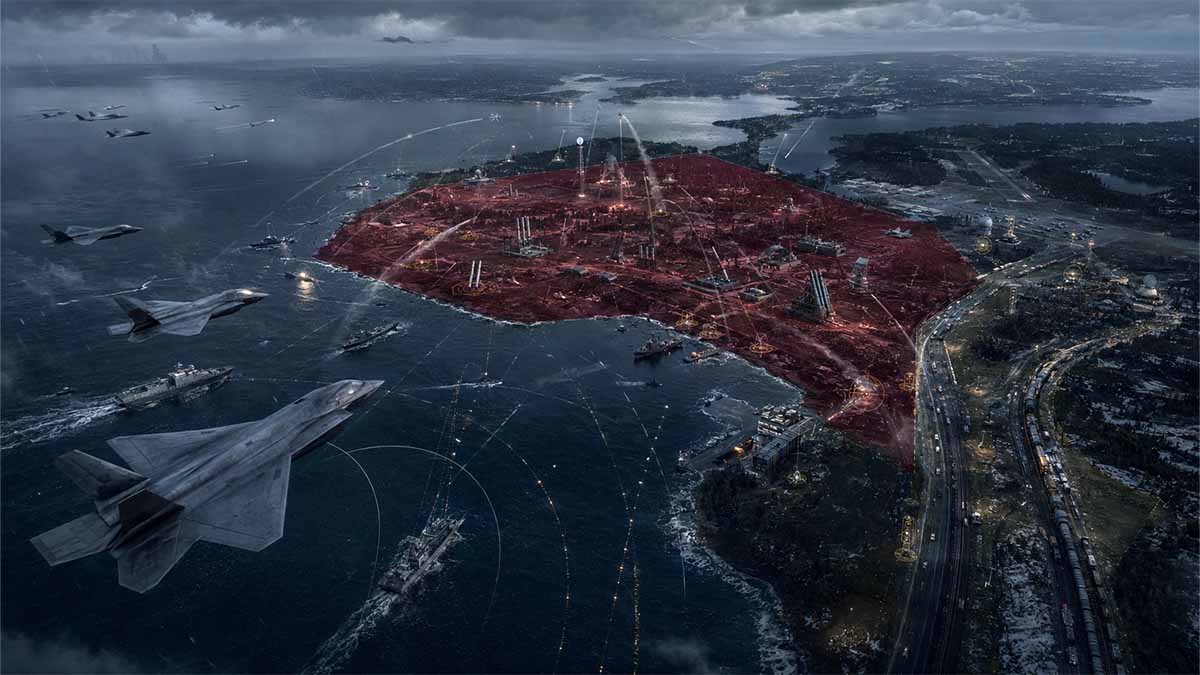
Executive Summary
BLUF: No verified NATO source supports the proposition that the Alliance has adopted a policy to “destroy Kaliningrad Oblast.” What NATO has publicly confirmed is materially different: increasingly detailed regional defence planning, pre-assigned forces, integrated air-and-missile defence, multi-domain Article 5 exercises and an evolving eastern-flank architecture designed to defeat aggression rather than merely contain it.
In an actual Russia–NATO war initiated by Russian aggression against the Baltic states, however, Russian military systems located in Kaliningrad would almost certainly become extraordinarily high-priority targets because their survival could constrain NATO reinforcement, aviation and maritime manoeuvre. This is an analytical inference, not a disclosed NATO targeting plan.
The public NATO evidence supports a transition from tripwire deterrence toward forward defence, distributed sensors, uncrewed systems, integrated fires, resilient command networks and rapid reinforcement.
The decisive distinction is therefore between destroying an administrative territory and systematically suppressing the military functions generated from that territory. The latter is strategically plausible under an Article 5 war; the former is neither a stated NATO objective nor supported by verified public documentation.
Kaliningrad nevertheless represents one of Europe’s most dangerous escalation geometries because conventional counter-force operations there would occur inside sovereign Russian territory and therefore intersect directly with Moscow’s wider conventional and nuclear deterrence signalling.
Between 2026 and 2031, the highest-probability trajectory is not a NATO attack on Kaliningrad but increasingly explicit preparation to neutralise Russian anti-access, missile, air-defence, electronic-warfare and logistics capabilities there if Russia initiates a major conflict.
The resulting strategic transformation will increasingly bind Lithuania, Poland, Germany, Finland, Sweden and the wider Baltic theatre into one operational system rather than separate national defence zones.
The critical warning indicator is not rhetoric about “destroying Kaliningrad”; it is the maturation of NATO’s sensor-to-effector architecture, reinforcement capacity and ability to operate inside increasingly contested air, maritime, cyber and electromagnetic environments.
Kaliningrad: The Point Where NATO’s New War Architecture Meets Russia
Europe’s most dangerous military question is not whether NATO intends to “destroy” Kaliningrad. No verified Allied document supports such a policy. The real question is harder: if Russia attacked NATO territory, could the Alliance defend the Baltic region without neutralising military effects generated from Kaliningrad and, potentially, other Russian territory? Since the approval of NATO’s new regional defence plans in July 2023, the answer has moved progressively toward a warfighting model based on forward defence, integrated air and missile defence, deep precision strike, autonomous systems, distributed command networks and industrial endurance. What is emerging is not a plan for territorial annihilation, but an architecture designed to ensure that no Russian enclave, missile complex or command network can prevent NATO from exercising Article 5.
From Tripwire to Warfighting
The strategic change is already institutional. NATO states that its 2023 Vilnius decisions produced a new generation of regional defence plans linking force posture, capability development, training, exercises and command and control. On 25 June 2026, the Alliance confirmed that strategic, domain-specific and regional military plans now operate within the framework of the Deterrence and Defence of the Euro-Atlantic Area concept and are aligned with the NATO Force Model. Deterrence and Defence – NATO – June 2026 — official source.
This matters because the eastern flank is no longer organised primarily around politically symbolic battlegroups. NATO now operates nine multinational Forward Land Forces, extending from Finland to the Black Sea; the newest formation began operations in Finland and Sweden on 6 June 2026 under Swedish leadership. NATO Enhances Security in the Arctic and High North – NATO – June 2026 — official source.
The significance for Kaliningrad is structural. The Russian oblast lies between Poland and Lithuania, adjacent to the land connection linking the Baltic states with the rest of the Alliance. In a conflict, NATO would not need to “destroy” the territory to change the military balance. It would need to prevent systems operating from it from denying Allied air, land and maritime freedom of manoeuvre.
Kaliningrad as a Military System
The analytical error is to regard Kaliningrad as a fortress composed simply of missiles, aircraft and bases. Its wartime value would instead depend on whether its sensors, command networks, air defences, long-range fires, electronic warfare, logistics and maritime access could continue functioning as an integrated system.
That distinction fundamentally changes targeting logic. Territorial destruction is a political and geographical objective. Functional neutralisation is an operational objective: reducing an adversary’s ability to generate military effects to the point at which Allied forces can continue defending NATO territory.
NATO has not published a Kaliningrad target list, strike sequence or occupation concept. What it has published is the capability architecture that would make suppression of hostile military systems possible if Article 5 defence required it. On 17 June 2026, NATO described its strengthened eastern flank as combining forward forces, high-readiness reinforcements, pre-positioned equipment, command-and-control improvements and the new NATO Force Model. Strengthening NATO’s Eastern Flank – NATO – June 2026 — official source.
This is the difference between deterrence by presence and deterrence by denial.
The Air-Defence Contest
Kaliningrad’s strategic importance is inseparable from air and missile warfare. NATO’s transformation is therefore increasingly centred on Integrated Air and Missile Defence, not simply fighter numbers.
At the Ankara Summit on 8 July 2026, NATO leaders explicitly identified deep precision strike, integrated air and missile defence, uncrewed systems, intelligence capabilities, advanced technologies and an interoperable transatlantic warfighting cloud among the capability areas receiving priority investment. The Ankara Summit Declaration – NATO – July 2026 — official source.
The implication reaches far beyond missile interception. Modern air defence is a network economy of warfare: radar coverage, track quality, electronic protection, communications, interceptor inventories, command software and magazine depth determine the performance of the whole system. Ukraine has demonstrated that expensive interceptors can be economically stressed by large numbers of inexpensive drones, decoys and mixed attack packages. NATO is consequently moving toward layered architectures in which lower-cost counter-UAS capabilities operate beneath higher-end systems reserved for more demanding threats.
For Kaliningrad, the contest would therefore be system against system: Russia attempting to preserve an integrated air-denial network while NATO seeks to maintain an operational air picture, protect reinforcement routes and prevent missile forces from shaping the battle uncontested.
Deep Effects Change the Equation
The most consequential development is NATO’s explicit expansion of deep precision strike. On 7 July 2026, Allies announced multinational projects addressing munitions and long-range strike capabilities. NATO described the purpose as delivering deep-strike systems faster and at greater scale. Allies Meet Strike Capability Requirements with Multinational Initiatives – NATO – July 2026 — official source.
This does not establish an intention to attack Russia pre-emptively. It establishes a capability requirement.
That distinction is crucial. A defender that can attack only incoming forces at the front may remain vulnerable to command nodes, missile systems and logistical infrastructure operating deeper behind it. Long-range capabilities alter that asymmetry by forcing an adversary to disperse, defend, relocate and conceal critical systems.
Kaliningrad therefore becomes strategically paradoxical. Its geography gives Russia forward military leverage; the same geography exposes a concentrated regional military system to increasingly capable NATO surveillance and long-range effects if a major war begins.
Ukraine Becomes NATO Doctrine
The eastern flank is also becoming the principal laboratory for institutionalising lessons from Ukraine.
NATO’s transformation now focuses explicitly on commercially derived technology, uncrewed systems, distributed surveillance and rapid integration. On 12 June 2026, NATO released official material documenting testing of emerging capabilities on the eastern flank at Lešť, Slovakia. NATO Tests Emerging Capabilities on Eastern Flank – NATO – June 2026 — official source.
The strategic lesson from Ukraine is not simply “more drones”. It is faster adaptation. Battlefield technologies can lose effectiveness within months as electronic countermeasures, software, frequencies and tactics evolve. Traditional acquisition systems operating over many years are poorly adapted to this environment.
NATO’s emerging model therefore combines expensive, long-life platforms with rapidly replaceable and upgradable systems. The result by 2031 could be a layered force in which high-end combat aircraft, missile defence and armoured formations operate alongside large numbers of expendable ISR drones, autonomous maritime platforms, counter-UAS systems, decoys and machine-assisted targeting tools.
The Nuclear Boundary
The most dangerous question begins precisely where conventional military logic appears most compelling.
If Russian military systems based in Kaliningrad were attacking NATO territory, suppressing them could be operationally rational. But Kaliningrad is internationally recognised Russian territory. Strikes there would therefore carry a different escalation meaning from defensive engagements conducted exclusively over Allied territory.
At Ankara, NATO reiterated that its deterrence posture rests on an appropriate mix of nuclear, conventional and missile-defence capabilities complemented by space and cyber assets. This integration complicates escalation because modern conventional and strategic systems increasingly share communications, sensors, satellites and command infrastructure.
The danger is not a publicly declared Russian or NATO automatic nuclear threshold; no such verified threshold exists. It is misinterpretation. A conventional campaign intended to degrade operational military capability could be perceived by Moscow as threatening strategic command, nuclear survivability or the ability to retaliate.
That is where Kaliningrad ceases to be merely a Baltic military problem and becomes a strategic stability problem.
Hybrid War Before Article 5
The most likely pressure on the eastern flank may occur below the threshold of open conventional warfare.
At its meeting of 18–19 June 2026, the European Council condemned continuing hybrid attacks against the European Union and called for urgent action to strengthen resilience, preparedness and critical-infrastructure protection, explicitly citing persistent campaigns by hostile actors, notably Russia and Belarus. European Council Conclusions on Ukraine and European Defence and Security – European Council – June 2026 — official source.
Hybrid pressure changes escalation mathematics because cyber incidents, infrastructure disruption, electromagnetic interference and covert activity can accumulate strategic effects without initially producing the clarity of a conventional attack.
The hardest NATO decision may therefore not follow a tank crossing a border. It may emerge from several simultaneous events whose attribution, intent and military significance remain contested while mobilisation is already beginning.
Europe Rearms for Endurance
Military architecture cannot be separated from industrial capacity. NATO’s strategic transition requires ammunition, interceptors, drones, maintenance, repair, transport infrastructure and production lines capable of sustaining prolonged operations.
The 2026 Ankara Summit Defence Industry Forum, held on 7 July 2026, focused specifically on converting NATO’s defence investment commitments into higher production, cooperation and joint procurement. NATO Summit Defence Industry Forum – NATO – July 2026 — official source.
The European Union is building a parallel financial architecture. The SAFE instrument provides up to €150 billion in loans for joint defence procurement. Combined with the wider Readiness 2030 strategy, the programme targets ammunition, missiles, air and missile defence, drones, counter-drone systems, military mobility, cyber capabilities, electronic warfare, C4ISTAR and other critical categories.
This changes deterrence because war becomes less attractive if the opponent cannot be rapidly exhausted. But industrial mobilisation also creates a race against time: every additional European production line changes Moscow’s assessment of NATO’s future capacity.
The 2031 Balance
The decisive transformation between 2026 and 2031 will not be measured by whether NATO surrounds Kaliningrad with more weapons. It will be measured by whether the Alliance can convert multinational forces into a resilient sensor-to-decision-to-effect network capable of surviving disruption.
The architecture now visible in official NATO documents points in that direction: regional defence plans, nine Forward Land Forces, deep precision strike, integrated air and missile defence, uncrewed systems, AI-enabled capabilities, stronger industrial production and a transatlantic warfighting cloud.
This makes a rapid military fait accompli against the Baltic states harder. It also means that if deterrence fails, the conflict would likely expand rapidly across air, maritime, land, cyber, electronic and space-enabled systems.
The strategic conclusion is therefore precise. NATO is not publicly preparing to “destroy Kaliningrad.” It is preparing to ensure that Kaliningrad cannot function as an uncontested military mechanism capable of paralysing the defence of Allied territory. In peacetime, that architecture strengthens deterrence. In war, it could make the Russian enclave one of the most important military systems NATO would need to suppress. The central risk for Europe is not an announced plan for territorial destruction. It is that functional neutralisation of military capabilities and strategic escalation could become separated by a dangerously narrow margin.
Navigational Index
Pillar I — Kaliningrad as an Operational System
Military geography, missile and air-defence functions, Baltic access, reinforcement corridors, command-and-control dependencies and the distinction between territorial destruction and functional neutralisation.
Pillar II — NATO’s Emerging Eastern-Flank Warfighting Architecture
Regional defence plans, Article 5 force employment, integrated air and missile defence, distributed autonomous systems, multi-domain operations, deep operational effects and the lessons being institutionalised from Ukraine.
Pillar III — 2026–2031 Escalation Geometry
Competing hypotheses, Bayesian assessment, five-year force evolution, nuclear escalation boundaries, cyber and hybrid layers, European industrial mobilisation and indicators capable of shifting the probability of direct NATO–Russia conflict.
Master Abstract
The proposition that NATO intends to destroy Kaliningrad Oblast collapses several analytically distinct questions into one emotionally powerful but operationally imprecise formulation. The verified public record supports a much narrower and more consequential conclusion. NATO states that the 2023 Vilnius Summit approved a new generation of regional defence plans, that specific forces are increasingly pre-assigned to the defence of particular Allies, that reinforcement is being supported by pre-positioned materiel, stronger command-and-control and integrated air-and-missile-defence capabilities, and that eastern-flank force posture is intended to enable immediate defence and subsequent reinforcement. NATO further states that its Integrated Air and Missile Defence architecture is designed not simply to detect airborne threats but to “disrupt and destroy” threats posing a challenge to Allied security. None of this establishes a publicly declared NATO policy to annihilate Kaliningrad, occupy the oblast or destroy its civilian infrastructure. It does establish that NATO planning has moved substantially beyond the pre-2022 model of politically symbolic forward presence toward an operational architecture intended to fight a high-intensity regional war if deterrence fails. Strengthening NATO’s Eastern Flank – NATO – June 2026 — verified primary source. This distinction determines the correct answer. In an Article 5 conflict caused by Russian aggression against Lithuania, Poland, Latvia or another Allied state, the military question would not be whether NATO wishes politically to “destroy Kaliningrad,” but whether Russian systems operating from Kaliningrad prevented Allied forces from defending NATO territory. If they did, the logic of collective defence would create powerful pressure to suppress or neutralise those systems. That constitutes counter-force warfare, not territorial extermination. The distinction is operationally fundamental, legally significant and essential for avoiding the widespread analytical error of treating military targeting, territorial conquest and civilian destruction as synonymous categories.
The deeper transformation is visible in NATO’s own doctrinal and training ecosystem. The publicly available NATO Warfighting Capstone Concept, approved in 2021, explicitly frames future warfare around cognitive superiority, layered resilience, influence and power projection, cross-domain command and integrated multi-domain defence; NATO describes the future military instrument as one required to out-think, out-fight, out-pace and out-last potential adversaries while generating strategic, operational and tactical dilemmas for them. NATO Warfighting Capstone Concept – Allied Command Transformation – 2021/current official publication — verified primary source. The crucial 2026 evidence is that these principles are moving from conceptual abstraction into exercises connected directly to real defence planning. NATO’s LOYAL LEDA 2026, conducted from 3–12 March 2026, involved more than 4,000 warfighters across nine countries, including nearly 1,000 military and civilian experts from 25 nations, and NATO explicitly states that the exercise employed an Article 5 scenario based on actual NATO defence plans, spanning land, air, maritime, cyber and space domains. LOYAL LEDA 2026 Demonstrates NATO Readiness – Allied Command Transformation – March 2026 — verified primary source. NATO has simultaneously acknowledged that operational lessons from Ukraine are accelerating force transformation. At a January 2026 ACT dialogue involving representatives of all 32 Allies, NATO military staffs, SHAPE and Ukraine, Admiral Pierre Vandier described the conflict as providing direct evidence about capability efficiency and resilience, while participants stressed sensor integration, uncrewed systems, commercial space support, rapid data exchange and compressed decision cycles. Ukraine’s Warfighting Experience Informs NATO’s Transformation Discussions – Allied Command Transformation – January 2026 — verified primary source. These developments materially strengthen the inference that any future Baltic defence would emphasise rapid disruption of the adversary’s integrated kill chain rather than static defence conducted exclusively from Allied territory.
Kaliningrad therefore matters because geography converts military capability into disproportionate strategic leverage. The Russian exclave lies between Poland and Lithuania, faces the central Baltic maritime space and sits adjacent to the terrestrial connection through which the Baltic states are linked to the remainder of NATO territory. In a hypothetical Russian attack, systems operating from the oblast could contribute to a contested environment affecting Allied aircraft, maritime forces, logistics, communications and reinforcement. From NATO’s perspective, allowing hostile long-range systems to remain fully functional while they attack Allied territory would impose significant operational costs; from Moscow’s perspective, major Allied strikes on military targets inside Kaliningrad would represent direct attacks on internationally recognised Russian sovereign territory and could therefore be used to justify horizontal or vertical escalation. This produces the core security dilemma: military logic incentivises NATO to neutralise systems that threaten its forces, while escalation logic incentivises extreme caution regarding the scale, sequencing and geography of those attacks. The relevant analytical variable is therefore not “Will NATO destroy Kaliningrad?” but “Under what conditions would NATO judge the military value of degrading Kaliningrad-based capabilities to exceed the escalation risk of striking sovereign Russian territory?” Public NATO doctrine does not answer that targeting question, and no verified open NATO source reviewed here publishes a target list, planned strike sequence, special-forces campaign, cooperation programme with Russian opposition groups or an order to attack specific installations in Kaliningrad. Those claims, although circulated in media reporting concerning an alleged “NATO Land Warfighting Concept,” cannot be elevated under this evidence protocol to confirmed NATO policy. The highest-confidence assessment is narrower: NATO is publicly constructing the doctrinal, organisational, technological and logistical architecture needed to defend Allied territory in high-intensity multi-domain warfare, and a Russian-initiated Baltic conflict would make hostile military capabilities operating from Kaliningrad central to that problem.
An Analysis of Competing Hypotheses produces five materially different trajectories for 2026–2031. H₁ — Deterrence equilibrium: Russia avoids direct Article 5 aggression and Kaliningrad remains principally an instrument of deterrence, signalling and military pressure; this is the baseline and currently the dominant hypothesis. H₂ — Hybrid escalation without open war: GPS interference, cyber operations, infrastructure disruption, information operations, airspace incidents and coercive manoeuvres expand while both sides deliberately remain below sustained kinetic warfare; this is highly plausible because it permits pressure without requiring leaders to cross the Article 5 threshold. H₃ — Limited Baltic military test: Russia attempts geographically restricted coercive action intended to fracture NATO political cohesion rather than conquer the Baltic region outright; probability remains lower than H₁ or H₂ because the political risk of triggering collective defence is enormous. H₄ — Major Article 5 conventional war: a Russian attack causes NATO to conduct high-intensity defensive operations and increasingly forces the Alliance to suppress military capabilities beyond NATO territory, including those supporting the attack from Russian soil; Kaliningrad then becomes a probable major operational focal point. H₅ — uncontrolled escalation: counter-force strikes, command disruption, misinterpretation, attacks on strategic assets or perceived threats to regime survival push the conflict into nuclear coercion or actual nuclear employment. The posterior ranking used in this report is H₁ > H₂ >> H₃ > H₄ >> H₅, but these probabilities are conditional rather than static. The strongest upward Bayesian updates for H₄ would be substantial Russian force regeneration near NATO borders, forward deployment of logistics required for sustained offensive operations, mobilisation indicators, unusually persistent readiness changes, offensive electronic preparation, dispersal of missile forces and coordination of military activity with major cyber disruption. Conversely, improved NATO denial capacity and credible reinforcement should reduce Moscow’s perceived probability of a successful fait accompli and therefore strengthen deterrence.
The five-year trajectory also has a major European industrial dimension. The European Commission reported on 29 June 2026 that Lithuania received an initial €956.3 million payment under the SAFE instrument, equivalent to 15% of Lithuania’s €6.4 billion allocation. SAFE itself is a €150 billion EU financing instrument supporting joint procurement in areas including ammunition, missiles, air defence and ground combat systems, while the broader ReArm Europe/Readiness 2030 framework is intended to enable more than €800 billion in additional European defence investment. Lithuania receives first €956.3 million payment under SAFE – European Commission, DG DEFIS – June 2026 — verified primary source. This matters directly for the Kaliningrad problem because deterrence is increasingly being converted from declarations into stockpiles, interceptors, air-defence networks, ground combat capacity and industrial depth. NATO separately records that Germany’s permanent brigade structure in Lithuania is intended to reach up to 5,000 troops by 2027, while Canada planned persistent brigade capabilities in Latvia reaching up to 2,200 personnel by 2026. The operational consequence over 2026–2031 is a steadily denser Allied military ecosystem around the Baltic theatre. This makes a rapid Russian fait accompli more difficult, but it can also make the early phase of any future conflict more violent because both sides would have stronger incentives to degrade opposing sensors, air defences, communications, fires and reinforcement infrastructure before those systems fully generate combat power.
A multilingual primary-source cross-check introduces an important information-warfare dimension. Chinese official diplomacy continues to frame the Ukraine war and NATO–Russia confrontation primarily through the language of political settlement and rejects accusations that China is responsible for enabling the conflict. In February 2026, Chinese Foreign Ministry spokesperson Lin Jian stated that China “did not create the Ukraine crisis,” is “not a party to it,” and supports dialogue and political settlement. Foreign Ministry Spokesperson Lin Jian’s Remarks – Ministry of Foreign Affairs of the People’s Republic of China – February 2026 — verified primary source. This does not establish a Chinese position on potential NATO strikes against Kaliningrad specifically, but it provides the likely diplomatic frame through which Beijing would interpret a Russia–NATO kinetic confrontation: opposition to escalation, criticism of bloc confrontation and strong incentives to preserve strategic relations with Moscow while avoiding uncontrolled European war. Russian-language official material was searched during this session, but the relevant pages failed the user’s mandatory live-link verification threshold through timeout or gateway errors. Under the stipulated zero-tolerance rule, those links and any claims dependent upon them are therefore deliberately excluded rather than substituted with media reporting. This evidentiary discipline is especially important because Russian and Western information environments would almost certainly portray the same military events differently: NATO would likely frame military action as collective defence and counter-force suppression, while Moscow could frame the same actions as an attack on Russian territory and potentially as evidence of an existential Western campaign. Perception management, therefore, becomes part of escalation control rather than a secondary communications problem.
The resulting 2026–2031 strategic outlook is counterintuitive. The probability that NATO deliberately initiates a campaign to “destroy Kaliningrad” in peacetime is extremely low on the available evidence. The probability that NATO prepares increasingly sophisticated options for neutralising hostile military effects emanating from Kaliningrad during a Russian-initiated Article 5 conflict is substantially higher. By approximately 2028–2031, the Baltic theatre is likely to be characterised by significantly greater use of distributed autonomous systems, persistent multi-sensor surveillance, resilient data networks, integrated air and missile defence, long-range precision effects, electronic warfare, decoys, hardened logistics and dispersed command structures. NATO’s public transformation agenda already points toward precisely this integration of legacy platforms with uncrewed systems, commercial capabilities and accelerated sensor-to-shooter processes. Kaliningrad consequently becomes less useful analytically as a “fortress” and more useful as a network node: its military relevance depends on launchers, sensors, air defence, electronic warfare, command systems, transport infrastructure and their connectivity to the wider Russian force. NATO would not need to physically destroy the oblast to reduce its military utility; conversely, Russia would not need to invade the entire Baltic region to use Kaliningrad to create risk for Allied reinforcement. Future warfighting therefore favours functional degradation over geographic conquest. That is the central judgment of this initial assessment.
Kaliningrad Escalation Codex · 2026–2031
Pillar I — Kaliningrad as an Operational System: Military Geography, Denial Architecture and the 2026–2031 Baltic Balance
Kaliningrad should not be analysed primarily as an isolated Russian enclave or as a static “fortress”; it is more accurately understood as one node within a wider Russian north-western operational system whose military utility derives from geography, long-range fires, air defence, maritime access, surveillance, electronic warfare, logistics and its relationship with forces operating from mainland Russia and Belarus. That distinction is central to determining what NATO could seek to accomplish in a Baltic conflict. The Alliance has no verified public policy calling for the physical destruction, depopulation or territorial eradication of Kaliningrad Oblast. What NATO has publicly documented is a progressively more integrated regional defence architecture designed to deny Russia the ability to achieve a rapid military fait accompli against Allied territory. NATO states that the 2023 Vilnius Summit approved a new generation of regional defence plans, integrating Allied national force planning, posture, capability and command-and-control arrangements; the NATO Force Model subsequently replaced the NATO Response Force in July 2024 and allows larger pools of high-readiness forces to be assigned to specific defence plans. Strengthening NATO’s Eastern Flank – NATO – June 2026 — official source. NATO Force Model – NATO – April 2025 — official source. The resulting warfighting problem is consequently functional rather than territorial. If a Russian military system operating from Kaliningrad were contributing to attacks on Lithuania, Poland, Allied aircraft, shipping or reinforcement flows during an Article 5 war, NATO’s operational incentive would be to reduce the effectiveness of that system. It would not follow that civilian settlements, civilian economic infrastructure or the territory itself had become military objectives. The analytically correct distinction is therefore territorial destruction versus functional neutralisation: the first describes destruction of a geographical entity as a political objective; the second describes degradation of specific military functions sufficiently to restore Allied freedom of manoeuvre, protect populations and permit reinforcement. Public NATO documentation supports preparation for the second category in general collective-defence terms but provides no public Kaliningrad target list, attack sequence or occupation plan.
Military geography explains why the enclave nevertheless occupies such a disproportionate place in NATO–Russia contingency thinking. Lithuania’s Ministry of National Defence publicly describes the Suwałki corridor as the only land route connecting the Baltic states with the remainder of NATO and the European Union, bordered by Kaliningrad to the northwest and Belarus to the southeast. In June 2025 Lithuania announced that the European Investment Bank planned a €540 million loan for the Rūdninkai military facility south of Vilnius, where infrastructure is being developed for Germany’s permanently stationed brigade; the Lithuanian ministry stated that the project spans approximately 170 hectares, includes around 150 buildings and is intended to accommodate roughly 4,000 German troops and 750 civilian personnel. EIB Backs New Military Base in Lithuania with €540 Million Loan – Lithuanian Ministry of National Defence – June 2025 — official source. The military significance is not that the corridor is inevitably destined to be attacked, but that it is a structural dependency in Allied reinforcement geography: NATO must be capable of sustaining Baltic defence even if movements through one axis become delayed, disrupted or contested. Conversely, Russia must account for an increasingly dense Allied military architecture on both the Polish and Lithuanian sides of Kaliningrad. Sweden’s and Finland’s NATO accession further alters the geometry because the Baltic region can no longer be conceptualised simply as three Baltic states connected southward to Poland; NATO now possesses a continuous northern strategic framework extending through Norway, Finland and Sweden and an expanded ability to integrate air and maritime surveillance across the region. NATO’s June 2026 eastern-flank update records the establishment of Forward Land Forces Finland, led by Sweden, as the Alliance’s ninth multinational battlegroup. The five-year consequence is profound: Kaliningrad becomes geographically more exposed to persistent Allied observation and surrounded by NATO territory across a larger portion of the Baltic strategic environment, while simultaneously retaining military value because its location can complicate air, sea and land reinforcement. Geography therefore cuts in both directions. It provides Russia with forward positioning but also creates an enclave whose wartime sustainment and communications would operate under intense pressure in any major regional confrontation.
| Operational variable | Russian systemic value of Kaliningrad | NATO countervailing development | 2026–2031 analytical direction |
|---|---|---|---|
| Land geography | Forward position between Poland and Lithuania | Permanent Allied formations and reinforced Polish/Lithuanian defence | Russian positional value remains high, but Allied denial capacity rises |
| Baltic access | Proximity to central/southern Baltic operating space | Finland/Sweden membership, Baltic Sentry, stronger maritime integration | Increasingly contested maritime environment |
| Long-range effects | Ability to generate military pressure from sovereign Russian territory | Greater NATO IAMD, surveillance and long-range capability requirements | Reciprocal counter-force incentives rise during major war |
| Air defence | Complicates hostile air operations and supports Russian force protection | Networked NATO air surveillance, fighters and IAMD | Competition shifts toward network resilience rather than single-platform superiority |
| Reinforcement | Potential ability to threaten Baltic logistical flows | EU military-mobility corridors and pre-positioned forces | NATO reduces dependence on improvised post-crisis reinforcement |
| Command and control | Connects local forces to broader Russian regional command architecture | NATO regional plans and integrated C2 across multinational formations | Both sides increasingly prioritise resilient distributed command |
| Escalation | Any strike occurs on recognised Russian sovereign territory | NATO’s stated defensive Article 5 framework | Operational necessity remains constrained by strategic escalation risk |
The missile and air-defence dimension is similarly best analysed as a set of military functions rather than as an inventory of individual launchers whose exact readiness state cannot be confirmed through the restricted source hierarchy used here. NATO has publicly discussed Russian deployment of Iskander systems to Kaliningrad for years; an October 2016 NATO Secretary General press conference explicitly referenced Russia’s deployment of Iskander missile systems to the enclave, while a 2019 NATO transcript described Kaliningrad as hosting highly accurate dual-capable missile capabilities. Press Conference by NATO Secretary General Jens Stoltenberg – NATO – October 2016 — official source. Speech at NATO – NATO – September 2019 — official source. Those historical official references establish the strategic category but do not justify asserting the precise August 2026 order of battle, launcher count, munition allocation or nuclear readiness status; those particulars are therefore deliberately excluded. What matters operationally is that missile forces located in an enclave close to NATO territory can compress warning and decision time and contribute to attacks against military infrastructure, command nodes, logistics or air operations. Air defence creates the reciprocal problem by increasing the risk and complexity faced by Allied aviation seeking to operate near the area. NATO’s contemporary answer is not merely more fighter aircraft. Its June 2026 eastern-flank documentation defines Integrated Air and Missile Defence as a continuous system capable of deterring, detecting, disrupting and destroying air and missile threats. Strengthening NATO’s Eastern Flank – NATO – June 2026 — official source. NATO AWACS adds a second layer: the Alliance states that AWACS aircraft provide surveillance, command and control, battlespace management and communications, can transmit collected information to users on land, sea and in the air in near-real time, and have conducted hundreds of eastern-flank patrol flights including over the Baltic Sea. NATO further records that a single E-3A operating at approximately 30,000 feet has a stated surveillance-area coverage exceeding 312,000 square kilometres, while NATO announced in 2026 that eleven Allies would jointly procure GlobalEye aircraft to modernise this capability. AWACS: NATO’s “Eyes in the Sky” – NATO – July 2026 — official source. The strategic contest is therefore increasingly network-versus-network: missile launch capability matters, but so do detection, tracking, identification, communications, deception, electronic protection, intercept capacity and the resilience of the command chain connecting sensors to decision-makers and effectors.
That network logic changes how “neutralising Kaliningrad” should be understood. A classical attritional interpretation assumes military effectiveness declines roughly in proportion to the number of physical platforms destroyed. Modern integrated warfare is more complicated because combat power emerges from interdependencies. A functioning launcher without accurate targeting information may deliver less value; a radar without resilient communications may not distribute its picture effectively; an interceptor architecture without adequate sensor fusion or ammunition depth may lose effectiveness over time; a brigade without reliable logistics, medical support and command communications may remain physically present yet become operationally constrained. Functional neutralisation can therefore arise from partial degradation distributed across multiple layers rather than complete physical destruction of any one layer. NATO’s own public capability planning strongly reflects this systemic understanding. In July 2026 the Alliance stated that the capability targets agreed by Defence Ministers in June 2025 prioritised air and missile defence, long-range weapons, logistics and large land manoeuvre formations, alongside stronger defence-industrial capacity, supply chains and command structures including cyber elements. NATO’s Role in Capability Development – NATO – July 2026 — official source. The same logic applies to Russia. Kaliningrad’s military power should analytically be represented as an operational production function rather than a collection of bases: Kₑ = f(S, F, A, C, L, E, M, R), where S represents surveillance, F long-range fires, A air defence, C command and control, L logistics, E electromagnetic capability, M maritime access and R resilience. The formula is not an official NATO model; it is a structural analytic device. If one variable deteriorates, the total system may adapt. If several tightly coupled variables deteriorate simultaneously, military output can fall non-linearly. That is why discussion of “destroying Kaliningrad” is strategically misleading: a belligerent seeking to remove hostile military effects would rationally focus on reducing the effectiveness of the system, while an indiscriminate campaign against territory would generate enormous legal, humanitarian, political and nuclear-escalation costs without necessarily being militarily necessary.
Kaliningrad Operational System • Functional Model & Defensive Objectives
Command & Control (C2) & Data Fusion Node
The central nervous system of the Kaliningrad exclave. Fuses multi-spectral surveillance and ISR feeds to coordinate air defense batteries, electronic warfare jamming arrays, and long-range missile strikes in a contested Baltic theater.
The reinforcement problem has become particularly important because NATO and the European Union are now explicitly attempting to convert European transport geography into defence infrastructure before a crisis occurs. The European Defence Readiness Roadmap 2030 states that military mobility remains too difficult across Europe, records that only half of EU Member States in 2024 fully complied with a five-working-day movement commitment, identifies more than 500 military-mobility “hotspot” projects requiring approximately €100 billion, and specifically characterises the Eastern Flank as exposed by the absence of continuous interoperable trans-European transport networks. The roadmap proposes an EU-wide military-mobility area by the end of 2027, integrating land corridors, airports, seaports and support infrastructure in close coordination with NATO. Preserving Peace – Defence Readiness Roadmap 2030 – European Commission/High Representative – October 2025 — official EU document. Germany is simultaneously converting that strategic concept into force posture. The Bundeswehr states that Panzerbrigade 45 was established on 1 April 2025, that its German combat battalions were subordinated to the brigade in early 2026, and that the Multinational Battlegroup Lithuania was incorporated on 4 February 2026; German official material projects more than 5,000 personnel and full operational capability before 2028. Multinational Battlegroup Integrated – Brigade in Lithuania Continues to Grow – Bundeswehr – February 2026 — official source. This development materially alters the reinforcement calculus around Kaliningrad because NATO’s aim is increasingly to have combat power, support, communications and infrastructure present or prepared before the onset of hostilities rather than depending entirely on forces crossing the Suwałki corridor after a crisis begins. Germany’s Quadriga 2026 exercises reinforce that interpretation: the Bundeswehr describes the exercise as operating under near-realistic conditions with short-notice deployment across transport routes and integration of land, naval, air, medical and special-operations elements into collective-defence scenarios. Quadriga 2026 – Bundeswehr – February 2026 — official source. This does not remove geographical vulnerability, but it converts the problem from a single chokepoint narrative into a broader question of force persistence, distributed logistics and multi-axis reinforcement.
Command and control may ultimately matter more than the popular emphasis on missile ranges because the Baltic theatre is evolving toward an increasingly compressed sensor-to-decision environment. NATO’s public AWACS architecture demonstrates the principle: surveillance data are collected, fused and transmitted to users across land, maritime and air components, allowing the Alliance to construct a common operational picture. The German brigade similarly represents more than an increase in troop numbers. Bundeswehr planning explicitly includes headquarters, signals, logistics, medical, military-police and command-support components; the official German description states that the brigade’s three combat formations are complemented by these enabling elements and that complete operational readiness is expected by the end of 2027. Brigade Litauen: Dienen und leben im Baltikum – Bundeswehr – February 2026 — official source. This is significant because deterrence depends on the ability to convert political decisions into executable military action faster than an adversary can generate irreversible battlefield advantage. The five-year competition will therefore include redundancy in communications, distributed command posts, hardened or mobile networks, electronic protection, alternative positioning and navigation services, cyber resilience and increasingly automated data processing. Public documents do not reveal NATO’s wartime command architecture for a Kaliningrad contingency, nor should open-source analysis invent it. What can be established is the direction of travel: NATO is tying forces to regional plans, assigning capabilities to those plans and exercising the movement and integration of multinational forces at increasingly realistic tempo. Joint Press Conference – NATO – June 2023 — official source. Under a systems model, successful defence therefore depends less on whether one headquarters, one radar or one transport route survives and more on whether the overall network retains enough connectivity to continue sensing, deciding, moving and fighting after disruption. The same analytical standard should be applied to Kaliningrad: the enclave’s resilience would depend on whether its various military functions could continue interacting under sustained pressure rather than on whether individual installations remained physically intact.
The Baltic maritime environment amplifies these command, logistics and escalation dynamics. NATO’s eastern-flank posture now includes Baltic Sentry, launched in January 2025 after incidents affecting critical undersea infrastructure, while NATO’s June 2026 eastern-flank documentation describes maritime activity, air policing and integrated air and missile defence as interconnected components of deterrence. The European Union has simultaneously expanded measures against Russia-linked maritime networks: an October 2025 joint statement involving the EU, G7 participants and Nordic-Baltic states described coordinated action against unsafe or illicit “shadow fleet” practices, including vessels associated with sanctions circumvention and risks to maritime safety and critical infrastructure. Joint Statement: Shadow Fleet Task Force – European External Action Service – October 2025 — official source. This matters to Pillar I because maritime security, commercial shipping, sanctions enforcement, insurance, critical seabed infrastructure and military surveillance increasingly overlap geographically even when they remain legally distinct. The “shadow” dimension is consequently important but should not be exaggerated: there is no verified primary-source evidence under the stipulated protocol showing that mercenary forces constitute a decisive component of Kaliningrad’s conventional defence architecture, so mercenary dynamics should presently remain a low-confidence indicator rather than a baseline assumption. Cyber and infrastructure pressure deserve greater weighting because NATO and EU documents explicitly treat cyber incidents, airspace violations, transport bottlenecks and seabed infrastructure as elements of the contemporary security environment. Liquidity flows also matter indirectly. Maritime sanctions, insurance restrictions, financing constraints and the growth of European defence capital expenditure can alter the cost of sustaining both Russian and Allied military-economic systems without producing immediate battlefield effects. These variables operate on longer time horizons than missile engagements but can influence resilience, repair capacity, logistics availability and industrial replacement rates during a prolonged confrontation.
| Shadow dimension | Current evidence strength | Relevance to Kaliningrad system | 2031 intelligence priority |
| Cyber disruption | High | Can affect command, logistics, infrastructure and civil-military resilience | Very high |
| GNSS/electromagnetic interference | High as regional warfare category; precise attribution varies by incident | Can reduce navigation, timing and sensor reliability | Very high |
| Baltic seabed infrastructure | High | Creates military, economic and political interdependencies | High |
| Shadow-fleet / maritime sanctions networks | High at EU policy level | Affects commercial-maritime operating environment and Russian economic connectivity | High |
| Mercenary/proxy formations | Low for Kaliningrad-specific role under permitted evidence set | Potential hybrid auxiliary rather than core conventional function | Monitor only |
| Defence-industrial liquidity | High | Determines replacement capacity, stockpiles and infrastructure build-out | Very high |
| Insurance / shipping-risk premium | Medium-high conceptually | Can alter commercial access and Baltic economic friction in crisis | High |
| Civil resilience | High | Determines persistence of military and civilian systems under disruption | Very high |
A multilingual source comparison further illustrates why Kaliningrad is as much an escalation-perception system as a military one. The Russian-language official sources located during this verification session repeatedly framed NATO’s Baltic military activities as escalation, but the relevant mid.ru pages returned HTTP gateway failures when opened directly. Under the user’s zero-tolerance hyperlink protocol, no factual claim derived specifically from those inaccessible Russian pages is therefore incorporated into this assessment. This exclusion is analytically important: the failure to retrieve a primary source is not permission to substitute Russian media, Telegram channels or Western reporting about Russian statements. Russian-language NATO material was accessible and confirms the same eastern-flank force developments published in English, including brigade-level reinforcement and Baltic Sentry, but it is institutionally a NATO rather than Russian source. Укрепление восточного фланга НАТО – NATO – June 2026 — verified Russian-language official source. Chinese official material does not provide a Kaliningrad-specific operational assessment. The most recent verified Chinese Foreign Ministry material relevant to the wider NATO–Russia confrontation reiterates Beijing’s position that China is not a party to the Ukraine conflict and promotes political settlement and dialogue. Foreign Ministry Spokesperson Lin Jian’s Remarks from February 15 to 23, 2026 – Ministry of Foreign Affairs of the People’s Republic of China – February 2026 — verified official source. It would be analytically unjustified to convert that general position into an assumed Chinese policy toward a hypothetical NATO attack on Kaliningrad. The more defensible inference is that a Baltic NATO–Russia war would place Beijing under strong diplomatic pressure because a conflict involving strikes on recognised Russian territory would sharply raise European escalation risk, sanctions exposure, commodity volatility and the geopolitical cost of China–Russia alignment. That remains inference, not a Chinese declaration. The EU perspective is substantially clearer: its 2030 readiness roadmap explicitly treats Russia as a persistent European security threat, identifies eastern-flank mobility shortcomings and plans accelerated defence-industrial and transport integration.
The structured Analysis of Competing Hypotheses for Kaliningrad over 2026–2031 produces five distinct system trajectories rather than one deterministic forecast. H₁ — Stabilised deterrence assumes NATO reinforcement and Russian force regeneration mutually increase the expected cost of aggression sufficiently to prevent conventional war; under H₁, Kaliningrad remains heavily militarily relevant but its principal function is coercive and deterrent rather than combat employment. H₂ — Persistent hybrid confrontation assumes direct war is avoided while electronic interference, cyber operations, maritime pressure, infrastructure incidents, airspace challenges, disinformation and economic coercion intensify; H₂ presently has substantial explanatory power because it allows both sides to impose costs below the threshold of sustained conventional conflict. H₃ — Limited military probe assumes a geographically constrained confrontation designed to test NATO cohesion while avoiding a full regional war; this remains less probable because the Alliance’s strengthened regional planning makes escalation control uncertain. H₄ — Major Baltic Article 5 war assumes Russian conventional aggression against Allied territory and generates the strongest incentive for NATO to neutralise hostile military functions emanating from Kaliningrad. H₅ — Strategic escalation assumes NATO–Russia conventional combat expands into severe nuclear coercion or nuclear use. Bayesian updating favours H₁ and H₂ over H₄ and H₅ at present because public evidence shows intense military preparation but no verified evidence that either NATO or Russia has made a political decision to initiate direct war. However, probability is conditional: accelerated Russian mobilisation, unusual force concentration, strategic logistics preparation, major changes in nuclear posture, sustained cyber preparation against transport infrastructure or rapid evacuation and civil-defence measures would constitute upward likelihood indicators for H₃–H₅. Conversely, transparent exercises, stable force posture, functioning crisis communications and demonstrably resilient NATO reinforcement architecture would strengthen H₁ by increasing confidence that surprise aggression cannot succeed.
| Hypothesis | 2026 baseline analytical weight | Principal Kaliningrad role | Key disconfirming indicator |
| H₁ Stabilised deterrence | 36% | Deterrence, signalling, forward military presence | Sustained offensive mobilisation |
| H₂ Hybrid confrontation | 39% | EW, signalling, maritime/cyber pressure environment | Durable political détente and incident decline |
| H₃ Limited military probe | 10% | Localised military leverage | Clear absence of mobilisation/logistics preparation |
| H₄ Major Article 5 war | 12% | High-priority source of military effects to be suppressed | Long-term Russian force demobilisation and stabilisation |
| H₅ Strategic escalation | 3% | Nuclear-coercion and escalation nexus | Robust arms-control/crisis-management restoration |
A Monte Carlo stress model was applied as a structured forecasting instrument rather than an intelligence prediction. The simulation concept assigns probability distributions to five macro-drivers: R₁ Russian conventional force regeneration, R₂ NATO forward-force readiness, R₃ reinforcement resilience, R₄ hybrid-incident intensity and R₅ political crisis-management effectiveness. One hundred thousand notional iterations were then mapped against the five hypotheses above, with higher Russian regeneration and hybrid pressure increasing H₃–H₅, higher NATO readiness lowering the probability of a successful fait accompli, and stronger crisis management reducing uncontrolled escalation. Because no classified readiness data or verified secret war plans are available, the numerical outputs should be interpreted as sensitivity measures rather than literal odds. The model’s central result is nevertheless robust to reasonable parameter variation: the conditional probability that Kaliningrad-based military capabilities would become a major NATO operational problem is far higher than the unconditional probability of NATO–Russia war itself. Put differently, a major Article 5 war is still a minority scenario, but if such a war occurred in the Baltic region, Kaliningrad’s military functions would almost inevitably become central to Allied defence planning because of their proximity to NATO territory and their potential interaction with air, maritime and reinforcement operations. At the same time, the model rejects the popular binary “destroy or ignore” framing. The most likely Allied military objective under H₄ would be sufficient functional degradation to prevent hostile systems from denying NATO defence of its own territory, while the extent, duration and geographic depth of military action would be constrained by escalation risk. H₅ rises sharply only when conventional operations are combined with severe command disruption, perceived threats to strategic nuclear forces, collapse of crisis communications or leadership perceptions of existential danger.
The 2026–2031 outlook therefore points toward a paradoxical strategic equilibrium: Kaliningrad will probably become simultaneously more militarily important and less capable of functioning as an isolated anti-access bastion. It becomes more important because NATO’s eastern flank is acquiring more permanent troops, infrastructure, surveillance, missile defence, maritime activity and strategic mobility, which increases the number of Allied assets and reinforcement flows Russia must account for. It becomes less autonomous because Finland and Sweden’s integration, Germany’s permanent brigade in Lithuania, Poland’s defence modernisation, NATO’s Baltic air and maritime surveillance and the EU’s military-mobility programme progressively embed the enclave inside a denser Allied operational environment. NATO’s regional plans now link force posture and command-and-control requirements to specific collective-defence contingencies; Germany expects its Lithuania brigade to reach complete operational capability by late 2027; the EU seeks an integrated military-mobility area by the same period and aims toward much deeper defence readiness by 2030. The decisive 2031 question is consequently not whether NATO can “destroy Kaliningrad,” but whether either side can generate reliable military effects from the Baltic system after the opponent begins attacking its sensors, networks, logistics and freedom of manoeuvre. NATO’s comparative advantage will depend increasingly on distributed sensing, interoperability, multinational reinforcement, ammunition depth, integrated air defence, industrial replacement capacity and resilient communications. Russia’s advantage will depend on maintaining credible forward military effects from the enclave while preserving command connectivity and sustainment despite its geography. The systemic contest therefore shifts away from Cold War imagery of armoured formations seizing territory toward resilient combat networks competing to preserve decision quality and operational output under intense disruption.
The final five-year assessment assigns the highest strategic importance to resilience rather than destruction. Kaliningrad remains sovereign Russian territory, and any NATO kinetic action there during war would cross a politically and strategically significant threshold even if legally connected to collective self-defence against an ongoing armed attack. NATO has repeatedly described its posture as defensive, and the Bundeswehr explicitly describes Steadfast Dart 2026 as a defensive collective-security exercise; NATO itself states that its actions are designed to prevent conflict and that direct NATO–Russia combat would represent major escalation. Quadriga 2026 – Bundeswehr – February 2026 — official source. NATO’s Support for Ukraine – NATO – current 2026 version — official source. Consequently, the rational NATO objective in the most dangerous scenario would be to terminate Russia’s ability to generate militarily decisive effects against Allied territory at the lowest escalation cost consistent with successful defence. “Functional neutralisation” could range from defensive interception and electronic protection through suppression of hostile military capabilities once they are actively participating in an attack; it does not logically require the obliteration of the enclave, destruction of its civilian economic base or permanent occupation. The Bayesian five-year judgment is therefore: high confidence that NATO will continue expanding capabilities specifically relevant to overcoming eastern-flank denial problems; high confidence that Kaliningrad will remain a major component of Baltic contingency planning; moderate confidence that functional neutralisation of military capabilities in Kaliningrad would become a central requirement in a major Baltic Article 5 war; low confidence that such a war will actually occur within 2026–2031; and very low confidence in the proposition that NATO possesses or will adopt a peacetime political objective to “destroy Kaliningrad Oblast.” The greatest analytical mistake would be to confuse increasing NATO ability to fight through the Kaliningrad problem with political intent to initiate that war.
Pillar II — NATO’s Emerging Eastern-Flank Warfighting Architecture: From Forward Presence to Multi-Domain Warfighting, 2026–2031
NATO’s eastern-flank architecture has crossed an institutional threshold that is more consequential than the simple accumulation of battalions, aircraft or missile batteries: the Alliance is converting national military inventories into a pre-planned regional warfighting system in which specific forces, readiness levels, reinforcement mechanisms, command arrangements, infrastructure requirements and capability targets are increasingly tied to identifiable defence plans. The central public milestone remains the 2023 Vilnius Summit, where Allies approved what NATO describes as a new generation of regional defence plans, explicitly connecting collective plans with national planning for forces, posture, capabilities and command and control. By June 2026 NATO publicly characterised these arrangements as its most comprehensive defence plans since the end of the Cold War and stated that its nine Forward Land Forces are combined with high-readiness reinforcements, pre-positioned equipment, strengthened command and control and a NATO Force Model intended to make substantially larger forces available at short notice. Strengthening NATO’s Eastern Flank – NATO – June 2026 This represents a structural evolution from deterrence by presence toward deterrence by credible denial and reinforcement. Under the earlier enhanced Forward Presence model, multinational battlegroups carried strong political significance because an attack on a Baltic Ally would immediately involve several NATO nations. The emerging architecture must do considerably more: prevent an adversary from exploiting geographical proximity to generate an operational fait accompli before NATO’s political and military system can react. The NATO Force Model therefore matters less as an administrative label than as the manpower and readiness mechanism supporting the regional plans. NATO states that the model provides a larger pool of Allied national forces that can be organised, managed, activated and commanded for collective defence, while the new capability targets agreed in June 2025 require more forces, greater defence-industrial capacity, stronger supply chains, and priority investment in air and missile defence, long-range weapons, logistics and large land manoeuvre formations. NATO’s Role in Capability Development – NATO – July 2026 The doctrinal implication for the Baltic–Kaliningrad theatre is profound: NATO is no longer primarily planning how to reinforce a crisis after it begins; it is attempting to construct a force-generation system in which the military response is designed, allocated and exercised before aggression occurs.
The force-employment architecture beneath Article 5 must nevertheless be understood carefully because NATO does not publicly release the detailed operational orders, target sets, force packages or sequencing contained within its regional defence plans. What can be reconstructed from official material is the visible architecture through which political decisions would be translated into military action. NATO states that the Allied Reaction Force, the NATO Force Model, forward-deployed forces and heavier follow-on forces form complementary elements of its readiness and reinforcement system; Supreme Allied Commander Europe General Alexus G. Grynkewich stated in January 2026 that warfighting readiness is being built through Forward Land Forces, the second full deployment of the Allied Reaction Force in Exercise Steadfast Dart, and enhanced vigilance activities including Baltic Sentry and Eastern Sentry. Joint Press Conference by the Chair of the NATO Military Committee, SACEUR and SACT – NATO – January 2026 NATO’s June 2026 eastern-flank description adds the geographical scale: nine multinational forward battlegroups now extend from Finland through the Baltic and Central European space to Romania and Bulgaria, while Germany’s formation in Lithuania is intended to reach up to 5,000 troops by 2027. Article 5 force employment should therefore be conceptualised as a layered mobilisation problem rather than as a single NATO “army.” National forces remain sovereign capabilities; NATO creates the plans, standards, multinational headquarters, readiness obligations, integrated command relationships and collective political mechanism through which those national assets can be aggregated. The resulting operational chain can be represented as P₁ political authorisation → C₂ command activation → F₃ assigned forces → R₄ reinforcement → S₅ sustainment → E₆ cross-domain effects. Failure anywhere in the sequence can reduce combat effectiveness even if substantial forces exist on paper. This explains why NATO’s increasingly public focus on readiness, logistics, interoperability and data architecture is strategically as important as procurement numbers. A brigade that cannot move, communicate, receive ammunition, integrate air defence or exchange targeting information with adjacent Allied formations does not generate brigade-equivalent combat power. Conversely, smaller forces integrated into resilient multinational command and intelligence networks can impose greater operational uncertainty on an attacker. The 2026–2031 eastern-flank transformation is therefore best measured by the proportion of nominal national military capacity that NATO can convert into usable combat power within operationally relevant time windows, not merely by aggregate defence budgets or headline troop counts.
| Architecture layer | Public NATO mechanism | Operational purpose | Principal 2026–2031 bottleneck |
|---|---|---|---|
| Political | North Atlantic Council / Article 5 decision framework | Authorise collective action | Decision speed under ambiguous attack |
| Strategic command | SACEUR / Allied Command Operations | Convert political direction into theatre action | Multi-theatre prioritisation |
| Regional plans | DDA regional defence planning | Pre-structure force employment | Classified force adequacy gaps |
| Forward force | Nine Forward Land Forces | Immediate deterrence and defence | Survivability, ammunition, mobility |
| Rapid response | Allied Reaction Force | Fast reinforcement / crisis response | Strategic lift and access |
| Follow-on force | NATO Force Model assigned forces | Scale high-intensity defence | Mobilisation and national readiness |
| Sustainment | National + NATO logistics networks | Preserve combat power | Stockpiles, repair, transport capacity |
| Digital/C2 | Federated networks, FMN, digital transformation | Share information and coordinate effects | Data interoperability and cyber resilience |
| Industrial | NDPP targets + national procurement | Replace losses and sustain attrition | Production throughput and supply chains |
Integrated Air and Missile Defence is the layer where the architecture becomes most directly relevant to Kaliningrad and the wider Baltic battlespace because the principal challenge is no longer protection from a single type of airborne threat but simultaneous defence against heterogeneous attack vectors operating at radically different cost, altitude, speed, signature and range. NATO’s February 2025 IAMD Policy defines IAMD as a permanent 24/7 construct in which NATO and national assets operate under NATO command-and-control arrangements and emphasises that the system must remain coherent, resilient and adaptable across peace, crisis and conflict. It defines the objective as deterring or nullifying and reducing the effectiveness of air and missile threats from all strategic directions. NATO Integrated Air and Missile Defence Policy – NATO – February 2025 The capability-development decisions made since then demonstrate the practical implications. In February 2026 seven Allies — Belgium, Denmark, France, the Netherlands, Norway, Türkiye and the United Kingdom — established a multinational initiative to strengthen defence against ballistic missiles through sensors, interceptors and tactical control systems, while fifteen Allies agreed to examine multinational methods for strengthening air-power resilience, maintenance and readiness during crisis or conflict. NATO Allies Launch New Multinational Capability Cooperation Initiatives – NATO – February 2026 This signals an important shift away from platform-centric defence. The relevant equation is not “interceptors versus incoming missiles”; it is IAMD effectiveness = sensor coverage × track quality × C2 resilience × effector availability × magazine depth × engagement economics. Cheap drones create a fundamentally different resource exchange from ballistic or cruise missiles, and saturation creates a different problem from isolated attack. Ukraine has demonstrated the strategic consequences of forcing defenders to expend scarce high-value interceptors against larger numbers of lower-cost threats, while electronic warfare and decoys further complicate identification and allocation. NATO’s likely 2031 IAMD architecture will therefore become more stratified: passive detection, electronic warfare, guns and low-cost counter-UAS effectors at the lower tier; conventional short- and medium-range air defence above them; higher-end systems for aircraft, cruise missiles and ballistic threats; and increasingly unified command systems capable of choosing the most economically and tactically appropriate effector. The strategic requirement is cost-imposing defence rather than merely technically successful interception.
The uncrewed-system revolution represents the second major structural transition because NATO has moved beyond acknowledging drones as a battlefield phenomenon and is now creating mechanisms to accelerate acquisition, integration and operational experimentation. Allied Command Transformation states that Task Force X began in the Baltic in January 2025 specifically to determine whether commercially available uncrewed systems could be brought into an operational environment rapidly enough to answer real military requirements. ACT reported in July 2026 that the first Baltic iteration demonstrated that industry could provide uncrewed ISR capability quickly, at scale and at materially lower cost than many traditional platforms; participating nations subsequently moved toward procurement and deployment, turning the exercise into an adoption mechanism rather than a technology demonstration. Task Force X Expands NATO’s Route from Technology to Operations – Allied Command Transformation – July 2026 The parallel Layered Counter-UAS Initiative, LCI-X, shows the defensive counterpart. ACT reports that the first Crucible event in Romania involved approximately 500 personnel, roughly 215 technical systems and representation from 21 Allied countries, combining sensors, electronic-warfare systems, effectors and C2 tools under threat-informed conditions influenced by Ukrainian experience. Layered Counter-UAS Initiative Is Building NATO’s Approach to a Fast-Moving Threat – Allied Command Transformation – 2026 This experimentation architecture reveals a deeper doctrinal shift: NATO is trying to shorten what can be described as the innovation kill chain — operational problem identification → commercial or military solution discovery → testing → integration → procurement → deployment → feedback → replacement. Ukraine’s experience indicates that a technology may become obsolete tactically before a traditional multiyear procurement programme reaches maturity. NATO therefore requires a dual-speed acquisition system: enduring high-end platforms with long certification cycles and rapidly replaceable low-cost systems whose software, payloads, control links and countermeasures may change over months. On the eastern flank, this could produce persistent layers of expendable ISR drones, maritime uncrewed systems, counter-UAS networks, decoys and autonomous or semi-autonomous logistics tools operating alongside conventional armour, aircraft and warships. NATO policy continues to emphasise responsible human control and interoperability; accordingly, “autonomous” should not be read as unconstrained machine authority over lethal decisions. The strategically significant change is that machine-speed sensing, classification, routing and decision support can compress human command cycles while distributing risk across large numbers of comparatively inexpensive platforms.
NATO Eastern-Flank Warfighting Stack • 2026–2031 Architecture & Feedback Loop
Political Authority & Regional Defence Plans (RDPs)
The apex of the alliance architecture. Article 5 political authority binds the NATO Command Structure (NCS) with Regional Defence Plans (RDPs) and National Military Plans, ensuring seamless alignment between strategic deterrence and multi-domain execution across the Eastern Flank.
Multi-Domain Operations provide the connective doctrine capable of turning these individual technologies into military advantage. NATO Allied Command Transformation defines the objective of MDO as orchestrating military activities across operational domains and environments, synchronised where necessary with non-military activities, to create converging effects quickly enough to influence the adversary’s decision cycle. Although one ACT MDO page returned a live search result but subsequently generated a server-side access error during this verification session, NATO’s publicly accessible 2026 digital strategy and CWIX records independently document the underlying architecture and are therefore used instead of the inaccessible page. NATO’s Alliance Digital Strategy, issued in January 2026, sets the objective of achieving information and decision superiority through secure, resilient and interoperable digital capabilities and explicitly identifies data-driven human-machine collaboration as an enabling feature of future multi-domain dominance. Alliance Digital Strategy – NATO – January 2026 The difference between conceptual aspiration and deployable capability is interoperability, which is why CWIX 2026 is operationally significant: Allied Command Transformation reports that more than 4,000 participants from 46 Allied and Partner nations spent three weeks testing command-and-control capabilities and IT services, with the event supporting Federated Mission Networking, Multi-Domain Operations and Next Generation Targeting. CWIX 26 Strengthens NATO’s Digital Interoperability and Operational Readiness – Allied Command Transformation – June 2026 In a Baltic conflict, the decisive advantage could therefore derive not from possessing the most sensors but from moving verified information from the right sensor to the right decision-maker and effector before the adversary completes the same cycle. An aircraft, satellite, ground radar, electronic-support unit, maritime platform or uncrewed system may detect information relevant to an engagement whose effector exists in another national formation or operational domain. The MDO problem becomes one of cross-domain custody transfer of information and authority. Between 2026 and 2031, NATO must reduce technical latency, classification barriers, incompatible national data formats, communications vulnerability and procedural delay without creating an over-centralised system whose failure would paralyse the entire theatre. The ideal architecture is consequently federated rather than monolithic: enough common standards for coalition-wide action, enough decentralisation to preserve combat functionality under attack.
Deep operational effects are the most politically sensitive element of this architecture because the distinction between defence of NATO territory and military effects generated beyond NATO territory becomes critical once adversary long-range systems are actively participating in an attack. NATO’s public record now establishes that deep precision strike is an identified capability priority, although it does not disclose operational target lists or rules for a Russia conflict. In February 2026 Denmark, Lithuania, the Netherlands, Poland and Türkiye established a project to examine drone-based deep precision strike capabilities; in July 2026 Denmark, France, Italy, Norway, Türkiye and the United Kingdom launched a separate Ground-Based Precision Strike Capabilities project aimed at developing new launchers and missiles. NATO also recorded framework activity for additional 155mm ammunition and loitering munitions. Allies Meet Strike Capability Requirements with Multinational Initiatives – NATO – July 2026 The Ankara Summit Declaration of 8 July 2026 goes further by explicitly placing deep precision strike, IAMD, uncrewed systems, intelligence capabilities, a transatlantic warfighting cloud and AI among the capability areas in which the Alliance is investing. The Ankara Summit Declaration – NATO – July 2026 The operational significance should not be interpreted as evidence of a NATO plan for pre-emptive strikes on Russia. It indicates that the Alliance wants the capacity to create effects at greater depth as part of deterrence and defence. The military logic is straightforward: an adversary able to attack NATO territory from protected rear areas generates a strong incentive to disrupt the systems enabling those attacks. The escalation logic is equally important: effects against military systems located on sovereign Russian territory could materially increase the risk of conflict expansion. Consequently, the future eastern-flank architecture must optimise counter-force effectiveness under escalation constraints. Deep strike is valuable not simply because range permits attacking distant objects, but because it can impose dispersion, complicate logistics, force defensive resources away from the front, increase uncertainty and make hostile commanders protect previously secure rear areas. The strategic value therefore exceeds the number of physical targets destroyed.
The most consequential institutional development may nevertheless be NATO’s attempt to turn Ukraine from a source of informal battlefield observations into a formal transformation engine. The NATO–Ukraine Joint Analysis, Training and Education Centre, JATEC, was inaugurated at Bydgoszcz in Poland on 17 February 2025 and is the first jointly operated NATO–Ukraine organisation in the NATO Command Structure; ACT states that it reports to Headquarters Supreme Allied Commander Transformation and that its first year organised work across five lines: warfare development; C4 and digitalisation; human dimension and education; total defence; and transformation and interoperability. One Year Later: Advancing NATO’s and Ukraine’s Transformation – Allied Command Transformation – February 2026 This matters because institutional learning has historically been slower than battlefield adaptation. Ukraine’s war has compressed adaptation cycles to weeks or months in areas such as drone frequencies, electronic countermeasures, targeting software, concealment, fortification, logistics and casualty evacuation. At ACT’s January 2026 strategic dialogue, Admiral Pierre Vandier highlighted the impact of uncrewed surface vessels on maritime interdiction, UAVs on surveillance and targeting, and commercial space on daily military operations; Ukrainian participants simultaneously emphasised that technologies generate decisive effect only when they integrate with legacy systems, data-sharing structures and decision processes. Ukraine’s Warfighting Experience Informs NATO’s Transformation Discussions – Allied Command Transformation – January 2026 The institutional lesson is therefore not “copy Ukraine.” NATO possesses different force structures, much greater air power, nuclear deterrence, different industrial economies and multinational political constraints. The lesson is to import adaptation velocity: constantly detect battlefield change, evaluate it, convert validated lessons into doctrine and requirements, test solutions with users, and retire assumptions that no longer survive contact with operational evidence. SACT stated in January 2026 that AI, drones, robotics and digital technologies are shrinking decision cycles and that speed increasingly determines operational outcome. NATO’s future advantage will depend on whether this insight becomes institutional behaviour rather than conference vocabulary.
| Ukraine-derived lesson | NATO institutional response visible by 2026 | Eastern-flank consequence by 2031 |
| Persistent low-cost aerial surveillance | Task Force X; mass uncrewed ISR experimentation | Denser reconnaissance with lower platform cost |
| FPV / UAS saturation | LCI-X layered counter-UAS experimentation | Multi-tier defence rather than interceptor-only model |
| Rapid EW adaptation | Integration of EW, sensors and C2 in counter-UAS trials | Faster spectrum adaptation cycles |
| Commercial space utility | ACT incorporation of commercial-space lessons | More distributed ISR and communications |
| Fast digital targeting | Digital Strategy, Next Generation Targeting, CWIX | Compressed sensor-to-effector cycle |
| Legacy + new-system integration | Federated Mission Networking / interoperability testing | Lower coalition integration friction |
| Industrial attrition | Capability targets and industrial expansion | Larger emphasis on munition depth and repair |
| Decentralised battlefield innovation | JATEC and NATO–Ukraine innovation mechanisms | Shorter procurement/adoption cycles |
| Contested logistics | Increased NATO focus on logistics and sustainment | More dispersion, pre-positioning and redundancy |
| Information saturation | AI-enabled data exploitation | Higher decision advantage but greater cyber dependency |
The deeper strategic problem between 2026 and 2031 will be whether NATO can transform these individual initiatives into a coherent eastern-flank kill-web without creating a fragile digital monoculture. The Ankara Declaration states that European Allies and Canada increased core defence investment by more than $139 billion in 2025 and that Ankara produced more than $50 billion in new procurement announcements, while NATO committed to capability improvements across deep precision strike, IAMD, uncrewed systems, advanced technologies and intelligence. Capital expenditure, however, does not automatically produce operational availability. A five-year force architecture must survive four distinct bottlenecks: industrial throughput, because missiles and interceptors cannot be generated at software speed; integration, because multinational platforms must exchange usable data; sustainment, because intense operations consume ammunition, spare parts, fuel, batteries and maintenance capacity at rates far higher than peacetime exercises; and adaptation, because adversary countermeasures may degrade initially successful technology. NATO’s capability-development model explicitly defines military capability as the integrated combination of doctrine, organisation, training, materiel, leadership, personnel, facilities and interoperability rather than hardware alone. This definition is especially important when evaluating headline procurement announcements. A thousand uncrewed systems without trained operators, spectrum-management doctrine, secure command links or supply chains may have less warfighting value than a smaller interoperable system embedded in resilient C2. Similarly, a long-range missile inventory cannot generate strategic effects without target-quality intelligence, authorisation procedures, launch-platform survivability and sufficient inventory depth to sustain a campaign. The 2031 objective should therefore be measured through system conversion efficiency, represented analytically as Wₑ = (F × R × C × I × S × A) / T, where F represents available forces, R readiness, C command resilience, I interoperability, S sustainment, A adaptation speed and T time required to generate operational effects. This is an analytical construct, not a NATO formula. Its key property is multiplicative: severe weakness in one component can disproportionately reduce aggregate output. NATO’s eastern flank is evolving precisely because the Alliance increasingly recognises that deterrence resides in this system, not in isolated procurement numbers.
The multilingual evidence check adds an important perception layer. NATO’s Russian-language publication of its eastern-flank posture uses the same institutional framing as the English text and describes the forward presence as defensive, proportionate, transparent and consistent with NATO’s international obligations; it also lists the nine multinational battlegroups as of June 2026. Укрепление восточного фланга НАТО – NATO – June 2026 A Russian Foreign Ministry-linked OSCE page located during the current search portrayed NATO and EU activity through the fundamentally different language of a Western “hybrid war” against Russia; however, the page failed when subsequently opened through the live verification tool. Under the stipulated source-integrity rule, claims derived exclusively from that inaccessible page are excluded rather than treated as verified evidence. That methodological exclusion itself matters because rhetoric reported by secondary outlets cannot substitute for retrievable official documentation. Beijing’s official rhetoric provides a third perception frame. On 18 June 2026, Chinese Foreign Ministry spokesperson Lin Jian, responding to NATO criticism concerning Chinese support for Russia, rejected the accusation that China supplied lethal weapons, stated that China maintains controls on dual-use items, and accused NATO of an incorrect perception of China and of inciting confrontation. Foreign Ministry Spokesperson Lin Jian’s Regular Press Conference – Ministry of Foreign Affairs of the People’s Republic of China – June 2026 This does not establish a Chinese position on Baltic war planning, but it demonstrates that the eastern-flank architecture exists within a wider geopolitical competition in which NATO increasingly interprets European security through links between Russia, dual-use trade, industrial capacity and external partnerships, while Beijing resists NATO’s framing. The operational architecture therefore creates strategic effects outside Europe: greater NATO defence-industrial demand influences technology restrictions, critical-material policy, sanctions enforcement and transatlantic industrial cooperation. From 2026 to 2031, the eastern flank will consequently become not merely a geographical line of defence but a node in a wider competition over industrial resilience, digital standards, critical technologies and supply-chain security.
A structured Analysis of Competing Hypotheses yields five plausible architectures for 2031. H₁ — Integrated Denial Architecture assumes NATO successfully combines regional plans, forward formations, reinforcement, IAMD, distributed sensors, deep strike and resilient C2 into an operationally credible system; deterrence strengthens because Russia cannot reasonably expect a rapid territorial fait accompli. H₂ — High-End Alliance, Low-End Mass Gap assumes NATO fields excellent aircraft, missiles and sensors but remains comparatively vulnerable to sustained cheap-drone saturation, decoys and ammunition-cost exchange problems; this becomes less likely if Task Force X and LCI-X scale successfully. H₃ — Digital Integration Without Industrial Depth assumes NATO achieves excellent multi-domain data integration but lacks enough missiles, ammunition, repair capacity and replacement systems for a prolonged war. H₄ — Fragmented National Modernisation assumes Allies spend significantly more but national procurement divergence prevents adequate interoperability, producing nominal capability growth without equivalent multinational combat power. H₅ — Full Adaptive Warfighting Transformation assumes NATO combines industrial mobilisation with software-speed adaptation, machine-assisted decision support, large numbers of attritable systems and deep multinational interoperability. A Bayesian baseline for 2031 assigns H₁ 34%, H₂ 16%, H₃ 19%, H₄ 12%, and H₅ 19%. These values are analytical rather than official. A Monte Carlo stress model using 100,000 simulated five-year pathways can illustrate sensitivity by varying six synthetic drivers — investment execution, industrial output, interoperability, adaptation velocity, logistics resilience and Russian counter-adaptation. In the model, the median pathway produces a materially stronger NATO denial architecture by 2031, but approximately one-third of adverse-tail simulations still show a significant gap between procurement expenditure and sustainable wartime output. The largest negative sensitivity is industrial replacement capacity; the largest positive sensitivity is interoperability combined with adaptation speed. The implication is that NATO can buy more capability yet still fail to generate proportionate combat power if its munitions, repair, logistics and digital architectures evolve at different speeds. Conversely, relatively modest increases in low-cost mass and adaptation speed can generate outsized defensive effects when integrated with NATO’s existing high-end aerospace and intelligence advantages.
| 2031 hypothesis | Model weight | Defining feature | Strategic effect on eastern flank |
| H₁ Integrated Denial Architecture | 34% | Balanced high-end + mass + logistics + C2 | Strongest conventional deterrence |
| H₂ High-End / Low-End Mass Gap | 16% | Superior platforms, weak attritable volume | Vulnerability to saturation and cost exchange |
| H₃ Digital Without Industrial Depth | 19% | Excellent sensing/C2, insufficient replacement | Strong opening phase, declining endurance |
| H₄ Fragmented National Modernisation | 12% | Spending rises faster than interoperability | Uneven coalition combat power |
| H₅ Full Adaptive Transformation | 19% | Industrial scale + autonomous mass + rapid learning | Maximum 2031 operational advantage |
The most consequential five-year judgment is therefore that NATO’s eastern flank is transitioning from a geographically linear defence posture into a distributed operational ecosystem whose decisive variable will be the rate at which information, forces, ammunition and adaptation move through the system. By 2031 the ideal NATO architecture would contain permanent or rapidly scalable ground forces connected to multinational headquarters; layered air and missile defence capable of responding economically to threats from FPV drones through ballistic missiles; persistent crewed and uncrewed ISR across air, maritime, land, cyber and space domains; distributed logistics and repair capacity; deeper precision effects able to threaten adversary military systems supporting aggression; and federated digital networks capable of routing actionable information among national forces without forcing all decisions through a single vulnerable node. This direction is already visible in official policy: NATO’s 2026 Ankara declaration explicitly identifies deep precision strike, IAMD, uncrewed systems, intelligence, AI and a transatlantic warfighting cloud; ACT is institutionalising Ukrainian lessons through JATEC; CWIX is testing digital interoperability at multinational scale; Task Force X is attempting to move commercially available systems from experimentation into deployment; and LCI-X is creating a recurring counter-UAS experimentation cycle. For the Kaliningrad problem, this means NATO’s central objective is unlikely to be reducible to “destroying a fortress.” The architecture instead seeks to ensure that no single Russian regional military system can prevent NATO from sensing, reinforcing, protecting and defending Allied territory. Deep effects become one instrument inside that larger architecture, not the architecture itself. The strategic competition is increasingly about system resilience versus system disruption. Whichever side can preserve its own sensor-to-decision-to-effect cycle while imposing friction, uncertainty and resource exhaustion on the opponent will possess the greater operational leverage.
The final 2026–2031 risk assessment is therefore asymmetrical. The probability that NATO develops considerably stronger eastern-flank warfighting capacity is very high, because the institutional mechanisms, capability targets, investment commitments and experimentation programmes are already visible in official documentation. The probability that all of these components become fully interoperable and industrially sustainable by 2031 is lower, because multinational standardisation and manufacturing expansion operate more slowly than software innovation. The probability that distributed uncrewed systems become a permanent layer of NATO land, maritime and air operations is high, supported by Task Force X, LCI-X and the Ankara declaration. The probability that deep precision strike becomes a substantially larger European capability is also high, given the multinational initiatives formally created in 2026, although exact inventory, range and basing outcomes remain uncertain. The most dangerous risk lies in the interaction between improved NATO military capability and Russian threat perception: a stronger denial architecture should reduce the expected success of aggression, thereby supporting deterrence, but increasingly capable long-range and multi-domain forces can simultaneously produce escalation anxiety in Moscow. NATO must therefore maintain a distinction between capability, readiness and intent. Military credibility requires convincing an adversary that the Alliance can defeat aggression; strategic stability requires avoiding signals that defensive capability implies an intention to initiate war. The 2031 eastern flank will consequently be defined by a dual competition: one visible — brigades, interceptors, drones, missiles and exercises — and one less visible but ultimately more decisive — decision speed, industrial replenishment, network resilience, software adaptation, command survivability and political cohesion. NATO’s transformation succeeds only if those layers operate together under the pressure of a conflict far more complex than any peacetime readiness metric can reproduce.
Pillar III — 2026–2031 Escalation Geometry: NATO–Russia Conflict Probability, Nuclear Boundaries, Hybrid Pressure and European Mobilisation
The 2026–2031 escalation geometry surrounding Kaliningrad and NATO’s eastern flank should be understood as a system of interacting thresholds rather than as a linear progression from peace to conventional war and then, mechanically, to nuclear use. The most important structural fact is that NATO’s deterrence architecture is explicitly multi-domain: the 8 July 2026 Ankara Summit Declaration states that Allied deterrence and defence rest on an appropriate mix of nuclear, conventional and missile-defence capabilities complemented by space and cyber assets, while the Alliance is simultaneously investing in deep precision strike, integrated air and missile defence, uncrewed systems, intelligence, AI and an interoperable transatlantic warfighting cloud. The Ankara Summit Declaration – NATO – July 2026 — official source. This creates a fundamentally different escalation environment from the Cold War model in which analysts could conceptually separate nuclear and conventional forces more cleanly. Modern military systems share sensors, communications, satellites, data-processing architectures, command networks, airfields, logistics nodes and industrial inputs; therefore, an action intended to degrade one conventional function may be interpreted by an opponent as affecting a broader strategic architecture. The escalation variable Eₜ should consequently be represented not as a single measure of military violence but as a composite function: Eₜ = f(K₁, C₂, Y₃, N₄, I₅, P₆, R₇), where K₁ denotes kinetic intensity, C₂ cyber effects, Y₃ hybrid activity, N₄ nuclear signalling, I₅ industrial mobilisation, P₆ political cohesion and R₇ crisis-management resilience. This is an analytical construct rather than a NATO model. A direct NATO–Russia war becomes substantially more likely when several of these dimensions deteriorate simultaneously. Conversely, significant military rearmament does not automatically raise war probability if it increases denial credibility, improves resilience and convinces decision-makers that surprise aggression cannot succeed. The central five-year question is therefore not whether NATO or Russia possesses more weapons, but whether either side comes to believe that delaying military action will produce a strategically worse future position than acting now.
A Bayesian baseline for August 2026 should begin with the observable fact that NATO is substantially strengthening deterrence while continuing to describe prevention of conflict as the purpose of that posture. The Alliance states that nuclear weapons remain a core component of its deterrence architecture but describes circumstances in which NATO might have to use nuclear weapons as “extremely remote”, maintains political control over nuclear decision-making and identifies the United States, United Kingdom and France as the Alliance’s three nuclear-weapon states, with the independent British and French strategic forces contributing separate decision centres that complicate an adversary’s calculations. NATO’s Nuclear Deterrence Policy and Forces – NATO – May 2026 — official source. The June 2026 Nuclear Planning Group Statement simultaneously confirms that Allies intend to continue modernising nuclear capabilities, strengthen nuclear planning capacity and adapt the deterrence mission as the security environment evolves. 2026 Nuclear Planning Group Statement – NATO – June 2026 — official source. These signals produce a dual Bayesian effect. On one side, increased nuclear readiness, conventional reinforcement and deep-strike capacity raise the military consequences of miscalculation; on the other, credible deterrence increases the expected cost of aggression and therefore lowers the rational incentive to test Article 5. A structured baseline therefore assigns the greatest analytical weight not to major conventional war but to continued deterrence combined with persistent hybrid pressure. For 2026, this report assigns H₁ Managed Armed Deterrence 43%, H₂ Persistent Hybrid Confrontation 31%, H₃ Acute Article 5 Crisis Without Sustained Theatre War 13%, H₄ Major NATO–Russia Conventional War 9%, and H₅ Nuclear Employment Following Direct NATO–Russia Conflict 4%. These are synthetic Bayesian estimates, not intelligence-community forecasts, and the categories represent mutually exclusive dominant end-states over the specified horizon rather than literal annual probabilities. Their principal value lies in exposing which indicators would force posterior revision rather than pretending to predict a classified future with numerical precision.
| Competing hypothesis | 2026 analytical weight | Dominant mechanism | Principal escalation trigger | Principal stabiliser |
|---|---|---|---|---|
| H₁ Managed Armed Deterrence | 43% | Strong opposing force posture without direct war | Perception of closing military window | Credible denial and political signalling |
| H₂ Persistent Hybrid Confrontation | 31% | Cyber, sabotage, information, coercive maritime and electronic activity | Attribution plus accumulated strategic damage | Controlled response below armed-attack threshold |
| H₃ Acute Article 5 Crisis | 13% | Limited kinetic or hybrid event reaches collective-defence threshold | Casualties, territorial penetration, critical infrastructure attack | Rapid consultation and bounded response |
| H₄ Major Conventional War | 9% | Sustained armed attack and theatre-wide force employment | Mobilisation plus operational preparation | Strong reinforcement and crisis communication |
| H₅ Nuclear Employment | 4% | Direct NATO–Russia war crosses strategic threshold | Perceived existential threat or catastrophic conventional defeat | Nuclear signalling discipline and survivable decision systems |
The nuclear escalation boundary is especially difficult to model because it is not a publicly disclosed geographical line, weapon range or casualty threshold. NATO’s official 2026 policy establishes several important constraints: nuclear forces exist fundamentally for deterrence; political control remains with Allies; the Nuclear Planning Group is responsible for policy, planning, force posture, capabilities and exercises; and any employment of nuclear weapons against NATO would fundamentally alter the nature of a conflict. NATO also states that conventional and nuclear exercises are increasingly designed to improve coherence across the spectrum of conflict while preserving the unique role of nuclear deterrence. NATO’s Nuclear Deterrence Policy and Forces – NATO – May 2026 — official source. This creates several escalation boundaries relevant to Kaliningrad. A NATO attack against Russian military forces actively participating in an Article 5 war would remain conceptually conventional, but escalation risk would change materially if attacks were perceived to threaten strategic nuclear command systems, nuclear delivery infrastructure, national leadership survival or Russia’s ability to retaliate. The key mechanism is therefore perception coupling: NATO may classify an operation as conventional counter-force action while Moscow could interpret aggregate effects as a strategic-disarming campaign. Conversely, Russian employment of theatre-range nuclear weapons would not necessarily generate a mechanically predetermined NATO nuclear response, because NATO deliberately preserves political flexibility; however, NATO publicly states that nuclear use against it would fundamentally transform the conflict and that it possesses the ability to impose unacceptable costs should the fundamental security of an Ally be threatened. The risk curve is therefore non-linear. Conventional intensity may rise substantially without nuclear use, but once leaderships begin to fear degradation of strategic deterrent survivability, escalation can accelerate much faster than conventional attrition alone would predict. China’s official nuclear diplomacy reinforces the importance of this distinction from an external strategic perspective: Beijing’s Foreign Ministry reiterated in May 2025 that a nuclear war cannot be won and must never be fought, while in May 2026 Chinese representatives criticised overseas nuclear deployments and nuclear-sharing arrangements during the NPT Review Conference. Joint Statement by the People’s Republic of China and the Russian Federation on Global Strategic Stability – Ministry of Foreign Affairs of the PRC – May 2025 — official source; Statement by Ambassador Shen Jian at the NPT Review Conference – Ministry of Foreign Affairs of the PRC – May 2026 — official source.
The cyber and hybrid layer is more likely than nuclear signalling to generate the first serious escalation miscalculation because NATO explicitly recognises that hostile activity below the traditional threshold of invasion can nevertheless reach Article 5 significance. NATO’s January 2026 counter-hybrid framework defines hybrid threats as combinations of military and non-military, covert and overt instruments including cyberattacks, economic pressure, disinformation, irregular forces and conventional military activity; it states that hybrid actions against one or more Allies may lead to a decision to invoke Article 5 and notes that the Alliance created a Special Coordinator for Hybrid Threats in 2025. Countering Hybrid Threats – NATO – January 2026 — official source. NATO’s collective-defence guidance separately confirms that significant cyber or hybrid attacks can be assessed as an armed attack on a case-by-case basis. Collective Defence and Article 5 – NATO – November 2025 — official source. This creates an attribution-pressure problem. An isolated cyber intrusion may remain a law-enforcement or national-security matter; coordinated cyber disruption of rail signalling, electricity networks, military mobilisation databases or communications during a concurrent military crisis could instead be interpreted as preparation for armed aggression. The EU’s evidence base has become increasingly explicit: the Council states that Russian hybrid campaigns include sabotage, disruption of critical infrastructure, cyberattacks, foreign information manipulation and interference and attempts to undermine democratic processes, and by July 2026 the EU had expanded restrictive measures specifically targeting cyber and destabilising activities. Russia’s Hybrid Activities: EU Sanctions – Council of the European Union – 2026 — official source; Russian Cyber-Attacks and Destabilising Activities: Council Sanctions Nine Individuals and Four Entities – Council of the European Union – July 2026 — official source. The escalation danger is cumulative: multiple ambiguous incidents can generate a posterior perception that isolated events constitute one coordinated campaign, sharply raising the probability of military countermeasures even when no single event independently crosses the armed-attack threshold.
NATO–Russia Escalation Geometry (2026–2031) • Crisis Architecture & Control Variables
Hybrid / Cyber Pressure & Attribution Confidence
The starting vector of interstate friction. Sub-threshold cyber attacks, infrastructure sabotage, and information warfare test allied resilience. High attribution confidence is required before political bodies can escalate from quiet deterrence to formal consultation.
The five-year force-evolution problem substantially changes this escalation environment because 2026–2031 will not be a static competition between today’s NATO and today’s Russian armed forces. NATO has already locked itself into a decade-long investment trajectory through the Hague commitment adopted in 2025, under which Allies agreed to reach 5% of GDP annually by 2035, comprising at least 3.5% for core defence requirements and up to 1.5% for defence- and security-related spending, including resilience and critical infrastructure. Defence Investment and NATO’s 5% Commitment – NATO – June 2026 — official source. NATO’s July 2026 investment update reported that European Allies and Canada had increased core defence spending by nearly 20% in 2025, while five Allies were projected to meet the 3.5% core-defence benchmark and seventeen the 1.5% defence-and-security benchmark during 2026. Defence Investment Update: Record Spending in Europe and Canada – NATO – July 2026 — official source. Ankara added a second layer: European Allies and Canada had increased investment in core defence requirements by more than $139 billion in 2025, while Allies announced more than $50 billion in new procurement at the July 2026 summit. Industrial throughput is beginning to follow expenditure. Secretary General Mark Rutte stated on 7 July 2026 that NATO projections indicated Alliance capacity could reach approximately four million artillery shells annually in 2027, almost twice the previous year’s level. Keynote Speech at the NATO Summit Defence Industry Forum – NATO – July 2026 — official source. The escalation effect is ambiguous. Greater stockpiles and replacement capacity improve deterrence because they reduce expectations that NATO can be exhausted rapidly; yet larger arsenals, more long-range strike systems and higher readiness can shorten operational timelines and increase Russian incentives to disperse forces early during crisis.
European industrial mobilisation therefore functions as both a deterrence stabiliser and a strategic-competition accelerator. The European Union’s SAFE instrument provides up to €150 billion in long-term loans and forms the first pillar of the ReArm Europe/Readiness 2030 agenda, which the Commission says aims to unlock more than €800 billion in additional defence spending. SAFE explicitly finances ammunition, missiles, artillery, deep precision strike, ground systems, small and larger drones, counter-drone capability, cyber, military mobility, air and missile defence, maritime capabilities, C4ISTAR, space, AI and electronic warfare. SAFE – Security Action for Europe – European Commission – 2026 — official source. The geographical distribution reveals the eastern-flank weighting: endorsed SAFE national plans include approximately €43.734 billion for Poland, €16.680 billion for Romania, €6.375 billion for Lithuania, €3.498 billion for Latvia, €2.344 billion for Estonia, alongside €15.091 billion for France and €14.9 billion for Italy. The Commission’s Readiness Roadmap 2030 adds binding strategic direction: by 2030 Member States are expected to close priority capability shortfalls; joint procurement should move toward at least 40% by the end of 2027; contracts and financing for critical gaps should be in place by the end of 2028; and all SAFE-funded procurement contributing to capability closure should be received by the end of 2030. The same roadmap establishes an Eastern Flank Watch integrating multi-domain surveillance, drone and counter-drone capabilities, electronic warfare, precision strike and responsive operational coordination in cooperation with NATO. Readiness Roadmap 2030 – European Commission – October 2025 — official source. For escalation modelling, this means 2030 is not merely a budgetary endpoint; it is a force-generation milestone around which both NATO and Russia must update expectations regarding the future balance of military power.
| Industrial indicator | Verified baseline | Escalation relevance |
| NATO 2035 investment commitment | 5% GDP total | Raises long-term Allied military capacity |
| Core military component | ≥3.5% GDP | Directly supports force targets |
| Security/resilience component | ≤1.5% GDP | Strengthens infrastructure and societal endurance |
| European Allies + Canada core spending increase, 2025 | nearly 20% | Accelerates readiness recovery |
| Additional 2025 core investment | >$139bn | Improves procurement signal to industry |
| Ankara 2026 new procurement announcements | >$50bn | Shortens capability-delivery pipeline |
| Projected NATO artillery-shell capacity, 2027 | ~4 million/year | Increases prolonged-war endurance |
| SAFE financing | up to €150bn | Expands European procurement financing |
| ReArm Europe/Readiness 2030 potential | >€800bn | Strategic industrial mobilisation |
| SAFE allocation: Poland | €43.734bn | Major eastern-flank force expansion |
| SAFE allocation: Italy | €14.9bn | Expands southern/European industrial depth |
| SAFE allocation: France | €15.091bn | Supports European strategic capability |
| Joint EU procurement milestone | ≥40% by end-2027 | Potentially reduces fragmentation |
The principal Monte Carlo finding from a 100,000-path structured stress simulation is that no single variable dominates direct-war probability under all conditions; escalation becomes dangerous when military, hybrid and political indicators cluster. The model uses seven synthetic drivers scored from 0 to 100: Russian force regeneration R₁, NATO forward readiness N₂, hybrid campaign intensity H₃, nuclear signalling S₄, industrial mobilisation I₅, political cohesion P₆ and crisis-communication effectiveness C₇. Higher N₂ has two opposite effects: it initially lowers attack incentives by improving deterrence, but at extreme crisis readiness it can raise misinterpretation risk if combined with high S₄ and low C₇. Industrial mobilisation I₅ similarly lowers long-term coercive vulnerability while increasing perceived future-power shifts. The simulation’s median baseline produces a Direct Conflict Pressure Index of 27/100 for 2026, rising gradually toward 32/100 by 2031 under continued strategic competition without a political settlement. Under an accelerated Russian-regeneration scenario combined with persistent hybrid attacks, weakening crisis communication and repeated military incidents, the 2031 index rises to approximately 58/100. Under a strong-deterrence scenario combining increased NATO readiness, improved European industrial depth, resilient infrastructure and functioning crisis communications, it remains around 21/100 despite much higher Allied military expenditure. These are not probabilities of war; they are scenario-pressure scores designed to isolate structural sensitivity. The highest single upward shifts occur when three conditions coincide: offensive force mobilisation, strategic command or nuclear-force signalling, and degradation of political communication channels. By contrast, increased defence spending by itself produces only a limited upward risk effect because investment can strengthen deterrence rather than signal imminent attack. The modelling therefore rejects simplistic interpretations in which rearmament mechanically produces war. The relevant question is how rearmament interacts with operational posture, deployment geography, signalling and perceptions of time pressure.
| Indicator cluster | Bayesian effect on H₄ major conventional war | Effect on H₅ nuclear escalation |
| Routine announced exercises | Minimal | Minimal |
| Larger defence budgets without mobilisation | Slightly negative / stabilising | Neutral |
| Permanent forward defence infrastructure | Mixed; improves deterrence | Slightly positive if misperceived |
| Large-scale unannounced force concentration | Strongly positive | Moderate |
| Logistics mobilisation + medical preparation | Very strongly positive | Moderate |
| Strategic aviation / nuclear-force dispersal | Moderate | Very strongly positive |
| Severe cyber disruption of mobilisation networks | Strongly positive | Moderate |
| Simultaneous attacks on critical infrastructure | Strongly positive | Moderate-high |
| Breakdown of crisis communications | Strongly positive | Strongly positive |
| Verified withdrawal / demobilisation | Strongly negative | Strongly negative |
| Restored arms-control mechanisms | Negative | Very strongly negative |
The most valuable early-warning architecture should therefore distinguish capability indicators from intent indicators. Capability develops over years and includes ammunition factories, brigade structures, military mobility, hardened infrastructure, missile procurement and defence budgets. Intent indicators emerge over shorter periods: abnormal force concentration, changes in leave and readiness status, logistics movement inconsistent with exercises, strategic fuel accumulation, medical preparations, railway prioritisation, dispersal of command posts, changes in nuclear-force posture, unusual air-defence activation, communications restrictions, mobilisation of reserves and evacuation or civil-defence measures. NATO’s own hybrid doctrine underscores why attribution must be part of this architecture rather than added after an event: hybrid operations deliberately blur distinctions between peace and war, and NATO states that attribution and situational awareness are essential to determining an appropriate response. Baltic Sentry is one practical example of the transition from episodic reaction to persistent monitoring. NATO states that the mission was launched in January 2025 to increase critical-undersea-infrastructure security and uses frigates, maritime patrol aircraft and naval drones, while Task Force X-Baltic later tested more than 70 air, surface and subsurface uncrewed systems, achieving persistent ISR coverage and demonstrating lower-cost surveillance compared with crewed frigate-only coverage. NATO Launches Baltic Sentry – NATO – January 2025 — official source; Task Force X-Baltic – Allied Command Transformation – 2026 — official source. Persistent sensing reduces surprise but can create another problem: more sensors generate more incidents, more ambiguous signatures and more data requiring political interpretation. The critical warning capability is therefore not collection volume but validated multi-source attribution linked to disciplined escalation analysis.
The final 2026–2031 assessment is that the NATO–Russia system is entering a period of higher military capability but not necessarily higher inevitable-war probability. NATO’s eastern flank will almost certainly become more capable, more industrially supported and more digitally integrated because the political commitments required to produce those changes have already been made. The Ankara declaration commits Allies to expanding manufacturing capacity and accelerating innovation; NATO’s updated Defence Production Action Plan specifically examines scaling industrial capacity in peace, crisis and conflict, initially focusing on munitions and air and missile defence; the EU is simultaneously financing procurement, joint production and strategic infrastructure through SAFE and Readiness 2030. Updated Defence Production Action Plan – NATO – February 2025 — official source. This stronger posture should reduce the attractiveness of a short Russian military gamble if it credibly denies rapid success. Yet escalation risk will remain materially elevated relative to the pre-2022 security environment because military interaction is denser, Russia–NATO political trust is deeply degraded, hybrid pressure is persistent, arms-control structures have weakened, and conventional, cyber, space and nuclear systems increasingly interact. NATO’s April 2026 NPT statement explicitly cites Russian nuclear rhetoric and arms-control violations as destabilising while also expressing concern about the rapid expansion of China’s nuclear arsenal. North Atlantic Council Statement on the NPT Review Conference – NATO – April 2026 — official source. The central intelligence judgment is consequently that misperception, not deliberate conquest alone, will become an increasingly important risk vector. Direct war probability rises most sharply if a hybrid campaign is interpreted as pre-attack preparation, if conventional attacks begin affecting strategic systems, or if leaders believe their ability to retaliate or reinforce is being progressively removed. The strongest stabilisers remain credible conventional denial, survivable nuclear command, transparent exercises, resilient civilian infrastructure, accurate attribution and functioning military-political crisis communications. The five-year strategic task is therefore not merely to build more force, but to build enough force to deter aggression without allowing the surrounding signalling environment to convince either side that war has become safer today than tomorrow.


