















Scope: Assessment of Russia–Brazil diplomatic, commercial, financial and defence relations, with emphasis on national-currency settlement and the five-year outlook to 2031.
Executive Summary / BLUF
- Russia and Brazil are deepening an established strategic partnership, but the verified record does not support the conclusion that Brazil is entering a Russian geopolitical sphere.
- Bilateral trade reached a reported US$12.4 billion in 2024, yet its concentration—especially Brazilian imports of Russian fertilisers—creates interdependence rather than a diversified strategic-economic bloc.
- Local-currency settlement is a declared objective, not an operational bilateral regime. Trade imbalance, banking exposure, liquidity and sanctions-compliance risks remain decisive constraints.
- The 2025 BRICS declaration advanced technical work on payment-system interoperability; it did not establish a common currency or a completed BRICS payment system.
- Brazilian participation in a Russian security forum and reported interest in examining Russian defence products do not establish procurement, technology transfer, testing or fielded capability.
- Moscow gains diplomatic legitimacy and commercial resilience from Brasília; Brazil gains fertiliser security, negotiating leverage and strategic optionality.
- The most defensible outlook is selective expansion without alliance: stronger institutional dialogue and practical trade mechanisms, but limited defence penetration and no demonstrated Brazilian abandonment of strategic autonomy.
Brazil and Russia: Partnership Without Alignment
Brazil and Russia have built a relationship that is politically useful, commercially substantial and strategically constrained. Their cooperation operates through BRICS, the G20 and the United Nations; bilateral trade reached US$10.9 billion in 2025; and a defence agreement permits military exchanges, exercises and technical cooperation. Yet the architecture remains asymmetric. Brazilian agriculture depends on Russian fertilisers and diesel, while Russia absorbs comparatively few Brazilian exports. National-currency settlement cannot correct that imbalance. Defence contacts offer access to Russian technology but expose any procurement to sanctions, export controls and uncertain lifecycle support. The decisive question is therefore not whether Brasília and Moscow can deepen relations. It is whether they can convert diplomatic proximity into durable economic and technological capacity without compromising Brazil’s strategic autonomy.
Strategic Distance
The defining feature of the relationship is cooperation without geopolitical alignment. Vladimir Putin and Luiz Inácio Lula da Silva share an interest in a more distributed international system, stronger representation for emerging economies and institutional coordination outside exclusively Western frameworks. This creates diplomatic convergence, but not a common security policy.
Brazil’s position is anchored in sovereign decision-making, peaceful dispute settlement and freedom to maintain multiple partnerships. Its defence doctrine identifies national sovereignty, territorial integrity and protection against external interference as central objectives, while calling for investment in domestic capabilities and military readiness. Livro Branco de Defesa Nacional — Ministry of Defence of Brazil — 2024
Moscow consequently offers Brasília an additional channel of influence, not an alliance. Russia benefits from engagement with the largest economy in Latin America and from demonstrating that Western pressure has not produced universal diplomatic isolation. Brazil gains negotiating latitude across BRICS and the G20 while preserving relations with the United States, Europe and China. Neither side, however, has accepted obligations of mutual defence, coordinated deterrence or foreign-policy discipline.
That distinction is essential. A strategic partnership describes the breadth of dialogue; it does not establish identity of interests.
The Weight of Trade
The commercial relationship is large enough to matter but too concentrated to rebalance the partnership. Brazil’s Chamber of Deputies reported that bilateral merchandise trade reached US$10.9 billion in 2025. Brazilian exports accounted for US$1.5 billion, while imports from Russia reached US$9.4 billion, principally fertilisers and diesel. Rússia quer retomar cooperação parlamentar e levar missão a Moscou — Chamber of Deputies of Brazil — Mar 2026
Calculated from those official figures, Russian goods represented 86.2% of the bilateral flow, leaving Brazil with a merchandise deficit of US$7.9 billion. For every dollar of Brazilian goods sold to Russia, Brazil purchased approximately US$6.27 from it.
This is not balanced interdependence. Russia supplies inputs that affect Brazilian agricultural yields, freight costs and food-price formation; Brazil’s exports to Russia do not exercise comparable leverage over the Russian economy. The relationship’s political visibility therefore exceeds its commercial diversification.
The imbalance also explains why bilateral ambitions have repeatedly turned toward new Brazilian exports, investment and industrial cooperation. Without broader Russian demand for Brazilian food, manufactured goods, machinery, services and technology, higher trade volumes can deepen concentration rather than create resilience.
Fertiliser as Infrastructure
Fertiliser is commonly classified as a traded commodity. For Brazil, it is more accurately understood as production infrastructure. Its availability affects planting decisions, yields, rural credit, export income, transport utilisation and food inflation. Russian supply therefore connects the bilateral relationship directly to Brazil’s fiscal, monetary and agricultural-policy environment.
This dependence gives Brasília a rational interest in preserving commercial channels with Moscow. It does not eliminate the case for diversification. A supply structure concentrated in a geopolitically exposed market transfers external shocks into domestic production costs. Shipping disruption, banking restrictions, insurance withdrawal or sanctions uncertainty can affect delivery even when agricultural trade itself is not formally prohibited.
US authorities have explicitly stated that their Russia sanctions are not designed to target agricultural trade. That protection is significant but not equivalent to frictionless commerce: banks and logistics companies still screen counterparties, ownership, vessels and payment routes. Fact Sheet: Russia Sanctions and Agricultural Trade — US Department of the Treasury — Jul 2022
Brazil’s strategic objective should therefore be continuity without exclusivity: maintain lawful Russian supplies while expanding domestic production, alternative sourcing, port flexibility and inventories. The relevant measure of sovereignty is not the nationality of the supplier but the system’s ability to withstand its interruption.
The Currency Illusion
The proposal to settle trade in reais and roubles has political appeal. It can reduce conversion costs in some transactions, limit direct reliance on dollar clearing and demonstrate the ability of emerging economies to construct additional payment channels. But currency denomination cannot solve an underlying shortage of reciprocal commercial flows.
With Brazil importing US$9.4 billion and exporting US$1.5 billion in 2025, Russian sellers would accumulate far more reais than Russian importers require for purchases from Brazil. A sustainable local-currency mechanism would need one or more balancing functions: deeper Russian demand for Brazilian goods; investment opportunities for accumulated reais; central-bank liquidity arrangements; currency swaps; or conversion through another internationally accepted asset.
Each mechanism introduces price, liquidity, convertibility or counterparty risk. Exporters ordinarily prefer currencies that can be used predictably to pay suppliers, service debt or preserve value. A payment system may move the transaction away from the dollar, but it cannot manufacture demand for the weaker side’s currency.
The same limit applies to BRICS financial initiatives. The bloc can expand settlement options and institutional experimentation, but a common political preference for monetary diversification is not a substitute for deep capital markets, transparent pricing, liquid hedging instruments and balanced trade. Currency substitution is an instrument of commerce—not a cure for its structure.
Defence Without Procurement
Brazil and Russia possess a formal defence framework. The agreement signed in Moscow on 14 December 2012 and approved by Brazil’s Congress on 25 May 2017 covers political-military consultations, peacekeeping experience, military education, maritime search and rescue, technical systems, delegation visits, exercises, training and visits by military aircraft and warships. The designated implementing authorities are the two defence ministries. Agreement between the Government of the Federative Republic of Brazil and the Government of the Russian Federation on Defence Cooperation — National Congress of Brazil — May 2017
The instrument creates access, not an acquisition mandate. A delegation may examine equipment, exchange operational experience or attend a security forum without generating a Brazilian requirement, budget appropriation or contract.
The historical record nevertheless shows that cooperation can reach operational level. Brazil acquired 12 Russian Mi-35M attack helicopters, designated AH-2 Sabre. In April 2020, the Brazilian Air Force reported that the aircraft had arrived in four lots and accumulated more than 8,000 flight hours. Há 10 anos, helicóptero AH-2 Sabre era incorporado à Força Aérea Brasileira — Brazilian Air Force — Apr 2020
Brazil’s Ministry of Defence also records officer exchanges, cyber and space working groups, aviation cooperation and negotiations concerning Igla and Pantsir-S1 air-defence systems. Crucially, the official wording distinguishes the completed helicopter acquisition from air-defence negotiations; it does not record a completed Pantsir-S1 purchase. Parcerias e acordos em Defesa — Ministry of Defence of Brazil — current institutional record
The Sanctions Perimeter
The central obstacle to a new Russian weapons acquisition is not diplomatic access. It is transaction execution and support over the equipment’s full service life.
US sanctions apply through designated Russian manufacturers, banks and intermediaries, while US export controls can affect US-origin and specified foreign-produced components, software and technology. The US Treasury warns that persons outside Russia can face exposure for significant transactions or material support involving Russia’s military-industrial base, designated entities or sanctions-evasion structures. Frequently Asked Questions—Recently Updated — Office of Foreign Assets Control — current record The broader legal architecture includes the Countering America’s Adversaries Through Sanctions Act and successive Russia-related executive orders, regulations, directives and designations. Countering America’s Adversaries Through Sanctions Act-Related Sanctions — Office of Foreign Assets Control — current record
European exposure is equally relevant. Regulation (EU) 2021/821 controls exports, brokering, transit and technical assistance involving dual-use goods, software and technology. It applies throughout the Union, with national enforcement in Italy, France, Germany and the other member states. Exporting dual-use items — European Commission — current record The United Kingdom operates a separate sanctions and export-licensing regime.
These rules are not automatically Brazilian prohibitions. Their reach arises through suppliers, controlled content, banks, insurers, shipping companies, software licences and maintenance providers under the relevant jurisdictions. Paying in roubles or reais does not release a controlled semiconductor, authorise a blocked counterparty or persuade an insurer to accept prohibited exposure.
The Lifecycle Test
The decisive evaluation of Russian equipment is therefore not its catalogue performance or acquisition price. It is whether Brazil can finance, integrate and maintain the system through 2031.
A credible programme would require verified access to technical data, diagnostic equipment, spare parts, munitions, software updates and depot-level maintenance. Brazil would need authority to integrate national communications, sensors and weapons; lawful access to every material third-country component; and contractual protection against supply interruption.
Technology transfer must also be measured precisely. Assembly is not design authority. Training is not control of source code. A domestic maintenance facility is not strategic autonomy if critical modules must still return to Russia or depend on components whose export can be denied.
This is where industrial policy and sanctions converge. A purchase intended to diversify Brazil’s suppliers can reproduce dependency in a less transparent and more politically exposed form. Conversely, a narrowly defined cooperation project with genuine Brazilian intellectual property, local production and replaceable inputs might improve autonomy even if Russian technology participates in it. The determining variable is control over the lifecycle.
The 2031 Balance
The most defensible trajectory is continued political dialogue, commercial interdependence and selective defence contact without a major geopolitical realignment. Brazil has incentives to protect fertiliser and energy flows, expand exports, preserve BRICS coordination and examine technologies from multiple suppliers. Russia has incentives to retain a major non-Western partner with global diplomatic weight.
Yet structural limits will remain. Trade concentration restricts the economic case for national-currency settlement. Sanctions and export controls raise the cost of defence procurement. Brazil’s existing industrial relationships require interoperability across non-Russian systems. Most importantly, Brasília’s concept of autonomy is incompatible with replacing one external dependence with another.
A different outcome would require visible official evidence: a published Brazilian capability requirement, budget authority, procurement instrument, named suppliers, tested configurations, licensed components, an executable payment channel and a sovereign maintenance plan. Until those elements appear, diplomatic warmth should be read as strategic optionality—not as the prelude to alignment.
Brazil and Russia can broaden their partnership by 2031. Its durability, however, will be decided less in summit language than in fertiliser terminals, payment ledgers, export licences, production lines and maintenance hangars. Those are the places where sovereignty becomes measurable.
Navigational Index
- Strategic partnership without geopolitical alignment
- Trade concentration and the limits of currency substitution
- Defence access, sanctions exposure and the 2031 trajectory
Master Abstract
Partnership is real; alignment is not established
President Vladimir Putin’s Independence Day message described Russia–Brazil relations as developing “in the spirit of strategic partnership” and highlighted cooperation in the UN, BRICS and G20. This is authoritative evidence of the Kremlin’s position and of Moscow’s intention to broaden bilateral engagement; it is not independent evidence that Brazil accepts a Russian geopolitical project or security alignment. Луису Инасио Луле да Силве, Президенту Бразилии — President of Russia — Sep 2026
The institutional foundation predates the present geopolitical confrontation. Russia’s Ministry of Foreign Affairs records the 2000 Treaty on Partnership Relations and associated bilateral action plan, while Brazilian and Russian mechanisms include intergovernmental commissions and a High-Level Cooperation Commission. Федеративная Республика Бразилия — Ministry of Foreign Affairs of the Russian Federation The relationship is therefore neither improvised nor reducible to personal affinity between Putin and Lula. Nevertheless, Brazil’s conduct remains consistent with strategic autonomy: engagement with Russia is pursued alongside relations with the United States, China, the European Union and other partners, without a verified mutual-defence commitment, exclusive economic architecture or binding alignment with Russian foreign policy.
Commercial scale conceals a narrow structure
A Brazilian Senate proposal establishing a Brazil–Russia parliamentary group records bilateral trade of US$12.4 billion in 2024, describes Russia as Brazil’s fifth-largest source of imports and identifies fertilisers as a central component of the relationship. Because the figure appears in the proposal’s explanatory justification rather than an attached statistical release, it should be treated as an official parliamentary assertion pending reconciliation with the final MDIC/Comex Stat annual vintage. Projeto de Resolução do Senado — Senado Federal — 2025
The structure explains both the relationship’s resilience and its ceiling. Russian fertiliser supplies support Brazilian agricultural production; Brazilian exports to Russia include agricultural commodities and selected manufactured goods. But concentration produces a large settlement imbalance: Brazilian buyers require substantial payment capacity toward Russia without an equivalent flow of roubles demanded by Russian importers. Direct real–rouble settlement would therefore require market-makers, clearing banks, credit lines, reserve-management arrangements or recurring conversion through a third currency. Currency denomination alone would not remove exchange-rate exposure, sanctions screening, correspondent-banking constraints or the need for internationally usable liquidity.
The BRICS framework remains exploratory. The July 2025 Rio de Janeiro Declaration instructed finance ministers and central-bank governors to continue discussions on the BRICS Cross-Border Payments Initiative and acknowledged technical work on greater interoperability among payment systems. Its language concerns possible pathways and continued discussion—not an operational common platform, reserve currency or compulsory replacement of the dollar. Rio de Janeiro Declaration: Strengthening Global South Cooperation for a More Inclusive and Sustainable Governance — Department of International Relations and Cooperation of South Africa — Jul 2025
Defence interest must not be confused with acquisition
The supplied report attributes to Colonel Carlos Gustavo Monteiro Gonçalves an intention to examine Russian security products during the May 2026 International Security Forum. Russia’s Foreign Ministry confirms that the forum was scheduled for 26–29 May 2026 in the Moscow Region. Press release on The International Security Forum — Ministry of Foreign Affairs of the Russian Federation — Mar 2026 No accessible Brazilian Ministry of Defence record located for this assessment independently confirms the quoted statement, delegation mandate, product evaluations, procurement negotiations or subsequent acquisition.
The correct technical distinction is therefore between attendance, market observation, formal evaluation, procurement decision, contract, delivery and operational deployment. The public record presently supports, at most, exposure to Russian offerings and possible exploratory interest. Brazil’s diversified defence relationships, domestic industrial ambitions, interoperability requirements and the financial consequences of Russia-related sanctions constrain any rapid shift toward Russian systems. Moscow can nevertheless use defence exhibitions, training contacts and technical dialogue to preserve access, identify Brazilian requirements and cultivate longer-term industrial opportunities.
Key Evidence Table
| Indicator | Value/status | Reference date | Definition/scope | Issuer | Exact source |
|---|---|---|---|---|---|
| Formal bilateral foundation | Partnership treaty and action plan recorded | 22 Jun 2000 | Russia–Brazil institutional framework | Russian MFA | Федеративная Республика Бразилия |
| Bilateral trade | US$12.4bn | 2024 | Parliamentaryly reported merchandise trade; statistical reconciliation required | Brazilian Federal Senate | Projeto de Resolução do Senado |
| Russian position | Relations described as a strategic partnership | 7 Sep 2026 | Presidential diplomatic message | President of Russia | Луису Инасио Луле да Силве, Президенту Бразилии |
| BRICS payments | Technical discussions continuing | 6–7 Jul 2025 | Cross-border payment interoperability; no completed common system | BRICS leaders | Rio de Janeiro Declaration |
| Customs facilitation | Joint work suspended pending appropriate conditions | Updated 13 Mar 2026 | Proposed mutual recognition of authorised economic operators | Receita Federal do Brasil | Trabalho Conjunto Brasil-Rússia |
| Security forum | Event officially scheduled; Brazilian procurement not established | 26–29 May 2026 | Multilateral security forum in Moscow Region | Russian MFA | Press release on The International Security Forum |
Competing Pathways
| Hypothesis | Diagnostic support | Disconfirming evidence | Indicators | Current standing |
|---|---|---|---|---|
| Selective strategic expansion | High-level dialogue, BRICS coordination, large trade flows, fertiliser interdependence | Narrow trade structure; suspended customs work; no verified defence procurement | Resumption of commissions; sectoral agreements; new clearing arrangements | Best supported: expansion remains practical and non-exclusive |
| Geoeconomic consolidation | Interest in national currencies and payment interoperability; sanctions create Russian incentives | Currency imbalance, limited rouble demand, compliance and liquidity constraints | Designated settlement banks; published real–rouble volumes; credit or swap facilities | Plausible but conditional: requires financial infrastructure not publicly established |
| Security alignment with Russia | Attendance at Russian forums; reported interest in defence products | No verified contract, delivery, operational adoption or alliance commitment | Procurement notices; trials; industrial agreements; training or sustainment contracts | Weakly supported: public evidence establishes exploration, not alignment |
| Stagnation after diplomatic signalling | Implementation delays and exposure to external restrictions | Trade interdependence and established institutions create incentives to continue | Persistent suspension of customs work; falling trade; absence of follow-through | Material downside pathway, but not the current central judgment |
Principal Gaps and Watch Indicators
- Final 2025 and 2026 MDIC/Comex Stat bilateral trade data, disaggregated by product, direction, value and quantity.
- Verified settlement-currency shares for Russia–Brazil transactions and identification of participating financial institutions.
- Any bilateral central-bank, finance-ministry or commercial-bank instrument governing real–rouble clearing, liquidity or convertibility.
- Brazilian Ministry of Defence records defining the mandate and outcomes of the May 2026 delegation.
- Procurement notices, requests for information, technical trials, licensing agreements or end-user arrangements involving Russian defence suppliers.
- Formal resumption—or definitive termination—of the suspended customs mutual-recognition work plan.
- Evidence that bilateral trade is diversifying beyond fertilisers, energy products and agricultural commodities.
- Changes in sanctions, export controls, insurance availability or correspondent-banking access affecting lawful bilateral transactions.
Russia–Brazil Bilateral Dynamics: Strategic Expansion, Financial Infrastructure & Defence Boundaries
Forensic evaluation of the Moscow–Brasília axis cross-examining formal diplomatic declarations against physical trade flows ($12.4bn), cross-border BRICS payment rail development, the suspension of customs mutual recognition, and unverified defence procurement hypotheses.
Diagnostic Metric Decomposition: Selective Strategic Expansion
Balancing observable official engagements against hard structural and regulatory limitations.
Selective Strategic Expansion: Non-Exclusive Bilateral Deepening
Sustained high-level political dialogue; systematic BRICS coordination; substantial physical merchandise exchange ($12.4bn); critical mutual interdependence in Russian nitrogen/potash fertilizer exports and Brazilian agribusiness supplies.
Highly concentrated, narrow trade basket (fertilizers/hydrocarbons vs soy/meat); formal suspension of mutual customs recognition (Receita Federal); complete absence of verified military-technical sales contracts or operational adoption.
Formal reconvening of the High-Level Cooperation Commission (STAN); concrete sectoral bilateral treaties; new bank-to-bank settlement clearing mechanisms mitigating secondary sanctions exposure.
Key Evidence Table: Official Bilateral Benchmarks
Forensic reconciliation of official treaties, legislative resolutions, customs decrees, and multilateral declarations.
| Indicator | Value / Status | Ref. Date | Definition / Scope | Issuer | Exact Source Citation |
|---|---|---|---|---|---|
| Formal Bilateral Foundation | Partnership Treaty Recorded | 22 Jun 2000 | Foundational legal framework and Action Plan governing long-term intergovernmental relations. | Russian MFA | Федеративная Республика Бразилия — MFA of the Russian Federation — Jun 2000 |
| Bilateral Merchandise Trade | US$12.4 Billion | 2024 | Reported merchandise turnover; requires statistical reconciliation between MDIC and FTS records. | Brazilian Federal Senate | Projeto de Resolução do Senado — Senado Federal do Brasil — 2024 |
| Russian Position | Strategic Partnership | 7 Sep 2026 | Official characterization of bilateral ties reaffirmed in high-level state messaging on Brazilian Independence Day. | President of Russia | Луису Инасио Луле да Силве, Президенту Бразилии — Kremlin.ru — 7 Sep 2026 |
| BRICS Payment Integration | Technical Discussions Ongoing | 6–7 Jul 2025 | Cross-border payment messaging & interoperability dialogue; no finalized universal clearing system. | BRICS Leaders | Rio de Janeiro Declaration — BRICS Leaders Summit — Jul 2025 |
| Customs Facilitation | Joint Work Suspended | Updated 13 Mar 2026 | Proposed mutual recognition of Authorised Economic Operators (AEO) paused pending operational conditions. | Receita Federal do Brasil | Trabalho Conjunto Brasil-Rússia — Receita Federal — Updated Mar 2026 |
| Security Forum Engagement | Event Officially Scheduled | 26–29 May 2026 | Multilateral security conference in Moscow Region; Brazilian attendance does not establish defence procurement. | Russian MFA | Press release on The International Security Forum — Russian MFA — 2026 |
Comprehensive Analysis of Competing Hypotheses (ACH)
Systematic assessment of geopolitical trajectories, evaluating structural drivers against observable data thresholds.
| Hypothesis | Diagnostic Support | Disconfirming Evidence | Observable Watch Indicators | Current Standing |
|---|---|---|---|---|
| Selective Strategic Expansion | High-level dialogue; BRICS coordination; large bilateral trade flows ($12.4bn); critical fertilizer interdependence. | Narrow commodity trade structure; suspended customs work plan; absence of verified military-technical procurement. | Resumption of commissions; concrete sectoral agreements; bilateral clearing mechanisms. | Best Supported |
| Geoeconomic Consolidation | Shared interest in national-currency settlements and payment messaging interoperability; Russian sanction evasion incentives. | Severe trade imbalance; minimal Brazilian commercial demand for roubles; Western compliance and foreign-exchange liquidity risks. | Designated settlement banks; published real–rouble transaction volumes; central-bank swap facilities. | Plausible but Conditional |
| Security Alignment with Russia | Attendance at multilateral security forums in Moscow; historical exploratory interest in air defence systems. | Zero verified contracts, platform deliveries, operational doctrine integration, or formal mutual defence obligations. | Official procurement notices; field trials; industrial co-production pacts; sustainment and training contracts. | Weakly Supported |
| Stagnation After Signalling | Recurring intergovernmental implementation delays; acute exposure of Brazilian financial institutions to secondary Western sanctions. | Vital agricultural fertilizer demand and mature institutional frameworks create enduring economic incentives to maintain ties. | Persistent freeze on customs facilitation; falling commodity trade; indefinite postponement of high-level commissions. | Material Downside Risk |
Principal Gaps and Watch Indicators Agenda
Empirical verification of the bilateral trajectory requires monitoring eight critical documentary and financial thresholds:
Final 2025 and 2026 Brazilian Ministry of Development, Industry and Foreign Trade data, detailing product-level volume, direction, and unit pricing.
Verified currency breakdown for bilateral invoicing (USD, EUR, BRL, RUB, CNY) and identification of authorized intermediary banking channels.
Publication of binding bilateral instruments between Banco Central do Brasil and the Bank of Russia governing liquidity, currency swaps, or convertibility.
Declassified records from the Brazilian Ministry of Defence establishing the exact briefing requirements and outcomes of the May 2026 Moscow security forum delegation.
Formal Requests for Information (RFI), technical flight/field evaluations, or industrial licensing proposals involving Russian state arms exporter Rosoboronexport.
Official regulatory gazette entries signalling either the resumption or definitive cancellation of the suspended Receita Federal Authorised Economic Operator program with Russia.
Customs verification showing bilateral trade expanding into manufactured goods, pharmaceuticals, or technology services beyond agricultural commodities and diesel.
Shifts in US Treasury OFAC or EU export enforcement targeting maritime insurers, shipping lines, or major Brazilian correspondent banks servicing lawful fertilizer transactions.
Strategic Partnership Without Geopolitical Alignment
Principal judgment
The Russia–Brazil relationship constitutes a substantive and increasingly institutionalised strategic partnership, but the public record does not establish Brazilian geopolitical alignment with Moscow. The distinction is fundamental. Brazil cooperates with Russia where interests converge—fertiliser security, agricultural trade, multilateral reform, scientific exchange and alternative payment arrangements—while retaining independent positions on territorial sovereignty, military commitments, sanctions and relations with Western powers.
Moscow seeks more than commercial continuity. Brazil offers Russia access to Latin America’s largest economy, political legitimacy within the Global South and an influential partner in the UN, G20 and BRICS. Brasília, however, treats Russia as one component of a deliberately diversified foreign policy. Its objective is not incorporation into a Russian sphere but preservation of strategic choice in an international system increasingly structured by US–China competition and Russia–West confrontation.
A partnership built before the present confrontation
The bilateral architecture was not created by the war in Ukraine or by the return of Luiz Inácio Lula da Silva to the presidency. Russia’s official treaty register records the Treaty on Partnership Relations between the Russian Federation and the Federative Republic of Brazil, signed on 22 June 2000, together with a bilateral action plan. Федеративная Республика Бразилия — Ministry of Foreign Affairs of the Russian Federation — Jun 2000
That framework transformed episodic diplomatic engagement into a structured relationship involving political consultation, economic cooperation, science and technology, space, energy, agriculture and defence dialogue. Intergovernmental commissions subsequently provided the administrative machinery needed to convert presidential declarations into sectoral programmes.
This historical depth matters analytically. A relationship based only on contemporary political affinity would be vulnerable to leadership change. The Russia–Brazil relationship instead possesses diplomatic routines, sectoral constituencies and material interests that have survived different Brazilian administrations and major changes in the international system.
Institutionalisation nevertheless remains incomplete. Brazil’s Federal Revenue Service records that negotiations for mutual recognition of the two countries’ Authorised Economic Operator programmes formally began on 31 October 2023, but the process remained in its first phase and was described—on a page updated on 13 March 2026—as temporarily suspended pending appropriate conditions. Trabalho Conjunto Brasil-Rússia — Receita Federal do Brasil — Mar 2026
The suspension is an important counterweight to narratives of uninterrupted strategic acceleration. Political access has not automatically produced regulatory integration, reduced customs friction or a fully insulated bilateral trade architecture.
Moscow’s objective: legitimacy, resilience and access
President Vladimir Putin’s message to Lula on Brazil’s Independence Day, 7 September 2026, described relations as developing successfully “in the spirit of strategic partnership” and emphasised coordination within the UN, BRICS, G20 and other multilateral structures. It also stated Russia’s intention to strengthen the full range of bilateral ties. Луису Инасио Луле да Силве, Президенту Бразилии — President of Russia — Sep 2026
The message should be read as an authoritative statement of Russian intent, not as independent confirmation of bilateral convergence. Its significance lies in the breadth of Moscow’s stated ambition. Russia is presenting Brazil not merely as a commodity customer but as a diplomatic and institutional partner capable of helping reduce Moscow’s isolation from influential non-Western states.
Brazil provides Russia with four strategic assets.
First, it is the largest economy and most populous state in Latin America, giving bilateral engagement continental political weight. Second, Brazilian demand for fertilisers sustains a major trade channel whose economic rationale has survived financial and logistical disruption. Third, Brazil participates simultaneously in BRICS, the G20, the UN system, Mercosur and multiple Western-centred economic institutions. Access to Brasília therefore connects Moscow to forums in which Russia’s diplomatic position is otherwise increasingly contested. Fourth, Brazil’s preference for negotiated multipolarity overlaps with Russia’s campaign against exclusive Western dominance, even though the two governments do not necessarily define multipolarity in the same way.
For Moscow, the optimal outcome is not necessarily a formal alliance. A Brazil that continues trading, rejects automatic diplomatic isolation, supports greater BRICS financial autonomy and remains open to Russian technology already weakens the effectiveness of Western containment. Russian influence can therefore advance through continued access and selective cooperation without requiring Brasília to endorse Russia’s entire strategic agenda.
Brazil’s objective: autonomy through diversification
Brazilian engagement with Russia is better explained by strategic diversification than ideological alignment. The Brazilian model seeks to widen the country’s diplomatic and commercial options while avoiding exclusive dependence on any major power.
This orientation has a constitutional foundation. Article 4 of Brazil’s 1988 Constitution establishes national independence, self-determination, non-intervention, equality among states, peaceful settlement of disputes and cooperation among peoples as principles governing international relations. These principles do not prescribe neutrality in every dispute, but they create a durable legal-political basis for autonomous and universal diplomatic engagement.
Brazilian official discourse has repeatedly described this tradition as both autonomous and universalist. In an official address marking 50 years of Brazil–China relations, the Ministry of Foreign Affairs stated that Brazilian foreign policy was guided by the pursuit of autonomy and a universal vocation. Discurso da Ministra, substituta, das Relações Exteriores, na abertura do seminário Brasil-China 50 anos — Ministério das Relações Exteriores — Aug 2024
Applied to Russia, this doctrine produces a dual policy:
- preserve dialogue, trade and institutional cooperation with Moscow;
- avoid accepting Russian relations as an exclusive strategic commitment that would constrain Brazil’s partnerships elsewhere.
The result can appear ambiguous when measured against alliance-based models of foreign policy. It is more accurately understood as compartmentalisation. Brasília can cooperate with Moscow within BRICS, maintain fertiliser imports and oppose indiscriminate economic coercion while simultaneously defending the principles of sovereignty and territorial integrity rejected by Russia’s conduct in Ukraine.
Ukraine exposes the boundary of convergence
Brazil’s position on Ukraine supplies the clearest empirical test of whether strategic partnership has become geopolitical alignment.
On 2 March 2022, Brazil voted in favour of UN General Assembly Resolution ES-11/1, which deplored Russia’s aggression against Ukraine and demanded that Russia immediately cease the use of force and withdraw its military forces. The resolution was adopted by 141 votes in favour, five against and 35 abstentions. Brazil’s affirmative vote placed it outside the group supporting or shielding Moscow on the central legal proposition. Aggression against Ukraine: voting summary — United Nations General Assembly — Mar 2022
That vote is incompatible with a finding of comprehensive geopolitical alignment. At the same time, Brazilian diplomacy has resisted reducing the conflict to permanent bloc confrontation. Brasília has emphasised negotiation, criticised escalation and preserved direct political relations with Russia. This combination differs both from Russian alignment and from full participation in the Western strategy of diplomatic, financial and military pressure.
The Brazilian position contains a structural tension. Engagement preserves mediation capacity and economic interests; excessive equivalence between aggressor and victim, however, can weaken Brazil’s claim to defend the Charter-based principles it invokes elsewhere. Conversely, complete adoption of Western policy would reduce Brasília’s diplomatic autonomy and expose economically sensitive sectors without necessarily increasing Brazilian influence over the conflict.
Brazil therefore seeks a narrow corridor: condemnation of violations of territorial sovereignty, rejection of military alignment, resistance to automatic bloc discipline and continued access to all principal actors. Whether this approach produces influence or merely ambiguity depends on Brazil’s ability to translate dialogue into identifiable diplomatic outcomes.
BRICS is a coordination platform, not a bilateral alliance
Russia and Brazil cooperate extensively inside BRICS, but the organisation does not impose collective defence, a unified foreign policy or supranational authority. Its consensus-based structure permits members to coordinate on reform of global governance while retaining divergent relations with the United States, Europe and other powers.
The July 2025 Rio de Janeiro Declaration illustrates both convergence and limitation. BRICS leaders supported reform of multilateral institutions and instructed finance ministers and central-bank governors to continue discussion of the BRICS Cross-Border Payments Initiative. They acknowledged technical work on possible interoperability among national payment systems but did not establish a common currency, binding settlement mechanism or unified financial jurisdiction. Rio de Janeiro Declaration: Strengthening Global South Cooperation for a More Inclusive and Sustainable Governance — Department of International Relations and Cooperation of South Africa — Jul 2025
For Russia, BRICS provides institutional space to promote mechanisms less exposed to Western financial power. For Brazil, the same work can reduce transaction costs and diversify payment options without requiring an anti-dollar or anti-Western commitment. The shared instrument therefore serves different strategic purposes.
This asymmetry does not make cooperation insubstantial. It means that agreement on institutional reform should not be extrapolated into agreement on security order, territorial revision or military confrontation.
Material interdependence anchors political dialogue
A Brazilian Senate proposal to establish a permanent Brazil–Russia parliamentary group records bilateral trade of US$12.4 billion in 2024, describes this as a historical record and identifies Russia as Brazil’s fifth-largest source of imports. The proposal also highlights Russian fertilisers as essential inputs for Brazilian agricultural productivity. Because these figures appear in the legislative justification rather than an attached MDIC statistical table, they represent an official parliamentary account requiring reconciliation with the applicable Comex Stat vintage. Projeto de Resolução do Senado — Senado Federal — 2025
This trade creates a strong constituency for continuity. Brazil has an interest in reliable access to nitrogen, phosphate and potash inputs; Russia has an interest in revenue, market access and durable non-Western commercial relationships. The mechanism is reciprocal but asymmetric: Brazilian agriculture depends on imported inputs, whereas Russia benefits from a major customer able to preserve demand under geopolitical pressure.
Such interdependence strengthens dialogue without necessarily generating alignment. In fact, the concentration of trade limits the relationship’s transformative depth. A strategic-economic bloc would require broader investment, industrial integration, reciprocal financing, technology partnerships and diversified trade. The present structure remains heavily organised around complementary commodity needs.
Defence contact remains below the alignment threshold
The supplied material reports that a Brazilian delegation member attended Russia’s first International Security Forum, held in the Moscow Region from 26 to 29 May 2026, and expressed interest in learning about Russian security products. The Russian Ministry of Foreign Affairs confirms the event’s dates and official sponsorship. Press release on The International Security Forum — Ministry of Foreign Affairs of the Russian Federation — Mar 2026
No accessible first-order Brazilian defence record reviewed for this chapter establishes that the delegation received a procurement mandate, initiated a formal evaluation, negotiated a contract or selected a Russian platform. The evidence must therefore remain within its proper category: participation and exploratory observation.
The analytical threshold for defence alignment would be materially higher. It would require evidence of sustained procurement, financing, technology transfer, training, maintenance infrastructure, ammunition dependency, doctrine integration or privileged intelligence cooperation. None of these conditions is established by attendance at a forum or examination of displayed systems.
Russian defence diplomacy nevertheless has strategic value. It maintains relationships with Brazilian officers, exposes potential customers to Russian products and preserves future market access. Brazil can use such contacts to gather technical knowledge and widen procurement options. Both objectives are compatible with continued non-alignment.
The relationship is deliberately compartmentalised
| Dimension | Verified cooperation | Limiting evidence | Assessment |
|---|---|---|---|
| Diplomatic | Presidential contact; institutional commissions; UN, G20 and BRICS interaction | No exclusive consultation or common foreign-policy mechanism | Strategic partnership |
| Commercial | Reported US$12.4bn trade in 2024; fertiliser interdependence | Concentrated trade and incomplete customs integration | Material but narrow |
| Financial | BRICS work on cross-border payment interoperability | No verified bilateral real–rouble infrastructure or common currency | Exploratory |
| Defence | Dialogue and reported exposure to Russian products | No verified procurement, delivery or operational integration | Contact below alignment threshold |
| Legal-security | Continued bilateral relations | Brazil voted for ES-11/1 condemning Russian aggression | Independent position |
| Institutional orientation | BRICS and Global South coordination | Continued engagement with Western and universal institutions | Multi-vector strategy |
The relationship’s defining feature is therefore not convergence across all domains but the capacity to prevent disagreement in one domain from terminating cooperation in others. This compartmentalisation is precisely what gives the partnership durability.
What Moscow can realistically achieve
Between 2026 and 2031, Russia can realistically seek three forms of expansion.
The first is diplomatic: more frequent senior-level engagement, parliamentary contacts and coordination on institutional reform. The second is commercial: protection of fertiliser flows, expansion of Brazilian food exports and incremental customs or logistical facilitation. The third is financial: experimentation with local-currency invoicing, payment-system interoperability or settlement through institutions less exposed to Western restrictions.
A fourth ambition—durable defence-industrial penetration—is more difficult. It would face sanctions risk, financing constraints, lifecycle-support questions, interoperability requirements and competition from Brazilian, European, American, Israeli and other suppliers. Russian products can attract technical interest without generating contracts capable of altering Brazil’s strategic orientation.
Russia’s attainable objective is thus influence without alliance: ensuring that Brazil remains commercially connected, diplomatically accessible and unwilling to participate automatically in a Western containment strategy.
What would constitute actual geopolitical alignment
A finding of Brazilian alignment with Russia would require a substantially different evidence pattern, including several of the following developments:
- systematic Brazilian support for Russian positions on territorial revision or use of force;
- a bilateral security commitment or privileged strategic consultation mechanism;
- large-scale Russian defence procurement creating long-term operational dependency;
- intelligence cooperation directed against third states;
- financial infrastructure designed principally to evade rather than lawfully manage sanctions exposure;
- withdrawal from, or deliberate obstruction of, Brazil’s major Western partnerships;
- coordinated positions across unrelated international disputes rather than selective BRICS convergence.
The verified record does not currently meet these criteria. Diplomatic warmth, trade expansion and national-currency discussions are insufficient substitutes for evidence of security dependency or binding policy convergence.
Key judgments
- Russia–Brazil relations possess genuine institutional and economic depth and should not be dismissed as ceremonial diplomacy.
- Moscow’s principal strategic return is continued access to a major Global South power, not Brazilian entry into a Russian-led alliance.
- Brazilian policy is best characterised as autonomous, universalist and compartmentalised.
- Brazil’s vote for UN General Assembly Resolution ES-11/1 demonstrates a material boundary to political convergence with Russia.
- BRICS cooperation increases bilateral opportunity but does not impose unified foreign, financial or security policy.
- Defence-forum participation establishes access and interest—not procurement, operational adoption or strategic alignment.
- Trade concentration around fertilisers reinforces continuity while limiting the breadth of the partnership.
What would change the assessment
The assessment would move toward geopolitical alignment if Brazil entered binding security arrangements with Russia, developed operational dependency on Russian military systems, systematically supported Moscow on territorial disputes, or created exclusive financial mechanisms carrying demonstrable strategic costs in relations with other major partners.
It would move toward stagnation if bilateral commissions ceased functioning, fertiliser trade materially declined without replacement sectors, customs negotiations remained indefinitely suspended and announced payment or industrial initiatives produced no operative instruments.
Open official record
- Full declaration and implementation annexes of the 2026 High-Level Cooperation Commission.
- Final official 2025–2026 bilateral trade data by product, quantity, value and direction.
- Brazilian Ministry of Defence documentation concerning the May 2026 Moscow delegation.
- Any formal real–rouble settlement, liquidity, clearing or correspondent-banking instrument.
- Current implementation status of the 2023 customs Joint Work Plan.
- Procurement, evaluation or industrial-cooperation records involving Russian defence suppliers.
Deliberate Compartmentalisation: The Architecture of Russia–Brazil Relations
The durability of the Moscow–Brasília axis does not rely on ideological or comprehensive geopolitical convergence. It persists through an explicit operational design: isolating structural disagreements to safeguard transactional, institutional, and trade priorities.
Dimension Metric Analysis: Diplomatic Pillar
Comparative balance between verified engagement depth, institutional constraints, and strategic insulation.
Diplomatic Dimension: Strategic Partnership Without Alliance Exclusivity
Direct presidential phone and summit contacts; structured high-level intergovernmental commissions (STAN); systemic alignment across the UN, G20, and expanded BRICS forums.
Complete absence of exclusive bilateral consultation mechanisms or joint foreign-policy mandates; Brasília strictly avoids automatic endorsement of Russian international initiatives.
Operates as a flexible consultative bridge. Allows both nations to project Global South leadership while permitting Brazil to preserve active, high-priority relationships with Washington and European capitals.
Comprehensive Compartmentalisation Matrix
Audited evaluation of the six bilateral dimensions separating practical integration from deliberate strategic boundaries.
| Dimension | Verified Cooperation | Limiting Evidence | Strategic Assessment |
|---|---|---|---|
| Diplomatic | Presidential contact; institutional commissions; regular interaction in UN, G20, and BRICS frameworks. | No exclusive consultation or binding common foreign-policy coordination mechanism. | Strategic Partnership |
| Commercial | Reported US$12.4bn trade turnover in 2024; deep critical fertiliser and diesel interdependence. | Heavily concentrated trade profile; incomplete customs facilitation and suspended AEO programs. | Material but Narrow |
| Financial | Active multilateral BRICS dialogue exploring cross-border payment rails and clearing interoperability. | No verified bilateral real–rouble payment infrastructure, currency swap facilities, or shared currency. | Exploratory |
| Defence | Bilateral dialogue channels; Brazilian attendance at security forums and technical hardware briefings. | Zero verified military-technical procurement, deliveries, joint production, or doctrine alignment. | Contact Below Alignment |
| Legal-Security | Maintenance of continuous diplomatic relations, dialogue channels, and consular stability. | Brazil voted for UN General Assembly Resolution ES-11/1 explicitly condemning Russian aggression. | Independent Position |
| Institutional | Active participation in BRICS expansion, Global South platforms, and multilateral reform agendas. | Sustained deep institutional, financial, and security integration with Western and universal bodies. | Multi-Vector Strategy |
The Mechanics of Durable Compartmentalisation
The defining characteristic of the Russia–Brazil relationship is not ideological affinity or comprehensive alignment. Instead, it is the deliberate capacity to prevent acute divergence in one specific domain from undermining or terminating critical cooperation in another:
Brazil voted in favor of UNGA Resolution ES-11/1 condemning the invasion of Ukraine, upholding international law norms without provoking Russian fertilizer export suspensions or trade retaliation.
Brasília actively backs high-profile de-dollarisation narratives within BRICS while pragmatically insulating its central bank and domestic financial institutions from secondary sanctions exposure.
Engagement with Moscow establishes Brazil’s credentials as a non-aligned diplomatic broker without forcing a breach with OECD institutions, EU trade deals (Mercosur–EU), or transatlantic security partners.
Chapter 2 — Trade Concentration and the Limits of Currency Substitution
Principal judgment
Russia–Brazil trade has acquired strategic weight but not structural breadth. Its high aggregate value conceals a pronounced asymmetry: Brazil purchases large volumes of Russian fertilisers and related inputs, while Russia absorbs a narrower basket of Brazilian exports. This concentration strengthens the political incentive to protect bilateral commerce but simultaneously obstructs balanced real–rouble settlement.
Using national currencies can reduce the number of transactions routed through the dollar and mitigate some correspondent-banking frictions. It cannot, by itself, correct the trade imbalance, create rouble liquidity in Brazil, guarantee convertibility, remove sanctions exposure or provide the financial depth presently supplied by major international currencies.
The operative conclusion is therefore narrower than the political narrative. Currency substitution is technically possible for selected transactions; a scalable bilateral system requires designated institutions, transparent exchange-rate formation, liquidity provision, trade finance, compliance controls and a mechanism for disposing of structurally accumulated roubles. None of that complete architecture is publicly established.
A record value with an unbalanced composition
A proposal submitted to the Brazilian Federal Senate to establish a Brazil–Russia parliamentary group states that bilateral trade reached a historical record of US$12.4 billion in 2024. It also describes Russia as Brazil’s fifth-largest source of imports and identifies fertilisers as the principal strategic component of the relationship. Because the figure appears in the proposal’s explanatory justification rather than an attached MDIC statistical release, it remains an official parliamentary assertion that should be reconciled with the final Comex Stat vintage before being used for contractual or econometric purposes. Projeto de Resolução do Senado — Senado Federal — 2025
The strategic significance of the US$12.4 billion figure does not lie only in its size. It lies in what Brazil imports. Fertilisers are not discretionary consumer goods: they enter the production function of Brazilian soy, maize, sugarcane, cotton, coffee and other crops. Interruption can transmit through planting decisions, yields, farm margins, food prices, export revenues and the national trade balance.
Brazil’s Ministry of Agriculture estimates that 85–90% of the fertilisers consumed nationally are imported. Its 2024/25–2034/35 agribusiness projections explicitly identify geopolitical uncertainty surrounding fertilisers from Russia and China as a material risk. The same document reports that fertilisers account, on average, for more than 40% of agricultural production costs, while the National Fertiliser Plan seeks to raise domestic production to approximately 45–50% of demand by 2050. Projeções do Agronegócio 2024/2025 a 2034/2035 — Ministério da Agricultura e Pecuária — Sep 2026
These national import-dependency figures must not be misrepresented as Russia’s bilateral market share. They establish Brazil’s systemic exposure to foreign fertiliser supply, while the Senate record establishes Russia’s importance within that exposure. Exact Russian shares must be drawn from the corresponding Comex Stat product codes, quantities and annual vintages.
Fertiliser dependence gives trade strategic persistence
Brazil is the world’s fourth-largest fertiliser consumer and accounts for approximately 8% of global consumption, according to the Ministry of Agriculture’s sector statistics. Potassium represents 38% of Brazilian nutrient application, phosphorus 33% and nitrogen 29%; soy, maize and sugarcane together accounted for 72% of national fertiliser consumption in 2020. Estatísticas do Setor — Ministério da Agricultura e Pecuária — May 2022
The concentration creates a transmission chain extending well beyond the bilateral balance:
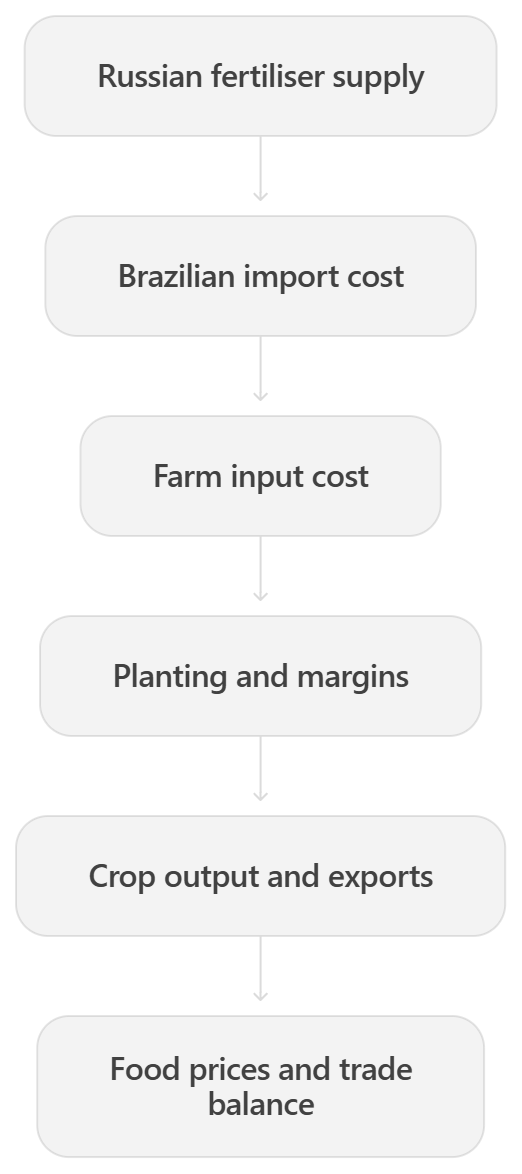
This explains why Brasília has a material interest in preserving lawful trade even when political relations between Russia and Western states deteriorate. The objective is not merely to maintain a commercial partner; it is to prevent geopolitical disruption from entering the cost base of an export sector central to Brazilian income, foreign-exchange generation and food supply.
The same structure benefits Moscow. Brazil represents a large, recurring market for Russian production and provides export revenue from a major non-Western economy. Unlike short-lived opportunistic purchases, agricultural demand recurs with planting cycles and is supported by Brazil’s expanding output.
The countervailing force is Brazilian diversification. An exposure serious enough to justify protecting Russian supply also justifies developing domestic production and alternative suppliers. The National Fertiliser Plan is therefore both an industrial policy and a long-horizon hedge against excessive dependence. If implemented, it would reduce Russia’s structural leverage even if bilateral trade continued to grow.
Aggregate commerce overstates diversification
A high trade total does not itself constitute deep economic integration. Decision-grade assessment requires separate examination of:
- product concentration;
- export and import values;
- physical quantities and unit values;
- company concentration;
- transport routes and ports;
- trade-finance providers;
- settlement currencies;
- foreign direct investment;
- domestic value added;
- substitutability of the traded products.
The verified record presently supports a relationship dominated by complementary commodity requirements. Brazil needs imported agricultural inputs; Russia needs access to large external markets and imports Brazilian agricultural products. This generates durable exchange, but it does not yet demonstrate extensive integration in advanced manufacturing, investment, joint production or cross-border financial services.
Trade concentration also produces asymmetric disruption risks. A payment interruption affecting Russian fertiliser imports can impose costs on Brazilian agriculture before alternative supply is secured. A restriction on Brazilian exports to Russia affects specific exporters but does not necessarily impose an equivalent systemic cost on the Russian economy. The political importance of trade can consequently exceed Brazil’s bargaining power within the most sensitive product chains.
Currency substitution solves only one layer of the transaction
The term “trade in national currencies” often combines several economically distinct operations:
| Transaction layer | What national-currency use can change | What it does not automatically solve |
|---|---|---|
| Commercial invoicing | Contract expressed in reais or roubles | Final currency held by exporter |
| Customer payment | Importer pays in domestic currency | Cross-border clearing |
| Interbank conversion | Removes one visible dollar leg | Need for a liquid exchange rate |
| Central-bank settlement | Can reduce private correspondent exposure | Credit and balance limits |
| Trade finance | Can denominate credit in local currency | Availability, tenor and pricing |
| Reserve management | Can hold bilateral settlement balances | Convertibility into usable assets |
| Compliance | Can route payment outside some dollar channels | Sanctions, AML and counterparty obligations |
An invoice denominated in reais does not prove that the Russian exporter retains reais. The receiving bank can convert the payment into another currency, hedge the exposure or transfer it through an intermediary. Similarly, a contract denominated in roubles does not prove that the transaction bypasses every dollar-linked price, institution or risk-management instrument.
Meaningful currency substitution must therefore be measured by the complete payment chain—not the currency printed on the invoice.
Brazil already possesses a model, but not with Russia
Brazil has operational experience with local-currency settlement through the Sistema de Pagamentos em Moeda Local, or SML. The Central Bank of Brazil defines it as an international payment system allowing funds to be transferred between users in participating countries through their respective domestic currencies. Pagamento em moeda local — Banco Central do Brasil
The SML was developed within a regional institutional setting. Brazil introduced arrangements with Argentina and Uruguay and subsequently established a third agreement with Paraguay. The Brazil–Paraguay system entered into force in August 2018. Brasil e Paraguai assinam regulamento para facilitar transações em moedas locais — Banco Central do Brasil — Aug 2018
Under this model, commercial users can pay and receive in their national currencies while participating central banks and authorised financial institutions perform the necessary clearing and settlement functions. The Central Bank explains that SML transactions avoid the operational sequence of local currency–dollar and dollar–local currency conversion for the end users. Sistema de Pagamentos em Moeda Local — Banco Central do Brasil
The precedent proves that national-currency settlement is institutionally feasible. It does not prove that the same structure can be transferred unchanged to Russia.
The existing SML rests on negotiated central-bank conventions, operating rules, participating financial institutions and compatible regional frameworks. A Russia–Brazil mechanism would have to address greater geographic distance, sanctions exposure, limited direct currency markets and a more pronounced bilateral trade imbalance.
There is a further qualification. The official SML methodology calculates the bilateral rate through each currency’s relationship with the dollar: the Brazilian central bank’s frequently asked questions state that the SML rate is formed from the relationship between the real’s PTAX rate against the dollar and the relevant partner currency’s rate against the dollar. Sistema de Pagamentos em Moeda Local: perguntas frequentes — Banco Central do Brasil
Thus, eliminating the dollar as the user-facing payment currency does not necessarily eliminate it as the reference currency used to construct the exchange rate. Payment-currency diversification and de-dollarisation of price formation are separate processes.
The bilateral imbalance is the controlling constraint
Assume Brazilian importers consistently purchase more from Russia than Russian importers purchase from Brazil. A settlement system must then process a persistent net flow toward Russian exporters. Paying those exporters in roubles shifts the task of sourcing roubles to Brazilian importers or their banks. Paying them in reais shifts the accumulated currency exposure to Russian exporters, Russian banks or a public settlement institution.
The imbalance must ultimately be absorbed through one or more mechanisms:
- increased Russian purchases of Brazilian goods and services;
- Russian investment or lending denominated in reais;
- bilateral credit lines;
- central-bank or state-bank balances;
- conversion through a third currency;
- use of accumulated reais to purchase Brazilian assets;
- periodic net settlement in an internationally liquid currency.
None of these mechanisms is cost-free. Trade diversification requires market access, logistics and competitive Brazilian supply. Investment requires acceptable assets and regulatory approval. Credit lines create counterparty and sovereign exposure. Central-bank balances require agreed limits and risk allocation. Third-currency settlement reintroduces an external currency into the architecture.
The Brazilian ambassador’s reported statement that trade imbalance complicates national-currency settlement is therefore economically coherent. However, the quotation supplied through Sputnik remains an attributed media statement unless confirmed in a first-party Brazilian diplomatic record. The underlying mechanism is supportable; the existence of an operative bilateral plan is not yet publicly established.
The rouble’s limited external function matters
A settlement currency must perform more than the accounting function of expressing a price. It must provide:
- reliable convertibility;
- sufficient market liquidity;
- predictable access to counterparties;
- usable hedging instruments;
- legally robust settlement finality;
- acceptable custody arrangements;
- assets in which surplus balances can be stored or invested.
The real has a substantial domestic financial market but a more limited international role than the dollar or euro. The rouble’s international use is further constrained by Russia-related financial restrictions, reduced access to Western correspondent networks and heightened counterparty scrutiny.
This does not make bilateral settlement impossible. It increases the cost of constructing and operating the necessary infrastructure. A shallow real–rouble market would produce wider bid–ask spreads and make large conversions more price-sensitive. Importers and exporters could face exchange-rate volatility that previously sat within deeper dollar markets. Banks would price legal, liquidity, sanctions and reputational risks into trade finance.
Currency substitution can consequently reduce one dependency while increasing another: dependence on a smaller group of specialised banks willing and able to intermediate the bilateral corridor.
BRICS has authorised continued work—not a completed system
The 2025 Rio de Janeiro Declaration instructed BRICS finance ministers and central-bank governors to continue discussions on the BRICS Cross-Border Payments Initiative. It acknowledged progress by the BRICS Payment Task Force in identifying possible paths toward greater interoperability and welcomed a technical report on cross-border payment systems. Rio de Janeiro Declaration: Strengthening Global South Cooperation for a More Inclusive and Sustainable Governance — BRICS leaders — Jul 2025
The operative verbs are “continue the discussion,” “identifying possible pathways” and “potential.” They do not establish:
- a BRICS currency;
- a single clearing institution;
- mandatory national-currency use;
- a shared central-bank balance sheet;
- guaranteed convertibility;
- a common sanctions policy;
- uniform regulation of participating banks;
- an operational Russia–Brazil payment corridor.
The declaration is nevertheless consequential. It supplies political authorisation for technical work on interoperability and lower-cost cross-border payments. This can generate bilateral pilots or common messaging standards without requiring a supranational monetary union.
Brazil’s preferred framing is consistent with optionality: expand payment choices, reduce costs and improve resilience. Russia has an additional strategic incentive—to reduce financial exposure to Western-controlled infrastructure. Those objectives overlap operationally but remain politically distinct.
Sanctions exposure cannot be engineered away by changing currency
Using reais or roubles does not determine whether a transaction is lawful. Sanctions and compliance exposure depend on the parties, beneficial owners, goods, services, vessels, insurers, banks, jurisdictions and transaction purpose.
Even when fertiliser trade is not itself prohibited, a payment can be delayed or rejected if it involves a designated institution, restricted service, sanctioned vessel or financial intermediary whose internal policy exceeds the formal legal minimum. European Union guidance states that its Russia sanctions do not target international trade in agricultural and food products, while also maintaining extensive economic and individual restrictive measures against Russia. Sanções da UE contra a Rússia: perguntas e respostas — Council of the European Union
The operational problem is therefore not captured by the binary question “Are fertilisers sanctioned?” A lawful commodity can encounter payment, transport, insurance or due-diligence friction elsewhere in the transaction chain.
National-currency settlement can reduce exposure to US-dollar clearing, but it cannot neutralise the laws applicable to participating banks or guarantee that non-US institutions will accept the transaction. Nor does it remove anti-money-laundering, counter-terrorist-financing, proliferation-financing and beneficial-ownership obligations.
A credible Russia–Brazil mechanism would need compliance architecture as much as payment technology.
Customs integration remains unfinished
Payments are only one source of trade friction. The Brazilian and Russian customs authorities began work in October 2023 toward mutual recognition of their Authorised Economic Operator programmes. Such an agreement would allow qualifying operators to receive reciprocal benefits, including priority treatment and potentially shorter clearance times.
The Brazilian Federal Revenue Service states, however, that the work remained in its first phase and was temporarily suspended pending appropriate conditions. Trabalho Conjunto Brasil-Rússia — Receita Federal do Brasil — Mar 2026
This is strategically revealing. Even if a local-currency payment channel were established, bilateral commerce would still encounter customs, certification, transport, insurance and inspection constraints. Financial innovation cannot substitute for incomplete trade facilitation.
The most efficient bilateral strategy would therefore integrate payment reform with customs cooperation, logistics resilience, transparent product certification and broader reciprocal market access. Treating currency substitution as a self-contained geopolitical project would overstate its economic effect.
Four levels of national-currency implementation
| Level | Required evidence | Current public standing |
|---|---|---|
| Political intention | Official declaration supporting national-currency use | Evident at BRICS level; bilateral ambition reported |
| Institutional design | Signed rules identifying banks, currencies, governance and settlement procedures | Not publicly established for Russia–Brazil |
| Operational availability | Participating banks accepting commercial transactions | Not established through an official bilateral register |
| Material adoption | Published transaction numbers, values and shares of bilateral trade | No verified bilateral series located |
Only the first level is clearly established. This distinction prevents announced intent from being converted into an operational capability.
The feasible pathway is selective, not comprehensive
The most credible near-term model is not complete replacement of the dollar. It is a limited corridor for eligible transactions, probably concentrated in high-volume sectors with recurring counterparties.
Such a corridor would require:
- designated and legally eligible participating banks;
- clear settlement rules and exposure limits;
- transparent real–rouble pricing;
- mechanisms for netting or periodic balance settlement;
- trade-finance and hedging products;
- compliance screening across all transaction layers;
- procedures for disruption, default and dispute resolution;
- published aggregate data permitting institutional oversight.
Fertiliser transactions offer scale and predictability, but the same concentration aggravates the balance problem. Expansion of Russian imports from Brazil would improve the economic basis for bilateral settlement more effectively than political declarations alone.
The decisive variable is therefore not whether governments permit use of national currencies. It is whether private and public institutions can hold, price, hedge and recycle the resulting balances at acceptable cost.
Key judgments
- The reported US$12.4 billion trade relationship is strategically significant, but aggregate value overstates diversification.
- Brazil’s 85–90% national import dependence on fertilisers makes external supply a systemic agricultural vulnerability; this figure is not Russia’s bilateral market share.
- Fertiliser dependence sustains cooperation with Moscow while simultaneously strengthening Brazil’s incentive to diversify suppliers and expand domestic capacity.
- Local-currency invoicing does not prove end-to-end local-currency settlement.
- Brazil’s existing SML demonstrates technical feasibility, but its bilateral exchange rates can still use the dollar as the reference unit.
- A persistent Brazilian trade deficit with Russia creates an accumulation problem that real–rouble denomination cannot remove.
- BRICS has authorised continued technical work on interoperability; it has not created a common currency or completed settlement system.
- Currency substitution can reduce dollar-clearing exposure, but it cannot eliminate sanctions, compliance, liquidity, insurance or counterparty risk.
- The most credible pathway is a limited, regulated payment corridor rather than comprehensive bilateral de-dollarisation.
What would change the assessment
The assessment would move toward material currency substitution if Brazil and Russia published an operative agreement identifying participating institutions, settlement rules, exchange-rate methodology, liquidity arrangements and transaction data—and if national-currency payments acquired a measurable share of bilateral trade.
It would weaken if no designated corridor emerged, if businesses continued to price and settle principally through dollars, yuan or other intermediary currencies, or if banks declined participation because compliance and liquidity costs exceeded the savings from alternative settlement.
Open official record
- Reconciled Comex Stat data for Russia–Brazil trade in 2024–2026, including FOB values, net weight and product codes.
- Official bilateral trade balances separated from gross trade turnover.
- Settlement-currency shares for Brazilian imports from and exports to Russia.
- Identity and legal eligibility of banks participating in real–rouble transactions.
- Any central-bank agreement, credit line, clearing facility or exposure limit supporting bilateral settlement.
- Published methodology for a real–rouble reference rate and available hedging instruments.
- The complete BRICS technical report on cross-border payments and its implementation status.
- Current status of the suspended customs mutual-recognition work plan.
Chapter 3 — Defence access, sanctions exposure and the 2031 trajectory
Principal judgment
Brazil and Russia retain a valid institutional framework for defence dialogue, training, technical exchanges and equipment cooperation. The verified record does not, however, establish a new Brazilian procurement programme, contract, financing arrangement or capability commitment involving Russian defence products as of 7 September 2026.
The reported Brazilian attendance at Russia’s May 2026 International Security Forum is best assessed as access and market observation, not evidence of procurement intent. The principal constraint is not Brazil’s legal ability to communicate with Russian suppliers. It is the difficulty of financing, integrating, supporting and politically sustaining Russian-origin equipment while Russian manufacturers, banks and technology chains remain exposed to US, EU and UK sanctions and export controls.
Through 2031, limited exchanges, demonstrations, education and non-binding technical discussions remain more supportable than a major weapons acquisition. A substantial purchase would require a documented Brazilian capability requirement, budget authority, competitive or legally justified procurement, an assured payment channel, component and maintenance guarantees, and an explicit governmental decision to absorb sanctions and interoperability risks. None is established in the accessible official record.
The bilateral agreement permits cooperation but creates no procurement obligation
The bilateral legal foundation is the Agreement between the Government of the Federative Republic of Brazil and the Government of the Russian Federation on Defence Cooperation, signed in Moscow on 14 December 2012 and approved by Brazil’s Congress in 2017.
Its scope includes political-military consultations, military education, peacekeeping experience, maritime search and rescue, and cooperation in operating defence-related technical systems. Permitted forms include delegation visits, expert meetings, courses, conferences, observation of or participation in exercises, and visits by military aircraft and warships. The designated implementing authorities are the two defence ministries. The agreement therefore authorises a broad relationship but does not itself approve a purchase, allocate money, waive procurement requirements or guarantee technology transfer. Complementary arrangements imposing substantial costs remain subject to Brazilian constitutional approval requirements. Acordo entre o Governo da República Federativa do Brasil e o Governo da Federação da Rússia sobre Cooperação em Defesa — Congresso Nacional — May 2017
This distinction controls the interpretation of Russian invitations and Brazilian participation in security events:
| Activity | What the agreement supports | What the activity does not establish |
|---|---|---|
| Attendance at a forum | Dialogue, conferences and expert contact | A capability requirement or procurement decision |
| Inspection of equipment | Technical familiarisation and information exchange | Successful testing or Brazilian certification |
| Manufacturer presentation | A first-party description of claimed performance | Operational availability or suitability for Brazil |
| Military delegation visit | Continuing institutional access | Budget authority, contract or delivery |
| Exercise observation | Exposure to doctrine and employment concepts | Brazilian adoption of the system or doctrine |
| Negotiation | Exploration of price, configuration or cooperation | Contract signature, financing or execution |
Brazil’s Ministry of Defence continues to list Russia among its defence partners. The page records working groups in cyber and space security, political-strategic dialogue, officer exchanges, aviation cooperation, the earlier acquisition of 12 Mi-35 helicopters, and negotiations concerning Igla and Pantsir-S1 air-defence systems. Its wording separates an accomplished acquisition from negotiations, which is decisive: the page does not record a completed Pantsir-S1 purchase. Parcerias e acordos em Defesa — Ministério da Defesa — Mar 2014, current page
The previous Mi-35 transaction demonstrates that Russian-origin combat equipment has entered Brazilian service. It does not establish that the transaction remains replicable under the post-2022 sanctions, production and logistics environment. In April 2020, the Brazilian Air Force reported that all 12 aircraft had been delivered in four lots and had accumulated more than 8,000 flight hours. This proves historical operation, not the present readiness of the fleet or a current preference for Russian systems. Há 10 anos, helicóptero AH-2 Sabre era incorporado à Força Aérea Brasileira — Força Aérea Brasileira — Apr 2020
The May 2026 forum report establishes interest only as an attributed claim
The supplied material attributes to Colonel Carlos Gustavo Monteiro Gonçalves a statement that the Moscow-area forum offered an opportunity to examine security products, including Russian products. A Brazilian government document independently identifies an officer of that name and rank as affiliated with the Ministry of Defence. Processo Seletivo CACI 2025 — 2ª revisão — Escola Superior de Defesa — 2025
That identity match does not independently authenticate the quotation, define his mandate at the forum or establish that he represented a procurement authority. No accessible Brazilian Ministry of Defence release, delegation mandate, requirement document, tender, budget instrument, contract award or evaluation report was identified that converts the reported visit into an acquisition programme.
The defensible formulation is therefore narrow: a Russian media report indicates Brazilian interest in learning about Russian security products; the official Brazilian record examined does not establish procurement action. “Access” in this context means exposure to officials, doctrine and products—not privileged access to deliverable military capability.
Sanctions create transactional and lifecycle exposure
A Brazilian purchase from Russia would not be governed by a single universal embargo. Exposure would depend on the Russian counterparty, beneficial ownership, banks, currencies, components, logistics providers, insurers, software, technical services and any US-, EU- or UK-jurisdictional persons involved.
US restrictions are especially relevant because they combine blocking sanctions, restrictions affecting Russian defence-industrial entities, export controls over US-origin and specified foreign-produced technology, and authorities addressing foreign facilitation of significant transactions. OFAC states that persons outside Russia can be targeted for material support to Russia’s military-industrial base, significant transactions with that base, sanctions evasion or support to designated persons. Frequently Asked Questions—Recently Updated — Office of Foreign Assets Control — current page
CAATSA provides a separate statutory sanctions framework concerning Russia, while the US Ukraine/Russia sanctions programme contains lists, directives, licences and interpretive guidance that must be checked at transaction level. A proposed contract cannot be assessed merely by confirming that “Russia” is not subject to a comprehensive territorial embargo; the relevant entities and transaction chain must be screened individually. Countering America’s Adversaries Through Sanctions Act-Related Sanctions — Office of Foreign Assets Control — current page Ukraine-/Russia-related Sanctions — Office of Foreign Assets Control — current page
US export controls add a different risk from financial sanctions. The Export Administration Regulations govern exports, re-exports and specified transfers of controlled items. Accordingly, a Russian platform containing controlled electronics, software, machine tools or subsystems can encounter licensing constraints even where Brazil is the ultimate customer. Export Administration Regulations — Bureau of Industry and Security — current edition
EU controls are likewise material when European-origin dual-use components, software, brokering, technical assistance or transit are involved. Regulation (EU) 2021/821 establishes common dual-use rules, item lists, end-use controls and controls over brokering, technical assistance and transit; member states administer authorisations and enforcement. Exporting dual-use items — European Commission — current page
These regimes do not automatically become Brazilian domestic prohibitions. Their practical reach arises through controlled technology, designated counterparties, participating banks, supplier nationality, clearing arrangements and firms’ compliance obligations. Currency substitution would not remove these dependencies. Payment in reais, roubles or another non-dollar currency could reduce direct use of dollar clearing, but it would not legalise dealings with a blocked entity, release controlled components or make insurers and logistics providers accept the transaction.
European supplier exposure is differentiated by jurisdiction, not strategic effect
Italy, France and Germany operate within the common EU dual-use framework, although licensing, enforcement and penalties retain national implementation elements. The United Kingdom applies a separate post-Brexit sanctions and export-control system. For Brazil, the operational implication is broadly convergent: European content or services cannot be assumed available for a Russian-linked programme merely because the final user is Brazilian.
| Jurisdiction | Relevant connection to a Brazilian programme | Principal exposure |
|---|---|---|
| Italy | Electronics, aerospace components, sensors, industrial equipment or technical services under EU jurisdiction | Export authorisation, end-use review and sanctions screening |
| France | Aerospace, communications, optronics, propulsion or support services under EU jurisdiction | Licensing refusal, restricted technical assistance or supplier withdrawal |
| Germany | Machine tools, industrial electronics, engines, components or financing under EU jurisdiction | Dual-use controls, compliance restrictions and lifecycle disruption |
| United Kingdom | Finance, insurance, components, software or technical services involving UK persons | UK sanctions and export licensing |
| European Union collectively | Common dual-use regulation and Russia-related restrictive measures | Reduced access to components, servicing, brokering and transit |
The critical risk is therefore systemic rather than confined to initial delivery. A platform can be physically delivered yet remain vulnerable to shortages of spares, updates, test equipment, depot maintenance, munitions replenishment or lawful third-country components. A credible evaluation must assess availability over the planned service life, not only acquisition price or declared performance.
Brazil’s capability strategy favours autonomy, but Russian dependence can reproduce the problem
Brazil’s defence policy emphasises sovereign national capabilities, readiness and protection from external interference. Its White Paper links national defence effectiveness to investment in national capacity and recognises cyber threats, illicit arms flows and other cross-domain risks. Livro Branco de Defesa Nacional — Ministério da Defesa — 2024 submission
A Russian offer involving local production or technology transfer could therefore appear consistent with Brazil’s autonomy objectives. The decisive test is whether the arrangement transfers usable knowledge and lifecycle authority or merely exchanges dependence on one foreign supplier for dependence on another.
A defensible programme would need to establish:
- Brazilian access to maintenance data, diagnostic tools and source material where required;
- local or diversified production of high-failure and mission-critical components;
- munitions availability and lawful replenishment routes;
- authority to integrate Brazilian sensors, communications and weapons;
- protection against remote software, encryption-key or update dependencies;
- supply guarantees that remain credible during sanctions escalation;
- verified export permission for all third-country content;
- training and safety certification that can continue without permanent Russian presence;
- termination, escrow and substitution rights if performance becomes impossible.
Absent these conditions, nominal technology transfer would not create strategic autonomy.
The 2031 trajectory is conditional, with limited cooperation the baseline pathway
Explicit numerical probabilities are not supportable because the official record contains no published Brazilian requirement, tender, competing bids, budget line or schedule. Three pathways are nevertheless distinguishable.
Pathway 1 — Managed contact without major acquisition
This is the best-supported trajectory. Brazil maintains defence diplomacy, officer exchanges, conferences, technical visits and selective discussions while avoiding a large Russian-origin combat-system commitment. The mechanism is institutional continuity under the 2012 agreement combined with transactional caution.
Indicators strengthening this pathway include recurring delegations without published tenders; cooperation concentrated in education, cyber dialogue, space, peacekeeping or search and rescue; and Brazilian capital programmes continuing through domestic or established Western partnerships.
Pathway 2 — Narrow, insulated procurement
Brazil acquires a limited system, service or component with low dependence on Western-controlled technology and a payment and maintenance structure designed to minimise sanctions exposure. This pathway becomes more credible if the Ministry of Defence publishes a defined requirement, Russian suppliers demonstrate supportability, and Brazilian industry receives genuine maintenance and integration authority.
The principal risk is that a transaction described as “insulated” still contains hidden dependencies in semiconductors, software, banking, shipping or insurance. A small acquisition could also impose disproportionate training and logistics costs if it creates a unique equipment family.
Pathway 3 — Major strategic acquisition or co-production
A large air-defence, aviation, missile or other combat-system programme would represent a material change in Brazil’s procurement posture. It would require an explicit political decision, multiyear funding, an identified operational gap, industrial participation, verified component access and acceptance of possible secondary-sanctions consequences.
This pathway would strengthen if Brazil issues a formal request for proposals that includes Russian suppliers; records a budget commitment; establishes a bilateral industrial vehicle; or publishes testing, certification and technology-transfer milestones. It would weaken further if sanctions expand, Russian delivery backlogs persist, or Brazil deepens interoperability and industrial integration with suppliers whose systems are difficult to combine with Russian architectures.
Decision implications
Brazil can preserve dialogue with Russia without prejudging acquisition. The appropriate decision threshold is not whether Russian equipment can be displayed or demonstrated, but whether it can be lawfully financed, delivered, integrated and supported at an acceptable readiness level through 2031.
Before any procurement advances beyond market research, the responsible authorities would need an auditable sanctions and export-control map covering every counterparty, component, bank and service provider. The capability evaluation should assign high weight to sovereign maintenance, munitions replenishment, software authority and supplier substitution. A low purchase price would not compensate for an unfinanceable payment chain or an unsupported fleet.
The distinction also matters diplomatically. Treating every military contact as geopolitical alignment would overstate the record; treating sanctions as irrelevant because Brazil retains strategic autonomy would understate the commercial and technical mechanisms through which external controls operate.
Key judgments
- The bilateral agreement provides a lawful institutional channel for defence cooperation but does not authorise or finance an acquisition.
- The verified record supports continuing defence access and historical Russian equipment supply; it does not establish a new programme in 2026.
- The reported May 2026 forum participation is evidence of possible interest in observation, not proof of procurement intent.
- Sanctions risk is transaction-specific and extends beyond payment currency to counterparties, components, software, logistics, insurance and lifecycle support.
- Limited institutional cooperation is more consistent with the verified baseline than a major Russian-origin acquisition by 2031.
- A major programme becomes credible only after publication of a requirement, budget, procurement instrument, industrial plan and support architecture.
What would change the assessment
The assessment would move toward substantive procurement if the official record disclosed:
- a Brazilian armed-service operational requirement naming a relevant capability;
- a tender, request for information or approved direct-award justification involving a Russian supplier;
- a multiyear budget or contract award;
- a Brazilian sanctions and export-control determination;
- verified trials under Brazilian operational conditions;
- a funded local-production or maintenance arrangement;
- confirmed licences for material third-country components; or
- delivery, acceptance and training milestones.
It would move further away from procurement if Russian counterparties essential to the transaction were newly designated, component licences were denied, Brazilian strategic projects selected incompatible systems, or official planning removed Russian-origin platforms from the relevant capability options.
Open official record
The following decisive records remain unavailable or were not publicly established:
- the Brazilian delegation mandate and official report for the May 2026 security forum;
- any list of Russian systems formally examined by Brazil at that event;
- a current Brazilian requirement connected to those systems;
- formal market-research, technical-evaluation or procurement documents;
- the present readiness and support status of Brazil’s Russian-origin equipment;
- proposed counterparties, banks, currencies and payment routes;
- bills of material identifying US, EU, UK or other controlled content;
- licensing determinations from the relevant export-control authorities;
- lifecycle-cost, munitions and availability guarantees through 2031.
European Supplier Exposure: Differentiated by Jurisdiction, Not Strategic Effect
Comparative cross-jurisdictional evaluation of EU and UK export controls, secondary sanctions screening, and end-use verifications impacting Brazilian aerospace, industrial, and defence programmes interacting with Russian entities.
Regulatory Exposure Metric: Italy (Aerospace Sensors & Industrial Electronics)
Tracking licensing friction, sanctions compliance overhead, and lifecycle disruption indices across jurisdictions.
Italy: Industrial Dual-Use & Aerospace Components Under UAMA Oversight
Electronics, aerospace subsystems, avionics sensors, precision industrial machinery, and specialized engineering services subject to EU and Italian national export licensing jurisdiction (UAMA).
Stringent export authorization requirements, mandatory end-use verification, re-export license clauses, and rigorous sanctions compliance screening against Russian designated entities or affiliated supply chains.
Italian suppliers cannot transfer subsystems to Brazilian platforms if downstream modules or integration testing interface with Russian software, components, or defense facilities, irrespective of Brazilian sovereign end-user status.
Comprehensive Jurisdiction Exposure Matrix
Forensic mapping of European supply dependencies across Brazilian aerospace and defense platforms.
| Jurisdiction | Relevant Connection to a Brazilian Programme | Principal Regulatory & Operational Exposure |
|---|---|---|
| Italy | Electronics, aerospace components, sensors, industrial equipment or technical services under EU jurisdiction. | Export authorisation delays, stringent end-use reviews, and intensive Russia-related sanctions screening. |
| France | Aerospace, communications, optronics, propulsion systems or long-term support services under EU jurisdiction. | Licensing refusals, restricted technical assistance, and sudden supplier withdrawals driven by sovereign compliance. |
| Germany | Machine tools, industrial electronics, diesel engines, subsea components, or structured project financing under EU jurisdiction. | Strict dual-use export controls (BAFA), corporate compliance restrictions, and severe platform lifecycle disruption. |
| United Kingdom | Syndicated finance, maritime insurance, sub-components, embedded software, or technical services involving UK persons. | Autonomous UK sanctions enforcement (SAMLA/OFSI), export licensing vetoes, and financial services prohibitions. |
| European Union (Collectively) | Common dual-use regulatory regime (Regulation EU 2021/821) and Russia-related restrictive measures packages. | Reduced access to high-tier components, servicing moratoria, brokering restrictions, and interdiction of transit cargo. |
The Strategic Choke Point: Elimination of End-User Neutrality
The core operational reality for Brazilian defence planners, Embraer, and aerospace conglomerates is that Western export compliance regimes no longer treat sovereignty as a blind shield. The strategic effect is convergent: European content cannot be integrated into systems that touch Russian entities:
Both the EU Dual-Use Regulation and UK sanctions prohibit the supply of controlled technologies if there is reasonable cause to suspect diversion to, or integration with, Russian defence programs—regardless of intermediary assembly in Brazil.
European original equipment manufacturers (OEMs) face severe liability if they provide software patches, calibration data, or spare parts to platforms operating alongside sanctioned Russian avionics or radar suites.
London and continental maritime insurers, reinsurance pools, and commercial settlement banks automatically freeze cover for transit or testing of joint platforms containing Russian participation, halting delivery logistics.


