





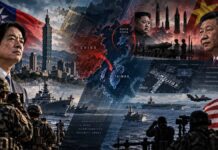








Scope: Assessment of the physical, financial and diplomatic architecture promoted through the SCO and BRICS across Eurasia, its capacity to reduce dependence on Western-controlled infrastructure through 2031, and the implications for Italy, France, Germany, the United Kingdom and the European Union.
Executive Summary / BLUF
- Principal judgment: Eurasia is constructing meaningful strategic redundancy, but the verified record does not establish an operational trade-and-finance system capable of circumventing all Western chokepoints.
- The SCO has formally endorsed transport corridors, energy cooperation and greater use of national currencies; these are policy mandates, not evidence of an integrated operating architecture.
- The proposed SCO Development Bank remains under negotiation. It has no verified charter, subscribed capital, lending portfolio or operational date.
- BRICS payment cooperation likewise remains at the stage of technical discussion and potential interoperability among national systems.
- The New Development Bank had USD 53.4 billion in subscribed capital on 15 June 2026, but 59.5% of its active portfolio was denominated in US dollars.
- In 2026 Q1, the US dollar still represented 57.13% of allocated official foreign-exchange reserves; the renminbi represented 1.99%.
- New routes can redistribute vulnerability, but they cannot eliminate dependence on ports, border crossings, insurance, trade finance, technology, energy infrastructure and politically exposed transit states.
- The five-year base case is therefore managed diversification within a still-interdependent global system, not the emergence of a self-contained Eurasian economic order.
Eurasia’s New Architecture: Strategic Autonomy Without Systemic Independence
Eurasia is acquiring something more consequential than a collection of new railways, pipelines and payment mechanisms: the capacity to negotiate with the West from a position of greater optionality. The Shanghai Cooperation Organisation summit in Bishkek on 1 September 2026, followed by the Eastern Economic Forum in Vladivostok on 1–4 September, exposed the scale of this ambition. Yet the decisive distinction is between bypass and independence. Alternative corridors can redirect cargo; national currencies can settle selected transactions; new institutions can finance infrastructure. None of these achievements, separately or together, yet replaces the dollar-centred liquidity system, Western insurance and legal services, or the maritime network through which most intercontinental trade still moves. Eurasia is not leaving the existing order. It is constructing insurance against exclusion from it.
The Summit System
The 2026 Bishkek Declaration presents the SCO as a platform founded on sovereignty, equality, non-interference, consensus and the “indivisibility of security”. It supports multimodal transport, an energy-cooperation strategy to 2030, greater use of national currencies and the creation of an SCO Development Bank. It also approved regulations for new security-related centres and condemned military attacks against Iran.
The wording matters. The official declaration does not identify the United States in the passage concerning Iran; presenting it as an explicit unanimous condemnation of a “US war” exceeds the agreed text. Nor does the document transform the SCO into a military alliance. It expressly describes the organisation as non-military and not directed against another state or institution.
This restraint is not diplomatic weakness. It is the mechanism holding together China, India, Russia, Iran, Pakistan and the Central Asian republics. Consensus allows members to associate themselves with a collective position without surrendering strategic autonomy. But it also limits coercive integration: there is no common foreign policy, collective-defence obligation, supranational regulator or court capable of compelling implementation.
Diplomacy as Infrastructure
Eurasian summits should not be dismissed as ceremonial. Repeated leader-level meetings lower political transaction costs. They allow bilateral disputes to be managed alongside formal negotiations and provide political sponsorship for customs agreements, energy projects, transport standards and financial interoperability.
The diplomatic effect is particularly valuable for governments facing Western sanctions or isolation. Participation demonstrates that exclusion from Euro-Atlantic institutions does not equal international isolation. A national position can acquire greater weight when incorporated into a declaration signed by states representing a substantial share of global population and output.
Yet summit coordination remains issue-specific. India’s official account of Prime Minister Narendra Modi’s 31 August 2026 meeting with Iranian President Masoud Pezeshkian emphasised dialogue, civilian protection, freedom of navigation and freedom of commerce. That position is consistent with SCO solidarity, but it also reflects India’s independent maritime, energy and trade interests. New Delhi’s participation does not imply automatic alignment with every Russian, Chinese or Iranian policy.
The emerging model is therefore not a Eurasian NATO or European Union. It is variable-geometry diplomacy: common language where interests overlap, ambiguity where they diverge, and continuing freedom to cooperate across geopolitical camps.
The Corridor Reality
The physical architecture is expanding. Russia promotes the Northern Sea Route and the International North–South Transport Corridor; China continues to develop Belt and Road connections; India and Russia support the Chennai–Vladivostok maritime corridor; Central Asian states seek westward access through the Trans-Caspian route.
These routes create redundancy, but redundancy is not substitution. The World Bank’s November 2023 assessment of the Middle Corridor concluded that coordinated investment and operational reform could triple freight volumes and halve travel times by 2030. Even under that improved scenario, traffic would reach approximately 11 million tonnes and account for about 1% of Europe–China trade. Its principal value would remain regional: improving the access of Kazakhstan, Azerbaijan and Georgia to external markets.
The difference between theoretical capacity and commercially dependable throughput is decisive. Eurasian land routes cross multiple borders, customs regimes, gauges, ports and trans-shipment points. Their economics depend on predictable schedules, interoperable documentation, available rolling stock, insurance and balanced return cargo. A route may bypass one maritime chokepoint while creating several administrative ones.
The 11th Eastern Economic Forum brought representatives from 78 countries to Vladivostok in September 2026, according to the organiser’s preliminary account. That participation demonstrates continuing interest in Russia’s Far East and Asia-Pacific connectivity. It does not, by itself, establish completed infrastructure, bankable freight volumes or competitive transport costs.
The Currency Constraint
Local-currency settlement is the fastest-moving part of the Eurasian project because it can expand through national regulation and bilateral banking arrangements without waiting for a common currency. Russia has redirected a large proportion of sanctioned trade into roubles and partner currencies. China’s Cross-Border Interbank Payment System provides renminbi clearing and settlement. India’s July 2022 framework permits international trade settlement through Special Rupee Vostro Accounts.
These mechanisms reduce exposure to individual correspondent banks and lower the immediate need for dollars in selected bilateral transactions. They do not eliminate currency risk. Exporters accepting a partner’s currency must be able to spend, invest, hedge or convert the resulting balances. Without deep securities markets, credible monetary policy, liquid foreign-exchange instruments and unrestricted capital mobility, local-currency settlement can shift the conversion problem rather than solve it.
The IMF’s Currency Composition of Official Foreign Exchange Reserves data for the first quarter of 2026 placed global allocated reserves at $13.10 trillion. The dollar represented 57.13%, the euro 20.03% and the renminbi 1.99%. Reserve shares do not measure every trade payment, but they reveal where central banks still hold liquid international purchasing power. The evidence supports gradual diversification—not displacement of the dollar.
A Bank, Not a Breakaway System
The New Development Bank is the most developed BRICS financial institution. Its June 2026 investor presentation reported $53.4 billion in subscribed capital. At 31 March 2026, it held $38.098 billion in assets, $13.028 billion in equity and $24.583 billion in borrowings. President Dilma Rousseff leads a membership comprising the five BRICS founders together with Bangladesh, the United Arab Emirates, Egypt, Algeria and Uzbekistan; Uruguay, Colombia and Ethiopia were listed as prospective members.
The balance sheet nevertheless shows continuing integration with global finance. NDB’s funding strategy explicitly includes benchmark dollar bonds, international capital markets, bank loans and local-currency issuance. Its investment portfolio was still 59.5% dollar-denominated in the June presentation, against 21.5% in renminbi, 9.4% in euros, 6.8% in rand, 1.8% in Swiss francs and 1% in rupees.
Most revealingly, NDB reported that new transactions in Russia remained on hold and disclosed $1.9 billion in outstanding exposure to Russian-domiciled borrowers. An institution created by BRICS has therefore not operated outside global funding, ratings and risk-management constraints. It expands choice, but it is not evidence of financial secession.
The proposed SCO Development Bank remains less advanced. On 29–30 June 2026, Chinese Vice-Minister of Finance Liao Min and Kyrgyz Deputy Finance Minister Nurbek Akzholov co-chaired a Shenzhen consultation attended by delegates from 28 countries. The SCO Secretariat described establishment of the bank as a political consensus reached in 2025, while confirming that negotiations over its essential features and work programme were continuing. No constitutive agreement, paid-in capital schedule or lending operation had been published.
BRICS Seeks Reform, Not Exit
The strongest evidence against an imminent post-Western system is contained in BRICS’ own institutional language. The Rio de Janeiro Declaration, adopted at the summit of 6–7 July 2025, welcomed Indonesia as a member and ten partner countries, including Kazakhstan, Malaysia, Thailand, Vietnam and Uzbekistan. Expansion increased geographic reach, but also widened the range of interests requiring consensus.
The declaration called for reform of the Bretton Woods institutions, supported completion of the IMF’s 16th General Review of Quotas and described the IMF as central to the global financial safety net. It also endorsed World Bank shareholding reform and reaffirmed the World Trade Organisation as the core of the multilateral trading system.
On payments, BRICS leaders instructed their finance ministers and central-bank governors to continue discussion of possible interoperability. A common settlement platform was not announced. The proposed BRICS Multilateral Guarantees initiative remained a pilot to be incubated within NDB, while the New Investment Platform was still under technical discussion.
This is institutional revisionism, not institutional abandonment: greater voting power inside existing bodies, supplemented by alternatives capable of reducing dependence where the present system is considered vulnerable or discriminatory.
Europe’s Exposure
Europe’s risk is not that Eurasian commerce suddenly disappears behind a continental wall. It is that European leverage declines function by function. Traffic can avoid selected ports; local currencies can reduce correspondent-banking activity; regional banks can displace European development finance; new standards can weaken European regulatory influence.
For the moment, Europe retains formidable power through its market, the euro, technology, maritime services, insurance, compliance systems and legal jurisdiction. The Council of the EU reported in September 2026 that sanctions applied transaction prohibitions to more than 100 Russian and other financial institutions. Since June 2024, EU entities outside Russia have been forbidden from connecting to Russia’s SPFS financial-messaging system; restrictions also extend to third-country institutions using it. Approximately €210 billion in Russian central-bank assets remained immobilised within the EU.
This reach creates its own strategic reaction. The more financial infrastructure is used coercively, the stronger the incentive for targeted and risk-exposed countries to finance alternatives. Sanctions can impose immediate costs while gradually encouraging the institutional insulation that reduces their future effectiveness.
Europe’s answer cannot therefore be coercion alone. The European Commission reported in May 2026 that Team Europe had mobilised more than €306 billion through Global Gateway since 2021 and launched more than 250 projects across transport, energy, digital systems and other sectors. “Mobilised” is not synonymous with disbursed or completed, but the programme gives Europe an affirmative instrument: trusted connectivity, finance, technical standards and access to its market.
Four European Interests
Italy’s strategic interest lies in remaining a connector. Its ports, energy terminals, manufacturing supply chains and Mediterranean geography benefit from trade moving between systems. Rome’s May 2026 Arctic policy also emphasised freedom of navigation and protection of underwater and space infrastructure. Italy loses from closed blocs and gains from resilient, legally secure interconnection.
France has a different exposure. Its updated Indo-Pacific strategy, published in December 2025 and revised in March 2026, rests on 1.8 million French citizens in the region and territories accounting for more than 90% of France’s exclusive economic zone. Paris combines sovereign presence, military access, regional partnerships and European action. It can offer an autonomous European partnership without accepting a binary US–China framework.
Germany carries the greatest industrial sensitivity. Its official China Strategy identifies China simultaneously as partner, competitor and systemic rival, while expressly choosing de-risking rather than decoupling. For German industry, fragmentation would affect inputs, machinery exports, automotive production, chemicals and logistics. Berlin must reduce concentrated dependencies without destroying commercially viable exchange.
The United Kingdom is exposed through finance, insurance, arbitration and maritime services. Its June 2026 engagement with China and India combined investment diplomacy with cooperation on AI standards, critical minerals, supply-chain resilience and maritime security. London’s influence depends on keeping its service ecosystem indispensable while preventing it from becoming an instrument of sanctions circumvention.
The Test of Separation
A genuinely independent Eurasian system will not be proven by declarations, pilot projects or percentages drawn from sanctioned bilateral trade. It will require live multilateral settlement at scale; deep local-currency capital markets; common technical rules; autonomous insurance and reinsurance; recognised arbitration and enforceable judgments; pooled emergency liquidity; and transport networks able to maintain competitive prices during a major disruption.
The critical indicators are now observable: a signed and capitalised SCO bank; published BRICS payment volumes; sustained local-currency use by non-sanctioned private companies; competitive corridor freight data; common guarantee and insurance mechanisms; and implementation of summit commitments in national law and budgets.
Until those conditions emerge, the correct strategic conclusion is narrower but still consequential. Eurasia is not replacing the Western-centred system. It is making exclusion from that system less decisive—and, in doing so, steadily reducing the monopoly of power that Western chokepoints once provided.
Navigational Index
- Corridors and chokepoints: Physical connectivity, operating constraints and the difference between bypass capacity and systemic independence.
- Currencies and financial infrastructure: Local-currency settlement, BRICS interoperability, development finance and continuing dollar dependence.
- Strategic consequences: Eurasian diplomatic coordination, European exposure and indicators of genuine institutional separation.
Master Abstract
The central proposition is directionally correct but operationally premature
The supplied proposition identifies a genuine structural movement: China, Russia, India, Iran and their regional partners are investing political capital in transport diversification, local-currency settlement and non-Western development finance. The 2026 Bishkek Declaration gives this agenda an official SCO mandate. It supports multimodal corridors and logistics centres, continued implementation of the SCO Energy Cooperation Strategy to 2030, and a roadmap for increasing the share of national currencies in mutual settlements. It also records continuing work toward an SCO Development Bank. These provisions establish collective intent, but the declaration does not create a common currency, payment system, financial regulator, trade-finance market or operational development bank. 上海合作组织二十五周年比什凯克宣言 — Ministry of Foreign Affairs of the People’s Republic of China — Sep 2026
The defensible conclusion is therefore narrower than the “Brave New World” thesis. Eurasia is assembling layers of redundancy intended to reduce exposure to sanctions, maritime disruption and dollar-centred financial infrastructure. It is not yet constructing a closed system in which routes, capital, payment, insurance, technology and final demand are exclusively Eurasian. That distinction matters: the former increases bargaining power and resilience; the latter would require institutional and market capacities not demonstrated by the current public record.
New corridors relocate vulnerability rather than abolish it
The International North–South Transport Corridor is a real multinational undertaking linking the Indian Ocean and Persian Gulf with Iran, the Caspian region, Russia and Northern Europe. India describes it as a 7,200-kilometre multimodal network incorporating sea, rail and road transport. QUESTION NO- 2058 SOUTH-SOUTH COOPERATION — Ministry of External Affairs, Government of India — Aug 2024
Its strategic value lies in optionality: cargo can move along alternative alignments when established routes become expensive, congested or politically exposed. But multimodality also creates interfaces at which delays accumulate—ports, customs posts, rail-gauge changes, trans-shipment facilities, documentation systems and national sanctions controls. A corridor that avoids one maritime passage does not become “chokepoint-free”; it substitutes a distributed chain of land, port and regulatory dependencies for a concentrated maritime dependency.
The same qualification applies to the Northern Sea Route and the proposed Trans-Arctic Transport Corridor. Their strategic relevance is substantial, particularly for Russia–Asia energy and bulk trade. Their commercial independence is less established. Arctic operations remain dependent on specialised vessels, ice information, rescue capacity, port infrastructure, seasonal conditions, environmental regulation and adequate cargo aggregation. The public official record reviewed for this assessment does not provide a consistent, independently reconcilable series demonstrating that the wider Trans-Arctic concept has reached the throughput, reliability and year-round operability necessary to substitute established Asia–Europe maritime routes.
The article’s treatment of “Power of Baikal,” described as the successor to Power of Siberia 2, also exceeds what the cited SCO record establishes. The Bishkek Declaration endorses implementation of an energy-cooperation strategy; it does not document an executed gas-sales agreement, final investment decision, financing package, construction programme or commissioning schedule for that pipeline. Until those instruments become public, the project must be treated as announced or negotiated infrastructure—not delivered capacity.
Financial autonomy remains the binding constraint
Physical infrastructure alone cannot create a separate economic system. A scalable alternative also requires settlement finality, convertible or reliably hedgeable currencies, correspondent relationships, trade credit, depositary services, insurance, reinsurance, dispute resolution, compliance standards and deep pools of liquid assets.
BRICS has moved beyond rhetorical discussion, but not yet to a unified financial platform. The July 2025 Rio Declaration instructed finance ministers and central-bank governors to continue discussing the BRICS Cross-Border Payments Initiative. It described the objective as potential interoperability among existing national payment systems and welcomed a technical report identifying possible pathways. The same declaration referred separately to continuing discussions on local-currency finance, reinsurance, settlement and depositary infrastructure. This is evidence of organised technical work—not evidence that a common BRICS payment network is operational. Rio de Janeiro Declaration: Strengthening Global South Cooperation for a More Inclusive and Sustainable Governance — Department of International Relations and Cooperation, South Africa — Jul 2025
The proposed SCO Development Bank is at an earlier institutional stage. An official consultation held in Shenzhen on 29–30 June 2026 discussed the bank’s principal elements and work programme. Although SCO governments had reached political consensus on establishing the institution in 2025, the June meeting remained a consultation among delegations. The public record does not yet establish its treaty basis, headquarters, capital subscriptions, governance, credit policy or operational launch. The Fourth Consultation Meeting on Shanghai Cooperation Organization Development Bank held in Shenzhen, China — Shanghai Cooperation Organisation — Jun 2026
The NDB demonstrates both progress and dependence
The New Development Bank provides the best available test of whether a BRICS institution has already escaped the established financial system. On 15 June 2026, the NDB reported USD 53.4 billion in subscribed capital. At the end of 2025, its active portfolio comprised 115 projects worth more than USD 35.6 billion. Yet the portfolio’s currency composition was 59.5% US dollars, compared with 21.5% renminbi, 9.4% euro, 6.8% South African rand, 1.8% Swiss francs and 1.0% Indian rupees. The bank also identified benchmark US-dollar bonds and international capital markets as components of its funding strategy. Investor Presentation — New Development Bank — Jun 2026
These figures do not mean that local-currency finance is immaterial. They demonstrate that diversification is occurring within a balance sheet still substantially dependent on dollar-denominated assets and international funding markets. They also correct two claims in the supplied text: the official subscribed-capital figure was USD 53.4 billion—not USD 53.6 billion—and Colombia remained a prospective member on 15 June 2026 rather than a completed member. Zimbabwe did not appear in the NDB’s published list of members or prospective members at that date.
The wider monetary baseline is equally constraining. In 2026 Q1, the IMF recorded USD 13.10 trillion in allocated official foreign-exchange reserves. The dollar accounted for 57.13%, the euro for 20.03% and the renminbi for 1.99%. Exchange-rate movements affected the quarterly change, but the comparison still demonstrates the scale difference between dollar and renminbi reserve liquidity. IMF Data Brief: Currency Composition of Official Foreign Exchange Reserves — International Monetary Fund — Jul 2026
Accordingly, “de-dollarisation” should be separated into three different processes: bilateral invoicing in national currencies; settlement through non-Western messaging and payment systems; and replacement of the dollar as the principal international reserve, funding and collateral currency. The first is advancing in selected relationships. The second remains fragmented. The third is not established by the current data.
Consensus diplomacy is real, but institutional diversity limits bloc formation
The SCO and BRICS attach formal importance to sovereignty, consultation, consensus and non-interference. This diplomatic method helps states with divergent interests maintain participation without accepting alliance-style discipline. It also limits the degree to which summit declarations can be treated as evidence of unified strategy.
China, Russia, India and Iran do not have identical security, trade or monetary interests. India supports greater use of local currencies and alternative corridors, but it also maintains extensive commercial and strategic relations with the United States, Europe, Japan and Gulf partners. China benefits from financial diversification while retaining a large interest in access to global markets. Russia and Iran face stronger incentives to accelerate sanctions-resistant systems. Consensus can therefore sustain institutional expansion precisely because it does not require members to adopt identical alignments.
The Bishkek Declaration illustrates this distinction. It condemns military attacks against Iran and characterises them as violations of the UN Charter and international law, but the published text does not identify the United States by name in that passage. The article’s statement that SCO members unanimously condemned “the US war on Iran” is therefore more specific than the operative declaration. The record supports a collective condemnation of the attacks and support for a diplomatic settlement—not the article’s precise attribution. 上海合作组织二十五周年比什凯克宣言 — Ministry of Foreign Affairs of the People’s Republic of China — Sep 2026
The declaration also approves regulations for the SCO Comprehensive Centre for Countering Security Challenges and Threats and associated specialised structures. It states that early substantive operation would strengthen cooperation. That wording distinguishes an approved institutional framework from a centre already demonstrating integrated operational capability.
European exposure is differentiated
| Jurisdiction | Principal exposure | Decision priority through 2031 |
|---|---|---|
| Italy | Mediterranean ports, energy imports, shipping and export-oriented manufacturing connect Italy directly to any redistribution of Eurasian cargo flows. | Preserve access to competing corridors while strengthening port security, sanctions compliance and Mediterranean–Central European logistics. Italy’s 2026 Arctic policy also links freedom of navigation with protection of critical maritime and space infrastructure. Dal Mediterraneo al Grande Nord, la proiezione strategica dell’Italia nel nuovo scacchiere artico — Ministero degli Affari Esteri e della Cooperazione Internazionale — May 2026 |
| France | Its European industrial base and Indo-Pacific presence make maritime governance, freedom of navigation and supply-chain continuity material national interests. | Maintain operational awareness across the Indian Ocean and Arctic approaches while avoiding the assumption that every Eurasian connectivity project constitutes an anti-European bloc. |
| Germany | Export manufacturing and complex industrial supply chains make Germany especially exposed to changes in freight cost, payments, standards and access to Asian demand. | Diversify logistics and critical inputs while preserving commercially viable Eurasian trade where consistent with EU law and sanctions. |
| United Kingdom | London-based financial, insurance and maritime-service capabilities remain exposed to the migration of trade toward non-Western settlement and reinsurance channels. | Monitor alternative payment, insurance and vessel-ownership structures while maintaining proportionate enforcement against prohibited transactions. The United Kingdom has formally identified strategic maritime chokepoints and port security as economic-security concerns. G7 Foreign Ministers’ Declaration on Maritime Security and Prosperity — Foreign, Commonwealth & Development Office — Mar 2025 |
| European Union | The EU faces possible erosion of sanctions leverage, standards-setting power and transport centrality, but remains an important market, currency area and source of capital and technology. | Combine enforcement with competitive connectivity, euro-denominated finance and infrastructure partnerships. Global Gateway expressly identifies transport, energy and digital connectivity as instruments for resilient supply chains. Global Gateway — European Commission — May 2026 |
The principal European risk is not immediate exclusion from Eurasia. It is gradual loss of influence over the standards, payment interfaces and infrastructure governing a growing share of cross-border commerce. Conversely, indiscriminate disengagement would accelerate the very institutional separation Europe seeks to limit. The appropriate analytical distinction is therefore between legitimate diversification, sanctions circumvention and systemic strategic decoupling.
Key Evidence Table
| Indicator | Value/status | Reference date | Definition/scope | Issuer | Exact source |
|---|---|---|---|---|---|
| SCO local-currency policy | Continued implementation of roadmap | 1 Sep 2026 | Increasing national-currency use in settlements among SCO members | Chinese MFA publication of SCO declaration | 上海合作组织二十五周年比什凯克宣言 — Ministry of Foreign Affairs of the People’s Republic of China — Sep 2026 |
| SCO Development Bank | Consultation phase; no verified operational bank | 29–30 Jun 2026 | Discussion of institutional elements and work programme | SCO Secretariat | The Fourth Consultation Meeting on Shanghai Cooperation Organization Development Bank held in Shenzhen, China — Shanghai Cooperation Organisation — Jun 2026 |
| NDB subscribed capital | USD 53.4 billion | 15 Jun 2026 | Subscribed—not paid-in—capital | New Development Bank | Investor Presentation — New Development Bank — Jun 2026 |
| NDB active portfolio | 115 projects; >USD 35.6 billion | 31 Dec 2025 | Active portfolio, distinct from cumulative approvals | New Development Bank | Investor Presentation — New Development Bank — Jun 2026 |
| NDB dollar exposure | 59.5% | Jun 2026 presentation | Currency share of active portfolio | New Development Bank | Investor Presentation — New Development Bank — Jun 2026 |
| Global reserve share | USD 57.13%; RMB 1.99% | 2026 Q1 | Share of allocated official foreign-exchange reserves | IMF | IMF Data Brief: Currency Composition of Official Foreign Exchange Reserves — International Monetary Fund — Jul 2026 |
| BRICS payment architecture | Technical discussion; potential interoperability | 6 Jul 2025 | Cross-border payment cooperation among national systems | BRICS leaders; official South African repository | Rio de Janeiro Declaration: Strengthening Global South Cooperation for a More Inclusive and Sustainable Governance — Department of International Relations and Cooperation, South Africa — Jul 2025 |
| INSTC physical scope | 7,200 km | 2 Aug 2024 | Multimodal maritime, rail and road corridor | Government of India | QUESTION NO- 2058 SOUTH-SOUTH COOPERATION — Ministry of External Affairs, Government of India — Aug 2024 |
Competing Pathways
| Hypothesis | Diagnostic support | Disconfirming evidence | Indicators | Current standing |
|---|---|---|---|---|
| H1 — Managed redundancy | Multiple corridors, bilateral local-currency settlement and technical interoperability develop alongside existing global systems. | Would weaken if SCO/BRICS created exclusive institutions and members shifted most trade finance away from established markets. | Corridor utilisation, local-currency lending, interoperable national systems, continued dollar/euro funding. | Leading pathway. It best fits the coexistence of diversification initiatives with continuing dollar and global-market dependence. |
| H2 — Selective Eurasian autonomy | Sanctioned states and willing partners establish sufficiently complete alternative systems for energy, commodities and strategic goods. | India’s multi-alignment, divergent national regulations and limited common financial infrastructure constrain bloc-wide application. | Operational SCO bank; BRICS settlement rules; regional reinsurance; sustained non-dollar liquidity; sanctions-resistant logistics. | Plausible under restricted conditions, especially for bilateral or sector-specific trade. |
| H3 — Systemic financial and logistical bifurcation | Trade, finance, insurance and investment separate into predominantly Western and Eurasian ecosystems. | Current institutions remain interconnected; the NDB retains substantial dollar exposure; no common BRICS currency or unified payment system exists. | Capital controls, exclusive settlement requirements, separate collateral markets, large-scale reorientation of reserves and trade finance. | Not supported as the five-year base case. It remains an escalation pathway rather than an established trend. |
Principal Gaps and Watch Indicators
Records capable of changing the assessment
- SCO Development Bank: publication of a constitutive agreement, subscribed-capital schedule, voting rules, headquarters agreement, lending policy and operational date would move the initiative from political intent toward institutional capability.
- BRICS payments: the decisive evidence would be an identifiable operator, settlement asset, participation rules, liquidity mechanism, compliance architecture, transaction volumes and binding implementation calendar.
- Trans-Arctic Transport Corridor: a unified official plan must be matched by financed projects, commissioned infrastructure and comparable data on year-round throughput, cost, transit time, safety and insurance.
- Power of Siberia 2/“Power of Baikal”: an executed sales agreement, final investment decision, financing allocation, procurement record and verified construction milestones are required before capacity can be treated as committed.
- National-currency settlement: bilateral percentages require definitions identifying whether they measure invoicing, payment, clearing or final settlement and whether third currencies are counted as national currencies.
- Russian SCO trade figures: the reported USD 400 billion trade value and 98% national-currency share remain attributable political statements unless accompanied by an official statistical series specifying period, coverage and calculation methodology.
Confirming indicators
- Sustained commercial throughput growth across at least three Eurasian corridors, measured on compatible definitions.
- An operational SCO bank making and disbursing loans in multiple member currencies.
- BRICS payment interoperability supported by disclosed transaction data and legally final settlement.
- Expansion of regional insurance, reinsurance, rating and collateral markets outside Western jurisdictions.
- A durable decline in dollar use across reserves, trade finance and cross-border borrowing—not merely bilateral invoicing.
Weakening indicators
- Repeated postponement of bank and payment-system implementation.
- Persistent reliance on dollar funding, Western insurance or Western-controlled technology.
- Corridor utilisation below announced capacity or concentrated in subsidised and politically directed cargo.
- Divergence among India, China, Russia and other members over governance, currency risk or sanctions exposure.
- Continued preference by private firms for established routes because of cost, reliability, liquidity or enforceability.
SCO and BRICS Integration Dynamics: Managed Redundancy vs. Systemic Bifurcation
Forensic evaluation of local-currency settlement mechanisms, Eurasian transport corridor expansion, and institutional autonomy. Distinguishing documented operational diversification from unproven structural decoupling from Western-led financial architecture.
Evidentiary Balance: Managed Redundancy (H1)
Measuring diagnostic consistency, institutional integration limits, and global reserve dependencies.
H1 — Managed Redundancy: Multi-Corridor Coexistence and Non-Exclusive Systems
Multiple corridors, bilateral local-currency settlement, and technical interoperability develop alongside existing global systems. It best fits the empirical coexistence of diversification initiatives with continuing dollar and global-market dependence.
Would weaken decisively if SCO/BRICS created exclusive, closed-loop institutions and member states actively shifted the vast majority of their trade finance away from established Western capital markets.
Commercial corridor utilisation rates, non-dollar local-currency lending volumes, interoperable cross-border national payment networks, and sustained offshore funding via dollar and euro issuances.
Key Evidence Table: Official Records, Declarations & Institutional Disclosures
Systematic reconciliation of verified multilateral commitments, capital structures, reserve shares, and open-source documentation gaps.
| Indicator | Value / Status | Ref. Date | Definition / Scope | Issuer | Exact Source Citation |
|---|---|---|---|---|---|
| SCO Local-Currency Policy | Continued implementation of roadmap | 1 Sep 2026 | Increasing national-currency use in settlements among SCO members. | Chinese MFA (Publication of SCO declaration) | Bishkek Declaration on the 25th Anniversary of the Shanghai Cooperation Organisation — Ministry of Foreign Affairs of the People’s Republic of China — Sep 2026 |
| SCO Development Bank | Consultation phase; no verified operational bank | 29–30 Jun 2026 | Discussion of institutional elements and work programme. | SCO Secretariat | The Fourth Consultation Meeting on Shanghai Cooperation Organization Development Bank held in Shenzhen, China — Shanghai Cooperation Organisation — Jun 2026 |
| NDB Subscribed Capital | USD 53.4 billion | 15 Jun 2026 | Subscribed—not paid-in—capital. | New Development Bank | Investor Presentation — New Development Bank — Jun 2026 |
| NDB Active Portfolio | 115 projects; > USD 35.6 billion | 31 Dec 2025 | Active portfolio, distinct from cumulative approvals. | New Development Bank | Investor Presentation — New Development Bank — Jun 2026 |
| NDB Dollar Exposure | 59.5% | Jun 2026 presentation | Currency share of active portfolio. | New Development Bank | Investor Presentation — New Development Bank — Jun 2026 |
| Global Reserve Share | USD 57.13%; RMB 1.99% | 2026 Q1 | Share of allocated official foreign-exchange reserves. | International Monetary Fund | IMF Data Brief: Currency Composition of Official Foreign Exchange Reserves — International Monetary Fund — Jul 2026 |
| BRICS Payment Architecture | Technical discussion; potential interoperability | 6 Jul 2025 | Cross-border payment cooperation among national systems. | BRICS leaders; official South African repository | Rio de Janeiro Declaration: Strengthening Global South Cooperation for a More Inclusive and Sustainable Governance — Department of International Relations and Cooperation, South Africa — Jul 2025 |
| INSTC Physical Scope | 7,200 km | 2 Aug 2024 | Multimodal maritime, rail and road corridor. | Government of India | QUESTION NO- 2058 SOUTH-SOUTH COOPERATION — Ministry of External Affairs, Government of India — Aug 2024 |
Comparative Pathways Matrix (ACH)
| Hypothesis | Diagnostic Support | Disconfirming Evidence | Indicators | Current Standing |
|---|---|---|---|---|
| H1 — Managed Redundancy | Multiple corridors, bilateral local-currency settlement and technical interoperability develop alongside existing global systems. | Would weaken if SCO/BRICS created exclusive institutions and members shifted most trade finance away from established markets. | Corridor utilisation, local-currency lending, interoperable national systems, continued dollar/euro funding. | Leading pathway. It best fits the coexistence of diversification initiatives with continuing dollar and global-market dependence. |
| H2 — Selective Eurasian Autonomy | Sanctioned states and willing partners establish sufficiently complete alternative systems for energy, commodities and strategic goods. | India’s multi-alignment, divergent national regulations and limited common financial infrastructure constrain bloc-wide application. | Operational SCO bank; BRICS settlement rules; regional reinsurance; sustained non-dollar liquidity; sanctions-resistant logistics. | Plausible under restricted conditions, especially for bilateral or sector-specific trade. |
| H3 — Systemic Financial & Logistical Bifurcation | Trade, finance, insurance and investment separate into predominantly Western and Eurasian ecosystems. | Current institutions remain interconnected; the NDB retains substantial dollar exposure; no common BRICS currency or unified payment system exists. | Capital controls, exclusive settlement requirements, separate collateral markets, large-scale reorientation of reserves and trade finance. | Not supported as the five-year base case. It remains an escalation pathway rather than an established trend. |
Records Capable of Changing the Assessment
- SCO Development Bank: Publication of a constitutive agreement, subscribed-capital schedule, voting rules, headquarters agreement, lending policy, and operational date would move the initiative from political intent toward institutional capability.
- BRICS Payments: The decisive evidence would be an identifiable operator, settlement asset, participation rules, liquidity mechanism, compliance architecture, transaction volumes, and a binding implementation calendar.
- Trans-Arctic Transport Corridor: A unified official plan must be matched by financed projects, commissioned infrastructure, and comparable data on year-round throughput, cost, transit time, safety, and insurance.
- Power of Siberia 2 / “Power of Baikal”: An executed sales agreement, final investment decision, financing allocation, procurement record, and verified construction milestones are required before capacity can be treated as committed.
- National-Currency Settlement: Bilateral percentages require definitions identifying whether they measure invoicing, payment, clearing, or final settlement, and whether third currencies are counted as national currencies.
- Russian SCO Trade Figures: The reported USD 400 billion trade value and 98% national-currency share remain attributable political statements unless accompanied by an official statistical series specifying period, coverage, and calculation methodology.
Observable Watch Indicators
• An operational SCO bank making and disbursing loans in multiple member currencies.
• BRICS payment interoperability supported by disclosed transaction data and legally final settlement.
• Expansion of regional insurance, reinsurance, rating, and collateral markets outside Western jurisdictions.
• A durable decline in dollar use across reserves, trade finance, and cross-border borrowing—not merely bilateral invoicing.
• Persistent reliance on dollar funding, Western insurance, or Western-controlled technology.
• Corridor utilisation below announced capacity or concentrated in subsidised and politically directed cargo.
• Divergence among India, China, Russia, and other members over governance, currency risk, or sanctions exposure.
• Continued preference by private firms for established routes because of cost, reliability, liquidity, or enforceability.
Corridors and Chokepoints
Principal judgment
Eurasia is acquiring credible bypass capacity, but not systemic independence. The International North–South Transport Corridor, the Trans-Caspian Middle Corridor, the Northern Sea Route and associated rail, port and logistics projects can redirect selected cargoes when Suez, the Red Sea, Russian transit routes or established financial channels become unavailable. None yet provides a complete, commercially equivalent substitute for the existing maritime system.
Three distinctions control the assessment:
- A route exists when physical links permit an end-to-end shipment.
- Bypass capacity exists when that route can absorb commercially meaningful cargo diverted from another route.
- Resilient capacity exists when delivery times, costs, customs procedures and insurance remain sufficiently predictable under disruption.
- Systemic independence exists only when transport, ports, technology, finance, insurance, legal enforcement and final markets can operate without decisive reliance on the system being bypassed.
The verified record supports the first condition across several corridors and limited evidence of the second. It does not establish the fourth.
“Western chokepoints” is an imprecise category
The central proposition conflates physical geography with the wider infrastructure of Western influence. Suez, the Strait of Hormuz, the Strait of Malacca and the Panama Canal are not interchangeable and should not be treated as a single Western-controlled network. Their vulnerability arises from different combinations of territorial jurisdiction, conflict exposure, navigational constraints, naval presence, port access and commercial service dependence.
What Western states and companies often influence is not necessarily the territorial passage itself, but the service architecture surrounding international trade:
- dollar and euro trade finance;
- marine insurance and reinsurance;
- vessel classification and certification;
- sanctions screening;
- access to European and North American ports;
- maritime technology and specialised equipment;
- international arbitration and contract enforcement;
- container availability, shipping alliances and freight-forwarding networks.
A railway avoiding Suez can therefore bypass a physical passage without escaping sanctions, insurance requirements, foreign technology, European customs or dollar-denominated trade finance. Conversely, a non-Western-controlled maritime passage can remain usable by Western and Eurasian carriers alike. The relevant analytical question is not who is rhetorically associated with a chokepoint, but which actor controls each function required to complete a transaction.
The established maritime system retains a structural advantage
Deep-sea shipping benefits from scale, standardisation and extensive port connectivity. Alternative land and multimodal corridors compete against an integrated system in which a container can remain on the same vessel across thousands of kilometres. Eurasian land corridors normally require several changes of transport mode, customs jurisdiction or rail gauge.
This does not make alternative corridors strategically irrelevant. It means their strongest economic case is usually one of three narrower functions:
- transporting high-value or time-sensitive goods;
- connecting landlocked regional economies to new markets;
- providing emergency redundancy when a principal route is disrupted.
The World Bank’s assessment of the Trans-Caspian route illustrates the scale problem. Even if the recommended investments and operational improvements are completed, traffic across the Caspian component was projected to reach approximately 11 million tonnes in 2030. Transcontinental traffic would remain below 40% of corridor volumes, while China–EU trade using the route would represent approximately 1% of total bilateral trade. The Middle Trade and Transport Corridor: Policies and Investments to Triple Freight Volumes and Halve Travel Time by 2030 — World Bank — Nov 2023
The implication is decisive: a corridor can become strategically valuable without becoming systemically dominant. Redundancy does not require parity with maritime transport, but claims of replacement do.
International North–South Transport Corridor
A real network, not a single completed line
The International North–South Transport Corridor—INSTC—is a 7,200-kilometre multimodal network intended to connect India and the Indian Ocean with Iran, the Caspian basin, Russia and markets farther north. Its architecture includes maritime legs, Iranian road and rail links, Caspian crossings and western or eastern alignments through the region. QUESTION NO- 2058 SOUTH-SOUTH COOPERATION — Ministry of External Affairs, Government of India — Aug 2024
Its principal strategic function is to provide an India–Iran–Russia axis that does not depend on the Suez Canal for the entire journey. Chabahar also gives India a connection to Afghanistan and Central Asia without transiting Pakistan. This is a meaningful geopolitical advantage, particularly where political relations make nominally shorter routes unavailable.
India and Iran strengthened the physical and legal basis of this architecture in May 2024 by signing a long-term operating contract between India Ports Global Limited and Iran’s Ports and Maritime Organization for the Shahid Beheshti terminal at Chabahar. The Indian government subsequently described the arrangement as a ten-year agreement giving India operating rights at the terminal and identifying Chabahar as a prospective INSTC node. Long-term Main Contract for development of Shahid Beheshti Port Terminal, Chabahar signed between India Port Global Limited (IPGL) and Ports and Maritime Organization (PMO) of Iran — Press Information Bureau, Government of India — May 2024; Transforming India’s Transport Infrastructure (2014–2025) — Press Information Bureau, Government of India — Jun 2025
Where the bypass is credible
For trade between western India and Russia, INSTC can reduce reliance on the Red Sea–Suez–Mediterranean route. It can also improve the connectivity of Iran, the Caucasus and landlocked Central Asian economies. Its value increases when conflict, congestion or security threats raise the cost of Red Sea passage.
The corridor has another advantage: it connects large producers and consumers of energy, agricultural commodities, fertilisers and industrial goods. These cargoes can provide a more stable volume base than a corridor dependent exclusively on discretionary Asia–Europe container transit.
Where independence fails
INSTC remains a network of national segments rather than a single railway or unified operating system. Its commercial performance depends on:
- completion and capacity of missing rail links;
- interoperability among road, rail, port and Caspian services;
- customs coordination and electronic documentation;
- predictable border-clearance times;
- availability of rolling stock and Caspian shipping;
- sanctions treatment of Iranian and Russian counterparties;
- bankability of cargo, insurance and trade finance;
- reliable return cargo to reduce empty movements.
Chabahar improves access but does not remove these constraints. A port operating agreement does not itself establish sufficient hinterland capacity, scheduled end-to-end services or competitive door-to-door prices.
The legal and sanctions environment is particularly consequential. Both Iran and Russia are subject to extensive restrictions in Western jurisdictions. Even when a shipment is lawful between the participating states, financial institutions, insurers and logistics companies can decline involvement because of sanctions exposure, compliance costs or uncertainty. The corridor can therefore reduce physical dependence on Western routes while increasing dependence on public financing, state-linked carriers and bespoke financial arrangements.
Net assessment: INSTC has the strongest case as a strategically useful India–Iran–Russia and regional corridor. The record does not support treating it as a general replacement for Suez-based Asia–Europe trade.
The Trans-Caspian Middle Corridor
A diversification route with demonstrated demand
The Trans-Caspian International Transport Route connects China and Central Asia with Kazakhstan, the Caspian Sea, Azerbaijan, Georgia, Türkiye and European markets. Unlike INSTC, its contemporary strategic rationale includes reducing reliance on transit through Russia and Belarus.
Cargo interest rose after Russia’s 2022 invasion of Ukraine. The World Bank records a 33% increase in container traffic in 2022 compared with 2021. That movement demonstrated genuine demand for an alternative. It also exposed the corridor’s operating limits: border, trans-shipment and coordination problems produced severe delays, and container traffic during the first eight months of 2023 fell 37% from the corresponding 2022 period as shippers returned to alternative routes. The Middle Trade and Transport Corridor: Policies and Investments to Triple Freight Volumes and Halve Travel Time by 2030 — World Bank — Nov 2023
This episode is analytically more important than a nominal capacity figure. It shows that infrastructure did not need to reach its engineering limit before commercial performance deteriorated. Coordination, scheduling and border management became binding constraints first.
Multimodality is both strength and weakness
The Middle Corridor is politically flexible because it crosses several jurisdictions and offers alternative branches. The same characteristic reduces operational simplicity. A typical movement can involve:
- Chinese or Central Asian rail;
- a Kazakhstan border and railway segment;
- transfer at a Caspian port;
- maritime carriage across the Caspian;
- unloading in Azerbaijan;
- renewed rail transport through Georgia;
- a Black Sea maritime connection or onward rail through Türkiye;
- further customs and transport interfaces before reaching the EU.
Each transfer creates exposure to documentation failure, equipment shortages, port congestion, incompatible schedules and liability disputes. Gauge changes and locomotive replacement add further delay.
The World Bank identified ten immediate bottlenecks. They included congestion around Almaty, long waits at the Kazakhstan–Uzbekistan border, falling Caspian Sea levels affecting port operations, locomotive shortages in Georgia, gauge-change limitations at Akhalkalaki, capacity constraints at Poti, technical obsolescence on the Sivas–Kars–Georgia railway and inadequate digitalisation of customs and border management. Poti port had already reached capacity in 2023. 10 Priority Actions That Can Triple Trade in the Middle Corridor by 2030 — World Bank — Apr 2024
The environmental constraint is not incidental. A falling Caspian Sea level affects vessel loading, berth access and port investment requirements. It is a physical risk that diplomatic agreements cannot resolve without infrastructure adaptation.
A regional corridor before a Eurasian land bridge
The World Bank’s model projects that, if the recommended improvements are implemented, Caspian traffic can triple from its 2021 level to approximately 11 million tonnes by 2030. If the improvements are not implemented, projected demand would be 35% lower. Approximately 4 million tonnes of the 2030 total would be containerised cargo. The Middle Trade and Transport Corridor: Policies and Investments to Triple Freight Volumes and Halve Travel Time by 2030 — World Bank — Nov 2023
Those projections are conditional model outputs, not guaranteed capacity or forecast shipments. They nevertheless clarify the route’s likely function. The corridor can materially improve the economic options of Kazakhstan, Azerbaijan and Georgia while remaining a minor component of total China–Europe commerce.
It is also not an exclusively Eurasian alternative to the West. Its western branches depend on Türkiye, Black Sea ports, Romania, Bulgaria and the EU market. European and multilateral institutions are directly involved in financing or supporting corridor improvements. The route therefore demonstrates competitive interdependence rather than bloc separation.
Net assessment: The Middle Corridor is a credible resilience mechanism and an important regional development axis. Its documented interface problems and limited projected share of China–EU trade preclude treatment as a system-scale maritime substitute.
The Northern Corridor through Russia
The rail corridor connecting China with Europe through Kazakhstan, Russia and Belarus proved that transcontinental rail can attract time-sensitive container traffic. Its advantages include extensive pre-existing infrastructure, fewer maritime transfers than the Middle Corridor and established operating experience.
Its limitations are geopolitical and economic. The World Bank records that the northern route developed with direct and indirect Chinese subsidies and faced structural problems from imbalanced eastbound and westbound trade. Since 2022, sanctions, insurance concerns and voluntary corporate withdrawal have further reduced its attractiveness for some European shippers. The Middle Trade and Transport Corridor: Policies and Investments to Triple Freight Volumes and Halve Travel Time by 2030 — World Bank — Nov 2023
This route is operational, but it does not circumvent the strategic contest described in the source proposition. It passes through Russia and Belarus and ultimately requires access to European terminals and customers. It is therefore exposed to precisely the political division that the proposed Eurasian architecture seeks to manage.
The route remains relevant for China–Russia commerce and for cargo whose owners accept the applicable legal and sanctions exposure. Its role as a broadly accepted China–EU land bridge is more constrained.
Northern Sea Route and Trans-Arctic Transport Corridor
Strategic potential exceeds verified commercial maturity
The Northern Sea Route provides Russia with an Arctic maritime axis linking its northern resource regions to Asian markets. It can shorten specific voyages between Northeast Asia and northern Europe relative to passage through the Indian Ocean and Suez. It also supports Russian energy and mineral exports from Arctic production zones.
The broader Trans-Arctic Transport Corridor is more ambitious. It envisages integration of Arctic navigation with northern ports, river systems, railways, digital services and industrial centres. In strategic terms, it seeks to transform a Russian coastal shipping route into a larger Eurasian logistics system.
The evidentiary problem is that concept, capacity and commercial performance are frequently combined in political presentations. The public official record reviewed for this chapter does not provide a single harmonised series establishing:
- year-round end-to-end container service;
- scheduled service frequency;
- realised transit volumes separated from Russian destination cargo;
- comparable door-to-door costs;
- delay and cancellation rates;
- commercially available insurance terms;
- sufficient ice-class vessel and icebreaker availability;
- emergency-response coverage across the route.
Without those records, the route’s current role must be described narrowly: operational for specialised and destination cargo, strategically important for Russia’s Arctic economy, and potentially useful for selected Asia–Europe voyages—but not verified as a general alternative to Suez.
Icebreaking capacity is necessary but not sufficient
State-supported icebreaking and navigation services can expand the operating season. They do not eliminate the commercial consequences of ice conditions, weather, limited repair facilities, communications coverage, environmental liability or shortage of specialised vessels.
A commercially independent Arctic corridor would require more than navigability. It would need:
- predictable sailing windows;
- scheduled cargo aggregation;
- competitive port charges;
- reliable search-and-rescue coverage;
- shipbuilding and maintenance capacity;
- recognised classification and safety standards;
- financing and insurance acceptable to cargo owners;
- economically viable return voyages.
The route is also highly concentrated institutionally. Russian control can protect strategic direction but creates a single-jurisdiction dependency. A corridor designed to escape vulnerability elsewhere therefore introduces concentrated reliance on Russian regulation, icebreaking, infrastructure and security policy.
Geography limits the bypass claim
The Northern Sea Route is most attractive for cargo originating in Northeast Asia or the Russian Arctic. Shipments from South Asia, Southeast Asia and much of China must first reach northern waters, potentially reducing the distance advantage. Seasonal variation also affects comparisons with Suez.
Its strongest economic base is consequently not universal Asia–Europe container traffic but Russian Arctic energy, minerals and project cargo. Transit trade can supplement that base, but the public record does not yet establish transit at a scale capable of restructuring global shipping.
Net assessment: The Northern Sea Route provides Russia with meaningful sovereign logistics capacity and Asia with an additional option. The larger Trans-Arctic vision remains a development pathway rather than a verified system-scale corridor.
China–Central Asia connectivity
China’s strategy does not depend on a single route. It combines railways, roads, dry ports, pipelines and maritime connections across Russia, Central Asia, Pakistan, Iran and the Caspian region. This network approach is more resilient than reliance on one flagship corridor because cargo can be redistributed according to political access, price and urgency.
The SCO’s 2026 Bishkek Declaration formally supports multimodal transport corridors, logistics centres and implementation of its energy-cooperation strategy to 2030. It does not, however, specify completed capacity, commercial demand or delivery schedules for each project. 上海合作组织二十五周年比什凯克宣言 — Ministry of Foreign Affairs of the People’s Republic of China — Sep 2026
China’s advantage is therefore cumulative rather than absolute. Each additional railway, port agreement or border terminal reduces dependence on a single route. Yet the multiplication of corridors also creates risks of excess capacity and competition among subsidised projects. If several routes pursue the same limited high-value transit market, nominal capacity can increase faster than commercially sustainable demand.
The correct measure of success is not kilometres built or agreements signed. It is whether privately and publicly owned cargo moves consistently without exceptional subsidy, administrative intervention or case-by-case diplomatic support.
Comparative corridor assessment
| Corridor | Verified status | Primary bypass function | Principal operating constraints | Systemic-independence assessment |
|---|---|---|---|---|
| INSTC | Multimodal segments operating; Chabahar under a ten-year India–Iran operating agreement; network integration incomplete | Reduces India–Russia dependence on the Suez route; expands Indian access to Iran, Afghanistan and Central Asia | Missing or constrained rail links, multiple customs systems, Caspian interfaces, sanctions and financing | Strategically credible; not systemically independent |
| Middle Corridor/TITR | Operational but capacity and coordination constraints documented | Bypasses Russia and Belarus for China/Central Asia–Europe traffic | Caspian transfers, port capacity, gauge changes, border delays, falling sea level, fragmented digital systems | Strong regional value; minor projected share of China–EU trade |
| Northern rail corridor | Established operational route | Faster land alternative for selected China–Europe cargo | Russia/Belarus sanctions exposure, subsidies, trade imbalance, European terminal access | Operational but geopolitically constrained |
| Northern Sea Route | Operational for Russian Arctic and specialised shipping | Avoids Suez for selected northern-origin voyages | Ice conditions, specialised fleet, seasonal reliability, emergency infrastructure, insurance | Sovereign Russian capacity; limited general substitution |
| Trans-Arctic Transport Corridor | Political and infrastructure-development concept | Intended integration of Arctic maritime, rail, river and port systems | No harmonised operating model, schedule, throughput series or completed investment architecture | Announced pathway, not demonstrated system |
| Wider China–Central Asia network | Multiple existing and planned road, rail and pipeline links | Distributes exposure across several Eurasian alignments | Competing routes, fiscal burden, border governance, uneven demand and national interests | Network resilience without unified control |
Capacity is not throughput
Infrastructure announcements commonly cite design capacity. Design capacity is the maximum engineering volume under specified conditions. It is not equivalent to realised throughput and says little about whether cargo moves profitably or punctually.
For decision purposes, corridor performance must be evaluated through at least seven variables:
| Variable | Decision relevance |
|---|---|
| Realised annual throughput | Establishes actual use rather than theoretical capacity. |
| End-to-end transit time | Must include border, port and trans-shipment delays—not only movement time. |
| Reliability distribution | Average transit time conceals commercially damaging variance. |
| Total logistics cost | Must include handling, storage, customs, insurance and financing. |
| Directional balance | Persistent empty returns increase unit costs and subsidy requirements. |
| Scheduled service frequency | Determines whether a route supports routine supply chains or exceptional shipments. |
| Disruption recovery time | Measures resilience when a port, border or transport segment fails. |
The Middle Corridor demonstrates why this distinction is essential. Its engineering capacity was not exhausted during the 2022 traffic increase; operational coordination failed first. Similarly, Chabahar’s legal availability does not establish continuous INSTC performance, and Arctic navigation does not establish scheduled, commercially insurable container service.
New routes create new chokepoints
Every bypass redistributes rather than eliminates concentration risk.
For INSTC, potential chokepoints include Iranian rail interfaces, Caspian ports, border controls and access to financial services. For the Middle Corridor, they include Caspian vessel capacity, Aktau and Baku port operations, Georgian rolling stock, Akhalkalaki gauge change, the Turkish rail network and entry into the EU. For the Northern Sea Route, icebreaking, specialised vessels, Arctic ports and Russian regulatory control become concentrated dependencies.
This produces a central paradox: the greater the number of transport modes and jurisdictions used to avoid one visible maritime chokepoint, the greater the number of smaller operational chokepoints that must function in sequence.
Distributed dependencies can still improve resilience because the failure of one does not necessarily close the whole system. But resilience requires genuinely substitutable branches, not simply a longer chain with more transfer points.
Diplomacy facilitates access but cannot manufacture performance
The SCO’s consensus model can help resolve border, customs and infrastructure coordination problems because the organisation includes many of the states through which the corridors pass. Summit diplomacy can also protect politically sensitive projects from bilateral disputes and provide governments with a face-saving framework for gradual compromise.
This is a real institutional advantage. It should not be elevated into evidence of superior operational performance. Consensus can approve a roadmap while leaving unresolved:
- allocation of construction costs;
- tariffs and transit fees;
- customs-data sharing;
- liability for delays or cargo loss;
- technical standards;
- environmental obligations;
- currency and exchange-rate risk;
- access by third-country operators;
- sanctions and export-control exposure.
Diplomacy is therefore an enabling condition. Commercial discipline, administrative integration and enforceable operating arrangements determine whether the corridor functions.
Five-year outlook
Base pathway: layered redundancy
Through 2031, the balance of evidence supports continued growth in corridor optionality rather than displacement of deep-sea shipping. INSTC should become more strategically relevant for India–Iran–Russia and Central Asian commerce if missing infrastructure and procedures improve. The Middle Corridor should gain regional traffic and selected China–Europe cargo, but the World Bank’s own model indicates that it will remain a minor component of total bilateral trade.
The Northern Sea Route should remain important for Russia’s Arctic production and selected Asian customers. Its transformation into a routine Asia–Europe container corridor requires evidence of reliability and service depth not currently available.
Higher-autonomy pathway
Selective systemic autonomy would become more credible if transport investments were combined with:
- an operational SCO or BRICS development-finance mechanism;
- interoperable regional payments;
- non-Western marine insurance and reinsurance;
- common customs documentation;
- predictable arbitration and enforcement;
- sufficient local production of rolling stock, ships and logistics technology.
Even then, autonomy would probably emerge by sector—energy, minerals, fertilisers and state-backed strategic cargo—before encompassing general merchandise.
Failure pathway
Corridor development would underperform if governments build overlapping infrastructure without adequate cargo demand, if border agencies fail to coordinate, or if sanctions and political instability raise costs above those of established routes. The result would be strategic infrastructure with limited commercial utilisation and continuing dependence on state subsidies.
Key judgments
- Eurasian corridors are becoming strategically additive, not globally substitutive.
- INSTC has a credible geopolitical function, but its multimodal and sanctions-exposed structure constrains commercial independence.
- The Middle Corridor has demonstrated demand and equally demonstrated operating fragility; its principal value lies in regional development and redundancy.
- The Northern Sea Route strengthens Russian sovereign access to Arctic resources and Asian markets, but its system-wide transit role remains unproven.
- No verified corridor eliminates dependence on ports, customs, insurance, technology, finance and final-market access.
- “Circumventing Western chokepoints” is therefore an inadequate test. The relevant measure is whether each critical service has a scalable and legally usable substitute.
- By 2031, a denser Eurasian network should increase bargaining power and resilience without producing a self-contained post-Western logistics system.
What would change the assessment
The judgment would move toward systemic Eurasian independence if the following were documented simultaneously:
- scheduled, year-round and commercially insured services on multiple alternative corridors;
- sustained throughput at levels materially affecting established maritime routes;
- harmonised customs and electronic transport documents across participating states;
- published door-to-door performance comparable with maritime alternatives;
- operational regional trade finance, insurance and settlement in non-Western currencies;
- sufficient return cargo to sustain services without exceptional subsidy;
- multiple substitutable ports and border crossings on each corridor.
The judgment would weaken if traffic remained dominated by state-directed energy and bulk cargo, projects missed construction milestones, or shipping companies continued returning to established maritime routes after temporary disruptions.
Open official record
The following records remain necessary for a definitive capacity assessment:
- harmonised INSTC throughput, end-to-end transit-time and cost data by route and commodity;
- commissioning and operating records for remaining Iranian rail connections;
- the full Chabahar operating contract or an official statement of its material commercial provisions;
- current Middle Corridor scheduled-service, delay and port-utilisation data;
- a reconciled Northern Sea Route series separating destination, cabotage and international transit cargo;
- the governing instrument and financed project schedule for the Trans-Arctic Transport Corridor;
- verified Arctic fleet availability, icebreaker coverage, insurance terms and service cancellations;
- corridor-specific subsidies, public guarantees and contingent fiscal liabilities;
- comparable statistics distinguishing design capacity from realised commercial throughput.
Capacity is Not Throughput: Why Alternative Eurasian Routes Redistribute Chokepoints
Forensic evaluation of trade bypass corridors across the Eurasian landmass. Evaluating the structural paradox where multi-modal, multi-jurisdictional routes designed to bypass maritime chokepoints introduce fragile sequential dependencies, border frictions, and trans-shipment vulnerabilities.
Friction Profile: Middle Corridor (TITR)
Tracking trans-shipment coordination, gauge breaks, maritime vessel supply, and dwell times.
Middle Corridor (Trans-Caspian International Transport Route): The Operational Coordination Crisis
During the 2022 traffic surge following Russia’s invasion of Ukraine, the Middle Corridor did not fail because its aggregate engineering capacity was breached. Instead, operational coordination broke down completely across the Caspian Sea interface, triggering massive cargo delays.
Key bottlenecks include Caspian feeder vessel availability, port loading congestion at Aktau and Baku (Alat), shortages of Georgian rolling stock, the critical rail gauge break at Akhalkalaki (Georgia-Turkey interface), and customs delays entering the European Union.
Severe directional imbalances (heavy westward container demand with mostly empty eastward returns) drive up unit freight rates. Without sustained public subsidization and unified inter-state dispatching, commercial container schedules remain irregular.
The Seven Mandatory Corridor Evaluation Variables
Beyond headline engineering design metrics: decision-grade operational criteria required to verify genuine commercial throughput.
| Variable | Decision Relevance | Core Failure Mode Masked by Headline Data | Analytical Weight |
|---|---|---|---|
| Realised Annual Throughput | Establishes actual commercial utilisation rather than theoretical or design capacity. | Infrastructure announcements routinely quote max engineering capacity that is never realised. | Primary Baseline |
| End-to-End Transit Time | Must include border clearance, port dwell, and trans-shipment delays—not merely locomotive movement time. | “Track speed” figures mask days lost waiting for cranes, shunting, or phytosanitary inspections. | Operational Dwell |
| Reliability Distribution | Average transit times conceal commercially damaging variance (e.g., standard deviation in arrival days). | Supply chains calibrate around predictable arrival windows, not optimistic best-case averages. | Schedule Variance |
| Total Logistics Cost | Must include handling, warehousing, cargo storage, customs broker fees, transit insurance, and financing costs. | Low linehaul rail tariffs are cancelled out by expensive multi-port lifting charges and insurance surcharges. | Total Landed Cost |
| Directional Balance | Persistent empty return runs drastically inflate unit costs and necessitate permanent state subsidisation. | One-way bulk flows leave container slots empty on backhaul, making non-subsidised operation unviable. | Backhaul Ratio |
| Scheduled Service Frequency | Determines whether a route supports routine just-in-time supply chains or only exceptional, ad-hoc shipments. | Infrequent train block departures force industrial cargo back into maritime sailings despite longer transit. | Commercial Feasibility |
| Disruption Recovery Time | Measures systemic resilience when an individual port, border post, or rail segment experiences failure or embargo. | Lack of parallel bypass tracks means a single derailment or strike paralyzes the entire transcontinental line. | Resilience Benchmark |
Corridor Chokepoint Mapping: Where Concentration Risk Actually Migrates
Constructing overland bypasses does not eliminate concentration risks—it merely trades maritime bottlenecks (Suez, Malacca, Bab el-Mandeb) for terrestrial and regulatory pinch-points:
• Caspian Sea roll-on/roll-off vessel shortages.
• Crane and berth bottlenecks at Aktau and Baku (Alat).
• Akhalkalaki track gauge shift (1520mm Russian to 1435mm Standard).
• Single-track capacity limits on Turkish eastern mountain rail.
• Missing Rasht-Astara rail connection requiring road transfers.
• Secondary sanctions exposure restricting maritime trade finance.
• Customs congestion at Iran-Azerbaijan border crossings.
• Shallow draft limitations in Volga-Don canal connections.
• Severe shortage of Arc7 ice-class commercial container ships.
• Mandatory dependence on Rosatom nuclear icebreaker escorts.
• Non-existent commercial search-and-rescue infrastructure.
• Complete exclusion from Western hull insurance and P&I clubs.
The Central Paradox of Multimodal Transport Diversification
“The greater the number of transport modes and sovereign jurisdictions used to avoid one visible maritime chokepoint, the greater the number of smaller operational chokepoints that must function in sequence.”
Maritime transit through a canal (such as Suez or Panama) is a single concentrated vulnerability. However, it requires zero trans-shipment lifts, standard bill-of-lading protocols, and uniform admiralty law. By contrast, overland corridors require container transfers from ship to rail, rail to truck, break-of-gauge axle adjustments, multiple national border filings, and bilateral transit permits. Every additional handoff introduces a potential point of sequential failure.
True logistics resilience requires parallel, interchangeable alternative routes. If an disruption occurs, cargo can instantly switch tracks without needing re-contracting, intermodal lifting, or separate customs inspections.
Simply adding transfer hubs, border crossings, and inland seas creates the illusion of independence while mathematically increasing transit variance. The failure of any single link halts the whole movement.
Forensic Strategic Key Judgments
Currencies and Financial Infrastructure
Principal judgment
Local-currency settlement is expanding, but the verified record does not establish an integrated BRICS or SCO financial system capable of replacing the dollar-centred architecture. China, India and Russia possess functioning national payment or settlement mechanisms; BRICS has begun technical work on interoperability; and the New Development Bank provides a multilateral financing platform. These components remain institutionally separate.
The binding constraints are no longer simply technological. Payment messages can be transmitted without SWIFT, and bilateral trade can be invoiced without dollars. The harder requirements are:
- convertibility between participating currencies;
- sufficient foreign-exchange liquidity;
- hedging instruments at acceptable cost;
- mechanisms for recycling persistent trade surpluses;
- trade credit and working-capital finance;
- settlement finality across jurisdictions;
- reliable collateral and reserve assets;
- correspondent-bank participation;
- insurance and reinsurance;
- enforceable sanctions, compliance and dispute-resolution rules.
The five-year base case is therefore progressive currency diversification inside a still dollar-dependent international system. The most realistic alternative to dollar dominance is not a single BRICS currency, but a layered network in which bilateral local-currency arrangements, renminbi infrastructure and selected regional platforms coexist with continued use of the dollar and euro.
De-dollarisation comprises five different processes
The term “de-dollarisation” is routinely used for developments that have materially different economic consequences.
| Layer | What must change | Current Eurasian position | Strategic significance |
|---|---|---|---|
| Invoicing | Export contracts are priced in local currencies rather than dollars | Operational in selected bilateral relationships | Reduces immediate demand for dollar invoicing but does not eliminate dollar financing or hedging |
| Payment and settlement | Funds move and settle through non-dollar accounts or platforms | National mechanisms exist; regional integration remains incomplete | Reduces reliance on dollar correspondent banks for covered transactions |
| Financial messaging | Instructions are transmitted without relying on SWIFT | CIPS and Russia’s SPFS provide alternatives in defined networks | Messaging autonomy does not itself provide liquidity, credit or settlement assets |
| Financing and collateral | Trade credit, bonds, loans, guarantees and collateral are available in alternative currencies | NDB and national institutions provide limited capacity; dollar funding remains material | This is the principal constraint on scaling local-currency trade |
| Reserves and safe assets | Central banks and private institutions hold deep, liquid non-dollar assets | Diversification is visible, but dollar assets retain a large structural lead | Determines crisis liquidity and the durability of an international currency |
A transaction invoiced in rupees but financed through a dollar loan remains partly dollar-dependent. A renminbi payment transmitted through CIPS can still involve a bank holding dollar assets as liquidity reserves. A bilateral settlement agreement can avoid dollar conversion while leaving marine insurance, commodity benchmarks or project finance denominated in dollars.
The defensible unit of analysis is therefore the complete transaction chain, not the currency printed on the invoice.
Local-currency settlement is operational but uneven
India has created a functional legal mechanism
The Reserve Bank of India established an additional mechanism for invoicing, payment and settlement of international trade in Indian rupees in July 2022. The framework allows authorised Indian banks to open Special Rupee Vostro Accounts for correspondent banks in trading-partner countries. Indian import payments are credited to these accounts, while Indian exporters receive payment from the accumulated balances.
The RBI permits surplus balances to finance projects and investments, export or import advances, and investment in Indian Treasury bills and government securities, subject to existing rules. Transactions remain subject to normal documentation, reporting and due-diligence requirements, while banks connected with jurisdictions subject to specified Financial Action Task Force countermeasures are excluded. International Trade Settlement in Indian Rupees (INR) — Reserve Bank of India — Jul 2022
This is genuine operational infrastructure. It demonstrates that local-currency settlement does not require a common BRICS platform. Two banking systems can establish a controlled bilateral mechanism using correspondent accounts and nationally defined legal rules.
It also exposes the structural limitation. If India imports substantially more from a partner than it exports, the partner’s bank accumulates rupee balances. Those balances are useful only if they can be:
- spent on Indian goods or services;
- invested in acceptable Indian assets;
- converted into another currency at a manageable cost;
- lent to an entity with future rupee obligations.
Without those uses, the exporter bears currency and liquidity risk. Local-currency settlement therefore works most efficiently when trade is reasonably balanced or the surplus country is willing to hold the deficit country’s assets.
Bilateral success does not establish multilateral convertibility
A bilateral mechanism can be designed around the specific trade pattern and regulations of two states. A multilateral platform is materially more difficult because it must allocate exchange-rate, credit and liquidity risks across currencies with different characteristics.
The BRICS currencies are not equivalent:
- the renminbi has the largest supporting economy and the most developed cross-border infrastructure within the group, but remains subject to capital-account management;
- the Indian rupee has growing settlement arrangements but limited international use compared with the dollar or renminbi;
- the Russian rouble and Iranian rial face extensive sanctions-related constraints;
- the Brazilian real and South African rand are market-traded but more volatile and less liquid internationally;
- currencies of newer BRICS members differ substantially in convertibility, inflation history and market depth.
A common platform does not remove these differences. It must price them. If exchange risk is absorbed artificially by governments or public banks, the system shifts the cost from private traders to public balance sheets.
China possesses the most developed alternative infrastructure
The Cross-Border Interbank Payment System is an operational Chinese financial-market infrastructure supporting cross-border payment and clearing services. CIPS uses a hybrid mechanism combining real-time gross settlement and deferred net settlement. Its official documentation identifies services in renminbi and Hong Kong dollars, including cross-border remittances, delivery-versus-payment, payment-versus-payment and interbank money-market lending. Home — Cross-Border Interbank Payment System — Sep 2026
CIPS is therefore more than a messaging channel. It provides clearing and settlement functions within its designated currency architecture. It can reduce the operational need to route renminbi payments through dollar correspondent chains and offers China an important resilience mechanism.
It is not, however, a BRICS-wide currency platform. Its settlement assets are centred on the Chinese monetary system. Participation in CIPS expands access to the renminbi; it does not create equal multilateral treatment for rupees, roubles, reais or other member currencies.
This distinction carries a political consequence. A system built primarily around CIPS would reduce dollar dependence but increase monetary dependence on China. Several BRICS governments support diversification precisely because they seek greater sovereignty, not replacement of one dominant external currency by another. That tension favours interoperability among national systems over a single China-centred platform.
BRICS interoperability remains a technical project
The July 2025 Rio de Janeiro Declaration provides the clearest controlling record of the initiative’s institutional maturity. BRICS leaders instructed finance ministers and central-bank governors to continue discussion of the BRICS Cross-Border Payments Initiative. They acknowledged that the BRICS Payment Task Force had identified “possible pathways” for discussing the “potential” for greater interoperability among members’ payment systems.
The declaration also:
- welcomed a technical report on cross-border payments;
- supported local-currency financing through the BRICS Interbank Cooperation Mechanism;
- recorded discussions on reinsurance capacity;
- encouraged technical dialogue on settlement and depositary infrastructure;
- supported revision of the Contingent Reserve Arrangement, including eligible payment currencies;
- described participation by new members in that arrangement as voluntary and dependent on national circumstances.
These formulations document structured institutional work but stop short of establishing a common operator, binding rulebook, settlement asset or implementation date. Rio de Janeiro Declaration: Strengthening Global South Cooperation for a More Inclusive and Sustainable Governance — Department of International Relations and Cooperation, South Africa — Jul 2025
What interoperability would actually require
Connecting national payment systems is not equivalent to connecting domestic messaging interfaces. A credible BRICS mechanism would require published rules for:
- Access: which central banks, commercial banks and non-bank institutions can participate.
- Settlement: whether obligations settle in central-bank money, commercial-bank money, a bridge currency or another asset.
- Foreign exchange: how currency pairs are priced and where market-making liquidity originates.
- Finality: the legal moment at which payment becomes irrevocable in every jurisdiction.
- Credit losses: who absorbs the failure of a participant or correspondent institution.
- Collateral: which assets qualify and how haircuts are set.
- Compliance: how anti-money-laundering, counter-terrorist-financing and sanctions requirements are reconciled.
- Data: where transaction information is stored and which authorities can access it.
- Disputes: governing law, jurisdiction and enforcement of judgments.
- Continuity: recovery arrangements if a national platform, communications link or liquidity provider fails.
The official BRICS record available at the cut-off date does not publicly resolve these questions. The correct description is therefore interoperability under development, not an operating BRICS payment system.
Messaging autonomy does not eliminate sanctions exposure
Russia’s System for Transfer of Financial Messages demonstrates both the value and limits of national alternatives. SPFS allows participants to transmit financial instructions outside SWIFT. The EU nevertheless prohibited EU entities outside Russia from connecting to SPFS or equivalent specialised Russian messaging services from June 2024. It subsequently extended transaction restrictions to third-country financial operators linked to Russian circumvention activity.
As of the assessment date, the Council of the European Union reported transaction bans affecting more than 100 Russian and other financial institutions and approximately EUR 210 billion in immobilised Russian central-bank assets within the EU. EU sanctions against Russia: questions and answers — Council of the European Union — Sep 2026
The implication is not that alternative systems are ineffective. SPFS can preserve domestic and selected cross-border communications. The implication is that a new messaging channel does not confer immunity from restrictions imposed on:
- participating institutions;
- underlying assets;
- correspondent accounts;
- counterparties;
- export-controlled goods;
- insurance and shipping services;
- access to EU markets.
Sanctions leverage migrates from the messaging layer to the institution, asset, service or transaction layer. Eurasian financial autonomy must therefore be assessed across the entire payment chain.
The New Development Bank is the decisive institutional test
Substantial institution, limited systemic scale
The New Development Bank is the most developed BRICS financial institution. It possesses a treaty basis, subscribed capital, governance structure, credit ratings, active lending portfolio and access to domestic and international capital markets.
On 15 June 2026, the NDB reported:
- USD 100 billion in authorised capital;
- USD 53.4 billion in subscribed capital;
- an initial paid-in-capital ratio of 20% of subscribed capital;
- USD 21.1 billion in total outstanding borrowings.
At the end of December 2025, the bank had cumulatively approved approximately USD 43.0 billion for 139 projects. Its active portfolio—approvals net of cancelled and fully repaid loans—contained 115 projects representing more than USD 35.6 billion in NDB financing. Investor Presentation — New Development Bank — Jun 2026
These are material resources. They do not make the NDB a financial equivalent of the World Bank Group, the major regional development banks or global private capital markets. Nor does subscribed capital equal cash available for immediate lending: authorised, subscribed, paid-in and callable capital perform different balance-sheet functions.
The portfolio remains predominantly dollar-denominated
The active portfolio’s currency composition provides the strongest available measure of the bank’s actual financial orientation:
| Currency | Share of active portfolio | Reference date |
|---|---|---|
| US dollar | 59.5% | 31 Dec 2025 |
| Renminbi | 21.5% | 31 Dec 2025 |
| Euro | 9.4% | 31 Dec 2025 |
| South African rand | 6.8% | 31 Dec 2025 |
| Swiss franc | 1.8% | 31 Dec 2025 |
| Indian rupee | 1.0% | 31 Dec 2025 |
Investor Presentation — New Development Bank — Jun 2026
The NDB is therefore a vehicle for currency diversification, but not a de-dollarised institution. Its dollar share was larger than the combined shares of the renminbi, euro, rand, franc and rupee in the active portfolio.
The bank’s funding structure points in the same direction. It operates an international medium-term note programme listed in London and Dubai, is a regular issuer in the US-dollar Regulation S market and uses English law for specified international programmes. Of the USD 21.1 billion in outstanding borrowings reported on 15 June 2026:
- US-dollar benchmark bonds represented 21.3%;
- US-dollar loans represented 29.4%;
- other US-dollar borrowing represented 12.2%;
- renminbi benchmark borrowing represented 31.9%;
- the balance included smaller euro, Hong Kong-dollar and rand components.
Calculated from the NDB’s published categories, explicitly dollar-labelled borrowings represented 62.9% of the total composition shown. This is a balance-sheet composition calculation, not a measure of the bank’s political preferences. Investor Presentation — New Development Bank — Jun 2026
Dollar use is rational, not merely statutory
The supplied article attributes NDB dollar dependence principally to its statutes. The public evidence supports a more complex explanation. A development bank uses dollars because:
- many infrastructure inputs and international contracts are dollar-priced;
- borrowers seek dollar financing for dollar-linked revenues;
- global investors provide deeper dollar funding;
- dollar yield curves support pricing across maturities;
- derivative markets provide hedging;
- dollar assets are more readily accepted as collateral;
- international ratings and investor mandates facilitate dollar issuance.
Changing statutes would not automatically replace those market functions. A bank that lends heavily in local currencies must either raise matching local-currency liabilities or hedge the mismatch. Both can be costly in markets with limited duration, liquidity or investor demand.
The NDB’s renminbi issuance demonstrates that local-market funding can scale where a sufficiently deep domestic market exists. Replicating this across all member currencies is a separate challenge.
The proposed SCO Development Bank remains pre-operational
The official SCO record shows political momentum but not an established institution. A consultation held in Shenzhen on 29–30 June 2026 brought together delegations to discuss key institutional elements and a work plan. The SCO Secretariat stated that political consensus on establishing the bank had been reached at the September 2025 Tianjin summit.
The June 2026 process was still consultative. No verified public record reviewed for this chapter establishes:
- a constitutive treaty;
- subscribed or paid-in capital;
- headquarters;
- voting shares;
- lending eligibility;
- preferred-creditor status;
- applicable law;
- currency policy;
- credit rating;
- first loan or disbursement;
- operational launch date.
The September 2026 Bishkek Declaration correspondingly noted progress and called for continued work. It did not announce an operational bank. The declaration also directed members to continue implementing the roadmap for increasing national-currency settlements. 上海合作组织二十五周年比什凯克宣言 — Ministry of Foreign Affairs of the People’s Republic of China — Sep 2026
Independence creates its own balance-sheet problem
A bank designed to be insulated from Western sanctions or financial pressure would need capital, liquidity and payment channels that remain usable during a crisis. This requirement produces difficult choices.
If it raises funds primarily in renminbi, it risks becoming dependent on Chinese liquidity and monetary policy. If it raises multiple local currencies, it assumes exchange-rate and asset-liability-management complexity. If it issues dollar or euro debt, it regains access to deeper markets but reintroduces the jurisdictional exposure it was intended to avoid. If it depends principally on government capital, its lending capacity becomes constrained by fiscal contributions and shareholder credit quality.
The bank’s true independence will therefore be determined by its liabilities, collateral and liquidity facilities—not by its name or political mandate.
Dollar dependence remains structural
Reserve holdings show scale, not every function
IMF data place global allocated foreign-exchange reserves at USD 13.10 trillion in 2026 Q1, down marginally from USD 13.15 trillion in 2025 Q4. The dollar’s share increased from a revised 56.42% to 57.13%. The euro represented 20.03%, and the renminbi 1.99%. Approximately half of the dollar-share increase reflected exchange-rate valuation effects rather than active reserve purchases. IMF Data Brief: Currency Composition of Official Foreign Exchange Reserves — International Monetary Fund — Jul 2026
COFER measures official reserve holdings. It does not measure trade invoicing, payment messages, bank funding, derivatives or commodity pricing. It nevertheless captures one of the hardest monetary functions to replace: the provision of liquid reserve assets held for intervention, confidence and crisis management.
The gap between 57.13% for the dollar and 1.99% for the renminbi does not preclude rapid growth in bilateral renminbi trade. It shows that the renminbi has not yet achieved comparable reserve depth.
Network effects operate across markets
The Federal Reserve’s July 2026 assessment states that the dollar remained:
- the most widely used currency in foreign-exchange transactions;
- the most widely used currency in cross-border payments;
- the leading official reserve currency;
- the dominant currency for international debt securities and loans.
The institution attributes this position to the scale of the US economy, the depth and liquidity of US financial markets and confidence in US institutions. As a first-party US institutional assessment, this establishes the Federal Reserve’s position and should not be treated as independent proof of every causal claim. Its description is nevertheless consistent with the IMF reserve evidence and the NDB’s own balance sheet. Fifth Conference on the International Roles of the U.S. Dollar: Stablecoins, Digital Payments, and the International Role of the U.S. Dollar — Board of Governors of the Federal Reserve System — Jul 2026
Dollar centrality is self-reinforcing. More users create deeper markets; deeper markets reduce transaction costs; lower costs attract more issuers, investors and traders. A political decision to invoice one commodity in another currency does not reproduce the surrounding yield curve, repo market, hedging instruments and crisis liquidity.
Digitalisation does not necessarily weaken the dollar
New payment platforms, tokenisation and stablecoins are often treated as intrinsically de-dollarising. The evidence does not support that generalisation.
A digital platform changes the transmission channel. It does not determine the currency unit or reserve asset. A stablecoin denominated in dollars can extend dollar access to users outside the traditional banking system. The Federal Reserve’s 2026 conference assessment concluded that dominant stablecoins were overwhelmingly dollar-denominated and that digital platforms were expanding the ways dollars could be transferred and held. Fifth Conference on the International Roles of the U.S. Dollar: Stablecoins, Digital Payments, and the International Role of the U.S. Dollar — Board of Governors of the Federal Reserve System — Jul 2026
A BRICS digital settlement mechanism would produce monetary diversification only if its settlement asset were non-dollar and participants were willing to hold the resulting balances. Technology can reduce transaction time and messaging costs. It cannot abolish exchange-rate risk or manufacture demand for a currency.
The surplus-recycling problem
The most important unresolved economic question is what a surplus country does with the local currency it receives.
Consider a persistent bilateral imbalance:
- State A imports energy from State B.
- Payment occurs in State A’s currency.
- State B accumulates balances in that currency.
- State B must spend, invest, lend or convert those balances.
- If attractive assets are unavailable, State B demands a discount, changes the invoicing currency or limits further settlement.
A viable multilateral system could offset such imbalances across several countries. A surplus earned from one trading partner could finance imports from another. That requires broad currency acceptance and an exchange mechanism with reliable prices and liquidity.
A synthetic BRICS accounting unit has sometimes been proposed as an intermediary. Such a unit would still require:
- a valuation formula;
- reserve backing;
- rules for creation and redemption;
- loss allocation following devaluation or default;
- an issuer or governing authority;
- mechanisms preventing persistent overdrafts;
- assets that participants willingly hold.
Without these features, a unit of account facilitates bookkeeping but does not function as money or a reserve asset.
Development finance is the bridge between routes and currencies
The new Eurasian corridors require long-duration financing for ports, railways, pipelines, energy networks, logistics centres and digital customs infrastructure. Local-currency settlement cannot support these projects unless financial institutions can transform short-term deposits into long-term credit while managing currency and maturity risk.
The NDB’s active portfolio allocated 38% to transport infrastructure at the end of 2025, demonstrating direct relevance to the physical corridor agenda. Yet 86.6% of its active portfolio was in sovereign loans, 12.6% in non-sovereign loans and only 0.8% in equity investments. Investor Presentation — New Development Bank — Jun 2026
This structure provides government-backed development lending but is not equivalent to a deep private project-finance market. A fully independent Eurasian investment ecosystem would also need:
- commercial banks willing to provide construction and working-capital finance;
- institutional investors purchasing long-term local-currency debt;
- guarantee and political-risk instruments;
- project preparation and technical-assistance capacity;
- transparent procurement;
- credible environmental and social standards;
- insolvency and dispute-resolution mechanisms;
- currency and interest-rate derivatives.
The BRICS Multilateral Guarantees initiative, discussed in the Rio Declaration as an NDB-based pilot, addresses a genuine gap. Its announced incubation and reporting process does not yet establish capital, guarantees issued or risk exposure. Rio de Janeiro Declaration: Strengthening Global South Cooperation for a More Inclusive and Sustainable Governance — Department of International Relations and Cooperation, South Africa — Jul 2025
Comparative capability assessment
| Component | Operational status | What it accomplishes | What it does not yet accomplish |
|---|---|---|---|
| RBI Special Rupee Vostro mechanism | Operational national framework | INR invoicing, payment and settlement through correspondent accounts | Multilateral convertibility or automatic recycling of rupee surpluses |
| CIPS | Operational Chinese infrastructure | RMB/HKD clearing and settlement, financial messaging and liquidity-efficient processing | Equal multicurrency BRICS settlement |
| SPFS | Operational Russian messaging network | Communications resilience for connected institutions | Immunity from sanctions or unrestricted access to foreign assets |
| BRICS Cross-Border Payments Initiative | Technical discussion | Identifies pathways toward interoperability | Common operator, binding rulebook, settlement asset or disclosed transaction volume |
| BRICS Interbank Cooperation Mechanism | Cooperative institutional mechanism | Supports exploration of local-currency project finance | Integrated BRICS capital market |
| New Development Bank | Operational multilateral bank | Infrastructure and sustainable-development finance across member states | Dollar-independent balance sheet or system-scale Global South financing |
| SCO Development Bank | Consultation stage | Political framework for a future institution | Capital, governance, lending, borrowing or operational capability |
| Contingent Reserve Arrangement | Existing BRICS framework under revision | Potential balance-of-payments liquidity cooperation | General trade settlement or a common reserve currency |
Implications for Europe
Italy
Italy’s direct exposure lies in export finance, machinery, energy trade, shipping and Mediterranean logistics. Increased local-currency use can create commercial opportunities where Italian firms can invoice in euros or access renminbi settlement. It also raises treasury costs when contracts involve currencies with limited hedging markets.
The Italian priority is not to oppose local-currency trade as such. It is to ensure that banks and exporters can distinguish lawful diversification from transactions involving sanctioned counterparties, restricted goods or circumvention structures. Smaller firms will bear proportionately higher compliance and hedging costs than large multinational groups.
France
France combines a major euro-area banking sector with state interests in infrastructure, energy and development finance. A stronger Eurasian development-finance architecture would compete with European institutions for standards, procurement influence and project pipelines.
France’s strategic interest lies in maintaining the euro’s international role through deep capital markets and credible European investment instruments. Defensive restrictions alone cannot make the euro more attractive to third countries.
Germany
Germany’s manufacturing model makes payment fragmentation a supply-chain issue. Firms trading with China and Central Asia can benefit from faster renminbi settlement, but multicurrency invoicing increases treasury, accounting and risk-management requirements.
A financially fragmented Eurasia would particularly affect medium-sized exporters that lack large internal foreign-exchange operations. Germany therefore has an interest in payment interoperability and commercial engagement, while applying EU sanctions and export controls at the underlying transaction level.
United Kingdom
The United Kingdom is outside the euro area but retains major roles in foreign exchange, capital markets, insurance and governing-law services. Local-currency settlement can bypass some London intermediaries, while simultaneously creating demand for hedging, legal and risk-management expertise.
The principal UK exposure is gradual displacement from the service layer rather than immediate replacement of sterling. A successful Eurasian financial architecture would need to internalise functions currently supplied through London-linked markets, including currency conversion, marine insurance, bond issuance and dispute resolution.
European Union
The EU possesses two sources of leverage: the euro and regulatory access to the single market. Its sanctions demonstrate that restrictions can reach messaging systems, third-country banks and circumvention services. The Council reports that EU entities are prohibited from connecting to SPFS and that transaction bans have been extended to specified non-Russian operators facilitating circumvention. EU sanctions against Russia: questions and answers — Council of the European Union — Sep 2026
This reach also creates a countervailing incentive for targeted states to construct alternatives. Excessively broad or legally unpredictable secondary exposure would accelerate diversification among states that are not themselves sanctioned. European policy must therefore preserve the distinction between enforcing adopted restrictions and treating all non-dollar settlement as hostile conduct.
Five-year outlook
Base pathway: multicurrency layering
Through 2031, local-currency settlement should expand most rapidly where:
- trade volumes are large and recurring;
- governments or state companies dominate transactions;
- one partner faces sanctions or dollar-access constraints;
- the surplus currency can be reinvested;
- central banks provide swap lines or liquidity;
- major banks are directed or incentivised to participate.
The result will be a denser network of bilateral arrangements and stronger renminbi infrastructure. The dollar will lose exclusivity in selected relationships without losing its central global role.
Higher-autonomy pathway
BRICS financial autonomy would become substantially more credible if members establish:
- a binding interoperability rulebook;
- central-bank or jointly guaranteed settlement;
- active market-makers across member-currency pairs;
- a multilateral mechanism for recycling surpluses;
- regional collateral and repo markets;
- large-scale local-currency development lending;
- reinsurance and depositary capacity;
- public transaction and performance data.
This pathway would not require a common currency. It would require a common financial operating environment.
Fragmentation pathway
If sanctions expand and geopolitical conflict intensifies, separate payment networks could develop more rapidly. Such fragmentation would reduce exposure to hostile jurisdictions but increase:
- trapped liquidity;
- exchange-rate volatility;
- duplication of infrastructure;
- compliance divergence;
- capital costs;
- reduced netting efficiency;
- difficulty enforcing cross-border contracts.
Strategic autonomy would then be purchased at the price of lower financial efficiency.
Key judgments
- Local-currency settlement is already operational in bilateral frameworks; it is not merely aspirational.
- Bilateral settlement is easiest when trade is balanced or surplus balances can be reinvested in acceptable assets.
- CIPS is a substantive renminbi infrastructure, not a neutral multicurrency BRICS system.
- BRICS payment interoperability remains under technical discussion; no common settlement platform is established in the verified public record.
- Financial messaging autonomy does not eliminate sanctions against banks, assets, services or underlying transactions.
- The NDB is a functioning development bank, but 59.5% of its active portfolio and a calculated 62.9% of the published borrowing composition were dollar-denominated.
- The SCO Development Bank remained in consultation as of June–September 2026.
- Dollar dependence persists because of liquidity, safe assets, credit markets, collateral and network effects—not merely because international institutions specify dollar accounting.
- Through 2031, diversification is more defensible than replacement as the controlling forecast.
What would change the assessment
Evidence of the following would move the judgment toward an autonomous Eurasian financial system:
- a published BRICS cross-border payment rulebook and identified operator;
- final settlement in central-bank money across multiple member currencies;
- regular disclosure of transaction value, volume, failures and settlement times;
- liquid direct markets between BRICS currencies without routine dollar intermediation;
- a functioning multilateral surplus-recycling facility;
- significant NDB or SCO-bank lending funded in the same local currencies;
- regional trade-credit, insurance, reinsurance and collateral markets;
- sustained reduction in the dollar share of international borrowing and reserves;
- private-sector adoption without compulsory direction or exceptional subsidy.
The judgment would weaken if local-currency arrangements continued producing unusable surplus balances, if BRICS initiatives remained voluntary studies, or if development banks retained predominantly dollar-denominated assets and liabilities.
Open official record
The following documents and data remain necessary for a definitive assessment:
- the BRICS Cross-Border Payments System technical report referenced in the Rio Declaration;
- the BRICS Payment Task Force’s implementation plan and performance metrics;
- currency-by-currency BRICS trade invoicing and final-settlement statistics;
- direct and indirect CIPS participant and transaction data under a stable official statistical series;
- comparable SPFS cross-border data distinguishing messages from settled value;
- bilateral central-bank swap utilisation rather than authorised ceilings;
- Special Rupee Vostro balances, turnover and surplus investment by partner country;
- the revised Contingent Reserve Arrangement treaty and operating rules;
- the BRICS Multilateral Guarantees pilot’s capital, guarantees and risk exposure;
- the SCO Development Bank’s constitutive agreement, capital schedule and currency policy;
- NDB disbursements, repayments and funding costs by currency;
- harmonised data distinguishing invoicing, messaging, clearing and final settlement.
The New Development Bank as the Decisive Institutional Test: De-Dollarisation Rhetoric vs. Balance-Sheet Reality
Forensic financial appraisal of BRICS and SCO multilateral finance mechanisms. Dissecting the New Development Bank’s capital structure, persistent US-dollar liabilities, the pre-operational status of the SCO Bank, structural surplus recycling bottlenecks, and systemic ripple effects across European economies.
Currency Distribution: NDB Active Portfolio (31 Dec 2025)
Tracking empirical denomination across the bank’s USD 35.6B+ net active financing portfolio.
The New Development Bank: Substantial Resource Base, Structural Dollar Commitment
The NDB is a vehicle for currency diversification, but strictly not a de-dollarised institution. In its active portfolio of 115 projects (>USD 35.6B), the US-dollar share (59.5%) exceeds the combined shares of the renminbi, euro, rand, franc, and rupee.
Dollar reliance is driven by rational economics rather than statutory constraints: international procurement contracts and infrastructure inputs are dollar-priced, global capital markets offer deeper long-term dollar liquidity, and derivative hedging in member currencies remains costly.
The NDB’s international borrowing programme relies on London and Dubai listings, US-dollar Regulation S debt issuances, and English law governing documentation. Over 62.9% of its total reported borrowings of USD 21.1B are explicitly dollar-denominated.
Comparative Capability Assessment: Eurasian Financial & Payment Mechanisms
Systematic cross-examination of operational readiness, concrete achievements, and unresolved structural bottlenecks across non-Western monetary architecture.
| Component | Operational Status | What It Accomplishes | What It Does Not Yet Accomplish |
|---|---|---|---|
| RBI Special Rupee Vostro Mechanism | Operational National Framework | INR invoicing, payment, and settlement executed through correspondent bank accounts. | Multilateral convertibility or automatic recycling of structural rupee trade surpluses. |
| CIPS (Cross-Border Interbank Payment System) | Operational Chinese Infrastructure | RMB/HKD clearing and settlement, financial messaging, and liquidity-efficient transaction processing. | Equal multicurrency settlement across diverse non-Chinese BRICS participants. |
| SPFS (Financial Messaging System of Bank of Russia) | Operational Russian Network | Communications resilience and sanctions insulation for domestically and bilaterally connected institutions. | Immunity from Western secondary sanctions or unrestricted access to offshore foreign assets. |
| BRICS Cross-Border Payments Initiative | Technical Discussion Stage | Identifies exploratory pathways toward multilateral interoperability of national payment rails. | Common operator, binding legal rulebook, common settlement asset, or verified transaction volume. |
| BRICS Interbank Cooperation Mechanism | Cooperative Institutional Framework | Facilitates dialogue and supports exploratory local-currency project finance lines. | An integrated, cross-border BRICS capital market with shared liquidity backstops. |
| New Development Bank (NDB) | Operational Multilateral Bank | Finances sustainable infrastructure (USD 35.6B+ active portfolio; USD 53.4B subscribed capital). | A dollar-independent balance sheet or systemic financial scale equivalent to the World Bank Group. |
| SCO Development Bank | Pre-Operational Consultation | Establishes political consensus (Tianjin 2025 / Shenzhen 2026 / Bishkek 2026 roadmap). | Constitutive treaty, subscribed/paid-in capital, headquarters, rating, or loan disbursement capacity. |
| Contingent Reserve Arrangement (CRA) | Framework Under Revision | Provides potential mutual short-term balance-of-payments liquidity support. | Routine trade settlement, swap execution depth, or common reserve currency functionality. |
The Core Structural Bottleneck: The Surplus-Recycling Problem
The primary barrier to de-dollarisation is not technological or transactional; it is the economic question of surplus allocation. Bilateral non-dollar trade creates stranded balances unless liquid secondary markets exist:
State A imports energy from State B and pays in State A’s national currency. State B rapidly accumulates large credit balances denominated in a non-convertible or restricted currency with limited international utility.
State B must spend, invest, or convert these balances. If State A lacks deep domestic bond markets, high-technology export goods, or open capital accounts, State B demands pricing discounts or halts further national-currency settlement.
Proposals for a synthetic BRICS accounting unit do not solve the underlying problem without hard reserve backing, clear rules for default/loss allocation, transparent governance, and voluntary willingness of participants to hold net balances.
Transnational Exposure Mapping: Implications for Major European Economies
High exposure in specialized machinery, export credit, and Mediterranean shipping. Increased local-currency settlement creates selective euro/renminbi opportunities but burdens small-and-medium exporters with disproportionate currency hedging and sanctions-due-diligence overhead.
Major euro-area banking and development finance presence. Expansion of Eurasian development lenders challenges European procurement rules and social/environmental standards in the Global South, requiring deeper euro-denominated international investment instruments.
Extensive industrial linkages with China and Central Asia. Renminbi-denominated invoicing accelerates processing times but fragments treasury management for Mittelstand exporters lacking sophisticated internal foreign-exchange desks.
London remains the primary global center for foreign exchange, marine insurance, and English governing-law contracts. Eurasian financial structures aim to internalise debt issuance, marine risk underwriting, and dispute settlement, threatening gradual displacement of City of London intermediaries.
Forensic Strategic Key Judgments
Strategic Consequences
Principal judgment
Eurasian diplomatic coordination is producing a more plural international system, but the verified record does not establish a separate Eurasian order capable of replacing Western markets, currencies, financial services, legal venues or security institutions. SCO and BRICS members increasingly coordinate positions, create alternative channels and resist externally imposed isolation. Their principal strategic achievement is collective optionality: members can transact, finance projects and align diplomatically without accepting alliance discipline or a common ideology.
The same institutional design that facilitates expansion limits integration. Consensus, sovereign equality and non-interference allow states with divergent interests—China, India, Russia, Iran and the Central Asian republics—to remain in the same forums. They do not, however, produce automatic burden-sharing, enforceable common policies or supranational authority. The SCO expressly defines itself as non-military and not directed against other states or organisations. BRICS continues to seek greater representation within the IMF, World Bank and WTO while developing supplementary institutions. These are indicators of institutional diversification, not verified systemic withdrawal. 上海合作组织二十五周年比什凯克宣言 — Ministry of Foreign Affairs of the People’s Republic of China — Sep 2026 Rio de Janeiro Declaration: Strengthening Global South Cooperation for a More Inclusive and Sustainable Governance — Department of International Relations and Cooperation, South Africa — Jul 2025
Coordination without alliance discipline
Consensus is a source of reach—and a constraint on action
SCO and BRICS summits perform three consequential functions.
First, they confer diplomatic legitimacy. Participation enables sanctioned or politically isolated governments to demonstrate that exclusion from Western institutions does not amount to international isolation. Joint declarations can convert bilateral positions into a broader institutional stance, particularly on sovereignty, sanctions, trade access and the use of force.
Second, summits reduce coordination costs. Regular leader-level and ministerial meetings support bilateral bargaining, project sequencing and crisis communication alongside the formal agenda. Their value therefore cannot be measured solely by the number of binding instruments signed.
Third, they provide political sponsorship for technical processes—development-bank negotiations, customs cooperation, transport standards and payment interoperability—that require sustained intergovernmental backing.
The cost of this inclusiveness is limited compulsion. Neither organisation possesses an authority comparable to the European Commission, a common court comparable to the Court of Justice of the European Union, an integrated monetary authority or a collective-defence obligation. A declaration of shared preference is therefore not evidence that each member will impose corresponding domestic measures, finance implementation or accept costs on behalf of another member.
The 2026 Bishkek Declaration illustrates this distinction. Members approved institutional regulations for SCO security-related centres, but the text called for their early substantive operation; it did not demonstrate staffing, budgets, shared intelligence procedures or operational output. It also recorded progress toward an SCO Development Bank while directing further work, rather than announcing a capitalised and lending institution. 上海合作组织二十五周年比什凯克宣言 — Ministry of Foreign Affairs of the People’s Republic of China — Sep 2026 The June 2026 consultation in Shenzhen likewise confirmed continuing negotiations involving 28 delegations, not an operational bank. The Fourth Consultation Meeting on Shanghai Cooperation Organization Development Bank held in Shenzhen, China — Shanghai Cooperation Organisation — Jun 2026
Political alignment remains issue-specific
The SCO condemnation of military attacks against Iran was diplomatically material because it associated all members, including India, with the agreed text. The published declaration, however, condemned the attacks without naming the United States in the relevant passage. Describing it as an explicit unanimous condemnation of a “US war” goes beyond the wording of the controlling document. 上海合作组织二十五周年比什凯克宣言 — Ministry of Foreign Affairs of the People’s Republic of China — Sep 2026
India’s official position demonstrates the limits of bloc interpretation. At its August 2026 meeting with Iran, New Delhi emphasised dialogue and diplomacy, civilian and infrastructure protection, and freedom of navigation and commerce. This is compatible with SCO solidarity but also reflects India’s independent interest in maritime access and energy security. It does not establish Indian support for every Iranian, Russian or Chinese interpretation of the conflict. PM’s meeting with the President of Iran on the sidelines of SCO Summit — Prime Minister’s Office, Government of India — Aug 2026
The more defensible description is therefore variable-geometry coordination: common positions where interests overlap, abstention or ambiguous language where they do not, and continued freedom to cooperate with institutions outside the grouping.
Reforming the system is not the same as leaving it
The 2025 BRICS Rio Declaration provides the clearest institutional test. It supports greater Global South representation but simultaneously:
- treats the WTO as central to the multilateral trading system;
- calls for IMF quota and governance reform;
- supports World Bank shareholding reform;
- continues technical discussion of payment interoperability rather than establishing a common system;
- places the proposed BRICS Multilateral Guarantees initiative within the New Development Bank; and
- leaves participation in the Contingent Reserve Arrangement voluntary for new members.
These positions contest the distribution of authority within existing institutions. They do not constitute a collective decision to withdraw from them. Rio de Janeiro Declaration: Strengthening Global South Cooperation for a More Inclusive and Sustainable Governance — Department of International Relations and Cooperation, South Africa — Jul 2025
The New Development Bank represents genuine institutional addition, but its operations remain connected to global capital markets. As of 15 June 2026, it reported USD 53.4 billion in subscribed capital and an active portfolio exceeding USD 35.6 billion. The published currency composition of that portfolio remained 59.5% US dollars, compared with 21.5% renminbi, 9.4% euros, 6.8% South African rand, 1.8% Swiss francs and 1.0% Indian rupees. It also raises funds through established international bond markets. The NDB therefore expands borrower choice without yet constituting a financially detached Eurasian circuit. Investor Presentation — New Development Bank — Jun 2026
Institutional-separation test
Genuine separation is a higher threshold than diplomatic alignment or the availability of alternative infrastructure.
| Institutional layer | Verified status | What remains necessary for genuine separation | Assessment |
|---|---|---|---|
| Political coordination | Recurring declarations, ministerial processes and expanded membership | Durable alignment during disputes imposing unequal national costs | Established but issue-specific |
| Common rules | Cooperation frameworks and sectoral strategies exist | Binding, harmonised rules with domestic implementation and dispute procedures | Partial |
| Operational platforms | National and regional payment, messaging and settlement systems operate | Multilateral interoperability at scale, published volumes and reliable crisis performance | Partial and fragmented |
| Pooled finance | NDB operational; SCO bank under negotiation | Larger paid-in capital, diversified funding, local-currency lending and independent guarantees | Limited |
| Commercial ecosystem | Alternative routes and bilateral settlement mechanisms expanding | Autonomous insurance, reinsurance, ratings, trade finance, clearing, arbitration and liquidity | Not established |
| Enforcement capacity | National authorities can direct domestic institutions | Common supervision, compliance rules and enforceable cross-border judgments | Not established |
| Crisis substitution | Some sanctioned trade has been redirected | Demonstrated ability to replace Western finance, technology and logistics during a broad disruption | Not demonstrated |
| Supranational authority | None verified across SCO or BRICS | Delegated powers capable of overriding national preference | Absent and politically improbable under present principles |
The decisive dividing line is operational behaviour under stress. A system is institutionally separate only when its participants can continue high-volume trade and investment after losing access to Western correspondent banks, convertible currencies, insurance, technology, legal services and destination markets—and can do so without exceptional subsidies, opaque intermediaries or declining commercial efficiency. The official record does not yet demonstrate that capability.
European exposure
Europe faces erosion of leverage, not economic exclusion
Europe’s exposure operates through functions rather than geography. Eurasian corridors can reduce the share of traffic passing through European-controlled gateways. Local-currency settlement can reduce demand for euro- or dollar-based correspondent services. Alternative banks can displace European development finance. Non-Western arbitration, insurance and technology standards could eventually weaken European influence even where European territory is not bypassed.
The reverse dependency remains substantial. Eurasian infrastructure often seeks European markets, European equipment, internationally recognised insurance and financing from institutions in which European states retain influence. The World Bank’s assessment of the Middle Corridor, for example, treated it principally as a regional trade route and estimated that even under an improved 2030 scenario it would carry approximately 11 million tonnes, representing about 1% of Europe–China trade. Western-supported investment in such infrastructure also means that physical diversification does not automatically create geopolitical separation. The Middle Trade and Transport Corridor: Policies and Investments to Triple Freight Volumes and Halve Travel Time by 2030 — World Bank — Nov 2023
Europe retains considerable regulatory and financial reach. The Council records transaction prohibitions covering more than 100 Russian and other banks, restrictions on third-country institutions connected to Russia’s SPFS messaging system, and approximately €210 billion in Russian central-bank assets immobilised in the EU. EU anti-circumvention measures also reach non-EU financial operators, maritime-service users, overseas subsidiaries of EU companies and contractual re-export arrangements. EU sanctions against Russia: questions and answers — Council of the European Union — Sep 2026
These measures create the incentive for alternative institutions while also demonstrating the scale those institutions must overcome. The strategic contest is consequently recursive: European coercive reach accelerates Euras Eurasian insulation; each successful insulation measure reduces the future reach of European sanctions.
European responses differ by national exposure
| Actor | Principal exposure | Verified policy direction | Strategic implication |
|---|---|---|---|
| Italy | Mediterranean ports, shipping, energy routes and connecting infrastructure | Italy’s 2026 Arctic policy stresses freedom of navigation and protection of underwater and space infrastructure | Italy benefits from functioning connections between systems and is poorly served by rigid bloc separation |
| France | Indo-Pacific territories, maritime jurisdiction, naval access and overseas economic interests | France’s updated strategy combines strategic autonomy, sovereignty partnerships, regional organisations and EU action | France can operate as an autonomous European security and infrastructure partner rather than treating Eurasia as a single hostile space |
| Germany | Industrial supply chains, Chinese-market exposure and Central European logistics | Germany defines China simultaneously as partner, competitor and systemic rival; its stated policy is de-risking, not decoupling | Abrupt bifurcation would impose higher industrial costs on Germany than calibrated diversification |
| United Kingdom | Finance, insurance, maritime services, legal services and sanctions implementation | The UK continues direct economic and security engagement with China and India, including maritime-security and supply-chain initiatives | British influence depends on maintaining service centrality while managing sanctions and security exposure |
| European Union | Market access, standards, finance, trade routes and sanctions credibility | Global Gateway links infrastructure investment to secure transport, digital and energy connections; the Commission reports more than €306 billion mobilised since 2021 | The EU can compete through financing and standards, but mobilisation figures are not equivalent to disbursed or completed infrastructure |
Italy’s position is documented in its emphasis on critical infrastructure and navigational rights in the Arctic, an emerging route whose European significance depends on legal access and service connectivity. Dal Mediterraneo al Grande Nord, la proiezione strategica dell’Italia nel nuovo scacchiere artico — Ministry of Foreign Affairs and International Cooperation, Italy — May 2026
France’s updated Indo-Pacific strategy rests on its overseas territories, strategic autonomy, sovereignty partnerships, support for regional organisations and implementation of the EU Indo-Pacific strategy. This provides France with direct regional interests distinct from those of continental European states. The Indo-Pacific: a priority for France — Ministry for Europe and Foreign Affairs, France — Mar 2026
Germany’s official strategy acknowledges increasing dependencies on China while explicitly rejecting decoupling in favour of de-risking and diversification. This makes Germany particularly sensitive to policies that turn selective resilience into general economic separation. Strategy on China of the Government of the Federal Republic of Germany — Federal Foreign Office, Germany — Jul 2023
The United Kingdom’s June 2026 engagement with China and India similarly combined economic cooperation with AI standards, maritime security, critical-mineral monitoring and supply-chain resilience. This is a policy of competitive engagement, not disengagement. Foreign Secretary completes landmark trip to China and India to bolster UK security — Foreign, Commonwealth & Development Office, United Kingdom — Jun 2026
At EU level, Global Gateway is the principal affirmative instrument. The Commission reports that Team Europe mobilised more than €306 billion between 2021 and May 2026 and launched more than 250 projects across transport, energy, digital and other sectors. “Mobilised” should not be interpreted as an equivalent amount disbursed or as evidence that every project is operational. Global Gateway — European Commission — May 2026
Strategic pathways to 2031
Pathway 1 — Competitive pluralism
SCO and BRICS continue expanding coordination while members remain connected to Western institutions and markets. Alternative routes, currencies and banks increase negotiating leverage but function primarily as supplements. This pathway best fits the current record because BRICS simultaneously develops alternatives and demands reform within the IMF, World Bank and WTO.
Pathway 2 — Selective parallelism
Separate financial and logistical systems become operational in sanctions-sensitive sectors—energy, defence-related goods, strategic minerals and state-backed infrastructure—while ordinary commerce remains integrated. This would create two partially overlapping systems rather than a comprehensive divide. Its clearest sign would be sustained use of alternative settlement, insurance and financing by non-sanctioned firms acting for commercial rather than political reasons.
Pathway 3 — Systemic bifurcation
Geopolitical escalation produces competing blocs with restricted capital mobility, incompatible technical standards, duplicated payment systems and politicised market access. This would require members presently pursuing multi-alignment—particularly India and several Central Asian states—to accept substantial losses of autonomy and external market access. The consensus-based architecture of SCO and BRICS currently weighs against that outcome, although expanded sanctions or a major military confrontation would strengthen it.
Watch indicators and decision thresholds
| Indicator | Evidence of deeper separation | Evidence against separation |
|---|---|---|
| SCO Development Bank | Signed constitutive agreement, paid-in capital, credit policy and first disbursements | Continued consultations without an operative treaty or balance sheet |
| BRICS payment interoperability | Common technical rules, live multi-country settlement and published volumes | Bilateral arrangements or pilot discussions without scalable operation |
| Reserve and invoicing behaviour | Persistent local-currency use beyond sanctioned trade and state-directed contracts | Conversion back into dollars or euros for savings, funding and risk management |
| Financial-market depth | Local-currency bond markets attract independent foreign investors and provide crisis liquidity | Reliance on capital controls, state banks or dollar-linked funding |
| Transport substitution | Multi-year freight volumes, competitive prices and reliable transit times during disruption | Announced capacity without commercially realised traffic |
| Insurance and legal services | Eurasian reinsurance pools and arbitration awards accepted across jurisdictions | Continued dependence on Western insurance, English-law contracts or external enforcement |
| Institutional compulsion | Binding decisions implemented despite material national costs | Communiqués followed by selective or delayed domestic implementation |
| Security integration | Funded centres, shared procedures and documented joint operational output | Regulations and exercises without enduring command or intelligence integration |
| Member alignment | Coordinated action during crises involving conflicting national interests | Continued hedging, neutrality or cooperation with rival frameworks |
| External participation | Non-sanctioned firms adopt Eurasian platforms for price and efficiency advantages | Use remains concentrated among sanctioned or politically directed entities |
Key judgments
- SCO and BRICS have become consequential coordination platforms, but neither is a supranational authority or collective alliance.
- Their consensus model expands diplomatic reach while constraining enforceable integration.
- The emerging system is designed primarily to prevent exclusion and increase bargaining options, not to establish complete economic autarky.
- BRICS support for reform of the IMF, World Bank and WTO is incompatible with claims that the organisation has already chosen wholesale institutional exit.
- Europe retains significant leverage through markets, finance, maritime services, standards and sanctions enforcement, but coercive use of that leverage strengthens incentives for alternative systems.
- Italy, France, Germany and the United Kingdom face materially different exposures; a unitary “Western” response would obscure those differences.
- Genuine institutional separation requires autonomous liquidity, insurance, legal enforcement, finance and crisis substitution. The public record establishes only partial progress in those layers.
What would change the assessment
The assessment would move toward genuine systemic separation if SCO or BRICS members capitalised common institutions at scale, transferred binding authority to them, published sustained cross-border settlement volumes, created commercially credible insurance and liquidity facilities, and continued essential trade during a broad loss of Western financial and technological access.
It would move away from separation if proposed institutions remained consultative, alternative systems were used predominantly for sanctions evasion or state-directed trade, or member governments continued relying on Western markets and institutions whenever commercial conditions permitted.
Open official record
The following records remain necessary for a firmer assessment:
- a signed constitutive instrument, capital schedule and governance rules for the proposed SCO Development Bank;
- verified operating data for the SCO security centres established under the Bishkek framework;
- transaction-level or consistently defined aggregate data for BRICS cross-border settlements by currency;
- published rules and live-volume data for any interoperable BRICS payment mechanism;
- comparable freight, cost, delay and insurance data across the principal Eurasian corridors;
- evidence of whether announced infrastructure finance represents commitments, disbursements or completed assets;
- enforceable arrangements for common insurance, guarantees, arbitration and emergency liquidity;
- national implementing measures showing whether summit commitments have altered domestic law, budgets or regulatory practice.


