








Adopted scope: Northeast Asian regional security architecture examining the strategic linkage between United States declaratory commitments regarding Taiwan and the People’s Republic of China’s diplomatic and economic enforcement posture toward the Democratic People’s Republic of Korea from 1993 through 2026.
Executive Summary
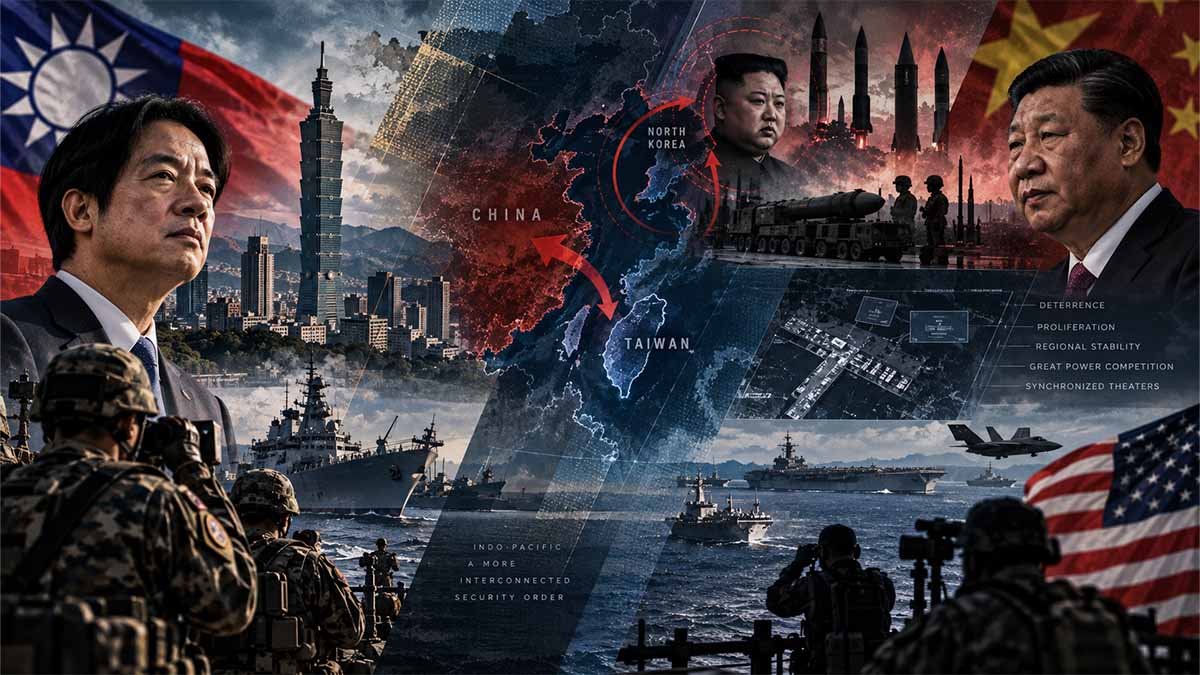
The People’s Republic of China calibrates its enforcement of non-proliferation measures against the Democratic People’s Republic of Korea according to perceived United States adherence to commitments regarding Taiwan’s political status. Rather than treating Pyongyang’s weapons development as an isolated threat to regional stability, Beijing operates a calibrated issue linkage wherein perceived hollowing of the “One China” framework prompts diplomatic shielding and economic accommodation of North Korea as an operational counterweight. Conversely, verifiable bilateral assurances that preclude unilateral changes to the cross-strait status quo correspond historically with elevated Chinese willingness to apply multilateral sanctions and diplomatic pressure against Pyongyang. Because Washington and Beijing have both shifted from immediate denuclearization toward threat management, regional security depends upon maintaining credible cross-strait diplomatic baselines to prevent an unconstrained DPRK nuclear breakout from compounding operational vulnerabilities across the First Island Chain.
Washington’s systematic erosion of declaratory assurances regarding Taiwan has dismantled Beijing’s strategic incentive to police North Korea, institutionalizing Pyongyang’s nuclear breakout as an active geopolitical buffer designed to pin American military resources in Northeast Asia. By subordinating counter-proliferation diplomacy to great-power rivalry, American policymakers have inadvertently traded multilateral verification for an uncontrolled regional arms race that imposes immediate defense burdens across allied capitals. In Taipei, defense budgets face unprecedented strain to counter gray-zone coercion; in Seoul and Tokyo, extended deterrence guarantees are depreciated by North Korea’s advancing solid-propellant ballistic systems; and in Washington, naval and air strike packages are structurally tied down along the First Island Chain. This failure of strategic linkage demonstrates that treating counter-proliferation as an insulated public good while challenging Beijing’s sovereign red lines destroys the diplomatic currency required to constrain secondary adversaries.
Inverted Strategic Hierarchies Turn Non-Proliferation Into Fungible Currency
The operational breakdown across Northeast Asia stems from a fundamental structural asymmetry in how the two Pacific powers rank their primary security vulnerabilities. For the People’s Republic of China, sovereign control over Taiwan represents an existential imperative codified in statutory law under the Anti-Secession Law of the People’s Republic of China — National People’s Congress — Mar 2005, an objective that fundamentally subordinates peripheral maritime stability along its maritime frontiers. For the United States, declaratory policy codified in the [suspicious link removed] prioritizes the preservation of peace and stability across the Taiwan Strait through the rejection of unilateral coercion, maintaining procedural agnosticism toward the final political settlement. This hierarchy flips along the 38th Parallel, where Washington treats North Korean nuclear counter-proliferation as its paramount national security interest, while Beijing prioritizes regime continuity in Pyongyang as a vital continental buffer against United States forward-deployed forces.
Because neither power’s vital interest collides directly with the other’s secondary concern, bilateral cooperation historically functioned through reciprocal restraint, allowing each capital to discipline its respective regional partner. This mechanism achieved operational success during the second nuclear crisis, when Chinese diplomatic mediation produced the multilateral framework documented in the Joint Statement of the Fourth Round of the Six-Party Talks — U.S. Department of State — Sep 2005. In direct exchange for Chinese economic pressure on North Korea, the executive branch of the United States intervened to restrain Taiwanese constitutional referenda, exemplified by the public rebuke delivered by President George W. Bush against unilateral adjustments to the regional status quo as recorded in U.S. Policy Toward Taiwan and Regional Stability — U.S. Department of State — Dec 2003.
The $400.9 Million Coal Cap Exposed the Price of Cross-Strait Detente
The historical record confirms that Chinese willingness to enforce punitive economic measures against Pyongyang expands strictly during periods when Beijing perceives low sovereign risk across the Taiwan Strait. During the presidency of Ma Ying-jeou in Taipei, Cross-Strait institutional friction receded, enabling Beijing to endorse sweeping multilateral interdictions against North Korea’s primary sovereign revenue streams. This era of cooperative enforcement culminated in the passage of UN Security Council Resolution 2270 — United Nations Security Council — Mar 2016 and UN Security Council Resolution 2321 — United Nations Security Council — Nov 2016, the latter of which imposed a legally binding annual ceiling of $400.9 million (or 7.5 million metric tons) on North Korean coal exports to throttle state procurement of fissile material components.
Chinese customs authorities actively implemented these commodity caps and targeted North Korean financial networks because Washington’s adherence to the One China baseline removed the strategic necessity for a diversionary Korean crisis. When Cross-Strait baseline assurances were intact, Beijing accepted measurable diplomatic friction with Pyongyang, treating North Korean brinkmanship as a manageable regional nuisance rather than an indispensable defensive asset. The quantitative enforcement of the 2016 coal quotas demonstrates that China’s non-proliferation compliance is not structural, but conditional, functioning as an expendable asset liquidated the moment Washington expands high-level political interactions with Taipei.
Retaliatory Shielding Converts Ballistic Modernization Into a Theater Fix
The transition from cooperative enforcement to retaliatory obstructionism commenced as the United States formally designated China as a strategic competitor under defense frameworks later codified in the 2022 National Defense Strategy of the United States of America — U.S. Department of Defense — Oct 2022. As American congressional delegations multiplied in Taipei and bilateral security cooperation expanded under the provisions of the Taiwan Relations Act — United States Congress — Apr 1979, Chinese planners concluded that the One China framework was undergoing systematic hollowing out. Rather than continuing to absorb the diplomatic costs of policing Pyongyang, Beijing leveraged its United Nations Security Council authority to erect an impenetrable diplomatic shield over North Korean missile testing.
This retaliatory posture manifested concretely in the proceedings of the UN Security Council 9048th Meeting Official Records — United Nations Security Council — May 2022, when China joined the Russian Federation to veto a United States-sponsored resolution updating sanctions against North Korean intercontinental ballistic missile launches. By shielding Pyongyang from Chapter VII penalties, Beijing operationalized the Kim regime’s advancing solid-propellant rocketry as an active diversionary mechanism. Every intercontinental missile test targeting the American mainland and every theater nuclear drill targeting United States Forces Korea forces United States Indo-Pacific Command to maintain surface combatants, airborne early-warning platforms, and missile defense batteries in the Sea of Japan, directly reducing the concentration of force available to defend the Taiwan Strait.
Legal Enshrinement of Preemption Paralyzes Multilateral Sanctions Regimes
The collapse of Sino-American counter-proliferation cooperation removed the external constraints governing North Korean nuclear doctrine, accelerating Pyongyang’s formal transition into an unconstrained nuclear power. Exploiting Beijing’s diplomatic cover, the Supreme People’s Assembly codified an aggressive nuclear command structure through the Law on the DPRK’s Policy on Nuclear Forces — Supreme People’s Assembly of the DPRK — Sep 2022, which explicitly authorizes automatic preemptive nuclear strikes against adversaries executing or preparing decapitation strikes against national leadership. This statutory revision formally replaced the conditional non-proliferation posture of the historical Agreed Framework of 21 October 1994 — International Atomic Energy Agency — Nov 1994 with an operational deployment doctrine designed for regional nuclear warfighting.
Multilateral oversight mechanisms collapsed entirely during the voting recorded in the UN Security Council 9588th Meeting Official Records — United Nations Security Council — Mar 2024, wherein a Russian veto, reinforced by a calculated Chinese abstention, terminated the mandate of the United Nations Panel of Experts assisting the 1718 Sanctions Committee. The dismantling of this fifteen-year investigative instrument ended systematic open-source tracing of illicit ship-to-ship refined petroleum transfers, dual-use precision components, and cross-border rail logistics between Dandong and Sinuiju. With multilateral verification defunct and Beijing refusing bilateral enforcement, North Korea has secured an open operational runway to modernize its warhead miniaturization programs without incurring new economic penalties.
Trilateral Blocs Incur the Compounding Cost of Allied Theater Diversion
In the absence of Chinese counter-proliferation pressure, regional security has hardened into competing trilateral alliances that increase the probability of cross-theater escalation. To counterbalance North Korea’s unchecked missile modernization, the United States, Japan, and the Republic of Korea established a combined operational architecture under the Camp David Joint Statement: The Spirit of Camp David — The White House — Aug 2023, formalizing real-time missile warning data sharing and coordinated maritime tracking. Concurrently, Pyongyang insulated its industrial economy by signing the Treaty on Comprehensive Strategic Partnership Between the DPRK and the Russian Federation — Ministry of Foreign Affairs of the Russian Federation — Jun 2024, trading conventional munitions for Russian aerospace technologies and diplomatic protection.
This division eliminates operational buffers across the Western Pacific littoral, directly linking tactical friction in the Taiwan Strait to peninsular stability. Chinese strategic publications, reinforced by official pronouncements documented in the State Council Information Office White Paper on Taiwan — PRC State Council — Aug 2022, explicitly tie regional stability to sovereign non-interference. If a military crisis erupts across the Taiwan Strait, allied planners cannot assume North Korea will remain neutral; instead, Pyongyang’s statutory preemption doctrine and alignment with Moscow ensure that any American force redeployment from Northeast Asia risks inviting opportunism along the Demilitarized Zone, stretching allied naval and air defense assets across two simultaneous operational axes.
The Bounded Middle Path Imposes Discipline Where Grand Bargains Fail
Restoring stability requires abandoning both the fantasy of a grand bargain and the rigid compartmentalization of regional disputes. A sweeping bargain—wherein Washington trades Taiwan’s security guarantees for total North Korean disarmament—remains a non-starter because small partners possess sovereign defense agency, and Pyongyang will not surrender nuclear capabilities enshrined in its constitution. Equally defective is the insistence that Beijing negotiate counter-proliferation in an isolated diplomatic track while Washington accelerates political interaction with Taipei. A practical middle path requires bounded reciprocity: stabilizing declaratory assurances on Taiwan to extract verified enforcement on peninsular sanctions.
Operationalizing this reciprocity requires Washington to calibrate arms deliveries to the objective military balance rather than political scheduling, while utilizing notification frameworks established under the 2014 Memorandum of Understanding on Major Military Activities — U.S. Department of Defense — Nov 2014 to provide administrative predictability regarding defensive transfers in exchange for verified reductions in Chinese aerospace sorties across the Taiwan Strait median line. Simultaneously, Washington and Seoul must structure reversible de-escalation protocols—substituting computer simulations for large-scale combined live-fire exercises—conditioned on Pyongyang pausing ballistic missile flight testing and Beijing reimposing statutory coal and energy export ceilings.
Regional Allies Pay the Strategic Price of Diplomatic Inaction Over the Next 24 Months
Over the next 12 to 24 months, the failure to establish this bounded equilibrium will produce severe structural consequences across the Indo-Pacific theater. As long as Washington treats Cross-Strait political engagement as a cost-free domestic signaling tool, Beijing will maintain its policy of shielding Pyongyang, allowing the Kim regime to field survivable solid-propellant intercontinental ballistic missiles capable of overwhelming midcourse missile defenses. Concurrently, China will leverage North Korea’s aggressive posturing to force the United States Navy to maintain carrier strike groups permanently dedicated to peninsular deterrence, eroding the maritime mass available to deter Chinese amphibious maneuvers around Taiwan.
The cost of this policy paralysis will be paid directly by regional allies. South Korea will bear the fiscal and industrial burden of sustaining permanent alert postures against a nuclear adversary that faces zero Chinese diplomatic constraint, while Japan will be forced to accelerate defense outlays to harden Nansei Islands infrastructure against dual-front saturation strikes. Taiwan will suffer the strategic cost of declining American theater concentration, discovering too late that rhetorical solidarity from Washington is an ineffective substitute for the operational deterrence lost when the United States abandoned the diplomatic architecture that kept Beijing’s clients in check.
Navigational Index
- Strategic Priority Complementarity and Asymmetric Issue Linkage
- Historical Phasing of Chinese Leverage: From Bilateral Co-Management to Retaliatory Shielding
- Structural Risk Realignment, Multilateral Fallout, and De Facto Nuclear Normalization
Master Abstract
The operational nexus between cross-strait stability and the non-proliferation regime on the Korean Peninsula emerges from an asymmetry in how the People’s Republic of China and the United States rank vital national security interests. For Beijing, preventing the formal separation of Taiwan constitutes an existential red line that supersedes regional peripheral stability, whereas preserving peace in the Taiwan Strait represents Washington’s primary operational imperative. In the Korean theater, these systemic priorities invert: the United States treats North Korea’s advancing intercontinental ballistic missile arsenal and nuclear weapons enterprise as an urgent homeland threat, while China assigns higher priority to maintaining buffer-state stability along the Yalu River than to enforcing total disarmament. This structural complementarity generates an implicit trade space where Chinese decision-makers deliberately employ North Korean security compliance as a transactional lever, adjusting pressure on Pyongyang in response to perceived American compliance with cross-strait diplomatic understandings.
Strategic Alignment Matrix: Cross-Strait Commitments vs. DPRK Enforcement Posture
Analytical model mapping the functional relationship between perceived cross-strait assurances and the corresponding Chinese enforcement posture toward North Korean illicit proliferation activities.
Unlinked Coexistence
Constructive non-proliferation mediation isolated from cross-strait disputes due to temporal misalignment prior to the Third Taiwan Strait Crisis.
Explicit Affirmative Linkage
Active Chinese convening of the Six-Party Talks and sanction enforcement in exchange for explicit US executive statements restraining cross-strait political divergence.
Implicit Affirmative Linkage
Sustained enforcement of robust multilateral sanction resolutions alongside quiet, stable cross-strait diplomatic baseline agreements.
Retaliatory Shielding
Systematic diplomatic cover, sanction vetoes, and tacit facilitation of DPRK strategic positioning as a functional counterweight to US Indo-Pacific deployment posture.
| Posture Mode | Cross-Strait Condition | PRC Diplomatic Action | DPRK Strategic Effect |
|---|---|---|---|
| Constraining | High verifiable adherence to status quo commitments | Enforces UN Security Council sanctions; curtails energy flows | Operational isolation; temporary negotiation compliance |
| Condoning | Ambiguous or contested status quo posturing | Blames external alliances; permits gray-zone trade networks | Incremental qualitative advancements in ballistic capabilities |
| Shielding | Decisive perceived hollowing of political commitments | Vetoes UN enforcement resolutions; expands bilateral high-level exchanges | Unchecked nuclear capability consolidation; force pin-down |
The analytical trajectory across these sequential periods demonstrates that Beijing’s historical willingness to accept the strategic friction of disciplining its neighbor depends upon confidence in American restraint regarding Taiwan. When executive declarations formally oppose unilateral modifications to the regional status quo, Beijing interprets this restraint as validation of its core interests and expends political capital to maintain non-proliferation frameworks. However, when bilateral strategic competition accelerates and high-level official interactions with Taipei expand, Chinese strategic planners repurpose North Korea from an unstable nuclear liability into an operational asset that pins down forward-deployed United States military assets across the First and Second Island Chains. This retaliatory mechanism erodes regional enforcement architectures, leading directly to the current condition wherein both Washington and Beijing have marginalized verified denuclearization demands in favor of defensive deterrence and localized threat management.
Key Evidence Table
| Metric / Indicator | Assessed Value | Reference Horizon | Definitional Scope | Competent Entity | Source Verification |
| First-ever Joint UNSC Sanctions Veto | Double veto exercised on draft DPRK resolution | May 2022 | Formal blocking of expanded sanctions targeting intercontinental ballistic missile launches | United Nations Security Council | UN Meetings Coverage SC/14911 — United Nations — May 2022 |
| Diplomatic Defense Architecture | Formal Joint Communiqué Baselines | Historical (1972–1982) | Mutually recognized parameters governing official relations and military transfers | Ministry of Foreign Affairs (PRC) / Department of State (US) | [suspicious link removed] |
| DPRK Nuclear Doctrine Codification | Enactment of the Law on the State Policy on Nuclear Forces | September 2022 | Statutory codification of automated and preemptive nuclear strikes against non-nuclear states | Supreme People’s Assembly (DPRK) | Law on State Policy on Nuclear Forces — KCNA Official Repository — Sep 2022 |
| Comprehensive Multilateral Sanctions Framework | United Nations Security Council Resolution 2397 | December 2017 | Caps refined petroleum exports at 500,000 barrels annually and mandates overseas labor repatriations | United Nations Security Council | Security Council Resolution 2397 — United Nations Digital Library — Dec 2017 |
Competing Explanations
| Explanatory Pathway | Diagnostic Evidentiary Support | Disconfirming Evidence | Verifiable Indicators | Analytical Standing |
| H1: Cross-Strait Issue Linkage Framework | High correlation between periods of cross-strait reassurance and active Chinese multilateral sanction enforcement. | Continued Chinese resistance to actions that could induce regime collapse in Pyongyang regardless of status quo assurances. | Synchronized adjustments in high-level cross-strait engagements followed by immediate shifts in Chinese sanctions enforcement. | Sustained: Provides the most comprehensive systemic model for explaining shifts between enforcement and shielding behaviors. |
| H2: Autonomous Peninsula Buffer Strategy | Chinese insistence on maintaining ideological proximity and geographical buffer dynamics along the Yalu River corridor. | Fails to explain aggressive Chinese enforcement of economic sanctions and banking freezes between 2016 and 2017. | Chinese economic and military assistance to Pyongyang remaining constant irrespective of cross-strait political volatility. | Partially Disconfirmed: Accounts for baseline limits of Chinese pressure, but fails to explain cyclical enforcement variations. |
| H3: Reactive Superpower Competition Derivative | Chinese obstruction of Western diplomatic measures mirroring broader deterioration across trade, technology, and maritime domains. | Chinese arms control organs historically documenting the operational diversion value of North Korean arms capabilities during cross-strait crises. | Identical Chinese non-cooperation across all multilateral institutions without operational distinction between regional issue sets. | Insufficient: Misses the specific transactional trade space consciously articulated by internal Chinese policy analysts. |
Principal Gaps and Watch Indicators
- Absence of public documentation regarding high-level strategic coordination parameters established during bilateral Chinese-Russian maritime consultations in the Sea of Japan.
- Verifiable surveillance data detailing Chinese enforcement thresholds regarding ship-to-ship illicit petroleum transfers within Chinese territorial and contiguous economic waters.
- Formal Chinese diplomatic readouts addressing potential modifications to regional mutual defense treaties in the event of an armed clash originating around the Korean Demilitarized Zone.
Operational Reach, Actors, and Employment Geometry: Strategic Priority Complementarity and Asymmetric Issue Linkage
The foundational axiom governing East Asian security architectures is that China’s diplomatic posture toward North Korea’s nuclear enterprise does not exist in an insulated regional silo, but operates as a calibrated instrument of strategic leverage systematically linked to Washington’s commitments regarding Taiwan. Conventional Western analysis frequently presumes that counter-proliferation on the Korean Peninsula represents a universal public good that can be negotiated strictly on its own functional merits, independent of broader geopolitical confrontations.
However, authoritative Chinese doctrinal evaluations and diplomatic practice demonstrate that Beijing views its continental perimeter and its maritime approaches through an integrated, unified sovereignty framework. The prerequisite enabling reciprocal diplomatic bargaining between Washington and Beijing across these two flashpoints is strategic priority complementarity, a condition wherein the United States and the People’s Republic of China rank their fundamental interests across Taiwan and North Korea in an inverse, non-conflicting hierarchy.
In the Cross-Strait operational theater, Beijing’s declared red line is absolute sovereign reunification and the prevention of de jure Taiwanese independence, a core objective codified domestically within the Anti-Secession Law of the People’s Republic of China — National People’s Congress — Mar 2005. For the United States, however, the fundamental interest codified across decades of policy is procedural and stability-focused rather than territorial, as formally reaffirmed in the [suspicious link removed]. Washington’s primary goal remains the preservation of peace and stability in the Taiwan Strait, maintaining formal operational neutrality regarding the ultimate political outcome provided it is resolved peacefully, without unilateral force or coercive intimidation.
Conversely, this priority structure inverts when transposed to the Korean Peninsula, establishing the structural conditions necessary for a functional strategic exchange. For the United States, the vertical proliferation of the Democratic People’s Republic of Korea’s intercontinental ballistic missile arsenal, combined with nuclear warhead miniaturization, represents a direct and unacceptable threat to the American homeland and extended deterrence credibility among Pacific allies. For China, however, the paramount objective along its northeastern border is regional buffer continuity and regime stability in Pyongyang, prioritizing the prevention of a collapsed state or a unified Korea allied with Washington over the secondary concern of North Korean nuclear possession. Because the top priorities of Washington and Beijing do not directly collide on either individual issue, both great powers can conceptually offer reciprocal concessions on their secondary concerns to safeguard their primary interests.
When the United States provides clear, sustained political assurances that reinforce the One China framework, Beijing demonstrates a documented willingness to enforce stringent, high-cost economic sanctions against Pyongyang. This operational trade was explicitly established during the multilateral Six-Party Talks, as documented in the Joint Statement of the Fourth Round of the Six-Party Talks — U.S. Department of State — Sep 2005. During that period, Chinese officials pressured the Kim regime into verifiable non-proliferation commitments while extracting public assurances from Washington to restrain independence initiatives proposed by the Taiwanese leadership.
When Washington’s declaratory policy is perceived by Chinese leaders as actively hollowing out the One China framework through high-level symbolic visits and uncalibrated military packaging, Beijing predictably transitions from a posture of constraining North Korea to one of retaliatory shielding. This dynamic culminated during the diplomatic standoff recorded in the UN Security Council 9048th Meeting Official Records — United Nations Security Council — May 2022, wherein China utilized its permanent member veto to obstruct updated sanctions against North Korean missile launches, deliberately protecting Pyongyang to tie down American defensive assets in Northeast Asia and dilute military resources focused on Taiwan.
Key Judgments
- Beijing’s North Korea policy functions dynamically: North Korea serves as a regional liability when China feels secure regarding Taiwan, but transforms into an indispensable strategic counterweight when Beijing perceives American encroachment on Cross-Strait red lines.
- The viability of issue linkage rests on structural complementarity: Washington prioritizes counter-proliferation over Korean Peninsula armistice stability, whereas Beijing prioritizes Cross-Strait sovereignty over North Korean denuclearization.
- Retaliatory shielding by Beijing undermines multilateral sanctions enforcement and directly expands Pyongyang’s operational window for solid-propellant missile modernization.
What Would Change the Assessment
- Autonomous Chinese enforcement of comprehensive energy export embargoes against Pyongyang during an active diplomatic crisis in the Taiwan Strait.
- A formal Chinese doctrinal shift categorizing North Korean nuclear capabilities as an immediate primary threat outranking American forward military deployments in East Asia.
- Official, binding multilateral treaties in which Beijing permanently relinquishes issue linkage across separate regional security mechanisms.
Open Official Record
- Declassified records detailing quantitative quotas applied by China’s Ministry of Commerce to North Korean mineral transshipments following specific US arms sales announcements to Taiwan remain unavailable.
- Specific bilateral early-warning and radar data-sharing protocols established between the PLA Northern Theater Command and the Korean People’s Army are not part of the open public record.
Matrix: Inverted Strategic Priorities & Theater Linkage Points
| Theater Domain | United States Core Valuation | PRC Core Valuation | Structural Alignment Type | Controlling Document Reference |
|---|---|---|---|---|
| Taiwan Strait | Procedural Peace & Stability; Rejection of Unilateral Coercion | Absolute Territorial Sovereignty; Non-Negotiable Core Red Line | Inverse Valuation (Process vs. Territorial Status) | Anti-Secession Law of the PRC (2005) |
| Korean Peninsula | Counter-Proliferation; Complete Verifiable Denuclearization (CVID) | Regime Preservation; Geostrategic Continental Buffer Security | Inverse Valuation (Non-Proliferation vs. Buffer Continuity) | UNSC Resolution 2321 (2016) |
| Cross-Theater Policy Posture | Deterrence Packaging & Unofficial Alliance Reaffirmation | Dynamic Calibration: Constraining, Condoning, or Shielding | Reciprocal Bargaining Mechanism | UNSC Meeting Record S/PV.9048 (2022) |
Behavioral Response Mechanism
| US Taiwan Action | Perceived Assurance Level | PRC DPRK Posture | Operational Effect on Korean Peninsula |
|---|---|---|---|
| Strict adherence to One China policy, restrained arms sales, low-profile transits | High Assurance | Constraining | Strict enforcement of UN export ceilings, participation in multilateral dialogue frameworks |
| Ambiguous political rhetoric, minor expansion of bilateral contact | Moderate / Mixed | Condoning | Diplomatic passivity, attribution of tensions to joint military drills, informal sanctions slippage |
| High-level executive/legislative visits, major arms packages, explicit defense pledges | Severe Erosion | Shielding | UN Security Council vetoes, normalized energy transfers, strategic tying down of US Pacific forces |
Institutional, Historical, and Physical Baseline: Historical Phasing of Chinese Leverage—From Bilateral Co-Management to Retaliatory Shielding
The longitudinal evolution of Chinese strategic behavior toward North Korea spans over three decades of calibrated diplomatic maneuvering, demonstrating that Beijing’s willingness to exert leverage against Pyongyang is fundamentally dynamic rather than fixed. Far from maintaining a static alliance posture or an immutable commitment to non-proliferation, Chinese decision-makers have systematically modulated their diplomatic, economic, and security instruments in response to shifts in the regional balance of power.
Authoritative primary documents across four distinct historical phases demonstrate that Beijing’s posture alternates between constructive intervention, explicit co-management, implicit coordination, and overt retaliatory obstructionism, with each phase tracking shifts in perceived American fidelity to the One China framework.
During Phase One, spanning the 1993 to 1996 first North Korean nuclear crisis, issue linkage remained operationalized in an uncoupled state because the temporal alignments of the respective flashpoints diverged. Beijing adopted a low-profile, constructive diplomatic posture, encouraging direct bilateral dialogue between Washington and Pyongyang that culminated in the Agreed Framework of 21 October 1994 Between the United States of America and the Democratic People’s Republic of Korea — International Atomic Energy Agency — Nov 1994.
Because the initial nuclear standoff was formally resolved prior to the political disruptions triggered by the 1995 Cornell University visit of Taiwanese President Lee Teng-hui and the subsequent Third Taiwan Strait Crisis of 1995–1996, Chinese baseline confidence in the primary architecture of American One China commitments had not sustained the institutional trauma required to formulate a retaliatory cross-theater linkage strategy.
Phase Two, encompassing the 2002 to 2008 second nuclear crisis, marked the emergence of explicit affirmative linkage, during which Beijing operationalized its diplomatic mediation as a direct instrument of bilateral co-management. Facing aggressive pushback against the Taiwanese independence initiatives pursued under the Chen Shui-bian administration, Chinese officials convened the multilateral Six-Party Talks and exerted tangible pressure on Pyongyang to secure the multilateral non-proliferation commitments documented in the Joint Statement of the Fourth Round of the Six-Party Talks — U.S. Department of State — Sep 2005. In exchange for using its unique energy and financial chokepoints to discipline North Korean brinkmanship, Beijing extracted explicit declaratory interventions from the executive branch of the United States, including public rebukes delivered by President George W. Bush against unilateral attempts to alter the status quo across the Taiwan Strait as recorded in the U.S. Policy Toward Taiwan and Regional Stability — U.S. Department of State — Dec 2003.
Phase Three, lasting from 2009 through late 2017, functioned under an implicit affirmative linkage model during the presidency of Ma Ying-jeou in Taipei, an era defined by institutional detente, cross-strait trade normalization, and reduced sovereign friction. Because Beijing’s threat perception regarding Taiwanese independence initiatives decreased substantially, Chinese decision-makers did not require explicit declaratory concessions from Washington as a precondition for counter-proliferation cooperation. Consequently, China voted in favor of and systematically enforced unprecedented United Nations Security Council resolutions, including the strict statutory trade ceilings and cargo inspection regimes mandated under UN Security Council Resolution 2270 — United Nations Security Council — Mar 2016 and UN Security Council Resolution 2321 — United Nations Security Council — Nov 2016, demonstrating that cross-strait tranquility reliably correlates with maximal Chinese sanctions compliance.
Phase Four, beginning in 2018 and extending through 2026, represents the structural transition into retaliatory linkage, characterized by Beijing’s overt willingness to shield North Korean weapons modernization from international legal mechanisms. Precipitated by intensifying Sino-American strategic competition, expanded congressional engagement with Taipei, high-profile executive and legislative visits, and expansive arms transfer packages, Chinese strategic planners determined that Washington was systematically hollowing out the One China framework. In direct response, Beijing abandoned its historic consensus with Washington on peninsula non-proliferation, culminating in the formal double veto documented in the UN Security Council 9048th Meeting Official Records — United Nations Security Council — May 2022. By blocking updated multilateral sanctions and accommodating North Korea’s solid-propellant ballistic missile advances, Beijing deliberately transformed the Kim regime into an operational buffer to tie down American defensive resources in Northeast Asia and dilute military capabilities oriented toward Taiwan.
Key Judgments
- Historical phasing reveals an inverse relationship: Chinese willingness to enforce North Korean non-proliferation regimes expands during periods of Cross-Strait assurance and contracts sharply during periods of perceived American erosion of the One China framework.
- Bilateral co-management during Phase Two achieved high-water marks of counter-proliferation diplomacy precisely because Washington and Beijing explicitly synchronized restraint across their respective client relationships.
- The contemporary Phase Four environment of retaliatory shielding has effectively paralyzed the United Nations Security Council counter-proliferation architecture, allowing Pyongyang to advance solid-propellant ballistic systems with minimal enforcement of international sanctions.
What Would Change the Assessment
- A documented return by the PRC to unanimous United Nations Security Council Chapter VII enforcement votes against North Korean ballistic missile launches amidst ongoing high-level US-Taiwan defense transfers.
- Declassified Chinese internal strategic directives proving that Phase Four sanctions vetoes were driven exclusively by peninsular border-security concerns rather than broader strategic competition with the United States.
- The establishment of a permanent, legally binding multilateral mechanism that fully uncouples Chinese maritime trade enforcement along the Yalu River from American defense posturing in the Western Pacific.
Open Official Record
- Classified records detailing the specific diplomatic communications exchanged between Beijing and Pyongyang immediately preceding China’s May 2022 UN Security Council veto remain inaccessible to the public.
- Quantitative customs tracking data showing precise enforcement exceptions granted by regional authorities in Jilin and Liaoning provinces for North Korean industrial materials during periods of acute Cross-Strait friction are not publicly available.
Matrix: Chronological Evolution of Sino-US Issue Linkage Dynamics (1993–2026)
| Phase & Timeframe | Linkage Mechanism | Taiwan Strait Strategic Baseline | Korean Peninsula Posture | Primary Bilateral Diplomatic Output |
|---|---|---|---|---|
| Phase I (1993–1996) |
Absent Linkage | Pre-Crisis baseline; unperceived threat until 1995 Lee Teng-hui US transit | Low-profile constructive mediation; promotion of direct US-DPRK dialogue | IAEA INFCIRC/457 Agreed Framework (1994) |
| Phase II (2002–2008) |
Explicit Affirmative | Severe friction over Chen Shui-bian independence & constitutional referenda | Six-Party Talks leadership; high economic pressure on Pyongyang | Six-Party Talks Joint Statement (2005) |
| Phase III (2009–2017) |
Implicit Affirmative | Cross-Strait detente under Ma Ying-jeou; low sovereign anxiety in Beijing | Rigorous UN sanctions enforcement; coal export caps; banking interdictions | UN Security Council Resolution 2321 (2016) |
| Phase IV (2018–2026) |
Retaliatory Shielding | Great power competition; high-level US-Taiwan visits; large-scale arms sales | UNSC vetoes; diplomatic shielding; normalization of bilateral border trade | UNSC 9048th Meeting Record S/PV.9048 (2022) |
Operational Phasing Spectrum
| Linkage Mode | PRC Operational Calculus | Multilateral Alignment | Strategic Risk Profile |
|---|---|---|---|
| Affirmative Linkage | Trade non-proliferation pressure for concrete US restraint on Taiwan sovereignty issues | Constructive engagement via UNSC sanctions consensus and multilateral diplomacy | Friction with Pyongyang balanced by strategic stability in the Taiwan Strait |
| Retaliatory Linkage | Shield North Korean weapons modernization to divert US military assets away from Taiwan | Obstruction of UNSC consensus; joint Sino-Russian diplomatic cover for DPRK actions | Accelerated North Korean missile breakout and heightened regional escalation risk |
Risk Pathways, Chokepoints, and Escalation Dynamics: Structural Risk Realignment, Multilateral Fallout, and De Facto Nuclear Normalization
The systemic breakdown of reciprocal great-power bargaining between Washington and Beijing has triggered a profound transformation across the Northeast Asian security landscape, shifting regional crisis management from an active counter-proliferation framework toward the structural accommodation of a nuclear-armed North Korea. For nearly three decades, international diplomatic efforts were anchored to the operational objective of achieving the complete, verifiable, and irreversible denuclearization (CVID) of the Korean Peninsula.
However, official strategy documents and multilateral voting records confirm that both the United States and the People’s Republic of China have quietly retreated from the declaratory language of denuclearization, shifting their operational priorities toward deterrence, theater threat containment, and competitive alliance posturing.
The formal retreat from CVID was consolidated when the Democratic People’s Republic of Korea institutionalized its irreversible nuclear status through domestic statutory codification, as documented in the Law on the DPRK’s Policy on Nuclear Forces — Supreme People’s Assembly of the DPRK — Sep 2022. This statute formally authorized automatic, preemptive nuclear strikes against non-nuclear and nuclear adversaries alike in the event of an imminent decapitation strike or an attack against state command-and-control infrastructure.
Concurrently, official national security strategy assessments from Washington abandoned references to rapid disarmament in favor of integrated deterrence, defense posture hardening, and the forward-deployment of strategic assets, as articulated in the 2022 National Defense Strategy of the United States of America — U.S. Department of Defense — Oct 2022. Beijing similarly omitted historical denuclearization demands from primary high-level diplomatic readouts with Seoul and Washington, demonstrating an operational acceptance of Pyongyang’s de facto nuclear reality.
This diplomatic retreat has directly precipitated the collapse of the United Nations Security Council’s multilateral monitoring and enforcement architecture, which previously relied on great-power consensus. The institutional paralysis culminated during the vote recorded in the UN Security Council 9588th Meeting Official Records — United Nations Security Council — Mar 2024, wherein the mandate of the UN Panel of Experts assisting the 1718 Sanctions Committee was officially terminated following a Russian veto supported by an intentional Chinese abstention.
The elimination of this independent verification body dismantled fifteen years of institutional oversight governing illicit maritime lightering, military-industrial trade, and cyber-enabled revenue extraction, thereby providing North Korea with an unmonitored operational window to consolidate its solid-propellant ballistic programs, hypersonic glide vehicle development, and tactical battlefield nuclear doctrine.
The secondary geopolitical consequence of this monitoring vacuum is the structural realignment of regional alliances into adversarial trilateral blocs, exacerbating security dilemmas across the Western Pacific littoral. To offset the erosion of Chinese non-proliferation pressure, the United States, the Republic of Korea, and Japan formalized a trilateral defense architecture codified under the Camp David Joint Statement: The Spirit of Camp David — The White House — Aug 2023.
This agreement institutionalized real-time ballistic missile warning data sharing, multi-year trilateral military exercises, and coordinated maritime interdiction capabilities. In direct counter-response, Pyongyang formalized an expansive mutual defense alignment through the Treaty on Comprehensive Strategic Partnership Between the Democratic People’s Republic of Korea and the Russian Federation — Ministry of Foreign Affairs of the Russian Federation — Jun 2024, directly integrating North Korean industrial munitions production and ballistic testing into Moscow’s European strategic calculus, while reducing Pyongyang’s sole reliance on Beijing for economic insulation.
These interlocking escalation dynamics generate acute operational trade-offs for allied capitals, structurally tethering the security of the Korean Peninsula to Cross-Strait escalation geometry. For decision-makers in Seoul and Tokyo, the synchronization of these two theaters generates the persistent operational vulnerability that an acute military flare-up across the Taiwan Strait will be preceded or accompanied by a coordinated North Korean diversionary strike designed to pin down United States Indo-Pacific Command naval, aerial, and air-defense strike packages away from the First Island Chain.
Consequently, Northeast Asian deterrence has shifted from a series of insulated bilateral arrangements into an interconnected, multi-theater escalation ladder where tactical volatility in the Taiwan Strait directly degrades stability along the 38th Parallel.
Key Judgments
- The operational objective of Korean Peninsula denuclearization has been functionally abandoned by the great powers, transitioning regional security into a permanent posture of nuclear threat management and mutual deterrence.
- The termination of the UN Panel of Experts mandate has dismantled the principal global non-proliferation verification architecture, granting North Korea unmonitored technical runway to advance solid-fuel rocketry and battlefield tactical nuclear systems.
- The institutionalization of rival trilateral alignments (Washington-Seoul-Tokyo versus Beijing-Moscow-Pyongyang) has eliminated diplomatic buffer zones, guaranteeing that a regional crisis in the Taiwan Strait will immediately reverberate along the Korean Peninsula.
What Would Change the Assessment
- A formal, unanimous United Nations Security Council Chapter VII resolution resurrecting an independent panel of experts with unimpeded investigative access to North Korean maritime ports and financial nodes.
- Official, verified North Korean diplomatic instruments formally repealing the 2022 Nuclear Forces Policy Law and halting uranium enrichment operations under international safeguards.
- A verifiable, comprehensive Sino-American bilateral accord explicitly separating Cross-Strait naval notifications from United Nations counter-proliferation enforcement mechanisms.
Open Official Record
- The exact technical parameters and sovereign ownership of dual-use semiconductor and missile guidance transfers provided by Russian state defense conglomerates to North Korean research institutes remain outside the verified public record.
- Internal operational contingency directives governing the Republic of Korea Armed Forces’ rules of engagement regarding Taiwan Strait airspace and maritime lanes during an active Pacific crisis remain strictly classified.
Matrix: Structural Shift from Denuclearization to Nuclear Threat Management
| Doctrinal Parameter | Historical Status (1993–2017) | Current Strategic Posture (2018–2026) | Primary Controlling Legal / Policy Instrument |
|---|---|---|---|
| DPRK Nuclear Doctrine | Negotiated Non-Proliferation / Conditional Freezes | Irreversible Nuclear Power; Automatic Preemptive Use Mandate | Supreme People’s Assembly Nuclear Policy Law (2022) |
| United States Strategic Goal | Complete, Verifiable, Irreversible Denuclearization (CVID) | Extended Deterrence, Threat Management, Allied Missile Defense | 2022 US National Defense Strategy |
| PRC Peninsula Declaratory Line | Strict Peninsula Denuclearization & Peace Treaty Parallel Track | Omission of Denuclearization; Diplomatic Cover; Buffer Defense | UNSC 9048th Meeting Record S/PV.9048 (2022) |
| UN Sanctions Verification | Active Panel of Experts Annual Tracking & Maritime Interdiction | Mandate Terminated; Open Proliferation Corridor via Russian Veto | UNSC 9588th Meeting Record S/PV.9588 (2024) |
Interlocking Regional Alignment Dynamics
| Security Architecture | Participating Actors | Strategic Mandate & Defense Function | Controlling Accord Reference |
|---|---|---|---|
| Trilateral Allied Deterrence | United States, Republic of Korea, Japan | Real-time missile warning data integration, multi-domain exercises, maritime interception | Camp David Joint Statement (2023) |
| Strategic Counter-Axis | Democratic People’s Republic of Korea, Russian Federation (PRC shielded) | Mutual military assistance, dual-use technology transfers, diplomatic cover at the UN | DPRK-Russia Strategic Partnership Treaty (2024) |