










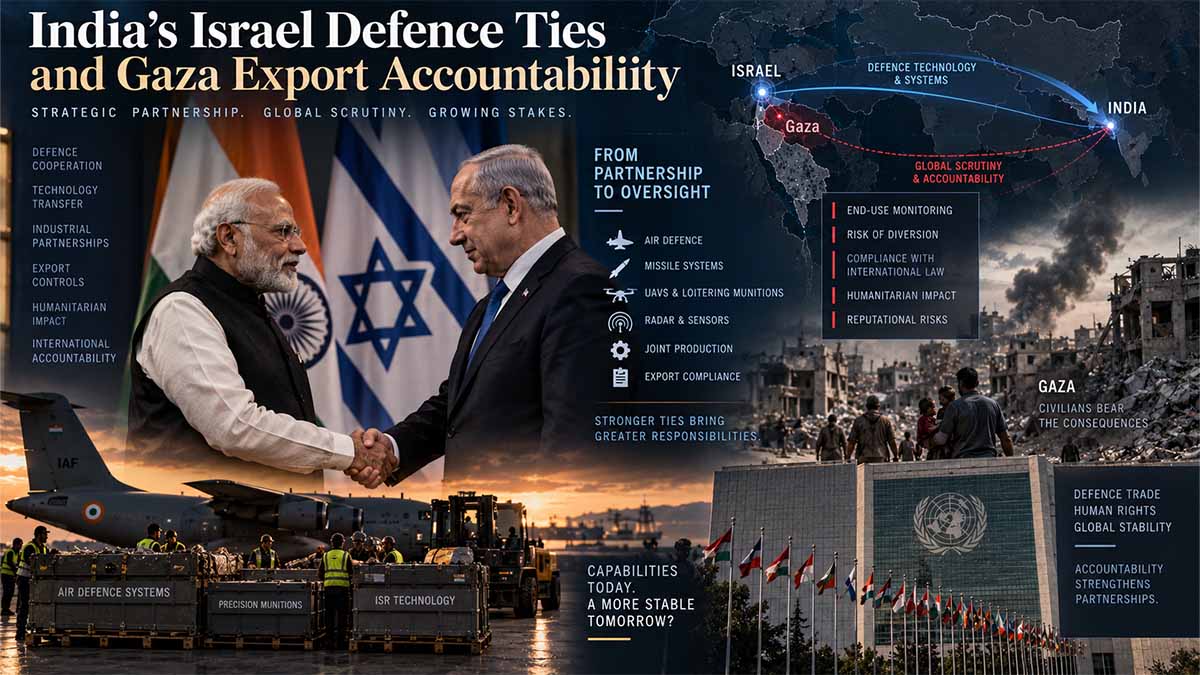
Scope: This assessment examines India’s diplomatic commitments concerning Palestine, its defence and industrial relationship with Israel, and the documentary requirements for assessing export accountability, concentrating on the period from October 2023 to September 2026, with a conditional five-year outlook.
Executive Summary / BLUF
India’s support for Palestinian rights and its expanding defence relationship with Israel constitute an established policy configuration, although the compatibility of individual military exports with international obligations requires transaction-specific evidence that diplomatic declarations cannot supply.
The September 2026 BRICS declaration opposes forced displacement, condemns starvation as a method of warfare, and acknowledges the ICJ’s provisional measures, establishing the collective position endorsed by India concerning civilian protection. BRICS New Delhi Declaration: Building for Resilience, Innovation, Cooperation and Sustainability (September 12, 2026) — Prime Minister of India — Sep 2026. Prime Minister of India
India’s Ministry of Defence separately confirms a November 2025 cooperation memorandum covering advanced technology, co-development and co-production, providing an official foundation for the continuing institutional relationship. 17th India-Israel Joint Working Group meeting on defence cooperation held in Tel Aviv — Ministry of Defence, India — Nov 2025. Press Information Bureau
An exchange-filed corporate disclosure records exports of Hermes 900 platforms to international customers by February 2020, establishing an export-oriented industrial relationship without identifying the destination or operational employment of particular wartime deliveries. Adani-Elbit JV further steps up their presence in the international markets; after the successful export of Hermes900, expanding to export Mini UAV systems — Adani Enterprises Limited — Feb 2020. nsearchives.nseindia.com
The controlling decision issue is whether the relevant authorities can demonstrate how particular exports were classified, authorised, assessed and monitored, while the decisive uncertainty remains the connection between individual Indian-origin consignments, their ultimate recipients and their subsequent use.
India’s Defence Exports Have Outgrown Its Public Account of Their Risks
India’s legal and diplomatic exposure over Gaza rests on a widening gap between the military relationship it is building with Israel and the evidence it publishes about the consequences. At the BRICS summit on 12 September 2026, New Delhi endorsed language condemning starvation as a method of warfare and opposing the forced displacement of Palestinians. Its defence partnerships nevertheless continued to develop through procurement, manufacturing and exports. Those activities do not, by themselves, establish complicity in unlawful conduct. They do require an explanation of how India evaluates the risks attached to particular recipients and transactions. The governing problem is accountability: the deeper the industrial relationship becomes, the less persuasive a general assurance about export controls becomes without records showing what authorities knew, what they examined and what restrictions they enforced.
BRICS language increases the burden of explaining export decisions
The BRICS New Delhi Declaration of 12 September 2026 placed India’s concern for Palestinian civilians in a collective institutional document. That commitment matters because New Delhi also endorsed closer defence cooperation with Israel through the bilateral “Special Strategic Partnership”. The relevant question is how the government applies the civilian-protection concerns it has formally endorsed when deciding whether military assistance should proceed.
Prime Minister Narendra Modi’s joint statement with Israel identified joint development, joint production and technology transfer in defence. These arrangements serve India’s domestic manufacturing ambitions while deepening relationships with Israeli suppliers. They also extend the range of decisions requiring scrutiny beyond purchasing a finished weapon: industrial cooperation creates continuing choices about components, production support and the conditions attached to their provision.
The Palestinian Foreign Ministry welcomed the BRICS declaration but called for practical and concrete steps. For India, an immediate test lies within its own administrative responsibilities: whether the government can show that its export decisions incorporate a substantive assessment of the risks described in the declaration. Diplomatic language becomes harder to defend when the decision records necessary to assess its implementation remain inaccessible.
The shipment figures demand scrutiny, not a shortcut to liability
The quantities in Amnesty International’s Made in India, published on 30 July 2026, make transaction-level examination necessary. Amnesty examined 2,596 shipments from India to Israel between 7 October 2023 and 30 November 2025, including 564,970 explosive-ordnance parts and 390,516 small-arms components. Its findings included 1,000 rounds of 155mm high-explosive artillery ammunition supplied by Munitions India to Elbit Systems and 120 mortar launchers of 81mm calibre supplied by Advanced Weapons and Equipment India in February 2024.
Amnesty identified nine exporters, including three state-owned companies: Munitions India, Advanced Weapons and Equipment India, and India Optel. Those findings increase the importance of examining government involvement. They do not eliminate the need to distinguish the legal status of each enterprise, the authority behind each decision and the subsequent destination of particular goods.
The commercial relationship is substantial in its own right. According to SIPRI’s figures for 2021–25, Israel supplied 15 per cent of India’s imports of major arms, while India received 29 per cent of Israel’s exports in that category. These shares establish a significant defence relationship. They do not measure the contribution of Indian exports to particular operations in Gaza, and they cannot substitute for evidence of operational use.
The distinction between categories also matters. Amnesty’s shipment analysis encompasses ammunition, parts and components; SIPRI’s figures concern major arms. A narrow measure of major weapons cannot resolve allegations about goods outside that category. Equally, a customs entry establishes neither the unlawfulness of the recipient’s subsequent conduct nor the supplier’s knowledge of it.
Joint manufacturing creates decisions that survive the original contract
Adani Elbit Advanced Systems’ Hyderabad venture illustrates the industrial transmission mechanism. The dossier describes production associated with the Hermes 900 drone, a model operated by the Israeli military over Gaza. The relevant legal inquiry concerns what the Indian venture supplied, to whom, under which conditions and with what knowledge. The shared platform name provides a reason to investigate those questions; it does not answer them.
The November 2025 memorandum on co-development and co-production institutionalised further cooperation between the defence establishments. As production relationships develop, the original contract date becomes an incomplete explanation for later conduct. Each subsequent delivery, amendment or support decision must be considered against the information available when that decision was taken.
A contract signed before 7 October 2023 can explain the origin of an obligation between commercial parties. It cannot establish that every later performance decision received an adequate risk assessment. For the transactions identified by Amnesty, a defensible examination would reconstruct the sequence of warnings, approvals and deliveries, then determine whether the relevant authorities reconsidered their position as information changed.
The Genocide Convention’s prevention obligation also makes practical influence relevant. Whether a supplier can restrict deliveries, enforce conditions or withhold support depends on the actual contractual and institutional arrangements. The dossier does not establish India’s transaction-specific leverage. That evidentiary gap calls for the relevant records, rather than an assumption that commercial importance either guarantees influence or leaves the supplier powerless.
Prevention duties arise before the evidence proves complicity
India ratified the Genocide Convention on 27 August 1959. The distinction between prevention and complicity is therefore consequential. Under the ICJ’s judgment of 26 February 2007, the duty to take preventive action arises when a state knows, or should normally know, of a serious risk of genocide. The required conduct depends on reasonably available means and the capacity to influence the actors concerned.
The same ICJ judgment sets a more demanding knowledge requirement for complicity: awareness of the principal perpetrator’s specific genocidal intent was at least necessary. It left unresolved whether an accomplice must also share that intent. An assessment of Indian assistance must preserve those distinctions. Failure to establish complicity would not, by itself, demonstrate that authorities adequately discharged a preventive duty.
Article 16 of the International Law Commission’s state-responsibility articles and commentary introduces another inquiry: assistance connected to an internationally wrongful act, with the requisite knowledge and contribution. The commentary addresses assistance intended to facilitate the act and actually contributing to it. A legally serious allegation must identify that conduct and connection; general awareness of the war cannot fill every evidentiary gap.
Foreign Ministry spokesman Randhir Jaiswal’s assertion on 31 July 2026 that India possesses a “robust legal and regulatory framework” consequently answers only part of the question. A framework establishes the existence of controls. Assessing compliance requires evidence of their application to the transactions under examination, including the information considered and the reasons for proceeding.
Israel’s assurances must be tested against the obligations India retains
India’s Article IX reservation to the Genocide Convention requires consent for submitting disputes to the ICJ in each case. It concerns jurisdiction and should be analysed separately from substantive obligations. Likewise, India’s absence from the Arms Trade Treaty’s participant list prevents treating that treaty’s export provisions as obligations binding India as a state party. Neither point resolves the application of other international duties.
The ICJ’s 19 July 2024 advisory opinion adds a separate external constraint. It identifies obligations concerning non-recognition and non-assistance in maintaining Israel’s unlawful presence in the occupied Palestinian territory. Applying that reasoning to an Indian transaction requires an examination of what the transaction supported. The identity of an Israeli purchaser alone cannot establish the prohibited connection.
State-owned exporters also require a precise attribution analysis under the International Law Commission’s framework. Ownership does not automatically make every commercial act attributable to India. The inquiry concerns legal functions, instructions and control, while the government’s own approval decisions remain separately examinable. This distinction prevents both an unsupported allegation of comprehensive state responsibility and an equally unsupported claim that an enterprise’s corporate form settles the issue.
For Israeli recipients and Indian authorities, end-use assurances matter only to the extent that they address the identified risks and can be tested. The SCOMET licences and associated conditions described in the dossier are therefore central evidence. Their confidentiality leaves the public unable to determine whether safeguards were specific, whether compliance was checked, or whether reported concerns altered subsequent decisions.
Over the next two years, the cost will follow the decisions left unexplained
The ICJ’s order of 21 May 2026 sets 22 November 2027 for South Africa’s Reply and 22 May 2029 for Israel’s Rejoinder. These are procedural deadlines, not judgment dates. Over the next 12–24 months, India’s decisions will therefore continue to require justification without the convenience of a completed merits determination. Waiting for that outcome would leave the preventive-duty question unanswered.
For the companies identified in Made in India, an adequate record would separate lawful industrial activity from assistance alleged to support unlawful conduct. For Indian authorities, contemporaneous assessments would demonstrate what they knew and why they acted. If those records exist but remain withheld, the immediate cost is reduced public confidence in the government’s explanation. If they do not exist, the difficulty is more substantial: later statements cannot reconstruct the reasoning that should have informed the original decisions.
The BRICS declaration and the Special Strategic Partnership have already established India’s chosen diplomatic and industrial direction. The remaining choice concerns how that direction is governed. Publishing reasoned assessments, providing appropriate scrutiny of sensitive records and demonstrating that restrictions are enforceable would make the policy defensible on evidence. Leaving those questions unresolved transfers the burden to Indian exporters, public authorities and citizens who are asked to accept an account of the trade’s consequences that they cannot examine.
Navigational Index
- Diplomatic commitments and strategic direction — India’s Palestine position, the BRICS declaration and the institutional development of relations with Israel.
- Defence production and export governance — Joint manufacturing, documented export activity, licensing authority and the distinction between authorisation, delivery and operational use.
- Legal exposure and accountability thresholds — Applicable obligations, evidentiary requirements, changing indicators and the records necessary for a defensible assessment.
Master Abstract
Diplomatic commitments and strategic direction
The principal assessment is that India has preserved political support for Palestinian rights while strengthening an institutional defence partnership with Israel, leaving the management of particular export risks as the central unresolved question. Paragraphs 30–34 of the September 2026 BRICS declaration address humanitarian access, Palestinian self-determination, opposition to displacement and international humanitarian law; paragraph 33 specifically condemns starvation as a method of warfare and acknowledges ICJ provisional measures concerning humanitarian assistance. These provisions establish India’s endorsed diplomatic position, but contain no shipment-specific finding about Indian exports, no disclosed licensing assessment and no mechanism demonstrating that particular defence goods cannot contribute to prohibited conduct. Their significance therefore rests on the policy commitments they record and the questions those commitments create for domestic implementation. BRICS New Delhi Declaration: Building for Resilience, Innovation, Cooperation and Sustainability (September 12, 2026) — Prime Minister of India — Sep 2026. Prime Minister of India
The bilateral strategic direction is independently documented in the joint statement covering Narendra Modi’s visit to Israel on 25–26 February 2026, which records the elevation of relations to a Special Strategic Partnership and welcomes the defence cooperation memorandum signed on 4 November 2025. This is evidence of an announced governmental commitment to deepen the relationship, although the statement does not establish the contractual value, delivery schedule or end-use conditions of particular weapons transactions. Analytically, the coexistence of these diplomatic positions is consistent with an attempt to preserve separate relationships across a divided regional environment; that explanation remains incomplete, however, unless the government can show how civilian-protection commitments inform the administrative decisions governing transfers. India – Israel Joint Statement — Prime Minister of India — Feb 2026. Prime Minister of India
The published visit outcomes also demonstrate the breadth of the relationship, recording 17 agreements or memoranda and 10 announcements, including artificial intelligence cooperation, a proposed cyber centre and a quota of up to 50,000 Indian workers over five years. These entries concern agreements, intentions and an announced quota, rather than proof of completed implementation; the absence of an itemised weapons procurement contract from this particular list establishes only the scope of the published document, rather than the absence of separate defence negotiations or contracts. The broader policy implication is that decisions concerning military transfers would operate within a relationship containing several civilian and technological channels, allowing policymakers to address particular export risks without assuming that every bilateral activity must receive identical treatment. List of Outcomes: Visit of PM to Israel — Prime Minister of India — Feb 2026. Prime Minister of India
Defence production and export governance
The industrial connection predates the Gaza war and includes an established manufacturing facility, rather than merely a subsequent political announcement. Adani’s December 2018 release records the inauguration of the Hyderabad UAV complex and describes an initial programme producing carbon-composite aerostructures for Hermes 900 aircraft, with later assembly and integration envisaged. The distinction between the initial manufacturing activity and the planned expansion matters because a production announcement cannot establish how many complete aircraft were subsequently delivered, which customers received them or how they were configured for operational use. The company’s description supports the existence and intended industrial function of the facility, while its promotional character requires restraint concerning claims of performance, uniqueness or combat effectiveness. Adani Defence & Aerospace and Elbit Systems Inaugurate India’s First Private UAV Manufacturing Facility at Hyderabad — Adani Group — Dec 2018. adani.com
A February 2020 disclosure submitted to Indian stock exchanges subsequently states that the Hyderabad venture had begun exporting Hermes 900 platforms to international customers, strengthening the documentary basis for treating the facility as part of an international defence production network. The disclosure does not identify those customers or connect the recorded exports to Gaza, which prevents its use as proof of the wartime destination alleged in the supplied narrative. Its analytical importance is narrower but substantial: India’s industrial participation extends beyond purchasing foreign systems, creating additional points at which manufacturing records, export authorisations and customer documentation become necessary to establish the movement of equipment through the bilateral supply relationship. Adani-Elbit JV further steps up their presence in the international markets; after the successful export of Hermes900, expanding to export Mini UAV systems — Adani Enterprises Limited — Feb 2020, PDF page 2. nsearchives.nseindia.com
Government reporting also establishes substantive cooperation in air defence, with the Ministry of Defence recording four Army MRSAM flight tests on 3–4 April 2025 and identifying the system as jointly developed by DRDO and Israel Aerospace Industries. These are official statements concerning development and testing, rather than a complete account of operational availability or combat performance; their relevance is that cooperation involves systems intended for India’s own military requirements, creating a concrete capability consideration for decisions affecting the relationship. The resulting constraint on policy is an analytical inference: restrictions reaching across shared production, technical support or development programmes would require an assessment of their effect on Indian capabilities, while measures confined to particular outbound transfers would have a different scope. DRDO & Indian Army conduct four successful flight-tests of Army version of Medium-Range Surface-to-Air Missile — Ministry of Defence, India — Apr 2025. Press Information Bureau
The May 2025 MRSAM ecosystem summit provides further evidence of this continuing industrial relationship, with the ministry describing local manufacturing, technical representation and life-cycle support involving Aerospace Services India and Israel Aerospace Industries. The record identifies support activities associated with MRSAM and subsystems including the Barak 8 missile, making maintenance and industrial integration relevant to any assessment of policy costs. It does not demonstrate that these activities supplied Israel’s Gaza operations, and their inclusion here serves to explain the institutional depth of the relationship rather than to infer a connection unsupported by the document. CENJOWS hosts MRSAM-India Eco-System Summit 2.0 — Ministry of Defence, India — May 2025. Press Information Bureau
India’s published export guidance identifies the Department of Defence Production as the authorising body for munitions-list items, while recording specified exceptions involving DGFT and requiring end-user documentation for relevant categories. The guidance describes the end-user certificate as a means of establishing the transmission chain to the ultimate user and preventing diversion, making the certification and its supporting records central to transaction-level scrutiny. The existence of that requirement establishes an administrative framework; whether the assurances were adequate, independently checked or reassessed for a particular transfer remains a question requiring the corresponding file. FAQs on Export of Munitions List Items notified under Category 6 of SCOMET — Department of Defence Production, India — accessed Sep 2026. defenceexim.gov.in
An important qualification to claims of complete official silence is the ministry’s February 2020 publication listing Israel among destinations for which export authorisation had been issued, with the relevant item described as an empty outer cover of a mortar shell. This record establishes a pre-war authorisation, rather than a completed delivery or subsequent use, but demonstrates that destination and equipment-category disclosure has occurred within the official system. It therefore supports examining whether similarly bounded disclosure could clarify wartime exports while preserving sensitive technical or commercial information. Export of Defence Equipment — Ministry of Defence, India — Feb 2020. pib.gov.in
Legal exposure and accountability thresholds
India’s legal exposure requires separating substantive obligations from the jurisdiction available to enforce them, particularly because the UN depositary records its ratification of the Genocide Convention on 27 August 1959 together with an Article IX reservation requiring the consent of all parties for submission of a dispute to the ICJ. That reservation concerns judicial jurisdiction and does not itself remove the substantive obligations contained elsewhere in the Convention, although its application to a particular proceeding would require a jurisdiction-specific assessment. Convention on the Prevention and Punishment of the Crime of Genocide — United Nations Treaty Collection — status accessed Sep 2026. treaties.un.org
Article I of the Convention establishes the undertaking to prevent and punish genocide, while Article III includes complicity among the punishable acts; these provisions require a legal analysis distinct from a political assessment of bilateral relations. A statement supporting Palestinian rights cannot by itself demonstrate compliance with prevention obligations, just as a commercial or manufacturing relationship cannot by itself establish complicity, because the latter conclusion requires the applicable legal elements and supporting evidence. The operative question is therefore what the relevant authorities knew, what conduct particular assistance supported and what measures they took within the applicable legal framework. Convention on the Prevention and Punishment of the Crime of Genocide — United Nations — Dec 1948, Articles I–III. treaties.un.org
Article 16 of the International Law Commission’s articles addresses aid or assistance provided with knowledge of the circumstances of another state’s internationally wrongful act, subject to the condition that the act would also be wrongful if committed by the assisting state. Its accompanying commentary addresses facilitation and actual contribution, making a conclusion of responsibility dependent on more than the existence of defence commerce; identifying an exporter’s state ownership would likewise leave questions concerning attribution, conduct and knowledge to be resolved. The articles and commentary provide an analytical framework rather than a shipment-specific adjudication, and the verified records examined here do not establish that framework’s elements for a particular Indian transfer. Draft articles on Responsibility of States for Internationally Wrongful Acts, with commentaries — International Law Commission — 2001, Article 16 and commentary, printed pages 65–67. 2001
India does not appear in the Arms Trade Treaty Secretariat’s February 2026 list of states parties, so the treaty’s export-assessment provisions cannot simply be presented as treaty obligations binding India on that basis. Articles 6 and 7 nevertheless identify a concrete policy framework for prohibitions and prospective risk assessment, including consideration of serious violations of humanitarian and human rights law; voluntary use of comparable assessments would constitute a policy choice whose implementation would require specified domestic authority and procedures. List of ATT States Parties (alphabetical order) — Arms Trade Treaty Secretariat — Feb 2026; Arms Trade Treaty — United Nations — Apr 2013, Articles 6–7. old.thearmstradetreaty.org
The contested character of the underlying allegations must also remain visible, with Israel’s Geneva mission rejecting the Commission of Inquiry’s genocide allegations and asserting that Israeli operations target Hamas while seeking to minimise civilian harm. This document establishes Israel’s official response, rather than independently verifying its account of military conduct, and cannot settle the lawfulness of individual operations or the adequacy of a supplier’s export assessment. The accountability question consequently survives the political dispute: transfer decisions require an evidentiary assessment of the relevant goods, recipients and risks, rather than reliance on either a general denial or a general accusation. Israel categorically rejects the libelous rant published today by the Commission of Inquiry — Ministry of Foreign Affairs, Israel — Sep 2025. Ministry of Foreign Affairs
The supplied narrative’s wartime shipment totals, monetary estimates and destination claims are not adopted as established official findings in this assessment, because the corresponding transaction records necessary to substantiate those propositions were not verified.
Key Evidence Table
| Indicator | Value/status | Reference date | Definition/scope | Issuer | Exact source |
|---|---|---|---|---|---|
| Gaza commitments endorsed through BRICS | Paragraphs 30–34 address civilian protection and Palestinian rights | September 2026 | Collective diplomatic declaration | BRICS; published by India’s PMO | BRICS New Delhi Declaration — Prime Minister of India — Sep 2026 |
| Defence cooperation memorandum | Signed; includes technology sharing and co-production | 4 November 2025 | Announced institutional framework, rather than a delivery record | Ministry of Defence, India | 17th India-Israel Joint Working Group meeting on defence cooperation held in Tel Aviv — Ministry of Defence — Nov 2025 |
| Strategic partnership elevation | Announced during Modi’s visit | 25–26 February 2026 | Bilateral political commitment | Prime Minister of India | India – Israel Joint Statement — Prime Minister of India — Feb 2026 |
| Hermes 900 export activity | Company reported exports to international customers | February 2020 | Corporate disclosure without customer identification | Adani Enterprises Limited | Adani-Elbit JV further steps up their presence in the international markets; after the successful export of Hermes900, expanding to export Mini UAV systems — Adani Enterprises Limited — Feb 2020 |
| Army MRSAM tests | Four successful tests reported | 3–4 April 2025 | Government account of testing; jointly developed system | Ministry of Defence, India | DRDO & Indian Army conduct four successful flight-tests of Army version of Medium-Range Surface-to-Air Missile — Ministry of Defence — Apr 2025 |
| Published Israel export authorisation | Mortar-shell outer cover listed | 10 February 2020 | Pre-war authorisation; delivery not established | Ministry of Defence, India | Export of Defence Equipment — Ministry of Defence — Feb 2020 |
| Genocide Convention participation | Ratification recorded | 27 August 1959 | Treaty participation with Article IX reservation | UN depositary | Convention on the Prevention and Punishment of the Crime of Genocide — United Nations Treaty Collection — accessed Sep 2026 |
The table distinguishes political commitments, company-reported activity, official test results and export authorisations, preserving the different evidentiary functions of the underlying records. Prime Minister of India
Principal Gaps and Watch Indicators
Export authorisations and approval chronology
The decisive missing record is a transaction-level set of wartime authorisations identifying the controlled goods, licensing body, consignee, ultimate end user, approval date and subsequent amendments, because that chronology would permit an assessment of which information was available when individual decisions were taken.
Disclosure of reasoned reassessments would strengthen the proposition that risk controls were applied to changing circumstances, while documented continuation after an unresolved adverse end-use finding would materially increase the concern requiring legal examination.
Delivery reconciliation and downstream use
A defensible account requires matching authorisations to shipping records, receipt documentation and subsequent allocation, because permission to export, physical delivery to a company and operational employment by armed forces represent separate events.
Serial-number records, production-lot documentation or authenticated allocation records connecting an Indian-origin item to a particular operation would change the assessment substantially, whereas a country-level customs entry would leave the downstream connection unresolved.
Certification and monitoring
The relevant end-user certificates, inspection records and any documented breach would determine whether the administrative assurances attached to particular transfers were meaningful in practice, with the official guidance establishing the intended traceability function of such documentation. FAQs on Export of Munitions List Items notified under Category 6 of SCOMET — Department of Defence Production, India — accessed Sep 2026. defenceexim.gov.in
Policy implementation over the next five years
Continuation of the institutional relationship remains a supportable baseline direction because the November 2025 memorandum expressly promotes technology sharing and joint production, although its announcement establishes neither the scale nor the successful implementation of future programmes. The indicators capable of changing that direction are binding programme contracts, implemented export conditions, documented licence refusals or suspensions, and published findings concerning the use of particular goods. 17th India-Israel Joint Working Group meeting on defence cooperation held in Tel Aviv — Ministry of Defence, India — Nov 2025. Press Information Bureau
Decision thresholds
The immediate accountability option is a bounded disclosure programme linking categories, recipients and approval dates, which would improve public scrutiny while requiring decisions about the protection of sensitive information; its principal limitation is that publication alone would not establish downstream compliance.
A transaction-specific review would address that limitation by examining the goods and the evidence concerning their ultimate use, although any resulting restriction would require a verified domestic legal basis, an assessment of contractual consequences and a clear condition for reconsideration.
Adoption of treaty-style export risk assessment would provide a prospective policy framework, while accession to the Arms Trade Treaty would involve a separate formal decision and implementation burden; neither course would retrospectively determine the lawfulness of past transfers. Arms Trade Treaty — United Nations — Apr 2013, Articles 6–7 and 21.
Open-source analytical assessment
India’s Israel Defence Ties
and Gaza Export Accountability
The documented relationship combines support for Palestinian rights with continuing defence cooperation, while the assessment of individual exports depends on authorisation, delivery and end-use evidence.
Palestinian rights
The September 2026 BRICS declaration addresses humanitarian access, opposes forced displacement and condemns starvation as a method of warfare in its Gaza provisions.
BRICS New Delhi Declaration: Building for Resilience, Innovation, Cooperation and Sustainability (September 12, 2026) — Prime Minister of India — Sep 2026, paragraphs 30–34.
Defence partnership
The November 2025 memorandum promotes advanced technology sharing, co-development and co-production, while the February 2026 joint statement records a Special Strategic Partnership.
17th India-Israel Joint Working Group meeting on defence cooperation held in Tel Aviv — Ministry of Defence, India — Nov 2025; India – Israel Joint Statement — Prime Minister of India — Feb 2026.
Export accountability
India’s published guidance describes authorisation and end-user certification requirements, while the adequacy of controls for an individual transfer requires its corresponding records.
From manufacturing evidence to operational attribution
This schematic sets out the evidence needed to assess a transfer, with dashed segments identifying records unresolved in the underlying assessment rather than an established route into Gaza.
-
Industrial baseline · Corporate disclosure
Indian manufacturing and reported exports
Adani’s February 2020 exchange-filed disclosure reports Hermes 900 exports to international customers, without identifying the customers or establishing a wartime destination.
-
Regulatory framework · Official guidance
Classification and export authorisation
The applicable control category and competent licensing authority must be identified, with the published framework assigning munitions authorisations to DDP subject to specified DGFT exceptions.
-
Missing transaction link · Approval and assurance records
Licence conditions and ultimate end user
The individual authorisation, approval date, declared purpose and end-user certificate are needed to establish what was permitted and which assurances accompanied the transfer.
-
Missing delivery link · Shipment reconciliation
Consignment, receipt and downstream allocation
Shipping documents and authenticated receipt records must connect the authorised goods to the recipient, while onward allocation requires separate documentary support.
-
Missing operational link · Attribution evidence
Specific use and legally relevant conduct
Serial numbers, production lots or authenticated operational records would be needed to connect an Indian-origin item to a particular use, followed by assessment under the applicable legal standard.
Reading rule: solid segments represent documented background or regulatory requirements, while dashed segments represent evidentiary requirements; the sequence does not establish that a particular Indian consignment reached or was used in Gaza.
Legal questions require distinct tests
Prevention and complicity
The Genocide Convention establishes the obligation to prevent and punish genocide and lists complicity among punishable acts, while a finding concerning a supplier requires the applicable elements and supporting evidence.
Convention on the Prevention and Punishment of the Crime of Genocide — United Nations — Dec 1948, Articles I–III.
Aid or assistance
Article 16 and its commentary address knowledge and assistance contributing to internationally wrongful conduct, providing a framework for examination rather than a finding on particular Indian exports.
Draft articles on Responsibility of States for Internationally Wrongful Acts, with commentaries — International Law Commission — 2001, Article 16, printed pages 65–67.
Records that would change the assessment
| Required record | Question it resolves | Assessment significance |
|---|---|---|
| Individual export authorisation | Which goods, recipient and approval date were covered? | Defines the transaction and the information available at approval. |
| End-user certificate and conditions | Who was the ultimate user, and what purpose was declared? | Defines the assurance against which subsequent use can be checked. |
| Shipment and receipt documents | Were the authorised goods physically delivered? | Separates permission to export from completed delivery. |
| Allocation and operational records | Where and how was the identifiable item used? | Tests the alleged connection to particular operations. |
| Reassessment and monitoring records | How did authorities respond to new information? | Tests the implementation of controls as circumstances changed. |
Disclosure and transaction review
A bounded disclosure programme would make approval dates, equipment categories and recipients available for scrutiny, while a transaction-specific review would examine the goods and their end-use evidence; any restriction would require a verified domestic legal basis and defined reconsideration conditions.
Prospective export-risk policy
Arms Trade Treaty Articles 6 and 7 provide a framework for prohibitions and export-risk assessment, while India’s absence from the February 2026 list of states parties requires separating voluntary policy adoption from treaty obligations binding its parties.
Arms Trade Treaty — United Nations — Apr 2013, Articles 6–7; List of ATT States Parties (alphabetical order) — Arms Trade Treaty Secretariat — Feb 2026.
Diplomatic Commitments and Strategic Direction
India’s diplomatic direction rests on an enduring commitment to Palestinian statehood and an expanding institutional relationship with Israel, while retaining discretion over the diplomatic measures it supports at the United Nations. The consequential issue is how those commitments become operational: recognition, assistance, negotiating positions and bilateral agreements each require different decisions, and support for one does not establish how India will act on another. India’s own explanations of vote show that it distinguishes its preferred political settlement from the wording and approach of individual resolutions. Protection of civilians and upholding legal and humanitarian obligations: Explanation of Vote — Permanent Mission of India to the UN, 12 June 2025.
Palestinian statehood as an established diplomatic commitment
India’s recognition of Palestine created an institutional relationship that successive governments have maintained through diplomatic representation, presidential engagement and assistance programmes. This continuity matters because recognition is an existing element of Indian foreign policy; statements supporting Palestinian statehood reaffirm a position already embedded in its diplomatic arrangements. The presidential record identifies recognition in 1988 and the establishment of India’s Representative Office in 1996. Presidential banquet address for Mahmoud Abbas — President of India, 7 October 2008.
| Institutional milestone | Date | Significance |
|---|---|---|
| Full diplomatic recognition of the PLO office in India | 26 March 1980 | Established a formal Palestinian diplomatic presence |
| Indian recognition of the State of Palestine | 1988 | Established India’s recognition policy |
| Establishment of India’s Representative Office | 1996 | Created a resident channel for bilateral engagement |
| Presidential endorsement of Palestinian UN membership | September 2012 | Connected bilateral recognition with multilateral representation |
Sources: Presidential address — 7 October 2008; Presidential address — 11 September 2012.
The territorial content of that policy is also significant. President Pranab Mukherjee’s September 2012 address supported a Palestinian state with East Jerusalem as its capital, living within secure borders alongside Israel, and endorsed Palestinian membership of the United Nations. Recognition, territorial settlement and international representation therefore appear as distinct components of the official position; an assessment that records only the phrase “two-state solution” loses some of its substantive content. Presidential address for Mahmoud Abbas — President of India, 11 September 2012.
A more recent bilateral contact demonstrates continued executive engagement. During Modi’s meeting with Mahmoud Abbas on 22 September 2024, the Indian government recorded support for Palestinian UN membership and discussed assistance in education, healthcare and capacity building, alongside ceasefire and hostage-release concerns. This provides evidence of an active political channel, although the meeting communiqué does not establish what influence India subsequently exercised over negotiations. PM meets President of Palestine — Prime Minister’s Office, 22 September 2024.
UN positions reveal discretion over diplomatic instruments
India’s voting record requires resolution-specific analysis. An affirmative vote, an abstention and a statement supporting membership are different diplomatic acts, even when their accompanying explanations invoke similar objectives.
| Date | Officially recorded action | Position expressed in the accompanying statement |
|---|---|---|
| 12 December 2023 | Voted in favour of the resolution adopted at the resumed tenth emergency special session | Addressed humanitarian suffering, hostages, international humanitarian law and a two-state settlement |
| 1 May 2024 | Reaffirmed support for Palestinian UN membership | Expressed hope that the membership application would be reconsidered following the Security Council veto |
| 18 September 2024 | Abstained | Supported a ceasefire and negotiations while arguing that diplomatic efforts should bring the parties closer |
| 12 June 2025 | Abstained | Supported humanitarian access, a ceasefire and hostage release, while favouring direct negotiations |
Sources: Explanation of Vote — 12 December 2023; UNGA Meeting on the Use of Veto — 1 May 2024; Explanation of Vote — 18 September 2024; Protection of civilians: Explanation of Vote — 12 June 2025. All are Permanent Mission of India records.
The September 2024 explanation establishes a procedural preference: India presented dialogue and negotiation as the route toward a settlement and assessed the resolution through that lens. Analytically, this means that endorsement of Palestinian rights does not automatically determine India’s vote on measures intended to advance those rights. The explanation documents India’s stated reasoning; it does not independently demonstrate that abstention improved negotiating prospects. Explanation of Vote — Permanent Mission of India, 18 September 2024.
The June 2025 statement reinforces that distinction by referring explicitly to earlier resolutions India had supported or abstained on. Its diplomatic language combines concern over civilian suffering with a preference for direct talks, preserving room for case-specific decisions. The practical implication is that future Indian votes should be assessed against the particular obligations, mechanisms and language under consideration; this selected record cannot support a numerical claim about India’s entire UN voting history. Protection of civilians: Explanation of Vote — Permanent Mission of India, 12 June 2025.
The BRICS declaration extends the diplomatic agenda
Beyond its immediate Gaza language, the New Delhi Declaration identifies questions of representation, financial access, Jerusalem and regional stability. These provisions matter because they describe elements of a political settlement and the institutional conditions under which Palestinian public authorities could operate.
| Declaration paragraph | Additional commitment | Policy question arising from it |
|---|---|---|
| 28 | Regional stability, civilian protection and continuity of trade and energy flows | How will these priorities inform India’s regional diplomacy? |
| 31 | Palestinian UN membership and a state based on the 1967 borders, with East Jerusalem as capital | Which diplomatic initiatives will India support to advance these objectives? |
| 31 | Adequate Palestinian representation in financial institutions and access to resources | Will India pursue specific financial or institutional measures? |
| 34 | Preservation of Jerusalem’s legal and historical status and access to holy places | How will India respond to measures affecting those arrangements? |
| 40 | Condemnation of terrorism alongside compliance with international law | How will both commitments be applied in subsequent decisions? |
Source: BRICS New Delhi Declaration — Prime Minister’s Office, 12 September 2026.
The analytical test is implementation. A collective declaration records agreed positions, but additional national decisions are needed to translate those positions into financial initiatives, negotiating instructions or administrative action. The relevant evidence would therefore identify an implementing authority, an instrument and a measurable result. Endorsement alone leaves those implementation questions open.
Assistance commitments require project-level accounting
India’s assistance relationship with Palestine contains identifiable projects, permitting a more concrete assessment than general statements of solidarity. The February 2018 official agreement list records six project costs.
| Project | Location or beneficiary | Stated cost, USD million |
|---|---|---|
| Hospital | Beit Sahour, Bethlehem Governorate | 30.00 |
| “Turathi” women’s empowerment centre | Palestinian beneficiaries | 5.00 |
| National Printing Press | Ramallah | 5.00 |
| School | Muthalth Al Shuhada village | 1.00 |
| School | Tamoon, Tubas Governorate | 1.10 |
| Additional floor for Jawahar Lal Nehru boys’ school | Abu Dees | 0.25 |
| Calculated total of the six listed amounts | 42.35 |
Source: List of MoUs/Agreements signed during the Prime Minister’s visit to Palestine — Press Information Bureau, 10 February 2018. The total is calculated from the individual amounts; they are stated project costs, not verified expenditure or completion figures.
The composition gives the programme a substantial healthcare component: the hospital accounts for approximately 70.8% of the listed value, calculated as 30 divided by 42.35. That concentration makes the hospital’s delivery status particularly consequential for assessing this package. The agreement list establishes the allocation at announcement; determining the resulting public benefit would require disbursement, completion and service-delivery records. Official project list — PIB, 10 February 2018.
Earlier assistance also included a USD12 million Palestine–India Techno Park initiative, whose foundation stone President Mukherjee discussed in May 2017. The same address stated that India had hosted more than 700 Palestinians under its ITEC training programme. These figures describe different activities and accounting categories: an infrastructure commitment and cumulative participation in training. They should remain separate when measuring delivery. Presidential address for Mahmoud Abbas — President of India, 17 May 2017.
The June 2026 UN statement supplies additional figures, but their status requires careful labelling.
| Figure reported by India | What the statement establishes | Accounting limitation |
|---|---|---|
| USD170 million in projects | Government-reported value of the assistance portfolio | Does not provide a project-by-project reconciliation |
| USD5 million annual UNRWA contribution | Stated annual contribution | Does not independently document every payment |
| USD2.5 million first tranche | Payment announced as forthcoming | The statement alone does not establish subsequent receipt |
These amounts should not be added into a new headline total: the portfolio may encompass previously announced projects, while UNRWA contributions follow a separate funding channel. The decision-relevant measure is the proportion of commitments that has become functioning infrastructure, delivered services or confirmed transfers.
Relations with Israel have acquired a broad institutional base
The institutional development of India–Israel relations extends across ministries, commercial organisations and research bodies. Israel’s official consular history dates full diplomatic relations to 29 January 1992, identifies Ariel Sharon’s 2003 visit as the first by an Israeli prime minister, and records Modi’s 2017 visit followed by Netanyahu’s 2018 visit to India. These milestones provide the political setting for increasingly differentiated cooperation. Bilateral relations — Consulate General of Israel in Mumbai, undated official history.
The January 2018 list contains nine instruments spanning several sectors.
| Sector | Instrument recorded | Institutional connection |
|---|---|---|
| Cybersecurity | Memorandum of understanding | Government cooperation channel |
| Oil and gas | Memorandum of understanding | Energy-sector engagement |
| Air transport | Amendment protocol | Bilateral transport arrangements |
| Film production | Co-production agreement | Cultural and commercial cooperation |
| Space | IIST–Technion memorandum of understanding | Academic and research cooperation |
| Investment | Invest India–Invest Israel memorandum of intent | Investment-promotion bodies |
| Energy technology | Two letters of intent involving Indian Oil | Battery and solar-thermal technology |
The ninth listed instrument concerns homeopathic-medicine research. The document establishes the instruments’ titles and parties; their legal effects and implementation require examination of the underlying texts. List of MoUs/Agreements signed during the Israeli prime minister’s visit — Prime Minister’s Office, 15 January 2018.
This breadth matters analytically because bilateral cooperation can be advanced through numerous administrative channels. Research institutions, investment agencies and commercial partners create recurring work programmes whose continuation does not depend on a single summit statement. Establishing institutional density, however, does not establish the effectiveness of each programme; that requires separate implementation evidence.
Agricultural cooperation offers a measurable example. In his February 2026 Knesset address, Modi reported 43 Centres of Excellence, said they train more than half a million farmers, and announced an ambition to reach 100 centres. The operational count and the expansion target should be kept separate, and the training figure remains an official assertion in the speech rather than an independently audited outcome. PM’s Address to the Knesset — Prime Minister’s Office, 25 February 2026.
Trade negotiations give strategic direction an administrative programme
The proposed free-trade agreement provides evidence of institutional activity during 2026. The commerce ministry recorded negotiating terms of reference agreed in November 2025, a first round in February 2026 and a second round in July.
| Indicator | Officially reported figure or event |
|---|---|
| First negotiating round | New Delhi, 23–26 February 2026 |
| Second negotiating round | New Delhi, 20–23 July 2026 |
| Bilateral goods trade, FY2024–25 | Approximately USD3.62 billion |
| Bilateral merchandise trade, FY2025–26 | USD3.93 billion |
| Calculated nominal increase | Approximately USD0.31 billion, or 8.6% |
Sources: First Round of India–Israel FTA Talks Conclude Successfully — PIB, 26 February 2026; India and Israel Conclude Second Round of Negotiations — PIB, 24 July 2026. Growth is calculated from rounded merchandise-trade values; it is not a measure of services, investment or arms transfers.
The July announcement identifies negotiations covering goods, services, rules of origin, customs, intellectual property and sanitary and technical requirements. This creates a substantive administrative agenda, but the cited announcement describes a proposed agreement and does not establish that a final treaty had entered into force. Strategic intention, negotiation progress and legally effective market access therefore remain separate stages. Second round of FTA negotiations — PIB, 24 July 2026.
Regional exposure shapes India’s diplomatic priorities
India’s regional interests encompass its citizens, energy supplies and commercial access. Its June 2026 Security Council statement referred to almost ten million Indian citizens in the Gulf and linked regional stability to trade, energy and maritime concerns. These interests provide concrete reasons for sustained engagement with multiple regional governments and for India’s emphasis on political solutions. They do not, by themselves, explain any particular decision concerning Israel or Palestine. Security Council statement — Permanent Mission of India, 10 June 2026.
Modi’s Knesset address also referred to I2U2 and the India–Middle East–Europe Economic Corridor, placing relations with Israel within a wider framework of regional cooperation. The analytical implication is that India’s strategic direction must be evaluated through several connected relationships. References to those frameworks establish political support; they do not prove that their individual projects are financed, completed or operational. PM’s Address to the Knesset — Prime Minister’s Office, 25 February 2026.
Key judgments
- Palestinian statehood remains an established Indian diplomatic commitment. Recognition, representation and support for UN membership provide substantive institutional evidence. Presidential record, 2012.
- India retains discretion over the instruments intended to advance that commitment. Its explanations of abstention show a preference for negotiated outcomes, leaving future votes dependent on individual texts and mechanisms. Explanation of Vote, June 2025.
- Relations with Israel have a broad institutional foundation. The assessment rests on sectoral agreements and active trade negotiations, while their implementation remains a separate evidentiary question. 2018 agreement list; July 2026 FTA announcement.
What would change the assessment
| Additional evidence | Effect on the assessment |
|---|---|
| A published Indian implementation programme for the BRICS Palestinian commitments | Would demonstrate how collective language is being translated into national action |
| Project-level expenditure and completion records for Palestinian assistance | Would permit assessment of delivered benefits and outstanding commitments |
| Recipient confirmation of announced UNRWA payments | Would establish completion of the relevant funding transfers |
| A concluded FTA text and entry-into-force record | Would establish the legal consequences of the negotiating process |
| Resolution-specific changes in Indian UN positions | Would clarify whether India’s diplomatic approach is becoming more operationally demanding |
These are analytical indicators, not claims that the specified developments have occurred.
Open official record
The principal unresolved questions concern implementation. The cited assistance announcements do not provide a consolidated project audit; the BRICS declaration does not itself identify India’s national delivery programme; and the July trade announcement does not establish a concluded FTA. A fuller assessment requires project completion certificates, expenditure records, confirmed aid receipts and authenticated agreement texts. Palestine project list — PIB, 2018; BRICS declaration — PMO, 2026; FTA negotiating announcement — PIB, July 2026.
Defence Production and Export Governance
India’s defence relationship with Israel involves several distinct industrial transactions—manufacturing for Indian forces, exporting components to an Israeli manufacturer, transferring technology and supplying finished equipment—whose consequences must be assessed through the documents governing each transaction. A company disclosure can establish a reported delivery to Israel without establishing the component’s subsequent incorporation into an aircraft or its operational employment, while an export authorisation establishes permission subject to conditions rather than proof that the authorised quantity was shipped. This distinction is consequential because Adani’s annual report documents a Hermes 900 fuselage export, whereas India’s export procedure separately regulates applications, end-user documentation and administrative approval. Annual Report 2019–20 — Adani Enterprises Limited — Jun 2020; Amendment of Standard Operating Procedure for issue of Export Authorization — Department of Defence Production — Aug 2026. adanienterprises.com
Joint manufacturing creates several directions of supply
The industrial unit of analysis should be the particular product and transaction, because the existence of an Indian–Israeli partnership does not identify whether its output serves Indian procurement, Israeli production or another customer. Manufacturing location, technology ownership, contracting entity, consignee and ultimate user answer different questions, and conflating them obscures both the industrial relationship and the authority responsible for approving an export.
Adani’s December 2018 facility announcement described a staged production model: initial manufacture of carbon-composite aerostructures for Hermes 900, followed by Hermes 450, with subsequent expansion toward complete aircraft assembly and integration. The announced 50,000-square-foot facility therefore represented an industrial development programme whose stages should be assessed separately; its physical size did not establish annual aircraft output, utilisation or completed deliveries. The webpage carries a 13 December publication date while its announcement text dates the inauguration to 14 December, so the precise day should retain that documentary qualification. Adani Defence & Aerospace and Elbit Systems Inaugurate India’s First Private UAV Manufacturing Facility at Hyderabad — Adani Group — Dec 2018. adani.com
| Industrial activity | First-party record | Transaction direction established | Evidentiary boundary |
|---|---|---|---|
| Hermes 900 fuselage manufacture | FY2019–20 annual report records an export | India to Israel | Does not identify subsequent aircraft or mission |
| Drishti 10 UAV handover | January 2024 company announcement | Manufacturer to Indian Navy | Does not establish an export to Israel |
| Naval MRSAM procurement | January 2025 ministry contract announcement | BDL to Indian Navy under a supply contract | Does not establish delivery of the contracted missiles |
| Sonobuoy localisation | May 2025 company collaboration announcement | Intended Indian assembly for Indian and global markets | Does not establish completed production or shipments |
Sources: Annual Report 2019–20 — Adani Enterprises — Jun 2020; Navy chief unveils first indigenously manufactured Drishti 10 UAV of Adani Defence & Aerospace — Adani Defence & Aerospace — Jan 2024; Aatmanirbhar Bharat: MoD inks Rs 2,960 crore contract with BDL for Medium-Range Surface-to-Air Missiles for Indian Navy — Ministry of Defence — Jan 2025; Adani Defence & Aerospace and Sparton Enter Strategic Partnership to Indigenise Anti-Submarine Warfare Solutions (Sonobuoys) for India — Adani Group — May 2025. adanienterprises.com
The sonobuoy agreement adds an important corporate distinction: the announced partner was Sparton, an Elbit Systems group company, and the stated objective was localisation of assembly for Indian and global markets. An Israeli parent-company connection consequently does not determine the destination of the resulting goods, while the announcement’s reference to a binding collaboration agreement does not establish that the envisaged manufacturing capability had reached production. Adani Defence & Aerospace and Sparton Enter Strategic Partnership to Indigenise Anti-Submarine Warfare Solutions (Sonobuoys) for India — Adani Group — May 2025. adani.com
Documented exports must retain their product-level identity
Adani’s FY2019–20 report states that its Elbit joint venture exported the first Hermes 900 fuselage shipset to Israel and describes the delivery as successful. This is a substantive corporate disclosure identifying both the component and destination, but it concerns the reporting period ending March 2020 and supplies no transaction-level bridge to wartime shipments after October 2023. The report also records additional Thor and Skylark orders, which must remain classified as orders unless separate delivery evidence establishes fulfilment. Annual Report 2019–20 — Adani Enterprises Limited — Jun 2020, printed page 78. adanienterprises.com
A separate governmental record demonstrates why an authorisation requires narrower wording. In February 2020, the Ministry of Defence listed an empty mortar-shell outer cover among items authorised for export to Israel, but supplied neither an Israeli shipment quantity nor a delivery date; the release also stated that company-specific cost and foreign-exchange information was not maintained in the form discussed. The defensible conclusion is therefore that an authorisation was recorded, while actual dispatch and subsequent use remain unestablished by that document. Export of Defence Equipment — Ministry of Defence — Feb 2020. pib.gov.in
| Record | What it establishes | What it cannot establish alone |
|---|---|---|
| Product-specific authorisation | Administrative permission for the stated export | Whether shipment occurred |
| Corporate delivery disclosure | Supplier-reported transfer of the identified item | Independent customs verification or battlefield employment |
| Purchase order | Commercial demand and contracted scope | Production, acceptance or delivery |
| Export customs record | Declared goods and recorded export procedure | Ultimate incorporation and operational use |
| Recipient acceptance record | Receipt or acceptance by the identified recipient | Subsequent allocation to a military unit |
| Operational record | Employment of an identifiable system or component | Earlier supply-chain provenance unless identifiers connect the records |
This is an analytical evidentiary framework grounded in the distinction between the ministry’s authorisation record and the company’s delivery disclosure; progressing from one stage to another requires additional documentation rather than a change in terminology. Export of Defence Equipment — Ministry of Defence — Feb 2020; Annual Report 2019–20 — Adani Enterprises — Jun 2020. pib.gov.in
National export statistics contain an accounting qualification
India’s aggregate defence-export figures provide context for administrative scale, but their accounting basis limits their use as evidence of physical deliveries. In its 2024 review, the ministry explicitly described the series as combining DDP authorisation values for private companies with actual exports or contracts for defence public-sector undertakings, creating a composite measure that cannot automatically be treated as customs-cleared goods delivered during the same financial year. YEAR END REVIEW 2024 — Ministry of Defence — Dec 2024. Press Information Bureau
| Ministry-reported indicator | FY2023–24 | FY2024–25 | FY2025–26 |
|---|---|---|---|
| Total defence exports, ₹ crore | 21,083 | 23,622 | 38,424 |
| Private-sector contribution, ₹ crore | 15,209 | 15,233 | 17,353 |
| DPSU contribution, ₹ crore | 5,874 | 8,389 | 21,071 |
| Export authorisations issued | 1,507 | 1,762 | Not supplied in the cited April 2026 release |
| Registered exporter count reported in April 2026 | — | 128 | 145 |
Sources: Defence exports surge to a record high of Rs 23,622 crore in Financial Year 2024–25, a growth of 12.04% over 2023–24 — Ministry of Defence — Apr 2025; Defence exports skyrocket to record Rs 38,424 crore in Financial Year 2025–26, a massive 62.66% increase over previous fiscal — Ministry of Defence — Apr 2026. These are national administrative figures, expressed in current rupees without inflation adjustment, and contain no Israel-specific allocation. pib.gov.in
The published values show that DPSUs accounted for approximately 85.7% of the reported FY2025–26 increase, calculated as their ₹12,682-crore increase divided by the ₹14,802-crore national increase. This identifies the institutional source of growth in the reported aggregate, but provides no basis for assigning that growth to Israel, a particular product or wartime consumption. Defence exports skyrocket to record Rs 38,424 crore in Financial Year 2025–26, a massive 62.66% increase over previous fiscal — Ministry of Defence — Apr 2026. Press Information Bureau
Licensing authority changed during the relevant period
The authority map must reflect the date and end-use category of the transaction. In September 2024, the commerce ministry announced that DGFT had authorised DDP to license all SCOMET Category 6 items for military end use, addressing exclusions that had existed previously; presenting the older division of responsibilities as an unchanged current rule would therefore misidentify the competent authority for some transactions. DGFT updates the SCOMET List with recent policy changes and updates in the multilateral export control regimes — Ministry of Commerce & Industry — Sep 2024. pib.gov.in
The August 2026 SOP identifies the approval hierarchy and separates ordinary commercial exports from temporary movements and repair-related transactions, providing a more precise institutional account than attributing every decision generically to “New Delhi”.
| Function | Competent institution or office | Documentary basis |
|---|---|---|
| Maintenance of the SCOMET control list | DGFT | SOP paragraph 1.1 |
| Category 6 export authorisation under the delegated framework | DDP | Paragraph 1.2 |
| Ordinary grant of authorisations | Joint Secretary (DIP), DDP | Paragraph 10.1 |
| Examination involving foreign-policy considerations | Ministry of External Affairs consultation in specified cases | Paragraph 4.2 |
| Resolution of stakeholder disagreement | Defence Export Steering Committee, chaired by Secretary (Defence Production) | Paragraph 10.4 |
| Final decision where committee agreement remains absent | Defence Minister | Paragraph 10.4 |
| Appeal against rejection or denial | Secretary (Defence Production), within 30 days | Section 12 |
The same procedure identifies a specific Arms Act delegation covering nine firearm parts—barrel, cylinder, bolt, breech block, slide, firing pin, frame or receiver, extractor and hammer or striker—so a disclosure describing “small-arms components” requires technical classification before the applicable approval route can be determined. Neither a broad customs description nor a manufacturer’s product label substitutes for the classification and conditions attached to the relevant authorisation. Amendment of Standard Operating Procedure for issue of Export Authorization — Department of Defence Production — Aug 2026, paragraph 1.2.
End-user documentation establishes assurances rather than observed use
The August 2026 SOP requires general-export applications to include a purchase or supply order or contract, technical specifications, an undertaking and the applicable end-user certificate. Its certificate requirements differ between complete systems, firearm parts, residual components and technology transfers, making the actual certificate—and the capacity in which its signatory acts—material to assessing the assurances accepted by the licensing authority. Amendment of Standard Operating Procedure for issue of Export Authorization — Department of Defence Production — Aug 2026, paragraphs 3.2.1 and 3.2.1(v).
| Transaction category | Certificate requirement in the procedure | Governance significance |
|---|---|---|
| Complete systems and sensitive items for government or military end use | Government-signed and stamped certificate | Identifies a governmental assurance |
| Nine firearm parts | End-user certificate, ordinarily including government or non-government users | Government signature can additionally be required by DDP |
| Residual components and protective equipment | Certificate route associated with the firearm-parts category | Component status does not eliminate documentation |
| Technology, software or services | Government certificate, with specified corporate-transfer alternatives | Intangible transfers require separate scrutiny |
| Exhibition, repair and other specified movements | Different supporting-document requirements | Must be distinguished from ordinary permanent supply |
Crucially, paragraph 4.6 permits government verification of end-user declarations before and after export, while section 11 requires records to be retained for five years from export, or longer if DDP specifies. The evidentiary consequence is that an assurance and its verification are separate records: a certificate establishes what was declared, whereas an inspection, documentary reconciliation or recipient confirmation would establish what the government subsequently checked. The procedure provides an audit mechanism, but the retrieved transaction records do not establish its application to particular wartime consignments. Amendment of Standard Operating Procedure for issue of Export Authorization — Department of Defence Production — Aug 2026, pages 9 and 12.
The August 2026 reforms change the level at which scrutiny occurs
The ministry’s August 2026 announcement describes a move toward broader standing permissions and reduced repetitive consultation, which changes where oversight must be examined: eligibility, approved items and counterparties become especially important when each consignment no longer requires a separate application.
| Announced reform | Previous arrangement described by the ministry | Revised arrangement |
|---|---|---|
| OGEL procedures | Three separate procedures | One consolidated framework |
| Ordinary OGEL validity | Two years | Three years |
| Destination coverage | 41 countries | All countries subject to stated exclusions |
| Multiple consignments | Separate applications avoided through OGEL | Eligible exporters self-generate authorisations |
| Long-term foreign-OEM relationships | Existing transaction framework | Contract-aligned validity possible for eligible arrangements |
| Non-lethal exports | Stakeholder consultation | Consultation removed for most destinations, with sensitive-country safeguards |
Source: Less procedural burden, wider global market access for Indian industry: Defence Export SOP and Open General Export Licence framework simplified to make India a trusted global manufacturing & export partner — Ministry of Defence — Aug 2026. The announcement does not establish the eligibility of a particular Israeli recipient or transaction. Press Information Bureau
Analytically, a standing permission places greater weight on accurate classification, approved scope and reconciliation of actual consignments, because transaction volume can grow without a corresponding increase in individual approval decisions. This mechanism does not establish weaker enforcement by itself; the assessment would turn on the conditions, reporting and verification applied to the particular licence. Notification for Open General Export Licence — Department of Defence Production — Aug 2026.
Operational use requires a connected documentary chain
A component exported to a manufacturer can enter a production line, a spare-parts inventory or another contractual channel, so establishing battlefield employment requires identifiers connecting the delivered item with the finished system and its subsequent allocation. Conversely, failure to establish that connection does not erase a documented transfer; it limits the conclusion that can be drawn about the transfer’s operational consequences.
| Question | Record needed to resolve it | What the record would add |
|---|---|---|
| What was permitted? | Authorisation and amendments | Approved item, quantity, recipient and conditions |
| What left India? | Export declaration, invoice and transport record | Consignment identity, date and declared contents |
| What arrived? | Import entry and recipient acceptance | Receipt and reconciliation of quantities |
| What was incorporated? | Manufacturer production or maintenance record | Component-to-system linkage |
| Who received the system? | Allocation or transfer record | Ultimate recipient and relevant date |
| Where was it employed? | Mission, unit or incident record with matching identifiers | Operational connection |
These are analytical requirements for attribution, informed by the SOP’s distinction between contractual documents, technical specifications, end-user certificates and verification; they are not claims that the corresponding records are publicly available for the disputed transfers. Amendment of Standard Operating Procedure for issue of Export Authorization — Department of Defence Production — Aug 2026, sections 3 and 4.
Judicial restraint preserves executive responsibility
In Ashok Kumar Sharma & Others v. Union of India, decided on 9 September 2024, the Supreme Court declined the requested Article 32 relief directing cancellation of existing licences and a halt to new arms-export licences for Israel. Its reasoning addressed jurisdiction over a foreign sovereign, contractual consequences and judicial restraint in foreign affairs, while paragraph 9 expressly recognised sufficient statutory power for the Union government to impose restrictions. Ashok Kumar Sharma & Ors v. Union of India, 2024 INSC 674 — Supreme Court of India — Sep 2024.
The judgment consequently cannot be treated as a transaction-specific validation of licences, shipments or end-use compliance, particularly because paragraph 12 expressly disclaimed an opinion on the conduct of foreign policy. Its institutional significance is that the requested judicial intervention failed while responsibility for considering restrictions remained with the executive, subject to the applicable statutory framework and the relevant international commitments. Ashok Kumar Sharma & Ors v. Union of India, 2024 INSC 674 — Supreme Court of India — Sep 2024, paragraphs 9–12.
Key judgments
- The documented industrial relationship contains distinct supply directions, requiring domestic procurement, component exports and planned localisation to retain their separate evidentiary status. Annual Report 2019–20 — Adani Enterprises — Jun 2020; Navy chief unveils first indigenously manufactured Drishti 10 UAV of Adani Defence & Aerospace — Adani Defence & Aerospace — Jan 2024. adanienterprises.com
- The principal accountability question concerns implementation of existing controls, since the procedure provides identifiable approval authority, end-user documentation, verification powers and record-retention requirements. Amendment of Standard Operating Procedure for issue of Export Authorization — Department of Defence Production — Aug 2026.
- National export totals cannot establish Israel-specific deliveries, especially where the ministry’s stated accounting combines authorisations with exports or contracts. YEAR END REVIEW 2024 — Ministry of Defence — Dec 2024. Press Information Bureau
What would change the assessment
| Additional evidence | Assessment affected |
|---|---|
| Transaction-level authorisations and amendments | Whether particular goods, quantities and recipients were approved |
| Matched Indian export and Israeli receipt records | Whether approved transfers became completed deliveries |
| Applicable OGEL and consignment returns | Whether standing permissions governed particular shipments |
| End-user verification reports | Whether declared assurances were checked after delivery |
| Component-to-system and system-to-unit identifiers | Whether Indian-origin goods can be connected to operational employment |
These indicators identify the documentary thresholds for stronger conclusions, following the distinctions embedded in the export procedure rather than assuming that every stage of the supply chain has been established. Amendment of Standard Operating Procedure for issue of Export Authorization — Department of Defence Production — Aug 2026.
Open official record
The decisive unresolved record is a transaction-level reconciliation connecting licence conditions, actual dispatch, recipient acceptance and subsequent end use for transfers during the Gaza war. The verified historical disclosures establish a reported fuselage delivery and a separate component authorisation, while the current procedure establishes the administrative mechanisms through which additional records should be sought; neither evidentiary stream establishes a comprehensive wartime shipment total or operational attribution. Annual Report 2019–20 — Adani Enterprises — Jun 2020; Export of Defence Equipment — Ministry of Defence — Feb 2020; Amendment of Standard Operating Procedure for issue of Export Authorization — Department of Defence Production — Aug 2026.
Legal exposure and accountability thresholds
India’s legal exposure depends on what its authorities knew, what influence they could exercise, and how particular assistance contributed to unlawful conduct. Evidence of military exports warrants scrutiny, but it does not by itself establish complicity in genocide or individual criminal responsibility. Equally, the absence of a final judgment does not postpone obligations to respond to serious risks. A defensible assessment must distinguish preventive duties, responsibility for assistance, attribution to the state, and the requirements of a competent court.
Applicable obligations and their legal reach
India ratified the Genocide Convention on 27 August 1959. Its reservation concerns Article IX, which addresses disputes before the International Court of Justice: India requires the consent of all parties in each case. That jurisdictional position must be assessed separately from the Convention’s substantive obligations. The depositary also records objections to the reservation; it should therefore be described precisely, rather than treated as comprehensive immunity. treaties.un.org
Source: United Nations Treaty Collection, Convention on the Prevention and Punishment of the Crime of Genocide — participant status and reservations.
| Legal framework | Relevant obligation or test | Question for an assessment of India |
|---|---|---|
| Genocide Convention: prevention | Respond to a serious risk through reasonably available means | What risk information reached authorities, and what measures were within their power? |
| Genocide Convention: complicity | Establish assistance and the requisite awareness of the principal perpetrator’s genocidal intent | Does the evidence connect identifiable assistance with knowledge of that specific intent? |
| Geneva Conventions, common Article 1 | Respect and ensure respect for the Conventions | How were risks of humanitarian-law violations assessed and addressed? |
| State responsibility: Article 16 | Examine knowing assistance in another state’s internationally wrongful act | What wrongful conduct was facilitated, through whose attributable conduct? |
| Obligations concerning the occupied Palestinian territory | Avoid assistance maintaining the unlawful situation identified by the ICJ | Did a transaction support that situation, rather than merely involve an Israeli counterparty? |
| Individual criminal responsibility | Establish a person’s conduct, mental element and the court’s jurisdiction | Which individual decision or contribution satisfies a specified criminal provision? |
These are separate legal inquiries. An investigation should identify the applicable obligation before choosing its evidence or drawing conclusions.
The ICJ expressly recalled states’ obligations concerning arms transfers in its 30 April 2024 order in Nicaragua v. Germany. It declined to indicate provisional measures in the circumstances then presented, while preserving questions of jurisdiction, admissibility and merits. That procedural outcome did not certify the legality of military assistance generally. icj-web.leman.un-icc.cloud
Source: International Court of Justice, Alleged Breaches of Certain International Obligations in respect of the Occupied Palestinian Territory — Order of 30 April 2024, paragraphs 20–25.
India’s absence from the Arms Trade Treaty’s participant list means that its treaty-specific export provisions cannot simply be applied to India as obligations of a state party. Other applicable international obligations still require their own assessment. treaties.un.org
Source: United Nations Treaty Collection, Arms Trade Treaty — participant status.
Prevention: the significance of knowledge, timing and influence
The ICJ’s 2007 genocide judgment distinguishes the onset of preventive action from a subsequent finding of responsibility. The duty to act arises when a state knows, or should normally know, of a serious risk. Prevention is an obligation of conduct, assessed against reasonably available means and capacity to influence. A retrospective finding of failure to prevent requires genocide actually to have occurred. icj-web.leman.un-icc.cloud
Source: International Court of Justice, Application of the Genocide Convention — Bosnia and Herzegovina v. Serbia and Montenegro, Judgment of 26 February 2007, paragraphs 430–431.
For India, the investigation therefore needs a dated account of available information and available action. A statement that authorities lacked conclusive evidence of genocide would leave unanswered whether they possessed enough information to trigger preventive measures.
The following questions are analytical applications of that distinction, rather than findings about undisclosed Indian decisions.
| Assessment element | Records that would clarify it | Consequence for the analysis |
|---|---|---|
| When risk became apparent | Dated diplomatic reporting, legal advice and circulated warnings | Establishes the information available before each decision |
| Who received the information | Distribution lists, briefing records and acknowledgements | Identifies institutional awareness without presuming every official knew everything |
| What influence was available | Contractual rights, service dependencies and government communications | Tests practical opportunities to affect conduct |
| What measures were considered | Options papers and recorded reasons | Distinguishes an evaluated response from an unsupported assertion |
| Whether measures were implemented | Instructions, follow-up reports and verification results | Establishes action beyond a promise to act |
| Whether conditions changed | Subsequent assessments and review dates | Tests whether an earlier decision remained defensible |
Influence needs concrete examination. A supplier might possess leverage through maintenance, specialist components, software support or contractual conditions. Whether India or a particular company actually possessed such leverage requires evidence. Neither commercial importance nor strategic proximity should substitute for that inquiry.
Assistance and complicity: identifying the wrongful contribution
Article 16 of the International Law Commission’s state-responsibility articles addresses assistance given with knowledge of the circumstances of another state’s wrongful act, where the act would also be wrongful if committed by the assisting state. The commentary additionally describes assistance intended to facilitate the act and actually contributing to it; an indispensable contribution is unnecessary, but significant contribution matters. These articles are not themselves a treaty, and the legal status and interpretation of the relevant rule require attention. legal.un.org
Sources: International Law Commission, Responsibility of States for Internationally Wrongful Acts, 2001, Article 16; Draft articles with commentaries, 2001, commentary to Article 16, paragraphs 3–5.
A transaction-specific allegation should consequently identify the underlying wrongful conduct, the assistance provided, the relevant decision-maker’s knowledge and the contribution made. General awareness of a destructive war leaves important parts of that allegation unproven.
For genocide complicity, the ICJ held that awareness of the principal perpetrator’s specific genocidal intent was at least necessary. It left unresolved whether the accomplice must also share that intent. An assessment should preserve that distinction. icj-web.leman.un-icc.cloud
Source: International Court of Justice, Bosnia and Herzegovina v. Serbia and Montenegro — Judgment of 26 February 2007, paragraph 421.
| Evidence proposition | What it can support | What remains to be established |
|---|---|---|
| A military item reached an Israeli purchaser | Delivery to that purchaser | Its subsequent allocation and relationship to unlawful conduct |
| The purchaser produced equipment used in Gaza | A relevant industrial connection | Whether the supplied item contributed to the alleged violation |
| Authorities received credible warnings | Notice relevant to a risk assessment | The warning’s contents, recipients and implications for the decision |
| Supply continued after a warning | A later decision requiring examination | Knowledge, contribution and the applicable mental element |
| A batch was allocated to a specified operation | A stronger operational connection | The operation’s unlawfulness and the supplier’s relevant awareness |
| Communications discussed facilitating unlawful conduct | Potential evidence of purpose or knowledge | Authenticity, context, attribution and actual contribution |
These distinctions also affect how components should be investigated. Their relevance may lie in replenishing stocks, sustaining production or enabling maintenance. Such a theory needs production, inventory and allocation records. The investigation should explain the contribution alleged rather than infer it from the item’s military classification.
Humanitarian-law risk also warrants examination independently of genocide allegations. The ICRC’s 3 June 2024 interpretation calls for withholding transfers where a clear risk exists that they would contribute to violations. It considers recipient conduct and the credibility of safeguards relevant. That is the ICRC’s legal interpretation; the precise scope of third-state obligations remains contested in aspects of state practice. ICRC
Source: International Committee of the Red Cross, Arms transfers to parties to armed conflict: what the law says, 3 June 2024.
Attribution and the responsibility of identifiable individuals
State ownership requires examination of an enterprise’s legal functions and actual conduct. The attribution framework distinguishes state organs, entities exercising governmental authority, conduct under state instructions or control, and conduct subsequently adopted by the state. Government ownership alone does not resolve those categories. An authority’s own approval decision can be examined separately from whether a company’s entire activity is attributable to India. legal.un.org
Source: International Law Commission, Responsibility of States for Internationally Wrongful Acts, 2001, Articles 4, 5, 8 and 11.
| Actor or decision | Accountability question | Necessary evidence |
|---|---|---|
| Licensing official | What was decided with what information? | Decision file, advice, delegated authority and recorded reasons |
| Government-owned enterprise | In what legal capacity did it act? | Constitutive instruments, statutory powers and transaction-specific instructions |
| Private exporter | What conduct and knowledge belonged to the company or its personnel? | Internal communications, customer information and individual responsibilities |
| Ministry directing a transaction | What instructions or control existed? | Written directions, reporting arrangements and evidence of implementation |
| Director or senior manager | What personal contribution was made? | Approval records, communications and actual decision-making authority |
| Technical or service personnel | What assistance was knowingly provided? | Work orders, support records and knowledge relevant to the alleged offence |
Individual criminal liability introduces additional requirements. Under the Rome Statute, Article 25 concerns natural persons. Article 25(3)(c) addresses assistance provided for the purpose of facilitating a crime; Article 25(3)(d) specifies a separate form of intentional contribution to a group crime. Jurisdiction must also be established under the Statute. Alleged assistance originating outside the territorial situation requires careful jurisdictional analysis.
Source: International Criminal Court, Rome Statute of the International Criminal Court, Articles 12, 13 and 25.
An allegation against an enterprise therefore cannot automatically become a criminal allegation against every director, employee or public official associated with it. Personal conduct and the applicable mental element must be demonstrated.
Judicial thresholds and the meaning of the current record
Procedural decisions answer defined questions at particular stages. Their significance should be stated within those limits.
| Proceeding or stage | Threshold or function | Limit on the conclusion |
|---|---|---|
| ICJ provisional measures | Protect plausible rights against a real and imminent risk of irreparable prejudice, subject to the other requirements | Does not finally establish genocide or supplier responsibility |
| ICJ assessment of genocide allegations on the merits | The 2007 judgment required fully conclusive evidence for allegations of exceptional gravity | Does not set the trigger for preventive action |
| ICC arrest warrant | Reasonable grounds to believe the person committed a crime, with additional warrant requirements | Does not establish guilt |
| ICC confirmation of charges | Substantial grounds to believe the person committed each charged crime | Determines whether charges proceed to trial |
| ICC conviction | Guilt beyond reasonable doubt | Requires proof against the particular accused |
Sources: International Court of Justice, South Africa v. Israel — Order of 26 January 2024, paragraphs 35–36 and 60–61; Bosnia and Herzegovina v. Serbia and Montenegro — Judgment of 26 February 2007, paragraph 209; International Criminal Court, Rome Statute, Articles 58, 61 and 66.
In South Africa v. Israel, the January 2024 order concerned plausible Convention rights and protective measures. It should not be restated as a final finding of genocide. icj-web.leman.un-icc.cloud
The 21 May 2026 order directs further written pleadings. It sets 22 November 2027 for South Africa’s Reply and 22 May 2029 for Israel’s Rejoinder. Those are procedural deadlines, not promised judgment dates, and the order does not resolve the merits. icj-web.leman.un-icc.cloud
Source: International Court of Justice, South Africa v. Israel — Order of 21 May 2026.
A separate legal issue arises from the 19 July 2024 advisory opinion. The Court identified obligations concerning non-recognition and non-assistance in maintaining Israel’s unlawful presence in the occupied Palestinian territory, including distinguishing relevant dealings with Israel from dealings concerning occupied territory. The opinion is advisory, while the obligations it identifies derive from underlying law. It does not establish that every transaction with Israel breaches those obligations. icj-web.leman.un-icc.cloud
Source: International Court of Justice, Legal Consequences arising from the Policies and Practices of Israel in the Occupied Palestinian Territory, including East Jerusalem — Advisory Opinion of 19 July 2024, paragraphs 273–279.
Changing indicators and the records that matter
Risk assessment should follow developments over time. The question is whether new information changed what authorities could reasonably conclude, or changed the measures available to them. The following indicators would justify further investigation; none independently establishes liability.
| Changing indicator | Why it matters | Record needed to assess it |
|---|---|---|
| A credible warning names a receiving unit or manufacturer | Makes the concern more specific | Warning, receipt date and resulting assessment |
| Evidence connects supplied equipment to an alleged unlawful operation | Strengthens the contribution inquiry | Authenticated operational and technical records |
| A recipient breaches an assurance | Undermines reliance on that safeguard | Breach notification, investigation and response |
| An end user or deployment location changes | Alters assumptions underlying the decision | Amendment requests and revised assessment |
| Support becomes essential to continued operation | May increase supplier influence | Maintenance dependencies and support commitments |
| Officials receive more detailed evidence of intent | May change the knowledge inquiry | Briefings, communications and documented evaluation |
| Verification finds a restricted use genuinely effective | Could support a narrower assessment | Independent findings, access conditions and exceptions |
A defensible record should preserve both adverse evidence and evidence supporting a lawful explanation. It should also identify what remains unknown.
| Record category | Question it answers | Evidentiary weakness to avoid |
|---|---|---|
| Contemporaneous legal advice | Which obligations and facts were considered? | Reasoning written only after controversy arose |
| Risk assessment and revision history | How did the assessment change? | An undated conclusion without supporting material |
| Recipient-specific information | What was known about intended use? | Reliance on generic country-level assurances |
| Internal decision communications | Who knew and approved what? | Assuming job title proves personal knowledge |
| Verified safeguards | Were restrictions credible and followed? | Treating a signed assurance as proof of compliance |
| Production and allocation records | How did assistance enter the relevant activity? | Equating receipt with operational deployment |
| Incident evidence and technical analysis | Was there a connection to unlawful conduct? | Unauthenticated images or unsupported identification |
| Records of considered alternatives | Which available measures were accepted or rejected? | Unexplained claims that no useful action was possible |
Public disclosure and evidentiary preservation serve different purposes. A public explanation can provide the governing standard, review dates, categories assessed and reasons for action. A court or authorised investigator may need the underlying unredacted material. Commercial or security sensitivity should be addressed through appropriate access arrangements; it does not answer the substantive legal question.
Key judgments
Preventive duties require examination before final judicial findings. Authorities’ knowledge, available influence and documented response are central to assessing that conduct.
Complicity requires a more specific case. Delivery evidence needs to be connected to the alleged wrongful contribution and the relevant knowledge or intent.
Institutional and personal responsibility must remain distinct. Ownership, governmental approval and individual participation each raise different evidentiary questions.
The available legal framework does not establish transaction-specific liability by itself. The principal unresolved issue is whether contemporaneous records support the allegations, a defensible lawful explanation, or a narrower conclusion.
What would change the assessment
The assessment would become materially stronger if authenticated records connected identifiable assistance to unlawful conduct and established the relevant decision-makers’ knowledge. Evidence of ignored recipient-specific warnings, ineffective assurances or deliberate circumvention would also matter.
It would become narrower if reliable records demonstrated segregated lawful use, effective restrictions, timely reassessment and verified corrective action. Unsupported assurances would carry less weight than evidence showing how safeguards operated.
Open official record
The essential outstanding questions concern the contents and dates of risk assessments, the officials who received material warnings, the measures considered, the effectiveness of safeguards, and the connection between particular assistance and alleged violations. A reasoned legal conclusion needs those records alongside the primary instruments and judicial decisions cited above.