








Scope: This assessment examines the accelerating penetration of Chinese automotive and battery actors into the European industrial system, the emerging role of Morocco as the southern extension of that system, and the development of Chinese-controlled or Chinese-linked lithium supply chains in Mali and the wider Sahel-facing economic space, with a five-year analytical horizon to 2031.
Executive Summary / BLUF
The Gotion–Volkswagen agreement announced on 28 September 2026 is not an isolated investment but a structural change in the geography of Europe’s battery industry, because Chinese battery technology and capital are increasingly being embedded inside European production rather than reaching Europe only through imports. Volkswagen Group
The proposed architecture links Valencia in Spain, Šurany in Slovakia and Kenitra in Morocco through common LFP-cell, cathode-material, procurement and commercial arrangements, thereby creating a cross-Mediterranean industrial system in which Gotion participates inside Volkswagen’s European supply chain rather than remaining an external supplier. Volkswagen Group
The latest Volkswagen disclosure confirms approximately €1.1 billion from Gotion for 49% of the Valencia venture, while PowerCo is expected to contribute approximately €470 million by 2030 for 49% holdings in Šurany and Kenitra; Valencia remains 51% controlled by PowerCo, whereas Gotion is intended to hold 51% of the Slovak and Moroccan ventures. Volkswagen Group
Spain has already committed substantial public resources to Sagunto: the Spanish Ministry of Industry stated in July 2025 that the PowerCo project represented roughly €3 billion of investment and had received more than €260 million through PERTE VEC, demonstrating that Chinese participation is entering an industrial asset already supported by European public policy. mintur.gob.es
The strategic issue is consequently shifting from dependence on Chinese-made vehicles toward dependence on or partnership with Chinese technology, process know-how, battery chemistry, production capital and upstream materials within assets physically located in Europe and neighbouring countries.
Morocco is becoming a critical bridge in that architecture: beyond Gotion, Chinese BTR and CNGR-linked projects are establishing cathode, anode and battery-material production, making the country increasingly relevant to both European automotive supply security and Chinese internationalisation strategies. micepp.gov.ma
In the Sahel, the pattern is different but complementary: the strongest verified Chinese automotive-adjacent advance is upstream lithium control in Mali, where Ganfeng operates Goulamina and Chinese Hainan Mining controls the industrial partner receiving the full Stage-1 output of the Bougouni lithium project. finances.ml
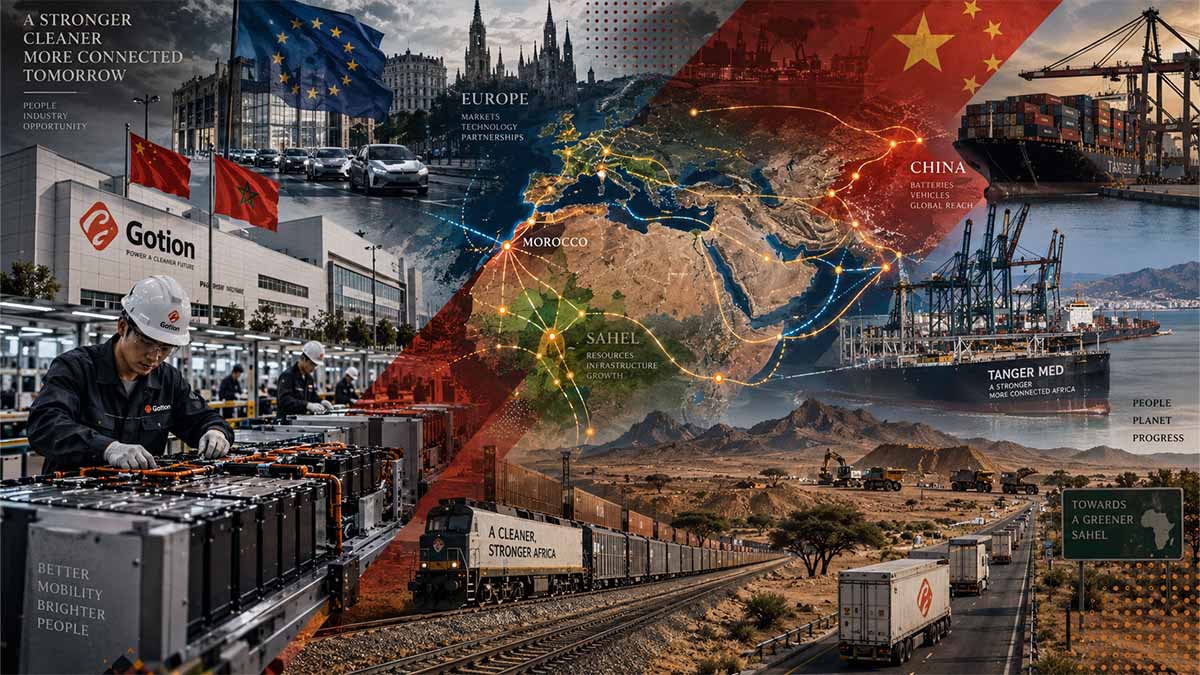
The resulting geometry is therefore not simply “China exporting EVs to Europe”; it is increasingly China participating at multiple layers of the Euro-African mobility value chain—from lithium extraction in Mali, through battery materials in Morocco, to cell production and vehicle manufacturing inside the European Union.
The decisive policy question for Europe is no longer whether Chinese industrial presence can be prevented, because significant localisation is already occurring, but which strategic layers Europe retains technological, governance and supply-chain control over when Chinese firms become embedded partners in European production.
China Is No Longer Exporting Cars to Europe. It Is Entering the Factory
Europe’s automotive contest with China is moving beyond customs policy. Chinese-associated manufacturers accounted for about 15% of electric-vehicle registrations in the European Economic Area in 2024, against roughly 4% in 2021, while the number of Chinese models represented rose from 58 to 130. Yet by 2025 only around 20% of battery-electric cars sold in the EU were imported from China. The apparent contradiction is the point: Chinese competitive power is increasingly entering Europe through factories, joint ventures, battery plants, procurement networks and technology partnerships rather than exclusively through imported vehicles. For European governments, the fiscal question is therefore no longer confined to tariffs; for manufacturers, the industrial question is who controls technology; and for Brussels, the security question is whether production located in Europe is sufficient when the underlying manufacturing stack remains externally concentrated.
Tariffs hit imports; localisation changes the object of competition
The European Union imposed definitive countervailing duties on Chinese battery-electric vehicles from 30 October 2024, setting rates of 17.0% for BYD, 18.8% for Geely and 35.3% for SAIC, with other cooperating producers generally subject to 20.7% and Tesla receiving 7.8% after individual examination. The instrument responded to subsidised imports, but it does not address a Chinese-owned battery cell manufactured in Hungary, a Chinese technology platform assembled in Spain or components supplied through a Chinese-European joint procurement system. The distinction became explicit in January 2026, when the European Commission allowed future EU investment to form part of price-undertaking proposals, and again on 10 February 2026, when it accepted an undertaking from Volkswagen Anhui for the CUPRA Tavascan that combined minimum-price and volume conditions with commitments to significant BEV-related investment inside the Union.
That regulatory evolution changes the policy problem. At the border, Brussels can impose a countervailing duty; once manufacturing moves inside the Union, the relevant instruments become industrial policy, competition law, investment screening, battery regulation and procurement governance. The same Chinese company can therefore face a tariff when exporting a completed vehicle while benefiting from European localisation when investing in production. In December 2025, the Commission’s Automotive Package included a €1.8 billion Battery Booster, of which €1.5 billion was structured as interest-free lending support for European battery-cell producers. European public money is thus being mobilised to rebuild domestic capacity at the same time as Chinese companies are supplying part of the technology, capital and manufacturing capability required to make that capacity commercially viable.
Volkswagen and Gotion show why majority ownership is no longer enough
Volkswagen’s relationship with Gotion illustrates the depth of the shift. In May 2020, Volkswagen announced approximately €1.1 billion of investment to acquire 26% of Gotion High-Tech, becoming its largest shareholder at the time; in July 2021, Gotion became a technology partner for cell industrialisation linked to Volkswagen’s Salzgitter strategy. By September 2026, the relationship had moved from equity investment and technical cooperation to a proposed three-site production architecture covering Valencia, Šurany and Kenitra, alongside joint European procurement and sales activity. Valencia would remain 51% PowerCo and 49% Gotion, while Šurany and Kenitra would reverse the structure to 51% Gotion and 49% PowerCo.
The capital flows are equally revealing. Gotion is expected to contribute approximately €1.1 billion for its 49% participation in Valencia, while PowerCo is expected to contribute approximately €470 million by 2030 for its stakes in the Slovak and Moroccan ventures. Volkswagen also plans to dispose of 5.3% of its economic interest in Gotion while preserving the voting rights it currently exercises and maintaining its board representation and nomination rights. That separation between financial ownership and governance influence matters: the relevant question is not simply who owns 51%, but who controls cell chemistry, manufacturing recipes, production equipment, process data, supplier qualification and the next generation of R&D. The disclosed agreements do not establish the full allocation of those control points.
CATL has already turned localisation into industrial scale
CATL represents a more direct model because it does not require a European automotive shareholder to establish manufacturing inside the Union. Its Thuringia plant in Germany began serial cell production in December 2022, with regulatory approval for an initial 8 GWh, planned capacity of 14 GWh, investment of up to €1.8 billion and an employment objective of as many as 2,000 people. CATL described the localisation process as combining German suppliers and research relationships with Chinese specialists in technology, process and management. The factory therefore transfers more than physical output: it imports an established manufacturing system and then surrounds it with European labour and suppliers.
Hungary shows the scale of the second phase. CATL began trial cell production at Debrecen on 22 September 2026 after already producing 537,000 battery modules there since autumn 2024. The planned complex is designed to reach 100 GWh, more than seven times the planned capacity of the German installation. Once cells are manufactured in Debrecen for European vehicle plants, a tariff on China-built BEVs no longer addresses that segment of Chinese industrial participation. European production capacity rises, logistics shorten and OEM supply becomes more resilient geographically, but ownership of process technology can remain Chinese.
Spain is becoming the preferred laboratory for Chinese-European industrial integration
Spain hosts three different localisation models simultaneously. In 2024, Chery and EV Motors agreed to restart vehicle production at the former Nissan complex in Barcelona’s Zona Franca, with an announced programme of about €500 million, more than 1,000 jobs and a long-term ambition of 150,000 vehicles in 2029. Production restarted in November 2024, and by 2026 the EBRO plant described production of the S400, S700, S800 and S900 with an objective of approximately 30,000 units during 2026 and 50,000 in the medium term. In April 2026, Chery added a European Operations Center and Spanish R&D presence in Barcelona after reporting entry into 18 European markets and more than 100,000 regional users.
The Stellantis–Leapmotor structure goes further because it can move Chinese technology across brand boundaries. Stellantis invested approximately €1.5 billion in 2023 for roughly 20–21% of Leapmotor and two board seats, while the two companies created Leapmotor International as a 51% Stellantis/49% Leapmotor venture with exclusive rights outside Greater China for manufacturing, exports and sales. On 8 May 2026, the companies proposed producing the Leapmotor B10 at Zaragoza alongside a battery-electric Opel C-SUV, with the Opel potentially using components supplied through the Leapmotor International ecosystem. They also envisaged broader joint purchasing and possible future Leapmotor production at Villaverde in Madrid from the first half of 2028.
That changes the industrial transmission mechanism. A Chinese company no longer needs an independent European factory network if a European multinational provides plants, purchasing power, regulatory capacity, logistics and dealerships. Conversely, Stellantis gains access to a vertically integrated Chinese EV platform and component ecosystem without reproducing every capability internally. The proposed Villaverde structure went so far as to contemplate possible transfer of the factory to the Spanish subsidiary of Leapmotor International, although the 8 May 2026 announcement remained subject to feasibility work, definitive agreements and approvals.
Europe’s public money and Chinese industrial capability are meeting in the same factories
The contradiction for European industrial policy is now visible in the geography of investment. Spain hosts PowerCo–Gotion at Valencia, Chery–EBRO in Barcelona and Leapmotor–Stellantis at Zaragoza, with Villaverde under consideration; Germany hosts CATL in Thuringia and Volkswagen’s long-term Gotion relationship; Hungary hosts CATL’s planned 100 GWh Debrecen complex; and Slovakia hosts the Gotion–PowerCo structure at Šurany. These are not identical investments, but together they show that European electrification is being financed and industrialised through overlapping national bargains with Chinese companies rather than through a single Union-wide model of technological autonomy.
The corporate logic is difficult to dismiss because European manufacturers require cheaper batteries and shorter development cycles. Volkswagen expects LFP chemistry to rise from approximately 10% of the European market to 40–60% by 2030, while acknowledging that Europe currently lacks relevant LFP production capacity. Stellantis has described Leapmotor’s vertically integrated technology and cost structure as complementary to its own global manufacturing and commercial footprint. Refusing those capabilities raises cost and execution risk; absorbing them accelerates electrification but increases the importance of knowing who controls chemistry, process engineering, production data and suppliers.
The next 24 months will decide whether localisation becomes learning or dependency
Between now and 2028, the decisive evidence will come from implementation rather than announcements: CATL’s Debrecen ramp, the final Gotion–PowerCo contractual allocation of technology and intellectual property, the depth of localisation at Chery–EBRO, and whether the Stellantis–Leapmotor plans for Zaragoza and Villaverde become binding industrial commitments. The documents currently available do not establish detailed technology-licensing provisions for the Gotion–PowerCo ventures, supplier-origin data for CATL’s European plants, detailed local-content ratios for Chery–EBRO or definitive agreements for the proposed Leapmotor expansion. Those gaps determine whether European factories accumulate independent engineering capability or merely provide geographically local production for externally controlled technology.
The cost of inaction over the next 12–24 months will therefore fall first on European battery producers that fail to reach competitive scale, then on national automotive systems that capture assembly but not chemistry, process engineering or supplier control, and finally on governments financing electrification without securing corresponding technological capability. Italy is particularly exposed if Spain and Central Europe continue to absorb new EV and battery capital while Italian plants receive a smaller share of electrification investment; France faces the cost problem if nationally anchored production cannot match Chinese-linked European supply; Germany must determine whether partnership generates transferable know-how rather than durable dependence. Europe does not have to choose between Chinese technology and industrial isolation. It does have to decide what portion of the production system it intends to control after the factories have been built.
Navigational Index
Pillar I — China Moves from Export Penetration to Embedded European Production
Gotion–Volkswagen, CATL, Chery, Leapmotor and the transformation of trade competition into localisation, joint production, technology integration and European manufacturing.
Pillar II — Morocco Becomes the Cross-Mediterranean Battery-Manufacturing Interface
Kenitra, Tanger Tech and Jorf Lasfar as increasingly important locations for Chinese-linked battery cells, cathode materials, anodes and precursor chemistry serving European and global markets.
Pillar III — The Sahel Emerges as the Upstream Resource Layer of a Wider Chinese Battery Ecosystem
Mali’s Goulamina and Bougouni lithium projects, Chinese ownership and offtake structures, West African logistics corridors and the implications for European critical-mineral autonomy.
Master Abstract
The Gotion transaction reveals a deeper transition in Europe’s relationship with Chinese automotive industry
The significance of the PowerCo–Gotion agreement lies less in the nominal 49% Chinese shareholding contemplated at Valencia than in the fact that the transaction institutionalises Chinese participation inside a European battery-production architecture already connected directly to Volkswagen’s vehicle factories. Volkswagen confirmed on 28 September 2026 that the proposed cooperation extends across three industrial sites—Valencia, Šurany and Kenitra—and includes not only manufacturing but also joint procurement and sales activities in Europe, making the arrangement materially broader than a conventional minority financial investment. Valencia is intended to become a European LFP-cell hub under PowerCo majority ownership, Šurany is intended to manufacture LFP cells under Gotion majority ownership, and Kenitra is intended to produce LFP cathode material under the same 51% Gotion/49% PowerCo configuration. Volkswagen Group
This is important because LFP chemistry sits directly at the affordability frontier of the European EV market. Volkswagen itself states that European LFP penetration could rise from around 10% currently to 40–60% by 2030, while acknowledging that Europe presently lacks relevant LFP cell-production capacity. Volkswagen Group The commercial logic is therefore strong: European manufacturers need cheaper batteries to compete in mass-market electric vehicles, while Chinese battery firms possess industrial scale, mature LFP know-how, established supply chains and manufacturing experience that Europe has not replicated at comparable speed. The resulting convergence creates a strategic paradox: localisation strengthens physical production in Europe while potentially institutionalising Chinese technological influence within the very supply chains European industrial policy seeks to make more autonomous.
That paradox is already visible elsewhere. CATL began serial cell production at its German facility in Thuringia in 2022 and planned total capacity of 14 GWh there, while its Debrecen complex in Hungary—where trial cell production began on 22 September 2026—is designed ultimately for 100 GWh, making it CATL’s largest production base outside China when completed. CATL CATL originally announced approximately €7.34 billion of investment for Debrecen and explicitly located the plant near European customers including Mercedes-Benz, BMW, Stellantis and Volkswagen. CATL The industrial pattern is consequently broader than Gotion: Chinese battery groups increasingly serve European OEMs from production capacity physically situated inside the European industrial perimeter.
Vehicle manufacturing is moving in the same direction. Chery states that its partnership with Spain’s EV Motors revived the EBRO brand and Barcelona manufacturing operations, while Stellantis and Leapmotor have gone significantly further institutionally: Stellantis acquired approximately 21% of Leapmotor, established Leapmotor International as a 51% Stellantis/49% Leapmotor joint venture, and reported in May 2026 that the companies were assessing deeper manufacturing integration at Zaragoza and additional Leapmotor production at Villaverde in Madrid. Chery International This demonstrates that the European response to Chinese competition is becoming simultaneously defensive and collaborative: the EU maintains countervailing duties on China-made BEVs, while individual European industrial groups increasingly form partnerships through which Chinese technology and products are localised inside Europe.
The European Commission’s own policy trajectory confirms the tension. Definitive countervailing duties of 7.8% to 35.3% were imposed from 30 October 2024 after the Commission concluded that China’s BEV value chain benefited from subsidisation creating a threat of economic injury to EU producers. European Commission Yet by January 2026 the Commission’s guidance on potential price undertakings explicitly identified future investment in the EU as one of the factors that could form part of negotiated arrangements with Chinese exporters. Trade and Economic Security The boundary between trade defence and industrial localisation is therefore becoming increasingly porous.
Sagunto is becoming a test case for the difference between ownership sovereignty and technology sovereignty
PowerCo’s retention of 51% at Valencia matters because it preserves formal corporate control, and Volkswagen states that PowerCo and Gotion would jointly manage the project. Volkswagen Group That configuration differs substantially from a Chinese-controlled acquisition of a European strategic asset, and it would be analytically incorrect to describe Sagunto simply as a Chinese takeover. Nevertheless, ownership percentage alone does not establish technological sovereignty, because battery production depends on process engineering, chemistry, intellectual property, equipment specifications, precursor materials, qualification procedures, manufacturing yield, supplier relationships and accumulated production data.
The chronology also shows how rapidly the industrial concept is changing. When construction was launched in 2023, Volkswagen described Valencia as a PowerCo facility with 40 GWh of initial annual capacity, expandable to 60 GWh, and more than 3,000 future jobs. Volkswagen Group The Spanish government subsequently continued to describe the project in July 2025 as an approximately €3 billion investment supported by more than €260 million of PERTE VEC assistance. mintur.gob.es
The user-supplied proposition that the revised first phase is now approximately 30 GWh, more than 1,500 direct jobs and a 2027 production start cannot presently be reproduced as an established official fact from the latest first-order documents retrieved in this assessment. Volkswagen’s 28 September 2026 announcement states instead that Valencia’s previously announced investment and employment measures remain in place, without restating those three revised values. Volkswagen Group PowerCo’s currently accessible careers material still carries the older description of more than €3 billion and more than 3,000 direct jobs. careers.powerco.de The discrepancy is material and should remain open until PowerCo, Volkswagen, the Spanish authorities or a regulatory filing publishes a revised plant specification.
What is already clear, however, is that Gotion would gain industrial access to one of Europe’s most strategically important mass-market battery programmes while PowerCo would gain access to Gotion-linked capacity and experience in LFP manufacturing. This is therefore best understood as reciprocal industrial interdependence rather than unilateral Chinese control.
Slovakia extends the same model further east, but with Chinese majority ownership
The Šurany component of the arrangement is strategically different from Valencia because Gotion is intended to hold 51%, while PowerCo would acquire 49%. Volkswagen Group Long before the new Volkswagen agreement, the Slovak government had already designated the underlying Gotion–InoBat investment as one of the largest industrial projects in the country, originally identifying approximately €1.2 billion of investment, 1,311 jobs, an initial production capacity of 20 GWh and potential future expansion toward 40 GWh. economy.gov.sk
The Slovak government documentation also records a maximum approved investment-aid package of approximately €214 million, including €150 million in capital grants and €64 million in income-tax relief. rokovania.gov.sk The policy implication is significant: Chinese battery manufacturing is not merely entering Europe despite European governments; in several jurisdictions it is being incorporated into national industrial policy because governments regard battery investment as necessary to preserve domestic automotive competitiveness.
Šurany therefore illustrates the core European dilemma particularly clearly. Slovakia has one of Europe’s most automotive-intensive manufacturing economies and must ensure that its combustion-era production base survives the transition to electric vehicles. At the same time, the technology platform supporting that transition increasingly involves a Chinese battery partner. Industrial continuity and strategic autonomy are not automatically aligned.
Morocco is becoming much more than an automotive assembly platform
The Kenitra cathode-material venture is particularly important because it places Morocco between European vehicle manufacturing and African or global raw-material flows. Volkswagen states that the proposed Kenitra joint venture would manufacture LFP cathode material, with Gotion holding 51% and PowerCo 49%, explicitly describing the plant as an instrument to diversify sourcing and expand the regional battery value chain. Volkswagen Group
This project does not stand alone. Morocco signed a strategic agreement with Gotion in June 2024 for an integrated battery ecosystem in Kenitra involving an initial 12.8 billion dirham investment and initial capacity of up to 20 GWh. cg.gov.ma Chinese BTR New Material Group is simultaneously developing cathode and anode projects at Mohammed VI Tanger Tech; Morocco’s investment ministry reported in May 2026 that those projects represented a combined investment of approximately 6 billion dirhams, more than 1,150 expected direct jobs, and production planned during 2026. micepp.gov.ma
A further layer is being developed at Jorf Lasfar through COBCO, the partnership between Moroccan AL MADA and Chinese battery-material producer CNGR. Morocco’s Ministry of Industry states that the project is intended ultimately to reach 120,000 tonnes per year of NMC precursor material and 60,000 tonnes per year of LFP cathode material, with output aimed principally at European and North American battery markets. Ministero della Cultura
The aggregate picture is therefore much more consequential than a single gigafactory. Chinese and Chinese-linked companies are participating in cells, cathodes, anodes, precursor chemistry, aluminium components and automotive manufacturing inputs inside Morocco, while Morocco already possesses major vehicle-assembly and export infrastructure. This creates the conditions for the country to operate as a low-cost, geographically proximate battery-material and automotive-production platform connected to the EU by short maritime routes and preferential trade architecture.
For Europe, Morocco can consequently serve simultaneously as a diversification partner and an indirect channel for Chinese industrial embedding. These two interpretations are not mutually exclusive.
The Sahel layer is upstream rather than manufacturing-led
The evidence does not support describing the Sahel today as a Chinese EV-manufacturing platform comparable to Central Europe or Morocco. What is occurring instead is potentially more fundamental: Chinese companies are securing positions in the mineral feedstocks needed by the battery economy, with Mali providing the clearest documented case.
In May 2024 the Malian government concluded a renegotiated agreement governing the Goulamina lithium project under its 2023 mining code, raising the combined participation of the state and Malian nationals to 35% while establishing Ganfeng Lithium as the principal Chinese industrial partner. finances.ml Lithium du Mali subsequently identified its ownership structure as 65% Ganfeng and 35% Malian state, while Ganfeng’s own global-resources disclosure lists Goulamina among its major overseas spodumene assets. lithiumdumali.ml
The logistics chain is particularly revealing. Lithium du Mali reported that commercial export movements began in April 2025, with trucks carrying spodumene to Abidjan, from where Ganfeng-chartered maritime transport moved the material toward China for additional processing into lithium products. lithiumdumali.ml Ganfeng’s 2025 annual report subsequently recorded 336,600 tonnes of concentrate production at Goulamina and confirmed that the first shipment to China occurred during 2025. HKEX News
Mali’s second major lithium project at Bougouni reinforces the pattern. The Malian Ministry of Mines identifies the project as a China–Mali–United Kingdom cooperation structure and states that the two Malian lithium mines together were expected to produce approximately 590,587 tonnes of spodumene concentrate in 2026. mines.gouv.ml Hainan Mining controls 51% of Kodal Mining UK, while the Malian state holds a direct 35% interest in the local operating company; Kodal disclosed that Hainan Mining is the exclusive purchaser of 100% of Stage-1 DMS production for four years. HKEXNews
The critical strategic point is therefore the destination of value addition. Mali increasingly produces the raw or concentrated lithium feedstock, but significant downstream conversion remains linked to Chinese industrial capacity. Kodal’s corporate disclosures state that Bougouni output supplies Hainan’s battery-grade lithium-hydroxide plant in China, while Goulamina material likewise travels toward Chinese conversion facilities. Kodal Minerals
The Sahel dimension of the Chinese automotive advance is consequently not yet primarily the sale or manufacture of cars. It is the establishment of long-duration positions in the mineral, logistics and commercial infrastructure supporting the battery economy.
Key Evidence Table
| Indicator | Value / status | Reference date | Definition / scope | Issuer | Exact source |
|---|---|---|---|---|---|
| Valencia ownership proposed | PowerCo 51%; Gotion 49% | 28 Sep 2026 | LFP battery-cell JV | Volkswagen Group | Volkswagen Group, PowerCo and Gotion deepen strategic partnership |
| Gotion Valencia contribution | Approx. €1.1bn | 28 Sep 2026 | Consideration/investment for proposed 49% stake | Volkswagen Group | Volkswagen Group announcement |
| Šurany + Kenitra PowerCo contribution | Approx. €470m by 2030 | 28 Sep 2026 | PowerCo contribution for 49% stakes | Volkswagen Group | Volkswagen Group announcement |
| Sagunto public support | More than €260m PERTE VEC | Jul 2025 | Spanish industrial support accumulated for project | Spanish Ministry of Industry and Tourism | Spanish Ministry of Industry — Sagunto visit |
| Šurany initial capacity | 20 GWh, potential 40 GWh | 2024–25 | Planned LFP-cell plant | Slovak Ministry of Economy | Slovak Ministry of Economy — Gotion/InoBat investment |
| Šurany public aid | Up to €214m | 2025 | Grant + tax relief | Slovak government | Šurany Industrial Park government report |
| CATL Debrecen | 100 GWh planned total capacity | Sep 2026 | Chinese battery-cell production in Hungary | CATL | CATL Debrecen trial operations |
| Morocco BTR battery materials | MAD 6bn, >1,150 direct jobs | May 2026 | Cathode + anode projects | Moroccan Investment Ministry | BTR Tangier Tech steering committee |
| Morocco Gotion battery ecosystem | Initial MAD 12.8bn, up to 20 GWh | Jun 2024 | Integrated EV battery ecosystem | Moroccan Government | Gotion strategic investment agreement |
| Goulamina ownership | 65% Ganfeng / 35% Mali | 2024–26 | Mali spodumene mine | Lithium du Mali / Mali government | Lithium du Mali — Goulamina mine |
| Goulamina 2025 production | 336,600 tonnes concentrate | FY2025 | Dry-basis lithium concentrate | Ganfeng Lithium | Ganfeng Lithium 2025 Annual Report |
| Bougouni Stage-1 offtake | 100% to Hainan Mining | Jun 2025 | Four-year exclusive offtake | Kodal Minerals | Bougouni Lithium Project Off-Take Agreement |
| EU China-BEV duties | 7.8–35.3% | Since 30 Oct 2024 | Definitive countervailing duties | European Commission | EU definitive BEV countervailing duties |
What the evidence indicates for Europe
The principal transformation is from external competition to internalised competition. The first phase of Chinese automotive expansion into Europe was dominated by imports, price competition and concerns over state-supported industrial scale; the second phase increasingly consists of production localisation, European joint ventures, European employment, European public subsidies, European distribution networks and Chinese technology embedded within nominally European value chains.
That model is visible through several different institutional configurations rather than one uniform pattern. CATL uses wholly or strongly Chinese-controlled European battery manufacturing; Gotion increasingly uses joint ventures with European or European-linked partners; Chery entered Spanish production through EBRO; and Leapmotor internationalisation relies on the industrial, commercial and dealer infrastructure of Stellantis. CATL
This produces a more difficult policy problem than tariffs alone can solve because customs measures operate primarily at the border, whereas localisation changes the legal and industrial identity of the product. A battery cell manufactured in Slovakia or Spain by a locally incorporated joint venture is part of European industrial output even when substantial technology, process knowledge or capital originates in China.
The Commission has responded by attempting to rebuild indigenous industrial depth. Its December 2025 Automotive Package included a €1.8 billion Battery Booster, of which €1.5 billion is allocated as interest-free lending support for European battery-cell producers, explicitly in support of a more resilient EU battery value chain. Mobility and Transport The existence of that programme itself confirms that policymakers recognise that vehicle assembly without control of cell technology and battery materials leaves a major strategic vulnerability unresolved.
Italy, France, Germany and the United Kingdom
Germany
Germany is simultaneously the European state most directly challenged by Chinese automotive competition and one of the states most deeply integrated with Chinese battery production. CATL’s Thuringia plant already produces cells, Volkswagen remains a strategic shareholder and industrial partner of Gotion, and German OEMs have extensive commercial and manufacturing exposure to China. CATL
The Gotion arrangement therefore should not be interpreted merely as German dependence; it also reflects Volkswagen’s attempt to internalise a technology that is increasingly essential to affordable EV production while retaining corporate control at Valencia and continued governance rights inside Gotion itself. Volkswagen stated that the proposed disposal of 5.3% of its economic stake in Gotion would not reduce the voting rights it exercises and would not alter its board representation and nomination rights. Volkswagen Group
France
France currently has stronger policy incentives to preserve a domestically anchored battery ecosystem, but the same economic pressure applies: affordable European EVs require cost structures increasingly associated with LFP technology, and Chinese suppliers possess substantial scale advantages. The central French exposure is therefore not necessarily direct Chinese ownership of a flagship French battery plant but competitive pressure throughout the European market and the possibility that French OEMs and suppliers increasingly procure from Chinese-controlled or Chinese-partnered European capacity.
For France, the strategic distinction to monitor is whether European localisation of Chinese technology remains supplier diversification or evolves into technological dependence at chemistry, manufacturing-equipment, precursor-material or cell-design level.
Italy
Italy is comparatively weaker in large-scale cell manufacturing and therefore potentially more exposed to decisions taken elsewhere in the European value chain. The Stellantis–Leapmotor model is especially relevant because it demonstrates how a European-headquartered automotive group can become a vehicle for internationalising Chinese platforms, procurement structures and vehicle technologies. Stellantis reported more than 40,000 Leapmotor shipments in Europe during 2025 and an expanding manufacturing partnership in Spain. Stellantis.com
Italy’s principal risk is consequently not necessarily the arrival of one dominant Chinese gigafactory, but a gradual shift in the technological centre of gravity of mass-market electric mobility away from national production ecosystems toward trans-European platforms combining European brands, Chinese technology and manufacturing nodes outside Italy.
United Kingdom
The United Kingdom sits outside the EU trade-defence and state-aid framework, which creates a different policy geometry. Chinese manufacturers can approach the British market through imports, distribution, potential localisation and partnership structures without being governed by the EU’s internal industrial-policy instruments, although UK national-security, subsidy-control and investment-screening mechanisms remain relevant.
The key British strategic issue is therefore whether future Chinese localisation enters through vehicle assembly, battery manufacturing, technology licensing or infrastructure ecosystems, and whether UK industrial policy can capture sufficient domestic value added rather than becoming primarily an end market for technologies developed and manufactured elsewhere.
Principal Gaps and Watch Indicators
The first unresolved issue is the definitive revised industrial specification for Valencia. The latest Volkswagen announcement confirms the ownership and financial architecture but does not independently establish the reported reduction to 30 GWh, approximately 1,500 direct jobs or the reported revised 2027 operating schedule. A revised PowerCo industrial plan, environmental authorisation, construction filing, Spanish government decision or Gotion shareholder circular would materially resolve this issue.
A second watch point is the precise technology and intellectual-property allocation between PowerCo and Gotion across Valencia and Šurany. Formal majority ownership by PowerCo at Valencia is important, but technological sovereignty depends on which partner controls cell chemistry, manufacturing recipes, process equipment, production data, quality qualification and future upgrades.
A third indicator is the source of cathode feedstock for Kenitra. If the Moroccan LFP-material plant uses predominantly Chinese-origin upstream inputs, the project will geographically relocate part of the value chain without necessarily diversifying the underlying dependency. If Morocco or alternative African suppliers become meaningful sources of phosphate, lithium, manganese or associated materials, the supply-security effect would be different.
A fourth indicator is whether Malian lithium begins to undergo substantial conversion in Africa rather than being exported primarily as concentrate. The present Goulamina and Bougouni structures confirm mining and beneficiation in Mali but still show strong Chinese control over downstream offtake and conversion. lithiumdumali.ml
A fifth indicator is whether Chinese battery and automotive investors begin connecting Mali–West Africa–Morocco–Europe through explicit commercial or logistics arrangements. The public record currently supports the individual nodes but does not yet establish a single vertically integrated China-controlled corridor running directly from Malian lithium into Gotion’s Moroccan or European facilities.
A sixth indicator is the European Union’s evolving definition of “European” battery production. A central future regulatory question will be whether industrial-support mechanisms distinguish only by manufacturing location or also by ownership, intellectual property, origin of strategic inputs, control over production processes and dependency on non-EU technology.
Net Assessment
The most defensible interpretation of the current evidence is that China’s automotive expansion is entering a second, structurally deeper phase.
The first phase was visible and politically easy to identify because it consisted of Chinese-made vehicles and batteries entering European markets as imports. The second phase is more complex because it involves Chinese industrial capabilities entering European and neighbouring production systems through joint ventures, minority and majority holdings, manufacturing localisation, technology partnerships, procurement alliances, local employment and public investment support.
Gotion’s emerging relationship with Volkswagen illustrates this transition particularly clearly. Valencia would remain majority-controlled by PowerCo, but Gotion would become an embedded industrial partner in a plant designed to supply European mass-market electric vehicles. Šurany would invert that control structure, with Gotion holding the majority while PowerCo enters the Chinese-linked facility. Kenitra would extend the same relationship to cathode materials outside the EU but immediately adjacent to European logistics and automotive production. Volkswagen Group
Morocco is therefore becoming the industrial hinge between European demand and a Chinese-influenced battery-material ecosystem, while Mali demonstrates how the upstream layer of that ecosystem is expanding into the Sahel through control of lithium production and offtake.
The result is not yet a single centrally controlled Chinese Europe–Africa automotive corridor, and the evidence does not support presenting it as such. What is already observable is something more nuanced and potentially more durable: a network of individually negotiated commercial structures that, when viewed together, progressively increases Chinese participation across raw materials, battery chemistry, cell manufacturing, vehicle technology, production systems and European distribution.
Europe is responding with tariffs, critical-material legislation, battery subsidies and industrial-policy instruments, but Chinese firms are simultaneously adapting by moving investment and production inside the regulatory perimeter. The European Commission’s Critical Raw Materials Act classifies battery-grade lithium, manganese, graphite and nickel among strategic raw materials, while its Battery Booster attempts to accelerate European cell manufacturing; these policies reveal that European institutions increasingly regard the problem as one of industrial capacity and value-chain control rather than trade balance alone. Eur-Lex
The central strategic tension through 2031 will consequently be between two forms of resilience: resilience through localisation, in which Europe accepts Chinese capital and technology to accelerate domestic battery production, and resilience through autonomous capability, in which Europe attempts to retain independent control over technology, materials, industrial equipment and strategic decision-making. The two objectives can overlap, but the current Gotion–Volkswagen architecture demonstrates that they are not identical.
No decision-useful visualisation should yet portray Mali, Morocco, Slovakia and Spain as a proven vertically integrated material flow, because the public record establishes the individual industrial nodes but does not yet establish that Goulamina or Bougouni lithium physically feeds the Gotion–PowerCo facilities. Representing such a flow as established would exceed the evidence.
China’s Automotive Advance Across Europe, Morocco and the Sahel
The verified evidence indicates that Chinese automotive expansion is moving beyond the export of finished electric vehicles and toward a multi-layer industrial presence involving battery technology, European manufacturing, Moroccan battery-material capacity and upstream African lithium extraction. The architecture below separates confirmed industrial relationships from connections that remain analytically plausible but are not yet demonstrated by public evidence.
Goulamina — Mali
65% Ganfeng 35% Mali 336,600 t in 2025Ganfeng is the controlling industrial partner in the Goulamina lithium operation. Commercial spodumene exports began through Abidjan, with material moving toward China for downstream conversion.
Bougouni — Mali
Hainan-linked 100% Stage-1 offtakeHainan Mining is the exclusive purchaser of Stage-1 production under the disclosed four-year offtake arrangement, tying Malian lithium output directly to a Chinese downstream industrial buyer.
Kenitra — Gotion / PowerCo
Gotion 51% PowerCo 49%Proposed LFP cathode-material joint venture forming the southern industrial component of the wider Gotion–PowerCo partnership.
Gotion Morocco Battery Ecosystem
MAD 12.8 bn initial Up to 20 GWhMorocco is developing a broader Gotion-linked battery ecosystem at Kenitra that strengthens the country’s role as a near-European battery manufacturing platform.
BTR — Tanger Tech
Cathodes Anodes MAD 6 bnChinese BTR investments add cathode and anode capacity, extending Morocco from vehicle assembly toward higher-value battery-material manufacturing.
COBCO — Jorf Lasfar
120,000 t NMC precursor 60,000 t LFP cathodeThe AL MADA–CNGR-linked industrial platform creates an additional Chinese-connected battery-material node serving European and international markets.
Valencia / Sagunto — Spain
PowerCo 51% Gotion 49% ~€1.1 bn GotionPowerCo retains majority control while Gotion becomes an embedded industrial partner in European LFP-cell production connected to Volkswagen’s mass-market EV strategy.
Šurany — Slovakia
Gotion 51% PowerCo 49% 20 GWh initialHere the governance structure reverses: Chinese majority ownership is combined with a European strategic partner inside the EU manufacturing system.
CATL — Germany & Hungary
Thuringia Debrecen 100 GWh Hungary targetCATL demonstrates that the Chinese localisation model already extends well beyond Gotion, with major cell-production capacity physically embedded within the European market.
Chery / Leapmotor / European OEMs
Vehicle localisation JV structuresChinese automotive penetration increasingly uses European assembly, joint ventures, distribution networks and OEM partnerships rather than relying solely on imports from China.
Emerging Value-Chain Geometry
Bougouni
Hainan Mining
Anodes
Precursors
Slovakia
Hungary
Germany
Stellantis
Others
Phase One — Export Penetration
Chinese EV and battery manufacturers initially challenged European producers primarily through imported vehicles, imported cells and lower production costs generated by large-scale Chinese industrial ecosystems.
Phase Two — Industrial Localisation
Chinese capital, manufacturing expertise and battery technology are increasingly entering European and near-European production through local factories, joint ventures and technology-sharing structures.
Phase Three — Strategic Interdependence
Europe gains local production and employment while Chinese firms gain durable positions inside European supply chains, making the distinction between domestic manufacturing and technological sovereignty increasingly important.
Germany
Volkswagen–Gotion and CATL exposure place Germany at the centre of both European resistance to Chinese competition and industrial cooperation with Chinese battery champions.
France
France faces pressure to preserve nationally anchored battery capacity while benefiting from lower-cost LFP chemistry and a rapidly regionalising European battery market.
Italy
Italy risks losing relative industrial weight if battery-cell investment, Chinese localisation and mass-market EV platforms consolidate primarily in Spain, Central Europe and Morocco.
United Kingdom
Outside the EU trade-defence regime, the UK faces a distinct localisation question centred on whether future Chinese investment produces genuine domestic industrial value or mainly expands market access.
Decision-Critical Watch Indicators
confirmation of final capacity, employment and operational start date.
ownership of LFP chemistry, manufacturing recipes, process data and future cell upgrades.
origin of lithium, phosphate and precursor inputs entering Moroccan cathode production.
whether lithium conversion begins moving from China toward Africa.
any contract linking Mali output directly with Moroccan or European battery plants.
whether European support rules begin differentiating manufacturing location from ownership and technology control.
Principal Sources
- Volkswagen Group — Volkswagen Group, PowerCo and Gotion deepen strategic partnership — September 2026
- Slovak Ministry of Economy — Gotion / InoBat battery investment in Šurany
- Government of Morocco — Gotion strategic battery investment agreement
- Moroccan Ministry of Investment — BTR projects at Tanger Tech
- Moroccan Ministry of Industry — COBCO battery-material project
- Ganfeng Lithium — 2025 Annual Report
- Kodal Minerals — Bougouni Lithium Project Off-Take Agreement
- European Commission — Definitive countervailing duties on battery electric vehicles from China
Pillar I — China Moves from Export Penetration to Embedded European Production
Principal Judgment
China’s automotive advance in Europe has entered a qualitatively different phase in which the strategic variable is no longer simply the volume of Chinese vehicles crossing the European border, but the progressive incorporation of Chinese capital, battery chemistry, manufacturing processes, component ecosystems, vehicle platforms and vertically integrated procurement structures into production located physically inside Europe. The distinction is fundamental because conventional trade-defence instruments operate most directly against imports, whereas localisation transforms Chinese industrial competition into a problem of ownership, technological control, supplier dependence and value-chain governance inside the European manufacturing perimeter.
The transformation is already measurable. European Commission Joint Research Centre analysis published in March 2026 found that vehicles associated with Chinese manufacturers accounted for approximately 15% of electric-vehicle registrations in the European Economic Area in 2024, compared with approximately 4% in 2021, while the number of Chinese manufacturers represented in the market rose from 19 to 25 and the number of models from 58 to 130 during the same period. In trade terms, China accounted for approximately 55% of the value of EU BEV imports in 2024, according to Eurostat and Commission analysis.
Yet the import figure alone increasingly gives an incomplete picture. European Commission material published in June 2026 states that only around 20% of fully electric cars sold in the EU in 2025 were imported from China, including both Chinese and non-Chinese brands, while a clear majority of BEVs sold in the Union were produced inside the EU. That apparent contradiction is analytically important: Chinese competitive influence is increasingly being transmitted not simply through vehicles arriving from Chinese ports, but through European production partnerships, European-incorporated joint ventures, Chinese-controlled battery factories, local assembly, technology transfer and cross-border procurement structures.
The evolution visible through Gotion–Volkswagen, CATL, Chery–EBRO and Leapmotor–Stellantis therefore represents four distinct models of Chinese industrial embedding rather than four examples of the same phenomenon. Gotion is entering reciprocal ownership and technology-sharing structures with a major European OEM; CATL is constructing Chinese-controlled production capacity directly inside Europe; Chery is using an industrial partnership to reactivate European manufacturing capacity and establish an operational European base; Leapmotor is using the industrial, procurement and distribution infrastructure of a European multinational to internationalise Chinese vehicle technology. The common denominator is localisation, but the location of corporate control and technological leverage differs substantially.
The Competitive Baseline Has Changed from Import Penetration to Industrial Presence
China’s competitive position cannot be understood through Chinese-brand registrations alone because Chinese manufacturing now intersects with European brands, European ownership structures and European production assets. The Commission’s JRC explicitly includes both wholly Chinese manufacturers and partially Chinese or joint-ownership structures when analysing the changing European market, reflecting the increasing difficulty of drawing a simple line between a “Chinese car” and a “European car” solely from the badge on the vehicle.
| Indicator | Earlier position | Latest verified position | Strategic meaning |
|---|---|---|---|
| Chinese-associated share of EEA EV registrations | ~4% in 2021 | ~15% in 2024 | Rapid market penetration before full localisation |
| Chinese manufacturers represented in EEA | 19 in 2021 | 25 in 2024 | Larger competitive base |
| Chinese models represented | 58 in 2021 | 130 in 2024 | Much broader segment coverage |
| China share of EU BEV import value | — | ~55% in 2024 | High import exposure remained before localisation accelerated |
| China share of total EU vehicle import value | — | ~17% in 2024 | Chinese exposure disproportionately concentrated in EVs |
| China-origin BEVs as share of EU BEV sales | — | ~20% imported from China in 2025 | Most EU BEV sales already sourced outside direct China-import channel |
Sources: European Commission Joint Research Centre and Eurostat.
The data expose an important distinction between Chinese-origin imports, Chinese corporate ownership and Chinese technological content. A European-built vehicle can avoid being counted as a Chinese import while retaining Chinese battery cells, electronic architectures, software components, supplier relationships or vehicle-platform technology. Conversely, a vehicle imported from China may be sold under a European-controlled brand. Industrial exposure therefore has to be measured across several layers simultaneously rather than through customs statistics alone.
Four Different Models of Chinese Industrial Embedding Are Emerging
| Model | Principal example | Chinese position | European position | Location of production | Main strategic mechanism |
|---|---|---|---|---|---|
| Reciprocal industrial partnership | Gotion–PowerCo | Battery technology, cell manufacturing experience, majority control in selected ventures | Capital, OEM demand, European production network, majority at Valencia | Spain, Slovakia, Morocco | Cross-shareholding, JVs, procurement and production |
| Chinese-controlled localisation | CATL | Direct control of battery manufacturing assets | European customers and host-state industrial support | Germany, Hungary | Wholly/local-subsidiary manufacturing |
| Reindustrialisation JV | Chery–EBRO | Vehicle technology and international OEM capability | Existing plant, local brand, workforce and industrial footprint | Barcelona | Joint production and plant reactivation |
| European-led internationalisation JV | Leapmotor–Stellantis | EV platforms, vertically integrated technology and Chinese cost structure | Global manufacturing, procurement, dealerships and brands | Spain and international network | Equity investment plus 51:49 global JV |
The importance of this taxonomy is that European exposure is not determined solely by the percentage of Chinese capital. A minority Chinese shareholder can still be strategically decisive when it controls a technology Europe needs, whereas a majority Chinese-owned plant can nevertheless produce significant local employment, investment, tax revenues and supplier demand. Ownership, technology, manufacturing location and value capture therefore need to be analysed separately rather than collapsed into a single concept of “foreign investment”.
Gotion–Volkswagen Represents the Deepest Form of Reciprocal Integration
The Gotion relationship differs from a conventional supplier contract because Volkswagen has spent more than six years progressively integrating itself with the Chinese battery producer. Volkswagen announced in May 2020 that it would invest approximately €1.1 billion to acquire 26% of Gotion High-Tech, making Volkswagen the company’s largest shareholder at the time and becoming the first global automotive manufacturer to invest directly in a Chinese battery supplier. Volkswagen explicitly stated that the investment would provide deeper battery know-how and noted Gotion’s position across sourcing, development, cell production and recycling.
The relationship moved from equity ownership into technology industrialisation in 2021, when Volkswagen identified Gotion as a technology partner for planned cell production at Salzgitter and for development and industrialisation work connected with Volkswagen’s unified-cell architecture for volume vehicles. The strategic direction was therefore established long before the 2026 transaction: European automotive capital moved into the Chinese battery ecosystem, while Chinese cell-manufacturing expertise progressively moved into the European automotive ecosystem.
The September 2026 arrangement pushes that integration substantially further because Gotion and PowerCo are no longer cooperating merely in development or supplier qualification. They propose three production joint ventures, joint European procurement and joint European sales activity. Valencia would remain 51% PowerCo and 49% Gotion; Šurany and Kenitra would be 51% Gotion and 49% PowerCo; Gotion would invest approximately €1.1 billion for its Valencia participation, while PowerCo is expected to contribute approximately €470 million by 2030 for its stakes in the Slovak and Moroccan ventures.
Evolution of the Volkswagen–Gotion Relationship
| Date | Development | Capital / control | Industrial significance |
|---|---|---|---|
| May 2020 | Volkswagen announces investment in Gotion | ~€1.1bn; 26% planned stake | European OEM enters Chinese battery producer |
| July 2021 | Gotion becomes technology partner for Salzgitter | No new ownership change required | Battery know-how moves toward European cell industrialisation |
| 2021–2025 | Supplier and technical cooperation develops | Volkswagen strategic shareholder | Relationship extends from finance into production architecture |
| September 2026 | Three production JVs announced | 51:49 structures differentiated by site | Joint industrialisation becomes multinational |
| September 2026 | Volkswagen agrees to sell 5.3% economic stake | Voting influence stated to remain unchanged | Economic ownership partially reduced without equivalent governance withdrawal |
| By 2030 | PowerCo contribution to Šurany and Kenitra | ~€470m | European capital enters Chinese-majority production nodes |
| Proposed transaction | Gotion contribution at Valencia | ~€1.1bn | Chinese battery capital enters PowerCo’s European production hub |
Sources: Volkswagen Group.
One of the most important and least superficial elements of the September 2026 transaction is Volkswagen’s proposed disposal of 5.3% of its economic equity interest in Gotion while preserving the voting rights it currently exercises and retaining its board representation and nomination rights. The distinction demonstrates that economic ownership and strategic governance do not necessarily move together. Volkswagen can monetise or restructure part of its financial exposure without abandoning its institutional position inside the Chinese supplier.
This matters because Gotion is not simply being inserted downstream as a contract manufacturer. The architecture spans cells, cathode active material, procurement and sales, meaning that cooperation extends across multiple layers of the battery business. The strategic question for European autonomy therefore concerns which party ultimately determines chemistry evolution, process optimisation, manufacturing equipment, production-data ownership, supplier qualification, next-generation cell design and intellectual-property migration between sites.
Gotion–PowerCo Control Matrix
| Function | Valencia | Šurany | Kenitra | Strategic question |
|---|---|---|---|---|
| Majority equity | PowerCo 51% | Gotion 51% | Gotion 51% | Corporate control differs by node |
| Minority equity | Gotion 49% | PowerCo 49% | PowerCo 49% | Reciprocal capital exposure |
| Output | LFP cells | LFP cells | LFP cathode material | Partnership spans materials and finished cells |
| Management | Joint | Joint | Joint | Formal management is shared despite differing equity majorities |
| Procurement | Joint European activity envisaged | Integrated | Integrated | Purchasing becomes a strategic integration layer |
| Sales | Joint European activity envisaged | Integrated | Upstream supply function | Commercial coordination extends beyond factory gates |
| Technology dependence | To be established contractually | To be established contractually | To be established contractually | Public record does not disclose decisive IP provisions |
The public record therefore permits a strong conclusion about industrial integration but not yet about the precise allocation of intellectual-property control. Any assertion that PowerCo has already secured full technological sovereignty over LFP production would exceed the disclosed agreements, just as describing Valencia as a Chinese takeover would misstate its 51% PowerCo ownership.
CATL Shows What Direct Chinese Localisation Looks Like at Scale
CATL provides a different model because the company did not require a European OEM equity partner to establish a European industrial footprint. Its first manufacturing base outside China was established in Thuringia, Germany, where serial cell production began in December 2022 after regulatory approval for an initial 8 GWh of annual cell capacity. CATL stated that the German project involved planned investment of up to €1.8 billion, eventual capacity of 14 GWh and as many as 2,000 jobs.
The German site was strategically important not simply because it relocated production, but because CATL explicitly described the project as a localisation programme involving local suppliers, German support functions and cooperation with research institutes, while also bringing Chinese specialists in technology, process and management to support start-up. That combination shows how industrial localisation operates in practice: equipment and know-how travel outward from the Chinese technology base while progressively recruiting European labour, suppliers and institutional relationships around the production node.
Hungary represents a much larger second stage. CATL began trial cell production at Debrecen on 22 September 2026 after completing permitting requirements for the first two production lines. The company states that it had already produced 537,000 battery modules at Debrecen since module production began in autumn 2024 and that, when fully developed, the Hungarian complex is planned to reach 100 GWh, making it CATL’s largest manufacturing base outside China.
CATL European Manufacturing Footprint
| Indicator | Thuringia, Germany | Debrecen, Hungary |
|---|---|---|
| Strategic role | CATL’s first plant outside China | Largest planned CATL base outside China |
| Cell-production status | Serial production since Dec. 2022 | Trial cell production from Sept. 2026 |
| Initial / permitted capacity | 8 GWh | First two cell lines in trial operation |
| Planned full capacity | 14 GWh | 100 GWh |
| Announced investment | Up to €1.8bn | Large-scale dedicated European investment programme |
| Employment objective | Up to 2,000 | Major regional industrial workforce, final total dependent on build-out |
| Module production | Operational before cell ramp-up | Operational since autumn 2024 |
| Modules reported before cell trial production | — | 537,000 |
| Ownership model | CATL-controlled | CATL-controlled |
| European role | German customer proximity and localisation | Large-volume Central European supply hub |
Sources: CATL.
The scale differential is significant. At a nominal 100 GWh, Debrecen would have more than seven times the planned capacity of CATL’s 14 GWh German installation, illustrating how Central Europe has become a preferred geography for the next stage of battery localisation. Manufacturing economics, proximity to European OEM factories, industrial land, energy availability, logistics and host-government support together create conditions in which Chinese battery groups can supply European producers without relying on transcontinental shipment of finished cells.
The deeper consequence is that tariffs on Chinese vehicles do not address Chinese battery manufacturing located inside the EU. A European-assembled vehicle using cells manufactured by a Chinese-owned company in Hungary is economically, legally and industrially different from an imported China-built BEV, even though the Chinese company may retain control over core battery technology and production processes.
Chery–EBRO Uses a Different Entry Point: European Reindustrialisation
Chery’s Spanish strategy is structurally distinct because its European entry is built around the recovery of an existing automotive location rather than a greenfield battery gigafactory. In April 2024, Chery and EV Motors agreed to produce vehicles at the former Nissan complex in Barcelona’s Zona Franca. The Spanish government presented the project as part of national reindustrialisation, while the Catalan government subsequently described the partnership as a joint venture intended to combine Chinese vehicle technology with a reactivated European industrial base.
The original industrial ambition was substantial. Spain’s Ministry of Industry reported that the agreement contemplated approximately €500 million of investment, more than 1,000 jobs and production reaching 150,000 vehicles in 2029. Those figures represented an announced plan rather than current realised production and therefore should not be treated as the plant’s present output.
Production restarted in November 2024, initially with EBRO models. The Catalan government confirmed commencement of S700 production, while subsequent official material confirmed continued cooperation between Chery and EBRO.
By 2026, EBRO’s own factory information described production of the S400, S700, S800 and S900 across gasoline, hybrid and plug-in-hybrid configurations, with an objective of reaching approximately 30,000 units annually during 2026 and 50,000 in the medium term, while a second production line was being introduced to expand capacity and enable electric-model manufacturing. This is materially different from simply importing completed Chery vehicles under another badge because local manufacturing capability, labour and future EV production capacity are being built around the partnership.
Chery–EBRO: Announced Ambition Versus Verified Industrial Development
| Indicator | 2024 announced architecture | Verified position by 2026 |
|---|---|---|
| Industrial site | Former Nissan Zona Franca complex | Operating EBRO Factory |
| Relationship | Chery–EV Motors / EBRO joint venture | Operational strategic alliance |
| Investment ambition | ~€500m | Progressive reindustrialisation underway |
| Employment ambition | >1,000 | Chery reported >1,000 local jobs created through cooperation |
| Long-term production ambition | 150,000 vehicles by 2029 | EBRO objective of up to 30,000 annually in 2026, then 50,000 medium-term |
| Initial production strategy | European production of Chery-linked vehicles envisaged | EBRO-branded vehicles currently assembled |
| Electrification | EV production planned | Second line being prepared for electric models |
| Broader European role | Barcelona manufacturing base | Barcelona also selected for Chery European Operations Center and Spanish R&D presence |
Sources: Spanish Government, Government of Catalonia, EBRO and Chery.
The comparison between the 2024 ambition and the 2026 operational position is analytically important because localisation does not occur instantaneously. Initial production can rely on imported components or less localised assembly before progressively deepening supplier, engineering and manufacturing content. The correct metric is therefore not whether every vehicle is immediately “fully European”, but whether the local value chain is becoming progressively deeper in tooling, component sourcing, engineering capability and production responsibility.
Chery reinforced that trajectory in April 2026 by opening a European Operations Center in Barcelona and establishing a Spanish research and development presence, describing Europe as both a major market and a strategic hub for localisation and innovation. Chery reported that it had entered 18 European markets and served more than 100,000 users in the region, while explicitly identifying the EBRO cooperation as part of its progression from export-led globalisation toward local integration.
That institutional layer matters because a company with local R&D, local operations management and local manufacturing is considerably more embedded than one operating through national distributors alone. Commercial penetration becomes organisational implantation.
Leapmotor–Stellantis Is the Most Advanced Example of a European OEM Internationalising a Chinese EV Platform
The Leapmotor relationship reverses the usual narrative that Chinese firms are simply purchasing European industrial assets. Stellantis invested approximately €1.5 billion in 2023 to acquire roughly 20–21% of Leapmotor, obtaining two board seats, while the two companies established Leapmotor International, a 51% Stellantis / 49% Leapmotor joint venture with exclusive rights outside Greater China for the export, sale and manufacture of Leapmotor vehicles.
The governance architecture therefore places the internationalisation vehicle under European majority control while leveraging Chinese product-development capability and vertical integration. Leapmotor supplies the technology-intensive product platform; Stellantis contributes factories, procurement scale, regulatory experience, logistics, market access and one of the world’s largest dealer infrastructures.
This model had already progressed beyond distribution by 2026. On 8 May 2026, Stellantis and Leapmotor announced their intention to deepen the partnership through manufacturing and procurement integration in Spain. Their plan contemplated producing the Leapmotor B10 at Zaragoza alongside a new battery-electric Opel C-SUV, while allowing the Opel model to use components supplied through the Leapmotor International ecosystem. The parties also proposed broader joint purchasing and potential future allocation of Leapmotor products to Villaverde, Madrid.
The most strategically important provision is not the production of a Chinese-branded model in Spain; it is the contemplated use of LPMI-enabled components in an Opel vehicle designed in Europe. That represents a movement of Chinese-linked cost structures and component ecosystems across the brand boundary into a legacy European marque, creating a deeper level of technological and procurement integration than simple contract assembly.
The Villaverde proposal goes further institutionally. Stellantis stated that future Leapmotor models could be allocated to the Madrid plant from the first half of 2028, that production would be intended to satisfy future “Made in Europe” requirements, and that ownership of the factory itself was under discussion for potential transfer to the Spanish subsidiary of Leapmotor International. The plans remained subject to feasibility studies, definitive agreements and approvals at the time of announcement and therefore cannot yet be treated as completed transactions.
Leapmotor–Stellantis Integration Layers
| Layer | Structure | Strategic consequence |
|---|---|---|
| Equity | Stellantis ~20–21% of Leapmotor | European OEM gains direct exposure to Chinese EV company |
| Governance | Two Stellantis board seats | Influence extends beyond passive financial investment |
| International JV | Stellantis 51%, Leapmotor 49% | European party controls international commercial vehicle |
| Export rights | Exclusive outside Greater China | Internationalisation channel institutionalised |
| Manufacturing rights | Included outside Greater China | European factories can become production bases |
| Distribution | Stellantis dealer network | Chinese product gains rapid European commercial reach |
| Zaragoza production | Leapmotor B10 planned | Chinese vehicle platform physically localised |
| Opel component integration | LPMI components contemplated | Chinese-linked ecosystem moves into European brand architecture |
| Joint purchasing | Expansion planned | Supplier leverage becomes shared |
| Villaverde | Future Leapmotor allocation considered | Chinese-linked production becomes longer-term |
| Plant ownership | Potential transfer to LPMI Spanish subsidiary | JV could acquire a permanent European industrial asset |
Sources: Stellantis.
The structure demonstrates why the concept of “Chinese penetration” has become insufficiently precise. Leapmotor does not need to build an independent European factory network if Stellantis can supply manufacturing capacity, procurement, regulation, distribution and customer service. Conversely, Stellantis gains access to an EV company that it itself describes as highly vertically integrated and technologically efficient. The competitive interaction therefore becomes symbiotic even where the two sides remain distinct corporate entities.
European Trade Defence Is Beginning to Intersect with Localisation Rather Than Simply Oppose It
The European Union imposed definitive countervailing duties on Chinese BEV imports from 30 October 2024 after concluding that the Chinese BEV value chain benefited from subsidisation causing a threat of injury to European producers. The final company-specific rates were 17.0% for BYD, 18.8% for Geely and 35.3% for SAIC, with other cooperating companies generally subject to 20.7%, Tesla assigned 7.8% following individual examination and non-cooperating companies subject to 35.3%.
| Exporter category | Definitive EU countervailing duty |
|---|---|
| BYD | 17.0% |
| Geely | 18.8% |
| SAIC | 35.3% |
| Other cooperating companies | 20.7% |
| Tesla following individual examination | 7.8% |
| Other non-cooperating companies | 35.3% |
Source: European Commission, 29–30 October 2024.
These measures address subsidised imports but do not prohibit Chinese investment or Chinese-controlled production inside Europe. Indeed, the regulatory architecture subsequently became more nuanced. In January 2026 the Commission issued guidance for Chinese BEV producers seeking price undertakings as alternatives to duties and explicitly stated that proposals could include future investment in the EU, alongside minimum import prices, volume considerations, sales channels and other commitments.
The practical significance became visible one month later. On 10 February 2026, the Commission accepted a price undertaking from Volkswagen Anhui for the CUPRA Tavascan under which the vehicle could enter the Union at or above an agreed minimum import price and receive exemption from the applicable countervailing duty. The undertaking included import-volume constraints and commitments to significant BEV-related investment projects inside the EU, with defined milestones.
This case demonstrates that the emerging European approach is not equivalent to economic separation from China. Trade defence is increasingly capable of coexisting with negotiated localisation when the Commission concludes that the resulting arrangement addresses the injury identified in the original investigation.
How the Competitive Instrument Changes When Production Localises
| Competitive stage | Principal European policy instrument | Limitation of instrument |
|---|---|---|
| Finished Chinese BEV imported into EU | Countervailing duty | Effective primarily at border |
| Chinese exporter accepts price floor | Price undertaking | Requires compliance monitoring |
| Chinese producer commits EU investment | Undertaking + investment milestones | Chinese technological presence may increase |
| Chinese company manufactures vehicle inside EU | EU industrial/regulatory law | Import tariff no longer addresses local output directly |
| Chinese company manufactures battery cells inside EU | Battery, environmental and industrial regulation | Ownership and technology become more relevant than customs origin |
| Chinese technology enters European-brand vehicle | Competition, investment, procurement and industrial policy | Nationality of final badge reveals little about technology dependency |
The policy frontier is consequently shifting from “How should Europe tax Chinese imports?” toward “What constitutes European industrial capacity when production takes place in Europe but technology, corporate control or strategic inputs remain externally concentrated?”
Localisation Is Attractive Because Europe Needs Cost Reduction as Much as It Needs Capacity
The acceleration of partnerships is not inexplicable from the European corporate perspective. Affordable EV production depends heavily on battery cost, manufacturing scale, platform simplification, component integration and shortened development cycles. Volkswagen explicitly identifies LFP as strategically important for mass-market electric mobility because of its competitive cost, durability and robustness, while projecting European LFP market share rising from approximately 10% today to between 40% and 60% by 2030. Volkswagen simultaneously acknowledges that Europe currently lacks relevant LFP production capacity.
Leapmotor supplies a parallel logic at vehicle level. Stellantis explicitly described the company’s vertically integrated EV ecosystem and cost-efficient technology as assets that could complement Stellantis’s established brands, global manufacturing footprint and commercial reach. The proposed use of Leapmotor International components in a new Opel vehicle shows that the objective is not merely access to another Chinese brand but access to cost and time-to-market advantages that can potentially be transmitted into Stellantis products.
European manufacturers therefore confront a strategic trade-off. Refusing Chinese technology can preserve a stronger distinction between European and Chinese industrial ecosystems but may increase cost and delay mass-market electrification; accepting Chinese partnerships can accelerate production and reduce cost while increasing dependency on technologies and supplier structures that Europe is simultaneously trying to reproduce domestically.
European Public Policy Is Financing Capacity While Chinese Firms Supply Part of the Industrial Capability
The European Commission’s December 2025 Automotive Package illustrates the size of the problem policymakers perceive. The package contains a €1.8 billion Battery Booster, including €1.5 billion in interest-free loans intended to support European battery-cell producers, explicitly aimed at building a more complete EU battery value chain.
The challenge is definitional as much as financial. A cell produced in Hungary by CATL increases European production capacity and reduces the need to import that specific physical cell from China, but it does not automatically create European ownership of the relevant chemistry, manufacturing process, production software or intellectual property. Likewise, PowerCo participation in Gotion facilities can provide Volkswagen with industrial knowledge that would be unavailable through a conventional arms-length purchasing relationship. The localisation process can therefore simultaneously reduce geographic supply risk and increase corporate or technological interdependence.
EU battery regulation adds another layer because batteries placed on the European market are progressively subject to carbon-footprint, traceability and due-diligence requirements. Regulation (EU) 2023/1542 requires battery economic operators to establish supply-chain controls and traceability systems for covered raw materials and establishes manufacturing-plant-specific carbon-footprint requirements for electric-vehicle batteries as the relevant implementing framework becomes applicable. These rules do not prohibit Chinese ownership, but they increase the regulatory importance of knowing where and how batteries are manufactured and from which supply chains their materials originate.
Spain and Central Europe Are Emerging as the Principal Landing Zones
The industrial geography revealed by these four cases is not random. Spain appears repeatedly across the Gotion–PowerCo, Chery–EBRO and Leapmotor–Stellantis structures, giving it an unusually broad role covering battery cells, vehicle assembly, Chinese-European joint ventures and potential cross-platform component integration. Germany remains critical through CATL and Volkswagen’s technology relationships, while Hungary and Slovakia are becoming high-capacity battery-production locations tightly linked to Central Europe’s existing automotive manufacturing system.
| Country | Chinese-linked structure examined | Industrial function | Control configuration |
|---|---|---|---|
| Spain | PowerCo–Gotion Valencia | LFP cells | European majority |
| Spain | Chery–EBRO Barcelona | Vehicle manufacturing | JV / strategic alliance |
| Spain | Leapmotor–Stellantis Zaragoza | Vehicle manufacturing | European-led international JV |
| Spain | Potential LPMI Villaverde | Future vehicle manufacturing / plant control | Proposed JV subsidiary ownership |
| Germany | CATL Thuringia | Battery cells and modules | Chinese-controlled |
| Germany | Volkswagen–Gotion relationship | Battery technology / governance | Reciprocal strategic investment |
| Hungary | CATL Debrecen | Battery cells and modules | Chinese-controlled |
| Slovakia | Gotion–PowerCo Šurany | LFP cells | Chinese majority |
The strategic consequence is a European map increasingly characterised by multiple overlapping national bargains with Chinese industrial actors rather than a single Union-wide model of engagement. Host states gain employment, plant utilisation, supplier activity, tax revenue and electrification investment; European OEMs gain technology and lower-cost manufacturing; Chinese groups gain production legitimacy, proximity to customers, reduced logistics exposure and deeper institutional presence inside the Single Market.
Italy’s Exposure Is Increasingly Indirect Through Stellantis Rather Than Through a Comparable Battery Cluster
Italy does not currently occupy an equivalent position to Spain, Hungary or Germany in the four industrial structures examined here, but that does not isolate the country from their effects. Stellantis is itself a major Italian industrial actor, and the Leapmotor relationship provides the group with access to Chinese-developed EV platforms, components and procurement structures that can influence vehicle programmes beyond the locations where Leapmotor-branded vehicles are physically manufactured. The critical Italian variable is therefore whether domestic Stellantis facilities eventually receive comparable electrified production, technology integration or component sourcing, rather than whether a Chinese manufacturer simply announces an Italian factory.
The comparative risk is industrial displacement inside Europe: if Spain attracts both Chinese-linked vehicle manufacturing and battery investment while Central Europe captures the largest new cell capacity, Italy can remain integrated into the same multinational automotive groups while capturing a smaller share of new electrification capital. This is a question of European intra-industrial geography rather than merely China–Italy bilateral investment.
France Faces a Different Problem: Preserving a Domestic Battery Strategy While Competing Against Chinese Cost Structures
France’s exposure is less directly represented in the Gotion, CATL, Chery and Leapmotor sites analysed here, but the competitive mechanism is immediate because French OEMs and French-based production operate within the same European market as vehicles and cells benefiting from Chinese industrial scale. French policy has therefore to manage two competing objectives: maintaining an indigenous European battery and automotive base while preventing cost differentials from making domestically anchored production commercially uncompetitive.
The critical test is not simply whether France prevents Chinese ownership of domestic gigafactories, but whether French and European cell producers can reach sufficient yield, utilisation, cost and chemistry competitiveness to prevent OEM procurement from migrating toward CATL, Gotion or other Chinese-linked European capacity.
The United Kingdom Illustrates the Importance of Separating Market Access from EU Industrial Policy
Leapmotor International expanded into the United Kingdom using the same Stellantis-controlled internationalisation structure applied elsewhere, demonstrating that Chinese technology can enter a European market through a European distribution and service architecture even outside EU institutions. Stellantis describes Leapmotor International as a 51:49 joint venture with exclusive rights for manufacturing, exports and sales outside Greater China and has used its established commercial infrastructure to support the brand’s European expansion.
The UK therefore presents a useful comparator: Chinese industrial expansion does not depend exclusively on access to EU industrial subsidies or Single Market manufacturing sites. Distribution alliances, technology partnerships and investment structures can generate significant market presence even where the trade and regulatory framework differs from that of the Union.
The Most Important Change Is the Movement of Chinese Competitive Advantage Across Corporate Boundaries
The transition now taking place can be understood as a sequence of increasingly deep industrial penetration.
| Depth of integration | Mechanism | Example | What transfers into Europe |
|---|---|---|---|
| Level 1 | Finished-product import | China-built BEVs | Vehicle |
| Level 2 | European distribution | Leapmotor via Stellantis network | Market access and service capability |
| Level 3 | Local assembly | Chery–EBRO | Production activity and employment |
| Level 4 | Local cell production | CATL Germany/Hungary | Battery manufacturing capability |
| Level 5 | Equity integration | Volkswagen–Gotion | Governance and strategic alignment |
| Level 6 | Joint production | PowerCo–Gotion | Shared industrial assets |
| Level 7 | Shared procurement | Gotion–PowerCo / Leapmotor–Stellantis | Supplier ecosystem and purchasing leverage |
| Level 8 | Cross-brand component use | LPMI-enabled Opel components proposed | Chinese-linked technology enters European marque |
| Level 9 | Local R&D and operations | Chery Barcelona | Organisational and engineering embedding |
The higher levels are strategically more consequential because they persist even when direct imports decline. Tariff protection can alter the economics of Level 1; it has considerably less direct effect on Levels 5 through 9.
The Core European Vulnerability Is Not Foreign Ownership Alone
Foreign ownership is visible and therefore politically salient, but technologically dependent production can exist under European majority ownership. Valencia is the clearest example: PowerCo’s proposed 51% stake establishes corporate majority control, but the commercial rationale for partnering with Gotion is precisely that Gotion contributes capabilities that PowerCo considers valuable. The relevant sovereignty test must therefore go beyond the shareholder register and examine whether Europe can reproduce the technology independently.
A rigorous assessment should distinguish at least eight control points:
| Control point | Why it matters |
|---|---|
| Cell chemistry | Determines performance, cost and material composition |
| Cathode/anode formulation | Controls crucial battery characteristics |
| Manufacturing recipe | Determines yield, quality and economics |
| Production equipment | Can create dependency on external machinery suppliers |
| Battery-management technology | Controls performance, safety and integration |
| Production data | Enables continuous process optimisation |
| Supplier qualification | Determines resilience and switching capability |
| Next-generation R&D | Determines whether current localisation becomes future autonomy |
None of the disclosed agreements reviewed for this chapter provides sufficient public detail to determine the complete allocation of these eight control points inside the Gotion–PowerCo ventures. The absence of such disclosure does not demonstrate Chinese control, but it equally prevents majority European equity from being treated as proof of technological independence.
The Strategic Competition Is Moving from Nationality of Product to Control of the Industrial Stack
The most important conclusion from Pillar I is therefore that European automotive competition is becoming less intelligible through national labels alone. A Volkswagen can contain Chinese battery technology; an Opel can potentially use components from a Chinese-linked procurement ecosystem; a Leapmotor can be manufactured in a Stellantis plant; an EBRO can be built through a Chery-linked industrial partnership; and a CATL battery manufactured in Hungary is simultaneously Chinese-controlled and European-produced.
The competitive unit is increasingly the industrial stack: raw-material access, chemistry, cells, electronics, software, platform architecture, components, manufacturing, procurement, distribution and after-sales infrastructure. Chinese groups have begun penetrating several of these layers simultaneously, while European companies increasingly participate voluntarily because partnership provides access to cost, speed and technology advantages that would be expensive and time-consuming to reproduce independently.
This is not evidence that European automotive sovereignty has already been lost, nor does the public record support that conclusion. It does establish that the problem has become considerably more complex than preventing subsidised Chinese vehicles from entering European ports.
Key Judgments
Chinese automotive penetration has progressed from a border-based trade challenge toward embedded industrial participation, with Chinese-controlled or Chinese-linked manufacturing now present inside several important European automotive economies.
The four principal cases examined represent materially different models: CATL demonstrates direct Chinese-controlled localisation; Gotion demonstrates reciprocal Chinese-European industrial integration; Chery demonstrates reindustrialisation through a local manufacturing partner; and Leapmotor demonstrates internationalisation through a European-controlled global joint venture.
The European Commission’s countervailing duties remain relevant to China-built BEVs, but their strategic reach diminishes as Chinese firms manufacture inside Europe or transfer technology and component ecosystems into European-owned production structures. The Commission’s 2026 acceptance of an investment-linked price undertaking for Volkswagen Anhui demonstrates that trade defence and localisation can coexist inside the same policy architecture.
Spain has become particularly important because three of the four industrial models examined intersect there: PowerCo–Gotion at Valencia, Chery–EBRO in Barcelona and Leapmotor–Stellantis at Zaragoza and potentially Villaverde. Central Europe simultaneously provides the large-scale battery-production base through CATL in Hungary and Gotion-linked capacity in Slovakia.
The decisive European autonomy question is therefore no longer simply where the factory stands or who owns 51% of its equity, but who controls the chemistry, engineering knowledge, production data, supplier ecosystem, component architecture and next generation of technology.
What Would Change the Assessment
The assessment would strengthen materially toward deeper Chinese industrial dependence if disclosed Gotion–PowerCo contracts showed Chinese control over decisive LFP intellectual property or process engineering across European plants; if Stellantis progressively introduced Leapmotor-derived architectures or supplier systems across multiple European brands; if CATL’s 100 GWh Debrecen build-out reached full scale while European-owned competitors failed to achieve comparable utilisation; or if Chinese-linked firms acquired further European assembly plants rather than merely establishing greenfield operations.
The assessment would move in the opposite direction if European-owned battery producers achieved large-scale competitive LFP manufacturing independently, if European OEMs diversified Chinese-linked supply through multiple technically substitutable suppliers, if localised partnerships generated meaningful transfer of manufacturing knowledge to European engineering organisations, or if procurement and intellectual-property arrangements gave European partners demonstrated ability to continue production independently of their Chinese counterparts.
Open Official Record
The decisive documents still missing from the public record are the detailed technology-licensing and intellectual-property provisions of the 2026 Gotion–PowerCo joint ventures; definitive industrial and ownership agreements for the proposed Stellantis–Leapmotor expansion at Zaragoza and Villaverde; detailed local-content data for Chery–EBRO production in Barcelona; supplier-origin data for CATL’s European plants; and comparable cost, yield and utilisation information allowing Chinese-controlled European plants to be assessed directly against European-owned battery manufacturers.
Until those records become available, the strongest defensible conclusion is that Chinese automotive industry is no longer merely approaching Europe from outside: it is becoming structurally incorporated into selected layers of European production, while European companies are simultaneously incorporating themselves into Chinese technology ecosystems. Whether that convergence ultimately produces European technological learning and diversification or a durable dependency on Chinese industrial capabilities will depend less on headline factory ownership than on the deeper distribution of control across the battery and vehicle technology stack.
Pillar II — Morocco Becomes the Cross-Mediterranean Battery-Manufacturing Interface
Principal Judgment
Morocco is no longer evolving merely as an automotive assembly platform attached to European supply chains; it is becoming a multi-layer battery-material and electric-mobility manufacturing interface positioned between Chinese industrial technology, African and Moroccan raw-material resources, European automotive demand, and transatlantic export markets. The strategic significance lies in the simultaneous emergence of three differentiated industrial poles: Kenitra, where Gotion is building an integrated battery-production ecosystem and where the PowerCo–Gotion architecture is extending into cathode materials; Tanger Tech, where BTR is establishing cathode and anode manufacturing; and Jorf Lasfar, where COBCO is constructing a much broader battery-material complex incorporating NMC precursor production, LFP cathodes, critical-metal refining and black-mass recycling.
This industrial geography matters because Morocco is progressing beyond the low- and medium-value segments historically associated with wiring, seats, assembly and conventional automotive subcontracting. The country is beginning to capture production steps situated closer to the technological and chemical core of electric-vehicle batteries, including cathode active materials, anode materials, NMC precursors, LFP chemistry, metal refining, recycling and eventually large-scale cell production.
The official project pipeline is already sufficiently large to demonstrate a structural shift. Gotion’s first Moroccan phase is designed around 20 GWh of battery capacity and MAD 12.8 billion of investment, with a stated longer-term potential of 100 GWh and MAD 65 billion. BTR’s cathode and anode projects together represent approximately MAD 6 billion, while COBCO’s Jorf Lasfar complex represents approximately MAD 20 billion and targets industrial output equivalent to as much as 70 GWh of battery capacity annually when the planned production system is fully developed.
The result is an emerging Moroccan battery cluster that cannot be understood simply as a collection of Chinese factories. It is better interpreted as a cross-Mediterranean industrial conversion platform through which Chinese industrial capability is being combined with Moroccan logistics, mineral resources, trade agreements, automotive production, labour and proximity to European customers.
Morocco’s Existing Automotive Base Makes Battery Localisation Economically Different from a Greenfield Emerging-Market Bet
The battery investments arriving in Morocco are entering an economy that already possesses a significant automotive export base rather than attempting to create one from zero. Morocco’s automotive exports reached MAD 157.6 billion in 2024, representing a 6.3% annual increase and making automotive the country’s largest export sector for the second consecutive year. Passenger vehicles represented 14.9% of total Moroccan exports, while insulated wires and cables accounted for another 10.5% and automotive parts 3.7%, demonstrating that the sector already spans finished vehicles and components rather than depending exclusively on final assembly.
The momentum continued in 2026. Automotive exports exceeded MAD 58.28 billion during the first four months of 2026, up 18.6% year on year, with the vehicle-manufacturing segment rising 33.5% to MAD 23.88 billion and wiring exports rising 16.1% to MAD 22.09 billion.
| Moroccan automotive indicator | Verified value | Reference period | Strategic implication |
|---|---|---|---|
| Automotive exports | MAD 157.6bn | 2024 | Largest Moroccan export sector |
| Annual automotive export growth | +6.3% | 2024 | Existing platform still expanding |
| Passenger cars as share of total national exports | 14.9% | 2024 | Finished vehicles already structurally important |
| Insulated wires/cables share | 10.5% | 2024 | Deep component ecosystem already present |
| Automotive parts share | 3.7% | 2024 | Supply-chain localisation extends beyond assembly |
| Automotive exports | MAD 58.28bn | Jan–Apr 2026 | Strong current export performance |
| Manufacturing export growth | +33.5% | Jan–Apr 2026 YoY | Vehicle-production component accelerating |
| Wiring export growth | +16.1% | Jan–Apr 2026 YoY | Existing supplier base remains important |
Sources: Morocco/Office des Changes.
The battery transition is therefore being superimposed on an industrial platform that already possesses export logistics, Tier-1 and Tier-2 supplier networks, trained automotive labour, customs experience and European customer relationships. This substantially reduces the industrial risk faced by incoming battery investors compared with jurisdictions where cell or materials production would be isolated from downstream customers.
Morocco’s Strategic Advantage Is the Combination of Industrial Capability and Preferential Market Connectivity
The country’s European relevance is reinforced by the structure of EU–Morocco trade. The European Commission records that total EU–Morocco trade in goods reached €62.2 billion in 2025, with EU imports from Morocco totalling €25.5 billion; machinery and transport equipment alone accounted for €12.9 billion, or 50.6% of EU imports from Morocco. The EU remained Morocco’s largest trade partner, receiving 33.2% of Moroccan exports and providing 34% of its imports.
Industrial goods trade between the EU and Morocco is already fully liberalised under the Association Agreement framework, while Morocco participates in the Pan-Euro-Mediterranean rules-of-origin system, which permits qualifying cumulation between participating jurisdictions under applicable product-specific rules. This does not mean that a Chinese-invested product manufactured in Morocco automatically acquires preferential Moroccan origin; the product must satisfy the applicable rules of origin. It does mean, however, that Morocco operates inside a trade architecture deliberately designed to facilitate regional industrial integration with Europe.
| Trade-interface factor | Position |
|---|---|
| EU–Morocco goods trade | €62.2bn in 2025 |
| EU imports from Morocco | €25.5bn |
| Machinery and transport equipment share of EU imports | €12.9bn / 50.6% |
| Share of Moroccan exports going to EU | 33.2% |
| Industrial goods trade | Fully liberalised under bilateral framework |
| Origin framework | Pan-Euro-Mediterranean Convention |
| Strategic effect | Moroccan production can integrate into regional European value chains subject to applicable origin rules |
Source: European Commission.
This trade architecture creates a critical distinction between Chinese production in China destined for Europe and Chinese-backed production inside Morocco. The latter takes place inside a jurisdiction with established preferential economic links to the Union, a major existing automotive export sector and logistical proximity to southern Europe.
Kenitra Is Becoming the Cell-Manufacturing Anchor of the Moroccan Battery System
The Gotion project at Kenitra is the most direct attempt to establish large-scale battery-cell manufacturing in Morocco. The Moroccan government’s investment agreement signed on 6 June 2024 describes the project as the first gigafactory of its kind in the Middle East and Africa and specifies an initial investment of MAD 12.8 billion for an integrated electric-battery manufacturing ecosystem with 20 GWh of annual capacity.
The government further stated that the initial project was expected to support 17,000 direct, indirect and induced jobs, including 2,300 highly qualified positions, while the longer-term development plan contemplated scaling production toward 100 GWh with aggregate investment potentially reaching MAD 65 billion. These figures are announced programme targets rather than realised operating results and should therefore be interpreted as development ambitions rather than current capacity.
Kenitra Gotion Development Architecture
| Indicator | Initial phase | Long-term stated potential |
|---|---|---|
| Investment | MAD 12.8bn | MAD 65bn |
| Battery capacity | 20 GWh/year | Up to 100 GWh/year |
| Employment impact | 17,000 direct + indirect + induced | Not separately restated |
| Highly qualified jobs | 2,300 | Not separately restated |
| Industrial model | Integrated battery ecosystem | Expanded integrated platform |
| Location | Kenitra | Kenitra |
| Strategic function | Cell manufacturing base | Regional gigafactory-scale hub |
Source: Moroccan Head of Government.
The importance of the 100 GWh figure should not be understated, but neither should it be treated as already financed or commissioned capacity. A plant reaching that level would belong to the highest tier of battery manufacturing sites internationally, but the official Moroccan document describes it as a development trajectory rather than a completed or fully contracted build-out.
Kenitra’s role deepens further under the 2026 Gotion–PowerCo architecture, because the Morocco node is expected to move beyond complete cells and into LFP cathode material, giving the location a role upstream of cell assembly itself. In industrial terms, that creates the possibility that Kenitra becomes a vertically connected platform rather than a simple gigafactory.
Tanger Tech Introduces a Different Layer: Cathode and Anode Manufacturing
BTR New Material Group is creating a complementary industrial structure in the Mohammed VI Tanger Tech City. The original 2024 investment agreement covered a cathode-material plant valued at MAD 3 billion, designed for 50,000 tonnes of annual production capacity and developed in two phases over approximately 15 hectares. The first phase was planned at 25,000 tonnes per year, with an official target to enter operation from September 2026.
This project was significant because it moved Moroccan automotive industrial policy upstream from vehicle and component assembly into battery active materials, where material formulation, quality control and chemical processing become considerably more technology-intensive.
BTR subsequently added a second project focused on anode materials. By January 2025, the Moroccan investment ministry confirmed that BTR was developing both cathode and anode plants at Tanger Tech, with combined investment exceeding MAD 6 billion. In May 2026, the ministry updated the employment expectation for the two projects to more than 1,150 direct jobs and confirmed that production from both industrial projects was scheduled to begin during 2026.
BTR Tanger Tech Project Development
| Item | Cathode plant | Anode plant | Combined position |
|---|---|---|---|
| Investor | BTR New Material Group | BTR New Material Group | BTR |
| Location | Mohammed VI Tanger Tech City | Same industrial zone | Tanger Tech cluster |
| Initial disclosed investment | MAD 3bn | Subsequent second project | >MAD 6bn combined |
| Cathode nominal capacity | 50,000 t/year | — | 50,000 t/year confirmed |
| Phase 1 cathode capacity | 25,000 t/year | — | Targeted from Sep. 2026 |
| Production start | 2026 target | 2026 target | 2026 |
| Employment | Earlier official releases used higher project-wide estimates | — | >1,150 direct jobs in May 2026 update |
| Industrial function | Positive-electrode material | Negative-electrode material | Both major electrode components |
Sources: Moroccan investment ministry.
There is an important official-data discrepancy regarding employment. The March 2024 investment announcement referred to more than 2,500 jobs associated with the cathode project, whereas the January 2025 and May 2026 official updates describe the two BTR projects together as producing more than approximately 1,100–1,150 direct jobs, specifically characterising many of them as highly qualified. The figures should not be silently reconciled because the older number may include broader employment categories or reflect an earlier project configuration.
The latest official project-status figure—more than 1,150 expected direct jobs across the two investments—is therefore the more appropriate measure of current direct-employment planning, while the earlier 2,500 figure remains part of the original investment announcement.
BTR Matters Because Cathode and Anode Localisation Moves Morocco Closer to the Chemical Core of the Battery
The shift from wiring harnesses and conventional components toward active battery materials changes the quality of the industrial ecosystem. A battery cell is not merely an assembly of imported components: cathode and anode materials determine significant aspects of energy density, cycle life, charging performance, safety, cost and raw-material intensity.
BTR’s presence therefore introduces industrial capabilities that sit closer to the core of battery manufacturing than traditional automotive subcontracting. The company’s own customers, as identified in the Moroccan government’s original investment announcement, include major global battery or automotive groups such as BYD, CATL, Volkswagen and Tesla, demonstrating that the Moroccan facility is being established by a company already integrated into global battery supply chains.
The result is that Tanger Tech potentially becomes a materials-export platform capable of feeding multiple battery manufacturers, rather than a captive plant tied to one single vehicle OEM.
Jorf Lasfar Is the Most Vertically Ambitious Battery-Materials Project
COBCO is structurally different from both Gotion and BTR because its stated industrial architecture encompasses several stages of the battery-material chain simultaneously. The platform results from a strategic partnership between Moroccan investment group AL MADA and Chinese battery-material company CNGR Advanced Materials and entered its first operational phase in June 2025 with the commissioning of NMC precursor cathode-material production lines.
The project covers more than 238 hectares and represents approximately MAD 20 billion, equivalent to roughly US$2 billion according to the Moroccan Ministry of Industry. It is designed primarily to serve European and North American markets.
Its final target architecture includes:
| COBCO capability | Target capacity |
|---|---|
| NMC precursor material | 120,000 t/year |
| LFP cathode material | 60,000 t/year |
| Black-mass recycling | 30,000 t/year |
| Equivalent battery capacity | Up to 70 GWh/year |
| Approximate EV-equivalent stated by ministry | ~1 million EVs/year |
| Industrial land | >238 hectares |
| Investment | MAD 20bn |
| Direct qualified jobs at maturity | >1,800 |
| Indirect jobs | ~1,800 |
| Construction employment mobilised | >5,000 |
Source: Moroccan Ministry of Industry.
The 70 GWh figure is particularly important because it provides a comparable measure to gigafactory-scale cell production even though COBCO itself is producing battery materials rather than complete cells. The Ministry of Industry states that the project’s planned capacity would provide enough active materials to equip approximately one million electric vehicles annually, depending on battery size and chemistry assumptions embedded in that official conversion.
Jorf Lasfar Adds Raw-Material Refining and Recycling Rather Than Stopping at Chemical Conversion
The most consequential aspect of COBCO is that its industrial model does not begin with imported finished cathode precursors. The project is intended to refine nickel, cobalt and manganese, produce NMC precursors, manufacture LFP cathode materials and process up to 30,000 tonnes of black mass annually to recover lithium, nickel and cobalt from end-of-life batteries.
This creates a more complex value chain:
| Industrial stage | COBCO stated activity | Strategic value |
|---|---|---|
| Critical-metal input | Nickel, cobalt, manganese | Upstream feedstock access |
| Refining | Local processing | Higher domestic value capture |
| NMC precursor production | 120,000 t/year target | High-value intermediate battery chemical |
| LFP cathode production | 60,000 t/year target | Mass-market EV / stationary-storage chemistry |
| Recycling | 30,000 t/year black mass | Recovery of lithium, nickel and cobalt |
| Export | Europe and North America | Integration into Western battery markets |
The project therefore has the potential to reduce the number of processing stages that must occur in East Asia before battery material reaches European customers. That does not mean the resulting value chain is technologically independent from China; CNGR remains the Chinese industrial partner providing battery-material expertise. It does mean that more of the physical transformation process occurs geographically within the Euro-African production space.
Morocco’s Domestic Mineral Base Gives Jorf Lasfar a Different Strategic Logic from a Pure Import-Processing Hub
The Moroccan Ministry of Industry explicitly identifies phosphate, cobalt and manganese among the domestic natural resources the COBCO platform aims to valorise locally.
This is particularly relevant for LFP chemistry because phosphate is a central component of lithium-iron-phosphate cathodes. Morocco’s existing phosphate industry therefore creates a potentially valuable upstream industrial adjacency that many European manufacturing locations do not possess.
However, this should not be overstated into a claim of full Moroccan raw-material autonomy. LFP production still requires lithium, while NMC production requires several critical metals with geographically distributed supply chains. The decisive metric will be the degree to which Moroccan domestic inputs eventually substitute imported battery-grade materials rather than merely being present in the national resource base.
Raw-Material Position by Chemistry
| Chemistry / component | Relevant input | Moroccan position from official project record | Remaining exposure |
|---|---|---|---|
| LFP | Phosphate | Domestic phosphate resource identified | Lithium and other processed inputs remain required |
| NMC | Nickel | Local refining planned | Raw feedstock origin may remain external |
| NMC | Cobalt | Moroccan resource identified and refining planned | Scale and battery-grade availability require verification |
| NMC | Manganese | Domestic resource identified | Industrial feedstock mix requires project-level disclosure |
| Recycling | Li/Ni/Co | Recovery planned from black mass | Depends on availability of recycling feedstock |
| Anode | Graphitic material | BTR anode plant planned | Feedstock origin not publicly established in retrieved official documents |
The public record therefore supports a conclusion of partial upstream integration, not complete resource sovereignty.
Morocco Is Creating Multiple Battery Chemistries Rather Than Betting Exclusively on One Technology
The three principal clusters collectively expose Morocco to multiple battery architectures.
| Location | Investor / JV | Core chemistry / product | Strategic layer |
|---|---|---|---|
| Kenitra | Gotion | Battery cells; LFP ecosystem | Cell manufacturing |
| Kenitra | Gotion–PowerCo | LFP cathode material | Cathode active material |
| Tanger Tech | BTR | Cathode material | Active material |
| Tanger Tech | BTR | Anode material | Negative-electrode material |
| Jorf Lasfar | AL MADA–CNGR / COBCO | NMC precursor | Precursor chemistry |
| Jorf Lasfar | COBCO | LFP cathode material | Cathode active material |
| Jorf Lasfar | COBCO | Black-mass recycling | Circular raw-material recovery |
This diversification matters because the future European battery market is unlikely to converge around a single chemistry. LFP is increasingly important for lower-cost mass-market vehicles and stationary storage, whereas NMC remains relevant where higher energy density or other performance characteristics justify its material composition. Morocco is positioning itself to participate in both.
The Three Clusters Serve Different Functions and Should Not Be Treated as Duplicates
| Variable | Kenitra | Tanger Tech | Jorf Lasfar |
|---|---|---|---|
| Dominant strategic function | Cell-manufacturing anchor | Electrode-material production | Integrated battery-material conversion |
| Principal Chinese actor | Gotion | BTR | CNGR through COBCO |
| Moroccan / European strategic partner | PowerCo in latest JV layer | Moroccan state investment framework | AL MADA |
| Initial / core investment | MAD 12.8bn | >MAD 6bn combined | MAD 20bn |
| Cell capacity | 20 GWh initial | None disclosed | Materials equivalent up to 70 GWh |
| Cathodes | Yes / planned LFP | Yes | Yes, LFP |
| Anodes | Broader ecosystem potential | Yes | Not primary disclosed focus |
| NMC precursor | Not core disclosed function | Not core disclosed function | 120,000 t/year |
| Recycling | Not primary disclosed layer | Not disclosed | 30,000 t/year black mass |
| European-market relevance | Direct | Direct/indirect | Explicitly targeted |
| Development maturity | Major industrial project under development | Production targeted in 2026 | First NMC precursor lines commissioned |
Sources: Moroccan government and ministries.
The emerging Moroccan system therefore resembles an industrial division of labour. Kenitra is oriented toward batteries and cells, Tanger toward electrode materials, and Jorf Lasfar toward the more chemical and upstream stages of active-material production.
The Aggregate Investment Pipeline Is Already Large Enough to Alter Morocco’s Industrial Structure
The three main projects identified through official records represent at least approximately MAD 38.8 billion in explicitly disclosed current-phase investment: MAD 12.8 billion for Gotion’s initial Kenitra phase, more than MAD 6 billion for BTR’s two Tanger Tech projects, and MAD 20 billion for COBCO.
This figure excludes later Gotion expansion toward the possible MAD 65 billion programme because that is a future potential rather than current first-phase investment.
Verified Current-Phase Battery Investment
| Project | Disclosed investment |
|---|---|
| Gotion Kenitra initial phase | MAD 12.8bn |
| BTR Tanger cathode + anode | >MAD 6bn |
| COBCO Jorf Lasfar | MAD 20bn |
| Combined disclosed current-scale investment | >MAD 38.8bn |
Calculated from official Moroccan project figures.
If Gotion ultimately executes the entire 100 GWh / MAD 65 billion development path, the scale of the Moroccan battery sector would increase substantially beyond the current committed or operational baseline. That scenario should remain analytically separate from projects already under construction or operating.
Employment Data Show the Transition Toward More Skilled Industrial Roles, but Official Definitions Differ
| Project | Official employment figure | Definition / caution |
|---|---|---|
| Gotion Kenitra | 17,000 | Direct + indirect + induced |
| Gotion Kenitra | 2,300 | Highly qualified positions within wider employment estimate |
| BTR original cathode announcement | >2,500 | Earlier project announcement; category not fully reconciled with later figures |
| BTR 2026 two-project update | >1,150 | Direct jobs |
| COBCO construction | >5,000 | Temporary construction employment |
| COBCO operating phase | >1,800 | Direct highly qualified jobs |
| COBCO operating phase | ~1,800 | Indirect jobs |
Sources: official Moroccan government and ministry releases.
The distinction matters because large headline employment figures can mix direct plant labour, subcontracting, induced employment and temporary construction activity. Direct high-skill positions provide a better indicator of whether Morocco is genuinely accumulating new chemical, process-engineering and battery-production capabilities.
COBCO’s Energy Strategy Adds a Carbon-Competitiveness Dimension
Battery materials are increasingly exposed not only to price competition but also to carbon-intensity requirements. COBCO states that its environmental strategy includes a target of using 80% green energy in 2025 and 100% by the end of 2026, together with desalinated water and water-treatment and recycling systems.
This matters for European market access because battery carbon-footprint regulation increasingly scrutinises the emissions embedded in battery production. A Moroccan materials platform capable of combining lower-carbon power with proximity to Europe could therefore compete not only on labour and logistics but also on embedded emissions, provided that project-level lifecycle data ultimately validate those targets.
| Competitive variable | Morocco battery-cluster relevance |
|---|---|
| Labour cost | Lower than core Western European production centres |
| Logistics | Short maritime distance to EU |
| Existing automotive base | Already substantial |
| Free-trade connectivity | Strong |
| Renewable-energy potential | Relevant to battery carbon footprint |
| Phosphate resource | Strategic for LFP value chain |
| Industrial ports | Strong export orientation |
| Chinese technology access | High and increasing |
| European customer proximity | High |
| Technology sovereignty | Mixed; several core technologies remain partner-dependent |
Morocco Provides Chinese Firms with a Different Route into Western Markets
Chinese battery groups investing in Morocco gain several advantages simultaneously. They can move production physically outside China, locate closer to European customers, participate in a country with established trade relationships with both Europe and the United States, access an existing automotive ecosystem and potentially integrate Moroccan natural resources into the production process.
For Chinese battery-material firms, Morocco therefore functions as more than a low-cost manufacturing base. It can serve as a jurisdictional and logistical interface between Chinese technology and Western demand.
That does not mean that Moroccan production automatically circumvents European trade-defence measures or rules of origin. European preferential treatment depends on the applicable product-specific rules, and EU customs authorities retain the ability to verify origin. The correct conclusion is narrower: localisation in Morocco gives Chinese industrial groups access to a fundamentally different trade and production configuration than exporting completed battery components directly from China.
For Europe, Morocco Creates Both Diversification and Dependency at the Same Time
European exposure to Moroccan battery production should not be described simply as a new dependency on China. Physical production in Morocco diversifies geographic concentration away from East Asia, shortens transport routes, creates an alternative manufacturing base near Europe and introduces the possibility of using Moroccan resources and renewable energy.
Yet diversification of geography is not identical to diversification of technology ownership.
| Dependency dimension | Effect of Moroccan localisation |
|---|---|
| Geographic dependence on China | Reduced |
| Exposure to Asian maritime routes | Reduced |
| Physical proximity to EU assembly plants | Improved |
| Chinese corporate participation | Remains high |
| Chinese battery-material technology | Remains important |
| European supplier diversification | Potentially improved |
| Moroccan industrial capability | Substantially increased |
| European technological autonomy | Not automatically increased |
| Upstream raw-material diversification | Partially improved |
| Resilience to geopolitical disruption | Potentially improved, but dependent on input origins |
The Moroccan model can therefore increase European supply resilience while simultaneously extending Chinese industrial influence into a geographically European-adjacent production system.
France and Spain Are Structurally Positioned to Benefit First from a Moroccan Battery Hub
The Mediterranean geometry makes Morocco particularly relevant to western and southern European automotive production. Spanish production plants are geographically close, while French OEMs have longstanding manufacturing and supplier exposure in Morocco.
Battery materials exported from northern Morocco can reach Iberian industrial zones far more rapidly than equivalent supplies moving from East Asia. This matters increasingly as OEMs attempt to reduce inventory, accelerate product-cycle changes and maintain more regional supply chains.
Spain’s growing importance within the Gotion–PowerCo system adds another layer: Valencia is emerging as an LFP cell-production site while Kenitra is being integrated into the same strategic partnership as a cathode-material node. Even where the public record does not yet establish specific physical material flows between Kenitra and Valencia, the corporate architecture creates an institutional basis for such regional integration.
Germany Is Connected Through Ownership and Technology Even Without Geographic Proximity
Germany’s exposure runs primarily through Volkswagen and PowerCo rather than geography. Volkswagen remains strategically tied to Gotion, while PowerCo’s participation in Morocco creates a direct German-linked corporate position inside the Moroccan battery-material ecosystem.
This makes Morocco relevant to German industrial policy because part of the supply architecture supporting future Volkswagen battery production may reside outside both Germany and the EU while remaining controlled or co-controlled through a German corporate group.
The German question therefore becomes whether nearshoring to Morocco constitutes sufficient strategic diversification if the underlying technology remains tied to the same Chinese partner active elsewhere in PowerCo’s production system.
Italy Risks Remaining a Customer of a Mediterranean Battery System Built Elsewhere
Italy currently lacks a directly comparable Moroccan-linked battery-material architecture among the projects examined here. The risk is therefore less immediate Chinese ownership of Italian production than relative exclusion from where new industrial capital is concentrating.
If Morocco becomes the southern battery-material base while Spain, France and Central Europe capture the largest cell and EV-manufacturing investments, Italy could participate mainly downstream through vehicle demand, components or Stellantis procurement rather than as a primary location for new battery chemistry and active-material capacity.
The strategic issue for Italy is therefore not whether Morocco’s rise is adverse in itself. A strong nearby supply base can benefit Italian manufacturers. The problem arises if Italy becomes structurally dependent on production decisions taken in Moroccan, Spanish, French or Central European industrial clusters while failing to attract equivalent high-value battery investments domestically.
The United Kingdom Gains Access Without Shaping the Euro-Mediterranean Industrial Architecture
The UK can benefit commercially from Moroccan battery-material exports and retains its own bilateral trade architecture with Morocco, but it no longer participates directly in EU industrial policy, state-aid coordination or the Single Market regulatory mechanisms shaping European battery localisation.
As a result, British firms can purchase from Moroccan or Chinese-linked Moroccan plants, but London has less direct influence over the emerging EU–Morocco battery ecosystem than EU member states whose OEMs, funding instruments and regulatory systems form part of the regional architecture.
Morocco’s Most Important Strategic Achievement Is the Shift from Assembly to Chemical Transformation
The hierarchy of automotive value creation is changing.
| Earlier Moroccan role | Emerging Moroccan role |
|---|---|
| Wiring harnesses | Cathode active materials |
| Seats and conventional components | Anode materials |
| Vehicle assembly | LFP battery cells |
| Export logistics | NMC precursor chemistry |
| Labour-intensive subcontracting | Critical-metal refining |
| Automotive parts | Black-mass recycling |
| Final assembly integration | Battery-value-chain integration |
This transformation is more important than any individual headline gigafactory. Vehicle assembly provides scale, employment and exports, but battery-material manufacturing adds chemical engineering, process control, quality laboratories, mineral conversion and recycling technology to the domestic industrial base.
The Emerging Cluster Can Be Read as a Three-Layer System
Industrial Layer A — Cell Production
The Gotion project provides the clearest route toward complete battery-cell manufacturing and therefore the closest connection to downstream vehicle production.
Industrial Layer B — Active Materials
BTR and the Gotion–PowerCo cathode arrangement deepen Moroccan capacity in materials that determine cell performance and economics.
Industrial Layer C — Upstream Conversion and Circularity
COBCO extends the system further upstream through metal refining, precursor chemistry and recycling.
Together, these layers move Morocco closer to an integrated battery economy than a conventional automotive assembly model.
Aggregate Capacity Shows the Potential Scale of the Moroccan Platform
Direct arithmetic across heterogeneous project types must be handled carefully because gigawatt-hours and tonnes of active material are not interchangeable. Nevertheless, the official project figures reveal substantial scale.
| Capacity indicator | Official figure |
|---|---|
| Gotion initial cell capacity | 20 GWh/year |
| Gotion long-term possible cell capacity | Up to 100 GWh/year |
| BTR cathode capacity | 50,000 t/year |
| BTR first cathode phase | 25,000 t/year |
| COBCO NMC precursor | 120,000 t/year |
| COBCO LFP cathode | 60,000 t/year |
| COBCO black-mass processing | 30,000 t/year |
| COBCO battery-equivalent output | Up to 70 GWh/year |
| COBCO official EV-equivalent estimate | ~1 million vehicles/year |
Sources: official Moroccan records.
The figures should not be added into a single “Moroccan GWh” total because BTR and COBCO produce materials rather than finished cells and their outputs may serve different chemistries and external customers. The correct interpretation is that Morocco is building parallel capacity across several stages of the battery chain.
The Critical Unknown Is How Much of the Chinese Supply Chain Is Truly Being Recreated in Morocco
Factory localisation can mean several different things.
At the shallowest level, Chinese precursor materials and production equipment may be imported into Morocco and subjected to limited local transformation before export.
At an intermediate level, Morocco may refine imported metals, produce active materials and use local energy and labour while continuing to depend heavily on Chinese process technology and key feedstocks.
At the deepest level, Morocco would develop domestic or diversified raw-material sourcing, engineering capability, process IP, production equipment, recycling feedstock and independent customer relationships.
The three current clusters appear to move beyond shallow assembly, particularly COBCO, but the public record is still insufficient to establish complete upstream autonomy.
The Critical Data Still Missing Are More Important Than Additional Factory Announcements
Several records would materially change the assessment:
| Missing record | Why it matters |
|---|---|
| Gotion Kenitra definitive construction and ramp schedule | Distinguishes announced capacity from executable capacity |
| PowerCo–Gotion Kenitra offtake agreements | Determines whether material is captive to Volkswagen ecosystem |
| BTR anode nominal capacity | Necessary to quantify full electrode-material balance |
| Feedstock origin for BTR cathode/anode plants | Determines true upstream diversification |
| COBCO raw-metal sourcing percentages | Establishes degree of Moroccan versus imported input |
| Lithium sourcing for LFP production | Critical unresolved dependency |
| Customer contracts | Establishes actual European demand integration |
| Export destination shares | Distinguishes European from North American orientation |
| Local-value-added percentages | Measures real industrial localisation |
| Technology-licensing arrangements | Determines control over production know-how |
These are more strategically important than additional announced investment totals because they determine where value, dependency and control ultimately reside.
Key Judgments
Morocco has crossed the threshold from being primarily an automotive-assembly and component-export platform into becoming a credible battery-material manufacturing jurisdiction, with industrial projects covering cells, cathodes, anodes, precursors, refining and recycling.
The emerging cluster is not concentrated in a single project or geography. Kenitra, Tanger Tech and Jorf Lasfar perform different functions, creating a distributed industrial architecture that is more resilient and technologically broader than a single gigafactory.
Chinese participation is central but takes different forms: Gotion is building an integrated battery ecosystem and entering a European-linked joint venture structure; BTR is establishing dedicated electrode-material manufacturing; and CNGR participates through COBCO in partnership with Moroccan AL MADA.
The Moroccan government is not merely hosting foreign assembly capacity. Official project design increasingly seeks local conversion of critical resources, higher-skilled employment, recycling capability, renewable-energy integration and access to both European and North American markets.
Europe gains a geographically closer and potentially lower-carbon supply base, but this should not be equated automatically with European technological sovereignty because several of the core industrial technologies remain controlled or co-controlled by Chinese partners.
The most important structural development is therefore not that Chinese companies are “entering Morocco”, but that Morocco is becoming a jurisdiction where Chinese battery technology, Moroccan industrial policy, African or domestic resources and European market demand can be combined within the same production architecture.
What Would Change the Assessment
The assessment of Morocco as a genuine cross-Mediterranean battery hub would strengthen materially if Gotion begins commercial cell production at scale, if BTR simultaneously commissions cathode and anode lines, if COBCO reaches its planned NMC and LFP capacities, if publicly disclosed European customer contracts confirm sustained offtake and if a meaningful share of critical inputs is refined or sourced within Morocco or Africa rather than imported as advanced intermediates.
The assessment would weaken if the large Gotion expansion remains indefinitely at the announced-project stage, if BTR or COBCO capacity remains materially underutilised, if most high-value precursors continue to be imported from China, or if European battery customers fail to commit substantial long-term volumes.
A further decisive indicator will be whether Morocco develops domestic engineering, laboratory, process-control and recycling expertise sufficiently deep to operate the emerging ecosystem independently of continuous external technical support.
Open Official Record
The principal unresolved records are the definitive industrial timetable and investment drawdown for the full Gotion Kenitra programme; the exact capacity of BTR’s anode plant; the material-sourcing matrices for BTR and COBCO; the detailed Gotion–PowerCo Kenitra supply contract; the share of COBCO output already committed under long-term European or North American offtake; project-specific local-content ratios; and the eventual balance between Chinese technological control and Moroccan operational capability.
Until those records become public, the strongest defensible conclusion is that Morocco has already moved beyond automotive assembly and is becoming one of the most important emerging battery-material interfaces between China, Africa and Europe, but the depth of true technological localisation remains less advanced and less transparent than the physical localisation of factories.
Pillar III — The Sahel Emerges as the Upstream Resource Layer of a Wider Chinese Battery Ecosystem
Principal Judgment
Mali is emerging as a strategically relevant upstream lithium jurisdiction at precisely the moment when Chinese battery companies are extending their industrial presence through Morocco and into Europe, but the evidence supports a more precise conclusion than the proposition that a single China-controlled Sahel–Morocco–Europe battery corridor already exists. What is demonstrably occurring is the formation of a Chinese-anchored upstream extraction and offtake system in southern Mali, centred on the Goulamina and Bougouni spodumene projects, in which Chinese companies possess decisive positions not only in mine ownership but also in operational control, product purchasing, price formation, maritime shipment and downstream conversion.
The distinction is important because the principal strategic asset is not simply geological ownership of lithium reserves. Control over the chain from mined ore to battery-grade chemical determines where the highest-value transformation occurs, where industrial knowledge accumulates, which customers obtain preferential physical access and which jurisdiction ultimately controls material entering cathode and battery manufacturing.
At Goulamina, Ganfeng Lithium holds 65% of Lithium du Mali while the Malian side holds 35%, and the mine produced 336,600 tonnes of lithium concentrate on a dry basis in 2025 after Phase I entered operation. The first commercial material travelled by road from Mali to the Port of Abidjan, was loaded onto a vessel chartered by Ganfeng and transported to China for further treatment into usable lithium chemicals. (Ganfeng Lithium — 2025 Annual Report) (Lithium du Mali — Beginning of the export of Spodumene)
At Bougouni, the structure is different but the downstream orientation is equally clear. Hainan Mining controls 51% of Kodal Mining UK, Kodal Minerals holds 49%, and that intermediate company owns 65% of the Malian operating company, while the Malian government directly holds 35%. Hainan simultaneously possesses a four-year exclusive agreement to purchase 100% of Stage-1 spodumene concentrate, creating what Kodal itself describes as a vertically integrated chain between the Malian mine and Hainan’s lithium-hydroxide conversion capacity in China. (Kodal Minerals — JV Partners & Offtake)
The strategic implication for Europe is therefore not that Chinese firms merely “own African lithium”. It is that Chinese companies increasingly occupy several of the commercial control points between African extraction and battery-grade conversion, whereas the European Union’s Critical Raw Materials Act requires Europe to diversify precisely those stages of its supply chain, including lithium extraction, processing and dependence on individual third countries. (Regulation (EU) 2024/1252 — EUR-Lex)
Mali Has Moved from Lithium Prospectivity to Commercial Export
Until recently, Mali’s lithium importance was primarily geological and prospective. That has changed. Goulamina entered commercial production first, followed by Bougouni, creating two operating southern Malian spodumene systems within a relatively short period.
The Malian Ministry of Mines stated in 2026 that the combined forecast output of the country’s two lithium mines could reach 590,587 tonnes of spodumene concentrate during 2026, which, according to the ministry, would place Mali first among African producers on that measure. The ranking is a Malian government statement rather than an independently reconciled continental production comparison, but the underlying volume forecast demonstrates the scale of the industrial transition. (Malian Ministry of Mines — Les Mines de Lithium de Bougouni)
Mali Lithium Production Architecture
| Variable | Goulamina | Bougouni |
|---|---|---|
| Region | Southern Mali / Bougouni area | Southern Mali |
| Principal Chinese actor | Ganfeng Lithium | Hainan Mining |
| Malian operating company | Lithium du Mali SA | Les Mines de Lithium de Bougouni SA |
| Malian participation | 35% | 35% |
| Foreign operating interest | Ganfeng 65% | KMUK 65% |
| Control inside foreign holding company | Ganfeng direct | Hainan 51%; Kodal 49% |
| First concentrate production | 2024/25 ramp-up | February 2025 |
| 2025 production | 336,600 t concentrate | >45,000 t reported by Nov. 2025 |
| Stage-1 annual target | Ganfeng reports project capacity of ~506,000 t concentrate | ~125,000 t concentrate |
| Product | Spodumene concentrate | Spodumene concentrate, ~5.5% Li₂O target |
| Downstream orientation | China | Hainan, China |
| Main verified export port | Abidjan | San Pedro |
| Downstream buyer/control | Ganfeng ecosystem | Hainan exclusive Stage-1 buyer |
Sources: Ganfeng Lithium — 2025 Annual Report, Kodal Minerals — Mali President Officially Opens Bougouni, and Malian Ministry of Mines.
The industrial significance is not merely that two mines have opened. Their output is being commercialised through structures in which Chinese industrial partners control or strongly influence both production and downstream market access.
Goulamina Gives Ganfeng Control Across Extraction, Export and Conversion
Goulamina illustrates the most direct vertically connected structure. The Malian government’s renegotiation of the project in May 2024 under the 2023 Mining Code raised the combined participation available to the state and Malian nationals from the previous 20% structure to 35%. The government simultaneously confirmed a new partnership with Ganfeng Lithium for development and exploitation of the project. (Malian Ministry of Mines — Goulamina Agreement)
The resulting operating company, Lithium du Mali SA, identifies its current structure as 65% Ganfeng Lithium and 35% Malian government interests. (Lithium du Mali — Beginning of the export of Spodumene)
This gives Ganfeng majority equity, but the company’s influence extends beyond the shareholder register. Ganfeng is a major lithium chemical producer, meaning that Goulamina is integrated into an industrial group capable of performing the downstream conversion steps that Mali itself does not yet execute at comparable scale.
Goulamina Control Chain
| Industrial function | Controlling / principal actor | Location |
|---|---|---|
| Mine ownership | Ganfeng 65% / Mali 35% | Mali |
| Mining operations | Lithium du Mali / Ganfeng-led structure | Mali |
| Concentration | Goulamina processing plant | Mali |
| Inland logistics | Malian contracted hauliers | Mali–Côte d’Ivoire |
| Port staging | Dedicated Goulamina logistics operation | Abidjan |
| Vessel charter | Ganfeng | Côte d’Ivoire → China |
| Chemical conversion | Chinese downstream facilities | China |
| Final lithium chemical integration | Ganfeng ecosystem | China / global network |
The location of these stages reveals where value is currently captured. Mali performs extraction and beneficiation into concentrate, but the decisive conversion from spodumene concentrate toward battery-usable lithium chemicals still occurs outside the country.
Goulamina’s 2025 Production Confirms That This Is No Longer an Announced Project
Ganfeng’s audited 2025 reporting records 336,600 tonnes of concentrate produced during the year, while identifying Phase I of Goulamina as completed and commissioned and describing production capacity as progressively being released. The company reports an annual concentrate design figure of approximately 506,000 tonnes for the project. (Ganfeng Lithium — 2025 Annual Report)
| Goulamina indicator | Verified figure/status |
|---|---|
| Ganfeng equity interest | 65% |
| Malian interest | 35% |
| 2025 concentrate output | 336,600 t dry basis |
| Reported project concentrate capacity | ~506,000 t/year |
| First export movements | April 2025 road movements |
| First shipment to China | 2025 |
| Principal export corridor verified | Goulamina → Abidjan |
| Downstream treatment | China |
| Chinese controlling industrial group | Ganfeng Lithium |
Source: Ganfeng Lithium — 2025 Annual Report.
At 336,600 tonnes, 2025 production represented approximately 66.5% of the stated 506,000-tonne annual concentrate capacity, calculated directly from Ganfeng’s reported values. The ratio should not be interpreted as a conventional utilisation rate without accounting for commissioning, ramp-up and operating periods, but it demonstrates that Goulamina had already reached industrial output at substantial scale during its first full operating phase.
The Abidjan Corridor Is Part of the Mining Asset
The Goulamina project demonstrates why logistics cannot be treated as an ancillary function in analysing landlocked critical-mineral production. Mali has no maritime outlet; the commercial value of spodumene therefore depends on reliable road access through neighbouring coastal states and specialised port handling.
Lithium du Mali reported that on 26 April 2025 the first trucks carrying commercial spodumene departed Goulamina toward the Port of Abidjan in Côte d’Ivoire. Three Malian logistics companies—NDC Niangadou Distribution Compagnie, Toguna Logistique and SDL Sylla Transport and Logistics—were selected for the inland transport operation. Material was unloaded into a dedicated warehouse at Abidjan and subsequently loaded onto a Ganfeng-chartered vessel for shipment to China. (Lithium du Mali — Beginning of the export of Spodumene)
The Port of Abidjan had already confirmed in February 2025 that Goulamina’s logistics organisation intended to use the port as a strategic export hub, with specific discussions involving the Abidjan bulk terminal. (Port Autonome d’Abidjan — Goulamina delegation)
This produces a geographically dispersed industrial asset:
Mine in Mali → road corridor through Côte d’Ivoire → storage and bulk handling at Abidjan → maritime shipment controlled by the industrial buyer → Chinese conversion capacity.
The commercial mine therefore cannot be separated from road security, customs clearance, transit relations with Côte d’Ivoire, port capacity, bulk-storage availability and ocean freight.
Bougouni Creates a More Explicit Offtake-Control Structure
Bougouni contains a more complicated ownership chain but an even clearer contractual mechanism for Chinese control over output.
The operating company Les Mines de Lithium de Bougouni SA (LMLB) is 65% held through Kodal Mining UK, with the Malian state directly holding 35%. Within Kodal Mining UK, Hainan Mining holds 51% and Kodal Minerals 49%, meaning that Hainan possesses ultimate majority control over the foreign operating stake. (Kodal Minerals — Bougouni Quarterly Update, April 2026)
Bougouni Ownership Structure
| Layer | Ownership |
|---|---|
| Les Mines de Lithium de Bougouni SA | 65% KMUK / 35% Mali |
| Kodal Mining UK | 51% Hainan Mining / 49% Kodal Minerals |
| Operational oversight | KMUK |
| Ultimate majority inside KMUK | Hainan Mining |
| Stage-1 offtake buyer | Hainan Mining |
| Stage-1 output committed | 100% |
| Initial offtake duration | Four years |
Sources: Kodal Minerals — Bougouni Quarterly Update and Kodal Minerals — Off-Take Agreement.
The ownership chain matters because Hainan is not simply a minority financing partner receiving product under market conditions. It has majority control of the project development vehicle and is simultaneously the exclusive purchaser of the Stage-1 output.
This is a classic example of equity plus offtake integration.
Hainan Secured 100% of Stage-1 Bougouni Production
The June 2025 offtake agreement makes Hainan the exclusive buyer of 100% of spodumene concentrate produced by the Stage-1 DMS plant for an initial four-year term. The contract begins upon receipt of the Malian export permit and provides for annual quantity reviews and review of the concentrate floor price. (Kodal Minerals — Bougouni Lithium Project Off-Take Agreement)
The pricing mechanism is equally revealing. Rather than using a European benchmark, the agreement references the Shanghai Metals Market price for 6% spodumene concentrate, adjusted for grade and quality and converted between CIF-China and West African FOB terms. (Kodal Minerals — Bougouni Lithium Project Off-Take Agreement)
| Bougouni offtake term | Structure |
|---|---|
| Buyer | Hainan Mining |
| Seller | Les Mines de Lithium de Bougouni |
| Output covered | 100% Stage-1 DMS concentrate |
| Initial term | 4 years |
| Quantity review | Annual |
| Price review | Annual floor-price review |
| Reference benchmark | Shanghai Metals Market SC6 |
| Commercial reference | CIF China |
| Quality adjustment | Yes |
| Geographic destination | Hainan / China |
| Strategic effect | Production commercially tied to Chinese downstream chain |
The significance of the Chinese price reference should not be overstated into a claim that Hainan unilaterally determines price: Kodal states that the negotiated formula contains no contractual discount to the relevant market reference and includes a floor price. However, the commercial architecture remains oriented toward Chinese market pricing, Chinese purchase and Chinese downstream processing.
Bougouni Is Already Generating Commercial Export Revenues
Bougouni began producing high-grade spodumene concentrate in February 2025, and by the official opening on 3 November 2025 the project had produced more than 45,000 tonnes, with targeted annual production of approximately 125,000 tonnes at an average 5.5% Li₂O grade. (Kodal Minerals — Mali President Officially Opens Bougouni)
The commercial system became clearer during 2026. Kodal reported 26,981 tonnes of concentrate at 5.28% Li₂O during Q1 2026, followed by 26,174 dry metric tonnes at 5.34% during Q2, bringing first-half 2026 production to 53,195 dry metric tonnes. (Kodal Minerals — Q1 2026 Bougouni Update) (Kodal Minerals — Q2 2026 Bougouni Update)
Bougouni Operating Data
| Indicator | Value |
|---|---|
| Stage-1 planned annual production | ~125,000 t/year |
| Target concentrate grade | ~5.5% Li₂O |
| Q1 2026 output | 26,981 t |
| Q1 grade | 5.28% Li₂O |
| Q2 2026 output | 26,174 DMT |
| Q2 grade | 5.34% Li₂O |
| H1 2026 output | 53,195 DMT |
| First export shipment | 28,735 DMT |
| First shipment realised price | US$989.50/t actual concentrate |
| SC6-equivalent reported price | US$1,148/t CIF |
| First shipment payment | US$27.25m |
| Revenue received by end-Q1 update | >US$51m |
| Total exported after third Apr. 2026 shipment | ~69,000 t |
Sources: Kodal Minerals — February 2026 Operations Update, Kodal Minerals — April 2026 Quarterly Update, and Kodal Minerals — July 2026 Quarterly Update.
The data establish that Bougouni has moved beyond mine-development risk into a producing and exporting asset, even though Stage-1 remains substantially smaller than Goulamina.
San Pedro Has Become Bougouni’s Maritime Outlet
Where Goulamina initially established an Abidjan route, Bougouni exports have developed through San Pedro in Côte d’Ivoire.
Kodal reported that its third shipment of approximately 20,000 tonnes departed San Pedro on 12 April 2026, bringing cumulative exports since November 2025 to approximately 69,000 tonnes. The cargo was expected to arrive at Hainan in June 2026. (Kodal Minerals — April 2026 Quarterly Update)
The existence of different Ivorian maritime outlets is strategically important because it demonstrates that southern Mali’s lithium economy is developing multiple logistics paths into Côte d’Ivoire, rather than depending entirely on one coastal terminal.
Verified Export Geometry
| Mine | Inland origin | Coastal state | Port | Maritime destination | Buyer / controlling downstream actor |
|---|---|---|---|---|---|
| Goulamina | Southern Mali | Côte d’Ivoire | Abidjan | China | Ganfeng |
| Bougouni | Southern Mali | Côte d’Ivoire | San Pedro | Hainan, China | Hainan Mining |
This should still not be interpreted as complete corridor resilience. Both routes ultimately depend on Côte d’Ivoire, meaning that the apparent diversification is principally port-level and route-level rather than diversification across multiple coastal states.
Chinese Control Exists at Several Different Levels and Should Not Be Reduced to Equity
A mine’s shareholder register captures only one form of strategic control. The two Malian lithium projects demonstrate at least six distinct control mechanisms.
| Control dimension | Goulamina | Bougouni |
|---|---|---|
| Majority project equity | Ganfeng | Hainan indirectly through KMUK |
| Operating influence | High | High |
| Export coordination | Ganfeng-linked logistics | KMUK / Hainan-linked chain |
| Product purchasing | Ganfeng ecosystem | Hainan exclusive |
| Maritime destination | China | China |
| Downstream chemical conversion | China | Hainan lithium-hydroxide chain |
| Market-price reference | Group/global lithium markets | Shanghai Metals Market explicitly |
| European direct access | Not established | Not established |
This is why the strategic issue for Europe is not whether China “owns 65% of Malian lithium”. The stronger conclusion is that Chinese industrial actors hold interlocking positions across ownership, procurement, transport and processing, making access to output more structurally secure for Chinese battery supply chains than for European ones.
Bougouni Creates an Explicit Mine-to-Lithium-Hydroxide Chain
Hainan has invested in a 20,000-tonne-per-year battery-grade lithium hydroxide facility in Hainan Province, with construction beginning in December 2022 and first production reported in December 2024. Kodal explicitly describes the relationship between Bougouni and this conversion facility as a vertically integrated supply chain. (Kodal Minerals — JV Partners & Offtake)
The industrial sequence is therefore:
| Stage | Bougouni chain |
|---|---|
| Ore extraction | Mali |
| DMS beneficiation | Mali |
| Spodumene concentrate | Mali |
| Road transport | Mali → Côte d’Ivoire |
| Port export | San Pedro |
| Offtake | Hainan Mining |
| Ocean freight | Côte d’Ivoire → China |
| Lithium hydroxide conversion | Hainan Province |
| Battery-material availability | Chinese/global downstream market |
This is strategically more consequential than a simple commodity purchase because the buyer participated in financing the mine, controls the development vehicle and owns downstream conversion capacity.
Mali Has Simultaneously Increased State Capture of the Mining Value Chain
Chinese control should not obscure a second structural development: Mali has materially strengthened the formal state position in mining projects.
Under the 2023 Mining Code, the Malian state has a non-contributory 10% interest in new mining projects, can purchase an additional 20% during the first two years of commercial production and allows local private interests to acquire a further 5%, creating potential Malian participation of up to 35%. The International Monetary Fund identifies this as a material increase from the 20% framework under the previous 2019 code. (IMF — Mali Country Report No. 25/106)
Mali Mining Participation Framework
| Component | Maximum share under 2023 framework |
|---|---|
| State free-carried interest | 10% |
| Additional state purchase option | 20% |
| Local private investors | 5% |
| Maximum state + national participation | 35% |
| Previous framework | 20% |
Source: IMF — Mali Country Report No. 25/106.
Both Goulamina and Bougouni have consequently moved toward the 35% Malian participation level, giving the state a substantially larger economic position than would have existed under the previous framework. (Malian Ministry of Mines — Goulamina Agreement) (Kodal Minerals — Mali: Our Host Country)
This creates an important dual reality: Chinese companies can possess decisive operational and downstream positions while Mali simultaneously captures a greater equity and fiscal share of the resource.
The Malian Bargain Is Resource Sovereignty Without Full Processing Sovereignty
The revised mining framework increases Malian participation, fiscal capture, local-content obligations and state leverage. The government states that the 2023 reforms are intended to increase mining contributions to the national budget, local infrastructure and development while raising national participation in projects. (Malian Ministry of Mines — Mining Policy Update)
However, retaining 35% of a mine is not equivalent to retaining 35% of the full lithium value chain.
The present value chain can be simplified as follows:
| Stage | Mali captures activity? | Chinese control/influence? |
|---|---|---|
| Geological resource | Yes | No exclusive geological control |
| Mining licence | Sovereign Malian authority | Investor rights contractual |
| Extraction | Yes | Majority foreign operational control |
| Concentration | Yes | Chinese-linked operational structures |
| Inland haulage | Increasing local participation | Commercial chain externally driven |
| Port handling | Côte d’Ivoire | Buyer-linked export planning |
| Spodumene ownership after sale | No | Chinese buyer |
| Lithium chemical conversion | No material large-scale role established | China |
| Cathode production | No established Goulamina/Bougouni connection | China / wider Asian system |
| Cell production | No | Downstream Chinese/global industry |
Mali has therefore strengthened resource sovereignty and revenue participation, but substantial downstream industrial value continues to leave the country with the concentrate.
Stage-1 DMS Production Is Deliberately Less Complex Than Full Chemical Conversion
Bougouni Stage-1 uses dense-media separation and processes approximately 1 million tonnes of ore per year to target more than 125,000 tonnes of spodumene concentrate annually, according to Kodal. The reported Stage-1 development cost is approximately US$65 million. (Kodal Minerals — Our Purpose and Business Model)
| Bougouni Stage-1 parameter | Value |
|---|---|
| Ore-processing feed | ~1 Mt/year |
| Concentrate target | >125,000 t/year |
| Target grade | ~5.5% Li₂O |
| Initial mine life described | ~4 years |
| Stage-1 capex | ~US$65m |
| Hainan project investment into KMUK | US$100m |
| Total Hainan/Kodal financing transaction cited | US$117.5m |
Sources: Kodal Minerals — Business Model and Kodal Minerals — Power Generation Plant Operational.
The attractiveness of DMS is speed and lower capital intensity relative to more sophisticated processing structures. The strategic disadvantage for Mali is that it exports a concentrate rather than the battery-grade chemical required by cathode producers.
The Economic Hierarchy Extends Far Beyond the Mine Gate
Lithium value accumulates through successive transformations rather than at one step.
| Value-chain stage | Typical product | Present Mali position |
|---|---|---|
| Mining | Pegmatite ore | Established |
| Beneficiation | Spodumene concentrate | Established |
| Chemical conversion | Lithium carbonate / hydroxide | Not established at comparable commercial scale |
| Cathode materials | LFP / NMC active material | Not established in these projects |
| Cell production | Battery cells | Not established |
| Pack integration | Vehicle/storage battery | Not established |
| Vehicle manufacturing | EV | Not established |
The Chinese commercial model effectively links the first two Malian stages to the subsequent Chinese conversion system, preserving much of the chemically intensive downstream value outside Mali.
Mali’s 2026 Production Forecast Would Make the Country Material to Battery Supply Even Before Downstream Processing Develops
The Malian Ministry of Mines forecasts 590,587 tonnes of concentrate from Goulamina and Bougouni together in 2026. (Malian Ministry of Mines — Bougouni Lithium)
The ministry does not provide the individual mine split in that statement, meaning that attributing exact 2026 production volumes to each project from the aggregate would not be justified without additional official disclosure.
What can be established is the following scale relationship:
| Production reference | Tonnes concentrate |
|---|---|
| Goulamina actual 2025 | 336,600 |
| Bougouni Stage-1 annual target | ~125,000 |
| Mali government combined 2026 forecast | 590,587 |
| Increment over Goulamina 2025 actual alone | 253,987 |
The forecast indicates that Malian concentrate supply is expected to rise materially as Goulamina ramps and Bougouni moves closer to steady-state operation.
The Strategic Bottleneck Is Conversion, Not Geological Availability
This point is central to European critical-mineral autonomy. A European company acquiring rights to future Malian ore would not automatically solve Europe’s lithium problem if the concentrate still needed to be processed through conversion capacity concentrated elsewhere.
The European Commission states that EU lithium demand is expected to increase approximately twelve-fold by 2030 and twenty-one-fold by 2050 relative to the baseline used in its Critical Raw Materials Act analysis. (European Commission — Critical Raw Materials Act)
The Critical Raw Materials Act consequently sets different 2030 benchmarks for different stages:
| EU 2030 strategic-material benchmark | Target |
|---|---|
| EU extraction | At least 10% of annual EU consumption |
| EU processing | At least 40% |
| EU recycling | At least 25% |
| Maximum dependence on one third country at a relevant processing stage | No more than 65% |
Source: Regulation (EU) 2024/1252 — Article 5.
The existence of separate extraction and processing benchmarks demonstrates the underlying policy logic: access to ore without access to processing does not constitute supply-chain autonomy.
China’s Advantage Is Especially Important at the Processing Stage
The Council of the European Union identifies China as the dominant global and European supplier across numerous critical-material categories and notes that China has progressively expanded export controls since 2023 across materials and related technologies. (Council of the EU — Critical Raw Materials Explained)
Malian lithium therefore presents Europe with both an opportunity and a paradox.
The geological source is outside China, meaning that in principle Mali can diversify global extraction.
The commercial chain, however, can still reinforce Chinese industrial concentration if the mine’s production is controlled through Chinese equity, tied to Chinese offtake and converted predominantly in China.
Extraction Diversification Versus Processing Diversification
| Question | Goulamina / Bougouni effect |
|---|---|
| Does mining occur outside China? | Yes |
| Does this diversify geological extraction globally? | Yes |
| Does Chinese capital remain central? | Yes |
| Is downstream product largely China-bound? | Yes |
| Does Europe currently secure direct physical offtake? | Not established |
| Does Mali currently perform battery-grade conversion? | Not at the scale represented by these projects |
| Does this automatically diversify EU processed-lithium supply? | No |
This is the difference between resource diversification and supply-chain diversification.
Goulamina and Bougouni Are Not Yet Supply Assets for Europe
There is no verified public evidence reviewed for this chapter establishing direct European long-term offtake from either Goulamina or Bougouni.
Goulamina’s first export sequence explicitly moved concentrate to China for transformation into lithium chemicals. (Lithium du Mali — Export of Spodumene)
Bougouni’s entire Stage-1 output is contracted to Hainan for four years. (Kodal Minerals — Off-Take Agreement)
Consequently, the presence of large lithium resources in a geographically African jurisdiction does not presently mean that Europe has diversified its own physical lithium access through those mines.
The Relationship with Morocco Must Remain Analytically Separate Until Physical Flows Are Proven
The preceding industrial analysis established that Morocco is developing substantial Chinese-linked cathode, precursor and battery capacity. The preceding European chapter established that Chinese groups are simultaneously entering European cells and vehicle manufacturing.
It would therefore be tempting to present a complete sequence:
Malian lithium → Moroccan cathodes → European cells → European EVs.
The public record does not yet support that chain.
Neither the retrieved Goulamina records nor the Bougouni offtake documentation establishes shipment of Malian spodumene into Gotion, BTR or COBCO facilities in Morocco. Goulamina’s initial destination is explicitly China, while Bougouni’s Stage-1 buyer is Hainan.
This evidentiary distinction is strategically important because the existence of compatible nodes is not the same as the existence of a physical supply chain.
A Future Mali–Morocco Link Would Fundamentally Change the Geometry
If future contracts redirected part of Malian lithium toward Moroccan conversion or cathode production, the architecture would become materially different.
A potential future configuration would be:
| Stage | Potential geography |
|---|---|
| Spodumene extraction | Mali |
| Initial beneficiation | Mali |
| Transit | Côte d’Ivoire / alternative West African ports |
| Lithium chemical conversion | Morocco or another regional platform |
| Cathode active material | Morocco |
| Cell manufacturing | Morocco / Spain / Slovakia / Central Europe |
| EV production | EU / Morocco |
Such an arrangement would establish a genuine Africa–Mediterranean battery chain and could provide Europe with a geographically diversified alternative to Chinese domestic conversion.
At present, however, it remains a strategic possibility rather than an established industrial flow.
Côte d’Ivoire Is an Underappreciated Critical-Mineral Transit State
The Malian lithium story reveals that countries without substantial lithium deposits can nevertheless become strategically important because of logistics.
Côte d’Ivoire provides the maritime gateway for both major producing projects presently examined:
Abidjan for Goulamina and San Pedro for Bougouni.
This gives Côte d’Ivoire an emerging role in the global battery-material economy that is not captured by mining-production statistics.
Côte d’Ivoire’s Lithium-Corridor Functions
| Function | Abidjan | San Pedro |
|---|---|---|
| Goulamina exports | Verified | Not primary route established |
| Bougouni exports | Not principal verified route | Verified |
| Bulk handling | Yes | Yes |
| Malian overland access | Yes | Yes |
| Maritime connection to China | Verified | Verified |
| Strategic vulnerability | Transit disruption / port capacity | Transit disruption / port capacity |
For landlocked mining states, the coastal corridor can therefore become as strategically important as the mine itself.
The Corridor Creates Multiple Points of Vulnerability
The upstream chain is exposed to risks that do not exist in a mine connected directly to a domestic seaport.
| Risk layer | Mechanism |
|---|---|
| Mine operation | Equipment failure, grade variation, commissioning and ramp-up |
| Road infrastructure | Congestion, road degradation, accidents |
| Border crossing | Customs delays and administrative disruption |
| Political relations | Mali–Côte d’Ivoire transit dependence |
| Security | Protection of long-distance mineral haulage |
| Port capacity | Bulk-storage and vessel availability |
| Maritime freight | Ocean freight rates and shipping disruption |
| Buyer concentration | Limited negotiating alternatives |
| Conversion concentration | Dependence on Chinese downstream plants |
| Price volatility | Lithium-cycle volatility affects mine economics |
The Chinese model partially mitigates downstream commercial risk because the buyer is integrated into the project structure and possesses conversion capacity. Conversely, the same integration concentrates buyer power.
The Malian State Has Increased Its Share, but Buyer Concentration Remains
The new 35% national participation framework means Mali captures a larger share of mine-level economics, but it does not in itself create multiple competing customers.
This distinction can be summarised as follows:
| Dimension | Current Malian position |
|---|---|
| Sovereign ownership of mineral | Strong |
| State equity participation | Increased materially |
| Local-content leverage | Increased |
| Mine tax/dividend capture | Increased |
| Control of export licence | Sovereign |
| Choice of downstream market | Constrained by project agreements |
| Battery-grade chemical processing | Limited |
| Multiple competing offtakers | Not demonstrated |
| European strategic access | Not established |
Resource nationalism and commercial diversification are therefore separate variables.
Bougouni Demonstrates the Financial Power of Upfront Chinese Capital
Hainan’s involvement was instrumental in financing Stage-1 development. Kodal records a US$100 million investment into Kodal Mining UK, as part of a wider US$117.5 million funding transaction, with approximately US$65 million required for initial Stage-1 development. (Kodal Minerals — Power Generation Plant Operational)
The financing structure is strategically important because early-stage mining projects often face significant capital constraints before producing revenue.
| Capital element | Bougouni |
|---|---|
| Stage-1 capex | ~US$65m |
| Hainan investment into KMUK | US$100m |
| Wider financing transaction | US$117.5m |
| Hainan KMUK ownership after investment | 51% |
| Kodal ownership | 49% |
| Offtake secured | 100% Stage-1 output |
Chinese capital did not merely purchase future production after the mine was built; it helped make production possible and obtained corporate control and offtake in the same strategic transaction.
This Is the Critical Difference Between Procurement and Ecosystem Formation
A conventional European approach might purchase lithium under long-term commodity contracts after mine development.
The Chinese structures examined here operate at several earlier stages:
capital formation → equity ownership → mine construction → operational management → offtake → freight → conversion → battery-material ecosystem.
The earlier an industrial actor enters the chain, the greater its ability to influence where subsequent production goes.
That is the central strategic lesson from Mali.
Europe’s Current African Critical-Mineral Architecture Is More Developed Elsewhere
The EU has expanded critical-raw-material partnerships through the Critical Raw Materials Act and Global Gateway, but the Council’s early-2026 list of strategic raw-material partnerships includes countries such as the Democratic Republic of the Congo, Namibia, Rwanda, South Africa and Zambia, while Mali is not listed among the sixteen formal partnerships identified by the Council at that date. (Council of the EU — Critical Raw Materials Act)
This difference does not imply an absence of EU engagement with Mali more broadly. It demonstrates that Europe has not yet institutionalised Malian lithium within the same formal strategic-minerals architecture developed with several other African producers.
Selected African EU Strategic Raw-Material Partners Identified by Early 2026
| African partner | Formal EU CRM partnership identified |
|---|---|
| Democratic Republic of the Congo | Yes |
| Namibia | Yes |
| Rwanda | Yes |
| South Africa | Yes |
| Zambia | Yes |
| Mali | Not listed in Council’s early-2026 partnership inventory |
Source: Council of the European Union — Critical Raw Materials Act.
That institutional gap matters because Goulamina and Bougouni have already entered commercial production while their principal output channels are directed toward China.
Europe’s Exposure Is Not Simply a Competition for Tonnes
The European strategic problem is often framed incorrectly as a race to secure raw-material volumes. The more decisive question is which part of the chain Europe secures.
| European strategy | What it would secure | Remaining vulnerability |
|---|---|---|
| Buy Malian concentrate only | Physical ore access | Conversion dependency |
| Finance Malian mine equity | Long-term extraction exposure | Processing still external |
| Secure long-term offtake | Volume security | Shipping and conversion risk |
| Build African conversion | Regional value addition | Cathode dependence may remain |
| Link Mali to Moroccan cathode plants | Euro-African materials chain | Cell technology still relevant |
| Build European conversion | Greater processing sovereignty | Ore import dependence remains |
| Combine mine + conversion + recycling | Highest resilience | Requires highest capital and execution capability |
The CRMA’s 10/40/25 benchmarks implicitly recognise this layered structure. (Regulation (EU) 2024/1252)
European Autonomy Would Require Access Before the Material Is Contractually Locked
The Bougouni case demonstrates a timing problem. Once 100% of Stage-1 production is subject to a multi-year exclusive offtake agreement, competing buyers cannot simply appear after production starts and purchase significant tonnage without renegotiating the contractual structure or waiting for new production phases.
Goulamina similarly demonstrates that majority equity can embed product into the controlling company’s own downstream ecosystem.
European autonomy therefore depends increasingly on participation before mining assets reach commercial operation.
Relevant intervention points include:
| Project phase | Strategic leverage available |
|---|---|
| Exploration | Highest geological risk; lowest entry cost |
| Feasibility | Financing leverage emerges |
| Construction | Debt/equity and infrastructure can influence offtake |
| Commissioning | Most output arrangements already established |
| Commercial operation | Access depends increasingly on existing contracts |
| Expansion | New opportunity to negotiate incremental production |
| Refinancing | Existing commercial terms may be revisited |
By the time a mine is exporting, much of its strategic orientation may already have been determined.
Future Expansion at Bougouni Is Therefore More Important to Europe Than Current Stage-1 Output
Stage-1 production is contractually committed to Hainan, but Bougouni’s wider geological resource and future expansion provide a different strategic question.
Kodal states that it aims to expand the currently defined resource from approximately 32 million tonnes toward 50 million tonnes, with the potential to extend mine life beyond 15 years. (Kodal Minerals — Our Purpose and Business Model)
This creates a distinction between:
existing Stage-1 output already locked into Chinese offtake and
future additional production that may require new capital and potentially new commercial arrangements.
That future incremental capacity would be a more realistic point of entry for non-Chinese customers than attempting to displace existing Stage-1 contractual structures.
Resource Estimates Must Be Treated Conservatively
In March 2026, Hainan referred to a substantially increased internal resource assessment at Bougouni, but Kodal explicitly cautioned that the estimate had not yet undergone independent JORC-compliant audit and validation and therefore declined to recognise it as an updated formal mineral resource. (Kodal Minerals — Response to Hainan Mining Report)
This is a relevant example of why resource announcements should not automatically be converted into strategic supply estimates.
The correct evidentiary position is:
| Resource claim | Status |
|---|---|
| Existing Kodal published resource base | Established company disclosure |
| Hainan additional 15.47 Mt internal estimate | Reported by Hainan |
| Independent JORC validation | Not completed at time of Kodal response |
| Appropriate analytical treatment | Unconfirmed upside, not established reserve |
The chapter therefore does not incorporate Hainan’s internal additional estimate into production or mine-life calculations.
Chinese Upstream Control Does Not Mean Mali Is Passively Losing Value
It would be analytically inaccurate to describe these projects simply as Chinese extraction of African resources.
Mali has renegotiated its mining framework, increased state and national participation to as much as 35%, required greater local content and positioned itself to capture more tax and dividend revenue. The Malian Ministry of Mines states that the 2023 reforms increased national participation, strengthened local employment and procurement requirements and redirected mining revenues toward domestic development mechanisms. (Malian Ministry of Mines — Mining Sector Reform)
Bougouni already reports hundreds of local jobs, and the Malian government stated that Stage-1 involved approximately US$65 million of investment, around 500 local jobs, with employment expected to rise toward 800 during a subsequent development phase. (Malian Ministry of Mines — Bougouni Lithium)
The structural question is therefore not whether Mali benefits. It is how much of the full battery-value-chain benefit remains in Mali relative to the value created downstream.
The Value-Addition Gap Is the Central Sahel Problem
Mali exports spodumene concentrate while the most technologically intensive transformations remain elsewhere.
This creates three distinct economic layers:
| Layer | Current location |
|---|---|
| Resource rents, mining employment, initial beneficiation | Mali |
| Transit/logistics income | Mali + Côte d’Ivoire |
| Lithium-chemical conversion and downstream industrial value | Predominantly China in the verified chains |
Closing that gap would require substantial investment in power, water, chemical processing, industrial logistics, technical skills, environmental management and guaranteed downstream customers.
Mining policy alone cannot create that industrial layer.
Energy and Infrastructure Will Determine Whether Mali Can Move Downstream
Lithium chemical conversion is considerably more infrastructure-intensive than mining and DMS concentration. A genuine downstream Malian lithium industry would require reliable electricity, industrial water, chemical inputs, transport, waste management, qualified process engineers and long-term buyers.
The strategic bottleneck is therefore broader than capital.
A future domestic conversion strategy would need to solve:
| Requirement | Current strategic challenge |
|---|---|
| Reliable industrial electricity | Scale and continuity |
| Water | Processing requirements and competing uses |
| Reagents / chemicals | Import dependence |
| Specialist workforce | Training requirement |
| Environmental controls | Higher complexity than mining |
| Export logistics | Landlocked geography persists |
| Customer qualification | Battery supply chains require strict standards |
| Long-term finance | High capital expenditure |
| Technology | International industrial partner required |
Until those conditions exist, exporting concentrate to established conversion hubs remains commercially rational even if it captures less downstream value domestically.
The Security Context Makes Logistics Resilience More Important Than Resource Size Alone
Mali’s political and security environment adds a further layer that European or Chinese buyers must price into long-term supply decisions. Lithium operations are located in southern Mali rather than some of the country’s most conflict-affected northern zones, but commercial exports still depend on long transport corridors, national administrative stability and relations with neighbouring transit states.
The strategic value of Malian lithium therefore cannot be assessed solely through reserves and production capacity.
A usable critical-mineral supply is:
geology + mine availability + processing + transport + export permission + port access + shipping + downstream conversion.
Failure at any one of these stages can interrupt physical supply.
The EU’s 65% Diversification Threshold Shows Why Mali Matters but Also Why Chinese Offtake Matters More
The CRMA aims to ensure that, by 2030, no single third country provides more than 65% of annual EU consumption of a strategic raw material at any relevant stage of processing. (EUR-Lex — Regulation 2024/1252)
Lithium is explicitly classified as both a critical raw material and, at battery grade, a strategic raw material under the Regulation. (EUR-Lex — Annexes I and II)
Malian mines should therefore theoretically be highly attractive to Europe as alternative upstream sources.
However, a mine only contributes to European diversification if Europe can access its physical output or the processed chemicals derived from it.
A Malian mine whose product is contractually and industrially integrated into China can diversify global geology without necessarily diversifying European supply.
That distinction should sit at the centre of future European raw-material strategy.
China Is Building Optionality; Europe Is Still Building Policy Architecture
The Chinese advantage visible in Mali is not necessarily that every tonne will permanently flow to China. It is that Chinese companies have secured options over production through equity, financing, offtake and processing.
Those positions allow them to direct material according to industrial requirements.
Europe’s current response is more institutionally structured but often less asset-specific. The Critical Raw Materials Act, strategic partnerships and Global Gateway create the policy architecture for diversification, and the EU has designated strategic projects both inside Europe and in partner countries. (Council of the EU — Critical Raw Materials Act)
The contrast is therefore:
| Chinese approach visible in Mali | European framework |
|---|---|
| Project equity | Strategic partnerships |
| Mine financing | Global Gateway / financing instruments |
| Exclusive offtake | Diversification targets |
| Operational control | Regulatory policy |
| Downstream conversion | European processing benchmark |
| Integrated buyer | Strategic-project designation |
The European mechanisms are not intrinsically weaker, but their strategic effect depends on whether they ultimately produce actual ownership, offtake and processing capacity rather than institutional frameworks alone.
Italy Has a Specific Interest in the West African–Mediterranean Geometry
For Italy, Malian lithium should not be approached as an isolated Sahel resource question. Its relevance increases if West African raw materials can eventually connect to Mediterranean conversion and European automotive production.
Italy’s industrial position would benefit from diversified battery-material supplies, particularly if regional chains reduce dependence on long Asian maritime routes. At the same time, the previous industrial analysis showed that much of the emerging battery investment is concentrating in Spain, Germany, Hungary, Slovakia and Morocco rather than Italy.
Italy therefore has two separate strategic exposures:
raw-material access, where Malian production could eventually offer diversification; and
downstream industrial location, where Italy would gain less if African raw materials feed Moroccan or Iberian processing and then bypass Italian high-value manufacturing.
The policy question is therefore not merely whether Europe secures Malian lithium, but where that lithium is processed and transformed once it enters a Euro-African production system.
France Has Stronger Geographic Exposure to the West African Resource System
France’s industrial exposure arises from the same European battery requirements, but the West African logistics system also intersects historically and commercially with French-oriented corporate and financial networks.
However, Chinese mine ownership and offtake structures mean that geographical proximity or longstanding commercial familiarity with West Africa does not automatically generate physical access to lithium.
The decisive variable remains contractual control of production.
France therefore faces the same structural problem as the wider EU: the opportunity is geographically accessible, but access must be secured before production is locked into vertically integrated competitors.
Germany’s Exposure Is Primarily Downstream but Strategically Direct
Germany requires lithium because its vehicle and battery industries represent major downstream consumers, yet the two Malian mines examined here do not currently provide a verified German-controlled upstream channel.
This creates an asymmetry: German industry is increasingly involved in Chinese-European battery partnerships downstream, while Chinese firms possess substantial upstream positions in the African lithium chain.
If Chinese-linked cell production expands inside Europe while upstream lithium is also increasingly channelled through Chinese-controlled mining and conversion structures, Europe can localise manufacturing without necessarily reducing dependence across the full material chain.
The United Kingdom Retains an Indirect Position Through Kodal
Bougouni is noteworthy because Kodal Minerals is a London-listed company and retains 49% of Kodal Mining UK, the joint venture through which the foreign 65% share of the Malian operating company is controlled. (Kodal Minerals — Bougouni Quarterly Update)
This creates a British capital-market connection to the project but should not be confused with British strategic control. Hainan holds the 51% majority of KMUK and possesses the Stage-1 offtake agreement.
The distinction between financial participation and strategic control is therefore particularly visible at Bougouni.
Strategic-Control Matrix
| Variable | Goulamina | Bougouni |
|---|---|---|
| Malian national stake | 35% | 35% |
| Principal Chinese actor | Ganfeng | Hainan Mining |
| Chinese majority | Direct 65% | 51% of KMUK, which owns 65% of LMLB |
| Mine-level operational influence | High | High |
| Exclusive Chinese offtake disclosed | Integrated Ganfeng export chain | Explicit 100% Stage-1 |
| Chinese conversion | Yes | Yes |
| China-market price reference disclosed | Not equivalent contractual detail retrieved | Yes, SMM reference |
| Côte d’Ivoire transit | Abidjan | San Pedro |
| EU offtake | Not established | Not established |
| Moroccan material flow | Not established | Not established |
| African chemical conversion | Not established | Not established |
What Europe Would Actually Need to Change the Current Structure
If European policy seeks genuine diversification through Mali rather than simply observing growing non-Chinese geological production, it would need to participate in several stages simultaneously.
| Intervention | Strategic effect |
|---|---|
| Equity in mine expansion | Secures influence before new capacity is committed |
| Long-term offtake | Secures physical volume |
| Infrastructure financing | Builds leverage over export corridors |
| African lithium conversion | Prevents all value moving to Asian processors |
| Connection to Moroccan cathode plants | Builds regional battery-material chain |
| European refining / conversion | Strengthens CRMA processing benchmark |
| Recycling integration | Reduces dependence on virgin supply |
| Technical training in Mali | Increases local political sustainability |
| Transparent ESG / traceability | Supports EU battery regulatory compliance |
A strategy limited to purchasing finished lithium hydroxide after Chinese conversion would not materially change the strategic structure.
Watch Indicators
The first indicator is whether Goulamina expands beyond its current Phase-I production level and whether incremental output remains entirely within Ganfeng’s internal supply structure.
The second is Bougouni Stage-2 financing and offtake. Additional production beyond the current DMS structure could create the most realistic near-term opportunity for a new customer or co-investor.
The third is whether the four-year Hainan offtake agreement is extended, expanded or supplemented.
The fourth is the emergence of African lithium-conversion capacity, whether in Mali, Morocco or another regional jurisdiction.
The fifth is whether Gotion, BTR, COBCO or another Moroccan battery-material operator signs direct Malian supply agreements. Such a contract would provide the missing documentary link between Pillar II and Pillar III.
The sixth is whether the EU adds Mali to its network of formal critical-raw-material strategic partnerships.
The seventh is whether Abidjan and San Pedro develop dedicated lithium-handling infrastructure, indicating that current traffic is becoming a permanent bulk-mineral corridor.
The eighth is any significant shift in Mali’s mining legislation, export permits, state participation or local-processing requirements, which could materially alter project economics.
Key Judgments
Mali has already moved from geological potential into commercial lithium production at strategically relevant scale, with Goulamina and Bougouni establishing two functioning spodumene production systems.
Chinese involvement is materially deeper than portfolio investment. Ganfeng and Hainan occupy positions across equity, financing, operational management, purchasing, logistics and downstream conversion, creating structural access to Malian production.
Mali has simultaneously strengthened its own position through the 2023 Mining Code, raising possible state and national participation to 35%, increasing local-content requirements and strengthening fiscal and development capture. (IMF — Mali Country Report No. 25/106)
The resulting structure is therefore neither simple Chinese domination nor full Malian sovereignty. It is a negotiated system in which Mali captures more mine-level value while Chinese firms retain substantial control over the industrial path from concentrate to battery-grade lithium.
The Côte d’Ivoire corridors are strategically important components of that architecture: Abidjan serves Goulamina and San Pedro serves Bougouni, converting Ivorian port and transport infrastructure into part of the upstream battery supply chain.
For Europe, Malian lithium currently represents potential diversification rather than secured diversification. Neither principal mine has a verified direct European offtake channel, and Stage-1 Bougouni output is fully contracted to Hainan.
The most important policy distinction is therefore between where lithium is mined and who controls its transformation. Mining in Mali reduces geographic concentration of global extraction, but if the concentrate is financed, purchased and chemically converted within Chinese industrial ecosystems, the European battery chain remains exposed to downstream Chinese concentration.
What Would Change the Assessment
The assessment would shift substantially toward the emergence of a genuine Euro-African lithium corridor if a European or Moroccan battery-material company secured significant Malian offtake, if lithium chemical conversion were established in Morocco or West Africa, if Gotion, BTR or COBCO contracted directly with Goulamina or Bougouni, or if an EU-supported strategic project financed mine expansion in exchange for diversified physical supply.
It would shift further toward Chinese consolidation if Ganfeng absorbed substantially all Goulamina expansion into its internal downstream system, if Hainan extended its exclusive Bougouni arrangement beyond Stage-1 or into later expansion phases, or if Chinese investors also captured future Malian lithium projects before alternative investors established positions.
The assessment of Malian industrial sovereignty would strengthen materially if Mali progressed from spodumene concentrate into commercial battery-grade lithium carbonate or hydroxide and developed technical capacity independent of a single foreign industrial group.
Open Official Record
The most important unresolved records are the definitive 2026 production split between Goulamina and Bougouni behind the Malian government’s aggregate 590,587-tonne forecast; detailed Goulamina sales and internal-transfer arrangements; future Goulamina Phase-II capacity and offtake provisions; definitive Bougouni Stage-2 financing and commercial arrangements; any direct contractual relationship between Malian lithium producers and Moroccan battery-material plants; detailed port-handling volumes at Abidjan and San Pedro; and any future EU institutional arrangement specifically addressing Malian lithium.
Until those records become public, the strongest defensible conclusion is that the Sahel is beginning to function as an upstream resource layer within a wider Chinese battery ecosystem, but not yet as a proven physical supply corridor into Chinese-linked Moroccan and European battery factories. China’s current advantage derives from entering early enough to combine finance, ownership, offtake and conversion, whereas Europe’s strategic challenge is to transform regulatory ambitions for diversified critical-mineral supply into comparable asset-level access before future African production is contractually committed elsewhere.