













Scope: This assessment examines the strategic meaning of the United Kingdom’s access to Ukraine’s Avengers AI Labs, the operational and industrial advantages created by combat-derived training data, the safeguards imposed by Kyiv, and the comparative position of Germany, France, Italy and the European Union over the 2026–2031 horizon.
The report follows the FULL DOSSIER architecture, evidentiary hierarchy, three-pillar index and claim-level sourcing requirements specified in the supplied protocol. Testo incollato
Executive Summary / BLUF
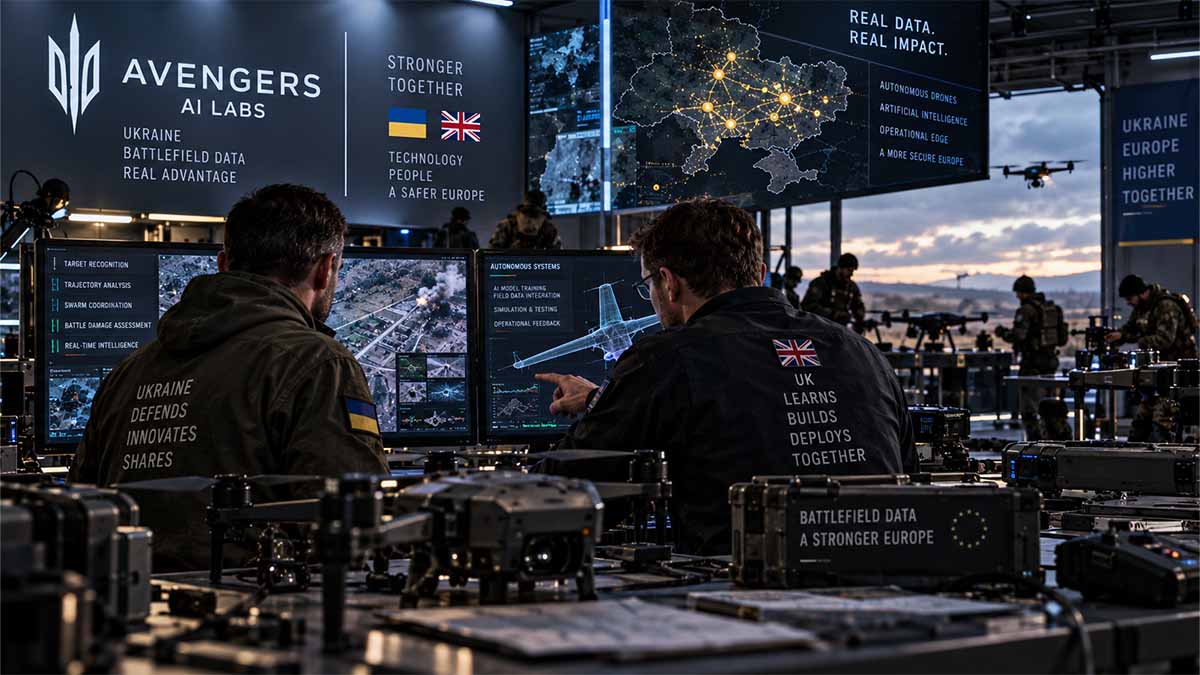
The significance of the United Kingdom’s access to Avengers AI Labs extends substantially beyond acquiring another dataset for drone research: London is obtaining structured access to a continuously refreshed, combat-derived machine-learning environment in which British companies can train, test and evaluate models against real battlefield imagery, sensor conditions and target classes that are extremely difficult to reproduce through peacetime experimentation. Ukraine’s Ministry of Defence confirms that the platform contains more than five million annotated battlefield frames, predominantly derived from unmanned systems through the DELTA combat ecosystem, while the UK Ministry of Defence separately records sensor information corresponding to more than six million detected objects. UK becomes the first international partner to join Avengers Labs — Ministry of Defence of Ukraine British companies to access prized Ukraine data to develop AI drone swarms — GOV.UK
The decisive advantage is therefore not simple possession of imagery, because participating companies will neither receive the underlying database nor be permitted to download it; the advantage lies in controlled computational access to Ukraine’s operational learning environment, including labelled data, metadata, varying observation conditions and tools for testing model behaviour under specific battlefield circumstances. TF RAID: Avengers AI Swarming Competition — UK Ministry of Defence
Up to 12 UK-registered companies are expected to enter the first phase, receiving approximately three months of access through non-financial contracts, while up to five may later receive funded MOD contracts to continue development. Critically, Ukraine will retain ownership of the trained AI model weights, while the UK Ministry of Defence and participating company will receive licensing and sublicensing rights respectively, creating a bilateral mechanism designed to convert Ukrainian combat data into deployable capability without transferring the source dataset itself. TF RAID: Avengers AI Swarming Competition — UK Ministry of Defence
The competition is explicitly oriented toward autonomous target recognition, distributed decision-making, adaptive mission execution and collaborative sensing/information fusion, particularly where communications are degraded or satellite navigation is unavailable, meaning that its strategic objective is not simply better drone image recognition but increasingly resilient multi-platform autonomy. TF RAID Avengers: AI swarming competition — GOV.UK
The UK is not the only European state receiving Ukrainian combat-derived knowledge: Germany signed a separate defence-data memorandum with Kyiv in April 2026 covering DELTA and other systems, including analysis of combat employment of PzH 2000, RCH 155 and IRIS-T, while the European Defence Agency is developing the BraveTech EU mechanism for operational experimentation. What is distinctive is that Britain is identified by both governments as the first international partner specifically admitted to Avengers Labs itself, a materially narrower and more consequential claim than saying that Britain was the first state ever to receive Ukrainian battlefield data. Ukraine and Germany sign a memorandum on defence data exchange — Ministry of Defence of Ukraine UK becomes the first international partner to join Avengers Labs — Ministry of Defence of Ukraine
The principal strategic consequence is a widening distinction inside Europe between states that merely observe lessons from Ukraine and states that are being incorporated into Ukraine’s data–model–experiment–procurement cycle. Britain is attempting to place itself firmly in the latter category.
Britain Is Buying Learning Speed, Not Just Ukrainian Battlefield Data
Britain’s access to Ukraine’s Avengers AI Labs, opened to UK industry in September 2026, matters because London is acquiring something more valuable than a database: a route from real combat evidence into domestic algorithms, procurement and force design. Up to 12 UK-registered companies can enter the initial competition, with up to five expected to progress into funded Ministry of Defence development. Ukraine retains control of the underlying battlefield dataset and trained model weights, while British companies work inside the protected environment. The fiscal stake is equally clear: the UK has already committed more than £5 billion to drones and autonomous weapons, £100 million to the Rapid AI Delivery Taskforce, and more than £1 billion to the Digital Targeting Web. The industrial question is therefore no longer whether Britain can experiment with defence AI, but whether it can convert Ukrainian wartime learning into sovereign military capability faster than Europe’s other major powers. TF RAID Avengers: AI swarming competition — UK Ministry of Defence Defence Investment Plan — UK Government
Britain has secured the scarce input: real operational evidence
Ukraine’s advantage is not simply that Avengers contains more than 5 million battlefield frames and millions of detected objects; it is that those observations originate from sustained warfare, are structured through the DELTA ecosystem and can be filtered by source, recording conditions, object visibility, physical condition and environmental context. The UK Ministry of Defence describes Avengers as a production-grade machine-learning environment rather than a downloadable image archive, while Ukraine states that British participants will train and test models without receiving unrestricted copies of the underlying data. That distinction turns combat experience into a controlled industrial asset: London gets computational access to the empirical record of the war, while Kyiv preserves data sovereignty. UK becomes the first international partner to join Avengers Labs — Ministry of Defence of Ukraine TF RAID: Avengers AI Swarming Competition — UK Ministry of Defence
The value lies in update velocity as much as scale. Ukraine reported in March 2026 that its wider AI-training resource contained millions of annotated frames generated across tens of thousands of combat flights, while DELTA’s Mission Control was processing more than 230,000 reports per week by August 2026. Those figures should not be equated directly with Avengers samples, but they show the size of the operational data environment feeding Ukraine’s digital warfighting system. A static dataset depreciates as camouflage, drone designs, electronic-warfare tactics and sensor configurations change; a continuously replenished dataset can expose model failure as the battlefield itself evolves. Ukraine opens real battlefield data to partners for AI model training — Ministry of Defence of Ukraine Mission Control data — Ministry of Defence of Ukraine
The British bet is institutional: compress procurement before the data advantage expires
The decisive British instrument is the Rapid AI Delivery Taskforce, TF RAID, which reports directly to the Chief of the Defence Staff and has £100 million allocated through the Defence Investment Plan. The first Avengers competition illustrates the intended tempo: launched on 25 September 2026, industry briefing on 7 October, submissions due 22 October, assessment beginning 23 October, and Phase 1 participants due to be notified by 6 November 2026. The point is not that six weeks can produce a fielded autonomous system; it is that the Ministry of Defence is attempting to compress the period between identifying an operational problem and selecting industrial candidates to solve it. Rapid AI Delivery Taskforce — UK Ministry of Defence TF RAID Avengers: AI swarming competition — UK Ministry of Defence
That matters because defence AI depreciates faster than many conventional platforms. A model trained against current battlefield conditions can lose value if procurement takes years while the adversary changes signatures, tactics or electronic countermeasures. Britain’s wider acquisition reforms are therefore part of the same strategy: Commercial X reported 580 contracts by December 2025 with an average contracting time of 31 days, while the Defence Industrial Strategy created additional routes for small technology companies and the government committed to raise direct and indirect MOD spending with SMEs to £7.5 billion through May 2028. The structural test is whether these mechanisms can move successful Avengers-derived technologies beyond demonstration contracts into repeat procurement. Ministry of Defence Commercial X Defence Industrial Strategy 2025
The money already points toward autonomy, but procurement conversion remains the constraint
The UK’s Defence Investment Plan, published on 30 June 2026, placed approximately £297.7 billion of MOD expenditure across 2026/27–2029/30 inside a broader programme that includes more than £5 billion for drones and autonomous weapons, £790 million for protection of the UK homeland and overseas bases against air, drone and missile threats, and £115 million against AI-related threats. These allocations mean that Avengers is not operating in a budgetary vacuum: there is already a funded demand environment for autonomy, counter-autonomy, sensor fusion and resilient digital systems. The Defence Investment Plan Funding Explainer — HM Treasury and Ministry of Defence Defence Investment Plan Oral Statement
The problem is that British defence procurement remains structurally concentrated. In 2024/25, the MOD Core Department placed 2,398 new contracts worth £21.4 billion, but only 559 contracts worth £876 million went directly to SMEs, even though smaller software, robotics and dual-use companies are precisely where much defence-AI innovation originates. Britain’s policy response—TF RAID, UK Defence Innovation, the National Armaments Director Group and accelerated SME contracting—therefore serves one purpose: prevent the system from producing many prototypes but few operational fleets. MOD trade, industry and contracts: 2025
Germany is building a different advantage: battlefield data tied to weapon performance
Britain is not alone in exploiting Ukrainian combat evidence. On 14 April 2026, Ukraine and Germany signed a defence-data memorandum that Kyiv described as its first agreement of this type with a partner, covering DELTA and other Ukrainian digital systems while explicitly including operational analysis of PzH 2000, RCH 155 and IRIS-T. The German model is therefore not identical to Avengers. Britain is using protected Ukrainian data to accelerate AI and collaborative autonomy; Germany can potentially feed real combat evidence directly into the redesign, maintenance and software evolution of major German-made weapon systems. Ukraine and Germany sign a memorandum on defence data exchange — Ministry of Defence of Ukraine
That difference matters industrially. A German manufacturer receiving validated evidence on how its system performs under sustained combat pressure can modify software, maintenance assumptions, sensors and future production standards; a British company inside Avengers can instead learn where recognition, navigation or distributed decision-making fails under real operational conditions. Both approaches create path dependence because early access generates knowledge about failure modes before competitors acquire the same experience. Europe is therefore beginning to divide not simply between states with stronger or weaker defence industries, but between states with different kinds of privileged learning relationships with Ukraine.
France controls more of the AI stack, but not the same wartime-data channel
France’s model is more sovereign and centralised. The Agence ministérielle pour l’intelligence artificielle de défense, AMIAD, created on 1 May 2024, is directly attached to the French Ministry of the Armed Forces and is intended to industrialise defence AI across the institution. By 2026, France had identified approximately 400 defence-AI use cases, targeted 300 AMIAD personnel by year-end, allocated more than €400 million to AI in 2026, and developed classified sovereign compute infrastructure including the ASGARD supercomputer. AMIAD, une agence clé pour l’IA de défense — Ministère des Armées Projet de Loi de Finances 2026 — Ministère des Armées
France therefore controls more of the national AI production stack than Britain’s Avengers arrangement alone would imply: governance, compute, research, engineering and deployment are concentrated inside a sovereign architecture. But the public record does not establish French access equivalent to the protected Avengers MLOps environment. The trade-off is clear: France has greater sovereign processing depth, while Britain currently has the stronger publicly documented route into Ukrainian battlefield training data. The strongest long-term position would combine both advantages rather than choose between them.
Italy has written the strategy; the missing layer is operational data access
Italy crossed an important threshold in February 2026 when the Ministry of Defence published its first comprehensive Defence Strategy on Artificial Intelligence, defining systemic and systematic AI integration across Defence as a strategic requirement. Italy also possesses a significant aerospace, electronics, naval and land-systems industrial base and participates with the UK and Japan in the Global Combat Air Programme, for which the British Defence Investment Plan allocated £8.6 billion on the UK side. Defence Strategy on Artificial Intelligence — Italian Ministry of Defence Defence Investment Plan Oral Statement
What is not established in the public record is an Italian mechanism equivalent to Britain’s Avengers access, Germany’s DELTA-linked memorandum or France’s AMIAD-plus-sovereign-compute architecture. That creates a potential implementation gap rather than a policy gap. Italy has defined the objective; the missing evidence concerns the operational pipeline linking real combat data, sovereign compute, national technical authority, testing and procurement. Without that pipeline, industrial competence risks depending on data and model environments controlled elsewhere.
Brussels can narrow the gap, but scale comes with slower conversion
The EU response is BraveTech EU, which connects the European Commission, European Defence Agency and Ukraine’s BRAVE1 ecosystem. In April 2026, the Commission and EDA established a €35 million operational-experimentation layer; by July, six teams had entered Phase II, while the structure allows four leading teams to receive €300,000 each and two final winners €500,000 each. The 2026 challenge set includes autonomous strike UAS, swarms, decentralised mission execution, EW-resistant systems, sensing and rapid battlefield reconfiguration. BraveTech EU — European Defence Agency European Commission partners with EDA on BraveTech EU
The EU’s advantage is continental diffusion: Ukrainian operational problems can be exposed to companies across multiple Member States rather than concentrated in a bilateral relationship. Its weakness is procurement authority. Brussels can finance experimentation, but Member States still decide whether systems are bought at scale. Britain can move from protected data access to a national contract through one government; BraveTech must convert multinational experimentation into multiple sovereign acquisition decisions. The difference is the familiar European trade-off between breadth and speed, now applied to software-defined warfare.
The next 24 months will price the cost of learning too slowly
Between late 2026 and 2028, the decisive evidence will be whether Britain converts the first Avengers cohort into fielded systems, whether Germany demonstrates product changes derived directly from Ukrainian combat data, whether France combines AMIAD and ASGARD with equivalent Ukrainian datasets, whether Italy turns its 2026 Defence AI Strategy into a dedicated operational architecture, and whether BraveTech winners obtain real procurement contracts beyond experimentation. NATO is simultaneously creating a larger demand environment: its Drone Edge initiative announced more than USD 40 billion in counter-drone investment over five years and a target to increase drone operators fivefold by the end of 2027. NATO’s Drone Edge
The cost of inaction will therefore fall first on the states and industries that remain dependent on other countries for training data, model updates or operational validation. In software-defined defence, buying the platform is no longer enough; the durable advantage belongs to the actor that owns, or at least controls, the learning loop around it. Britain has understood that early. The next 12–24 months will show whether Europe’s other major powers close the gap, or finance sovereign platforms whose most important intelligence remains trained somewhere else.
Navigational Index
Pillar One — Battlefield Data as Strategic Capital
How Ukraine has converted combat observations, drone video, metadata and DELTA-derived detections into an AI-training asset whose value derives from realism, diversity, annotation quality, continual updating and association with actual operational conditions rather than from raw image volume alone.
Pillar Two — Britain’s Exploitation Model: From Ukrainian Data to Sovereign Capability
How Taskforce RAID, the UK–Ukraine AI Partnership, the Avengers competition and British defence-industrial policy create a structured route from Ukrainian combat evidence through machine-learning experimentation to British autonomous systems, procurement, infrastructure protection and future NATO force design.
Pillar Three — European Strategic Asymmetry
How Britain’s access compares with Germany’s bilateral defence-data arrangement, France’s sovereign military-AI architecture, Italy’s new defence-AI strategy and the EU’s BraveTech experimentation framework, and why access to real wartime data may become as strategically consequential as access to specific platforms or weapons technologies.
Master Abstract
Battlefield experience is becoming a defence-industrial input
The war in Ukraine has generated a category of strategic resource that European defence planning traditionally possessed only in limited quantities: high-volume, digitally captured combat experience that can be converted directly into machine-learning training and evaluation material. Avengers Labs represents the institutionalisation of that resource. According to Ukraine’s Ministry of Defence, the platform is based on more than five million battlefield frames and receives most of its data from unmanned systems connected to DELTA; the dataset includes tanks, artillery systems, air-defence assets, infantry, Shahed-type UAVs and reconnaissance drones, is anonymised and time-delayed for operational security, and continues to expand as new material enters the system. UK becomes the first international partner to join Avengers Labs — Ministry of Defence of Ukraine The underlying DELTA ecosystem has itself been deployed across all levels of Ukraine’s Defence Forces and functions as a digital battlefield-management architecture for situational awareness, planning and information exchange, demonstrating that Avengers is connected to a far larger operational data-generating system rather than functioning as an isolated computer-vision archive. The DELTA combat system has been deployed across all levels of Defence Forces of Ukraine — Ministry of Defence of Ukraine
That distinction is fundamental because the military value of machine-learning data depends not merely on scale but on representativeness, annotation, variation, operational context and iterative feedback. The British competition document describes Avengers as a Ukrainian-owned, production-grade MLOps environment permitting data discovery, dataset configuration, training, testing and model evaluation, including assessment against specific operational circumstances rather than aggregate performance alone. Its metadata architecture records collection origin, source characteristics, media quality, environmental and observation conditions, object location and visibility, object condition and, where available, behaviour across sequential observations. TF RAID: Avengers AI Swarming Competition — UK Ministry of Defence That is significantly more valuable for developing operational AI than an undifferentiated archive of battlefield imagery, because it allows developers to determine whether a model that appears effective overall fails under thermal imagery, camouflage, partial visibility, particular terrain, changing weather, unusual viewing angles or other specific conditions.
Britain is accessing the learning system, not simply the archive
The most important feature of the agreement is therefore frequently obscured by descriptions of Britain “receiving Ukrainian battlefield data.” Kyiv has specifically stated that British participants will not obtain direct access to the dataset and will not be able to download it; they will train and test their models inside the secure Avengers environment, with Ukrainian and British authorities maintaining oversight. UK becomes the first international partner to join Avengers Labs — Ministry of Defence of Ukraine The security architecture changes the strategic bargain: Ukraine retains custody of the raw operational resource while Britain obtains the ability to derive capability from it, thereby separating data sovereignty from model development. The arrangement is reinforced by intellectual-property provisions disclosed in the British competition document, under which participating companies retain ownership of their pre-existing technology and proprietary software, while Ukraine owns the resulting trained AI weights and the MOD and relevant UK company receive licence and sublicence rights. TF RAID: Avengers AI Swarming Competition — UK Ministry of Defence
This creates an unusually sophisticated bilateral structure because neither side simply transfers its most valuable asset to the other. Ukraine protects the combat data and resultant trained weights; British companies preserve their proprietary architectures and software; the UK Ministry of Defence acquires access to the resulting capability through licensing; and both armed forces must benefit from successful proposals. The competition therefore acts simultaneously as an AI-development programme, defence-industrial qualification mechanism, technology-transfer framework and bilateral capability accelerator.
The operational target is resilient autonomy
The UK Ministry of Defence has defined four development domains: autonomous recognition of operationally relevant objects; distributed decision-making among multiple autonomous systems; adaptive execution where communications are constrained; and collaborative sensing and information fusion between platforms. British companies to access prized Ukraine data to develop AI drone swarms — GOV.UK The competition documentation goes further by requiring a credible pathway from machine-learning development to operational experimentation and by explicitly focusing on collaborative UAV behaviour, contested environments and decentralised control. TF RAID: Avengers AI Swarming Competition — UK Ministry of Defence
This matters because the requirement is directed at precisely those conditions that have repeatedly complicated conventional Western concepts of network-enabled warfare: electromagnetic interference, disrupted command links, denial of GNSS services, sensor uncertainty and the need to distribute decision-making without creating a single vulnerable command node. The resulting technology therefore has applications much broader than massed aerial drone attack. The British government identifies prospective roles ranging from battlefield logistics and precision targeting to maritime surveillance and anti-submarine operations in the North Atlantic, demonstrating that London regards swarm autonomy as a cross-domain architecture rather than a Ukrainian battlefield niche. British companies to access prized Ukraine data to develop AI drone swarms — GOV.UK
The Avengers programme fits an existing British force-transformation strategy
The agreement should consequently not be interpreted as an isolated initiative generated by political symbolism around support for Ukraine. Britain’s Strategic Defence Review 2025 explicitly concluded that future military effect will increasingly depend on data flows connecting crewed, uncrewed and autonomous systems, called for high-volume integration of autonomous platforms, a protected Defence AI Investment Fund and a digital targeting architecture, and stated that UK defence should absorb lessons from Ukraine at “wartime pace.” The Strategic Defence Review 2025 — GOV.UK The government subsequently committed more than £4 billion for autonomous systems during the parliamentary period and associated that investment explicitly with lessons emerging from Ukraine. Major £5 billion technology investment accelerates UK defence innovation in a European first — GOV.UK
Avengers therefore supplies something the UK strategy otherwise cannot manufacture rapidly at home: a large stream of labelled observations originating from an adversarial environment where camouflage, electronic warfare, deception, attrition and platform adaptation are occurring continuously. In effect, British industry receives an opportunity to compress part of the learning cycle that would otherwise require years of controlled experimentation, because models can be exposed to data produced by thousands of real engagements rather than laboratory approximations alone.
The UK advantage is temporal as much as technological
This is where Britain’s approach deserves particularly close attention. The competitive advantage is not necessarily that a British company will immediately create a superior autonomous drone; the more important possibility is that selected companies can begin accumulating institutional learning about model failure, data quality, operational edge cases and battlefield variability before equivalent ecosystems become broadly available elsewhere. Machine-learning advantage is path dependent: every training cycle reveals which observations are missing, where classification errors occur, what metadata matters and which system architectures remain robust under interference. Early access therefore creates knowledge not only about successful algorithms but about which development approaches fail against real operational distributions.
The British programme is deliberately structured to exploit that time advantage. Phase 1 runs for approximately three months and allows up to twelve UK-registered companies to demonstrate value using Avengers; Phase 2 is expected to award funded MOD contracts to as many as five participants from early 2027. TF RAID: Avengers AI Swarming Competition — UK Ministry of Defence This converts access directly into a procurement funnel rather than leaving battlefield learning disconnected from acquisition. Taskforce RAID itself was established specifically to accelerate the movement of AI-enabled capabilities into the armed forces and reports directly to the Chief of the Defence Staff, according to the competition documentation. TF RAID: Avengers AI Swarming Competition — UK Ministry of Defence
Germany demonstrates that Britain does not possess an exclusive route to Ukrainian combat knowledge
The European comparison requires careful qualification. Germany actually signed a major defence-data memorandum with Ukraine on 14 April 2026, months before the British Avengers announcement. Ukraine described it as its first agreement on defence-data exchange with a partner and stated that Germany would gain access to combat information from DELTA and other digital systems for AI-model improvement, analytics and study of German-supplied systems including PzH 2000, RCH 155 and IRIS-T. Ukraine and Germany sign a memorandum on defence data exchange — Ministry of Defence of Ukraine
The correct analytical distinction is therefore that Britain is the first international partner admitted to Avengers Labs, while Germany had already established an important bilateral framework for defence-data exchange. These programmes are not identical. Germany’s arrangement appears broader across weapons-performance analysis and defence data, while Britain’s Avengers programme is more tightly institutionalised around MLOps access, autonomous swarming and an explicit industrial competition leading toward procurement. Britain’s advantage should consequently be described as specific and operationally structured, not as an absolute monopoly over Ukrainian battlefield data.
France possesses a strong sovereign AI architecture but a different access model
France has pursued a more centralised sovereign military-AI approach. The French Ministry of the Armed Forces created the Agence ministérielle pour l’intelligence artificielle de défense — AMIAD in 2024 to industrialise defence AI and move projects from experimentation toward deployable military capability, while the French Army’s 2026 analytical work explicitly studies Ukrainian use of AI for drone navigation, targeting and operations under jamming. AMIAD, une agence clé pour l’IA de défense — Ministère des Armées L’intelligence artificielle dans les drones en Ukraine — Armée de Terre France is also accelerating drone procurement and experimentation through its national drone initiatives. Drones : accélérer et massifier les commandes — Ministère des Armées
The public record examined for this assessment, however, does not establish French access equivalent to the Avengers secure MLOps environment. France therefore possesses substantial sovereign AI-development capacity, defence research and industrial resources, but Britain’s specific Ukrainian arrangement gives selected British firms a direct pathway into a combat-derived training infrastructure that publicly documented French programmes do not presently replicate.
Italy has established the strategic framework but still faces the operationalisation problem
Italy formally published its Defence Strategy for Artificial Intelligence in February 2026, describing AI integration as a strategic requirement and calling for rapid, systematic adoption across the defence establishment. Strategia della Difesa in materia di Intelligenza Artificiale — Ministero della Difesa The strategic direction is therefore explicit, and Italian military publications are closely studying Ukrainian drone warfare, swarming and AI-enabled operational adaptation.
What is not established by the available official record is an Italian bilateral arrangement giving national companies access to an operational battlefield-data environment equivalent to Avengers. This distinction matters because AI strategy, domestic compute capacity and defence-industry competence cannot themselves substitute for high-quality labelled operational data. If combat-derived training data become an increasingly scarce defence input, countries without privileged data partnerships may eventually depend on allied models, joint European training environments or synthetically generated datasets whose statistical correspondence to actual high-intensity warfare requires continuing validation.
The European Union is building a collective alternative, but with a different architecture
The EU is also attempting to shorten the innovation cycle through BraveTech EU, which connects the European Commission, European Defence Agency and Ukraine’s BRAVE1 ecosystem. In July 2026 the EDA moved six companies into Phase II, where technologies including multi-UAV swarms, autonomous systems and resilient tactical connectivity are being tested in realistic operational conditions, including scenarios involving degraded communications. The initiative has a budget of €35 million through 2028 for the EDA-managed experimentation phase. EDA will work with the first group of innovators under BraveTech EU Phase II — European Defence Agency
BraveTech EU is strategically important but structurally different from Avengers. The European mechanism focuses strongly on experimentation and validation in realistic or battlefield-like conditions; the British-Ukrainian arrangement gives firms access to a Ukrainian production MLOps environment populated with millions of labelled real-world observations. One is primarily an experimentation and capability-maturation architecture, while the other directly inserts selected companies into a wartime data-training pipeline. Over time these models may converge, but the distinction remains material in September 2026.
Britain is turning alliance access into industrial learning
The larger British strategy becomes clearer when Avengers is considered together with the UK–Ukraine 100 Year Partnership, the Strategic Defence Review, autonomous-systems funding and Taskforce RAID. London is not merely seeking battlefield intelligence about what has happened in Ukraine; it is constructing mechanisms through which British companies can repeatedly convert Ukrainian operational experience into algorithms, prototypes and potentially contracted military systems. The August 2026 AI Partnership had already identified three British companies — Sintela, Mind Foundry and Skyral — in initial projects and included work on fibre-optic sensing and low-power AI chips for autonomous systems. New partnership set to see the UK and Ukraine develop battle winning technology as Britain secures access to Ukraine’s Avengers AI Labs — GOV.UK
The strategic objective is therefore cumulative. Battlefield data informs models; models generate prototypes; prototypes enter British and Ukrainian experimentation; successful technologies move toward funded procurement; firms accumulate intellectual and engineering experience; and the resulting industrial ecosystem becomes better positioned for later UK, NATO and export requirements. This does not guarantee successful autonomous weapons or a durable British technological lead, because data quality, transferability, compute architectures, sensor differences, model robustness, adversary adaptation and procurement execution remain major constraints. It does, however, establish a learning infrastructure that most European defence establishments do not presently possess in the same form.
Key Evidence Table
| Indicator | Value / status | Reference date | Definition / scope | Issuer | Exact source |
|---|---|---|---|---|---|
| UK status within Avengers Labs | First international partner admitted specifically to Avengers Labs | 25 Sep 2026 | Access for British defence companies under bilateral programme | Ukraine MoD | UK becomes the first international partner to join Avengers Labs |
| Initial UK industry cohort | Up to 12 UK-registered companies | 25 Sep 2026 | Phase 1 competition | UK MOD | TF RAID Avengers: AI swarming competition |
| Phase 2 cohort | Up to 5 companies | Early 2027 planned | Funded follow-on MOD contracts | UK MOD | TF RAID: Avengers AI Swarming Competition |
| Core Avengers dataset | 5M+ battlefield frames | Sep 2026 | Real-world UAV imagery with annotations and metadata | UK MOD / Ukraine | TF RAID: Avengers AI Swarming Competition |
| Sensor detections | More than 6 million object detections | 25 Sep 2026 | Tanks, artillery, air defence, infantry, Shahed and reconnaissance UAVs among identified categories | UK MOD | British companies to access prized Ukraine data to develop AI drone swarms |
| Data custody | Dataset cannot be directly downloaded by British participants | 25 Sep 2026 | Training and testing inside protected Avengers environment | Ukraine MoD | UK becomes the first international partner to join Avengers Labs |
| Data-security treatment | Data anonymised and delayed | Sep 2026 | Intended to prevent operational risk to Ukrainian personnel | Ukraine MoD | UK becomes the first international partner to join Avengers Labs |
| AI-weight ownership | Ukraine owns trained model weights; MOD/company receive licence/sublicence | Sep 2026 | Applies to models developed under access arrangement | UK MOD | TF RAID: Avengers AI Swarming Competition |
| Target technology areas | ATR; distributed decision-making; adaptive mission execution; collaborative sensing/fusion | Sep 2026 | Autonomous and collaborative UAV operations | UK MOD | TF RAID: Avengers AI Swarming Competition |
| Existing Ukrainian participation | More than 30 Ukrainian defence companies using Avengers | 25 Sep 2026 | Ukraine MoD states three resulting products are already used on battlefield | Ukraine MoD | UK becomes the first international partner to join Avengers Labs |
| German data partnership | Defence-data exchange agreement covering DELTA and German weapons employment | 14 Apr 2026 | PzH 2000, RCH 155, IRIS-T and wider combat data | Ukraine MoD | Ukraine and Germany sign a memorandum on defence data exchange |
| EU operational experimentation | BraveTech EU Phase II | Jul 2026 onward | Battlefield-like testing including swarms and degraded connectivity | European Defence Agency | EDA will work with the first group of innovators under BraveTech EU Phase II |
| EDA BraveTech budget | €35 million through end-2028 | Jul 2026 | EDA-managed Phase II experimentation | European Defence Agency | EDA will work with the first group of innovators under BraveTech EU Phase II |
| UK autonomy investment | More than £4 billion | Current Parliament | Autonomous systems programme linked to SDR transformation | UK Government | Major £5 billion technology investment accelerates UK defence innovation in a European first |
Strategic Interpretation: What Britain Is Actually Acquiring
The most defensible interpretation is that Britain is acquiring four layers of advantage simultaneously, none of which requires physical possession of Ukraine’s source database.
First, it gains access to data realism, because the observations originate from an adversarial environment containing concealment, electronic warfare, damaged equipment, unusual sensor angles, poor visibility and continuously changing tactics.
Second, it gains learning velocity, because model weaknesses can be identified against battlefield distributions rather than discovered only after domestic field trials.
Third, it gains industrial selection, because up to twelve companies compete inside a common operationally relevant environment before the MOD reduces the field to a smaller number of funded developers.
Fourth, it gains institutional memory, because British government laboratories, armed forces and companies learn how to structure datasets, validation criteria and MLOps pipelines for future autonomous systems even where Ukrainian data itself remains inaccessible.
This final layer may prove particularly durable. The dataset will eventually age; Russian systems, Ukrainian sensors and battlefield tactics will change; particular models may become obsolete. The institutional ability to convert operational observations into machine-readable training material, retrain systems quickly and connect model evaluation to procurement is more transferable than any individual neural-network model.
Comparative European Position
| Actor | Publicly established 2026 mechanism | Direct combat-data dimension | Industrial pathway | Principal distinction |
|---|---|---|---|---|
| United Kingdom | Avengers Labs + Taskforce RAID competition | Direct secure training on Ukrainian battlefield datasets | Up to 12 firms → up to 5 funded follow-ons | Integrates combat data, MLOps and procurement |
| Germany | Bilateral Ukraine–Germany defence-data memorandum | DELTA and other battlefield data; weapon-performance analysis | Joint projects and technology development | Broader defence-data cooperation already established before UK Avengers access |
| France | AMIAD + national drone and AI programmes | Strong study of Ukrainian operational lessons; equivalent Avengers access not publicly established | Sovereign centralised AI industrialisation | Powerful national AI architecture, but different battlefield-data access model |
| Italy | Defence AI Strategy 2026 | No equivalent Avengers access established in reviewed official record | Strategic integration framework under development | Policy framework exists; operational data pipeline less publicly developed |
| European Union | BraveTech EU | Ukrainian battlefield challenges and operational expertise integrated into experimentation | EU-wide testing and maturation | Multilateral experimentation rather than exclusive national MLOps access |
The table does not support a conclusion that Britain possesses an absolute European lead in military AI, because France has substantial sovereign AI infrastructure, Germany already possesses a major Ukrainian defence-data partnership, and the EU is creating collective experimentation mechanisms. What it does establish is that Britain has negotiated an unusually direct route between combat data and national industrial development, and has connected that route to an acquisition organisation explicitly designed to shorten the transition between experimentation and deployed military capability.
Principal Gaps and Watch Indicators
The first major unresolved issue concerns data representativeness. The official documentation establishes scale, annotation and operational provenance, but it does not disclose the distribution of observations across geography, seasons, sensors, altitude, target classes, adversary equipment variants or stages of the war. A dataset containing millions of frames can still produce model bias if specific environments or operational circumstances dominate the sample.
A second gap concerns the exact technical boundary between access and extraction. Kyiv states that raw datasets cannot be downloaded, while the competition document establishes that trained model weights can be licensed; the public record does not yet specify how derivative embeddings, intermediate representations, feature stores, evaluation outputs or synthetic datasets generated inside the protected environment will be treated.
A third concerns operational validation. Access to combat-derived data does not itself demonstrate that a British model will survive jamming, spoofing, adversarial camouflage, sensor degradation or platform loss when transferred to British hardware, doctrine and electromagnetic environments. The decisive indicator will be whether the Phase 2 companies advance from data-trained models into representative multinational exercises or operational trials.
A fourth concerns Ukraine’s wider partner strategy. Germany already has a defence-data agreement, and Ukraine stated in March 2026 that international partners would be able to train AI systems using real battlefield data. Ukraine is the first country in the world to open real battlefield data to partners for AI model training — Ministry of Defence of Ukraine The UK advantage will therefore depend partly on how quickly similar access is subsequently extended to other European or NATO partners.
The most important watch indicators over the next twelve months are the identities of the twelve Phase 1 companies; which five receive funded continuation; whether those firms are connected to larger British primes; the scale of MOD follow-on funding; evidence of integration with British UAV programmes, the Digital Targeting Web or maritime autonomous systems; any subsequent Avengers agreements with France, Germany, Poland, the Nordic states, the United States or EU institutions; and the contractual treatment of derivative model IP.
Decision-Relevant Assessment
The public record supports a stronger conclusion than the proposition that “the UK can see Ukrainian battlefield data.” Britain is being admitted to an institutional mechanism through which real combat observations are transformed into machine-learning capability, while Ukraine retains control over the underlying strategic resource. That distinction explains why the agreement matters.
For London, Avengers reduces the distance between observing the Ukrainian war and learning computationally from it. For British industry, it lowers one of the highest barriers to developing credible defence AI: acquiring large quantities of labelled data representing actual contested operations. For the Ministry of Defence, it creates a filter through which companies can be tested against operationally meaningful problems before larger procurement commitments are made. For Ukraine, it externalises part of the development burden to a major allied technology ecosystem while preserving ownership over both the source data and resulting trained weights.
The broader European consequence is the emergence of a new form of defence inequality based not only on budgets, factories and weapons inventories but also on access to combat-derived datasets and the institutions capable of exploiting them. Germany has recognised this through its defence-data agreement; the EU is building an experimentation framework through BraveTech; France is investing heavily in sovereign military AI; Italy has now established its own strategic framework. Britain’s distinctive move has been to combine privileged Ukrainian data access with a domestic procurement organisation, national autonomy investment and an explicit strategy of converting lessons from Ukraine into future force design.
That combination, rather than any single drone model developed under Avengers, is the principal strategic development requiring continued monitoring.
UK Access to Ukraine’s Avengers AI Labs
Britain is gaining controlled access to a combat-derived machine-learning environment rather than simply receiving a battlefield archive, creating a direct institutional bridge between Ukrainian wartime data, British defence companies, autonomous-system development and future procurement.
The strategic value of Avengers AI Labs lies in the ability to train and evaluate British AI models against millions of real wartime observations while the underlying Ukrainian dataset remains inside a protected environment. The resulting advantage is therefore not ownership of Ukrainian battlefield data but accelerated access to the data → model → validation → procurement learning cycle that increasingly determines the effectiveness of autonomous military systems.
Strategic Architecture
Battlefield Data as Strategic Capital
Ukraine has converted wartime imagery, detections and associated metadata into an industrially usable AI-training resource whose value comes from operational realism, continuous refresh and detailed annotation.
British Exploitation Model
Taskforce RAID connects protected Ukrainian MLOps access with UK companies, autonomous-system development, competitive selection and potential Ministry of Defence procurement.
European Capability Asymmetry
Germany, France, Italy and the EU are pursuing different military-AI pathways, but Britain has negotiated an unusually direct connection between real combat data and national industrial development.
The Strategic Learning Cycle
Verified Programme Baseline
What Britain Receives — and What Ukraine Retains
| Element | United Kingdom / Companies | Ukraine | Strategic meaning |
|---|---|---|---|
| Underlying battlefield dataset | No direct download | Retains custody and control | Data sovereignty remains Ukrainian. |
| MLOps environment | Controlled training and testing access | Provides protected environment | British companies exploit the data without physically acquiring it. |
| Pre-existing company software | Company retains ownership | No transfer of pre-existing UK proprietary technology | Protects commercial incentives for British participants. |
| Trained model weights | MOD/company obtain licensing rights under programme terms | Ukraine retains ownership | Operational benefit is shared without surrendering Ukrainian control of the derived model asset. |
| Procurement pathway | Potential funded MOD follow-on contracts | Potential access to resulting capability | Turns wartime data into a bilateral industrial-development pipeline. |
Contractual structure: TF RAID: Avengers AI Swarming Competition — UK Ministry of Defence .
European Military-AI Positioning
Combat Data + MLOps + Procurement
First international partner specifically admitted to Avengers AI Labs.
UK companies gain controlled access to real Ukrainian wartime data for model training, followed by a potential funded Ministry of Defence pathway.
Broader Defence-Data Partnership
Germany and Ukraine signed a defence-data memorandum covering DELTA-derived information and operational analysis of systems including PzH 2000, RCH 155 and IRIS-T.
Sovereign Defence-AI Architecture
France is developing military AI through AMIAD and associated national defence programmes, while studying Ukrainian drone and AI experience.
Equivalent public access to the Avengers protected MLOps environment has not been established in the cited record.
Strategic Framework, Earlier Operational Stage
Italy published its Defence Strategy for Artificial Intelligence in 2026, formally identifying AI integration as a strategic defence requirement.
No equivalent bilateral Avengers access is established in the cited official record.
Collective Experimentation
BraveTech EU connects European institutions with Ukrainian operational experience and supports testing of autonomous systems, swarms and resilient communications.
Its architecture is multilateral experimentation rather than a national protected MLOps-access programme.
Priority Capability Domains
| Capability | Operational problem | Potential advantage |
|---|---|---|
| Autonomous target recognition | Identifying operationally relevant objects under variable battlefield conditions | Reduced dependence on continuous human interpretation of sensor feeds |
| Distributed decision-making | Loss or degradation of central communications | Multiple platforms retain coordinated behaviour without a single command node |
| Adaptive mission execution | GNSS denial, jamming and changing battlefield conditions | Greater resilience when pre-planned communications or navigation assumptions fail |
| Collaborative sensing | Incomplete observations from individual platforms | Information fusion across several autonomous systems |
Capability areas derived from: TF RAID Avengers: AI swarming competition — UK Ministry of Defence .
Strategic Watch Indicators
Industry Selection
Identification of the Phase 1 companies and whether established British primes participate directly or through smaller AI specialists.
Phase 2 Funding
Contract values, selected companies and the degree to which successful models move from software experimentation into deployable platforms.
European Replication
Whether Ukraine subsequently grants comparable Avengers access to Germany, France, Poland, Nordic states, EU institutions or additional NATO partners.
Operational Integration
Evidence that Avengers-trained models enter British drone programmes, maritime autonomy, digital targeting architectures or major exercises.
Net Assessment
Britain’s advantage is not that it has simply obtained a Ukrainian database. The more consequential development is that London has positioned selected British companies inside a controlled system capable of converting combat observation into model training, model training into operational experimentation, and experimentation into procurement. Germany has established its own important defence-data partnership, France retains substantial sovereign military-AI capability, Italy has created a national strategic framework, and the EU is developing collective experimentation through BraveTech; however, the UK–Ukraine Avengers mechanism is distinctive because it directly integrates real wartime data, an industrial competition and a national defence acquisition pathway within the same learning architecture.
Primary and First-Party Sources
- Ukraine Ministry of Defence — UK becomes the first international partner to join Avengers Labs
- UK Government — British companies to access prized Ukraine data to develop AI drone swarms
- UK Ministry of Defence — TF RAID Avengers: AI swarming competition
- UK Ministry of Defence — Avengers AI Swarming Competition Overview
- Ukraine Ministry of Defence — Ukraine and Germany defence-data memorandum
- European Defence Agency — BraveTech EU Phase II
- French Ministry of the Armed Forces — AMIAD
- Italian Ministry of Defence — Strategia della Difesa in materia di Intelligenza Artificiale
Pillar One — Battlefield Data as Strategic Capital
Principal Judgment
The strategic asset created by Ukraine is not a static collection of drone footage but a wartime data-production system in which operational activity generates observations, those observations are progressively structured through the DELTA ecosystem, selected material is curated and annotated inside Avengers Labs, models are evaluated against identifiable battlefield conditions, and the resulting algorithms can then be returned to operational systems for further validation. Ukraine’s Ministry of Defence states that Avengers Labs is continuously replenished with real battlefield material, while the British Ministry of Defence describes the environment as a production-grade MLOps platform supporting data discovery, dataset configuration, training, testing and evaluation rather than simple file access. Міністерство оборони України
The distinction is decisive because the scarcity being monetised strategically is not raw imagery. Contemporary militaries can generate enormous volumes of video, satellite imagery and sensor output; the harder resource to reproduce is a corpus in which observations originate from actual high-intensity warfare, contain identifiable target classes, are associated with environmental and collection conditions, include object-level annotation, are updated as the battlefield changes, and can be queried so that model performance is measured under different operational circumstances rather than through a single aggregate accuracy figure. The UK competition documentation confirms that Avengers contains multi-level metadata covering collection origin, source characteristics, media quality, environmental factors, recording conditions, object visibility, object condition, relationship with the environment and, where available, object behaviour across sequences. GOV.UK
This makes Avengers strategically important for a reason that extends beyond autonomous drones. It demonstrates how Ukraine is converting combat experience into machine-readable institutional memory.
From Battlefield Activity to Machine-Readable Knowledge
The underlying architecture begins with DELTA, which Ukraine describes as its combat digital ecosystem for battlefield awareness, operational planning and information exchange across units and command levels. In August 2025 the Ukrainian Ministry of Defence stated that DELTA had been ordered into use across all levels of the Defence Forces and described it as a unified source for information exchange available on laptops, tablets and smartphones. The ministry also reported that the system was supporting the targeting of more than 2,000 enemy assets per day, although this number is a Ukrainian governmental operational claim rather than an independently audited statistic. Міністерство оборони України
The significance of DELTA for Avengers is that battlefield observations do not enter the AI-development process as an isolated stream. Ukraine states that most Avengers Labs data originates from unmanned systems through DELTA, creating a relationship between the systems producing combat information and the infrastructure used to train new algorithms. Міністерство оборони України This substantially increases the potential analytical value of the archive because provenance, collection context and observation conditions can be preserved alongside the imagery rather than reconstructed retrospectively from disconnected files.
The British competition document makes that architecture explicit. Avengers supports analysis at three principal levels: dataset, individual observation and specific object, with additional specialised annotation structures extending across sensor modalities, environmental conditions, target categories and event types. GOV.UK
| Information layer | Publicly documented fields | Why it matters for AI development | Military implication |
|---|---|---|---|
| Dataset level | General origin, collection context, source characteristics, media quality, versioning, availability of additional annotations | Allows developers to understand how a dataset was produced rather than treating all images as statistically equivalent | Reduces the risk of training decisions being made without understanding the source population |
| Observation level | Environmental factors, recording conditions, basic media characteristics | Enables the construction of subsets representing specific operational conditions | Models can be tested separately under different observation regimes instead of relying solely on aggregate performance |
| Object level | Object identity, position, visibility, physical condition, relationship with surroundings | Supports detection, classification, localisation and condition-sensitive training | Particularly valuable when targets are obscured, damaged, dispersed or partially visible |
| Sequential behaviour | Behaviour across observation sequences where available | Makes temporal modelling possible rather than treating every frame independently | Relevant to tracking, movement analysis and collaborative sensing |
| Specialised annotations | Sensor modality, observation conditions, object category and event type | Allows developers to segment training according to mission and sensing configuration | Improves transferability from generic computer vision toward military-specific perception tasks |
Source: the UK Ministry of Defence’s official TF RAID Avengers AI Swarming Competition documentation. GOV.UK
This metadata hierarchy is one of the most important characteristics of the system. Five million unstructured images would constitute a large archive; five million observations whose provenance, quality, target characteristics and observation conditions can be filtered and recombined constitute an experimental environment.
Why Five Million Frames Do Not Equal Five Million Independent Learning Events
The headline number of more than five million battlefield frames must be interpreted carefully. A frame count does not reveal the number of independent missions, geographical areas, unique targets, sensor configurations or tactical situations represented inside the corpus. Ukraine stated in March 2026 that the broader training resource contained millions of annotated frames collected during tens of thousands of combat flights, but the public record does not disclose the distribution of observations within those flights. Міністерство оборони України
This matters because consecutive frames from the same video are statistically correlated. One minute of imagery can generate hundreds or thousands of frames without producing an equivalent number of independent battlefield situations. Consequently, dataset scale should not be assessed through frame count alone.
The strategically relevant variables are instead:
| Dataset property | Public record | Analytical significance |
|---|---|---|
| Nominal scale | More than 5 million frames | Establishes substantial corpus size but not independent-event count |
| Annotated objects | Millions | Indicates object-level supervision rather than raw-video storage alone |
| Flight provenance | Tens of thousands of combat flights referenced by Ukraine in March 2026 | Indicates that the collection spans a large number of operational sorties |
| Target diversity | Tanks, artillery, air defence, infantry, Shahed-type UAVs, reconnaissance drones and other aerial targets | Broadens usefulness across ground and counter-UAS perception problems |
| Sensor diversity | UK documentation explicitly references daylight and infrared imagery | Reduces dependence on a single optical regime |
| Environmental diversity | Official UK documentation states that the dataset covers diverse conditions and scenarios | Provides a basis for condition-specific evaluation |
| Temporal updating | Continuous / regular updating | Limits the degree to which the dataset becomes frozen around an earlier phase of the war |
| Metadata depth | Dataset-, sample- and object-level structures | Enables controlled selection and diagnostic evaluation |
| Raw-data portability | Restricted | Preserves Ukrainian control and reduces uncontrolled proliferation |
Sources: Ukraine Ministry of Defence and UK Ministry of Defence official programme documentation. Міністерство оборони України
The public documentation therefore supports the conclusion that Avengers is large and structured, but does not support the stronger assertion that five million frames correspond to five million independent combat observations. That distinction should remain explicit in any serious assessment of its machine-learning value.
Annotation Is the Conversion Layer Between Video and Capability
Raw battlefield imagery has limited machine-learning value until the information inside it becomes interpretable by algorithms. Annotation supplies that conversion layer.
For object detection, training requires not merely an image of a vehicle but information indicating what the object is and where it is located within the image. More advanced annotation can record whether an object is damaged, partially obscured, concealed by vegetation, stationary, moving, viewed through infrared imagery or interacting with other objects. The UK documentation confirms that Avengers goes beyond simple category labels by incorporating location, visibility, condition and environmental relationship at object level. GOV.UK
This matters because battlefield perception is dominated by difficult cases rather than ideal laboratory images. An armoured vehicle photographed from above in clear weather, at short range and without camouflage may be easy for a modern vision model to identify. The militarily consequential question is whether the same model can recognise the target when only part of it is visible, when the vehicle is damaged, when vegetation breaks its outline, when the viewing angle changes, when the image is infrared, when smoke or dust obscures the scene, or when the target resembles a civilian or decoy object.
The metadata architecture gives developers the ability to construct precisely those difficult subsets.
A model that produces apparently strong overall detection results could therefore be interrogated more deeply:
| Evaluation question | Why aggregate accuracy can conceal failure |
|---|---|
| Does performance collapse under infrared observation? | A dataset dominated by daylight imagery could produce strong overall results despite poor night capability |
| Does the model detect damaged equipment? | Destroyed or partially destroyed objects may have visual characteristics very different from intact examples |
| Does visibility level affect classification? | Partially obscured targets may be disproportionately responsible for missed detections |
| Does performance change across terrain types? | Background textures can become unintended predictive features |
| Does media quality alter detection? | Compression, low resolution, vibration or transmission degradation can materially affect computer vision |
| Does one sensor or platform dominate the dataset? | The model may learn platform-specific characteristics rather than target characteristics |
| Does performance remain stable across newer battlefield observations? | A model trained on historical observations can degrade as camouflage and tactics change |
These are not speculative features attributed to Avengers; they are analytical uses enabled by the metadata categories that the UK Ministry of Defence confirms are present in the environment. GOV.UK
Real Battlefield Data Changes the Distribution Problem
The central machine-learning advantage of battlefield data concerns distribution.
A model performs well when the data it encounters operationally resembles the data on which it was trained and validated. Controlled exercises inevitably reproduce only a portion of the operational distribution encountered during a prolonged high-intensity war. Ukraine’s dataset includes imagery generated under the pressures of repeated real combat missions, which exposes models to situations created not for testing purposes but by adversarial interaction.
This can include effects such as damaged targets, incomplete observations, unusual platform attitudes, non-standard target presentation and changes in equipment appearance produced by field modification. The official Avengers documentation does not publish a complete taxonomy of these phenomena and therefore does not permit claims about their individual prevalence, but it explicitly states that the platform contains a diverse collection of conditions and scenarios and allows performance assessment against specific battlefield contexts. GOV.UK
The advantage can be expressed conceptually:
Conventional development cycle
Controlled collection → curated training → controlled test → field exercise → discovery of unexpected failure → new collection
Combat-derived development cycle
Operational observation → structured capture → annotation → targeted training → condition-specific evaluation → operational experimentation → new operational observation
The second architecture can reduce the delay between the appearance of a new battlefield phenomenon and its incorporation into AI development, provided that the ingestion, annotation and model-retraining cycle operates sufficiently quickly.
Ukraine’s statement that Avengers is continuously supplemented with new data of practical combat value is therefore more strategically important than the five-million-frame headline. Міністерство оборони України
Continual Updating Turns the Dataset Into a Moving Strategic Asset
A static dataset depreciates.
Weapons change. Sensor payloads change. Russian vehicle modifications change. Camouflage practices evolve. Drone flight profiles change. Counter-UAS measures improve. Electronic warfare alters how systems operate. Units adopt new tactical procedures. New target categories appear.
A model trained on an excellent representation of the battlefield in 2024 could become progressively less representative of the battlefield in 2026 if the training population were not refreshed.
Avengers is explicitly designed around regular updating. The British MOD describes the corpus as continuously growing through regular updates, while the Ukrainian MOD similarly states that it is constantly updated and expanded to preserve combat relevance. GOV.UK
This creates a form of strategic compounding because new combat activity does not merely generate tactical intelligence; it can generate additional machine-learning material.
| Battlefield change | Potential dataset consequence | Potential model-development consequence |
|---|---|---|
| New enemy UAV type appears | New imagery and annotations enter the corpus | Detection models can be retrained against the emerging target |
| Existing vehicle receives field modifications | New visual variants become observable | Reduces reliance on canonical manufacturer silhouettes |
| Countermeasures alter drone operating conditions | Different image quality or observation geometry may enter the dataset | Developers can evaluate robustness under changed sensing conditions |
| Target concealment methods evolve | More difficult visibility cases become available | Hard-negative and low-visibility training can be expanded |
| Ukrainian sensor mix evolves | New sensing modalities or recording characteristics appear | Model portability across sensors can be tested |
| Operational tactics change | Sequential behaviour and contextual relationships shift | Tracking and decision-support models can be re-evaluated |
The table describes the mechanism enabled by continual battlefield ingestion; the public record does not disclose the frequency with which each individual category is added to Avengers.
DELTA Is Creating a Much Larger Data Environment Than Avengers Alone
Avengers should not be assessed independently from Ukraine’s wider effort to digitise combat operations.
The Ministry of Defence launched Mission Control inside DELTA in January 2026 as a unified command-and-control and reporting system for unmanned operations. Drone crews are instructed to enter operational information including UAV type, launch point, route and mission, allowing activity that was previously reported through slower manual systems to become structured digital data. Міністерство оборони України
By 26 March 2026, Ukraine stated that Mission Control was operational across all corps and force groupings, covered reconnaissance, strike, mining, logistics and evacuation missions, and had already generated more than 150,000 digital reports on completed missions by early March. Міністерство оборони України
By 17 August, the Ukrainian Ministry of Defence reported a much larger operating scale: 50,000 missions were being processed through Mission Control and more than 230,000 reports were being submitted every week. The ministry also stated that commanders use the records to analyse what worked, what did not and why before adjusting subsequent operations. Міністерство оборони України
These Mission Control statistics should not be equated with Avengers training samples: the Ministry has not publicly stated that every Mission Control report becomes part of Avengers. Their importance lies elsewhere. They demonstrate the emergence of an adjacent structured combat-data infrastructure capable of recording operational activity at a scale far beyond manually assembled intelligence reports.
This creates several distinct categories of potential wartime data capital:
| Data class | Confirmed Ukrainian system | Primary function | Relationship to AI development |
|---|---|---|---|
| Battlefield imagery/video | DELTA / Avengers Labs | Observation and target recognition | Directly confirmed as Avengers training material |
| Object annotations | Avengers Labs | Machine-learning supervision | Direct training and evaluation input |
| Mission records | Mission Control / DELTA | Record UAV operations and results | Supports operational analysis; direct ingestion into Avengers not publicly established |
| Route / launch / mission information | Mission Control | Operational command and reporting | Creates structured contextual data outside the image archive |
| Target-engagement verification | DELTA | Validate combat events | Creates outcome-linked operational records |
| Battlefield video analysis | Vezha / DELTA | Real-time collaborative video exploitation | Provides an operational environment in which AI detection can be used |
| AI-derived target detection | Avengers AI integrated with Vezha | Automated identification | Represents downstream operational use of trained models |
Sources: Ukrainian Ministry of Defence official descriptions of Avengers, DELTA, Mission Control and Vezha. Міністерство оборони України
The Important Asset Is the Link Between Training Data and Operational Feedback
Many defence AI programmes possess datasets. Far fewer possess a credible mechanism connecting the dataset to continued operations.
Ukraine states that an Avengers AI capability trained using the relevant data has already been incorporated into Vezha, DELTA’s battlefield-video-analysis module. In an August 2026 Ministry explainer, Ukraine reported that Avengers identifies approximately 70% of enemy military equipment in real time while analysing more than 100,000 video streams per month. These figures are Ukrainian Ministry of Defence performance claims; the underlying test methodology, denominators, false-positive rate and independent validation data are not publicly available and therefore the 70% figure should not be interpreted as a conventional benchmark accuracy measure. Міністерство оборони України
The significance of the claim is architectural rather than numerical: a model-development environment is connected to an operational video-analysis system generating continuing battlefield use.
That creates the possibility of a feedback architecture:
Observation → annotation → model training → model deployment → operational use → detection outcome → new observation → retraining
The public documentation does not establish how automated this full cycle is, nor how quickly production models are retrained. Those remain important collection gaps. Nevertheless, the individual components are publicly documented, and together they indicate that Ukraine is moving away from treating AI development as a separate research activity and toward embedding it in a continuously operating digital combat ecosystem.
Ukraine Is Also Converting Combat Reporting Into Performance Data
A second dimension of the emerging data architecture is outcome verification.
Ukraine stated in August 2026 that more than 260,000 enemy fixed-wing and multirotor UAVs had been neutralised since the beginning of the year, with all relevant engagements verified in DELTA. The ministry provided a breakdown of approximately 195,000 fixed-wing UAVs and 66,000 multirotor UAVs and described DELTA as the system through which engagement characteristics can be tracked and effective counter-drone solutions scaled. Again, these are official Ukrainian wartime claims and are not independently audited within the official record examined here. Міністерство оборони України
The important analytical point is that Ukraine is trying to connect equipment employment to observed outcome, rather than recording inventory and mission activity separately.
The same principle is being extended to procurement. In March 2026 the Ministry of Defence announced that future UAV demand would increasingly be generated automatically from frontline data and that procurement should prioritise systems demonstrating operational effectiveness. Міністерство оборони України
This potentially creates a much broader defence-data loop:
| Stage | Data generated | Institutional use |
|---|---|---|
| Acquisition | Platform type, quantity, unit allocation | Distribution and inventory |
| Mission planning | Mission, route, launch point | Command and resource allocation |
| Mission execution | Sensor feeds, imagery, telemetry where retained | Situational awareness |
| Target interaction | Detection, classification, engagement event | Tactical analysis |
| Outcome verification | Damage / interception / mission result | Effectiveness assessment |
| Comparative performance | Platform results across repeated missions | Procurement prioritisation |
| AI training | Selected annotated observations | Model development |
| Updated capability | Improved algorithm or system | Reintroduced into operations |
Not every arrow in this architecture has been publicly documented as fully automated. The table represents the data relationships created by Ukraine’s documented systems, not a claim that one integrated database automatically performs every step.
Data Volume Becomes More Valuable When Failure Can Be Isolated
The strongest feature of the Avengers design may be its ability to determine where a model fails, not merely whether it achieves an acceptable overall score.
Consider two hypothetical systems:
- Model A recognises 88% of objects overall.
- Model B recognises 85% overall.
Without metadata, Model A appears superior.
But suppose Model A performs poorly against infrared imagery and partially obscured targets, while Model B retains more consistent performance across both. If the intended mission occurs predominantly at night or in degraded visibility, the aggregate ranking becomes operationally misleading.
Because the UK competition documentation states that Avengers allows models to be evaluated under specific operational conditions and battlefield contexts, developers can construct evaluation matrices more relevant to military employment. GOV.UK
A proper evaluation architecture could therefore examine:
| Dimension | Examples of questions enabled by the documented data structure |
|---|---|
| Target category | Which classes are systematically under-detected? |
| Visibility | How rapidly does performance deteriorate as the target becomes partially obscured? |
| Object condition | Does destroyed or damaged equipment generate false classifications? |
| Sensor mode | Is infrared performance materially weaker than daylight performance? |
| Recording quality | How resilient is the model to low-quality or compressed imagery? |
| Environmental condition | Does terrain or weather correlate with missed detections? |
| Sequence behaviour | Can a tracked object remain associated across successive observations? |
| Source characteristics | Does the model generalise between different collection systems? |
| Dataset version | Does retraining on newer data improve or degrade older use cases? |
The purpose of the table is not to claim that Avengers publicly exposes a preconfigured dashboard for every one of these questions. It identifies analytical tests supported by the categories the MOD says the platform contains.
Negative Examples May Be as Valuable as Confirmed Targets
One of the least visible but most important elements of battlefield machine learning is the treatment of non-targets and ambiguous objects.
An autonomous recognition system trained predominantly on confirmed military targets risks becoming overly sensitive. On an actual battlefield it must distinguish targets from civilian vehicles, terrain features, wreckage, shadows, abandoned equipment, decoys and visual structures that resemble military objects.
The current public documentation confirms target annotations and environmental relationships but does not disclose the volume or taxonomy of negative examples within Avengers. This is therefore an important unresolved issue rather than a basis for assumption.
For UK companies, the relevant question is not simply how many tanks or UAVs appear in the dataset, but whether the training environment contains sufficiently difficult hard negatives to measure false-positive behaviour.
This matters operationally because false positives can have fundamentally different consequences from missed classifications. A computer-vision system supporting intelligence analysis may tolerate one error profile; a model contributing to increasingly autonomous targeting or route prioritisation requires a much stricter understanding of confidence, uncertainty and identification thresholds.
Dataset Diversity Does Not Eliminate Dataset Bias
Combat provenance improves realism, but it does not automatically eliminate statistical bias.
Indeed, battlefield data can contain distinctive forms of selection bias.
Sensors operate where units deploy them. Drones survive longer in some environments than others. Successful missions may produce more complete records than missions in which platforms are destroyed or communications fail. Certain target classes are more valuable and therefore more intensively observed. Some sectors of the front may have higher digital maturity than others. Weather and terrain can alter collection intensity. Platform upgrades can change image characteristics over time.
This creates several biases that require active management:
| Potential bias | Mechanism | Why it matters |
|---|---|---|
| Mission-selection bias | Data is generated by missions commanders decide to conduct | Dataset may not represent situations that are rarely attempted |
| Survivorship bias | Successful sensor platforms can return more usable data than lost platforms | Most difficult operating conditions may be underrepresented |
| Target-priority bias | High-value targets attract disproportionate surveillance | Model may perform better on strategically important classes than routine battlefield objects |
| Geographic bias | Collection intensity varies by sector | Terrain-specific cues may enter the model |
| Temporal bias | Earlier periods may dominate cumulative data volume | New equipment or tactics can remain statistically underrepresented |
| Sensor bias | Particular UAVs or cameras may contribute disproportionate footage | Model may overfit to recording characteristics |
| Annotation bias | Human labelling standards can change or vary | Systematic labelling differences can propagate into model behaviour |
| Confirmation bias in outcome data | Successful engagements may be easier to verify | Performance estimates may overrepresent observable successes |
The British documentation partially mitigates these risks by confirming dataset versioning, source characteristics, observation metadata and condition-specific evaluation, all of which make bias easier to identify. GOV.UK What it does not disclose is the actual statistical composition of Avengers, meaning no public analyst can currently determine whether particular target, sensor, geography or temporal categories are underrepresented.
Versioning Is Strategically Important
The presence of dataset versioning, explicitly identified by the UK Ministry of Defence, deserves particular attention. GOV.UK
Without version control, an AI developer cannot reliably determine whether a change in model performance results from a new algorithm, a different training corpus, altered annotations or a shift in the test population.
In an evolving war, versioning allows three strategically important comparisons:
Model against fixed historical dataset: determines whether the algorithm itself improved.
Fixed model against newer battlefield dataset: reveals whether battlefield evolution degraded performance.
Updated model against updated dataset: measures whether retraining has restored or increased performance under newer conditions.
This produces a far more informative development cycle than continuously mixing new data into an undocumented corpus.
| Comparison | Model version | Dataset version | Question answered |
|---|---|---|---|
| Controlled algorithm test | New | Fixed | Did the model improve? |
| Battlefield drift test | Fixed | New | Has the operating environment changed enough to degrade performance? |
| Adaptation test | New | New | Has retraining recovered effectiveness against current conditions? |
| Regression test | New | Historical | Did improvement on new data damage performance against older conditions? |
The UK document does not disclose the specific version-control system or release cadence used by Avengers, so those technical details remain non-public.
Data Drift Is Not a Technical Detail; It Is an Adversarial Weapon
In commercial machine learning, data drift often occurs because consumer behaviour or market conditions change. In warfare, the process can be deliberate.
Once an adversary understands how a detection system operates, it has incentives to alter equipment appearance, camouflage, movement, emissions or tactical behaviour in ways that degrade the model. Consequently, the battlefield distribution is not merely evolving; it is potentially adversarially evolving.
A continuously refreshed dataset offers a mechanism for responding to that challenge. New observations can reveal where older training distributions no longer represent operational reality. If those changes are captured, annotated and incorporated rapidly enough, model retraining can become part of the tactical adaptation cycle.
This is one reason the value of Avengers cannot be reduced to the current dataset size. The strategically important characteristic is the relationship between the dataset and a war that continues producing new observations.
The relevant competitive variable becomes:
time from adversary adaptation → observation → annotation → model update → operational redeployment
The official record does not publish this end-to-end latency. It is one of the most consequential metrics that remains unavailable.
The Data Flywheel Is Already Supporting a Ukrainian AI Ecosystem
Ukraine’s Ministry of Defence stated on 25 September that more than 30 Ukrainian defence companies were already training models on Avengers Labs and that three resulting products were being used on the battlefield. The ministry did not publicly identify those three systems in the announcement or provide independent performance data, so the claim should be treated as an official programme statement rather than independently verified combat-effectiveness evidence. Міністерство оборони України
Nevertheless, the number of participating companies shows that Avengers has already moved beyond an internal government research dataset.
Its emerging institutional model is:
State-controlled operational data
→ secure government MLOps infrastructure
→ multiple competing defence developers
→ model training against common battlefield evidence
→ operational experimentation
→ selected deployment
→ new battlefield observations
This architecture is potentially more important than any single model because it enables competition between developers while preserving a shared operational evidence base.
Secure Access Preserves Scarcity
Ukraine has deliberately separated computational access from data possession.
British companies will not receive unrestricted copies of the underlying dataset and cannot download it; model development will occur within the protected environment. Міністерство оборони України The UK competition rules additionally require security and compliance controls, continuing UK and Ukrainian oversight, and due diligence on participating companies. GOV.UK
This preserves several Ukrainian advantages simultaneously.
| Control mechanism | Strategic effect |
|---|---|
| No unrestricted dataset download | Limits uncontrolled replication of the battlefield corpus |
| Protected training environment | Allows foreign developers to exploit data without receiving custody |
| Continuous bilateral oversight | Maintains institutional control over access |
| Company due diligence | Restricts participation to vetted entities |
| Security/compliance obligations | Creates contractual controls around handling |
| Ukrainian ownership of trained model weights | Preserves rights over a principal derivative asset |
| Licensing to UK MOD/company | Allows capability exploitation without full transfer of underlying ownership |
Source: UK MOD competition terms and Ukrainian MOD description of the protected access model. GOV.UK
The arrangement demonstrates an emerging concept of defence data sovereignty: an ally can receive substantial utility from sensitive data without acquiring the data itself.
Cybersecurity Becomes Part of Data Value
A wartime AI repository has little strategic utility if compromise of the platform exposes operational information or enables manipulation of training data.
Ukraine reported in March 2026 that an independent assessment of DELTA, including the Vezha module and Avengers AI platform, examined more than 160 information-security requirements and identified no deviations. The Ministry did not publish the complete audit methodology or all underlying findings, so the claim establishes the government’s reported compliance status rather than an independently reproducible cybersecurity assessment. Міністерство оборони України
The cybersecurity problem has two dimensions.
The first is confidentiality: access to recent battlefield data could reveal troop locations, sensor capabilities, collection patterns or operational behaviour.
The second is integrity: corruption of labels or insertion of manipulated data could degrade model performance while remaining difficult to detect.
For this reason, anonymisation, time delay, controlled access, versioning and platform security are not peripheral administrative protections. They determine whether battlefield data can be exposed to industrial exploitation without converting the dataset itself into an intelligence vulnerability.
Data Delay Creates an Explicit Trade-Off Between Safety and Freshness
Ukraine states that Avengers material is anonymised and delayed before being exposed through the platform so that its use does not endanger troops during ongoing operations. Міністерство оборони України
This creates an unavoidable optimisation problem.
Fresh data has greater value for responding quickly to battlefield adaptation. Delayed data reduces operational-security risk.
The balance can be represented as:
| Shorter release delay | Longer release delay |
|---|---|
| Faster learning from new adversary tactics | Lower probability of exposing ongoing operational patterns |
| Faster retraining against new target variants | Greater time for operational sensitivity to decay |
| Higher potential relevance to current front conditions | Lower immediacy for rapidly changing phenomena |
| Greater intelligence-security burden | Easier controlled sharing with outside companies |
The actual delay interval has not been publicly disclosed. This is important because a delay of hours, days or weeks would have materially different implications for the platform’s usefulness in rapidly adapting models.
Avengers Converts Ukraine’s Opportunity Cost of War Into a Negotiable Strategic Resource
Ukraine bears the extraordinary human, financial and material cost of generating this battlefield information because it is fighting a full-scale war. Other countries cannot reproduce the same dataset simply by increasing defence research expenditure.
They can organise exercises, generate synthetic environments, conduct trials and purchase commercial data, but those mechanisms cannot perfectly reproduce the same adversarial interaction, tactical adaptation and operational randomness present in sustained warfare.
Ukraine’s Ministry of Defence explicitly argues that data of comparable scale and quality is extremely difficult for either private companies or states without modern full-scale combat experience to collect. Міністерство оборони України That assessment is a Ukrainian institutional claim and should not be transformed into an absolute proposition that no comparable datasets exist elsewhere, particularly because classified national holdings cannot be evaluated from the open record.
The underlying economic logic is nevertheless strong.
The cost of reproducing Avengers is not the cost of storage.
It is approximately:
combat operations + sensor deployment + platform attrition + thousands of missions + data transmission + human validation + annotation + metadata production + secure infrastructure + repeated operational feedback
The resulting resource is therefore difficult to replicate because the rare input is combat experience at scale, not cloud capacity.
Synthetic Data Cannot Fully Substitute for This Resource
Synthetic data remains valuable because it can cheaply generate rare scenarios, control class balance and simulate environments that are difficult to capture. However, synthetic training depends on assumptions encoded into the simulated world.
If the simulation omits an operational phenomenon, models trained exclusively inside that simulation cannot learn it.
Real battlefield data therefore performs a second function beyond direct training: it can reveal where synthetic environments fail to reproduce reality.
A sophisticated development architecture can combine the two:
| Data source | Principal strength | Principal limitation |
|---|---|---|
| Real battlefield data | Maximum operational authenticity | Expensive, sensitive, unevenly distributed |
| Controlled exercises | Repeatability and known ground truth | Adversary behaviour and battlefield stress are artificial |
| Synthetic data | Virtually unlimited scale and controllable scenario generation | Depends on fidelity of simulator assumptions |
| Commercial imagery | Broad geographic availability | Often lacks tactical metadata and direct combat context |
| Manufacturer test data | High technical consistency | Can be narrow and platform-specific |
| Mixed real + synthetic corpus | Combines realism with controlled expansion | Requires rigorous validation to prevent synthetic bias |
Avengers’ unique strategic role is therefore not to eliminate synthetic data but to provide the real-world anchor against which synthetic expansion can be judged.
The Dataset Is Becoming Institutional Memory
Military organisations traditionally preserve experience through after-action reports, doctrinal publications, training programmes and personnel rotation.
Those mechanisms remain essential, but they cannot capture every sensor observation or convert millions of operational encounters directly into machine-readable training material.
Ukraine is adding a new layer of institutional memory:
Human lesson: “this type of target is difficult to identify under these conditions.”
Machine-readable lesson: thousands of labelled examples describing the target, environmental condition, sensor type, visibility and outcome.
The second format can be repeatedly reused in algorithm development after the original mission has ended and after the original operators have left the unit.
This gives battlefield data an unusually long strategic half-life, provided that provenance and versioning are preserved.
The Largest Strategic Advantage Is Not Current Accuracy but Learning Rate
The most important metric for evaluating Avengers should therefore not be the current performance of any single model.
It is the rate at which the ecosystem can learn.
A competitor may possess a better algorithm at time T₀. If another system observes more battlefield events, labels them more effectively, diagnoses model failures faster, retrains more frequently and redeploys updates more quickly, the second ecosystem can eventually overtake the first.
The relevant strategic equation is qualitative rather than numerical:
Operational AI advantage = data relevance × annotation quality × model capability × evaluation quality × update velocity × deployment speed
A weakness in any one component can constrain the entire system.
Five million frames with poor annotation would have limited value.
Excellent annotations attached to stale observations would degrade over time.
Strong models without rapid operational deployment would produce research rather than combat advantage.
Continuous data without systematic evaluation could reproduce undetected biases.
Avengers matters because the publicly documented architecture addresses several of these variables simultaneously.
Battlefield Data Capital: Evidence Matrix
| Strategic property | Evidence established in public record | Assessment | Principal unresolved variable |
|---|---|---|---|
| Scale | 5M+ battlefield frames; millions of annotated objects | Large operational corpus | Number of independent missions/unique observations inside dataset |
| Operational provenance | Real UAV footage collected in Ukraine | Strong | Detailed distribution by front sector and period |
| Target diversity | Ground and aerial targets including armour, artillery, air defence, infantry and UAVs | Broad documented target set | Class balance |
| Sensor diversity | Daylight and infrared explicitly referenced | Multimodal collection confirmed | Full sensor taxonomy and relative proportions |
| Metadata depth | Dataset-, observation- and object-level metadata | High structural value | Exact schema and completeness rates |
| Temporal relevance | Continuous regular updates | Major strategic advantage | End-to-end ingestion latency |
| Version control | Dataset versioning documented | Supports longitudinal testing | Release frequency and rollback architecture |
| Operational linkage | Avengers AI connected to DELTA/Vezha; 30+ Ukrainian companies training models | Feedback ecosystem exists | Detailed deployment pathway for individual models |
| Security | Protected environment, anonymisation, delay, cybersecurity assessment | Strong documented controls | Exact delay, technical isolation and audit model |
| International scarcity | First foreign Avengers access granted to UK | Restricted access remains strategically valuable | Number and terms of future partner agreements |
| Outcome linkage | DELTA records missions and verifies engagements | Wider data ecosystem increasingly outcome-driven | Extent to which operational results enter Avengers training/evaluation directly |
| Adaptive potential | Continually refreshed data from ongoing war | Supports response to battlefield drift | Speed of model retraining and field redeployment |
Sources: official Ukraine Ministry of Defence and UK Ministry of Defence records. Міністерство оборони України
What Is Not Publicly Established
Several claims would materially strengthen the assessment but cannot currently be made from the official record.
The public documentation does not disclose the geographical distribution of Avengers observations; the proportion of imagery originating from different fronts; the number of unique targets represented; class balance between target categories; the proportion of daylight versus infrared material; the complete sensor taxonomy; annotation error rates; inter-annotator agreement; the volume of negative examples; the frequency of duplicate or near-duplicate frames; the precise time delay before operational data becomes available; the full dataset schema; compute resources available to participants; model-training limits; adversarial-testing protocols; false-positive and false-negative rates for deployed Avengers models; or the speed with which a battlefield observation can become part of a retrained operational model.
These are not minor technical omissions. They determine whether Avengers is merely a very large dataset or a genuinely superior military machine-learning system of record.
Key Judgments
Ukraine has created something more strategically durable than a library of combat video: it has begun converting battlefield activity into structured, versioned, annotated and reusable digital capital.
The central value arises from five mutually reinforcing properties: genuine operational provenance, metadata depth, continual refresh, condition-specific evaluation and connection to a wider DELTA combat-data ecosystem.
The five-million-frame figure is important but analytically secondary. The more consequential variables are how those frames are structured, whether difficult operational conditions are adequately represented, how quickly new battlefield phenomena enter the corpus and whether model failures can be linked back to identifiable conditions.
DELTA and Mission Control demonstrate that Ukraine is simultaneously expanding the upstream production of structured operational data. Mission Control’s reported scale—more than 230,000 reports per week by August 2026—indicates that digitisation is moving beyond intelligence imagery into systematic recording of unmanned-system activity. Міністерство оборони України
Avengers also introduces an important sovereignty model: external companies can derive machine-learning capability from Ukrainian data while the source corpus remains inside a protected Ukrainian environment.
The strategic resource should therefore be understood not as five million pictures, but as a continuously regenerating empirical record of modern warfare capable of being converted into machine behaviour.
What Would Change the Assessment
Evidence that the corpus is heavily concentrated in a small number of sensors, sectors, target categories or periods would weaken the current assessment of dataset diversity.
Evidence that data requires long delays before ingestion, or that annotation and model-validation cycles operate slowly, would reduce the importance attributed to continual battlefield updating.
Publication of independent model-evaluation results showing limited transfer from Ukrainian imagery to different UK sensors or platforms would demonstrate that the operational advantage is more environment-specific than the current architecture suggests.
Conversely, evidence that Avengers-trained models can move rapidly between Ukrainian and British hardware, retain performance across sensors, and be retrained within short adaptation cycles would substantially strengthen the assessment that the platform represents a transferable military-AI learning infrastructure rather than a Ukraine-specific computer-vision repository.
Open Official Record
The most important records still required are the Avengers data dictionary and annotation specification; class and sensor distribution statistics; dataset-version history; annotation-quality methodology; model-evaluation protocol; false-positive and false-negative data for deployed applications; exact anonymisation and temporal-delay rules; technical conditions governing derivative datasets and embeddings; and documented end-to-end latency from battlefield collection to operational deployment of a retrained model.
Those records would allow the next analytical step to move from assessing the structural value of the data to measuring the actual learning efficiency of the Avengers ecosystem.
Pillar Two — Britain’s Exploitation Model: From Ukrainian Data to Sovereign Capability
Principal Judgment
Britain’s exploitation model is best understood not as a technology-transfer agreement but as an attempt to build a national conversion system capable of moving continuously from foreign combat evidence to British experimentation, British industrial participation, accelerated contracting, operational integration and eventually NATO-relevant force structure. The institutional pieces already exist and, taken together, form a considerably more developed pathway than a conventional defence research programme: the UK–Ukraine AI Partnership provides privileged bilateral access and co-development channels; the Rapid AI Delivery Taskforce places military, technical and commercial authority inside a single rapid-delivery organisation reporting directly to the Chief of the Defence Staff; the Avengers competition supplies an operationally relevant challenge and an industrial selection mechanism; UK Defence Innovation provides subsequent development and scaling routes; the National Armaments Director structure integrates science, procurement, support and infrastructure; and the Strategic Defence Review and Defence Investment Plan supply the force-design objectives and financial demand signal into which successful autonomous capabilities can ultimately be absorbed. GOV.UK
The critical strategic point is therefore not whether one British company produces a particularly capable swarm algorithm during the inaugural Avengers competition. The more consequential question is whether Britain can institutionalise a repeatable exploitation chain in which Ukrainian operational experience exposes a capability problem, British firms compete to solve it, government organisations rapidly validate competing solutions, acquisition authorities fund the strongest candidates, and the resulting technologies are inserted into the Army, Royal Navy, RAF and joint digital architecture without returning to the multi-year procurement cycles that historically separated experimentation from operational deployment. The Strategic Defence Review 2025 explicitly requires innovation and procurement to be measured increasingly in months rather than years, while the Defence Industrial Strategy 2025 makes acquisition transformation, industrial resilience and faster exploitation of British technology formal policy objectives. GOV.UK
Britain Has Constructed a Multi-Institution Exploitation Chain Rather Than a Single Programme
The British model becomes clearer when the institutions are mapped according to function rather than viewed as separate government initiatives.
| Institutional layer | Organisation / instrument | Confirmed function | Position in exploitation chain | Strategic significance |
|---|---|---|---|---|
| Bilateral political framework | UK–Ukraine AI Partnership | Combines Ukrainian operational experience and datasets with British universities, researchers, companies and government capabilities | Opens access and defines co-development relationship | Provides privileged foreign combat-learning channel |
| Operational technology accelerator | Rapid AI Delivery Taskforce — TF RAID | Identifies military problems, evaluates AI/autonomy technologies and accelerates successful capabilities into operational use | Converts operational requirement into rapid experimentation | Shortens gap between emerging technology and military employment |
| Initial industrial competition | TF RAID Avengers competition | Selects UK companies to exploit Avengers for collaborative autonomous systems | Competitive screening | Prevents access from remaining an academic research exercise |
| Innovation scaling architecture | UK Defence Innovation — UKDI | Develops, scales and adopts technologies across autonomy, decision advantage, logistics, effects and protection | Follow-on maturation and scaling | Supplies broader pipeline beyond Avengers |
| Acquisition integration | National Armaments Director Group | Integrates technology, procurement, support, infrastructure and defence estate organisations | Converts validated technology into supported capability | Reduces institutional discontinuity between innovation and acquisition |
| Digital integration layer | Digital Targeting Web | Connects sensors, decision systems and effectors across domains | Operational integration | Provides network architecture into which AI systems can connect |
| Force-design framework | Strategic Defence Review 2025 | Defines high-low force, autonomy, digital warfighting and NATO-oriented force structure | Creates military demand | Gives successful technology a doctrinal destination |
| Capital allocation | Defence Investment Plan 2026 | Allocates long-term investment across autonomous weapons, AI, homeland defence and other capabilities | Funds deployment and scaling | Converts strategic intent into purchasing capacity |
| Industrial expansion | Defence Industrial Strategy | Supports UK firms, SMEs, supply-chain resilience and procurement reform | Expands supplier base | Turns defence innovation into sovereign industrial capacity |
Sources: Rapid AI Delivery Taskforce, UK–Ukraine AI Partnership, Defence Investment Plan, Defence Industrial Strategy 2025. GOV.UK
This structure matters because defence innovation frequently fails not during research but during the transitions between institutions: prototype to trial, trial to funded programme, programme to integration, integration to procurement, and procurement to scalable industrial production. Britain is attempting to remove several of those discontinuities simultaneously.
Taskforce RAID Is the Central Conversion Mechanism
The Rapid AI Delivery Taskforce, announced in June 2026 and formally described by the Ministry of Defence in August, is a particularly important element because it does not sit merely within a research organisation. It reports directly to the Chief of the Defence Staff, combines military, technical and commercial expertise, works across the Services, industry, academia, government and allies, and has been allocated £100 million through the Defence Investment Plan. Its stated mission is explicitly operational: identifying difficult defence problems, assessing emerging AI, autonomy and frontier technologies, and accelerating successful solutions into military use. Rapid AI Delivery Taskforce — Ministry of Defence GOV.UK
That reporting line is significant. Conventional innovation programmes can remain organisationally distant from military command structures and therefore optimise for demonstrations, research milestones or technology-readiness metrics rather than actual operational relevance. TF RAID’s direct relationship with the Chief of the Defence Staff potentially allows capability priorities to be generated from defence-level operational requirements and provides an institutional route through which successful technologies can be escalated rapidly when they demonstrate military utility.
The exploitation sequence can therefore be represented as follows:
| Stage | Governing question | Primary British mechanism | Output |
|---|---|---|---|
| Operational problem definition | What military problem must be solved? | CDS / Military Commands / TF RAID | Defined operational challenge |
| Evidence acquisition | What real-world information exists to train or evaluate solutions? | UK–Ukraine partnership / Avengers | Combat-derived evidence |
| Industrial discovery | Which British firms can solve the problem? | Open competition | Candidate suppliers |
| Controlled experimentation | Which systems actually perform? | TF RAID / Ukrainian environment / military specialists | Comparative technical evidence |
| Down-selection | Which companies justify further investment? | MOD competition process | Smaller funded cohort |
| Capability maturation | Can prototype become operational equipment? | TF RAID / UKDI / Service commands | Deployable capability |
| Digital integration | Can it connect to UK targeting and command networks? | Digital Targeting Web / Service architectures | Integrated operational system |
| Procurement | Can MOD contract and scale it rapidly? | NAD Group / Commercial organisations | Production contract |
| Force integration | Where does it fit doctrinally? | Army, RN, RAF and Joint force transformation | Fielded force element |
| Allied exploitation | Can it operate with NATO forces and standards? | NATO interoperability mechanisms | Alliance-capable capability |
The importance of this chain is not that every Avengers project is guaranteed to pass through every stage; no such outcome is established. Its significance is that Britain has already created institutions corresponding to each stage.
The Avengers Competition Functions as an Industrial Filter
The inaugural competition is structured differently from a conventional research grant because it applies an operationally constrained dataset and specific military problem to a deliberately limited industrial cohort. The competition opened on 25 September 2026, with a UK industry briefing scheduled for 7 October, submissions closing on 22 October, MOD assessment between 23 and 30 October, and successful Phase 1 participants due to be notified by 6 November 2026. TF RAID Avengers: AI Swarming Competition — Ministry of Defence GOV.UK
The compressed timetable is strategically relevant because it is itself an experiment in acquisition tempo.
| Competition milestone | Official date | Elapsed function |
|---|---|---|
| Competition launch | 25 Sep 2026 | Industrial call initiated |
| Industry briefing | 7 Oct 2026 | 12 days after launch |
| Submission deadline | 22 Oct 2026 | 27 days after launch |
| MOD review period begins | 23 Oct 2026 | Immediate assessment |
| Review completion | 30 Oct 2026 | Eight-day formal review window |
| Phase 1 notification | By 6 Nov 2026 | Approximately six weeks from launch |
Source: TF RAID Avengers: AI Swarming Competition. GOV.UK
For a defence institution, this timetable is unusually compressed. The larger strategic value therefore lies partly in whether the MOD can demonstrate that it can repeat this pattern: define a frontline-derived AI problem, expose it rapidly to industry, test competing solutions against operational evidence and move the strongest participants into paid development without requiring a new multi-year acquisition structure for every technology.
The Competition Is Designed Around Capabilities That Map Directly Onto British Force Transformation
The autonomous functions sought through Avengers correspond closely to the architecture defined in Britain’s broader defence planning.
The official competition focuses on autonomous recognition, distributed decision-making, adaptive mission execution under constrained communications and collaborative sensing or information fusion. The September announcement further states that such swarms could allow relatively small numbers of sailors, soldiers or aircrew to control larger numbers of autonomous systems performing logistics, targeting or anti-submarine missions. British companies to access prized Ukraine data to develop AI drone swarms — GOV.UK GOV.UK
These functions map almost directly onto the future force described in the Strategic Defence Review.
| Avengers technology function | British force-design requirement | Potential destination |
|---|---|---|
| Autonomous recognition | Faster sensor-to-decision cycle | Digital Targeting Web |
| Distributed decision-making | Operations despite communications disruption | Army dispersed formations; maritime autonomous groups |
| Collaborative sensing | Networked sensor fusion | Joint targeting architecture |
| Autonomous coordination | High platform numbers controlled by fewer personnel | Army swarm systems; Royal Navy autonomous flotillas; RAF collaborative platforms |
| GNSS-denied mission execution | Resilience under electronic warfare | Land, maritime and air autonomous systems |
| Edge AI | Reduced dependence on remote cloud processing | Forward-deployed and disconnected operations |
| Multi-platform cooperation | Crewed-uncrewed teaming | Future Combat Air System and hybrid naval forces |
| Machine-speed information processing | Shorter engagement cycles | ASGARD / Digital Targeting Web |
The Strategic Defence Review explicitly identifies dynamic networks of crewed, uncrewed and autonomous assets connected through data flows as a fundamental source of future military effect, while requiring large numbers of autonomous systems to enter the Integrated Force over the following five years. GOV.UK
The implication is important: Avengers is not generating technology for an undefined future requirement. It is being exploited against requirements already embedded in Britain’s official force-development architecture.
Britain Has Allocated Capital on a Scale That Allows Successful Prototypes to Escape the Laboratory
The Defence Investment Plan published on 30 June 2026 places the technology agenda inside a much larger capital framework, identifying approximately £297.7 billion of Ministry of Defence expenditure over 2026/27–2029/30, of which the government describes approximately £15 billion as additional Defence Investment Plan spending across the four-year period. Defence Investment Plan Funding Explainer GOV.UK
| Financial year | Total MOD budget | Additional DIP spending | NATO spending share of GDP stated in funding plan |
|---|---|---|---|
| 2026/27 | £68.3bn | £3.4bn | 2.6% |
| 2027/28 | £73.8bn | £3.7bn | 2.7% |
| 2028/29 | £76.5bn | £3.9bn | 2.7% |
| 2029/30 | £79.1bn | £4.0bn | 2.7% |
| Four-year total | £297.7bn | £15.0bn | — |
Source: The Defence Investment Plan Funding Explainer — HM Treasury and Ministry of Defence. GOV.UK
Within this broader plan, the government announced more than £5 billion for drones and autonomous weapons, together with £100 million for TF RAID, £115 million to strengthen defences against AI-related threats, and £790 million for protection of the UK homeland and overseas bases against air, drone and missile threats. Defence Investment Plan Oral Statement Prime Minister’s Defence Investment Plan speech GOV.UK
The funding does not mean that Avengers companies have automatic access to those budgets. It establishes something different but strategically important: a funded demand environment already exists for technologies of the same general classes being explored through Avengers.
The British Model Attempts to Solve the “Valley of Death” Between Prototype and Procurement
The principal industrial obstacle for emerging defence technology is frequently not invention but scale. Small firms may successfully demonstrate a prototype but lack the capital, production capacity, security accreditation, procurement experience or long-term demand required to become defence suppliers.
Britain is attempting to address this problem through several parallel mechanisms.
The MOD’s Commercial X programme reports that by December 2025 it had delivered 580 contracts, with an average time to contract of 31 days, which the department described as 47% faster than comparable procurement timelines, while its commercial teams can work with frontline organisations to place contracts up to £50 million and less than two years in duration. Ministry of Defence — Commercial X GOV.UK
The Defence Industrial Strategy additionally created new mechanisms aimed specifically at smaller suppliers, including the Defence Office for Small Business Growth and a bespoke commercial pathway intended to reduce contracting barriers. Defence Industrial Strategy 2025 GOV.UK
In January 2026, the government launched a £20 million accelerated-contract fund targeted at small and innovative companies with limited previous MOD business, within a wider commitment to raise MOD spending with SMEs to £7.5 billion through May 2028. Search for Britain’s next defence unicorn kicks off with new £20 million fund GOV.UK
By May, 13 British technology companies had received contracts of up to £4 million each through the programme, covering technologies including autonomous systems, quantum sensing, communications and synthetic training. Government backing future British defence unicorns GOV.UK
These instruments matter to Avengers because the selected firms do not need to enter an acquisition system designed exclusively around established prime contractors. Britain has been constructing procurement routes through which relatively small technology companies can obtain direct government contracts and scale.
The Existing Supplier Structure Shows Why Procurement Reform Remains Necessary
The latest detailed MOD contract statistics provide useful context. In financial year 2024/25, the MOD Core Department placed 2,398 new contracts worth £21.4 billion, but only 559 contracts, worth £876 million, went directly to SMEs. SMEs therefore represented approximately 23% of new contracts by number, while direct SME expenditure remained a much smaller share of total industrial spending. MOD trade, industry and contracts: 2025 GOV.UK
| MOD contracting indicator, 2024/25 | Official value |
|---|---|
| New MOD Core Department contracts | 2,398 |
| Total new-contract value | £21.4bn |
| New contracts directly awarded to SMEs | 559 |
| Value of new SME contracts | £876m |
| SMEs as share of new contracts by number | 23% |
| Competitively awarded SME contract value | 71% of SME contract value |
Source: MOD trade, industry and contracts: 2025. GOV.UK
These numbers illustrate the structural challenge. AI and autonomous-system innovation often originates in relatively small software, robotics and dual-use firms, whereas the traditional defence procurement system remains financially dominated by large programmes and larger industrial suppliers.
The British exploitation model will therefore succeed only if organisations such as TF RAID and UKDI create genuine pull-through into larger contracts rather than producing an expanding number of small demonstrations without subsequent scale.
UK Defence Innovation Provides a Second Scaling Route
UK Defence Innovation consolidated the MOD’s innovation activity and in July 2026 identified five priority themes: Autonomy, Decision Advantage, Logistics and Support, Effects, and Protection. Its function is explicitly to accelerate development, scaling and adoption of advanced technologies rather than merely fund basic research. UKDI unifies innovation to accelerate frontline capabilities GOV.UK
These themes are unusually well aligned with the technology space opened by Avengers.
| UKDI theme | Relevance to Ukrainian-derived AI capability |
|---|---|
| Autonomy | Multi-UAV coordination, navigation, collaborative control |
| Decision Advantage | Sensor fusion, automated recognition, targeting support |
| Logistics and Support | Autonomous resupply, maintenance analytics, unmanned transport |
| Effects | One-way effectors, collaborative strike systems, precision engagement |
| Protection | Counter-UAS, perimeter security, infrastructure monitoring |
UKDI’s Innovation Support to Operations competitions provide another significant mechanism because the July 2026 cycle explicitly required successful technologies to demonstrate affordability, manufacturability, rapid scalability and a route to operational use within 12 months of project completion. Innovation Support to Operations Cycle 8 GOV.UK
That requirement demonstrates the institutional emphasis Britain is placing on manufacturability and deployment speed alongside technical performance.
The National Armaments Director Structure Reduces the Institutional Gap Between Technology and Equipment
The National Armaments Director Group became fully established in April 2026 and now unites MOD organisations responsible for science and technology, procurement, infrastructure, equipment support and the defence estate. NAD Group fully established GOV.UK
This reform is strategically relevant to AI and autonomous systems because these technologies cross institutional boundaries unusually quickly.
A battlefield AI system can require simultaneously:
- software development;
- sensor integration;
- compute hardware;
- communications;
- electronic-warfare resilience;
- vehicle integration;
- security accreditation;
- test ranges;
- contracting;
- logistics;
- software support;
- continuing model updates.
Treating those functions as separate acquisition activities can dramatically slow deployment. A more integrated armaments organisation gives Britain the institutional possibility, though not yet proof, of managing such systems as continuously evolving capabilities rather than static equipment purchases.
Procurement Is Being Reoriented Around Delivery Speed
The 2026 reform of single-source defence contracting provides another indicator of the direction of travel. The government announced that suppliers can receive incentive payments of up to 10% for stronger delivery performance, while delayed or inefficient delivery can reduce returns. Defence firms incentivised to deliver on time GOV.UK
This does not directly govern the Avengers competition, but it shows that the wider acquisition architecture is increasingly being redesigned around speed and delivery performance, which is essential for software-defined capabilities where technological relevance can deteriorate much faster than for conventional platforms.
The underlying logic differs fundamentally from traditional platform procurement:
| Traditional platform acquisition | Software/autonomy exploitation model |
|---|---|
| Requirement fixed early | Requirement evolves with operational evidence |
| Long design cycle | Iterative development |
| Major platform milestones | Frequent software/model releases |
| Capability largely fixed at acceptance | Capability changes throughout service life |
| Supplier change expensive | Modular components potentially replaceable |
| Operational lessons enter later upgrade | Operational data can drive continuous updates |
| Procurement cycle measured in years | Some software cycles must be measured in months or weeks |
Britain’s institutional reforms increasingly acknowledge this difference.
The Digital Targeting Web Is the Main Integration Destination
The Digital Targeting Web is particularly important because it provides the operational architecture through which AI-enabled perception and autonomous systems can create effects beyond isolated platforms.
The MOD has allocated more than £1 billion to the Digital Targeting Web and describes it as a system connecting sensors, deciders and effectors across contested environments, explicitly drawing lessons from Ukraine. UK to deliver pioneering battlefield system GOV.UK
Dstl’s implementation work identifies several important enabling components, including the Single Information Environment, the SAPIENT interoperability standard for AI-enabled sensors and an AI Passport concept intended to support more modular integration of AI components into defence systems. Building the Digital Targeting Web GOV.UK
This is where the significance of Avengers can extend beyond drone swarms.
An autonomous recognition model is tactically useful when it identifies an object.
It becomes strategically more valuable when its identification can enter a wider network where another sensor verifies the target, an AI-enabled decision system prioritises it, a commander approves the engagement and a different platform delivers the effect.
The Digital Targeting Web is intended to provide precisely that type of connectivity.
ASGARD Demonstrates That Britain Is Already Testing the Model at Corps and Divisional Level
The Army’s ASGARD initiative offers a practical example of how AI-enabled decision architecture is being moved toward NATO-level formations. The MOD reported in July 2025 that ASGARD had been tested and had reduced decision time while improving targeting precision, and stated that its next phase would support Corps and Divisional targeting as the Army contribution to the broader Defence Targeting Web. Fundamental lethality shift for British Army spearheaded by ASGARD GOV.UK
The associated Digital Decision Accelerators for Defence Open Framework was designed around the Sense–Decide–Effect cycle and includes AI/ML decision-support capabilities, edge compute and digital services. Digital Decision Accelerators for Defence — Find a Tender Find Tender
The relevance to Avengers is structural rather than programmatic: there is no public evidence that an Avengers-trained model has yet been inserted into ASGARD. What the public record establishes is that Britain already has a digital operational architecture into which this class of capability could eventually be integrated if it meets performance and assurance requirements.
Army Exploitation Could Alter the Economics of Mass
The Strategic Defence Review proposes a particularly important conceptual model for land warfare: approximately 20% crewed platforms, 40% reusable autonomous or uncrewed systems and 40% consumables, including rockets, missiles, shells and one-way effectors. Strategic Defence Review 2025 GOV.UK
This “20–40–40” concept should not be interpreted as an existing Army inventory structure; it is a force-design direction identified in the review.
Its implications for AI are substantial.
| Force element | Approximate SDR conceptual share | AI/autonomy relevance |
|---|---|---|
| Crewed systems | 20% | Command, complex decision-making, heavy combat platforms |
| Reusable uncrewed systems | 40% | Surveillance, electronic warfare, logistics, reconnaissance, collaborative strike |
| Consumables / effectors | 40% | One-way drones, missiles, rockets, ammunition |
A force with such a large uncrewed component cannot scale proportionally by adding human operators for every platform.
Distributed autonomy therefore becomes a manpower multiplier rather than simply a technological enhancement.
The Avengers competition directly addresses this problem by developing systems capable of collaborative operation and distributed decision-making while allowing relatively small numbers of personnel to supervise larger autonomous groups. British companies to access prized Ukraine data to develop AI drone swarms GOV.UK
Royal Navy Exploitation Could Extend Into Atlantic Bastion
The Royal Navy’s Atlantic Bastion concept provides another strategically important destination.
The Strategic Defence Review identifies Atlantic Bastion as a framework for securing the North Atlantic for Britain and NATO through a hybrid mixture of conventional and autonomous systems. Strategic Defence Review 2025 GOV.UK
The government’s September Avengers announcement explicitly identifies hunting submarines in the North Atlantic as one potential future application of collaborative autonomous systems. British companies to access prized Ukraine data to develop AI drone swarms GOV.UK
The translation from Ukrainian aerial battlefield imagery to anti-submarine warfare is not direct; a vision model trained against ground targets does not become an underwater acoustic classifier merely because both use AI.
The transferable asset is instead the collaborative-autonomy architecture:
distributed sensing → local processing → information fusion → mission reallocation → autonomous coordination → human supervision
That architecture can be applied to unmanned surface vessels, underwater vehicles, airborne sensors and other systems even when the underlying sensor data and models differ completely.
RAF Exploitation Fits the Crewed–Autonomous Teaming Model
The Strategic Defence Review similarly defines future air combat around crewed aircraft operating with autonomous collaborative platforms, particularly within the wider Future Combat Air System. Strategic Defence Review 2025 GOV.UK
The Defence Investment Plan further committed £8.6 billion to the Global Combat Air Programme, which Britain is developing jointly with Italy and Japan. Defence Investment Plan Oral Statement GOV.UK
The strategic relevance of Avengers for air power therefore concerns not the transfer of Ukrainian drone hardware to advanced combat aircraft, but the opportunity to learn how autonomous systems behave when:
- communications degrade;
- central control becomes unreliable;
- navigation is contested;
- several platforms must collaborate;
- targets change during the mission;
- human supervisors cannot manually control every platform continuously.
Those are precisely the problems that become more important as crewed aircraft control growing numbers of collaborative autonomous systems.
The UK–Ukraine AI Partnership Is Broader Than the Avengers Competition
The August 2026 bilateral agreement established a wider AI relationship before the specific Avengers competition opened.
Three British companies were already identified in pilot activities: Sintela, Mind Foundry and Skyral. The government also disclosed two concrete pilot directions: one involving AI-enabled distributed fibre-optic sensing for physical-site protection, and another exploring low-power AI chips for future drones, robotics and autonomous systems. New partnership set to see the UK and Ukraine develop battle winning technology GOV.UK
This broadens the strategic interpretation considerably.
The partnership is not simply:
Ukraine gives data → Britain builds drones.
It is closer to:
Ukraine supplies operational problems and experience → British ecosystem supplies AI, semiconductor, sensing, simulation and engineering capability → joint programmes produce technologies potentially applicable in both military and domestic-security environments.
The Infrastructure-Protection Pilot Shows How Battlefield Learning Can Migrate Into Homeland Security
The fibre-sensing pilot is particularly important because it demonstrates a pathway from Ukrainian wartime experience into British territorial resilience.
According to the UK government, the technology converts buried fibre-optic cables into AI-enabled sensing networks capable of detecting activity around protected facilities; an initial system was due to be deployed at a UK defence site, with potential later applications identified for airports, prisons, railways and energy infrastructure. UK–Ukraine AI Partnership GOV.UK
The significance is not merely commercial dual use. It demonstrates an exploitation route whereby the bilateral AI partnership can potentially serve three different British security markets:
| Security domain | Potential application |
|---|---|
| Deployed military operations | Autonomous drones, sensing, navigation, targeting support |
| Defence estate | Base perimeter protection, surveillance, intrusion detection |
| National critical infrastructure | Airports, railways, prisons, energy sites and other protected facilities |
This is consistent with broader UK policy, which increasingly treats malicious drone activity, cyber threats, surveillance and sabotage against sensitive locations as national-security problems rather than exclusively military ones. The 2026 UK Defence Innovation competition on illegal UAS use explicitly includes prisons, sensitive locations and critical national infrastructure among the environments requiring protection. Countering Illegal Use of UAS Around Prisons and Sensitive Sites GOV.UK
Low-Power AI Chips Address One of Autonomous Warfare’s Less Visible Bottlenecks
The second disclosed pilot addresses another important issue: edge-compute efficiency.
Future autonomous systems cannot assume continuous high-bandwidth access to remote data centres. Small drones have severe limits on electrical power, thermal dissipation, weight, size and available battery capacity, while contested environments can prevent reliable data transmission.
The UK–Ukraine partnership therefore includes exploration of next-generation low-power AI chips intended for drones, robotics and autonomous systems. UK–Ukraine AI Partnership GOV.UK
This addresses the compute layer of autonomous warfare:
| Constraint | Conventional response | Edge-AI requirement |
|---|---|---|
| Limited communications | Transmit data when possible | Process more information locally |
| GNSS disruption | External navigation dependence | Greater onboard perception/navigation |
| Limited battery | Large compute consumes endurance | Low-power accelerators |
| Latency | Remote processing delays decision | Local inference |
| Electronic warfare | Link disruption interrupts remote control | Mission continuation onboard |
| Swarm scale | Central processor becomes bottleneck | Distributed computation |
The importance of this project is that Britain is exploiting Ukrainian experience not only at the algorithm level but potentially at the hardware architecture level.
Industrial Sovereignty Depends on Controlling More Than the Algorithm
The government has explicitly characterised the partnership as a manifestation of AI sovereignty, but sovereign capability in autonomous warfare depends on several layers simultaneously. UK–Ukraine AI Partnership GOV.UK
| Sovereignty layer | Requirement | Current British relevance |
|---|---|---|
| Operational knowledge | Understanding real combat requirements | Ukrainian partnership supplies unusually rich exposure |
| Data access | Training and evaluation evidence | Avengers provides controlled access |
| Algorithms | Domestic ability to train and modify models | British AI companies and research ecosystem |
| Compute | Ability to run models in contested environments | Low-power AI-chip initiative directly relevant |
| Platforms | Air, sea, ground autonomous vehicles | Major UK autonomous-system investment |
| Communications | Resilient networking and EW resistance | Digital Targeting Web / Cyber & Electromagnetic Command |
| Integration | Connecting systems into force architecture | DTW, ASGARD and Service programmes |
| Procurement | Ability to contract and scale domestic suppliers | NAD, UKDI, Commercial X reforms |
| Manufacturing | Production capacity at relevant scale | Defence Industrial Strategy |
| Software sustainment | Continuous updating after deployment | Emerging digital acquisition model |
| Standards | Interoperability with allies | NATO architecture and British standards work |
Sovereignty should therefore not be interpreted as absolute self-sufficiency. Britain is deliberately using Ukrainian data and foreign operational knowledge. The policy objective is closer to sovereign ability to understand, modify, deploy, sustain and integrate critical capability without being structurally dependent on a single external technology provider.
The Exploitation Model Has a Built-In Export Dimension
Once a British company develops an autonomous capability that satisfies UK military requirements and NATO interoperability standards, its potential market extends substantially beyond the domestic MOD.
The Defence Industrial Strategy explicitly identifies defence exports, industrial growth and stronger international partnerships as core objectives. Defence Industrial Strategy 2025 GOV.UK
NATO’s procurement environment similarly offers multiple acquisition channels, including national procurement, NATO agencies and the NATO Security Investment Programme. Navigating NATO procurement GOV.UK
This creates a possible industrial progression:
Avengers access
→ UK model / autonomy technology
→ UK military validation
→ British procurement
→ NATO interoperability
→ allied procurement opportunities
→ industrial scale
This pathway remains conditional; no Avengers-derived British system has yet completed it. But the institutional route exists.
NATO’s 2026 Strategy Makes This Market Far More Important
The NATO Ankara Summit materially strengthens the external demand environment.
In July 2026, NATO committed to developing capability across uncrewed systems, advanced technologies, intelligence and interoperable warfighting-cloud infrastructure, while stating that the Alliance would adopt powerful AI models. Ankara Summit Declaration NATO
NATO’s separate Drone Edge initiative states that Allies intend to invest more than USD 40 billion in counter-drone capabilities over five years, develop a NATO counter-drone marketplace and train five times as many drone operators by the end of 2027. NATO’s Drone Edge NATO
| NATO 2026 initiative | Announced direction |
|---|---|
| Counter-drone investment | More than USD 40bn over five years |
| Drone workforce | 5× drone operators by end-2027 |
| Procurement | NATO counter-drone marketplace |
| Force architecture | Interoperable transatlantic warfighting cloud |
| Technology | Adoption of advanced AI models |
| Capability priorities | Uncrewed systems, AI, ISR, precision strike, air and missile defence |
| Industrial policy | Faster transition from experimentation to acquisition |
The market context is therefore moving in the same direction as Britain’s investment model.
NATO Is Explicitly Trying to Solve the Same Experimentation-to-Acquisition Problem
The Alliance’s 2026 Strategy for Industry–NATO Cooperation is especially relevant because it identifies the transition from experimentation into acquisition as a structural problem requiring institutional solutions.
NATO states that Allies should accelerate the identification, contracting and acquisition of new technologies; use agile procurement processes; create clearer transition pathways from accelerators into capability programmes; and integrate interoperability throughout the full system lifecycle. Strategy for Industry–NATO Cooperation NATO
This creates strong convergence between NATO policy and the British exploitation model.
| NATO objective | British implementation analogue |
|---|---|
| Operational experimentation | TF RAID / military testing |
| Rapid technology adoption | TF RAID / UKDI |
| Agile contracting | Commercial X / new SME pathways |
| Industry participation | Avengers competition / UKDI |
| Interoperability by design | SAPIENT / DTW |
| Pull-through into acquisition | NAD Group / Defence Investment Plan |
| Production scaling | Defence Industrial Strategy |
| Allied capability development | UK–Ukraine partnership |
This alignment increases the possibility that technologies matured within the UK can be designed from an early stage for coalition operations rather than retrofitted for interoperability later.
Britain’s NATO Role Makes the Army Dimension Particularly Important
The Strategic Defence Review requires the British Army to modernise two divisions and the Corps Headquarters committed to NATO’s Strategic Reserves Corps. Strategic Defence Review 2025 GOV.UK
Consequently, British experimentation with autonomous systems does not concern merely a national expeditionary force.
If successful technologies become embedded at Corps and Divisional level through architectures such as ASGARD and the Digital Targeting Web, they potentially influence how British headquarters operate inside NATO formations.
The institutional progression becomes:
Ukrainian operational evidence
→ British algorithm development
→ British Army experimentation
→ ASGARD / Digital Targeting Web integration
→ Corps-level employment
→ NATO formation interoperability
This is one of the strongest mechanisms through which the value of Avengers access could extend beyond the original British industrial beneficiaries.
Britain Is Also Positioning Itself Within a Wider European Defence-Industrial Network
The British approach is not purely national.
At the E5 meeting of 24 June 2026, France, Germany, Italy, Poland and the United Kingdom committed to stronger industrial cooperation in areas including unmanned systems and AI, while explicitly linking those capabilities to NATO warfighting readiness and interoperability. E5 Leaders’ Statement GOV.UK
This creates a potentially important two-level British strategy:
Level 1 — Acquire an early national exploitation advantage
British firms gain controlled access to Ukrainian operational data and develop domestic expertise.
Level 2 — Convert domestic expertise into multinational programmes
British technologies can subsequently enter European or NATO collaborative architectures.
That distinction is strategically important because early bilateral access does not necessarily imply long-term technological isolation. Britain can seek to benefit from being an early learner while still exploiting larger allied markets and common standards later.
Critical Infrastructure Creates a Second Demand Market Outside the Armed Forces
The UK government increasingly treats AI and autonomy as capabilities relevant to the resilience of the British state itself.
The August UK–Ukraine AI announcement explicitly connects the partnership to protection of critical infrastructure, while the government’s 2026 counter-UAS innovation competition identifies sensitive sites, prisons and critical national infrastructure as potential operational environments. UK–Ukraine AI Partnership Countering Illegal Use of UAS GOV.UK
The implication is that a British company emerging from defence AI programmes potentially operates across several customer groups:
| Market | Relevant technology |
|---|---|
| MOD operational forces | AI perception, swarming, autonomous navigation |
| Defence estate | Perimeter detection, counter-UAS, surveillance |
| Home Office / police | Counter-UAS and automated sensing |
| Ministry of Justice | Prison drone detection |
| Energy sector | Infrastructure monitoring and perimeter security |
| Transport | Rail, airport and port protection |
| NATO | Autonomous and counter-autonomous systems |
| Allied governments | Defence exports |
This dual military–homeland demand can improve industrial sustainability by reducing dependence on a single acquisition programme.
Britain Is Attempting to Create a Learning Advantage Rather Than a One-Time Technology Advantage
The most strategically consequential characteristic of the model is its potential recurrence.
A one-time competition can produce a useful capability.
A permanent exploitation system can repeatedly absorb foreign operational evidence and translate it into domestic force improvements.
The emerging British model can be represented as a nine-stage cycle:
| Stage | Function | British institution |
|---|---|---|
| 1 | Observe real battlefield problem | Ukraine / UK military liaison |
| 2 | Obtain controlled operational evidence | UK–Ukraine AI Partnership |
| 3 | Convert problem into technical challenge | TF RAID |
| 4 | Expose challenge to industry | Open competition |
| 5 | Test competing solutions | Avengers / military experimentation |
| 6 | Down-select technologies | MOD / TF RAID |
| 7 | Mature and scale | UKDI / industry |
| 8 | Procure and integrate | NAD / Service Commands / DTW |
| 9 | Field, observe and iterate | Armed Forces / allied operations |
This is qualitatively different from technology acquisition in which the government identifies a platform requirement, writes a fixed specification and waits years for delivery.
The Model Still Contains Serious Conversion Risks
The architecture is strong on paper, but several failure points remain.
Prototype accumulation without fleet-scale procurement
Britain has created many innovation mechanisms; the decisive test will be whether technologies progress into substantial operational contracts rather than remaining within a permanent experimentation ecosystem.
Fragmentation between rapid teams and Service procurement
TF RAID can accelerate early development, but major equipment programmes still require integration with Service architectures, safety regimes, communications, logistics and procurement authorities.
Hardware bottlenecks
Software can evolve rapidly, while sensors, semiconductors, secure communications hardware and airframes scale more slowly.
Certification and assurance
Autonomous systems used near lethal decision processes require much stronger testing and assurance than commercial AI applications.
Interoperability
A technically successful British system that cannot exchange information with NATO command, targeting and communications architectures has reduced coalition value.
Supplier fragility
Start-ups can possess excellent technology but insufficient financial resilience, manufacturing capacity or security infrastructure for defence-scale production.
Model obsolescence
A system trained on current battlefield patterns can lose effectiveness rapidly if adversary equipment or tactics change.
Dependence on Ukrainian access
Britain benefits from the Ukrainian operational environment but does not own the underlying source dataset; long-term value therefore depends partly on continued political and technical cooperation.
Conversion-Risk Matrix
| Risk | Failure mechanism | Consequence | Existing British mitigation | Remaining uncertainty |
|---|---|---|---|---|
| Prototype trap | Successful demonstration receives no major contract | Innovation does not become force capability | TF RAID, UKDI, NAD integration | Actual Avengers pull-through rate unknown |
| Slow contracting | Procurement duration exceeds technology cycle | Systems become obsolete before deployment | Commercial X, SME routes | Scaling to major contracts remains unproven |
| Integration failure | Model cannot connect to Service architecture | Standalone capability | DTW, SAPIENT, AI Passport | Technical standards still evolving |
| Manufacturing bottleneck | Supplier cannot produce at scale | Low operational mass | Defence Industrial Strategy | Production capacity varies by technology |
| Compute dependence | Imported hardware becomes constraint | Strategic vulnerability | Low-power-chip exploration | UK semiconductor autonomy remains limited |
| Data-access dependence | Ukrainian arrangements change | Reduced retraining access | 100 Year Partnership / bilateral AI agreement | Long-term contractual details not public |
| NATO incompatibility | National solution fails coalition standards | Reduced export and operational value | NATO-first force design | Certification burden uncertain |
| Assurance delays | Safety or legal requirements slow deployment | Operational fielding delayed | Responsible AI governance | High-autonomy certification remains challenging |
| Adversary adaptation | Field conditions change faster than upgrades | Model performance declines | Iterative software model | End-to-end update latency not public |
The Strategic Asset Is the Conversion Rate
The strongest way to evaluate Britain’s policy is therefore not by counting AI pilots, drones or participating companies.
The decisive metric is the conversion rate from useful operational observation to fielded sovereign capability.
That conversion rate depends on several sequential variables:
Conversion efficiency = operational relevance × industrial response × evaluation speed × contracting speed × integration success × production capacity × update velocity
The equation is conceptual rather than a quantitative model, because the public record does not supply defensible coefficients for each variable.
It nevertheless identifies the correct strategic measurement problem.
If Britain obtains exceptional battlefield information but requires four years to procure the resulting technology, much of the advantage disappears.
If it moves from operational evidence to a deployable system within months, repeatedly, the Ukrainian relationship becomes a durable competitive asset.
Decision-Relevant Exploitation Dashboard
| Dimension | Current documented position | Evidence strength | Strategic meaning |
|---|---|---|---|
| Political access | Formal UK–Ukraine AI Partnership | High | Stable bilateral framework exists |
| Operational AI accelerator | £100m TF RAID reporting directly to CDS | High | Dedicated rapid-delivery institution exists |
| Industrial competition | Avengers competition launched | High | Initial selection pipeline active |
| SME procurement routes | Multiple accelerated mechanisms | High | Entry barrier being reduced |
| Technology scaling organisation | UKDI operational | High | Follow-on maturation route exists |
| Acquisition integration | NAD Group fully established | High | Procurement and technology organisations being consolidated |
| Digital integration | DTW funded above £1bn | High | Network architecture available |
| Army digital pathway | ASGARD operational experimentation underway | High | Corps/Divisional integration route emerging |
| Autonomous-system capital | >£5bn announced | High | Strong funded demand signal |
| Homeland defence | £790m air/drone/missile protection allocation | High | Domestic security market expanding |
| NATO demand | >USD 40bn counter-UAS commitment | High | Large allied market emerging |
| NATO interoperability | Explicit 2026 policy priority | High | Standards will increasingly determine exportability |
| Avengers-derived fielded UK system | Not yet established | None | Principal proof point remains outstanding |
| Avengers-derived UK production contract | Not yet established | None | Commercial conversion unproven |
| Avengers-derived NATO adoption | Not yet established | None | Long-term strategic effect remains prospective |
What Would Demonstrate That the British Model Is Working
The most important proof will not be a ministerial announcement or another experimental demonstration.
Evidence of successful exploitation would include a sequence of increasingly demanding milestones:
| Evidence threshold | Significance |
|---|---|
| Avengers Phase 1 participants publicly identified | Establishes actual industrial cohort |
| Five or fewer firms receive funded follow-on contracts | First conversion from access to government investment |
| Capability tested on British military hardware | Demonstrates transfer beyond Ukrainian training environment |
| Integration with DTW, ASGARD or Service architecture | Demonstrates operational interoperability |
| Operational unit receives system | Moves beyond experimentation |
| Repeat procurement occurs | Indicates capability has survived initial novelty |
| Production capacity expanded | Shows industrial scaling |
| Allied exercise demonstrates NATO interoperability | Extends value beyond UK |
| NATO or allied customer procures derivative system | Converts technical advantage into industrial and alliance influence |
| Continuous model-update pipeline demonstrated | Establishes persistent learning advantage |
What Would Weaken the Assessment
The assessment would materially weaken if the Avengers programme produces technically successful demonstrations but no meaningful follow-on procurement; if selected firms cannot integrate their software with British military platforms; if the protected-data environment restricts experimentation more severely than anticipated; if model performance proves highly dependent on Ukrainian sensors and operating conditions; or if procurement, accreditation and manufacturing timelines remain substantially slower than the tactical adaptation cycles the programme is intended to exploit.
It would also weaken if similar access is rapidly extended to many allied industrial ecosystems without Britain converting its early position into operational capability, because first-mover access has strategic value only when the learning advantage is translated into capability before competitors close the gap.
Key Judgments
Britain has built a substantially more sophisticated exploitation architecture than a simple bilateral data-sharing arrangement. TF RAID provides the rapid operational bridge; Avengers supplies the first combat-data challenge; UKDI supports maturation and scaling; the NAD Group links innovation with acquisition and support; the Digital Targeting Web provides a digital integration destination; and the Defence Investment Plan supplies the capital necessary for successful technologies to become meaningful force elements.
The institutional structure is also aligned with Britain’s declared force design. The Army’s proposed high-low architecture, the Royal Navy’s Atlantic Bastion concept, autonomous collaborative aircraft, ASGARD and the Digital Targeting Web all create explicit military demand for capabilities that resemble the distributed sensing, collaborative autonomy and degraded-communications functionality being explored through Avengers.
The £100 million allocated to TF RAID is therefore strategically more important than its absolute size suggests, because the Taskforce is positioned at the point where operational problems, industry and procurement converge. Rapid AI Delivery Taskforce GOV.UK
The broader more-than-£5-billion autonomous-systems investment, the £1-billion-plus Digital Targeting Web, and the emerging NATO market provide potential downstream capital and demand if the technologies survive testing. Prime Minister’s Defence Investment Plan speech UK Digital Targeting Web announcement GOV.UK
The strongest long-term British advantage would therefore not be possession of a particular Ukrainian-trained model. It would be the establishment of a sovereign institutional capability to identify operational change, absorb battlefield evidence, mobilise national industry, experiment rapidly, contract quickly, integrate software into joint forces and repeat the cycle faster than adversaries and competitors.
That is the real exploitation model being constructed around Avengers.
Open Official Record
The next evidence required to judge whether the model is converting access into sovereign capability is highly specific: identities of the Phase 1 Avengers companies; value and technical scope of Phase 2 contracts; actual MOD intellectual-property and licensing arrangements; hardware selected for British demonstrations; integration requirements for the Digital Targeting Web; applicable SAPIENT and AI Passport standards; Service-level autonomous-system acquisition plans; production-volume requirements; testing arrangements under electronic warfare conditions; safety and Responsible-AI certification requirements; and evidence of any Avengers-derived technology progressing into NATO experimentation or procurement.
Until those records emerge, the architecture can be assessed with relatively high confidence, while its actual conversion efficiency from Ukrainian combat data to deployed British military capability remains the central unproven variable.
Pillar Three — European Strategic Asymmetry
Principal Judgment
Europe is not developing a single military-AI model around Ukraine; it is fragmenting into distinct national and supranational exploitation architectures whose strategic value depends on what each actor can access, control, integrate and repeatedly learn from. Britain has obtained controlled entry into Ukraine’s Avengers AI Labs and is explicitly linking that access to national industrial competition and procurement; Germany has negotiated a broader bilateral defence-data arrangement that includes DELTA-derived combat data and operational analysis of German weapon systems; France has built the most clearly articulated sovereign military-AI institutional architecture among the principal continental powers, centred on AMIAD, sovereign compute, classified infrastructure and direct ministerial control; Italy has formally adopted a national defence-AI strategy but is still earlier in converting doctrine into an operationally mature data-to-capability ecosystem; and the European Union is using BraveTech EU to create a multinational experimentation and technology-maturation framework derived from Ukrainian battlefield requirements rather than a nationally controlled combat-data environment. UK becomes the first international partner to access Avengers AI Labs — UK Government Ukraine and Germany sign a memorandum on defence data exchange — Ministry of Defence of Ukraine AMIAD, une agence clé pour l’IA de défense — Ministère des Armées Defence Strategy on Artificial Intelligence — Italian Ministry of Defence BraveTech EU — European Commission
The resulting asymmetry cannot be reduced to a simple hierarchy in which one country is “ahead” and another “behind”. Each architecture possesses different strengths. Britain currently has the clearest public route from Ukrainian battlefield data into domestic industrial competition; Germany has a broader state-to-state defence-data arrangement directly linked to the performance of major German-supplied systems; France has the strongest documented sovereign AI production apparatus, including a classified AI supercomputer, hundreds of identified use cases and a dedicated ministerial agency intended to industrialise military AI; Italy has established the policy mandate for systemic integration but the public record does not yet show an equivalent protected battlefield-data access mechanism or institutional AI-production structure at French scale; the EU, meanwhile, can potentially achieve far greater industrial breadth than any single state through BraveTech, but its multinational governance and experimentation model produces different advantages and different coordination costs. AMIAD, une agence clé pour l’IA de défense — Ministère des Armées Projet de Loi de Finances 2026 — Ministère des Armées EDA partners with the European Commission on BraveTech EU — European Defence Agency
The Core European Asymmetry Is Access Architecture, Not Raw AI Spending
The key distinction emerging across Europe is the type of access each actor has to wartime knowledge and the institutional mechanism through which that knowledge is converted into capability.
| Actor | Primary 2026 architecture | Type of Ukrainian linkage | National control of AI infrastructure | Direct industrial pathway | Publicly documented access to real combat data | Main structural advantage |
|---|---|---|---|---|---|---|
| United Kingdom | Avengers Labs + TF RAID + UK–Ukraine AI Partnership | Bilateral protected access and co-development | High, but data remains Ukrainian-controlled | Direct competition and follow-on procurement path | Yes, through secure Avengers environment | Fast conversion from foreign combat data to national industry |
| Germany | Bilateral defence-data memorandum | State-to-state exchange covering DELTA and weapons-performance analysis | High | Joint projects and potential industrial feedback into German systems | Yes | Deep integration between combat evidence and German equipment evaluation |
| France | AMIAD + classified sovereign AI infrastructure | Strong operational study of Ukraine, but no equivalent Avengers access publicly established | Very high | Centralised state-led industrialisation | Not publicly established at Avengers-equivalent level | Sovereign compute, centralised governance, large AI portfolio |
| Italy | Defence AI Strategy 2026 | Ukraine lessons incorporated conceptually; no equivalent access publicly established | Developing | Strategy-defined, less mature public implementation path | Not publicly established | Formal strategic framework and NATO/EU integration potential |
| European Union | BraveTech EU + EDA/HEDI/EUDIS | Joint EU–Ukraine operational experimentation | Shared / distributed | Multinational SME and scale-up pathway | Battlefield-derived operational priorities, but not equivalent raw-data custody | Scale, industrial breadth and multinational technology diffusion |
Sources: TF RAID Avengers: AI swarming competition — UK Ministry of Defence, Ukraine–Germany defence-data memorandum — Ukrainian Ministry of Defence, AMIAD — French Ministry of the Armed Forces, Defence Strategy on Artificial Intelligence — Italian Ministry of Defence, BraveTech EU — European Defence Agency
This comparison shows why raw expenditure provides an incomplete picture. A state can spend heavily on AI but remain dependent on synthetic, peacetime or imported operational data; conversely, privileged battlefield access without domestic compute, integration and procurement capacity may produce little durable advantage.
The more relevant strategic equation is:
Military-AI leverage = operational data access × sovereign processing capacity × institutional conversion speed × industrial depth × integration authority × update velocity
Europe’s current asymmetry lies in the fact that no major actor dominates all six variables simultaneously.
Britain’s Distinctive Advantage Is Its Data-to-Industry Interface
The British model is distinctive because it gives private companies structured access to the Ukrainian training environment under a national selection process. The official Avengers competition invites UK industry to develop autonomous drone swarming and collaborative-operation technologies, with an initial selection phase beginning in September 2026. TF RAID Avengers: AI swarming competition — GOV.UK
This places Britain in a relatively unusual position among European states: the government is not merely receiving operational reports or importing Ukrainian lessons into doctrine, but creating a mechanism through which British firms themselves become direct users of Ukrainian combat-derived machine-learning infrastructure.
This creates several specific advantages:
| British mechanism | Strategic consequence |
|---|---|
| Protected access to Avengers | British firms train against operationally derived data without requiring raw-data transfer |
| Nationally limited industrial cohort | Knowledge accumulates inside UK companies rather than being distributed immediately across the entire European market |
| TF RAID selection | Government can compare firms under common operational conditions |
| UK follow-on contracting | Successful firms can move into national procurement pathways |
| UK–Ukraine bilateral political framework | Access is embedded in a broader strategic relationship rather than a one-off technical arrangement |
| Connection to UK autonomy investment | Successful technologies can potentially scale into already-funded autonomous-system programmes |
The asymmetry is therefore not simply Britain versus Europe. It is the difference between a national government obtaining early access and directing that access through its own industrial ecosystem versus a broader European model designed from the outset around multinational participation.
Germany May Possess the Most Operationally Granular Bilateral Data Arrangement After Britain
Germany’s agreement deserves particular attention because it is structurally different from Avengers and in some respects broader.
On 14 April 2026, Ukraine and Germany signed what the Ukrainian Ministry of Defence called Ukraine’s first agreement of its kind on defence-data exchange with a partner. The memorandum provides for joint projects involving combat data and allows German partners to analyse the operational employment of German-supplied systems including PzH 2000, RCH 155 and IRIS-T, while also granting access to combat data from DELTA and other Ukrainian digital systems for AI-model improvement and analytics. Ukraine and Germany sign a memorandum on defence data exchange — Ministry of Defence of Ukraine
This arrangement is strategically different from British access because Germany can potentially connect battlefield data not only to autonomous systems but directly to weapon-system performance, tactical employment and industrial feedback.
| German data category publicly identified | Potential exploitation route |
|---|---|
| PzH 2000 employment data | Reliability, tactics, maintenance, ammunition employment, operational adaptation |
| RCH 155 operational data | Automation, mobility, survivability and artillery employment |
| IRIS-T employment | Air-defence engagement analysis and system optimisation |
| DELTA combat data | AI training and broader analytical applications |
| Ukrainian combat expertise | Doctrine, tactics and system-development feedback |
| Joint data projects | Longer-term bilateral defence-technology development |
The important implication is that German access potentially supports closed-loop product improvement for some of Europe’s most important weapon systems.
If a German manufacturer receives validated information about how its system performs under sustained combat conditions, that information can influence software, maintenance cycles, sensors, ammunition integration, platform modifications and future export variants.
That may be strategically comparable to access to Avengers even though the technological focus differs.
Germany’s Position Could Become Especially Powerful When Combined With Industrial Scale
Germany’s structural advantage is not only access to Ukrainian data; it is the ability to combine data with a large continental defence-industrial base.
The Ukrainian memorandum explicitly links data exchange to strengthening technological and analytical cooperation. Ukraine and Germany sign a memorandum on defence data exchange — Ministry of Defence of Ukraine
This means Germany can potentially exploit battlefield evidence through an industrial ecosystem already active in artillery, air defence, land systems, sensors and increasingly autonomous systems.
The German pathway can therefore be represented as:
Ukrainian operational use of German equipment
→ DELTA and battlefield data
→ German government and industrial analysis
→ design modification
→ new production standard
→ reintroduction into Ukraine or German forces
→ new battlefield performance data
That is a potentially powerful feedback loop because the country supplying a major system receives operational evidence generated by the same system under war conditions.
The public record does not disclose which German firms receive direct access to which datasets, nor whether raw telemetry or detailed maintenance data form part of the agreement; those remain important limits on the assessment.
Britain and Germany Are Pursuing Different Forms of First-Mover Learning
The two countries should therefore not be collapsed into a single category.
| Variable | United Kingdom | Germany |
|---|---|---|
| Primary access mechanism | Avengers AI Labs | Bilateral defence-data memorandum |
| Main publicly documented purpose | AI model development and autonomous systems | Defence-data analysis, AI improvement and system-performance evaluation |
| Industrial interface | Open competition for UK companies | Public details less explicit |
| Data environment | Protected MLOps platform | DELTA and other Ukrainian systems |
| Weapon-specific analysis | Not central to public Avengers description | Explicitly includes PzH 2000, RCH 155 and IRIS-T |
| Main strategic advantage | Algorithmic and autonomous-system learning | Equipment-performance and industrial feedback |
| Principal unknown | Conversion into fielded British systems | Scope and industrial distribution of exchanged data |
Britain’s advantage is currently more explicit in AI-development workflow, while Germany’s arrangement appears potentially stronger in system-specific combat feedback.
Both represent forms of privileged access that other European states have not yet publicly documented to the same degree.
France Is Building the Most Explicitly Sovereign Continental AI Architecture
France presents a different model entirely.
The French Ministry of the Armed Forces created the Agence ministérielle pour l’intelligence artificielle de défense — AMIAD on 1 May 2024 as a national agency directly attached to the minister, with responsibility for supervising, producing, integrating and scaling defence AI across the ministry. France explicitly describes the agency as an instrument of sovereign military AI and as a mechanism for turning experimentation into robust operational capability. AMIAD, une agence clé pour l’IA de défense — Ministère des Armées
By 2026, the French Ministry reported:
- 300 planned recruits by the end of 2026;
- 400 identified defence-AI use cases;
- two principal sites at Bruz and Palaiseau;
- embedded AI for weapon systems, sensors, autonomous robotics and collaborative combat;
- operational AI for imagery, intelligence, cyber and decision support;
- sovereign software and hardware infrastructure;
- a classified AI supercomputer;
- direct links with industry, startups and research institutions. AMIAD, une agence clé pour l’IA de défense — Ministère des Armées
The French 2026 defence budget documentation further allocated more than €400 million to AI in 2026, identified approximately 400 use cases, confirmed the expansion of AMIAD toward 300 specialists, referenced the classified ASGARD supercomputer and included development of an autonomous ground-combat robotics unit through the PENDRAGON programme. Projet de Loi de Finances 2026 — Ministère des Armées
France’s Sovereign Strength Lies in the Full AI Stack
France’s strategic model places particular emphasis on controlling the full chain from data governance to compute and deployment.
| French capability layer | Publicly documented asset | Strategic implication |
|---|---|---|
| Governance | AMIAD directly attached to minister | Centralised authority |
| Human capital | 300 personnel target by end-2026 | Dedicated specialist mass |
| Use-case portfolio | 400 identified cases | Broad application pipeline |
| Research | Palaiseau research pole | Direct link with national scientific ecosystem |
| Engineering | Bruz technical pole | Operational development capacity |
| Compute | Classified ASGARD supercomputer | Sovereign processing of highly sensitive data |
| Robotics | PENDRAGON and autonomous robotics initiatives | Direct route into physical autonomous systems |
| Industrial interface | Continuous engagement with startups and defence industry | Technology absorption |
| Technical authority | Formal AI technical-authority role under 2026 ministerial instructions | Standardisation and assurance |
| Data governance | Central ministry-level data structure | Supports controlled AI exploitation |
Sources: AMIAD, Données et IA — Ministère des Armées, Projet de Loi de Finances 2026
This is important because France is building an architecture capable of handling some of the most sensitive defence data without depending on foreign cloud or compute infrastructure.
The Ministry explicitly describes its objective as maintaining sovereign control over data, models and sensor AI. L’IA enjeux de défense — Ministère des Armées
France therefore demonstrates that battlefield-data access is only one component of strategic advantage.
A country with less direct Ukrainian data access but greater sovereign compute, institutional coherence and controlled integration could remain highly competitive if it obtains sufficient operational data through exercises, allied exchanges, intelligence holdings or future bilateral arrangements.
France Is Explicitly Studying Ukrainian AI Warfare
French military institutions are not isolated from Ukrainian operational lessons.
In March 2026, the French Army published an analysis specifically focused on AI in Ukrainian drone operations, identifying functions including flight assistance, terminal guidance and navigation under jamming. L’intelligence artificielle dans les drones en Ukraine — Armée de Terre
In June 2026, another French Army assessment examined the geometry of the Ukrainian battlefield and the emergence of a persistent vulnerability zone shaped by pervasive surveillance, long-range precision weapons and increased use of ground robotics in logistics. Réflexions sur la géométrie du champ de bataille ukrainien — Armée de Terre
These documents show that France is systematically extracting doctrinal and technical lessons from Ukraine.
What they do not establish is equivalent access to Ukraine’s protected MLOps environment or raw battlefield-data infrastructure.
The asymmetry with Britain is therefore not one of awareness; it is one of depth of computational access.
France’s Potential Weakness Is Not Technology but Empirical Grounding
A sovereign AI ecosystem can build advanced models, but the quality of operational training depends on data.
France can generate national training data through exercises, intelligence, ISR and testing, yet those sources do not necessarily reproduce the statistical properties of sustained high-intensity war.
This creates a strategic tension:
France controls more of the AI stack.
Britain currently has more explicitly documented privileged access to Ukrainian wartime AI-training infrastructure.
The balance between these advantages will depend on whether France develops equivalent data partnerships or whether its sovereign infrastructure can compensate through other operational sources.
Italy Has Crossed the Strategic-Policy Threshold
Italy’s position changed materially in February 2026 when the Ministry of Defence published its first comprehensive Defence Strategy on Artificial Intelligence, describing AI adoption not as an optional technology programme but as an essential strategic and political requirement. Defence Strategy on Artificial Intelligence — Italian Ministry of Defence
The strategy calls for systemic and systematic integration of AI throughout Defence, with emphasis on secure and resilient systems, sovereign capability, operational effectiveness and rapid implementation. Strategia della Difesa in materia di Intelligenza Artificiale — Ministero della Difesa
This matters because Italy has now established the political authority required for defence-wide AI integration.
However, the public record reviewed for this assessment does not yet establish an Italian structure equivalent to:
- Britain’s protected Avengers access;
- Germany’s formal DELTA-linked defence-data memorandum;
- France’s AMIAD and classified sovereign compute architecture.
Italy therefore appears to be transitioning from strategy definition toward implementation architecture.
Italy’s Main Opportunity Lies in Integration Rather Than Replication
Italy does not necessarily need to replicate every British, German or French institution.
Its position inside the EU, NATO and major cooperative industrial programmes provides alternative routes to AI capability.
Italy is already deeply embedded in multinational defence programmes, including the Global Combat Air Programme with the United Kingdom and Japan, and its defence-industrial base includes aerospace, sensors, naval systems, electronics and land platforms that increasingly depend on AI-enabled functions.
The strategic question is therefore not whether Italy builds an “Italian Avengers” immediately, but whether it can connect its 2026 AI strategy to:
- sovereign data governance;
- defence compute infrastructure;
- real operational datasets;
- experimentation with Ukrainian systems;
- joint European programmes;
- NATO standards;
- industrial integration through national primes and SMEs.
The public record presently supports the first strategic step but not all of the subsequent implementation steps.
Italy Risks a Data-Access Gap More Than an AI-Policy Gap
The potential Italian disadvantage is increasingly clear.
Italy now has a strategy.
What remains less visible is the operational data pipeline required to train and validate models against high-intensity warfare.
| Capability element | Italy publicly documented in 2026 | Relative maturity |
|---|---|---|
| Defence-wide AI strategy | Yes | High at policy level |
| Formal strategic mandate | Yes | High |
| National AI governance architecture | Developing | Medium |
| Classified defence AI compute comparable to French ASGARD | Not established in reviewed public record | Unclear |
| Dedicated agency equivalent to AMIAD | Not established in reviewed public record | Lower |
| Bilateral Ukrainian defence-data arrangement | Not established | Lower |
| Protected Avengers-type MLOps access | Not established | Lower |
| EU experimentation access | Yes through EU structures | High potential |
| NATO interoperability pathway | Yes | High |
| Major defence-industrial base | Yes | High |
The asymmetry is therefore not that Italy lacks industrial or technical competence; it is that the public record does not yet show the same institutional connection between strategy, combat data and continuous model development visible elsewhere.
BraveTech EU Is the European Union’s Attempt to Socialise Ukrainian Wartime Learning
The European Union is pursuing a fundamentally different approach.
Rather than granting one national industry privileged access to a Ukrainian data environment, BraveTech EU is designed to connect Ukrainian battlefield experience with European defence innovators through a multinational selection, testing and operational-experimentation pipeline. BraveTech EU — European Commission
The programme combines the European Commission, the European Defence Agency, Ukraine’s BRAVE1 ecosystem, the European Defence Fund and the EU Defence Innovation Scheme, with an explicit objective of moving technologies from development into real-world validation and deployment. BraveTech EU — European Commission
In April 2026, the European Commission and EDA signed an agreement providing €35 million for EDA to implement the operational-experimentation phase. European Commission partners with the European Defence Agency on BraveTech EU
BraveTech Has Become a Structured Two-Stage Selection Pipeline
By July 2026, BraveTech had moved six companies from its initial selection stage into Phase II operational experimentation. EDA will work with the first group of innovators under BraveTech EU Phase II
EDA subsequently clarified the architecture in detail.
Each programme cycle begins with DefTech Forges, after which six selected teams move into operational experimentation. The four strongest teams can receive €300,000 each for the next stage, after which two ultimate winners can receive €500,000 each. Multiple cycles are planned between 2026 and 2028. BraveTech EU — European Defence Agency
| BraveTech stage | Participants | Support / outcome |
|---|---|---|
| DefTech Forges | Broad applicant pool | Initial selection and testing |
| Phase II first experimentation campaign | 6 teams | Operationally relevant testing |
| Second experimentation campaign | Best 4 teams | €300,000 each |
| Final winners | 2 teams | €500,000 each |
| Programme duration | Multiple cycles, 2026–2028 | Repeated technology maturation |
Source: BraveTech EU — European Defence Agency
The important strategic distinction is that BraveTech does not appear designed to provide all participating companies with unrestricted access to a Ukrainian battlefield-data lake. It translates Ukrainian operational experience into requirements, experimentation scenarios and validation conditions.
BraveTech’s 2026 Challenge Set Is Remarkably Close to the Lessons of Ukraine
The second BraveTech DefTech Forges cycle, announced in August 2026 for testing in Germany and Romania, focuses on:
- unattended acoustic and seismic ground sensors;
- autonomous strike UAS and swarms;
- decentralised mission execution;
- resilient multi-drone coordination;
- EW-resistant UAS operations under controlled jamming;
- rapid battlefield reconfiguration;
- modular payload changes;
- software updates and rapid prototyping;
- RF seekers and terminal guidance. Call for participants: 2nd edition of the BraveTechEU DefTech Forges — European Commission
This shows that Europe is not merely studying Ukrainian lessons conceptually.
It is beginning to build a continental experimentation infrastructure around precisely the operational problems exposed by the war.
| Ukrainian battlefield problem | BraveTech response |
|---|---|
| Jamming and communications degradation | EW-resilient UAS testing |
| Large numbers of drones | Swarm autonomy |
| Need for decentralised control | Decentralised mission execution |
| Rapid enemy adaptation | Test–fix–retest cycles |
| Sensor-to-shooter compression | Integrated sensing and strike |
| Counter-battery and target location | Unattended sensor networks |
| Terminal guidance under contested conditions | RF seeker development |
| Fast hardware adaptation | On-site payload and hardware reconfiguration |
Source: BraveTechEU DefTech Forges 2026 call — European Commission
EU Scale Is Its Greatest Strength
The EU model has one major advantage over bilateral arrangements: breadth.
BraveTech can involve innovators from multiple Member States and Ukraine and can connect them to:
- EDA operational experimentation;
- European Defence Fund instruments;
- EUDIS;
- national test ranges;
- multinational industrial partnerships;
- future EDIP mechanisms;
- Ukrainian operational requirements.
The Commission originally proposed up to €50 million in EU funding matched by €50 million from Ukraine for the wider BraveTech framework, while the current EDA-managed Phase II is funded through a €35 million contribution agreement. BraveTech EU — European Commission European Commission partners with EDA on BraveTech EU
This creates the possibility that Ukrainian wartime innovation diffuses across the European industrial base rather than remaining concentrated in a few bilateral relationships.
EU Scale Is Also Its Principal Coordination Risk
The same multinational architecture that provides breadth can slow exploitation.
A national programme can align:
government → military requirement → company → procurement authority
A multinational programme must additionally reconcile:
- different national procurement laws;
- different security classifications;
- national industrial preferences;
- IP ownership;
- export controls;
- interoperability requirements;
- different force structures;
- different threat perceptions;
- different budget cycles.
BraveTech’s strategic success will therefore depend less on whether it produces technically impressive experiments and more on whether Member States buy and scale the resulting systems.
The programme’s own architecture recognises this challenge by explicitly stating that its objective is to shorten the path from laboratory development to operational capability. BraveTech EU — European Defence Agency
The Real European Divide Is Emerging Between Data Owners, Data Partners and Data Consumers
A useful way to understand the emerging asymmetry is to distinguish three categories.
Data owner
Ukraine sits in a unique position because it generates, curates and controls the underlying wartime data.
Privileged data partners
Britain and Germany are the clearest publicly documented examples of European states with bilateral access mechanisms to Ukrainian combat data.
Operational-learning consumers
France, Italy and EU institutions extensively study Ukrainian operational lessons and participate in experimentation, but the public record does not establish equivalent protected access arrangements at the same level.
This produces a new hierarchy of defence knowledge.
| Category | Example | Strategic privilege |
|---|---|---|
| Battlefield-data originator | Ukraine | Controls source data and continuous operational feedback |
| Protected AI-data partner | United Kingdom | Can train models inside Ukrainian controlled environment |
| Defence-data exchange partner | Germany | Can access DELTA and weapon-system employment data |
| Sovereign AI processor | France | Strong independent compute and AI industrialisation |
| Strategic adopter | Italy | Policy framework and industrial potential without equivalent public data access |
| Collective experimenter | European Union | Multinational access to battlefield-derived problems and realistic testing |
These categories can overlap in the future.
Their current separation is precisely why strategic asymmetry exists.
Combat Data Is Becoming Analogous to Test-Range Access, but More Valuable
Historically, defence advantage frequently depended on privileged access to:
- advanced test ranges;
- nuclear testing data;
- signals intelligence;
- flight-test telemetry;
- radar cross-section measurements;
- missile trial data;
- submarine acoustic libraries.
Combat-derived AI data increasingly belongs to the same strategic category.
The reason is that the dataset does not simply describe an adversary.
It describes how systems, sensors, people and algorithms behave against an adversary under real operational pressure.
That distinction makes the information useful not only for intelligence but for engineering.
The Analogy With Weapons Technology Is Becoming More Direct
For conventional systems, technology advantage often resides in a physical object.
For AI-enabled systems, advantage is distributed across:
hardware + software + training data + model weights + evaluation environment + update pipeline
A country receiving the hardware but not the data pipeline may possess the system without possessing the capability to improve it independently.
This changes the meaning of sovereignty.
| Conventional defence asset | AI-enabled equivalent |
|---|---|
| Airframe design | Model architecture |
| Engine performance data | Compute and inference performance |
| Radar signal library | Training dataset |
| Missile seeker algorithm | Detection / classification model |
| Flight-test range | Evaluation environment |
| Mid-life upgrade | Model retraining |
| Spare parts pipeline | Data / software sustainment pipeline |
| Technical documentation | Metadata and annotation schema |
The implication is profound: battlefield datasets may become strategic military assets in their own right, subject to alliance bargaining, controlled access and industrial policy.
Access to Real Combat Data Can Produce Path Dependence
AI development is path dependent because early access to real operational data helps institutions discover which assumptions are wrong.
A developer exposed to battlefield data learns:
- which target classes are underrepresented;
- which sensor modes fail;
- which environments produce false positives;
- which communications architectures break;
- which onboard compute constraints matter;
- which tactical behaviours defeat automation.
This learning then changes future system design.
Consequently, early-access states may accumulate an intangible advantage that persists even after other states receive comparable data later.
The benefit is not only the original model.
It is the institutional knowledge generated while building, failing and retraining against the data.
European Military AI Could Become Increasingly Bifurcated
Two broad development models are now emerging.
Sovereign-stack model
France is the clearest example.
The priority is control over:
- models;
- compute;
- data governance;
- national technical authority;
- national research;
- industrial integration.
Combat-access model
Britain and Germany have emphasised privileged operational links with Ukraine.
The priority is:
- access to real wartime evidence;
- accelerated feedback;
- industrial learning;
- weapon-specific or model-specific adaptation.
The strongest long-term architecture would combine both models.
That is the central strategic issue.
A country possessing sovereign compute without sufficient operational data risks training excellent systems against incomplete distributions.
A country possessing rich battlefield data without sovereign compute, integration and industry risks remaining dependent on others to exploit it.
Comparative Sovereignty Matrix
| Capability | UK | Germany | France | Italy | EU |
|---|---|---|---|---|---|
| Direct Ukrainian battlefield-data access publicly established | Yes | Yes | Not equivalent publicly established | Not established | Indirect / operationally derived |
| Dedicated national defence-AI agency | TF RAID is narrower than full ministry AI authority | No direct equivalent identified here | AMIAD | Not equivalent publicly established | EDA / Commission distributed |
| Sovereign classified AI compute publicly documented | Developing broader sovereign AI policy | National capability exists but not central in cited arrangement | Yes — ASGARD | Not equivalent publicly established | Distributed across Member States |
| Direct industrial competition linked to Ukrainian data | Yes | Not publicly detailed | Domestic ecosystem, not Ukraine-specific | Not established | Yes through BraveTech, but battlefield-scenario based |
| Weapon-specific Ukrainian combat feedback | Limited in public Avengers framing | Yes | Operational analysis, not bilateral system-feedback arrangement | Not established | Indirect |
| Central technical AI authority | Distributed | Distributed | Yes | Strategy framework | Shared |
| Continental industrial scale | Medium-high | High | High | High in selected sectors | Very high collectively |
| Ability to impose single national procurement decision | High | High | High | High | Low |
| NATO integration potential | Very high | Very high | Very high | Very high | Indirect through Member States |
This matrix deliberately avoids artificial numerical scoring because the available data does not support a defensible common metric.
NATO Is Becoming the Arena Where These National Architectures Converge
The national asymmetries matter because NATO is rapidly creating a much larger market for autonomous and counter-autonomous capability.
At the July 2026 Ankara Summit, NATO launched Drone Edge, under which Allies committed to invest more than USD 40 billion in counter-drone capabilities over five years and to increase the number of drone operators in Allied armed forces fivefold by the end of 2027. NATO’s Drone Edge — NATO
NATO simultaneously expanded its innovation architecture, launched new industrial-access mechanisms and announced major procurement commitments. Tens of billions in new procurements revealed at the NATO Summit Defence Industry Forum — NATO
The Secretary General also stated that NATO would move toward powerful AI models and an interoperable transatlantic warfighting cloud, showing that the Alliance increasingly views AI, data and uncrewed systems as elements of the same future force architecture. Press conference following the 2026 Ankara Summit — NATO
NATO Could Convert National Data Advantages Into Alliance Standards
The larger strategic consequence is that early national experience can shape later alliance standards.
A country that develops mature:
- model-assurance procedures;
- interoperability standards;
- swarm-control protocols;
- AI deployment practices;
- battlefield-data governance;
- machine-learning evaluation methods;
can potentially influence how NATO defines certification and interoperability.
This creates a second-order advantage.
The first advantage is technical.
The second is institutional standard-setting.
If British or German systems trained through Ukrainian data become widely adopted, their interfaces and operating assumptions can influence coalition architecture.
France can counterbalance this through sovereign technical authority and strong industrial participation.
The EU can shape standards through procurement and regulatory frameworks.
BraveTech Could Reduce National Asymmetry Over Time
The EU’s principal strategic value is precisely that it can reduce the gap between privileged bilateral partners and states without equivalent access.
If BraveTech consistently exposes companies from across Europe to:
- Ukrainian operational requirements;
- EW conditions;
- realistic tactical scenarios;
- rapid test–fix–retest cycles;
- Ukrainian operators;
- operationally relevant evaluation criteria;
then some of the tacit learning currently concentrated in bilateral relationships can diffuse across the Union.
The August 2026 call for experiments in autonomous strike UAS, EW-resistant operations, decentralised missions and rapid battlefield adaptation demonstrates that this diffusion process is already moving toward highly specific operational problems. BraveTechEU DefTech Forges — European Commission
The critical distinction remains that scenario exposure is not necessarily equivalent to direct dataset access.
The EU Faces a Scale-versus-Speed Trade-Off
The British model privileges speed and national control.
The EU model privileges scale and cross-border diffusion.
Neither advantage is trivial.
| Dimension | Bilateral national model | EU multinational model |
|---|---|---|
| Decision speed | Potentially faster | More actors and procedures |
| Industrial reach | National | Continental |
| Data control | Easier bilateral governance | More difficult multinational governance |
| Procurement pull-through | Direct national authority | Depends on Member States |
| Standardisation | National first | Multinational from outset |
| Technology diffusion | Concentrated | Broad |
| Strategic exclusivity | Higher | Lower |
| Economies of scale | Limited by national market | Potentially very large |
| Interoperability | Requires later alignment | Built into multinational environment |
| Political resilience | Bilateral relationship dependent | Distributed across Union |
Europe’s future military-AI architecture will probably combine these models rather than choose only one.
The Most Important Asymmetry Could Become Update Velocity
Current comparisons often focus on budgets, models or numbers of drones.
The more consequential measure may eventually be how quickly each ecosystem incorporates new battlefield evidence into operational systems.
A useful future benchmark would therefore compare:
| Metric | Strategic meaning |
|---|---|
| Observation-to-ingestion time | How quickly new battlefield data enters the system |
| Ingestion-to-annotation time | Speed of data preparation |
| Annotation-to-training time | Model-development efficiency |
| Training-to-validation time | Evaluation speed |
| Validation-to-procurement time | Institutional conversion |
| Procurement-to-fielding time | Industrial execution |
| Fielding-to-feedback time | Ability to close the operational loop |
| Full adaptation cycle | Total response time to adversary innovation |
No European actor presently publishes enough comparable information to calculate these metrics.
Their future disclosure would provide a far more meaningful measure of military-AI competitiveness than headline spending alone.
The Strategic Value of Ukrainian Access Will Increase if Warfare Becomes More Software-Defined
The greater the proportion of military capability governed by software and machine learning, the more valuable live operational data becomes.
A conventional artillery piece can be improved through metallurgy, propulsion, ammunition and mechanical engineering.
An autonomous system can additionally change materially through:
- new training data;
- improved model weights;
- different navigation algorithms;
- better classification;
- improved swarm logic;
- new sensor fusion;
- updated threat libraries.
This makes battlefield adaptation increasingly software-defined.
Where hardware replacement may require years, some software updates can theoretically be fielded far faster.
The strategic advantage therefore shifts toward actors able to sustain rapid learning cycles.
European Defence Industrial Competition Will Increasingly Include Data Rights
Future defence cooperation may therefore involve negotiations not only over:
- production workshare;
- export rights;
- IP ownership;
- maintenance;
- supply chains;
but also over:
- training-data access;
- derivative dataset rights;
- model weights;
- retraining privileges;
- telemetry;
- operational feedback;
- synthetic-data generation;
- audit rights.
Britain’s protected-access arrangement with Ukraine already illustrates this evolution.
Germany’s defence-data memorandum illustrates it from another angle.
The strategic competition is moving from who owns the platform toward who owns the learning loop around the platform.
Comparative Strategic Exposure
| Actor | Main strength | Main structural vulnerability |
|---|---|---|
| United Kingdom | Privileged Ukrainian AI-training access linked to national industry | Dependence on continuing Ukrainian access and successful procurement conversion |
| Germany | Combat feedback linked directly to German weapon systems and DELTA | Public industrial exploitation mechanism remains less transparent |
| France | Sovereign compute, centralised AI authority and strong national infrastructure | Equivalent Ukrainian protected-data access not publicly established |
| Italy | Strong industrial base and new strategic mandate | Less visible implementation architecture and combat-data pipeline |
| European Union | Scale, funding, multinational experimentation and industrial breadth | Slower procurement conversion and national fragmentation |
The table does not imply ranking. It identifies different sources of leverage and different points of dependence.
Strategic Watch Indicators
The first major indicator will be whether France or Italy signs a bilateral Ukrainian defence-data agreement comparable to the German or British models. Such a development would narrow the current access asymmetry substantially.
A second indicator will be whether Ukraine expands Avengers access beyond Britain while preserving differentiated partner privileges.
A third will be whether German industry publicly demonstrates design changes directly derived from Ukrainian combat data for systems such as IRIS-T, RCH 155 or PzH 2000.
A fourth will be whether AMIAD begins integrating large Ukrainian operational datasets into its sovereign ASGARD infrastructure or establishes a formal Ukraine-linked training arrangement.
A fifth will be whether BraveTech graduates produce actual procurement contracts across multiple EU Member States rather than remaining primarily experimentation programmes.
A sixth will be whether Italy converts its 2026 AI strategy into a dedicated institutional authority, classified compute infrastructure and a clear operational-data governance architecture.
A seventh will be whether NATO develops formal standards for battlefield-data sharing, model assurance and autonomous-system certification, because such standards would determine how transferable national AI advantages become across the Alliance.
What Would Change the Assessment
The current asymmetry would narrow rapidly if Ukraine broadly opened Avengers or equivalent datasets to multiple European partners under standard conditions.
It would widen if Britain or Germany retained privileged access while demonstrating repeated operational and procurement outcomes that other states could not reproduce.
France could substantially alter the balance if it combined its already formidable sovereign AI stack with comparable Ukrainian data access.
Italy’s position would improve materially if the 2026 strategy were followed by an operational implementation architecture with dedicated AI authority, sovereign compute and bilateral access to combat-derived datasets.
The EU position would strengthen if BraveTech demonstrated a repeatable pathway from Ukrainian battlefield requirement through multinational experimentation to large procurement programmes.
Key Judgments
Europe’s emerging military-AI asymmetry is not a simple competition over who possesses the largest AI budget or the most advanced algorithm. It is a competition over access, sovereignty, institutional learning and conversion speed.
Britain currently possesses the most explicitly documented protected path from Ukrainian battlefield AI data into a national industrial competition. TF RAID Avengers: AI swarming competition — GOV.UK
Germany possesses a separate and potentially equally consequential advantage through a bilateral defence-data agreement connecting DELTA-derived combat evidence with the employment of major German weapon systems. Ukraine and Germany sign a memorandum on defence data exchange — Ministry of Defence of Ukraine
France possesses the strongest publicly documented sovereign military-AI institutional architecture among the principal continental actors, with AMIAD, more than €400 million allocated to AI in 2026, a 300-person specialist workforce target, approximately 400 identified use cases and classified sovereign compute infrastructure. AMIAD, une agence clé pour l’IA de défense — Ministère des Armées Projet de Loi de Finances 2026 — Ministère des Armées
Italy has crossed the political and doctrinal threshold by adopting a formal defence-AI strategy in February 2026 but has not yet publicly demonstrated an equivalent battlefield-data or sovereign-production architecture at the same level of institutional maturity. Defence Strategy on Artificial Intelligence — Italian Ministry of Defence
The EU is attempting to compensate for national fragmentation through BraveTech, whose €35 million EDA-managed operational-experimentation phase, multi-cycle structure and direct focus on Ukrainian battlefield problems provide a credible pathway for diffusing combat-derived technological learning across the European industrial base. European Commission partners with EDA on BraveTech EU BraveTech EU — European Defence Agency
The strategic implication is that access to real wartime data is beginning to acquire a status analogous to access to advanced weapons technology, test infrastructure or intelligence holdings. The states that can combine such data with sovereign compute, industrial depth, fast procurement and continuous field feedback will possess an advantage that cannot be reproduced merely by purchasing the finished platform.
The central European contest is therefore moving from ownership of weapons toward ownership of the learning systems that continuously improve weapons.
Open Official Record
The most consequential unresolved records are the exact technical terms of Germany’s access to DELTA and other Ukrainian systems; the identity of German industrial users of exchanged data; whether France is negotiating comparable bilateral access; whether Italy intends to establish a national defence-AI agency or dedicated sovereign compute infrastructure; the precise data-sharing arrangements inside BraveTech EU; whether Avengers access will be extended to additional European states; procurement outcomes from the first BraveTech experimentation cycles; NATO rules governing military AI model assurance and wartime dataset exchange; and any future European framework defining ownership of model weights, operational telemetry and derivative datasets generated through multinational programmes.
Until those records emerge, the most defensible assessment is that Europe is entering an era in which strategic military advantage will increasingly depend not only on who can design and manufacture weapons, but on who can continuously train, update and improve those weapons from real operational evidence faster than competitors can adapt.
Europe’s Military-AI Divide: Data Access, Sovereignty and the New Strategic Asymmetry
The central European divide is no longer simply about defence budgets or algorithmic sophistication. It increasingly concerns who can access real wartime data, who can process it inside sovereign infrastructure, who can convert it into deployable systems, and who can update those systems faster than adversaries and competitors can adapt.
Britain, Germany, France, Italy and the European Union are developing fundamentally different military-AI models. The United Kingdom currently combines protected Ukrainian AI-training access with a national industrial competition; Germany has a broader defence-data agreement linked directly to DELTA and German weapons employment; France has the strongest publicly documented sovereign military-AI architecture among the principal continental actors; Italy has established a strategic framework but a less mature public implementation pipeline; and the EU is attempting to diffuse Ukrainian wartime learning across the continental industrial base through BraveTech EU.
Five European Exploitation Models
Protected Combat-Data Exploitation
Controlled Avengers access linked directly to national industry and procurement.
British companies can train models inside Ukraine’s protected environment while the raw dataset remains under Ukrainian control.
Weapon-System Feedback Architecture
Bilateral defence-data access tied to DELTA and operational performance of German systems.
The agreement explicitly includes analysis of PzH 2000, RCH 155 and IRIS-T employment.
Sovereign Full-Stack Military AI
Centralised national control over military AI governance, compute, engineering and deployment.
AMIAD, sovereign classified compute and a broad portfolio of defence-AI use cases define the French model.
Strategic Integration Phase
Defence-wide AI strategy established, but battlefield-data and sovereign implementation architecture less visible.
Italy now has the strategic mandate required for integration, but not yet an equivalent publicly documented Avengers or AMIAD structure.
Multinational Operational Experimentation
BraveTech EU attempts to distribute Ukrainian battlefield learning across the wider European industrial base.
Its comparative advantage is breadth and multinational participation rather than exclusive national data access.
The Emerging Strategic Hierarchy
Comparative Access and Sovereignty Matrix
| Variable | United Kingdom | Germany | France | Italy | European Union |
|---|---|---|---|---|---|
| Direct Ukrainian combat-data access | Yes, protected Avengers environment | Yes, bilateral defence-data arrangement | No equivalent publicly documented arrangement | No equivalent publicly documented arrangement | Indirect through operational experimentation |
| Industrial interface | Direct UK company competition | Public mechanism less explicit | National AI and defence-industrial ecosystem | Industrial potential, implementation path still emerging | Cross-border innovators and SMEs |
| Sovereign AI compute | Developing broader sovereign framework | National capability, not central to cited arrangement | Classified ASGARD supercomputer | No equivalent publicly established | Distributed among Member States |
| Dedicated defence-AI authority | TF RAID focused on rapid operational exploitation | Distributed institutional model | AMIAD centralised agency | Strategy exists; equivalent agency not publicly established | EDA / Commission / EUDIS structure |
| Weapon-specific battlefield feedback | Not central in Avengers public description | Explicitly includes German weapons systems | Strong operational analysis but no equivalent bilateral mechanism disclosed | Not publicly established | Indirect through experimentation |
| National procurement authority | High | High | High | High | Depends on Member States |
| Industrial scale | Strong | Very strong | Very strong | Strong in selected sectors | Very high collectively |
United Kingdom vs Germany: Two Different First-Mover Advantages
| Dimension | United Kingdom | Germany | Strategic interpretation |
|---|---|---|---|
| Primary access route | Avengers AI Labs | Defence-data memorandum | Both are privileged, but structurally different |
| Primary exploitation objective | AI models and collaborative autonomy | Combat analytics and weapon-system performance | UK emphasises algorithms; Germany emphasises broader operational feedback |
| Industry participation | Explicit competition for UK companies | Industrial participation not fully disclosed publicly | UK pathway is more transparent at industry level |
| German/UK equipment linkage | Indirect | Explicit: PzH 2000, RCH 155, IRIS-T | Germany can potentially feed combat evidence directly into product redesign |
| Principal strategic advantage | Algorithmic learning speed | Hardware/software operational feedback | Different forms of privileged learning |
Sources: UK TF RAID Avengers competition and Ukraine–Germany defence-data agreement .
France: Sovereign Military-AI Full Stack
Centralised Governance
AMIAD is directly attached to the French Ministry of the Armed Forces and is intended to industrialise defence AI across the institution.
Human Capital
France has publicly targeted approximately 300 AMIAD personnel by the end of 2026.
Use-Case Portfolio
Approximately 400 defence-AI use cases have been publicly identified across operational, intelligence, cyber and platform applications.
Sovereign Compute
Classified AI infrastructure, including the ASGARD supercomputer, allows sensitive defence workloads to remain within a controlled national environment.
Industrial Integration
France integrates national primes, startups, academia and research institutions into a ministry-level AI architecture.
Strategic Constraint
Equivalent direct access to the Avengers protected Ukrainian MLOps environment has not been publicly established.
Sources: AMIAD — Ministère des Armées and Projet de Loi de Finances 2026 .
Italy: Strategy Established, Operational Architecture Still Emerging
| Capability element | Publicly established position | Strategic interpretation |
|---|---|---|
| Defence-wide AI strategy | Yes | Political and doctrinal mandate exists |
| Systematic AI integration objective | Yes | AI is treated as a defence-wide transformation requirement |
| Dedicated defence-AI agency comparable to AMIAD | Not publicly established | Institutional implementation remains less centralised |
| Avengers-equivalent Ukrainian data access | Not publicly established | Potential data-access gap |
| Sovereign classified AI compute at French scale | Not publicly established in reviewed record | Infrastructure maturity remains unclear |
| NATO/EU integration | Strong | Offers alternative path through alliance and European programmes |
| Industrial base | Strong in aerospace, electronics, naval and land sectors | Implementation capacity exists if operational data access is secured |
Source: Defence Strategy on Artificial Intelligence — Italian Ministry of Defence .
BraveTech EU: Continental Diffusion of Battlefield Learning
€35M EDA Experimentation Layer
The European Commission and EDA established a €35 million operational-experimentation phase to test and mature technologies derived from Ukrainian battlefield requirements.
Six-Team Phase II Cohorts
Selected teams progress from DefTech Forges into structured operational experimentation.
€300K Intermediate Awards
Four leading teams can receive €300,000 each to continue development.
€500K Final Awards
Two ultimate winners can receive €500,000 each within the programme cycle.
Operational Focus
Autonomous strike UAS, swarms, EW resilience, decentralised control, sensing and rapid battlefield reconfiguration dominate the 2026 challenge set.
Strategic Limitation
BraveTech distributes operational learning broadly, but does not replicate the same nationally controlled protected dataset access available to British Avengers participants.
Sources: BraveTech EU — European Defence Agency and European Commission–EDA BraveTech agreement .
Bilateral Access vs EU Scale
| Dimension | Bilateral national model | EU multinational model |
|---|---|---|
| Decision speed | Potentially faster | Slower due to multi-state governance |
| Industrial reach | National industry concentrated | Continental participation |
| Data control | Easier to manage through bilateral rules | More complex governance |
| Strategic exclusivity | Higher | Lower |
| Procurement conversion | Single government can buy directly | Depends on national acquisition decisions |
| Economies of scale | National market limitation | Potentially much larger |
| Interoperability | Often aligned later | Built into multinational context earlier |
Combat Data as a Strategic Defence Asset
| Traditional strategic asset | AI-era equivalent | Why it matters |
|---|---|---|
| Missile test range | Model evaluation environment | Determines whether systems are validated under realistic conditions |
| Radar signature library | Operational training dataset | Allows automated recognition of real battlefield targets |
| Flight-test telemetry | Operational feedback data | Reveals failure modes and performance degradation |
| Platform upgrade cycle | Model retraining cycle | Allows capability to change without replacing the entire platform |
| Technical documentation | Metadata and annotation schema | Determines whether data can be meaningfully reused |
| Spare-parts sustainment | Software and data sustainment | Maintains effectiveness after initial fielding |
The Future Benchmark: Update Velocity
The strategic winner will not necessarily be the actor with the largest model or the largest budget. It will increasingly be the actor able to complete this cycle repeatedly, securely and faster than adversaries can alter the battlefield distribution.
NATO Convergence Layer
| NATO 2026 direction | Documented commitment | Relevance to European AI asymmetry |
|---|---|---|
| Counter-drone investment | More than USD 40bn over five years | Creates a major market for national AI and autonomy ecosystems |
| Drone workforce | 5× more operators by end-2027 | Accelerates institutional absorption of uncrewed systems |
| Warfighting cloud | Interoperable transatlantic architecture | Forces national systems toward common standards |
| AI adoption | Advanced AI models identified as future capability priority | Turns national AI maturity into alliance relevance |
| Industrial policy | Faster transition from experimentation to procurement | Creates pathway for UK, German, French, Italian and EU-origin technologies |
Sources: NATO’s Drone Edge and Ankara Summit Declaration .
Strategic Exposure by Actor
| Actor | Primary strength | Primary vulnerability |
|---|---|---|
| United Kingdom | Direct protected battlefield-data access linked to national industry | Must convert access into actual procurement and fielded capability |
| Germany | Weapon-specific operational feedback and DELTA access | Industrial exploitation pathway remains less publicly transparent |
| France | Sovereign compute, governance and national AI architecture | Equivalent protected Ukrainian dataset access not publicly established |
| Italy | Strong industrial base and formal strategic mandate | Less mature public data-access and implementation architecture |
| European Union | Scale, multinational participation and technology diffusion | Procurement conversion depends on Member States and can be slower |
Strategic Watch Indicators
France–Ukraine Data Agreement
A bilateral agreement comparable to UK or German access would significantly reduce the present asymmetry.
Italian Implementation Architecture
Establishment of a dedicated AI authority, sovereign compute environment or Ukraine-linked data arrangement would materially change Italy’s position.
Expansion of Avengers Access
Wider access for additional NATO or EU partners would reduce Britain’s exclusivity.
German Product Redesign
Evidence that PzH 2000, RCH 155 or IRIS-T upgrades directly incorporate Ukrainian combat data would validate Germany’s feedback model.
BraveTech Procurement Conversion
The decisive test is whether experimental winners secure substantive acquisition contracts across several Member States.
NATO AI Standards
Formal alliance rules on model assurance, battlefield-data sharing and autonomous-system interoperability could convert national advantages into standard-setting influence.
Net Assessment
Europe’s military-AI competition is increasingly moving away from a simple contest over platforms and algorithms toward a contest over learning systems. Britain currently has the strongest publicly documented protected route from Ukrainian battlefield AI data into a domestic industrial competition; Germany has a broad defence-data mechanism tied directly to combat performance of major German systems; France has created the most mature sovereign AI production architecture among the major continental powers; Italy has established a strategic foundation but has not yet demonstrated an equivalent operational data pipeline; and the European Union is attempting to compensate for fragmentation through multinational operational experimentation. The long-term advantage will belong to the actors able to combine real combat evidence with sovereign processing, rapid model development, procurement authority, production depth and continuous operational feedback.
Primary and First-Party Sources
- UK Ministry of Defence — TF RAID Avengers AI Swarming Competition
- Ministry of Defence of Ukraine — Ukraine and Germany sign a memorandum on defence data exchange
- Ministère des Armées — AMIAD
- Ministère des Armées — Projet de Loi de Finances 2026
- Italian Ministry of Defence — Defence Strategy on Artificial Intelligence
- European Defence Agency — BraveTech EU
- European Commission — BraveTech EU cooperation with EDA
- European Commission — BraveTechEU DefTech Forges 2026
- NATO — Drone Edge
- NATO — Ankara Summit Declaration


