











Scope — This assessment examines Russia’s military and coercive posture from the High North through Finland and the Baltic region to Poland, asks whether the observable Russian strategic trajectory indicates that NATO territory itself is becoming a direct operational target, and assesses the current-to-five-year horizon while distinguishing hybrid action, limited kinetic escalation and preparations required for a general conventional campaign.
Executive Summary / BLUF
- The verified public record does not support the proposition that Russia is presently preparing an imminent large-scale invasion of NATO territory; it does support a materially different and strategically important conclusion: NATO states are already targets of Russian coercive activity below general-war thresholds, while Russia is simultaneously rebuilding the command structures, force-generation mechanisms, unmanned formations, ammunition stocks and north-western military infrastructure that would widen Moscow’s future military options. The Danish Defence Intelligence Service stated on 24 September 2026 that it sees no indications of an outright Russian invasion and considers one highly unlikely, while judging the risk of a limited military attack on one or several NATO-bordering states to be low but rising. Forsvarets Efterretningstjeneste Assessment of the threat from Russia — Danish Defence Intelligence Service — 24 September 2026
- The strategically relevant Russian option is therefore not necessarily territorial conquest but a deliberately bounded crisis: an action sufficiently serious to impose military and political costs, sufficiently limited to make a general NATO-Russia war irrational for Moscow, and sufficiently ambiguous in attribution, scale or claimed intent to complicate the transition from national response to collective defence; DDIS explicitly identifies isolated long-range strikes, false-flag mechanisms and the use of limited forces among scenarios that could be attempted if Moscow believed collective NATO military retaliation could be avoided. Forsvarets Efterretningstjeneste
- Russia’s current coercive campaign cannot be dismissed as rhetorical signalling. Germany formally attributed the attempted 4 August 2026 attack at Leipzig/Halle Airport to Russia; the United Kingdom’s Crown Prosecution Service has charged a defendant with assisting a foreign intelligence service and preparing sabotage after alleged contact with an individual believed to be linked to the GRU Volunteer Corps; and Polish prosecutors are investigating the deliberate 31 August fire at WB Electronics in Skarżysko-Kamienna as activity involving a foreign intelligence service and a terrorist offence, although the Polish proceeding has not publicly established Russian responsibility and no person had been charged in that case when the investigation was announced.
- The north-western force build-up is strategically significant, but infrastructure construction must not be converted automatically into an imminent-attack narrative. Finland’s government states that the country faces no immediate military threat, while Prime Minister Petteri Orpo stated in August that garrisons being constructed on the Russian side of the eastern border are expected to receive personnel after the war in Ukraine; this supports an assessment of persistent theatre preparation and future force absorption rather than proof that those forces are already assembled for offensive operations.
- Russian statements themselves confirm that the north-western reorganisation is intentional rather than accidental. President Putin has publicly connected the extension of Russia’s NATO frontier after Finland joined the Alliance with the restoration of a separate military district and a renewed Russian military presence in the region; this establishes declared strategic adaptation to the changed northern geometry, although it does not establish an offensive decision against Finland or NATO. Kremlin Special
- The deeper military indicator is force architecture rather than barracks alone. Estonia’s Foreign Intelligence Service reports that Russia is establishing unmanned formations throughout its services, including a UAV regiment under the Leningrad Military District, while assessing that Russian artillery-ammunition production exceeded its 2021 level by more than seventeenfold and reached roughly 7 million large-calibre shells, mortar rounds and rockets in 2025; those findings describe the development of a force able to sustain high-volume warfare and rebuild reserves, not merely a border-security deployment. Välisluureamet
- There is nevertheless no defensible basis for assigning an autumn-or-winter invasion timetable. Estonia’s Foreign Intelligence Service states that, in its February 2026 assessment, Russia had no intention of militarily attacking Estonia or another NATO state during the following year, while warning that Russian military reform would increase its capabilities over time; the proper analytical distinction is therefore between current intent, which is not publicly established for a NATO invasion, and accumulating capability and strategic optionality, which are observable.
- The critical warning threshold would be the conversion of permanent infrastructure and force-generation activity into a concealed-or-open operational concentration containing the enabling elements required to fight NATO forces: command-and-control structures, integrated air defence, electronic warfare, logistics, fuel, ammunition, engineering, medical capacity, force protection and accompanying aviation or long-range fires; DDIS assesses that even a limited deployment requiring conventional Russian forces to protect it from NATO reaction would require several months of preparation and would be difficult to conceal. Forsvarets Efterretningstjeneste
Putin Does Not Need to Invade NATO to Test It
Russia’s most consequential military development in 2026 is not evidence of an imminent invasion of NATO, but the construction of a cheaper and potentially more usable option: a bounded crisis that would force the Alliance to decide, under compressed time and incomplete information, whether a limited Russian action requires collective military response. On 24 September 2026, the Danish Defence Intelligence Service assessed the risk of a limited Russian attack on one or more NATO-bordering states as low but growing, while finding no indications of an outright invasion. At the same time, Russia is rebuilding the Leningrad Military District, creating formations in Karelia, expanding ammunition output and embedding unmanned systems into permanent force structures. The strategic danger lies in the interaction between those two tracks: coercion is available before Russia has regenerated the forces required for regional war.
Moscow does not need a large war to create a NATO crisis
The distinction made by the Danish Defence Intelligence Service on 24 September 2026 is more useful than the familiar invasion debate. DDIS identifies limited pathways that require far less military mass than a regional campaign: an isolated long-range strike against infrastructure supporting Ukraine, a false-flag UAV operation, or the deployment of a small number of military personnel into a NATO state. These scenarios would not require Russia first to establish conventional superiority over the Alliance; they would require Moscow to believe that NATO could be pushed into uncertainty over attribution, proportionality and collective response without moving immediately to general war.
That calculation would target NATO’s decision system as much as physical infrastructure. Under the North Atlantic Treaty, Article 4 permits consultation when an Ally considers its security threatened, while Article 5 applies when an armed attack has occurred; NATO states that significant cyber and hybrid attacks may qualify on a case-by-case basis. The absence of a published mechanical threshold deprives Moscow of a guaranteed safe zone, but it also leaves room for miscalculation. DDIS’s 24 September 2026 assessment explicitly identifies uncertainty in Moscow over what would trigger collective NATO military action.
The numbers show a force being built, not an army already assembled
Russia has nevertheless created the institutional architecture for a materially larger north-western force. The Leningrad Military District has been re-established; Lithuanian intelligence reports the formation of the 44th Army Corps and the expansion of two motorised-rifle brigades of the 6th Combined Arms Army into divisions; the 71st Motorised Rifle Division has replaced the former 200th Separate Motorised Rifle Brigade near Pechenga; and a new Iskander-M missile brigade is being formed. Presidential Decree No. 139 of 4 March 2026 set the authorised Russian Armed Forces establishment at 2,391,770 positions, including 1,502,640 military personnel.
Those figures should not be confused with available combat power. Norway’s Focus 2026 assessment reports that almost all personnel and materiel belonging to the 71st Motorised Rifle Division and the 61st Separate Naval Infantry Brigade have been transferred from the Kola Peninsula for operations in Ukraine, while Lithuanian intelligence reports that many newly formed Russian units remain short of personnel, equipment and infrastructure. The distinction is operationally decisive: a military district is a command framework, a division is an authorised organisation, and a garrison is absorption capacity; none is equivalent to a fully staffed, equipped and integrated field formation.
The industrial base is reducing the cost of future regeneration
The military significance of Russia’s mobilisation becomes clearer in ammunition. Estonia’s Foreign Intelligence Service estimates that Russian production of artillery ammunition of 100 mm calibre and above increased from approximately 400,000 rounds in 2021 to 7 million rounds in 2025. The 2025 total included about 3.4 million howitzer rounds, 2.3 million mortar rounds, 800,000 tank and infantry-fighting-vehicle rounds and 500,000 multiple-launch rocket-system rounds. EFIS estimated the procurement cost at roughly RUB 1 trillion, or €10.6 billion, in 2025.
The same transformation is occurring in unmanned warfare. EFIS reported in 2026 that Russia plans approximately 190 unmanned-systems battalions across its armed forces and is staffing and equipping a UAV regiment directly subordinate to the Leningrad Military District, while the Baltic Fleet has formed an unmanned naval-strike regiment. Zapad 2025, according to Lithuanian intelligence, involved up to approximately 30,000 Russian and Belarusian personnel and incorporated fibre-optic FPV drones operating at distances of up to 40 kilometres, dispersed logistics and electronic countermeasures. The industrial transmission mechanism is therefore no longer simply more tanks and artillery: it is mass ammunition, cheaper precision, persistent reconnaissance and logistics designed to operate under observation.
Ukraine is still the brake — but it is also the force-release mechanism
The Ukrainian war is the principal reason this expanded architecture has not yet become a completed NATO-facing force. Lithuanian intelligence assesses that continued high-intensity fighting keeps Russian personnel, equipment and ammunition committed and therefore constrains Moscow’s ability to generate military threats elsewhere. Finland’s Prime Minister Petteri Orpo stated on 24 August 2026 that garrisons being constructed beyond Finland’s eastern border are expected to receive additional personnel after the war in Ukraine, a formulation that captures the current military reality more accurately than claims of an already completed frontier concentration.
The same mechanism explains why a ceasefire or frozen conflict would matter immediately even if it produced no Russian decision to attack NATO. DDIS assesses, under explicit conditions, that Russia could regenerate capability for a local war against a neighbouring state approximately six months after the war ends or freezes, regional war involving several Baltic-region NATO states in approximately two years, and large-scale European war in approximately five years. These are capability horizons, not war predictions, but they show why the destination of marginal Russian production matters: while Ukraine absorbs new personnel, vehicles and ammunition, north-western formations remain incomplete; when that demand falls, the same production can begin filling permanent structures.
NATO has already made the limited-crisis calculation harder
The Alliance’s eastern posture in 2026 is designed partly to deny Russia a politically isolated battlefield. NATO maintains nine multinational Forward Land Forces battlegroups in Bulgaria, Estonia, Finland, Hungary, Latvia, Lithuania, Poland, Romania and Slovakia, and Forward Land Forces Finland became operational on 6 June 2026 under Swedish leadership with contributions from Denmark, France, Iceland, Italy, Norway and the United Kingdom. A geographically limited military action in Finland would therefore risk involving personnel from several Allied states from the opening phase rather than confronting a purely national force.
The Ankara Summit Declaration of 8 July 2026 also committed NATO to strengthening deep precision strike, integrated air and missile defence, uncrewed systems, intelligence capabilities and the capacity to deploy and sustain forces. This matters because the strategic value of a Russian limited operation depends on time: if European forces can begin defensive movement, air protection and reinforcement before a wider political decision is complete, the window for creating a cheap fait accompli contracts. The dossier does not provide an auditable national-by-national fiscal ceiling for sustaining those commitments over the next 12–24 months. [NOT IN DOSSIER]
The Russian bet would be on decision time, not battlefield superiority
The most dangerous Russian operation would therefore be one designed to create maximum political compression with minimum initial military exposure. An isolated strike, limited incursion or ambiguous drone event becomes attractive only if Moscow believes the target state will hesitate, NATO governments will disagree, and escalation can be terminated before American and European military weight transforms the balance. DDIS’s 24 September 2026 assessment makes that logic explicit by judging that Russia would probably undertake limited military action only if it believed collective NATO war could be avoided.
That assumption contains the central vulnerability in the strategy. A Russian commander can control the scale of the initiating operation but cannot control how the attacked government classifies it, whether Allied personnel are killed, whether technical attribution becomes conclusive or whether national forces respond before the North Atlantic Council has completed its deliberations. NATO’s response to Russian airspace violations in 2025 already demonstrated that relatively limited incidents can produce Article 4 consultations and additional military deployments through Eastern Sentry. A crisis intended to expose political hesitation can therefore produce the opposite effect: accelerated military integration.
The next 12–24 months will determine whether option-building becomes usable power
Between September 2026 and September 2028, the decisive indicators will not be speeches about war with NATO but whether Russia begins converting organisational capacity into permanently available combat power. The critical observations are the return of personnel and equipment to the 71st Motorised Rifle Division and other NATO-facing formations, complete staffing of the 44th Army Corps, operational readiness of the new Iskander-M brigade, full equipping of the Leningrad Military District UAV regiment, expansion of ammunition and fuel stocks, and repeated district-level exercises integrating land forces, air defence, electronic warfare, missiles and logistics.
If the war in Ukraine remains intensive through that period, Russia will continue paying for its NATO-facing expansion by keeping major formations incomplete. If the Ukrainian requirement contracts, the cost shifts westward: Finland and the Baltic states face shorter warning times, European governments must finance reinforcement and infrastructure resilience, and NATO must sustain readiness before any evidence of an actual attack decision exists. The cost of inaction over the next 12–24 months would therefore fall first on the states required to protect transport, energy, communications and military reinforcement networks while Russia converts wartime industrial output into permanent force capacity. The choice confronting Europe is not whether to prepare for a predetermined Russian invasion; it is whether to allow Moscow’s expanding menu of limited military options to become progressively cheaper to exercise.
Navigational Index
| Thematic pillar | Analytical purpose |
|---|---|
| Coercion Below General War | Establishes what Russia is already doing on NATO territory and determines the military logic connecting sabotage, cyber operations, unmanned systems, covert intelligence activity and limited kinetic risk without conflating those activities with a conventional invasion. |
| North-Western Force Geometry | Examines the Leningrad direction, Finland and the Baltic approaches through command restructuring, permanent infrastructure, force generation, unmanned warfare, ammunition production, logistics and the relationship between the Ukrainian theatre and Russia’s ability to generate forces elsewhere. |
| Escalation Decision Architecture | Determines what kind of NATO crisis would serve identifiable Russian strategic purposes, what military conditions would have to exist before such an operation became credible, which developments would materially change the assessment, and how the risk evolves across the five-year horizon. |
Master Abstract
NATO is already an operational target, but not yet in the sense implied by a conventional invasion
The most important analytical correction is to separate being targeted from being invaded. Russia does not need to cross a NATO frontier with divisions for NATO itself to become an object of military strategy, because the operational system sustaining Ukraine extends through European transport networks, defence-industrial facilities, communications infrastructure, airfields, ports, intelligence architectures and political decision centres. The German attribution concerning Leipzig/Halle, the British national-security prosecution involving an alleged GRU-controlled structure, NATO’s own description of increasing sabotage and cyber activity, and DDIS’s conclusion that Russia is increasingly seeking to prevent military support from reaching Ukraine indicate that the boundary between operations directed against Ukraine and coercive action directed against supporting NATO states has already become porous. Forsvarets Efterretningstjeneste
This does not mean that every fire, drone flight, communications failure or industrial accident in Europe is Russian-directed, nor does the official evidence permit such an inference. It means something more strategically precise: Russia possesses both motive and demonstrated institutional mechanisms for conducting activity against selected NATO-state targets while seeking to avoid the force-to-force conditions of an acknowledged NATO-Russia war. Such activity can impose protection costs, disrupt material flows to Ukraine, stretch intelligence and counter-sabotage services, force military resources into rear-area protection and generate uncertainty over attribution and response. Those are genuine military effects even when the instrument employed is a recruited civilian, destructive malware, an unmarked platform or a covert intelligence network rather than a regular Russian battalion. DDIS’s September assessment describes precisely this progression toward attacks with potentially greater consequences, including destructive cyber operations against critical societal functions and sabotage carrying casualty risk. Forsvarets Efterretningstjeneste
The Russian strategic problem is not “Can Russia conquer NATO?” but “Can Russia create a controlled political-military shock?”
An attempt to defeat NATO conventionally would require a scale of force, logistics, air operations, ammunition, mobilisation and strategic preparation that is fundamentally different from the resources required to create a localised military emergency. Russia therefore has a strong structural incentive, for as long as its principal land-war resources remain committed in Ukraine, to preserve escalation mechanisms whose strategic effects exceed their initial force requirements. A limited strike, a highly localised incursion, an attack on an infrastructure node associated with support to Ukraine, a dangerous air or maritime encounter or a covert operation that produces casualties would force governments to answer questions that routine espionage does not: whether the event constitutes an armed attack, whether attribution is sufficiently established, whether national forces should respond immediately, whether NATO consultation is required and what level of retaliation would restore deterrence without creating general war. DDIS’s public assessment explicitly identifies this category of risk and judges it possible even while Russia remains unable to conduct a regional war against NATO. Forsvarets Efterretningstjeneste
The military value to Moscow would arise from decision compression rather than battlefield conquest. The initiating action would ideally be small enough, from Russia’s perspective, to avoid making the allied response automatic, yet consequential enough that failing to respond would carry strategic costs; this is why attribution, proportionality, geography and the military status of the target would matter as much as the destructive power of the weapon employed. DDIS assesses that Russia would be inclined toward military attack only if it believed the action would not trigger collective NATO war and notes uncertainty in Moscow over precisely where that threshold lies. That judgment does not establish that the Kremlin has decided to conduct such an operation, but it identifies a credible strategic mechanism: the exploitable variable would be perceived uncertainty about escalation, not Russian superiority in a general NATO war. Forsvarets Efterretningstjeneste
The Leningrad direction is becoming a permanent military theatre again
Russia’s north-western military reorganisation should be interpreted through its long-term command geography. Finland’s accession to NATO transformed what had been a largely bilateral Russian-Finnish frontier into an extended Russia-NATO land boundary and changed the relationship among the Kola Peninsula, St Petersburg, Karelia, the Gulf of Finland and the Baltic theatre. Putin has publicly tied this altered geography to renewed Russian military presence and a separate military district, providing direct evidence that Moscow regards NATO enlargement in the north as requiring a structural military response. Kremlin Special Finland’s government, meanwhile, states that no immediate military threat exists, while acknowledging the construction of Russian garrisons whose personnel strength is expected to increase after the war in Ukraine.
This distinction is crucial. A barracks is capacity to receive a force; it is not the force itself. A military district is a command framework; it is not proof of an approved campaign. A newly created formation is nominal capability until personnel, equipment, ammunition, training, maintenance, communications and supporting arms make it operationally usable. The strategic importance lies in the direction of institutional travel: Russia is creating the organisational and physical architecture through which additional combat power can later be absorbed, commanded and sustained in the north-west. As forces eventually become releasable from Ukraine, that architecture reduces the time and institutional friction necessary to regenerate a substantial permanent presence opposite Finland and the Baltic region. Finland’s own defence planning therefore describes Russia as a long-term and unpredictable military threat while continuing to state that Finland does not presently face an immediate military threat.
Russia is rebuilding a force designed for mass, persistence and inexpensive precision
The transformation of Russian military capacity cannot be understood by counting manoeuvre battalions alone. Estonia’s 2026 intelligence assessment identifies a systematic effort to institutionalise unmanned warfare across the Russian Armed Forces, including plans for approximately 190 unmanned-systems battalions, a UAV regiment assigned directly to the Leningrad Military District and specialised naval unmanned formations; EFIS assesses that the objective is to absorb Ukrainian-war lessons into permanent command structures and expand intelligence, indirect-fire, naval-strike and precision-strike functions. Välisluureamet This is strategically important because a future confrontation in the northern or Baltic theatre would not reproduce an older mechanised model in which the decisive indicator was simply the movement of tank and motor-rifle formations toward a frontier.
The second structural element is ammunition. EFIS estimates that Russian production of artillery ammunition greater than 100 mm increased from approximately 400,000 rounds in 2021 to roughly 7 million in 2025, comprising about 3.4 million howitzer rounds, 0.8 million tank and fighting-vehicle rounds, 0.5 million multiple-launch rocket-system rounds and 2.3 million mortar rounds; the service further assesses that this production permits Russia to begin rebuilding part of its strategic stocks even while the Ukrainian war continues. Välisluureamet These are Estonian intelligence estimates rather than Russian audited production statistics, and they must be treated accordingly, but the military implication of the assessed trend is substantial: Russia is attempting to preserve the ability to conduct sustained, ammunition-intensive warfare after Ukraine, rather than merely replacing daily battlefield expenditure.
The Ukrainian war constrains immediate Russian mass but simultaneously accelerates military adaptation
The paradox is that Ukraine both restricts and strengthens different components of Russian future capacity. It restricts Moscow because large land formations, aviation, missile inventories, trained personnel and logistics remain consumed by an active high-intensity theatre; it strengthens future capability because the Russian military is continuously testing electronic warfare, long-range strike, unmanned reconnaissance and attack, counter-UAV measures, tactical adaptation and industrial mobilisation under wartime conditions. Estonia’s intelligence service therefore assesses both that Russia does not currently intend to attack a NATO state during the coming year and that Russian military reform will increase its capabilities in the years ahead.
This is why the end, freezing or substantial reduction of combat in Ukraine would constitute a strategically significant force-release event, although it would not automatically produce an attack on NATO. DDIS’s longer-range readiness timelines are explicitly conditional on the Ukrainian war ending or becoming frozen, Russia continuing to rebuild conventional capacity and Moscow judging the broader strategic circumstances favourable; its September update nevertheless states that much smaller-scale attacks are conceivable before those conditions exist. Forsvarets Efterretningstjeneste The meaningful intelligence requirement is therefore to monitor how quickly formations, experienced personnel, strike systems, air-defence assets, electronic-warfare units and logistical capabilities migrate from wartime commitments into permanent north-western structures once operational demand in Ukraine changes.
Russian strategic deterrence provides the ceiling above a limited conventional crisis
Russia’s November 2024 Basic Principles of State Policy on Nuclear Deterrence remain relevant because they establish the formal strategic layer above conventional military operations and define nuclear deterrence as an element of national defence under presidential direction; their existence does not indicate that a NATO crisis would become nuclear, but it means every conventional confrontation with Russia occurs beneath an explicitly articulated strategic-deterrence architecture.
This architecture reinforces the distinction between an invasion strategy and a coercive-crisis strategy. A bounded operation would seek, by definition, to obtain political or military effect without causing an uncontrolled transition into general NATO-Russia hostilities, while Russia’s strategic forces would remain part of the background calculation constraining escalation decisions on all sides. The rationality of such a strategy depends on Moscow believing that the initial action is controllable and that NATO will interpret restraint as preferable to escalation; the danger, therefore, is not simply deliberate aggression but miscalculation about the opponent’s response threshold. DDIS explicitly identifies that uncertainty as a source of risk. Forsvarets Efterretningstjeneste A Kremlin belief that it understood the boundary of tolerable action when NATO governments understood the same event as requiring collective military response would turn a supposedly bounded operation into an escalation mechanism that its initiators could no longer reliably control.
The evidence does not establish a scheduled autumn or winter offensive
No verified Tier A record examined for this assessment establishes a Russian order to attack NATO during autumn or winter 2026, an operational deployment corresponding to such an order, or the concentration of regular forces and enabling capabilities that would normally accompany preparation for a substantial conventional operation. DDIS states explicitly that it sees no indications of an outright invasion, assesses that even after a political decision such an operation would require at least approximately six months of preparation, and judges that a force concentration necessary to support even some forms of limited deployment would require months and be difficult to conceal. Forsvarets Efterretningstjeneste Finland states publicly that it faces no immediate military threat, and Estonia’s intelligence service stated in February that Russia had no intention of militarily attacking Estonia or another NATO member during the following year.
The absence of those indicators should not be turned into the opposite assertion that a crisis is impossible. The analytical judgment supported by the present record is narrower and more defensible: Russia is creating a larger menu of coercive and military options against NATO while deliberately operating in domains that permit pressure before a conventional campaign army is available. A limited crisis therefore has a lower force-generation threshold than an invasion and deserves separate treatment, while permanent Russian development in the Leningrad direction concerns the military balance over years rather than proving an operation scheduled for the next season.
Key Evidence Table
| Indicator | Value/status | Reference date | Definition/scope | Issuer | Exact source |
|---|---|---|---|---|---|
| Russian hybrid escalation against NATO | DDIS assesses further escalation during the coming months, including attacks with potentially greater consequences | 24 Sep 2026 | Unclassified external-threat assessment; institutional intelligence judgment rather than independently observable fact | Danish Defence Intelligence Service | |
| Limited kinetic action against NATO | Low but growing risk; DDIS states it could occur even while the Ukraine war continues | 24 Sep 2026 | Limited attack distinct from regional war or invasion | Danish Defence Intelligence Service | Forsvarets Efterretningstjeneste |
| Large-scale invasion | No indications identified by DDIS; assessed highly unlikely, with at least about six months required for preparation after a decision | 24 Sep 2026 | Outright invasion of one or more NATO states | Danish Defence Intelligence Service | Forsvarets Efterretningstjeneste |
| Near-term Russian military intent toward NATO | EFIS assesses no intention to militarily attack Estonia or another NATO member during the coming year | 10 Feb 2026 | Estonian external-intelligence assessment; does not exclude hybrid or covert activity | Estonian Foreign Intelligence Service | |
| Finnish immediate military-threat status | Finland states it is not facing an immediate military threat | Sep 2026, current government page | Finnish national security assessment | Finnish Government | |
| Russian infrastructure opposite Finland | Finnish PM states garrisons are being built and are expected to be filled as Russian military presence increases after the Ukraine war | 24 Aug 2026 | Official Finnish observation/assessment; does not establish current site-by-site operational strength | Finnish Government | |
| Russian unmanned-force institutionalisation | EFIS reports large-scale creation of unmanned-system units, including a UAV regiment subordinate to the Leningrad Military District | Feb 2026 report | Intelligence assessment of Russian military reform | Estonian Foreign Intelligence Service | Välisluureamet |
| Russian large-calibre ammunition production | EFIS estimate: ~7 million rounds in 2025, more than seventeen times the assessed 2021 output | 2025 production; published Feb 2026 | Artillery ammunition ≥100 mm under the OSCE-derived definition used by EFIS; intelligence estimate, not Russian audited statistics | Estonian Foreign Intelligence Service | Välisluureamet |
| Leipzig/Halle attempted attack | German Government formally attributes responsibility to Russia | Event 4 Aug; attribution 4 Sep 2026 | Attempted hybrid attack at an airport | German Federal Government | |
| UK alleged sabotage preparation | Defendant charged with assisting a foreign intelligence service and preparing sabotage after alleged communications with a person believed linked to the GRU Volunteer Corps; proceedings remain active | 9 Sep 2026 | Criminal charge, not conviction | Crown Prosecution Service | |
| Skarżysko-Kamienna industrial fire | Deliberate fire investigated as participation in foreign-intelligence activity and a terrorist offence; estimated damage at least PLN 15 million; no suspect charged at announcement | 31 Aug 2026 | Investigation status does not by itself establish Russian responsibility | Polish National Prosecutor’s Office | |
| NATO military presence in Finland | Forward Land Forces Finland operational from 6 June 2026; one of nine eastern-flank multinational battlegroups | Jun 2026 | NATO defensive forward presence; Swedish framework nation | NATO | |
| Russian strategic-deterrence framework | Updated nuclear-deterrence principles entered into force | 19 Nov 2024 | Strategic planning document defining Russia’s official nuclear-deterrence framework | President of the Russian Federation |
Principal Gaps and Watch Indicators
| Gap or indicator | Present verified status | What would materially change the assessment |
|---|---|---|
| Regular-force concentration in the Leningrad direction | Permanent command and infrastructure development is established, but the present official record does not demonstrate the concentrated combat grouping required for a substantial NATO operation. | Sustained movement of multiple combat formations into assembly areas together with their supporting arms, rather than routine garrison staffing, training activity or transit to Ukraine. |
| Operational logistics | Construction alone does not demonstrate campaign readiness. | Simultaneous forward accumulation of ammunition, fuel, maintenance capacity, recovery systems, transport assets, engineering support and medical infrastructure at a scale exceeding normal garrison requirements would be substantially more diagnostic than additional barracks. |
| Command architecture | The north-western command structure has been rebuilt and unmanned formations are being institutionalised. | Activation of wartime-style joint command arrangements, persistent forward command posts, unusually intensive secure communications and the integration of ground, aviation, air-defence, electronic-warfare and long-range-strike elements would indicate transition from force development toward operational preparation. |
| Force release from Ukraine | Ukraine continues to absorb a large portion of Russia’s experienced land force and supporting capacity. | A ceasefire, freeze or major fall in combat intensity followed by systematic redeployment of experienced formations and specialist units to the north-west would change the available Russian force pool and therefore the time required to create a NATO-facing grouping. DDIS explicitly conditions its longer-term war-readiness estimates on this variable. Forsvarets Efterretningstjeneste |
| Coordinated pre-kinetic pressure | Confirmed or alleged sabotage and intelligence-linked activity is already occurring, but individual incidents do not establish preparation for a military campaign. | A geographically and temporally coordinated pattern affecting military reinforcement infrastructure, energy, communications, transportation and defence industry while conventional Russian forces simultaneously change posture would carry substantially greater diagnostic weight. |
| Long-range and unmanned strike posture | Russia is institutionalising unmanned capabilities and possesses established long-range strike forces, but this alone does not reveal a NATO attack decision. | Unexplained dispersal or concentration of strike assets, supporting ISR, targeting activity and electronic-warfare systems toward the north-western theatre, particularly when synchronized with logistical mobilisation, would raise the significance of the force posture. |
| Russian political-military signalling | Moscow publicly presents its north-western reinforcement as a response to NATO enlargement and denies an interest in war with the Alliance. Official statements are evidence of declared position, not proof of future intent. | Explicit demands backed by force movement, unusual readiness measures, evacuation or civil-defence preparations, exceptional exercise restrictions, or military ultimatums directed at a specific NATO government would represent a qualitative change from general strategic rhetoric. |
| Site-level manpower at Petrozavodsk, Pechenga and other reported installations | The official evidence used here confirms Russian north-western infrastructure development at aggregate level but does not establish a reliable, current and auditable site-by-site count corresponding to widely circulated claims of a specific future troop total. | Official or independently verifiable first-order observation showing completed facilities, assigned formations, actual personnel strength, operational equipment and sustained logistics at the named sites would permit a firmer readiness assessment. |
| Political decision for a limited kinetic test | DDIS judges the risk low but growing; no public official evidence establishes that the Kremlin has issued such an order. | Intelligence-supported indications of operational tasking coupled with military preparation would be necessary before converting a plausible Russian strategic option into an assessment of an impending operation. |
Russia–NATO Crisis Architecture: From Persistent Pressure to the Threshold of Direct Military Action
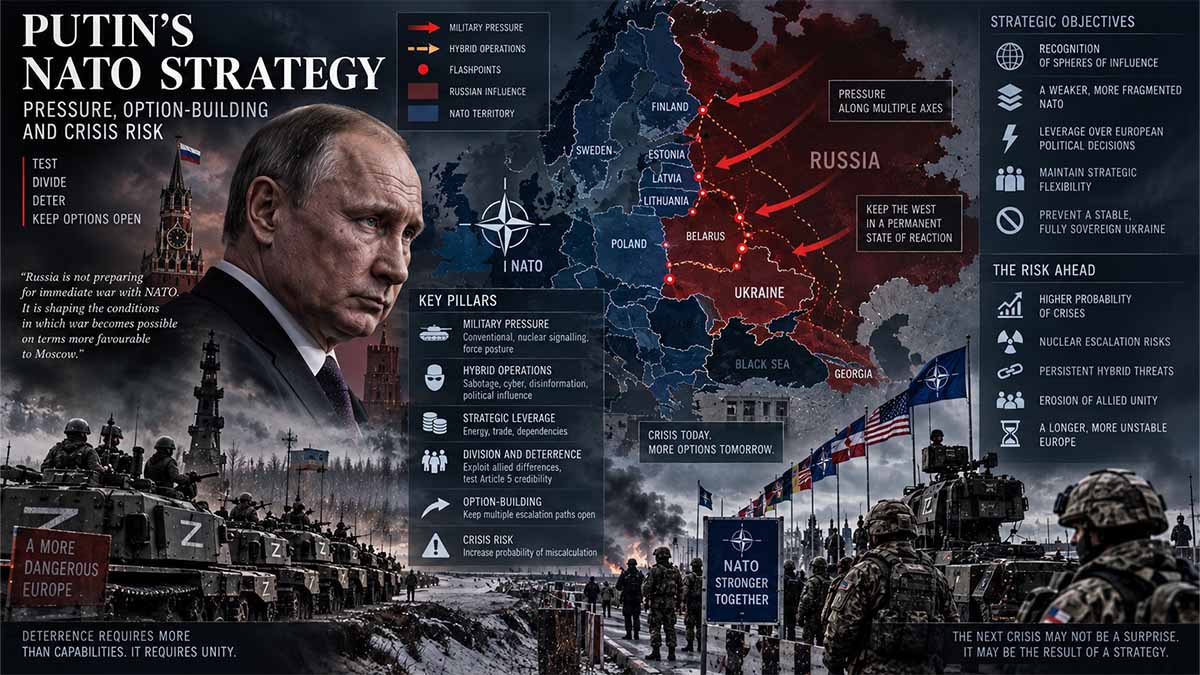
The strategic issue is not whether Russia presently possesses the force necessary to launch a general war against NATO, but whether Moscow is constructing sufficient military capacity, coercive instruments and escalation options to generate a bounded crisis whose political effects could exceed the initial scale of the military action.
Strategic Pressure Architecture
North-Western Command Reconstruction
Russia has rebuilt a dedicated military command structure oriented toward its north-western frontier, reflecting the altered military geography created by Finland’s accession to NATO and the expansion of the Alliance’s land frontier with Russia.
Observed structural changePermanent Infrastructure Expansion
New and renovated garrison infrastructure provides capacity to receive, sustain and command larger formations after the Ukraine war releases forces, but infrastructure alone does not demonstrate an operational attack grouping.
Capacity-buildingMass and Ammunition Regeneration
Estonian intelligence assesses a major expansion of Russian large-calibre ammunition output, demonstrating an effort to rebuild the material basis for sustained high-intensity warfare rather than merely replacing daily battlefield losses.
Industrial mobilisationInstitutionalisation of Unmanned Warfare
Dedicated unmanned formations, including structures associated with the Leningrad Military District, indicate that lessons from Ukraine are being absorbed into Russia’s permanent force architecture.
Force adaptationSabotage and Intelligence Operations
Covert or deniable operations can damage defence-industrial, logistics or infrastructure nodes while complicating immediate attribution and political response.
Already occurringCyber and Infrastructure Pressure
Destructive cyber operations and attacks against critical societal functions offer Moscow mechanisms for creating operational disruption without crossing immediately into acknowledged interstate warfare.
Persistent pressureAmbiguous Kinetic Action
A limited strike, localised military incident, infrastructure attack or deliberately engineered confrontation would create a substantially more dangerous escalation problem because NATO governments would have to determine attribution, proportionality and the appropriate collective response.
Conditional optionLimited Direct Military Test
The strategically significant scenario is a bounded military action designed to create an acute political-military crisis while remaining below the scale Moscow believes would trigger an uncontrollable NATO-Russia war.
Critical thresholdAttribution
Governments must determine whether the event is attributable to the Russian state, a proxy structure, a recruited actor or another mechanism before deciding whether a collective military response is justified.
Decision variableArmed-Attack Determination
The severity, target, casualties, military purpose and scale of an incident determine whether governments treat it as sabotage, coercion, hostile action or an armed attack requiring a fundamentally different response.
Decision thresholdResponse Calibration
NATO would need to restore deterrence while avoiding a response whose scale produced escalation disproportionate to the original event, making political cohesion and speed of decision part of the operational problem.
Escalation managementRisk of Miscalculation
The most dangerous pathway emerges if Moscow believes an action will remain limited while NATO governments interpret the same event as requiring collective military retaliation.
Systemic escalation riskEscalation Geometry
Military restructuring and strategic pressure
Command reconstruction, industrial mobilisation, intelligence collection, exercises and force adaptation expand future options without themselves constituting preparation for immediate war.
Covert and deniable operations
Sabotage, cyber disruption, proxy activity and interference can impose real military costs while retaining ambiguity over the appropriate level of response.
High-consequence incident
A severe infrastructure attack, casualties or a deliberate military encounter would force accelerated NATO consultation and sharpen questions of attribution and collective defence.
Bounded use of conventional force
A deliberately restricted military operation would depend upon Moscow believing that the action could achieve coercive effect without triggering a general NATO-Russia war.
Large-scale conventional attack
This would require a qualitatively different force posture, substantial preparation, extensive logistics and visible concentration of combat and enabling formations.
Indicators That Would Change the Assessment
Combat-Formation Concentration
Sustained movement of multiple combined-arms formations toward the north-west, especially when accompanied by enabling units, would be substantially more diagnostic than garrison construction.
Operational Logistics
Forward accumulation of fuel, ammunition, bridging equipment, repair assets, field medical capacity and military transport would indicate transition from infrastructure development toward campaign preparation.
Joint Command Activation
Persistent forward command posts integrating ground forces, aviation, air defence, electronic warfare and long-range strike assets would materially increase concern.
Force Release From Ukraine
A ceasefire, frozen conflict or major reduction in Ukrainian combat intensity could release experienced Russian formations for regeneration and redeployment toward other theatres.
Coordinated Rear-Area Disruption
Simultaneous pressure against transport, defence industry, telecommunications, energy and military reinforcement nodes would carry greater diagnostic weight than isolated incidents.
Strike-System Reorientation
Unusual dispersal or concentration of long-range strike, reconnaissance and electronic-warfare assets toward the north-western theatre would alter the operational picture.
Why a Limited Crisis Could Have Strategic Effects
The target of a bounded operation would be the alliance decision system as much as the physical target.
A limited Russian action would generate strategic leverage only if the political consequences exceeded the military cost of initiating it. The operational logic therefore depends upon compressing decision time, creating uncertainty about attribution and proportionality, forcing governments to evaluate collective-defence obligations under pressure, and testing whether a response can be agreed rapidly without producing an uncontrolled escalation cycle.
Net Strategic Assessment
The present evidence describes an environment in which Russia is simultaneously conducting or supporting coercive activity below the threshold of general war, regenerating military-industrial capacity, institutionalising battlefield lessons from Ukraine and rebuilding permanent military infrastructure opposite NATO’s northern frontier. These developments increase Moscow’s future strategic optionality but do not demonstrate that a large-scale attack on NATO has been ordered or scheduled. The most consequential near-term risk is therefore not a concealed army preparing to conquer NATO territory, but the possibility that Russian decision-makers eventually conclude that a deliberately bounded military crisis can impose political costs on the Alliance without triggering an uncontrollable conventional war.
Principal Official Evidence
Source treatment: intelligence-service assessments represent the formal judgments of their issuing institutions and are not presented as independently verified Russian operational orders. Russian official statements establish declared positions and announced organisational responses, not proof of future operational intent.
Accessible analytical table
| Analytical layer | Verified or assessed condition | Strategic meaning | Indicator requiring reassessment |
|---|---|---|---|
| Russian force architecture | North-western command restructuring, infrastructure development, unmanned-force expansion and wartime industrial mobilisation. | Creates capacity to absorb and sustain greater future military power without establishing an immediate attack. | Multi-formation concentration accompanied by operational logistics and joint command activation. |
| Sub-threshold operations | Sabotage, cyber pressure and intelligence-linked activity form part of the current security environment. | Permits coercive effects against NATO states while avoiding the immediate conditions of conventional war. | Coordinated operations against military reinforcement networks combined with conventional posture changes. |
| Limited kinetic crisis | Public intelligence assessments identify this as a plausible but presently limited-risk pathway. | Would attempt to produce political-military pressure disproportionate to the initial force employed. | Operational tasking, mobilisation of enabling forces and target-specific military preparation. |
| Large-scale invasion | The presently verified public record does not establish imminent preparation for a general NATO invasion. | Requires a much larger, more visible and logistically demanding force posture. | Sustained theatre-scale mobilisation, force concentration, stockpiling and integrated campaign preparation. |
Coercion Below General War
Principal judgment
The most consequential feature of Russia’s present activity against NATO is not the volume of isolated hostile incidents but the emergence of a coercive operating system that links intelligence services, recruited intermediaries, cyber operators, information activity, sabotage, unmanned platforms and overt military signalling to strategic objectives normally associated with warfare while avoiding the political and military costs of initiating acknowledged general war. This interpretation is supported particularly by the Danish Defence Intelligence Service’s September 2026 assessment, which identifies a qualitative shift from operations principally intended to create fear and weaken support for Ukraine toward activity intended to physically impede the movement of support to Ukraine, including sabotage against defence companies and railway transport. That transition matters because it converts what can superficially appear to be “hybrid harassment” into operations capable of producing direct effects on military sustainment, reinforcement, industrial output and governmental decision-making. Assessment of the Threat from Russia — Danish Defence Intelligence Service — 24 September 2026 Forsvarets Efterretningstjeneste
This operating logic is compatible with Russia’s own declared strategic framework, although Russian official doctrine does not publicly acknowledge responsibility for the covert attacks discussed below. The 2023 Foreign Policy Concept of the Russian Federation defines relations with much of Europe and NATO through the language of confrontation, describes Western policy as a new form of hybrid war against Russia, declares that Moscow intends to neutralise threats originating from NATO and the European Union, and explicitly reserves what it calls symmetrical and asymmetrical measures in response to actions Russia considers hostile. Those declarations are evidence of Russia’s officially articulated strategic worldview and response doctrine; they are not evidence that a particular sabotage operation was ordered under that doctrine. Executive Order approving Russia’s Foreign Policy Concept — President of Russia — 31 March 2023 Sito speciale Kremlin
The deeper military significance is therefore that Moscow does not need to defeat NATO forces in battle to obtain strategically relevant effects against the Alliance. If disruption of rail movement delays materiel, an attack on a defence facility forces production security measures, cyber activity threatens electricity or communications, repeated drone incidents absorb surveillance and air-defence attention, and information operations complicate attribution or redirect public anger, Russia can impose distributed friction on the system that converts European economic capacity into military support. NATO’s own 2026 resilience requirements explicitly identify energy, civil communications and transport infrastructure as essential to military enablement and Host Nation Support, demonstrating why civilian systems have military value during crisis and conflict. 2026 Resilience Baseline Requirements — NATO — 15 September 2026 NATO
The campaign has moved from psychological pressure toward operational interdiction
The strongest evidence of strategic evolution is contained in the wording of the Danish assessment itself. DDIS states that Russian hybrid attacks had until recently been principally intended to create fear and weaken public support for assistance to Ukraine, whereas Russia has increasingly begun to seek directly to prevent that support from reaching Ukraine, identifying defence enterprises and railway transport carrying military equipment as relevant targets. This is not merely a change in intensity; it represents a change in the operational purpose of hostile action, because the objective moves from influencing willingness to support Ukraine toward degrading the physical mechanisms through which support is generated and transported. Assessment of the Threat from Russia — DDIS — 24 September 2026 Forsvarets Efterretningstjeneste
That distinction produces a more useful military interpretation of sabotage than the generic label “hybrid warfare.” An operation against a transport corridor supporting defence logistics can create three simultaneous effects without destroying large quantities of military equipment: it can interrupt movement, impose inspection and security requirements across a much larger network, and compel the targeted government to allocate additional police, intelligence, military or infrastructure-protection resources to functions that previously operated under peacetime assumptions. Poland’s continuing application of the CHARLIE third-level alert to specified railway infrastructure through 30 November 2026, alongside BRAVO and BRAVO-CRP alert levels elsewhere, demonstrates how individual acts can produce enduring national-security consequences extending substantially beyond the damaged location. System antyterrorystyczny RP — Polish Ministry of Interior and Administration Gov.pl
The operational logic is therefore closer to interdiction by distributed disruption than to classical strategic bombing. The objective need not be the destruction of an entire logistics network; repeated attacks, credible threats and uncertainty concerning where the next incident will occur can increase protection requirements across airports, railways, manufacturing sites, warehouses, ports, energy networks and communications systems simultaneously. NATO’s revised resilience requirements reflect precisely this military-civilian interdependence by requiring Allies to protect and restore civil transport systems, maintain transport IT and operational-technology resilience, preserve communications and energy availability, and ensure that civilian resources remain capable of supporting NATO military plans under contested conditions. 2026 Resilience Baseline Requirements — NATO NATO
Strategic functions of the campaign
| Strategic function | Mechanism observed or officially assessed | Military effect sought or created | Evidentiary basis |
|---|---|---|---|
| Interdict support to Ukraine | Sabotage against defence companies and railway transport | Delays or complicates the physical movement and production of military assistance | DDIS explicitly identifies this shift in Russian objectives. DDIS Assessment — 24 September 2026 |
| Increase rear-area protection costs | Threats to airports, industrial facilities, railways and critical infrastructure | Forces states to protect a larger geographic and functional rear area rather than concentrating resources exclusively on military formations | NATO resilience planning treats civil transport, communications and energy as essential military-support functions. NATO 2026 Resilience Baseline Requirements |
| Generate strategic uncertainty | Use of proxies, recruited individuals, cybercriminal networks or covert services | Separates physical effect from immediately provable state responsibility and complicates rapid political response | UK government attributes Russian intelligence services with tasking and in some cases funding cybercriminals and associated actors. Profile: GRU cyber and hybrid threat operations — GOV.UK — updated 13 July 2026 |
| Probe political thresholds | Escalatory actions whose scale remains below obvious conventional invasion | Tests national and NATO decision processes without committing Russia to general war | NATO states that significant cyber and hybrid attacks can constitute an armed attack, but determination is case-specific. Collective defence and Article 5 — NATO |
| Pressure public support | Physical incidents accompanied by narratives assigning blame elsewhere or amplifying fear | Increases political cost of continued policy while degrading trust in institutions | Polish authorities documented disinformation narratives attempting to redirect responsibility for railway sabotage toward Ukraine. Narracje dezinformacyjne na temat sabotażu polskich linii kolejowych — Gov.pl — 19 November 2025 |
| Create escalation leverage | Cyber disruption, sabotage with casualty potential, military incidents and unmanned incursions | Provides Moscow with multiple coercive rungs below the level of regional conventional war | DDIS assesses increasing frequency and potentially greater consequences of Russian hybrid attacks. DDIS Assessment — 24 September 2026 |
Russia’s proxy architecture reduces the political cost of hostile action
A central characteristic of the emerging pattern is the separation of strategic direction from tactical execution. The UK government’s July 2026 public profile of GRU activity identifies Units 29155, 26165 and 74455 as Russian military-intelligence structures with cyber capabilities and states that Russian intelligence services have tasked, and in some cases funded, cybercriminals; the same document describes Unit 29155-associated activity as including the use of external actors to expand surveillance, reconnaissance and deniable operational capacity. The significance is not that every criminal or disruptive incident in Europe should therefore be attributed to Moscow, but that state capability can be combined with non-state execution in a way that lowers operational exposure and complicates attribution. Profile: GRU cyber and hybrid threat operations — UK Government — updated 13 July 2026 GOV.UK
The United Kingdom subsequently institutionalised this threat assessment through law by designating the GRU Volunteer Corps under the National Security (State Threats) Act 2026. The Home Office states that the government assesses the organisation to form part of a network of volunteer and proxy formations directed and controlled by Russia’s GRU and describes it as a mechanism through which military intelligence can recruit, organise and deploy volunteer and proxy forces. This is strategically important because it illustrates an organisational bridge between state intelligence activity and actors who may not outwardly resemble serving Russian military personnel. First groups designated as threat to national security — UK Home Office — 17 July 2026 National Security (State Threats) Act 2026 factsheet — GOV.UK
The September 2026 Swindon prosecution demonstrates the evidentiary caution required when assessing such networks. The Crown Prosecution Service charged Joshua Cammidge with materially assisting a foreign intelligence service and preparing an act of sabotage after alleged communications with a person believed to be associated with the GRU Volunteer Corps; the matter remains an active criminal proceeding and the charge is not a conviction. The value of the case for strategic analysis lies therefore not in assuming guilt, but in the alleged operational model under judicial examination: remote contact, tasking through an intermediary associated with a state-controlled structure, and preparation for physical sabotage inside a NATO country. Man charged with assisting GRU Volunteer Corps — Crown Prosecution Service — 9 September 2026 Crown Prosecution Service
Leipzig demonstrates the distinction between political attribution and criminal proof
The Leipzig/Halle case is particularly useful because the German government publicly described how attribution is constructed. Berlin concluded that Russia was responsible for the attempted attack of 4 August 2026, stating that police investigation, the operational pattern and intelligence findings each supported the political attribution; the government specifically identified the target, means employed, technical expertise and use of what it termed “low-level agents” among the relevant indicators. At the same time, it explicitly stated that the criminal investigations and legal proceedings remained unfinished. Versuchter Anschlag am Flughafen Leipzig/Halle — Bundesregierung — 4 September 2026 Bundesregierung
This distinction has direct strategic consequences. Political attribution is a national-security judgment made from multiple evidentiary streams, whereas criminal conviction must satisfy legal standards in an adversarial judicial process; an adversary exploiting this difference can potentially obtain operational effect before the evidentiary record necessary for prosecution is publicly available. Germany’s response therefore did not wait for the completion of the criminal process: its government announced diplomatic and administrative countermeasures, including closure of the Russian Consulate General in Bonn, termination of the agreement governing the Russian House in Berlin, proposals for additional EU listings and strengthened entry controls. German Federal Government response to Leipzig/Halle attack — 4 September 2026 Bundesregierung
The case also demonstrates why the term “deniable” should not be confused with “undetectable.” Deniability can remain useful even after governments develop high confidence in attribution if the attack is conducted without uniformed forces, formal acknowledgement or an unmistakable military chain of command, because the target government must still determine which countermeasure is legally, politically and strategically proportionate. Germany’s description of its response as proportionate, deliberate and non-escalatory illustrates how the attacker can impose a decision problem even when attribution becomes strong. Reaktionen auf hybriden Angriff am Flughafen Leipzig/Halle — Bundesregierung
Polish railway sabotage shows how civilian infrastructure becomes military terrain
The November 2025 attacks against Poland’s Warsaw–Dorohusk rail corridor provide one of the most concrete officially documented examples of physical sabotage against transport infrastructure. The Polish National Prosecutor’s Office states that prosecutors prepared charges against two Ukrainian citizens for terrorist-type diversion conducted on behalf of Russian intelligence, including the placement and detonation of C4 explosive beneath a passing freight train near Mika at 20:58 on 15 November 2025, damage to overhead traction equipment near Gołąb, and installation of specially constructed metal objects on a rail capable of creating a derailment hazard. The suspects left Poland for Belarus before they could be detained, and the charges therefore remain allegations rather than final judicial findings. Zarzuty za akty dywersji przeciwko infrastrukturze kolejowej — Prokuratura Krajowa — 19 November 2025 Gov.pl
The military significance does not derive principally from the amount of infrastructure destroyed. The Warsaw–Dorohusk axis belongs to the eastern transport architecture through which Poland sustains national movement and connections toward Ukraine, and the prosecutor’s description of the alleged objectives included intimidation, destabilisation of public order and weakening security. Prime Minister Donald Tusk subsequently stated that a second incident forced a train carrying 475 passengers to brake sharply and described the combined events as among the most serious security incidents Poland had faced since the beginning of Russia’s full-scale war against Ukraine. PM Tusk in Parliament: Russia Behind Sabotage Attacks in Poland — 18 November 2025
The broader operational effect is visible in the state response: Polish authorities introduced CHARLIE alert measures on specified railway lines and, as of September 2026, the Ministry of Interior continued to list the third alert level for railway infrastructure until 30 November 2026, while BRAVO and BRAVO-CRP remained applicable more widely. A comparatively local act therefore produced security requirements extending over a national transport system for a prolonged period, illustrating how sabotage can generate costs far beyond the physical damage at the attack site. System antyterrorystyczny RP — Polish Ministry of Interior and Administration Gov.pl
Operational record: what the documented cases actually establish
| Location / system | Officially established public record | Quantitative detail | Attribution status | Strategic relevance |
|---|---|---|---|---|
| Leipzig/Halle Airport, Germany | German government politically attributed the attempted 4 August 2026 hybrid attack to Russia on the basis of police, pattern and intelligence evidence | Exact operational damage was avoided because the attack failed | Formal German political attribution to Russia; criminal proceedings ongoing | Demonstrates use of civilian transport infrastructure as a coercive target and the employment of low-level agents. Bundesregierung — Leipzig/Halle response |
| Swindon, United Kingdom | Defendant charged with assisting a foreign intelligence service and preparing sabotage after alleged GRU Volunteer Corps contact | One defendant currently charged in the cited proceeding | Criminal allegation; no conviction stated | Shows alleged proxy recruitment architecture linked by UK authorities to Russian military intelligence. CPS — Man charged with assisting GRU Volunteer Corps |
| Mika / Gołąb railway, Poland | Prosecutors prepared charges concerning sabotage on behalf of Russian intelligence using C4 and rail obstruction | C4 detonated beneath freight train; a related incident involved a passenger train carrying 475 people according to the Polish PM | Prosecutorial allegation against identified suspects | Direct interference with transportation infrastructure and creation of derailment risk. Polish National Prosecutor — railway sabotage charges |
| Skarżysko-Kamienna, Poland | Prosecutors opened investigation into deliberate fire at WB Electronics premises as foreign-intelligence activity and a terrorist offence | Damage assessed at at least PLN 15 million | Investigation opened; no person charged in the cited notice | Defence-industrial target; attribution to a specific foreign service remained unresolved in the official notice. Wszczęcie śledztwa w sprawie pożaru w Skarżysku-Kamiennej — Prokuratura Krajowa — 31 August 2026 |
| Polish energy network | UK and EU publicly attributed a cyberattack to Russia’s FSB Centre 16 | UK stated that disruption could have affected 500,000 citizens | Governmental attribution to FSB Centre 16 | Demonstrates capacity to target essential societal functions whose disruption also affects military resilience. UK and EU strike Russian cyber networks with new sanctions — GOV.UK — 13 July 2026 |
Defence industry is becoming part of the operational rear
The concentration of defence and unmanned-systems manufacturing in European civilian industrial locations alters their strategic status from a Russian targeting perspective even though they remain civilian facilities under domestic ownership and regulation. Swindon illustrates this transformation particularly clearly: the UK Ministry of Defence announced the establishment there of a major TEKEVER drone-production site, while a separate government programme opened a large uncrewed-systems testing centre during 2026. This creates an industrial ecosystem whose outputs directly support British capability development and, in TEKEVER’s case, systems with operational relevance to Ukraine. New drone factory to open in Swindon — UK Ministry of Defence — 15 September 2025 Europe’s largest drone testing centre opens in Swindon — UK Ministry of Defence — 12 June 2026
The important strategic consequence is that the distinction between “front” and “rear” is progressively losing operational meaning. A missile factory, drone-development centre, railway junction, port terminal, electricity distribution system, telecommunications provider or commercial logistics company can contribute directly to a NATO state’s capacity to sustain military operations even while remaining geographically hundreds or thousands of kilometres from a potential battlefield. NATO’s own resilience doctrine recognises this condition explicitly by requiring national authorities to ensure transport, communications, energy, medical and governmental systems can continue operating during contested military conditions. 2026 Resilience Baseline Requirements — NATO NATO
This produces an attractive asymmetry for a state seeking coercive effect without large conventional force deployment: attacking a military battalion exposes the attacker immediately to the logic of military retaliation, whereas disrupting a privately owned logistics node, subcontractor, communications provider or energy system can impose real military costs while initially generating questions concerning criminal jurisdiction, intelligence attribution, infrastructure regulation, private-sector responsibility and national rather than Alliance-level response. That institutional complexity is itself part of the strategic terrain. NATO’s 2026 requirements consequently emphasise cross-government governance, private-sector planning, restoration capacity and explicit coordination of civilian infrastructure with military operational requirements. NATO 2026 Resilience Baseline Requirements
Cyber operations provide Russia with scalable strategic effects
Cyber operations occupy a particularly important position in this architecture because they can produce intelligence collection, disruption, pre-positioning, coercion or destructive effects without requiring physical access to the target territory. The North Atlantic Council stated on 13 July 2026 that Russia continues persistent malicious cyber activities against NATO members and partners, including activity affecting critical national infrastructure and government entities, and NATO announced that it had strengthened mechanisms for integrating cyber effects into Alliance operations, missions and activities. Statement of condemnation by the North Atlantic Council of Russia’s malicious cyber activities — 13 July 2026 NATO
The UK government’s GRU profile adds institutional detail by identifying three specific GRU entities with established cyber capabilities — Units 29155, 26165 and 74455 — and describing Units 26165 and 74455 as comprehensive cyber capabilities employed for Russian military and foreign-policy objectives. It also states that Russian intelligence services have used cybercriminal relationships and that GRU structures have funded development of technologies supporting cyber and hybrid operations. These remain official UK attributions rather than disclosures of Russian operational orders, but taken together they indicate that cyber capability should be understood as an integrated state instrument rather than as an isolated technical domain. Profile: GRU cyber and hybrid threat operations — UK Government GOV.UK
Cyber operations are also strategically useful because their effects can be graduated. Espionage can remain below disruptive thresholds, network access can be retained for future use, limited disruption can demonstrate capability, and destructive action can generate substantial societal consequences without the deployment of conventional forces. This does not make cyber action automatically “safe” from collective defence consequences: NATO explicitly states that significant cyber attacks and other hybrid attacks may constitute an armed attack, and Article 5 determination is made case by case. Collective defence and Article 5 — NATO — updated 12 November 2025 NATO
Physical sabotage and information activity can reinforce one another
The Polish railway case provides evidence of a second operational layer that deserves particular attention. Following the sabotage incidents, Polish authorities reported disinformation activity in Russian and Polish information environments that sought to redirect responsibility toward Ukraine and discredit Polish security services. The official statement does not establish that the physical operation and every identified online narrative were directed through a single command chain, and such coordination should therefore not be asserted without further evidence; nevertheless, the coexistence of physical attack and narrative exploitation demonstrates how an incident can generate additional political effects after the material operation has ended. Narracje dezinformacyjne na temat sabotażu polskich linii kolejowych — Polish Government — 19 November 2025
This matters strategically because attribution becomes part of the battle rather than merely a forensic process following it. An attack executed by non-Russian nationals, for example, can be exploited to generate suspicion against Ukrainians or other groups even when prosecutors allege that those individuals acted on behalf of Russian intelligence; Poland’s prime minister explicitly warned after the railway sabotage against allowing anti-Ukrainian sentiment to develop, arguing that such a reaction would serve Moscow’s interests. PM Tusk in Parliament: Russia Behind Sabotage Attacks in Poland — 18 November 2025
The strategic return from such a mechanism is potentially greater than the physical damage because the same event can simultaneously trigger transport disruption, investigative expenditure, political controversy, media amplification, inter-community tension and disagreement about attribution. For a coercive strategy seeking to degrade an adversary’s ability to act collectively, this multi-domain effect can be more valuable than destruction alone, because it attacks both infrastructure and the decision environment surrounding its protection. The EU’s March 2026 hybrid-threat conclusions similarly describe hybrid tactics as instruments aimed not only at security but at fracturing societies and undermining political decision-making. Council adopts conclusions on advancing the EU’s capacity to counter hybrid threats — 16 March 2026 Consiglio dell’Unione Europea
The real threshold is not “hybrid versus war”
A rigid division between “hybrid activity” and “war” is analytically misleading because NATO does not maintain an automatic exemption for hostile activity performed through unconventional means. NATO’s public explanation of Article 5 states that what constitutes an armed attack is assessed case by case, is not limited to overt conventional strikes, and may include significant cyber or other hybrid attacks; Article 4 consultation is available when territorial integrity, political independence or security is threatened, but Article 4 consultation is neither required before Article 5 action nor equivalent to Article 5 invocation. Collective defence and Article 5 — NATO NATO
Consequently, the usable coercive space available to Russia is not an unlimited “grey zone” safely beneath Article 5. It is an uncertain zone in which means, effects, attribution, intent, scale, casualties and cumulative consequences all influence whether an operation remains a national criminal or counterintelligence problem, becomes an Alliance political-security problem, or reaches the level of armed attack. That uncertainty can create opportunity for coercion, but it also creates danger for Moscow because misjudging NATO’s interpretation of a high-consequence operation could generate exactly the collective response the operation was intended to avoid. DDIS identifies this uncertainty directly, assessing that Russia is itself likely unsure about what would trigger collective NATO military action. Assessment of the Threat from Russia — DDIS — 24 September 2026 Forsvarets Efterretningstjeneste
Escalation and decision architecture
| Stage of hostile activity | Principal governmental problem | NATO mechanism potentially relevant | Strategic significance |
|---|---|---|---|
| Intelligence collection / covert preparation | Detection, counterintelligence, criminal evidence | National responsibility; intelligence coordination | Allows target selection and preparation while preserving deniability. |
| Cyber intrusion without major destructive effect | Attribution, remediation, network defence | NATO cyber cooperation and national response | Can provide intelligence or establish access for later action. NATO statement on Russian malicious cyber activities — 13 July 2026 |
| Physical sabotage with contained consequences | Investigation, infrastructure security, attribution | National measures; Alliance consultation if security implications justify it | Imposes cost while attempting to avoid classification as armed attack. |
| Repeated or coordinated hybrid operations | Pattern recognition and cross-border attribution | Article 4 consultation and coordinated Allied response remain available | Raises the strategic issue from isolated incident to campaign. Countering hybrid threats — NATO |
| Significant destructive cyber or hybrid attack | Whether effects constitute an armed attack | Article 5 may apply on a case-by-case basis | Means employed no longer determine the legal-political category by themselves. Collective defence and Article 5 — NATO |
| Limited overt kinetic action | Immediate military defence and escalation control | Article 4 and potentially Article 5 depending on circumstances | Moves from deniable coercion toward direct interstate military confrontation. |
The campaign seeks leverage through cumulative friction
The most plausible strategic logic is not that individual sabotage operations will sever European support to Ukraine by themselves. Their utility lies in cumulative friction: each attack, attempted attack or credible threat can oblige governments and companies to raise security levels, multiply inspections, harden facilities, duplicate systems, protect personnel, modify routes, invest in cyber resilience and increase intelligence coverage. Those costs are distributed across ministries, infrastructure operators, defence companies and private-sector logistics rather than appearing as a single military expenditure, making them easy to underestimate in a conventional force-balance analysis. NATO’s resilience doctrine now explicitly treats restoration, redundancy, transport continuity, communications, energy availability and private-sector contingency planning as elements of deterrence and defence. 2026 Resilience Baseline Requirements — NATO NATO
The operational objective can therefore be understood as reducing the efficiency of mobilisation and support, not necessarily preventing them absolutely. If moving the same quantity of equipment requires more protection, longer planning, redundant routing, additional screening and greater political oversight, the attacker has extracted strategic cost without defeating any NATO formation. This is one reason the increasing emphasis on defence-industrial facilities and transport infrastructure identified by DDIS is more important than the raw number of incidents. DDIS Assessment of the Threat from Russia — 24 September 2026
The model also explains why seemingly modest operations can remain strategically rational from Moscow’s perspective even when the physical damage is limited. Success can be measured through forced adaptation, uncertainty and resource diversion rather than solely through destroyed assets; conversely, an operation that produces excessive casualties or unmistakable military attribution can become strategically counterproductive if it consolidates allied political will or crosses a collective-defence threshold. The coercive instrument therefore has value only while Moscow believes it can control the relationship between effect and escalation. DDIS’s assessment that future sabotage could carry a high risk of casualties indicates that this margin may be narrowing as Russian risk tolerance increases. Assessment of the Threat from Russia — DDIS Forsvarets Efterretningstjeneste
The Russian concept of asymmetrical response is strategically relevant but cannot substitute for attribution
Russia’s own Foreign Policy Concept provides an important interpretive boundary. It states that the Russian Federation considers it legitimate to employ symmetrical and asymmetrical measures in response to actions it defines as threatening its sovereignty or territorial integrity, including economic sanctions or the use of information and communications technologies; it also identifies neutralising threats from NATO and hostile European states as a policy priority. This establishes an official Russian willingness to conceptualise competition through cross-domain and asymmetrical responses rather than through purely reciprocal military action. Foreign Policy Concept of the Russian Federation — President of Russia — 31 March 2023 Sito speciale Kremlin
The analytical error would be to use this doctrinal language as automatic proof that every hostile event in Europe was directed by Moscow. Doctrine establishes strategic permissiveness and a declared worldview; attribution still requires evidence specific to the incident. The Leipzig case reached formal German political attribution; the Polish railway case produced prosecutorial allegations concerning activity on behalf of Russian intelligence; the Swindon case remains before the courts; and the Skarżysko-Kamienna investigation, in the cited official notice, had not established a named foreign service or charged an individual. Maintaining these distinctions is essential because treating suspicion as proof would obscure the very attribution problem Russia can exploit. Bundesregierung — Leipzig/Halle attribution Polish National Prosecutor — railway sabotage charges CPS — GRU Volunteer Corps case Polish National Prosecutor — Skarżysko-Kamienna investigation
The civilian rear has become part of NATO’s deterrence problem
NATO’s September 2026 resilience requirements provide perhaps the clearest institutional confirmation of how much the strategic environment has changed. They explicitly require continuity of government; resilient energy; management of population movement; food and water security; mass-casualty preparedness; resilient communications; and resilient civilian transportation, while repeatedly linking those functions to Host Nation Support and execution of NATO military plans. In other words, an adversary seeking to interfere with NATO military effectiveness does not have to attack military formations directly if it can successfully disrupt the civilian systems on which those formations depend. 2026 Resilience Baseline Requirements — NATO — 15 September 2026 NATO
This creates a defensive challenge fundamentally different from conventional border defence because the number of economically and militarily relevant nodes is very large and many are privately owned. Ports, telecommunications networks, electricity distribution, logistics companies, manufacturers, rail operators and cloud or data providers can become strategically relevant because of the function they perform rather than because they are formally designated military targets. The NATO requirements consequently demand whole-of-government and whole-of-society coordination and specifically call for business-continuity planning by civil and commercial stakeholders under crisis and conflict conditions. NATO Resilience Baseline Requirements 2026
Functional target system
| Functional system | Why it matters militarily | Coercive effect if disrupted | Observable defensive response |
|---|---|---|---|
| Rail transport | Moves personnel, equipment and supplies and forms part of reinforcement networks | Delay, rerouting, security burden, psychological effect | Poland continues elevated railway alert measures. Polish Ministry of Interior anti-terrorism system |
| Airports | Support military mobility, logistics and strategic air access while remaining major civilian nodes | Flight disruption, security reinforcement, political visibility | German government reinforced infrastructure protection following Leipzig/Halle. Bundesregierung — Leipzig/Halle response |
| Defence manufacturing | Generates munitions, drones, sensors and other military capacity | Production interruption and increased security expenditure | DDIS identifies defence companies as an increasingly relevant Russian sabotage target. DDIS threat assessment |
| Energy networks | Sustain civilian functions, industrial production and military operations | Cascading societal and operational disruption | NATO identifies resilient energy as a baseline defence requirement. NATO 2026 Resilience Baseline Requirements |
| Communications | Essential to government, military coordination, emergency response and logistics | Command friction, public disruption, loss of situational awareness | NATO requires resilient civil communications and redundancy. NATO 2026 Resilience Baseline Requirements |
| Digital/OT transport systems | Coordinate physical movement and network capacity | Operational disruption without physical destruction | NATO explicitly requires transport IT and OT resilience. NATO 2026 Resilience Baseline Requirements |
Coercion below general war is becoming a military campaign in its effects even when it remains legally fragmented
The central analytical finding is therefore that the current Russian pressure campaign should not be reduced to a collection of intelligence scandals, cyber incidents or criminal cases. Different incidents remain subject to different evidentiary standards and some allegations remain unresolved, but the publicly documented pattern shows operations against the functional architecture that allows European states to manufacture, transport, finance, communicate and politically sustain military assistance. DDIS’s conclusion that Russian activity is increasingly intended to prevent support from reaching Ukraine is the critical bridge between individual incidents and strategic purpose. Assessment of the Threat from Russia — Danish Defence Intelligence Service — 24 September 2026
The campaign is also structurally attractive because many defensive reactions are national while the strategic effect is transnational. A rail interruption in Poland, an airport incident in Germany, a suspected sabotage preparation in Britain or a cyberattack against energy infrastructure can each fall initially within separate police, intelligence, judicial, regulatory and political systems even though the cumulative strategic objective, if coordinated, concerns NATO’s capacity to act. The EU recognised this institutional problem in March 2026 when it reaffirmed a cross-sectoral hybrid toolbox bringing together preventive, restrictive, cooperative and support measures rather than treating each category of hostile activity as an isolated policy problem. Council adopts conclusions on advancing the EU’s capacity to counter hybrid threats — 16 March 2026
The resulting strategic contest is therefore increasingly about whether NATO countries can convert fragmented national evidence into sufficiently rapid collective understanding before the attacker extracts political or operational advantage from ambiguity. The Leipzig response shows that political attribution can occur before a criminal case ends; NATO’s Article 5 doctrine confirms that the form of an attack does not automatically determine whether collective defence applies; and its resilience requirements show that protection of civilian systems has become part of military deterrence itself. German Federal Government — Leipzig/Halle attribution Collective defence and Article 5 — NATO NATO 2026 Resilience Baseline Requirements
Indicators that would signal a more dangerous phase
| Indicator | Why it matters | Assessment consequence |
|---|---|---|
| Sabotage shifts from isolated facilities toward multiple nodes in the same reinforcement network | Would suggest operational selection based on systemic effect rather than opportunistic target choice | Stronger evidence of organised interdiction activity rather than episodic disruption |
| Physical and cyber attacks occur against the same functional sector within a compressed period | Could indicate cross-domain targeting intended to exceed normal recovery capacity | Would increase concern over integrated campaign planning |
| Incidents increasingly produce fatalities or mass-casualty risk | Would narrow the political space separating sabotage from armed attack | NATO escalation and collective-response calculations would become materially more acute |
| Defence-industrial sites repeatedly become targets across several countries | Would reinforce DDIS’s judgment that the objective is increasingly to impede military support to Ukraine | Would elevate industrial security from company-level protection to theatre-wide military resilience |
| Known Russian state structures are connected to larger numbers of recruited local actors or criminal networks | Would demonstrate greater capacity to generate attacks without deploying Russian personnel | Would increase operational reach while preserving tactical deniability |
| Attack narratives are rapidly amplified to blame Ukraine, migrants or domestic political groups | Would suggest exploitation of physical operations for societal fragmentation | Would increase the political effect even when physical damage remains limited |
| Military incidents in the Baltic or High North coincide with intensified sabotage and cyber pressure | Would connect covert pressure to overt force signalling | Would indicate a more integrated coercive posture across the escalation spectrum |
| Repeated targeting of NATO reinforcement and Host Nation Support infrastructure | Would directly affect NATO’s capacity to move and sustain forces | Would represent a transition from political pressure toward preparation of the operational environment |
The most important warning sign is therefore not simply “more sabotage.” It is greater integration among target selection, timing, operational purpose and political exploitation, particularly where attacks begin concentrating on the transportation, energy, communications and industrial systems identified by NATO as essential to military reinforcement and sustainment. 2026 Resilience Baseline Requirements — NATO Assessment of the Threat from Russia — DDIS
Key judgments
Russian activity below the threshold of general war is increasingly relevant to military operations because its target set overlaps with the civilian infrastructure required to sustain NATO forces and support Ukraine. DDIS’s September 2026 assessment provides the clearest official indication of this shift by identifying direct interference with defence companies and military-support transport as an increasingly important objective. DDIS Assessment of the Threat from Russia — 24 September 2026
Proxy structures and externally recruited actors provide Russia with a mechanism for separating strategic sponsorship from tactical execution. The UK government’s GRU assessment, legal designation of the GRU Volunteer Corps and the active Swindon prosecution demonstrate the institutional importance Allied governments now attach to this model, while the judicial status of individual cases must remain clearly distinguished from intelligence assessment. Profile: GRU cyber and hybrid threat operations — GOV.UK First groups designated as threat to national security — GOV.UK CPS — GRU Volunteer Corps case
The principal strategic effect is cumulative friction rather than spectacular destruction. Protection costs, rerouting, redundancy, investigation, cyber remediation, counterintelligence and prolonged alert measures can degrade the efficiency with which states convert economic resources into defence capability even when individual attacks fail to destroy major assets. NATO’s 2026 resilience requirements explicitly connect these civilian systems to military enablement. NATO 2026 Resilience Baseline Requirements
The term “below Article 5” must not be treated as a fixed safe zone. NATO explicitly states that significant cyber and other hybrid attacks can constitute an armed attack and that the determination is case-specific; consequently, the Russian coercive strategy contains an inherent escalation risk if Moscow misjudges the political or operational consequences of a particular incident. Collective defence and Article 5 — NATO
What would change the assessment
The assessment would require substantial revision if authoritative evidence demonstrated that the documented incidents were primarily unrelated criminal activity rather than state-directed or state-enabled operations, if official investigations materially reversed existing political attributions, or if Russian intelligence structures demonstrably reduced their use of proxy, cyber and sabotage mechanisms. Conversely, the assessment would strengthen materially if investigations established common command relationships across multiple incidents, if defence logistics were targeted systematically across several NATO countries, or if cyber, physical sabotage and overt Russian military signalling began appearing as synchronised components of a single operational sequence. German Federal Government — Leipzig attribution methodology NATO statement on Russian malicious cyber activities — 13 July 2026
Open official record
The public record still does not disclose the intelligence basis necessary to reconstruct Russian command-and-control arrangements behind many alleged sabotage operations; the complete evidentiary files supporting Germany’s Leipzig political attribution remain non-public while criminal proceedings continue; the Swindon prosecution remains unresolved; and Poland’s Skarżysko-Kamienna investigation had not, in the cited prosecutor’s notice, identified a charged perpetrator or publicly established a Russian command link. These gaps prevent a defensible public reconstruction of a single centralised Russian sabotage command architecture, even though national governments and NATO now assess the broader pattern of Russian hybrid activity as persistent and strategically significant. Bundesregierung — Leipzig/Halle attack Crown Prosecution Service — Swindon case Polish National Prosecutor — Skarżysko-Kamienna investigation Statement by the North Atlantic Council on Russian hybrid activities
North-Western Force Geometry
Principal judgment
Russia’s north-western military development is best understood not as a linear accumulation of troops along Finland’s frontier, but as the construction of a theatre architecture capable of receiving, regenerating, commanding and sustaining substantially greater combat power once sufficient personnel and equipment become releasable from the Ukrainian war. The decisive development is therefore institutional before it is numerical: Moscow has recreated the Leningrad Military District, established the 44th Army Corps for the Karelian direction, expanded brigade structures toward divisions in the Kola Peninsula and within the 6th Combined Arms Army, begun forming an additional Iskander-M missile brigade, institutionalised district-level unmanned formations, expanded Kaliningrad infrastructure, and continued building the ammunition and personnel establishment necessary to support a larger post-war force. Lithuania’s 2026 national threat assessment simultaneously provides the essential qualification: many newly created formations remain incompletely manned and equipped, while personnel and equipment nominally belonging to those formations are being consumed by the Ukrainian theatre. Sogno Nazionale
This distinction is fundamental because military geography is being established faster than operational mass. A headquarters, army corps, divisional title, barracks complex or authorised personnel ceiling creates institutional capacity; none of those elements independently demonstrates that an operational formation of corresponding strength exists at its home station. Norwegian intelligence states that almost all personnel and materiel belonging to the newly constituted 71st Motorised Rifle Division and the 61st Separate Naval Infantry Brigade have been transferred away from the Kola Peninsula for operations in Ukraine, while Lithuanian intelligence reports more broadly that many newly formed Russian formations remain understrength because of shortages of personnel, combat equipment and infrastructure. The current Russian posture is consequently neither an empty façade nor a completed NATO-facing field army: it is a partially instantiated force structure whose long-term significance exceeds its present local combat density. etterretningstjenesten.no
The analytical variable that matters most is therefore conversion capacity: how rapidly Russia could turn administrative structures, new garrisons, industrial output and units presently committed in Ukraine into credible combat formations permanently assigned to the north-western theatre. Finland’s prime minister stated on 24 August 2026 that garrisons being constructed beyond Finland’s eastern border are expected to receive personnel once the war in Ukraine ends, while Norwegian and Lithuanian intelligence independently describe essentially the same mechanism from the military side: units and equipment currently required in Ukraine are expected eventually to return to, or populate, formations along Russia’s north-western frontier. Valtioneuvosto
Speech by Prime Minister Petteri Orpo — Finnish Government — 24 August 2026
National Threat Assessment 2026 — Lithuanian State Security Department
Focus 2026 — Norwegian Intelligence Service
The Leningrad Military District creates a permanent command framework for the north-western theatre
The recreated Leningrad Military District should be interpreted as a strategic command mechanism rather than simply another layer of military bureaucracy. Russia’s December 2022 force-reform programme explicitly called for the creation of separate Moscow and Leningrad Military Districts as part of a much larger re-expansion of the Russian Armed Forces, including new artillery divisions, aviation formations, naval infantry divisions and a planned military strength of approximately 1.5 million uniformed personnel. Russian official statements later confirmed that the districts had been formed, while President Vladimir Putin publicly connected the north-western reorganisation to the enlargement of NATO’s frontier following Finland’s accession. These Russian statements establish the organisational decision and Moscow’s stated rationale; they do not establish a decision to conduct offensive operations. Sito speciale Kremlin
Russian Defence Ministry force-development presentation recorded by the Kremlin — 21 December 2022
Russian Presidential meeting confirming formation of the Leningrad and Moscow Military Districts
The operational significance becomes clearer when the district is considered geographically. Finland and Russia share a 1,340-kilometre land frontier, officially confirmed by the Finnish government, making the Finnish direction fundamentally different from a narrow border sector in which one or two formations could dominate the military problem. A force responsible for such an extended frontier must solve command, mobility, reconnaissance, sustainment and reinforcement problems across widely separated northern and southern sectors while also interfacing with the Kola Peninsula, St Petersburg, the Gulf of Finland, the Baltic Fleet and Kaliningrad. The Leningrad Military District supplies the institutional structure within which those separate areas can be treated as parts of a single military-strategic problem. Valtioneuvosto
Norwegian intelligence has described the Leningrad Military District as responsible for defence and military operations in the Baltic and Nordic regions and potentially for cooperation with the Northern Fleet in the Arctic. That formulation is analytically important because it demonstrates why the north-western build-up should not be reduced to individual garrisons such as Pechenga or facilities in Karelia: the Russian structure is intended to provide operational coherence across land, maritime, air, missile, electronic and increasingly unmanned domains. etterretningstjenesten.no
Verified force architecture inside the north-western system
| Formation or capability | Verified public status | Geographic/command role | Present readiness constraint | Source |
|---|---|---|---|---|
| Leningrad Military District | Re-established as a separate military district and operational command framework | Nordic, Baltic and north-western strategic direction | District existence does not reveal actual combat strength available at any moment | Russian Presidential record on military-district formation |
| 44th Army Corps | Lithuanian intelligence reports that it has been formed and contains a motorised-rifle division | Intended for the Karelian/north-western land direction | Units forming within the wider Russian reform remain subject to personnel, equipment and infrastructure shortages | Lithuanian National Threat Assessment 2026 — Russian force expansion |
| 71st Motorised Rifle Division | Created from the former 200th Separate Motorised Rifle Brigade | Pechenga/Kola sector; subordinate to the Leningrad Military District | Norwegian intelligence reports that almost all personnel and equipment have been transferred from the Kola Peninsula for the war in Ukraine | Focus 2026 — Norwegian Intelligence Service |
| 61st Separate Naval Infantry Brigade | Still a brigade in the Norwegian 2026 assessment, but scheduled for expansion into a division | Sputnik/Kola; Northern Fleet component | Almost all personnel and materiel reported committed outside the Kola Peninsula to Ukraine | Focus 2026 — Norwegian Intelligence Service |
| 6th Combined Arms Army formations | Lithuanian intelligence reports that two motorised-rifle brigades have been expanded into divisions | South-western portion of the Leningrad MD and Baltic approaches | Division titles do not establish complete manning, equipment or operational readiness | Lithuanian threat assessment — Russian capabilities near NATO’s eastern borders |
| New Iskander-M missile brigade | Formation reported underway inside the Leningrad Military District | Adds operational-level missile capacity to district architecture | Public official record does not establish complete staffing, missile inventory or readiness date | Lithuanian National Threat Assessment 2026 |
| Leningrad MD UAV regiment | Estonian intelligence reports a UAV regiment directly subordinate to the district; staffing and equipping underway | District-level reconnaissance and strike capability | Not yet described as completely staffed or equipped | International Security and Estonia 2026 — Estonian Foreign Intelligence Service |
| Baltic Fleet unmanned naval-strike regiment | Formation reported established | Baltic maritime strike architecture | Public source does not disclose full platform inventory or operational readiness | International Security and Estonia 2026 |
| Kaliningrad naval infantry formation | Existing brigade being expanded into a naval infantry division | Forward Baltic component within the Leningrad MD | Current land grouping remains weakened because personnel and equipment are committed to Ukraine | Lithuanian National Threat Assessment 2026 |
Divisionisation changes the character of Russian land power
The return from brigade-dominated structures toward divisions has greater military significance than the terminology initially suggests. Norwegian intelligence estimates a typical Russian brigade at approximately 3,000–4,000 personnel, whereas an infantry or tank division can contain approximately 5,000–10,000 personnel, organised around subordinate regiments estimated at roughly 2,500–3,500 personnel each. These figures are generic structural estimates rather than actual current headcounts for the formations discussed above, but they explain the institutional logic behind Russia’s reform: the divisional model creates additional command depth, a larger internal support architecture and the ability to integrate several manoeuvre regiments with artillery, reconnaissance, air defence, engineering and logistics under a more substantial headquarters. etterretningstjenesten.no
Focus 2026 — Russia’s land force structure — Norwegian Intelligence Service
The reform therefore represents more than an attempt to increase the number of soldiers stationed in western Russia. Russia is reconstructing the ability to command larger combined-arms packages over sustained operations, reversing important elements of the post-2008 reform that had sought greater reliance on smaller brigades. Norwegian intelligence explicitly characterises the transition as producing a larger, heavier and more powerful land force for regional warfare. The critical uncertainty remains implementation: a division existing in an organisational table is not equivalent to a combat-ready division containing trained personnel, full equipment sets, ammunition, maintenance capacity and supporting formations. etterretningstjenesten.no
Formation labels versus military reality
| Condition | What it actually establishes | What it does not establish |
|---|---|---|
| Formation officially created | Headquarters and authorised organisational structure exist | Full personnel strength |
| Brigade redesignated or expanded into division | Intended increase in command depth and eventual combat mass | That all subordinate regiments are operational |
| Permanent garrison constructed | Physical capacity exists to receive personnel and equipment | That the planned formation is currently stationed there |
| Equipment allocated to formation | Materiel exists somewhere within the force-generation system | That it remains at the home station rather than in Ukraine |
| Personnel assigned administratively | Manning process has begun | Collective training or combat readiness |
| Formation conducts field training | Some level of functional capability exists | Readiness for sustained theatre operations |
| Formation exercises with district-level aviation, missile, air defence, EW and logistics elements | Much stronger evidence of operational integration | An order or intention to launch hostilities |
| Sustained deployment with ammunition, fuel, repair, medical and command-support systems | Evidence of a genuine operational grouping | By itself, political intent for offensive action |
This distinction resolves an important evidentiary problem surrounding claims of extraordinarily large future Russian troop totals near Finland. The public official sources reviewed here establish the planned architecture and direction of expansion, but they do not establish a current aggregate of one hundred thousand operational Russian troops concentrated against Finland. Finland’s government confirms garrisons under construction and expects increased Russian presence after the Ukrainian war, while Norwegian and Lithuanian intelligence simultaneously document that the personnel and equipment needed to populate the structures are still heavily committed elsewhere. Valtioneuvosto
Karelia is being rebuilt as a land-force receptacle
The creation of a new army corps for Karelia is one of the more strategically important structural changes because it places a permanent higher-level command structure behind Finland’s long eastern frontier. Norwegian intelligence states that Russia has established a new army corps that is intended, over the longer term, to be garrisoned in Karelia, while Lithuania identifies the 44th Army Corps and a motorised-rifle division under its command. The two official assessments are mutually consistent on the central point: Russia is creating a substantial permanent land-force command in a region where the post-Soviet military presence had been considerably thinner than the emerging structure now implies. etterretningstjenesten.no
The significance of a Karelian army-corps framework is not that it proves an offensive plan toward Finland, but that it reduces the institutional preparation required if Moscow later decides to generate additional combat power in that direction. Without a permanent corps framework, newly generated units require an improvised or externally provided command arrangement; with a standing corps, subordinate formations can be assigned, trained and integrated into an existing hierarchy. Garrisons, communications, training areas, depots and support infrastructure then become the physical counterpart of the headquarters structure. Finland’s August 2026 statement that Russian garrisons under construction are expected to fill after the war is therefore strategically consistent with the force architecture reported by Norwegian and Lithuanian intelligence. Valtioneuvosto
There is nevertheless a major difference between absorption capacity and deployed power. A newly built Karelian garrison is strategically meaningful precisely because it can shorten future force-generation timelines, but its existence should not be converted into an estimate of combat strength until personnel, equipment and support elements can be independently established. This is particularly important in a war in which Russia routinely creates formations administratively and then commits their personnel and equipment to Ukraine before their home-garrison structure is fully mature. Lithuanian intelligence explicitly states that this is occurring. Sogno Nazionale
The Kola Peninsula combines conventional force generation with strategic-force protection
The northern end of the geometry is qualitatively different because the Kola Peninsula contains both conventional land formations and assets associated with Russia’s strategic military posture. Norwegian intelligence identifies the 71st Motorised Rifle Division at Pechenga and the 61st Separate Naval Infantry Brigade at Sputnik while also emphasising the central military significance of the Northern Fleet and its nuclear-powered submarine forces. The consequence is that Russian force planning near Norway and northern Finland cannot be understood purely through the lens of land manoeuvre; protection of Northern Fleet bases and Russia’s strategic nuclear second-strike capability is itself a central military requirement. etterretningstjenesten.no
The 71st Division illustrates particularly well the distinction between future structure and current force availability. Norwegian intelligence identifies it as the successor to the 200th Separate Motorised Rifle Brigade, states that it will be garrisoned at Pechenga with at least two motorised-rifle regiments and one tank battalion, and reports that almost all of its personnel and equipment are presently committed to the Ukrainian war. The formation therefore exists institutionally while much of its physical combat power is geographically elsewhere. etterretningstjenesten.no
The same applies to the 61st Naval Infantry Brigade, whose planned transformation into a division would enlarge Russia’s amphibious and coastal-ground component in the region but whose current personnel and equipment are also largely consumed by Ukraine. Norwegian intelligence explicitly cautions that the complete planned structure may not ultimately become fully professionalised and that parts could rely on mobilisation and conscripts. That qualification matters because the headline size of a planned division does not reveal the composition or readiness model through which Russia intends to man it. etterretningstjenesten.no
Kola and Karelia: current institutional status
| Element | Institutional development | Present operational condition identified by official intelligence | Analytical significance |
|---|---|---|---|
| 71st Motorised Rifle Division | Brigade expanded into division | Almost all personnel and materiel transferred from Kola for Ukraine | Existing divisional architecture can receive returning/reconstituted forces after the war |
| 61st Naval Infantry Brigade | Expansion to division planned | Most personnel and materiel currently committed to Ukraine | Future increase in Northern Fleet ground component remains incomplete |
| New army corps in Karelia / 44th Army Corps | Higher-level land headquarters established | Formation development continues while Russian manpower and equipment remain heavily demanded by Ukraine | Creates command framework for larger future land-force presence opposite Finland |
| New garrison infrastructure | Finnish government confirms construction across the eastern frontier | Finland expects greater personnel presence after the war | Infrastructure represents future absorption capacity rather than current combat mass |
| Northern Fleet strategic forces | Permanent and strategically central | Remain a major Russian military priority independent of conventional land-force depletion | Northern land forces perform both regional and strategic-force protection functions |
Sources: Focus 2026 — Norwegian Intelligence Service; Lithuanian National Threat Assessment 2026; Finnish Prime Minister’s Annual Meeting of Heads of Mission speech — 24 August 2026.
The Baltic component gives the district depth, missiles, sensors and an isolated forward position
The Leningrad Military District’s southern geometry extends through St Petersburg and the Gulf of Finland into the Baltic and incorporates Kaliningrad, creating a structure that is geographically discontinuous but operationally interconnected. Lithuania’s intelligence service reports that two motorised-rifle brigades associated with the 6th Combined Arms Army have been expanded into divisions and that Russia has begun forming an Iskander-M missile brigade within the district. The importance of this development lies not only in additional launcher numbers, which are not publicly established in the official source, but in the creation of an additional district-level long-range precision-strike formation capable of being integrated with reconnaissance and command systems. Sogno Nazionale
Kaliningrad has a different function. Lithuania’s 2026 assessment describes its present land component as temporarily weakened because substantial personnel and equipment are being used in Ukraine, yet simultaneously documents long-term infrastructure expansion: construction of elements of the 29B6 Container over-the-horizon radar, the existing Voronezh-DM early-warning radar, a hardened arsenal and a strategic-reserve logistics base. This combination illustrates the wider pattern visible throughout north-western Russia: near-term conventional depletion can coexist with long-term investment in the infrastructure required for future military power. Sogno Nazionale
Kaliningrad also functions as an electronic-warfare environment rather than solely a ground-force location. Lithuanian intelligence states that Russia actively employs systems in the region to jam and spoof satellite-navigation signals at varying ranges and intensities, principally to protect Russian military and critical civilian facilities against UAV attack, while accepting spillover effects affecting aviation and maritime navigation outside Russian territory. This is relevant to force geometry because navigation warfare increasingly forms part of the protective envelope surrounding military infrastructure and because GNSS denial changes the operating conditions for both unmanned systems and conventional forces throughout the Baltic environment. Sogno Nazionale
The Ukrainian war is simultaneously Russia’s principal constraint and its principal military laboratory
The relationship between Ukraine and the north-western force build-up is nonlinear. Continued high-intensity war prevents Moscow from accumulating the complete land-force structure it intends to maintain around Finland and the Baltic because personnel, vehicles, ammunition, engineering equipment, air-defence systems and specialist units are repeatedly demanded by the Ukrainian front. Lithuanian intelligence states explicitly that most newly generated Russian formations are being sent to Ukraine and that a continuation of the war at its present intensity would continue limiting Russia’s ability to generate military threats elsewhere. Sogno Nazionale
At the same time, Ukraine is accelerating the quality of Russian institutional learning. Lithuania’s assessment of Zapad 2025 states that the exercise incorporated assault formations for fortified positions, dispersed logistics, large-scale UAV employment, fibre-optic FPV drones capable of operating at distances up to 40 kilometres, electronic countermeasures and real-time spectrum analysis. The exercise involved up to approximately 30,000 Russian and Belarusian personnel, according to Lithuanian intelligence, considerably fewer than the 100,000 figure publicly claimed by Putin, with the reduced scale itself attributed to Russia’s continuing commitments in Ukraine. Sogno Nazionale
During Zapad 2025 Russia applied lessons learned in Ukraine — Lithuanian State Security Department
This produces a strategically important paradox: the longer the Ukrainian war continues at high intensity, the longer it delays the physical filling of NATO-facing formations, yet the more operational experience the Russian Armed Forces accumulate in drone warfare, electronic warfare, dispersed logistics, counter-battery operations, field fortification, reconnaissance-strike integration and adaptation under persistent surveillance. The result after the war would therefore not simply be the return of the Russian Army that existed before February 2022. The formations that eventually populate Karelia, Pechenga, the 6th Combined Arms Army and Kaliningrad would inherit organisations and tactical procedures shaped by years of high-intensity combat, although their actual quality would still depend on personnel retention, equipment replacement, leadership, training and the condition of returning units. Sogno Nazionale
Ukraine’s effect on north-western force generation
| Mechanism | Current effect | Post-war implication |
|---|---|---|
| Personnel demand | Newly formed units supply personnel to Ukraine rather than remaining fully staffed at home stations | A reduction in fighting releases trained and combat-experienced personnel for permanent formations |
| Equipment demand | Vehicles and equipment allocated to new formations are sent to Ukraine | Ending or reducing combat permits newly manufactured and repaired equipment to remain in home formations |
| Ammunition consumption | Sustained demand continues to absorb very large volumes | Lower expenditure creates greater opportunity for strategic stock rebuilding |
| Industrial mobilisation | Russia expands production while fighting | Industrial infrastructure survives beyond the immediate battlefield requirement |
| Operational learning | UAV, EW, dispersed logistics and assault methods are continuously refined | Lessons can be institutionalised in post-war formations |
| Garrison development | Physical infrastructure can be constructed while formations remain deployed elsewhere | Returning units can move into an already prepared administrative and basing structure |
| Collective training | High-intensity war limits some normal training cycles and large strategic exercises | Post-war conditions permit more district-level integration and combined-arms training |
The key analytical implication is that the end of the Ukrainian war would not itself generate an immediate fully restored north-western army. Units leaving the battlefield would require personnel rotation, maintenance, vehicle replacement, ammunition replenishment, medical recovery, leadership regeneration and collective training before they could become stable permanent formations. The strategic danger, however, would change because Russia would no longer have to choose to the same degree between sustaining Ukraine and filling its new NATO-facing structures.
Russia has established the legal establishment for a much larger armed force, but authorised strength is not actual strength
Russian force-generation ambitions now have a formal personnel ceiling substantially above the pre-war establishment. Presidential Decree No. 139 of 4 March 2026 established a total authorised Russian Armed Forces establishment of 2,391,770 positions, including 1,502,640 military personnel. The previous September 2024 establishment had specified 2,389,130 positions, including 1,500,000 military personnel. These are legally authorised establishment figures, not independently verified counts of personnel actually serving, trained or deployable. EPP
The March 2026 decree therefore demonstrates that the institutional expansion announced in 2022 has been incorporated into Russia’s formal force establishment, but the operational problem remains filling it. Lithuanian intelligence reports continuing shortages of personnel and equipment in newly constituted units, making it essential not to interpret the authorised figure of 1.50264 million military personnel as a statement that Russia possesses that number of trained, equipped and combat-available troops. Sogno Nazionale
Russian authorised force establishment
| Date / decision | Total authorised establishment | Military personnel component | Analytical meaning |
|---|---|---|---|
| September 2024 establishment | 2,389,130 | 1,500,000 | Formalised the 1.5 million military-personnel target announced during the force expansion |
| March 2026 Decree No. 139 | 2,391,770 | 1,502,640 | Current authorised establishment in the official Russian legal record |
| Change | +2,640 | +2,640 | Administrative increase only; it does not measure actual recruitment or operational readiness |
Source: Russian General Prosecutor’s official explanation of Presidential Decree No. 139 — 7 April 2026.
The much larger structural change occurred earlier, when Russia moved toward the 1.5 million military-personnel establishment and began creating new armies, corps, divisions and brigades. The 2026 adjustment is therefore not evidence of a new mass mobilisation wave; it is better understood as a minor amendment within an already enlarged authorised structure. The material intelligence question is no longer whether Russia has legally created sufficient positions, but whether it can provide the people, vehicles, munitions and training necessary to make them militarily meaningful.
Unmanned warfare is becoming embedded into the district’s permanent order of battle
The most technologically consequential change in the north-western force architecture is the institutionalisation of unmanned systems as organic formations rather than temporary wartime detachments. Estonia’s Foreign Intelligence Service assesses that Russia is planning approximately 190 unmanned-systems battalions, mainly UAV formations distributed through the Ground Forces, Airborne Forces and Naval Infantry, following the creation of a dedicated unmanned-systems branch in autumn 2025. At formation level, the Russian model described by EFIS assigns a UAV regiment to a military district, another regiment at army or army-corps level, and UAV battalions at division and brigade level; the Navy is developing corresponding unmanned-surface-vessel regiments at fleet level. Välisluureamet
International Security and Estonia 2026 — Russian Armed Forces and unmanned warfare
This structure is already appearing in the north-west. EFIS reports that the Baltic Fleet has formed a regiment of unmanned naval strike vehicles and that a UAV regiment directly subordinate to the Leningrad Military District is being staffed, armed and equipped; it further assesses that the Baltic Fleet is expected to receive a UAV regiment and divisions within the 6th Combined Arms Army are expected to establish UAV battalions. Välisluureamet
Planned Russian unmanned organisational architecture
| Command level | Planned unmanned formation | North-western implementation reported in 2026 |
|---|---|---|
| Military district | UAV regiment | Leningrad MD UAV regiment being staffed and equipped |
| Army / army corps | UAV regiment | Organisational model established; detailed readiness by corps not publicly disclosed |
| Division | UAV battalion | Expected in 6th Combined Arms Army divisions |
| Brigade | UAV battalion | Standard model planned across relevant branches |
| Fleet | USV regiment | Baltic Fleet unmanned naval-strike regiment formed |
| Fleet | UAV regiment | Baltic Fleet UAV regiment expected in coming years |
Source: Estonian Foreign Intelligence Service — International Security and Estonia 2026.
The strategic importance is that future Russian force density cannot be measured solely by counting tanks, infantry battalions or artillery tubes. A district structured around persistent UAV reconnaissance, fibre-optic FPV systems, electronic warfare, precision fires and maritime unmanned strike creates a sensor-to-shooter network extending beyond the physical frontage occupied by manoeuvre formations. Estonia’s intelligence service explicitly assesses that these unmanned formations will augment intelligence, indirect-fire, naval-strike and precision-strike capabilities around the Baltic theatre. Välisluureamet
Ammunition production changes the sustainability calculation
The material foundation behind Russia’s force expansion is increasingly important because divisions and army corps without deep ammunition stocks would provide nominal mass but limited endurance. Estonia’s Foreign Intelligence Service estimates that Russian production of artillery ammunition of 100 mm calibre and above rose from approximately 400,000 rounds in 2021 to 7 million rounds in 2025, representing more than a seventeenfold increase. The estimate covers tank, howitzer, mortar and multiple-launch rocket ammunition under the OSCE-derived definition used by EFIS. Välisluureamet
The estimated production trajectory was approximately 0.4 million in 2021, 1.0 million in 2022, 3.5 million in 2023, 4.5 million in 2024 and 7.0 million in 2025. Calculated directly from those EFIS figures, 2025 output corresponds to an average production equivalent of approximately 19,200 rounds per day, although daily production equivalence must not be confused with daily battlefield availability because the total contains several ammunition categories, production is not necessarily uniform through the year, stocks require transport and distribution, and different calibres are not interchangeable. EFIS itself nevertheless judges that the expansion is sufficiently large for Russia to begin replenishing part of its strategic artillery reserves while fighting continues. Välisluureamet
Estimated Russian large-calibre ammunition production
| Year | EFIS estimate | Annual change calculated from EFIS data |
|---|---|---|
| 2021 | 0.4 million | Baseline |
| 2022 | 1.0 million | +150% |
| 2023 | 3.5 million | +250% |
| 2024 | 4.5 million | +28.6% |
| 2025 | 7.0 million | +55.6% |
Source data: International Security and Estonia 2026 — Russian artillery-ammunition production. Percentage changes are calculated from the source series.
The composition of the estimated 7 million rounds produced in 2025 is also militarily relevant because it shows that the increase was not confined to one weapon class.
| Ammunition category | Estimated 2025 production | Share of 7 million total, calculated |
|---|---|---|
| Howitzer ammunition — 122, 152 and 203 mm | 3.4 million | 48.6% |
| Tank and infantry-fighting-vehicle ammunition — 100, 115 and 125 mm | 0.8 million | 11.4% |
| MLRS ammunition — 122, 220 and 300 mm | 0.5 million | 7.1% |
| Mortar rounds — 120 and 240 mm | 2.3 million | 32.9% |
| Total | 7.0 million | 100% |
Source: Estonian Foreign Intelligence Service 2026 assessment — ammunition production breakdown.
EFIS additionally estimates that Russian procurement of this ammunition cost approximately RUB 1 trillion, or about €10.6 billion, in 2025, and that Russia had imported approximately 5–7 million artillery rounds from Iran and North Korea since 2023. These are intelligence estimates rather than audited Russian production accounts, but they materially alter the sustainability picture because domestic production and external supply together can permit stock reconstruction even before the Ukrainian war has ended. Välisluureamet
The strategic consequence for the north-west is delayed rather than immediate. Ammunition being produced nationally is not automatically assigned to the Leningrad Military District, and the public official record does not disclose district-level stockpiles. What matters is that the industrial system increasingly possesses the capacity to create the reserves from which a larger north-western force could eventually be sustained.
Russia is adapting logistics around the expectation of persistent drone observation
One of the least visible but most consequential lessons from Ukraine concerns logistics. Lithuanian intelligence reports that Zapad 2025 incorporated dispersed supply points, truck-based distribution, reduced concentration of resources and physical counter-UAV protection of supply routes, reflecting lessons from a battlefield where large static logistics concentrations are highly vulnerable to persistent reconnaissance and precision strike. Sogno Nazionale
This changes how future Russian readiness should be measured. Large depots and obvious forward stockpiles remain important indicators, but a force trained to disperse logistics may deliberately minimise precisely the concentrations that older warning models would expect. The more useful indicators therefore include the number and activity of distributed supply nodes, transport fleets, field maintenance, engineering units, temporary ammunition points, mobile air-defence and electronic-warfare coverage, military medical capacity and sustained movement patterns connecting permanent garrisons to training areas. None of these individually proves offensive preparation, but together they provide a better indication of campaign-level readiness than barracks construction alone.
The logistical adaptation also means that infrastructure around new garrisons should be assessed functionally. Accommodation tells only how many personnel can be housed; military sustainability depends on vehicle maintenance, fuel handling, ammunition storage, communications, railway access, road capacity, engineering support, air defence, medical facilities and the ability to distribute supplies under observation. Public reporting on many of the new north-western sites does not yet provide a sufficiently complete Tier A record to establish those capabilities site by site.
The decisive force-release event would be a sustained reduction of the Ukrainian requirement
Lithuanian intelligence provides one of the clearest official frameworks for understanding how the Ukraine war changes Russian force availability. Its 2026 assessment states that continued fighting at approximately current intensity would keep much of Russia’s available military capacity committed and prevent complete restoration of the strategic reserves needed for a large NATO conflict; a ceasefire or frozen conflict would permit faster staffing of permanent bases and rebuilding of ammunition stocks; and a peace settlement accompanied by sanctions relief would accelerate the process further by releasing forces, financial resources and access to industrial technologies. These are Lithuanian intelligence forecasts, not established future outcomes. Sogno Nazionale
Force-release pathways identified by Lithuanian intelligence
| Strategic condition | North-western consequence identified in the official assessment | Principal limitation |
|---|---|---|
| High-intensity Ukraine war continues | New formations continue being assembled but many remain committed to Ukraine; threat-generation capacity elsewhere remains constrained | Personnel, equipment and ammunition continue to be consumed |
| Ceasefire or frozen conflict | Troops and equipment at permanent bases increase in the near term; formations become progressively more completely staffed; strategic reserves begin rebuilding faster | Quantity may recover before quality and modernisation |
| Peace agreement combined with sanctions relief | Larger force withdrawals from Ukraine become possible, financial flexibility increases and access to industrial technology improves | Still requires regeneration, training and replenishment rather than instant readiness |
| Longer-term development under favourable conditions | Lithuanian intelligence assesses that Russia could eventually field an army 30–50% larger than before the war and substantially more modern | Intelligence forecast dependent on political, economic and industrial conditions |
The central military point is that the termination of combat does not merely stop Russian losses; it changes the destination of marginal Russian production. While the war continues, a new armoured vehicle, artillery piece, UAV unit or trained soldier can be absorbed immediately by the Ukrainian theatre. Once that demand contracts, a growing share can remain in newly created permanent formations. The same logic applies to ammunition: reduced consumption converts production capacity from replacement flow into reserve accumulation. This is the mechanism through which apparently incomplete formations in Karelia, Pechenga, the 6th Combined Arms Army and Kaliningrad can become substantially more consequential without requiring a new reform announcement.
Infrastructure should therefore be read as an option-building asset
The strongest interpretation of the new north-western garrisons is neither that they are meaningless construction nor that they prove an imminent campaign. They are option-building infrastructure. Their military value derives from reducing the time and organisational friction required to absorb forces later. Finland’s own government has effectively articulated this interpretation by stating that the garrisons currently under construction across the frontier are expected to be filled once Russia can increase its military presence after the Ukrainian war. Valtioneuvosto
Infrastructure is particularly important because personnel can be moved much faster than a complete permanent military ecosystem can be constructed. Barracks, vehicle parks, depots, headquarters buildings, training areas, communications, power, workshops and security systems developed during wartime can therefore provide a ready institutional shell for units returning later. The correct warning question is not simply “How many soldiers are there today?”, but “How much additional force can this infrastructure absorb, and how rapidly can that force become integrated and sustainable?”
Readiness indicators with the greatest diagnostic value
| Indicator | Current public status | Why it matters |
|---|---|---|
| Permanent garrison construction | Confirmed at aggregate level by Finland | Establishes future absorption capacity |
| 44th Army Corps institutional development | Confirmed by Lithuanian and Norwegian intelligence | Provides higher headquarters for the Karelian direction |
| 71st MRD return to Pechenga | Not yet realised; almost all personnel/materiel reported in Ukraine | Return would convert nominal structure into substantially greater local combat mass |
| 61st Naval Infantry expansion | Planned, not yet complete | Would enlarge Northern Fleet ground component |
| 6th Combined Arms Army divisions fully staffed at home stations | Not established publicly | Would indicate substantial progress from organisational expansion to operational force |
| New Iskander brigade operational readiness | Formation underway; readiness not publicly established | Would increase district-level missile capacity |
| Leningrad MD UAV regiment fully equipped | Staffing/equipping underway | Would add district-wide reconnaissance-strike capability |
| Ammunition reserves assigned to north-western formations | No reliable public official figure | Necessary for sustained operations rather than demonstration deployments |
| Large-scale district collective training | Normal training continues, but Ukraine constrains available mass | Would demonstrate integration of separate formations into a theatre system |
| Return of Ukraine-deployed equipment to permanent garrisons | Not yet observed at the scale implied by the planned structure | Direct indicator of force release |
| Expansion of repair, medical and field logistics capacity | Public site-level data incomplete | Essential evidence of sustainable operational readiness |
What the present evidence supports — and what it does not
The official record supports a strong judgment that Russia is deliberately reconstructing a much denser and more capable military system in its north-western territories. The Leningrad Military District is established; the 44th Army Corps exists; the 71st Motorised Rifle Division has replaced the former 200th Brigade; additional 6th Combined Arms Army formations are moving from brigade to division status; Russia is building an additional Iskander-M brigade; Kaliningrad continues receiving strategic infrastructure; district- and fleet-level unmanned formations are being created; and Russian ammunition production has expanded dramatically. Sogno Nazionale
The same official record does not support treating all of this authorised structure as immediately available combat power. Lithuanian intelligence says many formations remain incomplete; Norwegian intelligence documents that the principal Kola ground formations remain heavily deployed to Ukraine; Estonian intelligence says the Leningrad UAV regiment is still being staffed and equipped; and Finland’s government expects much of the personnel increase only after the Ukrainian war ends. Sogno Nazionale
Nor does the official record establish a reliable current figure of 100,000 operational Russian troops concentrated along Finland’s border, a complete site-by-site readiness picture for every reported garrison, or evidence that Russia has already assembled the combined-arms, logistics, ammunition and command architecture required for a major north-western campaign. Those propositions require evidence beyond the public record presently available.
Key judgments
The Leningrad Military District is becoming the institutional backbone of a restored north-western Russian military theatre rather than simply a collection of border garrisons. Its structure increasingly connects Karelia, the Kola direction, the 6th Combined Arms Army, the Baltic Fleet, Kaliningrad, missile forces and unmanned formations under a framework designed for much greater future capacity. Lithuanian National Threat Assessment 2026 — Russian force expansion
The current Russian force in the region remains materially smaller than the organisational architecture implies because the Ukrainian war continues to absorb personnel and equipment belonging to formations nominally based there. This is particularly explicit in the Norwegian assessment of the 71st Motorised Rifle Division and 61st Naval Infantry Brigade and in Lithuania’s description of newly formed units being diverted to Ukraine. Focus 2026 — Norwegian Intelligence Service
Russia’s movement from brigades to divisions indicates preparation for greater organisational depth and sustained regional land warfare, but divisional designation cannot be treated as proof of complete combat readiness. Norwegian intelligence places a typical Russian division at approximately 5,000–10,000 personnel and a brigade at approximately 3,000–4,000, but these generic ranges cannot be multiplied mechanically across announced formations to produce a current troop total. Focus 2026 — Russian land-force structure
Unmanned warfare is becoming a permanent layer of north-western force structure rather than an auxiliary battlefield adaptation. The district-level UAV regiment, Baltic Fleet unmanned naval-strike regiment and planned divisional UAV battalions indicate that future Russian combat geometry will depend increasingly on persistent reconnaissance, electronic warfare and precision-strike networks. International Security and Estonia 2026 — unmanned warfare reform
The industrial foundation for sustained artillery warfare has expanded substantially. EFIS estimates Russian large-calibre ammunition production at approximately 7 million rounds in 2025, compared with roughly 400,000 in 2021, while judging that Russia can already begin rebuilding part of its strategic reserves during the Ukrainian war. International Security and Estonia 2026 — artillery ammunition production
The decisive acceleration point would be a sustained reduction in Russia’s Ukrainian force requirement. A ceasefire or frozen conflict would not automatically produce an operational north-western offensive force, but it would allow newly generated manpower, equipment and ammunition to remain increasingly at permanent bases instead of being continuously absorbed by Ukraine. Lithuanian intelligence assessment of Russian force regeneration after Ukraine
What would change the assessment
The assessment would become materially more severe if substantial components of the 71st Motorised Rifle Division and other north-western formations returned from Ukraine and remained at their permanent garrisons; if the 44th Army Corps were shown to possess multiple fully staffed subordinate formations; if the new Iskander-M brigade reached documented operational status; if district UAV and electronic-warfare structures completed staffing and began regular integrated training; if large ammunition, fuel, repair and medical-support systems expanded in parallel with combat formations; and if the Leningrad Military District began conducting repeated theatre-scale exercises integrating the Karelian land component, 6th Combined Arms Army, aviation, missile forces, air defence, Baltic Fleet and northern forces under a common operational command structure.
The assessment would weaken if garrison construction repeatedly failed to result in assigned formations, if manpower shortages forced new divisions to remain predominantly mobilisation shells, if Russian equipment losses continued to prevent permanent re-equipment of the north-western units, if ammunition production ceased growing or became unable to rebuild strategic reserves, or if economic constraints forced the Russian government to abandon the divisional and army-corps expansion described in its current reform.
Open official record
The most important unresolved data are the actual current personnel strength and equipment inventories of the 44th Army Corps, the precise subordinate structure and readiness of its motorised-rifle division, the current home-station strength of the 71st Motorised Rifle Division, the implementation schedule for transforming the 61st Naval Infantry Brigade into a division, the specific readiness level and inventory of the new Iskander-M brigade, the completed strength of the Leningrad Military District UAV regiment, and the quantity of strategic ammunition reserves physically assigned to north-western formations.
No sufficiently authoritative public record presently provides an auditable current total of Russian operational troops stationed across all garrisons opposite Finland, nor does it provide the full support order of battle necessary to establish whether the new north-western structure has crossed from force generation into campaign-level readiness. Until those records or observable force movements become available, the defensible judgment remains that Russia has built much of the institutional skeleton for a significantly larger north-western military posture, while the Ukrainian war continues to prevent that skeleton from being fully populated with permanent operational mass.
Escalation Decision Architecture
Principal judgment
The central problem in assessing a possible Russian test of NATO is not determining whether Moscow possesses the forces required to defeat the Alliance in a general European war, because the official record does not support that proposition under present conditions; the more important question is whether Russian decision-makers could identify a bounded military action whose immediate military requirements are limited, whose strategic effects are potentially disproportionate, and whose escalation can be presented in Moscow as controllable because the Kremlin expects NATO to hesitate over attribution, proportionality, collective response or the involvement of the United States. The Danish Defence Intelligence Service now assesses a low but growing risk of a limited Russian military attack against one or more NATO states bordering Russia even while the war in Ukraine continues, while continuing to judge an outright invasion highly unlikely and reporting no current indications that such an invasion is being prepared. Assessment of the Threat from Russia — Danish Defence Intelligence Service — 24 September 2026 Forsvarets Efterretningstjeneste
The strategic distinction is decisive. DDIS states that a limited attack could occur before Russia possesses the forces necessary for regional war and identifies three concrete forms that such an operation could take: an isolated long-range strike against infrastructure vital to military support for Ukraine; a false-flag operation using Ukrainian-manufactured drones; or deployment of a limited number of military personnel, potentially without national insignia, into a NATO state bordering Russia. DDIS further assesses that Moscow would probably undertake such military action only if it believed that the action would not trigger collective NATO war, while simultaneously judging that Russia is uncertain about precisely what would trigger such a response. Assessment of the Threat from Russia — DDIS — 24 September 2026 Forsvarets Efterretningstjeneste
This produces the core escalation problem: a limited Russian operation would depend on Moscow simultaneously believing that the military effect was large enough to matter and the political effect was small enough to remain controllable. Those requirements work against each other. Increasing the scale of an operation improves its military effectiveness but also improves attribution, strengthens the case for collective defence, increases the probability of Allied casualties and expands the number of governments directly involved. The principal danger is therefore not simply deliberate escalation; it is a Russian decision based on an incorrect assessment of NATO’s response threshold.
A useful Russian crisis would have to satisfy several conditions simultaneously
The publicly available evidence does not establish an approved Kremlin plan for such an operation, and nothing in the official record allows reconstruction of Russian target-selection orders. It is nevertheless possible to determine what characteristics a bounded operation would need to possess if it were intended to achieve the objectives identified by DDIS: diverting European resources from Ukraine, generating disagreement inside NATO, and altering the security trajectory without deliberately initiating a general NATO-Russia war. DDIS Assessment — 24 September 2026 Forsvarets Efterretningstjeneste
Decision requirements for a bounded Russian military crisis
| Requirement | Operational meaning | Why it matters to escalation control | Evidentiary status |
|---|---|---|---|
| Limited initial military footprint | The initiating operation must not require the mass Russia presently needs for regional conventional war | A smaller force reduces preparation indicators and the political signal of general mobilisation | Consistent with DDIS scenarios involving isolated strikes or limited troop deployments. DDIS Assessment |
| Strategically important target | The action must affect something more valuable than the military resources used to attack it | Otherwise the strategic return would not justify escalation risk | DDIS specifically identifies infrastructure vital to support for Ukraine. DDIS Assessment |
| Ambiguity over intent or attribution | Moscow would benefit if the event could initially be framed as accidental, deniable, proxy-executed or technically ambiguous | Delays political agreement on the nature of the attack | DDIS explicitly identifies false-flag and attribution narratives as possible mechanisms. DDIS Assessment |
| Local military cover | Russia would require sufficient conventional forces to deter or survive immediate national military reaction | A supposedly limited operation cannot remain limited if its initiating force can be rapidly destroyed | DDIS states that a limited deployment would probably require a preceding regular-force build-up lasting several months. DDIS Assessment |
| Narrative of bounded intent | Russian authorities would need a political explanation portraying the incident as accidental, defensive, retaliatory or geographically limited | Such narratives can support efforts to prevent horizontal escalation | DDIS gives the example of claiming that a long-range weapon entered NATO territory because it had been jammed by Ukraine. DDIS Assessment |
| Expectation of NATO response uncertainty | Moscow would have to calculate that Allied governments would debate the appropriate collective response | The strategic objective identified by DDIS includes sowing division if NATO cannot agree on a response | DDIS Assessment |
| Credible escalation ceiling | Russia would need to believe it could terminate the operation before NATO expands the conflict | Without such confidence, the operation becomes an uncontrolled wager against a materially stronger coalition | Analytical inference from DDIS’s judgment that Russia would attack only if it expected to avoid collective NATO war |
| Strategic timing | Moscow would need to perceive the broader military and political environment as unusually favourable | Capability alone does not produce a decision to use force | DDIS specifically identifies perceptions of US willingness and NATO cohesion as variables in Russian calculations. DDIS Assessment |
The final two conditions are particularly important because they explain why Russian capability growth alone cannot be translated into a calendar date for aggression. A state can possess a military option for years without exercising it; what changes risk is the interaction between capability, perceived political opportunity and confidence that escalation can be controlled.
The optimal operation for coercive purposes would be militarily narrow but politically difficult to classify
DDIS’s own examples reveal the architecture of the problem more clearly than hypothetical large-scale invasion scenarios. An isolated long-range strike on infrastructure connected to Ukrainian military support would create a physical effect while leaving immediate questions concerning whether the strike was intentional, whether the target possessed a direct military function, whether the event constituted an armed attack and what response would be proportionate. A false-flag drone operation would shift the initial problem toward attribution. A small cross-border military deployment without insignia would create the most direct sovereignty challenge but would simultaneously increase the risk that national forces engage it immediately. Assessment of the Threat from Russia — DDIS Forsvarets Efterretningstjeneste
Crisis pathways identified or directly supported by the official record
| Crisis pathway | Immediate military requirement | Principal ambiguity | Escalation danger | Official evidentiary basis |
|---|---|---|---|---|
| Isolated long-range strike | Weapon allocation, targeting intelligence and launch capability | Intentional attack versus alleged navigational or electronic-warfare deviation | Destruction or casualties can produce an armed-attack determination even if Moscow denies intent | Explicit DDIS scenario. 24 September 2026 assessment |
| False-flag UAV attack | Access to appropriate platform and target intelligence | Attribution and provenance of the aircraft | Technical attribution may eventually contradict the initial narrative, escalating rather than controlling the crisis | Explicit DDIS scenario. 24 September 2026 assessment |
| Limited deployment without national insignia | Small ground element plus nearby conventional forces able to respond to NATO reaction | Status, command relationship and intended permanence | Direct contact between Russian and NATO forces becomes possible almost immediately | Explicit DDIS scenario; DDIS says supporting force build-up would take months. 24 September 2026 assessment |
| Air or maritime military incident escalating beyond signalling | Existing deployed platforms and command authority | Deliberate coercion versus unsafe or unauthorised behaviour | Casualties or destruction of NATO military assets could rapidly remove ambiguity | NATO reports repeated Russian airspace violations and increasing provocative activity. Strengthening NATO’s eastern flank — NATO — updated 17 June 2026 NATO |
| Destructive cyber operation with major physical consequences | Access to compromised networks and destructive capability | State attribution and classification of resulting effects | NATO explicitly states that significant cyber attacks can reach the armed-attack threshold | Collective defence and Article 5 — NATO NATO |
These pathways should not be treated as equally probable, and no public official record supports assigning independent numerical probabilities to them. Their value is instead diagnostic: they identify the operational forms through which military pressure can move from sub-threshold coercion into direct interstate confrontation without first requiring the preparations associated with regional war.
NATO’s decision architecture is more complex than an automatic Article 5 switch
A Russian calculation based on the assumption that NATO must choose instantaneously between “doing nothing” and launching collective war would misunderstand the Alliance’s treaty architecture. Article 4 allows any Ally to request consultation whenever it considers its territorial integrity, political independence or security threatened, while Article 5 establishes that an armed attack against one or more Allies is considered an attack against all; Article 5 does not prescribe an identical military response by every state, because each Ally undertakes the action it considers necessary, including the possible use of armed force. The North Atlantic Treaty — NATO NATO
NATO decisions are reached by consensus, but NATO states that consultation can occur at short notice because all members maintain permanent delegations at headquarters and the consultation machinery operates continuously. Article 4 therefore provides an intermediate political mechanism through which an ambiguous crisis can be collectivised before the Alliance reaches a judgment on Article 5. The consultation process and Article 4 — NATO — updated 23 September 2025 NATO
Article 5 itself is also broader than an overt invasion. NATO explicitly states that the definition of an armed attack must be assessed case by case and that significant cyber and other hybrid attacks may qualify, meaning that an unconventional instrument does not automatically remain outside collective defence merely because regular troops are absent. Collective defence and Article 5 — NATO NATO
NATO decision sequence under a bounded crisis
| Decision node | Principal question | Institutional mechanism | Why it matters to Russian escalation calculations |
|---|---|---|---|
| Detection | What occurred and is the event continuing? | National military, intelligence, police and NATO surveillance systems | Determines whether the event is treated as accident, covert attack or overt military action |
| Attribution | Who directed or controlled the action? | National intelligence plus Allied information sharing | Ambiguous attribution creates political space; confident attribution narrows it |
| Immediate national defence | Must the attacked state act before NATO-wide political agreement? | Sovereign national authority | Russian planners cannot assume that all military response waits for collective political deliberation |
| Article 4 consultation | Does the incident threaten an Ally’s security even if the Article 5 threshold remains unresolved? | North Atlantic Council | Allows rapid collectivisation of an ambiguous crisis. NATO Article 4 process |
| Armed-attack determination | Has the scale, nature or cumulative effect reached Article 5 territory? | Allied political decision on a case-by-case basis | No publicly declared mechanical threshold exists for Moscow to calculate precisely. NATO Article 5 |
| Collective response selection | What combination of military and non-military action is necessary? | Allies individually and collectively | Article 5 does not require an identical response from every Ally |
| Escalation management | How can deterrence be restored without generating uncontrolled conflict? | Political leadership, NATO command structure and national governments | This is where a limited Russian operation could either terminate or expand into regional confrontation |
The absence of a mechanical public Article 5 threshold has two opposing effects. It denies Russia a precisely calibrated boundary beneath which military action is guaranteed to remain unanswered, but it also creates uncertainty over how Allies would classify an unprecedented incident. DDIS explicitly identifies Russian uncertainty concerning the NATO threshold as a source of miscalculation risk. DDIS Assessment — 24 September 2026 Forsvarets Efterretningstjeneste
NATO has attempted to reduce the exploitable decision gap
A central assumption behind theories of a successful limited Russian test is that Alliance political deliberation would create an interval during which Moscow could establish a fait accompli before NATO mobilised an operational response. Public NATO statements indicate that the Alliance has deliberately worked to reduce this vulnerability.
NATO’s June 2026 eastern-flank posture consists of nine multinational Forward Land Forces battlegroups located in Bulgaria, Estonia, Finland, Hungary, Latvia, Lithuania, Poland, Romania and Slovakia, all integrated into NATO’s command structure. NATO states that these formations are supported by reinforcement arrangements, pre-positioned equipment and enhanced command and control, while existing battlegroups can be expanded toward brigade size when required. Deterrence and defence — NATO — updated 25 June 2026 NATO
The creation of Forward Land Forces Finland in June 2026 is particularly relevant to the north-eastern theatre because a military incident in Finland would no longer involve Finnish forces alone; the formation is Swedish-led and includes contributions from Denmark, France, Iceland, Italy, Norway and the United Kingdom. This multinationality does not predetermine any political response, but it increases the possibility that an operation directed at a geographically limited point would immediately affect personnel or forces belonging to several Allies. NATO enhances security in the Arctic and High North — 8 June 2026 NATO
NATO Deputy Secretary General Radmila Shekerinska stated publicly in July 2026 that the Alliance had altered the way defence plans are activated and that the Supreme Allied Commander Europe had authority to activate plans required to protect Allied territory. That statement establishes NATO’s declared operational posture, although the detailed rules and classified authorities governing specific crisis circumstances are not public. Remarks by NATO Deputy Secretary General Radmila Shekerinska — 15 July 2026 NATO
This creates an important constraint on the limited-crisis concept: political consultation does not necessarily imply complete military inactivity while governments debate the ultimate collective response. Surveillance, force protection, air policing, reinforcement, defensive movement and activation of existing defence plans can begin within established national and NATO authorities even before the final political characterisation of an incident is settled.
A limited ground operation requires more preparation than an isolated strike
DDIS draws a useful operational distinction between limited stand-off attack and deployment of personnel onto NATO territory. A long-range strike can be generated from existing launch infrastructure without the same degree of local land-force concentration; sending Russian forces physically across a frontier would expose those troops to immediate military response and therefore require conventional forces nearby capable of protecting, reinforcing or extracting them. DDIS assesses that this supporting build-up would require several months and would be difficult to conceal. Assessment of the Threat from Russia — DDIS Forsvarets Efterretningstjeneste
Minimum military architecture for different escalation mechanisms
| Capability | Stand-off strike | False-flag UAV operation | Limited ground deployment | Larger local war |
|---|---|---|---|---|
| Target intelligence | Essential | Essential | Essential | Essential |
| Long-range strike system | Essential | Not necessarily | Supporting role | Major role |
| Nearby ground combat force | Not necessarily required for initial act | Not required for initial act | Required as protection against reaction, according to DDIS logic | Extensive |
| Air defence / EW cover | Useful | Context dependent | Important | Essential |
| Operational reserve | Limited requirement | Limited requirement | Important | Extensive |
| Sustained logistics | Low for one isolated strike | Low for single operation | Required if presence persists | Major requirement |
| Medical / recovery / maintenance architecture | Limited initial role | Limited initial role | Increasingly necessary with duration | Essential |
| Command-and-control integration | Strike-specific | Operation-specific | Cross-domain requirement | Theatre requirement |
| Preparation visibility | Potentially low | Potentially low | DDIS: months and difficult to conceal | Very high |
| Current official assessment | Credible limited-attack pathway | Credible limited-attack pathway | Possible but requires visible preparation | Russia presently lacks regional-war readiness while Ukraine war continues, according to DDIS |
The table should not be read as a Russian operational plan; it is an analytical decomposition of the military requirements implicit in the scenarios DDIS identifies. The important result is that warning time is highly scenario-dependent. Absence of a large border concentration materially weakens the case for imminent ground incursion or regional war, but it does not eliminate the possibility of a stand-off strike or other limited military action that relies on capabilities already deployed elsewhere.
The time variable changes radically if the Ukraine war freezes
DDIS provides unusually specific conditional military-readiness timelines, but they require careful interpretation. Its September 2026 update maintains the timelines first published in February 2025 on the explicit assumptions that the war in Ukraine ends or becomes frozen, Russian conventional capabilities continue growing while Western military capabilities fail to grow at the same pace, and Moscow assesses that the United States cannot or will not support European NATO members in a war against Russia. These are scenario assumptions, not predictions that the specified wars will occur. Assessment of the Threat from Russia — DDIS — 24 September 2026 Forsvarets Efterretningstjeneste
Under those conditions, DDIS assesses that Russia could become capable of local war against a bordering country in approximately six months, regional war against several Baltic-region NATO states in approximately two years, and large-scale continental war in approximately five years. The September update specifically states that these timelines remain valid. DDIS Assessment Forsvarets Efterretningstjeneste
Conditional Russian military-readiness timeline identified by DDIS
| Strategic condition / elapsed regeneration period | Capability assessed by DDIS | Critical qualification |
|---|---|---|
| Ukraine war continues at current high intensity | Limited military attack remains possible, while Russia lacks capability for regional war against NATO | This is the September 2026 update and is distinct from post-war regeneration scenarios |
| Approximately 6 months after war ends/freezes, under DDIS assumptions | Capability to wage a local war in a country bordering Russia | Capability does not mean intention |
| Approximately 2 years | Credible threat to one or several NATO countries; readiness for regional war against several Baltic Sea-region states | Requires continued Russian growth and insufficient countervailing Western growth |
| Approximately 5 years | Readiness for large-scale war on the European continent | Conditional capability timeline, not forecast that such a war will occur |
Source: Assessment of the Threat from Russia — Danish Defence Intelligence Service — 24 September 2026. Forsvarets Efterretningstjeneste
Lithuanian intelligence independently identifies the same basic force-release mechanism. Its 2026 assessment states that continued high-intensity fighting in Ukraine keeps Russia’s capacity to threaten other states constrained, whereas a ceasefire or frozen conflict would allow more rapid staffing of permanent formations and reconstruction of strategic ammunition reserves. Lithuania further assesses that under such conditions Russia could eventually develop sufficient capability to undertake military action against the Baltic states while seeking regional superiority during the initial phase, potentially on the assumption that NATO could not respond rapidly enough and that nuclear deterrence would help contain the conflict. This is a Lithuanian intelligence judgment, not a documented Russian operational order. Reduced Western pressure on Moscow would accelerate Russia’s preparations for conflict with NATO — Lithuanian State Security Department — 2026 Sogno Nazionale
The five-year horizon is therefore a moving capability window, not a countdown
The period from late 2026 to approximately 2031 cannot defensibly be described as a countdown to war. It is better understood as a conditional capability-conversion period whose speed depends on the disposition of the Ukrainian conflict, the rate of Russian force regeneration, strategic reserves, military-industrial output, NATO reinforcement, European readiness and Moscow’s perception of transatlantic political cohesion.
Estonia’s Foreign Intelligence Service provides an important near-term counterweight to more alarmist interpretations. Its 2026 assessment states that Russia has no intention of militarily attacking Estonia or another NATO state during the coming year, and that Estonia expects to reach a similar assessment in the following year because European defensive measures are forcing the Kremlin to calculate carefully what it can risk. EFIS simultaneously warns that Russian military reform will enhance capability in subsequent years. Estonian Foreign Intelligence Service public report 2026 Välisluureamet
The resulting trajectory is not contradictory. Near-term intent can remain absent while medium-term capability increases. Strategic warning becomes dangerous when those two variables begin converging.
Five-year escalation architecture
| Period | Capability condition supported by current official assessments | Principal strategic variable | What would materially worsen the outlook |
|---|---|---|---|
| Late 2026–2027 | Limited military action conceivable; regional-war capability still constrained by Ukraine | Russian risk tolerance and interpretation of NATO response | Deliberate limited strike coupled with explicit coercive demands or visible protective force build-up |
| First regeneration phase after Ukraine freeze | DDIS estimates local-war capability could emerge in roughly six months under stated assumptions | Speed at which combat units, equipment and ammunition are redirected from Ukraine | Permanent retention of released formations in NATO-facing districts plus rapid logistical preparation |
| Approximately two-year regeneration horizon | DDIS assesses possible readiness for regional war under its conditional scenario | Strategic reserves, complete formation staffing, integrated command and NATO countervailing posture | Multiple combat-ready formations accompanied by theatre logistics, air defence, EW and missile support |
| 2028–2030 zone | Outcome highly dependent on Ukraine settlement, sanctions, Russian industrial sustainability and NATO force development | Relative trajectory rather than Russian force size alone | Russia regenerating faster than NATO can reinforce, train and sustain eastern-flank forces |
| Approximately five-year conditional horizon | DDIS identifies potential Russian readiness for large-scale European war if all enabling assumptions persist | Political intent becomes decisive because capability would no longer be the principal constraint | Evidence that general-war capability is being coupled with operational planning and mobilisation |
The table does not assign probabilities because the evidence does not support defensible numerical forecasting across these pathways. The relevant intelligence requirement is to identify transitions between capability states, not to create a false probability of a war in a specific year.
Russia’s perception of American commitment is a strategic variable, not a side issue
DDIS identifies one political-military condition repeatedly: Russia’s assessment of whether the United States can and will support European NATO states during a conflict. It is therefore not sufficient to evaluate Russia’s conventional forces against European forces in isolation, because Moscow’s decision problem concerns the expected coalition it would face after initiating the crisis. DDIS Assessment — 24 September 2026 Forsvarets Efterretningstjeneste
This does not mean that a temporary American distraction elsewhere would mechanically produce Russian action. It means that the perceived reliability, speed and scale of US involvement form part of the Kremlin’s risk calculation according to DDIS. A limited crisis would become strategically more attractive only if Moscow concluded that European response would remain fragmented long enough for the operation to achieve its political purpose before American military weight transformed the balance.
NATO’s institutional response has been to strengthen the in-place force system while increasing European responsibility. The July 2026 Ankara Summit declaration states that European Allies and Canada are assuming greater responsibility for Alliance defence while NATO continues developing deep precision strike, integrated air and missile defence, uncrewed systems, intelligence capabilities and the ability to deploy and sustain forces. The Ankara Summit Declaration — NATO — 8 July 2026 NATO
This matters to Russian crisis calculations because the value of an operation designed around delayed US intervention declines if European forces can generate an immediate defensive response before the wider Alliance reinforcement system reaches full scale.
The nuclear layer is intended to shape escalation even if no nuclear weapon is used
Any direct Russia-NATO military crisis would exist beneath two nuclear deterrence systems from its first hour, regardless of whether either side contemplated nuclear employment. Russia’s November 2024 Basic Principles of State Policy on Nuclear Deterrence are an official strategic-planning document defining the threats Russia intends nuclear deterrence to address and the conditions under which the Russian Federation may proceed to nuclear use, with overall direction reserved to the President. Executive Order Approving the Basic Principles of State Policy of the Russian Federation on Nuclear Deterrence — President of Russia — 19 November 2024 Kremlin Special
Russia’s broader foreign-policy doctrine also explicitly defines strategic deterrence and the avoidance of escalation into nuclear or other major conflict as central security objectives while reserving symmetrical and asymmetrical measures in response to actions Moscow characterises as threatening Russian sovereignty or territorial integrity. These are Russia’s declared policy positions and should not be treated as proof of how the Kremlin would behave in a specific future crisis. Foreign Policy Concept of the Russian Federation — President of Russia — 31 March 2023 Sito speciale Kremlin
For NATO, nuclear deterrence is likewise formally integrated with conventional, missile-defence, space and cyber capabilities. NATO’s nuclear policy states that the strategic nuclear forces of the United States constitute the principal Alliance guarantee, while the independent forces of the United Kingdom and France create additional separate centres of nuclear decision-making, which NATO explicitly says complicate an adversary’s calculations. NATO’s nuclear deterrence policy and forces — updated 25 September 2026 NATO
The Nuclear Planning Group remains NATO’s senior consultative and decision-making body for the Alliance nuclear mission, while France does not participate in the NPG and retains its independent national decision structure. Nuclear Planning Group — NATO — updated 20 May 2026 NATO
Nuclear escalation architecture surrounding a conventional crisis
| Layer | Function in a limited Russia-NATO crisis | Why it constrains decision-making |
|---|---|---|
| Russian strategic nuclear deterrence | Raises prospective costs of escalation against Russian territory or forces | Moscow can seek to deter expansion of a local confrontation |
| NATO nuclear deterrence | Signals that coercion cannot be insulated indefinitely from wider Alliance capability | Limits confidence that Russia can escalate conventionally without encountering higher-level deterrence |
| US strategic forces | NATO identifies them as the supreme guarantee of Alliance security | Directly affects Russian calculations of transatlantic commitment |
| British and French independent forces | Separate national decision centres | Russia cannot reduce the nuclear calculation to a single NATO political decision |
| NATO Nuclear Planning Group | Consultation and nuclear-policy coordination | Provides institutional mechanism for nuclear signalling and posture management during crisis |
| Conventional forces and missile defence | Keep initial crisis response below nuclear level where possible | Greater conventional credibility can enlarge the space for controlled conventional response rather than immediate nuclear escalation |
The presence of nuclear deterrence therefore does not make a limited conventional crisis impossible; Lithuanian intelligence explicitly warns that Russian planners could miscalculate that nuclear deterrence would help localise such a conflict. Lithuanian National Threat Assessment 2026 — Russian conflict preparation Sogno Nazionale
The danger is that deterrence can constrain escalation while simultaneously encouraging risk-taking if one side becomes excessively confident that the other will exercise restraint.
The most dangerous failure mode is asymmetric interpretation of the same event
A bounded crisis becomes unstable when Moscow and NATO assign different meanings to the same military act. Russian planners could consider an isolated infrastructure strike a limited coercive signal; the attacked state could regard the same strike as an intentional armed attack producing casualties on sovereign territory. Moscow could consider an unmarked force presence temporary and politically reversible; the targeted government could view it as territorial aggression requiring immediate military removal. A Russian command could regard air or maritime harassment as controlled signalling; an Allied commander could interpret weapons release, targeting illumination or collision risk as imminent hostile action.
This is why escalation control is not controlled by the initiator alone. Once force has been used, the target acquires its own decision authority, allied forces may already be present, national rules of engagement operate, local commanders may have immediate defensive responsibilities, and political leadership must respond under incomplete information.
NATO’s experience with Russian airspace violations in 2025 illustrates the mechanism without implying that those incidents constituted deliberate preparations for war. NATO states that violations involving Russian drones over Poland and Russian fighter aircraft in Estonian airspace triggered Article 4 consultations and led to the launch of Eastern Sentry, involving additional fighters, helicopters, transport aircraft, air-defence systems, surveillance aircraft and frigates. Strengthening NATO’s eastern flank — NATO NATO
An incident intended as limited signalling can therefore produce structural military consequences exceeding the initiating act.
Decision compression is the operational centre of gravity of a limited crisis
The distinguishing feature of a bounded NATO crisis is not simply low force levels but compressed decision time. A large conventional concentration gives political leaders days or months of warning and allows intelligence assessments, mobilisation and diplomacy to develop before the first shot. An isolated missile strike, drone incident or limited incursion can place governments immediately into a sequence of simultaneous decisions: defend the affected site, determine attribution, establish whether the operation continues, consult Allies, decide whether escalation is deliberate, protect reinforcement routes and determine what military response preserves deterrence without generating unnecessary expansion of the conflict.
Decision-compression matrix
| Time-sensitive problem | Information initially available | Cost of waiting too long | Cost of acting too quickly |
|---|---|---|---|
| Determine attribution | Often incomplete | Allows attacker to shape narrative or repeat operation | Wrong attribution damages credibility and can trigger inappropriate retaliation |
| Protect affected territory | Tactical data normally arrives before complete strategic intelligence | Additional military damage or loss of territory | Local engagement can broaden confrontation |
| Initiate Alliance consultation | Security threat may be clear before armed-attack determination | Nationalises a problem that may require collective response | Premature framing can constrain diplomatic room |
| Move reinforcement forces | Threat trajectory may still be uncertain | Adversary gains positional advantage | Movement can be interpreted as escalation |
| Strike the source of attack | Military source may be identifiable before political intent is understood | Failure to suppress continuing attack | Counterstrike may expand geography of conflict |
| Issue deterrent communication | Requires credible but incomplete assessment | Silence can be interpreted as hesitation | Excessive threats can lock leaders into escalation |
| Terminate crisis | Requires understanding adversary’s actual objective | Continued confrontation raises accident risk | Premature termination can leave coercive gains intact |
The strategic value of ambiguity therefore has limits. The more consequential the incident becomes, the more rapidly NATO’s decision problem moves from attribution toward defence, and the smaller the time window in which ambiguity can inhibit action.
Russia’s current pressure and its future conventional capability follow different clocks
One of the most important conclusions from the combined Danish, Estonian and Lithuanian official assessments is that Russian escalation operates on two clocks.
The first is the immediate coercive clock. DDIS assesses that intensified hybrid operations and even limited military action could occur during the coming months despite the continuing Ukrainian war. DDIS Assessment — 24 September 2026 Forsvarets Efterretningstjeneste
The second is the conventional regeneration clock. Regional and continental war require substantially greater force reconstruction, strategic reserves, logistics and freedom from the Ukraine commitment; DDIS assigns approximately two and five years respectively under its stated post-war assumptions, while Lithuania separately assesses that reduced pressure on Moscow would accelerate its capacity to regenerate a military force capable of regional action. Lithuanian National Threat Assessment 2026 Sogno Nazionale
Confusing these clocks produces two opposite analytical errors. Treating every hostile Russian action as the opening phase of a continental invasion exaggerates what present force availability supports; assuming no serious military crisis can occur until Russia has reconstructed a regional-war army ignores the limited pathways DDIS now considers plausible.
Indicators of transition from coercive option-building to operational preparation
The most valuable indicators are therefore not generic measures of hostility but observations capable of showing that a specific military option is moving from conceptual availability toward operational execution.
| Indicator | Normal or ambiguous interpretation | Escalatory interpretation | Diagnostic weight |
|---|---|---|---|
| Long-range weapons repositioned or assigned against a new target set | Exercise, dispersal or routine force protection | Target-specific preparation against NATO infrastructure | High when combined with ISR and command changes |
| Persistent ISR focused on reinforcement nodes | Strategic intelligence collection | Final target development for military action | Moderate alone; high when temporally linked to strike-force activity |
| Rapid increase in district-level readiness | Exercise or readiness inspection | Preparatory posture for limited action | High if geographically concentrated |
| Regular forces moved behind a border sector for several months | Training or reinforcement | Protective grouping for a limited incursion | Very high because DDIS specifically identifies this requirement |
| Forward air defence and electronic warfare concentration | Defensive protection of Russian territory | Creation of an operational umbrella for forces expected to encounter NATO response | High when integrated with manoeuvre forces |
| Unusual ammunition and fuel movement | Exercise support | Preparation for sustained combat beyond a symbolic incident | High if scale exceeds training requirement |
| Medical and repair capacity forward deployed | Exercise-support activity | Preparation for anticipated combat losses and equipment attrition | High because such support has limited signalling value but strong operational value |
| Civil/military communications restrictions or command-post activation | Security measure | Transition toward wartime command architecture | High when occurring with other indicators |
| Specific Russian political demands coupled with military movement | Coercive diplomacy | Possible ultimatum supported by force | Very high |
| False attribution narratives prepared before or immediately after an incident | Information operation | Potential attempt to shape the political interpretation of an engineered event | Moderate alone; much stronger when paired with technical evidence |
| Multiple NATO-facing formations cease supplying Ukraine and remain in home districts | Force regeneration | Creation of operational reserve available for local or regional use | Strategic rather than immediate indicator |
The key threshold would be convergence. No single indicator listed above establishes attack preparation; a simultaneous change in targeting activity, force protection, logistics, command readiness and political signalling would be substantially more significant than infrastructure construction or aggressive rhetoric viewed separately.
What would constitute a genuine deterioration in the five-year outlook
The five-year assessment would become materially more severe if several conditions emerged simultaneously: the Ukrainian front froze sufficiently to release formations without immediately consuming replacement equipment; Russia began permanently staffing its newly constructed NATO-facing force structure; strategic ammunition reserves shifted from wartime replacement toward stock accumulation; district-level units repeatedly demonstrated integrated operations with missiles, drones, electronic warfare, air defence and logistics; and Russian political messaging began attaching concrete demands to visible military movement.
Lithuanian intelligence explicitly assesses that a ceasefire or frozen conflict would allow faster force growth and reserve rebuilding, while DDIS identifies the end or freezing of the Ukrainian war as a foundational condition for its accelerated local, regional and continental readiness timelines. Reduced Western pressure on Moscow would accelerate Russia’s preparations for conflict with NATO — Lithuania Sogno Nazionale Assessment of the Threat from Russia — DDIS Forsvarets Efterretningstjeneste
The assessment would weaken if the Ukraine war continued to absorb Russia’s regenerated formations at approximately current intensity, if newly created units remained systematically incomplete, if strategic reserve reconstruction failed, or if NATO’s reinforcement architecture and European readiness grew at a pace sufficient to deny Russia the expectation of local advantage. DDIS explicitly makes the relative growth of Russian and Western military capability, rather than Russian growth alone, one of the conditions governing its readiness timelines. DDIS Assessment — 24 September 2026 Forsvarets Efterretningstjeneste
Key judgments
A direct Russian test of NATO does not require Russia first to become capable of regional or continental war. DDIS explicitly assesses that limited military action could occur while the Ukrainian conflict continues and before Russia has reconstructed the capabilities needed for regional war. Assessment of the Threat from Russia — 24 September 2026 Forsvarets Efterretningstjeneste
The most strategically usable crisis would have to remain limited in physical scope while producing a larger political decision problem. DDIS’s specific examples — isolated long-range strikes, false-flag UAV attacks and limited deployments — all share this architecture, although there is no evidence that one has been selected for execution. DDIS Assessment Forsvarets Efterretningstjeneste
Article 5 ambiguity cannot be treated as a guaranteed Russian sanctuary. NATO states that armed-attack determinations are case-specific and may include significant cyber or hybrid attacks, while Article 4 permits collective consultation before an Article 5 determination has been reached. Collective defence and Article 5 — NATO NATO The consultation process and Article 4 — NATO NATO
A small cross-border deployment is considerably more demanding than an isolated stand-off attack. DDIS assesses that Russia would probably require a preceding conventional force concentration to protect such a deployment against NATO reaction and that this preparation would require several months and be difficult to conceal. DDIS Assessment Forsvarets Efterretningstjeneste
The end or freezing of the Ukrainian war would be the most important structural accelerator of conventional risk because it would release personnel, equipment, production output and ammunition for permanent NATO-facing formations. Both Danish and Lithuanian intelligence assessments identify this mechanism explicitly. DDIS Assessment Forsvarets Efterretningstjeneste Lithuanian National Threat Assessment 2026 Sogno Nazionale
The five-year horizon is a capability horizon, not a forecast of Russian attack. DDIS’s approximately six-month, two-year and five-year timelines are expressly conditional on changes in Ukraine, continued Russian military expansion, inadequate countervailing Western military growth and Russian doubts concerning US support; presenting those timelines as a calendar prediction would misstate the assessment. Assessment of the Threat from Russia — DDIS Forsvarets Efterretningstjeneste
Nuclear deterrence influences the conventional crisis from its beginning rather than appearing only at the final stage of an escalation ladder. Russia’s current nuclear principles define nuclear deterrence as part of national defence under presidential direction, while NATO publicly maintains a combined nuclear, conventional and missile-defence posture and multiple nuclear decision centres. Russian Basic Principles of State Policy on Nuclear Deterrence — 19 November 2024 Kremlin Special NATO’s nuclear deterrence policy and forces — updated 25 September 2026 NATO
The principal pathway to uncontrolled escalation is miscalculation rather than a predetermined march through a fixed escalation ladder. DDIS explicitly assesses that Russia is uncertain about which actions would trigger collective NATO military response; the danger therefore arises when Moscow’s assumption that an operation will remain bounded diverges from NATO governments’ interpretation of the same event. DDIS Assessment — 24 September 2026 Forsvarets Efterretningstjeneste
What would change the assessment
The assessment would move sharply toward greater concern if Russian conventional forces began a persistent, multiservice build-up behind a specific NATO frontier while long-range strike units, electronic warfare, air defence, logistics, medical support and operational headquarters simultaneously shifted into a posture inconsistent with routine training; if Moscow coupled those movements with specific political demands; or if Russian military behaviour demonstrated that operations previously conducted through deniable or sub-threshold instruments were being placed under overt regular-force protection.
The assessment would also deteriorate if the Ukrainian conflict froze while Russian formations returned to permanent western and north-western garrisons substantially faster than current intelligence assessments anticipate, because DDIS and Lithuanian intelligence both identify force release from Ukraine as the key mechanism by which local and regional military capability can regenerate. Assessment of the Threat from Russia — DDIS Forsvarets Efterretningstjeneste Lithuanian National Threat Assessment 2026 Sogno Nazionale
Conversely, the assessment would weaken if Russian NATO-facing formations remained dependent on personnel and equipment repeatedly diverted to Ukraine; if strategic reserve reconstruction stagnated; if district-level force integration remained incomplete; and if NATO’s strengthened forward posture, reinforcement architecture and political decision procedures continued to reduce the possibility that Moscow could obtain a geographically localised military advantage before collective response developed. NATO currently maintains nine multinational eastern-flank battlegroups and states that these forces are integrated into its command structure and supported by reinforcement and readiness arrangements. Strengthening NATO’s eastern flank — NATO — updated 17 June 2026 NATO
Open official record
The decisive unknown remains Russian political intent. Public evidence establishes capability development, altered risk tolerance and several military pathways that Western intelligence services consider credible, but it does not disclose a Kremlin decision authorising a NATO operation, a target list, operational plans or a timetable. The Estonian Foreign Intelligence Service states that Russia has no intention of militarily attacking a NATO state during the coming year, while DDIS simultaneously assesses a low but growing risk of limited military attack; these judgments address different dimensions of uncertainty and should not be falsely reconciled into a single numerical probability. Estonian Foreign Intelligence Service public report 2026 Välisluureamet DDIS Assessment — 24 September 2026 Forsvarets Efterretningstjeneste
The second major gap concerns NATO’s classified response architecture. Public documents establish Article 4 and Article 5 procedures, multinational forward forces, Allied consensus rules, strengthened defence plans and publicly declared SACEUR authorities, but they do not disclose operational rules of engagement, national nuclear thresholds, detailed reinforcement timelines or the precise delegated authorities governing every possible border, air, maritime, cyber or missile incident. NATO crisis management NATO
The third gap is Russian escalation control itself. Moscow’s published doctrines establish strategic deterrence principles and its official conception of symmetrical and asymmetrical responses, but the public record cannot establish whether Russian political and military leaders believe that a bounded conventional operation against NATO could genuinely remain bounded once Allied forces have been killed or NATO territory intentionally struck. Executive Order Approving the Basic Principles of State Policy on Nuclear Deterrence — President of Russia Kremlin Special
That unresolved question is the central strategic uncertainty of the entire assessment: the danger is not that Russia presently possesses an assured method for defeating NATO through a limited crisis, but that Russian leaders could at some future point believe that they have identified such a method and discover only after initiating it that NATO’s actual response threshold was different from the one they had calculated.
Russia–NATO Crisis Decision Architecture: From Limited Military Action to Uncontrolled Escalation
The central analytical problem is not whether Russia can presently defeat NATO in a general European war, but whether Moscow could identify a limited military action whose immediate requirements remain manageable while its political and strategic effects are substantially larger than the force employed.
The Core Strategic Mechanism
A bounded crisis would have value only if Moscow believed it could create strategic effect without triggering a general NATO-Russia war.
Limited Initial Military Footprint
The initiating act must require materially less force than a regional conventional campaign.
Strategically Significant Target
The target must generate operational or political effects greater than the resources required to attack it.
Ambiguity or Narrative Space
Moscow benefits if intent, attribution, proportionality or legal classification remain contested during the first phase of the crisis.
Expectation of NATO Restraint
The operation becomes strategically rational only if Russian leadership expects collective NATO war to remain avoidable.
Isolated Long-Range Strike
A stand-off attack against infrastructure linked to military support for Ukraine could generate significant effects without requiring a large ground-force concentration.
False-Flag UAV Operation
Attribution could initially be contested through use of equipment, technical signatures or narratives intended to point responsibility elsewhere.
Limited Unmarked Ground Deployment
A small force inserted across a NATO frontier would create a sovereignty crisis but would require conventional forces nearby to protect it from military reaction.
Air, Maritime or Cyber Incident
A high-consequence military or cyber event can move rapidly from signalling into armed confrontation if lives or critical assets are lost.
Attribution
NATO governments must identify the responsible actor and determine whether the event is accidental, proxy-executed or state-directed.
Armed-Attack Determination
Scale, casualties, military purpose and cumulative effects determine whether the incident remains below or reaches Article 5 territory.
Response Selection
National and collective military action must restore deterrence while limiting unnecessary horizontal or vertical escalation.
Miscalculation
The crisis becomes unstable if Moscow expects restraint while NATO interprets the same event as requiring collective military response.
Credible Limited-Crisis Pathways
These pathways are not assigned probabilities; they are operational forms explicitly identified or directly supported by current official assessments.
Long-Range Infrastructure Strike
A precision attack can generate direct military-support disruption while initially preserving narrative ambiguity over intent or targeting.
- Military requirement
- Target intelligence, command authority and strike platform.
- Primary ambiguity
- Intentional attack versus claimed navigational or EW-related deviation.
- Primary escalation danger
- Casualties or destruction generating an armed-attack determination.
False-Flag UAV Operation
The immediate strategic objective would be to complicate technical and political attribution long enough to slow collective interpretation.
- Military requirement
- Platform access, target intelligence and technical preparation.
- Primary ambiguity
- Provenance and actor responsibility.
- Primary escalation danger
- Later forensic attribution can make the deception itself escalatory.
Limited Ground Incursion
A small incursion would create the clearest challenge to sovereignty but also the highest immediate probability of direct force-to-force contact.
- Military requirement
- Insertion force plus nearby conventional support and protection.
- Primary ambiguity
- Status, command relationship and intended duration.
- Primary escalation danger
- Immediate engagement by national or multinational forces.
NATO Decision Sequence Under a Bounded Crisis
Article 4, national defence authority and Article 5 create several decision stages rather than a single automatic transition from incident to general war.
Military Prerequisites by Escalation Type
The absence of a large border concentration materially reduces the credibility of an imminent ground campaign, but does not eliminate stand-off or other low-footprint military options.
| Military requirement | Stand-off strike | False-flag UAV operation | Limited ground deployment | Larger local war |
|---|---|---|---|---|
| Target intelligence | Essential | Essential | Essential | Essential |
| Long-range strike capability | Essential | Optional | Supporting role | Major role |
| Nearby ground-force protection | Not required for initial attack | Not required | Important / likely required | Extensive |
| Air defence and EW cover | Useful | Context dependent | Important | Essential |
| Sustained logistics | Low initial requirement | Low initial requirement | Required if presence persists | Large-scale requirement |
| Operational reserve | Limited requirement | Limited requirement | Important | Extensive |
| Preparation visibility | Potentially low | Potentially low | DDIS assesses months of preparation may be required | High |
| Present official assessment | Credible pathway | Credible pathway | Conditional | Not current capability |
Conditional Capability Timeline
DDIS timelines are capability estimates under explicit conditions, not predictions that Russia will attack NATO on those dates.
Ukraine War Continues
DDIS assesses that limited military action remains conceivable while Russia still lacks readiness for regional war against NATO.
Local-War Capability
Under DDIS assumptions following an end or freeze of the Ukraine war, Russia could regenerate sufficient capability for a local war against a bordering state.
Regional-War Capability
Under the same assumptions, DDIS assesses that Russia could become capable of regional war involving several Baltic-region NATO states.
Large-Scale European War Capability
DDIS identifies this as a conditional readiness horizon only if Russian force growth continues and countervailing Western capability does not increase sufficiently.
The Central Escalation Failure: Asymmetric Interpretation
Escalation control fails when the initiator and the target assign fundamentally different meanings to the same military act.
Bounded coercive act
- Limited geographic scope.
- Temporary or reversible military objective.
- Expectation that NATO avoids general war.
- Reliance on ambiguity, signalling or denial.
- Expectation that nuclear deterrence discourages escalation.
Armed attack requiring collective response
- Intentional strike on sovereign Allied territory.
- Deaths of national or multinational NATO personnel.
- Attack on infrastructure vital to military reinforcement.
- Evidence of Russian state direction.
- Need to restore deterrence before additional attacks occur.
Indicators of Transition Toward Operational Preparation
No individual indicator proves attack preparation. The highest warning value emerges when several operationally connected indicators appear simultaneously.
Persistent Regular-Force Concentration
Several months of combat-unit movement behind one NATO frontier would materially strengthen the case for preparation of a ground operation.
Forward Logistics
Ammunition, fuel, repair, engineering, medical and transport systems would indicate preparation for sustained activity rather than signalling.
Air Defence and EW Concentration
A protective electromagnetic and air-defence envelope would be required if Russian ground forces expected direct NATO military reaction.
Ukraine Force Release
A ceasefire or frozen conflict becomes dangerous when released formations remain in NATO-facing districts rather than being demobilised or dispersed.
Political Demands Coupled With Force Movement
Specific Russian demands backed by visible military posture would represent a much stronger warning signal than hostile rhetoric alone.
Target-Specific ISR Activity
Persistent reconnaissance against reinforcement nodes becomes materially more significant when linked to strike-force movement or readiness changes.
Command-Post Activation
Wartime-style command architecture is more diagnostic when it appears with logistics, EW, air defence and manoeuvre formations.
Pre-Prepared Attribution Narrative
Immediate claims of accident, Ukrainian responsibility or technical error would warrant scrutiny when they accompany an otherwise anomalous event.
Multiple Signals Appear Together
The most serious warning condition is simultaneous targeting activity, logistics preparation, command activation, force protection and political coercion focused on the same theatre.
Five-Year Risk Architecture
The five-year horizon should be treated as a moving capability window rather than as a countdown to a predetermined war.
| Period | Capability condition | Principal strategic variable | Condition that would worsen the outlook |
|---|---|---|---|
| Late 2026–2027 | Limited military action conceivable; regional-war capability constrained by Ukraine. | Russian risk tolerance and interpretation of NATO response. | Deliberate strike combined with coercive demands or supporting regular-force posture. |
| First post-Ukraine regeneration phase | DDIS estimates local-war capability could emerge after roughly six months under stated conditions. | Speed of force release and reconstitution. | Permanent retention of released units in NATO-facing districts. |
| Approx. two-year regeneration horizon | DDIS assesses potential regional-war capability. | Strategic reserves, full formation staffing, integrated command and NATO countervailing readiness. | Multiple combat-ready formations with theatre logistics and long-range fires. |
| Approx. five-year conditional horizon | DDIS identifies possible large-scale European-war readiness. | Relative Russian versus NATO capability and political intent. | General-war capability accompanied by operational planning, mobilisation and explicit coercive objectives. |
Nuclear Deterrence Shapes the Crisis From the Beginning
Nuclear forces do not appear only at the end of an escalation ladder; they influence every major conventional decision because both sides know that uncontrolled escalation occurs under a nuclear ceiling.
Strategic Nuclear Deterrence
Russian doctrine uses nuclear deterrence to influence calculations about attacks on Russian territory, forces and strategic capabilities.
Alliance Strategic Guarantee
NATO identifies US strategic nuclear forces as the principal guarantee of Alliance security.
Separate Nuclear Decision Centres
Independent British and French nuclear forces complicate any Russian assumption that escalation can be controlled through one decision channel.
Escalation Buffer
Strong conventional capability enlarges the space for proportionate response without requiring rapid movement toward nuclear thresholds.
Principal Official Evidence
Evidence treatment: intelligence-service statements are presented as the formal assessments of their issuing institutions, not as independently verified Russian operational orders. Conditional six-month, two-year and five-year timelines describe potential capability development under stated assumptions and are not forecasts that Russia will initiate war at those dates.
Accessible strategic summary table
| Analytical layer | Current assessment | Principal escalation mechanism | What would change the assessment |
|---|---|---|---|
| Limited military action | DDIS assesses a low but growing risk while the Ukraine war continues. | Isolated strike, false-flag UAV attack or limited military deployment. | Evidence of target-specific preparation, supporting force movement or operational tasking. |
| Regional war | Russia is not currently assessed by DDIS as ready while the Ukraine war continues. | Requires significantly larger force regeneration, strategic reserves and theatre logistics. | Ukraine force release combined with integrated NATO-facing formations and sustained operational logistics. |
| NATO decision process | National defence, Article 4 consultation and Article 5 assessment provide several response stages. | Russian strategy would benefit from uncertainty over attribution and response proportionality. | Fast attribution and visible multinational military response reduce the exploitable decision window. |
| Five-year outlook | Capability can increase materially under favourable Russian regeneration conditions. | The decisive variable is convergence between rising capability and political intent. | Large-scale regeneration accompanied by operational planning, mobilisation and coercive political demands. |
| Nuclear layer | Present throughout the crisis rather than only at its final stage. | Both sides seek to deter further escalation while preserving freedom of conventional action. | Changes in nuclear posture, readiness, signalling or command arrangements would fundamentally alter the risk environment. |