













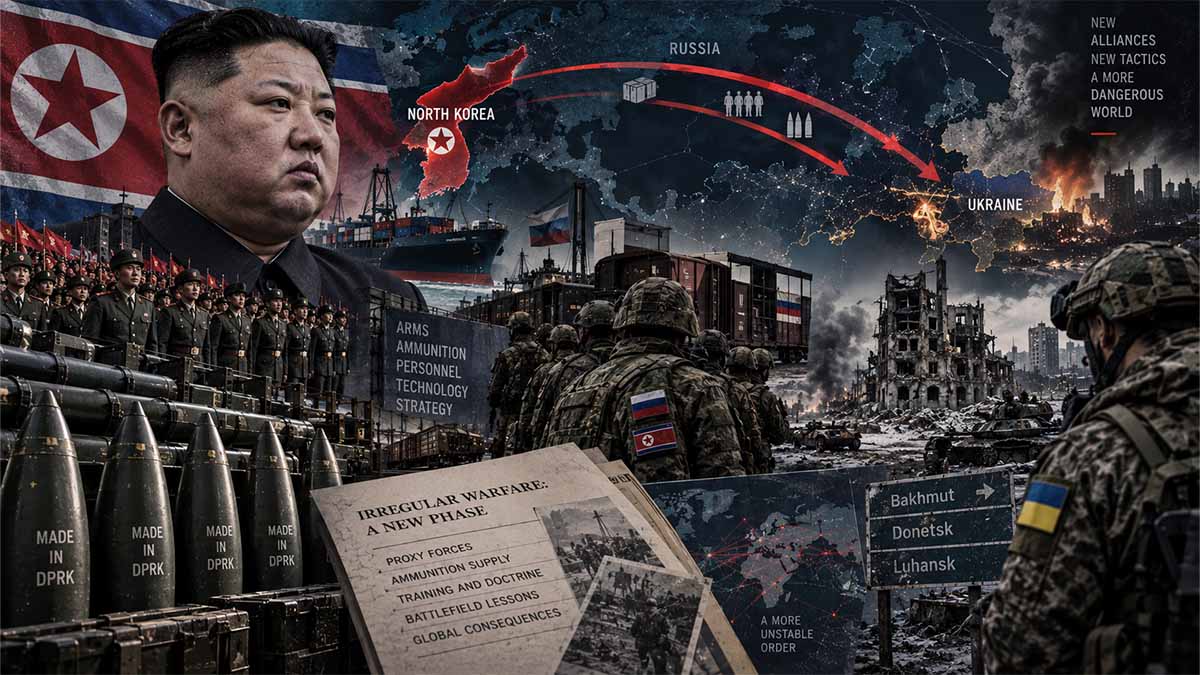
Scope: This assessment examines how North Korea’s deployment to Russia and exposure to the Ukraine war are changing the capabilities, institutional learning processes and potential employment architecture of its irregular forces on the Korean Peninsula, using the pre-deployment force structure as the baseline, verified developments through 27 September 2026, and a five-year analytical horizon to 2031; European actors are addressed only where sanctions enforcement, Russia-linked technology transfer or intelligence monitoring materially affects the assessment.
Executive Summary / BLUF
- The principal judgment is that Ukraine has not created a fundamentally new North Korean irregular-warfare mission set; it has altered the quality of the inputs available to an existing one. Years before the Russia deployment, the U.S. Defense Intelligence Agency described North Korean special-operations forces as organized for infiltration, reconnaissance and disruptive attacks against rear-area command nodes, airfields, ports and other high-value targets in South Korea, whereas the Ukraine experience has subsequently added verified Russian training in unmanned aerial vehicle operations, artillery and frontline infantry tasks, together with direct combat exposure that North Korea previously lacked. North Korea Military Power: A Growing Regional and Global Threat — Defense Intelligence Agency, Oct 2021 DIA Unlawful Military Cooperation including Arms Transfers between North Korea and Russia — MSMT, May 2025 MSMT
- The most consequential post-Ukraine development is therefore organizational learning rather than any single imported weapon: the Multilateral Sanctions Monitoring Team reported that more than 11,000 DPRK personnel were deployed to Russia in late 2024, that Russian forces trained them in UAV, artillery and infantry operations, and that an additional deployment exceeding 3,000 personnel was estimated between January and March 2025, creating a scale of combat exposure large enough to generate instructors, unit-level experience and institutional lessons if Pyongyang chooses to disseminate them across its forces. Unlawful Military Cooperation including Arms Transfers between North Korea and Russia — MSMT, May 2025 MSMT
- Russia has simultaneously become a potential technology-and-knowledge multiplier: the MSMT records, on the basis of information from participating states, assessments that Russia supplied North Korea with short-range air-defence equipment, advanced electronic-warfare and jamming systems, operational knowledge and at least one Pantsir-class vehicle, while Russian battlefield feedback was also reported to have contributed to improvements in DPRK ballistic-missile guidance performance; the evidence establishes a functioning feedback relationship, although it does not establish the quantity, distribution or operational readiness of every transferred capability. Unlawful Military Cooperation including Arms Transfers between North Korea and Russia — MSMT, May 2025 MSMT
- The most important irregular-warfare implication is a potential transition from discrete penetration missions toward multi-domain reconnaissance–disruption networks, in which infiltrating or clandestinely positioned forces can be supported by unmanned reconnaissance, electronic warfare, cyber activity, deception and precision effects against rear-area systems; this is an analytical judgment derived from the combination of North Korea’s established SOF missions and newly documented training and technology access, not evidence that Pyongyang has already fielded such an integrated architecture inside South Korea. DIA
- The Russian connection has acquired institutional durability beyond an episodic battlefield transaction: the Treaty on Comprehensive Strategic Partnership was signed on 19 June 2024, ratified by Russia in November and entered into force on 4 December 2024, while Russia publicly acknowledged DPRK personnel participating in operations in the Kursk region and subsequently in demining activities, providing a formal political channel through which military interaction can persist even if the intensity of fighting changes. Договор о всеобъемлющем стратегическом партнерстве между Российской Федерацией и Корейской Народно-Демократической Республикой — Official Publication of Legal Acts, Dec 2024 Pubblico Pravo Remarks at the Expanded Meeting of the Defence Ministry Board — President of Russia Kremlin Special
- South Korea has already begun treating Russia–DPRK cooperation as a force-development variable rather than merely a diplomatic issue: the Republic of Korea Ministry of National Defense stated that the 2025 Freedom Shield exercise incorporated changes in North Korean strategy, tactics and capabilities derived from analysis of Russia–DPRK military cooperation and recent wars, while its June 2026 drone policy called for more than 20,000 short-range reconnaissance and small attack drones and training for 500,000 drone-capable personnel, illustrating how Ukraine-derived lessons are reshaping both sides of the peninsula’s military adaptation cycle. 2025 Freedom Shield Exercise — Republic of Korea Ministry of National Defense, Mar 2025 m.korea.kr 한국형 장거리 자폭 드론 전력화 추진…50만 드론 전사 양성 — Republic of Korea Ministry of National Defense, Jun 2026 korea.kr
- The decisive uncertainty is operationalization: no verified public record presently establishes how many Kursk veterans have become instructors inside North Korea, whether Russian-derived UAV or electronic-warfare techniques have been incorporated into special-operations doctrine, whether specialized equipment has been distributed to infiltration units, or whether an operational clandestine support infrastructure exists south of the DMZ; consequently, the evidence supports a substantial increase in North Korea’s learning opportunity and technical options, but not a claim that every Ukraine-derived capability has already become a peninsula-ready irregular-warfare system.
North Korea’s Ukraine Lesson Is Not the Drone. It Is the Return on Infiltration.
North Korea’s deployment to Russia changes the economics of irregular warfare on the Korean Peninsula less by solving the old problem of entry than by increasing the value of any infiltration that succeeds. The 1968 Blue House raid and the 1996 Gangneung submarine incursion showed a force able to penetrate and fight, but unable to sustain situational awareness, communications and logistics once exposed. After the Comprehensive Strategic Partnership Treaty with Moscow in June 2024, Pyongyang gained combat experience against a technologically superior opponent and access to Russian electronic-warfare and drone-related know-how. The strategic stake is now South Korea’s rear area: command nodes, supply lines, critical infrastructure and political targets become more vulnerable if drones and new support systems raise the payoff from a successful penetration.
Kursk did not solve infiltration; it changed what happens after it succeeds
The 11th “Storm Corps” was selected from North Korea’s most capable special-operations elements for the Kursk campaign, where fields, villages and forests offered partial similarities to western infiltration corridors around the Demilitarized Zone and the Imjin River. South Korea’s border monitoring, breach detection, naval and air assets remain a different obstacle from Ukrainian defenses, but Kursk exposed North Korean troops to Ukrainian drone pilots, special operations forces, Western equipment, functioning command-and-control networks and persistent aerial reconnaissance. The lesson is not that Kursk can be transplanted to Korea; it is that Pyongyang has now tested its personnel against the battlefield transparency that historically punished clandestine forces.
The 1996 Gangneung operation remains the useful benchmark. The Sang-o-class submarine delivered weapons, explosives and personnel for reconnaissance of military facilities and power plants and preparations to assassinate South Korean officials, but the mission collapsed after the vessel ran aground and was detected by a civilian. North Korean commandos demonstrated small-unit tactics, demolition and land navigation, yet the operation exposed deficits in situational awareness, communications, logistics and modern equipment. Three decades later, the Russian deployment addresses precisely those weaknesses rather than replacing the original infiltration concept.
The 1996 weakness has become the 2025 technology programme
North Korean reinforcements from the 94th and 92nd Special Forces Brigades later fought alongside elite Russian forces around Sudzha, where the dossier records attacks on Ukrainian supply lines and entrenchments and the use of advanced camouflage, thermal capes and Russian-supplied extended cold-weather equipment. These are not decisive capabilities on their own: the dossier also notes that Russia’s thermal ponchos face effectiveness questions against evolving thermal cameras, while the U.S. Marine Corps is not expected to procure comparable counter-detection equipment until 2027 because the non-detection thresholds are demanding. Their value lies in the first minutes and hours of an infiltration, when detection historically turned a covert mission into a manhunt.
After the June 2024 Russia–North Korea partnership, that adjustment serves a larger operational logic. South Korean sensors along the Demilitarized Zone and shorelines are designed to exploit thermal, visual and movement signatures; Kursk forced North Korean personnel to operate where reconnaissance drones made those signatures harder to hide. Camouflage, weather exploitation and thermal suppression do not remove the insertion bottleneck, but paired with drones they can improve route reconnaissance and information after a team enters defended territory.
Drones attack the old North Korean information deficit
North Korean leadership has prioritized drone-enabled operations, while Col. Gen. Kim Yong Bok, commander of North Korea’s special operations forces, was sent to Russia to absorb battlefield experience for return to the domestic force. In November 2025, footage cited in the dossier showed North Korean drone pilots operating independently near Ukraine’s Sumy region; Ukrainian military intelligence assessed them as proficient in drone reconnaissance and as supporting artillery fire and specialized reconnaissance near the Russia–Ukraine border. Drones can therefore attack the historic weakness of infiltrating forces by improving route awareness before contact, observation after penetration and fire support once a team is exposed.
In July 2025, Russian instructors were believed to be training North Korean drone pilots near Pyongyang, while Ukrainian intelligence assessed that more than 3,000 North Korean troops had already become military instructors. That figure matters more than another isolated equipment display because instructors convert individual experience into institutional memory. If the Russia cohort teaches reconnaissance, counter-detection and drone integration at scale, Pyongyang does not need every special-operations soldier to fight in Kursk; it needs enough veterans to change how units train.
Russia and China are reducing the production bottleneck
Under the post-June 2024 relationship, the Multilateral Sanctions Monitoring Team and the Korea Institute for Defense Analysis, as cited in the dossier, confirmed Russian transfers of drone airframe designs, navigation and guidance systems; Pyongyang has also imported low-cost drones and drone assembly lines from China. The dossier records a direct road connection to Russia, an accelerating bridge project linking North Korea to China’s free-trade zone in Dandong, and North Korean supply of its own drone cluster munitions to Russia. The implication is industrial: drones, batteries, communications equipment and spare components must exist in quantity if irregular warfare is to move beyond demonstration units.
The constraint is tighter for longer-range sabotage. South Korean drone rules prohibit flights within a three-to-five-nautical-mile radius of active airfields and military installations, while infiltrated pilots still face signal range, systems delivery and infrastructure problems. Russian-derived repeaters or communications equipment would therefore matter more than another airframe if they separate operators from the target area. The dossier also notes that fiber-optic wire and batteries are readily procurable through China–Russia dual-use supply chains, although it records no official confirmation of direct fiber-optic or sleeper-drone transfers to North Korea.
The dangerous option is distributed sabotage, not mass attack
By November 2025, the dossier’s most consequential longer-term pathway was no longer a conventional drone barrage but a small, distributed architecture built around reconnaissance, sabotage and drone ambush. Sleeper drones, including jam-resistant fiber-optic variants, can remain dormant until a target appears, while solar-panel modifications can extend waiting time. Russia’s Rubicon regiment scaled such tactics during the Kursk campaign, and the dossier records indirect indications of contact with North Korean personnel, but also states that there is no official record of direct transfers of fiber-optic or ambush drones. That gap is decisive: this remains a pathway under observation, not a fielded North Korean capability.
The economic warning comes from Operation Spider’s Web, which the dossier says used only 117 first-person-view drones to inflict disproportionate damage in an adversary’s rear. The comparison is not a forecast for Korea. It shows why a small number of low-cost systems, if assembled and concealed near supply lines, command-and-control sites or critical infrastructure, can force the defender to protect far more points than the attacker needs to reach. That asymmetry turns irregular warfare from a border-security problem into a rear-area protection problem.
Seoul is preparing for drones, but the dossier points to a narrower threat
Ulchi Freedom Shield included counter-drone drills, and Seoul has proposed training 500,000 “drone warriors,” but the dossier argues that the emphasis has fallen on larger one-way attack drones rather than the light, easy-to-assemble first-person-view systems that North Korean special operations forces could exploit after infiltration. A large inbound aircraft presents an air-defense problem; a small system assembled or activated close to a target becomes a detection, acoustic-sensing, counter-intelligence and infrastructure-protection problem.
Ulchi Freedom Shield therefore addresses only part of the defensive equation described in the dossier. Integrated drone detectors and acoustic sensors around critical assets can address systems with minimal or no radio signature; anti-drone nets and jammers can add physical and electronic layers; intelligence services can target smuggling routes, intermediaries, brokers, sympathizers and production enablers. Border surveillance remains necessary, but once a small team enters South Korea the contest shifts toward denying it a reconnaissance, logistics and strike ecosystem.
The next 12–24 months will show whether experience becomes doctrine
Over the next 12–24 months, the decisive evidence will be organizational rather than rhetorical: whether the more than 3,000 North Korean personnel described by Ukrainian intelligence as military instructors continue to propagate Russia-derived lessons; whether Col. Gen. Kim Yong Bok’s special-operations community receives repeaters, electronic-warfare support and drones in usable quantities; whether Russian training moves beyond reconnaissance into sleeper-drone and sabotage techniques; and whether the 2027 U.S. Marine Corps procurement benchmark is matched by faster North Korean adaptation in camouflage and thermal suppression.
The cost of inaction would fall first on South Korean command-and-control centers, military logistics, supply lines, government facilities and critical infrastructure identified in the dossier as potential sabotage targets. Ulchi Freedom Shield can train against visible drone attack, and 500,000 drone-qualified personnel can widen familiarity with unmanned systems, but neither automatically solves the smaller problem Pyongyang is trying to create. If North Korea converts the June 2024 Russia relationship, the July 2025 training cycle and the November 2025 operational experience into a repeatable special-operations method, Seoul will face a cheaper attack architecture and a more expensive protection requirement. That imbalance, rather than the drone itself, is the post-Ukraine shift.
Navigational Index
- Battlefield Learning Becomes a Force-Development System — the pre-Ukraine irregular-warfare baseline, the scale and character of North Korea’s Russian deployment, the institutional mechanisms by which combat experience can move from expeditionary formations into training establishments and the significance of a continuing Russia–DPRK military relationship.
- The Rear Area Becomes a Networked Battlespace — the potential convergence of special operations, unmanned systems, electronic warfare, cyber capabilities, intelligence collection and precision disruption, together with the distinction between capabilities already documented and operational combinations that remain analytical pathways rather than verified deployments.
- Detection, Attribution and Resilience Become the Strategic Contest — the changing South Korean defensive problem, the legal and sanctions architecture surrounding Russian assistance, the indicators that would demonstrate genuine North Korean doctrinal assimilation, and the developments that would materially raise or lower the assessment through 2031.
Master Abstract
Ukraine changes the constraint structure, not the original mission
North Korea entered the Ukraine war with a mature irregular and special-operations mission architecture rather than a blank doctrinal slate, which makes the distinction between mission innovation and capability acceleration fundamental to understanding what has changed. The Defense Intelligence Agency’s 2021 unclassified assessment described North Korean strategic special-operations formations as intended for reconnaissance, infiltration and attacks in South Korean rear areas, including command-and-control installations, airfields, ports, storage facilities and other high-value military infrastructure, while identifying the 11th Corps as an important strategic SOF formation; those missions therefore pre-date both the June 2024 Russia–DPRK treaty and the subsequent deployment to Kursk. North Korea Military Power: A Growing Regional and Global Threat — Defense Intelligence Agency, Oct 2021 DIA What Ukraine provided was something different: sustained interaction with a technologically intensive war, Russian instruction in UAV and frontline operations, and actual exposure to the organizational problems of combat rather than scripted domestic exercises. The MSMT records more than 11,000 North Korean personnel deployed by late 2024 and Russian training in artillery, UAV and infantry operations, while it also records additional personnel deployments during early 2025. MSMT/2025/1 — Multilateral Sanctions Monitoring Team, May 2025 MSMT The strategic significance therefore lies less in North Korea discovering irregular warfare than in its gaining an external laboratory through which long-standing missions can be recalibrated against contemporary surveillance, unmanned systems, electronic warfare and operational tempo.
Combat learning matters because North Korea can institutionalize failure as well as success
The value of the Russian deployment cannot be assessed simply by asking whether North Korean troops performed well in individual engagements, because a military organization can derive considerable institutional value from exposure to communications problems, command friction, casualty generation, equipment vulnerability, reconnaissance failures and the interaction between unmanned systems and ground forces. Russia publicly acknowledged DPRK personnel participating in the Kursk campaign, while the MSMT reports that Russian forces trained deployed North Koreans in artillery, UAV and infantry operations and that Russia provided or was assessed to have provided operational knowledge alongside electronic-warfare equipment and other military systems. Meeting with Chief of the General Staff Valery Gerasimov — President of Russia, Apr 2025 Kremlin Special Unlawful Military Cooperation including Arms Transfers between North Korea and Russia — MSMT, May 2025 MSMT This creates a qualitatively different learning channel from arms procurement alone: personnel can return with observations about training cycles, unit organization, camouflage discipline, command-and-control requirements, unmanned reconnaissance and the vulnerabilities created by persistent detection, after which North Korea can decide which lessons are transferable to its own geography. The public record does not disclose the DPRK after-action-review system, instructor assignments or revised curricula, so institutional absorption cannot yet be measured directly; nevertheless, the scale and duration of the deployment make the potential diffusion of battlefield experience a materially more important variable than the performance of any one North Korean formation in Russia.
The emerging risk is integration across domains rather than a single “Ukraine weapon”
The most consequential analytical pathway is not the simple transplantation of Russian battlefield techniques to Korea, because the geography, surveillance architecture, force density, maritime approaches and political escalation environment of the Korean Peninsula are fundamentally different from Kursk; the more transferable element is the logic of connecting sensing, communication, disruption and strike effects across organizational boundaries. North Korea already possessed special-operations and cyber capabilities before the Russian deployment, and the second MSMT report, released in October 2025, documented what participating governments describe as deep connections between UN-designated DPRK entities, including the Reconnaissance General Bureau, and cryptocurrency theft, fraudulent IT activity and cyber espionage. Joint Statement on the MSMT Report Covering DPRK Cyber and IT Worker Activities — FCDO, Oct 2025 GOV.UK No official record presently proves that these cyber structures have been operationally fused with Kursk-derived SOF or drone experience, and the distinction matters: a pre-existing cyber apparatus should not be re-labelled as a Ukraine lesson merely because both capabilities now coexist. The strategic change would occur if North Korea begins designing operations in which cyber reconnaissance or disruption, unmanned observation, electronic interference and physically infiltrated personnel function as parts of the same mission chain; evidence of exercises, command arrangements, specialist cross-postings or new integrated training would therefore be more consequential than another isolated drone prototype or equipment announcement.
Russia provides a feedback ecosystem that can outlast the original deployment
The bilateral relationship now contains political, military and logistical channels that make continued learning more feasible than it was before 2024. Russia’s official legal publication records that the Treaty on Comprehensive Strategic Partnership, signed on 19 June 2024 and ratified under Federal Law No. 374-FZ, entered into force on 4 December 2024, while subsequent Russian presidential statements openly acknowledged North Korean personnel serving alongside Russian forces in Kursk and later participating in large-scale demining. Договор о всеобъемлющем стратегическом партнерстве между Российской Федерацией и Корейской Народно-Демократической Республикой — Official Publication of Legal Acts, Dec 2024 Pubblico Pravo Remarks at the Expanded Meeting of the Defence Ministry Board — President of Russia Kremlin Special The MSMT separately reports, while identifying where information comes from participating states rather than independent public inspection, that Russia has provided North Korea with air-defence systems, advanced electronic-warfare and jamming equipment, operational knowledge and ballistic-missile performance feedback. MSMT These channels matter because irregular-warfare modernization requires more than hardware: it requires testing, countermeasure awareness, operator training, maintenance knowledge and repeated feedback, all of which become easier when the relationship shifts from isolated procurement toward sustained military interaction. The evidence does not demonstrate unrestricted Russian technology transfer, however, and neither the existence of the treaty nor Russian political statements establish which additional systems Moscow will transfer, in what numbers, or to which North Korean formations.
The defensive problem has shifted from penetration alone to penetration plus attribution
For South Korea, the central consequence is that the traditional counter-infiltration problem increasingly intersects with the broader problems of unmanned systems, electronic interference, cyber access and ambiguous attribution. The Republic of Korea Ministry of National Defense stated in March 2025 that Freedom Shield scenarios were being revised to reflect changes in North Korean strategy, tactics and capabilities identified through analysis of Russia–DPRK military cooperation and contemporary conflicts, and that field training would extend across land, maritime, air, cyber and space domains. [FS 훈련] 2025 자유의 방패(FS) 연습 실시! — Republic of Korea Ministry of National Defense, Mar 2025 m.korea.kr By June 2026, Seoul had announced a broader drone and counter-drone development policy that explicitly drew lessons from the wars in Ukraine and the Middle East, called for rapid acquisition of more than 20,000 reconnaissance and small attack drones and set a target of training 500,000 drone-capable personnel. 국방 드론·대드론 발전 정책 발표 — Republic of Korea Ministry of National Defense, Jun 2026 한국형 장거리 자폭 드론 전력화 추진…50만 드론 전사 양성 — Republic of Korea Ministry of National Defense, Jun 2026 korea.kr The analytical implication is not that numerical drone inventories determine the balance, but that both sides are adapting to a battlespace in which inexpensive unmanned systems can expand surveillance and attack options, while electronic and cyber activity can make the origin and purpose of individual incidents harder to establish quickly.
The legal architecture remains restrictive even as enforcement has become more difficult
The Russia–DPRK military-learning relationship also operates against an international legal framework that has not disappeared with the termination of the UN Panel of Experts. The UN Security Council’s 1718 Committee continues to list the DPRK sanctions measures in force, while the MSMT states that relevant Security Council resolutions remain legally binding and assesses Russian training of North Korean troops involving arms or related materiel as prohibited military training or assistance under resolutions 1718, 1874 and 2270. Security Council Committee established pursuant to resolution 1718 (2006) — United Nations Security Council Nazioni Unite Unlawful Military Cooperation including Arms Transfers between North Korea and Russia — MSMT, May 2025 MSMT Russia’s March 2024 veto prevented renewal of the Panel of Experts’ mandate, but it did not itself terminate the underlying Security Council measures; the MSMT was subsequently established by eleven participating states in October 2024 to fill part of the resulting monitoring gap, although it is a multilateral mechanism created by those governments rather than a subsidiary organ of the Security Council. MSMT This distinction is important because the deterioration of monitoring architecture can reduce transparency without changing the formal legal status of the prohibitions themselves.
Key Evidence Table
| Indicator | Value/status | Reference date | Definition/scope | Issuer | Exact source |
|---|---|---|---|---|---|
| Pre-Ukraine strategic SOF mission | Infiltration, reconnaissance and rear-area attack missions were already embedded in DPRK force structure | Information cut-off before Oct 2021 publication | Establishes baseline; does not describe post-Kursk adaptation | U.S. Defense Intelligence Agency | North Korea Military Power: A Growing Regional and Global Threat — DIA, Oct 2021 DIA |
| DPRK deployment to Russia | More than 11,000 personnel deployed in late 2024 | Late 2024 | MSMT figure attributed to participating-state information; operational deployment subsequently acknowledged by both governments | Multilateral Sanctions Monitoring Team | Unlawful Military Cooperation including Arms Transfers between North Korea and Russia — MSMT, May 2025 MSMT |
| Additional DPRK deployment | More than 3,000 personnel estimated | Jan–Mar 2025 | Replacement/reinforcement estimate from an MSMT participating state | Multilateral Sanctions Monitoring Team | MSMT/2025/1 — May 2025 MSMT |
| Russian training of DPRK personnel | Artillery, UAV and basic infantry operations, including trench-clearing instruction | 2024–Apr 2025 reporting period | Training received in Russia; public record does not establish subsequent DPRK-wide dissemination | Multilateral Sanctions Monitoring Team | MSMT/2025/1 — May 2025 MSMT |
| Russian technology/knowledge transfers | Short-range air defence and advanced EW/jamming systems reported; at least one Pantsir-class vehicle and operational knowledge reported by participating-state information | Since Nov 2024 | Attribution must remain explicit because quantities and transfer details are not independently published | Multilateral Sanctions Monitoring Team | MSMT/2025/1 — May 2025 MSMT |
| Bilateral institutional framework | Comprehensive Strategic Partnership Treaty in force | 4 Dec 2024 | Treaty signed 19 Jun 2024 and ratified by Russia under Federal Law No. 374-FZ | Russian Federation official legal publication system | Договор о всеобъемлющем стратегическом партнерстве… — Official Publication of Legal Acts Pubblico Pravo |
| Russian official acknowledgment of DPRK combat role | DPRK participation in Kursk publicly acknowledged; later Russian statement also records DPRK participation in demining | Apr 2025 onward | First-party Russian record establishes Russia’s official position and acknowledgment, not an independent performance assessment | President of Russia | Meeting with Chief of the General Staff Valery Gerasimov — Apr 2025 Expanded Meeting of the Defence Ministry Board — President of Russia Kremlin Special |
| ROK exercise adaptation | Freedom Shield scenarios explicitly incorporate changes derived from Russia–DPRK cooperation and recent wars | 10–20 Mar 2025 exercise | Official ROK planning statement; not proof of a specific DPRK capability | Republic of Korea Ministry of National Defense | 2025 Freedom Shield Exercise — ROK MND, Mar 2025 m.korea.kr |
| ROK drone/counter-drone expansion | Planned acquisition of 20,000+ reconnaissance/small attack drones and training of 500,000 drone-capable personnel | 26 Jun 2026 | Announced policy and training/acquisition objective, not completed inventory | Republic of Korea Ministry of National Defense | 한국형 장거리 자폭 드론 전력화 추진…50만 드론 전사 양성 — ROK MND, Jun 2026 korea.kr |
| DPRK cyber and clandestine financial ecosystem | Cyber espionage, cryptocurrency theft and fraudulent overseas IT activity linked by participating governments to designated DPRK entities including the RGB | Report released 22 Oct 2025 | Demonstrates a parallel clandestine capability base; no official evidence yet proves operational fusion with Ukraine-derived SOF lessons | MSMT participating states / UK FCDO publication | Joint Statement on the MSMT Report Covering DPRK Cyber and IT Worker Activities — Oct 2025 GOV.UK |
| UN sanctions status | Arms-transfer and military-assistance restrictions remain part of the 1718 sanctions architecture | Current through 27 Sep 2026 | Panel of Experts mandate ended in 2024; sanctions committee and underlying measures remain | United Nations Security Council | Security Council Committee established pursuant to resolution 1718 (2006) Nazioni Unite |
Principal Gaps and Watch Indicators
Veteran diffusion is the first decisive indicator
The strongest evidence that the Ukraine experience has moved from an expeditionary episode into North Korean force development would be documented reassignment of Russian-deployment veterans to domestic training academies, special-operations brigades, UAV units, reconnaissance formations or exercise-control organizations, because personnel rotation into instructor and doctrine-writing functions would demonstrate institutional transmission rather than merely individual combat experience. Public sources currently establish deployment, training and combat participation but do not identify the subsequent organizational distribution of returning personnel. MSMT
Integrated exercises matter more than isolated equipment displays
Evidence that North Korea is conducting exercises combining infiltration forces, small unmanned systems, electronic warfare, communications disruption and cyber effects against simulated rear-area objectives would materially strengthen the assessment that a genuine post-Ukraine irregular-warfare architecture is emerging; by contrast, additional public demonstrations of individual drones, jammers or special-forces units would prove considerably less because equipment possession does not establish combined operational competence. The present record supports separate SOF, UAV, EW and cyber capabilities or access channels, but their operational integration remains unverified. DIA
Russian transfers require quantity, recipient and readiness evidence
The MSMT’s evidence concerning advanced electronic-warfare systems, jamming equipment, air-defence systems and operational knowledge establishes a credible transfer channel, but public reporting still lacks the quantities, unit recipients, training packages, maintenance arrangements and operational status necessary to determine whether these systems have materially changed North Korean special-operations employment on the peninsula. Confirmation that such systems have entered SOF, reconnaissance or UAV formations rather than conventional air-defence or strategic units would substantially alter the assessment. MSMT
The clandestine logistics question remains unresolved
Physical irregular operations beyond the immediate border environment require communications, sustainment, concealment and mission support, and the official public record currently provides no verified evidence that North Korea has established a Ukraine-derived clandestine UAV or electronic-warfare support infrastructure inside South Korea. Evidence of pre-positioned equipment, verified covert logistics cells, specialized communications architecture or organized technical support would therefore represent a much stronger warning indicator than generalized rhetoric or force demonstrations.
South Korea’s counter-adaptation will determine the net effect
North Korea’s learning cannot be evaluated independently of an opponent that is itself absorbing lessons from Ukraine and other contemporary conflicts: Seoul explicitly incorporated Russia–DPRK developments into Freedom Shield planning in 2025 and in 2026 announced large-scale drone acquisition, counter-drone development and mass operator training. 국방 드론·대드론 발전 정책 발표 — ROK Ministry of National Defense, Jun 2026 m.korea.kr The relevant strategic variable is therefore not North Korea’s absolute improvement but the relative pace at which Pyongyang can integrate acquired experience versus the pace at which Seoul improves detection, counter-UAS coverage, electronic resilience, infrastructure protection and cross-domain command arrangements.
Attribution should be treated as an operational variable in its own right
A future irregular-warfare architecture would derive political utility not only from physical effects but from the time required to determine who conducted an incident, under whose authority and with what objective, particularly where unmanned systems, cyber activity or intermediaries blur the evidentiary chain. This makes forensic attribution, persistent surveillance and cross-domain intelligence fusion strategically significant because an incident whose sponsor is not immediately established can create a different escalation problem from an overt conventional strike; the public record, however, does not establish that North Korea has already constructed a unified doctrine specifically designed around such an attribution gap.
Net Assessment
The verified record supports a structural but incomplete transformation in North Korea’s irregular-warfare potential. Before Ukraine, Pyongyang already possessed special-operations forces designed for infiltration, reconnaissance and rear-area disruption, together with cyber capabilities and an expanding interest in unmanned systems; after the Russian deployment, it additionally possesses something historically more difficult to acquire under conditions of isolation: direct exposure to a large contemporary war, Russian training in UAV and other frontline operations, continuing military interaction under a formal bilateral treaty, and documented access to selected Russian electronic-warfare, air-defence and operational knowledge channels. North Korea Military Power — Defense Intelligence Agency, Oct 2021 DIA MSMT/2025/1 — Multilateral Sanctions Monitoring Team, May 2025 MSMT
The central analytical mistake would therefore be to search for a single new “Kursk doctrine” or one decisive Russian technology. What matters is whether North Korea converts dispersed lessons into an institutional system capable of linking reconnaissance, unmanned platforms, electronic effects, cyber activity and special operations around the longstanding objective of penetrating and disrupting an adversary’s rear area. The evidence available by 27 September 2026 is sufficient to establish the inputs to such a transformation, but not the completed transformation itself: there is no publicly verified North Korean doctrine demonstrating integrated employment, no disclosed inventory showing the scale of technology diffusion, no verified map of veteran redistribution across the KPA, and no official evidence establishing a clandestine drone-support network inside the Republic of Korea.
The five-year strategic question through 2031 is consequently one of institutional conversion. If returning personnel become instructors, Russian-derived electronic and unmanned technologies enter special-operations formations, exercises begin combining infiltration with UAV, EW and cyber effects, and dedicated command arrangements emerge to connect those functions, the distinction between North Korea’s conventional and irregular operational layers would become progressively less useful for defense planning. If those indicators do not appear, Russia’s battlefield experience may remain concentrated within a limited group of personnel and systems whose tactical value is real but whose strategic effect on peninsula operations is considerably narrower.
South Korea’s response shows that this learning contest has already begun: its defense ministry is explicitly adapting exercises to Russia–DPRK military cooperation and is pursuing mass drone and counter-drone capability after studying Ukraine and other recent conflicts. 2025 Freedom Shield Exercise — Republic of Korea Ministry of National Defense, Mar 2025 m.korea.kr 국방 드론·대드론 발전 정책 발표 — Republic of Korea Ministry of National Defense, Jun 2026 korea.kr The strategic balance will therefore depend less on whether North Korea has “learned from Ukraine” in the abstract than on which lessons it can reproduce, distribute and combine faster than South Korea can detect, attribute and neutralize them.
North Korea After Ukraine
How combat exposure in Russia can transform North Korea’s established special-operations architecture into a more networked system combining infiltration, unmanned reconnaissance, electronic effects, cyber activity and rear-area disruption.
The transformation mechanism
Established asymmetric architecture
- Special-operations infiltration
- Reconnaissance behind South Korean lines
- Rear-area disruption
- Attacks against command nodes, airfields and ports
- Parallel cyber and intelligence capabilities
Combat-learning laboratory
- More than 11,000 personnel initially deployed
- Additional personnel subsequently deployed
- Russian UAV training
- Artillery and infantry training
- Exposure to contemporary battlefield surveillance
- Access to Russian operational knowledge and selected EW systems
Potential networked irregular warfare
- Drone-assisted reconnaissance
- Counter-surveillance and concealment
- Electronic disruption
- Precision rear-area attacks
- Cyber-enabled preparation or disruption
- Faster tactical adaptation after infiltration
The right-hand stage represents an analytical pathway supported by documented inputs; it is not evidence that every component has already been integrated into a fielded North Korean doctrine.
The emerging operational network
What Russia changes
Verified evidence versus analytical pathway
Documented in the public record
North Korea possessed a substantial special-operations architecture before the Ukraine deployment.
More than 11,000 DPRK personnel were reported deployed to Russia in late 2024.
Russian forces trained North Korean personnel in UAV, artillery and infantry operations.
Russian-DPRK military interaction continued under a formal bilateral treaty.
South Korea altered exercise and drone-development planning in response to lessons from recent wars and Russia-DPRK cooperation.
What still requires evidence
The number of returning veterans assigned as instructors inside the Korean People’s Army.
Formal integration of Russian-derived UAV methods into special-operations doctrine.
Distribution of transferred electronic-warfare equipment to infiltration formations.
Operational integration among SOF, cyber, drones and electronic warfare.
A verified clandestine support infrastructure for drone-enabled operations inside South Korea.
The strategic contest on the Korean Peninsula
Increase operational complexity
Improve the ability of small or dispersed forces to survive surveillance, gather information, locate targets and create disruption after penetration of defended areas.
Increase detection and resilience
Seoul is expanding drone acquisition, operator training, counter-drone systems and multi-domain exercises while incorporating lessons from the Ukraine war and Russia-DPRK military cooperation.
Relative adaptation speed
The strategic effect depends not on North Korea’s improvement in isolation, but on whether Pyongyang can absorb and operationalize lessons faster than Seoul can detect, attribute, disrupt and neutralize them.
Indicators that would change the assessment
Veterans become instructors
Confirmed reassignment of Russia-deployment personnel into SOF academies, UAV formations or doctrine-development establishments would demonstrate institutional diffusion.
Integrated field exercises
Exercises combining infiltration, drones, electronic warfare and cyber effects against rear-area objectives would be stronger evidence of doctrinal integration than isolated equipment demonstrations.
SOF-specific Russian technology
Verified allocation of Russian-derived EW, communications or UAV systems to special-operations formations would materially strengthen the assessment.
New command structures
Organizational changes connecting reconnaissance, unmanned systems, electronic warfare and special operations would indicate movement toward a genuinely networked irregular force.
Training-cycle changes
Revised curricula, specialist cross-postings or repeated Russia-linked training exchanges would indicate that Ukraine lessons are becoming institutional rather than episodic.
Persistent operational barriers
Failure to integrate communications, logistics, specialized equipment and technical support would limit the strategic value of individual battlefield lessons.
Evidence matrix
| Evidence | Status | Strategic meaning | Qualification |
|---|---|---|---|
| Pre-existing DPRK strategic SOF mission | Established before Ukraine | Shows that Russia accelerates an existing mission architecture rather than creating one from zero. | Does not itself demonstrate post-2024 modernization. |
| More than 11,000 DPRK personnel deployed | Reported by MSMT | Creates a large personnel pool potentially capable of carrying battlefield experience back into the KPA. | Subsequent assignments are not publicly mapped. |
| UAV, artillery and infantry training | Documented by MSMT | Provides direct exposure to contemporary operational techniques. | North Korea-wide dissemination is not established. |
| Russian EW and jamming equipment | Reported by participating states | Creates a potential technical bridge toward counter-surveillance and spectrum operations. | Quantities, recipient units and readiness remain uncertain. |
| South Korean drone and counter-drone expansion | Officially announced | Demonstrates that Seoul is adapting to the same contemporary battlefield trends. | Announced acquisition and training targets are not equivalent to completed operational capability. |
From infiltration force to potential multi-domain disruption system
The strongest interpretation supported by the public record is not that North Korea has already built a completely new irregular-warfare doctrine, but that the Russia relationship has supplied the personnel exposure, training channels, technology access and operational feedback required to accelerate one. The strategic threshold will be crossed only when those inputs are demonstrably converted into integrated North Korean organizations, training systems and field procedures.
Primary and institutional sources
North Korea Military Power: A Growing Regional and Global Threat — U.S. Defense Intelligence Agency
2025 Freedom Shield Exercise — Republic of Korea Ministry of National Defense
Defence Drone and Counter-Drone Development Policy — Republic of Korea Ministry of National Defense
Graphic logic: verified fact is separated from analytical pathway; no numerical risk score, probability estimate or unsupported capability rating is used.
Battlefield Learning Becomes a Force-Development System
Principal judgment
The most consequential consequence of North Korea’s intervention in Russia is not that the Korean People’s Army has merely accumulated a cohort of soldiers who have experienced combat, but that the deployment created the first observable external learning cycle through which selected North Korean formations could be trained abroad, committed to sustained combat, exposed to failure against unmanned systems and artillery, withdrawn or temporarily paused, retrained, returned to action with modified tactics, reinforced with new personnel, observed by senior North Korean commanders and subsequently connected to domestic changes in military education, special-operations training and unmanned-systems development. By March 2025, the U.S. Defense Intelligence Agency assessed that DPRK troops had already adapted to the Kursk environment by incorporating counter-UAS measures and smaller assault groups after suffering substantial casualties, while North Korean state reporting during the following months simultaneously emphasized practice-centred military education, the study of contemporary warfare, modernization of training systems, special-operations formations capable of broader mission sets, and closer integration of unmanned systems with operational planning. These separate evidence streams do not prove that Pyongyang has already transferred a complete “Kursk doctrine” to the Korean Peninsula; taken together, however, they establish something more important for long-term force development: North Korea now possesses an observable mechanism for converting foreign battlefield experience into changes in training, organization, technology and command practice. Oversight
Operation Atlantic Resolve Quarterly Report to Congress, January–March 2025
Unlawful Military Cooperation including Arms Transfers between North Korea and Russia — MSMT/2025/1
The deployment created a controlled experiment involving one of the KPA’s most important force pools
The personnel chosen for Russia matter because the deployment was not drawn only from generic manpower. The U.S. Department of Defense Inspector General reported that the approximately 12,000 personnel who entered Russia during 2024 consisted mainly of infantry and special-operations troops from the KPA’s 11th Corps, while the Defense Intelligence Agency’s earlier North Korea Military Power assessment identifies the 11th Corps as the strategic-level formation controlling special-operations brigades assigned to missions that include infiltration and the creation of a disruptive second front in South Korean rear areas. This establishes a direct institutional bridge between the formations gaining experience in Russia and the formations that would have a disproportionate role in any future Korean irregular-warfare campaign; it does not establish that every Russia-deployed soldier belonged to a strategic infiltration unit, but it means that the learning pool included personnel from precisely the KPA community whose mission set makes modern reconnaissance, counter-UAS awareness, concealment, communications and independent small-unit action particularly relevant. Media Defense
North Korea Military Power: A Growing Regional and Global Threat — U.S. Defense Intelligence Agency
The deployment also differed qualitatively from a military exchange or demonstration exercise because the personnel passed through several distinct stages of force generation. U.S. Defense Department reporting in October 2024 assessed that roughly 10,000 North Korean soldiers had been sent to eastern Russia for training, with about 8,000 already moved to Kursk Oblast by 31 October, while Russian forces instructed them in artillery operations, UAV operations, basic infantry tactics and trench clearing. By 4 November, the Pentagon estimated the total DPRK presence in Russia at approximately 11,000–12,000, with at least 10,000 in Kursk; the subsequent MSMT investigation records more than 11,000 troops deployed in late 2024, their transfer from eastern Russia to Kursk, their participation in combat alongside Russian forces and an additional deployment exceeding 3,000 personnel between January and March 2025. Dipartimento della Difesa
Deployment and learning chronology
| Stage | Verified scale or event | Operational significance for force development | Evidentiary qualification | Principal source |
|---|---|---|---|---|
| Training concentration in eastern Russia | Approximately 10,000 DPRK personnel assessed in Russia by 31 October 2024 | Created a centralized external training cohort rather than scattered individual exchanges | U.S. assessment at that date; numbers subsequently revised upward | U.S. Department of Defense Dipartimento della Difesa |
| Movement into operational theatre | Approximately 8,000 assessed in Kursk by 31 October; at least 10,000 there by 4 November | Accelerated transition from training to operational exposure | Deployment did not mean all personnel were already fighting | U.S. Department of Defense Dipartimento della Difesa |
| Russian training package | Artillery, UAV operations, basic infantry tactics and trench clearing | Introduced concrete technical and tactical knowledge applicable to contemporary battlefield conditions | Public sources do not disclose training duration or proficiency standards | U.S. DoD / MSMT Dipartimento della Difesa |
| Frontline employment | Combat confirmed in locations including Plekhovo and later Malaya Loknya in December 2024 | Converted training into battlefield experience against Ukrainian forces using extensive UAV surveillance and fires | MSMT relies in part on participating-state information | MSMT MSMT |
| Initial casualty shock | More than 1,000 casualties assessed by the U.S. DoD during the initial period of fighting | Created an immediate empirical test of pre-existing DPRK tactical methods | Casualties include killed and wounded | DoD Inspector General / DoD Media Defense |
| Adaptation phase | Combat operations reportedly paused from mid-January to March 2025 while additional training occurred | Strong evidence of a feedback-and-correction cycle rather than uninterrupted repetition of initial tactics | Exact unit-level lessons remain non-public | DIA through DoD Inspector General Oversight |
| Tactical modification | By March, DIA assessed use of counter-UAS tactics and smaller assault groups | Demonstrates observable adaptation to drone and artillery threats | Does not establish transfer to forces inside North Korea | DIA through DoD Inspector General Oversight |
| Reinforcement | More than 3,000 additional personnel, January–March 2025, according to an MSMT participating state | Established a second personnel cycle capable of interacting with combat-experienced formations | Exact unit provenance is undisclosed | MSMT MSMT |
| Senior-command presence | Four high-ranking DPRK generals assessed in Kursk by February 2025 | Increased the possibility that operational lessons reached higher command echelons rather than remaining at squad or battalion level | Individual responsibilities are incompletely disclosed | DIA through DoD Inspector General Oversight |
Failure became a source of institutional information
North Korea’s early losses in Kursk are strategically relevant because they exposed weaknesses under conditions very different from scripted domestic exercises. The DoD Inspector General reported that approximately 12,000 troops had deployed to Russia in 2024 and that by March 2025 at least 8,000 were engaged in Kursk, while DIA assessed approximately 4,000 North Korean casualties since combat operations began in December. Calculated against the approximately 12,000-person 2024 deployment estimate, the March casualty total was equivalent to roughly one-third of the original deployment, although this ratio must not be interpreted as a fatality rate because the figure includes both killed and wounded and because reinforcements subsequently entered the theatre. Oversight
The more important finding lies in what happened after those losses. DIA assessed that North Korean leaders suspended combat operations from approximately mid-January until March and that personnel received further Russian instruction in UAS warfare and combat tactics intended to increase survivability against Ukrainian drone and artillery strikes; according to the same DIA reporting, North Korean formations subsequently incorporated counter-UAS methods and smaller assault groups into their battlefield approach. This sequence—engagement, loss, pause, retraining, tactical modification and renewed employment—is the clearest publicly documented indication that the Russian operation generated an actual military-learning process rather than merely combat exposure. Oversight
What Kursk appears to have taught at unit level
| Learning problem | Initial condition exposed in Russia | Documented adaptation or training response | Potential relevance to future SOF development | Transfer status |
|---|---|---|---|---|
| Persistent aerial observation | Ukrainian UAS reduced concealment and increased vulnerability of troop concentrations | Additional UAS-related training and counter-UAS adaptation | Strong relevance to infiltration forces operating against sensor-dense South Korean defenses | Battlefield adaptation verified; peninsula transfer not publicly established |
| Large assault formations | Exposure to drone and artillery fires generated heavy losses | DIA assessed adoption of smaller assault groups | Reinforces dispersed small-unit employment, already central to SOF missions | Verified in Kursk, not verified in domestic SOF doctrine |
| Combined command | DPRK and Russian formations initially faced language and military-culture barriers | DIA assessed establishment of rudimentary combined C2 | Provides experience in operating within a larger fires-and-reconnaissance architecture | Verified at limited level in Russia |
| Technical dependence | DPRK troops entered a battlespace where UAVs, artillery and communications interact continuously | Russian training covered UAV, artillery and infantry operations | Broadens understanding of how tactical intelligence and fires are integrated | Training verified; depth of mastery unknown |
| Senior command observation | Expeditionary operations require decisions beyond squad and platoon levels | Four senior DPRK generals were assessed present by February 2025 | Creates a pathway for lessons to enter General Staff and corps-level thinking | Presence verified; subsequent doctrinal role undisclosed |
The Russian campaign therefore matters even where North Korean performance was initially poor. A military institution does not need to win every engagement to learn from it; in this case, an unusually high casualty burden generated information about which existing methods performed badly against persistent surveillance and rapid fires, while subsequent retraining gave Pyongyang an opportunity to observe how Russian instructors attempted to solve those failures. DIA’s own assessment goes further, stating that North Korea’s strategic objectives in Russia included gaining combat and military-technical experience, deepening cooperation with Moscow and acquiring advanced Russian capabilities. Oversight
Senior commanders transformed battlefield exposure into an institutional rather than purely tactical asset
The presence of four high-ranking North Korean generals in Kursk by February 2025 is especially significant because it reduces one of the normal barriers to military learning: the isolation of frontline experience from the institutions that control doctrine, training and force design. DIA assessed that those generals commanded subordinate North Korean forces and probably coordinated operational manoeuvres with Russian counterparts, while Russian and DPRK forces had established a rudimentary combined command-and-control arrangement despite continuing language and military-cultural obstacles. Oversight
This arrangement created at least three different potential information flows. Frontline troops could identify tactical vulnerabilities and workable countermeasures; officers could compare unit performance across engagements and reinforcement cycles; senior commanders could observe how reconnaissance, fires, UAV activity and command relationships affected operations at a larger scale. The public record does not disclose formal DPRK after-action reports, staff studies or debriefing procedures, so the existence of a systematic lessons-learned bureaucracy equivalent to those used by some Western militaries should not be assumed. What can be established is that North Korea did not leave the experience entirely at the tactical edge: senior military leadership was physically present within the operational architecture. Oversight
This distinction is important for irregular warfare because isolated veterans change individual units, whereas senior-level absorption can change standards, curricula, mission requirements and procurement priorities. The central intelligence question is consequently no longer whether individual soldiers return from Russia with experience, which is already inevitable for survivors, but whether the General Staff, 11th Corps and military-education system convert those experiences into common standards that can be reproduced among formations that never deployed abroad.
Military education became the most visible domestic transmission mechanism
The strongest publicly visible North Korean evidence of institutional absorption appeared in the military-education sector during 2025. In February, Kim Jong Un inspected the Kang Kon Military Academy, which North Korean state reporting describes as the country’s principal institution for training junior commanding personnel, and called for intensified military-practice-centred education, preparation of field-type officers, mastery of rapidly developing weapons and combat equipment, and study of the “actual experiences of modern warfare” adapted to Korean requirements. Because this is North Korean state reporting, it establishes leadership direction rather than independent proof that the reforms were fully implemented; nevertheless, the timing and content demonstrate that contemporary combat experience had become an explicit input into military education soon after North Korean forces entered combat in Russia. KCNA Watch
The institutional significance lies in the level of officer being targeted. Junior commanders trained at an academy responsible for tactical-level leadership become platoon, company and battalion leaders distributed across the KPA, allowing lessons that originate in a relatively limited overseas cohort to diffuse far beyond the original deployment. If curriculum reform is sustained, Pyongyang does not need to send tens of thousands of additional personnel to Russia to propagate every lesson; a smaller number of combat-experienced officers, training officers and instructors can influence a much larger force through standardized courses, tactical exercises and revised evaluation criteria.
North Korean reporting in May 2025 provides a second and more specific indicator. During a combined tactical demonstration connected to a Conference of Training Officers, the KPA showcased special-operations sub-units pursuing an “all-mission battalion” standard, while Kim emphasized changes in training systems, the use of information technology and scientific assessment, adaptation to the changing character of modern warfare, and the need to develop commanding officers capable of greater initiative and independent judgment. The state report specifically identified personnel from a sub-unit under the 11th Corps as a model formation within this training effort. Because the publicly accessible text reproduces KCNA reporting rather than independently verifying the exercise, it should be treated as evidence of North Korean official priorities and claimed activity rather than proof of performance; even under that limitation, it is an important institutional signal because the same strategic SOF organization associated with Russia deployment was being publicly linked to force-wide training innovation. Global Security
KCNA text reproduced: Combined Tactical Drill under the Conference of Training Officers, May 2025
Domestic transmission architecture visible in the public record
| Institutional node | 2025 evidence | Force-development function | Significance | What remains unverified |
|---|---|---|---|---|
| Kang Kon Military Academy | Leadership direction to intensify practice-centred education and incorporate actual modern-war experience | Produces junior tactical commanders | Potentially distributes lessons across many conventional and specialized formations | Curriculum documents, course hours, instructor identities |
| KPA General Staff training apparatus | Combat Training Department presented tactical forms and methods during May demonstrations | Converts policy into training standards and evaluations | Provides a central mechanism for common tactical standards | Whether Kursk after-action material is formally incorporated |
| Conference of Training Officers | Seventh conference held in May 2025 after seven years since the previous gathering | Disseminates training policy across services and formations | Creates force-wide transmission mechanism | Specific written directives remain unavailable |
| 11th Corps model formation | State reporting highlighted an 11th Corps sub-unit meeting an “all-mission battalion” standard | Connects strategic SOF with broader training reform | Strongest visible organizational connection between expeditionary SOF pool and domestic training innovation | Whether the showcased troops themselves served in Russia |
| Military academies and political institutions | High-level inspections of military educational institutions during early 2025 | Officer formation, doctrine socialization and ideological control | Allows tactical lessons to be standardized without changing political control of the force | Degree of tactical autonomy actually permitted in wartime |
The crucial analytical point is that the timing alone does not prove causation: North Korea had pursued training modernization before the Russian deployment, and Kim’s calls for combat-oriented military education cannot automatically be attributed to Kursk. What changes the assessment is the convergence between the content of those directives and independently documented battlefield adaptation: modern-war experience, UAS awareness, smaller-unit effectiveness, command judgment and technical integration all appear simultaneously in the Russian evidence and the domestic training discourse. This convergence supports, but does not conclusively prove, a transfer mechanism.
The UAV and electronic-warfare sectors provide the technological side of the same learning system
Personnel lessons would have limited strategic value if they remained disconnected from North Korea’s procurement and defense-science institutions, yet state reporting from March 2025 shows that Pyongyang was simultaneously directing the Unmanned Aeronautical Technology Complex and an electronic-warfare research organization to accelerate unmanned and electronic systems. North Korean reporting stated that unmanned weapons should be integrated with operational planning and the fundamentals of battle, that military theory, practice and education required updating because of rapid technological change, and that newly developed electronic jamming and attack systems had entered production. These are first-party North Korean claims about priorities and production, not independent evidence of quantity, quality or operational readiness. krld.pl
The significance for force development is the coupling of four systems that are often treated separately in external analysis: education, doctrine, technology and training. If Pyongyang merely purchased drones while maintaining older operational concepts, the effect would be incremental; if it changed doctrine without expanding production and operator training, implementation would remain shallow. The 2025 evidence instead indicates leadership direction toward simultaneous changes in theory, education, unmanned equipment and electronic warfare, while the Russia deployment supplied a live environment in which North Korean personnel were experiencing those same technologies as both tools and threats. Oversight
The MSMT adds an external supply dimension to this picture. According to information supplied by a participating state, Russia provided or was believed to have provided North Korea since November 2024 with short-range air-defense systems, advanced electronic-warfare systems including jamming equipment, operational knowledge and at least one Pantsir-class combat vehicle, while Russian feedback on North Korean ballistic missiles was also reported to have contributed to improvements in guidance performance. The relevant lesson for irregular-warfare force development is not that a Pantsir system will accompany infiltration teams, which would be an unsupported conclusion, but that Russia–DPRK cooperation demonstrably includes technical feedback and operational knowledge, proving that the relationship can transmit more than finished hardware. MSMT
Force-development inputs emerging from the Russia relationship
| Input category | Verified or officially claimed evidence | Possible institutional recipient | Force-development effect | Confidence boundary |
|---|---|---|---|---|
| Combat experience | Thousands of DPRK personnel exposed to Kursk combat | 11th Corps, infantry formations, General Staff | Tactical adaptation and veteran instructor pool | High confidence in exposure; lower confidence in domestic redistribution |
| UAV instruction | Russian training in UAV operations | SOF, reconnaissance, artillery and unmanned units | Operator competence and better understanding of UAS-enabled battlespace | Training verified; syllabus and proficiency undisclosed |
| Counter-UAS experience | DIA assessed adaptation after losses | Returning units and training establishments | Survivability and dispersion lessons | Verified in Russia |
| Electronic-warfare equipment | Russian EW and jamming systems reported by MSMT | Unknown DPRK formations | Potential acceleration of spectrum-warfare modernization | Recipient formations and quantities unknown |
| Operational knowledge | MSMT explicitly reports transfer of operational knowledge | Defense-science, command and technical institutions | More valuable than hardware when incorporated into doctrine | Subject matter not fully disclosed |
| Missile feedback | Russia reported to have supplied battlefield performance data | Missile industry and development organizations | Demonstrates a functioning test–feedback–improvement cycle | Applies directly to missiles; broader transfer mechanism is analytical inference |
| Domestic UAV/EW production | DPRK state reporting says new EW systems entered production and UAV programs were prioritized | Defense industrial sector | Converts lessons into potentially scalable equipment | Production quantity and effectiveness remain unverified |
The industrial relationship demonstrates that North Korea can operate a rapid battlefield feedback loop
One of the most important pieces of evidence about North Korea’s capacity to institutionalize wartime learning comes not from its troops but from its weapons. According to the MSMT, North Korea transferred more than 20,000 containers of munitions and related materiel to Russia after deliveries began in September 2023, while Russian-flagged vessels were assessed to have carried as many as 9 million rounds of mixed artillery and multiple-rocket-launcher ammunition in 49 shipments between January and mid-December 2024. The MSMT additionally reports at least 100 ballistic missiles supplied during 2024, elements equivalent to three brigade sets of heavy artillery, and more than 200 vehicles, self-propelled guns, multiple rocket launchers and reload vehicles associated with those systems. MSMT
These numbers matter to the present chapter because they created a uniquely large operational test environment for North Korean materiel. A state that supplies weapons at this scale receives opportunities to observe failures, reliability, accuracy, component stress, ammunition performance and adversary countermeasures under combat conditions that cannot be replicated domestically. The clearest documented example is missile performance: the MSMT reports participating-state information that Russia supplied North Korea with data feedback from ballistic-missile use that contributed to improvements in guidance performance. MSMT
This establishes an important precedent. A battlefield feedback relationship demonstrably exists in at least one North Korean weapons sector; consequently, a similar flow of lessons concerning drones, communications, electronic warfare or special-operations equipment is institutionally plausible, although public evidence does not establish that each of those channels is already operating with the same maturity.
Scale of the broader military-learning ecosystem
| Observable | Reported quantity / status | Why it matters to force development | Source qualification |
|---|---|---|---|
| DPRK personnel initially deployed | More than 11,000 / approximately 12,000 in U.S. assessments | Creates substantial human learning pool | MSMT / U.S. DIA and DoD MSMT |
| Additional personnel Jan–Mar 2025 | More than 3,000 | Establishes reinforcement and repeated personnel circulation | Participating-state estimate in MSMT MSMT |
| DPRK casualties by Mar 2025 | Approximately 4,000 | Demonstrates severe battlefield exposure and pressure for adaptation | DIA estimate in DoD IG report Oversight |
| DPRK munitions containers to Russia | 20,000+ since Sep 2023 | Creates extensive battlefield-testing opportunity | MSMT participating-state information MSMT |
| Artillery/MRL rounds shipped during 2024 | As many as 9 million, across 49 maritime shipments | Sustains repeated operational feedback rather than isolated testing | MSMT participating-state information MSMT |
| Ballistic missiles transferred in 2024 | At least 100 | Provides combat-use data for weapons development | MSMT participating-state information MSMT |
| Heavy artillery packages | Elements of three brigade sets and 200+ associated vehicles/weapons | Expands testing beyond ammunition into complete systems | MSMT participating-state information MSMT |
| Russian transfers to DPRK | Short-range air-defense, advanced EW/jamming, at least one Pantsir-class vehicle and operational knowledge reported | Demonstrates reciprocal military-technical exchange | Quantities remain incomplete MSMT |
The logistics architecture makes the relationship repeatable
Force development requires recurring exchanges rather than one-time battlefield contact, and the Russia–DPRK relationship now possesses a physical network capable of sustaining them. MSMT reporting identifies rail, maritime shipping and Russian military cargo aircraft as transfer channels, including Ilyushin Il-76 and Antonov An-124 aircraft associated with sensitive military cargo, while Russian-flagged vessels have repeatedly moved containers between North Korean and Russian ports. The same report records high-level DPRK defense-industrial engagement in Russia, including the August 2024 visit of Kim Jong Sik, First Vice Director of the Munitions Industry Department, to Russia’s Army-2024 military-technical forum. MSMT
This matters because institutional learning accelerates when personnel, equipment, engineers and information can circulate through established routes. North Korea no longer has to create a bespoke channel every time it seeks Russian instruction or technical input; the relationship has accumulated diplomatic, logistics and military-technical infrastructure capable of supporting recurrent exchanges, even though the exact content of later transfers remains only partly visible publicly.
The political framework has simultaneously hardened. Russia’s official legal publication records that the Treaty on Comprehensive Strategic Partnership, signed on 19 June 2024 and ratified by Russia in November, entered into force on 4 December 2024. Russia subsequently acknowledged the combat role of DPRK forces in Kursk, and President Vladimir Putin later publicly described North Korean personnel as having participated both in the Kursk operation and in demining activities. These Russian statements establish Moscow’s official acknowledgment and political framing of the relationship, rather than independent evidence of North Korean battlefield effectiveness. Pubblico Pravo
Official publication of the Russia–DPRK Comprehensive Strategic Partnership Treaty
The treaty does not by itself guarantee that every Russian military innovation will reach North Korea, nor does it establish which forms of cooperation will continue after the Ukraine war changes in intensity; nevertheless, the combination of a treaty framework, repeated high-level exchanges, active military transport routes, personnel deployments and reciprocal materiel transfers means that the force-development relationship has become structurally more durable than an ad hoc wartime transaction.
The May 2025 training cycle is more important than the symbolism surrounding Kursk
The most revealing domestic indicator is not North Korea’s later public celebration of soldiers who served abroad, but the way training policy was described while combat was still generating lessons. North Korean state reporting on the Seventh Conference of Training Officers, held on 14–15 May 2025, stated that the conference reviewed experience accumulated in the training sector during the seven years since the previous conference and addressed ways to increase the actual war capability of units and sub-units, while the associated tactical demonstrations brought commanding officers and training officials together around standardized exercise methods. Global Security
More significantly, the preceding demonstration placed special-operations personnel within an explicit force-development framework. State reporting said the KPA was seeking to make its special-operations forces more broadly capable across mission requirements, highlighted an 11th Corps sub-unit as a model in the training revolution, called for greater use of IT and scientific judgment systems in training, and stressed exercises that increase commanders’ initiative, independence and creativity. Global Security
These statements should not be read uncritically as proof of achieved performance, because North Korean official media routinely presents military activity in maximally favorable terms. Their analytical value lies elsewhere: they identify what the leadership wants the KPA to institutionalize. When such statements are compared with DIA’s independent assessment that North Korean formations in Kursk had already moved toward smaller assault groups and counter-UAS methods after retraining, the overlap between observed battlefield adaptation and declared domestic training priorities becomes difficult to dismiss as purely rhetorical. Oversight
A five-stage institutional conversion model best explains the emerging system
The verified evidence now supports a more precise model of how foreign combat experience can become KPA force development without assuming that the process is complete.
| Conversion stage | Evidence already visible | Institutional mechanism | Assessment |
|---|---|---|---|
| Exposure | 11,000–12,000-person deployment, Russian training, Kursk combat | Selected units encounter modern UAV, fires and C2 environment | Established |
| Correction | Heavy losses followed by operational pause, retraining and smaller-group/counter-UAS adaptation | Tactical feedback alters battlefield methods | Established in Russia |
| Command capture | Four senior DPRK generals in theatre and combined C2 with Russia | Higher echelons observe performance and coordinate operations | Established at limited level |
| Domestic transmission | Military-academy reforms, Training Officers Conference, 11th Corps model training | Veteran knowledge can enter curricula and training standards | Strongly indicated, direct veteran-to-school linkage not yet public |
| Force-wide replication | UAV/EW modernization, all-mission SOF rhetoric, scientific training systems | Doctrine, procurement, instructor networks and standardized evaluation spread lessons throughout KPA | Emerging; not yet demonstrated at scale |
The distinction between the fourth and fifth stages is central. North Korea can already demonstrate modern training concepts and announce new equipment, but force-wide replication requires sufficient instructors, recurrent exercises, equipment availability, revised tactical manuals, realistic opposition forces, after-action mechanisms and command incentives that reward adaptation rather than rigid doctrinal compliance. The public official record does not yet permit measurement of those variables.
The most consequential returnees may be officers and instructors rather than assault troops
A large proportion of policy attention has focused on the number of North Korean soldiers returning alive from Kursk, but from a force-development perspective the distribution of experience matters more than the aggregate number. A veteran rifleman can improve one squad; a veteran battalion officer can change planning and training across several companies; an instructor at Kang Kon Military Academy or within a corps training establishment can influence hundreds of future commanders; a General Staff officer can affect evaluation criteria, exercise design and force structure.
For this reason, the decisive missing dataset is not the total number of survivors but their post-deployment assignment pattern. The public record does not identify how many personnel have returned to the DPRK, how many remain in Russia, which units have received Russia veterans, whether combat-experienced officers have entered military academies, or whether the 11th Corps has established permanent lessons-learned teams. These gaps materially constrain any claim that Kursk experience has already become force-wide capability.
The presence of four senior generals in Russia nevertheless matters because it offers Pyongyang a way to capture lessons at command level even before large-scale veteran redistribution occurs. Oversight The additional deployment of more than 3,000 personnel during the first quarter of 2025 similarly creates the possibility of overlapping cohorts, although the public record does not establish whether experienced troops formally trained incoming replacements before their deployment. MSMT
Russian assistance multiplies learning, but dependence creates its own ceiling
North Korea gains more from the relationship when Russian assistance fills gaps that domestic training alone cannot address, particularly access to contemporary battlefield data, unfamiliar countermeasures, advanced electronic systems and operational feedback. The MSMT evidence concerning Russian electronic-warfare transfers and missile performance feedback demonstrates that Moscow has already provided forms of assistance capable of shortening North Korean development cycles. MSMT
Dependence on Russia nevertheless introduces several limitations. Techniques optimized for Kursk are not automatically suitable for the Korean Peninsula; Russian communications architectures and available fires differ from North Korean systems; Russian electronic-warfare equipment cannot be assumed to be available in sufficient quantity for KPA-wide use; and combined operations in Russia were constrained by language and military-cultural differences even after both sides established basic command arrangements. DIA explicitly identified those interoperability problems. Oversight
The value of Russia should therefore be understood as an accelerator and external laboratory, not as a substitute for North Korean institutional competence. The critical measure is the extent to which Pyongyang can strip Russian-specific features from the experience and reproduce the underlying principles—dispersion, sensor awareness, rapid tactical adaptation, UAV integration, electronic protection and decentralized execution—within North Korean organizations and Korean geography.
South Korean planning increasingly treats Russia as part of the North Korean force-development cycle
Seoul’s own behavior provides independent evidence that the Russia relationship is being treated as a military-learning problem rather than merely a diplomatic alignment. The Republic of Korea Ministry of National Defense stated that the 2025 Freedom Shield exercise incorporated changes in North Korean strategy, tactics and capabilities derived from analysis of Russia–DPRK military cooperation and contemporary conflicts, while exercises extended across land, maritime, air, cyber and space domains. Korea
2025 Freedom Shield Exercise — Republic of Korea Ministry of National Defense
By May 2026, the ROK Ministry of National Defense was still publicly confirming that U.S.–ROK intelligence sharing concerning Russia–DPRK military exchanges was operating normally, indicating that monitoring the relationship remained an active intelligence requirement well after the first Kursk deployment. Korea
The South Korean response does not prove that every feared North Korean innovation has occurred, but it demonstrates that the opposing military is already incorporating the Russia variable into readiness planning. In strategic terms, that creates a competitive learning cycle: North Korea absorbs combat experience from Russia, South Korea modifies training to account for those possible changes, and Pyongyang can in turn observe South Korean adaptations through intelligence collection and future exercises.
Key judgments
| Judgment | Evidence base | Confidence | Principal limitation |
|---|---|---|---|
| Russia has created North Korea’s first large, sustained contemporary combat-learning environment in decades | 11,000–12,000-person deployment, UAV/artillery/infantry training and sustained Kursk combat | High | Exact post-deployment personnel disposition remains unknown |
| North Korean forces demonstrated a measurable tactical learning cycle inside Russia | Combat losses, training pause, additional UAS instruction, smaller-group tactics and counter-UAS adaptation | High | Public record reveals only selected adaptations |
| The 11th Corps gives the Russian experience particular relevance to future irregular warfare | DIA identifies 11th Corps as strategic SOF formation; DoD IG states Russian deployment included mainly infantry and 11th Corps SOF | High | Exact brigade composition of deployment is not public |
| Senior command participation increased the chance that lessons reached institutional echelons | Four senior DPRK generals assessed in theatre; rudimentary combined C2 | Moderate–high | Their subsequent assignments and reporting chains are undisclosed |
| Domestic military education shows signs consistent with absorption of modern-war experience | 2025 academy guidance, Training Officers Conference, practice-centred education and 11th Corps model training | Moderate | Causation from Kursk specifically cannot yet be proved |
| UAV and EW modernization provides a technical pathway for applying battlefield lessons | DPRK state reporting on unmanned/EW integration and production plus verified Russian UAV instruction and reported EW transfers | Moderate–high | Quantity, quality and operational distribution remain uncertain |
| Russia–DPRK military cooperation has become structurally repeatable | Treaty, transport networks, reciprocal transfers, training, high-level exchanges and continuing intelligence monitoring | High | Future scope remains politically contingent |
| Force-wide institutionalization has not yet been demonstrated | No public manuals, veteran distribution records, instructor rosters or KPA-wide exercise data | High | Closed DPRK information environment limits observation |
What would change the assessment
| Indicator | Effect on assessment |
|---|---|
| Verified appointment of Russia veterans to Kang Kon Military Academy, General Staff training organizations or 11th Corps schools | Would substantially strengthen the conclusion that battlefield experience is being institutionalized |
| Publication or acquisition of revised KPA tactical manuals explicitly reflecting UAV, counter-UAS, EW or dispersed assault lessons | Would provide direct evidence of doctrinal conversion |
| Repeated exercises in which multiple 11th Corps units employ drones, EW, reconnaissance and independent small-unit manoeuvre together | Would demonstrate replication beyond a single model formation |
| Evidence of Russian instructors operating permanently or recurrently inside DPRK training establishments | Would indicate a deeper and more durable knowledge-transfer architecture |
| Identification of specialized Kursk veteran training cadres distributed among several KPA corps | Would show force-wide diffusion rather than elite retention |
| Evidence that the new training methods remain confined to demonstration units without broader adoption | Would weaken the judgment of systemic transformation |
| Severe constraints on UAV production, communications equipment or EW distribution | Would limit the ability to convert doctrinal learning into deployable capability |
| Termination or major contraction of Russian technical and training support | Would slow, but not erase, the learning already accumulated |
Open official record
The official and first-order public record still does not disclose the number and identity of Russia-deployment veterans who have returned to North Korea; the brigades and battalions to which they have subsequently been assigned; the existence and contents of formal Kursk after-action reports; revisions to KPA field manuals or SOF doctrine; the identities of instructors at military academies with Russia experience; the quantity and unit allocation of Russian-origin electronic-warfare systems; the extent to which Russian UAV instruction has been incorporated into domestic operator certification; the degree of interoperability among North Korean UAV, reconnaissance, artillery, cyber and special-operations formations; or the number of units that have passed the new “all-mission” standards highlighted by North Korean state reporting. These records and observations would determine whether the current evidence represents a deep KPA-wide transformation or a faster but still concentrated modernization of selected elite formations.
The evidence available through September 2026 therefore supports a narrower but strategically significant conclusion: the Russia deployment has progressed beyond simple combat exposure and has produced an observable learning chain connecting frontline experience, tactical correction, senior-command participation, training reform and technology modernization, while the final step—repeatable force-wide institutionalization—remains the principal unresolved question. The distinction is essential because North Korea does not need every soldier to become a Kursk veteran for the experience to alter its future irregular warfare; it needs the right veterans, commanders and technical specialists to become teachers, doctrine writers, evaluators and force designers.
The Rear Area Becomes a Networked Battlespace
Principal judgment
The central post-Ukraine change in North Korea’s irregular-warfare problem is not the emergence of any single new weapon, but the possibility that capabilities previously treated as separate instruments—special operations, unmanned reconnaissance, electronic warfare, cyber penetration, intelligence collection and precision disruption—can increasingly interact across the same operational cycle. The public record already establishes each of several constituent capabilities independently: North Korean strategic special-operations forces have long been assigned infiltration and rear-area missions; small DPRK unmanned aircraft have penetrated South Korean airspace; North Korea has repeatedly generated significant GPS interference; its cyber organizations have penetrated South Korean information infrastructure and defense-sector networks; the Reconnaissance General Bureau combines foreign-intelligence responsibilities with clandestine operations and command of some of North Korea’s most capable cyber units; and the Ukraine deployment has provided additional exposure to UAV-intensive, electronically contested warfare. What the public record does not yet establish is the operational fusion of these capabilities into a single repeatable Korean Peninsula mission architecture. That distinction is fundamental: the convergence is strategically credible because the necessary components increasingly exist, but a verified North Korean system in which cyber access cues physical infiltration, electronic warfare shields unmanned reconnaissance, or clandestine forces use remotely generated targeting information for precision attacks has not been publicly demonstrated. North Korea Military Power: A Growing Regional and Global Threat — U.S. Defense Intelligence Agency The DPRK’s Violation and Evasion of UN Sanctions through Cyber and Information Technology Worker Activities — MSMT/2025/2 DIA
The resulting analytical problem is therefore one of operational connectivity rather than capability existence. A rear area ceases to be protected primarily by physical distance when an adversary can collect information remotely, interfere with navigation or communications without crossing a border, insert malware months before a crisis, penetrate airspace with small unmanned systems, exploit intelligence collected through cyber espionage and potentially combine those effects with infiltrating personnel during a confrontation. This report uses the term networked rear-area battlespace to describe that interaction among physical, digital and electromagnetic access channels; it does not imply that North Korea has publicly announced such a doctrine or that every component is already technically integrated.
The established capability base is already multi-domain
North Korea does not need to build every part of a networked irregular-warfare architecture from zero. The Defense Intelligence Agency’s baseline assessment identifies strategic special-operations formations tasked with infiltration, reconnaissance and attacks against important facilities in South Korean rear areas, while identifying the 11th Corps as a principal strategic SOF formation. This provides the physical-access layer of the problem: the traditional North Korean irregular-warfare mission has always sought ways to bypass the front line and impose costs deeper inside the adversary’s operational system. The significance of more recent developments is that the information, surveillance and disruption available to personnel performing those missions can theoretically become much richer than the self-contained capabilities available to earlier infiltration teams. North Korea Military Power: A Growing Regional and Global Threat — Defense Intelligence Agency DIA
The unmanned layer is also demonstrated independently of the Russian deployment. On 26 December 2022, the Republic of Korea Ministry of National Defense reported detecting five North Korean unmanned aircraft of less than approximately two metres in size crossing into South Korean airspace; one reached the northern capital region while four operated around Ganghwa Island. Seoul subsequently acknowledged significant difficulty detecting and intercepting very small reconnaissance UAVs, illustrating that inexpensive low-observable platforms can create disproportionate surveillance and air-defense problems even without sophisticated strike payloads. Briefing on North Korean Unmanned Aerial Vehicles — Republic of Korea Ministry of National Defense, 26 December 2022 ROK JCS Statement on Response to North Korean Drones — Republic of Korea Policy Briefing, 27 December 2022 Korea
The electromagnetic layer is equally concrete. The Republic of Korea informed the International Civil Aviation Organization that DPRK-origin GPS radio-frequency interference between 2 October 2024 and 14 February 2025 affected approximately 4,400 civil aircraft from more than 20 countries and regions, after which the ICAO Council again expressed concern and called on North Korea to prevent recurrence. This is important not because civilian GPS jamming should automatically be equated with tactical electronic warfare, but because it demonstrates that North Korea possesses an already employed ability to impose electromagnetic effects beyond its territory and across a geographically significant operating environment. International Civil Aviation Organization Reiterates Warning to DPRK over GPS Interference Activities — Republic of Korea Ministry of Foreign Affairs Ministero degli Affari Esteri
Cyber capability adds a fourth access channel. The 2025 Multilateral Sanctions Monitoring Team report on DPRK cyber and IT-worker activity describes North Korea’s cyber force as a full-spectrum national program and records operations against South Korean cyber infrastructure, defense companies and other targets, including activity assessed as pre-positioning for destructive and disruptive operations under future contingency scenarios. In 2023 and 2024, the report states that Temp.Hermit compromised widely used South Korean authentication software and penetrated IT asset-management servers to identify vulnerabilities across Korean networks, creating bridgeheads from which access could potentially be expanded during a later crisis. The DPRK’s Violation and Evasion of UN Sanctions through Cyber and Information Technology Worker Activities — MSMT/2025/2, pp. 91–92 Ministero degli Affari Esteri
The intelligence layer is organizationally significant because the Reconnaissance General Bureau sits at the intersection of several clandestine functions. According to the MSMT, the RGB is North Korea’s principal foreign-intelligence organization, is broadly responsible for intelligence collection and clandestine operations, and commands some of the country’s most capable cyber units, including multiple advanced persistent-threat organizations within its 3rd Bureau. That does not mean the RGB commands every KPA special-operations formation or that cyber operators and infiltration forces routinely conduct joint missions, but it establishes that intelligence, clandestine activity and offensive cyber capabilities are not institutionally isolated from one another inside the North Korean state. MSMT/2025/2 — DPRK Cyber Program Organization and Units Ministero degli Affari Esteri
The constituent layers of a networked rear-area threat
| Operational layer | Publicly documented North Korean capability | Quantitative or dated evidence | Rear-area relevance | Integration status |
|---|---|---|---|---|
| Special operations | Infiltration, reconnaissance and disruptive attacks against rear-area military objectives | Established before Ukraine | Provides physical access and human presence | Documented capability |
| Small UAV penetration | DPRK UAVs penetrated ROK airspace | 5 UAVs, 26 Dec 2022 | Remote reconnaissance and pressure on air-defense networks | Documented capability |
| Electronic interference | DPRK-origin GPS interference affecting civilian aviation | Approx. 4,400 aircraft, 20+ countries/regions, Oct 2024–Feb 2025 | Demonstrates electromagnetic reach and navigation disruption | Documented capability |
| Cyber pre-positioning | Compromise of ROK software and IT-management infrastructure | Operations documented during 2023–2024 | Creates potential persistent access before a contingency | Documented capability |
| Cyber espionage | Defense, aerospace, nuclear and engineering targeting | Continuous multinational attribution through 2024–2026 | Intelligence and technology acquisition | Documented capability |
| Foreign intelligence | RGB responsible for foreign intelligence and clandestine operations | Institutional organization documented by MSMT | Provides collection, analysis and covert-action framework | Documented organization |
| Russia-derived UAV/counter-UAS exposure | Russian training and combat exposure in UAV-intensive warfare | 2024–2025 | Expands knowledge of sensor-dense combat | Documented input |
| SOF–UAV–EW–cyber integrated mission chain | No public first-order evidence of complete integrated Korean deployment | None publicly established | Would create genuinely networked rear-area operations | Analytical pathway only |
| Cyber-to-physical target cueing | No verified public evidence tying cyber reconnaissance directly to subsequent DPRK physical attack missions | None publicly established | Would shorten intelligence-to-effect cycle | Analytical pathway only |
| EW-supported clandestine penetration | No verified public demonstration | None publicly established | Could complicate detection and communications | Analytical pathway only |
| Drone-enabled precision attacks by infiltrated personnel | No verified Korean Peninsula deployment in public official record | None publicly established | Would extend reach after physical penetration | Analytical pathway only |
Sources: Defense Intelligence Agency, Republic of Korea Ministry of National Defense, Republic of Korea Ministry of Foreign Affairs, MSMT/2025/2. DIA
Physical distance is losing part of its protective value
Traditional rear-area security assumes that geography creates friction: an attacker must cross a defended boundary, sustain personnel, communicate across distance and retain sufficient situational awareness to identify useful objectives. The new environment weakens several of those assumptions simultaneously. Cyber reconnaissance can occur before a military crisis; unmanned systems can extend observation beyond the line of sight of infiltrating personnel; electronic interference can affect navigation or communications without a physical presence at the affected site; and digital access can create latent options that remain dormant until a crisis changes the political utility of activating them. The 2026 U.S. Annual Threat Assessment states that North Korea’s cyber program remains “sophisticated and agile” and that state cyber actors seek to compromise government, private-sector and critical-infrastructure networks both to collect intelligence and to create options for future disruption. 2026 Annual Threat Assessment — Office of the Director of National Intelligence Direzione Nazionale Intelligence
This changes the meaning of infiltration. A physical operative no longer has to carry the entire intelligence, communications and effects architecture needed for a mission if external systems can potentially perform portions of those functions remotely. Conversely, a cyber operator does not necessarily have to produce a strategic effect alone if digital access can complement activities taking place in the physical domain. The public evidence supports the existence of both sides of this architecture; it does not establish that Pyongyang has yet fused them operationally.
Cyber pre-positioning creates a rear area before a war begins
The most important cyber evidence for this assessment is not cryptocurrency theft, despite its financial scale, but North Korea’s demonstrated interest in maintaining access to infrastructure that could become operationally relevant during a contingency. The MSMT reports that Temp.Hermit exploited vulnerabilities in authentication software used in South Korea during 2023 and 2024, compromised Korean websites to spread malicious code and penetrated IT asset-management servers to identify vulnerabilities across connected networks. The report explicitly assesses this activity as pre-positioning for possible future destructive and disruptive operations under contingency conditions. The DPRK’s Violation and Evasion of UN Sanctions through Cyber and Information Technology Worker Activities — MSMT/2025/2 Ministero degli Affari Esteri
That finding changes the temporal geometry of irregular warfare. A traditional infiltration operation begins when personnel cross into hostile territory; cyber pre-positioning can begin months or years earlier, creating access that may remain invisible until activated or discovered. The strategic significance is therefore less about spectacular cyberattacks in peacetime than about whether latent access exists inside networks that become operationally important during mobilization, crisis management or military operations.
The same report documents North Korean cyber penetration of South Korean defense-sector networks and technology companies. In May 2024, Andariel-linked activity extracted substantial quantities of technical information, including weapons-design data, from defense-technology companies, while other operations targeted industrial and engineering information. These activities provide direct evidence that DPRK cyber programs support military-technical intelligence collection rather than functioning only as financially motivated criminal enterprises. MSMT/2025/2 — DPRK Malicious Cyber Activities and Defense Industrial Base Targeting Ministero degli Affari Esteri
Documented cyber functions relevant to the rear-area problem
| Function | Documented activity | What the evidence establishes | What it does not establish |
|---|---|---|---|
| Persistent access | Compromise of authentication software and IT-management infrastructure | North Korean actors can create network footholds before a crisis | That these accesses are synchronized with military operations |
| Infrastructure mapping | Identification of vulnerabilities in ROK networks | Digital reconnaissance can identify weaknesses before activation | That mapped vulnerabilities have been transferred to SOF planners |
| Defense espionage | Theft of weapons and technical information | Cyber programs directly support military intelligence and technology acquisition | That stolen information is used for immediate battlefield targeting |
| Intelligence collection | Spearphishing and collection against security and policy targets | Cyber organizations collect strategic and operationally relevant information | That collection is automatically converted into physical attack orders |
| Disruption option creation | MSMT assessment of contingency-oriented pre-positioning | DPRK seeks options for destructive/disruptive cyber activity | Which infrastructure would be selected in a real crisis |
| Revenue generation | Large-scale cryptocurrency theft and IT-worker schemes | Cyber capability finances regime priorities and technical programs | Direct tactical relevance to rear-area operations |
Source: MSMT/2025/2 — Multilateral Sanctions Monitoring Team. Ministero degli Affari Esteri
North Korea’s cyber force is large enough that financial operations should not obscure its military role
The sheer financial scale of DPRK cyber activity demonstrates organizational capacity but can distort analysis if it causes cyber operations to be treated primarily as sanctions-evasion mechanisms. The MSMT attributed at least $1.19 billion in cryptocurrency theft during 2024 and at least $1.65 billion from January through September 2025, dominated by the February 2025 Bybit theft, while the FBI separately attributed approximately $1.5 billion in stolen Bybit assets to North Korea. The U.S. intelligence community later assessed that North Korean cryptocurrency heists probably generated approximately $2 billion during the full year 2025; the figures should not be treated as conflicting because the MSMT figure covers only January–September and includes thefts attributed with a specified high-confidence methodology, whereas ODNI provides a later full-year intelligence estimate. MSMT/2025/2 North Korea Responsible for $1.5 Billion Bybit Hack — FBI 2026 Annual Threat Assessment — ODNI Ministero degli Affari Esteri
The operationally more important observation is that revenue, espionage and disruption coexist inside overlapping state structures. The MSMT reports that nearly all identified DPRK malicious cyber activity, cybercrime and IT work ultimately falls under or benefits entities linked to the Workers’ Party, RGB, Ministry of National Defense, Munitions Industry Department and other sanctioned organizations. The result is not necessarily a single centralized cyber command issuing every task, but an ecosystem in which financially motivated, intelligence and military-support activities can share personnel, infrastructure, organizational patrons and technical expertise. MSMT/2025/2 — DPRK Cyber Actor and IT Worker Connections to UN Designated Entities Ministero degli Affari Esteri
The Reconnaissance General Bureau is the most important organizational bridge
The RGB deserves particular attention because organizational adjacency is a prerequisite for cross-domain integration. The MSMT describes it as North Korea’s principal foreign-intelligence service, broadly responsible for both intelligence collection and clandestine operations, while also commanding highly capable cyber organizations. Its 3rd Bureau includes multiple advanced persistent-threat groups and research organizations involved in espionage, revenue generation and other operations. MSMT/2025/2 — Reconnaissance General Bureau Ministero degli Affari Esteri
A multinational advisory issued by the NSA, FBI, U.S. Cyber Command, CISA, the Republic of Korea National Intelligence Service and National Police Agency, and the United Kingdom’s National Cyber Security Centre similarly attributes a global cyber-espionage campaign to the RGB’s 3rd Bureau and states that the group targets defense, aerospace, nuclear and engineering organizations for classified and sensitive technical information. North Korea Cyber Group Conducts Global Espionage Campaign to Advance Regime’s Military and Nuclear Programs — Joint Cybersecurity Advisory, July 2024 NSA Press Release CISA
This creates a genuine institutional convergence between foreign intelligence, clandestine operations and cyber capability, but the distinction from military SOF must remain clear. Public evidence does not establish that the RGB’s cyber units exercise operational command over the 11th Corps, that an RGB cyber cell directly supports a particular special-operations brigade, or that intelligence derived from cyber penetration has been used to cue a physical infiltration mission. Organizational proximity makes such coordination easier; it does not prove that the coordination exists.
Institutional proximity versus operational integration
| Relationship | Public evidence | Assessment |
|---|---|---|
| RGB ↔ foreign intelligence | Explicit institutional responsibility | Established |
| RGB ↔ clandestine operations | Explicit institutional responsibility | Established |
| RGB ↔ advanced cyber units | Multiple subordinate APTs documented | Established |
| Cyber units ↔ defense technology intelligence | Repeated documented targeting | Established |
| Cyber units ↔ ROK infrastructure access | Pre-positioning and penetration documented | Established |
| RGB cyber ↔ KPA 11th Corps mission planning | No public first-order documentation | Unverified |
| Cyber access ↔ physical sabotage timing | No public verified case establishing direct synchronization | Unverified |
| Cyber intelligence ↔ drone targeting | No public verified operational chain | Unverified |
| Cyber disruption ↔ EW ↔ SOF combined operation | No public verified deployment | Analytical pathway |
Source framework: MSMT/2025/2 and Joint Cybersecurity Advisory AA24-207A. Ministero degli Affari Esteri
Electronic warfare can create disruption without physical penetration
North Korea’s repeated GPS interference demonstrates another characteristic of networked irregular warfare: the attacker can impose operational friction without placing a physical unit at the affected location. Seoul documented jamming episodes in 2024, and during that year’s Ulchi Freedom Shield exercise the Republic of Korea Joint Chiefs of Staff explicitly identified North Korean missile threats, GPS interference, cyberattack, land, maritime and air threats, and recent patterns of warfare among the realistic threats incorporated into combined training. ROK Ministry of National Defense Regular Briefing — 29 August 2024 Korea
The subsequent aviation impact provides a measurable indication of scale. According to the ROK Foreign Ministry, approximately 4,400 civil aircraft from more than 20 countries and regions encountered DPRK-origin GPS radio-frequency interference between October 2024 and February 2025. ICAO’s intervention confirms that the phenomenon was significant enough to become an international civil-aviation safety concern rather than merely a bilateral military complaint. ICAO Reiterates Warning to DPRK over GPS Interference Activities — ROK Ministry of Foreign Affairs Ministero degli Affari Esteri
The analytical consequence is not that North Korea can arbitrarily disable South Korean military navigation; military systems can incorporate inertial navigation, protected signals, redundancy and other countermeasures, and civilian aviation interference cannot be used as a proxy measurement for military electronic-warfare effectiveness. What the evidence establishes is a demonstrated willingness and capability to create broad-area electromagnetic friction. Its integration with UAV operations, physical infiltration or cyber disruption remains unverified.
Small drones compress the distance between surveillance and action
The 2022 UAV penetration is important because it exposed a physical surveillance problem that existed before the Ukraine experience. South Korea’s military reported five small DPRK aircraft crossing the Military Demarcation Line, including one reaching the northern Seoul metropolitan area, and subsequently acknowledged limitations in detecting and engaging very small reconnaissance drones. Briefing on North Korean Unmanned Aerial Vehicles — ROK Ministry of National Defense ROK Response to North Korean UAVs Korea
This demonstrated capability was principally reconnaissance-oriented in the publicly established record. There is no official evidence from that incident that the aircraft carried strike systems or that they operated as part of an infiltrating SOF mission. The relevance of Ukraine is therefore not that Kursk suddenly gave North Korea drones, but that it exposed North Korean personnel to a battlefield in which unmanned reconnaissance, tactical fires, counter-UAS procedures and small-unit movement interact continuously. The U.S. Defense Department Inspector General reported that by March 2025 North Korean forces in Russia had incorporated counter-UAS methods and smaller assault groups after further training intended to improve survivability against Ukrainian drones and artillery. Operation Atlantic Resolve Quarterly Report to Congress, January–March 2025 Media Defense
A post-Ukraine irregular-warfare problem consequently emerges from combining an already demonstrated Korean UAV penetration capability with newly acquired understanding of how unmanned systems shape ground operations. The combination is plausible; its actual fielding remains to be demonstrated.
Intelligence collection can increasingly occur through multiple independent channels
A networked rear-area operation does not require every sensor to belong to the same unit. North Korea already possesses several independent intelligence channels capable of building different pieces of the same operational picture: foreign intelligence officers and clandestine networks, cyber espionage against security and industrial targets, reconnaissance drones, signals and electronic collection, open-source information, and conventional military reconnaissance. The NSA and ROK agencies have documented DPRK actors impersonating trusted individuals to collect sensitive information on foreign policy, security developments and matters relevant to the Korean Peninsula, while the broader 2024 joint advisory documents RGB collection against defense and engineering organizations. U.S., ROK Agencies Alert: DPRK Cyber Actors Impersonating Targets to Collect Intelligence — NSA North Korea Cyber Group Conducts Global Espionage Campaign — NSA Agenzia per la Sicurezza Nazionale
The key analytical question is therefore not whether North Korea can collect useful information through multiple domains—it demonstrably can—but whether the resulting information can be fused rapidly enough to support time-sensitive physical operations. No official public record demonstrates such a North Korean intelligence-fusion chain for irregular warfare on the peninsula.
Intelligence sources and their potential operational roles
| Collection channel | Documented activity | Information potentially generated | Verified connection to physical irregular operations |
|---|---|---|---|
| Cyber espionage | Defense, aerospace, engineering and security targeting | Technical, organizational and policy information | Not publicly verified |
| Kimsuky/social engineering | Security and geopolitical intelligence collection | Decision-making, policy and personnel information | Not publicly verified |
| Small UAVs | Airspace penetration and reconnaissance | Local imagery and observation | Not publicly verified |
| RGB clandestine intelligence | Foreign intelligence and covert operations | Human and operational intelligence | Institutional function established; specific modern mission chains unavailable |
| Electronic/signals activity | GPS interference and broader EW development | Electromagnetic situational awareness/disruption | Connection to SOF missions not verified |
| Russia-derived combat exposure | UAV-intensive battlefield experience | Knowledge of sensor-to-effect cycles | Transfer to Korean integrated missions not verified |
Sources: NSA–ROK Advisory on DPRK Intelligence Collection, MSMT/2025/2, ROK UAV Briefing, ROK Foreign Ministry on GPS interference. Agenzia per la Sicurezza Nazionale
Precision disruption is the least proven but potentially most consequential layer
The phrase precision disruption requires discipline because it is easy to move from documented capability into unsupported scenario construction. North Korea demonstrably possesses precision and semi-precision weapons, special-operations forces, drones, cyber capabilities and electronic-warfare systems; this does not demonstrate that it has developed an irregular-warfare concept in which clandestine personnel provide targeting data to unmanned or stand-off systems for coordinated attacks against individual rear-area facilities.
The better-supported judgment is narrower. Modern intelligence and unmanned systems can reduce the information disadvantage historically faced by small infiltrating teams once they are separated from their parent formations. North Korean exposure in Russia to drone-intensive combat increases its understanding of that operational problem, while domestic small-UAV penetration demonstrates a pre-existing reconnaissance capability. If these elements were connected through reliable communications and command systems, they would permit much more selective disruption than earlier irregular operations; however, the public record through September 2026 does not establish that this architecture has been operationally deployed on the Korean Peninsula. Operation Atlantic Resolve Quarterly Report to Congress, January–March 2025 Briefing on North Korean Unmanned Aerial Vehicles — ROK Ministry of National Defense Media Defense
Coexistence of capabilities must not be mistaken for integration
This is the most important evidentiary constraint in the chapter. North Korea’s SOF, cyber organizations, drones and electronic-warfare capabilities can all be documented, but the fact that one state controls multiple instruments does not prove that those instruments operate together. An integrated capability requires interoperable communications, compatible command relationships, shared targeting information, common planning procedures, realistic joint training and sufficient technical reliability under contested conditions. None of these can be assumed from equipment inventories alone.
Capability-to-integration ladder
| Evidentiary level | Requirement | Current public status |
|---|---|---|
| Component existence | Capability independently exists | Established across SOF, cyber, UAV and EW domains |
| Common strategic purpose | Capabilities support military/security objectives | Established |
| Organizational proximity | Relevant organizations have mechanisms for coordination | Partially established, strongest around RGB intelligence/cyber functions |
| Combined training | Multiple domains repeatedly exercised together | Incomplete public evidence |
| Shared operational C2 | Real-time command architecture connecting domains | Not publicly established |
| Sensor-to-effect integration | Information from one domain directly enables action in another | Not publicly established for DPRK irregular warfare |
| Combat-proven integrated system | Combined architecture demonstrated in real operation | Not established on Korean Peninsula |
The resulting assessment is deliberately asymmetric: confidence is high that the ingredients exist, moderate that Pyongyang is moving toward greater cross-domain coordination, and substantially lower regarding the precise architecture, maturity and readiness of any integrated system.
The most credible near-term pathway is reconnaissance and disruption, not a fully autonomous strike network
Among possible forms of convergence, the least demanding is the combination of better situational awareness with existing infiltration and reconnaissance missions. Unmanned systems do not need to carry sophisticated weapons to alter the effectiveness of a small ground element; intelligence value alone can change route awareness, observation quality and knowledge of nearby activity. Similarly, cyber access does not need to destroy infrastructure to produce useful information, and electromagnetic activity does not need to suppress an entire network to generate confusion or local friction.
This makes reconnaissance-enhanced irregular warfare analytically more defensible than claims that North Korea already possesses a sophisticated distributed precision-strike network. The former requires capabilities that are separately documented and comparatively modest levels of integration; the latter requires secure networking, rapid intelligence fusion, resilient communications and coordinated command that the public record does not yet show.
Cyber-physical convergence presents a different problem from traditional sabotage
The MSMT finding that North Korean actors have pre-positioned access inside South Korean digital infrastructure is especially important when considered against the traditional physical concept of sabotage. Physical sabotage normally requires access to the target environment at or near the time of action; cyber pre-positioning separates access acquisition from effect activation. Access can therefore be established in peacetime while the decision to use it is deferred. MSMT/2025/2 — Cyberattacks Against ROK Infrastructure Ministero degli Affari Esteri
If future North Korean planning were to coordinate latent cyber access with physical activity, the resulting operational problem would be qualitatively different from either cyberattack or infiltration considered independently. A defender would need to determine whether apparently unrelated digital disruption and physical incidents belonged to one coordinated operation, separate operations or ordinary technical failures. That attribution latency becomes operationally important even without perfect North Korean technical integration because uncertainty itself complicates crisis management.
No verified public case establishes such synchronized DPRK cyber-physical activity against South Korea. It should therefore remain an analytical pathway and collection requirement rather than be represented as an existing doctrine.
Electronic interference can multiply ambiguity
GPS interference adds a comparable cross-domain uncertainty. Because positioning and timing services are deeply embedded in civilian transportation, communications and modern military systems, interference can produce effects across military and non-military systems simultaneously. The scale documented by Seoul—approximately 4,400 affected civil aircraft over several months—shows how an electromagnetic action can expand the operational environment far beyond a single military installation. ICAO Reiterates Warning to DPRK over GPS Interference Activities — ROK Ministry of Foreign Affairs Ministero degli Affari Esteri
This does not mean civilian GPS interference would necessarily translate into equivalent military effects. Its importance is architectural: electronic activity can generate noise, uncertainty and operational burden across a wide geographical area without requiring North Korean personnel to physically occupy that space.
Civilian and military networks increasingly occupy the same defensive problem
A networked rear area contains infrastructure whose functions are simultaneously civilian, commercial and strategically relevant. Communications networks, software authentication services, industrial suppliers, logistics systems, ports, transportation infrastructure and digital identity systems can serve civilian purposes while also supporting defense mobilization and military sustainment. The MSMT’s documentation of DPRK attacks against authentication software, construction-sector networks, semiconductor-related technology and defense companies illustrates that North Korean cyber collection does not respect a simple boundary between “military” and “civilian” systems. MSMT/2025/2 Ministero degli Affari Esteri
This complicates rear-area defense because the military cannot secure every relevant node independently. Resilience increasingly depends on coordination among armed forces, intelligence organizations, telecommunications providers, civil aviation authorities, cybersecurity agencies, infrastructure operators and private firms. That is one reason South Korean exercises have increasingly incorporated cyberattack, GPS interference and multi-domain threats rather than treating them as separate technical contingencies. ROK Ministry of National Defense Regular Briefing — Ulchi Freedom Shield 2024 Korea
South Korea is responding to a cross-domain problem rather than a single drone problem
Seoul’s defense planning increasingly reflects this wider interpretation. The 2026 Republic of Korea defense drone and counter-drone policy explicitly cites lessons from Ukraine and Middle Eastern conflicts, states that threats extend beyond military installations to nationally important and civilian facilities, and calls for rapid expansion of unmanned and counter-unmanned capabilities, including more than 20,000 short-range reconnaissance and small attack drones and training for approximately 500,000 drone-capable personnel. These are announced acquisition and training objectives rather than completed inventories, but they indicate the scale at which Seoul now interprets the unmanned problem. Defense Drone and Counter-Drone Development Policy — Republic of Korea Ministry of National Defense, 26 June 2026 Korea
The September 2026 Defense Drone Technology Exhibition further shows that Seoul is attempting to accelerate the movement of commercial and domestically developed drone and counter-drone technology into operational military environments through testing and evaluation. 2026 Defense Drone Technology Exhibition — Republic of Korea Ministry of National Defense, 16 September 2026 admin2.korea.kr
These measures matter to the assessment because North Korean convergence will not occur against a static adversary. Every new reconnaissance or penetration technique generates counter-detection, hardening and training responses, meaning that the relevant variable is the relative learning rate between Pyongyang’s integration efforts and Seoul’s ability to create a multi-layered detection and resilience architecture.
The rear-area contest can be understood as six interacting functions
| Function | North Korean documented foundation | Potential networked role | Current evidentiary standing |
|---|---|---|---|
| Collect | RGB intelligence, cyber espionage, UAV reconnaissance | Build a richer operational picture across physical and digital environments | Strongly documented independently |
| Access | Physical infiltration missions and cyber penetration | Establish presence inside defended physical or digital environments | Documented independently |
| Observe | UAVs, cyber intelligence, clandestine intelligence | Reduce uncertainty after access | Capabilities documented; integration unverified |
| Disrupt | Cyber contingency access, GPS interference, traditional SOF missions | Create friction in communications, navigation or organizational response | Individual capabilities documented |
| Coordinate | Command systems, intelligence organizations and Russia-derived modern-war exposure | Synchronize multiple effects | Principal unresolved capability |
| Exploit | Follow-on intelligence, physical effects or psychological consequences | Convert temporary disruption into operational advantage | Analytical pathway; not publicly demonstrated as integrated system |
This functional model is more defensible than describing North Korea as already operating a single “multi-domain irregular warfare system,” because it reveals precisely where evidence stops. Collection, access and disruption are established; coordination is the critical missing layer.
Russia can accelerate coordination without proving it
Ukraine matters to this chapter because battlefield exposure can teach North Korean personnel not merely how individual systems work, but why information must move rapidly between sensors, commanders and effectors in a drone-saturated environment. The U.S. intelligence community’s 2026 Annual Threat Assessment explicitly concludes that North Korea’s support to Russia has increased its capabilities because its forces gained combat experience in twenty-first-century warfare together with access to equipment. 2026 Annual Threat Assessment — Office of the Director of National Intelligence Direzione Nazionale Intelligence
The operational importance of this experience lies in exposure to connectivity: drones are useful because information from them reaches someone able to act; electronic warfare is useful because its timing affects adversary sensors and communications; small units survive because their movement responds to surveillance and fires; and reconnaissance becomes valuable when information travels through a functioning command system. Kursk therefore gives North Korea practical experience of the relationships among capabilities whose separate existence it already possessed.
It still does not prove that North Korea can reproduce Russian battlefield networking at home. Communications architecture, command culture, training, equipment availability and Korean terrain differ substantially, while even Russian–DPRK combined operations experienced language and command friction. The relevant judgment is consequently that Ukraine raises the ceiling on potential integration, not that it proves the ceiling has already been reached. Operation Atlantic Resolve Quarterly Report to Congress, January–March 2025 Media Defense
The most dangerous change may be shorter decision cycles rather than greater destructive power
A networked rear-area architecture does not necessarily need to deliver greater explosive power to become strategically more important. Its value can come from reducing the time between detecting an opportunity, confirming information, assigning a response and producing an effect. Historically, infiltrating personnel operating deep inside defended territory faced severe information and communications constraints. The convergence of unmanned reconnaissance, cyber-derived information and more resilient communications would reduce some of those limitations if successfully integrated.
This is why a technologically modest North Korean operation could become substantially more effective without any spectacular breakthrough in weapons technology. Better information, faster coordination and reduced exposure can change the operational return from capabilities that individually appear familiar.
The evidence for that potential is increasing; evidence for actual Korean deployment remains incomplete.
Attribution latency becomes part of deterrence and escalation
The rear-area problem is not exclusively military because below-threshold operations derive part of their utility from uncertainty about attribution and intent. A missile launch is comparatively easy to classify as a military action; malware inside an industrial network, temporary GPS interference, an unidentified small UAV or disruption affecting commercial infrastructure can initially present a more ambiguous picture.
If several such effects occurred during the same political crisis, decision-makers would have to determine whether they represented a coordinated North Korean operation, unrelated events, technical failures or different institutions acting under separate authorities. The delay required to establish attribution can therefore affect escalation management even when each individual action is limited.
The 2026 U.S. intelligence assessment’s description of North Korea as willing to employ asymmetric capabilities, together with its characterization of DPRK cyber operations as capable of intelligence collection and creating options for future disruption, reinforces the relevance of this attribution problem without proving any specific future scenario. 2026 Annual Threat Assessment — ODNI Direzione Nazionale Intelligence
Evidence matrix: what is known, what is emerging, what remains hypothetical
| Proposition | Evidence | Status as of 27 Sep 2026 | Analytical consequence |
|---|---|---|---|
| DPRK can physically infiltrate or attempt penetration of the South | Long-standing SOF mission structure | Established | Physical access remains part of planning baseline |
| DPRK small UAVs can cross the MDL | Five-aircraft December 2022 incident | Established | Rear-area airspace cannot be treated as automatically secure against small systems |
| DPRK can create geographically broad GPS interference | 2024–25 events affecting ~4,400 civil aircraft | Established | Electromagnetic effects can extend beyond immediate border area |
| DPRK cyber actors have access to ROK digital infrastructure | Temp.Hermit operations documented | Established | Rear-area access can occur before physical hostilities |
| Some DPRK cyber access is assessed as contingency pre-positioning | MSMT/KISA evidence | Established assessment | Digital options may exist before crisis activation |
| RGB combines intelligence, clandestine and cyber responsibilities | MSMT organizational evidence | Established | Institutional conditions for cross-domain coordination exist |
| DPRK uses cyber operations to steal defense technology | Multiple multinational investigations | Established | Cyber espionage supports military modernization |
| DPRK has gained contemporary UAV-related combat experience | Russia training and Kursk operations | Established | Knowledge base for modern reconnaissance/disruption has expanded |
| UAVs support North Korean SOF infiltration on the peninsula | No first-order operational evidence | Not established | Monitor rather than assume |
| Cyber intelligence feeds DPRK physical target selection in real time | No first-order evidence | Not established | Important collection gap |
| GPS/EW is synchronized with covert infiltration | No verified public demonstration | Not established | Plausible but unproven pathway |
| Cyber, SOF, UAV and EW operate under common tactical C2 | No public evidence | Not established | Decisive threshold for genuine networked warfare |
| North Korea possesses a combat-proven integrated rear-area network | No public evidence | Not established | Current assessment must remain component-based |
Sources: DIA, MSMT, ROK Ministry of National Defense, ROK Ministry of Foreign Affairs, NSA, ODNI. DIA
Indicators of genuine operational convergence
The strongest indicators would not be additional photographs of drones or announcements of new electronic-warfare equipment, because those would confirm component modernization rather than integration. More decisive evidence would include repeated North Korean exercises in which special-operations formations operate with dedicated unmanned reconnaissance and electronic-support elements; the creation of permanent command structures linking SOF, UAV and electronic-warfare units; doctrinal material assigning cyber or remotely collected intelligence to physical mission planning; specialized communications equipment appearing consistently within infiltration formations; exercises requiring units to operate after deliberate cyber or electromagnetic disruption; or credible evidence that Russia-returned personnel are serving in formations responsible for cross-domain coordination.
| Watch indicator | Why it matters | Effect on assessment if verified |
|---|---|---|
| SOF units repeatedly training with organic or attached UAV elements | Demonstrates routine rather than experimental integration | Strong increase |
| Dedicated EW support appearing in SOF exercises | Connects electromagnetic effects directly to irregular forces | Strong increase |
| Common command post controlling SOF, UAV and EW functions | Addresses current coordination gap | Major increase |
| Cyber-derived intelligence incorporated into field exercises | Demonstrates digital-to-physical intelligence flow | Major increase |
| Russia-trained drone personnel reassigned to 11th Corps formations | Creates direct institutional bridge | Moderate-to-strong increase |
| New secure communications architecture for small dispersed units | Provides technical basis for networking | Moderate increase |
| Repeated cross-domain exercises against simulated rear-area objectives | Demonstrates replication and operational intent | Major increase |
| Continued absence of combined exercises despite equipment growth | Suggests modernization remains compartmentalized | Would weaken integration judgment |
| Persistent communications or command limitations | Restricts real-time cross-domain coordination | Would significantly constrain assessment |
Defensive implication: the problem is increasingly one of system resilience
A networked threat cannot be answered exclusively by deploying additional counter-drone weapons along the border. South Korea’s own policy increasingly reflects this reality: Ulchi Freedom Shield has incorporated cyberattack, GPS interference and multi-domain threats; its 2026 drone strategy combines drone acquisition with counter-drone development; and official policy explicitly recognizes threats to military, nationally important and civilian facilities. ROK Ministry of National Defense — Ulchi Freedom Shield 2024 Defense Drone and Counter-Drone Development Policy — ROK Ministry of National Defense, June 2026 Korea
The defensive requirement consequently shifts from protecting individual facilities toward maintaining essential functions despite partial penetration, digital compromise, navigation interference or temporary surveillance by an adversary. Detection remains important, but resilience, redundancy, rapid attribution, cross-agency information sharing and the ability to continue operations while individual systems are degraded become equally important strategic variables.
Key judgments
| Judgment | Supporting evidence | Confidence | Principal caveat |
|---|---|---|---|
| North Korea already possesses the principal component capabilities required for a networked irregular-warfare architecture | SOF, UAV penetration, EW interference, cyber access and foreign-intelligence organizations independently documented | High | Component existence does not equal operational integration |
| Cyber operations have already transformed the concept of rear-area access | ROK infrastructure pre-positioning documented in 2023–24 | High | Specific contingency targets remain undisclosed |
| RGB creates an institutional bridge among intelligence, clandestine activity and cyber operations | MSMT organizational mapping | High | Does not establish command over all military SOF |
| DPRK electronic warfare can generate geographically broad effects | GPS interference affecting approximately 4,400 aircraft | High | Civilian GPS impact does not measure military EW effectiveness |
| Small UAV penetration presents a demonstrated surveillance challenge | Five DPRK UAVs entered ROK airspace in 2022 | High | Incident does not demonstrate strike or SOF integration |
| Ukraine increases North Korea’s understanding of UAV-intensive and sensor-dense warfare | Russian training and combat adaptation documented | High | Korean operational transfer remains incompletely observed |
| The most credible first stage of convergence is enhanced reconnaissance and disruption rather than a fully integrated strike network | Requires fewer unverified technical assumptions | Moderate–high | Still an analytical judgment |
| Cyber-to-physical mission integration has not been demonstrated publicly | No first-order evidence of a complete mission chain | High | DPRK opacity means absence of evidence is not evidence of absence |
| Common tactical C2 is the decisive missing capability | No public evidence of integrated SOF–UAV–EW–cyber tactical command | High | Classified intelligence could alter this judgment |
| A genuine networked rear-area system would reduce the protective value of distance and increase attribution problems | Mechanism supported by documented cross-domain access options | Moderate–high | Degree depends on reliability and integration |
What would change the assessment
The assessment would strengthen materially if official or technically credible evidence showed a permanent KPA command-and-control structure joining special operations, unmanned aviation and electronic warfare; repeated 11th Corps training with dedicated drone and EW support; operational employment of cyber-derived information in physical mission planning; Russia-trained UAV personnel embedded in strategic infiltration formations; or exercises in which digital, electromagnetic and physical effects were deliberately synchronized against rear-area objectives.
Conversely, the assessment would weaken if North Korea continued expanding individual systems without demonstrating interoperable command, if Russian-derived UAV or EW technologies remained confined to specialist conventional formations, if communications limitations prevented dispersed units from operating within an information network, or if exercises continued to display largely sequential rather than integrated employment.
Open official record
The public official record does not presently disclose North Korean tactical command architecture linking the RGB, KPA General Staff, 11th Corps, UAV formations and electronic-warfare organizations; communications equipment assigned to strategic SOF; procedures for transmitting cyber-derived intelligence into military planning; whether Russian-trained UAV operators have entered peninsula-focused special-operations formations; whether GPS or other electronic interference has been exercised deliberately alongside physical infiltration; whether cyber pre-positioning inside South Korean networks is assigned to wartime military campaign plans; whether small DPRK reconnaissance UAVs have been integrated into clandestine ground missions; or whether North Korea possesses a repeatable sensor-to-effect architecture capable of coordinating dispersed rear-area operations.
The evidence through 27 September 2026 therefore supports a significant but bounded conclusion. North Korea’s rear-area threat has moved beyond the historical problem of commandos physically penetrating a defended boundary because the state now possesses independently demonstrated means of entering airspace, networks and the electromagnetic environment while collecting intelligence through organizations whose mandates overlap with clandestine activity. Ukraine adds contemporary knowledge of how unmanned systems, small ground elements and counter-surveillance interact under combat conditions. The transformation becomes strategically decisive only when those components are connected through reliable command, communications and intelligence fusion. That convergence is increasingly plausible and increasingly important to monitor, but it remains an emerging operational pathway rather than a publicly verified, combat-proven North Korean system.
Detection, Attribution and Resilience Become the Strategic Contest
Principal judgment
The defensive problem created by North Korea’s post-Ukraine adaptation is shifting from the comparatively narrow task of preventing an infiltrator, drone or missile from reaching a protected point toward a broader contest over whether South Korea can detect an anomalous event early enough, determine what produced it, attribute it to the correct actor and command chain, preserve essential military and civilian functions while attribution is still incomplete, and respond without allowing ambiguity itself to generate operational paralysis. The Republic of Korea and United States are already adjusting their exercises to this environment: the official briefing for the August 2026 Ulchi Freedom Shield exercise stated explicitly that scenarios incorporated responses to GPS disruption, cyberattack and drone attack, and that the exercise reflected lessons North Korean forces were assessed to have brought back from the war in Ukraine. m.korea.kr ROK–U.S. Joint Briefing on 2026 Ulchi Freedom Shield
The strategic consequence is that successful defense can no longer be measured simply by interception rates. An unidentified small UAV that penetrates airspace but does not strike anything, interference that degrades navigation without destroying equipment, malicious code discovered inside a logistics network before activation, or a physical incident whose sponsor is not immediately clear can each impose military costs because commanders must decide whether the event is isolated, preparatory, coordinated with other activity or part of a larger campaign. The central contest through 2031 will therefore concern the quality of South Korea’s sensor integration, technical attribution, cross-government information sharing, distributed resilience and decision speed, while the corresponding North Korean threshold of concern will be whether the capabilities examined in the previous chapters mature from parallel instruments into an operationally synchronized doctrine.
South Korea has already moved beyond a border-only defense concept
The most significant official South Korean development during 2026 is the explicit expansion of counter-unmanned protection from the forward area into the rear area. In June, the Ministry of National Defense announced that protection against unmanned threats would be broadened from front-line areas toward rear areas, and from protection of major assets toward protection extending to individual combatants; the same policy calls for rapid acquisition of more than 20,000 short-range reconnaissance and small attack drones, training of approximately 500,000 personnel capable of operating drones, deployment of counter-drone systems and continued development of laser, high-power microwave and low-cost interceptor technologies. These are policy and acquisition objectives rather than a completed inventory, but they reveal how substantially the Korean defensive concept has changed. Korea Republic of Korea Defense Drone and Counter-Drone Development Policy, June 2026
The important development is not the headline quantity of drones by itself. The ministry’s formulation recognizes that low-cost unmanned systems challenge the traditional economics of point defense: expensive interceptors cannot economically become the sole answer to large numbers of inexpensive systems, while military installations cannot be the only protected objects because transportation, communications, logistics and other infrastructure in the rear may also become operationally relevant during a crisis. The ROK response is therefore being constructed around a portfolio of detection, hard-kill, directed-energy, interceptor-drone and operational-training measures rather than a single countermeasure. Korea
September 2026 provided evidence that this policy is moving beyond paper planning. The Ministry of National Defense expanded dedicated drone and counter-drone test units from one to nine, deliberately selecting units representing different operational environments—including forward, rear, mechanized, sustainment, specialist drone, special-operations and educational formations—and used the Defense Drone Technology Exhibition to test systems including AI-enabled swarms, attack drones, laser counter-UAS systems, autonomous fire-control systems and high-speed interceptor drones in military conditions. This remains experimentation and validation rather than proof of force-wide fielding, but it demonstrates that Seoul is trying to shorten the path between civilian innovation, military testing and procurement. Korea Admin 2026 Defense Drone Technology Exhibition — Republic of Korea Ministry of National Defense
South Korea’s defensive architecture is becoming layered
| Defensive layer | Verified 2026 development | Operational purpose | Principal residual problem |
|---|---|---|---|
| Detection | Expanded drone/counter-drone experimentation across multiple environments | Find small or unconventional systems before they reach important assets | Small signatures, clutter and identification burden |
| Identification | UFS scenarios incorporate drone, cyber and GPS-disruption events | Determine what type of event is occurring | Detection does not establish sponsorship |
| Interception | Laser, high-power microwave, interceptor-drone and conventional counter-UAS systems under development/testing | Defeat threats economically across different ranges and classes | Cost exchange, saturation and rules of engagement |
| Rear-area protection | MND explicitly extended protection concept beyond the front | Reduce assumption that distance from DMZ equals safety | Vast number of potentially relevant civilian and military nodes |
| Operator expansion | Target of approximately 500,000 drone-capable personnel | Distribute unmanned competence through the force | Training quality matters more than numerical certification alone |
| Rapid technology insertion | Nine dedicated test units and greater use of commercial technology | Reduce acquisition lag relative to fast UAV innovation | Procurement speed must be matched by sustainment and doctrine |
| Combined preparedness | 2026 UFS incorporated GPS disruption, cyberattack, drone attack and Ukraine-derived DPRK lessons | Train command system under simultaneous pressures | Exercise performance is not equivalent to wartime performance |
| National resilience | Government and military components integrated within UFS | Preserve state and military functions in emergency conditions | Requires civilian infrastructure participation, not military action alone |
Sources: ROK Ministry of National Defense’s June 2026 drone policy, September 2026 Defense Drone Technology Exhibition and August 2026 UFS briefing. Korea
Detection is becoming a classification problem rather than merely a sensor problem
Modern defense can generate large quantities of detections without solving the more difficult question of what those detections mean. The critical analytical sequence increasingly contains several separate judgments:
Detection → identification → technical attribution → organizational attribution → assessment of intent → decision
Failure at any point produces a different operational problem. Detecting a small aircraft establishes an object in controlled airspace but does not automatically reveal whether it is military, commercial, privately operated, deliberately deceptive or malfunctioning. Detecting malicious network activity can establish unauthorized access without immediately identifying the sponsoring organization. GPS interference can be geographically traced with increasing precision, but its relationship to wider military activity still requires interpretation.
A useful illustration appeared in January 2026, when North Korea stated that a South Korean UAV had entered DPRK territory. The ROK Ministry of National Defense responded that its initial investigation showed that the military neither possessed the UAV described by North Korea nor had operated an aircraft at the relevant time, while Seoul said it would investigate whether a civilian actor could have been responsible. The significance of the episode for this assessment does not depend on deciding between competing political narratives; it demonstrates the practical attribution difficulty created when relatively accessible unmanned technology permits military, civilian and potentially covert actors to produce superficially similar signatures. Korea ROK Ministry of National Defense Statement on the January 2026 UAV Claim
Attribution requires four different answers
| Attribution question | Required determination | Typical evidence required | Strategic importance |
|---|---|---|---|
| What happened? | Drone intrusion, cyber intrusion, interference, sabotage, malfunction or accident | Radar, RF data, logs, imagery, physical evidence | Establishes that an incident occurred |
| How was it done? | Platform, software, communications method, spectrum source or physical technique | Technical forensics and intelligence correlation | Narrows the responsible capability set |
| Who performed it? | State unit, proxy, civilian, criminal network or unknown actor | Intelligence, technical signatures, custody, communications and behavior | Establishes actor attribution |
| Who authorized it? | Tactical initiative, service command, intelligence organization or national leadership | Command intelligence and contextual evidence | Determines escalation significance |
| Was it isolated or coordinated? | Single incident versus component of wider operation | Cross-domain temporal and geographic correlation | Determines defensive posture and response scale |
The distinction between actor attribution and command attribution is especially important on the Korean Peninsula because the same physical effect can carry radically different implications depending on whether it originated with a civilian hobbyist, an intelligence organization, a military unit acting under standing orders or the national command authority.
Technical attribution can succeed even when political attribution remains difficult
The GPS interference episodes affecting aviation provide a contrasting example in which technical identification became much stronger. In April 2025, the Republic of Korea Foreign Ministry reported that the ICAO Council had explicitly identified the DPRK as the origin of GPS radio-frequency interference, following interference between 2 October 2024 and 14 February 2025 that South Korea said affected approximately 4,400 civilian aircraft from more than 20 countries and regions. ICAO had already issued an earlier decision in 2024 and again called on North Korea to prevent recurrence. Ministero degli Affari Esteri ICAO Reiterates Warning to DPRK over GPS Interference — ROK Ministry of Foreign Affairs
This example demonstrates why the future defensive contest will depend on persistent technical collection rather than political inference. When the electromagnetic origin of interference can be reconstructed independently and presented to an international technical organization, attribution becomes more defensible and less dependent on competing strategic narratives. The same principle applies to cyber forensics, UAV components, communications links and recovered equipment: the stronger the technical evidence chain, the less operational advantage ambiguity can provide.
Resilience becomes valuable because perfect interception is unattainable
A defensive architecture built around the assumption that every hostile system will be detected and destroyed before producing an effect is increasingly fragile when threats include inexpensive drones, cyber penetration and electromagnetic disruption. South Korea’s own June 2026 policy implicitly recognizes this problem by expanding counter-drone protection to rear areas and by pursuing several interception technologies with different cost and performance characteristics rather than relying on a single high-cost solution. Korea
Resilience addresses the residual problem left after prevention. For an operational headquarters, logistics system, airfield, communications network or civilian infrastructure node, the relevant question becomes not only whether an attack can be stopped but whether the function can continue after partial degradation. That moves emphasis toward redundant communications, distributed command procedures, alternate navigation, recoverable digital infrastructure, reserve equipment, decentralized logistics and exercises conducted under degraded conditions.
The 2026 UFS briefing is significant because GPS disruption, cyberattack and drone attack were incorporated into a combined exercise rather than treated only as isolated technical problems. U.S. Forces Korea explicitly connected these scenarios with lessons North Korea had gained from deployment in Ukraine and stated that these factors differentiated current exercises from earlier iterations. m.korea.kr
Prevention and resilience solve different parts of the problem
| Defensive objective | Prevention approach | Resilience approach | Why both are necessary |
|---|---|---|---|
| Small UAV threat | Detect and intercept aircraft | Preserve operations if individual systems penetrate | No interception system is perfect |
| GPS interference | Locate/jam-resistant navigation and suppression where legally and operationally appropriate | Alternative navigation and timing sources | Broad-area interference can affect many users simultaneously |
| Cyber intrusion | Patch, monitor and block malicious access | Segmentation, backups, restoration and continuity procedures | Persistent adversaries can sometimes obtain access despite prevention |
| Communications attack | Protect links and spectrum | Multiple independent communications paths | Command must continue when individual networks fail |
| Logistics disruption | Protect hubs | Disperse stocks and maintain alternate routes/processes | Concentrated nodes create single points of failure |
| Attribution delay | Improve sensors and forensic collection | Maintain decision options while responsibility is still being established | Operational tempo may not permit waiting for perfect certainty |
Rear-area resilience creates a whole-of-state rather than purely military requirement
The changing threat architecture creates a jurisdictional problem because many systems on which military effectiveness depends are not exclusively military. Civil telecommunications, satellite services, commercial transport networks, energy infrastructure, software providers, aviation systems and privately operated drones can all become part of the operational environment without becoming formal military assets.
This is one reason Ulchi Freedom Shield combines a government emergency-preparedness exercise with the ROK–U.S. military exercise. The 2026 government description states that UFS includes national-level preparation intended to protect life and property during war or comparable national emergencies alongside combined military defense activities. Korea 2026 Ulchi Freedom Shield — Republic of Korea Government
The strategic defensive challenge is consequently one of interdependence: a military organization can improve the protection of its own communications and installations yet remain vulnerable if commercial networks, transport systems or key suppliers fail simultaneously. Conversely, resilience distributed across civilian systems can deny an irregular operation disproportionate effects even when physical penetration occurs.
Russia–DPRK military assistance operates inside a sanctions regime that remains legally in force
The legal architecture surrounding Russian assistance is considerably clearer than the political enforcement environment. The Security Council’s DPRK sanctions regime requires all UN Member States to prevent arms transfers to North Korea and prohibits related technical training, military assistance and services. The current 1718 Committee summary states that the arms embargo includes arms and related materiel, related financial transactions, technical training, hosting trainers or advisers for military, paramilitary or police training, and services connected with manufacture, maintenance or use; it also includes a catch-all provision covering items that a state determines could directly contribute to the operational capabilities of the DPRK armed forces. Nazioni Unite UN Security Council 1718 Committee — Sanctions Measures
The MSMT’s first report sets out the legal chain more specifically. It concludes that resolutions 1718 (2006), 1874 (2009) and 2270 (2016) collectively prohibit arms transfers and military training or assistance involving North Korea: resolution 1874 expanded the arms embargo and restrictions on technical training, while resolution 2270 extended the prohibition to all arms and related materiel and clarified restrictions concerning the hosting of DPRK personnel for military, paramilitary or police-related training. On that basis, the MSMT assesses Russian training of North Korean soldiers involving arms or related materiel as violating those resolutions. MSMT MSMT/2025/1 — Unlawful Military Cooperation including Arms Transfers between North Korea and Russia
The same report states, based on information supplied by participating states, that Russia transferred or was believed to have transferred short-range air-defense systems, advanced electronic-warfare systems including jamming equipment, operational knowledge and at least one Pantsir-class vehicle to North Korea, and it assesses those transfers as violations of the existing arms embargo. MSMT
The applicable UN sanctions architecture
| Instrument | Relevant rule | Application to Russia–DPRK cooperation identified by MSMT | Present status |
|---|---|---|---|
| UNSCR 1718 (2006) | Initial arms embargo and prohibition on specified technical training, advice, services and assistance | Applies to prohibited arms-related exchange and training | Binding |
| UNSCR 1874 (2009) | Expanded embargo on arms and related materiel and broadened restrictions on technical training and assistance | Captures wider arms and military-support activity | Binding |
| UNSCR 2270 (2016) | Expanded embargo to all arms and clarified prohibition on hosting DPRK trainers/advisers for military-related training | Removes previous small-arms limitation and widens implementation requirements | Binding |
| Later DPRK resolutions | Expanded sectoral, financial, transport and proliferation restrictions | Relevant to logistics, finance and sanctions-evasion networks | Binding |
| 1718 Committee | Oversees implementation, exemptions, listings and reporting | Institutional sanctions body remains operational | Active |
| Panel of Experts | Previously investigated and reported violations | Mandate expired after Russian veto blocked renewal | Ended 30 Apr 2024 |
| MSMT | Multilateral monitoring and reporting mechanism established by 11 states | Investigates and publishes information on sanctions violations | Active, but not a UN subsidiary body |
Sources: UN Security Council 1718 Committee and MSMT legal annex. Nazioni Unite
The end of the Panel of Experts changed monitoring, not the underlying law
Russia’s March 2024 veto is sometimes described too broadly as having “ended UN sanctions monitoring.” The more precise position is that the Security Council failed to extend the mandate of the Panel of Experts, whose mandate consequently ended on 30 April 2024; the 1718 Sanctions Committee and the substantive Security Council sanctions themselves remained in force. The UN meeting record states that Russia vetoed the proposed mandate extension after fourteen years of annual renewals. UN Press UN Security Council: Failure to Extend the DPRK Panel of Experts Mandate, 28 March 2024
This created an important enforcement and information gap because the Panel had provided an institutionalized UN mechanism for investigating violations, publishing findings and supporting the Committee. It did not erase the legal obligations imposed by the underlying resolutions. The Security Council’s current 1718 page continues to describe the arms, financial, proliferation, transport and other restrictions as operative sanctions measures and expressly notes that the Panel supported the Committee only from 2009 until 30 April 2024. Nazioni Unite
The Multilateral Sanctions Monitoring Team was subsequently established in October 2024 by Australia, Canada, France, Germany, Italy, Japan, the Netherlands, New Zealand, the Republic of Korea, the United Kingdom and the United States. Its founding states describe its purpose as assisting implementation of existing UNSCRs by investigating and publishing sanctions violations and evasion attempts, while explicitly recognizing that it does not replace the former UN Panel of Experts. Ministero degli Affari Esteri MSMT Steering Committee Inaugural Joint Statement
This institutional distinction matters. A UN Panel operating under Security Council authority possessed different legitimacy, information-access expectations and relationship with the 1718 Committee from a coalition mechanism created by eleven participating governments. The MSMT nevertheless partially restores investigative capacity and, importantly, its first report was formally transmitted to the Security Council in June 2025 as document S/2025/340, creating a documentary bridge between the coalition mechanism and the UN record. MSMT
The bilateral Russia–DPRK treaty does not extinguish pre-existing UN obligations
The Treaty on Comprehensive Strategic Partnership between Russia and North Korea was signed on 19 June 2024, ratified by Russia in November and entered into force on 4 December 2024, according to the Russian Federation’s official legal publication system. Pubblico Pravo Official Russian Publication of the Treaty on Comprehensive Strategic Partnership
Its existence provides a bilateral political and legal framework for extensive cooperation, but it does not remove obligations that Russia and North Korea possess under the UN Charter. Article 25 of the Charter provides that UN members agree to accept and carry out Security Council decisions, while Article 103 establishes that where obligations under the Charter conflict with obligations under another international agreement, Charter obligations prevail. Nazioni Unite Charter of the United Nations — Articles 25 and 103
Accordingly, the existence of a bilateral treaty cannot by itself operate as a legal mechanism for setting aside binding Security Council sanctions obligations. That conclusion is separate from broader legal questions concerning the troop deployment, collective defense claims or the law governing the Russia–Ukraine war; for the specific sanctions question addressed here, the relevant prohibitions on arms-related transfers and military training remain those imposed by Security Council decisions.
Autonomous sanctions have developed around the UN core
The UN regime is no longer the only sanctions architecture relevant to the relationship. The European Union both implements UN DPRK sanctions and maintains autonomous restrictive measures, including travel bans, asset freezes, prohibitions on making funds available to listed persons and entities, trade and technology restrictions, investment controls and measures against military assistance. The Council of the EU states that its Russia sanctions also include DPRK individuals and entities connected with military support for Russia. Consiglio dell’Unione Europea European Union Sanctions against North Korea
In May 2024 the EU added six individuals and three entities in connection with sanctions evasion, prohibited weapons programs and North Korean support for Russia’s war against Ukraine, applying asset freezes, a prohibition on supplying economic resources and travel restrictions to the listed individuals. Consiglio dell’Unione Europea
The United States has built an additional sanctions layer through executive authorities targeting financial facilitators, procurement networks, military officials and actors supporting Russia–DPRK transfers. In December 2024, the U.S. Treasury sanctioned nine individuals and seven entities, while the Department of State took parallel action against additional DPRK-related targets; the Treasury action included figures linked to the troop deployment and North Korean military institutions. U.S. Department of the Treasury U.S. Treasury Sanctions Key Facilitators behind DPRK Military Support to Russia
The sanctions system now operates at four overlapping levels
| Level | Mechanism | Function | Principal limitation |
|---|---|---|---|
| United Nations | Binding Security Council resolutions and 1718 Committee | Universal legal baseline for UN members | Enforcement depends on implementation by states; Panel no longer exists |
| MSMT | 11-state monitoring mechanism | Investigates and publicizes violations/evasion | Not a Security Council subsidiary body |
| European Union and partner regimes | Autonomous asset freezes, trade controls, travel bans and Russia-related restrictions | Adds legal and financial pressure beyond UN designations | Geographic reach tied to jurisdiction and financial exposure |
| National sanctions/export controls | U.S., ROK, UK, Japan and others | Targets specific networks, intermediaries, logistics and finance | Evasion can migrate toward jurisdictions with weaker enforcement |
Enforcement now depends increasingly on attribution networks
The disappearance of the Panel means that legal prohibitions and factual monitoring are more institutionally separated than before. The existence of a binding prohibition does not automatically produce an agreed evidentiary record of a violation; states must detect shipments, identify vessels or aircraft, reconstruct corporate ownership, trace financial payments, inspect recovered equipment and correlate personnel movements.
The first MSMT report illustrates this new model. Its findings draw on participating-state intelligence, transport records, imagery, open-source research and physical analysis, and distinguish between direct evidence, participating-state assessment and external technical investigations. For example, the report states that North Korea transferred more than 20,000 containers of munitions and related materiel to Russia after September 2023, that participating-state information estimated as many as 9 million artillery and multiple-rocket-launcher rounds delivered in 2024, and that more than 11,000 troops were deployed in late 2024, followed by an estimated 3,000+ additional troops during January–March 2025. MSMT
The strategic implication is that attribution itself has become part of sanctions enforcement. Satellite imagery, customs intelligence, financial intelligence, battlefield exploitation and network analysis increasingly determine whether the legal regime can be translated into actionable designations or interdiction.
Enforcement asymmetry is now a structural vulnerability
The sanctions system contains an unusual contradiction: Russia remains a permanent member of the Security Council and a member of the 1718 Committee while the MSMT assesses Russia as participating directly in activities prohibited by the same sanctions regime. The Committee operates by consensus, which limits the prospects for new committee-level actions where a permanent member rejects the underlying assessment. The current Security Council page confirms that all fifteen Council members sit on the Committee and that decisions are made by consensus. Nazioni Unite
That does not make existing sanctions legally void, but it materially affects institutional enforcement capacity. The likely result through 2031 is a widening distinction between the formal global legal regime and the coalition of states willing to investigate, sanction and disrupt particular networks under national or regional authorities.
For defense planning, this means that sanctions should be treated as one constraint on the rate of North Korean modernization rather than as an assumption that Russian support will be prevented. The documented transfer of military knowledge, air-defense systems and electronic-warfare equipment after the sanctions architecture was already fully established demonstrates that prohibition and prevention are not the same thing. MSMT
The decisive doctrinal threshold is no longer possession but repeatability
Determining whether North Korea has genuinely assimilated its Ukraine experience requires observable evidence at a higher level than the existence of new equipment. The threshold should be repeatability across different formations and exercises.
A one-off demonstration of an unmanned system proves possession or experimentation. Repeated training in which reconnaissance, electronic support, small-unit movement and command systems interact under realistic opposition begins to demonstrate doctrine. Repetition across multiple formations demonstrates dissemination. Integration into evaluation standards and operational planning begins to demonstrate institutionalization.
The strongest indicators between 2026 and 2031 will therefore be behavioral rather than declaratory.
Indicators of genuine doctrinal assimilation
| Indicator | Why it is diagnostically important | Evidence level required | Assessment effect |
|---|---|---|---|
| Repeated cross-domain exercises involving different formations | Demonstrates that integration is not confined to a demonstration unit | Multiple independently observed exercises | Major upward revision |
| Standardized command relationships between SOF, UAV and EW organizations | Reveals organizational architecture rather than temporary cooperation | Unit structure, exercise C2 or authoritative documentation | Major upward revision |
| Common communications equipment appearing across formerly separate formations | Provides technical basis for shared information | Repeated imagery, recovered equipment or official documentation | Upward revision |
| Coordinated spectrum activity and UAV operations during exercises | Indicates synchronized rather than parallel employment | Time-correlated technical collection | Strong upward revision |
| Cyber activity temporally linked to physical exercises or crises | Could indicate preparation of a cyber-physical campaign model | Technical attribution plus operational correlation | Major upward revision if repeatedly verified |
| Realistic opposition-force training emphasizing concealment, counter-UAS and degraded communications | Demonstrates institutionalization of Ukraine-era survivability lessons | Repeated exercise evidence | Moderate upward revision |
| Serial production of specialized communications/EW equipment suitable for dispersed units | Allows doctrine to scale beyond elite formations | Industrial evidence and recurring field appearance | Moderate-to-strong upward revision |
| Russia–DPRK recurring specialist exchanges after the Ukraine war stabilizes | Demonstrates that learning relationship has become durable | Travel, official agreements, training deployments | Moderate upward revision |
| Persistent absence of combined cross-domain training | Suggests capabilities remain compartmentalized | Multi-year observation | Downward revision |
| Equipment concentrated in ceremonial or experimental formations | Limits force-wide impact | Repeated order-of-battle evidence | Downward revision |
| Communications and command failures recurring during major exercises | Indicates networking remains a bottleneck | Credible technical/operational evidence | Significant downward revision |
Observable signatures matter more than North Korean rhetoric
North Korean political statements can reveal priorities but cannot establish operational competence. A stronger 2026–2031 assessment should therefore place more weight on observable signatures:
Training signatures
The most consequential evidence would be repetition: identical tactical concepts appearing across several training areas, multiple services or successive exercise cycles rather than a single demonstration for leadership. The transition from experimental behavior to standardized evaluation would indicate genuine doctrinal assimilation.
Organizational signatures
Changes in unit structure would be particularly important. Permanent UAV, electronic-warfare or communications elements attached to formations whose traditional role was physical infiltration would indicate that integration has moved from temporary coordination into force design.
Industrial signatures
The critical question is not whether North Korea can display an advanced system but whether it can manufacture enough compatible equipment to distribute it across operational units. Serial numbers, recurring equipment configurations, factory expansions, procurement patterns and repeated appearances in multiple units would matter more than individual prototypes.
Electromagnetic signatures
Repeated correlations between exercise activity, changes in spectrum use, navigation interference, communications behavior and unmanned operations would provide stronger evidence of integration than public statements concerning electronic warfare.
Cyber signatures
A major change in assessment would occur if technically attributed North Korean cyber operations were repeatedly timed to military exercises or crises in a way that indicated operational rather than intelligence or financial objectives. One coincidental overlap would be insufficient; reproducible correlation across multiple events would be required.
By 2031 the most important variable is the quality of command integration
Hardware diffusion can happen relatively quickly; command transformation generally takes longer. The decisive question is whether North Korean commanders can receive information from different sensors, understand its reliability, move it through secure networks, assign an appropriate effect and continue doing so when communications are degraded.
This means that the strongest potential North Korean improvement through 2031 would not necessarily be the acquisition of a more advanced drone. It would be the establishment of a reliable sensor–decision–effect loop across geographically dispersed units.
Conversely, sophisticated equipment can produce limited operational improvement if command remains centralized, communications are vulnerable, information arrives slowly or units lack discretion to respond to rapidly changing conditions. Russia’s battlefield experience can expose North Korea to alternative practices, but importing equipment or observing another military does not automatically alter institutional command culture.
Assessment-raising developments through 2031
Several developments would materially increase concern because they would remove important uncertainties that remain in the current assessment.
| Development through 2031 | Why it matters | Expected analytical impact |
|---|---|---|
| Permanent Russia–DPRK military training mechanism survives beyond the current war | Turns wartime cooperation into durable force development | High |
| Russian transfers expand from discrete systems to communications, sensors and battle-management technology | Addresses the networking layer currently least demonstrated | Very high |
| North Korea demonstrates cross-domain operations in multiple geographically separated exercises | Shows force-wide replication | Very high |
| Cyber campaigns are repeatedly synchronized with conventional or irregular exercises | Demonstrates cyber-physical planning | Very high |
| UAV and counter-UAV equipment becomes organic to multiple SOF formations | Indicates doctrinal rather than experimental adoption | High |
| North Korean EW systems demonstrate more precise, localized and adaptive effects | Suggests maturation beyond broad-area interference | High |
| Russian operational feedback expands from missiles into UAV/EW/communications systems | Creates a continuing battlefield test–improve cycle | High |
| DPRK improves secure tactical communications for dispersed formations | Removes a major constraint on networked operations | Very high |
| South Korean attribution repeatedly lags during ambiguous incidents | Creates exploitable decision-space for below-threshold operations | High |
| Sanctions monitoring and interdiction cooperation erodes among participating states | Reduces external friction on technology and logistics transfer | Moderate-to-high |
The Russian battlefield-feedback precedent already exists in one weapons sector: the MSMT reports participating-state information that Russia provided performance data on North Korean ballistic missiles, contributing to improvements in guidance performance. The importance of this finding is methodological rather than missile-specific—it demonstrates that the relationship is capable of functioning as an operational test–feedback–improvement loop. MSMT
Assessment-lowering developments through 2031
A serious assessment must identify evidence that would weaken its principal judgment rather than treating every future development as confirmation.
| Development through 2031 | Why it would lower the assessment |
|---|---|
| Russia–DPRK training exchanges contract substantially after the Ukraine conflict changes | Reduces external source of contemporary combat learning |
| Russian advanced-system transfers remain isolated prototypes | Limits ability to scale new concepts across the KPA |
| Cross-domain exercises remain rare and leadership-focused | Suggests demonstration value exceeds operational adoption |
| Persistent tactical communications weaknesses remain visible | Prevents reliable networking of dispersed capabilities |
| North Korean UAV/EW systems remain concentrated in specialist units | Limits irregular-force integration |
| ROK counter-UAS detection and low-cost interception mature faster than DPRK penetration methods | Reduces operational return from unmanned infiltration |
| South Korea establishes rapid cross-domain attribution mechanisms | Shrinks the ambiguity window on which below-threshold operations can depend |
| Improved cyber segmentation and infrastructure recovery reduce operational effects of intrusion | Makes access less strategically useful |
| International component controls materially disrupt North Korean electronics procurement | Slows scaling of modern systems |
| MSMT and national intelligence cooperation improve interdiction of Russia–DPRK transfer networks | Raises cost and visibility of continued technical exchange |
South Korea’s most important defensive advantage is its capacity to learn at scale
North Korea’s Russia experience creates a meaningful adaptation challenge, but the Republic of Korea is not a static target. The June and September 2026 policies demonstrate a deliberate attempt to accelerate procurement, spread drone competence through the armed forces, create diverse test environments and connect civilian technological innovation with military experimentation. Korea
The 2026 UFS exercise adds an operational dimension: South Korean and U.S. officials explicitly stated that cyber, GPS disruption, drone attacks and lessons derived from North Korean participation in Ukraine were incorporated into exercise planning. This is unusually direct official confirmation that the alliance is treating the Ukraine experience as a variable in contemporary peninsula readiness rather than as a distant European battlefield issue. m.korea.kr
The competition through 2031 will therefore be interactive. Every North Korean adaptation can prompt South Korean detection or protection measures; every South Korean countermeasure can prompt efforts to circumvent it. The side gaining the greatest advantage will not necessarily be the side that possesses the newest individual system but the side that closes its learning cycle more rapidly.
Attribution speed is becoming a measurable strategic variable
One of the most useful metrics for future analysis will be time-to-confident-attribution. The question is how long it takes South Korean authorities to progress from detection of an anomaly to a sufficiently supported judgment about origin, responsible organization and likely intent.
A short attribution cycle narrows the usefulness of ambiguous operations. A long cycle allows uncertainty to interfere with force protection, public messaging, diplomacy and decisions about military posture.
The metric should not be reduced to a universal number because different incidents require different evidence. A drone recovered physically can permit rapid component and route analysis; a sophisticated cyber intrusion may require weeks or months; electromagnetic interference can sometimes be geolocated more rapidly; an unexplained infrastructure failure may initially produce little evidence at all. The strategic objective is consequently not instantaneous certainty but a system capable of generating graded confidence fast enough for the decision at hand.
A practical attribution model
| Stage | Decision requirement | Failure consequence |
|---|---|---|
| Event confirmation | Establish that an abnormal event actually occurred | Resources diverted by false alarm or real attack overlooked |
| Technical characterization | Determine mechanism and immediate effects | Wrong defensive response |
| Source localization | Narrow geographic, network or electromagnetic origin | Attribution remains overly broad |
| Actor attribution | Identify responsible organization/state | Political and military response constrained |
| Intent assessment | Determine reconnaissance, coercion, sabotage, preparation or attack | Escalation may be misread |
| Campaign correlation | Determine whether event belongs to wider activity | Distributed operation may be treated as isolated incidents |
| Public/international substantiation | Produce releasable evidence where necessary | Coalition and legal action harder to sustain |
Sanctions and resilience perform different strategic functions
Sanctions cannot substitute for defense, and defense cannot substitute for sanctions. The former can raise the financial, technological and logistical cost of North Korean force development; the latter limits the effect of capabilities that nonetheless emerge.
The most effective architecture therefore operates on separate timescales:
| Timescale | Principal instrument | Objective |
|---|---|---|
| Before acquisition | Export controls, sanctions, procurement-network disruption | Reduce access to technology |
| During transfer | Maritime, aviation, financial and customs monitoring | Detect and expose movement |
| During force development | Intelligence collection and exercise observation | Identify doctrinal change |
| Before crisis | Cyber defense, infrastructure hardening, counter-UAS deployment | Reduce latent vulnerabilities |
| During incident | Detection, attribution and interception | Limit immediate effects |
| During sustained disruption | Resilience and continuity systems | Preserve essential functions |
| After incident | Forensics, intelligence sharing and sanctions/designation action | Increase future cost and improve attribution database |
The sanctions architecture is stronger legally than institutionally
A central judgment emerging from the evidence is that the legal prohibition surrounding Russia–DPRK military cooperation is clearer than the international system’s capacity to enforce it. The Security Council resolutions remain binding, the 1718 Committee remains operational and Article 25 of the Charter continues to require members to implement Council decisions; Article 103 further establishes the primacy of Charter obligations over conflicting treaty commitments. Nazioni Unite
Yet the expert-monitoring architecture is weaker than it was before April 2024, Russia is itself an alleged participant in violations documented by the MSMT, committee decisions require consensus, and enforcement increasingly depends upon national and coalition mechanisms. The establishment of the MSMT partially compensates for the information gap, while EU and U.S. autonomous measures create additional enforcement tools, but neither reproduces the exact institutional position of the former UN Panel. UN Press
This distinction should be maintained throughout any future assessment. Weak enforcement does not make the underlying prohibition legally weaker; strong legal rules do not guarantee effective prevention.
2031 watch matrix
| Domain | 2026 baseline | Development that raises concern | Development that lowers concern |
|---|---|---|---|
| SOF integration | Modernization and Russia experience evident, integrated network not proven | Cross-domain formations become routine | Capabilities remain compartmentalized |
| UAV capability | Rapid development and Ukraine exposure | Mass deployment with resilient communications | Countermeasures consistently neutralize small systems |
| Electronic warfare | GPS disruption and reported Russian systems documented | Localized, adaptive and tactically integrated EW | Broad-area but imprecise interference remains dominant |
| Cyber operations | Persistent access and pre-positioning documented | Activity synchronizes with physical military operations | Networks become better segmented and access persistence declines |
| Command and control | Principal public evidence gap | Shared real-time C2 across domains appears | Communications remain unreliable and centralized |
| Russian assistance | Active technical, training and materiel relationship | Institutionalized long-term military training framework | Cooperation contracts or becomes primarily symbolic |
| Sanctions enforcement | UN rules intact; Panel gone; MSMT active | Monitoring coalition fragments | MSMT information sharing and interdiction expand |
| ROK counter-UAS | Large-scale policy expansion underway | — | If fully fielded and economically sustainable, penetration value declines |
| ROK attribution | Cross-domain exercises increasing | Repeated attribution failures | Faster technical and organizational attribution |
| ROK resilience | Whole-of-government exercise framework exists | Concentrated infrastructure remains vulnerable | Redundancy and degraded-operation competence improve |
Key judgments
| Judgment | Confidence | Evidentiary basis | Principal uncertainty |
|---|---|---|---|
| South Korea has formally moved toward a rear-area and cross-domain defensive concept | High | 2026 MND drone policy and UFS scenarios | Fielding pace and operational effectiveness |
| Attribution is becoming as important as physical interception for ambiguous irregular events | High analytical confidence | UAV ambiguity, GPS attribution and cyber-disruption environment | Exact DPRK doctrine remains unavailable |
| ROK–U.S. exercises now explicitly incorporate Ukraine-derived changes in DPRK capability | High | Official August 2026 UFS briefing | Exercise scenarios are not evidence of enemy capability themselves |
| UN sanctions restricting arms transfers and military training with DPRK remain legally operative | High | 1718 Committee, UNSCR framework, MSMT legal annex | Enforcement is politically constrained |
| The Russian veto terminated the Panel of Experts, not the underlying sanctions regime | High | UN Security Council record and current 1718 Committee status | None material |
| MSMT has restored part of the monitoring function but is not equivalent to the former UN Panel | High | MSMT founding documents and S/2025/340 | Future participation and access to evidence |
| The Russia–DPRK treaty cannot by itself override binding Charter obligations | High legal confidence | UN Charter Articles 25 and 103 | Separate jus ad bellum questions fall outside this specific conclusion |
| Genuine North Korean doctrinal assimilation should be judged by repeatable cross-domain employment, not system possession | High analytical confidence | Military-technical gate applied to current evidence | DPRK opacity limits observation |
| Common command and communications remain the decisive public evidence gap | High | No verified integrated tactical architecture in open official record | Non-public intelligence could materially change assessment |
| The balance through 2031 will depend on relative learning speed rather than North Korean modernization alone | Moderate–high | Parallel DPRK learning and ROK adaptation already observable | Future technological and political trajectories remain open |
What would materially change the assessment before 2031
The assessment should be revised upward if North Korea demonstrates repeatable synchronization of UAV, electronic-warfare, cyber and irregular-force activity; if Russia supplies communications or battle-management technology that addresses the current networking gap; if cross-domain command organizations become visible; if technical indicators show cyber or electronic effects repeatedly preceding or accompanying physical operations; or if the Russian relationship evolves from wartime exchange into a permanent training-and-development institution.
The assessment should be revised downward if integration remains limited to elite demonstrations, if Russian systems remain scarce and unsupported, if North Korean communications and decentralized command remain persistent weaknesses, if South Korean low-cost counter-UAS systems mature faster than North Korean penetration technologies, or if improvements in cyber resilience and rapid attribution significantly reduce the operational value of ambiguity.
The sanctions assessment should separately rise or fall according to enforcement evidence. Expansion of MSMT membership, improved financial and shipping intelligence, repeated successful interdictions and coordinated national designations would raise the cost of continued transfer even without new UN resolutions. Conversely, fragmentation among monitoring states, increased use of opaque logistics channels or broader military-industrial integration between Russia and North Korea would reduce the practical constraining effect of existing rules despite their continued legal validity.
Open official record
Several records would materially change this chapter if they became public: the detailed ROK architecture connecting military counter-UAS detection with civilian aviation and critical-infrastructure warning systems; measured detection and interception performance from the nine newly designated drone/counter-drone test units; documented ROK time-to-attribution during representative cyber, UAV and electromagnetic incidents; North Korean command documents establishing combined SOF–UAV–EW procedures; evidence connecting specific Russia-returned personnel with cross-domain command organizations; quantities and unit destinations of Russian electronic-warfare and communications transfers; technical evidence that North Korean cyber activity has been synchronized with physical military operations; and any durable post-Ukraine Russia–DPRK training arrangement.
Net assessment through 2031
North Korea’s post-Ukraine irregular-warfare evolution should not be assessed primarily by counting drones, cyber units or Russian systems. The decisive question is whether Pyongyang can connect information, access and effects more quickly than South Korea can detect them, attribute them and recover from them.
South Korea’s 2026 policy changes indicate that this problem is already understood at institutional level. Counter-drone defense is expanding toward the rear area; acquisition mechanisms are being accelerated; test units have increased from one to nine; national exercises now incorporate cyberattack, GPS disruption and drone attack; and U.S.–ROK officials explicitly acknowledge that North Korean experience from Ukraine is modifying the threat model. Korea
At the same time, Russia–DPRK military cooperation is occurring inside an unusual legal environment: the relevant Security Council sanctions remain binding, yet the UN expert mechanism that historically investigated their implementation no longer exists; Russia participates in the Security Council and 1718 Committee while being accused by the eleven MSMT states of activities that violate those resolutions; and monitoring has consequently shifted toward a coalition architecture supplemented by EU and national sanctions. Nazioni Unite
The resulting strategic contest is therefore not simply offense against defense. It is learning against learning, ambiguity against attribution, penetration against resilience, and technical integration against institutional integration. Pyongyang gains the greatest advantage if dispersed capabilities can be connected quickly enough to create effects before Seoul understands that apparently separate incidents belong to one operation. Seoul gains the greatest advantage if it can detect anomalies across physical, digital and electromagnetic domains, establish sufficiently confident attribution before ambiguity becomes operationally valuable, and continue functioning even when prevention fails.
Through 2031, the evidence should consequently be judged against one threshold above all others: whether North Korea progresses from possessing several capable asymmetric instruments to repeatedly operating them as one coordinated system. That threshold has not yet been demonstrated in the public record. Russia’s battlefield relationship has made it more attainable, but South Korea’s rapidly expanding counter-UAS, exercise and resilience architecture means that North Korean learning will occur inside an active competitive adaptation cycle rather than against a static defense.


