









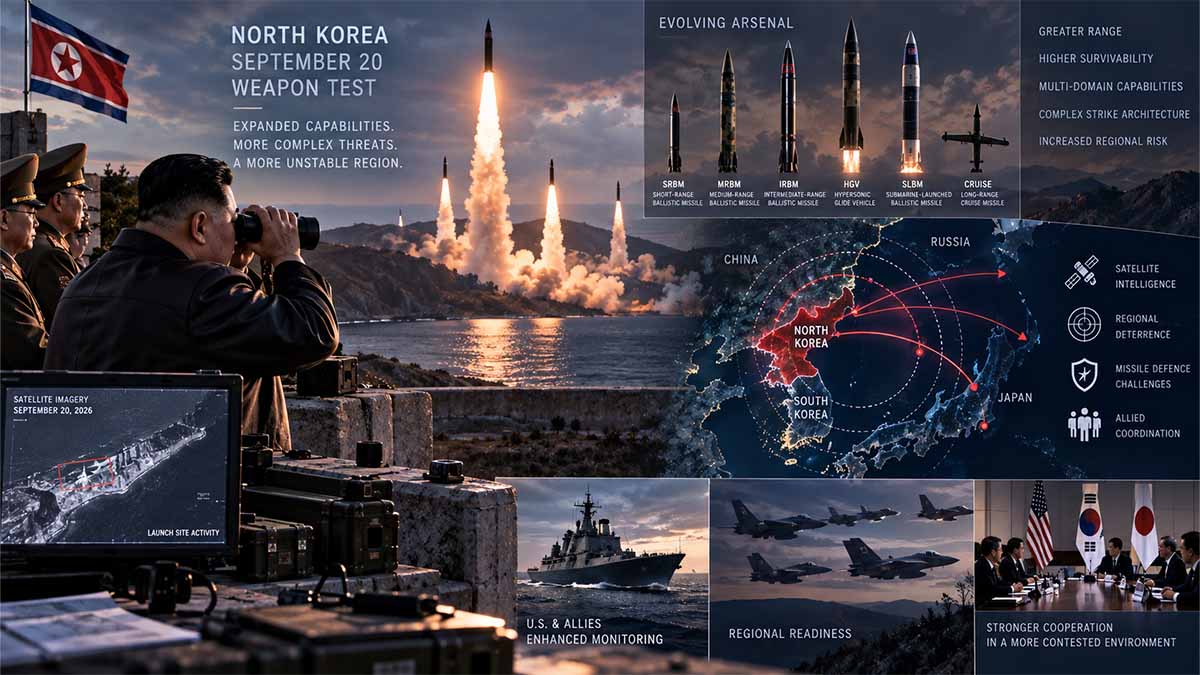
Scope — This assessment examines the DPRK weapon activity of 20 September 2026, the subsequent North Korean claim that a “new-type weapon” was successfully tested, the independently observable launch parameters, the evolution of Pyongyang’s military signalling and force-modernisation strategy, and the consequences for the Republic of Korea, Japan, the United States and the wider Indo-Pacific security architecture over a five-year horizon.
Executive Summary / BLUF
The strongest defensible judgment is that the 20 September 2026 activity represents another increment in North Korea’s transition from accumulating missile range toward diversifying survivable, manoeuvrable and operationally usable regional strike options, although the available official evidence does not yet establish that Pyongyang has fielded a qualitatively new operational capability or that the system performed all functions claimed by North Korean state media.
Japan independently detected two ballistic-missile launches on 20 September, the first at approximately 15:00 JST, reaching about 60 km altitude and 440 km range, and the second at approximately 17:54 JST, reaching approximately 70 km and 590 km, with both assessed to have fallen outside Japan’s exclusive economic zone and with no reported damage to aircraft or vessels. These parameters are documented separately by the Japanese Ministry of Defense — North Korea Missile-Related Information, first launch — 20 Sep 2026 and the Japanese Ministry of Defense — North Korea Missile-Related Information, second launch — 20 Sep 2026.
The DPRK subsequently characterised at least part of the activity as the successful test of a technologically significant “new-type weapon,” while imagery distributed with the announcement reportedly displayed the designation Hwasong-11Ma-1; however, because the accessible first-order Japanese record establishes the trajectories but not the North Korean weapon designation, and because the original KCNA technical report does not provide independently verifiable telemetry sufficient to confirm claimed performance, the designation and claimed technological breakthrough should remain separated analytically from the independently observed launch event. The publicly reproduced KCNA account and image interpretation are described by Yonhap News Agency — 22 Sep 2026, which should be treated as a discovery and cross-reference source rather than as controlling technical evidence under the evidentiary standard adopted here.
The geopolitical significance therefore lies less in whether a single September test constitutes a technological “game changer” than in the cumulative architecture being constructed by Pyongyang, in which intercontinental systems, solid-fuel missiles, shorter-range manoeuvring systems, large-calibre rocket artillery and increasingly explicit nuclear-operational doctrine create several overlapping attack geometries that complicate detection, discrimination, interception and escalation management. Japan’s 2026 Defence White Paper already describes North Korea’s solid-fuel Hwasong-18 and Hwasong-19 ICBM programmes, while also documenting Pyongyang’s repeated exercises associated with what it calls tactical nuclear operations, demonstrating that the September test belongs to a broader force-development continuum rather than an isolated technological episode. Defense of Japan 2026 — Ministry of Defense of Japan — DPRK section.
The immediate strategic consequence is an increasingly difficult regional missile-defence problem, particularly if subsequent verified testing demonstrates sustained powered manoeuvre or hypersonic-glide characteristics at comparatively low altitude, because defence systems must then contend not simply with speed but with reduced warning time, uncertain trajectory prediction and potentially heterogeneous salvos combining systems with different flight profiles. The available September 20 telemetry is consistent with a relatively low-altitude regional trajectory, but altitude and range alone do not establish hypersonic-glide performance, manoeuvring effectiveness, terminal accuracy, survivability against counterforce operations or operational readiness, and none of those properties should therefore be inferred from the test without additional verified evidence.
The broader diplomatic implication is equally important, because weapons development and diplomatic signalling are increasingly operating simultaneously rather than sequentially: Pyongyang can preserve the possibility of political engagement while continuing programmes it presents domestically as sovereign defence requirements, thereby raising the military baseline from which any future negotiations would begin. North Korea has constitutionally entrenched the development of nuclear forces according to the account reproduced in Japan’s official 2026 defence assessment, meaning that expectations of a simple return to the earlier diplomacy-for-denuclearisation framework face a substantially altered institutional and military environment. Defense of Japan 2026 — Ministry of Defense of Japan — DPRK section.
For Seoul, Tokyo and Washington, the central policy problem is consequently becoming less one of stopping an occasional missile test and increasingly one of preserving credible deterrence and crisis stability against a diversified North Korean force whose different systems may create ambiguity over payload, mission and escalation level, particularly during compressed decision windows in a confrontation.
North Korea’s New Strike Architecture Is Rewriting Deterrence in Northeast Asia
North Korea’s 20 September 2026 weapons activity matters less for the label attached to a single missile than for the military architecture it now reveals, because Pyongyang is moving from a force measured by range toward one designed around survivability, launch compression, trajectory diversity, salvo density and nuclear ambiguity. Japan recorded two ballistic launches that day, one travelling about 440 km at roughly 60 km maximum altitude and another about 590 km at roughly 70 km, while the DPRK presented at least part of the activity as a major technological advance. The immediate consequence is not proof of an unstoppable weapon, but a harder deterrence problem for Seoul, Tokyo and Washington, whose fiscal, procurement and command systems must now defend against several attack geometries at once while managing a thinner margin for political error.
The real shift is from missile range to attack complexity
The strongest evidence in the dossier is the widening spread of North Korean delivery systems across range, propulsion, basing and mission type. Japan’s 2026 defence assessment identifies several newer short-range ballistic missile families, including systems with demonstrated or assessed ranges of approximately 400 km, 750 km and 800 km, alongside the 600 mm “super-large multiple rocket launcher” with a demonstrated range of roughly 400 km, solid-fuel intermediate-range missiles, the Hwasong-18 and Hwasong-19 intercontinental systems, cruise missiles and rail- and submarine-based launch concepts. Defense of Japan 2026 — Ministry of Defense of Japan
The military value of this diversification lies in the interaction among systems rather than the headline performance of one missile, because a defender required to discriminate among ballistic, manoeuvring, cruise and artillery-derived threats must allocate sensors and interceptors before knowing whether the incoming weapon is conventional, nuclear-capable or intended primarily to saturate defensive capacity. The 20 September launch therefore fits a broader pattern in which North Korea adds new attack geometries to an existing force rather than replacing one generation with another.
Solid fuel is compressing warning time faster than diplomacy can absorb
Japan’s 2026 Defence White Paper states that North Korea has repeatedly tested solid-fuel ballistic missiles since 2019 and assesses that such weapons can remain fuelled in advance, support faster preparation and improve the conditions for repeated firing; the Hwasong-18 and Hwasong-19 extend this logic to intercontinental range, with Japan assessing that either could exceed 15,000 km depending on payload weight. Defense of Japan 2026 — Ministry of Defense of Japan
The structural effect is to shorten the interval between political warning and military action, particularly when solid-fuel missiles are paired with road-mobile transporters, rail platforms, submarines and underground infrastructure. A liquid-fuel system can expose part of its launch cycle to surveillance, whereas a solid-fuel launcher kept in a higher state of readiness reduces the number of observable indicators available to an opponent. That technical improvement raises deterrent survivability for Pyongyang while simultaneously increasing pressure on South Korean and allied decision-makers to act earlier and with less complete information.
The 600 mm system turns saturation into a strategic problem
The 600 mm system, classified by Japan as SRBM C, is especially important because it sits between traditional rocket artillery and ballistic-missile operations, with a demonstrated maximum range of about 400 km and firing intervals estimated at under one minute in some observed events. Pyongyang has claimed that the system can carry tactical nuclear weapons, although the dossier does not establish that payload capability independently. Defense of Japan 2026 — Ministry of Defense of Japan
The economic consequence for missile defence is direct: a defender does not face only the quality of individual missiles but the cost and availability of interceptors required to defeat a dense salvo. Japan’s FY2026 programme assigns approximately ¥509.1 billion to integrated air and missile defence, including ¥79.7 billion for Aegis System Equipped Vessel preparations, ¥72.3 billion for SM-3 Block IIA interceptors, ¥10.7 billion for SM-6, ¥7.7 billion for Patriot modification and ¥54.7 billion for the next-generation JADGE command architecture. FY2026 Defense Budget — Ministry of Defense of Japan
Those figures show where the fiscal burden is moving: not simply toward buying more interceptors, but toward connecting sensors, command systems and weapons fast enough to allocate the right response before salvo density overwhelms decision time.
South Korea faces the hardest trade-off between pre-emption and restraint
The Republic of Korea’s vulnerability is more compressed because North Korean artillery, rockets and ballistic missiles overlap geographically across a dense concentration of political, economic and military targets. Seoul’s response is built around the ROK 3K Defense system, comprising Kill Chain, Korea Air and Missile Defense and Korea Massive Punishment and Retaliation, with Kill Chain explicitly designed to detect and strike nuclear and missile command, launch and support systems, including mobile launchers, where evidence indicates an impending attack. Defense White Paper — Republic of Korea Ministry of National Defense
That doctrine produces a dangerous asymmetry: as North Korean launchers become harder to detect and faster to employ, the technical incentive to strike them earlier increases, while the evidentiary certainty required to justify such action becomes harder to obtain. The result is a deterrence system in which improved survivability on one side can generate stronger pre-emption pressures on the other, making crisis stability more dependent on intelligence quality and command discipline than on missile numbers alone.
Alliance integration is becoming the answer to force heterogeneity
The United States, Japan and South Korea have responded by connecting previously separate bilateral defence structures more tightly, and the dossier records continuous trilateral real-time missile-warning sharing since December 2023, together with recurring FREEDOM EDGE exercises and a fourth iteration scheduled in the 2026 framework. Defense of Japan 2026 — Ministry of Defense of Japan
At the same time, U.S.-ROK extended deterrence has become more procedural through the Nuclear Consultative Group, which covers nuclear planning, conventional-nuclear integration, secure communications, simulations and joint threat assessment. U.S.-ROK Nuclear Consultative Group Fact Sheet — U.S. Department of Defense
The shift is significant because North Korean military diversification is producing an allied response based on sensor fusion, joint warning, crisis consultation and counterstrike planning rather than on interceptor procurement alone. Yet deeper integration also feeds Pyongyang’s argument that the opposing alliance system is becoming more capable and more offensive, generating an action-reaction cycle in which defensive integration stimulates further North Korean diversification.
Russia has broken the old diplomatic geometry of the peninsula
The Russia–DPRK relationship now adds a major-power dimension that did not previously exist in comparable form. The Treaty on Comprehensive Strategic Partnership, which entered into force on 4 December 2024, contains an Article 4 mutual-assistance provision applicable where one party comes under armed attack and enters a state of war, while Russian statements at the United Nations have cited that treaty in connection with North Korean military participation related to operations in the Kursk region. Treaty on Comprehensive Strategic Partnership — United Nations Digital Library
The relationship also creates a military-learning channel. Japan’s 2026 defence assessment states that at least 100 North Korean ballistic missiles were reportedly supplied to Russia during 2024 and warns that battlefield employment in Ukraine could improve North Korean accuracy and operational proficiency; separate United Nations Security Council proceedings documented Hwasong-11-family missile remnants recovered in Ukraine, including a missile carrying a 2024 production mark. Defense of Japan 2026 — Ministry of Defense of Japan UN Security Council 9820th Meeting
This is an industrial and operational shift, not only a diplomatic one, because production for external war can generate manufacturing scale, serial feedback and performance data that domestic testing alone cannot reproduce.
China now has to manage the consequences of a stronger North Korea
China’s position is more complicated because Beijing benefits from avoiding instability or regime collapse on its border but pays a strategic price when North Korean military development accelerates U.S.-Japan-ROK integration, Japanese counterstrike procurement and regional missile defence. During Xi Jinping’s June 2026 state visit to the DPRK, Beijing and Pyongyang reaffirmed the long-term strategic importance of bilateral relations, while Chinese diplomacy continued to call for dialogue, reduced confrontation and attention to what Beijing describes as the underlying causes of the peninsula dispute. Ministry of Foreign Affairs of the People’s Republic of China — June 2026
The contradiction is structural: a more survivable North Korean regime can serve China’s interest in border stability, but the same military capability encourages precisely the U.S.-led regional coordination that Beijing seeks to constrain. China therefore has influence with Pyongyang but not an interest set identical to Pyongyang’s, while Russia’s deeper security relationship gives North Korea another external partner and reduces any assumption that Chinese leverage is exclusive.
The next 12–24 months will be decided by deployment, not declarations
The central test through 2027 and into 2028 will not be whether North Korea announces another missile designation but whether it converts developmental systems into deployed inventories, trained units and repeatable mixed-system operations, because the February 2026 Ninth Party Congress explicitly identified the 600 mm system, new 240 mm rocket systems and operational-tactical missile complexes for wider deployment while calling for greater operationalisation of nuclear combat forces. Japanese Assessment of the Ninth Party Congress — Ministry of Defense of Japan
If that transition proceeds, the financial burden will fall first on South Korea and Japan through larger interceptor inventories, harder command infrastructure, dispersed bases and more persistent surveillance; the operational burden will fall on U.S. forces required to sustain extended deterrence across both regional and homeland threat levels; and the diplomatic burden will fall on a Security Council whose sanctions framework remains legally intact but whose dedicated Panel of Experts ceased operating on 30 April 2024. UN Security Council 1718 Committee
The cost of inaction is therefore not simply a larger North Korean arsenal. It is a regional security system forced to spend more money, make faster decisions and accept higher escalation risk because Pyongyang is building a force whose value lies precisely in making defence, attribution and retaliation more difficult to separate.
Navigational Index
Pillar I — The weapon test and the evidentiary boundary
What was independently observed on 20 September, what North Korea claims occurred, what the available trajectory data establish, and which technical conclusions remain unsupported by the public record.
Pillar II — From missile development to layered coercive capability
How the event fits North Korea’s broader movement toward solid-fuel missiles, manoeuvring regional strike systems, tactical-nuclear doctrine, artillery integration and more survivable launch architectures.
Pillar III — Deterrence, escalation and Indo-Pacific consequences
How increasingly heterogeneous DPRK strike systems alter the defence problem facing South Korea, Japan and United States forces, while affecting China, Russia, alliance planning and the diplomatic structure surrounding the Korean Peninsula.
Master Abstract
The September test is significant because of the trajectory of North Korean modernisation, not because Pyongyang has yet proved every technological claim
The independently verifiable baseline begins with two launch events rather than with North Korea’s later description of the weapon, because the Japanese Ministry of Defense’s first assessment records a ballistic missile launched at approximately 15:00 JST from the vicinity of North Korea’s east coast, travelling approximately 440 kilometres and reaching a maximum altitude of approximately 60 kilometres, while the second Japanese assessment records another ballistic missile at approximately 17:54 JST, travelling around 590 kilometres with a maximum altitude of approximately 70 kilometres. Neither was assessed to have entered Japan’s EEZ, and Japan reported no confirmed damage to nearby aircraft or vessels, which supports Pyongyang’s narrower assertion that the launches did not physically strike neighbouring territory but does not validate North Korea’s wider claims concerning the tested weapon’s technological performance.
Those figures matter because the relatively low observed apogees distinguish the launches from conventional high-arching medium- or long-range ballistic demonstrations and place analytical attention on regional penetration, trajectory shaping and missile-defence complexity, although the public telemetry remains insufficient to determine whether the system executed a genuine hypersonic-glide profile, sustained aerodynamic manoeuvring, a pull-up manoeuvre, terminal evasion or another trajectory-management technique. The term “hypersonic” is frequently used too broadly in public discussion because most ballistic missiles exceed Mach 5 during significant portions of flight; the militarily important question is therefore whether the vehicle can conduct meaningful manoeuvre while travelling at hypersonic velocity in ways that materially complicate tracking and interception, a proposition that cannot be established from range and maximum altitude alone.
The strategic trajectory nevertheless deserves close attention because Japan’s official defence assessment documents a North Korean missile ecosystem already spanning solid-fuel intercontinental systems, tactical ballistic missiles and exercises Pyongyang associates with nuclear employment, while the September event appears to continue the DPRK’s effort to increase the number of technologically and operationally distinct strike pathways available to its forces. The 2026 Defense of Japan assessment describes the three-stage solid-fuel Hwasong-18, the larger Hwasong-19, and North Korean exercises that Pyongyang itself presented as tactical-nuclear operational training, showing that the relevant trend is not a single missile family but the construction of a broader spectrum of survivable nuclear and conventional delivery options.
The important evolution is the multiplication of penetration problems rather than a simple increase in missile range
North Korea has already demonstrated systems capable of threatening targets far beyond the Korean Peninsula, meaning that additional strategic value increasingly comes from characteristics other than maximum range, including launcher mobility, solid-fuel readiness, trajectory unpredictability, short launch preparation, salvo employment, penetration aids, multiple missile families and potentially manoeuvring re-entry or glide vehicles. Japan assesses that the solid-fuel Hwasong-18 can potentially exceed 15,000 kilometres depending on payload mass, while the later Hwasong-19 was launched in October 2024 on a trajectory whose flight duration and altitude exceeded previous North Korean tests; these developments mean that Pyongyang’s present technological problem is increasingly one of reliability, survivability, response time and defence penetration rather than simply demonstrating theoretical geographic reach. Defense of Japan 2026 — Ministry of Defense of Japan.
Within that context, a manoeuvrable shorter-range system would perform a different strategic function from an ICBM because its primary relevance would concern targets such as command facilities, airfields, ports, logistics hubs, missile-defence batteries and reinforcement infrastructure within the Korean and Japanese theatres rather than continental United States targets. This creates a layered deterrence problem, because Washington and its allies must simultaneously protect regional forces needed to sustain deterrence, preserve retaliatory capability against North Korean nuclear coercion and maintain escalation control when the same or visually similar missile families could potentially support different conventional or nuclear missions.
The September launch geometry consequently matters even without proof of revolutionary technology, because a force containing ballistic, quasi-ballistic, manoeuvring and cruise-type trajectories can require defenders to detect and discriminate several threat classes simultaneously, while mobile launchers and solid-fuel propulsion reduce some of the warning indicators associated with liquid-fuel preparation. The strategic effect arises from interaction among systems rather than from any single missile, which means that the cumulative burden on allied intelligence, surveillance, missile tracking, command-and-control and interceptor inventories can grow faster than the number of new weapon designations alone would suggest.
Pyongyang is also converting technological development into political signalling
The timing and presentation of North Korean missile activity must be analysed cautiously because intent cannot be derived mechanically from chronology, and Japan’s defence minister explicitly stated after the September 20 launch that Tokyo could not determine the intention behind an individual launch with certainty. Nevertheless, the Japanese government documented a substantial tempo of North Korean ballistic-missile activity in 2026 and described the activity as threatening regional and international security, while maintaining close trilateral information exchange with the United States and South Korea. Extraordinary Press Conference by Defense Minister Koizumi — Ministry of Defense of Japan — 20 Sep 2026.
The same official Japanese statement recorded nine launch occasions involving at least fifteen ballistic missiles or related projectiles during 2026 up to 20 September, compared with four occasions and at least five missiles during 2025, according to Japan’s own counting methodology; because national authorities can count launches and projectile types differently, these figures should be treated as Japan’s official series rather than mechanically reconciled with alternative South Korean tallies. Extraordinary Press Conference by Defense Minister Koizumi — 20 Sep 2026.
This increased testing environment permits Pyongyang to serve several objectives simultaneously without requiring that every launch have a single dominant political explanation, because technical validation, crew training, deterrence signalling, domestic legitimisation and external coercive communication can occur during the same event. Kim Jong-un’s reported emphasis on military modernisation and war readiness therefore fits a broader pattern in which weapons testing functions both as engineering activity and political theatre, although specific claims about his intention should remain attributed rather than transformed into established fact.
The legal baseline has not changed merely because North Korea regards its nuclear status as permanent
From the perspective of the existing United Nations sanctions regime, North Korean domestic legislation or constitutional provisions do not supersede Security Council obligations applicable to the DPRK, because successive Security Council resolutions require North Korea to halt ballistic-missile activities and abandon its nuclear-weapons and ballistic-missile programmes. Resolution 2375, for example, reaffirmed that the DPRK “shall not conduct any further launches that use ballistic missile technology”, while the Security Council’s 1718 Committee continues to administer the sanctions architecture created by resolution 1718 and subsequently expanded through resolutions including 1874, 2087, 2094, 2270, 2321, 2371, 2375 and 2397. Security Council Resolution 2375 coverage — United Nations — Sep 2017 and Security Council Committee established pursuant to resolution 1718 — United Nations.
The political enforceability of that architecture and the legal existence of its obligations must nevertheless be distinguished, particularly because the institutional mechanism surrounding sanctions monitoring has weakened compared with the earlier period: the United Nations 1718 Committee records that its Panel of Experts, established in 2009, operated only until 30 April 2024, after which its mandate was no longer renewed. Security Council Committee established pursuant to resolution 1718 — United Nations. This reduces one important multilateral mechanism for systematic public documentation even though it does not erase the substantive resolutions themselves.
The most consequential change concerns crisis geometry
A diversified regional missile force creates uncertainty that is strategically important even before every system reaches mature operational deployment, because an incoming missile detected during a crisis may not immediately reveal whether it carries a conventional or nuclear payload, whether its target is tactical or strategic, or whether the launch is part of a limited coercive action or the opening phase of a larger attack. That ambiguity compresses decision time for South Korean, Japanese and United States authorities while increasing the importance of resilient command-and-control, space- and airborne-based tracking, integrated air and missile defence, hardened infrastructure, distributed logistics and credible second-strike capability.
For the Republic of Korea, the principal concern is the density and diversity of regional threats because much of the country’s military, political and economic infrastructure lies within ranges accessible to multiple North Korean systems, meaning that a technically mature manoeuvring weapon would add another penetration problem rather than create vulnerability from zero. For Japan, the September 20 launches demonstrate the direct relevance of DPRK regional strike development to Japanese territory and nearby maritime approaches even though both missiles were assessed to have fallen outside the Japanese EEZ, while the Japanese government explicitly characterised repeated ballistic-missile launches as a threat to Japan, the region and the international community. Japanese Ministry of Defense — 20 Sep 2026.
For the United States, the strategic challenge is two-layered because North Korea’s long-range systems create a homeland-deterrence problem while its shorter-range weapons threaten the forces, airfields, ports, sensors and missile-defence assets through which Washington would reinforce and defend its allies. This interaction is particularly important because theatre systems do not need intercontinental range to affect the credibility of extended deterrence if they can disrupt the regional infrastructure required to implement United States commitments.
China and Russia face a different strategic calculation from Seoul, Tokyo and Washington
Neither Beijing nor Moscow faces the same direct alliance-defence problem, and neither should therefore be analytically grouped with the United States-led alliance network; however, further North Korean missile diversification carries potential costs for both because it strengthens incentives for South Korea, Japan and the United States to expand missile-defence integration, surveillance, long-range conventional strike capabilities and trilateral military coordination, developments that China in particular has historically regarded as affecting its own strategic environment.
North Korean military advances therefore contain an inherent geopolitical paradox for Beijing: preventing destabilisation or conflict on the peninsula remains materially important to China, yet sustained DPRK missile and nuclear development generates precisely the alliance consolidation and advanced United States regional military presence that Beijing has strong incentives to constrain. The September test does not resolve that contradiction, but it reinforces the structural dynamics through which North Korean weapons development can indirectly accelerate wider Indo-Pacific force modernisation.
The emerging strategic contest is consequently over architecture rather than individual missiles
The most important analytical evolution is that the Korean Peninsula is moving toward a deterrence environment in which force architecture, survivability, sensing, command resilience and missile-defence saturation matter at least as much as the nominal range of individual North Korean missiles, because technological diversity allows Pyongyang to create multiple tactical and strategic dilemmas simultaneously. The September 20 test should therefore be interpreted neither as proof that North Korea has acquired an unstoppable new weapon nor as a routine launch of negligible consequence; the stronger conclusion is that it supplies another data point in an increasingly coherent effort to broaden the DPRK’s options for penetrating, overwhelming or complicating allied defensive systems.
That judgment would strengthen materially if subsequent official tracking data demonstrated reproducible manoeuvring trajectories, successful low-altitude glide over substantial distances, repeated launches from operational mobile units, simultaneous mixed-system salvos, documented transfer to deployed formations or training explicitly integrating the weapon into nuclear command procedures. Conversely, the assessment would weaken if later testing exposed reliability problems, if trajectory reconstruction showed essentially conventional ballistic behaviour, or if no operational deployment evidence emerged despite repeated developmental announcements.
Key Evidence Table
| Indicator | Value/status | Reference date | Definition/scope | Issuer | Exact source |
|---|---|---|---|---|---|
| First detected launch | At least 1 ballistic missile | 20 Sep 2026, ~15:00 JST | Launch from vicinity of DPRK east coast toward northeast | Japan Ministry of Defense | North Korea Missile-Related Information — 20 Sep 2026 |
| First observed trajectory | ~440 km range; ~60 km maximum altitude | 20 Sep 2026 | Japanese preliminary assessment | Japan Ministry of Defense | North Korea Missile-Related Information — 20 Sep 2026 |
| Second detected launch | At least 1 ballistic missile | 20 Sep 2026, ~17:54 JST | Launch from vicinity of DPRK east coast toward northeast | Japan Ministry of Defense | North Korea Missile-Related Information — second launch |
| Second observed trajectory | ~590 km range; ~70 km maximum altitude | 20 Sep 2026 | Japanese preliminary assessment | Japan Ministry of Defense | North Korea Missile-Related Information — second launch |
| Japanese EEZ impact | None assessed for either documented launch | 20 Sep 2026 | Estimated splashdown outside Japanese EEZ | Japan Ministry of Defense | First launch; second launch |
| Damage reports | None confirmed from aircraft or vessels at time of statements | 20 Sep 2026 | Immediate Japanese safety reporting | Japan Ministry of Defense | Defense Minister extraordinary press conference |
| Japanese 2026 launch count | 9 occasions, at least 15 projectiles | Through 20 Sep 2026 | Japanese official counting methodology | Japan Ministry of Defense | Defense Minister extraordinary press conference |
| Japanese 2025 comparison | 4 occasions, at least 5 projectiles | Full year 2025 | Same Japanese statement; methodological comparability should remain within Japanese series | Japan Ministry of Defense | Defense Minister extraordinary press conference |
| DPRK missile-sanctions baseline | Ballistic-missile launches prohibited under applicable UNSC resolutions | Current legal regime | International obligations established under Chapter VII sanctions architecture | UN Security Council | Resolution 2375 coverage; 1718 Committee |
| UN Panel of Experts | Mandate ended 30 Apr 2024 | 30 Apr 2024 | Monitoring mechanism attached to 1718 Committee | UN Security Council | 1718 Committee background |
Principal Gaps and Watch Indicators
The most important unresolved issue is weapon identity and flight behaviour, because the currently accessible official Japanese telemetry does not establish whether the tested vehicle was the system identified in North Korean imagery as Hwasong-11Ma-1, whether a glide body separated from its booster, how extensively it manoeuvred after boost, what velocity it maintained during that phase, or whether the demonstrated trajectory materially increased penetration capability against deployed missile defences; subsequent official tracking reconstruction by Japan, the Republic of Korea or the United States would therefore constitute a decisive collection event.
A second gap concerns operational maturity, because one successful developmental test, even if accepted as technically successful, does not demonstrate serial production, unit deployment, trained crews, wartime availability, reliable command links, storage endurance or repeatable accuracy, meaning that imagery of launch vehicles, unit-level exercises, repeated tests under varying conditions and evidence of integration into operational formations would materially strengthen the assessment that the programme has moved from development toward fielded capability.
A third gap concerns payload and mission integration, because North Korea’s broader nuclear doctrine makes dual-capable regional systems strategically important, but the public record examined here does not establish that the September-tested weapon has been equipped, certified or assigned for nuclear delivery; official DPRK statements identifying the system with nuclear forces, observable nuclear-unit exercises employing the same launcher or missile family, or credible first-order technical evidence connecting the system to nuclear-warhead integration would substantially alter the escalation assessment.
A fourth indicator concerns salvo architecture, because the most consequential development would not necessarily be a marginal increase in peak speed but demonstrated employment alongside ballistic missiles, large-calibre rocket artillery, cruise missiles or unmanned systems in coordinated exercises designed to saturate or fragment allied tracking and interception resources; recurring mixed-system launches would therefore deserve greater strategic weight than another isolated maximum-performance demonstration.
A fifth indicator concerns diplomatic decoupling, because continued rapid weapons modernisation alongside renewed political contacts would suggest that Pyongyang increasingly regards nuclear-force development as a permanent background condition rather than a negotiable bargaining variable, whereas a verifiable freeze on testing, production or deployment tied to negotiations would demonstrate that the military and diplomatic tracks remain more directly connected than current North Korean doctrine suggests.
North Korea’s September 20 Weapon Test: From Missile Expansion to a More Complex Regional Strike Architecture
BLUF. The strongest defensible judgment is that the 20 September 2026 activity represents another increment in North Korea’s transition from accumulating missile range toward diversifying survivable, manoeuvrable and operationally usable regional strike options. The publicly verified evidence establishes two ballistic-missile launches with relatively low observed apogees, but does not yet prove that Pyongyang fielded a qualitatively new operational capability, demonstrated sustained hypersonic glide or achieved all performance claims associated with the later North Korean announcement.
The launch event is verified; the full capability claim is not
Japan independently documented two ballistic-missile launches. The later DPRK description of a “new-type weapon” and the designation associated with North Korean imagery should remain analytically separate from the independently observed trajectory record.
September 20 launch record and verified reference points
| Indicator | Value / Status | Reference | Scope | Issuer |
|---|---|---|---|---|
| First detected launch | ≥1 ballistic missile | 20 Sep • ~15:00 JST | DPRK east coast → northeast | Japan MoD |
| First trajectory | ≈440 km / ≈60 km | 20 Sep 2026 | Range / max altitude | Japan MoD |
| Second detected launch | ≥1 ballistic missile | 20 Sep • ~17:54 JST | DPRK east coast → northeast | Japan MoD |
| Second trajectory | ≈590 km / ≈70 km | 20 Sep 2026 | Range / max altitude | Japan MoD |
| Japanese EEZ impact | None assessed | 20 Sep 2026 | Both splashdowns outside EEZ | Japan MoD |
| Immediate damage reports | None confirmed | 20 Sep 2026 | Aircraft / vessels | Japan MoD |
| 2026 launch count | 9 occasions / ≥15 projectiles | Through 20 Sep | Japanese counting series | Japan MoD |
| 2025 comparison | 4 occasions / ≥5 missiles | Full year 2025 | Same Japanese series | Japan MoD |
| UN ballistic-missile baseline | Launches prohibited | Current regime | UNSC sanctions architecture | UN Security Council |
| UN Panel of Experts | Mandate ended | 30 Apr 2024 | 1718 monitoring mechanism | UN Security Council |
Observed event, attributed designation, unresolved performance
The strategic evolution is architectural, not merely numerical
The marginal value of new systems increasingly lies beyond maximum distance
The challenge is heterogeneous attack geometry
Ambiguity over mission and payload compresses decision time
| Ambiguity | Operational problem | Decision impact | Required resilience |
|---|---|---|---|
| Conventional vs nuclear payload | Launch intent not immediately visible | Escalation uncertainty | Survivable command and retaliation options |
| Tactical vs strategic target | Trajectory may not reveal target early | Compressed warning | Distributed sensors / tracking |
| Limited strike vs opening salvo | Scale cannot be inferred from first launch | Risk of over- or under-reaction | Resilient C2 / escalation protocols |
| Single system vs mixed salvo | Multiple threat classes may overlap | Interceptor-allocation stress | Integrated air / missile defence |
The same force development generates different strategic problems
Domestic DPRK nuclear policy does not supersede existing UN obligations
The applicable Security Council sanctions architecture continues to prohibit ballistic-missile launches and requires abandonment of the DPRK’s nuclear-weapons and ballistic-missile programmes. The weakening lies in monitoring capacity rather than the formal disappearance of those obligations: the 1718 Panel of Experts ceased operating after 30 April 2024 when its mandate was not renewed.
The emerging contest is over force architecture rather than individual missiles
What would materially strengthen the assessment
Six controlling judgments
The verified September event is significant primarily as another data point in a broader DPRK transition toward more survivable and heterogeneous strike options.
Low observed apogees focus analytical attention on regional penetration and trajectory shaping, but do not prove hypersonic-glide performance.
North Korea’s strategic value increasingly derives from force diversity, mobility, solid-fuel readiness and salvo complexity rather than range alone.
The most consequential military effect is a more difficult integrated air- and missile-defence problem, especially if mixed-system launches become routine.
The strategic danger lies in payload, mission and salvo ambiguity that can compress allied decision windows during a confrontation.
The present public record does not establish operational maturity, nuclear certification or a decisive technological breakthrough and should not be stretched beyond what observed telemetry supports.
Evidence still required for a capability-level judgment
- Independent confirmation of weapon identity and designation.
- Trajectory reconstruction beyond range and maximum altitude.
- Evidence of glide-body separation or sustained powered/aerodynamic manoeuvre.
- Serial production and deployment to operational formations.
- Reliable accuracy and terminal-performance data.
- Nuclear payload certification or force-assignment evidence.
- Mixed-system salvo integration and command-procedure evidence.
Signals that would materially change the assessment
Pillar I — The Weapon Test and the Evidentiary Boundary
Principal judgment
The evidentiary significance of the 20 September 2026 event lies in the fact that two distinct ballistic-missile launches are independently established by Japanese national technical reporting, whereas the specific identity, propulsion architecture, payload configuration, manoeuvring mechanism and claimed technological novelty of the “new-type weapon” remain outside the independently verified public record. The available evidence therefore supports a firmer conclusion about the geometry of the launches than about the maturity of the weapon itself: the first projectile flew approximately 440 km with a maximum altitude of about 60 km, while the second travelled approximately 590 km with a maximum altitude of about 70 km, both on north-easterly trajectories from the vicinity of North Korea’s east coast and both terminating outside Japan’s exclusive economic zone according to Tokyo’s assessment. Those parameters are unusually important because they place both events firmly in the regional short-range strike problem while simultaneously showing relatively low maximum altitudes, yet neither altitude nor range establishes that the missiles executed sustained hypersonic glide, terminal evasive manoeuvring, a pull-up trajectory or any other specific penetration technique.
The North Korean assertion supplied with the event report goes materially further than the independently observable record by describing a successful test of a weapon of major technological significance, characterising it as a demonstration of “ultra-modern defence technology” and linking possession of the technology to wartime readiness and future force development; under a strict intelligence standard, however, these statements constitute first-party assertions about performance and significance rather than independent proof of the underlying engineering achievement, particularly because the DPRK did not publicly disclose a complete technical specification, externally verifiable telemetry package, guidance-error data, propulsion profile, payload mass, terminal velocity, manoeuvre envelope or interception-resistance measurement.
The analytical boundary is therefore precise: a ballistic launch occurred twice; the trajectories were sufficiently observable for Japan to publish approximate range and altitude figures; the projectiles did not enter Japan’s EEZ; no contemporaneous damage to aircraft or vessels was reported; but the public official record does not yet establish exactly what technological function was tested or whether the demonstrated configuration has reached operational military maturity. Japan’s Defence Minister explicitly reinforced this distinction during the post-launch press conference by stating that Japan, the United States and the Republic of Korea were still conducting detailed analysis and that Tokyo was not in a position to determine conclusively the intention behind individual launches.
The event chronology reveals two separate test opportunities rather than one undifferentiated launch episode
The Japanese Ministry of Defense published separate notifications for the two launches on 20 September, and that distinction matters because two firing events separated by several hours provide a different developmental and operational context from a simultaneous salvo, even though the official public record does not disclose whether the same weapon configuration was employed in both cases. The first launch occurred at approximately 15:00 Japan Standard Time, originated from the vicinity of North Korea’s east coast, travelled toward the northeast, reached approximately 60 km maximum altitude, and covered approximately 440 km before falling outside Japan’s EEZ; the second was recorded at approximately 17:54 JST, again from the vicinity of the east coast and again toward the northeast, but this time the projectile reached approximately 70 km maximum altitude and travelled approximately 590 km before falling outside the EEZ.
Those differences cannot automatically be interpreted as evidence of different missiles, different payloads or different mission profiles, because launch azimuth, propulsion duration, trajectory shaping, payload mass and test objectives can alter observed range and altitude even within a single missile family; correspondingly, the available data do not justify describing the second shot as technologically superior to the first merely because it travelled farther and somewhat higher. The correct conclusion is narrower but still operationally useful: the two independently reported trajectories were not identical, which means that any future official reconstruction capable of showing changes in powered-flight duration, mid-course manoeuvring, velocity retention or terminal behaviour would be particularly important for determining whether North Korea was testing repeatability, different profiles or different system configurations.
Independently observed launch parameters
| Evidentiary variable | First launch | Second launch | What the official record establishes | What it does not establish |
|---|---|---|---|---|
| Date | 20 Sep 2026 | 20 Sep 2026 | Both events occurred on the same day | Whether they formed one formal test programme |
| Approximate launch time | 15:00 JST | 17:54 JST | Two separate firing events | Exact countdown or launch preparation time |
| Origin | Vicinity of DPRK east coast | Vicinity of DPRK east coast | Same broad geographic launch area | Exact launcher coordinates |
| Direction | Northeast | Northeast | Broad azimuth toward the Sea of Japan/East Sea | Exact launch azimuth in degrees |
| Missile classification | Ballistic missile | Ballistic missile | Japan detected ballistic-missile behaviour | Exact DPRK designation |
| Maximum altitude | ~60 km | ~70 km | Low maximum altitude relative to many conventional high-arc ballistic profiles | Glide regime, manoeuvre envelope or pull-up behaviour |
| Approximate range | ~440 km | ~590 km | Short-range regional engagement geometry | Maximum design range |
| Estimated impact area | Outside Japanese EEZ | Outside Japanese EEZ | No assessed EEZ entry | Exact impact coordinates |
| Immediate damage report | None reported | None reported | No confirmed aircraft or vessel damage at time of Japanese statement | Absence of all environmental or debris effects |
| External technical analysis | Ongoing among Japan, United States and ROK | Ongoing among Japan, United States and ROK | Allied technical assessment was not complete | Final trajectory reconstruction or intelligence conclusion |
Sources: Japanese Ministry of Defense, 20 September 2026. First launch — North Korea Missile-Related Information, Japan Ministry of Defense Second launch — North Korea Missile-Related Information, Japan Ministry of Defense
The low maximum altitudes are analytically important, but they do not by themselves prove a hypersonic glide vehicle
A maximum altitude of approximately 60–70 km is materially different from the very high lofted trajectories that North Korea has repeatedly employed when demonstrating longer-range ballistic systems, but the correct technical interpretation requires considerable restraint because maximum altitude represents only one observable parameter within a complete trajectory. A ballistic missile deliberately flown on a depressed or relatively shallow trajectory can remain at comparatively low altitude without becoming a hypersonic glide vehicle, while a manoeuvring re-entry vehicle can also modify portions of its trajectory without necessarily executing sustained atmospheric glide; consequently, the current Japanese figures constrain the geometry of the event but do not uniquely identify the underlying flight mechanism.
This distinction is especially important because “hypersonic” is not, by itself, an adequate intelligence classification for a modern missile system, since ballistic missiles routinely exceed five times the speed of sound during portions of their flight, whereas the more militarily consequential question concerns how the vehicle manoeuvres while travelling at high velocity, how long it remains within the atmosphere, how predictable its path remains to defensive sensors, and whether its manoeuvring authority is large enough to complicate engagement by existing interceptors. None of those variables is supplied in the Japanese public statements of 20 September, meaning that claims regarding missile-defence penetration must remain conditional rather than declarative.
The absence of public velocity data is particularly consequential because it prevents calculation of the vehicle’s energy state across the relevant phases of flight, while the absence of time-series altitude and position data prevents reconstruction of whether the vehicle followed a conventional descending ballistic path, performed cross-range manoeuvres, executed a late pull-up manoeuvre or remained within a sustained glide corridor. The public official record therefore supports the description “low-altitude ballistic-missile launch profile as observed by Japan”, whereas a formulation such as “confirmed hypersonic-glide flight” would exceed the available evidence.
Technical propositions and current evidentiary status
| Proposition | Current assessment | Evidence supporting the assessment | Evidentiary limitation |
|---|---|---|---|
| Two ballistic missiles were launched on 20 Sep 2026 | Established | Two separate Japanese MoD notifications | Japan’s public statement provides approximate rather than full tracking data |
| Both launches originated near the DPRK east coast | Established at broad geographic level | Japanese MoD | Precise launch coordinates remain undisclosed |
| First projectile flew about 440 km | Established as Japanese official estimate | Japanese MoD | Measurement uncertainty not publicly quantified |
| Second projectile flew about 590 km | Established as Japanese official estimate | Japanese MoD | Measurement uncertainty not publicly quantified |
| Maximum altitudes were roughly 60 km and 70 km | Established as Japanese official estimates | Japanese MoD | Full altitude-time profiles unavailable |
| Both trajectories were relatively low | Supported | Published range and altitude data | “Low” does not identify the propulsion or glide mechanism |
| Weapon was a hypersonic glide vehicle | Not independently established | DPRK-associated reporting points toward a novel system | No verified official external telemetry establishing sustained glide |
| Weapon executed pull-up manoeuvring | Not established | No external first-order trajectory reconstruction published | Requires detailed tracking data |
| Weapon manoeuvred laterally | Not established | No public cross-range data | Requires azimuth/time tracking or sensor reconstruction |
| Weapon demonstrated missile-defence penetration | Not established | No live interception attempt or engagement data | Penetration requires more than low altitude |
| Weapon demonstrated precision strike accuracy | Not established | No independently verified aim-point/impact-error data | Splashdown region is not equivalent to accuracy measurement |
| Weapon is operationally deployed | Not established | Test activity alone | Requires unit deployment, training, inventory or readiness evidence |
| Weapon is nuclear capable | Not established for this configuration | DPRK has a broader nuclear-missile programme | No verified payload integration evidence for the September system |
| Weapon is serially produced | Not established | No production documentation in the public official record | Prototype/test article cannot be equated with production inventory |
The first launch and second launch should not be merged into a single performance figure
One of the most important evidentiary errors to avoid is the creation of a synthetic “September 20 missile performance” value by averaging the two launches, because doing so would erase potentially meaningful differences between the events and would imply knowledge that the public record does not provide. The Japanese data should therefore remain disaggregated: 440 km at approximately 60 km maximum altitude for the first launch and 590 km at approximately 70 km for the second, because each pair of observations describes a separate flight event and neither Japan nor another accessible first-order source has publicly established that the two projectiles were identical in configuration.
The same rule applies to inferred maximum range, because neither shot demonstrates the missile’s full design envelope; a missile can be intentionally flown below maximum range for testing, geography, safety, telemetry collection or trajectory-validation reasons, while payload mass and manoeuvring requirements can further alter the achieved distance. The published ranges therefore establish demonstrated flight distances on 20 September, not the system’s theoretical or operational maximum range.
Japan’s sequential reporting provides an unusually useful audit trail
The Japanese Ministry of Defense’s reporting sequence shows that the government first issued immediate warning-oriented information, then confirmed that the projectile appeared to have fallen, subsequently stated that entry into the Japanese EEZ had not been confirmed, and later published more complete range and altitude estimates; this chronology illustrates why early launch reporting should not be treated as final technical characterisation, because initial notifications are intended primarily for warning and situational awareness while later statements incorporate more developed tracking assessments. One Japanese notice stated only that an object potentially constituting a ballistic missile had apparently already fallen, while another reported that penetration of Japan’s EEZ had not been confirmed at that stage, before the ministry later released the approximate maximum-altitude and distance figures.
For intelligence assessment, this sequence establishes a hierarchy among the 20 September Japanese statements: the immediate alerts confirm detection and safety concerns, whereas the later Ministry of Defense releases provide the stronger publicly accessible technical baseline. It would therefore be methodologically incorrect to treat every contemporaneous notification as an independent corroborating source, because they originate from the same national detection and reporting system and should instead be regarded as successive stages of one Japanese official evidence stream.
The absence of damage does not verify North Korea’s claim that the test had no adverse security impact
North Korea’s statement that the test produced no adverse impact on neighbouring states contains two analytically different propositions that should not be conflated, because the observable proposition concerns immediate physical consequences whereas the broader security proposition concerns military and strategic effects. Japan reported that the missiles were assessed to have fallen outside its EEZ and that no information concerning damage to nearby aircraft or vessels had been confirmed at the time of reporting, which supports a narrow conclusion that no immediate physical damage was publicly recorded by Japan.
That record does not establish the broader proposition that the launches had no adverse security effect, because Japan formally protested the activity and described North Korea’s nuclear and missile development as threatening Japan and international peace and stability, while the Defence Minister characterised the activity as contrary to relevant Security Council resolutions. The distinction is substantive rather than rhetorical: a launch can avoid territorial impact or casualties while still altering force readiness, prompting surveillance activity, generating warning procedures, imposing defensive costs and contributing to strategic instability.
Physical-effect and security-effect distinction
| Dimension | Verified public evidence | Assessment |
|---|---|---|
| Missile impact on Japanese territory | None reported | No territorial strike established |
| Missile entry into Japanese EEZ | Japan assessed both impacts outside the EEZ | No EEZ entry established |
| Aircraft damage | None reported at time of announcement | No immediate aviation damage established |
| Vessel damage | None reported at time of announcement | No immediate maritime damage established |
| Civil warning and monitoring burden | Japanese government initiated information collection, safety confirmation and contingency procedures | Security-management consequence established |
| Diplomatic consequence | Japan lodged a strong protest through its embassy channel in Beijing | Political consequence established |
| Military consequence | Japan, United States and ROK continued joint analysis | Intelligence and defence consequence established |
| Broader strategic effect | Cannot be measured from physical-impact data alone | DPRK “no adverse security impact” assertion is not independently demonstrated |
Source: Japanese Ministry of Defense and Defence Minister’s extraordinary press conference, 20 September 2026. Extraordinary Press Conference by Defense Minister Koizumi — 20 September 2026
The September event occurred within a substantially accelerated 2026 Japanese launch count
The Japanese Defence Minister stated on the evening of 20 September that North Korea had carried out ballistic-missile or related launches on nine occasions involving at least fifteen projectiles during 2026, including the September 20 events, whereas Japan counted four occasions involving at least five projectiles during 2025; these figures demonstrate a materially higher launch tempo within Japan’s own consistent reporting series, although they should not automatically be merged with South Korean or United States counts because governments can classify multiple-launch rocket systems, tactical missiles and ambiguous projectiles differently.
The evidentiary value of the comparison is consequently strongest when used longitudinally within the Japanese series: the relevant observation is not an artificially harmonised multinational count, but that Tokyo itself recorded more launch occasions and substantially more projectiles by 20 September 2026 than during the entire preceding year, thereby establishing a higher observable test-and-launch tempo regardless of unresolved disagreements over weapon taxonomy.
Japanese official launch-tempo series cited on 20 September
| Period | Launch occasions | Minimum projectiles | Source scope | Analytical use |
|---|---|---|---|---|
| 2025 | 4 | At least 5 | Japanese MoD counting methodology | Baseline |
| 2026 through 20 Sep | 9 | At least 15 | Japanese MoD counting methodology | Current-year comparison |
| Evidentiary implication | Higher tempo in both event count and minimum projectile count | — | Same national reporting series | Supports accelerated observed activity, not necessarily proportional capability growth |
Source: [Japanese Ministry of Defense extraordinary press conference, 20 September 2026].
The increase in launch tempo cannot, however, be translated mechanically into an equivalent increase in military capability because testing frequency measures activity rather than effectiveness, while the technological significance of each event can differ sharply; a single successful developmental test of a mature solid-fuel system could be more consequential than multiple routine training launches, whereas repeated failures could inflate launch counts without producing comparable operational progress. The correct analytical inference is therefore that North Korea has sustained a denser test and training environment in 2026 according to the Japanese record, creating more opportunities to collect engineering data, exercise crews and demonstrate force activity, while the extent of actual capability improvement must be established separately for each system.
The 2026–2030 DPRK military-development context raises the importance of identifying what was actually tested
The United Nations Security Council record provides a broader official context that is directly relevant to interpreting the September event without assuming its precise technical identity, because UN Under-Secretary-General Rosemary DiCarlo told the Council in 2026 that North Korea had entered a 2026–2030 five-year military development plan announced at the Ninth Party Congress and that this programme included new strategic assets, including ground- and underwater-launched intercontinental systems. She also described continuing diversification across short-range ballistic missiles, multiple-launch rocket systems, long-range cruise missiles and anti-ship weapons, while explicitly referring to North Korean statements about qualitative modernisation and diversified delivery systems.
This official UN record does not prove that the September 20 weapon belongs to any specific programme, but it changes the analytical baseline because a claimed “new-type weapon” tested during the first year of the 2026–2030 plan should be evaluated against an expressly declared programme of qualitative modernisation rather than treated as an isolated engineering event. The critical intelligence requirement therefore becomes identifying which problem the new system is intended to solve: reduced launch preparation, improved survivability, lower-altitude penetration, greater terminal manoeuvrability, increased accuracy, heavier payload delivery, improved saturation capability or some combination of these functions.
Programme-context evidence relevant to weapon identification
| Officially documented DPRK development line | Public official evidence | Relevance to 20 Sep test | Current linkage to September system |
|---|---|---|---|
| Short-range ballistic missile development | UN Security Council briefing describes continued SRBM activity | Strong regional-range relevance | Possible, not formally established from external official data |
| Long-range strategic cruise missiles | UN Security Council record | Demonstrates broader trajectory diversification | No direct evidence of connection |
| Multiple-launch rocket systems | UN Security Council record | Relevant to saturation and mixed-salvo architecture | No direct evidence of connection |
| Ground-launched ICBM complexes | 2026–2030 programme described at UN | Demonstrates continued strategic-force expansion | September trajectory inconsistent with ICBM test role |
| Underwater-launched strategic systems | 2026–2030 programme described at UN | Relevant to survivability diversification | No evidence of maritime launch on 20 Sep |
| Qualitative modernisation of delivery systems | UN briefing citing DPRK development direction | Highly relevant conceptually | Consistent with DPRK’s own framing, but precise technology unverified |
Source: United Nations Security Council, 10147th meeting on non-proliferation/DPRK. United Nations Security Council — 10147th Meeting, DPRK non-proliferation
The Hwasong-11 family provides relevant context, but identification of the September configuration remains a separate evidentiary question
An important distinction must be maintained between the existence of the broader Hwasong-11 family and the identification of the weapon flown on 20 September, because the United Nations record contains independently documented evidence that Hwasong-11-family missiles manufactured in North Korea have existed and have been employed outside the Korean Peninsula, yet that evidence cannot be used to establish automatically that the September 2026 test article belongs to the same exact configuration.
During a Security Council meeting on DPRK non-proliferation, Conflict Armament Research described field examination of missile remnants recovered in Ukraine and reported that distinctive features allowed investigators to identify several weapons as Hwasong-11-family missiles manufactured in the DPRK, including documentation of a missile bearing a 2024 production mark; the same briefing described nearly 300 internal components originating from companies in multiple countries and territories, providing unusually concrete evidence that at least some Hwasong-11 variants had reached serial manufacturing and export or transfer pathways.
This information materially strengthens the baseline understanding of North Korea’s short-range missile industrial maturity, but it should not be misused as proof of the September test’s configuration, because an established missile family can host different warheads, seekers, manoeuvring vehicles, guidance packages or developmental variants. The analytical question is therefore whether the September system represents an incremental derivative of an already mature short-range ballistic platform or a substantially different flight vehicle mounted on a familiar booster, and that question remains unresolved in the accessible first-order official record.
Public imagery can generate a technical hypothesis, but imagery-derived labels require evidentiary caution
Secondary reporting based on imagery distributed by North Korean state media indicates that a monitor visible during the test reportedly displayed wording translated as “Hwasongpho-11Ma-1 Flight Trajectory,” while some reporting interpreted the visible nose section as potentially consistent with a manoeuvring or hypersonic glide configuration; however, the original KCNA technical record containing those details was not independently retrievable from its primary official portal during this research session, meaning that these observations cannot be elevated to the same evidentiary status as the Japanese tracking record under the source-governance protocol adopted for this dossier.
The designation should therefore be treated as an open-source identification hypothesis derived from DPRK-released imagery, not as the externally verified name of the missile detected by Japan, until either the original DPRK source is directly recoverable or another competent first-order record links the observed launches to that designation. This distinction matters because North Korean weapon nomenclature has strategic signalling value in its own right, and accepting a designation uncritically can allow the producer’s chosen narrative of technological novelty to become embedded in external analysis before the underlying engineering difference has been demonstrated.
The public record does not establish accuracy
No accessible official evidence from the 20 September event provides a circular error probable, radial miss distance, impact-point coordinates relative to a declared target, or any other quantitative accuracy measure, meaning that accuracy cannot be inferred from the fact that the missiles reached an intended maritime area. A developmental missile can achieve approximately planned range and azimuth while still possessing materially different terminal accuracy from that required for hardened-point targets, while the precision demands for area targets, ports, airfields, logistics concentrations and hardened command facilities differ substantially.
Accordingly, descriptions such as “precision strike weapon” or “high-accuracy missile” would be premature unless supported by a documented test target and independently confirmed miss-distance data, because a government statement that a missile reached a designated area does not disclose the dispersion statistics required to characterise operational precision.
The public record does not establish warhead integration
The September event must also be kept separate from North Korea’s broader nuclear arsenal because the existence of a national nuclear-weapons programme does not prove that every new ballistic missile configuration is immediately nuclear-certified. The United Nations record establishes that the DPRK continues to develop nuclear and ballistic-missile programmes and that relevant Security Council resolutions require cessation of ballistic-missile activities, while the 2026 Security Council briefing expressly connects Pyongyang’s modernisation effort with diversification of delivery systems.
That strategic context makes payload integration an urgent intelligence question, but the September public record does not disclose a nuclear-warhead interface, payload dimensions, re-entry qualification, environmental survivability test, command-and-control certification or assignment to nuclear units; consequently, the correct formulation is that the new system could become more strategically consequential if integrated into the DPRK’s nuclear force structure, whereas describing the September configuration itself as a verified nuclear delivery system would exceed the available evidence.
The public record does not establish operational deployment or readiness
A successful weapons test represents an engineering and programme milestone, but it is not equivalent to fielded capability, because operational deployment requires a larger chain of evidence that includes production, acceptance testing, unit assignment, crew training, maintenance arrangements, storage, command integration, reload capacity, logistics and sufficient inventory for wartime employment. None of those elements is established by the Japanese tracking data from 20 September.
The distinction is especially important for senior decision-makers because developmental success and operational availability produce different planning consequences: a prototype may justify increased collection and future defensive investment, while a system deployed in meaningful numbers to trained formations can require immediate changes in alert posture, interceptor allocation and contingency planning. The public record presently places the September system in the former category unless and until further deployment evidence emerges.
Capability maturity ladder for the September system
| Capability stage | Evidence required | Public status as of 22 Sep 2026 |
|---|---|---|
| Concept announced | Official programme statement or imagery | DPRK claims technological importance |
| Prototype/test article exists | Physical launch event associated with claimed system | Launches established; exact configuration linkage remains incomplete externally |
| Basic flight demonstrated | Tracking confirming launch and trajectory | Established |
| Repeatability demonstrated | Multiple comparable tests under documented conditions | Not yet established for the exact configuration |
| Manoeuvring performance demonstrated | Detailed trajectory reconstruction | Not publicly established |
| Accuracy demonstrated | Target coordinates and verified miss distance | Not publicly established |
| Payload qualification demonstrated | Warhead/payload test evidence | Not publicly established |
| Production demonstrated | Factory, serial-production or inventory evidence | Not established for this configuration |
| Unit deployment demonstrated | Assigned operational formations | Not established |
| Operational readiness demonstrated | Training, logistics, command integration and repeat availability | Not established |
| Combat performance demonstrated | Credible operational employment data | Not established |
The legal evidentiary threshold is considerably simpler than the technical one
The technical identity of the weapon can remain uncertain while the legal status of ballistic-missile testing under the existing Security Council framework remains comparatively clear, because Security Council decisions explicitly require the DPRK not to conduct further launches using ballistic-missile technology and to suspend activities related to its ballistic-missile programme. The Republic of Korea’s Ministry of Foreign Affairs reproduces the operative language of Security Council Resolution 2375, which reaffirms that the DPRK shall not conduct further launches using ballistic-missile technology and shall suspend activities related to its ballistic-missile programme.
Consequently, establishing whether the September system was an advanced glide vehicle, a modified short-range ballistic missile or another derivative is critical for military analysis but not necessary to determine whether an externally identified ballistic-missile launch falls within the prohibitions established by the Security Council framework; this explains why Japan could formally condemn the launch while allied technical analysis of the weapon remained ongoing.
The absence of full allied telemetry is the central limiting factor
The decisive missing evidence is not another political statement but time-resolved trajectory data, because modern missile characterisation depends on measurements that allow analysts to reconstruct acceleration, burnout, altitude, velocity, cross-range displacement and terminal behaviour rather than relying solely on maximum altitude and total distance. Japan, the United States and South Korea possess sensors capable of collecting substantially more information than has been released publicly, but the Japanese Ministry of Defense explicitly stated only that detailed analysis was continuing among the three countries.
Until such information becomes public, the evidentiary ceiling remains unusually clear: the test demonstrates that North Korea launched two ballistic projectiles along low regional trajectories and that at least one event was subsequently presented by Pyongyang as a major new weapon-system test, while the precise technological innovation responsible for that presentation remains unverified outside North Korean claims.
Evidence matrix: what is known, what is inferred, and what remains unproven
| Question | Verified fact | Defensible analytical inference | Unsupported conclusion to avoid |
|---|---|---|---|
| Did North Korea launch missiles on 20 Sep? | Yes, two ballistic events independently reported by Japan | The activity represented deliberate missile testing or training | Exact test purpose is known |
| Were both short-range regional flights? | Demonstrated distances of ~440 km and ~590 km | Regional strike geometry is evident | These figures represent maximum range |
| Were trajectories relatively low? | ~60 km and ~70 km maximum altitude | Penetration/trajectory-shaping questions warrant attention | Hypersonic glide is proven |
| Was a new system tested? | DPRK says yes | A developmental variant is plausible | External verification confirms a wholly new architecture |
| Did it manoeuvre? | No public first-order evidence | Possible given DPRK modernisation priorities | Pull-up or lateral evasion confirmed |
| Was it accurate? | No quantitative accuracy data | None safely derivable | Precision strike demonstrated |
| Was it nuclear capable? | No September-specific integration evidence | Strategic relevance would rise sharply if nuclear integrated | Nuclear certification established |
| Was it operational? | No unit-deployment evidence | Developmental maturity appears below publicly proven operational status | Fielded capability established |
| Did it threaten Japanese territory physically? | Both fell outside EEZ; no damage reported | Immediate physical consequences were limited | Test had no security effect |
| Did it violate existing UNSC ballistic-missile restrictions? | Japan identified ballistic missiles; UNSC restrictions remain applicable | Legal condemnation does not require exact variant identification | Technical ambiguity removes the legal issue |
Key judgments
The first and strongest judgment is that the 20 September event is technically more significant than a generic launch notification but evidentially less conclusive than North Korea’s own presentation suggests, because two externally tracked low-altitude regional ballistic flights are established while the mechanism that supposedly makes the weapon technologically novel remains undisclosed and independently unverified.
The second judgment is that the discrepancy between what sensors publicly establish and what North Korea claims is itself strategically important, because Pyongyang obtains signalling value immediately from presenting the weapon as technologically advanced, whereas external defence planners must wait for trajectory reconstruction, repeated testing and deployment evidence before determining whether defensive architectures require substantial adaptation.
The third judgment is that the two launches should remain analytically separate until common configuration is demonstrated, because their published range and altitude values differ and no accessible first-order source establishes whether North Korea intentionally tested two trajectories of the same system, two configurations, or one developmental weapon alongside another ballistic platform.
The fourth judgment is that neither “hypersonic,” “precision,” “nuclear-capable,” “operational” nor “missile-defence penetrating” should presently be used as an independently verified descriptor of the September system, because each term requires evidence that is absent from the publicly released official telemetry.
The fifth judgment is that the most consequential near-term evidence will come not from additional rhetoric but from repeatable flight behaviour, because another launch producing comparable low-altitude geometry, observable manoeuvring, a disclosed system designation, or evidence of unit deployment would move the assessment from developmental novelty toward operationally relevant capability.
What would change the assessment
The assessment would strengthen materially if Japan, the Republic of Korea or the United States published detailed trajectory reconstruction demonstrating sustained atmospheric manoeuvre; if North Korea repeated the test with a consistent configuration under observable conditions; if first-order imagery or official technical documentation definitively linked the launches to a named system; if operational units were shown receiving launchers or training with the weapon; or if credible data demonstrated accuracy, terminal velocity or payload integration.
The assessment would weaken if subsequent allied analysis characterised the September trajectories as essentially conventional ballistic profiles without meaningful manoeuvring; if follow-on tests repeatedly failed; if the claimed new configuration did not reappear in exercises or deployments; or if later evidence showed that the “new-type” description referred primarily to a modified payload or limited subsystem rather than a major change in the missile’s flight architecture.
Open official record
The decisive missing records are a final Japan–United States–Republic of Korea trajectory assessment; exact launch coordinates; velocity-versus-time and altitude-versus-time data; cross-range displacement; burnout and separation timing; terminal-flight observations; impact coordinates; declared aim points; independently verified miss distances; propulsion characteristics; payload mass; confirmed North Korean system designation; evidence of serial production; unit assignment; and any first-order evidence linking the September configuration to nuclear warhead integration.
Until those records emerge, the most defensible institutional formulation remains that North Korea demonstrated two short-range ballistic flights on 20 September 2026, including one event subsequently represented by Pyongyang as a technologically important new weapon-system test, while the public official record is still insufficient to determine whether the claimed innovation constitutes a mature hypersonic-glide, manoeuvring-re-entry, terminal-penetration or other operationally transformative capability.
The Weapon Test and the Evidentiary Boundary: What September 20 Proved — and What It Did Not
Principal judgment. Two distinct ballistic-missile launches on 20 September 2026 are independently established by Japanese national technical reporting. The first travelled approximately 440 km and reached about 60 km maximum altitude; the second travelled approximately 590 km and reached about 70 km. What remains outside the independently verified public record is the exact system identity, propulsion and payload configuration, manoeuvring mechanism, precision, nuclear integration, missile-defence penetration and operational maturity of the DPRK-described “new-type weapon.”
The geometry is firmer than the technological interpretation
Japan established two separate low-altitude regional ballistic flights. What remains unresolved is whether both launches involved the same system configuration and whether either flight demonstrated a genuinely novel manoeuvring or glide mechanism.
Independently observed launch parameters
| Variable | First launch | Second launch | Established | Not established |
|---|---|---|---|---|
| Launch time | ≈15:00 JST | ≈17:54 JST | Separate firing events | Exact countdown / preparation time |
| Origin | DPRK east coast vicinity | DPRK east coast vicinity | Same broad region | Exact launcher coordinates |
| Direction | Northeast | Northeast | Broad Sea of Japan / East Sea azimuth | Exact azimuth |
| Classification | Ballistic missile | Ballistic missile | Ballistic behaviour detected | Exact DPRK designation |
| Maximum altitude | ≈60 km | ≈70 km | Relatively low trajectories | Glide regime / pull-up / manoeuvre envelope |
| Range | ≈440 km | ≈590 km | Regional demonstrated distance | Maximum design range |
| Impact area | Outside Japanese EEZ | Outside Japanese EEZ | No assessed EEZ entry | Exact impact coordinates |
| Technical analysis | Ongoing | Ongoing | Japan / U.S. / ROK analysis continuing | Final trajectory reconstruction |
What is established, supported or unproven
| Proposition | Current assessment | Evidence | Limitation |
|---|---|---|---|
| Two ballistic missiles launched | Established | Separate Japanese MoD notifications | Approximate public tracking only |
| Both trajectories relatively low | Supported | 60 km / 70 km maxima | Low altitude does not identify flight mechanism |
| Hypersonic glide vehicle | Not independently established | DPRK-associated novelty reporting | No external sustained-glide telemetry |
| Pull-up manoeuvre | Not established | No public reconstruction | Requires time-series tracking |
| Lateral manoeuvre | Not established | No cross-range data | Azimuth/time data absent |
| Missile-defence penetration | Not established | No live intercept attempt | Low altitude alone insufficient |
| Precision strike accuracy | Not established | No verified aim-point error data | Splashdown area ≠ precision metric |
| Operational deployment | Not established | Test activity only | Needs unit / inventory evidence |
| Nuclear-capable configuration | Not established | Broader DPRK nuclear programme exists | No September-specific payload integration evidence |
Low altitude matters — but it is not a unique fingerprint
Do not merge the two launches into a synthetic performance figure
The first event remains ≈440 km / ≈60 km and the second ≈590 km / ≈70 km. Averaging them would imply common configuration and erase potentially meaningful differences. Neither shot establishes the system’s maximum design range.
Japanese sequential reporting should be treated as one evolving official evidence stream
No physical damage does not mean no strategic consequence
| Dimension | Verified evidence | Assessment |
|---|---|---|
| Territorial impact | None reported | No territorial strike established |
| Japanese EEZ entry | Both impacts assessed outside EEZ | No EEZ entry established |
| Aircraft damage | None reported | No immediate aviation damage established |
| Vessel damage | None reported | No immediate maritime damage established |
| Monitoring burden | National collection and safety procedures activated | Security-management consequence established |
| Diplomatic consequence | Japan lodged strong protest | Political consequence established |
| Defence consequence | Japan / U.S. / ROK analysis continued | Military-intelligence consequence established |
Japan’s own series shows a materially denser 2026 activity environment
The event sits inside an explicitly declared qualitative modernisation cycle
| Development line | Official public evidence | Relevance | September linkage |
|---|---|---|---|
| Short-range ballistic missiles | UN briefing documents continued SRBM activity | Strong range relevance | Possible, not established |
| Long-range cruise missiles | UN Security Council record | Trajectory diversification | No direct link |
| Multiple-launch rocket systems | UN record | Mixed-salvo context | No direct link |
| Ground-launched ICBM complexes | 2026–2030 programme | Strategic expansion | September geometry inconsistent with ICBM role |
| Underwater strategic systems | 2026–2030 programme | Survivability diversification | No maritime-launch evidence |
| Qualitative delivery-system modernisation | UN briefing citing DPRK direction | Conceptually highly relevant | Consistent, technology unresolved |
Family maturity does not verify the September configuration
United Nations reporting documents the existence and external recovery of Hwasong-11-family missiles manufactured in the DPRK, including serial-production evidence from weapons recovered outside the Korean Peninsula. That strengthens the baseline assessment of North Korean short-range missile industrial maturity, but it does not prove that the September 20 test article belongs to the same exact configuration or that the imagery-derived “Hwasong-11Ma-1” label has been independently verified.
Accuracy, nuclear integration and operational readiness remain unproven
Public status of the September configuration as of 22 September 2026
| Capability stage | Evidence required | Public status |
|---|---|---|
| Concept announced | Programme statement / imagery | DPRK claims technological importance |
| Prototype exists | Physical launch linked to claimed system | Launches established; exact linkage incomplete |
| Basic flight demonstrated | Tracking confirming launch / trajectory | Established |
| Repeatability demonstrated | Comparable tests under documented conditions | Not yet established |
| Manoeuvring demonstrated | Detailed trajectory reconstruction | Not publicly established |
| Accuracy demonstrated | Aim point / miss-distance data | Not established |
| Payload qualification | Warhead / payload evidence | Not established |
| Production demonstrated | Factory / serial / inventory evidence | Not established |
| Unit deployment | Assigned operational formations | Not established |
| Operational readiness | Training / logistics / command integration | Not established |
Technical ambiguity does not remove the ballistic-missile legal issue
The exact technical architecture can remain unresolved while the legal status of a launch externally identified as using ballistic-missile technology remains comparatively straightforward under the existing Security Council framework. Military identification requires detailed telemetry; legal condemnation does not require a complete engineering reconstruction of the variant.
The decisive missing evidence is time-resolved trajectory data
Known fact, defensible inference and unsupported conclusion
| Question | Verified fact | Defensible inference | Unsupported conclusion to avoid |
|---|---|---|---|
| Did DPRK launch missiles? | Yes, two ballistic events | Testing or training activity | Exact purpose is known |
| Regional flights? | 440 km / 590 km demonstrated | Regional strike geometry | Maximum design range |
| Low trajectories? | ≈60 / 70 km maxima | Penetration questions warranted | Hypersonic glide proven |
| New system? | DPRK says yes | Developmental variant plausible | External verification confirms wholly new architecture |
| Did it manoeuvre? | No public first-order proof | Possible within modernisation direction | Pull-up / lateral evasion confirmed |
| Accurate? | No quantitative data | None safely derivable | Precision strike demonstrated |
| Nuclear capable? | No September-specific evidence | Strategic relevance rises if integrated | Nuclear certification established |
| Operational? | No deployment evidence | Developmental stage | Fielded capability established |
Six controlling judgments
The September event is technically more significant than a generic launch notification but evidentially less conclusive than DPRK presentation implies.
The discrepancy between public sensor evidence and DPRK technological claims is itself strategically important because signalling value arrives before external technical confirmation.
The two launches should remain analytically separate until common configuration is established.
“Hypersonic,” “precision,” “nuclear-capable,” “operational” and “missile-defence penetrating” are not presently independently verified descriptors of the September configuration.
The most consequential near-term evidence will come from repeatable flight behaviour, unit integration and deployment rather than additional rhetoric.
The current evidence ceiling supports two short-range low-altitude ballistic flights and a subsequent DPRK novelty claim, but not an operationally transformative capability judgment.
Decisive missing records
- Final Japan–U.S.–ROK trajectory assessment.
- Exact launch coordinates and launch azimuth.
- Velocity-versus-time and altitude-versus-time data.
- Cross-range displacement and separation timing.
- Terminal-flight observations and impact coordinates.
- Declared aim point and independently verified miss distance.
- Propulsion architecture and payload mass.
- Confirmed system designation and serial-production evidence.
- Unit assignment and nuclear-warhead integration evidence.
What would materially change the judgment
Pillar II — From Missile Development to Layered Coercive Capability
Principal judgment
North Korea’s military-development trajectory is no longer best understood as a linear progression from shorter-range missiles toward progressively longer-range systems, because the more consequential transformation is the construction of a layered coercive architecture in which mobile solid-fuel ballistic missiles, lower-altitude manoeuvring systems, tactical-nuclear delivery concepts, very-large-calibre rocket artillery, cruise missiles, rail-mobile launchers, submarines, hardened underground infrastructure and increasingly practised salvo operations are being combined to create multiple overlapping attack options across different distances and warning timelines. Japan’s 2026 Defence White Paper assesses that the DPRK now operates or develops several families of short-range ballistic missiles capable of unusual low-altitude flight, has demonstrated rail-mobile launch activity, has developed solid-fuel intermediate- and intercontinental-range systems, and is deliberately increasing both launch concealment and the difficulty of interception, while the February 2026 Ninth Party Congress additionally identified 600 mm multiple rocket launchers, new 240 mm rocket systems and operational-tactical missile complexes among systems intended for expanded deployment. Defense of Japan 2026 — Ministry of Defense of Japan
The critical strategic consequence is therefore not that every individual North Korean missile has become technologically superior, but that an adversary facing the DPRK must increasingly solve several different defensive problems simultaneously, because one system may emphasize survivable mobile launch, another high-rate saturation, another low-altitude manoeuvring flight, another long-range strategic deterrence, and another cruise-missile penetration, while Pyongyang’s declaratory nuclear posture increasingly integrates these categories into concepts of battlefield and theatre-level nuclear employment rather than treating nuclear weapons solely as instruments of last-resort retaliation against the United States. Japan’s official assessment explicitly states that North Korea appears to be seeking capabilities applicable both to regime-level nuclear deterrence and to an armed conflict involving conventional forces and tactical nuclear weapons on the Korean Peninsula, while the 2026 Ninth Party Congress called for the further “operationalization” of nuclear combat forces through repeated exercises designed to improve nuclear readiness. Defense of Japan 2026 — Ministry of Defense of Japan
North Korea has moved from a missile inventory toward a portfolio of complementary strike mechanisms
The most important structural development since the beginning of the 2021–2025 military-development cycle has been the diversification of delivery systems around different operational functions rather than the replacement of older weapons by a single new generation, because legacy liquid-fuel systems remain relevant while newer solid-fuel ballistic missiles, manoeuvring SRBMs, intermediate-range systems, cruise missiles and artillery-derived strike systems add alternative combinations of range, readiness, survivability and salvo density. Japan identifies at least five distinct recent short-range ballistic-missile categories, labelled SRBM A through E for analytical purposes, in addition to legacy Scud and Nodong systems, submarine-launched missiles, intermediate-range ballistic missiles, solid-fuel ICBMs and multiple cruise-missile families. Defense of Japan 2026 — Ministry of Defense of Japan
This diversification gives the DPRK more than range redundancy, because different systems impose different sensor, interceptor, command-and-control and force-protection requirements on an opponent, while diversity itself creates uncertainty concerning the weapon, payload and intended target during a rapidly evolving crisis. A mobile short-range ballistic missile capable of irregular low-altitude flight, a 600 mm rocket capable of very rapid consecutive firing, a long-range cruise missile approaching along a non-ballistic route and a solid-fuel strategic missile launched from a concealed transporter are not interchangeable weapons, but when they coexist within one force structure they create combinatorial complexity in which the defender must allocate surveillance and interceptor resources before possessing complete knowledge of the attack composition.
Layered DPRK strike architecture as documented in the 2026 Japanese official assessment
| Capability layer | System or category documented by Japan | Officially assessed characteristic | Approximate range or performance | Operational contribution | Evidentiary qualification |
|---|---|---|---|---|---|
| Battlefield/theatre ballistic | SRBM A, DPRK designation includes Hwasongpho-11 variants | Solid fuel; mobile; low and irregular trajectory; visually similar to Iskander | ~800 km demonstrated maximum | Mobile regional strike and penetration complexity | Nuclear payload capability cited as an external assessment, not independently demonstrated in every variant |
| Battlefield ballistic | SRBM B | Low-altitude irregular trajectory | ~400 km | Additional trajectory diversity within Korean theatre | Public designation remains less certain |
| High-volume theatre strike | SRBM C / 600 mm “super-large multiple rocket launcher” | Consecutive firing; intervals estimated at under one minute in some cases | ~400 km | Saturation, rapid salvo generation and tactical-nuclear signalling | DPRK claims tactical-nuclear payload capability |
| Extended theatre ballistic | SRBM D | Believed derived from SRBM A; irregular low-altitude trajectory | Possible maximum ~750 km | Wider regional coverage with penetration-oriented flight profile | Maximum range assessed rather than demonstrated across all profiles |
| Very-short-range tactical | SRBM E / Hwasongpho-11Ra | Smaller than SRBM A–D; wheeled 3-axle TEL observed in 2026 | Shorter than A–D; exact range not stated | Dense battlefield strike layer | Newly observed in April 2026 |
| Rail-mobile ballistic | SRBM A-derived rail system | Missile fired from modified rail carriage | Similar family characteristics | Concealment and geographic launch flexibility | Exact inventory unknown |
| Submarine tactical/operational | Small SLBM | Low-altitude irregular flight possible | ~650 km demonstrated maximum | Alternate launch axis and survivability | Platform availability remains constrained |
| Medium-range strategic/theatre | Solid-fuel IRBM families | Conical and flattened manoeuvring/glide-type warheads shown | Intermediate-range | Regional bases and missile-defence complexity | Japan still analysing DPRK “hypersonic” claims |
| Strategic nuclear | Hwasong-18 | Three-stage, solid fuel, 9-axle TEL, cold launch | Potentially >15,000 km depending on payload | Mobile strategic deterrent | Re-entry effectiveness remains subject to analysis |
| Strategic nuclear | Hwasong-19 | Three-stage, solid fuel, 11-axle TEL | Potentially >15,000 km depending on payload | Larger mobile ICBM layer; potential multiple-warhead role discussed | Multiple-warhead capability not publicly proven |
| Cruise strike | Hwasal-1 / Hwasal-2 families | DPRK describes as strategic cruise missiles | DPRK claims flights up to 2,000 km | Low-altitude non-ballistic approach routes | Maximum range is DPRK-claimed |
| Artillery firepower | 240 mm MLRS and 170 mm self-propelled artillery | Long-range artillery deployed near DMZ | Northern ROK targets including Seoul region exposed | Mass fires and coercive escalation below strategic missile level | Exact readiness and munition stocks not publicly established |
Source: Defense of Japan 2026 — Ministry of Defense of Japan.
Solid fuel has altered the temporal dimension of North Korean missile operations
The movement toward solid-fuel propulsion is strategically important because it reduces several operational burdens associated with liquid-fuel missiles and therefore changes the relationship between intelligence warning and launch execution, rather than merely improving the missile’s propulsion technology. Japan’s 2026 Defence White Paper notes that the DPRK has repeatedly launched solid-fuel ballistic missiles since 2019 and assesses that such missiles are generally easier to store and handle, can remain loaded with propellant in advance and can therefore support faster preparation, reloading and follow-on firing, characteristics that increase both surprise-attack potential and retaliatory capability. Defense of Japan 2026 — Ministry of Defense of Japan
The resulting military effect is best understood as warning compression, because a liquid-fuel missile whose pre-launch procedures produce detectable activity presents a different intelligence problem from a solid-fuel weapon that can remain stored in a substantially more launch-ready configuration, especially when paired with mobile launchers, underground facilities and dispersed deployment areas. The strategic transition therefore operates through the combined effect of propulsion and mobility: solid fuel shortens preparation, TEL mobility complicates location, hardened infrastructure protects storage and rail or submarine deployment creates additional launch axes, meaning that adversary intelligence must identify both the missile and the launcher before launch rather than relying heavily upon a prolonged visible preparation cycle.
Propulsion and basing evolution
| Attribute | Earlier liquid-fuel model | Newer solid-fuel/mobile model | Strategic consequence |
|---|---|---|---|
| Propellant loading | Often requires substantial launch preparation | Propellant loaded during manufacture or prior storage cycle | Fewer visible pre-launch indicators |
| Storage readiness | More demanding fuel-handling requirements | Generally better suited to stored readiness | Higher probability of rapid launch |
| Reload/re-fire | More complex | Potentially faster | Greater capacity for repeated launches |
| Launcher exposure | Preparation can create detectable signatures | TEL can remain concealed longer | Counterforce targeting becomes harder |
| Launch geography | Mobile but constrained by preparation requirements | TEL, rail and some submarine integration | Wider distribution of firing points |
| Surprise potential | Lower relative to mature solid-fuel mobile force | Higher | Compressed adversary decision time |
| Retaliatory survivability | Vulnerable if detected before launch | Improved if dispersed and concealed | Stronger second-strike or residual-strike potential |
Source: Defense of Japan 2026 — Ministry of Defense of Japan, which explicitly connects solid fuel, TELs, submarines and rail platforms to increased concealment, launch immediacy and survivability.
The strategic significance becomes even clearer at intercontinental range, because Japan assesses both the Hwasong-18 and Hwasong-19 as three-stage solid-fuel ICBM-class systems, with the former observed on a nine-axle TEL and the latter on an eleven-axle TEL using cold-launch techniques; Japan further assesses that either could exceed 15,000 km depending on warhead weight, while cautioning that definitive evidence regarding all aspects of re-entry technology remains incomplete. Defense of Japan 2026 — Ministry of Defense of Japan
The significance of solid-fuel ICBMs for regional coercion is indirect but important, because the stronger Pyongyang believes its strategic retaliatory force has become, the greater the possibility that it perceives additional freedom to employ lower-level military pressure under the protection of a survivable strategic deterrent; Japan’s Defence White Paper explicitly warns that overconfidence or misperception regarding long-range deterrence could contribute to more serious regional provocations. Defense of Japan 2026 — Ministry of Defense of Japan
Mobility is becoming a force multiplier rather than simply a launcher characteristic
North Korea’s use of wheeled TELs, tracked TELs, rail vehicles and submarines creates a distributed launch architecture that increases the number of locations that allied intelligence must monitor and reduces confidence that destroying a known fixed site would neutralize the missile force. Japan assesses that the DPRK deliberately employs TELs, submarines and rail-launch systems to conceal launchers, permit launches from varying positions and make warning, detection and ultimately interception more difficult, while its broader assessment also notes the existence of numerous military-related underground facilities throughout North Korean territory. Defense of Japan 2026 — Ministry of Defense of Japan
The rail-mobile component is particularly important because it converts civilian-type transportation infrastructure into a potential military operating network, at least conceptually, and Japan records that North Korea has conducted firing training by what Pyongyang called a “railway mobile missile regiment”, using modified railcars carrying missiles visually similar to its SRBM A family. Defense of Japan 2026 — Ministry of Defense of Japan
Rail mobility does not automatically provide unrestricted survivability because rail networks are geographically constrained and potentially observable, but it increases the number of credible launch locations and complicates pre-launch discrimination between ordinary transport activity and military movement, particularly when combined with tunnel networks, covered storage and deception. The strategic value therefore arises less from rail mobility alone than from platform heterogeneity, because an intelligence system required to monitor road-mobile launchers, rail launchers, fixed facilities and maritime platforms simultaneously faces a much larger search and classification problem.
Launch-platform diversification and survivability effect
| Launch platform | Publicly documented DPRK use/development | Main survivability advantage | Main limitation |
|---|---|---|---|
| Wheeled TEL | Multiple SRBM, IRBM and ICBM systems | Road mobility and dispersal | Road network, signature and vehicle size remain constraints |
| Tracked TEL | Certain tactical and Pukguksong-related systems | Mobility over less-developed terrain | Lower road speed and logistical burden |
| Rail launcher | SRBM-family weapon fired from modified railcar | Blends with broader rail network and enables dispersed positioning | Limited to railway geography |
| Submarine | SLBM testing and development | Creates alternative launch axis and potential concealment at sea | DPRK submarine survivability and endurance remain significant constraints |
| Surface ship | Strategic and other cruise-missile tests reported from naval platforms | Extends missile launch geography to maritime approaches | Platform survivability and fleet size |
| Underground facility network | Broad military infrastructure assessed by Japan | Storage concealment, protection and deception | Egress points and support networks can still be monitored |
| Fixed launch infrastructure | Space launch and some developmental roles | Supports larger equipment and controlled testing | Highest vulnerability to surveillance and pre-targeting |
Source: Defense of Japan 2026 — Ministry of Defense of Japan.
The short-range missile force is being optimized for penetration and operational use rather than merely deterrent display
Japan’s official classification of North Korean SRBM families indicates that several newer systems are designed or assessed to fly lower and on more irregular trajectories than conventional ballistic missiles, including SRBM A with an observed maximum flight distance of about 800 km, SRBM B at approximately 400 km, and SRBM D with a possible maximum range of approximately 750 km, while the smaller SRBM E appeared in April 2026 and broadens the lower end of the force structure. Defense of Japan 2026 — Ministry of Defense of Japan
This structure suggests that the DPRK is building overlapping coverage rather than relying upon one tactical missile family, because a force containing several systems within approximately the 400–800 km envelope can support different payload, target, launcher and trajectory requirements while preserving redundancy if one system encounters technical or operational limitations. The purpose of overlap is strategically important because missile defence is not challenged solely by the maximum velocity of an incoming projectile; it is also challenged by differences in trajectory, radar horizon, launch location, simultaneous firing, terminal behaviour and the defender’s uncertainty regarding which interceptor layer should engage which threat.
Japan’s 2026 assessment explicitly concludes that North Korea is persistently pursuing missile designs intended to penetrate ballistic-missile defences and that the DPRK may be developing different conical and flattened warhead configurations in parallel to create weapons with different ranges and flight behaviours, thereby making the opponent’s response more complicated. Defense of Japan 2026 — Ministry of Defense of Japan
The 600 mm system closes the conceptual gap between rocket artillery and ballistic-missile operations
The DPRK-designated 600 mm “super-large multiple rocket launcher”, classified by Japan as SRBM C, is strategically important because it occupies an unusual space between traditional artillery and guided missile operations, with Japan assessing a demonstrated maximum range of approximately 400 km and reporting firing intervals estimated at less than one minute in some launch events, which Tokyo interprets as evidence of an effort to improve consecutive-fire and potential saturation-attack capability. Kim Jong-un has additionally claimed that the system can carry tactical nuclear weapons, although that specific payload capability remains a North Korean assertion rather than independently demonstrated public fact. Defense of Japan 2026 — Ministry of Defense of Japan
The importance of the system arises from its potential combination of volume, range and payload ambiguity, because a high-calibre guided rocket or quasi-ballistic weapon capable of reaching hundreds of kilometres can theoretically participate in attacks against air bases, command centres, logistics nodes, missile-defence units and concentrations of forces while being launched in larger numbers than the most sophisticated strategic missiles. A defender confronting such a system must therefore solve an economic as well as a technical problem, because interception capacity can be stressed not only by technologically advanced missiles but by a sufficiently dense volume of less expensive incoming weapons.
The February 2026 Ninth Party Congress increased the significance of this development by identifying the 600 mm system as already developed and intended for further operational deployment, alongside new 240 mm rocket systems and operational-tactical missile complexes. Defense of Japan 2026 — Ninth Party Congress assessment
Artillery-to-missile escalation continuum
| Fire system | Officially assessed range/status | Typical operational scale | Strategic function within layered coercion |
|---|---|---|---|
| 170 mm self-propelled artillery | Long-range artillery deployed near DMZ | Tactical/operational | Persistent pressure on northern ROK targets |
| 240 mm MLRS | Long-range rocket artillery; new version identified for future deployment | Tactical/operational | Volume fire, infrastructure and force-concentration attack |
| 600 mm MLRS / SRBM C | ~400 km demonstrated maximum; rapid consecutive firing | Operational/theatre | Saturation, deep strike and claimed tactical-nuclear role |
| SRBM A/B/D/E families | Approximately several hundred kilometres, depending on system | Operational/theatre | Precision, manoeuvring and mobile strike |
| Cruise missiles | DPRK claims up to 2,000 km for some types | Theatre/strategic | Alternative flight path and low-altitude penetration |
| IRBM | Intermediate-range | Theatre/strategic | Regional bases and extended deterrence infrastructure |
| ICBM | Potentially >15,000 km for newer systems depending on payload | Strategic | United States homeland deterrence |
Sources: Defense of Japan 2026 — Ministry of Defense of Japan and Ninth Party Congress assessment — Ministry of Defense of Japan.
Tactical nuclear doctrine is increasingly connected to usable theatre forces
The most important doctrinal change is that North Korean nuclear weapons are no longer presented exclusively as strategic deterrents intended to guarantee regime survival against a nuclear attack, because Pyongyang’s 2022 nuclear policy law, subsequent exercises and the 2026 Party Congress collectively indicate an effort to normalize the possibility of nuclear employment within a regional conflict, including under conditions involving threats to leadership or strategic assets. Japan’s official interpretation of the 2022 law notes that nuclear use can be contemplated if North Korea judges an attack against leadership or important strategic targets to be imminent, and that the law describes automatic and immediate nuclear strike mechanisms if the command-and-control system governing the nuclear force is endangered. Defense of Japan 2026 — Ministry of Defense of Japan
Japan additionally records repeated DPRK training described as exercises of “tactical nuclear operation units” and “comprehensive tactical training simulating a nuclear counterattack”, while the February 2026 Party Congress called for exercises that would further increase the practical operationalization of the nuclear combat force and improve nuclear readiness. Defense of Japan 2026 — Ministry of Defense of Japan
This evolution matters because tactical-nuclear doctrine changes the meaning of short-range missile development: if a portion of the regional missile force is eventually assigned genuine dual-capable missions, an opponent can no longer assume that a short-range launch belongs strictly to the conventional domain, while Pyongyang itself may exploit that uncertainty to increase coercive leverage. The result is a compressed escalation environment in which the same launcher family, launch area or flight profile can carry different implications depending on the payload, mission assignment and conflict phase.
Nuclear-operational evolution documented in official sources
| Development | Date | Officially documented content | Strategic implication |
|---|---|---|---|
| Five-year weapons plan announced | Jan 2021 | Tactical nuclear weapons, hypersonic glide warheads, solid-fuel ICBM and underwater strategic systems identified among objectives | Nuclear force modernization extended across multiple delivery classes |
| Nuclear forces policy law | Sep 2022 | Conditions for nuclear employment, command arrangements and scenarios involving threats to leadership or strategic targets | Nuclear weapons integrated into explicit employment doctrine |
| Tactical-nuclear unit exercises | 2022 onward | DPRK described missile launches as training for tactical nuclear units | Regional systems increasingly associated with nuclear missions |
| Simulated nuclear counterattack exercises | 2023 onward | DPRK described exercises involving simulated nuclear warheads and nuclear counterattack procedures | Training moves beyond declaratory deterrence |
| Constitutional nuclear language | Sep 2023 | DPRK announced constitutional language concerning continued advancement of nuclear weapons | Institutionalization of long-term nuclear development |
| Ninth Party Congress | Feb 2026 | Further operationalization of nuclear combat forces through exercises and increased readiness | Movement toward routine nuclear-force training |
| New five-year plan | 2026–2030 | New strategic assets, additional deployment and continuing nuclear production emphasized | Modernization cycle becomes continuous rather than episodic |
Sources: Defense of Japan 2026 — Ministry of Defense of Japan, Japanese assessment of the Ninth Party Congress, and UN Security Council briefing by Rosemary DiCarlo — 30 April 2026.
The UN Secretariat independently confirmed in April 2026 that the new 2026–2030 Five-Year Military Development Plan announced at the Ninth Party Congress included new strategic assets and that DPRK missile activity across 2025 and early 2026 encompassed short-range ballistic missiles, multiple-launch rocket systems, strategic cruise missiles and anti-ship missiles, while North Korea had also tested ballistic missiles with what it described as cluster-bomb and fragmentation-mine warheads. Remarks by Rosemary DiCarlo to the Security Council — United Nations, 30 April 2026
The significance of those warhead experiments is not merely destructive effect but mission diversification, because a missile force capable of carrying unitary high-explosive, submunition, area-denial and potentially nuclear payloads becomes harder to classify by launcher or trajectory alone, thereby allowing Pyongyang to expand both battlefield utility and coercive ambiguity without requiring a completely new missile for every mission.
Salvo capability is becoming as important as individual missile performance
North Korea’s operational development increasingly emphasizes simultaneous launches, short-interval consecutive launches and coordinated attacks from different firing locations, which Japan assesses as evidence of practical missile-operation training oriented toward saturation attacks rather than isolated technological demonstrations. Japan records examples of multiple missile launches from TELs at different times and locations, short-range missile firings combined with artillery, consecutive SRBM C launches at intervals of less than one minute, and launches from different locations against designated targets. Defense of Japan 2026 — Ministry of Defense of Japan
This represents a fundamental change in the defensive problem because missile defence is constrained by sensor capacity, engagement timelines, interceptor inventories and launcher reload rates, meaning that a relatively modest number of missiles launched nearly simultaneously can generate an operational challenge greater than the sum of their individual technical characteristics. A system does not need to be individually invulnerable if the attacker can present enough diverse targets within a sufficiently compressed period to force the defender to prioritize engagements, expend expensive interceptors or leave lower-priority assets exposed.
Operational behaviours relevant to saturation
| Observed or assessed behaviour | Japanese official assessment | Defensive consequence |
|---|---|---|
| Multiple missiles launched in one event | Repeatedly demonstrated | Requires simultaneous tracking and engagement |
| Launches from different locations | Documented | Complicates source identification and pre-launch suppression |
| TEL launches at varied times, including early morning and night | Documented | Weakens reliance on predictable operating cycles |
| Short-interval consecutive firing | Documented for 600 mm/SRBM C, with some intervals estimated below one minute | Compresses interceptor decision window |
| Missile and artillery combined fires | Documented in DPRK training | Forces defence across different threat classes |
| Irregular low-altitude trajectories | Assessed for several newer SRBMs | Reduces predictability and complicates engagement geometry |
| Rail-mobile and submarine launch options | Documented | Expands potential launch axes |
| Cruise and ballistic missile coexistence | Documented | Requires simultaneous ballistic and aerodynamic threat detection |
Source: Defense of Japan 2026 — Ministry of Defense of Japan.
The conventional force remains integral to the coercive architecture
North Korea’s missile modernization should not obscure the continuing scale of its conventional military, because Japan estimates a total force of approximately 1.28 million personnel, including about 1.1 million ground-force personnel, with roughly two-thirds of ground forces positioned near the Demilitarized Zone, while the land force retains more than 3,500 tanks, long-range 240 mm rocket artillery and 170 mm self-propelled guns capable of threatening cities and military positions in northern South Korea, including the Seoul region. Defense of Japan 2026 — Ministry of Defense of Japan
Japan additionally estimates approximately 790 naval vessels totalling around 100,000 tonnes, roughly 20 Romeo-class submarines, about 30 smaller submarines, around 140 air-cushion landing craft, and approximately 550 combat aircraft, while acknowledging that much of the air inventory is technologically old; the important point is that North Korea’s asymmetric missile and nuclear systems sit above a large conventional force rather than replacing it. Defense of Japan 2026 — Ministry of Defense of Japan
Force structure relevant to layered coercion
| Force element | Japanese 2026 estimate | Role within coercive architecture |
|---|---|---|
| Total DPRK military personnel | ~1.28 million | Large mobilization and escalation base |
| Ground forces | ~1.1 million | Primary conventional combat mass |
| Ground forces near DMZ | ~two-thirds of ground force | Immediate pressure on ROK |
| Tanks | >3,500 | Conventional manoeuvre force |
| 240 mm rocket systems | Deployed near DMZ | Long-range mass fires |
| 170 mm self-propelled artillery | Deployed near DMZ | Long-range conventional strike |
| Naval vessels | ~790 | Coastal defence, infiltration and emerging missile roles |
| Total naval displacement | ~100,000 tonnes | Indicates predominance of smaller vessels |
| Romeo-class submarines | ~20 | Undersea warfare and potential conversion pathway |
| Small submarines | ~30 | Special operations/infiltration roles |
| Air-cushion landing craft | ~140 | Rapid coastal infiltration |
| Combat aircraft | ~550 | Conventional air component, although largely older platforms |
| Underground military facilities | Numerous, country-wide according to Japanese assessment | Concealment, protection and force preservation |
Source: Defense of Japan 2026 — Ministry of Defense of Japan.
The large conventional force makes nuclear and missile modernization more coercively useful because Pyongyang can operate along a spectrum extending from border incidents and artillery pressure through missile attacks and ultimately nuclear escalation, thereby creating several thresholds rather than forcing every crisis into a binary choice between peace and strategic nuclear exchange.
North Korea’s 2026–2030 plan indicates a transition from development toward deployment
A particularly important change introduced at the Ninth Party Congress is the emphasis on bringing completed systems into service and expanding deployment, because technological development only becomes strategically consequential when accompanied by inventories, trained units and operational integration. Japan’s 2026 assessment states that systems identified for deployment included strategic weapon systems intended to deter strategic adversaries, the 600 mm rocket system, new 240 mm rocket systems and operational-tactical missile complexes, while future developmental objectives included strengthened ground- and underwater-launched ICBMs, AI-enabled unmanned attack systems, anti-satellite weapons, electronic-warfare systems and additional reconnaissance satellites. Japanese assessment of the Ninth Party Congress — Ministry of Defense of Japan Defense of Japan 2026 — Ministry of Defense of Japan
The distinction between development and deployment is central because the previous five-year cycle generated multiple prototype or early operational systems, whereas the new cycle appears to place greater emphasis on force incorporation, readiness and scaling; if that declared transition is implemented, the decisive metric for the remainder of the decade will increasingly become how many launchers, firing units and reloads are available, rather than how many new missile names are announced.
2026–2030 modernization priorities visible in first-order official assessments
| Capability area | Status described in 2026 record | Strategic purpose |
|---|---|---|
| Nuclear weapons | Continued development and increased production | Larger and more resilient nuclear force |
| Nuclear training | Greater operationalization through repeated exercises | Readiness and employment credibility |
| 600 mm rocket system | Development described as completed; deployment to continue | Theatre-level high-volume fires |
| New 240 mm rocket system | Deployment highlighted | Conventional firepower modernization |
| Operational-tactical missile complexes | Deployment highlighted | Theatre precision and penetration |
| Ground-launched ICBM | Further strengthening planned | Strategic deterrence |
| Underwater-launched ICBM/strategic systems | Future development identified | Survivability and alternate launch axis |
| AI unmanned attack systems | Future introduction identified | Expanded autonomous/unmanned strike capability |
| Electronic warfare systems | Future development identified | Disruption of adversary sensing and command networks |
| Anti-satellite weapons | Future development identified | Counter-space capability |
| Reconnaissance satellites | Additional systems planned | Targeting, surveillance and strategic warning |
| Naval nuclearization | Emphasized by DPRK leadership | Broader nuclear delivery architecture |
Sources: Defense of Japan 2026 — Ministry of Defense of Japan, Japanese Ninth Party Congress assessment, and UN Security Council briefing — 30 April 2026.
The Russia relationship has created a combat-learning loop that did not previously exist at this scale
One of the most consequential external changes in the DPRK missile programme is the emergence of a combat-feedback pathway through Russia’s war against Ukraine, because North Korean ballistic missiles have moved beyond domestic test ranges into operational use against real defended targets, potentially allowing Pyongyang to obtain information concerning reliability, accuracy, component performance, targeting and missile-defence interaction under wartime conditions. Japan’s 2026 Defence White Paper states that at least 100 North Korean ballistic missiles were reportedly supplied to Russia during 2024 and assesses that operational use in Ukraine raises concern that performance and employment proficiency could improve through combat experience; Japan further records assessments that Russian-provided data have contributed to improved accuracy of some North Korean short-range ballistic missiles. Defense of Japan 2026 — Ministry of Defense of Japan
The United Nations Security Council record independently contains evidence that missiles of the Hwasong-11 family manufactured in North Korea were recovered after strikes in Ukraine, while a December 2024 Security Council briefing documented a missile bearing a 2024 production mark, demonstrating that at least one missile had moved from North Korean production to combat use within months rather than years. Security Council 9820th Meeting — United Nations, 18 December 2024
By May 2025, statements in the Security Council referred to more than 24,000 containers of munitions and munitions-related material and well over 100 ballistic missiles transferred from the DPRK to Russia since September 2023, although those transfer figures were presented by national delegations rather than independently adjudicated by the Council as a collective finding and should therefore be attributed accordingly. Security Council 9912th Meeting — United Nations
The strategic implication is substantial because North Korea historically had extensive missile-test experience but almost no publicly documented large-scale modern combat employment from which to derive real-world performance data, whereas the Ukraine conflict provides a potential feedback loop involving missile accuracy, reliability, supply chains, electronic warfare and interception, and Japan’s 2026 assessment explicitly warns that such experience could contribute to further improvement in North Korean weapons and operational capabilities. Defense of Japan 2026 — Ministry of Defense of Japan
Russia–DPRK military feedback mechanism
| Stage | Documented evidence | Potential effect on DPRK capability |
|---|---|---|
| Missile production | Hwasong-11 family missiles documented with recent production marks | Demonstrates active production cycle |
| Transfer to Russia | Over 100 ballistic missiles reported in UN Security Council statements | Creates sustained external demand and production incentive |
| Combat employment | DPRK-origin missile remnants documented in Ukraine | Generates real-world performance information |
| Technical feedback | Japan records assessments of accuracy improvement using Russian-provided data | Potential refinement of guidance and targeting |
| Production expansion | Japan notes Kim Jong-un statements concerning expanding missile-production capacity | Higher future inventory potential |
| Operational learning | DPRK personnel and military cooperation with Russia have expanded | Exposure to contemporary warfare practices |
| Technology return flow | Potential Russian assistance remains a major concern in official Japanese and UN assessments | Possible acceleration of specific technology areas, although precise transfers often remain unverified |
Sources: Defense of Japan 2026, UN Security Council 9820th meeting, and UN Security Council 9912th meeting.
Production depth is becoming a strategic variable
If North Korea succeeds in moving from prototype-rich modernization toward sustained serial production, the regional balance will increasingly depend upon inventory depth and launcher-to-missile ratios, because a missile that can be fired only in small numbers has a fundamentally different operational effect from one available in dozens or hundreds of rounds. Japan’s 2026 Defence White Paper notes that Kim Jong-un has publicly discussed expansion of missile-production capacity and warns that a stronger production structure could accelerate the build-up of North Korean ballistic-missile forces. Defense of Japan 2026 — Ministry of Defense of Japan
The transfer of large quantities of ammunition and ballistic missiles to Russia is relevant in this respect because sustained exports require an industrial base capable of producing beyond immediate domestic test needs, even though publicly available official evidence still does not permit a reliable estimate of annual missile output by type. The correct analytical focus should therefore shift from counting test launches toward monitoring factory activity, launcher production, serial markings, deployment formations, reload vehicles, storage infrastructure and frequency of operational training, which would provide stronger evidence of force depth.
The architecture increasingly permits coercion at multiple escalation levels
The emerging North Korean force structure provides different instruments for different political and military purposes, allowing Pyongyang to create pressure without immediately crossing to the highest level of violence, while retaining the ability to signal escalation by changing weapon class, launch pattern, payload declaration or target geography. Long-range artillery and rocket systems provide local pressure against the Republic of Korea; mobile SRBMs extend strike reach into operational depth; 600 mm systems combine potential volume with tactical-nuclear signalling; cruise missiles add alternative penetration routes; IRBMs threaten wider regional infrastructure; and ICBMs provide the strategic backdrop against the United States homeland.
Coercive ladder created by force diversification
| Escalation band | Principal DPRK instruments | Possible coercive purpose | Main escalation risk |
|---|---|---|---|
| Demonstrative pressure | Missile tests, artillery drills, naval deployments | Political signalling without immediate attack | Misinterpretation of exercise as preparation |
| Border/local coercion | Conventional artillery, short-range rockets, special operations | Pressure on ROK while limiting geographic scope | Rapid local escalation |
| Operational conventional strike | SRBMs, 600 mm systems, cruise missiles | Attack on airfields, command centres, logistics or reinforcement nodes | Payload ambiguity and allied counterstrike |
| Theatre nuclear signalling | Systems declared or believed dual-capable | Deterrence or coercive escalation | Difficulty distinguishing conventional from nuclear mission |
| Theatre nuclear employment | Tactical nuclear forces if actually operationalized | Stop or reverse an adversary campaign | Massive escalation and strategic response |
| Regional strategic attack | IRBM and long-range cruise capabilities | Hold bases and allied infrastructure at risk | Wider war involving Japan and U.S. forces |
| Strategic nuclear deterrence/attack | ICBMs and future survivable maritime systems | Deter regime-threatening intervention or threaten U.S. homeland | Strategic nuclear exchange |
The importance of this ladder is not that North Korea necessarily intends to move predictably from one level to the next, because real crises rarely follow neat escalation sequences, but that the existence of more differentiated instruments gives Pyongyang a larger menu from which to select actions and signals, thereby increasing both coercive flexibility and the possibility of misinterpretation.
The layered architecture complicates allied counterforce planning
A force relying heavily on a small number of known liquid-fuel launch sites can theoretically be approached as a counterforce problem centred on surveillance and pre-launch destruction, whereas a force composed of solid-fuel TELs, rail launchers, submarines, underground facilities, dispersed artillery and multiple missile families creates a much more demanding intelligence-surveillance-reconnaissance requirement. Japan explicitly assesses that North Korea’s varied launch platforms are intended to increase concealment, complicate warning and detection and ultimately make interception more difficult. Defense of Japan 2026 — Ministry of Defense of Japan
The operational consequence is that the probability of eliminating the entire DPRK strike force before launch declines as mobility, platform diversity and inventory depth grow, while any attempt to conduct extensive counterforce operations carries a corresponding risk of being interpreted by Pyongyang as an attack on leadership or strategic forces, a particularly important problem given the employment conditions described in North Korea’s nuclear policy law.
This creates a dangerous interaction between force survivability and command vulnerability, because the very measures designed by the DPRK to prevent disarming attack can also incentivize dispersed command arrangements or predelegated responses during crisis conditions, while allied attempts to locate and neutralize those assets can appear to North Korean decision-makers as confirmation that a regime-threatening campaign has begun.
The September 20 development belongs inside this architecture rather than above it
The new weapon tested in September should therefore not be evaluated primarily by asking whether it replaces the Hwasong-11 family, the 600 mm system or other manoeuvring missiles, because the available evidence points toward a North Korean development philosophy based on adding another attack geometry to an already diversified family of regional strike systems. Japan’s 2026 assessment already documented an explicit DPRK effort to develop multiple warhead shapes and trajectory profiles in parallel, with the stated or assessed purpose of complicating the defensive response, meaning that a new system producing yet another combination of low flight, manoeuvrability, rapid launch or terminal uncertainty would be strategically consistent with the architecture already visible before September. Defense of Japan 2026 — Ministry of Defense of Japan
Its significance will therefore depend not merely upon maximum range or headline velocity but upon whether it becomes serially produced, assigned to operational units, integrated into nuclear or conventional exercises and usable in mixed-system salvo operations, because those are the conditions under which technological novelty becomes coercive military power.
Key judgments
The first judgment is that North Korea’s modernization has shifted from range acquisition toward force diversification, with solid-fuel propulsion, TEL mobility, rail and submarine launch options, manoeuvring flight profiles, cruise missiles and high-volume artillery-derived systems collectively reducing the value of any defensive strategy built around a single threat model.
The second judgment is that solid fuel and mobility are transforming launch readiness and survivability, because shorter preparation timelines and a larger number of potential launch positions compress warning and make pre-launch neutralization more difficult, while the Hwasong-18 and Hwasong-19 extend this logic from regional strike systems into the strategic nuclear force.
The third judgment is that the 600 mm system is operationally significant beyond its nominal classification, because its approximately 400 km demonstrated reach, rapid consecutive firing and claimed tactical-nuclear role bridge the traditional divide between rocket artillery and ballistic missile forces while creating a potentially scalable saturation instrument.
The fourth judgment is that North Korea’s tactical nuclear posture is becoming increasingly operational rather than purely declaratory, as demonstrated by nuclear-employment law, tactical-nuclear unit training, simulated nuclear counterattack exercises and the Ninth Party Congress directive to further operationalize nuclear combat forces through repeated exercises.
The fifth judgment is that Russia’s war against Ukraine has created an unprecedented combat-learning channel for North Korean missile forces, because Hwasong-11-family missiles have been used operationally, recent-production examples have been recovered, and official Japanese analysis warns that Russian data and battlefield experience may improve North Korean accuracy and employment proficiency.
The sixth judgment is that production capacity and inventory depth now matter as much as individual missile performance, because a force able to generate repeated or mixed salvos changes the economics and sustainability of missile defence, while the Ninth Party Congress emphasis on deployment suggests that Pyongyang’s next modernization phase will be measured increasingly through fielded numbers rather than demonstration prototypes.
The seventh judgment is that the September 20 system is best interpreted as another potential layer in this architecture, not as an isolated weapon programme, and its strategic importance will rise sharply if subsequent evidence demonstrates serial production, operational unit assignment, dual-capable integration or incorporation into mixed salvo exercises.
What would change the assessment
The assessment would strengthen significantly if official evidence showed sustained deployment of 600 mm systems, operational-tactical missile complexes or new Hwasong-11 derivatives to additional formations; if DPRK exercises increasingly combined artillery, SRBMs, cruise missiles, unmanned systems and electronic warfare within one operational sequence; if Russian or North Korean records demonstrated systematic battlefield-performance feedback into missile redesign; if serial markings or production imagery indicated sharply rising missile output; or if tactical-nuclear exercises demonstrated repeatable command-and-control procedures across several delivery systems.
The assessment would weaken if deployment of the new systems remained limited to ceremonial or prototype units; if follow-on testing revealed persistent reliability problems; if North Korea failed to translate declared production expansion into observable force growth; if Russian combat experience produced no measurable improvement in missile effectiveness; or if the 2026–2030 programme remained primarily declaratory rather than generating new operational formations.
Open official record
The most important unresolved records concern missile-production rates by family; inventories of operational launchers and reload vehicles; quantities of 600 mm rockets and short-range ballistic missiles assigned to active units; the number and location of rail-mobile missile formations; the actual readiness of submarine-launched systems; the extent of nuclear warhead miniaturization for newer tactical delivery systems; the division between conventional and nuclear missions within individual missile families; the degree of predelegation in nuclear command arrangements; the scale of combat-performance data transferred from Russia; and the extent to which newer missile systems are already incorporated into combined artillery, missile, electronic-warfare and unmanned-system exercises.
The controlling assessment therefore remains that North Korea is constructing not a single revolutionary missile capability but a layered strike and coercion system in which solid fuel increases readiness, mobility improves survivability, manoeuvring trajectories complicate interception, high-volume rocket systems generate saturation, tactical-nuclear doctrine creates payload ambiguity, artillery preserves lower-level coercive options, strategic missiles deter outside intervention and Russian combat experience potentially accelerates the refinement of the entire architecture, creating a substantially more complex regional military problem than would be visible from any individual weapons test considered in isolation.
From Missile Development to Layered Coercive Capability: North Korea’s Expanding Strike Architecture
Principal judgment. North Korea’s modernization is no longer best understood as a simple progression toward longer-range missiles. The more consequential transformation is the construction of a layered coercive architecture combining mobile solid-fuel ballistic missiles, low-altitude manoeuvring systems, very-large-calibre rocket artillery, cruise missiles, rail-mobile launchers, submarines, underground infrastructure, tactical-nuclear concepts and increasingly practised salvo operations. The resulting military problem is combinatorial: allied forces must solve several different detection, discrimination, interception and escalation challenges at the same time.
The strategic problem is diversity rather than a single revolutionary missile
Mobile SRBMs, 600 mm systems, cruise missiles, IRBMs, ICBMs, rail launchers, submarines and artillery create different warning and interception requirements. Their combined effect is larger than the sum of individual weapon characteristics.
Layered DPRK strike architecture documented in the 2026 Japanese assessment
| Layer | System | Assessed characteristic | Range / performance | Operational contribution | Qualification |
|---|---|---|---|---|---|
| Battlefield / theatre | SRBM A / Hwasongpho-11 variants | Solid fuel, mobile, low / irregular trajectory | ≈800 km | Regional strike / penetration complexity | Variant-level nuclear capability not uniformly verified |
| Battlefield | SRBM B | Low-altitude irregular trajectory | ≈400 km | Additional trajectory diversity | Public designation less certain |
| High-volume theatre | SRBM C / 600 mm | Consecutive firing, some intervals <1 minute | ≈400 km | Saturation / tactical-nuclear signalling | Nuclear payload role is DPRK-claimed |
| Extended theatre | SRBM D | Irregular low-altitude trajectory | possible ≈750 km | Wider regional coverage | Range partly assessed |
| Very-short-range | SRBM E / Hwasongpho-11Ra | Smaller system, 3-axle TEL observed | Below A–D | Dense battlefield strike layer | Newly observed in 2026 |
| Rail-mobile | SRBM A-derived system | Modified rail carriage | Family dependent | Concealment / flexible launch geography | Inventory unknown |
| Submarine tactical | Small SLBM | Potential low-altitude irregular flight | ≈650 km | Alternative launch axis | Platform availability constrained |
| Medium-range | Solid-fuel IRBM families | Manoeuvring / glide-type warheads shown | Intermediate range | Regional bases / defence complexity | “Hypersonic” performance still analysed |
| Strategic | Hwasong-18 | Three-stage solid fuel, 9-axle TEL | potentially >15,000 km | Mobile strategic deterrent | Re-entry effectiveness under analysis |
| Strategic | Hwasong-19 | Three-stage solid fuel, 11-axle TEL | potentially >15,000 km | Larger strategic mobile layer | MIRV capability not publicly proven |
| Cruise strike | Hwasal-1 / Hwasal-2 | Low-altitude non-ballistic approach | DPRK claims up to 2,000 km | Alternative penetration route | Range is DPRK-claimed |
Solid fuel changes the temporal dimension of the threat
| Attribute | Earlier liquid-fuel model | Solid-fuel / mobile model | Strategic consequence |
|---|---|---|---|
| Propellant loading | Visible preparation burden | Pre-loaded / stored readiness | Fewer pre-launch indicators |
| Storage readiness | More demanding handling | Higher stored readiness | Higher rapid-launch probability |
| Reload / refire | More complex | Potentially faster | Repeated-launch capacity |
| Launcher exposure | Preparation creates signatures | TEL concealment longer | Counterforce targeting harder |
| Launch geography | Mobile but preparation-constrained | TEL / rail / submarine | More firing points |
| Surprise potential | Lower | Higher | Compressed decision time |
Mobility is becoming a force multiplier
Overlapping 400–800 km systems create redundancy and uncertainty
The strategic value of several short-range families is not simple duplication. Different systems can carry different payloads, use different launchers, follow different trajectories and stress different layers of allied defence. The defensive challenge therefore depends on launch location, radar horizon, trajectory, terminal behaviour and salvo timing as much as on peak velocity.
The conceptual bridge between rocket artillery and ballistic-missile operations
| Fire system | Range / status | Scale | Role in layered coercion |
|---|---|---|---|
| 170 mm artillery | Long-range / near DMZ | Tactical / operational | Persistent pressure on northern ROK |
| 240 mm MLRS | Long-range rocket artillery | Tactical / operational | Volume fire / infrastructure attack |
| 600 mm / SRBM C | ≈400 km | Operational / theatre | Saturation / deep strike / nuclear signalling |
| SRBM A/B/D/E | Several hundred km | Operational / theatre | Mobile manoeuvring strike |
| Cruise missiles | DPRK claims up to 2,000 km | Theatre / strategic | Alternative low-altitude flight path |
| IRBM | Intermediate range | Theatre / strategic | Regional bases / reinforcement infrastructure |
| ICBM | Potentially >15,000 km | Strategic | U.S. homeland deterrence |
Tactical nuclear doctrine is increasingly connected to theatre forces
| Development | Date | Documented content | Strategic implication |
|---|---|---|---|
| Five-year weapons plan | Jan 2021 | Tactical nuclear, hypersonic, solid-fuel ICBM, underwater systems | Modernisation across multiple delivery classes |
| Nuclear policy law | Sep 2022 | Employment conditions / leadership-threat scenarios | Explicit employment doctrine |
| Tactical-nuclear unit exercises | 2022 onward | Missile training associated with tactical nuclear units | Regional systems linked to nuclear missions |
| Nuclear counterattack training | 2023 onward | Simulated nuclear counterattack procedures | Operational practice beyond rhetoric |
| Constitutional nuclear language | Sep 2023 | Continued nuclear advancement institutionalised | Long-term force commitment |
| Ninth Party Congress | Feb 2026 | Further operationalisation and readiness exercises | Routine nuclear-force training |
| 2026–2030 plan | 2026 | New strategic assets / deployment / production | Continuous modernisation cycle |
Operational behaviour is becoming as important as individual missile performance
Missile modernization sits above a large conventional coercive base
The declared emphasis is moving from prototype development toward deployment and scaling
| Capability | 2026 status / direction | Strategic purpose |
|---|---|---|
| Nuclear weapons | Continued development / increased production | Larger, more resilient force |
| Nuclear training | Greater operationalisation | Employment credibility |
| 600 mm system | Deployment to continue | High-volume theatre fires |
| 240 mm system | Deployment highlighted | Conventional firepower modernisation |
| Operational-tactical missiles | Deployment highlighted | Precision / penetration |
| Ground ICBM | Further strengthening | Strategic deterrence |
| Underwater strategic systems | Future development | Alternate launch axis / survivability |
| AI unmanned attack | Future introduction | Expanded unmanned strike layer |
| Electronic warfare | Future development | Sensor / command disruption |
| Counter-space | Anti-satellite capability identified | Counter-space pressure |
Combat employment creates a learning channel that domestic testing cannot fully replicate
Inventory depth may become more important than the next missile designation
A force capable of launching one or two advanced missiles creates a different defensive problem from a force capable of generating repeated mixed salvos. The most decision-useful indicators are therefore factory activity, launcher production, serial markings, reload vehicles, storage capacity, unit deployment and the frequency of operational training rather than the number of new names announced.
Force diversification creates multiple escalation options
| Escalation band | Principal instruments | Possible coercive purpose | Main escalation risk |
|---|---|---|---|
| Demonstrative pressure | Missile tests / artillery drills / naval moves | Political signalling | Exercise misread as preparation |
| Border / local coercion | Artillery / short-range rockets / SOF | Pressure while limiting geography | Rapid local escalation |
| Operational strike | SRBMs / 600 mm / cruise missiles | Attack airfields / C2 / logistics | Payload ambiguity |
| Theatre nuclear signalling | Declared / believed dual-capable systems | Coercive escalation | Conventional / nuclear ambiguity |
| Theatre nuclear employment | Operational tactical nuclear force | Stop / reverse adversary campaign | Massive escalation |
| Regional strategic attack | IRBM / long-range cruise | Threaten bases / allied infrastructure | Regional war expansion |
| Strategic nuclear | ICBM / future maritime systems | Deter regime-threatening intervention | Strategic nuclear exchange |
A distributed solid-fuel force makes pre-launch neutralisation progressively harder
The new system matters if it becomes another usable attack geometry
The September weapon should not be judged by whether it replaces existing Hwasong-11 variants or the 600 mm system. Its strategic importance will depend on whether it becomes serially produced, assigned to operational formations, integrated into conventional or nuclear exercises and used in mixed-system salvo operations. Under that condition, technological novelty becomes coercive military power.
Six controlling judgments
North Korean modernization has shifted from simple range acquisition toward force diversification across several strike classes and basing modes.
Solid fuel and mobility are compressing warning time and increasing survivability from tactical systems through the strategic ICBM layer.
The 600 mm system is strategically important because range, rapid consecutive fire and claimed dual-capable use bridge rocket artillery and missile operations.
North Korea’s tactical nuclear posture is increasingly operational in training and doctrine rather than existing solely as declaratory strategic deterrence.
Russia’s war against Ukraine has created a new combat-learning pathway through real-world use of DPRK-origin missiles and possible battlefield-performance feedback.
Production capacity and inventory depth now matter as much as individual missile performance because repeated and mixed salvos change the economics of defence.
Critical unknowns for force-depth assessment
- Missile production rates by family.
- Operational launcher and reload-vehicle inventories.
- Quantities of 600 mm and SRBM rounds assigned to active formations.
- Number and location of rail-mobile missile units.
- Operational readiness of submarine-launched systems.
- Warhead miniaturisation for newer tactical delivery systems.
- Conventional vs nuclear mission allocation inside individual missile families.
- Extent of nuclear command predelegation.
- Scale of combat-performance feedback transferred from Russia.
- Integration of missiles, artillery, EW and unmanned systems in combined exercises.
Signals that would materially strengthen or weaken the assessment
Pillar III — Deterrence, Escalation and Indo-Pacific Consequences
Principal judgment
North Korea’s increasingly heterogeneous strike force is changing the regional deterrence problem from one centred principally on intercepting identifiable ballistic missiles into a multi-domain contest over warning time, target identification, command resilience, interceptor allocation, conventional-nuclear discrimination and alliance decision speed, because South Korea, Japan and the United States must now prepare simultaneously for geographically dispersed launches, low-altitude and manoeuvring trajectories, cruise-missile approaches, high-volume fires, cyber disruption and the possibility that conventionally usable regional systems may also perform nuclear missions. Japan’s 2026 defence planning explicitly states that emerging airborne threats now include manoeuvring warheads, increasingly capable cruise missiles and hypersonic glide weapons, and that the resulting threat environment requires stronger detection and tracking, more capable interceptors, sensor-to-shooter networking and integration of missile defence with counterstrike capabilities rather than reliance upon interception alone.
The most important geopolitical consequence is therefore not simply greater North Korean striking power but the institutionalisation of a counter-architecture around the DPRK, because the United States, Republic of Korea and Japan have progressively connected missile-warning networks, exercises, nuclear consultation, conventional-nuclear planning and command relationships that were previously more nationally segmented. Japan records that continuous trilateral real-time sharing of North Korean missile-warning information has operated since December 2023, while the three countries have institutionalised multi-domain exercises through FREEDOM EDGE and continued senior-level defence coordination.
This interaction generates an increasingly important strategic paradox: the more Pyongyang diversifies and disperses its strike architecture in order to strengthen deterrence and penetration, the stronger the incentives become for Seoul, Tokyo and Washington to integrate sensors, exercises, conventional strike options and nuclear planning; yet the more deeply those allied systems integrate, the more North Korea can cite them as evidence that its own force expansion is necessary, producing a reciprocal security dynamic in which defensive adaptation by one side can be interpreted as offensive preparation by another. China’s current diplomacy illustrates the political difficulty of breaking that cycle, because Beijing simultaneously emphasizes regional stability, maintains increasingly close relations with Pyongyang and argues that reduction of tensions requires addressing what it describes as the underlying causes of North Korean insecurity and United States policy toward the DPRK.
The regional defence problem has shifted from missile interception toward system-of-systems competition
The first-order consequence of North Korean force heterogeneity is that defensive effectiveness can no longer be measured solely by whether a particular interceptor can defeat a particular missile under controlled conditions, because an operational attack would create a simultaneous problem involving detection, classification, tracking, command allocation and magazine management. Japan’s Ministry of Defense now defines integrated air and missile defence around a networked architecture connecting radars, sensors and “shooters,” rather than around autonomous interceptor batteries, and its FY2026 programme assigns approximately ¥509.1 billion to integrated air and missile defence capability, including spending on Aegis System Equipped Vessels, Patriot upgrades, Type 03 medium-range surface-to-air missile upgrades, SM-3 Block IIA interceptors, SM-6 missiles, radar improvements and the next-generation JADGE command-and-control system.
This shift is particularly significant because heterogeneous salvos can impose different engagement solutions within the same compressed time window: a ballistic missile can require upper- or lower-tier interception, a manoeuvring vehicle may complicate predicted intercept points, a cruise missile may remain beneath some radar horizons for longer periods, while simultaneous unmanned or electronic threats can impose additional demands on sensors and communications. The defender consequently faces not only a physical interception problem but an information-management problem, because valuable seconds must be used to determine which tracks represent the greatest threat, which interceptor is technically appropriate and which assets must remain in reserve for subsequent waves.
The emerging defensive equation
| Defensive function | Earlier predominantly ballistic problem | Heterogeneous DPRK problem | Institutional response now visible |
|---|---|---|---|
| Detection | Detect launch and establish ballistic track | Detect ballistic, manoeuvring, cruise and potentially unmanned threats across different altitudes | Broader radar and space-based surveillance |
| Classification | Determine probable missile type and destination | Determine weapon class, trajectory, payload possibility and target simultaneously | Data fusion and shared warning |
| Tracking | Predict largely ballistic flight path | Maintain track despite manoeuvre or alternative flight geometry | Improved radars and networked sensors |
| Interception | Select upper- or lower-tier BMD solution | Allocate interceptor class according to heterogeneous threat | SM-3, PAC-3 MSE, SM-6 and additional systems |
| Command | National or bilateral decision loops | Trilateral information and combined planning increasingly relevant | JADGE, U.S.-Japan coordination and trilateral data sharing |
| Magazine management | Preserve sufficient interceptor stocks | Allocate scarce interceptors among potentially mixed mass salvos | Expanded inventories and layered defence |
| Counterforce | Optional supplement to defensive interception | Increasingly important if salvo volume exceeds feasible interception | ROK Kill Chain and Japanese counterstrike capability |
| Nuclear discrimination | Strategic launches more clearly separated from conventional systems | Regional systems can create payload ambiguity | U.S.-ROK nuclear consultation and crisis planning |
| Continuity | Protect major bases and command centres | Maintain operations despite repeated, distributed strikes | Hardened, dispersed and resilient operating concepts |
Japan’s defence planning explicitly concludes that existing missile-defence networks alone are becoming insufficient against the growing quality and quantity of regional missile forces and therefore connects interception with counterstrike and standoff capabilities intended to constrain further launches.
South Korea faces the most compressed escalation geography
For the Republic of Korea, the principal difficulty is geographic compression, because political leadership, major population concentrations, command facilities, air bases, ports and substantial portions of national infrastructure are located within ranges accessible to several classes of North Korean weapons, leaving Seoul substantially less physical warning depth than Japan or the continental United States. The resulting defence model has therefore developed around a combination of pre-launch intelligence, active missile defence and retaliatory capability rather than interception alone.
The Republic of Korea Ministry of National Defense defines this architecture through the ROK 3K Defense system, comprising Kill Chain, Korea Air and Missile Defense and Korea Massive Punishment and Retaliation; its official defence documentation describes Kill Chain as an offensive system intended to detect nuclear and missile command, launch and support systems, including mobile TELs, and to strike those targets before launch where clear indications of intended use exist, while KAMD provides active defence and KMPR supplies a retaliatory component.
The architecture reveals the fundamental difficulty created by North Korean mobility and shorter warning timelines, because the effectiveness of pre-launch action depends upon distinguishing routine dispersal from imminent attack with sufficiently high confidence to justify action before launch. As solid-fuel readiness and concealment increase, that decision becomes harder rather than easier: the technical incentive to act earlier increases precisely as the evidentiary certainty available before launch can decline, creating one of the most serious escalation dilemmas on the peninsula.
South Korea’s layered deterrence problem
| Problem | Why it is acute for the ROK | Existing institutional response | Residual vulnerability |
|---|---|---|---|
| Short warning time | Geographic proximity compresses detection-to-impact interval | Integrated surveillance and Kill Chain concept | Mobile launchers may remain concealed until late |
| High-value target density | Seoul region, command nodes and air infrastructure concentrated geographically | Hardening, dispersal and air/missile defence | Defence cannot guarantee protection of every target |
| Large salvo potential | Missile and artillery threats can overlap | KAMD and combined ROK-U.S. response | Interceptor inventory can become a limiting factor |
| Payload ambiguity | Regional missile launch may not reveal conventional or nuclear payload | Nuclear consultation and alliance intelligence | Decision-makers may need to act before payload identification |
| Leadership targeting risk | North Korean doctrine places importance on attacks affecting strategic command | Hardened command structures and alliance continuity planning | Counterforce operations can themselves trigger escalation fears |
| Pre-emption threshold | Kill Chain depends upon evidence of intended attack | ISR and precision-strike investment | False positives carry exceptional escalation costs |
| Extended deterrence credibility | DPRK can threaten ROK while increasingly holding U.S. homeland at risk | U.S. nuclear guarantee and NCG mechanisms | Pyongyang may seek to exploit doubts over U.S. risk acceptance |
| Diplomatic stabilisation | Deterrence must coexist with political effort to reduce confrontation | Seoul’s current peace-coexistence initiative | Military modernisation continues despite dialogue proposals |
The last variable has become especially important under the current South Korean administration, because President Lee Jae Myung has simultaneously emphasized peace, inter-Korean dialogue and the conversion of the armistice system toward a more durable peace arrangement while maintaining the alliance and deterrence architecture inherited from earlier administrations. In August 2026, Lee publicly called for direct inter-Korean dialogue and an eventual transition from the armistice system toward a peace regime, while on 2 September he again described peace on the peninsula as central to Northeast Asian stability.
This creates an important distinction between political strategy and military readiness: Seoul is pursuing diplomatic reopening without evidence that North Korea has suspended military modernization, meaning that the South Korean government has incentives to lower political temperature without allowing reduced rhetoric to become equivalent to reduced readiness.
Extended deterrence is becoming increasingly procedural rather than merely declaratory
The United States security guarantee to South Korea historically depended heavily upon the credibility of the U.S. nuclear umbrella and conventional forces, but recent institutional evolution has moved the alliance toward increasingly structured nuclear consultation through the Nuclear Consultative Group, which now incorporates nuclear and strategic planning, conventional-nuclear integration, simulations, crisis consultation, secure communications, risk reduction and information-sharing workstreams. The official U.S.-ROK NCG fact sheet records principal-level meetings beginning in July 2023 and describes dedicated work on nuclear planning, exercises, communications and combined assessments of DPRK nuclear threats.
The 57th U.S.-ROK Security Consultative Meeting further confirmed continued work on the NCG and recorded successful conventional-nuclear integration tabletop exercises intended to improve decision-making during potential nuclear contingencies on the peninsula, while the United States reaffirmed its extended-deterrence commitment using the full range of U.S. defence capabilities, including nuclear capabilities.
This proceduralisation matters because extended deterrence credibility depends not only upon presidential declarations but also upon whether allied command systems, communications, exercises and planning processes can function under crisis conditions. A more heterogeneous DPRK force makes this institutional dimension increasingly important, because policymakers may face situations in which North Korea uses regional missiles conventionally while simultaneously signalling nuclear readiness, forcing Washington and Seoul to distinguish among retaliation, escalation control and strategic signalling under considerable time pressure.
Evolution of U.S.-ROK extended deterrence mechanisms
| Mechanism | Documented function | Strategic relevance against heterogeneous DPRK forces |
|---|---|---|
| Nuclear Consultative Group | Bilateral nuclear planning and consultation | Reduces uncertainty over alliance response procedures |
| Conventional-Nuclear Integration | Connects ROK conventional capabilities with U.S. nuclear planning | Enables coordinated response across escalation levels |
| Nuclear contingency simulations | Tests decision processes | Reveals procedural vulnerabilities before crisis |
| Secure communications | Supports leadership-level crisis consultation | Critical under missile attack or cyber disruption |
| Joint intelligence assessments | Builds shared threat picture | Important when payload or mission is ambiguous |
| EDSCG | Wider diplomatic-defence consultation on extended deterrence | Connects nuclear deterrence with broader strategic policy |
| Combined exercises | Tests operational readiness and alliance coordination | Demonstrates ability to implement plans rather than merely declare them |
| Strategic asset deployments | Provide visible demonstration of U.S. capabilities | Adds signalling component to deterrence |
Sources: U.S. Department of Defense documentation on the Nuclear Consultative Group and Extended Deterrence Strategy and Consultation Group.
The strategic difficulty is that stronger consultation does not eliminate the classic decoupling problem associated with extended deterrence, because North Korea’s increasing ability to hold both regional allies and, potentially, the U.S. homeland at risk creates an incentive for Pyongyang to believe it can raise the cost of American intervention. The institutional purpose of the NCG is therefore not simply nuclear planning but political assurance: it attempts to reduce the possibility that North Korea could exploit differences in threat perception between Seoul and Washington.
Japan is moving from missile defence toward integrated denial and counterstrike
Japan’s response reflects a different strategic evolution because Tokyo historically emphasized defensive interception, but its current defence framework explicitly combines strengthened missile defence with counterstrike capability, standoff weapons, improved sensor networks and greater resilience. Japan’s Ministry of Defense states that the increasing quantity and sophistication of surrounding missile forces make complete reliance upon existing missile-defence networks increasingly difficult and defines counterstrike capability as the minimum necessary self-defence response, under specified legal conditions, after an armed attack has occurred.
The FY2026 integrated air and missile defence programme allocates approximately ¥509 billion, including ¥79.7 billion for Aegis System Equipped Vessel-related preparations, ¥72.3 billion for SM-3 Block IIA acquisition, ¥10.7 billion for SM-6, ¥7.7 billion for Patriot modification, ¥5.1 billion for the improved Type 03 medium-range surface-to-air missile and ¥54.7 billion for development of the next-generation JADGE architecture.
Japan FY2026 integrated air and missile defence investments identified in official budget documents
| Programme | FY2026 amount | Intended function |
|---|---|---|
| Integrated air and missile defence overall | ~¥509.1 bn | Detection, tracking, networking and interception |
| Aegis System Equipped Vessel preparations | ¥79.7 bn | Sea-based BMD and integrated air defence |
| SM-3 Block IIA | ¥72.3 bn | Upper-tier ballistic missile interception |
| SM-6 | ¥10.7 bn | Extended air/missile defence role |
| Patriot modification | ¥7.7 bn | Improved ballistic-missile interception |
| Type 03 improvement | ¥5.1 bn | Enhanced medium-range air/missile defence |
| Next-generation JADGE | ¥54.7 bn | Networked battle management and AI-assisted decision support |
| FPS-5 upgrades | ¥1.9 bn | Warning and tracking |
| FPS-7 upgrades | ¥0.5 bn | Warning and tracking |
| FPS-3 replacement with FPS-7 | ¥4.7 bn | Sensor modernization |
Source: Japanese Ministry of Defense FY2026 budget documentation.
These investments demonstrate that the DPRK challenge is influencing not simply the number of Japanese interceptors but the architecture connecting sensors, decision systems and shooters, because Japan is developing a next-generation JADGE framework designed to integrate multiple information sources and improve battle management. This becomes especially important against heterogeneous attacks because missile defence can fail operationally even when individual interceptors perform correctly if the command network cannot assign the appropriate weapon to the appropriate track quickly enough.
Japan’s two-layer BMD concept currently uses Aegis-based SM-3 interception in the upper layer and Patriot PAC-3 in the lower layer, coordinated through JADGE, while future improvements include new radars, PAC-3 MSE, SM-6 and research into systems capable of dealing with hypersonic glide threats.
Trilateral warning integration has reduced one of North Korea’s historical geographic advantages
A major structural change since 2023 has been the institutionalisation of real-time trilateral missile-warning information among Japan, South Korea and the United States, because the geography of the Korean Peninsula means that different national sensors observe different portions of a missile flight and can therefore obtain greater value when their information is combined. Japan’s 2026 Defence White Paper states that since December 2023 the three countries have been able continuously to share missile-warning information in real time concerning ballistic missiles and other projectiles launched by North Korea.
The mechanism does not create a single multinational interceptor command, and it should therefore not be described as a unified missile-defence system, but it represents a substantial improvement in shared situational awareness because detection from one national sensor network can be incorporated into the assessments of the others.
Evolution of trilateral defence integration
| Mechanism | Date/status | Function | Strategic effect |
|---|---|---|---|
| Real-time DPRK missile warning sharing | Operational since Dec 2023 | Continuous trilateral exchange of missile-warning information | Improves shared detection and assessment |
| Multi-year trilateral exercise plan | Operational | Regularises defence exercises | Moves cooperation from ad hoc to scheduled |
| FREEDOM EDGE | Began 2024; fourth iteration scheduled/performed in 2026 framework | Multi-domain interoperability | Connects maritime, air and other operations |
| Trilateral tabletop exercises | Institutionalized | Policy and operational crisis planning | Improves decision coordination |
| Defense Trilateral Talks | Continuing | Working-level defence coordination | Maintains institutional continuity |
| Trilateral Chiefs of Defense meetings | Continuing | Senior military coordination | Aligns force planning and strategic assessments |
| Trilateral Security Cooperation Framework | Institutionalized after Camp David process | Formalises information sharing, exercises and senior dialogue | Makes cooperation less dependent upon individual crises |
Official Japanese reporting states that FREEDOM EDGE 26 was scheduled for 7–11 September 2026 and represented the fourth iteration of the trilateral exercise, with the objective of improving multi-domain interoperability; Japan additionally reported that a U.S. Air Force KC-135 deployment to Miho Air Base was incorporated into the 2026 iteration.
The strategic significance lies in institutional persistence because Japan–South Korea security cooperation has historically been vulnerable to bilateral political disputes, whereas repeated exercises, technical data-sharing and formal mechanisms make military coordination more difficult to reverse completely even when political relations fluctuate.
The alliance architecture creates a sensor-to-decision advantage but not an invulnerable shield
The United States, Japan and South Korea possess far more capable space, airborne and maritime surveillance infrastructure than North Korea, but that advantage should not be confused with guaranteed defensive success because the DPRK can exploit geography, concealment, surprise, mass and ambiguity. The modern contest therefore involves finding launchers before firing, maintaining track after launch, distinguishing weapon type, allocating interceptors and preserving command systems after initial attack, creating multiple opportunities for either side to gain or lose operational advantage.
Core asymmetry in the regional missile contest
| DPRK advantage sought | Allied compensating capability | Remaining uncertainty |
|---|---|---|
| Mobile launch concealment | Persistent ISR and shared intelligence | TELs can remain hidden in terrain or underground facilities |
| Short launch preparation | Early-warning sensors and continuous readiness | Warning window can remain short |
| Low/irregular trajectories | Improved radars and diverse interceptors | Engagement envelope may still shrink |
| Mass salvo | Layered BMD and distributed assets | Interceptor inventories remain finite |
| Mixed weapon classes | Sensor fusion and integrated command | Classification under time pressure remains difficult |
| Payload ambiguity | Intelligence fusion and nuclear consultation | Warhead type may remain unknown until impact |
| Command disruption | Hardened and secure communications | Cyber and physical attack can occur simultaneously |
| Strategic nuclear cover | U.S. extended deterrence | Escalation credibility remains politically contingent |
| Underground basing | Persistent multi-domain surveillance | Complete launcher inventory cannot be assumed known |
The operational meaning of heterogeneity is therefore cost imposition: North Korea does not have to guarantee penetration by every weapon if it can require allied states to maintain multiple interceptor types, redundant sensors, hardened command networks and expensive high-readiness forces continuously.
The United States now faces a two-level deterrence problem
For Washington, DPRK modernization generates one deterrence problem on the peninsula and another at the homeland level, because regional systems threaten U.S. forces and bases needed to implement extended deterrence, while intercontinental systems are intended to place the United States itself at risk. This produces a strategic linkage between theatre defence and homeland defence: a North Korean leadership confident that its ICBM force can survive a first strike could calculate that Washington would be more cautious about intervening in a regional confrontation, whereas the United States seeks to demonstrate that homeland vulnerability does not dissolve its alliance commitments.
U.S. strategy therefore relies on several overlapping mechanisms: forward forces, combined command structures, conventional capabilities, missile defence, nuclear forces, strategic asset demonstrations, nuclear consultation and trilateral coordination. U.S. defence documentation has repeatedly reaffirmed that the extended-deterrence commitment to the ROK includes the full range of U.S. capabilities, including nuclear capabilities, while the alliance has expanded scenario-based nuclear planning and conventional-nuclear integration.
This creates a difficult escalation equation because an attack on U.S. bases in the Republic of Korea or Japan could be intended by Pyongyang as a limited attempt to disrupt reinforcement, but Washington could interpret the same operation as the opening phase of a wider campaign; conversely, allied strikes against DPRK launchers or command nodes might be regarded in Pyongyang as preparation for regime decapitation rather than limited conventional defence.
Heterogeneous forces increase the risk of conventional-nuclear entanglement
The most dangerous consequence of dual-capable regional delivery systems is not simply that nuclear weapons might be used, but that an opponent may be unable to determine whether a particular movement or launch is nuclear or conventional before making its own decision. This phenomenon, generally described as conventional-nuclear entanglement, can occur when the same launcher families, bases, command networks or surveillance systems support both conventional and nuclear operations.
The escalation risk can be represented as a chain rather than a single decision.
Conventional-nuclear ambiguity pathway
| Stage | Observable event | Possible allied interpretation | Possible DPRK interpretation | Escalation danger |
|---|---|---|---|---|
| Force dispersal | TELs leave garrisons | Preparation for attack | Defensive survivability measure | Pre-emption pressure |
| ISR intensification | Allied reconnaissance increases | Necessary warning activity | Preparation for counterforce strike | DPRK disperses further |
| Limited missile launch | Missile fired at military target | Conventional attack or nuclear precursor | Coercive demonstration | Payload uncertainty |
| Counterforce response | Allied strike on launch infrastructure | Self-defence | Attempt to disarm nuclear force | Nuclear alert escalation |
| C2 attack | Communications or leadership node attacked | Operational necessity | Decapitation attempt | Nuclear use incentives increase |
| Strategic asset deployment | U.S. bomber or naval nuclear-capable force arrives | Deterrence signal | Preparation for nuclear strike | Reciprocal alerting |
| Multiple missile launch | Mixed salvo begins | Potential nuclear attack | Escalation dominance attempt | Decision timelines collapse |
The significance of the U.S.-ROK NCG and secure nuclear-consultation mechanisms is therefore partly risk management, because improved consultation reduces the possibility that Seoul and Washington will reach incompatible interpretations of the same North Korean action during a compressed crisis.
Counterstrike capability creates deterrence value but also sharper crisis thresholds
South Korean Kill Chain and Japan’s emerging counterstrike posture both reflect the recognition that interception alone may not remain sufficient against increasingly numerous and sophisticated missile threats, but the shift toward offensive responses introduces its own escalation problem because effective counterforce operations often depend upon acting rapidly against mobile launchers, command centres or supporting infrastructure.
Japan explicitly states that counterstrike capability is intended to constrain subsequent missile attacks when an armed attack against Japan has occurred and when the conditions for use of force under Japanese law are satisfied, meaning that Tokyo does not officially describe the capability as an unrestricted doctrine of preventive attack.
The strategic interaction is nevertheless consequential because North Korea must increasingly consider that missile use against Japan could generate not merely interception but strikes against the systems supporting further launches, while allied planners must consider that attacking DPRK command infrastructure could intersect with North Korean nuclear-command arrangements.
Deterrence and escalation effects of allied counterforce options
| Capability | Intended deterrence mechanism | Stabilising effect | Escalatory mechanism |
|---|---|---|---|
| ROK Kill Chain | Threaten imminent launch capability | Raises cost of visible attack preparation | Encourages DPRK to shorten warning and disperse |
| Japanese counterstrike capability | Threaten continuation of missile campaign | Reduces assumption that Japan will remain purely defensive | DPRK may treat preparations as offensive |
| U.S. long-range strike | Threaten critical military infrastructure | Strengthens alliance retaliation credibility | Can be confused with strategic disarming attack |
| ISR expansion | Improve warning and discrimination | Reduces surprise | DPRK may interpret persistent surveillance as targeting |
| Integrated BMD | Deny expected damage | Reduces confidence in successful coercion | DPRK may compensate with larger salvo or new penetration systems |
| Nuclear consultation | Clarifies alliance response | Reduces allied uncertainty | DPRK may perceive deeper nuclear integration |
No single effect should therefore be characterised as inherently stabilising or destabilising; the impact depends upon crisis conditions, communications, force posture and the degree to which each side understands the thresholds of the other.
China’s strategic problem is increasingly different from North Korea’s strategic problem
China continues to describe peace and stability on the Korean Peninsula as a fundamental regional interest, but Beijing’s relationship with Pyongyang strengthened visibly during 2026, culminating in Xi Jinping’s June 2026 state visit to the DPRK, during which Xi and Kim publicly reaffirmed the strategic importance of bilateral relations. Chinese official reporting states that Beijing views maintaining, consolidating and developing China–DPRK relations as a long-term strategic guideline and that exchanges may expand across diplomacy, law enforcement and military fields.
At the same time, China’s strategic interests are not identical to Pyongyang’s because North Korean missile and nuclear expansion creates secondary effects that Beijing has reasons to regard cautiously, including stronger U.S.-Japan-ROK military cooperation, expanded missile defence, more capable Japanese standoff weapons and greater U.S. regional integration. Beijing’s dilemma therefore arises because North Korean military power can reduce Pyongyang’s dependence upon Chinese security support while simultaneously creating security responses elsewhere in Northeast Asia that China opposes.
Chinese diplomacy has increasingly emphasized reduction of confrontation rather than public pressure on Pyongyang. In August 2026, Foreign Minister Wang Yi told South Korea’s national security adviser that China regarded the reduction of tensions as requiring attention to what Beijing calls the root causes of the peninsula confrontation and urged efforts toward dialogue, mutual trust and an eventual transition from armistice to peace.
China’s structural interests around the peninsula
| Chinese interest | Effect of DPRK military strengthening | Effect of stronger U.S.-ROK-Japan response | Resulting tension for Beijing |
|---|---|---|---|
| Prevent major war near Chinese border | Strong DPRK deterrence can reduce regime vulnerability | Alliance military expansion can increase crisis intensity | Beijing wants deterrence without uncontrolled arms competition |
| Preserve DPRK state stability | Stronger regime security can reduce collapse risk | Sanctions and pressure can increase economic strain | China resists destabilising pressure |
| Limit U.S. military expansion | DPRK provocations encourage U.S. deployments | Trilateral coordination increases | North Korean behaviour can undermine a Chinese regional objective |
| Maintain influence over Pyongyang | Bilateral relationship remains important | Russia provides Pyongyang an alternative partner | Chinese leverage can become less exclusive |
| Avoid nuclear proliferation elsewhere | DPRK arsenal increases regional nuclear debate | Allied states may strengthen nuclear consultation | Non-proliferation environment deteriorates |
| Maintain economic stability in Northeast Asia | Major crisis would threaten trade and investment | Arms competition raises long-term costs | Beijing has strong incentive for crisis management |
China therefore possesses meaningful diplomatic access to Pyongyang but does not possess complete control over North Korean strategic decisions, and the expansion of DPRK-Russia military cooperation further reduces any assumption that Beijing is Pyongyang’s only external strategic partner.
Russia has transformed from diplomatic stakeholder into direct security partner
The Russia–DPRK relationship now changes the deterrence geometry of the Korean Peninsula in a way that did not exist before 2024 because the Treaty on Comprehensive Strategic Partnership entered into force on 4 December 2024 and contains an Article 4 mutual-assistance provision under which either side is to provide military and other assistance if the other comes under armed attack and enters a state of war, according to the United Nations record summarising the treaty.
Russia has subsequently invoked Article 4 as the legal-political basis for North Korean military participation connected with operations in the Kursk region, with a Russian statement to the UN General Assembly describing the deployment of Korean People’s Army units as grounded in the bilateral treaty and Article 51 of the UN Charter.
This development produces three significant Indo-Pacific effects. First, Pyongyang now possesses a major-power security relationship qualitatively different from the previous pattern of political support because the treaty contains an explicit mutual-assistance mechanism; second, combat cooperation with Russia creates a practical pathway for North Korean personnel and systems to gain wartime experience; and third, Moscow has a stronger incentive to oppose renewed multilateral pressure against Pyongyang, further reducing the capacity of the Security Council to operate as a unified coercive mechanism.
Russia–DPRK strategic transformation
| Dimension | Earlier relationship | Post-2024/2026 condition | Regional consequence |
|---|---|---|---|
| Political support | Diplomatic alignment | Formal comprehensive strategic partnership | Stronger international backing for Pyongyang |
| Military assistance | Limited/opaque | Treaty contains mutual-assistance clause | Adds major-power dimension to DPRK security environment |
| Combat cooperation | Minimal | DPRK personnel involved in Russia-related operations | Creates operational learning channel |
| Arms relationship | Historically constrained by UN sanctions framework | Extensive allegations and official dispute over transfers | Erodes sanctions enforcement environment |
| Technology interaction | Limited public evidence | Growing concern about reciprocal military benefits | Potential acceleration in selected DPRK capabilities |
| UNSC politics | Russia formally supported past DPRK sanctions | Russia vetoed continuation of the DPRK Panel of Experts in 2024 | Multilateral monitoring weakened |
| Regional diplomacy | Russia one of several negotiating powers | Moscow increasingly aligned with Pyongyang against Western pressure | Six-party-style diplomatic geometry less viable |
The significance is not that Russia provides North Korea an automatic guarantee against every possible contingency, because the treaty language is tied to armed attack and a state of war, but that decision-makers in Seoul, Tokyo and Washington must now include possible Russian reactions in scenarios involving major hostilities with North Korea, introducing an additional escalation layer to a crisis previously conceptualised largely through U.S.-China dynamics.
The UN Security Council remains legally relevant but strategically less capable of generating new pressure
The DPRK sanctions regime has not disappeared, but its political enforcement environment has deteriorated considerably because Russia’s 2024 veto ended renewal of the 1718 Committee Panel of Experts, removing the Security Council’s dedicated independent monitoring mechanism even though the underlying Council resolutions remain legally in force. At the Security Council’s April 2026 DPRK meeting, several delegations emphasized that termination of the Panel did not terminate the binding sanctions regime, while DPRK and Russian representatives rejected or disputed key elements of the Western interpretation of the sanctions architecture.
The diplomatic consequence is a widening gap between formal law and collective enforcement capacity, because additional binding Security Council measures require cooperation among permanent members whose strategic interests regarding North Korea have diverged substantially.
Institutional position of the main actors
| Actor | Current publicly documented posture | Principal security objective | Structural constraint |
|---|---|---|---|
| DPRK | Continues nuclear and missile modernization and rejects existing denuclearization pressure | Regime security and strategic autonomy | Economic constraints, technical challenges and adversarial alliance system |
| Republic of Korea | Maintains alliance deterrence while current government promotes peace coexistence and dialogue | Prevent attack while reducing long-term confrontation | Geographic vulnerability and domestic political variation |
| United States | Maintains extended deterrence and alliance planning | Defend allies while limiting nuclear escalation | Must balance regional commitments with homeland risk |
| Japan | Expanding integrated BMD, standoff and counterstrike capabilities | Defend territory and protect alliance infrastructure | Missile saturation and geographic exposure |
| China | Strengthening relations with DPRK while advocating stability and dialogue | Avoid war, instability and excessive U.S. strategic expansion | Limited ability to dictate DPRK decisions |
| Russia | Formal strategic partnership with DPRK and military cooperation | Expand strategic partnership and challenge Western pressure | Risk of wider regional arms competition |
| UN Security Council | Existing DPRK resolutions remain in force | Non-proliferation and sanctions implementation | Permanent-member political division |
| Japan–ROK–U.S. trilateral structure | Increasingly institutionalised warning and exercise cooperation | Reduce information gaps and increase interoperability | Political sustainability across changing administrations |
The security architecture is moving from bilateral alliances toward interconnected deterrence
The traditional regional architecture consisted principally of two separate American alliances, U.S.–ROK and U.S.–Japan, but the growing DPRK missile challenge has encouraged a triangular operational layer linking those bilateral relationships. The real-time warning mechanism, FREEDOM EDGE exercises, trilateral tabletop exercises and senior defence consultations mean that the response to a North Korean missile launch is increasingly simultaneously Korean, Japanese and American at the information level, even though legal authorities and decisions concerning military action remain national or alliance-specific.
Japan’s Ministry of Defense describes cooperation with the United States as indispensable to ballistic-missile defence and states that Japan receives U.S. Shared Early Warning data as well as information from U.S. TPY-2 radars and Aegis vessels, while the trilateral system adds continuous Japan–U.S.–ROK missile-warning sharing.
This creates an important network effect: each additional sensor is more useful when its information can be rapidly combined with other sensors, meaning that trilateral integration increases the value of national investments without requiring all three countries to operate a fully unified military structure.
The same integration that improves defence can increase North Korean incentives to diversify further
A more effective allied sensor and interception network creates a predictable adaptive response because Pyongyang can seek to defeat the architecture through greater launch mobility, alternative trajectories, saturation, electronic warfare, cyber operations, deception or attacks against sensors and command nodes rather than simply building missiles with greater range.
This produces an iterative contest.
Action–reaction cycle
| Allied development | Probable DPRK adaptation mechanism | Resulting allied requirement |
|---|---|---|
| Better early warning | Greater TEL concealment and shorter launch preparation | More persistent ISR |
| More BMD interceptors | Higher salvo volume and decoys | Larger magazines and better discrimination |
| Improved upper-tier BMD | Lower or manoeuvring trajectories | Broader interceptor mix |
| Real-time trilateral data sharing | Attacks on networks, cyber or electronic warfare | Greater communications resilience |
| Hardened bases | Precision and larger payloads | Dispersal and redundancy |
| Counterstrike capability | Deeper concealment and command dispersal | Better targeting intelligence |
| Strategic asset deployments | Stronger nuclear signalling | More sophisticated escalation management |
| Trilateral exercises | DPRK combined and nuclear-response exercises | Greater crisis communication requirement |
This cycle does not imply inevitability of conflict, but it does indicate why purely technical solutions are unlikely to “solve” the North Korean missile problem permanently: each improvement in defence changes the engineering and operational incentives confronting Pyongyang.
Japan and South Korea confront the same threat through different strategic geometries
Although North Korean weapons affect both states, their vulnerabilities are not identical, meaning that “allied response” should not be treated as a single homogeneous category.
Comparative defence geometry
| Variable | Republic of Korea | Japan | Strategic consequence |
|---|---|---|---|
| Distance from DPRK | Immediate adjacency | Greater standoff distance | ROK faces shorter warning times |
| Artillery exposure | Severe in northern ROK | Minimal | ROK must address threats below missile level |
| Missile exposure | Extensive | Extensive | Both require BMD |
| U.S. force presence | Major land, air and command presence | Major air, naval and Marine presence | Both are essential to U.S. regional operations |
| Nuclear consultation | Formal U.S.-ROK NCG | U.S. extended deterrence consultations through Japan alliance mechanisms | Different institutional structures |
| National counterforce capability | Mature ROK 3K structure | Japan building counterstrike capability | Different stages of offensive-defensive integration |
| Population concentration | Seoul metropolitan region close to DPRK | Large urban areas farther from DPRK | Different warning and evacuation problems |
| Main DPRK coercive instruments | Artillery, SRBM, nuclear | Missile, cruise, nuclear | Threat composition differs |
| Political approach in 2026 | Deterrence plus active peace-coexistence initiative | Defence modernisation plus diplomatic coordination | Alliance alignment does not eliminate policy differences |
The practical consequence is that trilateral cooperation must integrate different national defence priorities rather than erase them: Seoul’s highest priorities remain immediate peninsula defence and escalation control, whereas Tokyo must consider missile defence alongside protection of Japanese territory, U.S. bases, maritime approaches and reinforcement routes.
U.S. bases make Japan and South Korea integral to the wider Indo-Pacific balance
North Korean strike capabilities have implications beyond the peninsula because U.S. facilities in South Korea and Japan contribute not only to Korea contingencies but to the broader U.S. force posture in Northeast Asia, meaning that DPRK systems capable of threatening those installations affect reinforcement, logistics and potentially operations connected to other regional contingencies.
This interaction creates a strategic overlap between the Korean Peninsula and broader Indo-Pacific competition: missile defence radars, airfields, ports, command facilities, tanker aircraft and naval installations are relevant both to Korea and to wider U.S. regional operations, meaning that investments undertaken partly in response to North Korea can have military utility beyond the peninsula.
China’s repeated opposition to what it describes as bloc confrontation reflects this wider dimension, with Beijing explicitly urging Seoul in August 2026 to pursue greater strategic autonomy and avoid taking sides while calling for restoration of dialogue on the peninsula.
The DPRK problem is becoming progressively interconnected with the European security theatre
Russia–North Korea military cooperation has weakened the conceptual boundary between European and Indo-Pacific security because missiles, ammunition, personnel, combat experience and diplomatic support now move across those theatres, while the United States and its allies increasingly interpret Russian and North Korean cooperation as part of a broader strategic relationship rather than a geographically isolated transaction.
The U.S.-ROK Extended Deterrence Strategy and Consultation Group has explicitly described the security environments of the Indo-Pacific and Euro-Atlantic as increasingly interconnected and has linked DPRK-Russia military cooperation to alliance deterrence discussions.
The strategic implication is that a development originating in Ukraine can affect Korean deterrence if it produces improved North Korean accuracy, production methods or operational experience, while developments on the Korean Peninsula can affect Europe when North Korean munitions or personnel support Russian operations.
Diplomatic space is becoming narrower but not closed
The current diplomatic environment differs fundamentally from the period of the Six-Party Talks because the principal external actors no longer share the same operational definition of the problem: Washington, Seoul and Tokyo continue to treat DPRK denuclearization obligations under existing Security Council resolutions as legally operative; Russia increasingly presents sanctions and Western pressure as part of the cause of instability; China publicly emphasizes root causes, dialogue and an end to what it characterizes as hostile policy; while Pyongyang rejects the legitimacy of demands that it relinquish what it now treats as an established nuclear deterrent.
South Korea’s present government is nevertheless attempting to reopen political space by separating immediate peaceful coexistence and risk reduction from the harder long-term question of denuclearization, with President Lee proposing direct dialogue and movement from armistice toward a peace framework while arguing that reduced confrontation could permit discussion of measures to halt further nuclear advancement.
The emerging diplomatic structure can therefore be represented as three partially overlapping but increasingly divergent approaches.
Competing diplomatic frameworks
| Framework | Principal actors | Core proposition | Primary obstacle |
|---|---|---|---|
| Denuclearization under existing UNSC obligations | U.S., Japan and traditionally ROK alliance policy | DPRK nuclear and ballistic programmes remain subject to binding international obligations | DPRK rejects premise and P5 unity has collapsed |
| Peace-coexistence and risk reduction | Current ROK government, with elements compatible with Chinese diplomacy | Reduce hostility and restore dialogue before attempting larger settlement | Does not itself reverse nuclear modernization |
| Strategic partnership and pressure resistance | DPRK–Russia relationship, increasingly supported politically by Moscow | Security cooperation and sovereign defence prioritized over Western-led sanctions demands | Deepens bloc structure and reduces sanctions leverage |
| Chinese stability-first diplomacy | China | Address root causes, reduce confrontation, restore dialogue and create peace mechanism | Beijing’s preferred sequencing differs from U.S.-Japan approach |
The central diplomatic difficulty is thus not merely absence of negotiations but absence of agreement concerning what negotiations should ultimately be designed to achieve and in what order, because deterrence, denuclearization, peace-regime negotiations, sanctions relief and security guarantees are now prioritised differently by the major participants.
The five-year risk is not necessarily deliberate war but increasingly fragile crisis stability
The most credible medium-term danger arises from the combination of more usable weapons, shorter warning times, stronger counterforce capabilities and harder political alignments, because each development can make deterrence stronger under normal conditions while simultaneously making crisis decisions more dangerous when deterrence appears to be failing.
Principal escalation pathways, 2026–2031
| Pathway | Initiating event | Escalation mechanism | Principal braking mechanism | Evidentiary indicator |
|---|---|---|---|---|
| Limited conventional confrontation | Border, maritime or artillery incident | Reciprocal strikes expand geographically | Military hotlines and political restraint | Increased forward readiness |
| Missile demonstration crisis | DPRK launch near sensitive territory | Allied deployments interpreted as preparation for attack | Clear signalling and limited force posture | Strategic asset movement |
| Counterforce crisis | Evidence of imminent missile attack | Allied attempt to neutralize launchers | High-confidence intelligence and political consultation | TEL dispersal plus nuclear alerting |
| Nuclear signalling crisis | DPRK announces nuclear readiness | U.S./ROK nuclear posture response | NCG consultation and private communications | Nuclear-unit exercise indicators |
| Mixed-salvo escalation | Ballistic/cruise/UAV attack | Defence saturation and rapid retaliation | Pre-planned proportional response | Simultaneous launch preparations |
| Leadership/C2 crisis | Strike affects command infrastructure | DPRK interprets action as decapitation attempt | Avoidance of ambiguous leadership targeting | Command-network dispersal |
| Russia-linked escalation | Major conflict invokes DPRK-Russia treaty questions | Russian political or military involvement | Treaty interpretation and diplomatic intervention | Russian force/posture changes |
| Alliance decoupling attempt | DPRK threatens U.S. homeland during regional crisis | Effort to deter U.S. reinforcement | U.S. extended-deterrence signalling | ICBM alert activity |
These are analytical pathways rather than predicted outcomes, and the available official record does not support numerical probabilities for them.
Indicators capable of changing the deterrence assessment
The assessment that the region is moving toward a more tightly integrated but more escalation-sensitive deterrence structure would strengthen if the United States, South Korea and Japan deepen real-time sensor fusion beyond warning data; if Japan’s Aegis System Equipped Vessels and counterstrike systems reach operational readiness; if U.S.-ROK conventional-nuclear exercises become more frequent or complex; if DPRK exercises increasingly combine nuclear signalling with conventional attacks; if Russia expands the practical military dimensions of its treaty with Pyongyang; or if China materially expands military cooperation with the DPRK following its 2026 political rapprochement.
The judgment would weaken if sustained inter-Korean negotiations produce verifiable restraint on missile deployments or exercises; if trilateral military cooperation slows materially; if DPRK-Russia military cooperation contracts; if China uses its renewed leadership-level relationship with Pyongyang to obtain measurable arms-control restraint; or if a new multilateral monitoring and diplomatic mechanism restores some of the collective functionality lost after termination of the UN 1718 Panel of Experts.
Decision-relevant strategic matrix
| Actor | Immediate requirement created by DPRK heterogeneity | Medium-term institutional adaptation | Principal downside risk |
|---|---|---|---|
| Republic of Korea | Maintain warning and retaliation capability under very short timelines | Integrate ISR, KAMD, Kill Chain and alliance nuclear consultation | Pre-emption pressure and escalation compression |
| Japan | Defend against diverse missile trajectories and protect U.S.-Japan operating bases | Networked IAMD, Aegis vessels, stronger sensors and counterstrike capability | Arms-race dynamics and target expansion |
| United States | Preserve credibility of regional and homeland deterrence simultaneously | NCG, conventional-nuclear integration and trilateral architecture | Decoupling pressure and nuclear escalation |
| China | Prevent conflict while limiting U.S.-led military consolidation | Diplomatic engagement with DPRK and ROK | DPRK actions accelerate precisely the alliance integration Beijing opposes |
| Russia | Sustain strategic relationship with DPRK | Treaty-based defence and military cooperation | Deeper Northeast Asian bloc confrontation |
| DPRK | Preserve survivable deterrent and coercive options | Diversification, dispersal and operational integration | Provokes increasingly capable opposing architecture |
Key judgments
The first judgment is that North Korean force heterogeneity is changing the unit of competition from individual weapons to interconnected military systems, because defensive effectiveness now depends upon whether sensors, communications, command systems, interceptors and counterstrike capabilities operate coherently under compressed timelines rather than upon the theoretical performance of a single missile-defence system.
The second judgment is that South Korea bears the greatest escalation compression, because geographical proximity forces Seoul to combine pre-launch detection, missile defence and retaliation while simultaneously avoiding decisions based upon ambiguous warning indicators; the strategic problem therefore becomes one of decision confidence as much as weapons performance.
The third judgment is that U.S. extended deterrence has become institutionally deeper, because nuclear consultation, conventional-nuclear integration, secure communications and crisis simulations increasingly convert the U.S. nuclear guarantee from a broad political assurance into an operational planning process, although no institutional mechanism can completely remove the risk that Pyongyang attempts to exploit U.S. homeland vulnerability to separate Washington from its allies.
The fourth judgment is that Japan has entered a structural transition from predominantly interceptive missile defence toward integrated denial, combining interception, networked battle management, resilience, standoff capabilities and legally conditioned counterstrike options; the approximately ¥509 billion FY2026 integrated air and missile defence programme provides concrete evidence that this change is already entering procurement and implementation rather than remaining purely doctrinal.
The fifth judgment is that Japan–ROK–U.S. trilateral defence integration has become one of the most important second-order consequences of North Korean military modernization, because real-time missile-warning sharing and recurring FREEDOM EDGE exercises increasingly connect two previously separate American alliance structures into a partially networked regional deterrence architecture.
The sixth judgment is that China faces an increasingly uncomfortable strategic trade-off, because a stronger DPRK reduces the risk of externally imposed regime collapse but simultaneously stimulates U.S.-Japan-ROK cooperation, Japanese counterstrike capability and regional missile-defence integration that Beijing has reasons to oppose.
The seventh judgment is that Russia has changed the strategic geometry materially, because the bilateral comprehensive strategic partnership treaty and subsequent military cooperation introduce a major-power security relationship into contingencies involving North Korea that previously lacked an equivalent operational dimension.
The eighth judgment is that the diplomatic environment is moving away from a common denuclearization framework toward competing definitions of stability, with Seoul emphasizing peaceful coexistence and renewed dialogue, Beijing prioritizing root causes and reduction of confrontation, Moscow deepening strategic partnership with Pyongyang, and the United States and Japan maintaining the legal and security relevance of existing UN non-proliferation obligations.
The ninth and controlling judgment is therefore that the principal Indo-Pacific consequence of North Korea’s evolving strike architecture is not merely a larger DPRK arsenal but the creation of an increasingly interconnected regional deterrence system on both sides of the confrontation, in which better sensors, deeper alliances and stronger retaliatory forces can improve deterrence during normal conditions while simultaneously shortening decision windows and increasing the stakes of misinterpretation during a severe crisis.
What would change the assessment
A sustained and verified halt in North Korean missile and nuclear-force operationalisation accompanied by restored military communications and reciprocal constraints on high-risk exercises would materially weaken the assessment that the peninsula is entering a progressively more compressed escalation environment, whereas further integration of tactical nuclear exercises, mixed conventional-nuclear delivery systems, larger missile inventories, Russian military assistance and deeper allied counterstrike planning would strengthen it substantially.
A second decisive variable will be whether South Korea’s 2026 peace-coexistence initiative produces an operational risk-reduction mechanism rather than only political messaging, because restored military hotlines, launch notifications, exercise transparency arrangements or negotiated geographic buffers would directly affect the probability that routine force activity is misclassified as imminent attack.
A third decisive variable will concern China, because the 2026 restoration of high-level China–DPRK engagement gives Beijing greater political access to Pyongyang while simultaneously leaving unresolved whether that access will translate into actual restraint concerning missile or nuclear development; observable Chinese success in securing limits would alter the regional balance substantially, while expanding military cooperation without restraint would push the assessment in the opposite direction.
A fourth variable concerns Russia, because clarification of how Moscow and Pyongyang interpret Article 4 of their strategic partnership treaty in a Korean Peninsula contingency would materially affect allied escalation planning, particularly if future official statements broaden or narrow the circumstances under which military assistance would be provided.
Open official record
The most consequential missing official records concern the precise scope of 2026 U.S.-ROK nuclear and conventional integration planning; the operational readiness dates and inventory depth of Japan’s new missile-defence and counterstrike systems; rules governing trilateral missile-warning information exchange during actual hostilities; national interceptor inventories and sustainable salvo capacity; continuity-of-government arrangements under combined missile and cyber attack; the degree to which North Korean regional missiles share conventional and nuclear command networks; the exact operational interpretation of the Russia–DPRK mutual-assistance clause; the substance of any military cooperation discussed during the June 2026 China–DPRK summit; and whether Seoul’s renewed peace diplomacy is producing formal military confidence-building mechanisms.
The resulting strategic picture is therefore one of stronger deterrence accompanied by more demanding escalation management, because North Korean force diversification is stimulating corresponding integration among South Korea, Japan and the United States while simultaneously bringing China and Russia more directly into the political and military geometry of the peninsula, thereby replacing the earlier relatively linear missile-versus-defence competition with a much broader contest among sensor networks, alliance structures, nuclear guarantees, counterstrike capabilities, major-power partnerships and competing diplomatic frameworks.
Deterrence, Escalation and Indo-Pacific Consequences: From Missile Defence to Interconnected Regional Counter-Architecture
Principal judgment. North Korea’s increasingly heterogeneous strike force is changing the regional deterrence problem from one centred mainly on intercepting identifiable ballistic missiles into a multi-domain contest over warning time, target identification, command resilience, interceptor allocation, conventional-nuclear discrimination and alliance decision speed. The second-order consequence is equally important: Seoul, Tokyo and Washington are progressively institutionalising a counter-architecture based on shared missile warning, networked sensors, integrated air and missile defence, conventional-nuclear consultation, counterstrike options and recurring trilateral exercises.
Defence effectiveness now depends on the network, not the interceptor alone
The operational challenge begins before interception. Detection, classification, tracking, command allocation, interceptor choice, magazine management, continuity and counterforce must function coherently during a heterogeneous salvo.
The emerging defensive equation
| Function | Earlier ballistic problem | Heterogeneous DPRK problem | Institutional response |
|---|---|---|---|
| Detection | Detect ballistic launch | Ballistic, manoeuvring, cruise, unmanned threats | Broader radar / space surveillance |
| Classification | Probable type and destination | Type, trajectory, payload possibility, target | Data fusion / shared warning |
| Tracking | Predict ballistic path | Maintain track despite trajectory changes | Improved radars / networked sensors |
| Interception | Upper / lower-tier BMD | Select interceptor by threat class | SM-3 / PAC-3 MSE / SM-6 / others |
| Command | National / bilateral loops | Trilateral information increasingly relevant | JADGE / alliance coordination |
| Magazine management | Maintain interceptor stock | Prioritise among mixed mass salvos | Expanded layered inventory |
| Counterforce | Supplementary | More important if salvo volume exceeds interception | ROK Kill Chain / Japanese counterstrike |
| Nuclear discrimination | Strategic systems more distinct | Regional payload ambiguity | NCG / crisis consultation |
The most compressed escalation geography
| Problem | Why acute | Response | Residual vulnerability |
|---|---|---|---|
| Short warning | Geographic proximity | ISR + Kill Chain | TELs may remain concealed |
| Target density | Seoul / C2 / bases concentrated | Hardening / dispersal / BMD | Cannot defend every target |
| Salvo potential | Missile + artillery overlap | KAMD / alliance response | Finite interceptor inventory |
| Payload ambiguity | Conventional / nuclear uncertainty | Alliance intelligence / consultation | Decision before payload confirmation |
| Pre-emption threshold | Kill Chain requires intent assessment | ISR / precision strike | False positive escalation |
| Extended deterrence | DPRK homeland threat to U.S. | U.S. guarantee / NCG | Decoupling pressure |
The U.S. nuclear guarantee is becoming procedural rather than merely declaratory
From predominantly interceptive BMD toward networked defence and counterstrike
| Programme | FY2026 amount | Function |
|---|---|---|
| Integrated air & missile defence | ≈¥509.1bn | Detection, tracking, networking, interception |
| Aegis System Equipped Vessel | ¥79.7bn | Sea-based BMD / air defence |
| SM-3 Block IIA | ¥72.3bn | Upper-tier ballistic interception |
| SM-6 | ¥10.7bn | Extended air / missile defence |
| Patriot modification | ¥7.7bn | Lower-tier ballistic interception |
| Type 03 improvement | ¥5.1bn | Medium-range defence |
| Next-generation JADGE | ¥54.7bn | Networked battle management / AI-assisted decision support |
A triangular operational layer is emerging above two bilateral alliances
| Mechanism | Status | Function | Strategic effect |
|---|---|---|---|
| Real-time missile warning | Since Dec 2023 | Continuous warning exchange | Improved shared detection |
| Multi-year exercise plan | Operational | Regularises training | Moves cooperation beyond ad hoc events |
| FREEDOM EDGE | 4th iteration in 2026 framework | Multi-domain interoperability | Connects air / maritime / support operations |
| Tabletop exercises | Institutionalised | Crisis planning | Improves decision coordination |
| Defense Trilateral Talks | Continuing | Working-level coordination | Institutional persistence |
DPRK seeks cost imposition; allies compensate through networks
| DPRK advantage sought | Allied compensating capability | Remaining uncertainty |
|---|---|---|
| Mobile launch concealment | Persistent ISR | TELs can remain hidden |
| Short preparation | Continuous early warning | Window remains compressed |
| Irregular trajectories | Better radars / interceptor diversity | Engagement envelope may shrink |
| Mass salvo | Layered BMD / distributed assets | Finite interceptor stocks |
| Payload ambiguity | Intelligence fusion / NCG | Warhead type may remain unknown |
| Command disruption | Hardened secure communications | Cyber + physical attacks may overlap |
The most dangerous uncertainty is what a launcher or strike means before impact
| Stage | Observable event | Possible allied interpretation | Possible DPRK interpretation | Danger |
|---|---|---|---|---|
| Force dispersal | TELs leave garrisons | Preparation for attack | Defensive survivability | Pre-emption pressure |
| ISR intensification | Allied reconnaissance rises | Necessary warning | Counterforce preparation | Further DPRK dispersal |
| Limited missile launch | Military target struck | Conventional / nuclear precursor | Coercive demonstration | Payload uncertainty |
| Counterforce response | Allied launch-site strike | Self-defence | Nuclear disarming attempt | Nuclear alert escalation |
| C2 attack | Command node hit | Operational necessity | Decapitation attempt | Nuclear use incentives rise |
Deterrence value increases alongside sharper crisis thresholds
| Capability | Deterrence mechanism | Stabilising effect | Escalatory mechanism |
|---|---|---|---|
| ROK Kill Chain | Threaten imminent launch capability | Raises cost of attack preparation | Encourages deeper concealment / shorter warning |
| Japan counterstrike | Threaten continuation of missile campaign | Denies assumption of passive defence | DPRK may view preparations offensively |
| U.S. long-range strike | Threaten critical infrastructure | Strengthens retaliation credibility | Can resemble strategic disarming strike |
| Integrated BMD | Deny expected damage | Reduces coercive confidence | Drives larger salvos / penetration systems |
| Nuclear consultation | Clarify alliance response | Reduces allied uncertainty | DPRK sees deeper nuclear integration |
A stronger DPRK can strengthen precisely the alliance architecture Beijing opposes
A direct major-power security relationship now enters Korean contingency planning
| Dimension | Earlier condition | Post-2024 / 2026 condition | Regional consequence |
|---|---|---|---|
| Political support | Diplomatic alignment | Comprehensive strategic partnership | Stronger backing for Pyongyang |
| Military assistance | Limited / opaque | Mutual-assistance clause | Major-power dimension in contingency |
| Combat cooperation | Minimal | KPA involvement in Russia-related operations | Operational learning channel |
| UNSC politics | Russia previously backed sanctions | Panel renewal vetoed in 2024 | Monitoring weakened |
| Regional diplomacy | One negotiating power among several | Closer strategic alignment with Pyongyang | Six-party geometry less viable |
Formal law persists while collective enforcement capacity weakens
Existing DPRK sanctions resolutions remain legally operative, but the Security Council’s political capacity to generate new pressure has deteriorated markedly. The termination of the 1718 Panel of Experts widened the gap between formal legal obligations and multilateral monitoring and enforcement capacity.
Defensive improvement changes Pyongyang’s adaptation incentives
| Allied development | Possible DPRK adaptation | Resulting allied requirement |
|---|---|---|
| Better early warning | More TEL concealment / shorter preparation | More persistent ISR |
| More BMD interceptors | Higher salvo volume / decoys | Larger magazines / discrimination |
| Improved upper-tier BMD | Lower / manoeuvring trajectories | Broader interceptor mix |
| Trilateral data sharing | Cyber / electronic attack on networks | Communications resilience |
| Counterstrike capability | Deeper concealment / command dispersal | Better targeting intelligence |
| Strategic asset deployment | Stronger nuclear signalling | More sophisticated escalation management |
South Korea and Japan face the same adversary through different geometries
| Variable | Republic of Korea | Japan | Consequence |
|---|---|---|---|
| Distance | Immediate adjacency | Greater standoff | ROK warning shorter |
| Artillery exposure | Severe | Minimal | ROK faces sub-missile threat layer |
| Missile exposure | Extensive | Extensive | Both require layered BMD |
| U.S. presence | Land / air / command | Air / naval / Marine | Both integral to U.S. operations |
| Counterforce | Mature 3K architecture | Counterstrike emerging | Different stages of integration |
Diplomatic space is narrower because the actors no longer agree on the end-state
The principal medium-term risk is fragile crisis stability rather than inevitable deliberate war
| Pathway | Initiating event | Escalation mechanism | Braking mechanism | Indicator |
|---|---|---|---|---|
| Limited conventional | Border / maritime incident | Reciprocal strikes expand | Hotlines / restraint | Forward readiness |
| Missile demonstration | Launch near sensitive territory | Allied deployments misread | Clear signalling | Strategic asset movement |
| Counterforce crisis | Evidence of imminent attack | Attempt to neutralise TELs | High-confidence intelligence | TEL dispersal / nuclear alert |
| Nuclear signalling | DPRK announces readiness | U.S./ROK posture response | NCG / private communication | Nuclear-unit exercise signals |
| Mixed-salvo escalation | Ballistic / cruise / UAV attack | Saturation / rapid retaliation | Pre-planned proportional response | Simultaneous launch preparation |
| Leadership / C2 crisis | Command infrastructure struck | Decapitation fears | Avoid ambiguous targeting | Command dispersal |
| Russia-linked | Treaty contingency question | Russian involvement | Diplomatic interpretation | Russian posture changes |
| Alliance decoupling attempt | U.S. homeland threatened | Deter reinforcement | Extended-deterrence signalling | ICBM alert activity |
Immediate requirements, institutional adaptations and downside risks
| Actor | Immediate requirement | Institutional adaptation | Principal downside risk |
|---|---|---|---|
| Republic of Korea | Warning / retaliation under short timelines | ISR + KAMD + Kill Chain + NCG | Pre-emption pressure |
| Japan | Defend diverse trajectories / bases | IAMD + Aegis + sensors + counterstrike | Arms-race / target expansion |
| United States | Regional + homeland deterrence simultaneously | NCG + CNI + trilateral architecture | Decoupling / nuclear escalation |
| China | Prevent conflict / limit U.S.-led consolidation | Engagement with DPRK / ROK | DPRK drives alliance integration Beijing opposes |
| Russia | Sustain strategic relationship | Treaty-based cooperation | Deeper bloc confrontation |
| DPRK | Preserve survivable coercive options | Diversification / dispersal / operationalisation | Stronger opposing architecture |
Six controlling judgments
North Korean force heterogeneity is changing the unit of competition from individual weapons toward interconnected sensor, command, interceptor and strike systems.
South Korea bears the greatest escalation compression because proximity increases the importance of acting early while lowering the certainty available before launch.
U.S. extended deterrence is becoming institutionally deeper through nuclear consultation, conventional-nuclear integration, simulations and secure communications.
Japan has entered a structural transition toward integrated denial combining interception, battle management, resilience, standoff capabilities and legally conditioned counterstrike.
Trilateral Japan–ROK–U.S. warning and exercise integration is one of the most consequential second-order effects of DPRK military modernization.
The controlling Indo-Pacific consequence is stronger deterrence combined with more demanding escalation management, because better defences coexist with shorter decision windows and greater misinterpretation risk.
Evidence still required for a full deterrence audit
- Precise scope of 2026 U.S.–ROK nuclear and conventional integration planning.
- Operational-readiness dates for Japanese IAMD and counterstrike systems.
- Interceptor inventory depth and sustainable salvo capacity.
- Rules governing trilateral warning exchange during actual hostilities.
- Continuity-of-government arrangements under missile and cyber attack.
- Extent to which DPRK regional systems share conventional and nuclear C2 networks.
- Operational interpretation of the Russia–DPRK mutual-assistance clause.
- Substance of military cooperation discussed during the 2026 China–DPRK rapprochement.
- Whether Seoul’s peace initiative produces formal confidence-building mechanisms.