








Executive Summary
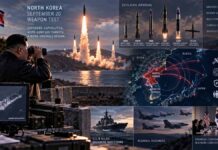
The USSR’s 1991 dissolution ended North Korea’s single largest source of subsidized fuel, food, machinery, and diplomatic protection almost overnight. The shock triggered a decade of economic implosion, culminating in the 1994–1998 famine that killed several hundred thousand to several million people. Politically, the regime responded not with market liberalization (unlike Vietnam or China) but with ideological intensification — doubling down on Juche self-reliance rhetoric while pivoting real power toward the military under Kim Jong Il’s “Songun” (military-first) doctrine. Strategically, the loss of the Soviet security umbrella became the central argument inside Pyongyang for building an independent nuclear deterrent, a program that accelerated through the 1990s and matured into today’s arsenal. Geopolitically, China filled much of the resulting vacuum as patron of last resort, while Russia remained largely absent from North Korea for two decades — until the 2022 Ukraine war and 2024 mutual-defense treaty pulled Moscow and Pyongyang back into an intimate, transactional alliance that echoes, and in some ways inverts, the old Soviet-era relationship.
Pyongyang, Moscow, Tehran: The New Architecture of Confrontation
Three theatres are converging into a single strategic pattern. Ukraine enters its fifth year of attritional war without a ceasefire. North Korea has deployed combat troops onto European soil for the first time in its history. And a ten-week US-Israeli campaign against Iran has just tested, in real combat, what a “strategic partnership” actually means when a patron state comes under fire. Between June 2024 and August 2026, Moscow converted an informal relationship with Pyongyang into a ratified mutual-defense treaty, while extending only intelligence support to a nominally allied Tehran under direct attack. That asymmetry is not accidental — it is the clearest available evidence of which alliances the Kremlin treats as binding commitments, and which remain merely transactional.
The Ratified Alliance
On 18 June 2024, Vladimir Putin and Kim Jong Un signed the Treaty on Comprehensive Strategic Partnership in Pyongyang, during Putin’s first visit to North Korea in 24 years. The treaty was ratified by Russia’s Federal Assembly on 6 November and by North Korea’s State Affairs Commission on 11 November 2024, entering into force on 4 December 2024. Article 4 obliges each party to “immediately provide military and other assistance” if the other falls into a state of war due to armed invasion, invoking Article 51 of the UN Charter. Arms Control AssociationCSMonitor.com
The commitment was operationalised within months. Beginning in October 2024, North Korea sent an estimated 14,000–15,000 troops — drawn primarily from the 11th “Storm” Corps, its elite special-operations formation — to Russia’s Kursk Oblast, where they were thrown into frontal assaults to help retake territory Ukraine had seized months earlier. By early 2026, South Korean intelligence agencies estimated that roughly 6,000 of those soldiers — more than a third of the deployment — had been killed or wounded. In return, Moscow provided political cover of a kind unavailable since the Cold War: in March 2024 Russia vetoed the renewal of the UN Panel of Experts that had monitored North Korea sanctions violations since 2009, dismantling the principal multilateral verification mechanism constraining Pyongyang. NPR + 2
The Informal Partner
Iran received no equivalent commitment when it was struck directly. Despite a longstanding partnership encompassing economic ties and military cooperation, Russia’s response to the 2026 Iran war was defined by strategic caution rather than intervention — limited to intelligence support, including data on US military positions, with no combat forces committed. The contrast with North Korea is structural, not circumstantial: a ratified, mutual-defense treaty produced Russian-equipped troop rotations and diplomatic shielding at the UN Security Council; an informal strategic partnership produced neither. For institutional investors and defence planners assessing Moscow’s reliability as a security guarantor elsewhere — the Sahel, the South Caucasus, Central Asia — this is the operative data point: paper alliances without ratified mutual-defense clauses do not trigger Russian military backing once a partner is under direct assault. Wikipedia
Ten Weeks That Redefined Deterrence
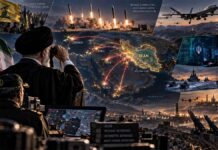
The 2026 Iran war began on 28 February, when the United States and Israel launched coordinated strikes that killed Supreme Leader Ali Khamenei and targeted Iranian military and nuclear infrastructure. US Central Command, under Admiral Brad Cooper, initiated “Operation Epic Fury” at 01:15 EST — 09:45 local Tehran time — with mission objectives including the destruction of Iran’s offensive missile capability, the elimination of its navy, prevention of nuclear-weapons acquisition, and severing of proxy support networks, under direct orders from President Donald Trump. Defense Secretary Pete Hegseth described the operation as “the most lethal, most complex and most precise aerial operation in history.” Just Security
Iran’s counter-escalation followed a horizontal logic designed to raise costs beyond the bilateral frame: Iranian strikes hit US embassies and military installations across the UAE, Saudi Arabia, Qatar, Kuwait, Bahrain, Iraq, Oman and Jordan, while NATO forces intercepted Iranian drones and missiles near Turkey’s Incirlik base. Operation Epic Fury concluded on 5 May 2026, with a Pakistan-mediated ceasefire and a June memorandum of understanding intended to reopen the Strait of Hormuz — an arrangement Iran subsequently tested by firing on three commercial vessels on 6–7 July, prompting renewed US strikes. As of early August, negotiations between Washington and Tehran remained active, with President Trump describing the moment as a “last chance” for a settlement. Just Security + 2
The Fused Command
What distinguishes this campaign from every US intervention since the Cold War is the operational fusion between Washington and Jerusalem. Israel’s parallel campaign, Operation Roaring Lion, was described by Israeli officials as the largest single strike sortie in Israeli Air Force history — approximately 200 aircraft against roughly 500 objectives, including Iranian air-defence networks and ballistic-missile infrastructure. Israeli surveillance assets — airborne early-warning aircraft, long-endurance unmanned systems and signals-intelligence platforms — supplied real-time targeting data against mobile launchers and hardened facilities, while US carrier strike groups, guided-missile submarines and long-range bombers carrying deep-penetration munitions handled the reinforced nuclear targets Israel could not reach alone. CENTCOM characterised the joint action as “the largest regional concentration of American military firepower in a generation.” Aviation Week Network + 2
This was not improvised cooperation but the product of years of joint interoperability development between US Central Command and the Israel Defense Forces, and its political implication is already reshaping Washington’s regional posture: Israeli officials are reportedly seeking to shift the bilateral relationship away from dependence on US Foreign Military Financing toward a strategic partnership built on shared research, development and co-production — a structural upgrade with direct consequences for defence-industrial contracts, technology-transfer regimes and NATO-adjacent procurement markets over the coming decade. The Jerusalem PostAtlasinstitute
The Nuclear Calculus, Inverted
North Korea’s founding strategic lesson from the Soviet collapse was that regime survival required an independent nuclear deterrent before any adversary coalition could act. Academic reconstruction of internal Pyongyang deliberations concludes that the collapse of the USSR — North Korea’s principal security guarantor — triggered a decisive shift in strategic calculus, convincing the leadership that only an indigenous nuclear weapon could guarantee survival, a judgment that became Pyongyang’s top state priority once the socialist bloc collapsed at the turn of the 1990s. North Korea crossed that threshold in 2006 and has not been struck since. CarnegieArms Control Association
Iran represents the inverse case: a state struck precisely because it had not yet completed the same threshold-crossing. The strategic lesson other regional actors will draw from 2026 is unambiguous, and it will shape proliferation dynamics, defence budgets and diplomatic posturing from the Gulf to Northeast Asia for a generation.
The Cost of Inaction
The three theatres are not competing for attention by coincidence — they compete for the same finite pool of intelligence assets, munitions stockpiles and diplomatic bandwidth in Washington. US-brokered ceasefire talks between Russia and Ukraine were explicitly suspended in March 2026 because the escalating Middle East crisis diverted attention from Europe’s largest conflict since the Second World War. Kyiv’s own involvement in the Iran war was confined to diplomatic endorsement and the provision of technical expertise to help Gulf states counter Iranian drone and missile attacks — assistance rendered while Washington had itself halted direct military aid to Ukraine, and while the Iran conflict risked diverting air-defence resources Kyiv needed against Russia. aolWikipedia
For institutional and financial audiences, the strategic conclusion is structural rather than episodic: great-power capacity is being simultaneously allocated across a treaty-bound Pacific-adjacent alliance (Russia–North Korea), an attritional continental war (Russia–Ukraine), and a fused expeditionary campaign (US–Israel–Iran). Each theatre now shapes the resourcing, credibility and diplomatic timelines of the other two — and any actor underwriting risk in one of these theatres is, whether or not it recognises the fact, underwriting exposure to all three.
Index
- The Economic Rupture: Aid Cutoff, Trade Collapse, and Famine
- The Ideological and Political Response: Juche Hardening and Songun
- The Strategic Response: The Nuclear Decision
- The Long Shadow: China’s Rise and Russia’s Return (2022–2026)
- Two Wars, Two Alliance Architectures
- Israel as Strategic Partner: The Epic Fury/Roaring Lion Model
- Escalation Dynamics and Diplomatic Off-Ramps Compared
- Cross-Theater Linkages: Why These Wars Aren’t Actually Separate
1. The Economic Rupture: Aid Cutoff, Trade Collapse, and Famine
By the late 1980s the Soviet Union had become the load-bearing pillar of North Korea’s command economy. Soviet aid and trade underwrote North Korea’s economy through the late 1980s, and the Soviet share of North Korea’s total trade fell from nearly half in 1985 to less than 8 percent in 1994. The relationship wasn’t ordinary trade — it was a subsidy relationship: North Korea traded with the Soviet Union at favorable rates, to the point that some analysts describe the USSR as effectively subsidizing Pyongyang with discounts on food, fuel, and other essentials in exchange for political loyalty. By 1988, the Soviet Union represented roughly 60 percent of North Korea’s economy. Encyclopedia Britannica + 2
The warning signs actually predate 1991. Gorbachev began reducing aid to North Korea as early as 1985 in favor of building ties with South Korea, and Moscow’s tilt toward Seoul culminated in a stark transactional move: the Soviet government normalized relations with South Korea in exchange for roughly $1 billion in cash, $1.5 billion in loans, and $500 million in South Korean capital goods — money that was explicitly contingent on Moscow ending military assistance to Pyongyang. This “abrupt cutoff… weakened the North’s armed forces” and terminated the concessionary trade regime North Korea had relied on for decades (NCNK briefing). WikipediaLynne Rienner Publishers
When the USSR formally dissolved in December 1991, the effect on physical trade flows was immediate and severe. Trade with the USSR, which had accounted for more than half of North Korea’s two-way trade, fell by the equivalent of 40 percent of North Korea’s global imports, and by 1993 imports from the USSR stood at just 10 percent of their previous level. Energy was hit hardest: oil imports from the USSR fell by more than 75 percent between 1990 and 1991 alone, a figure corroborated elsewhere showing Soviet petroleum subsidies collapsing from 506,000 metric tons in 1989 to just 30,000 metric tons in 1992. Crossing Borders + 2
The mechanism of collapse was structural, not merely a demand shock. North Korea’s command economy had built itself around Soviet-supplied inputs — coal for power, fertilizer and machinery for agriculture, and industrial parts for manufacturing — leaving it, as one peer-reviewed analysis puts it, “extremely vulnerable to disruptions in its input flow” because of its increasing reliance on imported energy, agricultural inputs and manufactured goods from the Soviet Union and the wider communist bloc. When that flow stopped, the same source notes the economy “plunged into precipitous decline, splintering into a number of parallel economies through the 1990s” — a military economy, an entrepreneurial economy, a court economy, and an illicit economy operating alongside the remnants of central planning, with the military becoming the backbone of regime perpetuation under this new order and foreign aid becoming crucial to sustaining it (ScienceDirect / Journal of Comparative Economics). NCNK + 3
The human cost of this collapse was the “Arduous March” famine of 1994–1998. Causes are generally listed as economic mismanagement, natural disasters, international sanctions, and the collapse of the Soviet bloc, and without Soviet aid, the flow of imports to the agricultural sector ended while the government proved too inflexible to respond; energy imports fell 75 percent, flooded coal mines lost the electricity needed to pump them out, and electrically dependent irrigation and fertilizer systems collapsed in turn. Death toll estimates vary widely by methodology — Haggard and Noland put it at 600,000 to 1 million, roughly 3–5 percent of the population — while other tallies range as low as 240,000 and as high as 3.5 million (Wikipedia summary of the academic literature). Crucially, one comparative study notes North Korea diverged sharply from Vietnam, which faced an identical Soviet withdrawal but responded with market-oriented đổi mới reforms; “the North Koreans stood pat” instead (ScienceDirect, 2025). globalsecurity + 3
2. The Ideological and Political Response: Juche Hardening and Songun
Where China and Vietnam absorbed the shock of communism’s global retreat by liberalizing markets, North Korea’s leadership drew the opposite lesson. A 2026 study in the Texas National Security Review reconstructs Pyongyang’s internal reaction from North Korean print media and concludes that the Kim regime, shaped by its hereditary succession structure and its utopian version of Juche ideology, interpreted the Soviet collapse in ways that diverged sharply from Beijing’s response, and that the overriding conclusion drawn in Pyongyang was the need to tighten ideological control over the entire population (TNSR). CarnegieCarnegie
Power inside the state also visibly shifted toward the armed forces. Kim Jong Il, who assumed leadership after his father’s death in 1994 in the middle of the famine, accepted international food aid, tolerated the growth of informal markets, and promoted the Songun (“military first”) policy while expanding North Korea’s ballistic missile and nuclear weapons programs (Britannica). Songun formally emerged in 1997 and prioritizes the Korean People’s Army in the allocation of state resources and affairs, elevating the army to a central state function (WorldAtlas). A recent analytic synthesis frames this as a direct causal chain: the Arduous March exposed the vulnerabilities of ideological isolation and centralized planning once external support evaporated, and Kim Jong Il responded by institutionalizing Songun as a strategic extension of Juche — prioritizing the military and coercive apparatus over agriculture and aid distribution even as it prolonged civilian suffering, because it preserved the leadership’s monopoly on power (Grokipedia synthesis of primary-source scholarship). WorldAtlas + 2
It’s worth noting the irony scholars have long pointed to: despite branding itself as an economy of “self-reliance,” North Korea has in practice been aid-dependent for most of its history, and the Soviet Union remained its greatest economic benefactor right up until 1991, after which the economy entered the crisis that produced the mass famine (New World Encyclopedia). Juche functioned less as an actual economic strategy than as the regime’s legitimating myth once its real patron disappeared — and, per U.S. Defense Intelligence Agency archival material from the period, North Korea’s economy in 1990 was a socialized command system in which state-run industries produced 95 percent of output, with the Soviet share of the roughly $1.4 billion in plants and equipment received between 1946–1960 alone standing at 40 percent (GlobalSecurity.org, DIA study). Grokipediasenate
3. The Strategic Response: The Nuclear Decision
The most consequential and durable legacy of the Soviet collapse is North Korea’s nuclear weapons program. North Korea’s early nuclear cooperation with Moscow was framed around civilian prestige and technology transfer, not weapons — but that changed as the security guarantee behind it evaporated. The TNSR study is explicit on the causal link: Gorbachev’s reforms and the subsequent collapse of the USSR — North Korea’s principal security guarantor — triggered a decisive shift in Pyongyang’s strategic calculus, leading the leadership to conclude that only an independent nuclear deterrent could ensure regime survival. Carnegie
Carnegie’s Moscow-based assessment of the North Korean nuclear threat makes the same point from a different angle: the existence of the socialist bloc had generally guaranteed North Korea’s security up until the Soviet collapse, and once the socialist camp fell apart at the turn of the 1990s the nuclear program became the leadership’s top priority; by the early 1990s it was already apparent to the international community that intensive weapons-development work was underway (Carnegie Endowment / Carnegie Moscow Center). A separate academic study of the decision-making traces this back further, to a formative moment of Cold War abandonment anxiety: the withdrawal of Soviet missiles from Cuba at the end of the 1962 Missile Crisis first led Pyongyang to fear it might be abandoned by its superpower protector — a fear the 1991 collapse then confirmed in full (Wilson Center). Arms Control AssociationNCNK
The 1990s were not a straight line to weaponization — Pyongyang briefly froze plutonium production under the 1994 Agreed Framework in exchange for U.S.-backed light-water reactors — but the underlying logic never went away. After the Soviet collapse, developing an independent nuclear counterweight became especially important to Pyongyang, even during the years the Agreed Framework nominally held, because of a persistent fear that Washington could use its own nuclear leverage to topple the regime (EU Non-Proliferation Consortium). By the 2000s this had matured into doctrine: today’s regime, per Britannica, views nuclear weapons as a deterrent against foreign intervention and a guarantee of regime survival, a posture directly descended from the abandonment trauma of 1991. Texas National Security ReviewWilson Center
4. The Long Shadow: China’s Rise and Russia’s Return (2022–2026)
For roughly two decades after 1991, China absorbed the patron role Russia vacated: Beijing continued fuel and food shipments to prevent a North Korean economic collapse, even as both Russia and China otherwise turned away from the political-economic systems North Korea espoused (GlobalSecurity.org). Russia, by contrast, was largely a bystander in North Korean affairs for a generation — the Cold War-era mutual-defense treaty had lapsed in 1996 after Moscow established diplomatic relations with Seoul, and a 2000 bilateral agreement that replaced it specified no military relationship at all (NCNK). bbciThe Kyiv Independent
That changed with Russia’s full-scale invasion of Ukraine. Facing shell shortages, Moscow turned back to Pyongyang, and the relationship rapidly re-militarized: in 2023, following a Putin–Kim summit, North Korea sent over 7,000 tons of military equipment, including more than 1 million artillery shells, directly to Russian forces (FPIF). This culminated in a formal alliance restoration: on 18 June 2024, Kim Jong Un and Vladimir Putin signed the Treaty on Comprehensive Strategic Partnership in Pyongyang, which took full legal effect on 4 December 2024 (Wikipedia, treaty text summary). Under Article 4, the two states committed to “immediately provide military and other assistance” to one another if either falls into a state of war due to armed invasion, framed under the UN Charter’s Article 51 right of self-defense (Arms Control Association). Wikipedia + 3
The treaty was quickly operationalized. Beginning in October 2024, North Korea sent an estimated 14,000–15,000 troops — mostly drawn from the elite 11th “Storm” Corps — to fight alongside Russian forces retaking Kursk Oblast; by early 2026 South Korean intelligence estimated roughly 6,000 of those soldiers, more than a third of the deployment, had been killed or wounded (Kyiv Independent, June 2026). In return, Russia has begun shielding North Korea diplomatically at a level unseen since the Soviet era: in March 2024 Moscow vetoed renewal of the UN Panel of Experts that had monitored North Korea sanctions violations since 2009, effectively dismantling the last multilateral sanctions-verification body. Analysts frame this new pact as potentially the strongest connection between Moscow and Pyongyang since the Soviet Union collapsed in 1991 (Global News) — though notably one built on a far more transactional, arms-for-technology basis than the ideological patronage of the Soviet period, and one China watches warily rather than welcomes, having reaffirmed alongside Russia in a May 2024 joint statement its preference for resolving Korean Peninsula issues “exclusively through political and diplomatic means” (GIS Reports). NPR + 3
Russia–Ukraine War
US/Israel–Iran War
Chapters 5–8: Comparing the Russia–Ukraine War and the US–Iran Conflict
5. Two Wars, Two Alliance Architectures
The Russo-Ukrainian war and the 2026 Iran war are structurally different kinds of conflicts, and that difference matters for how each is likely to resolve.
Ukraine’s war is a war of attrition over territory, fought by a state defending its own soil against invasion, with Western support arriving indirectly — arms, intelligence, and diplomatic backing, but no US or NATO troops in the fight. Since 2023, Russia has continued attritional advances across much of the 750-mile front without achieving a significant breakthrough; Moscow effectively controls all of Luhansk province while Ukraine holds roughly 19 percent of Donetsk, and in February 2026 Ukrainian forces mounted a counterattack in Zaporizhzhia that regained roughly 100 square miles — the first month since 2023 in which Ukraine gained more territory than it lost. Diplomatically, the war has moved in fits and starts under American mediation: in February 2026, the US, Russia and Ukraine held their first formal trilateral contact in Abu Dhabi, and later that month a new round of talks in Geneva marked the first time territorial questions were formally on the agenda, though the sides remain far apart on territory and security guarantees, making a short-term breakthrough unlikely. Notably, those talks were then overtaken by events elsewhere: US-brokered ceasefire talks between Russia and Ukraine were put on hold in March 2026 because the escalating Middle East crisis drew attention and resources away from Europe’s largest conflict since World War II.
The Iran war is the opposite kind of conflict — not a war for territory but a preventive, expeditionary campaign, launched by two allied powers with air and naval superiority against a state without an outside patron willing to intervene militarily. The 2026 Iran war was initiated by the United States and Israel on February 28, 2026, and per the Council on Foreign Relations, the strikes came after Tehran would not accede to US demands to end all nuclear enrichment activity; Trump stated the war’s goals were to destroy Iran’s ballistic missile capabilities, eliminate its navy, prevent it from ever acquiring a nuclear weapon, and sever its support for proxy forces, while also calling for regime change. The opening strike was decapitating rather than attritional: the surprise attacks targeted military and government sites and assassinated several Iranian officials, including Supreme Leader Ali Khamenei.
Where Ukraine fights alone with Western material support, Iran fought this war essentially without a great-power military patron. Russia — despite a longstanding partnership with Iran including economic ties and military cooperation — responded with strategic caution rather than direct military intervention, limited to providing intelligence support such as data on US military positions. That is a telling asymmetry: Moscow was willing to send its own economy into overdrive supplying North Korea and receiving DPRK troops in return (Chapter 4), but it did not extend equivalent military commitment to Iran when Tehran was actually struck. This suggests Russia’s 2024 treaty-based alliance with Pyongyang is a harder commitment than its informal partnership with Iran — a distinction with real predictive value for how Moscow might behave in future crises involving either partner.
6. Israel as Strategic Partner: The Epic Fury/Roaring Lion Model
The clearest structural feature of the Iran war — and the one with no real analogue in Ukraine — is that the US did not fight this war as the sole first-tier combatant. It fought as half of a fully fused joint command with Israel, an arrangement built over years of prior interoperability.
Israel’s operational role was central due to geographic proximity and persistent intelligence coverage: the Israel Defense Forces maintained detailed targeting libraries covering western and central Iran, where key missile brigades, air-defense installations, and elements of nuclear infrastructure were located, with Israeli airborne early-warning aircraft, long-endurance drones, and signals-intelligence platforms likely providing real-time targeting updates for time-sensitive strikes against mobile launchers and protected facilities. The United States, in turn, supplied the strategic depth and specialized strike capability needed against hardened nuclear targets — carrier strike groups, guided-missile submarines, long-range bombers carrying deep-penetration munitions for reinforced enrichment sites, plus space-based intelligence, electronic warfare, and cyber support to degrade Iranian radar coverage and command communications in the opening phase. Analysts described this as the product of years of joint interoperability development between US Central Command and the Israeli military, not an improvised coalition.
The scale of Israel’s independent contribution was substantial rather than symbolic: Israel’s own campaign, Operation Roaring Lion, was described by Israeli officials as the largest single strike sortie in Israeli Air Force history, involving roughly 200 warplanes against about 500 objectives, including Iran’s air defenses and ballistic-missile infrastructure. A Pentagon briefing confirmed the division of labor was formalized, not ad hoc: Defense Secretary Pete Hegseth said Israel had specific mission objectives of its own and described Israel as “a capable partner” in the joint action, while Israeli aircraft flew hundreds of sorties against hundreds of targets as part of the combined operation. Commentary in Israeli media captured what this cooperation represented politically: Operation Epic Fury/Roaring Lion is described as the most highly integrated bilateral offensive in modern history in terms of intelligence and operational cooperation, and a companion analysis argued the campaign showed Israel “operating as a partner and even peer to the United States,” with Israeli officials reportedly now pushing to shift the relationship away from one defined primarily by US Foreign Military Financing toward a strategic partnership grounded in shared research, development, and co-production.
This is the sharpest contrast with Ukraine. Kyiv receives Western weapons, training, and intelligence, but there is no joint US-Ukrainian command structure, no shared targeting doctrine built over a decade of exercises, and no American combat sorties flown alongside Ukrainian pilots inside Russian-controlled airspace. Israel’s relationship with Washington in this war functioned as a genuine joint-force alliance; Ukraine’s relationship with the West functions as a sponsorship model. That distinction is precisely why, as one Ukraine-focused source notes, Ukraine’s own involvement in the Iran war was limited to diplomatic endorsement and technical/military expertise offered to help Gulf states counter Iranian drone and missile attacks — assistance rendered notable mainly because it came at a time when the US had halted direct military aid to Ukraine itself, and when the Iran conflict threatened to divert air-defense resources Kyiv needed against Russia.
7. Escalation Dynamics and Diplomatic Off-Ramps Compared
Both wars generated a similar pattern — initial shock, regional/international spillover, then a fragile, contested truce — but on very different timelines and with different degrees of durability.
In Iran’s case, the war moved from decapitation strike to ceasefire in about ten weeks: Operation Epic Fury began February 28, 2026, and concluded May 5, with a Pakistan-mediated ceasefire and a June memorandum of understanding halting large-scale fighting — though both sides have continued trading strikes over alleged violations, and a durable settlement remains elusive given unresolved disputes over Iran’s nuclear program, the Strait of Hormuz, and sanctions relief. Iran’s own escalation strategy during the active war followed what one Foreign Affairs analysis termed horizontal escalation: Iranian strikes targeted US embassies and military installations across the UAE, Saudi Arabia, Qatar, Kuwait, Bahrain, Iraq, Oman and Jordan, aiming to widen the conflict’s costs beyond the military domain until it became too expensive for the US and Israel to sustain. Even the notional truce has proven leaky: Iran subsequently asserted a right to collect transit fees in the Strait of Hormuz and fired on multiple commercial vessels on July 6–7, 2026, testing the limits of the MoU and prompting renewed US strikes. As of early August 2026, the diplomatic track was still active but unresolved: talks between Washington and Tehran were reported ongoing, with Trump describing it as a “last chance” for a deal.
Ukraine’s war, by contrast, is now in its fifth year with no ceasefire of any kind — only episodic prisoner exchanges and stalled talks. Since taking office in January 2025, President Trump has repeatedly attempted to broker a peace deal, including directing a pause in US assistance to Ukraine in March 2025 to pressure Kyiv toward negotiations, and direct Russia-Ukraine talks in May 2025 produced the war’s largest prisoner swap but no ceasefire. Russia’s own account of its negotiating position, as of mid-2026, has remained essentially maximalist: Putin said in June 2026 that Russia was “ready for peace talks… on the basis of the Istanbul agreements” from 2022 — terms Kyiv is likely to reject as unrealistic. Unlike Iran, which faced a devastating and rapid military shock that pushed it toward the negotiating table within months, Russia has absorbed over three years of attritional losses without a comparable external shock forcing capitulation, and analysts remain divided on whether momentum favors a deal or further escalation — CFR’s July 2026 assessment noted that despite a string of setbacks, Putin appeared ready to ramp up his aerial assault on Ukraine rather than settle, even as diplomatic momentum was nominally building around a NATO summit in Ankara.
8. Cross-Theater Linkages: Why These Wars Aren’t Actually Separate
The two conflicts are not isolated from each other, and the North Korea case from Chapters 1–4 is the connective tissue. Three linkages stand out:
Resource and attention competition. The Iran war directly interrupted Ukraine diplomacy: US-brokered Russia-Ukraine ceasefire talks were explicitly put on hold in March 2026 because the Middle East escalation drew attention away from Europe’s war. Great-power bandwidth is finite, and Washington’s simultaneous management of a treaty ally’s expeditionary war (Israel) and an indirect proxy war (Ukraine) creates real trade-offs in diplomatic capital, munitions stockpiles, and intelligence assets — the same kind of trade-off North Korea exploited when it used the 2022–2026 window of Russian preoccupation with Ukraine to extract an unprecedented mutual-defense treaty and troop-rotation arrangement from Moscow (Chapter 4).
Russia’s asymmetric patronage. Russia’s restrained response to the attack on its Iranian partner — intelligence-sharing only, no forces committed — stands in sharp contrast to the treaty-bound, troop-exchanging alliance it built with North Korea over the same period. This is a useful data point for judging how firm Moscow’s other partnerships actually are: formal, ratified, mutual-defense treaties (DPRK) appear to carry real weight in Russian strategic calculus, while informal “strategic partnerships” (Iran) do not automatically trigger military backing once a partner comes under direct attack.
The proliferation logic repeats. North Korea’s post-1991 nuclear decision (Chapter 3) and Iran’s pre-war nuclear program are driven by structurally similar logic — a state calculating that only an independent deterrent guarantees regime survival against a superior adversary coalition. The 2026 Iran war is, in that sense, the empirical test of the counter-scenario North Korea avoided: Pyongyang crossed the nuclear threshold before it could be struck; Tehran was struck first, partly because it had not yet done so. That contrast is likely to be studied intensively by other regimes weighing the same trade-off in the years ahead.


