















Scope: This dossier assesses whether US-backed connectivity through southern Armenia can advance without undermining Armenian sovereignty or provoking Iranian countermeasures, covering the South Caucasus and material European interests through November 2031.
Executive Summary / BLUF
TRIPP’s principal vulnerability is the gap between sovereign authority and operational dependence. Its commercial structure establishes a durable US interest, while the published agreement preserves Armenian governmental powers. Framework Agreement between the Republic of Armenia and the United States of America on Strategic Cooperation Concerning the Trump Route for International Peace and Prosperity (TRIPP) — Armenian Ministry of Foreign Affairs — May 2026. mfa.am
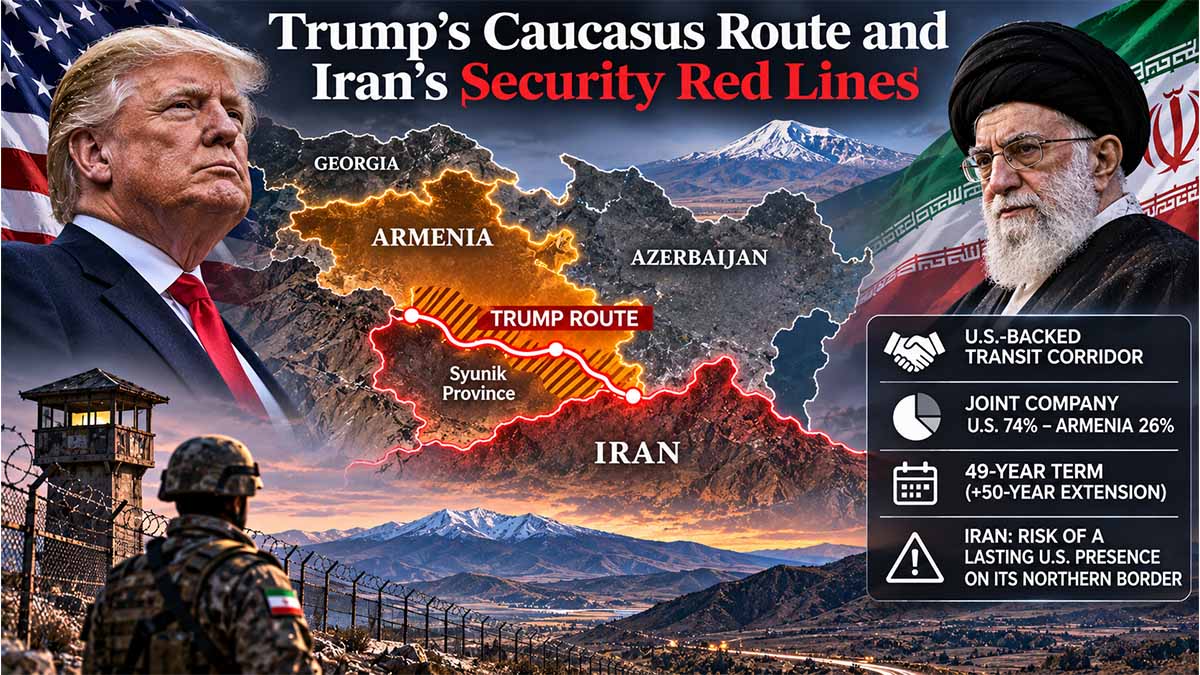
The planned development company has 74% US-side ownership and 26% Armenian ownership; the envisaged initial development term is 49 years, with a mutually agreed 50-year extension increasing Armenia’s share to 49%. Prime Minister Nikol Pashinyan’s speech at the discussion of the Government’s 2026–2031 Program at the National Assembly — Armenian Prime Minister’s Office — Aug 2026. primeminister.am
Iranian diplomacy combines concern about US involvement with continued engagement with Armenia. Foreign Minister Abbas Araghchi publicly expressed both positions in October. Araghchi on TRIPP: Iran trusts Armenia — Foreign Minister’s remarks recorded by ARMENPRESS — Oct 2026. ARMENPRESS Armenian News Agency
The immediate decision is whether financing, governance and operating contracts can make Armenian control demonstrable. The decisive uncertainty is how the implementing institutions will function once infrastructure becomes operational.
Trump’s Caucasus Route Must Make Sovereignty Operate
The Trump Route for International Peace and Prosperity will strengthen Armenia only if the state can enforce its decisions after investors, contractors and neighbouring governments have acquired interests in keeping the route open. That is the contradiction at the centre of TRIPP: Washington’s participation may help mobilise capital and political support, but neither foreign investment nor Armenian jurisdiction on paper establishes who can resolve an operational dispute without disabling the infrastructure. For Yerevan, the immediate exposure is fiscal and institutional; for Tehran, it is the possibility that commercial participation develops into a security function; for European partners, it is the risk of financing connections whose responsibilities remain unsettled. TRIPP’s governing test is therefore whether Armenian authority remains executable when the interests supporting the agreement begin to diverge.
Political progress has moved faster than operating certainty
The trilateral statement published on 7 November 2026 established technical-planning groups for transportation and electricity transmission. That was a documented implementation step, but it did not establish a consolidated engineering baseline, guaranteed service date or completed financing package. The distinction determines what governments and investors can reasonably claim: a planning mechanism can resolve interfaces, while an operating connection must demonstrate that those interfaces work.
The Armenian government’s account of the 12 November 2026 meeting between Prime Minister Nikol Pashinyan and Azerbaijani President Ilham Aliyev described continuing railway and highway planning alongside existing transit activity. That sequence allows economic cooperation to develop before the entire programme is built. It also makes disciplined reporting necessary: movement through Azerbaijan cannot automatically be attributed to completed TRIPP infrastructure, and progress on one connection cannot establish readiness across the programme. The official meeting record preserves that distinction.
The financial headlines describe different obligations
TRIPP’s planned development company assigns 74% to the US-side entity and 26% to Armenia, with an initial 49-year development term and a mutually agreed 50-year extension that would increase Armenia’s share to 49%. Those figures describe ownership and duration, not paid-in construction capital. DFC’s public summary separately states that its direct and indirect equity in an individual subproject would not exceed 40% where it contributes capital. The parent-company structure therefore cannot be mechanically applied to every underlying asset.
The same distinction applies to DFC’s 3 June 2026 announcement of US$2.5 billion in approved transactions. That aggregate included a separately identified US$1.5 billion Indo-Pacific investment platform alongside other deals. It was not a TRIPP construction allocation. Company approval advances the institutional architecture; a railway or electricity project still needs an executable financing decision. DFC’s announcement explicitly allows further steps before commitment and closing.
European figures require equally strict treatment. The separate 60-kilometre Sisian–Kajaran road project carries an approximate €1.349 billion total cost and €236 million in EIB financing. The EU’s €270 million resilience and growth plan covers 2024–2027, while its expected €2.5 billion Global Gateway investment scale has a different scope. None of these amounts constitutes a consolidated TRIPP budget. Adding them would manufacture financial certainty from instruments that finance different purposes, impose different conditions and reach expenditure at different speeds.
The European Commission’s investment call makes the boundary explicit: proposals require at least €30 million in investment and a minimum 20% promoter equity or own-resources contribution, but participation guarantees no financing. At the minimum project size, that means €6 million from the promoter, calculated from the eligibility requirements. An eligible proposal remains distinct from an approved transaction. The Commission’s conditions leave no basis for treating expressions of interest as financial close.
A completed asset can still fail to deliver a service
Prime Minister Nikol Pashinyan’s 2 November 2026 budget address identified railway, road and electricity transmission as immediate priorities, while leaving oil and gas pipelines for later discussion. This sequencing matters to procurement: different modalities require different designs, counterparties and acceptance procedures. Presenting them as one fixed corridor would obscure the point at which each component becomes useful and the liabilities incurred before its connections are ready.
For TRIPP, the infrastructure transmission mechanism runs through those interfaces. A railway needs operating services and usable connections beyond the construction boundary; electricity infrastructure needs coordinated operation, measurement and settlement; digital systems need support, recovery procedures and clear responsibility for access. These are delivery requirements, not findings of existing defects. Their financial consequence is nevertheless direct: an asset completed ahead of its necessary connections can incur maintenance and financing costs before earning the revenue assumed in its appraisal.
The Sisian–Kajaran project record illustrates why route length alone cannot support a reliable construction estimate. It identifies sections, a tunnel, environmental assessment and procurement responsibilities within a defined project. Transferring its costs to another alignment would ignore engineering differences; ignoring its preparation requirements would understate the work between political approval and usable infrastructure. The EIB record supplies a comparator for project discipline, not a price list for TRIPP.
Armenian law enables tailored governance and raises the value of scrutiny
Armenia’s Law HO-467-N, adopted on 12 November 2026 and published the following day, permits specified departures from ordinary joint-stock-company rules for qualifying treaty-based companies with at least 25% Armenian participation. The significance lies in where consequential decisions move: the charter and shareholders’ agreement can specify important governance arrangements within the statutory framework. The enabling law does not establish that every resulting choice protects the public interest.
TRIPP’s bilateral framework also separates governmental, shareholder and concession relationships. A commercial payment dispute, a corporate deadlock and an emergency affecting public functions need not have the same remedy. The state’s practical position depends on whether it can enforce a lawful decision while the commercial disagreement remains unresolved. A consent right has less value if exercising it interrupts the very service the government must preserve.
The fiscal constraint is equally concrete. Article 6 assigns Armenia financial responsibility for securing relevant land and clearing third-party rights, while Article 9 establishes specified tax exemptions. Public expenditure and foregone receipts can therefore occur on a different timetable from project income. Article 11’s one-year termination notice is not an immediate operational remedy, nor does it establish what happens under every separate contract. The published framework makes contract-level liability and continuity provisions central to any assessment of Armenia’s return.
Iran’s objections need defined activities and observable boundaries
Iranian Foreign Minister Abbas Araghchi’s 16 October 2026 remarks combined concern about US presence with confidence in Armenian partners and continuing consultations. That position allows negotiation because trust in Armenia and concern about foreign involvement are not mutually exclusive. It does not establish acceptance of every subsequent operating arrangement.
Iranian Ambassador to Armenia Khalil Shirgholami’s September 2026 remarks were more specific: he linked conditional acceptance to Armenian sovereignty and the absence of a US security or military presence. The resulting negotiating question is what functions an operator performs, under whose authority and with what limits. An assurance excluding troops cannot answer every question about security responsibilities; equally, foreign ownership cannot by itself establish a military role. The ambassador’s recorded remarks support examining those distinctions rather than assuming either unconditional approval or inevitable confrontation.
TRIPP reassurance should therefore resolve identifiable concerns without becoming an undefined external approval right over Armenian commercial decisions. A bounded process could clarify mandates and information access; an open-ended requirement to satisfy every possible objection could create permanent uncertainty. Iran’s security red lines remain policy positions, and their invocation does not itself establish a legal entitlement to coercion or force.
Europe’s interests converge on compatibility, not identical exposure
Italy, France, Germany and the United Kingdom enter the TRIPP calculation through different relationships. Italy’s immediate energy interest concerns operating infrastructure: TAP records an additional 1.2 billion cubic metres per year of long-term capacity from January 2026, distinct from prospective Armenian pipeline discussions. France’s €250 million AFD agreement, signed on 1 October 2026, concerns Armenian budget support. Germany’s exposure includes a €120 million KfW loan, alongside a €15 million EU grant, for the Caucasus Transmission Network. These instruments create reasons to scrutinise regional compatibility, but do not establish ownership or control over TRIPP.
The United Kingdom’s position also separates diplomacy from corporate activity. Its May 2026 strategic partnership declaration with Armenia creates no legal obligations, while BP’s regional energy operations represent commercial exposure rather than a British government guarantee. For all four governments, the relevant choice is whether national engagement strengthens usable connections and Armenian implementation capacity without accepting unidentified liabilities.
The EU–Armenia Connectivity Partnership offers an institutional channel for coordinating transport, energy and digital investment. Its value will depend on whether it identifies responsibilities between projects, rather than presenting separate announcements as a common delivery programme. The partnership’s published remit supports coordination and regulatory alignment; it does not confer authority over the bilateral TRIPP company.
The next two years will determine who absorbs unresolved commitments
Between November 2027 and November 2028, the relevant test will be whether TRIPP’s implementing institutions have converted political sponsorship into executable financing, enforceable responsibilities and credible arrangements for service continuity. These are analytical review points, not official completion deadlines. The most persuasive evidence of resilience would be a material dispute resolved through ordinary institutions while unrelated lawful activity continues.
For TRIPP, inaction means leaving consequential interfaces unresolved while commitments become harder to reverse. Armenia would bear the public-administration burden and the land-related costs assigned by the framework; investors and contractors could face delayed deployment, financing costs or disputed obligations; European partners would risk supporting assets whose connecting services remain uncertain. Tehran would have less reason to distinguish bounded commercial participation from the security functions it opposes if the operating limits remain opaque.
The choice is to advance the TRIPP components whose conditions are executable and retain scrutiny over those whose risks remain unidentified. Irreversible commitments should follow evidence that authority, financing and operations fit together. If that discipline is absent, the price will emerge through delayed service, contested liabilities and more expensive correction after contracts and infrastructure have fixed the parties’ positions.
Navigational Index
Pillar I — Territory, Sovereignty and Strategic Access
- Chapter 1 — Syunik’s connectivity problem and the regional settlement: Physical geography, historical baseline and the distinction between reopening communications and changing territorial control.
- Chapter 2 — Corporate control and sovereign authority: Treaty provisions, domestic implementation, customs administration and institutional safeguards.
- Chapter 3 — Iran’s security calculus and regional counterweights: Iranian interests, Armenian reassurance, Azerbaijani and Turkish connectivity, and Russian and Chinese implications.
Pillar II — Infrastructure, Finance and European Exposure
- Chapter 4 — From political agreement to operating infrastructure: Transport, electricity, digital systems, project sequencing and implementation capacity.
- Chapter 5 — Financing, commercial viability and strategic dependence: Capital commitments, concessions, procurement, revenue assumptions and fiscal exposure.
- Chapter 6 — European interests and coordination constraints: Separate assessments of Italy, France, Germany and the United Kingdom, followed by the European Union collectively.
Pillar III — Escalation, Indicators and Policy Choices
- Chapter 7 — Implementation pathways and the five-year outlook: Managed connectivity, institutional friction and security escalation.
- Chapter 8 — Courses of action and final net assessment: Authorities, implementation burdens, reversibility, decision thresholds and principal risks.
Master Abstract
A long-term commercial position with unresolved operational consequences
The central strategic question is whether foreign commercial control can coexist with sufficiently credible Armenian public authority to prevent a transport initiative from becoming a security confrontation. The United States International Development Finance Corporation describes an intended corporate chain running from a wholly DFC-owned Delaware entity to a jointly owned Armenian development company, with infrastructure-specific subsidiaries envisaged beneath it. This establishes a direct US governmental commercial interest; it does not, by itself, establish military basing or territorial jurisdiction. The distinction matters because influence can arise through investment decisions, contractor selection and infrastructure dependence without transferring sovereignty. Conversely, foreign ownership alone cannot establish that such influence has become coercive. The assessment therefore turns on observable arrangements: who can suspend operations, replace contractors, inspect systems, enforce decisions and maintain service during a political dispute. Public Information Summary — US International Development Finance Corporation — undated, accessed Nov 2026, pp. 1–2. dfc.gov
Ratification advances the project without completing its legal architecture
Armenia’s domestic ratification is documented in Law HO-466-N, adopted on 28 October 2026, signed and officially published on 10 November. The law ratifies the agreement signed in Washington on 1 June and Yerevan on 4 June. Its domestic commencement provision must be distinguished from the agreement’s international entry into force, which requires completion of the bilateral notification procedure. The domestic law establishes an important implementation milestone; it does not establish that every subsequent corporate, financing or concession instrument has been executed. Law on Ratifying the TRIPP Strategic Cooperation Framework Agreement — Republic of Armenia, ARLIS — Oct–Nov 2026, Article 1 and publication notation. old.arlis.am The Armenian ministry separately confirms the two signature dates. Signing of the Framework Agreement between the Republic of Armenia and the United States of America on Strategic Cooperation Concerning TRIPP — Armenian Ministry of Foreign Affairs — Jun 2026. mfa.am
The agreement anticipates reserved decisions requiring mutual consent, Armenian primacy in emergencies, and continuing Armenian responsibility for customs, immigration and border security. Those provisions constrain the interpretation that majority ownership automatically creates an extraterritorial corridor. Their practical strength nevertheless depends on the implementing instruments and administrative capacity. A formally retained power has limited operational value if authorities cannot inspect the relevant systems or enforce a decision without disabling essential infrastructure. This is an implementation risk to be tested, rather than an established condition. Framework Agreement — Armenian Ministry of Foreign Affairs — May 2026, Articles 3, 7–8 and 11. mfa.am
Iran’s position allows negotiation but requires more than diplomatic reassurance
Iran’s publicly expressed concern about American involvement should be assessed alongside its continuing cooperation with Armenia. On 16 October 2026, Araghchi stated that Tehran had concerns about US presence in its surrounding region while expressing trust in Armenian partners and describing continuing consultations. These remarks support an assessment of conditional engagement; they do not establish Iranian acceptance of every future operating arrangement. Nor do they support treating confrontation as inevitable. The distinction creates a negotiating space in which Armenia can demonstrate that infrastructure development does not compromise neighbouring states’ security. The corresponding Iranian choice is whether objections remain attached to identifiable activities or expand into opposition to US-linked commercial participation itself. The former can potentially be addressed through operating safeguards; the latter would be substantially harder to reconcile with TRIPP’s ownership structure. Araghchi on TRIPP: Iran trusts Armenia — Foreign Minister’s remarks recorded by ARMENPRESS — Oct 2026. ARMENPRESS Armenian News Agency
Subsequent official Armenian records document continued cooperation. Pashinyan received Iranian Vice President Seyed Hamid Pourmohammadi on 9 November, discussing border infrastructure, road construction and energy cooperation. The following day, the bilateral intergovernmental commission reviewed joint projects and signed a memorandum. These are concrete signs that working channels remained active, although Armenian readouts cannot independently establish Tehran’s complete internal assessment. The mechanism favouring restraint is straightforward: deterioration would impose costs on existing bilateral projects and reduce opportunities arising from regional reopening. That countervailing interest does not eliminate security concerns, but it makes an automatic progression from disagreement to rupture analytically weak. The Prime Minister receives the delegation led by the Vice President of the Islamic Republic of Iran — Armenian Prime Minister’s Office — Nov 2026. primeminister.am Meeting of the Intergovernmental Commission held under the co-chairmanship of Deputy PM Grigoryan and Vice President of the IRI Pourmohammadi — Armenian Government — Nov 2026. Government of the Republic of Armenia
Technical planning has advanced further than demonstrated commercial readiness
The trilateral announcement published by Armenia on 7 November 2026 established initial technical planning groups for transportation and electricity transmission. It records organised implementation work, rather than commissioned infrastructure. Joint Statement by the United States, Armenia, and Azerbaijan on the Launch of Trilateral Technical Planning Groups to Advance TRIPP — Armenian Ministry of Foreign Affairs — Nov 2026. mfa.am Pashinyan’s 2 November budget speech also differentiated the immediate rail, road and electricity agenda from oil and gas pipeline questions requiring later discussion. Consequently, prospective energy infrastructure should not be treated as installed capacity or a committed supply route. Վարչապետ Նիկոլ Փաշինյանի ելույթը Ազգային ժողովի մշտական հանձնաժողովներում ՀՀ 2027 թ. պետբյուջեի նախագծի նախնական քննարկմանը — Armenian Prime Minister’s Office — Nov 2026. Հայաստանի Հանրապետության վարչապետ
Financing is a separate gate. DFC’s public summary records US$0.00 for its investment, insurance or equity amount at the stage described, states that there was no DFC investment at that time, and reserves future subproject evaluation. This is neither a total project cost nor proof that all possible financing is absent. The document establishes institutional preparation without demonstrating financial close. Until project-specific commitments, engineering estimates and demand assumptions become available, neither construction affordability nor commercial returns can be assessed reliably. Political sponsorship may improve investor confidence, but cannot substitute for bankable contracts and executable financing. Public Information Summary — US International Development Finance Corporation — undated, accessed Nov 2026, p. 1. dfc.gov
European interests converge on connectivity but differ in exposure
The European implications extend beyond support for a diplomatic settlement. Each government must distinguish potential commercial opportunities from commitments already undertaken, and distinguish regional disruption risk from direct dependence on infrastructure that has yet to become operational.
| Jurisdiction | Documented policy or exposure | Analytical implication |
|---|---|---|
| Italy | The Foreign Ministry identifies Azerbaijan’s contribution to Italian and European energy security through the Southern Gas Corridor and Trans Adriatic Pipeline, alongside support for Armenian–Azerbaijani normalisation. | Rome has an interest in containing regional escalation while preserving workable relations with both parties. Existing energy exposure does not establish dependence on TRIPP. |
| France | France welcomed the Washington breakthrough and explicitly linked regional connectivity and reopened borders to sovereignty and territorial integrity. | Paris has a basis for supporting infrastructure while scrutinising whether implementation preserves effective Armenian authority. |
| Germany | Germany welcomed negotiated compromise and specifically acknowledged progress on transit through Armenia and US responsibility. | Berlin’s relevant implementation test is whether political commitments produce predictable, enforceable transit arrangements. |
| United Kingdom | The May 2026 strategic partnership declaration explicitly names TRIPP and Crossroads of Peace as connectivity platforms; it also states that the declaration creates no legal obligations. | British diplomatic support must be distinguished from a binding financial or security commitment. |
| European Union | The EU supports normalisation founded on sovereignty, territorial integrity and inviolable borders, and offers implementation support and expertise. | European coordination can concentrate on compatible operating standards and host-state capacity without presuming control over the bilateral corporate structure. |
Sources: Minister Tajani meets Azerbaijani Foreign Minister Bayramov — Italian Ministry of Foreign Affairs and International Cooperation — Nov 2025. esteri.it Arménie/Azerbaïdjan – Accord en vue de la normalisation des relations entre l’Arménie et l’Azerbaïdjan — French Ministry for Europe and Foreign Affairs — Aug 2025. France Diplomatie Außenminister Wadephul zu Armenien und Aserbaidschan — German Federal Foreign Office — Aug 2025. Auswärtiges Amt Joint Declaration on a Strategic Partnership between the United Kingdom of Great Britain and Northern Ireland and the Republic of Armenia — UK Prime Minister’s Office — May 2026. GOV.UK Armenia/Azerbaijan: Statement by the High Representative on behalf of the European Union on the initialling of the Armenia-Azerbaijan Peace Treaty — Council of the European Union — Aug 2025. consilium.europa.eu
Key Evidence Table
| Indicator | Value/status | Reference date | Definition/scope | Issuer | Exact source |
|---|---|---|---|---|---|
| Domestic ratification | Law HO-466-N adopted; subsequently signed and published | 28 Oct; 10 Nov 2026 | Armenian domestic approval; distinct from bilateral entry into force | Republic of Armenia | Ratification law, Article 1 and publication notation. old.arlis.am |
| Planned company ownership | US-side entity 74%; Armenia 26% | Undated disclosure accessed 16 Nov 2026 | Intended Armenian joint venture | DFC | Public Information Summary — DFC — undated, p. 1. dfc.gov |
| Development horizon | Initial 49 years; optional additional 50 years | 24 Aug 2026 statement | Extension by mutual agreement; Armenia’s share then 49% | Armenian Prime Minister | Government Programme speech — Armenian Prime Minister’s Office — Aug 2026. primeminister.am |
| Border operating model | Private customer-facing services; Armenian sovereign decisions | Jan 2026 framework | Announced administrative division, requiring implementation | Armenian and US governments | TRIPP Implementation Framework — Armenian Ministry of Foreign Affairs — Jan 2026, “Front Office – Back Office”. mfa.am |
| Technical coordination | Initial transport and electricity groups | Armenian publication: 7 Nov 2026 | Planning mechanism; not completed infrastructure | Three participating governments | Trilateral Technical Planning Groups statement — Armenian Ministry of Foreign Affairs — Nov 2026. mfa.am |
| DFC financial participation | US$0.00 at the disclosed stage | Undated disclosure accessed 16 Nov 2026 | DFC participation figure; not total project cost | DFC | Public Information Summary — DFC — undated, p. 1. dfc.gov |
| Armenian–Iranian institutional engagement | Intergovernmental commission met; memorandum signed | 10 Nov 2026 | Continuing bilateral cooperation, as recorded by Armenia | Armenian Government | Intergovernmental Commission meeting — Armenian Government — Nov 2026. Government of the Republic of Armenia |
No decision-useful visualisation is supportable from the verified record.
Competing Explanations or Pathways
Three implementation pathways warrant monitoring. They are conditional analytical alternatives, can follow one another over time, and carry no numerical probabilities.
| Pathway | Mechanism | Confirming indicators | Indicators weakening the pathway |
|---|---|---|---|
| Managed sovereign connectivity | Armenian authorities retain enforceable operational control while foreign participation supplies investment and expertise. | Published operating rules; auditable state decisions; credible contractor replacement powers; sustained Armenian–Iranian consultations. | Opaque delegation, unenforceable safeguards or persistent interference with neighbouring access. |
| Commercial progress with recurrent political friction | Construction and contracting advance, but uncertainty over security, information access or governance repeatedly disrupts confidence. | Procurement progresses alongside unresolved operating protocols, repeated diplomatic objections or delayed financing. | Transparent implementation and a sustained absence of disputes over authority. |
| Security confrontation or prolonged suspension | A disputed activity is interpreted as crossing a security threshold, causing restrictions, interruption or escalation. | A separately documented foreign security role, coercive interference with access, or formal suspension measures. | Effective Armenian enforcement and mutually accepted arrangements addressing the disputed activity. |
The strongest current basis is for continued negotiation accompanied by implementation friction: technical planning and bilateral cooperation are documented, while essential operating and financing questions remain unresolved. This judgment would weaken if subsequent instruments transferred consequential security functions or established restrictions incompatible with continuing Armenian authority.
Principal Gaps and Watch Indicators
| Consequential gap | Named record or observation required | Decision threshold |
|---|---|---|
| International entry into force | Bilateral exchange-of-notes confirmation under Article 11 | Distinguish a domestically ratified instrument from an internationally effective agreement. |
| Effective corporate safeguards | Executed company charter and shareholders’ agreement, including reserved matters and deadlock procedures | Determine whether Armenia can prevent or remedy decisions affecting essential public functions. |
| Border and information governance | Operating procedures, data-access agreements, audit rights and system-administration arrangements | Establish who can access information, alter processing rules and enforce final decisions. |
| Security responsibilities | Approved infrastructure-security plans, licensing records and contractor mandates | Identify any material change from infrastructure protection to foreign governmental security activity. |
| Commercial viability | Project-specific financing commitments, engineering studies, procurement awards and demand forecasts | Separate institutional sponsorship from financial close and executable construction. |
| Continuity of Armenian–Iranian access | Published engineering interfaces and observed border operations | Test whether east–west infrastructure preserves practical north–south connectivity. |
| Durable Iranian reassurance | Competent Iranian statements addressing the actual implementing arrangements | Distinguish general diplomatic trust from acceptance of specific operational provisions. |
The January implementation framework already envisages Armenian control of government data systems and legally governed foreign data sharing. The consequential task is to establish whether subsequent contracts and systems implement those principles effectively. Joint Statement on the Publication of the Armenia-U.S. Implementation Framework for TRIPP — Armenian Ministry of Foreign Affairs — Jan 2026, “Data Systems and Sovereignty”. mfa.am
Assessment date: 16 November 2026. Planned company ownership: US side 74%; Armenia 26%. Commercial ownership and sovereign authority are distinct.
The published architecture preserves Armenian border and customs powers. Operating arrangements, financing and security responsibilities remain decisive implementation questions.
Official framework agreement · DFC public information summary
The interactive dashboard requires JavaScript.Pillar I — Territory, Sovereignty and Strategic Access
Chapter 1 — Syunik’s Connectivity Problem and the Regional Settlement
Connectivity becomes strategically valuable only when access remains usable in both directions
The decisive territorial question is whether reopening east–west communications preserves Armenia’s practical north–south access and its ability to govern the infrastructure crossing its territory. Armenia’s official geographical description places Georgia to its north, Azerbaijan to its east, Türkiye to its west and Iran to its south, within a national territory of 29,743 square kilometres and an average elevation of approximately 1,800 metres. These characteristics make the relationship between infrastructure alignment and political access particularly consequential: a connection between two external markets can traverse Armenian territory without necessarily improving the reliability of Armenian domestic movement or access to neighbouring states. The relevant assessment must therefore distinguish the physical availability of a route, the legal entitlement to use it, the administrative conditions governing passage and the ability to maintain service during a dispute. A railway can exist while access remains commercially unattractive, administratively unpredictable or politically vulnerable; equally, a foreign-sponsored connection can improve national resilience if it adds usable routes without weakening existing ones. Geography establishes the location of the problem, but operating arrangements determine whether the resulting infrastructure reduces dependence or merely redistributes it. Geography — Government of the Republic of Armenia — undated, accessed Nov 2026. Government of the Republic of Armenia
The Armenian government’s own implementation language requires a narrower interpretation than the idea of a single, already defined corridor containing every prospective transport and energy asset. In his 2 November 2026 budget address, Nikol Pashinyan identified the Nrnadzor–Karchevan railway, road infrastructure and electricity transmission as immediate components, while treating oil and gas pipelines as subjects for later discussion. He also announced that Armenia would commission design work before the development company became ready to assume it. The distinction is strategically important because a defined railway alignment, a potential future pipeline and a broader programme of regional reopening create different land requirements, security interfaces and negotiating dependencies. They cannot be aggregated into one completed capability or one fixed territorial arrangement. For planning purposes, each modality requires its own evidence of route selection, connection points, land access and compatibility with existing movement; a political announcement covering several modalities does not establish that these engineering and administrative questions have been resolved. Speech by Prime Minister Nikol Pashinyan at the preliminary discussion of the draft 2027 State Budget of the Republic of Armenia — Armenian Prime Minister’s Office — Nov 2026. primeminister.am
| Connectivity question | What must be demonstrated | Strategic consequence |
|---|---|---|
| East–west international passage | Usable connections, predictable processing and enforceable access conditions | Establishes whether the route can attract sustained traffic |
| Armenian domestic movement | Reliable access between Armenian locations, including during maintenance or disruption | Determines whether transit infrastructure also strengthens national integration |
| North–south access | Engineering and operating arrangements preserving existing connections | Tests whether new infrastructure complements neighbouring access |
| Infrastructure interfaces | Clear responsibility for junctions, crossings, utilities and emergency access | Reduces disputes between commercial operation and public administration |
| Disruption management | Alternative procedures and authority to restore service | Determines whether connectivity remains usable under political stress |
Analytical criteria: these are implementation tests, not findings that the relevant arrangements are already complete.
The historical baseline contains different arrangements for different routes
The November 2020 trilateral statement provides an essential historical baseline because it treated the Lachin connection and the reopening of regional transport in separate provisions. Paragraph 6 specified a five-kilometre-wide Lachin corridor under Russian peacekeeping control, whereas paragraph 9 addressed the unblocking of economic and transport links, Armenian guarantees for movement between Azerbaijan’s western regions and Nakhchivan, and a role for the Russian Federal Security Service’s Border Guard Service in overseeing that transport communication. These provisions did not establish identical legal arrangements for every route mentioned in the statement. The distinction prevents a recurrent analytical error: transferring the explicit territorial dimensions and security formula of one connection to another merely because both are described in political discourse as corridors. The document is evidence of the commitments and institutional design adopted at that time; it cannot, without subsequent documentation, establish which elements remain operational, have been superseded or have become incompatible with later arrangements. The enduring strategic issue is the allocation of authority over movement, rather than the repeated use of the same geographical label. Statement by the Prime Minister of the Republic of Armenia, the President of the Republic of Azerbaijan and the President of the Russian Federation — Armenian Prime Minister’s Office — Nov 2020, paragraphs 6 and 9. primeminister.am
The 11 January 2021 joint statement subsequently established a deputy-prime-minister-level working group involving Armenia, Azerbaijan and Russia, prioritising railway and road communications and providing for expert subgroups, resource assessments and implementation schedules. This record shows that the practical problems of reopening communications were already recognised as requiring coordinated technical and governmental decisions, rather than a declaration of political intent alone. Its continuing analytical value lies in identifying the categories of work that any later architecture must still address: connecting infrastructure across jurisdictions, assigning responsibilities, identifying resources and establishing procedures acceptable to the participating states. A new sponsor can change the balance of influence without removing these underlying requirements. Conversely, the existence of an earlier mechanism does not establish that it holds exclusive authority indefinitely. The relevant comparison is therefore between documented mandates and implementation responsibilities, with any claim of continuity, replacement or incompatibility requiring examination of the applicable instruments rather than inference from diplomatic sponsorship. Joint statement issued following meeting between Nikol Pashinyan, Vladimir Putin and Ilham Aliyev — Armenian Prime Minister’s Office — Jan 2021. primeminister.am
| Instrument | Documentary function | Boundary on interpretation |
|---|---|---|
| November 2020 statement, paragraph 6 | Specific Lachin connection and security arrangement | Its dimensions cannot automatically be applied to another route |
| November 2020 statement, paragraph 9 | Regional reopening and Azerbaijan–Nakhchivan communication | Historical wording does not prove present operational implementation |
| January 2021 joint statement | Trilateral coordination and technical preparation | An institutional mechanism is not evidence of completed infrastructure |
| Initialled peace agreement published August 2025 | Proposed interstate settlement | Initialling must remain distinct from entry into force |
Sources: November 2020 trilateral statement; January 2021 joint statement; Publication of the initialed Agreement between Armenia and Azerbaijan — Armenian Ministry of Foreign Affairs — Aug 2025. primeminister.am
Existing cargo movement must remain separate from prospective TRIPP throughput
A useful operational datum appears in the Armenian government’s account of the 12 November 2026 Pashinyan–Aliyev meeting in Dublin: it reported that 105,000 tonnes of cargo had been transported to Armenia through Azerbaijani territory since November of the previous year. The same account described continuing discussion of TRIPP railway and highway planning. The juxtaposition matters because it documents an existing transit development without establishing that the reported cargo travelled on completed TRIPP infrastructure. It would be incorrect to relabel this quantity as TRIPP throughput, annualise it into a demonstrated route capacity or infer project revenues from it. Its defensible significance is narrower but still substantial: movement through Azerbaijani territory can develop before the full prospective infrastructure programme is complete, creating practical experience and an economic constituency for continuity. Whether that experience translates into durable regional access depends on service conditions, cargo composition and administrative reliability, which the published meeting account does not quantify. Prime Minister of Armenia meets with President of Azerbaijan in Dublin — Armenian Prime Minister’s Office — Nov 2026. primeminister.am
| Officially reported indicator | Value and period | What the record establishes | What it does not establish |
|---|---|---|---|
| Cargo transported to Armenia through Azerbaijan | 105,000 tonnes, since November 2025, reported 12 November 2026 | A cumulative transit movement reported by Armenia | TRIPP throughput, installed capacity, annual revenue or modal breakdown |
| Immediate southern infrastructure agenda | Railway, road and electricity transmission | Announced design priorities | Commissioned assets or completed connections |
| Oil and gas infrastructure | Later discussion | Prospective scope | Approved alignment or committed supply capacity |
Sources: Dublin meeting account — Armenian Prime Minister’s Office — Nov 2026; 2027 budget discussion speech — Armenian Prime Minister’s Office — Nov 2026. primeminister.am
Regional settlement and transport administration require separate legal tests
The initialled peace agreement published in August 2025 recognises sovereignty and territorial integrity, rejects territorial claims, provides for border-delimitation negotiations and includes a provision concerning third-party forces along the parties’ mutual border. Its entry-into-force clause requires the exchange of instruments notifying completion of domestic procedures. These provisions establish the content of the published settlement text; they do not justify presenting every obligation as already operative. The distinction has direct consequences for security analysis: language concerning forces on the Armenian–Azerbaijani mutual border cannot automatically answer questions about commercial contractors, a separate border with Iran or every form of foreign technical involvement. Those issues require examination of the relevant activity, location and legal instrument. A durable settlement would reduce uncertainty around transit, but transport implementation and interstate peace remain legally distinct processes whose interaction must be demonstrated. Publication of the initialed Agreement between Armenia and Azerbaijan — Armenian Ministry of Foreign Affairs — Aug 2025, Articles I–III, VI–VII and XVI. mfa.am
Key judgments, changing indicators and open official record
The territorial assessment turns on the compatibility of different forms of access, the precise allocation of authority and the demonstrated usability of connections. The most consequential positive indicators would be published engineering arrangements preserving north–south movement, clear access conditions and operational evidence distinguishing traffic on existing routes from traffic on newly commissioned infrastructure. The assessment would deteriorate if new infrastructure imposed coercive restrictions on established access or created operating arrangements that Armenian authorities could not enforce. The principal missing records are therefore route-specific engineering plans, cross-border operating protocols and disaggregated traffic reporting, rather than another general declaration favouring connectivity.
Chapter 2 — Corporate Control and Sovereign Authority
Implementation instruments determine how corporate influence reaches public functions
The central legal risk lies in the interfaces between corporate decision-making and public administration, where incomplete rules can create dependence without formally transferring sovereignty. Several provisions of the published bilateral agreement deserve attention beyond the headline ownership structure: the shareholders’ agreement is to be governed by US and New York law, while the company charter is governed by Armenian law; reserved matters require mutual consent; Armenia retains the role of concession grantor; and dispute settlement under the interstate agreement proceeds through consultation. Article 11 permits termination on one year’s written notice. These are distinct legal relationships, and their remedies should not be assumed to be interchangeable. A disagreement between governments, a shareholder deadlock and a contractor’s failure can require different procedures even when all arise from the same infrastructure. The practical assessment must consequently identify the competent decision-maker and remedy for each interface, rather than treat the project as a single agreement with one enforcement mechanism. Framework Agreement between the Republic of Armenia and the United States of America on Strategic Cooperation Concerning TRIPP — Armenian Ministry of Foreign Affairs — May 2026, Articles 1, 3, 6 and 10–11. mfa.am
This division creates an implementation problem that is analytically separate from the question of majority ownership. If a dispute concerns an ordinary commercial payment, contractual remedies may be sufficient; if it concerns customs enforcement, emergency access or the operation of a government information system, continuity of public authority becomes central. The relevant safeguards would identify which decisions remain immediately enforceable, what happens while a dispute is pending and how essential services continue if the parties disagree. These are criteria for examining future instruments, not findings that a particular contractual defect already exists. The countervailing consideration is equally important: a complicated legal structure can allocate risks more precisely and improve investment confidence when its interfaces are explicit. Complexity becomes a strategic vulnerability when responsibility is fragmented or remedies cannot operate quickly enough to preserve essential functions.
The November corporate-law amendment makes detailed governance more consequential
A further implementation step is established by Law HO-467-N, adopted on 12 November 2026 and signed and officially published on 13 November. It introduces provisions allowing specified departures from ordinary joint-stock-company rules for treaty-based companies in which Armenia holds at least 25%. The permitted subject areas include major and interested-party transactions, aspects of shareholder and board procedures, share-transfer rights and liability. The law also addresses the consequences of state participation falling below the threshold and conditions for extending differentiated arrangements to qualifying subsidiaries. It should therefore be read as a statutory mechanism enabling tailored governance, rather than a general removal of Armenian law. Its significance is that the charter and shareholders’ agreement can become the instruments through which important governance choices are specified; the quality of those choices cannot be inferred from the existence of the enabling law itself. Law HO-467-N, «Բաժնետիրական ընկերությունների մասին» օրենքում լրացումներ կատարելու մասին — Republic of Armenia, ARLIS — Nov 2026, Articles 2–3. old.arlis.am
The resulting scrutiny should focus on decision classes rather than a simplified division between national and foreign ownership. A state shareholder may possess a meaningful consent right over a narrowly defined security matter while having less influence over the procurement or technology decisions that determine future dependence. Conversely, routine commercial autonomy can be compatible with strong public control if government functions remain independently executable and adequately resourced. The appropriate examination asks whether reserved matters cover the decisions that can materially alter the state’s practical position, whether affiliated companies are subject to equivalent safeguards and whether deadlock procedures preserve continuity. There is no defensible basis for assigning a numerical sovereignty score to these arrangements before the relevant instruments are available. The measurable outputs are instead documentary and operational: publication of governance provisions, identification of competent authorities, auditable decisions and demonstrated ability to maintain public functions during disagreement.
Border administration requires separate control of decisions, systems and contractors
The January implementation framework envisages private operators handling customer-facing administrative work while Armenian officials retain sovereign decisions. It also states that government data systems remain under Armenian control and that sharing information with foreign authorities requires an appropriate legal framework. These commitments create a useful distinction between facilitating a transaction and deciding whether it is lawful, but they do not eliminate the need to examine the systems through which both functions are exercised. Effective control would require the public authority to understand and audit processing rules, retrieve relevant records and enforce its decisions without depending exclusively on a contractor’s cooperation. This is an analytical implementation test, not evidence that operators currently possess improper access. Equally, the use of digital processing should not be treated as proof that Armenian jurisdiction has disappeared merely because a traveller or consignment may encounter fewer physical administrative steps. Joint Statement on the Publication of the Armenia-U.S. Implementation Framework for TRIPP — Armenian Ministry of Foreign Affairs — Jan 2026, “Front Office–Back Office” and “Data Systems and Sovereignty”. mfa.am
TRIPP: decision authority, operating systems and continuity safeguards.
Security assurances become credible through enforceable operating boundaries
The bilateral agreement preserves Armenian primacy in emergencies and envisages Armenian approval of infrastructure-security plans, with private security personnel subject to Armenian licensing. These provisions establish an important legal boundary, but the implementation assessment must still distinguish routine protection of facilities from activities involving wider governmental security functions. The operative questions concern mandate, equipment, reporting relationships, information access and the limits on action outside the protected installation. An assurance excluding foreign troops does not answer every question about a contractor’s functions, while a contractor’s foreign nationality does not establish a military presence. The assessment must examine what an actor is authorised and able to do. For neighbouring states, published and enforceable boundaries could reduce uncertainty more effectively than broad political descriptions; for Armenia, the same boundaries would clarify responsibility when an incident requires immediate public intervention. Framework Agreement — Armenian Ministry of Foreign Affairs — May 2026, Article 7. mfa.am
| Review area | Relevant distinction | Material warning indicator |
|---|---|---|
| Facility protection | Protecting infrastructure versus exercising wider governmental functions | A mandate extending beyond identifiable protection tasks |
| Emergency response | Commercial incident management versus public command | Conflicting instructions without a clear authority to resolve them |
| Information access | Operational service data versus government information | Undocumented access or unclear accountability |
| Contractor replacement | Nominal termination right versus practical continuity | Essential functions cannot continue after replacement |
| Corporate deadlock | Shareholder disagreement versus interruption of public duties | Public functions become contingent on resolving a commercial dispute |
These warning indicators are conditional review criteria; the verified record does not establish that they have occurred.
Key judgments, changing indicators and open official record
The legal architecture should be assessed through the enforceability of particular decisions, the transparency of system access and the continuity of public functions. The November legislative amendment increases the importance of examining the actual governance instruments because it enables differentiated rules within specified statutory boundaries. Confidence would increase with publication of the executed charter, shareholders’ agreement, security mandates and relevant operating procedures; it would decrease if essential public powers depended on discretionary contractor cooperation or unresolved commercial consent. The principal open records are therefore the instruments that connect legal authority to day-to-day execution, together with evidence that the responsible Armenian bodies can exercise their functions independently when necessary.
Chapter 3 — Iran’s Security Calculus and Regional Counterweights
Iran’s exposure includes established infrastructure relationships
Iran’s strategic interest cannot be reduced to opposition to a competing route: it also has an existing interest in preserving the value and reliability of its connections with Armenia. The Armenian Foreign Ministry’s bilateral record identifies the gas-for-electricity arrangement, expressed as three kilowatt-hours of electricity for one cubic metre of imported gas, existing electricity connections and the third transmission line under construction. It also records the 2023 contract for the 32-kilometre Kajaran–Agarak section of the North–South Road Corridor and the establishment of Iran’s consulate-general in Kapan on 20 October 2022. These relationships establish material and institutional stakes that precede TRIPP’s current implementation phase. Their strategic significance is that Tehran has potential gains from compatible regional reopening as well as potential losses from exclusion or restrictions. The relevant analytical test is therefore whether the emerging network preserves usable interfaces with these relationships, rather than whether every east–west improvement necessarily weakens Iran. Iran — Bilateral Relations — Armenian Ministry of Foreign Affairs — updated Oct 2026. mfa.am
| Established relationship | Officially recorded detail | Strategic relevance |
|---|---|---|
| Gas-for-electricity exchange | 3 kWh per m³ of imported gas | An existing energy relationship |
| North–South road development | 32 km, Kajaran–Agarak contract signed in 2023 | A concrete infrastructure interest |
| Iranian diplomatic presence in Syunik | Kapan consulate-general established 20 October 2022 | A sustained institutional presence |
| Electricity connectivity | Existing links; third line recorded as under construction | Distinguishes operating connections from unfinished development |
Source: Iran — Bilateral Relations — Armenian Ministry of Foreign Affairs — Oct 2026 update. The electricity figure is a documented exchange ratio, not a tariff or a measure of annual trade. mfa.am
The October diplomatic record also shows that infrastructure and security were being discussed together. On 5 October 2026, Armenia’s foreign minister met President Masoud Pezeshkian in Tehran and presented TRIPP implementation progress while discussing connectivity and energy cooperation. This establishes that the project was addressed through a high-level bilateral channel, although an Armenian account cannot reveal the full Iranian assessment or establish agreement on unpublished details. The mechanism favouring continued negotiation is the possibility of separating objectionable security functions from economically useful connectivity. The mechanism favouring deterioration would be a widening Iranian interpretation of unacceptable involvement, or an operating arrangement that Armenia could not convincingly explain and enforce. Neither outcome follows automatically from the meeting itself; the record instead establishes that a channel existed through which concrete questions could be raised and potentially resolved. Meeting of the Minister of Foreign Affairs and International Trade of Armenia with the President of Iran — Armenian Ministry of Foreign Affairs — Oct 2026. mfa.am
Iranian concern and Armenian reassurance are not mutually exclusive positions
Araghchi’s 16 October remarks combined concern about US presence in Iran’s surrounding region with confidence in Armenian partners and continuing consultations. These positions are compatible if Tehran distinguishes Armenia’s intentions from the possible evolution of foreign involvement. They also show why diplomatic trust should be interpreted carefully: confidence in a partner can support negotiation without constituting approval of every subsequent contract or security arrangement. The practical implication is that reassurance becomes more durable when it is tied to identifiable functions and observable limits. Armenia could demonstrate that a specific authority remains executable, that a contractor’s mandate is bounded or that information access follows a defined legal procedure; a general statement of friendship cannot provide the same operational clarity. At the same time, Iranian concern does not itself prove that a prohibited activity exists. The distinction between a feared future development and an established present arrangement is essential to avoiding an escalation narrative that outruns the documentary record. Araghchi on TRIPP: Iran trusts Armenia — Iranian Foreign Minister’s remarks recorded by ARMENPRESS — Oct 2026. ARMENPRESS Armenian News Agency
The most consequential analytical distinction is between a red line directed at a particular activity and a red line directed at an actor’s presence in any form. The first can potentially be translated into enforceable provisions: location, mandate, information access and authority can be specified and observed. The second is more difficult to reconcile with a project explicitly involving a foreign governmental commercial interest. The record examined does not establish a single operational definition accepted by all relevant Iranian institutions. It is therefore premature to infer either unconditional Iranian acceptance or a settled decision to prevent implementation. The observable threshold is whether subsequent objections identify a remediable activity or reject the underlying participation model regardless of safeguards. That distinction would materially change the feasibility of reassurance and the scope of any remaining negotiation.
Türkiye’s connectivity objective does not determine the legal regime inside Armenia
Türkiye’s foreign minister, Hakan Fidan, explicitly connected the route to the Middle Corridor, the Azerbaijan–Nakhchivan connection and access to Central Asia in his 15 January 2026 press conference. He also described discussion with his Azerbaijani counterpart and linked further progress to Armenian–Azerbaijani peace and Turkish–Armenian normalisation. This first-party statement establishes Ankara’s strategic interest and preferred terminology, but does not determine the legal powers exercised on Armenian territory. A transit benefit for Türkiye can coexist with Armenian jurisdiction; a common political label cannot substitute for the instruments assigning administrative responsibility. The significant implementation question is whether the parties’ different descriptions converge on compatible rules for inspections, access and dispute handling. If they do, divergent terminology may remain politically sensitive without preventing operation. If they conceal incompatible expectations, the disagreement is likely to reappear when a concrete decision affects passage or security. Press Conference by Foreign Minister H.E. Hakan Fidan with Representatives of National and International Media Organizations — Republic of Türkiye Ministry of Foreign Affairs — Jan 2026. mfa.gov.tr
Russia’s position involves institutional and infrastructure interests
Russia’s relevance should be disaggregated into its earlier institutional role and the practical infrastructure relationships that can persist under a different political framework. The 2021 working-group record establishes the former. Separately, Pashinyan’s November 2026 budget address described discussions with Russian partners about railway restoration and investment responsibilities, including the need to obtain answers on who would invest, how and within what timetable. This indicates an implementation interface rather than evidence that every Armenian connectivity project has already moved beyond Russian participation. The strategic implication is that displacement can be partial: Russia could lose influence over one coordination mechanism while retaining relevance through existing infrastructure or investment negotiations. Conversely, commercial involvement would not automatically restore a wider political role. The assessment must track changes by function—coordination, ownership, operation, financing and security—because a single claim that Russia has either been excluded or remains indispensable would conceal material differences. Speech at the preliminary discussion of the draft 2027 State Budget — Armenian Prime Minister’s Office — Nov 2026; January 2021 joint statement — Armenian Prime Minister’s Office. primeminister.am
China’s documented position does not support automatic alignment against connectivity
The 31 August 2025 Armenia–China strategic partnership statement supports Armenian sovereignty, territorial integrity and the inviolability of borders, welcomes Crossroads of Peace and identifies opportunities for infrastructure cooperation. These commitments do not establish Chinese approval of every TRIPP arrangement, but they do contradict the assumption that improved Armenian connectivity must inherently conflict with Chinese interests. The defensible analytical distinction is between access to a more useful regional network and concern about the governance of particular assets within it. China could favour connectivity while assessing participation opportunities and operating conditions separately. A claim that Beijing has adopted a coordinated policy to obstruct TRIPP would require a specific competent statement or identifiable action; it cannot be derived from broader strategic competition with Washington. The relevant indicators are project-specific diplomatic positions, participation decisions and evidence of access conditions affecting Chinese commercial interests. Joint statement Between the Republic of Armenia and the People’s Republic of China on the Establishment of a Strategic Partnership — Armenian Prime Minister’s Office — Aug 2025. primeminister.am
Regional interests: documented positions and evidence needed to establish change.
Regional interests are not a single alignment
Documentary baseline and analytical watch indicators. No probabilities, risk scores or inferred common policy.
| Actor | Documented baseline | Evidence needed to establish change | Official record |
|---|---|---|---|
| Iran | Existing infrastructure relationships and continuing consultation. | A competent statement addressing specific implementing arrangements. | October 2026 meeting |
| Türkiye | Declared interest in regional connectivity and access to Central Asia. | Agreed operating conditions and normalisation measures. | January 2026 press conference |
| Russia | An earlier trilateral coordination role. | Documents establishing continuity, replacement or a revised function. | January 2021 joint statement |
| China | Support for Armenian sovereignty and Crossroads of Peace. | A project-specific position or identifiable participation decision. | August 2025 strategic partnership |
Published positions establish the stated policy of the issuing parties. They do not prove undisclosed intentions or future action.
Key judgments, changing indicators and open official record
The regional assessment supports differentiated interests rather than a predetermined alignment for or against implementation. Iran’s established infrastructure relationships create reasons to preserve cooperation alongside its security concerns; Türkiye’s declared connectivity objectives require translation into operating conditions; Russia’s earlier institutional role must be separated from any continuing infrastructure function; and China’s documented support for Armenian connectivity prevents an assumption of automatic opposition. This assessment would change with competent project-specific statements, executed arrangements assigning new functions or observable restrictions affecting access. The decisive open record concerns what each actor accepts, finances, operates or contests in practice, because broad geopolitical alignment cannot establish those choices.
Pillar II — Infrastructure, Finance and European Exposure
Chapter 4 — From Political Agreement to Operating Infrastructure
Delivery depends on the completion of connected systems
TRIPP’s operational credibility will depend on whether its individual infrastructure components can deliver a reliable service across their interfaces, rather than on the completion of construction within a single jurisdiction. The trilateral technical-planning statement published by Armenia on 7 November 2026 establishes initial working groups for transportation and electricity transmission, but does not disclose a consolidated engineering baseline, procurement schedule, commissioning programme or guaranteed service date. This distinction matters because a transport connection requires more than track or pavement: its usefulness depends on the availability of connecting infrastructure, operating procedures, maintenance arrangements and commercial services at each end. Electricity infrastructure presents a different delivery problem, requiring agreement on how connected systems will operate and how transactions will be measured and settled. Digital infrastructure introduces another set of dependencies involving communications, system administration and continuity. These components can advance at different speeds, and an early success in one cannot establish readiness in the others. The strongest evidence of implementation would therefore be a published sequence of modality-specific milestones with identifiable acceptance criteria, rather than a single political completion target covering the entire programme. Joint Statement by the United States, Armenia, and Azerbaijan on the Launch of Trilateral Technical Planning Groups to Advance TRIPP — Armenian Ministry of Foreign Affairs — Nov 2026. mfa.am
| Infrastructure component | Evidence needed before construction can be assessed | Evidence needed before an operating service can be claimed |
|---|---|---|
| Railway | Agreed alignment, engineering design, interfaces and procurement packages | Accepted infrastructure, operating arrangements, maintenance capability and demonstrated service |
| Highway | Design, junctions, construction responsibilities and access arrangements | Safety acceptance, maintenance provision and functioning traffic management |
| Electricity transmission | Connection design, equipment specifications and responsibilities | Testing, operating coordination, metering and settlement arrangements |
| Digital infrastructure | Network architecture, service responsibilities and continuity requirements | Tested availability, access controls, recovery procedures and service support |
| Border-processing systems | Functional requirements and integration with competent authorities | Demonstrated processing, exception handling and auditable decisions |
| Multimodal interfaces | Agreed responsibilities between infrastructure and service providers | Evidence that transfers and administrative processes work together |
These are analytical delivery tests, not findings that the specified arrangements have already been completed or are necessarily absent.
Existing European road financing provides a concrete comparator
The Sisian–Kajaran road project offers a documented example of the scale and preparation involved in substantial infrastructure construction in Syunik, while remaining distinct from a TRIPP financing commitment. The European Investment Bank’s project record describes a 60-kilometre road link, comprising two sections and the Bargushat tunnel, with an approximate total project cost of €1.349 billion and €236 million in EIB financing. Its listed signature date is 12 November 2024. Calculated from those published amounts, the EIB financing represents approximately 17.5% of the listed project cost; that ratio does not establish the size of any remaining funding gap because other financing must be examined separately. The record also identifies environmental assessment, habitat considerations and internationally tendered contracts. The analytical relevance is not that these costs can be transferred to another alignment, but that mountainous infrastructure requires preparation and commitments extending well beyond a political agreement. Route length alone cannot support a defensible TRIPP construction estimate without comparable engineering scope, structures, land requirements and price assumptions. ARMENIA SISIAN-KAJARAN ROAD PROJECT — European Investment Bank — project record released Aug 2024, accessed Nov 2026. eib.org
| Comparator indicator | Published value | Definition and limitation |
|---|---|---|
| Sisian–Kajaran road length | 60 km | A separate North–South road project |
| Approximate total project cost | €1.349 billion | Published project estimate; not a TRIPP estimate |
| EIB financing | €236 million | Financing amount; not evidence of full disbursement |
| Listed financing signature | 12 November 2024 | Contractual milestone, not construction completion |
| EIB financing / listed project cost | 17.5% | Calculated as 236 ÷ 1,349, rounded to one decimal |
Source: ARMENIA SISIAN-KAJARAN ROAD PROJECT — European Investment Bank. Amounts are reproduced in the source’s published euro terms, without inflation adjustment. eib.org
Electricity and digital connectivity require their own implementation evidence
The EU–Armenia Connectivity Partnership, announced in May 2026, identifies transport, energy and digital connectivity as separate priorities and places investment coordination and regulatory alignment within a high-level dialogue. This supplies a wider cooperation framework, but it should not be interpreted as confirmation that all three sectors have reached the same stage of implementation. For electricity, the decisive questions concern the usable service created by an interconnection, including operating coordination and the conditions under which exchanges can occur; for digital infrastructure, the distinction is between installing physical connectivity and delivering a dependable service whose responsibilities remain clear during disruption. These are implementation requirements, not evidence of a particular technical deficiency. The opportunity is that coordinated preparation can reduce conflicting designs, duplicated procurement and avoidable incompatibilities. The countervailing risk is that a broad connectivity agenda encourages the presentation of multiple initiatives as a single delivery programme even when their financing, contractors and acceptance procedures remain separate. Public reporting should therefore preserve the identity and status of each project while explaining the interfaces that make the network useful as a whole. The EU-Armenia Connectivity Partnership — European Commission — May 2026. Enlargement and Eastern Neighbourhood
Infrastructure delivery: separate systems, shared dependencies.
Separate delivery tracks, common readiness tests
An analytical dependency scheme. Expand each component. No construction progress percentages or completion dates are implied.
Transport
Construction must connect with usable operating arrangements, maintenance capability and services beyond the project boundary.
Electricity
Physical connections require tested operation, clear responsibilities, measurement and arrangements for commercial exchange.
Digital systems
Installed networks must become supported services with defined access, recovery and continuity responsibilities.
Dependencies shared across the programme
Assessment date: 16 November 2026. Criteria are analytical requirements, not findings of existing defects. Official context: TRIPP technical planning; EU–Armenia Connectivity Partnership.
Key judgments, changing indicators and open official record
The delivery assessment should advance when published evidence establishes engineering scope, funded procurement, completed construction and accepted service in sequence, allowing different components to progress independently without obscuring their interfaces. Confidence would increase with modality-specific schedules identifying who accepts the works, who operates them and what service becomes available at each milestone; it would decrease if construction announcements repeatedly substituted for evidence that connecting systems and operating resources were ready. The principal open records are therefore detailed designs, procurement awards, financing conditions, acceptance procedures and operating agreements. Without those records, neither a precise completion date nor a defensible aggregate throughput figure can be established.
Chapter 5 — Financing, Commercial Viability and Strategic Dependence
Company approval and infrastructure financing are different commitments
TRIPP’s financing assessment must distinguish approval of its implementing institution from the capital required to build and operate individual projects. DFC’s 3 June 2026 announcement included the creation of the TRIPP Development Company among a group of approved transactions whose combined headline value was US$2.5 billion. That headline is not a TRIPP construction allocation: the announcement also included a separately identified US$1.5 billion Indo-Pacific investment platform and other transactions. The significance of the TRIPP decision is institutional progress within DFC’s approval process, while its significance for a particular railway, road or electricity asset depends on subsequent project-specific commitments. Reading the aggregate board announcement as a fully funded corridor would therefore overstate the record. Conversely, describing the initiative as lacking all institutional approval would overlook a documented step. The appropriate financing question is which obligations have become executable for each project, on what conditions, and with which party bearing the consequences if those conditions are not met. DFC Board Approves $2.5 Billion in New Strategic Investments Advancing Infrastructure, Energy, and Supply Chain Security — US International Development Finance Corporation — Jun 2026. DFC
DFC’s public information summary adds a further distinction: it states that forming the development company does not oblige DFC to invest in its subprojects and that, where DFC contributes equity, its direct and indirect ownership in an individual subproject would not exceed 40%. This prevents the parent-company ownership structure from being mechanically applied to every underlying asset. It also implies that project-level capital structures and counterparties must be examined separately, rather than inferred from the political identity of the principal shareholders. For commercial assessment, the relevant documents would establish the equity actually committed, the conditions for debt drawdown, the allocation of construction risk and the source of operating revenue. Until these are available, institutional sponsorship can be assessed as an enabling factor but cannot be converted into a demonstrated financing package or a forecast return. Public Information Summary — US International Development Finance Corporation — undated, accessed Nov 2026, p. 1. dfc.gov
Commercial viability depends on revenue that can be collected under realistic conditions
A credible project model must distinguish the economic benefits of connectivity from the cash available to repay investors and lenders. Reduced transport costs, improved market access or greater competition can benefit the wider economy without generating equivalent revenue for an infrastructure company. The reverse is also possible: access charges can support a project’s accounts while reducing its attractiveness to users. The analytical task is to identify the relationship between demand, service quality, tariffs and competing routes, while preserving uncertainty about the scale and timing of traffic. DFC’s summary refers to potential development benefits, but the retrieved record does not provide the project-specific demand model needed to derive a reliable TRIPP revenue forecast. It would therefore be inappropriate to convert wider economic projections into company income or to present a calculated payback period without cost, tariff and utilisation assumptions. A defensible investment case would disclose how revenues respond to lower traffic, delayed opening, higher maintenance costs and interruptions, together with the contractual allocation of those risks. Public Information Summary — US International Development Finance Corporation — undated, pp. 1–2. dfc.gov
| Financial concept | Required evidence | Interpretation to avoid |
|---|---|---|
| Institutional approval | Competent approval and its scope | Treating approval as a construction disbursement |
| Committed equity | Executed subscription and funding conditions | Equating an ownership percentage with paid-in capital |
| Committed debt | Signed financing and drawdown conditions | Assuming the entire amount has been received |
| Commercial revenue | Tariffs, contracts, demand and collection arrangements | Converting economic benefits into company income |
| Public support | Budget authority, guarantee or subsidy instrument | Assuming political sponsorship covers all losses |
| Financial close | Evidence that the necessary financing and conditions are in place | Treating a memorandum or announcement as financial close |
This table provides an analytical classification; it does not assign an unverified financing status to a particular subproject.
Fiscal exposure can arise before transit revenues
The bilateral framework creates specific fiscal questions beyond the construction budget. Article 6 assigns Armenia financial responsibility for securing the relevant land and clearing third-party rights, while Article 9 specifies exemptions concerning defined dividends, capital gains and transfers of development rights. These provisions should be assessed individually rather than described as a general exemption from Armenian taxation. Their practical importance is that public costs and foregone receipts can arise through different channels and at different times from project revenues. An assessment of Armenia’s fiscal return would therefore require the value and timing of land-related expenditure, the treatment of each revenue stream and the distribution of profits after financing and operating costs. It would also need to identify any additional guarantees or compensation commitments in subsequent instruments. None of these can be reconstructed from ownership percentages alone, and a long operating term does not itself demonstrate a positive fiscal balance. Framework Agreement between the Republic of Armenia and the United States of America on Strategic Cooperation Concerning TRIPP — Armenian Ministry of Foreign Affairs — May 2026, Articles 6 and 9. mfa.am
The framework also envisages project subsidiaries and the selection of concessionaires, operators and engineering contractors. The strategic issue is how these arrangements allocate responsibility when construction overruns, service fails or demand falls below expectations. A concession can transfer meaningful risk when the private party bears an enforceable consequence, but a nominal transfer may leave the state exposed if essential service continuity requires intervention. Conversely, retaining some public risk can be justified where it supports a socially valuable connection that would otherwise be underprovided. The assessment must therefore examine the specific allocation rather than presume that private participation either removes fiscal exposure or necessarily creates an unacceptable dependence. The relevant evidence includes payment obligations, performance remedies, termination compensation and responsibility for maintaining service during a dispute. Framework Agreement — Armenian Ministry of Foreign Affairs — May 2026, Article 4. mfa.am
European investment invitations are not financing guarantees
The European Commission’s May 2026 call for expressions of interest establishes a concrete screening framework for potential Armenian investments: projects must involve at least €30 million, with a minimum 20% equity or own-resources contribution from the promoter. At the minimum project size, that requirement corresponds to €6 million, calculated as €30 million multiplied by 20%; it is an arithmetic implication of the eligibility criteria, not a reported commitment by an investor. The call explicitly states that participation creates neither a legal partnership with the Commission nor a guarantee of financing from the EU or partner institutions. This distinction matters for assessing European participation: the call can identify commercially relevant proposals and support their development, but a proposal’s eligibility cannot establish that it has passed investment approval, secured debt or reached financial close. The decisive transition is from an eligible concept to an executed transaction with identifiable obligations. EU launches a call to boost strategic investments and further deepens its partnership with Armenia — European Commission — May 2026. Enlargement and Eastern Neighbourhood
Financial commitments: amounts, scope and interpretation limits.
Amounts that must not be added together
Different institutions, instruments and project scopes. This table is not a consolidated TRIPP financing plan.
| Record | Amount | Correct classification | Source |
|---|---|---|---|
| DFC board announcement | US$2.5 billion | Aggregate across several transactions; not a TRIPP allocation. | DFC, June 2026 |
| Sisian–Kajaran road | €236 million | EIB financing for a separate North–South road project. | EIB project record |
| EU resilience and growth plan | €270 million | 2024–2027 programme; not a dedicated TRIPP construction budget. | Council of the EU, May 2026 |
| EU investment call | €30 million minimum | Project eligibility threshold; not awarded financing. | European Commission, May 2026 |
Published currencies are retained without conversion or inflation adjustment. Financing amounts do not establish disbursement. Programme envelopes, transaction aggregates and eligibility thresholds are not interchangeable.
Key judgments, changing indicators and open official record
The financing assessment should improve when project-specific capital commitments, contractual risk allocations and demand assumptions become available together, allowing revenues, public costs and contingent liabilities to be assessed on a consistent basis. A larger political financing headline would not by itself resolve those questions. The most consequential adverse indicators would be recurrent reliance on unidentified future capital, guarantees whose fiscal implications are not disclosed or contractual obligations that shift losses to the public sector without a corresponding assessment of benefits. The open official record concerns executed financing agreements, drawdown conditions, concession terms, procurement awards and the financial model supporting each major asset.
Chapter 6 — European Interests and Coordination Constraints
Italy — protecting operating energy connections while assessing new opportunities
Italy’s immediate exposure is anchored in an operating Caspian-to-European energy relationship, while TRIPP remains a prospective addition to the regional connectivity system. TAP’s operator records that an additional 1.2 billion cubic metres per year of long-term capacity began delivery in January 2026, following the first expansion phase. This is an annual capacity increment, not a measurement of actual additional gas delivered during the year, and it must remain separate from any future pipeline discussion associated with Armenian connectivity. The distinction gives Rome a concrete analytical priority: developments around TRIPP should be assessed for their potential regional effects without implying that Italy’s existing gas supply physically depends on the new route. A project can matter to Italian energy security through diplomatic tension, investor confidence or wider disruption even when it is not part of the operating supply chain. Conversely, claims that TRIPP will itself secure additional Italian gas require evidence of an approved pipeline, supply commitments and connecting capacity. History — Trans Adriatic Pipeline — operator timeline, accessed Nov 2026. tap-ag.com
The Italian Foreign Ministry has identified Azerbaijan’s contribution to Italian and European energy security through the Southern Gas Corridor and TAP, alongside Italian commercial interests and support for normalisation with Armenia. These positions establish a reason for Rome to preserve dialogue with both states rather than allow a prospective infrastructure opportunity to become inseparable from a wider political confrontation. The practical Italian contribution could include diplomatic support for predictable access and commercial engagement where procurement, financing and responsibilities are sufficiently clear. Such activity would have a different authority and burden from any public guarantee or security undertaking, which would require a separate competent decision. The principal commercial risk is committing capital or services before the relevant conditions are executable; the principal diplomatic risk is allowing support for one regional relationship to weaken the credibility of Italy’s support for a stable settlement. Minister Tajani meets Azerbaijani Foreign Minister Bayramov — Italian Ministry of Foreign Affairs and International Cooperation — Nov 2025. esteri.it
France — budget support creates an institutional exposure distinct from project ownership
France’s exposure includes a documented public-finance relationship with Armenia, rather than only a diplomatic position on regional security. Armenia’s Ministry of Finance records the signature on 1 October 2026 of an AFD credit-line agreement worth €250 million, identified as budget-support financing within a 2026–2028 programme concerning public-finance management and financial-market development. This amount must not be described as French financing for TRIPP, nor does the signature establish that the full sum has been disbursed. Its significance is institutional: French development financing is connected to the capacity and sustainability of Armenian public administration, which can affect the state’s ability to prepare, assess and supervise major infrastructure commitments. The relevant French policy question is therefore how to support stronger investment appraisal and implementation without conflating general budget support with an endorsement of every concession or corporate decision. That approach can strengthen Armenian capacity while preserving scrutiny of project-specific costs and liabilities; its limitation is that broad reform support cannot substitute for enforceable safeguards in a particular transaction. A loan agreement has been signed between the Republic of Armenia and the French Development Agency — Armenian Ministry of Finance — Oct 2026. minfin.am
Germany — financing grid resilience gives Berlin a concrete implementation stake
Germany’s material exposure is particularly visible in electricity infrastructure. The EU delegation’s 20 March 2026 account records agreements signed the previous day for the Caucasus Transmission Network comprising a €120 million KfW loan, with German federal risk cover, and a €15 million EU grant. The resulting €135 million is a financing package for that network, not a dedicated allocation to a TRIPP electricity component and not proof of completed capacity. This distinction gives Berlin a practical interest in the compatibility of new regional connections with investments already being supported. A line’s strategic value depends on whether it contributes to a usable and reliable system, so coordination should examine operating interfaces and implementation responsibilities rather than treat every new connection as automatically additive. Germany can contribute through the conditions, expertise and supervision associated with its development-finance engagement, but those instruments do not give it general authority over the bilateral TRIPP structure. The principal risk is fragmented investment that finances separate assets without resolving how the system operates as a whole. Armenia advances its energy resilience with additional €135 million in European Commission and the German Government support — EU Delegation to Armenia — Mar 2026. EEAS
United Kingdom — bilateral trade and regional corporate interests require separate treatment
The United Kingdom’s direct trade relationship with Armenia remains quantitatively distinct from the wider regional activities of British companies. The official factsheet released on 6 November 2026 records £159 million in total UK–Armenia goods and services trade during the twelve months ending June 2026, comprising £141 million in UK exports and £18 million in imports, measured in current prices. These are trade flows across a defined twelve-month period, not investment commitments or prospective corridor revenues. They establish a commercial baseline against which future claims of expanded bilateral opportunity can be evaluated, but cannot reveal how much trade would use a particular route. The useful policy test is whether new connectivity changes actual service conditions and market access for firms, rather than whether an infrastructure announcement is followed by a general statement that trade will increase. Armenia: Trade and Investment Factsheet — UK Government — Nov 2026, p. 1. assets.publishing.service.gov.uk
BP’s regional operating interests illustrate why the British lens cannot stop at bilateral Armenian trade. Its 4 November 2026 results identify a 29.99% operating interest in Shah Deniz and report approximately 20 billion standard cubic metres of field production during the first nine months of 2026. The company also reports approximately US$1.078 billion in Shah Deniz capital expenditure by BP and its co-venturers during that period. These figures describe an existing regional energy business; they are neither UK-government expenditure nor TRIPP investment. The analytical implication is that British corporate exposure and British policy commitments must be tracked separately. London’s May 2026 strategic partnership declaration with Armenia envisages cooperation across security, economic development and governance, while explicitly stating that it creates no legal obligations. It provides a channel for cooperation, not an automatic financing or defence guarantee. 2026 third quarter results — BP Azerbaijan — Nov 2026; Joint Declaration on a Strategic Partnership between the United Kingdom and the Republic of Armenia — UK Prime Minister’s Office — May 2026. Home
European Union — coordinating investment without overstating financial control
The EU’s contribution is broader than a single infrastructure project and consequently requires careful financial classification. The Council’s account of the May 2026 EU–Armenia summit identifies a €270 million resilience and growth plan for 2024–2027 and states that Global Gateway investments in Armenia are expected to reach €2.5 billion. These figures have different scopes and financial meanings: the former is a programme envelope for a defined period, while the latter is an expected investment scale. They should not be added together, labelled as disbursed funds or treated as a TRIPP budget. The summit also included six non-binding letters of intent, whose legal status must remain distinct from executed financing. The EU’s strategic opportunity lies in aligning its transport, energy and digital engagement with projects that can pass appraisal and deliver usable services; its principal coordination risk is presenting a collection of instruments as an integrated financing plan before the underlying commitments and interfaces are established. EU-Armenia summit, 4–5 May 2026 — Council of the European Union — May 2026. Consilium
| European actor | Quantified exposure or instrument | Correct scope | Priority for coordination |
|---|---|---|---|
| Italy | TAP expansion: 1.2 bcm/year additional long-term capacity | Operating regional gas infrastructure | Separate existing energy security from prospective TRIPP assets |
| France | AFD agreement: €250 million | Armenian budget-support credit line | Public investment appraisal and fiscal capacity |
| Germany | €120 million KfW loan, alongside €15 million EU grant | Caucasus Transmission Network financing | Compatibility and implementation of electricity investments |
| United Kingdom | £159 million bilateral trade, twelve months to June 2026 | Goods and services trade flow | Assess actual commercial access separately from corporate energy exposure |
| European Union | €270 million, 2024–2027 plan | Resilience and growth programme | Maintain instrument-level accountability and avoid double counting |
Sources: TAP operator timeline; Armenian Ministry of Finance, AFD agreement; EU delegation, Caucasus Transmission Network financing; UK trade factsheet; Council summit record. These indicators are not comparable measures of national commitment and do not support a ranking. tap-ag.com
Convergence requires agreement on projects and responsibilities
The Commission’s summit record provides a practical institutional basis for coordination through a high-level connectivity dialogue and a separate transport dialogue, alongside investment mobilisation involving European and Armenian firms. Those mechanisms can reduce fragmentation if they identify which institution is financing which asset, what conditions apply and how implementation interfaces will be managed. They cannot by themselves establish control over a US–Armenian company or convert national commercial interests into a single European position on every contractual choice. The common European interest is strongest where reliable connectivity, Armenian implementation capacity and transparent financing reinforce one another; differences become more consequential where an initiative affects existing energy relationships, public lending exposure or national commercial opportunities. Effective coordination would therefore work at the level of documented projects and responsibilities, preserving the distinction between diplomatic support, financing authority and contractual participation. EU and Armenia sign connectivity partnership, strengthen economic ties and deepen security cooperation — European Commission — May 2026. Enlargement and Eastern Neighbourhood
Key judgments, changing indicators and open official record
European exposure is substantial enough to justify sustained coordination, but its components differ in geography, financial form and implementation responsibility. Italy’s operating energy interest, France’s budget-support relationship, Germany’s grid financing and the United Kingdom’s distinct trade and corporate exposures should inform a common approach without being collapsed into an invented aggregate commitment. Confidence would increase with project-level financing decisions, published coordination outcomes and evidence that separate investments produce compatible services; it would decrease if announcements repeatedly obscured instrument status or transferred responsibilities without clear accountability. The principal open records are executed investment agreements, disbursement reporting, coordinated implementation schedules and the decisions translating the EU’s dialogue mechanisms into specific projects.
Pillar III — Escalation, Indicators and Policy Choices
Chapter 7 — Implementation Pathways and the Five-Year Outlook
The decisive variable is how disputes are contained as commitments become harder to reverse
The strongest working assessment through November 2031 is a contested implementation process in which commercial progress and political friction coexist, with the possibility of movement towards either managed connectivity or prolonged suspension. This is a conditional judgment, not a quantified forecast: the available record does not provide a reproducible basis for assigning numerical probabilities or a reliable aggregate completion date. The November technical-planning announcement and the subsequent Armenian–Azerbaijani discussion of railway and highway development establish continuing political and technical engagement, but do not determine how the parties will resolve the more consequential disputes that arise when contracts, land commitments and operating responsibilities become specific. The strategic distinction is between disagreements that remain confined to an identifiable project function and disagreements that are interpreted as challenges to sovereignty, national security or the regional balance. A procurement dispute can remain negotiable when responsibility and remedies are clear; the same dispute can acquire wider significance if a government presents it as evidence that an external actor is acquiring powers beyond the agreed framework. The resulting outlook depends on whether institutions can correct a disputed arrangement before the political cost of compromise becomes greater than the cost of delay. Joint Statement on the Launch of Trilateral Technical Planning Groups to Advance TRIPP — Armenian Ministry of Foreign Affairs — Nov 2026; Prime Minister of Armenia meets with President of Azerbaijan in Dublin — Armenian Prime Minister’s Office — Nov 2026. mfa.am
| Analytical window | Principal question | Evidence of progress | Evidence requiring reassessment |
|---|---|---|---|
| November 2026–November 2027 | Can political commitments become executable project arrangements? | Published implementing instruments, identifiable financing decisions and sufficiently developed designs | Repeated announcements without corresponding contractual or engineering milestones |
| November 2027–November 2029 | Can construction and administration advance together? | Funded works, resolved interfaces and preparation of operating institutions | Physical investment advances while access, responsibilities or public capacity remain disputed |
| November 2029–November 2031 | Does the investment produce durable, usable connectivity? | Accepted services, transparent operating results and effective handling of disputes | Persistent interruption, unanticipated public support or unresolved conflict over authority |
These windows organise the assessment horizon. They are not official deadlines, promised construction dates or predictions that particular assets will be operating within them.
Managed connectivity requires disputes to become more specific and more resolvable
Under the managed-connectivity pathway, the parties progressively translate political assurances into arrangements that can be inspected, enforced and corrected. The relevant mechanism is the reduction of uncertainty through repeated, verifiable decisions: operators receive sufficiently clear mandates, public authorities demonstrate that they can exercise their functions, and disagreements are directed towards the institution competent to resolve them. The January implementation framework provides a stated basis for this approach through its separation of administrative services from sovereign decisions and its treatment of government data systems and security responsibilities. Those principles are enabling conditions, rather than evidence that implementation has already passed the necessary tests. The pathway would become more persuasive if early disputes produced documented corrections without interrupting unrelated activity, because that would demonstrate that the architecture can absorb friction. It would weaken if routine operating questions repeatedly required intervention by heads of government or if public functions could not continue while commercial disagreements were pending. The objective is therefore institutional resilience: an arrangement that works only while political relations are favourable offers less protection than one capable of preserving lawful service through a disagreement. Joint Statement on the Publication of the Armenia-U.S. Implementation Framework for TRIPP — Armenian Ministry of Foreign Affairs — Jan 2026, “Front Office–Back Office”, “Security Operations” and “Data Systems and Sovereignty”. mfa.am
Iranian acceptance under this pathway would be more credible if attached to defined activities rather than inferred from a general improvement in diplomatic relations. At the September 2026 APRI Forum, Ambassador Khalil Shirgholami described conditional support for connectivity while opposing harm to Armenian sovereignty and a US security or military presence. These are attributed Iranian policy conditions, not an agreed legal definition binding all participating governments. Their importance for the outlook is that they identify subjects on which practical clarification could matter: the functions performed by foreign personnel, the location of their activity and the extent of Armenian control. A workable accommodation would not require Tehran to endorse every commercial choice; it would require a sufficiently stable understanding of which activities trigger an objection and how concerns can be examined. The pathway would deteriorate if objections expanded irrespective of demonstrable safeguards, or if an implementing arrangement introduced functions that Armenian assurances had excluded. Iran supports connectivity initiatives; envoy clarifies Tehran’s position on TRIPP — Iranian Ambassador’s remarks recorded by ARMENPRESS — Sep 2026. ARMENPRESS Armenian News Agency
Institutional friction can accumulate without producing an immediate security crisis
The second pathway is prolonged partial implementation, in which some transactions and works advance while unresolved responsibilities repeatedly interrupt the programme. This outcome does not require a deliberate decision by any participant to defeat the project. It can emerge from differences between the timing of financing, engineering preparation, concession decisions and administrative readiness, particularly where one institution makes an irreversible commitment before another has resolved a necessary condition. DFC’s board announcement explicitly notes that approved transactions may still require further steps before commitment and closing, while its public summary preserves separate evaluation of subproject participation. These qualifications support an assessment in which institutional progress can be real without implying that all delivery conditions are satisfied. The strategic danger would be the reinterpretation of ordinary implementation difficulties as evidence of hostile intent, prompting political demands that make the underlying commercial problem harder to resolve. The countervailing force is that modular preparation can preserve useful progress: a delay affecting one financing package need not suspend unrelated design work if responsibilities and liabilities remain bounded. DFC Board Approves $2.5 Billion in New Strategic Investments Advancing Infrastructure, Energy, and Supply Chain Security — DFC — Jun 2026; Public Information Summary — DFC — undated, accessed Nov 2026, p. 1. DFC
This pathway requires a distinction between delay and strategic failure. A project can be delayed because a safeguard is being negotiated, because a cost estimate has changed or because financing conditions have not been met; those explanations have different implications from a decision to remove public authority or impose coercive restrictions. The appropriate indicator is therefore the relationship between an announced milestone, the reason for non-completion and the evidence of corrective action. Repeatedly changing deadlines without disclosing the underlying condition would reduce confidence, whereas a revised schedule accompanied by an executable remedy could improve the assessment despite a later opening date. The same logic applies to costs: an increase does not establish manipulation, but an increase without a clear scope explanation or an identified bearer of the additional obligation creates a consequential exposure. Through the five-year horizon, the principal test would be whether institutions make uncertainty more transparent and manageable, or allow unresolved commitments to accumulate until political pressure substitutes for appraisal.
Security escalation requires a change in activity or coercive behaviour
The security-escalation pathway should be activated analytically by evidence of conduct, rather than by terminology alone. The published bilateral framework preserves Armenian primacy in emergencies and contemplates Armenian approval of infrastructure-security plans, with private security personnel subject to Armenian licensing. A documented activity inconsistent with the agreed allocation of responsibility would therefore require examination of mandate, authorisation and actual effect. It would not be sufficient merely to identify a foreign contractor, nor would a statement excluding foreign troops settle every question about an operator’s functions. Escalation becomes more plausible if a disputed activity is followed by an inability to clarify or correct it, interruption of established access, or a formal coercive measure linked to the project. Even then, attribution and proportionality remain central: a technical failure, criminal act or commercial dispute must not automatically be converted into evidence of state-directed hostile action. The immediate analytical priority would be to establish what happened, which authority was competent and whether the disputed conduct continued after notification. Framework Agreement between the Republic of Armenia and the United States of America on Strategic Cooperation Concerning TRIPP — Armenian Ministry of Foreign Affairs — May 2026, Article 7. mfa.am
The legal position must remain separate from strategic signalling. A government’s declaration that an activity crosses a security red line does not itself establish a legal entitlement to use force. Article 2(4) of the UN Charter prohibits the threat or use of force in international relations, and the UN Security Council’s official explanatory record places that rule alongside respect for sovereignty, territorial integrity and political independence. Applying the law to a concrete incident would require examination of its facts and any asserted legal basis; an infrastructure ownership dispute or general concern about influence cannot, by itself, complete that analysis. This distinction matters for policy because ambiguity over commercial or administrative arrangements should be addressed through the competent legal and diplomatic mechanisms before it is allowed to become a confrontation over an alleged security entitlement. The purpose of clarification is not to dismiss security concerns, but to prevent an untested interpretation from acquiring the status of an established violation. Purposes and Principles of the UN: Article 2(4) — United Nations Security Council, Repertoire — undated, accessed Nov 2026. Security Council
| Observation | What it supports | What it does not establish | Appropriate analytical response |
|---|---|---|---|
| Stronger political rhetoric | Increased sensitivity or pressure | A decision to suspend implementation or use force | Examine whether official measures follow |
| Published change in an operator’s mandate | A material alteration requiring review | That the change is unlawful or hostile | Compare mandate, authority and activity |
| Confirmed restriction on established access | An operational consequence | Attribution or intent without further evidence | Establish cause, responsibility and duration |
| Documented inability to exercise a public function | A governance failure requiring correction | An irreversible transfer of sovereignty | Identify remedy and test restoration |
| Formal suspension or contractual notice | A decision with defined legal significance | Automatic collapse of every related activity | Examine scope, conditions and surviving obligations |
| Verified threat or use of force | A security crisis requiring urgent legal assessment | A lawful basis merely because a red line was invoked | Establish facts and activate competent diplomatic and security channels |
These are proposed analytical thresholds. They do not describe incidents established by the record examined.
Decision thresholds: classify the evidence before selecting a response.
Evidence determines the response
Proposed decision logic, assessed on 16 November 2026. These branches describe conditional responses, not current incident findings.
Clarification
An allegation or ambiguous mandate requires documentary verification. Preserve evidence and seek an authoritative explanation.
Escalate the assessment if verified conduct reveals a material defect.
Targeted correction
A documented operating or contractual defect requires a remedy matched to the affected function and the applicable authority.
Reassess after the correction is demonstrated, not merely announced.
Crisis response
Verified coercive restriction, threat or use of force requires urgent factual, legal and diplomatic assessment.
Attribution and legal authority remain separate questions.
No probability, risk score or automatic legal determination is implied. Official context: TRIPP Framework Agreement; UN Charter principles.
Key judgments, changing indicators and open official record
The pathways are not mutually exclusive stages of a fixed sequence: successful operation in one component can coexist with institutional friction elsewhere, and a security dispute can be contained without ending the programme. The strongest positive indicator would be a demonstrated ability to resolve a material disagreement while preserving unrelated lawful activity. The strongest adverse indicator would be a verified change in functions or access followed by failure of the competent institutions to correct it. The principal collection gaps concern implemented security mandates, incident records, formal notices and evidence of restored service, because these would distinguish a negotiable defect from a deterioration in the underlying political relationship.
Chapter 8 — Courses of Action and Final Net Assessment
A proportionate strategy should preserve useful options while testing the unresolved risks
The most defensible policy course is conditional, modular implementation combined with operational reassurance and project-specific financing discipline. This is a recommendation derived from the relationship between the documented opportunities and unresolved implementation questions; it is not an adopted governmental plan. Its purpose is to allow useful preparation and viable components to proceed while avoiding commitments that make later correction prohibitively costly. The relevant alternatives are not simply unconditional acceleration and abandonment. They include publishing and testing safeguards before irreversible commitments, separating a disputed function from the wider programme and retaining the ability to pause an affected component without interrupting unrelated activity. The bilateral framework provides differentiated governmental and corporate roles, while DFC’s public summary preserves separate subproject investment decisions. Those features support examination of modular choices, although the precise rights available in a particular case depend on the applicable instrument and its legal status. The practical advantage of this approach is that it creates opportunities to learn from implementation before all risks are consolidated; its principal burden is the coordination needed to maintain clear interfaces and prevent successive reviews from becoming an indefinite administrative delay. Framework Agreement — Armenian Ministry of Foreign Affairs — May 2026; Public Information Summary — DFC — undated. mfa.am
Publication and operational testing offer the most reversible first step
A first course of action would concentrate on making consequential responsibilities sufficiently clear to be tested before the relevant activity begins. Armenian public authorities, the US counterpart and the competent corporate bodies would each act within their own remit; no single participant could unilaterally publish, amend or approve every instrument. The expected effect would be to reduce uncertainty about decision rights, contractor mandates and continuity arrangements, with particular attention to functions that could generate a security objection or public liability. The implementation burden would fall on legal drafting, technical documentation, interagency coordination and the capacity to demonstrate the procedures in practice. Its effects could begin before construction or service opening, making it more reversible than a decision to commit the entire programme to a fixed delivery structure. The principal downside would be the time required to resolve genuine disagreements and the need to distinguish material information from details that cannot appropriately be published. The decision threshold should be whether enough information is available to establish responsibility and remedy, rather than whether every commercial detail is public. The published implementation framework’s allocation of administrative and sovereign functions supplies the reference against which such testing could be organised. Joint Statement on the Publication of the Armenia-U.S. Implementation Framework for TRIPP — Armenian Ministry of Foreign Affairs — Jan 2026. mfa.am
Operational reassurance should address activities without creating an undefined external approval right
A second course would establish a focused Armenian–Iranian process for examining concerns about the actual implementation arrangements, supported by clarification from other parties where their responsibilities are directly involved. The diplomatic objective would be to replace broad assumptions with questions that have observable answers: which actor performs a task, under what authority, in which location and subject to what limits. This proposal is supported by the existence of consultations described by Araghchi, but it should not be represented as an already agreed mechanism. Its implementation burden would be political as well as technical, because Armenia would need to reassure a neighbour while retaining responsibility for decisions within its jurisdiction. The principal second-order risk is that an open-ended consultation process could be interpreted as an external right to approve every commercial decision, producing new uncertainty rather than resolving the original concern. A bounded process would therefore identify the subjects being discussed, the information needed and the form of any resulting clarification. Its value would be demonstrated by a resolved issue or a more precise statement of disagreement, rather than by the frequency of meetings alone. Araghchi on TRIPP: Iran trusts Armenia — Iranian Foreign Minister’s remarks recorded by ARMENPRESS — Oct 2026. ARMENPRESS Armenian News Agency
Financing should advance only as the relevant conditions become executable
A third course would sequence investment decisions around the readiness of each component, linking larger commitments to the documents and capabilities necessary for that component to function. The responsible actors would be the competent shareholders, financiers, project entities and Armenian authorities, each applying its own approval requirements. The expected effect would be to limit the accumulation of liabilities where engineering, demand or operating conditions remain unresolved. This does not require every project to wait for every other project; it requires the conditions for proceeding to be explicit enough that a local success does not depend on an undisclosed obligation elsewhere. The implementation burden would include project appraisal, consistent reporting and management of interfaces between contracts signed at different times. The principal risk is that sequencing can raise coordination costs or leave early assets underused if their connections arrive later. That risk should be assessed against the alternative of committing capital before the necessary conditions are established. DFC’s explicit preservation of further steps between board approval, commitment and closing provides a documented institutional reason to maintain these distinctions. DFC Board Approves $2.5 Billion in New Strategic Investments Advancing Infrastructure, Energy, and Supply Chain Security — DFC — Jun 2026. DFC
Suspension and exit require a defined scope, authority and restoration test
A fourth course would reserve targeted restriction, renegotiation or exit for a documented failure that cannot be corrected through the less disruptive measures. These actions differ in legal basis and consequence: a contractual pause, a regulatory measure and termination of an interstate agreement are not interchangeable. Article 11 of the bilateral framework provides for termination taking effect one year after written notification, while Article 10 provides for consultation over interpretation and application. That wording should not be expanded into an assumed immediate right to suspend every project activity, nor should termination be presumed to extinguish all obligations under separate contracts. The implementation burden would therefore include legal review of the affected instruments, continuity planning and assessment of outstanding liabilities. The potential benefit is the ability to prevent a verified defect from becoming entrenched; the principal downside is that a broad response can interrupt useful activity, increase costs and reduce confidence even where the original problem was limited. The preferred threshold would be a material, evidenced failure combined with an inadequate remedy, with the chosen response confined to what the competent authority can lawfully and effectively change. Framework Agreement — Armenian Ministry of Foreign Affairs — May 2026, Articles 10–11. mfa.am
Policy options: authority, effect, burden, reversibility and risk.
A proportionate sequence of policy choices
Proposed options, not adopted measures. Timing is relative to implementation decisions, not an official schedule. Scroll horizontally to inspect every assessment field.
| Option | Competent actors | Expected effect | Implementation burden | Time to effect | Reversibility | Second-order consequence | Principal risk |
|---|---|---|---|---|---|---|---|
| Publish and test safeguards | Responsible Armenian authorities, US counterpart and corporate bodies, within their remits. | Clarify responsibilities and demonstrate enforceability. | Legal drafting, documentation and operational testing. | Before the relevant activity begins. | Relatively high before contracts and systems are fixed. | Clearer responsibilities can improve counterpart confidence. | Review delays or disclosure that does not resolve the real issue. |
| Bounded operational reassurance | Armenian and Iranian diplomatic authorities; other parties where directly relevant. | Translate concerns into specific, examinable questions. | Political agreement on scope and technically useful information. | During preparation and as arrangements change. | Process can be adjusted by agreement. | May reduce misinterpretation and improve crisis communication. | Consultation becomes an undefined external approval expectation. |
| Stage investment by readiness | Competent financiers, shareholders, project entities and public authorities. | Limit commitments unsupported by executable conditions. | Appraisal, reporting and contract-interface management. | At each financing and procurement decision. | Falls after expenditure and binding commitments. | Preserves learning opportunities between components. | Fragmentation or underuse of assets awaiting connections. |
| Targeted restriction, renegotiation or exit | Authority competent under the particular law, agreement or contract. | Contain an evidenced failure or change the affected arrangement. | Legal review, liability assessment and continuity planning. | Instrument-specific; exit may involve notice periods. | Varies; termination is harder to reverse than review. | Can preserve a boundary but reduce investor confidence. | Disproportionate interruption, compensation exposure or escalation. |
Options are conditional analytical recommendations. Existing legal roles must be checked against the applicable instrument. Official reference: TRIPP Framework Agreement.
Decision thresholds should be attached to evidence and a possible remedy
The recommended sequence requires explicit thresholds so that conditionality does not become either an empty assurance or an indefinite obstacle. A government or financier considering an irreversible commitment should know which unresolved condition is material, which record would resolve it and which actor can supply or validate that record. The threshold for seeking clarification should remain lower than the threshold for restricting activity, because uncertainty can justify investigation without establishing wrongdoing. A targeted corrective measure should require a demonstrated defect within the competent authority’s remit, while broader suspension or exit should require an assessment that the defect cannot be adequately contained by a narrower response. This approach preserves proportionality and creates a route back to normal implementation when the evidence changes. It also improves accountability: a decision-maker must explain the connection between the observed condition, the chosen action and the expected effect, rather than rely on an undefined claim of strategic necessity.
| Decision point | Evidence required | Response supported | Condition for returning to normal implementation |
|---|---|---|---|
| Material uncertainty before commitment | Identified missing instrument or unresolved responsibility | Seek clarification; defer the affected commitment where justified | Competent confirmation and an executable arrangement |
| Documented operating defect | Reliable record of the failure and its consequence | Require correction through the applicable authority | Demonstrated restoration and verification |
| Financing condition not satisfied | Applicable financing requirement and evidence of non-completion | Reassess the affected transaction | Condition fulfilled or financing lawfully restructured |
| Security-related mandate changes | Authorised text and evidence of actual functions | Legal and diplomatic review | Agreed clarification or effective correction |
| Coercive interference or verified threat | Established facts, attribution assessment and legal analysis | Urgent protective and diplomatic decisions within lawful authority | Verified cessation, restored access and an adequate prevention arrangement |
The table sets out proposed decision criteria. It does not assert that any listed failure has occurred.
European coordination can support implementation without assuming a collective guarantee
European involvement would be most useful where it improves appraisal, interoperability and Armenian institutional capacity while keeping each participant’s financial and legal responsibilities visible. The EU’s high-level connectivity dialogue provides a stated platform for investment coordination and regulatory alignment, but it does not establish a collective guarantee for TRIPP or a common authority over its bilateral corporate structure. Italy, France, Germany and the United Kingdom would therefore retain different decisions concerning national diplomacy, development finance and commercial participation, as examined in Pillar II. The practical coordination test is whether those decisions reinforce compatible outcomes without making one institution responsible for an obligation it has not accepted. A common reporting framework could help distinguish support already committed from opportunities still under consideration and identify whether separate projects depend on the same unresolved interface. Its limitation is that reporting cannot resolve a disagreement over substantive responsibility; that requires a decision by the competent parties. The EU-Armenia Connectivity Partnership — European Commission — May 2026. Enlargement and Eastern Neighbourhood
Final net assessment
TRIPP presents a credible opportunity to broaden regional connectivity, but its strategic value will be determined by the quality of the operating settlement that accompanies investment. The defensible assessment is neither that foreign commercial participation necessarily extinguishes Armenian sovereignty nor that formal legal safeguards eliminate the possibility of dependence. The relevant distinction is whether Armenia can exercise consequential public functions in practice, whether investors can rely on sufficiently predictable conditions and whether neighbouring states can distinguish commercial activity from a security role they regard as threatening. The record supports continuing implementation efforts and a basis for negotiation; it does not establish a completed corridor, guaranteed commercial returns or an inevitable confrontation. Over the five-year horizon, the most consequential development would be the successful resolution of a material dispute through ordinary institutions, because that would demonstrate resilience beyond favourable political declarations. The corresponding warning would be a verified failure that persists because the competent institutions cannot or will not correct it.
The preferred course is therefore to proceed where conditions are demonstrably executable, retain scrutiny where material questions remain unresolved and match any restrictive response to an evidenced problem and a lawful authority. That approach preserves the economic option without assuming that every announced component is ready, and it treats reassurance as a continuing operational task rather than a single diplomatic statement. The final judgment would improve with published implementing instruments, project-specific financial close, accepted services and evidence that disputes can be corrected without disrupting unrelated access. It would deteriorate with coercive restrictions, functions inconsistent with the agreed allocation of responsibility or liabilities that accumulate without a credible commercial and public-interest basis. The strategic test is whether new connectivity remains governable when interests diverge.


