














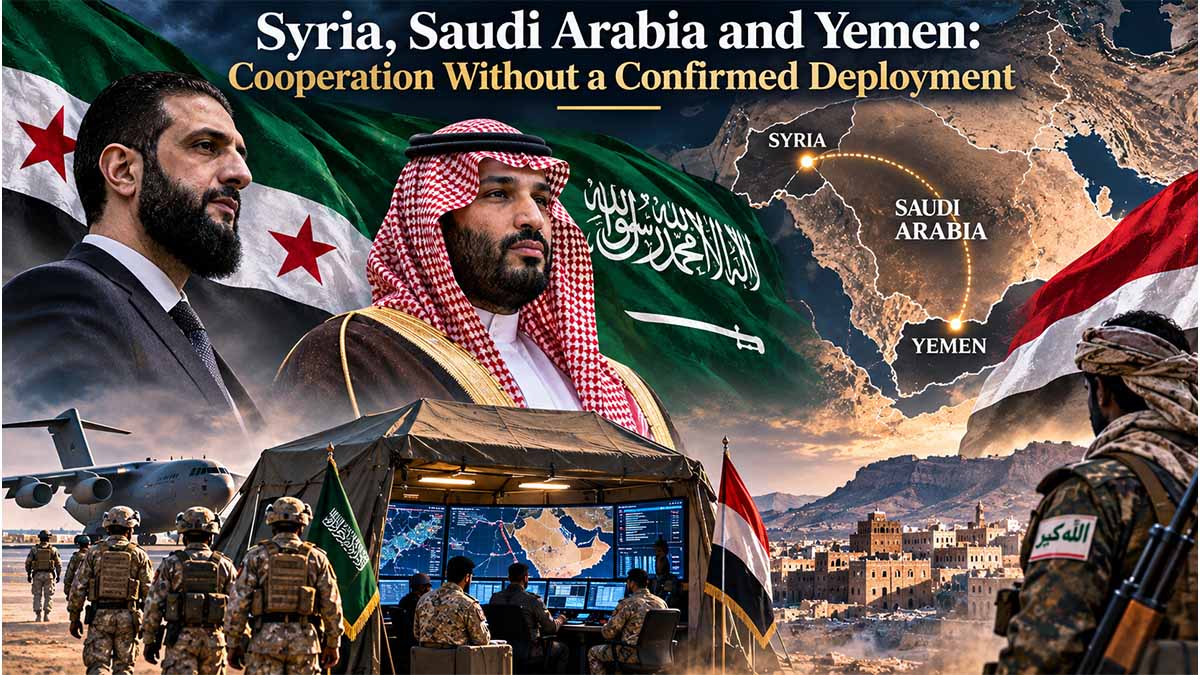
Scope: This dossier assesses whether Saudi–Syrian military cooperation is developing into Syrian intervention against the Houthis, covering Syria, Saudi Arabia, Yemen and their principal regional and European partners, with an immediate operational focus and an outlook to November 2031.
Executive Summary / BLUF
Saudi–Syrian defence cooperation is established; a Syrian expeditionary deployment to Yemen is not established by the verified official record.
The agreements signed in Riyadh on 4 November demonstrate a substantial bilateral rapprochement, including military cooperation and development financing.
On 9 November, Foreign Minister Asaad al-Shaibani denied that Syrian troops were in Yemen or that an imminent deployment was planned.
On 12 November, Yemen’s chargé d’affaires in Damascus also challenged accounts of a deployment arrangement.
Saudi Arabia’s broader coalition-building is more firmly documented: Türkiye, Pakistan and Saudi Arabia have announced measures to implement their collective-defence commitments.
British operational support is independently documented, but European maritime protection, Saudi territorial defence and ground combat in Yemen remain distinct missions.
The principal decision threshold is a documented change in mission, command arrangements and territorial employment—not the announcement of another cooperation agreement. sana.sy
Syria’s Saudi Partnership Must Build Capacity Before It Exports Force
Saudi Arabia’s defence partnership with Syria creates a decision that neither a signing ceremony nor a projected troop total can resolve: whether Damascus can contribute to regional security without exporting the institutional capacity it needs for reconstruction. The agreements signed on 4 November 2026 establish military cooperation; they do not establish an authorised Syrian combat deployment to Yemen. For Riyadh, the attraction is another potential source of assistance. For Damascus, the constraint is a recovery programme requiring security, engineering, procurement and administrative resources at home. European governments face the same distinction from the opposite direction: protecting Saudi territory and commercial navigation does not amount to approving a Syrian land campaign. The governing test is whether cooperation leaves Syria with stronger institutions or a larger inventory of external obligations.
A defence agreement cannot supply an expeditionary army
On 9 November 2026, Syrian Foreign Minister Asaad al-Shaibani denied that Syrian troops were in Yemen or that a deployment was planned in the near future. On 12 November, Yemen’s chargé d’affaires in Damascus, Mohammed Azzi Baakr, challenged accounts of a deployment arrangement. These are attributable official positions, not independent inspections. They nevertheless prevent a combat intervention from being treated as an acknowledged government decision. The military question begins where the 4 November agreement’s public description ends: which formation, under whose command, supported by which resources, and for how long?
The NATO logistics framework identifies supply, movement, maintenance and supporting services as connected requirements. Its relevance is institutional, not evidence of NATO involvement in Syrian planning. Individual battlefield experience cannot establish collective readiness, equipment availability or endurance. Saudi provision of transport, accommodation or medical services could reduce Damascus’s immediate burden if agreed, but would also make the contribution dependent on those arrangements. A force whose initial movement is funded has not thereby acquired the replacements, maintenance and command capacity required for a continuing mission.
The financing figures measure different claims on the state
The World Bank’s October 2025 assessment of damage during 2011–2024 estimated physical reconstruction costs at US$216 billion, within a US$140–345 billion range. Direct physical damage was estimated separately at US$108 billion; the two measures are not additive. Against that historical requirement, the six Saudi concessional loan agreements signed on 4 November 2026 exceed US$403 million. They are targeted commitments, not verified disbursements or a measure of remaining national reconstruction needs. The EU’s Council background brief of 13 November also identifies a €620 million Syria support package for 2026–2027. None of these figures establishes a fungible budget from which an overseas campaign can be priced.
The Saudi allocations reveal the competing requirements: US$105 million for emergency services, US$100 million for healthcare, US$90 million for Aleppo thermal generation, US$60 million for housing, US$30 million for water metering and more than US$18 million for government financial services. Germany’s ASPIDES application, meanwhile, estimates €18.9 million in additional deployment expenditure for 1 November 2026–31 October 2027. That national military estimate cannot be combined with Syrian development loans or EU assistance. Its significance is the discipline it illustrates: an external commitment needs a defined period, a resource provision and a clear distinction between estimated expenditure and money spent.
Electricity procurement exposes the real capacity constraint
The World Bank’s Syria Electricity Emergency Project shows how financing becomes dependent on institutional execution. The US$146 million grant announced in June 2025 covered transmission, substations and implementation support. The June 2026 mission record subsequently identified clearance, procurement, engineering supervision and security arrangements involving Syria’s Ministries of Defence and Interior. Restoring electricity therefore requires more than generating equipment: sites and access routes must be usable, contracts administered and the network capable of delivering power. These functions are part of the recovery programme’s productive capacity.
The same World Bank mission record states that the transmission-line procurement package excluded the Türkiye connection at that stage and proceeded with the Jordan line. An announced design had already become a more specific implementation decision. That distinction should govern military cooperation as well. Under the Saudi programme, rehabilitation of generating units in Aleppo will produce its intended service benefit only where the wider system permits delivery. If an external mission draws on personnel needed for domestic engineering, coordination or security, its opportunity cost would appear partly in delayed services. The record does not quantify that displacement; a competent decision must establish whether it exists before accepting another continuing obligation.
Domestic approval and territorial authority remain separate
Syria’s Constitutional Declaration of 13 March 2025 distributes relevant powers rather than creating one unlimited deployment authority. Article 30 assigns treaty ratification and budget approval to the People’s Assembly; Article 32 identifies the president as supreme commander; Article 37 concerns final treaty signature; and Article 41 addresses mobilisation and war following National Security Council approval. Their application depends on the actual instrument and mission. A training assignment should not automatically be treated as a declaration of war, but presidential attendance at a ceremony cannot establish every approval required for sustained combat.
International authority requires a separate assessment. In its 1986 Nicaragua judgment, the International Court of Justice addressed the victim-state request, necessity and proportionality relevant to collective self-defence. Its 2005 Armed Activities judgment emphasised the limits of territorial consent. Applied here, Saudi permission for personnel to operate in Saudi Arabia cannot itself establish Yemeni permission for their presence in Yemen. Security Council Resolution 2216 records the historical Yemeni request for assistance in 2015; that record does not, by itself, establish the current scope of consent for a new Syrian mission. An alliance can organise assistance, but cannot replace these inquiries.
European solidarity is not a common operational mandate
Italy’s existing exposure demonstrates why additional assistance requires a specific decision. In the parliamentary hearing of 8 October 2026, Italian Defence Minister Guido Crosetto reported 407 personnel in the Saudi presence and distinguished existing arrangements from a possible ad hoc mission requiring parliamentary consideration. France’s 9 November diplomatic statement expressed solidarity with Saudi territorial defence. The UK parliamentary answer of 13 November confirmed counter-air and refuelling operations since 20 October. These records establish different commitments; none establishes approval of a Syrian ground intervention.
Germany’s Bundestag authorised continued ASPIDES participation through 31 October 2027, while the EU operation’s separately established mandate runs to 28 February 2027. Those dates cannot be treated as one automatic commitment. The Council’s March 2026 maritime amendments also added infrastructure-information and capacity-building functions within available means and capabilities. For European governments, the practical choice is whether requested support improves a defined protective function and remains within the relevant authority. General concern about trade and energy disruption cannot establish that an unspecified land campaign would restore commercial passage.
The next two years will charge for obligations left undefined
Over the next 12–24 months, the EU’s 2026–2027 assistance programme and Germany’s nationally authorised ASPIDES period provide concrete intervals for scrutiny. Damascus and Riyadh should measure cooperation through functioning institutions, supportable assignments and completed objectives. European governments should identify any assistance connected to a Syrian mission through its actual function, authority and resource cost. Failure to do so would allow successive renewals and additional tasks to determine the commitment before institutions have assessed its cumulative burden.
The UN Humanitarian Coordinator’s 20 October 2026 statement on Taiz identifies who already bears the consequences when security and services deteriorate: households facing food and fuel prices that had more than doubled, and a city whose water production had halved. Those observations do not establish what a Syrian intervention would change. They establish why force size is an inadequate measure of policy. If the 4 November partnership creates obligations without maintainable capacity or measurable protective results, Syrian service users would bear any domestic displacement, contributing governments would carry continuing support costs, and Yemeni civilians and commercial shipping would remain exposed to an unresolved conflict.
Navigational Index
Pillar I — Political Alignment and the Authority to Intervene
- Chapter 1 — Saudi–Syrian Rapprochement: Agreements, Official Positions and Strategic Interests
- Chapter 2 — Deployment Authority: Syrian Decisions, Yemeni Consent and Collective Defence
Pillar II — Military Feasibility and the Reconstruction Constraint
- Chapter 3 — From Military Cooperation to Expeditionary Operations: Command, Readiness and Sustainment
- Chapter 4 — Reconstruction Finance, Institutional Capacity and the Cost of External Commitments
- Chapter 5 — Yemen’s Escalation Pathways: Territorial Defence, Ground Warfare and Maritime Exposure
Pillar III — International Consequences and Decision Options
- Chapter 6 — Italy, France, Germany, the United Kingdom and the European Union
- Chapter 7 — Alternative Pathways and Watch Indicators, 2026–2031
- Chapter 8 — Courses of Action and Final Net Assessment
Master Abstract
Cooperation has advanced further than the evidence for intervention
The strongest defensible assessment is that Damascus and Riyadh are institutionalising a security partnership while the scope of any Syrian operational contribution remains unresolved. President Ahmed al-Sharaa and Crown Prince Mohammed bin Salman attended the signing of bilateral agreements in Riyadh on 4 November 2026, covering military cooperation alongside development, infrastructure, energy, housing, health and financial services. The ceremony establishes political commitment and an agreement-making process; it does not itself establish an authorised force package, deployment location or combat mission. President al-Sharaa, Crown Prince bin Salman attend signing of bilateral agreements — Syrian Arab News Agency — Nov 2026. sana.sy
The subsequent Syrian position is explicit but must remain attributed. At his 9 November press conference, al-Shaibani said the Saudi agreement concerned rebuilding Syria’s armed forces, denied an agreement with Yemen for deployment there, and stated that any future overseas military deployment would be publicly announced. These statements weigh against treating intervention as an accomplished decision, although a government denial cannot independently establish the absence of undisclosed planning. Syria has no plans to deploy troops to Yemen, foreign minister says — Syrian Arab News Agency — Nov 2026. sana.sy
A further consequential statement came on 12 November. Yemen’s chargé d’affaires in Damascus, Mohammed Azzi Baakr, told SANA that circulating accounts of troops being sent under Syrian–Yemeni military cooperation did not reflect the current situation on the ground. This adds an identifiable Yemeni diplomatic position to the documentary record. However, because the statement appeared through Syria’s state news agency, it is evidence of the representative’s stated position rather than an independent inspection of deployment activity. السفير اليمني بدمشق: ما يتم تداوله عن نشر قوات بموجب اتفاق مع سوريا لا يعكس الواقع — Syrian Arab News Agency — Nov 2026. sana.sy
Accordingly, the verified official documents examined do not establish an authorised Syrian contingent of 3,000 troops, an expansion to 10,000, or an approved 600-person initial combat deployment. Those quantities cannot serve as the baseline for estimating military effects, costs or escalation. Nor would an advisory presence in Saudi Arabia, if subsequently established, automatically demonstrate participation in combat inside Yemen. Personnel location, assigned tasks, operational control and authority to use force must be established separately.
Saudi coalition-building has a firmer institutional foundation
The regional defence architecture extends beyond bilateral discussions with Syria. Türkiye’s Foreign Ministry confirmed in August that the Makkah Joint Defence Agreement had been signed by Türkiye, Pakistan and Saudi Arabia and that its Strategic Political and Defence Committee would meet on 31 August. This provides an official institutional basis for the trilateral arrangement, while leaving Syria outside the membership identified in that record. No: 168, Regarding the First Meeting of the Strategic Political and Defence Committee Established Under the Makkah Joint Defence Agreement — Republic of Türkiye Ministry of Foreign Affairs — Aug 2026. mfa.gov.tr
More significantly, the three governments’ 5 October joint statement announced a decision to implement collective-defence commitments and arrange the rapid deployment of agreed military forces and capabilities in Saudi Arabia, subject to approved arrangements and national legislation. It also recorded the appointment of Lieutenant General Nauman Mahmood, retired, as the alliance’s first secretary-general for a three-year term. These are documented implementation decisions; they do not establish that every announced capability has arrived or that the alliance has authorised Syrian operations in Yemen. Joint Statement on the Emergency Meeting of the Strategic Political and Defense Committee of the Makkah Alliance for Defense, 5 October 2026 — Republic of Türkiye Ministry of Foreign Affairs — Oct 2026. mfa.gov.tr
This distinction changes the strategic interpretation. Saudi Arabia can assemble overlapping forms of assistance without creating a single integrated war coalition: air defence, advisers, logistics, maritime protection and ground operations carry different commitments and escalation risks. Syrian participation would require its own evidentiary and legal assessment even if Damascus eventually entered a regional defence arrangement.
Reconstruction creates both an incentive and a constraint
The financial relationship gives Damascus a material interest in sustaining Saudi support. SANA’s account of the agreements records six concessional development loans worth more than US$403 million, signed on 4 November, covering electricity, water, healthcare, housing, civil defence and digital transformation. These are financing agreements, not evidence of completed disbursement or infrastructure delivery. Saudi loans of over $403 million could boost Syria’s recovery — Syrian Arab News Agency — Nov 2026. sana.sy
The analytical mechanism runs in two directions. Development financing can reinforce the political incentive for defence cooperation, but reconstruction also raises the opportunity cost of sending trained personnel and institutional attention abroad. Neither mechanism proves a bargain exchanging loans for soldiers. Establishing such a linkage would require contractual provisions, official statements or other competent evidence connecting the commitments.
Operationally, an expeditionary mission would require more than individually experienced fighters. The relevant tests are deployable unit cohesion, accountable command, communications interoperability, transport, maintenance, medical evacuation and replacement capacity. These are assessment requirements, not verified deficiencies assigned to particular Syrian formations. The available official record does not support a quantified judgment about how many Syrian troops could be sustained abroad or what battlefield effect they would produce.
European support has distinct national and institutional limits
The clearest documented European contribution to Saudi territorial defence is British. On 20 October, the UK announced defensive counter-air missions using RAF Typhoons, an A400M transport contribution and military advisers. The announcement explicitly excluded offensive strikes by those Typhoons, while separately describing extended air-to-air refuelling support for Saudi operations, including against threatening Houthi military targets in Yemen. The mission therefore contains distinctions that a general description of “defensive support” can obscure. Operational update 20 October – UK military support to the Kingdom of Saudi Arabia — UK Ministry of Defence — Oct 2026. GOV.UK
On 13 November, a parliamentary answer confirmed that RAF personnel had undertaken defensive counter-air operations and refuelling flights since 20 October. This moves those activities from announced intent to officially reported implementation. It establishes British operational involvement, without demonstrating British endorsement of a Syrian ground intervention. Written question 40911: Royal Air Force defensive operations supporting Saudi Arabia — UK Parliament — Nov 2026. UK Parliament
France’s stated position combines solidarity with Saudi territorial defence and continued diplomatic engagement. The French Foreign Ministry’s account of the 9 November ministerial meeting condemned Houthi attacks and reaffirmed support for Saudi Arabia in defending its territory. That statement does not announce approval for Syrian combat operations. Ministérielle G7 Affaires étrangères – Entretien du Ministre avec Son Altesse Fayçal Ben Farhan Al Saoud, ministre des Affaires étrangères du Royaume d’Arabie saoudite — France Diplomatie — Nov 2026. France Diplomatie
Germany’s parliamentary framework is separately defined. The Bundestag records approval on 15 October for continued participation in ASPIDES until 31 October 2027, with a ceiling of 350 personnel. That ceiling is an authorisation, not a deployed headcount. Moreover, the national authorisation’s end date must be distinguished from the EU operation’s separately established mandate. EUNAVFOR ASPIDES — Deutscher Bundestag — Oct 2026. Deutscher Bundestag
Italy’s documented diplomatic baseline includes the G7 statement issued after the Paris meeting of 9–10 November, published by its Foreign Ministry. The statement supports Yemen’s government, including capacity-building, condemns Houthi attacks and recognises the contribution of defensive EU maritime operations. For Rome, the analytical policy question is whether any additional assistance strengthens maritime security and regional stability within a clearly defined mandate. The collective statement supplies no specific endorsement of Syrian expeditionary warfare. Dichiarazione congiunta a seguito della riunione dei Ministri degli Esteri del G7 tenutasi a Parigi il 9 e 10 novembre 2026 — Italian Ministry of Foreign Affairs and International Cooperation — Nov 2026. esteri.it
At EU level, ASPIDES remains a defensive maritime-security operation. The Council extended it to 28 February 2027, with a financial reference amount of nearly €15 million for common costs over 1 March 2026–28 February 2027. This figure does not represent the total national cost of participating forces. The mission’s existence cannot establish European participation in a ground coalition against the Houthis. Red Sea: Council extends the mandate of Operation ASPIDES to safeguard freedom of navigation — Council of the European Union — Feb 2026. Consilium
Key Evidence Table
| Indicator | Value/status | Reference date | Definition/scope | Issuer | Exact source |
|---|---|---|---|---|---|
| Saudi–Syrian agreement-making | Military cooperation included in signed bilateral package | 4 Nov 2026 | Establishes cooperation; no verified expeditionary force package | SANA | Signing ceremony |
| Syrian deployment position | Minister denied troops in Yemen and near-term deployment plans | 9 Nov 2026 | Attributed government position | Syrian foreign minister, through SANA | Ministerial statement |
| Yemeni diplomatic position | Chargé d’affaires challenged deployment accounts | 12 Nov 2026 | Named diplomatic assertion; not independent operational verification | Yemeni chargé d’affaires, through SANA | Arabic statement |
| Development financing | Six concessional loans; more than US$403 million | Signed 4 Nov; reported 11 Nov 2026 | Financing commitments; disbursement not established | SANA, reporting Syrian Finance Ministry information | Financing account |
| Makkah alliance implementation | Decision to arrange forces and capabilities for deployment in Saudi Arabia | 5 Oct 2026 | Announced implementation measures; delivered force package unspecified | Türkiye, Saudi Arabia and Pakistan | Joint statement |
| British operational activity | Counter-air operations and refuelling flights officially reported | Answer dated 13 Nov 2026 | Activities since 20 October | UK Ministry of Defence | Parliamentary answer |
| German participation authority | Up to 350 personnel; national authorisation through 31 Oct 2027 | Approved 15 Oct 2026 | Authorisation ceiling; not actual strength | Bundestag | Mandate account |
| EU maritime mandate | Through 28 Feb 2027; nearly €15 million common-cost reference | 23 Feb 2026 | Defensive maritime operation; excludes national expenditure totals | Council of the EU | Mandate extension |
Alternative Pathways and Indicators
Institutional rebuilding remains the most directly supported interpretation. A Syrian diplomatic source described cooperation as training, expertise exchange and military consultation, with Saudi coordination visits to Syria expected in December. The announced visits remain prospective at the cut-off date. Diplomatic source: Military agreements with KSA limited to training, expertise exchange — Syrian Arab News Agency — Nov 2026. sana.sy
Limited Syrian assistance inside Saudi Arabia is a separate pathway requiring operational confirmation. Evidence of advisers, training teams or liaison officers would establish only their documented functions. A change toward participation in hostilities would require evidence of targeting responsibilities, operational command or direct combat employment.
A Syrian combat deployment into Yemen would constitute a material change in policy and exposure. Its feasibility would depend on a defined mission, sustainable force package and accountable command. Its legal assessment would require the actual instrument invoked and the relevant facts. The Security Council’s institutional account explains that Article 51 concerns individual or collective self-defence following an armed attack and requires immediate reporting of measures to the Council; it does not determine the legality of an unspecified future operation. Actions with Respect to Threats to the Peace, Breaches of the Peace, and Acts of Aggression — United Nations Security Council — undated. Security Council
These pathways can occur sequentially or overlap. Current evidence does not justify numerical probabilities or an inference that cooperation in Yemen would lead automatically to Syrian deployments in other wars.
Principal Gaps and Watch Indicators
| Consequential gap | Record or observation required | Decision consequence |
|---|---|---|
| Overseas deployment authority | Published Syrian decision specifying mission, location and duration | Establishes a change from cooperation to authorised deployment |
| Territorial and legal basis | Relevant host-government instrument and any formally invoked self-defence documentation | Enables assessment of authority and geographic limits |
| Force size and readiness | Named units, confirmed movement records and evidence of sustainment arrangements | Permits assessment of deployable strength and endurance |
| Command responsibility | Official command arrangements and disclosed mission responsibilities | Distinguishes training from combat integration |
| Syrian alliance membership | Formal accession instrument and applicable implementation decisions | Establishes obligations beyond political discussion |
| Financial implementation | Loan effectiveness notices, disbursement records and procurement awards | Separates development commitments from realised expenditure |
| Western support for Syrian operations | Explicit national decisions identifying the Syrian mission supported | Distinguishes general Saudi solidarity from operational endorsement |
The assessment would change most substantially if Damascus announced an overseas deployment and competent records established its location, mission and command structure. Until then, the defensible baseline is an expanding security partnership operating alongside documented regional coalition-building, with Syrian intervention in Yemen remaining unestablished.
Syria, Saudi Arabia and Yemen
As of 16 November 2026. Saudi–Syrian military cooperation is documented. A Syrian combat deployment to Yemen is not established by the verified official record.
| Indicator | Status | Official source |
|---|---|---|
| Military cooperation | Bilateral agreements signed, 4 November 2026. | SANA — signing ceremony |
| Syrian deployment | Foreign minister denied troops in Yemen and near-term plans, 9 November. | SANA — ministerial statement |
| Yemeni position | Chargé d’affaires challenged deployment accounts, 12 November. | SANA — diplomatic statement |
| Development loans | Six concessional agreements worth more than US$403 million; disbursement not established. | SANA — financing account |
| Makkah alliance | Implementation measures announced, 5 October; delivered force package unspecified. | Türkiye MFA — joint statement |
| United Kingdom | Counter-air operations and refuelling officially reported, 13 November. | UK Parliament — answer 40911 |
| Germany | National ASPIDES authorisation: up to 350 personnel through 31 October 2027; not deployed strength. | Bundestag — ASPIDES |
| European Union | ASPIDES mandate through 28 February 2027; nearly €15 million common-cost reference. | Council of the EU — mandate extension |
Pillar I — Political Alignment and the Authority to Intervene
Chapter 1 — Saudi–Syrian Rapprochement: Agreements, Official Positions and Strategic Interests
The strategic significance of Saudi–Syrian rapprochement lies in the institutional choices it opens, while the available agreements and statements leave the decision to undertake combat operations abroad unestablished. The distinction matters because political alignment, military cooperation and intervention require different commitments, create different liabilities and depend on different authorities. A government can endorse another state’s security, establish defence consultations and exchange military expertise without authorising participation in that state’s wars. Equally, a relationship initially designed around institutional reconstruction can acquire operational functions through later decisions. The task is therefore to identify what the existing partnership permits publicly, what its participants have expressly ruled out, and what additional evidence would demonstrate a change in purpose. On the present record, the relationship has acquired a formal military dimension, but its publicly described immediate function remains the rebuilding of Syrian military institutions. The 7 November account of training, consultations and capacity-building provides the relevant starting point; possible future mutual defence or alliance accession was presented as a subsequent development, rather than an obligation already in force. Diplomatic source: Military agreements with KSA limited to training, expertise exchange — Syrian Arab News Agency — Nov 2026. sana.sy
The partnership establishes access across institutions without disclosing an operational mandate
The composition of the Riyadh engagement demonstrates the breadth of the relationship more clearly than an isolated reference to a defence agreement. SANA’s account of the 4 November signing ceremony identifies Syrian participation by the ministers responsible for foreign affairs, defence, finance, industry and internal trade, together with the head of the General Intelligence Service; the Saudi side included defence, foreign affairs, energy, industry and mineral resources, and environment, water and agriculture. This establishes senior institutional participation across security and economic portfolios. The analytical implication is that the partnership provides channels through which several forms of cooperation can be negotiated together, although it does not establish that they were exchanged against one another. Defence engagement can support the restoration of state institutions, while economic cooperation can increase the practical value of maintaining the political relationship. Whether those channels produce a narrower training partnership or a broader security commitment depends on implementing decisions that the signing ceremony does not disclose. In particular, the presence of defence and intelligence officials establishes access and political attention; it cannot establish operational control, deployment authority or a joint targeting arrangement. President al-Sharaa, Crown Prince bin Salman attend signing of bilateral agreements — Syrian Arab News Agency — Nov 2026. sana.sy
A further distinction concerns the legal character of the instruments signed. The official account refers collectively to agreements and memorandums of understanding, but the military instrument’s complete operative text has not been verified in the records examined. Its title and the circumstances of signature therefore cannot establish provisions on entry into force, implementation, expenditure, troop status, dispute settlement or termination. This is consequential rather than merely procedural. A framework that permits consultations may require subsequent arrangements before personnel can be posted abroad; an instrument providing training access may leave combat employment outside its scope; and an undertaking that creates binding obligations may engage domestic approval requirements different from those applicable to an administrative arrangement. The appropriate assessment remains limited to the functions that officials have publicly described. The consequential missing record is the authenticated instrument and any implementing arrangement that would connect its general purpose to a particular mission. Until that connection is documented, the agreement supplies evidence of an institutional partnership rather than a complete explanation of how forces would be employed.
International re-engagement increases the value of restraint
Syria’s external choices also take place within a changing European institutional relationship that can be measured through specific decisions rather than diplomatic imagery. On 11 May 2026, the Council of the European Union adopted a decision terminating the partial suspension of the EU–Syria Cooperation Agreement. The Council explained that the suspended provisions concerned trade and that their reinstatement would apply from the first day of the month following notification to the Syrian authorities. This sequencing illustrates why political announcements, legal decisions and implementation dates require separate treatment: the adoption date alone does not establish that every restored provision applied immediately. For the present assessment, the development creates a documented channel for renewed economic engagement and increases the potential value to Damascus of sustaining predictable relations with European institutions. It does not supply European approval for Syrian military operations abroad. The analytical inference is conditional: an overseas commitment that materially undermined domestic stability or generated serious legal controversy could complicate the wider partnership Syria is rebuilding, whereas cooperation that strengthens accountable institutions could support it. Syria: Council restores full application of EU-Syria Cooperation Agreement — Council of the European Union — May 2026. consilium.europa.eu
The European record also demonstrates that re-engagement remains differentiated. On 18 May 2026, the Council renewed restrictive measures targeting individuals and entities associated with the former Assad regime until 1 June 2027, while removing seven entities, including the Syrian Ministries of Defence and Interior, from the sanctions list. It simultaneously distinguished the lifting of economic sanctions from the maintenance of restrictions based on security grounds. These decisions document expanded institutional engagement without establishing unrestricted military cooperation. Delisting a ministry changes its treatment under the measures concerned; it does not itself authorise a particular transfer, training programme or operational relationship. The strategic consequence for Damascus is that access to international partners can expand through several legally distinct channels, each with its own conditions. For Saudi Arabia, cooperation with Syrian state institutions can consequently develop alongside European re-engagement without implying identical objectives or coordinated decisions. Treating these developments as a single Western endorsement would obscure the separate authorities involved and overstate the commitments that the official decisions establish. Syria: Council renews restrictive measures targeting the former al-Assad regime for one year and de-lists certain entities — Council of the European Union — May 2026. Consilium
Official denials define the stated policy but leave separate questions of implementation
The wording of the Syrian foreign minister’s 9 November statement has three distinct evidentiary functions. It states a position on current presence, rejects a near-term plan and describes an expectation of public disclosure for any future deployment. Those propositions should not be collapsed into a permanent undertaking never to operate abroad. They also concern deployment in Yemen and cannot, by themselves, resolve every question about consultations or activities in Saudi Arabia. This territorial precision matters because evidence of a meeting, a training visit or an advisory assignment would need to be assessed against its actual function before it could establish participation in hostilities. Conversely, the minister’s statement cannot independently verify the absence of undisclosed activity. Its importance is that it fixes the government’s publicly attributable position against which subsequent decisions can be compared. A later announcement of an external mission would require analysis of whether policy had changed, whether the earlier statement concerned a different mission, or whether new evidence contradicted the previous account. Syria has no plans to deploy troops to Yemen, foreign minister says — Syrian Arab News Agency — Nov 2026. sana.sy
The Yemeni diplomatic statement adds a different institutional voice, although its publication channel limits the degree of independent corroboration it supplies. On 12 November, Yemen’s chargé d’affaires in Damascus challenged circulating accounts of a deployment under Syrian–Yemeni military cooperation and said that such steps would be announced through the relevant official institutions under applicable procedures. His position matters because an operation inside Yemen would engage Yemeni authority separately from the Saudi–Syrian relationship. Nevertheless, a statement published by SANA cannot substitute for an independently verified Yemeni decision or an inspection of forces on the ground. Its substantive contribution is to weaken the proposition that an acknowledged bilateral deployment arrangement already exists in the public record, while identifying official institutional action as the channel through which a future arrangement should be assessed. For decision-makers, the next useful evidence would be a mission-specific decision, invitation or implementing instrument, rather than another general declaration of friendship. السفير اليمني بدمشق: ما يتم تداوله عن نشر قوات بموجب اتفاق مع سوريا لا يعكس الواقع — Syrian Arab News Agency — Nov 2026. sana.sy
Institutional evidence and its limits
The following component isolates the institutional changes that materially affect interpretation. Its native disclosure controls expose the implications without scripts, external requests or styles applied to the surrounding WordPress page.
Institutional change: what each record establishes
Documentary position as of 16 November 2026. The final column states the boundary of the evidence.
| Record | Established change | Interpretive limit | Official source |
|---|---|---|---|
| EU cooperation decision 11 May 2026 |
Decision to end the partial suspension of the EU–Syria Cooperation Agreement. | Restored provisions apply according to the notification timetable; this is not military approval. | Council of the EU — cooperation decision |
| EU sanctions review 18 May 2026 |
Seven entities delisted, including the Defence and Interior ministries; former-regime measures renewed to 1 June 2027. | Delisting does not independently authorise a specific military transaction or operation. | Council of the EU — sanctions review |
| Riyadh signing ceremony 4 November 2026 |
Senior security and economic institutions participated in the bilateral agreement package. | Attendance does not establish deployment authority or operational command. | SANA — bilateral signing ceremony |
| Syrian ministerial statement 9 November 2026 |
Public denial of troops in Yemen and near-term deployment plans. | Attributed policy position; not independent verification of all military activity. | SANA — foreign minister’s statement |
| Yemeni diplomatic statement 12 November 2026 |
Chargé d’affaires challenged deployment accounts and referred to official procedures. | Does not itself disclose a mission-specific invitation or implementing instrument. | SANA — Yemeni diplomatic statement |
Political implication: cooperation can deepen without combat deployment
Analysis: consultation, training and institutional engagement can increase the value of the partnership while leaving a combat decision outstanding. A deployment assessment requires evidence linking an authorised mission to identifiable forces and territory.
Decision threshold: obtain the implementing instrument
Collection priority: authenticated agreement text, entry-into-force information and any mission-specific arrangement. The absence of a publicly verified instrument does not prove that no non-public arrangement exists.
Categories are qualitative. No readiness scores, probabilities or force estimates are implied.
Institutional evidence: EU cooperation and sanctions decisions expand engagement; the Riyadh agreements do not themselves establish a Syrian combat deployment. Detailed sources appear in the surrounding chapter.
Alliance discussion creates an option whose obligations require separate verification
Syria’s possible entry into the Makkah arrangement would alter the institutional setting of its defence relationship, but the distinction between consultation and accession remains decisive. The October joint statement identifies Saudi Arabia, Türkiye and Pakistan as the participating states and expressly connects implementation to approved arrangements and national legislation. Its significance is that collective-defence policy is being translated into institutional decisions among named participants. It does not establish that a prospective fourth state has accepted obligations, acquired rights or authorised forces under the arrangement. Nor does an implementation decision establish that every announced capability has become operational. For Syria, accession would therefore raise several questions beyond political alignment: the procedure for joining, the obligations accepted, the circumstances in which assistance is required, the role of national decisions and the mechanisms for withdrawing or limiting participation. Without the relevant operative texts, those matters cannot be reconstructed from alliance terminology. The defensible conclusion is that discussions create an identifiable strategic option whose consequences remain dependent on further institutional acts. Joint Statement on the Emergency Meeting of the Strategic Political and Defense Committee of the Makkah Alliance for Defense, 5 October 2026 — Republic of Türkiye Ministry of Foreign Affairs — Oct 2026. mfa.gov.tr
Key judgments
The relationship’s most consequential political feature is the creation of official channels capable of supporting progressively deeper cooperation. Its practical direction remains contingent on the purposes assigned to those channels. European institutional re-engagement increases the value of predictable state conduct, while Saudi cooperation gives Damascus another avenue for strengthening its institutions. Neither development independently determines whether Syria will accept an external combat role. The principal analytical risk is to treat several distinct changes—access, delisting, consultation, agreement signature and alliance discussion—as cumulative proof of an intervention decision. They instead establish a wider range of choices whose exercise must be verified individually.
What would change the assessment
The assessment would change if an authenticated agreement or implementing decision established a specific operational obligation, if formal accession documents placed Syria within the Makkah arrangement, or if competent records connected identifiable Syrian forces to an authorised external mission. Additional diplomatic meetings alone would demonstrate continued engagement but would not resolve those questions.
Open official record
The consequential outstanding records are the complete Saudi–Syrian military instrument, its applicable approval and implementation documents, and any formal Syrian alliance-accession instrument. Their absence from the verified public record limits the conclusions that can be drawn about binding obligations; it does not establish that every relevant discussion or arrangement is public.
Chapter 2 — Deployment Authority: Syrian Decisions, Yemeni Consent and Collective Defence
A Syrian mission abroad would require its domestic authority and international legal basis to be assessed separately, while its actual conduct would remain subject to applicable law throughout the operation. These are connected inquiries, but none can be resolved merely by establishing that Damascus and Riyadh have signed a military agreement. A Syrian decision can identify who authorised the forces without settling their entitlement to operate in another state; a host government’s consent can address territorial presence without authorising every activity; and a collective-defence claim must satisfy the conditions of self-defence rather than rely solely on political solidarity. A further distinction arises between deployment in Saudi Arabia and operations inside Yemen: the territorial state, mission and legal justification may change when forces cross a border or undertake cross-border action. The purpose of the analysis is therefore to identify the records and conditions relevant to each possible mission, rather than declare an unspecified intervention lawful or unlawful in advance. The Security Council’s institutional account distinguishes self-defence under Article 51 from Council enforcement action under Chapter VII, providing the foundation for keeping those routes separate. Actions with Respect to Threats to the Peace, Breaches of the Peace, and Acts of Aggression — United Nations Security Council — undated. Security Council
Syria’s constitutional framework distributes relevant powers across different functions
The Constitutional Declaration of 13 March 2025 assigns distinct functions that bear on an overseas commitment. Article 30 includes treaty ratification and budget approval among the People’s Assembly’s responsibilities; Article 32 identifies the president as supreme commander; Article 37 concerns final signature of treaties; and Article 41(1) provides for presidential declaration of mobilisation and war after National Security Council approval. These provisions must be read as separate allocations of authority. They do not establish, without further examination of the mission and implementing law, that every training visit requires a declaration of war or that presidential command authority removes other applicable requirements. The relevant question would be how a specific mission had been legally classified and authorised. A treaty-based obligation, its domestic approval and a subsequent operational order may concern different acts. Establishing compliance would therefore require the applicable instrument and decisions, rather than inference from the president’s participation in a ceremony. Constitutional Declaration of the Syrian Arab Republic, Articles 30, 32, 37 and 41 — Presidency of the Syrian Arab Republic, Arabic text preserved in UNHCR Refworld — Mar 2025. refworld.org
For an institutional assessment, the absence of a publicly verified approval should produce a defined collection requirement rather than a categorical finding of constitutional illegality. The analyst would need to identify whether the military instrument is treated domestically as a treaty, whether an approval requirement applies to it, whether the proposed activity falls within an existing lawful authority, and whether expenditure has the necessary basis. A decision providing personnel for a limited instructional assignment would need to be examined on its own terms; an order committing units to sustained hostilities would raise a materially different set of facts. The distinction also prevents a public announcement from being treated as conclusive legal proof. Disclosure can identify a decision and its stated purpose, but the competent decision-maker, relevant approvals and actual implementation must still be assessed. The resulting standard is demanding but narrow: determine the legal route actually used for the mission that exists, rather than inventing a universal deployment procedure from constitutional provisions that address different functions.
Consent must match the territory, activities and duration of the mission
The International Court of Justice’s judgment in Armed Activities on the Territory of the Congo provides a particularly relevant warning against treating military cooperation as unlimited territorial permission. In paragraphs 47 and 52–53, the Court distinguished the basis of consent from a cooperation protocol, explained that the consent at issue could be withdrawn, and emphasised that its geographic and operational scope was restricted. The implication for a prospective Syrian mission is an analytical application of that reasoning: the assessment would need to identify the competent consenting authority and determine whether the activities remained within the permission actually given. Saudi consent to personnel being present in Saudi Arabia would not itself establish Yemeni consent to their presence in Yemen. Equally, permission for training would not automatically establish permission for a different combat mission. A mission-specific written instrument would provide strong documentary clarity, although the Court’s treatment of consent also cautions against assuming that only a particular documentary form can establish it. Armed Activities on the Territory of the Congo, Judgment, paragraphs 47 and 52–53 — International Court of Justice — Dec 2005. icj-web.leman.un-icc.cloud
This territorial inquiry becomes more important as the proposed tasks become more intrusive. Instruction delivered on Saudi territory, protection of a facility, participation in operational planning and direct fighting inside Yemen should each be described according to the activity established by evidence. A single label such as “military assistance” can conceal differences in where personnel act, whose instructions they follow and what authority is invoked. That does not mean each activity necessarily requires a different treaty; it means that the legal assessment must test whether the actual authorisation covers the conduct. Where consent is relied upon, the limits of that consent remain material as the operation evolves. A change in geographic scope, a newly assigned task or a withdrawal of permission can therefore require reassessment even if the original deployment was validly authorised. This is a continuing governance requirement: the mission must remain aligned with its legal basis over time, rather than treating approval at entry as a permanent answer to every subsequent activity.
Resolution 2216 records a historical invitation without supplying unrestricted authority for a new mission
Security Council Resolution 2216, adopted on 14 April 2015, is relevant because its preamble records the Yemeni president’s request for assistance, including military intervention, transmitted in March 2015. Its operative provisions demand Houthi withdrawals and other measures, establish an arms embargo and provide specified inspection and seizure arrangements. The distinction between those functions is decisive: recording a request in the preamble is different from authorising a general combat operation through an operative provision. The resolution therefore cannot, by itself, establish that a particular Syrian mission in 2026 is covered by valid current consent or by a Council authorisation to fight. Nor does the historical request prove that consent has expired. The assessment must establish its continued applicability, competent interpretation and relationship to the forces and tasks now proposed. The text supplies an essential historical and legal reference, but it cannot replace mission-specific verification. Resolution 2216 (2015), preamble and operative paragraphs 1 and 14–17 — United Nations Security Council — Apr 2015. mandates.un.org
Collective self-defence requires more than an alliance commitment
In Military and Paramilitary Activities in and against Nicaragua, the International Court of Justice identified conditions that prevent collective self-defence from becoming a discretionary entitlement to intervene wherever a partner faces insecurity. Paragraphs 194–195 address necessity, proportionality and the requirement of an armed attack; paragraph 199 identifies the need for a request by the state that regards itself as the victim. Applied prospectively, this means that an assisting state would need to assess the attack and the assistance requested, rather than rely exclusively on its own view of the partner’s interests. Membership in a defence arrangement can organise assistance, but it cannot dispense with the applicable international conditions. For a Syrian contribution, the documentary inquiry would consequently examine the request, mission and stated justification together. This establishes the framework for assessment without deciding the legality of an operation whose tasks and factual circumstances have not been verified. Military and Paramilitary Activities in and against Nicaragua, Judgment, paragraphs 194–199 — International Court of Justice — Jun 1986. icj-web.leman.un-icc.cloud
An additional distinction concerns the relationship between defending Saudi Arabia and conducting force on Yemeni territory. Establishing a request for assistance from Riyadh would be relevant to collective self-defence, but the legal analysis of particular cross-border measures would still depend on their factual and legal circumstances. The non-state character of the Houthis does not make every question of territorial sovereignty, attribution or permissible defensive action disappear. Those issues should be addressed through the position actually advanced by the participating states and the evidence supporting it, rather than through an assumed universal answer. Article 51 also requires measures taken in self-defence to be reported immediately to the Security Council. Such reporting records the state’s justification and enables scrutiny; it is not a Council judgment endorsing the operation. Accordingly, a competent assessment would examine the letter alongside the underlying request and the conduct it purports to justify. Actions with Respect to Threats to the Peace, Breaches of the Peace, and Acts of Aggression, Article 51 section — United Nations Security Council — undated. Security Council
Mission-specific legal assessment matrix
Authority follows the mission
Analytical assessment requirements. These rows describe possible mission types; they do not assert that those missions have been authorised or deployed.
| Possible mission | Authority to examine | Decisive evidence | Boundary of the conclusion |
|---|---|---|---|
| Training in Saudi Arabia | Applicable Syrian approval and Saudi permission. | Assignment, agreed tasks and personnel arrangements. | A training assignment does not establish authority for a different combat mission. |
| Defence of Saudi territory | Domestic authority, Saudi consent and any self-defence basis invoked. | Request for assistance, mission decision and relevant reporting. | Protection inside Saudi Arabia does not itself establish authority for every cross-border measure. |
| Operations in Yemen by consent | Valid consent from the competent Yemeni authority and its applicable limits. | Evidence of consent, scope, duration and any subsequent modification. | Historical cooperation cannot be assumed to cover unlimited new activities. |
| Collective self-defence | Armed attack, victim-state request, necessity, proportionality and Charter reporting. | Request, factual account, legal justification and operational scope. | An alliance commitment does not replace the international conditions. |
| Security Council enforcement | Specific operative authorisation and its limits. | Resolution text covering the proposed action. | A Chapter VII reference alone does not establish unrestricted combat authority. |
Legal sources: Syrian Constitutional Declaration — March 2025; ICJ, Armed Activities — December 2005, paragraphs 47 and 52–53; ICJ, Nicaragua — June 1986, paragraphs 194–199; UN Security Council Repertoire — Chapter VII and Article 51.
Legal assessment: domestic authority, territorial consent, collective self-defence and Security Council enforcement are distinct inquiries. Their application depends on the actual mission and evidence identified in this chapter.
Command arrangements do not remove responsibility for conduct
The legal consequences continue after authority to deploy has been established. The International Law Commission’s Articles on Responsibility of States for Internationally Wrongful Acts, adopted in 2001, distinguish attribution of conduct from the existence of a breach. Article 4 addresses state organs, Article 7 addresses conduct exceeding authority, Article 16 concerns aid or assistance under its stated conditions, and Article 20 limits the effect of consent to conduct within its scope. These articles are not a treaty in their own right, and their application requires attention to the status of the particular rule and the facts. Their relevance here is that coalition participation does not provide a general escape from responsibility: command, conduct and knowledge remain material. A description such as “adviser” cannot alone resolve what personnel actually did, while a valid invitation cannot excuse every subsequent act. Responsibility of States for Internationally Wrongful Acts, Articles 4, 7, 16 and 20 — International Law Commission — 2001. legal.un.org
For the prospective mission, this means that the practical allocation of authority would need to be sufficiently clear to identify who assigns tasks, who supervises execution, who can refuse an instruction and who investigates alleged misconduct. These are assessment requirements rather than findings about an existing Syrian command arrangement. Their importance increases where several states contribute personnel under different national restrictions or where a training function develops into operational support. A cooperation agreement that leaves these matters unresolved may still support limited engagement, but it would provide an incomplete basis for assessing a more demanding mission. The same reasoning applies to external supporters: general political sympathy for a partner and assistance connected to particular conduct raise different questions. The consequential evidence would concern the assistance actually provided, its purpose and the circumstances known to the supporting state. Analysis should therefore follow identifiable decisions and conduct instead of treating coalition membership as a sufficient answer to responsibility.
Decision scheme: parallel legal routes and continuing constraints
From a proposed mission to a defensible legal assessment
Analytical scheme, not a declaration that any mission is authorised. International legal routes may overlap; they are not necessarily cumulative.
Identify personnel, tasks, territory, duration and the competent decisions. Agreement signature alone does not answer every question.
Consent
Identify valid permission and its limits.
Assessment requirement
Examine the consenting authority, permitted activities, territory and any modification or withdrawal. Permission for one mission cannot simply be assumed to cover another.
Collective self-defence
Assess the armed attack and assistance requested.
Assessment requirement
Examine necessity, proportionality, the victim-state request and Article 51 reporting. An alliance label does not replace these inquiries.
Specific authorisation
Read the operative provisions and limits.
Assessment requirement
Determine whether a Security Council resolution authorises the proposed measures. Distinguish a recorded historical invitation from an operative combat authorisation.
Reassess when the mission changes. Authority to deploy does not resolve the legality of every act carried out during the operation.
Sources: ICJ — Armed Activities, December 2005; ICJ — Nicaragua, June 1986; Security Council — Resolution 2216, April 2015; ILC — State Responsibility Articles, 2001. The branches represent legal inquiries, not deployment stages, scores or probabilities.
Legal scheme: establish the mission and domestic authority; assess the applicable international basis—consent, self-defence or specific Council authorisation—and continue reviewing conduct and responsibility throughout the operation.
Key judgments
The decisive legal distinction is between an agreement that facilitates cooperation and the authority supporting a defined operation. Syria’s domestic process, permission to act on foreign territory and any collective-self-defence justification require separate examination, even when the relevant decisions appear in a connected diplomatic package. The historical Yemeni invitation recorded in Resolution 2216 is material context but does not settle the scope of a prospective mission. Alliance participation can organise assistance without displacing the applicable conditions of international law, while consent must remain aligned with the activities undertaken. These distinctions allow a decision-grade assessment to identify what would make a mission supportable without claiming that an unverified deployment has already passed or failed the relevant tests.
What would change the assessment
The most consequential developments would be a mission-specific Syrian decision identifying its legal route, competent Yemeni evidence of consent where relied upon, a request and legal justification supporting any collective-self-defence claim, and records defining command responsibility. A material change in the mission’s tasks or territorial scope would require reassessment even if the original deployment had an adequate basis. Conversely, confirmation of a limited training assignment would narrow the inquiry to that assignment and would not establish participation in combat.
Open official record
The outstanding legal record comprises the applicable domestic approval and implementing decisions, evidence of consent and its scope, any Article 51 communication relevant to the proposed operation, and the arrangements governing command and responsibility. Until those records and the corresponding operational facts are established, the legal assessment must remain attached to defined possible missions rather than to an assumed Syrian intervention.
Pillar II — Military Feasibility and the Reconstruction Constraint
Chapter 3 — From Military Cooperation to Expeditionary Operations: Command, Readiness and Sustainment
The decisive military question is whether Syria could generate and sustain a coherent external force without weakening the institutions responsible for security and recovery at home. Individual combat experience cannot establish that capacity. An expeditionary formation must function as an organisation: its commanders must control assigned personnel, its communications must support coordination with partners, its equipment must remain serviceable, and its support arrangements must continue after the initial movement. These requirements provide the appropriate assessment framework, but they do not establish particular deficiencies in Syrian units whose readiness has not been independently documented. NATO’s public logistics framework identifies supply, movement, maintenance and supporting services as integrated functions and links interoperability directly to sustainability and combat effectiveness. That framework is useful here as an institutional reference, rather than evidence that Syria follows NATO procedures or that a prospective Saudi–Syrian mission would operate under NATO authority. Its central implication is that the ability to send personnel abroad and the ability to sustain an effective force abroad are different capabilities. NATO’s role in logistics — NATO — Jan 2025. NATO Topic
Force generation must be assessed at unit level
A defensible readiness assessment would begin with the formation selected for the mission rather than a national troop total. It would examine whether that formation has an established chain of command, trained subordinate leaders, reliable personnel records, serviceable equipment and a demonstrated ability to perform its assigned tasks collectively. Experience acquired by individuals in different organisations may be valuable, but its transfer into a new formation depends on common procedures and functioning institutional relationships. A soldier’s familiarity with a particular environment or weapon does not establish that a unit can coordinate movement, communicate with another contingent, manage casualties or maintain its equipment during a prolonged deployment. Conversely, a force undergoing institutional reconstruction should not automatically be judged incapable of every limited external assignment. A small, carefully selected instructional team and a formation expected to undertake sustained combat present substantially different demands. The analytical requirement is therefore to match the evidence to the mission: confirmation of a training capability would support conclusions about training, while a combat assessment would require collective performance evidence relevant to the proposed employment.
The distinction also affects how a prospective contingent should be counted. Personnel assigned to command, communications, transport, maintenance, medical support and administration contribute to the mission’s effectiveness even when their function is not direct combat. A headline headcount that does not disclose those categories cannot establish the number of personnel available for a particular task, and it cannot establish how long that availability could be maintained. Rotation creates another requirement: a force serving abroad may need replacements, preparation for subsequent contingents and recovery time after return. The relationship between deployed strength and the personnel needed to sustain it varies with the mission and support arrangements, so no universal multiplier is supportable here. For Syria, the consequential question would be whether the same scarce specialists are simultaneously required for external employment and domestic institutional rebuilding. Without verified unit-level information, assigning a numerical readiness score or estimating a deployable national reserve would create precision that the evidence does not support.
Coalition support can reduce the burden while creating dependencies
The British support package announced on 20 October illustrates the separate functions that can sit behind a military contribution. The UK identified defensive counter-air missions using Typhoon aircraft, an A400M contribution for moving defence materiel and military advisers supporting Saudi staff officers, alongside refuelling support described separately. The relevant lesson for this chapter is organisational: aircraft performing a visible protective mission are supported by transport, advisory and other enabling activities. These functions cannot be treated as interchangeable, and the existence of one does not establish that another is available to every partner. For a prospective Syrian assignment, Saudi provision of accommodation, transport, communications or medical services could reduce the resources Damascus would need to supply directly. It would also make effectiveness conditional on the reliability and scope of those arrangements. Host support should therefore be assessed as a documented service with identified responsibilities, rather than inferred from political proximity or the host state’s general resources. Operational update 20 October – UK military support to the Kingdom of Saudi Arabia — UK Ministry of Defence — Oct 2026. GOV.UK
Command integration would impose a parallel requirement. The issue is operational as well as legal: who assigns tasks, receives reports, coordinates support and decides whether a contingent can accept an additional commitment. A formation can remain under national command while receiving specified operational instructions from a coalition headquarters, but the actual arrangements must be established before conclusions can be drawn about unity of effort. Language, reporting formats, equipment compatibility and access to relevant information can affect performance even where the political relationship is close. These are assessment variables, not verified failures of Syrian cooperation. Their importance is that an external mission can expose gaps that are less visible during domestic operations or short visits. The strongest evidence of integration would therefore concern demonstrated collective activity under the procedures relevant to the mission. A visit to a headquarters would establish contact; a completed exercise could establish performance under its tested conditions; neither would, without further evidence, establish endurance during a prolonged contested operation.
Readiness and sustainment assessment component
Expeditionary readiness: evidence before headcounts
Analytical requirements, not findings that a particular Syrian formation has passed or failed. No troop estimate or readiness score is assigned.
| Function | Evidence required | What it would establish | What remains separate |
|---|---|---|---|
| Unit cohesion | Collective training and a functioning chain of command. | Ability to perform tested tasks together. | Endurance during an extended operation. |
| Command integration | Agreed tasking, reporting and support procedures. | Defined relationships with partner headquarters. | Performance under operational pressure. |
| Movement | Assigned transport and reception arrangements. | Ability to move the specified force. | Recurring replenishment and rotation. |
| Maintenance | Compatible equipment support and access to spare parts. | An identified basis for equipment availability. | Actual serviceability over time. |
| Medical support | Documented treatment and evacuation arrangements. | Assigned responsibility for casualty support. | Availability when demand rises. |
| Personnel continuity | Replacement, rotation and recovery arrangements. | A basis for maintaining the commitment. | Effects on domestic staffing. |
Assemble a formation capable of its assigned tasks.
Connect command, information and support with partners.
Maintain personnel and equipment throughout the commitment.
Domestic capacity is a concurrent constraint
Assess whether external service removes specialists also needed for domestic security, training or reconstruction. The size of that effect requires staffing evidence; it cannot be inferred from a deployment headline.
Institutional reference: NATO’s role in logistics — January 2025. The matrix is an analytical application, not NATO certification of Syrian forces.
Expeditionary readiness requires separate evidence of force generation, coalition integration and sustained support. No verified unit-level readiness score is assigned.
The domestic requirement is simultaneous, not sequential
The reconstruction record provides a concrete reason to examine domestic security demand alongside any external commitment. The World Bank’s June 2026 energy-sector mission account describes government security arrangements for electricity project worksites and access routes, involving the Ministries of Defence and Interior. This is evidence that civilian infrastructure delivery can depend on security institutions performing specific domestic functions. It does not establish that the personnel involved would otherwise join an overseas mission, and it cannot quantify the opportunity cost of a deployment. It does, however, identify a mechanism through which security capacity contributes directly to recovery: worksites must be accessible and protected before contractors can deliver the infrastructure that financing is intended to support. The relevant assessment would therefore examine functional overlap—such as engineering, coordination, transport or security personnel—rather than assume that every soldier serving abroad displaces a civilian project. Aide-Mémoire: World Bank Energy Sector Mission, Section II.C — World Bank — Jun 2026. documents1.worldbank.org
Key judgments
The verified record does not support a numerical estimate of Syrian expeditionary endurance. A limited specialist assignment would create a different burden from sustained combat employment, and host support could reduce that burden while increasing dependence on partner arrangements. The strongest assessment would follow identifiable units and support functions rather than a headline contingent size.
What would change the assessment
Mission-relevant collective training results, confirmed support arrangements and evidence of replacement capacity would allow a more specific judgment. Evidence that an external assignment depleted a scarce domestic function would materially worsen the assessment of its sustainability.
Open official record
The consequential gaps are unit-level readiness evidence, equipment availability, support responsibilities, rotation arrangements and the relationship between external staffing and domestic requirements.
Chapter 4 — Reconstruction Finance, Institutional Capacity and the Cost of External Commitments
Syria’s reconstruction constraint is the ability to convert financing into functioning assets and services while maintaining the institutions required to deliver them. Funding commitments are essential, but their effectiveness depends on procurement, engineering, site access, financial management and subsequent operation. The scale of the requirement is substantial: the World Bank’s assessment covering 2011–2024, published in October 2025, estimated US$108 billion in direct physical damage and physical reconstruction costs ranging from US$140 billion to US$345 billion, with a conservative best estimate of US$216 billion. These are different measures, not additive totals, and the assessment is a historical reconstruction baseline rather than a November 2026 estimate of remaining needs. Its uncertainty also precludes treating the central estimate as a fixed invoice. The strategic implication is that an external commitment must be assessed against a recovery process with extensive demands on money, institutions and skilled personnel, without assuming that every military expense could otherwise be transferred directly to a reconstruction project. Syria’s Post-Conflict Reconstruction Costs Estimated at $216 billion — World Bank — Oct 2025. worldbank.org
The Saudi package targets services whose effects depend on implementation
The sectoral composition of the Saudi financing is more informative than its aggregate value. The published allocations connect generating capacity, water metering, emergency response, housing, healthcare and government financial systems. They therefore address several conditions that can support recovery, but through different implementation paths. Rehabilitating generation requires an operational electricity system capable of delivering power; repairing housing depends on access, procurement and local conditions; strengthening emergency services requires equipment, staffing and continuing operating resources. These mechanisms explain why the financing cannot be interpreted as an immediate increase of equivalent size in usable national capacity. The Finance Ministry’s account identifies intended projects and beneficiaries, rather than completed outputs. The targets should consequently remain targets in both the analysis and the accompanying table. Where beneficiaries overlap across services, adding the estimates would also overstate the number of distinct people reached. المالية توقع 6 اتفاقيات قروض ميسّرة مع الصندوق السعودي بقيمة تتجاوز 403 ملايين دولار — Syrian Arab News Agency, reporting the Finance Ministry — Nov 2026. sana.sy
The financing figures require a further numerical distinction. Five stated sector amounts, together with an US$18 million reference floor for digital transformation, sum to US$403 million; because the digital allocation is described as exceeding US$18 million, the package remains more than US$403 million. Reporting an exact total of US$403 million would therefore remove a qualification present in the source. Nor do the published amounts establish the loans’ interest rates, repayment schedules, grace periods, disbursement conditions or the recipient’s associated operating commitments. Those terms would be needed to assess debt service and future fiscal exposure. The appropriate conclusion is that the package creates identified development commitments with potentially significant service effects, while its realised contribution depends on implementation and its full fiscal consequences depend on financing terms that have not been verified here. Finance Ministry signs six concessional loans worth over $403 million — Syrian Arab News Agency — Nov 2026. sana.sy
Financing, outputs and reconstruction composition
Development commitments and physical reconstruction
The loan table and reconstruction chart describe different measures and periods. Neither represents completed expenditure or an available military budget.
| Sector | Amount | Published target / scope |
|---|---|---|
| Aleppo thermal generation | 90 | Approximately 5 million intended beneficiaries. |
| Water metering | 30 | 300,000 meters; approximately 1.5 million intended beneficiaries. |
| Emergency services | 105 | 25 civil-defence centres; more than 7 million intended beneficiaries. |
| Housing | 60 | Up to 10,000 damaged homes. |
| Healthcare | 100 | Hospital and health-centre rehabilitation, construction and equipment. |
| Government financial services | More than 18 | Digital transformation and institutional development. |
| Package | More than 403 | Commitments; disbursement not established here. |
Targets are prospective and may overlap. They must not be summed as distinct people reached. Source: SANA / Syrian Finance Ministry — 4 November 2026.
Physical reconstruction: three asset categories
World Bank assessment, 2011–2024; published October 2025. Bar scale: US$0–100 billion, not percentages.
Central estimate: US$216bn; range US$140–345bn. These are physical reconstruction estimates, not annual flows or remaining needs measured in November 2026. Source: World Bank — 21 October 2025.
Saudi financing commitments exceed US$403 million across six sectors. Separately, the World Bank’s historical physical reconstruction estimate comprises US$82 billion for infrastructure, US$75 billion for residential buildings and US$59 billion for non-residential buildings.
An electricity project demonstrates the distance between approval and delivery
The World Bank’s electricity programme provides a concrete implementation sequence. In June 2025, the Bank announced an US$146 million IDA grant intended to rehabilitate transmission lines and substations and strengthen electricity-sector institutions. The programme included regional interconnection infrastructure, spare parts, maintenance equipment and implementation support, demonstrating that restoring power requires a functioning network as well as generation. Its original design should not be treated as a completed system or as proof that every proposed connection remained in the procurement package. The distinction matters to the Saudi generation project: additional generating capacity produces its intended service benefit only where fuel, network availability and system operation permit delivery. This is an analytical dependency, not a finding that the Saudi project will fail. It explains why progress should be measured through commissioned and functioning assets, service availability and operating performance, rather than the value of contracts alone. Syria: World Bank US$146 Million Grant to Improve Electricity Supply and Support Sector Development — World Bank — Jun 2025. worldbank.org
The June 2026 mission record adds dated evidence of implementation rather than announcement. It records grant effectiveness on 9 January 2026 and, as of 28 June, disbursement of SDR6.99 million, reported as US$9.53 million, or 6.49% of the SDR-denominated grant. The same record identifies clearance, procurement and engineering supervision as implementation requirements. Those figures are a June observation, not a November balance, and the dollar equivalent should not be confused with the original approval value. The record also states that the transmission-line procurement package excluded the Türkiye connection at that stage and proceeded with the Jordan line. This demonstrates that project scope can change between approval and execution. The strategic relevance is institutional: recovery requires continuous coordination and decisions after financing is secured, so management capacity and specialist availability are themselves resources whose diversion can affect delivery. Aide-Mémoire: World Bank Energy Sector Mission, Table 2 and implementation sections — World Bank — Jun 2026. documents1.worldbank.org
The opportunity cost extends beyond the defence budget
An overseas commitment could impose direct expenditure on transport, allowances, equipment support and replacement, but its national cost would also depend on how partners share those burdens and which domestic functions are affected. Saudi financing of a contingent’s operating costs, if documented, could reduce Syria’s immediate fiscal exposure without eliminating the demand on its personnel and command attention. Conversely, an external assignment that improved training or institutional relationships could generate benefits on return, although those benefits would require evidence and should not be booked in advance. The correct comparison is therefore mission-specific: what additional resources are required, who provides them, what domestic output is delayed or displaced, and what measurable capability returns to Syria. In the absence of contract terms and expenditure records, neither a deployment price nor a reconstruction loss can be calculated defensibly. The central risk is a commitment whose initial costs appear manageable because partner support covers visible expenses, while its duration and demands on scarce institutional capacity remain open-ended.
Key judgments
The reconstruction constraint is simultaneously financial, organisational and operational. The Saudi loans address identified service priorities, but intended beneficiaries and asset targets remain prospective. The electricity project illustrates why approval, effectiveness, disbursement, procurement and functioning infrastructure must be tracked separately.
What would change the assessment
Verified loan terms, disbursement records and commissioned outputs would permit a more precise assessment of recovery capacity. A documented external cost-sharing arrangement would clarify fiscal exposure, while evidence of delays attributable to diverted personnel would establish a more direct opportunity cost.
Open official record
The main gaps are Saudi loan terms and disbursements, subsequent electricity-project implementation records, operating-cost provisions and any mission-specific allocation of external military expenditure.
Chapter 5 — Yemen’s Escalation Pathways: Territorial Defence, Ground Warfare and Maritime Exposure
Territorial defence, intervention on land and protection of shipping are connected security problems with different military requirements and different measures of success. A contribution can improve one dimension while leaving another largely unchanged. Protecting Saudi cities would be assessed through the functioning of protective capabilities and the effects of attacks; a ground mission would require evidence concerning its assigned objectives, endurance and consequences for the population; maritime security would require attention to attacks, safe passage and commercial decisions. None can be inferred solely from the number of personnel assigned to the overall coalition. The British operational announcement illustrates the importance of separating tasks within one contribution, while the IMO’s statements establish shipping and seafarer safety as a distinct exposure. The analytical task is to identify mechanisms connecting the theatres without assuming that success in one produces success in the others. This also prevents a narrowly defined initial contribution from being treated as evidence that its personnel are available for every subsequent coalition requirement. Operational update 20 October – UK military support to the Kingdom of Saudi Arabia — UK Ministry of Defence — Oct 2026; Statement on recent attacks on ships in the Red Sea — International Maritime Organization — Jul 2026. GOV.UK
Territorial defence can limit damage without resolving the underlying conflict
A protective contribution inside Saudi Arabia could have a bounded purpose even while the wider conflict continues. Its effectiveness would depend on the capability provided, the threats encountered and the supporting arrangements, rather than the political prominence of the contributing state. The distinction is particularly relevant to any Syrian proposal: experience in land warfare would not establish a capability to intercept missiles or protect every category of infrastructure. A partner might nevertheless contribute training, liaison or another clearly defined function if that role were documented and supported. The potential escalation mechanism arises when protective measures fail to prevent damaging attacks and political pressure develops to expand the mission. That is a conditional pathway, not a forecast that expansion will occur. Its observable indicators would include newly announced tasks, a change in the geographical scope of employment or a different category of capability assigned to the mission. Maintaining a clear distinction between the original protective purpose and later additions is essential to assessing both military burden and the prospects of withdrawal.
Ground operations carry a service-delivery and civilian-protection burden
The humanitarian situation in Taiz demonstrates why territorial outcomes cannot be evaluated only through changes in military control. On 20 October 2026, UN Humanitarian Coordinator Laurent Bukera reported that road closures and insecurity were obstructing essential supplies, food and fuel prices had more than doubled, and water production in the city had halved. He also warned that shortages threatened hospital energy supply and medical oxygen. These are attributed observations for that date, not a comprehensive November statistical series, and their geographic scope must remain Taiz. Their operational significance is the connection between access, essential services and civilian survival. A force assigned to improve security would need its contribution evaluated against whether civilian movement and supplies actually became safer, while avoiding the assumption that a military presence alone delivers those outcomes. The same evidence also shows how disruption can propagate across sectors: restricted fuel access can affect healthcare and water even without direct damage to every facility. Statement by the Humanitarian Coordinator for Yemen, Laurent Bukera, on Humanitarian Situation in Ta’iz — United Nations in Yemen — Oct 2026. United Nations in Yemen
For a prospective external contingent, this creates a distinction between accomplishing an immediate military task and producing a sustainable security effect. A short assignment may end before local institutions can maintain the conditions it helped create; an extended assignment may impose increasing demands on personnel, logistics and political support. Neither problem can be resolved through a generic claim of combat experience. Assessment would need to establish the relationship with the Yemeni institutions responsible for the area, the conditions under which the mission could conclude and the indicators used to judge whether its purpose had been achieved. These are strategic requirements, not a proposed operational plan. They also identify a countervailing possibility: a limited contribution with a clear purpose and adequate local institutional support could avoid some burdens associated with a broader commitment. The evidence needed to distinguish those outcomes concerns mission design and implementation, rather than an assumed national capacity to reproduce experience from another war.
Maritime exposure must be measured by incidents and consequences, not threats alone
The maritime record supplies specific evidence of different consequences from apparently similar categories of attack. The Secretary-General’s 10 September 2026 report, transmitting IMO information through 9 September, records three August incidents: an attack on Tihamah that killed four seafarers, the destruction of the uncrewed vessel Amir Khan 1468 while under repair, and an attack causing fire on the tanker Amzan, with no injuries reported. These are historical incident records rather than a complete current count or a measure of the probability of a future attack. Their analytical value lies in showing why casualty, vessel damage and disruption must be tracked separately. The IMO’s subsequent September statement also confirmed four fatalities in the 11 August Red Sea attack. Neither source supports converting the number of incidents into an estimate of commercial losses without additional shipping, repair, insurance and routing data. Letter dated 10 September 2026 from the Secretary-General addressed to the President of the Security Council, S/2026/721, annex — United Nations — Sep 2026; Stop attacking merchant ships and seafarers: IMO Secretary-General to Member States — International Maritime Organization — Sep 2026. Annex
The link to a Syrian land contribution remains conditional. Additional forces ashore would not, by their presence alone, establish that shipping threats had declined; maritime outcomes would need to be observed directly. Ship operators may also assess risk through factors extending beyond the latest recorded incident, including the consequences of a successful attack and the availability of protective arrangements. The IMO’s July statement expressly called for thorough risk assessment before transit and identified risks to seafarers, the marine environment and supply chains. These concerns explain why lower attack activity, where established, would not automatically prove normal commercial conditions. A stronger maritime assessment would therefore combine dated incident reporting with actual traffic, route choices and other relevant indicators, preserving the difference between the absence of newly recorded attacks and the restoration of confidence. Without compatible current series, this dossier cannot quantify the trade benefit that a hypothetical Syrian contribution would produce. Statement on recent attacks on ships in the Red Sea — International Maritime Organization — Jul 2026. imo.org
European maritime activity now includes additional infrastructure and capacity-building functions
The relevant European operational framework is broader than the initial mission description alone. On 30 March 2026, the Council amended ASPIDES to include, within its means and capabilities, collecting and sharing information on suspicious activity involving critical submarine infrastructure, training Djiboutian maritime forces and cooperation with the Yemeni Coast Guard. ATALANTA also received an information-sharing task concerning critical submarine infrastructure, while its revised mandate retained specified monitoring functions. These additions do not establish a European ground intervention or a command relationship with Syrian forces. They show that maritime security involves protective presence, information, infrastructure awareness and partner capacity as separate functions. For the escalation assessment, their significance is the possibility of overlapping activity without a single integrated campaign: national territorial defence, regional land operations and EU maritime tasks may occur concurrently under different mandates. The operational relationship among them must be established through actual coordination arrangements, rather than inferred from a shared concern about insecurity. Maritime security: Council updates mandates of EU naval operations ASPIDES and ATALANTA — Council of the European Union — Mar 2026. Consilium
Escalation pathways and incident evidence
Three theatres, different tests of effectiveness
Analytical pathways may overlap. Their position and appearance do not encode probabilities, severity scores or a sequence of escalation.
Protect Saudi territory
Assess the protective function actually assigned.
Changing indicator
New tasks or a wider geographic mission would alter the original commitment.
Evaluate durable effects
Separate immediate military results from access, services and local institutional continuity.
Changing indicator
Observe whether safer civilian movement and supplies persist and whether the mission has a credible completion condition.
Measure actual passage
Distinguish attack reports, consequences and commercial traffic.
Changing indicator
Use compatible incident and transit data before judging whether security improvements restore commercial confidence.
| Date | Vessel | Area | Recorded consequence |
|---|---|---|---|
| 11 August 2026 | Tihamah | Southern Red Sea | Damage and fire; four seafarers killed. |
| 17 August 2026 | Amir Khan 1468 | Southern Red Sea | Vessel destroyed; uncrewed and under repair. |
| 24 August 2026 | Amzan | Northern Red Sea | Onboard fire; no injuries reported. |
Incident source: UN Secretary-General — S/2026/721, 10 September 2026, annex. The report transmits IMO information through 9 September 2026. The table does not establish incident frequency after that date.
Other references: UN in Yemen — Taiz statement, 20 October 2026; Council of the EU — maritime mandate amendments, 30 March 2026.
Escalation assessment distinguishes Saudi territorial defence, ground operations and maritime exposure. Historical UN incident records show different human and vessel consequences and do not establish a current attack rate.
Key judgments
A Syrian contribution would need to be evaluated against the task it actually performs. Territorial protection cannot establish success in a ground campaign, and a ground contribution cannot establish restored maritime security without direct evidence. Taiz demonstrates the importance of access and essential services, while the maritime record demonstrates why incident numbers, casualties and commercial effects require separate measurement.
What would change the assessment
A documented change in mission scope, evidence of sustained improvement or deterioration in civilian access, and compatible current maritime incident and traffic series would materially change the assessment. Verified arrangements connecting a Syrian contribution to one of these functions would permit a more specific evaluation of its value and burden.
Open official record
The principal gaps are mission-specific operational evidence, current and comparable service-access indicators, updated maritime incident records and traffic data, and the support arrangements that would determine whether an external contribution remains bounded or becomes a prolonged commitment.
Pillar III — International Consequences and Decision Options
Chapter 6 — Italy, France, Germany, the United Kingdom and the European Union
The European consequence of Saudi–Syrian military cooperation is a requirement to coordinate distinct national commitments without converting support for Saudi security into an assumed endorsement of Syrian intervention. European governments can share concerns about attacks, maritime disruption and Syria’s stability while authorising different activities, accepting different risks and retaining different approval procedures. Their contributions must therefore be compared by mission, authority, implementation and exposure, rather than assembled into a single description of Western participation. The distinction has practical consequences: a government supporting maritime protection may not have authorised support for a land campaign, while a state already assisting Saudi territorial defence must assess whether any additional request changes its existing commitment. The G7 statement following the Paris meeting of 9–10 November provides a common political reference: it combines solidarity with Yemen’s government and Saudi Arabia with support for Syria’s peaceful transition, recovery and reconstruction. It establishes shared objectives, but its relevant provisions do not identify a jointly approved Syrian expeditionary mission. Déclaration conjointe à l’issue de la réunion des ministres des Affaires étrangères du G7 à Paris, les 9 et 10 novembre 2026 — France Diplomatie — Nov 2026. France Diplomatie
Italy — Existing exposure makes mission definition a substantive decision
Italy’s position involves an established national presence beyond its maritime contribution. During the parliamentary hearing of 8 October 2026, Defence Minister Guido Crosetto identified 407 personnel, divided between 242 in the air component and 165 in Cerbero, and described the associated defensive equipment and aircraft arrangements. These are ministerially reported figures for that hearing date, rather than a verified November deployment total. More consequentially, Crosetto distinguished the existing arrangements from the possibility of a separate mission, stating that an additional ad hoc commitment would have to be addressed in Parliament. The analytical implication is that an Italian decision on a new regional request would need to specify whether it remains within an existing authorised function or creates a different commitment. That distinction affects parliamentary scrutiny, force protection, expenditure and public accountability. For Rome, the immediate policy requirement is therefore to define any additional task and its relationship to existing personnel, rather than treat all regional activity as one expandable operation. Audizione del Ministro della difesa, Guido Crosetto, sull’attacco alla base di Ta’if e sulla presenza di militari italiani in Arabia Saudita — Italian Chamber of Deputies, joint parliamentary committees — Oct 2026. documenti.camera.it
Italy’s maritime commitment must be kept separate from that reported Saudi presence. The parliamentary documentation on international missions records an ASPIDES authorisation framework with its own personnel and asset ceilings; those ceilings do not represent the same population as the personnel reported in Saudi Arabia and cannot be added to produce a reliable regional deployed total. This distinction also informs the economic assessment. Maritime disruption creates a policy interest in protecting passage, but that interest does not establish that every proposed military contribution would deliver the same commercial benefit. Italy would need to examine whether additional resources improve the specific protective function, whether personnel and equipment can be sustained, and whether the commitment competes with other authorised tasks. The same discipline applies to industrial exposure: equipment already used in a mission generates maintenance and replenishment requirements, but the available record does not quantify the additional procurement burden of a hypothetical Syrian operation. A defensible Italian position would connect any new commitment to a measurable purpose and an identified resource provision. Proroga delle missioni internazionali in corso e autorizzazione per ulteriori missioni e interventi di cooperazione per l’anno 2026 — Italian Parliamentary Research Services — Jul 2026. documenti.camera.it
France — Saudi solidarity and Syrian engagement remain separate policy relationships
France’s 9 November ministerial account establishes solidarity with Saudi Arabia in defending its territory while maintaining a diplomatic approach to the wider regional crisis. The same statement describes France’s readiness to contribute, when conditions permit, to a strictly defensive multinational maritime mission concerning the Strait of Hormuz. That prospective activity must remain distinct from an implemented contribution and from operations against the Houthis. For Paris, the Syrian question consequently involves managing several relationships without allowing one to determine the others automatically: support for Saudi security, protection of navigation, engagement with Damascus and the objectives of regional diplomacy. The policy implication is that France could assess a specific Syrian contribution according to its authority, conduct and effect on stability while retaining its stated Saudi partnership. Neither approval nor rejection of such a contribution follows mechanically from the bilateral statement. The necessary decision would concern the actual mission, the French assistance requested and the consequences of providing it. Ministérielle G7 Affaires étrangères – Entretien du Ministre avec Son Altesse Fayçal Ben Farhan Al Saoud, ministre des Affaires étrangères du Royaume d’Arabie saoudite — France Diplomatie — Nov 2026. France Diplomatie
Germany — Parliamentary approval defines a bounded contribution
Germany’s record permits a more precise distinction between political support, personnel authority and estimated expenditure. The government application for continued ASPIDES participation provides for up to 350 personnel and estimates approximately €18.9 million in additional deployment expenditure for 1 November 2026–31 October 2027. This is an estimate for a defined national participation period, not audited spending or the total European operation cost. The Bundestag’s plenary record confirms adoption of the committee recommendation on 15 October, with 421 votes in favour, 66 against and 90 abstentions. These documents provide firmer authority than a summary webpage whose body retains references to an earlier mandate period. Their policy significance is that Germany’s engagement remains defined through a specific parliamentary decision, personnel ceiling and financial estimate. An argument for broader assistance would therefore need to identify what changes in function, resources or authority are required; the existence of a maritime mandate would not itself establish approval for support to a Syrian ground mission. Drucksache 21/8294: Fortsetzung der Beteiligung bewaffneter deutscher Streitkräfte an EUNAVFOR ASPIDES — German Federal Government / Bundestag — 2026; Plenarprotokoll 21/102, ASPIDES vote — Deutscher Bundestag — Oct 2026. dserver.bundestag.de
United Kingdom — Operational involvement creates a specific oversight requirement
The British record establishes implemented activity rather than political intent alone. The parliamentary answer of 13 November confirms defensive counter-air operations and air-to-air refuelling flights since 20 October in support of Saudi security. It does not establish British participation in Syrian command arrangements or approval of Syrian ground operations. The practical implication for London is that any request involving an additional contingent would need to be examined against the function British forces are actually asked to perform. Transport, information, refuelling, advice and direct protective activity can produce different relationships with another force’s operations, so a general description of regional support would be insufficient for oversight. A bounded British policy could continue its authorised protective functions while requiring a separate decision on assistance connected to any Syrian mission. The material question would be whether that assistance changes operational exposure, dependencies or responsibility, rather than whether London and Damascus express similar views about Houthi attacks. Written question 40911: defensive operations supporting Saudi Arabia — UK Parliament — Nov 2026. UK Parliament
European Union — Recovery policy and maritime security require coordinated implementation
The EU’s immediate Syria agenda provides an additional reason to assess external military commitments against their effects on domestic stability. The Council’s 13 November background brief for the 16 November Foreign Affairs Council describes a €620 million support package for 2026–2027, while identifying continuing challenges in governance, reconciliation, security and recovery. That figure is a stated support package, not evidence that the full amount has been disbursed. The brief also identifies possible further development of the bilateral partnership as a subject for discussion; it cannot be treated as an adopted outcome of the meeting. The analytical implication is that the EU has interests in Syria’s recovery that extend beyond the immediate Yemen question. Assistance designed to improve accountable institutions could support those interests, while an external commitment that depleted essential capacity or generated serious misconduct could undermine them. Assessing that relationship would require evidence of effects rather than an automatic presumption that all military engagement is either stabilising or destabilising. Background brief: Foreign Affairs Council, 16 November 2026; Foreign Affairs (Defence) Council, 17 November 2026 — Council of the European Union — Nov 2026. consilium.europa.eu
National commitments and their documentary limits
European engagement: compare functions and authority
Different missions, dates and financial definitions. These entries must not be added together or used as a force-contribution ranking.
| Actor | Documented position / figure | Definition | Decision implication |
|---|---|---|---|
| Italy: Saudi presence | 407 personnel: 242 air component; 165 Cerbero. | Ministerial statement, 8 October; not a verified November total. | Examine additional requests against the existing mission and parliamentary framework. |
| Italy: ASPIDES | 448 personnel, 2 naval assets, 4 aircraft. | 2026 authorisation ceilings in parliamentary documentation; not deployed strength. | Separate maritime authority from the reported Saudi presence. |
| France | Saudi territorial-defence solidarity; conditional readiness for a defensive maritime initiative. | Diplomatic statement, 9 November. | A prospective initiative is not an implemented mission or approval of Syrian ground operations. |
| Germany | Up to 350 personnel; approximately €18.9m additional deployment expenditure. | National ceiling and estimate for 1 November 2026–31 October 2027. | Authority, expenditure estimates and actual deployment remain separate measures. |
| United Kingdom | Counter-air and refuelling activity confirmed. | 13 November parliamentary answer covering activity since 20 October. | Any support connected to another contingent requires examination of the actual task. |
| European Union | €620m Syria support package for 2026–2027. | Package identified in the 13 November Council background brief; not verified full disbursement. | Assess whether external commitments support or weaken recovery capacity. |
Sources: Italian parliamentary hearing — 8 October 2026; Italian parliamentary dossier — 24 July 2026; France Diplomatie — 9 November 2026; Bundestag — Drucksache 21/8294; UK Parliament — 13 November 2026; Council background brief — 13 November 2026.
European engagement comprises distinct national missions, authorisations and political positions. Personnel ceilings, reported deployments, expenditure estimates and support packages are not interchangeable.
Convergence permits coordination without requiring identical commitments
The strongest basis for coordination is agreement on specific protective and institutional outcomes: safer civilian navigation, protection of populations, accountable assistance and preservation of Syria’s recovery capacity. National contributions could differ while supporting those outcomes, provided their purposes and relationships are disclosed sufficiently for oversight. The principal coordination risk is that common language conceals different understandings of the activity being supported. One government may regard assistance as protection of Saudi territory, another as maritime security and another as support for a broader campaign. Those differences become consequential when requests involve information, transport or other enabling functions. A workable European approach would therefore define the contribution and its limits before seeking additional assets. It would also keep economic exposure separate from claims about military effectiveness: concern about energy prices or commercial disruption can justify attention and resources, but it cannot establish that an unspecified intervention will reduce either.
Key judgments
European governments share several political objectives but retain distinct operational and institutional commitments. Italy’s existing Saudi exposure, British implemented support, Germany’s parliamentary mandate and France’s diplomatic position require different assessments. The EU’s recovery agenda gives it a further interest in the domestic consequences of Syrian external commitments.
What would change the assessment
An explicit national or EU decision supporting a defined Syrian mission would establish a different level of commitment. A new operational task, revised mandate or verified expenditure provision would also require the comparison to be updated.
Open official record
The consequential gaps concern any mission-specific European support decision, the resources actually assigned and the arrangements connecting national contributions to a prospective Syrian operation.
Chapter 7 — Alternative Pathways and Watch Indicators, 2026–2031
The five-year outlook should be organised around observable changes in commitments and outcomes rather than a predicted troop total. Several pathways remain possible: cooperation could remain concentrated on institutional rebuilding, develop into bounded external assistance, expand into combat employment or contract following political or operational difficulties. These pathways can overlap or follow one another, so they do not constitute mutually exclusive scenarios and no numerical probabilities are assigned. Their value is to identify evidence that would distinguish meaningful change from continued diplomatic activity. The horizon also requires temporal discipline. Near-term decisions can be assessed through instruments, assignments and resources; later judgments depend increasingly on actual institutional performance, sustained results and the cumulative burden of commitments. A partnership that appears manageable during its first assignment may develop different characteristics after repeated renewals, while an initially limited relationship may produce durable domestic capability. Those are conditional mechanisms to examine, not outcomes established by the current record.
Institutional consolidation would be demonstrated by domestic results
The consolidation pathway would develop if cooperation produced stronger Syrian institutions while external commitments remained bounded. Its strongest indicators would be functioning training systems, reliable administrative processes, improved delivery of relevant public functions and evidence that skills and equipment can be maintained after partner support changes. Further meetings or newly signed frameworks would provide weaker evidence because they record engagement rather than institutional performance. The countervailing risk is that cooperation produces parallel arrangements whose effectiveness depends on a narrow group of personnel or continuing external management. In that case, the relationship could deepen politically without strengthening the state’s ability to operate independently. The EU’s stated emphasis on a peaceful, inclusive and Syrian-owned transition provides an identifiable policy benchmark against which this pathway can be assessed, although external statements cannot substitute for evidence of domestic results. Council conclusions on Syria, document 10688/25 — Council of the European Union — Jun 2025. data.consilium.europa.eu
Bounded assistance would depend on enforceable limits and demonstrated completion
A second pathway would involve a defined external assignment whose tasks, duration and support arrangements remain limited. Its strategic value would depend on accomplishing the assigned purpose without creating a continuing demand that Syria cannot absorb. The relevant indicators would include a disclosed mandate, identified support responsibilities, scheduled review and evidence that personnel can return or rotate without a material loss of essential domestic capacity. A nominal end date alone would be insufficient: repeated extensions without reassessment could transform a temporary contribution into a continuing commitment. Conversely, an assignment that concludes after delivering a verified result would provide stronger evidence of control than a relationship sustained through open-ended declarations. The analytical threshold is therefore the relationship between the stated limit and actual behaviour. This pathway would weaken if tasks expanded without corresponding resources, if support responsibilities remained uncertain, or if domestic institutions became dependent on personnel repeatedly absent abroad.
Mission expansion would be identified by new functions and cumulative obligations
Expansion could occur through a formal decision or through successive additions to an initially narrow assignment. The mechanism is cumulative: a contribution acquires further responsibilities because it is already present, partners rely on its availability or earlier objectives remain incomplete. The strongest indicators would be newly assigned functions, a change in territorial scope, recurrent increases in supporting resources and repeated renewals that broaden rather than merely maintain the mission. None of these developments would automatically establish strategic failure; a larger commitment could be deliberately authorised and adequately supported. The risk would arise where the mission’s burden increased faster than the institutions and resources sustaining it. A five-year assessment would therefore follow the cumulative commitment, including replacements and recovery periods, rather than the size of the contingent at one moment. Claims that an external mission generates influence should also be tested against identifiable results, since political access can increase alongside dependence and exposure.
Retrenchment could reflect either failure or disciplined adjustment
A reduction in cooperation would require interpretation rather than an immediate conclusion that the partnership had collapsed. Withdrawal after completion, a planned pause or reallocation to a more urgent domestic requirement could demonstrate effective control. Retrenchment would have a different meaning if driven by unresolved misconduct, inability to sustain the mission, a breakdown in political relations or an unmanageable domestic cost. The distinguishing evidence would concern the stated reason, implementation and subsequent relationship. Continued civilian cooperation after a military reduction, for example, would indicate that the broader partnership remained viable. Conversely, suspension across several institutional channels could reveal a more extensive deterioration. The principal forecasting discipline is to avoid making every observation confirm the same explanation: expansion is not automatically proof of success, and reduction is not automatically proof of weakness. Both must be assessed against the objectives and conditions established before the decision.
Pathways, thresholds and disconfirming evidence
Conditional pathways, 2026–2031
Analytical framework. Pathways may overlap or occur sequentially. No probabilities, numerical scores or predicted deployment dates are assigned.
| Pathway | Confirming observation | Disconfirming observation | Decision threshold |
|---|---|---|---|
| Institutional consolidation | Cooperation produces functioning domestic systems and maintainable capability. | Activity remains dependent on isolated personnel or permanent external management. | Expand only where outcomes and continuing domestic capacity are demonstrated. |
| Bounded assistance | Defined tasks, support, review and completion conditions are observed. | Repeated extensions or new tasks undermine the original limit. | Reassess before extending or materially changing the mission. |
| Mission expansion | Additional functions and cumulative obligations are formally or practically assumed. | Activities remain within the original assignment and conclude as planned. | Require a new assessment of authority, resources and domestic effects. |
| Retrenchment | Reduction, suspension or withdrawal is implemented. | Commitment continues with verified resources and unchanged scope. | Determine whether adjustment reflects completion, reprioritisation or failure. |
Establish the commitment
Primary observations
Mission decisions, assigned resources, implementing arrangements and the first review of actual performance.
Test sustainability
Primary observations
Renewals, personnel continuity, domestic opportunity costs and whether initial outcomes persist.
Assess institutional effects
Primary observations
Durable capability, continuing dependence, completed commitments and the condition of the wider partnership.
The periods organise future review; they are not predictions that a deployment, renewal or withdrawal will occur. Thresholds are proposed analytical controls, not existing government commitments.
Four conditional pathways are assessed: institutional consolidation, bounded assistance, mission expansion and retrenchment. Review horizons identify evidence to collect rather than events predicted to occur.
Geographic expansion requires its own evidence
The possibility of Syrian activity in other conflicts should not be inferred from a prospective Yemen assignment. Each additional theatre would involve a new combination of political purpose, domestic authority, territorial basis, support requirements and international response. Even a confirmed deployment to Yemen would establish precedent only in the limited sense that the Syrian government had undertaken that particular external commitment. It would not demonstrate willingness or capacity to serve in Sudan, Ukraine or another theatre. The relevant future indicator would be a separate request, decision or implementing arrangement, supported by evidence of the mission concerned. This distinction is particularly important over a five-year horizon, when a plausible sequence can easily be mistaken for a forecast. The defensible approach is to identify what would establish a new commitment and assess it when that evidence exists, while retaining the cumulative resource consequences of earlier commitments.
Key judgments
The outlook depends on institutional performance and the management of cumulative obligations. Cooperation can deepen without combat expansion, and a reduction can represent disciplined adjustment. The most diagnostic indicators concern implemented decisions and durable results rather than the frequency of diplomatic engagement.
What would change the assessment
A formally authorised mission, verified performance over successive review periods or evidence of material domestic displacement would distinguish the pathways more clearly. Separate documentary evidence would be required for any additional theatre.
Open official record
Future collection should prioritise mission reviews, renewals, support expenditure, domestic staffing effects and evidence that stated outcomes persist after external assistance changes.
Chapter 8 — Courses of Action and Final Net Assessment
The most defensible policy is to assess each proposed contribution against a defined protective or institutional outcome, require evidence before expansion and preserve the ability to revise the commitment. This is an analytical recommendation rather than a statement of existing policy. It follows from the central imbalance in the record: political cooperation is documented more clearly than a Syrian expeditionary mission, while the consequences of an external commitment would depend on arrangements that have not been established publicly. Decision-makers should therefore avoid making the size of a prospective contingent the organising measure of success. A contribution becomes strategically useful when its purpose is clear, the required authority and resources exist, its effects can be observed and its burden remains acceptable. This approach permits assistance where the evidence supports it while preventing general declarations of solidarity from becoming a substitute for mission-specific decisions.
Preserve cooperation while making expansion conditional
For Damascus and Riyadh, institutional cooperation offers a course whose value can be assessed without presuming combat employment. Training, administration and other agreed functions can be evaluated through the systems they improve and the capacity they leave behind. Their implementation burden is not negligible: personnel must be available, objectives must be specified and performance must be reviewed. Their relative advantage is that the assignment can be designed around domestic institutional gains and adjusted before it creates a prolonged external obligation. The principal risk would be a programme that records activity without delivering maintainable capability. The appropriate decision threshold is therefore evidence of functioning outcomes and continuing Syrian capacity to sustain them. This recommendation is consistent with, but not created by, the EU’s stated support for institution-building and recovery; the actual content and approval of any programme remain matters for the competent authorities. Council conclusions on Syria — Council of the European Union — Jun 2025.
For European governments already engaged in regional protection, the priority is to ensure that additional support corresponds to an identified gap within an approved purpose. Reinforcement should be assessed through the function supplied, its availability and its expected contribution, rather than an undifferentiated request for more assets. The European Council’s October position calls for reinforcement of ASPIDES in line with its mandate and emphasises complementarity among international initiatives. That provides a political basis for examining maritime requirements while preserving the need for national and EU decisions on resources and implementation. The principal trade-off is that strengthening one commitment can reduce availability elsewhere, so the analysis must identify both the protective benefit and the capacity being committed. This does not require every participant to provide the same asset; it requires the combined effort to meet an identified purpose without obscuring national limits. EU position on the situation in the Middle East, reflecting the conclusions of 15–16 October 2026 — Council of the European Union — Oct 2026. Consilium
Combine protective measures with supply-chain scrutiny and political access
Military protection is one instrument among several available to governments addressing the conflict’s consequences. In its explanation of vote on 12 November, the UK described the Security Council’s action as strengthening arms-embargo implementation and addressing dual-use components and precursor chemicals; it also referred to further work on a list of items. Those statements establish the British account and position, not the complete operative scope of a resolution whose provisions must be examined separately before implementation. The policy implication is that supply-chain scrutiny can complement protection without requiring the same type of military commitment. Its effectiveness would depend on competent legal authority, accurate identification, cooperation and attention to legitimate trade and humanitarian activity. It should therefore be assessed by enforcement results and unintended effects, rather than the breadth of political language used to describe it. This resolution demonstrates this Council’s determination to take decisive action against reckless attacks by the Houthis in Yemen: UK Explanation of Vote at the UN Security Council — UK Foreign, Commonwealth & Development Office — Nov 2026. GOV.UK
Political engagement and humanitarian access should be assessed as substantive instruments alongside those measures. Their purpose is not to certify the success of a military campaign but to reduce harm and preserve channels through which durable arrangements can be negotiated. The decision requirement is to identify the competent participants, the specific access or political objective and the evidence that an agreement is being implemented. A corridor announcement, for example, would need to be assessed through actual safe passage and delivery; a negotiating initiative would need to be evaluated against participation and implementation rather than the occurrence of meetings. The principal risk is that political activity becomes detached from conditions on the ground, while the countervailing risk is that an exclusively military assessment overlooks measures that could reduce pressure at a lower continuing resource cost. A combined policy should therefore retain separate outcome measures for protection, access, institutional assistance and political engagement.
Comparative decision matrix
Courses of action: authority, burden and reversibility
Proposed options, not adopted decisions. Time-to-effect is qualitative because procurement, staffing and implementation data do not support reliable numerical estimates.
| Course of action | Authority | Expected effect | Implementation burden | Time-to-effect / reversibility | Second-order consequence | Principal risk |
|---|---|---|---|---|---|---|
| Concentrate Saudi–Syrian cooperation on institutional capability. | Competent Syrian and Saudi authorities under applicable domestic and bilateral arrangements. | Improve specified domestic functions and maintainable capability. | Training staff, programme management, equipment support and outcome review. | Benefits require implementation; individual assignments can be limited and reviewed. | May reduce future dependence if systems remain functional. | Activity is reported without durable institutional results. |
| Reinforce an identified protective function. | Relevant national approvals and EU decisions where an EU operation is concerned. | Address a verified protection or availability gap. | Deployable assets, crews, maintenance, support and funding. | Earlier effect only where ready resources exist; withdrawal must account for partner reliance. | Can reduce availability for other commitments. | Resources are added without resolving the actual limiting function. |
| Strengthen lawful supply-chain scrutiny. | Competent sanctions, customs and enforcement authorities under applicable instruments. | Improve identification and prevention of prohibited transfers. | Legal implementation, technical expertise, information exchange and compliance capacity. | Depends on implementation and cooperation; measures can be reviewed through competent procedures. | Can affect legitimate commercial and humanitarian activity. | Overbroad application or weak enforcement against actual prohibited activity. |
| Prioritise verified humanitarian access and political engagement. | Relevant Yemeni parties, UN mechanisms, participating states and competent humanitarian actors. | Reduce harm and preserve channels for durable arrangements. | Negotiation, access coordination, monitoring and delivery resources. | Timing is uncertain; suspension or modification can undermine trust. | May preserve services and reduce pressure on communities. | Announcements are not implemented or access remains unsafe. |
| Consider a Syrian combat mission only after a mission-specific assessment. | Applicable Syrian approval and a valid international legal basis; participating partners require their own decisions. | Potential contribution to a defined objective; effect presently unestablished. | Coherent forces, command, sustained support, oversight and domestic capacity protection. | Cannot be estimated from current evidence; reversibility declines as obligations accumulate. | May increase dependence, exposure and domestic opportunity costs. | Commitment expands without supportable outcomes or a workable completion condition. |
Decision rule: expand on evidence, reassess on material change
Before expansion, establish purpose, authority, resources and observable outcomes. Reassess when tasks, territory, duration, partner support or domestic effects materially change. These are proposed governance controls, not claims that every relevant record is public.
Analytical comparison based on the documentary findings in Chapters 1–7. No option is assigned an invented cost, probability or effectiveness score.
Decision options include institutional cooperation, targeted protection, lawful supply-chain scrutiny and humanitarian or political engagement. Any Syrian combat mission requires its own assessment of authority, resources, outcomes and cumulative burden.
Final net assessment
Saudi–Syrian military rapprochement is an established political and institutional development; a Syrian combat deployment to Yemen remains unestablished by the verified official record examined for this dossier. That distinction does not make the partnership strategically insignificant. It creates channels through which cooperation can develop, offers Saudi Arabia another potential relationship for security assistance and gives Damascus opportunities to strengthen institutions and external ties. Its eventual effect will depend on the functions assigned, the resources sustaining them and the consequences for Syria’s domestic capacity. The decisive issue is therefore whether the partnership produces maintainable capability and bounded commitments or accumulates obligations whose costs exceed the outcomes achieved.
The European response should follow the same distinction. Existing Italian and British activity, Germany’s parliamentary mandate, France’s stated solidarity and the EU’s recovery commitments establish different forms of engagement. They cannot be combined into proof of approval for Syrian intervention. A sound decision would identify the specific assistance requested, the competent authority, the expected effect and the resources committed, while preserving scrutiny of conduct and the ability to revise support. Cooperation can be strategically useful without becoming unlimited, but limits have practical value only when reflected in implementation and subsequent review.
The five-year judgment remains conditional. Institutional consolidation would be demonstrated by durable domestic results; bounded assistance by observed limits and completion; expansion by new functions and cumulative obligations; and retrenchment by the reasons for, and consequences of, reduction. None can be established through a headline force figure or diplomatic statement alone. The records that would change the assessment most decisively are a mission-specific decision, verified implementation, sustained operational results and evidence of the commitment’s domestic effects. Until those elements are established, policy should remain anchored to documented cooperation, separately authorised protective activities and the continuing strategic value of Syrian institutional recovery.


