
















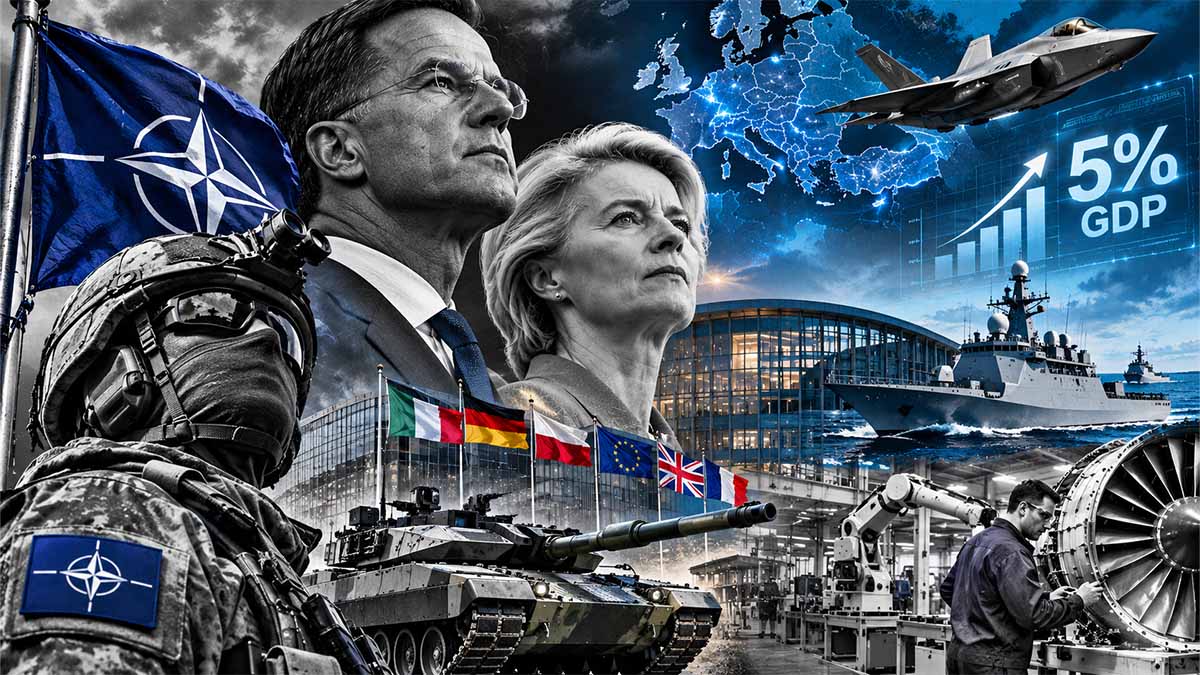
Strategic Deterrence, Transatlantic Burden-Sharing, Defence Industrial Mobilisation and the Future of European Security
Scope: Assessment of NATO’s strategic transformation, collective defence obligations, transatlantic military responsibilities, European defence expenditure and industrial readiness, covering the institutional baseline through November 2026 and a forward analytical horizon to 2031, with the 2035 investment deadline assessed separately.
Executive Summary — Bottom Line Up Front
NATO’s strategic transformation is increasingly defined by the relationship between collective defence, European military responsibility and the ability to convert defence expenditure into operationally credible forces. The central challenge is not simply whether European allies allocate larger percentages of national income to defence. It is whether those resources produce the formations, equipment, ammunition, logistics, infrastructure, industrial capacity and readiness necessary to sustain deterrence without assuming unlimited American reinforcement.
The Hague Summit of 25 June 2025 established a commitment to invest 5% of GDP annually in defence and security-related requirements by 2035, comprising at least 3.5% for core defence requirements and up to 1.5% for broader security and resilience. The agreement also requires annual national plans and provides for a review in 2029. The Hague Summit Declaration — NATO — Jun 2025. NATO Official text
The financial transition is measurable. European allies and Canada increased their combined defence expenditure by nearly 20% in real terms in 2025 compared with 2024, equivalent to more than $90 billion in constant 2021 US dollars, or approximately $139 billion in nominal terms. Nevertheless, NATO’s July 2026 estimates indicated that only five allies were expected to meet the 3.5% core defence guideline during 2026. Defence Investment Update: Record Spending in Europe and Canada — NATO — Jul 2026. NATO News+1
The principal intelligence judgment is that fiscal convergence and military convergence are distinct processes. Defence budgets can rise substantially while deployability, sustainment, force generation and industrial resilience improve more slowly.
A more territorially concentrated NATO would reduce some competing operational demands, but it would not eliminate threats originating beyond Allied territory, nor automatically remove NATO’s existing crisis-management responsibilities.
The decisive question for 2026–2031 is whether European governments can establish a sustainable relationship between national investment, multinational procurement, defence production, operational planning and the continued credibility of American security guarantees.
NATO 3.0: Europe Can Finance Deterrence Faster Than It Can Build It
The 5% commitment is reshaping transatlantic security, but the decisive constraint lies between public expenditure, industrial production and operational military power.
NATO’s commitment to devote 5% of GDP to defence and security by 2035 has exposed a fundamental contradiction in European security policy: governments can approve military expenditure considerably faster than industry can manufacture weapons or armed forces can convert them into operational capability. The Hague agreement of 25 June 2025 has created a new financial benchmark, while NATO’s February 2026 command reform has begun transferring greater operational leadership to European allies. Yet neither development eliminates dependence on American strategic capabilities, fragmented procurement systems or constrained national finances. Germany is expanding military investment, France and Italy face severe fiscal pressures, and the United Kingdom must reconcile its immediate investment programme with longer-term commitments. The central question is no longer whether Europe is prepared to spend more, but whether its institutions can convert expenditure into credible deterrence before financial commitments outpace industrial and military delivery.
The 5% Target Conceals Two Different Defence Economies
The Hague framework divides the 5% of GDP commitment into at least 3.5% for core military requirements and up to 1.5% for broader security-related expenditure, including infrastructure, cyber capabilities, resilience and defence-industrial development. The distinction matters because expenditure on military equipment, personnel and maintenance does not produce the same immediate effects as investment in civilian infrastructure or technological resilience. NATO’s planned 2029 review will examine the trajectory and composition of these commitments, but financial compliance cannot independently establish combat readiness. The Hague Summit Declaration — NATO — June 2025.
The financial acceleration is substantial. European NATO allies and Canada spent more than $571 billion in 2025, measured in constant 2021 dollars, representing nearly 20% real growth over 2024. The nominal increase was approximately $139 billion. Separately, the European Defence Agency recorded €418 billion in EU defence expenditure in 2025, projecting €454 billion for 2026, equivalent to 2.4% of EU GDP. These figures describe different institutional populations and accounting methodologies; treating them as interchangeable would distort the financial assessment. Defence Investment and NATO’s 5% Commitment — NATO — June 2026; EU Defence Spending — European Defence Agency — July 2026.
The more revealing European figures concern the composition of investment. EU equipment procurement reached €115 billion in 2025, but only 24% was classified as collaborative procurement. Defence research and development amounted to €17 billion, with €20 billion projected for 2026. Europe is therefore expanding its military demand while maintaining predominantly national procurement structures. More expenditure does not necessarily produce greater efficiency when governments finance different technical specifications, production arrangements and maintenance systems for comparable military requirements. European Defence Agency — July 2026.
European Command Is Expanding, but American Strategic Dependence Remains
On 6 February 2026, NATO agreed to place all three operational-level Joint Force Commands under European leadership. The United Kingdom would lead Norfolk, Italy Naples, and Germany and Poland would rotate command at Brunssum. The transition moved from agreement to implementation on 24 September 2026, when British General Nick Perry assumed command of Joint Force Command Norfolk. This is a material redistribution of institutional responsibility, not merely an adjustment to national spending targets. European Allies to Take on New Leadership Roles — NATO — February 2026; UK General Takes Command of Joint Force Command Norfolk — NATO — September 2026.
However, the United States retains the position of Supreme Allied Commander Europe, as well as leadership of Allied Air Command, Allied Land Command and Allied Maritime Command under the agreed reform. Greater European responsibility for operational headquarters therefore does not establish autonomy over the strategic capabilities supporting those headquarters. Intelligence, communications, command integration, reinforcement and other enabling systems must be assessed separately from the nationality of senior officers. Allied Command Operations — NATO — July 2026.
Nuclear deterrence makes the limitation still clearer. The United States, United Kingdom and France possess nuclear forces under distinct sovereign arrangements; France remains outside NATO’s Nuclear Planning Group. European conventional expansion cannot automatically reproduce the American nuclear contribution or establish a unified European nuclear authority. The operational redistribution can advance while the structure of strategic deterrence remains fundamentally transatlantic. NATO’s Nuclear Deterrence Policy and Forces — NATO — September 2026.
The Industrial Bottleneck Lies Before Final Assembly
European military production is increasingly constrained by the relationship between finished equipment and the specialised components required to manufacture it. On 14 October 2026, the European Commission allocated €168.2 million to eight projects under the European Defence Industry Programme, supporting €1.26 billion in planned industrial investment across 17 production sites in 14 EU member states and Norway. From 2027, the projects are expected to support annual output exceeding 20,000 tonnes of energetic materials, 3,500 drone and missile propulsion systems, 200,000 loitering-munition warheads and 60 million ammunition units. These are projected production effects, not verified current deliveries. European Commission — October 2026.
The industrial mechanism is decisive. Increasing final assembly capacity has limited military value if energetic materials, electronics, propulsion components or qualified suppliers remain unavailable. Likewise, a procurement contract does not establish completed manufacturing, and installed capacity does not demonstrate sustained production. The October programme indicates that European industrial policy is moving towards upstream constraints, where a relatively small number of specialised processes can determine the output of much larger weapons programmes.
The Commission’s €1.5 billion EDIP work programme, adopted in March 2026, provides targeted support for industrial reinforcement, common projects and cooperation involving Ukraine. The separate SAFE instrument offers up to €150 billion in loans for eligible defence investment through common procurement. Their economic functions differ: EDIP supports selected industrial activities, whereas SAFE provides repayable financing. Neither instrument automatically transforms public funding into delivered military equipment. EDIP Work Programme — European Commission — March 2026; SAFE — European Commission.
National Budgets Are Moving at Different Speeds
Germany represents the clearest example of accelerated fiscal mobilisation. Its 2026 budget identifies €82.7 billion for the Federal Ministry of Defence and approximately €25.5 billion from the Bundeswehr special fund, a combined €108.2 billion across those components. Berlin’s objective of reaching 3.5% of GDP in core defence expenditure by 2029 brings the target forward relative to NATO’s collective deadline. Yet the additional resources create procurement, workforce and maintenance obligations extending beyond initial acquisition. Federal Budget 2026 — German Federal Government.
France faces a different constraint. Its proposed 2026 Defence mission reached €57.1 billion excluding pensions, an increase of €6.7 billion, of which €3.5 billion represented acceleration beyond the existing military programming trajectory. Meanwhile, the European Commission forecast a 2026 deficit of 5.1% of GDP and public debt of 118.1%, rising to 120.2% in 2027. Paris must therefore sustain conventional military modernisation and independent nuclear capabilities within a deteriorating fiscal trajectory. French Defence Budget Proposal 2026 — Ministère des Armées; France Economic Forecast — European Commission — May 2026.
Italy combines industrial potential with particularly restrictive public finances. Its 2026 Ministry of Defence budget amounted to approximately €32.4 billion, but this administrative figure cannot be equated directly with NATO-defined defence expenditure. The Commission projected public debt at 138.5% of GDP in 2026 and 139.2% in 2027, making the financing of recurring military commitments and the reconciliation of expenditure classifications central policy problems. Italian Budget Law 2026 — Chamber of Deputies; Italy Economic Forecast — European Commission — May 2026.
The United Kingdom has established approximately £297.7 billion in Ministry of Defence budgets for 2026–27 through 2029–30, including £15 billion in identified additional investment allocations within that financial framework. The Office for Budget Responsibility estimated that meeting the longer-term defence trajectory would require an additional £35 billion in 2026–27 prices by 2035–36 compared with the 2026–27 expenditure level. London’s four-year investment plan therefore provides a near-term framework but does not eliminate the financing requirements of the 2035 commitment. Defence Investment Plan Funding Explainer — UK Government — June 2026; Economic and Fiscal Outlook — OBR — October 2026.
Territorial Defence Still Depends on Infrastructure Beyond the Frontier
NATO’s reorientation towards territorial deterrence does not eliminate the external systems sustaining European security. The Alliance launched Baltic Sentry in January 2025, Eastern Sentry in September 2025 and Arctic Sentry in February 2026, reflecting different requirements involving undersea infrastructure, airspace security and northern operational coordination. These missions reveal that continental defence depends on maritime access, communications, energy infrastructure and reinforcement routes, not exclusively on forward-deployed combat formations. NATO’s Maritime Activities; Arctic Security — NATO.
A doctrine reducing discretionary operations outside NATO’s treaty area could release selected resources for collective defence. An indiscriminate prohibition, however, could also weaken activities supporting essential maritime communications, external supply routes and infrastructure protection. Article 6 of the North Atlantic Treaty defines the geographical applicability of Article 5; it does not prohibit every other authorised Alliance activity. NATO’s 2022 Strategic Concept and 2025 Hague Declaration continue to recognise deterrence and defence, crisis prevention and management, and cooperative security as core tasks. The North Atlantic Treaty — NATO — April 1949; NATO 2022 Strategic Concept.
The resulting contradiction is operational rather than rhetorical. Territorial concentration can improve the availability of forces for European defence, but Europe remains dependent on transport, communications, supply chains and energy systems whose geographical reach exceeds the immediate battlefield. Protecting these dependencies requires selective external engagement even under a more restrictive interpretation of NATO’s military priorities.
The Next 24 Months Will Test Delivery, Not Declarations
Between November 2026 and November 2028, the principal evidence of progress will emerge from national procurement execution, industrial capacity expansion, implementation of NATO’s command reform and the operational integration of new equipment. The 2027 production targets associated with the Commission’s October 2026 industrial investments provide an early test of whether public subsidies generate actual manufacturing output. The EU’s temporary defence-related fiscal flexibility, covering eligible expenditure through 2028, creates a parallel test of whether governments can convert short-term budgetary space into capabilities with sustainable financing. EDIP Industrial Reinforcement — European Commission — October 2026; National Escape Clause for Defence Expenditure — Council of the European Union.
Failure would impose costs on several constituencies simultaneously. European taxpayers would finance higher expenditure without a corresponding improvement in delivered capability. Armed forces would remain exposed to delayed equipment, insufficient replenishment and expensive sustainment requirements. Defence manufacturers would face uncertain production schedules and potentially inefficient investments, while governments carrying substantial public debt would confront additional financing pressures. Within NATO, persistent capability gaps would prolong reliance on American strategic support even as European command responsibilities expand.
The 2029 Hague review will provide the first formally scheduled collective checkpoint, but the industrial and fiscal consequences will become visible earlier. By November 2028, the meaningful distinction will be between governments that have translated commitments into contracted, delivered and supportable military capabilities and those whose principal achievement remains higher expenditure. Europe’s defence transformation will be measured not by the percentage of GDP allocated to security, but by the military capacity that expenditure actually makes available.
Navigational Index
PILLAR I — STRATEGIC AND INSTITUTIONAL TRANSFORMATION
Chapter 1 — NATO’s Strategic Reorientation: Collective Defence, Treaty Geography and Alliance Doctrine :The institutional and legal foundations of territorial deterrence, the relationship between Articles 3, 4, 5 and 6, and the distinction between political proposals and formally adopted NATO strategy.
Chapter 2 — Transatlantic Burden-Sharing and the Redistribution of Military Responsibility : American and European contributions, the changing allocation of defence responsibilities, command structures, nuclear deterrence and strategic dependencies.
Chapter 3 — Operational Readiness and the Defence of European Territory : Forward defence, reinforcement, air and missile defence, military mobility, ammunition, logistics, force availability and the distinction between nominal force strength and sustained combat capability.
PILLAR II — FINANCIAL, INDUSTRIAL AND NATIONAL CAPABILITY TRANSFORMATION
Chapter 4 — The Economics of the 5% Defence Commitment : The Hague framework, spending definitions, public-finance constraints, expenditure trajectories, procurement efficiency, accounting comparability and the 2029 review mechanism.
Chapter 5 — Europe’s Defence Industrial Base and Strategic Production Dependencies :Industrial mobilisation, ammunition and missile manufacturing, critical technologies, supply-chain bottlenecks, production scaling, procurement fragmentation and transatlantic industrial relations.
Chapter 6 — National Defence Transformation: Germany, France, Italy and the United Kingdom : Separate country assessments of defence policy, fiscal capacity, industrial structures, military responsibilities and implementation constraints, followed by the EU-wide coordination challenge.
PILLAR III — STRATEGIC RISKS, SCENARIOS AND DECISION CONSEQUENCES
Chapter 7 — NATO’s Strategic Exposure and the Geography of Deterrence : Eastern-flank requirements, northern and southern approaches, maritime security, critical infrastructure, cyber threats and the consequences of restricting external operational commitments.
Chapter 8 — Five-Year Strategic Outlook: 2026–2031 : Alternative pathways for European capability development, industrial bottlenecks, alliance cohesion, changing American contributions and observable indicators of implementation.
Chapter 9 — Policy Options and Final Strategic Assessment : Institutional authority, capability priorities, financing mechanisms, industrial coordination, implementation risks, measurable results and the longer-term implications of the 2035 commitment.
Master Abstract
From defence expenditure to effective military power
The transformation of NATO’s European defence posture involves a structural change in the allocation of responsibility for security across the Atlantic. For decades, the Alliance’s operational credibility has depended on an integrated military system combining European armed forces with American strategic capabilities, reinforcement capacity, command integration and industrial resources. Increasing European expenditure addresses one component of this arrangement but does not, by itself, establish equivalent European operational autonomy.
The financial significance of the Hague commitments is substantial. A target of 5% of GDP represents a major increase over the previous 2% benchmark. However, defence expenditure is an input measure rather than an operational output. Its effectiveness depends on the composition of investment, procurement lead times, the sustainability of personnel and equipment, and whether new capabilities correspond to NATO’s defence plans.
The emerging strategic requirement is therefore twofold: to strengthen European conventional capability while preserving the transatlantic integration that underpins the Alliance’s existing deterrence posture. The two objectives are not inherently contradictory. They can nevertheless generate tensions over procurement preferences, command authority, industrial market access, and the distribution of financial and military obligations.
The limits of territorial concentration
A renewed emphasis on the defence of Allied territory is consistent with NATO’s founding treaty. Article 3 establishes the requirement to maintain and develop individual and collective defensive capacity, while Article 5 provides the collective-defence framework. Article 6 defines important geographical limits to the application of the collective-defence obligation. The North Atlantic Treaty — NATO — Apr 1949. NATO Official text
However, the geographical scope of the Article 5 guarantee is not identical to the permissible scope of every NATO activity. Crisis prevention and management, as well as cooperative security, remain among the Alliance’s three formally identified core tasks under its 2022 Strategic Concept. No verified subsequent formal replacement of that concept has been established in the records examined for this assessment. NATO 2022 Strategic Concept — NATO — Jun 2022. NATO Topic
A move towards stricter territorial concentration would consequently require decisions about the future role of crisis management, partnerships, external security assistance and operations undertaken beyond the geographical area of the collective-defence guarantee. Such changes cannot be inferred solely from the Hague defence investment commitment.
The strategic trade-off is material. Concentrating resources on European territorial defence could improve the availability of certain formations and support assets for the Alliance’s regional plans. Conversely, threats to European security may originate through supply routes, maritime approaches, cyber networks or unstable neighbouring regions outside the treaty’s specified Article 5 geography. A territorial orientation must therefore distinguish between prioritising the defence of Europe and disregarding the external systems on which that defence depends.
The industrial dimension of credible deterrence
Defence investment becomes militarily consequential when financial appropriations translate into usable capabilities. NATO’s industrial initiatives explicitly seek to aggregate demand, improve interoperability, address production constraints and strengthen supply chains. Its updated Defence Production Action Plan, endorsed in February 2025 and approved at the Hague Summit, builds on the original 2023 framework. Increasing Defence Industrial Production — NATO — Jul 2026. NATO Topic
For European governments, this creates an implementation problem that extends beyond defence ministries. Industrial expansion requires predictable orders, financing, production inputs, workforce availability, qualified suppliers, infrastructure and long-term procurement coordination. Higher appropriations cannot instantaneously overcome capacity constraints.
The European Union’s SAFE instrument provides up to €150 billion in loans for defence investment through common procurement. Its financing structure and industrial eligibility requirements create opportunities for coordinated European production, while also introducing questions about compatibility with NATO-wide procurement and transatlantic supply chains. What Is Security Action for Europe (SAFE)? — Council of the European Union — 2025. Consilium
This intersection between financing, industrial capacity and military requirements is central to the credibility of the 2035 target. A successful transformation cannot be measured by aggregate spending alone. It also requires evidence that military formations can be equipped, deployed, reinforced and sustained, and that industrial systems can replenish equipment and munitions during a prolonged crisis.
Divergent national responsibilities
The principal European powers face different operational and fiscal problems. Germany is relevant to continental logistics, reinforcement and the industrial foundations of European conventional defence. France combines continental defence responsibilities with national strategic forces and an extensive defence industrial structure. Italy links continental commitments with Mediterranean security, maritime logistics and southern-flank requirements. The United Kingdom remains a major non-EU European NATO member, with nuclear deterrence, maritime capabilities and an important role in transatlantic military integration.
These distinctions prevent a uniform assessment based exclusively on percentages of GDP. Defence expenditure must also be evaluated against each country’s force commitments, procurement structures, industrial responsibilities, sovereign capabilities and operational exposure.
At the collective level, the European Union can facilitate financing, industrial integration and procurement coordination, but NATO retains its distinct collective-defence and military-planning structures. The effectiveness of European defence investment will depend in part on aligning these two institutional systems without duplicating responsibilities or creating incompatible capability requirements.
Key Evidence Table
| Indicator | Value / status | Reference date | Definition / scope | Issuer | Exact source |
|---|---|---|---|---|---|
| NATO membership | 32 allies | 2026 | North Atlantic Alliance | NATO | Introduction to NATO |
| New defence investment commitment | 5% of GDP by 2035 | 25 Jun 2025 | Core defence plus eligible security-related spending | NATO heads of state and government | Hague Declaration, §§2–3 |
| Core military expenditure | At least 3.5% of GDP | 25 Jun 2025 | NATO-defined defence expenditure and capability targets | NATO | Hague Declaration, §3 |
| Broader security expenditure | Up to 1.5% of GDP | 25 Jun 2025 | Infrastructure, resilience, cyber and industrial requirements | NATO | Hague Declaration, §3 |
| Spending increase | Nearly 20% real growth | 2025 vs 2024 | European NATO allies and Canada, combined | NATO | Defence Investment and NATO’s 5% Commitment |
| Nominal spending increase | Approximately $139bn | 2025 vs 2024 | European allies and Canada; nominal US dollars | NATO | Defence Investment and NATO’s 5% Commitment |
| Expected core-spending compliance | 5 allies | 2026 forecast | Expected to meet 3.5% guideline | NATO | Defence Investment Update, Jul 2026 |
| Expected broader-spending compliance | 17 allies | 2026 forecast | Expected to meet 1.5% guideline | NATO | Defence Investment Update, Jul 2026 |
| Planned investment review | 2029 | Hague agreement | Review of spending trajectory and composition | NATO | Hague Declaration, §3 |
| EU defence financing | Up to €150bn | Instrument effective 29 May 2025 | Loans for eligible defence investment | Council of the EU | SAFE |
| NATO core strategic tasks | 3 | 2022 Strategic Concept | Deterrence and defence; crisis prevention and management; cooperative security | NATO | 2022 Strategic Concept |
Expenditure forecasts are not final audited outcomes. The $139 billion nominal increase and the real-terms growth figure represent different price bases and should not be treated as interchangeable measures. A financial target also does not establish the operational availability of the forces or equipment it is intended to finance.
Competing Strategic Pathways
Three analytically distinct pathways can be considered for the period 2026–2031. These are not mutually exclusive in every respect, since different allies may follow different implementation trajectories.
| Pathway | Supporting conditions | Principal constraints | Indicators to monitor | Present assessment |
|---|---|---|---|---|
| European capability convergence | Sustained national investment, coordinated procurement, expanding industrial output and credible NATO capability plans | Production lead times, recruitment, force sustainment and divergent national priorities | Deliveries, force readiness, ammunition replenishment and multinational deployment performance | Financial momentum is documented; full operational convergence is not established |
| Fiscal expansion without equivalent readiness | Defence budgets increase faster than equipment deliveries and force generation | Procurement delays, fragmented requirements, personnel costs and industrial bottlenecks | Persistent capability gaps despite rising expenditure | A consequential implementation risk requiring country-level evidence |
| Greater European responsibility with selective transatlantic reallocation | European conventional forces expand while American contributions become more concentrated in selected strategic functions | Command integration, strategic enablers, nuclear deterrence and political coordination | Adjustments to force posture, command assignments, reinforcement commitments and capability allocation | A plausible strategic pathway, but not an established Alliance-wide operational outcome |
The current record supports a conclusion of rapid financial adjustment combined with unresolved operational implementation. It does not establish that NATO has already completed a comprehensive reallocation of American and European military responsibilities.
Principal Intelligence Gaps and Watch Indicators
Capability conversion and operational readiness
The foremost intelligence gap concerns the conversion of higher national budgets into operationally available forces. NATO’s aggregate expenditure publications demonstrate financial inputs, but they do not provide a complete public account of mission-capable equipment, ammunition endurance, reinforcement performance or unit-level readiness across every ally.
The relevant future observations include national procurement delivery records, publicly released exercise assessments, force-generation commitments and NATO capability implementation statements.
The practical scope of NATO’s strategic reorientation
The Hague investment agreement confirms increased attention to territorial defence and stronger industrial cooperation. It does not independently establish the formal abandonment of crisis management or other existing strategic tasks.
A new Strategic Concept, explicit North Atlantic Council decisions, or officially announced changes to NATO’s operational responsibilities would provide a stronger basis for determining whether a narrower mission has become formal Alliance policy.
Transatlantic military responsibilities
The ability of European allies to assume additional responsibilities depends not only on conventional forces but also on intelligence, command and control, strategic transport, communications, air and missile defence and sustainment.
A change in the distribution of military responsibilities cannot be established from national expenditure announcements alone. Public evidence would need to include specific capability transfers, operational assignments, reinforcement commitments and documented readiness results.
Defence industrial production
The relevant indicators are not solely announced investment programmes or nominal production capacity. They include contracted quantities, delivery schedules, actual production rates, critical component availability, supply-chain resilience and the ability to sustain output over multiple years.
The principal distinction is between industrial capacity announced, industrial capacity installed and military equipment actually delivered.
The 2029 investment review
The Hague framework establishes 2029 as a formal review point for spending trajectories and the balance between expenditure categories. This creates an identifiable institutional checkpoint before the 2035 deadline.
The review’s strategic value will depend on whether progress is evaluated against capability requirements and implementation evidence, rather than simply against expenditure percentages.
Strategic Decision Implications
Three decision problems arise from the evidence.
First, defence expenditure must be connected to operational requirements. The responsible national authorities control budgets and procurement decisions, while NATO’s integrated planning processes identify collective capability needs. The expected benefit of closer alignment is a reduction in the gap between financial commitments and usable military resources. The burden lies in coordinating national procurement schedules, force structures and industrial investment across different fiscal and political systems.
Second, industrial coordination must preserve military interoperability. EU financing instruments and NATO industrial initiatives can strengthen procurement predictability and production capacity, but differing eligibility rules and industrial preferences may complicate transatlantic acquisition. The expected effect depends on how effectively procurement authorities reconcile supply security, competitive production, sovereign technology requirements and Alliance interoperability. Decisions taken through long-term industrial contracts can also create dependencies that are difficult or expensive to reverse.
Third, any redistribution of American and European defence responsibilities must preserve credible deterrence during the transition. Military capability cannot be transferred instantaneously through a political commitment or an increase in spending. Changes to force posture, strategic support and command responsibilities would carry implementation burdens and potentially significant second-order consequences for reinforcement, readiness and alliance cohesion.
These considerations distinguish three separate conditions: political commitment, funded implementation and demonstrated operational capability. Treating them as equivalent would overstate the maturity of Europe’s defence transformation.
No decision-useful visualisation is supportable from the verified record.
Final Assessment of the Dossier Opening
NATO’s 5% commitment establishes a measurable framework for expanding defence investment, but its full strategic significance will depend on the relationship between military requirements, national implementation and industrial delivery.
The Alliance’s transition cannot be judged solely by the number of governments meeting spending benchmarks. It also depends on whether European armed forces develop the equipment, force structures, logistical endurance, command integration and operational availability required for credible collective defence.
The difference between territorial prioritisation and the formal elimination of external missions remains institutionally important. The North Atlantic Treaty defines the collective-defence guarantee, while NATO’s strategic concepts and political decisions establish a wider framework of activities. A fundamental revision of that framework requires identifiable collective decisions, not merely a change in national political emphasis.
The critical test between 2026 and 2031 will be whether financial expansion becomes sustained European military capacity while the transatlantic deterrence structure remains operationally credible. The 2029 review and subsequent national implementation records will provide important evidence for assessing that transition before the 2035 investment deadline.
NATO 3.0: THE EUROPEAN DEFENCE RESET
From fiscal commitments to operational deterrence. An interactive assessment of NATO’s 2035 investment framework, European capability development, industrial mobilisation and strategic responsibility.
The Architecture of the 5% Commitment
NATO’s adopted investment framework distinguishes core defence expenditure from broader eligible security and resilience expenditure.
Investment Composition
The chart illustrates the 3.5% + 1.5% reference composition. It is a policy allocation, not a measurement of actual spending.
Expected Guideline Compliance
Categories overlap: the bars are not additive. Values represent anticipated 2026 compliance, not final outcomes.
Investment Growth and Implementation
Reported Defence Spending Growth
2025 / 2024Real growth is shown on a 0–100% percentage scale. The nominal monetary indicator uses its own labelled display bar and must not be compared visually as a percentage. Coverage: European allies and Canada.
From Budgets to Military Capability
ANALYTICAL MODELAppropriations must finance contracts, production and deliveries before they can generate equipped, trained, deployable and sustainable forces. This is a dependency chain, not a quantified conversion rate.
NATO Investment Milestones
Hague Summit adopts the 5% investment commitment.
NATO reports expenditure estimates and progress against new guidelines.
Scheduled review of the investment trajectory and composition.
Deadline for the agreed 5% GDP investment framework.
Three Pillars of European Defence Transformation
Strategic Doctrine
Territorial deterrence, treaty obligations, transatlantic responsibility and the distinction between NATO policy and political proposals.
Financial & Industrial Capacity
Defence financing, multinational procurement, industrial production, workforce and critical supply chains.
Operational Resilience
Force readiness, reinforcement, ammunition, military mobility, logistics, strategic enablers and sustainable deterrence.
European Defence Capability Matrix
Qualitative strategic roles, not country capability rankings or performance scores.
| Country / institution | Strategic role | Implementation requirement | Relevant domain |
|---|---|---|---|
| Germany | Continental reinforcement | Mobility and industrial capacity | Land / logistics |
| France | Strategic forces and conventional defence | Force and industrial sustainment | Nuclear / conventional |
| Italy | Mediterranean and continental security | Maritime and logistical readiness | Southern flank / maritime |
| United Kingdom | Transatlantic military integration | Strategic enablers and maritime forces | Maritime / nuclear |
| European Union | Financing and procurement coordination | Compatible industrial requirements | Industrial / financial |
Interactive Strategic Scenario Explorer
Select a pathway to examine its mechanism, principal constraint and observable indicators. No unsupported scenario probabilities are assigned.
European Capability Convergence
Sustained investment, coordinated procurement and industrial expansion improve the conversion of spending into deployable forces.
Official Documentary Foundations
| Indicator | Value / status | Reference | Authority |
|---|---|---|---|
| Defence investment commitment | 5% GDP / 2035 | 25 Jun 2025 | NATO |
| Core military component | 3.5% GDP | 25 Jun 2025 | NATO |
| Eligible security component | Up to 1.5% GDP | 25 Jun 2025 | NATO |
| Expected core-compliant allies | 5 / 32 | 2026 estimate | NATO |
| Expected security-compliant allies | 17 / 32 | 2026 estimate | NATO |
| EU SAFE loan instrument | Up to €150bn | 2025 | Council of the EU |
PILLAR I — STRATEGIC AND INSTITUTIONAL TRANSFORMATION
OPEN-SOURCE STRATEGIC INTELLIGENCE ASSESSMENT
Reference date: 9 November 2026 | Geographic scope: NATO, Europe and the North Atlantic | Strategic horizon: 2026–2031
Chapter 1 — NATO’s Strategic Reorientation: Collective Defence, Treaty Geography and Alliance Doctrine
Principal judgment: NATO’s strategic transformation is entering a phase in which territorial defence, European military responsibility and the enforceability of collective commitments are becoming more closely connected. Nevertheless, the institutional evidence establishes an important distinction between an increasingly concentrated military posture and a formal revision of the Alliance’s strategic mandate. The North Atlantic Treaty already establishes collective defence as NATO’s fundamental security guarantee. The 2022 Strategic Concept and the 2025 Hague Summit Declaration retain additional responsibilities for crisis prevention, crisis management and cooperative security. A narrower territorial doctrine would therefore represent a substantial political and institutional choice rather than the automatic consequence of higher defence expenditure.
The Alliance’s legal architecture: Four articles, four distinct functions
The institutional foundation of NATO’s transformation is the North Atlantic Treaty, signed in Washington on 4 April 1949. Its significance is not confined to the collective-defence obligation contained in Article 5. The Treaty establishes a system in which the development of national defence capacity, political consultation, collective military assistance and geographical applicability perform different but complementary functions. A strategic assessment that treats those provisions as interchangeable risks confusing three separate issues: the obligation to prepare for defence, the political decision to respond to a threat, and the legal consequences of an armed attack.
Article 3 establishes the continuing obligation of individual and collective defensive preparation. It requires the parties to maintain and develop their capacity to resist armed attack through continuous self-help and mutual assistance. Its importance extends beyond military budgets because effective resistance depends upon national institutions, civilian infrastructure, transport systems, energy availability, communications and the capacity to maintain government functions during a crisis. Article 3 consequently supplies the enduring treaty foundation for NATO’s emphasis on readiness, resilience and national responsibility. The 2025 decision to raise defence investment commitments can be understood as a political mechanism intended to reinforce this existing obligation, not as a new treaty article or a treaty amendment.
Article 4 establishes the consultation mechanism whenever an ally considers its territorial integrity, political independence or security threatened. Its threshold is different from that of Article 5: consultation does not require an armed attack to have occurred. This distinction is strategically consequential because coercion, sabotage, cyber disruption, military intimidation and ambiguous incidents can produce serious security concerns before the legal and factual conditions for collective defence are established. Article 4 permits political coordination under such circumstances without automatically requiring the Alliance to characterise an incident as an armed attack.
Article 5 provides the collective-defence undertaking. It establishes that an armed attack against one or more allies within its specified scope is considered an attack against them all. However, the provision does not prescribe an identical military response by every state. Each ally undertakes to assist by taking the action it considers necessary, which may include armed force. The Treaty expressly relates this obligation to the inherent right of individual and collective self-defence recognised under Article 51 of the United Nations Charter. The distinction between a binding obligation to assist and the national determination of particular measures is essential when evaluating the practical reliability of Allied contributions.
Article 6 defines the geographical applicability of Article 5, including specified territories and certain attacks against Allied forces, vessels and aircraft. It does not establish a general prohibition on NATO activities outside those areas. Its legal function is to clarify the collective-defence guarantee, not to determine the geographical limits of every operation, partnership, training mission or security activity that the Alliance may undertake under appropriate authority.
These provisions should be interpreted together rather than as competing alternatives. Article 3 establishes continuous preparation; Article 4 provides consultation; Article 5 establishes collective assistance following an armed attack within its applicable scope; and Article 6 helps determine that scope. The authoritative legal foundation is The North Atlantic Treaty — NATO — April 1949. NATO Official text
Treaty-function matrix
| Treaty provision | Legal function | Threshold or obligation | Institutional consequence | Strategic relevance |
|---|---|---|---|---|
| Article 3 | Individual and collective defence capacity | Continuous obligation to maintain and develop defensive capacity | National preparation and mutual assistance | Readiness, infrastructure, resilience and capability development |
| Article 4 | Political consultation | An ally considers its territorial integrity, political independence or security threatened | Consultation among allies | Crisis coordination before or independently of Article 5 |
| Article 5 | Collective defence | Armed attack within the Treaty framework | Obligation to assist, with measures determined by each ally | Credibility of deterrence and collective response |
| Article 6 | Geographical applicability | Specified territories and categories of attacks | Defines the geographical scope of Article 5 | Territorial coverage and operational legal interpretation |
| Article 9 | Institutional governance | Establishes the North Atlantic Council | Political oversight and subsidiary institutions | Collective decision-making and implementation |
Source: The North Atlantic Treaty, Articles 3–6 and 9 — NATO — April 1949.
The geographical distinction between collective defence and military operations
Article 6 deserves particular attention because an exclusively territorial interpretation of NATO’s future could otherwise produce a misleading understanding of the Alliance’s legal obligations. The provision refers not only to Allied territory in Europe and North America but also to Türkiye, specified North Atlantic islands and attacks against Allied forces, vessels or aircraft in the geographical circumstances described by the Treaty. Its historical wording also contains references affected by subsequent legal developments, including the former Algerian departments of France. The NATO-published Treaty includes explanatory notes concerning these changes.
Geographical interpretation must therefore distinguish territorial sovereignty, the location of a military incident, the status of forces and the applicable Treaty provisions. An attack on an Allied vessel in a covered maritime area, for example, raises a different Article 6 question from an attack on an Allied military installation outside the geographical scope specified by that article. The legal analysis cannot be reduced to whether an incident occurs physically within the land borders of a NATO member.
This distinction is important for European states possessing maritime forces, overseas installations, international shipping interests and military deployments beyond their metropolitan territories. The existence of a national interest or military presence outside the Article 6 geographical framework does not, by itself, establish that the collective-defence guarantee applies. Conversely, the absence of automatic Article 5 coverage does not establish that NATO is legally incapable of discussing the incident, coordinating appropriate activities or deciding upon another lawful collective response.
The operational implications extend to naval security, maritime reinforcement, strategic communications, counterterrorism cooperation and the protection of supply chains connecting Europe to external regions. A doctrine concentrated on European territorial defence would still need to account for external activities directly supporting that defence, including protection of maritime communications and the movement of military resources between North America and Europe. The Treaty does not resolve all of these operational choices automatically; it leaves substantial responsibility to Allied political decision-making and the applicable international legal framework. The North Atlantic Treaty — NATO — April 1949.
NATO doctrine: The difference between strategic prioritisation and formal doctrinal change
The most important institutional distinction concerns the relationship between NATO’s evolving defence priorities and its formally approved strategic doctrine. At the Madrid Summit on 29 June 2022, Allied leaders adopted a Strategic Concept identifying three core tasks: deterrence and defence, crisis prevention and management, and cooperative security. This architecture explicitly recognises territorial defence as fundamental while retaining mechanisms addressing instability, partnerships and security challenges affecting the Euro-Atlantic area.
The Hague Summit Declaration of 25 June 2025 intensified the emphasis on defensive capabilities and national investment commitments, but it also referred explicitly to all three core tasks. Consequently, the official declaration does not substantiate the proposition that NATO had formally abolished crisis-management responsibilities or adopted a complete prohibition on military activities outside the geographical area specified by Article 6.
This is not a merely semantic distinction. NATO’s Strategic Concept performs a political and doctrinal function by establishing shared priorities. Defence plans translate those priorities into military requirements. National governments then retain responsibility for financing and generating much of the force structure needed to implement them. A change in one element does not automatically constitute a change in the others.
The authoritative records are NATO 2022 Strategic Concept — NATO — June 2022 and The Hague Summit Declaration — NATO — June 2025. NATO Topic+1
A concentration of resources on territorial defence can occur without revising the Strategic Concept. Governments may prioritise ammunition, air defence, heavy formations, reinforcement infrastructure and readiness while preserving the legal and institutional ability to undertake other missions. A formal narrowing of NATO’s mission, by contrast, would require identifiable collective decisions affecting strategic guidance, operational planning and potentially established commitments. As of the report’s reference date, the official instruments verified here support a significant reorientation of priorities, but not the conclusion that the Alliance’s three-task framework has been formally abolished.
The North Atlantic Council and the institutional control of collective action
The North Atlantic Council is NATO’s principal political decision-making body. Its authority derives from Article 9 of the Treaty and the institutional arrangements developed by the Alliance. NATO decisions are normally reached through consensus rather than majority voting. This means that military adaptation must be understood not only through changes in the preferences of the largest allies but also through the requirement to reconcile the national security interests of the entire membership.
The consensus structure is particularly relevant to discussions of a more geographically restricted NATO. Different allies occupy different strategic positions and face distinct combinations of territorial, maritime, economic and security exposures. States bordering Russia or Belarus face different immediate geographical concerns from allies whose security responsibilities include major North Atlantic reinforcement routes, Mediterranean maritime approaches or the protection of strategically important external lines of communication.
A strategic reorientation therefore creates an institutional coordination problem: allocating sufficient political and military attention to territorial defence while avoiding an interpretation of Alliance security that disregards dependencies beyond Allied territory. This problem is not resolved simply by concentrating defence budgets on military equipment. Decisions about which missions remain necessary, which activities can be undertaken nationally or through other institutions, and which capabilities must remain under NATO’s integrated planning system require agreement among governments.
The institutional authority for these decisions is established in The North Atlantic Treaty, Article 9 — NATO — April 1949, while the continuing strategic responsibilities are set out in NATO 2022 Strategic Concept — NATO — June 2022.
The NATO Defence Planning Process: Translating strategic doctrine into national obligations
The NATO Defence Planning Process, or NDPP, provides the institutional connection between political strategy and national military capability development. Its significance is greater than that of a conventional budgetary coordination mechanism because it identifies required capabilities, distributes responsibilities among allies, supports implementation and evaluates progress against agreed objectives.
The process encompasses five stages within a normally four-year planning cycle. Political guidance establishes the ambitions to be supported. The strategic commands identify minimum capability requirements. Those requirements are apportioned among allies through capability target packages. NATO then facilitates implementation, including multinational cooperation. Finally, the Alliance evaluates national plans and progress against its requirements. Implementation is continuous, while formal capability reviews take place twice during the cycle.
The 2025 capability-target process is particularly relevant because it connects NATO’s updated regional defence plans with requirements for additional forces and equipment. Public NATO documentation identifies air and missile defence, long-range weapons, logistics and large land manoeuvre formations among the priorities. However, the detailed national allocations and certain operational assessments are not comprehensively public. It would therefore be unjustified to infer from aggregate expenditure figures that every member has satisfied its assigned military requirements.
The official procedural record is NATO Defence Planning Process — NATO — April 2025, supplemented by NATO’s Role in Capability Development — NATO. NATO Topic+1
Defence-planning responsibility matrix
| Planning stage | Institutional responsibility | Principal output | National implementation requirement | Verification issue |
|---|---|---|---|---|
| Political guidance | Allies through NATO political structures | Strategic objectives and level of ambition | Alignment of national defence priorities | Consistency between declared priorities and resources |
| Capability requirements | Allied Command Transformation and Allied Command Operations | Minimum capability requirements | Identification of national contribution possibilities | Operational suitability of the requirements |
| Target apportionment | NATO strategic commands, international staff and allies | Capability target packages | Integration into national military plans | Acceptance and implementation of assigned targets |
| Implementation | National governments, supported by NATO coordination | Programmes, acquisitions, formations and support arrangements | Financing, contracting, training and sustainment | Delivery against agreed milestones |
| Capability review | NATO planning and military authorities | Assessment of progress and shortfalls | Corrective national planning | Actual operational adequacy and remaining gaps |
Source: NATO Defence Planning Process — NATO — April 2025.
A distinctive feature of the NDPP is the procedure through which national capability targets are considered. NATO describes a consensus-minus-one approach for examining target packages, preventing an ally from unilaterally vetoing an otherwise agreed package concerning itself. The mechanism strengthens collective planning discipline, although the implementation of capabilities remains dependent on national authorities, budgets, defence institutions and procurement arrangements. This illustrates the difference between the Alliance’s capacity to agree military requirements and its practical ability to ensure that those requirements are fulfilled within the necessary period.
Territorial defence as a political commitment and an operational condition
The strategic credibility of collective defence depends on the relationship between declared commitments and observable implementation. A political promise to defend Allied territory communicates intent, but deterrence also requires an adversary to assess that the Alliance possesses the capability, readiness and political mechanisms necessary to respond. This produces three distinct credibility dimensions: political solidarity, military availability and the ability to sustain operations over time.
Political solidarity depends on the willingness of governments to undertake collective action. Military availability depends on forces and capabilities meeting the requirements for deployment and employment. Sustained operations depend on reinforcement, maintenance, ammunition, logistics, infrastructure and the continuing functioning of national institutions. Weakness in any dimension can diminish the practical effect of the others.
A territorially concentrated defence posture consequently has implications well beyond the location of combat formations. It changes the importance of national mobilisation systems, civilian preparedness, infrastructure protection, reserve arrangements and the ability to coordinate cross-border military movement. It also raises questions about how allies should allocate resources between persistent forward presence and forces positioned elsewhere but intended for rapid reinforcement.
The resulting institutional problem is not simply how much of NATO’s activity should occur within Europe. It is how political decision-making, national preparation and military command can remain sufficiently integrated to make collective defence credible under conditions of uncertainty and limited reaction time.
The legal and strategic implications of restructuring external missions
A reduction of NATO activities outside its principal territorial-defence mission would require distinctions between different categories of activity. A military operation undertaken to manage a crisis, a capacity-building partnership, a training mission, naval surveillance supporting reinforcement and a collective-defence deployment do not necessarily involve the same legal authority or strategic purpose.
An across-the-board prohibition on external operations could therefore have consequences different from a policy that reduces discretionary crisis-management commitments while preserving external activities essential to defending Allied territory. For example, the security of North Atlantic reinforcement is operationally connected to European defence even when relevant military activity takes place away from the immediate European land frontier. Similarly, maritime surveillance and cooperation with partners can contribute to situational awareness without necessarily creating an open-ended commitment to external intervention.
The legal framework leaves considerable room for political choice. It does not, however, establish that the geographical limits of Article 5 automatically invalidate other authorised NATO activities. The relevant institutional question is whether governments intend to modify the strategic tasks themselves, change their relative priority, or adjust operational commitments within the existing framework.
The distinction is supported by the continued inclusion of three core tasks in The Hague Summit Declaration — NATO — June 2025.
Key judgments — Chapter 1
The North Atlantic Treaty establishes a differentiated system of defensive preparation, consultation, collective assistance and geographical applicability. Its provisions cannot be reduced to a single territorial rule without losing important legal and institutional distinctions.
The Hague commitments reinforce national and collective defensive preparation but do not constitute a formal abandonment of the three core tasks recognised in the 2022 Strategic Concept.
The NDPP is the principal institutional mechanism through which strategic priorities become national military capability requirements. Its effectiveness ultimately depends on implementation rather than on target allocation alone.
A narrower operational emphasis can be pursued within NATO’s existing institutional framework. A formal change to the Alliance’s strategic mission would require identifiable collective decisions and corresponding changes to planning and implementation.
What would change the assessment: Adoption of a replacement Strategic Concept, an explicit North Atlantic Council decision discontinuing specified mission categories, or official revisions to the military planning framework establishing materially different responsibilities.
Open official record: Detailed national capability target packages, sensitive operational plans and comprehensive implementation assessments are not fully available through the public documents examined. These gaps prevent a definitive assessment of the degree to which an evolving political doctrine has already altered every national military obligation.
Chapter 2 — Transatlantic Burden-Sharing and the Redistribution of Military Responsibility
Principal judgment: The redistribution of military responsibility within NATO is already producing identifiable institutional changes. The most consequential publicly documented development is the February 2026 agreement to transfer leadership of all three operational-level Joint Force Commands to European allies while preserving American leadership at the strategic level and across the Alliance’s principal theatre component commands. This arrangement does not establish American military withdrawal from Europe. It represents a differentiated redistribution of command responsibilities in which European leadership expands while critical elements of NATO’s integrated operational architecture remain under American command.
The February 2026 command reform: An institutional redistribution of responsibility
On 6 February 2026, NATO announced an agreement changing the distribution of senior military leadership across its Command Structure. Under this arrangement, the United Kingdom would assume command of Joint Force Command Norfolk, Italy would assume command of Joint Force Command Naples, and Germany and Poland would share command of Joint Force Command Brunssum through a rotational system. The United States would retain the position of Supreme Allied Commander Europe and lead the Alliance’s three theatre component commands: Allied Air Command, Allied Land Command and Allied Maritime Command.
This allocation is particularly important because it separates operational-level leadership from theatre-wide functional command. Joint Force Commands are responsible for planning, conducting and sustaining major joint operations under the authority of the Alliance’s command system. Theatre component commands provide specialised expertise and command structures for operations in their respective domains. Consequently, placing European officers in charge of all three Joint Force Commands changes the nationality of senior operational leadership without transferring every component of theatre-level military authority away from the United States.
Implementation is gradual rather than instantaneous. NATO specified that the redistribution would be introduced over the following years in accordance with scheduled personnel rotations. One concrete milestone had already occurred by September 2026: on 24 September, British General Nick Perry assumed command of Joint Force Command Norfolk, succeeding US Navy Vice Admiral Doug Perry. The announcement provided direct evidence that the institutional agreement was moving into implementation rather than remaining exclusively a political declaration.
The relevant official records are European Allies to Take on New Leadership Roles in NATO’s Command Structure — NATO — February 2026 and UK General Takes Command of NATO’s Joint Force Command in the US — NATO — September 2026. NATO News+1
The strategic significance lies in the distribution of command responsibilities rather than the nationality of individual commanders alone. The reform increases European responsibility for operational planning and multinational force integration. It also preserves the American role in the command architecture responsible for coordinating land, maritime and air capabilities across the Alliance. This creates a transition in which European institutional leadership and American military integration remain mutually dependent.
NATO command redistribution: Decisions and implementation status
| Command | Headquarters | Agreed leadership arrangement | Documented status | Strategic function |
|---|---|---|---|---|
| Supreme Allied Commander Europe — SACEUR | SHAPE, Mons, Belgium | United States retains leadership | US command maintained | Strategic command of Allied operations |
| Joint Force Command Norfolk | Norfolk, United States | United Kingdom | British command assumed on 24 September 2026 | Joint operational command, including North Atlantic responsibilities |
| Joint Force Command Naples | Naples, Italy | Italy | Agreed transition; completed transfer not established by the cited reform announcement | Joint operational planning and execution |
| Joint Force Command Brunssum | Brunssum, Netherlands | Germany and Poland, rotating | Agreed transition; completed rotation not established by the cited reform announcement | Joint operational planning and execution |
| Allied Air Command | Ramstein, Germany | United States | US leadership retained under reform | Theatre air command |
| Allied Land Command | İzmir, Türkiye | United States | US leadership retained under reform | Theatre land command |
| Allied Maritime Command | Northwood, United Kingdom | United States | New US leadership allocation agreed | Theatre maritime command |
Sources: European Allies to Take on New Leadership Roles in NATO’s Command Structure — NATO — February 2026; Allied Command Operations — NATO — July 2026; UK General Takes Command of NATO’s Joint Force Command in the US — NATO — September 2026.
The table distinguishes agreed leadership changes from verified completed transfers. An agreement concerning the future nationality of a commander does not establish that the relevant command has already changed hands. Nor does a transfer of headquarters leadership demonstrate that all personnel, assets, national forces or supporting capabilities have been transferred to the same country.
SACEUR and the continuing American strategic role
The position of Supreme Allied Commander Europe remains central to NATO’s military command architecture. SACEUR heads Allied Command Operations and is responsible to NATO’s Military Committee for the conduct of Allied military operations. The command operates from Supreme Headquarters Allied Powers Europe in Mons, Belgium, and is responsible for preparing, planning and executing NATO military activities within its authorised responsibilities.
General Alexus G. Grynkewich of the United States Air Force assumed the position on 4 July 2025. NATO’s published description of the position identifies the traditional dual-hatted relationship between SACEUR and the command of US European Command. This relationship has long provided an important institutional connection between American military resources and the Alliance’s integrated planning system.
The authority of SACEUR should not be confused with independent political sovereignty over Allied forces. NATO operations are conducted within the Alliance’s political and military decision-making framework, and force contributions remain subject to national arrangements, including the relevant transfer-of-authority procedures. SACEUR identifies military requirements and requests forces through authorised mechanisms; the existence of a NATO command headquarters does not mean that it permanently possesses unrestricted authority over every national formation.
This distinction is essential when considering a potential redistribution of American and European military responsibilities. Command structures can be redesigned more rapidly than national force capabilities can be generated or replaced. An operational headquarters led by a European general may still depend on intelligence systems, communications, logistics, equipment or other enabling capabilities provided by multiple nations, including the United States.
The relevant official descriptions are Supreme Allied Commander Europe — NATO — July 2025 and Allied Command Operations — NATO — July 2026. NATO Topic+1
The principal analytical consequence is that European command leadership and European operational self-sufficiency are not equivalent conditions. An assessment of the Alliance’s future military balance must examine the personnel nationality of commanders, the availability of operational assets, the distribution of strategic enabling systems and the legal authority under which national forces are transferred to NATO operations. Treating a change of command as evidence of complete military autonomy would materially overstate the scale of the transformation.
The distribution of national military power and collective responsibility
The redistribution of responsibility within NATO cannot be measured entirely through the distribution of defence expenditure. Financial contributions are relevant because they establish the resources available for military development, but the Alliance depends on capabilities that are not interchangeable merely because they have comparable monetary values.
A country contributing additional land formations does not necessarily replace another country’s strategic intelligence capabilities. Additional artillery systems do not automatically provide equivalent air defence, strategic transportation or operational command capacity. Similarly, the expansion of military personnel does not establish that those personnel possess adequate training, equipment, sustainment arrangements or deployment authority.
NATO’s military organisation explicitly distinguishes the Command Structure from the Force Structure. The former provides the permanent command architecture; the latter comprises national and multinational forces and headquarters made available for Alliance purposes under applicable arrangements. Their readiness criteria and transfer-of-authority procedures can differ among nations. The NATO Force Model provides the mechanism through which forces are organised and managed for Alliance requirements.
These distinctions are documented in Military Organisation and Structures — NATO — September 2025 and NATO Force Model — NATO. NATO Topic+1
The resulting burden-sharing problem has several dimensions. Financial responsibility determines how much national income is allocated to security. Capability responsibility determines which military systems and formations a state is expected to provide. Operational responsibility concerns the authority and readiness necessary to use those capabilities. Strategic responsibility concerns the provision of functions whose importance extends across the Alliance, including nuclear deterrence and certain military enabling systems.
These dimensions can evolve at different speeds. Higher European expenditure may support future equipment purchases before it produces additional operational formations. The transfer of headquarters leadership may occur while national procurement programmes remain incomplete. Additional conventional forces may improve regional defence while leaving strategic dependencies substantially unchanged.
Burden-sharing assessment matrix
| Dimension | Relevant measure | What the measure establishes | What it cannot establish alone |
|---|---|---|---|
| Financial contribution | Defence expenditure and committed investment | Resources allocated to defence | Operational availability |
| Capability contribution | Equipment and force commitments | Planned or existing military resources | Mission-capable strength |
| Command responsibility | Leadership of NATO headquarters | Institutional command allocation | Ownership of supporting capabilities |
| Force availability | Declared readiness and deployment arrangements | Conditions under which forces may be generated | Sustained performance in conflict |
| Strategic enabling capacity | Intelligence, communications, transport and other support systems | Availability of critical support functions | Complete national or European autonomy |
| Nuclear contribution | Nuclear forces, participation and relevant support arrangements | Elements of deterrence architecture | Automatic agreement over nuclear employment |
| Industrial contribution | Contracts, production and deliveries | Material contribution to force development | Immediate combat readiness |
This matrix is an analytical classification derived from NATO’s institutional distinctions. It does not assign quantitative weights or imply that the categories can be aggregated into a single burden-sharing score.
Nuclear deterrence: The principal limit of a purely conventional redistribution
Nuclear deterrence remains one of the most important structural differences between the military responsibilities of European allies and the United States. NATO’s official nuclear policy identifies three nuclear-weapon states within the Alliance: the United States, the United Kingdom and France. It describes the strategic nuclear forces of the Alliance, particularly those of the United States, as the supreme guarantee of Allied security, while recognising the independent strategic forces of Britain and France as important contributions to overall deterrence.
The institutional structure is not symmetrical. NATO’s Nuclear Planning Group provides the principal forum for consultation and decision-making on the Alliance’s nuclear deterrence policy, posture, planning and related matters. All allies except France participate in that body. France maintains its independent nuclear deterrent and does not participate in the NPG, although its strategic forces are recognised as contributing to the security of the Alliance.
The distinction between NATO’s nuclear consultation arrangements and the sovereign control of nuclear weapons is fundamental. Participation in the NPG does not transfer national nuclear command authority to a common European institution. Nor does the existence of British and French nuclear forces establish a single European nuclear command structure equivalent to the existing American contribution.
NATO also describes nuclear-sharing arrangements involving United States nuclear weapons forward-deployed in Europe and capabilities supplied by participating allies. The United States retains control and custody of its forward-deployed weapons. Other allies contribute through relevant aircraft, infrastructure, support arrangements, exercises and nuclear consultation mechanisms. These arrangements reinforce the transatlantic character of NATO’s deterrence posture but must not be mistaken for a general transfer of nuclear ownership or employment authority.
The official institutional foundation is NATO’s Nuclear Deterrence Policy and Forces — NATO — September 2026 and Nuclear Planning Group — NATO — May 2026. NATO Topic+1
The strategic implication is significant. A redistribution of conventional military responsibilities cannot automatically reproduce the nuclear decision-making arrangements, strategic capabilities or political guarantees associated with the existing Alliance posture. Nuclear deterrence involves national authority, strategic credibility, consultation arrangements and the interaction between nuclear and conventional military capabilities. Consequently, any assessment of greater European responsibility must identify which functions are intended to become more European and which remain embedded within transatlantic arrangements.
Nuclear-deterrence responsibility matrix
| Actor or institution | Nuclear role | Decision-making arrangement | Consequence for burden-sharing |
|---|---|---|---|
| United States | Strategic nuclear forces and forward-deployed weapons in Europe | Sovereign US control; participation in NATO nuclear arrangements | Central transatlantic deterrence contribution |
| United Kingdom | Independent strategic nuclear forces | National nuclear authority; participation in NATO nuclear arrangements | Independent European nuclear contribution within the Alliance |
| France | Independent strategic nuclear forces | National nuclear authority; outside the NPG | Contribution to Allied security without NPG participation |
| Nuclear Planning Group | Alliance nuclear consultation and policy development | Participating allies, excluding France | Coordination of NATO nuclear policy and deterrence posture |
| Participating non-nuclear allies | Aircraft, infrastructure, support and consultation | National contributions under NATO arrangements | Sharing selected responsibilities without ownership of US nuclear weapons |
Source: NATO’s Nuclear Deterrence Policy and Forces — NATO — September 2026.
Strategic enablers and the difference between autonomy and resilience
The term strategic enablers refers to capabilities that allow military formations to function as an integrated force rather than as separate national units. Their importance can be understood through the operational dependencies associated with surveillance, intelligence, communications, command systems, transportation, logistics, replenishment and protection.
A multinational formation may possess combat vehicles, artillery and personnel but remain dependent on external support to deploy rapidly, maintain communications, identify threats or sustain operations. These dependencies are not necessarily evidence of institutional weakness. Multinational specialisation is an established feature of Allied military integration and can improve efficiency by avoiding unnecessary duplication. However, specialisation creates exposure when an indispensable capability is concentrated in a small number of providers and cannot be replaced quickly during a crisis.
The relevant distinction is therefore between interdependence and non-substitutable dependence. Interdependence can be compatible with credible collective defence when supply and command arrangements are reliable. Non-substitutable dependence becomes strategically consequential when an essential function cannot be maintained without a particular contribution and no timely alternative exists.
For Europe, greater responsibility can take several forms: developing additional national capabilities, expanding multinational enabling arrangements, increasing the resilience of existing systems or reducing single-provider exposure. Each approach involves different costs, institutional requirements and implementation periods. The operational effects must be assessed against specific capability requirements rather than against a general assertion of European independence.
NATO’s published capability-development priorities and the structure of the Defence Planning Process provide the institutional framework for this assessment. NATO’s Role in Capability Development — NATO; NATO Defence Planning Process — NATO — April 2025.
The European national dimension of command responsibility
Germany, France, Italy and the United Kingdom contribute to NATO’s institutional structure in different ways, and their roles cannot be assessed through a single measure of military importance.
Germany occupies a central position in NATO’s continental command and reinforcement geography. Its agreed rotational leadership of Joint Force Command Brunssum with Poland connects institutional responsibility to the northern and central European security environment. Germany also hosts Allied Air Command at Ramstein and the Joint Support and Enabling Command in Ulm. The strategic issue is not whether Germany should perform every military function independently, but how its national capacity, infrastructure and command responsibilities interact with multinational reinforcement and sustainment.
France presents a different institutional profile because its independent nuclear deterrent operates outside the NPG while contributing to overall Alliance security. French participation in conventional NATO military arrangements therefore coexists with sovereign nuclear decision-making. This creates a distinct relationship between national strategic autonomy and collective security that cannot be reduced to the arrangements applicable to non-nuclear European allies.
Italy has a particularly identifiable role in the redistribution agreed in February 2026 through its future leadership of Joint Force Command Naples. The command’s geographical position connects it to the southern strategic direction and the Alliance’s Mediterranean security environment. This provides an institutional basis for examining Italy’s contribution to operational planning, maritime security and multinational military coordination, while avoiding the unsupported assumption that headquarters leadership necessarily transfers all relevant military assets to Italian control.
The United Kingdom acquired a directly documented new operational leadership responsibility when General Nick Perry assumed command of Joint Force Command Norfolk in September 2026. Its role is distinctive because it combines participation in NATO’s integrated command system with an independent nuclear deterrent and significant responsibilities relating to the North Atlantic strategic environment. The command transition represents an observable expansion of European leadership, but the continued American position at SACEUR and the theatre component commands demonstrates that the reform does not amount to a complete institutional separation of European and American military responsibilities.
The European Union occupies a separate position. It is not part of NATO’s military chain of command, and European defence cooperation does not constitute a substitute for the Alliance’s established command authorities. Its importance in this context lies primarily in the capacity of European institutions to support compatible capability development, industrial cooperation, procurement and other enabling functions.
Official institutional sources: NATO Command Structure — NATO; European Allies to Take on New Leadership Roles — NATO — February 2026; UK General Takes Command of Joint Force Command Norfolk — NATO — September 2026.
Institutional risks associated with a changing distribution of command
Command reform introduces several requirements that extend beyond the formal appointment of senior officers. Multinational headquarters must maintain operational continuity during leadership transitions, preserve established planning procedures and ensure that staff expertise remains sufficient for the missions assigned to them. Changes to senior command nationality can occur within an established command system without requiring a complete redesign of communications, operating procedures or force-generation mechanisms, but effective implementation still depends on personnel continuity and institutional coordination.
A second concern relates to the relationship between political responsibility and military authority. European governments assuming additional command roles may face expectations of greater operational contribution. Yet command leadership and the national provision of military forces remain institutionally distinct. An ally can lead a multinational headquarters without controlling all formations assigned to that command, just as a country may provide substantial military resources without holding the relevant senior command position.
A third issue concerns the possibility of misinterpreting institutional reform as evidence of an immediate change in deterrence guarantees. The publicly announced command redistribution preserves American leadership in key military structures. It should therefore be evaluated as a change in the distribution of Allied responsibilities rather than as proof that the transatlantic security relationship has already been replaced by an autonomous European system.
The authoritative description of these continuing command relationships is Allied Command Operations — NATO — July 2026.
Key judgments — Chapter 2
The February 2026 command agreement provides concrete evidence of greater European operational leadership. Its implementation is gradual, with the British assumption of command at Norfolk confirmed in September 2026.
The United States retains SACEUR and the leadership of the three theatre component commands under the announced arrangement. Europeanisation of operational headquarters therefore does not establish European independence from the Alliance’s American strategic and functional command contributions.
Nuclear deterrence remains structurally differentiated. American, British and French nuclear capabilities operate under distinct sovereign arrangements, and France does not participate in the NPG.
The operational meaning of burden-sharing depends on capability availability, command relationships, strategic enablers and sustainable force generation, not exclusively on expenditure or senior appointments.
What would change the assessment: Official completion of the remaining command transfers, changes to the distribution of theatre component responsibilities, revisions to strategic reinforcement arrangements or documented changes to national contributions of essential military enabling capabilities.
Open official record: Comprehensive public inventories of mission-capable strategic enabling assets, detailed multinational force assignments and fully disaggregated operational dependencies are not available in the records examined. Accordingly, the command reform can be established more precisely than any claim of completed European operational self-sufficiency.
Chapter 3 — Operational Readiness and the Defence of European Territory
Principal judgment: The operational credibility of NATO’s European defence posture depends on the ability to combine forward-deployed forces, rapid reinforcement, integrated air and missile defence, resilient infrastructure and sustained military logistics. NATO has implemented significant changes to its force model, regional defence planning and forward presence since 2022. Nevertheless, the existence of military formations, multinational headquarters and national equipment inventories does not establish their immediate availability or ability to sustain high-intensity operations. The principal operational challenge is the conversion of declared force structures into a coherent defence system whose command, mobility, protection, replenishment and civilian support functions can remain effective under crisis conditions.
The transition from reinforcement-based assurance to forward defence
NATO’s operational posture has evolved through several institutional decisions following Russia’s full-scale invasion of Ukraine in February 2022. At the Madrid Summit in June 2022, Allies agreed to strengthen forward defence, adjust the balance between forces already stationed near exposed territories and those intended to reinforce them, and establish a new force model. At the Vilnius Summit in July 2023, Allied leaders approved a new generation of regional defence plans intended to connect the Alliance’s military requirements more closely with national force development, command arrangements and operational preparations.
This development is important because deterrence depends partly on the ability to prevent an adversary from assuming that NATO would require an extended period to generate a meaningful military response. Forward-deployed formations contribute to immediate defence and demonstrate multinational involvement. Reinforcement forces provide additional capacity and operational depth. Neither element is sufficient independently. Forward forces without reinforcement could become isolated or exhausted; reinforcement capacity without adequate forward protection could arrive too late to preserve the intended defensive position.
The resulting system combines national home-defence forces, multinational forward formations, reinforcement arrangements, pre-positioned equipment and integrated command structures. NATO identifies these elements as part of its strengthened deterrence and defence posture, including the capacity to expand certain forward battlegroups to brigade-sized formations when required.
The authoritative framework is Deterrence and Defence — NATO and Strengthening NATO’s Eastern Flank — NATO. NATO Topic+1
Operationally, the critical issue is whether forward forces, reinforcement formations and supporting infrastructure function as an integrated system. Their effectiveness depends on timely military decisions, transportation capacity, ammunition availability, logistics, air protection and secure communications. The size of a deployed formation therefore provides only partial information about the defence posture it supports.
NATO’s forward land forces: Nine multinational battlegroups
NATO’s published record identifies nine multinational Forward Land Forces battlegroups along its eastern flank as of June 2026, following the establishment of a battlegroup in Finland. The existing deployment system developed from the four battlegroups initially established in Estonia, Latvia, Lithuania and Poland, expanded to include Bulgaria, Hungary, Romania and Slovakia, and subsequently added Finland.
The battlegroups are organised through framework nations and contributing allies. Their composition is multinational, and NATO describes the force-generation arrangements as voluntary, sustainable and rotational. Personnel and capabilities can rotate between home countries and host territories according to applicable arrangements. Accordingly, a publicly listed battlegroup should not be interpreted as a permanently fixed inventory of every participating soldier or equipment item in the host country.
NATO identifies Sweden as the framework nation for the Finnish battlegroup, Italy for Bulgaria, the United Kingdom for Estonia, Canada for Latvia, Germany for Lithuania and Hungary for its own battlegroup. The published arrangements demonstrate that responsibility for forward defence is distributed across multiple European and North American allies rather than allocated solely according to the geographical location of the host nation.
The official deployment record is Strengthening NATO’s Eastern Flank — NATO. NATO Topic
NATO’s forward defence structure
| Host nation | Forward presence | Operational function | Principal implementation requirement |
|---|---|---|---|
| Bulgaria | Multinational battlegroup | Southeast European forward defence | Integration with host-nation forces and reinforcements |
| Estonia | Multinational battlegroup | Baltic forward defence | Rapid reinforcement and sustainment |
| Finland | Multinational battlegroup, established 2026 | Northeastern flank defence | Integration with the regional defence posture |
| Hungary | Multinational battlegroup | Central-eastern forward presence | Multinational force coordination |
| Latvia | Multinational forward formation | Baltic defence and reinforcement | Command integration and sustainable force support |
| Lithuania | Multinational forward formation | Baltic defence | Reinforcement and supporting infrastructure |
| Poland | Multinational battlegroup | Eastern-flank defence | National and multinational operational integration |
| Romania | Multinational battlegroup | Southeast European and Black Sea regional defence | Reinforcement, logistics and air protection |
| Slovakia | Multinational battlegroup | Central-eastern defence | Host-nation support and interoperability |
Source: Strengthening NATO’s Eastern Flank — NATO.
The table describes the publicly established deployment structure, not a complete combat order of battle. It does not establish current personnel strength, mission-capable equipment, classified readiness levels or specific reinforcement schedules.
The distinction matters because deterrence requires more than multinational representation. A forward formation must be able to operate with national forces, receive reinforcements, maintain communications and sustain itself through the relevant military planning period. A battlegroup’s political significance may be evident from the presence of multiple contributing nations, while its capacity to sustain combat remains dependent on operational factors that are not fully disclosed publicly.
The NATO Force Model and Allied Reaction Force
The NATO Force Model represents a major institutional development in the management of Allied military readiness. It replaced the NATO Response Force framework in July 2024 and provides arrangements for organising, managing, activating and commanding forces made available to the Alliance. The model is connected to the updated regional defence plans and the broader NATO Command Structure.
The Allied Reaction Force, activated in July 2024, forms part of this architecture. It is intended to provide a rapidly deployable, multinational and multidomain force that can support Allied requirements. Its establishment should not be confused with the transfer of every national high-readiness formation into a permanently NATO-controlled standing army.
NATO’s official record identifies Exercise Steadfast Dart 2025 as the Allied Reaction Force’s first large-scale deployment involving all its components after activation. The exercise tested deployment procedures, multinational coordination and interoperability among contributing forces and participating host countries. Such exercises provide observable evidence concerning the operation of the force model, although they do not reproduce every condition associated with sustained combat.
The distinction between exercise validation and actual operational availability remains important. A military exercise can demonstrate that particular procedures and formations function under defined conditions. It does not automatically establish that the same force can sustain unrestricted operations for an unknown period, against every threat, or under simultaneous demands across several theatres.
Sources: NATO Force Model — NATO and Allied Reaction Force — NATO. NATO Topic+1
Readiness must be assessed as a multidimensional military condition
A reliable assessment of military readiness requires separating several concepts frequently combined in public discussion. The declared strength of a force describes personnel or equipment assigned to it. Readiness concerns its ability to undertake an assigned mission within specified conditions and time requirements. Deployability concerns whether the force can reach the relevant operational area. Sustainability concerns whether it can continue operating once deployed. Combat effectiveness depends on how those elements interact with training, leadership, protection and the operational environment.
A formation with substantial nominal personnel strength may have limited immediate availability if critical equipment is undergoing maintenance or if required logistical resources are unavailable. A force may be adequately equipped but unable to deploy rapidly because of transportation constraints or national authorisation procedures. Similarly, a formation may achieve initial deployment but lack the ammunition, spare parts, engineering support or medical arrangements necessary for prolonged operations.
These distinctions are particularly consequential in multinational structures because different countries may contribute different parts of the operational system. A formation assembled from national components must reconcile equipment compatibility, communications protocols, logistical procedures and command arrangements. Standardisation and exercises reduce these difficulties, but their existence does not eliminate the need for current mission-specific assessment.
Military readiness and evidence requirements
| Readiness dimension | Principal question | Relevant evidence | Limitation of nominal inventories |
|---|---|---|---|
| Personnel availability | Are trained personnel available for the assigned mission? | Personnel readiness and force-generation reports | Establishment strength may exceed deployable strength |
| Equipment serviceability | Is essential equipment operational? | Maintenance and mission-capability records | Ownership does not establish serviceability |
| Deployment readiness | Can the formation reach its assigned area within the required period? | Deployment exercises and transport readiness | Nominal readiness may exclude route constraints |
| Operational integration | Can multinational components operate effectively together? | Certification and interoperability assessments | Separate national readiness does not prove integrated performance |
| Ammunition availability | Can the force sustain its planned activity? | Verified stocks, allocations and replenishment arrangements | Procurement orders do not establish usable stocks |
| Sustainment | Can logistics support continued operations? | Supply, maintenance and medical support assessments | Initial deployment does not demonstrate endurance |
| Command resilience | Can orders and information continue to circulate under disruption? | Communications and command-system exercises | Headquarters existence does not prove resilience |
| Recovery capability | Can damaged infrastructure and equipment be restored? | Repair capacity and tested recovery arrangements | Replacement plans do not establish timely restoration |
This analytical framework is consistent with NATO’s emphasis on deployable, interoperable and adequately supported forces under the NATO Defence Planning Process — NATO — April 2025.
The 2025 capability targets and the scale of military adaptation
The new NATO Capability Targets agreed by defence ministers in June 2025 provide a more demanding military reference point than aggregate national spending alone. NATO identifies additional requirements across several areas, including integrated air and missile defence, long-range weapons, logistics and large land manoeuvre formations. Its official capability-development material describes the targets as requiring more forces, expanded industrial capacity, stronger supply chains and the adoption of new technologies.
These requirements reflect the interaction between the Alliance’s regional defence plans and the military resources needed to implement them. Defence planning cannot be assessed solely through the number of brigades or aircraft assigned to national armed forces. It must also consider whether those formations possess the command, protection and sustainment systems required for their missions.
The public capability priorities are significant because they identify areas in which NATO considers further development necessary. They do not, however, provide a complete public breakdown of every nation’s assigned target, the present shortfall against each target or the final operational availability of planned acquisitions.
The competent institutional record is NATO’s Role in Capability Development — NATO. NATO Topic
A crucial distinction must also be preserved between requirements and procurement outputs. A target calling for additional air defence capability does not establish that sufficient systems have been ordered. An order does not prove delivery. A delivery does not establish operational integration, and integration does not automatically demonstrate readiness under sustained pressure. The same logic applies to armoured formations, ammunition, communications and logistics.
Integrated air and missile defence: The challenge of comprehensive protection
NATO Integrated Air and Missile Defence, or IAMD, is an essential component of the Alliance’s defence posture. It integrates military arrangements designed to address threats from aircraft, missiles and other airborne systems. Its operational importance extends beyond the protection of civilian populations because military headquarters, airfields, reinforcement facilities, transport infrastructure and logistics nodes also depend on functioning air defence.
NATO’s published doctrine recognises that the Alliance faces a broad spectrum of aerial threats. In September 2025, following a serious violation of Polish airspace involving Russian drones, NATO launched Eastern Sentry, an activity incorporating existing military assets and newer counter-drone technologies. NATO subsequently described the integration of its established Air Policing mission with other activities into a broader Air Defence posture during 2026.
This development indicates an adaptation in mission scope. Air Policing historically focused on maintaining the security and integrity of Allied airspace, particularly through aircraft-related identification and response missions. The broader Air Defence approach addresses a wider spectrum of threats and integrates additional capabilities across operational domains.
The shift is relevant because different aerial threats impose different requirements. Fighter aircraft, ballistic missiles, cruise missiles and unmanned systems vary in their characteristics, and a defence system effective against one category cannot automatically be assumed equally effective against all others. Sensors, communications, command arrangements and defensive systems must therefore be assessed as a coordinated architecture rather than as isolated inventories.
Sources: NATO Integrated Air and Missile Defence — NATO and NATO Air Defence — NATO. NATO Topic+1
The operational challenge is not reducible to a single metric of interceptor availability. Credible air and missile defence also depends on detection, identification, command coordination, reliable communications, maintenance, protection of supporting infrastructure and the ability to sustain defensive operations. The public documentation establishes the Alliance’s strengthening posture but does not disclose a complete, independently verifiable account of coverage, readiness and endurance across every defended area.
Military mobility and reinforcement: The infrastructure dimension of deterrence
The effectiveness of NATO reinforcement depends on the ability to move military personnel, equipment and essential supplies across national borders and through interconnected transport systems. Military mobility is therefore not simply a transportation issue. It connects national administrative procedures, infrastructure capacity, host-nation support, civilian transport operators and operational planning.
A reinforcement movement may involve multiple jurisdictions, transport modes and supporting institutions. Its execution depends on the availability of appropriate infrastructure and the coordination of civilian and military requirements. Port operations, rail transport, road networks, logistics facilities, communications and energy systems can all influence whether forces reach their intended locations in an operationally useful condition.
The importance of this relationship is reflected in NATO’s institutional structure, which includes the Joint Support and Enabling Command in Ulm, Germany. The command’s position within Allied Command Operations underscores that rear-area support and reinforcement are integral components of the Alliance’s military system rather than peripheral administrative functions.
The official organisational reference is NATO Command Structure — NATO. NATO General information
The analytical consequence is that readiness cannot be fully evaluated at the level of combat units alone. A formation may possess sufficient personnel and equipment but depend on civilian infrastructure or multinational transportation arrangements that determine the timing and reliability of its deployment. The operational resilience of that infrastructure is therefore a component of collective defence.
Military mobility also raises questions of institutional responsibility. NATO can identify military requirements and coordinate relevant defence planning, but national governments and civilian authorities retain substantial responsibilities for infrastructure, transport regulation, emergency procedures and the availability of essential services. Effective reinforcement requires those systems to be compatible with military requirements before a crisis occurs.
Civil preparedness and the seven baseline resilience requirements
The civilian dimension of NATO defence has acquired increasing significance because modern military operations depend extensively on infrastructure and services outside direct military ownership. NATO explicitly connects national resilience to Article 3 of the Washington Treaty and identifies three core functions of civil preparedness: continuity of government, continuity of essential services to the population and civilian support to military operations.
Its resilience framework includes seven baseline requirements addressing government continuity, energy, population movement, food and water, mass casualties and health crises, communications, and transport. These requirements establish a broad institutional understanding of defensive preparedness. The ability of an armed force to continue operating is connected to the capacity of the surrounding state to maintain essential functions under pressure.
In September 2026, NATO published updated Resilience Baseline Requirements addressing a security environment characterised by physical attacks, sabotage, cyber disruption, economic dependencies, emerging technologies and the need to restore damaged systems. The document gives particular attention to the interaction between national essential functions and the requirements of NATO’s deterrence and defence planning.
Sources: Resilience, Civil Preparedness and Article 3 — NATO and 2026 Resilience Baseline Requirements — NATO — September 2026. NATO Topic+1
NATO resilience requirements and their military consequences
| Resilience requirement | Civilian function | Military dependence | Principal risk if disrupted |
|---|---|---|---|
| Continuity of government | Sovereign decision-making and emergency authority | Authorisation, coordination and national command support | Delayed or impaired decisions |
| Energy resilience | Electricity and fuel availability | Military infrastructure, logistics and communications | Reduced operational continuity |
| Population movement | Civilian movement and emergency management | Separation and coordination of civilian and military traffic | Competition for transport capacity |
| Food and water | Essential supplies | Sustained civilian and military support | Supply and humanitarian pressures |
| Health and mass casualties | Medical services and emergency response | Treatment, evacuation and medical support | Reduced capacity to manage casualties |
| Communications | Telecommunications, data and cyber infrastructure | Command, coordination and information exchange | Impaired communications and continuity |
| Transport | Roads, railways, ports and transport services | Reinforcement, equipment movement and logistics | Deployment and sustainment delays |
Source: 2026 Resilience Baseline Requirements — NATO — September 2026.
The requirements are interconnected. Energy disruptions can affect communications and transport. Communications failures can complicate emergency government decisions and military coordination. Disrupted medical systems can reduce the capacity to respond to both civilian emergencies and military casualties. A national resilience assessment must therefore consider cascading consequences rather than evaluating each requirement in isolation.
The 2026 document also addresses contingency arrangements for significant population movements and the need to coordinate civilian evacuation with military deployment through limited transportation networks. This is particularly relevant to the defence of territory because civilian protection and military reinforcement can place competing demands on the same infrastructure during a crisis.
The existence of an official resilience framework does not establish that every ally already satisfies all its requirements. It provides a basis against which national preparedness can be assessed and improved. Publicly available documentation does not supply a complete, comparable performance dataset for all members across every baseline requirement.
Ammunition, replenishment and the endurance of conventional forces
Ammunition availability is a central determinant of military endurance. The operational significance of ammunition is not confined to the existence of stored quantities. It also depends on the compatibility of munitions with available systems, their condition, logistical accessibility, allocation to formations and the capacity to replenish stocks during sustained operations.
The same principle applies to spare parts, maintenance materials and other essential supplies. Military equipment that cannot be repaired or supported may cease to contribute to operational capability even when it remains part of the nominal national inventory. Consequently, combat endurance depends on the combined performance of military stocks, logistical systems and industrial replenishment.
NATO’s 2025 capability targets identify expanded military requirements that include additional land capability and long-range weapons, while its industrial policy recognises the need to increase defence production and strengthen supply chains. These requirements connect operational readiness to industrial delivery, but they should not be interpreted as proof that additional stocks have already been produced, delivered or made available to operational formations.
The institutional framework is documented in NATO’s Role in Capability Development — NATO.
An analytically useful distinction separates four elements of military sustainment: stocks already available for operational use, contracted replenishment, installed production capacity and realised industrial output. Each represents a different stage of supply availability. Combining them into a single estimate of operational endurance would produce a misleading picture of military capability.
There is also a temporal distinction between the ability to sustain an initial deployment and the capacity to maintain extended operations. The former is associated with forces and supplies already positioned or rapidly accessible. The latter depends increasingly on replenishment, transportation, maintenance, personnel replacement and infrastructure recovery. A defence posture designed around rapid reinforcement must be evaluated for both conditions.
The interaction between air defence, logistics and reinforcement
The individual components of territorial defence are operationally interdependent. Reinforcement formations require transport infrastructure, communications, logistics and protection. Air and missile defence systems require sensors, command coordination, maintenance, personnel and supplies. Logistics operations depend on functioning civilian infrastructure and secure movement arrangements. The disruption of one supporting function can consequently affect several operational capabilities simultaneously.
This interdependence makes purely numerical assessments of military strength insufficient. A force-count comparison can identify certain differences in nominal military resources, but it cannot establish the availability of the supporting systems necessary to employ those resources. Similarly, the existence of multiple defensive systems does not prove that their command arrangements and sustainment resources are sufficient under every operational condition.
An appropriate institutional assessment must therefore examine the coherence of the defence system as a whole. This includes the relationship between national and Allied forces, operational headquarters, supporting infrastructure, civil preparedness and industrial replenishment. NATO’s integrated defence and resilience frameworks recognise these relationships, although many mission-specific assessments remain outside the public record.
Official references: Deterrence and Defence — NATO; NATO Integrated Air and Missile Defence — NATO; 2026 Resilience Baseline Requirements — NATO — September 2026.
National implications for European territorial defence
Germany is particularly relevant to the interaction between continental reinforcement, operational command and logistical infrastructure. Its location within the European transport system, together with the presence of major NATO headquarters, creates a direct institutional connection between national resilience and multinational defence planning. The most consequential questions concern military mobility, infrastructure availability, force integration and the continuity of support functions. The presence of Allied Air Command at Ramstein and the Joint Support and Enabling Command at Ulm provides an official basis for identifying Germany’s institutional importance without presuming detailed national readiness figures that have not been verified here.
France combines substantial conventional responsibilities with an independent strategic deterrent. For territorial defence, the relevant operational questions include the availability of forces assigned to multinational requirements, the compatibility of national systems with NATO operations and the ability to sustain military contributions while maintaining sovereign responsibilities. France’s particular nuclear arrangements remain institutionally distinct from the conventional command and force-generation requirements applicable across the Alliance.
Italy contributes to the defence of European territory through its role in NATO’s southern strategic environment and its participation in multinational forward defence. NATO identifies Italy as the framework nation for the battlegroup in Bulgaria, providing a concrete example of Italian responsibility beyond its own national territory but within the collective defence of Allied territory. Its planned leadership of Joint Force Command Naples creates an additional relationship between operational headquarters responsibility and multinational defence coordination. These institutional roles require analysis of logistics, maritime access, reinforcement and force sustainability, rather than an assumption that geographical distance from the eastern frontier reduces Italy’s relevance to collective defence.
The United Kingdom has an important role in North Atlantic operational coordination, demonstrated by the transfer of Joint Force Command Norfolk to British leadership in September 2026. It is also the framework nation for NATO’s battlegroup in Estonia. These responsibilities connect British military contributions to both forward defence and the broader reinforcement architecture linking North America and Europe. The operational question is how effectively command responsibility, national force availability, maritime capabilities and Allied support arrangements can be integrated under the relevant defence plans.
The European Union occupies a supporting rather than commanding role in this operational framework. Its relevance concerns infrastructure, industrial development, transportation, financing and regulatory coordination within its competences. This distinction matters because NATO’s military command system and EU economic or regulatory instruments operate under different legal authorities. Their effectiveness depends on practical coordination rather than institutional substitution.
The relevant published NATO records are Strengthening NATO’s Eastern Flank — NATO, NATO Command Structure — NATO and UK General Takes Command of Joint Force Command Norfolk — NATO — September 2026.
Operational indicators for monitoring implementation
The public record permits the identification of several meaningful indicators without assigning unsupported probabilities, readiness percentages or comparative scores.
| Operational area | Observable indicator | Evidence required | Interpretation |
|---|---|---|---|
| Forward defence | Exercise-validated integration of host and multinational forces | Official exercise and certification findings | Evidence of integration, not unlimited combat endurance |
| Reinforcement | Demonstrated multinational deployment and reception | Official deployment exercise results | Evidence of tested movement and support arrangements |
| Air and missile defence | Integration of sensors, command and defensive systems | Official operational and exercise reporting | Evidence of system development, not complete territorial coverage |
| Ammunition | Delivered and operationally available munitions | Verified inventories and delivery records | Evidence of material availability, subject to undisclosed allocations |
| Logistics | Tested transport, supply and medical support | Official readiness and exercise assessments | Evidence of sustainment preparation |
| Civil resilience | Exercised continuity and recovery arrangements | National resilience reviews and exercises | Evidence of preparedness under specified conditions |
| Command integration | Completed headquarters transitions and validated procedures | NATO command announcements and exercises | Evidence of institutional implementation |
| Force readiness | Mission-specific certification and availability | Competent national or NATO records | Stronger evidence than nominal force inventories |
The indicators reflect the institutional requirements established in NATO Defence Planning Process — NATO — April 2025 and 2026 Resilience Baseline Requirements — NATO — September 2026.
Their interpretation requires caution. Successful performance during a military exercise provides evidence concerning the conditions tested, but it cannot establish performance under every possible crisis. Likewise, a national infrastructure programme can address an identified vulnerability without demonstrating that the completed system has already achieved the resilience necessary for prolonged military operations.
Key judgments — Chapter 3
NATO has established a more demanding territorial-defence architecture through updated regional defence plans, the NATO Force Model, the Allied Reaction Force and expanded multinational forward presence.
The nine forward battlegroups documented in June 2026 provide evidence of a sustained multinational presence along the eastern flank. Their existence does not, by itself, disclose the complete operational readiness or endurance of the forces assigned to them.
Integrated air and missile defence, military mobility and civilian resilience are essential supporting functions. Their operational importance derives from their capacity to enable, protect and sustain Allied formations rather than from their visibility in conventional force inventories.
The 2025 capability targets identify substantial military development requirements, but publicly available target descriptions do not establish that all required equipment and supporting capabilities have already been delivered and made operational.
The principal operational distinction is between nominal military strength and sustained, integrated combat capability. A credible assessment of European territorial defence must account for available personnel, functioning equipment, deployment capability, ammunition, logistical endurance, command resilience and civilian support as an interconnected system.
What would change the assessment: Publicly documented completion of major capability requirements, verified results from multinational deployment and sustainment exercises, changes to the Alliance’s forward force structure or authoritative evidence showing substantial improvements or deterioration in operational readiness.
Open official record: The most consequential information gaps concern mission-capable equipment inventories, available ammunition stocks, detailed reinforcement timelines, classified operational plans and national readiness assessments. These records are necessary to quantify the Alliance’s operational endurance with confidence, but they are not comprehensively available in the official public sources examined.
Pillar I — Integrated Strategic Assessment
The three chapters establish a transformation occurring across different institutional and military dimensions. Chapter 1 identifies the legal and doctrinal distinction between NATO’s continuing collective-defence obligations and a potential political narrowing of its external responsibilities. Chapter 2 documents an actual redistribution of senior command roles, demonstrating greater European operational leadership without establishing the disappearance of American strategic responsibilities. Chapter 3 examines the military system required to make those political and institutional arrangements operationally credible.
The relationship among these developments is consequential. NATO’s treaty obligations establish the legal framework for collective defence, but they do not determine the quantity or readiness of the forces required for implementation. Military command provides the authority and institutional arrangements for coordinating those forces, but command structures do not themselves generate equipment, ammunition or logistical resources. Operational planning defines military requirements, but those requirements depend on national force development and the resilience of the civilian and industrial systems supporting them. The Alliance’s transformation therefore involves the interaction of political authority, military organisation and operational capability rather than a single measurable shift in European expenditure.
The strongest institutional evidence of redistribution concerns the 2026 command reform. The strongest publicly established evidence of operational adaptation concerns the revised force model, regional defence plans, multinational forward presence and evolving air defence arrangements. The most significant remaining uncertainty concerns the extent to which national military capabilities can fulfil their assigned missions under prolonged or simultaneous operational demands.
For European governments, the implications are not uniform. Germany’s relevance is closely associated with continental command and reinforcement infrastructure. France’s position combines conventional commitments and independent strategic deterrence. Italy links southern strategic responsibilities with forward defence and operational headquarters leadership. The United Kingdom combines North Atlantic command responsibilities with forward military commitments and an independent nuclear contribution. EU institutions can support enabling functions but do not replace NATO’s military chain of command.
These differences make it important to distinguish a more balanced distribution of responsibility from a complete transfer of military functions. The former is supported by identifiable institutional decisions. The latter would require much stronger evidence concerning strategic enablers, operational forces, nuclear arrangements and the sustainability of European military capabilities.
The central finding of Pillar I is that NATO’s transformation is institutionally measurable but operationally incomplete as a publicly verifiable proposition. The Alliance has adopted stronger defence requirements, revised its command responsibilities and developed a more demanding territorial-defence structure. Whether these changes ultimately produce a durable redistribution of military capability will depend on the ability of member states to fulfil their assigned commitments and sustain the resulting forces.
That question establishes the analytical foundation for Pillar II, which examines the financial, industrial and national capability mechanisms through which NATO’s strategic requirements must be implemented.
PILLAR II — FINANCIAL, INDUSTRIAL AND NATIONAL CAPABILITY TRANSFORMATION
OPEN-SOURCE STRATEGIC INTELLIGENCE ASSESSMENT | 9 NOVEMBER 2026
Chapter 4 — The Economics of the 5% Defence Commitment
Principal judgment: The economic challenge created by NATO’s 2035 investment commitment is not simply the expansion of military budgets. It is the simultaneous financing of permanent expenditure increases, the restructuring of national procurement portfolios, the enlargement of industrial production capacity and the preservation of fiscal sustainability. The distinction is fundamental: governments can increase appropriations faster than defence companies can deliver equipment, while the costs of maintaining additional forces continue after the initial acquisition programmes have been completed. NATO’s new investment framework therefore creates a long-term public-finance obligation whose economic consequences will depend on expenditure composition, national debt dynamics, procurement performance and the productive capacity of the European defence industry.
The Hague framework: A permanent fiscal commitment with two different accounting functions
The investment framework adopted at The Hague on 25 June 2025 requires NATO allies to allocate 5% of gross domestic product annually to defence and security-related requirements by 2035, divided into at least 3.5% for core defence and up to 1.5% for broader eligible security expenditure. The underlying accounting distinction is consequential because the two categories do not measure identical activities. The core component is linked to NATO’s established definition of defence expenditure and to the capability targets assigned through Allied defence planning. The broader component covers eligible activities involving critical infrastructure, network protection, civil preparedness, resilience, innovation and defence industrial development.
The agreement also requires credible annual national implementation plans and establishes a review of expenditure trajectories and their composition in 2029. It is therefore more than a political declaration expressing a preferred level of defence spending, but it is not equivalent to an automatically enforceable European fiscal mechanism. National legislatures and governments retain responsibility for annual budgets, borrowing decisions and expenditure authorisations. The NATO commitment establishes the collective political requirement; domestic institutions determine how it is financed and implemented.
The economic significance of the distinction between the two expenditure categories becomes clearer when considering their different productive effects. Spending on personnel and maintenance sustains existing military capability and supports the operation of additional formations. Equipment investment can increase future military capacity, but only after production, delivery, integration and training. Expenditure on infrastructure and resilience may reduce the vulnerability of military and civilian support systems without necessarily increasing the number of combat platforms available. These activities can be complementary, but they should not be regarded as equivalent outputs simply because they contribute to the same aggregate percentage of GDP.
NATO’s official guidance also permits direct contributions to Ukraine’s defence and defence industry to be included within Allies’ reported defence spending, subject to the agreed framework. This creates an additional requirement for analytical precision: assistance to Ukraine can contribute to a national expenditure total without necessarily producing an equivalent increase in the reporting country’s own military inventory.
The operative source is The Hague Summit Declaration — NATO — June 2025, supplemented by Defence Investment and NATO’s 5% Commitment — NATO — June 2026. NATO Topic
The actual financial expansion: NATO and EU expenditure are different statistical universes
The latest available NATO and European Defence Agency data demonstrate an exceptionally rapid increase in European military expenditure, but their results must not be combined without accounting for differences in membership, reporting definitions, currencies and price bases.
NATO reported that European allies and Canada allocated more than $571 billion in 2025, measured in constant 2021 US dollars, equivalent to approximately 2.3% of their combined GDP. Compared with 2024, their spending increased by more than $90 billion in the same constant-price basis, corresponding to nearly 20% real growth. The nominal increase was approximately $139 billion. These two monetary increases describe the same broad expansion using different valuation conventions; they must not be added or treated as independently generated resources.
The European Defence Agency subsequently reported that defence expenditure across the EU’s 27 member states reached €418 billion in 2025, an increase of approximately 20% compared with 2024, and projected a further increase to €454 billion in 2026. The latter would correspond to 2.4% of EU GDP, compared with 2.2% in 2025. The agency reported €115 billion in defence equipment procurement for 2025 and stated that collaborative procurement represented 24% of equipment spending. Defence research and development amounted to €17 billion in 2025 and was expected to reach €20 billion in 2026.
These figures reveal two distinct developments. The first is the expansion of the aggregate fiscal resources allocated to defence. The second is the growing importance of investment, equipment purchases and technological development within those budgets. Neither trend, considered independently, establishes an equivalent increase in military capability: the industrial system must still deliver the equipment, and armed forces must integrate and sustain it.
Official sources: Defence Investment and NATO’s 5% Commitment — NATO — June 2026; EU Defence Spending: €418 Billion in 2025, Projected to €454 Billion in 2026 — European Defence Agency — July 2026. eda.europa.eu
European defence expenditure: Verified financial indicators
| Indicator | Value | Reference period | Statistical coverage | Interpretation |
|---|---|---|---|---|
| NATO European allies and Canada, combined defence expenditure | More than $571bn | 2025 | Constant 2021 USD | NATO-defined defence expenditure |
| NATO European allies and Canada, real annual increase | Nearly 20% | 2025 vs 2024 | Constant prices | Real growth, not nominal growth |
| NATO European allies and Canada, nominal annual increase | Approximately $139bn | 2025 vs 2024 | Current USD | Nominal increase, distinct from real-price measure |
| EU defence expenditure | €418bn | 2025 | EU-27 | EDA-reported expenditure |
| EU defence expenditure, projected | €454bn | 2026 | EU-27 | Forecast, not final expenditure |
| EU defence expenditure / GDP | 2.2% | 2025 | EU-27 | Aggregate EU ratio |
| EU defence expenditure / GDP, projected | 2.4% | 2026 | EU-27 | Aggregate EU forecast |
| EU equipment procurement | €115bn | 2025 | EU-27 | Procurement expenditure |
| Collaborative share of equipment procurement | 24% | 2025 | EU-27 | EDA-reported collaboration measure |
| EU defence research and development | €17bn | 2025 | EU-27 | Research and development expenditure |
| EU defence research and development, projected | €20bn | 2026 | EU-27 | Forecast expenditure |
Sources: Defence Investment and NATO’s 5% Commitment — NATO — June 2026; EU Defence Spending — European Defence Agency — July 2026.
The statistical distinction between NATO and EDA coverage has direct implications for governmental analysis. The NATO European-allies-and-Canada aggregate includes European NATO members outside the European Union and Canada, whereas the EDA’s EU-27 series includes EU members that are not NATO allies. NATO’s defence expenditure definition and the EDA’s accounting categories also require reconciliation before detailed country-level comparisons are attempted.
Consequently, the difference between the two headline expenditure totals cannot be interpreted as a measurement of how much the United Kingdom or other non-EU NATO states contribute. Nor can the EDA series be subtracted directly from NATO’s constant-dollar figure to derive a meaningful remainder. A valid reconciliation would require compatible national coverage, expenditure definitions, exchange rates, reporting periods and prices.
The economic importance of the gap between expenditure and productive output
The difference between public expenditure and delivered military capability is particularly significant during periods of rapid procurement growth. When governments increase acquisition budgets faster than industry expands production, additional demand can be absorbed through higher prices, longer delivery schedules, advance payments or competition for scarce industrial inputs. In such circumstances, nominal defence expenditure may increase without a proportional increase in physical military output.
The mechanisms are identifiable. Defence manufacturing frequently requires specialised components, qualified suppliers, secure production facilities, skilled labour and lengthy acceptance procedures. New production lines entail capital expenditure before they produce saleable equipment. Contractors may also require sufficiently predictable future orders before committing private capital to capacity expansion, because plants developed for specific military products can have limited alternative commercial applications.
A further consideration is the relationship between acquisition expenditure and operating costs. New equipment generates requirements for training, spare parts, software, maintenance, infrastructure and personnel. An acquisition programme that consumes a disproportionate share of future resources can create a force structure that is expensive to sustain. This means that the fiscal affordability of a military capability cannot be established from its purchase price alone.
The European Defence Agency’s data demonstrate the growing allocation of resources to equipment and research, while NATO’s capability framework establishes the military requirements to which such investment should contribute. The relationship between these two dimensions must be assessed through programme-level procurement and lifecycle information rather than aggregate expenditure percentages.
Relevant official records: EU Defence Spending — European Defence Agency — July 2026 and Defence Investment and NATO’s 5% Commitment — NATO — June 2026.
Procurement efficiency: Financial input versus military output
| Financial or industrial indicator | What it establishes | What it does not establish | Additional evidence required |
|---|---|---|---|
| Budget appropriation | Legal authority to spend | Contract execution or delivery | Commitments and actual expenditure |
| Procurement commitment | Resources assigned to acquisition | Completion of manufacturing | Contract schedules and progress |
| Contract award | Supplier obligation | Operational equipment availability | Delivery and acceptance records |
| Advance payment | Financial disbursement | Finished physical output | Production milestones |
| Installed production capacity | Potential manufacturing throughput | Sustained realised output | Actual production and quality records |
| Equipment delivery | Transfer of equipment | Full operational integration | Acceptance, training and readiness |
| Research and development expenditure | Resources devoted to innovation | Fielded capability | Testing, qualification and procurement decisions |
| Lifecycle expenditure | Financial support across service life | Guaranteed operational availability | Maintenance and mission-readiness records |
Public debt, fiscal rules and the cost of permanent defence expansion
The transition towards higher defence expenditure takes place within very different national fiscal positions. A government with comparatively limited public debt, stronger revenue growth and greater fiscal flexibility does not face the same financing constraints as a government with substantial accumulated debt and persistent deficits. However, debt ratios alone do not determine the feasibility of defence investment. Borrowing costs, debt maturity, interest expenditure, domestic savings, economic growth and the composition of public expenditure all influence the available choices.
The European Union’s revised economic governance framework adds another layer to the analysis. Under the Stability and Growth Pact, fiscal surveillance relies significantly on nationally agreed net expenditure paths, while the Treaty reference values for deficits and public debt remain relevant. The national escape clause for defence expenditure, developed under the ReArm Europe framework, allows qualifying member states temporary flexibility to increase defence spending beyond their agreed fiscal paths, subject to defined conditions.
The flexibility covers a four-year period beginning in 2025, with annual deviations of up to 1.5% of GDP through 2028 attributable to eligible defence expenditure. This is not equivalent to a permanent exemption from fiscal surveillance, nor does it mean that additional borrowing ceases to affect public debt. It is a temporary mechanism allowing the budgetary adjustment to occur under specified conditions while retaining the objective of medium-term fiscal sustainability.
As of June 2026, the Council had approved activation for 18 member states, including Germany but not France or Italy. This distinction is important when examining the financial trajectories of the larger European military powers: the availability of an EU-level mechanism does not establish that every state has requested or activated it.
The operative institutional references are National Escape Clause for Defence Expenditure — Council of the European Union and Economic Governance: Council Approves Flexibility for Spain to Increase Defence Spending — Council of the EU — June 2026. Consilium+1
The 2029 review: A fiscal checkpoint rather than the completion of the programme
The 2029 review established at The Hague creates a distinct decision point before the 2035 deadline. Its importance lies in the interaction between national spending trajectories, the evolution of the security environment and NATO’s updated capability requirements. By that point, some of the financial commitments made in the early years of the programme should have progressed beyond budgetary announcements into procurement and delivery, permitting a more substantive assessment of implementation.
The review could expose material differences between countries that have increased spending through sustained budget allocations and those relying substantially on temporary financial instruments, exceptional borrowing or short-term expenditure measures. It could also reveal differences between nominal compliance and effective capability development, particularly where major equipment programmes have long manufacturing schedules.
The precise future review methodology cannot be reconstructed from the existing public declaration. The official document establishes that the trajectory and balance of spending will be reviewed, but it does not publish a complete scoring system assigning weights to individual procurement outcomes, readiness measures or industrial production indicators.
The 2029 mechanism should therefore be assessed as an institutional opportunity to examine the credibility of implementation, not as proof that a comprehensive operational performance audit has already been designed or approved.
Source: The Hague Summit Declaration — NATO — June 2025.
Key judgments — Chapter 4
The central economic issue is the persistence of higher defence spending within national public finances, not simply the achievement of a numerical GDP threshold. European expenditure is increasing rapidly, but financial allocations and operational outputs remain distinct variables.
NATO and EDA statistics provide complementary but non-identical views of the European defence economy. Their different membership coverage, definitions and price bases prevent direct aggregation without reconciliation.
The EU’s defence-related fiscal flexibility provides temporary room for adjustment but does not eliminate debt-service costs, future budgetary obligations or the need to finance personnel and maintenance.
The 2029 review is an important institutional checkpoint, although the detailed future assessment methodology has not been established in the public records examined.
What would change the assessment: Revised national expenditure plans, audited procurement delivery information, materially different macroeconomic forecasts, changes to EU fiscal flexibility or the publication of detailed NATO criteria for assessing the 2029 review.
Open official record: The principal missing evidence concerns fully reconciled national expenditure classifications, detailed procurement cash-flow profiles, lifecycle commitments and programme-level relationships between investment and delivered military capability.
Chapter 5 — Europe’s Defence Industrial Base and Strategic Production Dependencies
Principal judgment: Europe’s defence industrial transformation is constrained less by the absolute availability of public investment announcements than by the ability to convert those commitments into production capacity, qualified output and dependable military deliveries. The most consequential evidence of progress in 2026 concerns the emergence of targeted industrial measures addressing components rather than simply finished weapons systems. The European Defence Industry Programme, particularly its October 2026 investment allocation for energetic materials, demonstrates an institutional recognition that manufacturing constraints can originate several stages upstream from final assembly. Nevertheless, projected manufacturing capacity must be distinguished from installed capacity and actual deliveries. The decisive industrial question is whether European governments can coordinate sufficiently predictable demand to finance long-lived production assets while preserving interoperability, supply security and access to critical technologies.
Europe’s defence industrial economy: Rising demand and persistent fragmentation
The rapid expansion of European defence expenditure is generating a substantial increase in demand for military equipment, industrial services and technological development. The European Defence Agency reported equipment procurement of €115 billion in 2025, alongside collaborative procurement representing 24% of equipment expenditure. Although aggregate equipment spending is increasing, the reported collaborative share demonstrates that most procurement expenditure remained outside the EDA’s reported collaborative category.
This distinction has important economic consequences. National procurement systems frequently reflect requirements concerning sovereign industrial capability, employment, security of supply, technology ownership and national military specifications. These considerations may be legitimate from the perspective of individual governments, but their cumulative effect can limit production scale when states acquire different systems serving comparable military functions. Fragmentation can reduce opportunities for shared component production, common maintenance arrangements, coordinated replenishment and sufficiently large production batches.
The potential economic benefits of cooperation are therefore not confined to lower unit prices. Common procurement can also support equipment interoperability, standardised training, shared inventories and a more predictable industrial demand profile. However, cooperation is not automatically efficient. Programmes involving several governments can generate complex work-sharing arrangements, differing technical requirements, competing national industrial objectives and prolonged negotiations over programme governance.
The relevant comparison is consequently between the total cost of nationally differentiated procurement and the full lifecycle cost of cooperation, including any administrative delays or compromises affecting the military product. Neither national procurement nor multinational procurement should be presumed universally more efficient without programme-specific evidence.
The latest available EDA expenditure data provide the quantitative basis for this assessment: EU Defence Spending: €418 Billion in 2025, Projected to €454 Billion in 2026 — European Defence Agency — July 2026. eda.europa.eu
EDIP: A targeted industrial intervention rather than a substitute for national procurement
On 30 March 2026, the European Commission adopted a €1.5 billion multiannual work programme under the European Defence Industry Programme. The programme targets production capacity, technological development, industrial cooperation and the resilience of Europe’s defence supply base.
More than €700 million was allocated to strengthening defence production, including areas such as energetic materials, electronic components, military platforms, missiles, ammunition and counter-drone systems. The Commission indicated that funding rates for successful projects would vary from 35% to 100% of eligible costs, depending on the relevant call and instrument.
The programme also provides a mechanism for cooperation involving Ukraine. The Commission’s March 2026 announcement identified €260 million within the industrial reinforcement allocation for the Ukraine Support Instrument, intended to support collaborative industrial capacity in Ukraine and Europe. The broader EDIP architecture provides for a dedicated Ukraine Support Instrument of €300 million. These amounts refer to different programme levels and must not be added as though they represent wholly separate funding envelopes.
The same Commission announcement allocated €325 million to European Defence Projects of Common Interest, establishing an additional channel for multinational industrial projects intended to serve broader European defence needs.
These instruments address different industrial problems. Production grants can support new capacity or the expansion of existing facilities. Cooperative procurement mechanisms seek to aggregate demand. Common-interest projects support industrial investments whose benefits extend beyond a single national purchaser. Support for Ukraine can facilitate industrial cooperation and production capacity linked to Ukrainian defence requirements.
The official allocation framework is set out in EDIP: Commission Adopts €1.5 Billion Work Programme — European Commission — March 2026 and EDIP: Forging Europe’s Defence — European Commission. Defence Industry and Space+1
The scale of EDIP should be interpreted correctly. Its €1.5 billion programme budget is substantially smaller than the annual aggregate procurement expenditure reported by EDA. This is not necessarily evidence of inadequacy, because EDIP is intended to influence industrial behaviour through targeted support rather than finance the entire acquisition of military equipment. Its effectiveness will depend on whether relatively concentrated public grants unlock larger productive investments, remove identifiable constraints and improve the reliability of European supply chains.
October 2026: The industrial importance of energetic materials
The Commission’s announcement of 14 October 2026 provides a particularly useful case study because it identifies specific industrial outputs rather than relying entirely on general investment language.
Under the Industrial Reinforcement Action pillar of EDIP, the Commission allocated €168.2 million to eight projects, intended to support €1.26 billion in industrial investment. The projects cover 17 production sites across 14 EU member states and Norway.
According to the Commission, the investments are expected from 2027 to support annual production exceeding 20,000 tonnes of energetic materials, 3,500 drone and missile propulsion systems, 200,000 loitering-munition warheads and 60 million units of ammunition. The Commission also stated that the supported projects were expected to reduce certain manufacturing times by up to 90%.
These are significant industrial targets, but their evidentiary status must be preserved. The figures describe expected future production effects associated with supported projects. They are not a verified statement that the announced quantities were already being manufactured or delivered in October 2026. The announced reduction in manufacturing time is likewise a projected maximum associated with specific processes and should not be interpreted as a universal reduction across all European ammunition production.
Source: Commission Allocates €168.2 Million to Boost Europe’s Defence Production — European Commission — October 2026. Defence Industry and Space
EDIP industrial reinforcement: Verified programme commitments and projected outputs
| Industrial indicator | Official value | Reference date | Evidence category | Analytical significance |
|---|---|---|---|---|
| EU financial allocation | €168.2m | October 2026 | Announced allocation | Direct public support |
| Associated industrial investment | €1.26bn | October 2026 | Planned investment associated with supported projects | Capital mobilisation |
| Selected projects | 8 | October 2026 | Commission allocation | Project portfolio |
| Production sites | 17 | October 2026 | Supported-site count | Industrial footprint |
| Geographical coverage | 14 EU member states and Norway | October 2026 | Project locations | Distributed production |
| Energetic materials | More than 20,000 tonnes/year | From 2027 | Expected annual production | Upstream materials capacity |
| Drone and missile propulsion systems | 3,500/year | From 2027 | Expected annual production | Propulsion component capacity |
| Loitering-munition warheads | 200,000/year | From 2027 | Expected annual production | Warhead manufacturing |
| Ammunition | 60 million units/year | From 2027 | Expected annual production | Broader ammunition output |
| Manufacturing-time reduction | Up to 90% | From 2027 | Projected process improvement | Potential acceleration |
The ammunition figure requires a specific qualification. The Commission’s reference to 60 million units does not establish that the programme will manufacture 60 million large-calibre artillery shells. Ammunition encompasses multiple categories, and the announcement does not support equating the entire total with one calibre or weapons system. Similarly, energetic-material tonnage cannot be converted directly into a number of complete missiles or artillery rounds without verified product specifications, material requirements and manufacturing yields.
This case illustrates why industrial production forecasts should be presented in the units defined by their issuing institution. Combining physically different outputs into a common military-equipment number would produce a misleading assessment of manufacturing capacity.
The industrial importance of upstream components
The October 2026 projects demonstrate a broader principle: final weapons assembly is only one stage of defence manufacturing. The production of missiles, ammunition and unmanned systems depends on specialised materials and components whose availability may constrain an entire manufacturing programme.
Energetic materials represent a particularly important category because they are used in several types of military products. Expanding final assembly capacity does not guarantee higher production if upstream materials are unavailable in sufficient quantities or cannot satisfy technical requirements. The same problem can arise with propulsion assemblies, electronic components, qualified mechanical parts and other specialised inputs.
From an industrial economics perspective, a production system is constrained by the relationship between its component stages. Where an essential input has no timely substitute, expanding capacity elsewhere may produce limited additional finished output. Effective industrial investment therefore requires identifying the actual constraint rather than distributing funding uniformly across a supply chain.
The financial implications are also significant. Suppliers producing highly specialised components may face concentrated demand from a limited number of major contractors. Their willingness to invest in additional equipment can depend on the duration and certainty of future orders. When contracts are short or procurement schedules are uncertain, suppliers may hesitate to undertake capital-intensive expansion even if current demand is strong.
The EDIP approach to energetic components explicitly addresses this upstream production problem. The Commission’s inclusion of electronic components, manufacturing processes, ammunition and missile-related inputs within its programme indicates an effort to support industrial capacity at multiple stages rather than concentrate funding exclusively on finished weapons.
Official references: EDIP Work Programme Adopted — European Commission — March 2026; EDIP Industrial Reinforcement Allocation — European Commission — October 2026.
Industrial dependency assessment
| Production stage | Economic function | Potential constraint | Relevant mitigation mechanism | Verification requirement |
|---|---|---|---|---|
| Energetic materials | Inputs for ammunition and propulsion-related products | Specialised manufacturing capacity | Targeted industrial investment | Actual output and qualified deliveries |
| Electronic components | Control, sensing and processing functions | Availability of specialised components | Supplier diversification and production support | Component qualification and supply continuity |
| Mechanical manufacturing | Structural and precision components | Qualified machinery and workforce | Capital investment and skills development | Production yield and acceptance records |
| Propulsion systems | Essential subsystems for relevant weapons | Specialised component capacity | Dedicated production projects | Delivered and qualified systems |
| Final assembly | Integration of components into military products | Component availability and manufacturing throughput | Coordinated production planning | Completed products |
| Testing and qualification | Technical acceptance and compliance | Limited testing capacity and certification requirements | Harmonised procedures where appropriate | Approved and usable deliveries |
| Sustainment and repair | Continued equipment availability | Spare parts and maintenance capacity | Lifecycle industrial support | Mission-capability and repair records |
The table is an analytical representation of industrial dependencies, not an assessment that every European supplier or national production line currently suffers from each listed constraint.
Procurement fragmentation and the economics of standardisation
The reported 24% collaborative share of EU equipment procurement in 2025 indicates that national procurement remains the predominant purchasing arrangement under the EDA’s statistical classification. This creates several possible consequences for production scale and military interoperability.
Where governments specify different requirements for comparable equipment categories, manufacturers may need to maintain separate production variants, testing programmes, spare-parts inventories and training systems. Such differentiation can increase development and support requirements and limit the possibility of concentrating production in larger common batches.
However, equipment standardisation also involves costs and trade-offs. National armed forces may operate under different geographical, operational and logistical conditions, and some variation can reflect genuine military requirements. Common procurement can also introduce governance complexity when participants disagree over technical specifications, industrial work-sharing, export conditions or programme schedules.
A defensible assessment must therefore distinguish unnecessary duplication from justified differentiation. The relevant objective is not uniformity for its own sake, but the reduction of avoidable lifecycle costs and interoperability problems without undermining military suitability or supply security.
The European Commission’s EDIP architecture addresses parts of this problem through common procurement, joint ammunition qualification and structures for European armament programmes. These instruments are intended to facilitate cooperation, but their existence does not establish that national procurement systems have already become integrated.
Source: EDIP: Forging Europe’s Defence — European Commission.
SAFE: The relationship between defence procurement and sovereign financing
The Security Action for Europe instrument creates an additional financing channel through which EU member states can undertake defence-related investment. The Commission is authorised to borrow up to €150 billion to finance loans supporting eligible common defence procurement.
The instrument differs fundamentally from an industrial grant programme. Under SAFE, financing is raised at EU level and provided through loans to participating governments. Those governments remain responsible for using and repaying the funds under the applicable financial arrangements. SAFE can improve access to financing and help coordinate demand, but the loan principal should not be confused with free fiscal resources or with guaranteed industrial output.
The Commission intends to integrate SAFE borrowing into the EU’s unified funding approach using EU-Bonds and EU-Bills, rather than issuing a separate category of specially labelled defence securities. This design is financially important because it connects defence-related borrowing to the Union’s broader funding infrastructure.
From an industrial perspective, SAFE can support the aggregation of national orders and provide manufacturers with a clearer demand outlook. Nevertheless, a common financing source does not automatically eliminate differences in national technical requirements, contract management or industrial participation conditions. Effective common procurement still requires agreement over products, specifications, delivery schedules and the division of responsibilities.
Source: SAFE — European Commission. European Commission
European defence industrial and financing instruments
| Instrument | Financial scale | Principal function | Institutional mechanism | Limitation |
|---|---|---|---|---|
| SAFE | Up to €150bn | Financing eligible common procurement | EU borrowing and loans to member states | Loans require repayment; delivery is not automatic |
| EDIP | €1.5bn | Industrial capacity and cooperation | EU programme funding | Targeted intervention, not total procurement financing |
| EDIP industrial reinforcement | More than €700m | Production capacity and key components | Grants under eligible calls | Project delivery and real output remain to be demonstrated |
| EDIP common-interest projects | €325m | Multinational industrial projects | Collaborative programme support | Outcomes depend on implementation |
| EDIP Ukraine Support Instrument | €300m dedicated instrument | Defence-industrial cooperation involving Ukraine | Programme-specific support | Different allocations must not be double-counted |
| National defence budgets | Country-specific | Procurement, personnel and operating requirements | Sovereign appropriations | Subject to fiscal, industrial and political constraints |
Sources: SAFE — European Commission; EDIP Work Programme — European Commission — March 2026; EDIP: Forging Europe’s Defence — European Commission.
The amounts in the table are not additive. Several allocations are components of EDIP, while SAFE is a separate loan instrument and national procurement budgets may finance activities supported by other European measures.
The European defence industrial base and technological sovereignty
A larger European defence industrial base does not necessarily imply complete technological independence. Modern military manufacturing involves specialised knowledge, intellectual property, software, sensors, electronic components, materials and integrated production systems. Some capabilities can be developed nationally, others through European multinational cooperation, and others through transatlantic or wider international supply chains.
The strategic meaning of technological sovereignty should therefore be defined precisely. A government can seek sovereign authority over the use and maintenance of certain military systems without manufacturing every component domestically. It can also seek secure access to essential technologies through trusted suppliers and long-term industrial relationships rather than comprehensive national ownership of every production process.
The consequences of technological dependence vary according to the function concerned. Dependence on a readily substitutable commercial component creates a different risk from dependence on a uniquely qualified subsystem, a proprietary maintenance interface or a restricted technology without which a military platform cannot remain operational.
The relevant industrial policy issue is consequently the identification of dependencies that are difficult to substitute within an operationally acceptable period. Investment in those areas can have a greater resilience effect than indiscriminate duplication of production that is already diversified.
The European Commission’s Readiness 2030 framework places emphasis on reducing capability gaps, accelerating industrial production, supporting technological development and strengthening the European defence industrial base. The industrial initiatives described under EDIP provide specific mechanisms for parts of that broader agenda.
Source: Future of European Defence — European Commission. European Commission
European and transatlantic defence industrial relations
The expansion of European defence production creates both opportunities and tensions within the transatlantic relationship. NATO’s defence requirements are multinational, while procurement budgets, industrial ownership, export authorisations and technology-transfer decisions often remain under national jurisdiction. European industrial policies can support greater regional production and resilience, but their interaction with established American and other Allied suppliers requires careful consideration.
The Hague Summit Declaration explicitly committed allies to expanding transatlantic defence industrial cooperation and working to eliminate barriers to defence trade among Alliance members. This objective has economic significance because integrated procurement and technology cooperation can support supply diversification, interoperability and industrial scale.
At the same time, European initiatives may include eligibility conditions intended to reinforce production within Europe or protect security-sensitive supply chains. Such provisions can create tensions where procurement authorities prioritise European industrial development while military users seek rapid delivery from existing international suppliers.
These objectives are not necessarily incompatible. A procurement programme could combine multinational production, European maintenance and access to established technology. The appropriate balance depends on product requirements, delivery urgency, industrial capacity, security restrictions and lifecycle costs.
The institutional commitment to transatlantic cooperation is recorded in The Hague Summit Declaration — NATO — June 2025. The EU’s distinct industrial mechanisms are described in EDIP: Forging Europe’s Defence — European Commission.
Defence industrial expansion as a long-term investment problem
Industrial mobilisation involves decisions with consequences extending beyond the immediate security environment. A manufacturer considering a new production facility must evaluate the expected duration of orders, availability of skilled labour, access to financing, regulatory requirements and potential demand after the initial procurement surge.
Public authorities therefore face a coordination problem. If they place short-term orders without predictable continuation, manufacturers may avoid expensive capacity expansion. If they guarantee long-term demand without sufficient performance controls, public finances may be exposed to costly commitments or inefficient production.
The relevant policy instruments include long-duration contracts, coordinated procurement schedules, supplier development and targeted investment in identified production constraints. Their effectiveness depends on the quality of demand forecasts, the governance of contracts and the ability to measure actual industrial output.
The October 2026 EDIP allocation illustrates the use of targeted public financing to support larger industrial investment. Nevertheless, the projected future production effects must be monitored against actual delivery and manufacturing records before conclusions can be drawn about the programme’s realised efficiency.
Key judgments — Chapter 5
Europe’s defence industrial transformation is increasingly focused on the upstream components and production systems that determine finished military output. The October 2026 EDIP allocation provides a concrete example of this approach.
EU defence equipment procurement reached €115 billion in 2025, but the collaborative share remained 24% under EDA’s reported definition. Procurement fragmentation therefore remains a significant institutional and industrial coordination issue.
EDIP and SAFE perform different financial functions. EDIP includes targeted programme support for industrial development, while SAFE finances eligible procurement through repayable loans. Their announced values cannot be aggregated as though they represent a single pool of grant financing.
Industrial scale, supply security and transatlantic interoperability must be assessed together. Policies that improve one dimension can create costs or dependencies in another.
What would change the assessment: Verified industrial output from the October 2026 projects, updated data on collaborative procurement, evidence of reduced delivery times, documented supply-chain diversification and implementation results from common European procurement programmes.
Open official record: Comprehensive programme-level production costs, component-specific supply concentration, manufacturing yields, actual delivery performance and comparable lifecycle cost data remain incomplete in the public institutional sources reviewed.
Chapter 6 — National Defence Transformation: Germany, France, Italy and the United Kingdom
Principal judgment: The four major European defence economies are not undertaking the same fiscal or industrial transformation. Germany is pursuing a substantial expansion of budgetary capacity and military procurement; France is accelerating an established multiannual military programming framework while operating under significant fiscal pressure; Italy faces a particularly pronounced reconciliation problem between NATO expenditure definitions, domestic budget categories and a high public-debt burden; and the United Kingdom has adopted a four-year Defence Investment Plan accompanied by longer-term commitments whose complete financing pathway remains subject to future fiscal decisions. Their collective importance derives not from the assumption that these different national systems will converge automatically, but from the requirement to align them with common military capability needs and an increasingly interconnected European industrial base.
Germany — Fiscal expansion, procurement capacity and the conversion of public borrowing into military assets
Germany’s defence transformation is distinguished by the magnitude of its planned budgetary expansion and its capacity to mobilise substantial fiscal resources for military procurement. Its importance within NATO’s European defence economy extends beyond the size of its armed forces because German industrial capacity, procurement decisions and infrastructure investment can influence the broader European supply system.
The federal government’s 2026 budget material identifies €82.7 billion for the Federal Ministry of Defence, alongside approximately €25.5 billion from the Bundeswehr special fund. Together, those two specified budget components amount to approximately €108.2 billion. This figure describes the combination of the stated ministry allocation and special-fund expenditure; it should not automatically be treated as the complete NATO-defined defence expenditure total because NATO’s reporting framework can include qualifying items from other budget headings.
Germany’s federal government also indicated a trajectory towards NATO core defence expenditure equivalent to 3.5% of GDP in 2029. This national objective brings forward the core spending target relative to the Alliance-wide 2035 deadline. However, it remains necessary to distinguish budgetary projections from completed expenditure and the availability of military capabilities.
The figures are documented in Federal Budget 2026: Investment in the Future — German Federal Government and Federal Budget 2026 and Financial Plan to 2029 — German Federal Ministry of Finance — July 2025. Bundesregierung
Germany: Defence financing indicators
| Indicator | Value | Period | Financial interpretation |
|---|---|---|---|
| Federal Ministry of Defence budget | €82.7bn | 2026 | Ministry expenditure allocation |
| Bundeswehr special fund | €25.5bn | 2026 | Additional special-fund allocation |
| Combined specified components | €108.2bn | 2026 | Arithmetic sum of the two reported components |
| NATO core expenditure objective | 3.5% of GDP | 2029 | Government spending trajectory |
| Additional military personnel envisaged | Up to 10,000 | 2026 | Planned personnel expansion |
Source: Federal Budget 2026 — German Federal Government.
The financial mechanism requires close scrutiny because the source and duration of defence funding affect procurement sustainability. Temporary or exceptional financing can accelerate acquisitions, but armed forces also need recurring resources for personnel, training, maintenance, infrastructure and the operation of newly acquired equipment. A rapid increase in investment allocations can therefore create additional recurring expenditure commitments that extend beyond the original financing programme.
Germany also faces an industrial absorption problem. The availability of larger procurement budgets does not establish that the national or multinational supply base can deliver all desired equipment within the required time. Manufacturers may need to expand facilities, recruit qualified personnel, increase supplier capacity and complete certification processes. At the same time, a government seeking faster delivery can encounter tension between urgent acquisition and longer-term industrial development.
The consequences are particularly relevant to ammunition, complex military platforms, air defence and supporting infrastructure. These product categories can differ substantially in production lead times and lifecycle requirements. A sustainable procurement strategy must therefore align the sequencing of orders with achievable production schedules and the armed forces’ capacity to integrate delivered equipment.
Germany’s central policy problem is not merely how to spend more, but how to manage the transition from extraordinary procurement expansion to a durable military expenditure structure. This requires consistency between the defence budget, multiyear financial planning, contracting authorities and the industrial capacity necessary to execute the resulting programmes.
Germany’s industrial role within a European procurement economy
Germany’s defence industrial importance is connected to the relationship between national production capacity and multinational procurement. Military systems frequently involve suppliers operating across national borders, with production responsibilities distributed among manufacturers and specialised component companies.
A substantial increase in German procurement can create additional demand for suppliers elsewhere in Europe, including firms producing propulsion components, mechanical assemblies, electronics, materials and specialised industrial services. However, this potential benefit depends on the sourcing arrangements of particular programmes and cannot be established solely from the value of the German defence budget.
The expansion also creates a governance challenge: aligning national industrial requirements with multinational standardisation. Governments may seek to preserve domestic production and technological capabilities while participating in programmes intended to reduce procurement fragmentation. Where requirements differ, the economic benefit of larger aggregate demand can be diminished by the need to develop separate product versions or maintain incompatible systems.
Germany’s future industrial contribution therefore depends partly on the quality of procurement coordination rather than solely on the value of its domestic orders. The European Commission’s industrial initiatives and NATO’s stated objective of expanding transatlantic defence industrial cooperation provide institutional mechanisms for addressing these coordination requirements.
Sources: EDIP: Forging Europe’s Defence — European Commission and The Hague Summit Declaration — NATO — June 2025.
France — Military programming, accelerated investment and constrained fiscal capacity
France’s defence transformation is organised around a multiannual military programming framework rather than a single annual procurement expansion. The 2024–2030 Military Programming Law provides the institutional basis for planned capability modernisation, while the government’s subsequent budget proposals reflect an effort to accelerate expenditure in response to changing military and strategic requirements.
The French Ministry of the Armed Forces presented a 2026 budget proposal increasing the Defence mission by €6.7 billion compared with 2025, bringing the proposed amount to €57.1 billion excluding pensions. The ministry stated that €3.2 billion of the increase corresponded to the existing programming trajectory, while €3.5 billion represented an additional acceleration of military investment.
This distinction is important because the increase contains both previously programmed expenditure and additional resources beyond the earlier trajectory. Treating the entire €6.7 billion as newly announced spending above the existing programming framework would misrepresent the structure of the proposal.
The French government’s budget documentation also identified investment in the availability of military equipment and the continuing renewal of nuclear deterrence capabilities. Its proposed increase in nuclear-related expenditure demonstrates that France’s defence budget must accommodate both conventional capability development and the financial requirements of its sovereign strategic forces.
The source is Projet de loi de finances des Armées 2026 — Ministère des Armées — October 2025. The corresponding budget mission details are recorded in Projet de loi de finances pour 2026, Fiches Missions — French Ministry of the Economy and Finance.
France: Military programming and fiscal indicators
| Indicator | Value | Reference | Status and interpretation |
|---|---|---|---|
| Defence mission, excluding pensions | €57.1bn | 2026 | Government budget proposal |
| Annual proposed increase | €6.7bn | 2026 vs 2025 | Proposed increase |
| Increase within existing military programming | €3.2bn | 2026 | Existing trajectory component |
| Additional acceleration | €3.5bn | 2026 | Increment beyond the original trajectory |
| Government deficit / GDP | 5.1% | 2026 | European Commission forecast |
| Government debt / GDP | 118.1% | 2026 | European Commission forecast |
| Government debt / GDP | 120.2% | 2027 | European Commission forecast |
Sources: Projet de loi de finances des Armées 2026 — Ministère des Armées — October 2025; Economic Forecast for France — European Commission — May 2026. European Commission
France’s fiscal position introduces a material constraint. In its May 2026 forecast, the European Commission projected a general government deficit of 5.1% of GDP for 2026 and a debt ratio of 118.1%, increasing to 120.2% in 2027. These figures do not imply that military expenditure cannot rise. They indicate that higher defence commitments must be financed within a public-finance environment already characterised by significant deficits and accumulated debt.
The distinction between fiscal affordability and strategic necessity should be preserved. A government may consider additional defence expenditure essential even where it increases near-term financing pressure. However, the sustainability of such spending depends on the relationship between economic growth, fiscal revenue, interest costs and the duration of expenditure commitments.
France also faces a distinctive resource-allocation problem because it maintains strategic nuclear forces alongside its conventional military requirements. Nuclear modernisation involves long-term industrial programmes and specialised technological capabilities, while conventional readiness requires continuing investment in equipment, personnel, training and sustainment. These requirements cannot be assessed independently when they compete for national financial and industrial resources.
France’s industrial structure and strategic autonomy requirements
France’s military-industrial model places significant importance on sovereign capabilities and long-term programme continuity. The relationship between defence procurement and industrial policy therefore involves not only acquisition efficiency but also the preservation of specialised technological knowledge, production facilities and national control over strategically important systems.
This creates a potentially different procurement logic from that of countries relying more extensively on international acquisition. National industrial continuity can support security of supply and control over sensitive technologies, but maintaining specialised domestic capabilities can also involve substantial fixed costs.
The economic question is whether industrial sovereignty is concentrated in functions where domestic control materially improves security and operational reliability. Where components or systems can be obtained through diversified and dependable international supply chains, full national duplication may not always be the least costly arrangement. Where sovereign control is essential, however, a higher direct procurement cost can be associated with a different security benefit.
France’s participation in European industrial cooperation must therefore reconcile two objectives: preserving national strategic capabilities and contributing to multinational programmes that improve production scale and interoperability. The trade-off should be evaluated separately for individual systems and technologies rather than converted into a general judgement about the superiority of national or European procurement.
The French military programming framework provides the basis for the country’s long-term industrial planning, while EU instruments such as EDIP introduce additional channels for cooperation. French Military Programming and 2026 Defence Budget — Ministère des Armées; EDIP Work Programme — European Commission — March 2026.
Italy — The fiscal and accounting challenge of NATO convergence
Italy’s defence transformation requires particular care because several official expenditure measures coexist, and they are not interchangeable. The ordinary budget of the Ministry of Defence, the wider national expenditure classified under the European COFOG system and NATO-defined defence spending have different institutional boundaries.
This distinction is essential when evaluating the credibility and cost of Italy’s future NATO commitments. A ministry budget records expenditure allocated through a particular administrative structure. Other qualifying military expenditure may be recorded in additional ministries or financing instruments. NATO’s methodology may include eligible expenditure that is not recorded within the ordinary Defence Ministry budget, while some domestic expenditure classified as defence under other systems may not correspond directly to NATO’s definition.
Italian parliamentary budget documentation illustrates the magnitude of these classification differences. The 2026 budget law authorised approximately €32.4 billion in final expenditure for the Ministry of Defence, while a separate functional classification identified approximately €31.27 billion in COFOG-02 defence allocations across relevant ministries. These figures should not be treated as competing estimates of the same accounting item.
The same parliamentary documentation reported that COFOG-02 expenditure commitments in the 2025 final accounts amounted to approximately €30.16 billion, equivalent to 1.34% of nominal GDP under that classification. This cannot be substituted for Italy’s NATO-defined expenditure ratio because the statistical scope is different.
The competent documentary records are Legge di bilancio 2026 — Parliamentary Budget Analysis, Chamber of Deputies and Documento programmatico di finanza pubblica 2026 — Camera dei Deputati.
Italy: Defence expenditure classifications and budgetary differences
| Financial measure | Official value | Period | Statistical or administrative scope |
|---|---|---|---|
| Ministry of Defence final expenditure | Approximately €32.4bn | 2026 | Ministerial budget |
| COFOG-02 defence appropriations | €31.2749bn | 2026 | Functional defence expenditure across relevant ministries |
| COFOG-02 defence appropriations | €31.8121bn | 2027 | Budget-law projection |
| COFOG-02 defence appropriations | €31.2245bn | 2028 | Budget-law projection |
| COFOG-02 defence commitments | €30.1599bn | 2025 | Final-account commitments |
| COFOG-02 expenditure / GDP | 1.34% | 2025 | Functional classification, not NATO definition |
| Government deficit / GDP | 2.9% | 2026 | European Commission forecast |
| Government debt / GDP | 138.5% | 2026 | European Commission forecast |
| Government debt / GDP | 139.2% | 2027 | European Commission forecast |
Sources: Documento programmatico di finanza pubblica 2026 — Camera dei Deputati; Legge di bilancio 2026 — Camera dei Deputati; Economic Forecast for Italy — European Commission — May 2026. European Commission
The comparison illustrates why a country’s defence effort cannot be reconstructed accurately by selecting one domestic budget heading and dividing it by GDP. Doing so may produce a figure that is numerically correct for the selected category but irrelevant to NATO’s expenditure definition. A government-level assessment of progress towards the Hague targets requires a reconciliation identifying eligible expenditures, their budgetary location, the applicable reporting period and the classification used by NATO.
Italy’s fiscal situation makes this distinction economically consequential. The European Commission’s May 2026 forecast projected public debt of 138.5% of GDP for 2026 and 139.2% for 2027, alongside a government deficit of 2.9% of GDP in both years. The combination of high accumulated debt and modest projected real growth restricts the room for sustained expenditure expansion without corresponding decisions concerning revenue, borrowing or other spending priorities.
The additional challenge is that defence investment can create delayed expenditure obligations. Large military procurement programmes may involve multiyear contracts with payments scheduled over extended periods, while the resulting equipment generates continuing operating and maintenance requirements. These costs must be considered within the broader public-finance trajectory rather than only within the annual amount initially committed.
Italy’s industrial base and the relationship between civil manufacturing and military production
Italy’s defence industrial potential cannot be evaluated solely through the number of companies classified as primary defence manufacturers. Advanced industrial production involves networks of firms supplying components, materials, electronics, precision manufacturing, software, engineering and maintenance services. Companies operating partly in civilian markets may contribute to defence programmes through qualified supply-chain relationships.
However, industrial versatility does not imply that civilian production can be converted immediately into military output. Defence-related manufacturing may require specialised quality systems, technical qualification, traceability, security controls, testing and compliance with contractual requirements. A company possessing relevant machining or materials expertise does not automatically possess the certification or production processes necessary for a specific military component.
This distinction is particularly important when assessing the potential contribution of small and medium-sized manufacturers. Their inclusion in defence programmes can expand productive capacity and support industrial diversification, but the transition may require investment in equipment, workforce training, qualification procedures and working capital.
An effective industrial policy must therefore distinguish established qualified suppliers from companies possessing potentially relevant but unverified capabilities. The former can already contribute within their authorised production scope; the latter require assessment and, where appropriate, a structured qualification process.
EDIP’s industrial reinforcement arrangements provide a potential European framework for addressing selected production constraints, although eligibility for a specific company or project depends on the applicable programme rules. EDIP: Forging Europe’s Defence — European Commission.
Italy’s policy challenge consequently combines three separate requirements: financing additional military capability, coordinating the national industrial resources necessary to deliver that capability, and ensuring that wider European procurement mechanisms do not create unnecessary fragmentation between domestic suppliers and multinational programmes.
The United Kingdom — Four-year investment planning and long-term budget commitments
The United Kingdom’s defence transformation is distinguished by its June 2026 Defence Investment Plan and the fiscal projections published alongside the October 2026 Budget. The plan establishes a defined investment programme over the four financial years from 2026–27 to 2029–30, while the longer-term NATO expenditure commitment extends to 2035.
The government published its Defence Investment Plan on 30 June 2026, identifying approximately £298 billion of investment over four years. The associated funding explanation specifies annual Ministry of Defence budgets of £68.3 billion, £73.8 billion, £76.5 billion and £79.1 billion respectively, giving a four-year total of £297.7 billion.
The same document identifies £15 billion of additional funding for the Defence Investment Plan over the four-year period. The official annual allocations are £3.4 billion in 2026–27, £3.7 billion in 2027–28, £3.9 billion in 2028–29 and £4.0 billion in 2029–30.
The distinction between these amounts is essential. The £15 billion represents additional resources within the overall financial plan; it must not be added to the approximately £298 billion total as if it were outside the programme’s stated funding envelope.
The authoritative sources are The Defence Investment Plan — UK Ministry of Defence and HM Treasury — June 2026 and The Defence Investment Plan Funding Explainer — UK Ministry of Defence and HM Treasury — June 2026. GOV.UK+1
United Kingdom: Four-year Defence Investment Plan
| Financial year | Ministry of Defence budget | Additional Defence Investment Plan allocation |
|---|---|---|
| 2026–27 | £68.3bn | £3.4bn |
| 2027–28 | £73.8bn | £3.7bn |
| 2028–29 | £76.5bn | £3.9bn |
| 2029–30 | £79.1bn | £4.0bn |
| Four-year total | £297.7bn | £15.0bn |
Source: The Defence Investment Plan Funding Explainer — UK Ministry of Defence and HM Treasury — June 2026.
The Office for Budget Responsibility’s October 2026 economic and fiscal outlook provides an additional perspective on the longer-term commitment. It projects defence expenditure equivalent to 2.6% of GDP in 2026–27, increasing to 2.7% in 2029–30 and 3.0% in 2030–31. The forecast subsequently rises to 3.1% in 2031–32, consistent with a government commitment to reach 3.5% of GDP in 2035.
The OBR also estimates that the additional 0.9 percentage points of GDP required between 2026–27 and 2035–36 would represent approximately £35 billion in 2026–27 prices. This is a forecast comparison in constant-price terms, not a new cash appropriation of £35 billion already available for immediate procurement.
The government’s October 2026 Budget stated that the detailed pathway towards the 2035 core defence target would be set out at the following spending review, while also identifying 3% of GDP in 2030 as an intermediate objective.
Sources: Economic and Fiscal Outlook — Office for Budget Responsibility — October 2026 and Budget 2026 — HM Treasury — October 2026. GOV.UK+1
The United Kingdom therefore presents a different planning structure from the German case. The four-year investment envelope provides an explicit near-term budgetary framework, while the 2035 target creates an obligation whose complete future financing must be reconciled with subsequent fiscal plans.
The United Kingdom’s industrial and financing strategy
The October 2026 Budget also introduced measures intended to expand the contribution of private and international finance to defence-related investment. These included an Innovative Defence Financing Taskforce and a commitment for the National Wealth Fund and British Business Bank to deploy up to £5 billion over four years into defence, dual-use and other sectors supporting national security, sovereign capability and resilience.
The government also identified £400 million for modern drone technology and related manufacturing, testing, evaluation and training activities. These measures demonstrate that the British industrial approach extends beyond conventional defence procurement to financing structures and the wider innovation system.
A further initiative concerns international procurement cooperation. The government described work with the Netherlands, Finland and Poland on a proposed Multilateral Defence Mechanism intended to aggregate demand and enable joint procurement.
These announcements should be classified according to their actual status. The £5 billion commitment establishes an intended financing capacity across several eligible sectors, not an audited total of completed defence investment. The proposed procurement mechanism establishes ongoing institutional development, not proof that common contracts have already been executed or that identified procurement savings have been realised.
The official record is Budget 2026 — HM Treasury — October 2026.
Economically, the British approach raises the question of how public procurement, private investment and international cooperation can be coordinated without creating unclear financial obligations or excessive dependency on assumptions about future industrial demand.
Private capital can contribute to production capacity when investors expect reliable cash flows. Defence procurement, however, involves specialised markets in which national governments remain major customers and regulatory authorities. Financing structures must therefore be evaluated against the underlying contracts, risk allocation, return expectations and security requirements rather than presented as a substitute for sovereign defence budgets.
Four-country comparison: Fiscal structures, defence investment and implementation constraints
The national evidence demonstrates that the transition towards the Hague objectives is occurring through different fiscal mechanisms. Germany’s expenditure expansion relies on a combination of ordinary budget allocations and special financing. France’s programme is structured through long-term military planning and additional budgetary acceleration. Italy must reconcile several expenditure classifications against a difficult public-debt trajectory. The United Kingdom has published a four-year investment envelope while retaining a longer-term commitment requiring further fiscal planning.
These differences make direct numerical comparisons potentially misleading. Germany’s combined ministry and special-fund allocation, France’s Defence mission excluding pensions, Italy’s ministerial expenditure and the United Kingdom’s Ministry of Defence budget are not automatically equivalent NATO expenditure measures. Comparing them without adjustment would risk overstating or understating national contributions.
Comparative national financial and implementation matrix
| Dimension | Germany | France | Italy | United Kingdom |
|---|---|---|---|---|
| Principal financial framework | Federal budget and Bundeswehr special fund | Military Programming Law and annual budgets | State budget, multiyear defence programming and additional qualifying expenditure | Defence Investment Plan and spending reviews |
| Selected 2026 financial figure | €108.2bn combined specified budget components | €57.1bn Defence mission proposed, excluding pensions | Approximately €32.4bn Ministry of Defence final expenditure | £68.3bn MOD budget, FY 2026–27 |
| Figure’s accounting scope | Ministry allocation plus special fund | French budget mission, excluding pensions | Ministerial final expenditure | UK financial-year departmental budget |
| Core NATO spending trajectory | Government objective of 3.5% by 2029 | Hague commitment, national programme adaptation | Hague commitment, national classification reconciliation required | 3% target for 2030; 3.5% for 2035 |
| Fiscal constraint | Financing continuity and recurring commitments | High deficits and rising debt | Very high debt and limited projected growth | Borrowing pressures and future spending-review decisions |
| Industrial implementation issue | Absorption of accelerated procurement | Long-term sovereign capability programmes | Qualification and integration of industrial supply chains | Delivery of the investment plan and innovative financing |
| Institutional dependency | National and multinational procurement coordination | Compatibility of strategic autonomy and cooperation | Coordination across expenditure and industrial systems | Integration of sovereign and multinational procurement |
| Principal verification requirement | Actual contracted deliveries and lifecycle resources | Enacted expenditure and programme implementation | Reconciled NATO reporting and executed programmes | Delivery against investment-plan milestones |
Sources: Federal Budget 2026 — German Federal Government; French Defence Budget Proposal 2026 — Ministère des Armées; Italian Budget Law 2026 — Camera dei Deputati; UK Defence Investment Plan Funding Explainer — June 2026.
The table is an institutional comparison, not a ranking of military strength or fiscal performance. The monetary figures intentionally retain their national currencies and accounting definitions. No exchange-rate conversion has been imposed because doing so would create an appearance of comparability without reconciling the underlying expenditure categories.
European Union coordination: The difference between aggregate financial resources and integrated defence production
The European Union’s defence-industrial role has expanded through a combination of financing instruments, industrial policy and regulatory initiatives. Its contribution is distinct from NATO’s military planning responsibilities. EU institutions can influence the financial conditions under which governments acquire equipment, the organisation of multinational procurement, the development of industrial capacity and the regulatory requirements affecting production.
The European Commission’s Defence Readiness 2030 framework identifies common capability gaps, industrial development and improved military mobility as important components of European security. Its roadmap proposes four major initiatives: the European Drone Defence Initiative, Eastern Flank Watch, the European Air Shield and the European Space Shield. These initiatives address different functional requirements and illustrate the breadth of technological and industrial capabilities involved in European defence preparation.
Their existence, however, should not be interpreted as evidence that four fully operational systems have already been procured, deployed or integrated. The roadmap establishes programme objectives and institutional priorities. The operational consequences depend on subsequent agreements, funding, technical development, acquisition and implementation.
The relevant Commission framework is Future of European Defence — European Commission. European Commission
The September 2026 Annual Defence Readiness Report adds a monitoring dimension to this process. Presented to EU defence ministers, it assesses progress across defence expenditure, capabilities, the defence industry and partnerships. This is important because the EU’s earlier emphasis on financing and industrial measures increasingly requires evidence of whether those measures are generating the intended capability development.
Source: Ministers Welcome First Annual Defence Readiness Report — European Defence Agency — September 2026. eda.europa.eu
The European defence market as a coordination problem
The EU’s aggregate defence expenditure is increasing, but that financial expansion does not automatically produce a unified European defence market. National governments continue to influence demand through procurement decisions, technical requirements, industrial participation policies and multiyear budget frameworks.
The economic benefits of coordination depend on which parts of the defence market are suitable for common procurement. Standardised ammunition, components, support systems and certain types of equipment may provide opportunities for aggregated demand. More specialised platforms can involve complex national requirements, technological dependencies and industrial arrangements.
The question is not whether every national procurement programme should become European. It is whether European governments can identify military requirements for which coordination produces demonstrable advantages in delivery, interoperability, lifecycle costs or supply security.
This distinction is essential because a common procurement arrangement can itself become inefficient if governments are unable to agree specifications or if industrial work-sharing requirements prolong development. Conversely, fragmented national acquisition can undermine the potential benefits of production scale and standardisation.
The European Defence Agency’s collaborative procurement data provide a measurable baseline, but the reported 24% share in 2025 does not establish the value of cooperation in individual programmes. A meaningful evaluation requires evidence of contract execution, acquisition cost, delivery performance and subsequent operational support.
Source: EU Defence Spending — European Defence Agency — July 2026.
The institutional relationship between EU financing and NATO military requirements
NATO’s capability requirements and EU financial instruments operate through separate institutional procedures. NATO establishes collective military needs through its defence planning system. EU mechanisms support eligible investment and industrial cooperation through rules governing financing, procurement, programme participation and implementation.
For national governments, the central challenge is ensuring that equipment financed through European mechanisms corresponds to military requirements identified within NATO or national planning. A project may be financially eligible for a European instrument without necessarily addressing a priority capability shortfall in every participating country’s armed forces.
The same distinction applies to industrial development. A programme can support regional production and employment while making a relatively limited contribution to an urgent operational requirement. Conversely, an acquisition that satisfies an immediate military requirement may generate fewer direct benefits for the European industrial base if its supply chain lies largely outside the region.
Neither outcome can be evaluated through financial expenditure alone. A coherent assessment requires identifying the intended military function, the procurement mechanism, expected industrial effects and the actual evidence of delivery.
The relevant institutional frameworks are EDIP: Forging Europe’s Defence — European Commission, SAFE — European Commission and NATO Defence Investment and the 5% Commitment — NATO — June 2026.
European capability coordination: Implementation responsibilities and measurable outcomes
| Policy area | Principal authority | Expected contribution | Implementation burden | Principal downside or uncertainty |
|---|---|---|---|---|
| NATO capability requirements | NATO planning authorities and participating states | Common military requirements | Alignment with national programmes | Capability targets may outpace procurement |
| National defence budgets | National governments and legislatures | Sustainable military financing | Fiscal and parliamentary decisions | Budget pressure and delayed implementation |
| SAFE financing | EU institutions and participating member states | Access to loan financing for eligible procurement | Repayment and compliance obligations | Financing does not guarantee delivery |
| EDIP industrial investment | European Commission and eligible participants | Production-capacity development | Project execution and industrial qualification | Announced capacity may not become realised output |
| Collaborative procurement | Participating national authorities | Demand aggregation and interoperability | Common specifications and contracting | Governance complexity and delays |
| Defence research and development | National and European funding authorities | Technological development | Testing, qualification and industrial transition | Research may not result in fielded capability |
| Defence industrial resilience | Governments and industrial operators | Reduced critical dependencies | Supplier development and capacity investment | High costs or concentration in alternative suppliers |
| Civil and military infrastructure | National authorities, supported by EU cooperation | Improved mobility and resilience | Long-term capital expenditure and coordination | Infrastructure completion may lag military requirements |
The assessment reflects institutional functions established in Future of European Defence — European Commission, EDIP Work Programme — European Commission — March 2026 and SAFE — European Commission.
The fiscal consequences of industrial sovereignty
European defence-industrial policy increasingly combines security objectives with broader economic considerations. Expanding production within Europe can support employment, technological development and the security of supply. However, these benefits cannot be treated as automatic fiscal returns sufficient to offset the cost of defence expenditure.
The creation of manufacturing facilities involves capital expenditure, specialised workforce requirements and potential ongoing support. If production depends on concentrated government demand, long-term viability can be sensitive to procurement cycles. Governments may therefore face a trade-off between maintaining reserve industrial capacity and maximising short-term efficiency.
The economic value of sovereign industrial capacity is partly associated with risks that ordinary market prices do not fully capture. A production capability that appears relatively expensive during peacetime may provide additional security when international supply chains become disrupted. Conversely, the indiscriminate replication of production facilities can generate high costs without materially increasing resilience if those facilities depend on the same upstream components or technologies.
The appropriate analytical unit is therefore the critical production function, not simply the nationality of the final manufacturer. Industrial resilience should be evaluated through the substitutability of essential inputs, the availability of qualified suppliers, the ability to maintain production and the relationship between production capacity and expected military requirements.
The Commission’s industrial reinforcement measures indicate a policy effort to address such constraints, particularly through targeted support for components and manufacturing capacity. The October 2026 EDIP projects provide a measurable future test of whether this approach produces realised industrial output.
Key judgments — Chapter 6
Germany, France, Italy and the United Kingdom are pursuing materially different fiscal and industrial implementation pathways. Their national budget figures cannot be compared as equivalent NATO expenditure measures without accounting reconciliation.
Germany’s planned expenditure expansion creates significant procurement capacity but also requirements for industrial absorption and sustained future financing.
France’s military programming framework provides multiyear continuity, while its fiscal forecasts indicate substantial pressure from deficits and public debt.
Italy’s principal analytical difficulty involves the coexistence of different defence expenditure classifications and the financing of additional commitments within a high-debt public-finance structure.
The United Kingdom’s four-year Defence Investment Plan provides a defined near-term funding framework, while the 2035 target requires further long-term financing and delivery decisions.
EU instruments can support coordination, industrial capacity and procurement, but their effectiveness must be established through realised outputs rather than aggregate funding announcements.
What would change the assessment: Revised national budgets, completed procurement programmes, updated fiscal forecasts, new industrial production results, changes in national financing strategies and verified improvements in collaborative procurement performance.
Open official record: Detailed reconciliation between national expenditure categories and NATO reporting, programme-level industrial costs, lifecycle liabilities and comparable national equipment-delivery datasets remain necessary for a more precise evaluation.
Pillar II — Integrated Financial and Industrial Assessment
The financial, industrial and national evidence establishes that Europe’s defence transformation is taking place through several parallel processes whose completion dates, financing requirements and economic effects are not identical. The Hague commitment creates an Alliance-wide expenditure objective, but its implementation occurs through national fiscal systems with different levels of debt, borrowing capacity and public expenditure flexibility. The rapid growth recorded by NATO and the European Defence Agency demonstrates that governments are allocating larger resources to security. It does not establish that those resources have already produced a proportionate increase in usable military capability.
The industrial evidence identifies a different constraint. Governments can authorise and finance procurement programmes, but manufacturing output depends on specialised suppliers, production facilities, workforce availability, qualification requirements and the reliable delivery of essential components. The October 2026 allocation under EDIP demonstrates that European institutions increasingly recognise the importance of upstream manufacturing constraints, particularly in energetic materials and related production systems. Nevertheless, the expected industrial outputs beginning in 2027 remain future performance claims that require subsequent verification.
The four national cases show how these constraints interact with different policy structures. Germany’s expansion depends on the conversion of increased public financing into contracted and delivered military resources. France must accommodate accelerated conventional investment alongside sovereign strategic requirements and a difficult fiscal outlook. Italy’s transformation requires clearer expenditure reconciliation and sustainable financing under elevated public debt. The United Kingdom has established a defined near-term investment programme while retaining substantial longer-term funding commitments.
At the European level, the interaction between national procurement, EU financing and NATO military requirements remains a central governance issue. SAFE and EDIP can support different stages of the investment and production process, but neither provides an automatic mechanism through which financial resources become operational military assets. Their effectiveness will depend on whether eligible investments address identifiable military requirements, strengthen productive capacity and improve delivery performance.
The central assessment is that European defence investment has entered a period of rapid financial expansion, while industrial and operational implementation remains a separate, longer-duration process. The credibility of the transition towards 2035 will therefore depend on the continuity of national financing, the execution of procurement programmes, the measurable expansion of production and the ability of European institutions to coordinate investment without creating avoidable fragmentation.
Pillar III must assess the strategic consequences of these unresolved implementation issues, including the relationship between industrial constraints, deterrence credibility, alliance cohesion, operational exposure and the evolution of European defence responsibilities through 2031.
PILLAR III — STRATEGIC RISKS, SCENARIOS AND DECISION CONSEQUENCES
Chapter 7 — NATO’s Strategic Exposure and the Geography of Deterrence
Principal judgment: NATO’s European security cannot be reduced to the defence of its eastern land frontier. The Alliance operates within an interconnected strategic environment extending from the Arctic and North Atlantic through the Baltic and Black Seas to the Mediterranean, while its military and civilian infrastructure depends on maritime transport, subsea communications, energy networks, digital systems and industrial supply chains. A strategy concentrating political attention and military resources on collective defence can strengthen deterrence, but an indiscriminate abandonment of activities beyond the immediate geographical boundaries of Allied territory would create additional risks if it also weakened the external functions necessary to sustain that defence. The operational distinction is between discretionary military intervention and the protection of strategic dependencies essential to the security of Alliance members.
The strategic geography of NATO: A multidirectional defence system rather than a single frontier
The principal geographical challenge facing NATO is the interaction between separate military theatres and the economic, technological and logistical systems connecting them. The Baltic region, northeastern Europe, the Black Sea, the Arctic and the Mediterranean present different military environments, yet they depend on overlapping Allied resources, common command structures and transnational infrastructure. Forces concentrated on one frontier may require reinforcement through another geographical region; maritime supplies entering European ports can be essential to continental defence; and communications systems connecting military headquarters can depend on infrastructure situated beyond the territory of the countries whose forces use them.
The importance of these relationships has increased as NATO has developed geographically differentiated enhanced vigilance activities. Baltic Sentry was launched in January 2025 to improve the protection of critical undersea infrastructure in the Baltic Sea. Eastern Sentry followed in September 2025 after violations of Allied airspace involving Russian aircraft and drones. Arctic Sentry was launched in February 2026 to improve NATO’s ability to coordinate military activities and strengthen deterrence across the Arctic and High North. These activities are not interchangeable. Each responds to different geographical and functional requirements, illustrating that NATO’s increasingly territorial defence posture still requires separate maritime, aerial, land and infrastructure-related arrangements.
The Alliance’s published approach is consistent with its broader 360-degree strategic orientation, which recognises threats and challenges arising from multiple directions. NATO’s 2022 Strategic Concept identifies Russia as the most significant and direct threat to Allied security and also addresses terrorism, strategic competition, cyber threats, technological change and instability affecting the Euro-Atlantic area. The concept does not establish that every threat has identical importance or requires an equivalent military response. Instead, it provides a framework within which resources must be allocated according to military requirements and collective political decisions.
Sources: NATO 2022 Strategic Concept — NATO — June 2022; Strengthening NATO’s Eastern Flank — NATO; Arctic Security — NATO — July 2026. NATO Topic+2
The strategic consequence is that geographical concentration does not eliminate competition for military resources. The same broad categories of aircraft, surveillance systems, naval units, logistical support and specialised personnel may be required for different activities. Greater attention to the eastern flank can therefore create allocation problems elsewhere, while maintaining the ability to respond across several regions increases the demands placed on national defence structures. These competing requirements should be evaluated against specific military tasks rather than through a general assumption that territorial defence and external security are mutually exclusive.
Eastern Europe: The relationship between conventional deterrence and the management of military incidents
NATO’s eastern security environment involves both the preparation for collective defence against armed attack and the management of incidents that may occur below the threshold of large-scale military confrontation. These two requirements impose different demands on military command and political decision-making. Conventional deterrence depends on credible defence plans, military preparedness and the ability to respond to aggression. Incident management requires surveillance, reliable identification, communication, escalation control and the ability to act proportionately under uncertain circumstances.
The events leading to Eastern Sentry illustrate the significance of this distinction. NATO’s official chronology records Russian drone incursions into Polish airspace and fighter aircraft violations affecting Estonia during September 2025, alongside other violations involving Allied airspace. NATO subsequently launched Eastern Sentry as a multidomain enhanced vigilance activity combining additional aircraft, helicopters, air defence systems, surveillance assets, transport aircraft and naval capabilities. The activity is intended to improve coordination and awareness across the eastern flank rather than provide a publicly defined guarantee that every aerial intrusion will be prevented.
The distinction between an actual armed attack, a violation of sovereign airspace, a technical incident and an ambiguous hostile act matters because the appropriate response depends on circumstances, attribution, military necessity and political authorisation. Not every airspace violation automatically activates Article 5, and the absence of Article 5 invocation does not indicate that an incident has no security consequences. Article 4 consultation and enhanced defensive activities can provide avenues for coordination without treating every incident as the beginning of a general war.
During a joint press conference on 14 October 2026, NATO Secretary General Mark Rutte stated that the Alliance did not assess an imminent threat of attack against NATO territory at that moment, while reaffirming the Alliance’s preparedness to defend its members. This provides an important qualification to assessments that infer imminent conflict from increased military activity or the reinforcement of defensive positions. A deteriorated security environment, persistent incidents and significant military preparedness requirements do not independently demonstrate that an attack is imminent.
Sources: Strengthening NATO’s Eastern Flank — NATO; Joint Press Conference with the NATO Secretary General and the Prime Minister of Estonia — NATO — October 2026. NATO Topic+1
The principal risk is miscalculation under conditions in which the political meaning of an incident may be disputed. A military activity that one actor presents as surveillance or coercive signalling may be interpreted by another as preparation for a more serious operation. Repeated incidents can also impose continuing demands on surveillance, command and defensive systems, even when individual events do not produce direct military escalation. Effective deterrence must therefore combine the capacity to respond with procedures that support accurate identification, attribution and proportionate political decisions.
The Arctic and High North: Northern defence as an Atlantic security problem
The Arctic and High North constitute a distinct strategic region whose significance cannot be understood solely through military activity along the European land frontier. NATO identifies the region as a gateway to the North Atlantic and a location of important transport, trade and communication links between North America and Europe. Seven of the eight Arctic states are NATO members, reflecting the effect of Finland’s and Sweden’s accessions on the Alliance’s geographical position.
The launch of Arctic Sentry in February 2026 demonstrates a more integrated approach to northern security. Rather than treating national activities as separate military events, the initiative is intended to consolidate situational awareness and coordinate existing Allied actions under an overarching operational framework. Joint Force Command Norfolk leads the activity under Allied Command Operations, while coordinating with other relevant NATO commands and North American defence institutions.
The development of command infrastructure is equally important. NATO opened a Combined Air Operations Centre at Bodø in Norway in October 2025, complementing existing centres at Uedem in Germany and Torrejón in Spain. The northern centre increases the organisational capacity to monitor and coordinate relevant air activity, providing additional geographical coverage and redundancy in NATO’s air command arrangements.
In June 2026, NATO established its ninth multinational Forward Land Forces battlegroup in Finland, with Sweden serving as framework nation. This development connects the northeastern land defence posture with the wider Arctic security environment. It does not, however, establish that every northern military requirement can be met by the land presence alone. The Arctic involves specialised environmental conditions, maritime activity, air surveillance, communications and substantial logistical demands.
NATO’s June 2026 launch of Task Force X-Arctic also introduced an initiative involving maritime uncrewed systems and new technologies to improve situational awareness. The activity supports Arctic Sentry and involves integration through Allied Maritime Command. Its significance lies in the potential contribution of technological systems to monitoring and coordination, although the announcement should not be interpreted as independent verification of comprehensive maritime surveillance coverage.
Sources: Arctic Security — NATO — July 2026; NATO Enhances Security in the Arctic and High North — NATO — June 2026; NATO Launches Task Force X-Arctic — NATO — June 2026. NATO Topic+2
The interaction between Arctic security and European defence creates several consequences. Northern maritime and air activity can affect the ability of North American and European forces to coordinate across the Atlantic. Environmental conditions impose requirements on equipment, personnel and infrastructure that differ from those of continental Europe. Greater operational activity in the north also creates demand for specialised resources that may not be readily substitutable with systems intended primarily for other regions.
It would be incorrect, however, to convert these observations into a conclusion that the Arctic is necessarily the most probable location of future military confrontation. NATO’s official documents establish increased strategic attention and military adaptation, not a defensible numerical probability of conflict in any particular region.
The Baltic Sea: Undersea infrastructure as a strategic security dependency
The Baltic Sea provides one of the clearest examples of the relationship between military deterrence and civilian infrastructure protection. Subsea communications cables and energy connections support economic activity and essential services, while maritime infrastructure may also be relevant to military communications and logistical continuity. Damage to these systems can produce disruption even without a conventional military confrontation.
Following incidents involving critical undersea infrastructure, NATO launched Baltic Sentry on 14 January 2025. The activity incorporates naval and air assets, including frigates, maritime patrol aircraft and uncrewed systems, while supporting the integration of national surveillance capabilities. NATO’s maritime command structure also includes a Maritime Centre for the Security of Critical Undersea Infrastructure, established in May 2024, and a network bringing together Allied authorities, infrastructure operators and other relevant participants.
The October 2026 meeting of NATO’s Critical Undersea Infrastructure Network in Rostock provides additional evidence of the direction of institutional development. Held on 20–21 October, the meeting addressed data sharing, operational response, security coordination and technologies relevant to monitoring and protecting underwater infrastructure. Participating organisations examined uncrewed surface and underwater systems, mine-countermeasure assets and methods for improving situational awareness.
These developments are important because infrastructure protection is not a function that military forces can execute independently from civilian operators. Commercial entities often own or operate important subsea systems and possess technical information necessary to identify damage, assess service continuity and organise repairs. Naval authorities may contribute surveillance and response capabilities, but the effectiveness of infrastructure protection also depends on information sharing and restoration capacity.
Sources: NATO’s Maritime Activities — NATO; NATO Launches Baltic Sentry — NATO — January 2025; NATO’s Critical Undersea Infrastructure Network Focuses on Delivering Security — NATO — October 2026. NATO Topic+2
The economic consequences of an infrastructure disruption depend on the function affected, the existence of alternative connections, restoration arrangements and the duration of the interruption. A damaged cable does not necessarily produce a complete regional communications failure if traffic can be redirected through other systems. Conversely, the availability of redundancy does not establish that all services can continue without degradation. The relevant evidence therefore concerns service continuity, alternative capacity, restoration time and the cumulative effects of multiple disruptions rather than the number of reported incidents alone.
The strategic assessment must also distinguish confirmed technical causes from attributed hostile activity. Infrastructure failures may be associated with accidental damage, technical problems or deliberate interference. The identification of damage does not independently establish responsibility, and a defensible attribution requires the competent investigative record.
Southern Europe, the Mediterranean and the risk of an excessively narrow territorial doctrine
The Mediterranean presents a different strategic relationship between NATO territory and external security conditions. Southern European members depend on maritime routes, commercial ports, energy networks and communications connecting Europe with North Africa, the Middle East and the wider international economy. Instability affecting those systems may create security and economic consequences without constituting an armed attack against a NATO member.
This distinction is particularly relevant to Italy, France, Spain, Greece and Türkiye, although the effects extend to other European countries through trade, energy and transport networks. A military doctrine concentrating resources on territorial defence would not necessarily eliminate the need to monitor maritime activity or maintain operational coordination in international waters. It would instead require decisions concerning which activities directly contribute to Allied security and which external missions involve objectives beyond the core defence requirement.
NATO’s Operation Sea Guardian provides an institutional example of maritime security activity in the Mediterranean. It is a non-Article 5 maritime security operation contributing to awareness, counterterrorism and maritime security capacity building. Its existence illustrates the distinction between missions established under collective defence and activities authorised for other security purposes. A proposal to abandon operations outside the Alliance’s principal territorial area would need to specify whether such maritime activities should be discontinued, transferred to national or other multinational arrangements, or retained because they support the security of European territory and its approaches.
The official operational framework is NATO’s Maritime Activities — NATO and NATO 2022 Strategic Concept — NATO — June 2022.
The principal economic mechanism is dependence on external transport and infrastructure. An interruption affecting a maritime corridor can influence transport costs, delivery schedules and the movement of essential commercial products. Such disruptions may also complicate defence procurement and logistics when industrial supply chains depend on internationally sourced components. These consequences do not necessarily justify a particular military intervention, but they demonstrate why geographical distance from Europe is an insufficient criterion for determining whether an external security development is relevant to European defence.
A more concentrated territorial strategy could therefore coexist with selective external maritime security activities, provided their objectives, authorities and resource requirements are clearly defined. The alternative—treating all external activity as equally dispensable—would risk failing to distinguish costly discretionary operations from limited activities supporting critical lines of communication.
Cyber threats and the strategic dependence on digital infrastructure
NATO’s defence posture increasingly depends on digital infrastructure whose disruption can affect both military and civilian functions. Communications, data processing, information exchange, logistics and the coordination of multinational operations require systems that remain functional under cyber threats and other forms of interference.
The Alliance’s Digital Strategy, published on 13 January 2026, identifies several measures intended to strengthen mission assurance and digital resilience. These include the adoption of Zero Trust security principles, the acceleration of post-quantum cryptography, the identification and protection of mission-critical services and the use of diversified contingency arrangements. The strategy refers to the PACE principle—Primary, Alternate, Contingency and Emergency—as a framework for maintaining communications and essential digital functions when normal arrangements are disrupted.
The significance of these requirements is institutional as well as technical. NATO’s military communications depend on an interconnected environment involving Alliance systems, national networks and supporting infrastructure. A cyber incident affecting one element can require coordination between different authorities, technical operators and military commands. The existence of several participating organisations can improve resilience through redundancy, but it can also create difficulties if security standards, incident-reporting procedures or restoration arrangements are inconsistent.
The competent source is Alliance Digital Strategy — NATO — January 2026. NATO Official text
A critical distinction must be maintained between the publication of a cybersecurity strategy and evidence of its completed implementation. The strategy establishes intended controls and priorities. It does not provide a complete public audit demonstrating that every NATO headquarters, national military network and relevant infrastructure provider has already implemented those measures. Nor does the adoption of a technological security principle guarantee uninterrupted operations under all forms of cyberattack.
The appropriate monitoring framework therefore examines documented implementation, exercises, incident-response performance, restoration capacity and the resilience of critical services. Public reporting should not equate the purchase of cybersecurity products with verified operational protection.
Hybrid threats, legal thresholds and escalation management
Hybrid activity creates particular difficulties because its effects may be distributed across military, civilian, economic and information systems. NATO’s official approach identifies activities such as sabotage, cyberattacks, disinformation and other coercive methods intended to undermine Allied security. Such activities can be conducted separately or in combination, and their legal and political significance depends on their nature, scale, effects and attribution.
The Alliance’s public guidance recognises that hybrid activities may, under sufficiently serious circumstances, reach the level of an armed attack and lead to consideration of Article 5. However, this possibility does not mean that every cyber incident or act of sabotage automatically satisfies the relevant threshold. The assessment remains case-specific and subject to Allied political decision-making and the applicable legal framework.
This distinction has major implications for deterrence. Conventional military capability can contribute to a broader security posture, but hybrid incidents often require investigative, technical, regulatory and civilian responses before any military decision can be made. The effectiveness of the response may depend as much on identifying responsibility and restoring essential services as on deploying conventional forces.
NATO’s 2026 Resilience Baseline Requirements explicitly identify physical attacks, sabotage, cyber disruption, harmful economic dependencies, environmental shocks, restoration capacity and dependence on space-based services among the challenges facing Allied resilience. This broadens the relevant security assessment from military confrontation to the ability of national societies and institutions to maintain essential functions under disruption.
Sources: Countering Hybrid Threats — NATO — January 2026; 2026 Resilience Baseline Requirements — NATO — September 2026. NATO Topic+1
The resulting strategic requirement is to preserve proportionality and institutional flexibility. An effective response to a disrupted communications system, for example, may involve technical restoration, national law enforcement, intelligence cooperation, diplomatic measures or military protection, depending on the evidence and circumstances. Treating every hybrid incident as a conventional military attack could create unnecessary escalation risks, while assuming that incidents below the armed-attack threshold have no strategic significance could weaken resilience and deterrence.
Strategic exposure by geographical and functional domain
The following comparison distinguishes publicly documented NATO activities from the operational functions whose continuity matters for European defence. It is not a ranking of the probability of attack or an assessment of undisclosed military vulnerabilities.
| Strategic domain | Documented NATO activity | Main defence dependency | Consequence of sustained disruption | Evidence required for stronger assessment |
|---|---|---|---|---|
| Eastern land and air frontier | Eastern Sentry; multinational forward forces | Surveillance, reinforcement, defensive coordination | Greater pressure on response systems and force integration | Official incident records, exercises and readiness reporting |
| Arctic and High North | Arctic Sentry; JFC Norfolk coordination; FLF Finland | Northern communications, air and maritime awareness | Reduced situational awareness and operational coordination | Exercise results and command implementation records |
| North Atlantic | NATO maritime and reinforcement activities | Transatlantic movement and communications | Reinforcement and logistics disruption | Maritime readiness and transport-continuity records |
| Baltic Sea | Baltic Sentry; undersea infrastructure network | Subsea communications and energy links | Communications and essential-service disruption | Investigative findings and restoration-performance records |
| Mediterranean | NATO maritime security activities | Commercial and military maritime access | Transport, logistics and economic disruption | Maritime incident and operational reporting |
| Digital infrastructure | Alliance Digital Strategy | Secure and resilient communications | Interruption of command or essential services | Implementation and mission-assurance assessments |
| Space-dependent services | NATO resilience requirements | Communications, navigation and related services | Reduced continuity of dependent functions | Verified contingency and redundancy assessments |
| Critical civilian infrastructure | 2026 Resilience Baseline Requirements | Energy, transport, communications and essential services | Cascading civilian and military consequences | National resilience exercises and recovery records |
Sources: Arctic Security — NATO; NATO’s Maritime Activities — NATO; Alliance Digital Strategy — NATO — January 2026; 2026 Resilience Baseline Requirements — NATO — September 2026.
Territorial concentration and the external-dependency problem
The strategic consequences of restricting operations beyond NATO’s immediate defence area depend on how such restrictions are defined. A policy reducing discretionary stabilisation missions could release certain military resources for collective defence. However, the resulting benefit would vary by force type, because personnel and equipment employed in one mission are not automatically suitable for another. Naval surveillance, airlift, intelligence, specialised logistics and other capabilities may support several purposes simultaneously, and their reassignment could require changes in training, basing or operational arrangements.
A more absolute prohibition would create additional institutional problems. It could remove activities that contribute directly to the protection of maritime connections, external supply chains or security partnerships relevant to Europe. It could also create uncertainty over how NATO should address threats originating outside the Article 6 geographical framework when their effects reach essential infrastructure within Allied territory.
The distinction between the geographical scope of Article 5 and the permissible scope of other NATO activities remains important. The 2022 Strategic Concept identifies crisis prevention and management and cooperative security as formal core tasks, while the Hague Summit Declaration of 2025 continues to refer to all three NATO core tasks. Therefore, a wholesale abandonment of external security activities would require identifiable political decisions rather than being inferred from the commitment to stronger territorial defence.
Sources: NATO 2022 Strategic Concept — NATO — June 2022; The Hague Summit Declaration — NATO — June 2025. NATO Topic+1
The central analytical finding is that territorial defence and external engagement are not binary alternatives. Their relationship depends on whether an activity addresses a necessary defensive function, supports a broader political objective or consumes resources with limited relevance to current military requirements. Without that classification, reducing the external mission portfolio could produce either useful operational concentration or unintended weaknesses in the systems sustaining European security.
NATO’s Geographic Exposure and Strategic Dependencies
This self-contained component is designed for insertion immediately after Chapter 7’s geographical exposure table. It combines an interactive strategic geography selector, animated 3D-style dependency architecture, detailed regional intelligence assessments, a comparative evidence matrix and five-language translation.
The scheme distinguishes documented NATO initiatives from analytical disruption pathways. It assigns no artificial threat probabilities, risk scores or undisclosed military capabilities. All CSS, JavaScript, data and animation are contained within the component. It does not alter the WordPress theme, global variables, page metadata or site settings.
European Deterrence: Geographic Dependencies
Select a strategic domain to explore documented NATO initiatives, defence dependencies, disruption mechanisms and the evidence required for a stronger assessment.
Eastern Flank
Eastern Sentry and NATO forward land forces.
Surveillance, reinforcement and integrated defence coordination.
Sustained disruption could increase pressure on response capacity and multinational coordination.
Official incident records, exercise assessments and readiness evidence.
From Exposure to Operational Consequence
A qualitative dependency model. No probabilities, capability scores or undisclosed performance measures are inferred.
Effective territorial defence requires a reliable relationship between forward forces, reinforcement, surveillance and political coordination.
Geographic Exposure and Dependency Matrix
Documented activities are distinguished from analytical dependencies. No numerical threat rankings are assigned.
| Domain | Documented activity | Defence dependency | Principal verification gap |
|---|---|---|---|
| Eastern Flank | Eastern Sentry and forward forces | Surveillance and reinforcement | Readiness and exercise results |
| Arctic / High North | Arctic Sentry | Northern coordination | Continuity of surveillance |
| North Atlantic | Maritime and reinforcement activities | Transatlantic movement | Transport continuity |
| Baltic Sea | Baltic Sentry | Undersea infrastructure | Repair and restoration records |
| Mediterranean | Maritime security activities | Maritime access | Operational reporting |
| Digital / Cyber | Alliance Digital Strategy | Secure communications | Implementation audits |
| Civil Infrastructure | Resilience Baseline Requirements | Continuity of essential services | Recovery exercises |
Documentary Foundations
The source documentation supporting the component is Strengthening NATO’s Eastern Flank — NATO, Arctic Security — NATO, NATO’s Maritime Activities — NATO, Alliance Digital Strategy — NATO — January 2026 and 2026 Resilience Baseline Requirements — NATO — September 2026.


