











Strategic Assessment of Undersea Communications Resilience, Maritime Security, Restoration Sovereignty, Industrial Dependencies and Allied Crisis-Response Capabilities
Scope: Global assessment of submarine telecommunications infrastructure and wartime restoration capabilities, with particular attention to the United States, NATO, the European Union, Italy, France, Germany, the United Kingdom, the Baltic Sea, the Mediterranean, the Arctic and the Indo-Pacific; documentary baseline through 5 November 2026 and strategic outlook to 2031.
Executive Summary / Bottom Line Up Front
The principal strategic vulnerability of global submarine communications is not simply the possibility of cable damage. It is the risk that multiple geographically dispersed disruptions could exceed the capacity of the international repair system while military conflict restricts vessel access, commercial insurance, specialised components and operational coordination.
– Submarine cables carry approximately 99% of intercontinental internet traffic, according to the European Commission. Their continuity is therefore inseparable from international finance, cloud infrastructure, commercial connectivity and government communications. Commission Increases Submarine Cable Security with €347 Million Investment and New Toolbox — European Commission — Feb 2026.
– The United States maintains a statutory two-vessel Cable Security Fleet, supported by privately operated commercial vessels. Its FY2027 Maritime Administration budget request proposes no new programme funding, compared with $10 million enacted for FY2026. This is a budgetary request, not proof that all existing operating obligations have ceased. 46 U.S.C. §53202 — United States Congress — 2019; MARAD FY2027 Congressional Budget Request, Cable Security Fleet, pp. 85–87 — U.S. Department of Transportation — 2026.
– The European Union has established a €347 million strategic cable-investment envelope under CEF Digital, while separate repair-capacity calls announced in 2026 total €60 million. The calls should not be interpreted as proof of installed, operationally available repair capacity. European Commission — Feb 2026; European Health and Digital Executive Agency — Jun 2026.
– Taiwan provides documented evidence of concentrated physical vulnerability. At the end of February 2026, its network comprised 15 international and 10 domestic submarine cables. Six international systems suffered disruptions following seismic activity in late 2025, demonstrating that multiple simultaneous faults can arise without hostile intervention. MODA Releases 2025 Submarine Cable Damage Analysis Report — Taiwan Ministry of Digital Affairs — Apr 2026.
– The United Kingdom initiated a legislative consultation on 22 October 2026 concerning critical undersea infrastructure, including security obligations and government intervention powers. These remain legislative proposals rather than enacted powers under the consultation. Proposals for New Legislation to Strengthen the Security and Resilience of Critical Undersea Infrastructure — UK Government — Oct 2026.
– NATO’s Baltic Sentry initiative demonstrates a documented increase in maritime surveillance and deterrence, but detection and military presence do not themselves establish the ability to repair multiple damaged cable systems under hostile conditions. NATO Launches Baltic Sentry to Increase Critical Infrastructure Security — NATO — Jan 2025.
Principal judgment: Submarine cable resilience must be evaluated as an integrated restoration system involving available ships, qualified personnel, compatible equipment, maritime access, legal authority, commercial risk allocation and geographically distributed redundancy. Without these elements, nominal network redundancy may provide only temporary protection during a sustained, multi-theatre crisis.
The War Beneath the Sea: Why Western Defence Still Depends on an Unsecured Digital and Energy Lifeline
The United States and Europe are investing in submarine cable security, but neither has demonstrated that it can restore essential military, telecommunications and electricity infrastructure during simultaneous maritime crises.
The contradiction is becoming a matter of national expenditure, industrial sovereignty and military readiness. In 2026, the European Union allocated €347 million to strategic submarine cable projects, while Washington requested no new funding for its two-vessel Cable Security Fleet in fiscal year 2027. NATO strengthened maritime surveillance, France expanded its publicly controlled cable industry, and Italy entered a new phase of submarine telecommunications integration through Prysmian and Fincantieri. Yet surveillance, manufacturing and emergency legislation do not automatically create a functioning restoration capability. The unresolved question is who can mobilise compatible equipment, specialist vessels and qualified personnel when damaged infrastructure must be repaired in waters where commercial operators cannot safely work.
The numbers reveal a procurement contradiction, not a shortage of political declarations
More than 99% of international data traffic travels through submarine cables, according to the International Telecommunication Union. Its 2025 Global Connectivity Report identifies more than 500 operational systems and approximately 1.4 million kilometres of network infrastructure, while the International Cable Protection Committee applies a different reporting basis and estimates approximately 1.8 million kilometres in 2026. International bandwidth has reportedly grown by approximately 22% annually since 2021. The physical network is expanding, but its capacity to recover from concurrent failures cannot be inferred from either route length or transmission bandwidth.
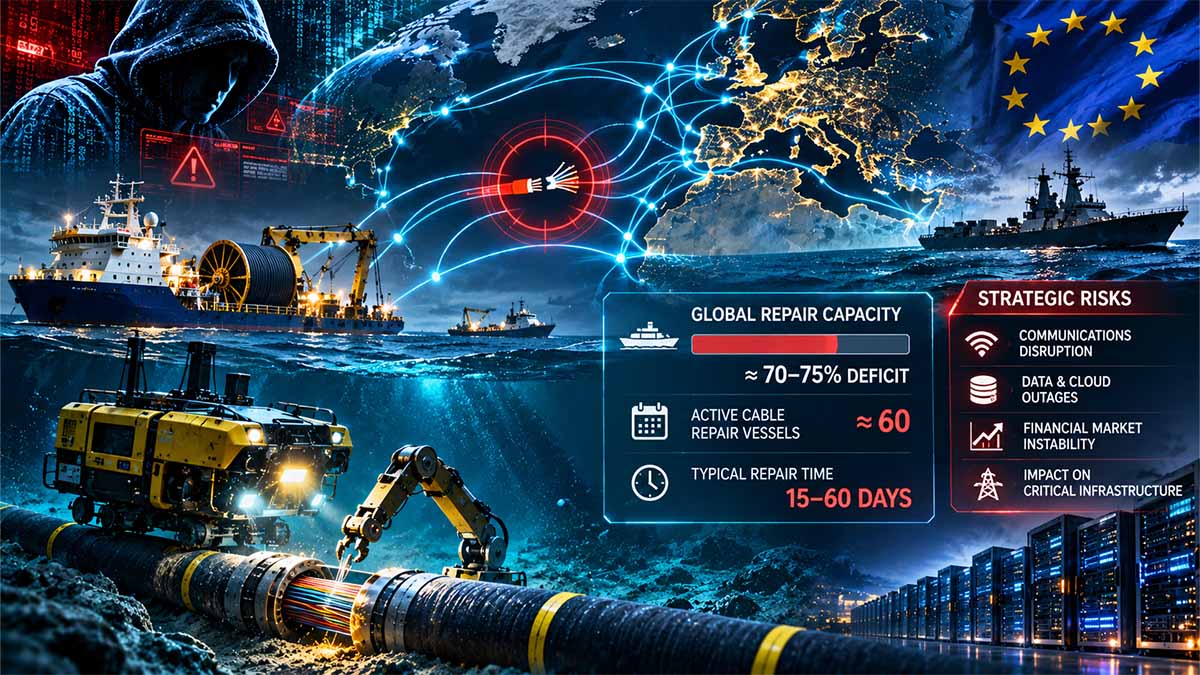
The economic model was designed around manageable accidents. The International Cable Protection Committee estimates approximately 150–200 submarine telecommunications cable faults annually, predominantly associated with fishing and anchoring. The ITU reported more than 170 repairs during 2025, while its technical guidance places typical mean repair time at approximately one to three weeks, depending on operating conditions. These statistics describe a system functioning largely under commercial assumptions. They do not measure its effective capacity when several regions require the same specialist vessels or when armed conflict prevents repairs from proceeding.
The financial contrast is revealing. The European Commission’s €347 million CEF-Digital programme for 2026–2027 includes €60 million in submarine repair-capacity calls: €20 million initially directed toward the Baltic and €40 million subsequently covering the Mediterranean, Atlantic and outermost regions. Another €5.8 million was announced in June 2026 for the first Baltic and Mediterranean Regional Cable Hubs. These amounts concern different functions within the wider European framework and must not be added as independent commitments.
Across the Atlantic, the United States’ Cable Security Fleet, established under Title 46 of the US Code, provides access to two privately owned vessels. The Maritime Administration recorded $10 million in FY2025 expenditure, $10 million enacted for FY2026 and zero new funding requested for FY2027. The request does not abolish the statutory programme. It does, however, expose the difference between possessing legal access to a commercial capability and maintaining a financially supported, operationally assured national-security resource.
The European procurement model contains a similar qualification. The 2026 CEF-Digital repair programme requires equipment modules capable of installation within three days after a compatible vessel reaches an appropriate port or shipyard. Applicants must identify at least three suitable vessels. That is a mobilisation requirement, not a guarantee of restoring a cable within three days. The vessel must still be available, properly equipped and able to reach the damaged system. The industrial and logistical process begins well before the actual repair.
Military infrastructure makes the exposure more serious than an internet outage
Commercial telecommunications represent only one part of the undersea infrastructure supporting national security. Military surveillance systems, dedicated communications networks, submarine electricity interconnectors and their supporting shore facilities perform different functions, but can depend on overlapping energy, industrial and communications resources.
The US Navy’s Integrated Undersea Surveillance System demonstrates the established military dimension. Its publicly acknowledged mission includes the detection, classification and reporting of submarine activity using fixed, mobile and deployable surveillance capabilities. The system’s origins extend to the Sound Surveillance System, whose first naval facility was commissioned in 1954. Its contemporary configurations are not comprehensively public, preventing a reliable assessment of individual vulnerabilities.
The distinction matters because damaging a cable is not necessarily equivalent to disabling the military function it supports. Alternative sensors, communications systems and processing arrangements may preserve essential capabilities. Equally, dedicated defence networks do not eliminate dependence on civilian electricity, telecommunications, ports or defence suppliers.
NATO formalised this interdependence in its 15 September 2026 Resilience Baseline Requirements, linking continuity of government, energy supplies, civil communications, transport and industrial support to the execution of military plans. The framework identifies seven resilience areas and requires attention to cascading failures and restoration capabilities.
The most revealing implication is institutional. A navy may protect maritime infrastructure without controlling the commercial operator responsible for restoring it. A defence ministry may depend on electricity infrastructure managed by civilian transmission operators. A government may possess secure military communications yet remain reliant on civilian networks for logistics, procurement and industrial coordination.
National defence continuity therefore depends on more than protected military installations. It depends on whether the civilian economy can continue providing the services required to sustain them.
The Baltic proves that one kilometre of damage can mean six months without capacity
The EstLink 2 electricity interconnector illustrates why submarine energy infrastructure deserves the same strategic attention as telecommunications.
On 25 December 2024, the 650 MW electricity connection between Finland and Estonia was disconnected following a fault subsequently identified in its submarine cable. Fingrid reported that the incident did not endanger Finland’s electricity system, but it removed an important cross-border transmission capability.
The physical intervention involved replacing approximately one kilometre of cable. Offshore work took place during May and June 2025, and commercial service resumed on 20 June 2025, almost six months after the original interruption.
The distinction between physical damage and economic consequence is fundamental. A damaged section accounting for a small fraction of the connection’s approximately 170-kilometre length generated months of lost transmission availability. Yet 650 MW of unavailable transfer capacity cannot simply be converted into an equivalent electricity shortage: the actual consequences depend on generation, alternative interconnectors, reserves and market conditions.
The incident occurred within a broader transformation of Baltic energy security. On 9 February 2025, Estonia, Latvia and Lithuania synchronised their electricity systems with continental Europe through Poland, ending their previous synchronous dependence on Russia and Belarus. The European Commission reported more than €1.2 billion in EU grants supporting the synchronisation programme.
These developments illustrate two different meanings of energy sovereignty. One concerns control of the electricity system’s operational architecture. The other concerns its ability to withstand the loss of individual transmission assets. A government can achieve the first while remaining exposed to the second.
The same distinction applies to submarine military infrastructure. Possessing an independent surveillance or communications capability does not guarantee that damaged equipment can be repaired promptly, particularly when specialised resources must be mobilised across international jurisdictions.
Europe’s industrial assets exist, but national control remains fragmented
Europe is not without manufacturing or engineering capabilities. The more difficult issue is converting those capabilities into assured emergency availability.
In March 2026, Alcatel Submarine Networks, 80% owned by the French state through the Agence des participations de l’État, announced approximately €100 million of investment over 2026–2028 at Calais and Greenwich. ASN reported three European factories, seven cable-laying vessels and more than 850,000 kilometres of optical systems historically deployed.
These figures establish substantial industrial capacity, not a government-controlled emergency repair fleet. Commercial vessel commitments, engineering compatibility and cross-border manufacturing remain relevant even when a government holds a controlling equity interest.
Italy’s position changed on 13 October 2026, when Prysmian completed its acquisition of Xtera Topco through a joint venture owned 80% by Prysmian and 20% by Fincantieri, with an enterprise value of $65 million. The transaction brings together submarine telecommunications cable production, repeater technology and maritime-industrial expertise.
The industrial geography extends beyond Italy. Prysmian announced that it was doubling production capacity at Nordenham in Germany and seeking up to 300 additional employees. The company also identified the planned EXA Meridian transatlantic system, with a length of 6,552 kilometres, 24 fibre pairs, more than 500 Tbps of scalable capacity and a target service date of 2029.
These are announced production plans and project specifications, not completed emergency restoration assets. They nevertheless demonstrate how the next generation of submarine communications capacity is emerging through industrial groups whose ownership, technology and production are distributed among several allied countries.
For Italy, the Prysmian–Fincantieri combination could support a more integrated industrial role in Mediterranean infrastructure. But corporate ownership does not provide automatic national authority over factories abroad, privately contracted ships or production already committed to other projects.
For France, majority ownership of ASN provides a stronger direct public-industrial relationship, although manufacturing and vessel operations remain internationally distributed. Germany contributes specialist production capacity. The United Kingdom hosts Greenwich manufacturing and Xtera-related activities while maintaining direct Atlantic maritime interests.
The central constraint is not the absence of European industry. It is whether national authorities have enforceable arrangements ensuring that compatible components, qualified engineers and suitable vessels will be available when commercial obligations and national-security requirements collide.
Surveillance can detect a threat without providing the means to repair its consequences
The military response to undersea security concerns has become more visible. NATO launched Baltic Sentry on 14 January 2025, increasing maritime presence and surveillance around critical infrastructure. Its October 2026 reporting confirmed the continued participation of mine-countermeasures vessels and underwater systems in regional monitoring.
On 9 April 2026, the United Kingdom disclosed a monitoring operation involving an Akula-class Russian submarine and two specialised submarines associated with Russia’s Main Directorate for Deep-Sea Research. British authorities reported an operation lasting more than one month, involving approximately 500 personnel and over 450 aircraft flying hours.
These are documented British military observations and assessments. They are not proof that the monitored vessels destroyed a cable. Likewise, the investigation into the December 2024 Eagle S incident in the Gulf of Finland must be distinguished from an established finding of state-directed sabotage.
The Finnish proceedings illustrate the legal difficulty. Prosecutors brought charges concerning damage to five cables and cited at least €60 million in direct repair costs. The Helsinki District Court initially declined jurisdiction in October 2025. On 27 August 2026, the Helsinki Court of Appeal reversed that ruling and returned the matter for examination. The appellate decision established jurisdiction at that procedural stage, not criminal guilt or Russian state responsibility.
The strategic problem is that governments may need to protect infrastructure and mobilise repairs before criminal or state attribution has been conclusively established.
The United Kingdom’s 22 October 2026 critical undersea infrastructure White Paper addresses part of this difficulty. It proposes stronger resilience obligations, new offences and national-security direction powers extending to relevant infrastructure and repair providers. The consultation closes on 14 January 2027. These remain proposals, not enacted powers.
There is also a military-law constraint. A civilian repair vessel does not automatically become a military objective because it operates in contested waters or receives naval assistance. Its status depends on its actual function and the applicable law of armed conflict. Governments considering escorts must reconcile operational protection, lawful military activity and the continued protection of civilians.
This produces a difficult allocation problem: naval forces can improve surveillance and deter interference, but specialist restoration remains an industrial operation. A minehunter cannot automatically replace a fibre-optic cable repair vessel, and emergency legislation cannot manufacture missing components.
The next 24 months will determine who absorbs the cost of institutional delay
The first consequential decisions fall in 2027. The United States must reconcile Cable Security Fleet requirements with the FY2027 budget process. The United Kingdom must decide what legal powers follow its January 2027 consultation. The European Union must turn its 2026 repair-capacity calls into awarded contracts, delivered equipment and qualified vessels.
The implications extend through 2028, when the credibility of the European approach should be measured through actual mobilisation exercises, compatible spare inventories and the capacity to conduct more than one restoration mission. The three-day equipment-installation requirement will have limited value if no suitable vessel, specialist crew or replacement cable is available at the required location.
Industry will face a parallel constraint. ASN’s €100 million programme runs through 2028, while Prysmian’s planned Nordenham expansion and EXA Meridian project extend into the following years. New capacity can strengthen communications networks, but additional infrastructure also creates maintenance obligations. Manufacturing growth does not automatically increase the number of concurrent repairs the system can perform.
The costs of inaction will not fall evenly. Governments would bear emergency coordination and security expenditure. Telecommunications and electricity operators would absorb repair liabilities and additional operating costs. Defence organisations could face reduced availability of supporting services. Industrial companies would confront disruptions to cross-border connectivity and energy exchange. Ultimately, businesses and households would pay through service degradation, higher costs or reduced reliability where existing alternatives prove insufficient.
The choices made during 2027–2028 will therefore determine whether public expenditure purchases measurable restoration capacity or merely another layer of monitoring and institutional coordination. The central issue is no longer how extensively Western governments recognise the undersea threat. It is whether their budgets, contracts, industries and military authorities can deliver a repair when essential national infrastructure is no longer commercially accessible.
Navigational Index
Pillar I — The Physical and Institutional Architecture of Global Submarine Communications
Chapter 1 — The Global Submarine Cable System: Strategic Geography, Economic Dependence and Infrastructure Concentration : Establishes the physical structure of international connectivity; cable landing stations; transoceanic corridors; network ownership; data-centre and financial dependencies; the distinction between physical route diversity and commercially controlled network redundancy; and the strategic significance of the Atlantic, Mediterranean, Baltic, Arctic, Red Sea and Indo-Pacific systems.
Chapter 2 — Maritime Threats, Cable Disruption Mechanisms and the Operational Geography of Undersea Competition : Examines documented accidental and environmental damage, deliberate interference, the difficulty of attribution, maritime monitoring, critical geographic concentrations, military reconnaissance and the conditions under which multiple cable faults could become a coordinated strategic threat.
Chapter 3 — Legal Jurisdiction, Sovereignty and the Protection of Submarine Infrastructure During Armed Conflict : Analyses maritime jurisdiction, international law, coastal-state authority, cable-laying and repair rights, flag-state responsibilities, the law of naval warfare, civilian and military infrastructure distinctions, protection of repair vessels and the legal implications of naval escorts.
Pillar II — Wartime Restoration, Industrial Capacity and the Strategic Economics of Infrastructure Continuity
Chapter 4 — The Global Cable Repair System: Fleet Availability, Technical Capacity and Restoration Bottlenecks : Examines maintenance agreements, specialist repair vessels, vessel location, response times, repair queues, qualified crews, jointing equipment, repeaters, spare cable, repair logistics, shipyard constraints and the distinction between nominal fleet size and deployable capacity.
Chapter 5 — Wartime Repair Under Contested Conditions: Military Protection, Insurance, Logistics and Government Authority : Assesses repair operations during hostilities; commercial and governmental command relationships; war-risk insurance; maritime access restrictions; crew protection; military escorts; legal exposure; emergency prioritisation; and the integration of naval, civilian and industrial capabilities.
Chapter 6 — Industrial Sovereignty, Telecommunications Supply Chains and the Financial Consequences of Restoration Failure : Investigates manufacturing dependencies, trusted-equipment requirements, industrial concentration, procurement, strategic inventories, investment structures, financial-market transmission, cloud infrastructure, telecommunications continuity and the economic implications of prolonged restoration.
Pillar III — Allied Strategic Resilience, Regional Exposure and the Architecture of Future Crisis Response
Chapter 7 — United States, NATO and European Strategic Readiness: National Capabilities and Alliance Coordination : Develops separate national assessments of the United States, Italy, France, Germany and the United Kingdom, together with the EU and NATO institutional frameworks. It examines maritime capabilities, regulatory authority, industrial exposure, financing arrangements, regional deployment constraints and interoperability.
Chapter 8 — Multi-Theatre Disruption Scenarios, Strategic Indicators and the 2027–2031 Resilience Outlook : Evaluates alternative disruption pathways, concurrent repair demand, regional competition for specialist resources, escalation and restoration constraints, decision thresholds, capability-development priorities, policy options and the final strategic net assessment.
Pillar IV — Military Submarine Infrastructure, Undersea Power Systems and State-Directed Seabed Warfare
Strategic Assessment of Military Communications, Underwater Surveillance Networks, Submarine Electricity Infrastructure, State Coercion, Hybrid Warfare and National Defence Continuity
Pillar IV – The Military Seabed Infrastructure System
Chapter 9 — The Military Seabed Infrastructure System: Defence Communications, Underwater Surveillance and Strategic Command Dependencies
Examines dedicated military submarine communications cables, fixed underwater acoustic surveillance networks, sensor-to-shore transmission infrastructure, military electrical connections, naval facilities, government communications carried over commercial cables, and the distinction between publicly documented capability and operational information that remains classified. Assesses the dependence of maritime domain awareness, anti-submarine warfare, naval command systems and strategic government communications on undersea and shore-based infrastructure.
Chapter 10 — Submarine Power Infrastructure: Military Energy Security, Offshore Electricity Systems and the Strategic Consequences of Interconnector Disruption
Analyses high-voltage submarine power cables, cross-border electricity interconnectors, offshore generation connections, energy supply to strategically important islands and maritime facilities, military dependence on civilian electricity networks, and the relationship between power-system resilience and defence readiness. Examines documented Baltic incidents, restoration periods, transmission capacities and the consequences of interrupted electricity exchange.
Chapter 11 — State-Directed Seabed Warfare: Strategic Coercion, Hybrid Operations, Infrastructure Disruption and Escalation
Investigates the strategic purposes for which hostile states may threaten or interfere with undersea communications and power infrastructure, including political coercion, intelligence collection, strategic signalling, economic pressure, exploitation of attribution uncertainty and disruption of military support functions. Distinguishes documented state capabilities, officially attributed hostile activity, criminal investigations and unverified allegations. Evaluates defensive indicators, cascading consequences and escalation risks without assuming that every cable incident is deliberate.
Chapter 12 — Military Infrastructure Protection, Allied Defence Continuity and the 2027–2031 Seabed Security Architecture
Assesses the protection of fixed military underwater systems, maritime situational awareness, resilience of civilian infrastructure supporting armed forces, defence–industry cooperation, national emergency authority, military support to infrastructure restoration, NATO–EU coordination and the requirements for maintaining essential command, communications and electricity services during a sustained crisis. Develops strategic investment priorities, decision thresholds and a final integrated assessment.
Master Abstract
Submarine Communications as a Strategic Dependency
The architecture of international digital connectivity has evolved into a foundational infrastructure for economic exchange, public administration, financial markets, industrial operations and military communications. Although satellite systems, terrestrial fibre networks and alternative transmission technologies provide supplementary connectivity, submarine fibre-optic cables remain the principal physical medium for intercontinental data transmission. The European Commission attributes approximately 99% of intercontinental internet traffic to submarine cables, while the United Kingdom identifies the same proportion for its international data traffic. These figures describe distinct geographic measures and should not be combined into a single global traffic statistic. Commission Increases Submarine Cable Security with €347 Million Investment and New Toolbox — European Commission — Feb 2026; Critical Undersea Infrastructure Legislative Consultation — UK Government — Oct 2026.
This infrastructure’s significance extends well beyond conventional telecommunications. International payment processing, cloud-service interconnection, multinational corporate operations, research networks, government data exchanges and selected defence communications depend directly or indirectly on high-capacity international transmission. The strategic consequence is that submarine cable disruption is not confined to the telecommunications sector: depending on the availability of alternative routes, it can propagate into activities whose operating requirements exceed the capacity of surviving links. The severity of disruption, however, cannot be inferred solely from the number of damaged cables. It depends on the traffic carried, surviving route capacity, physical separation, network topology, landing-station arrangements and the ability of operators to reroute services. A cable failure therefore becomes a national-security concern when it diminishes the continuity of functions that governments and economies cannot readily substitute.
The Difference Between Cable Protection and Restoration Sovereignty
Contemporary submarine cable security policy increasingly recognises the distinction between preventing damage, detecting interference and restoring infrastructure after disruption. NATO’s Baltic Sentry initiative, introduced in January 2025, strengthened maritime presence and monitoring around critical undersea infrastructure, while the February 2026 European Cable Security Toolbox incorporated preventive, detective and recovery measures into a wider resilience framework. In June 2026, the European Commission announced €5.8 million for two Regional Cable Hubs in the Baltic and Mediterranean and a further €40 million call for submarine cable repair capacity. These measures demonstrate an institutional movement toward integrated protection and restoration, but their funding and implementation stages must be separated from demonstrable operational readiness. NATO Launches Baltic Sentry — NATO — Jan 2025; Submarine Cable Security Toolbox and Cable Projects of European Interest — European Commission — Feb 2026; Commission Funds First Regional Cable Hubs and Launches €40 Million Call — European Commission — Jun 2026.
Restoration sovereignty should be understood as the practical capacity of a government or allied coalition to secure the return of essential communications within an operationally acceptable period, rather than as a requirement for exclusive state ownership of every cable, vessel or component. It requires assured or contractually reliable access to vessels, qualified crews, compatible spares, installation facilities, protected maritime routes and decision-making authority. These resources may be distributed across private operators and national jurisdictions. The resulting strategic question is not merely how many repair vessels exist, but whether a competent authority can mobilise them when commercial obligations, competing national requirements and conflict conditions restrict their availability.
The United States and the Governance–Capability Gap
The United States illustrates the distinction between commercial repair capability and state-assured mobilisation. Under Title 46, Section 53202 of the United States Code, the Cable Security Fleet comprises two privately owned, United States-documented vessels operating under agreements intended to support national-security requirements. The Maritime Administration’s FY2027 Congressional Budget Request identifies $10 million in FY2025 actual programme funding, $10 million enacted for FY2026 and no new funding requested for FY2027. The same document describes a mechanism through which participating commercial ship operators make vessels available to the Department of Defense upon request. This establishes a defined national-security access arrangement, but not a publicly demonstrated guarantee of simultaneous deployment in different maritime theatres. 46 U.S.C. §53202 — United States Congress — 2019; MARAD FY2027 Congressional Budget Request, pp. 85–87 — U.S. Department of Transportation — 2026.
The principal vulnerability is therefore institutional and operational as well as material. An emergency repair operation can require decisions involving telecommunications operators, maritime authorities, defence organisations, port administrations, insurers and foreign governments. Different authorities possess different legal powers, while the entity responsible for financing an intervention may not control the vessel needed to execute it. The United States has strengthened submarine cable licensing and security oversight: FCC rules effective in July 2026 include cybersecurity, physical-security and Covered List certification requirements. These requirements address important dimensions of preventive security, yet they do not independently resolve wartime repair allocation, component availability or naval support. Office of International Affairs Provides Filing Instructions for New Submarine Cable Rules and Other Guidance — Federal Communications Commission — Jul 2026. The strategic assessment is that the decisive readiness metric must be the ability to execute a complete restoration operation, not merely the existence of regulatory controls or retained commercial vessels.
Taiwan and the Operational Significance of Multiple Simultaneous Failures
Taiwan provides a particularly instructive case because its official records document both concentrated communications dependence and the interaction of human and environmental damage mechanisms. The Ministry of Digital Affairs reported that, as of the end of February 2026, Taiwan had 15 international and 10 domestic submarine cables, all classified nationally as critical infrastructure. During the four-year period analysed by the ministry, nearshore cable incidents averaged seven to eight annually; anchor dragging accounted for an average of 38.3% of these incidents. For 2025 specifically, three of seven recorded nearshore incidents were attributed to anchor dragging, representing 42.9% of that year’s total. The ministry separately identified earthquake-induced underwater landslides as a significant cause of offshore damage. MODA Releases 2025 Submarine Cable Damage Analysis Report — Taiwan Ministry of Digital Affairs — Apr 2026.
The distinction between nearshore human interference and offshore environmental damage is essential. It prevents the automatic attribution of every cable failure to hostile activity, while demonstrating that several cable systems can suffer disruptions within a compressed period through natural events alone. Taiwan’s ministry identified six international cable systems affected following earthquakes in late 2025. The analytical implication is that deliberate interference could encounter a network already carrying unresolved faults, making restoration priorities and geographic redundancy more important than individual incident counts. It would nevertheless be unsound to convert the Taiwanese experience into a numerical prediction of wartime failure probability without verified data on spare capacity, repair deployment, fault location and adversarial activity. The documented record establishes exposure to clustered disruptions; it does not establish that a particular future military campaign will succeed in isolating Taiwan.
Europe, the Mediterranean and the Industrial Geography of Repair
European policy is developing along two related but distinct trajectories: the creation of stronger mechanisms for security coordination and the investment in assets intended to accelerate repair. The European Commission’s February 2026 programme amendment allocated €347 million to strategic submarine cable projects across several categories, including cable security and repair capacity. A €20 million call initially addressed the Baltic, followed by an additional €40 million call covering the Mediterranean, Atlantic and EU outermost regions. HaDEA specifies that modular repair equipment should be capable of installation on preconfigured vessels within a maximum of three days after the vessel arrives at the relevant port or shipyard, with applicants identifying at least three vessels capable of receiving the modules. This is a programme requirement, not a documented maximum for total repair time. Commission Increases Submarine Cable Security with €347 Million Investment and New Toolbox — European Commission — Feb 2026; CEF-Digital Second Call for Submarine Cable Repair Capacities — HaDEA — Jun 2026.
For the Mediterranean, restoration readiness has implications extending beyond any single EU Member State. Communications corridors connect European economic activity to African, Middle Eastern and Asian networks, while maritime operations can be affected by differences in coastal jurisdiction, security conditions and port access. Italy and France therefore require separate analysis of their Mediterranean exposure, industrial assets and regulatory authority. Germany must be examined through its European network dependencies, industrial economy and Baltic security role, while the United Kingdom requires separate treatment as an Atlantic-facing maritime and digital infrastructure centre outside the EU legal framework. The British government’s October 2026 legislative consultation illustrates a governance approach involving stronger provider obligations and proposed national-security direction powers. The central European question is whether regional cooperation, funding and industrial coordination can become a deployable restoration architecture before a geographically dispersed crisis creates simultaneous demands on the same specialist resources.
Wartime Restoration and the 2031 Strategic Horizon
A sustained campaign against submarine communications could impose pressures substantially different from those encountered during ordinary cable maintenance. A damaged cable may require fault localisation, vessel transit, maritime permissions, safe positioning, recovery of cable sections, compatible components, specialist jointing and technical testing before service restoration. When conflict is present, insurance conditions, crew safety, military activity and competing national repair priorities add further constraints. The relevant operational model is therefore a sequence of interdependent activities, any of which may delay the entire restoration process. Increasing the number of vessels without addressing components, legal access and deployability would improve only one part of that system.
The 2027–2031 outlook should accordingly be evaluated through three interconnected variables: the geography and concurrency of cable damage; the effective capacity of restoration resources under conflict conditions; and the extent to which governments can coordinate public and private responsibilities. A favourable trajectory would involve distributed spare inventories, tested mobilisation procedures, accessible vessels and credible alternative communications routes. A deteriorating trajectory would involve rising competition for a small specialist workforce, restricted access to repair areas, slow acquisition of compatible components and political disagreements over emergency priorities. The most consequential unresolved issue is not whether submarine cables can be damaged—they demonstrably can—but whether the international restoration system can maintain essential connectivity when failures accumulate faster than repair resources can be mobilised and deployed.
Key Evidence Table
The following indicators distinguish the formally documented baseline from unverified operational assumptions.
| Indicator | Value/status | Reference date | Definition/scope | Issuer | Exact source |
|---|---|---|---|---|---|
| International data dependence | Approximately 99% | February 2026 | Intercontinental internet traffic; institutional estimate | European Commission | Commission announcement |
| US Cable Security Fleet | 2 vessels | Statutory provision, current through October 2026 | Privately owned commercial vessels under operating agreements | US Congress | 46 U.S.C. §53202 |
| US Cable Security Fleet budget | $10 million | FY2026 enacted | Programme appropriation, not fleet acquisition cost | US MARAD | FY2027 Budget, pp. 85–87 |
| US Cable Security Fleet FY2027 | $0 new funding requested | FY2027 proposal | Executive budget request, not final appropriation | US MARAD | FY2027 Budget, pp. 85–87 |
| EU strategic cable funding | €347 million | February 2026 | CEF Digital strategic programme envelope covering multiple project categories | European Commission | 2026 programme announcement |
| Baltic repair call | €20 million | February 2026 | Funding call for adaptable repair modules | European Commission | 2026 programme announcement |
| Mediterranean and Atlantic repair call | €40 million | June 2026 | Additional repair-capacity funding call | HaDEA | June call announcement |
| EU Regional Cable Hubs | €5.8 million | June 2026 | Grant announcement for Baltic and Mediterranean hubs | European Commission | Regional hubs announcement |
| EU repair-module installation target | Maximum 3 days | June 2026 call | From arrival of an eligible vessel at port/shipyard; not total restoration time | HaDEA | Call conditions |
| Taiwan international cables | 15 systems | End-February 2026 | Deployed international submarine cable systems | Taiwan MODA | Damage analysis report announcement |
| Taiwan domestic cables | 10 systems | End-February 2026 | Deployed domestic submarine cable systems | Taiwan MODA | Damage analysis report announcement |
| Taiwan nearshore cable incidents | 7–8 annually | Four-year historical average reported April 2026 | Within 24 nautical miles | Taiwan MODA | Damage analysis report announcement |
| Taiwan anchor-dragging share | 38.3% | Four-year historical average reported April 2026 | Share of nearshore cable incidents | Taiwan MODA | Damage analysis report announcement |
| Taiwan clustered seismic disruption | 6 international cable systems | Late 2025 | Disruptions associated with seismic activity | Taiwan MODA | Damage analysis report announcement |
| UK international data dependence | Approximately 99% | October 2026 | UK’s international data traffic | UK Government | Critical undersea infrastructure consultation |
| NATO Baltic maritime security | Baltic Sentry established | January 2025 | Military surveillance, presence and response activity | NATO | Baltic Sentry announcement |
Financial and Operational Interpretation
The differences between these indicators are material. The European €347 million programme envelope is not a dedicated fleet-acquisition appropriation. The two repair-capacity calls, totalling €60 million, are specific funding opportunities within the wider framework and should not be added to the €347 million as if they were necessarily independent additional allocations. Similarly, the €5.8 million announced for Regional Cable Hubs concerns coordination infrastructure, not the direct purchase of specialist repair vessels.
The American $10 million figure is an annual programme appropriation and cannot be compared directly with European multiyear investment envelopes without adjustment for duration, programme composition and expenditure type. Most importantly, the FY2027 zero request is evidence of an executive budget proposal, not proof that the fleet ceased operating or that Congress ultimately appropriated nothing. These distinctions prevent nominal financial comparisons from creating misleading conclusions about actual military or industrial readiness.
Competing Strategic Pathways
The available official evidence supports three distinct but potentially overlapping pathways. They are not mutually exclusive and therefore do not justify a numerical probability distribution.
| Strategic pathway | Diagnostic support | Disconfirming evidence or limitations | Watch indicators | Current standing |
|---|---|---|---|---|
| Commercial resilience remains adequate for most disruptions | Existing international networks have rerouting mechanisms; the UK reports that infrastructure faults rarely cause noticeable interruption; Taiwan’s operators have maintained connectivity through alternative routing during documented damage events | Successful rerouting does not establish that spare capacity remains adequate after additional faults, or that repair resources remain accessible during hostilities | Available route capacity, repair backlog, service degradation, documented restoration durations | Supported for many routine disruptions; unproven under sustained multi-theatre conflict |
| Restoration capacity becomes the binding strategic constraint | The US statutory arrangement covers two retained vessels; maritime access and specialist resources are finite; the EU has identified a need for emergency repair modules and regional coordination | No publicly verified global mobilisation model in the examined record establishes the threshold at which concurrent failures exceed effective repair capacity | Vessel availability, repair queues, repair-module deployment, specialised component lead times, access restrictions | Credible systemic vulnerability requiring contingency assessment |
| Public investment and allied coordination materially strengthen resilience | EU repair-capacity calls, Regional Cable Hubs, NATO Baltic Sentry, UK regulatory proposals and Taiwan’s resilience measures demonstrate institutional adaptation | Announcements and planned measures do not establish completed deployment, trained crews, interoperability or performance under wartime conditions | Awarded contracts, installed modules, certified ships, exercises, funded stockpiles, revised restoration procedures | Policy transition documented; operational effectiveness not yet established across the system |
Assessment of the Pathways
The three pathways are consistent with a transition from a predominantly commercially managed maintenance model toward a more explicit national-security and allied-resilience approach. The first remains persuasive where disruptions are isolated, alternative routes have spare capacity and vessels can operate under ordinary maritime conditions. The second becomes more consequential when cable faults accumulate across different geographical regions, because the same scarce specialist capabilities may be required in several places simultaneously. The third represents an institutional response to that vulnerability, but its effectiveness depends on implementation and exercises rather than the nominal volume of announced investment.
There is currently insufficient verified evidence to assign numerical probabilities to these pathways. Nor does the documentary baseline establish a reliable global wartime repair-capacity ceiling. The correct strategic approach is to evaluate measurable response capabilities and identify the circumstances in which commercial redundancy would cease to provide sufficient protection.
Principal Gaps and Watch Indicators
Restoration Capacity and Actual Deployability
The most consequential missing information concerns the difference between specialist vessels nominally present in commercial fleets and those capable of undertaking a particular repair at a specified time and location. A useful official readiness assessment would identify eligible vessels by operating agreement, flag, deployment region, repair capability and activation arrangements, while distinguishing commercially committed ships from assets immediately available to national authorities.
The United States should be assessed through Maritime Administration operating-agreement records, programme funding and Department of Defense mobilisation requirements. European readiness requires the actual procurement and delivery records produced under the 2026 CEF Digital calls. Neither programme funding nor vessel eligibility should be treated as proof of deployability.
Watch indicators: completed procurement awards, verified vessel readiness, deployment time, crew availability, mobilisation exercises and documented cross-theatre support arrangements.
Industrial Dependencies and Strategic Spare Inventories
Submarine cable restoration depends on compatibility between damaged systems and available replacement components. A credible resilience assessment therefore requires a component-level inventory identifying usable cable types, specialised equipment, supplier qualification, stock locations and the extent to which repair vessels can operate without additional procurement.
The official record examined here does not establish a complete publicly accessible inventory of government-controlled strategic spares across the United States, NATO and the European Union. This remains a consequential limitation because the availability of a vessel does not guarantee that the vessel can repair a specific damaged system.
Watch indicators: contracted strategic spare inventories, qualified suppliers, documented lead times, system compatibility, emergency procurement arrangements and port-based storage capacity.
Maritime Access, Insurance and Repair-Vessel Protection
Increased military tensions may affect whether civilian vessels can safely reach damaged infrastructure, whether operators can obtain commercially acceptable insurance and whether crews can be deployed under the applicable contractual and employment conditions.
The legal consequences of protection arrangements require case-specific assessment. A naval escort does not automatically determine the protected vessel’s status as a military objective. That classification depends on applicable international humanitarian law and the relevant circumstances, including the vessel’s purpose and use. Decisions concerning security support must therefore account for operational necessity, proportionality, civilian protection and the legal position of the parties.
Watch indicators: maritime exclusion measures, security incidents near repair operations, changes in applicable war-risk insurance conditions, restrictions on port access and formally approved government support arrangements.
Atlantic, Baltic, Mediterranean and Indo-Pacific Coordination
The European Union’s geographic allocation of repair-capacity calls indicates recognition that restoration requirements differ across sea basins. However, a regional module is useful only when a compatible vessel, available crew, authorised operating area and suitable supply chain can be assembled into a complete repair operation.
For Italy, the decisive question concerns the relationship between Mediterranean connectivity and the national ability to support emergency restoration through industrial and maritime facilities. For France, the assessment must examine industrial participation, overseas connectivity and Atlantic–Mediterranean requirements. Germany’s exposure must be evaluated through Baltic maritime security and the wider European digital economy. The United Kingdom’s Atlantic position, national regulatory reforms and NATO responsibilities require a distinct assessment.
Watch indicators: regional vessel preconfiguration, multinational exercises, port access agreements, national emergency powers, EU–NATO coordination procedures and operational restoration exercises involving more than one cable incident.
Legislative and Budgetary Developments
Three current policy processes warrant particular attention.
The US FY2027 Cable Security Fleet appropriation process will establish whether the executive proposal for no new programme funding is preserved, modified or superseded. The UK October 2026 legislative consultation will determine the future structure of proposed national-security direction powers and operator obligations, subject to subsequent legislative action. The EU repair-capacity procurement process, including the HaDEA call closing on 25 November 2026, will provide evidence of which public organisations obtain resources and whether regional deployment obligations become contractually enforceable.
These processes are important precisely because they convert institutional intentions into decisions that can affect practical readiness. Their outcomes must be examined separately from the announcements that initiated them.
Preliminary Strategic Net Assessment
The verified documentary baseline supports a clear but bounded conclusion: the principal strategic challenge of submarine communications security is increasingly the continuity of restoration under conditions of overlapping physical damage, contested maritime access and divided operational authority.
The United States possesses a defined statutory mechanism for access to commercial repair vessels but faces an unresolved question concerning FY2027 programme financing and the scale of assured multi-theatre mobilisation. The European Union has begun investing in geographically distributed repair capabilities, while the United Kingdom is pursuing stronger intervention and security powers through a legislative consultation. NATO has expanded surveillance and deterrence initiatives in the Baltic, and Taiwan has reinforced its approach to redundancy following documented clustered disruptions.
These measures differ in institutional purpose, funding structure and maturity. They cannot yet be consolidated into a verified inventory of wartime restoration capability.
The decisive strategic test for 2027–2031 will be whether governments and allied institutions can convert regulatory authority, commercial repair resources, industrial components and naval security into a coordinated capability that restores essential communications during concurrent crises.
A strong submarine cable network is not necessarily one in which damage never occurs. It is one in which damage can be absorbed, essential traffic can be maintained and restoration can proceed within acceptable operational limits even when maritime and commercial conditions deteriorate.
Submarine Cable Security & Wartime Resilience
Infrastructure geography, maritime disruption, legal authority and repair dependencies · Evidence cut-off: 5 November 2026
Figures are source-specific, not a global readiness index. Funding calls do not equal deployed equipment.
The decisive strategic distinction
Network redundancy
A second commercial service does not necessarily provide a physically independent seabed route, landing station, terrestrial backhaul or legal operating environment.
Restoration sovereignty
Effective recovery depends on accessible ships, trained crews, compatible parts, safe maritime access, authorisations and coordinated decisions—not vessel counts alone.
Operational dependency chain
Qualitative system map; not a simulated timeline or a claim that these steps always occur strictly in sequence.
No verified global wartime restoration-capacity threshold is available in this dataset. Normal fault rates cannot be used as wartime failure probabilities.
Regional exposure and operational questions
These comparisons describe documented strategic characteristics, not invented risk scores or forecasts.
Official quantitative baseline
| Indicator | Reported value | Reference | Definition / caution | Official record |
|---|
Distinct programme amounts · € million
The €20m and €40m calls are components of the broader EU framework; do not add them to €347m as independent new spending. Bars compare nominal amounts, not operational outcomes.
Maritime jurisdiction and protection
Location, applicable international law, flag-state authority and the circumstances of armed conflict determine which measures are lawful.
| Legal area | Applicable framework | Operational consequence |
|---|
A commercial cable or repair vessel is not automatically a military objective. Classification depends on applicable law, its actual contribution to military action and the definite advantage anticipated; proportionality and precautions continue to apply.
From cable protection to restoration readiness
| Priority | Observable indicator | Responsible actors | Decision consequence |
|---|
Critical unresolved questions
These are monitoring questions, not assertions that an identified state or operator currently lacks a capability.
Pillar I — The Physical and Institutional Architecture of Global Submarine Communications
Chapter 1 — The Global Submarine Cable System: Strategic Geography, Economic Dependence and Infrastructure Concentration
Principal Strategic Judgment
The global submarine telecommunications network must be understood as a geographically concentrated, commercially financed and internationally regulated infrastructure system whose operational importance exceeds the territorial jurisdiction of any individual state. Its principal structural vulnerability is not the absence of network redundancy, but the possibility that physically diverse routes, commercial transmission arrangements, landing-station facilities and network-management systems remain dependent on overlapping geographical and institutional resources. This distinction is essential because a country can possess several international cable connections without possessing equivalent independent paths for economic continuity, and a commercial operator can offer multiple network services while relying on a limited number of physical corridors. The decisive measure of resilience is therefore not the number of cables visible on a geographic map, but the ability of those cables, their landing facilities and their associated terrestrial infrastructure to preserve essential communications when individual systems or entire maritime regions become unavailable.
The International Telecommunication Union’s Global Connectivity Report 2025 identifies submarine cables as the infrastructure carrying more than 99% of international data flows. The report records more than 500 operational submarine cable systems covering approximately 1.4 million kilometres, while also identifying a substantial transformation in financing, with major cloud and technology companies becoming increasingly important participants in international network investment. The International Cable Protection Committee reports a larger approximate installed network length of 1.7 million kilometres in 2025 and around 1.8 million kilometres in its 2026 public materials. These figures should not be represented as directly comparable observations of annual physical expansion without reconciling their methodologies, coverage and reference dates. They nevertheless establish the scale of a communications system extending across every major ocean and connecting national telecommunications markets to international digital services. Global Connectivity Report 2025, Chapter 3 — International Telecommunication Union — Nov 2025; Submarine Cable Protection and Resilience: Media Factsheet — International Cable Protection Committee — 2026.
The Physical Architecture of International Connectivity
A modern submarine telecommunications system comprises several technologically and operationally distinct elements. The submarine cable itself contains optical fibres designed to transmit information using light signals. Submerged repeaters amplify optical signals over long distances, while branching units permit certain network configurations to serve multiple geographic destinations. At the landward end, cable landing stations contain the equipment required to terminate the submarine transmission system and integrate international capacity with terrestrial telecommunications infrastructure. The transmission network then connects through terrestrial fibre systems, exchange facilities and network nodes to data centres, telecommunications providers, enterprise networks and national communications infrastructure. The dependence of the entire system on these interconnected assets means that cable resilience cannot be measured independently from shore-based equipment, energy availability, physical security, terrestrial backhaul and the operational ability to transfer traffic among surviving routes.
The distinction between submerged and terrestrial infrastructure has direct strategic consequences. A submarine cable may remain physically intact while services become unavailable because of damage to its landing facilities, a power supply interruption, a failure in associated transmission equipment or a disruption affecting the terrestrial network that carries traffic inland. Conversely, a damaged submarine segment may not cause a substantial interruption to end users when traffic can be transferred to alternative cable systems with sufficient available capacity. This distinction explains why an incident involving a strategically important cable does not automatically translate into measurable national economic losses. It also explains why a small number of facilities near the coast may have significance disproportionate to their physical size: they connect the submerged international network with the terrestrial infrastructure that supports economic and government functions.
The ITU’s 2026 International Advisory Body on Submarine Cable Resilience explicitly identifies geographic concentration, limited route diversity, regulatory delay and inadequate repair preparedness as structural concerns. Its recommendations include stronger coordination between governments and commercial operators, improvements to permitting, diversification of routes, and arrangements for the timely deployment and repair of infrastructure. The recommendations reflect the physical reality that effective redundancy requires diversity throughout the communications chain rather than duplication of a single component. International Advisory Body on Submarine Cable Resilience: Final Report — International Telecommunication Union — Jul 2026; Working Group 1 Recommendations: Timely Deployment and Repair — ITU and ICPC — Feb 2026.
Global Network Measurements and Their Strategic Meaning
The most important quantitative distinction concerns the different measures used to describe submarine telecommunications infrastructure. Cable-system count, total installed length, international bandwidth, usable transmission capacity, occupied capacity and traffic volumes are not interchangeable. A long submarine cable may provide substantial connectivity across an ocean without serving the same number of countries as a branching regional network. A country may host several landing stations but remain dependent on a limited number of international transmission corridors. A capacity upgrade can substantially increase the usable bandwidth of an existing cable without adding another geographically independent physical route. Consequently, strategic analysis that relies exclusively on cable numbers risks confusing nominal infrastructure expansion with actual resilience.
| Structural indicator | Documented figure or status | Definition and limitation | Strategic interpretation |
|---|---|---|---|
| International data dependence | More than 99% | Share of international data flows attributed to submarine cables by the ITU | Submarine transmission remains the principal intercontinental communications medium |
| Operational submarine systems | More than 500 | ITU estimate in the 2025 Global Connectivity Report | System count is not equivalent to independently survivable paths |
| Total network length — ITU | Approximately 1.4 million km | ITU 2025 statistical baseline | Requires methodological reconciliation before comparison with alternative industry estimates |
| Total network length — ICPC | Approximately 1.7 million km in 2025 | Industry-published estimate | Indicates a different reporting basis or population from the ITU figure |
| Total network length — ICPC 2026 | Approximately 1.8 million km | Approximate contemporary industry figure | Should not be converted automatically into a measured annual expansion rate |
| Global annual cable faults | Approximately 150–200 | Industry estimate for submarine telecommunications cables | Describes recorded routine fault frequency, not wartime disruption intensity |
| Human-related fault share | Approximately 70–80% | ICPC classification of accidental human-related cable faults | Fishing and anchoring dominate routine physical-damage mechanisms |
| International bandwidth growth | Approximately 22% annually since 2021 | ITU-reported trend | Capacity demand can grow faster than physical route diversity |
| Reported submarine investment | $0.8 billion in 2015; $9.7 billion in 2025 | ITU-reported investment series; methodological basis must be preserved | Financing and demand have expanded substantially without proving equivalent improvements in resilience |
Sources: Global Connectivity Report 2025, Chapter 3 — ITU — Nov 2025; ICPC Media Factsheet — International Cable Protection Committee — 2026.
The ITU investment figures imply that the reported 2025 value is approximately 12.1 times the 2015 value, calculated directly from the published amounts of $9.7 billion and $0.8 billion. This comparison concerns the value of reported investment, not a twelvefold increase in physical cable length or independently protected network routes. Likewise, the annual bandwidth-growth figure must not be applied mechanically to historical system counts. Improvements in optical transmission technology, changes in utilisation and the commissioning of higher-capacity systems can permit traffic and capacity to grow without proportional increases in the number of separate seabed routes. From a strategic perspective, this creates a potential asymmetry between the economic value supported by the network and the physical infrastructure needed to maintain that value. A relatively small number of cable corridors may carry an increasing volume of economically critical communications, while the number and geographical distribution of assets capable of restoring those corridors may develop according to different commercial incentives.
Ownership, Financing and the Transformation of Infrastructure Governance
Historically, submarine telecommunications networks were primarily associated with national telecommunications administrations, international telecommunications carriers and consortia established to finance and operate long-distance communications. The contemporary model increasingly includes major cloud-service providers and technology companies financing infrastructure to support geographically distributed computing, content delivery and international data flows. The ITU identifies hyperscale technology companies as important contributors to the expansion of global submarine infrastructure. This transformation has significant consequences for governance because companies investing in transmission systems may simultaneously operate cloud platforms, digital services and international data-centre networks that depend on those same systems. Infrastructure decisions can therefore reflect a combination of telecommunications economics, cloud-network architecture, operational resilience requirements and strategic commercial competition. Global Connectivity Report 2025, Chapter 3 — International Telecommunication Union — Nov 2025.
The political implications should not be reduced to a simple opposition between public and private ownership. Commercial participation can mobilise substantial capital, support technological innovation and accelerate the construction of high-capacity routes. At the same time, the distribution of ownership, financing, operating authority and security responsibilities may produce institutional fragmentation. The owner of a cable is not necessarily the same entity as the landing-station operator, the telecommunications company providing services over the cable, the ship responsible for maintenance or the government with jurisdiction over a particular maritime segment. These distinctions become especially important when a network disruption has national-security consequences: the public interest in restoring a specific route may differ from the order in which a private company would ordinarily allocate repair resources under its maintenance agreements.
A useful national assessment must consequently distinguish five categories of control: legal ownership of cable assets; contractual rights to transmission capacity; operational control of network traffic; physical control of landing facilities; and jurisdiction over the maritime and territorial areas in which infrastructure is located. None of these categories automatically confers all the others. A state may exercise regulatory authority over a domestic landing station without owning the submarine cable connected to it. A multinational company may own or finance transmission infrastructure while relying on independent carriers and maintenance agreements to keep it operational. A cloud provider may be capable of changing digital traffic routes without possessing a dedicated repair vessel. These differences constitute a structural characteristic of contemporary digital infrastructure and must be incorporated into any analysis of sovereignty, resilience and emergency preparedness.
| Institutional layer | Typical controlling interest | Principal function | Strategic dependency | Relevant question |
|---|---|---|---|---|
| Cable-system ownership | Carrier, consortium, infrastructure company or technology investor | Financing, construction and lifecycle management | Contractual and regulatory rights | Who can authorise capital expenditure and major repair work? |
| Transmission-capacity rights | Operators, carriers, technology companies and customers | Allocation of international bandwidth | Capacity agreements and operational availability | Who can transfer critical traffic to alternative systems? |
| Landing-station operations | Licensed domestic operator or infrastructure company | Shore termination and network integration | National regulation, physical facilities and electricity | Can the station function independently during a regional crisis? |
| Terrestrial backhaul | Domestic and cross-border network operators | Connectivity between shore facilities and inland networks | Fibre corridors, switching and interconnection | Does another landing point provide a genuinely independent route inland? |
| Cable maintenance | Specialist marine contractor and maintenance-zone participants | Fault localisation and physical restoration | Vessel availability, crews, components and permits | Who is contractually obliged and practically able to repair the system? |
| National security and regulation | National authorities within their competence | Licensing, protection and emergency coordination | Statutory powers and institutional coordination | Can the state prioritise restoration when commercial priorities conflict? |
The table represents the functional architecture of the sector, not a claim that these roles are institutionally separated in every cable system. Some operators integrate several functions, while others distribute them among multiple entities. The important analytical question is whether emergency responsibilities remain clear under the actual contractual and legal structure.
The Difference Between Geographic Route Diversity and Effective Network Redundancy
Redundancy is frequently presented as the principal reason why the submarine cable system can absorb ordinary accidents. When one cable is damaged, network operators may reroute communications through another system, provided that functioning transmission paths and sufficient capacity remain available. Yet the existence of alternative routes does not establish the level of service that can be preserved during a geographically concentrated disruption. The operational consequences depend on whether surviving systems have spare capacity, whether the affected services can technically use those paths, whether terrestrial interconnection is available, and whether the alternative route depends on infrastructure exposed to the same hazard. These conditions determine whether redundancy is genuine or merely nominal.
A distinction must also be made between physical, logical, commercial and jurisdictional diversity. Physical diversity requires transmission paths exposed to different geographic hazards. Logical diversity concerns network configuration and the ability to redirect traffic. Commercial diversity involves independent suppliers or capacity contracts, which may nevertheless rely on common physical infrastructure. Jurisdictional diversity concerns the legal and political environments through which connections pass. A route that avoids one maritime danger may still be vulnerable because its alternative landing facilities are concentrated within the same country, or because the replacement path passes through a region subject to different security or regulatory restrictions. Therefore, two cable services purchased from separate companies cannot automatically be considered two independent physical routes.
| Diversity dimension | What it measures | What it does not guarantee | Decision-relevant test |
|---|---|---|---|
| Cable-system diversity | Number of separate systems | Distinct seabed alignment | Do systems share vulnerable corridor segments? |
| Landing-station diversity | Number and distribution of landing facilities | Independent terrestrial power and backhaul | Can one facility fail without disabling the alternatives? |
| Maritime geographic diversity | Separation of seabed routes | Commercially usable alternative bandwidth | Do routes avoid the same regional hazard? |
| Terrestrial diversity | Independent inland fibre paths | Independent international connectivity | Are routes convergent at the same inland facilities? |
| Operator diversity | Different commercial providers | Different physical infrastructure | Do providers share underlying cable capacity? |
| Jurisdictional diversity | Different coastal and regulatory authorities | Freedom from coordinated restrictions | Can essential service continue if one jurisdiction restricts access? |
| Restoration diversity | Different crews, vessels and spare inventories | Immediate access to all resources | Can several faults be repaired concurrently? |
This framework is particularly important for states whose international connectivity depends on a limited number of maritime approaches. The presence of a large number of cables in a region may improve route availability in normal conditions, but geographic concentration can create correlated exposure to environmental events or maritime disruption. Conversely, a longer alternative route may have considerable strategic value even if it is commercially less efficient, because it reduces reliance on a common physical corridor. Such an investment must be evaluated by its contribution to survivability and essential-service continuity rather than by transmission capacity alone.
The Atlantic: High-Capacity Connectivity and Continental Interdependence
The Atlantic is one of the principal physical interfaces between the North American and European digital economies. Its strategic importance derives from the combination of international telecommunications traffic, cloud-service connectivity, financial operations and the terrestrial networks associated with major economic centres on both sides of the ocean. The Atlantic cable system should therefore be understood as a distributed infrastructure environment rather than a single transoceanic corridor. Different routes, landing locations and commercial systems contribute to resilience, but their actual independence depends on the relationship between offshore paths and the networks through which traffic is distributed after landing.
The United Kingdom occupies an important position in this environment. In its October 2026 consultation on critical undersea infrastructure, the British government stated that submarine telecommunications cables carry approximately 99% of the United Kingdom’s international data traffic. The government also recognised that the infrastructure is highly resilient under ordinary operating conditions, while identifying the possibility of hostile interference and the need to modernise regulatory powers. This simultaneous recognition of routine resilience and strategic vulnerability is analytically significant: it prevents the assumption that ordinary service reliability proves preparedness for deliberate, geographically distributed disruption. Critical Undersea Infrastructure Security and Resilience: Proposals for Modernising UK Legislation — UK Government — Oct 2026.
France and the United Kingdom both possess direct Atlantic-facing infrastructure and international telecommunications responsibilities, but their national exposure cannot be treated as identical. France also participates in Mediterranean and overseas connectivity, requiring assessment across different geographic and jurisdictional environments. Germany, although positioned differently on the continental coastline, remains dependent on the wider European international telecommunications architecture through terrestrial interconnection and cross-border transmission. Italy’s Atlantic exposure is principally mediated through the broader European communications environment, while its direct maritime strategic responsibilities are concentrated more heavily in the Mediterranean. These differences mean that cable resilience must be examined in terms of actual transmission paths and dependencies, not simply national coastline length or the geographical presence of landing stations.
The Mediterranean: Europe’s Southern Communications Interface
The Mediterranean is a particularly complex strategic environment because it combines regional communications connections with transit relationships linking European markets to North Africa, the Middle East and onward international routes. Its importance derives from the proximity of multiple sovereign jurisdictions, the interdependence of telecommunications and terrestrial infrastructure, and the wider relationship between Mediterranean maritime activity and international connectivity. Unlike a remote oceanic segment, a Mediterranean cable route may interact with a dense distribution of ports, coastal infrastructure, fishing activity and national regulatory systems. This increases the significance of coastal operational conditions and highlights the need to distinguish accidental damage, hostile interference and administrative restrictions affecting repair operations.
The European Commission’s February 2026 Cable Security Toolbox and the subsequent establishment of a Mediterranean Regional Cable Hub demonstrate that the Mediterranean is being treated as a distinct European security and resilience environment. This is not evidence that the region has already achieved a common operational restoration capability. Rather, it indicates recognition that sea-basin coordination is required to integrate surveillance, incident assessment and response. The European Commission announced €5.8 million in June 2026 to establish the first Regional Cable Hubs in the Baltic and Mediterranean, illustrating an effort to institutionalise coordination at the regional level. Submarine Cable Security Toolbox and Cable Projects of European Interest — European Commission — Feb 2026; Commission Funds First Regional Cable Hubs — European Commission — Jun 2026.
For Italy, the Mediterranean’s strategic importance should be considered through several interrelated dimensions: direct submarine connections, participation in cross-border telecommunications markets, proximity to North African and Eastern Mediterranean routes, the operation of coastal infrastructure, and the availability of maritime and industrial facilities that could support restoration activities. These dimensions create a potential opportunity to contribute to European resilience, but that opportunity must not be confused with documented possession of a complete independent wartime repair capability. The institutional question is whether Italian infrastructure, commercial operators and relevant national authorities can participate in a coordinated restoration framework that remains functional when a disruption involves more than one jurisdiction. The commercial question concerns the degree to which international traffic using Mediterranean routes depends on Italian facilities and can be redirected through other European landing systems. The security question concerns the extent to which maritime monitoring and national emergency arrangements are aligned with the operational requirements of repair contractors.
France’s Mediterranean position must be assessed alongside its Atlantic and overseas responsibilities. Its strategic exposure is therefore geographically wider than the Mediterranean alone, while the same national industrial and administrative resources may face competing demands across different regions. Germany’s relevance arises from European network interdependence and its economic reliance on international digital connectivity, even where the immediate submarine infrastructure lies outside German waters. These distinctions are essential to avoid treating the European Union as a single maritime actor possessing uniform capabilities across all sea basins.
The Baltic Sea: Dense Maritime Activity and Concentrated Security Responsibilities
The Baltic combines closely interconnected coastal economies with intensive maritime activity, submarine communications infrastructure and energy interconnections. Its relatively enclosed geography creates a different operating environment from the Atlantic or the open Pacific. Maritime activity takes place within the proximity of several coastal states, while undersea communications and energy assets form part of a broader regional infrastructure environment. The consequences of cable disruption therefore extend beyond the physical telecommunications system to maritime policing, military monitoring, territorial jurisdiction and allied coordination.
NATO launched Baltic Sentry on 14 January 2025 following a series of incidents affecting critical undersea infrastructure. The initiative was intended to increase the Alliance’s military presence, improve the ability to identify and respond to destabilising activity, and integrate maritime surveillance assets. NATO identified frigates, maritime patrol aircraft and uncrewed systems among the capabilities involved. This represents a documented security response but should not be interpreted as proof that NATO controls the commercial cable infrastructure or possesses complete responsibility for restoration. Military presence can improve awareness and response options, while actual cable repair remains dependent on telecommunications operators, specialist contractors and applicable national authorities. NATO Launches Baltic Sentry to Increase Critical Infrastructure Security — NATO — Jan 2025.
The Baltic illustrates why physical infrastructure protection and maritime security cannot be analysed independently. A damaged cable may require investigation by one coastal authority, commercial action by another entity and maritime support coordinated among allied states. The geographic distribution of responsibilities creates potential challenges when several incidents occur in different national jurisdictions. For Germany, the Baltic represents a direct maritime-security environment as well as an element of wider European telecommunications resilience. For the EU, regional coordination is necessary because infrastructure risk does not follow the same boundaries as national administrative authority. For NATO, the relevant objective is to strengthen deterrence and situational awareness without assuming responsibility for commercial functions beyond the Alliance’s mandate. The resulting institutional architecture is necessarily multinational, making clarity of responsibilities as important as the availability of individual surveillance assets.
The Arctic: Long-Distance Route Diversification and Environmental Constraints
The Arctic has increasing strategic significance as a possible alternative communications route between Europe, North America and Asia. Its geographic attraction lies in the possibility of establishing transoceanic connections that avoid some existing southern maritime concentrations. However, the construction of alternative routes through higher latitudes must be evaluated against environmental conditions, geographic remoteness, limited supporting infrastructure, the availability of specialist vessels and the operational consequences of long repair transits. A route can improve global physical diversity while simultaneously creating more demanding restoration conditions.
The significance of the Arctic is reinforced by documented military concern about undersea infrastructure. On 9 April 2026, the United Kingdom’s Secretary of State for Defence publicly described a Russian submarine operation involving an Akula-class submarine and two specialised submarines associated with Russia’s Main Directorate for Deep-Sea Research. The British government stated that UK forces had monitored the activity in cooperation with allies, including Norway. This is an official account of military monitoring and assessed Russian activity; it should not be expanded into a claim that a cable was damaged or that a specific future operation was conclusively established. Defence Secretary No. 9 Speech — UK Ministry of Defence — Apr 2026.
The strategic importance of such episodes is that they concern areas where surveillance, deterrence and physical restoration may confront different practical limits. Detection of a vessel does not necessarily establish the ability to identify every underwater activity, and the ability to track a suspected threat does not mean that a repair vessel can reach the area promptly or operate safely. Arctic cable development should therefore be evaluated against a combined standard of route diversity, operational accessibility, repair logistics and international cooperation. A shorter or more geographically independent route has strategic value only when its lifecycle costs and restoration arrangements are compatible with the services expected to depend on it.
The Red Sea and Indo-Pacific: Concentrated International Transmission and Regional Exposure
The Red Sea is important because it forms part of the wider communications interface between Europe, the Middle East and Asia. Its strategic significance arises from the combination of submarine telecommunications routes, constrained maritime geography and the possibility that regional security conditions may affect commercial operations. The relevant distinction is between the number of cables traversing a maritime area and the proportion of international services that would become unavailable if those cables were disrupted. A geographic concentration does not provide a reliable measure of effective traffic loss unless actual utilisation, alternative routing and remaining capacity are known. Consequently, assertions concerning the percentage of global communications that would be interrupted by a particular Red Sea incident must be treated cautiously unless supported by compatible network-level evidence.
The Indo-Pacific is more geographically extensive and contains several distinct infrastructure environments. The western Pacific, Southeast Asian maritime corridors, Indian Ocean connections and island telecommunications systems differ substantially in route structure, network density, commercial operation and available alternatives. Large interconnected economies can often rely on more than one physical system, while some island communities remain dependent on comparatively limited international connections. The ITU’s July 2026 assessment specifically identified small island developing states, least developed countries and other underserved regions as facing heightened risks from limited route diversity and dependence on small numbers of cable systems. International Advisory Body Approves Landmark Report to Strengthen Submarine Cable Resilience — ITU — Jul 2026.
Taiwan provides official evidence of the distinction between national cable-system count and resilience against common hazards. Its Ministry of Digital Affairs reported 15 international and 10 domestic cable systems as of the end of February 2026, together with documented nearshore damage associated with vessel anchoring and offshore disruption associated with seismic events and submarine landslides. This demonstrates the need for separate assessments of nearshore physical protection, offshore geographic exposure and the continuity mechanisms available when multiple systems are damaged. It does not establish that all 25 systems possess equal transmission capacity or equivalent strategic importance. MODA Releases 2025 Submarine Cable Damage Analysis Report — Taiwan Ministry of Digital Affairs — Apr 2026.
Comparative Geography of the Major Maritime Communications Regions
| Maritime region | Principal strategic function | Structural exposure | Institutional complexity | Primary resilience question |
|---|---|---|---|---|
| North Atlantic | Europe–North America international connectivity | Shared landing and terrestrial dependencies; remote offshore operations | Multiple states and commercial operators | Are alternative systems physically and commercially independent? |
| Mediterranean | European, African and Middle Eastern connectivity | Dense coastal activity and multiple jurisdictions | EU and non-EU coastal states | Can restoration proceed across differing national legal and maritime regimes? |
| Baltic Sea | Northern European regional connectivity | Enclosed maritime geography, concentrated activity and infrastructure proximity | National coastal authorities, EU institutions and NATO | Can surveillance, incident investigation and repair mobilisation be coordinated? |
| Arctic | Potential high-latitude route diversification | Remoteness, environmental conditions and repair accessibility | Coastal states, operators and security authorities | Does geographic diversification remain useful under difficult restoration conditions? |
| Red Sea | Europe–Asia and Middle East communications interface | Maritime concentration and regional security conditions | Multiple coastal jurisdictions and commercial transit interests | Can sufficient alternative capacity remain available during regional disruption? |
| Western Pacific and Taiwan | International and island connectivity | Nearshore human-related damage and offshore seismic exposure | National authorities and multinational operators | Can essential services survive concurrent failures of several systems? |
| Indian Ocean | Interregional connectivity between Asia, Africa and the wider global network | Long routes and geographically dispersed repair requirements | Multiple national jurisdictions and maintenance arrangements | Can vessels and compatible components be mobilised without excessive delay? |
This table is a qualitative comparative framework. It does not assign numerical vulnerability ratings because the verified public record does not provide a consistent dataset covering cable locations, effective bandwidth, available repair resources and operational restrictions for every region.
Data Centres, Financial Infrastructure and the Economics of Network Continuity
Submarine cable systems constitute an important enabling infrastructure for financial, industrial and digital activity, but the economic consequences of disruption must be traced through the actual services affected. International financial transactions depend on communications networks linking institutions and markets, yet individual payment mechanisms may possess different arrangements for routing, processing and recovery. Cloud services depend on connectivity between users, applications and data-centre regions, but their tolerance of transmission interruption varies according to system design, workload location and replication arrangements. Industrial enterprises may depend on international connectivity for supply-chain coordination, engineering, commercial transactions and remote digital services, but the operational consequences of an outage differ across sectors and facilities. It is therefore analytically incorrect to attach a universal economic loss value to every cable fault.
The ITU identifies submarine cables as supporting international communications, finance, government activity, healthcare, education and banking. The economic mechanism is clear: when international transmission capacity becomes unavailable or insufficient, affected organisations may experience reduced service quality, interruption of digital processes, increased communications costs and delays in activities requiring international data exchange. However, the actual economic outcome depends on the number of services affected, the availability of alternative infrastructure, the duration of disruption and the effectiveness of contingency procedures. The distinction between infrastructure dependence and realised economic loss is fundamental to sound strategic analysis. International Advisory Body on Submarine Cable Resilience: Final Report — ITU — Jul 2026.
| Economic sector | Relevant dependence on international connectivity | Possible consequence of sustained capacity loss | Evidence required to quantify financial impact |
|---|---|---|---|
| Financial services | Cross-border transaction processing and international data exchange | Processing delays, reduced access to services, higher continuity costs | Transaction volumes, route dependence, outage duration and contingency performance |
| Cloud computing | Connectivity between users, data-centre regions and services | Service degradation, connectivity constraints and replication delays | Workload geography, network configuration, traffic demand and available alternative capacity |
| Telecommunications | Wholesale international transmission and retail connectivity | Congestion, higher routing costs and partial service interruption | Capacity utilisation, service agreements and routing capabilities |
| Manufacturing | Digital coordination of international suppliers and production processes | Delays in information exchange and selected operations | Facility-specific network dependence and business-continuity arrangements |
| Logistics and trade | International data exchange supporting commercial coordination | Slower processing and information availability | System-level connectivity requirements and operational alternatives |
| Public administration | Government networks and international communications | Reduced continuity of selected public functions | Critical-service inventories, alternative links and recovery requirements |
| Healthcare and research | International data exchange and networked specialist services | Delayed access to selected remote resources | Application architecture, local autonomy and available backups |
No aggregate loss estimate is assigned because these sectoral mechanisms overlap. Adding hypothetical losses across all seven sectors without accounting for shared dependencies, substitution and timing would create double counting. A defensible economic-impact assessment must instead begin with observed connectivity loss and model how that loss propagates through identifiable systems.
Chapter 1 — Key Judgments
The physical architecture of global submarine telecommunications is best characterised as a distributed international network with concentrated geographic interfaces and divided institutional control. Its scale cannot be measured adequately through cable-system counts alone, and growth in bandwidth, investment or transmission technology does not necessarily produce proportional improvements in physical resilience. The most important distinction for strategic planning is between infrastructure that exists, transmission capacity that is usable, alternative routes that are genuinely independent, and restoration resources that can be mobilised when needed.
The Atlantic, Mediterranean, Baltic, Arctic, Red Sea and Indo-Pacific represent different combinations of geographic exposure, commercial dependence and national jurisdiction. Consequently, a uniform global security model would overlook the operational conditions that determine whether essential services remain available during disruption. The chapter’s central conclusion is that network resilience is a property of the complete communications system—including seabed routes, shore facilities, terrestrial networks, commercial rights and restoration arrangements—not an attribute of the submarine cable considered in isolation.
What Would Change the Assessment
The assessment would require revision if independently documented traffic-routing, physical infrastructure and restoration data demonstrated that substantial portions of critical international services possess geographically independent backup capacity sufficient to maintain normal operations during concurrent regional disruptions. Conversely, evidence of shared landing facilities, convergent terrestrial paths, inadequate spare transmission capacity or highly concentrated maintenance resources would strengthen the judgment that nominal cable diversity can overstate effective resilience.
Open Official Record
The most consequential outstanding records for this chapter are authoritative, comparable inventories of physical cable routes and landing dependencies; national or regulatory assessments of essential-service international bandwidth requirements; independently established spare-capacity figures; and official documentation identifying the degree of physical separation among alternative communications corridors. These records would permit more precise conclusions without relying on commercial network maps as a substitute for operational readiness data.
Chapter 2 — Maritime Threats, Cable Disruption Mechanisms and the Operational Geography of Undersea Competition
Principal Strategic Judgment
The security of submarine telecommunications infrastructure is increasingly shaped by the difficulty of distinguishing ordinary maritime accidents, environmental damage, negligent navigation and deliberate hostile interference before sufficient technical, forensic and legal evidence becomes available. This ambiguity has important strategic consequences because governments must often protect essential infrastructure and restore communications before an incident can be conclusively attributed. The challenge is therefore not limited to preventing hostile action. It includes the ability to recognise abnormal conditions, reconstruct the physical cause of damage, coordinate maritime authorities, preserve evidence and implement proportionate protective measures without treating every operational fault as an act of sabotage.
The strongest evidence for this distinction comes from the contrast between global fault statistics and documented national investigations. The International Cable Protection Committee reports approximately 150–200 submarine telecommunications cable faults annually, with roughly 70–80% attributable to accidental human activity, principally fishing and ship anchoring. These figures establish that routine cable damage is a persistent industrial phenomenon rather than an exceptional occurrence. The security environment nevertheless changes when vessels operate near sensitive infrastructure under unusual circumstances, when multiple cable systems suffer damage within a restricted period, or when official investigations identify conduct potentially extending beyond navigational negligence. In such cases, the central analytical problem is determining whether the available observations support an accidental explanation, a deliberate criminal act or an operation directed or supported by a hostile state. Those explanations require different evidentiary thresholds and produce different legal and security consequences. Submarine Cable Protection and Resilience: Media Factsheet — International Cable Protection Committee — 2026.
The Physical Mechanisms of Submarine Cable Damage
The principal physical hazards affecting submarine telecommunications systems arise from contact with maritime equipment, natural seabed movement and technical failure. Fishing activity can bring equipment into contact with exposed cable sections, while anchors and associated equipment can damage cables through direct contact or movement along the seabed. Seismic activity and submarine landslides can produce geographically concentrated disruption affecting several systems. Technical failures represent a separate category in which service interruption may arise without external mechanical interference. These mechanisms are operationally different, yet their immediate consequences can resemble one another: a cable may lose transmission capability, operators may register a fault, and physical inspection may be needed to determine the precise location and cause.
The relationship between water depth and damage mechanism is important, although depth alone cannot determine vulnerability. Nearshore cable segments often interact with coastal maritime activity, including commercial shipping, fishing operations and seabed uses. Deeper offshore segments may face fewer routine human interactions but can be exposed to geological hazards and may require more demanding repair operations. The relevant physical variables include cable protection, local seabed conditions, maritime activity and environmental processes, rather than a universal classification in which shallow water is automatically dangerous and deep water automatically secure.
Taiwan’s official 2025 damage analysis provides unusually specific evidence. The Ministry of Digital Affairs reported that, during the four-year observation period, incidents within 24 nautical miles averaged seven to eight annually, with anchor dragging responsible for an average of 38.3%. Of seven nearshore incidents recorded in 2025, three were attributed to anchor dragging, or 42.9%. Two of those incidents involved illegal anchoring by foreign-flagged vessels. The ministry separately identified submarine landslides caused by earthquakes as the principal offshore damage mechanism in its analysis. The 24-nautical-mile threshold is a national statistical classification used in the report and should not be confused with the legal limit of Taiwan’s territorial sea or with a general international definition of nearshore waters. MODA Releases 2025 Submarine Cable Damage Analysis Report — Taiwan Ministry of Digital Affairs — Apr 2026.
These figures are particularly useful because they distinguish recorded causes rather than treating every unusual event as evidence of hostile intent. The 38.3% figure concerns anchor-related incidents within the specified geographic observation area; it does not measure the percentage of all cable damage worldwide, and it cannot be extrapolated to deep-sea infrastructure. Similarly, the 42.9% figure describes a single reporting year with seven incidents, making it sensitive to individual observations. Its importance is evidentiary rather than predictive: it establishes that anchoring remained a material source of damage in a politically sensitive maritime environment.
| Damage mechanism | Physical process | Supporting observations | Principal evidentiary limitation | Security significance |
|---|---|---|---|---|
| Commercial fishing interaction | Fishing equipment contacts or disturbs submarine cable | ICPC global fault classification | Requires incident-specific vessel and seabed evidence | High relevance to routine accident prevention |
| Anchor dragging | Anchor or associated equipment moves across seabed infrastructure | Taiwan MODA statistics; Finnish criminal investigation | Damage pattern alone does not establish intention | Can affect more than one asset along a vessel’s path |
| Earthquake-related seabed movement | Seismic activity destabilises underwater terrain | Taiwan MODA offshore damage analysis | Exact causal sequence requires geological evidence | Can produce geographically correlated failures |
| Submarine landslide | Movement of seabed material damages cable sections | Taiwan MODA identifies landslides as a major offshore risk | Extent and location depend on local seabed conditions | Multiple nearby systems may be exposed |
| Technical equipment failure | Failure of transmission or associated cable equipment | Recognised category within industry fault reporting | Requires engineering diagnosis | May resemble external damage in initial service alerts |
| Deliberate physical interference | Intentional damage by an individual or organised actor | Criminal investigations may establish conduct | Identification of a perpetrator does not automatically prove state direction | Creates policing, intelligence and deterrence requirements |
The table separates mechanisms from attribution. A physical explanation establishes how infrastructure was damaged; determining whether the conduct was negligent, intentional or state-directed requires additional evidence.
The Gulf of Finland: A Case Study in Physical Evidence, Economic Loss and Criminal Attribution
The events of 25 December 2024 in the Gulf of Finland provide an important example of the interaction between maritime investigation, economic damage and international legal jurisdiction. Finnish authorities investigated damage to the Estlink 2 electricity cable and telecommunications cables associated with the passage of the Cook Islands-registered tanker Eagle S. This case involved both electricity and telecommunications infrastructure, a distinction that is essential because the damaged systems performed different technical functions and their restoration costs cannot automatically be treated as telecommunications-specific losses.
Finnish investigators reconstructed the incident through maritime and underwater evidence. The National Bureau of Investigation examined the vessel, its equipment, crew testimony and seabed damage. In January 2025, Finnish police reported an underwater dragging trace of approximately 100 kilometres and recovered an anchor weighing approximately 11 tonnes. In June 2025, the National Bureau of Investigation announced the completion of its criminal investigation and stated that senior officers were suspected of aggravated criminal mischief and aggravated interference with telecommunications. These were investigative findings and suspicions, not final criminal convictions. Criminal Investigation into Cable Damage in the Gulf of Finland Concluded — Finnish National Bureau of Investigation — Jun 2025; Forensic Analysis of the Anchor Hoisted from the Gulf of Finland Started — Finnish Police — Jan 2025.
On 11 August 2025, Finland’s Prosecution Service announced charges against the captain and two senior officers. The prosecution alleged that the vessel had damaged five submarine cables while dragging its anchor along the seabed for approximately 90 kilometres. It stated that cable owners had suffered at least €60 million in direct repair costs, while the disruption also created serious risks for electricity supply and telecommunications. The prosecution acknowledged that alternative connections had helped maintain services. The difference between the approximately 90 kilometres identified in the prosecution’s allegation and the approximately 100 kilometres recorded during the police investigation should not be treated as an unexplained numerical inconsistency. They refer to different procedural stages and potentially different definitions of the relevant dragging path. The correct formulation preserves each figure with its original attribution rather than substituting one for the other. Charges Brought Concerning Submarine Cable Damage in the Gulf of Finland — Finnish Prosecution Service — Aug 2025.
The case also demonstrates why financial consequences must be interpreted carefully. The €60 million amount was a prosecution-stated minimum for immediate cable repair costs claimed by the relevant owners, not an independently established comprehensive estimate of Finland’s economic loss. It did not measure all potential effects on electricity markets, telecommunications service providers, industrial activity or public finances. The fact that alternative connections were available does not eliminate repair costs, but neither does the existence of substantial repair costs prove that end users suffered proportionate service interruptions. Physical damage, restoration expenditure and realised economic disruption are separate categories of evidence.
The Evidentiary Problem of State Attribution
Attributing an undersea incident to a state requires more than identifying a vessel associated with a particular country’s commercial networks, ownership structures or maritime trade. A vessel’s flag, ownership, beneficial control, commercial management, cargo origin and crew nationality may involve different jurisdictions and legal relationships. These characteristics are relevant to investigation, but none independently establishes that a state directed a particular act. Even evidence that a crew deliberately damaged a cable does not automatically establish that the act was conducted under government instructions or constituted a military operation.
The Eagle S case illustrates the importance of maintaining separate analytical conclusions concerning physical cause, individual criminal responsibility and state involvement. The Finnish investigation and prosecution developed evidence concerning the vessel’s movements and alleged conduct. That record must not be converted into an unqualified finding of Russian state-directed sabotage simply because the vessel departed from Russia or was publicly associated with wider concerns over maritime activity. Establishing state responsibility requires evidence capable of connecting the relevant conduct to the state under the applicable rules of attribution. The absence of such evidence in the public record does not prove that no such relationship existed, but it limits the conclusions a responsible assessment can draw.
The consequence is operationally significant. Governments may possess sufficient grounds to increase maritime surveillance or protect infrastructure before an investigation establishes criminal responsibility. They may also possess reasonable grounds to investigate possible hostile interference without being entitled to present the case publicly as a proven state attack. A disciplined response framework must preserve these distinctions because incorrect attribution can intensify diplomatic disputes, undermine prosecution and distort the assessment of future threats.
The Baltic Investigation as a Demonstration of Multi-Agency Coordination
The Finnish response also demonstrates the practical importance of cooperation between civilian law-enforcement authorities, border-security organisations and military resources. Finnish police described an operation involving the Helsinki Police Department, National Bureau of Investigation, Border Guard and Defence Forces. This arrangement combined criminal investigation, maritime security, technical evidence collection and the control of a vessel suspected of involvement. It is an important operational precedent because evidence collected during the first hours of an incident may affect both immediate infrastructure protection and subsequent judicial proceedings. Eagle S Tanker to Move to International Waters under Border Guard Control — Finnish Police — Mar 2025.
A competent response requires simultaneous attention to several objectives that may compete in practice. Investigators must preserve evidence and establish the sequence of events, while telecommunications and electricity operators may need access to the damaged infrastructure to begin restoration. Maritime authorities must protect the area and manage navigation, while national security institutions assess whether further damage is possible. The legal authority to detain a vessel, question crew members or conduct searches must remain distinct from the operational authority to secure a repair zone. Failure to separate these functions can create legal uncertainty and operational delay.
This experience is particularly relevant to the Baltic because several governments may have interests in the same incident. The infrastructure owner may be established in one country, the damaged cable may connect different jurisdictions, the vessel may carry a third-country flag, and the relevant conduct may have occurred outside territorial waters. Such circumstances require effective coordination without assuming that a single national authority possesses unlimited jurisdiction over the entire incident.
Military Reconnaissance and Undersea Infrastructure Competition
The 2026 British account of Russian submarine activity provides a different category of evidence from the Finnish criminal investigation. On 9 April 2026, the UK Ministry of Defence disclosed that British forces, working with Norway and other allies, had monitored a Russian operation involving an Akula-class submarine and two specialised submarines associated with Russia’s Main Directorate for Deep-Sea Research. The British government presented the operation as a security concern involving activity near critical undersea infrastructure. This constitutes an official national-security assessment by a competent government, but the public disclosure does not establish that the vessels damaged cables or that every aspect of their mission was independently verified in the public record. Defence Secretary No. 9 Speech — UK Ministry of Defence — Apr 2026; UK Exposes Covert Russian Submarine Operation in and around UK Waters — UK Ministry of Defence — Apr 2026.
The military relevance of seabed reconnaissance is broader than the immediate possibility of physical damage. Knowledge of the undersea environment can support submarine navigation, infrastructure monitoring and the assessment of strategic maritime conditions. Nevertheless, the observation of a specialised submarine in a sensitive region does not establish hostile action against a particular cable. International security analysis must therefore distinguish military capability, observed deployment, declared or assessed mission and completed hostile conduct.
NATO’s Baltic Sentry initiative reflects the institutional consequences of this security environment. Its maritime patrol and surveillance activities can improve the availability of observations relevant to suspicious conduct, but detection capability does not eliminate the need for legal attribution or physical investigation. A maritime contact may be identified and monitored without establishing the nature of an underwater operation. Conversely, cable damage may become apparent through telecommunications monitoring before the responsible vessel is identified. The resulting challenge is to integrate information from operators, law enforcement and maritime security authorities without presenting incomplete observations as conclusive evidence. NATO Launches Baltic Sentry to Increase Critical Infrastructure Security — NATO — Jan 2025.
Incident Attribution: From Physical Observation to Legal Responsibility
The investigation of cable damage should be divided into distinct evidentiary questions. First, whether an identifiable cable fault occurred and when service degradation began. Second, whether technical evidence establishes the physical mechanism responsible. Third, whether reliable observations connect particular maritime activity to the damaged segment. Fourth, whether the conduct satisfies the requirements of a domestic offence or another applicable legal prohibition. Fifth, whether sufficient evidence establishes that the act was directed, controlled or otherwise attributable to a state. These stages should not be collapsed into a single conclusion because the evidence necessary for each is different.
| Evidentiary question | Potential official record | What it can establish | What it cannot establish alone |
|---|---|---|---|
| Did a cable fail? | Operator fault and service records | Timing and technical characteristics of failure | Identity or intent of a perpetrator |
| Where was damage located? | Engineering survey and seabed investigation | Physical location and damage characteristics | State responsibility |
| Was a vessel nearby? | Maritime surveillance and vessel records | Vessel movements and proximity | Contact with cable or deliberate action |
| Was equipment involved? | Forensic examination of recovered objects | Possible causal physical mechanism | Whether conduct was intentional |
| Was conduct criminal? | Prosecutorial and judicial proceedings | Responsibility under applicable domestic law | Necessarily the involvement of a foreign state |
| Was the act state-directed? | Competent intelligence, judicial or other authoritative evidence | Potential attribution where legal criteria are met | An inference based exclusively on vessel nationality or commercial association |
| Did the event constitute an armed attack? | Legal and factual assessment of scale, effects and state involvement | Possible implications for international security law | Automatic classification from infrastructure damage alone |
The importance of this framework is demonstrated by the difference between a cable fault, an investigated criminal act and a security incident publicly attributed to a foreign government. Each may justify operational precautions, but they do not generate identical legal consequences or evidentiary conclusions.
Environmental Events and the Strategic Problem of Correlated Failure
Natural hazards deserve separate consideration because they can damage several cable systems without deliberate interference. Seismic activity and submarine landslides may affect geographically concentrated sections of infrastructure, creating simultaneous or near-simultaneous faults. Taiwan’s Ministry of Digital Affairs reported that seismic events in late 2025 affected six international submarine cable systems. This is evidence of correlated physical exposure, although the number of damaged systems does not by itself establish the proportion of total national bandwidth that became unavailable. MODA Releases 2025 Submarine Cable Damage Analysis Report — Taiwan Ministry of Digital Affairs — Apr 2026.
The operational importance of correlated damage is that restoration requirements can arise simultaneously. Different cable operators may need specialist vessels, technical crews and replacement components within the same period. Some repairs may require a different technical configuration or access to particular equipment, while geographical conditions may affect the time necessary for physical intervention. Under normal commercial circumstances, maintenance arrangements are designed to manage faults according to established procedures. When several systems are damaged together, the assumptions behind routine scheduling may become less reliable. The critical issue is the relationship between available resources and concurrent repair demand rather than the existence of a single especially difficult fault.
Environmental damage also complicates security assessment. A naturally occurring event may already have reduced spare transmission capacity before a separate maritime incident takes place. In such circumstances, the consequences of the subsequent incident may be greater than they would have been under normal network conditions. This does not mean that every sequence of faults represents a coordinated campaign. It means that the cumulative condition of the network must be incorporated into security decisions. An incident’s strategic importance depends partly on the state of the infrastructure before the incident occurred.
Strategic Concentration and the Limits of Geographic Threat Analysis
Maritime geography affects exposure through the interaction of cable routes, coastal infrastructure, shipping patterns and available alternative connections. Constrained corridors may contain multiple systems serving different destinations, while remote oceanic routes may have fewer nearby hazards but more difficult logistical conditions. Neither configuration can be classified as categorically safer without examining the physical network and relevant operational constraints.
The security significance of a corridor depends on at least four distinct relationships. The first is the concentration of infrastructure: how many independent systems occupy the relevant area. The second is the concentration of demand: how much essential communications traffic relies on those systems. The third is the availability of alternatives: whether other routes can accommodate affected services. The fourth is restoration accessibility: whether repair operations can be carried out under the prevailing maritime conditions. These variables may point in different directions. A heavily used corridor may possess extensive alternative capacity, while an apparently less important route may constitute the only practical international connection for a particular community.
For institutional planning, the relevant objective is not to construct a speculative ranking of maritime locations according to hypothetical attack opportunities. It is to establish which critical services depend on particular infrastructure configurations and whether their continuity requirements remain satisfied after plausible categories of accident, environmental event or security-related disruption. The ITU’s 2026 recommendations reinforce this approach by calling for risk identification, improved monitoring, route diversity and enhanced preparedness rather than treating cable protection as a purely military mission. International Advisory Body on Submarine Cable Resilience: Final Report — International Telecommunication Union — Jul 2026.
The Limits of Maritime Monitoring
Maritime domain awareness is necessary for cable protection but does not provide complete knowledge of underwater activity. Information derived from vessel identification systems, coastal monitoring, maritime patrols and other surveillance resources may help reconstruct movements or identify unusual behaviour. However, the absence of a particular electronic vessel signal does not independently demonstrate hostile intent, and the presence of a vessel near a cable does not establish that physical contact occurred. At the same time, reliance on voluntary or commercially available vessel information may produce incomplete observations of the relevant maritime environment.
Effective monitoring therefore requires integration rather than dependence on a single data source. Telecommunications operators possess technical information concerning network status; maritime authorities possess information concerning shipping activity; law-enforcement institutions can collect admissible evidence; and military organisations may possess additional situational awareness within their lawful responsibilities. The challenge is developing coordination arrangements that permit rapid incident assessment while respecting confidentiality, legal competence and the protection of commercially sensitive information.
The effectiveness of a monitoring programme should be assessed through observable outcomes: the ability to identify an actual fault, determine whether an incident requires intervention, preserve relevant evidence and support restoration. The number of surveillance assets deployed is not a sufficient performance measure. A sophisticated monitoring system that does not generate actionable decisions may provide less operational value than a smaller, well-integrated system linked to clear response responsibilities.
Chapter 2 — Key Judgments
The available record establishes that accidental human activity remains the dominant cause of routine submarine telecommunications cable faults. Environmental hazards can nevertheless produce multiple concurrent disruptions, while documented criminal investigations and official military observations demonstrate that deliberate interference and undersea security competition require separate institutional attention. These realities are not contradictory: an infrastructure system can experience mostly accidental faults while remaining vulnerable to intentional disruption.
The Finnish Eagle S proceedings demonstrate the importance of distinguishing physical reconstruction, criminal allegations, financial damage and legal jurisdiction. Taiwan’s official reporting demonstrates the coexistence of nearshore human-related damage and offshore geological risks. The British and NATO records establish heightened concern about undersea military activity and the resulting expansion of monitoring initiatives. Collectively, these records support a security framework based on evidence, maritime cooperation, realistic restoration requirements and calibrated attribution.
What Would Change the Assessment
The assessment would change materially if competent judicial or official investigations established additional confirmed cases of coordinated state-directed cable interference, or if improved reporting demonstrated that observed incidents were predominantly attributable to previously unrecognised technical or environmental mechanisms. More comprehensive operator data showing restoration demand, simultaneous fault frequency and actual service degradation would also permit a more precise assessment of how routine damage and hostile activity interact.
Open Official Record
The principal outstanding records concern the final judicial disposition and any subsequent appeals in major cable-damage proceedings; official post-incident technical assessments identifying physical causes; harmonised international reporting of concurrent submarine faults; and operational evidence connecting maritime surveillance to verified reductions in damage or restoration time. These records would improve attribution and effectiveness assessments without requiring speculative conclusions about hostile intent.
Chapter 3 — Legal Jurisdiction, Sovereignty and the Protection of Submarine Infrastructure During Armed Conflict
Principal Strategic Judgment
The legal architecture governing submarine telecommunications infrastructure is characterised by an important asymmetry: international law recognises extensive freedoms to lay and maintain submarine cables, but authority to investigate interference, protect infrastructure, regulate vessels and conduct repair operations varies substantially according to maritime location, flag-state jurisdiction, national legislation and the existence of armed conflict. The resulting legal framework does not establish a single international authority responsible for submarine communications continuity. Instead, it distributes rights and obligations among coastal states, flag states, cable operators, repair contractors and, where relevant, parties to armed conflict. Consequently, the principal legal vulnerability is not a complete absence of protection, but the possibility that several competent authorities possess overlapping responsibilities while none has sufficient unilateral power to organise and secure an entire restoration operation.
The foundational instrument is the United Nations Convention on the Law of the Sea (UNCLOS), adopted in 1982, which establishes maritime zones and regulates rights relating to navigation, submarine cables and continental-shelf activities. The applicable legal position differs between internal waters, territorial seas, exclusive economic zones, continental shelves and high-seas areas. During armed conflict, those rules must be considered alongside the applicable law of armed conflict, including the principles of distinction, military necessity, proportionality and precautions in attack. Domestic criminal legislation, licensing arrangements, insurance contracts and the legal status of ships introduce additional considerations. The international framework therefore provides essential legal foundations without automatically resolving the administrative, operational or security requirements of emergency restoration. United Nations Convention on the Law of the Sea and Its Implementing Agreements — United Nations Office of Legal Affairs — 2025.
Sovereignty and Jurisdiction Across Maritime Zones
The legal treatment of submarine cables depends principally on the distinction between coastal-state sovereignty and the specific rights established for other states within maritime zones. Under UNCLOS Article 2, coastal-state sovereignty extends over the territorial sea, its seabed and subsoil, subject to the Convention and other rules of international law. Article 3 permits a territorial sea extending to a maximum of 12 nautical miles from the applicable baselines. These provisions establish a comparatively strong jurisdictional position for coastal states in areas close to shore, where cables enter national territory and connect with terrestrial infrastructure. Nevertheless, coastal sovereignty is not unlimited; it operates within the rights and obligations established by international law, including applicable navigational rights.
Beyond the territorial sea, the legal position changes. The exclusive economic zone extends no farther than 200 nautical miles from the applicable baselines under Article 57. Within that zone, the coastal state enjoys specified sovereign rights and jurisdiction, principally concerning natural resources and certain associated activities. It does not acquire the same comprehensive territorial sovereignty that applies within the territorial sea. Article 58 expressly preserves, subject to the Convention, the rights of other states relating to navigation and the laying of submarine cables and pipelines. On the continental shelf, Article 79 recognises the entitlement of all states to lay submarine cables and limits the circumstances in which the coastal state may impede their laying or maintenance. These provisions are central to the international character of submarine telecommunications infrastructure because many cable routes traverse maritime areas in which no single coastal state possesses comprehensive territorial authority. UNCLOS, Part II, Articles 2–3 — United Nations; UNCLOS, Part V, Articles 56–58 — United Nations; UNCLOS, Part VI, Article 79 — United Nations.
The distinction has considerable operational consequences. A state may possess important security interests in a submarine cable crossing its exclusive economic zone without enjoying an unrestricted right to regulate every foreign vessel conducting activities in that zone. Similarly, the freedom to lay or maintain a cable does not automatically eliminate the practical requirement to comply with applicable domestic laws governing ports, customs, immigration, environmental protection and other matters within national competence. Repair operations may involve several legal regimes during a single mission: a vessel may depart from a foreign port, traverse international waters, enter a coastal state’s territorial sea, conduct technical work within an exclusive economic zone and require personnel or equipment to cross a national border. Each stage may involve different authorities and legal requirements.
| Maritime area | Principal legal regime | Coastal-state position | Rights of other states | Operational significance |
|---|---|---|---|---|
| Internal waters | Coastal-state territorial sovereignty, subject to applicable international obligations | Strong authority over ports and domestic maritime activities | Foreign access depends on applicable legal arrangements | Port entry, equipment import and crew mobilisation may require domestic approvals |
| Territorial sea | UNCLOS Articles 2–3 and relevant provisions on passage | Sovereignty over waters, seabed and subsoil, subject to international law | Navigational and other rights subject to treaty conditions | Cable landing and nearshore work require careful assessment of coastal jurisdiction |
| Contiguous zone | UNCLOS Article 33 | Limited control for specified customs, fiscal, immigration and sanitary purposes | Other freedoms are not displaced by a general territorial sovereignty claim | Does not create a universal cable-security policing jurisdiction |
| Exclusive economic zone | UNCLOS Part V | Specified sovereign rights and jurisdiction | Navigation and cable-laying freedoms recognised under Article 58 | Enforcement authority requires an identified legal basis |
| Continental shelf | UNCLOS Part VI | Sovereign rights concerning natural resources and specified associated matters | Cable-laying and maintenance rights protected by Article 79 | Coastal-state rights must be reconciled with international cable freedoms |
| High seas | UNCLOS Part VII | No coastal-state territorial sovereignty | Navigation and cable-laying freedoms, subject to applicable law | Flag-state responsibilities and international cooperation become particularly significant |
| Areas affected by armed conflict | Maritime law together with applicable law of armed conflict | Depends on zone, parties and applicable rules | Navigation and protection rights may be affected by lawful hostilities-related measures | Vessel safety and the legal status of operations require case-specific analysis |
This classification concerns the general treaty framework, not an assertion that every state is party to UNCLOS or that every relevant question is governed identically in national practice. Treaty participation, applicable customary international law and specific jurisdictional circumstances must be established before applying the framework to a particular state or incident.
The Legal Distinction Between Submarine Cables and Pipelines
UNCLOS Article 79 contains a distinction that is frequently overlooked in general discussions of undersea infrastructure. The provision addresses both submarine cables and pipelines, but does not apply identical restrictions to every aspect of their installation. Article 79(3) establishes that the delineation of the course for laying pipelines on the continental shelf is subject to coastal-state consent. That wording does not establish an equivalent general consent requirement for the course of telecommunications cables. Article 79(4), however, preserves coastal-state authority over cables and pipelines entering national territory or territorial seas and over specified infrastructure associated with exploitation of continental-shelf resources.
This distinction matters because communications cables, electricity interconnectors and energy pipelines may share maritime environments while remaining subject to different technical and legal considerations. A government seeking to strengthen undersea infrastructure security cannot assume that an authority governing pipelines automatically applies in precisely the same way to telecommunications cables. Nor can a government assume that the absence of a general continental-shelf route-consent requirement eliminates other lawful regulatory powers. The correct legal assessment must identify the particular infrastructure, maritime zone, activity and applicable legal provision. UNCLOS, Article 79 — United Nations.
The European Union’s submarine cable security framework encompasses both telecommunications and electricity cables, reflecting the common strategic concern that disruption to undersea infrastructure can affect essential economic functions. However, the legal and industrial requirements of protecting these assets remain different. Telecommunications systems carry digital information, while electricity interconnectors transmit electrical power, and pipelines may carry energy commodities. Their operational vulnerabilities and restoration requirements should therefore not be merged merely because they are located underwater. Submarine Cable Security Toolbox and Cable Projects of European Interest — European Commission — Feb 2026.
International Obligations Concerning Cable Damage
UNCLOS Articles 112–115 establish several important protections and responsibilities relating to submarine cables beyond the continental shelf and to the conduct of states and persons subject to their jurisdiction. Article 112 recognises the right of all states to lay submarine cables and pipelines on the seabed of the high seas beyond the continental shelf. Article 113 requires states to adopt laws and regulations making certain deliberate or culpably negligent breaking or injury of submarine cables punishable when the relevant conditions are satisfied. Article 114 addresses responsibility for repair costs where an operator laying or repairing its own cable damages another cable or pipeline. Article 115 concerns indemnification where shipowners sacrifice anchors, nets or fishing equipment to avoid damaging submarine infrastructure after taking the required precautions.
These provisions demonstrate that the international framework addresses both the protection of communications and the interaction between cables and ordinary maritime activity. It does not, however, establish a comprehensive international criminal court for every submarine cable incident, nor does it remove the need to determine which state possesses jurisdiction over the vessel or persons concerned. The existence of a substantive legal obligation to criminalise particular conduct is distinct from the competence of a national court to prosecute a particular defendant. UNCLOS, Part VII, Articles 112–115 — United Nations.
The distinction becomes particularly consequential when a vessel is registered in one jurisdiction, its crew members possess different nationalities, the alleged conduct occurs beyond territorial waters and the consequences are experienced in another state. In such circumstances, legal proceedings may require careful analysis of flag-state jurisdiction, territorial effects, applicable criminal legislation and international restrictions on enforcement powers. The relevant rules cannot be reduced to the proposition that a coastal state automatically possesses criminal jurisdiction whenever infrastructure connected to its territory is damaged outside territorial waters.
The Eagle S Litigation: A Significant 2026 Development in Maritime Criminal Jurisdiction
The Finnish Eagle S proceedings provide a particularly important example of these legal questions because the jurisdictional issue developed through successive judicial decisions. On 3 October 2025, the Helsinki District Court ruled that it lacked jurisdiction to examine criminal charges arising from the alleged cable damage outside Finnish territorial waters. The case was appealed, and on 27 August 2026, the Helsinki Court of Appeal reversed that conclusion and returned the case to the District Court for examination. This development materially changes the legal assessment compared with accounts that stop at the October 2025 ruling.
In decision HelHO:2026:9, the Court of Appeal concluded that Finnish authorities possessed jurisdiction because the alleged offences had produced legally relevant consequences in Finland. It also determined that the central conduct described in the charges did not constitute a maritime navigation incident of the type addressed by the relevant UNCLOS restriction. The court therefore considered that the Convention did not prevent Finnish criminal jurisdiction in the circumstances before it. This was a ruling concerning jurisdiction, not a final determination that the accused had committed the alleged offences. HelHO:2026:9, Judgment of 27 August 2026 — Helsinki Court of Appeal.
The importance of this decision extends beyond the particular vessel because it demonstrates how the interpretation of maritime jurisdiction can affect the ability of coastal states to prosecute alleged interference with infrastructure situated outside territorial waters. The legal significance nevertheless remains bounded. It is a decision of a national appellate court concerning particular facts, domestic law and the interpretation of applicable international rules. It cannot be presented as a universal resolution of criminal jurisdiction over all submarine cable incidents. Nor should it be treated as automatically granting other states the same enforcement powers in every maritime zone.
| Legal development | Date | Competent institution | Decision or procedural status | Strategic significance |
|---|---|---|---|---|
| Alleged damage to submarine infrastructure | 25 December 2024 | Incident investigated by Finnish authorities | Five cables allegedly damaged | Triggered questions concerning maritime investigation and jurisdiction |
| Criminal investigation completed | 13 June 2025 | Finnish National Bureau of Investigation | Investigative findings submitted for prosecutorial consideration | Established an evidentiary basis for criminal proceedings |
| Charges announced | 11 August 2025 | Finnish Prosecution Service | Charges against three senior officers | Raised questions of criminal liability and territorial effects |
| District Court ruling | 3 October 2025 | Helsinki District Court | Charges declared inadmissible for lack of jurisdiction | Demonstrated a restrictive interpretation of national competence |
| Appellate jurisdiction decision | 27 August 2026 | Helsinki Court of Appeal | District Court ruling reversed; case returned | Established jurisdiction to examine the charges in the circumstances of the case |
| Final criminal liability | Not established by the cited appellate ruling | Competent trial court and any subsequent appellate courts | Requires determination on the merits | Must not be inferred from the jurisdiction decision |
Sources: Charges Brought Concerning Submarine Cable Damage — Finnish Prosecution Service — Aug 2025; HelHO:2026:9 — Helsinki Court of Appeal — Aug 2026.
The judicial sequence illustrates a broader institutional challenge. Criminal liability, maritime enforcement authority and operational cable protection are related but legally distinct. A national court’s competence to hear charges does not by itself determine the legality of every coercive measure undertaken at sea. Similarly, an investigation that collects compelling physical evidence does not automatically establish the criminal intent required for conviction. Effective maritime-security policy must therefore integrate competent legal advice before operational interventions and preserve evidentiary standards throughout subsequent proceedings.
Flag-State Jurisdiction and the Limits of Coastal Enforcement
The flag state occupies a central position in the international legal framework governing vessels operating beyond territorial waters. UNCLOS Articles 91–94 address nationality, status and flag-state duties, while Article 92 provides the general principle of exclusive flag-state jurisdiction on the high seas, subject to exceptions established by international treaties or the Convention. These rules are essential to maritime legal order but can complicate investigations involving infrastructure connected to other states. A ship may lawfully navigate through international waters while being subject to the administrative and disciplinary authority of its flag state, even when its activities affect infrastructure owned by companies established elsewhere.
The coastal state’s response must therefore be based on an identified legal authority rather than a general assertion that the infrastructure is economically important. Depending on the circumstances, relevant grounds may arise from territorial jurisdiction, the effects of conduct, specific treaty provisions, applicable national legislation, flag-state consent or other recognised bases of authority. The assessment must also distinguish enforcement jurisdiction from prescriptive jurisdiction: the power to apply criminal law to certain conduct does not necessarily establish an unrestricted right to board, arrest or seize a foreign vessel outside territorial waters.
The Eagle S litigation demonstrates the practical importance of these distinctions. The Court of Appeal’s recognition of jurisdiction to hear the charges cannot be generalised into an unlimited coastal-state power to enforce criminal law throughout an exclusive economic zone. The legal basis of any particular maritime operation must still be assessed according to the location, facts, applicable legislation and international obligations. UNCLOS, Part VII, Articles 91–94 — United Nations; HelHO:2026:9 — Helsinki Court of Appeal — Aug 2026.
Wartime Legal Status of Submarine Telecommunications Cables
When an armed conflict exists, submarine telecommunications infrastructure must be assessed under the applicable rules governing military objectives and civilian objects. The central principle is distinction: attacks may be directed against military objectives, but civilian objects must not be made the object of attack. Article 52 of Additional Protocol I to the Geneva Conventions defines military objectives, insofar as objects are concerned, by reference to their nature, location, purpose or use and the definite military advantage that their destruction, capture or neutralisation would offer in the circumstances prevailing at the time.
This definition is particularly important for submarine communications because commercial networks may carry traffic used by civilian organisations, government institutions and military authorities. Nevertheless, the existence of some military communications does not automatically establish that an entire geographically extensive cable network constitutes a lawful military objective. A legally competent assessment must consider the relevant object, its actual contribution to military action and the anticipated military advantage of attacking it. Where a cable system performs mixed civilian and military functions, the determination may be complex, especially because the consequences of its destruction may extend far beyond the immediate military use identified. Additional Protocol I, Article 52 — International Committee of the Red Cross Treaty Database — 1977.
The legal consequences also depend on treaty participation and customary international humanitarian law. Not every state is bound by every provision of Additional Protocol I as treaty law, although core principles concerning distinction, military objectives and the protection of civilians are also reflected in customary international humanitarian law. A national legal analysis must therefore identify which instruments bind the relevant parties and which rules apply independently as customary law. It would be incorrect to present a treaty provision as universally binding in precisely the same form without examining the parties’ legal positions.
Military Necessity, Proportionality and Civilian Consequences
Even where a submarine cable or related infrastructure qualifies as a military objective, the legality of an attack does not follow automatically. The customary rule of proportionality prohibits attacks expected to cause incidental civilian harm that would be excessive in relation to the concrete and direct military advantage anticipated. The obligation to take feasible precautions in attack further requires those planning or deciding upon attacks to verify targets and take appropriate measures to avoid or minimise incidental civilian harm. These principles apply to military operations affecting communications infrastructure just as they apply to other objects, although the assessment may involve distinctive technical and systemic challenges. Customary International Humanitarian Law, Rule 14: Proportionality in Attack — International Committee of the Red Cross; Additional Protocol I, Article 57: Precautions in Attack — International Committee of the Red Cross.
The potential consequences of submarine cable disruption require particular attention because the infrastructure may support many civilian services that are geographically distant from the place of physical damage. A cable segment situated offshore may support financial communications, public administration, healthcare-related data exchange, industrial activity and other essential functions. The legal significance of these effects depends on their foreseeability, causal relationship to the contemplated attack and the applicable interpretation of incidental civilian harm. It would be inappropriate either to ignore reasonably foreseeable indirect consequences or to assert that every economically adverse effect automatically constitutes a legally relevant proportionality violation.
The complexity of such assessments reinforces the need for technical information about network dependence and alternative routes. A state assessing military operations near communications infrastructure must distinguish the physical object under consideration from the services it supports and the civilian consequences of its interruption. This is particularly difficult where infrastructure ownership and network operation are divided among multiple commercial entities. The legal analysis cannot be separated from technical knowledge of the infrastructure’s actual use.
Civilian Cable Repair Vessels and the Law of Naval Warfare
Repair vessels present a distinct legal problem because their ordinary function is commercial infrastructure maintenance, but their activities may acquire military significance during armed conflict. A vessel repairing a civilian telecommunications system does not become a military objective simply because it operates in a conflict-affected maritime region. Its status depends on the applicable law and the circumstances of its use. Conversely, a vessel’s commercial ownership or civilian crew does not confer unconditional immunity if its activities satisfy the legal criteria applicable to military objectives.
The central legal question is whether the vessel, by its nature, location, purpose or use, makes an effective contribution to military action and whether its neutralisation would offer a definite military advantage under the circumstances. A repair vessel engaged in restoring communications that substantially support military operations may require a more complex assessment than one working solely on civilian connectivity. Nevertheless, broad assumptions based on contractual relationships or the identity of the customer are inadequate substitutes for the actual legal test. The distinction is important because military support, contractual arrangements and technical activities may overlap without being identical.
A related issue concerns naval escorts. The presence of military protection may be relevant to the operational and legal circumstances of a vessel, but escort alone should not be represented as universally or automatically converting every protected civilian ship into a lawful military objective. The analysis must consider the vessel’s own activities, the circumstances of the escort, the applicable law of naval warfare and the conduct of the parties. The protection of a repair vessel may also involve alternatives to close naval convoy, including maritime monitoring, coordination with coastal authorities and security arrangements designed to protect a wider operating area.
Protection Arrangements and Their Legal Trade-Offs
The operational need to protect repair vessels creates a relationship between security assistance and legal exposure. Governments may be asked to support commercial ships that cannot safely undertake repairs because of maritime threats, yet the form of assistance may affect the vessel’s operational conditions and the perception of its status. This is not a reason to deny protection categorically. It is a reason to design protection arrangements through prior legal and operational review rather than improvised decisions during an emergency.
| Operational arrangement | Legal considerations | Potential benefit | Principal limitation |
|---|---|---|---|
| Unescorted commercial repair | Civilian status and applicable maritime rights | Preserves ordinary commercial operating arrangements | May be impracticable in dangerous waters |
| Maritime monitoring without close escort | Applicable surveillance and maritime jurisdiction rules | Improves awareness while limiting direct military association | Does not guarantee immediate protection |
| Area-security operations | Legal authority for military activity and protection of civilian shipping | Can reduce regional threats without directly integrating a vessel into a convoy | Depends on the scope and effectiveness of security operations |
| Close naval escort | Naval warfare rules and circumstances of protected vessel | May permit repair activity when threat conditions prevent unprotected operations | Requires military resources and careful legal assessment |
| Government-directed restoration | Domestic statutory authority and relevant law of armed conflict | May align repair priorities with essential national requirements | Does not automatically alter the vessel’s status or guarantee access |
| Multinational protection | Allied agreements, national authorities and applicable international law | May facilitate operations spanning several jurisdictions | Command, responsibility and legal differences require advance coordination |
The significance of this comparison is institutional rather than prescriptive. There is no universally optimal protection arrangement for every cable repair operation. The appropriate model depends on the nature of the threat, the legal status of the participants, the character of the infrastructure being restored and the practical availability of alternative measures.
Domestic Emergency Powers and the Problem of Operational Coordination
International law establishes important rights and constraints but does not create a comprehensive operational system for prioritising submarine cable restoration. Domestic legislation must therefore determine which national authorities can coordinate telecommunications operators, maritime institutions and other relevant actors during emergencies. The need for clarity becomes greater when cable damage affects essential services or requires public resources to support a commercially owned network.
The United Kingdom’s October 2026 consultation is relevant because it explicitly addresses the modernisation of national legislation governing critical undersea infrastructure. The government’s proposals concern stronger security and resilience obligations and potential powers enabling authorities to intervene in particular circumstances. As of 5 November 2026, the consultation remains a policy and legislative process, not a completed statutory reform arising from the consultation itself. Its importance lies in the attempt to clarify the relationship between private infrastructure operation and national-security responsibilities. Critical Undersea Infrastructure Security and Resilience: Legislative Consultation — UK Government — Oct 2026.
The European Union has pursued a complementary approach through coordinated risk assessment, security recommendations and investment programmes. The European Commission’s 2025 Action Plan on Cable Security established a framework addressing prevention, detection, response, recovery and deterrence, while the February 2026 Cable Security Toolbox and the list of Cable Projects of European Interest introduced further measures intended to reduce identified vulnerabilities. These instruments must be distinguished by legal character: a Commission recommendation, an action plan, a funding programme and a binding legislative obligation do not create identical enforceable duties. Submarine Cable Security Toolbox and Cable Projects of European Interest — European Commission — Feb 2026.
The Role of the International Telecommunication Union in Regulatory Coordination
The ITU’s 2026 International Advisory Body recommendations provide a practical bridge between maritime law and telecommunications governance. The working group’s proposals include transparent permitting procedures, improvements to customs and cabotage arrangements where national law permits, pre-clearance of vessels and crews, and the designation of governmental single points of contact. These recommendations address administrative obstacles that can delay repair operations even when the physical resources required for restoration exist. Working Group 1 Recommendations: Timely Deployment and Repair — ITU and ICPC — Feb 2026.
The importance of a designated national point of contact is that it can reduce uncertainty concerning the authority responsible for coordinating permits and facilitating communications with operators. Such a mechanism would not displace the legal powers of other ministries or agencies, but it could improve coordination where several approvals are required. Similarly, pre-clearance arrangements and predictable regulatory procedures can reduce administrative uncertainty without requiring states to surrender substantive environmental, security or maritime jurisdiction.
The recommendations are particularly relevant to multinational restoration operations. A vessel may possess the technical ability to repair a cable but still encounter delays when equipment importation, crew movement, port access or other regulatory requirements are unresolved. The ITU framework recognises that restoration capability depends on the compatibility of national procedures as well as the availability of ships and technical components.
Comparative Institutional Responsibilities
| Institution or authority | Principal competence | Contribution to cable resilience | Legal or operational limitation |
|---|---|---|---|
| Coastal state | Maritime jurisdiction under applicable international and domestic law | Nearshore regulation, maritime protection and lawful enforcement | Rights vary by maritime zone |
| Flag state | Jurisdiction and duties concerning registered vessels | Vessel regulation, investigation and relevant enforcement | Other states may possess jurisdiction under recognised legal bases |
| Cable owner/operator | Commercial infrastructure management | Monitoring, maintenance arrangements and technical restoration | Does not possess general public enforcement powers |
| Repair contractor | Specialist marine engineering | Physical fault location and repair | Depends on contracts, permissions, safety and available resources |
| National telecommunications regulator | Licensing and sectoral security within statutory mandate | Infrastructure obligations and regulatory supervision | Powers differ among jurisdictions |
| Law-enforcement authority | Investigation and criminal enforcement | Evidence collection, prosecution support and lawful intervention | Requires territorial or other recognised jurisdiction |
| Armed forces | National defence and authorised military operations | Surveillance, deterrence and security support | Must comply with applicable international and domestic law |
| European Union institutions | Competences conferred by EU treaties and legislation | Coordinated policy, funding and relevant legal instruments | Do not replace every national maritime or criminal jurisdiction |
| NATO | Collective defence and allied military coordination | Military awareness, deterrence and applicable security operations | Does not automatically control privately owned cables or civilian repair contracts |
| International Telecommunication Union | International telecommunications cooperation and technical coordination | Recommendations, institutional coordination and resilience policy | Advisory recommendations do not themselves create a global enforcement authority |
This allocation of responsibilities demonstrates why submarine cable security cannot be assigned exclusively to a navy, telecommunications regulator or commercial operator. The functions needed for prevention, investigation and restoration cross institutional boundaries. The principal requirement is a coherent system of legally authorised cooperation rather than the concentration of every function within a single organisation.
The Legal Position of Italy, France, Germany and the United Kingdom
The European states most relevant to this assessment possess different maritime geographies and institutional responsibilities. Italy’s legal exposure is particularly associated with Mediterranean maritime activities, coastal infrastructure and international telecommunications connections. France’s responsibilities extend across metropolitan maritime regions and overseas territories, creating potentially diverse jurisdictional and operational requirements. Germany’s maritime interests include the Baltic and North Sea environments, while its dependence on European network integration creates legal and economic interests extending beyond infrastructure directly located in German waters. The United Kingdom operates outside the EU legal framework but remains bound by applicable international law and participates in NATO maritime-security structures.
For each country, the legal assessment must identify national authorities competent to regulate telecommunications infrastructure, enforce maritime law, authorise port access and conduct security operations. It must also determine whether emergency powers are sufficient to coordinate essential-service restoration. These questions cannot be resolved through a generic assertion that all four states are subject to international maritime law. National legislation, administrative organisation and the distribution of competences differ, and practical restoration may involve infrastructure and vessels outside the jurisdiction of the state seeking to protect its communications.
At the EU level, coordination is complicated by the distinction between European competence over relevant digital and internal-market matters and Member State responsibilities for national security, defence and particular maritime enforcement activities. The European Commission can develop policy instruments and administer funding within its competence, while national governments retain responsibilities that cannot simply be assumed by EU institutions. NATO adds a further institutional dimension because allied maritime security cooperation may support the protection of infrastructure without replacing national civil authorities or commercial maintenance arrangements.
Legal Continuity During Armed Conflict and the Limits of Peacetime Assumptions
A final distinction is necessary between the legal arrangements applicable during ordinary commercial operations and those that may become relevant during armed conflict. The peacetime law of the sea continues to provide an important background framework, but applicable rules of armed conflict may affect the rights, obligations and security conditions of vessels and infrastructure. These interactions must be analysed according to the particular circumstances rather than by assuming that peacetime commercial arrangements either remain entirely unaffected or automatically cease to apply.
This distinction is especially important for neutral states and commercial operators. A repair vessel registered in a neutral state may operate under different legal and political conditions from a vessel controlled by a party to an armed conflict. The nature of the repair, the destination of the communications restored, the vessel’s conduct and its relationship with military forces may all require examination. It would be legally unsound to conclude that every repair operation supporting infrastructure used by a belligerent automatically constitutes direct participation in hostilities, just as it would be unsound to presume that a commercial label guarantees immunity regardless of actual military contribution.
The law therefore imposes a requirement for factual precision. The legal status of an object cannot be determined solely by ownership, and the legality of an attack cannot be established exclusively through its possible contribution to military operations. Protection of civilian objects, proportionality and feasible precautions remain relevant, while the precise obligations depend on the applicable treaty and customary legal regime.
Chapter 3 — Key Judgments
The governing international legal framework provides substantial protections for submarine telecommunications infrastructure but distributes authority among states and institutions in ways that can complicate enforcement and emergency restoration. UNCLOS protects cable-laying and maintenance freedoms while recognising specific coastal-state rights, flag-state responsibilities and obligations concerning cable damage. These provisions do not create unlimited coastal jurisdiction throughout maritime zones, nor do they establish an international restoration authority capable of overriding national procedures.
The Helsinki Court of Appeal’s 27 August 2026 decision in the Eagle S case is a significant development because it recognises Finnish criminal jurisdiction under the circumstances of the alleged incident, reversing an earlier restrictive interpretation. Its significance must not be overstated: it resolves a jurisdictional question at that procedural stage, not the ultimate criminal responsibility of the defendants or the universal application of the ruling to other maritime incidents.
During armed conflict, commercial ownership does not automatically determine civilian protection or military-objective status. The applicable tests require examination of actual military contribution, definite military advantage and the continuing obligations of distinction, proportionality and precautions. The protection of repair vessels likewise requires case-specific assessment, particularly where military assistance is contemplated.
The principal legal conclusion is that effective submarine cable resilience requires the alignment of international cable freedoms, national enforcement powers, emergency administrative procedures and the law governing maritime operations during armed conflict. Legal competence must be established before a crisis, rather than improvised after essential international communications have been disrupted.
What Would Change the Assessment
The assessment would change materially if subsequent judicial decisions established a broader or narrower interpretation of national criminal jurisdiction over cable damage beyond territorial waters, if new binding international instruments clarified responsibilities for submarine infrastructure protection, or if national legislation created demonstrably effective emergency restoration powers. Developments in the law of naval warfare concerning commercial repair vessels and mixed civilian–military communications systems would also require careful examination.
Open Official Record
The consequential outstanding records include the ultimate judicial disposition of the Eagle S proceedings; authoritative national legislation defining submarine cable emergency powers; applicable bilateral and multinational repair-access arrangements; official rules governing maritime protection of civilian repair vessels; and completed legislative outcomes arising from the United Kingdom’s 2026 consultation. These documents are necessary to move from general international principles to a fully specified assessment of government authority and operational responsibility.
Pillar I — Consolidated Strategic Assessment
The three chapters establish a structural relationship among infrastructure geography, incident mechanisms and legal authority. Submarine telecommunications networks are international in physical design and economic function, but their protection remains dependent on geographically and institutionally differentiated arrangements. Their vulnerability arises partly from the concentration of transmission routes and supporting facilities, partly from maritime and environmental hazards, and partly from the difficulty of assigning responsibility when incidents involve foreign vessels or occur beyond territorial waters.
The official record does not support the conclusion that the global network is inherently incapable of resisting disruption. It demonstrates that established commercial arrangements provide substantial ordinary resilience, that most routine faults arise from accidental activities and that governments and international organisations have introduced increasingly sophisticated security measures. It also establishes that the resilience of the system cannot be inferred from ordinary fault statistics, infrastructure counts or legal rights considered independently.
The central strategic issue is the degree to which these elements remain effective when several incidents occur in different jurisdictions and when the conditions of armed conflict restrict maritime operations. A network may possess spare transmission capacity while lacking assured access to repair resources. A government may possess legal authority to investigate suspected wrongdoing without controlling the contractor required to restore a cable. A military organisation may be capable of detecting threatening maritime activity without possessing the legal or commercial authority to determine restoration priorities. These are different institutional and operational problems, and their solutions must be evaluated separately.
Pillar I therefore establishes the foundation for the next analytical stage: determining whether the international cable maintenance and restoration system possesses sufficient industrial capacity, operational availability and legally coordinated authority to sustain essential communications under simultaneous disruption across several maritime theatres.
Pillar II — Wartime Restoration, Industrial Capacity and the Strategic Economics of Infrastructure Continuity
Chapter 4 — The Global Cable Repair System: Fleet Availability, Technical Capacity and Restoration Bottlenecks
Principal Strategic Judgment
The operational resilience of international submarine telecommunications infrastructure depends on a specialised maritime-industrial service whose capacity cannot be measured by the number of cable vessels formally registered, commercially advertised or associated with maintenance agreements. The decisive variable is the ability to assemble a technically compatible, legally authorised and operationally available repair capability at the required location within a period consistent with the continuity requirements of the affected communications network. This capability depends simultaneously on specialist vessels, trained crews, appropriate recovery and jointing equipment, compatible replacement materials, port infrastructure, maritime permissions, contractual mobilisation arrangements and the physical characteristics of the fault. These components form an interdependent restoration system in which the unavailability of one critical element can delay the entire operation, irrespective of the availability of the others.
The international system has historically been organised to respond to geographically dispersed equipment failures and accidental damage under ordinary maritime conditions. This commercial model has enabled operators to maintain extensive global networks without financing a dedicated repair vessel for every cable system. Its economic efficiency, however, rests partly on the shared use of specialised assets. When several repairs compete for the same vessels, crews, technical equipment or replacement components, the allocation mechanisms that reduce commercial costs can become operational constraints. In wartime, this dependence may be amplified by restrictions on navigation, insurance, crew availability and access to particular maritime regions. The question is consequently not whether the global cable-maintenance industry possesses advanced capabilities—it demonstrably does—but whether its assets can be mobilised concurrently, across geographically separated operating areas, under conditions in which commercial assumptions about access and risk may no longer apply.
The International Telecommunication Union’s July 2026 International Advisory Body report identifies increased repair times, insufficient regional resources and complex regulatory requirements among the major obstacles to submarine cable resilience. Its findings are consistent with the operational characteristics described in ITU-T G Supplement 41, the technical guidance governing the design of optical-fibre submarine cable systems. The latter explains that restoration requires identifying the fault, recovering the damaged section and replacing it using appropriate spare materials. It gives a typical mean time to repair of approximately one to three weeks, conditional on geographical location, depth, vessel availability, damage mechanism and weather. The interval is a technical reference estimate, not a guaranteed repair deadline or a reliable measure of restoration performance during armed conflict. Design Guidelines for Optical Fibre Submarine Cable Systems, Section 10.3 — International Telecommunication Union — Jul 2024; International Advisory Body Approves Report to Strengthen Submarine Cable Resilience — International Telecommunication Union — Jul 2026.
The Operational Structure of a Submarine Cable Repair Mission
A submarine cable restoration operation comprises successive technical and administrative stages whose duration depends on the characteristics of the affected system. The first is the identification and preliminary localisation of the fault through monitoring and testing performed by the relevant network operator. This determines whether the problem concerns submerged infrastructure, terminal transmission equipment or another part of the communications system. Once a marine repair is considered necessary, the operator or maintenance authority must identify a vessel capable of undertaking the work, confirm the availability of suitable equipment and materials, and arrange its deployment. The vessel must then reach the operating area, identify and recover the affected cable section, undertake the necessary replacement and jointing operations, return the repaired system to the seabed and support technical testing before restoration is declared complete.
Although these activities form a recognisable operational sequence, their duration cannot be assumed to be uniform. Fault localisation may be complicated by the distance between cable landing stations and the damaged segment. The recovery process depends on seabed depth and local environmental conditions. The replacement operation requires components suited to the system concerned, while testing must establish that the repaired transmission path satisfies the necessary technical requirements. Weather can restrict maritime operations, and the availability of alternative telecommunications capacity may influence commercial decisions about the urgency of an intervention. Consequently, even an apparently straightforward cable fault can impose a restoration requirement extending beyond the repair work physically performed on the seabed.
The distinction between time to restore service and time to complete physical repair is especially important. A network operator may restore customer connectivity through alternative routes before the damaged cable has been repaired. Conversely, completion of a physical cable repair does not necessarily establish that all previously affected services have recovered immediately, particularly where additional network reconfiguration is necessary. The two measurements describe different outcomes and must be reported independently. A government seeking to assess continuity of essential services should therefore require operational indicators for both the availability of communications and the condition of the damaged infrastructure.
| Restoration stage | Operational requirement | Principal dependency | Relevant performance measure | Consequence of delay |
|---|---|---|---|---|
| Fault detection | Recognition of transmission impairment | Network monitoring and operator procedures | Time from failure to detection | Delayed incident response |
| Fault localisation | Determination of affected cable segment | Technical testing, system records and engineering assessment | Time to establish actionable fault location | Incorrect or delayed mobilisation |
| Repair authorisation | Approval under operating and maintenance arrangements | Cable owner, maintenance authority and applicable contracts | Time to authorise intervention | Repair cannot enter the execution phase |
| Vessel allocation | Identification of a suitable vessel | Fleet position, commitments, technical capabilities and availability | Time from authorisation to allocation | Repair queue develops |
| Material verification | Confirmation of compatible replacement components | System specifications and available inventories | Time to obtain complete repair kit | Vessel may be unable to perform intended repair |
| Regulatory clearance | Required permissions for vessel, equipment and crew | Coastal, port, customs and other competent authorities | Time to obtain operational clearances | Mobilisation or access is restricted |
| Maritime transit | Movement to damaged cable location | Vessel position, speed, weather and maritime access | Actual transit duration | Delayed start of offshore work |
| Cable recovery | Retrieval of damaged section | Depth, seabed conditions and vessel equipment | Recovery-operation duration | Technical intervention cannot proceed |
| Jointing and replacement | Restoration of physical optical continuity | Qualified personnel, compatible cable and equipment | Offshore repair-work duration | Physical system remains defective |
| Testing and recommissioning | Confirmation of transmission performance | Operator acceptance and technical verification | Time to acceptance | Return to normal operation delayed |
| Restoration closure | Formal confirmation of repair completion | Operator, contractor and relevant authorities | Total end-to-end restoration duration | Residual uncertainty about service and infrastructure status |
This sequence is derived from the technical functions documented by the ITU and the operational dependencies identified in its 2026 resilience recommendations. It does not constitute a universal contractual workflow applicable to every cable maintenance agreement. ITU-T G Supplement 41, Section 10 — International Telecommunication Union — Jul 2024; Working Group 1 Recommendations: Timely Deployment and Repair — ITU and ICPC — Feb 2026.
Maintenance Agreements and the Economics of Shared Repair Capacity
The international maintenance model relies substantially on arrangements under which cable owners and operators obtain access to specialist repair services rather than maintaining entirely independent fleets. Regional maintenance agreements permit multiple cable systems to share maritime engineering assets, technical resources and operational support. This model reduces the capital burden borne by individual telecommunications operators, since a specialist vessel can serve several cable systems rather than remaining dedicated to a single route. The arrangement is economically rational where failures are sufficiently dispersed and repair demand remains compatible with available capacity.
However, the relationship between a maintenance agreement and the immediate availability of a repair vessel must be interpreted carefully. Contractual participation may establish rights to request services, specify responsibilities and organise the sharing of costs, but it does not establish that a particular ship is permanently stationed near every participating cable. A vessel may already be engaged in another repair, carrying out installation work, undergoing maintenance or operating in a different geographical area. Its suitability may also depend on whether it carries appropriate equipment and materials for the affected cable system. Therefore, membership in an established maintenance arrangement should be considered evidence of a repair-service mechanism, not proof of immediate operational readiness.
The ITU’s February 2026 recommendations recognise these problems and explicitly encourage governments to support the expansion of repair assets across different companies and countries, taking account of vessels and spare parts. The recommendations also support regional cooperation frameworks and the development of rapid-response capabilities for shallow-water incidents. These proposals indicate that the international policy discussion has moved beyond the narrow question of cable protection toward the availability, distribution and mobilisation of restoration resources. Working Group 1 Recommendations: Timely Deployment and Repair — ITU and ICPC — Feb 2026.
Specialist Vessel Categories and Actual Operational Capability
The expression cable ship can conceal important differences between vessels designed for installation, maintenance and repair. Some vessels are equipped to undertake large-scale installation projects, transporting substantial quantities of new cable and operating along planned routes. Others are configured principally for maintenance and repair operations. Certain vessels may perform both functions, but their capability must be established through technical specifications rather than inferred from the general classification of the vessel.
The relevant capabilities include cable storage arrangements, recovery and handling equipment, operational positioning systems, onboard jointing facilities, accommodation for specialist personnel, capacity to carry appropriate repair materials and suitability for the anticipated maritime environment. For deep-water operations, the ability to work effectively with cable at substantial depths becomes important. Nearshore interventions may require different equipment, particularly where access conditions make conventional deep-sea cable vessels unsuitable. The ITU’s recommendation to consider shallow-water rapid-response units reflects precisely this distinction.
A nominal vessel inventory can therefore overstate effective global restoration capacity if it includes ships unsuitable for the relevant fault, unavailable because of existing commitments or unable to reach the operating area under current security conditions. Conversely, a vessel equipped for extensive installation work may represent an important reserve capability if it can be mobilised with the appropriate technical configuration. The relevant national-security assessment must identify the mission-compatible capacity of each vessel, not merely its classification or ownership.
| Vessel or response category | Principal operational function | Required capabilities | Limitation for wartime restoration |
|---|---|---|---|
| Dedicated telecommunications repair vessel | Routine and emergency repair | Cable recovery, onboard jointing, suitable spare inventory | May be committed under commercial maintenance agreements |
| Multipurpose telecommunications cable vessel | Installation and maintenance | Cable storage, deployment and repair equipment | Installation commitments may constrain availability |
| Large installation vessel | Deployment of new long-distance systems | Substantial cable storage and installation equipment | Repair suitability and readiness require verification |
| Modular emergency-response vessel | Repair using temporarily installed specialist modules | Preconfigured interface, suitable platform and trained personnel | Module availability does not guarantee vessel, crew or spares |
| Shallow-water intervention platform | Nearshore inspections and selected repairs | Suitable small-scale recovery equipment and personnel | Not necessarily capable of deep-water cable restoration |
| Government-retained commercial cable vessel | Commercial operation with national-security availability obligations | Contractually defined capability and mobilisation arrangements | Effective availability depends on contract, location and operational conditions |
The distinction between retained commercial ships and dedicated government-controlled assets becomes critical when states must decide whether to fund additional vessel availability, acquire physical assets or maintain equipment that can be installed on compatible ships during an emergency.
The Global Fleet Capacity Problem
A reliable assessment of global repair capacity requires a consistent definition of the fleet being counted. An inventory may include vessels engaged in cable installation, dedicated maintenance ships, multipurpose vessels, ships undergoing construction and vessels technically capable of undertaking selected repair operations. These categories are not interchangeable. Counting every telecommunications cable vessel as an immediately deployable repair asset would overstate capacity, while counting only vessels permanently assigned to regional maintenance agreements could exclude assets capable of being redirected during emergencies.
The available official record confirms that limited regional repair resources represent a recognised vulnerability. The ITU reported in February 2026 that vessel availability was restricted in certain regions and that repair initiation times had increased despite a relatively stable frequency of cable faults. Its April 2026 background assessment recorded more than 170 cable repairs worldwide during 2025, approximately equivalent to a reported average of 3.3 repairs per week when calculated over a 52-week year. This figure concerns documented repairs, not necessarily every physical fault occurring during that year. It cannot be used alone to infer the number of repair vessels required, because different incidents demand different quantities of vessel time and may involve different technical operations. The World Is Coming Together to Strengthen Submarine Cable Resilience — ITU — Feb 2026; Submarine Cable Resilience — International Telecommunication Union — Apr 2026.
The ITU’s 2025 Global Connectivity Report further identifies an ageing repair fleet and increasing demand for new submarine cable installation. The report refers to an estimated 1.6 million additional cable kilometres required between 2026 and 2040, with overall installed cable length projected to increase substantially as older systems are retired and new systems enter service. These are long-horizon industry projections reproduced in an institutional report, not verified completed infrastructure. Their significance lies in the potential competition between installation demand and maintenance capacity where vessels, specialist personnel or industrial production resources serve more than one market segment. Global Connectivity Report 2025 — International Telecommunication Union — Nov 2025.
Restoration Times: Technical Reference Values and Operational Reality
The ITU-T technical reference of one to three weeks for mean repair time must be distinguished from the total duration of a national communications disruption. The figure describes a typical repair interval conditioned by technical and logistical circumstances; it is not a universal service-level guarantee. A repair operation can take longer because of vessel location, environmental conditions, equipment requirements or regulatory restrictions. Similarly, a communications outage can last less than the repair interval where operators successfully reroute traffic through alternative systems.
The distinction becomes more important when several faults occur together. A single incident may require one mobilisation sequence, while additional incidents may require separate vessels, compatible materials and technical crews. If the necessary resources are shared, the second or subsequent repair may not begin immediately. Even where independent cable systems are damaged, their restoration requirements may compete for the same limited maritime assets. This creates a repair-queue problem whose consequences depend on vessel availability, service time and geographical distribution rather than the number of faults alone.
A mathematically useful representation is to distinguish the arrival rate of repair requests, denoted by λ, from the effective completion capacity of the available repair system, denoted by μ. If repair demand persistently exceeds effective completion capacity, the outstanding repair workload will tend to increase. This is a general capacity constraint, not a calibrated prediction. The public institutional record does not establish a sufficiently consistent global dataset of repair arrivals, vessel operating hours, deployment times and mission compatibility to calculate a reliable wartime queue-growth rate.
| Quantitative indicator | Verified reference or status | What it measures | What it does not establish |
|---|---|---|---|
| Global repairs in 2025 | More than 170 | Reported completed or undertaken repair activity | Total number of distinct cable faults in every jurisdiction |
| Calculated weekly equivalent | More than 3.27 per 52-week year | Arithmetic conversion of the annual repair figure | Uniform weekly distribution |
| Typical technical MTTR | Approximately 1–3 weeks | ITU-T technical reference under variable conditions | Guaranteed end-to-end restoration time |
| New cable kilometres projected, 2026–2040 | Approximately 1.6 million km | Long-horizon additional infrastructure demand projection | Completed production or installed capacity |
| Global wartime deployable repair vessels | No reconciled figure established in the reviewed official record | Would require mission-qualified availability data | Cannot be substituted by commercial fleet counts |
| Global concurrent repair capacity | Not established | Would require resource, location and service-duration records | Cannot be inferred from annual repair counts |
| Repair capacity under contested access | Not established | Would require wartime mobilisation and risk assumptions | Cannot be equated with peacetime capacity |
Sources: ITU Submarine Cable Resilience Backgrounder — Apr 2026; ITU-T G Supplement 41 — Jul 2024; Global Connectivity Report 2025 — ITU — Nov 2025.
Qualified Personnel and the Limits of Expanding Fleet Numbers
An additional vessel does not automatically provide an additional fully operational repair capability. Submarine telecommunications repair requires trained maritime personnel and specialist technical staff capable of handling cable recovery, jointing, optical transmission testing and associated marine engineering operations. These skills cannot necessarily be transferred immediately from conventional shipping or unrelated offshore industries. Technical qualification, practical experience with submerged systems and familiarity with the requirements of individual cable technologies are therefore integral elements of restoration capacity.
Personnel availability also interacts with vessel deployment. A ship may be technically suitable and physically accessible but unable to undertake a particular operation without the required specialists. Commercial operators may maintain teams supporting several vessels, and individual repair missions can require expertise that is not available continuously at every location. Expanding the number of retained ships without ensuring the availability of qualified personnel could consequently generate nominal capacity that cannot be activated in practice. A government wishing to assess readiness should distinguish the number of qualified individuals, the number available for deployment, the number assigned to existing commitments and the number required for concurrent missions.
The ITU’s recommendations concerning emergency response and regional cooperation imply the need to integrate human resources into preparedness planning. The relevant capability is a complete repair team supported by a suitable vessel and technical materials. In this context, personnel training is not a secondary administrative requirement but an industrial capability that may determine the speed at which additional restoration resources can be mobilised.
Replacement Cable, Jointing Kits and Repeaters
The technical materials required for submarine cable repair are not universally interchangeable. Individual submarine systems can differ in cable construction, optical characteristics, mechanical protection, repeater configuration, branching arrangements and other technical specifications. A repair contractor must therefore possess sufficiently accurate information about the damaged system and suitable replacement materials. Where the necessary components are unavailable locally, they may need to be transferred from an existing inventory or manufactured and transported to the repair location.
ITU-T technical guidance identifies replacement of the damaged cable section as a central element of marine repair. This procedure requires both compatible cable and the ability to perform the appropriate jointing operations. The availability of a vessel alone is consequently insufficient if the relevant material inventory is incomplete. A spare cable section that cannot meet the necessary technical characteristics may not provide a viable substitute, while the unavailability of required components can delay operations even when the vessel and crew are ready.
Repeaters introduce further technical requirements in long-distance systems. Their design and compatibility depend on the architecture of the particular cable system. The replacement of a component cannot be assumed to be possible using equipment intended for another manufacturer’s system without technical verification. These constraints create an important distinction between generic emergency supplies and validated repair inventories. The strategic value of a stockpile depends on the cable systems it can actually support.
| Critical material or capability | Function | Compatibility requirement | Relevant inventory question |
|---|---|---|---|
| Replacement submarine cable | Restores damaged physical cable segment | Mechanical, optical and electrical specifications | Is sufficient cable of the required specification available? |
| Cable joints and associated materials | Connect existing and replacement cable sections | Construction and system-specific requirements | Are compatible joints available with qualified personnel? |
| Optical repeaters | Support transmission over long-distance systems | System design, power and optical characteristics | Are validated replacement units held? |
| Branching-related components | Support relevant network branching configurations | Particular system architecture | Are replacements available for the installed system? |
| Cable recovery and handling equipment | Supports physical intervention | Depth, cable characteristics and vessel configuration | Can the selected vessel safely perform the operation? |
| Technical testing equipment | Confirms repair performance | Relevant transmission technology | Can the system be tested and accepted without additional mobilisation? |
| Engineering documentation | Enables correct fault assessment and repair | Accurate system records | Are specifications accessible to authorised responders? |
| Qualified jointing personnel | Execute technically valid restoration | Training and experience with required system | Are trained specialists immediately available? |
The table concerns required capability categories rather than a claim that every cable repair requires replacement of all listed components. Actual requirements must be determined through engineering assessment of the affected system. Design Guidelines for Optical Fibre Submarine Cable Systems — ITU-T G Supplement 41 — Jul 2024.
Ports, Shipyards and the European Modular Repair Model
The European Union’s 2026 emergency repair programme introduces a useful alternative to relying exclusively on permanently dedicated repair vessels. Under the CEF-Digital Cable Repair Capacities initiative, public organisations with emergency-response responsibilities may seek funding for modular equipment that can be installed on suitably configured vessels. The second call, announced on 18 June 2026, provides €40 million and extends geographic coverage to the Mediterranean, Atlantic and EU outermost regions, following the earlier €20 million Baltic-focused call launched on 5 February 2026.
The programme contains specific operational requirements. Applicants are expected to identify at least three vessels that are already configured, or will be configured, to receive the repair modules. The modules are to be located in ports or shipyards capable of installing them on a vessel within a maximum of three days after that vessel arrives at the relevant facility. This is a concrete requirement for equipment installation readiness, not a commitment to complete an offshore cable repair within three days. The total response also depends on vessel mobilisation, technical personnel, compatible replacement materials, maritime transit and the repair itself. CEF-Digital Second Call for Submarine Cable Repair Capacities — European Health and Digital Executive Agency — Jun 2026.
The programme is significant for three reasons. First, it attempts to separate the availability of specialist repair equipment from exclusive dependence on permanently dedicated cable ships. Second, it makes port and shipyard preparation an explicit part of emergency readiness. Third, it involves public organisations, including civil-protection authorities, coastguards and military navies, rather than relying solely on commercial telecommunications operators. Nevertheless, the modular model does not remove the need for engineering compatibility, vessel certification and trained personnel. A preconfigured commercial vessel may be suitable for a specified type of intervention without possessing the full capability of a purpose-built deep-water repair ship.
The model should therefore be assessed through the number of modules delivered, the number of compatible vessels actually qualified, the readiness of installation facilities and the performance of practical exercises. Announced funding and application requirements are insufficient to establish that the programme has already delivered operational capacity across all intended sea basins.
The United States: Retained Commercial Capability and the Limits of Budgetary Visibility
The United States established the Cable Security Fleet under Chapter 532 of Title 46 of the United States Code. Section 53202 specifies a fleet of two vessels, privately owned and documented under the United States flag, operating under agreements intended to support national-security requirements. The statutory design preserves their use in commercial cable services while establishing arrangements for availability to the government. Section 53203 governs operating agreements, and the broader chapter defines the relevant national-security obligations and programme structure.
The distinction between statutory capacity and operational availability is central. The existence of two vessels under an established programme does not establish that both can be mobilised simultaneously from favourable locations, that compatible equipment is available for every system or that the ships are free of commercial commitments at the moment of activation. The legal mechanism provides a basis for government access, but its effectiveness depends on the actual operating agreements, contingency arrangements and physical condition of the assets. 46 U.S.C. §53202, Establishment of the Cable Security Fleet — United States Congress — 2019; 46 U.S.C. §53203, Award of Operating Agreements — United States Congress — 2019.
The Maritime Administration’s FY2027 Congressional Budget Request records $10 million in FY2025 actual programme funding, $10 million enacted for FY2026 and no new funding requested for FY2027. The administration explains that the programme makes direct payments to US-flagged operators whose vessels remain commercially active and must be made available to the Department of Defense when requested. The FY2027 proposal therefore creates an identifiable budgetary issue, but it is not equivalent to a congressional decision to terminate the programme, nor does it establish the actual availability of every vessel after the start of the fiscal year. MARAD FY2027 Congressional Budget Request, Cable Security Fleet Program, pp. 85–87 — US Department of Transportation — 2026.
| United States Cable Security Fleet indicator | Documented value or requirement | Status | Analytical implication |
|---|---|---|---|
| Fleet size | 2 vessels | Statutory design | Defined minimum national programme, not global repair capacity |
| Vessel ownership | Privately owned | Statutory requirement | Government mobilisation relies on contractual arrangements |
| Vessel documentation | United States documentation | Statutory requirement | Preserves specified national operational control |
| Commercial activity | Cable services | Programme condition | Vessels remain exposed to commercial commitments |
| Defence availability | Upon request under applicable arrangements | Programme obligation | Activation does not eliminate transit and material requirements |
| FY2025 actual funding | $10 million | Official budget record | Annual expenditure baseline |
| FY2026 enacted funding | $10 million | Official budget record | Current programme appropriation |
| FY2027 new funding request | $0 | Executive request | Future programme financing requires further budgetary examination |
| Concurrent global deployment capacity | Not established by the programme budget | Operational data unavailable | Cannot be inferred from the statutory vessel count |
Source: MARAD FY2027 Congressional Budget Request — US Department of Transportation — 2026; 46 U.S.C. Chapter 532 — United States Congress.
Comparative Assessment: American Retention and European Modularity
The US and European approaches address related problems through different institutional structures. The American system uses operating agreements to retain access to commercially active specialist vessels, while the European 2026 programme seeks to create adaptable repair equipment supported by preconfigured vessels and public emergency-response organisations. Neither architecture is sufficient to establish comprehensive restoration sovereignty independently. The US approach depends on the actual availability and deployment conditions of contracted ships. The European model depends on the successful procurement and certification of modules, the suitability of participating ships and the ability to assemble the necessary personnel and materials.
A meaningful comparison must distinguish annual expenditure from multiyear investment commitments, retained vessels from modular equipment, and existing operational agreements from programmes still undergoing procurement. The American $10 million FY2026 allocation represents a documented annual programme appropriation. The European €60 million allocated across the two 2026 calls concerns funding opportunities for emergency repair capabilities. These figures cannot be converted into a direct measure of relative readiness without additional evidence concerning cost structures, actual assets delivered and operational performance.
| Criterion | United States Cable Security Fleet | EU CEF-Digital Repair Capacity Initiative |
|---|---|---|
| Primary model | Commercial vessels retained through government agreements | Modular equipment installed on compatible vessels |
| Legal or programme basis | Title 46, Chapter 532 | CEF-Digital funding calls |
| Vessel requirement | Two-vessel statutory fleet | Applicants identify at least three compatible vessels |
| Principal financing measure | $10 million enacted for FY2026 | €20 million Baltic call and €40 million expanded regional call |
| Operational activation | Government request under relevant arrangements | Request through competent emergency authorities under programme conditions |
| Geographic design | US national-security requirement | Baltic, Mediterranean, Atlantic and outermost regions |
| Principal dependency | Availability of retained ships and crews | Modules, host vessels, qualified crews and installation facilities |
| Documented deployment benchmark | No universal response time established in cited statute or budget | Module installation within three days of eligible vessel arrival |
| Principal uncertainty | Effective wartime availability and future funding | Completed delivery, certification and operational readiness |
Sources: 46 U.S.C. §53202 — United States Congress; MARAD FY2027 Budget — US Department of Transportation; CEF-Digital Cable Repair Capacities — HaDEA — Jun 2026.
Chapter 4 — Key Judgments
The international submarine cable repair industry possesses established technical competence, but the available official evidence does not support a reliable numerical estimate of the total repair capability immediately deployable during a simultaneous multi-region crisis. Commercial vessel inventories, regional maintenance arrangements and government funding figures describe different aspects of the system and should not be combined as though they measured a common operational quantity.
The most consequential bottlenecks are the availability of technically compatible vessels, qualified personnel, suitable spare components, regulatory permissions and maritime access. Delays in any of these areas can prevent a repair operation from progressing, even where the physical cable fault is technically manageable. The European modular equipment initiative represents a concrete attempt to reduce dependence on permanently dedicated ships, while the American Cable Security Fleet provides a statutory mechanism for access to two privately operated vessels.
The principal operational conclusion is that repair capacity must be measured through complete, deployable restoration missions rather than nominal vessel numbers. A useful readiness assessment requires confirmed resources, verified compatibility, defined mobilisation rights and realistic end-to-end restoration performance.
What Would Change the Assessment
The assessment would change if authoritative vessel and maintenance records established that significant additional repair capacity can be mobilised rapidly across several regions without competing for personnel or equipment, or if official exercises demonstrated the ability to complete multiple simultaneous restoration operations under restricted maritime conditions. Evidence of persistent delays, vessel shortages or inadequate spare inventories would strengthen the conclusion that effective capacity is lower than nominal capacity suggests.
Open Official Record
The decisive outstanding information comprises the distribution and readiness of specialist vessels; the contents and mobilisation requirements of relevant maintenance agreements; validated inventories of compatible spare components; the availability of qualified repair personnel; actual deployment and repair durations; and performance results from completed emergency-response exercises. These records are needed to establish a credible operational baseline rather than relying on approximate fleet counts.
Chapter 5 — Wartime Repair Under Contested Conditions: Military Protection, Insurance, Logistics and Government Authority
Principal Strategic Judgment
The transition from ordinary submarine cable maintenance to wartime restoration changes the operating conditions of the entire repair system. Commercial maintenance arrangements are generally organised around identifiable technical faults, contractually defined responsibilities, navigable maritime areas and the ability to obtain specialist resources through established markets. Armed conflict can disrupt these assumptions simultaneously. A repair vessel may remain physically available but be unable to obtain acceptable insurance, enter the affected waters, secure port services or assemble a crew willing and legally permitted to undertake the mission. The owner of the damaged cable may possess contractual rights to repair services while lacking the authority to compel military protection, alter national maritime restrictions or prioritise the restoration of essential government communications over other commercial requirements.
Consequently, wartime restoration must be analysed as a combined civil–military operation requiring the coordination of distinct legal and operational authorities. The principal challenge is not simply to transfer commercial assets to military control. Such a transfer may create additional legal, contractual and security consequences without removing the underlying technical requirements. The necessary objective is to ensure that a competent authority can establish restoration priorities, identify suitable assets, secure lawful maritime access, allocate financial risks and coordinate protection while preserving clear responsibility for technical execution. An arrangement capable of performing these functions would represent a materially different level of preparedness from an ordinary maintenance contract or a maritime surveillance initiative.
The Operational Transformation from Peacetime Maintenance to Wartime Restoration
Under normal commercial conditions, restoration decisions are generally determined through contractual arrangements, technical urgency and the availability of alternative communications capacity. The consequences of a particular cable failure can be assessed in relation to the affected services and the economic interests of the parties responsible for the network. A wartime incident introduces additional considerations that cannot be reduced to private contractual obligations. A cable carrying essential government or military communications may receive priority despite limited commercial traffic. A highly utilised commercial network may require urgent restoration because its prolonged disruption would affect financial or public services. Another cable may be physically repairable but located in waters where maritime security conditions make immediate intervention unacceptable.
These circumstances create a need for an explicit decision hierarchy. The authority responsible for establishing national restoration priorities may not own the cables concerned, while the organisations technically capable of conducting the work may be established abroad. Even where a government possesses statutory emergency powers, it must determine whether their exercise is operationally feasible and legally appropriate. A direction to repair infrastructure cannot create an available vessel, manufacture missing components or eliminate the physical risks faced by maritime personnel. Therefore, wartime restoration authority must be developed alongside industrial and logistical capacity.
The UK government’s 22 October 2026 White Paper on Critical Undersea Infrastructure provides a particularly relevant institutional reference. The proposed national-security direction power would allow the Secretary of State, where necessary, to direct providers of submarine telecommunications infrastructure and providers of repair capabilities to undertake or refrain from specified actions. The White Paper expressly contemplates directions relating to the preservation of evidence, temporary reconfiguration or rerouting of traffic, prioritisation of essential connectivity and restoration work. Importantly, it recognises that government directions would need to account for technical feasibility, available vessels, personnel and safety constraints. As of 5 November 2026, these are proposals under consultation, not enacted powers arising from the White Paper. Critical Undersea Infrastructure Security and Resilience: Proposals for Modernising the UK’s Legislation — UK Government — Oct 2026.
The importance of this proposal lies in its attempt to address an institutional weakness that conventional telecommunications regulation may not fully resolve. Under ordinary circumstances, governments can cooperate with infrastructure operators through established emergency procedures and voluntary arrangements. During a severe national-security crisis, however, voluntary agreement may be insufficient to secure a particular outcome within the necessary period. An emergency direction power could provide a mechanism for prioritising public interests, but its utility would depend on clear thresholds, competent decision-making, safeguards and the actual capacity of the affected organisations to comply.
Wartime Restoration as an Integrated Decision System
A credible national restoration system requires decisions concerning technical feasibility, economic importance, maritime security and legal competence to be coordinated rather than taken independently. The first decision concerns whether the damaged infrastructure supports a function that cannot be adequately maintained through surviving routes. The second concerns whether the repair is technically possible with available vessels, personnel and components. The third concerns the maritime conditions under which the operation would be conducted. The fourth concerns which authority can approve, direct, finance or support the mission. The fifth concerns whether restoration should proceed immediately or whether another response—such as temporary rerouting, service prioritisation or additional maritime security—would provide a more acceptable balance of benefit and risk.
These decisions are interdependent. A technically feasible operation may be delayed because the security risk is unacceptable. Conversely, a maritime environment considered sufficiently secure may not justify deployment if the required components are unavailable. A government may also determine that urgent rerouting offers a faster means of preserving essential services than physical repair, even where the cable must ultimately be restored. Effective emergency coordination should therefore distinguish the immediate continuity objective from the longer-term infrastructure restoration objective.
| Decision function | Responsible authority or participant | Essential information | Decision consequence | Principal constraint |
|---|---|---|---|---|
| Essential-service prioritisation | Competent national emergency or telecommunications authority | Critical-service dependencies and surviving capacity | Determines which communications functions receive priority | Legal authority and reliable service-impact information |
| Technical feasibility | Cable owner, operator and repair contractor | Fault diagnosis, system specifications and repair resources | Establishes whether and how repair can proceed | Compatibility and asset availability |
| Vessel mobilisation | Operator, contractor or competent government authority | Contractual rights, vessel position and readiness | Allocates physical repair resources | Existing commitments and transit requirements |
| Maritime security assessment | Competent maritime and defence authorities | Threat conditions and operating-area restrictions | Determines the need for protection or postponement | Military capability, jurisdiction and risk |
| Insurance and liability allocation | Vessel owner, insurers and authorised public bodies | Cover terms, exclusions, personnel exposure and indemnities | Determines financial conditions for deployment | War-risk exclusions and uncertainty |
| Regulatory clearance | Coastal, port, customs and relevant national authorities | Applicable permissions and vessel documentation | Enables lawful access to the operating area | Multiple jurisdictions |
| Operational coordination | Designated lead authority within its mandate | Combined technical, legal and security picture | Resolves conflicting priorities and dependencies | Fragmented institutional powers |
| Restoration acceptance | Network operator and relevant technical parties | Testing results and service condition | Confirms return of physical and operational capability | Residual technical faults |
This table is a proposed analytical allocation of functions, not a description of an internationally established chain of command. National authorities and contractual arrangements differ, and any specific operational model must be founded on the powers actually available in the relevant jurisdiction.
Maritime War-Risk Insurance and the Commercial Availability of Repair Vessels
Insurance is a critical component of maritime restoration because the willingness and ability of a shipowner to undertake a mission may depend on whether the risks associated with the operation are covered on acceptable terms. Conventional maritime insurance arrangements distinguish among several forms of exposure, while risks connected to war, hostile acts or designated high-risk areas may require specialised coverage. A deterioration in maritime security conditions can therefore affect a vessel’s commercial availability even when the ship remains technically capable of sailing.
The United States maintains a federal Maritime War Risk Insurance programme administered through the Maritime Administration. Its stated objective is to provide war-risk insurance to US-flagged and foreign vessels when the Secretary of Transportation determines that adequate insurance for waterborne commerce cannot be obtained on reasonable commercial terms and conditions. This establishes an existing governmental instrument relevant to maritime operations under exceptional risk conditions. It does not establish that every submarine cable repair vessel automatically qualifies for coverage, that insurance will be issued for every conflict zone or that a particular crew can be compelled to undertake an unsafe operation. Maritime War Risk Insurance, Federal Assistance Programme 20.803 — US Office of Management and Budget.
The existence of such a programme is strategically important because insurance market conditions may change more rapidly than physical vessel availability. A government could possess contractual access to a repair vessel while the commercial terms of the proposed mission become unacceptable to its owner or operator. Public insurance mechanisms may reduce a financial obstacle, but they cannot independently resolve navigational restrictions, the risk of attack or the absence of specialist personnel. Thus, insurance should be treated as one component of deployability rather than as a substitute for maritime security.
The distinction between insurance for the vessel and protection of personnel is also important. The economic exposure of a shipowner may involve the hull, machinery, equipment, liabilities and interruption of commercial operations, while the interests and rights of crew members require separate consideration. Government-backed financial arrangements could address some of these risks, but the detailed terms of any intervention must be established through applicable law and contractual documentation. It would be unsound to assume that the presence of insurance automatically removes the legal, ethical or operational constraints associated with deploying civilian personnel in a conflict-affected area.
Shipowners, Crews and Operational Risk
Wartime restoration involves civilian maritime personnel whose employment conditions and safety cannot be treated as secondary to the technical urgency of a repair. Specialist cable vessels depend on experienced crews and technicians, and the loss or unavailability of these individuals may affect restoration capacity beyond a single mission. Operational planning must therefore account for personnel protection, contractual responsibilities, applicable labour requirements and the consequences of deployment into waters affected by military activity.
The relevant question is not whether governments can eliminate every risk. Maritime operations inherently involve uncertainty, and emergency restoration may be necessary under difficult conditions. The institutional requirement is to establish a transparent decision process capable of weighing the importance of the communications function against the risks and practical constraints of the proposed intervention. Where crew participation is restricted by law or contract, a government cannot assume that a financial payment alone resolves the problem.
For strategic readiness, a vessel should be considered deployable only when its physical condition, crew availability, insurance arrangements, legal permissions and operating-area conditions permit the intended mission. This definition is stricter than the commercial classification of a ship as operational or active, but it better reflects the actual requirements of restoration during hostilities.
The Legal and Operational Consequences of Naval Protection
Military protection may become necessary where threats to repair vessels prevent commercial operations from proceeding. Nevertheless, the decision to provide an escort or other security support requires a case-specific assessment of operational conditions, available naval assets, international law and the character of the repair activity. The legal distinction between civilian objects and military objectives remains relevant, as do the principles governing attacks and the protection of civilians. The presence of a naval escort should not automatically be equated with the loss of civilian protection, nor should commercial ownership be treated as an unconditional guarantee against lawful military action.
The appropriate security arrangement may differ according to the mission. A repair vessel operating in a region where the main concern is interference by unidentified civilian vessels may benefit from maritime monitoring and coordination with coastal authorities. A mission facing credible threats associated with armed conflict may require more substantial protection, although the provision of close escort could impose additional military demands and require further legal assessment. In other circumstances, the security situation may make immediate repair unacceptable regardless of the resources available.
The key requirement is that maritime protection be determined by the operational risk and lawful purpose of the mission. The integration of military resources should support the restoration objective without obscuring the technical responsibility of the repair contractor or creating unnecessary ambiguity over command and legal status.
The Strategic Cost of Military Protection
A naval escort consumes resources that may already be required for other operations. The use of frigates, patrol aircraft or other military assets to protect commercial repair activity can therefore create opportunity costs. During a regional conflict, governments may face competing demands for maritime security, protection of merchant shipping, military logistics and the defence of critical infrastructure. The decision to allocate military resources to a repair mission must consequently consider the expected benefit to essential communications and the effect on other authorised activities.
This does not imply that cable restoration should receive a lower priority than conventional military missions. On the contrary, the continuity of communications may be essential to the operation of government and military systems. The relevant analytical requirement is to identify the relationship between the communications function being restored and the resources necessary to secure its restoration. Without this relationship, proposals for universal naval escorts risk becoming operationally unrealistic.
| Protection arrangement | Expected benefit | Resource burden | Legal considerations | Main operational limitation |
|---|---|---|---|---|
| Enhanced maritime monitoring | Improves situational awareness | Surveillance and coordination resources | Applicable maritime jurisdiction | Monitoring does not guarantee protection |
| Coastal or regional security support | Improves operating-area awareness and response | National maritime and security capabilities | Coastal-state competence and operational mandate | Effectiveness varies by location and threat |
| Area-security operations | May reduce threats within a broader maritime zone | Potentially substantial military commitment | Applicable law of armed conflict and maritime law | Cannot eliminate all risks |
| Close naval escort | Provides direct military protection to a vessel | Dedicated naval assets and coordination | Requires case-specific legal review | May divert resources from other military requirements |
| Delayed repair with continued rerouting | Avoids immediate exposure of personnel | Relies on surviving communications capacity | Commercial and emergency authority | Prolonged dependence on remaining networks |
| Government-directed restoration | Aligns action with identified national priorities | Administrative, financial and operational resources | Requires a valid statutory or other legal basis | Direction does not create technical capability |
National Emergency Authority and the Limits of Compulsion
Emergency legislation can provide authority to direct commercial entities, but its practical effect depends on what those entities can actually perform. The UK’s October 2026 proposals expressly recognise this distinction by contemplating directions to cable providers and repair-capability organisations while acknowledging operational, technical and safety limitations. The proposed power could facilitate prioritisation, evidence preservation, rerouting and remedial action, but the government does not claim that a legal direction could overcome every physical constraint.
The US Cable Security Fleet offers a different model. Rather than relying exclusively on a general emergency direction power, it creates a statutory framework for agreements with commercially active vessels intended to meet national-security requirements. This approach provides a mechanism for advance preparation, but effective deployment still depends on the terms of the agreements and the availability of the assets when needed. The models are therefore complementary in principle: one focuses on powers to direct relevant activities, while the other establishes arrangements for access to particular maritime resources. They should not be treated as equivalent legal instruments or as proof of identical capability.
The European Union’s role introduces another category of coordination. Its security action plan and CEF-Digital programmes facilitate common priorities, regional cooperation and investment in emergency capabilities. However, an EU funding award does not automatically create the national authority required to direct a commercial vessel or undertake a maritime security operation in another state’s waters. These responsibilities must be reconciled with applicable national and international law. Joint Communication to Strengthen the Security and Resilience of Submarine Cables — European Commission and High Representative — Feb 2025; Critical Undersea Infrastructure Legislative White Paper — UK Government — Oct 2026.
Emergency Prioritisation of Competing Communications Functions
A major disruption may force governments and network operators to distinguish among services that are all economically important but not equally urgent for national continuity. Military command communications, emergency public services, financial transaction systems and telecommunications networks supporting essential infrastructure may depend on different combinations of transmission routes. Restoration priorities should therefore be determined through an assessment of essential function, surviving capacity, likely duration of disruption and the consequences of further service degradation.
A technically sound prioritisation system should not equate the commercial value of a cable with its strategic importance. A system carrying substantial commercial traffic may possess extensive alternatives, while a less commercially significant connection may support essential services in a location with limited redundancy. Likewise, the number of customers affected cannot be treated as the sole determinant of national-security priority. The relevant question concerns the consequences of continued disruption and the ability to mitigate those consequences by other means.
The decision framework must also distinguish physical restoration from the allocation of remaining network capacity. In some circumstances, prioritising essential traffic over existing links may preserve critical services while marine repairs are delayed. In others, the network may lack sufficient alternative capacity, making physical repair more urgent. A competent emergency authority requires access to accurate information concerning both dimensions.
| Prioritisation factor | Required evidence | Decision relevance | Limitation |
|---|---|---|---|
| Essential government function | Official service-criticality classification | Establishes public continuity requirement | Classification alone does not measure technical dependence |
| Military operational dependence | Competent defence assessment | Identifies mission-critical communications | Information may be restricted |
| Available alternative capacity | Operator network data | Determines immediate rerouting options | Capacity can change during the incident |
| Consequences of further failures | Network and service analysis | Identifies cumulative exposure | Requires current technical information |
| Expected repair duration | Contractor engineering assessment | Supports sequencing decisions | Subject to weather and access uncertainty |
| Maritime risk | Competent security assessment | Determines acceptable operating conditions | Risk cannot necessarily be eliminated |
| Economic disruption | Verified sectoral service-impact data | Identifies commercial and systemic consequences | Financial effects must not be double counted |
| Resource competition | Fleet and inventory records | Identifies opportunity cost of repair allocation | Requires accurate multinational information |
The practical implication is that an emergency coordination authority must maintain a shared operational picture covering communications services, technical repair resources and maritime conditions. Without such information, prioritisation risks being determined by the visibility of the incident or the influence of particular operators rather than by the consequences for national continuity.
Alliance Coordination and Cross-Border Restoration
The multinational character of submarine telecommunications creates additional problems when a cable system connects several jurisdictions or passes through waters subject to different authorities. A repair operation may require diplomatic coordination, port access, equipment importation, permission to conduct marine work and cooperation between commercial operators established in different countries. During armed conflict, these requirements may become more difficult to satisfy, particularly if participating states differ in their legal positions or security assessments.
The ITU’s 2026 recommendations address the peacetime foundations of this problem by encouraging transparent regulatory requirements, simplified customs procedures where permissible, pre-clearance of vessels and crews, and government-designated single points of contact. These proposals are operationally relevant to wartime readiness because administrative procedures developed before a crisis are more likely to remain usable when rapid mobilisation is necessary. However, a single point of contact is a coordination mechanism, not an independent authority empowered to override all national legal requirements. Working Group 1 Recommendations — International Telecommunication Union and International Cable Protection Committee — Feb 2026.
Within Europe, the Regional Cable Hubs and repair-capacity programmes provide potential foundations for coordinating information and resources across sea basins. NATO can contribute maritime situational awareness and authorised security activities, while Member States retain relevant national powers. The challenge is ensuring that these functions can be integrated without creating uncertainty about responsibility for decisions. A multinational arrangement should therefore specify the competent authority for approving a repair mission, the entity responsible for technical execution, the arrangements for maritime protection and the allocation of costs and liabilities.
Chapter 5 — Key Judgments
Wartime submarine cable restoration represents a distinct operational challenge that cannot be resolved solely by extending ordinary commercial maintenance procedures. The availability of ships, crews and technical materials must be considered together with maritime access, insurance, legal authority and the allocation of security resources. Government intervention powers can improve prioritisation and coordination, but they do not independently create deployable repair capacity.
The United States possesses an existing statutory arrangement for access to retained commercial cable vessels and a federal maritime war-risk insurance programme. The United Kingdom has proposed additional powers to direct cable infrastructure and repair providers during serious national-security incidents. The European Union is developing regional coordination and modular emergency capabilities. These are materially different instruments whose effectiveness must be assessed according to legal status and operational performance.
The principal judgment is that credible wartime readiness requires a pre-established civil–military restoration framework capable of converting technical resources and lawful authority into deployable missions under adverse conditions.
What Would Change the Assessment
The assessment would be strengthened by official exercises demonstrating that maritime authorities, defence organisations, cable operators and insurers can mobilise and protect repair vessels during complex emergencies. It would also change if binding national legislation established clearer powers and responsibilities or if operational records demonstrated that existing commercial arrangements remain effective under severe access restrictions.
Open Official Record
The principal gaps concern the detailed terms of emergency vessel mobilisation agreements, the conditions under which government war-risk insurance can be activated for submarine cable repair missions, official maritime protection procedures, crew-safety arrangements, multinational command relationships and the performance of exercises involving concurrent restoration requirements.
Chapter 6 — Industrial Sovereignty, Telecommunications Supply Chains and the Financial Consequences of Restoration Failure
Principal Strategic Judgment
Submarine cable restoration sovereignty ultimately depends on industrial capacity as much as maritime access. A government may possess the legal authority to prioritise an intervention and the financial resources to support it, yet remain unable to restore an essential communications link if compatible equipment cannot be manufactured, released from existing commitments, transported and installed within the required period. The principal industrial vulnerability is therefore not necessarily the absence of domestic cable production. It is the concentration of specialised manufacturing capabilities, the technical compatibility of equipment, the allocation of production capacity between new installations and maintenance, and the dependence of restoration on commercial supply chains whose priorities may not coincide with national-security requirements.
The resulting economic problem has two dimensions. At the supply end, governments and telecommunications operators must determine whether sufficient industrial resources exist to repair important systems during concurrent disruptions. At the demand end, they must determine which essential economic activities would suffer from reduced international connectivity and how long those activities could operate through alternative communications arrangements. The relationship is potentially nonlinear: a short interruption affecting a highly redundant network may have limited consequences, whereas a prolonged reduction in capacity affecting a geographically concentrated market could disrupt several interconnected services. Neither effect can be quantified reliably through cable length, nominal transmission capacity or the number of affected systems alone.
The European Commission’s Joint Research Centre estimated in August 2025 that the installation cost of submarine telecommunications cables generally ranged from approximately €25,000 to €45,000 per kilometre, compared with €1 million to €2 million per kilometre for submarine electricity cables. These figures refer to different infrastructure classes and should not be applied to emergency repairs without accounting for mobilisation, specialist components, operational complexity and the circumstances of the incident. Their importance is to demonstrate that submarine telecommunications and electricity infrastructure have materially different cost structures, even where they are both incorporated into public policies concerning critical undersea infrastructure. Subsea Cables: How Vulnerable Are They and Can We Protect Them? — European Commission Joint Research Centre — Aug 2025.
The Industrial Structure of Submarine Telecommunications Manufacturing
A complete submarine telecommunications system requires several industrial capabilities that should be assessed separately: optical-fibre cable manufacturing, production of submerged transmission equipment, development of repeaters and associated components, engineering of integrated systems, marine installation, and technical maintenance. Some companies integrate several stages of this process, while others specialise in individual technologies. This creates a market in which the nationality of a cable manufacturer does not necessarily identify the origin of every component or the location of every critical engineering capability.
The distinction matters for national-security procurement. A company may manufacture submarine cable in an allied country while relying on specialised components, intellectual property or subcontractors operating elsewhere. A system integrator may possess the technical knowledge necessary to design and install a cable without maintaining an independent industrial capacity to manufacture every replacement component. Conversely, an industrial group may own extensive cable production facilities without possessing all the specialised maritime resources required for emergency intervention.
Industrial sovereignty should therefore be defined in operational terms. The relevant question is not whether every component is produced domestically, but whether essential technical capabilities and replacement materials can be obtained reliably under foreseeable restrictions. This may involve domestic manufacturing, allied industrial arrangements, qualified alternative suppliers, strategic inventories or a combination of these mechanisms.
France: State Ownership and the Expansion of Submarine Telecommunications Production
France provides a significant example of direct state participation in the submarine telecommunications industrial base. Alcatel Submarine Networks (ASN) stated in March 2026 that it was 80% owned by the French State Investment Agency, the Agence des participations de l’État. The company reported more than 850,000 kilometres of submerged optical systems deployed worldwide, three European factories and an exclusive fleet of seven cable-laying vessels. These figures describe the company’s historical industrial activity and declared assets. The 850,000-kilometre figure is not the length of infrastructure currently owned by the French state, and the seven-vessel figure does not establish how many ships are immediately available for emergency repair.
On 12 March 2026, ASN announced an investment programme of approximately €100 million over three years, from 2026 to 2028, to modernise its production facilities at Calais in France and Greenwich in the United Kingdom. The investment includes the renovation and expansion of facilities at Calais and the development of production infrastructure at Greenwich. ASN associated the programme with increasing demand for international bandwidth, cloud services and artificial-intelligence infrastructure. These are company-reported investment intentions; the announcement does not establish that the entire programme has already been completed or that its additional production capacity is available for emergency restoration. Alcatel Submarine Networks Invests in Its Industrial Production Facilities — Alcatel Submarine Networks — Mar 2026.
The French position is strategically important because state ownership provides a form of public influence over a major industrial participant. It does not, however, eliminate the need to distinguish corporate ownership from the legal authority to redirect commercial resources. A state-controlled company may possess obligations to customers, employees and contractual partners that must be addressed through the applicable legal framework. Its manufacturing and maritime assets may also be distributed across different jurisdictions, requiring cooperation with the relevant national authorities.
The geographical distribution of ASN’s investment is particularly notable. Although the French state is the majority shareholder, the company is investing in industrial facilities located in both France and the United Kingdom. This demonstrates that industrial sovereignty may depend on cross-border production even where ownership is concentrated in a national public institution. The relevant resilience question is whether those facilities can support critical replacement production and how their capacity would be allocated during competing commercial and government requirements.
Italy and Germany: Prysmian’s Expansion into Integrated Submarine Telecommunications
A major development occurred on 13 October 2026, when Italian industrial group Prysmian announced completion of its acquisition of Xtera Topco Limited, a specialist in submarine telecommunications systems with UK and US operations. The acquisition was completed through a joint venture owned 80% by Prysmian and 20% by Fincantieri, with an announced enterprise value of $65 million. The combination brings Xtera’s proprietary repeater technology and telecommunications engineering capabilities together with Prysmian’s manufacturing and installation expertise.
The transaction is important because it extends the industrial capabilities of an Italian-based group beyond conventional cable production into more integrated submarine telecommunications systems. It also introduces Fincantieri, an Italian shipbuilding and maritime-industrial group, into the ownership structure of the acquired telecommunications business. This combination may create opportunities for industrial coordination, but it does not prove that the joint venture possesses an independently deployable wartime cable repair fleet or that the transaction automatically establishes national control over every relevant technology. Those capabilities must be demonstrated through contracts, facilities, personnel and operational arrangements. Prysmian Completes Xtera Acquisition and Accelerates Expansion in Submarine Telecom — Prysmian — Oct 2026.
The same announcement identifies a concrete expansion of submarine telecommunications manufacturing in Germany. Prysmian stated that it was doubling production capacity at its Nordenham facility and seeking to recruit up to 300 additional employees. The company described Nordenham as an established industrial centre for submarine telecommunications cable production, with manufacturing activity dating to 1899. These developments make Germany an important part of the industrial geography of the Italian group’s expansion.
Prysmian also reported that Xtera had been selected for the EXA Meridian transatlantic project, connecting New Jersey in the United States with Brean in the United Kingdom. The planned system is described as 6,552 kilometres in length, with 24 fibre pairs, more than 500 terabits per second of scalable capacity, and a target entry into service in 2029. These are announced project specifications and schedules, not verified operational capacity in November 2026. The cables are intended to be manufactured at Nordenham. Prysmian Completes Xtera Acquisition — Prysmian — Oct 2026.
| Industrial indicator | Documented value | Reference date | Entity or location | Evidentiary status |
|---|---|---|---|---|
| ASN state ownership | 80% | March 2026 | French state through APE | Company-reported ownership |
| ASN industrial investment | Approximately €100 million | 2026–2028 | Calais and Greenwich | Announced investment programme |
| ASN European factories | 3 | March 2026 | Europe | Company-reported industrial footprint |
| ASN cable-laying fleet | 7 vessels | March 2026 | International operations | Company-reported fleet; immediate repair readiness not established |
| ASN submerged optical systems deployed historically | More than 850,000 km | March 2026 | Worldwide | Historical company deployment measure |
| Xtera acquisition enterprise value | $65 million | October 2026 | Prysmian–Fincantieri joint venture | Completed acquisition announcement |
| Prysmian joint-venture ownership | 80% | October 2026 | Prysmian | Announced ownership |
| Fincantieri joint-venture ownership | 20% | October 2026 | Fincantieri | Announced ownership |
| Nordenham production expansion | Doubling of capacity | Announced October 2026 | Germany | Announced expansion, not independently verified completed output |
| Nordenham employment plan | Up to 300 positions | October 2026 | Germany | Recruitment objective |
| EXA Meridian planned length | 6,552 km | October 2026 | US–UK transatlantic route | Project specification |
| EXA Meridian planned fibre pairs | 24 | October 2026 | EXA Meridian | Engineering specification |
| EXA Meridian scalable capacity | More than 500 Tbps | October 2026 | EXA Meridian | Announced designed capability |
| EXA Meridian target service date | 2029 | October 2026 | EXA Meridian | Project schedule |
Sources: ASN Industrial Investment Announcement — Alcatel Submarine Networks — Mar 2026; Prysmian–Xtera Acquisition and Production Expansion — Prysmian — Oct 2026.
Industrial Implications for Italy, France, Germany and the United Kingdom
The developments involving ASN and Prysmian demonstrate that Europe possesses important industrial capabilities relevant to submarine telecommunications. However, these capabilities are distributed across corporate structures and national territories that do not correspond directly to the jurisdiction of any single government. France exercises majority public ownership of ASN, while the company operates important manufacturing facilities in the United Kingdom. Italy hosts the headquarters and industrial base of Prysmian and Fincantieri, while a major expansion of their submarine telecommunications capability involves Germany and the acquisition of a UK–US technology specialist.
This creates an industrial architecture in which European cooperation could increase resilience but also requires coordination. France’s direct public ownership provides one form of strategic influence. Italy’s corporate capabilities and maritime industrial participation provide another. Germany contributes specialised manufacturing capacity, while the United Kingdom is involved through production facilities, acquired technology businesses and direct international network connections. The European Union can support infrastructure investment and cooperation but does not automatically acquire ownership or operational control over these companies through funding programmes.
The policy objective should therefore be to distinguish four capabilities: the ability to design and manufacture relevant equipment; the ability to finance and scale production; the ability to secure compatible replacement materials; and the ability to mobilise those materials and associated vessels during an emergency. Industrial expansion advances the first two capabilities, but additional contractual and logistical arrangements are necessary to establish the third and fourth.
Telecommunications Cable Manufacturing Versus Submarine Power Cable Manufacturing
A central analytical distinction concerns the difference between submarine telecommunications cables and submarine electricity transmission cables. Although both technologies depend on specialist industrial facilities and maritime installation capabilities, their engineering requirements differ materially. Telecommunications systems transmit optical signals through fibre-based infrastructure, whereas submarine power cables transmit electrical energy and require different insulation, conductor and operating characteristics. Manufacturing capacity dedicated to extra-high-voltage electricity interconnectors cannot automatically be treated as capacity available for submarine telecommunications systems.
This distinction is especially relevant when interpreting industrial investment announcements. In July 2024, Prysmian announced a €450 million financing agreement with the European Investment Bank intended to support production capacity for electricity transmission and distribution, including extra-high-voltage submarine power cables and associated industrial investments in Europe. This financing is strategically relevant to the wider cable industry, but it should not be counted as a dedicated investment in telecommunications cable repair capacity. EIB Provides €450 Million to Prysmian to Promote European Energy Transition — Prysmian and European Investment Bank — Jul 2024.
The distinction applies equally to vessel capability. A ship designed principally for the installation of large high-voltage power cables may possess valuable maritime engineering expertise and equipment, but its suitability for a telecommunications repair operation requires technical verification. The existence of European submarine power cable manufacturing therefore provides evidence of a substantial industrial base without establishing an equivalent capacity to manufacture every required telecommunications component.
Trusted Equipment, Regulatory Restrictions and Supply-Chain Security
Supply-chain resilience is not determined solely by whether components can be obtained physically. Governments may also impose security requirements that affect which suppliers and technologies can be used in sensitive infrastructure. In the United States, the Federal Communications Commission adopted new submarine cable licensing and security rules in 2025, including requirements associated with equipment and services on its Covered List. The FCC’s July 2026 implementation guidance required submarine cable landing licensees to make specified certifications concerning cybersecurity, physical security and the use of Covered List equipment and services.
The Commission established a 8 September 2026 deadline for a one-time Covered List certification under the relevant licensing rules, subject to the conditions and exceptions specified in the official notice. These obligations are important because they affect the compliance requirements applicable to submarine cable systems connected to the United States. However, they must not be interpreted as a universal prohibition on every component produced in a particular country or as proof that all existing international cable systems have been rebuilt with a single approved supply chain. Office of International Affairs Provides Filing Instructions for New Submarine Cable Rules and Other Guidance, DA 26-785 — Federal Communications Commission — Aug 2026.
The strategic consequence is that a spare-parts inventory must satisfy both engineering and regulatory requirements. A replacement component may be technically compatible but unsuitable for a particular regulated system because of applicable security restrictions. Conversely, equipment obtained from a trusted supplier may still be unusable if it does not meet the system’s engineering specifications. A government seeking to establish assured restoration capacity must therefore consider these two dimensions jointly.
Strategic Spare Inventories and the Economics of Preparedness
Maintaining replacement materials imposes costs before any damage occurs. Spare cable, specialised components and associated equipment may need to be manufactured, stored, inspected, transported and periodically assessed for continued compatibility. Commercial operators have incentives to manage inventory according to expected maintenance demand and contractual arrangements. Governments concerned with severe but less frequent national-security disruptions may attach additional value to inventories that remain available when ordinary supply chains are constrained.
The economic justification for strategic inventories depends on the consequences of delayed restoration rather than the intrinsic value of the stored materials alone. A component may remain unused for an extended period, yet still provide important continuity value if its availability prevents a prolonged interruption of essential services. This does not mean that unlimited stockpiling is economically rational. Excessive or poorly specified inventories can immobilise resources while providing little usable capability, particularly when technologies change or equipment is incompatible with installed systems.
A more defensible approach is to establish inventories according to the technical characteristics of critical cable systems, foreseeable repair requirements, supplier lead times and the availability of alternative routes. The resulting stockpile would be evaluated through its coverage of identifiable systems and its ability to support actual restoration operations, not simply the quantity or financial value of materials stored.
| Inventory category | Economic purpose | Operational requirement | Principal risk | Appropriate verification |
|---|---|---|---|---|
| Compatible replacement cable | Reduce dependence on new production | Correct cable specifications and sufficient quantity | Technical mismatch or inadequate stock | Engineering compatibility records |
| Repeaters and specialised components | Enable restoration of relevant systems | Validated equipment for installed architecture | Supplier concentration | Approved equipment inventory |
| Jointing equipment and materials | Support offshore repair work | Suitability for relevant cable construction | Missing consumables or qualified personnel | Complete repair-kit inspection |
| Vessel-installable modules | Increase emergency vessel options | Compatible and preconfigured host ships | Module available but ship unavailable | Installation and deployment exercises |
| Technical documentation | Reduce repair preparation delays | Accurate, accessible engineering records | Restricted or outdated information | Periodic documentation audit |
| Distributed storage facilities | Improve access to materials | Secure, operationally accessible locations | Geographic concentration | Physical stock and accessibility review |
| Qualified personnel reserve | Support concurrent repairs | Current technical competence | Skills shortage | Training and availability records |
European Public Investment and the Allocation of Financial Resources
The European Commission’s 2026 submarine cable investment framework contains several funding categories that must be interpreted according to their actual purpose. The Commission announced a €347 million CEF-Digital programme allocation for strategic submarine cable and backbone infrastructure projects across 2026 and 2027. Within this wider framework, €60 million was associated with the two 2026 repair-capacity calls. The Commission also opened €200 million in new calls on 17 March 2026, comprising €180 million for high-capacity backbone infrastructure and €20 million for smart infrastructure upgrades and monitoring. The overall framework includes projects intended to improve capacity, security, monitoring and restoration, but these allocations should not be added together without examining whether they are components of the same programme envelope.
The Commission’s published programme information also identifies 13 Cable Projects of European Interest, intended to guide strategic investment priorities. These projects concern areas of infrastructure development and resilience rather than a completed inventory of restoration assets. The allocation of capital to additional routes can reduce concentration over time, while expenditure on monitoring and repair equipment addresses different aspects of the risk. Commission Makes Available €200 Million for Submarine Cable and Digital Infrastructure Projects — European Commission — Mar 2026; Commission Increases Submarine Cable Security with €347 Million Investment and New Toolbox — European Commission — Feb 2026.
| European investment category | Amount | Reference period | Purpose | Correct accounting treatment |
|---|---|---|---|---|
| Strategic CEF-Digital cable programme | €347 million | 2026–2027 | Strategic connectivity, security, repair and related infrastructure | Overall programme allocation |
| Baltic repair-capacity call | €20 million | February 2026 | Modular emergency repair capabilities | Part of wider programme funding |
| Additional regional repair-capacity call | €40 million | June 2026 | Mediterranean, Atlantic and outermost regions | Part of wider programme funding |
| Backbone deployment and upgrades | €180 million | March 2026 | High-capacity infrastructure and strategic routes | Programme call, not dedicated repair expenditure |
| Smart infrastructure upgrades | €20 million | March 2026 | Monitoring and sensing capabilities | Programme call, not physical restoration fleet |
| First Regional Cable Hubs | €5.8 million | June 2026 | Baltic and Mediterranean regional coordination | Specific hub funding; not equivalent to repair fleet acquisition |
Sources: European Commission Cable Investment Announcement — Feb 2026; European Commission Backbone Infrastructure Calls — Mar 2026; European Commission Regional Cable Hubs Announcement — Jun 2026.
The central financial distinction is between capital allocated to create infrastructure and funds intended to maintain or restore it. New cable systems may improve geographic diversity and transmission capacity but also increase the amount of infrastructure requiring maintenance. Monitoring systems can improve situational awareness without directly accelerating physical repair. Repair modules can increase technical response options but depend on suitable vessels and personnel. A complete investment strategy must therefore address both the expansion of infrastructure and the lifecycle requirements associated with its continued operation.
Financial Transmission of Prolonged Communications Disruption
The economic consequences of prolonged submarine cable disruption arise through the services that rely on international connectivity. A reduction in available transmission capacity can produce service degradation, congestion or interruption, depending on the affected network architecture and the availability of alternatives. These effects may then influence financial transactions, commercial operations, digital services and public administration. The direction of the effect is clear, but the magnitude cannot be inferred solely from the physical characteristics of the damaged cable.
For financial markets, the relevant mechanism concerns the availability and timeliness of information exchange among institutions, trading systems, service providers and international counterparties. Some functions may possess resilient communications arrangements, while others may depend on shared infrastructure. A cable fault does not automatically imply that settlement systems cease operating or that market losses occur. Quantification requires evidence concerning the actual communications paths supporting the relevant systems, operational contingency arrangements and the duration of any disruption.
Cloud infrastructure presents a related but distinct mechanism. International telecommunications systems connect users, enterprise networks and distributed computing facilities. The effect of a cable disruption depends on the geographic placement of workloads, the location of data, the distribution of network capacity and the design of applications. Some services may continue functioning through alternative paths or locally available resources, while others may experience reduced performance or delayed communication between regions. Therefore, a broad claim that submarine cable failure necessarily disables cloud computing would be technically unsound.
Industrial enterprises may experience disruption through communications supporting supply-chain management, international commercial coordination, engineering collaboration and other digitally connected activities. The effect varies by sector and facility. Some production processes can continue locally during international communications interruptions, while particular externally dependent functions may be delayed. A credible economic assessment must distinguish direct interruption of an industrial operation from slower information exchange or increased communications costs.
A Framework for Quantifying Economic Loss Without Fabricated Estimates
The financial impact of a submarine cable disruption should be assessed by identifying the services affected and the period during which they cannot operate at their required performance level. A useful conceptual decomposition distinguishes direct restoration costs, additional telecommunications operating costs, realised business interruption, public emergency expenditure and longer-term effects on investment or confidence. These categories may overlap, so they cannot be added without a consistent accounting framework.
The total cost associated with a disruption may be represented conceptually as the sum of distinct and non-overlapping categories of expenditure and realised economic loss. However, the official record does not provide a harmonised global dataset sufficient to estimate the corresponding values for a hypothetical multi-theatre wartime event. Assigning a precise global loss per day would therefore create false precision.
| Economic consequence | Transmission mechanism | Relevant data | Main source of uncertainty |
|---|---|---|---|
| Physical restoration expenditure | Vessel mobilisation, marine engineering and components | Contractor invoices and approved repair costs | Fault complexity and maritime conditions |
| Additional network operating costs | Use of alternative capacity and temporary routing arrangements | Operator expenditure and traffic records | Existing contractual capacity and technical configuration |
| Business interruption | Loss of service to economically significant operations | Verified affected activity and duration | Availability of substitutes |
| Financial transaction disruption | Reduced connectivity supporting selected financial processes | Institution-specific operational records | Network redundancy and contingency arrangements |
| Cloud-service degradation | Reduced cross-regional connectivity or service availability | Provider traffic and incident reports | Workload placement and application design |
| Public emergency expenditure | Security, coordination and support activities | Government expenditure records | Scope and duration of intervention |
| Longer-term investment effects | Changes in infrastructure and resilience expenditure | Audited investment and procurement data | Attribution to the incident rather than other factors |
This framework permits a government or regulator to develop a defensible estimate using verified national and sectoral data. It also avoids double counting when, for example, the cost incurred by a telecommunications operator is already reflected in payments made by its customers or when a reported business interruption includes expenditure on alternative connectivity.
The Difference Between Repair Cost and Systemic Economic Loss
The Finnish prosecution’s estimate of at least €60 million in direct cable repair costs associated with the Eagle S case demonstrates that physical infrastructure damage can create substantial identifiable expenditure. That amount, however, should not be treated as a comprehensive measure of economic loss or as a benchmark applicable to every incident. It reflects the particular systems, damage and claims involved in that proceeding. Charges Brought Concerning Submarine Cable Damage — Finnish Prosecution Service — Aug 2025.
The distinction is important because the relationship between repair expenditure and service disruption may vary considerably. A cable can require an expensive marine intervention while its customers remain connected through alternative systems. Conversely, a comparatively limited physical fault affecting a network with inadequate alternatives may produce prolonged service disruption. Consequently, repair costs are not a reliable proxy for national economic losses. They should be reported as a separate category supported by actual invoices, contractual claims or competent official assessments.
The Strategic Economics of Restoration Investment
Public expenditure on submarine cable resilience should be evaluated according to its ability to reduce consequential service interruption rather than the visible quantity of equipment purchased. An investment in additional repair vessels may improve resilience where vessel scarcity is the principal bottleneck. A strategic spare-parts inventory may be more valuable where compatible materials are difficult to obtain. Regulatory reform may reduce restoration time where permitting and administrative procedures are the dominant constraints. Additional cable routes may offer the greatest benefit where existing connectivity is geographically concentrated.
This means that governments should avoid assuming that one category of investment provides the best solution in every region. The relevant economic question is which intervention most effectively reduces the expected duration or severity of disruption to essential services, subject to the available evidence. The assessment must account for implementation burden, technical compatibility, maintenance cost and the possibility that investments in one capability will remain underutilised because another bottleneck has not been addressed.
The ITU’s 2026 recommendations support this broader approach by emphasising both timely repair and greater geographical diversity. The European Commission’s combination of backbone investment, smart monitoring, Regional Cable Hubs and modular repair equipment illustrates a policy framework that addresses several dimensions of the problem. Its success, however, must ultimately be evaluated through completed projects and operational performance rather than announced funding volumes. International Advisory Body Report on Submarine Cable Resilience — International Telecommunication Union — Jul 2026; Joint Communication to Strengthen the Security and Resilience of Submarine Cables — European Commission — Feb 2025.
Comparative Industrial and Financial Sovereignty
| Country or institution | Documented industrial or policy position | Strategic strength | Principal dependency | Required evidence for a stronger readiness judgment |
|---|---|---|---|---|
| United States | Two-vessel Cable Security Fleet; submarine cable security regulation; maritime war-risk insurance programme | Existing statutory access and security mechanisms | Commercial vessel availability, specialist supply and future programme financing | Actual mobilisation records, funded inventories and operational exercises |
| France | French state holds 80% of ASN; industrial investment at Calais and Greenwich | Public influence over a major integrated submarine systems company | Cross-border manufacturing and commercial commitments | Validated emergency production and restoration arrangements |
| Italy | Prysmian–Fincantieri participation in acquisition of Xtera | Expanding industrial integration across cable production, repeaters and maritime expertise | Distributed production and actual repair mobilisation capability | Completed operational capabilities and emergency supply contracts |
| Germany | Prysmian submarine telecommunications manufacturing expansion at Nordenham | Specialist manufacturing base and announced capacity expansion | Industrial completion, qualified personnel and supplier access | Verified output, workforce availability and compatible stock |
| United Kingdom | Greenwich manufacturing investment; Xtera technology base; proposed national-security direction powers | Industrial capabilities and evolving regulatory framework | Legislative implementation and maritime mobilisation arrangements | Enacted powers, operational contracts and completed exercises |
| European Union | €347 million programme allocation; repair modules; Regional Cable Hubs | Coordinated investment and regional capability development | Member State authority, procurement completion and technical interoperability | Delivered modules, qualified vessels and multinational exercises |
The table does not imply that the presence of an industrial facility automatically establishes national control over its output. Nor does the absence of a particular company from the table establish that the country lacks other capabilities. The assessment is limited to the specific official and first-party industrial records verified here.
Chapter 6 — Key Judgments
The industrial base supporting submarine telecommunications is becoming increasingly important to national security because the ability to restore damaged infrastructure depends on specialised manufacturing, engineering knowledge and access to compatible components. European industrial developments in 2026 demonstrate significant investment and corporate restructuring, including France’s majority public ownership of ASN and the Prysmian–Fincantieri acquisition of Xtera. These developments strengthen the relevance of European manufacturing but do not independently establish assured wartime restoration capacity.
The European Commission’s investment framework addresses several complementary needs, including physical network expansion, monitoring and emergency repair equipment. These programmes must be evaluated through their completed outputs and practical contribution to continuity. Financial allocations should not be added across overlapping programmes or treated as a direct measure of deployable resources.
The economic consequences of prolonged cable disruption depend on actual service dependence, alternative capacity, duration and the ability of affected organisations to continue operating. Repair expenditure and wider economic loss are distinct quantities, and the public record does not justify a universal estimate of financial damage per disrupted cable or per day of outage.
The principal industrial judgment is that restoration sovereignty requires assured access to compatible manufacturing capacity, technical knowledge, strategic inventories and deployable maritime resources. National industrial presence is valuable, but operational resilience depends on whether those capabilities can be integrated into a functioning restoration system.
What Would Change the Assessment
The industrial assessment would change if verified procurement and production records established that governments or allied institutions possess sufficient inventories and manufacturing capacity to meet defined concurrent restoration requirements. It would also change if completed programmes demonstrated that modular vessels could undertake a broad range of repairs with limited mobilisation delays, or if authoritative technical data identified critical component dependencies that cannot be resolved within acceptable restoration periods.
The financial assessment would become more precise if regulators, operators and competent public institutions released comparable datasets covering actual service interruption, restoration expenditure, traffic rerouting and associated economic consequences. Such records would permit quantitative evaluation without reliance on speculative loss estimates.
Open Official Record
The most consequential missing records are validated inventories of strategic spare components; government and commercial contracts establishing emergency manufacturing priorities; verified delivery schedules for announced industrial investments; the technical compatibility of replacement equipment across installed systems; the actual operational capabilities associated with the Prysmian–Xtera integration; the delivery and testing of EU-funded repair modules; and authoritative assessments of critical-service communications dependence. These records are necessary to determine whether industrial expansion is translating into measurable national and allied resilience.
Pillar II — Consolidated Strategic Assessment
The evidence developed across Chapters 4, 5 and 6 establishes that submarine telecommunications restoration is a system of interdependent maritime, industrial, financial and institutional capabilities. The existence of highly advanced repair technology does not mean that it is available at every location, while the availability of a vessel does not guarantee that the correct materials, specialist personnel and legal permissions can be assembled. Wartime conditions introduce additional constraints through maritime security, insurance and the competing priorities of governments and commercial operators. Industrial investment can improve long-term availability, but the operational effect depends on whether production capacity and replacement inventories are connected to credible mobilisation arrangements.
The most important development in 2026 is not the emergence of a single comprehensive restoration solution, but the increasing recognition of the problem across different institutions. The ITU has established recommendations for reducing deployment delays and strengthening repair architecture. The United States retains a statutory mechanism for access to commercial cable vessels, although its FY2027 executive budget request raises questions concerning future programme financing. The United Kingdom is consulting on national-security powers that could allow government direction of repair providers. The European Union is financing repair modules, regional coordination and wider infrastructure projects. France, Italy, Germany and the United Kingdom possess industrial assets relevant to the manufacture and engineering of submarine telecommunications systems.
These developments must be assessed according to their actual maturity. A legislative proposal is not an enacted power. A funding call is not an operational fleet. A factory investment is not a strategic spare inventory. A commercial vessel is not automatically available for government mobilisation. A new cable route is not necessarily an independent path for essential services. Preserving these distinctions is essential because institutional announcements and nominal infrastructure capacity can otherwise create an exaggerated impression of readiness.
The fundamental strategic vulnerability is the possible divergence between the rate at which essential communications infrastructure can become unavailable and the rate at which physical restoration resources can be assembled and deployed. Its severity cannot yet be calculated with defensible numerical precision from the public record examined here. The required evidence would include the distribution and readiness of repair vessels, compatible inventories, qualified crews, mobilisation procedures, actual restoration times and the dependence of essential services on particular transmission systems.
The central conclusion of Pillar II is that wartime restoration capacity is not a single asset or expenditure category. It is a coordinated operational capability whose effectiveness depends on the simultaneous availability of technical resources, industrial production, financial risk mechanisms, lawful authority and maritime access.
The next analytical stage must determine how these requirements differ among the United States, NATO, the European Union and the principal European states, and whether national capabilities can be integrated into a coherent response to concurrent regional crises without reproducing the same dependencies across allied systems.
Pillar III — Allied Strategic Resilience, Regional Exposure and the Architecture of Future Crisis Response
Chapter 7 — United States, NATO and European Strategic Readiness: National Capabilities and Alliance Coordination
Principal Strategic Judgment
The principal weakness in the transatlantic architecture for submarine communications continuity is the absence of a publicly demonstrated, integrated system capable of translating national maritime security capabilities, industrial resources, telecommunications regulation and commercial repair agreements into assured restoration capacity across simultaneous geographical emergencies. The United States, Italy, France, Germany and the United Kingdom possess different combinations of regulatory authority, industrial capability, maritime resources and international network dependencies. NATO provides collective military capabilities and coordination mechanisms, while the European Union is developing common security instruments and financing regional restoration assets. These institutional advantages are substantial, but they cannot be added together as though they constituted a single operational fleet under unified command. The strategic question is whether governments can transform complementary national capabilities into binding, technically compatible and operationally tested arrangements capable of sustaining essential communications during a crisis affecting more than one maritime theatre.
The official record demonstrates an important divergence in policy development. The United States maintains a statutory arrangement providing access to two privately operated submarine cable vessels but requested no new FY2027 funding for the programme. The United Kingdom has proposed extensive legislative reform, including emergency directions to repair providers, while its military authorities have demonstrated significant maritime surveillance activity. France exercises majority public ownership over an important submarine telecommunications manufacturer, Italy has expanded its industrial position through the Prysmian–Fincantieri acquisition of Xtera, and Germany hosts a production facility undergoing announced expansion. The European Commission has financed regional coordination and modular repair capabilities, while NATO has continued Baltic Sentry surveillance operations into October 2026. These measures address different components of resilience, but no official record reviewed here establishes that they have been integrated into a common, multi-theatre restoration command or a verified system of interchangeable repair assets. MARAD FY2027 Congressional Budget Request, Cable Security Fleet Program, pp. 85–87 — US Department of Transportation — 2026; Critical Undersea Infrastructure Security and Resilience White Paper — UK Government — Oct 2026; Deterring Hybrid Threats at Sea — NATO — Oct 2026.
United States — Strategic Reach, Regulatory Authority and the Limitations of Assured Access
The United States occupies a distinctive position because its international communications interests span the Atlantic and Pacific, while its national-security requirements extend to overseas military installations, allied operations and geographically distributed government functions. This broad strategic reach creates a challenge that differs from the requirements of a state concentrated within one maritime region. American restoration planning must account not only for infrastructure connected directly to the continental United States, but also for the possibility that communications affecting national-security interests become impaired in foreign waters or across privately controlled networks. The ability to request the services of a nationally documented cable vessel is therefore relevant but insufficient as a complete measure of readiness. What matters is whether the vessel can be allocated, provisioned and deployed where its presence would produce the greatest operational benefit, without neglecting another affected region.
The American institutional framework separates the regulation of submarine cable landing systems from maritime mobilisation and defence operations. The Federal Communications Commission exercises responsibilities concerning cable landing licences and relevant security requirements. The Maritime Administration administers the Cable Security Fleet, whose participating commercial operators must make their vessels available to the Department of Defense under the applicable statutory arrangements. Defence authorities possess military operational capabilities but do not automatically control every privately owned telecommunications system whose restoration might serve a national interest. This division of responsibilities is not inherently dysfunctional: specialised organisations can contribute expertise within their mandates. Its effectiveness, however, depends on whether advance arrangements allow decisions concerning essential-service priorities, vessel mobilisation, maritime security and technical restoration to be coordinated during emergencies.
The FCC’s July 2026 implementation guidance confirms that submarine cable landing licensees were required to meet new cybersecurity and physical-security certification obligations, with a one-time certification deadline of 7 August 2026 for relevant existing licensees. A separate Covered List certification requirement was subject to a 8 September 2026 deadline. These measures establish regulatory requirements concerning risk management and equipment security, but they do not provide a publicly verified inventory of emergency repair vessels or demonstrate the ability to restore several cable systems concurrently. The distinction between preventive regulation and physical restoration is important because a state may improve the security posture of licensed infrastructure without reducing the duration of a repair mission in contested international waters. Office of International Affairs Provides Filing Instructions for New Submarine Cable Rules and Other Guidance, DA 26-785 — Federal Communications Commission — Jul 2026.
The financial dimension introduces additional uncertainty. The Maritime Administration’s FY2027 budget request identifies $10 million in actual FY2025 Cable Security Fleet funding, $10 million enacted for FY2026 and zero new funding requested for FY2027. These are programme appropriation figures expressed in the federal budget record, not the value of the vessels or a comprehensive estimate of the government’s submarine restoration expenditure. The zero request is a proposed budgetary position, not evidence that Congress has eliminated the statutory programme or that existing contractual obligations have automatically expired. It nevertheless creates a relevant decision point because a programme designed to preserve commercial access for national-security purposes requires a stable relationship between legislative authority, operating agreements and available finance. MARAD FY2027 Congressional Budget Request, Exhibit III-1 and Program and Performance Statement, pp. 85–87 — US Department of Transportation — 2026.
The United States also faces an international coordination issue in the Pacific. A repair carried out in foreign territorial waters may require host-government cooperation, while a vessel operating under American contractual arrangements must satisfy the legal requirements of the relevant jurisdiction. During a conflict involving an important trading partner or military competitor, commercial and governmental relationships with foreign repair providers may become politically constrained. This does not justify assuming that every foreign contractor would refuse service. It does mean that restoration plans should distinguish resources under dependable contractual arrangements from resources whose availability depends on commercial or political decisions outside American control.
| US capability or instrument | Verified status at 5 November 2026 | Operational purpose | Principal limitation | Decision implication |
|---|---|---|---|---|
| Cable Security Fleet | Two-vessel statutory structure | National-security access to commercial repair capability | Does not establish simultaneous global availability | Audit actual mobilisation rights and readiness |
| FY2026 programme financing | $10 million enacted | Supports retained-vessel arrangements | Annual funding does not measure deployment capacity | Preserve the funding–capability distinction |
| FY2027 executive request | $0 in new programme funding | Proposed fiscal allocation | Not final congressional action | Establish programme-financing continuity |
| FCC physical-security certification | Effective requirements; August 2026 deadline for relevant licensees | Risk-management oversight | Does not create marine repair capacity | Link security regulation to operational contingency planning |
| FCC Covered List certification | September 2026 deadline | Equipment and supplier-security compliance | Engineering compatibility remains separately necessary | Align trusted equipment requirements with spare inventories |
| Department of Defense | Statutory beneficiary of cable-vessel availability arrangements | National-security mobilisation and military support | Asset access differs from direct government ownership | Test activation and cross-theatre deployment |
| Maritime Administration | Programme administrator | Commercial maritime capacity and government arrangements | Commercial vessels retain other operational commitments | Examine availability under competing demands |
The central American policy choice is therefore between preserving the existing commercial-retention model, expanding assured access through additional agreements, and developing more directly controlled capabilities. These approaches differ materially in cost, flexibility, availability and implementation burden. The published record does not establish that one solution is universally superior. A dedicated government-controlled asset might improve geographic positioning and reduce dependence on commercial availability, but could impose substantial acquisition, operating and personnel costs. Additional retained commercial vessels could provide flexibility at lower capital expenditure, but their actual benefit would depend on enforceable mobilisation arrangements and suitable locations. The correct decision requires a comparison of verified readiness requirements and lifecycle costs rather than reliance on nominal vessel numbers alone.
Italy — Mediterranean Position, Industrial Integration and the Opportunity to Strengthen European Restoration Capacity
Italy’s importance within European submarine communications resilience derives from the relationship between its Mediterranean geography, international industrial capabilities, national maritime institutions and participation in European and Atlantic security arrangements. Its strategic contribution should not be evaluated solely by the number of cable systems entering Italian territory, because international communications continuity also depends on the availability of terrestrial connections, commercial transmission rights and the ability to mobilise repair resources across the wider Mediterranean. The Italian question is whether national industrial and maritime capabilities can be organised into a technically credible contribution to European emergency restoration while protecting essential domestic communications.
A significant industrial development occurred on 13 October 2026, when Prysmian confirmed completion of the acquisition of Xtera Topco Limited through a joint venture owned 80% by Prysmian and 20% by Fincantieri, for an enterprise value of $65 million. The transaction combines Xtera’s repeater technology and submarine telecommunications engineering capabilities with Prysmian’s manufacturing expertise and Fincantieri’s maritime-industrial participation. The strategic significance lies in the potential integration of technologies and skills across the lifecycle of submarine telecommunications systems. However, the corporate transaction does not establish that Italy already possesses a new nationally controlled repair fleet, nor does it demonstrate that the technologies acquired can be redirected toward public emergency requirements without additional agreements. Prysmian Completes Xtera Acquisition and Accelerates Expansion in Submarine Telecom — Prysmian — Oct 2026.
The transaction also reveals the transnational character of Italy’s industrial position. Xtera has activities in the United Kingdom and United States, while Prysmian’s announced expansion of submarine telecommunications cable production concerns Nordenham in Germany. Therefore, Italian corporate influence over an industrial group cannot be equated automatically with exclusive domestic control of manufacturing, engineering knowledge or repair materials. For strategic purposes, this distinction creates both opportunities and dependencies. An Italian-based group with industrial facilities and technology partners across several allied countries may support a wider European restoration architecture, but its contribution depends on the availability of those facilities, the contractual allocation of their production and the legal conditions under which their outputs can be used during emergencies.
The Italian maritime dimension requires equally careful analysis. Italy’s position within the Mediterranean creates a geographic opportunity for cooperation with European and non-European coastal states, but geography alone does not establish the ability to undertake emergency restoration. A national contribution would require qualified vessels, relevant marine engineering equipment, trained personnel, compatible spare components and agreements governing operations in foreign waters. Port facilities and shipbuilding expertise may be useful, but their relevance must be demonstrated through actual technical configuration and emergency mobilisation procedures. The distinction prevents general national maritime strength from being presented as a proven submarine telecommunications repair capability.
At the policy level, Italy could derive substantial benefit from the European Union’s Mediterranean Regional Cable Hub and the CEF-Digital programme for emergency repair modules. These initiatives create a framework through which Member States may develop interoperable resources. Their operational significance for Italy will depend on the location of funded facilities, the identification of suitable vessels, the responsibilities assigned to national public bodies and the compatibility of available equipment with regional cable systems. The European Commission announced €5.8 million for the first Baltic and Mediterranean hubs on 23 June 2026, while a separate €40 million repair-capacity call covers the Mediterranean, Atlantic and outermost regions. Neither figure constitutes a specifically documented Italian national appropriation. Commission Funds First Regional Cable Hubs and Launches €40 Million Call for Cable Repair Capacity — European Commission — Jun 2026; CEF-Digital Second Call for Submarine Cable Repair Capacities — HaDEA — Jun 2026.
For Italy, the strategic challenge has three parts. The first concerns domestic continuity: identifying which essential public and economic functions depend on particular international telecommunications connections and verifying their ability to operate during sustained regional disruption. The second concerns industrial participation: determining whether Italian-owned or Italian-operated companies can supply technically appropriate components, maritime resources and engineering personnel under enforceable arrangements. The third concerns multinational interoperability: ensuring that any Italian contribution fits within an agreed European and allied system rather than duplicating resources while leaving critical regional gaps unaddressed.
| Italian strategic dimension | Verified basis | Potential contribution | Unresolved issue | Relevant policy authority |
|---|---|---|---|---|
| Industrial ownership | Prysmian 80% share of Xtera joint venture | Technology integration and manufacturing coordination | Emergency availability of production and expertise | Corporate authorities and competent national institutions |
| Maritime-industrial participation | Fincantieri 20% joint-venture share | Industrial integration and marine engineering cooperation | No verified dedicated restoration capability follows from ownership alone | Corporate and relevant maritime authorities |
| Mediterranean position | Geographic and international connectivity | Regional cooperation and supporting infrastructure | Actual distribution of suitable vessels and components | Competent national and regional authorities |
| EU repair modules | 2026 CEF-Digital funding mechanism | Development of adaptable emergency assets | Italian award, delivery and operational status not established here | European Commission, HaDEA and national applicants |
| Mediterranean Regional Cable Hub | EU funding announcement | Information sharing and regional coordination | Final operational responsibilities and performance | Participating Member States and EU institutions |
| NATO participation | Alliance membership | Maritime-security cooperation | Protection activity is not equivalent to repair command | National defence authorities and NATO within their mandates |
The strategic consequence for Italy is that its strongest potential contribution may emerge from combining industrial participation with a practical Mediterranean restoration capability. However, such a conclusion remains conditional on the completion of technical and contractual arrangements. Public investment should target verified gaps in regional readiness rather than assume that existing shipbuilding and cable-manufacturing capacity can be converted into specialised marine restoration without additional preparation.
France — Industrial Influence, Atlantic–Mediterranean Responsibilities and Multinational Production Dependencies
France occupies a distinctive position because it combines significant submarine telecommunications industrial capabilities with maritime interests extending beyond continental Europe. Its strategic assessment must distinguish the industrial influence arising from state ownership, the practical availability of specialised vessels and manufacturing facilities, and the operational requirements associated with geographically dispersed international communications. France’s national interests span Atlantic and Mediterranean environments, while its overseas territories introduce additional connectivity considerations that cannot be reduced to mainland European resilience.
The clearest industrial indicator is the French state’s 80% ownership of Alcatel Submarine Networks through the Agence des participations de l’État, as reported by ASN in March 2026. The company identifies three European factories, an exclusive fleet of seven cable-laying vessels and more than 850,000 kilometres of submarine optical systems historically deployed. These figures demonstrate substantial industrial experience and integration, but they are not measures of French government-owned operational cable capacity. State majority ownership of a company does not establish that its vessels are stationed at particular locations, available for immediate government tasking or equipped for every possible repair. Alcatel Submarine Networks Invests in Its Industrial Production Facilities — ASN — Mar 2026.
ASN’s €100 million investment programme for 2026–2028, covering Calais and Greenwich, provides a further indication of industrial development. Its significance for France is twofold. First, the Calais investment supports the modernisation of a domestic production facility. Second, the Greenwich investment demonstrates that the company’s industrial system depends on cross-border manufacturing arrangements within Europe. This can strengthen access to complementary production capabilities, but it also means that industrial readiness must be assessed through the availability and legal accessibility of assets located outside France.
The presence of a state-controlled industrial group provides potential advantages in strategic coordination, particularly where public authorities wish to understand manufacturing constraints or develop contingency arrangements. Nevertheless, public ownership should not be confused with an automatic ability to override technical limitations, existing contracts or the laws of another country. France’s contribution to allied restoration sovereignty would depend on whether public authorities and the company establish specific arrangements concerning production priorities, strategic inventories, specialist personnel and vessel mobilisation. Without those arrangements, the existence of substantial industrial capacity cannot be converted directly into a quantified national readiness level.
France also has a particular interest in ensuring that EU funding mechanisms complement existing industrial resources rather than duplicate them inefficiently. Modular repair equipment may provide useful additional options, but its effectiveness depends on compatibility with available vessels and cable systems. A policy relying exclusively on the number of ships associated with ASN would overlook the availability of qualified teams, the different roles of installation and repair vessels, and the possibility of simultaneous commercial requirements. The appropriate French performance measure is therefore the number of complete repair missions that can be supported under defined conditions, not the aggregate historical deployment experience of a single company.
Germany — Manufacturing Capacity, Baltic Security and Dependence on European Network Continuity
Germany’s strategic position is characterised by the combination of a major industrial economy, direct maritime interests in the Baltic and North Sea, and participation in transnational manufacturing and telecommunications systems. Its role in submarine infrastructure security must therefore be analysed through two distinct functions. The first is the protection and continuity of international communications supporting German economic and public activity. The second is the availability of industrial capabilities that can contribute to European infrastructure construction and restoration.
The Nordenham facility has acquired particular relevance through Prysmian’s October 2026 announcement that it was doubling submarine telecommunications cable production capacity and seeking to recruit up to 300 additional employees. This represents a declared expansion of the European manufacturing base, but the announced increase must not be interpreted as verified completed output. Production plans may depend on capital expenditure, the recruitment and training of personnel, manufacturing equipment and the availability of necessary inputs. The reference to 300 positions is a recruitment target, not an independently verified increase in employment at the cut-off date. Prysmian Completes Xtera Acquisition and Accelerates Expansion in Submarine Telecom — Prysmian — Oct 2026.
The German manufacturing contribution may extend beyond domestic requirements because the announced EXA Meridian system is intended to connect the United States and United Kingdom using cables produced at Nordenham. Its planned 6,552-kilometre length, 24 fibre pairs, scalable capacity exceeding 500 Tbps and 2029 target service date identify a significant international project. These values are project specifications and should not be treated as existing operational capacity in November 2026. Their importance is that German manufacturing output is being incorporated into a transatlantic system, illustrating the relationship between national industrial facilities and infrastructure serving other jurisdictions.
Germany’s maritime-security interests are separately demonstrated by NATO’s Baltic Sentry activity. NATO’s 2025 Annual Report documents participation by German naval personnel and mine-countermeasure capabilities in Baltic undersea surveillance. A further NATO publication dated 26 October 2026 describes the continued use of minehunters and underwater drones by Standing NATO Mine Countermeasures Group 1 to inspect and monitor critical undersea infrastructure. These records establish participation in maritime awareness and protection functions, but do not prove that German naval vessels are technically configured to repair optical telecommunications cables. NATO Secretary General Annual Report 2025, Baltic Sentry — NATO — 2026; Deterring Hybrid Threats at Sea — NATO — Oct 2026.
For Germany, a useful resilience strategy would connect the industrial and operational dimensions without conflating them. Manufacturing investment can support replacement-material availability, while maritime-security capabilities can improve awareness and protection in relevant waters. Neither automatically produces an integrated restoration capability. The remaining requirements concern technical inventories, repair-vessel compatibility, personnel qualification, emergency procurement and agreed arrangements for cooperation with neighbouring states.
United Kingdom — Maritime Security, Legislative Reform and International Industrial Integration
The United Kingdom has advanced further than several comparable jurisdictions in publicly specifying proposed national-security powers directed at submarine telecommunications operators and repair providers. Its 22 October 2026 White Paper, published with a consultation closing on 14 January 2027, proposes new criminal offences, stronger resilience obligations, a national-security direction power and a framework for submarine fibre-optic sensing technologies. The proposal distinguishes intentional, reckless and grossly negligent interference, with proposed maximum prison sentences of 14 years, 10 years and two years, respectively. These are legislative proposals rather than penalties newly enacted by the White Paper. Critical Undersea Infrastructure Security and Resilience White Paper — UK Government — Oct 2026.
The proposed national-security direction power is particularly relevant to the problem of restoring infrastructure controlled by private organisations. The government envisages authority to require information, preserve evidence, modify or reroute communications, prioritise essential services and direct appropriate repair-related action when justified by national-security circumstances. Its proposals also recognise that operations may involve infrastructure or repair resources outside British territorial waters, subject to jurisdictional and international-law constraints. This is an important attempt to address a gap between national-security responsibility and commercial infrastructure control. Nevertheless, the existence of a proposed statutory direction cannot be treated as evidence that all necessary ships, crews or components would be available to comply with it.
The British military record provides a separate measure of capability. On 9 April 2026, the Secretary of State for Defence described an operation monitoring an Akula-class Russian submarine and two specialised submarines associated with Russia’s Main Directorate for Deep-Sea Research. The government stated that the operation lasted more than one month and involved approximately 500 British personnel, more than 450 aircraft flying hours and a frigate operating over several thousand nautical miles. These are official British statements concerning a specific surveillance operation. They demonstrate a substantial deployment of maritime and airborne resources, but they do not quantify submarine cable repair readiness or establish that physical cable damage occurred. Defence Secretary No. 9 Speech — UK Ministry of Defence — Apr 2026.
The United Kingdom’s industrial role is reinforced by the Greenwich manufacturing investment announced by ASN and by the UK operations associated with Xtera. Both developments connect British production and engineering capabilities with companies controlled or majority-owned by foreign European industrial interests. This creates potential opportunities for European cooperation, but also requires consideration of commercial contracts, national regulation and any applicable national-security restrictions. The policy challenge is to combine effective domestic legal powers with reliable industrial and maritime arrangements rather than treat regulatory reform as a substitute for technical capacity.
| UK measure | Official figure or status | Date | What it establishes | What it does not establish |
|---|---|---|---|---|
| Legislative consultation | Open until 14 January 2027 | Oct 2026–Jan 2027 | Formal legislative development | Enactment of proposed powers |
| Proposed intentional-offence maximum | 14 years’ imprisonment | October 2026 proposal | Intended criminal deterrence | Current sentence under a newly enacted offence |
| Proposed reckless-offence maximum | 10 years | October 2026 proposal | Proposed culpability distinction | Final statutory wording |
| Proposed gross-negligence maximum | 2 years | October 2026 proposal | Proposed lower culpability category | Final implementation |
| Proposed security direction power | Covers relevant operators and repair-capability providers | October 2026 proposal | Intended mechanism for compulsory action | Availability of material or vessels |
| April surveillance operation | More than 450 aircraft hours | April 2026 | Military surveillance activity | Physical cable restoration capacity |
| British personnel involved | Approximately 500 | April 2026 | Scale of stated military response | Dedicated cable repair workforce |
| Calais–Greenwich ASN investment | Approximately €100 million combined | 2026–2028 programme | Cross-border industrial modernisation | British-only investment or completed output |
| Xtera participation | Acquired through Prysmian–Fincantieri joint venture | October 2026 | Industrial and technology integration | Independent British control of acquired company |
The British case is strategically important because it combines institutional reform, maritime-security activity and participation in international manufacturing. Its central unresolved issue is whether these elements can be coordinated into a measurable restoration capability, particularly when several cable systems require intervention and commercial resources are already committed elsewhere.
The European Union — Common Resilience Framework Without a Unified Maritime Command
The European Union’s contribution differs fundamentally from that of individual national governments. The EU can establish relevant regulatory obligations, coordinate policy, develop investment instruments and support cooperation among Member States within the competences conferred by its treaties. It does not function as a single coastal state, and EU funding does not automatically transfer control of national maritime-security resources or privately owned submarine cable vessels to European institutions.
The February 2026 Cable Security Toolbox and the identification of 13 Cable Projects of European Interest represent an attempt to establish common priorities across different infrastructure and geographic categories. The associated €347 million CEF-Digital programme envelope covers strategic cable investment, including security and resilience measures. In March 2026, the Commission opened calls providing €180 million for backbone development and upgrades and €20 million for smart infrastructure monitoring, while the June initiatives introduced support for regional hubs and additional repair equipment. The amounts describe different programme components and must not be added indiscriminately as though each were an independent new commitment. Commission Increases Submarine Cable Security with €347 Million Investment and New Toolbox — European Commission — Feb 2026; Commission Makes Available €200 Million for Submarine Cable and Digital Infrastructure Projects — European Commission — Mar 2026.
The geographical design of the European programme is particularly relevant to operational coordination. The first Regional Cable Hubs concern the Baltic and Mediterranean, reflecting the need to organise information and response activity at sea-basin level. The additional €40 million repair-capacity call explicitly extends the relevant geographic scope to the Mediterranean, Atlantic and outermost regions. Its applicants must identify at least three compatible vessels, while modules are expected to be installable within three days after a qualifying vessel arrives at the relevant port or shipyard. This deadline concerns installation of the module, not the mobilisation of the vessel or completion of the offshore repair. CEF-Digital Second Call for Submarine Cable Repair Capacities — HaDEA — Jun 2026.
The principal European uncertainty concerns the transition from programme design to operational capability. At the cut-off date, the 25 November 2026 application deadline for the second repair-capacity call remains in the future. It would therefore be premature to treat the programme as fully deployed or to attribute specific funded capabilities to particular Member States without award and delivery records. A meaningful European readiness assessment requires confirmation of procurement outcomes, vessel qualification, component inventories, port preparation and completed mobilisation exercises.
NATO — Military Deterrence, Maritime Awareness and the Boundary with Civilian Restoration
NATO provides the collective military dimension of transatlantic submarine infrastructure security. Its contribution is most clearly documented through the establishment of Baltic Sentry in January 2025 and the subsequent use of naval, airborne and uncrewed capabilities to improve maritime awareness. NATO’s official account identifies the integration of national surveillance assets, military presence and cooperation with industry as elements of its approach. Its leadership has also explicitly recognised that enforcement activities such as arrests and criminal investigations remain responsibilities of competent national authorities. NATO Launches Baltic Sentry to Increase Critical Infrastructure Security — NATO — Jan 2025.
The continuation of these activities into October 2026 is established by NATO’s official description of minehunter operations and underwater drones supporting Baltic Sentry. The record is significant because it demonstrates that the initiative is not merely an announcement from early 2025. It reflects an operationally continuing surveillance and deterrence activity. However, the record does not establish that NATO maintains an integrated civilian cable repair inventory, possesses authority to requisition commercial repair vessels across Allied jurisdictions or has adopted a common system for prioritising competing telecommunications restorations. Deterring Hybrid Threats at Sea — NATO — Oct 2026.
The distinction between NATO and EU responsibilities is fundamental. NATO can coordinate military capabilities and support security within its mandate, while EU institutions can administer relevant investment programmes and coordinate regulatory or industrial measures. National authorities retain responsibilities concerning domestic emergency powers, maritime enforcement, telecommunications regulation and the deployment of national assets. Commercial operators retain technical control and maintenance obligations under applicable arrangements. The result is a layered institutional architecture in which effective restoration depends on cooperation among organisations possessing different kinds of authority.
A central strategic concern is that overlapping institutional participation may create the appearance of extensive capability without establishing clear responsibility for a particular decision. Several organisations may contribute surveillance information, yet none may have unilateral authority to compel a foreign repair contractor to undertake a mission. EU funding may create equipment, but national authorities may control the vessels required to use it. Military protection may be available, but the commercial operator may lack suitable spare components. These are coordination problems that cannot be solved by treating the Alliance or the Union as a single operational owner of the network.
Comparative Assessment of National and Institutional Readiness
| Actor | Documented strength | Legal or institutional mechanism | Maritime role | Industrial exposure | Principal readiness gap |
|---|---|---|---|---|---|
| United States | Statutory access to two commercial repair vessels | Cable Security Fleet; FCC rules | Global national-security interests and defence mobilisation | International supply and trusted-equipment requirements | Assured concurrent deployment and FY2027 financing |
| Italy | Integrated industrial participation through Prysmian and Fincantieri | National powers and EU/NATO participation | Mediterranean cooperation and maritime capabilities | Multinational cable, repeater and engineering activities | Verified dedicated emergency repair capacity |
| France | Majority public ownership of ASN | Public corporate ownership and national powers | Atlantic, Mediterranean and overseas requirements | Major manufacturing and vessel-operating company | Direct availability of industrial assets under emergency arrangements |
| Germany | Expanding submarine telecommunications production | National powers and EU/NATO participation | Baltic and North Sea security cooperation | Nordenham manufacturing and transatlantic project supply | Conversion of industrial capacity into assured repair resources |
| United Kingdom | Extensive legislative proposals and demonstrated maritime surveillance | Proposed security and resilience legislation | Atlantic surveillance and allied maritime security | Greenwich manufacturing and Xtera-related industrial activity | Enacted powers and operational restoration guarantees |
| European Union | Common policy and investment mechanisms | CEF-Digital and relevant EU instruments | Coordination through Member States | Distributed European industrial capabilities | Procurement completion, interoperability and mobilisation |
| NATO | Military presence, monitoring and deterrence | Alliance command arrangements and national contributions | Baltic Sentry and maritime security | Dependence on national and commercial assets for repair | Defined integration with civilian restoration operations |
The table deliberately avoids numerical readiness scores. The available evidence does not provide a comparable dataset of operationally available vessels, qualified crews, spare inventories, deployment times and lawful emergency powers for every actor. Assigning scores would create unsupported precision and could conceal the distinction between real capabilities and announced initiatives.
Interoperability as the Central Transatlantic Requirement
Interoperability in submarine telecommunications restoration must extend beyond conventional military communications or vessel compatibility. It requires that a repair mission involving several countries can progress through a defined sequence of decisions without becoming blocked by unresolved responsibilities. Operational interoperability therefore includes common incident information, mutually understood technical requirements, compatible procurement arrangements, accessible spare inventories, lawful cross-border movement of personnel and equipment, and agreed responsibilities for maritime security.
The first dimension is informational. Governments and operators require a common understanding of the infrastructure affected, the service consequences, the location and nature of the damage, and the resources necessary for restoration. However, cable-system information may be commercially sensitive or security-relevant. An information-sharing arrangement must therefore identify which data can be transmitted, to whom and under what conditions. The second dimension is technical. Repair equipment and replacement materials must be compatible with specific systems rather than merely designated as approved or secure. The third dimension is operational. Compatible vessels must be available, qualified crews must be mobilised and appropriate ports or shipyards must support deployment. The fourth dimension is legal. The competent authorities must be able to authorise the mission, permit relevant activities and coordinate national obligations without assuming powers they do not possess.
| Interoperability requirement | Necessary evidence | Principal institutional participants | Failure consequence |
|---|---|---|---|
| Shared incident picture | Verified fault, traffic and infrastructure status | Operators, regulators and competent security authorities | Conflicting or delayed decisions |
| Essential-service prioritisation | Current service-dependence and available-capacity data | National continuity authorities and operators | Resources allocated without regard to critical consequences |
| Vessel compatibility | Certified equipment and repair capability | Contractors, vessel owners and public emergency bodies | Nominal vessel cannot perform assigned repair |
| Spare-component availability | Validated system-specific inventories | Manufacturers, operators and stockpile authorities | Mission delayed by material incompatibility |
| Cross-border personnel movement | Permits, qualifications and applicable agreements | National immigration, customs and maritime authorities | Specialists cannot reach vessel or location |
| Maritime protection | Threat assessment and authorised support arrangements | National navies and NATO where applicable | Unacceptable crew or vessel exposure |
| Financial and contractual responsibility | Activation agreements, coverage and liability terms | Operators, governments and insurers | Commercial refusal or unresolved payment obligations |
| Repair acceptance | Technical test and service-restoration records | Cable operator and repair contractor | Uncertainty about operational recovery |
The most consequential institutional challenge is to convert these requirements into tested procedures before a crisis. A multinational agreement containing general commitments to cooperate would provide less operational assurance than a narrower arrangement establishing the precise conditions under which a vessel, repair module, qualified crew and compatible components can be mobilised. Readiness should therefore be measured by completed exercises and documented performance rather than the number of participating organisations.
Chapter 7 — Key Judgments
The transatlantic system contains substantial resources relevant to submarine communications protection and restoration, but those resources are distributed across national governments, industrial companies, commercial operators, NATO and EU institutions. The United States has a statutory vessel-access mechanism; France has significant public industrial influence; Italy is expanding its integrated telecommunications-industrial position; Germany possesses important manufacturing capacity; and the United Kingdom is pursuing legal reforms while demonstrating active maritime surveillance capabilities. NATO provides military monitoring and deterrence, while the EU supports common policy, regional coordination and physical investment.
These complementary strengths cannot be treated as a unified operational capability without evidence of interoperable mobilisation arrangements. The decisive uncertainty concerns whether resources can be assembled and deployed across several maritime theatres at the same time, particularly where national authorities face competing priorities and commercial operators possess different contractual obligations.
What Would Change the Assessment
The assessment would become materially more favourable if completed multinational exercises demonstrated the coordinated deployment of qualified repair vessels, compatible modules, personnel and equipment across separate maritime regions under agreed national authorities. It would deteriorate if procurement delays, funding interruptions, competing commercial commitments or unresolved legal responsibilities prevented planned resources from becoming operationally available.
Open Official Record
The most consequential remaining evidence concerns final EU grant awards and delivery schedules; national emergency repair arrangements; the completed legislative outcome of the UK’s consultation; US FY2027 programme financing; allied vessel mobilisation agreements; cross-border permissions; interoperable spare inventories; and exercises establishing performance under concurrent restoration demand.
Chapter 8 — Multi-Theatre Disruption Scenarios, Strategic Indicators and the 2027–2031 Resilience Outlook
Principal Strategic Judgment
The most consequential strategic risk facing submarine telecommunications infrastructure between 2027 and 2031 is the possibility that geographically dispersed incidents will generate overlapping restoration requirements at a rate exceeding the effective capacity of the vessels, personnel, materials and legally authorised response mechanisms available to the affected governments and operators. This risk does not require the simultaneous destruction of a large proportion of the world’s submarine cables. Its severity depends on the relationship between the services affected, the remaining network capacity, the physical resources required to restore damaged systems and the operating conditions under which those resources must be deployed. A relatively limited number of incidents may generate substantial consequences where they affect infrastructure supporting poorly diversified essential services, while a larger number of physical faults may produce comparatively modest disruption where operators possess geographically independent transmission alternatives.
The strategic outlook is therefore not a forecast that a coordinated campaign against submarine cables will occur. The official evidence does not support assigning a numerical probability to such a campaign or identifying a reliable date by which international restoration capacity would become insufficient. Rather, the verified record establishes that several developments are proceeding simultaneously: international traffic demand continues to increase; submarine infrastructure investment is expanding; governments are developing stronger security and emergency-response measures; industrial groups are investing in production; and NATO is maintaining additional maritime monitoring activity. The resulting resilience outcome will depend on whether restoration capabilities develop sufficiently to support the expanding network under conditions materially more demanding than ordinary commercial maintenance. Global Connectivity Report 2025 — International Telecommunication Union — Nov 2025; International Advisory Body Approves Report to Strengthen Submarine Cable Resilience — ITU — Jul 2026.
The 2026 Operational Baseline: Actual Failures, Outstanding Repairs and Network Continuity
Taiwan’s recent official records provide an especially useful starting point for distinguishing cable damage from the operational consequences of restoration delay. On 4 November 2026, Taiwan’s Ministry of Digital Affairs published a clarification concerning public claims that several submarine cables had been damaged simultaneously. The ministry stated that three cable systems remained awaiting repair, comprising one domestic system, Taiwan–Matsu No. 2, and two international systems, EAC1 and TSE-1. It separately identified three international systems—APG, APCN-2 and SJC2—as undergoing planned maintenance arrangements. The distinction is material: outstanding fault repairs and scheduled maintenance should not be combined into a single count of newly severed cables or presented as proof of coordinated interference.
The ministry further stated that alternative routes continued to support communications over the affected systems, with the possibility of limited additional latency for some connections during peak periods. This observation demonstrates that physical cable impairment and end-user service continuity can coexist. It does not prove that all services retain their normal capacity, that the surviving routes could absorb additional failures indefinitely or that the repairs will be completed by every previously estimated date. The same record illustrates why public reporting must distinguish the date of the physical fault, the date on which repair status is reported, the scheduled restoration date and the condition of the communications services during the interim period. Clarification of Reports Concerning Submarine Cable Faults and Repairs — Taiwan Ministry of Digital Affairs — 4 Nov 2026.
Taiwan’s example also demonstrates an important limitation in using incident counts as a strategic indicator. Three cable systems awaiting repair do not necessarily imply three identical operational emergencies. Systems may differ in technical condition, available capacity, remaining functioning fibres, geographic exposure and restoration requirements. Similarly, planned maintenance on a functioning system does not necessarily indicate a complete interruption of transmission. The analytical requirement is to measure the cumulative effect on usable connectivity and the time necessary to restore the affected physical infrastructure.
| Taiwan official status indicator | Reported condition as of 4 November 2026 | Correct interpretation | Incorrect inference to avoid |
|---|---|---|---|
| Taiwan–Matsu No. 2 | Domestic system awaiting repair | Outstanding restoration requirement | Complete national communications isolation |
| EAC1 | International system awaiting repair | International cable repair backlog | Entire system necessarily unavailable to every connected customer |
| TSE-1 | International system awaiting repair | International cable repair backlog | Verified hostile interference without further evidence |
| APG | Planned maintenance arrangement | Separate maintenance category | Newly confirmed simultaneous hostile cable cut |
| APCN-2 | Planned maintenance arrangement | Separate maintenance category | Complete loss of all transmission capacity |
| SJC2 | Planned maintenance arrangement | Separate maintenance category | Proof of a coordinated attack |
| Alternative routing | Government reports continued service | Demonstrated use of network redundancy | Unlimited spare capacity or immunity to further failures |
| Peak-period performance | Possible limited latency impact | Evidence that service quality can differ from complete availability | Proof of total service interruption |
Source: Official Submarine Cable Clarification — Taiwan Ministry of Digital Affairs — 4 Nov 2026.
This evidence supports an important planning principle: governments require a continuously updated record of both damaged infrastructure and the operational condition of essential communications. A public count of faults may provide useful initial information, but it cannot substitute for data concerning traffic capacity, repair status and the resilience of remaining routes. In a multi-theatre crisis, the absence of these distinctions could produce inaccurate assessments of national vulnerability and inappropriate allocation of scarce repair resources.
Scenario Architecture: Four Distinct Disruption Pathways
The 2027–2031 outlook should be evaluated through four pathways reflecting different combinations of physical damage, restoration demand and operational restrictions. These are analytical scenarios rather than predictions, and no numerical probabilities are assigned because the available evidence does not establish appropriate base rates or a validated forecasting model. They are not strictly mutually exclusive: a natural disaster may coincide with security tensions, and a regional conflict may affect infrastructure already undergoing routine repair. The scenarios are designed to identify the conditions under which existing resilience arrangements would be sufficient, constrained or unable to meet essential-service requirements.
Scenario A — Distributed Routine Damage with Effective Commercial Recovery
Under the first pathway, cable damage continues to arise principally from ordinary maritime activity, natural hazards and technical failures, while commercial maintenance arrangements remain functional. Incidents may occur in different regions, but the geographic distribution and timing of the faults permit the available repair system to undertake interventions without prolonged competition for critical resources. Network operators continue using alternative transmission capacity, and the physical restoration of damaged infrastructure proceeds through established contractual and regulatory procedures.
This pathway is broadly consistent with the international system’s demonstrated ability to manage many routine cable incidents. It should not be characterised as a situation without disruption: individual regions and operators may experience significant delays, particularly where infrastructure is geographically remote or poorly diversified. The defining feature is that the overall restoration system does not enter sustained resource overload and that governments can rely primarily on ordinary commercial and regulatory arrangements.
The most important indicators would be stable or improving end-to-end repair durations, limited growth in outstanding repair work, continued availability of suitable vessels and no material restrictions on maritime access. This scenario would become less persuasive if concurrent demand increased, if specialist resources became unavailable for extended periods or if alternative telecommunications routes experienced sustained congestion. International Advisory Body Approves Report to Strengthen Submarine Cable Resilience — ITU — Jul 2026.
Scenario B — Regional Concentration of Faults Without Major Armed Conflict
The second pathway involves several faults affecting one maritime region within a period short enough to create competing demands for restoration. Such a situation could arise from seismic activity, submarine landslides or other environmental events, or from a sequence of unrelated maritime accidents. The defining feature is not hostile intent, but the concentration of repair requirements among cable systems that may depend on overlapping maintenance resources or whose alternative communications paths become progressively constrained.
The official Taiwanese record provides a defensible basis for considering this pathway. The Ministry of Digital Affairs has documented multiple international cable disruptions associated with seismic activity and the use of alternative routing during restoration. The evidence demonstrates that clustered physical faults can occur without a verified coordinated attack. The analytical consequence is that network redundancy and physical repair capacity may face different constraints: services may initially continue through surviving routes while the outstanding repair workload remains unresolved. Submarine Cables Damaged after Earthquake: Backup and Emergency Response Activated — Taiwan Ministry of Digital Affairs — Dec 2025, updated Jan 2026.
Under this pathway, regional authorities would need to distinguish the priority of restoring physical infrastructure from the urgency of maintaining essential communications services. If alternative routes possess adequate capacity, physical repairs can be sequenced according to technical feasibility and operational importance. If spare capacity becomes constrained, the relationship changes: an additional fault may have consequences substantially greater than those of the preceding incidents. The scenario therefore tests whether governments and operators possess reliable information about remaining connectivity, sufficient regional repair resources and clear mechanisms for adjusting restoration priorities.
Scenario C — Coordinated Disruption Across Two or More Maritime Regions
The third pathway concerns a deliberate or otherwise security-related sequence of incidents affecting separate maritime regions within overlapping periods. The key strategic characteristic is the competition created among restoration requirements that would normally be treated as independent regional problems. A major interruption in one area could absorb specialist resources, while another incident elsewhere creates additional demand for the same vessels, technical crews, compatible materials or governmental assistance.
The significance of this scenario lies in its challenge to assumptions that commercial maintenance capacity can be redistributed without substantial opportunity cost. A vessel deployed to one ocean cannot simultaneously undertake a repair in another. Similarly, manufacturing capacity allocated to urgent replacement components for one system may not be immediately available to support another. The scenario does not require the adversary to possess perfect knowledge of the repair industry’s resources. It simply recognises that physical restoration is a resource-consuming operation whose capacity can become constrained when concurrent demands exceed available supply.
The decisive distinction is between nominal global capacity and effective available capacity. A region may possess access to repair services through a maintenance agreement, but that access can become less reliable if resources are already committed elsewhere. An allied government may possess maritime forces capable of supporting a repair mission, but those forces may be assigned to other security requirements. These constraints could produce delays even if every individual repair remains technically feasible.
A credible assessment of this scenario requires data that are not fully established in the public record: the location and operational availability of specialist vessels, their actual technical compatibility, the distribution of qualified crews, the condition of spare inventories and the number of simultaneous repair operations that can be conducted without exceeding available capacity. The absence of such data precludes a defensible numerical estimate of how many incidents would be required to overload the system.
Scenario D — Multi-Theatre Conflict with Restricted Maritime Access
The fourth pathway involves submarine cable disruptions occurring during armed conflict or severe regional military confrontation, creating restrictions on maritime access and the availability of commercial services. Under these conditions, repair vessels may encounter security threats, insurance limitations, crew-safety concerns, port restrictions and competing military priorities. The relevant difference from Scenario C is that the capacity to undertake repairs may decline at the same time as demand increases.
This pathway represents the most demanding institutional test because governments may need to coordinate telecommunications continuity, maritime protection, emergency procurement and the legal status of repair operations simultaneously. A technically suitable vessel may be unable to enter the required waters. A government may possess authority to prioritise a repair but lack the practical ability to provide security. Alternative telecommunications routes may remain functional but experience increasing pressure as damaged infrastructure remains unavailable. The resulting problem is not simply the number of cable failures; it is the interaction of unresolved repair demand and constrained operational access.
The British government’s October 2026 legislative proposals explicitly recognise the possibility that emergency directions would need to be exercised under conditions of uncertainty and limited vessel, equipment, personnel or access availability. This provides an authoritative institutional basis for treating operational constraints as relevant to national-security planning. The document does not establish that such a multi-theatre event will occur, nor does it demonstrate that any particular government could guarantee restoration under the most severe conditions. Critical Undersea Infrastructure Security and Resilience White Paper, Chapter 5 — UK Government — Oct 2026.
Comparative Scenario Assessment
| Analytical dimension | Scenario A: Routine recovery | Scenario B: Regional concentration | Scenario C: Multiple regions | Scenario D: Contested multi-theatre environment |
|---|---|---|---|---|
| Principal source of disruption | Routine accidental, environmental or technical faults | Concentrated accidental or environmental damage | Concurrent incidents in separate regions, potentially deliberate | Disruption during military confrontation or armed conflict |
| Restoration demand | Generally dispersed | Concentrated within one region | Concurrent across regions | Concurrent and complicated by restrictions |
| Maritime access | Normally available | Normally available, subject to local conditions | May vary among regions | May be materially restricted |
| Vessel competition | Managed through ordinary arrangements | Regional competition possible | Cross-region competition becomes important | Available supply may decline |
| Alternative connectivity | Generally sufficient in affected networks | May become constrained | Depends on geographic diversity and surviving capacity | May face sustained pressure |
| Government role | Primarily routine regulatory and emergency coordination | Regional prioritisation and support | Multinational resource allocation | Civil–military coordination and national-security priorities |
| Principal failure condition | Unusual fault complexity or local shortage | Regional backlog and reduced redundancy | Insufficient concurrent resources | Combined shortage, access restrictions and unresolved authority |
| Relevant evidence | Routine restoration performance | Regional outage and repair data | Global resource and mobilisation data | Operational exercises and security-contingency arrangements |
These are qualitative pathways, not a calibrated risk matrix. Terms such as generally, possible and materially restricted describe conditional features of each scenario; they do not represent assigned probabilities.
The Mathematics of Restoration Saturation
The restoration-capacity problem can be expressed without inventing precise global figures. Let the number of repair tasks arriving within a defined period be represented by demand, while the total number of complete repairs that available resources can perform during the same period represents effective capacity. If demand persistently exceeds effective capacity, outstanding repair work accumulates. The essential distinction is that effective capacity is conditional on compatibility, geography, legal access, available personnel and operating conditions. It cannot be represented accurately by a simple worldwide ship count.
For strategic planning, a useful analytical relationship is:
\[ B_{t+1}=\max(0,\;B_t+A_t-C_t) \]
where \(B_t\) represents the outstanding repair workload at the beginning of period \(t\), \(A_t\) represents newly arriving repair workload during that period, and \(C_t\) represents repair work actually completed. For operational applications, each variable should be measured in a consistent unit of mission-equivalent workload rather than simply counting faults, because different repairs require different resources and durations.
This equation does not produce a numerical forecast without verified inputs. Its importance is conceptual: it shows why a system that successfully handles ordinary annual fault volumes may still experience an increasing backlog during concentrated incidents. If effective completion capacity declines because vessels cannot enter contested waters or qualified crews become unavailable, the backlog may rise even when the rate of new incidents remains unchanged.
The model also demonstrates why financial investment alone is insufficient. Additional funding can improve future capacity only where it produces assets capable of completing actual missions. Similarly, legal authority can improve allocation decisions but cannot remove a physical shortage of compatible components. Readiness assessments should therefore measure the effect of each intervention on completed restoration workload under the conditions for which the intervention is intended.
Indicators of Emerging Restoration Saturation
A government or regional coordinating body requires indicators capable of distinguishing a manageable sequence of incidents from an emerging systemic constraint. The most useful indicators are not necessarily the most visible. A public report of several cable faults may attract attention, while a less visible increase in vessel mobilisation delays or spare-component lead times may provide stronger evidence that the restoration system is approaching its operational limit.
The recommended indicators should distinguish physical network condition, service continuity, repair capacity and institutional response. They should also separate observations that can be publicly reported from information that may require confidential sharing among operators and competent authorities.
| Indicator | Required measurement | Evidence of deterioration | Principal source | Decision consequence |
|---|---|---|---|---|
| Outstanding repair workload | Number and complexity of unresolved missions | Sustained increase after accounting for completed work | Operators and maintenance authorities | Consider additional resource mobilisation |
| Vessel mobilisation time | Time from repair authorisation to suitable vessel allocation | Increasing delays | Contractors and government programme records | Examine alternative vessel arrangements |
| Compatible spare availability | System-specific inventory coverage | Critical components unavailable within required period | Manufacturers and operators | Activate priority procurement |
| Concurrent mission capacity | Number of complete repair operations supportable simultaneously | Capacity below defined contingency demand | Combined vessel, crew and material records | Allocate resources across regions |
| Essential-service spare capacity | Surviving transmission capacity relative to critical demand | Loss of adequate service margin | Operators and competent regulators | Prioritise traffic and restoration |
| Maritime accessibility | Availability of lawful and safe operating areas | Restrictions preventing deployment | National maritime authorities | Reassess security arrangements |
| Insurance availability | Applicable war-risk coverage and conditions | Coverage withdrawal or unacceptable terms | Shipowners and insurers | Examine authorised public support |
| Crew availability | Qualified personnel available for missions | Insufficient teams for concurrent operations | Repair contractors | Mobilise trained reserves |
| Regulatory clearance time | Time required for lawful permissions | Delays exceeding approved contingency assumptions | National authorities | Activate pre-arranged procedures |
| Exercise performance | Actual completion of defined response tasks | Failure to meet tested readiness requirements | Participating governments and operators | Correct institutional or resource gaps |
No universal numerical thresholds are proposed because the verified record does not establish a common service-criticality scale or consistent restoration requirement for every country. A threshold suitable for a geographically isolated island may be inappropriate for a highly connected continental economy. Each jurisdiction should define its requirements according to essential communications demand, existing redundancy and the consequences of prolonged disruption.
Decision Thresholds Based on Observable Conditions
A practical readiness framework should distinguish routine monitoring from progressively stronger intervention. The purpose of such a system is to connect public authority to observable conditions rather than rely exclusively on subjective declarations of crisis. The thresholds below are proposed decision rules, not current international legal requirements.
| Decision stage | Trigger condition | Required response | Governing constraint |
|---|---|---|---|
| Routine preparedness | Infrastructure operating within established continuity requirements | Maintain inventories, contracts and technical readiness | Normal legal and commercial arrangements |
| Enhanced coordination | Concurrent faults or deterioration in restoration resources | Establish shared operating picture and assess competing demands | Data access and confidentiality |
| Regional resource mobilisation | Existing resources cannot meet approved regional restoration requirements | Request additional vessels, components or personnel | Contractual and legal mobilisation rights |
| National continuity intervention | Essential services cannot be sustained through available routes | Use lawful emergency powers to prioritise continuity and repair | Proportionality, authority and technical feasibility |
| Multinational coordination | Required assets or permissions involve more than one jurisdiction | Activate advance international arrangements | National sovereignty and applicable treaties |
| Maritime-security support | Credible security threats prevent otherwise feasible restoration | Consider authorised protection or alternative operations | Applicable international law and operational risk |
| Strategic resource allocation | Concurrent missions compete for resources indispensable to national continuity | Prioritise according to documented essential-service consequences | Public accountability and competing national obligations |
The essential requirement is to define these conditions before a crisis. If a government waits until multiple cable systems are unavailable before determining which institution possesses authority to mobilise a repair vessel, the administrative process itself may become part of the restoration delay. Conversely, excessively broad emergency powers could create unnecessary intervention in commercial operations without improving technical outcomes. The preferred model is a proportionate escalation framework supported by verified operational information.
Strategic Capability Development, 2027–2031
The five-year outlook should be organised around observable capability milestones rather than speculative predictions of the number of future attacks. The relevant objectives are to improve the availability of restoration resources, reduce preventable mobilisation delays, strengthen technical compatibility and establish multinational procedures that can operate under difficult maritime conditions. Each milestone should produce evidence that can be independently assessed.
The first phase, during 2027, should concentrate on establishing the operational baseline. Governments and regional bodies need to identify the resources covered by existing agreements, distinguish nominal from deployable assets and establish the continuity requirements of essential services. The European Union’s 2026 repair-capacity calls and the United Kingdom’s legislative consultation create immediate opportunities for measurable progress, but their outcomes must be evaluated through completed decisions rather than assumed in advance. The United States must also resolve the implications of its FY2027 financing process for the Cable Security Fleet.
The second phase, during 2028, should address practical interoperability. Eligible vessels, repair modules, technical inventories and qualified personnel must be tested together. The relevant performance measure is not whether a module can be displayed or transported, but whether a complete repair mission can be assembled within a documented time under specified conditions. Multinational exercises should examine the interaction of commercial operators, national authorities and maritime-security organisations, including the administrative procedures required for cross-border intervention.
The third phase, during 2029, should evaluate whether expanding industrial capacity has improved restoration availability. This includes assessing completed manufacturing investments and the role of new telecommunications systems that are expected to enter service. Prysmian’s planned EXA Meridian project, targeting 2029, represents an example of announced infrastructure development whose realised operational characteristics should be verified after commissioning. New cable capacity could improve network options, but its contribution to resilience depends on physical route diversity, landing infrastructure and maintenance arrangements. Prysmian Completes Xtera Acquisition and Accelerates Expansion in Submarine Telecom — Prysmian — Oct 2026.
The final phase, during 2030–2031, should concern system-level performance. Governments should be able to assess whether established arrangements can support simultaneous missions in different regions, whether critical-service continuity remains adequate after several faults and whether industrial supplies can support restoration without unacceptable delays. These objectives require measurable evidence from exercises, procurement and operational experience. They should not be regarded as automatically achievable merely because a five-year planning period has elapsed.
| Period | Principal capability objective | Verification requirement | Failure indicator |
|---|---|---|---|
| 2027 | Establish national and regional readiness baselines | Verified asset, service-dependence and authority records | Continued reliance on nominal fleet counts |
| 2027 | Resolve major legislative and financing uncertainties | Enacted measures and appropriations where applicable | Unclear authority or interrupted programme support |
| 2028 | Test cross-border vessel and equipment mobilisation | Completed multinational exercises | Incompatible systems or unresolved permissions |
| 2028 | Validate strategic spare inventories | Technical and physical inspection records | Missing or unsuitable replacement components |
| 2029 | Assess production and infrastructure developments | Completed facilities and commissioned projects | Announcements without realised capability |
| 2029–2030 | Test concurrent restoration under constrained access | Documented exercise results | Resource allocation conflicts or prolonged delays |
| 2030–2031 | Demonstrate integrated regional and allied readiness | Repeated performance against defined continuity requirements | Failure to sustain essential services during tested scenarios |
This roadmap is an analytical proposal. It does not imply that the listed institutions have already adopted these milestones or committed the necessary funding.
Courses of Action: Institutional, Industrial and Operational Choices
A defensible strategic assessment must distinguish options according to legal authority, expected effect, implementation burden, time to effect, reversibility and principal risk. The strongest intervention is not necessarily the most effective. A national government may obtain greater near-term benefit from clarifying an existing mobilisation agreement than from acquiring an additional vessel that will not be delivered for several years. Conversely, a region suffering from persistent material shortages may obtain limited benefit from administrative reform unless industrial capacity is expanded.
The options below are designed to be complementary where appropriate, but they should be selected according to verified national and regional constraints.
| Course of action | Competent authority | Expected effect | Implementation burden | Time to effect | Reversibility | Principal risk |
|---|---|---|---|---|---|---|
| Audit existing repair mobilisation agreements | National authorities and participating operators | Establish actual access rights and readiness | Low to moderate administrative burden | Near term | High | Incomplete commercial disclosure |
| Create verified strategic spare inventories | Governments and operators through lawful agreements | Reduce dependence on emergency component acquisition | Moderate to high inventory and maintenance cost | Medium term | Moderate | Obsolescence and incompatibility |
| Expand retained-vessel arrangements | Competent governments | Increase contractually available maritime resources | Recurring financial commitments | Medium term | Moderate | Vessels unavailable at required locations |
| Acquire dedicated public repair vessels | Competent governments | Increase direct control over particular assets | High capital and operating costs | Longer term | Low | Expensive underutilisation or technical mismatch |
| Develop modular emergency capabilities | Public emergency bodies and eligible partners | Increase options for using compatible vessels | Procurement, qualification and training | Medium term | Moderate | Module–vessel incompatibility |
| Establish proportionate emergency direction powers | National legislatures and competent executives | Clarify authority for prioritisation and coordination | Legal and administrative reform | Depends on legislation | High through legislative amendment | Excessive intervention or unclear jurisdiction |
| Conduct multinational restoration exercises | National governments, operators and relevant institutions | Reveal operational and legal bottlenecks | Recurring coordination and exercise costs | Near to medium term | High | Exercises fail to represent relevant constraints |
| Improve regional infrastructure diversity | Operators, investors and competent authorities | Reduce dependence on common physical routes | High capital and permitting requirements | Longer term | Low | New routes retain hidden shared dependencies |
| Establish advance maritime protection procedures | National defence and maritime authorities | Reduce uncertainty concerning security support | Military planning and coordination | Near to medium term | High | Competition with other military requirements |
The table provides qualitative implementation assessments, not a cost-benefit ranking based on quantified estimates. Each option would require jurisdiction-specific financial and legal evaluation before adoption.
United States: Priority Decisions for 2027–2031
For the United States, the immediate priority is to reconcile the statutory purpose of the Cable Security Fleet with verified financing, operational availability and defence requirements. The FY2027 executive budget request for no new programme funding creates a specific decision requiring resolution through the federal budget process. The relevant question is not simply whether the existing two-vessel programme should be preserved, but whether its contractual and physical capabilities satisfy the requirements of concurrent incidents involving different maritime regions.
A systematic assessment should examine activation conditions, the location and readiness of vessels, the availability of qualified crews, the effect of commercial commitments and the ability to obtain compatible replacement equipment. It should also determine whether government-backed maritime insurance and other authorised support mechanisms are sufficiently integrated into contingency planning. Additional vessels or dedicated government assets could be considered after these requirements have been established, but neither should be treated as a substitute for a complete restoration architecture.
The United States also has an interest in multinational access arrangements because national-security communications may depend on systems located outside American jurisdiction. Effective international cooperation would therefore require arrangements involving allied governments, commercial operators and relevant repair organisations, while preserving the legal authority of coastal and flag states.
Italy: Priority Decisions for 2027–2031
For Italy, the strongest potential strategic opportunity lies in connecting industrial expertise with Mediterranean emergency capability. The Prysmian–Fincantieri transaction provides a relevant industrial foundation, while the EU’s Mediterranean initiatives offer a possible framework for coordinated investment and response. However, national policy should not proceed on the assumption that corporate participation automatically creates deployable government capability.
A practical Italian programme would first determine the continuity requirements of essential national services, including the degree to which their international communications depend on Mediterranean routes and alternative European connections. It would then establish whether available industrial resources can support compatible spare inventories, qualified repair teams or modular equipment within lawful public–private arrangements. The next requirement would be multinational coordination concerning vessel access, port facilities and emergency procedures, particularly where a repair mission involves infrastructure beyond Italian territorial jurisdiction.
The economic rationale for such a programme should be evaluated through the continuity of essential services and the potential reduction of restoration delays, rather than through general assertions about national industrial leadership. A maritime-industrial initiative that does not address system compatibility or regional mobilisation would provide limited evidence of improved resilience.
France: Priority Decisions for 2027–2031
France’s central strategic question is whether majority public ownership of ASN can facilitate dependable industrial and maritime preparedness without disrupting the company’s broader commercial and international obligations. The announced modernisation of Calais and Greenwich provides a basis for assessing future manufacturing capability, but practical resilience requires information about the availability of spare components, qualified personnel and suitable vessels under specified emergency conditions.
French policy should therefore distinguish the company’s commercial production programme from any formal national-security commitments. A credible arrangement would identify which resources could be mobilised, under what authority, with what financial compensation and within which geographical limits. France’s Atlantic, Mediterranean and overseas requirements also make geographically distributed resources important. Concentrating technical capabilities in one industrial location could provide economies of scale while leaving restoration operations exposed to transit and access constraints.
The relevant European opportunity is to coordinate French industrial capabilities with EU-funded regional resources and other national industrial assets, particularly where equipment compatibility and production requirements permit useful cooperation.
Germany: Priority Decisions for 2027–2031
Germany’s principal opportunity concerns the transformation of announced manufacturing expansion into reliable production capability serving both commercial infrastructure projects and strategic restoration needs. Nordenham’s planned expansion must be evaluated through completed investment, actual output, specialist workforce availability and the capacity to supply technically compatible materials. The recruitment target of up to 300 additional employees is a useful indicator of intended scale, but does not establish completed capability.
Germany also has a direct interest in the Baltic maritime-security environment. Its participation in allied monitoring and surveillance activities provides a foundation for cooperation, while restoration capability requires separate technical and institutional arrangements. The policy challenge is to connect industrial production, national maritime responsibilities and European emergency mechanisms without assuming that the same assets can perform installation, monitoring and repair functions interchangeably.
United Kingdom: Priority Decisions for 2027–2031
The United Kingdom’s immediate decision concerns the legislative consultation closing on 14 January 2027. The proposed national-security direction power addresses a genuine institutional problem: government may need urgent action from infrastructure and repair providers under conditions where voluntary cooperation cannot guarantee the required response. The consultation also recognises the need for proportionality, legal safeguards and operational feasibility. The subsequent legislative process will determine whether these proposals become enforceable powers and how they interact with existing telecommunications and emergency legislation.
British policy must also reconcile legal reform with the practical availability of maritime and industrial resources. The government’s April 2026 surveillance operation demonstrates the ability to deploy substantial military assets for undersea security monitoring, but an equivalent restoration capability cannot be inferred from that operation. The appropriate measure of readiness is whether authorities can coordinate the necessary technical, maritime and commercial resources when a particular cable system requires repair under adverse conditions.
EU and NATO: Priority Decisions for 2027–2031
The European Union should evaluate its programmes through delivered capabilities rather than aggregate financial commitments. The most immediate measure is the completion of procurement and deployment under the 2026 repair-capacity calls. Subsequent assessment should establish whether funded modules are compatible with identified vessels, whether ports can meet their installation requirements and whether the resulting resources can be mobilised across national jurisdictions. The Regional Cable Hubs should be evaluated according to their ability to coordinate information and support decisions rather than the number of organisations formally participating.
NATO’s principal contribution should remain aligned with its military responsibilities. Maritime awareness, deterrence and authorised protection can support the security conditions required for repair, while civilian technical execution remains the responsibility of competent operators and contractors. A useful NATO–EU–national coordination framework would therefore define the interfaces between security information, emergency repair requirements and national decision-making authority without implying that the institutions possess identical legal competences.
The most important test is whether this separation of roles remains effective under pressure. During an emergency, the organisation identifying a threat may not be the organisation authorising a vessel, financing replacement components or accepting the completed technical repair. The arrangements connecting these decisions must be explicit.
Final Five-Year Outlook
The evidence available as of 5 November 2026 supports a cautiously conditional outlook. International institutions and major governments are devoting increasing attention to submarine infrastructure resilience, while European industrial investments and public programmes may expand relevant capabilities over the coming years. These developments create a plausible pathway toward stronger restoration preparedness. They do not establish that the future system will be capable of absorbing simultaneous disruptions across multiple maritime regions, particularly where military conflict restricts access.
The most favourable outcome by 2031 would be a system in which national authorities possess accurate knowledge of essential-service dependencies, commercial and public resources can be mobilised through enforceable arrangements, compatible spares are accessible, and multinational exercises demonstrate the ability to restore infrastructure under complex conditions. Such a system would not eliminate cable damage. Its effectiveness would lie in reducing the probability that physical faults produce prolonged interruption of essential communications.
A less favourable outcome would involve continued growth in network capacity and traffic demand without comparable improvements in restoration resources. In that situation, the international system might remain highly effective during ordinary incidents while retaining substantial exposure to concurrent failures. The most adverse pathway would combine accumulated infrastructure damage with restricted maritime access, fragmented government authority and shortages of specialised resources. The severity of such an event would depend on the actual networks affected and cannot be reduced to a global loss figure without further evidence.
Final Net Assessment
The physical geography of submarine communications, the commercial structure of the repair industry and the distribution of legal and military responsibilities create a strategic vulnerability that is not adequately captured by conventional measures of digital infrastructure capacity. International connectivity can expand rapidly through higher-bandwidth systems and commercial investment while the ability to restore damaged infrastructure develops according to different industrial and institutional incentives.
The United States possesses a statutory mechanism for access to specialist vessels but faces important questions concerning financing and multi-theatre availability. Italy, France, Germany and the United Kingdom possess complementary industrial and maritime capabilities, although these are distributed through corporate and national structures that do not automatically permit collective mobilisation. The European Union is developing common investment and coordination mechanisms, while NATO provides important maritime-security capabilities. The available record demonstrates progress in each area but does not establish an integrated allied restoration system capable of guaranteeing essential communications continuity during concurrent crises.
The decisive strategic measure for 2027–2031 should therefore be verified restoration capacity under defined adverse conditions. This requires evidence concerning actual vessel availability, compatible spare components, qualified personnel, legal mobilisation powers, maritime access, essential-service dependence and the performance of multinational exercises.
The central policy conclusion is not that governments should replace the commercial submarine cable industry with an entirely public system. Commercial financing, engineering competence and maintenance arrangements remain essential. Rather, national-security authorities must determine which exceptional requirements the commercial system cannot be expected to satisfy reliably and establish proportionate public or allied mechanisms to address those gaps.
The strategic objective is to ensure that a geographically distributed communications system does not depend on restoration capabilities that become unavailable precisely when several states require them simultaneously. Achieving that objective will require integration of national authority, industrial resources, commercial expertise and allied maritime security, supported by measurable operational evidence rather than institutional announcements alone.
Pillar IV — Military Submarine Infrastructure, Undersea Power Systems and State-Directed Seabed Warfare
Strategic Assessment of Military Communications, Underwater Surveillance Networks, Submarine Electricity Infrastructure, State Coercion, Hybrid Warfare and National Defence Continuity
Navigational Index — Pillar IV
The following chapters extend the existing dossier without replacing or renumbering Chapters 1–8.
Chapter 9 — The Military Seabed Infrastructure System: Defence Communications, Underwater Surveillance and Strategic Command Dependencies
Examines dedicated military submarine communications cables, fixed underwater acoustic surveillance networks, sensor-to-shore transmission infrastructure, military electrical connections, naval facilities, government communications carried over commercial cables, and the distinction between publicly documented capability and operational information that remains classified. Assesses the dependence of maritime domain awareness, anti-submarine warfare, naval command systems and strategic government communications on undersea and shore-based infrastructure.
Chapter 10 — Submarine Power Infrastructure: Military Energy Security, Offshore Electricity Systems and the Strategic Consequences of Interconnector Disruption
Analyses high-voltage submarine power cables, cross-border electricity interconnectors, offshore generation connections, energy supply to strategically important islands and maritime facilities, military dependence on civilian electricity networks, and the relationship between power-system resilience and defence readiness. Examines documented Baltic incidents, restoration periods, transmission capacities and the consequences of interrupted electricity exchange.
Chapter 11 — State-Directed Seabed Warfare: Strategic Coercion, Hybrid Operations, Infrastructure Disruption and Escalation
Investigates the strategic purposes for which hostile states may threaten or interfere with undersea communications and power infrastructure, including political coercion, intelligence collection, strategic signalling, economic pressure, exploitation of attribution uncertainty and disruption of military support functions. Distinguishes documented state capabilities, officially attributed hostile activity, criminal investigations and unverified allegations. Evaluates defensive indicators, cascading consequences and escalation risks without assuming that every cable incident is deliberate.
Chapter 12 — Military Infrastructure Protection, Allied Defence Continuity and the 2027–2031 Seabed Security Architecture
Assesses the protection of fixed military underwater systems, maritime situational awareness, resilience of civilian infrastructure supporting armed forces, defence–industry cooperation, national emergency authority, military support to infrastructure restoration, NATO–EU coordination and the requirements for maintaining essential command, communications and electricity services during a sustained crisis. Develops strategic investment priorities, decision thresholds and a final integrated assessment.
Chapter 9 — The Military Seabed Infrastructure System: Defence Communications, Underwater Surveillance and Strategic Command Dependencies
Principal Strategic Judgment
Military submarine infrastructure constitutes a distinct strategic category that cannot be adequately assessed through the commercial telecommunications architecture alone. While international fibre-optic networks primarily support civilian and commercial communications, defence organisations also employ specialised underwater cable systems for surveillance, sensor connectivity, data transmission, research and the operation of naval facilities. In addition, modern armed forces depend on privately operated telecommunications and electricity infrastructure for substantial elements of their administrative, logistical, operational-support and governmental communications. Consequently, the strategic vulnerability of military seabed infrastructure arises from two different forms of dependence: the security and availability of purpose-built defence systems, and the continued operation of civilian networks without which military organisations may find it more difficult to sustain their activities.
The public documentary record establishes the existence of fixed military underwater surveillance networks and naval cable engineering capabilities, but it does not disclose the complete geographic distribution, operational performance or continuity arrangements of contemporary classified systems. This distinction is central. A historical programme may be publicly documented without its present configuration being disclosed; similarly, the existence of military cable-installation vessels does not reveal the number, condition or geographical position of currently operational underwater installations. A defensible assessment must therefore concentrate on officially acknowledged system functions, institutional responsibilities and general dependencies rather than invent an inventory of classified infrastructure.
The United States Navy identifies its Integrated Undersea Surveillance System (IUSS) as a capability supporting anti-submarine warfare through the detection, classification and reporting of submarines and other contacts of interest. The system includes fixed, mobile and deployable surveillance resources, together with associated processing and communications infrastructure. This establishes that seabed-associated sensing and data transmission remain part of contemporary naval surveillance, rather than merely representing an historical Cold War capability. About the Integrated Undersea Surveillance System — Commander, Undersea Surveillance — United States Navy.
The Functional Architecture of Military Undersea Networks
Military underwater infrastructure differs from commercial telecommunications systems primarily in mission, security requirements, technical configuration and the consequences of interruption. A commercial intercontinental cable is generally designed to transport substantial communications capacity between network operators and customers. A military underwater system may instead support persistent acoustic surveillance, scientific measurements relevant to naval operations, communications between specialised maritime facilities or the transmission of sensor information to military processing organisations. These functions are not interchangeable even when similar optical technologies or marine engineering techniques are used.
The US Navy’s public account of IUSS describes an integrated mission incorporating detection, localisation, tracking, reporting and the collection of acoustic, oceanographic and hydrographic information. This framework illustrates why the physical cable may be only one component of a larger military system. A functioning underwater sensor can provide little operational value if its associated processing, transmission or reporting arrangements are unavailable. Conversely, interruption of a specific transmission path does not necessarily eliminate the entire surveillance capability where independent systems, mobile sensors or alternative communications arrangements remain available. The strategic unit of analysis must therefore be the complete military function, not an isolated submerged component.
The principal architectural categories are distinguishable as follows.
| Military infrastructure category | Officially documented function or general role | Relationship to submarine cables | Strategic consequence of service loss | Public-record limitation |
|---|---|---|---|---|
| Fixed underwater acoustic surveillance systems | Persistent detection and classification of underwater contacts | Seabed or fixed sensors may rely on dedicated transmission infrastructure | Reduced availability of particular surveillance information | Current sensor locations and performance are not comprehensively public |
| Mobile acoustic surveillance systems | Collection of underwater acoustic information using deployed platforms | May complement fixed infrastructure | Reduced mobile surveillance coverage or flexibility | Operational deployment and effectiveness vary |
| Military sensor-processing facilities | Analysis and reporting of surveillance information | Depend on communications and supporting infrastructure | Delayed or reduced production of operational information | Current processing architecture is only partly public |
| Dedicated military submarine communications systems | Communications supporting specific naval or defence facilities | Purpose-built underwater transmission | Potential loss of a designated communications path | Complete military cable inventories are not public |
| Naval facility power and communications connections | Support for maritime facilities and associated infrastructure | May include submarine electricity and telecommunications cables | Reduced facility functionality or greater dependence on backup systems | Site-specific configurations are often restricted |
| Commercial cables supporting defence functions | Transport of relevant government or defence-related information | Publicly or privately operated international networks | Degraded external connectivity or service continuity | Actual routing and contractual arrangements require verification |
| Marine environmental monitoring systems | Collection of oceanographic and other environmental data | May use tethered or seabed-connected sensors | Reduced environmental information available for authorised missions | Operational applications may not be publicly disclosed |
The table is functional rather than geographic. It does not identify locations, operating frequencies, sensor performance or other information from which the vulnerability of particular military installations could be inferred.
The Historical Evolution of Fixed Naval Surveillance
The development of fixed underwater military surveillance systems provides important evidence of the enduring strategic value of the seabed. The United States Navy traces the origins of its Sound Surveillance System (SOSUS) to the early Cold War, when underwater acoustic monitoring was developed to support submarine detection. The broader IUSS architecture subsequently integrated fixed systems with mobile and deployable surveillance capabilities.
A US Navy account of the modernisation of its organisational structure records that the first SOSUS naval facility was commissioned in 1954 and that the later consolidation of surveillance processing produced the Naval Ocean Processing Facility structure. In October 2022, the Pacific facility was redesignated Theater Undersea Surveillance Command Pacific, reflecting the continuing development of underwater surveillance as an operational mission. The public record establishes institutional continuity and mission development, but it does not justify inferring that historical cable routes or surveillance configurations remain unchanged today. NOPF Whidbey Island Changes Name to Theater Undersea Surveillance Command Pacific — United States Navy — Oct 2022.
From a strategic perspective, the significance of this history lies in the distinction between underwater surveillance as a technical activity and surveillance as a complete military function. A fixed sensor network can contribute to persistent monitoring, but its operational value depends on data processing, command integration and appropriate communication with other military resources. Modern anti-submarine warfare involves combinations of fixed, mobile and deployable systems. It would therefore be incorrect to assume that loss of one fixed network necessarily renders a navy unable to detect submarines, just as it would be incorrect to assume that mobile systems automatically reproduce every function of a fixed installation.
The strategic advantages of fixed infrastructure arise from its potential for persistent operation and integration with shore-based processing resources. Its limitations include the need to maintain physical components over long periods and the possibility that some systems are less readily repositioned than mobile surveillance assets. The appropriate defence-resilience question is whether essential surveillance functions can continue when individual components or supporting services are unavailable, rather than whether every element of the underwater network can be physically protected at all times.
Military Communications and the Dependence on Commercial Infrastructure
One of the most consequential characteristics of contemporary military communications is the coexistence of dedicated government systems and commercially provided connectivity. Military organisations may possess highly specialised communications resources, but they also conduct administrative, logistical, industrial and international support activities within economies whose digital infrastructure is predominantly privately owned. This creates dependencies that are not adequately represented by inventories of military communications equipment alone.
The strategic issue is particularly important for states operating military installations abroad or supporting multinational deployments. A military command may retain secure communications capabilities while supporting organisations depend on broader civilian networks for procurement, personnel administration, maintenance coordination or exchanges with commercial suppliers. The consequences of a commercial cable interruption therefore depend on the precise functions affected and the available alternative arrangements. It would be inaccurate to conclude that commercial cable damage automatically disables military command-and-control systems. It would be equally inaccurate to conclude that military possession of dedicated communications means that commercial network disruption has no defence consequences.
NATO’s 2026 Resilience Baseline Requirements, published on 15 September 2026, explicitly connect civil communications resilience with continuity of government, support to military operations and other essential sectors. The requirements call for secure and reliable communications services, national risk assessments encompassing physical and digital vulnerabilities, and attention to cascading effects on civil support to armed forces. This establishes the civilian–military interdependence as an official Alliance planning concern rather than a purely theoretical proposition. 2026 Resilience Baseline Requirements — North Atlantic Treaty Organization — Sep 2026.
A government assessing military continuity must consequently identify which essential functions depend on dedicated defence networks and which rely on external infrastructure. The relevant information includes service continuity arrangements, alternative transmission capabilities, electricity requirements and contractual relationships with providers. Sensitive routing information need not be published for a government to report credible aggregate readiness indicators. Nevertheless, operational claims should be supported by exercises and authoritative assessments rather than assurances based solely on network ownership.
Defence Underwater Cable-Laying and Engineering Capabilities
The existence of purpose-built naval cable vessels provides further evidence that undersea infrastructure is an established military engineering activity. The US Navy describes USNS Zeus (T-ARC 7) as the first cable-laying and repair ship designed and built specifically for the Navy. Its published mission included installation and maintenance of submarine cable systems, together with associated engineering and oceanographic tasks. The historical Navy fact file identifies the ship as delivered in 1984, with cable-handling equipment and specialised positioning capabilities. This source documents the engineering role of the vessel, but its historical description should not be treated as proof of its active status in November 2026. Cable Laying/Repair Ship, T-ARC — United States Navy, Military Sealift Command — Oct 2021.
Military cable-engineering capabilities are relevant to both the development of underwater systems and their maintenance. However, the technical equipment required for a particular military installation may differ from that used for commercial long-distance telecommunications repair. Vessel suitability depends on the system concerned, the engineering operation and the required personnel. A historical capability to lay submarine cables does not automatically establish the ability to restore a contemporary classified underwater surveillance system, particularly where specialised equipment or security clearances are required.
The public record supports the existence of relevant military engineering expertise but does not provide a reconciled inventory of all current allied vessels capable of servicing dedicated defence underwater systems. This limitation matters because an assessment of military seabed readiness cannot simply add commercial repair fleets, naval oceanographic vessels and cable-installation ships together. Their missions and technical capabilities must be evaluated separately.
The Military Value of Undersea Environmental Information
Underwater surveillance systems do more than convey communications. They may contribute to the acquisition and processing of environmental information relevant to maritime operations. The US Navy’s IUSS mission explicitly includes the collection of acoustic, oceanographic and hydrographic information. Such information contributes to the understanding of underwater conditions and can support authorised naval operations. The strategic value arises from the integration of observations with the wider maritime operating picture, not from the existence of a particular underwater sensor in isolation.
This distinction is important when examining the effects of infrastructure disruption. A reduction in the availability of underwater environmental data may affect the quality or timeliness of particular assessments without necessarily preventing all military operations. The operational impact would depend on the information lost, its relevance to current missions and the existence of other collection capabilities. Those factors cannot be quantified responsibly without authorised operational evidence.
At the institutional level, however, the consequence is clear: governments should treat military sensor networks, their communications links and their supporting shore facilities as elements of an integrated capability requiring coordinated maintenance, cybersecurity and continuity arrangements. Protecting only the submerged portion of the system would leave unresolved risks associated with data processing, electricity and the transmission of information to authorised users.
Intelligence Collection, Sovereignty and Public Attribution
Underwater military activity presents a persistent challenge for open-source analysis because a large proportion of relevant operational information is legitimately withheld from public release. The existence of a naval programme, specialist vessel or publicly acknowledged reconnaissance mission does not establish the location of classified infrastructure or the full purpose of a particular deployment. Likewise, the observation of a foreign military vessel near critical undersea infrastructure does not automatically prove interference with a dedicated defence cable.
The United Kingdom’s 9 April 2026 disclosure concerning Russian underwater activity is relevant because it explicitly identifies specialised Russian naval units associated with undersea infrastructure operations. The Ministry of Defence stated that British and allied forces monitored an Akula-class submarine and specialised units of Russia’s Main Directorate for Deep-Sea Research, known as GUGI, in the High North. The government characterised the activity as a threat to critical undersea infrastructure and stated that the Russian vessels withdrew after the monitoring operation became overt. These are official British assessments of the observed activity, not a publicly verified record of completed cable destruction. UK Exposes Covert Russian Submarine Operation in and around UK Waters — UK Ministry of Defence — Apr 2026.
The episode demonstrates why the presence of specialised military underwater units must be analysed differently from ordinary commercial maritime incidents. A navy may possess legitimate reasons to collect oceanographic information or conduct submarine operations in international waters. At the same time, activities involving specialised undersea infrastructure capabilities can raise legitimate national-security concerns. The responsibility of the analyst is to distinguish the existence of a capability, the deployment of that capability, the officially assessed intention and any independently established hostile result. Failure to preserve these categories would exaggerate the evidence and undermine the credibility of the wider strategic assessment.
Chapter 9 — Key Judgments
Military submarine infrastructure includes dedicated communications systems, fixed underwater surveillance arrangements, sensor-to-shore transmission networks and facilities supporting naval operations. Public US Navy records establish the operational relevance of fixed and mobile surveillance systems, while NATO’s 2026 resilience requirements demonstrate that civilian communications continuity is also an explicit defence-planning concern.
The principal strategic distinction is between interruption of a particular underwater asset and degradation of the military function that asset supports. A physically damaged cable does not automatically establish the loss of an entire military capability, because alternative systems and arrangements may exist. Conversely, the presence of dedicated defence networks does not eliminate dependence on commercial electricity, telecommunications and industrial services.
A credible assessment must therefore examine complete defence functions, including their supporting infrastructure and continuity arrangements, without inventing details about classified deployments.
What Would Change the Assessment
The assessment would become more precise if competent defence authorities released aggregate information concerning the redundancy, restoration preparedness and operational continuity of fixed undersea surveillance and communications systems. It would also change if official investigations demonstrated that the interruption of particular underwater military infrastructure had produced defined operational consequences.
Open Official Record
The principal gaps concern publicly releasable aggregate readiness assessments, military–civilian infrastructure dependencies, verified emergency engineering capabilities, completed continuity exercises and the formal arrangements governing the protection and restoration of relevant defence underwater infrastructure.
Chapter 10 — Submarine Power Infrastructure: Military Energy Security, Offshore Electricity Systems and the Strategic Consequences of Interconnector Disruption
Principal Strategic Judgment
Submarine electricity infrastructure constitutes a separate strategic domain whose disruption can affect military readiness, civilian energy security and governmental continuity through mechanisms fundamentally different from those associated with fibre-optic telecommunications. A telecommunications cable transports information; a submarine power cable transmits electrical energy between generation facilities, electricity systems or specific installations. The loss of a communications route principally changes the availability and distribution of information, whereas the loss of an electricity connection can change the physical balance of generation, imports, reserves and consumption within the affected power system. The operational consequence depends on the role of the connection in the wider grid, the available replacement supply, the duration of the interruption and the ability of transmission system operators to maintain system stability.
Military electricity dependence requires particularly careful analysis because most armed forces operate within national energy systems that are primarily civilian in ownership and management. Military installations may possess dedicated backup generation and other continuity arrangements, but the existence, endurance and operational suitability of those arrangements cannot be assumed without competent evidence. A submarine electricity interconnector may therefore have national-security importance even when it was constructed and financed for commercial electricity exchange. Its strategic value arises not necessarily from direct ownership by a defence ministry, but from its contribution to the availability of electricity supporting national economic activity, public services, military logistics and the broader industrial base.
The European Commission’s Joint Research Centre distinguishes submarine telecommunications cables from submarine electricity cables in construction, function and cost. Its August 2025 analysis identifies typical submarine power-cable diameters of approximately 7–21 centimetres, compared with telecommunications cables reaching approximately 4–5 centimetres, depending on design and protection. The JRC reports average installation costs of approximately €1 million–€2 million per kilometre for submarine power cables, compared with around €25,000–€45,000 per kilometre for submarine telecommunications cables. These are broad infrastructure installation estimates, not standard costs for repairing a damaged system or replacing a specific high-voltage component. Subsea Cables: How Vulnerable Are They and Can We Protect Them? — European Commission Joint Research Centre — Aug 2025.
The Strategic Architecture of Submarine Electricity Transmission
Submarine electricity infrastructure performs several distinct functions. Cross-border interconnectors permit electricity exchange between national or regional power systems. Offshore transmission connections transport electricity generated at sea to onshore grids. Certain island and remote-area connections supply electricity to communities or installations that would otherwise require greater reliance on local generation. Dedicated maritime or defence facilities may also require specialised electrical connections. These categories share some engineering characteristics but differ in scale, ownership, regulation and operational importance.
A major cross-border interconnector is generally a component of the transmission system rather than an isolated supplier of electricity. Its value depends on the ability of two connected systems to exchange electricity when generation and demand conditions make such exchange beneficial. It can support security of supply, market integration and the use of different electricity-generation resources. Nevertheless, its rated transmission capacity does not mean that the entire amount is being transmitted continuously or that a disconnection necessarily causes an equivalent reduction in national electricity consumption.
The distinction between megawatts (MW) and megawatt-hours (MWh) is essential. MW measures electrical power or transmission capacity at a particular moment, whereas MWh measures electricity transmitted or consumed over time. A 650 MW interconnector does not automatically deliver 650 MWh in every hour of operation, because actual flows depend on dispatch, availability and operating conditions. Nor does the loss of a 650 MW connection necessarily produce a 650 MW national electricity shortage. Other generation, imports, reserves or demand-response resources may compensate for the unavailable transfer capacity.
| Infrastructure category | Principal function | Relevant quantitative measure | System consequence of unavailability | Military relevance |
|---|---|---|---|---|
| Cross-border electricity interconnector | Exchange electricity between connected power systems | MW of rated transfer capacity; MWh transferred | Reduced import/export capability | Energy security and continuity of the national economy |
| Offshore renewable-energy export connection | Transmit generation from offshore facilities to shore | MW of connected generation and export capacity | Restriction of available offshore generation | Indirect effect through civilian energy supply |
| Island electricity connection | Supply or exchange electricity with a geographically separated system | MW capacity and annual MWh supplied | Greater dependence on local generation or alternative supply | May affect strategically important islands and installations |
| Dedicated maritime-facility power connection | Support specified offshore or coastal installations | Installation-specific electrical requirements | Reduced facility operating capability | Potential direct effect on supported defence functions |
| Submarine communications associated with power infrastructure | Transmit operational information between relevant facilities | Communications availability and system-specific capacity | Reduced remote information or control capability | Possible consequences for energy-system management |
| Onshore equipment associated with submarine transmission | Integrate submarine electricity links with terrestrial networks | Converter or substation ratings and availability | Inability to use an otherwise intact cable | Interdependence of energy and communications continuity |
The table distinguishes the physical cable from the larger electrical system. The operational status of a submarine interconnector must be assessed in conjunction with its associated onshore equipment and the wider power network.
European Submarine Electricity Infrastructure: A Quantitative Baseline
The United Kingdom’s government-published Clean Flexibility Roadmap provides a useful official inventory of several operational electricity interconnectors connecting Great Britain with neighbouring systems. These include IFA, with a stated capacity of 2,000 MW; IFA2, ElecLink, Nemo Link and BritNed, each at 1,000 MW; and Viking Link and North Sea Link, each at 1,400 MW. The roadmap also identifies NeuConnect, a planned connection with Germany rated at 1,400 MW, as under construction in the publication’s reference period. Such figures describe nominal interconnector capability and project status, not the actual electricity flowing through the systems on any given day. Clean Flexibility Roadmap, Interconnector Capacity and Status Table — UK Department for Energy Security and Net Zero.
These connections demonstrate the scale of submarine electricity infrastructure within north-western Europe. However, their capacities must not be aggregated and presented as firm electricity supply available to the United Kingdom at all times. Interconnectors can carry electricity in different directions, their availability varies, and their economic contribution depends on the conditions of the connected markets. Furthermore, a country may possess several nominally independent interconnectors while remaining exposed to common energy-market conditions or related terrestrial infrastructure constraints.
| Interconnector | Connected electricity systems | Published capacity | Status in cited UK roadmap | Strategic interpretation |
|---|---|---|---|---|
| IFA | Great Britain–France | 2,000 MW | Operational | Significant cross-border transfer capacity |
| IFA2 | Great Britain–France | 1,000 MW | Operational | Additional connection between the same national markets |
| ElecLink | Great Britain–France | 1,000 MW | Operational | Electricity connection using a distinct infrastructure arrangement |
| Nemo Link | Great Britain–Belgium | 1,000 MW | Operational | Diversification of electricity trading connections |
| BritNed | Great Britain–Netherlands | 1,000 MW | Operational | Integration with the continental European electricity market |
| Viking Link | Great Britain–Denmark | 1,400 MW | Operational | High-capacity northern European electricity connection |
| North Sea Link | Great Britain–Norway | 1,400 MW | Operational | Electricity exchange with Norway |
| NeuConnect | Great Britain–Germany | 1,400 MW | Under construction in cited publication | Future capacity, not to be counted as operational at that reference date |
| EstLink 2 | Finland–Estonia | 650 MW | Returned to commercial service 20 June 2025 | Documented case of prolonged submarine electricity repair |
Sources: Clean Flexibility Roadmap — UK Department for Energy Security and Net Zero; EstLink 2 Electricity Transmission Link Returns to Commercial Use — Fingrid — Jun 2025.
The figures reveal a major difference between electricity and telecommunications restoration. A fibre-optic communications network may reroute information over another cable with suitable available capacity. Electricity transfers must instead be managed within the physical operating constraints of the interconnected power system. The availability of another transmission link is valuable, but the network must still maintain the necessary electrical conditions and supply-demand balance. This is why the consequences of losing a power interconnector cannot be inferred solely from its rated capacity or geographical position.
EstLink 2: A Documented Test of Submarine Electricity Restoration
The EstLink 2 incident provides a particularly important case because it establishes the real operational consequences of damage to a high-voltage submarine electricity connection. The link connects Finland and Estonia and has a transmission capacity of 650 MW. According to Fingrid, the total connection is approximately 170 kilometres long, comprising 145 kilometres of submarine cable, 14 kilometres of overhead line in Finland and 12 kilometres of underground cable in Estonia. These figures are rounded system descriptions and should not be interpreted as a precise engineering reconciliation of every component’s length. Fault in the EstLink 2 Electricity Transmission Connection Located in the Submarine Cable — Fingrid — Dec 2024.
On 25 December 2024, the connection disconnected from the electricity system. Fingrid subsequently confirmed that the fault was located in the submarine cable. At the time of the incident, the company stated that the failure had not endangered the Finnish electricity system, although it reduced cross-border transmission capability and could increase the risk of tighter supply conditions during prolonged periods of cold, low-wind weather. This distinction is significant because the loss of a large interconnector did not automatically produce a general electricity blackout.
The actual restoration timeline is more informative than a simple statement that the cable had been damaged. Fingrid confirmed on 18 June 2025 that repairs had been completed and the system was expected to return to commercial use on 20 June 2025. The intervention involved replacement of approximately one kilometre of submarine cable, with actual offshore repair work performed during May and June. Fingrid later confirmed the 20 June restoration in its half-year report. The link was therefore unavailable for nearly six months, although the precise timing of physical repair activity was substantially shorter than the total period of unavailability. EstLink 2 Returns to Commercial Use — Fingrid — Jun 2025; Fingrid Group Half-Year Report, 1 January–30 June 2025 — Fingrid — Jul 2025.
| EstLink 2 evidence | Documented figure or date | What it establishes | Analytical limitation |
|---|---|---|---|
| Nominal transmission capacity | 650 MW | Maximum published transfer capability | Not continuous realised power flow |
| Total link length | Approximately 170 km | Overall infrastructure scale | Includes submarine and terrestrial components |
| Submarine cable length | Approximately 145 km | Marine component | Does not reveal every technical design detail |
| Failure date | 25 December 2024 | Beginning of documented outage | Does not by itself establish the perpetrator or intent |
| Offshore repair activity | May–June 2025 | Physical intervention period | Not identical to full outage duration |
| Cable section replaced | Approximately 1 km | Physical replacement requirement | Replacement length is not proportional to system outage duration |
| Commercial restoration | 20 June 2025 | Return to electricity trading service | Does not quantify all economic consequences of the outage |
| Finnish system operation | No general system failure reported | Evidence of wider electricity-system resilience | Does not mean the lost transfer capacity had no economic consequence |
The case demonstrates that physical cable damage, engineering repair, service restoration and the wider electricity-system consequences must be measured separately. It also demonstrates why power-infrastructure contingency planning should account for restoration lasting months rather than assume that a damaged international interconnector can always be returned to service within the repair times typical of some telecommunications systems.
Electricity-System Sovereignty and the Baltic Synchronisation
The Baltic States’ electricity integration provides an example of infrastructure decisions with direct geopolitical significance. On 9 February 2025, Estonia, Latvia and Lithuania synchronised their electricity systems with the continental European network through Poland, ending their previous synchronous connection with the electricity system controlled by Russia and Belarus. The European Commission describes this as an important step in strengthening electricity-system independence, regional integration and energy security. Baltic Energy Market Interconnection Plan — European Commission.
The distinction between electricity synchronisation and electricity trading is essential. Synchronisation concerns the operational relationship among power systems, including their frequency and associated control arrangements. Cross-border electricity trading concerns the exchange of electrical energy. A country may trade electricity with another system without surrendering control of its own grid frequency, depending on the technologies and network arrangements involved. The Baltic synchronisation project therefore addressed a deeper form of operational dependence than the availability of any single electricity interconnector.
The European Commission reported that more than €1.2 billion in EU grants had supported the Baltic synchronisation programme and its associated infrastructure over the preceding period. This figure refers to a broad strategic electricity integration project, not expenditure devoted exclusively to protecting submarine cables. The synchronisation was intended to reduce dependence on the Russian and Belarusian electricity system while strengthening integration with continental Europe. It illustrates a wider form of infrastructure sovereignty in which strategic autonomy depends on control over essential system functions and not merely ownership of transmission assets. Commission, Baltic States and Poland Commit to Accelerated Baltic Grid Synchronisation — European Commission — Dec 2023.
The strategic consequence is that a state’s exposure to energy coercion cannot be assessed through submarine cables alone. It depends on generation capacity, electricity imports, transmission infrastructure, reserve resources, operational control and the arrangements linking the national grid to neighbouring systems. A disrupted submarine interconnector may reduce flexibility and market access without compromising the fundamental sovereignty of the national electricity system. Conversely, a state may possess substantial domestic generation while remaining exposed through operational dependencies or insufficient reserves under exceptional conditions.
Military Installations and Civilian Electricity Dependence
The availability of electricity is a foundational requirement for military operations, but the physical infrastructure supplying a military installation is not necessarily military-owned. Naval bases, air facilities, communications centres, logistics depots and defence-industrial establishments may draw electricity from the civilian grid while maintaining different forms of local backup generation. The operational significance of a submarine electricity interruption therefore depends on the affected installation’s relationship with the national grid and the endurance of its authorised continuity arrangements.
The NATO 2026 Resilience Baseline Requirements explicitly call for reliable energy supplies during crisis and conflict, taking account of industrial capacity, cross-border interconnections, supply-chain dependencies and the need to support military operations. They also require verified and exercised repair and restoration arrangements developed with infrastructure operators. This establishes electricity infrastructure resilience as an integral part of collective defence preparedness. 2026 Resilience Baseline Requirements, Resilient Energy Supply — NATO — Sep 2026.
A national assessment should distinguish the loss of imported electricity from the loss of electricity to a particular military facility. The former changes the wider energy balance; the latter concerns the continuity of a specific installation. They may be connected but are not equivalent. A damaged international electricity link can alter national reserve margins or market prices without interrupting a naval base directly. Conversely, an installation may encounter local electricity problems while international interconnectors remain operational.
The appropriate strategic evaluation must therefore include essential defence electricity demand, the availability of local alternatives, the reliability of the surrounding network and arrangements for restoring supply under exceptional conditions. Public reporting can assess aggregate readiness without revealing the precise endurance or technical configuration of individual sensitive installations.
The Financial Consequences of Submarine Power-Cable Disruption
The economic effects of submarine electricity infrastructure disruption differ from those associated with telecommunications because electricity availability is subject to physical system constraints and short-term balancing requirements. A reduced interconnector capacity can affect the ability of connected electricity markets to exchange power, potentially changing the use of local generation, reserves or other available connections. The consequences depend on electricity demand, weather, generation availability, market prices, network constraints and the duration of the outage.
The EstLink 2 case demonstrates this distinction. Fingrid reported that the Finnish electricity system continued operating, while cross-border capacity was reduced by 650 MW. The absence of a general Finnish power failure does not mean the lost connection was economically irrelevant. The outage removed a source of transmission flexibility for an extended period and required a substantial physical restoration operation. However, a precise estimate of its total economic consequences would require verified price, dispatch and network data rather than simply multiplying the nominal capacity by the number of hours in the outage.
Fingrid’s audited 2025 financial reporting states that the EstLink 2 repair represented a significant expense and that the company continued developing contingency measures with relevant energy-sector participants. The company reported €485.1 million in gross capital expenditure for 2025, but this figure covers the wider transmission business and must not be presented as the cost of the EstLink 2 repair. Fingrid Financial Statements Bulletin January–December 2025 — Fingrid — Mar 2026.
Chapter 10 — Key Judgments
Submarine electricity infrastructure is strategically important to military readiness because the armed forces depend on reliable energy systems, including systems primarily operated for civilian purposes. The loss of an interconnector can affect electricity exchange and system flexibility without necessarily causing a national blackout. Its actual consequences depend on the characteristics of the wider electricity network and the availability of alternatives.
The EstLink 2 case establishes that restoration of a high-voltage submarine connection may require several months even where the damaged section is comparatively limited. The Baltic electricity synchronisation demonstrates a separate geopolitical dimension: operational independence can depend on the architecture and control of the electricity system rather than on the availability of any particular cable.
The central conclusion is that military energy resilience requires coordinated assessment of submarine transmission, onshore electricity infrastructure, national generation, operational control and the continuity of essential defence facilities.
What Would Change the Assessment
The assessment would change if official energy-system stress tests demonstrated materially greater or lower resilience to simultaneous interconnector outages, or if new operational records established different restoration requirements for high-voltage submarine systems. Verified information concerning the aggregate endurance of essential military electricity services would permit a more precise evaluation of defence continuity.
Open Official Record
The principal gaps concern comparable national interconnector contingency assessments, military-support electricity requirements, verified emergency equipment inventories, high-voltage repair capacity, restoration exercises and the financial consequences of prolonged loss of cross-border electricity transmission.
Chapter 11 — State-Directed Seabed Warfare: Strategic Coercion, Hybrid Operations, Infrastructure Disruption and Escalation
Principal Strategic Judgment
The strategic significance of seabed infrastructure in interstate competition arises from its ability to connect military security with the economic and administrative continuity of a state. A government may depend on underwater assets for international communications, electricity exchange, maritime surveillance and the operation of strategically important facilities, while those assets remain distributed across international waters, foreign jurisdictions and privately owned systems. This creates opportunities for coercion and disruption that differ from conventional attacks on military installations: an incident affecting civilian infrastructure can generate national-security consequences, while uncertainty concerning responsibility may complicate diplomatic and military responses.
The most important analytical distinction concerns the relationship between strategic purpose and documented conduct. States may possess the capability to undertake underwater reconnaissance or interfere with infrastructure, but the existence of such a capability does not establish that it has been employed against a specific target. Official allegations concerning hostile activity must be attributed to the governments making them, while criminal findings, physical engineering evidence and judicial determinations must retain their separate status. A defensible assessment of seabed warfare therefore examines strategic objectives, observable forms of coercion, defensive indicators and consequences without converting hypothetical operations into established historical events.
The United Kingdom’s 2025 National Security Strategy explicitly identifies critical national infrastructure, including undersea cables and energy pipelines, as potential targets of hostile state activity. It further warns that states may use proxies, including criminal or other non-state organisations, complicating identification and accountability. The strategy associates infrastructure protection with a broader requirement to defend national sovereignty and reduce vulnerabilities arising from external dependence. These are official British strategic assessments, not proof of individual attacks. National Security Strategy 2025: Security for the British People in a Dangerous World — UK Government — Jun 2025.
The Strategic Purposes of Infrastructure Coercion
The deliberate disruption or threatened disruption of undersea infrastructure can serve several distinct political and military purposes. One is coercive signalling: demonstrating the ability to impose costs on another state in order to influence its policy. Another is economic pressure, where the interruption of essential services may increase political and financial demands on the affected government. A third is the degradation of military-support functions, particularly where civilian electricity and communications networks contribute to the operation of defence institutions. A fourth concerns intelligence collection and strategic reconnaissance, which may support the broader assessment of a maritime operating environment without necessarily involving physical damage.
These purposes must not be treated as automatically compatible. An operation intended to remain deniable may produce a different political effect from an openly announced coercive threat. A disruption of civilian services may create pressure on a government but could also strengthen public support for defensive measures or allied cooperation. Interference with an electricity interconnector may reduce market flexibility without achieving a politically significant loss of supply. Likewise, damage to a communications cable may produce little immediate economic effect if surviving networks have sufficient capacity. The outcome of infrastructure coercion therefore depends on the actual function interrupted, the ability of the affected state to compensate and the political interpretation of the event.
The distinction between an intended strategic effect and a realised effect is particularly important. A hostile actor may seek to undermine confidence in national infrastructure, but public confidence may remain stable where services continue and authorities provide credible information. A state may hope to exploit uncertainty about responsibility, but an investigation may eventually identify the relevant conduct and support criminal or diplomatic measures. Conversely, the absence of definitive attribution may limit the proportionality and political feasibility of certain responses even when physical damage is undisputed.
Russian Undersea Activity: Documented Capabilities and Official Allegations
Russia is central to current European assessments of undersea infrastructure security because NATO and British authorities have publicly identified Russian activity as a significant concern. The United Kingdom’s April 2026 disclosure describes specialised Russian military units associated with GUGI and an operation involving a conventional attack submarine in the High North. The British government stated that these units possessed capabilities intended for underwater infrastructure reconnaissance and that such capabilities could be employed destructively during conflict. The account also described British and allied surveillance activity intended to expose and deter the operation. UK Exposes Covert Russian Submarine Operation — UK Ministry of Defence — Apr 2026.
This evidence supports the conclusion that British defence authorities consider Russian specialised undersea operations a credible national-security concern. It does not establish a complete public inventory of Russian equipment, deployment locations or operational plans. Nor does it prove that a particular military cable or energy interconnector was destroyed during the episode. The British account is an official institutional attribution of suspicious activity and assessed military capability, not a judicial determination concerning sabotage.
The distinction is reinforced by the broader European record. In December 2024, following damage to electricity and communications cables in the Baltic, the European Commission and High Representative described a series of suspected attacks and identified concerns involving vessels associated with Russia’s shadow fleet. The statement called for stronger protective measures and potential sanctions while acknowledging an ongoing investigation. Its description of the suspected vessel’s commercial association should not be transformed into definitive proof of Russian state command over the incident. Joint Statement on the Investigation into Damaged Electricity and Data Cables in the Baltic Sea — European Commission and High Representative — Dec 2024.
The strategic importance of this record lies in the combination of physical infrastructure exposure, maritime intelligence concerns and the difficulty of attribution. Governments may need to improve protection and monitoring before a court establishes criminal responsibility or an intelligence authority makes an attributable finding of state direction. This creates a legitimate requirement for proportionate preventive action, but it does not justify presenting every incident involving a Russia-linked vessel as a completed Russian military operation.
Threat Strategies and Their Expected Strategic Effects
At the strategic level, interference with undersea infrastructure can be understood through several broad categories. These categories describe the potential political or systemic effects governments must plan to withstand; they are not instructions for carrying out disruption or identifying vulnerable installations.
| Strategic threat category | Potential state objective | General mechanism of pressure | Observable defensive indicators | Principal limitation on effectiveness |
|---|---|---|---|---|
| Coercive infrastructure signalling | Influence government policy through implied economic risk | Demonstration or threat of interference with critical infrastructure | Official threats, suspicious military activity and changes in maritime posture | May provoke stronger allied deterrence |
| Physical disruption | Reduce availability of a communications or energy service | Damage or interference causing an infrastructure fault | Operator alarms, engineering evidence and official investigations | Redundancy and system resilience may limit effects |
| Intelligence collection | Improve understanding of the maritime environment | Reconnaissance and collection of relevant observations | Competent maritime monitoring and official intelligence assessments | Observation does not establish destructive capability |
| Proxy-associated interference | Complicate responsibility and political response | Conduct involving entities whose relationship with a state is disputed | Criminal evidence, ownership records and competent attribution findings | Legal evidence may establish individual responsibility |
| Cyber-enabled service disruption | Affect supporting digital systems without necessarily damaging the cable | Compromise or disruption of associated information systems | Cybersecurity incidents and operator technical evidence | Segmentation, recovery and alternative processes |
| Economic coercion | Increase costs or reduce confidence in critical services | Threats or disruptions affecting essential economic functions | Service degradation, financial and operational records | Effects depend on alternatives and public response |
| Strategic escalation signalling | Demonstrate broader military capability or resolve | Public or observable undersea military activity | Defence disclosures and changes in military readiness | Risk of escalation and international condemnation |
This table establishes analytical categories rather than asserting that every category has been employed by a particular state. Attribution must be based on competent evidence concerning the event in question.
Physical Interference and Its Political Consequences
Physical interference with undersea infrastructure can affect electricity and communications differently. The consequence of an interrupted telecommunications cable depends heavily on whether the required services can be transferred to other paths. The consequence of an electricity interconnector outage depends on the electrical system’s capacity to maintain supply, stability and cross-border exchange. The political objective of a hostile state may be similar in both cases—to impose uncertainty or economic costs—but the physical transmission mechanisms and the resilience of the affected systems differ.
The EstLink 2 incident illustrates this distinction. The electricity link remained unavailable from December 2024 until June 2025, creating an extended reduction in cross-border capacity. However, Fingrid reported that the Finnish electricity system continued operating. The event therefore cannot be presented as proof that the loss of a large submarine electricity connection necessarily causes a national blackout. It does demonstrate that restoration may take months and that international electricity links can remain unavailable for substantial periods. EstLink 2 Returns to Commercial Use — Fingrid — Jun 2025.
This distinction limits the effectiveness of simplistic coercive assumptions. A state seeking to exert pressure through infrastructure disruption cannot reliably infer national consequences from cable capacity alone. The affected government may possess reserves, alternative connections, domestic generation or other arrangements that reduce the realised effect. Similarly, damage that creates significant repair expenditure may fail to produce the political outcome sought by the actor responsible.
Cybersecurity and the Underwater Infrastructure Interface
The cyber dimension of seabed security requires separate treatment because an underwater cable may remain physically intact while supporting systems become unavailable or compromised. Relevant risks can concern network management, associated shore facilities, communications services, electricity-system control environments and the digital systems used by operators and public authorities. The strategic consequence is that infrastructure continuity depends partly on cybersecurity outside the submerged cable itself.
The United Kingdom’s October 2026 White Paper explicitly identifies cyber threats, physical sabotage and proxy activity among the risks relevant to critical undersea infrastructure. It also addresses the national-security implications of fibre-optic sensing technologies, recognising that systems capable of obtaining information from submarine cables may create security concerns if sensitive data are not appropriately governed. These are proposed policy and regulatory responses, not evidence of a particular successful cyberattack against a military underwater network. Critical Undersea Infrastructure Security and Resilience White Paper — UK Government — Oct 2026.
The European Commission similarly treats physical security and cybersecurity as interconnected dimensions of energy resilience. Its critical-infrastructure policy calls for cooperation across public and private sectors, integrated threat assessments, preparedness exercises and protection of essential energy networks. The practical implication is that a state should not equate seabed protection exclusively with naval patrols. The integrity of supporting digital systems and the ability to recover their operation are also necessary. Critical Infrastructure and Cybersecurity — European Commission, Directorate-General for Energy.
Attribution Uncertainty as a Strategic Factor
Uncertainty concerning responsibility can affect political decision-making independently from the technical severity of an incident. An infrastructure operator may identify the physical cause of a fault without knowing whether the conduct was accidental or deliberate. Maritime authorities may identify a vessel whose activities warrant investigation without possessing evidence of state direction. A government may possess intelligence supporting an assessment that cannot be fully disclosed publicly. These differences can complicate diplomatic responses and produce divergent interpretations among allies.
Attribution uncertainty can also influence public confidence. Governments that present preliminary suspicions as established fact risk undermining credibility if later proceedings produce a different conclusion. Conversely, governments that wait for complete judicial certainty before undertaking proportionate defensive measures may leave infrastructure exposed to further disruption. The institutional response should therefore distinguish investigative thresholds, operational protection thresholds and thresholds for public attribution or international countermeasures.
The December 2024 European institutional response demonstrates this distinction. The Commission and High Representative publicly identified a suspected attack and associated concerns, while Finnish authorities continued examining the events. The appropriate strategic interpretation is that the incident justified heightened attention to infrastructure security, while the ultimate attribution of responsibility required further evidence. This separation permits preventive action without prejudging legal outcomes.
Regional Coercion and the Difference Between National and Alliance Exposure
The effects of undersea infrastructure disruption depend on geography, international interdependence and the distribution of available alternatives. An interruption affecting an island electricity connection may have a different significance from the loss of a major cross-border interconnector. Similarly, an incident affecting a regional communications system may create a national emergency in one jurisdiction while generating comparatively minor congestion elsewhere. These differences make it inappropriate to assume that a hostile operation affecting one cable will impose uniform consequences across an alliance.
The Baltic demonstrates the importance of regional interdependence. Several states share maritime infrastructure interests and participate in integrated electricity and communications markets. The European Commission’s Baltic synchronisation programme and NATO’s Baltic Sentry activity address different dimensions of this environment: energy-system independence and maritime-security awareness. Neither programme eliminates every possible infrastructure vulnerability, but both change the conditions under which a state could attempt to exert pressure.
The Mediterranean presents a different institutional environment, involving EU and non-EU coastal states, international communications routes and potentially different legal and operational conditions for repairs. The Atlantic combines substantial transoceanic communications capacity with the strategic responsibilities of the United States, Canada and European allies. The Arctic presents challenges associated with maritime conditions and the monitoring of specialised undersea military activity. These environments require different contingency arrangements and should not be reduced to a single generic concept of seabed warfare.
Escalation and International-Law Consequences
Deliberate interference with infrastructure can generate consequences extending beyond the immediate physical damage. An incident attributed to a state may lead to diplomatic measures, criminal proceedings, sanctions, heightened military readiness or other lawful responses. The legal character of the event depends on the facts and applicable international law. Damage to infrastructure does not automatically constitute an armed attack within the meaning of Article 51 of the United Nations Charter, nor does every act of sabotage necessarily trigger collective defence under Article 5 of the North Atlantic Treaty. Those determinations require assessment of the nature, scale, effects and attribution of the conduct, together with the relevant legal and political procedures.
The NATO Treaty provides for collective defence, while the Alliance’s contemporary resilience framework recognises infrastructure protection as an important element of security. However, the public record does not establish an automatic rule under which every submarine cable incident produces a specified military response. The Alliance must consider the evidence, the applicable law and the circumstances of the incident. 2026 Resilience Baseline Requirements — NATO — Sep 2026.
The escalation problem is particularly important where responsibility remains contested. An excessive response based on incomplete evidence could intensify a confrontation without improving infrastructure security. An inadequate response to well-established hostile conduct could weaken deterrence and increase uncertainty about the protection of essential services. Effective policy therefore requires calibrated attribution, lawful defensive measures and communication among allies.
Chapter 11 — Key Judgments
State-directed seabed warfare should be understood as a potential instrument of strategic coercion affecting communications, energy security, maritime awareness and government continuity. Its effectiveness depends on the actual services disrupted, the resilience of the affected systems and the political response of the targeted state.
The British and NATO records establish concern about specialised Russian undersea capabilities, while European investigations demonstrate the difficulty of determining responsibility for particular maritime incidents. These records support heightened preparedness but do not justify treating every cable fault as state-directed sabotage.
The principal strategic conclusion is that infrastructure coercion derives much of its political significance from uncertainty and systemic dependence, yet neither deliberate damage nor threatening activity guarantees a successful coercive outcome. Strong redundancy, credible attribution procedures, rapid restoration and allied cooperation can reduce the leverage available to hostile actors.
What Would Change the Assessment
The judgment would change if authoritative investigations established additional cases of coordinated state-directed interference, if official operational assessments demonstrated that specific infrastructure disruptions had materially degraded defence functions, or if governments documented successful coercive outcomes linked to undersea infrastructure threats.
Open Official Record
The principal gaps concern completed criminal and official investigations, attributable evidence of state direction, publicly releasable assessments of military consequences, and reliable data distinguishing actual service disruption from physical infrastructure damage.
Chapter 12 — Military Infrastructure Protection, Allied Defence Continuity and the 2027–2031 Seabed Security Architecture
Principal Strategic Judgment
The protection of military and dual-use submarine infrastructure must become an integral component of national defence continuity, rather than remain a specialised maritime-security activity conducted separately from telecommunications, electricity-system management and military operational planning. Undersea communications networks, military surveillance systems, cross-border electricity interconnectors and the shore-based infrastructure supporting them form a technologically diverse but strategically interconnected system. Their importance arises not simply from the possibility of physical damage, but from the dependence of governmental decision-making, military logistics, naval surveillance, industrial mobilisation and essential civilian services on resources that may be owned, operated and repaired by different public and private organisations. The principal strategic risk is consequently a failure of coordination between these organisations during a prolonged crisis, particularly when several infrastructure systems experience interruptions and military requirements compete with the needs of the civilian population.
The principal policy objective for 2027–2031 should be to establish a demonstrable capacity to preserve essential defence functions while simultaneously protecting civilian continuity. This requires identifying critical dependencies, maintaining independent or alternative service arrangements, developing repair capabilities appropriate to the technologies concerned, and establishing legally authorised procedures for coordinating military and civilian priorities. The approach must distinguish dedicated defence systems from commercial infrastructure supporting defence activity; submarine telecommunications cables from high-voltage electricity transmission; and maritime surveillance from physical restoration. These capabilities are complementary, but they are not interchangeable.
The most consequential recent institutional development is NATO’s 15 September 2026 revision of its Resilience Baseline Requirements. The Alliance explicitly connects national resilience with the execution of military plans, host-nation support, continuity of government, reliable energy supplies, civil communications and the restoration of essential infrastructure during crisis and conflict. The document requires attention to cascading failures, supply-chain dependencies, private-sector cooperation and the availability of repair resources. This establishes an authoritative basis for treating submarine infrastructure security as part of a wider defence-continuity problem rather than merely as a matter of naval patrols or commercial network maintenance. 2026 Resilience Baseline Requirements — North Atlantic Treaty Organization — Sep 2026.
The Strategic Transition from Asset Protection to Defence-Function Continuity
The traditional protection of critical infrastructure often begins with the physical identification of installations, their operators and the threats to which they may be exposed. This remains necessary for submarine infrastructure, but it is insufficient for assessing military consequences because the same physical system may support different functions with different resilience requirements. An international telecommunications cable can transport commercial traffic while supporting communications needed by government departments, defence suppliers or authorised military users. An electricity interconnector can primarily serve an integrated civilian energy market while contributing to the availability of electricity for public institutions and military-support industries. A dedicated underwater surveillance system can depend on shore-based electricity, processing facilities and communications infrastructure that are not themselves situated on the seabed.
The strategic unit of analysis must therefore be the essential function rather than the individual cable. A defence organisation requires certain information, energy and logistical capabilities to remain available under specified conditions. Those capabilities may be delivered through several independent assets or, in some circumstances, through assets sharing common supporting infrastructure. Determining whether a cable fault constitutes a significant military problem requires knowledge of this functional architecture. It cannot be inferred from cable capacity, length or ownership alone.
This approach is directly supported by NATO’s revised baseline requirements. The Alliance identifies seven baseline areas encompassing continuity of government, energy, population movement, food and water, healthcare, communications and transport. Within these categories, the document establishes specific expectations concerning civil support to military operations. In its energy requirement, NATO calls for verified and exercised repair and restoration plans developed with infrastructure operators. In its communications requirement, it calls for reliable and secure services, regular risk assessments, supply-chain visibility and priority access supporting military requirements and societal resilience. These are operational objectives rather than a claim that all Allies already possess equivalent capabilities.
The consequence is that submarine infrastructure preparedness must be incorporated into national continuity planning, while retaining the technical distinctions among the systems concerned. A defence continuity plan cannot assume that a commercial telecommunications provider can restore a dedicated military surveillance network. Nor can an electricity transmission operator be expected to resolve a defence communications failure outside its competence. The appropriate institutional response is to define the dependencies between these organisations, assign responsibility for maintaining them and establish tested alternatives where a critical function depends on resources vulnerable to interruption.
| Essential defence function | Relevant infrastructure dependency | Consequence of impairment | Continuity requirement | Evidence needed to establish readiness |
|---|---|---|---|---|
| National military command and governmental coordination | Dedicated and authorised commercial communications | Reduced communications availability or responsiveness | Continuity of essential decision-making | Approved continuity plans and exercises |
| Maritime domain awareness | Military sensing, information processing and communications | Reduced availability or timeliness of selected surveillance information | Preservation of essential maritime awareness | Aggregate functional continuity assessments |
| Naval logistics and maintenance | Electricity, digital services, ports and industrial suppliers | Delays in sustainment and maintenance activities | Continued support for operational forces | Logistics contingency exercises |
| Defence-industrial production | Electricity, telecommunications, transport and specialised components | Reduced production or delivery performance | Continuity of priority industrial outputs | Supplier and infrastructure resilience audits |
| Host-nation support | Civil transport, energy and communications | Constraints on receiving or sustaining allied forces | Timely provision of agreed support functions | National and allied validation exercises |
| Military medical support | Electricity, communications, transport and medical supply chains | Reduced medical-support capability | Continuity of essential healthcare functions | Joint civil–military preparedness assessments |
| National strategic communication | Government communications and public warning systems | Reduced ability to inform institutions and the population | Reliable official communications | Tested public communication alternatives |
| Submarine infrastructure restoration | Vessels, specialist personnel, spare components and maritime permissions | Increased time to restore essential systems | Deployable repair capability | Documented mobilisation and repair exercises |
This table describes functional dependencies rather than the actual architecture of any classified military network. The effectiveness of existing national alternatives cannot be established without competent operational evidence.
The Seven NATO Resilience Requirements and Their Relationship to Undersea Infrastructure
The September 2026 NATO framework provides a detailed institutional structure for understanding the indirect consequences of submarine infrastructure disruption. Its importance lies in connecting functions that are frequently examined independently. Electricity supply is relevant to military installations, but also to telecommunications, transport and healthcare. Communications are necessary for governmental coordination, yet they also support energy-system management and logistical activity. Transport is required to move military forces and commercial goods, while repair vessels and technical personnel may rely on ports and international travel arrangements. Consequently, the interruption of one infrastructure component can affect several resilience objectives without necessarily producing a complete failure of any individual sector.
The Alliance’s requirements explicitly recognise the potential for combined crises, including physical attacks, cyber incidents, harmful economic dependencies and environmental hazards. They also recognise the need for more reliable restoration capabilities. This is a significant development because it places the repair of civilian infrastructure within the requirements of defence preparedness. The text does not establish a dedicated NATO repair fleet or an automatic mechanism by which the Alliance can direct private operators. It instead sets expectations that national governments must implement within their own legal and institutional systems.
| NATO baseline requirement | Relationship to submarine infrastructure | Consequential dependency | Relevant national preparedness measure |
|---|---|---|---|
| 1. Continuity of government | Government communications and electricity continuity | Ability to maintain sovereign decision-making | Tested alternative communications and crisis-management arrangements |
| 2. Resilient energy supply | Power interconnectors, electricity distribution and defence facility supply | Sustained electricity availability | Grid contingency planning and verified restoration arrangements |
| 3. Population movement | Communications and electricity supporting evacuation and movement | Coordination of civilian and military mobility | Resilient information and transport support |
| 4. Food and water | Electricity and communications for essential services | Continuity of civilian support and military sustainment | Cross-sector emergency coordination |
| 5. Mass casualties and health crises | Energy, medical communications and supply chains | Support to civilian and military healthcare | Integrated medical continuity planning |
| 6. Civil communications | International cables, domestic networks and related services | Government, civilian and military connectivity | Alternative capacity, priority access and repair preparedness |
| 7. Civil transportation | Port infrastructure, logistics networks and communications | Deployment and sustainment of allied forces | Transport continuity and cross-border coordination |
Source: 2026 Resilience Baseline Requirements, Baseline Requirements 1–7 — NATO — Sep 2026.
The table demonstrates that a submarine cable incident should not be assigned automatically to a single institutional category. A telecommunications fault may have secondary implications for government coordination or transport, while an electricity interconnector failure may affect communications infrastructure through the availability of power. The actual consequence depends on the technical and operational relationship between the systems. A government that maintains a detailed inventory of physical cables without understanding these dependencies may underestimate the effects of a disturbance. Conversely, a government that assumes all dependencies fail together risks exaggerating the consequences and misallocating scarce response resources.
The appropriate policy is therefore to establish an integrated assessment of essential functions, supported by sector-specific technical expertise. Such an assessment must differentiate the probability of failure from the severity of the consequence and must distinguish the physical unavailability of a component from the inability of a complete service to operate. NATO’s baseline requirements provide the institutional basis for this approach, but national implementation must supply the detailed performance measures.
Military Undersea Surveillance: Defence Protection Without Revealing Operational Configurations
Dedicated military underwater surveillance infrastructure requires a protection framework different from that governing publicly operated commercial cable systems. Certain military sensor networks may be designed to support persistent maritime observation, the processing of underwater information and authorised reporting to naval commands. Their operational characteristics may be classified, and their effectiveness cannot be evaluated responsibly through public cable maps or assumptions about historical military infrastructure.
Protection should instead be assessed according to the resilience of the military function. This involves the ability to identify an impairment, determine its operational significance, maintain essential information through authorised alternatives and conduct restoration where feasible. Such a framework does not require public disclosure of sensor positions, capabilities or technical vulnerabilities. Governments can assess and report aggregate preparedness while preserving sensitive operational information.
The United States Navy’s official Integrated Undersea Surveillance System materials establish that fixed and mobile capabilities form part of a wider undersea surveillance mission. The institutional implication is that resilience depends on how these functions contribute collectively to maritime awareness. The loss of an individual fixed component may have limited consequences where alternative resources provide the required information, but that conclusion must be verified rather than assumed. Similarly, the availability of mobile platforms does not establish that every function of a fixed system can be replicated without constraints.
The strategic protection requirements for dedicated military underwater infrastructure can be organised into five categories: continuity of mission-essential information; secure operation of associated processing and communications facilities; availability of authorised technical maintenance; resilience of supporting electricity and shore infrastructure; and clear institutional responsibility for restoration. These categories are relevant without identifying the precise locations or configurations of military installations.
Maritime Security and the Actual Capabilities Demonstrated by NATO
NATO’s Baltic Sentry activities provide a documented example of military capabilities supporting the protection of undersea infrastructure. In an official publication dated 26 October 2026, NATO described the contribution of Standing NATO Mine Countermeasures Group 1 to maritime awareness and infrastructure inspection in the Baltic Sea. The activity involved naval vessels and underwater systems used to inspect maritime infrastructure and identify conditions warranting further assessment. The publication identifies participation by vessels and personnel from several Allies, including Germany, Finland, Lithuania, Poland and Portugal, demonstrating a multinational operational activity rather than a purely national initiative. Deterring Hybrid Threats at Sea — NATO — Oct 2026.
The significance of this capability is that equipment developed for one naval purpose can sometimes support additional authorised missions, including underwater inspection and the collection of information relevant to infrastructure protection. This can improve the use of existing military resources without necessarily requiring the acquisition of a separate platform for every function. Nevertheless, underwater inspection is not equivalent to submarine cable repair. Detecting a damaged segment or assessing suspicious activity does not establish the ability to manufacture a suitable replacement cable, perform specialist jointing or restore high-voltage electricity transmission. These activities require different industrial and engineering resources.
NATO’s operational contribution should therefore be measured by its ability to improve situational awareness, support lawful maritime security and assist competent civilian authorities. The repair of commercial infrastructure remains dependent on the relevant operators and specialist contractors, except where military or public assets are specifically authorised and technically capable of performing the work.
An important policy consequence is that governments should avoid double counting military platforms as restoration assets simply because they possess underwater inspection equipment. A mine-countermeasures vessel may be highly valuable for maritime assessment but unsuitable for repairing a deep-water optical cable. Its contribution to resilience lies in its actual mission capability, not its general proximity to the seabed-security problem.
A Functional Capability Matrix for Undersea Security
| Capability | Maritime military forces | Civilian cable operators | Specialist repair contractors | National regulators and emergency authorities |
|---|---|---|---|---|
| Maritime situational awareness | Principal or supporting role | May contribute relevant infrastructure information | Limited operational role | Information coordination |
| Detection of network service faults | Not ordinarily primary | Principal technical responsibility | Technical support | Oversight and incident coordination |
| Physical underwater inspection | Where appropriately equipped and authorised | May commission inspections | Specialist engineering inspection | Authorisation and coordination where required |
| Criminal evidence collection | Supporting role within lawful arrangements | May preserve technical records | May preserve engineering evidence | Competent law-enforcement authority leads |
| Cable engineering diagnosis | Limited by expertise and system | Principal system-specific information | Principal specialist competence | Coordination |
| Physical telecommunications repair | Only where suitably equipped and authorised | Contracts and accepts work | Principal technical execution | Emergency mobilisation within statutory powers |
| High-voltage submarine cable repair | Specialised competence required | Not generally within telecom operator function | Appropriate electricity-sector contractors | Energy and maritime authorities |
| Naval protection of repair operations | Where legally authorised | Requests or coordinates support | Operates within agreed safety arrangements | National decisions concerning protection |
| Restoration prioritisation | Defence requirements and security advice | Network impact and feasibility | Resource and schedule information | Competent public authority |
| Public continuity communication | Supporting government communications function | Service-status information | Technical progress information | Lead national communication responsibilities |
The comparison shows why an effective system requires coordination among distinct technical and legal roles rather than the assumption that a single military organisation should perform every function.
Defence Electricity Continuity and Submarine Power Systems
The protection of submarine electricity cables is inseparable from wider national energy security. A military installation may depend on an electricity system incorporating domestic generation, terrestrial transmission, international interconnectors and local distribution networks. The contribution of a particular submarine interconnector depends on the broader electricity system’s configuration and available supply alternatives. Consequently, a security assessment should not equate the loss of nominal interconnector capacity with an equivalent reduction in electricity delivered to military facilities.
The Baltic electricity transition demonstrates how strategic energy exposure can change through institutional and technical restructuring. On 9 February 2025, Estonia, Latvia and Lithuania synchronised their electricity systems with the continental European network through Poland, ending their previous dependence on the Russian and Belarusian synchronous system. This did not remove every infrastructure risk or eliminate the need for electricity interconnectors. It changed an important aspect of operational control and reduced a strategic dependence identified by European authorities. Baltic Energy Market Interconnection Plan — European Commission.
For military preparedness, the relevant lesson is that the protection of submarine power infrastructure must form part of a wider electricity-continuity strategy. The central questions concern the ability of the national grid to maintain essential supply, the availability of alternative generation and transmission, the resilience of distribution networks and the restoration arrangements applicable to particular high-voltage systems. These questions should be addressed through competent energy and defence authorities, supported by system operators and verified contingency exercises.
The difference between telecommunications and electricity engineering must remain explicit. The replacement of an optical submarine cable and the restoration of a high-voltage direct-current interconnector require different equipment, engineering procedures and industrial components. A country possessing substantial telecommunications cable manufacturing cannot automatically be considered capable of repairing every high-voltage electricity system. Similarly, the presence of an offshore electricity installation vessel does not establish full compatibility with telecommunications repair.
Defence-Energy Continuity Assessment
| Continuity dimension | Communications infrastructure | Electricity infrastructure | Defence planning implication |
|---|---|---|---|
| Core service | Information transmission | Electrical power supply and exchange | Different mission-critical requirements |
| Relevant network measure | Usable capacity and availability | Power capacity, energy supply and system stability | Separate technical performance indicators |
| Typical alternatives | Other physical routes and authorised communications technologies | Domestic generation, other interconnectors and reserve resources | Alternatives must be verified for their intended functions |
| Restoration specialist | Submarine telecommunications contractor | High-voltage cable and transmission specialist | Different industrial and workforce requirements |
| Shore dependency | Landing equipment, terrestrial backhaul and electricity | Converter or substation equipment and terrestrial grid | Supporting infrastructure must remain available |
| Military relationship | Communications supporting defence functions | Electricity supporting installations and wider sustainment | Essential functions may depend on both |
| Main continuity question | Can essential information still move reliably? | Can essential electrical demand still be met? | Joint assessment without technical conflation |
Allied Coordination: NATO, the European Union and National Sovereignty
The institutional architecture of seabed security is necessarily multinational because military, energy and telecommunications systems cross national jurisdictions while remaining subject to different legal authorities. NATO’s role concerns collective defence, military planning and authorised security operations. The European Union can develop relevant common legislation, investment programmes and cross-border coordination within its competences. National governments retain responsibility for substantial aspects of maritime enforcement, defence operations, emergency authority and public-service continuity. Private operators possess engineering expertise and contractual rights essential to restoration.
The challenge is not the absence of institutions, but the fragmentation of decision-making across institutions whose mandates overlap only partially. For example, NATO may possess maritime surveillance information relevant to a suspected incident, while a telecommunications operator possesses the technical records necessary to identify the affected system. An EU-funded regional coordination body may support information exchange, but a national authority may have to approve a repair vessel’s activities within its jurisdiction. The vessel itself may be privately owned and subject to contractual obligations determined by another company. The resulting response depends on decisions that must be coordinated without assuming that one institution possesses universal authority.
The European Commission’s June 2026 announcement of €5.8 million for Baltic and Mediterranean Regional Cable Hubs and a €40 million call for repair capacity represents a concrete attempt to improve this architecture. The policy objective includes monitoring, detection and response to threats affecting critical undersea infrastructure. However, the funding of a regional hub does not establish an independent maritime command, nor does it give EU institutions automatic authority to direct national armed forces or foreign-flagged commercial vessels. Commission Funds First Regional Cable Hubs and Launches €40 Million Call for Cable Repair Capacity — European Commission — Jun 2026.
NATO’s revised 2026 baseline requirements offer a complementary framework by calling for national governance arrangements that identify responsibilities across government and society, including private-sector and military participants. The requirements specifically recognise the importance of aligning national civilian planning with allied military needs. This creates a basis for integrating seabed infrastructure continuity into defence plans without converting every civilian asset into a military installation.
Institutional Responsibilities and Coordination Requirements
| Institution | Established role | Contribution to seabed defence continuity | Principal limitation |
|---|---|---|---|
| National government | National security, emergency powers and public continuity | Defines essential functions and lawful priorities | Jurisdiction and available resources |
| National navy | Authorised maritime security and defence missions | Surveillance, deterrence and protection where appropriate | Does not automatically provide specialist repair capability |
| National energy authorities | Electricity-sector regulation and security arrangements | Continuity of electricity transmission and restoration | Technical work remains operator- and contractor-dependent |
| Telecommunications regulator | Sector security and relevant licensing | Operator requirements and incident coordination | No universal command over maritime or military assets |
| NATO | Collective defence and allied coordination | Military planning, maritime awareness and interoperability | National sovereignty and civilian operator control |
| European Commission | Relevant EU policy, regulation and funding | Common priorities, grants and coordination | Does not replace national military or maritime authority |
| Regional Cable Hubs | Funded regional coordination mechanisms | Information sharing and support to response coordination | Operational powers depend on implementation |
| Commercial cable owners | Infrastructure ownership and service provision | Network status, technical information and repair contracts | Limited public emergency powers |
| Specialist repair organisations | Marine engineering and restoration | Physical repair and technical acceptance | Depend on access, equipment, personnel and contracts |
| Electricity transmission system operators | Operation of high-voltage networks | Power-system management and restoration | Cannot independently resolve maritime-security restrictions |
The objective is to establish a clear relationship among these responsibilities. A more powerful central authority would not necessarily produce better results if its mandate exceeded available resources or conflicted with legitimate national and commercial responsibilities. Conversely, purely voluntary cooperation may be insufficient where an emergency requires decisions across several jurisdictions within a limited period. The appropriate structure is therefore a coordinated system of defined powers, advance agreements and tested procedures.
Comparative National Defence-Continuity Assessment
The requirements for protecting military and dual-use seabed infrastructure differ substantially among the principal European powers and the United States. These differences reflect geography, the distribution of industrial assets, maritime responsibilities, national legal systems and the extent to which public authorities depend on commercial infrastructure. A comparison based solely on naval expenditure, industrial ownership or the number of submarine cables would conceal more than it reveals. The correct question is how each state combines maritime protection, energy-system continuity, defence communications and restoration capabilities, and whether those capabilities can operate in support of allied requirements when several countries face disruption simultaneously.
United States — Global Defence Obligations and Assured Communications Restoration
The United States must assess seabed infrastructure through a global defence-continuity framework because its military responsibilities are not confined to the maritime approaches of the continental United States. The publicly documented military infrastructure architecture includes the Navy’s undersea surveillance mission, while the statutory Cable Security Fleet provides a separate arrangement for access to privately operated telecommunications repair vessels. These systems serve different purposes. The military surveillance architecture contributes to operational information, whereas the retained commercial vessels support national-security requirements associated with submarine cable installation and maintenance. Neither can substitute automatically for the other, and neither establishes complete independence from civilian electricity, port services or industrial supply chains.
The immediate American priority is to establish a clear relationship between military communications requirements and the availability of national or allied restoration resources. A framework should distinguish systems operated directly by the Department of Defense, commercially provided services used by government organisations and infrastructure supporting defence-industrial or logistical functions. This would permit the government to identify which restoration requirements can be met through existing contracts and which require additional public arrangements. The resulting decisions must also account for the distance between potentially affected regions and the ability to sustain several missions without exhausting a limited pool of specialist personnel.
An important risk concerns administrative fragmentation. Submarine telecommunications regulation, government maritime support, military operations and private infrastructure ownership fall under different legal frameworks. The United States possesses substantial institutional capabilities, but their existence does not independently demonstrate rapid coordination during simultaneous disruptions. The appropriate evidence of readiness would be a completed national-security exercise establishing the ability to maintain specified essential services while mobilising repair resources under adverse conditions.
Italy — Mediterranean Defence Continuity and Industrial–Maritime Integration
Italy’s defence-continuity position is shaped by its Mediterranean geography and the importance of maritime connections linking European, North African and Eastern Mediterranean systems. The strategic challenge is not simply to protect cables reaching Italian territory, but to understand the wider dependencies of government, defence and industrial functions on regional telecommunications and electricity infrastructure. Maritime disruption elsewhere in the Mediterranean may affect services and commercial activities important to Italy even when no Italian-owned cable is physically damaged.
Italy’s industrial participation through Prysmian and Fincantieri provides a potential foundation for stronger cooperation between marine engineering, cable manufacturing and public emergency requirements. However, a commercial acquisition or industrial partnership should not be treated as proof that the state possesses dedicated military seabed restoration capability. Any national programme would need to establish the applicable legal authority, technical resources, specialist personnel and emergency contractual arrangements. The ability to manufacture submarine telecommunications components must also be distinguished from the ability to repair high-voltage electricity connections or classified military surveillance systems.
A credible Italian framework would combine a national assessment of essential defence functions with participation in European Mediterranean coordination. Its central objective should be to ensure that communications and electricity services necessary for national continuity can be supported through verified alternatives and appropriate restoration arrangements. The industrial opportunity would be strongest where specific Italian capabilities address demonstrable regional shortages, rather than where national investment merely duplicates assets available elsewhere.
France — Strategic Industrial Influence and Distributed Defence Requirements
France possesses major industrial capabilities relevant to submarine telecommunications and maintains defence responsibilities extending across several maritime regions. Its majority public ownership of Alcatel Submarine Networks creates a distinctive relationship between the state and a major commercial supplier, but the legal and operational implications depend on actual corporate governance and emergency arrangements. The government cannot assume that every industrial or maritime resource associated with the company is immediately available for national defence requirements without considering its commercial commitments, geographical position and technical suitability.
The French challenge is therefore to convert industrial influence into demonstrable continuity capability without conflating ownership and operational readiness. This would involve determining which engineering resources and replacement materials could be mobilised under an emergency framework, which systems they can support and what arrangements are necessary where production or vessel operations involve other jurisdictions. France’s overseas interests also make geographical distribution important: an arrangement effective in metropolitan waters may not provide equivalent restoration capability in more distant regions.
France could contribute to European resilience through industrial cooperation, technical standardisation and support for compatible replacement equipment. Its contribution to military seabed security, however, must be evaluated separately from its commercial industrial position, particularly where dedicated defence systems involve restricted technologies and information.
Germany — Baltic Security, Industrial Production and Allied Sustainment
Germany’s military seabed requirements arise from its Baltic and North Sea interests, its contribution to allied defence arrangements and the dependence of its industrial economy on international communications and electricity systems. The expansion announced at Nordenham strengthens the relevance of German manufacturing to submarine telecommunications, while NATO’s Baltic Sentry activities demonstrate the contribution of German maritime resources to regional security.
The operational distinction is important. Manufacturing can support the availability of physical components, while maritime surveillance can improve information concerning undersea activity. Neither automatically creates the ability to perform complete repair missions under wartime conditions. Germany’s readiness should therefore be assessed through the integration of industrial production, national energy continuity, maritime-security cooperation and contractual access to appropriate restoration resources.
The Baltic electricity synchronisation also affects Germany indirectly through European system integration and regional energy-security cooperation. Germany’s role in the wider European economy means that infrastructure disruption affecting neighbouring states may have consequences beyond the immediate location of the damaged cable. Effective planning should therefore incorporate cross-border interdependence and the requirements of allied military sustainment rather than focus exclusively on infrastructure within German territorial waters.
United Kingdom — Atlantic Security, Military Surveillance and Proposed Emergency Powers
The United Kingdom has publicly identified critical undersea infrastructure as a major national-security concern. Its April 2026 disclosure concerning Russian submarine activity demonstrates the government’s willingness to employ substantial naval and airborne resources for monitoring and deterrence. The October 2026 legislative White Paper proposes stronger security and resilience duties, new offences and powers to direct relevant providers during serious national-security circumstances. Together, these initiatives address military protection and governmental authority, but they do not independently establish a complete restoration capability for every class of undersea infrastructure.
An important distinction concerns the scope of the proposed legislation. The White Paper discusses submarine telecommunications infrastructure, energy infrastructure and emerging fibre-optic sensing technologies, but its proposed duties and powers vary according to the relevant category. It would therefore be incorrect to assume that all proposals apply identically to every military cable, electricity interconnector or commercial operator. The legal outcome remains dependent on consultation, subsequent legislative drafting and parliamentary enactment. Critical Undersea Infrastructure Security and Resilience: Proposals for Modernising the UK’s Legislation — UK Government — Oct 2026.
For the United Kingdom, the immediate strategic task is to connect military surveillance and national legal authority with technical restoration arrangements. The ability to identify a suspicious undersea operation can help prevent or investigate interference, but does not establish that electricity or telecommunications services can be restored quickly afterward. The appropriate preparedness test is whether authorised institutions can protect essential functions while operators and specialist contractors undertake necessary repairs.
National Comparative Matrix
| Country | Principal defence-continuity exposure | Documented institutional or industrial strength | Priority capability requirement | Consequential uncertainty |
|---|---|---|---|---|
| United States | Global communications, military surveillance and overseas sustainment | Navy surveillance mission; statutory Cable Security Fleet | Multi-region coordination and assured restoration | Actual simultaneous deployment capacity |
| Italy | Mediterranean communications, energy and allied support | Prysmian–Fincantieri industrial integration | Regional technical support and verified national continuity | Dedicated emergency resources and arrangements |
| France | Atlantic, Mediterranean and overseas infrastructure | State influence over ASN and specialised manufacturing | Industrial readiness across distributed jurisdictions | Assured availability of commercial assets |
| Germany | Baltic and North Sea security; European industrial and energy interdependence | Nordenham production expansion; NATO maritime cooperation | Integrate manufacturing, energy continuity and restoration | Completed expansion and deployable repair capability |
| United Kingdom | Atlantic infrastructure, maritime security and national connectivity | Public surveillance operations; proposed legal reforms | Enforceable, technically feasible emergency coordination | Legislative implementation and repair readiness |
| European Union | Cross-border digital and electricity infrastructure | Funding, regulation and regional coordination | Delivered interoperable assets and procedures | Authority and implementation across Member States |
| NATO | Collective defence and military support to resilience | Revised 2026 baseline requirements; maritime monitoring | Integrate civil continuity with allied defence planning | Tested arrangements between military and civilian systems |
The comparison identifies distinct national advantages without assigning unsupported readiness rankings. A country’s industrial scale, maritime geography or legislative progress does not by itself establish the effectiveness of its operational contingency arrangements.
The Emerging Security Implications of Fibre-Optic Seabed Sensing
One of the most significant technological developments for the 2027–2031 period concerns the use of optical fibres as sensing infrastructure. Telecommunications cables are conventionally designed to transport information, but certain optical sensing technologies can detect environmental changes along a fibre. This creates potential applications in infrastructure monitoring and maritime awareness while raising questions concerning the security and governance of the information obtained.
The United Kingdom’s October 2026 White Paper provides an unusually detailed official description of these technologies. It identifies distributed acoustic sensing, distributed temperature sensing, optical interferometry and state-of-polarisation sensing as categories relevant to its proposed security framework. The government also recognises potential future developments, including technologies that could be incorporated into cable repeaters and other equipment. The proposed regulatory approach includes notification of relevant deployments, security requirements and the possibility of governmental conditions or restrictions where national-security concerns arise. Critical Undersea Infrastructure Security and Resilience White Paper, Subsea Fibre-Optic Sensing — UK Government — Oct 2026.
The strategic significance of fibre-optic sensing is that communications infrastructure may acquire an additional information-gathering function. This could improve the ability to identify some forms of environmental or physical disturbance, potentially supporting infrastructure maintenance and security monitoring. However, the effectiveness of such systems depends on technology, installation conditions, signal processing and the specific application. The existence of a sensing capability does not establish comprehensive submarine detection, nor can it be assumed to replace dedicated military surveillance networks.
The security implications are similarly important. Data obtained through sensing may reveal information concerning activity in the marine environment, while the deployment of sensing technologies can involve commercial operators, technology suppliers and governmental interests. Appropriate regulation must therefore consider who controls the fibre, who operates the sensing equipment, who receives the resulting data and how sensitive information is protected. The British proposals recognise that security obligations may be necessary even when the underlying cable remains privately operated.
| Sensing category identified by UK government | General measured phenomenon | Potential public-interest application | Principal governance issue |
|---|---|---|---|
| Distributed acoustic sensing | Vibrations and acoustic changes along optical fibre | Infrastructure monitoring and environmental observation | Control and sensitivity of collected data |
| Distributed temperature sensing | Temperature changes along fibre | Monitoring of infrastructure and environmental conditions | Technical interpretation and information access |
| Optical interferometry | Changes in optical phase associated with physical influences | Measurement and monitoring | Accuracy, access and appropriate security controls |
| State-of-polarisation sensing | Changes in optical polarisation | Detection of certain external influences | Data governance and approved deployment |
| Emerging in-line sensing | Measurements using relevant cable equipment | Additional monitoring possibilities | Technical compatibility and regulatory oversight |
The table does not imply that all listed technologies are installed across existing submarine cable systems or that their operational performance is equivalent. It describes technologies expressly considered in the British government’s consultation.
The important policy conclusion is that the same commercial infrastructure may increasingly support both communications and environmental sensing. This creates a need to coordinate infrastructure protection, technology governance and national security without assuming that every commercial sensing application is inherently military.
Integrated Threat Assessment: Military, Economic and Governmental Consequences
The strategic consequences of interference with seabed infrastructure arise from the relationship between the affected physical system and the services that depend on it. A military surveillance network, a commercial telecommunications cable and a submarine electricity interconnector may be exposed to maritime hazards, but their loss can produce markedly different outcomes. Furthermore, the distinction between accident, hostile interference and armed conflict changes the legal and operational conditions under which authorities can intervene. A credible defence assessment must therefore evaluate three separate dimensions: the physical condition of the infrastructure, the consequences for essential functions and the circumstances affecting protection or restoration.
The United Kingdom’s April 2026 disclosure illustrates the concern surrounding specialised undersea military activity, while NATO’s October 2026 Baltic Sentry publication confirms that Allies are using naval inspection and monitoring capabilities to support undersea infrastructure security. Neither record establishes that every observed military activity constitutes an attack, or that surveillance eliminates the possibility of future incidents. The institutional consequence is a requirement for proportionate security measures supported by technical evidence and competent attribution. Defence Secretary No. 9 Speech — UK Ministry of Defence — Apr 2026; Deterring Hybrid Threats at Sea — NATO — Oct 2026.
A strategic continuity assessment must avoid assuming that the physical loss of an asset automatically produces the failure of the service it supports. Alternative communications, backup electricity supply, mobile military sensors or other authorised arrangements may preserve essential functions. Conversely, a small number of physical failures may produce substantial disruption where several services depend on common resources. The challenge is to identify those dependencies through competent national planning without publicly exposing the location or technical vulnerabilities of sensitive military assets.
Integrated Consequence Matrix
| Broad threat or disruption | Communications consequence | Electricity consequence | Military consequence | Governmental implication |
|---|---|---|---|---|
| Accidental physical cable damage | Reduced or interrupted transmission on affected system | Loss of affected transfer capability | Depends on functional redundancy | Technical restoration and service continuity |
| Severe environmental event | Potentially correlated cable faults | Possible concurrent damage to energy infrastructure | Greater demand on alternative services | Multisector emergency coordination |
| Deliberate infrastructure interference | Service disruption dependent on remaining capacity | Reduced transmission or supply flexibility | Potential degradation of supporting functions | Law enforcement, attribution and national-security response |
| Cyber incident affecting supporting systems | Network management or service disruption | Possible operational-system impairment | Dependence on affected digital functions | Cyber response and cross-sector continuity |
| Regional maritime-security crisis | Restricted access to repair areas | Delayed high-voltage restoration | Increased protection and logistics requirements | Coordination of commercial and military resources |
| Concurrent disruption across regions | Competition for telecommunications restoration capacity | Potential competition for specialised energy-repair resources | Simultaneous pressures on allied sustainment | Prioritisation and multinational coordination |
| Sustained armed conflict | More difficult maintenance and restoration | Extended transmission constraints where damage occurs | Increased dependence on continuity arrangements | Integration of civilian resilience and defence plans |
This framework does not assign numerical severity ratings because the available record lacks consistent information concerning individual military dependencies, national backup capacity and operational service requirements.
Strategic Indicators and Decision Thresholds for 2027–2031
The next five years should be evaluated through observable improvements in institutional coordination, technical readiness and essential-service continuity. The strongest evidence of progress would be completed exercises and operational records demonstrating that national governments and allied institutions can preserve required services when multiple forms of infrastructure are unavailable. Announced investment, new legislation and additional surveillance resources are relevant, but they must be connected to measurable performance.
The proposed indicators below distinguish the condition of the infrastructure from the ability of governments to maintain essential functions. They are policy assessment criteria, not intelligence claims concerning the present readiness of individual states.
| Strategic indicator | Required official evidence | Improvement signpost | Deterioration signpost | Relevant authority |
|---|---|---|---|---|
| Military communications continuity | Aggregated and releasable exercise results | Essential functions maintained through tested alternatives | Failure of defined continuity requirements | National defence authorities |
| Military undersea surveillance resilience | Authorised aggregate mission-continuity assessment | Required surveillance functions remain available under tested impairments | Significant mission interruption without adequate alternatives | Competent naval authorities |
| Electricity support to defence | Energy-continuity exercises and operator assessments | Defence-essential demand sustained | Insufficient supply or prolonged recovery | Energy and defence authorities |
| Cross-sector restoration readiness | Completed telecom and energy repair exercises | Compatible resources mobilised within approved requirements | Technical or administrative mobilisation failure | Operators and emergency authorities |
| Allied maritime monitoring | Official readiness and cooperation records | Effective coordination with relevant national authorities | Information gaps preventing timely assessment | NATO and national navies |
| Regulatory emergency authority | Enacted legislation and implementation arrangements | Clearly assigned and tested powers | Conflicting or insufficient legal competence | National governments |
| Industrial availability | Verified production and inventory records | Essential replacement resources available | Persistent shortages or incompatibility | Manufacturers and competent authorities |
| Multinational interoperability | Joint exercises and formal agreements | Cross-border activities completed without unresolved barriers | Delays due to jurisdiction or incompatible procedures | National governments, EU and NATO within their mandates |
| Protection of sensing data | Applicable security obligations and audits | Controlled access and demonstrated compliance | Unauthorised disclosure or unresolved security exposure | Competent regulators and operators |
The necessary decision thresholds should be established through national continuity requirements. For military functions, some thresholds may remain classified, while public institutions can report aggregate compliance with authorised standards. For civilian telecommunications and energy systems, regulators may be able to publish additional performance information without exposing sensitive operational details.
The principal requirement is that thresholds be specified before an emergency. A government cannot make well-supported restoration priorities during a crisis if it has not established which essential services must remain available, what alternatives exist and which authority can direct action. Conversely, excessively broad emergency powers may create operational confusion where technical feasibility and contractual responsibilities remain undefined.
Strategic Investment Priorities
Investment in seabed security should be selected according to the capability gap it addresses rather than its visibility or apparent technological sophistication. Additional surveillance can improve maritime awareness, but it does not manufacture replacement components. More repair equipment can improve technical options, but it does not independently secure access to contested waters. Stronger regulation can clarify operator responsibilities, but it does not ensure that every operator possesses the resources needed for a high-impact crisis. The appropriate strategy therefore requires a portfolio of mutually supporting measures.
Priority I — Functional Defence-Continuity Assessments
Governments should establish a secure, regularly updated assessment of the essential military and governmental functions dependent on submarine communications and electricity infrastructure. The assessment should distinguish dedicated military systems from commercial services and identify where several essential functions rely on common providers or resources. Its objective would be to determine whether required capabilities remain available after a defined category of disruption, not to produce a public inventory of sensitive facilities.
The competent authority would be the national government through its relevant defence, energy and communications institutions. The implementation burden would primarily involve information sharing, technical analysis and exercises. The expected benefit would be more accurate prioritisation and fewer unsupported assumptions about redundancy. The principal risk would concern the security of sensitive dependency information, making appropriate access controls essential.
Priority II — Assured Restoration Resources
Governments and operators should determine whether specialist vessels, qualified personnel and compatible replacement components are available under the conditions contemplated in national contingency planning. The relevant requirement is a complete restoration capability appropriate to the infrastructure concerned. Telecommunications, electricity and dedicated military systems should not be combined into a single nominal inventory where their engineering requirements differ.
The competent authorities would include relevant national ministries, regulators and publicly authorised entities working with infrastructure owners and specialist contractors. The implementation burden may include procurement, ongoing inventory costs, technical qualifications and contractual arrangements. The principal downside is that resources acquired without accurate compatibility assessments may remain unusable during emergencies.
Priority III — Allied Civil–Military Interoperability
NATO and national governments should integrate relevant civilian continuity requirements into authorised defence exercises, while the EU continues developing appropriate funding and regulatory mechanisms. The objective should be to establish whether surveillance information, technical fault assessment, emergency authority and restoration resources can be coordinated without ambiguity concerning command or legal responsibility.
The principal implementation burden concerns multinational exercises, agreements and information governance. These arrangements are relatively adaptable compared with major infrastructure construction, but their effectiveness depends on sustained institutional participation. A principal risk is creating additional coordination mechanisms without clear decision authority or measurable operational outcomes.
Priority IV — Electricity and Telecommunications Resilience as Separate but Connected Capabilities
Governments should ensure that national assessments of submarine telecommunications infrastructure and electricity interconnectors use technology-specific performance measures while recognising their interdependencies. The loss of a communications link should be assessed through the availability of essential information services; the loss of a power interconnector should be assessed through electricity-system operation and the ability to maintain essential demand.
The competent institutions differ by sector, making joint planning necessary. Implementation would involve technical system operators, national regulators and public authorities responsible for critical infrastructure. The principal risk is the use of incompatible definitions, such as comparing megawatts of electricity transfer capacity with telecommunications bandwidth or treating physical repair durations as equivalent across technologies.
Priority V — Governance of Emerging Seabed Sensing
The development of fibre-optic sensing creates potential benefits for infrastructure monitoring but also introduces questions concerning information access, operational interpretation and national security. Governments should establish appropriate regulatory oversight without assuming that every sensing application is military or that commercial technology automatically provides comprehensive maritime surveillance.
The United Kingdom’s October 2026 proposals provide an official example of a policy process addressing this issue. Their final scope and implementation remain subject to further legislative action. Critical Undersea Infrastructure Security and Resilience White Paper — UK Government — Oct 2026.
Comparative Decision Matrix
| Policy option | Authority | Expected benefit | Implementation burden | Time to effect | Reversibility | Principal downside |
|---|---|---|---|---|---|---|
| Secure military dependency assessment | National defence and continuity authorities | Better identification of essential functions | Moderate institutional and technical effort | Near to medium term | High | Sensitive information exposure |
| Verified technical restoration inventories | Governments and infrastructure operators | Greater certainty regarding material availability | Moderate to high recurring cost | Medium term | Moderate | Obsolescence and incompatibility |
| Multinational restoration exercises | National governments, NATO and eligible EU bodies | Improved coordination and validated procedures | Recurring operational and administrative resources | Near to medium term | High | Exercises may not reproduce severe crisis constraints |
| Additional regional monitoring | National navies and authorised maritime institutions | Improved awareness and lawful incident assessment | Personnel, platforms and operating costs | Medium term | Moderate | Surveillance mistaken for repair capability |
| Stronger emergency legal authority | National legislatures and competent executives | Clearer public prioritisation powers | Legislative and administrative effort | Dependent on legal process | High through amendment | Disproportionate intervention or jurisdictional conflict |
| Additional industrial production capacity | Companies, investors and authorised public programmes | Greater availability of specialised materials | High capital investment | Medium to longer term | Low | Capacity may not match emergency requirements |
| Alternative infrastructure routes | Owners, operators and permitting authorities | Reduced common physical dependence | High construction and operating cost | Longer term | Low | Hidden common dependencies remain |
| Fibre-optic sensing governance | Legislatures, regulators and operators | Improved security of sensing deployments and data | Regulatory and technical compliance | Near to medium term | Moderate | Excessive restrictions on useful applications |
The table establishes policy trade-offs rather than an unsupported financial ranking. A quantified comparison would require specific national cost estimates, implementation schedules, performance targets and authoritative information on existing capabilities.
The 2027–2031 Military Seabed Resilience Roadmap
The period from 2027 to 2031 should be approached as a sequence of capability-development and verification milestones. It would be inappropriate to assume that the completion of a programme or acquisition automatically produces an effective national-security capability. The defining measure should be the demonstrated ability to sustain essential functions under specified adverse conditions.
In 2027, national authorities should establish the functional baseline, clarifying dependencies among military communications, maritime surveillance, electricity systems and civilian infrastructure. The United Kingdom’s legislative consultation and the EU’s cable-repair funding mechanisms create identifiable institutional developments whose outcomes can be evaluated. The central question is whether planned measures have become enforceable responsibilities and funded operational programmes.
During 2028, attention should shift toward technical and institutional interoperability. Operators and authorised public bodies should verify whether replacement materials, repair capabilities and relevant agreements can support simultaneous demands. Exercises should evaluate the transition from maritime incident detection to technical assessment, lawful intervention and restoration, without requiring disclosure of classified military infrastructure details.
During 2029, the industrial and infrastructure developments announced in preceding years should be assessed against completed outputs. Expansion of manufacturing capacity, procurement of modular repair equipment and commissioning of new cable systems may improve resilience, but the contribution of each must be verified through actual technical capability and appropriate service-continuity measures.
During 2030–2031, the principal objective should be integrated performance. National governments and relevant allied institutions should be able to demonstrate that specified essential military and civilian services remain available under credible categories of concurrent infrastructure interruption. This requires tested procedures, compatible resources, qualified personnel and legally clear coordination arrangements. The objective is not the elimination of every possible disruption, but the reduction of circumstances in which infrastructure damage produces an avoidable failure of essential national functions.
| Year | Principal milestone | Required evidence | Strategic consequence |
|---|---|---|---|
| 2027 | National military–civilian infrastructure dependency baseline | Authorised assessments and continuity requirements | More accurate identification of essential functions |
| 2027 | Clarified national emergency powers and programme financing | Enacted measures, appropriations and formal agreements | Reduced institutional uncertainty |
| 2028 | Tested repair and cross-border mobilisation procedures | Completed technical and multinational exercises | Verified operational coordination |
| 2028 | Validated electricity and telecommunications alternatives | Sector-specific continuity exercises | Reduced dependence on untested redundancy |
| 2029 | Assessment of completed industrial expansion | Production, delivery and qualification records | Measurable replacement-resource capability |
| 2029–2030 | Integration of authorised seabed monitoring and response | Operational evaluation and governance compliance | Improved incident assessment and coordination |
| 2030–2031 | Demonstrated multi-sector defence continuity | Repeatable performance against defined requirements | Greater confidence in national and allied resilience |
These milestones constitute a recommended assessment framework, not existing commitments by NATO, the EU or individual governments.
Chapter 12 — Key Judgments
Military and dual-use submarine infrastructure must be assessed as a system supporting essential defence functions rather than as a collection of isolated physical assets. Dedicated military surveillance networks, commercial telecommunications systems, submarine electricity links and shore-based infrastructure may contribute to national security through different mechanisms, requiring distinct technical and legal approaches. The availability of military assets, industrial production or regulatory authority does not independently establish the ability to maintain those functions during sustained disruption.
NATO’s September 2026 resilience framework provides a particularly important institutional foundation because it explicitly connects civilian communications, energy supply, transport and government continuity with military operations. NATO’s Baltic Sentry activities demonstrate maritime monitoring and inspection capabilities, while the European Union is developing regional coordination and repair programmes. The United Kingdom’s legislative proposals address further institutional issues, including emergency powers and the security of fibre-optic sensing technologies. These developments are complementary, but their operational integration remains a consequential question.
The principal strategic conclusion is that national defence continuity depends on the verified performance of interconnected civilian and military systems, not merely the possession of protected military installations or advanced naval platforms.
What Would Change the Assessment
The assessment would become more favourable if authoritative exercises demonstrated that governments can maintain essential defence communications, energy supply and maritime information functions during concurrent infrastructure disruptions, using resources whose availability and legal mobilisation have been verified. It would deteriorate if national assessments demonstrated significant common dependencies without adequate alternatives, or if public procurement and regulatory programmes failed to deliver the operational capabilities for which they were designed.
Open Official Record
The most consequential missing records include releasable national defence-continuity assessments, completed cross-sector exercises, validated inventories of restoration resources, final legislative and funding decisions, operational evaluations of Regional Cable Hubs and official evidence concerning the effectiveness of emerging seabed sensing technologies. These records would permit stronger conclusions without disclosing sensitive military infrastructure.
Pillar IV — Final Integrated Strategic Assessment
The addition of dedicated military and submarine electricity infrastructure materially expands the strategic interpretation of seabed security. The global undersea environment is not merely the physical foundation of international internet traffic. It also contains specialised military sensing and communications systems, electricity interconnectors and infrastructure supporting the operation of strategically important facilities. These systems differ in engineering, ownership, regulation and operational purpose, yet their continuity contributes to governmental authority, national defence, economic security and allied military sustainment.
The available official record establishes that NATO and major European governments now regard the protection and restoration of critical infrastructure as part of broader resilience and defence preparedness. The UK’s April 2026 account of Russian specialised submarine activity demonstrates the security concerns associated with advanced undersea military capabilities, while NATO’s Baltic Sentry activity demonstrates ongoing allied monitoring and inspection. These records support preparedness and deterrence but do not justify assuming that every suspicious maritime incident represents a proven state-directed attack. Attribution remains a separate evidentiary and legal question.
The experience of submarine electricity systems further demonstrates that the consequences of infrastructure disruption cannot be measured by physical damage alone. Electricity networks may continue operating after the loss of an interconnector, but restoration can require substantial time and industrial resources. Telecommunications networks may preserve service through alternative routing while damaged cables remain unrepaired. Military surveillance functions may depend on combinations of fixed and mobile resources whose operational resilience cannot be established through public asset counts. These distinctions are essential because they determine whether a physical incident becomes a significant national-security problem.
For the United States, the strategic challenge concerns the integration of global defence obligations, specialised military underwater capabilities and assured restoration resources. For Italy, the opportunity lies in connecting Mediterranean responsibilities with identifiable industrial and maritime capabilities. France combines significant public industrial influence with geographically distributed requirements. Germany contributes manufacturing and Baltic maritime-security capacity, while the United Kingdom is advancing military surveillance and legal reform. The European Union can strengthen common investment and coordination, and NATO can integrate the relevant civilian dependencies into collective defence planning. None of these strengths automatically constitutes a unified system of wartime restoration.
The central strategic judgment is that protection of military seabed infrastructure and protection of the civilian systems supporting military power are inseparable components of national resilience. The ability of a government to sustain defence functions during crisis depends not only on protecting military assets, but also on preserving electricity, communications, industrial production, maritime access and lawful restoration capabilities across the networks on which those assets depend.
Between 2027 and 2031, the most meaningful indicator of progress will not be the number of surveillance deployments, new industrial announcements or legislative proposals. It will be the demonstrated capacity to preserve essential functions under credible conditions of concurrent disruption, supported by technically compatible resources, exercised procedures and clear national and allied responsibilities.
The ultimate strategic objective is to prevent the physical vulnerability of undersea infrastructure from becoming a disproportionate source of political coercion, military disruption or loss of governmental continuity. That objective requires institutional coordination and operational verification, not an assumption that any single navy, manufacturer, regulator or telecommunications operator can secure the entire seabed infrastructure system independently.