

















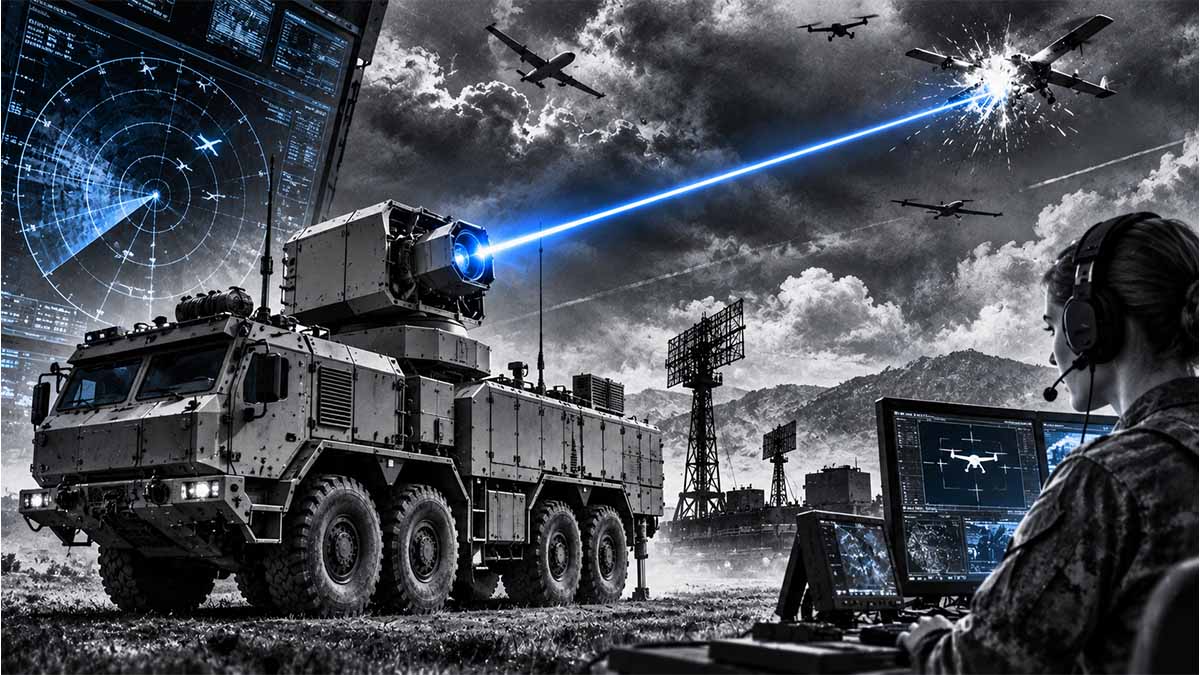
Scope: An assessment of the verified operational maturity, engineering limitations, platform integration and deterrence contribution of high-energy laser weapons across the United States, Israel, South Korea, Japan, China, Russia and major European defence powers, using evidence available through 2 November 2026 and examining force-development pathways to 2030.
Executive Summary — Bottom Line Up Front
Principal judgment — High confidence: High-energy lasers have become credible operational instruments for short-range defence against selected unmanned aerial threats, but they have not yet demonstrated the ability to replace kinetic air-defence systems or independently defeat sustained, high-density attacks under unrestricted battlefield conditions.
South Korea has documented deployment of Cheongwang Block-I since December 2024. Israel has reported successful wartime interceptions by laser prototypes and delivered its first full Iron Beam system in December 2025. The United States has demonstrated shipborne and vehicle-mounted engagements, although a federal audit identified substantial maturity deficiencies in its Stryker-mounted programme.
Operational judgment — High confidence: Electrical supply, waste-heat removal, atmospheric transmission, precision tracking, line of sight and target engagement time remain governing constraints. The relevant measure is not nominal laser power alone but the number of threats a complete system can reliably defeat within a specified time and environmental envelope.
Economic judgment — High confidence: Very low marginal firing costs are technically plausible, but published figures generally exclude acquisition, maintenance, cooling infrastructure and the cost of unsuccessful or repeated engagements. The economic advantage therefore depends on achieved engagement rates and system availability, not electricity prices alone.
Strategic judgment — Medium confidence: By 2030, lasers are most likely to strengthen layered point defence around military installations, naval vessels and selected mobile formations. Their contribution to strategic deterrence remains unproven because publicly documented changes in adversary conduct cannot yet be attributed specifically to laser deployments.
Decisive uncertainty: No sufficiently comprehensive, publicly accessible and independently audited dataset establishes representative kill probability, sustained engagement rate, weather-dependent availability and full lifecycle cost across the leading national programmes.
Laser Air Defence Is Becoming Real. Its Economic Case Is Not Yet Proven
South Korea has fielded Cheongwang Block-I, Israel has delivered its first full Iron Beam system, and the United Kingdom plans to install DragonFire aboard Royal Navy vessels from 2027. Yet the procurement case for high-energy lasers remains less mature than the weapons themselves. An interception is not an operational kill rate; cheap electricity is not cheap air defence; platform installation is not proof of combat availability. The contradiction reaches public budgets, industry and frontline protection. As of 2 November 2026, the decisive question is not whether lasers can destroy aircraft, but whether defence establishments can buy enough reliable defensive capacity to reduce exposure without weakening the missiles, guns and electronic-warfare systems they still require.
The firing bill is small; the defence bill is not
South Korea’s Defense Acquisition Program Administration has cited roughly KRW 2,000 per firing for Cheongwang; the United Kingdom’s Ministry of Defence puts a DragonFire shot at approximately £10; and the US Government Accountability Office reported Pentagon estimates of US$1–10 per firing in April 2023. These estimate marginal use, not successful defence. An audited cost per successful interception is [NOT IN DOSSIER]; meaningful comparison needs defeats, availability and maintenance costs. Cheongwang production — DAPA — 2024; Directed-energy transition — US GAO — 2023.
Britain’s £316 million DragonFire contract announced in November 2025 sits within a broader Spending Review pledge of nearly £1 billion in new directed-energy funding over the parliamentary period; the two commitments have different scopes and must not be added together. Israel’s Ministry of Defense described an approximately NIS 2 billion Iron Beam serial-production agreement in March 2025, while Germany’s July 2026 naval laser development contract falls in a reported mid-three-digit-million-euro range. The Pentagon’s directed-energy research spending was approximately US$1 billion annually at the time of the GAO’s 2023 inquiry. None counts mission-capable installations. UK Spending Review — HM Treasury — 2025; Iron Beam industrial agreement — Israel Ministry of Defense — 2025.
Fielding, combat use and acceptance are three separate thresholds
Cheongwang Block-I entered South Korean service in December 2024, but its reported developmental success does not disclose enough engagements to establish performance during sustained attacks. In June 2026, DAPA said a domestically developed oscillator reduced drone defeat time from 2–4 seconds to 1–2 seconds in prototype evaluation, while domestic content by value increased from 76% to 90%. Neither result demonstrates operational endurance. The upgraded component cannot be assumed present in every previously deployed system, and laser illumination time is not the complete detection-to-defeat cycle. Cheongwang oscillator qualification — DAPA — 2026.
Israel’s Ministry of Defense disclosed wartime interceptions by laser prototypes in May 2025, explicitly distinguishing them from the full Iron Beam system delivered on 28 December 2025. On 30 June 2026, it reported joint scenarios linking Iron Beam to the Iron Dome battle-management centre. This establishes prototype combat experience and subsequent integration progress, not a verified sustained kill rate for the delivered configuration. The United States supplies the acquisition warning: four 50-kW-class DE M-SHORAD Stryker prototypes were delivered in fiscal 2023, yet later testing led to a roughly two-year transition delay recorded in the GAO’s June 2025 audit. Installation had not resolved military acceptance. Israeli prototype intercepts — Israel Ministry of Defense — 2025; Iron Beam delivery — Israel Ministry of Defense — 2025; US Army modernisation audit — GAO — 2025.
Mobility is an energy and heat problem before it is a turret problem
Japan’s Acquisition, Technology & Logistics Agency distinguishes a 10-kW-class laser mounted on a recovery vehicle from a separate 100-kW-class system occupying two 40-foot containers. At an illustrative wall-plug efficiency of 40%, a weapon emitting 100 kW optically would demand 250 kW electrically and produce 150 kW of waste heat while firing; ten seconds would accumulate 1.5 megajoules before auxiliary loads. This is an illustrative calculation, not a weapon specification. Armoured vehicles must accommodate this burden without sacrificing mobility or protection; ships provide more space but add vibration, corrosion, maritime aerosols and competing electrical loads. Japanese high-power laser research — ATLA — 2024.
Japan’s 2026 Defense White Paper describes the US Navy’s 60-kW-class HELIOS aboard USS Preble and reports four UAVs disabled in January 2026; Germany’s Rheinmetall–MBDA consortium cites more than 1,000 test firings during its wider naval campaign. Four disabled targets are not a representative combat sample; 1,000 firings are not 1,000 verified kills. Aviation remains more constrained: the US YAL-1 destroyed a boosting missile in February 2010 aboard a modified Boeing 747, but that programme was cancelled, and the dossier establishes no routinely fielded destructive laser on a contemporary fighter or helicopter. Japan Defense White Paper — Japan Ministry of Defense — 2026; German naval development — Rheinmetall — 2026.
Saturation is a throughput test, not a magazine slogan
A laser consumes no interceptor missile when it fires, but it must still acquire, track, illuminate, assess and redirect before the next engagement; weather and thermal recovery further restrict the available firing window. Tracking many drones does not create multiple destructive beams. The US Army’s June 2025 Fort Sill exercise combined directed-energy prototypes and kinetic systems against Group 1–3 unmanned aircraft, yet the public account supplied no complete arrival-rate distribution or sustained defeat rate. Such data determine whether lasers can withstand concentrated attacks. US Army directed-energy live fire — June 2025.
NATO’s Integrated Air and Missile Defence Policy of 13 February 2025 requires layered protection, not reliance on one effector. Its 2026 counter-drone interoperability work assembled 40 companies from 11 Allied countries, more than 60 commercial counter-UAS systems and approximately 40 command-and-control applications. Interoperability is thus a procurement variable: a laser that cannot exchange targeting information or be assigned engagements within a common command architecture risks becoming a costly isolated installation. The dossier establishes no change in adversary behaviour attributable independently to lasers. NATO Integrated Air and Missile Defence Policy — 2025.
Europe has suppliers, but no common laser-defence standard
The United Kingdom’s DragonFire contract targets installation on Type 45 destroyers from 2027; Germany’s Rheinmetall–MBDA naval programme targets operational service in 2029. France’s HELMA-P was reported by CILAS as deployed for security at the Paris 2024 Olympics, which does not establish combat interception performance. Italy has relevant electro-optical competence and industrial involvement through Leonardo’s British operations, but no verified nationally fielded destructive laser air-defence system in the reviewed record. The European Defence Agency’s TALOS programme brought together 16 participants from nine countries and completed enabling-technology research in 2023 without producing a common operational weapon. National milestones still leave common qualification unresolved. DragonFire contract — UK Ministry of Defence — 2025; TALOS project closure — European Defence Agency — 2023.
Neither China’s publicly displayed LW-60 nor Russia’s reported Peresvet, associated in the Japanese defence assessment with counter-space functions, provides comparable verified evidence of sustained counter-air performance. Neither parity nor inferiority is established. NATO’s 2026 Layered Counter-UAS Initiative instead points to the more immediate contest: which allied procurement systems can turn national optical technologies into interoperable, maintainable defensive networks. NATO Layered Counter-UAS Initiative — 2026.
The 2027–28 bill will expose the cost of premature substitution
During the 12–24 months after 2 November 2026, Britain’s planned DragonFire ship integration will test whether a funded programme becomes accepted naval capability; the US Army’s delayed DE M-SHORAD transition will test whether its integration problems can be resolved; and Israel’s delivered Iron Beam will require operational evidence distinguishable from earlier prototype results. Germany’s 2029 service objective remains beyond most of that window. Ministries need audited availability, representative defeat rates and whole-system sustainment costs before reducing conventional inventories on the strength of laser announcements. US Army modernisation audit — GAO — 2025.
Inaction has two costs. Defence ministries that defer viable laser integration may continue spending scarce kinetic interceptors on threats that a qualified directed-energy system could defeat more economically; governments that accelerate substitution before qualification may purchase fragile capacity while weakening the missile and gun coverage needed in adverse weather or massed attacks. Taxpayers fund the procurement and sustainment mistakes, manufacturers absorb unstable orders, and operational units bear the risk of lost protection. By late 2028, the relevant measure will not be advertised kilowatts or systems exhibited but additional hostile threats reliably defeated per unit of defensive resource, without degrading readiness elsewhere.
Navigational Index
PILLAR I — VERIFIED TECHNOLOGY AND OPERATIONAL MATURITY
- Chapter 1. High-Energy Laser Weapons: Physical Baseline, Demonstrated Performance and Evidentiary Standards
- Chapter 2. Mobile Platform Integration: Armoured Vehicles, Naval Combatants and Aircraft
- Chapter 3. Comparative National Assessment: South Korea, Japan, the United States, Israel, China, Russia and Europe
PILLAR II — OPERATIONAL EMPLOYMENT AND STRATEGIC VALUE
- Chapter 4. Force Protection, Drone Saturation and the Limits of Laser Deterrence
- Chapter 5. Enabling Technologies: Power, Cooling, Beam Control, Sensors and Integrated Air Defence
- Chapter 6. Industrial Capacity, Acquisition Economics and Allied Force-Structure Implications
PILLAR III — STRATEGIC OUTLOOK AND ACQUISITION DECISIONS
- Chapter 7. Three Development Scenarios Through 2030: Incremental Progress, Engineering Breakthrough and Persistent Niche Capability
- Chapter 8. Critical Uncertainties, Verification Milestones, Monitoring Indicators and Decision Framework
Master Abstract
The central distinction: demonstrated interception is not sustained operational capability
The international directed-energy sector has crossed an important technological threshold: high-energy laser weapons are no longer confined to laboratories or isolated proof-of-concept demonstrations. Military authorities have documented fielded ground-based systems, operational prototype employment, naval integration, successful live-fire exercises and continuing procurement commitments. Nevertheless, these achievements do not establish a general capacity to defeat complex airborne attacks under combat-representative conditions. The critical distinctions are between a successful engagement and a repeatable engagement process; between equipment installed on a military platform and equipment certified for routine tactical use; and between a low marginal cost per laser firing and a demonstrably lower cost per threat defeated.
South Korea offers one of the clearest cases of a formally fielded laser air-defence capability. The Defense Acquisition Program Administration confirmed that Cheongwang Block-I entered service in December 2024, following development tests and the transition to production. Its June 2026 announcement reported improved drone engagement times using a newly localised laser oscillator, but those measurements came from additional evaluation on a system prototype; they must not be assigned retrospectively to every deployed Block-I unit. The agency’s earlier claim of a 100% live-fire success rate also lacks a published test denominator sufficient to calculate performance in operationally representative conditions. Laser Air-Defence Weapon Production Launch — Defense Acquisition Program Administration — Jul 2024. Domestic Development of Cheongwang Laser Oscillator — Defense Acquisition Program Administration — Jun 2026.
Israel has produced the strongest official evidence of laser use against hostile threats during wartime. In May 2025, its Ministry of Defense disclosed that Air Force personnel had employed laser prototypes to intercept numerous enemy threats. The distinction between these prototypes and the more powerful Iron Beam system is decisive: Iron Beam was still under development at the time, and its first unit was formally delivered to the Israel Defense Forces on 28 December 2025. A June 2026 test series subsequently documented joint operational scenarios involving Iron Beam and the Iron Dome battle-management centre. Together, these milestones support a judgment of limited operational adoption and material progress in command-and-control integration, but not a finding that the full Iron Beam architecture has already established a publicly audited combat interception record or sustained saturation-defence capability. Wartime Laser Interceptions — Israel Ministry of Defense — May 2025. First Iron Beam Delivery — Israel Ministry of Defense — Dec 2025. Iron Dome and Iron Beam Integration Tests — Israel Ministry of Defense — Jun 2026.
Mobile integration exposes the difference between technological output and military readiness
The most consequential engineering barrier is the integration of a complete weapon system rather than the production of an adequately powerful laser beam. The United States provides a particularly important example because its Government Accountability Office examined an actual vehicle-mounted acquisition programme rather than relying on supplier performance statements. Four 50-kilowatt-class Directed Energy Maneuver-Short Range Air Defense prototypes were delivered to an Army platoon during fiscal year 2023 and underwent an in-theatre assessment in fiscal year 2024. Their demonstrated maturity was insufficient for the planned acquisition transition, which was delayed by approximately two years. At the time of the audit, production was expected in fiscal year 2027 and the Army was considering an alternative vehicle configuration. This establishes that even a successfully integrated Stryker-mounted prototype cannot automatically be treated as a mature, routinely deployable weapon. Army Modernization: Air and Missile Defense Efforts Would Benefit from Applying Leading Practices — U.S. Government Accountability Office — Jun 2025.
Japan’s Acquisition, Technology & Logistics Agency has independently illustrated the significance of platform size. Its published research programme distinguishes a 10-kilowatt-class demonstrator mounted on a single military recovery vehicle from a separate 100-kilowatt-class experimental system occupying two 40-foot containers. The latter programme aims to demonstrate counter-drone and mortar-round effects, but its containerised architecture cannot be interpreted as proof that a 100-kilowatt laser has become a tactically practical weapon for tanks, armoured personnel carriers or aircraft. The physical requirements for electrical generation, power conversion, optical stability, cooling and protected operating volume remain system-level constraints even when laser-source efficiency improves. High-Power Laser Research for Counter-Drone Applications — Acquisition, Technology & Logistics Agency, Japan — 2024.
Operational advantage is conditional, while deterrence remains a separate question
High-energy lasers offer the strongest present advantage where threats are detectable early, relatively inexpensive, within a clear and short engagement path, and sufficiently separated in time for precise tracking, dwell and reassessment. They are less attractive when visibility deteriorates, target presentation time contracts, multiple threats arrive simultaneously, or vehicle and ship movements degrade beam stability. The frequently cited advantage of an effectively unlimited magazine is therefore conditional: electricity may replace expendable interceptor rounds, but power supply, thermal capacity, target tracking and engagement geometry still bound effective throughput. The U.S. Government Accountability Office identifies atmospheric effects and the capacity to engage one target at a time as significant limitations of laser systems. Science & Tech Spotlight: Directed Energy Weapons — U.S. Government Accountability Office — May 2023.
The strategic consequence is a distinction between force-protection utility, which has been demonstrated in increasingly credible settings, and deterrence value, which requires additional evidence about adversary behaviour, attack economics and the reliability of defensive effects under contested conditions. A defender that can destroy small unmanned aircraft at low marginal cost may reduce the economic attraction of selected attacks, but that outcome is not equivalent to preventing an adversary from launching them. Until measured operational performance establishes durable defensive capacity, high-energy lasers should be treated as an emerging component of layered air defence rather than a substitute for interceptors, guns, electronic warfare and resilient command-and-control systems. Confidence: high for the physical and engineering assessment; medium for the projected force-structure implications; low for any assertion that lasers have already produced a measurable strategic deterrent effect.
Key Evidence Table — Principal National Programmes
The comparison below distinguishes reported technical specifications, live-fire activity, fielding and combat evidence. A successful test does not imply a measured combat kill probability, and an undisclosed range must not be interpreted as zero.
| Indicator | Value/status | Reference date | Definition/scope | Issuer | Exact source |
|---|---|---|---|---|---|
| South Korea — Cheongwang Block-I | Fielded Dec 2024; exact optical power and independently verified engagement range not disclosed in the cited releases. Earlier 100% test success claimed without sample size. Confidence: high for fielding; medium for performance. | 2024–2026 | Ground-based point defence against small UAVs; public evidence does not establish sustained engagement rates. | DAPA | Production and Test Announcement — DAPA — Jul 2024 |
| South Korea — improved oscillator | Drone defeat time reportedly reduced from 2–4 seconds to 1–2 seconds in prototype evaluations. Approximately 50% or greater improvement in key oscillator characteristics reported. | Jun 2026 | Future production component, not automatically the specification of existing deployed units. | DAPA | Cheongwang Oscillator Localisation — DAPA — Jun 2026 |
| Israel — wartime laser prototypes | Officially reported successful interceptions of numerous hostile threats; no public engagement denominator or independent kill-probability dataset. Limited combat-proven prototype capability. | May 2025 | Combat use of laser prototypes, explicitly distinct from full Iron Beam. | Israel Ministry of Defense | Wartime Laser Interceptions — IMOD — May 2025 |
| Israel — Iron Beam | Approximately 100-kW class in the Japanese defence assessment; first system delivered Dec 2025; joint Iron Dome command-and-control scenarios tested Jun 2026. No public sustained kill-rate figures. Limited initial operational adoption. | 2025–2026 | Rockets, mortars and UAVs; delivered system is not the same as the earlier wartime prototypes. | IMOD; Japan MoD | First System Delivery — IMOD — Dec 2025; Japan Defense White Paper — Japan MoD — 2026 |
| United States — DE M-SHORAD | 50-kW class, four Stryker prototypes delivered; tactical assessment revealed insufficient maturity for planned transition. Operational experimentation, not mature production deployment. | 2023–2025 | Army mobile short-range air defence; no public representative sustained kill-rate dataset in the audit. | U.S. GAO | Army Modernization Audit — GAO — Jun 2025 |
| United States — Navy HELIOS | 60-kW class aboard USS Preble; Japanese MoD reports four UAVs disabled in Jan 2026. Ship-integrated experimental capability. | Jan 2026 | Reported naval engagements; four targets do not establish combat performance or high-rate simultaneous capacity. | Japan MoD | Defense White Paper, Advanced Technologies — Japan MoD — 2026 |
| Japan — land-based prototypes | 10-kW-class vehicle demonstrator and separate 100-kW-class two-container experimental system; small-drone destructive tests documented. Technology demonstrators. | 2024 | Counter-UAV research and proposed mortar defence; no demonstrated routine force-wide deployment. | ATLA | High-Power Laser Research — ATLA — 2024 |
| United Kingdom — DragonFire | Successful anti-drone trials; £316 million contract for naval deployment beginning in 2027. Optical power not published in the cited ministry announcement. Pre-operational acquisition. | Nov 2025 | Trials against high-speed drone targets; no disclosed representative operational kill rate. | UK Ministry of Defence | DragonFire Procurement and Trials — UK MoD — Nov 2025 |
| Germany — Rheinmetall/MBDA naval laser | More than 1,000 shots reported across testing; 2026 development contract; operational service targeted for 2029. Advanced demonstrator under acquisition development. | Jul 2026 | Naval and land tests, not 1,000 independently verified combat kills. | Rheinmetall / MBDA; BAAINBw contract | German Naval Laser Development Contract — Rheinmetall — Jul 2026 |
| France — HELMA-P | Manufacturer reports anti-drone security deployment during the Paris 2024 Olympics and additional procurement orders. Combat kills and sustained effectiveness not substantiated. Specialised protective deployment. | Sep 2024 | Security-oriented deployment, not proof of wartime interception capability. | CILAS | HELMA-P: From Security for the 2024 Olympic Games to Integration into the French Armed Forces — CILAS — Sep 2024 |
| China — LW-60 and related efforts | Vehicle-mounted LW-60 publicly displayed; optical power and operational engagement statistics not established in the cited assessment. Publicly demonstrated, fielding not verified here. | 2024–2026 | Counter-small-UAV systems; combat performance remains an open record. | Japan MoD | Defense White Paper — Japan MoD — 2026 |
| Russia — Peresvet | Reported deployment of a system in the tens-of-kilowatts class; principal described mission relates to counter-space activity. Reported deployed capability, not verified combat-proven laser air defence. | 2026 assessment | Anti-satellite and related directed-energy functions must not be equated with drone interception. | Japan MoD | Defense White Paper — Japan MoD — 2026 |
| Italy — national position | Publicly documented naval electro-optical and related technical research; no comparable verified national high-energy-laser air-defence fielding record established in the reviewed official material. Maturity indeterminate for a nationally fielded weapon. | As of Nov 2026 | Research capacity is not evidence of procurement, readiness or operational deployment. | Italian Navy | Electro-Optics Research — Italian Navy — undated |
What the published performance figures establish—and what they do not
The strongest published quantitative evidence is uneven in both measurement and meaning. South Korea’s 100% statement concerns an undisclosed number of development engagements. Its more recent 1–2-second result concerns an enhanced prototype. The U.S. Navy’s reported four-UAV engagement is a limited naval demonstration. Germany’s figure of more than 1,000 firings represents a cumulative test activity measure rather than an independently verified population of successful kills. Israel’s wartime reporting demonstrates actual hostile-threat interceptions but does not provide a complete numerator, denominator, environmental breakdown or threat classification needed for a statistically defensible estimate of operational effectiveness. These measures are not interchangeable and cannot be aggregated into a meaningful international success-rate ranking. DAPA — Jul 2024. DAPA — Jun 2026. Japan MoD — 2026. Rheinmetall — Jul 2026.
Published cost claims require similar restraint. South Korea’s estimate of approximately KRW 2,000 per firing and the United Kingdom’s approximately £10 per shot are ministerial estimates of marginal engagement expense; neither should be treated as a validated lifecycle cost per successfully defeated threat. A comparable acquisition assessment would require weapon-system capital cost, electrical and fuel expenditure, coolant and thermal management, maintenance, operator requirements, overhaul costs, reliability, availability and the frequency of repeat engagements. Laser Air-Defence Production Announcement — DAPA — Jul 2024. DragonFire Trials and Procurement — UK MoD — Nov 2025.
Engineering Reference — The Physical Cost of Mobile Laser Power
The 100 kW High-Energy Laser (HEL):
Thermodynamic Balance & Prime-Power Architecture
A nominal optical output of 100 kW represents solely the radiant terminal vector. Total weapon viability, duty-cycle sustainment, and platform integration are strictly governed by energy conservation laws: electrical bus conversion, massive transient heat rejection, and auxiliary parasitics.
Target-Directed Optical Power
Continuous coherent photonic energy delivered at the source aperture. This figure defines the theoretical irradiance (W/cm²) focused on the engagement target prior to atmospheric jitter, thermal blooming, and scattering.
Continuous Electrical Inflow
Required DC/AC power injection to pump the laser gain medium (fiber, solid-state slab). Demands high-discharge battery banks, supercapacitor modules, or dedicated high-frequency platform
Operational dependency scheme
The complete kill chain requires successful performance by every major subsystem, while the overall engagement rate is constrained by whichever subsystem becomes the practical bottleneck.
High-Energy Laser: Operational Dependency Chain
All six stages must function under the same engagement conditions. A successful firing is not proof of sustained target-defeat capacity.
Constraint: detection horizon.
Constraint: motion and vibration.
Constraint: available power.
Constraint: thermal capacity.
Constraint: attenuation and turbulence.
Constraint: engagement cycle time.
Interpretation: Nominal source power alone is insufficient to establish engagement range, kill probability, effective magazine depth or saturation resistance.
Technical basis: US GAO, Directed Energy Weapons, May 2023 ; Japan ATLA, High-Power Laser Research, 2024 . Conceptual system architecture; no invented performance data.Competing Development Pathways Through 2030
The three pathways are alternative dominant outcomes for procurement and operational employment rather than mutually exclusive claims about every national programme. Different armed forces could occupy different pathways simultaneously.
| Hypothesis | Diagnostic support | Disconfirming evidence | Indicators | Current standing |
|---|---|---|---|---|
| H1 — Incremental operational improvement | Fielded Korean systems, Israeli delivery and integration, expanding naval trials and production commitments. | Continuing mobility penalties, incomplete readiness records and limited representative live-fire datasets. | More deployed units, better documented engagement rates, routine mixed-weather exercises. | Leading assessment; medium confidence. |
| H2 — Power-density and thermal-management breakthrough | Improvements in beam generation, optical control, hybrid power architectures and modular integration. | Japan’s containerised 100-kW-class experimental architecture and the US Army’s previous mobile maturity problems show the magnitude of system-level barriers. | Independently verified reductions in full-system mass and volume, repeated high-power firing on manoeuvring platforms, sustained availability. | Plausible but not established; low-to-medium confidence. |
| H3 — Persistent specialised point-defence role | Atmospheric limitations, dwell requirements, cooling penalties and the continued value of kinetic weapons against short-warning or hard targets. | Real operational prototype successes and national transition programmes show that capability is progressing beyond laboratory use. | Procurement remains concentrated at fixed installations and large ships; mobile programmes continue to slip; no verified saturation-defence gains. | Credible downside pathway; medium confidence. |
The principal distinction between these scenarios is not whether lasers can destroy targets. That has already been demonstrated. It is whether complete systems can deliver sufficiently high availability and target throughput to alter force design, interceptor inventories and defensive operating costs in combat conditions.
Decision implications by scenario
Under incremental improvement, armed forces would rationally expand laser coverage at installations and on selected vessels while retaining substantial kinetic capacity. Under a power-density breakthrough, smaller ships, trucks and eventually a broader class of protected vehicles could become viable carriers, provided tracking and thermal performance improve together. Under the persistent niche pathway, lasers would remain valuable against selected small UAVs but would not materially change the required investment in missile interceptors, guns and electronic warfare.
Across all three pathways, the strongest near-term acquisition principle is to preserve flexibility through common sensors, battle-management systems and selectable effectors, so that commanders can employ the lowest-cost weapon that is effective under the prevailing conditions without making air defence dependent upon a single physical mechanism.
Principal Gaps and Watch Indicators
| Consequential uncertainty | Required evidence or observable milestone | Significance for 2030 assessment |
|---|---|---|
| Actual saturation-defence capacity | Military trial reports publishing target arrival rates, simultaneous tracks, engagements attempted, defeats achieved, re-attack intervals and the number of laser effectors used. | Establishes whether laser batteries materially reduce dependence on kinetic interceptors during concentrated attacks. |
| Weather-dependent reliability | Repeated exercises stratified by fog, rain, humidity, maritime spray, dust and turbulence, with results reported for equivalent target classes and ranges. | Determines realistic protected-area coverage and availability rather than nominal maximum range. |
| Mobile power and cooling integration | Full-system mass and dimensions, sustained electrical demand, thermal recovery profiles and mission availability during movement and after firing. | Determines the distinction between a vehicle that transports a laser and a platform that can reliably fight with it. |
| Combat evidence and cost per successful engagement | Authenticated operational logs separating prototypes from serial systems, threat types, engagement outcomes, repeat firings and corresponding maintenance costs. | Converts proof of technical feasibility into an economically meaningful force-protection assessment. |
| Naval transition milestones | US Navy operational evaluation of HELIOS; UK DragonFire integration on Type 45 destroyers from 2027; German qualification and intended service transition by 2029. | Tests whether shipboard systems progress from successful trials to routine fleet readiness. |
| South Korean production upgrades | DAPA acceptance data for new domestic oscillators, Block-II trials and documented tactical endurance of mobile variants. | Determines whether improved engagement time can be reproduced in serial systems under operational duty cycles. |
| Israeli networked air defence | Subsequent official Iron Beam acceptance and operational reporting, including Iron Dome battle-management allocation between laser and kinetic interceptors. | Determines whether demonstrated integration generates measurable defensive capacity at force level. |
| Airborne feasibility | Publicly documented manned or unmanned airborne high-energy-laser firing trials with complete power, cooling, stabilization and flight-envelope data. | Provides the decisive evidence presently missing for credible routine deployment on combat aircraft. |
These indicators carry different evidentiary weight. Contract awards demonstrate expenditure and procurement commitment; range trials establish bounded technical performance; military acceptance establishes the transition toward operational employment; and repeated, independently auditable service results establish the strength of an operational claim. None should be substituted for another.
Opening Net Assessment
The available official record supports a conclusion of genuine technological transition without a corresponding general transformation of air defence. South Korea demonstrates that an initial laser capability can enter military service; Israel establishes that laser prototypes can be employed against hostile threats and that a more powerful integrated system has progressed to initial delivery; the United States demonstrates the limits of rapid platform integration through a documented acquisition setback; and Japan, the United Kingdom, Germany and France establish different stages of technical experimentation, specialised deployment and naval procurement. Public reporting from China and Russia is materially less suitable for determining actual counter-air operational effectiveness, particularly where system descriptions concern demonstrations or counter-space missions rather than documented engagements against aerial threats.
The present acquisition risk is not principally that high-energy lasers will fail to work. It is that successful demonstrations will encourage investment decisions based on nominal kilowatts, declared maximum ranges, selective target kills or electricity-only firing costs, without adequately establishing full-system availability, weather-dependent effectiveness, sustained target throughput and integration cost. By 2030, defence authorities should measure laser success by the additional number of credible threats defeated per unit of defensive resource, not by optical output or the number of publicised trials.
The governing strategic judgment is therefore that directed-energy weapons are becoming increasingly important to layered, economically sustainable point defence, while their contribution to deterrence remains conditional upon operational reliability, demonstrable defensive capacity and the continued presence of complementary kinetic and electronic-warfare systems.
DIRECTED ENERGY
OPERATIONAL REALITY
High-energy lasers are moving beyond laboratory demonstrations, but fielding, combat experience, and dependable saturation defence are different evidentiary thresholds. Explore the verified programmes, practical engineering limits, and 2030 acquisition pathways.
Interactive 3D optical-power comparison
Published or officially assessed power classes are comparable as nominal optical output only. They are not measures of effective range, kill probability, coverage or readiness.
vehicle US Army
Stryker US Navy
HELIOS Japan
containers Israel
Iron Beam
Sources: Japan ATLA, High-Power Laser Research (2024) ; US GAO, Army Modernization (2025) ; Japan Ministry of Defense, Defense White Paper (2026) . The three-dimensional treatment is visual styling, not a third measurement dimension.
Power in · optical power out · waste heat
Change the assumptions to test the electrical and thermal balance. This is an illustrative model, not measured data from a named weapon. It assumes constant wall-plug efficiency and excludes auxiliary loads, storage losses and transient thermal limits.
Calculation: electrical input = optical output ÷ assumed efficiency; waste-heat rate = electrical input − optical output; heat energy = waste-heat rate × duration ÷ 1,000 (MJ). No prediction of combat performance is implied.
The weakest subsystem governs the engagement
Select any system element to inspect its limiting mechanism. Successful power generation alone does not establish a reliable kill chain.
Filter the evidence, not a fictional readiness ranking
Rows classify the nature of public evidence. Categories are deliberately non-numeric: an undisclosed kill probability or range is not zero, and a claimed test result is not a representative operational record.
Showing all 13 programme records.
| Nation / programme | Optical class | Officially reported evidence | Platform | Evidence category | Limitation / primary source |
|---|---|---|---|---|---|
|
South Korea Cheongwang Block-I |
Not disclosed here | Entered service Dec 2024; 100% development-test success claimed, sample size unavailable. | Ground point defence | Fielded | No public sustained kill-rate dataset. DAPA, 2024 |
|
Israel Wartime laser prototypes |
Not established | Ministry reported interceptions of hostile threats, May 2025. | Ground-based prototypes | Combat-reported prototype | No full engagement denominator. IMOD, 2025 |
|
Israel Iron Beam |
≈100 kW class* | First full unit delivered Dec 2025; linked integration tested Jun 2026. | Ground, integrated air defence | Delivery / integration | Prototype combat events are not full-system results. IMOD, 2025 |
|
United States DE M-SHORAD |
50 kW class | Four prototypes assessed; maturity deficiencies delayed acquisition transition. | Stryker vehicles | Prototype / assessment | Power, cooling and maturity challenges. GAO, 2025 |
|
United States HELIOS |
60 kW class* | Ship-installed; four UAVs reportedly disabled in Jan 2026. | USS Preble | Shipboard experimental | Limited live-fire sample; not measured wartime reliability. Japan MoD, 2026 |
|
Japan 10-kW vehicle demonstrator |
10 kW class | Small-drone research and demonstrator testing. | Military recovery vehicle | Research demonstrator | No documented serial tactical fielding. ATLA, 2024 |
|
Japan 100-kW experiment |
100 kW class | Separate high-power counter-drone / mortar research. | Two 40-foot containers | Research demonstrator | Container size cannot imply armoured mobility. ATLA, 2024 |
|
United Kingdom DragonFire |
Not published here | Anti-drone trials; naval deployment targeted from 2027. | Planned Royal Navy ship integration | Pre-service trials | Future target is not current service. UK MoD, 2025 |
|
Germany Rheinmetall–MBDA |
Not published here | More than 1,000 test firings claimed; development contract Jul 2026, service target 2029. | Naval demonstrator / development | Advanced demonstrator | Firing count ≠ successful combat engagements. Rheinmetall, 2026 |
|
France HELMA-P |
Not established here | Manufacturer reported specialised security deployment at Paris 2024 Olympics. | Fixed / transportable protection | Specialised deployment | Security duty ≠ combat-proven air defence. CILAS, 2024 |
|
China LW-60 and related systems |
Not verified here | Public demonstration and display evidence. | Vehicle-mounted demonstrators | Fielding unresolved | No representative official success dataset in reviewed record. Japan MoD, 2026 |
|
Italy National research and development |
Not established | Naval electro-optical research documented; no verified national laser air-defence fielding record in reviewed material. | Research, not confirmed weapon deployment | Fielding unresolved | Research activity is not operational readiness. Italian Navy, undated |
|
Russia Peresvet |
Tens-of-kW class, assessed* | Deployment reported; described mission relates primarily to counter-space. | Ground-based strategic system | Air-defence role unverified | Not a demonstrated counter-drone combat kill record. Japan MoD, 2026 |
From field trials to procurement transition
Solid upper borders identify reported past milestones; dashed amber borders denote future plans rather than completed capability .
South Korea: Cheongwang Block-I enters service.
France: HELMA-P manufacturer reports Olympics security deployment.
Israel: wartime prototype engagements disclosed; first full Iron Beam delivered.
US Army: GAO details mobile-system maturity gap.
South Korea: oscillator prototype improvements reported.
Germany: naval development contract.
US Navy: four-UAV event described in Japanese assessment.
UK: DragonFire naval integration planned.
US Army: production timing identified in earlier GAO audit; not a confirmed delivery.
Germany: planned naval service transition. Actual qualification and acceptance remain to be demonstrated.
Scenario selector: no invented probabilities
Three qualitative paths. Select one to compare force-structure implications, the economic mechanism and the evidence needed to validate the pathway.
Add selected laser batteries and naval effectors without reducing layered missile, gun and EW capacity prematurely.
Potentially lower marginal cost against suitable small UAVs, conditional on weather, engagement success and maintenance burden.
Serial acceptance, realistic multi-target trials, documented availability and repeatable engagements under mixed conditions.
The observations that could change the judgment
Publish targets arriving per minute, attempted engagements, successful defeats, retarget intervals and effectors employed.
Release comparable performance trials across dust, fog, rainfall, humidity, maritime spray and turbulence.
Disclose full-system mass, electrical load, heat rejection, operating duty cycle, downtime and platform availability.
Demonstrate in-flight beam generation and target engagement with credible flight-envelope, stabilization and thermal evidence.
Measure effective kills alongside acquisition, maintenance, electricity/fuel, crew burden and replacement components.
Show verified target assignment across laser, kinetic, gun and EW systems in the same realistic exercise.
Institutional and primary sources
- Republic of Korea DAPA — Laser Air-Defence Production Announcement (2024)
- Republic of Korea DAPA — Domestic Laser Oscillator Development (2026)
- Israel Ministry of Defense — Wartime Prototype Interceptions (2025)
- Israel Ministry of Defense — First Iron Beam Delivery (2025)
- Israel Ministry of Defense — Integrated Test Series (2026)
- United States GAO — Army Modernization and Short-Range Air Defence (2025)
- United States GAO — Directed Energy Weapons Technology Spotlight (2023)
- Japan ATLA — High-Power Laser Research (2024)
- Japan Ministry of Defense — Defense White Paper, Advanced Technologies (2026)
- United Kingdom Ministry of Defence — DragonFire Trials and Procurement (2025)
- Rheinmetall — German Naval Laser Development Contract (2026)
- CILAS — HELMA-P Paris 2024 Security Deployment (2024)
- Italian Navy — Electro-Optics Research (undated)
PILLAR I — VERIFIED TECHNOLOGY AND OPERATIONAL MATURITY | 2 November 2026
Directed-Energy Weapons: Technological Maturity, Mobile Integration and the Operational Balance of Military Power
Chapter 1. High-Energy Laser Weapons: Physical Baseline, Demonstrated Performance and Evidentiary Standards
The transformation of laser technology into a military weapon remains conditional upon the performance of the complete engagement system
The development of high-energy laser weapons has reached a stage in which the central technological question is no longer whether concentrated electromagnetic energy can physically damage or destroy an airborne target, but whether a complete military system can repeatedly generate, direct and sustain that energy against operationally relevant threats while remaining available for subsequent engagements under the environmental, mechanical and logistical conditions encountered by deployed forces. This distinction is fundamental to contemporary defence planning because the ability to demonstrate the destruction of a small unmanned aircraft at a controlled proving ground does not establish the capability to defend an airbase against a coordinated attack, protect a manoeuvring armoured formation or sustain defensive engagements from a warship operating in adverse maritime conditions. The relevant military capability consists of an integrated architecture incorporating surveillance, identification, target assignment, precision tracking, beam generation, atmospheric propagation, thermal management, damage assessment and engagement sequencing, with the actual effectiveness of the weapon ultimately determined by the performance of the architecture as a whole rather than by the nominal optical output of its laser source. The United States Government Accountability Office has documented both the potential economic advantages of directed-energy weapons and their limitations, including their sensitivity to weather, comparatively restricted engagement geometry and the tendency of high-energy laser systems to engage individual targets sequentially. Science & Technology Spotlight: Directed Energy Weapons — U.S. Government Accountability Office — May 2023.
The resulting technological position is more advanced than a purely experimental industry but less mature than the conventional terminology of operational deployment sometimes suggests, particularly when national announcements describe individual milestones without providing the engagement populations, environmental conditions or sustainment records required to evaluate their military significance. South Korea has placed an initial laser air-defence system into service; Israel has documented the wartime use of laser prototypes and delivered its first full Iron Beam system; the United States has integrated laser weapons on naval vessels and armoured vehicles, while documenting important acquisition problems; and Japan and several European countries have produced increasingly sophisticated experimental systems and initiated further development programmes. Nevertheless, these developments represent different technological and institutional achievements, and combining them into a single category of operational maturity would conceal the fundamental differences between experimental success, accepted equipment, limited deployment and repeatedly demonstrated combat effectiveness. Army Modernization: Air and Missile Defense Efforts Would Benefit from Applying Leading Practices — U.S. Government Accountability Office — Jun 2025. Israel MOD and Rafael Deliver First Operational High-Power Laser System — Israel Ministry of Defense — Dec 2025.
Principal assessment — High confidence: High-energy laser weapons have demonstrated credible utility against selected aerial threats, especially small unmanned aircraft, but the publicly established operational record does not yet justify treating them as general substitutes for missile interceptors, automatic cannon, radar-directed guns or electronic-warfare systems. Their principal present value derives from the possibility of adding a repeatable and relatively low-marginal-cost engagement mechanism to an existing defensive architecture, provided that the physical and operational conditions allow the laser to achieve the necessary effect.
The physical characteristics that determine the effective engagement envelope
A high-energy laser weapon transfers electromagnetic energy toward a selected target, commonly through a tightly controlled optical beam, and seeks to produce an effect through sustained energy deposition, local heating, structural damage, sensor disruption or another target-dependent mechanism. The critical distinction between a high-energy laser and a high-power microwave weapon is that the laser ordinarily concentrates its effect into a comparatively narrow optical path and is usually applied to one target at a time, whereas microwave systems can influence multiple susceptible electronic systems within a broader illuminated region, although their effectiveness depends on the characteristics and vulnerability of the targets concerned. The Government Accountability Office explicitly distinguishes these mechanisms, which are strategically complementary rather than operationally interchangeable, because lasers can offer precise engagements against individual accessible targets while high-power microwave systems potentially provide a different form of defence against groups of electronic threats. Science & Technology Spotlight: Directed Energy Weapons — U.S. Government Accountability Office — May 2023.
The nominal laser power, expressed in kilowatts, is only the starting point for evaluating destructive potential, since the amount of energy reaching a vulnerable target component depends on beam quality, optical aperture, propagation distance, atmospheric conditions, pointing accuracy, engagement duration and the target’s physical properties. An increase from 50 to 100 kilowatts of optical output doubles the emitted optical power under an otherwise equivalent definition, but it does not automatically double the effective range, halve the time required to defeat every target or double the number of threats that a complete weapon system can neutralise. Greater source power can be offset by atmospheric attenuation, beam spreading, target motion or thermal restrictions, while a lower-power system operating at a favourable engagement distance against an exposed and vulnerable component can achieve a successful result under conditions in which a more powerful system encounters greater difficulties. Consequently, a comparison based exclusively on national power classifications would confuse a physical characteristic of the energy source with the operational effectiveness of the assembled weapon.
The atmosphere represents a particularly important distinction between laser weapons and conventional kinetic interceptors because it forms part of the transmission path and therefore directly influences the energy delivered to the target. Fog, rain, dust, smoke, maritime aerosols and turbulence introduce attenuation, scattering or beam distortion, with the magnitude depending on wavelength, particle distribution, propagation geometry and prevailing environmental conditions. Although kinetic systems are also affected by weather through their sensors, flight conditions and terminal guidance, the laser must preserve sufficient optical energy along its engagement path for the duration required to produce the desired effect. This characteristic makes an isolated published engagement range insufficient to establish operational coverage, since the meaningful quantity is the range at which a specified target can be defeated with an acceptable probability under defined atmospheric conditions and within the response time available to the defending force. Science & Technology Spotlight: Directed Energy Weapons — U.S. Government Accountability Office — May 2023.
Verified performance: why reported interception success cannot be converted directly into operational reliability
One of the most consequential weaknesses in the international open-source evidence is the tendency to report successful engagements without publishing the total number of attempted engagements, the distribution of target characteristics or the conditions under which unsuccessful engagements occurred. For an acquisition authority, a claim that every target was destroyed during a particular demonstration establishes considerably less than a claim supported by several hundred independently documented engagements conducted across representative environments, target profiles and operational configurations. A scientifically meaningful assessment requires a defined engagement opportunity, an explicit success criterion, the number of attempts, the resulting outcomes and sufficient information to identify whether the reported result represents a laboratory trial, an acceptance test, an operational exercise or actual combat employment. Without these variables, a reported success percentage cannot be used to estimate the probability that the weapon will defeat the next target encountered in combat.
South Korea, France, Japan and the United Kingdom provide useful contrasting examples. The South Korean acquisition authority has described successful developmental testing for Cheongwang Block-I and subsequently published improvements in engagement duration following the introduction of a domestically developed laser oscillator. France’s Directorate General of Armaments reported a 100% success rate during HELMA-P evaluations conducted in 2020 and 2021, but did not publish a sufficiently detailed engagement population in the cited announcement to extrapolate that result to unrestricted combat conditions. Japan’s Acquisition, Technology & Logistics Agency published a research presentation identifying three representative categories of small rotorcraft and reporting destructive results in experimental tests, providing useful evidence about target diversity but not a statistically representative operational success rate. The United Kingdom’s December 2024 announcement concerning its Wolfhound-mounted laser demonstrator included a military trial manager’s statement that every engagement undertaken in the reported exercise had defeated its drone target, while leaving the complete numerical denominator and full environmental distribution unavailable. These results provide cumulative evidence that precision laser engagements are technically repeatable under selected conditions, but none, considered individually, establishes long-duration operational reliability. Laser Oscillator Localisation and Evaluation — Defense Acquisition Program Administration — Jun 2026. Counter-Drone Laser Prototype Procurement — French Ministry of the Armed Forces — Jun 2022. High-Power Laser Research for Counter-Drone Applications, pp. 11–15 — Japan Acquisition, Technology & Logistics Agency — 2024. British Army Successfully Tests New Drone-Destroying Laser — UK Ministry of Defence — Dec 2024.
The Japanese experimental programme is particularly informative because its engineering record provides a more useful assessment of technological maturity than a simple announcement of target destruction. The agency identifies two distinct development efforts: a Mitsubishi Heavy Industries vehicle-mounted demonstrator in the 10-kilowatt class and a Kawasaki Heavy Industries electrically driven system in the 100-kilowatt class. The larger system combines domestic 10-kilowatt-class fibre lasers, occupies two 40-foot containers and was developed to investigate engagement effects against small unmanned aircraft and 81-millimetre mortar projectiles. In the published presentation, destructive test examples against three categories of small rotorcraft are reported, while the research architecture explicitly identifies beam combination, precision tracking, radar integration, atmospheric propagation and sequential target engagements as subjects of technical evaluation. This provides concrete evidence of a disciplined progression from laser-source development to integrated experiments, but does not establish that the entire 100-kilowatt system can be installed on a single tactical combat vehicle or employed continuously during mobile operations. High-Power Laser Research for Counter-Drone Applications, pp. 4, 9–15 — Japan Acquisition, Technology & Logistics Agency — 2024.
The United Kingdom provides the clearest official public example of a quantified engagement distance associated with a vehicle-mounted experimental system. In July 2024, the Defence Science and Technology Laboratory announced that a high-energy laser integrated on a British Army Wolfhound vehicle had neutralised targets at distances exceeding one kilometre during trials at Porton Down. A subsequent exercise at Radnor Range involved military personnel from 16 Royal Artillery engaging hovering aerial targets with the vehicle-mounted system, while the November 2025 DragonFire announcement documented successful trials against drones of a type capable of flying at speeds up to 650 kilometres per hour. These are distinct programmes and tests: the Wolfhound result establishes a publicly disclosed distance for a land-based experimental engagement, whereas the naval DragonFire programme provides evidence of high-speed aerial target engagement but does not disclose its complete operational range. The British government’s earlier statement concerning an accuracy equivalent to striking a £1 coin at one kilometre is a precision illustration, not a verified claim that the weapon can defeat every representative military target at that distance. First Trial on British Army Vehicle for High-Powered Laser Weapon — UK Defence Science and Technology Laboratory — Jul 2024. DragonFire High-Speed Drone Trials and Naval Procurement — UK Ministry of Defence — Nov 2025.
Experimental evidence and the actual significance of the published figures
| Programme and issuing authority | Published quantitative evidence | Target and test context | What the evidence establishes | What remains undetermined |
|---|---|---|---|---|
| South Korea — Cheongwang, DAPA | Improved prototype engagement time: 2–4 seconds reduced to 1–2 seconds against drones; larger UAV engagement reportedly reduced from more than 10 seconds to several seconds | Additional testing of domestically developed oscillator, reported June 2026 | Measurable prototype improvement under the reported test conditions | Full test population, ranges, environmental conditions and performance of every previously delivered unit |
| South Korea — domestic oscillator, DAPA | Domestic content increased from 76% to 90% by value; principal oscillator performance characteristics improved by approximately 50% or more | Localisation and qualification programme, May–June 2026 | Industrial progress and reduced dependence on imported oscillator technology | Direct relationship between localisation and fleet-wide operational readiness |
| Japan — ATLA 10-kW project | 10-kW class integrated on one heavy wheeled recovery vehicle | Vehicle-mounted demonstrator completed October 2024 | Feasibility of integrating a complete lower-power laser system on one military vehicle | Tactical readiness, weather-dependent kill probability and serial production |
| Japan — ATLA 100-kW project | 100-kW class, assembled in two 40-foot containers | Small rotorcraft testing and research concerning 81-mm mortars | High-power ground-based experimentation and demonstrated destructive effects against selected small drones | Single-vehicle mobility, mortar-defeat probability and sustained engagement capacity |
| United Kingdom — Wolfhound demonstrator | Target neutralisation at distances exceeding 1 km | Porton Down trial, July 2024 | A publicly reported distance exceeding one kilometre for a vehicle-mounted experimental system | General operational range and representative combat availability |
| United Kingdom — DragonFire | Target drones capable of speeds up to 650 km/h; £316 million naval procurement contract | Hebrides Range trials, reported November 2025 | Progression from experimental anti-drone engagement toward naval acquisition | Classified operating range, complete test denominator and deployed fleet performance |
| France — HELMA-P, DGA | 100% reported success in 2020–2021 ground evaluations | Biscarrosse test environment | Successful developmental counter-drone evaluation | Statistical confidence without denominator, subsequent wartime kill rate |
| United States — DE M-SHORAD | 50-kW class, four prototypes delivered to an Army platoon in FY2023 | Prototype assessment, including in-theatre evaluation in FY2024 | Demonstrated physical integration and operational experimentation | Qualification for routine procurement and dependable tactical readiness |
| United States — IFPC HEL | 300-kW class | High-power system integration and prototype development | A substantially higher nominal power-class development effort | Service acceptance, procurement transition and representative target-defeat results |
| United States — HELIOS | 60-kW class, four UAVs reportedly disabled in January 2026 | Shipborne experimental activity | Multi-target test activity by a ship-integrated weapon | Simultaneous engagement capacity, combat kill probability and sustained shipboard availability |
| Germany — naval laser demonstrator | More than 1,000 test firings and 28,000 nautical miles reported during shipborne demonstrations | Tests aboard frigate Sachsen and at WTD 91 | Extensive integration experience and accumulated technical testing | Number of confirmed target kills, equivalent exposure conditions and naval production readiness |
The entries above originate from differently structured official records, notably the June 2026 South Korean oscillator announcement — DAPA, Japan’s high-power laser research presentation — ATLA — 2024, the British Army vehicle trial — UK Dstl — Jul 2024, the DragonFire procurement announcement — UK Ministry of Defence — Nov 2025, the French laser-prototype procurement announcement — DGA — Jun 2022, the United States Army acquisition audit — GAO — Jun 2025, the Japanese Defense White Paper — 2026 and the German naval development announcement — Rheinmetall — Jul 2026. The German cumulative firing figure and the reported endurance of the demonstration campaign are manufacturer-reported metrics, not independently established combat outcomes.
Measurement requirements for evaluating operational maturity
An appropriate evaluation of contemporary high-energy laser systems should distinguish the emitted optical power of the weapon from the electrical requirements of the platform, the energy delivered to the target from the energy generated at the source, the reported time needed to defeat one target from the entire engagement cycle, and the successful completion of a controlled exercise from the operational reliability of the equipment over a sustained mission. A system reported to destroy a drone after two seconds of laser illumination may require additional time for acquisition, target classification, weapon assignment, beam alignment, firing authorisation, damage assessment and subsequent target acquisition, while the number of available beams and the operating condition of the thermal subsystem will determine whether those actions can be repeated without interruption. These variables are directly relevant to tactical command because the principal advantage of a laser disappears when the system cannot process incoming threats at a sufficient rate to match the attack geometry.
A further methodological distinction concerns the consequences of target damage. A temporarily disabled optical sensor, an aircraft that loses controlled flight, a detonated warhead and a physically destroyed airframe represent different operational outcomes, and not all of them necessarily prevent the threatening object from reaching a protected installation. The reported neutralisation of an unmanned aircraft therefore requires the publication of a clear defeat criterion, particularly where the attack uses a small explosive drone, a descending munition or a rapidly moving rocket. The appropriate criterion is not necessarily whether visible damage occurs, but whether the defensive action prevents the intended hostile effect with adequate reliability and without imposing unacceptable residual risk on the protected asset.
Key judgment — High confidence: The quantitative evidence from national development programmes demonstrates real progress, including faster experimental engagements, lower-power vehicle integration, successful shipborne firings and increasingly extensive test campaigns, but it does not provide a sufficiently homogeneous statistical basis to rank countries by operational interception probability. A procurement decision that relies on nominal power or a selective demonstration percentage without the corresponding exposure and readiness data risks overestimating actual defensive capacity.
What would change the assessment: Publication of comparable military acceptance and operational test records containing target classes, attempted engagements, successful defeats, ranges, atmospheric conditions, system configurations, availability, re-engagement times and sustained operational endurance.
Open official record: Detailed Cheongwang acceptance and operational evaluations; complete results of the Japanese high-power laser test programme; representative British vehicle and DragonFire engagement populations; US Army directed-energy operational test reports; and audited performance distributions for the Israeli and German systems.
Chapter 2. Mobile Platform Integration: Armoured Vehicles, Naval Combatants and Aircraft
Mobile integration introduces a second technological problem beyond target destruction
Principal judgment — High confidence: Mobile integration is the principal dividing line between a laser system that can demonstrate the destruction of an aerial target and a weapon that can become a practical component of a manoeuvring military force. This distinction is not resolved merely by installing a laser turret on an existing platform, because an effective mobile weapon must generate and condition electrical power, control thermal discharge, preserve precision optical alignment, survive the mechanical and electromagnetic environment of the host platform, remain compatible with other combat systems and continue functioning within the operational tempo imposed by the unit’s mission. The physical integration of a high-energy laser is therefore a systems-engineering challenge involving the complete vehicle, ship or aircraft rather than an isolated choice of laser generator.
The evidence available through November 2026 suggests that the most suitable contemporary platforms are those capable of accommodating substantial auxiliary equipment without compromising their primary combat functions, particularly ground-based installations, transportable systems and naval vessels with comparatively substantial volume and electrical infrastructure. Armoured fighting vehicles provide significant tactical advantages through their ability to accompany manoeuvring forces, but face more restrictive limits on electrical generation, cooling, turret space, internal equipment volume and survivability. Aircraft present the most demanding integration environment because the weapon must compete directly with propulsion, avionics, payload, fuel and flight-performance requirements while operating within a changing atmospheric and mechanical environment. These differences are reflected in the development record: shipborne and ground-mounted laser demonstrations are numerous, vehicle-mounted weapons have entered meaningful military experimentation, and no publicly established contemporary programme in the reviewed evidence demonstrates a routinely operational high-energy laser air-defence capability aboard a fighter, helicopter or tactical unmanned aircraft.
Ground vehicles: from protected transport platforms to tactical armoured formations
The United States Army’s Directed Energy Maneuver-Short Range Air Defense programme is among the clearest documented examples of the difficulties associated with the transition from vehicle installation to operational readiness. The programme integrated a 50-kilowatt-class laser onto a Stryker combat vehicle and delivered four prototypes to an air-defence artillery platoon in the fourth quarter of fiscal year 2023. An in-theatre evaluation was conducted during fiscal year 2024, but the results caused the Army to delay transition to a formal programme office by approximately two years because the system was insufficiently mature. The Government Accountability Office reported that production, originally planned for fiscal year 2025, had consequently been moved to an anticipated fiscal year 2027 start, while Army officials were considering a different vehicle configuration. This is especially significant because the programme had progressed beyond laboratory testing and physical integration, yet still failed to satisfy the maturity requirements needed for a straightforward acquisition transition. Army Modernization: Air and Missile Defense Efforts Would Benefit from Applying Leading Practices, DE M-SHORAD section — U.S. Government Accountability Office — Jun 2025.
The same audit provides an important distinction between the requirements imposed upon different armoured formations. The Army’s Maneuver-Short Range Air Defense Increment 1, based on the Stryker platform and incorporating kinetic weapons including Stinger missiles and a 30-millimetre cannon, represents a different technical and operational architecture from the laser-equipped Increment 2. Future increments were being considered for lighter and heavier vehicle categories, but the audit noted that those future increments lacked approved requirements and dedicated funding at the time examined. This distinction matters because a laser weapon integrated onto a large protected vehicle does not automatically become suitable for a lighter infantry-support vehicle or a more heavily armoured platform whose internal space, armour configuration, powertrain and tactical mission impose substantially different restrictions. Adapting the weapon to another vehicle can require a fresh systems-integration effort, rather than a relatively simple transfer of an established turret. Army Modernization: Air and Missile Defense Efforts Would Benefit from Applying Leading Practices, Maneuver-SHORAD section — U.S. Government Accountability Office — Jun 2025.
Japan has adopted an instructive research approach that explicitly separates the development of a relatively low-power vehicle-mounted demonstrator from a substantially more powerful experimental system. The 10-kilowatt-class programme, awarded to Mitsubishi Heavy Industries, was integrated onto a heavy wheeled recovery vehicle and completed as a demonstrator in October 2024, while the 100-kilowatt-class project, awarded to Kawasaki Heavy Industries, retained an architecture occupying two 40-foot containers. The significance of this comparison is not that one approach should be considered technologically superior, but that increasing optical power requires an integrated solution to electrical generation, thermal management and other subsystem demands, and that these requirements can influence the physical configuration of the system more decisively than nominal laser power alone. A system transportable between prepared positions can perform valuable military functions without being capable of accompanying an armoured formation in direct manoeuvre or firing effectively while the host vehicle is moving. High-Power Laser Research for Counter-Drone Applications, pp. 4–10 — Japan Acquisition, Technology & Logistics Agency — 2024.
The British Wolfhound development effort confirms that vehicle-mounted laser engagements have progressed beyond purely theoretical integration. In July 2024 the Ministry of Defence announced that a laser weapon mounted on the vehicle had neutralised targets beyond one kilometre, while subsequent December trials demonstrated engagement by Army personnel against hovering drones. The programme involved the Defence Science and Technology Laboratory, Defence Equipment & Support and an industry consortium led by Raytheon UK, with the December announcement identifying a contract value of £16.8 million for the development effort. Crucially, the government’s description of the programme remained that of a capability demonstrator intended to inform future military requirements, rather than a statement that serial weapons had entered regular service with combat formations. This makes it an example of technically meaningful tactical experimentation without a corresponding demonstration of sustained operational deployment. First Trial on British Army Vehicle for High-Powered Laser Weapon — UK Defence Science and Technology Laboratory — Jul 2024. British Army Successfully Tests New Drone-Destroying Laser — UK Ministry of Defence — Dec 2024.
The engineering difficulty becomes greater when the proposed host is a main battle tank rather than a dedicated support vehicle, since the weapon installation must coexist with established requirements for armour protection, ammunition storage, turret movement, crew accommodation, ammunition-handling systems, fuel capacity, sensors and maintenance access. A high-energy laser cannot be evaluated as an external attachment whose only integration requirement is sufficient structural support: its cooling, power and control infrastructure must be accommodated without compromising the availability or combat role of the original platform. Moreover, a vehicle designed to fight while manoeuvring introduces pointing and tracking demands different from those of a vehicle that stops, establishes a stable firing configuration and then engages targets from a prepared position. Consequently, no verified evidence in the reviewed record establishes that operational main battle tanks have already acquired a mature, high-energy laser air-defence capability suitable for routine manoeuvre warfare, although this does not preclude classified research or future integration initiatives.
Electrical generation and thermal management: quantitative implications for platform design
The energy balance of a laser system provides an elementary but powerful means of distinguishing technological ambition from the requirements imposed on a host platform. The electrical input needed to sustain an optical beam is determined by the emitted optical power and the overall wall-plug efficiency of the laser source, while the difference between electrical input and useful optical output must be dissipated, buffered or otherwise managed as waste heat. This relationship does not depend on a particular manufacturer and is therefore suitable for a transparent engineering comparison, provided that assumptions are explicitly distinguished from measured platform specifications. Japanese defence research has identified power-supply size as a technical challenge in high-power laser development and has examined combining multiple fibre-laser sources to achieve higher total optical output. High-Power Laser Research for Counter-Drone Applications — Japan Acquisition, Technology & Logistics Agency — 2024.
The following calculation uses a uniform assumed wall-plug efficiency of 40% for illustration, not as the measured performance of any named weapon; it excludes sensor, radar, beam-control, power-conditioning and other auxiliary electrical demands. The electrical input equals optical output divided by efficiency, while the waste-heat rate equals electrical input minus optical output.
| Assumed optical output | Electrical input at 40% efficiency | Waste-heat generation | Waste heat during 10 seconds of emission | System-level implication |
|---|---|---|---|---|
| 10 kW | 25 kW | 15 kW | 0.15 MJ | Lower source-power burden, although tracking, cooling and auxiliary integration remain necessary |
| 50 kW | 125 kW | 75 kW | 0.75 MJ | Significant sustained electrical and thermal requirements on an armoured vehicle |
| 100 kW | 250 kW | 150 kW | 1.50 MJ | Substantial power-generation and cooling infrastructure required |
| 300 kW | 750 kW | 450 kW | 4.50 MJ | Major system-integration challenge, particularly for smaller mobile platforms |
These calculated values illustrate why the distinction between peak output and sustained firing capacity is essential. A short laser emission can potentially draw upon stored electrical energy or temporary thermal buffering, but continuous or repeated engagements require the broader platform infrastructure to restore the available energy and remove accumulated heat. The implication is that a larger energy-storage system can improve short-duration power availability without eliminating the need to reject waste heat over time, while high-efficiency laser sources can reduce electrical and cooling burdens without removing them altogether. A tactical laser integrated onto a vehicle must therefore be assessed over the entire engagement cycle, including the period needed to recover sufficient thermal and electrical capacity for subsequent firings, rather than solely through the duration of a single successful target engagement.
Naval vessels: greater integration capacity does not eliminate combat-system restrictions
Naval vessels possess several important advantages over tactical ground vehicles for early deployment of higher-power laser systems, including comparatively greater internal volume, existing power-distribution infrastructure, the possibility of dedicated cooling arrangements and the presence of sophisticated surveillance, fire-control and combat-management systems. These characteristics make surface combatants attractive hosts for laser weapons intended to supplement layered defence against unmanned aircraft, small surface threats and other selected targets, particularly where the weapon can receive targeting information from established shipboard sensors and contribute an additional engagement mechanism without requiring a completely independent detection and command architecture. Nevertheless, naval integration introduces its own restrictions, including continuous platform motion, vibration, salt contamination, maritime aerosols, atmospheric effects above the sea surface, competing electrical demands and the requirement to maintain optical equipment in a marine environment.
The United States Navy has accumulated significant experience through successive shipborne programmes, including the Laser Weapon System associated with USS Ponce, the Solid State Laser–Technology Maturation demonstrator installed aboard USS Portland, and the more recent HELIOS system aboard USS Preble. The US Navy publicly documented the disabling of a small unmanned aircraft by USS Portland during testing in May 2020 and a separate engagement against a static surface training target in the Gulf of Aden in December 2021, demonstrating that the experimental weapon could be operated from an actual naval platform under geographically different conditions. The significance of those milestones lies in practical shipboard installation and engagement, rather than in proof of fleet-wide availability or a complete ability to resist sustained attacks. The 2026 Japanese Defense White Paper subsequently described the 60-kilowatt-class HELIOS installation aboard USS Preble and reported that four unmanned aircraft had been disabled during January 2026 testing, while also describing plans to increase the system’s output in the future. The latter objective remains a development ambition until separately verified through a completed system configuration and relevant testing. USS Portland Conducts Laser Weapon System Demonstrator Test — United States Navy — May 2020. USS Portland Tests High Energy Laser Weapon System in Gulf of Aden — United States Navy — Dec 2021. Defense White Paper, Advanced Technology Developments — Japan Ministry of Defense — 2026.
The German naval programme provides a more extensive example of acquisition-oriented maritime experimentation. In July 2026, Rheinmetall and MBDA announced that Germany’s Federal Office of Bundeswehr Equipment, Information Technology and In-Service Support had awarded a development contract for a naval laser weapon system, with an operational target of 2029 and a contract value described as being in the mid-three-digit-million-euro range. According to the companies, the demonstrator underwent extended trials aboard the frigate Sachsen, accumulated approximately 28,000 nautical miles of maritime operation and completed more than 1,000 laser firings against airborne, maritime and land-based targets during the broader test programme. These are meaningful indicators of an extended shipboard development and test campaign, but the manufacturer’s cumulative figures do not identify a complete independently audited number of operationally representative successful target destructions, nor do they establish that the future production configuration has already completed naval acceptance. BAAINBw Commissions Rheinmetall and MBDA to Develop a Laser Weapon System for the German Navy — Rheinmetall — Jul 2026.
Japan is also developing a naval dimension to its high-energy laser research, with the Ministry of Defense selecting a shipborne laser-system research programme in December 2024 as part of its future equipment-development activities. The ministry’s documentation identifies requirements concerning high-power laser generation, irradiation control and suitability for shipboard installation, while explicitly distinguishing research-and-development selection from equipment entering mass production. This classification is important because Japanese experimental progress on high-power ground systems cannot automatically be transferred to a ship without verifying the naval installation’s mechanical, electrical, optical and command-system suitability. Selection of New Major Equipment: Shipborne Laser System, pp. 1–2 — Japan Ministry of Defense — Dec 2024.
Aircraft: demonstrated airborne laser effects are not evidence of a contemporary operational fighter weapon
Aircraft impose the most restrictive combination of physical and operational constraints, because an airborne laser system must occupy volume and mass that would otherwise support fuel, payload, defensive systems, sensors or mission equipment, while drawing electrical power from an installation that must remain compatible with propulsion and flight safety. The requirement to maintain a precise optical engagement from a moving aircraft introduces additional demands for stabilization, beam control, atmospheric compensation and structural integration, while thermal management must function within the aircraft’s changing altitude, temperature, speed and available cooling environment. The practical suitability of a laser for a large transport aircraft is therefore fundamentally different from its suitability for a fighter aircraft, helicopter or small unmanned platform, even if the optical output of the weapon source is identical.
The historical United States YAL-1 Airborne Laser Test Bed demonstrates both the feasibility and the limitations of airborne high-energy laser weapons. The system integrated a megawatt-class chemical oxygen iodine laser into a heavily modified Boeing 747-400F and successfully destroyed a boosting ballistic missile during testing in February 2010, with the engagement involving onboard sensors, low-power tracking lasers, atmospheric compensation and the high-energy destructive beam. The United States Air Force also documented the programme’s subsequent cancellation, demonstrating that technical proof of a destructive airborne engagement did not translate into a sustainable operational acquisition programme. The YAL-1 experience is particularly relevant to current assessments because it established the possibility of performing a complete airborne laser engagement sequence, while showing that achieving such a result with a large and specialised aircraft architecture is fundamentally different from delivering a practical and affordable weapon suitable for routine employment by tactical aviation. Airborne Laser Testbed Successful in Lethal Intercept Experiment — United States Air Force — Feb 2010. Airborne Laser Test Bed Bids Adieu to Edwards — United States Air Force Materiel Command — Feb 2012.
The operational assessment for 2026 must therefore remain differentiated. Historical airborne destructive engagements demonstrate that the laws of physics do not prevent laser weapons from functioning aboard aircraft, but they do not establish that current fighter-sized electrical and cooling systems can support the appropriate optical power, nor that modern high-energy laser weapons have been routinely integrated onto operational combat aircraft. The public record examined here does not justify classifying fighter-mounted, helicopter-mounted or tactical UAV-mounted destructive laser air-defence weapons as mature operational systems. Lower-power optical devices used for designation, ranging, communication or sensor disruption should not be confused with the high-energy destructive air-defence weapons considered in this assessment.
Comparative integration penalties by platform category
| Engineering dimension | Ground vehicles | Surface combatants | Manned and unmanned aircraft |
|---|---|---|---|
| Electrical generation | Competes with propulsion support, sensors, communications and onboard mission equipment | Larger electrical infrastructure but competing shipboard combat and service loads | Constrained by engines, generators, converters and flight-critical electrical requirements |
| Cooling and thermal management | Limited radiator area, protected internal volume and stationary or moving operating conditions | Greater cooling infrastructure potential; marine corrosion and system reliability remain concerns | Highly restrictive mass, volume, heat-rejection and flight-envelope requirements |
| Beam stabilization | Vehicle vibration, suspension movement, turret orientation and terrain | Ship roll, pitch, vibration and sea-surface propagation | Rapid platform movement, structural vibration and changing atmospheric path |
| Mass and physical installation | Turret loading, protected payload volume, axle loads and mobility | Deck structure, topweight, internal volume, routing and maintenance access | Payload, centre of gravity, aerodynamic drag, fuel and flight performance |
| Operational environment | Dust, mud, battlefield obscurants and limited line of sight | Spray, aerosols, precipitation, humidity and maritime corrosion | Changing altitude, temperature, turbulence, platform orientation and weather |
| Public maturity evidenced | Experimental armoured installations; Korean initial ground deployment | Shipborne demonstrators and advanced integration; further acquisitions underway | Historical large-aircraft proof of concept; no established modern routine tactical fielding in reviewed record |
| Principal remaining acceptance question | Can it accompany and protect manoeuvring forces through realistic duty cycles? | Can it achieve dependable mission availability as part of a combat ship’s weapons architecture? | Can it provide militarily useful effects without unacceptable aircraft penalties? |
The comparison is an analytical synthesis based on the documented US Army acquisition experience, Japanese vehicle and naval research, UK land and naval testing, German shipborne development and US airborne demonstration history. U.S. Government Accountability Office — Jun 2025. Japan Acquisition, Technology & Logistics Agency — 2024. UK Defence Science and Technology Laboratory — Jul 2024. Rheinmetall — Jul 2026. United States Air Force — Feb 2010.
Interactive three-dimensional mobile-platform integration architecture
The following standalone HTML component represents the different engineering dependencies of ground, naval and airborne deployment, with selectable platform categories and an accessible comparison table. It uses published programme evidence rather than arbitrary readiness scores or invented physical measurements. The ground examples are supported by the US Army Modernization Audit — GAO — Jun 2025 and Japanese High-Power Laser Research — ATLA — 2024; the naval examples by the German Naval Development Contract — Rheinmetall — Jul 2026 and 2026 Japanese Defense White Paper; and the aviation comparison by the Airborne Laser Testbed Experiment — US Air Force — Feb 2010.
Copy the complete component into a WordPress Custom HTML block at this position in the article.
Mobile Laser Integration: System-Level Dependencies
An interactive architectural illustration of the constraints separating installed laser technology from routinely usable tactical weapons. Select the platform category to compare documented maturity and integration requirements.
Ground integration
Compact protected platforms face constraints involving generator capacity, thermal rejection, turret space, vibration and mobility. Successful mounted firing does not establish sustained manoeuvre capability.
| Dependency | Ground vehicles | Naval vessels | Aircraft |
|---|---|---|---|
| Energy architecture | Generator / storage integration | Ship power distribution | Flight-compatible electrical supply |
| Thermal architecture | Limited heat-rejection volume | Marine cooling and corrosion control | Weight, volume and flight-envelope limits |
| Optical stability | Terrain and vehicle movement | Ship motion and marine atmosphere | Airframe motion and changing propagation |
| Established evidence | Mounted trials and initial ground fielding | Shipborne trials and naval development | Historical large-aircraft demonstrator |
| Critical qualification gap | Routine tactical availability | Fleet sustainment and combat-system integration | Practical operational tactical deployment |
Evidence cut-off: 2 November 2026. This three-dimensional diagram illustrates engineering relationships, not a weapon configuration, verified physical dimensions, comparative battlefield effectiveness or forecast probability. The static table remains accessible if JavaScript is disabled.
The operational significance of platform qualification
The most important acquisition consequence of the integration evidence is that the acceptance of a laser source, the installation of a beam director and the completion of a successful range engagement do not necessarily establish the suitability of the complete system for military service. A tactically useful vehicle installation must be measured against the operational demands of the supported formation, while a naval system must be assessed against the ship’s mission cycle and its established combat-system architecture, and an airborne system must demonstrate that its contribution to defensive effectiveness outweighs the performance and maintenance penalties imposed on the host aircraft. This implies that national acquisition authorities should avoid treating technological progress as a linear progression from larger laser power to greater combat value, since improvements in source power may be offset by disproportionately demanding integration requirements if electrical efficiency, cooling capacity and beam control do not progress at comparable rates.
Key judgment — High confidence: Ground-based and naval integration represent the most credible near-term paths toward increasingly useful operational high-energy laser systems, whereas destructive laser weapons aboard tactical aircraft remain materially less mature in the public record. The decisive distinction is not whether the laser can be transported or installed on the host platform, but whether it can perform repeated defensive engagements while the platform continues to fulfil its assigned military mission.
What would change the assessment: Verified sustained firing during mobile exercises, authoritative publication of full-system mass and electrical characteristics, measured thermal recovery periods, routine shipboard availability records and successful aircraft-mounted destructive engagements accompanied by complete integration evidence.
Open official record: Full operational evaluation of DE M-SHORAD, serial Korean mobile-system development and qualification, complete naval acceptance results for the German and British programmes, and flight-test evidence for modern tactical airborne destructive laser weapons.
Chapter 3. Comparative National Assessment: South Korea, Japan, the United States, Israel, China, Russia and Europe
National directed-energy programmes are advancing through fundamentally different acquisition and operational models
Principal judgment — High confidence: The international directed-energy competition cannot be represented credibly as a simple ranking of national laser power, the number of publicly displayed weapons or the chronological order of development announcements, because the leading programmes have been established to address different military requirements and have reached materially different stages of institutional adoption. South Korea has pursued initial national deployment of a relatively specialised ground-based counter-drone system; Israel has developed directed-energy capability as an additional effector within an established multilayered national air-defence architecture; the United States has invested in several distinct power classes and deployment environments while encountering documented acquisition and systems-integration challenges; Japan has emphasised progressive domestic research and experimental system development; and the principal European programmes have followed more differentiated pathways involving military experimentation, specialist protective deployment and future naval procurement. China and Russia remain significant technological actors, but the publicly verifiable evidence examined here provides a less complete basis for assessing actual high-energy laser counter-air readiness.
The operational meaning of these differences is substantial. A country that deploys a comparatively modest laser weapon to protect a defined military installation may obtain immediate protective utility even if another country possesses a more powerful but experimental system, while a country that successfully integrates a laser into an established defensive command network may eventually obtain a more consequential force-level capability than a country operating isolated weapons with limited coordination. Conversely, the existence of a combat-experienced prototype does not automatically establish industrial readiness to manufacture, maintain and replace a large number of standardised military systems. The national comparison must consequently distinguish technological maturity, institutional acceptance, doctrinal integration, industrial capacity and actual operational evidence, without inferring readiness from expenditure or nominal system power alone.
South Korea: an early operational transition supported by increasingly domestic production
South Korea’s Cheongwang programme is particularly relevant because it represents a transition from experimental laser development to formal military fielding rather than an exclusively prospective acquisition initiative. The Defense Acquisition Program Administration states that the Laser Air Defense Weapon Block-I entered service in December 2024, following a development and production programme directed primarily toward countering small unmanned aerial threats. This constitutes an important milestone in military acceptance and demonstrates that a laser weapon can be sufficiently mature for initial operational introduction within a specialised defensive role. Nevertheless, the significance of the milestone must be kept within the documented scope of the weapon: the official announcement does not establish a comprehensive engagement range against every category of unmanned aircraft or provide representative statistics concerning weather-dependent readiness, repeated engagements and the ability to defend a mobile formation against complex simultaneous attacks. Laser Air Defense Weapon Block-I Production Announcement — Defense Acquisition Program Administration — Jul 2024. Laser Oscillator Localisation and Cheongwang Fielding Record — Defense Acquisition Program Administration — Jun 2026.
The subsequent domestic development of a laser oscillator provides stronger industrial evidence than a simple announcement of future weapons development. On 1 June 2026, DAPA announced that domestic oscillator development had succeeded, that relevant defence specifications had been completed during May and that the new equipment would be applied to future production units. The authority reported that domestic content by value had increased from 76% to 90% and that principal oscillator performance characteristics had improved by approximately 50% or more compared with the previously imported component. Additional prototype evaluation reportedly reduced drone defeat time from two to four seconds to one to two seconds, while engagement times against larger unmanned aircraft decreased from more than ten seconds to several seconds. The distinction between a successful domestic component qualification and the measured performance of the existing installed fleet remains essential, since the improved oscillator was intended for subsequent production rather than automatically present in every previously delivered system. Domestic Development of the Cheongwang Laser Oscillator — Defense Acquisition Program Administration — Jun 2026.
The industrial significance of this development extends beyond the immediate reduction in engagement time because domestic production of a central laser component can strengthen maintenance continuity, replacement capability, production scheduling and technical control over subsequent modifications. These advantages are strategically relevant to a country seeking sustained availability of counter-drone systems during a prolonged period of military tension, although the acquisition authority’s reported increase in domestic content does not establish complete independence from foreign optical materials, electronic components or other specialised supply chains. South Korea’s published 2027 defence-budget proposal also identifies expansion of Block-I investment and the initiation of research and development for a mobile Block-II system, distinguishing the existing fielded capability from a future configuration intended to provide greater mobility and performance. The proposal demonstrates the intended direction of acquisition policy; it should not be interpreted as proof that the mobile Block-II system has completed qualification or entered operational service. 2027 Defence Budget Government Proposal — Defense Acquisition Program Administration — 2026.
Country assessment — High confidence for initial Block-I fielding and published industrial milestones; medium confidence for the operational consequences of the enhanced oscillator. South Korea has established a credible national fielding pathway for ground-based laser counter-drone defence and is pursuing higher-performance, more mobile configurations, but the available record does not substantiate a general ability to defeat massed attacks under diverse operational conditions.
Japan: domestic technological development and the distinction between experimentation and force introduction
Japan’s directed-energy effort is characterised by a research architecture that deliberately separates different technological objectives and corresponding integration requirements. The Acquisition, Technology & Logistics Agency’s 2024 technical presentation identifies the development of a 10-kilowatt-class vehicle-mounted system and a 100-kilowatt-class electrically driven experimental system, with the former intended for small-drone defence and the latter directed toward more demanding target sets including small unmanned aircraft and mortar projectiles. The 10-kilowatt programme was designed for installation on a single heavy wheeled recovery vehicle, while the 100-kilowatt programme required two 40-foot containers, making the physical distinction between transportable high-power experimentation and practical single-vehicle deployment explicit. These programmes have also been associated with different industrial participants, namely Mitsubishi Heavy Industries and Kawasaki Heavy Industries, reflecting a national effort to develop several technological routes rather than treating a single demonstration as a completed military capability. High-Power Laser Research for Counter-Drone Applications — Japan Acquisition, Technology & Logistics Agency — 2024.
Japan’s research documentation is especially important because it identifies technical work on domestic fibre-laser sources, beam combining, radar-linked target acquisition, precision tracking and the destructive effects of optical energy against representative aerial threats. These activities establish research competence in several subsystems that are indispensable for a practical directed-energy weapon, but the public material does not demonstrate that the resulting architectures have already been adopted throughout the Self-Defense Forces as standard equipment. In December 2024 the Ministry of Defense also formally identified a shipborne laser system for research and development, examining the requirements for high-power laser generation, control of laser irradiation and suitability for maritime installation. The corresponding document explicitly distinguishes the shipborne laser research programme from other equipment selected for mass production, providing an official indication that Japan’s naval effort remained within the development phase at the point of selection. Selection of New Major Equipment, Shipborne Laser System — Japan Ministry of Defense — Dec 2024.
The relevance of Japan’s programme to the wider regional security environment lies partly in its potential application to the protection of military installations, ships and geographically dispersed forces that may encounter unmanned aircraft or other short-range airborne threats. Nevertheless, geographical vulnerability and a strategic incentive to develop laser defence should not be mistaken for evidence that a mature operational capability has already been achieved. The engineering and acquisition record supports the conclusion that Japan has developed a significant domestic experimental base and a structured route toward future equipment integration, while the transition to fully qualified, routinely deployed systems remains dependent upon additional evidence.
Country assessment — High confidence for documented experimental programmes and research objectives; medium confidence for future acquisition trajectory. Japan possesses a credible technological-development architecture, but its published 2024 research milestones are not equivalent to operational fielding.
United States: substantial technological breadth alongside documented acquisition-transition difficulties
The United States occupies a distinctive position because its military programmes encompass several power classes, deployment environments and directed-energy mechanisms rather than a single national laser system. The Army has developed vehicle-mounted short-range air defence in the 50-kilowatt class and a separate 300-kilowatt-class Indirect Fire Protection Capability high-energy laser effort, while the Navy has pursued shipborne systems intended to provide additional defensive options against aerial and maritime threats. High-power microwave development forms a parallel technological category, particularly relevant to the potential simultaneous disruption of multiple unmanned systems, but should not be treated as evidence of the performance achieved by laser weapons. This breadth provides substantial research experience while increasing the difficulty of comparing programme outcomes across different military requirements. Army Modernization: Air and Missile Defense Efforts Would Benefit from Applying Leading Practices — U.S. Government Accountability Office — Jun 2025.
The Army’s acquisition experience is particularly revealing because the Department of Defense’s own independent audit record demonstrates that directed-energy technology has not progressed uniformly toward operational acceptance. In addition to the previously documented problems encountered by the 50-kilowatt-class DE M-SHORAD programme, the Government Accountability Office reported that the 300-kilowatt-class Indirect Fire Protection Capability laser effort was experiencing a delayed transition to a formal programme office and might not transition at all. The audit attributed the additional testing to the need for stronger performance evidence, operational user assessment and integration with the Integrated Battle Command System, while recording that early subsystem-level testing had shown the integration process to be more complicated than anticipated. This is a particularly important finding for procurement authorities because it demonstrates that the possession of a substantially higher-power experimental laser does not automatically imply a more advanced acquisition status or a more credible route to operational deployment. Army Modernization: Air and Missile Defense Efforts Would Benefit from Applying Leading Practices, IFPC High Energy Laser section — U.S. Government Accountability Office — Jun 2025.
The naval record provides a different pattern of development. Shipborne laser activity has been established through multiple generations of demonstration and has reached the integration of HELIOS aboard USS Preble, a platform with an established combat-system architecture and substantial experience operating advanced sensors and air-defence weapons. Japan’s 2026 Defense White Paper reports that the system operated in the 60-kilowatt class and disabled four unmanned aircraft during January 2026 testing, alongside discussion of a prospective future increase in optical power. The document also reports that the US Army conducted a June 2025 live-fire exercise involving a 50-kilowatt-class vehicle-mounted laser against a group of unmanned aircraft, indicating continuing test activity after the acquisition difficulties examined by the earlier GAO audit. These subsequent results demonstrate that technical progress and programme setbacks can coexist, but they do not by themselves prove that either system has completed the full acquisition transition or achieved sustained operational readiness. Defense White Paper, Advanced Technology Developments — Japan Ministry of Defense — 2026.
The American experience is therefore especially valuable as a warning against technological and institutional overconfidence. A national research establishment can demonstrate considerable industrial depth, successfully integrate advanced equipment and perform convincing live-fire engagements while remaining unable to satisfy the full readiness and acquisition requirements of operational units. The principal risk in comparing the United States with more narrowly focused national programmes is to equate the number and nominal power of experimental systems with the number of deployable weapon units, since the published American programme record demonstrates that prototype maturity, procurement approval and service availability are distinct achievements.
Country assessment — High confidence for the breadth of development and documented acquisition difficulties; medium confidence for current operational maturity of individual naval configurations. The United States has a substantial and diverse directed-energy development base, but a larger number of programmes does not establish greater present-day deployable laser capacity.
Israel: combat-reported prototypes and the transition to integrated multilayer air defence
Israel provides the most significant publicly documented case of military employment of laser interception technology against hostile threats during wartime, but its programme must be divided into distinct technological and operational categories to avoid overstating the maturity of the complete Iron Beam architecture. In May 2025, the Ministry of Defense disclosed that Israeli Air Force air-defence personnel had operated high-power laser prototypes in the field during the war and successfully intercepted numerous hostile threats. The ministry explicitly stated that these systems complemented the more powerful Iron Beam programme, which was still under development and expected to be delivered later that year. The distinction is essential because the operational results announced in May were achieved by prototype systems, and the public statement did not identify a comprehensive engagement population, the number of attempts or a full target-by-target breakdown. Wartime Laser Interceptions — Israel Ministry of Defense — May 2025.
The subsequent delivery of the first full Iron Beam system on 28 December 2025 represented a different institutional milestone, reflecting the transition from the development programme toward integration within Israel’s operational air-defence architecture. The ministry announced that the system had successfully completed a substantial test campaign against rockets, mortars and unmanned aerial vehicles and would become a complementary component alongside Iron Dome, David’s Sling and Arrow. This allocation of roles has substantial doctrinal significance because it establishes that the laser is intended to expand the range of available defensive responses rather than replace the existing layered interceptor structure. The announcement, however, did not provide sufficient numerical information to calculate the probability of successful interception under unrestricted operational conditions or the total number of hostile objects that a deployed laser unit could defeat during a concentrated attack. First Iron Beam Delivery — Israel Ministry of Defense — Dec 2025.
The operational integration process advanced further during the first half of 2026. On 30 June, the Ministry of Defense announced completion of a comprehensive Iron Dome test series incorporating upgraded capabilities and additional operational scenarios, including joint scenarios with Iron Beam integrated into the Iron Dome battle-management centre. This development is of particular importance because it moves the assessment beyond the technical performance of an isolated laser effector and toward the allocation of defensive engagements between different weapon systems within the same command architecture. Nevertheless, the announcement concerns a test series and does not disclose the full operational distribution of laser and kinetic engagements, the sustained availability of the delivered laser system or an independently audited combat record for the complete Iron Beam configuration. Iron Dome Receives Additional Upgrade: Comprehensive Test Series and Iron Beam Integration — Israel Ministry of Defense — Jun 2026.
Israel’s principal distinguishing feature is therefore not simply the published power class of Iron Beam, which Japan’s 2026 assessment describes as approximately 100 kilowatts, but the existence of combat-reported prototype employment combined with a deliberate transition toward a networked national defensive architecture. The resulting military advantage depends on command-system integration, suitable engagement opportunities and the capacity to sustain laser operations alongside kinetic interceptors, rather than on the economic attraction of electricity as a substitute for missile expenditure. The evidence is strongest regarding prototype combat employment, first-system delivery and test-based command integration, and weaker regarding the number of fully available serial units and their sustained battlefield performance.
Country assessment — High confidence for combat-reported prototype employment, first Iron Beam delivery and documented command-system tests; medium confidence for wider operational adoption; low confidence for any claimed quantified strategic deterrence effect.
China: visible industrial demonstrations without a comparable public operational performance record
China has demonstrated interest in vehicle-mounted and other directed-energy systems, including the LW-60 counter-drone laser displayed at the 2024 China International Aviation and Aerospace Exhibition. Japan’s Ministry of Defense identified the system in its 2026 Defense White Paper as a vehicle-mounted laser intended to counter small unmanned aircraft, while noting that its optical power had not been established in the cited public assessment. The same document discussed Chinese development of laser systems potentially associated with counter-space functions, reflecting an additional technological category that should not be equated with a fielded air-defence weapon. The existence of these programmes supports the assessment that China is pursuing military directed-energy capabilities, but public displays and assessments of intended capabilities do not establish representative operational engagement rates, the reliability of serially manufactured systems or their effectiveness under contested battlefield conditions. Defense White Paper, Advanced Technology Developments — Japan Ministry of Defense — 2026.
The central difficulty in assessing China is therefore one of evidence quality rather than an established technical deficiency. Publicly displayed systems may be technologically sophisticated and potentially relevant to military acquisition, but their maturity cannot be determined solely from vehicle photographs, exhibition specifications or statements about intended target categories. A credible operational assessment would require authoritative evidence of serial deliveries, military acceptance, completed engagement trials and unit-level deployment, ideally accompanied by information concerning target sets, engagement conditions and the integration of weapons with military surveillance and command systems. In the absence of such records, it would be equally unjustified to declare Chinese directed-energy capabilities ineffective or to assume that advertised systems have already achieved sustained combat readiness.
Country assessment — High confidence for public programme visibility; low confidence for independently established counter-air operational performance and serial readiness.
Russia: the distinction between directed-energy deployment and verified counter-air effectiveness
Russia presents a different analytical problem because public discussion of its directed-energy programmes includes systems associated with counter-space activity as well as claims concerning potential counter-air or anti-drone applications. Japan’s 2026 Defense White Paper reports that Russia has deployed Peresvet, describing it as a laser system in the tens-of-kilowatts class, and also refers to further development of higher-power chemical laser technology associated with counter-satellite missions. These statements provide an official foreign defence assessment of Russian directed-energy development, but do not establish that Peresvet constitutes a combat-proven air-defence system against drones, rockets or cruise missiles, nor do they provide a representative body of successful counter-air engagements. Defense White Paper, Advanced Technology Developments — Japan Ministry of Defense — 2026.
The distinction between anti-satellite and anti-aircraft applications is fundamental because the characteristics of a directed-energy mission depend upon the target’s vulnerability, operational geometry, atmospheric path and required physical effect. A system intended to interfere with optical sensors in space may possess strategic relevance without having demonstrated the ability to destroy unmanned aircraft or defend a ground formation against incoming munitions. Consequently, it would be methodologically unsound to compare a claimed counter-space laser system directly with a tested counter-drone weapon using only advertised power output or nominal deployment status. Public claims of Russian laser use in other missions require their own verification rather than being treated as proof of a mature tactical air-defence capability.
Country assessment — Medium confidence for the reported existence and deployment of directed-energy systems; low confidence for claims of demonstrated operational laser air defence against representative battlefield threats.
United Kingdom: experimental capability progressing toward naval procurement
The United Kingdom has developed a comparatively clear institutional transition from high-energy laser research into military acquisition, particularly through the DragonFire programme, which involves the Defence Science and Technology Laboratory, MBDA, Leonardo and QinetiQ. Earlier demonstrations established accurate tracking and engagement of aerial targets, while the November 2025 announcement recorded successful trials against high-speed drones and the award of a £316 million contract intended to deliver systems to the Royal Navy from 2027. The ministry also identified the Type 45 destroyer as the intended initial naval platform, providing a defined host and acquisition direction rather than an unspecified future application. Nevertheless, a delivery target remains different from accepted equipment already installed, qualified and routinely employed by the fleet. Advanced Future Military Laser Achieves UK First — UK Defence Science and Technology Laboratory — Jan 2024. DragonFire High-Speed Drone Trials and Naval Procurement — UK Ministry of Defence — Nov 2025.
The British programme also provides a useful example of the relationship between research investment, procurement commitments and industrial organisation. In January 2024, the government described an approximately £100 million combined public and industry investment in the DragonFire programme, while the November 2025 announcement identified a further £316 million contract and expected employment support involving approximately 590 jobs. These figures represent different institutional and financial categories and should not be combined uncritically into an overall programme expenditure total, because their coverage, accounting treatment and contractual boundaries are not established as directly additive in the cited announcements. The important conclusion is that the United Kingdom has moved from a principally research-driven capability toward funded naval procurement, while operational availability and final weapon performance remain subject to subsequent acceptance. Advanced Future Military Laser Achieves UK First — UK Defence Science and Technology Laboratory — Jan 2024. DragonFire Procurement Announcement — UK Ministry of Defence — Nov 2025.
Country assessment — High confidence for programme funding, successful trials and naval acquisition intentions; medium confidence for the planned transition schedule; no established basis for describing the planned 2027 configuration as already operational in November 2026.
Germany: extended maritime testing and industrial transition toward a complete naval weapon system
Germany’s directed-energy programme is characterised by a substantial industrial development effort concentrated on the prospective adoption of high-energy laser weapons by the Navy. The July 2026 contract involving Rheinmetall and MBDA marks an important acquisition milestone because it concerns the development of a complete system rather than an isolated component, with the announced scope covering surveillance, target tracking and engagement functions. The programme follows an extensive demonstration period involving the frigate Sachsen and land-based testing at WTD 91, with the industrial consortium reporting more than 1,000 successful firings during its wider experimental campaign and approximately 28,000 nautical miles accumulated during shipboard activity. The development contract’s described value in the mid-three-digit-million-euro range and its operational target of 2029 indicate a substantial industrial and procurement commitment, although the publicly announced figures do not amount to a complete audited cost baseline for future serial systems. BAAINBw Commissions Rheinmetall and MBDA to Develop a Laser Weapon System for the German Navy — Rheinmetall — Jul 2026.
The German programme is especially significant in the European context because it is organised around an intended national industrial base and a defined naval customer, reducing uncertainty about the prospective operational environment while leaving important questions concerning serial production, acceptance, availability and full-system lifecycle cost unresolved. The industrial partners report successful testing against airborne, maritime and land targets, including activity under adverse weather conditions, but the public record does not provide enough environmental and target-specific information to establish a general all-weather capability or calculate a statistically representative kill probability. The correct maturity classification is therefore advanced naval demonstration followed by contracted system development, rather than completed operational deployment. German Naval Laser Development Contract — Rheinmetall — Jul 2026.
Country assessment — High confidence for industrial contracting and reported extensive testing; medium confidence for the translation of those results into qualified operational capability by 2029.
France: specialised protective deployment and the transition toward military acquisition
France has pursued high-energy laser counter-drone technology through the HELMA-P programme, developed by CILAS and supported through the national defence innovation and procurement structure. The Directorate General of Armaments awarded a contract in June 2022 for the development and experimentation of an operational prototype derived from earlier demonstrator work, following evaluations conducted in 2020 and 2021. The government described HELMA-P as capable of detecting, tracking and neutralising mini and micro unmanned aircraft, including through sensor interference or physical damage, while identifying the need to improve safe operation and examine integration across different deployment environments. This progression is important because it connects experimental performance to operational requirements and includes the protection of sensitive facilities as an identifiable military and security application. Counter-Drone Defence: Ministry Orders First Laser Weapon Prototype — French Ministry of the Armed Forces — Jun 2022.
In September 2024, CILAS reported that HELMA-P had been deployed as part of the anti-drone security architecture protecting the Paris Olympic and Paralympic Games, working within a broader defensive system involving the French Air and Space Force. The manufacturer also stated that additional systems had been ordered for use by the French armed services. These claims document a specialised protective deployment and continuing procurement activity, but the Olympic security operation does not independently establish that laser engagements destroyed hostile military drones or that the system achieved sustained effectiveness against attacks comparable to those encountered in wartime. The distinction between security deployment, military acceptance and combat performance remains essential because the operational environment, permissible engagement decisions and target profiles can differ substantially. HELMA-P: From Security for the 2024 Olympic Games to Integration into the French Armed Forces — CILAS — Sep 2024.
Country assessment — High confidence for specialised security deployment and documented prototype development; medium confidence for the extent of subsequent military adoption; low confidence for any unreported wartime interception performance.
Italy: relevant industrial and electro-optical competence without an established fielded national laser air-defence capability
Italy requires a separate assessment because its industrial and naval technological capabilities are materially relevant to European defence integration, but those capabilities should not be conflated with verified national fielding of a high-energy laser air-defence system. The Italian Navy publicly describes electro-optical research activities within its scientific and technical structure, demonstrating the presence of relevant institutional competence in technologies associated with optical systems and their military application. That record, however, does not establish the existence of a serially produced Italian destructive laser weapon, its installation on an operational naval platform or an accepted Army counter-drone laser system. Electro-Optical Research Activities — Italian Navy — undated.
Italy’s strategic relevance should instead be evaluated through its potential contribution to broader European industrial integration, particularly in electro-optical engineering, precision tracking, electronics, platform integration and the specialised supply chains necessary for advanced defensive equipment. The British DragonFire programme provides a concrete example of such cross-border industrial relevance because Leonardo is identified by the UK Ministry of Defence as a programme partner responsible for beam-director technology, while the programme itself remains a British military acquisition initiative. This distinction demonstrates that an industrial group with Italian roots and significant British operations can contribute materially to a foreign laser programme without that contribution establishing a corresponding Italian national procurement or deployment decision. DragonFire Procurement and Industrial Partners — UK Ministry of Defence — Nov 2025.
Country assessment — High confidence for the distinction between relevant technological competence and verified national weapon fielding; low confidence regarding the maturity of any national programme not established in accessible official records. A more definitive assessment would require relevant Italian acquisition documentation, military testing records or official integration announcements.
European cooperation: common technological requirements do not imply a common operational capability
The European directed-energy landscape is characterised by national programmes with different operational objectives, maturity levels and industrial structures rather than an established single European laser air-defence architecture. France has developed a specialised counter-drone protective system, the United Kingdom is moving toward funded naval integration, Germany has initiated a substantial development contract following shipborne experimentation, and Italy participates in relevant optical and industrial domains without a corresponding verified national fielded system in the examined record. These differences do not make European technological cooperation irrelevant; they identify precisely where common technical standards, compatible command interfaces, environmental testing methods and coordinated industrial supply chains could produce benefits without requiring that all states procure identical laser weapons.
The more difficult question concerns the interoperability of complete defensive systems rather than the industrial interchangeability of individual components. A common optical source or a shared beam-director supplier does not guarantee that systems can exchange target data, accept operational engagement assignments or operate effectively within different national air-defence architectures, since military integration depends on communications, safety controls, command authority, platform interfaces and the adopted operational doctrine. Therefore, any future European initiative should be judged not solely by the existence of multinational research agreements or supply contracts, but by evidence of compatible military acceptance standards, interoperable target-assignment processes and successful joint exercises involving complete defensive systems.
Comparative national maturity and operational doctrine matrix
| Country | Principal documented systems | Current evidence category | Primary target emphasis | Integration status | Principal strategic limitation | Confidence |
|---|---|---|---|---|---|---|
| South Korea | Cheongwang Block-I; future mobile Block-II | Initial operational fielding; continued component improvement | Small UAVs and ground point defence | Ground deployment established; mobile successor under development | Sustained weather-dependent performance and mobile readiness not publicly quantified | High for fielding; medium for effectiveness |
| Japan | 10-kW vehicle demonstrator; 100-kW experimental system; naval research | Research and experimental testing | Small drones; investigation of mortar and broader airborne threats | Single-vehicle demonstrator and larger containerised system | Transition from research configurations to routinely employed military equipment | High for demonstrations |
| United States | DE M-SHORAD; IFPC HEL; HELIOS; earlier naval systems | Advanced prototypes, ship integration and acquisition experimentation | UAVs, selected indirect-fire threats, maritime protection | Ground and ship demonstrations established; Army transitions affected by delays | Integration maturity, acceptance and operational availability | High for documented tests and audit findings |
| Israel | Wartime prototypes; Iron Beam | Combat-reported prototypes; delivered and integrated successor | UAVs, rockets, mortars and layered air defence | Prototype combat employment; first full system delivered; joint battle-management testing | Complete serial-system combat data and sustained throughput unavailable | High for documented milestones |
| China | LW-60 and related programmes | Publicly demonstrated systems | Small UAVs; separately assessed counter-space applications | Vehicle-mounted examples publicly presented | Incomplete independently verifiable deployment and performance record | Low-to-medium |
| Russia | Peresvet and other reported directed-energy research | Reported deployment, primarily associated with counter-space functions | Counter-space and sensor-related missions | Ground-based deployment reported | No comparable verified laser counter-air operational dataset | Low for counter-air readiness |
| United Kingdom | DragonFire; Wolfhound land demonstrator | Advanced testing; funded naval acquisition | UAVs and selected naval air-defence threats | Land demonstrations; Type 45 integration planned | Naval acceptance and fleet-wide availability pending | High for tests and contracts |
| Germany | Rheinmetall–MBDA naval laser | Advanced maritime demonstrator; contracted development | UAVs, selected maritime and land targets | Shipborne test campaign; future service targeted | Representative kill probability and serial-system qualification unknown | Medium-to-high |
| France | HELMA-P | Specialist protective deployment and prototype acquisition | Micro and mini UAVs | Ground security application; naval feasibility tested | Public wartime performance and broader service availability unestablished | High for specialised deployment |
| Italy | Relevant electro-optical research and industrial participation | Enabling technology; national weapon maturity unresolved | No verified nationally fielded target set established | Industrial participation is distinguishable from national deployment | Insufficient official acceptance and fielding evidence | Low for national weapon maturity |
The maturity classifications reflect the South Korean Defense Acquisition Program Administration’s programme disclosures — 2024–2026, Japan’s Acquisition, Technology & Logistics Agency research — 2024, Japan’s 2026 Defense White Paper, the US Government Accountability Office’s 2025 acquisition audit, Israel’s June 2026 integration announcement, the United Kingdom’s 2025 DragonFire procurement announcement, Germany’s 2026 development contract, France’s 2024 HELMA-P deployment statement and the Italian Navy’s electro-optical research record.
Comparative net assessment: national leadership depends on the criterion selected
The available evidence does not support the identification of one country as the unequivocal global leader in operational laser air defence, because the answer changes materially depending on whether the criterion concerns initial fielding, combat employment, optical power, maritime integration, industrial scale or acceptance into an existing defensive network. South Korea has a comparatively strong official record of initial system deployment and domestic component development; Israel combines combat-reported prototype employment with delivery of a full system and explicit command-network integration; the United States possesses a broad technical and experimental base but has documented acquisition difficulties in important Army programmes; and the United Kingdom and Germany have advanced naval developments toward funded procurement pathways. Japan’s research record demonstrates substantial technological development without equivalent verified operational introduction, while the evidence available for China and Russia is insufficient to justify definitive comparative judgments about actual counter-air effectiveness.
The doctrinal significance of this differentiation is that directed-energy weapons are not currently advancing toward a single universal configuration capable of substituting for all existing short-range air-defence functions. The systems examined here are being adapted to different threat environments, physical platforms and operational command structures, while the most credible national developments involve requirements that can be linked to defined missions and realistic integration pathways. This provides a stronger basis for acquisition planning than the frequent presentation of laser power, firing cost or isolated test success as direct indicators of strategic superiority.
The industrial dimension further complicates comparisons because a delivered weapon system does not necessarily establish a scalable production base, and a domestic laser source does not necessarily establish sovereign control over every relevant component. National production maturity depends on optical manufacturing, beam-director technology, precision mechanics, power electronics, cooling equipment, software assurance, specialist maintenance and the ability to sustain manufacturing and replacement activities over the service life of the equipment. These characteristics are likely to determine whether an initial operational capability can expand into a dependable military force structure, but the available international records do not supply a sufficiently consistent set of production quantities, maintenance rates or component supply-chain measurements to justify numerical ranking of industrial readiness.
Key judgments — High confidence for the principal documentary distinctions; medium confidence for the relative force-development implications. No examined country has established, through sufficiently comprehensive public evidence, that laser weapons can independently replace conventional air defence across all relevant threat and environmental conditions. The strongest documented national achievements relate to initial fielding, selected combat-reported prototype use, platform integration and advanced developmental testing, while the ability to sustain operational effectiveness against concentrated and diverse attacks remains insufficiently measured in publicly accessible records.
What would change the assessment: Publication of comparable national acceptance records, independently documented combat engagements, serial production data, representative sustained firing exercises and military availability statistics, especially where they demonstrate that a laser system can be integrated into an operational formation or naval combat system without compromising established missions.
Open official record: South Korean Block-I operational data and Block-II qualification milestones; Japanese vehicle and naval acceptance decisions; US Army laser programme transition records; US Navy HELIOS qualification and readiness results; Israeli Iron Beam serial deployment and operational evaluations; Chinese and Russian military acceptance and deployment evidence; British DragonFire shipboard acceptance; German naval development qualification; French HELMA-P military service data; and any applicable Italian national high-energy laser acquisition or testing documentation.
Pillar I — Final Analytical Assessment
The documented development of high-energy laser weapons has established an expanding foundation of technological capability, including verified destructive engagements against selected unmanned aircraft, initial military fielding, shipborne integration, extended experimental campaigns and the introduction of laser systems into wider air-defence command architectures. These developments represent an important transition from feasibility research toward the earliest stages of operational adoption, but their strategic significance remains governed by the physical limits of optical energy transmission, the engineering requirements imposed by host platforms and the institutional process needed to convert demonstrators into maintainable, available and tactically usable military equipment.
The comparative evidence identifies three distinct thresholds that defence authorities should avoid conflating. The first is technological feasibility, demonstrated when a controlled test confirms the intended destructive effect. The second is military integration and acceptance, reached when a complete weapon system satisfies the relevant requirements for installation, safe operation, maintainability and service introduction. The third is sustained operational effectiveness, which requires repeated evidence that the system can deliver militarily useful results under representative conditions, including adverse environments, operational movement, competing system demands and consecutive engagements against realistic threat populations. The first threshold has been crossed repeatedly, the second has been reached or approached by selected programmes, and the third remains insufficiently documented across the international field.
The resulting strategic judgment is that high-energy laser weapons are becoming an increasingly credible component of modern defensive force design, but their present military value cannot be determined from laser power, expenditure, acquisition announcements or isolated successful firings. Their actual contribution will depend on how reliably complete systems can intercept assigned threats while preserving platform availability and functioning within an integrated defensive architecture, a distinction that remains decisive for defence ministries considering the allocation of limited procurement resources between lasers, conventional interceptors, guns and electronic-warfare capabilities.
Pillar I confidence: High for the established physical constraints and documented programme milestones; medium for comparative operational maturity; low where combat effectiveness, serial readiness or sustained availability are not independently established in the public record.
PILLAR II — OPERATIONAL EMPLOYMENT AND STRATEGIC VALUE | Evidence cut-off: 2 November 2026
Directed-Energy Weapons: Battlefield Utility, Defence Economics and Strategic Force Integration
Chapter 4. Force Protection, Drone Saturation and the Limits of Laser Deterrence
From individual interception to the economics of sustained defensive operations
Principal judgment — High confidence: The strategic importance of high-energy laser weapons lies less in their ability to destroy individual unmanned aircraft than in their potential to change the economics, endurance and resource allocation of defensive operations against large numbers of comparatively inexpensive aerial threats. Their development addresses a structural problem confronting modern armed forces: the expenditure of costly, industrially demanding and finite kinetic interceptors against unmanned aircraft or other weapons whose production costs can be substantially lower than those of the defensive munitions employed to destroy them. However, the proposition that electricity can replace expensive interceptor missiles is valid only within a specific operational envelope, because the low marginal expenditure associated with firing a laser does not eliminate limitations involving target visibility, engagement duration, atmospheric conditions, equipment availability, thermal recovery and the finite number of simultaneous engagements that an individual beam director can undertake.
This distinction is directly relevant to the structure of future military forces because the economic characteristics of an individual defensive engagement and the operational capacity of a defensive system are not equivalent. A laser may be inexpensive to fire but operationally inadequate if it cannot engage enough incoming threats within the available defensive interval, while a more expensive kinetic interceptor may remain economically justified when the consequences of a successful attack substantially exceed the cost of the defensive munition. Consequently, defence ministries should not evaluate directed-energy weapons exclusively as substitutes for expensive ammunition, but as additional effectors whose economic contribution depends on how often they can be employed successfully without degrading the protection provided by the broader defensive architecture.
The United States Government Accountability Office identified the financial potential of directed-energy systems in April 2023, reporting that Department of Defense officials estimated firing costs of approximately US$1–10 per engagement, while also emphasising the technological and institutional barriers preventing demonstrators from progressing into routinely fielded capabilities. The United Kingdom has separately described DragonFire’s marginal firing cost as approximately £10 per shot, contrasting this figure with missile engagements that can cost hundreds of thousands of pounds. These statements are credible evidence of the issuing authorities’ assessment of marginal expenditure, but they do not establish equivalent system boundaries, accounting methodologies or measured costs per successfully defeated threat. The cost of electrical generation or fuel consumed during firing must therefore be distinguished from acquisition expenditure, maintenance and overhaul, thermal-management infrastructure, combat-system integration, personnel, training, spare parts and the financial consequences of repeated or unsuccessful engagement attempts. Directed Energy Weapons: DOD Should Focus on Transition Planning — U.S. Government Accountability Office — Apr 2023. Boost for Armed Forces as New Laser Weapon Takes Down High-Speed Drones — UK Ministry of Defence — Nov 2025.
The saturation problem and the practical meaning of a deep laser magazine
The principal operational argument in favour of laser defence is often expressed in terms of magazine depth, since a weapon that draws its destructive energy from a generator or onboard electrical storage need not exhaust a discrete inventory of missiles after a predetermined number of engagements. This is a genuine distinction from kinetic air defence, but it does not establish an unlimited operational capacity. The effective defensive magazine of a laser system is constrained by its electrical supply, thermal endurance, tracking architecture, engagement duration, equipment reliability and the period during which the intended targets remain accessible. A weapon that possesses sufficient electrical energy for repeated firing may nevertheless become temporarily unavailable because of accumulated heat, optical contamination, limitations in its beam-control system or the inability to complete the engagement cycle before the next threat reaches the protected area. The United States Government Accountability Office specifically identified the importance of environmental conditions, restricted operating ranges and the fact that high-energy lasers generally concentrate their effects on one target at a time, while distinguishing high-power microwave weapons as a potential mechanism for affecting multiple susceptible targets within a broader region. Science & Technology Spotlight: Directed Energy Weapons — U.S. Government Accountability Office — May 2023.
The distinction becomes decisive during coordinated attacks because the defender must process the rate at which threats become engageable, rather than merely possess the physical ability to defeat each individual target. A single laser effector ordinarily requires a finite sequence of target acquisition, fine tracking, sustained illumination, damage verification and retargeting before it can undertake another engagement, and therefore its nominal ability to fire repeatedly must not be confused with an ability to neutralise several airborne targets simultaneously. The availability of multiple radar tracks does not, by itself, imply multiple independent destructive beams, while the distribution of targets across different directions may impose additional constraints arising from optical fields of regard, obstructions, platform orientation and command-system prioritisation. Where the arrival rate exceeds the sustainable engagement capacity of the available defensive effectors, the defender may remain vulnerable to attack saturation even if individual engagements have a high likelihood of success.
This is not a theoretical distinction without military relevance. In June 2025, the United States Army reported a live-fire exercise at Fort Sill in which the 4th Battalion, 60th Air Defense Artillery Regiment and the Army Rapid Capabilities and Critical Technologies Office evaluated directed-energy prototypes, including DE M-SHORAD, against a swarm of Group 1–3 unmanned aircraft while also employing conventional kinetic air-defence systems. The exercise demonstrates that American operational experimentation has moved beyond isolated laser demonstrations toward examination of different defensive mechanisms within the same tactical environment. Nevertheless, the official account did not publish a complete target-arrival distribution, the number of successful laser engagements, the number of kinetic engagements, sustained firing rates or a comparable statistical measure of each weapon’s contribution, and therefore it cannot establish a general ability to defeat high-density drone swarms. US Army Tests Laser Weapons, Aiming at a Future of Energy-Based Air Defense — United States Army — Jun 2025.
The Israeli experience demonstrates a complementary institutional response to the same challenge. On 30 June 2026, the Israel Ministry of Defense announced an extensive Iron Dome test series involving improvements intended to strengthen performance against advanced threats and high rates of incoming fire, including joint operational scenarios integrating Iron Beam with the Iron Dome battle-management centre. The importance of this exercise is that the laser was not assessed solely as a technologically independent weapon, but as a defensive effector whose usefulness depends partly on its coordination with existing surveillance and interception systems. The ministry did not publish a sufficiently detailed breakdown of laser-assigned targets and their outcomes to establish how much defensive capacity had been added by the laser, but the announced integration provides a concrete basis for examining the role of directed energy within multilayered air defence. Iron Dome Receives Additional Upgrade: Israel MOD and Rafael Successfully Complete Comprehensive Test Series — Israel Ministry of Defense — Jun 2026.
Operational utility differs substantially across threat categories
The suitability of laser interception depends not only on the nature of the defensive system, but also on the target’s physical characteristics, approach geometry, available exposure time and the consequences of partial damage. Small unmanned aircraft can present favourable engagement opportunities where their vulnerable components can be tracked and exposed to sufficient energy, particularly in the defence of installations with established detection infrastructure and comparatively clear fields of observation. Larger unmanned aircraft, including those operating at greater distances or with more substantial structural protection, present different requirements involving transmitted energy, beam stability and duration of exposure. Rockets, artillery projectiles and mortar rounds introduce potentially more restrictive engagement intervals and can require different defeat mechanisms, while cruise missiles may impose considerably greater detection, tracking, engagement and consequence-management demands. The fact that a national programme advertises several target categories does not establish that the system has achieved equivalent performance against each category under combat-representative conditions.
The appropriate assessment must also distinguish between disrupting the functioning of an airborne object and preventing it from causing the intended damage. An unmanned aircraft that loses controlled flight following laser damage may still present a residual hazard to personnel or critical infrastructure, while a rapidly descending munition or an object carrying an explosive payload can remain dangerous even after some components have been damaged. Consequently, the operationally relevant criterion is whether the defensive engagement prevents the hostile effect with an acceptable level of reliability, rather than whether the target displays visible damage or deviates from its intended trajectory. These considerations reinforce the need for threat-specific military acceptance criteria rather than reliance on undifferentiated claims of successful interception.
| Threat category | Potential directed-energy contribution | Principal operational limitation | Residual importance of other defensive systems | Assessment confidence |
|---|---|---|---|---|
| Small commercial-type and military micro-UAVs | Precision interception at relatively low marginal firing expense under favourable conditions | Detection, accurate tracking, visibility and sequential engagement capacity | Electronic warfare, guns and short-range interceptors | High |
| Larger reconnaissance and attack UAVs | Possible structural or subsystem damage where sufficient energy can be delivered | Range, target construction, mobility, exposure time and environmental degradation | Kinetic interceptors and broader integrated air defence | Medium |
| Multiple simultaneously approaching small UAVs | Repeated engagements without consuming a missile for every firing | Limited beam concurrency, retargeting and thermal endurance | High-power microwave systems, electronic warfare, guns and multiple kinetic effectors | High |
| Fibre-optic-controlled FPV drones | Potential physical defeat without reliance on interfering with the control radio link | Short approach times, small signatures and demanding precision tracking | Physical interceptors, guns, obstacles and other non-radio-dependent protection | Medium |
| Rockets, artillery and mortars | Potential interception against selected representative threats within a suitable engagement geometry | Short engagement windows, target resilience and consequences of incomplete destruction | Dedicated counter-rocket, artillery and mortar systems and kinetic weapons | Medium |
| Cruise missiles | Potential supplementary role in particular engagement conditions | Greater system-level demands, restricted warning intervals and unknown representative success rates | Established air-defence missiles and associated sensors | Medium-to-low |
| Ballistic missiles | No established basis for treating current tactical counter-drone lasers as replacements for strategic interceptors | Extreme mission requirements and different engagement regimes | Dedicated ballistic-missile defence systems | High |
This assessment is consistent with the technological distinctions made in the United States Government Accountability Office’s Directed Energy Weapons Assessment — May 2023 and NATO’s requirement for a coherent defensive architecture covering unmanned aircraft, cruise missiles, ballistic missiles and other aerial threats. NATO Integrated Air and Missile Defence Policy — North Atlantic Treaty Organization — Feb 2025.
The continued strategic relevance of kinetic interceptors, guns and electronic warfare
The broader military requirement is not to maximise the employment of any particular defensive technology, but to provide reliable protection against a threat set that includes targets with different signatures, vulnerabilities, trajectories, communication architectures and warning times. The NATO Integrated Air and Missile Defence Policy adopted on 13 February 2025 explicitly requires layered and coordinated defensive capabilities operating across different ranges and altitudes, and identifies Class I unmanned aircraft, defined in the policy as systems with a mass below 150 kilograms, as a challenge that must be addressed within coherent Alliance command-and-control arrangements. The policy therefore provides a strong institutional basis for assessing lasers as components of integrated defence rather than as self-sufficient substitutes for existing weapons. NATO Integrated Air and Missile Defence Policy — North Atlantic Treaty Organization — Feb 2025.
Electronic warfare can offer attractive alternatives to physical interception where an incoming drone depends on vulnerable command, navigation or communications links, particularly because disruption may affect the threat without requiring a projectile or sustained destructive optical illumination. However, the usefulness of electronic attack depends on the threat’s actual electronics, autonomy and communication methods; a system relying on a fibre-optic control link, for example, is not susceptible to radio-link jamming in the same manner as an otherwise comparable radio-controlled aircraft. NATO Allied Command Transformation explicitly identified fibre-optic-controlled first-person-view drones as a growing operational concern in a 2025 information request and noted their resistance to conventional jamming mechanisms. This reinforces the requirement for a portfolio of defensive effects rather than an architecture that depends exclusively on radio-frequency disruption. Countering Fiber-Optic-Controlled FPV Drones: Detect, Track, Neutralize — NATO Allied Command Transformation — 2025.
Guns and interceptor missiles continue to serve important functions where a physical engagement must be completed rapidly or where atmospheric conditions reduce the effectiveness of directed-energy systems. Conventional defensive munitions also provide flexibility against target categories for which existing laser systems lack representative qualification data, while their inventory limitations and logistical costs remain significant. The optimal composition of an integrated defensive architecture therefore depends on the distribution of threats and operating conditions, not on a general assumption that one technology will consistently dominate the others. In April 2026, NATO documented counter-drone training by forces deployed in Latvia employing both electronic warfare and conventional weapons, while the Alliance’s wider counter-UAS experimentation programme continued to focus on the integration of multiple sensor and effector categories. NATO Troops Take Part in Counter-Drone Training in Latvia — North Atlantic Treaty Organization — Apr 2026.
The limits of deterrence: technical success cannot be equated with changes in adversary behaviour
Military deterrence requires that an adversary perceive a sufficiently credible defensive or retaliatory consequence to alter its decisions, and the existence of a new weapon system does not, by itself, establish that such a change has occurred. A laser capability may influence an attacker’s calculations if it demonstrably reduces the expected effectiveness of certain low-cost attacks, makes repeated strikes more difficult or preserves the defender’s stock of kinetic interceptors during prolonged confrontation. However, even a credible capability to destroy selected drone types does not necessarily discourage the adversary from adapting its attack composition, changing the timing or direction of its operations, increasing the number of threats or accepting higher losses. Moreover, the observable behaviour of an adversary is influenced by offensive objectives, political constraints, intelligence assessments, broader military developments and the expected effectiveness of other defensive systems, making attribution of behavioural change to laser deployment particularly difficult.
The publicly accessible evidence examined through November 2026 does not provide a sufficient basis for concluding that the deployment of high-energy laser weapons has independently produced a measurable reduction in hostile attack frequency or fundamentally altered the strategic deterrence relationship among major military powers. Israel’s combat-reported prototype engagements and subsequent national air-defence integration demonstrate genuine military relevance, but they do not isolate the deterrent contribution of lasers from the effects of Iron Dome, David’s Sling, Arrow, military operations and other defensive measures. Similarly, the initial fielding of Cheongwang establishes a new defensive capability without proving that potential adversaries have changed their operational planning specifically because of it. The distinction must be preserved between demonstrated defensive effectiveness against selected threats and verified deterrence of hostile action, since the latter requires evidence about adversary expectations and decisions that cannot be derived from successful range tests alone.
Chapter 4 — Key judgments: The principal present advantage of high-energy laser weapons is their potential to reduce the marginal expenditure associated with certain defensive engagements and preserve conventional interceptor inventories, but this advantage is conditional on reliable interception, sufficient engagement opportunities and the ability to operate repeatedly without loss of availability. Their contribution to force protection is better established than their contribution to strategic deterrence, and military forces should retain complementary kinetic and electronic-warfare capabilities rather than assume that increasing laser power will remove the operational constraints created by massed attacks.
What would change the assessment: Publication of realistic engagement datasets showing that lasers materially reduce kinetic-interceptor consumption while maintaining or increasing the probability of protecting assigned assets, including exercises involving multiple threat types, different atmospheric conditions, sustained operation and measured recovery between engagements.
Open official record: Audited engagement rates, operational weather availability, comparative defeat costs, laser-to-kinetic engagement allocation records and documented evidence of changes in adversary behaviour attributable specifically to directed-energy deployment.
Chapter 5. Enabling Technologies: Power, Cooling, Beam Control, Sensors and Integrated Air Defence
The performance of the complete system is increasingly determined by the technologies surrounding the laser source
Principal judgment — High confidence: The next significant improvement in military directed-energy capability is unlikely to result from increased optical output alone, because the existing engineering record demonstrates that laser efficiency, beam quality, optical stabilization, thermal management and battle-management integration must improve together if higher-power weapons are to become smaller, more mobile and operationally reliable. The increasing sophistication of laser sources has already allowed national programmes to demonstrate engagements previously associated with much larger experimental systems, but the ability to concentrate energy at a target remains dependent upon the integrity of the entire optical and electrical architecture. Greater power generation can increase the available energy without necessarily improving the proportion delivered to the relevant target component, while better tracking and beam quality may increase the effectiveness of existing optical output without imposing a comparable increase in electrical demand. The most important technological competition is therefore shifting toward the efficiency of complete weapon architectures rather than the simple production of ever-larger nominal power ratings.
This conclusion is supported by developments within the United States Defense Advanced Research Projects Agency, which explicitly identifies the size, weight, efficiency and production complexity of current high-energy laser sources as obstacles to widespread military deployment. The agency’s Modular Efficient Laser Technology programme describes contemporary architectures based on multiple beam-combined fibre amplifiers and extensive supporting optical systems, while seeking to investigate compact laser tiles, photonic integration and coherent combining as alternative routes to scalable high-energy sources. Its Area-Multiplied Photonic-crystal Enhanced Devices programme separately identifies a fundamental trade-off in semiconductor laser development, in which increasing power can degrade beam quality through the appearance of unwanted optical modes, and seeks new photonic structures capable of improving power while preserving useful beam characteristics. These programmes constitute evidence of unresolved technological development requirements and active research priorities, not proof that the projected improvements have already been demonstrated in complete military systems. Modular Efficient Laser Technology — Defense Advanced Research Projects Agency — current programme record. Area-Multiplied Photonic-crystal Enhanced Devices — Defense Advanced Research Projects Agency — 2026.
Beam combining and the physical importance of optical quality
Beam combining is central to the development of higher-power solid-state laser systems because a complete weapon may need to aggregate energy from several optical sources while maintaining sufficiently concentrated output to achieve a destructive effect at the intended distance. The underlying engineering challenge is not simply to add the electrical or optical power of several amplifiers, but to control their combined propagation so that sufficient energy remains concentrated within an adequately small and stable target area. Coherent beam combining seeks to maintain controlled phase relationships among sources, while alternative combining architectures can exploit other optical properties, each introducing different requirements for calibration, control electronics, optical alignment and tolerance to disturbances. These considerations are particularly important for mobile platforms because the structure supporting the optical system is subject to mechanical, thermal and environmental changes that may degrade performance unless the complete control architecture can compensate.
The European Tactical Advanced Laser Optical System project provides substantial primary-source evidence that these challenges have been recognised as priorities for multinational research rather than merely proposed as future enhancements by individual manufacturers. The European Defence Agency reported the conclusion of TALOS in June 2023, identifying successful development of two demonstrators: a high-power amplifier operating at a wavelength described as comparatively safer for the human eye, and a propagation demonstrator designed to investigate efficient coherent combining at the target. The programme also addressed target vulnerability, operational concepts, laser development at approximately two micrometres, ethical and safety considerations and a technological roadmap for European directed-energy systems. Its consortium included 16 participants from nine European countries, establishing a concrete multinational research effort concerned with the optical and operational foundations of future weapons rather than the procurement of a finished air-defence system. EDA-Managed TALOS Project Successfully Closed — European Defence Agency — Jun 2023.
The technological significance of coherent combining is that increases in aggregate source power do not necessarily require a proportionate degradation in the concentration of delivered energy, provided the relevant optical and control requirements can be satisfied. However, this is a conditional engineering advantage rather than an established guarantee of higher operational performance. The complete system must maintain beam quality while coping with thermal distortion, mechanical movement, environmental contamination, component ageing and changing atmospheric conditions; moreover, the equipment needed to preserve coherent operation can itself create requirements for additional electronics, optical components, calibration and maintenance. The relevant acquisition measure should therefore be the delivered optical performance of the assembled weapon under realistic operating conditions, including stability over time, rather than the maximum laboratory output of an individual amplifier or the theoretical sum of component power ratings.
Adaptive optics and atmospheric compensation
Adaptive optics and related beam-control technologies address a different limitation: the degradation of an optical beam as it travels through an atmosphere whose properties are neither homogeneous nor constant. Atmospheric turbulence can disturb the wavefront of a transmitted laser beam, reducing the precision with which energy is concentrated at the intended target location, while aerosols, precipitation and other environmental factors can attenuate or scatter the transmitted energy. A system that successfully compensates for selected wavefront disturbances may improve its effective energy concentration, but adaptive optics cannot be treated as a universal solution to absorption, obscuration or the absence of a viable optical path. These mechanisms must be separated because correcting phase distortions does not recreate energy that has been absorbed or recover a clear line of sight through an opaque obstruction.
The importance of this distinction appears in the Israeli programme, where the Ministry of Defense’s December 2025 delivery announcement included Rafael’s attribution of Iron Beam’s development progress partly to adaptive-optics technology. This provides evidence that the manufacturer regards atmospheric and optical compensation as important to its system, but the announcement does not disclose the complete correction architecture, the performance improvement achieved under specified atmospheric conditions or independent comparative measurements against an uncompensated configuration. Accordingly, the claim supports the technical significance of adaptive optics within the programme without establishing that the system has overcome all atmospheric limitations. Israel MOD and Rafael Deliver First Operational High-Power Laser System — Israel Ministry of Defense — Dec 2025.
For acquisition authorities, the appropriate qualification method is to examine how the complete laser system performs under defined environmental conditions rather than to accept the installation of adaptive optics as an independent measure of capability. A system may demonstrate excellent performance in dry, relatively clear conditions while becoming less effective in heavy precipitation, fog or dust; it may also experience deterioration resulting from turbulence close to the ground or from maritime conditions affecting the optical path. The actual military value of atmospheric compensation can be established only through comparative environmental testing that preserves the relevant target, range and engagement definitions. This requirement is especially important for countries seeking to protect installations in climatically diverse regions or operate naval systems across different maritime environments, since a weapon with high performance during favourable conditions may provide substantially less annual or mission-level protection if its effective operating windows are narrow.
Electrical architecture, hybrid generation and energy storage
The broader electrical architecture determines whether sufficient energy is available when the laser must fire and whether the platform can sustain subsequent engagements without compromising other mission requirements. Ground-based installations may possess access to relatively substantial electrical infrastructure, while deployed systems must rely on generators, batteries, energy buffers or combinations of these technologies, each introducing requirements involving fuel, maintenance, safety, size and logistical support. A hybrid electrical system can potentially separate the immediate demand imposed by a firing event from the output available continuously from a generator, allowing stored energy to support transient loads, but it does not remove the need to replenish the stored energy or manage the waste heat generated during operation. The distinction is essential because increasing electrical storage may improve short-duration firing flexibility while failing to improve sustained engagement capacity if the underlying energy-generation and cooling systems remain inadequate.
The relationship between electrical efficiency and operational endurance is especially consequential for military systems that must function without access to fixed infrastructure. Higher laser-source efficiency reduces the electrical input required for a given optical output and simultaneously reduces the amount of conversion loss that must be managed as heat, thereby offering a potential benefit across several components of the platform architecture. However, a complete military installation also requires electricity for sensors, processors, communications, mechanical controls and supporting equipment, and the energy consumed by those components must be included when evaluating total system demand. A laser’s wall-plug efficiency cannot therefore be substituted directly for the efficiency of the complete defensive installation, while laboratory measurements made under a particular operating condition may not fully represent the performance achieved during actual military duty cycles.
Thermal management determines endurance rather than merely preventing equipment damage
Cooling is often described as a secondary engineering issue, but for repeated high-energy laser engagements it can become a primary determinant of operational capacity. The removal, transfer or temporary storage of waste heat influences the interval during which the weapon can maintain useful output, the number of engagements achievable before performance restrictions emerge and the time needed to restore full availability. These considerations extend beyond the laser source because optical components, electronics, electrical converters and tracking equipment may each impose their own thermal requirements, while thermal gradients can influence optical alignment and beam quality. A system that delivers adequate output during an isolated demonstration may therefore encounter a different performance envelope during prolonged operation, particularly when repeated firing is combined with high ambient temperature, constrained ventilation or competing platform electrical demands.
A complete thermal qualification should distinguish between the total energy generated as heat during a particular engagement, the continuous heat-rejection capacity of the installed cooling system and the amount of temporary thermal buffering available before performance restrictions are imposed. These variables cannot be inferred from nominal optical power alone, nor can the ability to store heat during a short firing event establish that the system can maintain the same engagement rate indefinitely. This distinction affects force structure because a laser that requires substantial recovery time between engagements may offer valuable protection against intermittent threats without providing adequate capacity during a concentrated attack. It also affects logistics because a system may impose additional demands for coolant maintenance, filters, heat-exchanger servicing, replacement parts and specialist technical personnel, even if its consumable ammunition expenditure is minimal.
Integrated sensors and battle management: the requirement for an effective defensive network
The transition from an independent laser demonstrator to a militarily useful air-defence element depends heavily on the quality of the information available to the weapon and the command procedures governing its employment. A radar may detect and track a threat before it can be acquired by a narrow-field electro-optical system, while additional sensors may contribute target identification, classification, movement information and damage assessment. The battle-management architecture must then establish an appropriate response using the available defensive capabilities, taking account of the engagement opportunity, the suitability of the assigned effector and the need to preserve other weapons for threats against which they are more effective. The result is a technical and institutional challenge involving sensor interoperability, data latency, common target descriptions, secure communications and operational authority, rather than an isolated problem of laser pointing accuracy.
NATO’s work during 2026 provides especially relevant evidence about the direction of this development. The NATO Communications and Information Agency’s Technical Interoperability Exercise 2026 brought together approximately 300 participants, 40 companies from 11 Allied countries, additional participation from Ukraine and Australia, more than 60 commercial counter-drone systems and approximately 40 command-and-control software applications to assess interoperability in a controlled test environment. The wider effort was followed by operational experimentation under the Alliance’s Layered Counter-UAS Initiative, which progressed from individual defensive systems toward interconnected counter-UAS cells and increasingly complex multinational command architectures. These activities did not constitute proof that lasers could defeat massed attacks, but they establish that NATO regards the integration of sensors, effectors and command systems as a critical requirement for operational counter-drone effectiveness. Allies and Industry Test the Latest Counter-Drone Technology During NATO Exercise — NATO Communications and Information Agency — May 2026. NATO Scales Counter-UAS Experimentation — NATO Allied Command Transformation — Oct 2026.
The practical consequences are particularly important for directed-energy weapons because laser effectors combine advantages in marginal expenditure with potentially restrictive engagement geometry and target-processing capacity. A battle-management system that fails to distinguish between the conditions favouring laser employment and those requiring kinetic or electronic-warfare responses risks reducing rather than increasing the effectiveness of the defensive network. Conversely, a system capable of coordinating different sensor sources and defensive mechanisms may preserve expensive ammunition for threats that cannot be handled reliably by directed energy, while allowing lasers to engage suitable targets when the conditions permit. The resulting economic and operational gains depend on the combined performance of command systems and effectors, making interoperability and software reliability central elements of the technology’s value.
NATO Allied Command Transformation’s October 2026 announcement provides a further institutional indication of this priority. Its Layered Counter-UAS Initiative progressed to Crucible 4-26, where connected defensive cells were being tested at greater scale across national and technical boundaries, including examination of how sensor information, command decisions and effector employment could be coordinated through the Alliance’s wider digital architecture. The programme’s emphasis on integration, experimentation and common procedures demonstrates that the operational challenge is not limited to procuring advanced interceptors or laser generators, but involves ensuring that heterogeneous national technologies can function coherently within a single defensive system. NATO Scales Counter-UAS Experimentation — NATO Allied Command Transformation — Oct 2026.
Supporting technologies and their acquisition consequences
| Enabling technology | Relevant technical contribution | Evidence of current development | Principal unresolved limitation | Acquisition significance |
|---|---|---|---|---|
| Fibre-laser amplification | Produces optical energy suitable for combining into higher-power systems | Existing national architectures and Japanese experimental development | Scaling without excessive losses, weight and complexity | Source efficiency and manufacturability |
| Coherent beam combining | Coordinates several optical sources to improve delivered beam concentration | European TALOS and DARPA MELT research | Precision control and long-term optical stability | Potential reduction in size and complexity |
| Semiconductor laser development | Investigates compact and potentially scalable optical sources | DARPA AMPED and MELT | Beam-quality degradation during power scaling | Future power density and industrial production |
| Adaptive optics | Compensates for selected optical wavefront distortions | Identified within the Israeli Iron Beam development account | Cannot eliminate obscuration or all atmospheric attenuation | Environmental operating envelope |
| Beam-director stabilization | Maintains sufficiently precise pointing under target and platform motion | British, German, American and other development programmes | Mechanical motion, vibration and alignment stability | Mobile and naval operational readiness |
| Electrical storage and hybrid power | Supports transient electrical demands and generator coordination | General integration approach relevant to mobile systems | Recharge, energy losses and sustained generation | Platform compatibility and logistics |
| Thermal buffering and cooling | Maintains acceptable operating conditions during repeated firing | Necessary across complete high-energy laser architectures | Continuous heat rejection and recovery intervals | Actual defensive endurance |
| Radar and electro-optical fusion | Supports detection, classification and precision engagement | National programmes and NATO counter-UAS exercises | Data consistency, latency and sensor limitations | Engagement quality and availability |
| Integrated battle management | Coordinates multiple effectors and command decisions | Israeli joint test series; NATO interoperability programmes | Cross-platform integration and tested operational procedures | Force-level rather than isolated weapon value |
| High-power microwave systems | Provide a different mechanism potentially affecting multiple susceptible electronic targets | US military development and GAO assessments | Target electronic susceptibility and effects verification | Complementary defence against certain drone concentrations |
The enabling-technology comparison is grounded in DARPA’s Modular Efficient Laser Technology programme, DARPA’s AMPED programme — 2026, the European Defence Agency’s TALOS completion record — 2023, the US Government Accountability Office’s 2023 directed-energy assessment, Israel’s June 2026 battle-management integration announcement and NATO Allied Command Transformation’s October 2026 counter-UAS experimentation report.
Human authority, operational safety and the limits of automated engagement
The integration of high-energy laser weapons into increasingly automated defensive networks creates requirements that extend beyond the performance of individual sensors and effectors. Rapid target classification and weapon assignment can be valuable where incoming threats allow only limited reaction time, but the decision to employ a destructive weapon must remain consistent with applicable military command authority, engagement restrictions, safety procedures and the operating environment. Because a laser emits directed optical energy rather than a conventional projectile, military safety arrangements must also address the potential exposure of friendly equipment, aircraft, optical sensors and personnel to transmitted or reflected energy, as well as the consequences of accidental emission or target misidentification. These requirements must be incorporated into the acquisition and acceptance process rather than treated as secondary procedural issues after successful range testing.
The more capable the defensive network becomes, the greater the importance of clearly established responsibility for target classification, engagement authorisation and the verification of resulting effects. Integrating several national systems can create new command challenges if different equipment suppliers use incompatible target classifications, control protocols or assumptions concerning autonomous operation, while the addition of a low-cost laser effector may increase the number of engagement opportunities requiring rapid evaluation. A mature architecture must therefore be able to coordinate the technical advantages of automation with reliable command authority, transparent performance measurement and effective human supervision, rather than equating reduced decision time with unrestricted automatic weapon employment.
Chapter 5 — Key judgments: The principal technological challenge is the conversion of optical energy into repeatable military effects through an integrated system whose power, cooling, beam control and sensor architecture remain effective under representative operational conditions. Advances in laser-source efficiency, coherent combining and photonic integration offer credible development pathways, but only complete-system evaluation can establish whether those advances produce meaningful improvements in military mobility, endurance and target-defeat capacity. NATO’s increasingly sophisticated counter-UAS interoperability programmes further indicate that the quality of defensive coordination will be as consequential as the performance of the individual laser source.
What would change the assessment: Published demonstrations of smaller high-power systems that preserve beam quality and sustained output, independently verified environmental-compensation improvements, complete thermal duty-cycle records and repeatable multinational exercises showing that integrated laser, kinetic and electronic-warfare systems provide measurable advantages over disconnected defensive architectures.
Open official record: Full-system efficiency measurements, optical performance under realistic atmospheric conditions, serially manufactured high-power photonic modules, complete cooling and storage profiles, environmental qualification reports and documented command-and-control performance during representative combined-effector trials.
Chapter 6. Industrial Capacity, Acquisition Economics and Allied Force-Structure Implications
The decisive industrial challenge is moving from successful prototypes to maintainable military production
Principal judgment — High confidence: The industrial significance of directed-energy weapons cannot be assessed by the cost of generating an individual laser firing or by the number of companies participating in research programmes, because the transition to sustained military use requires a complete manufacturing, integration and support system capable of delivering equipment that remains available throughout its service life. The combination of specialised optical components, precision mechanical systems, high-power electrical equipment, thermal-management infrastructure, control software and military platform integration creates an industrial architecture substantially more complex than the laser source considered in isolation. Consequently, the central economic question for defence ministries is not whether a laser can produce an inexpensive destructive effect under favourable conditions, but whether sufficient numbers of complete, reliable and maintainable weapons can be acquired at an acceptable lifecycle cost and incorporated into existing force structures without displacing capabilities that remain necessary.
The United States Government Accountability Office identified this problem in its April 2023 directed-energy assessment, reporting that the Department of Defense was spending approximately US$1 billion annually on directed-energy research and development at the time examined, while difficulties persisted in transferring successful prototypes into formal acquisition programmes. The report described concerns within the defence industrial base about committing additional private investment without predictable government demand and noted that the relatively small scale of development programmes contributed to high system costs. These findings demonstrate why laboratory success and technical performance are insufficient indicators of industrial maturity: suppliers require a credible route from experimentation to procurement, predictable qualification requirements and sufficient continuity of orders to justify investment in specialised production and support capacity. The GAO also distinguished the transition planning undertaken by different US military departments, identifying shortcomings in the agreements connecting some experimental programmes with their prospective acquisition customers. Directed Energy Weapons: DOD Should Focus on Transition Planning — U.S. Government Accountability Office — Apr 2023.
The economic significance of predictable procurement extends beyond the primary laser manufacturers because high-energy laser systems depend on several interconnected industrial specialisations that may have different production cycles and commercial markets. Optical elements, precision beam-director mechanisms, high-performance electrical converters, specialised cooling equipment, sensor systems and software integration each require their own engineering and qualification arrangements, while replacement parts must remain available during the operational life of the system. A development programme that successfully combines commercially available components into a demonstrator may still encounter substantial industrial difficulties when required to produce repeatable, environmentally qualified military units with controlled configuration, traceability and long-term technical support. The consequences are especially important for countries seeking sovereign production capacity, because domestic assembly or the localisation of one major component does not necessarily establish domestic control over every critical technology or eliminate exposure to external supply chains.
The financial scale of national programmes must be interpreted according to contractual scope
The public financial record shows that national directed-energy programmes are being funded through materially different mechanisms, ranging from relatively modest multinational research grants to substantial national development contracts and broader parliamentary spending commitments. These amounts cannot legitimately be combined into a single international market-size estimate without reconciling research expenditure, procurement contracts, multi-year funding envelopes, private investment and expenditures associated with other directed-energy technologies. The same caution applies to the conversion of different currencies, since a nominal contract expressed in pounds, euros, dollars or Israeli shekels represents a particular institutional obligation or announcement with its own reference date and accounting coverage, rather than a directly comparable measure of the cost of an operational laser battery.
The United Kingdom provides a clear example of the distinction between a technology-specific contract and a broader policy-level funding commitment. HM Treasury’s June 2025 Spending Review allocated nearly £1 billion of new funding during the parliamentary period to directed-energy weapons, whereas the Ministry of Defence’s November 2025 announcement identified a £316 million contract awarded to MBDA UK for the next phase of DragonFire naval capability. The two amounts refer to different financial scopes and should not be added together, because the broader funding commitment may encompass the programme-specific expenditure and other directed-energy activities. The same 2025 Spending Review separately identified £6 billion for munitions, including £1.5 billion associated with maintaining an industrial production pipeline, demonstrating that the British government’s force-development strategy treats new directed-energy technology and continued conventional munitions production as parallel requirements rather than mutually exclusive expenditure categories. Spending Review 2025, Departmental Settlements — HM Treasury — Jun 2025. Boost for Armed Forces as New Laser Weapon Takes Down High-Speed Drones — UK Ministry of Defence — Nov 2025.
Germany’s July 2026 development contract represents a different financial structure. Rheinmetall described an agreement awarded by the Federal Office of Bundeswehr Equipment, Information Technology and In-Service Support to the Rheinmetall–MBDA consortium for the development of a complete naval laser weapon system, with a contract value in the mid-three-digit-million-euro range and an anticipated operational transition in 2029. The published description provides evidence of a substantial industrial commitment to system development, including reconnaissance, tracking and engagement functions, but does not disclose an exact contract value or the complete future cost of serial production, installation, training and maintenance. Treating the contract as a direct price for a specified number of operational weapons would therefore introduce a financial interpretation that the published source does not support. BAAINBw Commissions Rheinmetall and MBDA to Develop a Laser Weapon System for the German Navy — Rheinmetall — Jul 2026.
Israel has adopted a programme structure combining state-directed development, industrial collaboration and the expansion of production capacity. An Israeli Ministry of Defense release dated 4 March 2025 reported an agreement valued at approximately NIS 2 billion, described by the ministry as more than US$500 million, to expand serial production of Iron Beam with Rafael and Elbit Systems. The release contains inconsistent relative wording about the precise signing day, so the printed date is treated here as the publication date rather than independent confirmation of the signing date. The announcement establishes the financial scale attributed by the ministry to industrial expansion but does not provide a sufficiently detailed breakdown to distinguish all equipment quantities, support expenditure and future production costs. The subsequent delivery of the first system in December 2025 demonstrated progress toward the programme’s intended operational adoption, while the total number of systems manufactured and accepted remained outside the detailed public evidence examined in this assessment. Major Milestone in High-Power Laser Intercept System Development — Israel Ministry of Defense — Mar 2025. First Iron Beam Delivery — Israel Ministry of Defense — Dec 2025.
The European Defence Agency’s TALOS programme offers a contrasting example at the research end of the financing spectrum. The project was awarded a European Union grant of approximately €5.4 million in July 2019, supporting a consortium of 16 beneficiaries from nine countries focused on laser-source, optical propagation, operational-concept and target-vulnerability research. The European Defence Agency subsequently confirmed the completion of the project in May 2023 and reported two experimental demonstrators rather than a fielded weapon system. The financial figure consequently represents a multinational research contribution toward enabling technology and should not be interpreted as a procurement cost or as the expenditure required to produce a complete operational laser battery. TALOS Kick-Off Meeting — European Defence Agency — Sep 2019. EDA-Managed TALOS Project Successfully Closed — European Defence Agency — Jun 2023.
Financial evidence table: contracts, commitments and research expenditure
| Country or institution | Published amount | Reference period | Financial category | Scope and relevant qualification |
|---|---|---|---|---|
| United States Department of Defense | Approximately US$1 billion annually | Reported Apr 2023 | Department-wide development expenditure | Directed-energy research including lasers and high-power microwaves; not a single programme or current 2026 appropriation |
| United Kingdom — HM Treasury | Nearly £1 billion | 2025 Spending Review, parliamentary period | New directed-energy funding commitment | Broad funding envelope; may overlap with individual programme contracts |
| United Kingdom — DragonFire | £316 million | Contract announced Nov 2025 | Naval capability procurement/development contract | MBDA UK-led delivery programme; not a verified price per completed deployed system |
| Germany — Rheinmetall/MBDA | Mid-three-digit-million-euro range | Contract signed Jul 2026 | Complete naval laser system development | Approximate supplier-described contract scale; precise value and serial-unit count undisclosed |
| Israel — Iron Beam | Approximately NIS 2 billion | Official release dated Mar 2025 | Serial-production expansion agreement | Attributed government amount; detailed quantities and expenditure schedule unavailable |
| European Union — TALOS | Approximately €5.4 million | Grant signed Jul 2019; project completed May 2023 | Collaborative defence research grant | Enabling research and demonstrators; not military equipment procurement |
Sources: Directed Energy Weapons: DOD Should Focus on Transition Planning — U.S. GAO — Apr 2023; Spending Review 2025 — HM Treasury — Jun 2025; DragonFire Procurement Announcement — UK Ministry of Defence — Nov 2025; German Naval Laser Development Contract — Rheinmetall — Jul 2026; Iron Beam Industrial Agreement — Israel Ministry of Defense — Mar 2025; TALOS Project Funding — European Defence Agency — Sep 2019.
The table does not present an international funding total because the entries cover different periods, currencies and financial categories, and some funding envelopes may overlap with individual awards. No currency conversion has been applied, and neither a procurement contract nor a development grant has been treated as an audited actual expenditure.
The difference between firing cost and the economic cost of defensive effectiveness
The calculation of a laser weapon’s economic advantage requires considerably more than comparing the estimated electricity consumed during one firing with the acquisition price of one conventional interceptor. The relevant financial measure is the expected lifecycle cost of providing a defined level of protection against a specified population of threats, including the probability of successful defence, the availability of the system, the number of systems required to cover the protected assets and the continued need for alternative weapons when lasers cannot be employed. A low marginal cost may therefore provide a substantial saving in repeated favourable engagements while contributing little to overall defensive expenditure where environmental restrictions, limited coverage or low engagement capacity require a full conventional air-defence system to remain available at all times.
The most useful economic framework separates capital expenditure, fixed operational expenditure, variable engagement expenditure and costs associated with unsuccessful defence. Capital expenditure includes the purchase and installation of complete systems, platform modifications, initial training and infrastructure investment. Fixed operational expenditure includes personnel, scheduled maintenance, testing, calibration, electricity and other resources required to maintain readiness even when the weapon is not firing. Variable engagement expenditure includes the incremental energy consumed, operating wear, thermal-management burden and replacement of components associated with actual use. The consequences of unsuccessful defence require separate treatment because a weapon that produces very inexpensive engagement attempts but fails to prevent substantial damage to protected assets may have inferior overall economic performance to a more expensive defensive mechanism with a higher probability of successful protection.
The correct denominator is therefore not simply the number of times the laser is activated, but the number of threats successfully defeated under operational conditions, adjusted for the cost of keeping the wider defensive network available. If a system requires several firing attempts to defeat one incoming object, its marginal expenditure per successful defeat will exceed its marginal expenditure per firing; if adverse environmental conditions prevent laser engagement, the acquisition and maintenance costs of the weapon remain even though another effector must be employed. Similarly, the cost of installing and supporting multiple laser units may be justified where they reduce expenditure on scarce interceptors, but that economic benefit must be demonstrated through measured defensive results and a realistic comparison with alternative force structures rather than assumed from nominal firing costs.
| Economic variable | Required measurement | Why it materially changes the result |
|---|---|---|
| Acquisition cost | Complete installed system cost, including sensors, power and cooling | Determines the initial investment required for a deployable capability |
| Annual fixed costs | Maintenance, operators, readiness testing, spares and infrastructure | Costs persist even without live firing |
| Marginal firing cost | Energy, cooling-related operating expense and firing-associated wear | Supports comparison of individual engagement attempts |
| Successful-defeat rate | Confirmed defeats divided by representative engagement attempts | Converts firing expenditure into meaningful defensive output |
| Re-attack frequency | Number of additional attempts per successfully defeated threat | Changes ammunition, energy and engagement-capacity assumptions |
| System availability | Mission-capable hours relative to required protection period | Determines how often the expected economic advantage can be realised |
| Environmental access | Proportion of required defensive periods in which effective laser engagement is possible | Defines the continuing requirement for alternative weapons |
| Sustainment capacity | Repair time, component availability and specialist maintenance | Influences operational continuity and lifecycle expenditure |
| Industrial scalability | Qualified production capacity, delivery time and replacement output | Determines whether an initial capability can be expanded during conflict |
| Residual defensive burden | Kinetic and electronic-warfare capacity still necessary | Prevents overstating savings from capabilities that remain complementary |
This structure is consistent with the United States Government Accountability Office’s distinction between potentially low directed-energy firing costs and the difficulties of acquiring and fielding complete systems. Directed Energy Weapons: DOD Should Focus on Transition Planning — U.S. Government Accountability Office — Apr 2023.
Industrial sovereignty and the European defence supply chain
European directed-energy development presents an important distinction between multinational technological competence and the existence of an integrated European manufacturing and acquisition base. The TALOS programme demonstrates that specialised expertise can be mobilised across several European countries, including France, Germany, Italy, the Netherlands, the United Kingdom, Belgium, Poland, Spain and the Czech Republic, while the German and British naval initiatives illustrate national procurement approaches supported by multinational industrial capabilities. However, the presence of companies from different jurisdictions within a research consortium does not imply that the resulting technologies are available under a common procurement framework, that intellectual-property arrangements permit unrestricted transfer or that national armed forces have adopted compatible equipment and support standards. The establishment of a resilient European directed-energy industrial capability therefore requires attention not only to technological development but also to production qualification, component availability, contractual continuity and interoperability among the armed forces expected to employ the resulting weapons.
France occupies a significant position through CILAS and its role within TALOS, particularly in laser research and counter-drone protective applications, while Germany is developing a more specific industrial arrangement around naval laser production through Rheinmetall and MBDA Deutschland. The United Kingdom’s DragonFire programme combines domestic public financing with industrial contributions from MBDA UK, QinetiQ and Leonardo UK, demonstrating a model in which national acquisition policy can support a defined operational customer while drawing on specialised industrial expertise. Italy’s participation through Leonardo within TALOS and the wider laser technology supply chain is relevant to European industrial capability, but it should not be confused with a verified national decision to procure or deploy a destructive laser air-defence system. These distinctions matter because European force development may benefit from shared optical and electronic technologies without necessarily converging on identical weapons, procurement schedules or operational doctrines. EDA-Managed TALOS Project Successfully Closed — European Defence Agency — Jun 2023. DragonFire Procurement and Industry Partners — UK Ministry of Defence — Nov 2025. German Naval Laser Development Contract — Rheinmetall — Jul 2026.
The most important strategic benefit of industrial coordination may ultimately emerge through common standards and supply-chain resilience rather than through a single multinational weapon. Compatible interfaces, qualified components, coordinated technical testing and predictable procurement commitments can potentially reduce duplication and improve maintainability, while excessively rigid common requirements could slow national programmes or make them less suitable for different operational environments. A land-based installation intended to protect a fixed military site and a naval system intended for integration aboard a destroyer may share enabling technologies without requiring the same optical output, cooling arrangement or combat-system architecture. European cooperation should consequently be assessed according to whether it improves industrial continuity, technical compatibility and the availability of qualified military capabilities, rather than by the number of collaborative projects alone.
NATO interoperability and the transition from national programmes to an Allied defensive network
The Alliance-level requirement is broader than the procurement of laser weapons by individual member states because NATO must integrate national air-defence assets into a coherent military architecture capable of operating across geographical boundaries, different command structures and varying threat environments. The February 2025 NATO Integrated Air and Missile Defence Policy establishes that national capabilities must contribute to a layered defence encompassing several categories of airborne threats, while the 2026 Layered Counter-UAS Initiative demonstrates the increasing emphasis placed on interoperability, connected defensive cells and shared situational awareness. The relevant question for future directed-energy acquisition is therefore whether a nationally developed laser system can operate within an Allied command architecture alongside conventional defensive systems, rather than merely exchange technical information with another manufacturer’s equipment. NATO Integrated Air and Missile Defence Policy — North Atlantic Treaty Organization — Feb 2025. NATO Scales Counter-UAS Experimentation — NATO Allied Command Transformation — Oct 2026.
This requirement has financial and industrial consequences because interoperability cannot be added indefinitely after the acquisition of independently designed systems without introducing integration expense and operational complexity. Where national programmes employ different interfaces, target-classification structures, communication protocols or engagement-authorisation arrangements, the effort required to connect them may become significant, while common standards introduced early in the development process can reduce some of these problems. The Alliance’s 2026 experimentation programme therefore provides a potentially valuable mechanism for identifying technical and procedural incompatibilities before governments make large serial acquisition commitments. The available reports do not establish a single NATO-wide laser architecture or demonstrate that a common directed-energy procurement programme has already been adopted; they establish a process through which the compatibility of different defensive technologies is being evaluated.
The strategic importance of this process is magnified by the uneven distribution of national technological maturity. Some countries may possess experimental lasers, others may operate sophisticated radar and battle-management systems, while others may contribute conventional interceptors or electronic-warfare capabilities. An effective multinational defensive network should therefore be capable of integrating different combinations of equipment without assuming that all participating countries must possess the same laser technology. This approach also reduces the risk that a single technological limitation, supplier vulnerability or environmental constraint will undermine the entire defensive structure.
Industrial acquisition should remain linked to conventional munitions production
One of the principal strategic risks associated with highly publicised directed-energy programmes is the possibility that defence authorities reduce investment in proven conventional systems before the emerging technology has demonstrated an equivalent capacity to meet military requirements. The available official record provides little justification for such a substitution. The United Kingdom’s 2025 Spending Review allocates substantial new funding to directed-energy weapons while simultaneously identifying an extensive programme of investment in conventional munitions production, and Israel’s Ministry of Defense announced plans in April 2026 to accelerate Arrow interceptor production notwithstanding its parallel development and delivery of Iron Beam. These decisions do not prove that particular funding levels are economically optimal, but they demonstrate that the relevant national authorities continue to regard kinetic weapons as indispensable parts of their defensive architectures. Spending Review 2025 — HM Treasury — Jun 2025. Israel MOD to Accelerate Arrow Interceptor Production — Israel Ministry of Defense — Apr 2026.
The resulting procurement principle is that high-energy laser investment should initially be assessed through the additional protective effect it provides to existing forces rather than the hypothetical savings created by immediately replacing conventional weapons. A successful programme may justify a future reduction in certain categories of interceptor expenditure if representative operational evidence demonstrates that lasers can perform those missions reliably and economically, but such a decision must account for adverse conditions, the continued need for redundancy and the industrial consequences of reducing established munitions production. Conversely, postponing all procurement until every technological uncertainty is resolved could delay the acquisition of a capability that already provides useful protection against selected threats. The appropriate balance therefore lies in clearly defined, evidence-based development and procurement stages that allow useful systems to enter service while retaining the capacity to adapt force structure as operational data accumulate.
Comparative procurement and force-structure decisions
| Acquisition approach | Responsible authority | Expected operational or industrial effect | Implementation burden | Time-to-effect | Reversibility and principal risk |
|---|---|---|---|---|---|
| Limited deployment at selected high-value installations | National defence ministry and relevant service acquisition authority | Establishes real operating experience against appropriate local threats | Integration, safety, maintenance, training and installation support | Shorter than broad force-wide deployment where a suitable system is already available | Relatively high reversibility; risk of overgeneralising local performance |
| Naval integration on selected combatants | Naval acquisition command and fleet operational authority | Adds a potential low-marginal-cost defensive effector to existing ship systems | Power, cooling, deck integration, electromagnetic compatibility and combat-system qualification | Dependent on planned ship availability and acceptance | Moderate reversibility; risk of expensive ship modification without adequate operational benefit |
| Mobile ground-force qualification | Army acquisition and operational commands | Evaluates whether lasers can protect manoeuvring forces | Significant vehicle integration, endurance testing and tactical support requirements | Dependent on successful full-system qualification | Moderate reversibility; risk of operational disruption and duplicated development |
| Common sensors and effector interfaces | National acquisition authorities with Allied interoperability organisations | Improves coordination among national laser, kinetic and EW systems | Software engineering, certification, security and common testing | Progressive through development and integration cycles | Generally high adaptability; risk of incompatible national implementation |
| Multinational enabling-technology research | EU, national ministries and participating industrial consortia | Shares selected research costs and increases technological options | Intellectual-property management, research coordination and qualification | Medium-to-long term | High flexibility at research stage; risk of weak transition into procurement |
| Incremental production tied to acceptance data | National procurement and industrial authorities | Builds manufacturing capability while limiting premature serial commitments | Industrial capacity, acceptance testing and support arrangements | Progressive over several procurement cycles | Moderate reversibility; risk of either insufficient scale or premature investment |
| Retention of conventional air-defence capacity | National defence ministries and armed-service commands | Preserves capability against threats and conditions not reliably addressed by lasers | Continuing munitions production, stockpile and maintenance costs | Existing capability preserved immediately; expansion depends on production | Lower near-term operational risk; potential opportunity cost if complementary technologies are neglected |
These are analytical procurement options derived from the documented transition challenges identified by the United States Government Accountability Office — Apr 2023, the United Kingdom’s Strategic Defence Review — 2025 and NATO’s Integrated Air and Missile Defence Policy — Feb 2025. The time-to-effect descriptions are conditional assessments, not promised delivery dates.
Interactive three-dimensional layered-defence and acquisition architecture
This component is designed specifically for insertion after Chapter 6, connecting the operational assessment of Chapter 4, the technological dependencies of Chapter 5 and the procurement implications of Chapter 6. The interactive controls allow the reader to examine four distinct defensive conditions without inventing performance probabilities or presenting speculative numerical rankings.
Its institutional basis is the NATO Integrated Air and Missile Defence Policy — Feb 2025, the United States Government Accountability Office’s Directed Energy Weapons Assessment — Apr 2023 and NATO’s Layered Counter-UAS experimentation programme — Oct 2026.
Copy the following single HTML component into a WordPress Custom HTML block. It contains its own scoped CSS, JavaScript, animation controls, source references and static fallback table; no separate HTML file or external library is required. Interactive functions depend on WordPress permitting inline JavaScript.
Integrated Air Defence: Operational Decision Architecture
Explore how changing defensive conditions influence the suitability and limitations of high-energy lasers, missiles, guns and electronic-warfare systems within an integrated protective network.
| Operating condition | Laser consideration | Other defensive mechanisms | Critical evidence requirement |
|---|---|---|---|
| Clear optical conditions | Additional precision engagement option against suitable threats | Retain kinetic and electronic options for other targets and contingencies | Representative success and readiness measurements |
| Poor visibility | Optical path can become restrictive | Non-optical effectors may remain usable, subject to their own limitations | Measured performance under different atmospheric conditions |
| Concentrated threats | Beam concurrency and engagement cycle become critical | Multiple effectors and susceptible-target area effects may be complementary | Arrival-rate, sustained throughput and retargeting test results |
| Radio-resistant drones | Physical interception remains a potential defensive option | Radio-link jamming alone may be ineffective; physical mechanisms remain important | Threat-specific sensor and defeat-effect validation |
Official source records: NATO Integrated Air and Missile Defence Policy, 2025 ; NATO Layered Counter-UAS Initiative, October 2026 ; US GAO Directed Energy Weapons, 2023 ; NATO ACT Fibre-Optic-Controlled Drone Research Request, 2025 .
Evidence cut-off: 2 November 2026. This component illustrates defensive dependency relationships and conditional technology suitability. It does not represent actual weapons deployment, measured kill probability, optimum tactical engagement procedures or a quantitative model of combat outcomes. All essential information remains available in the static comparison table.
Pillar II — Integrated net assessment
The operational, technological and industrial evidence establishes that the principal value of directed-energy weapons should be measured at the level of the complete defensive force rather than the individual laser generator, because an inexpensive engagement has limited strategic relevance unless the associated system can identify, track and defeat the assigned threat within the required time while remaining available for subsequent operations. This principle connects the physical limitations examined in the technological assessment with the economic and military requirements of sustained force protection: optical performance influences the range and reliability of individual engagements, electrical and thermal capacity influence operating endurance, command-and-control integration determines whether the weapon can contribute effectively to a broader defensive network, and industrial organisation determines whether successful systems can be produced, maintained and replaced at the scale required for military service.
The available evidence also demonstrates that the transition from experimentation to force-wide capability remains incomplete, even where national authorities have announced initial fielding, substantial procurement commitments or successful operational prototypes. The most significant strategic uncertainty is not whether lasers can provide useful additional protection, since increasingly credible official evidence establishes that they can, but whether the combined advantages of low marginal firing expenditure, improved optical performance and deeper effective magazines can be reproduced with sufficient reliability to change the allocation of military resources during prolonged, high-intensity confrontation. Until comparable operational data establish those advantages under representative conditions, defence authorities have a stronger evidentiary basis for expanding directed-energy systems as complementary elements of layered defence than for reducing the conventional capabilities on which the protection of military forces and critical infrastructure continues to depend.
From an industrial perspective, the principal opportunity is to establish a sustainable progression from enabling research through platform qualification to maintainable production, while preserving interoperability and avoiding procurement commitments whose economic justification depends on unverified performance assumptions. The United States’ documented transition difficulties, the United Kingdom’s simultaneous investment in lasers and conventional munitions, Israel’s continued development of both laser and kinetic missile-defence systems, and NATO’s progressively more complex counter-UAS interoperability exercises collectively support the judgment that future defensive advantage is likely to depend on coordinated technological diversity rather than the exclusive adoption of any single weapon category. Directed Energy Weapons: DOD Should Focus on Transition Planning — U.S. Government Accountability Office — Apr 2023. Spending Review 2025 — HM Treasury — Jun 2025. Israel MOD to Accelerate Arrow Interceptor Production — Israel Ministry of Defense — Apr 2026. NATO Scales Counter-UAS Experimentation — NATO Allied Command Transformation — Oct 2026.
Final Pillar II judgment — High confidence: High-energy lasers have credible and increasingly important force-protection applications, particularly where their low marginal engagement expenditure can supplement existing defences against selected unmanned threats; however, neither their demonstrated technical achievements nor the financial commitments supporting their development establish that they have already transformed strategic deterrence or eliminated the operational and industrial need for kinetic air defence.
Confidence boundaries: High for the physical constraints, identified acquisition mechanisms and official interoperability requirements; medium for the projected economic advantages of wider directed-energy deployment; low for precise national cost-per-successful-defeat comparisons or claims of independently measurable strategic deterrence effects, because the necessary standardised operational and financial datasets remain unavailable.
PILLAR III — STRATEGIC OUTLOOK AND ACQUISITION DECISIONS | 2 November 2026
Directed-Energy Weapons Through 2030: Strategic Scenarios, Technology Verification and Defence Acquisition Decisions
Chapter 7. Three Development Scenarios Through 2030: Incremental Progress, Engineering Breakthrough and Persistent Niche Capability
The decisive strategic question is whether technological progress can produce a measurable change in the structure and economics of air defence
Principal judgment — Medium confidence: Between November 2026 and December 2030, the most defensible central expectation is the progressive introduction of additional high-energy laser systems into selected ground-based and naval defensive architectures, accompanied by continued experimentation with vehicle mobility, higher optical power, miniaturisation and increasingly integrated command-and-control systems; however, the available evidence does not justify forecasting the general replacement of missile interceptors, radar-directed guns or electronic warfare, nor does it establish a credible basis for assigning numerical probabilities to competing technological outcomes. The relevant uncertainty concerns not the continued existence of functional laser weapons, which has already been established, but the ability of military acquisition organisations to convert individual successful systems into a dependable, affordable and sufficiently numerous defensive capability whose contribution remains measurable under different environmental and operational conditions.
The period to 2030 is strategically important because several national programmes have moved beyond exploratory research and now possess defined procurement schedules, institutional customers or anticipated service-transition milestones, creating observable opportunities to determine whether technological development can satisfy military acceptance requirements. The United Kingdom’s November 2025 DragonFire contract identifies the installation of systems aboard Royal Navy Type 45 destroyers from 2027, while Germany’s July 2026 development agreement establishes 2029 as the announced target for naval operational capability. Both dates are prospective milestones rather than independently verified future outcomes, and neither provides a numerical prediction of fleet-wide deployment by 2030. Their principal significance is that they establish testable commitments against which actual installation, qualification, delivery and service acceptance can subsequently be measured. Boost for Armed Forces as New Laser Weapon Takes Down High-Speed Drones — UK Ministry of Defence — Nov 2025. BAAINBw Commissions Rheinmetall and MBDA to Develop a Laser Weapon System for the German Navy — Rheinmetall — Jul 2026.
The broader institutional environment also supports a forecast based on complementary defensive capabilities rather than technological substitution. NATO’s Integrated Air and Missile Defence Policy of 13 February 2025 requires a layered response to threats extending from small unmanned aircraft to cruise and ballistic missiles, while the Alliance’s official update of 29 October 2026 continues to define integrated air and missile defence as an enduring mission across peacetime, crisis and conflict. The requirements of simultaneous readiness, operational resilience, geographical coverage and response against different target classes make it unlikely that an emerging weapon whose effectiveness depends on optical transmission and sustained engagement time could independently replace every other defensive mechanism within the forecast horizon. This conclusion derives from the combination of NATO’s established defensive requirements and the technical characteristics of laser systems, rather than from an assumption that laser technology will cease to improve. NATO Integrated Air and Missile Defence Policy — NATO — Feb 2025. NATO Integrated Air and Missile Defence — NATO — Updated Oct 2026.
A forecasting framework based on observable technological and institutional thresholds
The three scenarios considered here are alternative dominant development pathways, not mutually exclusive predictions concerning every national programme or geographical theatre. Incremental progress could describe naval acquisition in one country while another remains confined to specialist point defence, and an engineering breakthrough in a laser-source component would not necessarily imply that a complete weapon had achieved the same improvement in mobility or endurance. Consequently, the scenarios are assigned qualitative standing without numerical probabilities, and each is connected to specific observations that would strengthen, weaken or invalidate its assumptions.
The central discriminating variables are the demonstrated reduction in complete-system size and weight for a given operationally useful output, the improvement in electrical and thermal endurance during repeated firing, the reliability of optical engagement under representative environmental conditions, the number of independently documented target defeats during sustained exercises, the transition from developmental contracts to accepted military equipment and the ability to manufacture and maintain complete systems at a scale relevant to national force planning. These variables are selected because they represent different parts of the causal chain between technological invention and military value, and because improvement in one variable cannot automatically compensate for unresolved limitations in the others.
The importance of acquisition-transition evidence is independently supported by the United States Government Accountability Office, which has identified an enduring gap between successful directed-energy prototyping and formal military acquisition. Its April 2023 investigation documented the need for explicit transition arrangements, clearly identified acquisition partners and systematic operational feedback, while subsequent updates to its recommendations recorded that the US Air Force had provided evidence of improved transition arrangements in October 2025 and that some Navy-related recommendations remained open. This distinction is particularly relevant to scenario construction because it demonstrates that progress in research, technical maturity and administrative readiness can follow different trajectories, and that a future programme may encounter delays even after achieving apparently convincing live-fire results. Directed Energy Weapons: DOD Should Focus on Transition Planning — U.S. Government Accountability Office — Apr 2023, with subsequent recommendation updates.
Scenario I — Incremental progress within existing platform and power constraints
Under the incremental scenario, high-energy lasers become more common within designated defensive missions while retaining broadly similar limitations concerning range, optical access, sequential engagements, electrical integration and thermal endurance. The principal improvements would arise from better components, more reliable control software, increased experience with full-system qualification and improved integration with existing surveillance and battle-management architectures, rather than from a discontinuous change in the underlying physical characteristics of the technology. This pathway would permit military forces to develop increasingly specialised laser units for the protection of installations, airbases, logistical facilities, selected naval vessels and certain manoeuvring formations, while preserving conventional defensive systems against targets or conditions for which laser performance remains insufficiently established.
The scenario is supported by the existence of ongoing acquisition programmes with defined military customers, by the transition of initial systems into service and by the emergence of research and procurement activity directed toward practical rather than purely experimental requirements. However, those facts establish the direction of development rather than the number of systems that will become operational by 2030. The likely structure is therefore a gradual expansion of laser-enabled defensive capacity, not a general restructuring of air defence around directed-energy weapons as the primary means of interception.
The most important operational consequence would be a more differentiated allocation of defensive resources. Suitable small aerial threats could increasingly be assigned to laser systems when conditions permit, potentially conserving kinetic interceptors for engagements in which their characteristics are necessary, while established weapons would remain available to address environmental restrictions, higher-priority targets and periods of concentrated attack. This could reduce the marginal expenditure associated with selected classes of defence, but the total financial effect would depend on system acquisition costs, utilisation rates, successful-defeat probabilities, operational availability and the amount of conventional equipment that must still be maintained. In a force that retains its entire missile and gun structure while acquiring new laser systems, near-term total expenditure may increase even as the marginal cost of some individual engagements decreases.
Industrial consequences would include greater demand for qualified optical equipment, beam directors, electrical converters, cooling components, reliable maintenance arrangements and trained technical personnel, accompanied by a gradual shift from experimental manufacture toward repeatable production. Acquisition authorities would face the question of how quickly to expand procurement without assuming that improvements achieved in one platform configuration necessarily apply to another, while operational commands would need to develop procedures for integrating lasers without overestimating their suitability in changing environmental conditions. The most credible evidence supporting this scenario by 2030 would consist of serially accepted equipment, sustained service availability, routinely completed mixed-effector exercises and verified reductions in the use of conventional interceptors for specific threat categories.
Scenario I standing: Leading qualitative pathway; medium confidence. The evidence supports continued incremental adoption more strongly than a rapid transformation of all platform categories, but the scale and timing of adoption remain uncertain because the public record lacks comparable national delivery, availability and production-capacity datasets.
Scenario II — An engineering breakthrough in power density, beam control and thermal management
The breakthrough scenario assumes that advances in laser sources, electrical efficiency, optical engineering and thermal management substantially reduce the complete-system penalties associated with producing and sustaining militarily useful laser output, thereby enabling installations on a wider range of mobile platforms without the present degree of compromise in protected volume, electrical infrastructure or operational endurance. Such a breakthrough would be more consequential than a simple increase in nominal optical power, since the military requirement is to produce reliable defensive effects from a system whose size, weight, support burden and integration demands remain compatible with the host platform’s operational mission. The forecast therefore depends upon simultaneous progress across the complete weapon architecture, rather than upon a laboratory demonstration of a new high-output laser component.
The United States Defense Advanced Research Projects Agency’s Modular Efficient Laser Technology programme provides concrete evidence of the technological ambitions relevant to this pathway. DARPA identifies large, complex optical subsystems and multiple beam-combined fibre amplifiers as important characteristics of existing systems and is investigating compact, scalable laser tiles, coherent beam combining, photonic integration and advanced packaging as possible means of obtaining more capable and physically compact high-energy laser sources. These research objectives support the plausibility of future changes in source architecture, but they do not establish that a complete military system has achieved the desired reduction in size, weight or support burden, nor that the results can be integrated into a qualified armoured vehicle or aircraft. Modular Efficient Laser Technology — Defense Advanced Research Projects Agency — programme description. DARPA
If such improvements were demonstrated in complete systems, the strategic implications could extend beyond the addition of lasers to existing point-defence installations. More compact and efficient weapons could expand the number of suitable naval platforms, reduce the integration burden on military vehicles and make laser protection accessible to formations currently unable to accommodate the supporting infrastructure of larger experimental systems. Nevertheless, the feasibility of routine airborne deployment would remain a separate question because aircraft integration introduces additional demands associated with flight safety, payload, thermal rejection, aerodynamic effects and precision pointing under changing flight conditions. The successful miniaturisation of a ground-based system would not, by itself, establish that a fighter aircraft could carry and employ an equivalent weapon without unacceptable penalties.
A genuine system-level breakthrough could also change defensive economics by reducing the capital and sustainment cost of obtaining a given quantity of usable laser engagement capacity, rather than simply reducing the cost of the electrical energy consumed during firing. This would create stronger conditions for sustained procurement and broader deployment, particularly if production could be based on qualified, repeatable manufacturing processes rather than unusually complex experimental assemblies. However, the extent of any financial advantage would still depend on real interception results and availability, and a wider distribution of laser weapons could create new logistical or maintenance obligations even if individual systems became smaller.
Scenario II standing: Technically credible but not demonstrated at the required complete-system level; low-to-medium confidence. The strongest confirming evidence would be military testing of materially smaller, lighter and more energy-efficient systems that preserve beam quality and achieve repeatable defensive performance under mobility-representative conditions, followed by operational acceptance rather than further laboratory-only demonstrations.
Scenario III — Persistent concentration in specialised point defence
The persistent-niche scenario assumes that incremental technical improvements continue but fail to overcome the combined restrictions imposed by atmospheric propagation, precise tracking, limited engagement concurrency, electrical demand, heat rejection and the cost of complete-system integration. Under this pathway, lasers would remain militarily useful against suitable targets and could be routinely employed at protected installations, certain maritime locations and larger platforms, but they would not achieve the combination of availability, throughput and mobility required to alter the main structure of operational air defence. The scenario therefore does not imply technological failure or the abandonment of directed-energy weapons; instead, it describes a mature specialist capability whose operational contribution remains narrower than the ambitions frequently associated with the technology.
This pathway is plausible because several relevant limitations arise from the physical characteristics of optical weapons rather than merely from the immaturity of existing components. Weather can restrict the transmission of laser energy even when the source itself remains fully functional; optical tracking can become difficult when targets or platforms move rapidly; and a system with a single beam director cannot create additional simultaneous engagement channels merely by increasing source power. Improved components may reduce these constraints without removing them, while the need for alternative defensive weapons can limit the financial savings obtained from acquiring additional laser systems.
The resulting force structure would retain conventional missiles, guns and electronic-warfare capabilities as central elements of air defence, with lasers employed where their operational conditions produce a clear advantage. Capital expenditure could remain concentrated in relatively small numbers of specialist systems, and the industrial base might depend on limited military contracts and related optical, sensing or power-electronics applications rather than broad serial production. The main acquisition risk would be the commitment of substantial resources to ambitious deployment configurations whose technical complexity or low utilisation prevents them from delivering sufficient additional protective capacity to justify the expenditure.
Scenario III standing: Credible alternative; medium confidence. It would become the leading assessment if planned naval and mobile qualifications repeatedly failed to demonstrate sustained availability, if improvements remained confined to isolated laser components, or if realistic exercises showed that lasers contributed relatively little to the reduction of conventional defensive burden.
Comparative scenario architecture and implications for force development
The three pathways have different implications for defence planning because they alter the balance between capital-intensive installation, marginal engagement costs, operating availability and the residual requirement for other protective capabilities. A breakthrough could make new platform categories technically feasible without necessarily reducing total defence expenditure if more installations were procured; incremental improvement could deliver considerable operational value at selected sites without transforming the wider force; and persistent specialisation could still justify the acquisition of lasers where their effectiveness is well established. Consequently, scenario analysis should focus on the conditions under which additional expenditure produces measurable improvements in protection rather than assume that technological progress always results in lower overall spending.
| Strategic variable | Scenario I — Incremental adoption | Scenario II — Engineering breakthrough | Scenario III — Persistent niche |
|---|---|---|---|
| Dominant technological development | Component refinement and improved complete-system reliability | Material reduction in full-system size, weight, power and cooling penalties | Improvements insufficient to overcome principal operational restrictions |
| Ground-based deployment | Greater use at selected protected installations and larger vehicles | Potentially wider tactical vehicle integration | Concentration at fixed or transportable sites |
| Naval deployment | Introduction on selected combatants with conventional systems retained | Broader platform eligibility, subject to certification | Limited installation on ships able to support the equipment |
| Tactical aircraft | Experimental research; no assumption of routine adoption | Possible integration research advances, requiring separate flight qualification | Destructive high-energy systems remain outside routine tactical employment |
| Engagement concurrency | Generally constrained by individual beam directors | Could improve through additional effectors and compact installations | Remains an important restriction |
| Environmental limitations | Continue to require complementary defences | Some compensation improvements; no universal removal of obscuration | Limit the economic value of wider deployment |
| Conventional interceptor inventories | Remain necessary, potentially with reduced expenditure on selected engagements | Future inventory mix could change after verified substitution | Little structural reduction justified |
| Cost-per-successful-defeat outlook | Potential reductions for favourable target categories | Potentially larger reductions if throughput and reliability improve | Savings restricted by utilisation and continued conventional coverage |
| Industrial development | Gradual expansion of qualified suppliers and service support | Increased demand for new components and manufacturing architectures | Specialist production and smaller procurement volumes |
| Most important confirming evidence | Accepted equipment, repeatable exercises and operational availability | System-level power-density, cooling and mobility breakthroughs validated in military trials | Persistent qualification delays and low operational utilisation |
| Current qualitative standing | Leading assessment — medium confidence | Credible technological alternative — low-to-medium confidence | Credible limiting pathway — medium confidence |
Time-bound programme milestones must be distinguished from the technological conditions needed to achieve them
The publicly identified acquisition milestones provide the most immediate opportunities to test the central scenario because they create dates against which official implementation records can be compared. The British and German naval initiatives are particularly relevant, but it is important to distinguish their different institutional positions: the United Kingdom has awarded a contract intended to deliver systems for installation from 2027, whereas Germany has awarded a development contract with the expectation of operational service by 2029. Israel’s first delivery in December 2025 and its June 2026 command-system exercises establish a baseline for subsequent evaluation, but do not create a verified public schedule for the number of serial systems available each year through 2030. The United States Army’s fiscal year 2027 production expectation for the Stryker-associated DE M-SHORAD effort originates in a June 2025 Government Accountability Office audit documenting an acquisition delay; it should therefore be monitored as a historical planning baseline rather than treated as a confirmed production commencement.
The GAO’s 2025 investigation also establishes that programme transition can depend on factors beyond the performance of the laser weapon itself, including the maturity of military requirements, the selection of an appropriate platform, changes in intended acquisition pathways and the application of iterative development methods. The audit reported that the Army had used digital modelling and simulation extensively but had not consistently applied more advanced development approaches involving digital twins and digital threads, whose purpose is to maintain more comprehensive relationships between system configuration, engineering data and subsequent changes. This evidence supports a practical conclusion for the forecast period: systems-engineering capability and acquisition discipline may determine whether procurement schedules are realised just as strongly as improvements in laser output. Army Modernization: Air and Missile Defense Efforts Would Benefit from Applying Leading Practices — U.S. Government Accountability Office — Jun 2025. files.gao.gov
| National programme or institution | Established baseline by 2 Nov 2026 | Announced or relevant future milestone | Evidence needed to confirm completion | Principal forecast significance |
|---|---|---|---|---|
| United Kingdom — DragonFire | £316 million contract announced in Nov 2025 following live-fire trials | Royal Navy Type 45 installation from 2027 | Actual installation, acceptance, operating restrictions and fleet service data | Tests conversion of funded naval procurement into accepted capability |
| Germany — Rheinmetall/MBDA | Development contract signed 9 Jul 2026 | Operational target 2029 | Full-system military qualification, delivery and operational acceptance | Tests whether prolonged demonstrator experience translates into a naval weapon |
| United States — DE M-SHORAD | Earlier vehicle prototypes and a documented two-year transition delay | Production expectation FY2027, as recorded in 2025 | Updated procurement baseline, approved configuration and production record | Distinguishes a delayed plan from realised acquisition |
| United States — IFPC high-energy laser | High-power prototype effort with unresolved transition questions in 2025 audit | No sufficiently reliable completed service milestone established here | Updated requirements, acquisition transition agreement and independent test results | Indicates whether higher-power systems can overcome acquisition barriers |
| Israel — Iron Beam | First full system delivered 28 Dec 2025; joint command-system tests 30 Jun 2026 | Further integration and serial deployment, without a verified annual delivery schedule | Accepted serial quantities, system availability and operational engagement results | Tests whether initial adoption becomes measurable network-level protection |
| South Korea — Cheongwang | Initial Block-I deployment; domestic oscillator development reported in 2026 | Future production improvements and mobile follow-on development | Serial configuration records, mobile-system acceptance and tactical trials | Tests whether component progress changes fielded endurance and mobility |
| Japan — land and naval laser research | Multiple experimental architectures and a naval research pathway | Further qualification and potential acquisition, without a verified general service date | Official equipment selection for production, host-platform qualification and service acceptance | Tests movement from research into routine force structure |
| NATO — LCI-X | Four Crucible experimentation stages described during 2026 | Further interoperability work identified for 2027 | Exercise results, approved interface requirements and operational adoption | Tests whether heterogeneous effectors can form a coherent multinational defensive capability |
The programme dates and distinctions are grounded in the DragonFire Procurement Announcement — UK Ministry of Defence — Nov 2025, German Naval Laser Development Contract — Rheinmetall — Jul 2026, US Army Modernization Audit — GAO — Jun 2025, First Iron Beam Delivery — Israel Ministry of Defense — Dec 2025, Iron Dome and Iron Beam Integration Tests — Israel Ministry of Defense — Jun 2026 and NATO Scales Counter-UAS Experimentation — NATO Allied Command Transformation — Oct 2026.
Economic sensitivity: the cost of the successful defensive effect, not the price of a firing
The economic implications of the three scenarios should be assessed using a reproducible comparison of complete defensive capability rather than presumed savings obtained by replacing one missile launch with one laser firing. The central distinction is that marginal engagement expenditure represents only one component of the costs associated with protecting a site or a military formation, while the operating envelope determines whether the laser can be used frequently enough to justify its acquisition and support requirements. A system acquired for a highly specialised mission could offer a favourable cost per successful engagement when used regularly against appropriate threats, while an identical system deployed in a different environment might generate substantially less economic benefit because of poor optical availability, insufficient warning or the need to maintain all other defensive systems without modification.
A defensible financial model would estimate total expenditure over a declared service period, including capital investment, installation, training, maintenance, energy, replacement parts, operational staffing and the additional defensive systems retained to cover capability gaps, and then compare that expenditure with the verified number and type of threats defeated under representative operational conditions. The resulting estimates should be reported separately for individual engagements and for the continuous protection of an asset, because the cost of firing at one target and the cost of maintaining a credible defence during an extended period of threat are different economic measures. Such a model should also distinguish the value of avoiding interceptor expenditure from the monetary and operational consequences of a failed interception, recognising that a low-cost weapon can still be economically unattractive where its use creates an unacceptable probability of damage to critical equipment.
| Economic sensitivity variable | Incremental scenario | Breakthrough scenario | Niche scenario | Required evidence |
|---|---|---|---|---|
| Capital cost per usable defensive installation | May decline with repeated procurement and integration experience | Could decline materially if complete systems become smaller and simpler | May remain elevated because of limited production scale | Audited installed-unit acquisition costs |
| Marginal firing expenditure | Remains low relative to many conventional interceptor launches | Potential improvement through greater source efficiency | Can remain low despite restricted total utility | Energy, maintenance and firing-related operating records |
| Annual operating expenditure | Depends on deployment intensity and support arrangements | Could improve with reduced support burden | Fixed costs may be spread across relatively few engagements | Operating accounts and maintenance records |
| Environmental utilisation | Gradual improvement but persistent restrictions | Potential improvement if compensation methods advance | Remains a central restriction | Mission-specific environmental availability |
| Target throughput | Better processes and tracking, but continued sequential constraints | Greater potential if compact architectures support more independent effectors | Limited improvement relative to attack demand | Measured engagements per time interval |
| Conventional stockpile displacement | Selective and conditional | Potentially wider after independent proof | Limited structural displacement | Comparable threat-defeat results under alternative force configurations |
| Industrial production effects | Gradual qualification and production learning | Possible wider economies of scale, if demand materialises | Specialist production with limited scale | Serial-unit costs, defect rates and delivery performance |
| Financial downside | Overinvestment before adequate operational evidence | Premature reliance on unqualified breakthrough claims | Failure to adopt a useful complementary technology | Comparative lifecycle models and independently reviewed assumptions |
No numerical cost forecast is assigned because the requisite internationally comparable data on complete system acquisition prices, operating availability, successful engagement populations and maintenance expenditure are not available from the established official record. Assigning precise cost reductions would create an appearance of forecasting accuracy unsupported by the evidence.
Scenario consequences for deterrence and strategic stability
Even under the breakthrough pathway, the contribution of lasers to deterrence would depend on an adversary’s assessment of the defensive architecture and its expected ability to deny the intended benefits of attack, rather than on the defender’s possession of more powerful optical sources. A weapon system that increases the cost or complexity of a particular attack may encourage an adversary to alter the composition, timing or intensity of its operations, while a defensive improvement that is difficult to observe externally may produce limited behavioural change until demonstrated convincingly. The relevant evidence would therefore involve sustained reductions in attack effectiveness, documented changes in adversary assessments or other observable adjustments that cannot be explained more convincingly by unrelated military and political developments.
The incremental scenario would most plausibly strengthen deterrence by denial against selected attacks on protected installations or military assets, but its effect would remain geographically and operationally bounded. The breakthrough scenario could expand this effect if more forces acquired reliable protection without a corresponding increase in conventional ammunition requirements, although its strategic impact would still depend on coverage, availability and the ability to defeat relevant targets. The niche scenario would preserve the specialist protective value of laser systems without altering the broader balance between offensive attack capacity and defensive military resources. In all cases, it would be inappropriate to infer a quantified change in deterrence from acquisition expenditure or from the number of laser systems displayed in public announcements.
Chapter 7 — Key judgments: Incremental adoption is the leading qualitative pathway through 2030, while the possibility of a substantial engineering breakthrough cannot be excluded and persistent specialist employment remains a credible limiting outcome. The strongest observable discriminator will not be a higher advertised power class, but repeated evidence that complete systems can sustain operationally meaningful defensive performance with acceptable support requirements, followed by sufficiently broad military acceptance to change the actual allocation of defensive tasks.
What would change the assessment: Completed service acceptance ahead of stated procurement milestones, verified improvements in whole-system power density and cooling, independently documented sustained multi-threat exercises, or evidence that previously promising mobile and naval programmes repeatedly fail to satisfy military qualification requirements.
Open official record: Updated military procurement baselines for 2027–2030, complete system acceptance records, serial production and maintenance data, full-system thermal and electrical endurance tests, and official reports on actual engagement outcomes across relevant operating conditions.
Chapter 8. Critical Uncertainties, Verification Milestones, Monitoring Indicators and Decision Framework
Defence acquisition authorities require an evidence architecture capable of identifying genuine capability transitions
Principal judgment — High confidence: The most consequential requirement for directed-energy acquisition between 2026 and 2030 is the establishment of consistent, independently reviewable evidence connecting demonstrated technical performance with military acceptance, sustained operational availability, lifecycle expenditure and the contribution of each system to the protection of assigned assets. The proliferation of national development programmes and commercial systems has produced substantial evidence that high-energy lasers can perform useful defensive functions, but the absence of comparable operational reporting creates a risk that governments will commit to serial procurement before establishing how frequently those functions can be performed under representative conditions. This risk is particularly important for systems intended to protect national infrastructure or frontline military formations, where an overstatement of capability can influence not merely acquisition cost but the structure of the defence on which the protected force depends.
An effective decision framework must therefore distinguish among information that demonstrates the feasibility of a technological mechanism, information that establishes the suitability of a complete weapon for military employment and information that supports a decision to alter established force structures. These categories require different forms of evidence and different institutional authorities, since manufacturers are competent to report technical specifications and contractual developments, test organisations evaluate performance against established requirements, operational commands determine whether a capability is suitable for assigned missions and acquisition authorities must assess the financial and industrial consequences of procurement. A manufacturer’s announcement that a laser has achieved a certain output or destroyed a selected target can be useful evidence of a specific technical milestone, but it does not by itself establish whether procurement should proceed, whether the equipment can be maintained in service or whether existing interceptors can safely be withdrawn.
The United States Government Accountability Office’s December 2025 report on weapon-system testing provides a particularly relevant institutional foundation. The audit identified shortcomings in the extent to which Department of Defense testing policies reflected leading product-development practices involving early participation by testers, iterative evaluation, digital engineering tools and systematic operational feedback. Its findings concerned broader weapons acquisition rather than high-energy lasers alone, but the implications are directly applicable to programmes in which the development of individual technologies and the integration of complete systems can proceed at different speeds. The report reinforces the requirement for test and evaluation to influence design and acquisition throughout development, rather than functioning solely as a final approval stage after substantial financial commitments have already been made. Weapon Systems Testing: DOD Needs to Update Policies to Better Support Modernization Efforts — U.S. Government Accountability Office — Dec 2025.
The operational evidence that must become standardised
The principal obstacle to meaningful comparison is not the complete absence of military data, but the publication of measurements whose definitions, conditions and denominators are frequently insufficient for comparative analysis. A programme may report the successful destruction of several drones without identifying the number of attempted engagements, while another may publish a maximum range without describing the atmospheric conditions or target characteristics to which that distance applies. A third may describe extensive shipboard testing without separating the number of laser firings from the number of confirmed target defeats. Each report may accurately describe an underlying event, but the resulting figures cannot be combined into a reliable international measurement of combat readiness.
A defensible acceptance framework should require an engagement record that identifies the applicable target class, the environmental and mission conditions, the complete weapon configuration, the number of engagement opportunities, the number of engagements attempted, the operationally relevant outcomes, the interval required for reassessment and the readiness of the equipment during the evaluation period. It should also distinguish between the immediate effectiveness of a laser firing and the subsequent operational consequences of target damage, particularly where an incoming object could remain hazardous after being disabled. Such information would allow military authorities to measure the weapon’s contribution to the assigned defensive mission while identifying whether apparently favourable results depend on narrowly selected test conditions.
The necessary information should be managed through consistent configuration records so that subsequent changes in software, optical equipment, power generation or cooling arrangements do not invalidate the interpretation of earlier trials. A performance figure obtained from a developmental prototype cannot automatically be applied to a later production configuration, just as a result achieved with a newly qualified laser oscillator cannot establish the effectiveness of earlier systems that retain a different component. This requirement is especially important in rapidly developing weapons programmes because modifications intended to improve one characteristic may affect reliability, maintainability or the performance of other subsystems, making iterative testing and configuration traceability essential to acquisition confidence. The relevance of these practices is supported by the GAO’s specific criticism of insufficiently integrated modern development tools and its recommendation that the Army apply iterative approaches more consistently across air- and missile-defence modernisation. Army Modernization: Air and Missile Defense Efforts Would Benefit from Applying Leading Practices — U.S. Government Accountability Office — Jun 2025.
Principal indicators and the observations required to change confidence levels
| Monitoring indicator | Required official record or observation | Evidence that strengthens the assessment | Evidence that weakens the assessment | Decision consequence |
|---|---|---|---|---|
| Military acceptance | Formal service acceptance and equipment qualification | Production configuration accepted for a defined mission | Acceptance repeatedly deferred or restricted | Determines transition beyond development |
| Confirmed target-defeat performance | Complete military test report with successes and attempts | Repeatable success under representative target and environmental conditions | Results restricted to selected demonstrations | Establishes credibility of operational effectiveness |
| Sustained engagement capacity | Trials recording target arrival, engagement sequence and outcomes | Defensive throughput sufficient for the approved mission | Serial engagements unable to match mission requirements | Determines whether lasers meaningfully add capacity |
| Re-engagement and recovery | Time-stamped evaluation records covering firing and recovery | Weapon repeatedly available within required engagement intervals | Prolonged thermal or electrical recovery | Determines actual defensive endurance |
| Environmental availability | Trials covering relevant weather and atmospheric conditions | Repeatable performance across the required operating envelope | Large reductions under common operating conditions | Establishes the need for alternative coverage |
| Mobile-system readiness | Field evaluations during realistic platform operations | Stable performance without unacceptable host-platform degradation | Power, cooling or mechanical restrictions impair the primary mission | Determines qualification for manoeuvring forces |
| Naval qualification | Ship integration, acceptance and extended deployment records | Reliable operation as part of a ship’s established combat system | Persistent shipboard maintenance or integration problems | Supports naval procurement decisions |
| Aircraft integration | Flight-testing and independent certification evidence | Complete-system performance compatible with flight requirements | Excessive payload, thermal or power penalties | Determines whether airborne development remains credible |
| Command-system interoperability | Joint military exercise and interface qualification reports | Consistent sensor, command and effector coordination | Incompatible systems or unreliable engagement allocation | Determines multinational and networked utility |
| Lifecycle expenditure | Audited acquisition and sustainment data | Demonstrably favourable cost per successful defensive effect | High support costs relative to utilisation | Supports procurement-scale decisions |
| Industrial production | Accepted deliveries, capacity records and quality data | Repeatable production with reliable support arrangements | Delivery delays, supplier concentration or component failures | Determines expansion feasibility |
| Combat evidence | Authenticated operational engagement records | Repeated effective employment under hostile conditions | Outcomes cannot be corroborated or attributed to the stated weapon | Changes confidence in combat readiness |
| Adversary adaptation | Official threat assessments supported by observable developments | Changes plausibly attributable to directed-energy defensive effects | No distinguishable behavioural impact | Informs, but does not alone establish, deterrence value |
| Legal and safety qualification | National weapons review and military safety approval | Defined operational restrictions and completed reviews | Unresolved risks to personnel, aircraft or protected assets | Determines permissible and safe employment |
The table defines evidence requirements and decision consequences rather than asserting that those records have already been published. Its governing distinction follows the Weapon Systems Testing Assessment — U.S. Government Accountability Office — Dec 2025, together with the operational and interoperability requirements described in the NATO Integrated Air and Missile Defence Policy — Feb 2025.
Research and test milestones should be linked to decisions rather than publicity cycles
A credible monitoring programme should distinguish a public milestone from the operational decision it is expected to inform. The achievement of a higher source-power class might justify further investigation of target effects, but would not automatically justify serial production; successful firing from a moving vehicle might support progression toward integrated field trials, but would not demonstrate satisfactory mission availability; and an initial shipboard installation might support more extensive operational testing without establishing that the entire fleet should receive the equipment. This approach prevents technological achievements from being interpreted as proof of readiness for decisions that require additional evidence.
The temporal organisation of monitoring is equally important because the relevance of a programme milestone depends on the date of the underlying observation and the configuration of the equipment at that time. A 2027 naval installation should be assessed using the actual installation and acceptance records produced during that year, rather than a 2025 announcement describing the intended schedule, while a 2029 development target should be examined against the completed qualification process rather than the contractual ambition. Where information remains unavailable, the correct analytical response is to preserve the uncertainty and identify the missing document, not to assume that the absence of public negative information establishes successful implementation.
NATO’s October 2026 Layered Counter-UAS experimentation provides a useful model of progressive evaluation because the initiative explicitly distinguishes technical integration within individual defensive cells, interoperability among multiple cells and the extension of such connections across larger tactical and command structures. The official account identifies successive exercises in Romania, Finland and Latvia, followed by the more extensive Crucible 4-26 activity integrated with Digital Backbone Experimentation 2026, and describes further work expected during 2027. These activities are not tests of a particular laser’s destructive effectiveness, but they establish an institutional mechanism through which increasingly complex defensive capabilities can be evaluated before governments rely on their operation at Alliance scale. NATO Scales Counter-UAS Experimentation — NATO Allied Command Transformation — Oct 2026.
Procurement decision gates: separating research investment from operational commitment
The most useful acquisition structure is one in which the progression from research to procurement is conditional upon the completion of defined evidence requirements, while recognising that different military applications may justify different performance standards. A fixed-site system intended to protect an installation against intermittent small-drone incursions does not require exactly the same platform qualification as a laser intended for use aboard a destroyer or within a moving armoured formation, but both require evidence that the complete system can deliver the agreed military effect with acceptable reliability. Defining these requirements before a major procurement decision reduces the risk that the programme’s objectives will be adjusted retrospectively to fit favourable test results.
The four decision gates proposed below are therefore functional rather than tied to arbitrary technology-readiness scores. They identify the evidence needed to support progressively consequential military and financial commitments, and allow acquisition authorities to avoid treating the completion of one technical task as automatic approval for the next stage.
| Acquisition gate | Responsible authority | Minimum substantive evidence | Decision enabled | Principal reason to withhold approval |
|---|---|---|---|---|
| Gate A — Technology and safety qualification | Research authority, specialist testing organisation and national weapons-review function | Documented optical effect, known system configuration, electrical and thermal characteristics, preliminary safety and legal review | Authorise further integrated development | Unresolved physical performance or unacceptable safety uncertainty |
| Gate B — Integrated military prototype | Service development authority and operational test organisation | Complete-system operation, relevant platform integration, representative target evaluation and initial maintainability evidence | Authorise expanded operational trials or limited experimental procurement | Source-level demonstrations not reproduced by the complete system |
| Gate C — Operational acceptance | Military service acceptance authority and acquisition executive | Defined mission performance, environmental availability, sustained engagement results, support arrangements and validated safety restrictions | Accept equipment for specified military use | Insufficient evidence that the system meets the assigned mission |
| Gate D — Scaled procurement and force integration | Defence ministry, armed-service command and financial authority | Accepted serial configuration, demonstrated industrial capacity, lifecycle economics and integration with existing defensive plans | Expand production and consider changes to force structure | Procurement scale or proposed substitution exceeds proven operational utility |
The governing rationale is consistent with the 2025 Army Modernization Audit — U.S. Government Accountability Office and the 2025 Weapon Systems Testing Audit — U.S. Government Accountability Office, both of which identify the value of connecting requirements, iterative testing, operational users and acquisition decisions.
Interactive 3D Strategic Forecast and Acquisition-Gate Architecture, 2026–2030
The component combines an animated three-dimensional acquisition architecture, three selectable scenarios through 2030, four interactive decision gates, a source-based programme timeline and a detailed verification matrix. The underlying institutional framework draws on the U.S. Government Accountability Office’s Directed Energy Acquisition Assessment — 2023, its Weapon Systems Testing Review — 2025, the UK DragonFire Procurement Announcement — 2025, the German Naval Laser Development Contract — 2026 and NATO’s Layered Counter-UAS Experimentation Programme — 2026.
Directed Energy: Strategic Forecast & Acquisition Decision Gates
A three-dimensional, interactive assessment of the evidence required to transition military laser systems from technology demonstration to operational acceptance and scaled procurement. Scenarios are qualitative and do not represent numerical probabilities.
Observed milestones and future commitments
| Stage | Verification required | Permissible acquisition decision | Principal uncertainty |
|---|---|---|---|
| A — Technology | Reproducible optical effects, configuration traceability, preliminary safety and technical qualification. | Authorise further integrated development. | Source-level success may not translate to complete-system performance. |
| B — Integration | Electrical supply, cooling, platform stability, sensor interfaces and maintainability. | Authorise military field trials. | Installation may impose unacceptable operational penalties. |
| C — Acceptance | Representative engagements, availability, environmental performance, safety and operational suitability. | Accept equipment for a defined mission. | Test results may not establish sustained performance. |
| D — Procurement | Serial manufacturing, lifecycle economics, support capacity and interoperability. | Expand procurement where justified by verified defensive value. | Production scale or conventional-weapon substitution may exceed demonstrated benefit. |
Institutional sources: U.S. GAO, Directed Energy Transition Planning, 2023 ; U.S. GAO, Weapon Systems Testing, 2025 ; UK Ministry of Defence, DragonFire, 2025 ; Rheinmetall, German Naval Development, 2026 ; NATO Allied Command Transformation, Counter-UAS Experimentation, 2026 .
Evidence cut-off: 2 November 2026. The acquisition gates are proposed analytical criteria, not official programme approvals. Visual depth and animation have no quantitative significance. No success probabilities, arbitrary readiness scores or future deployment quantities are invented. All principal information remains available in the static table if scripting is disabled.
Chapter 8 — Final Decision Framework and Institutional Conclusions
Decision thresholds and the conditions governing the transition to routine military service
The central requirement emerging from the strategic assessment is the establishment of acquisition decisions that are proportional to the evidence available at each stage of technological and operational development, rather than permitting programme momentum, political visibility or isolated technical milestones to determine the scale of public expenditure. For defence ministries, the greatest risk is not necessarily an unsuccessful technological experiment, because experimentation is an essential component of capability development, but an institutional decision to restructure defensive forces on the assumption that a demonstrated technical effect has already become a dependable operational capability. In high-energy laser acquisition, this distinction carries particular importance because the apparent simplicity of a weapon that can fire repeatedly without expending conventional ammunition conceals a complex dependence on optical propagation, electrical generation, thermal management, precision tracking, platform integration and mission-specific operational availability. Consequently, a decision to expand procurement should follow evidence that the complete weapon can deliver a defined additional protective effect under realistic military conditions, supported by a credible industrial plan for production and maintenance, and not merely evidence that a particular laser source has achieved higher optical output or that a demonstration has destroyed several selected targets.
The decision framework must also distinguish the authority responsible for technical qualification from the authority responsible for accepting operational risk. Research institutions and specialised military laboratories can establish whether particular technologies function within a defined experimental environment, while service test organisations must determine whether the complete configuration satisfies the applicable military requirements, and operational commands must assess whether the resulting capability can contribute reliably to assigned missions without introducing unacceptable weaknesses into established defensive arrangements. Acquisition executives and defence ministries must then determine whether the financial and industrial commitments associated with broader procurement are justified by the marginal improvement in defensive effectiveness, recognising that an accepted laser system may still require substantial conventional support and that maintenance and availability limitations could significantly influence the number of systems needed for continuous protection. The importance of linking these responsibilities throughout development is reinforced by the U.S. Government Accountability Office’s Weapon Systems Testing Assessment — Dec 2025, which identifies the benefits of iterative testing, earlier participation by evaluation authorities and closer integration of operational feedback with product development.
Recommended acquisition decisions by responsible institution
| Responsible authority | Recommended decision | Required evidence | Implementation burden and time-to-effect | Principal risk and reversibility |
|---|---|---|---|---|
| Defence ministry and national procurement executive | Authorise limited, mission-specific deployment before expanding to major serial acquisition | Military acceptance, operating-envelope definition, lifecycle cost and support arrangements | Procurement and integration over the applicable acquisition cycle; effect begins after accepted equipment is available | Premature expansion may create high fixed expenditure; limited deployment remains more reversible |
| Army command and ground-systems authority | Require manoeuvre-representative qualification before accepting a vehicle-mounted laser as routine tactical equipment | Full-system power, cooling, stability, availability and sustained engagement records | Vehicle engineering, operational evaluation and technical maintenance infrastructure | Integration may reduce host-platform utility; redesign can be costly |
| Naval command and fleet acquisition authority | Tie installation commitments to ship-specific qualification and combat-system integration | Shipboard acceptance, maritime environmental data, maintainability and readiness during deployment | Dockyard availability, power and cooling modifications, combat-system certification | Installation costs and vessel downtime may be difficult to reverse |
| Air-force acquisition authority | Maintain destructive airborne laser development within evidence-gated research until complete flight qualification is demonstrated | Flight-envelope, electrical, thermal, stability, payload and mission-effectiveness results | Potentially substantial aircraft redesign and flight-safety evaluation | Unverified integration could compromise primary aircraft performance |
| National test and evaluation organisation | Establish consistent engagement definitions and configuration-controlled performance reporting | Attempted engagements, successful defeats, target categories, conditions and readiness data | Continuous testing and data management throughout development | Incompatible measures may distort subsequent acquisition decisions |
| Industrial and defence-production authority | Link production expansion to qualified configurations and credible maintenance demand | Accepted deliveries, production repeatability, component support and supply continuity | Industrial investment, supplier qualification and workforce development | Premature capacity investment or single-supplier dependence |
| NATO and national interoperability authorities | Establish common technical interfaces and joint evaluation arrangements for heterogeneous defensive systems | Verified interface performance, secure data exchange and coordinated military exercises | Multinational coordination and continuing software integration | Fragmented procurement may create expensive compatibility problems |
These recommendations follow the procurement and operational distinctions established in the GAO Directed Energy Transition Assessment — Apr 2023, the GAO Army Modernization Review — Jun 2025, the GAO Weapon Systems Testing Assessment — Dec 2025 and the NATO Integrated Air and Missile Defence Policy — Feb 2025.
Strategic monitoring priorities through December 2030
The monitoring of national programmes should concentrate on evidence that could materially change the comparative assessment, rather than the continuous accumulation of manufacturer announcements or technically impressive but narrowly defined demonstrations. The most consequential observations will concern the transition of the British and German naval programmes into genuinely accepted and available equipment, the progression of South Korean mobile systems from development into military qualification, the operational evaluation of the full Iron Beam configuration and its contribution to wider Israeli air-defence performance, the American Army’s resolution of previously documented acquisition and platform-integration problems, and the emergence of authoritative military testing and deployment records for Chinese and Russian laser systems. These indicators should be interpreted within the institutional and technological circumstances of each programme, because a completed contract, a production announcement, a successful trial and a deployed weapon represent different forms of evidence and carry different implications for strategic capability.
The European dimension requires particular attention to the distinction between industrial cooperation and military interoperability. The availability of specialised suppliers across different national markets can contribute to technological development and supply-chain resilience, but the military benefit depends on whether complete systems can be integrated into compatible surveillance, command and engagement architectures, supported through credible maintenance arrangements and deployed within forces whose operating conditions have been reflected in the qualification process. NATO’s increasingly complex counter-UAS experimentation provides an institutional mechanism for evaluating such integration, although the successful exchange of sensor data during an exercise cannot independently establish that a particular laser effector has achieved the necessary destructive performance or operating availability. The relevant monitoring approach must therefore connect technological qualification, command interoperability, military acceptance and industrial support rather than treating any one of these as sufficient evidence of complete capability. NATO Scales Counter-UAS Experimentation — NATO Allied Command Transformation — Oct 2026.
For the United States, the critical observations concern whether the documented transition difficulties of the Army’s vehicle-mounted and higher-power laser programmes are resolved through accepted configurations and operationally meaningful test results, rather than merely through revised programme schedules. For Israel, the decisive requirement is to distinguish the earlier wartime experience of prototype systems from the subsequent performance of the delivered full Iron Beam architecture, particularly where the latter is integrated into national battle-management systems. For South Korea, the performance and availability of production configurations incorporating improved domestic components will establish whether the reported technological progress produces sustained defensive capacity rather than isolated reductions in test engagement time. For Japan, progression from research and containerised experimental systems to qualified military equipment will be the principal measure of programme maturity. For China and Russia, more authoritative information concerning operational deployment, test conditions and representative counter-air engagements remains necessary before reliable international comparisons can be established. These uncertainties should be monitored without assuming that unpublished capabilities do not exist or treating uncorroborated claims as established military performance.
Chapter 8 — Key judgments
High confidence: Military acquisition authorities should measure the effectiveness of high-energy laser weapons at the level of the complete defensive system and the assigned protective mission, not through nominal optical power, isolated test successes or electricity-only firing costs. The most important indicators of readiness are sustained engagement performance, operational availability, environmental reliability, integration with existing command systems, military acceptance and maintainable serial production, while the absence of comparable public results prevents definitive numerical ranking of national operational capabilities.
Medium confidence: The period through 2030 is likely to provide increasingly useful evidence about the transition of selected national programmes from experimental equipment into regular military service, especially in ground-based point defence and naval applications. The extent of this transition remains dependent on complete-system engineering and procurement performance, while wider integration aboard manoeuvring armoured platforms and tactical aircraft requires separate qualification rather than extrapolation from success achieved on larger or less constrained systems.
What would change the assessment: A substantial change would require independently documented evidence that complete laser systems can defeat representative threat populations at sustained rates, under relevant environmental conditions, with sufficiently high operational availability and acceptable lifecycle expenditure to justify changing the composition of air-defence forces. Conversely, repeated qualification delays, unacceptable integration penalties or evidence that the cost per successful defensive effect remains unfavourable would strengthen the assessment that lasers are likely to retain a more specialised role.
Open official record: Complete system acceptance reports, military operating and maintenance data, independently reviewable live-fire results, accepted production quantities, service-level availability statistics, environmental qualification records and operational evidence connecting laser employment to measurable improvements in defensive outcomes.
Pillar III — Final Strategic Net Assessment
The global development of high-energy laser weapons has entered a consequential stage in which the principal challenge is no longer confined to demonstrating that concentrated optical energy can physically damage airborne targets, but concerns the ability of national defence institutions to transform increasingly sophisticated experimental systems into reliable, affordable and maintainable components of military force structure. The available evidence establishes genuine progress in several countries, including initial operational adoption, combat-reported prototype employment, advanced shipborne integration and the emergence of funded procurement pathways, but it does not establish an internationally generalised capability to replace existing kinetic air-defence systems or independently defeat sustained concentrations of diverse aerial threats. The importance of this distinction is amplified by the financial attractiveness of low marginal firing expenditure, which can encourage the premature assumption that a directed-energy weapon offers a general solution to the imbalance between inexpensive attacking drones and costly defensive interceptors, even though the effective military value of the weapon remains dependent on environmental access, sustained target throughput, equipment availability and the continuing contribution of complementary defensive systems.
The most defensible trajectory through 2030 is one of selective expansion, differentiated by mission and platform, in which laser weapons increasingly contribute to the protection of high-value assets and selected military formations while remaining integrated with conventional missiles, guns, electronic warfare and established surveillance networks. A substantial breakthrough in complete-system power density and thermal management could broaden this role, particularly if miniaturisation, optical control and industrial production improve together, but neither the available research programmes nor current acquisition commitments establish that such a transformation will be achieved within the forecast horizon. Conversely, the persistence of specialist point defence would not imply that the technology had failed, since a reliable laser system capable of reducing defensive expenditure against a defined threat category can provide meaningful military value even if its wider employment remains constrained.
The central strategic issue for defence ministers, service chiefs and acquisition authorities is therefore the discipline with which technological ambition is converted into military requirements, independently tested capabilities, production commitments and operational decisions. The most consequential institutional risk is not investment in a technology that remains under development, but the restructuring of defensive forces around operational assumptions that have not been demonstrated through representative evidence. Procurement strategies that preserve technological alternatives, require configuration-controlled testing, invest in interoperability and maintain essential conventional capacity offer a more defensible basis for long-term force development than programmes evaluated primarily through announced laser power, procurement value or isolated demonstrations. The enduring objective should be to increase the number of credible threats defeated per unit of defensive resource while preserving the resilience, flexibility and operational continuity of the wider protective architecture.
Final assessment — High confidence on the present engineering and acquisition constraints; medium confidence on incremental adoption as the leading pathway through 2030; low confidence in claims of an already measurable transformation of strategic deterrence. Directed-energy weapons are becoming an important element of modern air-defence architecture, but their future significance will be determined by demonstrated operational performance and industrial sustainability rather than technological announcements alone.


