
















Strategic intelligence dossier | Middle East security, energy markets, maritime disruption and international diplomacy
Scope: This assessment examines the conflict involving Iran, the United States and Israel; maritime and energy-system disruption in the Persian Gulf; Russian and Chinese diplomatic positioning; the exposure of European and Asian economies; and the principal escalation and stabilisation pathways through 30 June 2027.
Executive Summary / Bottom Line Up Front
The principal near-term risk is renewed, limited US military action after the 3 November 2026 congressional elections, rather than an established decision to initiate another large-scale campaign. The distinction is critical: documented political signalling and reported allied warnings make additional strikes a credible contingency, but do not establish a final presidential authorisation or an operational timetable.
The Strait of Hormuz presents a separate, more persistent strategic problem. Even without a renewed major offensive, attacks on shipping, constrained transit, depleted inventories and exceptional transportation costs could sustain a global energy-security crisis.
The available evidence establishes six principal findings:
- Military risk — High confidence: Washington has publicly linked restraint in military action to the midterm calendar, while contemporaneous reporting indicates preparations for the possibility of escalation. The post-election period is an increased-risk window, not a confirmed attack date.
- Oil inventories — High confidence: The International Energy Agency (IEA) measured global observed oil inventories at 509 million barrels below end-February levels by the end of September. ADNOC separately reported that nearly 1 billion barrels had been drawn from global inventories since the disruption began. These figures are not directly interchangeable.
- Maritime disruption — High confidence: IEA data indicate that Hormuz oil flows recovered to approximately 10.9 million barrels per day in September, yet remained substantially below their pre-war level. Recovery in physical shipments has therefore not restored normal maritime security.
- Energy costs — High confidence in the attributed figures: ADNOC reported logistics costs increasing from below 5% to above 30% of the cost of a barrel, while warning of exceptional diesel shortages and an LNG supply gap in affected markets.
- Diplomatic positioning — High confidence: China has officially announced regional envoy missions, including visits to Iran, Oman and Saudi Arabia. Russia advocates de-escalation and an accommodation of legitimate regional interests, but neither power has demonstrated unilateral capacity to secure a comprehensive settlement.
- Strategic outlook — Medium confidence: A negotiated, gradual reopening remains viable, although continued maritime insecurity could keep insurance, freight, inventory and energy-import costs elevated long after a political agreement.
Executive decision implication: Governments should prepare simultaneously for a renewed military shock and for a slower, economically costly restoration of maritime trade. A declaration of diplomatic progress should not be treated as evidence that commercial navigation, insurance availability or physical energy inventories have returned to normal.
Iran, Hormuz and the Price of Military Pressure: The Energy Crisis That Diplomacy Cannot Instantly Reverse
The prospect of renewed American strikes against Iran after the 3 November 2026 congressional elections confronts Washington with a fundamental contradiction: military pressure intended to secure political concessions could deepen an energy disruption whose economic consequences are already outlasting the immediate confrontation. President Donald Trump’s decision to exclude new attacks before the elections has created a political boundary, not a confirmed operational timetable. Meanwhile, the Strait of Hormuz remains commercially impaired, global petroleum inventories have contracted substantially, and diesel, LNG and shipping markets continue to reflect the cost of prolonged insecurity. Russia and China are supporting diplomatic engagement, but neither has demonstrated the capacity to guarantee an agreement between Washington and Tehran. The immediate question for governments is whether military coercion can produce enforceable concessions without further damaging the infrastructure, shipping confidence and energy reserves required for economic stabilisation.
Washington’s military leverage is constrained by the economic consequences of using it
On 8 October 2026, President Donald Trump publicly ruled out attacking Iran before the 3 November congressional elections. The statement established a politically significant period of restraint without creating an obligation to resume military operations afterward. By 31 October, US Secretary of State Marco Rubio indicated that the President had not decided to undertake additional strikes and continued to prefer a negotiated solution, while maintaining the military option. Reports published on 2 November, citing European officials, described an American force posture considered sufficient for operations at short notice, including potential attacks against Iranian nuclear-related infrastructure. None of these accounts establishes a final presidential authorisation, an approved target list or an operational timetable. Reuters, 8 October 2026. Reuters, 2 November 2026.
The distinction matters because the strategic effectiveness of renewed force depends on its political objective. Strikes against nuclear-related facilities might damage specific physical capabilities without resolving questions concerning retained nuclear material, technical expertise or international verification. Operations against missile infrastructure could reduce particular threats without guaranteeing the elimination of retaliatory capacity, while attacks intended to restore navigation through Hormuz could provoke additional pressure on commercial vessels and Gulf energy installations. The same operation might therefore be tactically successful and economically counterproductive, particularly if it encouraged Tehran to demonstrate its ability to impose costs beyond Iranian territory.
The regional constraint is equally substantial. During the Manama Dialogue on 2 November, Gulf officials expressed concern that American military installations, originally intended to strengthen regional security, could expose host countries to Iranian retaliation. Bahrain’s position as headquarters of the United States Fifth Fleet illustrates the potential divergence between Washington’s freedom to initiate an operation and the vulnerability of neighbouring governments to its consequences. Energy facilities, desalination infrastructure and maritime transport could become exposed even where Gulf governments had not authorised the American decision. Reuters, 2 November 2026.
The energy figures reveal a delivery crisis, not merely a production shortage
The scale of the disruption is established by the United States Energy Information Administration’s maritime data. Average petroleum transit through Hormuz fell from 21.6 million barrels per day in the fourth quarter of 2025 to 4.9 million in the second quarter of 2026, a contraction of approximately 77.3%. LNG movements declined from 10.5 billion to 0.8 billion cubic feet per day over the same period, equivalent to a reduction of approximately 92.4%. These figures measure interrupted maritime throughput rather than identical losses of global production, but they establish the severity of the impairment affecting one of the international energy system’s principal transport corridors. US Energy Information Administration, Global Energy Security Data, August 2026.
The subsequent recovery has been significant without restoring normal conditions. The International Energy Agency reported that Hormuz oil movements reached approximately 10.9 million barrels per day in September 2026, while Gulf crude exports recovered to 13.9 million barrels per day. Nevertheless, global observed oil inventories remained 509 million barrels below their end-February level at the end of September. Within that month’s inventory movements, a decline of approximately 113 million barrels in on-land stocks was largely offset by an increase of 103 million barrels in oil held aboard vessels, illustrating why aggregate inventories can conceal substantial differences in immediately accessible supply. International Energy Agency, Oil Market Report, October 2026.
On 2 November, Abu Dhabi National Oil Company Managing Director and Group Chief Executive Officer Sultan Ahmed Al Jaber described an even wider depletion of nearly one billion barrels from global oil inventories since the disruption began. That company-reported estimate cannot be added to the IEA’s 509-million-barrel observation because the two measures do not disclose equivalent definitions and coverage. Al Jaber also reported that shipping and logistics costs had increased from below 5% to above 30% of the cost of a barrel, a measure of the extraordinary commercial burden associated with transport insecurity rather than a universal freight index applicable to every shipment. ADNOC, Global Energy Security Must Be Rebuilt for a New Era, November 2026.
The figures expose a structural distinction that will remain relevant after any ceasefire: production can recover before internationally traded energy becomes reliably deliverable, while physical shipments can resume before inventories, insurance conditions and freight costs return to sustainable levels.
Diesel, LNG and industrial supply chains will transmit the shock beyond the Gulf
The most damaging industrial consequences emerge where crude availability cannot be translated efficiently into finished products. In September 2026, Middle Eastern refined-product exports remained at approximately 1.9 million barrels per day, compared with 4.7 million before the war. The IEA estimated that global diesel and gasoil availability in the third quarter was 1.7 million barrels per day below the corresponding period in 2025, while worldwide diesel exports during September were approximately 700,000 barrels per day lower year on year. Diesel benchmarks exceeded $200 per barrel during September, demonstrating that the crisis has produced a specific shortage of industrial and transport fuels rather than a uniform increase across petroleum products. International Energy Agency, Oil Market Report, October 2026.
The consequences extend into road freight, agriculture, construction, industrial machinery and petrochemical production, where rapid substitution is often constrained by existing equipment and processes. The IEA’s observations concerning record freight expenses, elevated crude acquisition costs and pressure on European and Asian refining margins demonstrate that higher selling prices do not necessarily compensate industrial operators for the additional cost of obtaining and processing feedstocks. The agency projected a decline in global oil demand of approximately 2.6 million barrels per day during 2026, showing that part of the market adjustment is occurring through reduced consumption and economic activity rather than exclusively through increased supply.
LNG introduces a different constraint because liquefaction facilities, specialised carriers, receiving terminals and contractual delivery arrangements cannot be substituted as readily as conventional petroleum cargoes. ADNOC’s 2 November statement identified a reported supply gap of 600 billion cubic feet in affected markets, although the public figure does not establish a sufficiently precise accounting period or geographical scope for conversion into national shortages. A negotiated reopening of Hormuz could improve cargo availability, but would not automatically recreate missed deliveries or remove infrastructure and contractual limitations.
These effects are geographically uneven. Italy faces exposure through manufacturing, hydrocarbon imports, Mediterranean logistics and refinery requirements; France through transport fuels, refining and industrial feedstocks, notwithstanding the different structure of its electricity system; Germany through energy-intensive manufacturing, chemicals and internationally sourced intermediate products; and the United Kingdom through fuel prices, wholesale energy markets, shipping and maritime insurance. The European Union must address these pressures across nationally differentiated energy systems, while China, India, Japan and South Korea remain particularly exposed to the reliability of Gulf maritime deliveries. The EIA’s assessment of international oil chokepoints identifies Asia as the principal destination region for Hormuz petroleum flows. US Energy Information Administration, World Oil Transit Chokepoints.
Emergency reserves can absorb disruption, but cannot replace secure trade
The IEA’s coordinated stock-release programme illustrates both the capacity and the limitations of government intervention. By 15 October 2026, approximately 330 million barrels had been released under the collective action initiated earlier in the year, with around 100 million barrels still awaiting delivery. The IEA Governing Board also emphasised the need to improve diesel availability, including measures involving more than 20 million barrels of diesel. These interventions cushion immediate shortages, but their effect depends on the accessibility, product composition and distribution of the released stocks. IEA Governing Board Statement on Energy Markets and Security, October 2026.
At the beginning of October, IEA member governments still held approximately 1.1 billion barrels of publicly controlled emergency oil stocks, including more than 200 million barrels of diesel. These reserves provide substantial protection, but they cannot permanently substitute for normal production and transportation. Additional releases also create future replenishment requirements, potentially exposing governments to high procurement costs if the crisis continues. Within the European Union, the Oil Stocks Directive requires member states to maintain emergency petroleum stocks equivalent to at least 90 days of net imports or 61 days of inland consumption, whichever is greater, providing a common legal baseline without eliminating differences in national infrastructure or product availability. International Energy Agency, 7 October 2026. European Commission, Security of Oil Supply.
Maritime safety imposes an additional constraint that monetary intervention cannot remove. On 10 September 2026, the International Maritime Organization recorded 75 confirmed incidents and 22 seafarer fatalities associated with the regional crisis, while its 28 August statement had identified up to 400 ships carrying approximately 6,000 seafarers unable to leave the Persian Gulf safely. These dated observations establish that the disruption involves physical danger to international shipping, not merely temporary changes in commercial costs. Consequently, restoration of transit requires measurable improvements in vessel safety and operating conditions rather than political announcements alone. International Maritime Organization, Confirmed Incidents, September 2026. International Maritime Organization, August 2026.
Russia and China can support mediation, but neither can guarantee Washington’s restraint
Russia’s diplomatic posture combines opposition to renewed military attacks with support for negotiations and insistence that any restoration of Hormuz navigation accommodate the legitimate interests of the parties involved. Moscow’s access to Tehran gives it a potentially useful channel for political communication, but the dossier establishes no Russian-brokered maritime settlement, recognised enforcement mandate or practical guarantee capable of compelling American or Iranian compliance. Its objectives include preserving diplomatic relevance, protecting relationships with regional governments and limiting escalation, while its own energy-market interests are complicated by sanctions, refinery constraints and changes in international demand.
China’s initiative is more explicitly documented. On 2 November, Foreign Ministry spokesperson Mao Ning announced that Middle East Special Envoy Zhai Jun would visit Iran, Oman and Saudi Arabia during the first half of November, while Liu Xianfa, Special Representative on African Affairs, and Hu Changchun, Special Envoy for Horn of Africa Affairs, would undertake parallel engagements involving Ethiopia, Djibouti, Egypt and Eritrea. The itinerary links Gulf diplomacy with the wider maritime-security environment extending toward the Red Sea and Horn of Africa, but remains an announcement of intended visits rather than evidence of completed negotiations. Chinese Ministry of Foreign Affairs, Press Conference, 2 November 2026.
Oman’s inclusion is particularly significant. On 2 November, Beijing published a joint statement concerning the deepening of the China-Oman strategic partnership following the state visit of Sultan Haitham bin Tariq, providing an institutional foundation for Chinese engagement with a country directly relevant to the geography and diplomacy of Hormuz. Saudi Arabia’s inclusion reflects its importance as an energy producer whose infrastructure security and export continuity are central to regional stabilisation. Nevertheless, China’s commercial relationships do not give Beijing authority over American military decisions or guarantee that Tehran will surrender maritime leverage in return for diplomatic engagement. China-Oman Joint Statement, 2 November 2026.
The decisive diplomatic channel remains the indirect negotiation between Washington and Tehran facilitated by Qatar. By 2 November, Iranian representatives had departed Doha without a breakthrough, although indirect contacts continued and Tehran indicated that its proposed implementation period might be shortened from seven days to two. The unresolved dispute concerns sequencing: Iran seeks relief from American restrictions and restoration of maritime conditions before broader nuclear negotiations, whereas Washington seeks credible nuclear-related commitments within the negotiating framework. A shorter timetable cannot overcome disagreement over which party must act first, who verifies implementation and what happens when compliance is disputed. Reuters, 2 November 2026.
The cost through 2027 will depend on implementation, not diplomatic declarations
Three trajectories remain credible through 30 June 2027. A contained confrontation accompanied by negotiated maritime normalisation would permit gradual inventory rebuilding, more reliable crude and LNG deliveries and a progressive reduction in freight and insurance premiums, although diesel shortages could persist after crude flows improved. Renewed limited American strikes followed by negotiation would introduce another period of commercial uncertainty, with the economic consequences determined primarily by Iranian retaliation and the ability to restore secure passage. A broader confrontation would sustain intermittent Hormuz restrictions, increase pressure on inventories and potentially expose alternative corridors, including Bab el-Mandeb and the Red Sea, to additional disruption.
The consequences over the following 12–24 months will fall unevenly across governments and industries. Energy-importing economies will absorb higher delivered fuel costs, industrial producers will face pressure on refining margins and feedstock procurement, shipowners and insurers will continue pricing regional insecurity, and governments may incur further expenses to replenish emergency reserves. Gulf producers could recover export volumes while remaining exposed to elevated security and logistics costs, whereas the United States would confront the political consequences of military decisions whose economic effects extend well beyond the Gulf.
The central policy choice is therefore not simply whether Washington employs further force, but whether the eventual settlement can establish commercially credible maritime security alongside enforceable political commitments. The 509-million-barrel observed inventory decline, the collapse and incomplete recovery of Hormuz traffic, and the exceptional cost of transporting energy demonstrate that the system has already absorbed a substantial shock. Another military operation may be short; rebuilding inventories, repairing commercial confidence and restoring industrial energy competitiveness will not necessarily be.
The cost of inaction will be borne principally by importing economies, energy-intensive industries, transport operators and public authorities responsible for maintaining supply security. The cost of an ineffective military intervention could be greater, because it would add another disruption to an energy system whose recovery remains conditional on a diplomatic agreement that has not yet been secured.
Navigational Index
Pillar I — Military Signalling, Escalation Risk and Maritime Exposure
- Chapter 1. Executive Strategic Judgement: Renewed US Military Action and the Persistence of Hormuz Disruption
- Chapter 2. Washington’s Post-Election Military Options: Political Timing, Strategic Objectives, Force Constraints and Escalation Thresholds
- Chapter 3. The Energy-Security Shock: Oil Inventories, Diesel and LNG Availability, Freight Costs and Industrial Exposure
Pillar II — Great-Power Diplomacy and the Negotiation Architecture
- Chapter 4. Russia’s Position: Mediation, Iranian Strategic Interests, Energy Stability and Constraints on US Military Freedom
- Chapter 5. China’s Regional Envoy Strategy: Iran, Oman, Saudi Arabia, Energy-Import Security and Diplomatic Leverage
- Chapter 6. Interdependence Between Military Risk, Energy Stress and Negotiation Channels: Doha, Gulf Mediation and the European-Asian Response
Pillar III — Strategic Foresight, Economic Consequences and Government Decision Support
- Chapter 7. Three Scenarios Through June 2027: Negotiated Normalisation, Limited Renewed Strikes and Prolonged Regional Escalation
- Chapter 8. Strategic Warning Indicators, Critical Intelligence Gaps and Policy Options for Governments and Energy-Security Authorities
Master Abstract
The conflict has entered a period in which political timing and operational risk are increasingly disconnected
The strategic situation at the beginning of November 2026 is characterised by the convergence of three pressures: the possibility of renewed American military operations, the continuing impairment of one of the world’s most important maritime energy corridors, and diplomatic initiatives that have not yet produced a verified settlement capable of restoring predictable commercial navigation. The significance of the 3 November US congressional elections is not that they constitute an operational trigger, but that the Trump administration publicly committed itself to avoiding attacks before the vote. President Trump’s 8 October declaration established a politically meaningful boundary around the use of force, while later diplomatic exchanges and statements attributed to senior US officials indicated that a negotiated settlement remained the preferred outcome. Reports of discussions concerning post-election strikes and warnings communicated to regional partners strengthen the assessment that military escalation is a realistic contingency. They do not, however, disclose an approved target set, confirmed strike order or operational commencement date.
The resulting decision environment is unusually sensitive to miscalculation. For Washington, military pressure may be intended to accelerate concessions on nuclear restrictions, missile capabilities, regional armed groups or maritime navigation, yet coercive escalation could simultaneously increase Iranian incentives to threaten tankers and energy infrastructure. For Tehran, retaining a capacity to disrupt Hormuz provides negotiating leverage but exposes the Iranian economy and regional trading partners to further deterioration. The central military question is therefore not merely whether additional American strikes can be conducted, but whether their coercive effect would exceed the political, commercial and security costs generated by Iranian retaliation. Confidence: medium, because the public record supports the existence of these strategic incentives but cannot establish their relative weight in private US decision-making.
Hormuz disruption is an inventory, transportation and industrial-security crisis
The Hormuz Chokepoint Fracture: An Inventory, Transportation, and Industrial-Security Crisis
Empirical operational divergence between nominal extraction capacity and commercial market delivery across primary maritime corridors, distillate processing units, and global storage hubs.
I. Quantitative Energy Benchmarks & Empirical Disruption Indicators
IEA comparative draw benchmarked from end-February 2026 through end-September 2026.
Broader integrated commercial and state-producer depletion estimate as of 2 November 2026.
IEA estimated persistent constrained maritime volume, reflecting partial transit recovery.
War-risk insurance, bunker re-routing, and charter risk pricing expansion versus pre-crisis norm.
II. The Core Divergence: Upstream Production vs. Delivered Market Availability
⚠ The Mechanical Bottleneck Reality
Headline upstream capacity figures fail to reflect actual industrial availability. Shut-in barrels cannot neutralize structural supply friction when delivery logistics collapse:
- Buffer Depletion: Primary regional and inland commercial reserves have absorbed the initial shock, stripping consumer nations of operational elasticity.
- Maritime Insolvency & Transit: Vessel transit rights require specialized war-risk indemnity underwriting, making crude deliverability a legal and financial gating factor.
- Crude Slate Incompatibility: Bypassing the Strait through reconfigured alternative crude streams creates refinery yield mismatches for complex cracking units.
⚙ Downstream Product & Gas Deficits
Disruptions have disproportionately targeted middle distillates and specialized fuels, compounding the crude shortfall into an immediate industrial operational shock:
- Acute Diesel Market Tightness: European and Asian distribution systems face an evaporating distillate inventory floor ahead of winter heating/freight surges.
- Refining Margin Squeeze: Run-rate reductions caused by elevated feedstock costs and sea freight expenses crush crack spreads and product availability.
- Gas Shock (600 Bcf Deficit): Producer reports indicate an estimated 600 billion cubic feet LNG shortfall, triggering direct competition between Atlantic and Pacific gas buyers.
III. The Normalisation Paradox: Political Accord vs. Operational Reality
| Domain | Diplomatic Normalisation Axis | Market Normalisation Axis (Real Economy) |
|---|---|---|
| Maritime Transit & Security | Bilateral safe-conduct agreements, signed ceasefires, de-escalation statements. | Lagged response: Insurers require months of audited incident-free passages before dissolving risk premiums. |
| Tanker Fleets & Logistics | Immediate lifting of nominal maritime transit bans. | Vessels out of position: Cape route diversions lock global deadweight tonnage into multi-week positioning delays. |
| Refining Yield Balancing | Restored theoretical pipeline flow and loading terminal access. | Weeks-to-quarters required to optimize thermal configurations, purge sour crude runs, and rebalance distillate yields. |
| Commercial Inventories | Expectation of pricing stability driven by diplomatic headlines. | Massive structural deficit (~509M to 1B bbl): Replenishing strategic reserves induces sustained baseline price support. |
IV. Vulnerability Topology: Regional Exposure Profiles
Continental Europe (Macro Focus)
Elevated vulnerability to distillate supply and input inflation:
- Middle Distillates: High exposure to diesel and gasoil shortfalls impacting heavy transport and logistics networks.
- Petrochemical Margins: High naphtha acquisition costs eroding non-integrated chemical output.
- Inflationary Drag: High landed barrel logistics feed directly into industrial and energy cost indexes.
United Kingdom
Island logistics sensitivity with acute trading exposure:
- Aviation & Jet Fuel: Constrained middle distillate availability forcing reliance on high-cost spot cargoes.
- Wholesale Gas Coupling: Competition for non-Gulf LNG increases wholesale NBP exposure.
- Maritime Supply Strain: Vulnerability to high container freight rates and insurance surcharges.
Germany
Manufacturing base energy density and refinery feed challenges:
- Industrial Base: Energy-intensive manufacturing vulnerable to electricity and gas parity spikes.
- Inland Supply Routing: Rhine-connected fuel distribution networks face tight secondary stock buffers.
- Petrochemical Disruption: High feedstock prices impact core basic chemicals production.
Italy & France
Mediterranean routing vs. Atlantic nuclear-cushioned profiles:
- Italy: High direct Mediterranean import exposure; reliant on pipeline and spot LNG arbitrage.
- France: Power generation partially insulated via nuclear output; domestic transport and diesel markets remain vulnerable.
- Refining Realignment: Mediterranean coastal refineries face high premiums on sour crude alternatives.
Verified Energy Evidence
Data available through 2 November 2026| Metric / Indicator | Value | Operational Scope & Context | Source |
|---|---|---|---|
| Observed oil inventory decline | 509 million bbl | Comparison: end-September vs. end-February 2026 | IEA (Oct 2026) |
| Reported depletion | Nearly 1 billion bbl | Broader company-reported estimate (2 Nov 2026) | ADNOC (Nov 2026) |
| Hormuz oil flows (September) | 10.9 mb/d | Estimated throughput, partial recovery | IEA (Oct 2026) |
| Logistics share of barrel cost | Over 30% | Below 5% prior to disruption | ADNOC (Nov 2026) |
Sources: IEA, Oil Market Report — October 2026 & ADNOC, Global Energy Security Must Be Rebuilt for a New Era — November 2026.
* Note: The two inventory estimates reflect different disclosed coverage methodologies and should not be aggregated.
These figures establish a critical distinction between energy production and energy availability. Production capacity cannot immediately compensate for depleted stocks, refinery imbalances, constrained tanker movements or the higher costs of making cargoes insurable and deliverable. The IEA’s October assessment identified acute diesel-market tightness, a significant reduction in petroleum-product exports and the continued sensitivity of European and Asian refining systems to both crude acquisition costs and transportation rates. ADNOC’s 2 November statement reinforced the same structural problem from a producing-country perspective, reporting exceptionally low seasonal diesel inventories in certain markets and an estimated LNG supply shortfall of 600 billion cubic feet in others. The geographic and accounting coverage of these company-reported figures requires further clarification before they can be used to calculate country-specific shortages.
The strategic consequence is that diplomatic normalisation and market normalisation may occur on different timelines. Safe passage might increase export volumes comparatively quickly, but replenishment of commercial stocks, restoration of refinery flexibility, insurance repricing and long-term charter adjustments will depend on repeated evidence of secure transit. Consequently, European industrial and transport systems, and the Asian economies most dependent on Gulf oil and LNG, face continued exposure even under a negotiated settlement. The principal continental-European concerns involve the cost of middle distillates, petrochemical and refining margins, industrial energy affordability and inflation transmission. The United Kingdom faces related shipping, aviation, fuel and wholesale-market risks, while national exposure across Italy, France and Germany depends on the structure of their respective import portfolios, refinery systems and industrial demand.
Russia and China are pursuing diplomatic influence through different instruments
Russia’s position combines opposition to further military operations with support for negotiations and an insistence that any settlement reflect regional interests, particularly those of Iran. This position is consistent with Moscow’s established diplomatic relations with Tehran and its concern about further attacks on Iranian nuclear infrastructure. Russian Foreign Ministry communications in March explicitly opposed strikes against facilities including Bushehr, citing risks to personnel and regional safety. A further statement attributed to Foreign Ministry spokesperson Maria Zakharova on 2 November called for intensified diplomacy, supported mediation and urged the normalisation of Hormuz with respect for the legitimate interests of all parties. The contemporary statement is reported by secondary outlets; independent verification against its original ministerial transcript remains a consequential evidence requirement.
Moscow’s practical objectives should not be reduced to a single explanation. Maintaining access to Tehran, retaining diplomatic relevance in discussions involving Washington and regional governments, defending its interpretation of international legality and limiting the effects of another regional war are compatible motives. Its ability to influence events remains more difficult to establish. Diplomatic contact and humanitarian assistance are observable contributions, but the retrieved evidence does not establish a Russian-sponsored maritime security arrangement, enforceable ceasefire mechanism or agreed settlement framework. Russia’s rhetorical position is therefore clearer than its demonstrated capacity to alter Iranian or American operational decisions.
China’s diplomatic initiative is more specifically documented. On 2 November, Foreign Ministry spokesperson Mao Ning announced that special envoy Zhai Jun would visit Iran, Oman and Saudi Arabia in early and mid-November. Separate missions involving Liu Xianfa and Hu Changchun were announced for Ethiopia, Djibouti, Egypt and Eritrea, linking the Gulf diplomatic initiative to security concerns extending toward the Red Sea and Horn of Africa. Beijing described these missions as efforts to promote dialogue, ease tensions and implement previously articulated Chinese initiatives on regional peace and security. Foreign Ministry Spokesperson Mao Ning’s Regular Press Conference — Ministry of Foreign Affairs of China — Nov 2026.
Beijing possesses substantial incentives to restore stable Gulf energy flows. The US Energy Information Administration estimates that 89% of crude and condensate transported through Hormuz in the first half of 2025 went to Asian markets, with China, India, Japan and South Korea accounting for approximately 74% of the total. China is consequently exposed not only to direct energy-import constraints, but also to freight inflation and disruptions transmitted through its trading partners. This exposure provides a strong rationale for diplomatic engagement without proving that Beijing possesses sufficient leverage to secure concessions on the nuclear, military and maritime issues dividing Washington and Tehran. World Oil Transit Chokepoints — US Energy Information Administration — 2026.
The negotiating window remains open, but the military and commercial thresholds for stabilisation differ
The Doha discussions reported at the end of October and beginning of November demonstrate that mediation remains active despite the deterioration in the regional security environment. Reports on 2 November indicate that the Iranian delegation had departed Qatar while indirect exchanges continued, and that Tehran had outlined conditions under which the Strait could be reopened. These developments support the continued viability of communication through Qatar, although they do not prove that Washington has accepted Iran’s proposed sequence of maritime and nuclear concessions.
The negotiating problem is inherently sequential. Washington seeks credible restrictions on Iranian capabilities and behaviour, while Tehran has incentives to secure relief from military and economic coercion before surrendering its principal maritime bargaining instrument. Gulf producers need the recovery of predictable energy exports; European and Asian importing governments require a reduction in the delivered cost of energy; and Russia and China seek to prevent further escalation while preserving their respective diplomatic influence. These objectives overlap sufficiently to support a negotiated pathway, but not sufficiently to guarantee its success.
Accordingly, the assessment for the first half of 2027 is defined by three credible trajectories: gradual normalisation under continued mediation; limited renewed American strikes followed by resumed bargaining; or wider escalation accompanied by recurring maritime closures, attacks on regional infrastructure and secondary risks to Red Sea trade. A negotiated settlement would offer the greatest opportunity for inventory rebuilding and freight normalisation, while renewed military action would threaten another drawdown of already diminished market buffers. The decisive warning indicators are not rhetorical threats alone, but verified changes in military posture, diplomatic mandates, security incidents, tanker throughput, export insurance and actual deliveries of crude oil, refined products and LNG.
Key Evidence Table
The following table distinguishes observed quantities, formally announced policies and attributed statements. Figures drawn from different reporting institutions are not treated as interchangeable measurements.
| Indicator | Value/status | Reference date | Definition/scope | Issuer | Exact source |
|---|---|---|---|---|---|
| Global observed oil inventory change | −509 million barrels | End-Sep 2026 versus end-Feb | IEA observed stocks, including oil on water | IEA | October Oil Market Report |
| Wider reported oil stock depletion | Nearly 1 billion barrels | 2 Nov 2026 | Company-reported cumulative depletion; detailed coverage not disclosed | ADNOC | ADIPEC statement |
| Hormuz oil throughput | 21.6 to 4.9 mb/d | Q4 2025 to Q2 2026 | Quarterly average crude and petroleum-product transit | EIA | Global Energy Security Data |
| Hormuz oil throughput recovery | 10.9 mb/d | Sep 2026 | September oil flows | IEA | October Oil Market Report |
| Middle East refined-product exports | 1.9 mb/d versus 4.7 mb/d before war | Sep 2026 | Regional product exports | IEA | October Oil Market Report |
| Global diesel and gasoil availability | −1.7 mb/d year-on-year | Q3 2026 | Estimated supply availability change | IEA | October Oil Market Report |
| Reported diesel inventory stress | Lowest seasonal levels in 35 years in some markets | 2 Nov 2026 | Region-specific company assertion | ADNOC | ADIPEC statement |
| Reported LNG supply gap | 600 billion cubic feet | 2 Nov 2026 | Affected-market aggregate; period requires clarification | ADNOC | ADIPEC statement |
| Logistics cost share | Below 5% to above 30% | Pre-war versus Nov 2026 | Reported share of barrel cost; not a published universal freight index | ADNOC | ADIPEC statement |
| Emergency petroleum release | Approximately 330 million barrels released; around 100 million pending | 15 Oct 2026 | IEA collective action | IEA Governing Board | Energy Markets and Security Statement |
| US military signalling | No attack before 3 Nov; renewed strikes under consideration | Oct–Nov 2026 | Public political declaration and attributed reports of deliberations | US presidency; established reporting | Reuters, 8 Oct |
| Chinese diplomatic missions | Zhai Jun to Iran, Oman, Saudi Arabia; parallel African missions | Announced 2 Nov 2026 | Official prospective diplomatic schedule | Chinese Foreign Ministry | Press Conference, 2 Nov |
| Russian mediation position | Support for negotiations and protection of legitimate regional interests | Mar–Nov 2026 | Official position and later attributed statement | Russian Foreign Ministry | March readout |
Verification qualification: The ADNOC release and the reproduced Russian March readout were identifiable in retrieved records, but their complete text could not be independently opened from the respective original hosting pages in this session. Their claims are accordingly attributed, rather than presented as independently audited measurements or newly authenticated ministry transcripts.
Observable Oil Transit Disruption
Oil flows through the Strait of Hormuz
Quarterly observations, million barrels per day. The September 2026 figure is a separate monthly observation and is therefore excluded from the quarterly series.
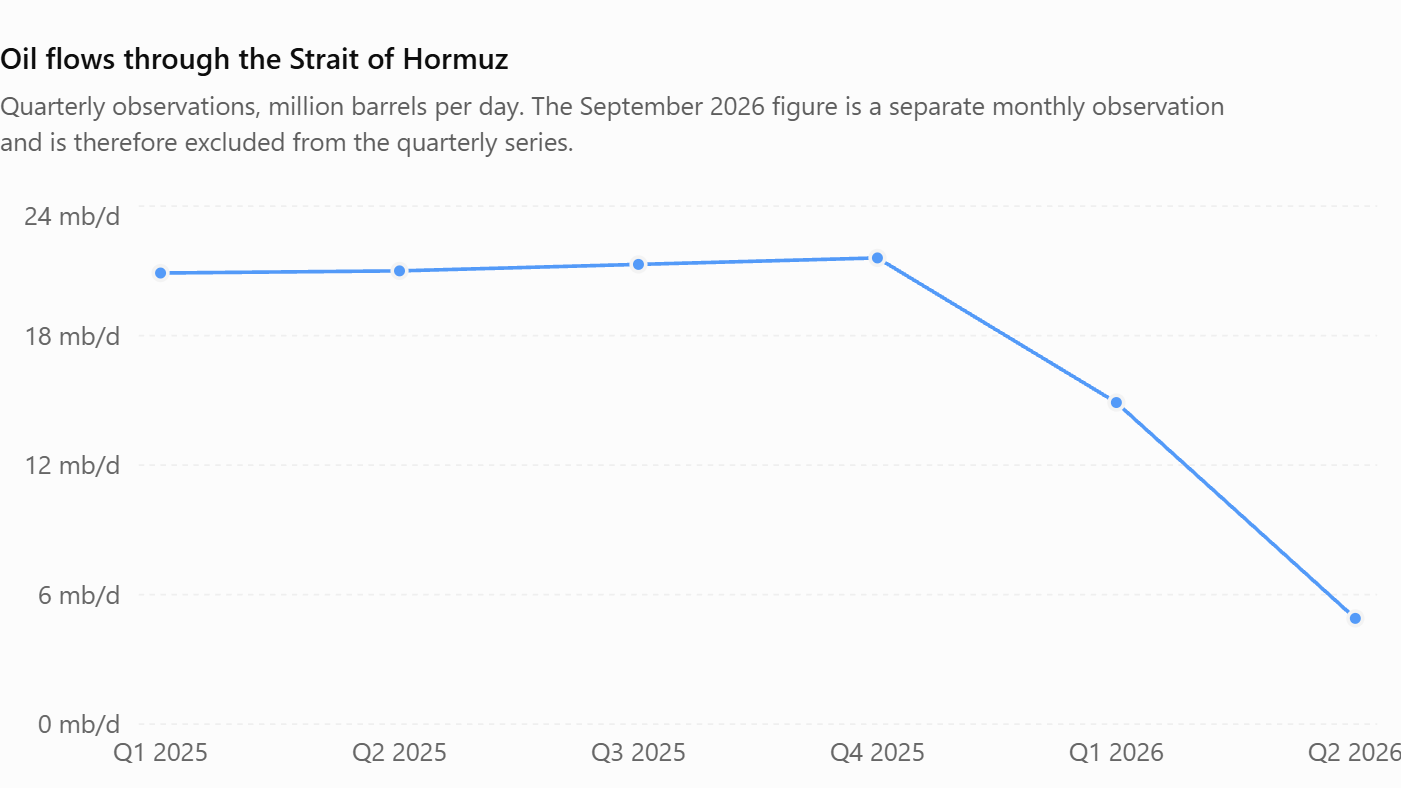
Source: US Energy Information Administration, Global Energy Security Data — Aug 2026. Monthly September 2026 recovery to 10.9 mb/d is separately reported by the IEA.
The collapse from 21.6 million barrels per day in the fourth quarter of 2025 to 4.9 million in the second quarter of 2026 represents a decline of approximately 77.3% in average transit volume, calculated from EIA data. The subsequent recovery reported by the IEA demonstrates that the maritime system retains substantial capacity to restore flows when operational conditions permit. However, the October IEA report also identifies renewed attacks as a significant obstacle to sustaining the recovery. The appropriate policy measure is therefore not the binary classification of Hormuz as open or closed, but the volume, reliability, security and commercial cost of actual passage.
Competing Strategic Pathways
The three pathways below are alternative dominant trajectories through June 2027. They do not assume that diplomacy and military operations are mutually exclusive: negotiations may continue during limited combat, while maritime disruption may persist after a ceasefire.
| Hypothesis | Diagnostic support | Disconfirming evidence or constraints | Transition indicators | Current standing |
|---|---|---|---|---|
| A. Contained tension and gradual normalisation | Active Qatari mediation; Chinese diplomatic initiative; strong producer and importer incentives to restore shipping | US-Iran negotiating differences; recurring attacks; impaired insurance confidence | Sustained rise in tanker passages; verifiable restraint; agreed maritime arrangements | Credible and economically favourable, but fragile |
| B. Limited renewed US strikes followed by negotiation | Public post-election military warnings; reported allied preparations; continued US coercive signalling | No confirmed strike authorisation; energy-market costs; risk of disproportionate retaliation | Operational force movements; formal warnings; short-duration strikes followed by mediation | Credible near-term escalation pathway |
| C. Broader escalation with intermittent Hormuz restrictions into 2027 | Repeated maritime attacks; regional infrastructure exposure; depleted energy buffers | Strong Gulf opposition to wider conflict; high economic costs; continued mediator engagement | Persistent strikes on infrastructure; renewed throughput collapse; cross-regional attacks | Severe consequence, not established as the predominant trajectory |
Confidence assessment: High that all three pathways are operationally and diplomatically relevant; medium regarding their comparative likelihood; low regarding any precise numerical probability. No defensible numerical distribution is assigned without an appropriate historical base rate or reproducible forecasting model.
Actor objectives and expected near-term behaviour
| Actor | Core objective | Principal instrument | Stated red line or critical position | Most probable near-term posture |
|---|---|---|---|---|
| United States | Nuclear constraints, coercive leverage, regional security and maritime access | Military forces, sanctions, negotiations | Prevention of an Iranian nuclear weapon | Maintain military options while evaluating diplomacy |
| Iran | Regime security, relief from coercion, preservation of bargaining leverage | Retaliatory capability, maritime leverage, indirect negotiations | Opposition to renewed attacks and demands for relief from US restrictions | Continue conditional diplomacy and deterrent signalling |
| Russia | Preserve regional influence, protect Iranian relationships, limit military escalation | Diplomatic communications, multilateral forums, engagement with Tehran | Opposition to strikes on Iranian nuclear infrastructure | Advocate negotiations and maintain diplomatic access |
| China | Restore energy-import security and regional stability | Envoy diplomacy, economic relationships, bilateral contacts | Opposition to further regional escalation | Pursue scheduled diplomatic consultations |
| Gulf producers | Protect export infrastructure and commercial passage | Diplomatic mediation, maritime security cooperation, export diversification | Threats to territorial security and energy facilities | Support de-escalation and reliable market access |
| European and Asian importers | Restore predictable energy supplies and reduce delivered costs | Energy reserves, procurement diversification, diplomacy | Prolonged disruption of critical energy supplies | Reinforce resilience while supporting diplomatic reopening |
The table identifies the principal convergence: none of these actors benefits economically from prolonged, unpredictable maritime closure. Their divergence concerns which military, political and economic concessions should precede normalisation, and which actors possess sufficient enforcement capacity to guarantee the resulting arrangement.
Principal Intelligence Gaps and Strategic Watch Indicators
Strategic Verification Architecture:
The Four Decisive Information Gaps
Analytical Principle: Geopolitical risk must not be collapsed into a generalized indicator of regional tension. Actionable operational foresight demands rigorous structural partition across four distinct vectors: Political Decision-Making, Operational Readiness, Maritime Security, and Enforceable Diplomatic Commitments.
US Military Authorisation & Readiness
No verified public executive order or statutory directive establishes the definitive timing, objectives, or authorized scope of a renewed operation. Narrative assumptions must be replaced with empirical tracking of physical preparations.
- Official Pentagon releases & formal strike mandates
- Verifiable strategic air and naval carrier group deployments
- Regional airspace notices (NOTAMs) & radar closures
- DEFCON / regional force-protection status modifications
Hormuz Transit Reliability & Vessel Security
Volumetric tanker traffic recovery is decoupling from true operational safety. Verified kinetic incidents on 1 and 2 November 2026 prove that the residual chokepoint threat remains an ongoing operational reality rather than posturing.
UK Maritime Trade Operations documented repeated commercial vessel targeting on 01 & 02 November 2026. Market normalisation remains constrained by extreme war-risk insurance clauses, route gating, and crude-vs-refined vessel screening.
Inventory Reconciliation & Market Fragility Dynamics
Headline figures must not be blurred into a generic shortfall. Resolving the variance between the IEA’s observed 509 million barrel decline (Feb–Sep 2026) and ADNOC’s ~1 billion barrel depletion (reported 2 Nov 2026) requires structural reconciliation across discrete energy verticals:
Severe stock deficits in primary destination hubs directly compressing European industrial logistics, haulage margins, and secondary generation capacity.
An estimated 600 Bcf global LNG deficit inducing high spot competition between Asian and European buyers, disrupting standard term contracts.
Logistics consuming >30% of total delivered barrel pricing (vs. <5% historical baseline), establishing high operational floor barriers across long voyages.
Negotiating Mandates & Maritime Guarantees
Public diplomatic rhetoric and high-level goodwill tours cannot be mistaken for executable transit agreements. Structural reconciliation requires written, enforceable legal instruments and verified maritime behavioral adjustments.
- Continuity & mandate limits of Qatari trilateral mediation
- Explicit conditions of Iranian chokepoint access terms
- Beijing special envoy diplomatic leverage & security frameworks
- Audited compliance mechanisms on maritime rights of way
Secondary Regional Disruption & Route Bypass
The ultimate severity of the disruption is defined by contagion velocity. An escalation that leaks outward from Hormuz faster than alternative corridors (East-West Pipeline, Cape diversions) can scale will precipitate an unhedged crisis.
- Kinetic or cyber strikes targeting Saudi East-West pipeline terminals
- Targeting of critical Gulf liquefaction and export ports (Ras Laffan)
- Coordinated anti-ship operations across Bab el-Mandeb & Red Sea
- Capacity exhaustion of alternate cross-peninsula bypass networks
Strategic Assessment for Government Decision-Makers
The immediate political uncertainty concerns whether Washington will translate its post-election military signalling into authorised operations. The more durable structural uncertainty concerns how quickly the Persian Gulf energy system could recover even if negotiations succeed. These uncertainties are linked, but they are not identical: military decisions can be taken over short periods, while rebuilding inventory protection, contractual certainty, freight capacity and maritime confidence requires sustained evidence of stability.
For energy-importing governments, the critical policy question is whether emergency stocks and supply diversification can bridge a further period of disrupted Gulf transit without imposing disproportionate fiscal and industrial costs. For Gulf producers, the challenge is to preserve export continuity while limiting the likelihood that domestic energy infrastructure becomes a retaliatory target. For the United States, Russia and China, the central diplomatic test will be whether military restraint, Iranian security concerns, nuclear negotiations and commercially credible maritime reopening can be organised into a sequence acceptable to the principal participants.
The first half of 2027 should therefore be assessed against measurable changes in shipping activity, energy inventories, product availability, military posture and negotiated commitments, rather than against declarations of imminent victory, collapse or diplomatic success.
The central strategic judgement is that a military confrontation can diminish before its energy-security consequences do. Conversely, a further military operation conducted against already depleted market buffers could produce commercial disruption significantly disproportionate to the immediate duration of the strikes. The most consequential outcome for governments is not only the avoidance of an enlarged war, but the restoration of a maritime corridor whose physical safety, insurance conditions and commercial reliability are credible to producers, carriers and importing states alike.
IRAN & HORMUZ
ESCALATION INTELLIGENCE
Integrated assessment of US military signalling, maritime disruption, oil inventories, LNG and diesel exposure, Russian and Chinese diplomacy, and the strategic pathways through June 2027.
Strategic Energy Exposure
Strait of Hormuz: 3D Throughput Analysis
Oil Transit — Quarterly Volume
Select a column to inspect the source observation. The graphic uses a perspective extrusion for presentation, while bar heights remain proportional to a zero-based scale.
Data: US EIA, Global Energy Security Data. September 2026’s 10.9 mb/d IEA estimate is a monthly observation and is not plotted as a quarterly average.
Disruption and Partial Recovery
The following reference comparisons use source-reported flows rather than assumed physical capacity.
Q2 2026 quarterly transit was approximately 77.3% below Q4 2025. The September monthly observation indicates substantial recovery, but is not proof of secure and reliable passage.
The bars express throughput as a share of the Q4 2025 observed flow, not utilisation of nominal capacity.
Supply-Chain Stress and Delivered Costs
Inventory Buffer Erosion
A reduction in observed inventories weakens the system’s ability to absorb additional transport disruptions. Emergency stock releases can cushion the shock but do not restore safe transit.
Approximately released under IEA collective action as of 15 October 2026.
Diesel Availability
Refinery and export constraints transmit maritime disruption into industrial and transport fuel costs. Middle Eastern petroleum-product exports were reported at 1.9 mb/d in September versus 4.7 mb/d before the war.
Calculated difference in the IEA’s reported product-export comparison.
LNG Import Stress
Disruption of Gulf LNG shipments affects receiving markets through supply availability, replacement-cargo competition and freight costs.
ADNOC-reported supply gap in affected markets; exact accounting period and scope require clarification.
Interactive Scenario Simulation
Choose a strategic pathway to compare its expected energy-market mechanism, diplomatic posture and observable indicators. This is a conditional scenario explorer, not a quantitative prediction model.
Gradual Hormuz Normalisation
Mediation produces progressively more reliable maritime passage while military escalation is contained. Commercial confidence improves in stages rather than returning immediately to pre-war conditions.
Expected Strategic Transmission
The chain represents a feedback mechanism, not a claim that all developments occur in a fixed sequence. Energy stress and negotiations may themselves influence military decisions.
Great-Power and Regional Actor Matrix
| Actor | Core objective | Instrument | Critical position | Near-term posture |
|---|---|---|---|---|
| United States | Nuclear constraints and regional security | Military pressure, sanctions and negotiation | Prevention of Iranian nuclear weapon development | Maintain military options while evaluating diplomacy |
| Iran | Regime security and bargaining leverage | Retaliatory capacity, maritime leverage and talks | Opposition to renewed strikes; demands for relief | Conditional negotiations and deterrent signalling |
| Russia | Regional influence and de-escalation | Diplomatic engagement with Tehran and other actors | Opposition to attacks on Iranian nuclear infrastructure | Support for negotiations and regional interests |
| China | Energy security and regional stability | Envoys, economic relationships and bilateral diplomacy | Opposition to broader regional escalation | Consultations with Iran, Oman and Saudi Arabia |
| Gulf producers | Export continuity and infrastructure protection | Mediation and maritime security cooperation | Threats to energy installations and territorial security | Seek stable transit and regional de-escalation |
| Energy importers | Secure supplies and lower delivered costs | Reserves, procurement diversification and diplomacy | Prolonged interruption of essential energy flows | Energy-system resilience and support for reopening |
Indicators That Could Change the Assessment
| Monitoring domain | Observable signal | Strategic meaning | Evidence requirement |
|---|---|---|---|
| US military posture | Verified deployments, warnings or formal orders | Potential transition toward renewed strikes | Official military statements and independently verifiable operational observations |
| Hormuz throughput | Sustained flow recovery or renewed decline | Change in physical energy-supply reliability | Consistent tanker and cargo-volume series |
| Maritime incidents | Repeated attacks or sustained incident reduction | Change in navigational security | Competent maritime-security advisories |
| Oil and diesel stocks | Inventory rebuilding or accelerating drawdowns | Change in capacity to absorb another supply shock | IEA and national inventory reports with consistent definitions |
| LNG delivery | Cargo recovery, terminal constraints or diversions | Change in importer exposure | Operator and national energy data |
| Mediation | Written commitments and verified implementation | Movement from diplomatic signalling to enforceable arrangements | Official government and mediator statements |
| Secondary corridors | Attacks affecting Red Sea or Gulf export infrastructure | Broadening of regional economic disruption | Maritime advisories and infrastructure operator disclosures |
PILLAR I — Military Signalling, Escalation Risk and Maritime Exposure
Iran, the United States and the Strait of Hormuz: Military Decision-Making, Strategic Coercion and the Global Energy-Security Crisis
Assessment cut-off: 2 November 2026 | Forecast horizon: 30 June 2027 | Intended readership: Heads of Government, Foreign and Energy Ministers, National-Security Authorities and Senior Institutional Decision-Makers
Chapter 1. Executive Strategic Judgement: Renewed US Military Action and the Persistence of Hormuz Disruption
Principal judgement: The immediate danger is not simply another military operation, but the possible failure of military restraint to produce a commercially credible reopening of Hormuz
The strategic position of the Persian Gulf at the beginning of November 2026 is characterised by a significant imbalance between the ability of the principal military actors to initiate a new confrontation and the capacity of the international energy system to absorb its consequences. The approaching American congressional elections of 3 November have created an identifiable political boundary around the timing of potential United States military operations against Iran, while simultaneously concentrating diplomatic attention on whether the Trump administration will continue indirect negotiations or attempt to employ additional military pressure after the electoral constraint has passed. This political calendar must not be confused with an operational order, and the distinction is particularly important because statements from senior American officials indicate that diplomacy remains an active option, while reports from regional governments indicate serious concern about the possibility of further attacks. The resulting situation is not one of demonstrated imminent war, but of heightened strategic uncertainty in which the credibility of military threats interacts with the remaining negotiating space, Iranian retaliatory capabilities, the security of Gulf producers and the deteriorated condition of international energy inventories. Trump says US will not attack Iran before midterm elections — Reuters — October 2026. Iranian envoys meet Qatari mediators as threat looms of US strikes after midterms — Reuters — October 2026.
The central distinction concerns the relationship between military escalation and economic disruption. An American attack could be limited in duration, targeted against a specific category of Iranian military or nuclear-related infrastructure and subsequently followed by another round of diplomatic engagement, yet its commercial effects could extend far beyond the period of active hostilities because the shipping system has already experienced severe interruptions, energy inventories have been reduced and insurers, shipowners and commodity traders are pricing not only observed losses but also the possibility of further attacks. Conversely, a negotiated reduction in hostilities could permit a relatively rapid increase in the number of vessels passing through Hormuz without restoring pre-crisis freight costs, refinery feedstock availability or strategic inventory coverage. The evidence supporting this distinction is substantial: the United States Energy Information Administration (EIA) recorded a fall in average oil transit through Hormuz from 21.6 million barrels per day in the fourth quarter of 2025 to 4.9 million in the second quarter of 2026, while the International Energy Agency (IEA) subsequently reported a partial recovery to 10.9 million barrels per day in September, accompanied by renewed threats to maritime and energy infrastructure. Global Energy Security Data — US Energy Information Administration — August 2026. Oil Market Report — International Energy Agency — October 2026.
The principal near-term judgement is therefore that renewed limited American military action is a credible contingency, whereas prolonged disruption of the economic functionality of Hormuz is already an established condition, even though the intensity and geographical distribution of its effects fluctuate with actual shipping movements, infrastructure security and market expectations. Confidence in the existence of the maritime disruption is high because the assessment rests on official transit statistics, energy-market measurements and contemporaneous maritime-security reporting; confidence regarding the timing or eventual authorisation of renewed American strikes is medium because public warnings and discussions do not disclose the internal decision process required to convert political intent into military execution. Assigning a precise numerical probability to either outcome would imply a level of forecasting precision that the available evidence does not justify.
The strategic meaning of the November electoral boundary
President Trump’s public statement on 8 October that the United States would not attack Iran before the congressional elections established a politically observable period of restraint, but the statement did not create a commitment to attack after the elections, nor did it establish that military preparations had reached the execution stage. A temporary political restriction can coexist with continued operational contingency planning, military readiness, diplomatic pressure and the consideration of alternative military objectives, and it is therefore necessary to separate the existence of military options from the selection of a particular option by the President. This distinction is reinforced by the contemporaneous account of the Doha mediation process, in which Secretary of State Marco Rubio was reported as stating that the President had not decided to undertake further military action and preferred a negotiated outcome, while maintaining the ability to strike if necessary. The resulting decision structure allows Washington to retain coercive leverage without prematurely committing itself to an action whose consequences could extend across the entire Gulf energy system. Iranian envoys meet Qatari mediators as threat looms of US strikes after midterms — Reuters — October 2026.
The political significance of the election should also be understood through the distinction between domestic political incentives and military effectiveness. The administration has faced a conflict in which the economic consequences of higher energy prices, particularly gasoline and transport fuels, directly affect the domestic electorate, while the strategic objectives associated with restricting Iranian nuclear capabilities and securing regional navigation remain unresolved. A temporary preference for delaying military action may therefore reflect the cost of escalation before a major electoral event without implying any reduction in the administration’s longer-term willingness to use force. Equally, the disappearance of the immediate electoral constraint does not eliminate the economic cost of further disruption, the possibility of attacks on American personnel and installations, the vulnerability of Gulf allies or the uncertainty surrounding Iranian retaliation. The relevant analytical conclusion is that the period after 3 November represents a change in the political conditions governing a military decision, rather than a verified change in the underlying military balance.
Hormuz as an operational chokepoint and strategic bargaining instrument
The importance of Hormuz lies in the concentration of essential energy transport within a relatively narrow maritime corridor connecting major Gulf producers and export terminals with the Gulf of Oman and wider international shipping networks. Its strategic relevance cannot be measured by physical geography alone, because the effective availability of the route depends upon commercial vessels accepting transit risk, insurers providing commercially viable coverage, ports maintaining operational continuity and buyers being able to receive shipments within the required delivery periods. Under normal circumstances, the corridor’s high throughput enables large volumes of oil and LNG to move from production centres toward importing economies, particularly in Asia; under conflict conditions, however, even partial or intermittent restrictions can generate substantial secondary costs because vessels may delay departure, alter routes, require additional security arrangements or become unavailable for subsequent cargoes. The energy-security problem is therefore not limited to whether Iran can physically prevent passage, but includes the extent to which recurrent attacks can make passage commercially uncertain even when some cargoes continue to move.
The EIA’s August 2026 energy-security dataset provides unusually clear evidence of the physical dimension of this disruption. Its reported quarterly series shows that Hormuz oil transit declined by approximately 77.3% between the fourth quarter of 2025 and the second quarter of 2026, while LNG movements through the same corridor fell from 10.5 billion cubic feet per day to 0.8 billion cubic feet per day, a decline of approximately 92.4%. These are exceptionally large contractions in observed transport flows, but they should not automatically be equated with identical losses of global oil or gas production, because some production can be redirected, temporarily stored, transported through alternative infrastructure or replaced by other suppliers, while demand can also contract in response to price increases and reduced economic activity. The figures are nevertheless sufficient to establish that the crisis has involved a profound impairment of a strategically important international transport route. The EIA additionally warns that Automatic Identification System signals have been especially unreliable in the Gulf since the end of February 2026 and that its transit estimates are subject to frequent revision, a limitation that must accompany any precise interpretation of the quarterly figures. Global Energy Security Data, Tables 2 and 4 — US Energy Information Administration — August 2026.
The persistence of military danger despite diplomatic activity
The existence of continuing negotiations does not demonstrate that the regional maritime threat has been removed. The United Kingdom Maritime Trade Operations (UKMTO) reporting system documented an incident in the Strait of Hormuz on 1 November involving a reported projectile strike against a vessel, followed on 2 November by a report that a tanker east of Ras Al Khafji had been struck by two unknown projectiles, with its crew accounted for and no environmental impact reported at that time. The reports do not, by themselves, conclusively identify the attacking party, establish a complete chain of command or demonstrate that either incident was ordered as part of a coordinated national strategy; they nevertheless confirm that the operational maritime environment remained hazardous at the dossier’s cut-off date. For commercial shipping, such incidents matter independently of their eventual attribution because shipowners and insurers must respond to observed hazards before a definitive political or military explanation becomes available. UK Maritime Trade Operations — Recent Incidents — October–November 2026.
This creates a structural challenge for every mediation effort. An agreement addressing nuclear restrictions, sanctions or the cessation of direct attacks might reduce the incentives for further confrontation, but restoration of reliable international passage would additionally require a sufficiently stable maritime-security environment to prevent isolated incidents from reversing commercial confidence. The United States and Iran are not the only relevant actors in this calculation: Saudi Arabia, the United Arab Emirates, Oman, Qatar, Bahrain and other regional governments face differentiated vulnerabilities involving energy exports, military installations, ports, desalination facilities and civilian economic infrastructure, while European and Asian governments must manage the exposure of their industries and consumers to a conflict they cannot individually resolve. Consequently, the absence of a renewed American offensive should be treated as a necessary but insufficient condition for comprehensive stabilisation.
Government-level risk assessment
| Strategic question | Evidence-based judgement | Confidence | Decision relevance |
|---|---|---|---|
| Has Washington confirmed a renewed strike operation after 3 November? | No confirmed final presidential authorisation or public execution timetable is established by the examined record. | High regarding this evidentiary limitation | Avoid interpreting political signalling as a confirmed operational order. |
| Is renewed limited US military action a credible near-term possibility? | Yes. Publicly maintained military options, post-election signalling and regional concerns support the assessment. | Medium | Maintain crisis-response readiness while preserving diplomatic flexibility. |
| Has the Hormuz system returned to normal? | No. Physical shipments have partially recovered, but maritime incidents and exceptionally high transport costs demonstrate continued impairment. | High | Plan around delivery reliability rather than nominal reopening. |
| Are existing energy buffers sufficient to eliminate another shock? | No such assurance is supported. Inventory depletion and continued emergency-stock releases indicate materially reduced resilience. | High | Maintain inventory surveillance, procurement diversification and emergency coordination. |
| Can mediation prevent renewed military action? | Potentially, but success requires reciprocal concessions and credible implementation arrangements not yet demonstrated. | Medium | Evaluate enforceable commitments rather than diplomatic declarations alone. |
| Would a limited military strike necessarily produce limited economic consequences? | No. The economic effect depends on Iranian retaliation, infrastructure damage, maritime incidents and available stocks. | High regarding the causal mechanism | Stress-test economic exposure independently from the anticipated duration of operations. |
The strategic asymmetry between escalation and recovery
The most consequential feature of the current environment is that military escalation and energy-system recovery operate on different timescales. Military operations may be initiated and completed within a relatively short period, whereas the restoration of strategic oil inventories, refinery production schedules, reliable maritime access and commercially acceptable insurance conditions depends upon repeated deliveries and sustained evidence that the security environment has improved. This difference creates a potential asymmetry in the consequences of coercion: military pressure intended to accelerate negotiations could generate additional energy-market costs that increase pressure on the very governments supporting a negotiated settlement, particularly where refined-product availability is already constrained. At the same time, the costs associated with prolonged disruption provide an incentive for Gulf producers, Asian importing economies and European governments to support an agreement that restores predictable transit, even if broader political differences remain unresolved.
The principal diplomatic implication is that the sequencing of concessions matters at least as much as their formal content. A settlement in which Washington demands irreversible Iranian concessions before changing its military or sanctions posture may face resistance from Tehran, while an arrangement in which Iran retains substantial maritime coercive leverage after receiving relief may be regarded by Washington and regional partners as insufficiently enforceable. A credible intermediate arrangement would need to create verifiable changes in behaviour that reduce the risk borne by both sides, while allowing international shipping operators to observe the restoration of security independently. The specific mechanisms for doing so belong to the negotiation architecture examined under Pillar II; the immediate judgement under Pillar I is that such mechanisms must be assessed through their operational effect rather than their diplomatic presentation.
Chapter 1 — Key judgements
Military risk: Renewed US strikes are plausible after the election but remain unconfirmed as an authorised operation.
Maritime risk: The persistence of actual attacks and the incomplete recovery of transit establish a continuing security crisis.
Economic risk: Reduced oil inventories and fragile refined-product availability increase the consequences of another shock.
Policy implication: Governments should maintain distinct indicators for military escalation, maritime security, shipping performance and energy-system recovery, rather than treating the region as either at war or at peace.
What would change the assessment: An official decision authorising military action, sustained verified restraint by the principal belligerents, a negotiated maritime-security arrangement with observable implementation, or a durable recovery of shipping activity accompanied by a reduction in reported attacks would materially alter the present judgement.
Open official record: The precise American military decision process, the operational instructions governing any prospective strike campaign and the enforceable conditions of a possible maritime reopening remain insufficiently established in publicly accessible primary documentation.
Chapter 2. Washington’s Post-Election Military Options: Political Timing, Strategic Objectives, Force Constraints and Escalation Thresholds
Principal judgement: Washington possesses credible military options, but the principal uncertainty concerns the relationship between operational success and the political concessions that force could realistically produce
The available evidence indicates that the United States has retained the ability to conduct renewed military operations against Iran and that the political period surrounding the 3 November congressional elections has become an important consideration in the timing of potential action. However, military capability, political authorisation and strategic effectiveness are separate categories, and a government-level assessment must avoid treating their apparent convergence as sufficient evidence that an operation has been approved or that its political objectives would be achieved. Reporting published on 2 November indicates that four European officials considered the American force posture in the region sufficient to enable an attack at short notice, while two of those officials identified Iranian nuclear-related facilities as plausible objectives. These statements are relevant indicators of perceived readiness and allied expectations, but they are not equivalent to a publicly confirmed operational order, an authenticated American targeting directive or verified intelligence concerning the President’s final intentions. The White House’s position, as reported in the same account, preserved the availability of military options without disclosing a binding decision to employ them. Trump’s Iran threat renews Gulf fears of a war it didn’t choose — Reuters — November 2026.
The analytical problem is particularly important because the objectives that might motivate renewed action are not interchangeable. An operation intended to damage nuclear infrastructure would have a different operational logic, target-selection requirement and political definition of success from one intended to suppress missile launches, weaken regional proxy capabilities, penalise maritime interference or force concessions in negotiations. A nuclear-focused campaign would be judged primarily against the extent to which it demonstrably reduced Iran’s ability to conduct relevant nuclear activities, whereas strikes against missile infrastructure would be judged against their effect on the threat to American and allied installations. A coercive operation linked to Hormuz would require an additional standard: whether the use of force actually increased the reliability of commercial passage rather than producing retaliation that made international navigation more difficult. The latter possibility is especially significant because the interests of Washington and the governments hosting American military facilities do not coincide perfectly, even where their broader security cooperation remains strong.
Nuclear infrastructure: The limitations of destruction as a political objective
The possibility of renewed strikes against Iranian nuclear-related facilities appears in contemporary reporting, including the suggestion by European officials that research and development infrastructure might be among the contemplated categories of targets. This reporting does not establish that any particular facility is the subject of an authorised operation, nor does it support the conclusion that a renewed strike would comprehensively eliminate Iranian nuclear capabilities. Nuclear programmes combine physical infrastructure, specialised equipment, technical personnel, materials, accumulated knowledge, procurement networks and organisational expertise, and damage to one component does not automatically demonstrate the permanent elimination of the others. Military operations may impose delays, destroy equipment and complicate reconstruction, but establishing the precise extent of such effects requires reliable information about the pre-strike condition of facilities, the location and status of relevant materials, the availability of alternative infrastructure and the results of subsequent verification. In the absence of such evidence, the defensible formulation is that a renewed attack could degrade specified capabilities, not that it would necessarily achieve permanent or comprehensive nuclear disarmament.
The political consequences of this limitation are substantial. If Washington defines success as the destruction of particular installations, the operation may be considered militarily effective even while the underlying dispute over enrichment, verification and future nuclear activity remains unresolved. If, however, the objective is a durable restriction on Iranian nuclear capabilities, the operational result would need to be translated into an enforceable political arrangement, because physical damage does not itself provide a system for monitoring compliance, controlling future reconstruction or resolving the legal and diplomatic questions surrounding Iranian nuclear activity. The International Atomic Energy Agency (IAEA), as the competent international nuclear verification body, has a distinct function from the armed forces conducting military operations, and a credible long-term assessment must therefore separate evidence of military damage from evidence of the status of nuclear materials and verification arrangements. The importance of this distinction is reinforced by Iran’s reported refusal during the current mediation process to transfer its highly enriched uranium stockpile abroad and its insistence that nuclear discussions follow the satisfaction of its immediate demands concerning sanctions and maritime restrictions. Iran says contacts over ending war continue as talks end with no breakthrough — Reuters — November 2026.
A further strategic complication arises from the possibility that attacks against nuclear-related infrastructure could alter the Iranian leadership’s assessment of the benefits and costs of retaining existing nuclear restrictions. On 31 October, Reuters reported remarks attributed to Iranian security official Mohsen Rezaei indicating that Tehran was debating whether to reconsider its longstanding prohibition on nuclear weapons in the event of renewed fighting, while also reporting that no such decision had been taken. This distinction is essential: a statement concerning an internal debate is not evidence that nuclear policy has changed, that a weapons programme has been authorised or that technical capabilities exist to implement such a decision. Nevertheless, the statement provides an observable example of how coercive military action might interact with the political debate over the future of Iran’s nuclear posture. The possible strategic effect of a strike therefore includes not only the immediate destruction or degradation of physical infrastructure, but also the risk that Iranian decision-makers could respond by hardening their negotiating position on verification, enrichment or future restrictions. Iranian envoys meet Qatari mediators as threat looms of US strikes after midterms — Reuters — October 2026.
Missile infrastructure, regional retaliation and the vulnerability of American security architecture
A second category of prospective American objectives concerns Iranian missile and drone capabilities, particularly where these threaten American forces, Gulf military installations, maritime facilities or allied infrastructure. The relevant military problem is not simply the ability to strike Iranian launch facilities or related infrastructure, but the extent to which additional attacks could reduce the frequency, intensity and geographical reach of subsequent Iranian retaliation. The distinction between destroying identified assets and eliminating an adversary’s capacity to sustain attacks is fundamental, especially when the opposing side has incentives to disperse equipment, employ alternative launch arrangements or preserve capabilities for use after the initial strikes. Without publicly verified inventories of operational systems, their locations, availability and actual attrition, the extent of any prospective degradation cannot be quantified with confidence.
For Gulf states, the strategic danger is amplified by the presence of American military installations within their territories. These installations support deterrence, surveillance, logistics and regional military operations, but their presence also creates potential targets through which Iran could impose costs on governments that have not themselves authorised renewed American strikes. Reporting from the Manama Dialogue on 2 November described growing concern among Gulf officials that bases originally developed as instruments of regional protection could also expose host countries to retaliation, with Bahrain identified as particularly vulnerable because of its role as headquarters of the United States Fifth Fleet. This does not establish that all Gulf facilities would be attacked in a renewed confrontation, but it demonstrates the central political constraint facing Washington: the decision to employ military force may be taken by the United States, while the consequences of regional retaliation may be borne by allied governments, their civilian populations and their nationally important infrastructure. Trump’s Iran threat renews Gulf fears of a war it didn’t choose — Reuters — November 2026.
The operational geography of retaliation is therefore wider than the geographical area in which an initial American strike might occur. The same reporting identifies concern about potential threats to energy installations, desalination facilities, communications infrastructure and other strategically important assets, while Iranian officials were reported to have prepared options for retaliation against American and Israeli interests. These claims must be interpreted as attributed threat assessments rather than evidence of a final Iranian attack order, but they are sufficient to demonstrate why the possibility of wider regional consequences constrains the attractiveness of further military action. Desalination infrastructure is important to civilian water security, communications systems support both economic activity and public services, and energy installations are essential to the export revenues and industrial operations of Gulf producers. The capacity to create insecurity around these systems can generate strategic leverage without requiring Iran to match American conventional military strength, although the degree to which such leverage would produce concessions remains uncertain.
Maritime coercion and the danger of a self-defeating military response
An operation intended to restore navigation through Hormuz confronts a different strategic test from an attack directed against a fixed military facility. The relevant measure of effectiveness is not the number of Iranian assets destroyed, but the subsequent ability of commercial vessels to pass safely, predictably and at economically acceptable cost. In principle, military operations could diminish the immediate threat posed by particular launch systems or facilities, but they could also create incentives for additional attacks on tankers, port infrastructure and maritime services. Because commercial shipping depends upon risk assessment rather than upon military control alone, a short period of increased attack activity may cause shipowners to delay voyages and insurers to reassess coverage even when naval forces retain significant operational superiority.
The distinction is evident in the maritime-security reporting available at the cut-off date. The UKMTO incident record contains successive reports of attacks or suspected attacks affecting tankers in and around Hormuz during late October, including incidents on 29 and 30 October and further reports on 1 and 2 November. These records demonstrate that the operating environment can deteriorate through relatively discrete attacks, sometimes involving unidentified projectiles, without requiring a declaration of comprehensive naval closure. It follows that the restoration of maritime security cannot be judged solely through the absence of a formal Iranian closure announcement or the physical possibility of passage. A more operationally useful assessment requires the simultaneous examination of actual cargo transit, attack frequency, incident severity, delays and insurance availability. UK Maritime Trade Operations — Recent Incidents — October–November 2026.
This creates a difficult relationship between coercive credibility and escalation control. A military threat that is never considered credible may have limited influence over negotiations, but a threat that becomes an operation can create costs that reduce the willingness of the other party to compromise or make it politically more difficult to accept concessions. Washington’s challenge is therefore to preserve military options while preventing the use of those options from producing an open-ended regional confrontation. Tehran faces a corresponding problem: maritime pressure may increase its negotiating leverage, but recurrent attacks and uncertainty over the Strait also produce incentives for importing countries, Gulf producers and external powers to coordinate against threats to navigation. Neither actor can assume that the immediate tactical effects of coercion will translate predictably into the desired political outcome.
Diplomatic timing and the significance of the Doha mediation process
The negotiating activity involving Qatar is relevant because it provides an observable alternative to renewed military action and establishes a communication mechanism through which proposals may be exchanged without requiring a comprehensive political agreement in advance. The 31 October reporting described discussions between Iranian and Qatari representatives following more than twelve hours of meetings in Tehran, with communication reportedly coordinated through regular contacts with Washington. Qatar’s proposed seven-day confidence-building arrangement was reportedly considered insufficient by Tehran, while the Iranian proposal called for changes involving the American blockade of Iranian ports, frozen assets and arrangements for transit through Hormuz before a broader settlement. The subsequent 2 November report indicated that Iran’s seven-step proposal had been condensed to permit faster implementation, potentially within two days, without altering Tehran’s underlying demand that its conditions be verified before nuclear negotiations resumed. Iranian envoys meet Qatari mediators as threat looms of US strikes after midterms — Reuters — October 2026. Iran says contacts over ending war continue as talks end with no breakthrough — Reuters — November 2026.
The resulting disagreement concerns the ordering of reciprocal obligations rather than merely the existence of diplomatic contact. Washington seeks an arrangement that addresses Iranian nuclear and regional security behaviour, while Tehran places greater emphasis on obtaining immediate relief from restrictions and coercion before undertaking negotiations over matters it regards as more fundamental to its security and sovereignty. An accelerated implementation schedule would not eliminate the underlying problem if the two sides continued to disagree on which obligations must be satisfied first, who should verify compliance and what happens if one party considers the other to have violated the arrangement. Consequently, a proposed two-day timetable for reopening Hormuz should be treated as a prospective contractual or diplomatic sequence, not as proof that the maritime environment could become fully secure, commercially predictable and economically normal within forty-eight hours.
The continuing existence of mediation is nevertheless a material constraint on the decision to renew military action. It gives the American administration a channel through which it can test Iranian intentions, evaluate alternative sequences of concessions and seek assurances without immediately incurring the costs of another campaign. It also provides Iranian representatives with a mechanism for pursuing sanctions or maritime arrangements without formally abandoning their capacity for deterrence. The limitation is that the public record does not demonstrate a mutually accepted implementation framework, and the reported departure of the Iranian delegation from Doha without a breakthrough indicates that diplomatic continuity has not yet produced substantive agreement.
The operational decision matrix
| Possible military objective | Intended strategic effect | Evidence status | Principal operational limitation | Principal political risk |
|---|---|---|---|---|
| Nuclear-related infrastructure | Degrade specified nuclear capabilities and increase bargaining pressure | Possible target category reported by European officials; no verified US target order | Physical damage does not establish elimination of retained materials or expertise | Iranian nuclear-policy hardening and further retaliation |
| Missile and drone infrastructure | Reduce threats to US and allied personnel and installations | Plausible military contingency; precise scope not publicly confirmed | Uncertainty over surviving and dispersed capabilities | Sustained attacks against Gulf host states |
| Maritime-threat infrastructure | Reduce threats affecting Hormuz navigation | Strategic possibility; not an announced strike plan | Tactical suppression may not restore commercial confidence | Additional attacks on tankers or ports |
| Regional armed-group support infrastructure | Diminish Iran-linked regional coercive capacity | Possible objective; no confirmed post-election operational mandate | Attribution and surviving network capacity may be difficult to establish | Escalation across additional theatres |
| Short coercive campaign | Induce concessions and accelerate negotiations | Consistent with reported signalling, but not confirmed as selected policy | Political effects depend on Iranian response | Escalation without agreement |
| Expanded campaign | Impose wider military costs and fundamentally alter Tehran’s calculations | No confirmed approval in the examined record | Higher operational, economic and diplomatic burdens | Regional war and prolonged energy disruption |
The matrix is a comparison of possible strategic objectives, not a reconstruction of classified American planning. Its purpose is to show why an assessment limited to the probability of an attack would be insufficient for government decision-making: the effects of force depend on the intended political outcome, the categories of capabilities affected, Iranian retaliation and the ability of diplomatic channels to absorb the consequences.
The legal and institutional dimension of a renewed operation
Any prospective American use of force against Iran would also require a distinction between domestic authorisation, asserted international legal justification and the factual conditions necessary to support that justification. The United Nations Charter establishes the general prohibition on the threat or use of force against another state, subject to the Charter’s applicable provisions, including the inherent right of individual or collective self-defence recognised under Article 51. Whether a particular strike could lawfully be justified as self-defence would depend on its factual circumstances, including the existence and character of an armed attack, necessity, proportionality and the relevant relationship between any continuing hostilities and the proposed action; those requirements cannot be satisfied merely by describing an operation as limited, preventive or necessary for deterrence. Charter of the United Nations, Articles 2(4) and 51 — United Nations — 1945.
The public information reviewed for this chapter does not establish the complete legal basis that the American administration would invoke for a new operation, nor does it establish the operative domestic legal authorisation, any formal congressional notification or the precise relationship between previous operations and a prospective renewal of force. These are consequential gaps because the legal characterisation of the operation could affect diplomatic support, allied participation and subsequent assessments of escalation responsibility. The existence of a continuing conflict does not remove the need to examine the particular circumstances of the contemplated action, and the report does not infer legal validity from military capability or political intent.
Chapter 2 — Key judgements
The ability of the United States to carry out renewed military operations must be distinguished from evidence that the President has authorised them, and the reported availability of forces does not establish that a particular target category, duration or escalation threshold has been approved. The principal operational risk is that a campaign capable of damaging Iranian infrastructure may not be capable of producing lasting security concessions or restoring maritime commerce, particularly if the Iranian response is directed against shipping, Gulf infrastructure or American facilities in neighbouring states. The most consequential diplomatic constraint is the continued existence of Qatari mediation, whose effectiveness depends on whether Washington and Tehran can establish a mutually acceptable sequence of reciprocal obligations.
What would change the assessment: An authenticated announcement establishing the legal and political basis for renewed strikes, publicly verifiable military deployments corresponding to a particular operation, a substantive agreement on the sequencing of maritime and nuclear concessions, or a demonstrable change in the scale of Iranian threats would materially alter the assessment of likely US behaviour.
Open official record: A confirmed strike authorisation, the precise scope of potential targeting, authoritative verification of relevant Iranian nuclear-material status and any formally accepted US-Iranian implementation agreement remain unavailable within the examined public evidence.
Chapter 3. The Energy-Security Shock: Oil Inventories, Diesel and LNG Availability, Freight Costs and Industrial Exposure
Principal judgement: The global energy system is experiencing a compound delivery shock in which depleted inventories, constrained refining products and exceptional shipping costs are more consequential than headline production capacity alone
The disruption of the Strait of Hormuz has altered the relationship between energy production, international transportation and the security of final supply. In a normally functioning market, additional production, available inventories, shipping capacity and refinery flexibility provide partially substitutable mechanisms for absorbing temporary disturbances, although the degree of substitutability varies across crude grades, refined products, LNG contracts and importing regions. The present crisis has weakened several of these mechanisms simultaneously. The contraction in Gulf maritime flows has been accompanied by reductions in commercial and strategic stocks, pressure on diesel availability, higher transportation charges and unusually large differences between physical crude benchmarks and futures-market prices. Consequently, the quantity of crude oil that producing states are technically capable of extracting is no longer an adequate measure of the energy available to importing countries at a predictable delivered cost, while the existence of aggregate global petroleum inventories does not demonstrate that the appropriate crude grades or refined products are available in the locations where they are required.
The October 2026 IEA Oil Market Report provides an authoritative quantitative foundation for this assessment. The agency estimated that global oil supply increased by 2.5 million barrels per day in September to 102.3 million barrels per day, supported by a substantial recovery in Gulf output, while simultaneously identifying global observed inventory levels 509 million barrels below their end-February position. The same report projected that annual global supply would decline by 5.8 million barrels per day to an average of 100.7 million barrels per day during 2026, before recovering by 7.7 million barrels per day in 2027, although this projected rebound remained conditional on the security and operational environment. In September, Gulf crude exports increased by 4.4 million barrels per day to 13.9 million, while aggregate oil flow through Hormuz increased by 3.7 million barrels per day to 10.9 million. The juxtaposition of higher production and exports with continuing inventory depletion demonstrates that a partial restoration of supply does not necessarily eliminate the existing deficit or compensate for earlier disruption. Oil Market Report — International Energy Agency — October 2026.
The physical energy balance: A market recovering capacity without restoring its buffers
The decline in observed global oil inventories requires careful interpretation because the IEA’s inventory measure includes multiple categories of stocks, and changes in those categories do not always move in the same direction. During September, global observed inventories decreased by approximately 10 million barrels, but this relatively modest net change concealed a much larger fall of 113 million barrels in inventories held on land, which was substantially offset by an increase of approximately 103 million barrels in oil carried aboard vessels. The distinction is important because oil at sea and oil already held at a refinery or distribution location differ in their immediate availability, delivery risk, financing requirements and susceptibility to maritime disruption. An increase in oil on water can therefore improve measured aggregate stock balances while providing less immediate protection to particular consumers than an equivalent increase in accessible inland inventories.
The IEA reported that non-OECD crude inventories decreased by 76 million barrels during September, with China accounting for approximately 78% of that decline, while OECD inventories fell by 37 million barrels. The Chinese share implies a reduction of approximately 59.3 million barrels within the identified non-OECD crude-stock movement, calculated from the agency’s reported values and rounded to one decimal place. This is a meaningful indication of Asian exposure, but it should not be confused with a comprehensive measure of Chinese strategic stock movements or with the quantity of oil directly lost because of a particular attack on Hormuz. The agency also reported that on-land inventories had reached their lowest level since at least 2016, placing the market in a condition where further disruption could generate disproportionate price responses because readily accessible supply buffers were already diminished. Oil Market Report — International Energy Agency — October 2026.
The aggregate depletion figure of 509 million barrels and the ADNOC statement that nearly one billion barrels had been drawn from global inventories since the start of the disruption should not be presented as competing calculations of an identical accounting variable without reconciling their definitions. The IEA figure refers to a documented stock measure and comparison period, whereas the statement by ADNOC Managing Director and Group Chief Executive Officer Sultan Ahmed Al Jaber on 2 November does not publicly disclose an equivalent inventory classification, measurement methodology or complete data series. The appropriate treatment is therefore to regard the IEA estimate as the more directly interpretable statistical observation and the ADNOC figure as a substantial but differently defined first-party assessment of broader market depletion. Neither figure should be added to the other, and the difference should not be described as an unexplained additional stock loss without a supporting reconciliation. Global Energy Security Must Be Rebuilt for a New Era — ADNOC — November 2026.
Strategic petroleum reserves: The finite capacity of emergency intervention
The use of emergency petroleum stocks provides direct evidence that governments have sought to mitigate the disruption through coordinated market intervention. On 7 October, the IEA stated that approximately 325 million barrels had been released under the collective action established in March 2026, while around 100 million barrels remained to be delivered under existing pledges. At its meeting on 15 October, the IEA Governing Board reported that approximately 330 million barrels had been released, reaffirmed the objective of completing the remaining releases and emphasised the need to accelerate diesel availability, including plans involving more than 20 million barrels of diesel. The increase between the two reported release totals represents a change in the cumulative implementation of the same collective action, not a separate intervention that should be added to the earlier number. The agency also explained that some members had released more than their original pledges, with the eventual cumulative volume therefore expected to exceed the initially announced 400 million barrels. Statement by IEA Executive Director on meeting of IEA Member governments on 7 October 2026 — International Energy Agency — October 2026. IEA Governing Board statement on energy markets and security — International Energy Agency — October 2026.
The effect of such releases must be evaluated against their physical and temporal limitations. Emergency oil stocks can increase the quantity of petroleum available to the market, reduce the immediate need for some commercial inventory drawdowns and provide an important signal of governmental coordination, but they cannot permanently substitute for sustained production or reliable transportation. Nor does the release of crude oil necessarily resolve a shortage of diesel if refining capacity, feedstock suitability, operational schedules or distribution arrangements prevent the additional crude from being converted into the required product at the appropriate location. This distinction explains why the IEA Governing Board emphasised diesel specifically, rather than treating the remaining petroleum-stock releases as sufficient to restore market stability across every product category.
At the beginning of October, the IEA reported that member governments still retained approximately 1.1 billion barrels of publicly held emergency oil stocks, including more than 200 million barrels of diesel, providing a substantial residual buffer against additional disruption. These quantities should not be interpreted as unrestricted, immediately deployable supplies available to all importing countries in equal measure, because emergency-stock composition, accessibility, national legal arrangements and the operational capacity to distribute released products differ across jurisdictions. The correct strategic interpretation is that coordinated emergency releases remain a significant policy instrument, but their effectiveness depends on the kind of product required, the duration of the disruption and the condition of the transportation system through which released supplies must reach consumers. Statement by IEA Executive Director on meeting of IEA Member governments on 7 October 2026 — International Energy Agency — October 2026.
Comparative strategic inventory positions
The EIA’s August energy-security dataset supplies country-level estimates of strategic oil inventories, providing a basis for examining the geographical distribution of official or estimated strategic reserves rather than relying exclusively on global aggregates. The figures have important limitations because the series combines estimates based on different national data sources, commercial information and analytical adjustments, while coverage of the second quarter of 2026 extends through June or the latest available observation. They are nevertheless useful for assessing how selected countries entered the later stages of the crisis and for identifying the degree to which the most strategically important importing economies had already drawn down or accumulated reserves.
| Country or reporting group | Q4 2025 | Q1 2026 | Q2 2026 | Change Q4 2025–Q2 2026 |
|---|---|---|---|---|
| China | 1,397 | 1,541 | 1,492 | +95 |
| United States | 413 | 413 | 321 | −92 |
| Japan | 263 | 263 | 187 | −76 |
| Other OECD Europe | 134 | 132 | 130 | −4 |
| Saudi Arabia | 82 | 88 | 74 | −8 |
| South Korea | 79 | 78 | 69 | −10 |
| Iran | 71 | 74 | 88 | +17 |
| United Arab Emirates | 34 | 41 | 35 | +1 |
| France | 33 | 33 | 33 | 0 |
| India | 21 | 21 | 21 | 0 |
| Spain | 12 | 12 | 12 | 0 |
Units: million barrels. Source: Global Energy Security Data, Table 1 — US Energy Information Administration — August 2026. Changes calculated from the published Q4 2025 and Q2 2026 observations; reporting categories and estimation methods may differ by country. The table is not a measure of total national petroleum inventories or of stocks remaining in November.
China’s inventory position illustrates the difference between a large strategic stockholding and a complete absence of vulnerability. The EIA estimate indicates that Chinese strategic oil inventories increased by approximately 95 million barrels between the fourth quarter of 2025 and the second quarter of 2026, even though the IEA later identified a substantial Chinese contribution to the September decline in non-OECD crude inventories. These observations are not inherently contradictory because they concern different reporting periods, inventory categories and data methodologies. Their combined significance is that China’s substantial stockholding provides an important buffer, while its continuing demand for imported oil, exposure to maritime transport and role in international industrial production still make supply reliability strategically relevant. The United States and Japan, by contrast, show marked reductions in the EIA strategic-inventory series over the earlier comparison period, while several other countries display comparatively limited changes. This differentiation reinforces the need to assess reserves by country, product and reporting period rather than assume that aggregate global petroleum holdings provide uniform protection to all importing economies.
Diesel availability: The most immediate transmission channel into industrial activity and transport costs
The diesel market is particularly exposed because its supply depends not only on crude oil availability but also on the operational configuration and location of refining capacity, the crude grades that refineries can process and the ability to move finished products across international markets. The IEA’s October report identified a decline in global diesel and gasoil availability of approximately 1.5 million barrels per day in the second quarter of 2026 and 1.7 million in the third quarter compared with the corresponding periods in 2025. It also reported that global diesel exports during September were approximately 700,000 barrels per day below their year-earlier level, with a combined reduction of 1.3 million barrels per day from Russia and the Middle East only partly offset by increased exports from other suppliers. These figures show that the market has been affected by both Gulf disruption and supply changes elsewhere, and it would therefore be inaccurate to attribute the entire diesel shortage exclusively to Hormuz. Oil Market Report — International Energy Agency — October 2026.
The regional consequences are substantial because diesel is employed across road freight, agricultural machinery, construction, mining, industrial equipment and numerous other activities for which rapid substitution may be technically or economically difficult. A sustained rise in diesel costs therefore affects both direct fuel expenditure and the price of transporting goods, while reduced availability may impose additional constraints on sectors that cannot readily adjust production schedules or substitute other fuels. In economies where freight movements are deeply integrated with industrial supply chains, the effect can spread from fuel markets into production costs, inventory management and consumer prices. The IEA reported that global diesel benchmarks had exceeded 200 US dollars per barrel during September before easing, while remaining at levels close to twice those of crude oil and their pre-crisis values. The significance of this observation is not merely that diesel became expensive, but that its price behaviour reflected a specific shortage of refined-product availability that could persist even if crude prices declined. Oil Market Report — International Energy Agency — October 2026.
The divergence between crude oil and diesel prices also creates an important industrial problem for refining economies. High middle-distillate selling prices do not automatically produce strong refinery margins if the cost of obtaining suitable crude feedstocks, transporting cargoes and operating refineries rises simultaneously. The IEA reported that record freight and crude acquisition costs had placed significant pressure on refining margins in Europe and Asia, while some American refiners benefited from access to relatively discounted feedstocks. This regional asymmetry reflects differences in energy sourcing, transportation exposure and refinery economics rather than a uniform effect of the crisis on every refining system. It also suggests that countries with domestic or more readily accessible crude supplies may experience different market outcomes from those whose refineries depend heavily on internationally transported feedstocks. Oil Market Report — International Energy Agency — October 2026.
LNG and the structural vulnerability of geographically concentrated gas exports
The LNG dimension of the crisis differs from the oil market because liquefied natural gas requires specialised liquefaction facilities, carriers, regasification terminals and contractual delivery arrangements, creating a supply chain that cannot be replaced simply by redirecting conventional oil tankers or increasing crude production. The EIA’s August dataset indicates that LNG flows through Hormuz fell from an average of 10.5 billion cubic feet per day in the fourth quarter of 2025 to approximately 0.8 billion cubic feet per day in the second quarter of 2026. This corresponds to a decline of approximately 9.7 billion cubic feet per day, or 92.4%, across the two quarterly observations. The figure represents reduced transit through the corridor, not necessarily the same quantity of permanently lost global natural-gas production or unmet final consumption, because imports can be affected by substitutions, inventory withdrawals, demand reductions and other supply adjustments. Global Energy Security Data, Table 4 — US Energy Information Administration — August 2026.
The strategic effect is magnified by the limited short-term substitutability of LNG transportation assets and the infrastructure required to deliver gas to consumers. An importing country may possess substantial nominal regasification capacity but remain unable to procure replacement cargoes at acceptable prices if global liquefaction availability is constrained, while an exporting country may possess recoverable gas reserves without being able to deliver them if liquefaction facilities or maritime routes are disrupted. Contractual arrangements and destination flexibility can redistribute available LNG, but redistribution does not necessarily increase total supply, and competition for replacement cargoes may transfer the cost of the disruption to buyers that did not previously import large quantities from the Gulf.
On 2 November, ADNOC described a reported LNG supply gap of approximately 600 billion cubic feet in certain affected markets. This statement is relevant evidence of the producing industry’s assessment of the magnitude of the crisis, but its public formulation does not identify an exact measurement period, the full geographical coverage of the shortfall or the accounting method used to distinguish reduced deliveries from unmet final demand. Accordingly, the figure should be presented as an attributed company estimate, not converted into a daily shortage or national exposure ratio without further supporting information. The contemporary maritime-security environment also demonstrated that LNG vessels themselves remained exposed: reporting on 2 November referred to an LNG carrier operated by Nakilat that had been struck by unidentified objects in the Gulf, reinforcing the conclusion that restoration of export volumes depends upon the security of both infrastructure and shipping assets. Global Energy Security Must Be Rebuilt for a New Era — ADNOC — November 2026. Iran says contacts over ending war continue as talks end with no breakthrough — Reuters — November 2026.
Freight, insurance and the emergence of a structural delivery premium
The rise in the cost of transporting energy has become a critical component of the crisis because it can prevent the economic normalisation of supply even when physical production and exports recover. ADNOC’s 2 November statement characterised the share of shipping and logistics in the cost of a barrel as having increased from below 5% before the disruption to above 30% during the crisis. This represents a substantial change in the producer’s reported cost structure, although the statement does not provide a sufficiently detailed methodology to establish that the percentages apply to every crude grade, route, contract type or importing destination. It would therefore be inappropriate to use the percentages as a universal international freight index or to infer that every delivered barrel has experienced an identical increase in shipping expenditure. Global Energy Security Must Be Rebuilt for a New Era — ADNOC — November 2026.
The IEA provides independent evidence of the broader commercial effect through its observations concerning tanker costs, crude acquisition prices and regional refining margins. Its October report recorded the September increase in North Sea Dated crude to 116.89 US dollars per barrel, a month-on-month rise of 26.17 dollars, followed by a level of approximately 134 dollars per barrel at the time of the report’s preparation. The agency also identified a 13% increase in Brent crude futures since the beginning of September and a substantially larger rise in some physical oil markers, reflecting the combined influence of regional supply disruption, freight escalation and stronger competition among importing refiners for available cargoes. These observations demonstrate that the energy shock has affected not only the price of the underlying commodity but also the physical-market premiums and transportation arrangements through which energy reaches industrial consumers. Oil Market Report — International Energy Agency — October 2026.
A structural delivery premium can persist even after the immediate cause of a disturbance diminishes because commercial actors require repeated evidence that previously disrupted routes have become reliable. Insurance costs depend on the perceived probability and severity of future incidents, charter rates depend partly on vessel availability and expected voyage duration, and inventory decisions reflect the perceived risk of future shortages. Companies may therefore continue holding larger precautionary stocks, purchasing from alternative suppliers or accepting more expensive transportation arrangements after maritime passage has resumed. The extent and duration of these effects cannot be quantified reliably from the current official data alone, but the causal mechanism is well established: uncertainty imposes a cost on physical delivery, and that cost is not eliminated by an announcement of political agreement unless actual operating conditions improve.
Global oil demand and the possibility of economically destructive market adjustment
The increase in delivered energy prices has also affected global demand, creating an additional complication for the interpretation of market balances. The IEA forecast a decline in global oil demand of approximately 2.6 million barrels per day during 2026, with fourth-quarter demand expected to fall by 2.5 million barrels per day relative to the corresponding period in the preceding year. This prospective contraction reflects both constrained product availability and the economic effects of exceptionally high energy costs, including weaker activity in some importing economies. The agency’s projection that global refinery runs would decline to an average of 81.7 million barrels per day during 2026, before recovering in 2027, further indicates that the crisis has implications extending across refining throughput, industrial fuel availability and the profitability of energy conversion. Oil Market Report — International Energy Agency — October 2026.
A reduction in consumption can assist the statistical rebalancing of oil markets while simultaneously worsening economic welfare. If demand declines because industrial companies reduce production, consumers limit mobility, freight operators face higher costs or households lose purchasing power, the resulting improvement in apparent supply-demand balance should not be interpreted as an uncomplicated recovery. The distinction matters for government policy because a market can move toward balance through the restoration of supply, the reduction of demand or a combination of both, yet those pathways have different consequences for employment, fiscal revenues, industrial investment and inflation. A government seeking to evaluate energy resilience should therefore assess the relationship between consumption, prices, production and economic activity rather than regard lower demand as an inherently favourable indicator.
Europe: Differentiated national exposure and the limits of aggregate regional analysis
The European Union experiences the consequences of the Hormuz disruption through interconnected but nationally differentiated markets for crude oil, refined products, natural gas, electricity and internationally traded industrial goods. The effects depend on the structure of each country’s fuel imports, refinery capacity, industrial composition, storage arrangements and ability to obtain replacement energy supplies, making it analytically insufficient to describe European exposure solely through a continental price indicator. European markets also transmit the consequences of international disruption indirectly: even a country that receives limited physical volumes through Hormuz can face higher energy costs when buyers elsewhere compete for the same alternative supplies, while industrial producers may face increased costs through transportation, imported intermediates and the energy requirements of their foreign customers.
Italy is exposed through the interaction of imported hydrocarbons, refining and petrochemical activities, manufacturing supply chains and the importance of maritime transportation for international trade. Higher costs for crude imports, diesel and LNG can affect industrial energy bills, freight expenditure and the competitiveness of energy-intensive manufacturing, while disruptions to maritime logistics can complicate the movement of inputs and finished goods across Mediterranean and international trading networks. The economic importance of the Italian manufacturing sector makes this interaction especially relevant to government energy-security planning, but the retrieved evidence does not provide a sufficiently current national series to calculate the precise share of Italy’s November 2026 energy expenditure directly attributable to Hormuz restrictions. The defensible policy priority is therefore to assess national refinery utilisation, fuel inventory coverage, LNG procurement conditions and the exposure of industrial supply chains rather than extrapolate a national loss from global percentage figures.
France faces a different combination of vulnerabilities because the effects of the oil and gas disruption must be considered alongside its electricity-generation structure, refining system, fuel distribution network and dependence on transport fuels. Electricity-generation characteristics may moderate exposure to certain international natural-gas price movements, but they do not eliminate the importance of diesel, aviation fuel, petrochemical feedstocks or the wider macroeconomic consequences of higher international energy and freight prices. The EIA’s strategic inventory series reported France at approximately 33 million barrels across the three quarterly observations from late 2025 through the second quarter of 2026, although this specific estimate does not capture every category of national petroleum stockholding or establish the country’s complete emergency supply position at the current cut-off. Global Energy Security Data, Table 1 — US Energy Information Administration — August 2026.
Germany faces substantial exposure through the energy requirements of manufacturing, chemicals, industrial processing, transport and the international supply chains supporting production. Higher imported fuel and feedstock costs can affect competitiveness even where direct purchases from Gulf producers represent only one component of the national energy supply system, because global prices and the availability of alternative grades or cargoes influence procurement across the wider market. The principal analytical concern is the combination of energy cost increases with existing industrial pressures, rather than the assumption that every German industrial sector faces the same exposure. National assessments should therefore distinguish firms whose production is directly dependent on hydrocarbons from firms whose principal vulnerability arises through electricity costs, logistics or the purchasing power of foreign customers.
The United Kingdom must be evaluated separately from the European Union because its domestic regulatory, fiscal and energy-market arrangements differ, notwithstanding its continuing participation in international oil, gas and maritime markets. The principal exposure channels include refined transport fuels, wholesale energy prices, the commercial costs of shipping and insurance and the international supply chains supporting industrial and consumer markets. The UK’s role in maritime-security reporting also gives it a distinct operational information function through UKMTO, whose incident advisories contribute to international commercial risk awareness. Nevertheless, the existence of such reporting capability does not eliminate the underlying commercial exposure of British carriers, ports, insurers or energy consumers to the conflict. UK Maritime Trade Operations — Recent Incidents — 2026.
At the European Union level, the most consequential policy issue is the coordination of energy security with industrial competitiveness. Emergency reserve arrangements, fuel-market surveillance and national procurement responses must be considered alongside the different capacities of member states to absorb higher costs, maintain refinery operations and protect strategically important industrial supply chains. EU coordination can improve information exchange and the consistency of responses, but it does not remove differences in national infrastructure, energy mixes or industrial requirements. A comprehensive European assessment therefore requires compatible national data on physical imports, storage, refinery utilisation and delivered energy costs, rather than the unqualified application of global market figures to every member state.
Asian importers: Greater direct exposure to Gulf maritime flows
Asian economies are particularly important to the global balance because a substantial proportion of oil transported through Hormuz is directed toward Asian markets. The EIA’s analysis of world oil transit chokepoints indicates that China, India, Japan and South Korea represent a major share of the corridor’s destination demand, while differences in domestic production, refining capacity, alternative procurement options and emergency reserves determine their individual ability to absorb interruptions. The crisis therefore creates a direct intersection between maritime security and industrial policy, particularly for economies whose refining, transport, petrochemical and manufacturing systems rely on regular seaborne supplies. World Oil Transit Chokepoints — US Energy Information Administration — 2026.
China’s exposure is shaped by the scale of its energy demand and industrial production, together with the significance of maritime oil imports and its relatively large reported strategic stockholdings. India faces exposure through crude-import expenditure, domestic refining and the potential consequences for transportation fuels and consumer prices. Japan and South Korea confront the implications of concentrated energy-import dependence and the importance of reliable maritime delivery to their industrial economies. The distribution of the shock is therefore unlikely to be proportional to population or total gross domestic product alone; rather, it depends on the intersection of import dependence, product requirements, contractual flexibility, strategic reserves and access to alternative supply.
The international transport network and secondary route exposure
Hormuz is not an isolated component of global logistics. Disruption within the Persian Gulf can affect shipping patterns across the Gulf of Oman, the Arabian Sea, the Red Sea, Bab el-Mandeb, the Suez system and other maritime corridors, while the use of alternative pipelines and export terminals changes the distribution of trade without necessarily restoring the original cost structure. The EIA’s quarterly data show that oil flows through Bab el-Mandeb increased from 5.4 million barrels per day in the fourth quarter of 2025 to 8.1 million in the second quarter of 2026, even as Hormuz throughput declined sharply, demonstrating that the regional structure of maritime movements changed during the period of disruption. This observation should not be interpreted as proof that every incremental barrel passing Bab el-Mandeb originated from a deliberate diversion of cargo previously transported through Hormuz, because maritime traffic reflects multiple trading routes and operational decisions. It nevertheless provides an important reason to monitor secondary corridors as potential transmission channels for both recovery and additional disruption. Global Energy Security Data, Table 2 — US Energy Information Administration — August 2026.
The September IEA report further illustrates the importance of alternative export infrastructure. It recorded overall bypass exports of approximately 5.6 million barrels per day after an increase of 970,000 barrels per day associated with the recovery of Saudi East-West pipeline flows. Such routes provide important resilience by allowing some production to reach export points without using the full length of the principal Gulf maritime corridor, but their existence does not establish that all displaced Hormuz traffic can be accommodated. Physical capacity, security, product suitability, terminal operations and the location of importing markets constrain substitution, while additional incidents affecting alternative infrastructure could reverse gains made through rerouting. The IEA’s reference to the September attack on the Saudi East-West Pipeline demonstrates why alternative routes must be analysed as assets requiring protection rather than as permanently available substitutes. Oil Market Report — International Energy Agency — October 2026.
Quantitative comparison of maritime energy corridors
The following table uses the EIA’s consistent quarterly observations to compare changes in selected international chokepoints and alternative routes. Changes represent differences in recorded throughput rather than a reconstruction of the specific cargoes diverted between routes.
| Maritime corridor | Q4 2025 | Q2 2026 | Absolute change | Percentage change |
|---|---|---|---|---|
| Strait of Hormuz | 21.6 | 4.9 | −16.7 | −77.3% |
| Strait of Malacca | 24.9 | 16.6 | −8.3 | −33.3% |
| Bab el-Mandeb | 5.4 | 8.1 | +2.7 | +50.0% |
| Suez Canal and SUMED | 5.9 | 5.8 | −0.1 | −1.7% |
| Cape of Good Hope | 9.9 | 9.4 | −0.5 | −5.1% |
| Danish Straits | 5.0 | 4.7 | −0.3 | −6.0% |
| Turkish Straits | 3.7 | 4.1 | +0.4 | +10.8% |
| Panama Canal | 2.8 | 3.2 | +0.4 | +14.3% |
Units: million barrels per day of petroleum liquids. Absolute and percentage changes are calculated from EIA’s reported observations, rounded to one decimal place. Source: Global Energy Security Data, Table 2 — US Energy Information Administration — August 2026. These are route-throughput measurements, not additive components of a global trade total, because shipments may traverse more than one chokepoint.
The data identify an important pattern: the contraction of Hormuz traffic occurred within a broader reorganisation of maritime energy movements, but there is no evidence that other individual routes compensated for the loss on an equivalent one-for-one basis. This matters for strategic planning because it indicates that disruption at one major chokepoint can generate consequences extending through global transportation systems without producing a simple, measurable transfer of the same cargo volume to another named passage. The aggregate economic result depends on the supply available for transportation, the destinations reached, the additional journey and insurance costs and the extent to which consumers can substitute supplies or reduce demand.
Global Maritime Energy Corridors, LNG Contraction and Exposure Transmission
The following component is designed specifically for insertion after the maritime-corridor analysis in Chapter 3. It adds a different analytical function from the earlier executive dashboard: an interactive, animated three-dimensional-style comparison of eight energy corridors, a separate LNG transit comparison, a quarterly change table and a dynamic explanation of the distinction between absolute throughput and percentage variation. Its quantitative inputs are taken from the EIA’s August 2026 dataset, with calculations derived directly from the reported observations. The graphic does not present artificial probability scores, and each mode makes clear which units and comparison periods are being displayed.
Copy the complete HTML into one WordPress Custom HTML block. All styling and scripting are contained inside the component, with no external JavaScript libraries or imported fonts.
GLOBAL ENERGY CORRIDORS
STRATEGIC FLOW MATRIX
Interactive comparison of observed petroleum transit across eight international corridors, with a separate LNG module for the Strait of Hormuz. The dimensional graphics encode actual EIA data; depth is a visual treatment, not another data variable.
Petroleum flows by maritime corridor
Scale: million barrels per day; zero baseline.
Selected corridor intelligence
Strait of Hormuz
Oil transit contracted by 16.7 million barrels per day, a decline of approximately 77.3%. The observation measures physical transit rather than total production lost.
Choose a chart group to examine a corridor. All observations are reproduced in the accessible table.
| Corridor | Q4 2025 | Q2 2026 | Change | Variation |
|---|---|---|---|---|
| Hormuz | 21.6 | 4.9 | −16.7 | −77.3% |
| Malacca | 24.9 | 16.6 | −8.3 | −33.3% |
| Bab el-Mandeb | 5.4 | 8.1 | +2.7 | +50.0% |
| Suez / SUMED | 5.9 | 5.8 | −0.1 | −1.7% |
| Cape of Good Hope | 9.9 | 9.4 | −0.5 | −5.1% |
| Danish Straits | 5.0 | 4.7 | −0.3 | −6.0% |
| Turkish Straits | 3.7 | 4.1 | +0.4 | +10.8% |
| Panama Canal | 2.8 | 3.2 | +0.4 | +14.3% |
Industrial consequences and the policy relevance of delivered-energy security
The combined evidence indicates that a modern energy-security crisis must be assessed through the relationship between extraction, refining, transportation, insurance, inventories and final industrial consumption. Each stage can become a binding constraint even when the preceding stage retains nominal capacity. This distinction is especially relevant to advanced manufacturing economies because energy is simultaneously a direct production input, a source of industrial feedstocks, a major component of freight expenditure and an influence on household purchasing power. The financial consequences of prolonged disruption may therefore emerge across multiple balance sheets, including those of energy importers, utilities, refinery operators, transport companies, industrial manufacturers, insurers and national governments, without necessarily appearing as an equivalent change in the global production of crude oil.
For national energy authorities, the appropriate response is to distinguish measures intended to secure immediate physical supply from measures intended to reduce future vulnerability. Emergency petroleum releases, coordination of refinery operations and procurement flexibility can affect the short-term availability of particular products, whereas additional storage, diversified infrastructure, improved information on physical inventories and commercially viable transportation alternatives address longer-term resilience. A further distinction concerns the responsibilities of governments and private operators: states may authorise emergency releases and coordinate international diplomatic action, but shipowners, insurers, terminal operators and industrial consumers ultimately determine whether supplies can be transported, financed, received and used under prevailing commercial conditions. A formally reopened maritime passage will therefore produce limited practical benefits if the operating environment does not support the movement of commercially insured cargoes.
The available official evidence also provides grounds for caution about the speed of eventual recovery. The IEA’s forecast of increasing oil production and refinery throughput during 2027 is relevant to the medium-term supply outlook, but it is contingent upon a security and commercial environment that permits those additional volumes to reach consumers. Forecast production is not equivalent to verified future output, and theoretical transport capacity is not equivalent to assured access for commercial carriers. In particular, the persistence of threats affecting tanker traffic, the possibility of renewed strikes and the uncertain status of nuclear and maritime negotiations prevent an evidence-based conclusion that global energy markets will necessarily return to their pre-crisis condition by the middle of 2027.
Chapter 3 — Key judgements
The energy-security crisis is characterised by the simultaneous erosion of accessible petroleum inventories, severe disruption to the international movement of crude oil and LNG, limited availability of certain refined products and substantial increases in the cost of physical delivery. The most important quantitative findings are the IEA’s recorded 509-million-barrel decline in global observed inventories, the exceptionally large contraction in Hormuz traffic measured by the EIA, the continuing shortage of diesel and gasoil identified by the IEA, and the growth in logistics costs reported by ADNOC. These findings provide strong evidence of a systemic disruption, but they do not support an exact calculation of the number of barrels or units of gas permanently lost to the world economy, nor do they establish an identical economic effect across all importing countries.
The greatest industrial vulnerability lies where essential fuels or feedstocks cannot be substituted rapidly, transport costs are a substantial part of production or distribution expenditure, inventories provide limited coverage and imported energy constitutes a significant part of operational costs. European and Asian economies face overlapping but differentiated exposures, requiring national analysis that incorporates their energy mixes, refinery systems, industrial structures and physical supply arrangements.
What would change the assessment: Sustained rebuilding of accessible on-land inventories, a material recovery in diesel exports, lower physically delivered crude and refined-product costs, consistently safer shipping through Hormuz, evidence of restored LNG deliveries and improved insurance availability would support a more favourable energy-security outlook. Conversely, renewed attacks on vessels or export infrastructure, further reductions in strategic reserves, continued diesel scarcity or wider disruption of alternative routes would support a deterioration in the assessment.
Open official record: Fully reconciled IEA and ADNOC inventory definitions, comprehensive country-level October and November refined-product inventories, current physical LNG delivery shortfalls by importing market, comparable route-specific tanker freight and insurance series, and the precise operational condition of Gulf export infrastructure remain necessary for a more complete quantitative assessment.
Pillar I — Integrated Net Assessment
The evidence assembled across the three chapters supports a strategic judgement that the potential resumption of American military action and the restoration of Hormuz commerce should be treated as related but analytically distinct policy questions. Washington’s military capability and its willingness to preserve coercive options are established through contemporary reporting and official statements, but the existence of those options does not demonstrate an authorised post-election campaign or a reliable mechanism by which new strikes would secure Iranian concessions. Tehran’s capacity to threaten Gulf shipping and regional infrastructure, meanwhile, creates risks that may persist even if American operations are limited, while the geographical concentration of energy production, export terminals, military installations and commercial shipping makes the wider Gulf economy unusually sensitive to renewed confrontation.
The quantitative energy record demonstrates that the crisis has already produced substantial damage to the normal functioning of international petroleum and gas trade. The reduction in Hormuz throughput recorded by the EIA, the decline in global inventories measured by the IEA, the pressure on diesel availability, the disruption of LNG movements and the rise in delivered-energy costs collectively establish a condition in which another military shock could have consequences extending beyond the immediate scale or duration of the operation. Nevertheless, the available data also show that physical flows can recover when operational conditions improve, and the September increase in Gulf exports provides evidence that the system retains meaningful, though incomplete, recovery capacity.
The decisive question for governments is therefore whether a renewed confrontation would strengthen the prospects for a verifiable settlement or instead prolong the period during which military insecurity prevents the normal operation of international energy markets. The answer cannot be established from political declarations or military capability alone, because the outcome depends upon reciprocal negotiating conditions, Iranian retaliation, Gulf infrastructure security and the confidence of commercial shipping operators. A policy framework that evaluates military risk independently from economic resilience would fail to capture this interdependence, while one that assumes an eventual diplomatic agreement will immediately eliminate freight premiums and restore depleted inventories would underestimate the time and institutional coordination required for recovery.
For the period extending to 30 June 2027, the most defensible position is that military escalation remains a credible near-term risk, while prolonged commercial impairment of Hormuz is the more firmly established strategic condition. Government preparedness should consequently encompass both the possibility of further American operations and the continuation of elevated energy costs and maritime uncertainty even under reduced hostilities. The restoration of energy security will ultimately be demonstrated through measurable improvements in physical supply, accessible inventories, reliable maritime navigation and economically sustainable transportation, rather than through the formal termination of military operations alone.
PILLAR II — Great-Power Diplomacy and the Negotiation Architecture
Chapter 4. Russia’s Position: Mediation, Iranian Strategic Interests, Energy Stability and Constraints on US Military Freedom
Principal judgement: Moscow seeks to remain indispensable to the diplomatic settlement without assuming direct responsibility for guaranteeing maritime security
Russia’s diplomatic position concerning the Iranian conflict reflects an intersection of strategic relationships, international legal arguments, energy-market interests and the broader contest over the ability of the United States to determine regional security outcomes through unilateral military action. Moscow’s declared support for the restoration of navigation through the Strait of Hormuz must therefore be understood alongside its opposition to renewed attacks against Iran, its insistence upon consideration of the legitimate interests of the countries involved and its established political relationship with Tehran. These positions are not necessarily contradictory: Russia may favour the recovery of international energy transportation while opposing a settlement imposed through military coercion, and it may simultaneously seek to preserve its relationship with Iran without endorsing every Iranian action affecting commercial navigation. The relevant question for governmental decision-makers is not whether Russian diplomacy employs the language of de-escalation, but whether Moscow possesses a combination of political access, credible incentives and practical negotiating instruments capable of influencing the decisions of Washington and Tehran.
An important documentary reference is the statement attributed to Russian Foreign Ministry spokesperson Maria Zakharova on 8 October 2026, in which Moscow expressed readiness to assist the search for compromise arrangements permitting the resumption of regular maritime passage through Hormuz while respecting international law and the legitimate rights and interests of the parties involved. The statement, reported by the Russian state news agency TASS, identifies the basis on which Moscow wishes to participate in negotiations: Russian diplomatic access to regional governments is presented as an instrument through which a settlement acceptable to multiple parties might be facilitated. The statement establishes an official position as reported by a state agency; it does not establish that Russia has negotiated an operative maritime agreement, secured an Iranian commitment or received a formal mandate from Washington to act as the principal mediator. The distinction is essential because diplomatic availability and actual negotiating effectiveness constitute different levels of evidence. Russia ready to help seek compromises to open Strait of Hormuz — TASS — October 2026.
The formulation concerning legitimate interests has a strategic function extending beyond the conventional language of diplomatic neutrality. In the Iranian context, it permits Moscow to argue that commercial navigation cannot be sustainably normalised through an agreement that ignores Tehran’s security concerns, economic restrictions or demands for relief from military pressure, while avoiding an explicit commitment to accept every condition advanced by the Iranian government. It also creates a diplomatic basis for criticising further American strikes without formally excluding Washington from the negotiation process. By presenting the settlement as a problem requiring accommodation among several actors, Russia challenges the proposition that military superiority alone provides a durable solution to the conflict. This positioning is compatible with Moscow’s interest in preserving influence within the regional diplomatic architecture, but the available public evidence does not permit a confident allocation of relative importance among its security, commercial and geopolitical motives.
The strategic function of Russia’s relationship with Iran
The relationship between Moscow and Tehran gives Russia a channel of communication with an actor whose decisions are central to the maritime-security crisis. However, diplomatic access should not be confused with an unrestricted ability to direct Iranian behaviour. Iran has its own security institutions, domestic political considerations, regional relationships and economic priorities, and its willingness to accept Russian proposals will depend partly on whether those proposals offer tangible benefits in the confrontation with Washington. Russia may be able to explain American or regional positions, transmit proposals, encourage particular forms of restraint and support diplomatic arrangements in multilateral institutions, but none of these functions automatically provides the leverage needed to secure Iranian acceptance of nuclear restrictions, the abandonment of maritime coercive measures or enforceable guarantees against attacks on commercial vessels.
Moscow’s influence is further conditioned by the asymmetry between its political interests in Iran and its wider diplomatic relations. A position identified too closely with Tehran could weaken Russia’s credibility with Gulf governments seeking predictable energy exports and protection of civilian infrastructure, while a position perceived in Tehran as excessively accommodating American demands could diminish the political value of Russia’s relationship with Iranian decision-makers. This gives Moscow an incentive to maintain a broad formulation of negotiated accommodation rather than specify the concessions Iran should make before the lifting of American restrictions. From a diplomatic standpoint, this ambiguity can preserve communication channels; from an implementation standpoint, however, it limits the usefulness of Russian declarations unless they are connected to identifiable commitments, verification procedures or a defined negotiating mandate.
The distinction between support and influence becomes especially important in relation to Iran’s nuclear infrastructure. Moscow’s objections to further attacks on Iranian nuclear facilities reflect concerns about the military escalation of the nuclear dispute and the potential consequences for regional security, including the safety of civilian nuclear installations. Such objections do not themselves constitute a verified proposal resolving disputes over enrichment, highly enriched uranium inventories or international inspection. An effective nuclear component of a settlement would require obligations that can be monitored by competent institutions and accepted by the parties responsible for implementing them. In this respect, Russia’s diplomatic role may be useful in sustaining dialogue, but it does not replace the institutional functions of nuclear verification or the need for American and Iranian political agreement.
Energy-market stability and the limits of a purely commercial explanation
The economic consequences of Hormuz disruption give Russia an interest in the crisis that cannot be reduced to the immediate direction of international oil prices. As a major producer and exporter of hydrocarbons, Russia participates in international energy markets where price increases can affect export receipts, commercial relationships and the fiscal environment, but the net impact of an energy shock depends on realised export volumes, sanctions, shipping conditions, payment arrangements and the costs imposed on trading partners. It would therefore be simplistic to assume either that Russia necessarily benefits from prolonged Gulf disruption because prices may rise, or that it necessarily prefers rapid normalisation because wider economic instability is costly. Both mechanisms can exist simultaneously, with their relative significance changing as the conflict affects physical production, international demand and the availability of shipping.
The International Energy Agency’s October 2026 assessment illustrates the complexity of this calculation. The agency reported that combined net diesel and gasoil exports from Russia and the Middle East had fallen by approximately 1.3 million barrels per day relative to September 2025, while also identifying damage to Russian refining capacity as a significant constraint on Russian product supply. In these circumstances, elevated international diesel prices do not automatically translate into an equivalent increase in Russian export earnings, because damaged refineries and constrained product availability may prevent producers from taking full advantage of higher prices. The agency also described a projected contraction in global oil demand during 2026, demonstrating how higher energy costs can weaken the broader commercial environment upon which exporters depend. Russia therefore has reasons to support stability even where certain market-price developments might appear favourable in isolation. Oil Market Report — International Energy Agency — October 2026. IEA
A further factor is the relationship between Gulf production and the broader OPEC+ framework, in which Russia and several Middle Eastern producers participate. The IEA reported Russian crude production of approximately 8.43 million barrels per day in September 2026, compared with 8.36 million in August, while Saudi production recovered from approximately 5.97 million to 8.30 million barrels per day over the same period. These figures illustrate how the consequences of the conflict are distributed unevenly among participating producers and why changes in Gulf export reliability affect the wider balance of international petroleum markets. They do not establish a coordinated diplomatic strategy between Moscow and Riyadh, nor do they prove that oil-production cooperation automatically translates into agreement over Iranian security policy. They do, however, show that Moscow’s diplomacy takes place within a market environment in which the operational decisions of Gulf exporters have direct consequences for the balance of international supply. Oil Market Report, OPEC+ Crude Oil Production Table — International Energy Agency — October 2026.
Constraining American military freedom without entering direct confrontation
A central element of Moscow’s approach is the use of diplomatic positioning to influence the political and institutional environment in which Washington considers additional military action. Opposition to renewed strikes can raise the diplomatic cost of escalation, particularly when similar concerns are expressed by Gulf governments and other major powers, but such opposition does not amount to an operational restriction upon American military capabilities. Russia can argue that military escalation would undermine negotiations, emphasise the requirements of international law and maintain diplomatic contacts with countries concerned about retaliation, yet these instruments are primarily political and reputational rather than physical constraints on the deployment or employment of American forces.
The distinction matters because analysts can otherwise overstate Russian leverage by treating public objections as evidence of an ability to prevent an American operation. A more defensible assessment is that Moscow may influence the international reception of new strikes and help preserve alternative diplomatic channels, while the actual decision to employ force remains dependent on American political authority, military assessments and perceptions of Iranian behaviour. Russia could also become relevant after an operation if Washington and Tehran require intermediaries capable of communicating proposals during heightened confrontation, but that possibility should not be mistaken for evidence that Moscow has already secured a recognised role in a future ceasefire or maritime arrangement.
The Russian position is also conditioned by the need to preserve relations with governments that have different views of Iran. Gulf producers have strong incentives to restore maritime passage and protect export infrastructure, while Iran seeks relief from restrictions it regards as central to the conflict. Moscow’s insistence that legitimate interests be accommodated provides diplomatic flexibility precisely because it does not publicly establish how those interests would be ranked when they conflict. The practical test of Russian mediation would therefore be whether it could contribute to an agreement that specifies reciprocal obligations, acceptable monitoring, treatment of violations and conditions for the resumption of normal maritime trade.
Russian diplomacy: evidence, constraints and measurable outputs
| Diplomatic dimension | Established or attributed Russian position | Available instrument | Limitation | Evidence of practical result |
|---|---|---|---|---|
| Hormuz navigation | Support for restoring regular shipping | Diplomatic consultations and mediation offers | No demonstrated maritime enforcement mandate | No independently confirmed Russian-brokered reopening |
| Iranian security interests | Inclusion of legitimate regional interests | Political access to Tehran | Iranian decisions remain autonomous | Access does not establish Iranian acceptance |
| US military escalation | Opposition to further attacks | Public diplomacy and multilateral engagement | No demonstrated authority to prevent US strikes | Political constraint, not operational prohibition |
| Energy-market stability | Interest in reducing instability | Producer diplomacy and market engagement | Russian exports and refineries face separate constraints | No confirmed Russia-specific stabilisation arrangement |
| Nuclear questions | Opposition to coercive escalation | Diplomatic engagement and international institutions | No substitute for nuclear verification | No verified comprehensive nuclear agreement |
| Wider Gulf diplomacy | Maintain relations across competing regional interests | Bilateral contacts and multilateral discussions | Conflicting priorities among regional governments | Continued engagement, but no verified settlement mandate |
This comparison identifies Moscow’s most defensible near-term role as a diplomatic participant capable of supporting a negotiated outcome and discouraging escalation, while the evidence remains insufficient to describe Russia as the decisive mediator or guarantor of maritime security. The Russian position is strategically relevant because it contributes to the international political environment surrounding American decisions and Iranian bargaining, but its practical importance will ultimately depend upon observable contributions to agreed implementation rather than the frequency or intensity of official statements.
Chapter 4 — Key judgements
Russia’s diplomatic posture is best understood as an attempt to preserve regional influence, protect its relationship with Tehran and maintain a role in any settlement, while supporting the restoration of international maritime commerce and opposing further military escalation. These objectives overlap but are not identical, and the available evidence does not permit the attribution of a single overriding motive. Moscow possesses relevant diplomatic relationships and can contribute to political communication, yet there is no sufficiently verified basis for concluding that it has secured an operative maritime agreement or possesses unilateral leverage capable of compelling either Washington or Tehran to accept a particular settlement. Confidence is high regarding the declared Russian position, medium regarding the assessment of its strategic objectives and low regarding any claim of decisive Russian mediation capacity.
What would change the assessment: A formal Russian proposal acknowledged by the negotiating parties, an official Russian-Iranian agreement concerning maritime restraint, documented Russian participation in an agreed verification mechanism or an identifiable Russian contribution to securing the passage of commercial vessels would demonstrate practical influence beyond rhetorical support.
Open official record: An authenticated full transcript of the relevant November Russian Foreign Ministry remarks, the precise content of Russian contacts concerning Hormuz and any formal mediation mandate or implementation arrangement remain consequential documentary requirements.
Chapter 5. China’s Regional Envoy Strategy: Iran, Oman, Saudi Arabia, Energy-Import Security and Diplomatic Leverage
Principal judgement: Beijing is constructing a geographically coordinated diplomatic initiative, but its energy-market influence should not be mistaken for the ability to determine the military choices of Washington and Tehran
China’s diplomatic activity at the beginning of November 2026 is more concretely documented than many of the informal claims concerning broader great-power mediation. On 2 November, Chinese Foreign Ministry spokesperson Mao Ning announced that Zhai Jun, Special Envoy of the Chinese Government on the Middle East Issue, would visit Iran, Oman and Saudi Arabia during the first half of November, while Liu Xianfa, the Special Representative on African Affairs, would visit Ethiopia, Djibouti and Egypt, and Hu Changchun, Special Envoy for Horn of Africa Affairs, would visit Eritrea. The government explicitly associated these missions with the implementation of previously announced Chinese initiatives for regional peace and security, the encouragement of negotiations and the reduction of tensions. This announcement constitutes direct evidence of intended diplomatic activity, including named representatives and destinations, but it does not establish that the visits have already occurred, that formal proposals have been accepted or that any participating government has committed itself to a negotiated outcome. Foreign Ministry Spokesperson Mao Ning’s Regular Press Conference on November 2, 2026 — Ministry of Foreign Affairs of China — November 2026. fmprc.gov.cn
The geographic organisation of these missions is strategically important because it connects the immediate confrontation in the Persian Gulf with the wider maritime and political environment linking the Arabian Peninsula, the Red Sea and the Horn of Africa. Iran is a principal belligerent and a central actor in the dispute over Hormuz, Oman possesses geographical and diplomatic relevance to the Strait, and Saudi Arabia is one of the region’s most important energy producers and a state directly affected by the wider consequences of the conflict. The parallel African missions extend the Chinese diplomatic initiative toward countries associated with the Red Sea and the approaches to Bab el-Mandeb, where disturbances in shipping and regional security can affect the same international energy and commercial networks disrupted by the Gulf confrontation. Beijing is therefore not merely addressing one bilateral dispute; it is seeking to engage several geographically connected diplomatic environments where escalation could affect the reliability of Chinese energy imports and international trade.
The diplomatic importance of Oman’s position
Oman’s role in China’s initiative warrants particular attention because it combines proximity to the Strait of Hormuz, diplomatic relations with Iran and the other Gulf states, and potential relevance to maritime arrangements governing commercial passage. Unlike a distant external power, Oman is directly connected to the geographical environment in which the security of Hormuz must be restored, and agreements concerning navigation may require practical coordination between the states exercising jurisdiction over the relevant coastal areas. This position gives Muscat an opportunity to contribute to the technical and political dimensions of maritime normalisation, although the scope of any particular arrangement must be established from its authoritative legal and operational documentation rather than inferred from Oman’s geographical location alone.
On 2 November, the Chinese Foreign Ministry published a joint statement concerning the deepening of the China-Oman strategic partnership following the state visit of Sultan Haitham bin Tariq to China on 1–2 November. The document provides a direct institutional foundation for assessing the relationship within which Chinese diplomacy toward the Gulf is developing, and demonstrates that Beijing’s engagement with Oman is supported by high-level bilateral political contact rather than being confined to an isolated envoy announcement. The coincidence of this state visit with the announcement of the broader regional mission strengthens the assessment that Oman has become an important component of China’s current diplomatic approach, although it does not establish that the China-Oman consultations produced an accepted American-Iranian maritime settlement. Joint Statement of the People’s Republic of China and the Sultanate of Oman on Deepening the Strategic Partnership — Ministry of Foreign Affairs of China — November 2026. fmprc.gov.cn
The significance of Oman becomes clearer when considered alongside the Iranian proposal discussed through Qatari mediation. Contemporary reporting indicates that Tehran favours a maritime arrangement involving a transit route agreed with Oman, while maintaining conditions relating to the American naval blockade, sanctions and the sequencing of subsequent negotiations. These are Iranian negotiating positions, not established obligations accepted by Washington or Oman, and the public record does not provide a complete technical specification for the proposed transit arrangement. Nevertheless, the existence of an Omani dimension within the Iranian proposal suggests that Beijing’s engagement with Muscat could be relevant to the diplomatic environment surrounding the practical restoration of shipping, provided Chinese discussions are coordinated with the parties responsible for negotiating and implementing the arrangement. Iran has a two-day plan to reopen Strait, resume nuclear talks with US — Associated Press — November 2026. AP News
Saudi Arabia as an indispensable energy and regional-security interlocutor
Saudi Arabia occupies a different position from Oman because its diplomatic importance arises from its role as a major energy producer, the scale of its export infrastructure and its exposure to both direct security threats and changes in global oil-market conditions. The partial recovery of Saudi oil production and exports during September illustrates the kingdom’s significance to the wider energy-security environment, while attacks affecting alternative export infrastructure demonstrate that restoration of the Strait alone cannot guarantee complete security of the regional oil system. Beijing’s decision to include Saudi Arabia in Zhai Jun’s mission therefore serves an identifiable strategic purpose: it enables consultations with a government whose decisions affect international energy availability and whose security concerns must be considered in any regional de-escalation arrangement.
The relationship between Chinese energy demand and Saudi export capacity provides an economic foundation for diplomatic engagement, but it does not automatically establish political alignment over the terms of a settlement with Iran. Saudi Arabia must consider the protection of its infrastructure, the reliability of exports, its broader relations with regional governments and its security cooperation with the United States, while China seeks to minimise the commercial disruption caused by a conflict over which it has limited direct military control. These interests support discussions over de-escalation but do not eliminate differences concerning Iranian activities, regional deterrence or the institutional guarantees required for a sustainable agreement.
The distinction is especially important because China cannot assume that commercial influence over an energy exporter translates into authority over that government’s military and diplomatic decisions. Beijing may encourage dialogue and communicate the economic consequences of prolonged instability, but Saudi participation in a comprehensive settlement will depend on the credibility of arrangements protecting territorial security, critical infrastructure and regular maritime trade. Consequently, Saudi Arabia should be treated as an autonomous negotiating actor whose interests overlap with, but are not reducible to, those of China, Iran or the United States.
China’s energy-import security and the limits of economic leverage
China’s exposure to the disruption of Hormuz provides a direct material explanation for its diplomatic involvement. The United States Energy Information Administration identifies Asian markets as the principal destinations for oil transported through the Strait, with China, India, Japan and South Korea representing a substantial share of total transit demand. Interruptions affecting this corridor can therefore influence Chinese crude procurement, refinery operations, industrial feedstock costs and the price and reliability of energy supplies available to other major Asian trading partners. Even where national inventories provide a temporary buffer, prolonged disruption can create additional costs through cargo substitution, increased freight expenditure and competition for alternative physical supplies. World Oil Transit Chokepoints — US Energy Information Administration.
China’s economic relationships offer several potential instruments of diplomatic influence, including its importance as an energy customer, bilateral trade relationships, investment cooperation and the political value of stable commercial engagement. Such instruments may encourage regional governments to support a negotiated outcome and may strengthen Beijing’s credibility as a participant concerned with the restoration of economic stability. However, the effectiveness of economic influence depends upon the willingness of the target government to modify its behaviour in response to the benefits or costs Beijing can credibly offer, and there is no basis for assuming that Iran would sacrifice a central security bargaining position solely because Chinese energy imports are affected. Tehran may also calculate that broader economic pressure on importing countries increases international demands for a settlement that addresses Iranian conditions, creating a divergence between China’s preference for rapid commercial recovery and Iran’s use of maritime leverage during negotiations.
Beijing’s leverage over Washington is subject to a different limitation. China may increase the diplomatic and commercial costs associated with further escalation by publicly supporting negotiations, engaging regional governments and highlighting energy-market consequences, but it does not control the American military decision process. Nor does the public record demonstrate an agreed Chinese-American division of negotiating responsibilities, a formal joint guarantee or a mechanism through which Beijing could veto renewed American military operations. Its contribution should therefore be evaluated through observable diplomatic outcomes and the ability to influence the behaviour of regional partners rather than through assumptions about general great-power status.
A wider maritime-security approach: The Red Sea and Horn of Africa
The parallel missions announced for Ethiopia, Djibouti, Egypt and Eritrea are significant because they extend China’s diplomatic activity beyond the immediate Persian Gulf confrontation into an adjoining maritime region. Djibouti and Eritrea occupy geographically important positions near the southern approaches to the Red Sea, while Egypt has a major interest in the security and commercial functioning of the Suez maritime system. Ethiopia’s regional political and economic relationships also make it relevant to the wider stability of the Horn of Africa. These missions should not be described as evidence of a unified Chinese operational security plan, since the Foreign Ministry announced diplomatic visits rather than a detailed military or maritime enforcement programme; their significance lies in the alignment between the geography of Beijing’s diplomatic contacts and the broader network of transport corridors exposed to regional instability.
A sustained crisis affecting Hormuz can influence cargo flows, shipping costs and risk assessments elsewhere, but those effects must be distinguished from direct attacks or restrictions within the Red Sea. The fact that China is engaging governments in both areas does not demonstrate that disturbances in one corridor mechanically cause disturbances in the other, or that every government visited participates in the same negotiation format. Rather, the missions indicate that Beijing is addressing several potentially connected security environments simultaneously, a diplomatic approach that can improve information exchange and broaden political engagement while still leaving the principal American-Iranian dispute unresolved.
Chinese diplomatic initiative: Scope and observable implementation
| Diplomatic representative | Announced destinations | Stated or identifiable purpose | Strategic relevance | Status at 2 November |
|---|---|---|---|---|
| Zhai Jun | Iran, Oman, Saudi Arabia | Middle East consultations, peace promotion and de-escalation | Central Gulf security and Hormuz diplomacy | Announced prospective visits |
| Liu Xianfa | Ethiopia, Djibouti, Egypt | Regional consultations concerning African security issues | Red Sea, Horn of Africa and regional stability | Announced prospective visits |
| Hu Changchun | Eritrea | Horn of Africa diplomatic engagement | Southern Red Sea political environment | Announced prospective visit |
| Xi Jinping and Sultan Haitham bin Tariq | China-Oman state-level engagement | Deepening the strategic partnership | High-level bilateral foundation for Gulf engagement | Official joint statement published 2 November |
The first three rows derive from the Chinese Foreign Ministry press conference of 2 November 2026, while the fourth reflects the China-Oman joint statement issued on 2 November 2026. The table distinguishes announced future activity from documented high-level bilateral engagement and does not presume that scheduled visits have already produced negotiated concessions.
Coordination with Russia and Gulf intermediaries
China and Russia share an interest in preventing further military escalation and preserving a negotiated approach, but alignment of public positions is not sufficient evidence of operational diplomatic coordination. A coordinated mediation initiative would require identifiable mechanisms such as joint proposals, agreed negotiating responsibilities, common guarantees, simultaneous representations to the belligerents or official acknowledgement by the participants that particular actions were undertaken as part of a shared diplomatic strategy. No such comprehensive mechanism is established by the documents examined for this chapter. It is therefore more defensible to regard the Russian and Chinese initiatives as broadly compatible diplomatic efforts whose precise degree of coordination remains unresolved.
China’s relationship with Gulf mediation presents a similar distinction. Beijing’s engagement with Iran, Oman and Saudi Arabia can complement the work of Qatar and other intermediaries by encouraging restraint and identifying regional security concerns, but it does not establish that Chinese envoys have become negotiating parties within the Doha format. Nor does the China-Oman strategic partnership demonstrate that Muscat has delegated its role in maritime discussions to Beijing. The most credible model is one of potentially complementary diplomatic channels operating under different institutional arrangements, with the risk that competing proposals could complicate negotiations if they offer inconsistent sequencing, guarantees or interpretations of the parties’ obligations.
Chapter 5 — Key judgements
China’s announced diplomatic initiative is substantial because it has a formally identified institutional structure, named representatives, a geographically coherent set of destinations and a stated objective of promoting negotiations and regional stability. Its relevance is reinforced by China’s dependence on international energy trade and by the proximity of the diplomatic destinations to the maritime corridors affected by the conflict. Nevertheless, the initiative remains at the stage of announced consultations, and its eventual effectiveness will depend upon the willingness of Washington, Tehran and regional governments to accept practical arrangements concerning security, sanctions, navigation and the sequence of concessions. Confidence is high regarding the announced missions and China’s stated objectives, medium regarding the economic and diplomatic mechanisms through which Beijing may exert influence, and low regarding any claim that the missions have already secured an agreed settlement or are formally coordinated with Russian mediation.
What would change the assessment: Completed envoy visits accompanied by official joint readouts, accepted Chinese proposals, a documented Chinese contribution to an Iran-Oman maritime agreement, or a formal Chinese role in a multilateral implementation mechanism would indicate movement from diplomatic engagement toward practical negotiating influence.
Open official record: The outcomes of the announced visits, any specific Chinese-Iranian or Chinese-Saudi commitments, the technical content of a possible Iran-Oman maritime arrangement and the existence of any formal coordination mechanism between Chinese, Russian and Qatari diplomatic initiatives remain unresolved.
Chapter 6. Interdependence Between Military Risk, Energy Stress and Negotiation Channels: Doha, Gulf Mediation and the European-Asian Response
Principal judgement: The negotiations are constrained less by the absence of communication than by disagreement over the sequencing, verification and enforceability of concessions
The diplomatic processes surrounding the Iranian conflict have not ceased, despite the deterioration of maritime security and the prospect of further American military action, but their continuation should not be confused with progress toward a mutually accepted settlement. The principal disagreement concerns the relationship between immediate measures intended to reduce hostilities, the restoration of navigation through Hormuz, relief from American economic restrictions and subsequent negotiations concerning Iranian nuclear activities. Tehran seeks to secure a defined change in the American military and economic posture before accepting broader nuclear discussions, while Washington has sought to place nuclear questions within the negotiating process from an earlier stage. The result is a sequencing problem in which the same potential components of an agreement may be regarded as acceptable in principle but unacceptable in the order proposed by the other party. The importance of this distinction is supported by reporting on the Qatari-mediated discussions during September and October, which repeatedly identified the ordering of reciprocal actions as a central obstacle rather than the complete absence of proposals. Iran receives US feedback on seven-day trust-building plan — Reuters — September 2026. Iran sees only unacceptable ideas in latest mediation to end war — Reuters — October 2026. Investing.com+1
The strategic significance of this disagreement extends beyond procedural diplomacy because sequencing determines when each party must surrender leverage and whether the other side is able to reverse or suspend the promised benefits. For Iran, an agreement that required immediate concessions on nuclear matters before relief from the American blockade or sanctions could be regarded as an arrangement in which Tehran incurred politically significant obligations without assurance of reciprocal American implementation. For Washington, an agreement that restored Iranian oil exports and reduced maritime pressure before establishing credible nuclear restrictions could be interpreted as granting relief without sufficient assurance that the underlying security dispute would be resolved. Both interpretations have internal strategic logic, and neither can be dismissed as a purely rhetorical obstacle. The challenge for intermediaries is consequently to design an implementation process in which neither government is required to make concessions that it regards as irreversible before receiving sufficiently credible evidence that the corresponding obligations will be fulfilled.
Doha’s mediation role and the evolution of the seven-step proposal
The role of Qatar is particularly important because Doha has maintained a channel of indirect communication between Washington and Tehran while seeking to translate the opposing positions into a sequence of confidence-building measures. Reporting on 30 September described American feedback being transmitted through Qatari intermediaries concerning an Iranian seven-day plan, with the parties discussing possible movement toward an enhanced version of a memorandum of understanding associated with earlier negotiations. The account indicated that the central disagreement concerned the sequencing of commitments, while the substantive components under consideration included the restoration of navigation through Hormuz and measures relating to Iran’s nuclear programme. Such reporting demonstrates the continued existence of a negotiating process, but it does not provide the authenticated full text of the memorandum or of the competing proposals, and those instruments should therefore not be reconstructed as though their operative provisions had been publicly established. Iran receives US feedback on seven-day trust-building plan — Reuters — September 2026.
On 28 October, reporting concerning a revised Qatari initiative described a proposed seven-day sequence involving daily confidence-building measures and possible guarantees by several countries, while an Iranian official characterised the ideas as unacceptable and denied that they constituted a satisfactory negotiating offer. The disagreement is analytically significant because it demonstrates that a proposal can be sufficiently developed to specify timing and potential guarantor participation while still failing to meet the political requirements of one of the parties. It also shows the difference between the diplomatic presentation of a draft and its legal or operational status: the existence of a proposed timetable does not create an enforceable obligation, while the indication that several governments might act as guarantors does not establish their identities, the scope of their responsibilities or the mechanisms through which compliance would be assessed. Iran sees only unacceptable ideas in latest mediation to end war — Reuters — October 2026. Investing.com
The subsequent diplomatic developments of 2 November present a more nuanced picture than a simple breakdown of negotiations. Iranian representatives departed Doha after discussions with Qatari mediators, but an official briefed on the process indicated that their departure did not itself result from negotiating difficulties and that a draft proposal continued to circulate, with the possibility of another meeting. Iranian Foreign Ministry spokesperson Esmaeil Baghaei stated that indirect exchanges were continuing, while identifying Iran’s seven-step proposal as the basis of discussions and indicating that the proposed implementation period might be shortened to two days if the necessary conditions were met. These statements demonstrate that the communication channel remained active and that Tehran was willing to discuss acceleration of the implementation timetable, but they do not establish American acceptance of the conditions or a substantive resolution of the disagreement over sequencing. Iran says contacts over ending war continue as talks end with no breakthrough — Reuters — November 2026. Investing.com
The diplomatic significance of the proposed two-day implementation period should be assessed with particular caution. A shorter timetable might be intended to demonstrate that Iran could rapidly restore maritime access under an accepted agreement, thereby increasing the attractiveness of a negotiated settlement to energy-importing governments and Gulf producers, but the duration of a proposed diplomatic sequence does not establish that the underlying commercial system could be restored within the same interval. An agreement might change the formal conditions under which vessels are permitted to pass, yet shipowners would still need to evaluate security threats, insurers would need to determine whether acceptable coverage could be offered, and energy producers would need to coordinate export schedules with available transport. The discrepancy between diplomatic implementation time and commercial recovery time means that a two-day proposal should be evaluated as a potential mechanism for initiating de-escalation, not as a complete forecast of economic normalisation.
Competing priorities within the proposed settlement
The Iranian position, as reported on 2 November, places emphasis on ending the American naval blockade of Iranian ports, addressing restrictions on Iranian oil exports and restoring the conditions for navigation through Hormuz before moving into subsequent negotiations over nuclear questions. The American position, as reflected in reporting on the talks, seeks to ensure that Iran’s nuclear programme is included within the negotiating framework from the beginning rather than deferred until after Tehran has received the principal relief it requests. This difference affects not only the ordering of commitments but also the determination of whether each step should occur simultaneously, conditionally or after independent verification. Iran’s reported refusal to transfer its highly enriched uranium stockpile abroad further indicates that disagreements over nuclear-material arrangements cannot be assumed to have been resolved by the existence of proposals concerning maritime security. Iran says contacts over ending war continue as talks end with no breakthrough — Reuters — November 2026. Reuters
The practical challenge for mediators is to separate commitments that can be verified relatively quickly from obligations whose implementation requires sustained monitoring. The suspension of an identifiable military restriction, the restoration of specified navigation procedures or the release of designated assets may be associated with observable administrative or operational actions, although the precise legal and financial conditions can be complex. By contrast, compliance with nuclear-related commitments may require technical verification, access arrangements and monitoring extending beyond the period required to initiate a ceasefire or resume shipping. A settlement that assumes all obligations can be verified on the same timetable risks creating ambiguity and disagreement during implementation, while one that permits major political concessions without specifying the conditions for reversal risks losing the confidence of one or both parties.
The challenge is therefore not to create the shortest possible sequence, but to establish a sequence that is credible to the principal belligerents and produces observable improvements for the regional governments and commercial actors affected by the crisis. This requires distinguishing the terms of a political ceasefire from the conditions governing maritime passage, the requirements of nuclear verification and the commercial procedures needed to make energy deliveries reliable. These functions may be negotiated within a common framework, but they cannot be treated as identical forms of compliance.
The role of Gulf states: The difference between facilitating an agreement and guaranteeing its consequences
The governments of the Persian Gulf have substantial incentives to prevent another phase of military escalation because their infrastructure, energy exports, civilian economies and international transport relationships are exposed to the consequences of renewed confrontation. Nevertheless, Gulf interests are differentiated, and the role of a country facilitating negotiations does not necessarily coincide with that of a country providing a security guarantee or implementing a maritime arrangement. Qatar’s contribution is centred on the exchange of messages and the preparation of proposals, while Oman’s relevance includes its geographical position and reported involvement in proposed maritime arrangements. Saudi Arabia and the United Arab Emirates have major interests in the reliability of energy exports and the protection of infrastructure, whereas Bahrain’s role as a host to important American naval facilities produces a distinctive set of security considerations.
The extent of Gulf concern was evident in public remarks at the Manama Dialogue on 2 November. The United Arab Emirates’ presidential adviser Anwar Gargash argued that military action would not provide a rapid solution to the conflict and emphasised the importance of diplomatic engagement, including the mediation led by Qatar, while acknowledging the continued possibility of renewed escalation. The warning is particularly relevant because it was issued by a senior representative of a government whose security and economic interests are closely affected by the conflict. It does not demonstrate that the UAE has adopted the Iranian negotiating position or rejected its relationship with Washington, but it provides evidence that an important Gulf partner considers additional military confrontation an uncertain means of securing regional stability. United Arab Emirates says military solutions offer no quick off-ramps to crisis with Iran — Associated Press — November 2026. AP News
The principal Gulf requirement is a settlement that restores predictability while preventing the participating states from becoming targets of retaliation or coercion. A maritime agreement may be formally concluded between Washington and Tehran, yet Gulf governments would retain responsibility for important domestic infrastructure and could still face attacks by actors not adequately controlled by the terms of the settlement. Conversely, regional governments may support confidence-building arrangements that protect commercial traffic while declining to endorse particular nuclear concessions or sanctions decisions. Their role must therefore be understood as both diplomatic and operational, involving the creation of an environment in which a bilateral political settlement can translate into wider regional security.
The interaction between energy stress and the willingness to compromise
Energy-market deterioration can increase incentives for compromise, but it can also harden negotiating positions when the parties believe additional economic pressure strengthens their leverage. For importing economies, high delivered energy costs and diminished inventories create a strong interest in the restoration of secure passage, making diplomatic normalisation economically attractive even where the underlying political dispute remains unresolved. Gulf producers likewise face incentives to restore export reliability, protect production infrastructure and reduce the costs imposed by maritime uncertainty. These interests can create external diplomatic pressure on Washington and Tehran to reach an agreement, but the effect of that pressure depends on the importance each belligerent assigns to its security demands and the extent to which it regards continued disruption as advantageous or tolerable.
Iran may interpret the international economic consequences of Hormuz restrictions as evidence that its maritime position provides substantial bargaining leverage, particularly if importing countries increasingly demand a negotiated settlement rather than further military operations. However, the same disruption can weaken relationships with countries whose economic interests are affected and encourage cooperation among states seeking to protect international navigation. Washington may regard economic pressure on Iran as a means of encouraging concessions, but prolonged disruption also exposes American consumers and allied economies to fuel-price increases and industrial costs. Consequently, the same market indicators can produce competing political interpretations, making it inappropriate to infer that deteriorating energy conditions necessarily increase the probability of agreement.
The IEA’s October assessment provides a quantitative indication of the economic pressure facing importing governments, including the substantial reduction in observed inventories, continued diesel shortages and the expectation that global gasoil stocks would remain difficult to rebuild before the second half of 2027. This creates a strong incentive to reduce the probability of additional disruption, but it does not identify the particular terms that Washington, Tehran or other parties would accept in exchange for de-escalation. The relationship between energy-market stress and diplomatic compromise is therefore conditional rather than automatic. Oil Market Report — International Energy Agency — October 2026.
European and Asian diplomatic interests
European and Asian importing governments possess a common interest in restoring predictable energy supplies, but their capacity to influence the settlement differs according to diplomatic relationships, economic exposure and the instruments available to them. European governments may support negotiations through political engagement, coordination with regional partners and the management of energy-market consequences, while Asian states may combine direct energy-import interests with bilateral economic relationships involving Iran, Gulf producers and the United States. China occupies a particular position because of its announced regional envoy missions, whereas India, Japan and South Korea have substantial energy-security interests that may encourage support for diplomatic normalisation without placing them in identical political relationships with the belligerents.
Within Europe, Italy, France, Germany and the United Kingdom should not be treated as a single negotiating actor. Italy’s interests include the stability of Mediterranean trade, energy procurement and industrial production; France’s position includes energy and maritime-security concerns alongside its international diplomatic role; Germany’s economic exposure is closely connected to manufacturing competitiveness and internationally traded industrial inputs; and the United Kingdom combines economic exposure with regional security relationships and maritime reporting capabilities. These differences do not necessarily produce incompatible diplomatic objectives, but they influence the instruments available to each government and the practical consequences of prolonged disruption. The European Union provides a framework through which member states may coordinate aspects of external policy and energy security, although national infrastructure and diplomatic relationships remain important determinants of implementation.
The key distinction is between the ability to express support for a settlement and the ability to secure the parties’ compliance with its terms. Importing governments can increase the diplomatic and economic incentives for de-escalation, provide support for agreed measures and coordinate responses to market disruption, but they cannot assume that their collective demand for secure energy supplies will determine the terms of an American-Iranian nuclear or military agreement. Their strategic importance nevertheless rises as the economic consequences become more widely distributed, particularly if the continuing crisis threatens industrial activity, inflation control and the replenishment of energy inventories.
Negotiation architecture and implementation requirements
| Negotiating component | Principal actors | Core disagreement or objective | Observable implementation requirement | Primary risk |
|---|---|---|---|---|
| Suspension of direct hostilities | United States, Iran and other relevant belligerents | Scope and sequence of military restraint | Verifiable cessation of specified attacks | Renewed hostilities before implementation |
| American naval restrictions | United States, Iran | Conditions for lifting the blockade | Official orders and observable change in maritime operations | Dispute over whether restrictions have ended |
| Hormuz navigation | Iran, Oman, Gulf states and shipping actors | Conditions for secure commercial passage | Actual vessel movements and agreed navigation procedures | Formal reopening without commercial confidence |
| Iranian oil restrictions | United States, Iran and affected commercial entities | Scope and timing of relief | Applicable legal changes and completed transactions | Partial or reversible relief |
| Nuclear negotiations | United States, Iran and competent verification institutions | Timing, enrichment, materials and inspections | Agreed obligations and technical verification | Unverified or disputed compliance |
| Ceasefire guarantees | Proposed guarantor states and principal parties | Identity, responsibility and enforcement | Officially accepted guarantee arrangements | Ambiguous responsibilities |
| Wider Gulf infrastructure security | Gulf governments and relevant security partners | Protection against retaliation | Reduction in incidents and credible protection measures | Attacks outside the immediate maritime corridor |
| Energy-market stabilisation | Producers, importers and energy authorities | Restoration of dependable supply | Inventory recovery, deliveries and freight normalisation | Persistent economic disruption after political agreement |
The comparison demonstrates that a comprehensive settlement involves several different forms of implementation. Military restraint can be evaluated through incidents and operational behaviour, maritime reopening through shipping movements and security conditions, sanctions relief through legal and commercial measures, and nuclear obligations through technically competent verification. These processes may be coordinated, but their institutional requirements differ, and a diplomatic agreement that fails to distinguish them may encounter serious difficulties when the parties attempt to determine whether commitments have been fulfilled.
The conditions for a durable settlement
A durable settlement requires the participants to move beyond general declarations of restraint toward arrangements capable of producing verifiable reciprocal behaviour. This does not mean that every political disagreement must be resolved before shipping can resume, but it does mean that the parties must have sufficient confidence in the immediate measures to avoid treating the first contested incident or implementation delay as justification for renewed hostilities. Intermediaries can contribute by clarifying the sequencing of obligations, reducing misunderstandings concerning proposed concessions and identifying matters that require technical rather than purely political verification. Gulf governments can contribute by supporting maritime arrangements that reflect the operational requirements of the region, while major importing states can reinforce the economic rationale for normalisation and support coordinated monitoring of its commercial effects.
The greatest risk is that an agreement may address the immediate military confrontation without creating conditions for stable maritime trade, or alternatively that a narrowly defined maritime arrangement may restore some cargo traffic without reducing the underlying military tensions sufficiently to prevent renewed attacks. Either outcome would leave the international energy system exposed to repeated shocks, while the political parties might continue to describe the negotiating process as successful or ongoing. The appropriate assessment should therefore distinguish the formal status of negotiations from the actual implementation of commitments and the restoration of commercial activity.
Chapter 6 — Key judgements
The Doha channel remains viable because indirect exchanges have continued despite the departure of the Iranian delegation and the absence of an accepted settlement, while the shortening of Tehran’s proposed timetable demonstrates willingness to reconsider the procedural duration of its plan without necessarily changing its substantive conditions. The principal obstacle is the unresolved sequence of American and Iranian obligations, particularly the relationship between the lifting of restrictions, the restoration of maritime passage and the commencement of nuclear negotiations. Gulf governments, Russia, China and energy-importing states provide additional diplomatic incentives for de-escalation, but there is insufficient evidence of a single, coordinated international mechanism capable of guaranteeing implementation.
Confidence is high concerning the continued existence of mediated exchanges and the published positions of the parties, medium concerning the possibility that a revised sequence could produce an agreement, and low concerning the eventual acceptance of any specific implementation arrangement.
What would change the assessment: A mutually acknowledged draft containing verifiable reciprocal measures, confirmed acceptance of the proposed sequencing by Washington and Tehran, the formal identification of guarantor states, and observable improvements in shipping security following implementation would support a substantially more favourable outlook.
Open official record: The authenticated text of the competing seven-step proposals, the terms of the earlier memorandum invoked during mediation, the identity and responsibilities of potential guarantors, and the precise operational arrangements concerning any proposed Iran-Oman transit route remain indispensable to a comprehensive assessment of settlement viability.
The Diplomatic Negotiation Architecture
This component is intended for insertion immediately after the negotiation architecture table in Chapter 6. Unlike the quantitative maritime dashboard used in Pillar I, it models the relationships, negotiating functions, dependencies and verification problems connecting Washington, Tehran, Doha, Moscow, Beijing and Gulf governments. The interactive controls distinguish documented diplomatic channels from announced missions and analytical relationships, while an additional timeline presents the identifiable September–November negotiation sequence. No numerical diplomatic influence, risk score or probability is invented.
GREAT-POWER DIPLOMACY
& NEGOTIATION ARCHITECTURE
Interactive analytical network of the US-Iran negotiations, Qatari mediation, Russian diplomatic positioning, Chinese regional envoy missions and the Gulf states’ maritime-security interests. Relationship types are distinguished explicitly: documented mediation, announced consultations and analytical interests.
Interactive Diplomatic Network
Select an actor to inspect its role. Lines identify different types of diplomatic relationship, not quantified influence or formal alliance obligations.
Qatar — Negotiating Intermediary
Qatar has facilitated indirect communication between Washington and Tehran, circulated proposals and supported negotiation over the sequence of reciprocal measures. Continued communication does not establish acceptance of the terms by either government.
Implementation Dependency Chain
The following sequence identifies distinct requirements for a durable arrangement. It is an analytical framework, not the authenticated text of a negotiated agreement.
Diplomatic Sequence: September–November 2026
US feedback on an Iranian seven-day proposal was transmitted through Qatari mediation. Sequencing remained a central obstacle.
Russia’s Foreign Ministry publicly expressed readiness to support compromise arrangements restoring Hormuz shipping.
A revised Qatari proposal was reported. An Iranian official characterised the ideas as unacceptable.
Tehran confirmed continuing mediated exchanges. China announced regional diplomatic visits. A China-Oman joint statement was issued.
Diplomatic Function and Implementation Matrix
| Actor | Function | Observable action | Unresolved requirement | Evidence standing |
|---|---|---|---|---|
| United States | Principal negotiating party | Indirect exchanges through Qatar | Acceptance of reciprocal sequencing | Talks documented; final agreement absent |
| Iran | Principal negotiating party | Seven-step plan and revised timetable | Accepted maritime and nuclear terms | Public Iranian position documented |
| Qatar | Active intermediary | Draft exchanges and mediation | Agreement acceptable to both sides | Negotiating channel documented |
| Russia | Diplomatic participant | Support for compromise and de-escalation | Practical mandate or agreed contribution | Position established; outcome unproven |
| China | Regional diplomatic engagement | Envoy visits announced | Completed visits and identifiable commitments | Official announcement documented |
| Oman | Maritime and regional interlocutor | High-level China-Oman engagement | Accepted technical transit arrangements | Bilateral statement documented |
| Saudi Arabia | Energy and regional-security stakeholder | Included in Chinese envoy itinerary | Infrastructure security and agreed guarantees | Planned diplomatic engagement |
Primary source: Chinese Ministry of Foreign Affairs — Press Conference, 2 November 2026 . Additional official record: China-Oman Joint Statement, 2 November 2026 . Negotiation chronology: Reuters, 30 September 2026 ; Reuters, 28 October 2026 ; Reuters, 2 November 2026 .
Methodological qualification: Lines in this graphic express documented communication, announced diplomatic activity or identified political interests. They do not represent a formal treaty network, quantified diplomatic leverage, shared command arrangements or verified commitments to guarantee a settlement. The diagram is self-contained and contains no live data feed.
Pillar II — Integrated Strategic Assessment
The combined diplomatic evidence demonstrates that Russia, China and the principal Gulf intermediaries are responding to the same regional crisis through different institutional instruments and with different degrees of practical involvement. Qatar has an identifiable role in transmitting proposals between Washington and Tehran, China has announced a geographically coordinated series of diplomatic consultations supported by high-level engagement with Oman, and Russia has publicly offered to facilitate compromise while opposing renewed escalation and emphasising the importance of accommodating regional interests. These activities are relevant because they create additional channels for communication and place political and economic pressure on the principal belligerents to consider negotiated arrangements, but they should not be interpreted as evidence of a unified mediation architecture or as proof that an enforceable settlement has already emerged.
The most consequential unresolved question is whether the participants can translate parallel diplomatic efforts into a sequence of commitments that simultaneously addresses the American demand for credible nuclear-related restrictions, the Iranian demand for relief from military and economic coercion, and the Gulf states’ requirement for reliable commercial navigation and infrastructure security. The distinction between a diplomatic agreement and its implementation is particularly important in this conflict because multiple forms of compliance would be required, including changes in military behaviour, official measures concerning sanctions and maritime restrictions, operational arrangements for shipping and technically competent verification of nuclear commitments. A failure in one of these domains could undermine progress in the others, especially if either Washington or Tehran concluded that reciprocal obligations were being implemented selectively.
The economic deterioration associated with the prolonged disruption of Hormuz strengthens the incentives for a negotiated outcome among energy producers, importing countries and commercial operators, but it does not determine the distribution of concessions between the principal belligerents. China and Russia may contribute to the political environment in which those concessions are negotiated, yet neither has demonstrated unilateral capacity to guarantee their implementation. Qatar and Oman possess more immediate relevance to particular diplomatic and maritime arrangements, but their effectiveness likewise depends on the agreement and behaviour of the parties whose actions have produced the crisis.
The principal judgement of Pillar II is that the diplomatic architecture remains viable but institutionally fragmented. The most promising indication of progress would not be the multiplication of envoy visits or public endorsements of negotiations, but the emergence of mutually acknowledged terms establishing reciprocal obligations, verification procedures and an operationally credible path toward safer maritime navigation. Until such arrangements are documented and implemented, diplomatic activity should be assessed as an important mechanism for preserving the possibility of de-escalation rather than as evidence that the conditions for durable settlement have already been achieved.
PILLAR III — Strategic Foresight, Economic Consequences and Government Decision Support
Chapter 7. Three Scenarios Through June 2027: Negotiated Normalisation, Limited Renewed Strikes and Prolonged Regional Escalation
Principal judgement: The decisive variable is whether any political or military settlement produces sustained commercial security before further depletion of the energy system’s remaining buffers
The evolution of the Iranian conflict through the first half of 2027 cannot be assessed adequately through a conventional distinction between renewed war and negotiated peace, because the military, diplomatic and commercial dimensions of the crisis are capable of moving in different directions over the same period. A ceasefire or agreement restoring legal access to the Strait of Hormuz could improve the prospects for increased energy shipments without immediately reversing the exceptional cost of freight, the deterioration of refinery economics or the depletion of accessible inventories; conversely, an American operation limited in targets and duration could trigger a much longer period of commercial insecurity if Iranian retaliation affected tankers, Gulf export infrastructure or alternative maritime routes. The three scenarios developed in this chapter therefore distinguish between the immediate military outcome, the operational condition of the maritime corridor and the subsequent response of the global energy system, while treating diplomatic negotiations as a variable that may continue even during confrontation rather than as an activity necessarily suspended by renewed hostilities.
The evidence supporting this distinction is substantial. On 31 October, United States Secretary of State Marco Rubio stated that President Donald Trump had not decided whether to resume attacks and preferred a diplomatic solution, while maintaining confidence in American military capabilities. On 2 November, Reuters reported that European officials considered the regional American force posture sufficient to permit attacks at short notice, and that Gulf governments were concerned about becoming targets of retaliation despite having limited influence over the decision to resume hostilities. At the same time, the International Energy Agency’s 14 October assessment identified an oil market already operating with 509 million fewer barrels of observed inventories than at the end of February, continued diesel-market pressure and the prospect of further disruption before supply recovery could become durable. The resulting environment contains both military incentives for coercion and strong economic incentives for restraint, with neither mechanism sufficient by itself to determine the eventual outcome. Iranian envoys meet Qatari mediators as threat looms of US strikes after midterms — Reuters — October 2026. Trump’s Iran threat renews Gulf fears of a war it didn’t choose — Reuters — November 2026. Oil Market Report — International Energy Agency — October 2026. Reuters+2
The forecasting methodology accordingly uses three conditional strategic pathways, rather than assigning numerical probabilities unsupported by a documented historical reference class or reproducible quantitative model. The scenarios are not fully mutually exclusive over the entire forecast period: an initially contained confrontation could be followed by renewed strikes, while a limited military operation could subsequently develop into prolonged regional escalation. Each scenario instead describes a dominant trajectory and identifies the observations that would indicate movement toward or away from it. This is particularly important because the most consequential developments may arise from changes in the interaction among military operations, commercial shipping and the negotiating process, rather than from a single identifiable political decision.
Scenario A — Contained tension and gradual normalisation under continued mediation
The first scenario assumes that the United States refrains from initiating another substantial military campaign in the immediate post-election period, while Qatar and other regional interlocutors maintain negotiations sufficiently active to produce an agreement or a succession of limited understandings addressing maritime passage and selected reciprocal measures. The scenario does not require an immediate comprehensive settlement of the nuclear dispute, but it does require a sustained reduction in attacks on commercial shipping and regional energy infrastructure, because restoration of maritime trade depends on commercial confidence as well as formal political commitments. Under this pathway, Washington would continue to preserve military options while using their credibility to support negotiations, and Tehran would seek to translate its bargaining position into measurable relief from restrictions without provoking a confrontation that could further damage its own security and economic position. Gulf governments would have an opportunity to support implementation through regional diplomatic contacts and practical arrangements concerning navigation, while China and Russia could reinforce de-escalation through parallel consultations without necessarily becoming formal guarantors of the settlement.
The energy-market effects of this scenario would be positive but unevenly distributed across commodities and regions. The most immediate improvement would be expected in the reliability of tanker movements and the ability of exporters to arrange shipments through Hormuz, particularly where infrastructure remained operational and cargoes could be mobilised without substantial additional investment. However, a recovery in transit should not be equated with a comparable increase in immediately accessible commercial stocks, because significant quantities of oil would first need to complete voyages, reach receiving terminals and become available to refinery or distribution systems. The IEA’s October figures illustrate the potential speed of initial recovery, with Gulf crude exports rising to 13.9 million barrels per day in September and overall Hormuz oil movements reaching 10.9 million barrels per day, while simultaneously showing that the improvement had not eliminated inventory pressure or diesel scarcity. In this scenario, the direction of market adjustment would be toward higher availability and reduced uncertainty, but the timetable would remain conditional on the security and reliability of actual deliveries. Oil Market Report — International Energy Agency — October 2026.
Diesel and other middle distillates would probably recover more slowly than crude availability if refinery constraints, product-export restrictions and low inventories continued to bind. This assessment follows from the documented difference between the recovery of Gulf crude shipments and the much weaker rebound in regional refined-product exports, which the IEA reported at approximately 1.9 million barrels per day in September against a pre-war level of 4.7 million. The implication is that reopening Hormuz could reduce crude supply pressure before eliminating the shortage of transport fuels and other products used by industry, creating an interval in which the international petroleum market appeared more stable at the crude level while manufacturing and freight operators continued to face elevated costs. LNG availability would similarly depend on the restoration of export operations, carrier availability, contractual schedules and receiving-terminal arrangements, meaning that the resumption of navigation could remove one important constraint without automatically compensating for every delivery missed earlier in the crisis.
The commercial effect on freight and insurance would be characterised by gradual repricing rather than an immediate return to historical conditions. Shipping companies would need evidence that security arrangements remained effective over repeated voyages, while insurers would evaluate whether the apparent reduction in attacks represented a durable change in exposure or merely a temporary interruption in hostilities. As a result, freight premiums might begin to decrease before inventories had fully recovered, but significant cost differences could persist between routes and cargoes according to their exposure to perceived regional risk. Such a sequence would benefit importing countries through lower marginal delivered costs while leaving the total economic consequences of earlier disruption embedded in existing contracts, depleted stock positions and the financial results of industries that had already experienced reduced production or increased procurement expenditure.
For diplomatic actors, the contained-normalisation scenario would create a favourable environment for the continuation of negotiations without demonstrating that all strategic disputes had been resolved. Washington would retain an interest in ensuring that maritime relief did not remove pressure for nuclear-related concessions, while Tehran would seek assurance that the restoration of passage would be accompanied by genuine changes in the military and economic restrictions it regarded as central to the conflict. Russia would be likely to present the reduction in hostilities as evidence supporting its preference for negotiation, while China would seek to translate its regional diplomatic engagement into support for stable energy trade. The risk of secondary disruption to Bab el-Mandeb, the Red Sea or other maritime corridors would be reduced to the extent that the wider regional security environment improved, but those routes would continue to require independent monitoring because the causes of insecurity outside Hormuz might not be fully resolved by an agreement between Washington and Tehran.
The decisive confirmation of Scenario A would be a sustained combination of fewer maritime incidents, rising verified cargo throughput, acceptable commercial insurance conditions and reciprocal implementation of negotiated commitments. A political announcement unsupported by these developments would be insufficient to classify the energy-security crisis as resolved. Confidence in the feasibility of the pathway is medium, while confidence in the direction of its conditional market effects is high.
Scenario B — Renewed limited American strikes followed by a return to negotiation
The second scenario assumes that Washington authorises a limited military operation after the congressional elections, directed against selected Iranian capabilities or intended to increase coercive pressure, and that Tehran responds in a manner sufficiently serious to impose additional costs but not so extensive as to make the subsequent restoration of negotiations impossible. The defining feature of this pathway is not the absence of escalation, but its eventual containment: both sides would need to conclude that continuation of the confrontation would be less advantageous than renewed bargaining, or that the initial military exchange had already demonstrated the respective costs and limits of coercion. This scenario is consistent with the existence of American military options and the reported concerns of Gulf governments, but the public record does not establish that Washington has selected such a policy or that Tehran would respond within limits anticipated by American planners. Trump’s Iran threat renews Gulf fears of a war it didn’t choose — Reuters — November 2026.
The strategic objective of a limited operation would determine the risks associated with its implementation. Strikes against nuclear-related infrastructure would be evaluated through their effect on technical capabilities and the subsequent willingness of Tehran to negotiate nuclear restrictions, while operations against missile or maritime-threat infrastructure would be judged according to whether they materially reduced attacks on American forces, regional partners or commercial shipping. A coercive campaign designed to accelerate concessions would face an additional test, because military damage does not automatically translate into political compliance and might instead increase Iranian incentives to demonstrate that the use of force would generate costs throughout the Gulf. The scenario therefore depends on a political outcome that cannot be inferred from the initial scale of the operation: Washington may seek a short confrontation, but the eventual duration and geographical extent of retaliation would also depend on Iranian decisions and the response of other actors.
For global oil balances, the immediate effect would probably be a deterioration in supply reliability relative to a contained-normalisation pathway, although the magnitude of the deterioration would depend on whether attacks were restricted to military facilities or extended to export infrastructure and commercial vessels. Even in the absence of large physical production losses, renewed maritime insecurity could delay voyages, reduce the availability of tankers willing to enter the region and increase the delivered cost of replacement cargoes, while existing inventory depletion would limit the capacity of importing systems to absorb another period of uncertainty without additional market adjustments. The IEA’s expectation of a prospective 2027 supply recovery would therefore become more vulnerable to delay, not because a single limited operation necessarily destroyed the infrastructure required for that recovery, but because the restoration of output and trade depends upon a sufficiently stable operating environment. Oil Market Report — International Energy Agency — October 2026.
The refined-product implications could be particularly severe if the new confrontation interrupted tanker movements while diesel stocks were still low and regional refineries remained constrained. A disruption lasting a relatively short period might nevertheless generate an extended shortage where fuel inventories could not be replenished before seasonal demand or industrial requirements increased, while replacement cargoes might need to be sourced from more distant markets at higher transportation costs. LNG importers would face a comparable problem if renewed insecurity caused operators to postpone loading or divert specialised carriers, because the availability of alternative cargoes and suitable shipping assets cannot be assumed to expand immediately in response to higher prices. Under this scenario, the market would experience an additional uncertainty premium whose magnitude could be greater than the direct loss of production, particularly if shipowners and insurers expected further attacks even after an announced return to diplomacy.
The diplomatic consequences would depend heavily on whether the operation produced any credible movement in the negotiating positions of Washington and Tehran. A limited attack could strengthen American perceptions of coercive leverage if Tehran subsequently accepted negotiations on terms it had previously rejected, but it could weaken those perceptions if Iranian retaliation extended the confrontation, hardened nuclear positions or increased the vulnerability of Gulf partners. Russia and China would be likely to oppose additional escalation and advocate the restoration of negotiations, although public opposition would not itself provide a mechanism for controlling the military exchange. Gulf governments would have strong incentives to accelerate mediation because they could experience the physical and economic consequences of retaliation regardless of whether they participated in the decision to initiate the American operation.
The most important transition threshold concerns the relationship between a limited strike and the subsequent scope of retaliation. If attacks remained geographically contained, commercial shipping began to recover and Qatari or other mediation channels resumed effective exchanges, the conflict could return toward Scenario A after a period of additional disruption. If retaliation repeatedly affected shipping, energy facilities or military installations in several countries, the pathway could instead evolve toward Scenario C, irrespective of Washington’s original intention to conduct a limited operation. Confidence is medium that this is a credible near-term trajectory, but low regarding the eventual effectiveness of renewed strikes in producing concessions or the extent of the Iranian response.
Scenario C — Broader regional escalation and intermittent Hormuz restrictions into 2027
The third scenario assumes that renewed military operations or a succession of attacks produces a wider confrontation in which the participants continue imposing military and economic costs without establishing an effective mechanism for mutual restraint. Hormuz would remain intermittently restricted, with periods of partial passage interrupted by renewed attacks, higher security warnings or damage to relevant infrastructure, while additional risks could emerge around Gulf export terminals, military facilities, communications systems and other economically important assets. The scenario does not require a permanent physical blockade of the Strait; intermittent insecurity could be sufficient to prevent reliable commercial planning and maintain elevated costs if shipowners and insurers expected further incidents. This distinction is critical because the economic effect of a chokepoint crisis depends on the predictability and insurability of passage as much as on the formal legal status of navigation.
The potential for regional spillover is supported by the concerns reported at the Manama Dialogue, where officials described the vulnerability of American military installations and Gulf infrastructure to Iranian retaliation, including the possibility that military bases intended to support regional security could become targets exposing their host countries to additional risk. Such statements do not establish that a comprehensive retaliatory campaign has been ordered, but they identify a strategic mechanism through which conflict could widen beyond the initial targets selected by Washington. If attacks affected several infrastructure categories simultaneously, the cost of restoration could become greater than that associated with interrupted shipping alone, particularly where facilities required physical repair, specialised equipment or extended operational checks before returning to service. Trump’s Iran threat renews Gulf fears of a war it didn’t choose — Reuters — November 2026.
The global oil-market consequences of prolonged escalation would be governed by the interaction among production restrictions, limited maritime access, inventory depletion and demand adjustment. A sustained loss of reliable Gulf exports would increase dependence on alternative production and remaining emergency stocks, but the extent of compensation would be constrained by refinery requirements, available transport infrastructure and the distribution of crude grades across international markets. Because global observed inventories were already substantially below their end-February levels, an additional disruption could leave importing economies more exposed than they had been earlier in the crisis, unless demand contraction or alternative supply had meanwhile created sufficient offsetting capacity. The IEA’s October outlook projected a recovery of global oil production during 2027, but that projection was explicitly dependent on the recovery of Gulf operations and could not be regarded as an unconditional forecast under continued regional escalation. Oil Market Report — International Energy Agency — October 2026.
Under prolonged restrictions, the economic burden would increasingly take the form of structural adjustment rather than temporary price volatility. Refineries might modify procurement strategies or operating schedules, industrial consumers could reduce production or invest in fuel substitution where technically feasible, governments might face recurring decisions on emergency-stock releases, and energy traders could maintain larger precautionary inventories despite their financing costs. Such responses can reduce immediate dependence on the disrupted corridor but may also create durable inefficiencies, including longer transportation distances, additional capital requirements and higher delivered costs for energy-intensive industries. The effect on global demand could be significant, particularly if high diesel and petrochemical feedstock prices weakened industrial activity in importing economies, but the available official record does not support a precise numerical estimate of the additional demand destruction specifically attributable to a continuation of the crisis through June 2027.
LNG markets would face their own structural constraints because alternative sources of liquefied gas, specialised carriers and regasification capacity cannot be assumed to expand at the same rate as a sudden regional supply interruption. Prolonged instability could increase competition among importing countries for flexible cargoes and force adjustments in gas consumption or contractual deliveries, while the consequences for national economies would depend on their respective gas storage, electricity-generation systems and industrial requirements. The scale of any resulting shortage would require updated data on individual export terminals, actual vessel movements and regional gas balances rather than extrapolation from a single historical transit observation. The EIA’s documented collapse in Hormuz LNG transit during the second quarter of 2026 establishes the vulnerability of the corridor, but it does not by itself determine future import losses under an extended 2027 escalation scenario. Global Energy Security Data — US Energy Information Administration — August 2026. U.S. Energy Information Administration (EIA)
The diplomatic environment would become more difficult under this pathway because recurrent attacks could reduce confidence in the enforceability of proposed commitments and encourage each belligerent to demand stronger guarantees before making concessions. Washington could increase its military objectives or seek further restrictions on Iranian capabilities, while Tehran might place greater emphasis on the termination of attacks, restoration of sovereignty over economic activity and guarantees against renewed coercion. Russia and China would have incentives to sustain diplomatic contacts and oppose further instability, but their ability to mediate would be constrained if the principal parties considered continued military pressure preferable to compromise. Gulf governments would face an especially difficult position because they would need to preserve relations with Washington while reducing exposure to retaliation and maintaining essential energy and civilian infrastructure.
A prolonged confrontation could also generate secondary disruption affecting maritime routes outside Hormuz, particularly if armed groups or regional actors intensified attacks around Bab el-Mandeb or if insecurity affected the infrastructure used to bypass the Strait. These outcomes are not inevitable consequences of continued Iranian conflict, and the role of particular actors would require independent verification, but the possibility is material because further restrictions on alternative routes would reduce the flexibility available to importers attempting to compensate for Gulf disruption. The scenario’s defining warning sign would therefore be the simultaneous deterioration of several systems: repeated attacks, persistent reductions in secure tanker transit, renewed inventory depletion and increasingly ineffective diplomatic exchanges.
Confidence is high in the severe economic and operational consequences that would follow the specified conditions, but low regarding whether the conflict will actually follow this pathway through June 2027. A wider regional confrontation remains an analytically necessary contingency because of its potentially disproportionate consequences, not because the present evidence establishes it as the most likely outcome.
Comparative scenario assessment through 30 June 2027
| Analytical dimension | Scenario A — Contained normalisation | Scenario B — Limited strikes and negotiation | Scenario C — Prolonged escalation |
|---|---|---|---|
| Dominant military condition | Continued restraint and reduced maritime incidents | New strikes and limited retaliation, followed by renewed talks | Repeated attacks and geographically wider insecurity |
| Hormuz transit | Sustained gradual recovery | Temporary renewed disruption followed by possible recovery | Unreliable passage and recurrent interruptions |
| Global crude availability | Improved delivery reliability | Additional temporary pressure | Prolonged constraint on accessible supplies |
| Oil inventories | Gradual rebuilding after deliveries stabilise | Additional draws possible | Persistent stock pressure and possible further emergency releases |
| Diesel | Slow recovery conditional on refining and exports | Renewed scarcity risk | Extended product shortages and demand adjustment |
| LNG | Improved shipping reliability | Temporary disruption and replacement-cargo competition | Recurrent delivery shortages and structural substitution pressures |
| Freight and insurance | Gradual reduction in risk premiums | Renewed increases during and after military exchange | Persistent exceptional risk costs and contractual uncertainty |
| Washington | Uses military leverage while negotiating | Tests limited coercion, then reassesses | Faces pressure to expand or sustain military operations |
| Tehran | Seeks reciprocal relief through negotiations | Retaliates while preserving possible bargaining channels | Prioritises deterrence and security demands under continued conflict |
| Moscow | Advocates negotiated accommodation | Condemns escalation and supports renewed talks | Seeks diplomatic relevance amid weaker negotiating conditions |
| Beijing | Supports trade restoration through regional contacts | Promotes de-escalation and protects import interests | Intensifies concern over energy supply and regional trade |
| Gulf governments | Support security and normalisation arrangements | Seek immediate containment of retaliation | Manage direct infrastructure and security exposure |
| Secondary trade corridors | Reduced diversion pressure if regional security improves | Temporary increase in exposure | Higher risk of disruption across connected maritime systems |
| Main transition indicator | Reliable passage and implemented commitments | Scope of retaliation and speed of resumed talks | Repeated attacks combined with failure of mediation |
The scenario comparison deliberately avoids numerical forecasts of oil prices, freight rates and event probabilities because the examined public evidence does not provide sufficient support for such estimates. Market consequences are expressed as conditional directions, with their mechanisms and limitations identified, rather than as false-precision point forecasts.
Decision-useful scenario indicators and the limits of quantitative extrapolation
The distinction between a credible scenario and an unsupported forecast becomes particularly important when governments attempt to translate strategic uncertainty into budgetary decisions, emergency-stock releases or military readiness measures. The available evidence permits calculation of observed throughput contractions, inventory changes and the size of announced petroleum releases, but it does not support a precise estimate of the number of barrels that would be unavailable under a hypothetical renewed attack, because that outcome would depend on operational decisions not established in the public record. A projection assigning a specific 2027 Brent price or LNG shortage to each scenario would require an explicit model of production, spare capacity, infrastructure damage, transit constraints, demand elasticity and stock withdrawals, together with assumptions about the duration and geographical scope of the military confrontation. In the absence of such a model, a precise number would be more likely to conceal uncertainty than to improve a ministerial decision.
The appropriate alternative is to identify measurable transition conditions and use them to determine when policy assumptions should be revised. In Scenario A, the strongest confirming evidence would be consistent improvements in transit reliability accompanied by actual implementation of reciprocal measures, because such observations would demonstrate that diplomatic progress was influencing commercial behaviour. In Scenario B, the decisive evidence would involve a confirmed American operation, the extent of Iranian retaliation and the subsequent ability of intermediaries to restore negotiations before maritime disruption became more persistent. In Scenario C, the most diagnostic observations would be repeated attacks despite mediation, damage to multiple categories of regional infrastructure, continuing reductions in safe cargo passage and an inability to replenish product inventories. This approach avoids equating rhetorical intensity with operational escalation and provides a stronger basis for changing government responses when circumstances materially change.
An additional distinction concerns the treatment of events that precede the forecast horizon. The EIA’s second-quarter 2026 transit observations and the IEA’s September inventory data describe historical conditions and cannot be interpreted as forecasts for the first half of 2027. Their value is to establish the magnitude of deterioration already experienced and identify the vulnerabilities that another disruption would encounter. Similarly, the IEA’s conditional expectation of a 2027 recovery establishes a plausible market trajectory if production and transportation improve, but it is not equivalent to a guarantee that the recovery will occur under any of the specified military scenarios. Global Energy Security Data — US Energy Information Administration — August 2026. Oil Market Report — International Energy Agency — October 2026.
Scenario transition matrix
| From | To | Principal transition condition | Most diagnostic observation | Government implication |
|---|---|---|---|---|
| A | B | Washington authorises limited renewed force | Confirmed military action rather than political warning | Shift from stabilisation planning to active crisis response |
| A | C | Repeated maritime or infrastructure attacks defeat containment | Sustained deterioration across several security indicators | Expand energy and infrastructure contingency measures |
| B | A | Military exchange ends and effective diplomacy resumes | Verifiable restraint and recovery of shipping reliability | Begin conditional restoration of normal procurement |
| B | C | Retaliation widens beyond the initial exchange | Multiple infrastructure attacks and renewed throughput restrictions | Prepare for prolonged disruption and alliance coordination |
| C | B | Wider confrontation becomes geographically contained | Sustained reduction in attacks followed by substantive negotiations | Maintain emergency preparedness while testing diplomatic credibility |
| C | A | A durable agreement produces operational normalisation | Repeated secure voyages, stock rebuilding and implemented commitments | Gradually unwind exceptional measures subject to verification |
The table is intentionally organised around observable changes rather than arbitrary numerical risk thresholds. The precise quantities that should trigger intervention would need to be determined by the competent authority using the latest available national stock, demand, procurement and operational information.
Chapter 7 — Key judgements
The three scenarios demonstrate that the principal risk to international energy security is not exclusively the initiation of another American military operation, but the possibility that military action and Iranian retaliation prevent a stable commercial recovery from taking hold. Gradual normalisation offers the clearest route toward rebuilding inventories and lowering transportation costs, but it requires observable security improvements and negotiated commitments capable of surviving isolated incidents. Limited renewed strikes constitute a credible escalation pathway, yet their eventual political effectiveness remains uncertain and their commercial consequences could exceed their military duration. Prolonged regional escalation would impose the most extensive economic and security burdens, particularly where repeated attacks restricted both the principal Gulf corridor and infrastructure supporting alternative supplies.
What would change the assessment: An authorised military operation, an accepted and implemented US-Iranian arrangement, sustained changes in maritime incident frequency, verified changes in oil and LNG flows, or a material revision of the IEA’s supply and inventory outlook would alter the relative standing of the pathways. The significance of such developments would depend on their demonstrated operational consequences rather than on their announcement alone.
Open official record: Updated military posture information, complete implementation terms for any proposed settlement, comparable route-specific freight and insurance data, revised national inventory statistics and technically credible information on the availability of critical energy infrastructure remain necessary for more precise scenario discrimination.
Chapter 8. Strategic Warning Indicators, Critical Intelligence Gaps and Policy Options for Governments and Energy-Security Authorities
Principal judgement: Government preparedness should be organised around measurable deterioration in physical supply, commercial navigation and diplomatic implementation, rather than around unverified assumptions concerning military intentions
The central objective of governmental decision support during the period extending to June 2027 should be to preserve the capacity to respond proportionately as the conflict evolves, without requiring complete certainty concerning American or Iranian intentions before protective measures are considered. This requires a distinction between intelligence indicators that warn of possible military escalation, operational indicators demonstrating the condition of the maritime corridor, market indicators measuring the availability and cost of energy, and diplomatic indicators establishing whether proposals have become enforceable commitments. A government that monitors only presidential statements may react too late to a deterioration in shipping conditions, while a government that relies exclusively on oil prices may mistake a temporary market adjustment for a durable improvement in security. The appropriate system is therefore multidimensional and should be designed to identify changes in the relationship among military posture, attacks on shipping, physical energy availability and the implementation of negotiated measures.
The need for such a framework is reinforced by the demonstrated limitations of the available data. The EIA explicitly warns that Automatic Identification System reporting in the Gulf has become particularly unreliable since the end of February 2026, requiring supplementary analysis and frequent revision of its estimates of Hormuz traffic. Similarly, official energy-inventory data are reported with different geographical coverage, product classifications and publication lags, while company statements concerning exceptional shipping costs and LNG shortages may lack the definitions required for direct comparison with international statistical series. An effective warning system should therefore distinguish between a change in underlying conditions and a change produced by reporting coverage or data revision, particularly when a small apparent improvement or deterioration could affect decisions involving emergency inventories, procurement contracts or public communications. Global Energy Security Data, Methodology Notes — US Energy Information Administration — August 2026.
Military warning: Separating political communication from operational preparation
The most important military intelligence requirement is to distinguish routine deterrent signalling and contingency planning from developments indicating that a specific operation has received political authorisation and is moving toward execution. Public threats, statements about military capability and reported discussions of possible targets may indicate that force remains an option, but they do not establish a decision to initiate hostilities. More diagnostic observations would include authoritative announcements from the United States administration, verifiable changes in regional military posture, officially notified airspace or maritime restrictions and public force-protection measures whose timing and geographical scope are consistent with a particular operation. Even these indicators may possess alternative explanations, including defensive precautions or attempts to increase negotiating leverage, and their meaning should be evaluated against contemporaneous diplomatic activity rather than interpreted independently.
Iranian warning indicators should likewise be separated by function. Official declarations of readiness provide evidence of an expressed deterrent posture, but the more consequential questions concern observable changes in the frequency and geographical distribution of attacks, the targeting of commercial vessels or regional infrastructure and the extent to which the Iranian authorities claim responsibility for or exercise restraint over relevant military activity. Where incidents involve unidentified projectiles or disputed attribution, governments should preserve that uncertainty rather than automatically assign responsibility based upon the wider political context. Such discipline is important because incorrect attribution can contribute to escalation and undermine the credibility of public assessments, particularly when military responses may have substantial consequences for civilian infrastructure and international trade.
Maritime warning: Operational security and the protection of commercial shipping
The International Maritime Organization (IMO) provides a particularly important official foundation for understanding the maritime consequences of the crisis. In its statement of 28 August 2026, the IMO reported that up to 400 ships carrying approximately 6,000 seafarers had been unable to leave the Persian Gulf safely since the conflict began, while at least 70 attacks on international shipping had been verified and 19 seafarers had been killed at that point. These figures establish that the conflict has imposed direct risks on civilian shipping and maritime personnel, rather than merely creating increased financial costs for shipowners and importers. They are historical observations with an August reference date, not a verified total of ships stranded or casualties as of November. Six Months of Uncertainty for Seafarers in Strait of Hormuz — International Maritime Organization — August 2026. imo.org
The IMO’s separate register of confirmed incidents reported 75 incidents and 22 confirmed seafarer fatalities as of 10 September 2026, illustrating both the continuation of maritime insecurity and the importance of distinguishing the reference dates of official counts. The organisation has also affirmed that the right of transit passage through straits used for international navigation should not be threatened or suspended, and has emphasised the need for practical measures allowing ships and crews to operate safely. These institutional positions are relevant to governments because they establish a framework within which commercial navigation must be assessed through the safety of vessels and personnel, not simply the recovery of cargo volumes. Middle East — Highlighted Confirmed Incidents — International Maritime Organization — September 2026. IMO Council Reaffirms Commitment to Protecting Vital Shipping Lanes — International Maritime Organization — July 2026. Highlighted (Confirmed) incidents+1
The most useful maritime warning indicators consequently concern the relationship between successful vessel transit, security incidents and the capacity of commercial operators to conduct voyages without exceptional protective arrangements. A sustained increase in recorded throughput should be treated as positive evidence only when accompanied by reliable information on incident frequency, vessel delays and the availability of normal commercial services. Conversely, a relatively small number of severe incidents may be sufficient to produce significant disruption if the affected ships, routes or infrastructure are commercially important. Because the available data are affected by incomplete vessel reporting, an appropriate monitoring framework should use several independent observations rather than rely on a single tracking series or one national advisory source.
Energy warning: Inventories, product availability and the quality of market recovery
Energy-security monitoring must be organised around the distinction between the availability of crude oil and the availability of the products required by final consumers. The IEA’s October assessment demonstrates that a substantial recovery in Gulf crude exports can coexist with low accessible inventories, constrained refined-product supplies and elevated shipping costs, creating a situation in which headline oil production figures suggest improvement while important elements of the industrial energy system remain under pressure. The central warning indicators should therefore include observed inventory changes, the distinction between oil on water and stocks held at accessible locations, diesel and gasoil export volumes, refinery operations, LNG deliveries and the difference between physical delivered prices and standard futures benchmarks. A government that monitors these variables separately is better positioned to identify the nature of an emerging shortage and select an intervention that addresses the actual constraint. Oil Market Report — International Energy Agency — October 2026.
The IEA’s coordinated petroleum-stock intervention provides an established institutional mechanism for addressing severe oil-market disruption, but it also illustrates the need to match emergency measures to specific product shortages. By 15 October, approximately 330 million barrels had been released under the collective action established earlier in 2026, while around 100 million barrels remained to be released and further measures were being considered with specific attention to diesel. This demonstrates that emergency reserves can provide an important buffer and that additional action remains institutionally possible, but it does not mean that every release should occur automatically in response to high international prices. Stock releases should instead be evaluated against physical availability, the severity and expected duration of the disruption, the condition of refinery and distribution systems and the residual reserves required to manage future emergencies. IEA Governing Board Statement on Energy Markets and Security — International Energy Agency — October 2026. IEA
European legal and institutional capacity
European governments possess an established legal framework for petroleum supply security that should be integrated into national crisis planning. The European Union’s Oil Stocks Directive requires member states to maintain emergency stocks of crude oil or petroleum products corresponding to at least 90 days of net imports or 61 days of inland consumption, whichever is greater. This provides a common minimum framework for preparedness but does not eliminate differences in national stock composition, infrastructure, consumption patterns or the practical availability of particular fuels. The European Commission also reports that petroleum products remain a significant component of the Union’s energy consumption, making oil-supply security relevant despite the continuing development of alternative energy technologies. Security of Oil Supply — European Commission. Energy
The importance of this framework is that European policy responses can combine national responsibilities with coordinated institutional measures, particularly where the same disruption affects multiple member states through international product markets. However, the formal existence of emergency stocks does not establish that every country possesses an equal ability to respond to a diesel shortage or to an LNG delivery interruption, because petroleum reserve obligations and natural-gas security arrangements concern different commodities and infrastructure systems. A credible European response should therefore incorporate national assessments of refinery requirements, actual inventory availability, storage and transport infrastructure, and the ability of industrial and transport consumers to absorb temporary disruptions.
Italy, France and Germany require differentiated treatment within this framework. Italy’s policy options should reflect the importance of seaborne energy procurement, Mediterranean logistics and manufacturing supply chains, while France must assess petroleum-product availability and refinery operations alongside the characteristics of its electricity system. Germany’s industrial exposure requires particular attention to energy-intensive production, chemicals and the indirect effects of freight and imported feedstock costs, whereas the United Kingdom, outside the European Union’s institutional framework, must rely on its own national arrangements and international energy-security coordination. The difference does not imply that one country is necessarily more vulnerable than another in every scenario; a defensible ranking would require compatible national data concerning imports, storage, refining, demand and exposure to specific fuel products.
Policy option I — Coordinated strategic inventory management
The first course of action is to maintain the readiness of emergency petroleum-stock systems while avoiding releases based solely on market volatility or speculative assumptions regarding a future American operation. Competent national energy authorities and, where applicable, the International Energy Agency should assess whether observed changes in physical supply, accessible stocks and product availability justify additional releases, taking account of the inventory composition and distribution capacity of participating governments. The expected effect is to reduce the immediate impact of temporary shortages, particularly where strategic stocks contain products that can be delivered rapidly to affected markets; the principal limitation is that emergency stocks are finite and cannot permanently compensate for disrupted production, insecure shipping or inadequate refining capacity. Their use should therefore be linked to observed supply conditions and replenishment requirements rather than treated as a substitute for the diplomatic restoration of reliable trade.
The implementation burden includes confirming stock accessibility, identifying available distribution channels, coordinating release schedules and assessing the effect of intervention on remaining emergency cover. Some measures may be implemented comparatively quickly once authorised, while rebuilding depleted stocks may require a much longer period and depend on the recovery of international supply. The decision is reversible in the sense that governments can suspend further releases, but the physical inventory already delivered to the market cannot be immediately recovered without subsequent procurement. The principal second-order risk is that premature or excessive releases could reduce resilience against another shock, especially if the conflict enters a prolonged escalation pathway.
Policy option II — Maritime-security information integration
The second course of action is to strengthen coordination among competent maritime authorities, security reporting centres, flag administrations, port authorities and commercial operators, with the objective of improving the reliability of information concerning attacks, navigation conditions and the practical availability of commercial passage. The relevant institutions include national maritime-security authorities and the IMO’s established mechanisms for protecting maritime safety and supporting seafarers. The expected effect is to reduce uncertainty, improve the timeliness of operational decisions and support a clearer distinction between isolated incidents and sustained deterioration in the security environment, without presuming that information exchange alone can eliminate the underlying military threat.
Implementation would require agreement on reporting standards, the treatment of uncertain attribution, mechanisms for sharing appropriate information and procedures for communicating changes to commercial operators. These arrangements can be developed without waiting for a comprehensive diplomatic settlement, although their effectiveness would depend on the cooperation of participating governments and industry actors. The principal risk is that incomplete or inconsistent reporting could create false confidence or unnecessarily restrict navigation, making the quality and transparent qualification of information as important as its speed of transmission.
Policy option III — Product-specific industrial resilience
The third course of action is to develop energy-security responses targeted to the industrial products and sectors most exposed to disruption, rather than assume that a general increase in crude supply will resolve every shortage. Diesel, gasoil, LNG and petrochemical feedstocks present different technical and commercial problems, and the appropriate interventions may involve alternative procurement, refinery coordination, stock management, temporary operational adjustments or support for essential transport and industrial functions. National energy and economic ministries should therefore distinguish between energy products whose shortage is principally caused by insufficient crude feedstock, those constrained by refining or processing availability and those affected primarily by maritime delivery or commercial contracting.
The anticipated benefit is a more effective allocation of available resources and a reduction in the risk that emergency measures provide supplies that cannot be converted, delivered or used where they are needed. Implementation requires coordination with companies possessing operational information about inventories, refining, industrial consumption and contractual commitments, while the time required for meaningful improvement varies with the nature of the constraint. Some procurement adjustments may be made within existing commercial systems, whereas infrastructure expansion and substantial fuel substitution generally require longer planning and investment periods. The principal second-order risk is that uncoordinated national purchasing or excessive precautionary stock accumulation could intensify competition for limited international cargoes and increase costs for other importers.
Policy option IV — Diplomacy linked to verifiable maritime implementation
The fourth course of action is to support diplomatic arrangements whose success can be assessed through independently observable changes in military and commercial behaviour, while avoiding the assumption that an announcement of negotiations or a ceasefire is sufficient evidence of restored energy security. Governments participating in or supporting mediation should distinguish commitments to cease attacks, measures governing maritime passage, the legal and financial implementation of restrictions or sanctions relief, and technical obligations concerning nuclear-related issues. Such separation can help reduce disputes over whether a particular stage of an agreement has been fulfilled and clarify which institutions possess the authority and competence to verify each obligation.
The implementation burden would be political and institutional rather than exclusively technical, because reciprocal concessions require agreement among actors whose strategic objectives differ and whose confidence in the other party’s commitments may be limited. Some measures could become effective rapidly if formally accepted, while others would require sustained monitoring or physical restoration of infrastructure and commercial arrangements. Diplomatic commitments may be reversible in legal or political terms, but the consequences of withdrawing them could include renewed hostilities and additional market disruption. The principal risk is that an arrangement lacking credible verification or a workable mechanism for responding to violations could collapse after an isolated incident, making clarity of implementation essential.
Policy option V — Integrated monitoring and decision thresholds
The fifth course of action is to establish an integrated national or intergovernmental assessment process that brings together military, maritime, energy, economic and diplomatic evidence within a common decision framework. Such a process would allow governments to identify whether deterioration in one domain is being offset or reinforced by changes in another, and would help avoid incompatible assumptions among defence, foreign affairs, transport, energy and finance authorities. The value of integration is particularly important in a crisis where an apparent recovery in crude exports can coexist with severe diesel shortages, or where diplomatic engagement continues despite preparations for renewed military action.
The implementation burden would involve data harmonisation, designation of responsible authorities, consistent reporting periods and the establishment of thresholds tied to actual national vulnerabilities. Decision thresholds should be based on physical supply cover, essential-sector requirements, verified incident patterns and the capacity of existing emergency measures, not on numerical risk scores invented for presentation purposes. The approach can be adjusted as evidence improves and is therefore highly adaptable, but its success depends on the quality of the underlying data and the willingness of decision-makers to distinguish uncertainty from established deterioration. The principal risk is that an excessively complex monitoring system might create delay or false precision; the remedy is to prioritise indicators that would materially change a government decision.
Comparative government policy options
| Policy option | Principal authority | Expected effect | Implementation burden | Time-to-effect | Reversibility | Main risk |
|---|---|---|---|---|---|---|
| Strategic petroleum-stock management | National energy authorities; IEA coordination where applicable | Cushion physical supply shortages | Inventory, delivery and replenishment coordination | Potentially short after authorisation, depending on physical access | Further releases reversible; stocks already released require replenishment | Depleting buffers before a subsequent shock |
| Maritime-security information integration | Maritime administrations, reporting centres and competent security authorities | Improve operational awareness and shipping decisions | Data sharing, verification and reporting standards | Potentially rapid for existing networks | High | Incorrect attribution or misleading confidence |
| Product-specific industrial resilience | Energy and economic ministries with operators | Reduce the effect of diesel, LNG and feedstock constraints | Procurement and operational coordination | Variable by commodity and infrastructure | Partial | Expensive procurement or international competition |
| Verifiable diplomatic implementation | Foreign ministries and authorised negotiating parties | Reduce risk of renewed conflict and insecure transit | Political agreement and verification | Conditional on acceptance | Politically reversible, but at potentially high cost | Collapse following disputed compliance |
| Integrated strategic monitoring | National-security and energy coordination authorities | Improve decisions across military and economic domains | Data harmonisation and interagency governance | Potentially short for institutional integration | High | False precision and delayed action |
Critical intelligence gaps and the records necessary to resolve them
A credible intelligence assessment must identify not merely which facts are unavailable, but which missing facts would materially change a decision. The most consequential gaps concern the authenticated status of American military authorisation, the precise operational conditions attached to Iranian maritime proposals, the ability of Gulf infrastructure to withstand or recover from further attacks, the composition and geographical availability of remaining petroleum inventories, and the commercial conditions under which shipowners and insurers would regard Hormuz transit as sufficiently reliable. These gaps cannot be resolved by extrapolating from political statements or by assuming that the latest reported value represents the current operational condition of every relevant system.
The first priority is to establish the difference between reported American military preparedness and a legally and politically authorised operation. The second is to obtain reliable operational evidence concerning maritime access, including actual cargo movements, security incidents and the availability of normal commercial services. The third concerns the reconciliation of inventory and product data across official institutions and first-party commercial disclosures, particularly where figures employ different reporting definitions. The fourth is the identification of authenticated, mutually accepted diplomatic commitments, rather than the reconstruction of unpublished negotiating documents. The fifth concerns the extent to which the recovery of alternative energy routes and infrastructure can compensate for persistent Gulf disruption without creating additional vulnerabilities elsewhere.
These priorities should be addressed through the competent institutional records, supplemented where necessary by commercial operating data whose methodology and provenance can be assessed. The absence of a public record is not sufficient to establish that an activity has not occurred, but it does limit the confidence with which government analysts can describe that activity as an operational fact.
Strategic early-warning framework: Indicators, evidence requirements and decision consequences
The following framework is designed to distinguish the appearance of risk from the observation of conditions that would justify a change in government posture. It does not assign numerical probabilities or arbitrary risk scores. Where no authoritative international threshold exists, the relevant trigger is a sustained change in the direction of verified observations, interpreted against the national government’s actual supply exposure and emergency capacity.
| Monitoring domain | Indicator | Normalisation signal | Deterioration signal | Primary record | Decision consequence |
|---|---|---|---|---|---|
| US military posture | Official authorisation, deployment and operational notices | Verified restraint consistent with negotiations | Confirmed military operations or changes linked to execution | US administration and competent military authorities | Adjust crisis-response and regional security posture |
| Iranian military posture | Official statements and observed attack patterns | Sustained reduction in attacks and threats to shipping | Repeated strikes or expanded geographical targeting | Authoritative announcements and independently confirmed incidents | Reassess infrastructure and maritime exposure |
| Hormuz navigation | Actual vessel and cargo throughput | Sustained, reliable increases | Recurrent restrictions or sustained declines | EIA, maritime authorities and operator data | Adjust procurement and transport contingencies |
| Maritime safety | Confirmed attacks and crew safety | Falling incident frequency over a meaningful observation period | Additional attacks, casualties or vessels unable to depart safely | IMO and competent maritime-security centres | Prioritise seafarer protection and voyage-risk reassessment |
| Oil inventories | Accessible stocks and rate of change | Rebuilding of on-land inventories | Accelerating drawdowns or reduced emergency cover | IEA and national energy authorities | Evaluate targeted release or replenishment |
| Diesel and gasoil | Stocks, imports, refinery output and exports | Improved product availability | Additional shortages despite crude recovery | IEA, national energy agencies and refinery disclosures | Activate product-specific measures |
| LNG | Export deliveries, receiving capacity and inventories | Reliable scheduled cargo arrivals | Further cancellations, diversions or terminal interruptions | Gas-system authorities and terminal operators | Diversify procurement and protect essential demand |
| Freight and insurance | Comparable route and vessel cost data | Sustainable reduction in premiums | Renewed security surcharges and reduced vessel availability | Marine insurers, charter disclosures and competent market records | Reassess delivered costs and contractual exposure |
| Mediation | Official acceptance and implementation of commitments | Reciprocal measures verified | Rejection of terms, disputed compliance or suspended exchanges | Foreign ministries and recognised mediators | Recalibrate diplomatic and contingency planning |
| Secondary infrastructure | Damage and service restoration | Stable operation of bypass routes and export facilities | Repeated attacks or prolonged operational outages | Infrastructure operators and maritime authorities | Expand redundancy and alternative procurement |
Decision thresholds must be linked to national capacity, not arbitrary international scores
An effective warning framework requires thresholds that can be explained and audited by the authority responsible for taking action. For petroleum stocks, a meaningful threshold would depend on the number of days of essential domestic demand that could be covered by accessible reserves, the rate at which those reserves were being depleted, the expected delivery of replacement cargoes and the extent to which national refining and distribution capacity could convert available supplies into required products. For LNG, a meaningful threshold would depend on storage availability, forecast demand, confirmed import deliveries and the technical capacity of receiving and distribution infrastructure. For commercial shipping, the decisive threshold would relate to whether operators could safely and reliably undertake voyages under prevailing security conditions, not solely the number of vessels physically passing a particular point on a single day.
The European Union’s established emergency oil-stock requirement of at least 90 days of net imports or 61 days of inland consumption provides an example of a legally defined minimum, but it should not be converted into a universal crisis trigger applicable without adjustment to every member state or every refined product. Likewise, the IMO’s verified maritime incident counts are essential for assessing safety deterioration, but a fixed number of incidents cannot alone determine the commercial viability of a route because the severity, geographical location and nature of attacks may differ substantially. Government decision thresholds must therefore combine quantitative observations with clearly defined operational consequences. Security of Oil Supply — European Commission. Middle East — Highlighted Confirmed Incidents — International Maritime Organization — September 2026.
WordPress Strategic Scheme — Interactive Government Decision and Scenario Intelligence System
The following HTML component is specifically designed for insertion within Chapter 8, after the strategic warning framework. It combines the scenario pathways, officially observed historical energy quantities, conditional market consequences and a government decision matrix in a single interactive graphical scheme. The perspective graphics are rendered using native SVG and CSS, without external libraries, while the scenario controls change the displayed diplomatic, military and economic conditions. Quantitative values are historical observations, not synthetic forecasts, and the component includes source links, accessible data tables and a reduced-motion setting.
IRAN–HORMUZ
SCENARIO & EARLY-WARNING SYSTEM
An interactive strategic assessment of three conditional pathways through June 2027, incorporating historical energy-market observations, military and diplomatic transition signals and policy-response dependencies. Scenario selection changes qualitative assessments; it does not fabricate future energy prices or probabilities.
Historical Market Baseline
EIA oil and LNG transit observations are shown with separate scales. The data are historical, not scenario projections.
Zero-based graphical scales. Petroleum in million barrels per day; LNG in billion cubic feet per day.
Gradual Negotiated Normalisation
Diplomatic implementation reduces security incidents and permits increasingly reliable maritime passage. Energy inventories recover gradually rather than instantly.
Strategic Transmission Chain
Scenario-Dependent Decision Matrix
| Domain | Expected direction | Required observation | Government response |
|---|---|---|---|
| Oil | Gradual recovery | Stock rebuilding | Plan replenishment |
| Diesel | Delayed improvement | Refined-product availability | Target product constraints |
| LNG | Improving deliveries | Reliable cargo arrivals | Review procurement |
| Shipping | Gradually lower risk costs | Safe voyages and insurance access | Normalise logistics cautiously |
| Diplomacy | Implementation advances | Accepted reciprocal measures | Support verification |
Official Historical Evidence
| Indicator | Observation | Period | Issuer |
|---|---|---|---|
| Hormuz oil flow | 21.6 → 4.9 mb/d | Q4 2025 → Q2 2026 | EIA |
| Hormuz LNG flow | 10.5 → 0.8 bcf/d | Q4 2025 → Q2 2026 | EIA |
| Global observed oil stocks | −509 million barrels | End-Feb → End-Sep 2026 | IEA |
| Emergency petroleum releases | Approximately 330 million barrels | 15 October 2026 | IEA |
| Verified maritime attacks | At least 70 | 28 August 2026 statement | IMO |
| Later confirmed incidents | 75 incidents; 22 fatalities | 10 September 2026 | IMO |
Chapter 8 — Key judgements
The most effective government response to the Iranian and Hormuz crisis is one that preserves the ability to act under uncertainty while maintaining a disciplined distinction between political signalling, verified operational conditions and measurable economic consequences. Military warning must focus on the progression from possible action to authorised operations, maritime warning must distinguish physical passage from commercially reliable navigation, and energy warning must assess whether stocks, refining capacity and product deliveries can sustain essential consumption if further disruption occurs. Diplomatic assessment must likewise distinguish the continuation of communication from the acceptance and implementation of reciprocal commitments, because the existence of negotiations provides an opportunity for de-escalation without guaranteeing its achievement.
The policy measures identified in this chapter are complementary rather than interchangeable. Strategic petroleum reserves can cushion interruptions but cannot permanently replace disrupted supplies; maritime information coordination can improve decisions but cannot itself eliminate attacks; industrial resilience can mitigate specific product shortages but requires detailed operational information; and diplomatic agreements can reduce strategic uncertainty only when their implementation produces verifiable changes. An integrated monitoring framework provides the institutional mechanism for evaluating these responses together, enabling national authorities to adjust their preparedness as physical and political conditions evolve.
What would change the assessment: The strongest positive evidence would consist of an implemented negotiating arrangement accompanied by reliable maritime transit, falling confirmed attack frequency, replenishment of accessible petroleum inventories and improved delivery of constrained refined products and LNG. The strongest negative evidence would be confirmed renewed military operations accompanied by recurring infrastructure attacks, persistent restrictions on commercial navigation, accelerated stock depletion and the failure of mediation to produce verifiable commitments.
Open official record: The most consequential remaining requirements are authoritative information on American military decisions, accepted negotiating documents, verified maritime operating conditions, current national energy-stock positions, comparable physical freight and insurance costs, and the implementation status of measures intended to secure regional infrastructure and restore trade.
Pillar III — Final Strategic Net Assessment
The strategic outlook for the Iranian conflict through 30 June 2027 is determined by the interaction of three forces that cannot be evaluated independently: the willingness of the United States and Iran to continue or resume military confrontation, the capacity of the diplomatic process to establish enforceable reciprocal commitments, and the resilience of an international energy system already weakened by exceptional transportation disruption, depleted inventories and shortages of strategically important refined products. These forces can reinforce or counteract one another, creating a situation in which military escalation may worsen commercial conditions without securing political concessions, while diplomatic progress may reduce immediate security risks without restoring normal market functionality.
The most defensible forecast is therefore conditional. Gradual normalisation remains achievable if negotiations produce measurable restraint and commercially credible maritime arrangements; renewed limited strikes remain a plausible near-term contingency whose political consequences cannot be predicted from military capability alone; and prolonged escalation represents a severe pathway that requires sustained government preparedness even though the present evidence does not establish it as the predominant outcome. Russia, China and Gulf intermediaries may influence the diplomatic environment, but the effectiveness of their engagement ultimately depends on decisions taken by the principal belligerents and the practical implementation of agreed commitments.
For governments, the central policy requirement is to preserve strategic flexibility without allowing uncertainty to become institutional inaction. Energy inventories, maritime-security intelligence, industrial exposure, diplomatic verification and military contingency planning should be evaluated within a common framework, while the measures adopted in each domain should remain proportionate to established conditions and reversible where feasible. Emergency action based on unsupported predictions could unnecessarily reduce future resilience, whereas excessive confidence in negotiations could leave essential economic systems exposed to a new disruption.
The ultimate measure of stabilisation will not be the absence of military announcements or the conclusion of a diplomatic meeting, but the restoration of secure passage, reliable physical energy deliveries, replenished inventories and commercially sustainable transportation. Until these conditions are observable over a sustained period, the crisis should remain a material strategic concern for national-security authorities, energy ministries and the governments of major importing and exporting economies.


