














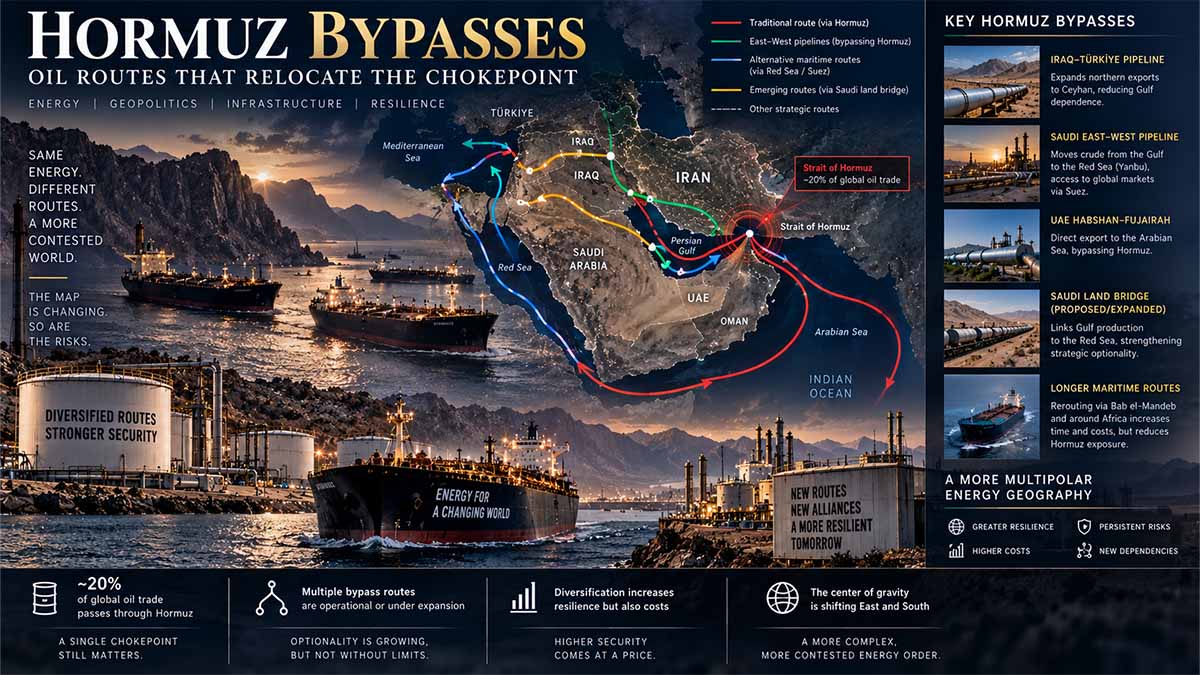
Scope: This assessment examines Saudi, Emirati and Iraqi alternatives to the Strait of Hormuz, their downstream maritime and overland dependencies, and the implications for European energy security, distinguishing the immediate crisis from infrastructure options extending to October 2031.
Executive Summary / BLUF
The principal strategic judgment is that bypass pipelines reduce exposure to Hormuz without establishing an independently secure export system, because their value depends on the continued availability of pumping stations, domestic feed networks, terminals, tankers and onward passages.
The strongest operational evidence is the reversal in combined exports from Yanbu and Fujairah, which the International Energy Agency records rising from 4.1 million barrels per day in February to 7.8 million in June 2026, before falling to 5.5 million in August amid Red Sea attacks; the subsequent shutdown of Saudi Arabia’s East–West Pipeline demonstrated that the alternative itself was vulnerable. Oil markets strain to plug the gap left by Middle East supply shortfall — International Energy Agency — Sep 2026. IEA
Iraq’s northern corridor has a documented contractual foundation, with 750,000 barrels per day of transport capacity allocated to SOMO/NOC under an August 2026 agreement, although allocated capacity must remain separate from measured throughput. Türkiye ve Irak Arasında Bir Yıllık Yeni Anlaşma — BOTAŞ — Aug 2026. botas.gov.tr
The decision consequence is that governments and investors should assess delivered, destination-specific barrels rather than aggregate pipeline capacity, while the decisive unresolved question is how much output each corridor can sustain through a renewed attack, terminal interruption or transit dispute.
A pipeline around Hormuz is not a guarantee of fuel
Europe should buy dependable fuel deliveries rather than reward announced bypass capacity. The G7 decision of 2 October 2026 exposes the distinction: its coordinated release of 100 million barrels over four months gives particular urgency to diesel and refinery maintenance, because recovering crude exports have not restored product availability. Pipelines ending at Yanbu, Fujairah or Ceyhan can redirect supply; they cannot independently secure the next voyage, enforce transit rights or make a receiving refinery produce the missing fuel. Financing those routes without resolving the remaining chain would exchange a visible maritime vulnerability for less visible contractual and industrial dependencies. The immediate choice is therefore fiscal as well as strategic: public support must purchase usable supply, with infrastructure commitments conditional on demonstrated delivery.
The import bill is rising faster than physical supply
In Q2 2026, EU crude-import value rose 55.8% against the 2025 monthly average while volume increased just 1.2%. The United States, Norway and Kazakhstan together supplied 46.5% of the recorded category. Diversification therefore coexisted with a sharp cost increase: changing suppliers does not insulate buyers from the international market. These figures cover crude and condensates, not the complete refined-fuel balance, and cannot attribute the entire increase to Hormuz. Eurostat’s September 2026 trade release establishes the financial pressure without establishing its sole cause.
The distinction between relief and recovery is equally stark. On 2 October 2026, the International Energy Agency reported approximately 325 million barrels released under the March collective action, against an original pledge of 400 million barrels, while refined-product flows remained severely constrained. The G7 commitment addresses that mismatch through diesel releases, maintenance coordination and avoidance of energy-export restrictions between members. Its accounting takes earlier fulfilled commitments into consideration; presenting the announcements as a verified 500-million-barrel total would overstate the record. The IEA assessment and the G7 statement make execution, rather than another aggregate pledge, the relevant test.
Each bypass transfers risk to another part of the journey
The Saudi East–West system redirects crude towards Yanbu; the Abu Dhabi connection reaches Fujairah; the Iraqi route through Türkiye ends at Ceyhan. Their strategic value depends on which interruption each can avoid and which dependencies remain. The one-year Iraq–Türkiye arrangement announced on 3 August 2026 allocated 750,000 barrels per day of transport capacity to SOMO and the North Oil Company. That is a contractual allocation, not proof that the volume was exported. Buyers need operating evidence and continuing access before incorporating it into firm supply. BOTAŞ’s agreement announcement documents the right to transport, not the completed cargo.
Maritime rerouting offers the same warning. In Q2 2026, the Energy Information Administration recorded oil flows of 8.1 million barrels per day through Bab el-Mandeb, 5.8 million through Suez and SUMED combined, and 9.4 million around the Cape of Good Hope. These overlapping global flows include crude, condensates and products; they are not three independent pools of replacement supply. A Cape voyage can avoid the Red Sea only after its cargo has reached a usable export point. A Mediterranean outlet can shorten exposure to southern passages only when inland movement and terminal loading work. The EIA passage series measures movement, not spare capacity available to European purchasers.
Proposed infrastructure belongs in a different category. Jordan’s official Haditha–Aqaba project record describes a 1-million-barrel-per-day connection and a $5.6 billion segment value, but its implementation narrative refers to 2019–2020. A recently updated webpage does not turn that historical cost into a current financing package. Similarly, the Iraqi ministry’s August 2026 account of technical and economic work on the Basra–Haditha–Kirkuk–Baniyas project establishes development activity, not operating supply. Current financial close and accepted commissioning: [NOT IN DOSSIER]. Treating these proposals as emergency capacity would allow future assets to substitute on paper for fuel needed now.
The receiving refinery determines the value of the new route
The United Kingdom’s Q2 2026 refinery production fell 14%, while net imports of all oils rose to 8.5 million tonnes. Grangemouth’s transition to an import terminal contributed to the refining decline. Additional crude access therefore answers only part of the British problem: a terminal receiving finished products and a refinery receiving feedstock serve different requirements. A bypass investment justified by crude throughput can leave the consuming market dependent on imported diesel or aviation fuel. Energy Trends: September 2026 makes that industrial transmission mechanism explicit.
Germany presents a complementary interest. Its first-half 2026 diesel production reached 15.8 million tonnes; exports were 2.06 million tonnes and imports 0.858 million tonnes. The resulting net-export position gives Berlin a reason to preserve cross-border distribution alongside domestic refinery continuity. Those figures do not establish spare processing capacity or compatibility with every replacement crude. France’s July 2026 road-diesel consumption fell 8.6% year on year while jet-fuel consumption rose 5.4%, further demonstrating why a general improvement in petroleum supply can coexist with pressure on a particular product. Destatis’s production release and France’s monthly energy report argue for procurement organised around the fuel required, the receiving plant and the delivery date.
Legal stockholding can conceal a physical delivery problem
Council Directive 2009/119/EC requires emergency stocks equivalent to the greater of 90 days of average daily net imports or 61 days of average daily inland consumption. Article 5 also requires availability and physical accessibility. Compliance with a quantity rule is therefore insufficient if the relevant product cannot reach the affected market. The directive provides emergency procedures and cross-border provisions; it does not create an automatically interchangeable European stockpile. The consolidated directive makes accessibility part of the obligation.
Italy’s 15 April 2026 decree illustrates the operational consequence. It permitted an experimental overseas stockholding ceiling of 100% for the stock year, subject to exceptions, while requiring specified OCSIT stocks to remain in Italy. This permission does not establish that all Italian reserves are abroad. It does mean that retrieval rights, transport arrangements and product location can determine how useful a legally compliant reserve becomes during disruption. The Italian stockholding decree should be read as a requirement to examine access, not as evidence of immediate delivery.
The same discipline should govern public finance. The 2 October 2026 G7 decision can mobilise existing stocks and coordinate refinery schedules; it cannot commission an unfunded cross-border pipeline. European support for new corridors should consequently advance through enforceable access, committed financing, verified construction and operating acceptance. Current project-specific delivered-cargo costs and insurance premiums: [NOT IN DOSSIER]. Without those terms, governments cannot establish whether a transport announcement buys affordable redundancy or transfers commercial risk to the public balance sheet.
European coordination must extend beyond the terminal
The G7’s 2 October 2026 undertaking to avoid energy-export restrictions within the group matters because a functioning German refinery or a released national stock has regional value only if products can move to another buyer. Maintenance coordination serves the same purpose: preserving processing availability can improve usable supply without waiting for new construction. The external bargain is thus reciprocal access to fuel and capacity, rather than a collection of national corridor announcements. Its success must be measured through delivered products and uninterrupted transfers.
Maritime protection remains a separate obligation. The Council extended Operation ASPIDES to 28 February 2027, with nearly €15 million for common costs over the relevant year. That figure excludes the full national expenditure on contributed ships, personnel and capabilities. Pipeline expenditure therefore cannot be presented as replacing the security budget for the onward voyage, while the common allocation cannot be treated as the complete cost of protection. The Council’s mandate decision identifies a continuing commitment whose renewal requires its own decision.
Over the next two years, users pay for capacity that cannot deliver
Between October 2026 and October 2028, the consequence of prioritising announced capacity over usable supply would be repeated emergency procurement without dependable replacement options. Italy’s extra-EU energy deficit already reached €4.808 billion in August 2026, against €3.571 billion a year earlier. The balance covers energy more broadly than oil and cannot isolate Hormuz, but it shows the external-cost exposure into which further procurement pressure would feed. Industrial buyers and freight operators would face fuel and delivery costs; households with limited transport alternatives would absorb part of the burden; taxpayers would pay where governments subsidised those costs or supported projects without secured performance. Istat’s August trade account supplies the starting exposure, not a quantified forecast.
The choice should therefore be judged by what the October 2026 commitments deliver: accessible product stocks, viable refinery schedules, replacement cargoes and enforceable transit, followed by investment supported by demonstrated operation. Maintenance deferral must also be assessed against the later outage it can create, and released reserves against their replenishment requirement. Over the next 12–24 months, a pipeline that supports repeat deliveries would expand buyers’ options; one counted before acceptance would leave them exposed while capital remained committed. The price of inaction would fall on the users still buying scarce fuel and the public budgets financing relief, even if announced export capacity continued to rise.
Navigational Index
Pillar I — Physical Alternatives and Operational Constraints
- Chapter 1 — Hormuz Dependence and the Architecture of Alternative Exports
- Chapter 2 — Yanbu and Fujairah: Operating Corridors and Their Remaining Exposure
- Chapter 3 — Ceyhan and Baniyas: Iraqi Supply Connections and Mediterranean Access
Pillar II — Security, Transit Authority and Commercial Viability
- Chapter 4 — Infrastructure Protection, Maritime Passage and Disruption Recovery
- Chapter 5 — Transit Agreements, Sanctions, Financing and Delivered-Cargo Economics
Pillar III — European Exposure and Strategic Decisions
- Chapter 6 — Italy, France, Germany, the United Kingdom and EU Coordination
- Chapter 7 — Alternative Pathways, Watch Indicators and the Outlook to 2031
- Chapter 8 — Courses of Action and Final Net Assessment
Master Abstract
The relevant unit is the complete delivery corridor
The controlling distinction is between avoiding a particular strait and securing the entire journey from producing field to receiving refinery, because a pipeline can remove one maritime dependency while introducing concentrated infrastructure exposure or leaving the cargo dependent on another passage. The International Energy Agency’s baseline identifies substantial Saudi and Emirati alternatives, but explicitly qualifies Saudi Aramco’s reported expansion of East–West capacity to 7 million barrels per day, noting that sustainable flows had not been tested at that level; consequently, that figure represents reported capacity rather than independently established crisis export performance. Strait of Hormuz — International Energy Agency — Feb 2026. IEA
For decision purposes, a corridor should therefore be evaluated through its narrowest functioning link: oil availability at the inlet, transfer capacity, power and pumping reliability, terminal storage, loading capability and the commercially acceptable onward voyage. This is an analytical framework rather than a measured capacity formula, since inventories, refinery consumption, maintenance and vessel scheduling prevent those links from being treated as interchangeable daily flows.
The strategic benefit of diversification is nevertheless substantial when disruption mechanisms differ between routes, although it diminishes when the same conflict threatens both the original passage and its alternative.
Yanbu substitutes a land corridor and destination-dependent maritime exposure
Yanbu’s principal advantage is its position within the Red Sea, which allows Saudi crude to reach that basin without passing through Hormuz, while the onward exposure differs according to the buyer’s location. The US Energy Information Administration identifies Suez and the SUMED pipeline as connections between the Red Sea and Mediterranean, and Bab el-Mandeb as the connection between the Red Sea, Gulf of Aden and Arabian Sea; this geography means that a conventional northbound voyage from Yanbu toward Europe avoids Bab el-Mandeb, whereas a southbound voyage toward Asian markets encounters it. Red Sea chokepoints are critical for international oil and natural gas flows — US Energy Information Administration — Dec 2023. U.S. Energy Information Administration (EIA)
The analytical implication is that “Yanbu access” cannot be assigned a single security value independently of destination, because northbound shipments retain Egyptian passage and handling dependencies while southbound shipments retain the southern Red Sea exposure. SUMED provides a connection across Egypt for crude already reaching its Red Sea inlet, rather than an independent means of transporting Iraqi southern production out of the Gulf.
The September disruption also demonstrates the distinction between securing sea passage and protecting the infrastructure that supplies it: the IEA’s September assessment records the recent East–West shutdown and identifies the pipeline as having brought 3.5 million barrels per day of crude exports to global markets in August. The Middle East and Global Energy Markets — International Energy Agency — accessed Oct 2026. IEA
That export measure should not be presented as total pipeline throughput, since barrels supplied to domestic refineries and barrels loaded for foreign buyers represent different uses of the same transport system.
Fujairah provides a different form of geographic diversification
Fujairah merits separate treatment because its export function differs from Yanbu’s: ADNOC describes the approximately 406-kilometre ADCOP pipeline as connecting an Abu Dhabi onshore collection centre with the Fujairah export terminal, thereby providing access to international shipping outside Hormuz. Who We Are — ADNOC Pipelines — accessed Oct 2026. ADNOC
For an eastbound shipment, that location removes the need to cross either Hormuz or Bab el-Mandeb at the beginning of the outward journey, although the protection gained remains conditional on the pipeline’s feed system, terminal availability and subsequent shipping conditions. The operator’s description establishes a route for a significant proportion of Emirati production, without establishing that all offshore production or neighbouring countries’ crude can be redirected into it.
The broader portfolio judgment is therefore that Saudi and Emirati bypasses offer complementary geographic options, rather than equivalent units of universally accessible spare export capacity; their combined resilience must be assessed against which fields they serve, which destinations they supply and whether their principal failure mechanisms are genuinely independent.
Ceyhan’s export opportunity depends on Iraqi connectivity and contractual continuity
The strongest recent first-party evidence for the Iraqi northern route is BOTAŞ’s announcement of a one-year crude-transport agreement with SOMO and North Oil Company, dated 3 August 2026, allocating 750,000 barrels per day within the Silopi–Ceyhan system and describing the arrangement as a means of maintaining flows pending a longer-term cooperation model. Türkiye ve Irak Arasında Bir Yıllık Yeni Anlaşma — BOTAŞ — Aug 2026. botas.gov.tr
The agreement establishes an important transport entitlement, but it does not establish an equally large stream of available crude at the Iraqi inlet. In March, Iraq’s oil ministry described a conditional objective of approximately 650,000 barrels per day of northern exports, dependent on increased regional production and contributions from northern fields, while also identifying the planned Basra–Haditha connection as a means of improving flexibility between southern production and northern infrastructure. النفط: ندرس إنشاء خط جديد إلى ميناء بانياس السوري — Iraqi Media Network, reproducing Iraqi News Agency statements — Mar 2026. news.imn.iq
These figures describe different constraints rather than contradictory observations: the Turkish allocation concerns transport access, whereas the Iraqi objective concerns prospective supply into the export system. The resulting assessment is that Ceyhan’s contribution to southern Iraqi export resilience depends on resolving internal connectivity as well as maintaining cross-border commercial arrangements.
Baniyas remains a development proposition, despite existing product trade
The Iraqi oil ministry’s statement of 30 August 2026 describes work on the technical and economic requirements of the Basra–Haditha–Kirkuk–Baniyas project, including implementation stages and a roadmap, which supports treating the corridor as an active development initiative without establishing financial close, completed construction or commissioned crude throughput. النفط: ماضون باستكمال المتطلبات الفنية والاقتصادية لمشروع أنبوب البصرة – حديثة – كركوك – بانياس — Iraqi Media Network, reproducing a ministry statement — Aug 2026. بانياس » شبكة الإعلام العراقي
Existing commercial activity provides a narrower form of evidence: in May, the ministry stated that Iraqi fuel oil was being exported by tanker truck through Baniyas, demonstrating a functioning product-logistics channel without demonstrating a high-volume crude-pipeline system. وزارة النفط تعلن عن خطة واسعة لتصدير النفط الأسود — Iraqi Media Network, reproducing Iraqi News Agency statements — May 2026. news.imn.iq
The prospective strategic gain would arise from moving Iraqi crude directly to the Mediterranean, while the corresponding burden would encompass cross-border construction, terminal development, transit governance and long-term protection. No completion date or project-cost estimate should enter the operational baseline until supported by the relevant engineering, financing and contractual records.
Europe’s exposure extends beyond direct Gulf cargoes
European vulnerability cannot be inferred solely from the proportion of national imports originating in the Gulf, because disruption also affects replacement-cargo competition, refinery feedstock availability and internationally traded products. The IEA’s September Oil Market Report records Gulf net diesel/gasoil exports of 390,000 barrels per day in August, just over one-quarter of pre-war levels, illustrating why restoring crude transport alone does not establish a corresponding recovery in usable fuel supply. Oil Market Report – September 2026 — International Energy Agency — Sep 2026. IEA
For Italy, the immediate institutional response includes participation in the coordinated IEA reserve release announced by MASE on 12 March, while the strategic implication is that accessible stocks, refinery-compatible replacement crude and reliable Mediterranean arrivals should be assessed together rather than assuming that geographic proximity to alternative terminals guarantees supply. Energia: Mase, l’Italia aderisce al rilascio coordinato di scorte petrolifere dell’AIE — MASE, official copy hosted by OCSIT — Mar 2026. ocsit.it
For France, the ministry’s description of strategic-stock governance identifies the DGEC’s role in authorising releases and the CPSSP/SAGESS structure for maintaining physical stocks, which makes product composition, location and release accessibility central variables in any assessment of resilience to an interrupted maritime corridor. La chaîne pétrolière — French Ministry responsible for ecological transition — accessed Oct 2026. ecologie.gouv.fr
For Germany, the longer-term policy position articulated by the environment ministry links reduced oil and gas dependence with electrification and renewable-energy expansion; analytically, those measures address exposure through lower demand, while immediate replacement supplies still require separate transport and refinery planning. Umweltminister Carsten Schneider zu mehr Unabhängigkeit von Öl und Gas — Federal Environment Ministry — Mar 2026. Medienbeitrag
For the United Kingdom, the government announced a 13.5-million-barrel contribution to the coordinated release on 11 March, providing a dated emergency commitment rather than a measure of October inventory availability, while the corridor implication remains the need to distinguish temporary stock support from durable replacement flows. UK joins IEA members in coordinated oil stock release — UK Government — Mar 2026. GOV.UK
At EU level, the Council extended ASPIDES to 28 February 2027 as a defensive maritime operation, providing an institutional instrument for protecting navigation while leaving pipeline protection, terminal recovery and commercial underwriting as separate requirements. Mer Rouge: le Conseil proroge le mandat de l’opération ASPIDES en vue de préserver la liberté de navigation — Council of the European Union — Feb 2026. Consilium
Key Evidence Table
Volumes are million barrels per day unless otherwise stated, with each entry retaining its own definition and reference period.
| Indicator | Value/status | Reference date | Definition/scope | Issuer | Exact source |
|---|---|---|---|---|---|
| Hormuz oil traffic | 4.9 | Q2 2026 | Quarterly average of crude, condensate and petroleum products; rounded components | EIA | Short-Term Energy Outlook — EIA — accessed Oct 2026 |
| Bab el-Mandeb oil traffic | 8.1 | Q2 2026 | Total oil passage, rather than Saudi bypass exports alone | EIA | Short-Term Energy Outlook — EIA — accessed Oct 2026 |
| Suez and SUMED oil traffic | 5.8 | Q2 2026 | Combined passage through the canal and pipeline | EIA | Short-Term Energy Outlook — EIA — accessed Oct 2026 |
| Saudi East–West capacity | 7 reported | Reported March 2025; discussed in February 2026 baseline | Reported expanded capacity; sustainable flows at that level not established by the cited assessment | IEA, attributing Aramco | Strait of Hormuz — IEA — Feb 2026 |
| Iraqi allocation within Silopi–Ceyhan system | 0.75 | 3 August 2026 | Contractual transport allocation to SOMO/NOC, rather than measured exports | BOTAŞ | Türkiye ve Irak Arasında Bir Yıllık Yeni Anlaşma — BOTAŞ — Aug 2026 |
| Iraqi fuel-oil exports through Baniyas | Ministry-reported truck trade | 8 May 2026 | Product exports; no crude-pipeline throughput established | Iraqi oil ministry statement | وزارة النفط تعلن عن خطة واسعة لتصدير النفط الأسود — Iraqi Media Network — May 2026 |
The EIA transport figures are passage estimates with distinct geographic coverage, rather than additive measures of unique export supply, because a cargo can appear in more than one chokepoint series and tracking gaps require supplementary route analysis. U.S. Energy Information Administration (EIA)
Alternatives and Decision Conditions
The evidence supports a conditional assessment of three strategic directions, without a defensible basis for assigning numerical probabilities or treating the directions as mutually exclusive.
| Strategic direction | Expected contribution | Condition required for the judgment to hold | Principal limiting factor |
|---|---|---|---|
| Restore and protect existing bypasses | Near-term recovery of export access through existing infrastructure | Sustained terminal loadings following repair, with acceptable onward shipping arrangements | Repeated interruption of concentrated infrastructure or maritime access |
| Expand Iraq’s northern export contribution | Greater access to Mediterranean loading through Ceyhan | Available crude at the northern inlet, reliable internal connections and contractual continuity | Feedstock and domestic-network constraints |
| Develop an Iraqi–Syrian crude corridor | Additional geographic diversification within the five-year horizon | Bankable agreements, finance, completed construction and commissioned terminal capacity | Execution, transit governance and security obligations |
For Baniyas, the financing environment must also be distinguished from the engineering problem: the Council’s May 2025 measures lifted broad economic restrictions while retaining security-based measures, and the current Council record confirms continuing targeted sanctions, which means commercial feasibility requires transaction-specific scrutiny rather than either a blanket assumption of prohibition or an assumption of unrestricted access. Syria: EU adopts legal acts to lift economic sanctions on Syria, enacting recent political agreement — Council of the European Union — May 2025; Syria — Council of the European Union — accessed Oct 2026. consilium.europa.eu
Principal Gaps and Watch Indicators
| Assessment-changing gap | Observable indicator | Decision threshold |
|---|---|---|
| Sustained Saudi post-disruption performance | Dated operator records separating pipeline throughput, refinery supply and terminal exports | Repeated fulfilled loading schedules and stable operations would support recognition of restored export capability |
| Destination-specific maritime availability | Completed voyages, cancellations and binding insurance or charter terms for the relevant route | A corridor should count as commercially available only where cargoes can reach contracted buyers on acceptable terms |
| Actual Iraqi northern export contribution | SOMO/NOC dispatch records and corresponding Ceyhan loadings | Measured exports must substantiate any claim that contractual allocation has become usable replacement supply |
| Southern Iraqi connectivity | Engineering acceptance records and demonstrated transfers into the northern system | Commissioned connections must establish a continuous pathway from southern fields to the export inlet |
| Baniyas implementation status | Published agreements, financial close, construction milestones and commissioning records | Operational capacity should enter the supply baseline only after the complete crude-handling chain has been demonstrated |
| Recovery after renewed disruption | Recorded repair time, spare-equipment availability and stock-buffer performance | Resilience should be recognised where service can recover within the continuity period required by contracted buyers |
The principal judgment would strengthen if an alternative route repeatedly lost export capability despite retaining nominal pipeline capacity, whereas it would weaken if independently documented operations demonstrated sustained delivery through renewed infrastructure attacks or shipping disruption.
Open-source analytical assessment · corridor dependencies
Hormuz Bypasses: Oil Routes That Relocate the Chokepoint
Alternative pipelines remove particular geographic dependencies, while the delivery of oil still requires functioning inland infrastructure, export terminals and commercially accessible onward passages.
The strategic value of a bypass is determined by the oil reaching contracted buyers during disruption, rather than by the pipeline capacity announced or the transport entitlement allocated.
This is a qualitative dependency schematic; arrow direction indicates the transport sequence, without representing distance, flow volume or a numerical risk score.
Different routes, different remaining dependencies
Yanbu · Saudi Arabia
Existing route · interruption documented- Eastern Saudi crude supply
- East–West pipeline and pumping system
- Yanbu export terminal · Red Sea
Remaining dependencies include pumping reliability, terminal stocks and loadings, followed by destination-specific passage and shipping availability.
Evidence boundary: the reported 7 million b/d capacity is distinct from sustained exports, while the reviewed official record documents a September interruption without establishing a daily post-repair throughput series.
Open supporting evidence
Strait of Hormuz — IEA — February 2026 distinguishes the reported expansion from tested sustainable flows.
Oil markets strain to plug the gap left by Middle East supply shortfall — IEA — September 2026 records the early-September shutdown.
Red Sea chokepoints are critical for international oil and natural gas flows — EIA — December 2023 establishes the onward passage geography; this older source supplies geographic context rather than current operating status.
Fujairah · UAE
Existing outside-Hormuz outlet- Abu Dhabi onshore collection centre
- ADCOP pipeline · approximately 406 km
- Fujairah terminal · Gulf of Oman
- Onward shipment to international buyers
Remaining dependencies include eligible upstream feed, pipeline availability, terminal operations and the onward voyage.
Geographic distinction: an eastbound outward voyage avoids Hormuz and does not require Bab el-Mandeb; this does not establish unrestricted access for all Emirati or neighbouring production.
Open supporting evidence
Who We Are — ADNOC Pipelines — accessed October 2026 describes the pipeline ownership, approximately 406-kilometre length and onshore connection to Fujairah.
Ceyhan · Iraq–Türkiye
Transport allocation documented- Crude available to the Iraqi northern system
- Domestic feed and cross-border connection
- Silopi–Ceyhan transport system
- Ceyhan loading → Mediterranean buyers
A larger role for southern Iraqi crude depends on reliable south-to-north connectivity, alongside available feed and contractual continuity.
Evidence boundary: BOTAŞ allocated 750,000 b/d to SOMO/NOC under a one-year agreement announced on 3 August 2026, which establishes a transport entitlement rather than measured exports.
Open supporting evidence
Türkiye ve Irak Arasında Bir Yıllık Yeni Anlaşma — BOTAŞ — August 2026 documents the agreement and allocated capacity.
النفط: ندرس إنشاء خط جديد إلى ميناء بانياس السوري — Iraqi Media Network — March 2026 reproduces ministry statements on conditional northern export objectives and the Basra–Haditha connection.
Baniyas · Iraq–Syria
Proposed crude corridor- Iraqi crude supply and domestic connection
- Proposed cross-border pipeline infrastructure
- Required Baniyas crude-handling capability
- Prospective Mediterranean crude exports
Implementation requires bankable agreements, financing, construction, transit governance, security arrangements and commissioning of the complete chain.
Evidence boundary: technical and economic development is documented, while existing trucked fuel-oil trade does not establish a commissioned high-volume crude pipeline.
Open supporting evidence
النفط: ماضون باستكمال المتطلبات الفنية والاقتصادية لمشروع أنبوب البصرة – حديثة – كركوك – بانياس — Iraqi Media Network — August 2026 describes the development work.
وزارة النفط تعلن عن خطة واسعة لتصدير النفط الأسود — Iraqi Media Network — May 2026 reports trucked fuel-oil exports.
What must remain available for delivery
Analytical model based on the corridor evidence above; these dependencies are not assigned weights, probabilities or a calculated capacity score.
Evidence with definitions preserved
| Indicator | Value and date | What the figure establishes | Exact source |
|---|---|---|---|
| Hormuz oil passage | 4.9 · Q2 2026 | Quarterly average passage of oil; distinct from bypass capacity. | Short-Term Energy Outlook — EIA — accessed October 2026 |
| Bab el-Mandeb oil passage | 8.1 · Q2 2026 | All oil passage covered by the series, rather than Saudi exports alone. | Short-Term Energy Outlook — EIA — accessed October 2026 |
| Suez and SUMED oil passage | 5.8 · Q2 2026 | Combined passage through the canal and pipeline. | Short-Term Energy Outlook — EIA — accessed October 2026 |
| East–West reported capacity | 7.0 · reported March 2025 | Reported expansion; the February 2026 assessment does not establish sustainable flows at this level. | Strait of Hormuz — IEA — February 2026 |
| Silopi–Ceyhan allocation | 0.75 · 3 August 2026 | Transport capacity allocated to SOMO/NOC, rather than actual export throughput. | Türkiye ve Irak Arasında Bir Yıllık Yeni Anlaşma — BOTAŞ — August 2026 |
Passage volumes are non-additive because a cargo can cross more than one chokepoint; tracking estimates, reported capacity and contractual allocations retain different definitions and reference periods.
Evidence required to strengthen the assessment
Existing route recovery
Repeated fulfilled loading schedules, stable throughput and demonstrated recovery following renewed disruption would establish more than a single restart announcement.
Iraqi northern delivery
Matched dispatch and loading records, alongside accepted domestic connections, would show how much transport entitlement becomes usable export supply.
Baniyas commissioning
Financial close, completed works and acceptance of the entire crude-handling chain would justify moving the project into the operational supply baseline.
Pillar I — Physical Alternatives and Operational Constraints
Assessment date: 4 October 2026. Quantities retain their original reporting periods, while operator statements, observed transport volumes and proposed infrastructure are distinguished throughout.
Chapter 1 — Hormuz Dependence and the Architecture of Alternative Exports
The disruption affects several energy systems that cannot use the same alternatives
The principal physical constraint is that the Gulf’s export problem encompasses crude oil, refined products and liquefied natural gas, whereas the principal bypass pipelines serve particular crude-producing networks, meaning that additional crude transport cannot automatically replace interrupted product shipments or restore LNG deliveries. The International Energy Agency’s September assessment reported that more than 10 million barrels per day of Gulf production remained shut in during August, while global refinery throughput was 4.2 million barrels per day below its year-earlier level, demonstrating that export restrictions were interacting with production and processing constraints rather than operating as an isolated shipping problem. Oil Market Report – September 2026 — International Energy Agency — Sep 2026. IEA
The resulting distinction is consequential for infrastructure planning: restoring a crude corridor contributes to supply only where oil is available at its inlet, while restoring the fuels required by importing economies also depends on refinery availability, product handling and the distribution network beyond the receiving port. A barrel released from storage, a barrel moved through an alternative pipeline and a barrel of production restored after a shutdown therefore perform different functions in the recovery process.
Pre-war exposure differed materially between producers
The IEA’s full-year 2025 accounting separates crude and condensate from petroleum products, allowing the original exposure to be assessed without presenting every country’s exports as the same commodity or assuming that an alternative belonging to one producer is available to another.
| Producer | Crude and condensate through Hormuz, million b/d | Petroleum products through Hormuz, million b/d | Combined flow, million b/d |
|---|---|---|---|
| Saudi Arabia | 5.43 | 0.80 | 6.23 |
| Iraq | 3.32 | 0.31 | 3.63 |
| United Arab Emirates | 2.02 | 1.22 | 3.24 |
| Iran | 1.69 | 0.72 | 2.41 |
| Kuwait | 1.40 | 0.97 | 2.37 |
| Qatar | 0.73 | 0.69 | 1.43 |
| Bahrain | 0.00 | 0.21 | 0.21 |
| Saudi–Kuwaiti Neutral Zone | 0.35 | 0.00 | 0.35 |
Reference period: full-year 2025; figures are rounded and describe passage through Hormuz rather than total national exports. Source: Strait of Hormuz — International Energy Agency — Feb 2026. IEA
The comparison establishes why national bypass capacity should not be treated as a regional pool: Iraq’s southern exports require an Iraqi connection into an alternative system, while Kuwait’s product exposure cannot be resolved simply by increasing Saudi crude throughput. The relevant question is therefore which production and processing assets have an accepted, functioning connection to the alternative outlet.
The transport record shows a redistribution of exposure
The EIA’s August 2026 energy-security dataset provides a consistent quarterly comparison across the principal passages, showing that the contraction at Hormuz coincided with increased oil passage through Bab el-Mandeb and increased LNG movement around the Cape of Good Hope.
| Transport indicator | Q4 2025 | Q1 2026 | Q2 2026 | Unit |
|---|---|---|---|---|
| Hormuz: crude and condensate | 15.9 | 10.9 | 3.7 | Million b/d |
| Hormuz: petroleum products | 5.7 | 4.0 | 1.1 | Million b/d |
| Hormuz: LNG | 10.5 | 7.4 | 0.8 | Billion cubic feet/day |
| Bab el-Mandeb: crude and condensate | 3.2 | 3.4 | 6.1 | Million b/d |
| Cape of Good Hope: LNG | 6.0 | 4.8 | 9.7 | Billion cubic feet/day |
Source: Tables 4, 6 and 10, Global Energy Security Data — US Energy Information Administration — Aug 2026. Passage estimates are non-additive, and EIA warns that Hormuz tracking data require frequent revision because AIS signals have become especially unreliable. U.S. Energy Information Administration (EIA)
These observations support geographic redistribution, but they do not establish a cargo-for-cargo substitution between the routes, because the series cover different commodities, origins and journeys. Increased passage through the southern Red Sea also means that a route avoiding Hormuz can become more dependent on another contested maritime area.
Market adjustment is broader than infrastructure substitution
The IEA’s 18 September assessment estimated a 1.7-million-barrel-per-day market deficit in the third quarter, despite a much larger headline reduction in Hormuz flows, because bypass exports, production outside the Gulf, inventories and weaker consumption collectively moderated the imbalance. It also estimated that global demand over the preceding six months averaged 5.8 million barrels per day below February levels, a comparison with the pre-crisis month rather than a year-on-year contraction. Oil markets strain to plug the gap left by Middle East supply shortfall — International Energy Agency — Sep 2026. IEA
The strategic interpretation is that market balance achieved through consumption losses or inventory depletion should not be mistaken for restored export resilience, since those mechanisms can reduce immediate shortages while leaving the underlying transport restriction unresolved. Conversely, an increase in bypass traffic does not necessarily represent an equivalent increase in global supply if it merely redirects barrels previously using another route.
Transporting a cargo beyond Hormuz is distinct from bypassing Hormuz
A development reported on 3 October 2026 illustrates this distinction: the Iraqi Oil Tanker Company announced that it had secured a very large crude carrier and transported two million barrels of Iraqi crude beyond Hormuz, with its director describing a change from delivery at Basra toward transportation beyond the strait. The announcement establishes the company’s claimed execution of a cargo operation, without establishing a land bypass or unrestricted passage for subsequent shipments. Iraq transports 2 million barrels of crude beyond of Hormuz for first time in decades — Syrian Arab News Agency, reproducing Iraqi News Agency and company statements — Oct 2026. sana.sy
The operational implication concerns responsibility as well as geography: arranging transport beyond a constrained passage can give the seller greater control over delivery, while also requiring it to manage additional vessel, scheduling and voyage exposure. The announcement does not disclose the complete contractual allocation of those obligations, so it should not be interpreted as proof that transit risk has disappeared.
A corridor has several independently binding limits
The following framework identifies the records required to establish usable export capability, rather than assigning unsupported weights or treating every published capacity figure as an equivalent measure.
| Constraint | Operational question | Evidence required | Error avoided |
|---|---|---|---|
| Eligible supply | Which fields and crude grades can feed the route? | Accepted connections and dispatch records | Treating national production as universally connected |
| Sustained transfer | What volume can move under current operating conditions? | Dated throughput and equipment-availability records | Substituting design capacity for realised transport |
| Coastal buffering | Can storage absorb arrivals and sustain loadings during interruption? | Usable inventory by grade and operating tank status | Treating total tank volume as immediately exportable stock |
| Marine loading | Can nominated vessels berth and complete loading? | Berth compatibility, loading logs and completed departures | Multiplying peak loading rates into daily exports |
| Buyer delivery | Can the cargo reach the receiving terminal? | Completed voyage and receipt records | Counting loaded barrels as delivered barrels |
Analytical framework grounded in the operator infrastructure descriptions examined in Chapter 2 and the transport records examined in Chapter 3; it is not a measured capacity model.
Key judgments
The physical export problem must be assessed separately for crude, products and LNG, while the reported recovery of market balance must be separated from the recovery of transport capability.
The most useful measure of resilience is a sequence of completed deliveries under disruption, because neither a transport allocation nor one successfully executed voyage establishes continuing availability.
What would change the assessment
The assessment would improve with sustained increases in delivered cargoes accompanied by restored production and processing, whereas greater reliance on stock depletion or consumption reductions would indicate that market adjustment continues to compensate for unresolved infrastructure constraints.
Open official record
The decisive missing records are current daily flows by commodity and route, matched dispatch-to-receipt records, and documented allocation of delivery responsibility for exceptional cargo arrangements.
Chapter 2 — Yanbu and Fujairah: Operating Corridors and Their Remaining Exposure
Saudi capacity must be assessed using the later operating record
The decision-relevant judgment is that Saudi Arabia’s East–West system has a stronger documented operating record than an assessment based solely on its announced expansion would imply, because Aramco’s first-quarter 2026 earnings presentation states that the pipeline was ramped to seven million barrels per day, while subsequent disruption demonstrates that reaching that rate does not establish its continuous availability.
Aramco also stated that it had introduced crude export outlets at Rabigh and repurposed infrastructure to supply some western refineries, which indicates adaptation across the coastal network rather than exclusive dependence on a single terminal configuration. These remain operator statements, and the presentation does not supply a daily series separating peak pumping, sustained throughput, refinery deliveries and tanker exports. First quarter 2026 earnings call — Saudi Aramco — May 2026, presentation page 4. aramco.com
The later company record therefore supersedes the earlier description of seven-million-barrel operation as untested, while leaving the separate questions of duration, export conversion and current availability unresolved.
Yanbu’s marine infrastructure is substantial, but its loading rates are local limits
Aramco’s 2025 port rules specify distinct northern and southern crude terminals, whose berth and loading-arm parameters provide a more precise picture of the marine interface than a single port-wide capacity number.
| Published parameter | Yanbu North Crude Terminal | Yanbu South Terminal |
|---|---|---|
| Crude loading berths | 4 | 3 |
| Crude loading arms per berth | 4 | 4 |
| Crude loading-arm diameter | 20 inches | 20 inches |
| Maximum crude rate per arm | 32,500 barrels/hour | 33,000 barrels/hour |
| Maximum crude rate per berth | 130,000 barrels/hour | 132,000 barrels/hour |
| Indicative berth numbers | 61–64 | 101–103 |
Source: Sections 1.3 and 1.5, printed pages 4–5, Yanbu Industrial Port — Saudi Aramco — Jul 2025. aramco.com
Calculated at those maximum rates, transferring a two-million-barrel parcel would require approximately 15.38 hours at a northern berth or 15.15 hours at a southern berth, before accounting for any lower-rate loading stages, connections or other turnaround activities. These are arithmetic lower bounds, not observed vessel turnaround times, and multiplying them across all berths would not establish sustained port exports because upstream feed and operating schedules remain separate constraints.
Vessel compatibility remains specific to the assigned berth
The universal berth annex further demonstrates that “Yanbu access” does not mean that every vessel can use every loading position.
| Berth | Maximum vessel deadweight | Maximum sailing draft |
|---|---|---|
| North 61 | 275,000 tonnes | 25.0 metres |
| North 62 | 500,000 tonnes | 29.0 metres |
| North 63 | 275,000 tonnes under the standard entry | 24.5 metres |
| North 64 | 400,000 tonnes | 23.0 metres |
| South 101 | 320,000 tonnes | 22.6 metres |
| South 102 | 500,000 tonnes | 27.0 metres |
| South 103 | 320,000 tonnes | 22.6 metres |
Source: printed pages 6–7, Universal Berth Parameters — Saudi Aramco — Jul 2025. The annex contains a conditional exception for North Berth 63 during a Berth 62 outage; the standard value is retained here. aramco.com
Deadweight is a vessel carrying-capacity measure rather than the weight of crude alone, while the berth-specific limits mean that loss of one position can affect the range of vessels available for replacement loading. The operational question is consequently whether the remaining berth, vessel and cargo combination is compatible, rather than whether another berth exists somewhere within the port.
Terminal development created grade-specific export capability
Aramco’s commissioning announcement for Yanbu South states that the terminal added three million barrels per day of western export capacity in 2018, with facilities designed to receive, store and load Arabian Light and Arabian Super Light, and records the first VLCC loading on 12 October 2018. Yanbu South Terminal export capacity — Saudi Aramco — Oct 2018. Aramco
This historical specification establishes the commissioned asset’s intended function without proving its current daily availability, while the named crude grades underline why substituting production from another field cannot be assumed to be operationally neutral. A defensible export plan requires the nominated grade to be available within the accepted storage and loading configuration.
The terminal announcement also should not be added mechanically to the East–West pumping figure, because the former describes an export-interface increment and the latter describes inland transfer capacity; both belong to the same delivery chain and do not constitute independent supplies.
Fujairah’s crude export system and wider oil port are distinct infrastructures
ADNOC Murban’s 11 June 2026 Base Offering Memorandum describes a 48-inch, approximately 404-kilometre pipeline from Habshan to Fujairah, commissioned in July 2012, with capacity of approximately 1.5 million barrels per day and a terminal tank farm connected to three single-point moorings. The document also records domestic refinery deliveries and refinery upgrades intended to permit more offshore sour crude processing, thereby freeing additional Murban for export. Base Offering Memorandum — ADNOC Murban Sukuk Limited — Jun 2026, printed page 117. Base Offering Memorandum.pdf
The physical consequence is that Fujairah export availability depends partly on allocation within ADNOC’s wider refining and production system, because domestic processing choices affect the quantity of Murban remaining for external sale. That mechanism is separate from a pipeline expansion and requires a distinct evidence base.
Published ADCOP figures describe different operating conditions
| Record | Published capacity or length | Interpretation |
|---|---|---|
| ADCOP bond announcement, November 2017 | 1.5 million b/d design capacity; increase to 1.8 million b/d using drag-reducing agents | Higher throughput was described as condition-dependent |
| Same announcement | Approximately 406 km | Operator’s asset-length description |
| ADNOC Murban memorandum, June 2026 | Approximately 1.5 million b/d; 404 km | Later financing document’s infrastructure description |
| Fujairah port infrastructure page | 1.8 million b/d | Port authority’s stated transmission capacity |
Sources: Abu Dhabi Crude Oil Pipeline LLC, an ADNOC Group company, successfully issues a US$3 billion bond — ADNOC — Nov 2017, pages 2–3; Base Offering Memorandum — ADNOC Murban Sukuk Limited — Jun 2026; Oil — Fujairah Ports Authority — accessed Oct 2026. adnoc.ae
The figures should remain attributed rather than averaged, since the records do not provide a current reconciliation of operating conditions or measurement boundaries; in particular, the 1.8-million-barrel rate should not be converted into independently verified October throughput.
The wider port provides handling flexibility without proving unlimited bypass access
The Fujairah Ports Authority describes FOTT as serving the oil industrial zone through interconnected pipelines and manifold systems, including transfers between terminals, while listing operation in configurations of nine main berths or fourteen wing berths, rather than presenting those numbers as simultaneously additive. Its VLCC jetty, operating since 2016, is described as accepting vessels up to 330,000 tonnes deadweight and connecting through two 40-inch lines. Oil — Fujairah Ports Authority — accessed Oct 2026. Fujairah Ports Authority
These facilities support flexibility in storage and marine handling, but the wider port’s product connections should not be assumed to be interchangeable with the dedicated ADNOC crude pipeline and its mooring system. Additional berth availability contributes to resilience only where the necessary cargo connection, storage allocation and operating authorisation also exist.
The second Emirati pipeline is a substantive project, with commissioning still decisive
ADNOC’s 15 May 2026 announcement states that the West–East Pipeline was under construction, expected to become operational in 2027, and intended to double export capacity through Fujairah; five days later, its chief executive stated that construction had begun in 2025 and was 50% complete at the time of his remarks. Khaled bin Mohamed bin Zayed chairs meeting of Executive Committee of ADNOC Board of Directors — ADNOC — May 2026; New Investment, AI and Freedom of Navigation Key to Building a Resilient Energy System: Dr. Sultan Al Jaber — ADNOC — May 2026. ADNOC
The project therefore belongs in the medium-term infrastructure assessment, but the May completion percentage cannot establish its October construction status, and the stated doubling objective does not by itself establish a precise commissioned capacity. Mechanical completion, integrated testing and demonstrated loading performance remain the relevant acceptance milestones.
Key judgments
Yanbu’s published loading infrastructure is capable of handling large parcels rapidly under specified conditions, while sustained exports depend on the supply and scheduling system feeding those berths.
Fujairah offers both dedicated crude-export infrastructure and a wider liquid-bulk handling network, whose capacities and connections require separate treatment.
The Emirati second pipeline represents documented construction rather than a purely conceptual proposal, although its contribution remains prospective until the complete export chain is accepted and operated.
What would change the assessment
The decisive improvements would be current operating records that reconcile ADCOP’s published capacity descriptions, demonstrate Saudi post-disruption performance, and establish integrated commissioning of the new Emirati route.
Open official record
The missing records concern sustainable throughput by grade, usable storage during interruption, simultaneous terminal operating limits, and dated construction and acceptance milestones for the second Emirati pipeline.
Chapter 3 — Ceyhan and Baniyas: Iraqi Supply Connections and Mediterranean Access
The northern corridor’s observed contribution is substantially below its allocated capacity
The principal judgment is that Iraq’s immediate northern export resilience must be assessed from recorded transport volumes rather than allocated capacity, because BOTAŞ’s published monthly series provides evidence of actual movement through the Iraq–Türkiye system while showing a significant reduction between June and August 2026.
| Month, 2026 | Iraq–Türkiye transported volume, million barrels | Calendar days | Calculated daily average, barrels/day |
|---|---|---|---|
| March | 3.176 | 31 | 102,452 |
| April | 5.504 | 30 | 183,467 |
| May | 5.924 | 31 | 191,097 |
| June | 6.422 | 30 | 214,067 |
| July | 5.504 | 31 | 177,548 |
| August | 4.720 | 31 | 152,258 |
Daily averages are calculated from BOTAŞ’s monthly quantities, published in thousands of barrels, divided by calendar days; these are pipeline transport measures rather than independently matched terminal exports. Source: Ham Petrol — BOTAŞ — data through Aug 2026, accessed Oct 2026. botas.gov.tr
The calculated daily average declined by approximately 28.9% from June to August, which establishes the direction of recorded transport performance without identifying its cause. A determination of whether the reduction resulted from supply, maintenance, security or commercial constraints requires additional dispatch and operating records.
Contractual access and national expansion ambitions remain separate propositions
BOTAŞ’s August announcement allocated 750,000 barrels per day to SOMO/NOC for one year, describing an interim arrangement intended to preserve flows pending longer-term cooperation, whereas Türkiye’s energy ministry subsequently described an ambition to extend the northern connection toward Basra and identified potential for larger future transport. Türkiye ve Irak Arasında Bir Yıllık Yeni Anlaşma — BOTAŞ — Aug 2026; Ceyhan Petrol Ticaretinin Üssü Olacak — Türkiye Ministry of Energy and Natural Resources — Aug 2026. botas.gov.tr
The ministry’s account refers to an agreement on 1 August, while BOTAŞ’s announcement is dated 3 August; those dates should remain attributed because an announcement date does not necessarily identify the date of signature. Neither record establishes that the proposed Basra extension has been commissioned.
The Turkish ministry also frames Ceyhan’s future as a broader trading and storage centre involving both Iraqi and Caspian supplies, which makes terminal-wide activity an unsuitable proxy for Iraqi exports unless the cargo origin and supplying pipeline are identified. Ceyhan Petrol Ticaretinin Üssü Olacak — Türkiye Ministry of Energy and Natural Resources — Aug 2026. T.C. Enerji ve Tabii Kaynaklar Bakanlığı
Southern connectivity must accommodate domestic refinery requirements
Iraq’s oil ministry described the proposed strategic connection as a means of improving supply flexibility between southern production and northern refineries, while its March account also linked prospective northern exports to field output, refinery consumption and rehabilitation of pumping infrastructure. النفط: ندرس إنشاء خط جديد إلى ميناء بانياس السوري — Iraqi Media Network, reproducing Iraqi News Agency statements — Mar 2026. news.imn.iq
The operational significance is that a south-to-north connection would perform more than an export function: its allocation between domestic processing and external sale would affect how much crude ultimately reaches Ceyhan. This requires an integrated dispatch assessment, because moving additional oil north does not establish that the same quantity remains available for export after domestic requirements.
| Requirement | Contribution to export resilience | Record needed to establish delivery |
|---|---|---|
| Southern-field inlet connection | Makes southern crude accessible to the alternative network | Accepted tie-ins and metered dispatch |
| Intermediate pumping and power | Supports sustained transfer across the domestic route | Operating availability and demonstrated throughput |
| Refinery/export allocation | Establishes the quantity remaining for external sale | Grade-specific dispatch schedules |
| Northern-system acceptance | Confirms compatibility with the receiving network | Operating approval and completed transfers |
| Cross-border transport and loading | Converts domestic movement into Mediterranean access | Matched border, terminal and departure records |
Analytical requirements derived from the ministry’s description of domestic supply flexibility and export-system development, rather than a claim that these components are already commissioned.
Baniyas is developing a bidirectional product-logistics role
The most recent operational development is broader than outward movement of Iraqi fuel oil: on 27 September, the Syrian Petroleum Company stated that imported gasoline had begun moving from Baniyas into Iraq under a renewable three-month agreement, with Qatar-based UCC purchasing the fuel and Syrian authorities providing transport for transit fees.
| September operating detail | Company-reported position | Evidentiary significance |
|---|---|---|
| Initial dispatch | 57 tanker trucks | Establishes a reported initial convoy |
| Intended expansion | About 200 tanker trucks/day | Operating target rather than demonstrated sustained traffic |
| Marine receipt | Two ships had unloaded gasoline | Product-import handling at Baniyas |
| Truck loading | Eight simultaneous filling positions prepared | Interface capacity expressed in positions, without a published daily barrel rate |
| Border route | Al-Tanf | Identified crossing for the reported operation |
| Agreement duration | Three months, renewable | Short-term commercial framework |
Source: Syria starts gasoline shipments to Iraq amid Hormuz disruption — Syrian Arab News Agency, quoting the Syrian Petroleum Company — Sep 2026. sana.sy
The operation indicates a route for replenishing Iraqi product supplies, but trucks per day cannot be converted into barrels per day without verified payloads, completed trips and cargo-density information. It also demonstrates a logistics function whose direction and commodity differ from a proposed westbound crude pipeline.
The pipeline project has a documentary sequence, but unresolved engineering boundaries
SANA’s July announcement records two memoranda: one between the Syrian Petroleum Company and Basra Oil Company, and another with a consortium comprising Chevron, UCC Holding and TI Capital to prepare technical and financial studies and an implementation framework. Syria , Iraq sign a MoU to revive Kirkuk-Baniyas oil pipeline — Syrian Arab News Agency — Jul 2026. sana.sy
A subsequent official account identifies Haditha–Baniyas as the rehabilitation focus within the historically associated Kirkuk–Baniyas corridor and reports an intended initial capacity of approximately two million barrels per day, while stating that the ultimate scale and timetable depend on studies, financing and final agreements. What to know about the historic Syrian-Iraqi Kirkuk–Baniyas pipeline — Syrian Arab News Agency — Jul 2026. sana.sy
The capacity belongs to the announced project objective, while the varying corridor names do not establish a single final alignment or define which historical assets will be retained.
| Project description | Established documentary meaning | Unresolved physical question |
|---|---|---|
| Kirkuk–Baniyas | Historical corridor and commonly used project designation | Which northern assets form part of the final system? |
| Haditha–Baniyas | Identified rehabilitation focus | What condition and reuse potential do existing sections have? |
| Southern Iraqi connection | Required for a substantial role in southern exports | Which route and accepted inlet configuration will supply it? |
| Two-million-barrel objective | Announced prospective scale | What sustained capacity will the commissioned system demonstrate? |
The July consortium memorandum establishes development work without supplying a public engineering acceptance record, while existing terminal product trade cannot resolve the separate requirements of sustained crude storage, pumping and tanker loading.
Commissioning must establish the complete delivery chain
| Acceptance stage | Evidence needed | What it would establish |
|---|---|---|
| Defined project scope | Approved alignment and engineering basis | A physically specified corridor |
| Financing and implementation | Financial close and executable construction agreements | Resources and obligations for delivery |
| Construction completion | Completion and inspection records | Installed infrastructure |
| Integrated commissioning | Successful testing from inlet to terminal | Functional continuity across the system |
| Sustained operations | Repeated metered transfers and matched cargo loadings | Usable export capability over time |
These are analytical acceptance conditions for recognising operational supply, rather than reported completion milestones.
Key judgments
The Ceyhan assessment now has an official monthly transport series that permits measured performance to be distinguished from contractual access, although the series does not identify the causes of monthly variation or independently reconcile every barrel with a tanker departure.
Baniyas has demonstrated company-reported product logistics in both directions, while its prospective crude pipeline remains a separate engineering and investment undertaking.
The determining constraint for Iraq is the continuity of the entire domestic and cross-border connection, because Mediterranean terminal access alone cannot provide an outlet for southern production.
What would change the assessment
The assessment would strengthen with demonstrated southern-to-northern transfers, matched Ceyhan exports and integrated commissioning evidence for the Syrian corridor, while continued product trucking without accepted crude infrastructure would preserve Baniyas’s role as a logistics outlet rather than establish the proposed pipeline capability.
Open official record
The decisive outstanding records are the final engineering scope, construction and financing commitments, current northern dispatch allocations, completed transport-to-loading reconciliations, and the sustained performance of the September gasoline operation.
Pillar II — Security, Transit Authority and Commercial Viability
Chapter 4 — Infrastructure Protection, Maritime Passage and Disruption Recovery
The security value of a Hormuz bypass depends on whether its entire delivery chain can withstand disruption and recover quickly enough to preserve scheduled exports. Moving crude away from the strait changes the geography of exposure, but the resulting corridor still requires functioning utilities, terminal services, available vessels and navigable approaches. Protection therefore has to be assessed against completed cargo movements, while recovery has to be measured against restored service and cleared backlogs.
The latest official maritime record makes this distinction particularly important for Yanbu. In its advisory effective 23 September 2026, the US Maritime Administration states that the tankers AMZAN and DAISY were reportedly struck by Houthi missiles off Yanbu on 24 August. That wording supports an attributed incident assessment; it does not establish the extent of damage, a terminal shutdown or the volume of exports interrupted. Nevertheless, it demonstrates why northern Red Sea loading cannot be treated as insulated from maritime attack simply because a particular voyage avoids Bab el-Mandeb. MARAD Advisory 2026-013.
4.1 Protection has to preserve a service chain
A useful analytical distinction is between protecting an asset against damage and protecting the export service against interruption. An undamaged pipeline can lose effective export capability when a terminal cannot accept nominations, a berth cannot receive a vessel, or a shipowner declines the voyage. Conversely, damage to one installation need not stop the corridor if genuinely independent alternatives remain available.
The following table is an analytical framework, rather than a claim that any particular corridor has the listed weaknesses.
| Layer | What protection must preserve | How exports can stop without extensive physical damage | Evidence needed to assess resilience |
|---|---|---|---|
| Pipeline operations | Safe, controllable movement of nominated crude | Precautionary shutdown or loss of supporting services | Operational availability and restart records |
| Power and communications | Continuity of essential services | Loss of pumping, control or coordination | Tested backup capability and restoration times |
| Storage and scheduling | Ability to receive, segregate and release cargo | Inventory congestion or disrupted nominations | Usable storage, occupancy and revised loading schedules |
| Marine terminal | Safe transfer between shore and vessel | Suspension of berthing, pilotage or loading | Terminal notices and completed loading records |
| Approaches and passage | Ability to arrive and depart safely | Attack warnings, navigation interference or restricted movement | Current advisories and verified port calls |
| Vessel availability | Owners and crews willing and able to perform | Refusal, diversion or delayed replacement | Confirmed fixtures and actual departures |
| Recovery coordination | Restoration of the complete service | Repairs finish before permissions or supporting services return | Integrated restart and backlog-clearance evidence |
The assessment implication is that additional equipment provides limited resilience when its supporting services remain dependent on the same failure point. Counting pumps, berths or vessels is therefore insufficient without examining whether they can continue operating independently.
ADNOC’s 3 September 2026 announcement provides evidence of organisational attention to continuity: it records a visit to its Emergency Control Centre and engagement with frontline employees and business continuity teams. This supports the existence of a coordinated emergency-management structure, but the announcement does not publish corridor-specific recovery times, spare-equipment inventories or independently measured continuity performance. ADNOC Executive Committee announcement.
4.2 Maritime protection is geographically and operationally bounded
For Fujairah, bypassing Hormuz does not remove the relevance of conditions in the Gulf of Oman. MARAD Advisory 2026-011, effective 9 September 2026, describes continuing risks from missiles, armed aerial and surface drones, alongside significant GNSS interference, spoofing and jamming. Its recommendations apply specifically to US-flagged vessels and include coordinated voyage planning and navigational cross-checking. These are contemporary official warnings, rather than quantified estimates of the probability that an individual cargo will be attacked. MARAD Advisory 2026-011.
| Corridor | Security question after the land movement | What the cited official record establishes | What remains unestablished |
|---|---|---|---|
| Yanbu | Can vessels safely approach, load and depart? | MARAD reports alleged missile strikes off Yanbu | Damage, resulting export losses and present terminal restrictions |
| Fujairah | Can shipping safely operate through the surrounding maritime area? | MARAD identifies Gulf of Oman attack and navigation risks | A cargo-specific assurance of passage |
| Ceyhan | Can inland operations and terminal services sustain scheduled departures? | Physical access alone cannot establish continuity | Corridor-specific protection performance and recovery guarantees |
| Baniyas | Can rehabilitation, terminal operations and transit services remain reliable together? | Operator records identify equipment and restart challenges at the refinery | A proven recovery standard for the proposed crude-export corridor |
The southern Red Sea also illustrates the difference between a security service and a universal guarantee. On 27 May 2026, EUNAVFOR ASPIDES reported that it had supported more than 1,960 merchant vessels and provided protection to more than 650 ships since February 2024, under a purely defensive mandate. These are cumulative mission figures: they should neither be added together nor converted into an attack-prevention rate, because the announcement does not supply the necessary denominators or explain overlap between categories. EUNAVFOR ASPIDES mandate and operating figures.
For commercial assessment, the relevant questions concern availability for the proposed voyage, the geographic extent of protection and any scheduling constraints associated with receiving it. A successful protected passage establishes that a particular movement was completed; it does not establish unrestricted access for every subsequent tanker.
4.3 Recovery evidence reveals the importance of supply chains
Aramco’s first-quarter 2026 earnings-call script provides unusually specific first-party recovery figures. The company stated that Hawiyah gas plant operations were restored in less than 24 hours, Khurais returned online in less than two days, and approximately 99% of materials used in restoration came through its local supply chain, avoiding what it described as typical external lead times of four to twelve months. These are company-reported outcomes for identified disruptions, rather than guaranteed repair times for pipelines or marine terminals. Aramco Q1 2026 earnings-call script, page 4.
A contrasting first-party account comes from Baniyas. On 11 September 2026, the Syrian Petroleum Company stated that the refinery’s major overhaul had originally been planned for 2025 but was postponed because necessary spare parts and materials had not arrived. It also described a gradual return after maintenance, inspections and safety tests. This concerns the refinery, whose restart cannot be equated with commissioning the proposed Iraqi crude pipeline, but it supplies concrete evidence that procurement and verification can govern operational timelines. Syrian Petroleum Company account of the Baniyas overhaul.
| Recovery evidence | Reported figure or condition | Appropriate interpretation |
|---|---|---|
| Hawiyah restoration | Under 24 hours | An achieved, asset-specific outcome |
| Khurais restoration | Under two days | Evidence of response capability for that disruption |
| Aramco restoration materials | Approximately 99% locally sourced | Supply-chain availability contributed to recovery |
| Aramco alternative procurement | Typical lead times of 4–12 months | A company estimate of potential external delay |
| Baniyas overhaul | Previously postponed by missing parts and materials | Procurement constrained the maintenance schedule |
| Baniyas restart | Gradual return after inspections and safety tests | Mechanical completion does not immediately establish full service |
The analytical lesson is that recovery capacity is partly created before an incident occurs. Available materials, qualified personnel, established procurement channels and tested restart procedures determine whether a shutdown remains short or develops into a prolonged loss of service.
4.4 Restoring throughput does not automatically clear the backlog
Recovery should be measured through at least three separate milestones:
- Equipment restoration: the affected installation can operate safely.
- Service restoration: the corridor can again receive, move and load scheduled crude.
- Delivery recovery: delayed volumes and cargo schedules have been reconciled.
A corridor returning to its previous throughput may have completed the second milestone while remaining unable to recover missed exports. Catch-up requires surplus capacity somewhere in the complete delivery chain, available inventories or an alternative route.
The following calculations illustrate the scale of the problem. They are hypothetical stress tests, not estimates of losses at any named corridor.
| Interrupted export rate | One-day interruption | Three-day interruption | Seven-day interruption |
|---|---|---|---|
| 250,000 barrels/day | 0.25 million barrels | 0.75 million barrels | 1.75 million barrels |
| 500,000 barrels/day | 0.50 million barrels | 1.50 million barrels | 3.50 million barrels |
| 1,000,000 barrels/day | 1.00 million barrels | 3.00 million barrels | 7.00 million barrels |
Scheduled volume displaced = interrupted rate × interruption duration.
Displaced exports are not necessarily permanently lost production. Storage can postpone the effect, while later deliveries can recover some volumes. Nevertheless, inventories cannot provide an unlimited buffer.
| Analytical measure | Calculation | Required qualification |
|---|---|---|
| Time before upstream storage fills | Available storage headroom ÷ net inventory accumulation | Storage must be usable for the relevant grade |
| Terminal delivery cover during an upstream stoppage | Usable terminal inventory ÷ continued loading rate | Loading and marine services must remain available |
| Backlog-clearance time | Displaced volume ÷ surplus sustainable delivery rate | Surplus must exist across the complete chain |
| Example clearance calculation | 3 million barrels ÷ 250,000 barrels/day = 12 days | Assumes uninterrupted surplus delivery capability |
The last example shows why a three-day shutdown can affect commercial schedules for substantially longer than three days. If no surplus delivery capability is available, the backlog cannot be cleared merely by restarting at the previous rate.
4.5 Key judgments
- Yanbu’s security assessment must include its local maritime approaches. The latest MARAD advisory makes exposure near the loading corridor explicit.
- Recovery evidence is strongest when it identifies achieved restoration times and their enabling conditions. Aramco’s figures are useful precedents, while Baniyas demonstrates the consequences of unavailable materials.
- Export resilience should be judged by completed deliveries and backlog clearance. Equipment restoration alone leaves the commercial outcome unresolved.
What would change the assessment
The most consequential evidence would be sustained post-disruption loading records, documented restoration of supporting services and proof that delayed cargoes were delivered without an accumulating backlog. A security improvement would also need to persist long enough to change owners’ voyage decisions and terminal scheduling.
Open official record
| Unresolved question | Evidence needed |
|---|---|
| What export interruption followed the reported Yanbu incidents? | Operator statements and reconciled loading records |
| How independently can alternative facilities operate? | Published engineering or audited continuity disclosures |
| How much usable inventory can bridge an interruption? | Grade-specific storage and occupancy information |
| How quickly can displaced exports be recovered? | Sustainable surplus delivery capability and actual catch-up records |
Chapter 5 — Transit Agreements, Sanctions, Financing and Delivered-Cargo Economics
A bypass becomes commercially dependable when transport rights, payment obligations, financing and marine carriage work together for the same cargo. Strategic support can help establish those arrangements, but the decisive questions concern who may nominate the oil, who must transport it, who bears interruption costs and whether the transaction can complete through the relevant banks and insurers.
As of 4 October 2026, the legal environment for Syrian infrastructure investment has changed substantially. The remaining assessment must therefore distinguish targeted restrictions and transaction-specific controls from the broad sanctions framework that previously constrained the country.
5.1 Transit authority requires more than allocated capacity
Türkiye’s Energy Ministry states that the August arrangement between BOTAŞ and SOMO/NOC lasts one year, preserving continued flows while a longer-term cooperation model is developed. Its announcement establishes an interim contractual framework, but does not publish the detailed provisions needed to evaluate allocation priority, financial commitments or remedies for non-performance. Türkiye Energy Ministry announcement, 1 August 2026.
The commercial significance of a transit agreement consequently depends on terms that a capacity announcement may leave undisclosed.
| Contractual issue | Why it affects commercial viability | Question requiring the agreement or implementing rules |
|---|---|---|
| Nomination authority | Determines who can schedule crude | Which entity’s instructions bind the transporter? |
| Capacity priority | Determines treatment during constraints | Is allocated capacity firm, interruptible or subject to competing nominations? |
| Minimum payment | Determines revenue stability | Is payment based on actual movement, reserved capacity or a minimum commitment? |
| Quality and custody | Determines acceptance and settlement | Where are quantity, quality, title and risk established? |
| Interruption allocation | Determines who absorbs lost service | Which events excuse performance, and for how long? |
| Security expenditure | Determines the final transit bill | Which protection and emergency costs are recoverable? |
| Renewal and termination | Determines continuity beyond the interim period | What happens to booked cargoes and investments at expiry? |
| Dispute resolution | Determines enforceability | Which law, forum and remedies govern disagreements? |
For Baniyas, the latest operator account adds an important contractual qualification. On 27 September, the Syrian Petroleum Company’s transportation and storage executive said talks to turn the pipeline memorandum into a contract were in their final stages. That statement supports evidence of continuing negotiation; it does not establish execution of the final agreement or financing close. Syrian Petroleum Company transit update.
5.2 Syria’s sanctions baseline has materially changed
The principal US milestones are now clear in official records.
| Milestone | Effective or enactment date | Commercial significance |
|---|---|---|
| Revocation of the broad Syria sanctions framework under Executive Order 14312 | 1 July 2025 | Removed the comprehensive OFAC programme |
| Repeal of the Caesar Act | 18 December 2025 | Removed its mandatory sanctions threat for specified foreign support and transactions |
| Rescission of Syria’s State Sponsor of Terrorism designation | 24 August 2026 | Removed that designation and associated restrictions |
| Continuing targeted sanctions | Current | Particular actors and transactions remain restricted |
OFAC’s updated guidance confirms the first two milestones, while the State Department’s formal notice establishes the effective date of the terrorism-designation rescission. These changes materially expand the legal scope for ordinary Syrian infrastructure and energy business. OFAC FAQ 1220; State Department rescission notice.
Targeted sanctions nevertheless continue. OFAC identifies restrictions concerning Assad and associates, human-rights abusers, Captagon traffickers, proliferation-related actors, terrorist affiliates, and Iran and its proxies. The correct analytical question is consequently whether the actual transaction involves restricted persons, property or activities. OFAC PAARSS programme.
Ownership matters as well as names on a list. Under OFAC’s 50 Percent Rule, entities owned directly or indirectly 50% or more in aggregate by blocked persons are themselves treated as blocked. Screening a contractor’s trading name therefore cannot establish the status of its ownership chain. OFAC ownership guidance.
The EU position also combines broad economic relief with continuing targeted measures. On 18 May 2026, the Council renewed restrictions concerning individuals and entities linked to the former Assad regime until 1 June 2027, while removing seven entities from the list. Council of the EU decision announcement.
5.3 Banking access and equipment eligibility are separate questions
OFAC explicitly permits US financial institutions to establish relationships with Syrian financial institutions, including correspondent relationships, subject to the applicable restrictions. This is meaningful legal permission, but does not demonstrate that a particular bank has accepted a project, approved a credit facility or agreed to process its payments. OFAC FAQ 1221.
Equipment procurement has its own framework. BIS guidance authorises eligible EAR99 exports and reexports under the Syria Peace and Prosperity exception, subject to end-user and end-use restrictions; Commerce Control List items require a licence unless an applicable exception covers the transaction. The updated interagency advisory also describes further regulatory adjustments following the August 2026 designation change as expected, so anticipated amendments must be distinguished from operative rules. BIS Syria export-control guidance; US interagency advisory, updated August 2026.
| Transaction component | Evidence required to establish practical availability |
|---|---|
| Project equity | Identified investors, committed amounts and funding conditions |
| Debt financing | Executed facilities and satisfied drawdown conditions |
| Payment processing | Bank acceptance of the parties, purpose and settlement route |
| Equipment supply | Classification, authorisation where required and delivery commitments |
| Construction | Executed contract, mobilisation and funded milestones |
| Cargo settlement | Acceptable title, quality, quantity and shipping documents |
5.4 Financing depends on dependable cash flow
The historical ADCOP financing demonstrates an actual asset-level debt transaction. ADNOC’s 6 November 2017 announcement described approximately $3 billion of senior secured bonds and explicitly connected long-dated financing to expected stable throughput from ADNOC Onshore. This establishes a financing precedent, rather than a current borrowing-cost benchmark for Syrian or Iraqi projects. ADNOC’s ADCOP bond announcement.
| Historical ADCOP tranche | Published principal | Structure | Published annual coupon |
|---|---|---|---|
| Series A | $837 million | Twelve-year bullet | 3.65% |
| Series B | $2.2 billion | Thirty-year fully amortising | 4.60% |
The commercial lesson is the relationship between credible throughput, dependable receipts and debt repayment. A new cross-border corridor must establish those relationships under its own legal, construction and security conditions.
SANA’s July announcement describes the Baniyas consortium’s role as preparing technical and financial studies and an implementation framework. That supports project-development activity, but does not disclose committed capital, executed debt facilities or completion guarantees. Official announcement of the pipeline memoranda.
A separate official record highlights the importance of counterparty liquidity. In September, Syria’s Energy Ministry stated that the Syrian Petroleum Company was owed approximately $1.7 billion by the Syrian Electricity Company for gas and other supplies. This reported receivable is not a pipeline-project liability, but it makes payment security and the separation of project cash flows material financing questions. Syrian Energy Ministry financial and supply account.
5.5 Insurance availability can change within the cargo-planning period
The August insurance notices provide concrete evidence that coverage can become a constraint independently of terminal operations.
| Insurer notice | Effective time | Relevant scope | Important limitation |
|---|---|---|---|
| Gard Circular 08/2026 | 00:01 GMT, 16 August 2026 | Specified covers reinstated with an expanded regional war-risk exclusion | Mutual P&I excess war-risk cover was explicitly unaffected |
| UK P&I Circular 14/26 | 00:01 GMT, 16 August 2026 | War-risk changes affecting specified non-mutual business | Mutual entries, including stated group war covers, were excluded from the cancellation |
Gard attributed its notice to reinsurance cancellation and identified a minimum 72-hour notice requirement for the affected covers. UK P&I stated that write-back cover was available subject to restrictions and conditions. Neither notice establishes that every vessel or every form of insurance became unavailable. They establish the need to examine the specific policy, geographical exclusion and any purchased reinstatement. Gard Circular 08/2026; UK P&I Circular 14/26.
Contractual allocation also matters. Where incorporated, BIMCO’s CONWARTIME 2025 provides for reimbursement of actually incurred insurance costs, net of applicable discounts or benefits, with supporting documentation and payment within 15 days. Its provisions also address actually paid crew bonuses. A route-cost estimate therefore needs the executed charter terms and documented expenses. BIMCO CONWARTIME 2025.
For voyage charters, VOYWAR 2025 provides a documented adjustment for estimated time and expenses incurred or saved through an alternative route, with specified seven-day settlement provisions. These model terms apply when incorporated into the relevant contract; they are not universal rules governing every tanker fixture. BIMCO VOYWAR 2025.
5.6 Delivered economics require a common destination and delivery window
A meaningful comparison starts with the same crude grade, delivered quantity, buyer and contractual delivery period.
Delivered cost per barrel = acquisition cost + inland transport + terminal costs + marine freight + insurance + delay costs + financing costs + applicable quality adjustments.
| Component | Evidence needed | Common estimation error |
|---|---|---|
| Inland transport | Executed tariff and payment basis | Treating an announced revenue projection as a published tariff |
| Terminal services | Applicable schedule and actual services | Omitting storage or additional handling |
| Freight | Fixture terms and complete itinerary | Comparing routes to different destinations |
| War-risk insurance | Quote, insured value, coverage period and exclusions | Applying a percentage to the wrong insured interest |
| Delay | Charter terms and statement of facts | Charging both hire and demurrage for the same period |
| Working capital | Cash committed, funding rate and settlement duration | Ignoring inventory and payment-processing time |
| Quality | Cargo assay and buyer specification | Assuming every delivered barrel has equal refinery value |
Türkiye’s minister projected approximately $500 million in annual revenue associated with the August commitment concerning 750,000 barrels/day. Conditional arithmetic gives 273.75 million barrels over 365 days, and approximately $1.83 per barrel when the projected revenue is divided by that volume. This is an implied revenue ratio, not a disclosed contractual tariff, verified receipt or complete transit cost. Türkiye Energy Ministry statement, 7 August 2026.
For assessing cost sensitivity, transparent arithmetic is more useful than unsupported current-rate assumptions.
| Hypothetical change | Assumption | Incremental cost per barrel |
|---|---|---|
| Additional voyage expense | $1 million across 2 million delivered barrels | $0.50 |
| Additional voyage expense | $3 million across 2 million delivered barrels | $1.50 |
| Additional delay expense | $500,000 across 2 million delivered barrels | $0.25 |
| Ten extra financing days | $200 million funded at 8% annually; 2 million barrels; 365-day basis | About $0.22 |
| Same fixed expense, smaller cargo | $1 million across 1 million delivered barrels | $1.00 |
These are illustrative sensitivities, not current freight quotes, insurance premiums, crude prices or financing offers. They show how delay and cargo size can alter delivered economics even when the underlying pipeline charge remains unchanged.
A higher-cost bypass can still have positive commercial value when it permits a sale that otherwise could not be completed. Its value depends on the buyer’s delivery requirement, the seller’s alternative outlets and the revenue preserved by reliable performance.
5.7 Key judgments
- Transit rights must be assessed through enforceable obligations. Interim access and negotiated capacity provide a foundation, while payment, interruption and renewal terms determine its commercial strength.
- Syria’s broad sanctions relief materially expands the opportunity for investment. Targeted restrictions, ownership screening and equipment controls still require transaction-specific assessment.
- Financing and insurance are separate conditions of delivery. A development memorandum does not establish funded construction, and general insurance availability does not establish cover for a particular voyage.
- Route selection should compare complete delivered economics. Tariff, freight, delay, working capital and the ability to complete the sale must be evaluated together.
What would change the assessment
The strongest positive evidence would be executed long-term transit and operating agreements, disclosed funding commitments, satisfied drawdown conditions, accepted equipment orders and repeated cargo settlements through functioning banking channels. Conversely, insurance exclusions without workable reinstatement, unresolved payment obligations or recurring contractual interruptions would weaken commercial viability even if the physical infrastructure remained usable.
Open official record
| Outstanding issue | Evidence needed to resolve it |
|---|---|
| Full commercial terms of the Iraqi–Turkish arrangement | Executed agreement or authoritative disclosure of its operative provisions |
| Baniyas project’s contractual maturity | Final signed agreements and implementation obligations |
| Financing close | Committed equity, executed debt and satisfied funding conditions |
| Current voyage insurability | Cargo- and vessel-specific policy endorsements |
| Comparable route economics | Matched destination, grade, delivery window and documented costs |
| Dependable commercial performance | Repeated delivery, payment and reconciliation records |
Pillar III — European Exposure and Strategic Decisions
Chapter 6 — Italy, France, Germany, the United Kingdom and EU Coordination
Europe’s immediate strategic requirement is to secure usable petroleum products and preserve distribution continuity, while its longer-term requirement is to acquire genuinely independent supply options; additional crude reaching a bypass terminal contributes to both objectives only when the receiving refinery, commercial arrangements and downstream logistics can turn that cargo into dependable deliveries.
The distinction has become more consequential in the latest official assessment: on 2 October 2026, the IEA reported that approximately 325 million barrels had been released under the March collective action, exceeding 80% of the original 400-million-barrel pledge, while warning that refined-product flows remained severely constrained despite substantial recovery in Middle Eastern crude exports. These are different stages of the supply chain, and improvement in one does not establish recovery in the other. Executive Director participates in G7 Leaders’ meeting on energy security and markets — IEA — Oct 2026. IEA
European exposure extends beyond direct Gulf purchases
Eurostat’s latest quarterly trade release shows the economic mechanism clearly: in Q2 2026, EU crude-petroleum import value increased 55.8% against the 2025 monthly average, while volume increased only 1.2%, to a reported average of 36.7 million tonnes. The principal suppliers were the United States, Norway and Kazakhstan, together accounting for 46.5%, calculated from the published shares; this combination demonstrates that diversified procurement can coexist with a large import-cost shock, although the aggregate figures cannot isolate the contribution of Hormuz from every other price and composition effect. EU oil imports value up by 56%, volume stable in Q2 2026 — Eurostat — Sep 2026. Eurostat
| EU crude-petroleum indicator | Published value | Reference and definition |
|---|---|---|
| Change in import value | +55.8% | Q2 2026 against the monthly average in 2025 |
| Change in import volume | +1.2% | Same comparison |
| Average monthly import volume | 36.7 million tonnes | Q2 2026 |
| United States supplier share | 18.8% | Q2 2026, Eurostat petroleum-oil category |
| Norway supplier share | 14.3% | Same category and period |
| Kazakhstan supplier share | 13.4% | Same category and period |
The category covers crude petroleum and condensates under CN 27090010 and 27090090, rather than the complete trade in refined fuels, so these figures should not be used to calculate Europe’s diesel-import dependence or the proportion of European consumption physically transiting Hormuz.
Italy: external costs and the geography of emergency stocks
Italy’s exposure is visible in the latest trade account rather than only in an assumed Gulf-import percentage: Istat reported an extra-EU energy deficit of €4.808 billion in August 2026, compared with €3.571 billion a year earlier, a deterioration of €1.237 billion, calculated from those values. This is an energy-wide balance, including more than petroleum, but it establishes a current external-cost pressure that policymakers must distinguish from actual fuel shortages. Commercio estero extra UE – Agosto 2026 — Istat — Sep 2026. Istat
Italy’s stock-release instruments also reveal why headline contributions require product and location analysis. The 26 March 2026 decree authorised a reduction of 1,610,800 tonnes of oil equivalent in specified obligations, covering fuel oil and other petroleum products held elsewhere in the EU; its product breakdown does not establish an equivalent release of road diesel or aviation kerosene. Decreto n. 92 del 26 marzo 2026 — MASE — Mar 2026, Articles 1–3. ocsit.it
| Italian release category | Specified quantity | Interpretation |
|---|---|---|
| Other products: petroleum coke, intermediate products, lubricants and bitumen | 1,155,100 tonnes of oil equivalent | Defined obligation reduction, not a diesel-delivery figure |
| Fuel oil | 455,700 tonnes of oil equivalent | Separate product category |
| Total | 1,610,800 tonnes of oil equivalent | Accounting unit; not physical cargo tonnage |
The annual decree of 15 April 2026, published on 9 May, separately permitted an experimental overseas stockholding ceiling of 100% for the 2026 stock year, subject to the March decree’s exceptions, while requiring the OCSIT stocks specified in Article 4(1) to remain in Italy. This permission does not demonstrate that all Italian emergency stocks are abroad, but it makes retrieval time, contractual access and cross-border delivery capacity material national-security variables. Determinazione dei quantitativi complessivi delle scorte di sicurezza e specifiche di petrolio greggio e/o di prodotti petroliferi per l’anno scorta 2026 — MASE — Apr 2026, Article 6. ocsit.it
The resulting policy priority is to reconcile procurement with the needs of particular receiving plants and users: Mediterranean access is valuable when suitable crude reaches an available refinery, while emergency product stocks are valuable when they can reach the affected distribution system within its operational deadline. Any Italian commitment to a new overseas corridor should therefore be assessed alongside domestic receiving, processing and distribution requirements.
France: electricity resilience does not remove transport exposure
France’s latest annual energy publication records petroleum at 38% of final energy consumption in 2025, compared with electricity at 27%, and an external petroleum-and-biofuel bill of €34.9 billion. These figures establish why the country’s electricity position cannot be used as a proxy for its petroleum security: the relevant vulnerability concerns oil-dependent activities and fuel distribution rather than an undifferentiated national energy balance. Chiffres clés de l’énergie – Édition 2026 — SDES — Sep 2026. Données et études statistiques
The July operating record adds product-level detail, showing that declining road-diesel consumption coexisted with growing jet-fuel demand, so a single aggregate demand trend would obscure different security requirements across freight, road transport and aviation. Conjoncture énergétique Juillet 2026 — SDES — Sep 2026, page 4. statistiques.developpement-durable.gouv.fr
| French consumption indicator | July 2026 | Change against July 2025 |
|---|---|---|
| Total petroleum products | 5.747 million tonnes | −6.0% |
| Road diesel | 2.296 million tonnes | −8.6% |
| Non-road diesel | 0.452 million tonnes | −2.0% |
| Jet fuel | 0.763 million tonnes | +5.4% |
These are the publication’s unadjusted series, with total consumption excluding marine bunkers and refinery own-use; they should not be mixed with its climate- and calendar-adjusted changes.
France’s concrete contribution to European resilience should consequently combine product-specific contingency planning with refinery and stock-release coordination, while treating Mediterranean corridor investment as a separate industrial decision whose justification depends on dependable delivery and compatibility with French demand.
Germany: production strength creates a coordination interest
Germany’s most recent product-production release, published 1 October 2026, shows first-half diesel production rising to 15.8 million tonnes, up 9.4%, while diesel exports reached 2.06 million tonnes and imports 0.858 million tonnes. Within these published categories, Germany was therefore a net diesel exporter of approximately 1.202 million tonnes, calculated from the trade figures, which gives it a material interest in keeping European product movements functioning rather than assessing resilience exclusively through domestic production. Produktion von Benzin und Diesel im 1. Halbjahr 2026 gestiegen — Destatis — Oct 2026. Statistisches Bundesamt
| German indicator | H1 2026 | Change against H1 2025 |
|---|---|---|
| Diesel production | 15.8 million tonnes | +9.4% |
| Diesel imports | 0.858 million tonnes | −23.9% |
| Diesel exports | 2.06 million tonnes | +18.7% |
| Motor-gasoline production, including aviation gasoline | 11.0 million tonnes | +1.8% |
These production and trade measures do not by themselves establish spare refinery capacity, the ability to substitute any crude grade, or October inventory levels, and they do not encompass every middle-distillate category.
Germany’s priority should be to protect the continuity of refinery feedstock, utilities and onward distribution, while comparing Mediterranean alternatives against the full chain needed to serve German buyers; access to a new foreign port has limited national value when the associated onward movement remains constrained or materially more expensive than available alternatives.
United Kingdom: upstream production and refining move in different directions
The September edition of Energy Trends records Q2 2026 indigenous primary-oil production falling 12%, refinery production falling 14%, and net imports of all oils rising 5.7% to 8.5 million tonnes, while end-quarter stocks stood at 10 million tonnes and met the IEA requirement according to DESNZ. The publication identifies Grangemouth’s transition to an import terminal as one contributor to declining refining, making receipt of finished products a distinct requirement from securing crude cargoes. Energy Trends: September 2026 — DESNZ — Sep 2026, pages 6–8. assets.publishing.service.gov.uk
| UK indicator | Q2 2026 outcome | Comparison |
|---|---|---|
| Indigenous primary-oil production | −12% | Year on year |
| Refinery production | −14% | Year on year |
| Net imports of all oils | 8.5 million tonnes | +5.7% year on year |
| Oil stocks | 10 million tonnes | End-quarter; −2.4% year on year |
The official National Emergency Plan for Fuel provides distinct supply-maintenance and severe-shortage tools, including reserve distribution capacity and priority delivery arrangements, with national activation led by DESNZ; the published framework does not establish that those emergency measures are currently activated. Summary of response tools in the National Emergency Plan for Fuel — DESNZ — accessed Oct 2026. GOV.UK
The UK’s best contribution to a common European response is therefore dependable product procurement and distribution, combined with G7 and IEA coordination, while its participation in any specific EU security or investment arrangement requires its own agreement and authority.
EU coordination: common obligations require national delivery
The stockholding framework establishes both quantity and usability: Article 3 of Directive 2009/119/EC requires the greater of 90 days of average daily net imports or 61 days of average daily inland consumption, while Article 5 requires availability and physical accessibility. Article 20 provides for emergency release procedures and contingency arrangements, giving coordination a practical legal basis without turning national stocks into an automatically interchangeable central pool. Council Directive 2009/119/EC — EU — consolidated Jan 2020, Articles 3, 5 and 20. eur-lex.europa.eu
The comparable March contribution table provides a common baseline for the four countries, although it records commitments and explicitly provisional breakdowns rather than completed October deliveries. IEA confirms Member country contributions to collective action to release oil stocks in response to Middle East disruptions — IEA — Mar 2026. IEA
| Country | Contribution in the IEA table dated 19 March | Published composition or mechanism |
|---|---|---|
| Italy | 10.0 million barrels | Obligated industry stocks; oil products |
| France | 14.6 million barrels | Breakdown not supplied in that table |
| Germany | 19.5 million barrels | Public stocks; product breakdown not supplied |
| United Kingdom | 14.0 million barrels | Obligated industry stocks; 4.3 million crude and 9.7 million products |
For the UK, the 11 March national announcement specified 13.5 million barrels, rather than the later IEA table’s 14.0 million; these are different official vintages, and neither figure should be silently substituted for the other or treated as proof of delivery. UK joins IEA members in coordinated oil stock release — DESNZ — Mar 2026. GOV.UK
The new G7 agreement of 2 October commits to a coordinated 100-million-barrel release over four months, a substantial diesel release frontloaded within 20 days, refinery-maintenance coordination and avoidance of energy-export restrictions between G7 countries. Its wording takes account of earlier fulfilled commitments, so the figure should not simply be added to the original 400-million-barrel pledge as an independently verified cumulative total. G7 Leaders’ Statement on global energy security and market stability — French Presidency — Oct 2026. elysee.fr
On maritime coordination, the Council extended ASPIDES to 28 February 2027, with nearly €15 million for common costs over the relevant year; that figure is not the full cost of nationally contributed ships, personnel and capabilities, so financial assessment must distinguish the common budget from national deployment expenditure. Red Sea: Council extends the mandate of Operation ASPIDES to safeguard freedom of navigation — Council of the EU — Feb 2026. Consilium
Key judgments
Italy’s principal immediate task is to reconcile external-cost pressure with the product and location of usable stocks; France requires differentiated plans for road fuels and aviation; Germany has an interest in preserving cross-border product distribution; and the UK must account explicitly for weaker refining alongside upstream decline.
What would change the assessment
Delivered October stock volumes by product, verified refinery availability and evidence of uninterrupted cross-border distribution would show whether current coordination is relieving the relevant shortages, while persistent diesel constraints despite recovering crude receipts would strengthen the case for product-specific intervention.
Open official record
The decisive missing common record is a reconciled country-by-country October implementation account covering product, physical location, release date, receiving market and replenishment obligations, rather than another aggregate announcement of barrels made available.
Chapter 7 — Alternative Pathways, Watch Indicators and the Outlook to 2031
The most defensible outlook to 2031 is a more diversified export and procurement system that retains substantial dependence on maritime trade, because additional routes can reduce the consequences of a particular interruption while leaving refining, shipping and cross-border implementation as separate constraints.
Alternative pathways should be assessed by the dependency they remove
For European buyers, supplier substitution, maritime rerouting and new land infrastructure address different problems: alternative origins can reduce dependence on Gulf exports, a Cape voyage can avoid the Red Sea, and a Mediterranean outlet can avoid part of the southern maritime journey, but none of these choices automatically supplies the required finished product at the required date.
| Pathway | Dependency reduced | Residual requirement | Decision standard |
|---|---|---|---|
| Additional Atlantic or North Sea procurement | Direct reliance on disrupted Gulf origin | Suitable grades, seller availability and refinery acceptance | Firm, compatible cargoes with delivery windows |
| Cape of Good Hope routing | Red Sea and Suez passage for the applicable voyage | Access to the original export point and additional shipping capacity | Complete itinerary and confirmed vessel availability |
| Suez/SUMED use | Particular canal or vessel constraints, depending on itinerary | Crude must first reach the appropriate Egyptian entry point | Contracted access across the complete route |
| Iraqi Mediterranean exports | Gulf maritime exposure for the connected Iraqi volumes | Inland supply, transit performance and Mediterranean shipment | Sustained deliveries attributable to the corridor |
| Proposed Iraqi outlet at Aqaba | Hormuz for oil successfully delivered overland | New construction and subsequent Red Sea passage | Current financing and commissioning evidence |
| Lower petroleum consumption | Volume needing procurement and movement | Suitable substitutes and implementation capacity | Measured fuel savings without disabling essential activity |
The proposed Aqaba connection illustrates the danger of mistaking a live institutional webpage for a current implementation schedule. Jordan’s Ministry of Energy project record describes a 1-million-barrel/day Haditha–Aqaba investment segment and approximately $5.6 billion for that segment, but its progress narrative still refers to 2019–2020 procurement milestones, despite a September 2026 website modification date; those historical project parameters are therefore neither a current cost estimate nor evidence of financial close or construction progress. مشروع مد خط أنابيب لتصدير النفط العراقي عبر أراضي المملكة الأردنية الهاشمية من ميناء العقبة — Jordan Ministry of Energy and Mineral Resources — historical project record, accessed Oct 2026. memr.gov.jo
Observed maritime adjustment is not independent spare capacity
EIA’s published quarterly estimates show different movements across three relevant passages, with southern Red Sea flows rising sharply between Q4 2025 and Q2 2026 while combined Suez/SUMED flows changed much less. These are global passage estimates based on tanker tracking, rather than Europe-bound deliveries or bypass capacity, and the same cargo can appear in more than one passage series. Short-Term Energy Outlook — Energy Security — EIA — 2026, Tables 5, 6 and 10. U.S. Energy Information Administration (EIA)
| Passage | Q4 2025 | Q1 2026 | Q2 2026 | Q2 2026 against Q4 2025, calculated |
|---|---|---|---|---|
| Suez Canal and SUMED, combined oil flows | 5.9 | 5.7 | 5.8 | −1.7% |
| Bab el-Mandeb, oil flows | 5.4 | 5.6 | 8.1 | +50.0% |
| Cape of Good Hope, oil flows | 9.9 | 8.2 | 9.4 | −5.1% |
Unit: million barrels/day; oil includes crude, condensate and petroleum products. These series must not be added into a total of independent alternative supply, and the Suez/SUMED row cannot establish the pipeline’s individual utilisation.
Short-term demand destruction is different from structural substitution
The change in the IEA’s demand forecasts provides a useful warning against treating crisis conditions as a stable 2031 trajectory: February’s report anticipated 850,000 barrels/day of global demand growth in 2026, whereas September’s report projected a 2.5-million-barrel/day contraction, followed by a 2.6-million-barrel/day recovery in 2027. The change in the 2026 forecast is 3.35 million barrels/day, calculated across those vintages, rather than an observed permanent reduction in petroleum requirements. Oil Market Report – February 2026 — IEA — Feb 2026; Oil Market Report – September 2026 — IEA — Sep 2026. IEA
Structural substitution follows a different mechanism: the IEA’s Global EV Outlook 2026 estimates that electric vehicles displaced around 1.7 million barrels/day in 2025, with displacement reaching approximately 5 million barrels/day in 2030 under both its Current Policies and Stated Policies scenarios. This is consumption avoided against an equivalent conventional-vehicle counterfactual, rather than a forecast that total oil demand falls by that amount, and it supplies no basis for automatically interpolating a precise 2031 figure. Outlook for electric mobility — Global EV Outlook 2026 — IEA — 2026. IEA
The strategic implication is that governments should preserve a distinction between fuel savings achieved through more efficient activity and reductions caused by lost output, cancelled travel or impaired logistics, while investors should test new infrastructure against both recovery in trade and gradual change in the product mix.
Conditional pathways to 2031
The following pathways are analytical alternatives without assigned probabilities, and individual elements can coexist because security conditions, investment progress and European demand can move independently.
| Pathway | Conditions required | Consequence for Europe | Evidence that would weaken it |
|---|---|---|---|
| Recovery with retained redundancy | More dependable passage and continuing use of alternative export options | Lower emergency pressure while buyers retain procurement choices | Repeated stoppages or withdrawal of alternative transport commitments |
| Persistent corridor competition | Export interruptions remain recurrent and access remains commercially selective | Larger value attached to reliable delivery and replacement-cargo options | Sustained normalisation without material access discrimination |
| Mediterranean expansion | Funded inland connections, enforceable transit and successful commissioning | Additional Iraqi-origin procurement possibilities | Missed funding, construction or sustained-operation milestones |
| Product bottlenecks despite crude recovery | Refining and product distribution remain more constrained than crude supply | Continued pressure on diesel and aviation markets | Product availability and distribution recover alongside crude receipts |
| Structural demand adjustment | Efficient transport and substitution reduce petroleum intensity | Smaller procurement requirement and changing refinery economics | Fuel consumption rebounds without equivalent productivity gains |
The balance of current evidence supports planning for incomplete and uneven normalisation, rather than assuming that one new corridor resolves Europe’s exposure; the product constraints identified in the latest official assessment make it particularly important to test whether additional crude actually improves the availability of the fuels under pressure.
Watch indicators must connect observations to decisions
| Indicator | Evidence to monitor | Decision consequence |
|---|---|---|
| October collective-action execution | Delivered barrels by country, product and date | Determine whether further product-specific measures are needed |
| Refinery coordination | Revised maintenance schedules and verified runs | Identify avoidable simultaneous loss of processing capacity |
| European product balance | Diesel and jet receipts, stocks and deliveries | Separate local logistics failures from regional supply pressure |
| Stock accessibility | Time from release instruction to receipt | Test whether legal holdings can meet operational deadlines |
| New-corridor financing | Executed facilities and conditions satisfied | Decide whether a project belongs in the funded investment case |
| Construction readiness | Permits, awards and mobilisation | Distinguish announced intent from implementation |
| Commissioning | Accepted performance tests and sustained deliveries | Admit volumes into procurement planning |
| Transit continuity | Renewal, actual nominations and completed shipments | Assess whether commercial access remains dependable |
| Substitution | Fuel use per unit of activity and fleet change | Distinguish efficiency from economic contraction |
| Replenishment | Delivered purchases restoring the required reserve profile | Assess readiness for the next interruption |
These are proposed decision indicators, rather than existing statutory thresholds, and their interpretation should use the relevant product and geography instead of a single Europe-wide warning score.
A milestone-based timetable
| Period | Principal strategic test | Treatment in planning |
|---|---|---|
| October 2026–early 2027 | Execution of releases and product-supply measures | Count actual deliveries separately from commitments |
| 2027 | Continuity of transit and evidence of funded expansion | Retain conditional volumes outside guaranteed supply |
| 2028 | Progress from construction to independently documented operation | Require acceptance and sustained performance |
| 2029 | Ability of additional routes to support repeated commercial deliveries | Assess availability through disruptions and maintenance |
| 2030 | Interaction between demand substitution and asset utilisation | Reassess product mix and financing assumptions |
| 2031 | Dependable supply across materially different disruption cases | Judge resilience by replaceable deliveries and essential-service continuity |
This timetable establishes assessment checkpoints, rather than promising that any named project will enter service in a particular year.
Key judgments
Alternative origin, alternative passage and lower consumption should be treated as separate components of resilience, while new infrastructure enters the dependable supply case only after its funding, access and operating milestones have been demonstrated.
What would change the assessment
Several independently usable routes delivering repeatedly during disruption would strengthen the redundancy case, whereas persistent product shortages alongside improving crude exports would shift investment and policy attention further toward refining, inventories and distribution.
Open official record
The decisive project gaps are current financing-close records, contractual access terms and accepted operating evidence, while the decisive market gap is a sufficiently detailed forecast linking European product demand, refinery changes and actual alternative-corridor availability through 2031.
Chapter 8 — Courses of Action and Final Net Assessment
The preferred European course is a sequenced portfolio that addresses immediate product shortages, preserves functioning regional trade and purchases additional resilience only where dependable delivery can be demonstrated, because concentrating resources in one overseas corridor would expose governments and buyers to a new set of correlated implementation risks.
Near-term measures should target the missing fuel and delivery deadline
Stock release, refinery coordination, alternative procurement and temporary consumption measures offer different mechanisms and should be selected against the diagnosed problem, while public financial support should preserve essential activity without concealing an unresolved physical shortage.
| Course of action | Institutional hook | Expected effect | Principal implementation burden | Main downside |
|---|---|---|---|---|
| Product-specific emergency release | National competent authorities within the EU stock framework; IEA coordination | Bridge verified diesel or jet gaps | Identify usable stocks and arrange timely delivery | Depletion without a credible replenishment plan |
| Coordinated refinery availability | G7 commitment implemented by governments and operators | Reduce avoidable overlap in outages | Reconcile schedules with engineering and safety requirements | Maintenance deferral creates later reliability problems |
| Alternative-origin and replacement-cargo procurement | Commercial contracts under applicable law | Add dependable supply options | Grade acceptance, shipping and settlement | Higher cost or concentration in another constrained supplier |
| Temporary fuel-efficiency measures | National transport and administrative powers | Reduce required fuel volume | Public acceptance and practical implementation | Burden shifted onto users with limited alternatives |
| Corridor development in stages | Host-state approvals and project contracts | Create future transport options | Feasibility, funding and implementation | Premature commitment to unsupported capacity |
| Structural reduction in oil intensity | National and European transport and investment programmes | Reduce recurring exposure over time | Fleet, charging and infrastructure change | Benefits arrive too slowly for the immediate crisis |
For EU members, Article 20 of the stock directive supplies the relevant emergency-planning requirement, including procedures for release and priority allocation; implementation still rests with competent authorities, while Article 5(2) addresses obstacles to emergency transfers of stocks held for another member state. Council Directive 2009/119/EC — EU — consolidated Jan 2020, Articles 5 and 20. eur-lex.europa.eu
The UK’s published fuel plan similarly distinguishes measures maintaining supply from severe-shortage allocation tools and reserves Energy Act emergency powers for the most severe disruptions, supporting graduated intervention rather than automatic activation of restrictive measures. Summary of response tools in the National Emergency Plan for Fuel — DESNZ — accessed Oct 2026. GOV.UK
Demand measures provide measurable relief under stated conditions
The IEA’s March 2026 demand-side assessment estimates that reducing highway speeds by 10 km/h can reduce an individual driver’s oil use by 5–10%, while efficient driving and operational improvements can reduce fuel demand for road commercial vehicles by 3–5%. Those estimates apply to their specified activities and conditions, so they cannot be added together or treated as a guaranteed percentage reduction in total national oil demand. Summary — Sheltering From Oil Shocks — IEA — Mar 2026. IEA
| Measure | Relevant metric | Appropriate implementation test |
|---|---|---|
| Freight efficiency | Litres per tonne-kilometre and delivered service | Fuel savings alongside maintained essential throughput |
| Lower highway speed | Fuel used on affected journeys | Observed compliance and actual consumption |
| Modal substitution | Passenger activity shifted from private vehicles | Availability and capacity of the alternative |
| Targeted financial assistance | Protected essential activity per unit of expenditure | Eligibility, duration and fiscal exposure |
The analytical preference for targeted assistance follows from the supply mechanism: a general price reduction does not create fuel, whereas assistance tied to essential activity can preserve necessary services while other measures relieve the physical constraint; the trade-off is greater administrative burden and the possibility of excluding users whose needs are poorly captured by eligibility rules.
Overseas investment should pass successive commitment gates
An overseas corridor’s strategic value should be assessed through the amount of dependable supply it adds during the disruption cases that matter to European users, with each funding stage tied to a verifiable achievement rather than a forecast of nameplate capacity.
| Commitment stage | Evidence required | Appropriate European commitment | Reason to pause |
|---|---|---|---|
| Development assessment | Defined scope, ownership and credible feasibility | Limited study expenditure | Unresolved route or supply assumptions |
| Commercial structuring | Enforceable access and demand commitments | Conditional contracting | No dependable revenue or allocation framework |
| Financing | Committed capital and workable funding conditions | Exposure within approved limits | Material funding or payment uncertainty |
| Construction | Permits, executed contracts and funded milestones | Payments against verified progress | Unresolved completion responsibility |
| Operating acceptance | Performance tests and complete cargo chain | Procurement supported by demonstrated capability | Terminal, access or delivery failure |
| Sustained service | Repeat deliveries and maintenance performance | Larger reliance with replacement options retained | Recurrent interruption or deteriorating access |
These are recommended governance gates, rather than a statement that any particular project currently satisfies them, and their purpose is to preserve reversibility until technical, commercial and sovereign risks have been sufficiently resolved.
Time to effect and reversibility should determine sequencing
| Option | Indicative planning horizon, not a promised result | Reversibility | Second-order consequence |
|---|---|---|---|
| Release already accessible products | Days to weeks where delivery is feasible | Operational decision is reversible; depleted inventory is not immediately restored | Replenishment competes with continuing demand |
| Revise refinery schedules | Weeks to months where engineering allows | Limited by maintenance and safety constraints | Benefits can migrate into a later outage period |
| Change cargo origin or contract options | Cargo cycles to contract-renewal periods | Greater with short commitments and flexible terms | Alternative sellers gain bargaining power |
| Temporary consumption measures | Days to months after lawful implementation | Generally high | Unequal burdens across households and businesses |
| Build new cross-border infrastructure | Multiple years, conditional on execution | Low after major expenditure | Long-term exposure to transit and demand changes |
| Reduce structural petroleum intensity | Several years | Investment-specific | Changes in electricity, transport and infrastructure requirements |
The recommended sequence places measures capable of delivering within the current shortage window ahead of construction-dependent responses, while preserving investment in future redundancy where it remains justified under both normalisation and recurrent disruption.
Country responsibilities should form a complementary portfolio
| Jurisdiction | Immediate priority | Medium-term priority | Evidence of success |
|---|---|---|---|
| Italy | Verify product-specific stocks and receiving requirements | Improve procurement and domestic distribution options | Timely deliveries of suitable fuel and restored reserve profile |
| France | Separate road, freight and aviation requirements | Coordinate processing and product inventories | Product availability consistent with sector demand |
| Germany | Preserve refinery continuity and cross-border movements | Retain feedstock and distribution flexibility | Sustained domestic and regional deliveries |
| United Kingdom | Secure finished-product receipts and last-mile delivery | Align imports and contingency planning with refinery changes | Supply continuity through the affected distribution network |
| EU institutions | Reconcile national release and accessibility information | Support cross-border coordination within the applicable framework | Comparable implementation records and unobstructed emergency transfers |
| G7 and IEA | Monitor the October commitments and market effects | Coordinate replenishment and subsequent collective decisions | Delivered volumes, relevant products and verified recovery |
This division is a recommended allocation of emphasis, rather than a claim that all governments have adopted the listed measures, and it avoids treating national production strength or geographical proximity as sufficient evidence of resilience.
Final net assessment
The governing distinction for European strategy is between additional transport capacity and additional dependable supply, because the former acquires security value only when it supports a usable cargo reaching the relevant market through a disruption; governments should therefore evaluate bypasses alongside refining, accessible product inventories, distribution continuity and demand reduction, with contracts and public funding tied to demonstrated performance.
For the horizon to 2031, a combination of supplier diversity, selectively developed corridors and lower petroleum intensity offers a stronger basis for resilience than dependence on a single alternative outlet, while the remaining need for oil trade makes the restoration of dependable maritime passage an enduring strategic objective rather than a problem that new pipelines can remove.
Key judgments
Immediate European intervention should follow the product shortage and delivery deadline, medium-term commitments should preserve replacement options, and long-term investment should purchase independently usable resilience rather than merely extend the list of announced routes.
What would change the assessment
Verified recovery in product supply and maritime continuity would reduce the need for emergency intervention, while dependable operation of multiple additional corridors would justify greater reliance on them; persistent shortages after crude recovery would instead strengthen the priority attached to processing, inventories and distribution.
Open official record
The final decisions remain contingent on reconciled October delivery records, current product-specific stock accessibility and executed project documentation, with success measured by continuity of essential services and recoverable commercial deliveries across different disruptions through 2031.


