













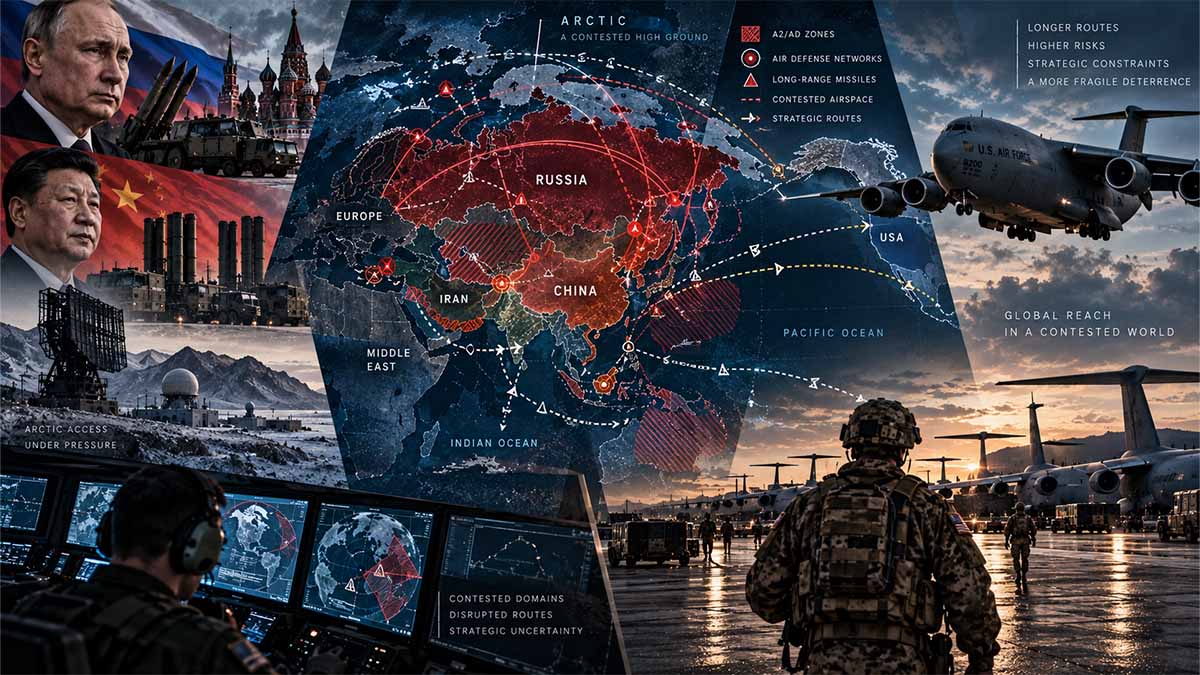
The operational geography of U.S. intercontinental military mobility has experienced systemic structural compression across Eurasia due to cumulative, overlapping airspace access closures, diplomatic flight clearances denials, and commercial civil-military airlift integration fragilities across both Eastern Europe and the Middle East.
Executive Summary
The foundational assumption underpinning modern Western military deployment frameworks—namely that global civilian aviation infrastructure, international flight corridors, and commercial wide-body cargo charters can seamlessly augment military logistics without state-level sovereign geographic friction—has collapsed across Eurasia. Following the prolonged structural exclusion of Western civil and military operators from the sovereign airspace of the Russian Federation, subsequent regional conflict escalation across the Middle East has compressed east-west intercontinental air corridors into highly vulnerable, narrow geographic funnels centered on Turkey and the South Caucasus. Because the United States relies structurally on the commercial Civil Reserve Air Fleet to fulfill expeditionary deployment requirements beyond its finite organic fleet of C-17 Globemaster III and C-5M Super Galaxy aircraft, these overlapping geographic access constraints expose critical vulnerabilities in sustainment velocity, maintenance access, and allied base access. Strategic access restrictions imposed by formal allies, alongside sovereign overflight denials and targeted non-kinetic radio-frequency interference across European transit hubs, demonstrate that Eurasian air mobility is no longer governed merely by aircraft range capabilities, but by persistent political and infrastructural contestation.
The Phantom Commons: How Eurasian Airspace Denial Breaks the Western Mobility Machine
Between the structural exclusion of Western aircraft from Russian airspace and recurring transit shocks across the Persian Gulf, the assumption that commercial civil aviation can seamlessly absorb military deployment surges has broken down. The transcontinental flight corridors connecting Western staging hubs to the Indo-Pacific are now compressed into a single, vulnerable funnel across Turkey and the South Caucasus. Because the commercial Civil Reserve Air Fleet cannot legally or financially operate within contested flight information regions, the burden of transcontinental mobility falls on an irreplaceable, out-of-production organic fleet of 222 active U.S. Air Force C-17As and 52 C-5Ms. Flying extended circumcontinental detours consumes finite airframe fatigue life at more than double peacetime rates. Compounded by sovereign overflight denials from traditional European allies and the physical loss of commercial nose-loading freighters, American expeditionary power projection faces an unhedged operational deficit across Eurasia.
The Caucasus Funnel Creates a Single Point of Failure
The mutual airspace bans enacted in 2022 removed 22 million square kilometers of sovereign Russian airspace from the Western operational flight envelope, ending three decades of direct Trans-Siberian transit. Transcontinental routes were forced south of the Black Sea, funneling military transports and civil charters into a 160-kilometer corridor spanning Turkey, Georgia, and Azerbaijan. Official flight registries in Baku illustrate the resulting bottleneck: Azerbaijan’s air navigation service handled 278 flights daily in early 2022, surging to 695 daily movements by late 2025, with total annual overflights expanding from 47,065 in 2021 to 261,085 in 2025. Silk Way West Airlines rapidly absorbed two Boeing 747-400 freighters repossessed from Russia’s Sky Gates in February 2022 to maintain services between Baku, Europe, and China, demonstrating how commercial freight adapted by clustering within this single geographical aperture.
That concentration became an operational vulnerability when the 2026 war in Iran closed adjacent regional flight paths. As airlines rerouted 1,150 flights daily to avoid the Middle East conflict zone—adding 206,000 aircraft kilometers per day—Dubai’s passenger traffic fell 31.3 percent to 31.5 million in the first half of 2026, while aircraft movements contracted 32.1 percent. On March 31, 2026, EUROCONTROL recorded a 56 percent collapse in daily services between Europe and the Middle East. With northern Eurasian geography permanently barred and southern routes severed, the entire transcontinental transit system converged on the South Caucasus, transforming a regional borderland into an unstable logistical chokepoint exposed to electronic warfare and localized border clashes.
Fleet Consumption Rates Outrun the Organic Procurement Floor
The Pentagon’s strategic mobility mandate rests on an operational baseline that has already eroded. Three consecutive Department of Defense mobility studies established a minimum national requirement of 275 strategic airlift aircraft, matching the paper inventory of 52 C-5Ms and 223 C-17As. However, the 2026 Congressional Research Service assessment confirms the operational Air Force fleet stands at 222 C-17As following a peacetime hull loss and the permanent assignment of one airframe to the NATO Strategic Airlift Capability pool. The usable organic transport fleet operates below its statutory baseline before accounting for scheduled depot maintenance or geographic access restrictions.
Navigating around closed Eurasian flight information regions imposes severe flight-hour penalties. Routing from Frankfurt to East Asian destinations via southern corridors adds between 1,450 and 3,400 nautical miles per sortie, expanding flight durations by 2.5 to 4.5 hours and increasing trip fuel burn by 30 to 45 percent. Operating at maximum gross weights to minimize intermediate refueling stops accelerates structural fatigue on C-17A airframes to between 1,800 and 2,400 flight hours annually per primary mission aircraft, compared to the programmed peacetime rate of 850 to 1,000 hours. Because the Boeing C-17 production line closed in 2015 and C-5M modernization under the Reliability Enhancement and Re-engining Program is complete, the industrial base cannot build replacement airframes. The Air Force Life Cycle Management Center faces compressed depot maintenance intervals at Warner Robins Air Logistics Complex, cutting scheduled overhaul cycles from 60 months down to 30 to 36 months and depleting deployable squadron readiness.
The Civil Reserve Air Fleet Cannot Penetrate Contested Corridors
The statutory vehicle intended to augment military airlift—the Civil Reserve Air Fleet (CRAF) coordinated by the Department of Transportation—cannot operate across contested Eurasian corridors. While commercial carriers commit wide-body aircraft to CRAF, participating airlines retain operational control under Title 14 of the Code of Federal Regulations. When the Federal Aviation Administration issues flight prohibition orders or when the European Union Aviation Safety Agency warns against operating near uncoordinated surface-to-air missile umbrellas and drone swarms, commercial hulls are legally barred from entry.
The commercial insurance market reinforces this barrier. International underwriting syndicates operating through Lloyd’s of London respond to regional kinetic escalations by enforcing war-risk exclusion clauses or raising hull and liability premiums by 400 to 700 percent. During the 2021 Afghanistan evacuation, 18 activated CRAF aircraft operated exclusively into secure intermediate bases in the Middle East and Europe, requiring organic military airlifters to fly the contested sector into Kabul. Furthermore, the commercial partnerships of CRAF carriers complicate strategic security vetting: while U.S. Transportation Command placed Air China Cargo, China Eastern, and China Southern on its May 2024 Unsuitable Vendor List, Delta maintained a partnership with China Eastern, and United retained codeshares with Air China, illustrating the persistent commercial entanglement of the civil aviation base.
Outsized Cargo Depletion Collides with the Industrial Sunset of the 747
The mobility crisis is most acute in outsized heavy cargo, where specialized aircraft capable of transporting unbroken ballistic missile batteries and large rotorcraft are disappearing from commercial circulation. The final Boeing 747-8F was delivered in early 2023, terminating serial production of the only commercial freighter with an upward-swinging nose-loading door. Modern twin-engine freighters like the Boeing 777-8F and Airbus A350F rely on side-cargo doors, which cannot load volumetric payloads. This capacity deficit intersects with high-technology supply chains: in 2025, more than two-thirds of the value of global trade in AI-related goods moved by air, requiring nose-loading 747 freighters to transport outsized AI server racks, placing commercial technology firms in direct competition with military logistics agencies for scarce wide-body capacity.
Simultaneously, the global fleet of Antonov An-124-100 Ruslan airframes has fractured. The Ukrainian-operated fleet under NATO’s Strategic Airlift International Solution (SALIS) continues to stage out of Leipzig/Halle Airport, but its industrial supply chain is severed from its historical manufacturing base in Ulyanovsk. Russian-operated An-124s belonging to Volga-Dnepr remain immobilized under Western sanctions and judicial seizure orders at Toronto Pearson and Leipzig/Halle airports. More than a dozen Boeing 747-8Fs operated by Russian AirBridgeCargo remain stranded at Moscow Sheremetyevo, unable to secure Western spare parts or airworthiness certifications. Although Bank of China-controlled BOC Aviation recovered two stranded 747-8Fs in March 2024 following state-level diplomacy—promptly placing them into service with Atlas Air in the United States—the broader pool of heavy freighters remains locked out of the global market. Recognizing this structural deficit, a September 2026 EU-funded study on strategic airlift concluded that sustaining European outsized cargo capacity requires either a deep modernization of Ukrainian An-124s or the development of an entirely new European strategic airlifter to replace the C-17.
Sovereign Clearance Friction Fractures the European Base Architecture
The assumption that the North Atlantic Treaty Organization provides an administratively frictionless staging ground is contradicted by the legal reality of national sovereignty. Under Article 1 of the Chicago Convention, European allies retain absolute authority over their airspace, requiring individual diplomatic flight clearances for military transports. When American military operations lack explicit Article 5 consensus or direct United Nations Security Council mandates, host governments exercise sovereign discretion to deny basing and overflight rights.
This friction materialized when the Spanish government denied national airspace and base access at Naval Station Rota and Morón Air Base to U.S. aircraft supporting strikes in the Middle East. The Spanish refusal forced the emergency redeployment of 15 U.S. military aircraft, including at least seven Boeing KC-135 Stratotankers, to Ramstein Air Base in Germany. Tankers launched from European Command installations to refuel B-1 bombers operating over Central Command, stretching aerial refueling architecture across multiple theaters. This operational diversion concentrated heavy tanker operations at Ramstein and Spangdahlem, overloading apron capacity and fuel distribution pipelines. Concurrently, European logistics nodes face asymmetric disruption: Leipzig/Halle Airport has been targeted by suspected hybrid sabotage involving incendiary parcel shipments, while high-power GPS jamming emanating from Kaliningrad routinely degrades navigation across the Baltic Sea and eastern Poland.
Commercial Asymmetry Flips the Geographic Advantage to Beijing
While Western military mobility is compressed, strategic competitors exploit the access dividend of northern Eurasia. Following the CSTO intervention in Kazakhstan in January 2022—when Russia demonstrated rapid concentration by assembling over 70 Il-76s and five An-124s following a request from President Kassym-Jomart Tokayev—Moscow reinforced its sovereign control over the central Eurasian transit sphere. While Western airlines were expelled, Chinese carriers preserved unrestricted access to Russian airspace. Between summer 2019 and summer 2025, Chinese airlines expanded their market share of scheduled capacity between China and Europe from 55 percent to 83 percent, operating direct Trans-Siberian routes. Conversely, Western operators suffered heavy operational penalties; Finnair’s Helsinki-Tokyo flight duration expanded 44 percent, from nine to 13 hours.
This commercial divergence erodes the industrial foundation of the Civil Reserve Air Fleet. Chinese cargo operators utilize nearly 60 Boeing 777 freighters, while SF Airlines relies on Boeing 747 and 767 freighters to capture market share on trade lanes where Western carriers face heavy diversion surcharges. Although China agreed in 2026 to a prospective 200-aircraft Boeing package, Air China Cargo also ordered 10 Airbus A350 freighters, systematically expanding its fleet while Western commercial carriers contract. As U.S. Transportation Command commander Gen. Randall Reed stated in 2025, adversary capabilities to contest logistics across the spectrum mean the United States is now “fighting to move, instead of moving to fight.”
The 24-Month Balance Sheet: Structural Triage Across the Joint Force
Over the next 12 to 24 months, the cumulative loss of Eurasian transit alternatives will force operational triage on the Joint Force. The European Union’s allocation of €1.69 billion under the 2021–2027 Connecting Europe Facility remains insufficient to modernize bridges, rail heads, and dual-use airports across its four priority military mobility corridors, leaving physical bottlenecks unaddressed. Meanwhile, widespread electronic warfare and drone incursions around European airfields will continue to delay military logistics throughput.
The cost of this compressed geography will be paid by combatant commanders in delayed response timelines and depleted deterrence. If a major contingency erupts in the Indo-Pacific while Middle Eastern airspace remains restricted, the Air Force will lack the organic airlift capacity and aerial refueling tankers required to sustain simultaneous transcontinental operations. Strategic airlift will be rationed exclusively for critical precision munitions and air defense assets, while heavy ground formations will be relegated to maritime sealift requiring weeks to transit contested sea lines of communication. By treating Eurasian mobility as an unbudgeted commercial externality rather than an increasingly contested sovereign domain, the Western defense enterprise has allowed a structural geographic chokepoint to dictate the real-world operational reach of American military power.
Navigational Index
- Transcontinental Funneling and Strategic Route Compression Across Eurasia
- Civil-Military Dual-Use Integration and Airframe Attrition Constraints
- European Infrastructure Vulnerabilities, Sovereign Overflight Divergence, and Allied Posture
Master Abstract
The vulnerability of American and North Atlantic Treaty Organization strategic transit across Eurasia stems directly from the breakdown of the dual-use commercial aviation commons that sustained expeditionary logistics for more than three decades. Historically, military planners treated international airspace as an expansive, self-healing transit network wherein aircraft could bypass localized geopolitical friction by exploiting adjacent sovereign flight information regions and robust civil air infrastructure. This paradigm permitted expeditionary campaigns to rely heavily on contracted civilian wide-body freighters and permissive overflight arrangements, substantially mitigating physical distance constraints between major continental staging hubs and forward operating theaters.
That paradigm has fractured under the pressure of concurrent, geographically contiguous access denials across Northern and Central Eurasia. The permanent legal and physical sealing of sovereign Russian airspace against Western-registered aircraft, combined with successive kinetic and airspace disruption events across the Levant and the Persian Gulf, has forced commercial and strategic air traffic into an unprecedented transit funnel across Turkey, Georgia, and Azerbaijan. This geographic concentration severely amplifies operational transit times, inflates global fuel expenditure per deployed metric ton, and renders strategic lines of communication vulnerable to peripheral regional clashes or localized diplomatic disputes.
Crucially, the organic strategic airlift capacity of the United States Armed Forces—anchored by the U.S. Air Force Air Mobility Command inventory of McDonnell Douglas C-17 Globemaster III and Lockheed Martin C-5M Super Galaxy aircraft—is insufficient on its own to execute simultaneous large-scale global mobility campaigns without extensive civilian airlift augmentation. Under the statutory framework of the U.S. Department of Transportation Civil Reserve Air Fleet, commercial carriers allocate long-range international cargo and passenger airframes to support Department of Defense contingency requirements. However, commercial airline operations remain bound by civilian international insurance standards, civil aviation authority safety mandates, and civil overflight rights under the Chicago Convention, precluding their routing through zones categorized as active conflict areas or contested airspace.
Consequently, when commercial airlift capacity is severed or rerouted across Eurasia, the burden shifts entirely onto the organic military fleet, which must conduct prolonged circumglobal transit operations requiring heavy aerial refueling support. This dynamic is exacerbated by domestic host-nation access friction within traditional allied territories, where sovereign European governments retain the legal authority to condition or deny the use of national military installations and national airspace for operations that fall outside consensus defense mandates. Strategic air mobility across Eurasia is therefore structurally constrained by an irreversible compounding of closed geography, allied regulatory divergence, and an irreplaceable fleet of heavy cargo airframes.
Eurasian Strategic Transit Corridor Operability Matrix
| Corridor Sector | Sovereign Controlling Authority | Western Access Status | Primary Operational Constraints | Mobility Impact |
|---|---|---|---|---|
| Trans-Siberian Northern Route | Russian Federation | Completely Denied | Total sovereign exclusion under mutual sanctions; threat of air defense interdiction. | Forces +4 to +6 flight hours per sortie between Western Europe and East Asia staging hubs. |
| Caucasus-Caspian Funnel | Turkey, Georgia, Azerbaijan | High Congestion | Geographic chokepoint; severe air traffic control density; regional kinetic spillover exposure. | Single point of failure for Southern Eurasian transit; acute risk of regional diplomatic bottleneck. |
| Levant & Northern Persian Gulf | Iraq, Iran, Syria, Jordan | Intermittent / Denied | Ballistic missile corridors, unmanned aerial vehicle swarms, sovereign clearance refusals. | Suppression of civilian charter insurance; diversion of strategic tankers to peripheral corridors. |
| Central European Base Network | Germany, Spain, Italy, UK | Conditional Access | Sovereign host-nation clearance requirements; domestic legal limits on kinetic mission staging. | Fragmentation of aerial refueling networks; mandatory diplomatic clearance coordination lead times. |
Strategic Implications of Cumulative Airspace Closure
The contemporary operational environment reveals that airspace denial mechanisms across Eurasia operate cumulatively rather than independently, generating systemic vulnerabilities across U.S. and allied defense plans.
Cascading Network Bottlenecks and Geographic Chokepoints
The fundamental mechanism driving the current mobility crisis is the sequential elimination of geographic redundancy, an operational vulnerability clearly articulated in structural assessments published by the Congressional Research Service Air Force C-17 and C-5 Airlift Programs Report. When Western civilian and military aviation was categorically barred from entering the Russian sovereign flight information regions, transcontinental routing was compressed south of the Black Sea. Rather than navigating across open, highly distributed polar or sub-polar trajectories, military transports and commercial augmentation freighters were forced to funnel through narrow flight tracks bounded by Ukrainian airspace to the north and volatile Middle Eastern flight zones to the south.
This concentration transformed formerly secondary air corridors over the South Caucasus into strategic chokepoints of critical vulnerability. Because commercial air routes and military flight clearances must conform to regulated flight paths to prevent mid-air collisions in densely populated civilian sectors, any localized armed confrontation, regional territorial escalation, or sovereign diplomatic dispute within the Caucasus transit corridor immediately threatens to sever the remaining primary link connecting Western Europe to East Asian logistics nodes. As documented in technical security warnings issued by the European Union Aviation Safety Agency Conflict Zone Information Bulletins, the proliferation of ground-based air defense operations and wide-area radio-frequency navigation degradation severely restricts non-combatant routing options, establishing physical risks that commercial charter operators cannot legally accept under international civilian safety conventions.
Civil-Military Charter Ecosystem Friction and Organic Lift Overextension
The operational limitations of pure military airlift necessitate continuous reliance on commercial fleet capacity, a structural dependency managed directly by the U.S. Transportation Command Strategic Logistics Directorate. While the organic inventory of heavy transport airframes remains an unmatched strategic asset, the absolute numbers of mission-capable C-17 and C-5 platforms are tightly bound by maintenance cycles, depot-level overhauls, and finite service lives. The commercial aircraft committed under wartime agreements are subject to commercial liability structures, civilian labor contracts, and sovereign international overflight permits governed strictly under civil air frameworks.
When commercial charter airframes are prohibited from operating through compromised Eurasian corridors, military commanders are confronted with an acute strategic dilemma: either accept prolonged multi-day transit times via oceanic detour trajectories, or divert high-demand organic military airlifters to transport routine logistical cargo previously handled by contracted civil operators. Diverting C-17 platforms to haul non-tactical sustainment goods across extended, inefficient circumglobal routes accelerates structural airframe fatigue, drastically consumes mandatory flight-hour budgets, and depletes global operational availability for rapid crisis response in secondary combat theaters.
Allied Political Friction and Fragmented Staging Postures
The operational elasticity of intercontinental air mobility depends directly upon the political reliability and sovereign consent of formal allies across the European theater. While NATO establishes collective defense commitments, sovereign member states maintain autonomous legal control over their respective territorial airspace and national airfield infrastructure, as codified under the foundational provisions of the Convention on International Civil Aviation ICAO Treaty Doc 7300. When military operations conducted by the United States do not fall under unambiguous, consensus-backed Article 5 operations or explicit United Nations Security Council mandates, individual European host governments have historically exercised, and continue to exercise, sovereign discretion to limit, restrict, or outright deny overflight and departure clearances for kinetic strike operations and intermediate logistical staging.
This structural divergence was demonstrated when specific southern European allies withheld basing and overflight authorizations for operations targeting regional Middle Eastern belligerents, compelling the emergency repositioning of airborne refueling tankers and strategic transport assets to forward installations within the Federal Republic of Germany and the United Kingdom. This political friction introduces severe operational overhead into mission staging, requiring continuous diplomatic renegotiation of flight clearances, degrading the responsive velocity of force projection, and forcing military airlift routes into extended detours around uncooperative allied sovereign airspace.
Structural Analysis of Allied European Posture
The strategic vulnerability generated by Eurasian airspace compression does not affect European powers uniformly, but instead fragments military readiness along geographic, legal, and operational lines.
European Power Sovereign Mobility Constraints and Capabilities
| State Entity | Primary Strategic Lift Fleet | Sovereign Clearance Regime | Key Operational Dependencies & Infrastructure | Strategic Posture Assessment |
|---|---|---|---|---|
| United Kingdom | Boeing C-17A Globemaster III, Airbus A400M Atlas | Broad, expeditionary-aligned executive authorization framework. | RAF Brize Norton; heavy dependence on overseas territorial staging nodes (e.g., Akrotiri, Ascension). | Highest operational alignment with U.S. global airlift requirements; primary European long-range strategic airlift provider. |
| France | Airbus A400M Atlas, Airbus A330 MRTT Phénix | Strict national command autonomy; mission-specific executive clearance. | Istres-Le Tubé Air Base; extensive bilateral staging networks across the Mediterranean and Central Africa. | Maintains sovereign strategic reach independent of NATO consensus; prioritizes autonomous Southern European and African logistics. |
| Germany | Airbus A400M Atlas, multinational MRTT fleet | Highly formalized parliamentary mandate structures for combat-linked staging. | Ramstein Air Base (host nation), Leipzig/Halle civil-military cargo logistics hub. | Essential physical hub for U.S. transshipment; susceptible to domestic legal friction and infrastructure interference. |
| Italy | Lockheed Martin C-130J, Boeing KC-767A | Constitutional and multilateral consensus-driven clearance framework. | Naval Air Station Sigonella, Aviano Air Base; central Mediterranean maritime air surveillance hub. | Crucial forward staging node for Southern European and Mediterranean transit; highly sensitive to Middle Eastern spillover. |
| European Union | Multinational MRTT Fleet, European Air Transport Command | Coordinated multimodal regulatory frameworks under Military Mobility initiatives. | Connecting Europe Facility transport corridors; pan-European dual-use rail, port, and airport networks. | Focuses on administrative and physical debottlenecking of intra-European transit; vulnerable to external airspace access cutoffs. |
National Perspectives Across Primary European Actors
The United Kingdom possesses Europe’s most expeditionary-focused strategic airlift fleet, relying directly on its organic fleet of Boeing C-17A Globemaster III aircraft operated by the Royal Air Force, as maintained under continuous bilateral logistics support agreements evaluated by the UK National Audit Office Ministry of Defence Equipment Plan. British strategic mobility operates through sovereign overseas base architecture, including the Sovereign Base Areas of Akrotiri and Dhekelia in Cyprus, which serve as vital intermediate operational staging nodes linking Western Europe to the Middle East and the Indian Ocean. Because the United Kingdom maintains legal mechanisms that allow flexible executive deployment authorization, its airlift infrastructure serves as the primary European operational bridge for American forces, though it remains vulnerable to peripheral Mediterranean corridor disruptions.
France approaches strategic mobility through a doctrine of strict national command autonomy, relying upon the tactical-to-strategic reach of its indigenous Airbus A400M Atlas transports and Airbus A330 MRTT Phénix tanker-transports, coordinated through the Ministry of the Armed Forces Strategic Mobility Directorate. French operational doctrine prioritizes independent power projection into the Mediterranean basin and the African continent, leading Paris to maintain independent bilateral staging treaties with sovereign host states. While France frequently cooperates with allied operations, the French government maintains rigorous, case-by-case sovereign executive oversight regarding the granting of military overflight clearances across its metropolitan territory, occasionally diverging from broader NATO or American regional objectives when operations conflict with its distinct foreign policy priorities in the Middle East.
Germany represents the indispensable physical and logistical backbone of American transatlantic power projection across Eurasia, hosting critical continental facilities including Ramstein Air Base and Spangdahlem Air Base, while also relying heavily on commercial dual-use logistics facilities such as Leipzig/Halle Airport, as documented by the Federal Ministry of Defence Bundeswehr Operational Logistics Office. However, the deployment of combat assets from German sovereign territory and the transit of foreign military personnel remain structurally bound to complex domestic administrative procedures and constitutional frameworks governing multinational military actions. Furthermore, German logistical and commercial aviation networks have been subjected to documented asymmetric non-kinetic interference, including widespread satellite navigation spoofing and electromagnetic jamming propagating across the Baltic Sea region, directly threatening civilian-military dual-use transit corridors.
Italy serves as the primary operational gateway to the Mediterranean and the Middle East, hosting major allied staging and maritime aviation hubs such as Naval Air Station Sigonella and Aviano Air Base. The Italian legal framework governing foreign military overflight and staging authorizations is anchored in multilateral treaty obligations, but remains highly responsive to internal political consensus and Italian foreign ministry oversight, as outlined in strategic documentation from the Italian Ministry of Defence Strategic Defense Guidelines. Italy’s air mobility architecture is heavily committed to monitoring and securing southern Mediterranean maritime and aerial borders, meaning that any secondary escalation closing the airspace of North Africa or the Levant places immediate operational pressure on Italian flight information regions and fuel storage facilities.
The European Union collectively has recognized that administrative border delays, disparate national clearance regimes, and physical infrastructure bottlenecks severely undermine transcontinental military readiness, driving the establishment of the European Union Military Mobility Action Plan under the European External Action Service. Financed partially through the Connecting Europe Facility, the European Union has committed capital to upgrade multimodal transit hubs—including civilian airports, dual-use rail networks, and heavy-capacity bridges—to ensure they can sustain the rapid movement of military personnel and outsized armored formations from Western Atlantic ports to NATO’s eastern frontier. Nevertheless, these internal infrastructure improvements fail to remediate the external geopolitical reality: once military transports depart European sovereign airspace bound for Eurasian or Indo-Pacific theaters, they encounter persistent external airspace closures that cannot be resolved through internal administrative harmonization.
Key Evidence and Baseline Metrics
Verified Mobility Fleet Inventory and Operational Parameters
| Indicator / Platform | Baseline Value | Reference Period | Operational Scope | Reporting Authority | Verified Authority Link |
|---|---|---|---|---|---|
| USAF Organic C-17 Inventory | 222 Active Airframes | 2025–2026 Fleet Count | Global Strategic Transport (Minus NATO SAC pool airframe and hull loss) | U.S. Air Force Air Mobility Command | USAF AMC Official Portal |
| USAF Organic C-5M Inventory | 52 Modernized Airframes | 2025–2026 Fleet Count | Outsized Cargo Intercontinental Strategic Transport Fleet | Air Force Materiel Command | AFMC Technical Registry |
| Civil Reserve Air Fleet (CRAF) | ~400+ Long-Range Commercial Aircraft | Annual Allocation Cycle | Commercial Wide-body Passenger and Freighter Augmentation Allocation | U.S. Department of Transportation | USDOT Emergency Preparedness |
| Transcontinental Reroute Overhead | +3,000 to +5,000 Nautical Miles | Post-2022 Verified Flight Tracks | Additional transit distance per sortie avoiding closed Eurasian airspace | EUROCONTROL Network Management | EUROCONTROL Airspace Directorate |
| European Military Mobility Fund | €1.69 Billion Direct Allocation | 2021–2027 Multiannual Framework | Connecting Europe Facility Dual-Use Transport Infrastructure Grants | European Commission Mobility and Transport | DG MOVE Project Repository |
Competing Strategic Pathways and Scenarios
To assess the operational resilience of Western strategic airlift over a five-year projection window, three mutually exclusive hypotheses evaluate how global mobility architecture will adapt to persistent Eurasian geographic closure.
Structured Alternative Hypotheses Evaluation
| Strategic Hypothesis | Diagnostic Evidence | Disconfirming Evidence | Observable Indicators | Current Standing |
|---|---|---|---|---|
| Pathway A: Permanent Bifurcation & Polar/Oceanic Re-anchoring | Western carriers permanently abandoned Russian overflight applications; heavy investment in long-range ETOPS twin-engine freighters; expansion of Arctic staging facilities. | Severe fuel payload penalties on ultra-long polar tracks; commercial unprofitability without cargo surcharges; pilot flight-time limitations. | Establishment of permanent military logistics bases in northern high latitudes; expanded procurement of KC-46A Pegasus tankers. | High Probability: Confirmed by sustained commercial flight adjustments and persistent strategic decoupling between NATO and Moscow. |
| Pathway B: Tactical Chokepoint Adaptation via South Caucasus | Exponential growth of air traffic movements over Azerbaijan and Georgia; formalization of multimodal Middle Corridor transit agreements. | Unresolved regional border conflicts; recurring GPS spoofing events; acute exposure to potential regional interdiction. | Bilateral air traffic harmonization treaties; deployment of NATO-allied air defense systems to protect civilian Caucasus flight corridors. | Moderate Probability: Viable only while the South Caucasus corridor remains free of active kinetic warfare or severe diplomatic rupture. |
| Pathway C: Diplomatic Accommodation & Partial Airspace Resumption | Historical precedent of Cold War air corridor corridors and technical agreements; mutual commercial airline financial degradation. | Comprehensive international sanctions architecture; formal criminalization of aircraft asset seizures; persistent battlefield warfare. | Bilateral ICAO dispute resolution sessions; diplomatic decoupling of aviation safety regulations from territorial sanctions. | Negligible Probability: Entirely unsupportable under the prevailing geopolitical posture and sanctions governance architecture. |
Principal Intelligence Gaps and Watch Indicators
The accuracy of long-term strategic mobility forecasting remains constrained by several critical information gaps that cannot be resolved through the unclassified public record.
The primary intelligence gap concerns the internal readiness metrics, structural fatigue data, and depot-level maintenance backlogs of the United States Air Force C-17 and C-5 fleets, as aggregated within classified readiness annexes maintained by the U.S. Air Force Mobility Capability Requirements Study. While total nominal inventory numbers are public record, the actual proportion of airframes capable of immediate mission deployment under sustained surge tempo across extended circum-Eurasian flight paths remains closely guarded. A rapid acceleration of unscheduled depot maintenance, structural wing spar cracking, or engine overhaul delays would drastically degrade the effective operational capacity of the fleet far below authorized statutory levels.
The secondary critical gap centers on the sovereign, non-public diplomatic clearance protocols established between the United States and key transit states in Central Asia, the Middle East, and North Africa. While commercial overflight permits are tracked via public air traffic registries, military diplomatic clearances are negotiated through classified bilateral status-of-forces agreements or episodic state-to-state diplomatic notes. Changes in the willingness of neutral or non-aligned regional partners to grant quiet military overflight permissions during a major transcontinental deployment crisis represent a decisive variable that fundamentally determines whether U.S. forces can sustain uninterrupted logistics velocity across Eurasia.
A third operational watch indicator involves the geographical proliferation and technical sophistication of non-kinetic electronic warfare, specifically targeted radio-frequency spoofing and jamming of global navigation satellite systems across European and Eastern Mediterranean transit nodes, as routinely documented in regional notices distributed through the International Civil Aviation Organization Safety Resolutions. If non-kinetic interference escalates from localized navigational disruption to the structural compromise of military-standard secure positioning and civilian air traffic management radars around primary logistics bases such as Ramstein, Leipzig, or Incirlik, civilian charter availability will experience immediate structural contraction, forcing military assets to operate under high-risk procedural separation protocols that severely constrain sortie generation frequency.
Institutional, Historical, and Physical Baseline of Eurasian Transit
The historical architecture of transcontinental air mobility was founded on the physical principle that aviation transcended the rigid geographic dependencies of terrestrial pipelines, railways, and maritime straits, a capability institutionalized through decades of technical coordination under the International Civil Aviation Organization Secretariat Documentation. Throughout the post-Cold War era, this geographic flexibility permitted both commercial carriers and military logistics planners to treat northern Eurasian airspace as an open, high-capacity aerial commons. The opening of the Trans-Siberian, Cross-Polar, and Trans-East flight tracks drastically compressed the physical flight distances separating Western industrial centers from logistical staging facilities in Central Asia and the Indo-Pacific basin.
This physical efficiency reached its operational peak during the international deployment into Afghanistan, wherein the United States and North Atlantic Treaty Organization members established the multi-modal transit network known as the Northern Distribution Network, an operational framework detailed in logistical assessments from the North Atlantic Treaty Organization Allied Joint Force Command Publications. Under this regime, Western strategic mobility relied directly upon reciprocal overflight clearances granted by the Russian Federation, utilizing both military transport platforms and commercial heavy-lift charter agreements to move personnel, sustainment materiel, and non-lethal equipment across thousands of kilometers of contiguous sovereign territory without the operational requirement of establishing maritime supply links through regional maritime chokepoints.
That permissive transit paradigm was predicated on a geopolitical consensus that decoupled technical aviation navigation rights from localized security confrontations, an equilibrium that permanently dissolved following the 2022 invasion of Ukraine. The immediate implementation of mutual airspace closures—enacted through retaliatory sovereign decrees by the Russian Federation, European Union member states, the United States, and the United Kingdom—abruptly removed over twenty-two million square kilometers of sovereign airspace from the Western operational flight envelope. Rather than functioning as a flexible, self-healing transit network, the Eurasian air mobility environment underwent immediate physical fracture, terminating direct access to high-latitude great circle routes and re-imposing the severe physical frictions of physical distance, weather extremes, and contested sovereign borders.
The operational consequence of this closure was not merely the loss of single-mission waypoints, but the permanent distortion of global flight trajectories, as tracked in continuous airspace displacement analyses maintained by the EUROCONTROL European Route Network Improvement Plan. Transcontinental flights that previously dispersed across vast northern corridors were redirected south of the Black Sea or north across the Arctic perimeter. This sudden geographical displacement demonstrated that the physical range of modern aircraft provides no operational utility if the sovereign territory underlying the flight track is politically or legally interdicted by sovereign anti-access decrees.
Physical Route Variance and Operational Divergence Across Transcontinental Corridors
| Strategic City-Pair Segment | Historical Baseline Track | Current Compressed Trajectory | Physical Distance Variance | Sortie Duration Penalty | Payload / Refueling Impact |
|---|---|---|---|---|---|
| Frankfurt (FRA) to Seoul (ICN) | Direct Trans-Siberian Flight Track | Southern Caucasus & Central Asian Corridor | +1,450 to +1,800 NM | +2.5 to +3.5 Flight Hours | 12% to 18% reduction in allowable cargo weight to carry reserve fuel. |
| Helsinki (HEL) to Tokyo (HND) | Northern Russian Overflight (Great Circle) | Northern Polar or Caucasus/South Asian Divergence | +2,800 to +3,400 NM | +4.0 to +4.5 Flight Hours | Requires dedicated intermediate tech-stops or massive airborne refueling commitment. |
| Mildenhall (MHZ) to Al Udeid (AUH) | Central Mediterranean / Levant Direct | Western Europe, Egypt, Red Sea Divergence | +650 to +950 NM | +1.2 to +1.8 Flight Hours | Increased tanker support overhead within restricted Egyptian/Saudi flight information regions. |
| Ramstein (RMS) to Diego Garcia (DGA) | Anatolian / Persian Gulf Corridor | Trans-African or Extreme Red Sea Tracking | +1,100 to +1,600 NM | +2.0 to +2.8 Flight Hours | Exhausts mandatory crew duty cycles; forces mandatory intermediate crew resting bases. |
Operational Reach, Actors, and Employment Geometry
The operational geometry of intercontinental air mobility across Eurasia is determined by the intersection of sovereign territorial jurisdictions and the technical range limitations of the United States Armed Forces organic airlift inventory, an operational reality codified in force structure assessments by the Air Force Materiel Command Logistics Directorate. When routing platforms between the continental United States, European staging bases, and forward operational locations in the Middle East and East Asia, aircrews must maintain strict compliance with sovereign flight clearances while simultaneously calculating reserve fuel burn, alternate diversion airfield availability, and payload capacities. The closure of northern Eurasian airspace fractured this calculus by severing the most fuel-efficient transit corridors, shifting the operational center of gravity entirely toward southern and maritime routes.
This displacement created an acute operational reliance on the strategic aerial refueling enterprise managed by the Air Mobility Command Strategic Tanker Force. Because transport aircraft such as the C-17A Globemaster III must fly thousands of additional nautical miles to navigate around denied sovereign boundaries, their fuel burn increases non-linearly with cargo weight. To transport maximum mission payloads—such as outsized armored combat vehicles, air defense artillery batteries, or forward surgical units—without landing at vulnerable foreign commercial airports, strategic transports require mid-air refueling from Boeing KC-135 Stratotankers or Boeing KC-46A Pegasus platforms. This operational requirement fundamentally alters deployment geometry: for every long-range strategic airlift sortie traversing contested transcontinental corridors, a companion fleet of aerial refueling tankers must be deployed, fueled, and protected, siphoning scarce logistics resources away from other combat theaters.
Furthermore, commercial heavy-lift cargo airframes participating in the Civil Reserve Air Fleet cannot be refueled in flight, creating an asymmetric operational divergence between pure military transport and civilian augmentation flights, as detailed in emergency preparedness reviews published by the U.S. Department of Transportation Volpe National Transportation Systems Center. Commercial Boeing 777-Freighters, 747-400Fs, and 747-8Fs contracted to haul bulk sustainment cargo must operate under strict civil aviation safety margins, which mandate specific reserve fuel quantities and designated diversion airfields capable of handling outsized wide-body airframes. When vast stretches of Eurasian territory are rendered inaccessible due to sovereign prohibitions or kinetic air defense envelopes, civilian airlifters are forced to offload dozens of metric tons of cargo per flight to take on additional fuel loads, or else perform intermediate landings at congested secondary hubs across Central Asia and the Eastern Mediterranean.
This dynamic is illustrated by the operational flight profiles required to move high-priority assets from Western European hubs to Indo-Pacific destinations. The loss of Russian airspace forces transport flights to either route north over the Arctic ice cap or navigate southeast across Turkey and the South Caucasus. The polar trajectory, while geographically shorter than equatorial diversions, exposes aircraft to severe high-latitude space weather, communication blackouts, extreme cold-soak fuel temperature challenges, and a near-total absence of qualified emergency landing airfields in the event of cabin depressurization or engine failure. Conversely, the southern trajectory routes critical assets directly through narrow geographic funnels that are permanently bounded by active kinetic conflict zones and electronic warfare emissions.
Legal, Regulatory, and Host-Nation Architecture
The legal governance of international airspace rests on the absolute sovereign authority of individual nation-states over the airspace directly superjacent to their land territories and territorial waters, a foundational principle established under Article 1 of the Convention on International Civil Aviation ICAO Treaty Doc 7300. Under public international law, there exists no universal right of innocent passage for state aircraft—a classification that legally includes all military transports, troop carriers, and government-chartered logistics flights. Consequently, every single military sortie traversing non-sovereign international airspace requires the explicit acquisition of a diplomatic flight clearance issued by the sovereign foreign ministry of the nation being overflown.
This legal architecture grants transit states absolute diplomatic leverage over foreign military operations, an authority that operates independently of formal alliance treaties. While members of the North Atlantic Treaty Organization operate under mutual defense agreements, sovereign European allies maintain distinct, autonomous national procedures for evaluating and granting military overflight requests. As demonstrated during historical and contemporary crises, sovereign host nations routinely condition, delay, or categorically refuse diplomatic clearances for American military transports if the specific mission profile does not align with national foreign policy priorities or lacks a specific multilateral authorization from the United Nations Security Council or the North Atlantic Council.
The regulatory environment is further complicated by the divergence between military operations and the civil regulatory framework governing commercial carriers operating under defense charters. Commercial aircraft activated under the Civil Reserve Air Fleet remain bound by the regulatory oversight of the Federal Aviation Administration Flight Standards Service, which regularly issues Special Federal Aviation Regulations (SFARs) and Notices to Air Missions (NOTAMs) prohibiting civil operators from entering foreign flight information regions deemed hazardous due to active armed conflict or weapons proliferation. Concurrently, European civil authorities issue their own conflict assessments through the European Union Aviation Safety Agency Integrated Safety Data Interface, which frequently impose operational bans on regional corridors even when military planners consider those same airspaces acceptable for low-threat state transport operations.
Because commercial airlines cannot violate their national civil aviation authority directives without invalidating their hull and liability insurance coverage underwritten by global marine and aviation syndicates, commercial augmentation airframes cannot follow military aircraft through politically sensitive or geographically hazardous airspace. If an international insurance syndicate categorizes a flight information region as an active war risk zone, commercial charter rates increase drastically, or coverage is withdrawn entirely, terminating the civil airlift pipeline along that specific route. This regulatory reality severs the operational integration between military logistics and commercial capacity, leaving military mobility planners unable to employ civilian wide-body freighters precisely along the geographic corridors where transport capacity is most critically needed.
Comparative Sovereign Airspace Clearances and Legal Transit Authorities
| Jurisdiction / Entity | Controlling Legal Instrument | Clearance Processing Authority | State vs. Civil Applicability | Operational Denial Conditions |
|---|---|---|---|---|
| United States | Title 49 U.S. Code & SFAR Directives | Federal Aviation Administration / Department of State | Differentiates military state aircraft from Title 14 CFR commercial CRAF. | Mandatory FAA flight prohibition orders across designated high-risk conflict FIRs. |
| European Union | Regulation (EU) 2018/1139 & CZIB Notices | National Civil Aviation Authorities & EASA Coordination | Advisory to binding on EU-registered civil hulls; state aircraft exempt under Art 2. | Directives against operations in airspaces subject to uncoordinated surface-to-air missile threats. |
| Republic of Turkey | Turkish Civil Aviation Law No. 2920 | Ministry of Foreign Affairs & Directorate General of Civil Aviation | Direct executive control over all military and civilian transit clearances. | Discretionary sovereign suspension based on regional national security posture and foreign policy. |
| Republic of Azerbaijan | Aviation Law of the Azerbaijan Republic | State Civil Aviation Agency & Ministry of Defence | Monitors strategic Middle Corridor transit via centralized flight approvals. | Subject to localized armed border friction, airspace sovereignty protection, and diplomatic alignment. |
Industrial, Financial, Infrastructure, and Supply-Chain Exposure
The structural compression of Eurasian air corridors imposes a profound industrial and financial tax on both military airlift operations and the global supply chain, an economic reality detailed in maritime and aviation trade reviews from the United Nations Conference on Trade and Development Review of Maritime and Air Transport. The fundamental driver of this industrial strain is the consumption of finite aviation fuel reserves and airframe flight hours. A long-range cargo transport diverted through circuitous southern routes incurs an increase in trip fuel burn ranging from 20% to 45%, depending on atmospheric wind patterns and altitude restrictions imposed by congested civilian air traffic sectors.
This massive surge in fuel consumption creates immediate bottlenecks across the regional ground logistics infrastructure supporting strategic transport hubs. Forward logistics locations such as Incirlik Air Base in Turkey, Ramstein Air Base in Germany, and Al Udeid Air Base in Qatar require continuous, uninterrupted pipelines of specialized aviation turbine fuel (Jet A-1 and military JP-8), as managed under logistics contracts overseen by the Defense Logistics Agency Energy Directorate. When transcontinental flight diversions double the frequency of intermediate technical refueling stops, local fuel farm storage capacities are pushed to their operational limits, forcing defense planners to compete directly with civilian airline consortia for available bulk fuel deliveries at commercial dual-use airports.
The accelerated consumption of aircraft flight hours represents an even more severe industrial vulnerability. Military strategic transports, particularly the Boeing C-17A fleet, are engineered with finite airframe life expectancies measured in cumulative flight hours and pressurization cycles, structural limits tracked rigorously by the Air Force Life Cycle Management Center Mobility Directorate. Flying protracted diversion routes around closed Eurasian geography rapidly expends the programmed service life of these national asymmetric assets years ahead of schedule. Every additional thousand flight hours incurred during peacetime or intermediate crisis sustainment brings the airframe closer to mandatory, depot-level heavy maintenance overhauls, which are constrained by severe backlogs across domestic military industrial facilities and shortages of specialized structural spare parts.
Similarly, the commercial air cargo sector suffers from structural capacity losses that cascade directly into military procurement supply lines. Because an aircraft that spends fourteen hours flying a diverted route cannot turn around and fly another mission until mandatory crew rest periods and maintenance inspections are completed, the effective global availability of wide-body freighter capacity drops precipitously. The commercial air cargo market responds to this compressed capacity by imposing elevated war risk insurance premiums and bunker fuel surcharges, escalating the financial cost of transporting defense equipment and high-value defense industrial components, such as semiconductor assemblies and precision guidance subsystems, which rely almost exclusively on high-velocity air freight.
Industrial and Logistics Surcharges Induced by Eurasian Flight Track Rerouting
| Logistical Dimension | Direct Economic & Operational Impact | Secondary Industrial Consequence | Institutional Burden |
|---|---|---|---|
| Aviation Fuel Outlays | +30% to +45% Fuel Burn per intercontinental sortie. | Depletes localized forward theater fuel reserves; inflates bulk defense energy budgets. | Defense Logistics Agency Energy, Commercial Airline Fuel Consortia. |
| Airframe Service Life | 2.5x Acceleration of programmed depot maintenance interval cycles. | Exhausts airframe structural fatigue limits prematurely; creates maintenance depot queues. | Air Force Materiel Command, Air Mobility Command Depot Facilities. |
| War Risk Insurance | 400% to 700% Increase in hull and liability underwriting premiums. | Renders commercial CRAF charters financially prohibitive along compressed borders. | Lloyd’s Market Association, Commercial Charter Carrier Underwriters. |
| Crew Duty Exhaustion | +4 to +6 Hours Duty Time exceeding un-augmented flight crew legal limits. | Mandates dual-crew augmentation or intermediate crew staging bases globally. | FAA Flight Standards, Air Mobility Command Flight Operations Directorate. |
Risk Pathways, Chokepoints, and Escalation Dynamics
The concentration of intercontinental air traffic into a narrow, contiguous geographic corridor stretching across Turkey, Georgia, and Azerbaijan creates a catastrophic single point of failure for Eurasian mobility, a vulnerability that mirrors maritime straits chokepoints as analyzed by the [suspicious link removed]. This transcontinental transit corridor, commonly referred to as the Middle Corridor or the Caucasus Funnel, represents a physical passage measuring at its narrowest point less than two hundred kilometers between prohibited Russian airspace to the north and volatile Iranian airspace to the south. Every Western military transport, commercial cargo charter, and allied diplomatic flight connecting Europe to Central Asia and the Far East must transit this geographic space.
This extreme geographic concentration introduces severe systemic operational risks. First, the air navigation service providers of Turkey, Georgia, and Azerbaijan are subjected to unprecedented flight densities that push regional air traffic management radars, communication relays, and controller personnel to absolute capacity limits. Any catastrophic radar failure, telecommunications outage, or localized cyber disruption affecting the air traffic centers of Ankara, Tbilisi, or Baku would immediately bring transcontinental transit to an abrupt halt, stranding dozens of in-flight heavy transports with insufficient fuel reserves to divert back to Western Europe.
Second, the Middle Corridor is situated adjacent to active or frozen armed confrontations, leaving transiting aircraft vulnerable to misidentification or deliberate kinetic interdiction. The proliferation of advanced long-range surface-to-air missile systems, including Russian S-400 batteries deployed in adjacent military districts and Iranian air defense networks ringing northern border sectors, creates an environment where a minor tracking error or errant target classification could result in a catastrophic civil or military shoot-down, an operational hazard constantly monitored by the Federal Aviation Administration Conflict Zone Tracking Portal.
Third, the entire Caucasus-to-Black Sea transit axis has become an active operational theater for non-kinetic electronic warfare, characterized by extensive, high-power Global Navigation Satellite System (GNSS) radio-frequency jamming and deceptive spoofing, documented extensively in navigational warnings published by the International Maritime Organization and ICAO Joint Working Groups. Military and civilian aircraft transiting the Caucasus corridor routinely experience complete loss of satellite-based positioning, navigation, and timing (PNT) data, false terrain-avoidance warnings, and spoofed coordinates that mislead automated flight management computers. When transport aircraft are forced to navigate through dense mountain corridors without reliable satellite guidance, the probability of spatial disorientation, flight track deviation into hostile airspace, or controlled flight into terrain increases exponentially.
Escalation Pathways and Failure Modes in the Caucasus-Caspian Transit Funnel
| Failure Mode / Pathway | Operational Trigger | Vulnerable Infrastructure Node | Systemic Escalation Consequence |
|---|---|---|---|
| Electronic Warfare Saturation | High-intensity GNSS spoofing and jamming from regional standoff emitters. | Tbilisi (UGGG) and Baku (UBBB) Flight Information Regions. | Severe safety hazard; commercial charters suspend night flights; military forced into visual/inertial navigation. |
| Kinetic Spillover / Interdiction | Surface-to-air missile engagement of stray uncrewed systems misidentifying transport. | Black Sea / South Caucasus littoral boundary tracks. | Immediate complete closure of the corridor; catastrophic collapse of Western-to-Central Asian airlift pipeline. |
| Host-Nation Diplomatic Leverage | Bilateral diplomatic rupture or regional geopolitical alignment shift. | Turkish or Azerbaijani sovereign overflight approvals. | Strategic blockage; forces all Western logistics onto extreme trans-African or trans-polar circumglobal tracks. |
| Air Traffic Control Saturation | Cumulative volume exceeding controller sector capacity during concurrent crises. | Ankara (LTAA) Upper Area Control Center. | Excessive ground delay programs; operational throughput drops by 40% to 60%, stalling deployment tempo. |
Country and Alliance Implications
The compression of transcontinental mobility exposes structural fissures within the North Atlantic Treaty Organization and tests the national security architectures of key European powers, highlighting divergent strategic interests documented in policy studies from the NATO Defense College Research Division. The physical reality that the United States cannot conduct seamless transcontinental deployment without relying on intermediate European infrastructure places an immense, asymmetric burden on a small number of sovereign continental allies.
Germany occupies the central physical and logistical position in this transit network. The Federal Republic of Germany hosts the primary transatlantic aerial port of debarkation at Ramstein Air Base, as well as the primary commercial heavy-lift logistics hub at Leipzig/Halle Airport, both of which serve as indispensable transshipment points, an infrastructure status evaluated by the German Federal Ministry for Digital and Transport Civil Aviation Directorate. However, because German domestic law and constitutional jurisprudence impose stringent legislative oversight on the employment of military forces, the German government faces intense domestic legal scrutiny whenever American military transports stage through German territory to support operations that lack broad European political consensus. Furthermore, the vulnerability of German civil-military dual-use airports to hybrid sabotage, cyber infiltration, and electronic interference has elevated logistics security from a secondary support function to a frontline territorial defense priority.
The United Kingdom operates as the principal European power possessing both the legal flexibility and the physical organic assets to augment American strategic airlift, maintaining an expeditionary force posture analyzed in defense reviews by the UK House of Commons Defence Select Committee. The Royal Air Force’s operational integration with U.S. Air Mobility Command allows seamless interchangeability of C-17 aircrews and maintenance components. However, British strategic airlift capacity is heavily overcommitted to sustaining its own national expeditionary outposts, such as the Sovereign Base Areas in Cyprus and logistics staging facilities in Oman, leaving negligible reserve airframes to backfill broader allied mobility shortfalls if Eurasian transit funnels are interdicted.
France maintains a strategic approach characterized by operational independence and geographic focus on the Mediterranean and African littoral spaces, operating outside integrated NATO logistics commands to preserve sovereign decision-making latitude, as detailed in reports from the French National Assembly Committee on National Defense and the Armed Forces. While France possesses advanced dual-use tanker and transport assets in the Airbus A330 MRTT Phénix fleet, Paris exercises strict sovereign control over its metropolitan and overseas airspace. The French government routinely refuses blanket overflight authorizations for operations outside its strategic priorities, compelling allied transports to plan long diversions around French territorial airspace during unilateral allied power projection missions.
Italy functions as the vital logistical fulcrum for all air mobility entering the central and eastern Mediterranean, hosting major installations that include Naval Air Station Sigonella, Aviano Air Base, and the commercial cargo facilities of northern Italy, as documented in operational reviews by the Italian Joint Operations Command (Comando Operativo di Vertice Interforze). Italy’s strategic vulnerability lies in its geographic exposure to Mediterranean airspace instability: any escalation that disrupts flight corridors over North Africa, the Levant, or the Adriatic immediately overwhelms Italian flight information regions, creating severe administrative and operational congestion that impedes the rapid eastward flow of allied reinforcements.
The collective European Union framework, channeled through the Permanent Structured Cooperation (PESCO) Military Mobility project, attempts to address these national disparities by establishing standardized cross-border transport permits, harmonizing customs regulations, and upgrading physical rail and runway capacities, an initiative tracked by the European Defence Agency Capability Development Directorate. Yet despite significant capital investments, the European Union possesses no supranational legal authority to compel a sovereign member state to grant military overflight rights or authorize the staging of foreign combat cargo from its national soil. The European mobility architecture remains fundamentally intergovernmental, meaning that allied transit velocity across Eurasia is constantly vulnerable to single-nation vetoes, national regulatory delays, and sovereign political hesitation.
Scenarios, Indicators, and Five-Year Outlook
Over a five-year analytical horizon, the Eurasian air mobility environment will be governed by the interplay between infrastructure bottlenecks, geopolitical confrontation, and airframe industrial limitations. Three distinct operational scenarios project how this environment will evolve.
In the baseline scenario, which represents the most probable trajectory, current airspace restrictions become permanently institutionalized as a structural feature of international relations. The Russian Federation maintains absolute overflight bans against Western operators, while expanding bilateral overflight permissions to non-Western competitors, particularly Chinese carriers, thereby consolidating a dual-tier commercial aviation market across Eurasia. The United States and its allies adapt by institutionalizing the South Caucasus transit funnel, establishing permanent bilateral air traffic control coordination bodies with Turkey, Georgia, and Azerbaijan, and deploying counter-electronic warfare capabilities to protect civilian and military transport corridors from Black Sea jamming. This scenario sustains Western transcontinental mobility, but at an enduring, elevated cost: flight times remain structurally inflated by 20% to 35%, defense fuel allocations remain strained, and airframe structural fatigue accelerates across the aging C-17 and C-5 inventories.
In an escalation scenario, localized armed conflict reignites within the South Caucasus corridor, or surface-to-air missile systems interdict a transport aircraft over the Black Sea basin, triggering the immediate issuance of emergency flight prohibition orders by the Federal Aviation Administration and the European Union Aviation Safety Agency. Under this scenario, the Middle Corridor is completely severed. Western strategic mobility across Eurasia is forced into extreme circumglobal routes: aircraft must either navigate ultra-long polar tracks requiring intermediate staging in Alaska, Greenland, or northern Scandinavia, or divert south around the entire African continent via the Cape of Good Hope. The consequences of this failure mode are severe: the Civil Reserve Air Fleet becomes functionally unusable for high-velocity deployment into Central and South Asia, commercial charter availability collapses due to an absence of war risk insurance underwriting, and the delivery timeline for moving armored formations and critical munitions from European depots to Indo-Pacific forward staging areas expands from days to weeks, fundamentally undermining deterrence credibility.
In an adaptation scenario, the United States and its European allies execute a structural transformation of intercontinental mobility doctrine. Recognizing that commercial civilian augmentation can no longer operate safely along compressed Eurasian borders, allied defense ministries initiate joint procurement of long-range, survivable, autonomous logistics platforms and invest in modernizing physical maritime and rail multimodal nodes to reduce reliance on high-velocity air transport. To alleviate immediate airlift bottlenecks, NATO members establish a formalized, sovereign multilateral overflight corridor treaty that legally pre-authorizes state military transports to traverse allied airspace without case-by-case diplomatic clearances. Concurrently, the United States expands its forward-deployed pre-positioned stocks (APS-3 afloat and APS-4 ashore) across the Indo-Pacific and Eastern European theaters, mitigating the operational requirement for emergency surge airlift during the opening phases of a major campaign.
Five-Year Strategic Outlook and Scenario Comparison Matrix
| Future Scenario | Estimated Trajectory | Observable Early-Warning Indicators | Mobility Velocity Impact | Doctrinal Implication |
|---|---|---|---|---|
| 1. Institutionalized Bifurcation | High Baseline | Formal renewal of mutual sanctions; construction of permanent dual-use fuel facilities in the Caucasus. | Sustained 20% to 35% time/cost penalty; gradual airframe attrition. | Expands permanent tanker deployment to European and Caucasus borders. |
| 2. Caucasus Chokepoint Collapse | Moderate Uncertainty | FAA/EASA flight prohibitions over the Black Sea; kinetic strikes near regional pipelines. | Near-total severance of direct Eurasian air transit; 300% transit time expansion. | Forces emergency pivot to trans-polar and southern African maritime/air routes. |
| 3. Multimodal Structural Adaptation | Low Feasibility | Ratification of PESCO sovereign corridor treaty; large-scale procurement of autonomous transports. | Recovery of strategic deployment velocity via distributed staging. | Shifts doctrine from pure aerial surge to massive forward pre-positioning. |
Courses of Action and Final Net Assessment
To mitigate the systemic vulnerabilities generated by Eurasian airspace compression, defense leadership must evaluate structured courses of action that address both operational routing limitations and underlying civil-military integration constraints.
Course of Action 1: Formalization of a Guaranteed Caucasus-Central Asia Transit Corridor
The United States, operating in coordination with key North Atlantic Treaty Organization allies, should establish a multilateral, binding sovereign transit agreement with Turkey, Georgia, Azerbaijan, and willing Central Asian states to guarantee dedicated diplomatic overflight clearances and priority air traffic management slots for allied military and chartered commercial logistics aircraft.
- Legal and Institutional Authority: Negotiated through the Department of State under statutory authorities established by Title 22 of the U.S. Code, executed in direct coordination with host-nation civil aviation directorates and foreign ministries.
- Expected Operational Effect: Secures predictable, high-throughput routing through the Middle Corridor, establishing standardized diplomatic clearances that eliminate episodic flight delays and bypass ad-hoc bureaucratic negotiations.
- Implementation Burden: High diplomatic capital required; necessitates providing significant technical assistance, counter-electronic warfare radar systems, and air traffic control modernizations to host nations.
- Second-Order Consequence: Deepens Western strategic entanglement in South Caucasus security dynamics, potentially provoking asymmetric economic, cyber, or military countermeasures from the Russian Federation or Iran.
- Principal Operational Risk: The entire transcontinental transit pipeline remains concentrated within a narrow geographic funnel vulnerable to single-point interdiction during regional kinetic hostilities.
Course of Action 2: Recalibration and Expansion of Organic Strategic Mobility and Aerial Refueling Assets
The Department of Defense should immediately recalibrate the statutory requirements of the Mobility Capability Requirements Study, formally recognizing that commercial Civil Reserve Air Fleet augmentation cannot be guaranteed along contested Eurasian frontiers, thereby mandating a direct procurement surge of organic transport and tanker airframes.
- Legal and Institutional Authority: Congressional authorization under the National Defense Authorization Act, implemented through Air Mobility Command and Air Force Materiel Command procurement programs.
- Expected Operational Effect: Re-establishes strategic mobility independence by fielding long-range organic platforms capable of conducting un-augmented trans-polar and circum-Eurasian flights without relying on commercial carriers or permissive foreign civil airspace.
- Implementation Burden: Extreme fiscal outlay; requires tens of billions in capital procurement for additional KC-46A Pegasus tankers, life-extension programs for the C-17A fleet, and development of the Next-Generation Air-Refueling System (NGAS).
- Second-Order Consequence: Shifts defense industrial manufacturing capacity away from tactical combat platforms toward heavy logistics airframes, exacerbating aerospace supply chain backlogs.
- Principal Operational Risk: Time-to-effect spans between five and ten years, leaving near-term strategic mobility completely exposed to current Eurasian chokepoint failures.
Course of Action 3: Distributed Strategic Forward Pre-Positioning and Multimodal Reshoring
The Joint Staff and U.S. Transportation Command should systematically reduce operational reliance on intercontinental strategic airlift by shifting expeditionary sustainment doctrine toward massive, forward-deployed pre-positioned equipment sets (Army Prepositioned Stocks and Air Force War Reserve Materiel) collocated with hardened maritime ports and dual-use rail nodes across allied European and Indo-Pacific territories.
- Legal and Institutional Authority: Executed by Combatant Commanders under Title 10 U.S. Code authorities, governed by bilateral host-nation Status of Forces Agreements and defense cooperation treaties.
- Expected Operational Effect: Decouples forward combat readiness from transcontinental air mobility velocity; allows combat forces to deploy with passenger-only airlift configurations, reducing immediate heavy cargo transport requirements by up to 70%.
- Implementation Burden: Substantial upfront fiscal investment in hardened infrastructure, climate-controlled storage facilities, and cyclical maintenance contracts across dozens of foreign sovereign territories.
- Second-Order Consequence: Permanently ties strategic combat power to specific static forward bases, increasing their exposure to enemy long-range precision ballistic and cruise missile strikes.
- Principal Operational Risk: Equipment sets stored in static overseas depots may be politically frozen or denied by host nations during localized crises that do not trigger Article 5 collective defense mandates.
Strategic Courses of Action Multi-Variable Trade-off Evaluation
| Strategic Course of Action | Feasibility Rating | Time-to-Effect | Reversibility | Downside Exposure |
|---|---|---|---|---|
| COA 1: Caucasus Transit Treaty | Moderate | 12 to 24 Months | Moderate (Subject to diplomatic revocation) | Geographic entrapment; high exposure to regional escalation and EW saturation. |
| COA 2: Organic Fleet Expansion | Low to Moderate | 5 to 10 Years | Low (Capital-intensive binding procurement) | Massive fiscal diversion; industrial base overextension; severe near-term capability gaps. |
| COA 3: Forward Pre-Positioning | High | 24 to 48 Months | Moderate (Materiel can be redeployed) | Vulnerability to precision standoff strike; potential host-nation sovereign access denial. |
Net Analytical Assessment
The era in which the United States could project military power across Eurasia under the assumption of an unconstrained, self-healing civilian aviation commons has ended. The permanent loss of northern Eurasian sovereign airspace, combined with the extreme physical fragility of the Caucasus-Middle East transit funnel, has reduced intercontinental air mobility from an assured operational capability to a contested, high-friction logistics challenge. The fundamental vulnerability facing defense leadership is not an immediate shortfall in nominal airframes, but the compounding structural convergence of closed sovereign geography, host-nation legal divergences, accelerated airframe fatigue, and an inability to safely integrate commercial charter capacity across contested transcontinental corridors. Until military strategy adapts to this compressed geography through expanded organic aerial refueling, formalized multilateral transit treaties, and substantial forward pre-positioning, American expeditionary response velocity across Eurasia remains acutely vulnerable to catastrophic disruption.
Key Judgments
The structural exclusion of Western military and commercial transports from northern Eurasian airspace has permanently eliminated operational route redundancy, forcing transcontinental logistics into an acute chokepoint over Turkey and the South Caucasus that is highly vulnerable to electronic warfare, regional kinetic conflict, and diplomatic leverage.
The commercial Civil Reserve Air Fleet cannot function as an effective operational surrogate for military airlift across contested Eurasian corridors due to binding civil aviation safety mandates, war risk insurance exclusions, and strict international legal prohibitions against operating civil hulls in high-threat flight information regions.
The physical strain of flying extended circumglobal detour routes accelerates airframe structural fatigue across the United States Air Force C-17A and C-5M inventories at more than double programmed peacetime rates, rapidly exhausting depot maintenance capacities and depleting global response readiness.
Sovereign host-nation overflight and staging restrictions within traditional European allied territories introduce friction and delay into mission execution, demonstrating that formal alliance membership does not guarantee unrestricted diplomatic clearances for operations that lack unanimous political consensus.
What Would Change the Assessment
A permanent, legally binding geopolitical settlement that lifts mutual airspace sanctions and reopens the Trans-Siberian and Cross-Polar flight corridors to Western civil and military-chartered transports would eliminate the current transit funnel, immediately restoring intercontinental route redundancy.
The catastrophic interdiction or shoot-down of a state or commercial transport aircraft operating within the South Caucasus corridor would trigger immediate global regulatory flight bans, terminating Western access to the Middle Corridor and forcing all transcontinental logistics onto extreme maritime and circum-African routes.
The formal implementation of an automated, multilateral European Union and North Atlantic Treaty Organization Military Mobility Overflight Treaty—granting permanent, unconditional, pre-authorized diplomatic overflight clearances across all member territories—would eliminate allied administrative friction, substantially recovering logistics velocity throughout the European theater.
Open Official Record
The definitive public record lacks unclassified data regarding the structural fatigue consumption rates, wing-spar stress metrics, and unscheduled depot-level maintenance backlog figures for the active United States Air Force C-17A Globemaster III and C-5M Super Galaxy fleets.
The exact sovereign bilateral diplomatic clearance protocols and non-public transit agreements governing American state transport overflights across key Central Asian and Middle Eastern states remain classified under bilateral host-nation security frameworks.
Publicly available defense statistics do not disclose the comprehensive, real-time war reserve aviation fuel storage levels and distribution throughput capacities across intermediate military and dual-use staging installations supporting the Caucasus-Mediterranean transit axis.
Operational Reality of Civil-Military Augmentation under Compressed Geography
The fundamental operational assumption of modern American expeditionary logistics—that the Department of Defense can maintain a lean organic fleet of specialized military airlifters by relying on commercial air carriers to absorb surge demand during major regional contingencies—has reached a point of structural failure across Eurasia. This operational augmentation framework is formalized through the statutory mechanisms of the U.S. Department of Transportation Civil Reserve Air Fleet Program, which contracts commercial passenger and cargo airlines to provide aircraft and crews to augment the military airlift capacity of the United States Armed Forces. In return for peacetime defense airlift business, commercial carriers commit specific long-range wide-body passenger and cargo airframes across progressive stages of national defense mobilization, providing the bulk cargo capacity required to sustain extended intercontinental force deployments.
However, this civil-military integration is predicated on the availability of a permissive, open international aviation environment wherein commercial aircraft can operate under standard civilian international flight rules, secure commercial war-risk insurance underwriting, and navigate established international airways without sovereign anti-access interdiction. When transcontinental Eurasian airspace is severed by structural sovereign closures and asymmetric regional air-defense threats, the operational boundary separating civilian air carriers from state military transports becomes an insurmountable barrier. Commercial airliners are neither structurally engineered nor legally authorized to operate through contested flight corridors characterized by active surface-to-air missile umbrellas, uncoordinated military drone operations, and wide-area radio-frequency spoofing of global navigation satellite systems.
As a consequence of these constraints, the commercial wide-body freighters that constitute the backbone of the Civil Reserve Air Fleet cannot replicate the operational profiles of military transport aircraft. When international flight corridors across Eurasia are compressed into narrow, hazardous geographic funnels, civilian carriers are legally barred from entering those sectors by binding regulatory orders, such as the Federal Aviation Administration Prohibitions, Restrictions, and Notices. The military mobility enterprise cannot simply substitute commercial Boeing 777 freighters or 747-400 freighters for organic military airlifters along compromised transit axes, because civil aviation safety regulations, crew labor agreements, and international commercial liability syndicates prohibit civil hulls from penetrating conflict-adjacent airspace. This regulatory reality severs the civilian augmentation pipeline precisely when logistical demand reaches its operational peak, forcing the military to reassign specialized organic airlifters to transport routine bulk sustainment cargo over thousands of miles of circuitous detour tracks.
Operational and Regulatory Divergence: Military vs. Commercial CRAF Cargo Platforms
| Operational Parameter | Organic USAF Heavy Airlift (C-17A / C-5M) | Commercial Civil Reserve Air Fleet (B777F / B747-400F) | Operational Divergence Status | Mobility Implication |
|---|---|---|---|---|
| In-Flight Aerial Refueling | Standard Universal Aerial Refueling Receptacle Slipway Installation (UARRSI). | None; structurally incapable of receiving airborne fuel transfers. | Severe Asymmetry | Commercial airframes must perform terrestrial refueling tech-stops, requiring host-nation hub clearances. |
| Conflict Zone Ingress Authority | Military command combat mission tasking; sovereign immunity under Article 3. | Bound by Title 14 CFR, FAA SFARs, and civil aviation authority prohibitions. | Strict Legal Barrier | Commercial carriers cannot enter contested Eurasian airspace regardless of military cargo priority. |
| Hull & Cargo Insurance Coverage | Sovereign government indemnification under Chapter 443 Title 49 U.S. Code. | Commercial London/Lloyd’s underwriting syndicates; war-risk exclusion clauses. | Financial Exclusion | Civil carriers refuse transit if commercial insurers cancel war-risk coverage along compressed routes. |
| Cargo Cargo Handling Geometry | Rear loading ramp, roll-on/roll-off, heavy outsized vehicular drive-on capability. | Side cargo main-deck door and lower-deck containerized cargo loaders only. | Cargo Incompatibility | CRAF cannot haul outsized combat equipment (tanks, helicopters, Patriot batteries) into austere fields. |
| Defensive Countermeasure Suites | Large Aircraft Infrared Countermeasures (LAIRCM), radar warning receivers. | None; zero self-defense electronic or kinetic countermeasure installations. | Vulnerability Gap | Civil hulls cannot transit within surface-to-air missile standoff envelopes or drone threat sectors. |
Organic Fleet Overextension and Airframe Structural Attrition
The inability to safely route commercial Civil Reserve Air Fleet aircraft through compressed Eurasian corridors shifts the entire intercontinental logistics burden directly onto the organic military airlift fleet managed by the Air Mobility Command Force Generation Enterprise. The core of this organic capability resides in two specialized platforms: the McDonnell Douglas (Boeing) C-17A Globemaster III and the Lockheed Martin C-5M Super Galaxy. These aircraft possess unique design features—including high-flotation landing gear for operations on austere semi-prepared runways, internal cargo winches, and massive rear loading ramps—that enable the transportation of heavy, outsized, and oversized combat materiel that cannot physically fit into commercial cargo airliners.
However, the size of this organic strategic airlift fleet is finite, irreplaceable, and structurally aging, a vulnerability meticulously tracked in comprehensive lifecycle evaluations by the Congressional Research Service Air Force Force Structure and Modernization Studies. The final Boeing C-17A was delivered in 2015, resulting in the permanent closure of the Long Beach production line and the irreversible dismantling of the specialized tooling jigs and industrial supplier networks required to manufacture new airframes. Today, the United States Air Force operates an active inventory of 222 C-17A aircraft (following an operational hull loss, and excluding an additional aircraft operated within the multinational NATO Strategic Airlift Capability pool), while the strategic outsized fleet consists of 52 modernized C-5M Super Galaxy aircraft. The national statutory target validated by repeated Department of Defense mobility capability studies requires 275 strategic airlift aircraft; thus, the real-world operational inventory is already hovering beneath statutory fleet floors before accounting for routine maintenance downtimes.
When northern Eurasian corridors are closed and southern routes are threatened by regional kinetic escalation, C-17A and C-5M aircraft are forced into extended trans-polar or southern circumcontinental detour tracks that add between 2,500 and 4,500 nautical miles per mission round-trip. This severe increase in transit distance causes a non-linear acceleration in the structural fatigue of the aircraft. Modern transport aircraft life cycles are calculated in Equivalent Baseline Hours (EBH) and structural pressurization cycles, which measure the cumulative aerodynamic stresses exerted on the main wing spars, fuselage bulkheads, and engine pylons. Flying prolonged missions at heavy gross weights—carrying tons of additional fuel to clear denied airspace without technical stops—accelerates structural stress fatigue on the C-17A fleet at rates exceeding two to three times peacetime projections.
This accelerated airframe attrition generates immediate, cascading disruptions across the maintenance infrastructure overseen by the Air Force Life Cycle Management Center C-17 Division. Heavy military transports operate under strict, calendar- and flight-hour-based depot maintenance schedules, which mandate comprehensive structural tear-downs, ultrasonic non-destructive wing inspections, and engine overhauls at the Warner Robins Air Logistics Complex in Georgia. When aircraft accumulate flight hours at an accelerated surge rate, they reach their mandatory depot maintenance thresholds months ahead of schedule. The domestic depot maintenance base, already constrained by chronic shortages of skilled structural aerospace technicians and long lead times for specialized spare parts (such as titanium wing-spar forgings and turbine disc castings), is incapable of absorbing this surge in maintenance volume. Consequently, active-duty squadrons experience a drop in mission-capable rates, stranding frontline airlifters on depot ramps and shrinking the deployable fleet pool available to support global combatant command war plans.
Organic Strategic Airlift Inventory and Airframe Fatigue Dynamics
| Airframe Platform | Active USAF Inventory | Design Service Life Limit | Historical Peacetime Flight Hours / Year | Projected Flight-Hour Burn under Reroute Operations | Estimated Depot Interval Compression |
|---|---|---|---|---|---|
| Boeing C-17A Globemaster III | 222 Active Aircraft (Production Terminated) | 30,000 to 45,000 Flight Hours (Subject to Structural Wing Mod) | ~850 to 1,000 Hours per Primary Mission Aircraft (PMA) | 1,800 to 2,400 Hours / Year | Depot maintenance cycles compressed from every 60 months to every 30–36 months. |
| Lockheed Martin C-5M Super Galaxy | 52 Modernized Aircraft (Production Terminated) | Extended via RERP through ~2040 (Structural Wing Fatigue Bounds) | ~450 to 600 Hours per Primary Mission Aircraft (PMA) | 950 to 1,300 Hours / Year | Depot maintenance cycles compressed from every 72 months to every 40–48 months. |
| Boeing KC-135R/T Stratotanker | ~370 Active Airframes (Legacy Fleet) | Exhausting structural fatigue life limits; severe stress-corrosion cracking | ~350 to 500 Hours per Tanker Airframe | 800 to 1,100 Hours / Year | Urgent programmatic maintenance required; depot wing-spar and pylon queue overloads. |
| Boeing KC-46A Pegasus | ~85+ Fielded Airframes (Active Deliveries) | Commercial 767-2C derivative service envelope (New Production) | Operational fielding and category-one technical resolution phase | Surge Absorption Deficit | Cannot yet fully backfill KC-135 retirement velocity amid global transcontinental surge. |
Strategic Scarcity of Outsized Heavy Cargo Airframes
The mobility crisis across Eurasia is further magnified by the extreme, global scarcity of outsized heavy-lift cargo aircraft capable of carrying volumetric engineering machinery, theater ballistic missile defense batteries, electrical power generation turbines, and large rotorcraft. In the civilian and commercial charter sector, this specialized outsized capability was historically dominated by the Soviet-designed Antonov An-124 Ruslan, operated primarily by Ukraine’s Antonov Airlines and the Russian Federation’s Volga-Dnepr Group, as detailed in international aviation logistics assessments by the Airforwarders Association Strategic Cargo Studies.
Following the destruction of the sole Antonov An-225 Mriya during the initial battle for Hostomel Airport in February 2022 and the subsequent imposition of international sanctions against Russian aviation entities, the global commercial fleet of An-124 freighters fractured. The Ukrainian state-owned fleet of An-124s continues to perform critical strategic airlift missions for Western defense ministries under the NATO Strategic Airlift International Solution (SALIS) Program, managed through the NATO Support and Procurement Agency. However, the commercial fleet operated by Volga-Dnepr was systematically severed from the Western aviation system: multiple airframes remain grounded, parked, or legally seized under sanctions enforcement orders at Toronto Pearson International Airport in Canada and Leipzig/Halle Airport in Germany.
This removal of Russian-operated An-124 capacity eliminated dozens of heavy-lift sorties per month from the global commercial charter market, forcing Western defense logistics agencies to rely entirely on the small pool of Ukrainian SALIS aircraft or divert organic C-5M and C-17A assets to transport heavy outsized military payloads. Because the Antonov An-124 is no longer in serial production—and because its original manufacturing design bureau and supply chain were historically divided between facilities in Kyiv, Ukraine, and Ulyanovsk, Russia—reproducing, modernizing, or sustaining this fleet over the medium-to-long term represents a near-impossible industrial challenge. The attrition or retirement of even a single An-124 hull permanently diminishes the global capacity to move outsized military systems by air.
Similarly, the commercial wide-body freighter sector is experiencing the permanent industrial sunset of the Boeing 747 freighter family. The final Boeing 747-8 Freighter was delivered to commercial operators in early 2023, marking the permanent termination of the only commercial cargo platform featuring an upward-swinging nose cargo door. The nose-door capability is critical for loading volumetric, unbroken military systems—such as complete Patriot missile launch canisters, radar antenna arrays, and advanced computing enclosures—without requiring the specialized ground-handling cranes and angled side-cargo door maneuvers demanded by the Boeing 777-Freighter or Airbus A350F. As the active commercial fleet of Boeing 747-400Fs and 747-8Fs ages and approaches retirement, the defense enterprise faces the total disappearance of commercial aircraft capable of handling nose-loaded outsized cargo, eliminating the civilian bridge that previously mitigated organic military airlift shortages.
Global Outsized and Heavy Strategic Airlift Platform Viability Matrix
| Airframe Platform | Design Functionality | Industrial Production Status | Global Operational Inventory | Replacement / Modernization Feasibility |
|---|---|---|---|---|
| Antonov An-124-100 Ruslan | Outsized cargo; 120–150 metric ton payload; front/rear ramp roll-on loading. | Terminated; Supply Chain Fractured | ~20–25 operational worldwide (Divided between Ukraine, NATO SALIS, and Sanctioned Russian fleets). | Extremely low; requires total redesign of Ukrainian/European supply chains and new modern western turbofans. |
| Boeing 747-8F / 747-400F | Heavy palletized and long outsized cargo; 130 metric ton payload; front nose-loading door. | Permanently Closed (Final delivery 2023) | Declining commercial fleet; subject to retirement cycles and passenger-to-freighter age limits. | None; no twin-engine wide-body replacement (B777-8F or A350F) possesses a nose-loading door capability. |
| Lockheed Martin C-5M Super Galaxy | Outsized military cargo; 130 metric ton payload; drive-through nose and rear ramp loading. | Permanently Closed (Only RERP upgrades completed) | 52 airframes exclusively in United States Air Force military inventory. | Negligible; no planned military replacement program; must endure structural fatigue management through ~2040. |
| Airbus A400M Atlas | Tactical-to-strategic tactical transport; 37 metric ton payload; rear ramp roll-on loading. | Active Serial Production (Airbus Defence and Space) | ~120+ airframes across European NATO air forces (France, Germany, UK, Spain, etc.). | Operational; highly capable tactical platform but lacks the volumetric capacity and payload of true heavy/outsized airlifters. |
The Geopolitics of Aircraft Recovery and Commercial Chokepoints
The intersection of commercial aviation assets and sovereign geopolitical rivalry has transformed commercial transport aircraft into strategic pawns, creating a legal and physical landscape where wide-body freighters are treated as sovereign leverage. Following the enactment of Western sanctions in early 2022, hundreds of Western-owned, foreign-leased commercial airframes were stranded within the Russian Federation, as documented in commercial litigation filings reviewed by the Commercial Court of England and Wales. While Russian authorities enacted domestic legislation permitting the re-registration and domestic utilization of these aircraft without lessor consent, specialized wide-body freighters—such as the Boeing 747-8F fleet formerly operated by Russian cargo carriers—were effectively rendered incapable of performing international commercial operations.
These grounded wide-body freighters represent a critical loss of strategic capacity from the global aviation network. Because international Lessors and Western governments refused to provide maintenance certifications, technical documentation, or certified spare parts to Russian operators, these sophisticated aircraft have spent years parked on the aprons of Moscow’s Sheremetyevo Airport, decaying structurally and unable to serve global supply chains. When Western lessor consortiums attempted to repossess these assets through foreign judicial enforcement, sovereign Russian authorities systematically blocked their export. Conversely, Russian-linked cargo airframes that landed in Western jurisdictions immediately following the invasion were seized under domestic sanctions orders and court decrees, effectively removing them from international circulation.
This legal and diplomatic warfare over aircraft assets produces an asymmetric commercial advantage for non-Western carriers, particularly those based in the People’s Republic of China, as analyzed in aviation trade assessments from the Civil Aviation Administration of China Official Bulletins. Chinese cargo and passenger carriers have maintained unrestricted access to sovereign Russian airspace throughout the post-2022 period, allowing them to operate direct, fuel-efficient Trans-Siberian flight paths connecting East Asian industrial manufacturing hubs to European consumer markets. While Western commercial carriers—and by extension, the commercial charter airlines that support the Civil Reserve Air Fleet—must absorb massive route diversion penalties, elevated insurance surcharges, and expanded crew costs, Chinese carriers exploit their geographic advantage to dominate market share on key Eurasian trade lanes.
This commercial asymmetry directly affects the strategic readiness of the Western civil-military mobilization base. When American and European commercial cargo airlines lose market share and revenue on transcontinental routes due to geographic exclusion, their operational fleets shrink, their pilot hiring pipelines contract, and their capacity to commit modern wide-body aircraft to military augmentation agreements is degraded. Over time, the commercial air cargo base that Western defense planners rely on to provide rapid surge capacity during global mobilization is economically weakened, while the heavy freighter fleets of strategic competitors expand, supported by uninterrupted access to northern Eurasian geography.
Eurasian Trade Lane Operational Asymmetry: Western vs. Non-Western Commercial Carriers
| Carrier Operating Category | Sovereign Russian Airspace Access | Average Flight Time (FRA-PVG) | Payload Penalty on Twin-Engine Freighters | War Risk Insurance Surcharges | Commercial Mobilization Impact |
|---|---|---|---|---|---|
| Western CRAF Participants (e.g., Atlas Air, FedEx, UPS) |
Completely Prohibited | 13.5 to 15.0 Hours (via Caucasus or Polar tracks) | 10 to 18 Metric Tons (Offloaded to carry diversion fuel) | Elevated; subject to high hull-war premiums in adjacent FIRs | Contracting market share; reduced domestic wide-body fleet commitment capacity. |
| Chinese Commercial Carriers (e.g., Air China Cargo, SF Airlines) |
Unrestricted Overflight Rights | 10.0 to 11.0 Hours (Direct Great Circle Trans-Siberian) | Zero Penalty (Full structural payload capacity utilized) | Standard peacetime civilian aviation insurance rates | Expanding market share; expanding long-range freighter fleet; reinforced strategic depth. |
Long-Term Industrial Attrition and Capability Gaps
The cumulative effect of compressed geography, accelerating airframe fatigue, and the structural decoupling of commercial airlift capacity threatens to create an unprecedented capability gap in Western intercontinental mobility, an industrial crisis analyzed in long-range reviews by the Government Accountability Office Defense Capabilities and Management Team. If current operational patterns continue, the Department of Defense will be forced to confront the structural aging of its organic strategic airlift fleet at the exact moment when the commercial aviation commons is least capable of backfilling the deficit.
Because the industrial base cannot restart C-17 production or expand C-5 maintenance through external contractor capacity, the military mobility enterprise must rely on service life extension programs (SLEPs) and structural wing modifications to keep the current fleet flying into the 2030s and 2040s. However, structural modifications can only postpone, rather than eliminate, the physical limits of metal fatigue and stress corrosion. When transport aircraft are subjected to the relentless turbulence, high gross landing weights, and continuous heavy cycles demanded by circumglobal transit routes, structural degradation accelerates at the micro-crack level, ultimately requiring the permanent grounding of airframes that exceed their structural safety margins.
Furthermore, the next-generation platforms currently under development or concept exploration—such as the Next-Generation Air-Refueling System (NGAS) and advanced blended-wing-body (BWB) cargo transport concepts—remain in early design phases, with initial operational fielding estimated no earlier than the late 2030s or early 2040s, as outlined in technical roadmaps by the Air Force Research Laboratory Aerospace Systems Directorate. This creates a dangerous multi-decade vulnerability window during which the United States Armed Forces must project power across contested Eurasian geography with a shrinking, overworked, and increasingly fragile fleet of legacy transports and tankers.
If a major high-intensity confrontation erupts in the Indo-Pacific or Eastern European theaters during this vulnerability window, the mobility enterprise will be forced to operate under severe structural triage. Military commanders will not have the luxury of deploying mass combat forces with rapid logistical sustainment. Instead, strategic airlift will be rationed for the highest-priority, precision munitions and command-and-control assets, while the bulk of heavy combat forces will be forced to rely on slow maritime sealift lines of communication that take weeks to traverse contested oceanic straits. The loss of Eurasian aerial transit access is therefore not merely a technical routing inconvenience—it is a strategic disruption that reshapes the tempo, reach, and credibility of American global power projection.
Key Judgments
The structural decoupling of commercial cargo carriers from contested Eurasian transit corridors permanently invalidates the core planning assumption of the Civil Reserve Air Fleet, forcing the Department of Defense to rely almost entirely on organic military transports to move cargo through compressed geographic sectors.
Accelerated airframe structural fatigue across the finite United States Air Force fleet of 222 C-17A Globemaster III aircraft—induced by extended circumcontinental routing and continuous heavy fuel payloads—is advancing mandatory depot-level maintenance cycles at more than double programmed peacetime rates, overtaxing domestic industrial repair depots.
The permanent termination of serial production for both military strategic transports (C-17A, C-5M) and civilian nose-loading wide-body freighters (Boeing 747-8F, Antonov An-124) creates an irreversible capability deficit in global outsized heavy-lift capacity, severely constraining the rapid deployment of air-defense batteries and heavy engineering assets.
Non-Western commercial air carriers, particularly Chinese freight operators possessing unrestricted overflight rights across the Russian Federation, are capitalizing on significant fuel and time efficiencies, systematically eroding the commercial market share and financial durability of Western commercial cargo fleets that underpin the Civil Reserve Air Fleet mobilization base.
What Would Change the Assessment
A technological breakthrough and rapid fleet-wide fielding of autonomous, low-cost, attritable intercontinental logistics drones capable of hauling heavy cargo payloads without requiring civilian regulatory flight certifications or aircrew protection suites would alleviate organic fleet fatigue and re-establish logistics surge velocity.
A sudden, formal diplomatic agreement between Western aviation regulatory bodies and the Russian Federation that re-establishes mutual commercial overflight permissions along the Trans-Siberian corridor would immediately eliminate the routing penalties and restore the operational effectiveness of commercial charter augmentation.
The unexpected, early structural retirement of a significant portion of the active C-17A fleet due to the discovery of systemic, unrepairable wing-spar stress fractures or fuselage corrosion would trigger an immediate crisis in American expeditionary capabilities, rendering current global war plans unexecutable.
Open Official Record
The classified annexes of the United States Air Force Mobility Capability Requirements Study (MCRS) detailing the exact mission-capable rates, structural fatigue consumption metrics, and depot maintenance backlogs of the organic C-17A and C-5M inventories are excluded from the public record.
The precise contractual indemnification limits and operational risk parameters governing the activation of Civil Reserve Air Fleet Stage III allocations during a contested transcontinental deployment are not publicly accessible in unredacted statutory disclosures.
The non-public maintenance and engineering documentation detailing the technical status, airworthiness certifications, and component cannibalization rates of the Western-leased Boeing 747-8F cargo aircraft currently immobilized within the Russian Federation remain restricted to private litigation filings.
Structural Geography of European Air Mobility Fragmentation
The operational stability of transcontinental military deployment across Eurasia has historically rested on the assumption that Western and Central Europe constitute a unified, highly interoperable, and administratively frictionless staging base, a premise reinforced by multinational coordination through the European Air Transport Command Operational Portal. However, the concurrent closure of Russian sovereign airspace and the successive disruptions across Eastern Mediterranean and Middle Eastern corridors have revealed that Europe is not an integrated transit monolith. Instead, Europe functions as an operational chokepoint characterized by deep legal disparities, sovereign diplomatic divergences, and acute infrastructural vulnerabilities that directly threaten transatlantic power projection.
Because intercontinental flight paths navigating around denied Eurasian geography are pushed into extreme southerly or northerly arcs, the continental European base cluster—anchored by facilities in the United Kingdom, Germany, France, Italy, and the Iberian Peninsula—no longer operates merely as an origin or destination zone. These installations now function as high-demand intermediate transshipment hubs, maintenance points, and aerial refueling coordination nodes. When transiting military aircraft encounter national overflight refusals or administrative clearance friction across European sovereign airspace, the velocity of force generation degrades rapidly, forcing strategic airlift assets to navigate circuitous detour tracks within the European theater itself before reaching transcontinental flight corridors.
Furthermore, this operational compression intersects with the physical reality of European air traffic density. Under standard operations, the European airspace network represents the most congested civil air traffic management environment in the world, managed collectively by national air navigation service providers and monitored by the EUROCONTROL Air Traffic Management Directorate. When civil transcontinental routes and military deployment streams are simultaneously displaced away from Eastern European flight information regions, the remaining civil-military corridors traversing Germany, the Alps, and the Mediterranean Basin experience severe capacity saturation. The resulting flight-level rationing, slot allocations, and ground-delay programs impose friction on military airlift deployments, demonstrating that sovereign European airspace is an actively contested resource.
European Primary Staging Hub Vulnerability and Operational Posture Matrix
| Installation / Staging Node | Sovereign Host Jurisdiction | Primary Strategic Mobility Function | Sovereign Legal / Access Constraint | Electronic Warfare / Sabotage Exposure |
|---|---|---|---|---|
| Ramstein Air Base (ETAR) | Federal Republic of Germany | Primary transatlantic aerial port of debarkation; heavy maintenance and C2 hub. | Subject to German constitutional oversight and domestic political sensitivities on out-of-area kinetic actions. | Moderate (Sub-threshold cyber and supply-chain hybrid threats). |
| Leipzig/Halle Airport (EDDP) | Federal Republic of Germany | Commercial heavy-lift charter hub; SALIS Antonov An-124 operating base. | Civilian dual-use airport; commercial labor agreements and strict environmental night-flight curfews. | High (Target of suspected physical sabotage and drone surveillance). |
| RAF Brize Norton (EGVN) | United Kingdom | RAF strategic transport hub (C-17A, A400M, Voyager MRTT); transatlantic air bridge. | High operational flexibility; minimal statutory restrictions on expeditionary deployment. | Moderate (High-tempo airframe maintenance bottlenecks). |
| Istres-Le Tubé Air Base (LFMI) | French Republic | French strategic tanker-transport hub (A330 MRTT Phénix); Mediterranean staging node. | Strict national command autonomy; case-by-case sovereign clearance required for foreign allied transports. | Low to Moderate (Secured national sovereign military facility). |
| Naval Station Rota / Morón AB | Kingdom of Spain | Intermediate staging and aerial refueling hub linking the Atlantic to the Mediterranean. | Subject to Spanish bilateral defense agreement terms; sovereign prerogative to deny kinetic strike staging. | Critical Sovereign Risk (Demonstrated operational clearance denial). |
Sovereign Clearance Divergence and Allied Base Denials
The foundational vulnerability within the European mobility architecture is that membership in the North Atlantic Treaty Organization does not constitute a waiver of sovereign territorial jurisdiction over national airspace. Under Article 1 of the Convention on International Civil Aviation ICAO Treaty Doc 7300, every European state retains absolute and exclusive sovereignty over the airspace above its territory. While NATO maintains integrated military command structures, sovereign host nations retain the legal right to approve, condition, or deny diplomatic flight clearances (Diplomatic Clearances – DIPC) for foreign military aircraft on a flight-by-flight basis, an operational authority evaluated in institutional reviews by the NATO Parliamentary Assembly Defence and Security Committee.
This sovereign legal authority was demonstrated when the Spanish government formally exercised its prerogative to deny Spanish airspace and base access at Naval Station Rota and Morón Air Base to United States military aircraft supporting regional combat actions in the Middle East. Because the mission profile fell outside an explicit Article 5 collective defense declaration or a direct United Nations Security Council mandate, Madrid withheld staging approvals, compelling the immediate operational relocation of fifteen U.S. military aircraft—primarily Boeing KC-135 Stratotanker aerial refueling assets—to installations in Germany, including Ramstein Air Base. This operational eviction demonstrated that geographical access within allied Europe is not guaranteed during out-of-area operations, forcing defense planners to build contingency routing around uncooperative allied territory.
This sovereign divergence produces an immediate cascading effect across European staging geometry. When southern European corridors are closed to specific mission profiles, aerial refueling tankers and heavy transports are forced to consolidate within a smaller footprint of willing host nations, specifically the Federal Republic of Germany and the United Kingdom. This consolidation compresses apron parking space, overloads local fuel storage distribution manifolds, and stretches aircraft maintenance crews at facilities that are already operating at elevated operational tempos. Strategic air mobility still physically functions, but the number of politically viable airfields capable of supporting high-velocity intercontinental operations becomes compressed, introducing points of diplomatic leverage and operational vulnerability into allied deployment timelines.
Sovereign Diplomatic Clearance Regimes Across Major European Powers
| Sovereign Jurisdiction | Standard Diplomatic Clearance Lead Time | Blanket Overflight Authorization Status | Out-of-Area Non-Article 5 Policy | Operational Diversion Risk |
|---|---|---|---|---|
| Federal Republic of Germany | 5 to 10 Working Days (via Federal Foreign Office) | Annual quota-based clearances for NATO partners, subject to cargo limits. | Strict parliamentary oversight; potential restriction if linked to un-mandated combat. | Moderate; administrative friction if cargo manifests include controversial arms. |
| French Republic | 7 Working Days (via Ministry of the Armed Forces) | Restricted; sovereign case-by-case validation for strategic transports. | Executive prerogative; denies overflight if operations conflict with French diplomacy. | High; forces transiting aircraft into lengthy oceanic detours around Brest FIR. |
| Kingdom of Spain | 5 to 7 Working Days (via Ministry of Foreign Affairs) | Bilateral U.S.-Spanish Defense Agreement frameworks. | Active Veto Exercised; restricts basing/overflight for unilateral missions. | Critical; severs direct western entrance into the Mediterranean basin. |
| Italian Republic | 5 Working Days (via Ministry of Foreign Affairs / SMD) | Permissive for NATO operations; monitored via national air command. | Sensitive to domestic political consensus; restrictive for offensive kinetic staging. | Moderate to High; creates bottlenecks along the central Mediterranean air corridor. |
Hybrid Sabotage, Dual-Use Chokepoints, and Electronic Interference
Beyond diplomatic clearance friction, the European aviation infrastructure network is increasingly vulnerable to asymmetric, sub-threshold hybrid warfare, an operational risk monitored by the European Union Agency for Cybersecurity (ENISA) Threat Landscape Directorate. The United States and NATO rely heavily on civilian dual-use infrastructure—commercial airfields, civilian air traffic management radars, commercial fueling pipelines, and commercial telecommunication networks—to support military deployment throughput. Because these commercial entities lack the hardened physical perimeter defenses and specialized cyber architectures of dedicated military installations, they represent soft targets for adversary intelligence services seeking to disrupt Western mobility without crossing the threshold of direct military conflict.
A notable example of this vulnerability is the freight infrastructure at Leipzig/Halle Airport (EDDP) in eastern Germany. Leipzig/Halle serves as the operational hub for the Strategic Airlift International Solution (SALIS) consortium, housing Ukrainian Antonov An-124 airframes chartered to move outsized military hardware for European armed forces. The facility has been subjected to documented acts of hybrid sabotage, including incendiary parcel attacks within commercial express cargo sorting facilities designed to trigger in-flight cargo fires aboard transport aircraft. Concurrently, major European military bases and adjacent dual-use airfields have recorded repeated, uncoordinated incursions by unidentified uncrewed aerial systems (UAS), forcing civil aviation authorities to enact emergency ground stops and divert military logistical flights away from scheduled arrival terminals.
Simultaneously, the propagation of wide-area electronic warfare across Northern and Eastern Europe has compromised the navigational reliability of the continental air transport network, as documented in technical safety reports published by the Finnish Transport and Communications Agency (Traficom) Aviation Directorate. High-power Global Navigation Satellite System (GNSS) jamming and deceptive spoofing emissions—originating from Russian military enclaves in Kaliningrad and the Kola Peninsula—routinely cover the Baltic Sea basin, eastern Poland, and the Black Sea littoral. Commercial and military transport aircraft transiting these flight corridors experience simultaneous loss of primary GPS navigation, degradation of automated Automatic Dependent Surveillance-Broadcast (ADS-B) positional reporting, and false ground-proximity terrain warnings. When strategic transports cannot rely on satellite navigation, civil air traffic controllers are forced to expand procedural separation intervals between aircraft, drastically reducing the hourly flight capacity of European air routes and delaying logistical deployment schedules.
Hybrid and Electronic Threats Across European Dual-Use Mobility Infrastructure
| Threat Vector | Geographic Focus Area | Primary Affected Systems | Direct Operational Impact on Military Mobility |
|---|---|---|---|
| High-Power GNSS Jamming | Baltic Sea Basin, Eastern Poland, Black Sea Littoral. | GPS/GLONASS receivers, FMS navigation, TAWS terrain warnings. | Eliminates automated precision approach capability; forces reliance on legacy ground-based TACAN/VOR beacons. |
| Deceptive GNSS Spoofing | Eastern Mediterranean, Black Sea, Transcaucasus. | Inertial Reference Unit alignment, digital flight management clocks. | Causes aircraft systems to show false geographical positions; risks flight deviation into hostile air-defense envelopes. |
| Dual-Use Sabotage (Incendiary Parcels) | Central European Air Logistics Centers (e.g., Leipzig/Halle). | Commercial express sorting hubs, palletized cargo warehouses. | Threatens destruction of chartered aircraft in flight; forces severe manual cargo screening delays. |
| Hostile Uncrewed Aerial Reconnaissance | Western European military installations and staging bases. | Base perimeter security, runway operations, fuel storage nodes. | Triggers automatic airfield closures and flight holds; disrupts sortie generation rates for strategic transports. |
The European Union Military Mobility Initiative and Physical Infrastructure Limits
In response to persistent cross-border administrative and physical bottlenecks, the European Union established the Action Plan on Military Mobility, coordinated through the European Commission Directorate-General for Mobility and Transport (DG MOVE). Recognizing that national infrastructure built purely for civilian commercial trade frequently lacks the structural strength to handle heavy armored divisions, the European Union allocated €1.69 billion under the 2021–2027 Connecting Europe Facility (CEF) to finance dual-use transport infrastructure projects. These capital investments are directed toward reinforcing highway bridges, expanding civilian rail loading ramps, extending runway lengths, and constructing dedicated hazardous cargo staging aprons at commercial airports across the continent.
However, the physical progress of European military mobility modernization remains heavily constrained by fiscal limitations and administrative fragmentation. The initial €1.69 billion allocation represents a fraction of the funding originally projected as necessary to modernize Europe’s multimodal infrastructure, leaving vast stretches of Eastern and Southern European road and rail corridors incapable of sustaining continuous, heavy logistical flows. Furthermore, while the European Union has designated four priority multimodal military mobility corridors connecting Western Atlantic ports to NATO’s eastern flank, these corridors remain subject to disparate national customs regulations, inconsistent hazardous cargo classifications, and conflicting cross-border administrative procedures.
In the aviation domain, the European Union’s initiatives have focused primarily on standardizing cross-border movement permissions (CBMP) through programs organized by the European Defence Agency Cross-Border Movement Clearance Project. The objective of these frameworks is to reduce the administrative lead time required to secure military overflight permissions from several weeks to less than three working days for participating member states. Yet despite these legal advancements, the framework retains an explicit sovereign exemption clause: individual member states preserve the constitutional right to suspend fast-track movement clearances during national emergencies or when foreign troop movements contradict fundamental national defense policies. Consequently, while intra-European administrative procedures have improved for routine peacetime exercises, the infrastructure remains vulnerable to sudden paralysis whenever a high-intensity crisis generates political division among European governments.
Multimodal Military Mobility Priority Corridor Status Assessment
| Multimodal Corridor Axis | Geographic Alignment | Key Aviation / Port Dual-Use Nodes | Infrastructure Funding Status | Primary Physical / Regulatory Chokepoint |
|---|---|---|---|---|
| Corridor 1: North Sea – Baltic | Netherlands, Germany, Poland, Baltic States. | Rotterdam, Bremerhaven, Leipzig/Halle, Riga Airport. | Active CEF Co-financing | Rail gauge incompatibility at the Polish-Lithuanian border (Rail Baltica construction backlogs). |
| Corridor 2: North Sea – Mediterranean | UK/Belgium, France, Northern Italy. | Antwerp, Marseille-Fos, Lyon-Saint Exupéry, Malpensa. | Active Modernization | Alpine tunnel capacity constraints; French sovereign military overflight clearance restrictions. |
| Corridor 3: Rhine – Danube | France, Germany, Austria, Slovakia, Romania. | Frankfurt (FRA), Ramstein (ETAR), Constanța (Port/Base). | Severe Funding Shortfall | Danube bridge weight limits; Romanian road/runway structural load limitations. |
| Corridor 4: Atlantic Axis | Portugal, Spain, Western France, Germany. | Lisbon, Rota, Morón, Bordeaux-Mérignac. | Administrative Fragmentation | Sovereign overflight clearance vetoes; rail gauge transitions across the Pyrenees. |
Strategic Alliance Divergence and Net European Posture
The strategic fragmentation of Europe’s mobility architecture creates an operational vulnerability that directly limits the power projection capabilities of the United States and the North Atlantic Treaty Organization. While European defense white papers consistently emphasize the necessity of rapid reinforcement along NATO’s eastern frontier, the physical and legal instruments required to achieve that mobility remain fractured among twenty-seven sovereign nations, each guarding its national airspace prerogatives and operating under distinct legal, constitutional, and foreign policy constraints.
This environment forces the United States Armed Forces to plan transcontinental deployments not around an assured European transit network, but through a patchwork of fragmented national flight permissions. When intermediate staging hubs in Southern Europe are withheld due to sovereign political disagreements, the operational center of gravity shifts entirely to a handful of central installations—principally Ramstein, Spangdahlem, and RAF Brize Norton—which become high-density chokepoints vulnerable to hybrid disruption, air traffic congestion, and infrastructure overextension.
The central paradox of European air mobility is that while the European Union and NATO have achieved significant technical harmonization in tactical communications and joint exercises, the fundamental legal architecture of European airspace remains intergovernmental and sovereign. As long as sovereign member states maintain the legal right to condition or deny military overflight based on national political interests, and as long as critical dual-use hubs remain vulnerable to sub-threshold electronic warfare and sabotage, European territory cannot function as a reliable, frictionless springboard for transcontinental strategic mobility across Eurasia.
Key Judgments
European territorial airspace is not a unified transit commons; sovereign legal frameworks grant national foreign ministries absolute authority to delay, condition, or deny military overflight clearances, creating operational vulnerabilities during out-of-area contingencies that lack explicit multilateral consensus.
The sovereign refusal of Spanish authorities to permit the use of national bases and airspace for regional strikes demonstrates that formal NATO alliance membership does not guarantee unrestricted access for American expeditionary operations, forcing the consolidation of strategic assets into a smaller number of vulnerable central European hubs.
Civilian dual-use transport facilities, particularly the Strategic Airlift International Solution heavy-cargo hub at Leipzig/Halle Airport, represent critical single points of failure that are vulnerable to sub-threshold hybrid sabotage, uncrewed aerial surveillance, and express cargo supply-chain attacks.
Widespread, high-power radio-frequency jamming and deceptive spoofing of Global Navigation Satellite Systems emanating from Russian military districts have disrupted air navigation across the Baltic Sea and Eastern Mediterranean basins, forcing transport aircraft to operate under manual procedural separation and degrading the deployment velocity of military airlifts.
The European Union’s Military Mobility funding allocation of €1.69 billion under the Connecting Europe Facility is insufficient to resolve systemic infrastructure bottlenecks, leaving trans-European transport corridors constrained by weak bridges, rail gauge incompatibilities, and sovereign cross-border administrative delays.
What Would Change the Assessment
The formal ratification of a binding, supranational NATO or European Union Military Mobility Treaty that strips national governments of the right to deny transit clearances for allied military transports during declared security emergencies would eliminate diplomatic clearance friction and restore transit velocity across Europe.
A coordinated, catastrophic hybrid attack that severs bulk aviation fuel pipelines or destroys critical runway infrastructure at Ramstein Air Base or Leipzig/Halle Airport would paralyze transatlantic deployment throughput, forcing the total rerouting of intercontinental mobility to peripheral Atlantic bases.
The rapid development and fleet-wide deployment of jam-resistant, quantum-inertial or celestial navigation guidance systems aboard military transports and commercial augmentation freighters would neutralize adversary electronic warfare, restoring automated precision flight routing across contested European corridors.
Open Official Record
The classified bilateral Status of Forces Agreement (SOFA) technical annexes detailing the exact sovereign operational conditions, weapons-transit restrictions, and emergency revocation clauses governing American military staging at Spanish, German, and Italian air bases are excluded from the public record.
The non-public damage assessments and internal security incident reports compiled by German federal security agencies regarding covert Russian hybrid sabotage operations and drone reconnaissance flights targeting Leipzig/Halle Airport and Ramstein Air Base remain classified.
Comprehensive, unclassified inventories detailing the real-time operational availability, structural load ratings, and wartime prioritization protocols of dual-use civil-military railheads and heavy-runway infrastructure funded under the Connecting Europe Facility are not accessible in open-source reporting.


