












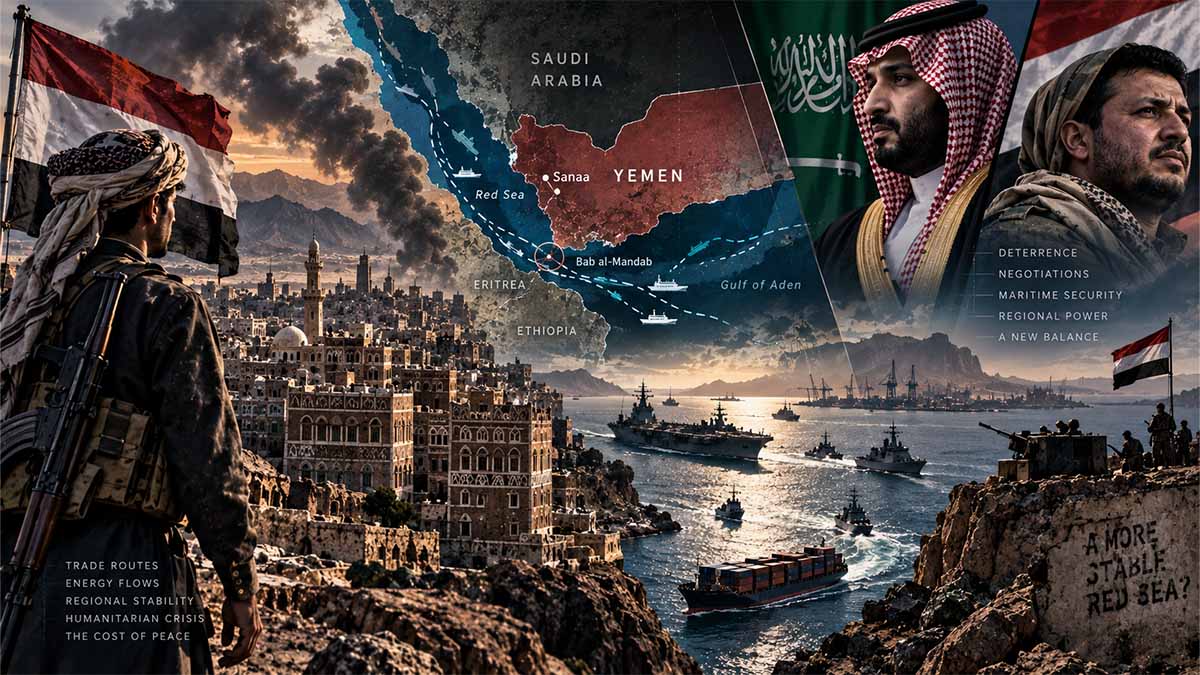
Scope: This assessment examines the renewed Saudi–Sanaa confrontation through 2 October 2026, the altered military and maritime balance around western Yemen and Bab al-Mandab, the viability of reviving or replacing the 2023 UN roadmap, and the resulting implications for Saudi Arabia, Yemen, the United States, the European Union, Italy, France, Germany, the United Kingdom, China, Oman and the wider Red Sea security architecture, with a five-year strategic horizon to 2031.
Executive Summary / BLUF
The negotiating environment between Riyadh and Sanaa has fundamentally changed because the assumptions underlying the 2022 truce and the prospective 2023 UN roadmap no longer describe the strategic environment of late 2026. The earlier framework centred on a nationwide ceasefire, public-sector salaries, renewed Yemeni oil exports, road openings and reduced restrictions on Sanaa Airport and Hodeidah; those commitments were announced by the UN in December 2023 but never matured into an implemented comprehensive settlement. Update on efforts to secure a UN roadmap to end the war in Yemen — OSESGY — 23 Dec 2023 Unmissions
By September 2026, the UN was reporting intensified fighting along Yemen’s western coast, Houthi advances toward Bab al-Mandab and reported capture of islands in the southern Red Sea, while simultaneous fighting reopened across several inland fronts; this transforms territorial control near the maritime chokepoint from a Yemeni battlefield variable into an international economic-security variable. ASG Khiari’s remarks to the Security Council on developments in Yemen — United Nations DPPA — 15 Sep 2026 DPPA
Saudi Arabia has meanwhile moved from strategic restraint toward declared military and maritime protection measures. On 20 July 2026 the Saudi-led coalition stated that it had begun measures to protect coalition commercial vessels transiting Bab al-Mandab and would respond to threats, while on 25 July it announced what it described as a proportionate military response against Houthi targets in Hodeidah. These are Saudi official assertions concerning Saudi operations and should be treated as such rather than as independent verification of every operational detail. Joint Forces Command of the Coalition: We Will Protect Our Commercial Vessels in Bab Al-Mandab Strait — Saudi Press Agency — 20 Jul 2026 الوكالة العربية السعودية للأنباء Joint Forces Command Announces Proportionate Military Response Against Legitimate Houthi Targets in Hodeida — Saudi Press Agency — 25 Jul 2026 الوكالة العربية السعودية للأنباء
The resulting negotiation is therefore no longer adequately described as a Saudi exit from the 2015 intervention. It is increasingly a negotiation over mutual vulnerability: Saudi vulnerability to missiles, drones and maritime coercion; Sanaa’s vulnerability to air attack, economic restriction and international isolation; and international vulnerability to disruption of the Red Sea route.
A sustainable arrangement would consequently require more than a cessation of Saudi–Houthi attacks. It would have to connect military de-escalation to an enforceable economic implementation mechanism, maritime-security commitments, the status of airports and ports, salary and revenue arrangements, reconstruction, detainees, foreign-force questions and a subsequent intra-Yemeni political process. The UN’s 2023 framework already contained many of these components, but the 2026 escalation has raised the price of sequencing failure. Grundberg to Asharq Al-Awsat: Commitments Key to Yemen Peace Roadmap — OSESGY Unmissions
For Europe and the United States, the Yemeni conflict can no longer be isolated from maritime security. The United States Maritime Administration states that more than 100 Houthi attacks on commercial vessels occurred between November 2023 and October 2025 and that the threat resumed in 2026; the IMO recorded renewed lethal attacks during the summer of 2026. 2026-013 Red Sea, Bab el Mandeb Strait, Gulf of Aden, Arabian Sea, and Somali Basin — U.S. Maritime Administration Amministrazione Marittima Statement on deadly ship attack in the Red Sea — IMO — 12 Aug 2026 Organizzazione Marittima Internazionale
The central judgment is consequently that the next Saudi–Sanaa settlement, if one becomes possible, will have to function simultaneously as a Yemeni peace arrangement, a Saudi border-security arrangement and a Red Sea maritime-security arrangement. Treating any one of these as separable from the others would reproduce the principal weakness of the earlier de-escalation architecture.
Yemen’s Next Peace Will Be Won in the Treasury, Not at the Ceasefire Line
Saudi Arabia and Sanaa can still stop shooting before they learn how to share a state, but the settlement now being priced is no longer a ceasefire in the narrow sense. By 2 October 2026, Yemen’s conflict has accumulated four interlocking liabilities: a fragmented monetary system, hydrocarbon exports that fell from US$1.137 billion in 2022 to US$37 million in 2023, a Red Sea security crisis that cut Suez traffic by roughly 70 percent from 2023 levels, and an internal political order in which the Southern Transitional Council has formally advanced a path toward southern self-determination. Republic of Yemen: 2025 Article IV Consultation — IMF — April 2026 Review of Maritime Transport 2025 — UNCTAD Southern Transitional Council Declaration — 2 January 2026
The governing thesis is therefore straightforward: a Saudi–Sanaa truce can terminate the most dangerous interstate dimension of the war, but only a settlement that rebuilds fiscal authority, distributes resource revenue, contains southern fragmentation and removes Bab al-Mandab from the repertoire of coercion can become durable peace.
The ceasefire is cheaper than the state that must follow it
The April 2022 UN truce succeeded because it was deliberately limited: offensive operations were frozen, fuel shipments were facilitated through Hodeidah, commercial flights resumed from Sanaa and road negotiations were opened, but the agreement created no independent enforcement mechanism and expressly remained temporary. United Nations Initiative for a Two-Month Truce — April 2022 By 23 December 2023, UN Special Envoy Hans Grundberg had expanded the prospective settlement to include a nationwide ceasefire, public-sector salaries, resumed oil exports, road openings and easing of restrictions at Sanaa Airport and Hodeidah. Update on efforts to secure a UN roadmap to end the war in Yemen — OSESGY — 23 December 2023 The problem was no longer the absence of a negotiating agenda; it was that the economic and institutional machinery required to execute that agenda did not exist.
That machinery weakened further before the next round of escalation. The UN Security Council ended the mandate of the United Nations Mission to Support the Hudaydah Agreement, UNMHA, on 31 March 2026, transferring residual functions to the Office of the Special Envoy. Security Council Resolution 2813 (2026) The decision removed a permanent field structure just months before renewed fighting made the western coast and approaches to Bab al-Mandab central again, meaning that any new settlement must recreate verification functions that the earlier architecture had allowed to lapse.
The numbers now dictate the politics
The fiscal problem is stark. The IMF records hydrocarbon exports of US$1.167 billion in 2021, US$1.137 billion in 2022, US$37 million in 2023 and effectively zero thereafter in its baseline absent a restart of exports. Government revenue excluding grants had fallen below 12 percent of internationally recognised government GDP by 2024, while public debt had risen above 100 percent of GDP. Republic of Yemen: 2025 Article IV Consultation — IMF — April 2026 In the same year, salaries absorbed roughly 32 percent of expenditure, debt service 22 percent and electricity subsidies 21 percent, leaving capital expenditure at only about 2 percent. IMF Debt Sustainability Analysis — April 2026
Saudi Arabia has already been paying to prevent the recognised state from becoming fiscally hollow. In March 2026, the Saudi Development and Reconstruction Program for Yemen signed an agreement worth SAR 1.3 billion to support operating expenditure and salaries; in June 2026, Riyadh announced a further tranche exceeding SAR 224 million. SDRPY–Yemeni Finance Ministry Agreement — March 2026 This makes Riyadh’s dilemma clearer: military disengagement does not remove Yemen from Saudi Arabia’s balance sheet if basic government functions remain dependent on Saudi transfers.
Oil revenue is the constitutional question disguised as an economic one
Restarting exports would restore foreign exchange, but it would also reopen the most combustible distributive question in the country: who owns Yemen’s resource revenue. The IMF estimates crude production at roughly 46,000 barrels per day in 2021–22, falling to 22,000 b/d in 2023 and 19,000 b/d in 2024. Republic of Yemen: 2025 Article IV Consultation — IMF The decline reflects not only lost output but the collapse of a fiscal compact that once allowed the state to convert hydrocarbons into salaries, imports and public spending.
A post-war formula will therefore have to allocate proceeds among the national treasury, producing governorates, public-sector payrolls, reconstruction and reserve accumulation. The settlement cannot simply return every dollar to a central account in Aden, because governorates such as Hadramawt, Shabwa and Marib emerged from the war with stronger claims over local resources; nor can it devolve all receipts locally, because the state would lose the revenue base required to finance national services. The fact that the World Bank launched a new Country Partnership Framework in June 2026 with an active Yemen portfolio of about US$2 billion across nine projects shows that external institutions are already building the fiduciary infrastructure needed for a more rules-based system. World Bank Country Partnership Framework for Yemen — 4 June 2026
A Saudi–Sanaa deal would end one war and expose another
The internal power structure has moved further away from a simple two-camp conflict. On 15 January 2026, Chairman Rashad al-Alimi appointed Mahmoud Ahmed Salem al-Subaihi and Salem Ahmed Saeed al-Khanbashi to the Presidential Leadership Council after the Council declared the seats of Aidarous al-Zubaidi and Faraj al-Buhsani vacant. Presidential Leadership Council decree — 15 January 2026 Those decisions reflected a rupture inside the anti-Houthi camp itself, not merely a reshuffling of portfolios.
The Southern Transitional Council raised the stakes further on 2 January 2026 by announcing a two-year transitional phase, an internationally supported North–South dialogue and a referendum on southern self-determination, while stating that a constitutional declaration establishing a “State of South Arabia” had been approved for implementation from January 2028 under its political programme. Southern Transitional Council Declaration — 2 January 2026 Riyadh can negotiate an end to its confrontation with Sanaa, but it cannot decide whether southern Yemen remains unitary, federal, confederal or independent. That question sits inside Yemen and will outlast any bilateral ceasefire.
Bab al-Mandab has turned Yemeni leverage into an international cost
The maritime dimension has changed the external economics of the conflict. UNCTAD reported that by May 2025 tonnage passing through the Suez Canal remained approximately 70 percent below 2023 levels, while global ton-miles increased 5.9 percent in 2024, nearly three times faster than the underlying growth of maritime cargo volumes. Review of Maritime Transport 2025 — UNCTAD Earlier UNCTAD data showed container-ship capacity using the affected route down 92 percent, car-carrier capacity down 96 percent and Cape of Good Hope arrivals up 89 percent by June 2024 compared with the mid-December 2023 baseline. Review of Maritime Transport 2024 — UNCTAD
The EU response has become permanent enough to acquire its own institutional logic. On 23 February 2026, the Council of the European Union extended EUNAVFOR ASPIDES through 28 February 2027 and allocated nearly €15 million in common costs for the extension period. Council extends the mandate of Operation ASPIDES — 23 February 2026 Italy has maintained approximately one FREMM continuously, and the Italian Ministry of Defence reported that Carlo Bergamini had completed 50 close-protection activities and 136 monitoring activities after 11 June 2026. Italian contribution to EUNAVFOR ASPIDES — Ministero della Difesa Europe can defend ships; it cannot escort its way into a Yemeni political settlement.
External guarantees will have to be divided by function
Oman is the strongest diplomatic bridge because it has continued to speak simultaneously with Riyadh, Yemeni parties and the UN. On 23 July 2026, the Omani Foreign Ministry stated that Muscat was coordinating with Saudi Arabia, the Yemeni parties and UN Special Envoy Hans Grundberg to resume the political process and implement the roadmap. Oman stresses need to avoid escalation in Red Sea — 23 July 2026 Oman had already hosted the December 2025 detainee talks that ultimately produced an agreement in May 2026 for the release of more than 1,600 conflict-related detainees, with the ICRC assigned the operational role. OSESGY detainee agreement — 14 May 2026
China performs a different function. The 10 March 2023 Beijing Agreement restored Saudi–Iran diplomatic relations, and by 9 December 2025 the third China–Iran–Saudi Arabia Trilateral Joint Committee was still functioning, with all three governments reaffirming support for a comprehensive political solution in Yemen under UN auspices. Joint Trilateral Statement — 10 March 2023 Third Trilateral Joint Committee Meeting — 9 December 2025 Beijing can stabilise the Saudi–Iran relationship; Muscat can keep negotiating channels open; the UN can legitimate an inclusive Yemeni process; none can replace the others.
The next 24 months will decide whether Yemen institutionalises peace or partition
The period through 2028 will be decisive because several clocks are running simultaneously. The STC has set a two-year political horizon around southern self-determination, the IMF baseline assumes only gradual recovery with growth reaching roughly 2.5 percent from 2028 onward, and hydrocarbon exports remain at zero in that baseline unless security conditions permit their return. IMF Yemen Article IV — April 2026 At the same time, the 2026 Humanitarian Needs and Response Plan identifies 22.3 million people requiring assistance, 18.3 million facing acute food insecurity and 5.2 million internally displaced. Yemen Humanitarian Needs and Response Plan 2026 — United Nations
If salaries remain irregular, oil receipts remain absent, southern constitutional conflict hardens and Bab al-Mandab continues to require permanent naval protection, the cost of inaction will not fall on one actor. Saudi Arabia will continue paying to stabilise a neighbour it wants to exit militarily; Europe will keep tying scarce naval assets to the Red Sea; Yemeni households will absorb inflation and service collapse; producing governorates will fight harder for direct control of revenue; and shipping companies will continue to price Yemeni instability into Europe–Asia trade.
The alternative is not a grand settlement imposed in one conference. It is a sequence in which money becomes auditable, resource revenue becomes rule-based, security guarantees become verifiable and territorial pluralism becomes constitutional rather than military. If those mechanisms are functioning by 2028, the 2022 truce will have proved to be the first step toward peace. If they are not, Yemen may still be quieter than it was in 2015 while remaining every bit as unresolved.
Navigational Index
Pillar I — The Saudi–Sanaa Bargain After the Collapse of Strategic Restraint
Chapter 1 — From the 2022 Truce to the 2026 Re-escalation
The institutional and military baseline, the April 2022 truce, the December 2023 roadmap commitments, the reasons implementation stalled, and the transition from incomplete de-escalation to renewed confrontation.
Chapter 2 — What Sanaa Can Demand and What Riyadh Can Accept
Ceasefire sequencing, border security, missile and drone threats, airports and ports, salaries, hydrocarbon revenues, detainees, reconstruction, compensation claims, foreign forces and enforcement mechanisms.
Chapter 3 — Territorial Leverage and the Bab al-Mandab Equation
Western Yemen, Mokha, Hodeidah, Red Sea islands, maritime approaches, Saudi shipping exposure and the distinction between territorial possession, fire-control capability and effective maritime denial.
Pillar II — The Red Sea Internationalisation of the Yemen Conflict
Chapter 4 — From Yemeni War to International Maritime-Security Crisis
Commercial shipping, insurance, rerouting, seafarer risk, maritime law, Resolution 2722 and subsequent Security Council action, U.S. maritime posture and the strategic significance of Bab al-Mandab.
Chapter 5 — Europe, the United States and the Security of the Southern Red Sea
The United States, EUNAVFOR ASPIDES, the United Kingdom and differentiated implications for Italy, France and Germany, including naval exposure, shipping interests, energy routes and the limits of military protection without political settlement.
Chapter 6 — Oman, China, Iran and the Architecture of External Guarantees
Omani mediation, China’s Saudi–Iran diplomatic role, Tehran’s position, the UN framework and the institutional question of who can credibly guarantee compliance without replacing a Yemeni political settlement.
Pillar III — The Political Economy and Endgame of a New Yemeni Settlement
Chapter 7 — Money, Oil, Salaries and Reconstruction as Instruments of Peace
Central-bank fragmentation, salary mechanisms, oil-export revenues, ports, sanctions, reconstruction finance and why implementation architecture is strategically as important as the ceasefire text itself.
Chapter 8 — Yemen After a Saudi–Sanaa Agreement: Internal Power Remains Unresolved
The Presidential Leadership Council, southern actors, local armed formations, territorial pluralism, state authority and the distinction between ending Saudi–Sanaa hostilities and resolving Yemen’s internal war.
Chapter 9 — Strategic Pathways to 2031 and the Conditions for a Durable Settlement
Settlement pathways, escalation indicators, implementation thresholds, maritime-security consequences, unresolved official records and the strategic conditions capable of moving the system from recurring armistice toward sustainable political accommodation.
Master Abstract
The settlement geometry has changed
The April 2022 UN-mediated truce represented the most important reduction in Saudi–Houthi hostilities since the Saudi-led intervention began in 2015. The parties agreed to halt offensive air, ground and maritime operations inside Yemen and across its borders, permit fuel ships into Hodeidah and restart limited commercial flights from Sanaa Airport; the UN later described the six-month truce period as the longest relative calm since the beginning of the war. Secretary-General’s Statement on a Nationwide Truce in Yemen — United Nations — 1 Apr 2022 Nazioni Unite Statement by the Secretary-General on the Nationwide Truce in Yemen — United Nations — 30 Sep 2022 Nazioni Unite
That arrangement reduced violence but did not solve the underlying sovereignty, economic and military disputes. By December 2023, after Saudi and Omani diplomatic engagement and UN mediation, the parties had committed themselves in principle to measures encompassing a nationwide ceasefire, public-sector salary payments, resumed oil exports, reopened roads and additional easing of restrictions affecting Sanaa Airport and Hodeidah. The UN described those undertakings as the basis for a future roadmap rather than as an already implemented peace agreement. Update on efforts to secure a UN roadmap to end the war in Yemen — OSESGY — 23 Dec 2023 Unmissions
The distinction is strategically decisive. A framework for settlement existed, but its implementation architecture had not been consolidated before the Yemen conflict became intertwined with the post-October 2023 Red Sea confrontation. By 2026, Yemen had therefore moved from an incomplete post-war negotiation back toward active coercive bargaining.
The new currency of negotiation is enforceability
Any renewed talks would inherit the subjects negotiated in 2022–23 but operate in a different security environment. The earlier UN process already recognised that salary payments required a transparent and effective disbursement mechanism, illustrating that the dispute was not simply about willingness to pay but about revenue, institutions, control and verifiable execution. Press statement by UN Special Envoy Hans Grundberg on a two-month renewal of the UN-mediated truce — OSESGY Unmissions
The 2023 discussions subsequently widened the agenda. Grundberg publicly described commitments concerning salaries, oil exports, roads, airport and port restrictions, detainees, reconstruction, the departure of non-Yemeni forces and preparations for an inclusive Yemeni political process. The breadth of those subjects demonstrates why a narrow ceasefire would not by itself resolve the conflict’s economic and sovereignty dimensions. Grundberg to Asharq Al-Awsat: Commitments Key to Yemen Peace Roadmap — OSESGY Unmissions
The renewed hostilities increase the importance of implementation guarantees because each side possesses instruments capable of imposing significant costs after an agreement. Riyadh retains airpower, economic influence, relationships with anti-Houthi Yemeni actors and substantial capacity to affect access and financial conditions, while Houthi forces have demonstrated long-range strike capability and the capacity to threaten commercial shipping. The Security Council sanctions framework also remains operative: Resolution 2216 imposed a targeted arms embargo on designated persons and entities, and the Security Council subsequently listed the Houthis as an entity subject to the targeted embargo. S/RES/2216 (2015) — United Nations Security Council Nazioni Unite The Houthis — United Nations Security Council sanctions listing Nazioni Unite
This means that a durable settlement cannot depend principally upon political declarations. It requires sequencing, verification and mechanisms that make violation costly enough to alter the parties’ incentives.
Bab al-Mandab has internationalised the bargaining table
The most significant change in the 2026 environment is geographical. On 15 September, the UN reported intensifying fighting along Yemen’s western coast, Houthi movement toward the Bab al-Mandab Strait and reported capture of several southern Red Sea islands. The same UN briefing noted that shipping flows appeared, at that point, to remain operational, which is important because territorial advances should not automatically be equated with physical closure of the waterway. ASG Khiari’s remarks to the Security Council on developments in Yemen — United Nations DPPA — 15 Sep 2026 DPPA
That distinction must be maintained throughout the dossier. Controlling coastline, possessing anti-ship weapons, attacking individual vessels, raising insurance costs and physically denying passage through Bab al-Mandab are different levels of maritime capability. They generate progressively larger economic and strategic effects and should not be conflated.
Nevertheless, even partial maritime coercion carries international consequences. The United States Maritime Administration reports that more than 100 separate Houthi attacks against commercial vessels took place from November 2023 through October 2025 and affected more than 60 nations, while its September 2026 advisory states that Houthi attacks had resumed and continued to threaten U.S. assets and commercial vessels. 2026-013 Red Sea, Bab el Mandeb Strait, Gulf of Aden, Arabian Sea, and Somali Basin — U.S. Maritime Administration Amministrazione Marittima
The IMO likewise reported renewed attacks during July and August 2026 and described the Red Sea as a critical international trade corridor whose disruption threatens global supply chains. Statement on recent attacks on ships in the Red Sea — IMO — 23 Jul 2026 Organizzazione Marittima Internazionale
The strategic implication is clear: Riyadh is no longer negotiating only about its southern frontier. It is negotiating beside one of the world’s major maritime arteries, where an unresolved Yemeni conflict can generate external economic costs far beyond the Arabian Peninsula.
Saudi Arabia has re-entered an explicit coercive posture
Saudi official statements demonstrate that Riyadh no longer treats the environment as merely one of dormant confrontation. On 20 July 2026 the Saudi-led coalition announced maritime protection measures for vessels transiting Bab al-Mandab and declared that threats would receive a response; five days later, it announced a military operation against Houthi targets in Hodeidah following attacks against commercial vessels. Joint Forces Command: We Will Protect Our Commercial Vessels in Bab Al-Mandab Strait — Saudi Press Agency — 20 Jul 2026 الوكالة العربية السعودية للأنباء Joint Forces Command Announces Proportionate Military Response Against Legitimate Houthi Targets in Hodeida — Saudi Press Agency — 25 Jul 2026 الوكالة العربية السعودية للأنباء
Riyadh also rejects the description of its policies as a blockade. The Saudi Foreign Ministry stated in July that more than 300 commercial vessels entered Hodeidah, Salif and Ras Isa during the first half of 2026, carrying food, goods, fuel and construction materials, while Saudi authorities argued that restrictions remained connected to implementation of the Security Council sanctions regime. These figures originate from the Saudi government and therefore document Riyadh’s position and reported port throughput; they do not independently settle wider disputes over access, inspection, restrictions or responsibility for economic conditions in northern Yemen. Foreign Ministry statement on allegations concerning Yemen and maritime navigation — Saudi Press Agency — 20 Jul 2026 الوكالة العربية السعودية للأنباء
The Saudi strategic problem is consequently dual. Riyadh has strong incentives to prevent an armed authority in northern Yemen from acquiring an unrestricted ability to strike Saudi territory or Saudi shipping, while another prolonged intervention risks recreating the very security and economic burdens that made de-escalation attractive after 2022.
A Saudi settlement therefore needs to produce something materially different from military pause: it must reduce the probability that Yemen can again become an active launch platform against Saudi territory without requiring permanent Saudi military management of the Yemeni conflict.
Sanaa’s leverage has expanded, but leverage is not the same as recognised authority
The altered military environment strengthens Sanaa’s bargaining position in specific domains, particularly because long-range strike systems and Red Sea operations create costs outside the immediate Yemeni battlefield. It does not, however, resolve the international question of Yemen’s political representation or eliminate competing Yemeni centres of authority.
The United Nations continues to frame the desired end state as a Yemeni-owned political process under UN auspices, rather than a bilateral Saudi–Houthi arrangement substituting for an internal political settlement. The UN’s December 2023 formulation explicitly connected ceasefire and economic measures to preparations for an inclusive political process. Update on efforts to secure a UN roadmap to end the war in Yemen — OSESGY — 23 Dec 2023 Unmissions
This distinction creates a structural limit on any Saudi–Sanaa bargain. Riyadh can potentially negotiate the end or limitation of cross-border hostilities, maritime threats and elements of Saudi involvement; it cannot by bilateral agreement alone extinguish rival Yemeni sovereignty claims, southern separatist aspirations, local armed networks or competing control over state institutions and natural-resource revenues.
Consequently, Saudi–Sanaa peace and Yemeni national peace are related but non-identical objectives.
Oman remains the most institutionally credible regional bridge
Oman occupies an unusual position because it was involved in the diplomatic contacts preceding the 2023 roadmap and also hosted earlier Saudi–Iranian dialogue. The December 2023 UN announcement expressly credited both Saudi Arabia and Oman for supporting the parties’ progress toward roadmap commitments. Update on efforts to secure a UN roadmap to end the war in Yemen — OSESGY — 23 Dec 2023 Unmissions
Oman’s value is therefore less a matter of formal power than of diplomatic access. A future arrangement requiring confidential communication, staged implementation and a channel capable of surviving periodic escalation would benefit from a mediator possessing working relationships across otherwise antagonistic camps.
The critical limitation is that mediation access does not equal enforcement power. Oman can facilitate communication and potentially host technical mechanisms; compliance guarantees requiring financial resources, sanctions relief, international legal arrangements or maritime-security commitments would necessarily involve larger institutional actors.
China matters because Saudi–Iranian détente created political space, not because Beijing can impose a Yemeni settlement
The March 2023 Beijing agreement between Saudi Arabia and Iran formally restored diplomatic relations and reaffirmed sovereignty and non-interference principles. The joint statement also recognised earlier Iraqi and Omani rounds of dialogue and committed the parties to renewed bilateral security cooperation. Joint Trilateral Statement by the People’s Republic of China, the Kingdom of Saudi Arabia, and the Islamic Republic of Iran — Chinese Ministry of Foreign Affairs — 10 Mar 2023 Ministero degli Affari Esteri
China subsequently stated that the Saudi–Iranian rapprochement had created more favourable conditions for political resolution of the Yemeni conflict. That is an official Chinese assessment rather than proof that Beijing controls the Yemeni negotiating process, but it demonstrates China’s declared interest in linking Gulf détente to regional conflict reduction. Special Envoy Zhai Jun Meets with Ambassador of Yemen to China — Chinese Ministry of Foreign Affairs — 13 Apr 2023 Ministero degli Affari Esteri
Beijing could consequently contribute diplomatic weight to a wider guarantee structure, particularly where Riyadh–Tehran communication matters. Yet the evidence does not establish that China has assumed responsibility for guaranteeing a Saudi–Sanaa settlement, financing Yemeni reconstruction or enforcing compliance. Those are distinct propositions and should not be inferred from China’s 2023 mediation role.
The United States faces a deterrence problem that military action alone has not resolved
For Washington, Yemen intersects simultaneously with freedom of navigation, protection of American assets, regional alliance management and the broader Middle Eastern security environment. The U.S. Maritime Administration’s active 2026 advisory demonstrates that the Houthi threat remains an operational concern for U.S.-linked commercial vessels and maritime assets. 2026-013 Red Sea, Bab el Mandeb Strait, Gulf of Aden, Arabian Sea, and Somali Basin — U.S. Maritime Administration Amministrazione Marittima
The United States therefore has an interest in preventing a settlement that merely transfers the conflict from the Saudi–Yemeni border to international shipping. At the same time, protecting merchant traffic through naval deployments or strikes does not resolve the political economy of Yemen, the distribution of national revenue, northern–southern power competition or the Saudi–Houthi security dilemma.
Washington’s central strategic tension is consequently between deterrence of maritime coercion and preservation of diplomatic space for a Yemen settlement. Excessive separation of those tracks risks failure in both: coercion without settlement leaves the source of recurrent escalation intact, while diplomacy without credible maritime deterrence leaves international shipping exposed to political leverage.
Europe has crossed from observer to security stakeholder
The European Union’s role has become more concrete since the establishment of EUNAVFOR ASPIDES in February 2024. In February 2026, the Council extended the operation until 28 February 2027 and allocated nearly €15 million in common costs for the extension period. The Council describes ASPIDES as a defensive maritime-security operation protecting vessels and freedom of navigation across the Red Sea and surrounding waters. Red Sea: Council extends the mandate of Operation ASPIDES to safeguard freedom of navigation — Council of the European Union — 23 Feb 2026 Consiglio dell’Unione Europea
The EU High Representative subsequently described Houthi threats to impose a maritime blockade on Saudi Arabia as a direct danger to regional stability and reaffirmed ASPIDES’ commitment to protecting freedom of navigation. Statement by the High Representative on Houthi threats against the Kingdom of Saudi Arabia and freedom of navigation in the region — EEAS — 23 Jul 2026 Servizio Europeo per l’azione esterna
This alters Europe’s policy equation. The European interest is no longer confined to humanitarian assistance or diplomatic support for the UN process; European naval assets, merchant fleets, ports, insurers, manufacturers and supply chains are directly exposed to the security environment between Suez and the Indian Ocean.
Italy, France and Germany share the maritime exposure but not identical instruments
For Italy, the Red Sea is particularly relevant because Suez–Mediterranean traffic affects the competitive position of Italian ports and the commercial logic of Mediterranean supply chains. Rome therefore has a material interest in both effective maritime protection and restoration of predictable transit conditions. Its strongest contribution to a settlement architecture would arise through coordinated EU maritime security, diplomacy, humanitarian engagement and support for verifiable implementation rather than through an independent Italian Yemen process.
For France, the strategic calculation combines maritime access, a permanent military and diplomatic presence across the broader western Indian Ocean and Gulf environment, and an interest in preserving freedom of navigation. Paris therefore confronts both the direct naval-security problem and the wider question of whether persistent instability south of the Red Sea can be contained indefinitely by maritime deployments.
For Germany, the consequences are more strongly transmitted through trade, industrial supply chains, maritime logistics and the EU institutional architecture. Berlin’s interest is therefore centred on predictable navigation, European unity, compliance with international law and reduction of recurrent shocks affecting transport corridors connecting European manufacturing to Asia.
For all three countries, the principal strategic error would be to conceptualise Yemen exclusively as a distant humanitarian conflict while treating Red Sea security as a separate naval-management problem. The two systems are increasingly interconnected.
The United Kingdom retains a more explicit security alignment with Riyadh
The United Kingdom stated on 21 July 2026 that it strongly condemned Houthi threats against Saudi Arabia, including threats of a maritime blockade, and declared its support for Saudi Arabia and other regional partners. FCDO Statement on Houthi threats against Saudi Arabia — UK Foreign, Commonwealth & Development Office — 21 Jul 2026 GOV.UK
British public guidance now also states that direct military conflict between Saudi Arabia, Yemen’s internationally recognised authorities and the Houthis resumed during 2026, with Houthi missile and drone attacks reported against Saudi cities, military installations, airports, energy infrastructure and shipping. Saudi Arabia: Regional risks — UK Foreign, Commonwealth & Development Office GOV.UK
London therefore occupies a more difficult diplomatic position than Oman: it possesses stronger military relationships with Riyadh and a clearer public position opposing Houthi attacks, but precisely those relationships reduce its ability to function as a politically neutral intermediary acceptable to all parties.
The humanitarian and economic baseline sharply constrains coercive strategies
Any assessment of bargaining power must be separated from the condition of Yemeni society. UNDP estimated that the conflict would have generated approximately 377,000 conflict-attributable deaths by the end of 2021, with roughly 60 per cent resulting indirectly from hunger, lack of healthcare and other conflict-related deprivation rather than direct violence. This is a modelled historical estimate rather than a current 2026 casualty count and should not be extrapolated mechanically. Assessing the Impact of War in Yemen: Pathways for Recovery — UNDP — Nov 2021 UNDP
The importance of that figure is analytical rather than rhetorical: the Yemeni conflict has demonstrated that infrastructure damage, economic fragmentation, public-service collapse and trade disruption can kill on a scale exceeding direct battlefield violence. Any agreement that stops missiles while leaving salaries, imports, transport corridors, banking fragmentation and reconstruction unresolved would therefore remain structurally incomplete.
Peace now requires three simultaneous bargains
The evidence supports a three-layer settlement architecture.
The first layer is Saudi–Sanaa de-escalation, encompassing cross-border attacks, air operations, missiles, drones, border security and the role of Saudi forces and Saudi-backed formations.
The second is economic normalisation, encompassing public-sector salaries, oil exports, banking and revenue mechanisms, ports, airports, roads, reconstruction and detainee issues.
The third is Yemeni political settlement, in which forces and constituencies outside Sanaa’s control determine the country’s future institutional structure, territorial arrangements and allocation of national resources.
A fourth layer has effectively emerged since 2023 but should be treated as an external security envelope rather than a substitute for Yemeni politics: Red Sea maritime security.
The central challenge is sequencing these layers so that progress in one does not become leverage for indefinitely postponing another.
Key Evidence Table
| Indicator | Value/status | Reference date | Definition/scope | Issuer | Exact source |
|---|---|---|---|---|---|
| UN-mediated nationwide truce | Agreed; offensive air, ground and maritime operations to halt inside Yemen and across borders | 2 Apr 2022 | Initial two-month nationwide truce | UN Secretary-General | Secretary-General’s Statement on a Nationwide Truce in Yemen Nazioni Unite |
| Roadmap commitments | Nationwide ceasefire; salaries; oil exports; road openings; easing restrictions on Sanaa Airport and Hodeidah | 23 Dec 2023 | Commitments to be incorporated into a UN roadmap, not a completed final settlement | OSESGY | Update on efforts to secure a UN roadmap to end the war in Yemen Unmissions |
| Saudi–Iran diplomatic restoration | Relations restored; sovereignty/non-interference reaffirmed | 10 Mar 2023 | Beijing trilateral agreement | China, Saudi Arabia, Iran | Joint Trilateral Statement Ministero degli Affari Esteri |
| Northern Yemen port traffic reported by Saudi Arabia | More than 300 commercial vessels | H1 2026 | Hodeidah, Salif and Ras Isa; Saudi-reported figure | Saudi Foreign Ministry / SPA | Saudi Foreign Ministry statement — 20 Jul 2026 الوكالة العربية السعودية للأنباء |
| Saudi maritime-protection posture | Protection measures announced for coalition commercial vessels transiting Bab al-Mandab | 20 Jul 2026 | Saudi-led coalition declaration | Saudi-led Coalition / SPA | Joint Forces Command statement — 20 Jul 2026 الوكالة العربية السعودية للأنباء |
| Saudi military response | Operation against Houthi targets in Hodeidah announced | 25 Jul 2026 | Saudi official account of operation | Saudi-led Coalition / SPA | Joint Forces Command statement — 25 Jul 2026 الوكالة العربية السعودية للأنباء |
| Houthi commercial-shipping attacks | More than 100 attacks affecting more than 60 nations | Nov 2023–Oct 2025 | U.S. maritime advisory baseline | U.S. MARAD | U.S. Maritime Advisory 2026-013 Amministrazione Marittima |
| West-coast escalation | Houthi advance toward Bab al-Mandab; several southern Red Sea islands reportedly captured | 15 Sep 2026 | UN report based partly on reported battlefield developments | UN DPPA | ASG Khiari’s remarks to the Security Council DPPA |
| EU maritime-security operation | ASPIDES extended to 28 Feb 2027; nearly €15m common-cost reference amount | 23 Feb 2026 | Defensive EU naval operation | Council of the EU | Council extends the mandate of Operation ASPIDES Consiglio dell’Unione Europea |
| Security Council sanctions architecture | Targeted arms embargo remains operative | Current framework | Resolution 2216 regime and subsequent designations | UN Security Council | S/RES/2216 (2015) Nazioni Unite |
| Conflict-attributable mortality estimate | 377,000 by end-2021 | Modelled through end-2021 | Direct and indirect conflict-attributable deaths; not a 2026 count | UNDP | Assessing the Impact of War in Yemen: Pathways for Recovery UNDP |
Competing Strategic Pathways
The evidence supports three genuinely distinct pathways. They are presented as analytical alternatives rather than deterministic forecasts; no defensible official dataset exists from which numerical probabilities should be manufactured.
| Hypothesis | Diagnostic support | Disconfirming evidence | Indicators | Current standing |
|---|---|---|---|---|
| Coercive bargaining produces an expanded Saudi–Sanaa settlement | Both sides retain strong incentives to cap economic and military exposure; the 2023 negotiating architecture already defines many substantive files; Oman and the UN preserve diplomatic channels | 2026 fighting has increased distrust, territorial stakes and maritime-security requirements | Resumption of Omani/UN shuttle diplomacy; verified cessation of cross-border strikes; technical negotiations on salaries/revenues; agreed maritime restraint mechanism | Institutionally plausible, but requires stronger implementation guarantees than the 2023 framework |
| A limited armistice freezes Saudi–Sanaa conflict without resolving Yemen | A bilateral reduction in attacks is easier to negotiate than comprehensive Yemeni reconciliation; earlier truce demonstrated that violence can be reduced without final political agreement | Maritime threats, internal Yemeni fronts and unresolved revenue questions can destabilise a narrow arrangement | Saudi–Houthi ceasefire without inclusive political timetable; continued local fighting; partial port/airport normalization | Structurally feasible but vulnerable to recurrent breakdown |
| The conflict becomes increasingly regionalised around Bab al-Mandab | Houthi maritime operations, Saudi responses, ASPIDES, U.S. maritime warnings and international shipping exposure already internationalise the conflict | All major external actors retain substantial incentives to avoid closure or prolonged high-intensity conflict around the chokepoint | Increased attacks on merchant vessels; sustained Saudi air campaign; additional multinational deployments; deterioration in UN diplomacy | The principal downside pathway if coercive bargaining outruns diplomacy |
Principal Gaps and Watch Indicators
The most important unresolved issue is the precise content of any current Saudi–Sanaa or Omani-mediated negotiating exchanges. The 2023 UN roadmap commitments are public, but no equally authoritative public instrument establishes the complete terms that either Riyadh or Sanaa would accept after the 2026 escalation.
A second gap concerns the actual military control and sustainable operational reach around Mokha, the Red Sea islands and the Bab al-Mandab approaches. The UN has reported Houthi advances and reported island captures, but territorial occupation should not be converted automatically into a conclusion about persistent anti-access control over the strait. ASG Khiari’s remarks to the Security Council — 15 Sep 2026 DPPA
A third gap concerns enforcement. No publicly verified agreement currently establishes a binding third-party guarantee covering Saudi cessation of military action, Houthi cross-border restraint, maritime-security commitments, salary finance, reconstruction disbursement and dispute-resolution procedures within one institutional framework.
The indicators most capable of changing this assessment are therefore:
- formal Saudi, Omani, UN or Sanaa confirmation of renewed structured negotiations;
- a verified cross-border ceasefire extending beyond informal restraint;
- withdrawal or redeployment of forces from sensitive western-coast positions;
- a mutually accepted salary and hydrocarbon-revenue mechanism;
- restoration of regular civilian air access under an agreed aviation arrangement;
- sustained reduction in attacks on commercial shipping;
- a formal mechanism connecting Saudi–Sanaa de-escalation with the UN-led intra-Yemeni process;
- Chinese, Omani, UN or other external participation in a documented guarantee structure;
- evidence that the Presidential Leadership Council and major southern actors are incorporated into, or explicitly excluded from, the settlement architecture;
- changes to EU, U.S. or UK maritime deployments indicating either durable de-escalation or anticipation of renewed escalation.
Sanaa’s Price for Peace
The strategic problem is no longer confined to a Saudi–Yemeni ceasefire. A durable settlement must simultaneously address Saudi border security, Yemen’s economic and political fragmentation, and the international security of the Bab al-Mandab–Red Sea corridor.
Central Analytical Judgment
The next Saudi–Sanaa settlement cannot reproduce the logic of the 2022 truce or simply reactivate the unfinished 2023 roadmap. The renewed confrontation has transformed the bargaining environment into a problem of mutual vulnerability and enforceability: Saudi Arabia requires protection against missiles, drones and maritime coercion, while Sanaa seeks economic normalization, political leverage, relief from military pressure and guarantees that commitments will actually be implemented.
The Settlement Architecture
Saudi–Sanaa Security Settlement
Cross-border attacks, Saudi air operations, ballistic missiles, drones, border-security arrangements, foreign-force questions and mechanisms preventing renewed military escalation.
Economic Normalisation
Public-sector salaries, hydrocarbon revenues, banking channels, Hodeidah, Sanaa Airport, commercial access, reconstruction financing and mechanisms capable of verifying implementation.
Yemeni Political Settlement
Relations between Sanaa, the Presidential Leadership Council, southern actors, tribal and regional authorities, competing armed formations and Yemen’s unresolved institutional structure.
Since the conflict increasingly affects international commercial navigation, a durable Saudi–Sanaa arrangement now interacts directly with freedom of navigation, European naval deployments, U.S. maritime security, insurance exposure and global supply chains.
The New Bargaining Equation
Bab al-Mandab: From Local Battlefield to International Chokepoint
Territorial presence near the strait, possession of anti-ship weapons, attacks on individual vessels, increased insurance costs and the physical denial of passage represent different levels of maritime capability and must not be treated as equivalent. The UN reported intensified fighting and advances toward Bab al-Mandab in September 2026 while also indicating that maritime traffic remained operational at that stage.
Official source: ASG Khiari’s remarks to the Security Council on developments in Yemen — United Nations DPPA — 15 September 2026
International Strategic Exposure
Maritime deterrence, protection of commercial navigation and U.S.-linked assets must be reconciled with preservation of the political space required for a Yemeni settlement.
EUNAVFOR ASPIDES transforms Europe from a diplomatic observer into a direct maritime-security stakeholder in the Red Sea.
Stronger public security alignment with Riyadh increases London’s relevance to deterrence while limiting perceptions of neutrality as a mediator.
Diplomatic access across opposing camps makes Muscat one of the strongest regional channels for confidential mediation and implementation sequencing.
Beijing can reinforce Gulf diplomatic de-escalation, especially through Saudi–Iranian dialogue, but no public record establishes Chinese responsibility for enforcing a Yemen settlement.
European Country Lenses
Exposure centres on Mediterranean–Suez trade flows, shipping, port competitiveness, naval security and the stability of Europe–Asia logistics corridors.
Combines naval capability, regional military presence and strategic interests spanning the Red Sea, Gulf and western Indian Ocean.
Principal vulnerabilities run through industrial supply chains, maritime trade and the economic consequences of prolonged rerouting or insecurity.
Maintains substantial regional security relationships and has publicly condemned threats against Saudi Arabia and maritime navigation.
Maritime protection must be connected to diplomacy because naval escort can manage immediate risk without resolving the political source of recurring instability.
Three Strategic Pathways
Renewed diplomacy produces an enforceable package connecting military de-escalation, economic implementation, maritime restraint and a subsequent UN-led intra-Yemeni political process.
Saudi Arabia and Sanaa reduce direct hostilities without resolving the underlying Yemeni political order, producing a lower-intensity but structurally unstable equilibrium.
Fighting around western Yemen and maritime attacks increasingly draw Saudi Arabia, European navies, the United States and other regional actors into an expanding Red Sea security confrontation.
Indicators of Movement Toward Settlement
Indicators of Renewed Strategic Deterioration
Verified Strategic Baseline
| Indicator | Status | Date | Strategic Meaning | Official Source |
|---|---|---|---|---|
| UN-mediated nationwide truce | Offensive operations halted under temporary agreement | April 2022 | Demonstrated that substantial military de-escalation was achievable without a final political settlement. | United Nations |
| UN roadmap commitments | Ceasefire, salaries, oil exports, roads, airport and port measures | December 2023 | Established the substantive foundation for a settlement but did not become a fully implemented peace architecture. | OSESGY |
| Saudi maritime-protection posture | Protection measures for commercial vessels announced | July 2026 | Demonstrates renewed Saudi willingness to connect Yemen operations with Bab al-Mandab maritime security. | Saudi Press Agency |
| EU Operation ASPIDES | Mandate extended to February 2027 | February 2026 | Confirms European institutional involvement in protection of navigation through the wider Red Sea theatre. | Council of the European Union |
| Western-coast escalation | Fighting intensified toward Bab al-Mandab | September 2026 | Links territorial warfare in Yemen directly to the security of an international maritime chokepoint. | United Nations DPPA |
| Commercial shipping threat | More than 100 Houthi attacks reported for Nov 2023–Oct 2025; threat resumed in 2026 | 2023–2026 | Demonstrates that the Yemen conflict now produces costs across international commercial and maritime systems. | U.S. Maritime Administration |
Net Strategic Assessment
The central strategic transformation is that Yemen can no longer be treated as an isolated civil war with a Saudi external dimension. The conflict now intersects directly with Saudi national security, Gulf deterrence, international commercial navigation, European maritime deployments and the security of the Red Sea–Suez corridor. A future agreement that deals only with the Saudi–Sanaa military relationship would therefore remain incomplete, while a maritime-security strategy that ignores Yemen’s political and economic settlement would manage the symptoms without resolving the mechanism that repeatedly regenerates the crisis.
Pillar I — The Saudi–Sanaa Bargain After the Collapse of Strategic Restraint
Chapter 1 — From the 2022 Truce to the 2026 Re-escalation
Principal judgment
The decisive fact is not merely that the 2022 truce failed to mature into peace, but that the architecture supporting restraint gradually lost both political momentum and institutional depth while the military, economic and maritime environment around Yemen changed fundamentally. The April 2022 truce had been deliberately narrow: it froze offensive ground, air and maritime operations inside Yemen and across its borders, authorised 18 fuel ships to enter Hodeidah during the initial two-month period, provided for two commercial flights per week from Sanaa to Jordan and Egypt, and committed the parties to talks on opening roads in Taiz and other governorates; critically, however, the arrangement also stated that it was temporary and that there would be no independent monitoring mechanism, leaving compliance dependent primarily on party-appointed focal points and UN facilitation rather than an enforcement system capable of imposing automatic consequences for violations. United Nations Initiative for a two-month Truce — United Nations Peacemaker — April 2022 Peacemaker
This limited design was sufficient to suppress a major cycle of Saudi–Houthi escalation, but it was never equivalent to demobilisation, disarmament, economic reunification or a political settlement, and the years that followed therefore produced what can more accurately be described as strategic restraint without strategic resolution. The December 2023 commitments negotiated through the UN process widened the agenda substantially by envisaging a nationwide ceasefire, payment of all public-sector salaries, resumption of oil exports, road openings, additional easing of restrictions on Sanaa Airport and Hodeidah Port, implementation mechanisms and preparations for a Yemeni-owned political process; yet those measures remained components of a projected roadmap rather than a signed and fully implemented settlement. Update on efforts to secure a UN roadmap to end the war in Yemen — OSESGY — 23 December 2023 Unmissions
The weakness was therefore structural rather than merely diplomatic. The ceasefire logic was progressively asked to carry disputes over national revenue, public administration, hydrocarbon exports, ports, aviation, prisoners, monetary authority, military presence and political legitimacy that could not be settled by maintaining silence along front lines alone. By 2026, that gap had become more consequential because Yemen’s economy had deteriorated markedly while the physical infrastructure of international monitoring was being reduced: the Security Council terminated the mandate of the United Nations Mission to Support the Hudaydah Agreement, UNMHA, on 31 March 2026, transferring residual functions to the Office of the Special Envoy and beginning liquidation of the permanent mission presence in Hodeidah. Resolution 2813 (2026) — United Nations Security Council — 27 January 2026 Hudaydah Agreement — UNMHA Digital Library
The original truce was intentionally modest
The 2022 arrangement was successful precisely because it postponed most sovereignty questions rather than resolving them. Its military obligation was a halt to offensive operations and a freeze in military positions, not disarmament or withdrawal; its economic provisions concerned fuel access rather than comprehensive revenue management; its aviation provisions specified a limited number of commercial flights rather than full airport normalisation; and its Taiz provisions required negotiations on roads rather than automatic reopening. The original text explicitly noted that the arrangements were temporary and should not constitute precedent, which protected negotiating flexibility but also meant that every subsequent expansion of the agreement required another political bargain. United Nations Initiative for a two-month Truce — United Nations Peacemaker — April 2022 Peacemaker
The absence of independent monitoring deserves particular attention because it later became central to the credibility problem. OSESGY was authorised to facilitate coordination through nominated focal points, but there was no autonomous verification body with the authority and field access necessary to establish responsibility for every alleged violation, certify implementation milestones or trigger agreed remedies; consequently, the truce created an environment in which restraint could persist while disputes over compliance accumulated beneath it. United Nations Initiative for a two-month Truce — United Nations Peacemaker — April 2022 Peacemaker
The contrast with the 2018 Hodeidah Agreement is instructive. That agreement had envisaged a UN-chaired Redeployment Coordination Committee, monitoring of redeployment and demining, weekly compliance reporting, and an enhanced UN role at Hodeidah, Salif and Ras Isa, precisely because the parties recognised that physical control of the western ports and military presence around them required institutional supervision; by March 2026, however, UNMHA itself had closed, meaning that any future western-coast settlement would need to recreate some of those verification functions through another mechanism rather than assuming the old architecture remained available. Hudaydah Agreement — UNMHA Resolution 2813 (2026) — United Nations Security Council Unmha
The 2023 roadmap expanded the peace agenda faster than implementation capacity
By December 2023 the peace process had moved well beyond the limited 2022 truce and had begun to address the issues that actually determine whether Yemen can sustain a functioning political economy: salaries, hydrocarbon exports, roads, ports, aviation and the transition to an inclusive political process. The significance of the roadmap therefore lies less in its diplomatic language than in the fact that it implicitly recognised that the conflict had become an argument over the distribution of state functions as much as an argument over territory. Update on efforts to secure a UN roadmap to end the war in Yemen — OSESGY — 23 December 2023 Unmissions
Yet each of those economic files contained unresolved implementation questions. “Pay all public-sector salaries” required agreement on who qualifies as a public employee, which payroll is valid, which institution disburses funds, which revenues finance the expenditure, how salaries are converted across Yemen’s increasingly fragmented monetary system and how the process is audited; “resume oil exports” required physical security for terminals and pipelines, revenue custody arrangements and agreement over revenue distribution; easing restrictions at airports and ports required security, customs, inspection and sanctions compliance; and a nationwide ceasefire required verification across multiple fronts controlled by different forces rather than merely a Saudi–Sanaa bilateral understanding. The roadmap therefore contained the correct substantive files but not yet the complete state machinery required to execute them. Republic of Yemen: 2025 Article IV Consultation — IMF — April 2026 Update on efforts to secure a UN roadmap to end the war in Yemen — OSESGY IMF
Economic deterioration transformed the meaning of “peace dividends”
The macroeconomic environment in which the roadmap would have been implemented deteriorated severely after the suspension of internationally recognised government hydrocarbon exports. According to the IMF’s 2026 Article IV documentation, hydrocarbon exports recorded US$1.137 billion in 2022, fell to only US$37 million in 2023, and were effectively zero in the IMF’s subsequent baseline for 2024 onward; the Fund also reported that government revenue excluding grants had declined from 22.5 percent of GDP in 2014 to below 12 percent in 2024, while public debt had risen above 100 percent of internationally recognised government GDP. Republic of Yemen: 2025 Article IV Consultation — IMF — April 2026 eLibrary IMF
This matters directly to negotiations because economic concessions cannot be analysed as if Yemen still possessed a unified fiscal base capable of funding them. The IMF calculated that grants constituted 42 percent of internationally recognised government fiscal revenue in 2024, while salaries absorbed approximately 32 percent of expenditure, debt service 22 percent and electricity subsidies 21 percent; capital expenditure accounted for only around 2 percent, demonstrating how little fiscal space remained for reconstruction even before renewed fighting increased requirements. Republic of Yemen: Staff Report for the 2025 Article IV Consultation — IMF — April 2026 eLibrary IMF
The same IMF assessment records about US$2.3 billion in Saudi and UAE financial support during 2023–24 and reserve coverage below one month of imports, meaning that any future Saudi financial contribution will operate in an environment in which Riyadh is not merely a former belligerent but also a critical external financier of the internationally recognised authorities. Republic of Yemen: 2025 Article IV Consultation — IMF — April 2026 eLibrary IMF
| Economic indicator | 2022 | 2023 | 2024 / latest verified baseline | Negotiating significance |
|---|---|---|---|---|
| Hydrocarbon exports | US$1.137bn | US$37m | Effectively zero in IMF baseline | Revenue-sharing cannot be implemented through a functioning export stream unless exports first resume |
| Government revenue excluding grants | — | — | Below 12% of IRG GDP | Domestic fiscal capacity is insufficient to carry a comprehensive settlement alone |
| Grants as share of fiscal revenue | — | — | 42% in 2024 | External financing remains structurally important |
| Public salaries as share of expenditure | — | — | 32% in 2024 | Salary commitments represent one of the largest recurrent fiscal burdens |
| Public debt | — | — | Above 100% of IRG GDP | Debt sustainability constrains reconstruction borrowing |
| International reserves | — | — | Below one month of imports | Currency and import stability remain vulnerable |
| Saudi/UAE financing | — | 2023–24 combined | About US$2.3bn | Gulf support remains systemically important |
Source: Republic of Yemen: 2025 Article IV Consultation — IMF — April 2026 and Debt Sustainability Analysis — IMF — April 2026. eLibrary IMF
The transition from incomplete peace to renewed coercion
The 2026 escalation did not emerge from an otherwise settled environment; rather, it exposed how much coercive capacity each side had accumulated while the political process remained incomplete. In August 2026 the UN Special Envoy warned that Yemen faced the most serious risk of return to large-scale conflict since the 2022 truce, citing increased military activity across front lines and renewed attacks on commercial shipping; by 10 September he reported that the risk had become reality, with intensified fighting across several theatres and an Ansar Allah offensive taking control of Mokha, approximately 75 kilometres from Bab al-Mandab, at that moment. Briefing by the UN Special Envoy for Yemen — OSESGY — 10 September 2026 Unmissions
Five days later, the UN reported further Houthi movement toward Bab al-Mandab, reported captures of islands in the southern Red Sea and simultaneous counteroffensive activity across Marib, Lahj, Al-Jawf, Hajjah, Al-Bayda and Sa’ada. The same briefing carefully noted that commercial traffic through the Red Sea appeared to remain operational at the time, an important qualification because battlefield proximity to a chokepoint is not synonymous with physical control of international navigation. ASG Khiari’s remarks to the Security Council — UN DPPA — 15 September 2026 DPPA
The geographic spread continued beyond the coast. On 1 October 2026 the Special Envoy reported significantly intensified fighting in Taiz, casualties, infrastructure damage and road closures, and stated that the governorate was hosting the majority of people newly displaced by the recent fighting. Statement by UN Special Envoy for Yemen on Taiz — OSESGY — 1 October 2026 Unmissions
The Security Council’s 18 September statement illustrates how far the strategic environment had moved from the assumptions of 2023: Council members condemned continued Houthi attacks against Saudi Arabia, including attacks affecting civilian and energy infrastructure, condemned attacks and threats against commercial shipping, expressed concern about Houthi advances around Bab al-Mandab, and cited at least 125,000 people displaced across Yemen since the beginning of September according to UN humanitarian reporting. UNSC Press Statement on escalation in Yemen and attacks against the Kingdom of Saudi Arabia — OSESGY — 18 September 2026 Unmissions
Saudi Arabia’s posture also changed materially
Saudi Arabia had strong incentives after 2022 to prevent a return to the open-ended intervention model that had characterised the preceding years, yet Riyadh’s July 2026 statements demonstrate that the threshold for direct response had been crossed once threats extended again to commercial shipping and Saudi interests. On 20 July the Saudi-led coalition announced operational measures to protect coalition commercial vessels transiting Bab al-Mandab and publicly stated that threats to those vessels would receive a firm response; on 25 July it announced what it described as a proportionate response against Houthi targets in Hodeidah following attacks on commercial vessels. These are Saudi official accounts and must therefore be treated as statements of Saudi policy and operations rather than independent verification of every battlefield detail. Joint Forces Command: We Will Protect Our Commercial Vessels in Bab Al-Mandab Strait — Saudi Press Agency — 20 July 2026 Joint Forces Command Announces Proportionate Military Response Against Legitimate Houthi Targets in Hodeida — Saudi Press Agency — 25 July 2026 الوكالة العربية السعودية للأنباء
The significance is not that Riyadh has necessarily returned to the strategic objectives or scale of its 2015 campaign, because the public record does not establish that conclusion; rather, the evidence shows that Saudi restraint is now conditional on the security of its territory, infrastructure and maritime access, making those matters unavoidable components of any renewed diplomatic process.
Chronology of strategic deterioration
| Date | Development | Institutional effect | Strategic consequence |
|---|---|---|---|
| 2 Apr 2022 | UN truce enters into force | Offensive operations frozen; limited fuel and aviation measures activated | Large-scale Saudi–Houthi confrontation sharply reduced |
| Jun–Oct 2022 | Truce extended | Restraint becomes the new baseline | Demonstrates feasibility of de-escalation without political settlement |
| 23 Dec 2023 | Roadmap commitments announced | Agenda expands to ceasefire, salaries, oil exports, roads, ports, airport and political process | Peace process becomes an economic-governance negotiation |
| 2024–25 | Oil-export collapse continues | State finances weaken further | Salary and reconstruction files become increasingly dependent on external finance |
| 23 Dec 2025 | New detainee-release phase agreed in Muscat | Functional confidence-building channel survives | Demonstrates that compartmentalised agreements remain possible |
| 27 Jan 2026 | Security Council approves final UNMHA extension | Permanent Hodeidah monitoring mission scheduled to end | Western-coast verification architecture weakens |
| 31 Mar 2026 | UNMHA mandate ends | Residual functions transfer to OSESGY | Future coastal agreement requires new monitoring design |
| 14 May 2026 | Parties agree to release over 1,600 detainees | Largest agreed detainee release of current conflict | Shows negotiated implementation remains possible even amid strategic distrust |
| Jul 2026 | Maritime attacks and Saudi protection measures resume | Saudi–Sanaa restraint erodes | Red Sea security becomes integral to bilateral bargaining |
| 10 Sep 2026 | Mokha captured by Ansar Allah according to UN briefing | West-coast balance changes | Sanaa acquires direct presence nearer Bab al-Mandab |
| 15–18 Sep 2026 | Further advance, reported island captures and attacks on Saudi territory | International concern intensifies | Bilateral war and maritime security converge |
| 1 Oct 2026 | Fighting intensifies in Taiz | Conflict broadens beyond coastal axis | Risk of national-scale escalation rises |
Sources: United Nations Truce Initiative, OSESGY Roadmap Update, Resolution 2813 (2026), OSESGY detainee agreement, OSESGY 10 September briefing, UN DPPA 15 September briefing, OSESGY Taiz statement. Peacemaker
What failed was sequencing, not the concept of negotiated de-escalation
The surviving detainee channel is particularly revealing because it demonstrates that the parties remained capable of reaching technically complex agreements even when the broader peace process was stalled. In December 2025 the parties agreed in Muscat on a new phase of releases; after 14 weeks of negotiations in Amman, they agreed in May 2026 to release more than 1,600 conflict-related detainees, described by OSESGY as the largest agreed release of the current conflict, with the ICRC tasked with operational facilitation. Parties agree under UN auspices to release over 1,600 conflict-related detainees — OSESGY — 14 May 2026 Yemen: ICRC to start preparations for release, transfer and repatriation of detainees — ICRC — 14 May 2026 Unmissions
The lesson is operationally important: where the object of an agreement is clearly defined, participants are identified, implementation can be delegated to a neutral operational actor and outcomes are observable, Yemen’s parties have repeatedly been able to reach agreements. The more difficult files are precisely those where those characteristics disappear—national revenues, armed-force status, territorial authority and maritime security—which implies that future diplomacy should break those problems into measurable obligations rather than relying on broad political commitments.
Key judgments
The 2022 truce demonstrated that de-escalation is achievable, but its lack of independent monitoring and deliberately temporary character prevented it from functioning as a permanent security architecture. United Nations Initiative for a two-month Truce Peacemaker
The 2023 roadmap moved correctly toward the economic and institutional foundations of peace, but the fiscal collapse following the suspension of hydrocarbon exports meant that implementation increasingly required external financing and credible revenue-management mechanisms rather than political commitments alone. Republic of Yemen: 2025 Article IV Consultation — IMF IMF
The closure of UNMHA on 31 March 2026 removed a permanent UN field presence specifically designed around the Hodeidah Agreement, which materially raises the importance of designing a replacement monitoring system in any new coastal-security settlement. Hudaydah Agreement — UNMHA Unmha
The 2026 escalation has therefore not simply restarted the pre-2022 war; it has created a more complex negotiation in which Saudi territorial security, Yemeni economic governance and international maritime navigation have become interdependent.
What would change the assessment
Evidence that Riyadh and Sanaa have agreed to a verified cessation of cross-border attacks accompanied by a technical implementation mechanism would materially improve the outlook, while further Houthi territorial advances toward Bab al-Mandab, sustained Saudi air operations, expansion of fighting around Taiz and Marib, or deterioration of commercial shipping would indicate continued movement away from the 2023 settlement model. UNSC Press Statement on escalation in Yemen — 18 September 2026 Unmissions
Chapter 2 — What Sanaa Can Demand and What Riyadh Can Accept
Principal judgment
The central bargaining problem is not whether Sanaa and Riyadh possess potential areas of compromise, because substantial overlap remains visible in the public record; the harder problem is that each side requires the other’s first move to reduce a different category of vulnerability. Sanaa’s negotiating logic places economic normalisation, cessation of hostile military pressure and recognition of its practical authority near the beginning of implementation, while Saudi Arabia requires credible restraints against missiles, drones, attacks on infrastructure and maritime coercion before creating economic or security conditions that could strengthen an armed actor capable of renewing those threats. The resulting negotiations therefore resemble a sequencing problem under mutual distrust rather than a simple disagreement about the final destination. The 2023 roadmap provides the substantive foundation, but the 2026 escalation means that military verification and maritime restraint now require much more explicit treatment. Update on efforts to secure a UN roadmap to end the war in Yemen — OSESGY UNSC Press Statement on escalation in Yemen — OSESGY — 18 September 2026 Unmissions
The negotiating field can be divided into three categories
Some issues are potentially transactional because both sides can exchange measurable concessions, some are distributive because agreement requires deciding who receives money or institutional authority, and others are constitutional because they concern the future Yemeni state rather than the bilateral relationship with Saudi Arabia. Mixing these categories into a single package increases the probability that every disagreement blocks every other one.
| File | Negotiation type | Sanaa interest | Saudi interest | Technical negotiability | Principal obstacle |
|---|---|---|---|---|---|
| Cross-border ceasefire | Transactional-security | End Saudi strikes | End missile/drone attacks | High if verified | Attribution and enforcement |
| Maritime restraint | Transactional-security | Preserve leverage while limiting external intervention | Protect Saudi and commercial shipping | Medium | Scope of prohibited activity |
| Sanaa Airport | Transactional/economic | Normalised international access | Security and sanctions safeguards | Medium-high | Inspection and route control |
| Hodeidah/Salif/Ras Isa | Transactional/economic | Commercial access and revenue | Prevent weapons inflows | Medium | Monitoring architecture |
| Public salaries | Distributive-fiscal | Nationwide payments including northern employees | Avoid financing military structures | Medium | Payroll validation and funding source |
| Oil exports | Distributive-fiscal | Share national revenue | Restore government revenue and export security | Medium | Revenue custody and terminal security |
| Detainees | Humanitarian-confidence building | Releases | Releases | High relative to other files | Verification of lists |
| Reconstruction | Distributive-financial | Large external funding | Stabilisation without unlimited liability | Medium-low initially | Governance, sequencing, attribution of responsibility |
| Foreign forces | Security-sovereignty | Withdrawal/non-interference | Preserve border and partner security | Medium | Definitions and sequencing |
| Recognition/governance | Constitutional | Greater formal authority | Preserve internationally recognised framework | Low bilaterally | Cannot be determined by Riyadh alone |
| Southern question | Constitutional | Expand national authority | Avoid allied fragmentation | Low bilaterally | Requires Yemeni political process |
The underlying factual basis for this matrix comes from the files expressly identified in the UN roadmap, the continuing UN insistence on a Yemeni-owned political process, the IMF’s evidence of fiscal fragmentation and the September 2026 Security Council focus on cross-border and maritime threats. OSESGY Roadmap Update Republic of Yemen: 2025 Article IV Consultation — IMF UNSC Press Statement — OSESGY Unmissions
Ceasefire sequencing requires reciprocal rather than sequential vulnerability reduction
A unilateral sequence in which one party fully demobilises its leverage before the other implements economic or security commitments is structurally improbable because each side can plausibly fear that the concession will become irreversible while the counterpart’s obligation remains delayed. The more credible model would therefore link specific actions: cessation of Saudi air operations to cessation of identified missile and drone launches; removal of restrictions or expansion of commercial access to verified compliance with agreed maritime and weapons-control procedures; and phased economic disbursement to milestones verified by a jointly accepted technical body.
The 2022 truce already contains the embryo of this approach because it coupled a military freeze with fuel access, commercial flights and road negotiations rather than postponing every civilian measure until after final peace. Its weakness was that implementation lacked independent monitoring and automatic remedies, not that reciprocal sequencing was conceptually unsound. United Nations Initiative for a two-month Truce Peacemaker
Saudi border security has become a threshold issue
The Security Council reported continued Houthi attacks affecting civilian and energy infrastructure in Saudi Arabia during September 2026 and explicitly affirmed Saudi Arabia’s inherent right of self-defence under international law, while simultaneously calling for a negotiated and Yemeni-owned political settlement. UNSC Press Statement on escalation in Yemen and attacks against the Kingdom of Saudi Arabia — 18 September 2026 Unmissions
For Riyadh, this makes any agreement that leaves the cross-border strike problem ambiguous politically and strategically weak. Saudi acceptance of expanded economic normalisation would therefore be easier to reconcile with its security requirements if the agreement contained observable restrictions on launches, military deployments near the frontier, storage or emplacement of specified weapons in designated zones, and a rapid incident-investigation mechanism; however, the public record does not establish that Sanaa has accepted such provisions, so they should be treated as potential design requirements rather than existing commitments.
Missile and drone restrictions cannot be reduced to disarmament rhetoric
A comprehensive disarmament demand would collide directly with the current military balance and is unlikely to constitute a practical opening position because Ansar Allah’s long-range arsenal is one of its principal instruments of strategic deterrence. The narrower and potentially more negotiable problem is use, deployment and transparency, not immediate elimination of every relevant system: geographical stand-off arrangements, restrictions on launches against Saudi territory, prohibition of attacks on civilian shipping, notice and investigation mechanisms, and specified consequences for verified violations would address Saudi vulnerability without assuming that complete disarmament can precede political settlement.
This distinction is consistent with the Security Council’s current focus, which centres on attacks, sanctions obligations and preventing acquisition of arms and related materiel rather than presenting immediate comprehensive Yemeni disarmament as an already agreed peace condition. UNSC Press Statement on escalation in Yemen — OSESGY — 18 September 2026 Unmissions
Salaries are a state-building problem disguised as a humanitarian concession
The demand to pay public-sector salaries is politically powerful because it affects large numbers of Yemeni households, but its implementation cannot be reduced to depositing Saudi money into an undifferentiated account. The IMF’s 2026 assessment shows that public salaries already represented around 32 percent of internationally recognised government expenditure in 2024, while government revenue had collapsed and the country operated under severe fiscal fragmentation; a nationwide salary mechanism therefore requires a verified payroll, rules governing civilian versus security-sector employees, an agreed currency convention, a sustainable financing source and safeguards preventing payroll financing from becoming indirect military support. Republic of Yemen: Staff Report for the 2025 Article IV Consultation — IMF — April 2026 eLibrary IMF
A credible architecture would separate beneficiary entitlement from political control over the disbursement institution. Salary rights could be validated through a joint technical registry using historical payroll data, biometric or employment verification where feasible and external audit, while disbursement could occur through a neutralised payment platform rather than placing the entire mechanism under either Aden or Sanaa. This is an analytical design option rather than an existing agreement, but it directly addresses the fiscal and trust problems documented by the IMF and the UN roadmap. Update on efforts to secure a UN roadmap — OSESGY Republic of Yemen: 2025 Article IV Consultation — IMF Unmissions
Hydrocarbon revenue is the core distributive conflict
Before the collapse in exports, hydrocarbons were one of the few sources capable of generating foreign exchange on a scale relevant to national fiscal reconstruction. The IMF records hydrocarbon exports of US$1.167 billion in 2021, US$1.137 billion in 2022 and only US$37 million in 2023, with no hydrocarbon export revenue in the subsequent baseline, while the Fund attributes the collapse to attacks that halted oil exports in 2022. Republic of Yemen: 2025 Article IV Consultation — IMF — April 2026 eLibrary IMF
| Hydrocarbon export revenue | Value |
|---|---|
| 2020 | US$764m |
| 2021 | US$1.167bn |
| 2022 | US$1.137bn |
| 2023 | US$37m |
| 2024 IMF baseline | US$0 |
| 2025 IMF baseline | US$0 |
| 2026 onward in baseline | US$0 unless exports resume |
Source: Republic of Yemen: 2025 Article IV Consultation — IMF Country Report 2026/080. eLibrary IMF
This revenue collapse explains why “resume oil exports” and “pay salaries” cannot be treated as separate files. If exports resume without an agreed distribution formula, control over revenues becomes a new source of conflict; if salaries are promised without restoring recurring revenue, the settlement becomes dependent on foreign grants; if Saudi Arabia directly finances salaries indefinitely, Riyadh remains structurally embedded in Yemeni public finance rather than exiting the conflict.
A more durable arrangement would therefore require agreement on at least five separate questions: who physically controls producing fields and export terminals; who markets crude and receives payment; where receipts are deposited; what proportion is allocated to salaries, public services and producing governorates; and who audits the account. The public record does not show that these issues have been fully resolved.
Ports require a new monitoring design because the old one has ended
The 2018 Hodeidah Agreement explicitly envisaged a UN role in port management support, inspection and monitoring, including coordination with the UN Verification and Inspection Mechanism, but UNMHA’s permanent presence ended on 31 March 2026. Hudaydah Agreement — UNMHA Resolution 2813 (2026) — UN Security Council Unmha
Saudi Arabia stated in July 2026 that more than 300 commercial vessels had entered Hodeidah, Salif and Ras Isa during the first half of the year carrying food, fuel, goods and construction materials, and it rejected claims that the ports were closed. Because that figure originates from the Saudi coalition, it establishes Riyadh’s reported throughput and policy position rather than independently resolving broader disputes over inspection delays, access conditions or the definition of blockade. Joint Forces Command: We Will Protect Our Commercial Vessels in Bab Al-Mandab Strait — Saudi Press Agency — 20 July 2026 الوكالة العربية السعودية للأنباء
The practical negotiating issue is therefore not simply “open or closed”, but whether a future system can permit predictable commercial entry while maintaining inspection safeguards accepted by Saudi Arabia, the internationally recognised government and international sanctions authorities. That requires a replacement for the verification functions previously associated with UNMHA and UNVIM rather than rhetorical agreement over the word “blockade”.
Sanaa Airport is similarly a security-access bargain
The 2022 truce allowed two commercial flights per week to Jordan and Egypt, making aviation one of the first visible benefits of de-escalation. United Nations Initiative for a two-month Truce Peacemaker
A future airport settlement would need to address route authorisation, passenger and cargo screening, aircraft availability, sanctions compliance, air-traffic coordination and the political question of which Yemeni institution exercises sovereign aviation authority. Complete normalisation could be phased, beginning with humanitarian and regional passenger routes before broader commercial expansion, provided that security procedures are jointly accepted and not vulnerable to unilateral suspension.
Detainees are the strongest available model for implementation
The detainee file is important not merely because of its humanitarian significance but because it supplies an empirical model of how implementation can work. The December 2025 Muscat round produced agreement on a new phase; subsequent talks in Amman ran for 14 weeks; by 14 May 2026 the parties had agreed on the release of more than 1,600 conflict-related detainees; and the ICRC, which does not participate in political bargaining, was assigned the neutral implementation role after the parties reached agreement. Statement by OSESGY at the conclusion of the tenth Supervisory Committee meeting — 23 December 2025 Yemen detainee FAQ — ICRC — May 2026 Unmissions
The architecture is replicable in principle: political agreement between the parties, detailed lists and verification, neutral technical implementation, observable completion and renewed negotiations for subsequent phases. The same design logic could inform salaries, road openings, port access and perhaps limited security verification, although the institutions required would differ.
Reconstruction and compensation must be separated
Sanaa may seek Saudi responsibility for wartime destruction, while Riyadh is more likely to accept reconstruction support framed as stabilisation, development or post-conflict recovery than unlimited legal liability for compensation; these two concepts must be kept analytically distinct because a reconstruction fund can be negotiated politically, while compensation involves questions of attribution, legal responsibility, beneficiary eligibility, valuation and potentially adjudication.
The fiscal data show why reconstruction cannot simply be loaded onto Yemen’s domestic budget. Capital expenditure represented only around 2 percent of internationally recognised government spending in 2024, while salaries, debt service and electricity subsidies absorbed most available resources. Republic of Yemen: Staff Report for the 2025 Article IV Consultation — IMF eLibrary IMF
A reconstruction facility would therefore require external capital and governance safeguards. A workable arrangement could distinguish emergency infrastructure restoration, nationally agreed development investment and individual compensation claims, because attempting to settle all three under one political account would create both legal and fiscal ambiguity.
Foreign forces and Saudi influence cannot be collapsed into one question
“Withdrawal of foreign forces” can refer to uniformed foreign personnel, advisers, coalition facilities, support relationships with Yemeni formations, intelligence cooperation or broader political influence, and these are not equivalent. A settlement provision that addresses only visible deployments while leaving proxy command structures untouched would not satisfy actors seeking an end to external military influence, whereas a maximal interpretation demanding the termination of all Saudi relationships with Yemeni partners would probably conflict with Riyadh’s security interests and the independent agency of those Yemeni actors.
The most feasible framework would therefore identify specific prohibited activities and military footprints rather than using undefined language about influence. Saudi acceptance would be easier where withdrawal is paired with border-security guarantees and where Yemeni factions retain the ability to participate politically without functioning as instruments of renewed cross-border war.
Recognition is the most difficult issue because Saudi Arabia cannot grant Yemen’s political future by itself
The UN mandate continues to define the objective as a peaceful, inclusive, orderly and Yemeni-led transition, and the Security Council reaffirmed in September 2026 its support for Yemen’s unity, sovereignty, independence and territorial integrity while continuing to support the internationally recognised Government of Yemen. OSESGY Mission UNSC Press Statement on escalation in Yemen — 18 September 2026 Unmissions
Consequently, Riyadh can recognise Sanaa as a negotiating counterpart for the purpose of bilateral de-escalation without being able unilaterally to transform Ansar Allah into the internationally recognised sovereign government of all Yemen. That distinction provides potential diplomatic space: functional recognition for negotiation need not equal final constitutional recognition.
The realistic overlap zone
| Sanaa objective | Saudi constraint | Plausible overlap | Required guarantor or mechanism |
|---|---|---|---|
| End Saudi strikes | End cross-border attacks | Reciprocal cessation | Joint military commission + third-party verification |
| Expanded port access | Weapons-smuggling concern | Commercial access with inspection | UN-linked inspection mechanism |
| Expanded airport access | Security/sanctions concern | Phased civil aviation | International aviation and screening arrangements |
| Salary payments | Fear of financing military structures | Verified civilian payroll | External audit + ring-fenced account |
| Oil-revenue share | Preserve IRG fiscal authority | Revenue-sharing formula | Escrow/dual-authorisation mechanism |
| Reconstruction | Avoid unlimited compensation liability | Defined recovery fund | Multilateral trust fund |
| Detainee release | Reciprocal releases | Already demonstrated | OSESGY + ICRC |
| Foreign-force withdrawal | Saudi border-security concern | Staged military disengagement | Security guarantees and monitoring |
| Political recognition | IRG legitimacy and UN framework | Functional negotiation status | UN political process |
| Maritime leverage | Freedom of navigation | Prohibition on attacks on commercial shipping | Maritime incident-verification mechanism |
This matrix is analytical rather than a record of agreed terms; it identifies the overlap implied by the UN roadmap, current Security Council positions, the demonstrated detainee process and the documented fiscal constraints. OSESGY Roadmap Update OSESGY detainee agreement IMF Yemen Article IV Unmissions
A credible implementation sequence
| Phase | Saudi/coalition action | Sanaa action | Economic measure | Verification |
|---|---|---|---|---|
| Immediate | Suspend designated offensive operations | Suspend cross-border and commercial-shipping attacks | Humanitarian facilitation | Incident hotline and third-party reporting |
| 30–60 days | Maintain air-strike suspension | Maintain launch restraint | Expand airport/port access | Technical inspection mechanism |
| 60–120 days | Begin agreed military redeployments | Redeploy agreed formations from designated sensitive areas | First verified salary tranche | Joint commission + external audit |
| 3–6 months | Reduce residual military footprint | Maintain maritime restraint | Resume selected hydrocarbon exports under escrow | Export and revenue audit |
| 6–12 months | Transition security role | Participate in national process | Reconstruction fund activation | UN/multilateral monitoring |
| Political phase | Security guarantees tied to compliance | Commit to inclusive Yemeni negotiations | Broader revenue-sharing framework | OSESGY-led implementation review |
No public document establishes this exact sequence; it is a decision-useful construction derived from the failures of the 2022 truce, the substantive content of the 2023 roadmap and the technical success of the 2025–26 detainee process. United Nations Truce Initiative OSESGY Roadmap Update ICRC detainee process Peacemaker
Key judgments
The negotiable core remains substantial because the UN process has already identified most of the substantive files, and the 2026 detainee agreement proves that structured implementation remains possible despite deep political hostility. Parties agree under UN auspices to release over 1,600 conflict-related detainees — OSESGY Unmissions
The fiscal dimension is now more difficult than it was in 2022 because hydrocarbon-export revenue has effectively disappeared from the internationally recognised government’s recent accounts, making salaries, reconstruction and public services increasingly dependent on either restored exports or external financing. IMF Yemen Article IV 2026 eLibrary IMF
Saudi Arabia’s minimum security requirement has risen because the 2026 escalation has again demonstrated the ability of the conflict to affect Saudi territory, energy infrastructure and maritime interests, while Sanaa’s minimum political and economic expectations are also likely to have risen because the military balance on the west coast changed in its favour during September. UNSC Press Statement — 18 September 2026 OSESGY briefing — 10 September 2026 Unmissions
The strongest possible agreement would therefore not rely on trust. It would reduce the amount of trust necessary.
Chapter 3 — Territorial Leverage and the Bab al-Mandab Equation
Principal judgment
Sanaa’s movement toward Bab al-Mandab materially increases its bargaining leverage because physical proximity to the southern Red Sea chokepoint expands the number of assets, routes and economic interests potentially exposed to Yemeni military action, but the evidence does not support treating territorial gains as equivalent to sovereign control of the strait or the ability to impose a permanent maritime closure. The operational distinction between territorial possession, surveillance reach, weapons engagement range, episodic interdiction and sustained maritime denial is essential, because each level carries very different consequences for Saudi Arabia, international shipping and the negotiating process. The UN reported on 10 September that Ansar Allah had gained control of Mokha, roughly 75 kilometres from Bab al-Mandab, and on 15 September reported further movement toward the strait and reported capture of several southern Red Sea islands, while also noting that commercial shipping flows appeared to remain operational at that time. Briefing by the UN Special Envoy for Yemen — OSESGY — 10 September 2026 ASG Khiari’s remarks to the Security Council — UN DPPA — 15 September 2026 Unmissions
Mokha alters the geometry before it changes the legal status of the strait
Mokha’s importance derives from location rather than from being Yemen’s largest commercial port. The UN identified it as approximately 75 kilometres from Bab al-Mandab, meaning that control of the city and its surrounding coastal approaches places Sanaa-aligned forces materially closer to one of the world’s major maritime transit routes than control centred farther north around Hodeidah. Briefing by the UN Special Envoy for Yemen — 10 September 2026 Unmissions
That change affects surveillance, coastal logistics, launch-site dispersion, access to island positions and the potential density of anti-ship threats. It does not, however, create exclusive Yemeni authority over the international waterway because Bab al-Mandab is bordered by Yemen on the Arabian side and Djibouti and Eritrea on the African side, and international navigation rights remain governed by the applicable law of the sea rather than battlefield possession on one coast.
The Security Council’s September 2026 statement reflects precisely this distinction: it treated Houthi advances toward Bab al-Mandab as a threat capable of expanding the conflict and endangering maritime security and international trade, while separately stressing the need to safeguard navigational rights and freedoms under international law. UNSC Press Statement on escalation in Yemen — 18 September 2026 Unmissions
The west coast now contains three distinct strategic zones
The northern zone centres on Hodeidah, Salif and Ras Isa, where the strategic issue is access to major commercial and energy-related infrastructure and where the 2018 Stockholm architecture created a dedicated UN monitoring framework. Hudaydah Agreement — UNMHA Unmha
The central coastal zone contains routes and positions linking Hodeidah to Mokha and the Taiz hinterland, making it relevant not merely as coastline but as the logistical bridge connecting northern Red Sea positions to the Bab al-Mandab approaches.
The southern zone is the Mokha–Bab al-Mandab–islands system, where territorial control has the greatest potential to generate international maritime effects. The UN’s September reporting on Mokha and southern Red Sea islands therefore matters because these positions can strengthen observation, dispersal and weapons employment even if they do not produce continuous closure of the strait. ASG Khiari’s remarks — UN DPPA — 15 September 2026 DPPA
| Zone | Principal locations | Strategic function | Negotiating significance |
|---|---|---|---|
| Northern Red Sea coast | Hodeidah, Salif, Ras Isa | Commercial imports, fuel, port revenues, inspection | Economic settlement and sanctions compliance |
| Central west coast | Coastal roads, Taiz-linked approaches | Logistics, reinforcement, territorial continuity | Determines sustainability of southern coastal positions |
| Southern approaches | Mokha and nearby coastline | Proximity to Bab al-Mandab | Increases potential anti-ship and surveillance leverage |
| Red Sea islands | Reported southern island positions | Observation, dispersal, maritime presence | Extends tactical reach but control remains fluid |
| Bab al-Mandab | International strait | Global trade and energy transit | Converts local conflict into international security issue |
Sources: Hudaydah Agreement — UNMHA, OSESGY Security Council briefing — 10 September 2026, UN DPPA briefing — 15 September 2026. Unmha
Hodeidah remains economically more important than Mokha
Mokha may have greater immediate relevance to the southern chokepoint, but Hodeidah, Salif and Ras Isa remain central to the economic settlement because they are the ports explicitly embedded in the Stockholm Agreement and have continued to receive commercial traffic. Saudi Arabia stated that more than 300 commercial vessels entered the three ports during the first half of 2026 carrying foodstuffs, fuel, merchandise and construction material. Joint Forces Command statement — Saudi Press Agency — 20 July 2026 الوكالة العربية السعودية للأنباء
The negotiating significance is therefore asymmetric: Hodeidah is primarily an economic and political-economy lever, whereas Mokha and positions nearer Bab al-Mandab produce greater direct maritime-security leverage. A comprehensive western-coast settlement must treat them differently rather than applying a single generic “port access” formula.
Bab al-Mandab’s importance is measurable
The U.S. Energy Information Administration estimates that petroleum flows through Bab al-Mandab reached 9.3 million barrels per day in 2023, then fell to 4.1 million b/d in 2024 and 4.2 million b/d in the first half of 2025 as security disruptions redirected traffic; by comparison, the Suez Canal and SUMED system carried 8.8 million b/d in 2023 and 4.9 million b/d in the first half of 2025. World Oil Transit Chokepoints — U.S. Energy Information Administration — updated 3 March 2026 EIA Stati Uniti
| Energy flow | 2022 | 2023 | 2024 | 1H 2025 |
|---|---|---|---|---|
| Bab al-Mandab total oil | 8.0 mb/d | 9.3 mb/d | 4.1 mb/d | 4.2 mb/d |
| Suez + SUMED total oil | 7.3 mb/d | 8.8 mb/d | 4.8 mb/d | 4.9 mb/d |
| Cape of Good Hope total oil | 6.1 mb/d | 6.2 mb/d | 9.3 mb/d | 9.1 mb/d |
| Bab al-Mandab LNG | 4.6 Bcf/d | 4.2 Bcf/d | 0.0 | 0.0 |
Source: World Oil Transit Chokepoints — U.S. EIA — March 2026. EIA Stati Uniti
The table demonstrates the economic mechanism of maritime coercion without requiring full closure. Bab al-Mandab oil flows fell by more than half between 2023 and 2024, LNG transit effectively disappeared, and oil traffic around the Cape of Good Hope rose from 6.2 million b/d in 2023 to 9.3 million b/d in 2024 as vessels adopted longer routes. World Oil Transit Chokepoints — U.S. EIA EIA Stati Uniti
This distinction is strategically important because Sanaa does not need to physically blockade every vessel to generate economic leverage: raising perceived risk enough to alter insurer, shipowner or charterer behaviour can divert traffic and impose costs, although those effects are partly reversible and depend on the credibility, selectivity and persistence of the threat.
Saudi Arabia possesses an important but incomplete bypass
Saudi Arabia has an unusual degree of resilience because its East–West crude oil pipeline connects eastern production areas with the Red Sea terminal system around Yanbu, enabling exports to avoid the Strait of Hormuz; however, once Red Sea transit itself is threatened, this diversification no longer eliminates chokepoint exposure, because crude leaving Yanbu for many destinations must still move through the Red Sea–Suez or Bab al-Mandab system depending on destination. The EIA reports that Saudi Arabia increased the use of the East–West pipeline and Red Sea terminals as flows changed after 2023, while Saudi crude and condensate volumes transiting Bab al-Mandab declined by more than 50 percent between 2023 and 2024. World Oil Transit Chokepoints — U.S. EIA — March 2026 EIA Stati Uniti
The EIA further estimated that intra-Saudi crude movements through Bab al-Mandab from Persian Gulf ports to Red Sea ports fell from around 300,000 barrels per day in 2023 to only 18,000 b/d in the first half of 2025, showing how strongly the security environment had already affected domestic route optimisation even before the 2026 escalation. World Oil Transit Chokepoints — U.S. EIA EIA Stati Uniti
Saudi energy exposure is therefore two-sided. The East–West system provides resilience against Hormuz disruption, but the value of that resilience depends increasingly on the security of Saudi Red Sea ports and adjacent maritime routes; an adversary able to threaten both Gulf and Red Sea exit options would impose a much more serious strategic problem than one able to threaten only a single chokepoint.
The EIA’s September 2026 Short-Term Energy Outlook explicitly reported that attacks on Saudi oil exports through Bab al-Mandab had reduced exports departing Yanbu, confirming that the 2026 confrontation was already affecting the practical value of Saudi Red Sea diversification. Short-Term Energy Outlook: Global Oil Markets — U.S. EIA — 9 September 2026 EIA Stati Uniti
Saudi export structure amplifies the strategic importance of eastern markets
Saudi Arabia exported approximately 7.0 million barrels per day of crude oil in 2023, with around 75 percent destined for Asian markets; China, Japan, South Korea and India were among the principal destinations. Saudi Arabia Country Analysis — U.S. EIA EIA Stati Uniti
That export geography means Red Sea insecurity does not automatically halt Saudi oil exports because substantial volumes can leave through Persian Gulf terminals and the Strait of Hormuz, but it reduces route flexibility at precisely the moment when Gulf chokepoint risk can also rise. The strategic value of Bab al-Mandab for Riyadh must therefore be understood not simply as “Saudi exports pass there”, but as route diversification insurance within a wider network of Hormuz, East–West pipeline, Yanbu, Suez and Cape options.
Territorial control, fire control and maritime denial are different capabilities
| Capability level | Description | Evidence threshold | Strategic effect |
|---|---|---|---|
| Territorial possession | Physical control of coastline, port or island | Verified occupation and sustained presence | Improves basing and surveillance |
| Surveillance reach | Ability to observe or track maritime traffic | Persistent sensors, intelligence or targeting support | Improves targeting quality |
| Fire-control capability | Ability to engage vessels within weapons range | Deployed systems + targeting chain | Creates credible vessel-level threat |
| Episodic interdiction | Ability to hit selected vessels | Repeated successful or attempted attacks | Raises insurance and rerouting costs |
| Local denial | Ability to make transit prohibitively dangerous for many vessels | Persistent threat across approaches | Significantly reduces traffic |
| Effective closure | Sustained inability of commercial traffic to transit | Observable cessation of passage | Major international economic shock |
The current public record clearly establishes repeated attacks on commercial vessels and growing territorial leverage near the strait, but it does not establish a sustained effective closure of Bab al-Mandab. The UN stated on 15 September that commercial shipping appeared to remain operational at that stage, while the IMO documented deadly attacks on individual vessels, including the August 2026 strike on the cargo ship TIHAMAH off Mokha. ASG Khiari’s remarks — UN DPPA — 15 September 2026 Statement on deadly ship attack in the Red Sea — IMO — 12 August 2026 DPPA
Maritime coercion works primarily through commercial risk transmission
The operational effect of an attack is not limited to physical damage to a targeted ship. Once threat levels rise, shipowners, charterers, insurers and crews reassess risk; war-risk premiums can increase, schedules change, vessels reroute, fuel consumption rises, voyage times lengthen and container capacity becomes less productive because ships spend more time at sea. The EIA’s flow data demonstrate the macro effect: while Bab al-Mandab throughput collapsed after 2023, Cape of Good Hope flows rose sharply. World Oil Transit Chokepoints — U.S. EIA EIA Stati Uniti
The IMO has repeatedly framed the problem in these wider terms, warning in August 2026 that continued attacks threatened global supply chains and calling on shipowners and operators to conduct thorough risk assessments before transiting the region. Statement on deadly ship attack in the Red Sea — IMO — 12 August 2026 Organizzazione Marittima Internazionale
This mechanism gives Sanaa leverage that exceeds the value of any single port or island because the commercial system responds to expected risk, not only proven territorial sovereignty.
Yet maritime coercion also internationalises the opposition to Sanaa
The same mechanism that increases bargaining leverage also attracts external counter-pressure. Once attacks affect third-country vessels, crews, energy markets and commercial supply chains, the conflict ceases to be interpretable solely as a bilateral Saudi–Yemeni confrontation; it becomes a maritime-security issue involving the Security Council, European naval forces, U.S. maritime authorities, insurers and commercial actors with no direct interest in Yemen’s internal political settlement.
The U.S. Maritime Administration states that more than 100 Houthi attacks on commercial vessels occurred between November 2023 and October 2025 and affected interests connected to more than 60 countries, while its September 2026 advisory continued to classify the region as an active threat environment. 2026-013 Red Sea, Bab el Mandeb Strait, Gulf of Aden, Arabian Sea, and Somali Basin — U.S. Maritime Administration EIA Stati Uniti
This creates a strategic paradox for Sanaa: maritime pressure can raise the cost of excluding it from a settlement, but excessive pressure can also enlarge the coalition of states willing to support maritime protection, sanctions enforcement or military countermeasures.
The Saudi calculation near Bab al-Mandab
Riyadh’s July 2026 announcement that it would actively protect coalition commercial vessels marks the point at which maritime risk became an explicit Saudi security mission rather than a problem outsourced to international naval operations. Joint Forces Command: We Will Protect Our Commercial Vessels in Bab Al-Mandab Strait — Saudi Press Agency — 20 July 2026 الوكالة العربية السعودية للأنباء
Saudi Arabia therefore faces a three-option strategic spectrum.
| Saudi posture | Immediate benefit | Principal cost | Long-term risk |
|---|---|---|---|
| Direct military suppression | Demonstrates willingness to protect routes | Escalation and renewed operational burden | Recreates open-ended intervention |
| Maritime defence only | Protects selected traffic while limiting ground exposure | Does not remove coastal threat infrastructure | Persistent attritional security costs |
| Negotiated maritime restraint | Reduces threat at source if credible | Requires concessions and verification | Agreement failure could restore threat |
| Combined deterrence + diplomacy | Preserves coercive leverage while negotiating | Complex sequencing | Requires disciplined escalation control |
None of these is inherently sufficient. Direct suppression can destroy specific launch systems without resolving political incentives; maritime defence can intercept attacks without ending their source; diplomacy can produce commitments without guaranteeing compliance. The evidence therefore supports a combined architecture in which military protection creates a ceiling against coercion while negotiations create a route toward reducing the need for that protection.
The disappearance of UNMHA creates a monitoring vacuum at the worst possible moment
The timing of UNMHA’s closure is strategically significant because the west coast became more contested within months of the end of a mission specifically designed to support the Hodeidah Agreement. The Security Council’s January 2026 resolution transferred residual functions to OSESGY, but OSESGY is fundamentally a political good-offices mission rather than a standing field-monitoring operation with the same specialised deployment. Resolution 2813 (2026) — UN Security Council Digital Library
Any new agreement affecting Mokha, Hodeidah, the islands or Bab al-Mandab therefore requires an explicit answer to a question that the earlier process could partially defer: who physically verifies the coastal military arrangement?
A credible mechanism would need to monitor agreed exclusion zones, port activity, major redeployments and incidents at sea while avoiding an unrealistically intrusive inspection regime that one side would reject. Potential models range from a reconstituted UN technical presence to a multinational monitoring cell using maritime-domain awareness and party liaison officers, but no such mechanism is currently established in the public record.
The negotiation value of Mokha is therefore high but conditional
Mokha improves Sanaa’s bargaining position because it changes the geographic baseline from which any future ceasefire would begin. If negotiations freeze forces broadly in place, territorial gains become political facts even without formal recognition; if Riyadh or the internationally recognised government insists on reversal before talks, the probability of continued fighting increases; if a redeployment mechanism is negotiated, Mokha becomes a bargaining asset exchangeable for security, economic or political concessions.
The UN’s description of the situation as fluid remains essential, however, because battlefield control in September 2026 should not be assumed to constitute permanently consolidated authority. Briefing by the UN Special Envoy for Yemen — 10 September 2026 Unmissions
The strategic value of the islands depends on persistence, not symbolism
Reported captures of southern Red Sea islands are potentially important because islands can support observation, radar, communications, small-unit basing or weapons deployment, but their military value depends entirely on logistics, survivability, resupply, sensor integration and the ability to withstand attack. The UN described the island captures as reported rather than independently established permanent control, which means they should be treated as indicators of expanding reach rather than proof of an irreversible anti-access system. ASG Khiari’s remarks to the Security Council — UN DPPA — 15 September 2026 DPPA
Strategic leverage map
| Asset / position | Economic leverage | Military leverage | Political leverage | Main limitation |
|---|---|---|---|---|
| Hodeidah | Very high for northern imports | Moderate | High | Vulnerable to inspection and sanctions disputes |
| Salif | Significant bulk-import function | Moderate | Moderate | Less political visibility |
| Ras Isa | Energy-related significance | Moderate | High if exports resume | Infrastructure vulnerability |
| Mokha | Moderate commercial role | High due to location | High after 2026 advance | Control remains contested/fluid |
| Southern Red Sea islands | Low direct commercial value | Potentially high for observation/dispersion | Symbolic and operational | Sustainment and survivability |
| Bab al-Mandab approaches | Systemic global relevance | High if credible anti-ship capability exists | Very high | International counter-pressure |
The maritime bargaining frontier
A durable settlement around Bab al-Mandab would need to define more than a generic commitment to “freedom of navigation”. At minimum, it would have to address attacks on commercial vessels, targeting criteria, weapons deployments in defined coastal zones, incidents involving Saudi-linked shipping, maritime inspection procedures, prohibited military use of ports, information-sharing and rapid attribution after incidents.
The Security Council’s September position provides an international legal baseline by stressing navigational rights and freedoms and demanding an end to attacks and threats against commercial shipping. UNSC Press Statement — OSESGY — 18 September 2026 Unmissions
A negotiated maritime arrangement would therefore not need to decide every constitutional issue in Yemen before reducing immediate risk, but it would need verification robust enough to distinguish normal coastal military presence from preparation for attacks on shipping.
Key judgments
Sanaa’s 2026 advance has strengthened its geographic leverage, particularly through control reported by the UN in Mokha and movement toward Bab al-Mandab, but no official evidence supports describing the strait as under Sanaa’s control or permanently closed. OSESGY briefing — 10 September 2026 UN DPPA briefing — 15 September 2026 Unmissions
The economic importance of Bab al-Mandab is demonstrated not merely by theoretical geography but by observed traffic displacement: oil flows fell from 9.3 million b/d in 2023 to 4.1 million b/d in 2024, LNG transit effectively disappeared and Cape-route oil flows rose sharply. World Oil Transit Chokepoints — U.S. EIA EIA Stati Uniti
Saudi Arabia retains important routing flexibility through Persian Gulf terminals and its East–West pipeline, but disruption around Bab al-Mandab reduces the strategic value of Red Sea diversification and therefore increases Riyadh’s incentive to prevent hostile maritime leverage from becoming structurally embedded near the strait. Saudi Arabia Country Analysis — U.S. EIA Short-Term Energy Outlook — U.S. EIA — September 2026 EIA Stati Uniti
The closure of UNMHA creates a serious institutional gap because the west coast is again militarily contested precisely when the dedicated UN field mission responsible for the Hodeidah monitoring architecture has ceased operations. Resolution 2813 (2026) — United Nations Security Council Digital Library
The resulting strategic reality is that Bab al-Mandab has become part of the price of peace itself: Riyadh cannot obtain a durable exit from the Yemen conflict while leaving maritime coercion unresolved, and Sanaa cannot convert coastal military leverage into sustainable political gains without confronting the international costs created when pressure on Saudi Arabia simultaneously threatens third-country shipping and global trade.
What would change the assessment
The assessment would materially strengthen in Sanaa’s favour if independently verified evidence showed durable consolidation of Mokha, stable control of relevant southern Red Sea islands, persistent maritime-domain awareness and demonstrated capacity to threaten traffic without unsustainable exposure to counterattack; it would weaken if government-aligned forces retook Mokha, if coastal positions became logistically untenable or if international maritime protection substantially reduced the operational effect of anti-ship attacks.
Conversely, a verified agreement establishing a military exclusion arrangement around key coastal positions, continuous commercial transit and an independent maritime incident-monitoring mechanism would indicate that Bab al-Mandab was moving from a coercive bargaining asset toward a managed security regime.
Pillar II — The Red Sea Internationalisation of the Yemen Conflict
Chapter 4 — From Yemeni War to International Maritime-Security Crisis
Principal judgment
The internationalisation of the Yemen conflict has occurred through a mechanism fundamentally different from the territorial escalation examined in Pillar I: the Red Sea crisis has converted a national and regional conflict into a persistent disturbance of the global maritime system by forcing commercial actors to price political violence directly into routing, vessel utilisation, crew safety, freight markets and supply-chain architecture. The most important consequence is therefore not the number of missiles or drones launched against individual vessels, but the transformation of risk perception into economically consequential commercial behaviour. By May 2025, according to UN Trade and Development, tonnage passing through the Suez Canal remained approximately 70 percent below 2023 levels, while the diversion of vessels around the Cape of Good Hope drove global ton-miles upward by approximately 5.9 percent in 2024, nearly three times faster than the underlying growth of maritime cargo volumes. UNCTAD Review of Maritime Transport 2025 — UNCTAD
The maritime crisis therefore needs to be understood as a system of cascading effects. A projectile launched from Yemen can cause physical damage to one vessel, but the economically larger effect emerges when hundreds of shipowners alter routes, insurers change risk assumptions, charterers demand different contractual terms, crews become unwilling to transit high-threat areas, naval forces provide escorts, ports experience changed arrival patterns and European and Asian manufacturers absorb longer lead times. In that sense, the Houthi campaign has demonstrated that limited anti-shipping capability can generate strategic effects substantially larger than the aggregate tonnage physically damaged.
From episodic attacks to a structurally altered maritime environment
The International Maritime Organization’s official incident database shows that between November 2023 and 9 January 2024 there were 17 confirmed incidents affecting international shipping in the Red Sea area; following adoption of Security Council Resolution 2722 on 10 January 2024, IMO recorded another 61 confirmed incidents through the current 2026 reporting period, of which 57 had occurred by the end of 2025. The figures must be interpreted carefully because they record confirmed incidents rather than every threat, interception or unsuccessful launch, but they establish a sustained pattern extending well beyond the initial months of the crisis. Organizzazione Marittima Internazionale Red Sea area — International Maritime Organization
The United States Maritime Administration uses a broader operational dataset and reports more than 100 separate Houthi attacks on commercial vessels between November 2023 and October 2025, affecting interests associated with more than 60 countries. Its active September 2026 advisory states that commercial attacks resumed in 2026, identifies vessels with Israeli, U.S., British or Saudi associations as facing heightened risk, and lists potential attack methods including one-way UAVs, unmanned surface vehicles, unmanned underwater vehicles, ballistic and cruise missiles, small-boat attacks, explosive craft, illegal boardings and seizures. Amministrazione Marittima U.S. Maritime Advisory 2026-013 — MARAD
These two datasets should not be treated as contradictory. IMO counts confirmed maritime incidents under its specific reporting methodology, whereas MARAD’s operational threat picture incorporates a broader U.S. security assessment of separate Houthi attacks and attempted attacks. The evidentiary distinction matters because the first is a maritime incident register while the second is an operational risk advisory intended to influence vessel behaviour.
The economic effect is produced through rerouting rather than physical stoppage
UNCTAD documented the magnitude of the commercial response during the first year of disruption. In June 2024, compared with the mid-December 2023 baseline, the total carrying capacity of ships arriving through the Gulf of Aden had fallen 76 percent, while Suez Canal transits were down 70 percent; capacity arrivals by gas carriers had fallen 100 percent, car carriers 96 percent, container ships 92 percent, bulk carriers 64 percent, product tankers 60 percent and crude tankers 50 percent. At the same time, vessel-capacity arrivals around the Cape of Good Hope increased 89 percent. UNCTAD Review of Maritime Transport 2024 — UNCTAD
The data demonstrate that the critical commercial threshold is not total closure. Shipping networks begin reorganising well before every vessel becomes physically incapable of transit because shipping companies optimise not only against probability of loss but also against schedule reliability, crew exposure, contractual obligations, cargo value and the possibility that a single incident could immobilise a high-value ship for months.
| Maritime indicator | Verified impact | Reference period | System-level implication | Official source |
|---|---|---|---|---|
| Gulf of Aden arriving vessel tonnage | −76% | Jun 2024 vs mid-Dec 2023 | Major diversion away from Red Sea approach | UNCTAD UNCTAD |
| Suez Canal transits | −70% | Jun 2024 vs mid-Dec 2023 | Route substitution became structural rather than episodic | UNCTAD UNCTAD |
| Gas-carrier capacity arriving via affected route | −100% | Jun 2024 | Gas shipping effectively abandoned the route during the comparison period | UNCTAD UNCTAD |
| Car-carrier capacity | −96% | Jun 2024 | Highly concentrated vehicle logistics particularly exposed | UNCTAD UNCTAD |
| Container-ship capacity | −92% | Jun 2024 | Europe–Asia liner schedules substantially reconfigured | UNCTAD UNCTAD |
| Cape of Good Hope capacity arrivals | +89% | Jun 2024 | African circumnavigation became the principal substitute route | UNCTAD UNCTAD |
| Suez tonnage compared with 2023 | −70% | May 2025 | Disruption persisted well beyond initial shock | UNCTAD UNCTAD |
| Global ton-miles | +5.9% | 2024 | More vessel-days required to move similar cargo volumes | UNCTAD UNCTAD |
The strongest evidence of systemic impact is that vessel-distance demand grew much faster than cargo itself. Maritime trade volumes increased only 2.2 percent in 2024, whereas rerouting caused ton-miles to rise almost 6 percent, meaning that a substantially larger amount of shipping capacity, fuel, crews and time was required to transport each unit of international commerce. UNCTAD
Container shipping absorbed a hidden capacity tax
The Cape diversion imposes what can be described analytically as a capacity tax on the global fleet. The vessel does not disappear physically, but its effective annual carrying capacity falls because each voyage takes longer. UNCTAD found that rerouting increased container-vessel demand by approximately 12 percent by mid-2024, despite strong newbuilding deliveries, while container-fleet capacity itself expanded by roughly 10.1 percent in 2024, equivalent to nearly three million TEU. Much of that additional fleet capacity was absorbed by longer routes rather than translating directly into lower freight prices. UNCTAD Review of Maritime Transport 2025, Chapter 3 — UNCTAD
This helps explain why an apparently local conflict can affect freight markets even when world merchandise demand remains broadly stable. A shipping company operating ten vessels on a route may need an additional vessel simply to maintain weekly service frequency once voyage duration lengthens sufficiently; multiplying this effect across alliance networks and trade lanes tightens the entire market.
UNCTAD reported that container spot rates reached levels around mid-2024 not observed since the COVID-era logistics disruption of 2021–22, before moderating later in the year while remaining materially above pre-crisis conditions. The same report attributes the surge primarily to Red Sea rerouting, which increased voyage distances, fuel requirements, charter demand and schedule disruption. UNCTAD
Insurance is strategically important even where public premium data are insufficient
War-risk insurance represents one of the clearest channels through which military risk becomes commercial cost, but exact premiums vary by vessel type, flag, ownership, destination, hull value, cargo, threat intelligence and daily market conditions. No sufficiently comprehensive current official dataset permits a defensible single figure to be presented as “the Red Sea insurance premium”; consequently, premium quotations from brokers or press reports should not be converted into a universal rate.
The underlying mechanism, however, is clear. A vessel assessed as operating within a war-risk area may require additional hull war cover, cargo insurance can be repriced, owners can seek contractual indemnities from charterers, seafarers can become entitled to enhanced protections or compensation under applicable agreements, and financiers can impose additional conditions. These costs compound the already measurable fuel, emissions, charter and schedule effects documented by UNCTAD.
The European carbon-cost effect is measurable. UNCTAD estimated that a large 20,000–24,000 TEU container ship diverting from the Far East–Europe route around Africa rather than Suez could incur approximately US$400,000 in additional EU Emissions Trading System costs per voyage, illustrating that the security diversion now interacts directly with European climate regulation. UNCTAD
The crisis has become a seafarer-security problem rather than only a trade problem
The risk cannot be reduced to macroeconomic flows because seafarers are the direct human interface between geopolitical competition and international commerce. The IMO confirmed in August 2026 that the cargo ship TIHAMAH was struck by a projectile off Al Mokha and that multiple seafarer fatalities were confirmed. Organizzazione Marittima Internazionale Statement on deadly ship attack in the Red Sea — IMO — 12 August 2026
IMO’s July 2026 reporting also underscores that Red Sea transit risk intersects with a separate resurgence of piracy and armed robbery in the Gulf of Aden and Somali approaches. Over a three-month period, IMO recorded 24 attempted or actual piracy and armed-robbery incidents in the wider Red Sea–Gulf of Aden area and reported 44 seafarers being held aboard three hijacked vessels. These incidents should not be attributed to the Houthis; they represent a separate threat stream that compounds the operational burden on vessels using the same maritime system. Organizzazione Marittima Internazionale
This distinction is strategically important because naval missions operating in the region confront overlapping but legally and operationally different threats: Houthi anti-shipping attacks, piracy, armed robbery, arms trafficking and broader state-on-state escalation. A force structure optimised to intercept a ballistic missile is not automatically optimised for hostage recovery, mine warfare or piracy suppression.
Resolution 2722 created an international reporting architecture, not a complete enforcement regime
On 10 January 2024, the Security Council adopted Resolution 2722 (2024) by 11 votes in favour, none against and four abstentions. The resolution demanded that the Houthis immediately cease attacks on merchant and commercial vessels and established monthly reporting by the Secretary-General on subsequent attacks. United Nations Press Releases Security Council Resolution 2722 (2024) — United Nations
The institutional significance of Resolution 2722 lies partly in the reporting mechanism that followed it. The Security Council subsequently extended the Secretary-General’s reporting requirement through a sequence of resolutions, demonstrating that maritime attacks had become a durable item of international peace-and-security management rather than an isolated Yemeni incident.
| Resolution | Date | Principal Red Sea function | Reporting horizon |
|---|---|---|---|
| 2722 (2024) | 10 Jan 2024 | Demanded cessation of Houthi merchant-shipping attacks and created monthly reporting | Initial architecture |
| 2739 (2024) | 2024 | Continued Council engagement | Subsequent extension |
| 2768 (2025) | 2025 | Continued Red Sea reporting architecture | Extended |
| 2787 (2025) | 15 Jul 2025 | Extended reporting established under Resolution 2722 | To 15 Jan 2026 |
| 2812 (2026) | 14 Jan 2026 | Extended Secretary-General monthly reporting | To 15 Jul 2026 |
| 2826 (2026) | 14 Jul 2026 | Extended reporting again | To 15 Jan 2027 |
Sources: Digital Library Security Council Resolutions — United Nations
Resolution 2826 (2026) is particularly important because it demonstrates that even after periods in which IMO reported no new incidents, the Security Council considered continued monitoring necessary through January 2027. Nazioni Unite
The international architecture is therefore persistent but deliberately limited. The Security Council has created condemnation, reporting and political oversight, but it has not created a standing UN naval force or a comprehensive enforcement regime for the southern Red Sea.
International maritime law establishes navigation rights but does not itself intercept missiles
The legal framework is comparatively clear. Part III of the United Nations Convention on the Law of the Sea establishes the regime governing straits used for international navigation. Article 38 provides that ships and aircraft enjoy a right of transit passage that “shall not be impeded”; Article 39 requires vessels exercising that right to proceed continuously and refrain from threats or uses of force inconsistent with international law; and Article 44 provides that states bordering international straits shall not hamper transit passage and that there shall be no suspension of that passage. Nazioni Unite UNCLOS Part III — United Nations
UNCLOS therefore establishes a powerful normative baseline, but law and operational security perform different functions. Navigation rights create legal entitlements; they do not physically neutralise cruise missiles, anti-ship ballistic missiles, drones or explosive surface craft. This gap between legal entitlement and physical accessibility explains why naval operations became necessary despite the continuing applicability of international maritime law.
The U.S. posture has evolved into layered maritime-risk management
The U.S. response is broader than fleet presence alone. MARAD’s September 2026 guidance advises U.S.-flagged vessels to coordinate with U.S. Naval Forces Central Command’s Naval Cooperation and Guidance for Shipping watch, remain as far as practicable from the Yemeni coast, conduct pre-voyage risk assessments, consider changes in route and speed, and under defined security circumstances consider switching off AIS where the master concludes continuous transmission would endanger the vessel. Amministrazione Marittima
The guidance reveals a sophisticated threat model: the U.S. government explicitly warns that vessels can be located not only through AIS but through small craft, UAV surveillance and other electronic transmissions. It also identifies unmanned underwater systems and explosive craft alongside missiles and drones, demonstrating that maritime protection increasingly requires an integrated air, surface, subsurface and electronic picture.
The U.S. posture can therefore be divided into four operational layers:
| Layer | Function | Instrument |
|---|---|---|
| Strategic deterrence | Raise cost of sustained attacks | Military posture and coalition capability |
| Tactical protection | Defend vessels in high-risk waters | Naval combatants and coalition forces |
| Commercial guidance | Reduce vessel detectability and exposure | MARAD, NAVCENT NCAGS |
| Information fusion | Identify attacks and warn shipping | NAVCENT, UKMTO, JMIC and partner networks |
Source: Amministrazione Marittima
This architecture can reduce tactical vulnerability but cannot make the route economically normal while the underlying threat remains credible. Every additional protective measure—escort, route variation, emission control, armed security, enhanced watchkeeping—carries a financial or operational cost.
Military protection has a fundamental scaling problem
The number of merchant vessels requiring passage through an international trade corridor greatly exceeds the number of high-end warships that European or allied navies can maintain permanently in one theatre. Close escort can protect selected vessels, while area air defence can create temporary protective zones, but neither approach can economically provide continuous individual protection to every merchant vessel.
The scaling problem becomes more severe because interceptors used against inexpensive unmanned systems can themselves be costly, magazines are finite, warships require maintenance and crews cannot remain indefinitely deployed. The Red Sea therefore demonstrates the difference between keeping a corridor technically open and restoring normal commercial confidence.
The first is principally military. The second is political.
Chapter 4 key judgments
The maritime campaign has succeeded strategically whenever it has altered commercial behaviour even without closing Bab al-Mandab, because rerouting, schedule disruption and vessel-capacity consumption transmit the conflict into global supply chains. UNCTAD’s data showing a 70 percent reduction in Suez tonnage compared with 2023 and a near-6 percent rise in global ton-miles during 2024 provide direct evidence of that transmission mechanism. UNCTAD
The Security Council has progressively institutionalised the Red Sea crisis through Resolutions 2722, 2787, 2812 and 2826, but this architecture remains one of reporting, condemnation and political pressure rather than direct UN enforcement. Nazioni Unite
Naval deployments can reduce the probability that individual attacks succeed, but they cannot eliminate the economic risk premium created by persistent missile, drone and maritime threats.
The strategic objective for international maritime actors is therefore not merely to defend ships; it is to restore a security environment in which shipowners no longer find systematic diversion commercially rational.
Chapter 5 — Europe, the United States and the Security of the Southern Red Sea
Principal judgment
The Red Sea crisis has created a distributed Western maritime-security architecture rather than a single coalition under unified political command. The United States and United Kingdom operate through U.S.-led maritime structures and maintain a greater willingness to combine vessel protection with offensive action against Houthi military capabilities; the European Union, through EUNAVFOR ASPIDES, has deliberately adopted a defensive mandate centred on maritime awareness, accompaniment and protection of merchant shipping. Within ASPIDES, Italy, France, Germany and other EU members contribute different combinations of warships, staff, political mandates and logistical assets. This division of labour increases political participation but also exposes the structural limit of the Western response: the international community has developed increasingly sophisticated mechanisms for defending navigation without possessing a correspondingly integrated mechanism for resolving the political conflict generating the threat.
EUNAVFOR ASPIDES has evolved from emergency response into a durable European mission
The Council of the European Union extended ASPIDES until 28 February 2027 following its strategic review and established a common-cost financial reference amount of approximately €15 million for the twelve-month period beginning 1 March 2026. The operation remains explicitly defensive and is intended to protect vessels, safeguard freedom of navigation and support stability along major maritime routes in accordance with international law. Consiglio dell’Unione Europea Red Sea: Council extends the mandate of Operation ASPIDES — Council of the EU — 23 February 2026
On 30 March 2026 the Council expanded the operational mandate so that ASPIDES could additionally collect and share information concerning suspicious activity affecting critical submarine infrastructure, illustrating how the mission is gradually developing from a narrow merchant-protection operation into a broader maritime-domain-awareness framework. Consiglio dell’Unione Europea Maritime security: Council updates mandates of ASPIDES and ATALANTA — Council of the EU
The mission’s geography is correspondingly extensive. It covers the principal maritime communication routes around Bab al-Mandab and monitors a wider operational space extending across the Red Sea, Gulf of Aden, Arabian Sea, Gulf of Oman, Gulf and Strait of Hormuz, although executive use-of-force authorities differ by sub-region. Consiglio dell’Unione Europea
ASPIDES is intentionally defensive
Italian Navy documentation provides an unusually precise description of the rules governing the operation. Within the high-threat area of the southern Red Sea and western Gulf of Aden, ASPIDES can conduct close protection, area protection and escort, including use of force when necessary and proportionate to defend merchant vessels; elsewhere in the wider operating area its tasks can be non-executive, such as accompaniment, monitoring and maritime situational awareness. Marina Militare Operazione EUNAVFOR ASPIDES — Marina Militare Italiana
That mandate distinguishes ASPIDES from campaigns intended to strike launch sites or military infrastructure ashore. European naval forces can destroy an incoming missile or drone threatening a ship within the rules governing the operation, but ASPIDES is not designed as an offensive war against Houthi-controlled territory.
This distinction protects EU political cohesion, but it also limits the mission’s ability to change the military production, storage or launch infrastructure generating repeated threats.
Italy has become the most continuously committed EU naval contributor
Italy’s role is substantially deeper than a symbolic flag contribution. The Italian Ministry of Defence states that among participating countries that have supplied naval assets—Italy, France, Greece, Germany, the Netherlands and Belgium—Italy alone has maintained naval assets continuously. The normal Italian contribution is approximately one FREMM frigate throughout the year, with periods of approximately four months during which Italy also holds command of the force at sea. Difesa Contributo nazionale all’Operazione ASPIDES — Ministero della Difesa italiano
The most recent Italian command rotation identified by the Ministry ran from 15 March to 21 July 2026, first aboard Luigi Rizzo and subsequently Carlo Bergamini. Italy had three national vessels assigned to the broader operation at the latest official update: the frigate Bergamini and minehunters Crotone and Rimini, the latter held ready for possible requirements connected with the Strait of Hormuz. Difesa
Since beginning its relevant mandate on 11 June, Bergamini had already completed 50 close-protection activities and 136 monitoring activities, providing a quantitative indicator of the operational tempo required merely to maintain merchant protection in a persistent-threat environment. Difesa
| Italian contribution | Verified status |
|---|---|
| Continuous naval contribution | Italy identified by its Ministry of Defence as only participant maintaining assets continuously |
| Typical commitment | Approx. one FREMM for 12 months/year |
| Italian Force Command rotation | 15 Mar–21 Jul 2026 |
| Current/most recent listed major frigate | Carlo Bergamini |
| Additional listed assets | Minehunters Crotone and Rimini |
| Bergamini close protections since 11 Jun | 50 |
| Bergamini monitoring activities | 136 |
Source: Difesa
The operational implication for Italy is significant. Rome is effectively underwriting part of the security architecture connecting the Indian Ocean to the Mediterranean while simultaneously depending on those routes for its own maritime economy. Italian defence statements explicitly characterise Suez and Bab al-Mandab as vital chokepoints for European energy and commerce. Marina Militare
Italy therefore faces a direct force-planning trade-off: persistent Red Sea commitments consume high-end surface combatant availability that must also support Mediterranean, NATO, national-underwater-infrastructure and broader Indo-Pacific requirements.
France possesses a structurally different advantage: permanent regional depth
France’s posture benefits from assets and infrastructure distributed around the western Indian Ocean and Gulf, particularly its longstanding military relationship with Djibouti. This provides Paris with operational depth that cannot be measured solely by the number of vessels placed temporarily under ASPIDES command.
In June 2026, a French FREMM escorted CMA CGM Notre-Dame, described by the French Ministry of Armed Forces as the largest container vessel under French flag using LNG propulsion, through Bab al-Mandab under the ASPIDES framework. French official reporting states that the frigate deliberately positioned itself along the expected threat axis to protect the commercial vessel against airborne and surface threats. Ministère des Armées Accompagnement du CMA CGM Notre-Dame en Mer rouge — Ministère des Armées
By late September 2026, France reported maintaining two FREMM frigates in the region: one dedicated to France’s autonomous situational awareness and national freedom of decision, while the other could periodically be assigned to ASPIDES for merchant accompaniment. French forces reported conducting more than 150 civilian-vessel accompaniments since February 2024, representing approximately 400 sea-days under European command. Ministère des Armées Point de situation des opérations — France — September 2026
France also deploys ATLANTIQUE 2 maritime-patrol aircraft for maritime surveillance and situational awareness, while French forces in Djibouti maintain combat-air and helicopter capabilities that provide an additional regional layer beyond the formal EU naval mission. Ministère des Armées
The French model is therefore characterised by a combination of EU naval participation plus sovereign regional awareness, giving Paris the ability to contribute to ASPIDES while preserving an independent national picture and response option.
Germany’s contribution exposes Europe’s naval-capacity constraints
Germany’s political commitment remains significant even as the scale of deployed personnel has been reduced. The Bundestag authorised continuation of Germany’s participation in ASPIDES through 31 October 2026, with an upper limit reduced from 700 to 350 personnel and approximately €23.9 million in additional mission-related expenditure for the relevant mandate period. Deutscher Bundestag Bundeswehreinsatz im Roten Meer — Deutscher Bundestag
The German mandate covers vessel protection against multidomain maritime attacks, accompaniment, air-supported reconnaissance and generation of the maritime operational picture, coordination with international partners and logistical support. Deutscher Bundestag
The personnel reduction is strategically revealing because Germany’s own Defence Minister publicly connected limitations in naval contribution to the long-term modernisation needs of the Bundeswehr’s fleet, while simultaneously arguing that safe maritime trade is a vital economic interest for Germany as an export economy. Bundesregierung.info
On 30 September 2026, the German federal government approved a proposal to continue participation beyond the current mandate, confirming that Berlin considers the threat sufficiently persistent to justify maintaining the mission rather than treating it as a temporary 2024 emergency. Bundesregierung.info EUNAVFOR ASPIDES-Mandat: Seeschifffahrt im Roten Meer schützen — Bundesregierung — 30 September 2026
Germany therefore illustrates the broader European problem: economic dependence on maritime security can exceed the availability of deployable high-end naval escorts.
The United Kingdom occupies a different political and military category
The United Kingdom is not an ASPIDES member because the mission is an EU operation; London instead participated in the U.S.-led Operation Prosperity Guardian and has previously joined American strikes against Houthi military targets. British official statements explicitly describe the policy as combining protection of navigation, interdiction of weapons smuggling, sanctions and, where judged necessary, targeted military action. GOV.UK
The UK’s July 2026 position became even more explicitly aligned with Riyadh after the renewed confrontation. On 21 July the Foreign, Commonwealth & Development Office condemned Houthi threats against Saudi Arabia, including threats of a maritime blockade, stating that those actions endangered Red Sea navigation and undermined the Yemen peace process. GOV.UK FCDO Statement on Houthi threats against Saudi Arabia — 21 July 2026
Six days later, the British Prime Minister discussed the situation directly with Crown Prince Mohammed bin Salman, condemned attacks by Iran and the Houthis on Saudi Arabia and reiterated an intention to strengthen bilateral defence cooperation. GOV.UK
The UK’s role is therefore more closely integrated with the Saudi security relationship than the EU’s collective ASPIDES mandate. This improves London’s relevance to deterrence but reduces its ability to position itself as a neutral diplomatic bridge between Riyadh and Sanaa.
The U.S. and European models solve different parts of the problem
The U.S.-led model combines commercial guidance, operational naval coordination, deterrence and a demonstrated willingness to conduct strikes against Houthi military infrastructure. The EU model concentrates on defensive maritime protection within a carefully bounded legal mandate. Neither model is inherently redundant because they address different thresholds of the threat.
| Dimension | United States / U.S.-led architecture | EU / ASPIDES | United Kingdom |
|---|---|---|---|
| Merchant guidance | Extensive MARAD/NAVCENT system | Maritime awareness and vessel coordination | UKMTO role within wider ecosystem |
| Vessel escort/protection | Yes | Yes | Yes historically/through coalition operations |
| Defensive interception | Yes | Yes | Yes |
| Offensive strikes in Yemen | U.S. has conducted them | Not ASPIDES mandate | UK has participated |
| Political relationship with Saudi Arabia | Strategic bilateral security relationship | Collective EU diplomacy | Strong bilateral defence relationship |
| Institutional mandate | National/coalition | CSDP mission | National + coalition |
| Main limitation | Escalation risk and sustainability | Limited capacity to attack source infrastructure | Similar escalation/force availability constraints |
Sources: Amministrazione Marittima
Europe is economically exposed through both imports and exports
Europe’s exposure is not limited to imported Asian consumer goods. Red Sea disruption affects machinery exports, automotive components, chemicals, energy products, industrial intermediate goods and container schedules moving in both directions between European production systems and Asian markets.
UNCTAD reported that approximately 22 percent of global seaborne container trade passed through the Suez Canal in 2023, giving the corridor importance considerably beyond oil alone. UNCTAD
For Europe, this creates three simultaneous effects:
- imported components arrive later and at higher freight cost;
- European exports to Asian markets face the same diversion penalty;
- Mediterranean transshipment and gateway ports can lose relative advantage when Asia–Europe flows are reorganised around routes that bypass Suez.
The third effect is especially important for Italy and southern Europe. The strategic commercial value of Mediterranean ports depends partly on their position close to the shortest Asia–Europe route through Suez. Persistent Cape diversion shifts sailing geography in favour of northern Atlantic access and changes the economics of transshipment.
Italy is structurally more exposed than a simple trade-share calculation suggests
Italy’s vulnerability should be assessed through the concept of the Mediterranean multiplier. Its ports, logistics corridors and manufacturing supply chains derive value from Italy’s geographic position between Suez and continental European markets. A prolonged degradation of the Suez route therefore affects not merely imported freight costs but the economic value of geography itself.
For that reason, Italy’s unusually continuous naval contribution to ASPIDES is strategically coherent: Rome is defending not only freedom of navigation as a general principle but also the commercial architecture that makes the central Mediterranean economically relevant to Europe. Italian Ministry of Defence statements explicitly connect the mission to energy security, essential-goods supply and economic prosperity. Difesa
France combines maritime trade exposure with sovereign strategic presence
France’s interest has a broader military component because it retains permanent forces and defence relationships extending from Djibouti to the Gulf. The presence of French military infrastructure close to Bab al-Mandab allows Paris to treat Red Sea instability not merely as a remote maritime deployment but as part of a continuous regional-security environment.
This also gives France a potential advantage in crisis response, logistics, air surveillance and independent intelligence collection that states dependent on rotational naval deployments lack. The late-September presence of two French FREMMs illustrates that Paris has preserved both national and European options simultaneously. Ministère des Armées
Germany’s principal vulnerability is industrial rather than geographic
Germany’s most important exposure lies in the dependence of its manufacturing model on predictable international logistics. Longer transit times affect automotive, mechanical engineering, chemicals, electronics and other sectors reliant on synchronised component flows. Germany’s own government characterises secure maritime trade as an economic lifeline for an export nation. Bundesregierung.info
Berlin therefore has a strong interest in Red Sea stability but faces a resource-allocation problem because the Bundeswehr must simultaneously support NATO deterrence in Europe while rebuilding naval readiness after decades of constrained investment.
Naval protection cannot restore the pre-crisis commercial equilibrium by itself
The operational data demonstrate that escorts work tactically: Italian, French, Greek and other European warships have protected merchant vessels through the high-threat corridor. However, a shipping company deciding whether to restore regular Suez service evaluates not whether one specific voyage can receive protection but whether the route can be depended upon continuously over months.
For the commercial system to normalise, four conditions have to improve simultaneously:
| Requirement | Naval force can provide? | Political settlement required? |
|---|---|---|
| Intercept incoming missile/drone | Yes, within capability and mandate | No |
| Escort selected merchant vessel | Yes | No |
| Eliminate all coastal launch capability permanently | No, not through ASPIDES | Yes / broader military campaign |
| Remove threat of renewed politically motivated attacks | No | Yes |
| Restore insurer confidence | Partly | Yes |
| Restore predictable liner schedules | Partly | Yes |
| Reduce need for high-cost permanent naval presence | No | Yes |
The table explains why the Red Sea cannot ultimately be stabilised by naval operations alone. Naval power protects the system while diplomacy attempts to remove the condition requiring permanent protection.
The European force-sustainability problem will become more serious if the crisis persists
Persistent high-threat escort requirements create opportunity costs. FREMM frigates, air-defence destroyers, maritime-patrol aircraft and mine-countermeasure vessels are scarce assets required for NATO, Mediterranean security, national waters, infrastructure protection and readiness cycles. Each prolonged deployment therefore imposes maintenance, personnel and readiness consequences elsewhere.
The result is a structural asymmetry: relatively inexpensive drones or missiles can compel wealthy states to allocate high-value naval platforms over extended periods. Even where tactical interception rates are high, this can produce strategic cost imposition on the defending coalition.
Chapter 5 key judgments
The EU has moved beyond emergency intervention and created a durable defensive maritime-security mission, extending ASPIDES through February 2027 and widening its information functions. Consiglio dell’Unione Europea
Italy is currently the most continuously committed naval contributor identified by its own Ministry of Defence and has combined year-round force provision with periods of tactical command. Difesa
France contributes not only frigates but a wider sovereign regional military architecture anchored in Djibouti and supported by maritime-patrol aviation. Ministère des Armées
Germany demonstrates the tension between major economic exposure and constrained high-end naval availability, while the UK remains more willing than the EU mission collectively to integrate defensive navigation policy with direct military action against Houthi capabilities. Bundesregierung.info
The strategic limit of all these approaches is identical: a fleet can defend a corridor, but it cannot create a political settlement inside Yemen.
Chapter 6 — Oman, China, Iran and the Architecture of External Guarantees
Principal judgment
A future Saudi–Sanaa agreement will require external support, but no single outside actor combines the diplomatic access, political neutrality, financial capacity, coercive leverage, international legitimacy and operational monitoring capability necessary to guarantee the settlement independently. The evidence instead supports a distributed guarantee architecture in which Oman provides trusted diplomatic access and facilitation, China helps stabilise the Saudi–Iran relationship and can contribute political and economic weight, Iran’s cooperation is necessary because of its strategic relationship with Ansar Allah and broader regional-security role, while the United Nations provides the indispensable legal and political framework linking a Saudi–Sanaa arrangement to a Yemeni-owned national settlement. The central design problem is therefore not choosing one guarantor; it is assigning each actor a function it can actually perform.
Oman is already functioning as the most active regional diplomatic bridge
Oman’s role differs qualitatively from that of other external actors because it has demonstrated working channels with Riyadh, the internationally recognised Yemeni authorities, Sanaa-linked actors and the UN process while preserving a foreign policy centred on dialogue rather than alliance-driven coercion.
The Omani Foreign Ministry stated on 23 July 2026 that Muscat was coordinating with Saudi Arabia, the Yemeni parties and the UN Special Envoy specifically to resume the political process and implement the roadmap while simultaneously calling for avoidance of escalation in the Red Sea and protection of freedom of navigation. fm.gov.om Oman stresses need to avoid escalation in Red Sea — Foreign Ministry of Oman — 23 July 2026
This is stronger evidence than general diplomatic rhetoric because it identifies the participants and the objective: Oman was not merely expressing support for peace but acknowledged an active coordination role connecting Riyadh, Yemeni parties and the UN.
Oman had already demonstrated this convening capability in December 2025 when Muscat hosted negotiations that produced an agreement on a new phase of conflict-related detainee exchanges. The Omani Foreign Ministry specifically credited cooperation by Saudi Arabia, OSESGY, the ICRC and the participating Yemeni parties. fm.gov.om Oman welcomes prisoner-exchange agreement in Yemen — 23 December 2025
The subsequent agreement in May 2026 to release more than 1,600 detainees demonstrates that Omani-hosted negotiations can lead to operational implementation when the issue is sufficiently defined. fm.gov.om
Oman’s comparative advantage is access, not coercion
Oman does not possess the military or financial scale to compel Saudi Arabia or Sanaa to honour every element of a comprehensive settlement, but coercive capacity is not Muscat’s principal value. Its strength lies in reducing the diplomatic transaction cost between actors that are unwilling to negotiate directly or publicly.
Oman can perform several specific functions particularly well:
- maintain confidential Saudi–Sanaa channels;
- host technical negotiations;
- transmit proposals without forcing immediate public commitment;
- provide politically acceptable venues for detainee, economic or security discussions;
- serve as one location for escrow or implementation mechanisms if parties agree;
- coordinate with OSESGY without replacing the UN political process.
Its principal weakness is enforcement. If one party violates a ceasefire, refuses a revenue transfer or resumes missile attacks, Oman alone lacks credible instruments capable of imposing compliance.
China’s relevance rests primarily on the Saudi–Iran relationship
China’s strategic value in Yemen is often overstated when the 2023 Beijing Agreement is interpreted as though Beijing directly mediated a Saudi–Houthi settlement. The official record establishes something narrower but still important: China facilitated the restoration of diplomatic relations between Saudi Arabia and Iran and created a trilateral follow-up mechanism designed to preserve that rapprochement. [The March 2023 agreement committed Riyadh and Tehran to restore diplomatic relations, reopen embassies, respect state sovereignty and non-interference principles and reactivate earlier bilateral security and cooperation agreements.] Ministero degli Affari Esteri Joint Trilateral Statement by China, Saudi Arabia and Iran — 10 March 2023
The mechanism remained active beyond the original agreement. At the third meeting of the China–Iran–Saudi Arabia Trilateral Joint Committee in Tehran on 9 December 2025, Saudi Arabia and Iran reaffirmed their commitment to the Beijing Agreement, welcomed China’s continued role in supporting implementation, and the three parties jointly reaffirmed support for a comprehensive political solution in Yemen under United Nations auspices. Ministero degli Affari Esteri Third Meeting of the China-Iran-Saudi Arabia Trilateral Joint Committee — Chinese Foreign Ministry — 9 December 2025
This continued institutionalisation matters because Saudi–Iranian communication acts as a regional shock absorber. It cannot settle Yemen directly, but it can reduce the probability that deterioration in Riyadh–Tehran relations automatically destroys the Yemeni negotiating environment.
Beijing explicitly recognises the UN as the principal Yemen channel
China’s own diplomatic position limits the argument that Beijing seeks to replace the United Nations. In its July 2023 discussions with Special Envoy Hans Grundberg, Beijing stated explicitly that it supported the UN in playing the principal role as the channel for balanced mediation and that China intended to coordinate with the UN and international community. Ministero degli Affari Esteri Zhai Jun Meets with UN Special Envoy Hans Grundberg — Chinese Ministry of Foreign Affairs
China reiterated in December 2025 that Yemen’s comprehensive political settlement should occur under UN auspices. Ministero degli Affari Esteri
The correct analytical interpretation is therefore that China can reinforce the regional diplomatic environment around the Yemen process, especially through Saudi–Iranian relations, rather than acting as an alternative sovereign mediator.
China’s potential financial role is larger than its demonstrated guarantee role
China possesses economic capacity well beyond Oman and could potentially participate in post-conflict infrastructure, energy, ports, telecommunications or reconstruction finance. Yet no official public instrument examined here establishes a Chinese commitment to guarantee Yemeni salary payments, underwrite a reconstruction fund, provide security forces or financially compensate parties for compliance.
That distinction is critical. Economic capability should not be converted into assumed commitment.
China’s usefulness would rise substantially if a settlement produced a stable investment environment because Beijing could support material peace dividends without needing to assume military responsibility for Yemen. It could also lend political weight to a multilateral implementation framework involving Riyadh and Tehran.
Iran is simultaneously indispensable and unsuitable as a sole neutral guarantor
Iran occupies the most complex position in any external guarantee architecture because Tehran has substantial strategic relevance to the Houthi movement and regional deterrence but is itself a principal actor in the wider Middle Eastern confrontation.
The continued China–Saudi–Iran trilateral mechanism demonstrates that Tehran and Riyadh retain an institutional channel even amid regional tensions, and in December 2025 Iran formally joined Saudi Arabia and China in reaffirming support for a UN-led comprehensive political settlement in Yemen. Ministero degli Affari Esteri
That creates a potentially important guarantee function: Iran can support a regional non-escalation environment and communicate directly with Saudi Arabia through channels already institutionalised by the Beijing Agreement.
However, Tehran cannot credibly substitute for a neutral monitoring body because its own strategic relationship with regional armed actors makes it a stakeholder in the outcome rather than an external technical observer.
The Iranian maritime doctrine makes external guarantees more complicated in 2026
The wider maritime environment has become even more difficult because Iran itself has adopted a highly contested position concerning navigation through the Strait of Hormuz during the 2026 regional conflict. Iranian official and state-linked statements have argued that Tehran can restrict vessels it considers associated with hostile powers while facilitating passage for vessels considered non-hostile, and Iranian authorities have described the insecurity around Hormuz as a consequence of U.S.–Israeli military action. lite.irna.ir
These are Iranian positions and should not be treated as accepted interpretations of international maritime law. The IMO and UNCLOS framework emphasise the protection of transit passage through international straits, including the principle that such passage should not be suspended. Nazioni Unite
The result is a credibility problem. Tehran can be part of a political guarantee that Saudi–Iran competition will not be used to destabilise a Yemen settlement, but it is poorly positioned to serve as the sole arbiter of maritime compliance because its own interpretation of chokepoint security is contested.
The most useful Iranian commitment would be negative rather than supervisory
Iran does not need to “guarantee” every action by Sanaa for an external guarantee architecture to function. A more realistic commitment would concern what Tehran itself agrees not to do.
Possible verifiable commitments could include:
- respect for a UN-supported Saudi–Sanaa ceasefire;
- no transfer of prohibited weapons inconsistent with Security Council obligations;
- no encouragement of attacks on Saudi territory or international shipping;
- support for Saudi–Iran crisis communication where incidents risk regional escalation;
- cooperation with a political settlement under UN auspices.
These would place responsibility on Iran for Iranian behaviour rather than requiring Tehran to assume legal responsibility for every autonomous action by Ansar Allah.
Saudi–Iran communication is itself part of the guarantee system
The 2023 Beijing Agreement is valuable because it transformed Saudi–Iranian communication from an episodic back channel into a more institutionalised trilateral process with China. By late 2025 the three countries had met at least three times through the joint mechanism, and the third meeting explicitly linked regional dialogue with Yemen’s political settlement. Ministero degli Affari Esteri
This reduces a major structural vulnerability that existed earlier in the Yemen war: an escalation inside Yemen does not automatically require Riyadh and Tehran to communicate only through intermediaries.
A functional Yemen guarantee architecture should therefore preserve the China–Saudi–Iran channel separately from the Yemeni negotiations themselves. The two systems serve different purposes:
| Channel | Purpose |
|---|---|
| Saudi–Sanaa | End direct and indirect military confrontation |
| Omani facilitation | Bridge negotiating gaps and host technical arrangements |
| UN-led Yemeni process | Determine national political settlement |
| China–Saudi–Iran mechanism | Prevent regional rivalry from destroying the Yemen process |
| Maritime-security mechanisms | Protect shipping and verify incidents |
| Financial mechanism | Execute salaries, revenues and reconstruction commitments |
The United Nations remains indispensable because only it can connect bilateral peace to national legitimacy
A Saudi–Sanaa settlement can stop cross-border warfare, but it cannot alone decide Yemen’s constitutional future. This makes OSESGY indispensable even if much of the actual bargaining occurs through Oman.
China’s official statements, Oman’s official statements and the Saudi–Iran–China trilateral mechanism all continue to point back toward a political process conducted under United Nations auspices. Ministero degli Affari Esteri
The UN therefore provides four functions external actors cannot easily duplicate.
First, it supplies the internationally recognised political framework within which a Yemeni-owned national settlement can be negotiated.
Second, it can convene actors that Saudi Arabia and Sanaa alone cannot legitimately exclude from Yemen’s future.
Third, it provides institutional continuity across changes in bilateral relationships.
Fourth, Security Council instruments can give agreed measures wider international legal and political standing.
Its weakness is enforcement: the UN Special Envoy is a mediator, not a military guarantor, and Security Council unity is not automatic.
A future guarantee cannot be a single signed declaration
The historical weakness of many ceasefire architectures is that the word “guarantee” is used as though a third-party signature can prevent non-compliance. Durable guarantees instead require different mechanisms for different obligations.
| Obligation | Verification requirement | Suitable external function |
|---|---|---|
| Cessation of Saudi air operations | Flight/strike incident verification | Joint military mechanism + technical monitoring |
| Cessation of cross-border launches | Launch detection and incident attribution | International technical monitoring + liaison |
| Merchant-shipping restraint | Maritime-domain awareness and incident investigation | IMO/UN reporting + naval information networks |
| Port access | Vessel and cargo verification | UN-linked inspection mechanism |
| Public salaries | Payroll and payment audit | International financial/audit mechanism |
| Oil-revenue distribution | Export, account and disbursement audit | Escrow + external financial supervision |
| Detainee releases | Identity and transfer verification | ICRC + OSESGY |
| Reconstruction funding | Project and financial audit | Multilateral trust mechanism |
| Saudi–Iran regional restraint | Political communication | China-supported trilateral channel |
| Intra-Yemeni political process | Inclusive mediation | United Nations |
The architecture must therefore be modular. Trying to make China guarantee salaries, Oman verify missiles, the UN insure shipping and Iran supervise Yemeni political representation would assign institutions tasks for which they are not designed.
Oman and the UN constitute the diplomatic core
The evidence suggests the most credible negotiating division of labour would place Oman and OSESGY at the centre of the diplomatic system. Oman can maintain communication where political recognition is sensitive, while the UN can translate bilateral understandings into a framework that preserves the rights and participation of other Yemeni actors.
Oman’s July 2026 declaration that it was already coordinating simultaneously with Saudi Arabia, Yemeni parties and the UN Special Envoy makes this architecture more than theoretical. fm.gov.om
The detainee process reinforces the same conclusion: Oman provided the political space, the UN facilitated the agreement, and the ICRC supplied neutral operational implementation. fm.gov.om
That is a practical prototype for the broader peace architecture.
China is best used as a regional stabiliser and economic multiplier
China’s comparative strength is different. Beijing has high-level political access to both Riyadh and Tehran and has already demonstrated that it can produce and maintain an institutional diplomatic framework between them. Ministero degli Affari Esteri
Its most effective contribution would therefore be to help prevent regional Saudi–Iran tensions from contaminating implementation of a Yemen agreement and, once conditions allow, to participate economically in infrastructure and development rather than attempting to replace Oman or OSESGY as the daily mediating channel.
Iran has to be inside the regional architecture without being allowed to dominate it
A peace arrangement that excluded Iran entirely would leave an important regional actor outside the incentive structure, increasing the risk that future Saudi–Iran crises would again spill into Yemen. A mechanism giving Tehran excessive supervisory authority, however, would be unacceptable to Riyadh and many Yemeni factions.
The solution is therefore participation without monopoly: Iran as a signatory or political supporter of regional non-escalation undertakings, not as the sole adjudicator of Yemeni compliance.
The guarantee system requires financial architecture as much as diplomacy
External guarantees frequently fail because the political text is negotiated in far greater detail than the financial flows required to sustain it. Yemen is particularly vulnerable to this problem because the prospective agreement includes public salaries, port operations, oil revenues, reconstruction and potentially compensation.
A credible guarantee architecture therefore needs ring-fenced accounts, predefined release conditions, independent audit, dispute procedures and protections against unilateral seizure or suspension.
Neither Oman nor China nor the UN should be expected to finance the entire arrangement. Saudi Arabia and potentially other Gulf states would remain important sources of capital, while international financial institutions and multilateral donors could supply technical and fiduciary functions.
Enforcement should rely on reversibility rather than maximal punishment
The strongest peace mechanisms make violations expensive without making every dispute existential. If one late payment automatically dissolves the entire ceasefire, the agreement becomes fragile; if repeated violations carry no consequence, it becomes meaningless.
A more robust design would use staged and reversible consequences:
| Violation | Initial response | Escalated response |
|---|---|---|
| Delayed financial tranche | Technical review / cure period | Suspension of next reciprocal economic measure |
| Isolated military incident | Joint investigation | Localised security restriction |
| Repeated cross-border launch | Emergency guarantor meeting | Reversible suspension of specified benefits |
| Attack on commercial shipping | Immediate maritime investigation | Coordinated international response under agreed framework |
| Failure of revenue transfer | External audit | Escrow reconfiguration |
| Political-process obstruction | Mediation escalation | Security Council / guarantor review |
This structure reduces the incentive for either side to exploit minor disputes as justification for immediate return to general war.
The external architecture must not become a substitute for Yemen itself
The principal danger of external guarantees is that Saudi Arabia, Iran, Oman, China, the United States, European states and the United Nations collectively create a regional settlement about Yemen without creating a Yemeni political settlement within Yemen.
The official Chinese, Omani and UN positions converge on one essential principle: the final political outcome must remain Yemeni and comprehensive. China explicitly supports Yemen’s sovereignty, unity and territorial integrity and a UN-led political settlement; Oman has repeatedly framed its diplomacy as contributing to a comprehensive settlement; OSESGY’s mandate centres on facilitating a Yemeni-led political process. Ministero degli Affari Esteri
External actors can guarantee the environment in which Yemen negotiates. They cannot legitimately predetermine the constitutional result.
External-guarantor function matrix
| Actor | Demonstrated diplomatic access | What it can credibly guarantee or facilitate | What it cannot credibly guarantee alone |
|---|---|---|---|
| Oman | Riyadh, Yemeni parties, UN | Confidential diplomacy, venues, sequencing, confidence-building | Military enforcement or large-scale financing |
| China | Saudi Arabia, Iran, Yemeni diplomacy, UN | Saudi–Iran dialogue, regional political backing, potential economic participation | Day-to-day Yemeni compliance monitoring |
| Iran | Saudi dialogue channel, relationship with Ansar Allah | Regional restraint, Iranian behaviour, political support for settlement | Neutral adjudication of Houthi compliance |
| United Nations | Internationally recognised political framework | Inclusive political process, legal/political legitimacy, monitoring coordination | Unilateral coercive enforcement |
| ICRC | Accepted humanitarian implementation role | Detainee identification, transfer, humanitarian verification | Political or military settlement |
| Saudi Arabia | Direct party and principal financier | Financial commitments, military disengagement, influence over aligned actors | Neutral guarantee of its own compliance |
| EU / U.S. maritime structures | Operational maritime networks | Shipping protection, maritime awareness, incident data | Yemeni constitutional settlement |
Sources: Ministero degli Affari Esteri
The optimal architecture is therefore distributed, layered and mutually reinforcing
A workable settlement would most plausibly operate through five mutually connected layers.
Diplomatic layer: Oman and OSESGY maintain the core Saudi–Sanaa and intra-Yemeni negotiating channels.
Regional layer: China, Saudi Arabia and Iran use the Beijing mechanism to prevent bilateral regional escalation from destabilising Yemen.
Security layer: a technical ceasefire and maritime incident mechanism verifies cross-border, coastal and commercial-shipping incidents.
Economic layer: independently audited salary, hydrocarbon and reconstruction accounts translate political commitments into measurable financial execution.
International layer: the UN Security Council and wider international community provide political legitimacy, sanctions adjustments where legally necessary and consequences for major violations.
No one of these layers can replace the others.
Chapter 6 key judgments
Oman is presently the clearest regional diplomatic bridge because it has active channels with Saudi Arabia, Yemeni parties and the UN and has already hosted negotiations that produced implemented humanitarian agreements. fm.gov.om
China’s principal strategic utility lies in preserving Saudi–Iran communication and political détente rather than replacing the UN or Oman as the operational mediator of Yemen’s internal settlement. Ministero degli Affari Esteri
Iran must be incorporated into the regional security architecture because Saudi–Iranian competition remains capable of affecting Yemen, but Tehran’s own contested maritime posture and strategic relationship with Ansar Allah mean that it cannot credibly function as the sole neutral guarantor.
The UN remains indispensable because bilateral Saudi–Sanaa de-escalation cannot determine Yemen’s final constitutional structure, and both the Chinese and Omani diplomatic records continue to locate the comprehensive settlement under UN auspices. Ministero degli Affari Esteri
The strongest external guarantee will therefore not be a single powerful state promising to enforce peace. It will be an institutional system in which each obligation is assigned to an actor capable of verifying or implementing that specific obligation, economic benefits are released against observable milestones, regional powers are given incentives not to sabotage the process, and Yemen’s political future remains negotiated by Yemenis rather than external guarantors.
What would change the Pillar II assessment
The assessment would improve materially if sustained commercial shipping returned to the Suez–Bab al-Mandab corridor without extraordinary naval protection, if war-risk assumptions normalised, if the IMO incident record showed a sustained cessation of Houthi attacks, and if Oman or OSESGY confirmed a structured maritime-security component inside renewed Saudi–Sanaa negotiations.
It would deteriorate if commercial diversion again increased, if attacks expanded beyond targeted affiliations toward indiscriminate merchant shipping, if EU or U.S. naval forces were required to increase escort density significantly, if Saudi–Iran relations ceased functioning through the Beijing mechanism, or if the Red Sea and Strait of Hormuz crises became operationally connected into a single confrontation affecting both of the Middle East’s principal maritime chokepoints.
The ultimate strategic judgment of Pillar II is therefore that the Yemen war has already escaped the geographical boundaries of Yemen without becoming internationally solvable by military means alone. The Red Sea crisis has generated a sophisticated multinational maritime-security architecture, but that architecture remains fundamentally defensive: it can protect ships, collect intelligence, reroute commerce and limit tactical damage, yet only a credible political settlement can remove the recurring incentive to weaponise international navigation.
Pillar III — The Political Economy and Endgame of a New Yemeni Settlement
Chapter 7 — Money, Oil, Salaries and Reconstruction as Instruments of Peace
Principal judgment
A durable Yemeni settlement will ultimately depend less on the elegance of the ceasefire text than on whether the parties can build a financial architecture capable of converting military restraint into regularly delivered salaries, functioning public services, predictable imports, restored hydrocarbon revenue, credible central-bank operations and visible reconstruction. Yemen’s conflict has created not merely two competing political authorities but increasingly two economic systems, with separate monetary institutions, divergent exchange-rate environments, different revenue bases, competing regulations and different levels of integration into the international financial system. The World Bank describes this explicitly as a division into two economic zones with separate institutions, monetary authorities and exchange rates, while the IMF identifies currency and financial-sector unification as one of the indispensable long-term requirements of any durable peace. Banca Mondiale
The strategic implication is fundamental: a ceasefire can suppress violence without repairing monetary fragmentation, and a political agreement can declare national unity without creating a functioning national treasury. Unless the settlement specifies who collects revenue, where funds are deposited, which currency is used, who validates payrolls, which institution pays salaries, how oil receipts are divided, how sanctions-compliance obligations are met and who audits reconstruction, economic disagreements can quickly regenerate political and military conflict.
Yemen’s post-war economic architecture therefore cannot be treated as a development issue to be addressed after peace. It is part of the peace mechanism itself.
Yemen now operates through competing monetary and financial systems
The World Bank reported in 2025 that Yemen had deepened into two economic zones characterised by competing institutions, monetary authorities and exchange rates. In internationally recognised government areas, inflation exceeded 30 percent in 2024, while the Yemeni rial depreciated from approximately YER 1,540 per U.S. dollar to YER 2,065 during that year. By July 2025 the Aden-market rate had fallen as far as YER 2,905 per dollar, before stabilisation measures brought it back to approximately YER 1,676 per dollar in early August. Banca Mondiale
The 2026 World Bank update reports that subsequent Central Bank measures and external financial support helped stabilise the Aden exchange rate, but it simultaneously warns that the underlying situation remains fragile because remittances, exports and aid—the economy’s principal external-income channels—remain weak. National real GDP declined an estimated 1.5 percent in 2025 and was projected to contract another 0.5 percent in 2026. Banca Mondiale
The monetary fragmentation is not therefore simply a dispute about which central bank governor is legitimate. It creates concrete differences in household purchasing power, banking liquidity, tax collection, payment systems, currency circulation and import costs.
| Monetary-financial issue | Internationally recognised government areas | Houthi-controlled areas | Settlement problem |
|---|---|---|---|
| Central-bank authority | CBY Aden | Parallel monetary authority in Sanaa | Which institution controls national monetary policy |
| Exchange-rate environment | Floating/depreciating rial subject to intervention | Distinct monetary conditions and liquidity constraints | No unified national exchange-rate system |
| Banking regulation | Increasingly concentrated under Aden regulations | Separate regulatory environment | Banks face conflicting compliance obligations |
| International correspondent banking | More closely connected to internationally recognised institutions | Increasing restrictions and compliance risks | Reintegrating banks without sanctions violations |
| Currency management | Newer banknotes circulate | Different rules on banknote circulation | Currency reunification requires negotiated transition |
| Public salaries | Constrained by IRG revenue collapse | Separate payroll structures and arrears | National payroll reconciliation |
| Import finance | CBY auctions and regulated FX mechanisms | Alternative channels | Rebuilding unified foreign-exchange allocation |
| Sovereign debt record | Reconstructed by CBY/MoF with IMF support | Fragmented historical information | National liability reconciliation |
Sources: IMF and World Bank assessments of Yemen’s institutional and monetary fragmentation. eLibrary IMF
The central bank cannot simply be “reunified” by decree
The IMF’s 2026 Article IV assessment identifies eventual unification of Yemen’s currency and financial sector as a central long-term priority, but the word unification conceals a technically difficult process. Years of fragmentation have generated different monetary liabilities, banking relationships, regulatory practices, debt records, public payrolls and cash-management structures. eLibrary IMF
A serious monetary settlement would therefore need at least five stages.
First, the parties would need to establish a consolidated national balance sheet covering central-bank assets, liabilities, foreign reserves and claims on government institutions.
Second, banking supervision would need to be harmonised, including common rules for capital adequacy, AML/CFT compliance, licensing and correspondent banking.
Third, conflicting currency and banknote regimes would need to be reconciled without generating sudden losses for households or banks.
Fourth, public accounts and government revenues would need to migrate toward a common treasury structure.
Fifth, monetary decision-making would need constitutional and institutional safeguards preventing either political bloc from treating the central bank as an instrument of factional financing.
The sequencing matters because premature institutional merger without balance-sheet reconciliation could simply transfer opaque liabilities into the new national financial system.
The banking system is already severely weakened
The IMF reported that the ratio of bank capital to assets had fallen from approximately 5 percent in 2022 to 2.5 percent by April 2025, while liquid assets relative to short-term liabilities dropped from 148 percent to 69 percent over the same period. Deposits had increasingly shifted away from formal banks toward money exchangers, while foreign-currency lending increased exchange-rate and liquidity risk. eLibrary IMF
The same assessment notes that major banks relocated headquarters to Aden under Central Bank direction in order to preserve correspondent banking relationships and reduce compliance complications, particularly after the U.S. designation environment affecting Houthi-controlled areas intensified banking risks. eLibrary IMF
This means that economic reunification cannot consist simply of reopening bank branches. Any peace settlement will have to rebuild trust between depositors, banks and regulators while preventing illicit finance and sanctions exposure from isolating the entire Yemeni banking sector.
Salary payments are the first visible test of whether peace produces material benefits
Public-sector salaries occupy an exceptional position because they combine humanitarian relief, state legitimacy, macroeconomic demand and political patronage. The IMF estimates that salaries represented approximately 32 percent of internationally recognised government expenditure in 2024, making payroll one of the largest recurring components of public spending. eLibrary IMF
Saudi Arabia has continued directly supporting this function. In March 2026 the Saudi Development and Reconstruction Program for Yemen signed an agreement with the Yemeni Ministry of Finance to provide SAR 1.3 billion in economic support allocated partly to operational expenditure and salaries, with an explicit emphasis on financial governance and transparency. In June 2026 Saudi Arabia announced an additional tranche exceeding SAR 224 million for operating expenditure and salaries. Sdrpy
The importance of these payments goes beyond their value. They demonstrate that salary regularisation remains dependent on external support because domestic revenue alone cannot support the state’s recurrent expenditure obligations.
A durable salary system therefore requires transition from Saudi emergency financing to nationally generated recurring financing, otherwise Saudi Arabia remains financially embedded in Yemen even after military disengagement.
A national salary mechanism needs an auditable payroll, not merely a transfer of money
A settlement-level salary system should distinguish four different beneficiary categories:
| Payroll category | Main verification issue | Settlement risk |
|---|---|---|
| Civil-service employees | Employment status and duplication | Ghost workers and duplicate salaries |
| Teachers and health workers | Active service delivery | Payment to inactive institutions |
| Pensioners | Identity and historic entitlement | Fragmented pension records |
| Military/security personnel | Force affiliation and command structure | Financing competing armed formations |
The final category is the most politically sensitive. Paying teachers and doctors can be framed as restoration of national public services; paying competing armed units before security-sector reform is agreed can institutionalise military fragmentation.
The most credible structure would therefore separate civilian payroll restoration from the longer political process governing military salaries.
A central payroll registry, external audit, digital or bank-based payment channels where feasible, and transparent eligibility rules would reduce the ability of either authority to turn salary lists into instruments of political patronage.
Oil is simultaneously Yemen’s principal fiscal opportunity and one of its most dangerous distributive conflicts
The economic importance of hydrocarbon exports is already clear from the fiscal collapse following their suspension. IMF data record hydrocarbon exports of US$1.167 billion in 2021, US$1.137 billion in 2022, only US$37 million in 2023, and zero in the Fund’s baseline thereafter in the absence of renewed exports. IMF
Production also declined. The IMF estimates crude output at approximately 46,000 barrels per day in 2021–22, falling to about 22,000 b/d in 2023 and 19,000 b/d in 2024. eLibrary IMF
The fiscal consequences were severe. The internationally recognised government’s revenue excluding grants fell from 22.5 percent of GDP in 2014 to under 12 percent in 2024, while capital expenditure fell to approximately 2 percent of total spending, leaving almost no domestic room for large reconstruction programmes. eLibrary IMF
Yet oil cannot simply be restarted and deposited into the existing system. The fundamental political question is who owns the revenue of a divided state.
A viable hydrocarbon settlement requires a national revenue constitution
At minimum, a durable oil framework would need to allocate revenue among five competing claims:
- the national treasury;
- oil-producing governorates;
- public-sector salary obligations across all territories;
- infrastructure and reconstruction;
- local communities bearing environmental and operational costs.
A purely centralised model would provoke resistance from producing governorates such as Hadramawt, Shabwa and Marib, whose political actors increasingly demand a direct share of local resources. A purely decentralised model would deprive the national government of the fiscal base required to finance national services.
The solution is therefore likely to require a rules-based revenue-sharing formula rather than discretionary transfers.
A possible architecture would divide net export proceeds into predefined accounts before political allocation occurs.
| Illustrative account | Purpose | Governance requirement |
|---|---|---|
| National recurrent account | Civil-service salaries and essential national services | Audited national payroll |
| Producing-governorate share | Local services and infrastructure | Transparent governorate budgets |
| Reconstruction account | National infrastructure rehabilitation | Multilateral oversight |
| Stabilisation/reserve account | FX reserves and import resilience | Central-bank safeguards |
| Environmental/local compensation | Communities affected by production | Public eligibility rules |
This is an analytical framework, not an agreed formula. The percentages would have to be negotiated by Yemenis.
Restarting exports requires physical rehabilitation as well as political agreement
The IMF–IDA debt sustainability analysis stresses that resuming oil production and exports will require both improved security and substantial rehabilitation of oil infrastructure. eLibrary IMF
This matters because a political declaration that exports will restart cannot instantly recreate 2022 revenue levels. Pipelines, terminals, storage infrastructure, production facilities, export contracts, insurance and operator confidence would all need restoration.
Consequently, any peace settlement that uses future oil receipts to promise immediate salary payments risks creating a financing gap during the rehabilitation period.
External bridging finance would therefore be necessary between the signing of the settlement and the restoration of meaningful export income.
Ports are fiscal institutions as well as logistics infrastructure
Port fragmentation has affected government revenue alongside oil. The IMF states that government revenue declined partly because trade shifted toward northern ports, smuggling increased and governorates retained central-government revenues, while competition among ports created divergent customs rates and tariff structures. IMF
The port question therefore involves more than freedom of entry. Customs revenue from Hodeidah, Aden, Mukalla, Salif and other gateways affects the fiscal balance among national institutions and local authorities.
A national settlement would therefore need to harmonise:
- customs valuation;
- tariff schedules;
- revenue-transfer requirements;
- inspection rules;
- port authority responsibilities;
- sanctions compliance;
- local revenue-retention formulas.
Without harmonisation, peace could create a competitive race among ports and governorates to offer lower customs rates in order to attract shipping, further weakening the central treasury.
Sanctions cannot simply disappear when negotiations begin
The Yemen sanctions regime remains legally relevant. Security Council Resolution 2801 (2025) extends the time-limited assets freeze and travel-ban measures through 14 November 2026 and extends the Panel of Experts mandate through 15 December 2026. The targeted arms embargo established through earlier Council resolutions remains part of the sanctions architecture. Nazioni Unite
The Security Council’s 2140 sanctions list currently contains 10 individuals and one entity, while designation criteria include actions threatening Yemen’s peace, obstructing the political transition, attacks on essential infrastructure, violations of international humanitarian law, obstruction of humanitarian assistance and violations of the targeted arms embargo. Nazioni Unite
Sanctions therefore interact directly with economic normalisation because banks, reconstruction contractors, port operators and international financial institutions require legal clarity regarding transactions with designated parties.
The settlement architecture will eventually require one of three approaches:
| Sanctions pathway | Mechanism | Political implication |
|---|---|---|
| Existing sanctions remain | Compliance continues unchanged | Limits economic integration |
| Case-by-case exemptions | Humanitarian/implementation transactions authorised | Allows partial normalisation |
| Political delisting after compliance | Council/Committee processes | Creates incentive for sustained implementation |
The Committee can already consider exemptions where necessary to facilitate UN and humanitarian work or purposes consistent with the sanctions regime. Nazioni Unite
The most effective use of sanctions in a peace process would therefore be conditional reversibility, where compliance creates identifiable benefits and renewed violations create identifiable costs.
Reconstruction needs to be separated from humanitarian relief
Yemen enters any future reconstruction phase from an exceptionally weak human-development baseline. The 2026 Humanitarian Needs and Response Plan estimates 22.3 million people require humanitarian assistance, including approximately 5.2 million internally displaced people; 18.3 million people face acute food insecurity, more than 2.2 million children under five are acutely malnourished, and only 59.3 percent of health facilities are fully functional. The United Nations in Yemen
Humanitarian financing and reconstruction financing solve different problems.
Humanitarian expenditure keeps people alive during crisis.
Reconstruction rebuilds the economic and institutional systems intended to reduce humanitarian dependence.
Using humanitarian funds to substitute indefinitely for public investment institutionalises emergency governance rather than rebuilding the state.
Yemen already possesses a reconstruction platform that can be scaled rather than invented from nothing
In June 2026 the World Bank launched a new Country Partnership Framework and reported an active portfolio of approximately US$2 billion across nine projects in Yemen. The framework includes the Yemen Resilience, Recovery and Reconstruction Trust Fund, supported by the United Kingdom, Netherlands and Switzerland, as well as an EU–IFC private-sector trust fund. Banca Mondiale
The same World Bank programme includes US$21 million in additional financing for urban services expected to benefit up to 1.75 million people, as well as a US$20 million Modernizing Public Institutions and Systems in Yemen Project specifically designed to strengthen public financial management, statistical capacity and the institutional foundations required eventually to finance Yemeni institutions more directly. Banca Mondiale
This infrastructure matters strategically because reconstruction does not have to begin with a single enormous donor conference. Existing multilateral institutions can be expanded progressively as governance improves.
Reconstruction should be milestone-based
A large unconditional reconstruction commitment immediately after a ceasefire would create significant diversion and patronage risks. A more resilient architecture would release funding in phases tied to observable institutional progress.
| Settlement stage | Reconstruction priority | Funding structure |
|---|---|---|
| 0–6 months | Electricity, water, hospitals, roads, port clearance | Emergency multilateral facility |
| 6–18 months | Municipal infrastructure, schools, public payroll systems | World Bank/UN trust mechanisms |
| 18–36 months | Oil infrastructure, power grids, logistics corridors | Blended public/private investment |
| 3–5 years | Industrial recovery, telecommunications, national transport | Development finance and FDI |
| Long term | National infrastructure convergence | Normal sovereign/development finance |
This sequencing reduces the danger of paying for prestige projects before the basic fiscal and administrative machinery required to maintain them exists.
Saudi Arabia will remain economically decisive even if it exits militarily
Saudi financial support already illustrates the contradiction at the centre of Riyadh’s desired exit: military disengagement can reduce Saudi exposure while economic collapse in Yemen would continue to generate insecurity along the Saudi border.
Saudi Arabia deposited SAR 1.3 billion in budget support in early 2026, announced additional Central Bank support and development projects valued at approximately SAR 1.9 billion, and subsequently provided further salary and operating-expense support. Sdrpy
The strategic goal for Riyadh therefore cannot realistically be zero involvement. It is more plausibly a transition from belligerent and emergency financier to development partner and external stabiliser.
The difference is crucial: emergency budget support creates dependency, whereas investment in infrastructure, trade and productive capacity can progressively reduce that dependency.
The peace dividend must arrive faster than the reconstruction dividend
Large infrastructure projects require years, while political expectations following an agreement will emerge immediately. The first six months therefore need visible, household-level improvements.
The most politically effective early measures would include:
- regular civilian salaries;
- improved electricity availability;
- reliable fuel imports;
- reopened roads;
- reduced customs fragmentation;
- predictable commercial flights;
- lower transport costs;
- restoration of basic municipal services.
These benefits create a constituency with an economic interest in preserving the agreement.
Chapter 7 key judgments
Economic implementation is not secondary to military implementation. Yemen’s monetary fragmentation, banking weakness and fiscal collapse mean that a ceasefire unsupported by a functioning payment and revenue system would leave the principal drivers of institutional competition intact. eLibrary IMF
Hydrocarbon exports provide the most obvious path toward restoring domestic fiscal autonomy, but physical rehabilitation and a negotiated revenue-sharing system must precede reliance on future oil income. eLibrary IMF
Saudi support remains indispensable in the short term, but the strategic objective should be to transform Saudi financing from recurrent budget rescue into transitional stabilisation and productive reconstruction. Sdrpy
Sanctions should be integrated into the implementation architecture through clearly defined exemptions and conditional relief rather than treated as a parallel legal issue. Nazioni Unite
The final economic test of peace is simple: whether Yemen can progress from externally financed survival toward nationally financed government.
Chapter 8 — Yemen After a Saudi–Sanaa Agreement: Internal Power Remains Unresolved
Principal judgment
A Saudi–Sanaa settlement could terminate the most dangerous external dimension of the Yemen war while leaving the internal state unresolved. The fundamental political problem is that Yemen no longer consists of only two clearly organised camps. The internationally recognised side itself contains competing military, territorial and political centres, while southern statehood aspirations have become more explicit rather than less explicit. The January 2026 rupture between the Presidential Leadership Council and the Southern Transitional Council demonstrates that even the anti-Houthi coalition’s internal constitutional arrangement cannot be assumed to survive unchanged into a national settlement.
Consequently, Saudi–Sanaa peace should be understood as the beginning of Yemen’s internal political negotiation, not its completion.
The Presidential Leadership Council itself changed materially in 2026
The Presidential Leadership Council was originally established in 2022 as a collective executive intended to unite major anti-Houthi political and military constituencies. By January 2026, however, its composition had changed dramatically.
On 15 January 2026, President Rashad al-Alimi issued a decree appointing Mahmoud Ahmed Salem al-Subaihi and Salem Ahmed Saeed al-Khanbashi to the PLC after the Council declared the seats of Aidarous al-Zubaidi and Faraj al-Buhsani vacant. According to the PLC’s official account, al-Zubaidi’s seat had been vacated after referral to the Public Prosecutor on high-treason accusations, while al-Buhsani’s membership had been revoked on the grounds stated in the Council decree. These are claims and legal actions of the PLC and should be described as such rather than treated as neutral judicial findings. Presidenza Alimi
The Council subsequently convened with the following full membership:
| PLC member | Position / political-security relevance |
|---|---|
| Rashad Mohammed al-Alimi | Chairman |
| Sultan al-Aradah | Major Marib political figure |
| Tariq Saleh | West-coast military-political actor |
| Abdulrahman al-Mahrami | Southern armed and political actor |
| Abdullah al-Alimi | Senior PLC member |
| Othman Mujalli | Political figure |
| Mahmoud al-Subaihi | Appointed January 2026 |
| Salem al-Khanbashi | Appointed January 2026; Hadramawt governor |
The official PLC listed this composition at its 21 January 2026 meeting. Presidenza Alimi
The implication is substantial: the collective executive designed to incorporate the principal anti-Houthi factions no longer incorporates Aidarous al-Zubaidi in the manner envisaged at the PLC’s creation.
The STC has moved from autonomy advocacy toward an explicit timetable for statehood
The Southern Transitional Council’s January 2026 political declaration fundamentally raised the stakes of any future national peace process. On 2 January the STC announced a two-year transitional phase, called for an internationally supported North–South dialogue and proposed a referendum on southern self-determination. It stated that a constitutional declaration establishing a “State of South Arabia” had been approved and proposed implementation from January 2028 unless earlier events triggered it. These are STC political claims and declared objectives, not internationally recognised changes in Yemen’s sovereign status. southern transitional council
The distinction is crucial. The STC is no longer merely demanding greater decentralisation within an accepted unified constitutional structure; its official position explicitly contemplates restored southern statehood.
Any final settlement that assumes automatic restoration of a highly centralised pre-war Yemeni state would therefore fail to engage one of the principal political disputes operating inside government-held territory.
The PLC–STC rupture was accompanied by military-security restructuring
The southern dispute was not confined to political declarations. On 2 January 2026, the PLC assigned Hadramawt governor Salem al-Khanbashi general command over the Homeland Shield Forces in Hadramawt, granting him military, security and administrative authority for restoring security and order in the governorate. Presidenza Alimi
The PLC later accused former member Faraj al-Buhsani of supporting STC-linked military movements and obstructing efforts to unify security forces under the Ministries of Defence and Interior. Again, these accusations reflect the PLC’s official position and are not independent findings, but they illustrate that command-and-control fragmentation had become a constitutional issue inside the internationally recognised camp. Presidenza Alimi
The state-building problem after a Saudi–Sanaa settlement is therefore not only whether Houthi forces can be integrated into a national military. It is whether all Yemeni armed formations outside a unified chain of command can be reorganised without triggering new intra-coalition wars.
Yemen’s post-war military landscape cannot be reduced to “government forces versus Houthis”
The internal security environment includes a combination of formal and semi-formal forces linked to different political authorities and regional patrons. The precise command relationships remain fluid, but the principal categories include:
| Force / structure | Main political relationship | Geographic relevance | Post-settlement issue |
|---|---|---|---|
| Houthi/Ansar Allah forces | Sanaa authorities | North, west and expanding fronts | Integration, disarmament, territorial command |
| PLC/Ministry of Defence structures | Internationally recognised authorities | Government-held areas | National command consolidation |
| Tariq Saleh-aligned forces | PLC member / west-coast power base | Western coast | Integration into national armed forces |
| Homeland Shield Forces | Saudi-backed / PLC-linked | South and east, including Hadramawt | Relationship to MoD chain of command |
| Southern armed formations | Southern political actors | Aden and southern governorates | Relationship to southern sovereignty claims |
| Local tribal/security formations | Local governors and communities | Marib, Hadramawt, Shabwa and elsewhere | Decentralisation versus national control |
The existence of multiple command systems means that a final ceasefire line cannot become Yemen’s permanent constitutional map by default.
Hadramawt is likely to be one of the hardest post-war territorial questions
Hadramawt’s importance arises from its size, hydrocarbon resources, geographic position, local political identity and competing national and southern claims. The appointment of Governor al-Khanbashi to both the PLC and command responsibilities over Homeland Shield Forces demonstrates the increasing strategic importance attached to the governorate by the internationally recognised authorities. Presidenza Alimi
The STC simultaneously identifies Hadramawt as part of its conception of a future southern state, while local Hadrami political constituencies have their own claims concerning self-government, resource control and representation.
A national settlement therefore cannot resolve the “southern question” merely by negotiating between Sanaa, Aden and the STC. Hadramawt itself must be represented as a political constituency rather than treated only as territory to be allocated between larger blocs.
Marib represents a different model of local power
Marib combines hydrocarbon resources, tribal networks, a strong local political leadership and strategic military geography. Sultan al-Aradah’s continued place in the PLC reflects the governorate’s political importance.
The broader implication is that decentralisation is no longer an abstract constitutional reform. Governorates that accumulated autonomous administrative, security and revenue-management experience during the war are unlikely simply to return all authority to a distant central government.
Territorial pluralism is now institutional reality
Yemen’s war has produced what can be described as territorial pluralism: different territories are governed by different combinations of authorities, security services, revenue systems and political movements.
A future constitution therefore faces at least four broad possibilities.
| Governance model | Core concept | Principal advantage | Principal risk |
|---|---|---|---|
| Restored unitary state | Strong central institutions | Administrative clarity | Politically inconsistent with current power distribution |
| Federal state | Constitutional regional autonomy | Can incorporate territorial diversity | Boundary and resource disputes |
| Highly decentralised unitary state | Strong governorate powers within one republic | Flexible compromise | Weak central capacity |
| Negotiated North–South confederal/separation arrangement | Separate or quasi-separate political units | Addresses southern self-determination claims | Creates disputes over borders, resources, debt and citizenship |
No current official agreement establishes which model will prevail.
The southern question cannot legitimately be decided between Riyadh and Sanaa
Even a comprehensive Saudi–Sanaa bargain cannot determine whether southern Yemen remains part of a unitary republic, becomes federal, acquires confederal status or eventually separates.
The STC’s 2026 declaration explicitly calls for self-determination and international involvement, while the PLC continues officially to affirm Yemen’s unity and sovereignty. southern transitional council
These are fundamentally incompatible constitutional positions.
A legitimate resolution therefore requires direct participation by southern political actors and populations rather than a territorial bargain imposed by northern or foreign parties.
The national political process will have to distinguish participation from veto power
An inclusive peace process does not require that every armed or political actor possess an unrestricted veto. If inclusion is interpreted as unanimity, any faction can block constitutional progress indefinitely.
A workable institutional design would instead separate:
- guaranteed representation;
- qualified-majority decisions;
- matters requiring regional consent;
- matters requiring national referendum;
- constitutional judicial review;
- local autonomy protections.
This distinction will be particularly important for questions concerning regional boundaries, natural-resource ownership and security-sector integration.
The central government must regain functions before it can regain authority
A common mistake in post-conflict settlements is to assume that sovereignty is restored by recognising one government. In practice, citizens judge state authority through electricity, salaries, courts, roads, policing, education, currency and basic administrative reliability.
Yemen’s 2026 humanitarian baseline shows how weak those functions remain: 22.3 million people require assistance; only about 59.3 percent of health facilities are fully functional; 18.3 million people face acute food insecurity; and approximately 5.2 million people are internally displaced. The United Nations in Yemen
The state must therefore rebuild administrative legitimacy at the same time that elites negotiate constitutional legitimacy.
Humanitarian geography will influence political geography
Displacement complicates any future referendum, boundary settlement or local-election process. With millions of internally displaced Yemenis, determining residency, voter registration and local political entitlement will be difficult.
A population displaced from Taiz, Hodeidah or another governorate cannot simply lose political rights because it resides temporarily elsewhere.
Any referendum or regional constitutional process therefore requires rules regarding:
- habitual residence;
- displacement status;
- voter eligibility;
- refugee participation;
- population registers;
- property claims.
Otherwise, territorial decisions risk embedding wartime displacement into permanent constitutional outcomes.
Reconstruction finance can itself become a federal bargain
Resource distribution offers one of the few instruments capable of bridging constitutional disagreements. If regions and governorates receive predictable shares of national revenue through transparent formulas, political actors have less incentive to seize institutions physically in order to control money.
The World Bank’s new institutional programme is relevant because it explicitly aims to rebuild public financial management and statistical capacity, both of which are prerequisites for a functioning intergovernmental transfer system. Banca Mondiale
A future federal or decentralised settlement will need reliable formulas covering:
| Revenue type | National share | Local interest |
|---|---|---|
| Oil/gas | Macroeconomic stabilisation and national services | Producing governorate entitlement |
| Customs | National budget | Port-city service burden |
| Income/business taxes | National redistribution | Local economic-development incentives |
| Telecommunications | National infrastructure | Local infrastructure needs |
| Foreign reconstruction aid | National priorities | War-damage distribution |
The percentages should arise from constitutional negotiation rather than donor preference.
Military integration should proceed institution by institution
Attempting to dissolve all armed formations simultaneously would create a security vacuum. A more realistic process would distinguish:
- national strategic forces;
- regional security forces;
- police;
- coast guard;
- border security;
- demobilised personnel.
The political question then becomes which forces require full national integration and which can legitimately remain regionally controlled.
Coast-guard and border-security integration is particularly important because maritime security and Saudi border security are directly linked to the external peace agreement.
Security-sector integration needs economic incentives
Thousands of armed personnel cannot simply be ordered out of military organisations without alternative livelihoods.
Demobilisation therefore requires:
- severance payments;
- pensions;
- vocational training;
- public works employment;
- integration into police or coast guard;
- private-sector employment programmes.
This is another reason reconstruction finance and security reform cannot be separated.
The internationally recognised authorities themselves require institutional consolidation
The PLC’s May 2026 reform matrix emphasised improving public services, state institutions and the unification of security and military decision-making. Presidenza Alimi
The fact that these reforms remain active objectives shows that a future settlement cannot assume that the non-Houthi side already possesses a single coherent state apparatus into which Sanaa can simply be inserted.
The negotiation is closer to a merger of fragmented state systems than to the surrender of one administration to another.
Chapter 8 key judgments
The January 2026 PLC–STC rupture demonstrates that the post-war constitutional question extends beyond Sanaa versus Aden. The official PLC removed Aidarous al-Zubaidi from its membership while the STC simultaneously advanced an explicit two-year path toward southern self-determination. Presidenza Alimi
The future Yemeni state therefore needs a constitutional mechanism capable of reconciling national sovereignty with powerful territorial claims.
Hadramawt, Marib and other governorates require direct political consideration because the war strengthened local political and fiscal interests that cannot realistically be erased by administrative decree.
Security-sector reform will need to integrate or redefine multiple armed structures rather than treating the conflict as a two-army problem.
The decisive analytical distinction is that ending Saudi–Sanaa hostilities would terminate one war but expose the unresolved political contest over the form of Yemen itself.
Chapter 9 — Strategic Pathways to 2031 and the Conditions for a Durable Settlement
Principal judgment
Yemen’s 2026–2031 trajectory should not be forecast through unsupported probabilities because the principal variables—Saudi–Sanaa negotiations, battlefield control, Iranian regional policy, southern constitutional politics and international maritime escalation—do not provide defensible quantitative base rates. A more rigorous approach is to identify distinct pathways and the observable thresholds that would move the system from one pathway toward another.
The central judgment is that Yemen can move toward durable political accommodation only if five transitions occur simultaneously or in coordinated sequence:
ceasefire → verified security restraint → economic reintegration → internal political settlement → regional de-escalation.
Failure at any one stage does not automatically destroy the process, but prolonged failure in several stages would convert the settlement into another temporary armistice.
The macroeconomic baseline to 2030 remains extremely weak even without renewed major war
The IMF’s pre-renewed-escalation baseline anticipated only gradual economic recovery, with growth eventually reaching approximately 2.5 percent annually from 2028 onward, assuming continued stabilisation but not full restoration of oil exports. eLibrary IMF
The Fund projected remittances rising from approximately US$1.98 billion in 2025 to US$3.11 billion by 2030, demonstrating how heavily household resilience may continue to depend on external income even in a stabilisation scenario. Hydrocarbon exports, by contrast, remain zero throughout the IMF baseline unless political and security conditions permit their restoration. IMF
| IMF baseline indicator | 2025 | 2026 | 2027 | 2028 | 2029 | 2030 |
|---|---|---|---|---|---|---|
| Hydrocarbon exports | 0 | 0 | 0 | 0 | 0 | 0 |
| Remittances, US$bn | 1.98 | 2.16 | 2.36 | 2.59 | 2.84 | 3.11 |
| Medium-term real growth | Weak | Initial recovery | Strengthening | ~2.5% | ~2.5% | ~2.5% |
The figures represent the IMF baseline and should not be interpreted as a forecast incorporating every subsequent 2026 battlefield development. IMF
The implication is important: peace alone does not generate rapid convergence. Yemen’s productive capacity has been so deeply damaged that even a successful political settlement would require years before income and infrastructure approach pre-war trajectories.
Pathway A — Enforceable settlement and gradual state reconstruction
Under this pathway, Saudi Arabia and Sanaa establish a verified military arrangement, international maritime attacks decline materially, salaries begin to be paid through an auditable mechanism, hydrocarbon exports resume progressively, and OSESGY succeeds in converting the bilateral de-escalation into an inclusive national process.
The decisive feature would not be the signing ceremony but implementation persistence beyond the first budget cycle.
Diagnostic indicators would include:
- twelve months without sustained Saudi–Sanaa cross-border attacks;
- predictable Red Sea navigation without routine high-threat naval escort;
- functioning civilian salary mechanism;
- restart of significant hydrocarbon exports;
- harmonisation of customs and banking rules;
- direct negotiations over constitutional decentralisation;
- gradual integration of security forces;
- sanctions relief linked to verified compliance;
- sustained external reconstruction commitments.
This pathway would not eliminate political disagreement by 2031, but it would change the mechanism through which disputes are managed—from armed coercion toward institutional bargaining.
Pathway B — Saudi–Sanaa détente but frozen internal partition
A second pathway would produce a durable bilateral ceasefire but no comprehensive Yemeni political settlement.
Saudi Arabia would disengage from direct confrontation, Sanaa would cease major attacks on the Kingdom and perhaps shipping, while the existing territorial division would become increasingly institutionalised.
Northern authorities would govern one monetary, security and administrative system; southern and eastern regions would remain governed through another; the PLC or its successor would retain international recognition; and constitutional negotiations would proceed slowly or remain stalled.
This arrangement could reduce violence substantially while producing a de facto divided Yemen without formal partition.
Its principal indicators would include:
- stable Saudi–Houthi ceasefire;
- limited progress toward central-bank reunification;
- separate public administrations continuing for several years;
- no major national constitutional agreement;
- continuing local armed-force structures;
- separate taxation and customs systems.
This pathway is strategically important because it could be mistaken for successful peace during its early years.
Pathway C — Southern constitutional rupture
The STC’s official January 2026 declaration makes a southern constitutional rupture a distinct pathway rather than a purely hypothetical scenario. The Council announced a two-year transition and a self-determination mechanism culminating in a proposed southern constitutional process. southern transitional council
Whether that programme can be implemented is not established, but its existence creates a clear watch horizon through 2028.
Diagnostic indicators would include:
- STC institutional structures continuing independently of the PLC;
- separate southern revenue or security institutions;
- international engagement with southern self-determination proposals;
- disputes over Hadramawt and Shabwa escalating;
- competing constitutional referendums or declarations;
- fragmentation within the PLC.
A negotiated federal compromise could interrupt this pathway; armed competition over southern territory would intensify it.
Pathway D — Renewed national-scale war
The highest-risk pathway would emerge if Saudi–Sanaa talks fail while west-coast, Taiz, Marib and southern fronts become simultaneously active.
This would combine several currently separate conflict systems:
- Saudi–Houthi confrontation;
- internationally recognised government versus Houthi forces;
- southern constitutional competition;
- local territorial disputes;
- Red Sea maritime attacks;
- regional Saudi–Iran confrontation.
The critical danger is not one front escalating but conflict-system convergence, where events in one theatre trigger mobilisation in several others.
Observable indicators would include mobilisation across multiple governorates, sustained Saudi air operations, attacks on Saudi energy infrastructure, new large-scale displacement, increased weapons flows and growing Red Sea maritime attacks.
Pathway E — Regional maritime accommodation without Yemeni political peace
There is also a narrower possibility in which maritime attacks diminish through regional arrangements even while the internal Yemen process remains unresolved.
Commercial shipping could partially return to the Red Sea, reducing international pressure, while territorial and political fragmentation continues inside Yemen.
This pathway would lower the external cost of the conflict and might therefore paradoxically reduce international urgency for a comprehensive national settlement.
Its principal warning sign would be maritime normalisation without institutional economic integration inside Yemen.
Comparative pathway matrix
| Pathway | Violence | Economic integration | Political settlement | Maritime security | State trajectory |
|---|---|---|---|---|---|
| Enforceable settlement | Declining | Progressively restored | Inclusive negotiations advance | Normalisation | Gradual reconstruction |
| Bilateral détente / frozen partition | Low external, episodic internal | Limited | Stalled | Improved | De facto division |
| Southern constitutional rupture | Variable | Fragmented | Competing constitutional projects | Potentially stable | Formal territorial reordering |
| Renewed national war | High | Collapse | None | Severe disruption | Further fragmentation |
| Maritime accommodation only | Internal conflict persists | Limited | Stalled | Strong improvement | International attention declines |
Implementation thresholds matter more than political declarations
A settlement should be evaluated through measurable thresholds rather than statements of intent.
Security threshold
The security phase should not be considered stabilised until there is a sustained cessation of cross-border attacks and large-scale air operations, together with functioning incident investigation.
Maritime threshold
A meaningful improvement would require commercial carriers to resume routine Red Sea transit based on their own risk assessments rather than exceptional military escort.
Economic threshold
The agreement becomes economically credible only when salary payments are regular, customs rules begin converging and oil-export revenue is entering an audited account.
Monetary threshold
Progress toward national economic reunification requires banking coordination, common financial regulations and an agreed roadmap for currency and central-bank integration.
Political threshold
A real national process exists only when the principal southern, northern and governorate-level political actors negotiate constitutional powers rather than merely participate symbolically.
Reconstruction threshold
Recovery becomes self-sustaining only when external grants begin leveraging domestic revenue and investment rather than continuously replacing them.
A settlement scorecard should remain binary and evidence-based rather than artificially weighted
| Implementation test | Evidence of success | Evidence of failure |
|---|---|---|
| Cross-border security | Sustained cessation and verified incident mechanism | Recurring missile/airstrike cycle |
| Salaries | Regular nationwide civilian payments | Politicised or intermittent payment |
| Oil exports | Resumed under audited revenue system | Continued shutdown or unilateral capture |
| Ports | Harmonised customs and predictable access | Competing tariff systems |
| Banking | Regulatory convergence | Further financial separation |
| Southern question | Negotiated constitutional forum | Unilateral competing sovereignty claims |
| Armed forces | Agreed integration roadmap | Expansion of parallel commands |
| Maritime navigation | Commercial return without exceptional protection | Persistent large-scale rerouting |
| Reconstruction | Transparent multilateral programme | Patronage-driven bilateral projects |
| Sanctions | Conditional adjustments tied to compliance | Sanctions disconnected from peace incentives |
This avoids constructing a numerical “peace score” unsupported by evidence.
The humanitarian threshold is becoming harder, not easier
The 2026 UN humanitarian plan estimates 22.3 million people require assistance, compared with 19.5 million in 2025, an increase of approximately 14.4 percent. The United Nations in Yemen
The response plan seeks US$2.16 billion to reach 12 million people, while humanitarian funding had already fallen sharply; the World Bank reports that funding for the UN response plan covered only 28 percent of needs, compared with 56.5 percent in 2024. The United Nations in Yemen
This creates a narrowing window. Even if combat stabilises, humanitarian withdrawal without simultaneous economic recovery could produce worsening living conditions during the peace transition.
That is politically dangerous because citizens may associate the peace agreement with declining assistance unless reconstruction and state services fill the gap.
Food insecurity is a direct political-stability indicator
UN agencies reported in June 2026 that approximately 5 million people in government-controlled areas were already experiencing Crisis-level or worse acute food insecurity, including 1.4 million in Emergency conditions, with the number projected to increase to 5.4 million, or roughly 51 percent of the population in those areas, during the June–September lean season. The United Nations in Yemen
These figures concern government-controlled areas rather than the entire country, which matters analytically because they demonstrate that economic distress cannot be attributed only to conditions under Sanaa.
A peace agreement that fails to address prices, salaries and food access would therefore remain vulnerable even where violence declines.
Reconstruction capacity is slowly being built before peace
The World Bank’s approximately US$2 billion active Yemen portfolio and new Country Partnership Framework provide an institutional platform that can be expanded if peace improves access and governance. Banca Mondiale
This means that the transition from humanitarian response to development does not need to begin at zero. The challenge is to move from externally implemented projects toward progressively stronger Yemeni institutional ownership without transferring resources into institutions that cannot yet meet fiduciary standards.
The sanctions regime can become an implementation instrument
Resolution 2801 keeps the core targeted sanctions measures in force until November 2026 and the Panel of Experts operating until December 2026. Nazioni Unite
A future settlement would create an opportunity to restructure sanctions policy around observable compliance.
The strongest design would follow a ladder:
compliance → exemption → suspension → delisting
with the possibility of reversal following material violations.
This converts sanctions from static punishment into conditional leverage.
The 2031 test is institutional rather than territorial
By 2031, Yemen should not be judged primarily by whether every disputed boundary has disappeared.
The more meaningful questions will be:
- Is political competition occurring through institutions rather than missiles?
- Is national revenue being distributed through rules rather than armed control?
- Can a Yemeni citizen transfer money and conduct business across the country?
- Are public employees paid regardless of factional geography?
- Do regional authorities possess defined constitutional powers?
- Are oil revenues audited?
- Do commercial ships transit Bab al-Mandab without treating Yemeni territory as an active war zone?
- Does Saudi Arabia finance development rather than emergency state survival?
- Can Yemen manage political crises without regional military intervention?
If those conditions exist, territorial diversity can coexist with national stability.
If they do not, even a formally unified Yemen may remain functionally fragmented.
Critical signposts through 2031
| Time horizon | Positive signpost | Negative signpost |
|---|---|---|
| 0–6 months | Verified military restraint | Renewed sustained Saudi–Sanaa strikes |
| 6–12 months | Salary mechanism and port normalisation | Economic measures remain declaratory |
| 12–24 months | Oil exports resume under audited framework | Revenue capture becomes new conflict |
| By 2028 | Negotiated southern constitutional process | Competing unilateral sovereignty projects |
| 2–3 years | Central-bank and banking integration begins | Parallel monetary systems harden |
| 3–5 years | Reconstruction shifts toward national institutions | Continued donor substitution for government |
| By 2031 | Institutional conflict management | Recurring armed settlement cycles |
Principal unresolved official records
Several records would materially change this assessment but are not publicly established.
The exact substantive terms of current Saudi–Sanaa negotiating exchanges remain unavailable.
No public comprehensive agreement establishes a final formula for hydrocarbon-revenue distribution.
No public instrument sets out an agreed nationwide payroll-validation methodology.
No final national mechanism currently defines how the competing central-bank and currency systems would be reconciled.
No public national agreement establishes the future status of southern Yemen.
No comprehensive security-sector integration plan covering all principal armed formations is publicly agreed.
No verified international mechanism currently combines cross-border ceasefire monitoring, maritime incident attribution, financial implementation and sanctions adjustment within one architecture.
These are therefore not minor information gaps; they are the principal unresolved elements of Yemen’s endgame.
Strategic conditions for durable accommodation
A sustainable settlement will require seven conditions operating together.
Saudi security must be credible. Riyadh must believe that disengagement does not recreate an unrestricted missile and drone threat on its border.
Sanaa must receive tangible implementation. Economic commitments cannot remain indefinitely postponed.
Yemen’s internal pluralism must be constitutionalised. Southern, eastern and local political power must enter a negotiated institutional framework.
Revenue must be rule-based. Hydrocarbons, customs and external support cannot remain discretionary political instruments.
Security forces must acquire legitimate chains of command. Parallel armies cannot indefinitely substitute for constitutional security institutions.
External actors must guarantee processes rather than dictate outcomes. Oman, Saudi Arabia, China, Iran, Europe, the United States and international institutions can support implementation but cannot legitimately substitute for Yemeni political agreement.
Commercial maritime security must become normal rather than permanently militarised. Bab al-Mandab must eventually cease functioning as both bargaining chip and international naval emergency.
Final net assessment of Pillar III
Yemen’s post-war challenge is no longer simply how to stop a war; it is how to reconstruct a state after more than a decade in which political authority, military command, currency, banking, taxation, trade routes, public salaries and territorial identity have progressively separated.
The economic evidence shows that the country cannot sustain peace through current domestic revenues alone. Oil exports remain suspended, central-bank institutions remain fragmented, fiscal space is extremely narrow, reserves remain weak and external support continues to finance basic government obligations. eLibrary IMF
The political evidence demonstrates an equally profound fragmentation. The internationally recognised executive itself changed composition in 2026 following the rupture with Aidarous al-Zubaidi, while the STC formally advanced a timetable toward southern self-determination. Presidenza Alimi
The humanitarian evidence creates additional urgency: more than 22 million people require assistance, acute food insecurity remains extraordinarily high and health and public-service capacity is severely weakened. The United Nations in Yemen
The decisive conclusion is therefore that the price of durable peace is not a Saudi payment, a Houthi concession or a single diplomatic agreement. It is the construction of a system in which security restraint, monetary reunification, revenue sharing, territorial pluralism, reconstruction finance and national political representation reinforce one another strongly enough that none of the principal actors gains more from returning to coercion than from remaining inside the settlement.
Between now and 2031, Yemen’s central strategic choice will not simply be between war and peace. It will be between institutionalising the fragmentation produced by war or converting that fragmentation into a negotiated political order capable of surviving without permanent external military management.


